Journal of the Irish Dental Association Iris Cumainn Déadach na hÉireann
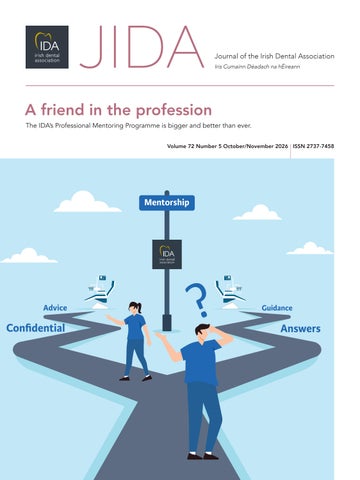
A friend in the profession The IDA’s Professional Mentoring Programme is bigger and better than ever. Volume 72 Number 5 October/November 2026 ISSN 2737-7458
FACT MOST INSURANCE COMPANIES ANSWER TO SHAREHOLDERS.*
WE ANSWER TO OUR MEMBERS
As a member-owned, not-for-profit medical indemnity organisation, our mission is supporting and protecting dental professionals – not delivering profits to shareholders. Unlike most insurance companies*, we are owned by our members and we exist to support, protect, and defend them when they need it most.
Get protection that puts you first
GET THE FACTS dentalprotection.orrg g Always there ffo or you *Non-mutual insurance companies only Dental Protection is a trading name of The Medical Protection Society Limited (“MPS”). MPS is a company limited by guarantee in England with company number 00036142 at Level 19, The Shard, 32 London Bridge Street, ge e of benefits of membership, which are all discretionary, y, and set out in MPS’s Memorandum and Articles of London, SE1 9SG. Dental Protection serves and supports the dental members of MPS with access to the full rang Association. MPS is not an insurance company y.. Dental Protection® is a registerre ed trademark of MPS. For inffo ormation on MPS’s use of your personal data and your rights, please see our Privacy Notice on the website. 2510016853:06/26
CONTENTS
Journal of the Irish Dental Association October/November 2026
Honorary Editor
Dr Cristiane da Mata
IDA President
Dr Bridget Harrington-Barry
IDA Chief Executive Fintan Hourihan Director of Advocacy Roisín Farrelly & Communications Journal Co-ordinator Liz Dodd liz@irishdentalassoc.ie Irish Dental Association Unit 2 Leopardstown Office Park, Sandyford, Dublin 18. T: +353 1 295 0072 F: +353 1 295 0092 www.dentist.ie
The Journal of the Irish Dental Association is the official publication of the Irish Dental
133 President’s news
Trust, togetherness and the road ahead
Association. The opinions expressed in the Journal are, however, those of the authors and cannot be construed as reflecting the
133 CEO’s message
Invest in the future of dentistry
Association’s views. The editor reserves the right to edit all copy submitted to the Journal. Publication of an advertisement or
135 IDA news
Progress on statutory CPD Upcoming IDA events
news item does not necessarily imply that the IDA agrees with or supports the claims
144 Feature – IDA uncovered A friend in the profession
146 Feature
The Irish voice in European dentistry
148 Risk management
Friendship matters in dentistry
therein. For advice to authors, please see: https://jida.scholasticahq.com/for-authors.
140 Commercial update The latest from dental suppliers
This Journal supports sustainable forestry/forest management and is printed using vegetable-
143 News feature
151 Classifieds 158 In the chair Dr Inez Duane
IADH Congress comes to Dublin
based environmentally friendly inks. Every mode of communication necessitates the consumption of energy and resources. It is crucial to consider the comprehensive effects throughout the lifecycle, including the production, storage, duplication, transmission, printing, and disposal of this Journal. These actions can potentially influence the economy, the environment,
The latest edition of JIDA Science is available free and exclusively to IDA members. In this edition: n Impact of initial correction of Class II division 1 malocclusion with a modified twin block appliance n Non-surgical peri-implantitis therapy: what now? n Chairside acrylic temporary crowns
82 83 84
100
Volume
SCIE NCE 2 Numb
er 5
Octo
ber/N
ath thy and the futu TO THE re of E EDI dental TOR
RESEAR Impact CH of initi with al c a mak modifie cor r e to d ttwin ection of
ovem
ber 2026
on
QUIZ CLINIC AL Non -surgicaFEATU TURE l perri-im O’Hag i plan an
Erin M. Ioann
titis
is Polyz ois
CLINIC ChairsidAL TIPS e acry Yong o Y ong F o licc ttem oo RESEAR CHE Title R
Resear cher
porary
therap
y: wha
t now
?
crown
PRO PR
s
FILE
and society. The path towards a sustainable future entails making prudent decisions in communication to ensure its viability for the wellbeing of all.
Th!nk
Media
Published on behalf of the IDA by Think Media, 537 NCR, Dublin 1. T: +353 1 856 1166 www.thinkmedia.ie Managing Editor Ann-Marie Hardiman ann-marie@thinkmedia.ie Editorial Caoimhe Coolican Advertising Paul O’Grady paul@thinkmedia.ie Design Rebecca Bohan, Tony Byrne
Follow us!
ISSN IS
3088-
6759
educati
the chil Caroline Cla bloc O’Dw ld k app ss II d and yer Decla n T. Millett parent liance: division 1 mal Mair wha ? ead Har occ usio t differ ding f enc lu Clair n e Laide e doe do s Micha it el Cronin
92 93 97
EDITOR IAL Evid ence, emp
LETTER
irish-dental-association Irish Dental Association irishdentalassociation irishdentalassociation
Volume 72 Number 5 | October/November 2026 | 131
Colgate® Duraphatt®, the on nly fluoride varnissh that carrie es the weight e of clinica al evidence* Colgate e® Duraphat® is the only y flu uoride varnish h licensed d forr caries co ontrol in the UK† • Fast and e easy application • Temporarry visual tint to aid app plication • Raspberry y flavour 22,60 0 ppm Fluoride
Protect yourr patients, patients yourr team and yourr dental practtitioners titioners’ prescribin es with Colgate® Duraphat® Fluoriide Varnish1-5 ng responsibilitie Adverse events should b be reported. Reporting forms and informa ation can be found at www.yellowcard.mh hra.gov.uk. Adverse events should also be e reported to Colgate-Palmolive (U.K.) by calling 00-800-321-321-32.
*For caries control. †Colgate® Duraphat® fluoride e varnish for patients 3 years of age and over. References: 1. Delivering better oral health - an evidence-based toolkit fo or prevention, Office for Health Improvement and Disparities’ 2021. 2. Marinho VCC, Worthington HV V, Walsh T, V, T, Clarkson JE. Fluoride varnishes for preventing dental caries in children and adolescents. Cochrane Database of o Systematic Reviews 2013. 3. The use of fluoride and.nhs.uk/long-read/supply-and-administration-of-medicines-by-dental-hygienists-and-dental-therapists/ 5. varnish by dental nurses to control caries. NHS. Primary Care Commissioning, 2009. 4. https://www.engla https://www.england.nhs.uk/commissioning/wp-- content/uploads/sites/12/2016/09/avoidance-doubt-v4-1.pdff.. Name of the medicinal product: Colgate® Duraphat® 50mg/ml Dental Suspension. Active ingredients: 1ml of suspension contains 50mg Sodium Fluoride equiv va alent to 22.6mg offFluo oride (22,600 ppm F-) Indications: For the prevention of caries in children and adults as part off a comprehe ensive control programme., desensitisation off hypersensitive tee eth. Dosage and administration: Recommended dosage for sing gle application: for milk teeth: up to 0.25ml (=5.65mg Fluoride), ), for mixed dentition: up p to 0.40ml (=9.04 Fluoride), ), for p permanent dentition: up p to 0.75ml (=16.95 Fluoride prophylaxis p y the application pp is usually y repeated p every y 6 months but more frequent q applications pp (every y3 e). For caries p months) may be made. For hypersensitivity, 2 or 3 ap pplications should be made within a few days. Contraindicationss: Hypersensitivity to colophony and/or any other constituents. Ulcerative gingivitis. Stomatiitis. Bronchial asthma. Special warnings and special precautionss forr use: Iff the whole dentition is being treated the application should not be carried out o on an empty stomach. On the day of application other high fluoride preparations such a fluoride gel should be avoided. Fluoride supplements should be ssuspended forr several days after applying Duraphat®. Interactio ons with other medicines: The presence observed in subjects with tendency to of alcohol in the Duraphat® formula should be conssidered. Undesirable effects: Oedematous swelling has been o e be removed from the mouth by brushing and rinsing. In ra are cases, asthma attackss may y occur in allergic reactions. The dental suspension layer can easily patients who have bronchial asthma. Legal classifica ation: POM. Product licence number: PL 00049/0042. Product liicence holder: Colgate-Palmolive (U.K.) VAT (10ml tube) Date off revision of text: June 2024. Limited, Goldsworth Place, 1 Forge End, Woking, Surrrey, GU21 6DB. Price: £22.70 excl VA
P R E SID ENT ’S NEWS
CE O ’ S ME S S A G E
Trust, togetherness and the Invest in the future road ahead of dentistry
Trust is one of the most important foundations of our profession: the trust we place in our colleagues; the trust our patients place in us; and, the trust that must exist between the profession and those responsible for developing and delivering health policy. That final relationship matters enormously. As a profession, we are willing to engage, to listen, to negotiate and to look for solutions. But when we enter discussions in good faith, we also need to know that good faith will be reciprocated. Oral health in Ireland is at a crossroads, and unfortunately, we have been travelling towards it along a very poorly maintained road. There are potholes everywhere, engraved with promises, commitments and assurances that have too oen failed to materialise. Yet, as professionals, we are not in the habit of making promises we cannot keep. That is part of what it means to be a professional. Our responsibility is to be honest about what can be delivered, to understand the limitations we face and, above all, to put the patient at the forefront of every treatment plan and decision we make. The same principles should apply to healthcare policy. The dental profession has been patient. We have engaged constructively with the Department of Health. We have brought forward proposals, highlighted the pressures facing dental services and, importantly, sought solutions rather than simply identifying problems. But the need for progress continues to remain urgent. Patients are waiting too long for care. Children are missing essential dental services. Public dental services are under pressure. General dental practitioners face significant challenges in delivering care. Hospital and special care services are dealing with growing demand. And successive strategies and plans have failed to deliver the transformation that patients and professionals were promised. The answer is not just to create short-term solutions that appear attractive because they address an immediate problem while ignoring the underlying structural failures. We need a properly resourced oral health service. We need realistic workforce planning. We need sustainable models of care. We need appropriate investment in prevention. We need to address access for children and vulnerable patients. And we need to make sure that the professionals delivering these services are properly supported and appropriately remunerated. These are not unreasonable demands. They are the foundations of a functioning oral healthcare system. If we are being asked to find solutions together, then there must be transparency, openness, and mutual respect. There must also be a shared determination to turn commitments into action. The road ahead will not be easy. But perhaps the first step is to stop repairing individual potholes and start rebuilding the road. And we will only do that if we do it together.
The coming months will be among the most important for dentistry in Ireland in a generation. Discussions between the IDA and the Department of Health/HSE on the Minister’s new oral health action plan have the potential to shape how dental care is delivered, funded and accessed for years to come. At moments like these, one truth is clear: a strong profession requires a strong representative body. Dentistry is facing significant challenges. Workforce shortages, increasing costs, changing patient expectations, regulatory burdens, and difficulties within publicly funded schemes all place growing pressures on practices and practitioners. At the same time, there is widespread recognition that Ireland’s oral health system requires reform. The negotiations and discussions that lie ahead represent an opportunity to influence the future direction of oral healthcare. However, opportunities alone do not create change. Change is achieved through informed advocacy, constructive engagement, and the collective strength that comes from representing the vast majority of dentists. Government listens most carefully when an organisation can demonstrate that it speaks on behalf of a united profession. Every member strengthens the legitimacy and influence of the Association’s position. It is worth remembering that many of the advances secured for the profession over the years were achieved not by individuals, but by dentists working together through the IDA. Whether engaging with Government, responding to legislative proposals, addressing regulatory issues or defending professional interests, the IDA has consistently provided a platform through which the profession can be heard. Membership is not simply about accessing services or benefits. It is an investment in the future of dentistry. It enables the Association to gather evidence, commission expert advice, engage with policymakers, and ensure that the realities of practice are understood by decision-makers. It allows us to bring the experiences of dentists from every part of the country directly into discussions that affect the profession. The period ahead will require ambition, persistence and unity. Reform processes are rarely straightforward. They involve difficult conversations, competing priorities and long-term commitment. The IDA is committed to engaging constructively to achieve meaningful improvements for patients and practitioners. I encourage every dentist to reflect on the value of professional solidarity. The stronger our membership, the stronger our voice. The stronger our voice, the greater our ability to influence decisions that will shape the future of dentistry in Ireland. If you’re not a member, then please contact Molly at molly@irishdentalassoc.ie and she will sort your membership immediately.
Dr Bridget Harrington-Barry IDA President
Fintan Hourihan IDA CEO
Volume 72 Number 5 | October/November 2026 | 133
MORE INFO ABOUT PRETTAU ® 3 DISPERSIVE ®
r.zirkonzahn.com/2f7
Dr. med. dent. David McReynolds – Dublin Dental University Hospital, Ireland MDT Alexander Lichtmannegger – Enrico Steger Laboratory, South Tyrol, Italy
IN CO
LLAB
ORAT WITH ION D UNIVE UBLIN DEN RSITY T HOSP AL ITAL
PRETTAU® 3 DISPERSIVE® COMPLETE RESTORATION OF UPPER AND LOWER JAW WITH ZIRCONIA SINGLE CROWNS -
Digital articulation with the PlaneFinder®/.-/,+*/).('&-%$+-#"&!. /*(/ & , $(*
-
* . -/& /$/ .- . $ / .!*/.-/).('&-%$+-#"&!. /*(/ &(/ .- . * ,& / .-. $ /.- $ . */,$- *-,.$ / (* $($,.&-/ /,+*/!*-,. ,
-
$ (. $,.&-/& /$/,* &($( /(* ,&($,.&-/ $!*/& / * / (* . / * . */(* .-/ &(/,+*/ /-$ / +* '/& /& .&-/$-!/,&/$ * / ,+*/$* ,+*,.
-
(&! ,.&-/& /,+*/ / .- */ (& - /.-/ (*,,$ ®/ / . *( . *®/%.( &-.$/ .- /,+*/-* /" / * * '& *(/ $-'/ +$- *(/ . .- / -.,#/ .-$ . $,.&-/ /$ .- / & & (/ . .!/ (*,,$ ®/ $(* / -,*- . * / / ,$.- / / / -(. &/ ,* *(/$-!/ (* &/ *($ .
Zirkonzahn Worldwide – T +39 0474 066 680 – info@zirkonzahn.com – www.zirkonzahn.com
NE W S
Progress on Bill introducing statutory CPD for dentists The Irish Dental Association has welcomed the Government’s approval of the General Scheme of the Dentists (Amendment) Bill, a significant step towards placing continuing professional development (CPD) on a statutory footing for dentists in Ireland. The proposed legislation marks an important development in the regulation of the dental profession and reflects a longstanding commitment to ensuring that dentists maintain and update their knowledge and skills throughout their careers. Once enacted, the legislation will provide a formal legal framework for CPD requirements, bringing dentistry into line with other regulated healthcare professions where mandatory CPD is already established. The IDA has consistently advocated for the introduction of statutory CPD and has engaged extensively with policymakers and stakeholders throughout the development of these proposals. Central to the Association’s position has been the need for any new framework to be practical, proportionate, and supportive of dentists in meeting their professional obligations, while recognising the realities of modern dental practice. The Government has stated that the proposed measures are intended to strengthen patient safety and quality of care, while helping to maintain public confidence in the dental profession. The introduction of statutory CPD is also expected to support ongoing professional competence and ensure
that dental practitioners can continue to respond effectively to developments in clinical practice, technology and patient expectations. The approval of the General Scheme represents an important milestone in the legislative process. The Bill will now proceed through the various stages of scrutiny and debate in the Oireachtas before becoming law. The IDA will continue to actively engage with Government, officials and other stakeholders as the legislation progresses, ensuring that the interests of dentists and their patients remain at the forefront of discussions. The Association remains committed to supporting members through any changes arising from the introduction of a statutory CPD framework and will provide updates as further details emerge.
HSE members voting on pay talks and restructuring
SAVE THE DATE
HSE-employed dentists have been balloted by the Irish Dental Association on a range of issues relating to pay, local bargaining claims, terms and conditions of employment, and the HSE’s ongoing restructuring programme. The ballot follows a decision by the IDA’s HSE Committee to seek members’ views on the growing challenges facing dentists working within the public dental service. The ballot seeks members’ support for possible industrial action aimed at securing acceptable pay increases, achieving a full and satisfactory outcome to outstanding local bargaining claims, and protecting existing terms and conditions of employment. A key concern for HSE dentists is the prospect of changes being introduced without agreement, contrary to established industrial relations procedures. The HSE Committee has highlighted concerns that unilateral decision-making risks undermining meaningful consultation and engagement with staff representatives. Members were also asked whether they would be prepared to take industrial action in response to changes arising from the HSE’s restructuring programme where such changes are implemented without agreement. The outcome of the ballot will provide the Committee with an important mandate and will help to determine the Association’s next steps.
Volume 72 Number 5 | October/November 2026 | 135
NEW S
IDA EVENTS AND CPD The IDA is delighted to bring the following CPD/educational events to members in the coming months. We look forward to seeing you there.
OCTOBER
NOVEMBER
DECEMBER
October 8-9 HSE Dental Surgeons Annual Seminar, Athlone
November 6 Dental Nurses Training Day, Dublin
December 9 IDA webinar, 8.00pm
November 7 Hands-on injection moulding course with Dr Micheál Healy, Kerry
October 9 BLS course, Dublin October 10 ILS course, Dublin October 16 South East meeting, Waterford October 17 Hands-on endodontics course with Dr Roberto Careddu, Dublin
2027 April 22-24 IDA Annual Conference, Galway
November 13 Domestic abuse certificate, Dublin November 21 Colgate Caring Dentist Awards November 25 IDA webinar, 8.00pm
To book any of these events, go to www.dentist.ie and click on ‘BOOK CPD’.
October 28 IDA webinar, 8.00pm
Latest HSE PCRS
Colgate Caring Dentist Awards 2026
report shows slight rise in dental activity The 2025 HSE Primary Care Reimbursement Service (PCRS) Annual Report showed that expenditure on the Dental Treatment Services Scheme (DTSS) reached €69.94m, a modest increase on 2024 (€69.37m), with services provided by 965 dentists participating in the Scheme. A total of 307,252 medical card patients received dental treatment under the Scheme in 2025. Dentists carried out 1,018,482 routine (“Above the Line”) treatments and 39,276 advanced (“Below the Line”) treatments, representing growth in patient access and activity compared with 2024. Oral examinations were the most frequently claimed routine treatment, while prosthetic services and periodontal treatments were the most common advanced procedures.
136 | Volume 72 Number 5 | October/November 2026
The countdown is on to the Colgate Caring Dentist and Dental Team Awards 2026, taking place on November 21 at the InterContinental Hotel, Dublin, and bringing together the very best of Irish dentistry to recognise and honour exceptional achievements. Join colleagues and friends from across the dental profession for a memorable evening celebrating excellence, dedication, and outstanding patient care. The awards night promises to be a highlight of the dental calendar, with renowned broadcaster and television presenter Kathryn Thomas making her debut as MC. Mark your diary and join us for a night of celebration.
NE W S
Are you receiving IDA Update? If you are not receiving your regular IDA Update for members, please contact roisin@irishdentalassoc.ie.
HSE Seminar 2026
Help us grow the IDA community
The HSE Dental Surgeons Annual Seminar returns to the Radisson Blu, Athlone, on October 8-9. This year’s fantastic programme includes a presentation on Scotland’s Childsmile programme from Prof. Peter Mossey, as well as presentations on reducing oral health inequalities, cle lip and palate care, treatment planning, and much more. In addition to the lectures, Friday aernoon will once again feature fantastic hands-on workshops. There will be opportunities to meet dental suppliers, and of course to catch up with old friends and meet new ones! Don’t miss it – BOOK TODAY.
Do you work alongside colleagues who aren’t currently members of the Irish Dental Association? They could be missing out on valuable savings, exclusive member discounts, reduced CPD rates, special offers, and a wide range of professional supports and benefits. We’re asking our members to help spread the word and encourage colleagues to discover what IDA membership can offer them. Every new member helps to strengthen the Association, and ensures that we can continue to represent and support dentists across Ireland. If you know someone who may be interested in joining, please encourage them to contact Molly Conroy, Membership Manager, at molly@irishdentalassoc.ie for further information.
Dental hygienists now eligible for employment permits Dental hygienists have been removed from the Ineligible Occupations List and are now eligible to apply for employment permits. This welcome change represents an important step towards addressing workforce shortages within the dental profession and supporting dental practices facing ongoing recruitment challenges. For a number of years, the Irish Dental Association has highlighted the difficulties practices experience in recruiting and retaining suitably qualified team members. Workforce shortages continue to place significant pressure on dental services, impacting practice capacity and, ultimately, patient access to care. The inclusion of dental hygienists within the employment permit system provides practices with an additional avenue to recruit qualified professionals and strengthen their clinical teams. The change follows sustained engagement by the IDA, which has consistently advocated for measures to address staffing shortages and support the long-term sustainability of dental services. While this development is a positive step, further action is required to tackle workforce challenges across the sector. The IDA will continue to advocate for the removal of dental nurses from the Ineligible Occupations List and for the inclusion of dentists on the Critical Skills Occupations
List. Both measures remain key priorities for the Association and are essential to ensuring that dental practices can recruit the skilled professionals needed to meet growing patient demand. Separately, a new Higher Certificate in Dental Nursing Apprenticeship, being developed in partnership with the Education and Training Boards (ETBs), was due to commence in September. The programme is expected to provide an additional pathway into the profession and contribute to building the future dental workforce. The IDA is currently preparing a submission on the statutory order under which the new apprenticeship scheme will be introduced. The Association will continue to engage with policymakers and stakeholders to ensure that meaningful workforce solutions are implemented, supporting both the dental profession and the patients who rely on timely access to high-quality oral healthcare.
Volume 72 Number 5 | October/November 2026 | 137
NEW S
HSE and public sector dentists: now is
Dental Nurses Training
a great time to join the IDA!
Day 2026
What is career support, professional representation and peace of mind worth to you? For HSE and public sector dentists, IDA membership is now available at a reduced rate of €565 per year. That breaks down to just: €47 per month Around €12 per week Roughly the price of two coffees For that, you’re not simply joining a professional association. You’re gaining access to support when you need it, expert guidance, professional resources, CPD savings, representation, and a stronger collective voice for dentists working in the public sector. Whether you need advice on a workplace issue, support at an important point in your career, or simply the reassurance of knowing that there is an organisation representing your interests, IDA membership is there to support you throughout your professional life. For around the price of two coffees a week, invest in your career, your profession and your peace of mind. Join the Irish Dental Association today. Visit dentist.ie or contact Molly Conroy, Membership Manager, to find out more.
CPD VERIFIABLE
Investing in continuing professional development (CPD) is essential for every member of the dental team, helping to maintain professional standards, enhance patient care, and keep up to date with the latest developments in dental practice. The Dental Nurses Training Day 2026 offers an excellent opportunity for dental nurses to gain valuable knowledge, develop practical skills, and network with colleagues from across the profession. Taking place on Friday, November 6, at the Radisson Hotel Golden Lane, Dublin 8, the programme features a full day of expert-led presentations and interactive workshops tailored specifically for dental nurses. Topics include oral radiology, patient records, social media, communication skills, infection control, equipment maintenance, and compliance in practice. With opportunities to engage with industry suppliers, share experiences with peers, and participate in hands-on workshops, this CPD event is not to be missed. Places are limited, so early booking is advised. To book, visit www.dentist.ie.
Essential training for every dental team Learn how to recognise and respond to domestic abuse and coercive control with this accredited online course delivered by Women’s Aid Ireland in partnership with the IDA. A valuable opportunity to strengthen your knowledge, support vulnerable patients, and enhance your professional practice. Friday, November 13, 2026 (online) Open to IDA members and their teams.
138 | Volume 72 Number 5 | October/November 2026
NEW Bright. Bold. BRILLIANT. BRILLIANT EverGlow universal composite now available in the new Xtra Bleach Shade.
SCAN TO ENQUIRE
C O MMERCIAL UPDATE
Confident sealing from Coltene According to Coltene, its CanalPro CalciSeal takes obturation to the next level. The calcium silicate-based bioceramic sealer is designed for modern root canal treatment, and the company states that it supports efficient and reliable obturation. Built for long-lasting sealing, according to Coltene, CanalPro CalciSeal offers excellent biocompatibility and sealing performance. The company states
that these features make it an ideal choice for clinicians seeking consistent results. CanalPro CalciSeal is part of Coltene’s wider root canal sealer range that includes ROEKO GuttaFlow bioseal, which the company calls a proven two-in-one cold filling system whose bioceramic components help to support regeneration by optimising pH within the root canal.
A triple gradient of natural colour
New savings scheme uncertainty
According to Zirkonzahn, its Prettau® Dispersive® zirconia materials are characterised by a smooth, natural colour gradient thanks to a manufacturing technique that does not blend colours into layers but disperses them evenly. The company has developed its Gradual-Triplex Technology for the new Prettau® 3 Dispersive® zirconia, which it states results in a highly translucent incisal edge and an extremely high flexural strength at the tooth neck. As a result, the materials can be used for all kinds of zirconia restorations, according to Zirkonzahn.
Budget 2027 will announce details of Ireland’s proposed personal investment account, designed to encourage some of the €170 billion held on deposit to move into productive, longer-term investments. A key feature will be simpler taxation, but important details remain unclear: the tax-free allowance, contribution ceiling, applicable tax rate, range of investments, and treatment of withdrawals and losses. According to Moore Wealth Management, the proposal could give savers an accessible alternative to deposits. However, the company advises that any surplus cash should first repay high-interest debt and overpay mortgages, which it says carry guaranteed returns. If pension contributions are maximised, the new account will hopefully be a good home for available savings, according to Moore Wealth Management.
!# ! $#*
%
+ #* + %*%' + ) + (!% !!+ #- #!' #- + ) + #,) + + + - #
.-,+*)('&+%*$#"'!+ -,'&% + -)*+ #'% +')+! $% +")* )-'# ,+'&-)( &+'& + +$ + + - !&+,)(-+*)('& +, + % &' + %) '-#+$-) ("'!+& $+&, -#' +!))'& +$-)' "' +# + & '& -+(! + (-% +'& + #,+)-+#'+ % &'
%'&+ %) '-#+.-, )('&+ -# +
%'&+ %) '-#+ )('&+ $-#,
140 | Volume 72 Number 5 | October/November 2026
%'&+ %) '-#+ % ))'&$#!'
%'&+ %) '-#+ '-# % + )('&-% !
BIT TE DOWN W 1 ON DE ENTAL PAIN AN
DUAL ACT PAIN RELI LI GETS TO
WORK
FAS AST
†
80% % MORE
PAIN A RELIEF 1*
References: 1. Danie iels et al, Maaxigesic® 325 Acute Dent se of standardparaceetamol alone. †Faster onset of action than standard Ibuprofeen alone. Easolief DUO 500 ('&%$#"('"! ( " "Each tablet contains parac White, capsule shhaped tablet with breakline on one side and plain on o the other her side. Short-term symptomatic treatment oof mild to moderate pain. ' " one to two tablets taken every six hours up to a maximum of six tablets in 24 hours. Easolief DUO is contraindicated in children under 18 years. Severe heart fa ity to paracetamol, ibuprofen, other NSAIDs or to any of the excipients, active alcoholism, assthm hma, urticaria, or allergic-type reactions after taking acetylsalicylic ac acid cid or o other NSAIDs NSAIDs, history of gas gast ng or perforation related to previous NSAID therapy, aapy active or history of recurrent peptic ulceratio ation/haemorrhage o , severe hepatic failure or severe renal failure, cerebrovasc scuular or other active bleeding, blood-formation disturbances, during the third trimester of pregnancyy. ' " " This medicinee is forr short term use and is not recommended for use beyond 3 days. Clinical stu tuuudies suggest that use of ibuprofe , particularly att a high dose may be associated with a small increeased risk of arterial thrombotic events. Patie at nts with w uncontrolled hypertension, congestive heart failure, established ischaemic m heart disease, peripheral arterial disease andd/or cerebrovascular disease should only be treate a d with ibuprofen after careful consid nsideration annd high doses should be avoided. Careful consideration should be exerciseed bef efore initiating long-term treatment of patientss with risk factors for cardiovascular events. The use of paracetamol at higher than an recommended doses can lead to hepatotoxicity, hepatic failure and death. Patients with impaire i red liver function or a history of liver diseasse or who are on long term ibuprofen or paracetamol therapy should have heepa patic function moniitored at regular intervals. Severe hepatic reactions, including jaundice andd cases of fatal hepatitis, though rare, have been reported with ibuprofen. Paracetamol can be useed in patients with chronic ic renal disease without dosage d adjustment. There is minimal risk &%$#"!" " & $ & $ $#" $ $ & !" $ &$ ! $! " $%" ! $ " & $ & $ $ $ $ " $ ! " $ $ #!&% $ $#" $ $ !" & $ $ $&%$" $ $ $ ! $" $" " " &! $ drug and thiazide diuretic at the same s time inc ncreases the risk of renal impairmentt. Blood dyscrasias have been rarely reported. Pattients on long-term m ttherapy with ibuprofen shouldd have regular haematological monitoring. Like other NSAIDs, ibuprofen cann inhibit plateleet aggregation. GI bleeding, ulceratiion or perforation, which can be fatal, has been reeported withh all NSAIDs at anytime during treatm ment. Combination therapy with protective agents (e.g. misoprostol or proton o pump inhibitors) ors should be considered. Use with concomitant NSAIDs including cyclooxygenase-2 selective tive inhibitors should be avoided. NSAID Ds may lead to onset of new hypertension or worsening of pre-existing hypeertension and patieents taking antihypertensive medicines with NSAIDs may have an impaired anti--hypertensive response. Fluid retention and oedema have been observed in some patients taking NSAIDs. NSAIDs may veryy rarely cause serious us cutaneous adverse eventss such as exfoliative dermatitis, toxic epidermal ne necr c olysis and Stevens-Johnson syndrome. Acutte generalised exanthematous pustulosis (AGEP) has been reported in relaation to ibuprofen-conta taining products. Products containing ibuprofen should not be administered to patients with acetylsalicylic acid sensitive asthma and should be used with caution in patients with pre-existing asthmaa. Adverse ophthalmologic gical effects have been obbserved with NSAIDs. For products containing ning ibuuprofen aseptic meningitis has been reported only rarely. NSAIDs may mask symptoms of % & $" $% ! $ $&! !$ &$" & $ " ! " & $&%$ " $&!$" ! " $ % $#" $ &$ " $ $& $#!& & $ &! & !& $ !"# $ & $ " $ !$ !"# $ "# ! $ & $!" !$ " $ & $" ! # $ when products containing ibuprofen are added to the treatment program. Cases of high anion gap metabolic acidosis (HAGM A A) havee been reported in patients with severe illness or malnutrition m or other sources of glutathione $ &$ ! $ ! " $ $#"!" " & $%&!$"$#!& & $# ! & $&!$"$ & " & $&%$#"!" " & $" $ & " $ %$ $ $ &$# !& " $" & $ $ # $#!& # $ & " & $&%$#"!" " & $" $ & $ moniti oring i is i recommende d d. d Warfarin, f i medicine di i s to treat epile il psy, chhlor hl amphe h nicol, i l probe b necid, idd, zido ziidd vudine di , medicine di i es used to treat tube b rculosis l i suchh as isoniazid, i i id aceetylsalicylic l li li acid, id othe h r NSAIDs, NSAID medicine di i s &$ ! " $ $ && $#! ! $&!$& !$ "! $ & & $ ! $ $ & ! " $ &! & !& $ & " $ " ' " " Easolief DUO D is contraindicated during the thirdd trimester of pregnancy. '" " " "( Dizzineess ss, drowsiness, fatigue and visual v disturbances are possible after taking NSAIDs. If affected patients should not drivve or operate machinery. " " $ " " $ ! & $ $& " $ $! & $" & " $#" $ "!! & " $ # # " $ " " $ & " $ & %&! $ & $ " $ & #" & $ $ " !& " $ && $ & $ !" $ #! ! $ " " $ " & !" % !" $ ! " $ " " " !" % !" $ ! " $ " &! " $ liver function ttests, blood creatinine increased and bloodd uurea increased. d. Re R fer to Summary of Product Characteeristics for other adverse effects. Adverse reactioons should be reported via HPRA Pharmacovigilance, website: www.hpra.ie. Pack size s e: 24 tab tablets. '" " : Cloonmel Healthcare Ltd. Marketing authorisation nuumber: PA0126/294/1. Product not suubject to medical prescription. Supply through ph phaarm armacies only. Date last revised: April 2025. Date Prepared: January 2026 0126/ADV/EAS/017H
CE
IFIED RT
N E W S FE AT U R E
IADH Congress comes to Dublin Some 700 dentists from across the globe attended IADH Congress 2026 in Trinity College Dublin. Seven hundred special care dentists from across the globe gathered in Trinity College Dublin in August for the International Association for Disability and Oral Health (IADH) Congress 2026. Hosted by the Irish Society for Disability and Oral Health (ISDH), the Congress theme was ‘Inclusion Health: Prioritizing, Diversity, Equity and Oral Health’. Over four days, the Congress included keynote addresses from leading figures in inclusive healthcare, seminars, symposia and workshops, as well as poster presentations, oral presentations and a slam competition, all with the aim of increasing inclusion and improving the oral health of persons with disabilities and those experiencing social exclusion. In her keynote address, Prof. Clíona Ní Cheallaigh discussed the causes and impact of social exclusion, and described her work in the Inclusion Health Service at St James’s Hospital in Dublin. She said that poor dental health is a very strong marker of social exclusion, and emphasised the importance of a holistic approach to healthcare, including oral health, for individuals experiencing poverty, homelessness and all forms of social exclusion. The Congress also saw the launch of two significant documents relating to disability and oral health. At a seminar chaired by Chief Dental Officer Dr Dympna Kavanagh, Dr Mélanie Gréaux introduced the World Health Organization’s (WHO) ‘Oral health equity for persons with disabilities: a policy brief’. This document is
the result of a major collaboration between the WHO’s oral health and disability health teams, and aims to address the inequities and structural barriers faced by persons with disabilities in accessing oral care. Dr Denise Faulks introduced the WHO International Classification of Functioning (ICF) Core Sets in Oral Health. The culmination of two decades of work, Dr Faulks said that the Core Sets will provide a validated, holistic tool to measure not just oral disease, but its impact on day-to-day functions such as smiling and chewing. She said that the Core Sets would also facilitate the collection of inclusive epidemiological data, the development of standardised outcome measures, and the identification of common risk factors. Keynote addresses at the Congress also included lectures by Prof. Caoimhin Mac Giolla Phadraig on ‘Making Clinical Decisions When Outcomes Are Uncertain in Special Care Dentistry’, Dr Mary Doherty on ‘Autism within the Healthcare Profession’, Prof. Sarah Baker on ‘Re-imagining Inclusive Research to Close the Oral Health Equity Gap’, and Prof. Murali Srinivasan on ‘Digital Dentistry and Special Care Dentistry’. A range of seminars covered topics from obesity and oral health, palliative care, and inclusive sedation in special care dentistry, to dental outreach programmes, behavioural support, and ageing and nutrition. Young and more experienced researchers also had the opportunity to present their research in oral and poster presentations throughout the Congress.
Pictured at the launch of the WHO’s ‘Oral health equity for persons with disabilities: a policy brief’ were (from left): Fintan Hourihan, IDA CEO; Prof. Alison Dougall, Dean of Dental Affairs and Head of School, Dublin Dental University Hospital; Dr Gillian Smith, ISDH President; and, Dr Bridget Harrington-Barry, IDA President.
Pictured at the IADH Congress in Dublin were: back row (from left): Dr Neil Martin and Dr Gregory Antonarakis. Front row (from left): Dr Mohd Isyrafuddin Bin Ismail; Dr Magy Hany Boules; Dr Noella Ferreiro Reboredo; Dr Naomi Murray; Dr Maryam AlZayer; Dr Åsa Mogren; and, Dr Sebastián Véliz.
Volume 72 Number 5 | October/November 2026 | 143
F EATURE – ID A UNCO VERED
NEW SERIES
IDA UNCOVERED
A friend in the profession The IDA’s Professional Mentoring Programme has been supporting members for over a decade, and now offers access to more expert mentors than ever before. Ann-Marie Hardiman Managing Editor at Think Media Ltd.
Ten years ago, in response to member demand, the Irish Dental Association (IDA) set up its Professional Mentoring Programme to offer free, practical, informal and confidential support to members. Over the years, many dentists have benefited from the Programme, and now, with an expanded pool of mentors to draw from, it’s better than ever.
Direct access to support The scheme is administered by IDA CEO Fintan Hourihan, and dentists who are IDA members can email mentor@irishdentalassoc.ie or contact Fintan directly to access it. Fintan explains what happens when a dentist gets in touch: “I ask them to explain what it is they are interested in speaking to a mentor about. Then there is a short form, which we ask them to complete in writing. We feel it’s important for the dentist to give some considered thought to precisely what they’re looking for, but equally, it helps us match them with an appropriate mentor”. Potential mentees are supplied with a booklet containing anonymised profiles of the mentors. The IDA’s panel of mentors now includes more than 20 dentists, with 12 new mentors recently recruited to offer the widest possible range of experience (see panel). There’s also an IDA guide to the Programme, which explains exactly what’s involved. Once you’ve selected the mentor you’d like to work with, Fintan will contact them, and if they are available, he will connect mentor and mentee.
Why seek a mentor? Dentistry has changed enormously, and so have the issues that might drive a dentist to seek a mentor, as Fintan explains: “In the initial years, it was very much younger dentists in the first 10 years of their career who sought out the service. More recently, we’ve noticed an increase in contacts from dentists who trained overseas. We are delighted to now have mentors who trained in central Europe, South America, Britain, Australia and New Zealand before moving to practice in Ireland”. He offers an example of why this support is increasingly important: “I was particularly
144 | Volume 72 Number 5 | October/November 2026
struck by a recent conversation with a dentist, who told me: ‘I arrived in Ireland from a country where every dentist has to be registered with the Dental Chamber and has their registration number, so probably a bit naively, I assumed the rest of the dental world worked in a similar way. I didn’t realise that the Dental Council and the IDA had very different roles, and at the beginning I had absolutely no idea that the IDA existed. I was very lucky to meet some great dentists here who helped me find my way, and encouraged me to join the IDA and attend local branch meetings. The professional support has been very useful, but for me the social side was just as important – getting to know local dentists and having colleagues I could ask for advice. I’m genuinely very grateful for all the help I’ve received over the years from dentists and from the IDA in general. I also remember feeling a bit embarrassed asking very basic questions. Things that are obvious if you trained and worked in Ireland were all new to me, and sometimes you don’t even know what you should be asking’”. Another emerging trend is practice owners who have decided to sell their practice, but remain on site as an associate. “That’s a very new phenomenon,” says Fintan. “And there’s no established pathway or easy way of navigating that. Again, we have in our panel of mentors long-serving dentists, who ran their own practice, sold their practice, but remained on as an associate”. The older issues haven’t gone away, and younger dentists still contact the scheme: “What we hear regularly from young dentists is that nothing prepares you for your first time in practice. They may have great clinical proficiency, but they don’t have experience of the everyday aspects to being a practising dentist”. The Mentoring Programme is only one of a suite of benefits that the IDA offers to support dentists. The Association runs regular webinars on all aspects of dentistry, both clinical and business related, and the ‘Starting Dentistry in Ireland’ publication contains all the information you need to get started as a dentist here. Advocacy also has a role
FE ATU R E – I DA U N CO V E R E D
Profile of our mentors Practice owners/partners
13
Associates
4
General practitioners
11
Specialists
5
HSE
3
Academic
1
Overseas trained
4
Dublin based
5
Rest of Leinster
3
Connacht/Ulster
3
Munster
6
to play, and the IDA has long argued for the re-establishment of a vocational training scheme for dentists. Fintan says they’re also looking at establishing onboarding schemes for dentists coming into the country from abroad.
finding it quite difficult. She was wondering what it would be like to move into a much bigger, multi-dentist, multi-surgery environment. We talked through what that transition might look like, and she subsequently joined one of the corporates and is very happy there”. Sometimes the conversations aren’t really about dentistry at all: “I’ve had mentees who have simply needed somebody to talk to – almost a friend in the profession. I think that’s probably one of the most important parts of mentoring. Dentistry can be a surprisingly lonely profession, and I think there’s sometimes an insecurity about reaching out because you feel that asking for help somehow means that you’re not coping or you’re not good enough. That’s really where mentoring comes into its own. It’s not necessarily about having all the answers. It’s about having somebody you can pick up the phone to, who understands the profession and understands some of the pressures that come with it. Sometimes, just knowing that you’re not alone makes a huge difference”. If you are an IDA member, you can contact the IDA today to access the scheme, and if you’re not, then please think about joining, and you will receive immediate access to the scheme, and to all the other benefits of membership. *Dentists’ names have been changed to maintain the anonymity of the Programme.
Reaching out Elizabeth* is a general dentist who has a special interest in orthodontics and has experience of setting up several practices over the years, both general and specialist. She says the questions she gets from mentees are varied: “A lot of them are about general practice – how to set up a practice, whether to stay on your own or join a larger practice, how to manage people, and what different career paths might look like. I remember one mentee who was working on her own in a single practice and was
h
r@ iris
tm
John* is a general dental practitioner who set up his own practice with a colleague a number of years ago. He’s been involved in the Mentoring Programme since its inception, and has mentored several dentists during that time, most of whom wanted to explore that process: “The people I’ve mentored have all been centred around the business of dentistry. It’s such a shame that undergraduate students don’t get even a module on how to run a business, how to do a set of accounts or file a tax return. That’s where I think the mentoring service is great. It fills that void”. Once he has been linked with a mentee, John arranges to meet in a neutral location for a coffee and a chat: “I’ll tell them a bit about myself and I’ll find out a bit about them. I think in a relaxed informal setting, they tend to open up a little bit more. They’ll explain their problem, and then lots of times you’ll maybe solve the problem there and then. Other times we might need to come back and look at it again”. John says that he might offer to visit the mentee in their practice, or invite them to his, as it can help to see exactly what the practical issues are. He’s happy to offer that practical advice, but says that oen what’s needed is a sounding board, an opportunity to talk through their ideas: “A lot of the time the mentees already know the answers, but maybe they just need a little bit of reassurance, in a non-threatening and nonjudgemental way”. He’s thoroughly enjoyed the experience: “Dentistry is a stressful job, and sometimes it’s lovely, when you go out and talk to another dentist and you realise, well, they’re having the same problems I’m having. It’s lovely to see somebody who came to you with a problem initially and then you’ve managed to help them solve their problem. There’s a lot of satisfaction in that”. “If you’re thinking of availing of the service as a mentee, I would say absolutely don’t think twice about it. Pick up the phone. It’s invaluable”.
d
n
ou Email de mentor@irishdentalassoc.ie
Pick up the phone
to find out more Stay connected Catherine* sought support from the Mentoring Programme when she was trying to figure out whether to take over a dental practice from a family member who was retiring: “The practice had really suffered during the recession, but I was determined – I wanted to be the one making the decisions. I had worked in industry before so had more business knowledge than most dentists, but there was lots I didn’t know. My mentor let me see their business plan, which they’d used to apply for finance. I didn’t think a bank would lend me money but my mentor reassured me that they would, and that made a massive difference. Getting that financing helped me to buy and completely renovate the practice”. Catherine says her mentor had lots of practical advice on the renovations too: “I had a plan on how I wanted to do things, but my mentor made suggestions that saved me money, and were also much better in terms of the workflow of the surgeries. Having someone to sound things off was really good – my mentor was very calm and helpful, and it was lovely to have someone who’d been in the same boat. I think dentists should have as many mentors as possible, for clinical issues, business, and life. It’s really important to stay connected”.
Volume 72 Number 5 | October/November 2026 | 145
F EATURE
The Irish voice in European dentistry The IDA has been active on the European stage for over 50 years. A recent publication from the Council of European Dentists exemplifies this international collaboration.
Pictured at the May 2025 CED General Meeting in Poland are (from left): Dr Kieran O’Connor; Fintan Hourihan, IDA CEO; Dr Michaela Dalton; and, Dr Robin Foyle.
Caoimhe Coolican Copy editor/journalist at Think Media Ltd.
About the CED The Council of European Dentists (CED) was established in 1961 (originally known as the EU Dental Liaison Committee) to advise the European Commission on matters relating to dentistry. It is the representative organisation for the dental profession in the EU, and is composed of national dental associations from 30 European countries, representing over 350,000 practising professionals. This not-for-profit association, with an office in Brussels, promotes the interests of the profession and patients through policy papers and lobbying the EU Commission on regulations concerning dentistry. The CED deals with a broad range of topics, such as education and professional qualifications, e-health, patient safety, medical device regulation, oral health policy and corporate dentistry. On all of these subjects, the CED issues statements and dra amendments to proposed EU legislation in order to ensure that the views of European dentists are reflected in decisions affecting them, and to promote high standards of dental care and education. Other activities include meeting with MEPs who have an influence on health policy to advocate for the profession, providing expertise to EU institutions on health and consumer protection and dental education, and co-operating with other allied professions.
Irish influence The Irish Dental Association (IDA) is one of the national dental associations that form the membership of the CED. Ireland has been involved with the CED since accession to the European Economic Community (EEC) in 1973. One of the many Irish representatives to have acted in this time is Dr Tom Feeney, a Board Member and Treasurer for many years who also managed the CED’s transition to an independent, fully staffed office. Drs Michaela Dalton, Robin Foyle and Kieran O’Connor are current IDA representatives at the CED. Dr Robin Foyle has represented Ireland at the CED since 2007, and is now in his second three-year term on its Board. IDA CEO Fintan Hourihan also attends CED meetings.
146 | Volume 72 Number 5 | October/November 2026
Drs Michaela Dalton and Kieran O’Connor are both members of the CED Oral Health Working Group. There are five active CED Working Groups, which are composed of dentists who are experts on specific issues and are tasked with draing CED policy. The Oral Health Working Group monitors national laws and EU Regulations and Directives, and prepares CED policy in areas related to oral health. Its recent work includes resolutions on sugar consumption, tobacco and antimicrobial resistance. Dr Kieran O’Connor feels it’s important for IDA members to know that the Association is represented at the European level through the CED: “We’re there, we contribute, and it is so important for us to have international representation because our voice is very strong. We’re a small country, but our voice is heard”. He believes that Ireland punches above its weight in terms of influence at the CED: “We are engaged people. Our standard of dental education is good. I think we enjoy being part of a collective – we value being at the centre of Europe. If you look across the EU level, we have become significant players”.
“We are engaged people. Our standard of dental education is good. I think we enjoy being part of a collective – we value being at the centre of Europe.” White Paper on Ageing and Oral Health One of the CED’s aims is to promote oral and dental health across the life course. As part of this effort, the CED General Meeting in November 2024 directed the Oral Health Working Group Chair Dr Vasileios Stathopoulos to develop a White Paper
FE AT U R E
“Oral health impacts everything. There’s a link: better oral health, better general health. Oral health in the ageing population is a good example of that because you’re dealing with all of the elements – their whole health needs to be managed”. Dr Kieran O’Connor (left) and Prof. Gerry McKenna at the Oral Health for an Ageing Population session at the FDI World Dental Congress 2026 in Prague.
on Ageing and Oral Health. Kieran led the co-ordination and draing of the White Paper, which was published in November 2025: “I’m a general dentist, 33 years qualified, with a master’s degree in restorative dentistry. It was great to lead the writing of the piece. I was able to identify with every single problem in it. Oentimes the older population does get neglected from the oral health point of view”. Irish dentistry was also represented among those who advised the Working Group on this project, including expert input from Prof. Gerry McKenna, Chair of Oral Health Services Research and Gerodontology in the Centre for Public Health at Queen’s University Belfast. Kieran describes the paper as a broad resource material: “It is designed to be in plain English, for policymakers to be able to read and go, okay that makes sense. The science is solid – but you don’t have to be a scientist to understand it”. The draing took 14 months, with the Working Group meeting regularly to review versions of the paper before it was presented at a CED General Meeting for approval. And while not everyone in the room always agrees, Kieran says that the development of this paper was remarkable: “For countries east, west, north, and south, the core values were very easy to agree. The difficulty was cutting it down to an eight-page document! Clara Luciani, Policy Officer at the CED, provided expertise with the design, layout and impactful use of language”.
An ageing population The paper first acknowledges a significant increase in the ageing population of Europe. It outlines the economic and social challenges created by this demographic shi, underscoring a profound strain on health systems, workforces and budgets. It also identifies a failure of the EU to address acute oral health diseases in its initiatives and policies on healthy ageing. The paper affirms that oral and general health conditions disproportionately impact the older age group. While overall life expectancy in Europe has improved, the quality of these additional years remains a major concern, as over 40% of EU citizens aged 65 and older live with at least two chronic conditions. The paper points to difficulties for this population in accessing care, through factors such as cognitive impairment, communication barriers, and lack of valid consent. Particular challenges, including frailty, polypharmacy, toothwear, oral cancer, sugar consumption, malnutrition, respiratory disease, and xerostomia, or dry mouth, are recognised. Therefore, the CED concludes that integrating the specific
oral health needs and conditions of older and dependant older adults must be central to disease prevention strategies.
CED recommendations The White Paper calls for urgent, co-ordinated action to address the oral health needs of Europe’s ageing population, emphasising prevention, education, and integrated care. It calls on policymakers and European Commission officials to: n integrate oral health in all EU health policies and initiatives; n target education through the enhancement of gerodontology training for dental professionals and the provision of oral health education for health and social care workers; n improve workforce conditions and interprofessional collaboration; and, n establish a dedicated oral health strategy for healthy ageing (including oral health literacy and citizen empowerment).
Oral health for well-being A consistent theme running through the paper is oral health as a fundamental component of general health and quality of life. It’s a message that the IDA continuously promotes, and one that Kieran highlights as a key takeaway: “Oral health impacts everything. There’s a link: better oral health, better general health. Oral health in the ageing population is a good example of that because you’re dealing with all of the elements – their whole health needs to be managed”. He explains that this policy illuminates a bigger picture: “It shows that as dentists, we’re not just odontological carpenters. We’re not just fixing problems; we’re integrating what we do with people’s medical care, residential care, social care, and having all the stakeholders working together for someone’s life to be better. Sometimes as dentists, we’re probably in a silo, doing stuff on our own. We have to show that we work with all the other parts of the puzzle”. Kieran is optimistic about these recommendations being pursued: “The population is getting older and everybody is dealing with it. Ageing faces us all. An increasing number of adults are retaining their natural teeth for life, and effective care requires assessment of individual, preventive strategies, early intervention, and collaboration between dentists, healthcare teams, carers, families and policymakers”.
Volume 72 Number 5 | October/November 2026 | 147
RI S K M ANAGEMENT
Friendship matters in dentistry Friendships are not just a luxury – they are a vital source of well-being and a professional resource Prof. Raj Rattan MBE Global Adviser at Dental Protection
It is late evening in early April. Artemis 2 has cleared the launch tower when my phone rings. It is a school friend who, knowing my longstanding interest in space travel, has waited until the launch abort window closed before calling. I answer, expecting another discussion about the ethics of space exploration – a longrunning debate. I am mistaken. He sounds distressed and wants to discuss a difficult situation with a patient he feels he did not manage well. He tells me he is calling not for dentolegal advice but as a friend. I am struck by the contrast: aer decades of waiting, humanity reaches once more for the Moon, while one dentist has waited several hours, out of courtesy, before reaching out to a friend for help.
supportive connections reduce stress and boost resilience. Conversely, excessive social media use links to increased anxiety, depression, and lower well-being. Friendship benefits mental health in many ways. It provides emotional support through listening, understanding, and validation. Systematic reviews confirm that meaningful, supportive relationships are linked to better mental health, lower morbidity, and even longer life expectancy.2 For Aristotle, friendship is not merely a social convenience, but a vital aspect of what he called eudaimonia – a state of human flourishing rooted in virtue, purpose, and meaningful activity. Genuine friendship, in this context, is not just about companionship but about mutual moral growth. Friends recognise the good in each other, reinforce it, and support one another in reaching their potential.
Types of friendship In Nicomachean Ethics, Aristotle describes three types of friendship.1 The first is based on utility – relationships formed because they are mutually beneficial. The second is based on pleasure, rooted in enjoyment. The third, and highest form, is friendship of virtue – relationships founded on mutual respect and shared values. In our professional lives, we build friendships of utility – colleagues we consult, refer to, collaborate with, and learn from. We also foster friendships for pleasure through conferences, peer-review groups, and social gatherings. Both types are valuable. Yet, when difficulties arise, it is friendships of virtue that we rely on. They take time to develop and are sustained by mutual trust and reciprocal regard for one another’s good. Aristotle describes such relationships as teleia philia, meaning complete or fully realised friendship.
Likes, followers, and friends Today, social media can blur what we mean by friendship. Followers, likes, and friends are not the same. Followers constitute an audience. They observe what you share and might feel they know you, but the relationship remains primarily one-sided. Likes are signals, not relationships. They reflect fleeting attention – effortless and easily forgotten. Friends are different. They get to know your character over time and stay by your side when times are tough.
The science and philosophy of friendship Evidence shows that relationship quality matters more than quantity. Strong,
148 | Volume 72 Number 5 | October/November 2026
Conclusion When I hung up the phone aer speaking with my friend, he said he felt better, even though I did not say anything he did not already know. Why? Perhaps because friendship does not always have to provide new answers but helps us return to the ones we already know. Virtue friendships are not a luxury but a professional resource. For generations, such friendships have provided emotional support, perspective, and resilience. No digital platform, however sophisticated, can fully replace that.
A final thought As I finish this article, I am reminded of John Glenn, the first American to orbit the Earth, inside a tiny spacecra called Friendship 7. Its name honoured not only the Mercury astronauts, but also the camaraderie and shared purpose that united them. Aristotle might have recognised a deeper truth in that name – that achievement rests not only on skill, endeavour, and virtue, but also on the strength of meaningful friendship.
References 1. Aristotle. Nicomachean Ethics. Book VIII-IX. 2. Keles B, McCrae N, Grealish A. A systematic review: the influence of social media on depression, anxiety and psychological distress. Int J Adolesc Youth. 2020;25(1):79-93.
NEW CLINICAL STUDY
cover our o science
† IPSOS, 2025.
Trade marks are owned by or licensed to the e Haleon group of companies. PM-IE-SENO-26-00021
D E N T I S AN ADV E RTOR IAL
Useful or troublesome – hypochlorous acid in the dental practice Jenny Nixon, Business Development Director at Dentisan, explores the suitability and risks of using hypochlorous acid as a dental disinfectant. Hypochlorous acid is a reliable solution for fighting enveloped viruses like Covid-19. Social media trends have also encouraged its use in dermatology, for the treatment of skin conditions like acne. For dental practices, hypochlorous acid is good for infection control, but its effectiveness is dependent on diligent management and compliance. So, how suitable is it?
Hypochlorous acid and its daily use Hypochlorous acid is naturally created in the body, when white blood cells attack invading pathogens and produce the acid in response to injury and infection.1 Its pH range is 3-6 for aqueous solutions, with 3.5-5 considered a stable form that optimises antimicrobial activities.2 Electrolysis creates hypochlorous acid from a combination of water, non-iodised salt and vinegar. This can be achieved in eight minutes, with a safer pH of 5-6.5 that is ready to use for disinfection against a broad range of micro-organisms.3 For healthcare providers, hypochlorous acid can be used for wound care, hand hygiene, surface application, and, of note to dental professionals, to target biofilm, especially in the dental unit waterlines (DUWLs). However, hypochlorous acid solutions that fail to meet compliance standards can increase the risk of pathogen transmission and also damage equipment in the dental practice. This means using properly formulated solutions at the recommended pH level to avoid: n metal corrosion and rust – hypochlorous acid is an oxidiser, which means improper wiping will increase the risk of rust on metal surfaces. There is also a risk of instrument corrosion; and, n material degradation – consistent application of hypochlorous acid to soer surfaces, such as plastic or rubber, can reduce hardness and micro-pitting. Hypochlorous acid must meet biocide compliance standards. Depending on claims and specific intended purpose, this could be adhering to the Great Britain Biocidal Products Regulation (GB BPR) and/or the Medical Devices Regulation (MDR)/Medical Devices Directive (MDD) (UK Conformity Assessed (UKCA)/Conformité Européenne (CE)). This can be particularly problematic and ambiguous with in-practice generator systems.
For instance, in DUWLs, if the water quality is not checked and maintained to the Care Quality Commission (CQC) standard, biofilm can coat the plastic material and disperse microorganisms through the water network. This will eventually pose a risk to patients and the dental team.3 Another drawback is that any errors in measurement cause delays in time and product waste (especially when considering that the antimicrobial activity of the solution is dependent on the optimal pH).4 Some formulations may require a thorough rinse out of the waterlines before the end of each working day; this can be a further inconvenience and runs the risk of being overlooked.
A reliable solution For cleaning DUWLs and other components of the dental practice, a non-toxic and non-corrosive disinfectant and maintenance solution that is easy to store is superior to hypochlorous acid solutions. It must also be effective in various forms and relatively inexpensive. The Dentisan product range is filled with reliable infection control solutions, including those for managing DUWLs. These ensure compliance with Health Technical Memorandum (HTM) 01-05 and support a seamless integration into the daily workflow. For those unsure of the correct regulations, or dental practices looking for a refresher, the Dentilearn in-practice CPD sessions are an excellent way of staying up to date on infection control compliance. The need for correct infection control protocols means using HTM 01-05-compliant products that are properly maintained. While hypochlorous acid can be beneficial, it demands considerable attention, with a large margin for error and non-compliance. For the safety of patients and the dental team, and the reputation of the dental practice, ensure that your cleaning solutions are reliable.
References 1. Sweeney E. Why Are People Obsessed With Hypochlorous Acid? TIME. January 28, 2026. Available from: https://time.com/7358447/what-is-hypochlorous-acid/. 2. Wang L, Bassiri M, Najafi R, et al. Hypochlorous acid as a potential wound care agent: part I. Stabilized hypochlorous acid: a component of the inorganic armamentarium of innate immunity. J Burns Wounds. 2007;6:e5.
How to store hypochlorous acid correctly To further reduce the risk of damage to dental practices, hypochlorous acid must be stored in a safe and stable manner. This is because the solution is highly reactive, in turn impacting its concentration and therefore its functionality. The following steps are required: n block any light sources by storing the acid in a dark container – this is because UV radiation and sunlight break down the active compounds aer four days; n regulate the storage temperature to below 25°C to prevent deterioration; n keep bottles tightly sealed to prevent oxidation; n ensure packaging is vented to prevent pressure build-up during natural degradation; and, n use smaller batches to maintain effectiveness. Failure to meet the regulations and storage guidelines for hypochlorous acid can have a detrimental impact on the dental practice as its antimicrobial qualities are diminished. 3
3. Shajahan IF, Kandaswamy D, Srikanth P, Narayana LL, Selvarajan R. Dental unit waterlines disinfection using hypochlorous acid-based disinfectant. J Conserv Dent. 2016;19(4):347-350. 4. Haralović V, Mokos M, Špoljar S, Dolački L, Šitum M, Lugović-Mihić L. Hypochlorous Acid: Clinical Insights and Experience in Dermatology, Surgery, Dentistry, Ophthalmology, Rhinology, and Other Specialties. Biomedicines. 2025;13(12):2921.
Jenny Nixon Business Development Director at Dentisan
CL AS SI F I E D S
Classified ads Classified advertisements are accepted via the IDA website – www.dentist.ie – only, and must be prepaid. The deadline for receipt of advertisements for inclusion in the next edition is Friday, October 30, 2026. Classified ads placed in the Journal are also published on www.dentist.ie for 12 weeks. Please note that all prices are inclusive of VAT. Advert size
Members
Non-members
up to 25 words 26 to 40 words
€147.60 €174.00
€295.20 €355.25
The maximum number of words for classified ads is 40. If the advert exceeds 40 words, please contact: Think Media, The Malthouse, 537 North Circular Road, Dublin 1. Tel: 01-856 1166 Fax: 01-856 1169 Email: paul@thinkmedia.ie Please note that all classified adverts MUST come under one of the following headings: 4 Situations wanted 4 Situations vacant 4 Practices for sale/to let 4 Practices wanted 4 Equipment for sale/to let Classified adverts must not be of a commercial nature. Commercial adverts can be arranged by contacting Paul O’Grady at Think Media.
support team. Join us! Contact sarahrymer@expressionsclinic.com.
SITUATIONS WANTED Experienced cosmetic dentist looking for sessions in Dublin or nearby, offering composite bonding, veneers and crowns. Active social media. Extensive portfolio available. Contact cosmeticdentistcv@outlook.com.
SITUATIONS VACANT Associates Associate general dental position available in Donegal. Mixed patient base, 3D scanner, fully digital practice with full book and excellent support staff. Apply in confidence. Contact steven@totaldentalireland.ie. Associate required for maternity cover at Fairview Dental Clinic, Dublin 3. Commencing September/October 2026. Potential for permanent position long term for the right candidate. Private/PRSI book in a fully digital practice. Please forward CVs to aoifelynch643@gmail.com. Associate with a view to purchasing a mostly orthodontic clinic in Dublin 1. Must have extensive experience in fixed appliances. One to two days initially, owner planning retirement/withdrawal over the next three years. Contact pdiddlums@gmail.com with CV. Dental associate required for maternity cover in Ballyconnell Dental Surgery. Full list of patients. The practice provides the full range of private treatment, PRSI and medical card patients. Part-time position with the opportunity of permanent. Fully equipped practice. Contact info@ballyconnelldentalsurgery.com. Enthusiastic associate dentist required for a busy, modern, family-run general practice in Roscrea, Co. Tipperary. Private/PRSI. Well equipped, fantastic
Experienced dental associate wanted for modern, family-run, private practice in south Wicklow. Must be Irish Dental Council registered. Private/PRSI. Flexible working days. Contact wicklowdentaljob@gmail.com. Experienced dental associate wanted for modern practice in Athy, Co. Kildare. Busy lists. Private/PRSI/GMS. Flexible working days. House attached to practice available to rent included. Contact info@dentalsuite.ie. Full-time, experienced dental associate required in very busy private practice in Tralee, Co. Kerry. Modern practice with state-of-the-art facilities including scanners and digital OPG. Must be fluent in English and have full Irish Dental Council registration. Email info@creandental.ie. Join our busy, modern, state-of-the-art private practice in Dublin and become part of a highly skilled, supportive, and patient-focused team. We are seeking an enthusiastic, motivated, and compassionate associate dentist who is committed to delivering exceptional care. Excellent earning potential. Contact dentalassociatepositiondublin@gmail.com. Part-time associate dentist for fully private stateof-the-art practice in D14. Cerec, digital X-ray, I/O cameras, visiting implant specialist and oral surgeon. Fantastic support team. Four years+ experience required. Team player and good communication skills essential. Contact paulodonnell81@gmail.com. Private north east practice, one hour from Dublin/Belfast, seeks Irish Dental Council-registered
Volume 72 Number 5 | October/November 2026 | 151
C L A SSIF IED S
associate dentist three to five days. Excellent support staff, weekly visiting oral surgeon. Accommodation available close by. Further information on request. Contact mbcar06@gmail.com.
earning potential. Must reside in Ireland and have Irish Dental Council registration. Experienced and friendly clinical support team in place. Strong patient books on offer. Contact careers@dentalcareireland.ie.
Progressive practice seeks associate dentist four days/week, replacing emigrating colleague. Established patient base, supportive team, intra-oral scanner, OPG, Pearl AI, GBT, Dentally soware. Minimum two years’ experience, must be Irish Dental Council registered. High earning potential. November start. Contact niamh@drumcondravillagedental.ie.
Dentist wanted for a modern family-run private practice in Tipperary – 15 minutes from Cashel/M7 and 30 minutes from Limerick. Fully private, no medical cards, full patient book. Full-time or parttime, flexible hours/days and very generous remuneration. Must be Irish Dental Council registered. Contact lizpierse@gmail.com.
We are seeking an associate dentist who is committed to providing exceptional care. Fully private, well-established Cork City dental practice. Fully digital, I/O scanner, OPG/CBCT. Taking over a departing colleague’s full book. High earning potential. Excellent support staff. Contact jennifer.meagher@gmail.com.
Dentist: initially part-time role. Relaxed, modern practice, joining supportive general, endo, ortho, and hygiene team. Flexibility offered in terms of work–life requirements. South Kildare. Contact apply@fairgreendental.ie.
Dentists Athlone Dental is seeking a friendly, motivated dentist for maternity cover in December. Join our busy, modern private practice with an established patient base, excellent team support and a collaborative working environment. Full- or part-time hours considered. Contact athlonedental@gmail.com. Castlebar: Full-time or part-time dentist wanted for our newly renovated Castlebar clinic. Join a friendly, supportive team with CBCT, intra-oral scanners and a high volume of new patients. Applicants must have at least nine months’ experience in general practice. Contact jobs@cubedental.ie. Dental Care Ireland Kilkenny. Fantastic opportunity for two+ year experienced dentist, maternity leave cover as of November 2026. Strong patient book on offer, high earning potential. Must have Irish Dental Council registration and reside in Ireland. Flexible options part or full time. Contact careers@dentalcareireland.ie. Dental Care Ireland Meath. Two+ years’ experience is required, strong patient book on offer within our established practices. Flexible options, fully supported by our friendly and experienced clinical teams. High earning potential. Irish Dental Council registration and currently residing in Ireland essential. Contact careers@dentalcareireland.ie. Dental Care Ireland Waterford. Two+ years’ experience required, flexible options on offer, high
Full-time dentist sought for newly renovated, 20 years established, private Little Island, Cork, clinic. Fully digital, OPG, new chairs, hygienist, excellent support team. Retiring excellent principal. Join our expanding group. Experienced dentist preferred. Immediate start or flexible. Contact jobs@cubedental.ie. General/cosmetic dentist required for immediate start in a busy, fully booked Cork City practice. Fulltime or part-time. 50% remuneration. Modern digital clinic with OPG, strong patient base, and excellent earning potential. Contact Colin Tobin at colintobinenterprises@gmail.com or 085-858 8524. Gort, Co. Galway. Full-time or part-time dentist wanted for our modern Gort clinic. Join a welcoming, supportive team with excellent facilities and a strong flow of new patients. Applicants must have at least nine months’ general practice experience. Contact jobs@cubedental.ie. Join our busy, state-of-the-art dental clinic in Galway City! We’re seeking a motivated, patientfocused dentist to become part of our friendly, experienced team. Excellent earning potential, modern facilities, and supportive work environment. Must be Irish Dental Council registered. Contact ethna@galwaydentalgroup.ie. Ready to take your earning potential to the next level? Join our busy, supportive dental practices nationwide with excellent earning opportunities, flexible working roster, clinical freedom and the
152 | Volume 72 Number 5 | October/November 2026
chance to build a highly rewarding career. Contact recruitment@shieldsdentalclinic.ie. Swords Dental seeks an experienced dentist on Saturdays (9-3). Busy, modern practice with excellent support staff and high earning potential. Possibility of additional days available. Contact colinpatricklynam@hotmail.com. Specialist/limited practice Are you a prosthodontist looking for work in a busy, state-of-the-art clinic in Galway City? Excellent referral base and flexible working arrangements. Confidential applications welcomed. Contact ethna@galwaydentalgroup.ie. Dental Care Ireland South East – orthodontist opportunities within our established, modern practices. Busy patient books on offer, high earning potential. Flexible days, supported by our friendly and experienced clinical team. Irish Dental Council registration essential and must reside in Ireland. Contact jennifermargaretcollins@gmail.com. Endodontist required for part-time role at Swords Dental to replace departing colleague. Busy, modern practice with friendly integrated team. Contact swordsdent@live.ie. Irish Dental Council-registered specialist orthodontist wanted to join our friendly, wellestablished Dunboyne practice. Confident, independent clinician building strong patient relationships within a supportive team. Contact dunboyneorthodontics@gmail.com. Unique opportunity for endodontist to join an established practice limited to endodontics in Kilkenny, Ireland. Beautiful location: growing population and outstanding quality of life. Modern practice: new surgery with CBCT, microscope, experienced staff and strong referral base. Three+ days/week. Contact dan@kilkennyendodontics.com. We are looking for an experienced part-time implantologist and prosthodontist to join our busy, state-of-the-art clinic with CBCT in Dublin 4. Contact aimee@dentalsuite.ie. Hygienists Dental hygienist wanted for a friendly, longestablished, modern practice in Bray. Full hygiene book at the moment on Mondays and Fridays,
Turning off sensitivity pain is as instant and simple
as a flick of a switch
of patients experienced instant1,* & long-lasting pain relief2,#
100% with PRO-ARGIN technology Zn
+
2
ACTS IN
Lasting gum protection with zinc compounds3,‡
1 MIN
*
SLS Free formula
with Colgate® SENSITIVE
*For instant relief, apply directly to the sensitive tooth with a fingertip and massage gently for 1 minute, up to twice a day and for children 6–12 years once a week or less frequently. #With continued use 2x per day. For lasting relief, apply with a gentle toothbrush making sure to brush all sensitive areas of the teeth. ‡With continuous use. References: 1. Subanalysis of Nathoo S, et al 2009. Nathoo S, et al. J Clin Dent. 2009;20(4):123-30). 2. Subanalysis of Docimo R, et al. J Clin Dent. 2009;20 (Spec Iss):17-22. 3. Lai HY, et al. J Clin Periodontol. 2015;42:S17.
Beyond drry. $#"! # # ! ® – # # # # # # # # # " # # # ! – #"! " – $ # # #
ivoclar.com
Making People Smile OptraGate2_DryControl _PrintAd-A5_02_2026_EN.indd 1
FIN ND OUT MO ORE
ivoclar.com/prroducts/accessories/optragate-dry-control
20/03/2026 15:46
CL AS SI F I E D S
position available from August 31, 2026. Two-surgery practice with Sirona Intego chair, Cavitron, and air polisher. Excellent support team. Contact reception@braydentalclinic.ie. Cavan/Meath/Louth/Monaghan – flexible opportunity for part-time Irish Dental Councilregistered dental hygienist to join the growing team at Frazer Dental (two dental hygienists, ortho therapist, five dentists). Contact frazermanagement1@gmail.com. Dental Care Ireland – awarded 2026 Great Place to Work. Due to growth, we have nationwide practices offering established patient books. Modern practices, offering part- or full-time hours, fully flexible. Earn high revenues or hourly rate. Irish Dental Council registration essential. Contact careers@dentalcareireland.ie. Dental Care Ireland Kilbarrack – Mondays, high earning potential with strong patient book on offer. Fully supported by a friendly, experienced clinical team. Irish Dental Council registration essential. Recently awarded 2026 Great Place to Work – come join us. Contact careers@dentalcareireland.ie. Dental Care Ireland Sligo, Clare, Galway and Athenry – flexible days, high earning potential with strong patient book on offer. Fully supported by our friendly, experienced clinical team. Irish Dental Council registration essential. Recently awarded 2026 Great Place to Work – come join us. Contact careers@dentalcareireland.ie. Dental hygienist required in Cootehill for a permanent, full-time role over four days per week. Offers excellent remuneration and available accommodation for the suitable applicant. Contact cootehill@colmsmithdental.ie. Full/part-time dental hygienist post available. Busy, modern, private/PRSI practice based in Roscrea, Co. Tipperary. Computerised with Cavitron and Satelec scalers. Good support team. Friendly staff. Contact sarahrymer@expressionsclinic.com. Hygienist required for friendly, modern practice in Birr, Co. Offaly. Initially three to four days/week, with opportunity to increase to five days over the coming months. Initially maternity leave cover, with potential to become long term. Excellent support team. Competitive remuneration. Contact jamiegcummins@gmail.com.
Immediate opening for Irish Dental Council-registered dental hygienist at our independently owned practice in Drogheda supported by own DSA, decon staff and strong clinical and admin teams. Position is flexible with two to four days/week. New graduates welcome. Contact angelamkearney@gmail.com. Maternity leave – dental hygienist in established dental practice in Dublin 6W for two days per week (Tuesday and Friday preferred). Computerised practice, supportive team, established patient base. Contact olivia.plunkett@gmail.com. North east multi-surgery practice seeks hygienist two to four days, must be Irish Dental Council registered. Further info on request. Contact mbcar06@gmail.com.
PRACTICES WANTED Dentist seeking established practice in Cork or Waterford, ideally two-chair practice or a singlechair practice with potential to expand. Might suit retiring colleague. Straightforward, discreet transaction with a smooth transition assured. For absolutely confidential discussion, please contact corkdentalclinic2026@gmail.com.
PRACTICES FOR SALE/TO LET Established solo practice in Cork. Principal wishes to retire and is seeking a caring dentist, committed to long-term continuity of care. Flexible purchase terms available for the right individual. Contact corkpractice2026@gmail.com.
Part-time role for hygienist available at Swords Dental. Longstanding book of hygienist patients with high demand. Friendly modern practice with integrated team including a periodontist. Contact colinpatricklynam@hotmail.com.
Space for new practice. Prime downtown location Drogheda. 110m2 first and second floors. Flexible layout. Scope to refurbish/redesign. Car parking. Zoned commercial. Contact 087-102 1376.
We are looking for an enthusiastic dental hygienist to join our busy, well-established dental practice in Cork City for three days/week. An excellent opportunity to take over the established hygiene book of a departing colleague. Excellent support staff. Contact jennifer.meagher@gmail.com.
North Dublin, 8km from Dublin City centre. No medical card, expense sharing. Excellently located in very busy shopping precinct/long established. One/two-surgery practice. Own front door. Low overheads. Ample grounds to expand service. Practice favourably priced. Contact niall@innovativedental.com.
Dental nurses/receptionists/practice managers/treatment co-ordinators Dental nurse/receptionist required for four to five days per week, Monday to Friday. Previous experience is preferable but not required. No late evenings or weekends. Contact ncdreception2@gmail.com. Join Beaumont Dental – we’re seeking a motivated, caring, organised dental assistant/patient experience co-ordinator for a full-time Monday to Friday role. Enjoy competitive pay, pension, career progression and a supportive team committed to exceptional patient care. Apply with your CV to reception@beaumontdental.ie.
EQUIPMENT FOR SALE Carestream CS 8100 digital panoramic OPG for sale due to equipment upgrade. Supplied and installed by DMI in May 2025. Excellent working condition. €8,500 or nearest offer. Now outside manufacturer’s warranty. Buyer responsible for professional deinstallation, collection, transport and re-installation. Contact edpracticemanager@hotmail.com. SybronEndo Twisted File TCM Endo 111 motor and handpiece. Pristine condition. Value €1,300. Also €600 NiTi files. Total value €1,900. Seeking €600 or nearest offer. Contact endohp2026@yahoo.com.
As a member of the Irish Dental Association you can use this logo on your website and other practice material. Contact molly@irishdentalassoc.ie for details.
MEMBER 2026
Volume 72 Number 5 | October/November 2026 | 155
Will you still be smiling at the end of the year?
DENTANET DENTAL LABORATORY SERVICE
Make sure your practice is profitable in 2026 As Ireland’s only specialist dental accountants we’re here to help you control your practice costs QUARTERLY ACCOUNTS
PAYROLL SERVICES
TAX CONSULTANCY
COST OF TREATMENT
MedAccount offers a full range of specialist dental accounting support and advisory services for Associates, Principals, Expense Sharing Partners and Hygienists.
MedAccount Services S20, The Pottery, Pottery Road, Dun Laoghaire, Co. Dublin.
ACCEPTING MANUAL AND DIGITAL IMPRESSIONS
Tel: 01 280 6414 Email: info@medaccount.ie
SEND STL/PLY FILES TO INFODENTANET@GMAIL.COM OR FIND US ON YOUR SCANNER
22 Tralee Road, Castleisland, Co. Kerry V92 AF82 T: +353 (0)66 714 3964 M: +353 (0)87 332 4779 E: infodentanet@gmail.com www.dentanet.ie
FIRST N CONSULTATIO
FREE
I N TH E CH AIR
Representing the next generation Dr Inez Duane recently graduated from Dublin Dental University Hospital, and now works in private practice in Celbridge. She talks about the benefits of getting involved in all aspects of dentistry. Caoimhe Coolican Copy editor/journalist at Think Media Ltd.
Why did you choose dentistry as a career? I really liked science in school, so the clinical side of dentistry appealed to me. But I also wanted something where I wasn’t stuck behind a desk, where I could build relationships with patients. Ultimately what sold me on dentistry was the variety. You can be a scientist, solve problems, communicate with people, and in some cases, you can be a bit of an artist. I realised quite quickly that dentistry is as much about people as it is about teeth. That’s one of the things I love: you’re treating a whole person, and every patient has a different set of circumstances and expectations. That combination really appealed to me.
Can you tell us about your dental training/education? The course in Trinity was great. It’s allowed me to have such a smooth transition into working as a general dentist. I think one of the most important things was actually dealing with patients. I learned so much through treating patients from second year to fih year. Alongside normal training, I became involved in the student side of dentistry. I was President of the Trinity Dental Society for two years, and the Irish representative of the European Dental Students’ Association for three years. I also did a lot of work with the Trinity Access Programme, which works with students from disadvantaged backgrounds and helps them transition through secondary school into first year of college. I had the opportunity to meet a wide variety of people, dentists and students from so many different countries, which has definitely stood to me.
What is your favourite part of dentistry? The most rewarding part is getting to know each of my patients and seeing their confidence develop over time. I’ve really enjoyed being able to take a patient who comes in to me really nervous and completely change their experience of the dentist – that’s the biggest achievement for me. The main thing is that they feel listened to and that they know they’re going to be okay.
student. But we learned from the really experienced dentists, and they probably learned in a completely different way from us. I was asked to continue on the Council, so myself and Shane are the new young dentist representatives this year. We’ve both been working for the last few months, so it’s great to have experience since graduating, and to hopefully be able to make a positive impact for the next generation of dentists. It’s so important that people know you don’t have to wait until you graduate to start making a contribution to dentistry.
In your view, what is the value of involvement with the IDA? Dentistry is a really individual profession and it can get lonely. The IDA is doing great work to try and fix issues in the profession, which will make everyone’s jobs better on a day-to-day basis. But it also allows you to meet people, find mentors, understand the profession a bit better, no matter what age you are. The most important thing to me now is continuing to learn, keeping on top of research, because it makes a huge difference to patients. The IDA really helps you to have a support network, so that you’re not just relying on your own experiences but on others who have years of experience.
What do you think are the big issues for dentistry in Ireland? The obvious one is access to care. When someone comes in with a medical card, the majority of the time, they haven’t been seen in 10 years. And instead of focusing on prevention, we’re two steps behind, trying to catch up on these really severe cases. Patients who need treatment are not getting it. Workforce is another one. We need to make sure that we have enough dentists and specialists to meet population needs. It’s not just the recruitment of dentists, but everything that goes with it for retention of dentists in the country: good working conditions, training opportunities, and support for early-career dentists. They’re all equally important.
What are your interests outside of dentistry? You were the first ever undergraduate IDA Council member. Tell us about your experience on the Council. It was a brilliant experience. Myself and Shane [Keating, the second undergraduate Council member] joined around the same time. I really enjoyed bringing the student perspective to our discussions. I was nervous, and thought, oh, I’m only a
158 | Volume 72 Number 5 | October/November 2026
I’m a huge advocate for work–life balance. I love my job, but I also love doing completely different things. I love music – I play violin, guitar, piano, and trumpet. It’s a really relaxing thing to do if you just need to unwind. I used to be big into sports as well, and was on the Irish athletics team when I was younger. I was also part of the Dublin Youth Orchestra. I’ve always loved my extracurriculars!
ESTE L ITE
ASTERIA C RE ATE N ATU R A L A E S TH E TI C S