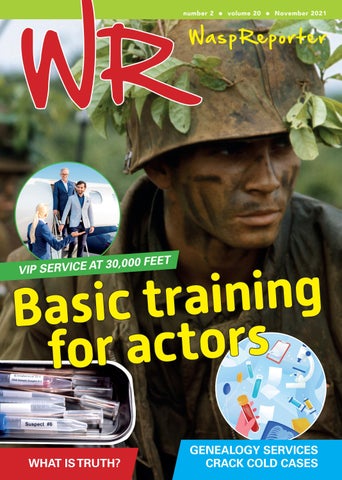
number 2
•
volume 20
•
November 2021
WaspReporter
0 FEET 0 ,0 0 3 T A E IC V R VIP SE
g n i n i a r t c i s Ba s r o t c for a WHAT IS TRUTH? WaspReporter_20.2.indd 1
GENEALOGY SERVICES CRACK COLD CASES 28-10-2021 12:44
Johan Graus Editor
3
Seasonal celebrities
6
Books not guns
8
The high life
10 Hollywood’s leading soldier 12 The future of packaging 14 A boy’s struggle
16 Defectors gone missing 18 The 93% Club
20 Sylvana Simons
22 Family tree forensics
24 Science under attack
26 Civil rights
Scan the QR codes to access the audio files.
For this issue, Sheila interviewed Kimi, a 17-year-old boy who lives in London. He talks about his education, his interests, friendship, and the advantages of not quite being an adult yet.
© XXX / XXX
audio
Contents
WaspReporter_20.2.indd 2
28-10-2021 12:44
© DAVID REDFERN/REDFERNS, EAMONN MCCORMACK/WIREIMAGE / GETTY IMAGES; JULIA MANGA / SHUTTERSTOCK
Christmas favourites, VIP service in private jets, anorexia in boys, North Korean defectors, Black Lives Matter – these are just a few of the myriad topics you will find in this issue of WaspReporter Magazine. As Christmas is just around the corner, we open this issue with an article about the stars of our favourite festive films and songs. What is it like for them to be thrown back in the spotlight every Christmastime? Another – albeit far less festive – story you shouldn’t miss is Waleed Khan’s account of how his school in Peshawar, Pakistan, was attacked by the Taliban. In ‘Books not guns’ (pp. 6–7) he describes the second-worst terror attack in Pakistan to date, in which 134 of his fellow students were killed. Waleed now lives in the UK, where he gives inspirational talks in schools, universities, and companies. Our cover article – ‘Hollywood’s leading soldier’ (pp. 10–11) – details the evolution of war movies. Where they used to paint an almost glamourous picture of heroic self-sacrifice, these films now portray military action with far greater realism. Former US Marine Captain Dale Dye helps filmmakers bring out the true brutality and horrors of war. Finally, don’t forget to check out our new digital platform eDition, which turns WaspReporter into a full interactive experience. Enjoy!
© MIKEDOTTA, YEHONATAN RICHTER LEVIN, MIGUEL IMAGE, AS FOOD STUDIO, FRIMUFILMS / SHUTTERSTOCK
E dit orial
Hello everyone,
BBC
audio
Books not guns Waleed Khan was just 12 when terrorists attacked his school. His injuries nearly cost him his life, but six years later, he’s determined to honour the classmates he lost
5
10
15
6
When I started school in Birmingham, the other kids had a lot of questions for me. ‘Where are you from?’, ‘What happened to you?’, ‘How did your face end up like that?’. Because of my scars, what happened in Pakistan was something I couldn’t hide. And it wasn’t something I wanted to. The scars stretch across the right side of my face and across the top of my mouth. At first, I was really upset by them – when I looked in the mirror there was a daily reminder of what had happened. At school I found it hard having to tell people again and again what they were from, so I decided to tell everyone my story all at once. The school called a special meeting for me. Before I started speaking, my hands were clammy and my legs were shaking behind the podium. I remember being really happy that it was hiding me so the whole school couldn’t see me tremble.
Just a normal day 20
25
30
When I woke up on the morning of 16 December 2014, it was just like any weekday; I put on my school uniform and met my friends in the car park. Every morning before school we would sit in the cafeteria and share breakfast together, usually arguing over the cricket match from the night before. Then we would make our way to class. Our school in Peshawar, Pakistan, is what we call an army school. This meant the army managed the school, and we were used to soldiers being around. So, it was no big deal to us when a major came in to deliver a first aid talk to us in the auditorium. It was about halfway through the talk when I remember hearing a deafening bang. It was loud, but not particularly out of the ordinary. Still, it could easily have been an army drill, so that’s what we all told ourselves. Laughter and chatter rippled around the room. It wasn’t
© MUHAMMAD ASAD, METIN AKTAS / ANADOLU AGENCY / GETTY IMAGES
1
W R number 2 • volume 20
WaspReporter_20.2.indd 6
28-10-2021 12:44
35
40
until the noise got closer and closer that things started to change. When the noise reached its loudest, complete silence fell over the auditorium. That’s when I knew something was wrong. The teachers’ smiles began to crack as they quickly locked all of the doors. One teacher told everyone to get down and hide under our chairs. Some of the younger students started to cry. I was too confused to move. And just like that, the door was kicked in and our auditorium became a war zone.
I remember hearing a deafening bang 45
50
55
60
65
© MUHAMMAD ASAD, METIN AKTAS / ANADOLU AGENCY / GETTY IMAGES
70
75
90
95
100
Terror attack
There was no pause before the firing started. They came in shooting. One of the men shouted ‘Hit the elder ones in the head’ so loud that everyone could hear. That’s when I realised that I was still on my chair – I was so shocked, I couldn’t move my body to hide. I was just staring at them. Even as one of them aimed his gun directly at me, I still couldn’t move. He was about 10 metres away from me when his first shot hit my face. I still wasn’t sure that what was happening was real. Shots were being fired in every direction. From the stage I could see everything. I could see my classmates dying. Some instantly. Others slowly. Even with their bodies in front of me, I couldn’t accept that my friends were dead, when a few minutes before we were laughing and gossiping with each other. It was the extreme mental pain that I remember the most. I was completely helpless and I think that broke me on the inside. I was lying on the stage now, desperately trying to roll onto the floor and under the chairs to some sort of cover. That’s when one of the terrorists saw me move. They shot me in the face, over and over again. I thought that was it – I was going to die there. Finally, after what felt like hours, the terrorists left through the exit. I had survived the second-worst terror attack in Pakistan to date – the shooters who attacked my school were from the Pakistan Taliban. Most victims were children. My classmates who should have gone on to become the country’s next politicians, engineers, and doctors were wiped out in minutes.
105
110
115
120
125
jaw with it. They put metal plates inside my mouth, and created a joint – that was one of the biggest operations I had. When the doctors in Pakistan could do no more for me, the complex nature of my injuries brought me to the UK for specialist medical care. When I arrived for my first operation, two years after the attack, my dad and I knew no one. School in Birmingham felt more relaxed. I sometimes still can’t believe that every child here has access to a good education, peace, and human rights – things that none of us in Pakistan would have dreamed of. Sometimes, before the attack, I’d drift off at school, but now I’ll never take education for granted again. The terrorists that entered my school that day chose to pick up bombs and guns. But I choose to pick up books and pens to fight terrorism in my country, because I believe it’s not weapons terrorists are scared of, it’s education. While I await my next surgery, I go to school. I’m studying for my final exams. I’m also a member of the UK Youth Parliament. We listen to issues raised by the young people in our area, then once a year we get to take them to the House of Commons.
Making a difference
When I forced my trembling legs onto the stage at my new school in Birmingham, I never dreamed that talking about what happened would allow me to feel like I was making a difference. I was worried people would laugh and I thought, ‘Why would anyone listen to me?’ After the incident, I kind of lost faith in humanity. But when I finished that talk, my classmates were hugging me and showing me so much respect – a tiny bit of that faith came back to me that day. Since then, I’ve done countless motivational talks in schools, universities, and companies all over the UK. I want to live life, not just for myself but for all the children that were killed that day and in other attacks. I want people to never forget my friends and classmates; they went there to study for their futures, not to be killed. It’s nice to have friends again, but the ones I lost are never far from my thoughts. <<
Coming to the UK
80
85
For the first two years after the shooting, I was in a hospital bed, and barely present. I went from a coma to surgery after surgery. My parents were told that I had a one per cent chance of survival. First, the doctors had to take all the bullets out of my body. Then they had to start to stitch my face back together, in many different operations. My front teeth were knocked out and my jaw was completely broken, so they took a bone from my leg and made me a new WR number 2 • volume 20
WaspReporter_20.2.indd 7
7
28-10-2021 12:44
The Guardian
The future of
audio
packaging Can a change in product design end the plastic waste crisis? We look at the possible types of a shower gel bottle to find out how a new economic model could be realised
1
5
10
Picture this. You’re running low on shower gel and shampoo, so on your next visit to the supermarket you go to the toiletries aisle and quickly scan what’s available. Instead of row upon row of colourful plastic bottles, this is what you see. A few plastic bottles, but not in the colours you’re used to – they’re mostly grey, with a few hints of colour here and there. Mostly, there are no bottles, though. Shower gels and shampoos in solid bar form are neatly packaged in cardboard boxes or available loose. There is also a stack of reusable bottles sitting next to large dispensers of liquid soap and shampoo.
20
25
30
Mix of strategies 15
12
In a world where we want to avoid using plastics, this is what shopping for personal care products could look like, and work is already underway to get us there. Across the board rooms, laboratories, and factories of large consumer goods companies, important questions are being asked about their role in this shift. Leela Dilkes-
Hoffman is a senior researcher for the New Plastics Economy project at the Ellen MacArthur Foundation, which campaigns against waste. She argues companies should ask themselves how to develop products, rather than how to develop packaging. ‘Can I do it in a solid tablet? Can I do it in a reusable bottle? Can I do it in a bottle that the user owns?’ she says. As the plastic waste crisis continues to grow, reuse options for packaging will increasingly become part of the mix of strategies that companies take to become part of a circular plastics economy. More than 8m tonnes of the stuff finds its way into oceans every year, so building a system that moves away from our current, linear ‘take, make, waste’ economy is critical.
Recyclability problems 35
For the consumer goods company Henkel, which is behind familiar brands such as Right Guard and Sellotape, all strategies are on the table. While pilots for body care products sold in solid bar format, or refill
© NOTIONPIC, TOPVECTOR / SHUTTERSTOCK
By Sarah laBrecQUe paid For By henkel
W R number 2 • volume 20
WaspReporter_20.2.indd 12
28-10-2021 12:44
40
45
50
55
60
65
70
solutions are ongoing, designing for recycling is also a priority to stop plastic waste ending up in the oceans. ‘We take responsibility for the packaging we are putting on the market,’ says Philippe Blank, head of circular economy and packaging at Henkel Beauty Care. ‘We need to design our products in the right way so that they can be recycled with existing technology.’ Not an easy task given the diverse systems across Europe and, indeed, the globe. ‘When you talk to experts within the industry,’ he continues, ‘we all share the same high-level pain points when it comes to packaging recyclability.’
A complex challenge
Looking at a typical bottle of shower gel helps to understand the difficulty of the challenge. In the absence of a product being sold in a solid state or as part of a refill system for the time being, let’s assume it still comes in a normal squeezy bottle, with a flip-top cap. The cap might be made from a different type of plastic to the bottle, and the label could be yet another type. That bottle can usually be recycled, but the recycled material will be lower quality than if only one type of plastic was used. To create a strong market for recycled plastics and to make our need for new plastics smaller, a higherquality plastic is more desirable. ‘The recycler wants a very pure material so he can sell it at a good price in the market,’ explains Marilu Valente, an industrial designer based in Germany. The other factor that means recycled plastic is less desirable is that it’s usually grey or non-transparent – the result of all our brightly coloured plastic bottles being recycled together. From a marketing point of view, using this grey, recycled plastic in a typically colourful product packaging can be a challenge.
80
85
90
Grey is the new beauty 95
100
105
110
Design for recycling
115
While it’s clear there are lots of new and exciting things happening behind the scenes in companies such as Henkel, to deal with the challenges around recycling there is still the small problem of the 150m tonnes of plastic that is already in the oceans. The plastic being recovered by the social enterprise Plastic Bank, for example, which Henkel and other consumer goods companies partner with, will go on to be recycled into that grey or cloudy material we keep coming back to. So, for the time being, despite companies trying to use single plastics at the design and manufacturing stage, if we want to put more of the existing stuff into new products, will consumers need to get used to a less colourful palette? ‘What is key, actually, from a company’s perspective, is that we should get people used to grey as the new beauty,’ says Blank. Indeed, with Henkel’s aim to reduce the amount of new plastic from fossil sources in consumer products by 50 per cent – for which use of recycled plastic will need to grow to more than 30 per cent – and for all packaging to be 100 per cent recyclable by 2025, the beauty industry could start to look a lot greyer. In the bigger picture, however, this seems a small price to pay for healthy and clean oceans. <<
© NOTIONPIC, TOPVECTOR / SHUTTERSTOCK
75
One solution is to design products that are made from a single plastic, in a single colour. Valente’s Nepenthes bottle, as well as ticking those two boxes, is also refillable. ‘It has gotten a lot of attention in the market,’ she says. Not just because it’s environmentally friendly
but also for its design, which she thinks helps in raising awareness among consumers. It doesn’t have a cap; instead, its flexible spout can be bent to plug the pouring hole. Blank agrees that using only one type of plastic is key. ‘We need to design packaging in a way so that we use, in the best case, only one material,’ he says. In the meantime, to help packaging designers make informed choices, Henkel has developed its ‘design for recycling’ software, EasyD4R. This tool is used at the beginning stages of product development, to check the recyclability of various materials. ‘This tool checks whether the packaging in your hand, or a packaging concept, will be recyclable according to international standards,’ says Colin Zenger, who leads on the development of the software at Henkel. To share best practices among other companies, EasyD4R can be downloaded for free.
WR number 2 • volume 20
WaspReporter_20.2.indd 13
13
28-10-2021 12:44
The Times
audio
Sylvana Simons is known as the pop princess turned TV presenter who became a hate figure for condemning Dutch blackface. Then she went into politics. But there is more to her than meets the eye. Mark Smith sat down with her for an interview
Sylvana Simons 5
10
15
20
20
Talking to her in her Amsterdam living room, the 50-yearold former TV presenter – and the first black woman to start a political party in the Netherlands and run for Parliament – exudes the same charisma and humour with which she brought music television to the Dutch masses in the 1990s. ‘Emotional rollercoaster’ is how she describes the recent experience of waiting at home to hear the fate of her party, BIJ1 (‘Together’), which pushes for ‘radical equality and economic justice’. She had woken to exit polls predicting a repeat of 2017’s failure to launch (after which Simons sat on Amsterdam’s city council). ‘It was devastating.’ But the picture changed, and soon it was time to hot-foot it to The Hague to take her place in the 150-seat House of Representatives. These are complicated times for the Netherlands. In January, the country was engulfed by violence after the imposition of a curfew – the first since Nazi occupation – intended to curb the spread of coronavirus. For three nights, rioters looted, pelted rocks, and torched buildings, including a Covid-19 testing centre, laying waste to the image of a peace-loving country that prizes compliance. At the time, Simons served as the country’s Cassandra on the world stage, telling the BBC’s Newsnight: ‘What we’re seeing … is this country reaping what it has sown. The
25
Netherlands have always projected an image of being reasonable, progressive, tolerant, and open, but it was just on the surface. If you’ve been pushing politics of division for 20 years, this is what you get.’
Fall from grace 30
35
40
45
Six years ago, Simons went from broadcasting’s golden girl to pariah after she dared to criticise the beloved Dutch tradition of wearing blackface to channel Zwarte Piet (‘Black Pete’) for the annual child-centred Sinterklaas festivities. The issue is a full-on cultural schism in the Netherlands, and Simons became its lightning rod. But ingrained racism is no less evident, she says, in the scandal that led to the January 2021 resignation of the prime minister Mark Rutte and his cabinet after it emerged that thousands of families had been wrongly accused of child benefit fraud. The scandal did not prevent Rutte from winning big his fourth time around. ‘It’s not a coincidence that the one Dutch word everybody on this planet knows is apartheid,’ Simons notes, sardonically. It’s this kind of pronouncement that angers her critics, who accuse her of ‘always playing the race card’. Simons counters that Geert Wilders, the most prominent member of the Netherlands’ far right,
© REMKO DE WAAL, ROB ENGELAAR, ROBIN UTRECHT / ANP
1
W R number 2 • volume 20
WaspReporter_20.2.indd 20
28-10-2021 12:45
50
spent the election campaign advocating a ministry of deportation and de-Islamisation. ‘Where is the uproar about that?’ she asks. For now, BIJ1 has only one seat, and Simons is determined to use it to hold the new government to account.
90
Backlash
A very personal story 55
60
65
70
75
80
95
100
105
110
115
She went on to host shows such as Sexquiz on the Beach and The Bus, which took the Big Brother format on the road and whose titular vehicle was repeatedly vandalised. ‘I never watched the programmes I did,’ Simons says. As a celebrity contestant, she reached the final of Strictly Come Dancing. Then in May 2015 she joined the campaign Zwarte Piet is Racisme (‘Black Pete is Racism’). It was a U-turn for Simons, who had previously defended the tradition as ‘innocent fun’. She immediately received emails and letters from people describing how they wanted to see her killed, raped, and burnt alive. A video in which dancers in blackface sing ‘Oh Sylvana, why don’t you pack your bags and leave this country’ went viral, and her face was photoshopped onto images of Ku Klux Klan lynchings. A Facebook page devoted to ‘waving Sylvana off’ was ‘liked’ 60,000 times. ‘Unimpressed’ is her response when I ask how she felt about all of this. Having experienced personal trauma already, she suggests, ‘there is nothing anybody can say or do to me that I’ve not already gone through and survived. I know my strength.’ But one night when she came home to find her security light broken, ‘I thought, “What if those 60,000 people show up at my house?”’ She began to sleep downstairs, a plank by her side.
Small victory
120
125
Months after her comments the UN intervened to condemn Zwarte Piet as a painful ‘vestige of slavery’ and imposed a time frame for phasing it out. Monuments including a mural of Surinamese heroes outside Amsterdam’s Black Archives have since been vandalised with slogans equating the eradication of blackface with ‘white genocide’. Simons jokes that the UN’s intervention is the ultimate affirmation of the nationalists’ conviction that the Netherlands is ‘the best at everything. Even racism.’ <<
© REMKO DE WAAL, ROB ENGELAAR, ROBIN UTRECHT / ANP
85
Simons was born in Suriname, the former plantation colony in South America where Dutch merchants imposed the brutal hierarchies that would typify the Atlantic slave trade and its legacy. Her parents moved to the Netherlands when she was 18 months old, and before long she was ‘holding anything that looked like a microphone, trying to interview everyone and everything’. This latent curiosity, she says, stems from finding her own existence a head-scratcher. ‘As a black girl in a white country, I was always wondering, “How come I was born with a Dutch passport? How come I can already speak Dutch if I’m not actually Dutch?”’ Simons left home in Hoorn for Amsterdam at 14 and says that she ‘lived on the streets for years’, becoming an in-demand backing dancer for R&B musicians. In 1995 she got the call that resulted in her becoming the face of TMF (The Music Factory). The eldest in a stable of blond, blue-eyed presenters, she put the business case for a focus on black music and interviewed Will Smith, Destiny’s Child and the like before establishing Sylvana’s Soul, a show centring on her own more esoteric tastes. Simons’s poised professionalism belied not only her hardscrabble origins but personal tragedy. Her oneyear-old pulled a pot of boiling water from the stove, sustaining ‘60 per cent burns’, which put him in hospital for three months. His father, home alone with him when the accident happened, took his own life shortly afterwards. ‘I was a single mother with a good job and one of my priorities was keeping it,’ she reflects. ‘I didn’t feel like sharing that [at the time], because it’s so personal. It’s painful.’ There was also a sense that, as an immigrant, she would let the side down if she faltered. ‘I thought that if I was the perfect role model and showed this country that we [black people] can also speak
properly, dress properly, act properly, then that would be my contribution to mutual understanding. I played that game for a long time.’
WR number 2 • volume 20
WaspReporter_20.2.indd 21
21
28-10-2021 12:45
Science Focus
audio
Family tree forensics
In the US hundreds of long forgotten cold cases are being reopened by detectives who mine DNA databases for leads, but it seems time might be running out… By Simon Crompton
1
5
10
2 15
22
When she answers my call, Paula Armentrout is buzzing with the news that’s just come through. Her company’s DNA analysis and genetic genealogy service has 3 just led to the arrest of a man for two murders that happened four years ago. It’s the 101st case of serious crime solved as result of genetic detective work by Parabon NanoLabs. The service was launched just three years ago, in May 2018. The Cincinnati man who’s been arrested beat a mother and son to death in their home in 2016. He might have thought he’d got
20
25
30
away with it, as at the time of the initial investigation the DNA sample found at the crime scene matched nothing on the police databases. The case went cold. But Virginia-based Parabon provided a new analysis of the DNA sample, which allowed it to be compared with hundreds of thousands of other DNA samples – not on police databases but on online genealogy services by 4 members of the public wanting to find relatives through genetic similarities. Just as in 100 other cases, the analysis revealed people related to the suspect,
35
40
45
50
some distantly. Parabon’s genetic genealogists then reverseengineered a family tree, joining the dots between the crime scene DNA and relatives, using official birth, death, and marriage records and obituaries, to produce a list of leads and potential suspects for whom the time, the place, and the DNA fitted.
Cold cases
Genetic genealogy has suddenly become big in United States law enforcement. The explosion began in April 2018, when California law authorities announced the
© MICROGEN / SHUTTERSTOCK
1
W R number 2 • volume 20
WaspReporter_20.2.indd 22
28-10-2021 12:45
55
60
65
5
70
75
6 80
85
90
95
© MICROGEN / SHUTTERSTOCK
7
100
105
110
identification and arrest of the suspected Golden State Killer, responsible for 12 killings, 51 rapes, and more than 120 burglaries in California between 1974 and 1986. 8 115 Police had drafted in the help of genetic genealogists, who pointed to former police officer Joseph James DeAngelo after they had uploaded their new analysis of 120 his DNA data to an open-source genealogy service called GEDmatch and compared it with the DNA records of hundreds of thousands 125 of people who wanted to research their family tree. Just one month after the Golden State Killer announcement, DNA engineering company 130 Parabon launched its genetic genealogy service – also using GEDmatch – and unsolved violent crime cases came flooding in from police departments. Parabon analyses DNA in a far more detailed 135 way than law enforcement DNA databases. To date, Parabon has worked on 9 450 cases, with the average case being 25 years old. The company 1 cases where 140 also takes on there’s an urgent need for leads. In 2018 they took on the case of a man who had raped a 79-year-old woman in Utah. Parabon’s chief genetic genealogist CeCe Moore 145 knew that narrowing down suspects using family trees might be the only means of preventing further crimes. ‘They desperately wanted to solve this case before he attacked 150 another woman or came back to 10 the victim’s home again. She was petrified, couldn’t sleep at night, afraid he would come back and 155 finish the job. So that was a very high-pressure case. The perpetrator was arrested in July 2018, just three months after the crime. But the rush to find new ways of 160 catching criminals through detailed DNA analysis is controversial. Rumblings started as soon as details of the Golden State Killer capture emerged. Was it right 165 that people who submitted their personal information for the purpose of finding relatives should have their families investigated for crimes? Some people involved in
170 subsequent cases have complained about feeling misled that their DNA has been used to build cases against relatives. Crime, science, and ethics 2 voiced 175 academics have their worries. Writing in the journal Genetics in Medicine, Dr Caitlin 11 Curtis, genomic research fellow at the University of Queensland, said that the growth of both 180 forensic genetic genealogy and detailed DNA analysis highlights the need for greater protection of genetic data. ‘Police genealogy shows how one person’s decision 185 about their genetic data can impact not only close relatives, but also distant ones,’ says Curtis. ‘Detailed DNA analysis highlights 12 190 how much sensitive information is contained in our genetic data.’ This includes information about our predisposition to disease and mental health problems, as well as what we look like. 195
Privacy concerns
Some of the concern has dampened down as genealogy websites have made it clearer whether or not 200 they are used in law enforcement programmes, and now make it necessary for users to ‘opt in’ if their DNA is to be used 13 205 forensically. Parabon says it only uploads samples to GEDmatch and one other company called FamilyTreeDNA. Other ancestry search companies, such as Ancestry.com and 23andme, do 210 not allow access for crime-solving. Moore, who was a well-known ancestry detective in the US before she developed forensic genetic genealogy techniques with 215 Parabon, also had early concerns about using DNA designated for family history work for crime14 solving. Now her concern is that new privacy requirements are 220 shrinking the DNA pool that crime samples can be compared against. Last year, GEDmatch opted its entire database out of law enforcement matching, and 225 required each person using the service to actively opt in. The result is that Parabon now has just 200,000 people to compare
against on GEDmatch, compared with 1,000,000 in 2018. ‘It’s now much more difficult to solve these cases and narrow them down as specifically as we used to,’ she says. ‘We don’t have enough data, which means a lot more work has to go into it.’ There are other limitations 3 expansion. Those that may who submit DNA to research their ancestry tend to be of European extraction – standing in the way of growth in many countries. Data protection laws in Europe are generally tighter than in the United States. And some experts believe there is simply no need for genetic genealogy in countries that operate an effective crime database. Denise Syndercombe Court, professor of forensic genetics at King’s College London, says that the UK hasn’t gone down the genetic genealogy route, partly because it already has a database that represents a more relevant population. The UK National Criminal Intelligence DNA Database, 25 years old this year, holds information on around 10 per cent of the UK population at any one time – because it includes DNA data on crime suspects as well as those who have committed crimes. According to Syndercombe Court, a complicated DNA analysis that can identify distant cousins isn’t required if your crime database is comprehensive enough. ‘The UK database contains information on one in eight males between the age of 15 and 45 to 50, so it’s very powerful,’ she says. In the case of unsolved serious offences, DNA can be compared to this database and it is likely to pick up close relatives – parents, children, full siblings, and sometimes half siblings and uncles. ‘The problem in the United States is that they haven’t been putting their felons into an identifiable DNA database. Most of these people could have been picked up many years ago if the United States had a proper governance structure. We have that, so my feeling is that the number of cases it would be useful for in the UK would be very limited.’ << WR number 2 • volume 20
WaspReporter_20.2.indd 23
23
28-10-2021 12:45
The Spectator
Science under a
audio
What is truth? By Richard Dawkins
5
10
15
20
25
30
You can speak of moral truths and aesthetic truths but I’m not concerned with those here, important as they may be. By truth I shall mean the kind of truth that a commission of inquiry or a jury trial is designed to establish. I hold the view that scientific truth is of this common-sense kind, although the methods of science may depart from common sense and its truths may even offend it. Commissions of inquiry may fail, but we assume a truth lurking there even if we don’t have enough evidence. Juries sometimes get it wrong and falsehoods are often sincerely believed. Scientists too can make mistakes and publish erroneous conclusions. That’s all regrettable but not deeply sinister. What is profoundly troubling, however, is any wanton attack on truth itself: the value of truth, the very existence of truth. This is what concerns me here. In Nineteen Eighty-Four, George Orwell’s O’Brien held that two plus two equals five if the Party decrees it so. The Ministry of Truth existed for the purpose of disseminating lies. During the Trump presidency, the US government moved in that direction. World-weary cynics sigh that all politicians lie: it goes with the territory. But normal politicians lie as a last resort and try to cover it up. Donald Trump was in a class of his own. For him, lying was not a last resort. It never occurred to him to do anything else. And far from covering up a lie, he can stick to it: his well-named ‘base’ loved him the more for it, and would believe the lie, however far-fetched and shamelessly self-serving. Fortunately, Trump was too incompetent to fulfil Orwell’s nightmare.
40
45
50
55
60
65
The threat of philosophy
35
24
A more insidious threat to truth comes from certain schools of academic philosophy. There is no objective truth, they say, no natural reality, only social constructs. Extreme exponents attack logic and reason themselves, as tools of manipulation or ‘patriarchal’ weapons of
70
Instead of exhorting young women to prepare for a variety of technical subjects by studying science, logic, and mathematics, Women’s Studies students are now being taught that logic is a tool of domination … the standard norms and methods of scientific inquiry are sexist because they are incompatible with ‘women’s ways of knowing’. The authors of the prize-winning book with this title report that the majority of the women they interviewed fell into the category of ‘subjective knowers’, characterised by a ‘passionate rejection of science and scientists’. These ‘subjectivist’ women see the methods of logic, analysis, and abstraction, as ‘alien territory belonging to men’ and ‘value intuition as a safer and more fruitful approach to truth’. That way madness lies. The social psychologist Phoebe Ellsworth, at an interdisciplinary seminar, praised the virtues of the experimental method. Audience members protested that the experimental method was ‘the brainchild of white Victorian males’. Ellsworth acknowledged this, but pointed out that the experimental method had led to, for example, the discovery of DNA. This was greeted with disdain: ‘You believe in DNA?’ You can’t not ‘believe in DNA’. DNA is a fact. DNA sequences can be compared, letter for letter, between any creature and any other, much as one might compare folios of Hamlet. From this we can compute a numerical figure for the closeness of cousinship of any two creatures and hence, eventually, build up a complete family tree of all life.
Mathematical truth
If your philosophy dismisses all that as patriarchal domination, so much the worse for your philosophy.
© GOODSTUDIO / SHUTTERSTOCK
1
domination. The philosopher Noretta Koertge wrote this in Skeptical Inquirer magazine in 1995, and things haven’t got any better since:
W R number 2 • volume 20
WaspReporter_20.2.indd 24
28-10-2021 12:45
r attack
75
80
85
Perhaps you should stay away from doctors with their experimentally tested medicines, and go to a shaman or witch doctor instead. If you need to travel to a conference of like-minded philosophers, you’d better not go by air. Planes fly because a lot of scientifically trained mathematicians and engineers got their sums right. They did not use ‘intuitive ways of knowing’. Whether they happened to be white and male or sky-blue-pink and hermaphrodite is supremely, triumphantly irrelevant. Logic is logic is logic; a mathematical proof reveals a definite truth, no matter whether the mathematician wields a penis or not. If you decide to fly to that conference, Newton’s laws and Bernoulli’s principle will see you safe.
What is profoundly troubling is any wanton attack on truth itself
© GOODSTUDIO / SHUTTERSTOCK
90
95
100
It is true that Newton’s laws are approximations which need modifying under extreme circumstances such as when objects travel at near the speed of light. Those philosophers of science who fixate on the case of Newton and Einstein love to say that scientific truths are only ever provisional approximations that have so far resisted falsification. But there are many scientific truths – we share an ancestor with baboons is one example – which are just plain true, in the same sense as ‘New Zealand lies south of the equator’ is not a provisional hypothesis, pending possible falsification. Of course, not all the sciences can boast the formidable accuracy of physics. We biologists stand in awe of the LIGO experiments in which gravitational waves, having travelled a billion light years, are detected by measurements accurate to less than a thousandth
105
the width of a proton. Biological experimenters have to confront problems like the subjective bias of the experimenter – ‘intuitive ways of knowing’.
Double-blind proof
110
115
120
125
130
135
140
Medical scientists have perfected safeguards aimed precisely against intuitive ways of knowing, because these are highly likely to mislead. The double-blind control test has become the gold standard for demonstrating the efficacy of a medical treatment. I myself conducted a double-blind test of dowsing (water divining). It was pathetically touching to witness the sincere distress of the professional dowsers when they failed – every single one of them – to perform above chance level. A layperson’s version of the pernicious philosophy I mentioned earlier is the familiar bleat of: ‘Well it may not be true for you but it is true for me.’ No, it’s either true or it isn’t. For both of us. As somebody once said (authorship multiply attributed), you are entitled to your own opinion but not to your own facts. Some of what I have claimed here about scientific truth may come across as arrogant. So might my disparagement of certain schools of philosophy. Science really does know a lot about what is true, and we do have methods in place for finding out a lot more. We should not be reticent about that. But science is also humble. We may know what we know, but we also know what we don’t know. Scientists love not knowing because they can go to work on it. The history of science’s increasing knowledge, especially during the past four centuries, is a spectacular cascade of truths following one on the other. We may choose to call it a cumulative increase in the number of truths that we know, or we can tip our hat to (a better class of) philosophers and talk of successive approximations towards yet-to-be-falsified provisional truths. Either way, science can properly claim to be the gold standard of truth. << WR number 2 • volume 20
WaspReporter_20.2.indd 25
25
28-10-2021 12:45
vibe WR
While we have made every effort to trace the copyright holders of
Say what? Dutch for advanced learners
articles and illustrations contained in this issue, we would be grateful for any information that might assist us in identifying sources we have as yet been unable to find. Editor Johan Graus Editorial assistant Aafke Moons Compiled by Marleen Cannegieter
finally
hé hé / ho ho
wait a minute
ja ja (quickly)
don’t rush me
ja ja (slowly)
I don’t believe you
zo zo (stress on last)
well well
zo zo (stress on first)
not too bad
poe poe
impressed
poe poe
not so impressed
poe poe
I’m tired
nou nou
slightly impressed
nou nou
don’t be so critical
nou nou nou
well well well
nou (slowly)
I doubt that
ja doei
no way
hup hup
hurry up
rara
guess what
kom kom
it’s not that bad
man man man
what a misery
tuttut
stop trying to impress me
wel wel
look who’s here
wel wel wel
expressing surprise
Erik Cats Christien van Gool Johan Graus Caspar van Haalen Aafke Moons Ine Sanders Frederike Westera Teaching enquiries Johan Graus, jgraus@xs4all.nl Photos on cover Bettmann, Izusek / Getty Images; Felipe Caparros, GoodStudio / © ESB PROFESSIONALS, CHRISTOPHE BOISSON, ALEXANDER LIMBACH, ALEXANDRA SHARGAEVA / SHUTTERSTOCK
hè hè
Shutterstock Editorial agency Marjan den Hertog, Deventer Graphic design Maura van Wermeskerken, Apeldoorn Subscriptions (also for Belgium) Mijntijdschrift.com Curieweg 16 8013 RA Zwolle (088) 22 666 93 waspreporter@mijntijdschrift.com Subscription terms and rates See Teacher File or bit.ly/wr-subscription © ThiemeMeulenhoff Amersfoort, Netherlands, 2021
Don’t forget to check out our brand-new digital platform: eDition. Ask your teacher for more information on how to log in.
WaspReporter_20.2.indd 28
28-10-2021 12:45