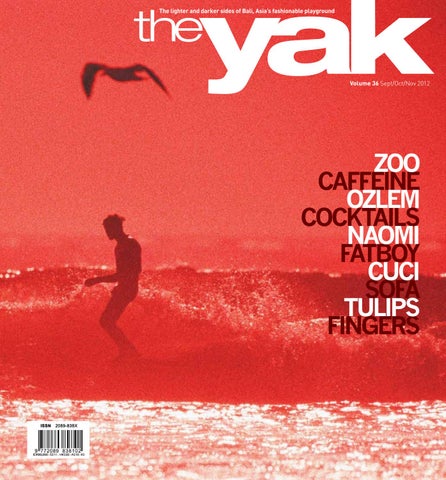
Volume 36 Sept/Oct/Nov 2012
IDR80,000 : S$11 : HK$50 : A$10 : €5
vote online www.theyakmag.com/awards pre party tix from yak office canggu club, laughing budDha (ubud), rip curl school of surf (sanur), deus ex machina (canggu).
JALAN RAYA SEMINYAK 36 KUTA BALI - PH. +62 361 730308 JALAN RAYA SANGGINGAN UBUD BALI - PH. +62 361 8878002 - JALAN DANAU TAMBLINGAN 37 SANUR BALI - PH. +62 361 270935 JALAN RAYA KEMANG 20 JAKARTA SELATAN - PH. +62 21 7182322 WWW.BIASABALI.COM
RUBY ANNA CASELLINI Creative Activist
Lu xur y
I n
P r i n t
Volume Thirty SIX SEPTEMBER/OCTOBER/NOVEMBER 2012
The Yak Magazine Sophie Digby, Agustina Ardie, Nigel Simmonds
Publisher's PA / Sales & Marketing Indrie Raranta
Production Manager Evi Sri Rezeki
Graphic Designers Irawan Zuhri, Teuku Melody, Stuart Sullivan
Accounting Julia Rulianti Volume 36 Sept/Oct/Nov 2012
Distribution Made Marjana, Kadek Arthana, Putu Widi Susanto, Made Sutajaya, Didakus Nuba
Publisher PT Luxury In Print
Licence AHU/47558/AH/01/01/2011
Advertising Enquiries Tel: (+62 361) 844 6341, 743 1804, 743 1805
www.theyakmag.com
IDR80,000 : S$11 : HK$50 : A$10 : €5
On the cover: Tanner Prairie by Dane Peterson.
Email: info@theyakmag.com sales@theyakmag.com Canggu Club Tennis Centre, Jl. Pantai Berawa, Canggu, Bali 80361, Indonesia © PT Luxury In Print The Yak Magazine Bali.
You know the drill. No part of this publication may be copied or reproduced electronically or otherwise without prior permission from the Publisher. Opinions expressed within this publication are those of the authors not the Publisher. The Publisher reserves the right to refuse advertising that does not comply with the magazine's design criteria. The Yak will not be held responsible for copyright infringements on images supplied directly by advertisers and/or contributors.
min
The Yak’s monthly e-newsletter is sent
Archives, additional content and
yPodBali Version 2.1 – The Yak's iPhone
to 20,000 mailboxes every month.
more at www.theyakmag.com
App – is available from the App Store.
contents Content is king.
P: 94 ghosts in the machine come out to play.
34
Yakety yak
Sermon From The Mount
36
15 minutes
38
one world
The Giving Game
40
Event Management
42
Seminal Seminyak
Two Royals
dates With destiny
New in the hood
150
52
Sun Worship
54
Cuci Sofa
out of the box
Culture vulture
56
The Wizard of Ozlem
58
Mister Fingers
60
German Dmitriev
interview
interview
interview
94
68
58
contents Content is life.
62
Naomi
66
Great Dane
76
Code Blue
88 90 92
interview
passions
yak fashion
venting in a villa
Back to the future Just doin' it
Laura Ridchardson interview
Honoka
56
104
Liquid Lunch
108
Hu'u Bar
110
Coffee Dreaming
116 118 120
oral pleasures
Oral pleasures
feature
oral pleasures
Booze and Fags big six
Sandwich Heaven fashion freestyle
Colour Me Purple
104
132
Out Of Africa
138
Bangkok Boutique
142
Tomorrow's Tulips
144 148 150
110
travel
travel
feature
Sounds around
Fatboy Slim AstroYak
Star Gazings advertiser's directory
Who's Who
90
yakback We dedicate this issue to our – not in the vulgar sense – otaku; the historic meaning of the Japanese word is 'family'; in modern slang it also can allude to a passionate if sometime obsessed being, a modern-day connoisseur incarnate...Time, money and effort is what it takes to earn this retro-modern title; devotion to a hobby to the nth degree. We at The Yak, your Bali-esque connoisseur-incarnates, have spent the last three months – yet rather more than a combined half century in actuality – gaining that exact title, with the aim of lessening at least one part of the time, money, effort equation for you, our readers – hence allowing you to enjoy flicking through the fruits of this our latest rendition to decide where you would like to spend your time and your money in Yaksville and beyond. Showing our full commitment, as any otaku should, we show you around what is new in the hood before introducing you to some fabulously talented peeps on the block, be they musically or artistically 'entwined'. Ozlem, Eric Sondhy, German Dmitiriev and Tomorrow’s Tulips give us the harmony we need in our lives with the visuals coming from Cuci Sofa and the Great Dane Petersen, while Honoka makes the rough into the smooth with her amazing precious stone conversions. Our enthusiasm hits news highs with The Yak fashion shoot and the arrival to Bali of all things equestrian, yes it’s up to its withers in pure professionalism – from dressage all the way to cavaletti! Back into the music scene, Voyager Retreats in Canggu has us turning our loyalties as they press the vinyl and make master recordings for the new and 'up&comings' in their state-of-the-art recording studio. We then get divinely attached to Zoo in Omnibus and hit the art-cafe for that unique and revered blend of beans. Passionate about oral pleasures we head to Hu'u before covetously consuming a cocktail or two prior to getting quite 'techie' about sandwiches, of all things! Then it’s hard to hide affection going to our fashionistas who lead the "Bali brand" with whimsical tenacity. Back to our musical obsession once again, we go tete a tete with no other than Fatboy Slim – a global brand in himself. With our telescopes planted firmly in the ground we round off this edition geekishly looking upwards – we are getting the distinct impression that the answer may lie in the stars and our horoscope column, Astroyak. So as any otaku would wish to another - May The Yak be with you.
LOVE IN TENTS In case anyone got the wrong idea from our interview with Steph and Nina last issue, we’d like to make it crystal clear that LOVE IN TENTS (www.loveintents.com) is not a clothing brand but an event organizing company. The girls’ clothing brand is of course THIS IS A LOVE SONG (www. thisisalovesong.com). Their jewelry company is called RBRTH (www.rbrth. com). All clear? Ok good. Let's go to the pub.
Dear Yak, Congratulations on another great new issue and thank you for your feature on Sardine, it looks excellent. See you soon,
part of our trip in Seminyak. Could you please let us know where we could come to buy these issues from you?
Pascal & Pika Sardine
Done. Dusted. Delivered.
Always a pleasure. Dear Yak, Love reading the mag! Ginny Cimpoias Morris Corporation A dancing fan maybe. Or a smoker. Dear Yak, We are excited to be heading to Bali this week. Whilst there we would really like to buy some copies of your wonderful magazine. We are hoping that as well as current issues we could also purchase some back issues from you. Of course we will be staying for
Sue and Rob Langmaid
Dear Yak, Many thanks for coming to the lunch which our agents Vinum organized at Potato Head. It was a pleasure to meet you and to introduce you to my wines. As you could see their particularity is entirely in their purity and minerality, and I was happy to see that they go particularly well in your warm climate. Of course if you have a chance to visit France in the future, please don’t hesitate to contact me in advance for a visit. With thanks and kind regards, Bruno Paillard Bruno Paillard Champagne Reims, France (Hic).
yakinthelapof... Norman Cook. Straight off the plane and police-escorted to our side, Mr Norman Cook a.k.a Fatboy Slim took it in his stride as we thrust our organ into his hot sweaty hand [that all sounds rather weird – Ed]. "Ah. The Yak," he said. "It's got bigger since I was last here. Things going well?" How bad could it be, we answered, when we have the likes of your esteemed personage to interview? "Nice one, he replied."
15 minutes Time was I seemed to bump into the British Royal family far more than was healthy for a lower-middle-class English boy. There I was waving my plastic Union Jack in the crowd of schoolchildren assembled to greet the Queen off the plane at Kuala Lumpur, part of her 1972 Royal Tour. There I was again cheering on Princess Anne at the Montreal Olympics in ‘76. Then there were the years at a posh little prep school in England where I was never very far from the Queen’s gaze – her portrait hung in the main dining hall. Later I worked as a reporter on a local newspaper in Norfolk – the royal estate at Sandringham fell within the paper’s circulation area and Boxing Day was never the same again. The entire royal pack – Lady Di included – would descend upon the estate to be photographed and filmed as they walked to Church. It wasn’t until I left England again that I had my first taste of royalty up close and personal. I was working as a magazine editor in Singapore – for a publication that covered expatriate life in the former British colony. And into town came a youthful and slightly chubby documentary filmmaker who was making a show about Singapore expats. His boss was none other than Prince Edward, then third in line to the British throne. In the wake of a slightly suspect career amongst the theatre luvvies, Edward had started a film production company called Ardent in the grounds of his royal estate, ostensibly to make films about royal yachts and the like; the history of polo perhaps. Or fox hunting. He hadn’t reckoned however on this young and ambitious filmmaker, employed from Channel 4 and a chap who appeared to have all the trappings of upper-class decency but none of the integrity. He was however little more than well-disguised tabloid paparazzi looking to make a name for himself. In Singapore, the thrusting filmmaker befriended me as a fixer. I imagine he thought I might be useful in some way – I was after all the editor of a magazine whose readership fell nicely into his kill range. His plan was simple: he would pose as Edward’s official production representative, out in the tropics to make a documentary about the wonderful nature of post- colonial expatriates. It was little more than a very good cover for digging up the dirt on
some of the more lascivious aspects of foreign life in the Lion City. None of this was obvious or of particular concern to me at the time. It was flattering and rather fun to be involved with a Prince of the Realm. I was invited to visit the royal production house while on a trip back to England. First I was wined and dined by the filmmaker at the local pub, then it was back to the estate to meet ‘Eddy’, as he referred to the Prince. I was half way through a rather animated story to his royal highness when I realised, too late, I had been talking way too much. As I bumbled on he raised his hand to his chin, displaying the goldest pinky ring I have ever seen. Emblazoned with the Windsor Crest, it shone with centuries of historic royalty; the specter of Henry VIII appeared in the room. I shut up. “Well,” he said as I stood there, admonished. “Nice of you to pop in. Do take care.” And with that I was ushered out past the discreetly armed security and back to Singapore. It was few weeks later that I saw the first rushes of the documentary. It was horrific. Our canny tabloid chameleon had fooled everyone and succeeded in making all involved look selfish and spoiled beyond belief. There was the story of the young man who paid extra to his maid for her to iron naked in his flat. The tale of the expatriate girl (who he got steaming drunk) whom he had convinced to bare her breasts. There was footage of prolific partying, law-breaking and prostitution. The documentary, one could see, was not quite what His Royal Highness would have condoned. When the shit hit the fan it was a PR disaster for the royal household, embroiled once more in a scandal only partially of their making in a year that turned out to be their annus horribilis. The production house was closed down and Edward was forced to distance himself from the whole messy debacle. It was several years later that I encountered the Prince again. He was visiting Singapore on a trade mission, which I attended. We were told to form ourselves into semi-circular groups and wait for the royal personage to come round for a chat. When he reached our little cluster, I couldn’t resist bringing up our meeting – did he remember my visit to his studio? “ Oh yes,” he said. “Tony.” And then with another flash of his historic and clearly well-employed royal ring, he said: “Haven’t they caught up with you yet?” I'm still trying to live it down.
It was a Saturday morning in the summer of 1959, and I drove to Brands Hatch race track in England with my fiancée who was practicing for the race on Sunday. It was fierce competition for pole position so I didn't really keep track of time, so when I finally glanced at my watch it was less than one and a half hours to curtain up. Blind panic! As an actor you’re supposed to be at the theatre by the half (35 minutes prior to curtain up) or they put the understudy on. Without really thinking I ran to the control tower, explained the problem to the race commentators and asked if there was anyone who could give me a lift to London. The guy in the box put out a message saying there was an actress desperate to get back to London in time for curtainup, and would anyone please volunteer to give her
a lift. Then we waited for what seemed like three life times and finally a good looking guy who looked vaguely familiar turned up and said he would give me a lift. We ran down to the competitor’s car park and jumped in a car, I was too agitated to notice what make. Then with tires screeching we set off. At this point he asked me what play I was in (The Brides of March) and as I turned to look at him properly for the first the profile was unmistakable. It was Steve McQueen. We got to London after a ride worthy of any movie, running red lights and breaking all the rules, but just in time. I wish I could say we had a great chat along the way but, at that speed, talking was difficult. He did say he had just finished filming with Frank Sinatra. J.F.
giving back
oneworld some children on bali are vulnerable and need a helping hand . . . you can play a part. Breaking the Silence in Bali: The Sacred Childhoods Foundation considers every childhood to be precious. Their dedicated team provides healthcare and aid packages to those living in absolute poverty. They bring schools directly into the slums for the purpose of teaching kids literacy, maths and life skills, and they operate trade-and-lend schemes to help families break free from the poverty trap. The Foundation is also supporting victims of child trafficking, organ harvesting and paedophilia, through project "Combating Organised Crimes Against Children." According to research, human trafficking is the world’s third most profitable illicit market, worth around USD 32 billion each year. In Indonesia an estimated 100,000 children are trafficked each year. Some are held as child prostitutes for domestic markets, whilst others are destined for the sex tourism industry or sent to ‘buyer’ countries, which include Japan, Malaysia and Saudi Arabia. There are very few refuges where victims can receive appropriate therapeutic support. The Sacred Childhoods Foundation is currently building an Eco village and safe home in central Bali to house rescued children and offer them 24-hour protection, therapy and medical care, so children can get back to just being children. A highly confidential service is offered for those who wish to report suspects. www.sacredchildhoods.org Cempaka Putih Foundation (Yayasan Cemapaka Putih): Cempaka Putih Foundation was founded in 2007 by I Gede Mangun, upon seeing the great poverty of the remote villages around his home town of Songan Village, Kintamani, Bangli – Bali. As a native of the area, Gede had often been asked, informally, to lend a helping hand to families facing hardship. Many people in the remote areas of the Bangli regency suffer from severe congenital disorders, have no access to medicine, sustainable food sources, and adequate water supplies. He soon realised that the need around him far exceeded his capabilities as an individual. So with the help and support of his friends and neighbours, Cempaka Putih Foundation was born. Cempaka Putih projects include the collection of clothing for impoverished families in the area, collection for medical treatment and transportation for many people in the area afflicted with serious hereditary illnesses (many of whom must be carried great distances from their homes to reach paved roads) collecting building supplies and organising volunteers for much needed housing and community buildings, and seeking cooperation with other organisations to provide first aid, medical counselling, and basic health education. In addition, most Sundays, the foundation hosts an English language programme, which was started in conjunction with a village primary school and is now being run from the Volcano Breeze Café – a restaurant Gede had owned in Toya Bungkah. Cempaka Putih Foundation began as a local group of volunteers, focused on emergency poverty relief and logistical assistance for the people in most
dire need. However, Gede has always placed great value on education, and it has been his dream to bring greater education and opportunities to the people of the central mountain region of Bali. With this focus in mind, Gede has begun work to reopen the Volcano Breeze Café as a student/ volunteer-run enterprise, with proceeds benefitting the foundation. By melding the language programme with practical on-the-job training and work experience, Gede hopes to bring a greater range of opportunities to the area’s youth. However, always looking forward, he sees far greater potential for such an endeavour. By working with local farmers, he hopes to create a greater market for local produce and encourage area farmers to practice sustainable, organic agricultural practices. As transportation costs can make it difficult for farmers in the area to compete, he also hopes to create new opportunities for cottage industry. www.cempakaputih.org The Smile Foundation (Yayasan Senyum): The Smile Foundation of Bali was founded in 2005 by Mary NorthmoreAziz at the suggestion of Dr. David David from the Australian Craniofacial Unit, to identify those in need of craniofacial surgery. Dr. David David has continued his association as the chief adviser to the foundation. In December 2006 the foundation opened the "Smile Shop", which was the first “Op shop” on Bali. It provides a source of income for the foundation through the sale of secondhand goods and old stock from local businesses. After extensive fundraising, the "Smile House" was opened in January 2007, in Denpasar. The Smile House provides accommodation and educational facilities, in particular for those from outlying areas. In many countries, craniofacial disabilities are treated shortly after birth. This is not necessarily the case in Bali. Craniofacial disabilities are not only disfiguring, but can also lead to difficulties with nutrition and communication. As such, treatment is essential. However, treatment is not just expensive, but it can involve extensive travel from the individual's home environment as well a complex bureaucratic process. The foundation provides pre- and post-operative support and helps to organise treatment for people suffering from craniofacial disabilities. Part of this involves identifying those in need, both in Bali and the surrounding Indonesian islands, as per David David's initial request. Once identified, the patients are sent either to the Sanglah General Hospital or the Dharma Husada Hospital in Denpasar, or, in the more serious cases, to the Australian Craniofacial Unit at the Women's and Children's Hospital in Adelaide, South Australia. This may involve organising visas, passports and flights for the patients. For patients being treated in Denpasar, the Smile House provides accommodation, as well as educational services to the parents — in particular as regards post-operative care. www.senyumbali.org
calendar
datesWITHDESTINY The 8th Annual Yak Awards: THE glitz, glamour and gregarious fun of the island’s premier event – The 8th Annual Yak Awards – hits town again on September 27th at Mozaic Beach Club. Last year’s awards at Hotel Tugu Bali, in Canggu, will be a hard act to follow – packed to the rafters, as it was, with music, food, fun, fashion, and a cornucopia of fabulous people who gathered to celebrate the achievements of Bali’s hard chargers in the worlds of couture, cuisine and hospitality. But we’re up for the challenge. Never fear, The Yak is here, and we never forget our friends who, on this night of nights, come out to play with us. Details to follow. Be there or be square . . . Vote for your favorites on: www.theyakmag.com/awards Melbourne Cup Day at the Canggu Club: Champers, hats and horses are what it’s all about on Tuesday, November 6, at the Canggu Club, when Australia’s holy day is celebrated in style. The Melbourne Cup is a horse race that stops a nation. Sweepstakes and betting rings abound but it’s the style council and party-philes who carry the day . . . www.cangguclub.com
IF YOU’RE IN SINGAPORE . . . September 1 to 8 – Sentosa Buskers Festival 2012: Be entertained by a mesmerizing mix of international comedy, circus and juggling acts, guaranteed to bring a smile to your face. Be generous and place a token of appreciation in the busker’s hat after each performance for charity. All funds raised go towards supporting Community Chest. September 21 to 23 – F1 Singapore Grand Prix: Rev-heads rejoice, the noise and excitement of Formula One is back on the streets of the Marina Bay street circuit – with its spectacular city backdrop featuring the historic City Hall building and the modern architectural gem the Esplanade - Theatres on the Bay. Thrill to the skill and bravado of superb endurance athletes in their screaming machines as the battle plays out between Ferrari, Red Bull, McLaren, Lotus and Mercedes to see who will reign supreme on the way to the climax of the 2012 season. October 19,20,26, 27 & 28 2012 – Sentosa Spooktacular 2012: The horror of Asian folklore and myth is back with more terror-filled activities and savage locations than any sane person could ever handle. Afraid of the dark? You will be
International Peace Day: This year the International Day of Peace is on a Friday 21st September to be precise, special activities and celebrations will take place all across the world over the 2012 Peace Day Weekend. The International Day of Peace, or "Peace Day" provides an opportunity for individuals, organisations and nations to create practical acts of peace on a shared date. In 2002 the UN General Assembly officially declared September 21 as the permanent date for Peace Day. Anyone, anywhere can celebrate Peace Day. It can be as simple as lighting a candle at noon, or just sitting in silent meditation. Or it can involve getting your co-workers, organisation, community or government engaged in a large event. The impact of millions of people in all parts of the world, coming together for one day of peace, is immense. International Day of Peace is also a Day of Ceasefire – personal or political. Take this opportunity to make peace in your own relationships as well as impact the larger conflicts of our time. Imagine what a whole Day of Ceasefire would mean to humankind.
once you’ve encountered the ghoulish creatures and spine-chilling goings on contained within the spooky shores of Sentosa. The nightmare is about to begin so prepare to be driven to the brink of insanity. IF YOU’RE IN AUSTRALIA . . . September 26 to October 13 – Brisbane Festival (Queensland): The Brisbane Festival is Brisbane's annual cultural event featuring more than 70 productions and 400 performances, plus art installations, conversations and talks, bars and other hang-outs, across major festival hubs creating a unique, exciting and special atmosphere in the city. October 18 to 21 – Perth International at Lake Karrinyup Country Club: The Perth International will be a new addition to the international golf calendar from 2012. The tournament is a partnership between global sports, entertainment and media company IMG and Tourism Western Australia to deliver a world-class sporting event in Perth. The Perth International will be co-sanctioned by the PGA Tour of Australasia and the European Tour with leading international golfers vying for prize money of
US$2 million, currently Australia’s richest annual golf tournament. November 6 – Melbourne Cup (Victoria): Held each year on the first Tuesday in November, the Melbourne Cup is more than a horse race – it’s a fashionfuelled week of celebrations. IF YOU’RE IN FRANCE . . . October 6 to 16 – Toulouse les Orgues International Festival: The event celebrates organ music with a diverse range of concerts and performances. Taking place each autumn since 1996, the festival has grown each year and now includes a program of approximately 60 events taking place in Toulouse and the Mid-Pyrenees region. Overall, the event covers more than just music, as visitors are invited to enjoy the area’s beautiful countryside and gastronomic treats through a series of exceptionally planned events. October 15 to 21 – Grand Lyon Film Festival: Each year, the birthplace of cinema welcomes nearly 170 film screenings, international movie stars and competitions during its popular film festival.
Biasa Sanur Biasa's clean lines and modern decor come to Sanur, making for an excellent backdrop to the classic yet contemporary pieces on offer in the new store. Italian designer Susanna Perini takes her inspiration from Italy and Bali to create unique pieces that are expressive and well-suited to these and other tropical climes. Each piece in the collection features natural lightweight fabrics created by artisans from around the world and impeccable tailoring for flattering fits and expressive fashion-forward design. Tel: 270935 www.biasabali.com
Matahari Beach Resort and Spa Who says the road less travelled has to be rustic? The Matahari Beach Resort and Spa offers traditional Balinese art and culture with a healthy dose of luxury. The resort is located on the secluded northwestern coast of Bali next to the Bali Barat National Park, and overlookes a windswept black sand beach and the Java Sea. Each of the 16 bungalows here were built by local artisans and architects, and feature ornate carved wooden doors, outdoor showers in private gardens and symbolic Balinese artwork. Guests can learn to dive at the PADI dive centre, study Balinese cooking or dancing, hike or mountain bike through the national park, enjoy a relaxing massage at the spa, or simply take in the fresh air and nature at this hidden gem located far off the tourist trail. Tel: (0362)292312 www.matahari-beach-resort.com Petitenget Bistro Fans of The Corner Store will be happy to know that owner Sean Cosgrove has opened another modern eating establishment dedicated to fresh flavours and high quality ingredients. The Petitenget Bistro offers tasty bistro fare that relies heavily on Italian and French influences. The menu, designed by Executive Chef Simon Blaby, features delicate croissants and homemade breads for breakfast, delectable lunch dishes such as crab and asparagus risotto, and a full dinner menu with mouthwatering meals such as roasted pork belly with green apple confit. Besides great food, diners can enjoy classic cocktails with a modern twist in the creatively designed space, which takes its inspiration from swank 1930s bistros of the Amalfi Coast. Tel: 4733054 www.bistrot-bali.com
Degree of Excellence Conrad Bali is turning up the heat on romantic dining this summer with Sizzling Saturdays at their signature restaurant, Eight Degrees South. Every weekend, Chef Allen Stevano and his team will grill up the island’s freshest seafood to perfection on open grills and barbecue pits directly on the beach. Diners can relax at private tables under the stars and on the sand, listening to the sensual and mellow beats of Bossanova and rare grooves, and breathing in the delicate aromas of succulent grilled seafood. Tel: 778788 www.conradbali.com
Two Decades of Casa Luna Janet DeNeefe of the Ubud Writers & Readers Festival had a good reason to celebrate this July as her landmark Ubud restaurant, Casa Luna, reached its 20th anniversary. The restaurant marked the gastronomic milestone with long-table lunches, special meals and cocktails as well as consecutive nights of live music and much revelry. Casa Luna will continue celebrating throughout the year with special dishes that blend wholesome Balinese and Mediterranean fare as well as their signature hospitality which has made the restaurant a meeting place and home away from home for travellers, locals, and expats alike for the past two decades. Tel: 977409 www.casalunabali.com
Mozaic Goes To The Beach Chef Chris Salans has taken his philosophy of using the freshest ingredients to take modern cuisine to new heights with the Mozaic Beach Club in Batubelig, Seminyak. The expansive dining and lounging establishment features all day tapas at the poolside, lunch on the spacious deck and a la carte dining or tasting menus in the evening in the fine dining restaurant. Diners can enjoy innovative dishes, prepared by celebrated chef James Ephrain, while taking in views of the ocean and beach just steps away. Joining the muchanticipated Mozaic Beach Club is Lotus Arts de Vivre, who contributes an elegant Asian fusion boutique and private dining room to the main dining floor of the beach club. Tel: 4735796 www.mozaic-beachclub.com Map ref.K.2
The Laguna Spa As if the panoramic views of the Indian Ocean and 5,000 square metres of swimmable lagoons were not enough, the Laguna Resort and Spa has just reopened its state-of-the-art Lagoon Spa and Fitness Center after extensive renovations. The new space offers eight tranquil treatment rooms where guests can receive pampering and holistic treatments that will relax, revitalise, and refresh the body, mind, and soul. For fitness buffs, the Fitness Centre is open 24-hours and offers fitness classes and personal trainers for the ultimate five-star workout. The spa is located in heart of the resort, surrounded by the clear waters of the lagoon and gushing waterfalls. Tel: 771327 www.thelagunabali.com
New Latitudes Wine lovers can take heart once again with the introduction of Sababay Wines to Bali billed as the "New Latitude wines of Indonesia". The winery is working closely with local grape farmers to implement better viticulturist practices in order to produce superior wines that hold their own on the local and international market. Sababay Wines is currently creating crisp, refreshing rosés, light and mellow reds that pair well with Asian cuisine, and vibrant and fruity whites that are perfect for cooling off on a hot day. Tel: 261104 www.sababaywinery.com
Segara Asian Located on Kuta Beach with spectacular ocean views, Segara Asian gives the impression of floating on top of the water – a captivating setting embellished by the most unrivalled views over Kuta Bay. Dine all day on a contemporary mash-up of Asian cuisines from 11:00am. Envision bewitching, theatrical ambiance, acrobats, contortionists and seductive dancers. Feel the excitement that live shows create, the dazzling exuberance of feathers, sequins and paillettes of 21st century Vaudeville. Elegantly mischievous nights are here again with Segara Asian’s cabaret revival, nightly from 8.30pm. Segara Asian hosts some of the most extravagant parties on the island – ones in which you will feel part of the show. Tel: 769755 www.segaraasian.com Map ref.D.13 Style at Taman Ayun The Taman Ayun Cafe and Lounge offers outdoor dining at its finest. This relaxing venue is located in the heart of the Padma Resort, and features a stylish pavilion surrounded by lush tropical greenery and cooled by gentle sea breezes. The modern Balinese decor is complemented by the work of renowned Javenese artist, Hedi Hariyanto, who has created a striking sculpture made from simple banana leaves. Diners can take their pick of classic Asian or Western dishes prepared with fresh local produce and served with signature Balinese hospitality. The spacious pavilion also makes this an ideal location for large groups and functions. Tel: 752111 www.padmahotels.com Map ref.R.14
Meet The Mulia The Mulia Group is setting the bar high for luxury resorts on Bali with the opening of its new high-end properties in Nusa Dua. The Mulia, Mulia Resort, and Mulia Villas will feature breathtaking landscapes and views over the dramatic Nusa Dua coastline, elegant and spacious rooms, suites and villas with lavish amenities. There will be also secluded gardens, hydrotherapy pools, chic restaurants and bars, a tranquil spa, 15 conference halls, and a chapel to boot. Guests will expect nothing but the finest service and attention to detail at this exclusive tropical island retreat. www.themulia.com
A Hint Of Skin Hailing from another tropical island, Mauritius, the designer of new label hYper wear combines a mélange of eye-popping colour to her boutique gym, tennis and yoga apparel. Not for the faint-hearted this brand screams for you to be noticed and is for the woman who embraces life and all its challenges with style. Hot Pink, Fanta, Turquoise, neon Orange and Yellow are just some of the colors which dazzle you. Her range of skirts featuring ruffles, pleats and frills are perfect for the tennis court or the gym. Understanding a woman’s body is important to her designs explaining the popularity of her backless and large armhole singlet which reveal a hint of skin. Shorts with inbuilt bike pants and curve hugging yoga pants made of cotton/lycra are also part of the exciting range. hYper wear can be bought online at hyperworkoutwear.com.
Green School ATM The new solar-powered ATM at The Green School may not be the first of its kind (some already exist in rural areas of India), but it may well be the most aesthetically pleasing. Spurred by thoughts of gasoline expended needlessly on 16-mile round trips to the nearest existing ATM, representatives of the school queried Bank Internasional Indonesia about installing a machine on-site. The bank was willing, but standard building procedure involves digging a big hole and pouring two tons of concrete into it. ATMs also require electricity, of course, which presented another conundrum. Rather than give up, however, or violate the school’s vision for the sake of convenience, a few creative minds decided to come up with a better way. So began the life of possibly the coolest ATM on the planet. In place of the concrete, an enormous stone was found to bolt the machine to. The structure encasing it is wrought of bamboo, glass, and recycled aluminium – a stark contrast to the glass and metal that makes up most ATM booths. Perhaps most ingeniously of all, the need for big-ticket electronics has been done away with by mounting four solar panels on stalks protruding from the roof of the ATM. Gas (and time) saved, all without creating an eyesore or causing unnecessary ecological impact. Tel: 469875 www.greenschool.org
Fish & Co Another newcomer to the Beachwalk Bali complex, the Singapore-based Fish & Co chain brings crispy on the outside, tender-in-the-middle fish and chips to Kuta. The nautical themed restaurant will dish up tasty seafood served piping hot and still in the pan. As the name implies, their signature dish is fish and chips, made from Dori fish imported from Vietnam, seasoned with a blend of secret spices, and fried-to-golden perfection. The seafood platter is a massive pan of fish, squid, shrimp and scallops served with lemon butter sauce, paella, and potatoes. As a tribute to their new home, the restaurant will also add a special Balinese Fish & Chips dish to their Around the World menu series. Tel: 8464901/2 www.fish-co.co.id Map ref. D.12 The Akmani Just minutes from the hustle and bustle of Kuta Beach lies the Akmani Legian, an oasis of green created with sustainability in mind. The resort was built using a blend of natural and sustainable elements, including 80-year-old ironwood that was sourced from a port in East Java. The bright and airy property features a rooftop integrated garden next to the poolside bar and lounge, a spa and fitness centre, stylish and modern rooms and villas, a children’s play area, two inviting restaurants and meeting rooms for conferences and events. Sun worshippers will be happy to know that there is direct beach access via the dedicated Benesari Lane. Tel: 754577 www.akmanilegian.com Map ref. D.11
Oazia Luxe Fancy some vodka with your favorite fashion brands? Oazia Spavodka Bar and Kitchen has just launched its Concept Store, selling only best the fashion labels produced in Bali. Besides their own Oazia luxury resortwear that features exotic hand-painted silks paired with semi-precious stones, the boutique will showcase exclusive products such as designer jewellery by Vanessa Montiel, botanical cosmetics by Enfants du Paradis, sexy bikinis by Karina Mattos, and lacy lingerie by GooseBerry Intimates. If the sheer choice of beautiful things gets a bit too overwhelming, you can always nip into the restaurant/bar for a shot of smooth, refreshing vodka to help you clear your mind. Tel: 0361 8008887 www.oazia.com Map ref.S.1
Blackpepper Bonanza With a resume like Executive Chef Ignacio Virgen’s, it should come as no surprise that the Blackpepper Cafe and Food Circus has opened to rave reviews. Chef Ignacio Virgen brings his years of experience from renowned restaurants such as El Bulli in Spain and Alain Ducasse at the Plaza Athenee in Paris to create the vibrant and innovative dishes at Blackpepper. From fluffy buttermilk pancakes to decadent foie gras burgers to crisp and healthy salads, sinful cocktails and molecular tapas, there is something for everyone on the extensive menu. For those on the run, the cafe also offers ready-made meals and takeaway juices, cheeses, and charcuterie items. Tel: 8475830 www.blackpepperbali.com Map ref.V.8
Kapal Already a favourite among lovers of shiny things, Kapal-Laut has opened its eighth location in the fashionable Beachwalk Bali mall in Kuta. The small store will sell a selection of their simple-yet-stylish jewellery pieces made from a range of materials including silver, stainless steel, leather, bone, wood, coral, and crystal beads, as well as handbags and accessories. Kapal-Laut prides itself on creating designs that are both elegant and affordable, so visitors can stock up on bling without burning a hole through the wallet. However, if the wallet is already on its last legs, Kapal-Laut also has a wide selection of cute and funky coin purses and wallets. Tel: 8465010 www.kapal-laut.com Map ref.T.14
Vet International Pooches and kitties rejoice with the opening of Vet International – a new 24hour veterinary clinic just off Sunset Road in the heart of Kuta. And the first to be internationally owned and managed. Whether it's a routine vaccination, neutering or a life-threatening emergency like a poisoning or road accident, the clinic’s impressive array of high-tech equipment, clean, spacious facilities and internationally trained staff can offer the best possible care to Bali's pets. Tel: 0361754881
www.vet-international.com Yak Map.
The Bistrot This summer marks the grand opening of two unique vintage cafe lounges which will both feature innovative retro-decor by Moroccan-born designer Zohra Boukhari. Bistrot on Jalan Laksmana, and Balique in Jimbaran will serve contemporary Mediterranean cuisine with an Asian twist in relaxed and elegant settings. All objects on display in both locales have been hand chosen by Boukhari, who has a knack for combining traditional objects with unexpected fabrics, materials, and textures. Balique will feature Dutch colonial furniture, corrugated iron, and open walls in a historic Indonesian house to create a memorable dining space. Bistrot will also feature industrial vintage decor with a hint of a feminine touch for a rustic, yet modern chill out space. Tel: 738308 www.bistrot-bali.com Umajati Tucked away in Petulu, Ubud is Umajati – a gem of a hideaway that is brand new, green and gracious. It is a new project designed from the ground, up, by the Threads of Life (TOL) team to provide guests with a truly local experience in sensational surroundings. TOL markets to independent travellers with a passion for high-quality hand-made work, a concern for cultural integrity, and sensitivity to the bigger picture of environmental and social change. What was needed was a new way of engaging these people in our work, and a new way of explaining the issues. The Umajati Retreat of environmentally and culturally sensitive accommodations – 10 minutes north of Ubud – was the result. Using recycled buildings and lumber (Javanese joglo houses) makes timber and Indonesia's forests a talking point. Employing waste water gardens for grey and black water opens up discussions about water use on Bali. Using low-power LED lights raises awareness of Bali's power management issues. Donating five per cent of pre-tax profits to TOL’s non-profit partner, the Bebali Foundation, and decorating the houses with Threads of Life textiles, connects Umajati to real-life issues in Indonesia's poorest communities. www.umajati.com
stay out of the shade and in the sun with these bali shelf essentials. carry on.
Raen A subtly raised cat brow fused with a slender frame creates superior style that bodes well for beach daze. Individually constructed with zyl acetate and the lens precision of Optics by Carl Zeiss Vision, these Raen sunglasses create a visual statement. Available from Deus Ex Machina, Canggu. www.raenoptics.com
Bag Man 100% cotton washable bag from Nowartt Collaboration, Master-Piece. Available at Eleven Boutique, Potato Head Beach Club. www.master-piece.co.jp
Indian Summer Time to put your best feet forward with these Navajostyle printed canvas lace-up rubber soled shoes by You Must Create, UK. Available in Bali in several different printed styles at Eleven Boutique, Potato Head Beach Club. www.youmustcreate.com
"Seasons" by Nao Tamura for Covo “Seasons� is an interpretation of functional kitchen and serving ware, inspired by nature and technology, through the cultural lens of Japan. Like a real leaf, each serving dish is flexible and multipurpose, enjoys its own shape, stackable in its open state, and in multiples, creating a sculptural display of serving artware. www.sksbali.com
58
Follow Your Dreams Get inspired – metal wall hanging from Hobo. www.thehobostore.com
Bird Cage Voltive Candle Holder Impress your friends with this stylish wall-mounted candle holder, exclusive to Hobo. www.thehobostore.com
culture vulture
Leighton Kelly has lived in a concrete tube and doesn't believe anyone cleans sofas in Bali. Instead he illustrates.
Leighton, we've not met you but this Q&A thing a thousand miles away by email seems like an appropriate way to start, given that you spent two years publishing a piece of art every day online on your blog . . . I realised I had more free time than anyone should have without filling it with meaningful acts. I must have been going through some sort of life lesson or something, and wanted to create a practice that I could feel more fulfilled by than just wasting my days with frivolous nonsense like having a job or going to school. I had a huge backlog of ideas that I was sitting on – that I knew would never be completed if I let them sit – so I began, www.dayone2012.tumblr.com . . . a daily art blog and soapbox rant for my observations that day. Tell us about the Cuci Sofa project you did on Bali. Firstly, I will have to say I don’t know what you are talking about. I have no affiliation to any sofa cleaning business. I have, however, for the last 10 or 12 years traveling to Bali, seen the multitude of CUCI SOFA posters on just about every street lamp, wall, and warung – each having a different phone number on them, but strangely, all looking uniformly printed with the same font and style as the last one. I believe it is a conspiracy of some sort . . . or some underground prostitution ring. Call the number for SOFA CLEANING or your KARPET or, for the love of god, SPRING BED . . . I mean c’mon, how many carpets are actually on Bali? Let alone sofas . . . I mean, sure, there are some sofas and such but enough to justify literally thousands of CUCI SOFA posters all with different numbers? No way. It’s a conspiracy. If I were me I’d go out on dark nights and plaster up my own brand of CUCI SOFA renegade art posters and use the 12 or so years of pre-name branding for my own nefarious art crimes. Imagine, not having to do 12 years of work to solidify a name that is now in the cultural subconscious forever? It's obvious you can draw, not entirely a prerequisite for a life in art – were you trained at art school? Not really, after high school, because I was bored, I decided to go to the community college and take art classes. It was easy to get the government assistance at that time which let me take any classes I wanted without having to pay for it. You were supposed to take other classes, like math and science . . . but I managed to skip all of those for several semesters before they caught on. I figured I knew better about what I was interested in than they did. It’s everyone's right to choose what education they feel they need to enrich their lives inside and outside of standard institutions. And it's obvious too your art develops daily in different ways. How did this happen? I think that boredom is what drives my creative process. There is always a surge of inspiration that drives a new direction, and which inevitability becomes monotonous to the point of inertia. Stagnation leads to a perfect fertile environment for a rebirth of voice and style. I sometimes look back at old projects and can’t believe the crap I created. Thankfully crap is the perfect fertilizer for new growth, even though it stinks. There's a comic reality to your artwork . . . A long time ago I learned the definition of what 'art' is. I soon forgot what it was and, for the life of me, can’t recall what I was told. It seems so trite to label ART as art – I’ve seen some high-end contemporary art at times which baffled and gave me slight indigestion . . . and have seen, on the same day, some random perfect moment so artfully crafted in its timing and visual depth that
I felt must have been created by the hand of some magnificent omnipotent idiot savant. Okay some prosaic background – how did you grow up? What were the main life events that shaped you? And where do you live now? I was raised in a small redwood shack on a mountain by the sea, in a family consisting of weirdos and creative misfits. I spent my time drawing endlessly, with the great support of my parents and peers. I find it one of the great tragedies in this world, at the cusp of the end of the American dream, and crumbling of the old ways, that the support of natural talent is crushed by ignorant parents, peers, and the push towards institutional conformity. I think it’s one of the bravest things an individual can do to break out from under a crushing stereotype of normality and find his or her unique voice, and vision of how their life should be spent. You mix media in a different way – like the drawings you did of cartoon targets, then fired guns at them. It's beyond montage . . . That project was inspired by a previous project in the desert – making a “booty”-bounce music video of my friends in slow motion. It was pretty scandalous and was banned from YouTube and Vimeo. There was a lot of assshaking, shotguns, and drunken target practice in the middle of nowhere. I got my own B-B gun and began painting targets to shoot at. Of course I overdid it and painted eight full-size targets with a centralized theme in which all the images were of animals with guns. It was only later that I gave some meaning to the pieces and conceptualised them under some sort of, "why we objectify others into good and evil” stereotypes and rationalise violence through our feelings of superiority and domination. What's the worst thing anyone has ever said about your work? The worst thing anyone could say is nothing at all . . . to be ambivalent. Strangely, I also think the best anyone could say about any work is nothing as well . . . to be rendered speechless by what you take in is really the best kind of reaction, not stupid old words. What about influences in your life that cross over into the work? Lately, I’ve given up on any aspirations I have had in order to allow for life to award me with its mysterious bounty and strange and winding roads. Every day seems like a play or movie being played out for me. The environments I live and work in become decorated with the nuances of my aesthetic and I find myself living in an art piece for better or worse. I’ve found when you tear down your preconception of what the box of art is supposed to look like it will spread out like a flood to all corners of your world. Did you ever live in a box . . . spiritually, philosophically or physically? I currently live in a box with no ceiling in a warehouse. I once stayed in a concrete tube for a night . . . it was so cold I had to go door-to-door at four in the morning stealing people’s freshly delivered newspapers – crumpling them up and sticking them in my clothes just to keep warm. It taught me that no matter what happens, even if I become destitute and homeless, without a cent to my name, I can still survive somehow. I might have to become a tabloid thief and live in tubes but at least I'll be living free. All roads lead back to lidless boxes. When will we see you on Bali again? You never can tell – it’s a mystery even to me . . . www.dayone2012.tumblr.com
interview
DJ, designer and recording artist, Ozlem Esen is busy redefining cool.
Ozlem – that's an interesting name. Where are you from, and how did you grow up? I was born in Sydney. My parents migrated from Turkey so I grew up between Sydney and Turkey, and obviously Ozlem is a Turkish name. What were you like as a teenager – did you drive your mum wild? Well my dad was a rebel when he was young, and left Turkey in quite a rebellious way, but when I was born he became quite strict and my mom became a kind of mediator between my dad and me. I was the kind of girl who snuck out of windows off to parties, never took no for an answer and all that . . . my poor mum did have to put up with quite a bit. Did you have friends who were also of mixed heritage – what was it like growing up between Turkey and Sydney? I grew up in the western suburbs of Sydney in a South American/Italian/Yugoslavian community which was a melting-pot and a very rich experience . . . different food, different music, different languages . . . I grew up exposed to so much, so many different ways of living, almost everyone there was "mixed". Moving between Turkey and Sydney was odd because in Sydney my parents lived in the Bronx of Sydney, which was the only place that had a Turkish community, so it was a poor and a kind of rough suburb, whereas in Turkey it was the reverse – my grandparents had a privileged heritage in Ankara with private schools, drivers and all that, so I suppose that's why I can get along with all walks of life. What happened after school? Did you get a job in a bank? I studied hospitality management at college and ended up at the Sydney Intercontinental on the VIP floor as a guest-relations manager; my job was to make sure that rock stars, actors and businessmen had every whim catered for. Eventually serving people got tiring and I figured out there was more that I wanted out of life. You're a stylist and a singer – tell us about those parts of your life. Music has always been in my blood. I was lucky enough to have a lot of friends in the music industry which led to opportunities for me to DJ back in the vinyl days . . . with deejaying some friends were doing tours that took me places. I sang on a few albums which eventually lead to my first solo album. Now I’m on my second project with a new band and producers Don Albert and Justin Boyd from South Africa. Where's your singing career at right now? We are currently in the studio working on the album. It’s the first time I have stopped everything to focus completely on the music, the album, and shows. It’s been a really exciting process as my producers are working with me all day every day – on songwriting and all the way to image-making. I have never worked in an environment where there has been such a creative flow. Everything seems to fuse together organically, and it’s a lot of fun. I have been very lucky in that the album has generated some interest from the right people already. We have shows booked in South Africa. I am excited to go to Africa. We're assuming that's where you want to be in a couple of years' time –
at the top of your game as a performer . . . To me, the most incredible thing about music is the reaction and energy I receive during shows. Every artist makes music in order to give energy, and receive energy back, when performing. If the top of my game means performing more and more worldwide, I'm up for that. Give us your most recent line of rap. Baby played, dirty riffs, And I sang, rotten rhymes, Was all ‘bout sex and cigarettes, Boy we loved killing time . . . As a stylist, what's your take on fashion, and fashion people? Considering I don't meet anyone who isn't a fashion designer or a stylist in Bali, including myself, I have a BAGFUL of takes, but I'll give you this one: Bali is progressing to be a fashion Mecca. Anything you can dream up can be made in Bali. I remember years ago there were only a handful of designers, but now I feel like I am driving down Rodeo Drive when I’m in Seminyak. I don't really know what the term "fashion people" means, but for me fashion means wearing whatever you want with confidence. In Sydney I feel like everybody came out of one big sale where there were only five things on offer. When I go out in Bali, there are so many different genres, styles and sub-cultures. I feel people stick to their guns and rock whatever they feel like wearing. What will we be wearing next year? Not much, as always. Okay, some more down-to-earth stuff: what's your most treasured possession? An “evil eye” that my grandmother used to wear pinned to the left-hand side of her bra. I feel it keeps me protected . . . that and my great-grandfather’s gold gun. What’s on your iPod these days? SBTRKT; Little Dragon; Astronomy; State Trooper; some old Culture Club; Warren G; City and Colour; some A. Skillz mixes . . . too much! When were you last happy? This morning, opening up the blinds and seeing perfect waves in front of my house, the river on the side and realising this is actually my life! When were you last sad? When my uncle passed away, he was one cool guy. What's the most incredible thing you have ever seen? It would have to be a toss-up between watching a ballet in Italy – which was set amongst ruins that perfectly framed an actual volcano erupting in the distance – or watching the sun go down over the Bosphorus from a rooftop in Istanbul. And finally, happy birthday. What does getting older mean to you? I don't know the difference between getting older and just living life. To me, if anything, it means lapping up every minute of the day and trying to not worry about anything that is out of my control.
wizard oz, by james heal.
interview
Erik sondhy: "Music is my life."
jazz cat Erik Sondhy reveres the beatles and wants you to keep loving the music. so says Salvador Bali.
Ok Erik, begin the begin. Erik Sondhy, age 37. I come from North Sulawesi, Manado, but my mother is Balinese. I never married but I have two children; a boy, six and daughter, eight. They live in Bandung. How about when you were a kid? Normal, high school, dropped out of college though to pursue my music. At what point did you start playing the ivories? When I was 11, I played in a church. Before that, where did your musical training come from? I didn't have any. There was an organ in the church that nobody played, so I sat down and learned how to play and I played it all through high school – self taught. Wow, sweet Jesus, guide my hand . . . Yeah, He told me to be a musician. What other instruments did you pick up along the way? Guitar – at the same time actually – there would be other places I played. I couldn’t bring the organ, so guitar came along with me. Now I play drums and trumpet as well. So at some point you decided to get serious I guess . . . When was that? After my first year in college, 1995 . . . I had a band all through high school and we played Beatles songs. When did the jazz come in? That came from my uncle. He wasn’t a musician but his advice was: “If you’re going to be a serious musician you have to learn classical and jazz as well as pop. You have to learn and listen to everything”. So I started listening to everything and asking other musicians. I learned how to read music from a friend. So now you’re fluent in the musical language? Yes, mostly because of friends. When I was younger there was a jazz competition in Jakarta and every year I won first prize. There was a small group of famous jazz artists at the time and they all looked at me as the new rising star. They started taking me to concerts where I played, and eventually I played with everybody on the jazz scene – all the famous players. I was being called for studio projects and
learning, learning, learning from all these greats: Miles Davis stuff and John Coltrane, the list goes on. Then traveling to Australia, Singapore and throughout Asia. When did you record your first solo album? That was in 2007, Introducing Erik Sondhy – all standards; my original album, out now, is called Jazz. In the future, something more commercial, and that will be called The Erik Sondhy Project. It will be with a lot of guest artists and in English. I want to hit the international market. You’re an arranger, musician, writer, but not a singer . . . I’m more comfortable being behind the scenes. I like to sing, but my focus is more on the musical side. Who is your biggest influence musically? The Beatles. I never heard that from a jazz artist . . . Nobody better, melodies and so on, I’m still so impressed. You still have a Beatles haircut. What music do you like to play the most? I like all music – a note is a note and I like to play and arrange everything according to my personality, being myself. Do you have your own studio where you prepare arrangements and ideas? Yes, I have my own studio at home. It seems these days you are all over in Bali doing weddings, back-ups, arrangements and so on, where could we find you playing on a regular basis? Mostly at Ryoshi House of Jazz on Jl. Legian in Seminyak: Mondays with The Rio Quartet and Wednesdays and Fridays with the Erik Sondhy Project. Anything to say to your fans out there? Just keep loving the music. Your philosophy? Music is my life.
interview . . . breaks the mould as a violin player. bali can do that to you.
GERMAN, tell it like it is. My name is German Dmitriev, I am from Russia, 26-years-old; born in Siberia – Krasnoyarsk City. I am married, no children. I have a dog. Did you come from a musical background? Yes, my mother is a pianist. My younger sister teaches piano. At what age did you start playing violin? When I was six years old. Did you like playing violin at that age or were you sort of forced into it? Good question. The truth is I really didn’t take pleasure in music until I was about 15. I studied at beginner’s school and then went on to music college, and then at a music academy for a master’s degree. During that time were you playing professionally? Yes, my first big performance was with The Symphony Orchestra when I was nine. I played solo. Impressive. How did you feel onstage at that age? I was shaking right down to my toes, but it was a success. I also had my first radio recording at 10. How do you feel on stage now, you seem to go off into another world? I feel as if in another time, much faster than the audience. Your selections of music are so varied, what do you like to play by yourself? Most of the time I play classical music, but now I like rock music for my show. When I was a boy I dreamed of big bands – I enjoyed rock music so much then that I started to doubt whether I had chosen the right
musical instrument. I really enjoyed playing guitar and thought I should be taking lessons, and then I discovered playing rock on violin . . . fusion. On that note, do you prefer acoustic opposed to electric? I prefer acoustic, but need a powerful sound, so I play electric violin onstage. At home I play only acoustic violin, and this is a pleasure for me. Do you play other instruments? Yes, I play guitar, piano and drums. I must add, playing on acoustic violin requires way more skills – it’s much more complicated. Also when performing in front of the audience, the technical aspect of an acoustic violin is quite complicated – it’s a living instrument and anything can go wrong. Electric violin gives you the confidence of having control, but the sound is not alive, it’s different. Who were your influences? David Garrett, the most famous violinist in the world. I take inspiration from Metallica, heavy metal, and Led Zeppelin, also Pompera. I like emotional extremes. On stage you have backing soundtracks over which you play solos. Do you record these yourself? I create with keyboards, guitar and drum machines. When I need it I have professionals to play saxophone, flute and other instruments. Have you recorded any albums? Not yet, that’s why I’m here in Bali. My solo career started two years ago, before that I was playing classical music and touring Russia, Europe and Japan.
It was the career of a classical musician and I wanted to perform and create on my own. At what age did you freak out? That was about four years ago. Ha ha, right. So what brought you to Bali? Destiny, really I don’t know, this is a hard question. I guess I reached a point, a certain level where the next logical step was to go to Moscow to try to build a career. Previously I had come to Bali to learn how to surf and I reached a point where I needed a change – climate, culture, environment . . . Bali is a popular destination for Russians. I think Bali is a very good place for creative people. Back home the climate is very extreme, minus 40 during the winter, not better in the summer, you’re always in furs. Now that you’re here, do you think you will be going back to Russia in the near future? I don’t know, I feel maybe something great here, maybe my album, maybe doing fusion with Balinese instrumentation. I think I’ll be here for a couple of years. I have plans to go to Moscow and London, but I want to record here. How do you find the music scene here? It’s not that progressive or competitive but in a way it is. I have played with Rio Sidik and Erik Sondhy . . . both very good. What is your philosophy? To do what I’m doing – enjoying life through music. S.B.
"I like emotional extremes."
interview photo by spencer hansen.
artist, fashion designer, visual merchandiser ... naomi samara engages the world. the universe does it right back.
NAOMI, how did you grow up, and where? I spent my childhood in Bali. I'm part of a huge family of crazy characters. Lots of uncles, aunties, cousins, and we used to all live in very close proximity to each other . . . so, there were interesting memories growing up. I am fortunate to have had a painter for a grandmother, and fairly open-minded parents, so creativity was always encouraged. Shipped off to boarding school in Sydney then Chiang Mai, where I established friendships with kids from different cultural backgrounds. Growing up with people who always come and go you get used to taking on new realities. That's why I think Bali would be a perfect environment for a creative hub. This island makes people maintain a youthful openness towards change and new perspectives. What's your background? I was in the Bachelor of Fashion Design program at RMIT Melbourne. I discontinued my course and decided to broaden my knowledge through real and versatile experiences. I moved back to Bali ready to take on any job that would require some creativity. After finding myself working for a human resources agency – doing their visuals for presentations – freelance graphic work and my own art projects here and there, I started working for Jenggala Keramik. You've been working with Jenggala as a visual merchandiser. What does that entail? Making sure that our products are visually portrayed at their best . . . maintaining a certain standard for overall displays in our retail outlets. Also sourcing consignment items that complement our products. The structure of the job gives me a lot of room to play. Best part is coming up with the seasonal collections (next one coming out this December). I love being able to get creative within the boundaries of functionality. You're opening a gallery/studio space in Sanur we hear. Do you paint? I communicate and express myself best through my paintings. I love finding a personal connection with other people’s art – also really discovering the story and process behind an art piece. That's why the gallery space is a dream project I've wanted to start up for some time. I'm naming the space Swoon . . . aiming to welcome young artists from different cultural backgrounds that have something fun, genuine and thought-provoking to share through monthly group exhibitions. The pieces showcased will be strictly small works not restricted to painting or photography. The space is small and understated, with an interactive working area/painting studio. Opening show will be in
September – a number of great artists are already involved, all contributing works with the same theme . . . I’m excited! And then there's the fashion line . . . This is something I've started working on with a friend, Linda. She already has her own clothing and jewellery line, Eleven44. We're collaborating on a small line of printed basics called Ghostbird – interpreting illustrations into detailed bold patterns. The aesthetic is quite ominous, whimsical and bold. Think Hans Andersen circa 2020. Do you have a head for business? No, unfortunately. But I'm very lucky to be surrounded by people who do. What stimulates you, visually? People fascinate me. Watching body language and awkward social interactions is entertaining. There is so much depth and restraint when it comes to human exchange. Most of my drawings and paintings explore this. You're currently in the States? What's that all about? My mother and little sister live in Anchorage, Alaska. I'm visiting for a few weeks, then off to catch up with friends in Washington State. It’s my first time in this part of the world . . . my eyes are loving the overwhelmingly different surroundings. Tell us a little about what makes you tick? What else are you passionate about? Apart from the painting . . . cannot tick without my daily excursion to the gym and my three cups of coffee. I also love being a hermit when I'm in nature. Back on Bali it's necessary to escape the chaos and drive up north with my paints and brushes . . . vanish for a few days. On a bad day, where does your strength come from to carry on? Doing a little bit of yoga and some cardio helps loads when I get stressed out – stops the brain from over-thinking and really helps me centre myself. Getting a huge brush and a giant canvas . . . going a little crazy also feels great on a bad day. And finally, where do you see yourself in five years? I’d like to have the gallery space established and flourishing as a centre for young artists and quality work. Being based on Bali, doing what I love . . . traveling and getting inspired by different environments. I hope to still be taking on new projects and being humbled by learning and working with amazing people.
passions
The Yak sat down with
Dane Peterson –
surfer, photographer, lover and epicshit -
kicker to tell him how much we love his work. Words by Paige Maddison Images by Dane Peterson
Surfing World Magazine, Jay Thompson, Indonesia 2011
passions
So Dane, what was your childhood like? Dark, angry and riddled with allergies, for the most part. I grew up in Eastern Los Angeles and most of my memories are from around the times of the Los Angeles riots. Before it all went off it was a predominantly middle-class white neighborhood, which then quickly diminished into a ghetto. I was a blond haired surfer, so I stood out like a sore thumb. During those years, surfing, baseball and hanging with my father were my only escapes from the negativity that surrounded me. Thinking back on it all now, I wish I’d been into photography at that point. I’d have shot it all with Neopan 1600, black and white. That shit would have been dope. When did you first start to pursue photography and what camera did you begin with? I purchased my first SLR in 2002, so roughly 10 years ago. It was a Nikon FM2 fixed with a 50mm f1.8 lens, which is a fully manual operated camera system. I imagine you would have upgraded since that time. . . what’s your current camera of choice? I use a few different bodies, all Nikon equipment. Most of my work is shot analogue on a Nikon F100 and then the rest of the time I use a Nikon D300 for digital applications. Your work has been featured on the covers of publications worldwide. Do you know how many you have had? What’s your favourite? Off the top of my head, I would guess around 20, maybe a few more. This isn’t counting catalogue or industry work. I’ve had a couple that I really like. I feel like an absolute dork even admitting that. But my all-
RAEN Optics, united States, 2010.
time favourite is of my good friend Harrison Roach, featured on the first issue of the Australian publication, Foam Symmetry. What I like most about this cover is the fact that the magazine has a portrait orientation, but they print their covers landscape, so it wraps around the front and back cover. This is a very interesting way for images to be displayed I think, given that thee days magazines are ruled by the almighty dollar, which means the back page usually goes to advertising. What about the days when the weather is poor and you can’t go outdoors to surf and/or photograph? How do you survive? I shoot black and white. Luckily for me, because of the way our house is situated, it’s like a studio between the hours of 7.30 and 10.00 in the morning and then again from 2.00 to 4.30 in the afternoon. So if I’m feeling up for it, I can always shoot portraits and/or some still life to preoccupy my mind. Otherwise, I’ll try to catch up on all the work that’s fallen behind. Where do you get your photographic inspiration? That’s kind of a broad question. It all depends on the elements I’m working with and what I’m shooting, but for the most part I’ll just see something and view it in a different light. I generally seem to see things from an unusual perspective. From that realisation, I am then inspired to capture what I’m viewing, photographically, and hopefully create a story around what I’m observing. Why film as opposed to digital? I just grew up shooting film and it’s what I learned and what I know
passions Roxy, Kassia Meador, Australia, 2011.
passions
best. It’s a medium I prefer working with and I believe that when I create or capture an image, I find that my film work portrays a deeper sense of emotion and depth in the imagery and shows more of the feeling, so people relate to it better. What makes you love surf photography? My background is in surfing; I grew up as a surfer riding long boards, travelled extensively and was photographed whilst doing so. I reached a point where I realised I was seeing the surfing world in a whole different perspective to the way it was portrayed in print. I wanted to showcase my own take; on the way I saw things. Surf photography is just one outlet for me. I love working on projects with friends and colleagues, whether it’s on lifestyle work, portrait work or in the water. Even the simple little things. . . like a couple of afternoons ago there was a group of weeds sprouting in our lawn, and it just caught my eye, so I shot it. It was the most gratifying image I’d created all week. I don’t believe surf photography is my only calling; all I know is that I am deeply passionate about creating imagery on all levels and that I am extremely fortunate to have it as my job and enjoy it so much. You were over in Bali recently as part of a group art show at the Deus Temple of Enthusiasm. What else did you get up to whilst you were here? My main objectives of the trip were to curate my side of the art show, which was something I was extremely excited about, seeing as Deus allocated such a large space in the gallery for my work. Aside from that, I was working with . . . Continued on page 75
Tom Wegener, Australia 2009.
passions
“Dane, what do you see yourself doing in five years time?
Who knows, really? You may have a
slight idea, if
you’re in lockdown. But other than that, I’m just
trying to live in the now. So f**k that question.”
dane.
Alex Knost, Jared Mell and Harrison Roach to secure lifestyle and surf imagery for their sponsors and some editorial features. Unfortunately I didn’t get to surf much - I had a minor mishap on a scooter three days into the trip. It left me with a sprained ankle and numerous grazes on both legs. It would have been quite funny to witness, and I laughed at the time, but it proved to be a pain in the ass, getting around and cleaning cuts in Bali. In my down time I did a little bit of body surfing, hung out at Deus, and continued to shoot all the rad shit that goes down in and around the temple. Looking at your work it seems fair to say you’re intrigued by the feminine form on a surf board? Could you elaborate on that? (Laughs) I guess you could say that, and I imagine it would have something to do with my background in long boarding and the appreciation for style and grace of any form that was instilled in me as a young surfer. There’s something to be said about a woman who can handle herself in the water, who can control a surfboard properly and adequately, then to be able to do all that and make it look easy truly a site to behold. I’m fortunate enough to know a handful of women like this and am able to photograph them. What makes you different? I’m a character. I struggle with authority to a point. I like to have fun every day and try my hardest to not be held down by something as silly as my chronic allergies. I’m brutally honest, which can sometimes come back and bite me in the ass. But in being that way, I know that I’m standing up for my beliefs and morals as well as keeping true to my direction. Describe your perfect day.
Wake up, make love to my beautiful partner, and then pop down to our favourite coffee shop for a soy latte, toasted avocado cream cheese bagel and a dip into the ocean. Whether it’s riding a log, going for a swim or a body surf, or even just an hour down the beach in the sun; there’s something about having my toes in the sand that I long for daily. I’d then head home to my office, check my emails and avoid as much work as I possibly can, in the hope of catching up with friends. This might generally consist of taking photographs of some kind, or creating something with friends’ and my imagery. An afternoon coffee is a must and I like to end my day sharing in the duties of a home cooked meal with my honey bun, snuggling on the lounge watching a movie and finishing a bottle of red. That would be a fucking perfect day. What inspires you in your day-to-day life? Analogue imagery, textured surfaces, love, laughter and my friends. It is rare to find genuinely kind humans, and when you do, it is particularly inspiring. CLOUDS. . . I always find that if I’m staring off into the clouds, it sparks some form of imagination in my mind. I nearly forgot one major aspect of inspiration. . . COFFEE! Life’s petrol. What do you see yourself doing in five years time? Who knows, really? You may have a slight idea, if you’ve just put yourself on lockdown and planned to study for the next 60 months. But other than that, I’m just trying to live in the now. Any last words? I used to say, Quit your job, Buy a Ticket, Never return. But now it’s just, DO EPIC SHIT.
Photography: D.Hump Stylist: Ozlem Esen
Model: Miriam at Chic Model Management Make-up and hair: Ozlem Esen
blue bodysuit: Miss Milne Bracelets: Dust + Beau
denim shirt: stylist's own denim shorts: one teaspoon shoes: celine (availble at prisoners of st petersburg) all jewelry: Ozlem Esen sunglasses: Ray BAn
singlet: from gloves and belt: Miss Milne Jeans: Ksubi shoes: stylist's own
Customised Denim JAcket: Dust+Beau Underwear: Ebony And Eve gold body chain and bracelet ring: Ozlem Esen Silver knecklace: Dust+beau
Bodysuit: stylist's own skirt: Ebony and eve jewelry: Ozlem Esen
T shirt: story by Tang mesh top: stylist's own Knecklace: DUST+Beau bodychain and anklet: Ozlem Esen
Jacket: story of (available in library) honeycomb ring: Eleven 44 Bikini: mink pink (available in library)
Dress: Miss MIlne Shoes: SHakuhachi bag: Prisoners of st petersburg
Lace shorts and top: Shakuhachi Jewelry: Ozlem Esen
venting The Spaceship has landed and It’s called Voyager Creative Boutique. There are some places that just fall through all the cracks, go off the radar and let you be free. . . Voyager is one of those places. It’s a reminder of the first time you stayed in Bali, up in that little losmen in Ubud; the first time you sat around a pool and wondered whether it would be possible to actually move to this island to live; the first time you started thinking about what kind of villa, or small hotel, or restaurant you might like to build here. Of course it helps if you actually are an architect, and one of the people behind this cute and sassy Canggu boutique resort certainly is. A 15-year veteran of the international design scene, both he and his partner are among the nicest and most interesting people you are ever likely to meet – they have a pedigree and charm that fills the place with an easy professionalism. The secret to Voyager is in its simplicity. The entire place is little more than a couple of thatched pavilions around a rather gorgeous pool, yet the effect is a lot bigger and more dramatic. The bedroom pavilions are enclosed by one-way glass, leaving anyone outside staring at their own reflection while you happily stand – starkers if you like – in your room looking out at the world. Interiors are small but ultra James Bond, with a modern mix of art, colours and objets – think skulls and Octopussy – to bring each of the four rooms into individual themes. Buddha and a guitar; gold bedspreads and a Jacuzzi. It’s kind of tropical-
modern boutique hotel living; not far off the experience of spending time in a space station somehow miraculously plonked down in the ricefields of Bali. And talking of guitars, this thoroughly pleasant little complex caters for all manner of creative types. There’s a music and video recording and production facility on site, capably manned and again glamorously positioned behind glass, non reflective this time, in another pavilion. The kitchen is open with a communal table under a mango tree that allows for all manner of conviviality. A few hundred yards away through a typical Balinese village is the beach, wild and cleansing and best tackled on horseback. The stables are around the corner. It doesn’t get much better than taking your mare to the mer, stopping off on the way to buy prawns from ibu directly from the fishing net and still alive, then returning to your thick wooden table under the mango tree to eat them for lunch. Or you could head over to the Temple of Enthusiasm at Deus, check out their bikes, bands and beverages; take a ride around the hood or pitch up at Echo Beach to watch the surfers and enjoy a beer or eight at The Beach House, Sticky Fingers or elsewhere. Either way you’re going to end up back at Voyager a rather happy bunny. The place is cool, discreet and relaxing, well positioned and the perfect locale to, say, visit for a month to finish off that latest album. And go platinum. www.voyager-retreats.com
just doin' it the bali equestrian centre welcomes a natural. we do too.
She’s won multitudes of medals and trophies; she’s been a national champion umpteen times; she’s been hailed for her horse handling abilities in large swaths of the northern hemisphere; and now she’s here. Laura Richardson has been a competition rider since she was five-years-old – an accident of history, she says, after her mum bought a pony for Laura and her sister to get about on in the picturesque pastures near her home town of Lechlade, which lies on the southern end of the Cotswolds in England. “By 16 I was running my own stable,” Laura says. When Laura finished high school she took off to Germany – renowned as the best place in the world to immerse one’s self in the equestrian arts – to further her competencies in the discipline of dressage. She commuted between Germany and her homeland to compete as part of the British national team. Laura was on the brink of making the Olympic team heading for Athens when her beloved horse, Millennium, suffered a serious leg injury – which saw him having to retire from competition . . . to live the rest of his days as a sire. Laura’s new adventure is as chief instructor at the Bali Equestrian Centre (BEC) in Canggu. The BEC is a state-of-the art riding, training and competition facility not far from another iconic sporting complex, the Canggu Club. There are three arenas; substantial and sumptuous (if you’re a horse or pony) stables; a clubhouse; and a place of fine repast that has been created under the auspices of the Aravina Estate of Margaret River – Western Australia’s premier wine growing area. BEC also boasts the only branch on Bali of that most British of institutions, The Pony Club. “With that we have an incredible range of activities for kids,” Laura says. Laura comes to Bali after being in charge of setting up a five-star equine riding and training facility for the prestigious Dorchester group in Ascot, London. “What I wanted to do there was create a stable where the service level in the stable matched the five-star service of the hotel,” Laura says. “I love training horses, I love teaching people and imparting knowledge, and seeing people inspired and excited about learning new skills.” And who better to learn from than someone who was ranked as high as number 18 in the world
for her chosen discipline. Laura is an amiable and friendly person, which I found quite strange given that I have a number of horse people in my family . . . “Generally you find with people who love horses, they don’t like people very much,” Laura says. “Where I’ve just come from I found it was the hardest thing to recruit good staff because we had stacks of great, qualified instructors who are very knowledgeable applying . . . but not very good with the guests. It was always hard to find that balance. “But with the international team here (at BEC) it was just heaven to walk in and find great, warm characters who love people, love kids, but who are also really passionate and knowledgeable about horses. “I’m very lucky to be able to do a job that I love.” What is about horses that so fascinates people? “They’re just amazing,” Laura says. “No two days are the same – although the training process, methods and techniques are written in stone almost – each horse teaches you something new every day. “And the people you get to interact with as a result of their love for horses is a real pleasure.” BEC has attracted people from all over the world who have come together to make it a world-class facility. Laura’s role is one of unifying the training methods of horses and riders so that there is a consistent approach across the board that, in turn, unifies people with their mounts. “We train everyone from complete beginners, to advanced riders who have participated in competitions, but who wish to expand their range of skills and disciplines,” Laura says. “There’s quite a bit of competition between our guests already.” There is also a therapeutic side to interacting with horses, Laura says: “It’s well documented that children with learning difficulties, for instance, derive great benefit from this kind of interaction. “I have taught children with autism and it’s great just seeing them come out of their shells . . . horses have these big eyes and you don’t need to be able to talk to communicate with them. “You can see with these children that when they don’t feel the pressure to talk . . . they just open up.” www.baliequestriancentre.com
Laura richardson rides capitano.
interview photo by d.hump.
honoka's ring tone.
honoka Kawazoe is a real life raider of the lost ark. If it's columbian emeralds you're looking for, she's your girl.
Honoka, where are you from and how did you grow up? I come from the countryside in Japan with the sea and many mountains all around. I was a bit wild as a child; running around the mountains and diving in the ocean exploring everything around me. Every summer my father took the family camping on a deserted island for a month. We slept under a tarpaulin and had nothing more with us except water, rice and soy sauce. The rest we had to find to survive. I learned a lot from those experiences and I developed a healthy appreciation for nature. I think my work today is very influenced by those experiences as a child. What is your earliest memory? I have many early childhood memories but I don’t know when they are from . . . I remember, while on one of our family camping trips, my father and I were playing. He was throwing me into the ocean and the waves were pushing me back to him. One time, the wave did not bring me back and I was lost in the water. My parents were searching all over for me and found me floating and laughing. Were you a girly-girl always fascinated by all things sparkly? No. I was exactly the opposite. Even at four or five years old I used to go out on my own in the mountains near my house. I used to collect insects, snakes or any animal or thing I found interesting. One day I collected about 100 cicadas and put them in my room. They were all over the walls and my room sounded like the jungle. My mother enjoyed the cicadas, but not so much the snakes I left in the house. Did your mother own a jewellery box, and were you in there all the time? No, not really. Most of her jewellery was simple bead or coral that she made herself. But, she did have one nice emerald ring which was her engagement ring. One day, after an argument with my father, she threw the ring on the ground outside the house. The next day, she went to find it, and did, but the emerald was gone. I was maybe five and I remember looking for that emerald for a long time even though I did not know what it was. We never found it. We are only asking because we know you are a jeweller . . . when did that start for you? I loved animals very much and I wanted to be a veterinarian. I entered veterinary school but I only lasted a year. I was very disillusioned because my idea of helping animals seemed to be different from what I was being taught . . . so, I left school and backpacked on my own for almost two years throughout S-E Asia. I was finding myself. I was in Thailand and I saw many rubies, sapphires and other stones. I was in Indonesia and I saw a lot of silver jewellery. Towards the end of my travels, I ended up in Australia to see and learn about opals and South Sea pearls. After that I returned to Japan and got my first real job as a buyer working for an emerald wholesaler. They sent me to Columbia to buy emeralds from the mines to send back to
Japan. I did this for more than six years. We'd heard that your specialty is emeralds from Columbia. Sounds dangerous . . . Yes, I specialise in Columbian emeralds. I spent nearly seven years going back and forth between Columbia and Japan. Columbia is a tough country and the people have difficult lives but they are very good and strong people. On the surface, they seem very rough and tough but once you make connections they will take care and protect you like family. I have many good friends there. Columbia has a reputation for being a dangerous place and it was dangerous but, nowadays, things have improved a lot. Tell us about your trips to the mines there . . . The mines are located in the mountains and they are in several regions. Sometimes they are on the ground level and sometimes they are deep underground. I would often have to climb down a ladder 50 metres to get to the digging caves. I would be accompanied by team of 20-30 people who helped me blast and dig. We might be down there for two days straight and not sleep or eat. It’s very exciting to be there and sometimes we didn’t find anything at all. Other times, we were lucky. What is the most dangerous situation that you’ve been in? There are many stories of danger in Columbia, especially in those days. The emerald business (and any precious stone) is a cash business and everyone knows who you are and why you’re there. But one of the scariest memories was being held up by knifepoint by a five-year-old girl in the streets of Bogota. You’re a gemologist as well as a jewellery designer . . . how did you learn that? While spending so much time in Columbia I began making some emerald jewellery out of stones I found. Then I got very ill and decided it was a good time to stop working as a buyer in Columbia. But my interest in emeralds and other stones led me to want to understand more about them, so I decided to go to learn about stones at the Gemology Institute of America (GIA) in New York. While studying advanced jewellery techniques in New York, I became aware of the fact that my design ideas were inspired more from my experiences rather than the traditional design techniques I was being taught. So I decided I would be better off just making jewellery instead of trying to study jewellery-making in a class. I lived, studied and made jewellery in New York for 10 years. Why do we wear jewellery? After all, emeralds are just green rocks right? Historically people wear jewellery as a means of protection from many things like disease or bad luck. It was and still is used as a status symbol. I make rough emerald jewellery because all emeralds are different and they are for life. Do you believe certain stones have certain energies? I believe that good energy is created by the people who wear it and, furthermore, I hope my clients feel that way as well.
omnibus
Andrew E. Hall jumps the wire and escapes the western industrial zoo.
The windows of Frigidaire icebergs, frozen in prickly heat, The vanishing cream victims, the drip-fed amnesianique, Where the test card melodies warn you in powder-blue pseudo-Bellaire, Germs and flies alarm you, they whisper the word Xpelair, The eyes of the night, sub-zero, peep through the widows of sleep, Everyone’s husband is a hero, and ghost insurance men creep, Through the Valley of the Long Lost Women, dreaming under the driers, Eating and sleeping and slimming, according to what is required . . . - John Cooper Clarke
Hammered we are. Hammered with televised and digitised images. Hammered with messages and memes – about dictatorial ignominy, imminent doom, ubiquitous gloom. I got a Skype message today from a friend visiting Japan – apparently reactor four at the Fukushima nuclear plant is smoking again. She’s frightened and doing a runner . . . back to our part of the world. Europe is an economic train wreck – rife with the societal disconnects that result from massive unemployment, and cultural and economic ghettoisation. America is mired in recession and wars . . . and still talking up conflict with China at some point in the future. Barak Obama is repeatedly hammered with the Republican meme: “black is not beautiful”. Religious fundamentalists there are up in arms and down in legs about the temerity of same-sex couples who want their loving relationships acknowledged in the public space . . . simply seeking the same social rights (and rites) that other loving couples enjoy. Individuals in Western “democracies” are regulated into zombie-esque existences ruled by clocks and corporate commissars; by commitments to the conformities of the work place. By scare tactics that there will be no social safety net when they are no longer able to spend hours a day commuting to an “office” – that, given the extent of electronic highways and byways these days, is probably a largely redundant concept – and to surrender to their wage slavery and borrowing behaviours. I was contacted by a financial advisor the other day – goodness knows how he got my number (and if you’re reading this, rack off and leave me alone) – little did he know that I am perhaps the last person on earth who needs the “services” he offered. Not because I am reluctant to take advice, but because I have a very tenuous relationship with the other part of his job description. He was somewhat taken aback when I outlined my long-term plan in the following manner: “I’m going to try to work for as long as I can, and then commit a timely suicide . . .” Just digressing to the office thing for a moment: Recent reports out of Australia have revealed that mining giant, BHP-Billiton, has circulated a directive to employees that at the end of each
working day they must clear up and put away personal effects on their desks and in their work stations . . . and . . . that the eating of garlic shall be forthwith prohibited . . . even out of work hours. For f**k’s sake. Where was I? oh yes . . . Bankers and billionaires have become iconic despite their pernicious practise of pillaging every little village. A case-in-point: Barclays banking executives and traders have been busted for interbank interest-rate-fixing over a period of years. The bank “settled” with British and American authorities for a bargain basement $450 million. And the penalty “suffered” by Barclays CEO, Robert E. Diamond Jr. for the ignominious activity that probably cost punters billions (by way of artificially inflating the cost of borrowing)? He resigned and walked away. Investigations into the scandal are likely to spread to other mega banks like Citigroup, JP Morgan Chase, and Deutsche Bank. Can you imagine the opprobrium (not to mention punitive proceedings) you or I would be subjected to if we, basically nicked, a mere fraction of the monies manipulated by Mr. Diamond Jr. and his minions? Money talks, the rest of us get rogered. In the search for a replacement for Mr. Diamond Jr., the New York Times says: “The bank’s new chief will have to satisfy investor demands for profits and growth, while convincing the public, politicians and regulators that Barclays has strengthened its internal corporate governance.” Investor morality is an oxymoron. And that’s very much part of the problem – greed is not only good, it’s the only game in town. Corporate governance has become a running joke with the unrelenting push by Western governments to deregulate these institutions that were founded upon notions of responsible management of clients’ funds. The Labour Theory of Value (posited by, a largely misunderstood, Karl Marx during the Industrial Revolution) has been labelled “heterodox” – not conforming with accepted or orthodox standards or beliefs. The theory has the audacity to suggest that the value of a commodity is related to the labor needed to produce or obtain that commodity
omnibus
(i.e. the input of workers).
from New Zealand.
Dead and buried as much as the man whose observations about the erosion of workers’ rights when capitalist industrialists persuaded the ruling classes to ring-fence the “commons” (public access lands where people could graze their domestic animals and grow things) in England; enact the socalled “Poor Laws”; and consign the economically disadvantaged to “work houses”.
Ah, the verdant Balinese panoramas; the spectacle of magical ceremonies; the dance and drama; the creativity of these ingenious people in arts and craft; the ultimate flexibility in our relationship with notions of “time”; the prevalence of joy; the bonhomme enjoyed between people from every part of the globe; the ability to share a beer without being scowled at. Not a necktie in sight. No suits. People smiling at each other without fear of physical assault. Brilliant!
You can read all about it in Charles Dickens’ Oliver Twist. Karl Marx’ grave might be a communist plot (and the poor bugger is probably rolling over in it) but we should all take time to consider the consequences of the present-day perversion of craven capitalism . . . which has little to do with the vision projected by the progenitorial Adam Smith. The machine is broken. Those who inhabit it have become ghosts. Run like hell! . . . or get out that bottle of chardonnay you’ve been saving for a rainy day, and drink it. No, no, can’t do that because you’ll probably be drug tested at work in the morning and summarily dismissed. Or compelled to endless hours of drudgery at AA meetings, in the absence of what you really need – a 12-step programme for dealing with the turpitudes of the workplace, and kicking the garlic habit. I saw it all coming many years ago, and have a profound understanding that you just can’t make a decent spaghetti Bolognaise without using heaps of garlic, so I got the hell out of Dodge. Go east young man. To be honest I wasn’t that young, just very tired. Tired of newsrooms where “news” became a metaphor for infotainment and a banal banter that lacked any substance . . . you might have noticed that things have not improved in that respect. Tired of creeping though the corridors of The Academy where students became a metaphor for money. Bali rose like an incandescent pearl on my horizon. I don’t know why, but when I arrived in the ‘90s I was surprised to find many others who, like myself, had decided that flight was more efficacious than fight. People who, when reminded about past lives in their home countries, either crossed themselves, performed Taoist finger yoga, or pretended they were
You could even go to Kuta in those days and have fun without becoming embroiled in the brawling of drunken Australians. There were still rice fields in Ubud’s Penestanan, and a group of people who used to gather at Ibu Putu’s ramshackle warung for fantastic Indonesian fare, a few arak madus, conversation, conviviality. We all used to get together at various venues – Casa Luna, the Yogya Café, Coconuts – to watch movies played from laser disks. We had that most important and wondrous thing . . . a community. Jodi Picoult says of community in Second Glance: “Heroes didn’t leap tall buildings or stop bullets with an outstretched hand; they didn’t wear boots and capes. They bled, and they bruised, and their superpowers were as simple as listening, or loving. Heroes were ordinary people who knew that even if their own lives were impossibly knotted, they could untangle someone else’s. And maybe that one act could lead someone to rescue you right back.” Perhaps the metropolites of the West should take some time out to reflect on the musings of Kurt Vonnegut on the subject: “What should young people do with their lives today? Many things, obviously. But the most daring thing is to create stable communities in which the terrible disease of loneliness can be cured.” . . . because there is a trend and tendency for metropolites in the West to lock themselves away in what John Mellencamp refers to as their “little pink houses”. Loneliness, alienation, anxiety and notions of “achievement” have become commodified in the West – appropriated by self-help and personal growth “gurus”, religious types, and “therapists” of various ilks. People are battered with the metameme: “you are incapable of dealing with your own shit” (but pay me, in cash or kind, and we’ll work it out). Causal factors in people’s distress are conveniently ignored because those factors
breakout.
omnibus
don't roll over.
are often to be found in the machinations of the dominant paradigm itself . . . in the mechanical, as opposed to organic, reflections we are confronted by when those of us, who are not actually psychotic, walk into the room of mirrors.
inappropriate behaviours.
The “gurus” understand this and play upon it (whilst embracing, with felicity, that the dominant paradigm is what it is) for their own covetous ends. But in saying that, there are probably some who are somewhat altruistic. Some . . .
In the post-Eat, Pray, Love era there has been an influx of people who have either forgotten, or were not aware of, the golden rule of travelling: check in your baggage before you get on the plane. Hordes of humans who aren’t looking simply for a bit of peace and tranquility – like me and my friends in the ‘90s – but for some form of salvation.
The very notion of what “psychosis” actually is, is not shared between Western and Eastern philosophies, phenomenonologies, and, indeed, treatment regimes. South African ethno-botanist, Dale Millard, who has conducted extensive research in traditional communities, and lives part-time on Bali says: “The wider (Western) medical profession is limited in its understanding of – and ways of dealing with – health issues, especially if those issues incorporate some component that might be regarded as ‘socially unacceptable’. “The obvious ones are those that involve some kind of mental aspect (schizophrenia, for example). “If someone’s seeing visions or hearing voices . . . you’re crazy mate. “But in many parts of the world it is regarded as a spiritual affliction. “You can see the same way of dealing with (some aspects of) mental health here on Bali – where there is a raised awareness of the value of ritual and belief (and where the sufferer doesn’t have to fit in with fabricated norms).”
But wait a minute . . . As Lou Reed says: “something’s happening here”.
It isn’t Liz Gilbert’s fault – she was a lovely person when I met her all those years ago. I was there when the whole love thing happened. I’m in the book – that became some kind of biblical reference for those who want what Liz found here. And with this influx came the industrialisation of what used to be the domain of village-based service providers – who had spent lifetimes developing and refining their healing arts and crafts. With the industrial and corporatist putsch in personal growth and healthful pursuits come the attitudes and platitudes, and exploitative practises, that are very much part of the Western psyche – although often draped in a veneer of Eastern philosophy. I had the misfortune one day, while I was dining at my favorite Chinese restaurant – on Tumpek Landep, the Balinese day for metal things – of watching some Californian woman blessing her companion’s scooter in the car park. Nearly choked on a wonton I did. There’s Laughing Yoga . . . where the guru’s opening address consists of: “Anyone heard any good jokes lately.”
Meanwhile, here we are . . . cruisin’. The tension in neck and shoulders has subsided to the point that you can see your earlobes again – and not just because you can get a massage every day for a couple of bucks. It’s a freedom thing. It’s a liberation thing. It’s a place that not only encourages, but demands, that you take responsibility for your own shit. An empowering thing.
Swimming Pool Yoga is a goody . . . where the teacher gently drags a student around by the head and whispers soothing mantras while other students stand in the shallow end directing happy thoughts at their colleague. It goes like this:
It’s a rising above the interminable rule sets (that are applied above and beyond simply being a law abiding citizen) and coercive legislations that are pasted over Western peoples like some sticky web – while bureaucratic spiders skitter down to see if you’re tasty enough to eat. Here we seem to be able to make our own rules – by an informal consensus process – regarding appropriate versus
Student’s inner voice: “There’s water going up my nose.”
Swwwwoooosh. “Relax, be at one with the water and breathe . . .”
Swwwwoooosh. “Be in the light and visualise it expanding out and around you.”
omnibus
“I think I’m drowning.” Swwwwoooosh . . . I once thought I might sign up for a tantric sex course . . . until I contemplated what the group training regimen might involve. Seriously though, there are huge numbers of people paying extraordinary amounts of money to learn from other people who portray themselves as “experts” but whose credentials are virtually – or in any other way, for that matter – impossible to verify. I have an acquaintance who, in the space of six months, accumulated an equivalent number of proficiency certificates for her Eastern-philosophybased pursuits. Talented and committed she certainly is, but I felt that such fast tracking was a bit beyond the pale. Apparently you can get a yoga instructor certificate in some places by doing an intensive course that lasts a mere month. Now that’s someone I’d be really interested in “studying” under . . . Perhaps I’m just being heterodox. But in 15-plus years of calling Bali home I’ve not really noticed that the relatively recent pervasion of personal growth industries giving rise to any increased awareness – spiritual or otherwise. The community I remember so fondly seems to have evolved into a tapas of sub-cultural cohorts that exude a certain smug superiority . . . who compete for the holy buck and, unfortunately, are all too often emulated by Balinese people who want a slice of the “spiritual tourism” pie. There are some good people about though, very good (in all ways shapes and forms), like Ieie who quietly goes about his business of teaching White Crane Silat in Ubud – a martial arts style that was passed to him by his father who founded the first Indonesian school for the style in Bogor, Java in 1952. “I always liked the way my father taught because he encouraged certain . . . freedoms . . . which encouraged students to form their own relationship with the art,” Ieie says. He also points out that to become proficient in Silat takes around 10 years of consistent training – maybe more. The creeping commercialisation and coporatisation of life on Bali is not limited to transcendental tourism. These Western values are being applied
with a ubiquity and rapidity that is mind-boggling. The explosion in numbers of real estate agencies and property developments all over the island is another manifestation of the West’s assault on the East. Again it’s all about the injection of massive amounts of money and a taking advantage of relatively lax planning laws. There are certainly local winners in this equation, but little or no time is spent reflecting on who or what the losers might be. Haste has become a societal norm. Though what the hurry is all about no one seems to know. Haste in getting from point A to point B (which, as we all know, is basically pointless these days given the gridlock affliction). Haste in our communication habits – which have little to do with actually talking to one another. Haste in the achievement of life’s goals. Haste in trying to get in front of another person in a supermarket checkout queue. People are looking a bit angrier – and not so much at each other. Thankfully the Balinese people cling to their cultural imperatives . . . just . . . before hopping back into their jeans and t-shirts, and catching up on all those terribly important text messages they missed out on while the ceremony was in progress. But, you know what? It’s still a good place to be if you can shut out the white noise created by the breathing down our necks of the behemoth that is inappropriately named “Western culture”. There’s one strategy that can be deployed to circumvent the lack of probity displayed by bankers, real estate agents, personal growth gurus, and other forms of branded bombast: water-boarding. Yep, water-board the bastards for as long as it takes to satisfy yourself that you can actually receive what all their promotions and promises say you’re going to receive. It’s technically outlawed by the UN (though not by the Americans), but then again so is the skullduggery that many of these types get up to while they sneakily segue into a seductive sales pitch. Either that or just become heterodox, and go for a long walk in the rice fields . . . without your dumb smart phone.
oral pleasures sarah douglas raises the bar with a cocktail or six at bali's latest and greatest.
this page and bottom right: mozaic beach club. Top right: Oazia spa vodka.
A GOOD cocktail, like a good meal, is perfectly balanced, created from the best ingredients and is attractively presented. Frankly there is more bad than good out there in cocktail land yet a sublime and gorgeous drink is not unattainable. The old adage, you get what you pay for, has never been truer than in the cocktail world. Eschew all cheap imitations; those budget-priced thumping-headache-inducing concoctions can be truly scary. Even then, it is possible to be served something atrocious in a high-priced bar, but we will not go there, and hopefully neither will you. Thankfully the island also boats some of the best, created by connoisseurs of high – quality imbibations. To join those we already love, a new a collection of bars has entered our orbit to satisfy the urge to drink, to dance, to laugh and what the hell, tell a few lies. There may even be food involved. Cubana Bar and Grill. Move over Hemingway and make mine a double. This Cuban pre-Castro era inspired bar comes complete with sofas and tobacco-leaf fans overhead. A huge granite-topped bar is the centre of all revelry accompanied by a latin-inspired musical menu. Mojitos and Margaritas sit well beside the long-bar tables with high stools and an outdoor garden. On Jl Petitenget, Cubana Bar and Grill has impressed us both with their cocktail menu and their lack of pretentiousness. This is a place to play pool, hang out, relax in the knowledge that you won’t get stiffed on the drinks and perhaps even practice your Tango. With a cocktail menu designed by our home-grown award winning bartender, Yos, and a menu full of comforting favourites, Cubana ticks the boxes. With a Happy hour that starts from 4 pm 'til 7 pm, you don’t even have to stay up late. Of course that doesn’t mean you won’t. Tel: 4737671 www.cubanabali.com Yak Map.S.3 Mozaic Beach Club. Tipping high on the style stakes, Mozaic Beach Club is more than just an extension of their award winning Ubud restaurant, it is also a place to hang out beside the pool, enjoy some gourmet tapas – did you mention fois gras five ways? – and enjoy some fabulous cocktails by the sea. Sunsets just got a lot sexier with this latest addition on Batu Belig Beach and this is destined to be a hot pick with a stylish clientele. Anything goes here from designer martinis to frosty frozen cocktails or a sparkling glass of bubbly. Expect great service, a very stylish atmosphere and a drink list that measures up to the gourmet food. High season or low, doesn’t matter, fabulous location, prices aimed at keeping you coming back and a smart yet casual beach club atmosphere means Yakkers will love this. Tel: 9150116 www.mozaic-beachclub.com Yak Map.W.7 LacaLaca. Those Mexicans know a thing or two about tequila and LacaLaca is a great place to get a little fired up. A great new addition to Bali’s nightlife, this is a colourful Mexican place with plenty of youthful style and a bottle of Habaneros sauce on every table. Tucked away on Jl Drupadi just off Oberoi Rd, the authentic Mexican flavours extends to the bar. Take it straight or take it hot, spiced with a little jalapeno perhaps? The classics are all here and a few fiery twists are designed to get your heart fluttering while your taste buds catch up. Don’t miss out on the Margarita menu. The cocktail bar is the perfect place to hang out, or for privacy, grab a bar table and peruse the menu, or heck, just stay for dinner, after a few of these you won’t be in a hurry to leave. Tel: 736 733 www. http://www.lacalacabali.com Yak Map.T.8
oral pleasures
Upstairs at Mama San. While Mama San’s Shanghai-meets-New York eatery captured Bali’s foodies in mere moments, the cocktail bar upstairs has done equally well. A stylish crowd gathers here every evening in the atmospheric bar and lounge decked out like an elegant gentlemen’s club. The long bar is surrounded by intimate tables with leather lounge chairs and ottomans, the tunes are smooth and mixologist, Joel Fraser, has designed some cocktails that go down a treat as the clock clicks pleasantly towards the witching hour. Served in a creative mix of glassware, the menu features classics with a twist and some top-shelf labels make a welcome appearance. Mint Juleps and Moscow Mules tip the hat towards classics like the Old Fashioned, Americanos and mixed drinks served with the soda on the side, allowing the full volume of alcohol to be revealed. Kerobokan, Tel: 730436 www.mamasanbali.com Yak Map.K.2 Blue Karma. This intimate boutique property tucked away on Seminyak’s Gang Bima is a delightful hideaway where intimate cocktails can come before or after dinner. Lulled by smooth jazz and Blues tunes, cocktails take a stylish twist here in a setting that is perfectly positioned to escape the crowds and soothe the senses. Each detail is personal and totally in tune. The menu includes some creative small bites that go down a treat with drinks. The open kitchen prepares fresh, healthy European and Asian favourites and some raw food specialties. Take a detour off the main street of Seminyak and lose yourself in this beautiful garden bar. Tel: 737898 www.balibluekarma.com Yak Map.U.12 Mantra. The latest place for a funky crowd to gather is Tipi Jabrik’s new bar, Mantra. With a warm and lovely décor featuring red brick walls, wooden tables and a collection of lamps, Mantra features great music, a lively menu and an excellent bar manned by Tim Adams who has flavoured the cocktail menu with skill and creativity. Mantra’s Rocket is a hot favourite here, spiced with wasabi, it definitely hits the spot and there are plenty of other lively suggestions on the menu. Live acoustic music and funky art create a great atmosphere and as the evening gets later, things get a little louder and the crowd gets thicker. Lots of fun and plenty of style. Tel: 4737681 . Yak Map.O.6 Oazia Spavodka Bar and Kitchen. This place is so out there. In terms of location it is well off the beaten path, on the road to Canggu, down a lane. It’s great news for those who live near Canggu but it seems everyone is heading there to check out this most unusual and very sexy venue. Vodka reigns here, and not simply because of the Russian influence. All the drinks served here, both alcoholic and virgin, are created using only natural ingredients, non-refined sugar and honey. A host of creative and delicious natural infusions are created in their incredible glass-enclosed kitchen, which sits in the middle of the restaurant. This place is glamorous and funky at the same time. And vodka, we are told, is the least obnoxious of alcohols, and therefore earns its place in this menu. Always something going on out here, so grab a cab (and a map) and check it out. It is the most original new venue on our menu this year.. Tel: 8008887 www.oazia.com Yak Map.S.1
top: Mamasan. Bottom: oazia Spavodka.
oral pleasures wolf Roberts learns what’s what, and hu’u’s hu’u, at this stylish Petitenget restaurant and nightspot.
US PRIME NEBRASKA BEEF SHORT RIB. bone-in, coffee rubbed.
LIVE JIMBARAN ROCK LOBSTER.
CRUNCHY SOUR DOUGH BRUSCHETTA with ripe roma tomato & fresh garden basil.
The first thing I notice as I wander towards the Hu’u Bar’s open air terrace, where a warm breeze blows invitingly and the sofa entices me for some serious lounging, is the pool that occupies centre stage. It’s easy to imagine swimming a few leisurely pre-dinner lengths, enjoying a cocktail while dangling tired feet in the water or, once the sun sets, submerging up to the shoulders to sip champagne with friends while the DJ spins a few tunes in the neighbouring room. Settling onto the sofa, my dining companion and I are welcomed by general manager and executive chef Philip Mimbimi, who gives us a crash course on the origins of the name. It refers to a famous atoll off Sumbawa, renowned for the wondrous waves that draw surfers to its shores. Remind you of anywhere? When Hu’u first opened, 11 years ago, it was surrounded by rice fields and Seminyak shared something of the wildness of that atoll. Philip’s own culinary journey has brought him to Bali from his birthplace, Cameroon, via a slew of intermediate destinations: Michigan, Jamaica, Phuket, Las Vegas, Singapore. He landed here four years ago, and has been pulling the strings in the Hu’u’s kitchen ever since. Trained at New York’s Culinary Institute of America, he’s passed through kitchens where virtually any ingredient available in the continental United States could be procured almost immediately, and others where a change to the children’s menu required an epic procession of tastings. While working at the Four Seasons in Singapore, he found himself regularly catching the midnight flight to Bali to relax during days off. Eventually, he decided to save on airfares and make the island his full-time home. Philip’s menu reflects the twin influences of a North American upbringing and a career forged largely in Asia. Succulent-looking steaks (the rib-eye, in particular, caught my attention) sit side-by-side with Indonesian classics such as garoupa marinated in local spices and wrapped in banana leaf. My dining companion and I opted for a starter of pork belly on mango salad with a coriander purée, followed by a signature nasi hu’uduk (sambal prawns, coconut rice, beef rendang, egg balado, toasted peanuts, pickled vegetables, and crispy anchovies), and topped off with dadar guling – pandan pancake stuffed with toasted coconut and palm sugar, served with coconut ice cream. The crackling on the pork belly stirred memories of glorious Sunday roasts in my native Britain, and the lively, spicy flavours of the mango complemented delightfully the richness of the meat. The presentation is elegant but unfussy. Philip allows the contrasting
colours, shapes, and textures of the foods to work together to create a dish in which the appeal of the whole surpasses that of the separate elements. The nasi hu’uduk – Philip’s take on a classic campur – features two of the largest prawns I’ve ever seen. Their subtle flavour is matched perfectly by the insistence of the sambal. The use of imported Australian beef makes the rendang deliciously tender and flavourful, my highlight of the meal. Eaten with a forkful of the delicate coconut rice, it burns pleasantly for a moment before the fragrant oils take the edge off the heat. The pickled vegetables also deserve a mention. Incredibly health-giving, and a staple of many Asian cultures, they’re nonetheless tricky to do well. The zest and freshness of these gives me an instant lift. I could happily have crunched my way through twice as many. Stephanie and I take a break between main course and dessert, giving the food time to digest and sampling some of the wines that make up the Hu’u’s extensive list. The Sauvignon Blanc is light and fruity, especially well-suited to the prawns but surprisingly versatile. The greater depth and body of the Shiraz makes a nice counterpoint to the sweetness and moreishness of the pancakes. The slightly warm pancakes, light green from the ground pandan leaf that goes into their creation, make a luxurious conclusion. The buttery toffee sauce that surrounds them, and the coconut ice cream that drips from them as it melts, leave me feeling thoroughly sated. The meal is over, but the beach is just a five-minute walk away. It would be unconscionable not to take advantage of the Hu’u bar’s location with a spot of sunbathing and a dip in the ocean. Philip invites us to return for the evening, when the main room pulsates to the sounds of resident and guest DJs. On a Friday or Saturday night, the Hu’u plays host to at least 600 and as many as 1200 diners and dancers. The soundproofed glass prevents the buzz of the club spilling over and spoiling the more relaxed al fresco experience. We would have loved to take Philip up on his offer, but the time for reattaching our scribely noses to the grindstone drew near, and we reluctantly bid him and Hu’u farewell. In a locale where glitz is a given, Hu’u works because the trendiness comes with a downto-earth vibe. A meal there was a laid-back pleasure, in which the welcome was warm and the hype of the heady address never overwhelmed the relaxed atmosphere. www.huubali.com
ORAL PLEASURES
Caffeine addicts, aficionados and lovers rejoice:
Bali now boasts a bevy of coffee houses worthy of any city, writes Katie Truman.
biku morning basic.
ORAL PLEASURES
capuccino pick up.
ANOMALI COFFEE Anomali means “something different”, and this specialist Indonesian coffee roaster company, established 2007, certainly is: with four branches in Jakarta, Anomali Coffee launched this year in Seminyak. Discerning caffeine imbibers can appreciate their seriously nerdy coffee knowhow: funky, industrial-style interiors (which wouldn’t look amiss in Melbourne) and eco-friendly, fair trade overtones – designerstyle seating is crafted from recycled woods, old metals and oil drums; overhead skylights; and, best of all, beans are purchased direct from local farmers. Anomali’s main concept is introducing 100 per cent Indonesian specialty coffee beans, focusing on finest quality and freshness with meticulous methodology, freshly ground to order and roasted every morning in a Turkish roaster. Anomali baristas are in-house-trained and well skilled in advising on bean and method options for the caffeine challenged. Like performance art, watch them at work at the central square coffee bar. ‘Usual suspect’ espresso-based options include fine lattes and cappuccinos – creamy and indulgent, artfully topped with ferns, hearts and whatnots. Signatures include Anomali Fusions, like crème brulee latte. Anomali’s stand-out however is Indonesian Single Origin Coffees, which include Sumatra Mandailing, Aceh Gayo Organic, Java Estate, Bali Kintamani and esteemed Papua Wamena. A useful ‘coffee for dummies’ blackboard classifies and explains bean varieties – light, medium or heavy body – which relates to different brewing methods: Syphon, Drip, Wood Neck or French Press that determine bean impact and taste. Well-priced gourmet comfort food includes Norwegian House-Cured Salmon and 24-hours Coffee Braised Balsamic Glazed Short Rib, both marinated with fruity Papua beans. Look out for a new branch opening in central Ubud. Anomali’s plea to ‘support your local coffee,’ shouldn’t be too hard to swallow. Anomali Coffee, 7B, Jalan Kayu Aya, Seminyak, Tel: 0361 736 687 www.anomalicoffee.com Yak Map.T.7 BIKU Some of you may wonder why Biku, Petitenget’s one-stop tea lounge, restaurant, antiques and book store is included here. Still a wildly popular ‘bun-fight’ after four years, housed within a 150-year-old East Javanese Joglo, Biku is most noteworthy for its superior, carefully sourced ritual teas – the island’s most extensive selection – and genteel tea culture. But Biku is: “Just as serious about its coffees as its teas,” says Asri, Biku’s Australian creator. Her family creates its own coffee blends from quality Indonesian beans for unique character – supporting local suppliers, and helping reduce carbon footprints. Good taste is bolstered with beans individually ground for maximum freshness; well-trained baristas; and 100 per cent fresh full fat milk (but if you must, there’s soy or skimmed). Espresso-based iced and hot lattes, macchiato, mochacinos come generously served in lovely large cups. Baby cinos and caffeine-inspired espresso martinis are also available. All go marvelously with Biku’s fabulous selection of fresh homemade cakes – old-fashioned varieties baked daily in-house and daintily
displayed along an antique wood table. Hot choices are carrot cake, cup cakes, Mexican chocolate cake and scones (served with organic strawberry jam and freshly whipped cream). Coffees can always substitute teas in Biku’s celebrated traditional Afternoon Teas, Mystical High Teas (with resident tarot readers), High Breakfasts and Asian High Teas. 8am to 11pm daily/ Biku, Jalan Raya Petitenget #888, Petitenget, Kerobokan, Tel: 0361 8570 888 www.bikubali.com Yak Map.O.5 Butter Cake & Coffee Shop Handsome Balinese lifeguard and rockabilly lead singer meets pretty Polish girl en vacanze, fall in love, marry and settle in Canggu. Soon after, Butter Cake & Coffee Shop is conceived, a sweet little gem along Jalan Pantai Berawa – a stagger from Canggu Club and Berawa Beach and smartly located in a thriving residential neighbourhood. Now a year old, Butter may be miniscule, but size really doesn’t matter, as there’s a big welcome from Gita and Marcello, who try to personally welcome everyone and know their names – a sort of ‘Cheers-style’ coffee shop. Styled like a quaint European front parlour, interiors include 1930s-style armchairs, dinky fireplace with stacked logs alpine-style and teaspoon chandelier. Marcello is barista-trained, but when he’s off saving lives down the beach, two handsome young baristas man the espresso machine. Don’t be hoodwinked by the tattooed one – he’s a whizz at delicate coffee art, producing pandas and rabbits in the frothy crema. Butter use ILLY coffee for the espresso-based offerings; their iced coffees include signature iced frappe al latte, whizzed-up with a special frappe-making contraption and served in a glass beaker. Light, iced and fluffy, it’s surprisingly void of any milk. Naughty milkshakes – including marshmallow – come served in bell jars. Coffees go hand-in-hand with Gita’s home-baked old-style cakes, – now almost legendary in Canggu – from Poland with love and freshly baked daily on the premises. Cinnamon rolls topped with cream cheese are a must-have signature, but also from Gita’s cake cabinet, try outrageous cranberry and white chocolate scones or lemon pound cake with blueberry sauce. They also make their own cookies, granolas and quiches and accommodate gluten-free options. Butter does melt in your mouth, so after all this, take a swift jog down Berawa Beach. Monday to Saturday: 8am to 6pm/ Butter Cake and Coffee Shop, Jalan Pantai Berawa 44, Tel: 0819 3621 6983 Yak Map.O.1 DROP The Coffee Spot More like those old-school, drop-in coffee bars than a café per se, Drop has emerged as a regular ‘coffee spot’ for Petitenget residents. Managed by self-confessed caffeine addict Dennis, who’s passion for coffee permeates all operations here, Drop is an open-air little establishment as chilled as its iced lattes, where busy patrons order for themselves at the Italian-style coffee bar and off the blackboard above. Again, a case of size doesn’t matter and personalised with quirky touches (ask about the “Whatever” wording along the bar), Drop offers a choice of outer timbered deck protected by a camouflage-style
ORAL PLEASURES
roof made of woven white plastic or inner coffee bar space, dominated by a generously-sized communal table encouraging conversation and networking. "It doesn’t matter about lacking flashy equipment," says St Petersburg native, Dennis. "Easy to make it, easy to spoil it" – staff have to know, and care about coffee.” And here, it seems they do. Beans are Italian Segafredo mix, giving Drop’s coffee that unmistakable smooth Euro taste for its long blacks, flat whites, lattes, and the perfecto base for signature fusions, such as coconut fluff (cappuccino with coconut milk) and yogi coffee (skimmed or soya milk, organic cocoa beans and nut varieties ground and blended). But stop press! Finally someone is serving Vietnamese coffee, complete with imported Viet beans and aluminum dripper atop a glass: not for the faint hearted (literally), two of these in the morning and you’ll be off with the fairies. This pronto coffee spot also provides food; their crispy yet juicy toasted Panini’s are a hit as well as gourmet sandwiches, pumpkin and feta quiches and lemon tarts. Great for people-watching on Jalan Petitenget, or afternoons with kindly supplied stacks of glossies and board games. 8.30am- 8.30pm daily: Drop, #888X, Jalan Petitenget, Kerobokan, Tel: 08123678-6859 Yak Map.O.5 Vienna Café and Bakery / KEBUN ZibIru Step off the street and through the bougainvillea-framed wooden door for a charming garden oasis slap bang in the ‘Hood – not that you’d know, it’s so tranquil. This rambling open-air home setting in a tropical garden smacks of rustic European meets traditional Balinese – eclectic seating arrangements range from recycled communal wooden tables in a separate wing, to a daybed sofa corner on the mezzanine floor in the white clapboard main building. Not surprisingly, patrons linger longer in this ‘secret garden cafe’ than they’d planned. Behind all this is Roma boy, Luigi – chef and die-hard espresso shot fan, who creates his own signature coffee blend of organic beans from Kenya and Sumatra by natural processing. Beans are freshly ground to order, and the taste, especially for a classic like long black, is smooth and full-bodied – without any bitter aftertaste or need for milk. Standard espresso-based coffees run from single-shots to cappuccinos and large macchiato; iced coffees feature Italian specialty café scegherato, or signature Vienna eiskaffee, a size zero's nightmare of vanilla ice-cream and whipped cream. The organic, good living concept extends to a remarkably good value, all-day menu, providing, as far as possible, organic vegetables, wholesome foods and goods freshly baked on the premises such as breads and cakes. Not surprisingly, there are also wonderful homemade pastas. By the time you read this, it’s all change at Vienna, starting with a new name, Zibiru. Renovations, including a new open-air mezzanine terrace and evening
restaurant-style dining, with a more sophisticated menu featuring classic Mediterranean traditional dishes with a modern twist, highlighting pastas. Nicely rounded off with post-dinner coffees and impossibly romantic with tree-strewn lanterns and candlelight . . . well, it is Italian. 7am-midnight daily - Kebun Zibiru / Vienna Café and Bakery, #7 Jalan Drupadi Tel: 0361 733255 Yak Map.T.8 Ippolito Specialty Coffee A Singapore-brand micro café introduced for the first time in Bali, Ippolito Speciality Coffee is actually part of boutique MACA Villas, a luxe villa resort of Petitenget. Ippolito specialise in unique roasting and brewing techniques plus specialty grade, globally sourced coffee beans, with a focus on quality estate, micro lot and single origin coffees. Beans are freshly roasted weekly, ground to order and brewed on the premises. Top-notch equipment includes an American Diedrich IR-12 roaster and Italian two-group Synesso Cyncra espresso machines, while Singaporetrained baristas offer myriad caffeine options and advice based on taste and method preferences even extending to take-home bags of beans. Emphasis is on the Indonesian archipelago’s finest beans, especially from Bali Kintamani; in classic one-upmanship, MACA/Ippolito owner, Michael, actually owns his own coffee plantation in Kintamani. Beans are offered as single origin coffees, or as one of several espresso-based blends – sourced from premier coffee spots Brazil, Colombia and Ethiopia. Ippolito’s house blend is Terra Firma, which yields a nutty, cherrylike flavour with chocolate undertones – ideal for their espresso-based coffees like lattes. The latter, served in a demi-glass and divinely creamy and mellow, rates as one of the town’s best (apparently, this ‘boils down’ to correct water and glass temperatures). Manual brewing methods relating to single origin coffees – Drip V60 filter, Syphon, French Press, Hario wood neck and Aero – may result in an intriguing laboratory-style display at your table. A signature single origin coffee, Kintamani carries bright, citrus notes, its delicate flavour requires no milk or embellishments. “Our baristas are trained to brew coffee that does justice to the bean’s distinct characteristics,” says coffee guru Michael. French patisserie-style cakes baked in-house, including melt-in-mouth tiramisu, compliment the coffees splendidly. Imbibe at Ippolito’s casual open-air deck beside a quiet laneway, covered by a swish new retractable roof, in rain or shine. Brewing early to late, Ippolito guarantees that at least one fully trained staff member can serve you whatever the time. MACA in-house guests get their own complimentary stash of Ippolito beans in their villa. 7am to 11pm daily: Ippolito Specialty Coffee, MACA Villas and Spa Seminyak, #7 Jalan Lebak Sari, Petitenget, Kerobokan, Tel: 0361 739 090 www.macavillas.com Yak Map. Q.1
vienna cafe, top. anomali, below left and right.
oral pleasures katrina valkenburg - finally free of the fags – let's her mind wander beyond the brief. Not so many years ago, holiday-makers to Bali would decide before arriving to refrain from drinking wine for the duration and instead stick to the ubiquitous Bintang and cocktails like arak madu made from the local hooch. The reason for this was two-fold (at least!): the imported wine was ridiculously expensive and, more often than not, it was oxidized or heat damaged; and secondly, the local industry was fledgling and was producing far from palatable, barely potable liquid masked as wine from table grapes grown in the dry north of Bali. So why is there now a plethora of choice and why are there consumers to buy it? Some of the answers are purely economic: Indonesia has emerged as a new wine market and there are more visitors to Bali, and Indonesia as a whole, and they’re richer (and more demanding) than the average tourist was 10 years ago. The relatively new trend to stay in private villas and home-cater rather than staying in hotels also plays a part as does the increasing number of Indonesians from Jakarta and Surabaya that have, or are building, holiday homes in Bali. And so this story comes to an end, as my allconsuming passion right now is to open a bottle of wine and inhale its entirety. This new, overwhelming, drive to drink far more than is considered reasonable (by me) has come about due to giving away nicotine after 38 years of what appeared to me to be a truly wondrous relationship. I’m now eating rather than playing with my food and in between mouthfuls, or outside those mouthfuls actually, I’m drinking, and it aint water . . . very often. My mind and body have been so poisoned by my affliction that I’m unable to write a Yak-like story for the first time in five years. Instead, I’m offering you the opportunity to get inside my sick little head by way of a letter I wrote to myself which I think will give you a clear idea of where I’m at:
DIARY OF AN ADDICT Dear Mind, Thank you, thank you, thank you for dealing so well with the decision to chop off my lifeline to happiness. Did you honestly think I’d be okay with the cold turkey routine? Where were my old friends when I got up early to make coffee and watch the mist rise from the river as the birds tweeted in the dawn of a new day? Where were my buddies when I came home all alone and lay on the couch in front of the idiot box with a bottle of wine for yet another night of inane viewing? You’ve cast them aside and you expect me to feel good about it? You expect that my lungs can now breathe better and my olfactory sense, which has always been rather good, will instantly be championship material in detecting the nuances in commercial Chilean Syrah. You believe that my body will be thanking you in three weeks, six weeks, 12 weeks, 12 years time . . . well so far, you’re not getting that from me. I’m lonely in the morning and I’m lonely in the evening and I hate you with all my weight . . . which, as you know, is not insignificant . . . for making me feel so fat and vulnerable. But having said all of that, you’ve led me down some pretty amazing tracks and I believe I can trust you to make it all better. I know you’re saving me from a ghastly future of phlegm-filled hacking in the morning, gangrenous appendages, diabetes, cancer of the throat, tongue, lungs and more. So a very big thank you to you. What a champion, if it had been left to me, you know it would NEVER have happened. We’ll celebrate this victory in 274 days time by going on a wonderful holiday together when my metabolism has sorted itself out and I’m back to a healthy weight. In the meantime, please continue to let me know when you think I’m indulging myself inappropriately. Dear Body, You’re a real trooper. I had no idea you were going to take my decision to cut off your pathetic lifeline so well. You’ve impressed me with the way you haven’t rebelled and started stuffing your face constantly. I understand
that you don’t want to be bigger than you already are, but truly, we can deal with this together. Whether you feel it now or in a year’s time, you are going to thank me for setting you free from this hideous addiction. Did you know that no-one wanted to get close to you? No matter how much perfume you splashed around with gay abandon, it never covered up the smell of filthy, stinky smoke. We will now be free to enjoy the odd flirtation or perhaps even a more serious proposal from someone who would have walked straight past you in the past. Your clothes, your hair, your breath, even your skin are now clear to smell of whatever you decide instead of having no choice at all. In fact your skin is already radiating health and vitality – okay, that may be overstepping it a bit, but you do look SO much better. There’s even a hint of colour in your dead-looking lips - perhaps you’ll be able to be seen without lipstick in the near future? What a concept. I wonder if we can actually try to reverse the aging process a bit by becoming fitter and more alive. We could eat more healthily and start enjoying some of the things we used to do together . . . like dancing. In fact, the more I think about it, the better I think we’ll both be. I’ll be thinking so much more clearly without the halo of fog around me and you’ll be moving with more purpose in a direction I know we both want to go . . . forward, into a future filled with promise. I think the holiday we will take will be somewhere around the Mediterranean, where food and wine are at the heart of a good life. We’ll both need to be in peak condition so that the food and drink we consume don’t add to your burden and the smoke I whiff around me doesn’t lure me into some smoke-filled abyss. So here’s to us both, hip-hip-hooray. Courage, conviction, perseverance. For those of you interested in my story on the local wine market, stay tuned for the December issue. Until then, Wine On! Katrina Valkenburg is a wine consultant and educator. All correspondence to katrinav@mac.com
eat drink read lounge
....... ot nly e st ace e Open 8am-11pm Daily Ph. 0361 8570 888
Jl.Raya Petitenget no.888 www.bikubali.com
Kerobokan Kelod info@bikubali.com
big six
Gourmet Sandwiches. You know you need them. In the carb-phobic times in which we live, the much loved habit of placing a variety of fillings between two slices of bread has fallen from favour in some households. However, no amount of preaching from the Atkins followers will divert us from this flavourful favourite. Said to be a favourite of the Earl of Sandwich, who liked to have his meals made portable so that he could continue playing cards, or working at his desk, depending on which story you believe, the neighbours came to ask for the “same as Sandwich”. The act of putting filling between two pieces of bread can be traced back as far as bread itself and each culture seems to take a slightly different approach. The towering roast beef hero you buy in New York City bears little resemblance to the thin layer of overcooked dry meat between two slices of buttered bread you will be served in an Engish café. However horses for courses and some like them piled high and others like them thin. There is though, without a doubt, good and bad in sandwich land. As with most things this is also reflected in Bali, where the local favourite, Rotiboy is more a freaky food phenomenon than a sandwich. The Junction. Possibly The Junction on Jl. Obereoi could win the sandwich contest, for its choice if nothing else. The owners here have done a deal with a local bakery and have achieved a baguette that will give any Parisian bakery a run for its money. The choice of a full or a half sandwich is very generous in its nod to varying appetites. Alongside those perfect baguettes you find wraps, paninis and pita pockets but for my money the chicken shawarma wins hands down. In a warm, crisp baguette with its creamy spiced filling dripping from the edges, a sprinkling of chopped cucumber and tomato and finished with a tangy yoghurt sauce, it is an honourable lunch or anytime snack. A great selection of fresh salads and very healthy juices are the secret behind this venue’s continuing popularity. Tel: 735610 Yak Map Q.7 S’wich. There is something so sweet about this tiny sandwich shop, located on Jl. Werkudara opened by two
young people who converted a small area of the family property into this go-to café dedicated to the not so humble sandwich. Flexibility is the key here, along with speed and fantastic prices. Pick your filling and your choice of bread or choose one of their creatively named suggestions. Plenty of delicious vegetarian fillings are on the menu, and they deliver – even to the beach. Wash it down with old-fashioned milkshakes, fresh juices and smoothies. Tel: 2120028 Yak Map T. 14 Gourmet Café. As the name suggests, Gourmet Café offers fab food with or without the bread but those in search of a portable feast will find their orders filled to elegant sufficiency here. A dedicated sandwich bar allows you to create your own favourite with fillings like turkey, roast beef or chicken, feta, brie, swiss cheese, lots of fresh salad selections and myriad accompaniments, but its menu also offers some great ideas to satisfy almost any urge. I find it very hard to pass on the hot roast chicken sandwich here, in fact I dream about it. Fresh, hot rotisserie chicken, chopped into a fresh, warm baguette and served with gravy and a light spread of Dijon mustard is wickedly, sinfully satisfying. A better hangover cure is hard to find. Have it your way or enjoy it their way, either way, expect to be impressed. Two handy locations on Petitenget and Sari dewi of Sunset RD, Gourmet Café was created by the owners of Metis and Bali Catering Company. Tel: 8475115/8947414 Yak Map. P.4 Kebab Palace. One of the earliest lovers of the sandwich is a Jewish elder who slapped some roasted meat between some flatbread and declared it delicious. Tumbling through the ages, this delicious form of feast has been embraced throughout the Middle East and has travelled beyond borders. Kebab Palace is a humble place, located on Jl. Raya Tuban, it features the typical Turkish doner kebab rotisserie revolving with seasoned chicken and lamb, fragrantly roasting and ready to be sliced and placed between a pita pocket. Add some salad and lovingly place a spoonful of garlicky tzaziki on top and you have one of the most affordable, filling and tasty treats ever invented. Lean meat, home-made
pita bread, salad and a yoghurt dressing, makes this healthy as well. The succulent lamb is my pick but my kids love the chicken and the falafel has its fans as well. Tel: 758075 Yak Map D.13 Biku. The high tea at Biku is as gorgeous and traditional as you will find anywhere. Served on delicate Royal Doulton china accompanied by your choice from one of their many teas it is a royal treat. Sometimes you don’t want to go all the way and while Biku also has a tempting sandwich menu sometimes those fluffy little finger sandwiches are just the thing to fill the gap. The selection includes smoked salmon, ham and mustard and cucumber (which frankly I can never see the point of ). The bread is white or brown and always fresh and buttery. Washed down with a pot of Earl Grey or English breakfast tea, made from loose tea and served with a terribly proper strainer, it is a gentle repast that still leaves room for one of their fabulous home-made cakes. Tel: 8570888. Zucchini. Not everything in Oberoi Road is glossy and new, thank goodness, and Zucchini is a case in point. A rustic little piece of country in the glitzy row of boutiques, it has an equally small menu but that is not the point. Alongside a daily selection of very fresh salads, there are two sandwiches on this menu and both are frankly very good. The chicken schnitzel is freshly made to order, warm and accompanied by fresh salad on two slabs of Kayu Api bread – probably the best bakery on the island. The steak sandwich, though, nudges toward the winning post. A seasoned slice of warm fillet steak on that wonderful rustic bread, topped with caramelised onions, pickled beetroot and salad leaves, smeared with mild mustard, is not to be missed. Served with a side of their organic salads this is the perfect meal for those times when nothing but bread will do. Good bread. For the finish you will want to try the flourless chocolate cake or one of their dense, fudgy brownies washed down with a smooth machiatto. Simply bliss. Tel: 736633 Zucchini cafe at Zuittion Yak Map. S.8
fashion freestyle
www.sksbali.com
www.quarzia.it
www.adineltdedition.com
www.deus.co.id
www.ciamaritima.com.br/available at ku de ta lifestyle boutique – www.kudeta.net
www.milos-bali.com
www.paulropp.com
www.oazia.com
Bamboo Blonde Tel. 3640060
www.bodyandsoulclothing.com
www.biasabali.com
travel
Out
OF
africa
Joe Yogerst leaves East Africa’s Swahili coast and the hanging tree of crushed hearts to take in the mythical island of Zanzibar. Photography by D.Hump.
As the sun broke over the Indian Ocean, the train slowly wound its way through the bright green hills that separate the Kenyan highlands from the coast. The line was built long ago as the British East African Railway – the famous “Lunatic Express” that took so much time and money to complete. And that encountered so many peculiar African problems, not just malaria and tribal attacks, but a pair of maneating lions that inspired numerous books and the 1996 film The Ghost and the Darkness. But we passed through the wilderness region without sound or sight of a lion. The train rumbled over a causeway and soon I was disembarking at the old Mombasa railway station onto what seemed like another planet. In just a few hours, Africa had changed dramatically from wildlife-strewn plains – and a new view of snowcapped Kilimanjaro around every bend – to a land of palm-shaded strands, bays protected by coral reefs and sun-splashed fishing villages. So distinct was the change it was almost as if the train had crossed an international border while we slept in our berths. Although now divided between several states – Kenya, Tanzania and Mozambique, as well as islands like Zanzibar and the Comoros – the East African coast carries a shared vibe and common customs. Most of the inhabitants are Swahili, an ethnic group of mixed African and Arab origin. Devout Muslims, they long ago lent their name to the lingua franca of East Africa, a language that blends Arab words and African grammar. For more than 2,000 years the Swahili have largely turned their backs on the African interior and, instead, focused their interest and energy on the lands across the Indian Ocean. Many ancient civilizations ventured along this coast and traded both goods and ideas with its inhabitants. The ancient Romans called it Azania; the
travel
medieval Arabs knew it as the land of Zinj. Five different European empires carved the region into colonies but could not dilute its Swahili character. Even now, decades into independence, the coast has more in common with Mecca, Cairo, or Dubai than colonial-era creations like Nairobi or Maputo. Tumbling out of the station, I ambled beneath the giant faux elephant tusks that have long served at Mombasa’s symbolic gateway and down Moi Avenue to the old Castle Hotel. The height of hospitality in British colonial times, the Castle is nowadays populated by a mixed bag of travelers who prefer to bunk down with history rather than the sound of waves at Mombasa’s flashy beach resorts. And I found the hotel’s ground floor café the best place in town for cold Tusker beer and people watching – a constant ebb and flow of humanity along the avenue; old men in embroidered skullcaps and flowing white robes; women in full-length black dresses or colorful kangas; longshoremen up from the docks; and scantly clad young ladies who make a living from the world’s oldest profession. Mombasa lies almost at the geographical center of the coast and, along with Zanzibar, is one of the spiritual capitals of coastal culture. The bustling port city boasts the largest Swahili population in East Africa and for many years was the linchpin of coastal affairs. Much of its charm can be attributed to Swahili influence: the proliferation of mosques and the narrow streets of the Swahili quarter known as Old Town, its ancient domes and minarets casting exotic shadows across the city. Dominating the scene is Fort Jesus, the massive citadel built by the Portuguese in 1593 when they were masters of the coast. The museum inside the fort spins tale of Arab traders who sailed down this coast starting around 600 AD. They established small trading posts and intermarried with the local African people. By the 13th century these humble settlements had evolved into a string of powerful city states stretching all the way from the Horn of Africa to the mouth of the Zambezi River. As well as a common language, the coastal people established a vast trade network. Their safaris (Swahili for “journey”) probed deep into the continent while their lateensailed dhows called on ports all around the Indian Ocean. The Swahili sultans and merchants became wealthy beyond the wildest dreams of those early Arab sailors. They imported Ming porcelain from China and Siamese stonewear, and exported their own products (in particular ivory, slaves and spices) to the outside world. They erected great mosques and palaces, and established the first mint south of the Sahara. Everything changed after Vasco de Gama rounded the Cape of Good Hope in 1498 and sailed up the East African coast. Within a decade, the Portuguese had subdued the sultans and ended the golden age of the Swahilis. Two centuries later Omani Arabs helped the locals expel the Portuguese (1698) and establish a powerful new sultanate in Zanzibar. By the end of the 19th century, the Europeans were back, the Swahili region divided between British, German, Italian, French and Portuguese masters. In days gone by you could simply hop on a dhow in Mombasa Harbour and sail south along the Swahili coast. But these days few of the old boats ply the coastal
travel
route for anything other than cargo. I was left with two possibilities for reaching Zanzibar: backtrack to Nairobi and catch a plane . . . or ride a bus down the coast road to Dar es Salaam, Tanzania’s de facto capital and the only mainland port with regular ferry service to the offshore islands. Cruising down the coastal highway seemed a much more organic (and scenic) means to continue the journey, and several days later I boarded a bus bound for the Kenya-Tanzania border and points south. Along the way is a place largely forgotten by both time and tourists – the old town of Bagamoyo – on the mainland directly opposite Zanzibar and indelibly tied to the island’s history. Bagamoyo is where the trade caravans arrived from the interior with their cargoes of slaves and ivory. The ivory was loaded directly onto waiting dhows and spirited away to Arabia and beyond; the slaves were crammed into tiny coral-stone cells awaiting shipment to the great slave market in Zanzibar. Exploring the ruined slave quarters on my own, it seemed like the buildings, the trees and the very soil were haunted by the memories of the thousands who suffered and died on this spot. I was told the name Bagamoyo means “crush your heart. " And after an hour alone amongst the cryptic, haunting old buildings – and beneath its infamous Hanging Tree – it was easy to see how it earned that sobriquet. Bagamoyo is historically important for another reason: this is where 19th century European explorers often commenced their explorations of the "heart of darkness" – author Joseph Conrad’s name for the wild, unknown African interior. Stanley and Livingstone, Burton and Speke, all passed this way. And some never left – at least not alive. A small chapel at the Notre Dame Mission on the outskirts of Bagamoyo was Livingstone’s final resting place in Africa, the good doctor having perished from malaria and dysentery. The town boasts a couple of modest Western-style hotels, mosquito infested affairs that underline the fact that Bagamoyo is no tourist resort. But the beach is gorgeous, and largely empty, and you can often see Zanzibar floating 20 miles across the water. Two days later I was on the other side, stepping off a ferry at the Stone Town ferry terminal on an enigmatic island that has changed immeasurably in recent times and at the same time stayed very much the same. Twenty years ago, Zanzibar was the quintessential backwater, the historic buildings crumbling, the economy depressed and visited by only the most intrepid tourists, most of them overland backpackers. But then a renaissance of sorts took place, sparked by energetic locals and enough foreign investment to kick-start tourism. It no doubt helped having a name (like Timbuktu or Rio) that seems to define "exotic" in a single breath, as well as a quirky spot in pop culture history as the birthplace of Queen lead singer Freddie Mercury (his father worked for the island’s British colonial government). An international film festival and annual Swahili music jamboree helped stoke interest. For whatever reason, Zanzibar began to attract a steady stream of celebrities, jet-setters, and ordinary travelers bent on experiencing its far-off allure. After roughing it in Bagamoyo, I was ready to splurge in Zanzibar. And there was certainly much to tempt me: more than a hundred hotels, some of them brand new beach resorts and others located in restored structures hundreds of years old. I settled into one of the latter, a sleek boutique called 236 Hurumzi in the middle of Stone Town. The 19th century manse was a an architectural gem combining elements from several cultures that have influenced the island – big Arabian-style rooms framed by teak beams from Burma, Persian windows with wooden shutters and delicate stained glass imported from India, plus a rooftop restaurant with harem-style seating and bird’s-eye views of the ancient metropolis.
Small and pedestrian-friendly, I could have easily explored Stone Town on my own. But given the lack of information in my guide book, I looked around for a guide who might lend me a more intimate perspective on Zanzibar’s capital city. Enter a local fellow named Sam, who offered his guiding services outside one of the curio shops on Hurumzi Street. Sam claimed he had once worked for the Tanzanian Department of Antiquities. Whether or not that was true was beside the point. He proved to be a most able escort, a veritable Wikipedia of knowledge on local history, architecture and culture. We started with the hulking House of Wonder, built as the sultan’s palace and later the British colonial administration centre, but now a museum dedicated to all things Zanzibar. “And why do you think they called it the House of Wonder?” Sam asked. “Not because of its size or shape or who lived inside, but rather because it was the first building in Zanzibar with electricity. People once stood outside for hours each night staring at the lights. Can you imagine?” Among the other stops on Sam’s circuit were the house where Dr. Livingstone lived while outfitting several of his landmark expeditions, the ruins of the sultan’s harem, and the Old Dispensary, a colonial-era drug store and medical clinic with an ornate façade that is considered the island’s finest example of hybrid Anglo-IndianArab architecture. Stone Town’s notorious slave market was demolished in the 1870s when human bondage was outlawed. According to Sam, it was replaced by a remarkable religious site – a place where Christians worshipped on Sunday and Muslims on Friday. In later years, the unique interfaith shrine was superseded by present Anglican cathedral, its steeple decorated with a clock donated by the Sultan of Zanzibar as a further sign of religious tolerance. In the churchyard is a moving memorial to the human chattels that were once sold here – five bronze slaves linked by ominous chains and diabolical history. The next day I finally got a chance to sail aboard a dhow, a voyage with half a dozen other visitors to one of the smaller islands scattered around Zanzibar. The skipper’s name was Rena, a one-time fisherman who now found it more lucrative to give tourists a brief glimpse of maritime life along the Swahili coast. In his Mickey Mouse sunhat and “Diesel Power” t-shirt, Rena was not your cinematic vision of a dhow captain. But he could certainly handle the boat like Sinbad, sweeping up the west coast in tight turns as we cruised towards Tumbatu Island. Coming ashore on the island’s leeward side, Rena led the way to a cluster of coral-stone ruins, all that remains of Shirazi Persian colony established here around 900 years ago. A 14th-century mosque was the largest structure, although truth be told, such was the crumbling state of the ruins it’s now hard to tell what any of them might have been centuries ago. Further up the coast we anchored in a turquoise channel, the water clear enough to see fish mingling in the coral gardens below. Rena set some of us up with fishing poles and crab bait, while others jumped overboard for a snorkel along the reef. As the veteran fisherman among us, Rena seemed to catch three fish to every one the rest of us landed. But together there was plenty for a barbecue on the strand. After lunch, walking down the long empty beach, there was a sense that nothing had changed in hundreds of years along this particular stretch of the Swahili coast. “Earth, sea and sky all seemed wrapped in a soft and sensuous repose,” is how British explorer Sir Richard Burton described Zanzibar in the 1880s. And at least here on Tumbatu Island, that’s how things remained.
travel
Clockwise from top: Anantara bangkok riverside, vie hotel bangkok, aloft bangkok, sofitel so bangkok, hotel muse langsuan, lit! bangkok hotel
planning on a visit to bangkok? of course you are. Tom o'brien takes the pressure off at a brace of new boutique retreats.
The Redux of the South Wing at the Anantara Riverside. Bangkok’s largest urban resort, located along the alluvial banks of the Chao Phraya River, recently completed a US$10 million refurbishment to its south wing following a rebranding of Thai-based Anantara Hotels. The south wing’s 175 rooms are positioned as a boutique hotel within a resort, with seven discreet floors of modern Thai style – most with seductive views of the city’s legendary river. Owned by American businessman and hotelier, Bill Heinecke, of the Minor Group, the 4.5 hectare property (previously a Marriott hotel) shares a five-star facility with towering tropical palms, river canals (klongs) and a busy riverside dock. Along with the new rooms, an upgraded gym and spa on the south wing’s ground floor found new life too – today it is considered one of Bangkok’s top-notch health and wellness destinations. The wing also sports its own dining experience with two American restaurants reflecting designs from another era. Benihana is an American take on Japanese teppanyaki (founded in New York City in 1964) and a hit in this capital synonymous with great food – a concept paradoxically made in the States, packaged and shipped to Asia via Bangkok. After 75 years as an international brand the other restaurant is Polynesian-themed, Trader Vic’s – push back to the dining conventions of the ‘70s when discovering the Orient apparently included Polynesia and somehow involved Kontiki interiors and Mai Tai cocktails. Anantara’s other striking feature is its easy river access with regularly departing ferries (free) that connect to the Bangkok Transit System (BTS). The resort’s accommodation is built both on land and the water, and guests can even take advantage of three-day Anantara cruises north to Ayutthaya aboard converted antique rice barges. Siamese Glam Located upriver from the Anantara in the royal district of Dusit, Thai-American pop star and actor Krissada Sukosol Clapp has taken his
family’s once derelict property and built what has become Bangkok’s most admired boutique city resort. Positioned as an “urban retreat” the property is situated on 1.2 hectares with roomy accommodation and a kind of hushed privacy unexpected, in fact rare, in Bangkok. Opened in June, The Siam brings a mix of age-old Siamese glamour and refined Thai luxury. Yet another resort set on the banks of the Chao Phraya River, the family attracts attention not as an international brand, but from its reputation as art collectors and philanthropists – pursuits that lend the property an air of good taste and generosity throughout. Accommodation consists of 28 Bill Bensley(Architectural Digest's Top 100 Designers and Most Creative People) designed suites, 10 pool villas – a first for Bangkok – and a century-old teakwood house once owned by socialite Connie Mangskau, who hosted the likes of Jacqueline Kennedy and Roger Moore. Room categories range from standard Siam to mae nam (river view) suites in the main residence, and private pool villas with a Thai, Chinese or colonial ambiance. But it is the teakwood houses brought to Bangkok by Jim Thompson from the ancient capital of Ayutthaya that are considered the big highlight here. Chon (“spoon” in Thai), a Thai restaurant richly decorated with antique artifacts, occupies another of Thompson’s traditional houses, doubling as a riverside cooking school with chefled tours to local markets. A Lofty Debut The future of city hotels has arrived at Aloft Bangkok – a limited service brand from Starwood Hotels and Resorts. With a need for what Aloft creators call “greater dialogue with guests,” the connection starts at check-in with an introduction to a Samsung Galaxy 3G cell phone loaned to guests for the duration of their stay. Using a specialised “Fingi” app for the hotel’s 50 “touch” rooms (there are 296 rooms in total with six room categories), the smart phone acts as an
all-in-one device for in-room functions from lights and temperature control to entertainment; ergo, no more fumbling for light switches in the middle of the morning and dealing with confusing TV remotes. Order from the online menu for in-room dining before you arrive to the hotel; send emails, browse nearby places of interest (using GPS), check room messages and make calls at a preferred rate. And unlike those difficult-to-insert cards that control elevators and open hotel room doors, a gentle wave of the phone over an indication lamp provides access up the lift and in your door. Further in-room technology includes a “plug and play” connectivity station that charges all electronics and links to the 42-inch LCD TV. The hotel’s creators decided that one wellplanned restaurant is all that this property requires given Aloft’s central location on Soi 11, Sukhumvit, where places to eat are in such abundance. Pubs and bars abound, including the beguiling pop-up variety unfolded from Volkswagen micro-buses that magically appear along Soi 11, smack on witching hour when the entire street morphs into something completely different from its daytime self. Aloft opened Crave, providing great value food and an innovative “wine buffet” with more than 250 labels. Like the food menu, diners can peruse labels, descriptions, and reviews from an iPad menu. Down Home and Central Opened in January and designed by Bangkokbased VaSlab Architecture, Lit Bangkok presents itself as a stylish hotel with a mix of homey service and modern amenities that start with an iPad check-in. The hotel comprises 79 rooms with unusual categories that took some time to fully understand: there are 25 Extra Radiance rooms with floor-toceiling windows and an open-plan design with bathtubs situated outside the bathrooms; 44 Different Degree rooms with long and narrow bathrooms that run the length of the room; five Full Spectrum suites using ambient light to ignite your mood; and five generously spaced Triple Luxe suites
travel
for those traveling in a trio, which according to the hotel management, is a regular occurrence for its guests. Thai-owned and managed, Lit Hotel Bangkok is located in the central city, down a colorful lane replete with local services – roadside eateries, reflexology shops, auto body shop, and quaint guests houses. Only a short stroll from the National Stadium BTS station, MBK mall, Siam Square, Siam Discovery Center and the Bangkok Arts and Culture Center, Lit attracts travelers who appreciate being near a number of the city’s popular attractions – breaking up a day with plenty of walking, though close enough to hotfoot it home for a swim or a rub in the hotel’s Kiriya Spa. Other than its prime location and flawless service, Lit wins over guests with its little extras like daily mini-bar allowance, free gourmet coffee in the lobby, and 10-minute foot massage sampler. MGallery’s Muse Gallery & Vie Hotels Accor Hotels has upped the ante with two sophisticated hotels in the Thai capital; the Vie hotel – part of the four-year-old MGallery collection; and its sister property, the recently opened Hotel Muse Langsuan – also an MGallery hotel. Both are promoted as modern business hotels. Once inside there’s no indication Hotel Muse Langsuan rises 25 floors into the Bangkok skyline. Arrive to Le Salon off the undersized lobby and step into an Old Street hotel lounge with its plush, indigo drapes, buttoned down leather couches, antique drink cart, and fastidious service. “Interior design inspiration throughout the hotel’s 174 guest rooms and suites and facilities come from Thailand’s golden age in the late 19th and early 20th centuries when the country opened its arms to European influences,” says general manager, Alexandre Chakrabarti. A wide and curving staircase to the hotel’s lower floor leads guests to Medici, an Italian restaurant and wine bar; a neo-industrial, cellar-like design of brick walls, wooden casks and steel rib vaults. Medici is about masculinity and money much in line with the hotel’s cigar lounge, Speakeasy, which caters to the well-heeled types plying their trades in neighboring office towers. Overlooking the lush grounds of the American Embassy is the Su Tha Ros, referred to as “newage authentic Thai” by the dining room’s maître
d'hôtel. But the person in charge here is clearly the self-confessed “spice junkie”. Purida Theeraphong, is Thai-born chef who made a name for herself in several Thai food ventures in North Sydney over her decade-long stay. Duplex Accommodation at VIE Hotel Bangkok Another well-turned-out property from Accor’s MGallery Collection, VIE hotel features 154 rooms with a clubby atmosphere ideally suited for business people. Albeit the hotel (and spa) attracts its fair share of couples and families given its close proximity to a BTS station, MBK shopping center, Siam Paragon and Central World. Like its sister property in Langsuan, VIE houses a cigar bar and Wine and Grill restaurant (“Lazy Sunday Brunch” is one of the city’s best with superior wine selection). The hotel’s key feature, however, is its two-floor, two-bedroom duplex units of up to a 145 square metres, which, for good reason puts the hotel on the map for couples traveling in pairs (or families). With lofty, six-metre ceilings, and floor-to-ceiling windows, there’s a feeling of luxury and comfort, and the kind of privacy increasingly found in a growing list of serviced apartments. Sofitel So Bangkok at Lumpini Park Opened in February after four years of construction, this 30-storey property fronting Lumpini Park is an ultra trendy (they call it “playful luxury”), high-in-thesky, urban retreat that uses technology and design to interplay with the five elements of water, earth, metal, wood, and fire. Each of the hotel’s 238 rooms and suites provide different Thai interior themes likely targeting a youngish demographic. The designers worked alongside renowned Thai architect, Smith Obayawat, and the French fashion designer Monsieur Christian Lacroix who designed the staff (they are referred to as “ambassadors” here) uniforms and are also responsible for creating the property’s “tree of life” emblem. Obayawat realised in the early planning stages that the hotel’s lobby needed to be located well above the park’s treetops. Walk in the groundfloor entrance from busy North Sathorn Road and take the lift to the ninth floor reception where the dazzling Bangkok skyline and lush Lumpini Park provide a fetching backdrop for an enormous floor-
to-ceiling window and lounge. Here is where you register your personal data (into a ubiquitous iPad) comfortably on a sofa, taking in the view. Each room is equipped with an Apple Mac mini (combining integrated entertainment and guest services including “add to cart” in-room dining), a 40inch LCD TV, wireless keyboard, track pad, and Wi-Fi. Naturally, the suites also include iPads. Sofitel So Bangkok was created as a food destination that attracts a healthy walk-in trade as well as hotel guests, with a clutch of restaurants that offer views of the city and park. The Prestigious Okura The Thais and the Japanese have much in common, and uniting their cultural attributes in a single hotel experience presents a blend of hospitality that could be a first of this standard in Bangkok. Opened in May, Okura Prestige is perhaps the city’s slickest new business accommodation – designed in a manner that speaks urbane Japanese with polished Thai grace. Occupying the first through third floors, and top 12 floors (beginning at the 26th floor) of the Park Ventures Ecoplex, the hotel was built to underscore the latest green technology and energy-saving techniques. With 240 rooms engineered with triple-glazed windows, the result provides an ultrapeaceful and cool in-room effect. Leisure travelers and regional weekenders to the Thai capital would find much to appreciate here too, with meticulous dining venues such as the hotel’s Yamazato Japanese restaurant that features two teppanyaki tables and a sushi bar stocked with fresh daily seafood flown in from Tokyo’s famed Tsukiji fish market. Combining Thai and Japanese traditions, the facility includes superior wellness programmes at its Okura Spa with adjacent fitness center and 25-metre cantilevered swimming pool supported on the edge of the 25th floor. Tom O'Brien is the director of Bali-based Accommindo, a Public Relations agency servicing clients throughout S.E. Asia. He can be contacted at tom@accommindo.com
feature photos: Anthony dodds.
living large and lovin'it. . .
ALEX knost PAINTS AND SINGS AND surfs and PLAYS GUITAR IN a ROCK BAND with his girlfriend christina. together they are tomorrow's tulips.
Okay Alex, it's barely afternoon, I'm two beers in and we've never met. And I am interviewing you by email. How gonzo is that? Where are you now? In my living room on a computer drinking a coffee, feeling relaxed, but confined. Confined in California. Did you grow up there? Yes, in Costa Mesa. Do you follow your heart or do you follow money? My heart – everyone’s answer would be heart. I suppose some people’s hearts are just closer to their wallets. Your music . . . it's instinctive, emotional, and dare I say it, retro. It reminds me of a mix of Velvet Underground and The Mamas and The Papas . . . I think the brilliant thing about the future is it can't help but to have a contemporary attachment. To me the term retro has to do with memories and relationships to a period in a person’s life – as much as I love other groups there’s no telling what a song will be like before it’s written. Let's talk about surfing: You're out on a wave, there's a Brazilian who drops in on you . . . do you hunt him down and exterminate him later on the beach? Highly doubtful. The shoe's on the other foot. You (unintentionally) cut someone up. They call you out when you're on the beach. Your girlfriend's watching as he's yelling at you, calling you a lowlife, disrespecting your mother, your friends and most everything else you hold precious . . . there's a chance to deck him. Do you take the shot? If he's yelling, I already laid him out emotionally. Tell us something about Tomorrow's Tulips, and how the band came about. And about your old ground with the Japanese Motors. I was exhausted by the Motors, we started so free and young, then it became a business that I was
emotionally attatched to . . . I was changing as a person, I didn't like the music anymore, and I was frusturated with trying to make something artistic work when it should have been working on its own. Then I fell in love with a new freedom, and a new girl, everything seemed limitless, primal almost. Talk to us about Christina, and how she picked up a drumstick. She was slowly dropping out of hair school, it was summer and every afternoon had bad onshore winds. I was getting stoned a lot for the first time in my life, we would lie around listening to music with the setting sun sneaking through these windows we covered with trashbags. I was living in a warehouse with a couple of guys from the Motors – that’s were we lived and practised – tons of gear around; the music we were in love with and listening to all the time was inspiring . . . and all the weed we smoked made the music we were trying to make sound good. I felt more comfortable playing with her than I did in the Motors. You were in Bail recently. Your impressions of the place? Amazing surf, lovely local people, great food, but it looks like it’s becoming really exposed to Western development. If you had your time again, what would you do differently? Care less about restrictions, do more, detatch myself from insecurities I feel I no longer can detach myself from. Where are you with your surfing career right now? I got lucky. I’ll take advantage of that as long as I can – surfing and creating takes me higher than anywhere I’ve ever been. I'll use every aspect as a medium in the creative process. What's your normal day like? Wake up early. Drink water. Surf as long as I can if the waves are good. I eat healthy and go to sleep early. If the surf is bad I’ll shape boards in the morning, skip lunch, play music while I drink beer and end
up eating nachos. I usually have a camera with me and I’ll take photos of everything along the way of each day. I also have been going to (clothing design company) RVCA a lot, working on a collection and all of the creative ideas that evolve from doing that. What would be your perfect day? Physically exhausted by the surf, emotionally wired creatively, feeling delirious, creating, constantly thinking, strategically high, naturally fried. What drives you, what are your passions? I want to use life and its avenues as a tool to create, expand emotionally, do as much possible. Life is short . . . I always feel like it's caving in. Why do you think people respect you? I feel like fewer and fewer do. What's the last lyric you wrote? I cant imagine the extent of what it will be, It’s a collaboration of complexities, blind with the stars in your eyes, Lied with the wondering minds, vaguely I’m on a ride, where I can feel alive, In your arms, in your tears, in your dreams, In your eyes , in your tears, in your dreams . . . What's going to be the story of your life, in five years/10 years and beyond? Self-destructive ex-patriot, or content conceptual artist splitting time between east and west coast America, maybe both, in no particular order. If you had to give a 15-year-old some advice, what would it be? Go nuts, educate yourself, be smart, be courteous, fuck school, live with instinct, not for expectations, unless you want to do something different. And lastly you're driving along a road in a forest. There's a wounded animal. It's big. You can't drive past. There's no-one for miles, what do you do? We listen to Syd Barret, get stoned and start a band ...
sounds around
Lou Nietunz meets the world's most pleasant hipster, fatboy slim, a.k.a Mr.norman cook.
So Norm, have you been to Bali before? Yes, I was here about 14 years ago. I actually wrote the pinch-line of Rockafella Skank on this beach just up there. I was here on holiday with my girlfriend, and I had a load of demos. One of them went, “Right about now, the funk-soul brother. . .” but it didn’t have a beat to it, so I was sitting on this beach just watching the surfers and then I started thinking, you know, surf-guitar riff and I wrote it in my head my like that. Bali looked very different back then, and I thought this would have to be a place where I come back and deejay one day, so it took me a while, but I’m finally here again. Did you get a chance to see much of the island? Yeah-yeah, it was part of the deal when I played ZOUK in Singapore . . . and Lincoln the owner (who had a friend that owned a hotel here) said, you get a week of R&R here on Bali, which was great – we drove up the volcano and all around, I loved it. When people say, “Where would you most like to go for a holiday?” because I travel so much for work, and me and my wife plan to get away a lot, we always say Bali. I’d dearly love to have brought my wife and kids this time – one day we will have time to do it – but with school holidays and all that it’s difficult. So I’m here on my own this time. Have you had much of a chance to check out the venue? Well, literally we just got here three hours ago and then two hours in traffic, but I’ve got a pretty good view of it from here. How was the police escort? I don’t know how long it would have taken us without the escort, but we got here. The thing is, when you’re in gridlock, a police escort can’t do very much – everyone just stares at you! So going back, what first got you interested in music? Musical Parents? Inspirational figures? Your first concert? Umm, yeah my family was quite musical, but only in the fact that they liked singing and dancing. I think I saw The Osmonds when I was about eight, and Donny Osmond had his name written in studs on the back of his leather jacket and he had a piano that had light-bulbs on it that would flash when he played
it, and when I saw that I thought, “That’s the kind of thing I’d like to be doing”. So, yeah, from about the age of eight; from then on, if you asked me what I wanted to do, I’d say I want to be a pop star. . . and people would laugh, but then when I started coming of age, it was more of a punk scene, so I downgraded and didn’t want to become a pop star, but more of a musician. That’s all I’ve ever wanted to do. So you started out playing drums? Yeah, I starting playing drums in the first band for about two months, and then I was a singer for a bit, then I was a guitarist, I mean my first sort of professional gig was as a bass-player for the Housemartins, but the whole time I was deejaying before I got into bands. I was deejaying back in the punk rock days because I was the only one who had all these punk rock records, so I used to get invited to all the parties. What kind of music were you playing back then? Well, when I think back I started with sort of postpunk, ska was coming in and the early 2Tone stuff. So I used to get invited to parties because I had the records, but after a while my records would get covered in vomit or beer, so I said, “Look I’ll come to your party but I’m not bringing my records,” and then someone said, “What if my parents hire these double-decks, and you’d be in control of the records and you can have them with you?” So I said alright . . . and they loved it, and I really loved it, and the DJ thing was born. But in those days, deejaying was more of a hobby, not a career. Back then, the DJ thing sort of had a bad name didn’t it? You know wedding deejays and the like? Yeah, the wedding DJs and this was in the time of the whole “disco sucks” movement in the late ‘70s, so the whole kind of “mixing of records” came later when electro and hip-hop got started. You were probably one of the first to work with sampling – how did that work with the copyrights and so on? Erm, well first it was what you could get away with, and then it was basically if you had a hit, then you’d have to pay, if you didn’t have a hit, you
sounds around
were fine. Then it got really serious, and everybody would have lawyers who were just paid to go through all my records with a fine-toothed comb trying to find samples and it became big business, but now there’s no money in the music business because everybody’s downloading, so they can’t afford lawyers anymore, and it’s becoming democratic again and you can get away with more again. How did it work with The Clash one you did? We originally put it out as a B-side, and I actually heard or went to see their Big Audio Dynamite show and they came on to it as their intro music, so I knew they were alright, but when it got to be number one, they asked for some money, so I paid them, but I got to meet my heroes that way and we kind of remain friends today. What’s the toughest challenge for you these days? Getting into the studio. Between doing stuff like this which is great fun and instant gratification and keeps me vibed and keeps me young, between that and having a family, and having a look at the charts and thinking where would I fit there? Getting into the studio is the hardest thing, I keep getting distracted by my kids and touring. Being a DJ is a lot easier than being in a band. If you’re in a band, you have to go on tour for about six months to promote a record, being a DJ I pretty much play at weekends and then I’ve got some income and can be dad during the week. I tend to go to work Friday afternoon and come back Sunday night and end up doing the school run Monday morning. My wife’s in the business as well, so they’re used to me not being around sometimes but never for any longer than two weeks – that’s my rule. What would you say your top three gigs have been so far? Umm, Brighton Beach, any of the ones on Brighton Beach. . . I just did two new shows in the AMEX Stadium, our new football stadium – opening it for concerts, that was pretty hot. . . any of the Glastonbury ones. Yeah, mainly the Brighton Beach ones are ones that are absolutely locked in my mind Did you (at the time) actually have a sense of how
many people had turned up for 2nd Brighton Beach Boutique? No. . . well first one was about 60 thousand people and that was fantastic, I couldn’t believe it got that big. The second one (with 250 thousand people) was a bit scary. That one went from lunchtime, where we were like, Woohoo – everybody’s coming, the sun’s out, yes – and then by about tea-time the police were saying to me, "Look, we can’t do this, it’s too many people", and I was only allowed to do it on the grounds that it was more dangerous not to do it, than it was to do it. So, the second one was a bit full-on, but just that launched a whole new career for me playing beaches around the world. Then I did Rio, then I did Bondi Beach, I just kind of got this reputation, I guess people saw the DVD of that and said, "Right, we want to do that in our country" – it opened a whole new career for me. Your shows and videos employ a wonderful fusion of audio and video – do you have a trusted partner or team you have developed this with? Yes, sadly they couldn’t all be here tonight because we couldn’t get them all the way out here, but yes I work with a bloke called Tim Fleming, who I worked with on the first Big Beach, I guess about 11 years ago, and yeah he’s just a mate of mine from Brighton who’s a video-artist and we have a lot of fun making the visuals together, but sadly the budget didn’t allow us to bring the team out this time. What’s your favorite footwear? Barefeet – I always deejay barefoot. You don’t get electrocuted? I do get electrocuted occasionally, but I dance better, I just feel more comfortable barefoot – I’ve had trench-foot, shards of glass in my feet, but I just feel better barefoot. Thanks SO much for your time, Norm – you are a true legend. Travel safe! www.fatboyslim.net
astroyak
moodofthemoment By Dr Deepak | astro-deepak@usa.net | www.astronlp.com | Skype: drdeepakvidmar The changes in the world continue – the economy, the climate, earthquakes, floods and solar storms that disrupt satellites and power grids. We live in significant times. Cardinal signs (Aries-Cancer-Libra-Capricorn) will feel the Pluto/Uranus, self-empowerment through challenge. Fixed signs (Taurus-Leo-Scorpio-Aquarius) will feel the Saturn shift, achievement through practicality. Mutable signs (Gemini-Virgo-Sagittarius-Pisces) will feel the Neptune-self-doubt or the divine. Absolutely sensitive to being controlled by anything or anyone. Relationships difficult at this time. You need your space to be you. Your work has to have an impact on the world. It has to be meaningful to you, to come from the heart and soul and to reflect who you really are. Strong urge to be authentic and in control of your own existence. Any attempt to suppress you, and you will quit and travel to the far shores of freedom. Any crisis now is an opportunity for you.
taurus
Saturn aspect the next couple of years gives you a groundedness of practicality and getting things done. It is a good time to put your nose to the grindstone and to build up your nest egg for the future. There is an air of seriousness about you now and you are reluctant to lose yourself in superficial social chit-chat. As you go within and learn to meet your own needs, there may come a sudden awakening of consciousness and psychic experience. This is your real nest egg . . . to give you comfort in the future.
gemini
The less you know what you are doing, the happier you will be. The joy for life is bubbling within you and laughter is on your lips. Don’t let the mind get in your way. Enjoy the happy thoughts and then let them go too. Be in your senses and enjoy the wind in your hair. This only happens every 12 years and it is good to go with the flow. Being romantic and idealistic is okay now. Being quiet in nature in a meditative way is even better. Be near water and stare longingly over calm seas.
cancer
The home is the center of the storm. Put your attention on the home and all sources of security available to you. As the winds of the storm blow on the outside, you will find all the resources you need on the inside. Paradoxically, gambling on a risky venture may pay off for you now and increase the foundations of your security. Any isolation you feel now will bond you to the universe. Any pain you feel will give you compassion. Any loss will be replaced with love.
leo Good time to get involved with the community and move all that energy you have now. It is a restless time with lots of activity with others in front of you. Time for communal coordination, contact, cooperation or conflict. Busy, busy. Tendency to be impatient and self-centered now, but the paradox is, it is all for the group. Stretch your vision and help achieve the goals that are for the good of all. Good time for networking and bringing others together in common effort.
sagittarius You are really not in the mood to work my friend. Time to play and be a kid again. Restless, impulsive, impatient, enthusiastic, friendly, and curious, it is time for you to explore and to discover for yourself if the grass really is greener on the other side. Time to enjoy the journey and to bring your joy and enthusiasm to those stuck in the daily grind. Gently, though. Sad people get angry when you bring them joy and robots will not appreciate your humor or practical jokes. capricorn
virgo
It is a time of unrequited yearning for the indefinable divine. You have what you want, but you don’t know what you have or what it is that you want. Not this. Not that. Your mind is busy providing you with all sorts of answers, but the questions elude you. You know but you don’t know. Proper nouns dissolve and old ideas melt away. Who am I? Where to go? What direction to take? What saves you from inconsolable confusion is that you feel so good about yourself and have an enthusiasm for life.
libra
This is not the time for harmony, balance, predictability, or polite relationships in your life. Everything changes. Everything – quickly, abruptly and deeply. It happens every 21 years, but not like this. This is new. New people, new experiences, new concepts, new sights to see. The positive intention in all of this is to bring some fresh air into your life and with that fresh air comes a clarity welcome to the soul. Good to walk your truth and let others walk theirs. Happy Birthday dear one.
scorpio
From fire to rock. This burst of energy you feel is the flame that strengthens the sword. Assert yourself. Put forth the drive you feel. The impulses are strong. You will achieve. Then the energy changes. Saturn transit. Happens every 28 years. It is a period of consolidation, responsibility, planning and management. You might be spending some resources to get the job done. All of your attention is on the work. You become a Rock of Gibraltar to us all. Happy Birthday my friend.
You are old enough and wise enough now to realise that things around you are not working very well. Frankly, they are falling apart and there may be an emergency. Your response to this determines the realisation of the inner power you have been destined to feel and express. You need a critical situation on the outside to develop yourself on the inside. There comes a change, a shift in consciousness. It gives you complete freedom, even from yourself . . . even if you have to chew your foot off to get out of the trap.
aquarius Maybe you are given more responsibility at work or it becomes harder in some way. Maybe you work harder, but make less money. That is okay because you are not driven by money so much now in your life. Sure you need a certain amount of it, but it doesn’t drive you. You might even be Pollyanna or careless about it. You tend to be serious now, which is paradoxical because it is a good time to play. You tend to be withdrawn now, which is paradoxical because people will be loving you more. pisces Good to just Be. Nowhere to go and nothing to do. Not really. Good time to be human, to be content with your life and with yourself, to be in nature and to listen to the waves on the shore and to listen to music at home. Indulge yourself and enjoy the presence of yourself. Get a massage, visit with friends, do something nice for someone. Drop all the proper nouns out of your mind and turn everything into a verb. Things are just happening. That’s all. Things are just happening.
melbourne cup ad
advertiser's directory
CLINIC, HOSPITAL ARC Tel: 767545/750982/7424639 www.arcclinics.com Page 103 Yak Map F.13 BIMC Hospital Tel: 3000911/761263 www.bimcbali.com Page 86 Yak Map F.12 Vet International Tel: 754881 www.vet-international.com Yak Directory Yak Map E.10
Four Seasons Tel: 701010 Page 119, 147 Matahari Beach Resort Tel: (0362) 92312 www.matahari-beach-resort. com Page 64 Oazia Tel: 8008887 www.oazia.com Page 12 Yak Map S.1 O’villas Tel: 737296 EVENT ORGANISER www.ovillas.com Simply Chic Weddings Page 102 Yak Map R.5 www.simplychicweddings. Padma Hotel biz Tel: 752111 www.balivillavaletine.com www.padmahotels.com www.taman-ahimsa.com Page 65 Yak Map R.14 Page 49 Pan Pacific Tel: 815900 HEALTH, SPAS & SALONS www.panfacific.com/bali The Private Spa Page 45 Tel: 731648 Semara Uluwatu www. Tel: 8482111 privatespawellnesscenter. www.semarauluwatu.com com Page BIC Page 141 Yak Map Q.10 The Amala Theta Spa Tel: 738866 Tel: 755726 www.theamala.com www.thetaspa.com Page 24 Page 25 Yak Map C.14 The Bale Yoga Barn Tel: 775111 www.theyogabarn.com www.thebale.com Page 87 Page 24 The Mulia Bali HOTELS & VILLAS www.themulia.com Alila Villa Soori Page Gatefold Tel: 8946388 The 101 Legian www.alilavillassoori.com Tel: 3001101 Page 27 www.the101bali.com Anantara Seminyak Page 64 Yak Map D.12 Tel: 737773 Tugu Hotel www.anantara.com Tel: 731701 Page 41 Yak Map P.11 www.tuguhotel.com Batu Karang Page 87 Tel: (0366) 5596376 Villa Kubu www.batukaranglembongan. www.villakubu.com com Page 89 Yak Map W.12 Page 101 Villa Palma Blue Karma www.balivillaworldwide. Tel: 8094323 com/bali_villa_palma.html www.balibluekarma.com Yak Directory Yak Map K.2 Page 51 Yak map. U. 12 W Retreat & Spa Double Six Tel: 4738106 Tel: 730466 www.whotels.com/ www.double-six.com baliseminyak Page 47 Yak Map P.13 Page 5 Yak Map O.4
MEDIA / PRINTING Indonesia Printer Tel: 021 6618501 www.indonesiaprinter.co.id Page 51 Yak Online Tel: 8446341 www.theyakmag.com Page 26
www.themenjangan.com Page 24
www.kudeta.net Page 3 Yak Map N.8 Mozaic Beach Club PROPERTY Tel: 4735796 Elite Havens www.mozaic-beachclub.com Tel: 731074 /738747 Page 6 Yak Map K.2 www.elitehavens.com Mozaic Ubud Page 1 Yak Map P.8 Tel: 975768 www.mozaic-bali.com RECREATION Page 21 MISCELLANEOUS Bali Equestrian Centre Potato Head/Tapping Bali Cleaning Service Tel: 8446533/8446541 Shoes Tel: 7803587 www.baliequestriancentre. Tel: 4737979/3007979 www.balicleaningclinic.com com www.ptthead.com Yak Directory Page 102 Yak Map O.5 www.tappingshoes-bali.com Bali 2nd Landscaping Canggu Club Page 39 Yak Map O.5 Tel: 081246368171 Tel: 8446385 Segara www.bali2nd.com www.cangguclub.com Tel: 769755 Yak Directory Page 22 Yak Map N.1 www.segaraasian.com Beachwalk Bali Melbourne Cup 2012 Page 89 Yak Map D.13 Tel: 8464888 Tel: 8446385 SOS Supper Club www.beachwalkbali.com www.cangguclub.com Tel: 737773 Page 23 Yak Map Y.12 Page 149 Yak Map N.1 www.SOSaSUPPERCLUB.com Bintang Beer Page 41 Yak Map P.11 Page 18 RESTAURANTS & BARS Starfish Bloo Eco Bali Biku Bali Tel: 4738106 Tel: 7907314/9003344 Tel: 8570888 www.whotels.com/ www.eco-bali.com www.bikubali.com baliseminyak Yak Directory Page 117 Yak Map O.5 Page 5 Yak Map O.4 FNPF Black Pepper Taman Wantilan Tel: 977978 Tel: 8475830 Tel: 701010 Ext 8204 www.fnpf.org www.blackpepperbali.com Page 147 Page 87 Page 37 Yak Map V.8 The Junction Limcharoen Balique Tel: 735610 www.limcharoen.com Tel: 704945 Page 50 Yak Map Q.7 Page 15 www.balique-restaurant.com Wah’s Restaurant SEAPA Page 31 Tel: 736585 Tel: +65.6744.6903 Bistrot Mobile:0818349809 www. Tel: 738308 www.wahwahburger.com outheastasiapropertyawards. www.bistrot-bali.com Page 35 Yak Map N.8 com Page 31 Warung Mie Page 20 Cafe Bali Tel: 701010 Ext 8204 Rim Cargo Tel 736484 Page 119 Tel: 737670 E:thecafebali@yahoo.com www.rimcargo.com Page 119 Yak Map Q.7 SHOPS Page 117 Yak Map T.8 Casa Luna Bamboo Blonde Spoiled Tel: 977409 Fb:bambooblondebali Tel: 8475141 www.casalunabali.com Twitter:@ bambooblondebali Yak Directory Yak Map G.1 Page 107 Yak Map S.3 Page 19 Yak Map S.8, U.11 Simpson Marine Hu’u Restaurant, Club & Bar Biasa Tel: 087862244053 Tel: 4736576 Tel: 730308, 8878002, www.simpsonmarine.com www.huubali.com 0217182322, 270935 Page 43 Page 14 Yak Map N.6 www.biasabali.com The Drawing Company Khaima Page 10-11 Yak Map V.12 Tel: +62 811382202 Tel: 735171 Bloomz www.tdcabali.com www.khaimabali.com Tel: 2171149 Yak Directory Page 50 Yak Map Q.8 www.bloomzflowers.com The Menjangan Ku De Ta Page 86 Yak Map V.2 Tel: 0362.94700 Tel: 736969
Body & Soul www.bodyandsoulclothing. com Page 16 Yak Map V.13, V.14 Carlo Tel: 285211 www.carloshowroom.com Page 17 DeLighting Tel: 420512, 7447041 www.de-lighting.com Page 13 Yak Map T.8, V.10 Deus Ex Machina www.deustemple.com Page 8-9 Yak Map O.8 Grammes Jewelry Tel: 731562/283861/769555 www.grammesbali.com Page 141 Yak Map U.10 Hatten Wines Tel: 767422/(021)78848449 www.hattenwines.com Page 147 Yak Map F.12 Honoka Amandari Shop Ubud info@honoka.us Page FIC Kapal Laut Jewelery www.kapal-laut.com Page 101 Yak Map T.14 Milo’s Tel: 8222008, 731689, 735551 www.milos-bali com Page 4 Yak Map O.8 Paul Ropp Tel: 734208,731002,701202, 974655 www.paulropp.com Back Cover Yak Map T.8 Periplus www.periplus.com Page 86 Yak Map F.13/P.7 Quarzia Tel: 736644 www.quarzia.it Page 33 Yak Map O.8 Sababay Tel: 261104 www.sababaywinery.com Page 2 SKS www.sksbali.com Page 29 Yak Map T.8 Sunbrella Tel: 021.52897393 www.sunbrella.com Page 107