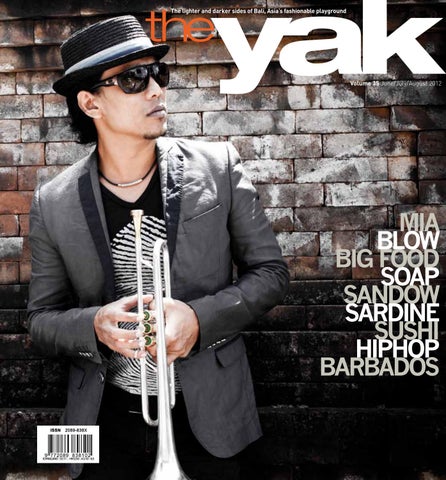
Volume 35 June/July/August 2012
IDR80,000 : S$11 : HK$50 : A$10 : €5
yak awards 2012
coming soon to a venue near you in September.
www.theyakmag.com
Jl. Laksmana No. 79, Seminyak. Bali - Ph: +62 361 738 655 Bali Collection, A14, Nusa Dua. Bali - Ph: +62 361 770 227
Asia’s Leading Yacht Dealership and Brokerage Since 1984
Approximately 18,000 islands in Indonesia. Countless cruising destinations. Bali in the centre, and Simpson Marine now here in Bali for you.
Contact us today to learn more about yachts.
P.T. Simpson Marine Indonesia Bali & Jakarta T: +62 8 786 224 4053 E: indonesia@simpsonmarine.com. www.simpsonmarine.com
Lu xur y
I n
P r i n t
Volume Thirty Five june/july/august 2012
The Yak Magazine Sophie Digby, Agustina Ardie, Nigel Simmonds
Publisher's PA / Sales & Marketing Indri Raranta
Production Manager Evi Sri Rezeki
Graphic Designers Irawan Zuhri, Teuku Melody, Stuart Sullivan
Accounting Julia Rulianti Volume 35 June/July/August 2012
Distribution Made Marjana, Kadek Arthana, Putu Widi Susanto, Made Sutajaya, Didakus Nuba
Publisher PT Luxury In Print
Licence AHU/47558/AH/01/01/2011
Advertising Enquiries Tel: (+62 361) 844 6341, 743 1804, 743 1805
www.theyakmag.com
IDR80,000 : S$11 : HK$50 : A$10 : €5
Rio Sidik. Photo by Lucky 8.
Email: info@theyakmag.com sales@theyakmag.com Canggu Club Tennis Centre, Jl. Pantai Berawa, Canggu, Bali 80361, Indonesia © PT Luxury In Print The Yak Magazine Bali.
You know the drill. No part of this publication may be copied or reproduced electronically or otherwise without prior permission from the Publisher. Opinions expressed within this publication are those of the authors not the Publisher. The Publisher reserves the right to refuse advertising that does not comply with the magazine's design criteria. The Yak will not be held responsible for copyright infringements on images supplied directly by advertisers and/or contributors.
min 34
The Yak’s monthly e-newsletter is sent
Archives, additional content and
yPodBali Version 2.1 – The Yak's iPhone
to 20,000 mailboxes every month.
more at www.theyakmag.com
App – is available from the App Store.
omnibus
contents
P: 95 big food: why is our most basic commodity controlled by so few? by Andre w E. Hall
“In less than three decades, a handful of multinational corporations has engineered a fast and furious corporate enclosure of the first link in the food chain.” - The ETC Group’s report, Who Owns Nature? Corporate Power and the Final Frontier in the Commodification of Life.
36
40
Yakety yak
Sermon From The Mount
42
15 minutes
46
one world
The Giving Game
48
Event Management
Running Into Art Garfunkel
dates With destiny
50
Seminal Seminyak
58
Too Cool For School
62
This Is A Love Song
New in the hood
out of the box
duoview 1
78 36
64 66
interwho
Mario Giorotto interwho
Cover Lover Rio Sidik
72
James Wynne
74
Sandow Birk
interview
artsake
76
Reno Pratama
78
Mia Taninaka
84
Riwin Red Hat
interview
interview
interview
76
66
118
contents 86 88 90
interview
John Marciano duoview 2
Cindy & Ari yak fashion
Clear Space
104
Hip Hop Family
114
Yoga
feature
feature
118
Amelia Earhart
122
Walking In The Sky
feature
exteriors
132 38
126 132 144 148
interiors
Quarter Century Carlo travel
Barbados Business oral pleasures
Sushi Sensation oral pleasures
Sardine Success
150
Janice Wong
154
Mozaic Beach
156
Big Six: Fish Face
oral pleasures
oral pleasures
oral pleasures
126
158
Rack Attack
174
Yak Canggu Tennis
Fashion Freestyle
just doin' it
178
Moonshine
180
Musical Musings
182
Digging Weed
184
Star Gazings
186
Who's Who
104
constant wining
raver's review
sounds Around
AstroYak
advertiser's directory
150
yakback If existentialism is the philosophy emphasizing freedom of choice and personal responsibility for one’s actions, then Yaksistentialism would logically be the freedom of choosing something Yakish, something luxurious, something out of the box, something that would make you personally responsible for enjoying life, quality and quantity – of all things upper deckish – being of equal importance. So with this as our philosophy we offer you the freedom to flick through this issue’s pages and pause … Read about how Art Garfunkel enjoyed Bali and what is new in our hood. Turn creative and meet Mario Gioretti of sks fame and hit the high notes with Rio Sidik as he trumpets his beliefs to the world. Business meets art meets skateboarding meets music and even soap in The Yak’s interview section where you get to philosophize with homegrown and imported notables. Fashion heads up the Food Chain in which A Hall gives you the realistic state of the world and who is really running the show. Dance and Yoga come before magnificent women in flying machines – Amelia Earhart disappeared somewhere around here 75 years ago. Next up, dally with perfectionism as interior designer Carlo Pessina bows to 25 years in the business of beautifying abodes. Barbados will surely touch your belief in travel before Japanese Yuu-san shows you the religiousness of Sushi in Oral Pleasures. Janice Wong will artfully tempt you with desserts just before the idolization of Bali’s fashionistas in Fashion Freestyle. One last philosophy is of popular proportions: tennis and here we got to ask ourselves at the IV annual Yak Canggu Tennis Classic what the racket was all about … Bernard Suits muses that a game is a “voluntary effort to overcome unnecessary obstacles…which is what we at The Yak have done for you this issue. So just sit back and enjoy the ‘ism s’ and the ‘osophies’ of life in Yaksville. May The Yak be with you…
yakinthelapof... Kelis. As one of The Yak’s esteemed bestrode the bar at the Hard Rock Centre Stage – spruiking and spraying – Brit Awards winner and Grammy nominee, Kelis, hid in a darkened corner. Safer there – less damp, less messy. It was the publicity launch for the Gorillaz gig at the magnificent GWK venue on the Bukit. But nothing escapes our eagle-eyed hard charger. And with a graceful leap – that, some say, involved a double somersault in the pike position – followed by a spontaneous break dance . . . he scooped up a handy copy of yours truly, moonwalked through the throngs and handed it over to our startled star. “We brought your milkshake, Ms Kelis,”he said. “Let’s Yak later,” she replied.
40
Dear Yak, I came across the magazine while in Bali recently. Love what you guys are doing over there. Would love to connect and, if possible, be kept in the loop for any openings.
first time in Bali. I searched for a restaurant in Seminyak, picked one, phoned through the App to make a booking, then used the map to guide myself there on my hired motorbike. Well worth the $1.99 price.
Meghan McTavish Bali
Robin Ajello New York
See you on FB Meghan.
Batman would have been proud of you, Robin. I know we are.
Dear Yak Absolutely adore your mag! Add me to your team! Matilda Mania Of course Matilda. But what is it that you do again? Dear Yak, Writing to say how much I enjoyed The Yak Canggu Tennis Classic this year. A surprisingly high level of tennis with some very entertaining matches, and some great prizes at the closing dinner. Well done. Claire DuMaurier Perth
I saw your magazine at The Cannes Film Festival this year. It surprised me to see The Yak sitting there at the Hotel Martinez, and even more surprised to see who was reading it – Alec Baldwin. Chris Powell Hong Kong Ha! Dear Yak, Is minYak is your monthly e-newsletter? A friend forwarded it to me. If possible I would like to advertise in it – please contact me. Simon Leather
Happy to hear that Claire. It was worth it just for the Champagne bar. Dear Yak, I used your yPodBali App for the
You are correct – minYak is our monthly newsletter. We’re glad you asked as it gives us a chance to tout it on these pages! Rate card on the way.
RAW. RARE. NAKED. It doesn’t get any better than sharing a meal at Starfish Bloo while looking out over the Indian Ocean. Take a different approach; Pan Asian cuisine infused with Western techniques that bring together unexpected taste sensations. Settle in and enjoy. Sunsets are free. Open for lunch, dinner and Sunday Brunch. Lunch With A View From Monday thru Saturday, choose from our delectable 3-course set menu and receive one complimentary cocktail smash, a glass of wine or an ice cold beer. 12.00PM - 3.00PM | Three course set menu IDR 300K ++ including one beverage.
STARFISH BLOO at W RETREAT & SPA BALI - SEMINYAK JL. PETITENGET, SEMINYAK, KEROBOKAN, DENPASAR, BALI T: +62 361 4738 106 E: b&f.wbali@whotels.com
EXPLORE WHOTELS.COM/BALISEMINYAK FACEBOOK.COM/WRETREATBALI TWITTER @WBALI
15 minutes SALVADOR BALI escorts a bemused folk hero around our island before The Fall. "It was 1987 and I was cruising in my jeep down Oberoi Road – such as it was in those days – on the way to lunch. There was a mere scattering of houses and not much else. . . apart from The Oberoi, of course. As I drove down the track this guy comes stumbling out of a roadside bush and I nearly batter the poor bugger back from whence he'd stumbled. Luckily my trusty steed had decent brakes – also a bit special at the time. I freaked and jumped out of the car, and the guy looks up in shock . . . and it’s Art Garfunkel. Even more bizarrely he looks at me and says: “Do I know you?” Still a little freaked I answered, “yes” . . . I'd grown up in New York City and, back in the day I hung out with the in-crowd that circulated around the Saturday Night Live comedy show. One night some years before I came to Bali, I sat next to Art at a dinner in Manhattan after the show had done a send-up of Simon and Garfunkel. Art and I had struck up a conversation. Standing on the side of the road in Bali, I reminded him of our talk, so he invites me back to the Oberoi Hotel, where he’s staying, to meet his new wife. Friends in the US had told him to come to Bali before “it was all gone”. But I had my lunch appointment. . . I lived near the Oberoi – one of two or three foreigners in the ‘hood, and I gave him directions and said we’d meet up and I would take him to Made’s Warung, and a new place called Marilyn’s, way up in Legian on Rum Jungle Road – nothing else in that area either, although Goa 2001 was being built . . . which would change the whole scene completely. I had a roommate by the name of Chandra, who looked Indonesian but
42
wasn’t, and spoke perfect English. When I got home later I found Art was making all kinds of hand signs to Chandra, trying to communicate . . . until finally, to his bemusement, she said: “Is there something wrong with you?” He was in shock and I was laughing my head off. So off we went to Made’s. Sitting with owners Peter and Made the questions never stopped and Art was as gracious as can be. A few drinks down the line and we decided to get a driver – I knew one outside touting his services and he took my coin . . . so off we set for Marilyn’s, a place named after this big breasted blond by the name of Tika. Our first encounter was with John De Coney, Made De Coney’s father of Lily Jean fame, and a veteran New Yorker with a karate mouth. I introduce Art to John, and John immediately put up both middle fingers and said, “fuck you!” Art freaked along with the rest of us, but that was John’s way of saying hello. Art and John hit it off after a while. A few more introductions and we were off to Gado Gado, the only other nightspot in those days apart from Double Six. While we were there, Art’s wife went to the car because she forgot something . . . too much time passed and I went out to see what was happening. Our driver was hitting on her – and furious for embarrassing me like that I started choking him. Art came along and cooled it all out, no problem. Everyone liked the guy . . . We had a few more lunches and then it was time for Art Garfunkel to head back to the States. The last I heard he was doing ok.
giving back
oneworld feeling charitable? here's some of the yak's favoured causes – support them.
BARC: It has many meanings, but for Linda Buller, of Bali Dog Adoption and Rehabilitation Centre (BARC), “bearing fruit” is way of life and result of passion – a passion to see all beings, even animals, experience life and love. “We bearers carry the goodies for the world,” Linda says with a gentle smile. Linda founded BARC and its shelter in 2007. BARC’s mission is much more than saving animals – it’s a quest to pass a test . . . a test to be human and humane; to be compassionate; to be attentive to the messages we’re told from beyond. “Sharing this world peacefully includes caring for all that inhabit it,” Linda says. BARC recognises the need for quality care of animals on Bali, and works to put right the tragedy of Bali street dogs. The foundation provides a sanctuary for animals that might, otherwise, succumb to a devastating and degrading fate: Abuse; neglect; poisoning; rabies; illness; sacrifice; dogs killed for their meat; are a few of the daily obstacles Bali street dogs have to overcome. Last year, BARC provided care to 5,000 dogs, including emergency medical attention; vaccinations; rescues; sterilization and rehabilitation. The refuge center in Ubud shelters and rehabilitates anywhere from 120 to 150 dogs at a time. Once rehabilitated, BARC adopts the dogs out to the community. Like the dogs, potential owners are also expected to act appropriately – they must be certain they’re able to care for a dog. BARC also operates a foster-care programme and provides community outreach and education on how to properly care for dogs. It works closely with the Good Karma Vet Clinic in Pengosekan. If the animals are not adoptable, they live out their days at the shelter – comfortably with love and dignity. The shelter is a no-kill refuge.
46
A French film crew premiered a documentary about BARC called, Stray Dogs of Bali, in late May; the foundation featured on the Project in Australia, also in May; and people continue to demonstrate support by fundraising, around the world. “Animals are put in front of people to test them, to see if they are decent human beings,” Linda says. www.balidogrefuge.com RIVER TO RIVER: After a recent surf trip to Bali, Kelly Slater is helping environmental beach clean-up efforts on the island. The 11-time World Champion has donated a brand new surfboard for auction, and has offered to match the funds for what the board sells for. He was quoted in The West Australian newspaper in May as saying: “I've never been so alarmed by the pollution situation as (on) this trip to Bali/Indo. “Worst I've ever seen. “If Bali doesn't do something serious about this pollution it'll be impossible to surf here in a few years.” Since August 2011, ideated by the Rotary Club of Bali Canggu, the River to River project is tackling part of the problem having set up a long-term cleanup project along two kilometres of beach from Pererenan to Berawa. With a fulltime manager and five fulltime beach cleanup workers trash is collected and recycled by Eco Bali. You can sponsor a strip of beach for as little as Rp.55,000 (which will keep one running metre clean for a year). Inquiries to Komang on: +62 819 992 00996. Or Tel: 4731701 – www.rotarycanggu.org facebook.com/rotarycangguclub THE JOHN FAWCETT FOUNDATION: “Our mission is to restore vision. Our vision is to
restore dignity. Our method is to create miracles.” The John Fawcett Foundation and its Indonesian counterpart, the Yayasan Kemanusiaan Indonesia, is a humanitarian foundation which assists needy people in Indonesia, particularly those with medical problems. It offers its assistance to people in the lower socio-economic group free of charge and without religious, political or ethnic consideration. The Foundation grew out of a number of Rotary projects established by its namesake, John Fawcett, in Bali, and is best known for its Sight Restoration and Blindness Prevention Project, incorporating the Mobile Eye Clinic for Cataract Surgery. www.balieye.org Seeds of Hope Children’s Home: The Bali Benih Harapan Foundation invites you to a magnificent charity event for the lover of art, music and food on Saturday, June 30, 7:30pm at Restaurant MannekePis in Seminyak, Jalan Raya Seminyak no. 2. World famous painter, Nico Vrielink will be painting next to Theos, “The King of Actionpainting” – an exciting performance to blues and rock music. The paintings will be auctioned after the performance. This is a wonderful opportunity to buy great pieces of art at great prices for a worthy cause. Join us for a delicious three-course dinner with music, including a welcome drink (Rp. 250,000) Reservations highly recommended. All proceeds will go to Seeds of Hope Children’s Home in Dalung, Bali. Tickets and reservations from Femke: 081 337 302460, femkebennink@gmail.com, or MannekePis: 0361 847 5784 info@mannekepis-bistro.com.
calendar
datesWITHDESTINY MUSTSEE AN important documentary premiered at the Rubin Museum in New York that will have a major impact on how caregivers and medical staff relate to neurological conditions such as Alzheimer’s syndrome and old-age dementia. Alive Inside is a documentary about the neurological and physiological benefits of music, based on research conducted by Dr. Oliver Sacks – portrayed by Robin Williams in the film, Awakenings. Alive Inside investigates how music can have a dramatic effect on people who exist with debilitating conditions that render them oblivious to their physical environments; that rob them of the ability to communicate, and to remember even their closest loved-ones. An excerpt from the documentary – that has received more than three
If you’re in London: June 23: The world’s highest rated equine sprinter, Black Caviar, will line up at Royal Ascot for the 1,200 metre Diamond Jubilee Stakes. This remarkable Australian horse has never been beaten in her 21 starts. Her owners are confident that she will notch up number 22 in front of Her Majesty Queen Elizabeth II. Black Caviar has become a phenomenon amongst race goers and non-race-goers alike around the world. She ran her last two races at South Australia’s Morphettville racetrack – both events were sold out well in advance. Australia Post has minted a stamp in her honour. June 25 – July 8: Get out your silver spoon and be prepared to dip it into a lovely bowl of strawberries and cream, while sipping on a crystal flute of champers . . . because Wimbledon is here again! The tournament that the world’s top players rank as their favourite will serve up the likes of Novak Djokovic, Rafa Nadal, the Fed Express and Andy Murray; a Williams or two will join the party, with Maria Sharapova, Victoria Azarenka and Ana Ivanovic. Gay Paris: June 21 – July 1: The boys take to the catwalk in the Paris Men’s Fashion Show to wow the crowds with next season’s fab threads and trends. July 2-5: It’s the fairer sex’s turn to turn heads at the Haute Couture Show where all your fave designers put their money where their 48
million hits on various websites – features 92-year-old Henry Dryer, who sits immobile in a chair in an aged care facility, unable to communicate, unable to remember even his own daughter . . . . . . until, that is, a caregiver brings him an iPod loaded with music from when Henry was in his prime. As soon as the headphones go on, Henry undergoes a remarkable metamorphosis. His head comes up, his body starts to groove with the tunes; he starts to sing along. Even when the headphones come off he is able to recall his fondness for the music of Cab Calloway. His eyes are alive. He knows who is. Once again he is an animated Henry Dryer. Alive Inside is a game changer. Catch it in June and July in cities acorss the US of A.
mouths are in an effort to garner the favour of fashionistas throughout the clothing industry. If you’re a film buff: June 14: Los Angeles Film Festival. June 20: The 65th Edinburgh International Film Festival. August 2: Melbourne International Film Festival. August 29: Venice Film Festival. Music: June 22-24: The original Isle of Wight Festivals were landmark moments for their time – they sit alongside Glastonbury and Woodstock in festival history. The first Isle of Wight festival took place from August 31 to September 1, 1968, and featured the likes of T- Rex and Fairport Convention. The 1970 Isle of Wight festival was a five-day marathon featuring The Doors, Hawkwind and Joan Baez. Jimi Hendrix also played at the festival in 1970 just weeks before his untimely death. This year’s lineup includes: Pearl Jam, Bruce Springsteen, Example and The Vaccinnes . . . August 10-12: Long Beach (California) Jazz Festival features some of the top artists of the year and includes VIP seating in an incredible outdoor setting with a great selection of food, art and much more. "Jazz", an experience you will never forget! On the culture trail: June 9 - 16: The Hie-jinja Shrine in Tokyo
explodes into life during Sanno Matsuri, a traditional festival from Edo times. Sip Japanese tea at garden ceremonies, wander through beautiful Ikebana flower displays and, in evennumbered years, watch costumed locals parade gilded shrines through Tokyo's centre. Sanno Matsuri is one of Tokyo's three "Grand Festivals" and is also regarded as one of the biggest festivals in Japan. Although the festival is annual, the grand procession of shrines, dancers and colourful costumes is biennial, falling on even-numbered years. July 28: Tokyo's dazzling fireworks display, Sumidagawa Hanabi Taikai, sees thousands of rockets spouting skywards along the Sumida River. The show includes a competition between rival firework companies, so expect state-ofthe-art pyrotechnics. Street stalls keep crowds fuelled with hot sake and corn-on-the-cob. And for the rev-heads: F1: Grand Prix of Europe in Valencia, Spain – June 24; British Grand Prix (Silverstone) – July 8; Dutch Grand Prix (Hockenheim) – July 22; Eni Magyar Nagydij (Budapest) – July 29. Moto GP: British Grand Prix (Silverstone) – June 17; Dutch Grand Prix (Assen) – June 30; German Grand Prix (Sachsenring) – July 8; Italian Grand Prix (Mugello) – July 15; U.S. Grand Prix (Laguna Seca) – July 29; Indianapolis Grand Prix (Indiana, USA) – August 19.
High Life Adjacent to award-winning AYANA Resort and Spa, Bali’s exclusive residential development AYANA Residences Bali has officially been launched. The low-density design, ecoconscious gated community will feature a limited number of luxury apartments and villas over 6.5 hectares of botanical gardens – three-bedroom top-floor and ground-floor penthouses with private pools, plus one and two-bedroom suites – all within AYANA’s Jimbaran Bay cliff-top grounds. With the first suites scheduled for completion early 2013, AYANA Residences’ investors can expect the largest living space of any Bali luxury residences, plus on-site Club House with 25m lap pool, café-bar, 10-seat cinema, swanky fitness centre and top-notch security. Residents also have privileged access to AYANA Resorts’ world-class facilities on their doorstep. Tel: 702120 www.ayanaresidences.com
Fountain of Youth On The Move Celebrating 10 successful years, ARC Anti-Aging Beauty Clinics moves to a bigger, purpose-built facility, handily located on Sunset Road (next to Bali Shell Museum). Since 2002, Australian-managed ARC Clinics are one of Indonesia’s leading anti-aging facilities, sought-after for their excellent range of anti-aging and cosmetic skin care programmes, using the latest products and technology and administered by experienced cosmetic physicians and nurses. With the new 1,000sqm clinic comes exclusive beautician services including oxygen infusion facials and Ultimate Ultrasonic Facial and later on, a dental clinic and gynaecology department. Cosmetic consultations are free and without obligation, so no excuse for things going southwards.... Tel: 754 645 / 750 982 / 742 4639 / 742 7876 Map ref. F.12 www.arcclinics.com Natural Tastes Want an upscale culinary experience back to nature? For a taste of unspoiled Bali, Patio Restaurant and Lounge at Plataran Bali Resort, is slapbang in a gorgeous rainforest setting – surprisingly in Kerobokan. Overlooking a river shaded by giant bamboo, surrounded by tropical gardens with rice terraces and jungle beyond, Patio may come traditional rustic style but cuisine here is all-sophisticated. “My inspiration for gourmet wellness cuisine comes from working for six years at Como Shambhala’s prestigious Uma restaurant,” declares Chef Nyoman Rai – who artfully balances textures, colours and taste-bud tingling flavours, highlighting raw food selections. Plataran Bali Resort is part of a series of high-end boutique resorts in Jakarta, Borobudur, Komodo – and soon, Ubud! Tel: 411 388 www.plataranbali.com
50
A ride with destiny Canggu always did have horsey overtones, and with it, Canggu’s Bali Equestrian Centre (BEC), Bali's first Equestrian Centre, complete with internationally certified instructors and full equestrian facilities. Opened piecemeal from December 2011, BEC now provides children’s covered arena, outdoor arena suitable for competitions, lessons, show-jumping and dressage, flood-lit covered arena, plus 40 stables and eight paddocks; grand opening for the clubhouse, restaurant and gallery is scheduled for August. Trot along for customdesigned lessons, group lessons for all levels, sunset canters, children’s pony club and riding camps. Tel: 844654 Map ref. P.2 www.baliequestriancentre.com Round The Horn Another retail indulgence on Jalan Petitenget, from the New Zealand creator of Corner Store, Horn Emporium has been a huge hit since 2011. This veritable Aladdin’s cave with old- world emporium ambience presents a unique, exquisite range of personally sourced art and antique pieces – from China to Mexico – plus accessories, body products, apparel and jewellery. In-house Horn label features clothing for women, men and children, as well as utterly stylish home accessories; this summer sees the launch of four new lines for the HORN women’s collection: Safari, Carnival, Frieda and Paradise, lavishly incorporating tie-dye prints and tribal masks to ornate lace and remembrance rose motifs. Tel: 4738330 Map ref. O.5 www.hornemporium.com
52
Fifty Shades of Green An experienced silversmith and interior designer, Pamela Cochrane from designcrop, creates ultra-contemporary, stylish jewellery with eco twists. Cochrane’s exclusive designs have been showcased in well-known collections and on international runways – a ‘less is more’ design style influenced by early years in Japan and Italy. Inspired by nature and earth-friendly consciousness, limited edition designcrop eco-range pieces are hand-crafted, using natural dyes and reused, recycled and natural parts (plumbing metals, faux leather derived from recycled rags and beach stones) proving fair trade, eco-friendly components can still be ‘high design.’ Available at designcrop’s Kerobokan and Ubud stores. Tel: 735865 Map ref. U.8
Luxury that doesn’t cost the earth Bambooku is Indonesia’s first company supplying certified organic 100% bamboo towels and bed linens to eco-conscious hotels, villas and spa’s across Bali – the most luxuriously soft, breathable and naturally hygienic towels and linens on earth. Bamboo bed sheets are equivalent to 600 thread-count Egyptian cotton and towels three times more absorbent than cotton; bamboo also has anti-bacterial properties. Plus Bambooku now carries a range of sexy, soft apparel and underwear, funky coloured pyjamas and more. With bamboo one of the world’s more sustainable resources, you’re helping contribute to a greener planet. Check-out Bambooku’s flagship store on Jalan Merthanadi, and later in 2012, outlets at SOGO and DFS. Tel: 7807836 www.bambooku.com
The Write Stuff The 9th annual Ubud Writers & Readers Festival – "One of the world’s six best literary festivals" (Harper's Bazaar, UK), this year runs October 3-7 and takes the theme “Bumi Manusia - This Earth of Mankind.” UWRF’s official programme is to be released in August, but so far this global festival promises an exciting array of more than 100 writers, performers, musicians and artists in over forty venues and public spaces throughout Ubud. “The 2011 Festival was an enormous success, with the biggest audiences and genuine sense of fellowship between the gathered literary community,” declares UWRF founder-director, Janet de Neefe. Where else can you swoon to a Russian poet serenaded by a gypsy violin? Tel: 7808932 www.ubudwritersfestival.com
Just What The Doctor Ordered The May launch of international-standard BIMC Hospital in Nusa Dua not only marks a dynamic new era in Bali’s quality health care – this now the island’s foremost medical establishment – but heralds the start of an international standard medical tourism industry akin to other Asian destinations. Besides BIMC’s Hospital Group’s established Kuta hospital, this mega-swanky, second health-care institution will operate based on the same principles, but taking services to the next stratosphere. An all-inclusive medical centre positioned nearby Nusa Dua’s five-stars, BIMC Hospital offers five ‘centres of excellence:’ 24-hour Accident and Emergency Centre, 24-hour Medical Centre, Dialysis Centre, CosMedic Centre and extensive Dental Centre. Tel: 3000911 www.bimcbali.com
Double Whammy Still crying into your beer over Double-Six Nightclub’s demise? Good news comes with the project launch of Double-Six Seminyak. This visionary destination hotel development stands on exactly the same spot as that legendary nightspot, beachfront on Seminyak’s Jalan Double Six. Ultra-chic, contemporary-style Double-Six Seminyak promises a five-star, five-storey exclusive experience (designed by the same folks as Ku De Ta and Cocoon) and 46 one and two-bedroom individual units – including swish penthouses – available for lease-hold purchase. Five F+B stations, avant garde business centre and gym, spa and children’s club are some of the superior facilities for short and long-stays. Tel: 756666 Map ref. P.13 www.double-six.com
Cooking Up A Hot Concoction One for the ‘Look at Kuta now!’ file: the Kuta boardwalk behind Discovery Mall looks even swankier with the opening of Segara Asian Grill. A sleek mix of colonial meets contemporary tropical, Bali’s newest Pan Asian restaurant- bar comes infused with a relaxed beach club ambience. It’s all about location: alongside Kuta beachfront with sweeping views up to Canggu Bay and prime spot for sunsets, submerged in the massive front pool with a cocktail. Open-air, cooled by sea breezes and ceiling fans, all-day dine and wine on Asian cuisine – signature is wok cooking from the open kitchen – or hit the ample-sized sun deck by the pool, to laze on snazzy sunbeds. Tel: +62 361 769755 Map ref. C.14 www.segaraasian.com
54
Walk The (Beach) Walk Another one for the ‘Look at Kuta now!’ file: Beachwalk Bali, a contemporary-style, retail- lifestyle concept opposite Kuta Beach, is now open. Sprawling low-rise for 250m along Jalan Pantai Kuta, Beachwalk Bali offers an eco-friendly but sophisticated mall experience suited to Bali – with alang alang thatched roof, recycled hardwoods and open-air walkways. Around 200 up-market retail stores and F+B outlets range from worldrenowned designer brands to hip local labels and traditional craft stores. Look out for exclusive-to-Beachwalk Bali global brands like GAP and Mango, plus Bali Deli and Sienna Café. Other facilities include valet service, kid’s area, central stage venue and underground parking. Beachwalk will be joined by five-star Sheraton Bali Kuta, opening later this year. Tel: 765777 Map ref. C.12 www.beachwalkbali.com
Classically Stylish in Nusa Dua Already a Seminyak fixture, Nico Perez ‘living in linen’ menswear concept brand has opened a second store, down in Nusa Dua. Coinciding with this, Nico Perez unveils their first women’s wear collection by Italian designer, Federico Gioli. Already renowned for ultra-cool menswear Bali-crafted in finest linens (devotees include ‘tourists,’ Julia Roberts and Javier Bardem), Nico Perez’s sensational collection of women’s apparel is bound to wow trend-setters this summer with an equally stylish yet utterly chilled range. So too, the new store, located in Nusa Dua’s Bali Collection;, a classic design of teak, black metal and glass and glam backdrop for super chic attire. Tel: 770227 www.nicoperez.co Spicing Up Sunset Road Bringing a new dining concept to Seminyak’s Sunset Road, Blackpepper Cafe & Food Circus opens July for delish breakfasts, lunches and dinners – all day, every day. Wonderfully casual, Blackpepper offers open-air terrace or air-conditioned café, with Executive Chef Ignacio ‘Nacho’ Virgen at the helm (previously of Spain’s EI Bulli). A gi-normous, great value menu includes creperie, pasta station, grill section, carb Fit dishes, Mexican specialties and premium Bling Bling (think Foie Gras Open Burgers). On the go? Take home ready-made meals, fresh juices, freshly-baked goodies and home-made charcuterie items. Tel: 847 5830 Map ref. V.8 www.blackpepperbali.com
Turning Japanese in Sanur Fans of Ubud’s hip Japanese restaurant, Minami, will be delighted to learn there’s a second Minami in Sanur (Jalan Segara Ayu). Same high standards and organic, home-style Japanese cuisine, but with some fresh variations: Minami / JJ Bar and Grill offers a more casual, seaside dining affair, at an airy beach house-style restaurant along Sanur’s boardwalk. Yummy new dishes include Teriyaki Rice Burger, 3Bs to Go (Beach Bento Box) and Japanese Grill skewers selection. Ubud signatures, ‘Sunny Blow’ and ‘Bloody Blow’ cocktails, perfect for Sanur sunsets, and Tasmanian Salmon (as recommended by The New York Times) have however been exported to Sanur. Tel: 08128613-4471 www.minami-bali.com Ku Boutique As if Ku De Ta could get any better, well it does, with their Ku De Ta Lifestyle Boutique, a shopaholic’s pleasure dome, presenting an intoxicating fashion, fantasy and fun trilogy. Grab your credit card, take five from cocktails and indulge in fabulous jewellery, accessories, beachwear, apparel and home wares for men, women and kids. Each boutique item has been hand-selected with the Ku De Ta patron in mind, created (naturally) with the finest materials available – most are Bali-exclusive. So now you can take home a piece of Ku De Ta. Shopping and cocktails combo? There is a God. Daily 11am-11pm. Tel: 736969 Map ref. N.8 www.kudeta.net
Good For The Soul Body& Soul clothing brand hardly requires any introduction, a series of highly visible boutiques across Bali and Indonesia since 1996, fashionista-popular for their Australian-designed funky, fresh, current and quality fashions, all competitively priced. But what you do need to know is Body&Soul has just opened on Jalan Raya Batu Belig – serving the blossoming Canggu, Batu Belig and Berawa enclaves. The swanky, spacious new store offers new collections in-store fortnightly, and stocks the complete basics and BS girls collections (8-14 years), premier Body&Soul swimwear range and accessories. Open daily 9am to 10pm, with heaps of parking space out front. Tel: 732 325 Map ref. M.2 www.bodyandsoulclothing.com
56
All Change Award-winning Hatten Wines has changed its labels, reintroducing traditional Balinese symbols onto its wine series. Still on a high from being recommended at the last Wine & Spirits Asia Wine Challenge, Bali’s own winery now features a temple roof for the Rosé, Balinese garden statue for its sweet white wine, Alexandria, an exquisite Balinese painting for dry Aga White (Wine Challenge silver medalist) and keris for the new Aga Red. Hatten’s two sparkling numbers have also been revamped with striking labels representing the flowers they’re named after – Jepun and Tunjung. Available now in restaurants and stores across Bali. Tel: 767 422 Map ref. F.12 www.hattenwines.com
S90 CafĂŠ Racer The S90 motorcycle features a forged cafĂŠ racer seat; overhauled engine and carburetor; custom-built polished clip-on handle bars; converted ignition from points to CDI; a custom Japanese exhaust; KTC small switches; a Daytona speedometer built into Suzuki GT front headlight; Polaris tail-light . . . all rolling on 18-inch TK Japanese wheels. Available at: Deus Ex Machina www.deustemple.com
58
Linus Systems Linus bikes come in a range of different colours – beach sand white, night rider black and rice paddy green – delightfully inspired by French designs from the '50s. Specs include: High-tensile steel frame with chrome-moly down tube; Shimano NEXUS threespeed gears; Tektro dual pivot caliper brakes; double wall alloy rims with stainless steel spokes; and genuine leather grips. This classic ride also comes with its own range of specialised accessories and upgrades – vintage tear-drop headlamp; market bag and pouch, made of waxed canvas and oilskin leather – and is not only built to last, but perfect for packing your beach gear or groceries. Available at: Deus Ex Machina www.deustemple.com
Burnout Shades Alero design sunglasses from Italy – the first and only with a light, flexible and break-resistant gum frame that comes with interchangeable lenses. Must-haves for style mavens. Available at: Mekong Jalan Oberoi, Milo's at Made's Warung, Namu on Jalan Petitinget and at Anantara Hotels.
59
60
out of the box
Standing Ovation (Left) The Avocado Lamp by Word of Mouth is a contemporary classic made from glassy white ceramic. Available from W.O.M: Kunti Arcade Shop 10, #9 Jalan Kunti, Seminyak. Wrist Action (Right) Hand woven and patterned bracelets that can be folded or crunched – works of art in motion. Materials are recycled or reused. Low Earth impact with max aesthetic. Available at: 88a Jl. Raya Basangkasa Crystal Magic (Below Left) The IGLO collection by Katarina Anderson for Covo is a series of three transparent crystal jars . . . good for spices, pasta, or pulses. Simple form designed for day-today life. Available at: sks www.sksbali.com Seats of Power (Below Right) Nimrod by Marc Newson features a matt or glossy polyethylene shell with seat and back cushions in expanded polyurethane covered in woolen fabric or leather. Available at: sks www.sksbali.com
61
duoview
nina hadinata and stephanie vermaas run one of the coolest concept stores in bali.
62
OK ladies, a quick roundup of who you are . . . Steph: Hello I'm Steph, I can't stop taking photos, and I swear in my past life I was a desert wanderer from Yucca Valley. I also like anything retro and kitschy. Nina: Hey, I'm Nina and I'm addicted to good food and good company. I also make parties for a living along with running our shop, This Is A Love Song. It's a song title isn't it? . . . are you just big PiL fans or does this say something else about what you're doing? Steph: Not a fan at all! But the name is actually the title of an interview we read in a magazine with John Lennon's son, Sean, and his girlfriend, Charlotte Kemp Muhl. Nina: And it also represents our unity together and the people we work with. So we thought the title suited and would be the name of the store and clothing. What are you up to? Steph: We are in San Francisco . . . yep, a long way from Bali, which is where we do what we do and that is run a store and a clothing line. I also design jewellery, which I call RBRTH. And Nina does . . . Nina: . . .the same thing. We’re currently on our US holidayslash-work trip, getting all inspired for our new collection and summer series for our clothing brand, Love in Tents. Your concept store on Jalan Laksmana is filled with quirky fashion wonder – how does it all come together? Steph: We wanted something different. When we started, stores were very minimalistic and pretty but all selling the same thing, just in a different space. We had the space because it used to be Nina's bar – Home Café – which closed down because of a psycho neighbour (god bless her) so we basically turned that into a store. We only had two thousand dollars so we had to spend wisely. Luckily we had a hell of a lot of time which we spent searching for recycled wood and alternative ways to make the interiors and displays. At the time no one in Bali was using toilet pipes as racks or collaging old wood and drilling them into the walls. We even got a bunch of old barrels and made a jewellery display. Nina: We didn’t plan it. It all sort of pieced together day by day with things we liked individually and collectively, so this is our love song.
How do you pick the people you work with? Steph: Some were already friends to begin with and others we became friends with through working together. Either way it's got to feel good to make it work. Right now we have a really good team behind us and we feed off each other’s creativity . . . and have so much fun at the same time that it doesn't ever feel like work. Nina: We kind of picked each other. Over the past couple of years I found myself surrounded by very talented people – especially when it came to the local brands, and realised there was no platform for these brands in Bali, so it was only natural for us to bring together a group of people that we already loved and admired. What's important to you in life? Steph: Family, love, travel and a pair of matching socks! Oh, food is in there too. Nina: Family in every form. Whether it's blood or a good mate. What defines cool for you? Steph: Not trying to be cool is cool for me. Just be yourself. Nina: Someone who's comfortable in her/his own skin, not in the outfit they chose that day. What does money mean to you? Steph: It's in my wallet but it always wants to leave so I don't like it too much. But we always work out our differences. Nina: I would like to say that it doesn't mean much, but the truth is it's got to mean something, right? I don't need all the money in the world . . . just enough to comfortably look after myself and the people that I love. We know the saying “Show Business" – without the Business there's no Show. Are you financially savvy? Steph: I suck. But Nina's Chinese sign is a rat and they're good with keeping the numbers in order so she's in charge of that. Phew. Nina: I am all about the business and will never leave you without a show. How do you see yourselves at 50? Steph: I'll get back to you in 25 years. Nina: Happy.
63
interwho
m ar io
mario giorotto is the creative director of sKs, bali's fashion and design mecca.
64
How’s life? My life is fantastic. I have a family: My amazing wife Dayu and two gorgeous kids, Rosa and Leone. Bali has good food, beautiful sunsets and it recharges your spirit. It also isn’t so isolated — I still have international people around me to share what’s going on around the world. And I have a chance to do charity work that’s close to my heart. We’ve seen your store, sks, establish itself as an innovative retailer over the last year. Is business good? As the Indonesians say: cukup untuk makan. We are able to put food on the table. It’s exciting to be able to bring worldwide design products to Bali; and, fortunately, it seems that other people find it exciting as well! You combine fashion, interior and graphic design in the store. Is this a reflection of your passions? Absolutely, yes. I’m a curious person and I really enjoy what I do. I always try to understand better what’s going on in the design world. Every year I attend Salone del Mobile in Milan and Design Week in Tokyo to discover new ideas and products from the most important designers in the industry, as well as young people who are up-andcoming. From there I often place orders for sks. I’ve worked in the design industry for a long time, and now I feel like I’ve made my dream of bringing iconic original pieces to Bali a reality. What else gets you out of bed in the morning?
My kids at five o’clock in the morning, every morning! Early mornings in Bali are the best. I feel that it’s really quality time. Tell us a bit about how and where you grew up and what your parents were like. I was born in 1957 in Turin, Italy, which explains why I’m crazy for Juventus! My father was super severe and my mother super sweet. As a result, I’m a mix of both of them. They gave me a foundation to survive in life on my own. They also taught me the real value of life. For this I’m really thankful. I worked from the time I was 14 and went to school in the evening. Turin was a small city back then, with only Fiat as an industry. My character is more creative and curious, so at 16-years-old I left to look for something more exciting in Milan. I started to work as an assistant to an incredible man selling Gianfranco Ferre’s first fur collections. This man was stylish, clever and very polished, and he taught me everything I needed to know about selling. At 18, I got my drivers licence and was given a few clients to follow on my own. What happened in your early 20s? I sold fur coats until I was 21, at which point I realised I was too young to live a life of just making money. In my heart I was a hippy, so one day I decided to stop working and found my way to Asia. I landed in India in 1978 by way of Turkey, Iran, Afghanistan and Pakistan. That trip really changed my life from being on a successful career path to being a citizen of the world. sks seems ripe for an expansion into different markets. Any plans to open in other countries? We’re always thinking about this. We have a lot of requests to open sks in other markets, so we are constantly considering how to duplicate the model elsewhere. Which part of your work do you most enjoy? There are two parts of my job that I really enjoy: I love researching and finding new products from around the world. I also love showcasing young designers and their talent at sks. Do you design (the men’s clothes) yourself? Yes, I design the men’s collection for sks and am very involved with the small details. The collection always reflects something unexpected. My character is quite precise, but I love a bit of a twist. I don’t like to take fashion too seriously. You’ve recently become an Indonesian citizen. How will that change things for you? Becoming an Indonesian citizen was a huge gift to my Balinese family. My life and my family are in Bali, so this was a natural progression for me. I really love this country. I respect the religion, beauty and energy of Bali, not as an expat, but as a citizen who considers Bali home. Things here are changing rapidly, but I wish we could preserve these fundamental feelings that Bali evokes for my children when they are starting their own families.
interwho
Rio Sidik is a horn player, he’s Indonesian, and he blows it like he sees it . . .
RIO. . .what’s the back-story? I was born in Surabaya, I’m 33, and I moved to Bali when I was 19. So how’s show business? It’s been good to me so far. Your group, Saharaja, was a favourite on Bali but seems to have fallen off the map – what happened? My divorce . . . Saharaja is coming back, single and mingle . . . same people and the music is our own – fusion, originals with some classic covers as well. Are you writing your own material? I’ve been writing a lot – actually 60 per cent of our stuff is original. Was your family into music? Yes, my mother’s side of the family . . . my grandfather was my biggest mentor. He is a trumpet player and he’s 75-years-old now, and has his own bigband orchestra in Surabaya. My grandmother was a singer; my mother a singer and a trumpet player; my aunt, singer and trumpet player; my uncles trumpet players; older brother trumpet player. All in the family, it’s in my blood. My grandfather was in the navy, so maybe that’s where he got the jazz bug. He brought back lots of records. I grew up with the big band sound and started playing solos and improvisations at 13 . . . that’s when I started playing piano. I learnt piano so I could improvise. Did you take lessons? My grandfather used to have a school where he taught more than a thousand students. Does your younger brother play trumpet too? My older brother is still playing in Surabaya and Jakarta, but my younger brother stopped and became an actor. My little sister, Marina, is a singer.
66
You sing as well, so I presume your mother was the voice teacher? She taught Marina and me. Did you ever have thoughts of ever doing anything else? No man, since I was a kid I knew I was going to be into music. Did you play with bands in Surabaya? Yeah, I played with my grandfather until I was 11 . . . that’s when I turned professional. At 11? Amazing. . . What made you come to Bali, given you were already successful in Surabaya? I just got tired of big cities. We went to Jakarta once a month . . . we travelled a lot with my grandfather. You were what they call a “trunk baby” in the show business world . . . Yeah, I grew up like that, so I came here and called a few friends and just started playing. Appears you never had a hungry day? Yes, thank God. I used to come here when I was in high school, so I already had experience playing in Bali. How long was it before you started the Saharaja band? The first band I played with was called Jiwa and the Soul Train – we split up, and I moved to Australia for a while. How was the reception in Australia? The first month was really dry. It’s so hard over there to get through. The musician environment is really protective . . . they were afraid I was going to take away their gigs. I just wanted to jam and they just wouldn’t let me. I got fed up, and then I met a clarinet player . . . we played and he really liked me, and finally I got through with his help. Now I go back and just call them, and go play some gigs.
horny.
67
interwho hot bike, cool jazz.
68
How many instruments do you play? I play a bit of piano, I play guitar and bass; I play the whole range of brass instruments. So you’re a one-man-band . . . you can actually do your own album by yourself? Yes, I did actually; that’s what I do, produce music. Score and write music. I learned that from my grandfather as well. Are you into recording right now? Actually, this year I’m producing two albums; one is my own; and the other is with Julie Tamblin, who’s a singer, and we’ll be doing a duo sort of thing. You’ve been travelling a lot this year, has that changed your attitude? Yes, a hell of a lot. Because of these trips I’ve written 12 new songs. You were in Russia? I was in Moscow, and I love Moscow man; it’s awesome, they loved me there. That’s an ego builder if there ever was one . . . Without a doubt, the biggest compliment I’ve ever had. How did you find the musicians to play with? I knew a few producers and contacted them before I left. They helped me to find musicians, straight away, meetings and practice rehearsals for shows. The musicians are great . . . they can play Tchaikovsky . . . I mean everybody can play classical – anyone who can play classical has amazing technique. Who is your biggest influence would you say? Miles Davis, Freddy Hubbard, Dizzy Gillespie – I love his personality on stage. So jazz is your passion? I wouldn’t say I’m a jazz musician; I play everything . . . and a jazz musician only plays jazz. On the rock scene, who are your favourites? I like Guns ‘n’ Roses; the Stones; and I’m a big fan of Michael Jackson. More recently Paramour and Nico Back . . . oh yeah Aerosmith – they’re cool. Last words? Just play what you feel, show what you play – that’s what Miles Davis said. Don’t be afraid to try something new. I don’t believe in music rules. What was your biggest compliment? When my grandfather came here last year and told me that he was proud of me. He was always strict and never said anything like that. This meant the world to me.
blow me up . . .
69
interview
. . . entrepreneur and shogroup exec with a distinguished pedigree in the hospitality industry.
James, where are you from originally and how did you end up on Bali? Born and bred in Sydney. My family is heavily involved in the (service) industry at home, and at the age of 22 I left Sydney for Switzerland to take on a two-year Swiss Higher Diploma in hotel management, and then, later, a business honours degree in the UK. I had seven months between finishing my degree and starting my MBA at Edinburgh University. My Danish girlfriend, now my beautiful wife, and I came to Bali for a little time-out before heading for Scotland. Within about four months of arriving, and at the age of 26, I set up Shogroup and took over the Canggu Club. We now also operate a bunch of villas in Bali and we are just about to take on our second private members club in Jakarta. What was your background before moving to Bali? My mum’s side (of the family) have been proprietors of hotels and pubs for five generations in Sydney, and my dad’s side have owned pubs and hotels for almost as long. My dad was born in his grandfather’s pub after it was realised his folks were not going to make it to the hospital. In 2004 my dad listed his group on the Australian Stock Exchange and so I have, luckily, had the opportunity to observe how the corporate side of the industry operates. I'm just as fortunate to have my father in-law by my side as he has been doing business in Asia and Indonesia for over 20 years. He's shared a lifetime of stories with me, and a wealth of advice. I don't take either one of them for granted. How did the idea of the Canggu Club come about – was it an evolution or was the whole plan mapped out before they started building it? Originally the plan was to build a school. An expat gentleman by the name of Steve Kenny took that idea and rolled out an ambitious plan to build both a private members’ club as well as a community school. Steve followed through with a vision that he ultimately created but, unfortunately, he passed away just two years after it was 72
conceived and within months of our takeover. What is the premise/philosophy behind the club? Like all businesses, you have to accept change and adapt as your environment evolves. While the original philosophy has stayed true, the model has had to embrace the changing dynamics of the Bali market and adapt accordingly. We've managed to do that pretty well. Upon our takeover we tweaked the model to place a greater emphasis on Bali's property and tourism sectors. In saying that, the premise still revolves around family, sport and recreation, and we are constantly adding new services directed towards specific demographics. If you operate a private members’ club you have to cater for a wide range of specific needs. In our case, a lot of recreational options. In the context of Bali, the Canggu Club is quite unique – a sporting venue, fitness centre and social meeting/recreation point. What range of activities do you offer members? Wow, where to begin . . . We offer an incredible range of activities to cater to a wide range of needs. We have badminton courts; squash courts; beach volleyball courts; a full-size, floodlit football pitch; basketball court; lap pool; a fitness centre; as well as our newly built elite training centre; social tennis and our tennis academy. We have recently renovated our adults-only bar and billiard room; we have numerous classes and programmes such as yoga, pilates, jazz, ballet, aerobics, dance; our new TRX training classes; and zumba. You name it, we offer it. Does the club host international sporting events, and if so what have your favourite ones been in the past? We do. We host a number of international rugby, soccer and AFL tournaments. I played rugby for 11 years so I personally get pretty excited every September when we have 400 rugby players, and 1,500 spectators turn up at the club for two days of footy, a few cold beers and some big hits on the field. It's a great couple of days on the Bali calendar and we welcome anybody and everybody.
How many Indonesians are employed by the club and where do you find the “right” kind of people to make the whole thing work? That's obviously a key question facing any large-scale operation . . . where to find committed and motivated people. The club has a local workforce of around 125 at any given time, and our staff turnover is incredibly low. Since our takeover of the club in 2008, 70 of the original staff have remained with us. Not a bad statistic. With regard to recruitment, particularly concerning key positions – I have never been fond of conducting long interview processes or advertising for positions. I either recruit people that I find myself, or people that have been highly recommended. Alternately, and preferably, where possible, we always try to promote from within. In my opinion a byproduct of this kind of a policy is that it inspires a level of commitment and loyalty to the organisation that is difficult to get otherwise. We have a great workforce. For yourself what is the best/worst part about living on Bali? There is a great deal of opportunity for honest and capable business people to expand and grow businesses and brands, both within Bali, as well as within the region. Bali seems to be a melting pot for interesting people with appealing ideas and businesses. Unfortunately, this can sometimes attract individuals that intend to exploit the honesty of others. Luckily Bali is a pretty tightknit community and these people never seem to go undetected for long. If you're doing business in Bali your reputation is everything and I think that is a great thing. What advice would you give someone wanting to set up a new business on the island? Respect the business environment that you're in and embrace your workforce. It's a fantastic place with a lot of opportunity.
artsake
artists Sandow Birk and Elyse Pignolet bring bali to life on the page.
Sandow, what's the early story? Born in Detroit, Michigan, 1962; moved to the Los Angles suburbs when I was five; went to Otis Art Institute (of Parson’s School of Design); dropped in and out of art school for many years before I finally finished a year of study in Europe. Half a year in Paris and England . . . that was in my 20s. Spent another four years in Rio de Janeiro, Brazil, back to Los Angeles and been a painter ever since. Did you always have a career in painting in mind? Actually I didn’t, I was sort of the kid that drew in math class, I really didn’t start thinking about being an artist until I stumbled into art school. What kind of art did you start out with? I’ve done a whole lot of traveling in my life as a surfer, so the first paintings I did were places I travelled to. A reporter in life through canvas, so to speak. . .? Sort of, I guess you could call it realism. What’s interesting is, you do a lot of your paintings with your wife, Elyse Pignolet. How does that work and how did that come about? We met about 10 years ago in Los Angeles and have been together ever since. . .got married a couple of years ago and have a child. Elyse’s background artistically? She has a Bachelor of Fine Arts degree and studies ceramics. Usually most artists are self-indulgent . . . don’t touch my canvas sort of thing . . . how did
74
the collaboration come about? Elyse has her own ceramic studio outside of the house in a different neighborhood, so she does her work (and I do mine); we’ve done some really large projects together – big murals, a metro station in Los Angeles. So art has been good to you? Yeah. . .for about 15 years now. How long have you been coming to Bali? I’ve been here six times. . .the first time was in 1993. So you’ve seen a lot of changes since then? The last time I was here was seven years ago in Canggu, surfing . . . it was really difficult to find (the beach) in the rice fields. So how did the Deus Ex Machina exhibition come together? Because of Susi Johnston. Last time I was here my wife and I were working on a big outdoor wooden gate for a house being built in Hawaii. We designed it and it was being carved here, so we came to see the project and the carvers. Susi was sort of the facilitator on the project – we met, liked each other, kept in contact and she kept saying: “You have to come back to Bali.” So she arranged a week at the Ailia Resort. We decided to stay on and do this project because we’d met the Deus team in Sydney, Australia, where they have a place, and in Los Angeles where they opened another venue. . .same set up as here. So you will be having exhibitions in all of the Deus destinations? I’d like to.
sandow & elyse.
75
interview skater and musician reno pratama was born to twelve bars.
Reno, for those of us who don't know you, tell us who you are, and what you do. I'm Reno Pratama, a.k.a. Renprat. I'm a street skateboarder and musician . . . I was born to play twelve bar blues. How did you grow up? I grew up with my skateboard, my guitar and harmonica . . . and lots of travelling with friends. Sometimes as a lonely wolf traveller! Getting to know other cultures and, yeah, it's all about living a good life. Is guitar your one true passion? Yes, I love to play and jam with players of other instruments . . . so, anyone wanna jam with me? Who are your influences and how would you describe your playing style? So many people influence me. My style I would describe as simple and elegant. What guitar/amp combination do you prefer? Fender Blues Deluxe and Cry Baby.
76
Self-taught? Yes, pretty much, I love to learn . . . but I do pick up riffs and licks from the people I hang out with. What's your philosophy on life? Break your love but don't break your heart. Break your board but don't break your life. Peace for the world! When are you happiest? I'm always happy when I’m with people who can show me things I’ve never seen or known before. What makes you cry? When a good friend dies. What makes you different? I’m not sure about that one . . . I just try to be myself – a common person. Keep it real, and follow my heart. Tell us about your skating, and skating in Indonesia. Skateboarding life has been so good. A lot of competition and demonstration here . . . it's good for the next generation. If you ask me about Indonesian
skateboarding, it's really huge. How did you get into it? I grew up in the Senayan (Jakarta) skateboarding scene starting in 1998, and all the Indonesian legend skateboarders came from there – Jack Curtin, Bima G, Rico Prams, Tony Seruntul, Davit Has, Mark O'Brian started skateboarding there. They always talked about the fun life – skateboarding with good attitude. It's a lifestyle forever . . . skate ‘til we die. What's right about Indonesia. What's wrong? Indonesia has so many things. We have different cultures, languages, beautiful islands, good waves, good streets for skateboarding in Jakarta, and other big cities here . . . Skate and guitar, sounds like the perfect youth dream. Anything else in your armoury? Skateboarding and guitar are my life, but not the only things in my life. I have other stuff going on – but maybe that’s a story for another time . . .
interview
mia taninaka: free spirited artist on the lam. Photo: D.HUMP.
78
Righto, who is Mia Taninaka?
Mmm I don't think I can sum that up in a few sentences. And if I could, I would consider
myself to be an incredibly boring person. Today,
I'm quite content.
How did you grow up, and where are you from? I grew up on the Northern Beaches of Sydney,
but spent parts of my youth travelling through South-East Asia with my family. I think this
definitely opened up my eyes and interests to a
whole other way of thinking, eating and living. Since quitting my job a couple of years ago, I've tried to devote most of my free time to travelling and generally having a good time.
You strike us as a free spirit...is that why you
draw so many eagles in your work?
I've always loved birds and their ability to
see the world from a completely different
perspective to the rest of us land folk. Eagles, to me, epitomise freedom, beauty and strength, qualities we should all aspire to a bit more.
Continued on page 82.
79
interview
manifest your dreams.
80
chips off the old block.
psychedelia.
81
interview
Your other influences seem to be a mix of
Have you ever had a job? Like in a supermarket
guessing...but it looks like there's a lot of
I've worked various occupations from checkout-
India and maybe American Indian? We're just folklore going on.
I'm hugely inspired by the deeply rooted
cultures of India, South American shamanism
and Native American folklore. They, along with many other tribal peoples, have maintained a
deep connection with the natural and spiritual world. Everything they do is in harmony with nature. The Western world has lost this
connection and as a result has lost its way.
Tell us about your art, and
how you got started.
I started drawing, painting and creating
from an early age but I didn't really start taking it seriously until I finished my
major art project in high school. It was
the first time I had to think about what I was painting and creating a finished piece
of work to show to someone other than close friends and family. After that I continued to paint, and a couple of years later my
boyfriend at the time organised for a gallery to show some of my pieces. I've been happily
painting and exhibiting ever since. How would you describe your style?
A wild and wonderful journey through the many
magical layers of the natural world.
What interests you about life?
I'm completely consumed by love, nature, good
food, beauty, travel, adventure and knowledge. Sounds corny, but feels lovely. I think we
live in this big beautiful universe and people are so involved in making money and careers to buy things they don't need that they totally miss all the magic surrounding us.
82
or something? Or a bank?
chick to bar-girl to graphic designer and have come to the conclusion that I'm not really
one for offices, long work hours or having to ask for time off. It's much more satisfying
working for yourself, the results you achieve are purely determined by how hard you work. I also get to go on lots of holidays and enjoy my freedom.
What's the toughest thing about you?
My new hiking boots which I'm currently wearing in the chilly New Zealand Alps. What's the weakest?
My freezing cold fingers.
Where did you get the name for your blog... Wolfie and Huck?
Well I love wolves and my boyfriend kind of
reminds me a bit of Huckleberry Finn so I just made up a little love story about them with that title and it stuck.
What exhibitions have you got coming up and where can we see more of your work?
I'm currently working on some side projects and have a few group shows planned for the
later in the year. I'll also be launching my online store within the next month, and will be setting up my new studio as soon as I get off this mountain and back to sunny Bali. Any last words?
'You were once wild here. Don't let them tame you' – Isadora Duncan
legging it. . .
83
interview
the man in the
Tropical Transit was the first band to explore the outer regions of Bali . . . and has continued to reinvent itself with Latin and soul-based rhythms. Founder, and musoin-chief, Riwin, shares the vibe with Salvador Bali.
Curtain call . . . My Balinese name I Gusti Ngurah Ketut Riwianna but I’m known simply by the name of Riwin. My age . . . ageless. When did you learn to play guitar? About 30 years ago. I met an English guy who was a hippie and he taught me how to hold a guitar in order to play. I learned enough in two weeks – the basics – enough for me to learn by myself. I met him at the immigration office, and he was wearing cut-off jeans . . . they threw him out. What style did you learn? Flamenco . . . which led to bossa nova and jazz . . . mostly island feels. Before that, what were you doing? Going to university in Bandung where I was studying biology. I was at the university in ‘76 where I met other musicians, and we started a group called Pahama. We entered a contest for radio and television . . . did an acoustic act, and we won. So for four years I was in Bandung, then back to Bali. That’s when you started Tropical Transit? Yes. Who was in the band when you started? France, but he passed away. Most of my earlier 84
band members have passed on . . . so Transit band members come and go . . . the lineup changes all the time. Did Tropical Transit get you out of Bali? Yes, we were sponsored by the Ford Motor Company in Europe, we went to the Caribbean – there was a party at the Bali Hyatt Hotel and we played there; the people liked us so much that they invited us to play on a cruise ship which was a very nice experience. Do you play cover songs or original music? We try hard to be more original. Now here’s something that should turn some heads – you’re a priest as well . . . how did that come about? Many spirits came to my house where I have a special room for them, and every full moon people would come and they would ask me to cleanse them . . . now they call me Mangku Rock ‘n’ Roll. Did you know you had this ability to contact spirits? I don’t know, I pray a lot so many people came to my house, they trust me and I made them happy and make them cool, get rid of their problems. You’re involved with a new project that might be a first – Radio Internet – elaborate on that . . .
A Japanese friend, Jakki Inaba, came to my house and listened to my songs, and said where did this come from? These songs should be on radio. Jakki is from Tokyo and is in the music business . . . very techno oriented . . . computers and all that. So he says, okay we will make a radio show and he did it. So now we have Tropical Transit Radio Internet from Bali to Japan. Is the music on the Radio Internet only Tropical Transit or other music as well? Only Tropical Transit. Will you collaborate with more people in the future? Yeah, we will be also be doing spiritual ritual – playing a type of world music. We did that at the Jakarta Jazz Festival . . . it’s what we do in Bali with incense and holy water. You can meditate with the music. We plan to go to Australia – to the World Music Festival and do this for the people down there. What words do you have for up-and-coming musicians. Play with your heart . . . if you’re really into it that it will be your reward. It’s not about money.
interview le president du savon.
86
John Marciano is a Renaissance man – an art conservator, musician, businessman . . . and he’s got his own Republic. He took time out to talk with Drew Corridore. He was born in Turkey, grew up in Singapore, went to university in Dallas, Texas, and first came to Bali in 1974 (because his family lived in Jakarta for a couple of years). He’s been around . . . and is driven by a compelling interest in, and exploration of, various aspects of the fine arts. After gaining his fine arts degree and completing a rigourous apprenticeship in (three-dimensional) decorative art restoration, John set up a company in the US that specialised in art conservation projects. “. . . so if a piece (whether it be made out of stone, wood, ceramic etc.) was in 10 pieces or 1,000 pieces, I could, essentially, make it look like it had never been broken,” he says. After 18 months or so of successfully building the company in the US, John moved back to the home of his youth, Singapore, for five years to continue the project there. “We did really well, and worked with the Economic Development Board, and the Singapore Tourist Promotion Board . . . training (with specific grants) people to preserve their own heritage,” John says. “There’s no single way to restore anything, so you have to look at each individual piece and approach it with your code of ethics . . . which means you cannot alter the original (intent) of the piece. “Everything I do (in restoration), as dictated by my code of ethics, has to be reversible . . . so when new technologies become available, a piece can be deconstructed, and reconstructed using the newer techniques.” John worked on many invaluable objet d’ art in private collections that the general public would, generally, never get to see – requiring endless hours of painstaking work . . . all the while refining his understanding of materials and processes. In 1997 John moved to Bali to manage the setting up of a candle factory. A strange departure you might think . . . Ever tried to create a near-perfect-looking piece of bamboo out of bee’s wax?
“That was seen as a hot trend in the States,” John says. “. . . and I was hired because of my skill set (in experimenting with various combinations of compounds and chemistries).” From there John moved into jewellery and handicrafts; exporting with Andrew Mclatchie’s Great Dividing Range company, that served some of the largest retailers in America at the time. Again, it was all about quality, finishing, and innovative approaches to product design and manufacture . . . “It was almost mind-blowing (the number of containers we put together) coming out of this tiny, little island,” he says. . . . and so to the present . . . The Republic of Soap: John’s next step (beginning in 2004) on the road to challenging himself on the creative journey: “I woke up one day and said to myself, ‘I want to make soap’, and I’d never made soap before,” he says. “All my candle(-making) books and literature talked about the historical association between candles and soap that were traditionally made by the same person – the chandler . . . so it felt like a natural progression for me.” And an opportune business decision. Republic of Soap has been supplying Bali's top spas, hotels and villas for years. Handmade natural luxury bath, body and home products are also specially designed to suit individual clients’ needs. “We’re always growing and increasing our knowledge of blending, creating and experimenting . . . are making great new products and we’re pleased with the direction we are moving in,” John says. “There is starting to be quite some demand from the European market, specifically France, as well as the Maldives. Above all, we have a lot of fun here and are constantly creating new scents and have introduced specialty items that many people don't even know exist . . . like low-melt-point massage candles that can
be directly poured onto the skin for a stunning effect. “The wax is liquid but not hot, just warm, when it is applied to the skin . . . really fun for couples!” All products in the Republic are made and packaged by John’s team of 20-plus workers. “I'm honoured to be working with a highly skilled team that is devoted to helping our clients with exclusive scent creations and customised artwork labeling. We all do our best so that the whole team-effort really creates an amazing handmade quality product,” he says. “We only use the finest ingredients available . . . which sometimes gets tricky because we need to source and maintain quality and consistency on everything – from our packaging to the paper that we use to hand-wrap our products. “We import oils from Australia and France for products that are unavailable in Indonesia . . . but of course we try to support the local community as much as possible, and source everything first from Indonesia before looking beyond the archipelago.” For John Marciano attention to detail is everything – whether it’s in putting customised logos on products and packaging for the Republic of Soap . . . or working on the business end of his Fender Stratocaster. He’s been a guitar player since he was kneehigh to a grasshopper and is well known around the traps on Bali for his Texas Blues-style technique. “I want to be a rock star when I grow up,” he says. “But it’s like everything . . . if you persist you’ll achieve what ever you want to achieve. “I didn’t know I was going to get into ceramics; I didn’t know I was going to become an art conservator; I certainly didn’t know I was going to end up making soap and skincare products . . . “But I always knew I wanted to play music.” And for John, listening to the rhythms and melodies of his life’s journey has led him a merry dance, that is far, far, from over . . .
87
duoview Cindy ishimine and ary aditya represent a new creative frontier in Bali: positive, indonesian, creative and at it.
ArYDressed by JUNGLETRIBE Shoes - ERDM Cindy Dress - HORN EMPORIUM Necklace - MAKE BELIEVE Heels - Stylist own Bracelet - JUNGLETRIBE
88
Should I ask who’s the boss here? Cindy: I’d say we both are. Ary: . . . there, my boss already got the answer. Seriously, where are you from and how did you grow up? Who or what has influenced you in life thus far? Cindy: I came from a mixed-cultural family of Indonesian, Dutch and Japanese. I was born in Indonesia but after high school I left for Osaka and then to Holland for eight years. So I would say I’ve spent my adult life abroad. Life inspired me to live the dream, but what keeps me going is the support from the people who love me. Ary: I’m authentic Sundanese; I grew up in Bandung, West Java, 29 years ago. Bandung is such a creative city – almost 60 per cent of young entrepreneurs are in creative businesses like publishing; the clothing industry; indie advertising; and guerrilla marketing. I like being in the creative industry, working with creative people and making experimental projects. It’s always been my passion to make something from an idea into reality. I live my dream. You’ve both been involved in one of the most exciting musical projects in recent times here in Bali, namely the Gorillaz Sound System party at GWK. How did that come about, and how were you both involved? Cindy: We were part of the Head Brewers production team for this event. I did promotion and marketing. I was very excited to take part in it, and always wanted to stage an audio-visual event at GWK. It’s such a beautiful venue. Ary: I did the design and made the official video for GSS, I was so excited with this event because it was a very attractive show with a massive visual stimulation. Had you ever done anything like this before? Cindy: I've been involved in many events, and was involved with a music festival in Ubud last year with one of Indonesia’s great composers, Franki Raden – it was small but I must say that we were proud to be able to pull it off without any sponsorship, and very lucky we had so much support from the artists, community and government. Ary: A couple of times I’ve been involved in indie community events. It’s fun to see local artists with their own unique music sound. In 2004 my friends and I released four DVD documentaries about the local music movement called Noise Maker Video Magazine. Why is Bali suddenly attracting so many cool acts? Cindy: Bali has always been THE island, THE paradise, it’s like being watched by the world. Who wouldn’t want to visit and perform on this beautiful island . . . right? And many people living here are looking for more entertainment and excitement. This makes it more possible to bring great acts to Bali. Bali is well known, but there is more to Bali than just traditional dances, temples, surfing, and so forth. There are other sides to Bali … new media art! Contemporary art and even punk/grunge bands that people are not aware of. Ary: Bali is fun but it’s boring if you do nothing. I really respect the local artists – they are very talented. But we need really big shows here.
Leading up to the day, what were the challenges in putting on the Gorillaz show? Cindy: I have to say that the biggest challenge was to convince people that the event was for real. What else are you into? Cindy: I love design, music, technology and art. I created PopArtFair.com which is an online gallery where everyone can send their artwork – everything from paintings, sculptures, product designs, fashion, installation, videos etc. Pop Art Fair is about fun and living … we love to collaborate. I’m also in a process of creating my own fashion line, I love every single thing that I do. Ary : I’m a geek and techno freak, I’m always excited about design, video, art and technology. I founded a creative company called Revolta Motion. I do motion-graphic and video editing stuff . . . almost all my jobs have to do with hardware & software but all this technology is useless if we can’t find creative and talented people to work with it. It seems to us Bali is one of the last frontiers for music . . . how do you find the local music scene, and how do you see it developing? Cindy: Music and movies are developing slowly in Bali. The local music scene is good for rock/punk music. I think we need to introduce other genres. Bali is not like in Jakarta, Bandung or Jogjakarta, where people are creatively competing . . . and that’s very productive and positive for the young generation to start innovating. Ary: Listening to music is such an enjoyment. I’d like to hear more musical genres here too. Bali has a big community and an underground scene. If there was one big music festival with various styles of music it would be more interesting. It’s also one of the burgeoning creative hotspots in Indonesia . . . how does the talent here stack up against other parts of Indonesia, do you think? Cindy: There are many great Balinese artists if you look for them, but if you’re talking about new media artists – such as video and motion graphics – most of them are out of Bali because chances are bigger in Jakarta than here. Ary: Balinese talent is superb, but the creative industry is still growing. You’re both from outside of Bali . . . what do you think you’ve brought to the island in terms of creativity? Cindy: This is just the beginning. I see that we’ve triggered creativity, and we’re still in the process of bringing it all together. Hopefully from this interview we can get more supporters who share the same vision. Ary: I love the mix of cultures here. Working with various people from around the world, I can see everything from different perspectives, and in unique ways – the experience is priceless. What gets you out of bed in the morning? Do you each have a personal philosophy to life? Cindy: Making dreams come true . . . life is customizable – design it the way you wish. Ary: I thank God I’m alive … let's do some crazy stuff every day, and make some money from the things we like doing . . .
89
clearspa c e
Photography: D.Hump. Stylist: Georgina Amanda Solomon. Model: Kristiana Lleshi. Make-up and hair by Bethany Colson for Balistarz using mac cosmetics/bethanycolson.com
90
Headscarf - Vintage Versace TOPSHOP Rose - MAKE BELIEVE Frida Kahlo Tee - HORNE EMPORIUM Belt - EverAfter Vintage Shorts - HORN EMPORIUM
91
Hat - EverAfter Vintage Scarf - EverAfter Vintage Chain - Stylist own design Shorts - TOPSHOP
92
Tee - THECOWBOYGEISHA Cuffs - JUNGLE TRIBE Sequin Skirt - Stylist own design Heels - LASSKAA @thisisalovesong
93
omnibus
by Andre w E. Hall
“In less than three decades, a handful of multinational corporations has engineered a fast and furious corporate enclosure of the first link in the food chain.” - The ETC Group’s report, Who Owns Nature? Corporate Power and the Final Frontier in the Commodification of Life.
95
ominubus
J.R.R. Tolkien once wrote: “If more of us valued food and cheer above hoarded gold, it would be a much merrier world” – but Tolkien died in 1973, before the advent of commodity buffering and price hedging that became characterised by so-called “butter mountains” and “milk lakes” in the European Union during the 1980s and onwards – when food took on an equivalency with hoarded gold. The world was not merrier. Government-subsidised over-production engendered wastage on a scale difficult to comprehend. While, in what was then referred to as the “Third World”, people in their hundreds of thousands died of malnutrition. In sub-Saharan Africa, food became a weapon of war. It is still used as such. The 2011 World Development Report states: “Most forms of political violence, particularly violent protest, communal violence, and civil conflict, are most prevalent in countries at lower levels of economic development . . . Due to the high correlations among low per capita incomes, poverty, and food insecurity, it is clear that political violence is largely a phenomenon of the food insecure world.” A common analogy in economic theorising refers to guns and butter – a hypothetical that relates to a nation’s opportunity cost of spending its treasure on guns (defense/security) or butter (consumer goods). Opportunity cost is the cost of making one economic decision over another, and – in the broadest context – what proportion of gross domestic product (GDP) should be allocated to what sectors in which a nation believes lay its best interests to invest. In late April the (apparent) Republican candidate-elect for the next US presidential election (to be held in November), Mitt Romney, specifically referred to this model in a speech delivered after a GOP Primary contest . . . he went for his guns. A warning to all of us if we have the misfortune to see him elected president of the United States. The guns and butter allegory, however, doesn’t correlate terribly well with economies modeled on a “free market” – a term that is misleading in the extreme . . . what it really means is non-regulated markets, where checks and balances have been removed to facilitate unmitigated access by monopolies and oligopolies. A “trickle-up” effect, in direct opposition to the mythical “trickle-down” doggerel, affected by lobbyists and marketing departments, in right-wing western democracies. But in conflict zones on the African continent (and anywhere else, for that matter) if you own the guns and the butter you can kill off communities – in a variety of ways – whole pesky populations that represent a (real or imagined) threat to the established order. The opportunity cost of this is obviously in favour of starvation – bullets cost money. In western “free market” economies greater and greater percentages of food resources, production, and preparation are falling into the hands of fewer and fewer multinational corporations in a global industry that boasts a size and scale that beggars belief.
96
97
omnibus
So, what is our relationship with “food” other than it being an essential fuel to keep us going in our daily lives? (Those of us, that is, who are in the privileged position of having access to it . . .) In (western) popular culture food has become synonymous with the celebrity chef . . . the gastro-porn industry that is a relatively cheap way of filling television broadcast schedules. In the good ol’ days there were one or two cooks on TV – my favourite was Keith Floyd, a Brit, who basically went on a lengthy, and geographically diverse, drinking binge and whacked things up in a wok. Nowadays a plethora of gastro-gnomes infest our screens, and cooking competitions like MasterChef (and even kiddy MasterChef) have become spectator sports where the stresses and strains of bunging something on a plate lead to various forms of neuroses and post-traumatic stress disorders. There is Gordon Ramsay – the self-styled evil genius of the kitchen who needs to attend a few anger management courses; Jamie Oliver – the healthy eating crusader who wants to eject junk food from school canteens (which got him into trouble with some obese Americans); there’s Nigella Lawson who does erotic things with chocolate and other foodstuffs . . . and leaves the viewer wondering how he can have a libido bloom from watching a cooking show. Anthony Bourdain, bless him, long ago adopted the Keith Floyd approach to travelogue and cultural cuisinery. Heston Blumenthal has brought the chemistry lab to the kitchen and does weird stuff with liquid nitrogen . . . Some of it is entertaining I suppose but it’s also become kind of cultish. Lisa Abend writes in Time magazine: “It's been a few decades since we started turning cooks into stars, and still the phenomenon continues to grow. These days, the Emerils, Marios and Gordons of the world scarcely need the qualifier chef — they are celebrities, plain and simple . . . In the Food Network era, the phenomenon of the celebrity chef has utterly transformed the restaurant industry and, in the process, changed the very nature of how we eat. “. . . shows like Iron Chef and The F Word have reinforced the message that cooking is best left to the professionals. By turning chefs into entertainers — whether performing onscreen or via the impeccable
98
platings in their restaurants — we have widened the breach between ourselves, and the once ordinary task of cooking. “In a world in which what and how we eat have become fetishised, celebrity chefs are finding new ways to harness their star power . . .” Cooking, culture and community were (and still are) symbiotic and specific in many parts of the world, but we have been thrown into a confusion of fusion – a blancmange of blending where the food has largely lost its own identity; replaced by the imprimatur of those who prepare it . . . whose word we are admonished to take on taste and texture, on form and function. And whose “brands” have become the be-all, and end-all, in what is considered appetising and appropriate by a new sociological species, the Foodie. There is a light and funny side to the whole pop culture food-centricity, as pointed out by Mic Looby in a recent issue of Australia’s The Age newspaper . . . “Witness the cooler-than-thou eateries where waiting staff delight in translating the menu’s highbrow hogwash into something slightly less hogwashed . . .” he writes. “Your attendant may be offering to help you, but what they’re really saying is: ‘Shall I decipher this gastronomical work of art into something you plebs can understand . . .’ “Having produced my fair share of disasters in the name of amateur culinary creativity, I can see why they do it. It’s a kind of insurance policy. If you make a stew and you call it a stew, people tend to expect a stew. “But call your stew more along the lines of A Reimagined Panamanian Ragu with Slumgullion-infused Micro Herbs and Essence of Pea, and you’re sure to render patrons mouthwateringly, compliantly clueless.” Looby concludes: “Art often works that way. It’s quite possible that Michelangelo woke up one morning, felt a bit peckish, and was inspired to carve a perfect, gigantic likeness of a crouton out of stone. But what do you know, halfway through, it turned into the statue of David – which he called a Roman Fusion Melange with Marble Dust (Lactose Free), before coming to his senses.” Everyone loves a laugh, but in the humour lurks the fact that there exists a disconnect between the psycho-social nature of what “food” actually means in the “First World” and what it means in all the other ones.
In my younger days I had the great privilege of doing a lot of my growing up with the Bedouin people in southern Saudi Arabia, just north of the Yemen boarder – over a period that stretched 11 years or so. It was a barren, rocky, and mountainous part of the world that could reach 50 degrees Celsius during the day and drop to near zero at night. The people of the region resembled their environment – tough, resilient, sometimes fierce . . . and incredibly hospitable; especially when it came to a 14-year-old white boy who landed in their midst for whatever reason. I ostensibly lived in a mining exploration camp in a place called Wadi Qatan – about three hours drive from the nearest town, Najran. At the top of the nearest mountain – Jebel Haar (which means “high mountain”) – there were ancient petroglyphs of what could only be described as human-like figures wearing helmets with antennae; in a wadi (dry river bed) near to the camp, a mining claim, in Thamudic script, proclaiming ownership of the area in the name of the Queen of Sheba, was carved into a cliff face.
The food brought us together. The food removed any sense of “difference” between us. The food confirmed our friendship. I remember those times with great nostalgia and fondness. And I look at the insidious creep of the fast food industry over the intervening years – lamenting the very real part it has played in rending the communal fabric of our social experience. It has trivialised and popularised the way we (in the “developed world”) relate to eating. It has made us fat . . . . . . at the same rate it has fattened the coffers of the global industry that spends hundreds of millions of dollars a year convincing us to eat it.
It was a fascinating place to go exploring.
But discussions about “fast food” more often than not are limited to the fare that you can buy, precooked, and delivered through the window of your vehicle. Very little discussion focuses on packaged and processed “foods” that you buy in your local supermarket.
But the best times were the nights, when I would visit the woven camelhair tents, strewn with carpets and cushions, of my friends; Sheik Ali; Sheik Zaid; Abu Salem; Gublan; and their womenfolk, to share a meal. Food resources were relatively scarce and the gathering would usually involve a number of families from the surrounding area.
The ETC Group’s 2008 report, Who Owns Nature? Corporate Power and the Final Frontier in the Commodification of Life, states: “After decades of consolidation, giant grocery retailers occupy the most powerful position on the agro-industrial food chain. Wal-Mart isn’t simply the largest grocery retailer, it’s the planet’s largest corporation.”
First, a beast (goat, sheep, or camel – depending on the size and auspiciousness of the gathering) would be slaughtered, and baked in the ground on hot rocks – sacred men’s business.
ETC Group works with several United Nations organisations and other agencies to monitor the global food industry.
The women would prepare subtly spiced rice, and doughy bread that was dipped in olive oil. There were endless rounds of sweet mint tea, and ghawa – coffee made with roasted green coffee beans and cardamom . . . the grinding of which took place with a brass mortar and pestle, accompanied by rhythmic metallic ringing, and the singing of songs. There was much laughter and the telling of (often bawdy) jokes around the campfire, under cloudless skies that presented the Milky Way in a way I had not seen before or since. The only time silence reigned was when our meal was served – on giant trays that were attacked by one and all with gusto, by hand – the right hand . . . followed by voluminous belching.
Nothing has changed in respect of the position Wal-Mart occupies in the Forbes list of the top 100 companies on the planet since the Who Owns Nature report was published. Carrefour is number 32; Nestlé is 42; and Tesco is 61st on the list. Traditional markets in the developing economies are places of social intercourse, barter and banter – where people wander and mingle as they get up close and personal with the produce that will end up on the family table. It is an organic process (in the anthropological sense) whereby the whole act of procuring the ingredients of sustenance becomes a valuable ritual in the social cycle. Vegetables and fruits are fresh from the primary
99
omnibus
producer. Animals, fish and birds, are (hopefully) newly dead, taken away live (for later slaughter), or butchered in situ. It’s a personal relationship with the responsibility for consuming things . . . things that were once alive but were sacrificed for our benefit.
At least 30 per cent of what I put in my trolley will have been manufactured by the world’s top 10 food and beverage “processors”. More than 40 per cent of people like you and me, worldwide, will be handing our hardearned over to fewer than 100 companies.
There is some speculation that even plants feel pain.
The ETC Group reports: “After decades of consolidation, giant grocery retailers occupy the most powerful position in the agro-industrial food chain.”
As I chow down on my spinach pie, do you think I care? . . . not nearly as much as when I was required to take the life of a sentient being, I can assure you. The point being that as I remove the carrot or cucumber from the place it has grown up in, or take a knife to the throat of a goat, I am the one asserting a primacy over the other things that Nature has created. For me this engenders a form of respect for Nature’s benevolence. In a “super”-market, however, I am reduced and diminished . . . I am a mere “shopper”. Let me share something with you: I loathe shopping in all its forms, particularly in supermarkets. I plan my forays into shops like a military campaign, and only after my refrigerator has stubbornly refused to restock itself for a number of days. I make a list of what I need, and paint a mental picture of exactly where these items are located in the supermarket based on my last visit. I meditate for an hour or so, and then do some yoga – so that I am flexible enough to weave past the cart-pushing throngs, and their badly behaved children. I get in my car and drive to the shop . . . very slowly so I have time to consider all the reasons I have to NOT do what I’m doing. Having parked the car and carried out some breathing exercises I walk purposefully through the wheelie gate and head straight for my first target aisle – only to find that what I want is no longer there! I become angry and insecure. It’s a cheap trick supermarkets use to force shoppers to spend more time in the infernal establishments . . . and I fall for it every damn time. In the ever-shrinking “fresh produce” section there is a forlorn selection of meats and veggies, hopelessly overwhelmed by acres of cold cabinets that contain packaged “food” that has been prepared in a factory somewhere far away. Reading the “nutritional” information I see lots of letters with numbers after them, and wonder what it all means.
100
. . . and the “fresh” potatoes that I put in the trolley on my last visit to the supermarket turned out to be rotten. ETC Group again: “When the top of the food chain starts yanking, it’s labour that suffers the biggest squeeze. When giant food retailers dictate lower prices, suppliers are forced to trim costs. That typically means lower wages and declining labour standards further down the food chain.” More and more of the world’s primary producers are being bonded to fewer and fewer of the world’s food megacorporations, which means that the world’s consumers are similarly chained. The people have lost control over their relationship with both producing and consuming. And because the populations in the developing world are so vast, and their comparative wealth is growing, the major corporations are targeting them with ruthless efficiency . . . witness, for instance, the proliferation of malls, “marts”, “mini-marts”, and all the other “mart” sizes on Bali. You can’t walk more than a hundred metres in any town or village without passing one or more of these places that flog plastic food in plastic packets. And people are flocking to them. At the beginning of the food chain a creeping corporatism is applying the shackles to farmers by way of an increasing emphasis on developing genetically modified (GM) seed stocks and applying patents to them. The Ecologist states: “Since the mid-1990s just five biotech giants - Monsanto, Syngenta, Bayer, Dow and DuPont - have bought up more than 200 other companies between them to dominate our access to seeds. “Philip Howard from Michigan State university (USA) . . . says the increasing power of seed companies is 'incompatible' with renewable agricultural practices such as saving and replanting seeds. He says one solution to restricting their control would be through banning the practice of granting patents on seeds, plants and genes.” The debate about whether GM crops are good, bad or otherwise will rage on for many years to come, no doubt.
101
omnibus
Science is science and people will always fiddle with the structures of things – as much out of curiosity as anything else. There are arguments that breeding new varieties of food can help ameliorate the levels of poverty and starvation in places like sub-Saharan Africa – drought resistant grain crops etc. Here on Bali we see a GM crop almost every time we walk outside . . . it’s called “miracle rice” or IR36 and IR72. American Henry Beachell and, later, his colleague Dr. Gurdev Singh Khush began crossing IR8 with at least 13 other varieties from six nations. Eventually, they developed IR36, a semi-dwarf variety that proved highly resistant to a variety of pests and diseases and produced the slender rice grain preferred in many countries. In addition, IR36 matured rapidly – in 105 days instead of the 130 days of IR8 and 170 days for traditional varieties. That meant that many regions could finally grow two crops a year, instead of one. By the 1980s, at least 11 million hectares were planted with IR36 around the world. In 1990, Dr. Khush produced IR72 which out-produced even IR36. So the upside is more crops a year. The downside, as we can see when we wander through the rice fields, is people spraying pesticides and applying fertilizers. The advent of miracle rice also engendered a fundamental change in the community approach to harvesting. We’ve all seen the tourist mini bus stopped by the side of the road and people snapping photos of women threshing bunches of rice in the field . . . this is because the heads of miracle rice won’t stay on the stalks until the plants can be taken back to the family compound where threshing traditionally took place when the indigenous Balinese rice was ubiquitous.
“In the first half of the 20th century, seeds were overwhelmingly in the hands of farmers and publicsector plant breeders. In the decades since then, Gene Giants have used intellectual property laws to commodify the world seed supply – a strategy that aims to control plant germplasm and maximize profits by eliminating Farmers’ Rights. Today, the proprietary seed market accounts for a staggering share of the world’s commercial seed supply. In less than three decades, a handful of multinational corporations have engineered a fast and furious corporate enclosure of the first link in the food chain.” A report, Future of Seeds and Food, published by a coalition of campaign groups, including Greenpeace, called for an end to patents on seeds to halt the domination of biotech giants like Syngenta. It says only bigger seed companies can afford to apply and enforce a patent. “Patents exacerbate genetic erosion as they promote monoculture by hindering the development of new seed varieties. In sum, the possible long term consequences of patents are control of the whole food chain by a few companies,” the report says. “What is needed most is a clear legal ruling that exempts seeds and farm animals from patent protection.” Food glorious food. We all need it. It fuels us and comforts us. The rituals surrounding it bring us together. Conflicts over it tear us apart. Control of the “butter” is just as, if not more, worrisome as control of the guns, if those in control are not motivated by a morality that embraces the wellbeing of the global community.
Balinese rice is naturally resistant to pests in this environment. It requires far less fertilization. It just doesn’t grow as fast.
Profit maximisation has never been a very good mechanism for promoting equity and access, fairness, and our fundamental human rights.
Pros and cons of farming practices aside – and the basic fact is that the human population is growing rapidly, requiring enormous boosts in agricultural production – the concentration of power to sell and supply the raw materials for this production has been deliberately concentrated into the laboratories and boardrooms of a very few corporations.
At 2011 seminar in the US titled “Feeding Hope: Living Democracy”, prominent advocate for a more humanised approach in negotiating the food chain, Dr. Vandana Shiva said:
The ETC Group report states: “Deregulation of the corporate-controlled food system has resulted in a cornucopia of calamities: It is making us sicker, fatter and more vulnerable. Unhealthy and hazardous food products and related environmental disasters are
102
constant reminders of a corporate food chain broken to bits.
“ . . .the agricultural tools of industry come from the mindset of war, where diversity is seen as the enemy . . . if we don’t make change, there’s only one future. No future.”
feature
B-BOYS
B-GIRLS kamau abayomi has been working with bali hip-hop dance outfit aerial crew for close to a decade. today they're indonesia's hippest dance champions.
104
NAME, rank and serial number please . . . Name: Kamau Bakari Abayomi, a.k.a. PitchBlackGold, a.k.a Ka Mau, a.k.a. Hitam Manis Rank: Poetical Paradigm Shifter Number: 0 Where are you from sir? San Francisco & Oakland, California. When did you first arrive on Bali? In July of 2003 – it was the second stop on a five-country journey. I resonated with Bali the most on that trip and returned two months later. I did a lot of traveling over the following months and returned to Bali in September 2004. I’ve been based here ever since. You're a Hip-Hop man, and involved with Bali's Aerial Crew – tell us about that. Well, as someone who understands Hip-Hop as a culture that is far deeper than just rap culture, I can recognise and connect with others who are of the same vibration. Globally and historically people gravitated toward the dance aspect of Hip-Hop culture first. Here in Bali, Aerial Crew embodies the fundamental principles of Hip-Hop in their way of expressing and being, and for the most part they are the only ones that get it. They had the energy when I first met them, and it has just intensified as they've learned more about it through our connection . . . and they've grown. I feel that my destiny and the destiny of Aerial Crew are intertwined. They are my nephews and nieces here, so I care if they are eating well and have shelter, and I feel stress at the times when they have hardships in those areas. Is the scene thriving here? The scene in Bali is very small in comparison to the rock scene, but there are good numbers of people dedicated to the culture and more taking interest. How did you meet the Crew? I met Eko, a.k.a. EC-Spicy, the founder of Aerial Crew, on my second trip to Bali in September of 2003. I was on a late afternoon beach walk when I came upon a parked Kuta Radio van blaring Hip-Hop music out of its speakers. There was an MC speaking in rapid-fire Indonesian next to a DJ playing music. Alongside the van, on the streetside of the curb, was a linoleum mat where some teenaged kids were break-dancing. Eko was one of them. A couple of the kids were pretty good, but most were beginners. After about five minutes or so, the MC asked me if I could rap . . . I guess he just felt I could do something. He gave me the microphone, I did what I do and it was the beginning of a fun-filled night. After sunset the session was finished. Eko invited me to go with them to a local fashion event in Denpasar where they would be breaking again. I hopped on the back of a motorbike and about 10 of us travelled to Denpasar. We arrived to a crowd of about 100 young Indonesian kids in this outdoor parking lot with a makeshift runway stage going through the middle. Everyone was crazy energetic. The mat was rolled out and the break-dancing started in front of the stage.
hitam manis
105
feature near earth flying.
106
I loved the vibe. I had long stopped practicing and performing as a dancer, so it really took me back to when I was a teen when my crew and I would go from one party to the next just to rock the dance floor. I hadn’t experienced this in a long while. Bali was indeed a special place that night. When I returned to stay in 2004 Eko had formed Aerial Crew with the best dancers I’d had met on my last trip. They didn’t have a consistent place to practice. They were always dancing on cement and had the scars and bruises to prove it. They needed a place where they could develop their skill without distractions, so I found a studio space in Seminyak where they could come two days a week and practice. They practiced hard and began progressing steadily. I started to work as a DJ and MC in venues on the island, and wherever I went I would talk with management about having the crew come in and perform. The venue manager would usually agree and they would come in during the course of the night and entertain the crowds for five or ten minutes. They were happy to be getting some exposure and some respect, and for the first time a little bit of money in their pockets for dancing. But, ironically, the main nightclubs playing Hip-Hop music were not showing any respect to them. Whenever they would begin dancing in those clubs they would be harassed, and sometimes physically assaulted by the security guards! This would change somewhat after I booked their first big show, for an Indonesian Independence Day celebration at MBarGo – the most popular new club at the time. They performed their first choreographed routine excellently, wearing the Indonesian colours red and white. They ended their routine with a flag waving salute to their country and the crowd went bananas! They were finally getting some respect. Since that first show, Aerial Crew has been at the forefront of representing true Hip-Hop culture in Bali and throughout Indonesia – never failing to entertain the crowd with their energetic dance character and soul/funk-based musical backdrop. The Bali-raised crew continue to light up the crowd, showing mastery of the beat, and incorporating acrobatic power moves in flow with top dancing groove. Having won seven first-place titles in dance battles from Jakarta, to Surabaya, to Yogyakarta, they have gained the respect of the Indonesian Hip-Hop world. But here in Bali they continue their struggle to be seen as more than just kids throwing themselves down on the floor. They still seek to have Bali – their home – fully respect them as the artists they are. How did you first get into Hip-Hop? I was born into it – even before I knew what it was. . . even before Hip-Hop knew what Hip-Hop was. Hip-Hop comes out of the soul, funk and R&B music that came before it – the music that my parents danced to. Seeing the movie Beat Street; getting my first mix-tape from a famous neighbourhood DJ; going down to the tourist spots to watch the street dance shows and do a little freestyle
107
feature
tactical cool.
108
breakin' not broken.
109
feature
dance myself . . . these were events that just activated and structured my DNA codes with Hip-Hop sensibilities. What does it mean to you? I have a philosophy of striving to express myself in a way that is truly unique; yet not separate from the whole – in a manner that is fun and meaningful, with style and with substance, and within the cultural elements of rapping, dancing, speaking, dressing and such. Hip-Hop is probably the most misunderstood sub-culture on the planet. Almost 40-years-old, with countless innovations and billions of dollars, and millions of albums, and dance routines, and artwork, and fashion and language, and pop culture additions . . . it's still misunderstood. There are kids rapping in hundreds of languages, dancing and expressing themselves in ways that are truly liberating on a personal and collective level. From Iraq to Japan, Columbia to Myanmar, youths are using Hip-Hop expression as a means of empowerment. So for me, Hip-Hop means to shatter paradigms . . . to lift the veils, to bring the dark to light so the light can heal . . . and do this with a whole lot of style and flavour. What does it mean to the world? As I see it, Hip-Hop is the ultimate tool for teaching a child to respect and discipline him- or herself – how to create and learn from within while building self confidence. There were no Hip-Hop classes back in the day. We taught ourselves, and learned from our friends by just doing it from the heart. It's all about accepting who you are, learning and creating from that space. Aerial Crew have all grown up in Bali – some from poor families, some middle class, and some from rich families, all brought together in the spirit of Hip-Hop. They are the embodiment of Indonesia's Pancasila ideal. This is the understanding driving what I do with youth and why I have the goal of opening a youth centre here in Bali. Is it relevant to Bali? Bali now is no longer the romanticised paradise of 20 years ago. It has modernised and opened itself up to globalisation. With that come many options . . . constructive and destructive. Real Hip-Hop culture is a holistically constructive force, especially for youths who need creative outlets to express themselves fully. Aerial Crew – the 2011 Indonesian champion dancers – are proof of that. Now is (their) next level of becoming . . . not just being champion break-dancers . . . the next level is becoming individuals and a collective of successful contributors to the community.
110
EC-Spicy.
111
BIMC Hospital Nusa Dua provide the following services and facilities 24 Hour Accident & Emergency Centre – Equipped with the latest emergency equipment to deal with any and every emergency
Pathology Department – 24 hour in-house laboratory
Doctor’s Consultation Rooms – General Practitioner and Specialists
Operating Theatres – 3 operating theatres for emergency and elective surgeries
Dialysis Centre – The latest technology in Hemodialysis with specially trained doctors and nurses
Pharmacy – 24 hour pharmacy also open to the public for prescription & over-the-counter medication
Intensive Care Unit – 2 ICU Beds & 1 ICU Isolation room, 3 Pre-Operative Beds, 5 Post-Operative Beds, 3 Recovery Beds and 3 Recovery Rooms
Ambulances – A fleet of ambulances ready 24 hour a day for emergency calls on the island of Bali
Dental Centre – Equipped with the latest dental care technology Hospital Beds – 42 ward rooms including 1 isolation ward room Radiology Department – CT-Scan, Digital X-Ray, 3 Dimensional Ultrasound and MRI
CosMedic Centre – Surgical procedures include: Blepharoplasty (eyelid surgery), Rhinoplasty (nose surgery), Face lift, Neck lift, Breast augmentations, Abdominoplasty and Liposuction. Non surgical procedures include: Botox, Dermal Fillers, Fruit Acid Peel, Aptos Stitch, Human Growth Hormone (hGH)
Kawasan BTDC Blok D Nusa Dua 80363, Bali, Indonesia www.bimcbali.com - nusadua@bimcbali.com
feature
Katie Truman takes her chakras for a wander to investigate Bali’s diverse selection of yoga venues and finds a variety that should keep even the most experienced yogi full of Zen cheer . . .
Temple Lodge Yoga Studio High above world-class surf breaks and Bingin Beach on the Bukit Peninsula, expect 180-degree views of the Indian Ocean and towering volcanoes. Embracing healthy and balanced lifestyle choices, Temple Lodge is exquisitely positioned as an ultra-tranquil surfing and yoga hideaway. Daily yoga classes take place early mornings in a yoga studio courtyard – no ocean views here but still a gorgeously airy setting. Instructors offer Hatha Yoga – awakening the spine and focusing on flexibility and core strength. More challenging Vinyasa Flow is also on offer; with roots in Ashtanga Yoga – combining stretching and strengthening. Pranayama and meditation are also practiced. Kundalini and Restorative yoga is in the pipeline. Cool off afterwards in the black volcanic stone infinity pool, or fuel-up with organic, macrobiotic and Ayurvedic foods at the sensational clifftop restaurant. Typically, Ayurvedic meals are incorporated into annual yoga retreat programmes open to all levels and ages. “We encourage beginners to advanced practitioners to try our classes,” Temple’s Cristiana says. “We’ve helped many lost yogis, caught up in daily life, to return again to their practice with renewed energy, motivation and inspiration.” Temple Lodge’s exciting new Yoga Boat Cruise launches June 23 - 30; the all-inclusive mobile retreat will sail around the Gili Islands and combine yoga, meditation, reef snorkeling, and islandhopping. www.thetemplelodge.com Chintamani Retreat and Spa Chintamani promises an “ultimate sanctuary for rejuvenation” for women. Sorry fellas, you’ll have to find your own space. Chintamani (magical jewel) rests in landscaped gardens, alongside the Laing River near Tabanan. A
114
luxurious, tranquil haven, Chintamani is designed specifically for busy women of all ages and walks of life needing to take time out in blissfully relaxed seclusion. “Retreats are becoming increasingly popular due to renewed focus on well-being and realisation that relaxation and rejuvenation are vital to maintain healthy lives,” Chintamani’s creator-owner, Wendy Matthews, says. All-inclusive packages cover gourmet meals, daily spa treatments. Optional wellbeing activities, like sunrise meditation and yoga sessions are also available. While yoga is key . . . “Chintamani is about having an unrivalled enlightening experience within luxurious grounds, where women find a relaxing escape from their demanding modern lifestyles,” Wendy says. “As a wellbeing retreat, we believe that practicing yoga once or twice daily will leave guests feeling ready to take on the world again!” Yoga here embodies serenity while fitting in low-key exercise to strengthen and stretch tired muscles. Classes include Ashtanga, Hatha and Power – the latter is most popular. Rotational instructors and repertoires blending various yoga forms keep classes fresh, in lush and tranquil surrounds with background riversong. www.chintamani.com.au Desa Seni Regarded as Bali’s premier yoga resort, this ecoconscious village in Canggu provides an authentic Indonesian cultural and spiritual experience with life-affirming wellness instruction. So you’re chilled before you’ve even uttered your first Omms. A range of classes cater to all skill levels for resort guests and guests from outside. “The practice of Yoga is a whole of three parts, Asana, Pranayama (breathing) and Meditation; we believe it’s important to practice all, hence why we
offer all,” co-founder, Tom Talucci, says. Desa Seni is Bali’s only venue offering Kundalini Yoga, which uncoils the infinite creative potential within; and pure Anusara yoga – tantric philosophy of intrinsic goodness, emphasizing alignment and life-affirming spirituality. Dynamic Hatha Yoga, Ashtanga, Vinyasa, and Yin Restorative sessions are also available. Imbued with community spirit, Indonesian Panca Maya Yoga and Sad Angga Yoga is hosted by an Indonesian instructor free of charge. There are yoga classes specifically for children, and a special Summer Series – June to August – covering art, dance, music and yoga, for all the family. Desa Seni is renowned for transformational yoga workshops and retreats . . . for revitalising yoga from sunrise to sundown in twp peaceful pavilions, Trimurti and Maha Devi, which overlook the organic vegetable gardens. www.desaseni.com ONEWORLD retreats @ Kumara Sakti Based on their personal spiritual quests, ONEWORLD’s founders create retreats that aim to awaken the five senses and ultimately help people find inner-happiness and peace. Based at Kumara Sakti, near Ubud – ONEWORLD is an eco-friendly, holistic retreat with terraced rooms cut into the river banks, and surrounded by luscious rainforest and rice paddies. Weekly retreat packages are all-inclusive, but it’s the Escape the World package – hosted bi-monthly for beginners and intermediate yogis – which is the ONEWORLD jewel. Yoga and meditation classes practiced in a calming environment in the open-to-nature shalastudio is the main focus, but complimentary programmes also include purification ritual and blessing ceremony; quality spa treatments (such as Ayurvedic Chakra Dhara); healthy cuisine and cultural discoveries.
Photo. como shambala.
115
feature
Guests also meet one of Bali’s most revered healers for a spot of healing. www.oneworldretreats.com / www.kumarasakti.com Yoga Health Retreats With over a decade successfully operating in Australian holistic epicentre, Byron Bay, 2012 sees Yoga Health Retreats (YHR) launch 11 retreats here on Bali. YHR’s six-day retreats are hosted in two carefully selected Ubud venues, creating a perfect nurturing, healing and spiritual environment for body, mind and soul. Purnati Resort (August 5-10, September 16-21, October 28 - November 2) is built on a sacred spot as a cultural arts centre, spiritual retreat and is tucked away in the Batuan countryside beside a sacred river. YHR at Kumara Sakti runs June 10-15, July 15-20 and August 19-24. Up to 16 guests come under YHR founder, Sue Hawkins’, expert guidance as she leads them to an enlightening yogic experience. Yogis get the chance to practice rejuvenating yoga based on Indian and Ayurvedic philosophy – morning Vinyasa Flow classes, and afternoon Restorative classes with Yoga Nidra – and experience deep inner-healing meditation courtesy of hand-picked, senior qualified facilitators. Both retreats provide open-air yoga pavilions overlooking rice paddies, while schedules include guided chakra visualization; Pilates; spa treatments; organic cuisine; and traditional purification ceremonies. “People – including high-flying professionals – are increasingly using retreats as a milestone to de-stress and recoup. We offer guests a journey of self-discovery and self-healing, a much-needed break from unbalanced lives,” Sue says. “Our mission is to provide essential tools to replenish and help cope with everyday demands.” www.yogahealthretreats.com COMO Shambhala Estate One of the world’s first residential holistic health and spa retreats, award-winning COMO Shambhala Estate is a sublime retreat for change with allinclusive, multi-day wellness programmes. Positioned in a spectacular setting above Ubud’s Ayung River, COMO’s natural energy and holistic spirit emanate from this magical environment. COMO has a resident advisory panel made up of
116
world-class experts in holistic health, including yoga master, Mark Chaves. “Our main aim is to help guests discover true holistic wellness – we prescribe holistic healing practices centred around their dosha type, such as diet, meditation and yoga,” Mark says. Yoga classes are part of a complimentary daily schedule for retreat guests (private sessions are also available) – with class types determined by personalised consultations. COMO promotes Asana Yoga in its purest form: non-competitive, healing, joyful, and meditative with purification of the physical, energetic and body aspects. Hatha Yoga is also practiced, along with other yoga forms like Ashtanga and Bikram – but keeping up with trends isn’t the goal here. COMO also teaches the broad yoga science spectrum, including Pranayama, meditation and Ayurveda.The principal Yoga Pavilion offers divine 360 degree views of the rain-forested property, while the open-sided Yoga Balé overlooks the Ayung River. COMO also hosts dedicated yoga and Pilates retreats, led by visiting masters. From October 8-14, The Art and Science of your Yoga Practice - A Therapeutic Approach, is led by Judy Krupp, founder of Sydney’s The Yoga Room. www.cse.comoshambhala.bz The Yoga Barn The ‘mother’ of all Bali’s yoga centres, Bali’s first dedicated yoga studio opened in 2007 amongst Ubud’s rice fields. “We don’t consider ourselves a yoga studio in the traditional sense,” co-creator Charley Patton says, “rather, a multi-dimensional holistic experience and community center where like-minded people with a passion for wellbeing, the environment, and society come to share, interact, grow, meet new friends, study, learn and play.” The Barn itself is exquisitely crafted entirely from woods in classic Indonesian style – expanding organically, there are now four open-air studios; the newest and largest, accommodating up to 150 yogis. Boasting the island’s biggest range of yoga classes; more than 70 drop-in classes a week, from early morning to late evening – covering beginner to advanced levels and all genres, including Slow Flow; Iyengar; Thai Yoga Bodywork; and Nadi Shakti.
The Yoga Barn provides an excellent opportunity to experiment with holistically alternative options like Sunday Morning Dance – a non- verbal come-as-you-are happy space; freeform dance; and Tibetan Bowl Meditations. Check-out the group retreats and ongoing guest workshops and Healing Hut for massage and acupressure sessions. www.theyogabarn.com Jiwa Yoga Bali For those with little time to decamp to Tabanan or Ubud but seeking an urban yoga fix, Jiwa Yoga Bali is handily located on all-happening Jalan Petitenget. In their sun-drenched studio, Jiwa focuses on traditional Bikram, as developed by Bikram Choudhury as well as Vinyasa Flow (or Hot Flow) yoga, with certified multi-national Bikram instructors and beginner-friendly classes. “We teach how to realign, re-energise and liberate using your breath to connect the mind, body and spirit through yoga,” co-founder, Angie Gocat says. Bikram Yoga is practiced with the studio heated to 38 degrees Celsius; the heat helps soften the muscles allowing for a deeper stretch, minimizing injury risks. Through a silent sequence of 26 postures and two breathing exercises, Bikram uses the tourniquet effect by compressing every muscle, joint, organ and major gland in the body, so when released all areas are flushed with oxygenated blood while maintaining postures. Health benefits run to strengthening the immune system, improving posture and flexibility and protecting the central nervous system. “We aim to sweat out toxins, soften muscles, stretch, bend, compress, lengthen and create space in the body, so you’re healthy from inside out,” Angie says. Towels, yoga mats and, with all that sweating, showers are provided. Sunday Silent Yoga Class nourishes souls in noble silence, and teaches sequential breathing with each movement. Jiwa also works exclusively with high-end hotels and villas and offers private classes – anything from working through injuries to exploring yoga fundamentals. www.jiwayogabali.com
feature
ameliaearhart she disappeared somewhere over the pacific ocean. But has left her stamp on history.
118
"I want you to understand I shall not hold you to any medieval code of faithfulness to me nor shall I consider myself bound to you similarly." Who do you think wrote these words? Germaine Greer, perhaps, in her 1970 book, The Female Eunuch . . . or maybe Naomi Wolf, author of The Beauty Myth in 1991? Should we time-travel back to 1949 and peruse Simone De Beauvoir’s The Second Sex. While these women were/are certainly doyennes (if indeed one may use the term) of the feminism movement, the answer in each case is . . . no. No. We have to go right back to February 7, 1931, to a house in Noank, Connecticut, where George P. Putnam (aka G.P.) received a hand-delivered letter from his bride-to-be, Amelia Earhart (born July 24, 1897). They were married on that
day, in a bonding that Earhart described as “a partnership with dual control”. July 2, this year, will mark the 75th anniversary of her disappearance (somewhere in the central Pacific) while attempting to make an airborne circumnavigation of the globe in a twin-engine Lockheed Electra. She took off on her flight – into the history books of aviators (in those days she was referred to as an aviatrix) whose eventual fates are surrounded in mystery and conjecture – from the small town of Lae in, Papua New Guinea. In a somewhat flowery piece of erudition in a 1937 clipping from an unidentified newspaper, Edwin C. Hill wrote: “Our Number One Lady Bird is winging her way around the globe, following the equator as close as may be. And she’ll probably land about where she started, right side up, as calmly as you please, for that’s the way Amelia Earhart does things, thrilling things, time after time, hopping continents and oceans with no fuss at all. She is the feminine equivalent of (Charles)
119
feature
more than a prop.
120
Lindbergh, whom, curiously, she somewhat resembles.” Oops . . . If, however, you do a web search for documents relating to Amelia Earhart you will find that, still, many are marked “restricted”. Conspiracy theorists rejoice! Perhaps she was beamed up by space aliens somewhere in the vicinity her last planned landing point – a tiny speck in the middle of the ocean called Howland Island. But space aliens aside, another newspaper clipping (“As Told to Hanna Stein”) from the early 1930s reveals Earhart’s take on gender politics, which, it might be said, was ahead of its time: “To be the first woman to fly across the Atlantic is one thing; to be a wife is quite another. And now that Amelia Earhart is married, we know it is the public interest to get her point of view on the financial agreement in the home. “Women are the better for their economic independence,” said this favorite daughter of America. “It’s a wonderful feeling to know that one has earning facilities, and I wouldn’t give them up for anything. “There were definite duties for girls and duties entirely distinct from them for the boys. And year after year the two sexes went along believing that neither could do the other’s job. But now that we know better, why should we still continue to humor an old tradition that has outlived itself?” While there is still much speculation about Earhart’s flying abilities and competencies, the fact remains that she was the first woman to fly solo across the Atlantic (in May 1932), from Harbour Grace, Newfoundland – landing after 14 hours 56 minutes in a pasture at Culmore, near Derry, Northern Ireland. For this feat she was awarded the Distinguished Flying Cross from the U.S. Congress; the Cross of Knight of the Legion of Honor, from the French government; and a Gold Medal from the National Geographic Society. She was feted by presidents and princes; by high society; and others whom she inspired with her flying adventures; and stances on the position of women in society. But another anecdote speaks more to her character . . . In 1929 she entered her first competitive air race: the Santa Monica-toCleveland Women’s Air Derby. According to Wikipedia: “During the race, at the last intermediate stop before the finish in Cleveland, Earhart and her friend Ruth Nichols were tied for first place. Nichols was to take off right before Earhart, but her aircraft hit a tractor at the end of the runway and flipped over. Instead of taking off, Earhart ran to the wrecked aircraft and dragged her friend out. Only when she was sure that Nichols was uninjured did Earhart take off for Cleveland but due to the time lost, she finished third.” Amelia Earhart achieved much during her – relatively short – life: She set many other records, wrote best-selling books about her flying experiences and was instrumental in the formation of The Ninety-Nines, an organisation for female pilots. Earhart joined the faculty of the Purdue University aviation department in 1935 as a visiting faculty member to counsel women on careers and to help inspire others with her love for aviation. She was also a member of the National Woman's Party, and an early supporter of the Equal Rights Amendment. Regardless of what actually became of her over a lonely and landless stretch of the Pacific Ocean, 75-years-on she remains an inspirational symbol not only to women of the world, but also that other gender which likes to think it holds all the cards. Fly on fair lady . . . 121
exteriors
WALKINGIN THE Many of us have seen Bali’s explosive southern coastal growth and cast aside much of it as territory lost to luxury, but every once in a while our expectations are confounded and we find a small gem amongst the rocks. Padma Resort Bali is one of these. Steps away from a traditional art and fashion market in downtown Legian, there’s good reason why the hotel describes itself as a five-star art sanctuary. Scattered amongst its expansive and well-groomed grounds are works of art that are truly stunning to the eye, created by some of Indonesia’s leading sculptors and artists. Ranging in size from large to small, these works of art complement the hotel’s grounds admirably, and compliment the success of a resort that is forever being improved, upgraded and enhanced. There’s good reason why TripAdvisor, the world’s largest travel website, voted Padma Resort Bali at Legian among the the Top 10 Hotels for families in Indonesia. Few can argue with that.
122
Art space.
123
INTERIORS
It’s visually enticing, interesting, varied and voluptuous. But there’s something else about Carlo Pessina’s furniture and accessories range . . .
BY ANDREW HALL
. . .you just want to touch it. To feel it. To run your hands over the lines and textures. To explore with your tactile sense as well as absorb the elemental aesthetic.
126
pearl mother.
127
INTERIORS 128
River pebbles; plaited palm; egg, sea and coconut shell; woven woods; terrazzo in ceramic and metal; finely cut inlays, are all part of the Carlo experience. Part of the fine crafting that has placed his functional artworks in the palaces of kings and queens; in the world’s finest hotels; in the houses and on the mega-yachts of the rich and famous. This year Carlo, who hails from 'Milano', celebrates his 25th year of making fine furnishings on Bali. He came to Bali in 1978 on a whim, leaving behind his career as an art director in the advertising industry. “He sold everything that he had in Italy,” says his partner, Anna Gutierrez Serra. “Carlo heard about this wonderful island and came over to check it out. . .he never thought it was going to be a definitive destination for him, it just ended up like that – as it does for so many people who have arrived from far-flung places.” He started experimenting with bespoke soft furnishings and successfully exported his products to hotels in Singapore and other parts of South-East Asia. “He’s always been very creative,” Anna says, “whatever he feels is the right channel, he lets it go.” The fabric enterprise stumbled on a lack of consistent quality and supply so Carlo tuned into another channel – that of making furniture from natural, sustainable, and recycled materials. He first turned to the craftsmen in the Philippines because of their skill in creating pieces containing exquisitely detailed (seashell and coconut) inlay pieces. Although his creations were commercially successful he ran into the omnipresent “knock-off” issues so prevalent in this part of the world. The only way to go forward was to build his own factory on Bali – utilising the skills of artisans he had had trained in the Philippines. Carlo’s first factory was located on the Bukit. “His design philosophy at that time was very much focused on the materials – they fascinated him,” Anna says. “They were all “leftovers” and he was very concentrated on how to convert these materials into pieces with very high-quality finishes. “A significant part of Carlo’s success lies in his uncompromising dedication to quality and durability. “Lately he is focused on the concept of different shapes and forms as a way of taking the design process further.” As I talk with Anna, I stir my espresso with a petite Carlo-designed mother-of-pearl teaspoon . . . stylin’. Last September Carlo exhibited his furniture in the prestigious Maison & Objet fair in Paris, France, and attracted much attention because of his innovative shaping and wide ranging finishing techniques. But with the increasing emergence of Asian economic power the
traditional markets of Europe and America are shifting to this part of the world – a trend that has been recognised by most major producers in the global marketplace. Anna’s background is in interior design, so when clients make contact they are availed of a complete design package into which existing items can be incorporated, or new designs created to fit in with the underlying concepts of a personalised creative process. Barcelona-born Anna says Bali is a beautiful place to live: “(Though) I feel that in the past five years it is changing drastically, dramatically, in a way that I don’t know where it is going. “Everyday life is very good, very pleasant . . . I enjoy the people, the weather, and the fact that you can actually make things happen . . .” To that end Carlo employs 350-plus people in his factory in Tabanan. “In Europe it is very difficult and expensive even to get a prototype made,” she says. “But here our people are very good, very hands-on. “For what we need this place is perfect.” Anna says the Indonesian market is growing stronger, with the nouveau riche looking more towards local producers for design elements in their increasingly grand houses and commercial properties. “The previous generation perhaps looked at imports from Europe and other places to make their design statements but today the new generation is happy to be buying products made in their own country,” she says. “In this respect it is a sign of how far we’ve come in product quality and integrity. “Other parts of the world have the same materials that we use but they don’t have the refined craftsmanship that we have access to.” As I look around the Sanur showroom there is evidence, perhaps, of the mind of Carlo: there are giant, two metre, champagne flutes finished in mother-of-pearl – a whimsical display piece for large spaces; a tripetal brass terracotta table supported on three spindles (for which Carlo received an award from Interior Design Magazine, America); I am sitting at an eight-place shell and coconut inlay dining table . . . that I can’t stop patting. The brass for the tri-petal table, for instance, is collected as leftover “fines” from a brass cutting workshop then inlaid and finished to produce a shapely structure with striking visual impact. “At the end of the day we are not trying to emulate anyone else’s designs . . . this is our stuff – it has character and there is emotion in our products,” Anna says. “They are not products that people forget.”
petals in the garden.
129
Mango Vision is Bali’s five-star hotel TV channel broadcast to thousands of rooms in the island’s best hotels. With award-winning documentary, travel, sport, fashion and food content, Mango makes sense for viewers and advertisers alike. Take advantage of Bali’s biggest viewing market: advertise on Mango, and reach an audience entertained by the best local content on TV. info@mangovision.tv
www.mangovision.tv
eat drink read lounge
....... ot nly e st ace e Open 8am-11pm Daily Ph. 0361 8570 888
Jl.Raya Petitenget no.888 www.bikubali.com
Kerobokan Kelod info@bikubali.com
TRAVEL
By Joe Yogerst. photos: D.HUMP.
132
133
travel
we are one.
134
Beneath Lord Nelson's steely gaze, I stake a claim to a seat in Trafalgar Square. The weather couldn't be better – bright blue sky with Rubenesque clouds that wouldn't look out of place on the ceiling of some baroque chapel. A perfect day for eating outside. And the perfect openair lunch: fish and chips from a nearby cafe. A policeman struts his stuff across the cobblestones, stopping to chat with a group of American tourists trying to find Parliament. An image of Queen Victoria glints in the stained glass of a lovely Neo-Gothic edifice on the edge of the square. And in the distance, the bells of a great cathedral peal the noon hour. It's the kind of scene that could easily unfold in London on a summer day . . . but for a few minor details. My al fresco lunch is flying fish. That friendly cop speaks with a thick West Indian drawl. And the flag fluttering above Parliament is not the Union Jack, but the blue-and-gold standard of Barbados. Perhaps the epithet "Little England of the Caribbean" is a bit of a stretch more than 30 years after independence. But even ardent nationalists are willing to admit that Barbados retains more British flavour than any other island in the West Indies. "We have adopted and kept many English customs," says Victor Roach, president of the Barbados Horticultural Society, which itself is a relic of British colonial days. There were many times when I had to remind myself that this was indeed the Caribbean and not some small slice of England that has gone adrift. It wasn't just the roundabouts and left-hand-drive, the cucumber sandwiches and fried tomatoes, nor even the warm beer. But something much more profound. Like an old oak, England has put down deep roots on this tropical island, extended its branches in all directions, cast its shadow over nearly everything in Bajan society. Time has not withered this hardy English foundation. "We're very British in many respects whether we like to admit it or not," says Hamish Watson, the son of a Caribbean cane planter and now a local hotelier. Double exposures abound as you drive around the island. Palm-fringed beaches, calypso music and rum punch betray the West Indian side of the Bajan psyche. But rocky windswept landscapes, Anglican psalms and afternoon tea are equally typical. Why does Barbados stand apart from other Caribbean isles? I put that question to a number of Bajans. Nearly everyone attributed this lingering Anglophile
ambience to more than 370 years of continuous British rule prior to independence in 1966. "We had one colonial power our whole history," says Penelope Hynam Roach, executive director of the Barbados National Trust, a nonprofit group that safeguards many historic sights. "One system of law, one system of schooling, one social structure. We didn't have the upheaval of adopting French or Spanish systems and then all of a sudden switching to the English system." Lesley Barrow-Whatley, curator of history at the Barbados Museum, tends to agree. "The British were never threatened here," she explains. "This was the center of the British Empire in this part of the world." That's a marked contrast to most Caribbean islands, which changed hands about as often as a pirate hoard. Nearby St Lucia suffered through 14 exchanges between France and Britain. The Virgin Islands have endured six different colonial masters. But not Barbados, first settled by Britain in 1627 and populated by staunch royalists who never yielded to foreign invasion. The Bajans even resisted Oliver Cromwell's revolution, the last speck of British soil to hoist his banner. "The Britishness of this place also has something to do with our character," Mrs Roach adds. "Bajans are very reserved in a British sort of way. Which, I think, has something to do with our geography. Barbados was too small a place. People had to be accommodating with each other. They learned the art of compromise very early on." Part of that comprise was dealing with the fact that society was multi-coloured. Barbados was one of the earliest places anywhere on the planet to integrate all races into the political system (Barbados elected its first "coloured" representative in 1831) and mandate compulsory education for all citizens. Thus, it avoided many of the racial and political problems that plague other West Indian nations today. In fact, the racial harmony that permeates Barbados is one of the first things that I noticed. Not once did I feel the tension or threat I know from so many other Caribbean islands. And even though Barbados had its rich and poor, I never got the feeling that class warfare was brewing just below the surface. This remains the kind of place where people greet strangers – white or black – with a smile and a hardy "good morning." "We don't dwell on the past, on the slavery and colonial days, like so many other West 135
travel free wheelin'.
136
Indian islands," says taxi driver Emerson Clarke, a black Bajan. "We look at the present and the future, because that's the only way you get ahead." That kind of gumption seems to run through much of Bajan society. The Puritan work ethic is still firmly in place and respect for tradition has not diminished. Many attribute this to the abiding influence of the Anglican church, which has managed to hold its own in Barbados despite the arrival of other Christian denominations. Like Mother England herself, an ancient stone church still holds pride of place in each of the island's 11 parishes. To a large extent, these are still the fulcrums of community life. Weddings and funerals, baptisms and confirmations. A perpetual cycle of ceremony passed down through the ages and still beholden to the Archbishop of Canterbury. "You'll find that Bajans are into lots of pomp and pageantry," Clarke added. "We just love that stuff – we're like the English in that way." I had a hard time finding an empty church in Barbados. I stumbled onto a Saturday afternoon wedding at St James' – a local farmer's daughter marrying a banker's son from London. Loads of rice and flowers and frilly white lace. Out on the rugged east coast, I found myself caught up in a most unusual traffic jam: mourners making their way to a funeral at St John's. And just when I thought I had St Thomas' church all to my own, little old ladies began to arrive for choir practice. Not wanting to disturb them, I started to leave. But they insisted that I sit and listen to their trusty English hymns, which drifted through the open doors and out across the parish's vast sugar cane fields. The island's other "religion" is cricket, another holdover from colonial days but now thoroughly Bajanized. From youngsters on the beach to the famous test ground called Kennington Oval, cricket is played with unrelenting passion each weekend. At a cricket ground on the south coast, I huddled beneath the meager shade of the clubhouse as players waited their turn to bat. They took me under their wing, these whiteclad weekend warriors, tried to explain the intricacies of their beloved game – alien terms like "stumped" and "leg before wicket". Indeed, I was stumped by their explanation. But I was far more interested in their fervor. "We play nuf cricket in Barbados," one of them
137
travel
claimed. Meaning they play a lot and they play it well. "The Barbados team could beat the rest of the West Indies combined."
were mostly white. But now you find that more and more coloured Bajans are getting involved in the Horticulture Society and National Trust."
That's probably not far off the truth. In the Barbados Museum, I found a whole display extolling the virtues of local cricket. The game has been around since 1806 when the British garrison scratched out the first batting crease. English touring teams have been visiting Barbados since 1895. And many of the sport's all-time greats – legends like Sir Frank Worrell and Sir Garfield Sobers – were born and raised on the island.
But that's not to say that planter society has faded away completely. Unlike other Caribbean islands where "white flight" coincided with independence, Barbados retained much of its rural aristocracy. These clans may have been parvenus back in England, where it's not unusual to find family trees that stretch back more than a thousand years. But in Barbados there's still a certain cache in claiming that your family goes back 300 years on the island.
That afternoon, I savored another great English tradition that has lingered in Barbados: gardening. Not ordinary gardening, which entails mowing the lawn and pruning the roses. Rather gardening with the passion that verges on fetish.
"Many of the original British families still live here," says Philip Atwell, manager of one of the island's largest plantations. "They've kept up their ties with family and friends in England for hundreds of years."
The Barbados Horticultural Society stages a programme each winter during which private gardens are open to public viewing. On this particular weekend, the home of Mr and Mrs R. DeVere Cole was under scrutiny. Fortified by generous portions of planters punch, green-thumbed devotees poured over a property with sweeping lawns, immaculate flower beds and separate hot houses for orchids and anthuriums.
Of course, times have changed. Sugar is no longer than golden goose that it once was. The plantations, and the families that run them, have had to adjust to late 20th century economics. Atwell's property, for instance, has diversified into beef and dairy cattle, and tropical flower cultivation.
"It's a lot of work," Mrs Cole exclaimed as she showed me her prize-winning anthuriums. But she isn't the only Bajan who minds getting her hands dirty. Local gardeners have captured six gold medals at the Chelsea Flower Show in London over the past 10 years, more than any other Caribbean nation. A BBC film crew is currently producing a documentary on the gardens of Barbados. And many of the country's most popular natural attractions – Andromeda Garden, Welchman Hall Gully and Farley Hill National Park – are privately developed gardens that were later bequeathed to the nation. Like many of the island's English customs, gardening has transcended colour and class barriers, reaching into nearly every part of society. "Organizations like ours were viewed as elitist in former times," says Victor Roach. "That's because they
138
Many of the island's "great houses" have been lovingly restored, preserving the grandeur and style of bygone days with their Chippendale staircases, Wedgwood china and Waterford crystal. And not unlike their counterparts in England, the owners have had to open their doors to tourism in order to pay for these restorations. At St. Nicholas Abbey, I watched home movies with Lt Col Stephen Cave, great-great-grandson of the British planter who took over the property in 1820. The black-and-white reels, shot by Cave's father, depicted Barbados life in the 1930s. People in pith helmets riding around in horse-drawn buggies, barrels of rum and molasses along the Bridgetown waterfront, workers harvesting sugar cane by hand. A fascinating insight into colonial life. Lt Col Cave later showed me around the house and grounds. Despite the lavish furnishings,
"hey mon".
139
travel
hollow point.
140
I was most intrigued by the old bathroom: a wooden bench seat with four holes. The colonel laughed: "In those days you either went by yourself or took the whole family along." Another buttress of plantation society is the Barbados Polo Club, where grunts of man and beast are nearly indistinguishable on weekend afternoons. Like a furious cavalry charge, polo teams storm up and down the emerald-green turf, the thunder of the hooves interrupted by a sharp crack of mallet against ball. And anyone who thinks this is good-natured fun should see the gritty determination in the players' eyes. The several hundred spectators are equally keen. Perched on the hoods of mud-encrusted Land Rovers, ensconced on picnic blankets, they clap and coo their encouragement until the chukka ends. Then it's time for champagne and caviar – and cucumber sandwiches, of course – as everyone chats about an upcoming match against a team of British rock stars. "Polo used to be small in Barbados," says Peter Ward, foreman of the polo stables. "But now it's really big. A lot of rich men wanna play this sport. They're coming down from England all the time." Until it was retired in 2003, Concorde whooshed many a jet-setting Brit down Barbados way on weekly flights from Heathrow. Mere mortal aircraft fly the transAtlantic route nowadays but Barbados remains one of the few places in the tropics that's a legitimate long weekend getaway from London. "Concorde changed this island," Hamish Watson told me. "Making it even more British than it was before because it has stimulated a new invasion of British and Irish landowners." Even beyond the island's well-tended gardens and homes, much of Barbados tends to resemble the British Isles. The highland Scotland District is the spitting image of its Caledonian namesake: rolling green hills grazed by sheep and russetcolored cattle. The area is bleak and windswept like the Scottish moors; a dramatic landscape that's ideal for hiking and horseback riding. I toured the Canefield Plantation with Nicky Greenidge, a young equestrian guide whose family probably worked the sugar cane fields a generation ago. As we galloped through a deep glen, she pointed out a huge wooden box with rusty metal skids, once used to haul sugar cane up the slippery slopes of the valley. "We had our sugar sleigh long before the Jamaicans had their bobsleigh team in the Olympics," Nicky laughed.
Poised on a ridge near the island's highest peak, we gazed down at the Bathsheba coast on the eastern flank of Barbados. With its boulder-strewn beaches, whitewashed fishing villages and pounding Atlantic surf, this shore could easily pass for Devon or Cornwall. In fact, much of the east coast is still populated by the descendants of English political prisoners exiled to Barbados after the failed Monmouth Rebellion of 1686. Several days later I explored the Bathsheba coast on my own, trekking the long white strand at Barclays Park. The beach was vacant, just me and the ghosts of the British Empire. I came upon a boulder with a bronze plaque proclaiming that Queen Elizabeth had once trodden upon this spot. It must have been a ludicrous scene, the queen in formal dress and floppy hat, striding across the sand with an entourage of local dignitaries. The Union Jack flapping in the breeze. A military band playing Rule Britannia or some other little ditty. How very British. How very Bajan. In Bathsheba village I popped into a cliff-top pub called the Round House Inn, serving fine British brew since 1832 – although the beer is chilled these days to cater to the beach crowd. I had the house specialty – flying fish pate served with toast points and chopped onion – and then continued down the coast. A narrow-gauge railroad once ran out here from Bridgetown and the quaint Victorian station still stands above mushroomed-shaped Bathsheba Rock. The old railroad right-of-way makes a convenient footpath along the base of the windswept cliffs. Indeed, you have to step back and remind yourself that you're not in Thomas Hardy country. A short drive south of Bathsheba is another vestige of colonial days. Codrington College was founded in 1745 to educate the sons of local planters and later became the first degree-issuing institute in the English-speaking Caribbean. It's been fully integrated for more than a century and in many respects is responsible for establishing the strong academic foundation on which modern Bajan society is built. With its Jacobean balustrades and richly decorated chapel, cows grazing the cricket pitch and Normanstyle church crowning a rise in the distance, Codrington is like a little Oxford of the tropics. More than any other place on the island, this is where I felt a sense of far-flung empire. A sterling example of how the British tried, quite successfully, to export their culture to every corner of the globe. In most other places that influence had slowly faded away. For whatever reason it lingers in Barbados, where the sun has yet to set on Mother England.
141
oral pleasures Yuu ohara claimed to be the best sushi chef in bali, so we put him to the test at a private yak lunch party. and . . . he is.
YUU-san, where did you learn about sushi? I worked as a sushi chef for eight years in Japan, and one year in Australia. I was born in Kyoto and spent my first 19 years there, until I moved to Australia in 2000. I have lived in Bali for about 10 years now . . . originally I came to surf but I’m getting on a bit, so I’m more into what I do in the kitchen at my hotel in Bingin, The Secret Garden. What percentage of a fish would generally be used for sushi? In the Japanese market, most of (any given) fish – sashimi and sushi – will be eaten raw because we have a tradition in how to treat the fish when it is caught and in the preparation process. In Indonesia management of the live resource is poor. So, the consequence of this is that (comparatively) only a few quality fish are of sufficient standard for the sushi and sashimi table. A very small proportion of the fish available at market is suitable. What happens to the rest of it? Of course it can be eaten, but I bake, or steam it – fresh fish is still delicious if you cook it in these ways. Freshness is everything! Is there a fish you cannot make sushi with? You can do sushi and sashimi with virtually any fish that has a firm texture. The secret is in the preparation . . . I use my hands and a good knife to remove the skin from each fish . . . this takes time and care, and an understanding of what parts to keep and what parts not to keep. What are the challenges of making great sushi in Bali? First of all, you must have an eye for the freshness of the fish, and you have to know what combinations go together. Using only one type of fish is not interesting in terms of taste and texture. Finding a suitable variety here is a daunting task. 144
the kindest cut.
145
oral pleasures
food as art.
Talk us through your preparation for a sushi gathering. How does it start, and how does it flow? What's important in the process? Obviously you have to know a good fish market. Knowing that the fish has been put on ice immediately after it has been caught is also an important factor . . . and that the temperature of the fish is kept constant during the transportation process from market to restaurant. It is also vital to control temperature during the preparation process (by using iced water). The most important thing is temperature control. Okay, some basics for the uninitiated. What's the difference between sushi and sashimi? Sashimi is (strips of ) raw fish eaten with the soy sauce. With sushi we combine pieces of raw fish with (Japanese) vinegar rice. However, even with the exact same fish, the way of cutting is different. What kind of knife do you use? Japan has its own kitchen knife to cut the sashimi – it is fashioned after the Samurai sword – we call it a “willow”. Only professionals, or people who have had much experience, should try to use this kind of knife . . . it is very, very sharp. Some westerners have an aversion to eating anything raw. What would you say to them?
146
In 1990 I started to work in Australia and met with some resistance from Australian people to what I was doing . . . but over time people began to understand the subtleness of flavour, and the health benefits, so it has become more and more popular. I say, just eat it! The so-called “California roll” was a product of the west and has become an icon when Western people think of Japanese food. Should we use chopsticks or not to eat sushi? Traditionally sushi is eaten by hand . . . it is not rude. What should we drink with sushi? Sake! It is to Japanese cuisine what wine is to Italian cuisine. So, you’ve created a sushi bar at The Secret Garden hotel on Bingin Beach, near Dreamland . . . tell us about that. I made a sushi counter in April at Secret Garden. I like to think that we serve the most delicious sushi and sashimi on Bali. One of our innovations is that we create private sushi parties in this beautiful place, so our guests feel very special that we are preparing food just for them. Reservations are needed . . . so give us a call. Tel: 0816 4747255.
sake dreaming.
147
oral pleasures dishy fishy.
148
pika and pascal Chevillot have built sardine into bali's foremost fish restaurant. bravo.
Pascal and Pika, it's been a while since we last caught up with you. How's life? Pika: Life is great, except maybe we work a bit too much. Pascal: It’s all about having fun. Your restaurant, Sardine, has quietly established itself as one of our foremost restaurants in Bali . . . congratulations. Pika: Thank you. We always knew what we wanted Sardine to be, the question was if other people would like it too. Pascal: Thanks, I’ll pass your compliments to our team. They are a big part of our success. The business seems to be round-the-clock, round-the-year . . . Pika: Pretty much. Every year is better and I guess we are getting better too . . . Pascal: You’re right, it’s getting harder and harder to pick a time to go on vacation. What's your most popular dish on the menu at the moment? Pika: Depends on what is on the menu that day . . . Our menu changes slightly every day, according to what we find in the market or what is in season. For appetizers it would be Papua Crab Tower and Opaka-Paka Sashimi; for mains, Pan Seared Scallops with Mushroom Ravioli and Bouillabaisse; desserts Ginger Crème Brulee and Black Pepper Ice Cream. Pascal: Beef Tenderloin . . . Oh wait, do we have that on the menu? Have you been tempted to open another Sardine, somewhere else on the island? Pika: We did play with the idea, but we decided we didn't want to work that hard! Pascal: Yes, no, yes, no . . . Are you still primarily a fish restaurant? Pika: Yes, but we always have something for
meat eaters and vegetarians. Pascal: Definitely . . . Fish, Octopus, Jumbo Prawns, Crab, Calamari, Clams, Mussels and Oysters. Pascal, do you still go to the fish market every morning? Pascal: I do, I love this part of my day. Pika: . . . great cure for a hangover. When you first opened, there wasn't much going on in your street . . . now it seems the world has moved to Petitenget and Canggu. Pika: I know, isn’t it incredible! When we first took that land four years ago everybody was saying we were crazy, that nobody would go that far. We chose this land because we wanted the rice field view and the feeling that we are in Bali.
Pascal: You're right, I think that our rice paddy will soon become a national heritage landmark. Can we expect any major changes in the coming year? Pika: Yes, from June 1 we are open seven days a week. Pascal: Right! There go my Mondays on the beach. One of the most distinctive things about Sardine is the quality of service. You seem to have built a great team. What's your secret on that? Pika: Yes, they are great, people here are wonderful to work with. I guess the secret is patience and repetition. Pascal: Going in the same direction and keeping a sense of humor. How are the ducks? Your gardens are so beautiful . . . Pascal: Getting fat, I think they will be ready soon and I might be able to sell the foie gras to Doudou. Pika: No way, they are meant to work in the rice paddies! I keep naming them after our customers. We even have a good looking one called Nigel. Naturally. Any fears for the future of our beautiful Bali? Pika: That it’s growing too fast, without a defined master plan. I think the progress is great but hope that the soul of Bali won’t get affected. Pascal: Bali is wonderful, even if it is going through growing pains. I think it will remain the magic place it has always been.
149
oral pleasures somewhere over the rainbow.
150
Known for her innovative take on desserts and her ever-evolving creations at 2am:dessertbar in Singapore, Chef Janice Wong strives to better her creations through a tireless passion for food. she's in bali in june for 'I'm an angel'.
151
oral pleasures
Janice, what is your background in art and the art of cuisine? I paint, I cook. I am intrigued with variety and colour, both in art and in cooking. One of my signature dishes, The Purple, was inspired through colours I came up with in a painting – the painting inspired me to create this dish. That painting is now in the 2am:dessertbar, along with many others I’ve experimented on to test colours. I relate to food and art without limitations or boundaries . . . it’s all art. In 2010 you blindfolded yourself for 72 hours . . . what was the purpose of this and how did it affect you? Without my sight my imagination was set free. I couldn’t see a thing but I could see everything. The experience challenged my perception. What is a tree if you’ve never seen a tree? What is black? What is white? What are colours? What is beauty? Without preconceived notions we can see the white in black, beauty in the ugly, infinity in finiteness. You worked in New York with Will Goldfarb, now at Bali’s Ku Dé Ta . . . what were you guys up to there? That was 2006 in a restaurant called Room for Dessert in Manhattan. We were experimenting with the art of plated desserts and beverages pairing – the focus was very much on the presentation of dishes and understanding the taste of individual wines and sweets of this mixture on our taste buds. Your book is titled “Imperfection” . . . why? Inspired by dead corals; the imperfection of it, and the beauty in the broken origin. What does the term “taste” mean to you? Taste is sensual. What role do aesthetics play in the preparation of the most perfect (or imperfect) dessert? It is what you see first but what you remember least. Taste is what you remember most. Nevertheless the dishes should always be pleasing to the eyes. I draw inspiration from nature, architecture, shapes and colors. What is the best feedback you can receive from someone who has sampled your food? The satisfaction on your customers’ facial expression when they’ve tasted a dish. In Singapore you have the 2am:dessertbar what’s the concept behind it? It’s along the lines of what I was doing with Will in New York. I was dissatisfied with how desserts were never the highlight of a meal and sought to change this perception with the opening of the bar in 2007. I want to test the limits of dessert making – including constantly
152
blurring the boundaries between sweet and savoury. The creations at the bar are sweet treats to be savoured, and become even more when matched with specialty wine-pairings. The popularity of 2am:dessertbar has reached everyone from the “cool kids”, to celebrities, to beyond Singapore’s shores and tickled the interest of local and international chefs. . . . and now you have a project called 2am:lab – what’s that about? 2am:lab is a sanctuary created for chefs and artists to create, experiment and discover the undiscovered. I do not want to be re-creating but to create delicious food that is completely undiscovered. I hope that with 2am:lab, we get to inspire future culinary talents to be more creative and progressive with their dishes. When you create a dish what do you focus on? Flavor is what you remember most, texture is what makes the dessert complete and temperature accentuates the palate. How do you divide your time in a normal working week? I work through the week and I find relaxation in my work. What does the term “food” mean to you? Pleasure. Life philosophy? Live, Work, Create. You are coming to Bali for the “I’m an Angel” gala dinner in June. Do you come to Bali often . . . what do you like about the island and being able to get together with other chefs? I’m mostly come for a vacation. This is my first time to really experience a collaboration with a number of other chefs. I love the nature and beaches on Bali.
indulgence.
153
oral pleasures
Ubud icon, mozaic, heads for the beach at batu belig.
One of Ubud’s most unique and talked about restaurants, Mozaic, comes to the beach in July with the announcement of its new Mozaic Beach Club opening in Batu Belig. “Expect a very different scene,” says Mozaic’s owner and award-winning chef, Chris Salans, “this is not Mozaic as we know it.” “This is a reinvention if you will – our executive chef from Mozaic-Ubud, James Ephraim, is moving to the beach club to create a more casual menu that will still have elements of our original restaurant, but it is a lot bigger and a lot more accessible.” James is heading the new team under the supervision of Chris – who has a clear vision of how he would like to see the brand grow in a different setting. James will be taking his favourite items from the Mozaic menu and paring them down, offering an a la carte menu; a tapas-style lounge menu; lunches by the pool; and setting a new tone for the beach club. “We still feature fabulous ingredients, spiced up with local flavours like ginger flower and turmeric, kemangi and curry leaves, but it will be simpler and more accessible,” James says. Seating almost 200 on various levels, Mozaic Beach Club is a spectacular space overlooking Batu Belig beach. The design features a poolside lounge
154
on the lower level, which will be perfect for those seeking sun and a casual menu. It will, however, still feature the signature foie gras – four different ways – along with seafood; meat; creative salads; and even a wagyu burger. “I have designed this menu to appeal to a wide range of tastes and budgets. There is a three-course lunch menu, alongside a large menu of bites that people can graze on throughout the day . . . either lounging by the pool, sitting at the bar or at outdoor tables,” James says. The dining room upstairs offers fine dining and carries through the theme of western style dishes prepared with local ingredients. However, here, a la carte features alongside a tasting menu which can be ordered per table. “I want people to be able to come in for a dessert if they want – they won’t be tied to the degustation concept. This is more fun . . . even though it is fine dining, sitting overlooking the sea gives it a different focus,” James says. The dining room is built around an open kitchen designed by Nayati, which lends drama to the scene, and brings the action of the kitchen into the dining experience. A retail space featuring the exclusive range from Thai-based company, Lotus Art de Vivre, has been incorporated, and elements of their homewares range are found throughout the dining room. “Mozaic-Ubud will continue to be a very exclusive dining experience, with only 60 seats. Mozaic Beach Club is very special and still offers the magic of Mozaic, but it differs in lots of ways,” James says. With a team of 60 chefs and over 100 floor staff, incredible infrastructure, which includes separate preparation areas below the main dining room, and a large open kitchen, as well as a rooftop events space, and the extensive poolside lounge, this will be a Beach Club with style. “There are some really great restaurants in the area so we had to create something that is unique and excellent; from the food to the service, the ambience, and always with the flavour of the original Mozaic reflected in our menu,” James says. It’s going to be challenging but we have worked hard to refine the concept, and all the elements. We’re very excited about it.”
oral pleasures
sarah douglas dives into a sea of sushi.
Sushi – Six Of The Best Sushi has become the favourite fast food for smart people, because we all know that fish makes you smarter. The whole world has embraced the ancient art of sushi and along with the traditional comes the fusion, the wild and creative. Bali has its fair share of both, here we introduce you to six of the best. W _ Starfish Bloo. There is a simple synergy in eating sparkling fresh sushi while gazing out at the sea. W does everything with flair and while their sushi menu isn’t big, it is fresh and bursting with flavour, and more than a little panache. Starfish Bloo is an airy creative space offering indoor and outdoor tables overlooking the sea and the pool. In their menu a section titled Raw, Rare and Naked the restaurant offers a selection of sushi, sashimi, and oysters on the half shell with a tangy ponzu sauce topped with salmon caviar, seaweed and lemon. The sashimi of coral trout is a feast for the eyes and comes with a fresh thai inspired chili dressing. This is raw fish dressed for best. Other selections include Australian kingfish belly shashimi and a selection of gleaming fresh fish varieties as shashimi or nigiri rolls. Stand outs include the rainbow sashimi roll, decoratively dressed with rainbow like fish varieties. Two tempura rolls also feature for those who prefer their seafood cooked; a tempura Jimbaran prawn roll and a tempura soft shell crab roll. Simply delicious. Tel: 4738106 Yak Map O.4 www.starwoodhotels.com Ryoshi Seminyak. A firm favourite in this neighborhood and surprisingly the source of some controversy. Japan-o-philes say this is commercial and popular but in the mind of this writer, popular and sushi are a good combination. A great range of fresh and cooked seafood feature on this menu and the prices are so reasonable you can afford to eat here all the time, and plenty of people do. Owner Sagon was the first to introduce sushi in Bali and old timers remember his sushi bar in Goa 2001 fondly. Going on to build Ryoshi restaurants all over the island including Ubud, Galleria Shopping Mall, Sanur and even Gili Trawangan before growing up and opening Kaizan in Oberoi Rd. This is as fresh as it gets,
156
and delicious. Sushi made while you watch in a great locations that also has some of the best music in town. There is a good reason why this is so popular, its great. Tel: 7472324 Yak Map P.8 Suksema. This one has sushi all mixed up and it has some stylish selections that are simple in construction and beautifully presented. Pedro, who opened this little sushi place in the vibrant new Canggu Plaza complex, opened in his first sushi bar in the famous pacha nightclub in Ibiza. A Brazillian who has travelled extensively he brought Japanese chefs in to train his staff and has a good command of the sushi basics himself. Brazil is of course home to a huge population of Japanese descendants and the locals have embraced it, they even have a name for it, Kappo. The mainstay of this place is slick chrome surfaces, lovely fresh fish, expertly prepared by experienced Indonesians, and always something new coming up. Innovative yet also as simple as sushi should be. The complex also offers a chance for diners to mix it up, so start with some sushi or sashimi, grab a brilliant pizza from Trattoria and then move over to the Bossa Nova where grilled meat on huge skewers steals the show. Tel: 8649700 Yak Map M.2 Hana and Dahana. Sweet and beautiful, Hana in the main street in Seminyak, and Dahana, its more grown-up cousin in Jl Petitengett go for the full on traditional feeling with hanging curtains and low tables. The lunch menu at Hana offers sets that arrive with plates of sashimi, a beautifully laid out plate of vegetables which are mysterious in their own Japanese way – beware of the blubbery seaweed for the uninitiated, complete with rice and miso soup. Prices are reasonable and this is another firm favourite with locals who love the ambience, the simplicity and the prices. A good selection of temaki, rolls, sushi and sashimi means everyone will find something they like, raw or cooked. A full Japanese menu is also offered and, despite the language difficulties with the staff, everything usually turns out beautifully. Very Japanese in dimensions and décor with very local prices.
Dahana Tel: 4730131 Hana Tel: 732778
Yak Map P.4 Yak Map U.11
Sushi Tei. Sushi meets Hollywood on the Sunset Road: Sushi Tei is surprisingly good and good fun. Built on a grand scale with sweeping staircases, bathed in white leatherette and finished with glass and chrome, this isn’t what you expect to find on the dusty Sunset Road at all, and yet, its brilliant and very reasonably priced as well. Central to Sushi Tei is the open sushi kitchen where chefs slice and dice and pack the sushi and sashimi serves on to small dishes that travel on a sushi train around the bar. For those who prefer to sink into the leatherette booths a menu is presented and guests can choose from it or point at the revolving plates. Lunchtime is very popular with men in uniforms but there’s a good sprinkling of people from everywhere. Kids especially seem to love this place; its glamour without the price tag. Tel: 8477346 Yak Map F.11 www.sushitei.com Kuni’s. Those who have discovered the dinner-only Kuni’s very quickly become regulars. After 30 years in Melbourne where he was a pioneer of Japanese food, Kuni knows his sushi from his sashimi and it’s all about the rice. A quick history lesson informs us that sushi chefs spend the first three years learning how to perfect their sushi rice. There is a big difference, we are told, between what housewives turn out for ladies lunches and the real thing. Kuni says there are no gimmicks on his menu, he strives to offer the best, the freshest, and his own version of the snack food that took over the world. There are a few items on this menu which offer unexpected flavours and textures and here you can really tell the difference between the novice and the pro. He figures me for a girl who likes a salty crunch and brings out a salmon skin roll that is to die for. Kuni pares down the selection in favour of freshness and local varieities over imported, except of course for the obligatory salmon. Kuni’s is style on a plate and he is one of the most gracious hosts at this very stylish restaurant. Tel: 730501 Yak Map P.8 www.kunisbali.com
158
fashion freestyle
www.sksbali.com
159
www.farahkhan.com
160
www.deus.co.id
161
WWW. nicoperez.co
162
www.milos-bali.com
163
Bamboo Blonde Tel. 3640060
164
www.quarzia.it
165
www.beachgoldbali.com
166
www.platform1827.com
167
www.paulropp.com
168
www.bodyandsoulclothing.com
169
www.69slam.com
170
www.oazia.com
171
www.umaandleopold.com
172
just doin' it nicholas d'ignazio (aus).
174
classic
the 2012 yak canggu classic served up some sumptuous tennis.
The annual Yak-sponsored Canggu Classic Open Tennis Tournament was a winner with fans again this year in May . . . thanks, in large part, to the Canggu Club’s tennis-meister, Robbert Wille. He’s been with the club virtually since the get-go and oversaw the creation of the tennis centre’s indoor courts. He also started organising tournaments and racquet evenings for club members. Robbert is a tennis coach who played professional tournaments in his native Holland – until injuries (lower back and . . . “golf elbow”.) forced him off the circuit. He moved to Bali about seven years ago. “It was too cold in Holland, man . . . and I needed another challenge,” he says. “I wanted to get away from Europe, and although the recession there is a fairly recent thing, I saw it coming. “I’m happy here . . . married to a beautiful Indonesian lady.” During his time at the Canggu Club, Robbert has conducted outreach programmes for young, local tennis players . . . “For three-and-a-half years I provided free lessons for kids with natural-born talent . . . some of them were already ranked in Indonesia and I helped get them up (in the rankings),” he says. “But at a certain point these people have to make a choice – to continue and push to the highest level, or to quit the game and study in preparation for life and a career . . . and the tennis association here doesn’t really provide enough incentive to keep good young players in the game.” But out of frustrations other things grow – like the Yak Canggu Classic, which Robbert has been organising for the past four years.
jenny de blecourt (nel).
175
just doin' it “I was looking for a title sponsor for a tournament I wanted to stage . . . and, by chance, I was coaching Sophie from The Yak – we talked about it and she came on board. We’ve been doing it ever since,” he says. The tournament has attracted the top local players on Bali. And this year the tournament attracted 30 players from Australia. “Also this year, for the first time, we had a junior competition as part of the Canggu Classic,” Robbert says. “. . . and then we had another 11 categories that can be broadly described as amateur, super-amateur, and open.” An overall 20 million rupiah was on offer for players in the open division. The tennis played was great to watch – especially in the open divisions where Bali’s best men and women fought for the prize money. But this tournament had something for everyone . . . including some excellent entertainment and refreshment venues. . . . so look out for the Canggu Classic in 2013 and note it in your diaries as a “must do”. tomoko goto (jp).
176
sam bencheghib (fra).
marcel corea (arg).
jan yeo (aus).
thanks to our sponsors:
177
constant wining 178
moonshine lunar motions, love potions and a tibetan vodka get katrina valkenburg howling at the moon. My Editor who must be obeyed, suggested I write about my first hangover for this issue of the Yak. However, looking back on my yackety-yak files, I realise that this is a common thread to my musings and that if anyone actually read Constant Wining, they must think one of two things: she’s dull and/or a drunk . . . both of which may in fact be true. Anyway, I too was dulled by the concept of spilling yet more dirty beans all over this crisp white paper so I have rebelled (I do hope any accompanying photography/graphics do not include the upchuck). Instead I’m going to attempt to simplify, which may in fact complicate, the idea of alcohol having an altogether different effect on imbibers at different times of the month. My story begins vertically, on top of the world looking down, in Tibet. I was with a boy called Yop who was there to visit his sister who had been studying to become a Tibetan monk. One night she came to his hotel to tell him of an incredible opportunity that was going to blow his proverbial mind and that he should quietly pack a small overnight bag and follow her down the stairs to a secret destination. After 30-odd years of a Chinese-mandated ban on Tibetan Buddhist festivals and ceremonies, Samye Monastery had been given the all- clear by the Chinese Government to hold a religious festival. It was to be a festival celebrating the fight between good and evil, right and wrong, black and white, give and take and it just happened that it was about to be held on this full-moon weekend. Of course, as I was the trusty travelling companion, I was not going to be left behind so in the dead of night we three scurried away from our lodgings and into the back of a towering red truck stacked high with bags of sampa (barley flour) and around about 20 Tibetans both male and female. We immediately took off into the pre-dawn deserted streets and soon found ourselves outside the city of Lhasa. The road was bumpy but we happily passed the hours by swigging half a bottle of Russian vodka and singing our traditional songs to each other. There was much laughter and it was obvious to all that we were embarking on a great adventure. After five rugged hours in blistering heat and covered from head to foot in deep red dust, we arrived a little closer to our ultimate destination. Pilgrims from all over the vast land had made their way by truck, yak, dzo, or foot but the last part of the journey was the same for all of us – the crossing of the headwaters of the Brahmaputra River by boat. It was July and the snows had begun to melt, the river was raging with frothing white water and thousands of pilgrims lined the shore patiently awaiting their opportunity to make the their way to the other side. The crossing was made in an overcrowded yak-skin boat that was guided through treacherously narrow channels by two expert oarsmen. We continued to swig and sing. Once on the other side, a tractor hauling a flatback transported the weary travellers the last couple of kilometres to Samye Monastery. As this was an occasion of great gravitas for the Tibetans, our trio decided to make camp about 250 metres away from the monastery. We erected our tents and gathered tinder for a fire. After what seemed an age, the fire was burning bright but, unfortunately, blue. At 12,500 feet it was possible to pass your hand slowly through the fire without fear of burning due to the lack of oxygen. Our billy was never going to boil so we turned back to our trusty bottle of vodka and awaited the rising of La Luna. From our position in a remote Tibetan valley aside the mighty Brahmaputra, the moon rose in spectacular form, embracing nearly 80 per cent of the night sky as it sashayed heavenward between two gargantuan Himalayan peaks.
Yop (who was 6’4” and extremely solidly built) and I went head to head on the next bottle of vodka and within half an hour our friend could offer up no more,– our bottles were empty. I perceived a rather strange thing, having shared one-and-a-half bottles of vodka in the space of an hour, I felt lightheaded and gay but still completely sober whereas my friend Yop was boisterous and reeling. The night turned out to be quite extraordinary – the three of us walked back in to the Monastery to observe the pilgrims chanting their mantras as they walked clockwise in deep contemplation. Eerie, deeply moving sounds accompanied the chanting that came from five-metre-long horns being blown by Lamas atop the flat roof. Suddenly, out of the darkness came a Chinese army jeep bearing six, what looked like, pubescent boys dressed up in khaki pyjamas, and they drove around the Monastery anti-clockwise - against the growing tide of Tibetans - and through a hand-held megaphone blurted out that they should “break it up, this is an illegal gathering”. We were shocked and dismayed and a little bewildered why 50,000 Tibetans didn’t just turn the jeep over. “Because violence isn’t our way,” I was told by a young devotee from Dharamsala. The Tibetans ignored authority and continued with their weekend of theatre, music dance and games as planned and I came away from the experience a little wiser on all fronts. I was reminded of this phenomenon this last full moon (May 5) - its closest orbit to earth for 19 years. I consumed one-and-a-half bottles of red wine on my own in about an hour and a half and was completely straight . . . okay, I have no witness to prove this but I swear I could have operated heavy machinery, and the following morning, absolutely no hangover to speak of; no dull headache; no nausea; no nothing but a feeling of joy at waking up in paradise once again. No matter how much I imbibe on the night of a full moon, I never seem to become anything more than slightly tipsy, which is not what I have witnessed in those bearing the Y chromosome. There are hundreds of websites dedicated to the moon’s effect on man. Some suggest that women become more emotional during a new moon (read light-headed) whereas men are more affected by a full moon (read drunk or inebriated). Globally there are more car accidents, more suicides, more house fires, more crimes of a sexual nature, more dialling of emergency rescuers and police during the period of a full moon. So far as I know, no research has been undertaken to establish whether the majority of cases involve men but my sense tells me this would be true. Managing the Winehouse has given me a unique insight into sales of alcohol, and the figures prove that over the past eight months (okay, not such a large base for research), sales on days of a full moon are nearly double the next best day in every month. The figures also indicate that more dark liquor – generally speaking the domain of men (whiskey, bourbon, brandy, rum) – is sold on nights of a full moon. Historically, full moons have been celebrated in a variety of ways, from harvest festivals to pagan sacrifices and most of them involved alcohol (oh, and men for that matter). Men go a little crazy, women keep their cool. For whatever the reason, it’s my view that there is definitely a poetic connection between the moon and alcohol. Wine On! Katrina Valkenburg is a wine consultant and educator. All correspondence to katrinav@mac. com
raver's review 180
Artist: Gotye Album: Making Mirrors Label: Eleven
Just in case you’ve been living in a musical bubble, like we all do sometimes without any good music stores to go to anymore…Belgian-Aussie art-pop artist Wally De Backer has been catapulted to the top festivals and air-waves around the world by his edgy brand of magic. A truly unique cocktail of styles, this multi-instrumentalist mixes folk-rock and art-pop much like Peter Gabriel, Jim Morrison, Fleetwood Mac and Sting. His purity of voice and production along with diverse soundscapes and percussion conjures up memories and visions of the future with dream-like precision. The album begins like a sunrise for the album title track, warmly growing as a set-up for the knock-out punch of East Way Out which reminds of Cheap Trick and Foreigner while Eyes Wide Open echoes of Simple Minds. De Backer draws on such a broad range of sounds and style it’s hard not to draw some comparisons to help describe his own style or repertoire. The stand-out hit Somebody I Used to Know also sounds like Peter Gabriel, Kate Bush and Fleetwood Mac rolled into one and it went global-viral from the recent rendition performed on Idol. Smoke And Mirrors exhibits a rich quality of imagination and production, and the echo effects don’t hurt either, not over-killed, just right, in a '70s kind of way, like The Doors. If things move in cycles, this guy is the musical amalgamationreincarnation of those stars before him plus Violent Femmes’
Artist: Esperanza Spalding Album: Radio Music Society Label: Heads Up
The latest offering from jazz-bassist composer and chanteuse continues to dazzle with her third entry into the arena. The Portland prodigy has blossomed further with more freedom and savoir faire than ever. Back with her own personal dream team to back her up from previous outings and some new collaborators, Spalding brought some serious back-up. The players include none other than Hip-Hop wizard Q-Tip and a host of Jazz legends including Jack De Johnette and Billy Hart and an array of master vocalists. It’s a collaboration and celebration of her past mentors, and future musical partners. Served up as the pop-friendly companion album to her Chamber Music Society, the opening track Radio Song cheekily gets the play-friendly pop-ness out of the way right from the start, but of course it’s not your average radio-song. Once again this artist’s quality is so clear and unique, blending R&B basslines with Brazilian samba-shakes, Spalding is in a league of her own, reminding us why “This song’s the one…even though ya never heard it” before breaking down in jazzy diversions then returning to radio-format, teasing out the jam to perfection. Cinnamon Tree is a quirky ballad for all spice lovers, celebrating the intoxicating fragrance of life and the natural world around us. Crowned & Kissed is a triumphant yet laidback collusion of trumpets and sultry soul. Black Gold simmers between jazz and Gospel to molten effect creating the feeling
love of xylophone mixed with some Dirty Harry soundtrack. There is a playfulness and wide panorama of all the instruments that entrances the listener to want to hear more. The paired-down '60s sound of I Feel Better sounds more like a Smokey Robinson or Steve Winwood ditty chased by In Your Light which again sounds like the Eagles or Doobie Brothers for the intro then becomes neo-ambient Kenny Loggins for a minute. The number of instrument layers that this guy operates on along with ambient production mastery allows for dizzying transitions between styles that takes you again and again beyond expectations. The Loot & Plunder remix of Somebody That I Used to Know takes it even further, with a sunny club- treatment of this classic that beckons more collaboration for other track remixes. It’s a great segue to State of the Art, a classic Dub-Orchestra jam that stabs with just the right amount of cosmic-pizzazz, while Don’t Worry We’ll be Watching You continues the mellow Dub-vibe to clear the smoke out the room before Giving Me A Chance fades into view for a Chicane-esque ride down the mountain. Save Me again reminds of Simple Minds or Tears for Fears to then close out with Bronte, which bids a melancholy farewell in style. If you haven’t already got Gotye, go get it and keep your ears peeled for a show coming soon to an island near you. www.gotye.com
of a revival, beaming with pride and love. Spalding deftly carries on the torch, written by Stevie Wonder for Michael Jackson, on her seminal and spaced-out rendition of I Can’t Help It. There are no limits for Esperanza’s voice, it goes where her soul takes her, and with such a cast of musical characters along for the ride, she is truly leading an expedition into the far reaches of her possibilities. Hold On Me sashays into a smoky classic New Orleans groove, the arrangements seem second-nature from the collective years of musical experience in the room. The brass sections are divinely on time and provide Spalding with the perfect engine to squeeze when she needs to. Vague Suspicions takes the tone right down to somberly serenade the sadness of betrayal perceived or otherwise before launching back to the skat-flecked Endangered Species featuring cosmic keyboards and empirical ease. Overall, you may not hear many, if any, of these songs on the radio,– which can seem obsolete as a format these days with all the online-ry, but maybe not for jazz lovers who don’t always find their musical fix on the Web. Long live the Esperanza’s radio - a beautiful journey once again. www.esperanzaspalding.com
sounds around
johndigweed For this chapter of chatter with a maestro, we catch up with none other than one of the grand-pappies of the House music era, DJ, producer, icon, and radio-host and all-around best-surnamed dude ever . . . Mr Digweed… So John, your first time to Bali? Any first impressions? Well, I first came here in the late '90s and I remember just how friendly the people are, the whole energy of the island is… a very welcoming place to be…I’m not quite sure how to describe it, you know, but everyone’s always smiling, happy…you know…the feel here, it’s just REALLY nice and I’ve been here on holiday with my wife as well, and we both just really loved it where we were, up in Ubud. Do you find that it’s changed much since your last time here? The roads seem a bit busier, I mean there’re more people travelling around now, I think there’s a bit more traffic on the roads and more development going on, seem to be new hotels popping up, um, but that’s always going to happen in a place which is very popular with tourists. So going back to your childhood – did you grow up in a musical family? No, not really at all. Both my parents weren’t musical and neither were my brother or sister, so I just always really loved music and would listen to the radio and I’d do a thing when I’d record and make cassettes and just make my own little mix edits without the deejay talking over them, so it was my way of making my own little compilation albums. Was it the recording or the deejaying aspect that got you most interested? The deejaying. I’ve always just loved the whole aspect of music and I wanted to become a DJ so I could share what I love with other people. That was the thing that really had the spark for me. Once I’d seen someone mix two records together that was it; I was like, "right, this is what I want to do". So I did a lot of work, saving up for one turntable then another, to allow me to start buying records. I was buying music before, but with the turntables that allowed me to mix them together, so there was a lot of work during those summer holidays and stuff like that just to get the money to buy the bits
182
. . . a music meister par excellence.
of equipment I needed to start practicing and to DJ. Do you remember the first concert you went to? Well, there weren’t so many concerts back then, it was more just different DJs playing in clubs. So, you know, there was a club called Rumors in my local town, and I got to know the DJs there, and built up a friendship and relationship with them. They’d allow me to go and play the first hour of nights, so it gave me the chance to practice in a big clubroom, which I think is a great learning curve. You know you can be the best DJ in your bedroom, but if you’ve never played in a room with a big sound system, it’s a whole different beast. So I was lucky that I knew a lot of the local DJs in the town. I was still too young to go to clubs, but I could get in, no problem. I just got to learn the ropes from a very young age. Was there anyone that taught you or were you selftaught? Well, a bit of both. There was a DJ named Barry Page, who was the first guy that I really listened to. His mixing was incredible. He’d play for five hours and he would just go through so many different genres of music, but he’d make it all make sense with the mixing. He was one of the people I was really inspired by. But for me, it was always about going and buying the music that I liked and then playing it in a way that I thought made sense. I didn’t really have anyone that I was copying, as such. I would get inspired more by what they did but then I’d play the records the way I thought they made sense. There wasn’t this whole DJ cult like there is now,– no one wanted to be a DJ. Now, everyone’s a DJ! I had a passion for music, and I was buying a lot of music, but once I figured out I could play two records at the same time and make it sound like one record, that was when everything kind of clicked. That was the thing for me, if I could play two records together for a long time, like they were made for each other, like putting two records together and having it make a third record. That was the thing that fascinated me the most, and was something that I aspired to be the best at. How old were you when you realised this? I was about 14 or 15 when I knew what I wanted to do, and how to go about getting it, so it was just through practice and determination.
What’s the toughest challenge for you these days? You’ve to play well, you’ve got to deliver, you’ve got to motivate yourself, you can't live in the past, you’ve got to move forward. You know, it’s one thing being successful, but maintaining it is a whole other world. You’ve got to make sure you’re delivering to your crowd, every single gig. And now with social media, if someone doesn’t like your gig, they’ll let you know, and they’ll let the whole world know at the same time. So, you’ve got to make sure you show up and you play well. How do you see the whole current state of the music industry and making music with the Web now as such part of it? Well, in a bigger sense it allows me, when I’m travelling, to hear tracks from my own label and other record producers. In that sense it's great for promotion you scan the world out for new releases, and gigs and touring, everything, so in that sense it’s great. It’s there to be used, and it’s a massive tool. The internet has been one of those game-changers. How many people does it take to run the Bedrock label these days - and what’s new in the pipeline? Well, there’s only two of us – it’s me and the label manager. It’s a small operation, but we get a lot done! He never sleeps. Album-wise we’ve got a new compilation mix coming out from Jimmy Van M and Oliver Lieb called Collaborations - that’s coming out in two weeks time. Got releases from Omid16B; there’s Underground Sound of Miami which is coming out, and there’s a new track which I did with Nic Muir called 30 Northeast which is being remixed by Julian Jewiel, there’s a whole bunch of stuff, so label-wise we have a very healthy release schedule. Did you ever dream it would end up like this – with you travelling and seeing so much of the world through what you do with music? When I first started, just going to London for club night seemed like a big adventure. But I think if you said to me when I was 14, "you’re going to be playing South America and China and Russia and all these other places, like Romania, Hungary, Bulgaria, I wouldn’t have thought it was on the radar. But now, it’s an everyday occurrence." www.johndigweed.com
astroyak
moodofthemoment By Dr Deepak | astro-deepak@usa.net | www.astronlp.com | Skype: drdeepakvidmar You have probably noticed by now that everything changes, sometimes soft and slow, sometimes hard and fast. Uranus-Pluto square goes exact seven times from June 2012 'til 2015. Mars transit week of June 24th triggers off Boom-Boom. Changes now come hard and fast. Good for the individual to be self-sufficient and not depend on anything else outside the front door. In the world of fashion there will be creative, daring, revolutionary designs with powerful tantric impact. Freedom and personal liberation are the theme for the next six years, but before you can run free, you need to tie your shoe strings first. Ruler in the Sixth House of details and daily chores. Time to clean out the closet and dot your i's and cross your t’s and get the car tuned up ready to go. Busy at your work, but leave time for relationship or some conflict come July. Pay attention to your health habits and do some active exercise. If you don’t feel like jogging, then trying banging your head against a brick wall.
leo This is a time for recognition and respect of self. Is it enough? Or do you keep pushing the goalposts because you think there is more to do, more to achieve? When enough is enough, then you can let go of the individual part of you and melt into the whole, the community, the entire species, and be All. Instead of one, you are everyone. You are All. It is a bigger picture, a bigger self. If you have achieved all you wanted to do, now you can relax. If there is something left to do, now you can finish it. The time is right.
taurus
virgo
sagittarius Busy, busy at your work and loving what you do. Even in the little things you can see the big picture and how useful they are to you and others. Self improvement through joy and generosity. Appreciation from others for your honesty and integrity. In June, abundance in relationships and positive response from others in general. But where is home? All nomads dream of a home to take off their shoes, but the feet keep itching to move. capricorn
Things look really good for you. They really do, so much so that you might have gained some extra weight. If you are having any troubles now, you are either having an aspect to one of your other nine planets or you are not looking at the glass as half full. Good time to live the good life and buy yourself and others little presents. Forget about how practical they are; pick something pretty. Surround yourself in beauty, walk in beauty, breathe in the beautiful.
gemini
Happy Birthday to you dear friend. Your personal charm is at a peak now and you are even more likeable than usual. Good time for friends at every level and every type. Your spiritual aspirations are at a peak and there is this urge to do something for mankind in a kind and caring way. Easier said than done. No matter how good you are at giving and sending love, it is hard for the other to believe or to receive. Turn it inwards until they can and just Be.
There is a paradox in your life now. On the one hand, there is all this energy to make things happen and one the other hand, there is this sort of laziness that wishes things would happen without your having to do anything about it. On the one hand, there is this dream and on the other hand, there is this don’t care-non-ambition-things are okay the way they are. It is a good time for taking in new information and gaining a higher wisdom. It will be revealed to you whether to do or not-to-do.
libra
Time to do it a different way. If what you are doing is not getting you what you want, then it is particularly the time to do it a different way. Strong possibility of travel to a foreign land during this time, even if you have to borrow the money to do it. It will give you a fresh perspective on your life and remind you of the wisdom you have already gained. For sure you will be travelling in your dreams now and new information will be coming to you in your sleep. Possible you might be going with a friend.
cancer
Okay, so Pluto is going to be opposite your sign for years to come and some parts of your life will change. Not an easy path, but it brings you to the Truth in the deepest possible way. Not the first time for you. Pluto was square Cancer from 1971 until 1983. Whatever happened during those years is an indication of the type of energies that might be happening now. Meanwhile, take it one step at a time. Right now, the juice is with bonding with community, sangha, and like-minded friends.
184
scorpio
Communal and cooperative efforts right now are the best way to achieve your material and spiritual goals. Teamwork and networking are correct. Communicate your Truth as you see it with respect for individual differences. Do it to the max even though you might feel that you are spending too much of your time doing things for others and your schedule becomes overloaded. Soon, but not yet, you will have your aloneness and privacy again.
Of all the signs, yours is the most realistic. I don’t have to soft pedal things with you or cover the pill with sugar. The long term view is that in the next three years particularly things are going to go boom-boom-creak-bang-splat. The predictable will become unexpected and that which is solid will turn to jelly. Make your plan, consider all possible contingencies, then be prepared to change the plan. Good fortune to pay attention to the details. Short term view is don’t forget to play and have a good time.
aquarius Maximum creativity now in a very practical way. Taking old ideas and traditions and looking at them in a new way. Stepping out of the box so you can see the box. Revelation through sleep and dreams. Sex energy and desire for intimacy stronger now so don’t forget to flirt with the one you love. Renew and revitalize your relationship with passion. Pay more attention to your money now because you really don’t care about it as much anymore. You might be getting careless or impractical. pisces Not only opposites attract, only opposites can attract. Same same do not last. The paradox is that we are attracted to the other because they are our opposite and then subtly or strongly expect them to be the same. This is a time of peace for you so maybe the partner wants to confront. This is a lazy time for you so maybe the partner wants to move. This is a time of contentment for you so maybe the partner wants to achieve. You are at your optimistic best now and communication is good.
Artists Studio
painting gallery
The Gallery I: Sunset Road 89 Seminyak - Bali Tel: +62 361 731 738 // The Gallery II: Jl. Seminyak 2a - Seminyak - Bali Tel: +62 361 732 741 contact@thegallerybali.com
www.thegallerybali.com
advertiser's directory
CLINIC, HOSPITAL ARC Tel: 767545/750982/7424639 www.arcclinics.com Page 173 Yak Map F.13 BIMC Hospital Tel: 3000911/761263 www.bimcbali.com Page 112 Yak Map F.12 EVENT ORGANISER Pro Motion Events Tel: 287250 www.pro-motion-events. com Page 181 HEALTH, SPAS & SALONS Prana Spa Tel: 730840 www.pranaspabali.com Page 71 Yak Map W.10 Semara Spa Tel: 8476661 www.semaraspa.com Page 125 Yak Map N.5 The Private Spa Tel: 731648 www.privatespawellnesscenter.com
Page 155 Yak Map Q.10 Theta Spa Tel: 755726 www.thetaspa.com Page 43 Yak Map C.14 HOTELS & VILLAS Alila Villa Soori Tel: 8946388 www.alilavillassoori.com Page 30 Anantara Seminyak Tel: 737773 www.anantara.com Page 29 Yak Map P.11 Ayana Resort Tel: 702222 www.ayanaresort.com Page 183 Batu Karang Tel: (0366) 5596376 www.batukaranglembongan. com Page 112 Blue Karma Tel: 8094323 www.balibluekarma.com Page 181 Yak Map U. 12 Como Shambhala www. como.bz Page 70 Conrad Tel: 778788 www.conradbali.com Page 53 Four Seasons Tel: 701010 Page 77, 185 Maca Villa Tel: 739090 186
www.macavillas.com Page 28 Yak Map Q.4 Matahari Beach Resort Tel: (0362) 92312 www.matahari-beachresort.com Page 103 Nikko Bali Resort & Spa Tel: 773377 www.nikkobali.com Page 143 O’villas Tel: 737296 www.ovillas.com Page 124 Yak Map R.5 Padma Hotel Tel: 752111 www.padmahotels.com Page 73Yak Map R.14 Pan Pacific Tel: 815900 www.panfacific.com/bali Page 21 Semara Uluwatu Tel: 8482111 www.semarauluwatu.com Page BIC Semara Resort Tel: 8476661 www.semararesorts.com Page 125 Yak Map N.5 The Amala Tel: 738866 www.theamala.com Page 22 The Bale Tel: 775111 www.thebale.com Page 22 The Legian Tel: 730622 www.GHMhotels.com Page 19 Yak Map M.7 The Mulia www.themulia.com Page Gatefold The Oberoi Tel: 730361 Page 157 Yak Map N.9 The 101 Legian Tel: 3001101 www.the101bali.com Page 142 Yak Map D.12 Uma Ubud Tel: 972448 www.como.bz Page 103 Villa Kubu www.villakubu.com. Page 157 Yak Map W.12 W Retreat & spa Tel: 4738106 www.whotels.com/ baliseminyak Page 41 Yak Map O.4 MEDIA / PRINTING Island Communications Tel: 282010
www.icommbali.com Page 181 Mango Vision www.mangovision.tv Page 130 The Bud Magazine www.theyakmag.com Page 142 Yak Map M.1 Indonesia Printer Tel: 021 6618501 www.indonesiaprinter.co.id Page 124 MISCELLANEOUS Bali Cleaning Service Tel: 7803587 www.balicleaningclinic. com Yak Directory Bali 2nd Garden Tel: 081246368171 www.bali2nd.com Yak Directory Beach Walk Tel: 8464888 www.beachwalkbali.com Page 33 Yak Map D.12 Eco Bali Tel: 7907314/9003344 www.eco-bali.com Yak Directory Formula 1 Tel: +6567315900 www.singaporegp.sg Page 15 Limcharoen www.limcharoen.com Page 45 Rim Cargo Tel: 737670 www.rimcargo.com Page 70 Yak Map T.8 Spoiled Tel: 8475141 Yak Directory Yak Map G.1 Simpson Marine Tel: 087862244053 www.simpsonmarine.com Page 26 The Drawing Company Tel: 3655439 www.tdcabali.com Yak Directory The Menjangan Tel: 0362.94700 www.themenjangan.com Page 22 YPod Tel: 8446341 www.theyakmag.com Page 12-13 Yak Map N.1 GALLERY Kendra Tel: 736628 www.kendragallery.com Page 5 Yak Map T.9 The Gallery Tel: 731738/732741
www.thegallerybali.com Page 185 Yak Map W.7, V.10 PROPERTY Elite Havens Tel: 731074 /738747 www.elitehavens.com Page 1 Yak Map P.8 RECREATION Canggu Club Tel: 8446385 www.cangguclub.com Page 20 Yak Map N.1 RESTAURANTS & BARS Biku Bali Tel: 8570888 www.bikubali.com Page 131 Yak Map O.5 Black Pepper Tel: 8475830 www.blackpepperbali.com Page 113 Yak Map V.8 Balique Tel: 704945 www.balique-restaurant. com Page 23 Bistrot Tel: 738308 www.bistrot-bali.com Page 23 Cubana Tel: 4737671 www.cubanabali.com Page 131 Yak Map S.3 Evo Tel: 730333 www.balisentosa.com Page 57 Yak Map O.6 Hu’u Restaurant, Club & Bar Tel: 4736576 www.huubali.com Page 17 Yak Map N.6 Khaima Tel: 735171 www.khaimabali.com Page 77 Yak Map Q.8 Ku De Ta Tel: 736969 www.kudeta.net Page 3 Yak Map N.8 Karma Beach Club Tel: 3618888 www.karmabeach.com Page 27 Yak Map K.3 Ma joly Tel: 753780 www.ma-joly.com Page 55 Yak Map C.14 Mamasan Tel: 730436 www.mamasanbali.com Page 65 Yak Map T.7 Mozaic Beach Club Tel: 9150116 www.mozaic-beachclub.
com Page 24 Yak Map K.2 Mozaic Ubud Tel: 975768 www.mozaic-bali.com Page 85 Potato Head Tel: 4737979 www.ptthead.com Page 37 Yak Map O.5 Segara Tel: 769755 www.segaraasian.com Page 155 Yak Map P.11 SOS Supper Club Tel: 737773 www.SOSaSUPPERCLUB. com Page 29 Yak Map P.11 Starfish Bloo Tel: 4738106 www.whotels.com/ baliseminyak Page 41 Yak Map O.4 Taman Wantilan Tel: 701010 Ext 8204 Page 185 Wah’s Restaurant Tel: 736585 Mobile:0818349809 www.wahwahburger.com Page 117 Yak Map N.8 Warung Mie Tel: 701010 Ext 8204 Page 77 SHOPS 69 Slam Page 32 Yak Map T.8, V.10 Alabaster Tel: 769007 www.alabasterlightingbali. com Page 112 Yak Map F.11 Bamboo Blonde Fb:bambooblondebali Twitter:@ bambooblondebali Page 31 Yak Map S.8, U.11 Beach Gold Tel: 737549/081338017256 www.beachgoldbali.com Page 39 Yak Map S.8 Biasa Tel: 730308, 8878002, 0217182322 www.biasabali.com Page 10-11 Yak Map V.12 Body & Soul www. bodyandsoulclothing.com Page 2 Yak Map V.13, V.14 Carlo Tel: 285211 www.carloshowroom.com Page 25 Design Crop Tel: 735865/978304 E.designcrop@yahoo.com
Page 179 Yak Map U.8 DeLighting Tel: 420512, 7447041 www.de-lighting.com Page 49 Yak Map T.8, V.10 Deus Ex Machina www.deustemple.com Page 8, 9 Yak Map O.8 Farah Khan www.farahkhan.com Page FIC Hatten Wines Tel: 767422 www.hattenwines.com Page 179 Yak Map F.12 Indowines www.riedel.com Page 44 Yak Map F.11 Kapal Laut Jewelery www.kapal-laut.com Page 94 Yak Map T.14 Oazia Tel: 8008887 www.oazia.com Page 18 Yak Map S.1 Milo’s Tel: 8222008, 731689, 735551 www.milos-bali com Page 51 Yak Map O.8 Nico Perez Tel: 738655/770227 www.nicoperez.co Page 67 Yak Map S.8 Paul Ropp Tel: 734208, 731002, 701202 www.paulropp.com Back cover Yak Map T.8 Platform 18/27 Tel: 738746 E:info@platform1827.com Page 94 Yak Map U.8 Periplus www.periplus.co.id Page 130 Yak Map F.13/P.7 Piment Rouge Tel: 8947340/730432/751783 www.pimentrougelighting. com Page 16 Yak Map O.4 Quarzia Tel: 736644 www.quarzia.it Page 35 Yak Map O.8 SKS www.sksbali.com Page 47 Yak Map T.8 Sunbrella Tel: 021.52897393 www.sunbrella.com Page 125 CHARITY IAA Tel: 736969 www.kudeta.net Page 14 Yak Map N.8