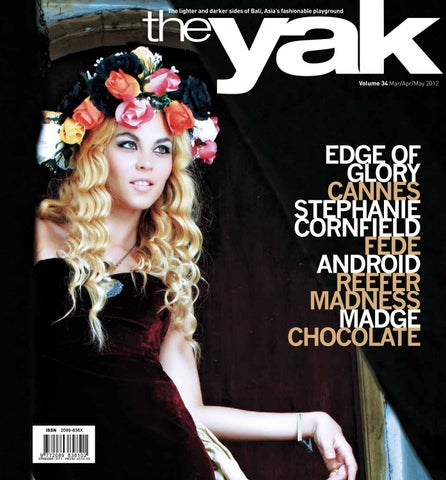
Volume 34 Mar/Apr/May 2012
IDR80,000 : S$11 : HK$50 : A$10 : €5
Simpson Marine brand standard guide
Logo Identity | Solid 2 colours logo on white background NEEDS PERMISSION BEFORE USE
Use logos for: • Shopping recycle bag • Microinjection logo for Keyring
Primary Colour Palette
Simpson Marine Logo | Horizontal
Simpson Marine Blue
Simpson Marine Grey
Plan Simpson Marine Blue logo and text on plan white background only, the “x” spacing rules must be followed
Simpson Marine Logo | Centred
Plan white logo and text on dark plan background only, the “Minimum Clear Space Rules” must be followed
09.2010
Lu xur y
I n
P r i n t
Volume Thirty FOUR MAR/APR/MAY 2012
The Yak Magazine Sophie Digby, Agustina Ardie, Nigel Simmonds Publisher's PA / Sales & Marketing Ananda Sarina Production Manager Evi Sri Rezeki Graphic Designers Irawan Zuhri, Teuku Melody, Stuart Sullivan Accounting Julia Rulianti Distribution Made Marjana, Kadek Arthana, Putu Widi Susanto, Made Sutajaya, Didakus Nuba Publisher PT Saka Wahana Cipta Licence AHU/47558/AH/01/01/2011 Advertising Enquiries Tel: (+62 361) 844 6341, 743 1804, 743 1805 www.theyakmag.com Email: info@theyakmag.com sales@theyakmag.com Canggu Club Tennis Centre, Jl. Pantai Berawa, Canggu, Bali 80361, Indonesia © PT Saka Wahana Cipta
MYPETSQUARE Dress @ Thisisalovesong KT Necklace @ Horn Emporium NIPPLESREVOLT Bracelet @ www.nipplesrevolt.com Photo: D.Hump Styling: Georgina Solomon Hair & Make-up: Anja Burck Model: Claudia / So Wanted
The Yak Magazine Bali. You know the drill. No part of this publication may be copied or reproduced electronically or otherwise without prior permission from the Publisher. Opinions expressed within this publication are those of the authors not the Publisher. The Publisher reserves the right to refuse advertising that does not comply with the magazine's design criteria. The Yak will not be held responsible for copyright infringements on images supplied directly by advertisers and/or contributors.
min
The Yak’s monthly e-newsletter is sent
Archives, additional content and
yPodBali Version 2.0 – The Yak's iPhone
to 20,000 mailboxes every month.
more at www.theyakmag.com
App – is available from the App Store.
contents
P: 96 android
Andrew E. Hall on the digital degeneration.
34
Yakety yak Words From On High
36
15 minutes
38
New in the hood Shopping, News, Happenings
48
Sole Of The Matter
Bowie Owes Me $3
issues
52
Into The Interior
56
One Day
60
Dare Jennings
out of the box
64 68
interwho
68
artsake Fede Tomasi
78
Reefer Madness
82
Eko Bintang
86 106
dialogue
duoview Studio Sumo
116
being green
passions
Yak fashion The Rum Diaries interview Stephanie Cornfield cannes Cinema Paradiso
116
64
136
contents 122
destinations Ulu and Environs
128
Sapa Sojourn
136
Dr Cocktail
144
Chocolate
146
Eelke at Alila
150
Better Karma
152
Tapping Shoes
travel
oral pleasures
oral pleasures
oral pleasures
oral pleasures
oral pleasures
150
154
big six Brunch
156
Client Catwalk
170
Ski Porn
172
Album News
174
Jazzy Jeff
176
Starstruck
178
Who's Who
fashion freestyle
just doin' it
raver's review
sounds around
astro yak
advertiser directory
170
122
146
yakback Paul Meng – Godfather of The Yak - RIP March issue of The Yak was blindsided by losing one of its larger-than-life, long-standing and most effervescent supporters, known to all as Paul Meng. When The Yak was barely strengthening its unsteady legs around the luxury life spots of Seminyak – for more reasons than just the wine – Paul offered us an office space, a delightful, open-air rooftop meeting room and an intrinsic generous spirit giving Michelle, Tina and myself a definitive leg-up into the ring and into the realms of Round 1 of magazine-land. Our first ever Yak awards were held on all three levels of Paul’s Place – just up from Ku De Ta – and, with that fabulous generosity of spirit, a wave of the hand and that inimitable giggle “Go ahead” he said, “Decorate the place!” It was on this footing and with this never-ending support that fun was had, deadlines were reached – only just – and the name of Seminyak hit the world’s media. Through laughter, tears, many a sunset cocktail, late-night typing sessions and some very good suggestions, Paul became the proud godfather of Bali’s only – at that time - luxury lifestyle magazine. As with any beloved child (and as The Yak grew in size and in style thanks to support from one and all – especially The Yak team as it stands today) his support never wavered, always excited at deadline and ever eager to get hold of his own copy hot off the press. Since those days, and always with Paul enthusiastically by our side, we have hosted seven Yak Awards, the magazine totters around the 200 page mark and weighs over one kilo. And it is this issue, the one you won’t get to feel that The Yak high tails it to none other than the Cannes Film Festival and on to Monaco Grand Prix, we know you would have been so proud! “We’ve come a long way baby“, as the song goes and we couldn’t have done it without you. Let us know where to send this issue, Paul. The Yak is going to miss you – Mish and me the most!!”
Dear Yak, I came across your magazine while in Bali over the Christmas break. Love what you guys are doing over there. Would love to connect and, if possible, be kept in the loop for any openings.
previous and I am now a confirmed Yak Addict! Congratulations to you – brilliant work! Andrew. We aim to please.
Meghan McTavish. That’s sweet Meghan. You can usually find us hanging around a Champagne bottle somewhere.
Dear Yak, Just read the new issue. Amazing! Just gets better and better. Tony Montana.
Dear Yak, I got up early this morning because I had some urgent work to do but I made the fatal mistake of starting to read the latest copy of The Yak. Some three hours later, I realised that I wasn’t going to get my work done as I was totally engrossed in the fascinating articles. You have some great writers among your team. It seems that every issue is better than the
Tony, Tony…you are too kind. Dear Yak, Sorry I don’t know you, but I love the magazine! Philip Hodges Jasmine Holidays
yakinthelapof... Tyra Banks tyra, Tyra, Tyra. We told you months ago it was time to chill in Ubud; to follow the breeze, soak up the vibe, get into the Ubud thing. Eat, Pray and Love. And so you did. You dumped the banker, headed for Como and sat among the palms to be wooed by our island's magic and the affections of a new beau. Was it anything to do with our humble organ? We offered it up on a silver platter, delivered to your door in the arms of a bronzed boy and with it a personalised note from us all here...perhaps you saw it? It was the squarish-looking publication under your Blackberry? No? Oh well, then a journey wasted perhaps...unlike you're own. Until we meet again.
Bowie owes me three dollars, writes sarah douglas. Celebrity sightings are so common in New York that the natives have engineered a convincingly pseudo-cool façade for such encounters. Naturally there are some that excite more than others. It’s good if they are actually doing something – an underground show, falling on their face, coming out of the wrong bathroom at a club, or losing it in the street. That’s entertaining. In the heady late ‘70s when Studio 54 reigned supreme and The Mudd Club had the downtown scene sewn up, there were plenty of occasions to test your cool if you were a teenaged Australian girl lucky enough to have a pass. My favourite celeb was David Bowie, who hung out regularly at The Mudd Club – never a bodyguard in sight and often just with one or two friends or on his own. He was so cool and detached that no one ever bothered him. Unlike Sylvester Stallone, who arrived one night and toured the two floors completely surrounded by bodyguards so tall that not a hair on the Stallion’s head was sighted. Saturday Night Live was king of TV in the late ‘70s and an invite to attend the dress rehearsal of John Belushi and Dan Ackroyd’s final show was about as good as it gets for a teenaged girl. A water fight in the dressing rooms and drinks on the town dressed in NBC’s castoffs is a memory I
cherish. After the final show they held a party at their place, The Blues Bar, situated in the meat packing district. It was a jaw-dropping evening of stars. Standing at the bar, searching for my poise in a stiff drink, a knock on the shoulder revealed none other than David Bowie. HE WAS TALKING TO ME! “Would you like a little wager?” he asked. “God,” I said, “anything.” He was playing with three little cups, under one of which (he assured me)was a dried pea. “Find the pea for a dollar,” says he. He got three dollars off me. I got suspicious after my third loss and asked to check... and of course there was no pea. I found my poise, aha, and my sense of outrage and demanded my money back. “I won it,” he tells me, “not so fair, maybe, but hey!” Then he just stood there smiling. I decided perhaps he wasn’t as cool as he seemed and went in search of some new famous friends – which in that bar, on that night, was merely a matter of turning around. But that guy still owes me three dollars.
thewritestuff In 1791, riled by a recent review that criticised a supposed abundance of "obscure language" and "imperfect grammar" in his poetry, celebrated Scottish poet Robert Burns channelled his anger and wrote the following magnificent letter to the critic responsible. Dear Sir: Thou eunuch of language; thou Englishman, who never was south the Tweed; thou servile echo of fashionable barbarisms; thou quack, vending the nostrums of empirical elocution; thou marriage-maker between vowels and consonants, on the Gretna-green of caprice; thou cobler, botching the flimsy socks of bombast oratory; thou blacksmith, hammering the rivets of absurdity; thou butcher, embruing thy hands in the bowels of orthography;
thou arch-heretic in pronunciation; thou pitch-pipe of affected emphasis; thou carpenter, mortising the awkward joints of jarring sentences; thou squeaking dissonance of cadence; thou pimp of gender; thou Lyon Herald to silly etymology; thou antipode of grammar; thou executioner of construction; thou brood of the speech-distracting builders of the Tower of Babel; thou lingual confusion worse confounded; thou scape-gallows from the land of syntax; thou scavenger of mood and tense; thou murderous accoucheur of infant learning; thou ignis fatuus, misleading the steps of benighted ignorance; thou pickle-herring in the puppet-show of nonsense; thou faithful recorder of barbarous idiom; thou persecutor of syllabication; thou baleful meteor, foretelling and facilitating the rapid approach of Nox and Erebus. R.B.
SLAM DUNK 69Slam always have been trail-blazers for funky fashions and bold new cuts, prints and fabrics – now they’ve done it again. A highlight of 69Slam Summer 12 Collection is Bamboo Underwear – a highly colourful tribute to Mother Nature with soft organic fibres and natural dyes. Now retailing worldwide, including 69Slam Bali flagship stores, never was being eco-friendly so hip (and unbelievably comfy)! www.69slam.com Map ref. P.8/V.10
DAZZLING BRUNCH Bored with the usual Sunday routine? That refined bunch at Nusa Dua's St Regis Bali Resort unveils Astor Diamond Champagne Brunch (11am-3pm) at signature Kayuputi Restaurant. Recreating St Regis New York’s grandeur traditions, their opulent ‘Brunch Package’ includes Aperitif (champagne, cocktails and canapés) at Kayuputi’s Champagne Bar, then brunch featuring caviar, foie gras and Asian inspired delicacies (Rp.995,000). ‘Beverage Package’ adds on premium wines and post-Brunch digestifs and cigars (total Rp1,990,000.) We suggest not making any plans afterwards. www.stregis.com
Vodka by Design
S PAVO D K A B A R K ITCHEN
&
Spa Vodka Bar and Kitchen is the Oazia team’s latest out-of-the-box concept – surprising, as it should have been out of the box ages ago. Balance is key here. Healthy food and drinks (all available with vodka of course), a resort-wear boutique and fabulous interior design concepts all enclosed in artfully created open-air surroundings. Mix one shot of vodka with one measure of laid-back luxury lifestyle and garnish with a touch of spa, you have landed in the world of SBVK. Jl. Sahadewa, Br Anyar, Canggu – opening April 2012. www.oazia.com Tel. 8446105
INSIDE THE WHITE HOUSE Paying homage to the white-capped waves espied from its upper-floor rooms and terraces, five-bedroom Villa Ombak Putih is the latest, most desirable offering from Marketing Villas Limited (MVL). A palatial hideaway in the sleepy seaside village of Cemagi, Villa Ombak Putih soothes the soul with contemporary white exteriors and ocean-inspired interiors, 30m pool and butler and full staff attending to every whim. The 3,300sqm tropical garden setting is inspired stuff for intimate weddings and refined events. www.villaombakputih.com / www.marketingvillas.com
BIASA 2012 2102 gnirpS
Two thousand and twelve, according to Bali's iconic brand Biasa, comes to us with brigths and stripes and flowing silhouettes. Classics, hand woven and hand dyed, artisan craftsmanship for a modern world of fashion. The versatility of Biasa's pieces is proven by the way in which individuals wrap, layer, tie or swoosh creating their own intrinsic style. Cottons, linens, muslin, jute, eco frindly fabrics in keeping with forward thinking responsible fashion brands. Biasa unlike its name - ordinary in Indonesian - is, as ever, anything but! Jl. Seminyak 36 www.biasabali.com Map ref. V.12 41
Ethnic Karma Finally there is a new boutique resort that really stands up to its tag line, “beyond expectation”. A large manicured garden, with central pool, is fringed by nine luxurious villas; Timoresque carved doors with elephant grass thatched roofs give the visuals and ambience of somewhere out of the pages of New York Times Bestseller “100 places to visit before you die”. On the wellness side the spa offers Shirodhara treatments, a Vichy shower and even a proper Shiatsu massage room as well as massage room for Balinese and Javanese treatments. Tribal art alongside canvases by Alexa Aguila, feature in their own boutique and in each of the one, two, three and four-bedroom ‘ethnic’ villas. The whole Blue Karma concept with its raw food restaurant and comfortable lounge area, promise to be a more than just a villa resort once the sultry sounds of Jazz and Blues fill its beautiful, walled, secret garden. Gg Bima #2 www.balibluekarma.com Map ref. U.12
FITTING DESIGNS Fresh from the pulsating shores of Brazil, Havaianas Fit is a unique addition to the Havaianas Summer Range, now hitting selected chic boutiques on this island. Revealing a new twist on a classic style, Havaianas Fit reveals a sleek, sophisticated design complete with wrap-around style, sensational for chilling at the beach or pool, available in black, gold or silver (Rp.329,000).
TRESSED OUT ‘Alarming’ hair days begone with Alila Villa’s Soori’s ultra-sleek Hair Spa by Spa Alila. Get your tresses nurtured and de-stressed with lavish, beneficial hair and scalp therapies inspired by age-old Indonesian beauty recipes, combined with latest hair care techniques. Within loungey-style interiors, raw herbs, fruits and naturally derived essential oils are freshly blended for treatments like Hair Repairs, oozing cocoa butter, honey, egg, coconut and rosemary essential oils. Combine with pressurepoint massage and manis / pedis. Tel: 8946388 www.alilavillassoori.com
O WHAT A GREAT IDEA On frequent trips to Bali over the years, three discerning British and Australian businessmen sought the perfect holiday getaway for their families. Their solution? Create your own. Thus, O Villas evolved – a luxurious new villa concept for Seminyak, offering gorgeous villa craftsmanship and attention to detail and plenty of pampering. But making sure it’s only a totter away from all the ‘hood’s action. www.ovillas.com
MIND YOUR MANNERS Pardon-me? Yes, that’s right, Platform 18/27 fashion label introduces its new collection for 2012, Par-done-me – a slinky range of mix ’n’ match layered pieces in bright tones to create an individual look. Par-done-me takes you from day to night and is almost de rigueur for island escapes (like Bali!) For those unaware, Platform 18/27 has two stylish boutiques in Seminyak, either of them will see you ‘Pardone-d.’ info@platform1827.com
ALL HANDS ON DECK An exciting new addition to Petitenget’s Semara Resort and Spa, The Deck Bali is modern colonial meets tropical casual, out-front and street side. This timbered openair deck space is all about global cuisine highlighting contemporary Australian, and innovative cocktails, and the only venue in Petitenget offering regular live music. Drop the kids off at Semara’s Cubby House next door for complete chill-out time. www.semararesorts.com
GET LOST IN OLD CUBA At last! Cuba comes to Bali (well, nearly) with Cubana Bar & Grill – another delicious Petitenget Boulevard addition. Cubana transports us back to that decadent, pre-Castro era, with retro-style Cuban bar, BBQ grill and cigar bar concept. This colonial-style haunt features bold colours, Cuban art and garden terrace, but most important, classic Mojitos, rum cocktails and Cuban Tapas. Don’t miss Cubanstyle bands Tuesday and Thursday nights and Mojito 2-for-1 Mondays. Yay! Tel: 473 7671 www.cubanabali.com
KNOCK ON WOOD Hardy introduces a rustic-style furniture and décor store, eponymously named after its owner, Geoff Hardy, a timber craftsman- designer of sustainable furniture in Australia and Indonesia for over 35 years! The store features European-themed, ‘big statement items’ with timeless looks and textured finishes – think huge refectory-style dining tables and wall mirrors – hand-crafted from reclaimed and aged kiln-dried timbers from Australia and Europe. Bespoke orders are also accommodated. Jl. Kunti I No.16 Seminyak - Bali - Tel: 733771
BAR NONE Open since July 2011, The 101 Legian Hotel’s Rooftop Dine & Music Lounge has raised the bar (literally) for stylish entertainment in the Legian burbs. On the 4th floor, 101’s massive rooftop restaurant-bar-lounge offers fabulous downtown views and a ‘New Urban Chillout Experience.’ Live daily happenings include Wednesday and Friday Sky Pool Parties with DJs, and monthly themed Urban Sunset Breeze Parties – all with daybeds, cabanas and cocktails! www.the101bali.com
LIFE ON THE EDGE Another tempting Sunday distraction: Sunday Bloody Mary Jazz Brunch (noon to 3pm) at Pan Pacific Nirwana. Let’s set the scene: relaxed on the water’s edge at super-swish Merica Restaurant, mystic Tanah Lot as the backdrop and smooth live jazz serenades. Little ones off your hands at the resort’s Kids’ Club. Indulge in premier global dishes, like freshly shucked oysters and marinated mandarin vodka salmon, washed down with spicy Bloody Marys. Ye Gods, what could be better? Tel: 815 900 www.panpacific.com/bali
BALI’S WILD LIFE
Gin Palace Culture Boating in Indonesia is about to set sail with PT Simpson Marine Indonesia. Joining the other nine offices in the region, Asia’s largest yacht-brokerage company, and the exclusive dealer for some of the worlds most respected brands, will be paving the way for yacht dealerships, new yacht sales, brokerage and fleet management of the world’s most elegant floating homes here in the archipelago. Additional services include boat-building, servicing and maintenance as well as chartering and second-hand yacht brokering. Maybe its time to buy a Gin Palace? www.simpsonmarine.com
Take a walk on the wild side with Animale! This legendary, decades-established, much lauded beach fashion brand, originally created by designer Jacques Ruc in St. Tropez, has branched-out even further than its international 30-country-wide reach and adds Russia to its global retail spots. Here in Bali, Animale’s new flagship store on Jl. Laksmana boldly dazzles in glass and uber-contemporary pyramid design, marking its territory as a leader of the pack for stylish tropical beach wear. Tel: 783 9964 www.animale.com
KAPAL lAUT With eight shops in Bali it is clear that this brand is successful. The reason is simple, Kapal Laut's quality and design blends to create simple and inexpensive elegance. Contemporary yet timeless, their use of natural elements - rubber, shell, pearl and horn - hand crafted with top grade silver and stainless steel form unique pieces of affordable splendour, so necessary in these challenging times! Tel. 7803104 www.kapal-laut.com
SEE U SOON Amazingly, there’s still room left in Seminyak for yet another resort; all-suite boutique U Paasha Seminyak Bali, part of deluxe U Hotels & Resorts. The contemporary-style 94 suites and four penthouses incorporate uncluttered open spaces, design accents and local heritage for max relaxation. Facilities run to rooftop bar and pool plus wellness centre with yoga facilities – with quick access to Seminyak’s hotspots and beach! Opening June 1st, guests booking up to August can enjoy introductory rates of US$170++ per suite. Tel: 822 8888 www.upaashaseminyak.com
issues
Sandal scandal I n d o n e s i a n s s p e a k tr u t h t o p o w e r w i t h r u bb e r s a n d a l s , w r i t e s d i a n a d ar l i n g .
There’s a certain elegance in the souls of people who have been stomped on for centuries. The people of Indonesia were pushed around first by their kings, then by their colonial rulers, and then – until 1998 – by their own soldiers. Even now in the so-called reform era, reform is unfinished business, and Indonesians are still shy about speaking to authority. Unlike, say, Americans, they are not in the habit of squaring off in front of their leaders, putting their hands on their hips and bellowing. Suppression has given them the skill of protesting in ways that are more subtle and imaginative. Several years ago, for example, a housewife named Prita Mulyasari was sued for $21,600 by Omni International Hospital for complaining in an email to friends and family about the alleged poor quality of her treatment while she was a patient there. The public – irked by the injustice routinely suffered by the “little people” (rakyat kecil) at the hands of the powerful – responded by collecting coins to help Ibu Prita pay the damages. They raised over $66,000 in coins alone, with an additional $30,000 in paper money and other donations. A more recent example is the case of AAL, a 15-year-old boy from Palu, Central Sulawesi. Because he is a minor, he is known in the press only by his initials – but his youth was not enough to save him from facing a five-year prison sentence for stealing a policeman’s sandals. In AAL’s view, he did not steal the sandals at all. The junior high school student was walking home from school with two friends one day in November 2010 when he found a pair of white Ando brand sandals by the side of the road, next to a trash bin outside a rooming house where a number of police officers were lodged. The sandals were apparently abandoned, and AAL took them home. Six months later, in May 2011, the three boys were passing the same rooming house at around three in the afternoon when one of the police
officers, Sgt. Ahmad Rusdi Harahap of the Police Mobile Brigade (the tough-looking Brimob), asked the boys where his Eiger brand sandals were. He said it was the third time his sandals had disappeared. The boys said they knew nothing about it. Sgt. Rusdi and another police officer, Sgt. Simson Jones Sipayung, interrogated the boys until 11pm that night. According to AAL’s lawyer Elvis DJ Katuwu, “That was when the police officers beat these kids. AAL, feeling pressured, admitted to taking a pair of sandals from the roadside, not from in front of Rusdi’s door, and not Eigers sandals but Ando brand.” Sgt. Rusdi told AAL to fetch the Ando sandals, saying that he had lost a pair of Andos as well. Now Ebert Nicolas Lagaronda, AAL’s father, became involved and offered to reimburse Sgt. Rusdi for all three pairs of lost sandals. When he learned that his son had been beaten, however, he reported Sgt. Rusdi to the provincial head of police (Bidang Propam Polda Sulteng). In turn, Sgt. Rusdi pressed criminal charges for theft against the boy. The case erupted into public attention at the end of December 2011 with a protest campaign organised by the National Commission for Child Protection, a public agency. The idea was to collect 1,000 pairs of flip-flop sandals (sandal jepit) and give them to the police. Indonesians all over the archipelago responded with an avalanche of sandals which they dumped at local police stations and prosecutors offices. Many donations were accompanied by messages such as “We want justice” and “With these sandals, we hope the police will understand” and “Prison is no place for children”. The protest campaign touched a number of sensitive points in the psyche of ordinary Indonesians. First there was the injustice of the looming punishment for the alleged crime: five years in prison for stealing a pair of sandals worth less than five dollars is felt to be outrageously unfair, especially when powerful
ELEGANT TRADITIONS • EPICUREAN ATTITUDE
R E S TA U R A N T
•
BAR
•
GALLERIES
Jl. Raya Kerobokan No.38, Kerobokan, Seminyak, Bali T +62 (0) 361 731175, 7492796 E info@warisanrestaurant.com www.warisanrestaurant.com
issues
people convicted of corruption regularly get off with lighter sentences. Second, and very much in the crosshairs of the National Commission for Child Protection, was the fact that a minor was being subjected to trial – and possibly imprisonment – as a criminal, not to mention being beaten by police. And finally there was the element of the sandals. Footwear is low. In Indonesia, you don’t even refer to your feet without saying “I beg your pardon”. The campaign’s title “1000 sandals for the esteemed Head of the National Police” (1000 sandal untuk yth Kapolri) squishes with irony. As the world saw when an Iraqi journalist threw his shoes at George W. Bush, shoes are a handy symbol of contempt. Rubber flip-flops are ever much more so. Cheap as the dirt they tread in, these sandal jepit are all that the poorest of poor can afford to wear. The more affluent wear sandal jepit to and from the bath. Outside the nation’s immigration offices are illustrated signs reminding foreigners that it is forbidden to wear sandal jepit on the premises. In short, hundreds of used rubber sandals at your door are a tremendous raspberry. The esteemed head of the national police, General Timur Pradopo, however, insisted that he didn’t mind. “There’s no need to be offended,” said the general at a press conference on January 5 outside the office of Indonesia’s president, where he had just concluded a meeting. President Susilo Bambang Yudhoyono was said to be following the case, but has not made any public comment about it. Meanwhile, the foreign press – which normally ignores Indonesia unless the news is particularly awful – was delighted. The wire services Associated Press and Agence France Presse picked up the story, and soon the BBC, CNN, ABC News, Voice of America, The New York Times, International Business Times, The Wall Street Journal, Radio Australia, The New Zealand Herald, The Hindustan Times, and The Washington Post had stories expressing their glee in the Indonesian people’s protest. In the national media, Indonesian celebrities added their own ever-welcome glamour. The Balinese entertainer Ayu Laksmi had ten pairs of very big black rectangular sandals specially made and sent by courier to the head of the national police. Explaining the large size of the sandals, she said, “Sandals are for protecting the feet. Those who enforce the law should protect children. These jumbo-size sandals have plenty of room for the little feet of children.” The organisers of the protest also sent sandals to the Supreme Court, the Constitutional Court, the Judicial Commission and the Ministry for Law and Human Rights.
The case came to trial in early January 2012. AAL was accused of stealing a pair of Eiger sandals, size 43. But the stolen goods presented as evidence were Ando sandals, size 9.5. Sgt. Rusdi insisted they were his. When Judge Rommel F Tampubolon asked Sgt. Rusdi why his thought so, he said, “I have an inner contact at the sight of those sandals. (Saya ada kontak batin saat melihat sandal itu.)” The judge asked him to try them on. They were too small. Nonetheless, AAL was found guilty, albeit of stealing not Sgt. Rusdi’s sandals but someone else’s. The judge ordered no punishment, however, perhaps because of the pressure of publicity surrounding the case – all those new and used sandals having left tread marks. In keeping with the lightweight character of the case, Sgt. Rusdi has been found to have transgressed the police disciplinary code and is to undergo a year of “training” (pendidikan). He and his colleague Sgt. Simson, who is accused of beating the boys, are to be demoted and to spend 21 days in detention. But people are not yet happy. In the eyes of many, AAL’s trial was blemished. The boy still insists that he is not a thief. And several thousand more minors are still awaiting trial as criminals. The Indonesian press is full of stories of “little people” and minors being persecuted by a justice system that seems to have lost its bearings. The week before AAL’s case went to trial, two brothers – FA, aged 14 and BMZ, 17 – died in police custody. The police say they hung themselves, but they would not release the bodies until the family signed a statement promising not to bring any complaints against the police. Because of injuries on the corpses, the family ordered autopsies, which, according to the National Commission on Human Rights, suggest not suicide but murder. Avaaz, a global online advocacy community, is circulating a petition to President Yudhoyono to reform the police. It reads: In the wake of the A.A.L. sandal scandal, we call on you to end the criminalisation of children, initiate a fundamental review of the police, and devise urgent reform programmes so that our police carry out their civic duties responsibly. This is a time for you to stand with Indonesian citizens – we count on you to take all necessary steps to bring about a police force that works for the people, not against them.
into the interior.
Recycled denim jeans find a new lease on life in the Umbria Lounge Chair by d-bohdi, www.d-bodhi.com.
Recycled teak dining table from the Tubeline collection by d-bodhi, www.d-bodhi.com.
Dining Chair Puglia, covered with recycled denim by d-bodhi, www.d-bodhi.com.
Inspired by all things creative, 'udder's' unique range of handmade dolls are designed to be loved for their difference. www.sksbali.com
the SENZANOME jade coins are made of genuine type a natural jadeite from burma and 18K gold. made in italy, available at sks www.sksbali.com
dialogue
it's time to turn it all off, says susi johnston.
N
Y
E
P
I
They say silence is golden, and now it's cool, too. A plethora of related and unrelated concepts around silence have begun to clutter our Google search results pages. There's the World Silence Day movement (inspired by Balinese Nyepi), a vow of silence day for Free the Children, international silence day to oppose the silence about abuses of the rights of gay and lesbian people, and even the Pope this year has declared silence as the theme of his annual message on World Communication Day (the Sunday before Pentecost). One can't help but wonder, how come it's suddenly so hip to shut up? If you ask the Balinese, they might "take the fifth," and say nothing at all, because as everyone knows by now, the Balinese invented Nyepi: a whole day and night of silence and seclusion, that embraces the entire island. They continue to honour and uphold this unique tradition, and to insist that non-Hindus, foreign visitors, the media, and the airlines do, too. So patch those blackout curtains, kids, because this year Nyepi falls on 23 March and as always, the island of Bali will be transformed, soothed, dark, and blissfully quiet. At least outwardly, that is. Nyepi for dummies Nyepi happens once a year, around Christian Easter time, coinciding with the ninth new moon in the Balinese calendar. It's sometimes referred to as "Balinese New Year," or cited as a moment that marks the end of the rainy season. The word Nyepi comes from the Balinese sepi, meaning "quiet." The transformation of the "s-" to "ny-" turns the abstract noun "quiet" into a verb "being quiet". The name doesn't really capture the nature of Nyepi though, because it's not merely a day of silence; it entails much more than just stuffing a sock in one's mouth. Nyepi is supposed to be observed by avoiding four "no-nos" or catur brata prescribed by the governing body of Balinese Hinduism: no fire or electricity or lights or other fire-like stuff; no travelling or traffic or going out; no working or busy-ness; and no fun. Yep, amati lelanguan, one of the four official austerities of Nyepi, means not amusing oneself, playing games, dallying in diversions or pursuing pleasure. That's often interpreted to rule out gastronomy of any kind, and it's also understood as a ban on sex, lies and videotape. And iPods, too. So, from an orthodox standpoint, fun in any form is strictly out for the duration of Nyepi. Oh, joy.
Debates about the duration of Nyepi itself, in seeming contradition to the very concept of the day, have generated a cacophony of dissenting voices over the years in Bali. Some say it lasts from sundown the night before, until sun-up the morning after. But most define the timing differently – effectively shortening Nyepi – and thereby making it easier to observe. Ironically, making Nyepi easier and more fun has become an industry in itself, with things like Nyepi holiday packages in hotels complete with couples' spa specials, and clowns and crafts for the kids. Nyepi is being commercialised in a variety of other ways, as well, with corporate and political "happy Nyepi" ads, banners, and billboards, Nyepi greeting cards and even animated Nyepi e-cards with groovy music. At least one e-commerce site, and it's a large one, has announced a one-day online Nyepi sale! Yes, you can now shop in silence on Nyepi, in the privacy of your own blacked-out bedroom. Is Nyepi slipping? Is it morphing into "Nyepi Lite," and becoming a custom more honoured in the breach than in the observance? Or is it gaining value and meaning by expanding outwards, incorporating tolerance, and shifting from a personal ritual of renunciation for one's own spiritual upgrading, to a time of respect and regard for one's fellow man and for the environment by agreeing not to bother either of them for just one day? Nyepocrisy It's impossible to say if Nyepi in the past was more rigourously observed, with full-on asceticism or not. Either way, today it isn't really about observing the taboos, it's more about politely concealing one's breaches of them. So what we have is a kind of "nyepocrisy" whereby everyone applauds the traditions of the day, but few have any intention of going hungry, keeping their lights off, or eschewing internet activity. And they don't. In Balinese palaces, noble families play ceki and other card games to while away the time, while munching "modern snacks" and winning pin money on their modest monetary wagers. Kids from all walks of life are plugged into their Playstations to keep them from complaining of boredom and kicking up a fuss. TV and DVD use is rife, but enjoyed furtively in rooms with the windows and doors closed. Balinese traditional homes haven't got much in the way of windows and doors anyway, so it's not hard to hide taboo-breaking. Among the Balinese, cellphones, texting and online social networks are all lit up on Nyepi, too. There's so much to Twitter about, after all, when the world outside your door is eerily devoid of cars and motorbikes, and the night sky shows every single one of its stars in the absence of light pollution. Wow! Instagram that!
dialogue
With increasing diversity in Bali's population, concessions are consciously made now for non-Hindu residents. On the afternoon of Nyepi day, we see Indonesian families pushing baby strollers, pedalling plastic tricycles, and stretching their legs in public parks and ball fields. This is openly condoned in some districts by the Balinese enforcers of tradition, the pecalang or civilian Hindu militia. When Nyepi falls on a Friday, which it recently did, the island's Muslim population is allowed to attend Friday prayers, but instructed to proceed to and from their mosques without making a kafuffle or carrying on conversations en route. And they do, which is nice, and inspires renewed optimism about the possibility of actually achieving harmony in diversity. Calls to prayer, whether by muezzins or loudspeakers are out of the question, and prayers and teachings take place in such a way that the sound doesn't carry beyond the building. Everyone gets things their own way, more or less, and they all avoid causing agro for others. That's hard to complain about; in fact it's almost a miracle, and Nyepi proves that it is possible. And it should be possible on every other day. Similarly, Bali's Indonesian Christian population, when Nyepi falls on a Sunday, have voluntarily cancelled the Catholic mass and other forms of in-church worship, encouraging their congregations to pray quietly at home instead. So Nyepi, in practice, in a world of diversity, is starting to be about what other people see, hear and observe, and about how we impact them. It's about not getting in other peoples' faces, not putting your noise out there, and enjoying the way that others do the same for you. It's also about not consuming, not sucking resources out of the natural environment, and not producing the usual amount of pollutants one typically does on any given day. We get to try it and see how that feels. That's not a bad thing at all. And it does, indeed, allow those who opt for the experiment of full-on asceticism to do so undisturbed. Just try to be silent, and abstain from eating, drinking or merry-making by yourself for one day when it's not Nyepi. Not likely, unless you are a true spiritual adept, deaf, dumb and blind, or remove yourself at some expense, to a dedicated retreat centre, having burned a quantity of fossil fuel to get there. Bali, and the rest of the populated world, is far too noisy, too crowded, and we are all getting on each other's nerves. And we're taxing our planet's generous resources to the breaking point. The Balinese tradition of Nyepi serves now more than ever, as a valuable respite from the madness, and an opportunity to consider and practice for one day, what an alternative to that madness might actually feel like.
It generally feels very good indeed. The novelty, surprise and fascination of finding oneself suddenly sitting on an island transformed is incredibly pleasurable. And it's a deeply transformational experience. If you haven't experienced it yourself, imagine being in the midst of four million people who by general agreement remain almost entirely unseen and unheard for an entire day and a night. Think about three million motor vehicles switched off, and for once, not tearing about making a ruckus and spewing fumes. On Nyepi night, you go up on your roof and look out over a dark and quiet island where the day before chaos reigned supreme, as it tends to do in urbanised and urbanising Southeast Asian population centres. You feel a very peculiar and pervasive sense of calm, whether you want to or not, and renewed hope for the future of humanity on planet Earth. Yesterday people annoyed, irritated and aggressed each other. They jostled, shouted, blasted their horns, and collided with each other everywhere on an energetic level. Now, there is only the moonless sky filled with stars you forgot existed, a breath of wind in the bamboo, and a distant dog barks tentatively, just once, as if to remark quizzically on the strangeness of it all. Tomorrow, chaos will reign again. But the chaos, agro and intensity of 21st century, go-go, booming Bali doesn't rev up to full RPMs immediately. You notice how for two or three days after Nyepi, things are generally calmer, more fluid, more civilised, and more pleasant. The respite from airplane noise, traffic hell, manic activity and general "purposefulness" has clearly been therapeutic for everyone. On many levels. Nyepi should be prescribed to the entire population of the world by its doctors, on a regular basis. On the day after Nyepi, I always say I wish it came once a week instead of once a year. And I wish it came to all the world, and not just to Bali. I wholeheartedly support widespread Nyepification. Let's all reboot. Regularly. Let's leave our stressed fellow man, woman and animal in peace for just one day. And our planet. C'mon people now, smile on your brother, everybody get together, and let's Nyepi.
interwho
Inspired son of the surf industry Dare Jennings – founder of Mambo and Deus Ex Machina – talks to Drew Corridore about counter-culture, Japan and custom motorbikes.
Deus Ex Machina in Canggu isn’t just a place where you can eat some great food, shop for clothing, surfboards and custom motorbikes . . . it’s a vibe. There are art spaces, a photography studio, grassy gardens for leisurely gatherings. You can even get a free tattoo by turning up in the late afternoon and putting your name on a chalkboard list. The man behind the idea that is Deus Ex Machina is Australian Dare Jennings – a Sydney-sider who also founded the Mambo surf wear company, as he puts it, “in another lifetime” (1984). Dare describes himself as an old lefty from his university days. Days when the Vietnam War was in full flight and the protest movement in Australia was at its height. He brought his rage with him when he decided to form Mambo. “I really hated the way that surf was sold as a fundamentalist religion,” he says. “That if you weren’t in you were out. “And I didn’t want to be part of ‘big surf’ – Billabong, Rip Curl, Quiksilver – but because we were part of the surf industry, what I wanted to be was the choice . . . the alternative. “Mambo was pretty much that: we loved to surf, we were satirical, we took the piss out of things, we loved artwork and other things just as much . . . at the time it was pretty radical, but not so much these days. “We used to call ourselves the bastard sons of the surf industry.” A maverick by nature, Dare says he just liked to do the opposite in things that were declared as givens by those who claimed to know “the way”. In his 20s he got off on surfing, on riding motorbikes and bicycles, of living the adventure to its fullest. “In the ‘70s if you surfed you also had a motorbike – you did that because both things were
a thrill and you pursued them as thrills,” he says. “In those days one of my great heroes was Herbie Jefferson who was a bit older than us and an Australian speedway champion and noted bigwave surfer. He was always out there when the big ‘bombies’ were breaking off Newcastle.” Dare says that Herbie’s attitude was: “Fuck it, I’m going to do everything that’s fun, do it all, I’m going to chase it and enjoy myself”. “Herbie used to say ‘it’s all the same juice’, ” Dare says. He sold Mambo in 2000 and “wandered around a bit”. “But I had it in my head that I could start another company that combined all of the things I’ve talked about – where all these things could happily coexist,” he says. “I’d spent time in Tokyo where there were a lot of young guys referencing vintage motorbikes but in a contemporary way. That really interested me. Sociologically speaking there was a turn away from technology, or cutting-edge, or this year’s model. “And suddenly people were going back to building stuff and making things.” Dare took the idea back to Sydney and started building bikes in a similar vein . . . Deus Ex Machina was born. “Because I figured there was nothing sadder than a bunch of old baby boomers hanging around together reminiscing,” he says. “We came up with the name (God is in the machine), which is a bit of a pretentious name for building motorbikes, but it expresses the idea of having respect for the machine and respect for the activities that the machine is part of.” But he didn’t want the new company to just be a motorbike customising place. Dare says he believes
the sum of different parts is always more interesting and, once again, moved away from more orthodox motorbike-building business models such as the ones that can be seen on American reality TV shows. “So we started to build bicycles and started to add surf into the mix,” he says. “People said ‘you’re mad!’ – you can’t have motorbikes and bicycles in the same shop. And surf boards! “I said I ride motorbikes and bicycles, I surf . . . it’s my shop, I can do what I want. “But,” he says, “if you do it seriously and it’s not just an affectation, and do it well, and you learn about things . . . that’s what it’s all about.” The first multi-various Deus Ex Machina outlet opened up in Camperdown, Sydney. “We call it The House of Simple Pleasures.” The Deus venue in Canggu is called The Temple of Enthusiasm. “In this day and age just having a shop is pretty dull,” Dare says. “You’ve got to make a place that’s interesting and entertaining – that’s worth making the effort to visit. So here (Canggu) people can come and have something to eat, see stuff, there are things going on, people revving motorbikes and getting excited about surfboards . . .” Deus isn’t stopping here and recently opened another venue on Venice Beach in California. “Sydney, for instance, is different to this – which is the Indonesian expression of what we’re all about – and the Venice Beach venue will be different again,” Dare says. Variety is, after all, the spice of life . . . sambal, perhaps, in the case of Bali. “Ideas, though, are universal,” says Dare.
duo view
DANIEL and Eva, the shop is open. . . I'm Eva Oikari, from Sweden, 26-years-old. I first came here when I was 19 during a year off after high school. I spent two nights here in Bali, then went on to the Gilis where I met my future husband, Daniel. I went back to Sweden and studied journalism, and we kept in touch. . . Daniel, what's your story? I’ll be turning 40 soon: I spent 10 years as a ski photographer in the French alps, then I worked with a company selling sunglasses and ski glasses and stuff. I did some graphic designing for them in Sweden – catalogues, labeling and packaging, then I realised it wasn't what I wanted, so we left. That’s where the artistic head came about I presume? So you’re living here in Bali now? Yes and yes, in Seminyak, two years now. Where did the idea for Studio Sumo come from?
thing. There's a stark designer feel to the shop that's reminicsent of that culture. Daniel: The family name, Oikari, is Finnish, but it is also a famous name of a sumo wrestler from the 1930s. Eva: That’s how the Studio Sumo came up. Daniel: We love Japan. We have two cats named Miso and Bento, two dogs named Sumo and Soba. Everything in the shop has a Japanese name. Our son has a Japanese name; he’s 16-months-old and there’s another one on the way. Our second child will have a Japanese name as well. It takes a lot of courage to just jump in the pool like that. Did you already have a concept of what you would sell? Daniel: No, we had never done anything like this before. Interesting, so, day by day you're coming up with new ideas?
Daniel: Step by step. We’ve spent nine months getting the labeling and the branding perfect . . . like when you walk into our shop, you get a free bottle of water with our label on it. Everything is packed in a special way. How's the response so far? Really good. I presume you would have people coming in and wanting you to do designs for them? More like looking around and stealing ideas! Who does the creating between the two of you? Eva: We do it together; we have a lot of stuff loaded in our heads. Is there a general direction in which you’re headed creatively? Daniel: Well, we control our own brand, and that includes manufacturing garments. We work with small local companies that we know are good.
daniel and eva oikari are swedish-finnish fans of all things japanese. AND it shows in their shop – studio sumo.
I mean it’s about as individual as one can get for this day and age . . . Daniel: When we left Sweden in 2008 we left everything behind, sold everything, travelled around the world gathering ideas, and within that time our ideas were to open up bungalows or a small restaurant, or some kind of shop. We stayed in the Philippines for a year and thought of doing something there, but it was impossible. We did diving trips to Bali and we discovered the Seminyak area; thought it would be fun to have a shop here. Eva: We were having a baby and didn’t want to be living in the Philippines with a new-born. We agreed we should open a shop, but we didn’t have any money. We came anyway, found the shop, signed the contract and decided to see what happens. I think Japan would really go for this kind of
All the time. Studio Sumo has been open for how long now? About seven months. Your items are attractive and alluring, but to what purpose? When you come into our shop, the concept is that everything is art: whether it’s a t-shirt, teaspoon or an egg cup or a book, it has to be considered art. Basically you're creating forms with whatever is available to the eye? Yes, it’s our brand, which is Studio Sumo garments, sun glasses etcetera. . . So far, how are things working out. Right now it’s a walk-in buy, no exporting? Eva: In the future maybe it will be about export. Right now we have a lot of creative work to do, we have to get stuff to the shop.
Life is art, so to speak: if it gives you an idea, it goes in the shop? Gallery, art shop – interesting, have you ever seen this concept before? Eva: Not really. What we like we hope other people will also like. Let’s have your philosophy . . . Eva: That always sounds like a cliché. I believe it's possible to do what you want to do, you don’t have to work nine-to-five and be depressed and hate your life. Better to follow your dreams and just do it. Daniel: It’s always been important for me to get the maximum out of life and always appreciate this world, explore and see a new things, and that’s the joy of travelling. Sometimes it’s not so easy living that way, but if you don’t try, you’ll never know. I don’t want life to pass me by and then regret it. S.B.
daniel and eva oikari, in-store.
artsake
federico Tomasi has the heart and soul of an artist compelled by the beautiful process of expression.
these and following pages: Federico Tomasi in his studio in bali.
artsake
federico, Tomasi, paint the picture. Born in Stockholm, age 37, lived in Sweden until I was 13 years old. My parents moved to Italy and that’s where I grew up, basically. I studied at the Institute of Art in Riccone, Italy, for five years. On first meeting we guess most people think you’re Italian – your mannerisms, accent, speech? Yeah, I feel more Italian than anything else. Did you ever pick up a brush before going to art school? No, it was probably my father, Mauro’s, influence. When he was 35 and I was five or six he was doing cinematography and he introduced me to that world: taking me here and there, introducing me to the art world – a very creative environment. I always had room to create, which my father always encouraged, so when it came time to make a decision – university or not – I chose art school, although I never thought about becoming an artist. I always admired artists but I thought they were in a dimension that I really couldn’t understand. After five years of art school I thought fashion would be my future . . . living in Italy, there was a lot of influence in that direction, lots of work, and lots of opportunities. I realised that wasn't something I wanted to do. After that I did ordinary jobs for a couple of years, as a bartender, etcetera. That was around the age of 26. I came to Asia in 1996 on holidays for a month: Bangkok, Singapore, Malaysia, then Bali for a week. Coming back from Bali something happened to me. Here we go, you got the Bali bite? Yeah, let's say the Bali bite. I got this beautiful energy
from Bali, the people – I saw this proudness in their souls, the way they lived. Even though there wasn’t much of a materialist world (nothing like where I came from) I started to have something I wanted to express and I had the capacity to paint, so there was my tool. I lost my fear of expressing myself. Artists are very passionate and intimate, and putting it out in public is hard sometimes. Sure, it’s your baby. Opening yourself up, and then you have critics – people like or don’t like it and you have to face that and Bali gave me that power. I had to go back to Italy because I had army problems, but I was sure I wanted to move and live here. Also my father was living here for six years. Up until that time, did you sell any of your paintings? No. It all started in Singapore, my first show was in a restaurant, that was in 1998. After a year exhibiting I got a phone call from London from The Fine Art Gallery – they loved my work, came to my studio in Singapore and offered me a contract. I signed, the prices went up and that gave me the freedom to live where I wanted to live . . . two-and-a-half years in Singapore, but for years Bali was always on my mind. I really didn’t know what to do in Singapore, I was not a painter then in my mind, so I moved to Bali in 1999. Since then where have your works been shown? A little bit everywhere: my agent, who I’m still with from the London gallery, pretty much takes care of everything. I have started to collaborate with galleries in Milan and shows in New York. How would you define your art? I think it’s very difficult to define any kind of art, but when
artsake
portraits, by federico tomasi.
artsake
people ask me, I say contemporary. I’ve been painting only faces and bodies for 12 years, still doing it, so maybe a portrait artist? I would say more avant-garde? Well it could be described as action painting; there is inspiration from (Jackson) Pollock a little bit, with a technique of letting go while maintaining total control. Oddly enough for someone who was so influenced by Bali, nothing in your work represents Bali? During the first year here the culture inspired me directly – the ceremonies, the strong spiritual aspect; I kind of lost it, though. It doesn’t have to be connected to the subject. I can paint something where the inspiration is there, for example, thinking about the love I have towards my son. That doesn’t mean I have to paint the face of my son. I’m doing a completely other thing, but the spirit is inside. The process of work contains a lot of elements. You’re going abroad shortly, are you doing anything there with your art? I received an e-mail from this gallery in Chelsea in New York City – I don’t want to say the name because I haven’t signed the contract – and they want to represent me. Actually I had a show in New York in 2002, then something went wrong. I fell into a very deep depression for a year. The artist’s dilemma of not living up to expectations: confusion, insecurity, the whole mess? Yes, I gave up Singapore, I gave up with everybody, gave up painting, then my son was born two days before the Bali bombing of October 12th, 2002. The day after he was born, I woke up to visions of 30 paintings I wanted to do. Do you see yourself heading in a certain direction as an artist? Goals, no. I had it, maybe a couple of years ago but now I think art has to be very honest in one way, there’s so much speculation around, so much in the art business that doesn’t have a connection with an artist. Strange, I’m an artist and must make a living, but I feel like I don’t fit in the art scene.
There’s no true artist that doesn’t feel that way – you’re not alone: you are a reporter of life and so you’re subjected to its anxieties on a deeper scale. I know, you do it because it’s instinct. It’s not about selling, but nowadays if you want to be a successful artist you have to take into consideration those elements, which means, don’t show your art there, because if you do you’re going to burn yourself; be careful, just show in the good galleries, don’t do this, don’t do that. I don’t sit down and start a painting thinking about this. Advice? Never sell your soul, just do it, doesn’t matter afterwards. If I don’t create for a month, there’s emptiness in my life. This year I discovered that once I finished a painting and put it on the wall, I felt death. Let’s end this interview with the many faces on paper looking up, an inside perspective? Well, it’s been four months I’ve been working on papers, hundreds of them. For some reason I see a spiritual connection without asking the reason why, one day I woke up remembering reading the Puputan mass suicide of the royal families of 1906 in front of the Dutch. So here we are with your philosophy of painting, variations of necks and heads looking up? Unconsciously I have this work on silver and gold paper, each of those, which I wanted to do a thousand of them. The Balinese didn’t have guns, so they threw coins and jewellery. So there’s the connection of silver and gold paper, but I cannot sell this work that has feelings inspired by a mass suicide – bad karma for me. So I’ll do this show and have a big cremation of my work. This connects the fact of what really matters to me – it’s already been done, finished, disappear, it really doesn’t matter. I work on the floor, so I really don’t have a perspective, a chance to see the paintings properly in the process. The emotion I had while I was doing it disappears. I can’t go back. I want to start another one, get back to that state of mind when I paint, that’s what matters to me. S.B. www.federicotomasi.com
BLUE KARMA
reefer
madness
it's a bike, it's a sculpture, it's a ... bio reef. sunk in the seas off the gilis. words by DREW CORRIDORE. pics by Nicole gozzer. Bikes, boards and Bali go together says Ano Mac of Deus Ex Machina . . . and Biorock ‘n’ roll. The gang at the Deus Temple of Enthusiasm has dropped the rock, and is rollin’ out a reef off the coast of Gili Trawangan as a way of stopping the island’s sandy shelf from slipping off into a very deep oceanic trench . . . . . . and as a way of rehabilitating an area that has been devastated by dynamite fishing in the past. Ano (an Aussie) is in charge of the project that was the brainchild of Celia Gregory from Bali’s Marine Foundation. She’s built some Biorock (a trademark) reefs before – up north near Pemuteran. But Ano has taken the concept and turned it into a free-diving amusement event. The only place in Indonesia where you can have your photo taken on a motorcycle . . . underwater. The bike will turn into coral soon enough (two to five years) so you have to be quick-ish. Biorock reefs are the result of the musings of marine scientist Wolf Hilbertz who discovered that by making a metal mesh and sinking a metal structure around it, then putting a small (solar-powered) electrical charge through the
biorev.
mesh, calcium would grow on the structure. Followed by coral-based flora, which, in turn, attracts the fauna. Bob’s your uncle . . . habitat baby! “When Celia walked in here with the idea of making a reef at Trawangan she was looking for sponsorship money,” Ano says. “But Deus is a little big company and we don’t have a lot of money to throw around. “But what we did have is a lot of old bits of metal.” This bounty comes from the fact that Deus strips down motorcycles in order to rebuild them with their own distinctive, retro styling. “So we said, ‘why don’t we build our own bio-reef frame out of all the stuff we’ve got lying around here’,” Ano says.
“Celia contacted Delphine Robbe at the Gilli Eco Trust and together they organised the other paraphernalia necessary for the project. “You can’t just make a metal frame and sink it because it’ll just rust away.” A solar array and “sacrificial anode” (a titanium mesh) to carry the charge had to be bought. The small electrical field (1.5 volts) prevents the metal from rusting, instead, allowing it to calcify. “The surf side of Deus is all about the water and a lot of us are mad divers so it seemed an obvious thing to do to get involved in a project like this,” Ano says. “It’s not a big advertising thing for us but we thought it would be fun to sink an actual motorbike
on the rock so people can free-dive down and sit on it. “We wanted to design something that was distinctively Deus – so our reef has got bikes and waves; things that are hallmarks of what we’re about.” There are other Biorock reefs around Bali – notably the Coral Goddess, which was designed by Celia – of the coast of Pemuteran. And there are others dotted around the Gillis, which has been the site of the annual Biorock conference in the past under the auspices of the Gilli Eco Trust. So go and have a look – 50 metres out in front of the Gili Cafe and six metres down. Hold your breath a bit and have your pic taken on the underwater Deus bike . . . easier if you’re kitted out with SCUBA gear.
passions
indonesian designer eko bintang references manet and degas in his illustrative work, writes tony stanton.
pieces to complete ourselves. But we never will. Eko, tell us a little about yourself…where Is illustration ’art’, would you say? you’re from and how you grew up. I’ll even say my mother’s hair is art! I personally I’m a Taurean – an illustrator born and raised believe that anything people create that has in Jakarta. I do some art directing and design an aesthetic value and goodness is ’art’. It’s that projects. I do illustrations for magazines and simple for me. So yes, illustration is art. group exhibitions along the way. What materials do you work with? How did you start in illustration? I work with acrylics on wood, but for publishing I started very early. When I was in elementary work I paint digitally with the same preference school my textbooks were filled with drawings I had when I used my brushes with acrylics on and sketches. I made funny drawings of friends wood. I’m just being practical because magazine and people I liked. Some friends would buy me deadlines are usually so tight I need to avoid lunch in return for a drawing in their textbook. problems with the image resolution. I also used to make apologies and confess my Who are your influences? Some of your work is feelings through my drawings. That’s when I quite surreal. realized that illustration is a useful media to get I am influenced by Édouard Manet and Edgar your message across. I was in junior high school Degas, both French painters from the late 1800s. when I got my first commissioned work – a I love the elegance they projected through their caricature of Slank, a famous Indonesian rock paintings. And I love old Indonesian movie posters. band. That was right after they saw my Spice Girls How healthy is the illustrative design world in drawing for a friend on her textbook. Indonesia, would you say, and how does it stack What themes motivate your work? up to other parts of the world? I am fascinated with how a person interacts within I can say that Indonesia has enormous talent but him- or herself . . . our inner conversations . . . our clients’ understanding here is limited. I know that inner struggles . . . our inner dances and songs. I in Europe and America there are plenty of agencies believe in the idea that we are one big unfinished and awards for illustrators. To me this shows that puzzle and we are always trying to find the missing
eko.
86
passions
they have a much more healthy system and that clients there appreciate illustration more professionally. I have noticed, however, that lots of Indonesian illustrators have problems in digging deep into their own culture to inspire them. This is sad, but I understand it. If you weren’t an illustrator, what would you be doing with your day? I’d be playing all day with my Frug dog Alphabeth and reading magazines. How do you start a project – especially if it is not a commission, but an original work? I keep a journal of pop-up ideas with me. So anytime I need to start I just flip through the pages. Then I start with decoding the idea (or the brief ), then do some small research about it, and then I make some alternative sketches before deciding which one to execute intensely. I never use a spontaneous approach for my work. How long does it take you to finish a piece? I don’t have the luxury of being able to depend on my mood anymore. The amount of time I spend on a piece depends on the scale and deadline of the project. Will you be exhibiting any time soon? Yes. I’m currently preparing for my first exhibition. I’m also running errands and moving my studio to a larger and more convenient place. And I can’t stop thinking about Bali.
Not A Superman, and left, the new physics.
PHOTOGRAPHY: D.HUMP
NDA SOLOMON STYLIST: GEORGINA AMA A BÃœRCK HAIR AND MAKE-UP: ANJ TED MODEL: CLAUDIA/SO WAN
MINKPINK dress @ Bamboo Blonde KT Necklace @ Horn Emporium
SHIRT @Milo 'S SACRED Mexican Heart @ Horn Emporium PARDONME Ring @ Platform 18/27
MESH Top @Milo MARJAN PEJOSKI High-waisted bottoms @ Horn Emporium NIPPLESREVOLT Ring + Earings @ www. nipplesrevolt.com
TUBE Panel Skirt @ Bamboo Blonde MINKPINK Poka Singlet @ Bamboo Blonde DOT DOT Tunic @ Bamboo Blonde PARDONME Ring @ Platform 1827 GOLD Chain Cuff @ Bamboo Blonde LASSKAA City Streets Platform Heel @ Thisisalovesong
KIMONO @ Stylist own MINKPINK Top @ Bamboo Blonde SHORTS @ Thisisalovesong CROSS Pendant @ Horn Emporium BRIARNA Wedge @ Bamboo Blonde
MYPETSQUARE dress @Thisisalovesong NIPPLESREVOLT bracelet @ www. nipplesrevolt.com RING @ Thisisalovesong PARDONME Ring @ Platform 18/27 LASSKAA Blue Jean Boot @ Thisisalovesong
MARJAN PEJOSKI Singlet @ Horn Emporium BIKINI Set @ Body & Soul NIPPLESREVOLT Earings @ www. nipplesrevolt.com ABIRATO Clutch @ Horn Emporium
MYPETSQUARE Pants @ Thisisalovesong SPOT Singlet @ Bamboo Blonde POKA-DOT Sunglasses @ Bamboo Blonde NIPPLESREVOLT necklace @ www. nipplesrevolt.com GOLD Chain Cuff @ Bamboo Blonde SHELL Bracelets @ Indigo & Rose
omnibus b y A n d r e w E . Ha l l
a disconnected generation hung up on the virtual world. how do we keep it real?
Virtual reality is the first step in a grand adventure into the landscape of the imagination. - Frank Biocca et al in Communication in the Age of Virtual Reality Really? And there I was thinking we’d taken the first step, and several thereafter, quite some time ago. In one careless sentence Frank and friends have wiped out philosophical, scientific, literary, musical and artistic endeavour (and more) spanning the millennia that preceded the invention of the computer (also carried out, funnily enough, without the assistance of computers). They have also made a statement that many would accept at face value because of the sheer ubiquity of our preoccupation with technology. Cleopatra will be kicking herself for compiling and maintaining one of the most important knowledge repositories in recorded history – the library in Alexandria. Ludwig von Beethoven will be tremendously disappointed to find out that his sonatas and symphonies are not part of a “grand adventure into the landscape of the imagination”. Galileo Galilei will think himself a twit for the time he spent being tortured by the Inquisition for his observations of our solar system. Picasso will just be pissed. Filmmakers will sob into their sorbets at Cannes. Such is the hegemony of the idea of “virtual reality”, and the technologies that attempt to facilitate it in people’s lives these days that there has been a quantum shift in the way we relate to each other. And for better or worse, in the way we think. Just when we thought we might have begun to understand the nature of reality – which is difficult enough (try talking to a traditional shaman; a sufferer of psychotic episodes; a priest; a priest talking to an atheist!) – it goes all “virtual” on us. Adding new, and no doubt interesting, dimensions to our collective ignorance. To our fundamental inability to deal with what is in front of our faces. Henry Miller said: “Chaos is the score upon which reality is written.” Yet into the chaos steps a form of order with which we can “interact” and manipulate to our hearts’ content – safe in the knowledge that if everything goes pear-
shaped we can simply hit the reset button. Virtual reality encourages us to create avatars of ourselves – endowed with powers we can never hope to attain in our “real” lives. But in some cases those avatars become incorporated into the holistic “me” in some sort of schizophrenic schism of the sensual world that is defined – for most of us – by our five senses (perhaps six, if you’re mobilised in metaphysical realms), not by the pixelated prerogatives of proprietorial popinjays. Our infatuation with “information” technology (IT) and its little sister, social networking, has messed with meanings in the languages we speak. Our sense of place is virtual space. The notion of “being on holiday” is an interesting one. I read a newspaper article recently that went into considerable detail about how to prepare for a holiday whilst ensuring that you were able to be “connected” to the rest of the world while you were “away”. Apparently, according to the author of this piece, one shouldn’t trust resort or accommodation websites when they advertise Wi-Fi access to guests. Why would anyone fib about this? But, no, it is de rigueur to call (with a phone) ahead to interrogate the staff of your intended destination about the availability of an internet connection. Why wouldn’t they fib on the phone as well? Once you can rest assured that connectivity is yours for the asking you can then proceed to your destination – poste-haste would be best, just in case you miss something on the way (and I’m not talking about beautiful panoramas or interesting encounters with actual people here). The kids can be distracted by burying themselves inside tablet-mounted gaming apps, so the opportunity for familial communication, singalongs, even the odd game of “I Spy”, so memorable in my childhood, is exchanged for silences broken only by digitised bursts of gunfire or things that go “boing”. And unsolicited ululations of: “Killed another one Amy . . .” “That’s nice dear,” says mommy. I was sitting in a pub on Bali once (not so long ago) when a couple with whom I am acquainted rocked into the place from their home country. Having arrived at their intended destination – which happened to be the richly cultural town of Ubud – for less than an hour, and after the usual niceties of re-acquaintance (no time flat), the wife had her netbook whipped out and was looking up ticket prices for a trip to Vietnam . . . the following year.
omnibus
“Hey look, darl, we can get to Ho Chi Minh for five hundred return; no, no, wait a minute; if we go on the sixth we can get it for four-eighty-nine . . . waddya reckon?” “Book ’em love . . . I’m off to my yoga class.” Unfairly, it was me who had the existential “where the hell am I” moment. I could have been anywhere. But I thought about asking her to book one for me too because I quite like Vietnam and four-eighty-nine sounded like a pretty good deal. I have similar cravings for an iPhone but am resisting stoutly. I resisted joining any social networking site as well – swearing never to indulge in what I believed to be time wasting nonsense. I lied. Research is research after all, so I am now on Facebook and have, wait a sec . . . 20 friends (not bad for 10 or so days where my own rules preclude me from “friending” another); one just added as I was checking. I have no idea who she is. But we’re friends now. Will we still be friends if I shut down my membership of the club that has 800-plus million members? Will my friends even notice that I’ve disappeared? Will they just get some other friends to play with? I don’t know. I don’t even know how to disentangle the web I’ve created – being technologically inferior to most five-year-olds. Lessons learnt? Going on Facebook really clogs up your email account; if I spent any time at all cross-referencing my friends with their friends I wouldn’t have enough time to clean my teeth; try to avoid mounting pictures of yourself on your “wall” after a serious drinking session; sometimes people post things that are interesting, with the same frequency that I get the urge not to smoke cigarettes; I have neither found a new wife, nor sold my house – which were objectives I set in the rather short period between joining that and writing this. Some of my friends – the sort I can actually experience in corporeal 3D – say I was needlessly optimistic in setting such goals from the get-go. But I’ll have to go online to get a wider opinion base. “(O)ur self-portraits are democratic and digital; they are crafted from pixels rather than paints. On social networking websites like MySpace and Facebook, our modern self-portraits feature background music,
carefully manipulated photographs, stream-ofconsciousness musings, and lists of our hobbies and friends. They are interactive, inviting viewers not merely to look at, but also to respond to, the life portrayed online. We create them to find friendship, love, and that ambiguous modern thing called connection. Like painters constantly retouching their work, we alter, update, and tweak our online self-portraits; but as digital objects they are far more ephemeral than oil on canvas. Vital statistics, glimpses of bare flesh, lists of favorite bands and favorite poems all clamor for our attention—and it is the timeless human desire for attention that emerges as the dominant theme of these vast virtual galleries. Although social networking sites are in their infancy, we are seeing their impact culturally: in language (where to friend is now a verb), in politics (where it is de rigueur for presidential aspirants to catalogue their virtues on MySpace), and on college campuses (where not using Facebook can be a social handicap). But we are only beginning to come to grips with the consequences of our use of these sites: for friendship, and for our notions of privacy, authenticity, community, and identity. As with any new technological advance, we must consider what type of behavior online social networking encourages. Does this technology, with its constant demands to collect (friends and status), and perform (by marketing ourselves), in some ways undermine our ability to attain what it promises—a surer sense of who we are and where we belong? The Delphic oracle’s guidance was know thyself. Today, in the world of online social networks, the oracle’s advice might be show thyself.” - From Virtual Friendship and the New Narcissism by Christine Rosen. As we speak there is much media chatter about Facebook’s initial public offering – a staggering 50 billion dollar public offering on a company that is generally valued at between 90 and 100 billion dollars. This valuation has nothing to do with the sharing and caring that goes on; it has everything to do with the fact that we who have signed up on the so-called social network are resources in a vast data mining operation with which Facebook makes its money – by enabling advertisers to target their products with great precision. In similar fashion to Google but without most of the security/privacy settings that Google offers. Founder and CEO, Mark Zuckerberg puts a slightly different spin on what his creation is “really” all about, as reported in a recent New York Times article: “Facebook was not originally created to be a company,” he wrote in a letter to potential investors that was part of Facebook’s filing. “It was built to accomplish a social mission — to make the world more open and connected.” Mr. Zuckerberg went on to compare his invention to the
CONNECTED...
omnibus
DREAMING OF THE NEW METROPOLIS.
102
printing press and television: “Facebook aspires to build the services that give people the power to share and help them once again transform many of our core institutions and industries.” And there is this: “We don’t build services to make money; we make money to build better services.” Over to you to decide on where the reality, virtual or otherwise, lays on that one. The following excerpt from an article written in late January by Rob Waugh in the Daily Mail might help clarify things for you: “Facebook's Timeline - a new look for people's Profile pages which exposes their entire history on the site - will become mandatory for all users. The 'new look' has been voluntary up until now. From now, users will simply be notified that they are being 'updated' via an announcement at the top of their home page, which users click on to activate Timeline. As with voluntary switches to Timeline, those who are 'updated' will have just seven days to select which photos, posts and life events they want to advertise to the world.” In other words, once you have been “notified” you have seven days to clean up your Facebook act before your history becomes cocked and locked for the prying eyes of marketing predators. Again, Zuckerberg sees it his way: “We believe building tools to help people share can bring a more honest and transparent dialogue around government that could lead to more direct empowerment of people, more accountability for officials and better solutions to some of the biggest problems of our time. By giving people the power to share, we are starting to see people make their voices heard on a different scale from what has historically been possible. These voices will increase in number and volume. They cannot be ignored. Over time, we expect governments will become more responsive to issues and concerns raised directly by all their people rather than through intermediaries controlled by a select few.” But if our “sharing” becomes mandatory is it not reasonable to conclude that Facebook in and of itself becomes not part of a select few, but a totalitarian control mechanism for our personal information? Given, of course, that we choose to “share” in the first place. Regardless of what I think about things like Facebook and its cousin, Twitter, the fact is that they have inveigled their way into our lives so thoroughly that we hardly notice how slavish our “social” networking behaviours have become. How many times have you found
yourself in a truly social situation (i.e. amongst nonvirtual people) and experienced a deafening silence as the majority of your “companions” ignore those present in favour of talking to their “friends” via their smart phone and android devices? A term has been coined for these rude and irritating folk . . . “Phonies”. Another worrisome aspect of these virtual entities, for me at least, is the influence they have on more orthodox media – those that supposedly parade under the banner of “journalism”. There is nary – and this is scary – a news outlet that does not “interact” with its viewers, listeners, readers via Facebook and Twitter. The news cycle and news gathering is being driven more and more by those who are not trained in journalistic practices of accuracy, balance, ethical reportage, and truthseeking. Not to mention the massive amount of free advertising the news media give to these ultimately commercial organisations. A very clever trick indeed! Yes, I do understand that I am guilty of the same thing by the very fact of writing this. Shame on me. The hell with it; if I’m going to fess up to Facebook, I’m also going to admit that I – in a prolonged moment of consumer envy – bought myself a tablet device (the most popular one) . . . that I love very much and really, really recommend, so go out and get one. Mortgage your granny’s house if you must. Everyone needs one of these things. They’re great! They do stuff! Of course, if a younger person looked at my “apps” (sounds so hip doesn’t it?) s/he would immediately write me off as somewhat boring (guilty) and overly concerned with offerings by the world’s printed media, and music from a bygone era. My response would be: “Watch it short-arse, I’m bigger than you . . . and, in case you didn’t pick up on it, I’ve got Larry the Talking Bird on there as well!” The young can be so unkind. I am beginning to have serious doubts about myself (I’m not alone, I’m sure) as I approach this sentence because I have never had any kind of attachment to any device. Laptops and desktops have always been merely handy tools of the trade. Over the years I have tried to surf the internet for fun but have run out of ideas on what to look for almost immediately. I have never played a video game since dad brought “Pong” home one day all those years ago. Things are different now baby! My tablet has an app called Zite – which creates a tailored online magazine according to my areas of interest. Brilliant . . . except for the politics section which is Americacentric and reminds me every day that no legislation has
103
omnibus
been passed to commit Republican legislators to lunatic asylums . . . or to try them for the treason of nearly bringing their nation to its debt-ridden knees . . . “. . . no, Newt, or Mitt, or whoever you are, it wasn’t Obama who racked up the debt, it was your mate George. So get back in your delusional boxes – better yet, introduce yourselves to the inner workings of the Large Hadron Collider and have a quantum day.” Otherwise, though, Zite is a wee ripper. Larry the Talking Bird is excellent, of course. E-books! Since the advent of airline baggage restrictions that encourage us to take ever-decreasing sets of underwear abroad, sticking a book or three in your bag has become a financial drag. Ta-da! I’ve got 500 books on my tablet. And I feel like a complete sell-out. A louse. I love books – real books that you can hold, that you can smell, that you can laugh and cry over, that you can pass on in the knowledge that a great gift has passed from your self to another. That grand adventures into the landscape of the imagination have changed hands and entered lives. Adele Horin writes about her affair with a tablet device in Australia’s National Times: “It's easy to turn the Kindle on. But I have found the Kindle doesn't turn me on. The thrill is gone: the thrill of anticipation as I toy with a printed book, turn the first page to read the author's dedication or bits of poetry; the list of his/her other books, the reprints from reviews; and then the flip to the back page to ponder the author's photo, and skim the acknowledgments. All these preliminaries, a kind of foreplay to the act of reading itself, just aren't the same with a Kindle.” They’re not the same with my tablet either, no matter how much trouble the makers have gone through to make the virtual page-turn seem like the real thing. With slumped shoulders and bowed head I have to agree with Adele when she says: “In my campaign to convert the world into book-lovers, I shall continue to buy books for people who don't read much. This next book for me, though - the one I'll take to the beach shack for my week's traditional summer read-in - must be my last. I want to feel the thrill one last time. But sense has won out over sensibility.” Video might have killed the radio star but IT and our unrelenting drive towards larger and larger things being packaged into smaller and smaller things has led to the virtual extinction of music on vinyl and will, probably, lead to the extinction of the printing press as surely as
104
we have witnessed the demise of film processing and the Kodak company. RIP. I, for one, shall miss you all. Apart from the obvious utilitarian benefits of an evergrowing range of tablet devices, and what were once referred to as telephones, a whole new industry that manufactures add-on products has sprung up. There are covers and cases; clip-on lenses for smart phone cameras; but I think my favourite is a thing called Comfe Hands which is hyped thus: “The Comfe Hands was created specifically for people who have a tendency to use their (tablets) for hours and hours. It features a pair of ergonomically designed grips that easily slip around the edges of the tablet. The surface has been specially engineered to keep the device from slipping out of the hands of its user. The material responds well to physical touch and will provide comfort to the user. The product also doubles as an incline stand for those who want to set the (tablet) down on a surface.” Handy. A friend said to me the other day: “You can take my car, you can take my business, you can take my wife . . . but don’t take my (tablet name deleted).” I thought about the offer on his wife for a moment
. . .
Albert Einstein said: “The distinction between the past, present and future is only a stubbornly persistent illusion.” I agree. But there is a danger in illusional friendship – it can quickly become delusional. Our reverential devotion to our devices has displaced to a degree our existential capacities to congregate and commune . . . to talk together without resorting to electronic props and paraphernalia. Our commitment to connectivity is mirrored in our discursive disconnect. The most important word in the phrase that leads this piece is “imagination”. Our connection to our lives and loves, to our desires, devotions and directional decisionmaking resides there. As Emily Dickinson wrote: “The Possible’s slow fuse is lit by the Imagination.” If we surrender our imaginations to the machinations of the virtual spaces created and re-created by the imagineers who inhabit the electronic highways and byways of IT corporations, it is we who become the androids, not the devices we collect and covet.
106
interview Stephanie cornfield with iggy pop.
photographer at large
Stephanie Cornfield has shot some of the world's biggest stars. she talks to Salvadore Bali about access, adrenalin and fortuitous encounters.
Stephanie, click away… I’m Stephanie Cornfield, I was born in Paris, but travelled frequently to America. I have dual citizenship – French and American, but with mixed origin, French-Italian on my mother’s side, and Greek-Russian, Romanian on my father’s side. My father was born in Istanbul. Did you have a formal education that led you to photo school? I finished my schooling in Paris then lived in London for four years on and off, then back to Paris where I studied political science at The American University. Photography came quite late and by accident. At 26 I was doing photos for different magazines covering nightlife in Paris, London and New York – underground stuff. How did the accident evolve? As I had studied political science, I wanted to be a war reporter. I had a boyfriend who was a war reporter for CBS News, based in London, and I joined him during the first Gulf War in Israel in 1991. Then I realised I wasn’t strong enough psychologically to cover war.
How long have you been taking pictures and with what kind of camera? My very first camera that my father gave to me was an old Nikkormat, great camera, very heavy, that was at age 23. These days I still use Nikon. Were you developing your own photos? Yes, I come from the old school – at that time it was real film, doing my own printing and developing. I was even using infrared film, which is a very delicate process. This type of film you had to develop in metallic tanks, not plastic . . . very tedious. Once I gave it to a lab and they screwed it up (laughs), so from then on I did everything on my own. Self reliant then . . . Sort of . . . I went to New York and London where my uncle Bernie Cornfeld gave me celebrity membership cards – flying from one club to another, one race to another, it was fun. I loved taking photos of drag queens, druggies and “the scene”, I was a big party girl. Everyone knew who I was and was okay with me taking photos. I wasn’t a stranger, so to speak. Visually it was
interview
this page: Top, taiwanese actress Shu Qi. above, Japanese filmmaker seijun suzuki. Right: Jack Nicholson.
interview above: kevin bacon. right: kirk douglas.
interview
French film director, actor, screenwriter and producer jean pierre mockyby.
interview
top: colin firth. bottom: david lynch.
really interesting and I developed a big archive of this kind of work. Then I became a rock photographer working on staff for a famous magazine based in France called Best, that went on for years. My most memorable encounter with a rock star was Iggy Pop . . . loved him. After seeing one of his concerts in a small venue in Paris, I ran into him accidentally in the corridor. He was with his bodyguard so I shouted “Iggy!” The bouncer pushed me away but Iggy grabbed my hand and said come have a drink. I ended up backstage with just him, his musicians and his manager. It was magic – we had a long conversation for almost two hours that I still remember to this day. Then he posed for me crawling on the ground…an unforgettable moment. He invited me backstage to one of his concerts later…that was where the photograph on these pages was taken. Definitely a riot house of photos that one – never knew if he was going to stick the microphone up his ass or cut his throat, amazing how he lived through it all. So as it turns out, you got a lot of on-the-job training? Definitely. I wished I’d done more earlier. I was hanging out in London with this famous photographer, Nat Finkelstein, who took pictures of Andy Warhol at the Factory back in the day and he was showing me all his stuff. It was very cool. For the past 10 years I’ve been taking pictures of movie stars. Sometimes I have the rare chance to go to their homes, but generally it’s at festivals . . . it’s two minutes, 10 minutes, it depends. Often it’s really quick . . . pure adrenalin. I like to work like that, under pressure . . . What we’ve been talking about so far is the entertainment business side. Now in Asia, quite a departure? Actually starting to take pictures in India – India is a paradise for photographers. So this is basically for your own head as an artist? Yes, especially the Kumbh Mela, the gathering of the sadhus, the holy men of India, when they take a dip in the Ganges to purify their sins. It happens every 12 years in four different places in India – Allahabad, Haridwar, Ujjain, and Nashik. I’ve been in Haridwar for the Kumbh – 80 million people – and this year in Allahabad for a smaller Mela called Magh Mela, but still there were 20 million people there. Quite an experience. Imagine 20 million people walking around in the fog and mist, the place filled with trancey sounds… What surprises me is that you only had your first exhibition recently, and here in Bali. Yes, my first exhibition Nomadic Mirrors at JP’s Warung, that went on for two months. You certainly have reams of material; will you be putting a book together? It’s the same thing as the exhibition, I never look for it, it comes to me, so at some point I might think about it. I just won a Venice
Movie Stars Award at the last Venice Film Festival for my portrait of Andy Lau. It’s my first award, so things are moving ahead. Backtracking, you mentioned your uncle, Bernie Cornfeld, not Cornfield? What position did he have in the entertainment industry? My grandfather emigrated to the United States during the war – escaped the Nazis and changed his name from Cornfeld to Cornfield. My uncle kept his original name. Bernie was a flamboyant businessman and lover of women. He was not in show business but did have a modeling agency and production house to get the girls (laughs). Did he help you on your way? Not at all, I met my uncle by an incredible coincidence. On a rainy night in London I met this girl who asked to share a cab with me and we started talking. I told her what I was doing – looking for a bit of modeling and a place to stay – and we kept in contact. I discovered she was a lesbian stuntwoman in the movies, quite a character. One year later she was on her way back to Paris from Cannes and she called me. So here we are, she asked me “what’s your name again?” I said Cornfield . . . “hold on you’re going to speak to someone”. . . then I hear: “Hello, I’m your grand uncle”. I said, “Bernie?” Incredible, fate, destiny. We clicked immediately. He was an eccentric character and so was I in my own ways. When I lived in London my father never told me I had this rich uncle, so it was like a fairytale. I moved to his house in Belgravia, and entered a whole new world – the best restaurants, theatre, parties, the high life. So it all began on that level? Yes, but my father was a film director. In 1962 he directed a movie with Sydney Poitier called Pressure Point and then in ’69 another one with Marlon Brando, The Night of the Following Day. Then a few more that were critically acclaimed, but not commercial. He went back to Europe and married my mother, then back to America. Actually my grandfather was the head of 20th Century Fox for Europe and my great grandfather was an impresario, actor and producer, one of the pioneers in cinema in central Europe. There’s no business like show business, as the song goes. In the blood, one vein or another. Future plans? I will be living in India for four months – Bombay. I have started to have contacts with Bollywood and the independent cinema here. I will also develop my photographic stories; pictures in the slums and at the Melas. Then I’m going back to Europe for the Cannes Film Festival where I have been working for the past five years with the Los Angeles Times. Anything you’d like to say to shut the lens? Don’t try, just do it. Stephanie, thanks for your time.
cannes
david smithson looks at the birth of the cannes film festival and bali's place in the history of celluloid.
There aren’t many things we can thank Mussolini for – but if it wasn’t for Il Duce we’d be stuck with the Oscars, and Brigitte Bardot would never have been tempted to dip her sweet nothings into the ocean at Cannes. Venice, 1938: the first competitive international film festival has lost the plot. The Mostra di Venezia – the Venice Film Festival – has just passed over Jean Renoir for top prize and awarded the Coppa Mussolini to a film commissioned by Joseph Goebbels celebrating the Nazi’s success at the Berlin Olympics. Oh, and a top prize for Benito’s young son so the poor boy’s feelings wouldn’t get stamped on. The French withdraw in protest; the British and American jurors follow suit; and before a year is up the world has a brand new, alternative international film festival free of political censorship and bias . . . Cannes, Cannes, Cannes. It’s seen some peaches come and go. Carol Reed’s The Third Man. Hitchcock’s Notorious. David Lean’s Brief Encounter, and Curtis Hanson’s LA Confidential. Michael Moore’s Bowling for Columbine – the
first documentary to be accepted in competition. Quentin Tarantino’s killer, Pulp Fiction. And the stars on the carpets: De Niro, Nicholson, Newman, Hopper, Loren, Streep, Lollabrigida. And . . . French starlet, Simone Sylva, who was the first to get her very own peaches out during a photo-call with Robert Mitchum in 1954. But boobs and political censorship have never been far from the screen. In Indonesia, they were its bedrock. Flicks of ‘30s Bali sucked heartily on the island’s bare-breasted cabinetpostcard image that encouraged so many early tourists – and stars like Charlie Chaplin – to visit its sultry shores. There is the silent Legong: Dance of the Virgins (1935), featuring a black-and-white love triangle between a topless adolescent market girl and her barely older squeeze – plenty of skin on show, and naturally ending in tragedy. Or Balinese Love (1931). Virgins of Bali – Land of Love and Romance (1932) was a goody. The most famous of Bali’s ‘bare native’ film sub-genre has to be Goona-
Byline: David Smithson.
Goona (1932), alternatively known as Love Powder and Man’s Paradise when it hit the salles [sic] of New York. Directed by Belgian Armand Denis and his aristocratic but penniless sidekick Andre Roosevelt – it had mammaries galore and squeezed in a bite of cannibalism to spice up the script. To the thrill of New York’s back-row ‘nudie-cutie’ fans, Goona-Goona shimmied past the censors – the skin on display was National Geographic brown, not prudish pink – and it became a huge hit. No surprise that ‘goona-goona’ – referring to a Balinese aphrodisiacal narcotic, or ‘magic’ – swiftly entered the North American lexicon as a street-level synonym for the f-word. Exploitation has been part of the script for Indonesian cinema since its inglorious, naked inception. As the Cannes Film Festival debuted, and then closed on the eve of the Second World War, Bali’s boatloads of tourists briskly made way for planeloads of Japanese imperial troops who not only seized the jewel of
Holland’s crown in record time, but quickly commandeered the archipelago’s fledgling film industry for its own profitable propaganda machine. Enter, stage left, the communist-leaning General Soekarno, Indonesia’s founding father and first president, who took the director’s chair in 1945 and banned all foreign film imports as he tore into his own nationalistic, anti-Western 20-year epic. Enter, stage right, the US-backed General Soeharto in 1965 – cue red dogs and The Year of Living Dangerously – who managed to bat any remaining film buffs into the gods with his iron-fisted debut that ran like a bad soap until his audience pelted him with tomatoes and ousted him during the dangerously violent outtakes of 1998. Happy Salma – model-turned-soap-star, and now a writer and serious actress in her own right – recalls her own, more innocent exposure to the moving image as she grew up in ‘80s Sukabumi, West Java. “We weren’t exactly out in the sticks: our city had
cannes
two cinemas that we caught films at,” she says. “But I remember going to the recreation ground, too, where a big white sheet was hung between two trees and a car drove around with a guy leaning out of the window with a huge loudspeaker rounding us up for an extra evening’s outdoor entertainment . . . it was very romantic, actually.” With few exceptions, adult-themed B-movies and soaps were de rigueur for Happy’s generation. But with Reformasi and the toppling of Soeharto’s New Order in 1998 came a new breed of film that tackled previously banned topics such as religion, politics, race and the underworld. Happy’s own career path has followed the maturing of Indonesian cinema. She acted in Riri Riza’s 2005 Gie that narrates the tragic tale of ‘60s activist Soe Hok Gie, and was the country’s official entry for Best Foreign Language Film at the 78th Academy Awards. Then there’s the new Xia Aimei (2012), the story of an underage Chinese girl trafficked into Jakarta’s pitch-black nightlife. Happy won Best Supporting Actress in 2011 at the Indonesian Movie Awards for her delicate portrayal of a prostitute in Tujuh Hati, Tujuh Cinta, Tujuh Wanita (Seven Hearts, Seven Loves, Seven Women), and found herself in Cannes last year as part of Indonesia’s delegation sent there to promote the country’s film industry. On the other end of the camera is Bali-born Soma Helmi who will miss Cannes this year but won a place at Sundance in 2011 for her contribution to the groundbreaking, crowd-sourced film Life in a Day produced by Ridley Scott and YouTube. Soma’s experiences of talkies in the ‘90s weren’t exactly wrap-o-vision. “It was all videos when I was young,” she says. “Growing up in Ubud we had to go down to the video shop in Denpasar and rent ten at a time so we wouldn’t run out. “TV? I remember watching it for the first time when I was about six – there was just one channel. It used to start at five in the afternoon with the news, and then there was half an hour of cartoons for the kids. Then there was news, more news, and then some more news until it went off-air at about half-past-ten. That was it. “It wasn’t that interesting to tell you the truth. I mean, we would just wait for the cartoons and that was it.” Soma takes a sip of her cappuccino, pausing for effect. “The local production houses here in Indonesia still tend to see film-making as venture capitalism rather than a mirror for ideas and self-expression,” she says. “Let’s say they produce four or five films a year. There’ll be a love film scheduled for Valentine’s Day, a couple of horror flicks for the holidays and a religious number to coincide with Ramadan. And their big investors are happy because they turn the all-important profit.” The latest horror fodder includes Suster Keramas (plotline: mystical monster takes on the form of a murderous hair-washing nurse) that drew the crowds with sexy scenes featuring Japanese porn star Rin Sakuragi . . . and the astoundingly named Hantu Puncak Datang Bulan (The Menstruating Ghost from Puncak). But the faded, dog-eared recipe of horror-stroke-love seems to have lost its sweetness: Indonesia’s sweets-in-a-box film industry has suffered a downturn in recent years. Rampant counterfeiting doesn’t help. In 2009 only six films sold more than a
million tickets at the box office. In 2010 just one movie broke the million mark, and in the same year only 81 Indonesian films had cinematic releases – down from 91 in 2008. “All the beautiful, thoughtful Indonesian indie films – and they’re being made in abundance – just don’t get the exposure,” Soma says. “They aren’t being sent to the right people. In fact, they’re hardly being sent at all because the submission fee for a short film at a festival like Sundance (about US$70) is often more than the production costs for the whole film.” To counteract this, the Balinale – Bali’s own international film festival – was founded in 2007 by Christine Hakim of Cannes jury fame and continues to showcase quality films from around the world as well as giving Indonesian filmmakers an opportunity to present their work to a wider audience. Workshops and free seminars are part of the package. But the capital’s JiFFest – the Jakarta International Film Festival – went limp in 2010 after 11 years and looks punch-drunk, if not dead on the canvas, due to a fatal lack of funding. In short, there isn’t a lot of exposure for your average art film in Indonesia. It’s telling that the two most-watched shorts of last year were a viral sextape featuring a famous boy-band frontman – he got three years for starring in it – and a YouTube clip of an on-duty police officer lip-synching to his favourite Bollywood hit (policeman, ‘Rapid Response’ Norman, got fired after spending too much time on chat shows and decided to pursue a career in serious acting instead. In fact he just co-starred as an immigration officer investigating the nightclub that pimps the trafficked, underage Xi-Xi in Xia Aimei. My, how the reels change. The internet, and a people’s revolt, burst the information dam, shut tight during Soeharto’s 32-year iron grip. Online forums such as the Bali-based MiniKino.org now act as a hub for talented Indonesian filmmakers who may live three, or 300 islands apart. Upload sites such as Vimeo provide the global screen that is so badly needed for serious Indonesian shorts to find an audience. Logistics: a borrowed Canon 5D, a laptop and a good broadband connection are all that’s needed to produce the next low-budget super-hit with a difference. Indonesia isn’t a poor country. Along with China and India, it has pushed through the ongoing economic crisis without so much as a blip. It has copper and oil, tin, natural gas, palm oil, the biggest goldmine in the world, and lots of people. Its 17,500 islands hide a deeply rich seam for the right camera – see Jakarta’s Chinese-Indonesian massacre of 1998; Bali’s mind-blowingly dramatic mass-protest suicides – the puputan – of 1904 and 1908; the lonely, imprisoned, genius-writing of Pramoedya Ananta Toer. You want raw material for a doco? Cloth for a historical backdrop? Just start walking and take your pick of the threads and diamonds at the side of the road. It’s easy here. As Happy says: “Indonesia isn’t just made up of seven hearts or seven faces or seven islands. There are thousands of islands, thousands of faces all wanting their stories to be told. We are a country rich beyond words. We have the innate, instinctive artistic talent, and we are ready to start talking . . . now.” Look out, Cannes: coming to a goldmine near you . . .
cannes
The Yak visits Cannes in may to hang out with the A-listers. Lita Chow speaks to the movers and shakers about what makes its film festival great.
left: eric omorÉ with sean penn. right: Madonna. With additional reporting by Jeremy Torr, Feizal Mansoor & Jeanne Twaites, Habiba Jaubert.
Eric Omoré – Nikki Beach Restaurant & Plage: Eric Omoré is a partner of the world famous Nikki Beach chain of elite celebrity beach party happenings at the most luxurious settings in the world. The African-born, French-educated, former DJ is as cool as it comes when it does come to party time. He says: “One problem that often happens with Cannes is I’m mistaken for the rapper, Lord Kossity, but I suppose I can always have a new job as an impersonator if I ever I retire from Nikki Beach. The only problem that I have is that I can't sing.” Of course, he adds, being a former DJ, he can always use tape playback instead . . . and mime. Right? We quizzed Eric on his plans for Cannes this year but he’s keeping his secrets close. It is the tenth time he’s been here, so we expect something special. “Yes, it will be special,” he agrees, “but I am keeping it secret. But let me assure you it will be more than anyone expects. We will light up the sky and fill the beach with fun and laughter; we will fill the sky, the sand, and the sea with joyous celebration.” Can’t ask for more than that. Pascal Morabito – créateur, designer, parfumeur, maroquinier, joaillier, guru de la Place Vendôme Paris:
Some say Pascal Morabito is a patriarch of finest taste. Assistant to Dali and César, husband of Marie-Eve and father of Teo and Tao, he was in Cannes to hang out and watch his Trophee François Chalais being awarded. And take a break from the overwhelming pleasures of the Morabito Art Villa in Bali. “I believe I have found my paradise (the Villa) and still work every day to maintain it and polish it since I'm a perfectionist,” he says. “The Morabito Art Villa is not finished yet; I'm still fine-tuning the set-up by adding new parts like a terrace overlooking the pool and facing the sea.” We ask about the Trophee François Chalais, awarded for the best reportage from TV, photo, write-up and radio. “Of course I have plenty of stories to tell. But the thing I am most proud of is being the one who did the very first Palme d'Or in real gold. “Crikey - you mean it’s solid?” “Yes, but it wasn’t always.” Morabito was shocked when organiser, Gilles Jacob, told him it was brass – so he vowed to make the next 100 percent gold. “Being a jeweller, I offered to create the prize in pure gold as my token of respect for the Seventh Art!” He did, and the idea (even if it was a bit pricey) caught on. Now Chopard continues the tradition and is a sponsor of the festival. You can see a whole lot of Chopard jewellery on the breasts of Cannes actors.
Madonna – singer, dancer, artiste, goddess of pop: Surely the reason Madonna comes to Cannes is to be worshipped? The cries of the fans, the scent of adulation, the admiring glances from B-movie actors . . . not according to her. It’s to feel good. “Actually my best memories are from when I came to show my documentary about Malawi, about my involvement in that story – why I adopted kids from Malawi and why I want to push people to do what I did, and invest money and their souls to help this poor part of the world,” she says. “Malawi has been neglected by the whole world and it’s dying – with HIV leaving generations of kids without parents and with a very sad future.” Madonna tells us that after the screening she, of course, got the “usual applause and ovations I'm used to”, but this time she felt even better than usual as it was for a good cause. But don’t think Madonna is all about personal adulation and feeling good at Cannes. She did take some time to sign a Poupée Frimousse doll as she left the building, to be auctioned for off in support of UNICEF. What a virgin. Monsieur X – concierge, waiter, attendant to the stars: The waiter of the bar of the five-star Le Grand Hotel, in the middle of the world famous Croisette and next to the Museum La Malmaison which is every year the headquarters of La 15aine des Réalisateurs – the little sister of the Cannes festival. This must be one of the more difficult jobs; being a concierge during the Cannes festival. Are they all demanding divas? Monsieur X (speaking diplomatically): “Well yes of course it is a real frenzy day and night. You have people running everywhere and very often they are not necessarily staying at the hotel but we still have to be there for them because during that period Cannes is like just a big playground for stars.” “As well as movie makers, VIPs from the film industry, there are wannabe millionaires who just want to mix with celebrities and have the feeling of the festival. It’s a buzzing bee’s nest which never rests.” We ask if he takes a break – maybe goes to Bali? “I have never been there yet but I heard it’s a paradise,” he says. “They say there is a gift for God in the middle of every street and on every corner! Here flowers are so expensive that nobody would leave them lying around in a basket.” He likes the idea of religious worship on an everyday basis. “Here, nobody gives anything to God; their god is money they just pray to have more and more.” Kevin Fraud – event organiser, FNAC forum: Kevin is famous for his lounge and book events during the festival. As an integral part of the action, he is used to having stars and VIPs drop in. One of which was president of the festival, Gilles Jacobs. “Gilles was at a book signing; presenting all the books he has made about the festival. Usually he is the one greeting the stars being photographed but this time he was the real star,” Kevin says. “It was great fun to see him smiling and
being applauded by a massive crowd. Nobody could come or go out of the shop and the security guard had to clear a passage to keep Gilles safe from the fans.” So that’s what it’s like to be a star. Kevin’s only regret about Cannes is that the surf is rubbish. “I love surfing and I hear you have beautiful beaches in Bali with big waves that we do not have in Cannes. Well, not normally that is – we did have a mini tsunami last spring when many bars and restaurants on the beach front were devastated,” (laughs). “So I went back to the bookshop and looked at books on Bali with white, pristine beaches and beautiful surroundings …” Daniel Messas – Boutique owner, fashionista, dresser to the stars: Daniel Messas is the famous owner of three highly selective boutiques selling top fashion items from the likes of Valentino, Dolce Gabana, JPG, Cavalli and many more. We murmured to him that being a Cannes tycoon of fashion with a very trendy and luxurious reputation, with having princesses dropping by for frocks on a regular basis, and being on first name terms with all the famous designers, must give him a unique insight into the top tier of the festival. “Well yes, the festival is very good time for us because everybody wants look their best and, obviously, the long gown and tuxedo is an obligation if you want to climb the red carpet,” he says. “Although I remember once an artist friend asked me to lend a dress to a new and promising young actress who could not afford 1,000 to 5,000 euros for a new dress. “She chose a Roberto Cavalli gown and in it she looked like a top model.” So much so she was approached by a well-known producer and got a part in a movie. “And the next morning when she brought it back, she just melted into the crowd – it was like Cinderella. We are proud to be magicians that transform ordinary human beings into stars.” Sylvana Lorenz – TV anchor, journalist, contemporary art expert: Sylvana has done many hours in front of the Cannes cameras, with mike in hand and smile on her face, she's the one asking the questions about dress and reputation. “In 2001 I was making the television programme Zone Interdite Jet Set," she says. “I had succeeded in convincing, with difficulty, Pierre Cardin, to walk into the festival with me so we could film him.” Pierre took offence to climbing up the red carpet staircase. He decided that it did not please him and refused to accompany Sylvana, who remembers feeling like a rejected bride standing at the altar. “I started having a hot flush and feeling nauseous so I ran to the toilet and vomited,” she says “. . . all over my magnificent Pierre Cardin noire dress.” After escaping from the nowreeking toilet, she discovered the security guards had closed the entrance doors – Definitely No Entry. “I had to wait for two hours before I could get in, and was the laughing stock of the series,” she smiles. Was it worth it? “It goes with the territory, “ she said.
Katie Truman totters on the edge At Bali’s newest luxe playground, uluwatu.
Uluwatu translates as ‘head’ and ‘rock,’ and along the south-west coast of the Bukit, that’s pretty much what you’ll find: a wild natural beauty of rugged limestone cliffs, rolling waves and dazzling cliff-top vistas of a never-ending Indian Ocean (next stop, Australia). A rocky, sacred outcrop – big in fishing and seaweed-farming, and dotted with ancient temples, Uluwatu was previously all about Bali’s most awesome surf breaks, one of its most revered Hindu sea temples (centuries-old Pura Uluwatu) and a swag of neighbouring idyllic white beaches – Balangan and Padang-Padang to name but two. But all that’s changing swiftly. The Uluwatu area is emerging as Bali’s new property darling and next hot ticket for tropical indulgence. With many of Bali’s original haunts now a built-up congested blur, developers (and the rest of us) are dispersing to places less visited. Since 2008, five-star resorts including Alila, Banyan Tree, Karma and Bulgari have set down roots along Uluwatu’s dramatic cliff-top plateau.
But now more super-deluxe boutique hotels, resorts and villas are moving in, (including, it is rumoured, Ritz Carlton). So if you want to get away from the madding crowds without jumping on a plane (and still maintaining discerning standards), head south to Bali’s newest playground, for a day, weekend or longer. Here we highlight Uluwatu’s newest kids on the cliff injecting definitive style and sublime highlife into this tranquil, magical slice of Bali. Semara Luxury Villa Resort Uluwatu Following its success in Seminyak, Australian-owned Semara has launched a second, albeit contrasting, resort along this increasingly exclusive coastline. Strung along three-plus hectares of prime cliff-top land between illustrious neighbours Karma Kandara and Alila Uluwatu, Semara Luxury Villa Resort brings a unique villa concept to Uluwatu: seven magnificent villas, each boasting approximately 2,300sqm of landscaped
grounds and 30m of cliff-edge frontage, with their own 25m infinity pool blurring into the Indian Ocean. Each villa contains five stylish bedrooms housed in separate buildings and a communal, expansive, living-dining space, designer kitchen and media room – assigned with a personal chef and butler, driver and car at your disposal. Within a resort complex these villas however offer full resort facilities, which include Semara Spa, restaurant, gym and floodlit tennis courts: treat Semara like a resort or private villa – or both. All architecturally refined, the villas are unique in character and layout to suit different guests and tastes. Whether it’s corporates, families or couples. Chintamani and Noora villas can be booked either as individual guest suites (some with private plunge pools) while sharing communal villa facilities, or combined as an adjoining 10-bedroom double villa accommodating up to 20 guests. The other five villas are for private use, but with the option of booking a single guest suite. Alternatively, book all seven villas and have the
kick back at el kabron.
destinations
this page and bottom right: Finn's beach Club at Semara. Top right: el kabron is freedome on a cliff.
entire resort to yourselves at no extra cost (maximum 70 guests) with private use of all resort facilities – fabulous for corporate events, anniversaries and extended families. As an ultra-private resort with a gated entrance (at the end of a very long lane) and with its own helipad, Semara can accommodate even the most camera-shy A-listers. Weddings are also a definite go here, hosted mainly at Semara’s most sensational Villa Tamarama, a stunning white vision of elegant colonial Raj-meetsthe-Hamptons, complete with two pools, massive double-storey living-dining room (white clapboardstyle dotted with Asian antiquities), plus cliff-edge gazebo, doubling as the ultimate wedding chapel. Standards are luxe, but Semara’s trademark relaxed playful element thrives – manis/pedis by the pool as your butler concocts a Velvet Mojito, a massage on the private deck, or sunrise yoga sessions on the oceanfront lawns. Alternatively, take the cliff-side inclinator down to Finn’s Beach Club, slap-bang on a private, vendor-free cove with pristine white sand and crystal-clear water. This natural bar-restaurant comes Robinson Crusoe-style, simply constructed with thatched roof, bamboo, stone and pebbles and featuring low-key spaces of raised decks, open grass verge and two idyllic tree-top houses accessed by stone steps − fabulous for private romantic trysts.
Rustic charm may prevail, but Finn’s still has the Champagne on ice, sophisticated cocktails – try the Semara Bloody Marys – and flavoursome global dishes (from oven-fired pizzas to nicoise salads); weekends bring forth buffet BBQs. A Rp250,000 beach pass covers F & B credit, sun-beds, kayaking, fishing and reef snorkeling activities. Children under 12 go free. Stand around in the water too long and bar staff may well wade out and ask for your drinks order, begging the question: “Will that be on the rocks, sir?” Semara Luxury Villa Resort, Jalan Pantai Selatan Gau, Ungasan 80362, Bali, tel: +62 (0) 361 848 2111 www.semarauluwatu.com Anantara Bali Uluwatu Resort and Spa Another familiar Seminyak name sparks up Uluwatu – this time, Thai-brand Anantara, with its March soft opening of Anantara Bali Uluwatu Resort and Spa. This ultra-contemporary beach resort celebrates its Anantara heritage and embraces all elements of this inspirational wild, rugged setting. Sensationally cascading down Uluwatu’s cliff-edge towards the crashing Indian Ocean, Anantara Uluwatu pulls-off a seemingly impossible architectural design. And with limited land availability and prices rocketing in the neighbourhood, this futuristic-styled 17,000sqm of relatively unspoilt coastline, epitomises an emerging
destinations
island trend – space-saving vertical development. Although sharing the same brand as Seminyak, this five-star resort comes bigger, with different concepts – like villa living – and with its remote location, a tad more low-key. However, Anantara’s signature services and elite facilities still feature. White, minimalist and cubist, the 74 accommodation units (84sqm to 350sqm) gently stagger down the cliff, their grass-covered flat roofs providing natural camouflage. Choose from Ocean-View Suites (some with private infinity pool), Ocean Front Pool Villas and two palatial Duplex Penthouses, with a superb upper-level private pool, perched on the resort’s top floor. Apart from Garden Pool Villas, all accommodation faces the ocean for unrivalled rooms with a view. Chic interiors reveal high design in natural style, with warm neutral tones and rich textures, while floorto-ceiling glass windows and doors allow for plenty of natural sunlight and personal sunset show. Hi-tech creature comforts include iPod docking station, DVD players, double-sized Hans Grohe showers, BOSE entertainment system, and trademark sensuous balcony Jacuzzi for two. If you’re partial to luxurious cliff-side living and keen to reap the benefits of Uluwatu’s escalating land prices, you can even invest in one of these resort units, managed by the Anantara Group and allowing 21 days’ stay per year. With no real beach to play with (it’s not called ‘Impossible Beach’ for nothing), the focus here is natural cliff-side splendour and to-die-for ocean views. A highlight is Anantara’s signature roof-top restaurantbar concept; here, multi-functional rooftop venue ‘360’ lives up to its name, providing surely the area’s finest panoramic views. Open-sided 360 incorporates French fine-dining, Teppanyaki room, glass-encased wine cellar and daybed loungey zone earmarked for sunset cocktails, all accompanied by smooth sounds of live jazz or grand piano. Down below on a lower level cliff-edge, a more casual poolside restaurant/bar features an infinity pool carved organically into the cliffs and sea of daybeds, the outdoor scene of DJ sessions, BBQs and Mediterranean-style pool dining. For the ultimate in private dining however, try Anantara’s ‘Bespoke dining by design,’ with table a deux set-up in one of several idyllic locations, including a secret cove, complete
with private chef and butler. Resort facilities cover an outdoor amphitheatre, Anantara-brand Villa Spa with cliff-front spa cabana, and Bali’s most striking wedding chapel, resembling a giant wooden bird cage; wedding parties can book-up some of the adjoining villas. Families will appreciate the kids' pool and day-care, while alternative distractions run to yoga sessions, surfing lessons, Balinese dance classes and Uluwatu Temple and El Kabron conveniently located a couple of coves down. Anantara Bali Uluwatu Resort and Spa, Jalan Labuan Sait, Kavling C-151, Uluwatu, Bali, tel: + 62 (0) 361 768402/ www.BalianantaraUluwatu.com El Kabron Spanish Restaurant and Cliff Club Introducing a much-needed and entirely new dining scene to the Bukit, nay Bali, El Kabron is Seminyak mindset deposited seemingly in the middle of nowhere. Hidden down the end of an long, meandering dirt track it’s so remote, this Hacienda-style, whitewashed building with wagon wheel windows looks suspiciously like a Mexican banditos hideout (I halfexpected to be ambushed by a posse of ponchoclad, cigar-chomping, gun-toting renegades.) But fear not, at this Spanish-owned Chiringuito-style restaurant and cliff-club, you’ll find arguably Bali’s finest Spanish cuisine and perched 40m up, between Padang-Padang and Dreamland beaches, 180-degree uninterrupted views of the Indian Ocean. Informal open-air dining – or as David and team El Kabron say, ‘flip-flop fine dining’ – comprise various options: thatch-covered main dining area with simple wooden tables and chairs; a sandy-floored backyard chill-out zone, strewn with eclectic seating, leading to white bean bags circling a pale azure rock-pool – a cliff-edge oasis for refreshing plunges. Don’t be misled by this Latino shabby chic; high standards and gourmet tastes attract the most discerning five-star patrons and the executive chef, Marc Torices, previously worked at Barcelona’s three-star Michelin restaurant, Sant Pau, alongside one of the world’s best female chefs. With passion, flair and sans any whiff of fusion, Catalan chef Marc presents authentic Spanish-
Mediterranean gastronomy in its purest form. “I want to reproduce all of Spain’s flavours, recreating a little piece of the Med in Bali, “ he says. Apart from Spanish imported staples, fresh organic produce is sourced at local markets, Bedugal organic farms and from Jimbaran’s fishermen – invariably by the perfectionist chef himself. Delicious Tapas is a selection of Spain’s finest, adhering to traditional flavours; order several to share, like fresh prawns cooked in olive oil with garlic sauce, grilled home-baked bread rubbed with fresh tomatoes, olive oil and garlic, home-made spicy Chorizo sausages, Iberico cured hams and fresh sardines marinated in vinegar. ‘Masterpiece’ paellas (endorsed by numerous patrons) are cooked and served the authentic way, in generous-sized paelleras: these feature saffron-tinged seafood paella de marisco, or the more exotic arroz negro de marisco, with squid, clams and prawns and paella rice blackened with squid ink, yielding a smoky, distinctive flavour. Brasas (grilled) dishes served with essential aioli and divine desserts like Chef’s special Catalan crème brullee also feature. Wash these all down with deceptively innocent jugs of house-made Sangria, or ice-cold San Miguels; if staff ask if you’d like ‘Sex on the Cliff,’ don’t slap their faces – it’s a signature cocktail here (and like the Sangria, a secret recipe). During March, El Kabron will be closed, reopening April with a bigger kitchen, front garden space and menu upgrade with even more sensational flavours and presentation; a revised gastronomic selection emphasizing seafood and traditional Spanish recipes, as well as weekly Degustation Menu. So it is well-worth the trek out here, and luckily the sort of establishment where you’re induced to loiter with intent for hours – and repeatedly return. Sunday is official Chill-out Day with sunset DJs, while weekly party night and nightly live music maintain the feelgood factor. Nothing however can compete with nature’s greatest sideshow – jaw-dropping sunsets that in high season are conveniently staged right over the rockpool. El Kabron Spanish Restaurant and Cliff Club, Jalan Pantai Cemongkak, Pecatu, Bukit; tel: +62 (0) 361 780 3416/ www.chiringuitoelkabron.com
trAvel Text: Joe Yogerst Photography: D.Hump
The traditonal hill tribes of vietnam – a richly diverse population of different beliefs and customs – defy the challenges of homogenous cliche.
tea time.
TRAVEL trAvel highland chic.
132
It was one of the strangest things I have come across anywhere on the planet, hundreds of people arrayed along a muddy river searching for gold. Not with anything faintly high-tech but rather oldfashioned metal pans, wooden poles, washboards and sluice boxes; some using nothing more than their hands, like a flashback to California of the 1840s when all of this equipment was originally invented. But in this case on the other side of the Pacific, the northern highlands of Vietnam, not far from the mountain town of Sapa. The miners – men, women and children – were all Black Thai (Tai), one of a dozen ethnic groups that inhabit these highlands. It looked like arduous work, yet the miners told me it was worth every bead of sweat – much better than laboring in the rice fields. Their average daily find was about a tenth of an ounce, which they could sell to local assayers or the gold shops of Hanoi. Nearly four decades after unification and more than half a century since the end of French colonial rule, the northern highlands remain much like they were in bygone times . . . secluded and wildly romantic, infused with an edgy frontier vibe, and still largely devoid of the tourists who have flooded other parts of Vietnam over the past few decades. For centuries, rugged topography prevented the region from integrating into the mainstream of Vietnamese civilization. Even today, this clenched fist of mountains and steep river valleys – the eastern-most extreme of the Himalayan chain – continues to defy lowland influence. Much of the highlands are still inaccessible except on foot. Roads are better than they used to be but many are in dire need of repair, and washouts are common during the rainy season. It is possible to catch a plane into Sapa and several other mountain outposts (less than an hour from Hanoi as the crow flies), but low clouds, poor visibility and short runways can make it a risky business. This splendid isolation has also preserved the region’s
melting pot: a patchwork of highland tribes that includes the Black and White Thai, Meo and Muong, and four different subgroups of Hmong. Outside of the large market towns and provincial capitals, it can be hard to find someone who speaks fluent Vietnamese. Historically they have very little in common with the people of the flatlands and, instead, look across the nearby border for their cultural roots, to the hill tribe regions of Laos, northern Thailand and southern China. Traveling through the region is a modern Canterbury Tales of strange encounters with people along the roads and rivers, full of surprises and with little indication what might be around the next bend. In a thatched-roof village called Bon Phang, on the other side of Hoang Lien National Park from Sapa, I came across an itinerant magician entertaining hundreds of people in the town square. Like the gold seekers who I had come across earlier, most of them were Black Thai, instantly identifiable from the flamboyant clothing and jewellery worn by the women. Black ankle-length skirts and brilliant blouses in shades of pink, lavender and aquamarine with big silver buttons shaped like butterflies. Their raven hair in buns, concealed by black scarves, hemmed in the intricate embroidery for which all of the highland tribes are known. Driving an isolated stretch between Sapa and another big highland town called Lai Chau, we came across about a dozen men with guns and assumed they were brigands. And why not? There were certainly bandits here in the 1990s and the region still has a reputation for lawlessness. The armed men moved swiftly through the landscape as if chasing something, intersecting the road just ahead of our jeep. Heart-in-throat time, your mind racing with thoughts of how you’re going to handle the impending confrontation. But it turns out they’re Hmong stalking wild boar with primitive flintlock rifles and hunting dogs. Down in the valley of the Nam Muc River, along the
133
TRAVEL
side of a road, came another unexpected encounter, this time with a fresh grave. And not just any grave, but the elaborate burial place of a young White Thai woman who died from natural causes just a few days before. Towering above the grave was a bamboo scaffold – around 15 metres high; strung with red, white and blue streamers and the dead woman’s clothes. Over the grave itself was a tiny wooden house on stilts, a scale model of a typical White Thai dwelling. Inside the hut were her body and various items she would need in the afterlife: food items, mosquito net, cotton quilt, woven floor mat and a tiny round chair for her ghost to sit on. Burning joss sticks were planted in the ground around this “grave house” and nearby was a small wooden altar adorned with animal bones and cow horns. Animism continues to thrive through much of the highlands. In Tong Nho, another Black Thai village, I met an 85-year-old shaman with a dusty leather valise at his side. Reaching inside he extracted an ancient book wrapped in plastic to protect it from the elements. “This is the Black Thai almanac,” said the old man, “it goes back four or five generations in my family.” Inside were colourful zodiac charts, numerical tables and other means by which he guided the everyday life of Tong Nho village. With me looking over his shoulder, the shaman flipped through the almanac, explaining the significance of each page. “These pictures show us the good and bad days to start building a new house, get married, plant crops, and so on. Everything is determined by 60-day cycles that are repeated six times each lunar year. The book also has instructions on how to position your house. If the door is facing the dragon’s head – as in this drawing – then the inhabitants will be gobbled up. Doors should always face the dragon’s body. We still use this book now. The village always asks my advice for new houses, weddings parties, and so on.”
Using the almanac as his celestial guide, the old man also practiced astrology and told fortunes. “Becoming a shaman doesn’t depend on your wealth or your family,” he explained. His eldest son, translating from the Black Thai language into Vietnamese, which was then converted into English for my benefit: “It depends on your knowledge.” I asked him what would happen to the book and its store of ancient knowledge after his death. “Anyone in my family who wants to learn or view this book can do so. And if not my family, someone else from the village will be trained to read this book, to be my successor.” Despite its isolation, the region played a pivotal role in French Indochina. Owing to its pleasant highland climate, Sapa evolved from a colonial military outpost on the edge of empire into a fashionable “hill station” frequented by Hanoi’s elite. Most of the elegant colonial buildings were destroyed during the revolution of the 1950s and the town sank into decades of obscurity. But it was that mild climate – in tandem with the awesome scenery and hill tribe cultures – that resurrected the town’s fortunes around 20 years ago, transforming it into the tourism and adventure travel center of the highlands. Several other places in the highlands also trace their roots to colonial times. Perched on a bleak hillside overlooking the town of Son La is an old French penitentiary. Built just after the turn of the 20th century, the prison was the scene of numerous guillotine executions, most of them Black Thai warriors who resisted France’s rule. Within its first decade, the prison also witnessed a least one massive jailbreak and a Bastille-like storming of its bastions by Black Thai rebels who summarily dispatched the French commandant. The most notorious phase of the prison’s history began in the 1930s when Son La became something of an inland
All in the family.
trAvel
serenity.
Devil’s Island for political prisoners from all around Vietnam. In a way, one established credibility as a Communist cadre by doing time at Son La. Many of the post-independence leaders were imprisoned there at one time or another. And many never left. Beneath the prison kitchen are underground cells that could be flooded with water in a matter of minutes. Prisoners were kept there for weeks at a time, submerged in chin-high water, trying to stay awake, stay afloat, to stay alive. Most of them didn’t. Ghosts of the highland past also linger in Dien Bien Phu. The lush valley holds a special place in the French psyche akin to Agincourt or Waterloo – a name that’s instantly emblematic of French defeat and surrender. The fierce battle that played out there in 1954 spelled not only the end of French dominion in Vietnam but also the start of geopolitical trends that would eventually draw America into war in Indochina. But that was long ago, a different era, before most of today’s Vietnamese were even born. Tanks and mortars have given way to spades and plows. Nowadays, Dien Bien Phu is just another mountain valley where people get on with the future rather than dwell on the past. Locals are more apt to talk these days about the “First Battle of Dien Bien Phu” – something I had never ever heard about till my visit. Three hundred years ago, the valley was a central node in the lucrative caravan network linking Thailand, southern China and the Red River Valley, a sort of miniature Samarkand of the hills. Its strategic and economic value was manifest. “This valley was very crowded at the time,” a member of the local district committee told me. “Trade was booming. They traded silver, clothes, agricultural and forest products. They mined silver in this area. And they grew opium too!” Such wealth was bound to draw the attention of outsiders, like the Chinese warriors who marched over the mountains in the mid-18th century to seize Dien Bien Phu.
According to legend, the invaders rounded up hundreds of local children, drowned them and showed the bleached bones to their grieving parents as a warning that they should never try to rebel. It took the better part of a year, but the Black Thai whipped themselves into fighting shape and confronted the Chinese. The final victory came in 1758 through an ingenious strategy called the “Goat Defense”. Under the cover of darkness, the rebels gathered 300 goats in the hills surrounding the valley. Lighted candles were fixed to the animals’ horns and they were herded down the mountain in clear view of the Chinese army camp. As was intended, the enemy looked up, saw this mass of quivering light and presumed it was massive reinforcements arriving. The invaders fled in panic, never to return. A fortress constructed after the battle to guard against future incursions lies near the center of the valley, crumbling ramparts and moats that form the outer shell of Ban Phu Citadel. Wandering around inside the walls, I came across the tomb of the general who devised the goat defense next to a tranquil pond and a simple mud-brick shrine. Offerings of bananas, limes and sesame cakes had been left on the mud doorstep, and inside, above the altar, was a painting of the general on a white steed. An almost forgotten bit of history in a place that time seems to have left time behind. So much of the highlands have that same bygone vibe. At some point, the 21st century will arrive and the rich, diverse hill tribe cultures will dilute or even vanish. But for the time being, old ways and means linger in the mountains and valleys around Sapa.
oral pleasures
mixologist dee cee elevates the once humble cocktail to sublime new heights.
Set ‘em up Dave. My nick name is Dee Cee, I’ve been called that since I was six years old Washington? No, more along the lines of AC/DC! Yeah, so my name is David Cade, 35, Slovenian, born in Italy, English is my first language, mainly because I came from a hippie traveling family. On our way to becoming a mixologist: schooling backdrop – normal? We suspect not. I was mostly home schooled. I never went to public schools. You were a bad boy, playing hooky, I like this. So what kind of curriculum did you have on the road? All the basics: grammar, English, maths, did a correspondence course in freelance journalism from Surrey, UK, at 19. Then I went out on my own to discover the world, not to be taught what to believe, what to think. My first job was at a McDonald’s for eight months, and then I became an English teacher. So young? I was approached to be an English teacher in the Berlitz International School. I was interviewed, got the job. That sounds kind of respectable . . . Yeah, yeah, I grew a goatee, got some glasses, true. I did that for two years, had to join the military, which was mandatory in those days. After that I started my own school, teaching, that was called A&B: financially it
was the best time, two years of that and then I had a mini midlife crisis – do I really want this briefcase life? I knew I really didn’t want it but I had no idea what I wanted to be, and I ended up in the United States with a friend of mine lending me his motorcycle and I did a tour of the States . . . just me, the helmet and the road, no music, nobody to talk to. Sounds like the Jack Kerouac book, On the Road. Quite. I asked myself some serious questions: what did I really love . . . and the answer was music, good drinks, good food, beautiful surroundings, architecture . . . so I came up with the word “playground”. I decided I wanted to open a restaurant-bar-club, although I knew nothing about it. Sometimes the road and the journey is more important than actually getting there. I went back to Slovenia, closed down my company and got myself a job as a bartender. I wanted to be a boss who knew everything about the business, and that’s been my driving force for the past 12 years. Mixology came in, but mostly cocktails with different liquors, bottled juices, some Sprite, like that. Did you have any schooling in mixology or was it on-the-job training? On-the-job. Slovenia, then Ibiza, then a vacation in Brazil where I discovered their juice culture – there are juice bars and stands everywhere. If I asked for an orange juice, they would ask me if I wanted lemongrass or wheatgrass inside; options I’d never had before. I realised cocktails should not only be dedicated to alcohol; they can really be
Building blocks for a great cocktail: crystal ice.
oral pleasures
left: shaken not stirred. above: past the finish line.
oral pleasures
these pages: dee cee in action. bottom right: bespoke spirits from bali indah.
about fruits mixed different herbs. I started imagining about going in this direction; playing with Nature's flavours rather than alcohol. I went back to Ibiza and my whole concept of bartending changed. I was playing with fresh fruit, fresh ingredients and vegetables in my drinks . . . the response was very positive. After a time I wanted to go further and I started studying herbs and their properties and was just blown away. Everything that Nature provides has tons of different properties. Nature offers all the medicine in the world, so much, so vital; beautiful properties in all these ingredients and then looking into spices, same thing. So the alcohol became less important and now you’re a man on a mission, so to speak? Yes, but of course most people want and expect the alcohol in their cocktails. What are you doing here on Bali? At the moment I’m consulting for some places that are opening: drink lists, training bartenders, that kind of thing. On what level – alcohol, herbs? My menu will always include some of these elements but I have to be concerned with making a living too. I do promote using only fresh fruits, preparing things on the spot and now my aim is to open my own place, where I can create the kind of drinks I love. Why Bali? I had a project in China and came here for vacation and discovered the island . . . then I came back. I had a venue in Ubud lined up – an investor who was interested in me – but the project faded away. I did a few events at Word of Mouth, then a fixed position at La Plancha, and then to La Barca, so as you say, still a mixologist on a mission. I hear you’ve also got a healthy fetish with ice? We talk about fruit, we talk about herbs, vegetables, spices and in fact, all these things come from water. Ice is the soul of every drink, it created the cocktail culture that we have today. No ice, no cocktail culture, so the quality of ice that we receive here in Bali is rather poor to be working with and so I’ve started working with people who could produce crystal clear ice blocks. It's a different process to reglar ice and the result is incredible. Will you be teaching somewhere down the line? Actually I have a friend, Federico [see our story in these pages], he’s an artist and has an art gallery on Jl. Drupadi and has a bar there as well in his studio – from March, I’ll work at the bar as a creative space, working on the crystal ice, teaching people how to work with it and of course the bartender society. People have various tastes, do you cater to suggestions? Sure, people like different things and I create specifically for their tastes. Do you have a menu of your own? It’s all about balance. You have to have the sour, the sweet, etcetera, but there's a lot more. Actually I’ve been thinking of making a book about it, explaining the different herbs and their properties and basing the book on that. I have archives of material and experience but as yet no specific menu. Do you have any Tom Cruise tricks? No, because that’s called flair bartending. Actually mixologists and flair bartending don’t see eye to eye. For a mixologist there are three sensations that you're trying to please: sight – what you see has to look appealing to you; second, smell – it has to be brought to your mouth, there's a sense of the aromas, whcih change and develop as you bring the drink to your mouth. Then there's taste: you have three flavours; the first impression, which can be sweet, spicy, sour, whatever. Then there's the middle taste and finally the taste that lingers. You might add a bit of pepper or spice that comes through at the end. Will you be staying in Bali? For sure. I moved here with the intent to stay. I’ve traveled so frequently, kind of hardcore around the world, so now I’m looking for a base. This is it. To your fans out there? Whenever I’m complimented on my drinks I always tell people that it's all about reminding us that Nature is a beautiful thing. We don’t recognize the flavours anymore because our flavours are so product based. So yeah, I’m trying to bring people a littel closer to Nature. Special thanks to Nick at Villa Lattitude, Kristal Bali for the crystal clear ice and Bali Indah for the awesome spirits.
s aiting ou....
Open 8am-11pm Daily Ph. 0361 8570 888
Jl.Raya Petitenget no.888 www.bikubali.com
eat drink read lounge
Kerobokan Kelod info@bikubali.com
oral pleasures
the dark arts of chocolate-making have come to bali boxed in a bamboo cathedral.
In the bamboo building precinct to the west of Mambal that boasts the Green School and Green Village a new boo structure has sprung up that houses the Big Tree chocolate factory. A very large three-storey A-frame structure in Sibang Kaja which, in and of itself, is impressive. Chocolate! That seductive yummy that tickles taste buds and has a curious soothing effect on the soul – that many claim as an aphrodisiac, and has proven health benefits – is here in commercial quantities thanks to Big Tree Farms founders Ben and Blair Ripple. It ain't easy making chocky – it’s an elaborate and prolonged process that starts with cocoa beans on a tree and progresses through a number of precisely controlled stages until it’s just right and ready to eat. Along the way the beans are transformed into “nibs”, “butter”, and “liquor”, and each component has to be treated just right in a range of large industrial machines that have, basically, been around in various forms since the late 19th century. Ben and Blair, for instance, have a thing called a mélangeur – which is a six-tonne piece of kit that has two giant granite rollers that pulverise chocolate liquor against a flat granite bedrock. They sourced this 1930s monster in Europe and had it shipped to Bali. . . . then it’s into the conche which heats and cools the liquor in a complex fashion so that it becomes smooth. And that’s only the mid-stage after the beans have been dealt with by roasters, hoppers, strippers, and winnowers and before the ingredients get pressed and prodded and probed. “We grow all our cacao in west Bali,” Ben says. “There’s a huge amount of cacao grown on Bali every year – about 7,000 tonnes.” The landholders who harvest the beans for Big Tree are among 13,000 organically certified farmers throughout the Indonesian archipelago who supply the company with produce (including an incredibly large volume of cashew nuts). As an aside, that’s a story worth telling: each and every cashew is quality controlled by staff in the nut room at the chocolate factory. Anyway, back to the chocolate . . . There are three basic types of cacao bean: forasteros (which has a very high antioxidant count); criollo (lower in antioxidants but super-fine flavour); and trinitario (a hybrid of the other two). “We have a lot of naturally occurring criollo cacao on Bali,” Ben says. “Bali is an incredible place because there are no commercialised cacao plantations here. It’s one of the few places in the world where cacao is ‘wild’.” “The Balinese have an amazing system of agriculture called the subak abian which we call ‘food forests’ (not a direct translation) – it was the basis for (Australian) Bill Mollison’s Permaculture . . . he travelled extensively through this region in the ‘60s and ‘70s and started this sweeping movement for change in agricultural thinking.
“. . . and it doesn’t really work commercially except in situations where you’re not directly connected to the market and farmers are producing a large range of products (and deriving income from all of them).” Ben says this approach to farming on Bali is inherently sustainable because no given piece of land is overly devoted to producing one thing. Quite the opposite: habitats are maintained and sustained through the biodiversity that exists in them. “The beauty of this is that the cacao has largely been left alone for more than a century . . . so we have a lot of criollo here which makes for beautiful chocolate bars (although not the best raw chocolate),” Ben says. Big Tree farmers also provide large amounts of the trinitario variety and the company is mainly focused on producing raw cacao, bulk chocolate and cacao butter for the world market. “But we’re certainly into producing our own organic and traditional chocolate for people to eat,” Ben says. Ben learnt the art of chocolate making from his partner, Frederick Schilling, who founded Dagoba Organic Chocolate in the US. And the local chocolateers, notably Ngurah Adi Widjaja (who, Ben says, has a natural affinity for extracting “insane” flavours) have come on in leaps and bounds. “Now I really think that the main drive of the chocolate market around the world is as a functional food,” Ben says. “Buying trends of consumers are changing and people want to spend their money on healthy indulgent treats, not just indulgent treats . . . they’re concerned about their sugar intake; about processed food; they’re more educated about the kinds of things that go into foods. “Natural organic foods that serve a higher function are becoming accepted and desired by more and more people . . . we see that functional ‘super food’ world, because we are organic farmers, as the way ahead, and our emphasis has always been on producing food products that fit that modality.” Ben points to the fact that the Mars company in 2011 took out scores of patents for processing cacao for health benefits – mainly for vascular health. “I think that’s all well and good,” Ben says. “But our purpose is to create a completely new model in the way business relationships exist between small-holder farmers who produce our products, manufacturers who process the products and consumers who use our products.” If you want to find out more about the whole chocolate caper at Big Tree you can pay a visit to the factory because, as Ben says, the factory has an open door policy and encourages people to have a look over the operation. Those of you who are looking forward to having a taste might well be advised to get along to the Bali Spirit Festival where Big Tree will be indulging the masses with some “mega chocolate giveaways”.
oral pleasures
david smithson meets Eelke plasmeijer, executive chef at the alila ubud.
Eelke Plasmeijer, executive chef at the Alila Resort Hotel just north of Ubud, is a passionate guy – and at 29 lucky enough to have landed himself the right job in exactly the right place. He was born in Loon op Zand, a little Dutch village close to the Belgian border. “We never had a food culture of our own in Holland – the local staples are boring and the exciting stuff comes from places like Indonesia. So we’ve made our own by picking the best of other countries’ dishes. It works: we’ve got more Michelin-starred restaurants now than Belgium…” Perhaps they should put Bali on the menu. We’re chatting in the Alila’s à-la-carte Plantation Restaurant. The view is all coconut and albasia trees, the wind is just right, and the sun is shining. He blames it all on his mother. “I got bitten by the food bug way too early – I wanted to be a baker but I really hate mornings. When I was 14 my mum got me a job doing the dishes at a local restaurant and I never looked back. So when she complains that I’m in a kitchen a million miles from home I just give her the look and remind her that it was all her fault …” Hotel and journalism school followed. He thought he might be a food critic but lost the taste and started on the shop floor as a trainee in Holland’s two-Michelin-starred Vermeer. A two-year stretch at Jakarta’s SHY restaurant saw Eelke test his taste buds. “I tried every local street food I could get my hands on, had a lot of stomach problems and picked up some great ideas. And a really brilliant immune system.” Who said cooking’s easy? Eelke has been at the Alila for two years. ‘Local’, ‘seasonal’ and ‘authentic’ are key. “I don’t see why we should have silly imported stuff like fois gras or caviar on the menu. I hate food miles. If you want fois gras you’re better off eating it in Belgium or France. Besides, why should someone from Belgium or France want to eat what s/he eats back home? What we do here is seasonal cuisine with local ingredients cooked with French techniques. We source every part of our menus locally except for the steak and the Cabana Lounge’s mozzarella pizza topping. We have local quail and local rabbit and local lobster. We follow the seafood and the fruit seasons, and we change the menu every two months to mirror that.”
And what about the staff? “Except for me, everybody’s local.” “The staff is incredible. They come up with the most amazing dishes for me to try. They’re always willing to learn, even after 15 years on the job. And I’ve become something of an expert on the village gossip…” Enough talk. It’s lunchtime and I want to see Eelke put his money where his mouth is. I don’t have to wait very long. The starter is asparagus soup with homemade bread rolls that would put a French bakery to shame. The asparagus is stewed off in salad oil, and blended with chicken stock and young sorrel leaf – on top is a poached egg capped with citrus-infused sea-salt and rind of tangerine, some lemongrass, lime leaves and a touch of chili. (The egg, by the way, has just been dropped by a free-range chicken in the next-door village . . . how local can you get?) Some carefully placed mint leaves give an unexpectedly fresh twist every few mouthfuls – welcome on a hot, humid day – and salty bacon crumblings to offset the subtlety of the asparagus. The main course is local rabbit from Bedugul cooked ‘Belgian style’ – legs only – which are slowly braised in local Storm Ale, palm sugar and a little vinegar to give it a modest sweet-and-sourness. Nothing’s too spicy. Underneath are pommes dauphine, local carrots, dainty pickled mushrooms and baked garlic. Dessert is more Icettafel than Rijsttafel, a combination dish of homemade white chocolate mousse, mango sorbet, a yoghurt sorbet infused with lime leaves and a peanut crumble – so, full-on local again. Cool and fresh. I thought I was full – but Eelke tempts me with a seasonal cocktail – and the barman brings me two. First is a frozen Basil Margarita – the basil is grown on-site. It’s a normal Margarita except for lots of basil leaves with their lilac-purple flowers – which turn out tastier than the leaves. Then I force down a freezing Mango Mojito that keeps its cool in the midday sun, a take on the classic cocktail with added seasonal mango and a sprinkle of darkred palm sugar. It’s like eating at a fine [Brussels’/Bruxellois] restaurant except that the view’s a bit classier and it doesn’t rain all the time. Try it. And if the Margaritas catch you up you can always stay the night…
Flamed, frozen and funky.
oral pleasures
katrina valkenburg visits the latest in a string of beach bars – karma beach club – that have affected her myriad coastal meanderings.
What is it about the beach that makes us all feel so much better? The sea air and salt water have therapeutic properties for sure but there’s also the feeling of sand underfoot, the smells of marine life – not always so romantic – and an innate sense that all is beautiful in the world. Whatever the reason, beaches have the tendency to allow all our woes and worries to float off in a balloon into the wide blue yonder. And so it is that some of my most fond memories revolve around the beach. When I was young, my family used to holiday annually on an island not far off the coast of Sydney along with the same other families, year in, year out. There was only one car on the island so we ran about barefoot and fancy free investigating the rock pools (where, as we found out later, the deadly blue-ringed octopus resided), swinging on the roots of oversized Fig trees (which, we found out later, were Heritage listed), poking into holes where extraordinary marsupials lived (which, we found out later, were endangered species) and reluctantly dawdled home only after the sun had retreated and our dinner of freshly caught kingfish was served with a salad made purely of iceberg lettuce. It was simple and it was exquisite. As we grew up, and our bedtime was extended, our beach games became a little more adventurous. One that I remember fondly (hehe) was a take on Hide and Seek, we named it Hide and Sex, the major difference being that you had to pair off and hide and if you were locked into a full-on mouth-to-mouth when caught, you were IN. This occasionally resulted in lockjaw as our hiding places sometimes took an immeasurably long time to be discovered. Innocent enough! Later again we discovered alcohol. The older boys would somehow acquire a cheap bottle with high alcohol content and we would shimmy down to the moonlit beach and drink the forbidden liquid straight-up, sitting around a campfire telling ghost stories. This often led to inebriation and unpleasant outbursts. Soon after, we were all grown up and we scoffed at our childish shenanigans. We were adults now and we were allowed to drink alcohol and kiss whomever we liked in public. The places that now titillated our imagination and yanked away our hard won moolah were beach bars in farflung places around the world filled with an ever-increasing number of New Best Friends. There was Thailand, where the local brew was sahtoh, made from fermented rice. It was cheap and palatable enough to drink enthusiastically. However, the next day was not so kind to you and it was unlikely a second night on this brew was ever on the cards. Then there was southern India’s Feni, which has a rather distinct and sharp smell and can be identified from a distance, a little like Durian on a hot day. The less said the better. Partnered with locally grown hooch, life became exotically frenetic. The Greek Islands too had their favourite, Ouzo, locally brewed to catastrophic proportions and mixed with anything from water to cola. The Norwegians were known to start drinking it before their plane left Oslo. Many never booked accommodation, preferring to spend their nights in an Ouzo-blur on the beach, and for two weeks of fun and game didn’t give up
until they found themselves once again back in Oslo. Brazil, and we’re into the very serious beach bar culture. The coastline is littered with coconut wood structures luring the uninitiated into a permanent state of euphoria with the local hooch Cachaça. Blended with limes, cane sugar and plenty of mint, this diabolical concoction is sure to bring on blindness and, if enough is consumed, utter madness. On the beach in Sanur in the old days it was Arak that was made into a lethal cocktail called an Arak Attack and really should come with a label warning of its potential for definitive and very severe hangovers. The years have slipped by, not always gracefully, but the beach bars of the world still hold great appeal to this young-at-heart self. For nearly 25 years I’ve been frequenting shabby yet friendly beach shacks on the south and west of Bali’s coastline to have a cold beer and watch the sunset. Then, about 17 years ago, La Lucciola restaurant became THE place for dinner beside the beach. Soon after, The Legian Hotel was built and the little village of Petitenget was put on the map. The Legian’s Pool Bar became the ultimate place for amazing cocktails, impeccable service with a smile and a magical setting to watch the sun set in the west over the Indian Ocean. The coolest places in Bali were heading west. And they’re still heading west. The tiny seaside village of Batu Belig has been transformed in less than a year by a couple of newcomers. First there was La Barca, shaped a little like a boat, that had all the attention – great position, great cocktails, happy staff and DJs spinning until the early hours of the morning. And now there’s Karma Beach Club at Batu Belig. Made almost entirely from bamboo and its by-products, it’s a truly fabulous addition to the world atlas of beach bars. Owned and operated by the Karma Group, the concept will be emulated in other such stunning settings of Gili Meno, Fiji, Cancun and the Bahamas on an immediate rollout over the next six months. The menu, designed by Australian chef Brad Harrison, spans breakfast through to dinner and everything in between and all the dishes are scrumptious – fresh, vital, innovative and delicious. Brilliant, thin and crispy based pizzas, Mezze plates, Mediterranean plates filled with yummy dips, hot salami, prosciutto and more. Seafood platters of delicately cooked fresh seafood and a host of other equally delicious morsels are all perfect for beachside dining. And then there’s the wine list – superbly designed to whet your appetite and with a 16 by-the-glass option, a stand-alone for Bali’s beach bars. Have a dip in the relatively safe ocean, lie in the sun for 20 minutes, don a kurta and retire to the shade of the restaurant and while away the hours grazing on tasty titbits, while imbibing some seriously good cocktails or wines. Beach bars will never be the same again, the benchmark has been raised by Karma and there’s no turning back. This can only be good news for good times, and possibly not so good for the morning after. But what the hell. Katrina Valkenburg is a wine consultant and educator. All correspondence to katrinav@mac.com
oral pleasures
TAPPINGSHOES mike pohorly visits french fine dining restaurant tapping shoes for a sensational bit of bird at potato head.
It could be said that current taboos around food are like Victorian taboos around sex – both are ridiculous, yet potentially delectable when overcome. It was with this alluring, albeit slightly askew, anticipation of the unfamiliar that I entered Tapping Shoes Restaurant to sink my teeth into pigeon for the first time. Tapping Shoes, specialising in classic French cuisine, is the new 2nd floor addition to the popular Potato Head Beach Club. The kitchen is run by Japanese-born Chef Hikaru, who brings 20 years of experience in French fine dining. The dining room itself is magnificent, artfully fusing the formal, the eclectic, and the playful – just as you’d expect from owner Ronald Akili, whose ultra swank beach club features a staggering façade of more than 10,000 mismatched 18th Century teak shutters. As with his club, Akili effortlessly combines seemingly incongruous touches in the restaurant, like antique cathedral candelabras, colourful striped tablecloths, and a dizzyingly endless array of chandeliers, all anchored by a huge and unexpected painting of Mick Jagger by famed Indonesian artist Dede Eri Supria. This combination of over-the-top and obscure detailing combines to create an atmosphere that’s warm, relaxing, and fresh all at once. Frankly, this is the last place you would expect to find yourself after enjoying cocktails against an Indian Ocean sunset – which is precisely why it works. A selection of fruity aperitifs eases the transition from the warm beach breezes below to this air-conditioned retreat with its own private balcony. Both the Bellini – soft blackberries, strawberries, raspberries married in sparkling wine – and the Lemongrass Margarita are exceptional and refreshing. Keeping with this vibe, the amuse bouche of chilled corn soup set against an even chillier potato ice cream is also incontrovertibly invigorating. Appetizers include terrine de foie gras, marble
style with mango and green pepper corn; and Canadian lobster served with tabouli, capsicum mousse, gazpacho sauce & balsamic reduction. The lobster was everything seafood lovers expect from these cold water catches – rich, savoury, and remarkably flavoured, with a dense, firm texture. The foie gras, being one of my personal favourite dishes, and only available at a small handful of fine establishments on the island, was delicious. Main courses offered at Tapping Shoes include traditional tournedos de boeuf; roasted Barbary duck breast; and the fish of the day. As tempting as they sounded, I wasn’t going to be persuaded away from my main aspiration this evening. The pigeon arrived, served in the manner of authentic French cuisine – with its fried feet as a garnish. And this is where I pause. Of course, Anthony Bourdain wouldn’t flinch. Nor would any
Frenchmen long acquainted with pigeon pie, or Chinese wedding guests who’ve long enjoyed the traditional crispy fried pigeon, which is served as an omen for a peaceful future. For the uninitiated, “squab” – as the cuisine of pigeon is known – has little in common with its street-savvy urban cousins. It’s a domesticated bird that is farmed in the manner of chickens but carries far fewer pathogens than most poultry, so it can be cooked medium, or even medium-rare safely. But as a North American, where popular sentiment still casts the pigeon as a lowly disease-riddled bird more commonly seen pecking rubbish on city sidewalks than arranged ornamentally on a dinner plate, it takes me a moment to recalibrate my gastronomical compass and try a bite. How did it taste? In a word, sensational. Delicious in a gamey sort of way, with a distinct taste that is actually quite difficult to describe – all boons in its favour. Pigeon is a darker meat with a heavier texture, yet tender and succulent. There is a slight nutty flavour that is set off here by roasting the bird in ginger sauce. Like the fortuitous glimpsing of a woman’s ankle in 1800s England, I find myself still relishing this unique experience days later. The meal was topped off spectacularly by an Oeufs à la Neige – a meringue floating on vanilla custard. In case you’re wondering how the name Tapping Shoes came about, it apparently just popped to mind when owner Akili and Chef Hikaru were looking for a way to convey the unpretentious and fun spirit of their fine French dining. Without question, thanks to their innovatively talented approach in cuisine and décor, they’ve succeeded on all accounts. The Tapping Shoes menu can be experienced à la carte or via prix fixe menus – a five-course or a six-course – that are priced around a million rupiah.
this page: evocative and fresh decor overlooking the indian ocean. left: exquisite french cuisine.
oral pleasures "Although the meal itself came to glory in the United States, the word is a British invention, coined in 1895 by Guy Beringer in a visionary article titled "Brunch: A Plea." Instead of England's early Sunday dinner, a post-church ordeal of heavy meats and savory pies, the author wrote, why not a new meal, served around noon, that starts with tea or coffee, marmalade and other breakfast fixtures before moving along to the heavier fare? By eliminating the need to get up early on Sunday, brunch would make life brighter for Saturday-night carousers. It would promote human happiness in other ways as well. "Brunch is cheerful, sociable and inciting," Beringer wrote. "It is talk-compelling. It puts you in a good temper, it makes you satisfied with yourself and your fellow beings, it sweeps away the worries and cobwebs of the week."" – At Brunch, The More Bizarre The Better, The New York Times , July 8, 1998. We are convinced, and in recent years we have seen brunch getting bolder, bigger, longer and more luxurious: join us for six of the best brunches on Bali. St Regis: Boneka. When it comes to stylish dining, St Regis sets the bar. First came Boneka’s brunch, the spacious dining room was made over with light jazz tunes providing a pleasing backdrop to buffet tables brimming with the freshest fruits and cereals, tiny patisserie and pastries, freshly baked breads and glistening seafood. More than bite-sized meals are offered throughout, and an à la carte menu features agonizingly delicious treats like salmon caviar-topped egg shells filled with lobster bisque; pan-fried foie gras with eggs; tender little steaks topped with perfectly fried eggs. Brunch begins with an hour of drinks at King Cole bar, including the famed Bali Marys. And a beverage option allows for the wine to flow throughout the afternoon. Rp495,00nett for brunch including Bloody Marys to start, add the beverage package for another Rp495,000nett to enjoy free flow wine throughout. Tel. 8478 111/ 300 6782 www.stregis.com/bali St Regis: Kayuputi After setting the standard for brunch, the hotel has now added a very exclusive brunch package at Kayuputi, it's beautifully designed seaside restaurant. Overlooking the white sands of Geger Beach, an hour-and-a-half of pre-brunch drinks including champagne, cocktails and canapés sets the scene for this luxurious oral pleasure. Champagne flows as extravagant breakfast treats lead the way: caviar is served to start on freshly made blinis,
bru n c h sarah douglas schmoozes sunday bloody sunday. followed by gourmet delights that include a divine foie gras menu, roast prime rib and so much more. This is a more intimate affair than Boneka, limited to just 30 guests, and way more luxurious. Rp995,000nett. To enjoy premium wines during brunch and digestifs and cigars after, the cost is Rp1,995,000nett. Tel. 8478 111/300 6786 www.stregis.com/bali W Resort: Starfish Bloo Where the sea meets the sky, W introduced its brunch at Starfish Bloo, a relaxed and leisurely tour through a range of culinary treats. A fresh sushi station offers a range of seafood including fresh oysters and prawns. A carving station offers succulent meats with delightful side dishes. Breakfast goodies are on offer along with fresh-baked pastries and breads. The beverage package offers free-flow wine and beer throughout the lengthy brunch, top-ups arrive promptly. Kids can enjoy the pool while the adults settle into sophisticated conversation, but they’ll surely be back to enjoy the towering cakes that are setting the standard for the fabulous desserts on offer. No less extravagant is the brunch now on offer at Fire, the resort’s kecak-inspired eatery which also offers a carving station, home–style treats and equally enticing menu items. Brunch at either venue costs Rp395,000++ or Rp870,000++ including free-flow beverage package. Children are fed and amused for Rp195,000++. Tel. 4738 106 Yak Map O.4 www.whotels.com/bali.seminyak Anantara Seminyak: S.O.S Hit the heights with Anantara’s monthly brunch, which is held at the S.O.S bar and offers incredible views over the ocean and South Bali. Chef Brandon is a consummate host together with general manager, Ivan, who says this is his favourite event. Each month a different wine maker is invited to showcase and this writer was lucky to attend while Taittinger Champagne was on the menu. Fresh seafood meets guests on arrival, fat prawns; freshly shucked oysters; and sweet mussels. Foie gras and toast; tiny crab cakes; and fresh sushi are passed around while the drinks flow. More treats arrive at the table and an a la carte menu serves up treats like apple French toast with, yes, more foie gras. Tenderloin steaks with eggs and foie gras butter threaten to raise cholesterol levels above acceptable but are hard to refuse. Eggs Benedict and a variety of freshly cooked Asian dishes are also on offer. All this is followed by an extravagant selection of cheeses
and sweets. Below, the surfers surf and children play and everything is beautiful. Brunch package including free flow cocktails and wine costs Rp695,000++. Tel. 737773 Yak Map P.11 www.SOSaSUPPERCLUB.com La Lucciola While we won’t be heading out every Sunday for champagne, caviar and foie gras, much as we might like to, there are those times when you just want to soak up the seaside atmosphere and enjoy a more modest but nevertheless delicious brunch. The original brunch venue in Bali still rates among the best. La Lucciola has maintained its stylish standards through changing faces in the kitchen, and the understated elegance of this Seminyak favourite still has the power to seduce us. A range of fabulous fresh juices and smoothies soothe the soul after a rowdy Saturday night. From 12 to 3pm diners can choose from freshly baked mini pastries, a variety of breakfast favourites including banana, poppyseed and macadamia French toast with maple syrup, a rich dish of baked eggs with ham and soft poached eggs with salmon on home-baked ciabatta. Italian specialties also feature on the menu from succulent lamb chops to tender baby calamari. A beautiful range of desserts and a range of cocktails, wine and French champagne threaten to turn this into a lengthy affair. Tel. 730 838 Yak Map M.7 Tekor Bali Sometimes amid the glamour and the glitz one starts to get a little nostalgic for the old days. Brunch at Tekor is a place that takes you back, the prices will as well. For an average price of Rp35,000 you can enjoy more food than you can eat and enjoy it leisurely overlooking the sea at Double Six aka Blue Ocean Boulevard. Tekor is like old times, where the waiters make funny comments and the food sometimes arrives in illogical order. However, it is fresh and delicious and always has been. The Slim Jim breakfast, for example, gives you a beautiful serve of home-made muesli with freshly grated coconut on the side, ladled over a papaya ring with fresh yoghurt. It also comes with toast or freshly baked brown bread, fresh juice and coffee or tea. Choose a more substantial American breakfast or a simple continental. The service will make you smile, the portions are generous and the prices will make you feel young again. No reservations required. Tel. 735268 Yak Map P.13
WAHWAH + WAGYU + BURGER + STEAK + RIBS + SATAY + CURRY + GRILL + MARTINI + CHAMPAGNE + WINE + BAR + GALLERY + BOTTLE SHOP + TEES + SILVER + CROC + WAHEVER
4 somewhere 12pm~12am
b’tween KuDeTa & 8 days a week m +62 818349809 (English) or
you r
Oral
Pleasure
d’ Legian Hotel or directly opp. d’ Seminyak +62 81338722838 (bahasa) e info@wahwahburger.com w www.wahwahburger.com
fashion freestyle
www.lily-jean.com
www.puravidafashion.com
WWW. deus.CO.ID
www.platform1827.com
www.quarzia.it
Bamboo Blonde Tel. 3640060
www.milos-bali.com
www.paulropp.com
www.bodyandsoulclothing.com
www.sksbali.com
www.69slam.com
www.farahkhan.com
just doin' it
mike pohorly talks to Canadian filmmaker David Mossop about the genre-bending Ski Movie all.i.can, currently the top downloaded documentary on Itunes.
DAVID, Bali is home to surfers and surf filmmakers, what are your thoughts on the relationship between surfing on water and boarding and skiing on snow? All board sports are intrinsically tied at the hip, but surfing is the root of it all. Turning a board in water, be it frozen or otherwise, is a transcendent experience, and one that bonds a huge population of people around the world together. You may just see some homage paid to our oceanic brethren in our next film. Did you start on a board or skis? Skis, but I boarded for several years as a teenager. Now I most prefer NoBoarding (Snowboarding with no bindings) in powder. . .it’s basically surfing snow. It is ridiculously fun. Your film contains so many stunning images and time-lapse sequences which evoke Baraka and Koyanniaqatsi. Bali residents have long been familiar with Ron Fricke’s work as many of his sequences were shot here. Were his movies a direct influence on All.I.Can? Absolutely, we have huge respect for Ron Fricke, there is no question of his influence on our work. It is an honour to be mentioned in the same sentence as him. I was a film studies major in university, where we studied many of the great directors. Ron Fricke is paid direct homage in our film, as are many other of my favourites, like Stanley Kubrick, Andrei Tarkovsky, David Fincher and the Cohen Brothers. For skiers growing up in the ’80s, the film, The Blizzard of Ahhh's was a breakthrough experience, a whole new level of ski movie from Warren Miller. Was this an early inspiration for you? For sure, The Blizzard of Ahhh's was a tour-de-force and absolutely blew my mind when I first saw it. It really opened my eyes to what is possible in a ski film. Another memorable work in the same genre was Mountain Man by Christian Begin – it also weaved in some meaning and intention to its theme, and changed the way we think of ski movies. All.I.Can has many different meanings weaved into the film. What are the main messages you wanted to communicate?
There are a lot of themes and intricacies we worked hard to embed in the film. We wanted to get across that we are all connected, not just to one another, but to nature. The same patterns that we see on a small scale in nature, are reflected in the large scale on the earth, and in us. Also, as JP Auclair states in the film: "It’s not about doing less, it’s about doing more". For me this is a major ideological breakthrough, one that can change the whole way we approach the environment and problem solving in general. Finally we wanted to share mountain culture, and how those of us that immerse ourselves in nature, have incredible potential. The mountains have taught us everything we need to know, we just have to bond together and apply what we have learned. The thankfulness for everything we have been given is central, the beauty of nature is a constant reminder to be grateful. What is your background as a filmmaker? I went to film school at the University of Victoria in British Columbia where I gained a deep appreciation for the art of the cinematic language, and the potential for cinema to act as a universal communicator. From there I went on to make countless no-budget short films learning the craft and paying my dues. I worked as a professional stills photographer intermittently, but also began film work for other production companies like Matchstick Productions, Freeride Entertainment and Switchback. The Sherpas' first feature film, The Fine Line, came out in 2008 and set our company off in full swing. For fellow filmmakers in Bali, what are the technical specs of the film? We can definitely spot some GoPro footage there, but what were your main cameras and what frame rates did you use? We shot Red One, Canon 5D and 7D, Arri SR2 Highspeed Super 16mm, Cineflex and Phantom HD Gold. The majority is shot at 24fps, but the Red runs up to 100fps at 2K resolution which allowed Eric Corsland, the co-director, to shoot a bunch of great shots in slow motion. The close-ups of the snowflakes falling look so amazing that they seem digitally produced.
Were they shot on a crazy macro lens? Yeah, we got this amazing super-macro lens called a 60mm 5:1. It's widest frame is an inch, and its tightest makes a grain of rice appear full screen. So interesting to view the world like that. The snowflakes, the eyeball, the stitching, the drips – that lens really blew our minds and opened up a lot of creative options. Some of the most stunning shots feature a nature scene of a mountain in the summer and then the shot explodes with snow and a skier rips through the frame. How did you accomplish that? Top secret! Just kidding. To spoil the magic. . .they are shots that are repeated from the exact same camera position, taken at different times of year. Once we have the same frame sampled enough times, our After Effects editing wizard brushes the different seasons together revealing them gradually using masks. We did have cameras out clicking for months on end at certain spots, but not in this case, it looks better to do a post-production blend for these action shots through the seasons. There are film artifacts such as exposure spots popping throughout the film which add a more rougher quality to the pristine image quality and add to the art of the movie in a way that's hard to put my finger on. What was the thinking behind adding them? Much of the film was shot on 16mm, and all the burns you see are from real film. But we did add in some cigarette burns (black circles) in post. They are a subtle reference to Stanley Kubrick's black monolith's from A Space Oddessy: 2001 Nobody really knows what they mean... they mean something different to everyone, and that might just be the point. And finally, is watching too much Ski Porn bad for you? Absolutely not. Ski porn is awesome and always will be. But we believe there are other ways to make a great ski movie, and with All.I.Can we wanted to try something unique. www.sherpascinema.com/theatre/allican
raver's review
The Best of Ku De Ta – Volume 1 Compiled by Jim Breese and BTK Label: Boudoir Musique
Lioness: Hidden Treasures Amy Winehouse Label: Universal Republic
Sunset haven and summertime party power-house Ku De Ta has released a new selection for the New Year, building upon the success of previous compilation series. This time at the helm is repeat-offender Jim Breese via Café Mambo and Ministry of Sound distinction. Mr. Breese has been one of the summer fixtures at KDT over the years, so he truly understands the sunset crowd here, as well as Ibiza, and many other island getaways around the way. Backed up by KDT resident BTK, this selection is deep in talent and well timed for the sunset mind. Things kick off gently with Nova Nova’s Prisoner Song, as the lilting voice seduces with a touch melancholy. Ocean Jive by Sven Hees then sets the scene for sultry cinematics as brushed drums and harp plucks dabble in waves of relaxation. The ocean-loving vibe continues with Calling My Mermaid by Mystic Diversions – a Bossanova ditty that’s sure to get your flipper swaying. Max Melvin’s Seaside then takes you deeper into the blissed-out excursion which is so chill it borders on a morphine-drip. The tempo fortunately then picks up with the celebratory Nao Adianta (which means “no use insisting” in Brazilian) – a classic you may well have heard before but
Although some critics have dismissed this album as an exploitation of the late Miss Winehouse’s legacy, that seems a cold and cynical response. Maybe all the media-noise and controversy surrounding the Soul-Queen’s demise have cottoned some people’s ears. Put together by Amy’s producers and friends Mark Ronson and Salaam Remi, in close contact with the Winehouse family, this selection picks the gems that were unreleased or reworked, as Winehouse was known to approach the same song in different ways each time. The ska-talised approach to Our Day Will Come serves as testament to this on the opening track which was recorded 10 years ago by Remi. This track makes one wonder what could have been possible if more reggaeexcursions had been conducted. Between the Cheats is a new composition by Winehouse from 2008 for her potential third album, also produced by Remi. Tears Dry receives a slow-tempo rendition here which is equal to or possibly better than the released version. Collaborations include fun-play with Hip Hop sharp-
never knew. Afterlife returns to a more somber mood with Speck of Gold, a yearning of hope which serves up downtempo Electronica, reminiscent of Zero7. The sojourn then turns to our Francophonic brothers with Etoile by Cantoma. Digby Jones keeps the vibe tropical with Pina Colada, followed by To Heaven by Forty4S featuring the dreamy voice of Aret. Fenomenon turns up the tempo a little bit with Pacific Memories, an instrumental excursion before Hi-Fi Love by Ganga turns to synth-washed doo-wops. Ultra Nate presents one of the stand-out tracks with Twisted, a warm but dark tale of life after love. Camino Del Sol by Antena returns us to the chilled Ibiza-vibe with spaced-out vocals and light rhythms before turning brighter with KZA’s xylophone-fest Routine. The final track is another standout by Chilly Gonzales, the now standard Knight Moves which ends the journey on a wistful but more up-tempo note. Overall quite a mellow outing here - perfect for fuzzy mornings and chilled afternoons.
www.kudeta.net
shooter Nas on Like Smoke, Questlove from The Roots on Half Time along with the legendary Tony Bennett on the timeless Body and Soul. Further proof of her wide-ranging musicality arrives in the form of The Girl From Ipanema which convinced Remi that he was dealing with a very special artist. This skat-rendition sounds so young and fresh and truly does the original justice. Overall this collection is a sparkling range of Amy’s magic. For those that say it’s sad, that’s only because we won’t be hearing any more new works from the troubled song bird. Much as is the case with dearly departed Whitney Houston, hopefully the world will remember these musical icons for what they did in the studios, rather than their troubles and tribulations in life. Rest in Peace, Miss Winehouse, you did more in your life than most will ever do. A portion of the proceeds from this album will go to the foundation set up to help troubled youth. www.amywinehouse.com www.amywinehousefoundation.org
sounds around JEFF, your first time to Bali – any first impressions? Well, you know, very beautiful. We just got in earlier and the plane touched down just as the sun was coming down and so, one of the best sunsets I’ve ever seen, golden orange. And you know I probably don’t get the chance to see a whole lot while I’m here, but tomorrow I’ll probably get up early to see the sun come up. Did you grow up in a musical family? Absolutely. My Dad was really in to the old jazz, and my older brother played funk, so I used to watch them practice and rehearse in the basement so much when I was growing up that I don’t think I really had a choice. I just kind of fell in to it. Who would you site as your strongest influences as a teenager? Growing up in Philly, the producers Gamble and Huff were very strong influences. Especially Kenny Gamble, he ended up becoming like a big brother to me, and just to watch the architects of the sound of Philadelphia, they would make guest appearances on the radio. So it was almost like living in Detroit – and Berry Gordy coming on the radio with classic Motown stuff, that’s kind of what I was exposed to. So that was amazing, and then you get older and get to meet them more and become friends with them. When you would have issues you would call them up, and those were the kind of guys that would help – it was definitely a blessing.
lou nietunz talks with Grammy-winning Hip Hop legend Jeffrey A. Townes.
Was there anyone that taught you how to deejay or did you teach yourself? I was pretty much self-taught. I used watch a lot of the older deejays and look at their mixing techniques, and especially when I got started it was more about timing and play selection and knowing what records go together. And then the scratching and stuff sort of came later on, and I kind of looked at that more as icing on top of the mixing. What’s the toughest challenge for you these days? I guess the travelling and the schedules. I kind of push myself to the limit with that. Balancing the studio work, balancing the family and home, and being on the road. Sometimes I may push it a little hard. In terms of Philadelphia, what is it do you think that has generated so much strong music both as insider, as well as travelling the world and seeing it from the outside? I think a big reason is that Philly is very, VERY tough. You know, from their sports teams to their music, they don’t show any mercy. So, I think it kind of makes you take your job seriously, which I think you should. You know, if your fan-base and the people are the most important thing then you want to make sure you satisfy them, and Philadelphia really grooms you to make you sure you do your job – or they will let you know it. Are there a lot of studios there – or do people who
make it there have to go to New York or L.A.? There’s tons of studios and places and musicians, it’s a really big melting-pot and grooming ground. One of the funny things is Philadephia grooms so many musicians that when you look from Estelle to John Mayer to so many of the other acts, so many of those acts – their entire bands are from Philly. So how do you see the music industry these days with the Web and so on? Pros and cons? For me personally it’s probably one of the best times for an artist. It sucks for the industry, but I think that the beauty of it now is that the artist has the ability to take the middle-man completely out of the picture. You used to have to try to find a record label to believe in what you do, and hope that they push you in order to get it to your fans, and right now, you have instant access to your fans so there’s really no need for a record label. What’s the funniest or most unexpected situation you’ve had to deal with while performing? I don’t really like performing outside, and I’m not really a big fan of bugs. I’ve had a couple bugs come around me in the middle of a set, and people probably thought that I was up there dancing – but I really wasn’t. Having travelled the world now, what would you say are your top three places to play or go to? Singapore for ZoukOut, that was incredible, fifty thousand people on the beach going crazy, ZoukOut was definitely great. Malaysia was definitely great, I enjoyed playing in Hong Kong, I love Japan. Japan has some of the best sound systems I’ve ever played on… and Canada. I really like the vibe in Canada, the whole country of Canada, but especially the western parts like Vancouver. Is there any mantra or expression that gets you through frustrating times? No, not really. You know, I don’t sweat the small stuff. Do you have any dreams or ambitions that you still want to fulfill? You know what, I’m doing it, I’m really doing it. And I didn’t expect to be doing it for as long, and pretty much the way that I am. I like to describe it as, I’m in a taxi cab, I’m in the back seat and I’m not saying anything, I’m just enjoying the view until the ride is over. Favorite kind of footwear? Nike Air Max. Extremely comfortable, great for travelling. Thanks so much for your time, Jeff. Hope you can make it back here sometime soon. www.djjazzyjeff.com
astroyak
moodofthemoment By Dr Deepak | astro-deepak@usa.net | www.astronlp.com | Skype: drdeepakvidmar
Big shock coming to the planet in June and July. Powerful change. Maybe something creative will come out of it. Cardinal signs – Capricorn, Cancer, Aries, Libra – will be most impacted. Fixed signs –Taurus, Scorpio, Aquarius, Leo – will have mixed events. Mutable signs – Pisces, Virgo, Gemini, Sagittarius – will find faith and prayer.
Something new. You need something new. Whatever the cost, the old will just not do. Uranus is in transit, the planet of change. You started feeling it June 2010. Now it gets really strong. Sometime between now and 2018 you will change your life significantly or life will change suddenly into something new. You can welcome this as it brings a breath of fresh air.
leo Life does have its ups and downs and this is an up time for you, particularly in work and career. This might be paradoxical because at the same time there is energy for long distance journeys, possibly suddenly. Mars in the Second House indicates a lot of energy either spending or making money. Just because you have it doesn’t mean you have to spend it.
taurus
Your greatest source of wealth and abundance is yourself. This is a time when you begin to shine and become an inspiration to others. The trick to having all of this is to learn to enjoy what you have instead of reaching for more. You are in such synchrony with yourself now that you do not need any more. Good to discipline yourself to keep this energy when this year’s transit passes on.
virgo Maybe you feel more like being in the dream world, the spiritual world, than being on this hard rock planet with all its demands and responsibilities. Neptune’s transit aspects Virgo from now until 2025. Things are not so clear and logical anymore. Imagination and intuition become stronger. It would be nice if you had the time to just be, with nowhere to go and nothing to do . . . but love.
gemini
libra
Expect help and support from unseen forces and spirit guides. You have earned good karma from doing good deeds and now it’s payback time. The juice is with your friends at this time more than at home. You might be feeling a little restless – so it’s a good time to spread your wings and visit the flowers. Time to make new friends. You might have lost interest in your work and don’t feel like pushing so hard.
All the cardinal signs are going through deep and significant changes in their life, and yours is about relationships and home. Either you become more independent and do your own thing, or your partner does. More unusual and free spirits come into your life and teach you the lesson of doing what you want to do without always taking other people into consideration. Expect the unexpected.
cancer
scorpio
The very essence of Cancer is about security and attachment and home and sensitivity to others’ emotions and needs. You are swimming up river against the current now because the environment is so unstable. There are challenges ahead that will challenge your security and provoke deep feelings. You may feel like quitting your job or relationship or both. You will survive this and be much stronger than before.
People really love you now, they really do. The question is: how open are you to that? Open means open. And open means being vulnerable and sharing your soul. That is usually not your forte. You may not want to do it. You may want to analyse their motives instead. You may open up only a little way. It is not so difficult to give love, but to receive is another story. You have the courage. Do you have the desire?
sagittarius
All your life you have been a traveller and nomad and now’s the time to just sit in a peaceful place and watch the river flow. All your life you have been a talker and a teacher and now is the time to be silent . . . comfortably silent. The truth cannot be expressed in words and words cannot express what you know and feel. Neptune’s transit is spiritualising you now and for many years to come.
capricorn
Go deep . . . go deeper than you ever have before. Take a second look at what you have taken for granted. Feel it. Feeling everything to the quick of your innermost soul. You are not a superficial person and these are not superficial times. Your task now is to find that part of you that never dies, the part of you that rises from the ashes and spreads its wings. It is a losing and a finding at the same time.
aquarius
The multidimensional unseen confusion leaves you now and there arises an unusual clarity about what is. Part of this clarity is about your work. Either it becomes a burden, or a mission and commitment. Home is where the juice is and your sense of security comes from your sense of optimism and joy. Increase your joy and you increase your security. It is more important than money in your life.
pisces Precious one, say goodbye to planet Earth and hello to the spirit world. If you were shy and daydreaming before, you are much more so now. Neptune is in transit. It happens only once in your life. It is a time for meditation and spirituality, not for ambition. I used to think you needed to be protected and cared for, but now I find that faith and compassion guide your steps.
advertiser's directory
CLINIC BIMC Tel: 761263 www.bimcbali.com Page 175 Yak Map F.12 EVENT ORGANISER Pro Motion Events Tel: 287250 www.pro-motion-events. com Page 177 HEALTH, SPAS & SALONS Prana Spa Tel: 730840 www.pranaspabali.com Page 66 Yak Map W.10 Theta Spa Tel: 755726 www.thetaspa.com Page 39 Yak Map C.14 HOTELS & VILLAS Alila Villa Soori Tel: 8946388 www.alilavillassoori.com Page 27 Anantara Seminyak Tel: 737773 www.anantara.com Page 59 Yak Map P.11 Batu Karang Tel: (0366) 5596376 www. batukaranglembongan.com Page 104 Bidadari private villas & retreat Tel: 9000401 www. bidadarivillasubudbali.com Page 143 Blue Karma Tel: 8094323 www.balibluekarma.com Page 76 Yak Map U.12 Como Shambhala www. como.bz Page 57 Conrad Tel: 778788 www.conradbali.com Page 35 Four Seasons Tel: 701010 Ext 8204 Page 76
Maca Villa Tel: 739090 Page 31 Yak Map Q.4 Matahari Beach Resort Tel: (0362) 92312 www.matahari-beachresort.com Page 77 Nikko Bali Resort&Spa Tel: 773377 www.nikkobali.com Page 67 Padma Hotel Tel: 752111 www.padmahotels.com Page 24 Yak Map R.14 Pan Pacific Tel: 815900 www.panfacific.com Page 81 Semara Uluwatu Tel: 8482111 www.semarauluwatu.com Back Inside Cover (BIC) Semara Resort Tel: 8476661 www.semararesorts.com Page BIC Yak Map N.5 St Regis Tel: 8478111 www.stregis bali.com Page 20 The Haven Tel: 738001 www.thehavenbali.com Page 148 Yak Map V.1 The 101 Legian Tel: 3001101 www.the101bali.com Page 77 Yak Map D.12 The Laguna Tel: 771327 www.thelagunabali.com Page 18 Tugu Tel: 4731701 www.tuguhotels.com Page 103 Villa Kubu www.villakubu.com. Page 127 Yak Map W.12 W Retreat & spa Tel: 4738106 www.whotels.com/ baliseminyak Page 45 Yak Map O.4
MEDIA / PRINTING Island Communications Tel: 282010 www.icommbali.com Page 177 Mango Vision www.mangovision.tv Page 142 Indonesia Printer Tel: 021 6618501 www.indonesiaprinter.co.id Page 104 MISCELLANEOUS Bali Spirit Festival Tel: 085711587822 www.balispiritfestival.com Page 177 Bali Cleaning Service Tel: 7803587 www.balicleaningclinic. com Yak Directory Bespoke Tel: 9003025 www.bespoke-bali.com Page 175 Rim Cargo Tel: 737670 www.rimcargo.com Page 127 Yak Map T.8 Simpson Marine Tel: 087662244053 www.simpsonmarine.com Page 22 YPod Tel: 8446341 www.theyakmag.com Page 6-7 PROPERTY Elite Havens Tel: 731074 /738747 www.elitehavens.com Page 1 Yak Map P.8 RECREATION Canggu Club Tel: 8446385 www.cangguclub.com Page 46 Yak Map N.1 Cubby House Kid’s Club Tel: 8476661 www.cubbyhousekidsclub. com Yak directory Yak Map N.5
RESTAURANTS & BARS Biku Bali Tel: 8570888 www.bikubali.com Page 143 Yak Map O.5 Cafe Bali Tel: 736484 thecafebali@yahoo.com Page 173 Yak Map Q.7 Cubana Tel: 4737671 www.cubanabali.com Page 155 Yak Map S.3 Evo Tel: 730333 www.balisentosa.com Page 43 Yak Map O.6 Hu’u Restaurant, Club & Bar Tel: 4736443 www.huubali.com Page 10-11 Yak Map N.6 Khaima Tel: 735171 www.khaimabali.com Page 149 Yak Map Q.8 Ku De Ta Tel: 736969 www.kudeta.net Page 3 Yak Map N.8 Karma Beach Club Tel: 3618888 www.karmabeach.com Page 23 Yak Map K.3 Potato Head Tel: 4737979 www.ptthead.com Page 17 Yak Map O.5 Queen’s Tandoor Tel: 765988, 732770, 771344 www.bali.queenstandoor. com Page 177 Yak Map D.14, U.10 Sabeen Tel: 738001 www.thehavenbali.com Page 148 Yak Map V.1 Sardine Tel:738202 Page 8-9 Yak Map U.3 Sip Wine Bar Tel: 730810 www.sip-bali.com Page 63 Yak Map V.13 SOS Supper Club Tel: 737773
www.SOSaSUPPERCLUB. com Page 59 Yak Map P.11 Sticky Fingers Tel: 8090903 www.stickyfingersbali.com Yak Directory Yak Map O.1 Taman Wantilan Tel: 701010 Ext 8204 Page 67 Wah’s Restaurant Tel: 0818349809 www.wahburger.com Page 155 Yak Map N.8 Warisan Restaurant Tel: 731175, 7492796 www.warisanrestaurant. com Page 49 Yak Map U.4 Warung Mie Tel: 701010 Ext 8204 Page 173 SHOPS 69 Slam Page 16 Yak Map T.8, V.10 Baik www.baik.it Page 12 Yak Map T.8 Bali Liquor Store Tel: 737132 www.bbcwines.com Page 2 Yak Map Z.11 Bamboo Blonde Page 26 Yak Map S.8, U.11 Biasa Tel: 730308, 8878002, 0217182322 www.biasabali.com Page 4-5 Yak Map V.12 Bloomz Tel: 2171149 www.bloomzflowers.com Page 175 Yak Map V.2 Body & Soul www. bodyandsoulclothing.com Page 33 Yak Map V.13, V.14 Carlo Tel: 285211 www.carloshowroom.com Page 21 Creative Design Tel: 809008 www.cdfurniturecollections.com
Page 149
Yak Map. Y 8
DeLighting Tel: 420512, 7447041 www.de-lighting.com Page 25 Yak Map T.8, V.10 Deus Ex Machina Telp: 3683395, 735047 www.deus.co.id Page 14-15 Yak Map O.8 Hatten Wines Tel: 767422 www.hattenwines.com Page 148 Yak Map F.12 Indowines Page 37 Yak Map F.11 Kapal Laut Jewelery www.kapal-laut.com Page 105 Yak Map T.14 Lily Jean www.lily-jean.com Page 19 Yak Map V.11 Milo’s Tel: 8222008, 731689, 735551 www.milos-bali com Page 51 Yak Map O.8 Paul Ropp Tel: 734208, 731002, 701202 www.paulropp.com Back cover Yak Map T.8 Platform 18/27 Tel: 738746 E:info@platform1827.com Page 105 Yak Map U.8 Periplus www.periplus.co.id Page 142 Yak Map F.13/P.7 Puravida www.puravidafashion.com Page 41 Yak Map U.12 Quarzia Tel: 736644 www.quarzia.it Page 29 Yak Map O.8 SKS www.sksbali.com Page 13 Yak Map T.8 Warisan Furniture Tel: 701081, 730048 E:casa@warisan.com / living@warisan.com Page 62 Yak Map W.1