The lighter and darker sides of Bali, Asia’s fashionable playground
Volume 21 Dec/Jan/Feb 2008-2009
VINO CULTURE GOING BELLY UP PROPER GANDER MUSCLES & MUD COLLECTIVE SOULS INFINITY EDGES & BEYOND
IDR 68.000 : S$11 : HK$50 : €5
Perfect Paradise? Robinson Crusoe’s image of paradise was quickly shattered once he discovered his dreamy tropical island had no food, dental facilities or, in fact, any means of escape. Truly he was in paradise, but his experience was grim. mc2 builds quality resort real estate. In paradise locations. Our luxury resort concepts coupled with branded management, secure ownership and outstanding financial returns, mean you can realize your dreams with total confidence. In fact, whether you are a potential buyer, investor, consultant, builder or operator, you will find mc2 creates outstanding property solutions in idyllic locations throughout South-east Asia. All within a proven package that you can trust to deliver. After all, paradise is pointless without peace of mind...
t: +62 361 736733 w: www.mc2property.com e: enquiries@mc2property.com
Volume Twenty One
Dec/Jan/Feb 2008-2009 THE YAK / THE BUD Sophie Digby, Agustina Ardie, Michelle Lamb Consulting Editor Nigel Simmonds, CV Icomm nigel@icommbali.com Publisher’s PA Katarina Taslim Sales & Marketing Robin Pasaribu Project Manager Evi Sri Rezeki Accounts Manager Yani Mulyani Graphic Designers Irawan Zuhri, Novan Satria Distribution Made Marjana, Kadek Arthana, Putu Widi Susanto, Made Sutajaya Publisher PT Saka Wahana Cipta Licence 1.265/09-04/PB/V/99 Advertising enquiries Tel/Fax: (62-361) 737 413, 743 1804, 743 1805 www.theyakmag.com Email: info@theyakmag.com theyak@indosat.net.id Jl. Kayu Jati 9Y (Loloan Restaurant) Petitenget 80361 Bali, Indonesia © PT Saka Wahana Cipta No part of this publication may be copied or reproduced electronically or otherwise without prior permission from the Publisher. Opinions expressed within this publication are those of the authors not the Publisher. The Publisher reserves the right to refuse advertising that does not comply with the magazine's design criteria. The Yak and The Bud will not be held responsible for copyright infringements on images supplied directly by advertisers and/or contributors.
Inquiries: info@theyakmag.com The Yak’s monthly e-newsletter is distributed to 10,000 mailboxes every fourth Friday.
con tents 32 34 40 44 46 48 50 58 62
Yakety yak Time for a facelift New in the Hood Not Drowning, shopping CULTURE VULTURES Fighting spirit THIS much i know Claude Challe INTERWHO We love Supercozi INCOMING Take a bow, PeWe JUST DOIN' IT Ab fab THIS LIFE Overdue interview Cameron Forbes
96 32
64 70 86 96 98 104 110 114 116
FREE RADICALS A mania for massage 5th anniversary Happy birthday to us feature Collective spirits duoview Puravida pair outdoors In the swim pent up in a penthouse Smooth as SilQ venting in a villa I Viva Vivalavi venting in a villa II Karang Kembar Artsake Karmic Kendra
114
118 124 132 134 136 138 140 144 146
club V. CLub Choose your club oral pleasures Slip into Sip oral pelasures Big Six: dim sum Mood Food Sarong soars fork in the road Time for Thai constant wining Dating games Photo essay Getting hitched Member of the cloth Lovely Lulu
160 162 170 172 174 176 178 180
Fashion spotlight Gil Cowen over the edge In Gods we trust advertorial Be Barefoot Raver's review Digweed and Warren sounds around Music for life astro yak Horoscope highs yak map Finder's keepers ad index The big list
fashion freestyle Dress to impress
124
162
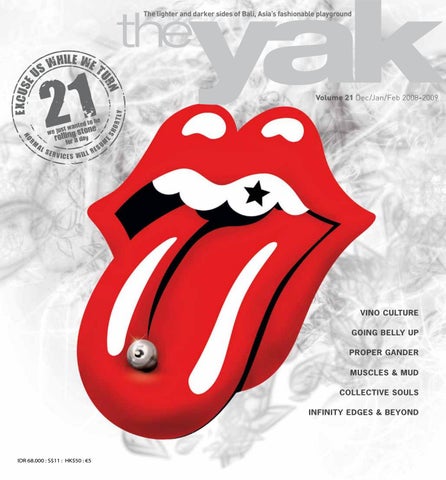
Excuse us while we come of age. We so wanted to be Rolling Stone for a day, and we are 21…we promise quasi-normal covers will resume in March 2009! With this edition, The Yak celebrates its 21st issue and no less than five whole years of groundbreaking creativity. In recognition of this, we have decided to follow those ‘mots’ of wisdom uttered by America’s pioneer in advertising, Leo Burnett (1891-1971) and keep The Yak “…simple…memorable, inviting to look at and fun to read.” We also decided that it was high time to renew, revamp and start a mini revolution. So here you have it, our slightly more mature yet equally irreverent, ever-expanding contribution to Bali – Asia’s luxury playground. We wouldn’t be seen playing anywhere else. Would you? So with beer and cigarette in hand (due to the ever-diminishing stocks of anything better to drink) let’s start by beefing it up at the playground with The Art of Fighting before learning the meaning of love with Claude Challe. Then, it’s time to get Cozi and meet a spiritual modern-day Boadicea. Bali Belly is on the cards before Moving On with Jamie James and lingering in a couple of Seminyak Spas. We then level the playing field with pages dedicated to our fifth anniversary – a look at what was then, and who went before. We get playful with coffee grinders, surfboards, orchids and Dalmatians before heading Upstream and Living The Life. This issues’ Duoview is courtesy of Puravida as we stay in the playpens of Karang Kembar and SilQ. The playroom then gets competitive with Club vs Club before our Vino Culture calms us down with glass in hand. On to the canteen, and on the menu we have Dim Sum, Sarong with a bottle of Burgundy, courtesy of our ‘epicurious’ playfellow, Katrina Valkenburg. In the fashionable playsuit we meet Lulu and are allowed to go Freestyle before putting our Trust In God. A quick lullaby from the likes of John Digweed and Nick Warren and it’s off to the land of nod with our eye on the future – Horoscopes… We hope you playfully get to enjoy this issue, forgive any faux pas and we’ll meet you back in the playground, same time next March. May The Yak be with you…
Dear Yak, Good For Health Nice to see the magazine looking so healthy – you guys have come a long way since the beginning back in (when?) 2002? Bruce, Singapore Thanks! Actually it was 2003 and this is our 5th Anniversary issue, so enjoy! Dear Yak, Go Barry It was a pleasure to read about the next president of the United States and his time in Indonesia as a child in your Sept. issue. Barack Obama is looking more and more like our last hope. America stands on the brink of history – the next decade will decide whether the world’s leading superpower can continue its grip on the globe or whether it is usurped by forces outside of its control. Either way, Barack – Barry – Obama is clearly the man to oversee any transition, and transition there clearly needs to be. Capitalism has long been touted (or at least since the failure of Communism) as possessing the power to offer freedom to individuals willing to work hard. Most of us know that in reality however, working hard is not enough. Capitalism (and probably Communism) allows some individuals to wield an unholy power over channels of finance, media and wealth. No longer. We
need consensus on issues, and we need to manage the ineffectiveness of consensus. The issues have become far too great for us to ignore – the environment in which we live is being destroyed: by us. The financial systems that we have put in place are cankered with greed, arrogance and selfishness. I rarely hear solutions from those I know who are engaged in the business of banking and finance; they shrug and say ‘don't worry, the markets will come back’. Maybe this time they will, eventually, but they won’t forever. Barack Obama appears to be a man of morals and one for whom the issues of the world loom large. He needs our support as individuals in a pledge we must all take to do whatever we can to make the world a better place. Even my sixyear-old daughter knows that. Jed Milberger, Bali Quite. Dear Yak, Party On Your pictures reminded me of what a fab party you threw for the Yak Awards this year. Full on! Louise, Perth Next year we plan to employ dolphins in a display of sychronised swimming under the stars. And our publisher will abseil from a moving helicopter (not).
Sometime in the mid-1990s, the Godfrey brothers (DJ Paul Godfrey and multi-instrumentalist Ross Godfrey) recruited Skye Edwards as vocalist during a chance meeting at a party. They formed a band called Morcheeba, and the rest, as they say, is history. Skye has since left the outfit but the brothers Godfrey go on..and yes, they are will be in Bali on January 14th at Karma Resorts.
New chef in town Since Junior High, Philip Mimbini has got down and dirty in high-end kitchens around the world. Passionate about food, its flavours and its preparation, Mimbini brings a new breeze to Bali’s cuisines. Born in Cameroon he moved to the States as a young boy. Having studied at the Culinary Institute of America, and with a Bachelors and Associates degree in Culinary Arts Management under his youthful frame, he set out to study wines in the Napa Valley. Moving always east, from Vegas through Jamaica to Thailand and Malaysia, cheffing for the Ritz-Carlton’s of the world, Bali is now the lucky destination of his oral talents and Nutmegs at Hu’u Bar Bali is his kitchen of choice. Keeping it fresh and innovative, his dishes and his enthusiasm about his new posting have us all savouring delicate flavours from Bali’s own hinterland and beyond, in delicious and original combinations that had yet to hit my palate! Tel. 736443
www.nutmegs-restaurant.com
Up and coming and in the running… Where to go on a Sunday where beach is wide, the waves are child friendly, the nearest bar is chic and fabulous cocktails are on the menu? Ma Joly, in Tuban (a.k.a South Kuta) Beach. After an elegant refurb, Ma Joly is well on the way to creating an upsurge in elegant, beachfront luxury. Lounge on a sun bed, sit in the pavilioned terrace, nibble on items from the light lunch menu and play a gentle game of paddle tennis…and… watch the sun go down…Yep guys, you’re in the running for a nomination for a Yak Award - Best Sunset Venue 2009! Tel. 753780 www.kupubarongbeach.com Yak Map: A.15
Yak Map: B.6
Porterhouse or Poivre? Where, oh, where can we get a decent steak with the right sauces and all the trimmings? Karma Steakhouse in Jimbaran has thankfully answered our wailing. New York Sirloin, Filet Mignon, Top Round, Wagyu, and my personal favourites – Porterhouse, Tartare and the monster 1kg Prime Rib (bone-in prime rib) for two. As for sauces, a generous drizzle of poivre cognac, blue cheese Gorgonzola and Roquefort or crab cake and lobster béarnaise might just make the grade – although with this quality morsel maybe just stick to the béarnaise and tarragon, horseradish cream or Bordelaise classic – red wine shallots, thyme and demi-glace. Side orders? Baked potatoes with sour cream, bacon and chives of course! Tel. 708800 www.karmaresorts.com
Jest-art (Art-U-Jest) Humour breaks boundaries, inspiring both new generations into listening to old traditions, and old traditions into updating themselves for new generations to comprehend. Indieguerillas are the eyes and mouthpiece for just such a ‘tradition retrofit’. Husband-wife team, Dyatmiko Lancur Bawono – Miko – and Santi Ariestyowanti, started Indieguerillas in 1999. Both with degrees in design, and inspired by local culture, daily events and folklore, these rebel artists excel in conceptualizing their attitude by working with video, digital art, wood, glass, resin, as well as acrylic on canvas. The audio illustration to this exhibition will be courtesy of Ari “MidiJunkie” Wulu, a Yogya-based sound artist who will provide the aural pleasure to the animation video and vernissage. All at BIASA artspace from December 21st through to January 14th. Jl Raya Seminyak 34 www.biasaart.com Yak Map: H.12
Ubud Images The Bali Photo Gallery in Ubud, peeping out onto Jl. Raya Sanggingan near Neka Museum, will be mounting exhibitions every few months in order to fill the much-needed photographic gallery gap. Surrounded by traditional art and sculpture galleries, international photographer Jill Gocher invites Carlos De La Rua to exhibit alongside her in the current exhibition “Bali with Love”. Visually stimulating, depicting aspects of this verdant isle, the wall sized pictorial voyages showcase Bali’s daily life in both abstract and realistic form and with Bali’s burgeoning villa trade there is a scene for everyone to hang on the wall.. Tel. 081999266710
A king, two queens and a pawn… GV Amazing Crafts are just that, amazing. GV’s contemporary interiors boutique, on the Basangkasa end of Seminyak, brings unique design to the mundane - think shoe rack that looks good enough to live in your living room. Art to the functional – that’ll be the silver-lined salt and pepper sets or the lava stone bowls lined with semi precious stones and enamels and, a myriad of eye and brain catching inventions that take today a simple step into tomorrow, very tastefully. Another unique item on show at GV? The chess sets! Handmade collectors pieces that would have the likes of Kasparov and Karpov drooling on their game clock… Jl. Basangkasa 22 Tel. 735588 Yak Map: H.9
Getting personal Fifty-five new palatial suites have set a new standard for luxury hotels on the island. ‘No two guests are the same so no two holidays should be the same’ as said by Michael Burchett, General Manager of The Conrad Bali, has given one of our favourite hotels a whole new summit. So what is at the top of this lofty venture? One hundred and ten square metres of fabulosity combine with service that can only be likened the world’s favourite, private, luxury concierge service – Quintessentially. Need a chopper to get to dinner at The Viceroy in Ubud? Front row seats at Uluwau’s fames sunset temple, maybe a seaplane to picnic in Lombok? Your Personal Assistant will arrange for that and some. More importantly they will book your spa treatment in the right room, your dinner at Spice on the right table. They have your best interests at heart, that coupled with the new personalized holiday planning website that allows you to pick and choose your favourite tunes, aromas and drinks, then your holiday will be perfection personified. Add to that five new Spa Pavilions and the new stylish Japanese eatery, Rin and the only DIY that you’ll have to do on your holiday is get up in the morning. Tel. 778788 www.conradbali.com
Chinoiserie Bar and Lounge A new drinking, eating and bar-standing venue comes to town, amazingly with ample parking and conveniently on Jl. Sunset. Contemporary Chinese décor awash with fabulous textures and elegant lighting is the new space for private cocktail parties, tete a tete romantic dinners or just a night out with the girls or boys. Menus are based on what has come to be known as Modern Asian and the dishes are deliciously affordable. Chinoiserie has, thankfully, classed itself as semi-fine dining, so you can leave the bling and tie at home! Jl. Sunset No. 7 Tel. 8088 777
TOKYO FRESH Theta spa has opened a hair salon with a team of experienced hair consultants from Japan. The menu ranges from precision hair cuts, professional hair treatments, and the trendy eye lash extensions using all products from the Land of the Rising Sun. All this is celebrated with an opening promotion with discounts up to 50 percent. Valid till December 30th. Call 0361755726 for reservations. www.thetaspa.com
‘Twixt Land and Sea Just as the sea touches all coastlines around the globe so does the menu at The Shore. The Nikko Bali Resort and Spa’s new signature restaurant presents a lunch menu that offers pungently delicious Asian favourites - Spicy prawn soup or the Korean stir fired beef with Kimchi and Gochujan chili sauce - as well as must-have Western dishes such as a myriad of pastas, pizzas, the ever-beloved Club Sandwich and burgers! At night The Shore morphs into a Fine Dining venue offering foie gras, oysters, yabbies, succulent freshly caught and imported seafood, tender imported Wagyu or lamb and desserts that set the taste buds into overdrive, Forest berries gratinated with Ice wine Sabayon or the Honey bee ice parfait croquant. Just as impressive as the menu are the views of the aquamarine sea by day, and the riot of stars in the night sky. Tel. 773377 www.nikkobali.com
Sorry, Orly! We forgot to put your credit on the superb Yak Awards photographs in the last issue...forgive us! For the rest of you, check out Orly's work at orly@orly66. com and www.orly66.com
Eat Oscar If you wish to see a kitchen that Jamie Oliver would be jealous of, or if your dream is to actually see a two-story wine cellar, then Kayuputi at St Regis Bali Resort, in Nusa Dua is the only place to go. Chef Oscar Perez will wine and dine you on caviar (Sturia and Prunier) and oysters when suitably in season. The menu steps from Lava stone grills to Hot and Chilled seafood-experiences. His soups are Chilled or Steamy; he does the Classics with aplomb - think Lobster Thermidor; his Wood Oven menu is smokin’ with a Black cod gratinated with foie gras sabayon; and his desserts are classified by flavours, Dark chocolate with Szechuan pepper timbale, salty chocolate flakes, chocolate and cardamom coulis with white chocolate mini Magnum. At Kayuputi the elegant table settings and decadent white décor satisfy the visual appetite, Oscar does all the rest! Tel. 847 8111 www.stregis.com/bali
Culture Vulture
C
THE ART OF FIGHTING by michele cempaka
Photo: Green School
Fusing Balinese martial arts and drama, contemporary dance and gamelan, Mepantigan is an entirely new cultural phenomenon. The fighters have a choice of competing in different locations, like the beach, in the mud or in any open space. For the competition, participants wear traditional Balinese clothing similar to that worn by Sumo wrestlers. Practitioners become more physically powerful whilst releasing stress in an atmosphere of camaraderie and good sportsmanship. In addition to physical skills, strength and agility, both emotional and spiritual intelligence come into play. Putu Witsen Widjaya, the originator of Mepantigan, found the inspiration for this unique art form while teaching Tae Kwon Do to children at Bali International School. His dream was to combine martial arts with traditional Balinese practices in a fun environment where people can celebrate life. It is his belief that this unique practice will empower the individual on all levels, helping him
Culture Vulture
Culture Vulture
Photo: Green School
Culture Vulture to become a more compassionate and non-violent human being. The first Mepantigan Championship was held in July at Green School’s Mepantigan Center – an innovative bamboo structure that is the first of its kind in the world, with seating for 300 people. Mepantigan is performed every full moon at the Green School.
This Much I Know
9
CLAUDE
Sophie Digby enjoys a love-in with the legendary Claude Challe, Dj, club impresario and founder of Buddha Bar. Claude, what is music to you? Music to me is like oxygen…I need music to breathe, to live, to love, to share…Without music I would not be able to live my life. Fortunately there are many other people for whom music is as important as it is to me. Music is something that approaches the divine, something that brings out the very best in us. Music is the most beautiful voyage, because we only need to close our eyes in order to leave… What has travel given you? The treasures of others make us richer as well and we add them to our own… through the music, this wealth has allowed me to discover the different sounds of the universe. Thanks to this beautiful planet on which we live, with its multitude of marvelous things, we can gain tremendous happiness. What is woman to you? It is women who give me inspiration. It is women who bring me delight and it is women who make me rise above myself and give the best I have to offer. God’s best creation is woman. What is your opinion on religion? Nowadays I have a dream for our children, which is a religion of love, nothing but love…all we really need is love. Are you part of a tribe? My tribe is the army of lovers, people who love beauty, music…the children who love life. What is a tribe to you?
A tribe is people that know each other…It means I do not need to talk to you first…I do not need to find out what is your name or what colour you are…I look into your eyes and I know if you are part of my tribe… Your thoughts on being famous? I do not feel famous…I only feel famous with my friends during the moments I share with them, when I try to bring them some happiness, when I try to give them a bit of joy. It goes for each one of us that we should be famous to ourselves and to others, when we are with them…that is what fame is about. What is your opinion on jealousy? Jealousy is the worst of all diseases. Worse, it is a disease that slowly chews you up and destroys all love… Have you ever been jealous? Before, yes! At times I have been extremely jealous, I was actually sick of jealousy, physically sick…and I have broken off relationships because of my jealousy… And what made you change? That was a lot of work…an enormous effort…but there was a lesson to learn, because you need to have confidence in yourself and you need to have confidence in the other person. Once you do have confidence in the other one, the jealousy is gone. But again, it is a grave disease that does require treatment… What are your thoughts on piracy and pirate taping?
In the old days I used to be very proud, whenever I came to Asia, India, Thailand, Indonesia, and I would see my albums pirated in the markets…basically because I thought the people there could not afford to pay the real price, so my music was on offer for very little money and I was happy with that. Nowadays piracy is global and it is a bad thing because it means death to independent producers like me. You simply do not sell any albums any more. So it does not allow us to create anything new. It used to be that I would sell enough to continue producing new albums of young musicians and start new projects. Unfortunately nowadays piracy is killing us. What will remain are just the big companies that produce commercial music and perhaps a few groups that publish their own underground stuff on the internet. Small professional producers will die out. It is a shame. Your thoughts on meditation? To hold a woman in my arms, to watch a sunset, to close my eyes, to listen to music and to be happy…or else to be all alone, to dream and leave my body and think of all the beauty in the world. Do you believe in astral projection? Not only do believe in it, once in my life I had the actual experience of travelling through space…during a time when I was involved in a very strong love affair and both of us left our bodies at the same time. It was a great chance and I thank God that I
was allowed to experience this. What is the meaning of life for you? For me, first of all, to live the present. To be happy in this very moment, to be with you right now; the fact that you ask me interesting and intelligent questions…I am listening to the sounds of the waves and the ocean…listening to music and listening to happy people…to me the real meaning of life is to find harmony in everything, in music, in life…I love life. What needs to change in the world, would you say? The most important point, so that the world can change, is first of all to change ourselves. For that to happen we must give a new education to our children. Education is all important. The present day school systems for our children are not at all adequate enough to raise the New Man in the age of Aquarius…for the Universal Age we need a universal man, so therefore we need to raise a new universal child that is independent of colour and religion…very simply it has to be a child that is filled with love, at peace with him or herself. We need children who are happy and who are willing to take our planet in their arms, protect it for themselves so we can share it with each other. We need to love each other because that is simply what life is all about, love, love, love!
NB: Thanks to Willem Loots for the accurate translation!
Interwho
Cozi Till is one half of Zen Lemonade, Bali’s most acclaimed electronic musical outfit. Their superb second album’s out soon. What's your name? Cozi Till or Supercozi...when I feel super! Where are you from? Born in Yokohama and later spent most of my time in Tokyo, Japan...a compressed, consuming spot of the sea creatures. How did you grow up? With my ultra-straight-still-living-in-Samuraiperiod-minded parents. I still remember, when my dad came home at night, me and my brothers and mom had to go down on our knees at the entrance room to welcome him...until I become an annoyed teenager and discovered punk music! Why don't you live in Japan any more? Just like that lyric from Moon River...there’s a lot of the world to see... What's the best thing about Japan? Craftsmanship and professionalism...people doing their best to be better. Also, generally Japanese people are honest...most of them don’t like cheat or rip other people off. Who or what is Zen Lemonade? My lovely husband Gus Till and I myself. Our electronic music unit. We are the both producers and composers and active as solo artists but when we are in the mood to do some musical invention together, we do so under this name. Also, we do lots of bespoke music design for high-end places and films and fashion labels all over the world. We are the sound alchemist team. When and where did Zen Lemonade start? It started in London in 2000 where Gus and I started to live together. We made a few dance and chill out songs, then Youth (the bassist of Killing Joke and legendary producer of many bands including Primal Scream) heard them and loved our stuff. So we released a debut album from his label in 2002 and got great feedback and toured all over the world until we moved to Bali. You’re about to release your second Zen Lemonade album. Tell us about that... The album title is Babylondon. It will be
released worldwide by Greek record label Electronic Soundscapes in early 2009. It’s a unique fusion of Dub, Ambient, ’70s psychedelic rock like Pink Floyd, break beats and trip hop on a strong techno base. A very important element is its Balinese flavour, which is deeply planted and mixed with those Western musical formats. Bali gives us such inspiration on a daily basis. We are always surrounded by the island’s music, whether it’s the nearby banjar practicing gamelan or the mangku chanting on a full moon night. We just love it and have tried to make a unique piece of music that strongly reflects these elements. We are obsessed by mixing Western musical formats and Balinese flavours together…the passion grew up like conjoined twins…a beautiful baby with two heads. It’s deep music. We are also very happy to say that Steve Hillage (Gong/ System7) played amazing guitar on two songs of the album. And Tim Valkenburg’s guitar is also very sensual, plus he did an incredible final mix as well. Where can we buy it? In most of the world. You can find it at general CD shops I guess. Also you can buy it from many internet shops and on Itunes for sure. In Bali…I didn't organise it yet but it will be somewhere. How did you meet Gus Till? X'mas eve, 1999, at his brother’s house. I was on a DJ tour in Australia and my friends took me there for a Christmas party. The best gift ever for both of us from Santa. Are you ever surprised that Zen Lemonade has a small but ardent fan base? Yes, constantly. We released our first album six years ago and still some people fly us over for a gig. This March we went to Moscow and 1,600 people came to the show. In April it was Athens to do a live support act for a band called Juno Reactor. There were 2,600 people there and a lot of people still remembered us. I really appreciated that. This is such magic...after six years, wherever we go, there
are people who come up to us and say: "Hey, I love what you are doing! Keep creating!" It really cheers us up. What's the biggest gig you've ever done? The Samothraki Dance Festival in Greece, August 2002. It was a four-day festival and there were many live acts from all over the globe. Twenty five thousand people in total. We did a live show on a beautiful seafront stage under the sun. What's the weirdest? Sado island, north Japan, July 2002. It was another big festival, but a typhoon hit the island on that day and emergency statements were issued from the government. The festival was cancelled and we were all stuck in a small traditional hotel like refugees. Artists and audience and staff for two nights or so. All we could do was drink sake and eat! We were supposed to do a performance but ended up with a sashimi bonanza. And the next day, by the time our bus reached to the ferry port to leave, the sky was totally clear and there was perfect sun. A strange trip. How can we find out more about Zen Lemonade? Go to www.myspace.com/zenlemonade. Do you want to be famous? I am totally happy with who I am now. If more people discover us and like what we are doing, it would be pleasure, of course, but we can keep going on without it, too. We are self-generating and petrol (fame) is a bonus. If you weren't a musician, what would you be? I’d probably be a journalist or poet or photographer. Can music make the world a better place? Absolutely. Music can transform negative energy into something more beautiful. Music can heal your soul. What's the last thing that goes through your mind before you go to sleep? Is tomorrow P.E. or swimming day for my kids? Not to forget to bring Rp20,000 for that! Cozi, thanks for your time…
interwho
Photo: Agus Pande
Incoming
Photo: Y.M.
Incoming
Pewe Hello. What's your name? Hi! Just call me Pewe. That should do. What do you do? I provide language, media and communications and environmental services. My various roles include providing translation, interpreting, narration, subtitling, copy writing, all the way to liaising with government, event promotion, organising press conferences…I know it’s rather broad. I started all these from my work as a journalist once upon a time. I am not a believer in office rituals, so I’ve been freelancing for quite a long time. I’ve created my own rituals; my colleagues and me formed a media and communications company – Bali International Communications Service or BICS – a year ago. From my love of diving, for the last seven years I’ve also been involved in underwater activities and marine projects with some international NGOs. Most of it still involves media. In 2002, we formed the Marine Journalist Group to provide an umbrella for those who care about our marine environment. As for the non-money-making stuff, I’ve been involved with foundations that foster Indonesia-India cultural exchange. I was active in the political scene, sat on one of the Strategic Boards of a political party (not as candidate!), but I recently let it go. Perhaps I’ll be back, but for sure, not soon. But whatever I do, I love doing it from behind the scenes. Since reformasi, what changes have you seen in Bali? I see so many flags substituting penjors today! Every day is political odalan in Bali.
Even big temples, too, have huge flags waving from their tops. I just came from Nusa Penida and wanted to take pictures of its streets, but then I stopped when all I saw on the screen was colourful flags. It’s just ugly. Where does your work take you? I often have to engage with people outside, well then you can find me in the sea, underwater, in the mud, inside tribal areas…everywhere…but apart from that, as long as there is a laptop, an internet connection and peaceful ambience, anywhere will do. Give us an example of a typical day. I’m a night owl. There’s no typical day – my timing is the reverse of what is considered normal. When travelling: sleep early, wakeup early and roam, roam, roam – or work, work, work when on duty. I don’t party much these days, but when I do, I like to party hard. Where did you grow up? Mostly in Bali, I was born and brought up here. Tell us about your mother and father. Mom is an ophthalmologist and my father is a retired government auditor who’s now into building temples in various locations in Bali and Java. Both are very spiritual and care most for education. They prefer to live a simple life. Tell us about your children. I have two daughters: Pundarika is in her 6th grade and Krishnalila is in 4th grade. Both go to school in Denpasar. The youngest one is autistic, so she goes to special school; her 4th grade is in transitional school. You had two children when you were
young. How did this change your life and your outlook on life? Well, first, I’m still young (smiles), but to answer your question: having my two daughters at a very young age brought so many changes into my life and my point of view about life. Having kids meant I had to stop being so self-obsessed. For every plan I make, I need to include my kids in it, and consider what the effects are if I execute my plan. I learned a lot about how to show my love; I used to be quite reserved and did not talk much about my feelings. By having them, slowly I started being able to say ‘love’, ‘dear’, ‘I miss you’, ‘I love you’. And that affected my surroundings, too. I became rather tender! They shredded me with their innocence. I’m a workaholic, mean and selfish. There are few emotions that have a place of importance in my dictionary (apart from my anger). If I didn’t have them, I wouldn’t be here today; I’d be out where nobody can find me, chasing dreams. They made me think so much about life and taught me that life is not just about work. Life becomes very colourful and meaningful when you start having kids. What is it like being a single mother and at the same time a Balinese woman? Being a single mother means you have to take two responsibilities at once – itself a heavy burden. Being a Balinese woman… (exhales)…you have no rights in anything. I mean, anything. You figure out then how to be both. But in my case, I can say, I’m on the safe-side. Today, Balinese women still have no rights. But thank God I was born into a family who think with logic,
so there is no difference to me being a man or a woman. Everyone is respected equally. My father wouldn’t adopt a son (we, his children, are three sisters) just to take care of the family’s property and temples. His daughters are capable of doing so! And why give up our family inheritance to others? From a traditional adat perspective, my village, too, has a wise regulation: that when we are working out of the village – most of people from my village in Penyaringan, Jembrana, live far away – we are allowed to substitute our duty to serve the banjar with a lump sum of money. Therefore it doesn’t burden those of us who are far away from our village. For a Balinese woman, when divorce happens, the children automatically go to the man’s family. Case closed. Hence many women are afraid of getting a divorce, no matter how crazy their husbands are. With me, I got to take care of both my children, though there are no written words on my divorce papers. My divorce was agreed upon on the proviso that I didn’t ask for my daughters’ custody formally on paper. Well then, I went ahead. We agreed to take care of our children’s issues the family way. Though physically they are with me so far, they still belong to my ex-husband’s family and temple. That much is my right as a Balinese woman. The worst thing about being a single mother is the way Indonesian men in general look at me, as a tasty chicken who is ready to be eaten. Hearing that I am a divorcee seems to instantly create a sexual fantasy in their mind. This sucks, big time! But it’s hardest for my kids. Whatever I face, it is nothing compared to the single
Continued on page 159
Putu Widyastuti is part of a new generation of Balinese: urbane, spiritual, tech-savvy…she embraces the world while remaining firmly rooted in the ideals of the home. She spoke to Kadek Krishna Adidharma about what makes her tick, why she loves India and what her children mean to her.
Just Doin'It
BALIBELLY We took three of the island's most sensuous practitioners in the art of belly dancing to The Ayana Villa at The Ritz-Carlton Bali Resort & Spa and put them in front of our lens....the pages that follow are the result of a fabulous Chardonnay-fuelled afternoon. Photography by Lucky 8.
Just Doin'It
Just Doin'It
Just Doin'It
OK boys, calm down, it’s not all that you think. Belly dancing, to offer some explanation to confused male viewers, is actually a celebration of the ancient feminine – and not for male gratification, as some might believe. Practitioners still hotly contest the origins of this oriental movement, but most believe it started as a religious dance practised by temple priestesses, and was part of traditional birthing rights in the countries of origin: principally Egypt and Turkey, but also Greece and the Balkans. The term “belly dancing” is believed by some to be a mis-transliteration of the term for the dance style Beledi or Baladi, and is generally credited to a certain Sol Bloom, entertainment director of the 1893 World’s Fair, the World Columbian Exposition in Chicago. Dancers from several Middle Eastern and North African appeared at this exposition, but it was the dancers in the Egyptian Theater of The Street in Cairo exhibit who gained the most notoriety. The rapid hip
movements and the fact that the dancers were uncorseted was considered shocking to Victorian sensibilities of the day. Today there are millions of people – women mostly, but some men too – around the world who practice this form of dance. Multicultural trends that have shaped Western and US belly dance are still at work. International and ever evolving, this versatile dance keeps absorbing a blend of influences: modern fashion, film and television imagery, the world of rock, jazz, clubhouse and hip hop, underground subcultures and many other contemporary influences. Watch Beyonce next time you get a chance and tell us she’s not had a lesson or two. It’s a fiercely physical sport, too, and belly dancing has rightly taken its position in the pantheon of workout regimes, providing a good cardio-vascular pump that helps increase both flexibility and strength, focusing on the torso and core muscles. Many belly dance styles also emphasise muscular isolation, teaching the
ability to move various muscles or muscle groups independently. And it just seems to fit a woman’s body. Clearly there’s a market for belly dancing as performance art, too, as our three girls showed us. They’re backgrounds could not be more diverse. Ally is half Jamaican and half English and comes from Wales; Nanou is Morrocan and living in France; and Christyana, who has been belly dancing since 2002, is Indonesian-Chinese. “Belly dance is a very grounded spiritual dance,” she told us, “as it was originally danced at temples. It is also a very natural movement for women that can bring out their sensuality, not sexuality, their confidence of being a woman. Both in spiritual and Womanhood, I can express it through this dance.” Belly dancers Allison, Nanou and Christyana can be contacted for performances on: alli@poisonbabe.com nanouwakinyan@gmail.com christyana1@hotmail.com
Just Doin'It
Just Doin'It
Just Doin'It
Just Doin'It
This Life Respect – but isn't it time to close that chapter in Bali’s history, asks Jamie James? When I was a boy, I was fascinated by the Black Hole of Calcutta. I didn’t know what it was, but the spooky, exotic name gave me a pleasurable chill – like the goosebumps I got reading about the Giant Rat of Sumatra, the Sherlock Holmes caper that Dr Watson never published “because the world is not yet prepared for it”. Later, I learned that the Black Hole was a filthy cell, 15 by 18 feet, in which a victorious Bengali nawab imprisoned more than a hundred soldiers of the East India Company in 1756 until most of them died of dehydration and suffocation. Proponents of the British Empire used the incident as propaganda, extolling the noble heroism of their soldiers in the face of heathen savagery. (Later historians showed that contemporary accounts of the incident were greatly exaggerated.) Having come through another season of memorials to the victims of the Bali bombings of 2002 and 2005, I sometimes wonder whether all this remembering doesn’t risk stigmatizing Bali the way the Black Hole darkened the name of Calcutta. I don’t want to make any heavy-handed parallels here; the point is that more than 200 years after those soldiers met their horrible end, the Black Hole was still just about the only thing most western people knew about one of the great cities of Asia. No one doubts the sincerity of the Bali memorializers or begrudges them their grief; but “Bali Bomb” is dangerously close to becoming a global brand, the defining image of the island for the rest of the world. In a recent issue of the German edition of Vanity Fair, a major story about Bali begins with the requisite incantation of “Island of the Gods,” complete with misty volcanoes and emerald rice terraces, but by the third paragraph the writer has
moved on to the bombings with gusto, and describes them in pornographic detail. The horror goes on page after page, lavished with gore, and offering not one new fact or idea. “Bodies were blown apart or incinerated on the spot, arms and legs and heads torn off, corpses charred and disfigured beyond recognition.” That is a seriously disturbing sentence, and we have all read it a thousand times. As the years pass, the event only seems to gain in iconic importance. The International Herald Tribune reported an October 12, 2008, gathering of 50 people at the Australian consulate in Denpasar; other observances were held in Australia. Every year brings a new interview with the Wacky Islamic Cleric who was tried for conspiracy in the 2002 attack. Australian television, always happy to give him a megaphone, ran a story last October in which the W.I.C. claimed that the 2002 bomb was actually an American nuclear missile fired from a submarine off Kuta Beach, and added the fascinating theory that Indonesia's Islamic groups are actually “Jewish organizations". Why do reputable news organisations treat this rubbish as news? Do the editors of the Trib, the global edition of the New York Times, really think that a gathering of 50 people at the Australian consulate is a story? There were probably a dozen events in Bali that day that drew bigger crowds, not counting cock-fights. I lived through both bombs and have, I think, a full sense of their horror; I just question whether all this public wailing and rending of garments still serves a useful purpose. My guess is that it makes the island less secure rather than more so. Mainly, I wonder why the survivors want to keep putting themselves through all that.
Eventually, mourning comes to an end. We never stop feeling sad about the deaths of our loved ones, mates and parents and particularly children, but eventually the sadness becomes internalised. That point varies among people (and peoples), but by six years a healthy psyche has outgrown the need for overt expressions of grief. The candles and floral wreathes for Bali are about something else. These heinous crimes will never be forgotten, not in the lifetimes of those of us who lived through them; I would just like to see them placed in the context of other events. The earthquake and tsunamis on December 26, 2004, killed at least 225,000 people, causing suffering on a scale far greater than the Bali tragedies. Yet on the tsunami’s fourth anniversary I don’t expect to see even the usual dry little news item about how the reconstruction is going slower than everyone had hoped. Why are there no candles and wreathes for Aceh?
We know the reason why. The Balinese are good sports and go along politely with the white folks’ neverending lamentations, but they must think we’re mad. The Balinese victims of the attacks were mourned and cremated long ago, and the survivors moved on to cope with the pressing demands of being alive. One of the most painful stages of mourning is the final one, the recognition that at a certain level, the death of an individual is an event of no consequence. We all have to go sometime. When I told Bonita, my Indonesian partner, about this column, he said, “Better not to talk about that anymore.” Obviously, that’s my point. Maybe talking about not talking about it is a pointless variation on the problem, but I am just so very weary of being asked, every time I tell someone where I live, “Is it safe there now?” No place is safe, every place is an island of the gods.
Interview
cameron
Forbes
Bali. It’s not all about beauty, as veteran foreign correspondent and author Cameron Forbes tells Marian Carroll in this revealing interview. Where are you now? In Melbourne, I’ve been based here since moving from Queensland in the 1960s. How old are you? Oh…you really want to know? I’m 70. A fit 70? Apart from a broken arm, I feel fine. How did you break your arm? I’ve got some old injuries, so often I walk for exercise. I’m not fully stable and one day while walking I stepped off the path to avoid a bicycle and went down. There was nothing heroic about it. That’s ironic, coming from a war correspondent. How many wars have you covered? I’ve done my fair share. I did the First Gulf War, the first Palestinian Intifada, civil wars like Sri Lanka, Bougainville. I went to Afghanistan and into Rwanda during the fighting, which was the worst of them all. That was just wallto-wall horror. Not a lot of fun when I really think about it. Did you always want to be a war reporter? I never have been a war junkie. I don’t find it exciting at all. More frightening. I spend some time working out the lines of fire when I’m in difficult situations so I can keep myself as safe as possible. But for me, the overseas posting is what journalism’s about and it (war) is part of the patch. I think it’s important that reality is brought to the public.
This is one of the themes in your second book, Under the Volcano: The Story of Bali. You are quite critical of Australia’s failure to do anything about the Communist purge in 1965-66. What inspired you to write the book? I was under pressure to do another war book on Vietnam, but the idea of doing a Bali book which captured both the beauty of Bali and the ugliness of the violence was a fascinating challenge. The suggestion from the editor was it would be Bali: Paradise Lost, but I said it never was a paradise, there’s always been internal warfare and then the Dutch colonial regime as they moved to crush Balinese resistance and then the holocaust in ’65/’66. It’s important that the reality of Bali is known. Bali is not just an all-singing, all-dancing place of beautiful ceremonies, although that is a part of it. It’s a place that’s faced enormous challenges. Some tourists just see Bali as a little playground where the beer’s cold and the beaches are fine, and they don’t realise that here is one of the world’s more complex societies which is interesting to look at in its own right, to look behind the image projected by the tourism people and by a lot of people who fell in love with Bali – the writers and artists in the 1930s who projected just one side of Bali. Do you think they did a disservice to it? I think they did if you believe it’s important
to know the truth about a country. They did a disservice to the people who came to Bali almost blinded by the richness and gorgeousness of the rituals. That’s the difference between being a tourist and a traveller. A tourist is into hedonism I suppose and a traveller is really interested in the country and its people. When did you first come to Bali? In 1974 at the end of a six-week trip through Asia. That’s when my fascination with Bali began because of its beauty and the echoes of the massacres in ’65 and ’66. You weave the stories of many Balinese into your book, reflecting your journalistic background. If you had to choose, would you rather be a journalist or an author? In a way, writing books is an extension of journalism. I act almost as a foreign correspondent but with an overlay of deep research, looking at sources, history books and official books and spending time in the archives gathering personal information on the people I’m writing about. I interviewed 25 people or so. I talked to the Bali Aga, Muslim Balinese, Chinese Balinese, as well as the body of the Hindu Balinese. The terrifying part about writing a book is having to jump from 5,000 words to 150,000 words. When did you first start in journalism? On a provincial paper in Queensland in 1960. I started off on police rounds which in fact led you into the underbelly of society. I was a racing writer, football writer, reported councils, it was an amazing all-round grounding that gave me an intimate view of the workings of society and its institutions. As Asia correspondent did you cover much of Indonesian affairs? My beat was from the Philippines to Afghanistan and all points between. However, unfortunately in the 1980s I was on the Indonesian blacklist and was only allowed in to cover bilateral visits from Australia; I couldn’t stay on to write about Indonesia itself. I managed to sneak into Bali for family holidays. Why were you blacklisted? There were two things: One, I had written some critical stuff about a fellow I knew. Another was the general upset because an Australian journalist had written about the Suharto family’s corruption after the
overthrowing of Marcos in the Philippines, and the Indonesian regime was fairly sensitive to criticisms of corruption. You have won many awards for your reporting over the years. Can you tell us about them? I was Australian Journalist of the Year for reporting of Asia in the ’80s; at that stage, it was the prime award in the country. I got the UN media peace award in the ’90s for reporting on Aborigines. I think I’ve had a fascinating balance of writing as a foreign correspondent but also on Aborigines when home-based, and in fact finding the most foreign country I know is Aboriginal Australia. And a Canadian award for international reporting, again in the ’90s, for a range of things: the Gulf wars, reporting on the end of apartheid. Were you ever shot at in the line of duty? A couple of times. In Rwanda, I was one of early ones in and had a very spooky night while I was sheltering in Kigali with rebel troops, when suddenly there was this enormous explosion, probably about 500 metres away. At first I jumped under a doorway but when the lieutenant said it was a Katyusha rocket I realised there was nowhere to hide. So we found a place with some beer, and we ended up drinking Nile Special as the rockets got closer and closer until we saw a muzzle flash down the valley and Patrick (the lieutenant) said it’s okay, our boys have got them. What’s next for you now? I’ve gotta see my surgeon this afternoon to see if my broken arm is knitting or not, because I’ve got a plate in my arm which is not good thing to have when you’ve signed a contract to do another two books. No, I imagine it would give writer’s cramp a whole new meaning. The first book is on the Korean war – a brutal, fascinating war which hasn’t been much written about and another one is called Horseback, and will look at the involvement of horses in exploration, settlement, war. For the Korea book, I’ll interview 30 or so survivors to get their voices before they fade forever. I’ll attempt to travel into China and talk to Chinese survivors, I’ll go to Turkey and to the old battlefields in Korea. I’ve got to go back to the trenches, so to speak. Good luck. Hope the arm heals soon!
Free Radicals
S e m in y a k
Blissed out at Glo Day Spa
S pas Awash with hedonistic fervour (no change there then...) we sent Marian Carroll to seek out Seminyak's sleekest spas for your delectation. Chill, Jl. Kunti With its sleek, stylish minimalist design, Chill is overshadowed by the palatial facade of its much bigger sister Prana Spa, also located within the expansive grounds of The Villas Bali Hotel & Spa. But the smaller, understated reflexology centre has put her best foot forward, leaving the beauty and body pampering to Prana and concentrating almost solely on your feet (excuse the puns). With 10 specially designed reflexology beds, a well-padded sound-proof door to block noise from outside plus individual iPods stocked with thousands of zen tunes, Chill is the epitome of the oasis cliche. The treatments are administered by therapists who have been trained to pin-point specific reflex and acupressure spots to relieve tension and muscle aches and improve circulation. And they are damn good at their jobs! For tired shoppers, The Yak highly recommends the Classic Chill, targeting your feet and legs, with the bonus of a shoulder, neck and head massage to
finish. For those who have just hopped off a plane, you can’t go past the Holistic Chill, a 1.5-hour full-body massage that promises to alleviate symptoms of jet lag such as headaches, migraines and poor blood circulation. This is also a great finale for those who are about to catch a plane back home (boo hoo!); Chill, and Prana for that matter, will even store your luggage and arrange your airport transfer while you enjoy a treatment designed to enable your body to fight off the dehydrating effects of plane travel. Bon voyage. Tel: 730840 Yak Map: I 10 Glo Day Spa, Jl. Kunti Hands-down the best place in Bali for mani-pedi and facials, there’s a good reason why Glo is booked out before major shin-digs, like our very own Yak Awards. But this boutique spa is not only responsible for enhancing the state of our paws: it also plays an indispensable part in the reduction of cellulite, stretch marks, acne and wrinkles; brown bods that are sprayed not burnt; eyelashes that are extended
and curled for the ultimate ‘come hither’ look; and bikini lines shaped as hearts in welcome – or arrows for the not-so-subtle. Glo’s reputation is solidly based in its commitment to hygiene and quality. Founded by Georgia Sutherland, whose consultancy Spa Alliance set up the spas at The Samaya, Kayana, Puri Jimbaran and Bali Sentosa resorts, Glo provides months of specialist training for its therapists and nail technicians and imports its products from Australia and the US. You can select a nail colour from hundreds of Creative and OPI bottles, enjoy specially formulated Decleor facials and body rituals, the natural finish of SunFX spray-on tan, and the softer touch of Brilliance XXX strip and Hard Wax products ideal for sensitive skin. Since it opened in 2005, Glo’s menu has been heavily focused on the cosmetic side of pampering, but it is now expanding its selection of body treatments and massage. With two deluxe treatment rooms – separated by a sliding door that opens up to enable couples to enjoy treatments together – it has
just introduced a Warm Stone Massage and Pregnancy Massage (using a special pregnancy pillow). Almost worth getting knocked up for! Tel: 738689 Yak Map: J.10 The Spa at The Legian, Jl. Laksmana It was here before Seminyak hit the tourist guides as Bali’s most fashionable playground, and it continues to forge its own path under the management of the GHM group. Located within one of the island’s most exclusive resorts, The Spa at The Legian launches an innovative new menu this month that combines the best of Oriental therapies with Western products and training. It is, in true GHM style, in a class of its own. With treatments sourced from India, Indonesia, Tibet, Hawaii, Japan, Thailand and Morocco, the spa takes you on a tour of Eastern healing philosophies, without having to leave this magnificent island or even the resort. Try the Himalayan body polish and hot stone massage, the Arabian exfoliation and body masque, or the
Free Radicals
Best foot forward: Chill Aryurvedic Abhyanga massage tailored to your dosha (vata, pitta or kapha) followed by Shirodhara therapy, to name just a few of the menu’s offerings. To enhance its new beauty treatments, this superb spa has also introduced many organic product lines based on Ayurvedic philosophies: REN from the UK, Traditions D’Orient from France and Sundari from India. Its five treatment rooms remain as lavish as ever, with individual stereo systems and bath, shower and steam facilities. Four come with ocean views and three have twin massage beds. On the subject of which, the beds are state-of-the-
art hydraulic inventions: using electronic controls, the therapist can adjust the bed’s height, the position required for your treatment (including raised back or feet), and shift the back section from fully prone to seated, enabling you to come to your senses and enjoy a cup of tea in bed before stepping foot on solid ground. There is also optional heating (recommended) and a fully-padded, adjustable face cradle that automatically fits the shape of your face. Fighting sleep is futile here; drooling into the flower bowl is quite unavoidable. Tel: 730622 Yak Map: B7
Spa at The Samaya, Jl. Laksmana Like the idea of a beach massage? Being at one with nature while your body receives a warm, oily rubdown to the rhythm of breaking surf and the twitter of birds darting amongst the palms? It all sounds exquisite, except when you consider the sweltering heat, the unwanted exfoliation provided by the sand, not to mention the somewhat persistent sarong sellers who seem to think you can shop even when you are being massaged. They are probably right, but still, why bother when you can savour the beach in all its glory from the privacy of the Spa at The Samaya?
There are four spacious spa villas at this chic resort, but you need concern yourself with only two: the oceanfront ones. Big enough to park your Kijang, Rolls and Vespa, with room still to spare, these exclusive villas bring five-star healing to the beach. Not quite floor-to-ceiling, wall-towall windows – but pretty close – provide uninterrupted views of a quiet stretch of Seminyak beach and the Indian Ocean beyond. The windows can be closed for full refuge from the outside world or slid open to welcome nature in. If you really want to experience the great outdoors, opt for the gazebo in the villa’s private garden,
Free Radicals Spa at The Legian
Free Radicals Refreshed at Taman Merah Spa
Free Radicals Spa with a view: The Samaya which is shielded by high walls. Each villa is fully equipped with twin massage beds, Jacuzzi spa, steam and sauna, Bose sound system, lounge, and rain shower and toilet. There’s a specially designed Indian massage chair for a unique head massage, or you can flake out on the beds for any number of spectacular full-body spa rituals. The signature Samaya four-hand massage is popular, but for us, the two-hour Chocolate Decadence is too tempting to pass up. Spa at The Samaya has also expanded its menu to beauty treatments, following the opening last May of its hair salon and mani-pedi area directly behind the openair reception. Still, it’s hard to go past those oceanfront villas. Open the windows, turn
off the music and let the waves of bliss wash over you. Tel: 731149 Yak Map: B9 Taman Merah, Jl. Petitenget The male revolution in the spa industry is well-established, as more spas tailor treatments for the other 49 percent of the population who like a good massage and pampering session as much as their wife/ girlfriend/mother…even if they won’t admit it in public! Taman Merah Spa, which is affiliated with and located a stone’s throw from Island Villas Bali in Petitenget, takes the concept further, with the whole design specifically aimed at a unisex clientele. The spa has set up all four treatment
rooms with twin massage beds to appeal to couples, and created blissful packages that encourage you to stay for half a day for some precious quality time together. Begin with a sauna or steam before settling in for the signature Balinese Ritual, which starts with a two-hour firm yet flowing massage from which you arise feeling well-rested and refreshed for the next stage of your indulgence: your preferred beauty treatment using Taman Merah’s signature products. Choose from a selection that includes cream bath, facial, mani-pedi or body scrub. The menu also includes reflexology in the common lounge area and a range of other massage therapies including the Shirodhara Balancing massage with
warm essential aromatherapy oils, which is provided in the dedicated Ayurveda room. The chic reception area and rooms open onto a moat backed by water walls that provide a constant tinkling of running water to lull you to sleep; two rooms have bath tubs (one with Jacuzzi) and the other two have outdoor rain showers, as if you needed further tempting. But perhaps the most striking aspect of the design is the vivid fire engine red tone of the interiors, which gives the spa an ultra-modern edge and explains its name, translated as ‘Red Garden (or Park)’. The univewrsal symbol for ‘stop’ should not be ignored…unless you’re in the middle of a treatment, that is. Tel: 736 487 Yak Map: D4
5th Anniversary
Comingofage forgive us
– but in case you hadn't been counting, we thought we'd remind you that this issue is our
21st and marks our 5th anniversary in bali's magazineland. so, freshly botoxed and back from the
salon, we thought we'd open a bottle and celebrate, then sit back and pen our editorial manifesto...
in case anyone was wondering what this organ, erm, was really all about. yak on.
5th Anniversary
1
Villas and Views
FOR five years The Yak has covered villas and views…it’s part of the reason why we’re here. This magazine has always been about cocktails and culture, and Bali’s exploding property market is most definitely part of the cocktail culture of this island. Where once the Bukit was a barren and waterless peninsula inhabited only by deer-like cows and cliff-hugging kingfishers, not to mention one of Bali’s holiest temples, now it’s home to multi-million dollar estates boasting helipads and solar-powered swimming pools. It’s all about the view, of course. It’s so good we wonder why it took so long for the world to cast its eyes far enough south to a panorama with which this magazine has long been enamored. Photo: Y.M.
5th Anniversary
2
cuisine
WHERE there are tourists and foreign residents there are restaurants and chefs producing palate-pleasing cuisine…and Bali is no exception to this rule, unless you include its ability to outshine the regional competition in this regard. Seminyak is the heart of this food fare, but world-class cuisine is not exclusive to our hood. Up the hill in Ubud there’s Mozaic, recently voted Asia’s 5th best restaurant. Our luxury hotels and resorts bring us professionally managed and beautifully conceived eateries inspired by all corners of the world. There are chefs for whom Michelin means more than a set of new tyres on their 4x4. And let us not forget the local fare: fiery and delicious, it stands up against any Asia has to offer. Over half a decade, The Yak has covered Bali’s cuisine scene and lauded its participants. Photo: Y.M.
5th Anniversary
3
the life
YES, the life. We’ve lived it, we live it, we will continue to live it. Whether it’s our annual Yak Awards party – bigger and more glamorous as the years go by – or our personal philosophy to supporting the best venues in town, The Yak has stood for living life to the full more so than any other publication on the island. It’s not been hard. Bali has the best party events in Asia…our season here is unparalleled in the region, toasted by the world’s jet set who arrive at our shores to live it up at clubs like Ku and events like The Junction. In this regard, we have worshipped at the altar of hedonism…and so it shall continue. Photo: Ippe
How it all started: “In short we had a dream, then a drink, then another drink, then I needed a hobby…and then a drink and Soph needed another magazine to launch…and another drink…then we needed Tina when we were sober for that one day in seven weeks it took us from conception to launch.” Co-Founder Michelle Lamb
5th Anniversary
The Yak – and in particular The Bud – has supported, covered and encouraged local culture since our beginning in 2003. Bali’s kaleidoscopic temple life is the lifeblood of the island, the reason why Bali is so special and such a force for global peace and harmony. Sections like Timeless Traditions and Culture Vulture have celebrated the magical on this island, with the best writers here covering aspects of Balinese life from Nyepi to nude bathing and everything in between. Photo: Collection Maurizio Rosenberg Coloni
5th Anniversary
environment PROBABLY the greatest threat to the place we call home comes from a disregard for the environment…our mountains, valleys and oceans are under threat like never before, groaning under the weight of global overproduction, inequality and our inability to keep pace with production of non-recyclable goods. In many ways the problem is not entirely of Bali’s making. First World nations must bear the brunt of the blame. Yet still our rivers are filled with plastic; the beaches still used as dumping grounds. The Yak is committed not only to covering these stories as they should be, but also to reducing our own carbon footprint by utilizing new products and technologies available…whether it is soy-based ink or bleach-free paper. Photo courtesy of www.diveindo.com
5th Anniversary
6
art
ART – both local and international – has featured strongly in these pages over the last five years. The Yak has covered galleries, artists, art dealers and art buyers in columns that include Artsake and Art Market. “We’ll continue with our coverage of the art scene in Bali,” says Publisher Sopie Digby, “as it is so central to the culture here. We should all be rightly proud of our artists. As a collector, I know I am.” Photo: Biasa Art Space
5th Anniversary
“What better way to cover the culture and progress of this fabulous island than
through the architecture that dresses it? Both traditional and modern, Bali’s
7
Architecture & Design
buildings and compounds represent the culture, the lifestyle and the aspirations
of its people, local and expatriate alike.” – Editor Nigel Simmonds. Photo: Y.M.
5th Anniversary
P E O 8
people
CULTURE VULTURE
IN many ways, The Yak is the sum of all the energy that people bring to Bali, whether they are tourists, foreign residents, Balinese or otherwise Indonesian. This magazine has always covered people: they – you – are the lifeblood of these pages. Over the last five years we have met and photographed so many characters it’s hard to pinpoint one above another; there has been the interesting, the courageous, the outrageous, the hip, the passionate and the worthy. People of these pages – we salute you!
82
5th Anniversary
P L E
O
83
5th Anniversary
interiors DESIGN and interiors cover our pages like Wallpaper…it’s no coincidence The Yak has been described in the past as Bali’s version of that excellent publication. Interior design continues to be central to our lives; Seminyak oozes design chic in its villas and homes. Ethnic, modern, romantic and rustic, Bali’s interiors are integral to this magazine’s raison d’etre. Photo: Y.M.
5th Anniversary
fashion FIFTEEN years ago Bali’s fashion industry was restricted to tie-dye t-shirts and batik sarongs; today it’s a multi-million dollar business sector that exports to every major market in the world. Bali’s homegrown fashion brands are now sought out by buyers from Australia to the UK. And the island’s fashionistas and designers have carved a niche for themselves here with shops and boutiques that showcase their best brand values. Our own fashion spreads have mirrored this growth, and will continue to do so as we work with the island’s best photographers, stylists and art directors. Photo: Y.M. and Ade Adinata. Styled by Nikki.
Feature Coffee King WirawanTjahjadi
The age-old tradition of stamp collecting may still be well and good for some, but for others, stamps just don’t cut it. Not when there are such treasures as Dalmations, antique coffee grinders, orchids, great big doors and shoes, glorious shoes to be had. By Hannah James. Photos by Y.M.
The Daily Grind WIRAWAN Tjahjadi is a well-travelled guy, by anyone’s standards. Italy, Switzerland, Singapore, Hong Kong, Taiwan, America and all of Indonesia. No doubt some of us have a more impressive list, but what makes Wirawan’s travels so unique is that all have been done in the name of finding the ultimate cup of coffee. Of course, the 46-year-old is the owner of a coffee business, including the Kopi Bali restaurants, and many would argue that his travels are ‘just business’. They’d be wrong. Wirawan is, by his own admission, obsessed “with anything and everything to do with coffee”. Coffee grinders, coffee cups, coffee art, coffee wood sculptures, coffee-dyed sneakers, coffee incense, coffee perfume, coffee candles, coffee machines, coffee vinegar, even coffee Viagra. All a part of his collection – some of which he finds it in his heart to sell, some not. He’s a regular Bubba Gump, only with coffee instead of shrimps. But it’s Wirawan’s passion for antique coffee grinders that has now landed him in a tight squeeze. Literally. He has so many – “too many to count”, he laughs, although when pushed he guesses at over 300 just
in his Sanur shop and office alone – that he doesn’t know where to keep them all. He has a mountain of grinders, still wrapped up in newspaper and bubble wrap, littering the floor of his office. Walk through his restaurant and you’ll see some that have made it out of bubble wrap lining the walls. Clever decorating, maybe? Yes, but not necessarily intentional. Wirawan has resorted to storing his collection, most of which he found in Java, in every available space, including floors and walls in his restaurants, gallery, store, factory and home. Wirawan may have been born into the coffee business – he is third generation coffee-Tjahjadi – but his passion for all the paraphernalia that comes with it is all his own. Having lived in America for a while – where “I tasted every kind of coffee known to man” – he returned to Bali determined to prove that the coffee-drinking experience in Bali could be better than any cuppa found in the States. He took over the reigns of the family coffee factory and then promptly opened Kopi Bali House to prove to everyone that the Balinese could make a really good cup of coffee. Perhaps it’s the effect of being surrounded by so much caffeine, and the
five or more cups of coffee Wirawan will admit to drinking every day; perhaps it’s an energy driven by his passion; perhaps it’s just that he wants to get on the next plane to Java to find yet another coffee grinder to add to his collection, but Wirawan doesn’t do anything slowly. He talks fast, walks fast, drinks his coffee fast… the only time he really slows down is when he is forced to by the slow-preparation process of his favourite brew: Kopi Luwak. Recently made famous by Jack Nicholson’s character in the movie The Bucket List as the most expensive coffee in the world, Wirawan has been swearing by the stuff for as long as he can remember. And, yes, it is made from the beans of coffee berries that have been eaten by Asian Palm Civets and then passed through the digestive tract (we’re putting it politely). Having taken five minutes to sit down and wait for his cup of Kopi Luwak, Wirawan is soon fidgety. He’s heading off to look at an antique gramophone that’s for sale – he collects those too and already owns 20 or so. Not that all that caffeine will ever let him sit down and listen to a full record, mind you. There is grinding to be done, after all.
Feature Board to Ride “SURFING expresses... a pure yearning for visceral, physical contact with the natural world.” So says surfer and writer Matt Warshaw. Well, we wouldn’t know about that. Neither would most surfers, to be fair. It’s a fairly weighty philosophy for a sport prone to such humdingers as “Surf’s up, bro”, “Hyper fierce gnarly, dude” and “Chinese wax jobs”. We jest. But seriously, what surfers, and anyone who’s caught even just one wave, do know is that surfing feels great. That surfing is an addiction. An addiction with a fairly pricey sidekick: surfboards. This is something Hamish Sutherland knows all about. He currently owns 26 boards… and he can’t even begin to remember how many he’s given away, broken, or left behind (heart-breaking all the while) over the years. A 44-year-old Aussie, Hamish first started surfing when he was just five years old. Growing up in Northern New South Wales, his family spent a lot of time in Byron Bay at their beach house on Wategoes Beach. “I basically lived on the beach in the holidays, surfing, surfing and surfing.” He caught his very first wave on a fibreglass 10’ malibu, “just like dad’s. I had been messing about on a foamy but kept pestering my father for a fibreglass board. He road a 10’ mal and he figured the only way to keep me quiet was to prove fibreglass boards were for grown ups. So he hired me one with the promise that, if I could ride it, he’d look at buying
me one. It was bright red with heaps of pressure dings but I felt great walking down with the older guys and their long hair to the Pass at Byron. Of course, with a proper fin and rails, the board was great to ride and I was catching little 1-2’ waves from the back all the way through to the beach from the word go.” His gamble lost, Dad had to buy Hamish a board. “I had my eye on a beautiful canary yellow San Juan single fin…reality check! My dad bought me a $15 second-hand board from the local paper. I still loved it.” The canary yellow San Juan made a lasting impression, though, because Hamish saved enough money, doing the paper run when he was just 12, to buy himself a 7’ canary yellow San Juan single fin for $40. “Imagine my disappointment years later to find my elder sister had sold it to pay for a bus fare back to Sydney.” Now in Bali, where he’s lived for the last 10 or so years – courtesy of “fantastic waves, warm water, wonderful people and a lifestyle that suits my disposition” – Hamish has 26 surfboards at his house varying in length from 5’10 to 10’. Clearly not a fan of selling boards, then. He rides them, then lends them to travelling friends or to encourage random visitors to have a go. He even once ran a surf club, along with then-headmaster Riki Teteina, for kids from Bali International School, using all his own boards. “It’s handy having plenty of spares around.” Although one wonders how handy his wife, Georgia, thinks they are, given that while most are housed on a board rack behind the house, “the newer
boards stay in the bedroom!” Hamish’s surfing altruism no doubt stems from when, as an eager eight-yearold, a Wategoes local gave him a Bob McTavish 7’10 asymmetrical single fin gun, which he’d used at Sunset Beach in Hawaii that winter, on a long-term loan. “It was magnificent, so shiny and sleek, with Bob’s Bluebird logo…” The local in question also passed on his philosophy that “the surfboard you ride becomes a part of you and you can’t sell it.” None of Hamish’s boards are so prized or precious that they are not surfed. He once bought a board that cost him the rather large sum of $595, especially for a trip to Bali. The board ended up snapping that very trip. Lesson learnt. “I don’t buy ‘collectors’ surfboards. I buy boards to ride.” In the same breath, “My 8’0 Eric Arakawa gun would be a hard one to replace. And I do have two boards that stand out as favourites: a 5’10 Rusty single fin from 1980 with a huge single concave throughout; and a 9’3 triple stringer Dick Brewer mal. The Rusty is great fun: when you get some pace up the single fin starts to hum. It’s got a classic Led Zeppelin winged guitar player spray on the bottom…and all this only cost me Rp60,000 in one of the local surf shops! And the mal is fantastic in smaller waves. It’s heavy, catches anything and just glides across waves – really relaxed, old school surfing.” Given his 26 boards and memories of even more that got away, it comes as no surprise when Hamish admits to being “a shocking hoarder”. His other collections
Feature
Surfer Hamish Sutherland
Feature Orchid collector Milo
Feature
include: five skateboards – even though he only got back into skating last year; four bass guitars – again, he only started playing last year; as well as every Tracks magazine and every Australian Surfing Life magazine printed since their first editions (although he finally gave these away when he moved to Bali). A surfing magpie he is... Flower Power EMILIO Migliavacca, who also goes by G.P. Wijayana, keeps such exalted company as Confucius. Well, in spirit anyway. Confucius once said that “the association with a superior person is like entering a hall of orchids”, acknowledging the wonder that is the orchid. Milo, with his own personal collection of “a few thousand” of these plants, would know all about this. Arriving in Bali in 1973 thanks to the flip of a coin, Italian born Milo was already somewhat intrigued by orchids. “Growing up in Milan, orchids were a very expensive flower, shrouded in magic and images of far-off, mythical, tropical places.” Imagine his childlike wonder then when, in 1983, visiting a friend in Denpasar whose father collected orchids, he was greeted by nearly 300 white Phalaenopsis – all in full bloom. “I got my first orchid rush and fell irrevocably in love.” Milo began his own collection that same year. An incurable collector, Milo already had a pile of crystals and swathes of batik on his hands. These quickly had to make way for his orchids as the collection grew. And grew. Today he has so many orchids
that he keeps his collection in four places. “One quarter, all warm-growing plants, lives at my home in Seminyak. Then, I keep some of the same warm-growing plants in Denpasar at my friend Made Jata’s house, just to make sure I double my chances of keeping all the varieties alive…orchids have a bad habit of dying on you! I also have a place in Kerobokan where I grow and sell some of my hybrids as well as a farm in the mountains of Gobleg for those that like it cold.” Even when pushed, Milo cannot begin to guess the exact number of orchids he owns. “The number is always changing because I do breed and sell some as well. But my own personal collection is a few thousand at least.” Included are a number of extremely rare Indonesian species which are “very difficult to find,” he reports proudly. “Some don’t even have a name yet.” He also owns a few worth more than US$1,000 per plant. But most precious of all? “Definitely my new hybrids...some of them are really innovative.” The thing Milo loves most about orchids is “that if you are good to them, they will flower again for you.” That and the fact that “entering the world of the orchid is always an amazing adventure as you are able to truly realise the magic of nature. The shapes, the perfume, the blooms that can last from one day up to six months, the aphrodisiacal and medicinal qualities…but most of all, here in Bali we are really lucky to be able to grow these amazing plants in our own gardens.”
Aladdin’s Cave MICHAEL Canada, from, erm, Canada (if you would believe it), arrived in Bali about nine years ago, fleeing a tainted love affair. With “big plans to become a serious playboy”, Michael instead promptly fell in love again with a lovely Balinese girl and settled into blissful married monogamy. He did, however, turn into something of a playboy in terms of all the beautiful collectibles he found to please his roving eye. Balinese doors; hand-painted mudflaps – “mostly of sexy Indonesian women”; Balinese gambling boards; Javanese movie posters…“mostly things reflective of an underground style of art that excites the humorous side of my imagination.” Gambling boards, known as ‘Kocokan’, were the first visuals Michael saw in Bali “that absolutely blew me away. When I first arrived, I’d often see the locals playing this board game in the dirt outside a temple. Everyone would gather round the board and bet money on their favourite picture. The colours and subject matter featured on these rolls of tablecloth vinyl were so comical and mystical and technically amazing that I was immediately hooked.” Over the years Michael has collected and sold about a hundred of the Kocokan boards to art collectors from all over the planet. “Val Kilmer, my most famous client, bought three at once.” Fortunately, given that the gambling boards are increasingly difficult to find since the banning of gambling a few years ago, Michael still
Feature has about a hundred boards in his own personal collection. “I still hunt them but rarely score.” From there, Michael became enamoured with Javanese posters, those ‘Now Playing’ paintings common in front of movie theatres. “Indonesia is one of the last places in the world where Bubblejet printing has not displaced hand-painted movie posters. In two more years this art form too will become extinct, though,” Michael predicts. As one of Canada’s biggest wallpainters back in the day, “these outsized canvases appealed to my muralistic senses. Plus, the speed painting style that these commercial art masters employ made me envious of their controlled freedom. These guys don't use projectors, they all smoke cigarettes while they paint and still one poster takes only a few hours. Also, the fact that the scenes they depict are indirectly stolen from the mega-corporations appealed to my criminal sensibilities. I always wanted to be an art thief…with these posters I can own stolen art without running the risk of going to jail!” His collection of movie posters – stored in Australia for safekeeping – numbers in the hundreds, which he hopes will one day be worth millions. His main obsession right now, though, “is actually antique Javanese and Balinese houses,” a passion that began with his collection of Balinese doors. “The Bali door thing has kind of dried up, though, since my door hunter was framed and given a five-year jail sentence for a crime he didn’t
commit!” Michael moved on from doors to entire houses. “People no longer seem to want to live in wood structures so are happy to sell them so they can build a concrete and ceramic tile home.” Clearly, none of Michael’s collections are items easily come by. “I only collect things that are going extinct. Gambling has been banned in Bali, so that’s gambling boards gone. Hand-painted posters will soon be usurped by inkjet just like hand lettering was killed off by computer-cut vinyl. And now the big bosses over in Java are passing a law, RUU anti porno bill no. 169, which will make even those exquisite paintings of sultry, bare-breasted women highly illegal. So my collection of trucker art is becoming more collectible daily.” Michael, who currently owns the Pondok Pitaya Surfer Hotel and Restaurant on Balian River with his wife, considers himself a “surfer, hotelier, activist, writer, quasiarchitect, collector…” Mostly though, he considers himself lucky. Thanks to his collection, he will be able to “sit back long after technology has turned true craft and imagination into just another logo and look at paintings done by people for purposes none other than purely artistic.” Dog Day Afternoons IT'S a dog’s life. Especially if you happen to be one of Diana von Cranach’s Dalmations. Diana currently owns four Dalmations, with two more puppies on the way…but Cruella de Vil, she is not. The complete
opposite, in fact. Diana loves her Dalmations so much that she has been known to turn potential visitors to her hotel, Puri Ganesha in Pemuteran, North Bali, away on their behalf. As the story goes, Diana recently got a booking from a woman who was scared of Dalmations. “She actually asked if I would please send my dogs away for the duration of their visit. I said, ‘Find another hotel’,” Diana states firmly. If dogs could fly, and all that. Mr Floppy, Diana’s first, was given to her by her husband Gusti just after they were married – now 10 years ago. “Mr Floppy wasn’t actually my first though… my husband had bought me a really beautiful Dalmation but we had to have him put down soon after we got him. Picking up his body at the vet, through a veil of tears I spotted this huge Dalmation sitting in a cage, looking for all the world like he wanted to be mine.” As it turned out, he was – the vet turned to Diana in that moment and said, “He’s yours.” Ten years later and still going strong, Mr Floppy has given Diana a family to be proud of. “His wife gave birth to a litter of five puppies on my bed. She died, but we still have one of her son’s from that litter, Mr Nose.” Then there are the two six-month-old puppies, Romeo and Miss Muffet, and the two brand new, as-yetunnamed puppies Diana will be picking up any day now. That brings her brood to six. “We’ve had seven at one time before, though. No doubt I’ll get there again!”
Feature
Dotty for Dalmations: Diana von Cranach
Feature British-born Diana first came to Bali on holiday with her family in 1984. She returned in 1987 and bought the land where her hotel now stands. In 1996 she moved to Bali permanently. Arriving here with a one-way ticket, one suitcase, US$200 and her piece of land, little did she know that just over 10 years later she’d have one husband, six Dalmations, an enviable collection of cookbooks, a renowned hotel, an ever-growing spice company (AllThingsNiceSpice Company), and a burgeoning career as a raw food chef, with a raw food recipe book contract thrown in for good measure. “There’s suddenly a lot going on in my old age,” she laughs. Her biggest passion, though, remains her dogs. Her eyes light up and her voice softens when she talks about them, all the while drinking tea from her Dalmationpainted mug, sitting on a cushion painted with Mr Floppy’s portrait. She couldn’t be prouder of Mr Floppy if he were her first-
born. “He’s won an international award you know! i.escape.com named him Southeast Asia’s Top Guest Relations Manager.” Now that’s what we call a collector’s item. Sole Sisters AT one time, A.A. Trisnawati owned so many shoes and handbags that her parents built her an entire room to house them all. It may have only been three by four metres, but even so. Then Trisna got married. Now she has a husband, but no special room...seems some really would do anything for love. Well, nearly anything. Trisna may have chosen love over a room, but she isn’t about to give up all her shoes. She currently owns over 40 pairs. Throw about 20 handbags into the closet – 10 big and 10 small – and you’ve got a lot of space her husband has had to relinquish. Now 36 and a die-hard fashionista, Trisna, who was born and brought up in Denpasar, started collecting shoes
the very minute she started earning her own money. Shoes of all colours, shapes and prices. Her friends are quick to point out that Trisna’s shoe collection puts the rainbow to shame. (Whoever said accountants lacked imagination?) And she doesn’t just look at them either. As Trisna will sadly tell you, many of her precious pairs have been worn so much they are on their last legs… but this does mean she has some ‘replacement’ shopping planned. Woe is her. Of course Trisna isn’t the only woman in the world to share Imelda Marcos’s little shoe problem. Give me a woman who doesn’t like shoes and I give you a woman who just hasn’t found the right fit. Most women aren’t as passionate about their collections as Trisna, though – the average woman is believed to own 10-15 pairs of shoes. One woman who is, however, as besotted with shoes as Trisna, is Ni Putu Sri Utari Dewi. A 34-year-old school secretary from
Ubud, Utari currently owns 35 pairs of shoes, “all in perfect condition”, and confesses to never having said “No” to buying a pair she really liked… price tag being a trifling matter. That said, like Trisna, Utari could never be accused of never wearing her shoes. “Being Balinese I often have weddings and temple ceremonies where I need to wear nice shoes,” she laughs. Utari, who first discovered the joy to be found in a gorgeous pair of shoes, has had a glass 2mx60cm cupboard made to house her collection. She prefers the setup at her favourite shoe shop, Cantik in Denpasar, though; more room for more shoes. Utari may have a favourite shoe shop, but ask her and Trisna if they have a favourite pair of shoes and both will look at you uncomprehendingly and then with dawning horror. Apparently this is tantamount to asking a mother which is her favourite child! Both love all of the shoes, all of the time.
Duoview
Photography by Y.M.
Duoview
It would he hard to find a more beautiful pair of people than Roberto and Kikka, the brains and the style behind Bali fashion label Puravida. The Yak caught up with them in their Seminyak store to talk design, working together as a team and what makes their brand shine. Hi! Would you please tell us your names… Ciao! I’m Roberto Milio and this is Francesca Ziggiotti, Kikka for short. When were you married? Kikka: Let me think...I'm not very good with numbers...(Roberto is giving me an angry look). Of course I remember: June 6, 1996! Roberto: Actually was the 8th... How long have you been together? R: Since 1992. We have two children. Sara is 12 years old and Rocco almost five. You work together as the duo behind fashion label Puravida, tell us about that… K: Well, we actually have different talents. I design the clothes together with my sister Cinzia. R: I'm director of Puravida, coordinating the various sectors of our company and promoting our brand image. Is it stressful – or do you have clear lines drawn as to your responsibilities? K: Honestly, Roberto is often out, taking care of the shops, advertising, public relations. I'm quite stuck to my chair. Sometimes we don’t even meet...but we always find the time to have lunch together and talk about our day...and by the way it's not stressful at all, not only because we do different things, but because there is no competitiveness at all between us. People often say it’s not a good idea for couples to work together… K: It may not be, but often people fall in love with their colleagues because they spend more time with them than with their own partners! R: But sometimes there are exceptions...I grew up with my mother and my father working together, running their own business their whole life with success and happiness. Now the same has happened to me, another exception to the rule I guess.
Do you ever fight when you work? How do you deal with that? K: It rarely happens...and I’m a Taurus – always right – and he's a Capricorn, and he's always right! Can you imagine? Deep down we respect each other’s point of view, so we never really fight. R: No fighting, she is the boss anyway. What are your backgrounds? K: We both come from Rome, but we met in a small town college...we both have good taste (I guess that's why we chose each other, ha ha!). We both like simple, pleasant things, we do our best to enjoy every day...that's the reason why we left the city and moved to the island of the Gods, it suits our lifestyle ideals much more than any other place. And that inspired us to start the Puravida adventure. In Italy we were much more into manuscript restoration...amazing but not so fashionable! R: From the small Mediterranean Sea to the big Indian Ocean. I'm a wave rider. Kikka, what’s his greatest talent? His ability to communicate well with people. Being able to assert his point of view, while respecting other people’s thoughts and feelings. He's strong and gentle at the same time. Roberto, what’s her’s? She is talented at whatever she does: dancing, acting, cooking, painting, or design clothing, she has such incredible skills and creativity, just amazing… Puravida is highly recognizable in terms of its patterns…where did that come from? K: I like colours and strong impact patterns and although it is not so easy to create good quality prints here in Indonesia, I like to challenge myself with that, because either ethnic or vintage style motifs have always fascinated me. And what about the poodle that always appears on your ads? What’s that about?
R: The inspiration for the poodle logo came during our last Puravida photo shoot in Rome. We took some pictures, inside Chiostro del Bramante, the art museum, and there was an exhibition by Omar Ronda and other contemporary artists, called Animal Cracking Art. One of the works was a huge statue of a red poodle (almost three meters high) surrounded by six huge and hungry pink crocodiles! The photos of the model with that background is one of my favourites. Matteo, our graphic designer, did the rest. I guess our point is…there’s a strong graphic design element with Puravida, probably more so than other Bali fashion brands, if that’s what you consider your company to be. K: It is true, that's the way I see it and the way I like it, although sometimes I feel a bit trapped in the concept I created. Are you printing your own cloth, or do you buy it in? Where are the graphic elements from? K: We produce, dye and print all our cloth here in Indonesia. The graphic elements depend on what the collection is inspired by...our next collection for example is dedicated to the Americas and in the patterns, printings and embroideries I drew there are a lot of the typical native art elements as well cowboy-style inspirations. How many markets are you in at the moment? Is there a big difference in the tastes of each market? R: We mostly sell our products in Indonesia, Thailand and Europe, but we also have customers from Hawaii, Japan and Australia. It’s true there may be huge differences in the tastes of each country but I would also have to say that somehow the people that choose our brand all have something in common. Do your prices differ in each market? R: Here in Indonesia we sell cheaper than in other countries; anyhow we present our
collections abroad first. Is Puravida constantly developing as a brand, or have you settled on a formula that you like? K: We are quite happy to be at the point we have reached. Sometimes you can just be carried away by events and grow or change to something different, but in this very moment we are sincerely looking forward to reaching higher standards of quality, modifying our production procedures and trying to find ways to respect the environment, using organic fabrics and recycled paper for our catalogues. We still believe there is a way to use business to inspire solutions to the environmental crisis. How important is advertising to a fashion label, would you say? Very important if you do it with style... And while we’re on the subject of business, what’s the most important piece of advice you would give to a designer just starting out? K: Not to think too much about what is trendy or what it is not, but to concentrate on developing your own style. Can we ask you – is there a type of woman, a look maybe, that you think personifies Puravida? What kind of physical and personal qualities does the Puravida woman possess? K: She is happy. What does her man look like? K: He looks deeply in love with her. Have you ever seen someone wearing Puravida and thought, no, no, that’s not right for her? K: I've seen our production manager, who is a 60-year-old auntie, convincing her niece to let her wear an extra small size geo-flower dress...and she looked great! Roberto and Francesca, thanks for your time. K&R: It was our pleasure. www.puravidafashion.com
Outdoors Who says water doesn't flow uphill? The Yak hits the big blue in Bali's most beautiful swimming pools.
U P S T R E
Karma Jimbaran. www.karmajimbaran.com
Outdoors
A M
The Samaya. www.thesamayabali.com
Outdoors
Villa Sungai. www.bali-villasungai.com
Outdoors It's only when the tide goes out that you discover who's been swimming naked. Warren Buffett
St. Regis Bali. www.stregis.com/bali
Outdoors
I have often wanted to drown my troubles, but I can't get my wife to go swimming. Jimmy Carter
The BalĂŠ. www.thebale.com
Outdoors
Swimming gave me my start, but my pal Tarzan did the real work. He set me up nicely. Johnny Weissmuller
Batu Karang.www.batukaranglembongan.com
P ent U p in a
P enthouse
Pent up in a Penthouse
s a fa r i modern
Tented designer luxury fit for anyone who can afford it. Text: Tony Stanton. Photos by Y.M.
TECHNICALLY, the Penthouse Villa at SilQ is not a penthouse at all, being located as it is on the ground floor, but only the meanest of the mean would argue that it did not fit this category in all other aspects. This tented and glass-walled palace to luxury oozes contemporary style and understated grandeur. It’s called the Penthouse Villa, where maybe once it might have been called the Presidential Suite (a terrible label that
conjures up images of fat despots and gold taps). It reminded me of Mies van der Rohe’s famous Farnsworth House in Plano, Illinois, (you can check it out at www. farnsworthhouse.org). Constructed almost exclusively of glass, it is open to the light on all sides, bathroom and all. But fear not for your modesty: gardens and an allencompassing swimming pool have been placed just so to keep you feeling fresh, naked and sprightly, without having to
Pent Up in a Penthouse "It reminded me of Mies van der Rohe’s famous Farnsworth House in Plano, Illinois."
Pent up in a Penthouse
Pent Up in a Penthouse worry about what the neighbours see. There’s a modest extravagance at play here. What may appear at first to be small touches (sheet marble instead of ugly and outdated tiles; showers that do not appear to have a plug hole but drain beautifully into hidden floors), on closer focus make for a highly pleasurable millionaire’s experience. The bath gowns are the right thickness and quality (and come to mention it, colour); the bed is Asian-hard and not Western marshmallow; the sofa is, I suspect, Italian, and not locally produced (you can tell when you sit on it – no marshmallows here either) and there are no ugly rugs to ruin the beautiful teak floor, just a single silk runner for the otherwise dove-white bed. In short, someone’s obviously thought long and hard about what’s gone into this villa-cum-penthouse; long enough to know when enough is enough. There’s simply no clutter. The pool is a healthy 25 metres, tiled with muted mosaics and just the right depth along its entire length. It’s well kept too – the water’s soft and welcoming, and the pH balance perfect. The only single complaint I might have (oh, he complains!) is that there’s not enough hot water to fill the tub, which is a shame given that this is a rather special tub. Full-on Jacuzzi, round
like a pot and covered with a grand rain shower (and backed by a single breadth of laminated wood), this is the relaxation tub of all time. The Penthouse Villa shines in other ways, too. I keep coming back to the design, because it really has been done well. Your entire, glass, James Bond-like cube is covered by a suspended sail that gives your day a distinct safari feel. This theme is carried through to the interior, with the roof resembling a Moroccan tent. The resulting effect is a glow of light that complements the rest in the room, which is divided simply by a single wooden carved partition, the only exuberance that exists in this otherwise deeply functional space. It would also be hard to fault the location of this very upmarket pad: Kerobokan – far enough away from the noise and close enough for lunch and dinner in Laksmana. All in, this is just the kind of place – if you can afford it – that one would feel happy to come home to at any time of day, to hell with the expense.
SilQ Tel: 8475461 www.silqkerobokanbali.com Yak Map: E3
Pent up in a Penthouse
Photography by Y.M.
Villa a
Venting In
LIVETHELIFE Lou Nietunz luxuriates in Vivalavi Villas & Spa and loses his head in the Las Vegas games room.
THE lovingly named Vivalavi Villas & Spa property greets like a surprise oasis. Set back just beyond the bustling thoroughfares of Jalan Oberoi and Kerobokan, this sizeable swathe of luxury units is well-hidden amongst a residential neighborhood. Unless informed, it would be easy to fly by the quiet entrance path off Jalan Mertasari. For those in the know, however, these six well-appointed twin-bedroom villas provide a deserved dose of solace away from the crowds of Seminyak. The method at work here, as co-owner Franck Girardot explained, embraces a modern French touch, whereby things are beautifully but simply arranged. Nothing is over-stated, yet everything’s there, ready to enjoy. As the “live the life” credo suggests, personal satisfaction is the name of the game here. Each of the villas, named after local blossoms, feature two well-appointed bedrooms with ensuite bathrooms. Rainmaker shower-heads and deep terrazzo baths serve to soothe your senses inside. Powerful private Jacuzzis await in the shade of lush gardens with massage beds nearby under modern thatched huts. While the
villas are cozy enough, the true spirit of this property lies outdoors. The main garden and guest-pool area surround the restaurant bar and games room at the front end, while a large spa and complete gym fill the back. The gym enjoys a large local members list, and boasts a collection of modern apparatus that belies such a residential setting. A stimulating contrast of old and new work together side-by-side here in the pursuit of health. The Viva Las Vegas games room says it all. A classic red-clothed billiards table glows to the approval of little kids and big kids alike in this poolside rec-room. Enjoyment of the good things in life is key here. A full selection of Hermanos cigars lines the antique display-case, while a custom-built red-felt poker table warns of jeopardized friendships. Two golf-swing cages are also there on-site to improve your swing, while training assistants can also help arrange your tee-times around the island. There is even an outdoor regulation sand court for any Boules or Petanque enthusiasts. With so much action going on, one
might build up quite an appetite. The health bar and Deli Garden menu provide a tasty tour for your tummy. A focused yet delectable selection of light Mediterranean and Asian along with daily specials will treat you to a fine choice. Butler service is also another surprise item on the menu. Trained for Vivalavi by Magnums Butler programme at the Conrad Resort, these seasoned recruits are now ready to expedite your holiday travel-time as only a personal assistant can. Whether as a personal driver, activities manager, offsite translator or even children’s day care supervisor, these top-shelf troops are there to put you even more at ease. Flexibility is another core belief here, adds Phil Hill, a seasoned GM of numerous resorts throughout Asia. Although the property caters to the family oriented market, any familial group can take over the entire premises at a packaged rate. This option is highly suitable for intimate wedding groups or for reunion functions, where everyone can be together but still have their privacy and convenience when desired. It should also be noted that Vivalavi
has also been built as the prototype for a larger, future resort community, up north on Negara’s west coast. Thirty two units will soon fan out across six hectares of lush beachfront with convention halls and theatres also in the works. Environmental sustainability and biodiversity are also high on the list, with low-impact materials selected for use and a range of homegrown vegetation to maintain self-sufficiency. While this larger project is being developed, highend service, guest relations, and the overall resort philosophy are all being honed as a blueprint for the future. A newly launched online magazine has even been prepared as a green means of keeping you informed of the latest news and updates. For more info or a private tour of this exciting new venture, follow the links below, and see what the future could hold in store for you. This could be a good time to invest in this cool kind of community design. Vivalavi Villas & Spa Tel: 847 6028 www.vivalavibali.com www.vivalavimag.com
Venting In A Villa
estateluxe Karang Kembar Estate on the Southern Bukit has a view to die for, architectural opulence and service that is Heaven-sent.
BALI’S Bukit Peninsula, now also known as Millionaires Mile, has become famous internationally and is now one of the most sought after locations on the island’s property market. Hardly surprising. Not far from the airport and the golf courses of Nusa Dua and Dreamland Beach, the Bukit’s cliff side setting is ideal for those looking to stay away from the hustle and bustle of Bali’s often overcrowded tourist hotspots. But what was it that drove this notso-popular ‘cape’ to fame and fortune? As usual visionaries, the ones that designed the likes of Karang Kembar Estate on the southeast cliffs – which sheer up vertically from the pristine sands of Pantai Kutuh – yes, they are the ones that put the Bukit on the map, that got the investors' and architects' juices flowing. Not surprisingly, as we say, as this contemporary five-bedroom estate leaves nothing to be desired. Magnificent is the view on walking through the elegant front entrance. A twenty one-metre swimming pool, a cliff balcony and an ample sun deck, landscaped with lawns, frangipanis and bougainvillea, are the forefront of the threepavilion architectural masterpiece. The Indian Ocean rolling majestically 90 metres below is patchworked with seaweed farms on a quilt of aquamarine waters. Different to other villas on the island, Karang Kembar boasts two master bedrooms. One with its separate spa room and delightful children’s bedroom, complete with nautical themed bunk beds. The
other, highly romantic with a private garden and private sundeck. The bathrooms, almost bigger than most downtown apartments in Tokyo, are elegantly out-fitted to the highest standards with artistic touches of Balinese carvings and artifacts. The guest bedrooms, either twin or double, also enjoy the sumptuousness of the other rooms whilst only slightly more compact in space. All have incredible views of the vast ocean beyond. The main pavilion, with it’s high ceiling, is airy, light and exceedingly comfortable. To one side there is a large dining table that seats no less than 10; on the other, wide soft sofas inspire one to just lie back, read a book and totally relax. To the rear is the immaculate open kitchen, wine chiller and breakfast bar. Yet with such luxury there is no “do it yourself” to the holiday. Headed by the estate’s manager and the talented executive chef, the charming and highly efficient staff at Karang Kembar Estate are just a few steps away to mix, pour, chop, cook and serve you from the enticing list of juices or cocktails and seriously delicious a la carte menus. Breakfast, lunch or dinner on the sundeck beside the pool are indeed memorable, however canapés and cocktails as the sun tinges the skies purple and the full moon rises in the east is a dream come true, that followed by an elegant dinner seated at the beautifully set dining table, it could quite easily be one of life’s more stylish pleasures. www.bali-karangkembarestate.com
Artsake
KarmicKendra HIDDEN just off Oberoi road on Jalan Drupadi, a new contemporary art-space – Kendra Gallery – has recently opened its doors to the artistic eyes and hearts of the ever-swirling Seminyak. Featured as centre pic to the Uma Sapna luxury villas resort, this airy sky-lit gallery faces onto a large enclosed garden courtyard. The fully-glassed facade welcomes designers, painters and art-lovers to a modern three-level sanctuary. At night, the bright glow of the room and its pieces fills the entire garden, allowing the works to be seen from a grand distance outside. The man with the plan is Belgian national, Bruno Wauters, an avid Asian art enthusiast who, after numerous trips to this magical isle, decided to make the move. With his wife, Sekar Warni, an Indonesian architect, they designed and built the Uma Sapna resort. Rather than the initial plan of a secluded restaurant, they opted to make the resort’s nucleus a showcase for up-and-coming Indonesian and Asian contemporary artists. At the gallery’s inaugural opening alone, an auction of donated pieces from participating artists raised more than $20,000 toward charities in Bali and quake-struck Yogyakarta. It is this kind of social benevolence and will to participate that will hopefully inspire others to do more likewise, as Art’s ability to heal is all too often forgotten. This is the kind of effect that true, well-run galleries can create, and is something that Seminyak is still in need of. Apart from Biasa Artspace, there is still a lot of room for
Lou Nietunz visits Uma Sapna's Kendra Gallery.
growth in the Seminyak art market that doesn’t pertain to villa-decor repros or disco-balled bike helmets. Since opening, three exhibits have been gone up. The current show, Ordinariness, curated by Kun Adnyana, is the gallery’s first solo venture. Highlighting the works of young Yogyakarta native, Irawan Prasetyo (aka Pras), these large black, beige and white canvases document a subtle humour that belies their stark palettes. These pieces often seek to document the everyday objects and animals that float through Pras’ life, representing them as simple silhouettes or profiles, almost like mental notes for an ongoing documentary. Composition is used just as much, if not more so than colour or modelling to convey his messages. This is classically evident in his piece, Another Black Sheep Appears, where the hind-quarters of the animal lead off the left side of the canvas while the head and torso emerge from the right. Is it one sheep, or two? Or are there just too damn many black sheep in the first place? This humour, coupled with social undertones, creates a heady construct, but with a very simple execution. Similarly strong, yet even more simply done, is the large square canvas with a familiarly curved black frame and flat grey-tone within, entitled Turn It Off, a poignant warning that goes out to all TV junkies in the land. Another recent addition to Kendra Gallery is the newly appointed GM, Kim Randall, who brings with her a wealth of knowledge and experience from London’s art
gallery scene. Although relatively new to the island, her exuberance for quality art and new artists will no doubt breathe more life into the space. Acknowledging the ins and outs of the art business, and the sometimes precocious nature of top talents, Ms Randall is also actively seeking out unrepresented artists that could use some added exposure or management help. There is also the x-factor at work here for unexpected sales of works within the villas of Uma Sapna, which may prove a stir, as guests may well find themselves spontaneously gazing at the sublime. One wonders if this might foil the notions of intimidation that can often arise with the sterility of most gallery spaces, and reduce the distance between art and audience. The upcoming show for December will feature the ceramic sculpture works of Ahadiat Joedawinata. Beyond that, there are already nine exhibits planned for next year, and surely more on the way. With such a central location, and yet a secluded serenity to enjoy the works within, this gallery will surely host many groundbreaking exhibits in the future. So keep your eyes, mind and heart open for more, and if you wish to be on the mailing list take the time to drop a line or come and take a look for yourself – you never know what you may find. Kendra Gallery Tel: 736 628 Email: enquiries@kendragallery.com
Yak Map: G9
Club V Club
InterContinental Bali Resort
Nikko Bali Resort & Spa
The Ritz-Carlton Bali
The Laguna Resort & Spa
club vs Nusa Dua Beach Hotel
club
Luxe out with our list of Club floor amenities...pitched head to head.
Club V Club Club v Club comparison
InterCon
Nikko
Nusa Dua Beach
Ritz-Carlton
The Laguna
List of the complimentary benefits excluding F & B
Special immigration clearance assistance at the Club InterContinental Airport Lounge located within the International Arrivals Hall; 24-hour Butler service; A choice of five breakfast venues; Exclusive use of the 24hr Club InterContinental Lounge*; Exclusive use of the Inspiration Space**; Exclusive use of the private Club InterContinental pool; Unlimited children’s programmes at Planet Trekkers, the Resort’s childcare facility; Complimentary late check out until 4pm; Luxury bath amenities; Complimentary access to 24-hour Fitness Centre; Preferential seating at every restaurant in the Resort.
Personalized check-in at Guest Relations Lounge and check-out at the Nikko Club Lounge, private infinity pool and terrace; Daily local & international newspaper; Outdoor lounging area and private cabana; Extensive DVD movie; Library in the lounge with a Best Seller novel collection; Updated local, national and international business and lifestyle magazines; Complimentary high speed internet access in the Lounge; two dedicated personal computers; WiFi access; Exclusive stationery; Late check out until 4pm (subject to availability)
Private check-in and checkout in the exclusive Palace Club Lounge; Complimentary use of the Palace Club Lounge 24 hours per day; Complimantary Wifi Internet access within the Palace Club Lounge; Pressing of four garments per room upon arrival; Pillow Menu - goose feather pillow, dacron pillow, fedik pillow, sponge pillow, firm and soft pillow; Book library; DVD library; Free entry to Gecko Kids Club (ages 3-12 years old); Use of spa and sports center facilities including Jacuzzi and sauna; Tennis and squash courts; Hotel activities: aqua-aerobics, garden tour, scuba diving introductory course, etc.
Flower drawn bath upon arrival; One time of pressing or washing of 4 pieces of clothing per room; Complimentary and unlimited access to the 18-hole golf putting course; Complimentary and unlimited access to use the tennis court; Complimentary and unlimited access to use gym, jacuzzi and sauna.
Complimentary access to gymnasium, sauna and jacuzzi, 24-hour Butler service.
List of the complimentary F & B benefits
Club InterContinental Lounge Refreshment Schedule; Complimentary breakfast; A choice of five breakfast venues including the Club InterContinental Lounge; Club InterContinental pool, Taman Gita Terrace, Bella Singaraja and In-Room Dining; Selection of juices, soft drinks, tea/coffee and snack menu; English afternoon tea; Evening cocktails, wines, sparkling wines and canapés; Late night snacks. All day: Complimentary selection of juices, soft drinks, tea/coffee & á la carte snack menu
Buffet and a la carte breakfast; All day refreshment; Afternoon tea; Evening Cocktail.
Welcome drink; American breakfast; Afternoon tea with pastries; A two hour cocktail with hors d'oeuvres; 24-hours nonalcoholic beverages in the Palace Club Lounge; Butler service.
Access to The Ritz-Carlton Club lounge with five food and beverage presentations served daily including, 24/7 Snacks To Go; All day beverage set-up • Club Breakfast: 7.00 am – 11:00 am. • Lunch: 12:00 noon -2:00 pm. • Lite Snacks: 2:00 pm – 4:00 pm. • Evening Hors d’ Oeuvres: 5:00 pm – 8 :00 pm. • Desserts, Candies • Cordials: 8:00 pm – 10:00 pm. Deluxe tropical fruit upon arrival; Daily turn down service of Balinese sweet on a Dulang.
Daily complimentary coffee & tea delivered (24hrs) to the room by your Butler; Complimentary afternoon high tea at Mayang Sari Lounge.
The most extraordinary request from a Club member was…
Lots of interesting requests in dealing with so many repeat guests over the past 15 years. Many are spiritual in nature, like asking us to arrange for a blessing at our resort temple to aid a brother back in Europe or daily flower offerings at the doorstep of the guestroom. Some have food preferences like daily delivery of boiled Bali sweetcorn or an ongoing supply of young coconut water to help quit smoking (or so they believe). And naturally, being whisked to all the remote corners of the surrounding islands by helicopter, right from our own helipad continues to be a favourite choice of many.
To allow their children utilize the club lounge
One day's notice to organize a private party on New Year's Eve in the Royal Residence including 2 live bands, flowers, fireworks, Dom Perignon 1996 Vintage (we were requested to take a helicopter to Singapore to pick up if it was not available here)
We arranged for a family member from one of our team to get on a plane and fly immediately to Singapore to hand carry special eggs and milk. As upon check-in our guest mentioned that they had forgotten to bring their preferred eggs and milk for their child.
We had a guest from Europe staying with their daughter during New Year’s Eve. The parents wished to enjoy the New Year’s Eve dinner and celebrate the New Year. The daughter did not wishing to stay with her babysitter preferred to play and stay with one of our Butlers. The parents got to enjoy the celebration.
What is the price difference between Standard room rate and Club room rate?
Resort Classic, is priced at USD 285 while a Club InterContinental room is priced at USD 485.
-
US$ 110.00 ++
US$ 150
“Deluxe Garden View Room” USD 350++ per room per night - 2008.
How many butlers does the Club employ?
14 butlers
24 club concierges
19 butlers
We have Club Concierge.
41 dedicated butlers
Club V Club Club vs. Club comparison
InterCon
Nikko
Nusa Dua Beach
Ritz-Carlton
The Laguna
What languages do they speak?
English, Japanese, Spanish
English, Japanese, French
English, Japanese, French, Italian
Indonesian, English, Japanese
English, Russian, Japanese
Do you have a designated Club Officer?
A team of Club InterContinental Administrators are responsible for overseeing all aspects of guest service.
-
Palace Club Manager
Yes.
Butler services direct to the room are overseen by our highly experienced Balinese female Chief Butler, Ms. Dayu Murtini
When was your Club floor last renovated? What renovations took place?
Just opened fresh from a major renovation! Relocation of the entire Club Wing with completely redesigned and renovated oversized guestrooms and suites.
Our Club Floor (rooms and lounge) opened on August 2007.
Full Interior make over of the Club lounge was in 2007. Additional floating Bale was built in 2007.
November 2007 saw the refurbishment of all the Rooms, Suites and Club Lounge.
The upgrade of all the Resort’s facilities was completed in August 2006.
Who did the interiors?
Dan Bube
-
-
Our creative team.
Manny Samson Assc., US
How big is the Club Room?
58 sqm.
42 sqm.
46 sqm.
48,5 sqm.
39 sqm
Does your Club Floor have a private pool?
Yes, it does.
Yes.
No.
No.
No.
Does the Club service extend itself to airport arrival?
Club InterContinental provides special immigration clearance assistance at the Club InterContinental Airport Lounge located within the International Arrivals Hall.
Yes, through our airport representative.
Yes.
No.
No.
Do you allow children?
Yes, we do. Many of our guests comment on how it is a unique treat to have a Club product that is family friendly. We do, however, ask guests to utilize our Planet Trekkers child care facility during cocktail hour and preserve the peace and quiet of our Club pool and Inspiration Space by limiting access to children.
No.
Yes (not recommended).
Children under 12 years old are not allowed in the Club Lounge.
Yes.
What makes your “club” different?
First, welcoming families. We’ve been called “parentfriendly” since we don’t expect parents to give up their luxuries just because they want to holiday with their child. Second, the Inspiration Space. This new concept provides a place for private time and offers opportunities for tailor-made In the Know experiences within Bali. And of course, let’s not forget the arrival experience. All Club guests are personally escorted through the long lines at airport immigration to wait comfortably in our Airport Arrival Lounge while our team of butlers collect their luggage. Few can rival such a welcome!
The spectacular ocean view with private infinity pool and terrace.
All the rooms face onto a private garden complete with pond, ducks, over 100 species of birds and a floating Bale. The lounge comes complete with a library corner, TV area, cigar verandah, check-in area. All rooms and suites are Balinese in style and come with the very best of Balinese hospitality.
The Ritz-Carlton Club’s tastefully furnished lounge features five food and beverage presentations daily. Staffed by a professional concierge team, The Ritz-Carlton Club offers an extra level of privacy and superior service for discerning guests. Being perched on the Cliff, Club rooms and Suites on 3rd & 4th floors offer unparallel views of the Indian Ocean. Club guests can enjoy preferred reservations for spa bookings, restaurant or golf tee times. Access to the extensive facilities: 5 swimming pools, 12 restaurants and lounges, The 22,000 sq. meter (236,000 sq. ft) spa complex incorporates a combination of spa villas. and one of the world’s largest Aquatonic pools.
We are highlighting the indigenous and personal services that will enrich the guest's stay into an exceptional journey. All will able to experience The Luxury Collection Hotels & Resorts’ signature services; NewspaperDirect from an extensive list of 600 newspapers from 65 countries; Luggage Forward is the cornerstone of The Luxury Collection’s signature service, Luxury Collection Luggage Liaison(sm). Guests travelling to any of 69 destinations, can have the peace of mind that comes with knowing that all their belongings will be waiting in their room upon arrival.
In less that fifty words entice us to your Club…
The legendary Club product continues to surprise and delight. Elegant, innovative and always pampering…be one of the first to preview the newly vamped Club InterContinental!
Nikko Club is a contemporary styled lounge and dining environment for the exclusive use of guests. There is ample space to chill out and soak up the sun as well as a series of shaded cabana’s that seemingly float above a refreshing body of water.
56 Palace Club rooms overlook fragrant landscaped gardens while the 25 Palace Club Suites enjoy breathtaking views of the palm fringed beaches, offering generous adjoining living areas fully equipped with state of the art entertainment systems.
Let the Club at Ritz-Carlton, Bali be a perfect getaway from all the things that get in the way. With luxurious accommodation, exquisite dining experience at our Club Lounge, access to our award winning spa facilities, relaxation is not something we merely invite. We make it a certainty.
When you look for luxury there is no other choice. Outstanding personalised service, outstanding food within a privileged location goes hand in hand with a brand that more than understands the word 'hospitality'.
Oral Pleasures
Oral Pleasures
O The French have been at the epicentre of gastronomy for as far back as the great Frankish Emperor Charlemagne (who ruled, as if you didn’t know, from 768 AD until 814 AD). Charlemagne was a rather humble man who dressed inconspicuously, but when it came to feasting, he adorned his clothing and shoes with jewels and embroidery befitting an Emperor. He loved to eat exceptionally well and, to impress his guests, used unusual gestures as well as food of great quality. One trick was to use asbestos tablecloth, which would be thrown into the fire after the end of a meal, thus allowing all crumbs and other droppings to burn away leaving the tablecloth clean and white. But I digress. This is not a story about asbestos or Charlemagne, it is an attempt
to reduce the history of French supremacy in the kitchen to a couple of hundred words ending up in, of all places, Bali. So… the very first restaurant in the world was opened in Paris in 1765. A tavern keeper, Monsieur Boulanger, served a single dish – sheep’s feet simmered in a white sauce. Boulanger's business was different from other food businesses, like cafes and inns, because it was centered on food, rather than alcohol (like taverns) or coffee and tea (like cafes). Customers came to Boulanger's establishment primarily to eat, and this was a novelty in the late 18th Century, where most people cooked their own meals or, in the case of the aristocrats, had dinner prepared for them by a chef. Boulanger claimed that his dish restored one's health, i.e. that it was a
restorative. His shop sign pledged: “Hasten unto me, all whose stomachs labour, and I will restore you.” By 1782, the first truly luxury restaurant was opened in Paris – La Grande Taverne de Londres. The owner was one Antoine Beauvilliers, a leading culinary writer and gastronomic authority of the time. Beauvilliers achieved a reputation as an accomplished restaurateur and host. The famous French gastronomic chronicler, Jean-Athelme Brillat-Savarin, a frequent guest, credited Beauvilliers with being the first to combine the three essentials of an elegant restaurant: smart waiters, a great wine cellar and superior cooking. By the 19th Century, French supremacy in the culinary world had consolidated, with Brillat-Savarin publishing what is
still considered the world's best food book, La Physiologie du Goût in 1825. Brillat-Savarin advocated kitchens as laboratories for the laws of nutrition and justified gourmandism on the grounds that it showed “implicit obedience to the commands of the Creator, who, when he ordered us to eat in order to live, gave us the inducement of appetite, the encouragement of savour, and the reward of pleasure”. The French Revolution dispersed the great chefs of former aristocrats to the world and French cuisine, after spreading slowly for centuries, suddenly became universal. To remain in the culinary lead, French food relied for its reputation on the inventiveness of its chefs and gastronomes.
Oral Pleasures
Auguste Escoffier (known as the chef of Emperors and Emperor of chefs) founded the grand hotel style. He created dishes for the celebrities of the time, including Peach Melba, in honour of the great Australian soprano, Nellie Melba. His showy and often creamy, rich and luscious dishes dominated haute cuisine until the 1970s, when nouvelle cuisine became the last French fashion to influence the way we eat. Now, in the 21st Century, international cuisine is more about fusion – East meets West is the palate of the day, with chefs moving around the globe to new hotels and restaurants, picking up tips from here and there to create their own personal style. Bali rivals the world when it comes to the number of restaurants per capita
Oral Pleasures
but it’s no easy task to make your mark in an environment where there’s so much competition. However, we now have an establishment that emulates the best of the French everyman’s fare. Sip, on busy Jalan Seminyak, has all three essentials for a successful restaurant, as stated by Brillat-Savarin: smart waiters, a great wine cellar and superior cooking. It’s an intimate, unpretentious bistro where great food and good wine, service and conversation prevail. Owner Christian Vannequé became France’s youngest Head Sommelier at La Tour D’Argent in the early 1970s in Paris and was responsible for the largest wine cellar in the world. The wine list at Sip is therefore extensive and intelligent, with a bountiful array of the world’s wines by the
Oral Pleasures
glass, or of course, the bottle. Executive Chef Patrick Chauchereau,, who worked in several two-Michelin-star restaurants in Paris before coming to Bali, has created a menu based on very traditional French lines. Whether it’s a quick and light restorative meal like an omelet and salad, or a long lingering lunch or dinner with a couple of bottles a head to complement a traditional cassoulet, Sip is a breath of Parisian air in our tropical paradise. Times have changed since the great Emperor Charlemagne and, of
course, asbestos is now synonymous with the death of many thousands of unwitting labourers – and, consequently, the lining of as many lawyers’ pockets. But enough of the history, we are still social creatures, we love to eat, we love to show off and we love to laugh. Sip manages to create the perfect environment for us all to have a jolly good time, drink good wine and eat fabulous food. Bon appetit. www.sip-bali.com
Oral Pleasures
Oral Pleasures Bale Bali, Jl. Kunti, Seminyak Bale Bali is a great place to hang out… if you’re family or friends of the family. If you’re a regular paying customer, expect much in the same way of service and welcome. That said, what you can also expect here is a cozy, intimate atmosphere, live Latin Jazz music every second Thursday, and a menu packed with Indonesian and Chinese family recipes and an obvious love for food. Included in which is a smallish dim sum menu. The usual dim sum suspects are all there: steamed and fried dumplings with shrimp, veggies, pork, chicken, taro root; chicken and pork buns; beef and shrimp meatballs; soybean skin rolls… Then there’s the special ‘sun shrimp’ – a delicious deep fried soft, juicy shrimp ball coated in something crunchy – and their bestselling chocolate Chinese bun. Clichés like ‘melt-in-the-mouth’ spring to mind. Unlike most restaurants offering dim sum, Bale Bali serves its menu into the evening too, so this is one place to come should a dinner-time dim sum craving strike. Prices from Rp15,000 to Rp25,000 per portion. Tel: 732731 Yak map: I.10 Chinoiserie, Jl. Sunset IT’s hard to talk about Chef Greg Lawrence’s food without waxing lyrical. Or drooling. And if Greg’s imminent dim sum menu, with a dim sum specialist from China at the helm, is even half as good as the dishes he’s currently whipping up, he’ll still be head and shoulders above the rest. Greg plans to be serving dim sum lunch by late December but until then, do yourself a favour and head over to Chinoiserie for dinner for what we are quite comfortable calling one of the best meals in Bali. Start with tomato and shrimp soup for a smoky, delicate flavour
MorningGLorY
Hannah James gets delirious for dim sum. Ho sic ah! that will have you slurping out the bowl. Move on to Chilli Lobster in a traditional Chinese sauce or Pork Vindaloo made to his granny’s recipe. Finish with a Ginger Espresso…it’s like drinking a biscuit. Predominantly Chinese, but “there are no rules in my kitchen”, Greg explains of the diverse menu, “as long as the flavours make sense and the food isn’t intimidating.” Add to this huge, cushiony chairs, gentle lighting, a space that looks out to the sky and a consideration for Chinese Feng Shui, and you may never leave. Prices from Rp18,000 to Rp165,000. Tel: 8088777 Yak map: A.10 Ema Restoran, DFS Galleria, Jl. By Pass Ngurah Rai, Kuta Think of a Chinese restaurant and you are more than likely thinking of a place like Ema. Another cavernous space, this time in a circular room, filled with large round tables set to overflowing with bowls, spoons, chopsticks and all the other typical Chinese meal accompaniments. It can be intimidating if you’re not part of a large group. Which is perhaps why Ema is so popular with tour groups – that, and the fact that it is upstairs from the Duty Free shopping centre at Bali Mal Galleria. In fact, you can sit upstairs and ponder some post-lunch duty free purchases through the large windows overlooking the Aladdin’s Cave below. Ema’s menu is similarly typical, especially the lunch time dim sum offerings. The steamed dumplings are, well, steamed. The deep fried tidbits are typically crunchy and salty. The veggies are fresh. The flavours everything you expect. Nothing spectacular, nothing disappointing. And we do like Ema’s use of names like ‘Steamed little juicy dumpling’. And a very juicy, flavourful little dumpling it was too. Prices from
Rp12,000 to Rp30,000 per portion. Tel: 773377 Yak map: B.13 Nan Xiang, The Rych, Jl. Pantai Kuta If you’re looking for your typical doughy dim sum offering then you’re at the wrong place if you’re at Nan Xiang. Yes, you’ll find things like steamed buns and deep fried balls, but with only 19 dim sum dishes on the otherwise extensive menu, the chef at Nan Xiang has gone out of his way to make it special. Different. Hailing from Shanghai, his dim sum specialities include things like ‘Xiao Long Pao’ – a Shanghai steamed bun with live crab roe and chicken stuffing; deep fried shrimp ball filled with crab roe – a soft, crunchy, juicy and intensely flavoured mouthful all at once; baked pastry filled with salt and pepper cashew nuts; fried pastry filled with lotus seed paste; and a curry puff, filled with minced beef and spring onion, with such a delicate flavour you’d be hard pressed to describe it as ‘curried’. Yet it is. Delicious. Of course, the fact that you’re right on Kuta beach, and can sit outside on the balcony savouring your meal, adds to the appeal. Prices from Rp7,500 to Rp62,800 per portion. Tel: 752180 Sanur Harum, Sanur Paradise Plaza If you go for dim sum at the Sanur Paradise Plaza, don’t order the hot and sour soup… have this soup just once and you’ll find yourself forever craving it, at the most inconvenient times and places. It’s that good. They also do delicious seafood fried rice and the BBQ honeyed pork is rather more-ish. For the rest, the dim sum on offer is, we have to say, average. A typically cavernous environment with not much atmosphere – what is it about Chinese restaurants? – but there are nearly 40 dim
sum dishes to choose from. The best way to get a taste of it all is to take advantage of their free-flow dim sum lunch every day between 11am and 2.30pm. Stick to the selection under ‘Chef’s Suggestion’ – in particular the Deep Fried Bacon Rolls, a soft, juicy morsel of fresh squid wrapped in bacon – washed down with their very good Chinese tea, and you won’t be disappointed. Stray over to the steamed dishes though, and you may not be that impressed. Price for the free-flow dim sum lunch is Rp68,000. Tel: 281781 The Golden Lotus, Bali Dynasty Resort, Tuban The Golden Lotus has been named ‘Best Chinese Restaurant in Bali’ three times by varying sources. An accolade which may have something to do with the fact that the kitchen staff and head chef, all locals, have been trained by expat Chinese chefs and dim sum specialists for the last 18 years. In spite of the rather large space it takes up, the restaurant, decorated in jewel-like red and yellow tones, still manages to be warm and welcoming. Then you’re given the menu…61 dim sum dishes alone, including specialities like shark’s fin dumplings and the ubiquitous chicken's feet. (If you’re going to try chicken's feet, this is the place.) None of which disappoint – flavourful, non-stodgy (often the downfall of steamed dumplings) and MSG-free. Added bonus: until the end of December, every time you dine at The Golden Lotus, five percent of your a la carte food bill will go towards charity to educate the children of Bali, which is what we call food for thought. Prices from Rp9,500 per portion to Rp80,000 per person for Sunday brunch dim sum buffet. Tel: 752403 Yak map: A.14
Mood Food
Mood Food
We found the best food writer on the island and sent her and a foodie friend to Sarong. Her verdict of Meyrick’s Seminyak restaurant? “He’s got all of it right.” By Diana Darling
WILL MEYRICK has done something wonderful in creating Sarong (located in the midst of everything on Jalan Petitenget). Just when everyone seems to think that sophistication means bare rectangles and fusion squirt, Meyrick has given us warmly glowing glamour in an airy joglo-style pavilion draped with bronze-coloured organza, furnished with romantic sofas, lit with standing chandelier lamps that give off a soft, sexy light – and high Asian cuisine that is real food. Meyrick’s cuisine has a strong foundation in Asian street food, which he then ramps up with luxury values. Imagine, for example, a tom yum that, instead of making you squint, is rich and velvety, thick with tender crustaceans; or a dahl that is at once smoky and buttery, with perfectly balanced spices. The food is also inspired. In a brilliant play on Southeast Asia’s traditional betel nut quid, for instance, there is Meyrick’s signature Salmon betel leaf with shrimp galangal & coriander, and now his Raw tuna betel leaf with lemongrass shallots & lemon basil. (Yak readers under 30 may remember their Balinese nannies chewing betel nut to relieve their headaches.) All the peppery flavour of the betel leaf is preserved in this innovative starter; the new Balinese version brings in the fresh pointy flavours of sambal matah. The menu draws on the traditions of India, Indonesia, China, and Thailand, and changes according to what’s available in the farmers’ and fishermen’s markets. Will Meyrick (who is executive chef and co-owner with three friends) commands
a team of specialty chefs: a warung chef; a martabak chef; an Indian chef; an Indonesian chef from Sumatra; and a Thai chef, Palm, formerly with the Oriental Hotel Bangkok and Meyrick’s long-time collaborator in Sydney, Hong Kong, Thailand, and Bali. For The Yak’s visit to Sarong, Will prepared a tasting menu with matching wines that allowed my companion Lyn and me to get a sense of the range and expertise of this team. We were expertly looked after the manager Din Hakim, a young man who evokes a string of adjectives: knowledgeable, solid, gracious, capable and cool. Lyn and I were given identical starters: the Raw tuna betel wonder described above; a Grilled scallop with sweet crispy duck Thai basil young coconut & peanut nam jihm (beautifully crafted so that all sensations were in equilibrium); an opulent Siew mai of steamed pork dumplings; and dainty Peking duck rolls whose hoi sin dip married wonderfully with the plum sauce and daikon and coriander garnish. (Do eat the garnishes at Sarong.) The wines were a Jean Dorsene Brut Nv (i.e., champagne) and a Tigress Sauvignon Blanc 2007, which to my palate was – how can I put it? – yummy. For mains we had a choice of an Indian triology (Lyn) or Thai trilogy (me). When Lyn took a bite of the Ajwaini fish tikka cooked in saffron cardamom tumeric & dill, she froze and began to moan: I thought she had broken a tooth. But no: “That’s exquisite,” she said finally. But she found the Dahl tadka yellow lentils slowly cooked
in ghee cumin & fresh coriander to be “the best dahl I’ve ever had, anywhere”, and she’s been almost everywhere. On the other hand, she found that the Tandoori grilled butter chicken with cashew nuts ginger & tomato sauce was a bit heavy on the tomato end of the spectrum. The Crispy pork hock with tamarind tamarillo sauce & nam pla prik was prettily presented, with neatly cut slices of this very succulent meat that is normally hidden in an unmanageable knuckle: but that evening it was a bit dry and a bit sweet. For this course, Lyn chose the Beringer Founder’s Estate Merlot 2005 over the Naked Range Duet Chardonnay 2006. I chose the Drylands Estate Pinot Gris over the Yarra Burn Shiraz Viognier 2005 and found it curiously peach-like. Accompaniments to the main course were: perfect naan – light, flaky, crisp on the outside and chewy in the middle; a wonderfully balanced rice pilaf; a medley of judiciously stir-fried baby snow peas, green beans, and Thai peas in black bean sauce with big red chillies, garlic, Bombay onion; and frankly I’ve forgotten what was in the fourth dish of this generous and handsomely presented plate. The plates were cleared, replaced with a jolly shot glass of vanilla vodka sprinkled with white chocolate. We sat back purring and admiring the garden which, though young (the place soft-opened only in April) is planted with big, broad-leaf tropical plants. “But we’re going to change this, make a new pavilion, move that thing back and pull the two pavilions together,” said an
amiable storm standing next to our table. It was Will Meyrick himself, and we were delighted to hear his story. This is a young man with tons of talent and energy and what seems already to be a habit of creating successful places. Will was born in Scotland with a name so posh that he had to leave half of it behind when he went to Australia. From Scotland he went to England and raised a lot of hell and then to Sydney where he starred in some blazingly smart places like Jimmy Lik’s and Longrain. Lyn got points with him for knowing those places well. At some point in what sounded like a roaring life, Will recognised his niche in the world of high-food high life: Asia. “People were talking about Asian cuisine and doing the fusion thing, but they weren’t getting into the traditional kitchens, the street kitchens. I wanted to tap into this.” We think he’s doing it brilliantly, but Meyrick is modest about his culinary gifts. “I’m not an art chef, I don’t brood and suffer over cuisine and think only about food. I’m a pretty good chef, but my interest goes beyond food: when I make a restaurant I’m thinking of the whole experience: ambiance; food; interiors; lighting; location. It’s about engaging all the senses.” At Sarong, he’s got all of it right.
Tel: 737809/081936018034 Email: info@sarongbali.com www.sarongbali.com Yak map: D4
F ork I n T he R oad
High road
Wild Orchid at Anantara Seminyak WITH some of the trendiest dining establishments in Bali just a stone’s throw away, Wild Orchid has raised the ante with their delectable array of high-end Thai cuisine. Master Chefs from both Thailand and Lao have created an innovative menu which includes sensational teasers like Som Tum Thai – a spicy green papaya salad that will enliven your taste buds, and Goong Gra Benang – prawn spring rolls that are the Asian version of a quesadilla: a flat and crispy creation with amazing flavours. For the main, why not go for the tried and true Pad Thai – stir fried rice noodles with egg and jumbo prawns in a delectable tamarind sauce. Or, dig into Chef Berm’s Creation – Roast duck on vegetable parcel and lobster rolled in rice paper for a truly unforgettable feast. Be sure to leave room for one of their delicious Thai sweet desserts of Taro and Pumpkin Dumplings in ginger syrup. Great food isn’t the only thing you’ll find at Wild Orchid, because the atmosphere is truly breathtaking. The restaurant is transformed at night with large wooden throne chairs decorated with silk scarves, soft candlelight and elegant tableware. At the centre of each table is a beautiful orchid. As you sip on a glass of Duet Pinot Noire by Naked Range or perhaps a colourful Cosmo and gaze upon the white sand beach just metres away, you’ll know that it doesn’t get much better than this. Tel: 737773
www.bali.anantara.com
Yak Map: D.11
Low road SAWASDEEKHA Thai Restaurant & Bar AN old-time favourite in Seminyak, tucked away on Jl. Werdudara, is part of Sawasdeekha, which also has a spa and beauty salon. Who could have known that this gem of a place serves up pretty good Thai food for just a fraction of the price you would pay elsewhere? Dishes range from Rp34.000-Rp48.500. The menu features more traditional Thai selections such as Goong Gratim Prik Thai – Thai-style garlic prawns with vegetables and all-time favourites like Pad Thai. Definitely try the Keng Kio Kan Gai – Green Chicken Curry or the Pa Neng Nuea – Dried Red Beef Curry. Both of these selections are stylishly presented in coconut shells. The fresh coconut flavours greatly enhance these delectable dishes, which are quite satisfying. There is also a decent choice of cocktails, but don’t bother ordering any Lindeman wine, because they don’t have any in stock; instead, you’ll have to stick to local vintages. The atmosphere is very pleasant, with four jinengs – small pavilions with grass roofs and floor seating – as well as several tables with candlelight. The casual-yet-elegant ambiance creates an intimate environment for those looking for a romantic evening to enjoy good food. No need to book in advance, although you could get a massage and have dinner afterward for a total pleasurable experience. M.C. Tel. 753573, 761772
Yak Map: A.12
wining
Constant
datinggames There’s now't as queer as folk, as Katrina Valkenburg discovers on a Christmas date...
My mother and I were extremely good friends and she obviously new me pretty well by the time this story began. I was newly single in 1992 when my mother invited me to a Christmas party with her friends who had also invited a handful of other ‘youngies’ to attend. Unbeknownst to me, a conspiracy was at work – one that would play out long after the party concluded. In fact, the story continues to amuse and bemuse old and new friends alike. “Go on, tell the story about when your mother set you up on a date,” is a familiar request. It was a hot and balmy summer night when I arrived at the glamorous apartment overlooking that famous Sydney Opera House. The skies were aglow with the twinkle of little stars and it certainly felt like love could be in the air.
The room was a cacophony of laughter when I ventured through the front door to be immediately surrounded by a bevy of my mother’s friends with all the predictable questions. “And what are you doing now?” “You look gorgeous darling, where did you get that outfit?” Crisp glass of Italian Pinot Grigio (the perfect party wine if there’s food being served) in hand, I was ushered by our host toward the balcony. “Darrrling, have you met so and so, he owns an art gallery in Rome and one in Florence?” I had not met this short, fair-haired gentleman before and would have left the party none the wiser to his occupation had the mother’s friend not introduced us. Next thing I know, I’m invited out to dinner with said gallery owner – let’s call him Charles for want of my memory, for
although he lived in Italy, he was most certainly from the British Isles. He didn’t know Sydney very well and suggested I might like to pick the restaurant and, although I saw it as an opportunity to dine out extremely well, my hospitality gene kicked in and it was for the view and the ambience, not the food and the wine, that settled me on a restaurant on an old wharf. We were awkward as we walked the 200 metres down the wharf, not quite knowing what to talk about, so we babbled inanities about the weather and the party the week before until we were seated and the menus arrived. Suddenly my mother’s words were echoing in my head. Her advice for the evening went something like this: “Whatever you do darling, don’t be yourself – don’t grab the wine list and try not to be too know-it-all about everything.” Hmmph, who did she think I should be like? Was I not ok just as I was? Obviously not! So I stopped breathing and pretended to be coy and unknowing about such masculine virtues as wine appreciation. I didn’t even raise a squeak when he ordered an over-oaked Chardonnay (the days of what seemed to me to be like drinking wine through a matchbox have thankfully disappeared). Our conversation was laboured through the first course but once the plates were cleared, he decided to drop a bombshell. “I think there’s something you should know,” he said. “Yes,” uttered me. “I’m gay,” he replied. Trying to control my laughter, I responded a little too quickly with “hand
me that wine list” and chose a bottle of spectacular Burgundy (Pinot Noir) to enjoy with the main course. From that moment on, Charles and I had a very enjoyable evening. We laughed at each other’s naughty stories and strolled around the foreshore of one of the world’s greatest harbours, passing carolling singers and oddballs weaving their way out of Irish pubs with a little too much Christmas fervour before sitting beneath the northern sail of that opera house and chatting till the wee hours of the morn whilst imbibing a bottle of Dom Perignon Champagne which he deemed imperative to bond our friendship. The evening turned out to be a blast but I was weak with anticipation about calling my mother the following day. How completely hysterical that my welltravelled and sophisticated mother and her worldly Roman girlfriend did not know that Charles was gay. The last laugh was on me. They did know but thought we would get on well, as was the case, and it was they who couldn’t believe that I didn’t know prior to our date. For me, it really does come down to the wine, but the company is equally important. Drink a great bottle of wine with a bore and you do yourself and the bottle a disservice. Drink a house wine with old or new friends and you immediately have the beginnings of a very jolly party. Happy Festive Season. Wine On! Katrina Valkenburg is a wine consultant and educator. All correspondence to katrinav@ mac.com
Photo Essay
my baliwedding Florence, London, Paris or Bali? It’s not hard to understand why so many couples choose this island to get married.
Photo Essay
Weddings and Bali – they go together like a horse and carriage, right? Yet it may be hard to believe that prior to 2003, the only options open to couples seeking a glamorous wedding ceremony on the Island of the Gods were a musty church in Kuta or an improvised ceremony held around a villa pool. It wasn’t until five years ago that marriage in any style really took off here, thanks in the most part to Koji and Yuka Koreyasu, the Japanese couple behind Tirtha Bridal who developed the first, purpose-built wedding facility on the cliffs near Uluwatu. Tirtha brought style and panache to the wedding market, developing a property that exceeded all expectations: impeccable, personal service in a contemporary, Balinese-influenced compound. Tirtha Uluwatu was born, and thousands of eager couples arrived to say their wedding vows. Tirtha became experts in creating the dream. The distinctive, pyramid-shaped glass chapel quickly became a Balinese icon. Perched above the Indian Ocean in front one of the most dramatic vistas in the world, the company dressed, married and catered to couples and their families from around the globe. Soon others followed, and chapels mushroomed throughout the five star hotel market. Later, Tirtha moved the market forward once again, this time building an exclusive villa property that put luxury at the forefront of the wedding day. Tirtha Luhur Uluwatu boasted a three-bedroom villa that served as both a secluded haven for elite travellers and as an elaborate wedding venue. At its centre, an avant-garde glass wedding pavilion and an outdoor pool terrace capable of catering to 300 guests. The only way to say 'I do'. www.tirthabali.com
Photo Essay
Members of the Cloth
LuLu Luiza Chang is the force – and the face – behind local fashion brand Lulu. The Yak sought her opinions on glamour, her grandmother and why pretentiousness makes her skin crawl. Hello, what’s your name? Hi, my name is Luiza Chang. Where are you from? I am half Brazilian and half Taiwanese. I was born in Sao Paulo, Brazil. How long have you been in the fashion business? Since I was a little girl. My grandmother was a tailor, my mother owned a small vintage store…there was nothing glamorous but the essence was already there. I also modeled for many shows across Italy. It was there that I studied fashion design. When and how did you start the brand Lulu? I opened my store about three years ago. Jerome (my husband) supports me 100 percent, a dream come true. What defines your fashion brand? Classic and romantic in a modern way. If someone walks into a party wearing Lulu, would we recognise it immedwwiately? Sure!
What’s the design process for you? I am inspired by travel, people, movies, music, images… Do you restrict yourself to just designing clothes that we can wear in Bali, or do you design winter fashion too? The clothes can be worn all year around... whenever, wherever. What about shoes and bags? I focus on clothes, but there are some accessories as well. Do you think fashion is all about image? Fashion is about everything and nothing. What do you hate about the fashion business? Pretentiousness. What inspires you about it? The endless possibilities. Have you ever modeled your own clothes? All the time. What materials most inspire you? Gentle organic fabrics like silk, cotton,
jersey... What's the perfect figure for a woman, would you say? Well I think there are many different kinds. How has the fashion business in Bali changed since you have been here? There has been an enormous change; it’s become more upmarket and specific. What’s the worst fashion faux pas? Wearing clothes from established designers from head to toe. Which international designers do you most admire? Jean Paul Gaultier, Isabel Marant, Lanvin. Who do you loathe? Uptight people. If you weren’t in the fashion business, what would you be doing, do you think? I would like to be active in human rights. What’s next for Lulu? Anais (my daughter) is my inspiration for a new kid's collection. Luiza Chang, thank you for your time! www.lulu-bali.com
Yak Map: H.12/G.8
Uma & Leopold Tel. 733670/731348/737697
wwww.dindarella.com
www.mogil.biz
www.puravidafashion.com
www.sabbathabali.com
www.paulropp.com
www.kerrygrima.com 154
www.bodyandsoulclothing.com
Lily Jean Tel. 8475678 156
www.lulu-bali.com
www.uluwatu.co.id, www.yeanne.com, www.obscurastudio.net
www.dejongfashion.com
www.dandelionkid.com
Continued from page 49 mother? I’d be far too wild without my mother. My mother has been a role model for me since I was very young. She’s a doctor, she’s a housewife, and she seldom asks help from anyone for whatever she’s doing. She kept on putting this into my brain. “You have to be able to support yourself and ask nothing from anyone.” By that she meant I should study the best I could to get the best results, get a good job and earn money so I wouldn’t depend on anyone else. She, herself, always studies hard. I’ve never seen her stop learning. She’s an independent woman. I admire her for that, and for her deep understanding of my wild side, despite her being conservative. I’ve rarely found this understanding elsewhere. She brought me up when I was down, when my marriage collapsed, when things didn’t go the way I expected. She’s always there for me when I need support. She dedicates her life to her family. This is what I learnt from her as well. She cares for her family more than herself. And she will protect her family in any way she can. What did you gain from being your father's daughter? My father fostered these values in my mind: independence, social, discipline and punctuality, multi-talented and well organised. He’s very strict with everything, especially time and manners. I used to hate his discipline and some of his values. Gosh, I used to cry sometimes when he sent me to classes or organisations I disliked. It was torture for me. He required me to be able to learn everything, to do many things and develop my abilities. For that I had a full daily schedule, more than the other kids my age at the time. My days outside would start at 7am and end at 9pm. He hired a private Balinese dancing teacher at home on Sundays; on other days he sent me to private English classes and many more courses – some of them at my request. The most enjoyable part has been, since the age of eight, his taking me travelling as a gift for good marks. He would teach me to travel in many ways so I could see the differences and finally he let me travel alone when I was 13. So my mother took care of my academic side and my father brushed up my social side. He would scold me if I
sat with poor manners, if I held the cups wrong when I brought drinks to guests. I had to speak politely, respecting elders – and one more thing; I had to always finish my plate clean whenever we had meals. He always told me to go to my school administrator to correct them whenever they misspelled my name, even if it were to only change ‘y’ to ‘i’. He always told me, “never depend on anyone”. Here he sometimes forgets that I am a girl, ha ha… For all that, finally I got my first scholarship to Australia when I was in high school. That was all because of my father, he was the one who informed and equipped me with all qualifications required to obtain one. And the second one, to India, thanks to his lessons of becoming an independent traveller. I was adopted as daughter by two fathers when I was in India: my Guruji, spiritual teacher, and my Maamaa – it means uncle in Hindi. He was the Chairman of the Students’ Hospitality Organisation. My adopted father taught me how to control my anger (he gave me a book titled Anger Management on my birthday!) and how to deal with bureaucracy and bureaucrats. He saved my life many times from my uncontrolled anger. Last but not least, Guruji taught me about compassion. He’s a priest in the main temple in Vrindabhan, a centre for Hinduism in India. He finally succeeded in making me sit and meditate after three to four years, something I had avoided doing as I thought it was very boring. Once I was summoned to his place, 40 hours’ journey by train from my place, and kept me there for two weeks full of lectures, reading scientific books on the Human Brain and learning to meditate. What I liked was his use of science in explaining the importance of meditation to our body. I only went out once a day, and even then only for one hour. He’s full of love. He touched upon my spiritual side. You travel a lot. Where do you go, and what drives you to go there? My every-year-must-go destination is India. Going to India every year is just like pulang kampung for me, visiting my family and friends while tracking down places I haven’t yet visited, as the country is huge! I travel to other countries as well for work projects. I’m in and out of
South East Asia. I normally learn the local customs and traditions wherever I go. I like to trace the history of Hindu civilisation as it travelled from India to Bali, seeing how it has changed, and how it relates to other religions, how it developed. I’d like to know the causes of the Indian Diaspora. This is related to what my father is working on. It’s like collecting puzzles. I would like to write a neutral account of it one day. Maybe it’ll take another 10 to 20 years to finish because each continent will take some years to observe. Maybe I can’t finish it all in time, but I know I will, somehow, find answers to some of my questions. How has your time in India been important to you? India is huge to me, and not because of its size and population. It’s my second home. How I ended up there, too, was just out of a strong instinct that I needed to go. I left everything at that time: my university, my work, my family…I just knew I had to go. India is challenging, interesting and unique. India shaped my life, changed my perspectives about life, changed my resentments into understanding. I found there are so many things out there we need to observe and learn from. The meaning of extreme poverty, how closed life can be when your life is full of suffocating customs – like arranged marriages and the dowry system. India is very open to other countries, hence I made friends with Arabs, Africans, Iranians, North-Eastern Indians (Chinese-Indian), Kashmiris, Vietnamese, people from the former USSR countries, learnt the customs, habits and political and social problems among youth in their regions; why they prefer to stay in India knowing of the tough life they are facing there…it really opened my eyes. I could never find this in any books. I learned how to survive there, too. India and Bali are definitely linked. Hinduism here derived from India along with our literature, so we can say, India is the land of our ancestors. Our traditions here in Bali are the product of assimilation and adaptation over the miles travelled through different countries with different cultures to reach us. India is not just about Delhi and Mumbai, and not all about poverty. It’s worth visiting for its beauty and diversity
of characters. Through the Indonesia-India Foundation I just joined, I’d like to create more activities in bonding India, Bali and Indonesia closer. What is your greatest concern about Bali's environment? I always get emotional when I think of garbage, turtles and coral reefs. Balinese people tend to throw garbage out of their car windows, or anywhere they want, turning it into a dump in the long run. Look at how the pavements create problems, with floods everywhere because they get clogged up with rubbish. And the stench when you roll down your window when passing Serangan, it’s terrible! There used to be plenty of turtles in Bali. Now, they are butchered. Yes, it is the main source of living to some. But please, think of their survival. The irony is, there are so many turtle release programmes celebrated with fanfare, when only one out of 1,000 will survive to maturity. I don’t know, or maybe don’t want to say, what the turtle organisation's problem is, but please, whatever it is, when you do it, do it for the turtles’ sake. I thank the WWF Wallacea Bali for giving me training in reef-check diving, therefore I got the chance to understand better how to measure the water condition. Bali is surrounded by a beautiful coastline full of a biodiversity of animals and plants, but it’s slowly drifting away. Educating to people on how to preserve and maintain it to keep it beautiful will be pricey for the future. Please do not bomb the fish and destroy the corals, we will have nothing left! How do you keep yourself fresh and growing? Thank you for the compliment. Maybe by mingling with fish – they only grow bigger but stay fresh all the time, splashing in many waters and party, party, party...ha ha ha… Can you share with us your happiest, most rewarding memory? Hmm… one day I woke up in the morning next to my eldest daughter. She was two years old at the time. She opened her eyes and kissed me on my lips, then lay down beside me, saying nothing. It’s the kind of love I need when the world outside is collapsing.
And you are? Gil Cowen. Hi Gil. How long have you been in Bali? I have been living here permenantly for the past four years, but I have been trading here for the last eight years. What do you do here? We design and manufacture leather
goods, specificially luxury leather handbags and shoes. Do you love it? I absolutely love what I do, and where I am. I am following my life's calling, and living in a beautiful country with my family by my side. . .who could ask for more? What’s your strongest attribute, would you say?
Probably my determination. I always push on, no matter what happens in life, steadfastly, and when things get tough, as they have in the past, I pick myself up, always moving forward, never looking back. What’s your weakest? I feel that, at the moment, my weakness is not being able to stop and take some time out for myself. I love what I do, but in building this business, I rarely have time to stop and bask in the benefits. Where does the name Mogil come from? I get asked this question a lot. It actually came from a girlfriend of mine who was supposed to start Mogil with me, but backed out at the last minute. It is a combination of her initials and my first name. It was originally the otherway around, however we all know what a mogul is! What’s unique or different about Mogil? What is most unique about us other than our sometimes unusual designs is our colour palette; which is universally unique. We are proud to use colour, and some fantastic and bold ones at that. What does success mean to you? Success means many a different thing, to many a different person. However, for me, success is accomplishing longheld dreams, sticking to my plan; and becoming fulfilled in this life in so many different ways. How many people do you employ? I employ over 200 people in different countries, from our head office, to manufacturing. Where are your products sold? Our products are being sold in many countries at present, such as Australia, Indonesia, UK, U.S.A, Japan, Israel, Greece and Canada. We plan to expand further, to stock in other countries such as Russia, mainland Europe; with the rest of the world soon to follow! Do you manufacture for other brands? We do. We manufacture private-label goods for other brands in Australia, Europe and America. What does Bali bring to your brand? Bali brings a very special essence to Mogil. Since our products are hand-
made, Bali brings a unique craftsmanship to all our products. The Balinese are very gifted and clever craftsmen. What inspires you? My son inspires me most, as does my husband, Mahi. There are also some unique and special souls that I call my friends. Bali, colour, my dogs and nature are also big inspiartions for me. We read somewhere that you started your company on “a borrowed $1,000”. Who lent you the money? I did start Mogil on a borrowed 1k, which was paid back as soon as I made enough! A good friend at the time leant it to me, and it was like winning the lotto. I knew I could do it, and here was my chance, so I grabbed it and jumped in. How does Taal fit into the Mogil family? Taal, which means God’s dew, greets the morning sun in Ubud, and Taal will greet the traveller. Taal is making a statement with an eclectic mix of fashion. Taal is a concept store that will hit the traveller on their journey into the mountains, into the hub of the artist colony that is Ubud. It is our first retail store, which is really a collection of the brands and things that we love. If you had to start all over again, what would you do differently? Nothing. What’s your most treasured accessory? My son Tetahi… and my tattoos! Where is your business heading? Our business is heading global, and we hope to extend our brand into other design areas in the future. Right now though, we are just concentrating on being stocked by some fantatsic stores, in some fantastic countries. More to come! When was the last time you thought about a change in career? I haven’t. This is my career, and I feel happy in it, and in my skin. I do what I do well, and I enjoy everything about it. Why change when you have found your place, your niche in life? Mogil Tel: 780 6088 www.mogil.biz
Over The Edge
E The stunning Shinto shrines at Ise in Japan celebrate the divine beauty of nature‌ and the awesome beings that inhabit it. By Tony Stanton. Photos by Lucky 8.
Shinto Priest at Geku
izawa Shrine
I’VE known people – foreigners – live in Japan for years and still consider themselves outsiders. They speak, eat and are married to the culture, yet talk to them in their native tongue and there’s always an element of accepted cluelessness when it comes to understanding why the Japanese are, well, so Japanese. They’re just like that, is what you hear. They’re different. And so they are. In the end, all the gaijin is left with is a mish-mash of clichés, picture-postcard snapshots of a culture that for many Westerners remains an inexplicable mystery. You can see these images in Western magazines: the rainbow-haired punks in the park, contrasted with the besuited salary men. The life-size robot, set against a woman in a kimono. The image of zen – the circles in the sand, the pebbles placed just so. Why? Well, that’s their religion, right? Not really. Zen Buddhism was introduced to Japan in the 6th century. Prior to that (and there was a lot in Japan’s history that went on prior to that), all Japanese people followed Shintoism, the state religion that populates life with kami sama, or gods. Shinto teaches that everything contains a kami sama (a spiritual essence which is sometimes translated into ‘god’, though perhaps ‘soul’ or ‘spirit’ would be more accurate). Every rock, every squirrel, every living and non–living thing contains a kami sama. Nature is sacred and to be in contact with nature is to be close to the gods. There’s nowhere better to get an understanding of this than Shinto’s main shrine, Ise Jingu, a few hours out by train from Tokyo in Mie Prefecture. Officially known simply as Jingu or ‘The Shrine’, Ise Jingu is in fact a complex that’s centered
on two main shrines, Naiku and Geku. The Inner Shrine, Naiku, is located south of central Ise City, and is dedicated to the worship of Amaterasu ohomikami, the sun goddess. The Outer Shrine, Geku, is located about six kilometers from Naiku and dedicated to Toyouke-no-ohomikami, the deity of agriculture and industry. Besides Naiku and Geku, there are an additional 123 Shinto shrines in Ise City and the surrounding areas, 91 of them connected to Naiku and 32 to Geku. Nature features strongly, as one might imagine. In many ways, little here has been created by man’s hand, other than several stunning wooden bridges and the meticulously constructed but simple shrines that populate the forest. At Naiku, a scared river runs through the trees with a palpable grace; towering trees – enough evidence if one needed it of a divine presence – dwarf visitors. It’s hard not to be humbled in the misty warmth of such ancient giants, or by the craftsmanship of a people for whom beauty and engineering go hand-in-hand. There’s a stunning smoothness to shrine buildings; a care in the folds of the monks clothes, and a clear reverence that’s been paid to the kami sama that populate the breathtaking natural scenery. The two main shrines of Ise are joined by Oharai Cho Street, a pilgrimage road considered to be a representaion of the birth canal, connecting the inner and outer worlds. It’s almost too beautifully preserved to believe that this route of restaurants and souvenir shops is original, but sure enough, many of the buildings have been restored and rebuilt here to ancient traditions. It gives the area a festival feel, and it’s easy to believe that people have been visiting Ise for centuries to pay their respects at these
hallowed grounds. It may have been much longer. According to religious texts, the divine Yamatohime-no-mikoto, daughter of the Emperor Suinin, set out around 2,000 years ago from Mt. Miwa in modern Nara Prefecture in search of a permanent location to worship the goddess Amaterasu ohomikami, wandering for 20 years through the regions of Ohmi and Mino. Her search eventually brought her to Ise, where she is said to have established Naiku after hearing the voice of Amaterasu ohomikami saying: “(Ise) is a secluded and pleasant land. In this land I wish to dwell.” Little has changed in that time, frankly. The old shrines are painstakingly dismantled and new ones built on an adjacent site to exacting specifications every 20 years at exorbitant expense, so that the buildings will be forever new and forever ancient and original. The present buildings, dating from 1993, are the 61st iteration to date and are scheduled for rebuilding in 2013. The empty site beside the shrine building, the site where the previous shrine once stood and where the next will be built, is called the kodenchi. This area is strewn with large white pebbles and is left totally empty apart from the oi-ya, a small wooden hut containing a sacred wooden pole a little over two metres in height. When a new shrine is constructed, it is built around the sacred central pole before the removal of the oi-ya, so that the pole is never seen. The symbolism is obvious – the kami sama are there, even though they may be invisible to us. Stand in the forest at Ise, look up and listen, and this singularly simply central concept of the Shinto beliefs becomes pretty clear.
Over The Edge
A traditional barber shop in Oharai Machi Street, on the approach to Naigu Shrine. Next page: Okage Yokocho Street, Naigu. Opposite page, top: Izawa Shrine. Bottom: Shinto Priests at Geku
170
Over The Edge
171
A dv e r t o r i a l
MakeYourWebsite
YourBest
Marketing Tool
Do you have a website that showcases your business and need it to help you be found from among your competition? Patricea Chow-Capodieci explains how. Jean and Keith are two individuals who both own different tour agencies specialising in organising inland tours of Bali. Six months ago, they both made separate decisions for improving their company website, in anticipation of capturing repeat and new travellers arriving in Bali for the year-end peak season. Jean splashed US$4,000 on redesigning her agency’s website, adding a range of new functionalities including options for planning a personalised tour itinerary online before arrival, selection of preferred inter-island transport, and making secure payments online. In contrast, Keith spent US$2,000 on marketing his agency’s basic yet informative website on the Internet through efforts such as targeting content at desired consumer markets, and placing banner advertisements on selected travel websites and portal. The result? While the website of Jean’s agency handled more bookings from past clients who totally dig the new features, the website of Keith’s agency received a surge of queries and confirmed bookings from new visitors. So how did Keith succeed in using less money for generating new business through his company’s website, even though his competitor has a snazzier website? Keith understood something that Jean did not: while a website can assist in showcasing a company’s products and services globally through the Internet, more has to be done if the website is expected to reach out and capture a wider audience. Keith had used the Internet for advertising and
marketing his agency’s web site to Internet savvy users looking for information or services offered by his company, so that they could arrive at his agency’s website through related searches using search engines such as Google, Yahoo! and Microsoft Live Search. Keith had subjected his agency’s website to Search Engine Optimisation or SEO, the term describing the advertising and marketing efforts of web sites through the Internet. Various steps are required in SEO work, which essentially is optimising a web site so that it can be found by search engines when Internet users look for services or products that are available through the website. Begin by identifying the market of people you want to reach so as to understand what are their interests and how they use the Internet. From here, you can begin identifying possible words, phrases and terms used by your target clientele on Internet searches. These terms are used in a range of technical and content work carried out on web pages of your site, transforming ordinary HTML into relevant information sources over the Internet. In turn, search engines will recommend these web pages as good resources for Internet users obtaining information using these search terms. Further reinforcement of your web site’s relevancy for your chosen terms is achieved through building and maintaining a resource page of links to other similar or affiliated web sites on the Internet. Although the process sounds simple, it requires constant attention, work and maintenance, as the
methods used by search engines in ranking web sites for relevancy to search terms is always changing and never fully disclosed to the public. Good placement in search engine results pages arrive with time, provided that your web site has been optimised with ethical methods, is continually promoted through approved channels, and is constantly updated so that it remains current and useful. With the easy availability and huge range of both printed and online literature on SEO in the market, it is easy to learn on your own and execute SEO on your web site. If you would prefer having more time for attending to other aspects of your business, why not follow Keith’s example and pay someone else for conducting the online marketing and promotions work of your web site. Companies like Spot Byte have expertise and experience in SEO. Besides optimising your web site, the Spot Byte team also manages other online promotional activity for web sites, including advertising campaigns, link exchanges, social bookmarks, and submission to web directories. Thus Spot Byte combines these efforts to increase your web site’s visibility and accessibility to your chosen market.
For more information and a free initial analysis of current Internet traffic and trends to your company's web site, contact Spot Byte at 0361 3161537 or info@spotbyte.com
R a v e r's R e v i e w s
Album Review By Lou Nietunz Artist: John Legend Album: Evolver Neo-soul crooner, John Legend returns to our playlists in slick style for his junior album-outing, Evolver. Coproduced by the ever-bashful Kanye West, this venture possibly lays on the flash a little more than we would expect from the humbly awesome Legend. West does know a diamond when he sees it though, and in this case does seem to help to mix it up a bit. Let’s just say Legend is growing, evolving, flexing his creative chops and keeping us musically in check at the same time. Collaborating with the likes Andre3000, Brandy, and Estelle as well, this could cynically be seen as a purely commercial endeavor hoping to reach a wider market. But even if so, the range and quality of collaborations out-do any demographics and truly create some special moments. After a dreamy duvet-dipped intro, the first track wakes up the affair with Greenlight, a soul-driven drum&bass classic craftily articulated by gentleman Benjamin and Legend’s soaring rifs. West lends his own brand of vocoder-chatter to follow on It’s Over, which could even float higher without. The vibe then gets pared back and mellows to Legend’s simpler, more honest format on the bittersweet Everybody Knows. While some may find it too sweet, and the backing vocals at one point are eerily reminiscent of PM Dawn’s Set Adrift, the purity of Legend’s craft shines through.
The next track Quickly joins vocal forces with pop-queen Brandy, slowly stirring up a web of synth-plucked R&B goodness. You can also hear the range of composers at work on this album, which takes it all over the place but also keeps it fresh and full of variation. Cross The Line’s whirling rotor-keys and synth-snares offer a cool 80’s throwback vibe on a this smooth ballad, before swerving on to a sun-splashed beach with Estelle on the rootsy No Other Love. From there, it slows down for the seminal This Time, reminiscent of Seal’s chord-work, before picking back up with Satisfaction a darker bass-driven tale of love lost. Bossanova beats even somehow sashay into the mix on Take Me Away, another sunny classic which leads to Good Morning, the dreamy-horned number that serves as a teaser for the beginning intro. Even rephrasing a guitar riff from Dire Straits’ Tunnel of Love, Legend reinvents the past with magical ease on I Love, You Love. The final official track, (prior to two bonus ones) is If You’re Out There, which he poignantly donated to the Obama campaign serving as a stirring cry for political change. If that ain’t enough, another reggae dancehall jammy awaits with the bonus Can’t Be My Lover chased with a suped-up remix of It’s Over by Teddy Riley, just for good for measure. For those who may find this album too sweet, you may just need someone special to enjoy it with. Legendarily smooth baby-making music…
Artist: Q-Tip Album: The Renaissance With all the bad, mad, money-oriented HipHop albums out there these days, it is a truly heartening advent to see the triumphant return of one the genre’s true originators, Q-Tip. The man behind A Tribe Called Quest and The Native Tongue Family is back and better than ever on his first solo album in nine years. Despite some ups and downs, including a previous album that never reached release, the “funky diabetic” once again cleans out your ear-holes with a bomb of aplomb that may snag Hiphop Album of The Year honors. Norah Jones, D’Angelo and Raphael Saadiq all step in to the ring here to help trumpet the Abstract’s return. The album kicks off with Johnny is Dead, a deliciously dizzy number that brings back those signature Tribe-vibe Rhodes-key vamps, seemingly warning of a return to the real deal. Won’t Trade follows in relentlessly funky style, reminding us of how good, good Hiphop can be. Yes, there’s crackly classic loops bouncing behind the beats, and they’re divinely obscure choices, reworked with love so that Tip can float, as he wrote, above them. Other stand-out tracks include We Fight/We Love, Manwomanboogie, and Life Is Better, but this is just one of those albums you could listen to all day. Warmth, humor and consciousness remain the hallmarks of Tip’s character and music. It’s as if HipHop fell off the right path he and cohorts had laid a while back, but now he returns to remind us of the sublime, and update all the young-guns on how it’s re-
ally meant to be done. The overall bouncy nature that pervades this album is largely due a lot of live bass-lines and drums, giving it a real livejam feel. It isn’t over-produced (except for one or two tracks where Q sounds like he’s on a hit of helium) and ultimately could be classed as JazzHop. You can appreciate this also by noting Tip’s choice of collaborators, veritable all-stars of NeoSoul and Jazz traditions. Their voices also share a molten, lackadaisical quality that fits perfectly with this album’s overall sound. Although one misses the back-andforth voice-games with Phife Ali from the Tribe days, you can tell that as a solo artist, Q has had to up his game and reinvent his story-telling to mature with the times. This along with the frustration of an unreleased album, make this one a true cause for celebration. If the world was weighing on his shoulders for a while, he’s spinning it on his finger now. If one may pine for the bygone days when HipHop was still exciting and new, the rebirth of that is what this album strives toward. One can only hope the stars of the new-breed will take note and The Renaissance will truly begin on a wider scale. Rumor has it that Tip will soon be forming a group called The Standard with recent rap-game front-runner Common, which could be a match made in heaven, so keep your ears open. In the meantime, stick this booty in your treasure-chest and turn it UP! The true Midnight Marauder has returned.
Sounds Around
johndigweed& nickwarren
We cornered Dj legends John Digweed and Nick Warren for a spot of one on two. By Lou Nietunz.
John Digweed Did you have musical childhoods? JD: I always listened to the radio and recorded the tracks I liked, but I hated music class at school – was so boring. NW: My parents had a rather strange music collection, some cool psychedelic stuff and also cheesy horrible nonsense, but I think it was my Dad’s fondness for Jean Michel Jarre that really got me hooked on electronica. Your first concert moments were...? JD: I started off playing college and birthday parties and progressed into warming up for deejays in the clubs in Hastings where I grew up. I had some great deejays teach me how to build a night. NW: My first concert was Barry White at the Winter Gardens in Bournemouth, the man
was and is a true legend. Who is your greatest musical superhero? JD: James Brown. NW: Joy Division had a massive impact on me musically, their track Decades blew my mind. Who would you most like to work with in the studio? JD: I really like working with Nick Muir. We have been making music for over 17 years together now and it is still great fun. NW: If I could get Vangelis in the studio I would die a happy man! Do you think electronic music supercedes other genres in terms of cross-culturalbility due to the parity of lyrics?
JD: Electronic music changes so often. I hate the way music has to be put into a genre. I prefer to listen with my ears and choose what I like, not by what genre it is. NW: Great question. I think that sums it up perfectly. I have always been obsessed with instrumental music because in your mind you go to the place you want to be, rather than being told what emotions to feel. What games do you play most? JD: Just started to play golf again which I am really enjoying. NW: It’s not really a game, more of a sport really, but I am a fly-fishing addict. What's the most beautiful spot you've been to on the planet so far? JD: I really love the the Big Sur in California. NW: For me it has to be Tierra del Fuego down at the bottom of Argentina. It’s a wild and barren place, but so beautiful. What's the best thing you've learned while on tour? JD: Travelling is amazing. You get to meet so many different people and cultures. It makes you more open-minded and I always like to try different food when I travel – I am very lucky to do what I do. NW: Enjoy everything, listen, learn and be happy. What was the best gig you have ever played and why? JD: I have played so many amazing gigs it's hard to pick out just one. Recently I played 9 hours at a new club in London for Bedrock's 10th Birthday and to celebrate the release of my new album Past Present Future. People
traveled from all over the world and it was a very special night. NW: I played in Lima, Peru this year. It was the party for my recent Global Underground album. 300 Peruvians dancing with wild enthusiasm, great sound and lighting. It was a joy to be there. Have you been to Bali before? JD: Yes, I have been here twice on holiday. I love it. The people are so friendly. NW: Yes, I have been to Bali four times now and love the place. It has a magical vibe. What do you find most characteristic of Bali as a destination? JD: The people. They are so happy and nice, it really makes such a difference when people are so friendly. NW: Ubud is one of the most spiritual places on the planet. Where do you go next? JD: Asia for two more weeks then back to the UK for two weeks, then South America in December. NW: After Bali I went to Thailand, and am now at home getting ready to go to Canada. TY: Do you have any personal mantra that you repeat when stressed, or that you the like the sound of? JD: Not really, I just try and focus on playing well. NW: “Be nice, be nice”, it costs nothing and makes people happy. What's your favourite footwear? JD: Adidas trainers! NW: My fishing waders!
Astro Yak
moodofthemoment
Hard to feel because of too much logic in the world. Hard to be free because of too much logic in the world. Hard to be logical in this world because crossing a busy street with only logic alone is going to get you hit by a big, bad truck. Big duality going on now between Saturn-Uranus opposition. Solid fixed matter conflicts with electric pulsations. It is the old opposition of Conservative versus Liberal, Right versus Left, Government versus Individual, Duty versus Spontaneity, Conformity versus Eccentricism. The old, old choice that mankind has always had to make. Uuhh, my friend, when you make your list of ‘Things To Do’, please include this Pluto transit from November 2008 to December 2024. It will be in force in your individual chart maybe only a year or two during that time, but for all other things Capricorn - government, construction, economy, infrastructure-management- it will last off and on for the next 26 years. All of these will be tested. The strong will learn survival skills and the weak will not learn anything at all. The difference between strong and weak is the ability to learn.
The urge to travel, but success at work may not let you go. Opportunities abound to achieve your goal, but you have to be there to get it done. Success gives you the means to travel, but not the time. If you take the time, you do not have the means. It is a choice between stability or freedom, something dependable or something refreshing. The resolution is to take the trip, but make it a short trip. Just 30 days off the beaten track will be enough to recharge your batteries and give you new memories bright and clear. Of all the forces in the Universe, it is usually the Taurus who does not move. Same job, same house, same chair, most things same same. Usually, but not now. If you do not travel now, you will at least be thinking about it or you will be thinking about friends who are traveling or living far away. There is a tendency now to reconsider what to do with your life and what the meaning of it all really is. Moving into new environments and smelling strange smells will help you understand what it is you already know. The more you plan for the journey, the more prepared you are, the quicker the unexpected will happen. The detours appear and multiply. What happens in relationship now will influence the evolving sense of meaningfulness in this life. You will either find your power through your relationship or you will discover that they have found theirs. The greater the power, the more clear it becomes that you are helpless and without
choice in all things. It is this realization that protects you and sets you free This is a time for unexpected changes in money and work that will give you a good result. Good to learn to take time to relax in your work and to treat yourself more than just a tool to get the job done. This is about finding enjoyment in the daily little things that usually you would feel bog you down. By positive thinking and sharing your energy to those in need, you prepare yourself for the next stage of becoming more and more attractive to other people who are also successful and positive in their life. Paradox. Saturn transiting in Virgo from Sep 2007 until Nov 2009 makes Jack a dull boy who is all work and no time to play. Uranus opposite Virgo from Mar 2003 until Mar 2011 makes life unpredictable and hard to conform to work, duty, relationship and wherever else expectations are made. Just right now in October 2008, the energy to do your duty and the energy to be free are pushing and pulling on each other through you. Off and on fixating and jumping until Sep 2010. To be responsible or to be free is not the task. The task is to be both. Everything that happens now is in preparation for your transformation in the next few years. Events are quickening. Evolution is quickening. Transformation is quickening and all of it is beginning now. This is such a significant time for you that it takes the breath away. Something new about yourself you would never recognize
or predict is going to come out of all of this. It is about learning to be a team player and an individualist at the same time. To thine ownself be true and may the other be happy with that. Just about the time you have it all figured out and the secret is revealed, no one wants to listen to you any more. Maybe it is because your communication is to the bone and too blunt. There is no doubt that you are saying what you are saying and it is not sugar coated with little pleasantries. Maybe it is because the truth is too much to bear and people prefer the cocoon to consciousness. The temptation is to be silent which only you can be, but this is not the time. The task is to find the right people to hear you and understand. Pluto in Sagittarius from 1995 until December 2008 is finally finished after 15 years. It should have been a time when you either learned to let go and walk off from obsessive attachments or you held on and they got ripped rather rudely from your tight fisted grip. Now is a time of abundance, of having things again, of building up your resources so that your desires can be met. The trick this time, however, is that, yes, you can have your desires again, but this time without attachment. Desire without Attachment. Simple. This is one of those times when you can’t hold on and you can’t let go. Damned if you do and damned if you don’t. Walk to the East and you miss the
setting Sun. Walk to the West and you don’t get to see it rise. The choice you have is a dilemma between the opportunity of the new versus the security of the old. At first, the Mind will try to make the decision, and then the friction between two contradictory forces will push you into an impulsive leap into the unknown. The less logical you are, the luckier you get. The more you Know, the greater the Awareness, the better it is to have Faith. They are not incompatible with each other, just sometimes exclusive. Reason and Logic are weak, weak forces in the faces of life and they will not protect you from harm. Better to believe and to believe sincerely in spirit guides that act benevolently on your behalf. The dreams and images of your subjective inside world are your source of wealth these next three months and the outside world by comparison has nothing substantial to offer you. There is something stopping you from being free. You may call it duty or responsibility or somebody just plain holding back. It may be the call of compassion as you dedicate yourself to helping so many of your friends that are suddenly having crises right now. Maybe there is nothing stopping you and instead it is a matter of no one there supporting you, encouraging you, guiding you. Maybe it is the fear you have of the unknown. Maybe it is that tiny little ego of yours who doesn’t think it is good enough to deserve to be free. Before you can surrender, you have to be free.
Yak Map
A dv e r t i s e r ' s D i r e c t o r y CLINIC BIMC Tel: 761263 www.bimcbali.com page 171 Yak map B.13 EVENT ORGANISER Pro Motion Events Tel: 287250 Fax: 270906 www.pro-motion-events.com page 171 HEALTH, SPAS & SALONS M Spa Tel: 736910 page 18 Yak map C.9 Spoiled Tel: 8475141 page 38 Yak map G.1 Theta Spa Tel:755726 Fax: 755260 www.thetaspa.com page 33 Yak map A.14 Theta Spa Salon Tel:755726 Fax: 755260 www.thetaspa.com page 115 Yak map A.14 HOTELS & VILLAS Alila Tel: 975963 www.alilahotels.com page 184 Yak map B.5 Bali InterContinental Tel: 0361 701888 www.intercontinental.com page 22 Batu Karang Lembongan Tel: 0366 24880 www.batukaranglembongan. com page 131 COMO Shambhala Tel: 978888 Fax: 978889 cse.comoshambhala.bz page 182/194 Conrad Bali Tel: 778788 www.conradhotels.com page 24 Ibah Tel: 974466 www.warwickibah.com page 38 Bud map E.5 Karma Jimbaran Tel: 708800 www.karmajimbaran.com Page 112 Karma Kandara Tel: 8482222 www.karmakandara.com Page 112 Komaneka Tanggayuda Tel: 976090 www.komaneka.com Page 191 Bud map A. 1
Maya Ubud Tel: 977888 Fax: 977555 www.mayaubud.com page 186 Nikko Bali Tel: 773377 www.nikkobali.com page 173 Silq Tel: 8475461 www.silqkerobokanbali.com Page 119 Yak Map: E.3 Sentosa Villa Tel: 0361 8094999 www.balisentosa.com Page 15 Yak Map: C.6 Spa Village Tembok Tel: 603 2783 1000 www.spavillage.com/tembokbali Page 39 St Regis Resort Bali Tel: 8478111 www.stregis.com/bali Page 37 The Balé Tel: 775111 Fax: 775222 www.thebale.com page 12 Yak map A.13 The Laguna Tel: 771327 www.luxurycollection.com/ bali page 130 The Replica Tel: 8476707 Fax: 8476708 www.thereplicasuite.com page 84 Yak map G.1 The Ritz-Carlton Tel: 702222 www.ritzcarlton.com/resorts/ bali page 139 The Samaya Tel: 731149 Fax: 731203 www.thesamayabali.com page 60/61 Yak map B.7 Uma Sapna Tel: 736628 Fax: 736629 www.coconuthomes.com page 7 Yak map G.9 Uma Ubud Tel: 972448 Fax: 972449 www.uma.como.bz page 182/194 Bud map B.1 Vivalavi Tel: 8476028 www.vivalavibali.com page 63 MEDIA Barefoot Tel: 3316530 www.bebarefoot.com page 175/177 Island Communications Tel: 282010 Fax: 287811
Bali Deli Tel: 738686 www.balideli.net page 137 Yak map I.10 Cafe Bali Tel: 7801515 thecafebali@yahoo.com MISCELLANEOUS page 123 Yak map E.8 Green School Bali Chandi Tel: 469875 Tel: 731060 www.greenschool.org www.chandibali.com Page 181 page 117 Yak map F.8 Little Stars Dava at Ritz-Carlton Tel: 285993 Tel: 702222 www.littlestarsbali.org www.ritzcarlton.com/resorts/ Page 34 bali page 139 Moet Chandon Glow at COMO Shambhala Tel: 469875 Tel: 978888 Fax: 978889 www.belvedere-vodka.com www.cse.comoshambhala.bz www.veuve-cliquot.com page 182/194 Bud map A.1 Page 20/29 Hu’u Bar/Nut Megs Rim Cargo Tel: 736443 Fax: 736573 Tel: 737670 www.huubali.com www.rimcargo.com page 133 Yak map C.6 Page 36 Yak map G.8 Kemiri at Uma Ubud SKAL Tel: 972448 Fax: 972449 Tel: 7840212 www.uma.como.bz skalbali@dps.centrin.net.id page 182/194 Bud map B.1 Page 177 Khaima Tel: 7423925 MUSEUMS/GALLERIES www.khaimabali.com Kendra page 95 Yak map F.8 Tel: 736628 Ku De Ta www.kendragallery.com Tel: 736969 Fax: 736767 Page 161 Yak map G. 9 www.kudeta.net Rudana page 3 Yak map C.9 Tel: 975779 Fax: 975091 Kudus at COMO Shambhala www.museumrudana.com Tel: 978888 Fax: 978889 Front inside Bud cover cse.comoshambhala.bz Bud map N.17 page 182/194 Bud map A.1 Loloan PROPERTY Tel: 736677 Fax: 736688 Elite Havens www.loloanbali.com Tel: 731074 Fax: 736391 page 95 Yak map C.6 www.elitehavens.com Ma Joly page 1 Yak map I.1 Tel: 753780 Exotiq Seminyak www.manikamhotels.com Tel: 737358 page 173 Yak map C.9 www.exotiqrealestate.com Paul’s Place page 2 Yak map F.8 Tel: 736910 MC2 Tropical Property paulsplace@dps.centrin.net.id Tel: 736733 page 18 Yak map C.9 www.mc2property.com Red Square Page 27 Yak map G. 8 Tel: 767540 Panorama Outrigger www.redsquarejakarta.com Tel: 736733 page 175 www.panoramaresortbali. Sarong com Tel: 737809 page 16-17 Yak map H.8 www.sarongbali.com Page 131 Yak map D. 4 RECREATION Sip Wine Bar Canggu Club Tel:730810 Tel: 8446385 www.sip-bali.com www.cangguclub.com page 85 Yak map H.13 page 113 Yak map C.2 The Junction RESTAURANTS&BARS Tel:735610 www.icommbali.com page 171 The Yak Online Tel: 737413 Fax: 737413 www.theyakmag.com page 179
page 123 Yak map C.9 The Pantry Tel: 281008 Fax: 281156 page 121 The Shore Tel: 773377 www.nikkobali.com page 173 Trattoria Tel: 737082/7460253 page 171 Yak map E.8 Wah Wah Burger and Wine Bar Tel: 0818349809 page 137 Yak map C7 Waroeng Bonita Tel: 731918 page 177 Yak map D4
www.sb-he.com page 179 Yak map I.9 Innuendo Tel: 730790/732113 Fax: 430683 www.innuendofashion.com page 19 Yak map H.9 Jemme Tel: 733508 Fax: 733609 jemme@stockleys.com page 59 Yak map I.9 K&I Tel: 737025 Page 14 Y ak map H. 9 Kerry Grima Tel: 732300 www.kerrygrima.com page 31 Yak map I.9 SHOPS Lily Jean Biasa lilyjean@dps.centrin.net.id Tel: 730308 Tel: 8475678 www.biasabali.com page 25 Yak map page 6-7 Yak map I.12 I. 11 Bloomz Fine Flowers Lulu Boutique Tel: 7802401 Tel: 732711 www.rimcargo.com www.lulu-bali.com Page 175 Yak map G.8 page 21 Yak map H.12 Body & Soul Luxe Loft Tel: 767169 Tel: 736910 www.bodyandsoulclothing. paulsplace@dps.centrin.net.id com page 18 Yak map C.9 Page 13 Yak Map: A.13/I.13 Mien Carlo Tel: 735964 Tel: 285211 page 119 www.carloshowroom.com Paul Ropp page 5 Tel: 734208, 731002, 7448083 Dandelion www.paulropp.com Tel: 730375 Inside front cover www.dandelionkid.com Yak map G.8/Bud map A.2 Page 35 Yak Map: H.9 Pura Vida DeJong Tel: 7431914 Tel: 732107/969 www.puravidafashion.com www.dejongfashion.com Page 23 Yak map page 85 I. 12 Delighting Sabbatha Fashion Tel: 412194 Tel: 731756 info@de-lighting.com sabbathabali@yahoo.com page 95 Yak map I.9 Page 8-9 Yak map H.10 Dinda Rella Taal Tel: 736953,734228 Tel: 7806087 www.dindarella.com page 184 Bud map page 10 Yak Map H.8 H.9 Gourmet Garage Uluwatu Boutique Tel: 701650 Fax: 701007 Tel: 287638 Fax: 287054 page 121 www.uluwatu.com GV Amazing Crafts page 4 Tel: 735588/7433782 Uma & Leopold www.gvbali.com Tel: 2733670/731348 page 34 Yak map I.9 page 26 Yak map F.7 Hishem Tel: 737441 JAKARTA www.hishem.com Biasa page 161 Yak Map I.7 Tel: 021 7182322 Hospitality Essentials Jl Raya Kemang 20 Tel: 7803981 Fax: 430683 page 6-7
Uphill other until we were obliged to step in with force. Apparently the fighting in Lombok was devastating. The Balinese go quite insane in war, Mrs. Peale. That was only a few years before I came out. We faced great challenges in those early years. The local nobility were a very wasteful class. They were great consumers of opium, which the government tried to restrict by controlling the opium market. They amassed enormous wealth for their own pleasure; the jewellery of both males and females, even children, was astonishing. The men were lazy and utterly irresponsible: they would gamble away entire communities at a cockfight. The princes married as many women as they pleased, and if a farmer couldn't pay his debts, the king took not only his land but his family as well, and sold them off as slaves. So you see, there was a great deal to overcome. As I understood it in those days, the fundamental goal of the colonial effort was to rescue the population from its tyrants. During his first year as Resident, my husband made several diplomatic overtures toward the independent kings, but they came to nothing, and this deeply annoyed him. He also had all the normal administrative duties in north and west Bali and the new territories of Karangasem and Lombok. There were taxes to collect, engineering and agricultural projects to supervise, and always volumes of reports to write. Since our residency comprised two islands, both of them with rugged terrain and a day's sail apart, there was a great deal of travel. It was really a very great responsibility. In the management of Bali, my husband had a most able assistant by the name of Zwart. He was a fat, smelly thing, but he had a knack for languages and he knew all about Balinese customs. He spoke Malay, of course, but also Balinese, which is nearly impossible to learn, and he could even read the Balinese script. He could also understand the Arabs and the Chinese when they spoke among themselves. Naturally Willem depended on him greatly. My husband does not mix easily with people, even of his own kind,
but jolly old Zwart made friends wherever he went despite his ugly appearance, and he got on famously with the Balinese, especially the ordinary villagers. He was forever going off to cockfights with them and joining their religious feasts. They had a funny name for him in Balinese, something like Captain Fat. I was fond of
its hierarchical rules, and we dared not flout them. These rules were like clothing; they assured our decency. There was an unspoken fear that if we let them drop, we'd be overcome by some tropical enchantment and fall to ruin. It happened from time to time. They called it going native, and it was viewed with both pity
him, too. Sometimes I got him to coach me in Malay. My own duties as the Resident's wife were to run a suitable household and to, how shall I put it, preside over the other wives of the Dutch community. This was difficult for me at first because I was so new; but the civil service is strict about
and contempt, Mrs. Peale – as a kind of insanity. So we struggled to maintain the posture demanded by the colonial endeavour, since that was, after all, our reason for being here. At least that's how it seemed: we were here to be exemplary. Moreover, we were a small band of foreigners in a difficult land, and we
had many problems in common. In our isolated world, even the most mundane things took on great importance. Our husbands were busy with their own problems, so we women had only each other. Our husbands were pleased to eat our cakes, but they were unable to tell us where to find good flour or an artisan who could build a proper oven. There was one woman in my small circle of acquaintances – a Mrs. Aarnt, the native wife of the pharmacist – who was very unhappy in Bali. Mrs. Aarnt was from one of the outer islands, and although she had converted to Christianity when she married Mr. Aarnt, she had been raised in Islam and never overcame her fear of pork. She held it very much against the Balinese that they raised pigs. She had great contempt for their religion, and took every opportunity to speak ill of them. I remember the strenuous conversation we'd had when she first called on me. "Everyone is very rich in Holland, that is true?" she said. "Oh, no. There are all kinds of people there. As in Java." "But Madame is rich, yes?" "No, no. Just ordinary. Goodness, it's hot." "At least we dress like human beings, not naked like Balinese women," she said, growing animated. "They are impossible workers, they follow orders only if they're in the mood." "To the contrary –" "Madame doesn't understand. You cannot control them. They are primitive, Madame. They drink raw pig-blood at their rituals." Her narrow face darkened with disgust. She went on, "If you corner them, they go amok and kill themselves, kill each other, even their children. They're still animals. I know them." This was extreme, of course; but I think we all felt a bit of fear of the Balinese in the beginning. It was only as one got to know the people of one's household that fear gave way to affection. But there was not much opportunity to socialize with the native ruling class.
[to be continued]
Uphill people. What are their houses like? What do they cook? What do they grow in their gardens?" "Well, the gardens look rather like jungle. As for the houses, they're nothing much, just little huts – and very dirty. People live mostly outdoors in the tropics." Emma blurted out, "I would so love to live there." "You wouldn't at all. Bali is no place for a white woman." "How can you say that? I mean, about what I would like or not like?" Emma was aware that she sounded childish. "Miss Van Dienst," he said. "You have no idea of the difficulty of the colonial endeavour. One is dealing with people whose notions of life – and of death, for that matter – are nothing like ours." "Well, of course not! That's the point, isn't it? Isn’t the whole idea to bring them civilization and learning and…and the knowledge of goodness?" Emma felt tears pricking her eyes. "Not exactly. That is, perhaps over time it is – but the immediate work is much more basic. It's a matter of digging ditches and carrying stones. If you want to educate people you must build schools, and you must build roads to get to the schools. And if people are to work on the roads, they must be fit, which means they must eat. If an irrigation dam breaks down, the rice crop fails and people go hungry. Ditches and stones, Miss Van Dienst. In many parts of the Indies we are starting from nothing." Emma burst into tears, and a little worm of snot danced out of her nose before she could cover her face her sleeve. Willem searched for a handkerchief, and Emma – mortified and shaken by the birth of an entire new universe of striving – sobbed into her arm, desolately in love. The couple were married the following spring. Now as the steamer headed south into the Dutch waters of the Indonesian archipelago, the night air grew heavy and hot. They crossed the equator about seventy miles south of Singapore. The
turning of the century with the turning of the tides was a fortuitous coincidence that the captain had gone to some pains to achieve, and aboard this Dutch ship, it was a high moment for Holland as they approached the Netherlands East Indies. They expected to reach Batavia on the following afternoon, and the end-ofjourney gaiety, combined with the usual ado about the equatorial crossing, the New Year’s Eve festivities, and the turnof-the-century euphoria, inspired noisy celebrations. The captain sent baskets of food and drink to the lower quarters, where most of it remained untouched
the ship. Everyone shoved to get a good look at that which does not exist. There in the seas they saw, not a Line, but much dark movement, and before them, no horizon at all.
by the mainly Muslim crew; on the upper decks, it was a bacchanalia. Emma went out on deck. The air was a hot blanket of darkness. There was no sight of the sky or of the sea; there was only colourless humidity. She thought, I might as well be locked in a cell at the bottom of the ship's hold. She tried to concentrate on the significance of the up-coming moment that would place her below the horizon in a new century. All the time she and Willem had been at sea, it had seemed to her that they were continuously nowhere in particular, and she was anxious for her new life to begin. Now she went out on deck to look for it. She wanted to watch her future roll up to her feet. Toward midnight as they approached the equator, there was a great banging and hooting and galloping to the rails of
the harbour of Tarik Tamu. In those days, Tarik Tamu had not yet joined the empire, and the town of Denpasar was just three or four native palaces surrounded by hovels. All the southern and central kingdoms were independent, and most of them couldn’t care less about Holland. But I was unaware of that when I first arrived. I was a bride and my heart was high. I loved and admired my husband, I believed in the empire, and I would be setting up house for the first time. I think that for any young wife the making of a home is an adventure. It's a chance to show who one is and what one can do, don’t you think? Those first years were the happiest time of my life. Our house in Singaraja was a pretty bungalow on a hillside overlooking the Buleleng harbour. It was a good strong house. It wasn’t big, but it felt big, with
Emma Bali was still a wild place when I first came out to the East Indies, Mrs. Peale. There were no roads then; no one crossed the mountains. The government was in north Bali, in Singaraja, so that's where we lived. If we had to go to into the South, we sailed around the eastern coast. It was a long trip – past Karangasem and down to
four large rooms, and a broad, deep veranda in front which was almost like a room in itself. The kitchen was among the out-buildings in the back, and the bathhouse was under the eaves. I loved my house and this strange steaming world with all its strange new smells. The house smelled of teak and fresh plaster, and outside were the scents of heavy flowers and queer fruits, and sometimes the diesel smells and sea-rot of the harbour; and every evening, the smoky perfume of incense when the gardener's wife put out offerings around the house. The house came with my husband's job. The government built it for us when he was promoted to Resident of Bali and Lombok. The old Resident had been called to Batavia, where he sat on the Council of the Indies, an exalted body that advised the Governor-General. Willem used to say that in the universe of the colonial service, the GovernorGeneral was the chief deity and that his predecessor had gone to heaven to advise God. But Resident was a lofty rank, the highest a civil servant might normally achieve. Willem was promoted a bit early to fill a vacancy, and he was always somewhat anxious about his standing with his superiors in Batavia. I think he found consolation in all the pomp and ceremony associated with his new position. In those days, it was quite elaborate because the colonial government couldn't be seen to be any less grand than the native rulers, and some of them were very grand indeed. The independent kingdoms were bound to Holland by only the faintest allegiance, spelled out in the famous treaty of 1849. I was to hear a lot about this treaty of 1849 over the next few years. I would hear it read, quoted, argued, and cursed. I even read it myself. Essentially, it said that the independent kingdoms agreed not to practice piracy or slavery, and to help rescue any of our ships that foundered off their coasts. In return, the imperial government agreed not to interfere in their internal affairs. But these rajas ran their kingdoms appallingly, and they were increasingly at war with each
Uphill
TRANSIT FIELDS Chapter 2, Part 1 of Diana Darling's novel, serialised here for the third issue.
In the year 1900, just after midnight on the first of January, while Ratu Mas and Ratu Ayu were copulating softly beside their snoring governess, a Dutch steamship crossed the equator east of Sumatra, bound for Java, Bali, and the scented islands to the east. Its hold was filled with the cargo of colonial enterprise – weapons and machinery, furniture and gin; linens, livestock, medical supplies; and many tons of paper. The passengers of its lower decks were indentured soldiers and labourers; on the middle decks, minor colonial officials and a few private passengers; and on the upper deck occupying the smaller of two staterooms was the newly appointed Resident of Bali and Lombok, Willem Houtman, and his young wife Emma. The larger stateroom, reserved for the highest officials of the Netherlands East Indies, remained empty. Willem Houtman was a man driven by irritability, and this accounted for much of his success as a civil servant. Disorder made him physically uncomfortable. He took pleasure, on the other hand, in the implementation of orders and the enforcement of rules, in the compiling and filing of reports, and in the contemplation of the colonial mission. Emma Houtman was a woman whose passion for order was of a higher, more sentimental sort. From childhood, she had longed to be a missionary. She was the daughter of the merchant Hendrik van Dienst, a trader in commodities from the East Indies who had met Willem at a gathering at his insurance broker's in Amsterdam on the Christmas Eve of 1898, when Emma was seventeen. Van Dienst had found that they had a remote family connection, and invited him home.
"You'll never guess who this is, Wig," Van Dienst had shouted to his wife from the door, nearly forty minutes late for dinner. "You know that niece of yours from Dordrecht who died out in the East Indies? Well, here's her husband. Willem Houtman. He's been out there in the civil service, posted in Bali, poor fellow, and he's going to stay with us over the holidays. After all, it's Christmas and the man’s all alone. The little one's my wife, Will, and the other one is my daughter Emma. Come on, come in." Fumes of gin radiated from the merchant toward the little sitting room. "Miriam's husband...my goodness," said Emma's mother. She rose from her chair and glided forward, head tilted, offering both her hands. "You must think of us as your family, Mr. Houtman." And then to her husband, "Good lord, Henry." In the candlelit gloom over dinner
that evening, they tried to coax their guest out of his shyness. Abstinent and stiff, he was not easy company. "Ah, Bali!" said Mrs. Van Dienst. "I have heard that the people of Bali are very violent. Is that so, Mr. Houtman?" "They are an unusual race, ma'am." Willem's face looked puckered, and he concentrated on cutting the breast of duck on his plate. "Is it true that their wives throw themselves on their husbands' funeral pyres? I cannot imagine why," said Emma's mother. "The government has been able to stop that in the imperial territories." A piece of meat skated from his plate onto the tablecloth. "Go easy on the man, Wig," said Van Dienst. Then, raising his voice hospitably, "From what I've heard, there's no point in trying to grow anything there. They say the land's too steep and the native princes are as crazy as loons." "It's a complicated place, sir. Not easy to describe." "Sounds like hell on earth." Emma said, "What extraordinary devotion. The wives, I mean." Her mother said, “Emma, be quiet, you’re being ridiculous.” But Emma was intrigued by Willem's reticence, and it disturbed her thoughts on Christmas morning as the family sat with their guest in church, Emma between her parents, Willem next to her father. Although the church was crowded for the holiday service and their pew was tightly packed, Emma felt that Willem was sitting too far away. As the congregation stood to sing of the joyful miracle and give thanks for the birth of the Prince of Peace, Emma cocked her ear for Willem’s
voice and in a reverie she imagined his low drone saying, “Kiss me, kiss me ever more.” On New Year’s day, the weather warmed and Emma persuaded Willem to come out with her for a walk. "Do you believe in fate, Mr. Houtman?" "No. I believe in hard work." "Oh, so do I, absolutely. Tell me, is there much missionary activity there?" "In Bali? No, it has not been successful, and now it is discouraged.” Willem paused for a moment and then said, "Their religion is...not at all like ours. They are not religious in the way we are, although they are very devoted to their Hindu gods. They are always busy with some ritual or another.” “Like the Catholics?” said Emma, wanting to understand. Willem burst out laughing. “I don’t see why that’s funny.” “I beg your pardon, I don’t mean to be rude, Miss Van Dienst. It’s just that you can’t imagine how different things are in the Indies.” “I could if you wouldn’t be so vague. Tell me, is it true that the princes are cruel and debauched?" "The native aristocracy is a decadent class, Miss Van Dienst." "How, for instance?" "It is not suitable to speak of such things to a young woman." "Good heavens, I've seen plenty of awful things in my church work. I'm not the sheltered child you take me for, Mr. Houtman." "I meant no offence, Miss Van Dienst. I will only say that the Balinese princes are unstable and venal. Please do not press me to speak of unpleasant things." "Then tell me about the ordinary
What’s your name? My passport says: Adolf Otto Bachmann; my nickname is Adi; my surname is BachmannSarining – in honour of my Balinese wife, Komang Sarining. What do you do? I’m occupied as an artist, a writer and a gallerist. How do you do it? I try to do everything fully concentrated – or leave it; I like to bring my thoughts and feelings together and express both in a well done and esthetic way. Where are you from? I was born and raised in Munich, Germany. Are you good in what you do? In a specific sense I’m very good: I’m curious, I have little fears or self-limitations only; I do work out many different ideas, concepts, subjects, styles, materials, techniques; psychologically I’m not depending on success or money. Self-taught or art school? I had a good education as a typesetter and typographer; then I spent some years as a volunteer in a commercial art studio; at the same time I attended evening classes: drawing, art sciences like psychology, philosophy, history of art and literature. Many of my skills I got from my father, who was a very talented craftsman. But the best lessons I got from learning by doing, as a self-employed graphic designer. Your exhibition – The Hero’s Journey. What’s that all about? More than two years ago I started to think about creating a kind of a Tour through a Man’s Life, as a kind of a guidebook or a comic strip. It’s the story of a man’s way from 20 to maturity – highly motivated and driven by curiosity, by sexual lust and by the desire to learn about life and to become successful in his profession…as a friend…as a lover… as a husband…as a parent; a person who picks up all kinds of knowledge and makes his experiences here and there. After this often wild and sometimes chaotic life, the hero enters a tranquil, more meditative phase, which opens him to fundamental changes, to transformation. As one result he commits himself to make peace with almost everything and everyone – quite a job. But, as everybody knows: the longest way starts with a first step. Finally the hero receives a strange Message from the Nowhere. The pieces of art I created for this show – some of them together with others – are colourful and sexy – some of them are quite witty too. Then the art becomes quieter, more meditative…a white-in-white performance. There is another special thing: My friend Anello Lalloji Capuano – a multi-talented musician who now lives in Ubud – composed, played and arranged a special soundtrack. The music follows the hero’s journey and illustrates it – a wonderful adventure for sure. Define ‘Hero’. A hero is an ideal archetype who behaves self-responsibly in life; who tries to confront the things which happen to him and around him instead of hiding and escaping from them; who tries to become or stay loyal, honest, reliable, trustworthy, faithful; who tries to bring his ideals and standards into his daily life – which we then call integrity. Who are your heroes? As I said: a hero is an ideal archetype, not a specific individual. A hero could be an orientation in your own life; a hero does not exist in reality. So I don’t have a hero – but there are such inspiring archetypes like Apollo, Buddha, Jesus Christ… Do you believe there should be limits to making art? Yes. Making art should be limited when art becomes a waste: a waste of resources, time and energy and when it disrespects people’s dignity without need. And artist’s artistic diarrhea also should be limited: when someone has nothing to say, he should shut up. But – and this is a big but – there is no Golden Book which gives advice on which art is acceptable or not; which art is delightful or causes vomiting; which art is inspiring or creates depression. So you have to relax and hope that this problem is solving itself – sometimes and somehow. I totally dislike the idea of institutions becoming a judge of art.
Therefore, an artist never should ask for governmental support! What about Japanese pornographic manga – is that art? Sorry – I don’t know what this is; but I have the feeling that it’s not so important that I have to know about it. Why is sex so prevalent in your work? Eros is one of the powers in life which keeps us going. It’s one of the bases of life – in every aspect, every orientation or intensity, even if it is not expressed. Sex is a possibility to get in intensive contact with another person; it is a way to evoke love and it is a way to overcome existential loneliness and isolation. What other themes do you revisit the most? The double meaning of many phenomena; the hidden wit in every drama; the Dadaistic (= non sense) aspect of life; the discrepancy between ideas, wishes and reality; the inspiring aspect of the Why not? How do keep your ideas fresh as an artist? That’s easy: I continuously produce ideas; I make some notes, sketches, collect material; order all that stuff in files – and let it age. Some of these ideas over-age and become bad. Others grow and become important and ask to get realised. Finally I only have to choose what I’m doing next. If someone were to ask you to draw an image of God, what would the drawing look like? I normally do not draw and I do not have a picture from what you call God. The most time of my life I have been a God-seeker – found one, lost one…these days I’m an agnostic again. Just let me say it this way: I’m not ready to answer your question now. Which artist, living or dead, do you most admire? I do admire several, of course: The Lascaux-cave painters, Giotto, della Francesca, Michelangelo, Goya, Kandinsky, Ernst, Picasso, Warhol. The one I admire most: Pablo Picasso! Can we look at untouched nature and say, yes, that’s art? Probably someone does; but by definition art always is something man has created. What’s the different between art and beauty? Beauty probably shows a subject more from the outside – art expresses more: Art comes from both the brain and the heart of the artist, and it should reach both, the brain and the heart of the recipient. Looking at art always should include the possibility of extending our consciousness. How do you work? Playful and concentrated; I follow concepts and I’m open to spontaneous new ideas…I like to work together with others. I like to learn from others and I like to share my knowledge with others. I like to be honest. I don’t like to pretend. Is there a point in the art you make? I try to show the existence of the double meaning of many phenomena, the hidden wit in every drama, the Dadaistic aspects of live, the discrepancy between ideas, wishes and reality or the inspiring aspect of the Why not? These are points I make with my art. If you weren’t an artist, what would you be? An archeologist (Egypt, Greece), or a historian (Europe, Middle East). You can say whatever you’d like in the next 50 words … 01Creating 02art, 03writing 04book 05manuscripts 06and 07running 08a 09gallery 10are 11wonderful 12things 13to 14do. 15I 16deeply 17wish, 18all 19the 20global 21villagers 22would 23be 24able 25to 26lead 27healthy, 28fulfilled 29and 30peaceful 31lives - 32now, 34tomorrow 35and 36in 37the 38future – 39free 40from 41fears, 42hunger 43and 44stress 45caused 46by 47political 48or 49economical 50power. Adi, thanks for your time.
Adi’s Artstudio & Gallery, Jl. Bisma 102 Ubud. Tel: 977104
www.adisbali.com
Art Market
A HERO'S WELCOME
Artist Adi Bachmann-Sarining’s exhibition The Hero’s Journey is an illustrated guide to the inner and outer world. Passport included.
The Ubudian
The Lounge at Mozaic
that we provide. There are a few of these restaurants in Europe and USA (I have worked or been as a client in a few of them myself ) and because of that I am able to understand how such type of business is run – Personally I would call it a destination restaurant. Do you have a dress code at Mozaic? We do not have a dress code for the restaurant, though we have one for the Lounge. I would say in general that one should be dressed smart casual to dine at Mozaic. But in no way should one be dressed up to come to Mozaic. It is a gastronomic experience in comfort and of reasonable price (US$60 a head instead of $250 in Australia/Singapore, or $400 in Europe or USA that I have experienced myself ). Do you have much walk-in trade? A little. More in the low season than the high season. Because our seating is limited to 60 guests a night we find that the restaurant is fully booked two days ahead of time when Bali is busy. The rest of the year, walk-in guests can get seats (as long as they are willing to wait in our lounge and have a drink until their table is ready) What's the most someone has ever spent at your restaurant? Rp5 million per guest (Rp495,000 on food and the rest on beverages/wines). Are you a tyrant in the kitchen?
A tyrant no, but a commander yes. What are your best attributes, would you say? I have a vision, I focus on it and I try not to allow anything to get in the way of achieving it. I lead by example. I am at work every day and work as hard (and maybe harder) than all of my staff. What are your worst? I am impatient and stubborn. Who is the best chef in the world? Depends for what kind of cooking! Ferran Adria of El Bulli is the best. Molecular chef. I am sure there is a guy in Japan who kicks ass at Japanese food, one in China for Chinese food, etc...Who is my favourite chef? Difficult to answer since I haven’t tried them all but of all the ones I have tried, Thomas Keller at the French Laundry delivered the best food. Which culture has the best food? They all do. What is better than a babi guling in Bali? What is better than a laksa in Singapore? Than a certain cheese from France? Than a white truffle from Italy? When cooking, should there be stress around food? I mean Western chefs are known to be either mad, fiery or hard... In general I would say that in order to produce a great dining experience one must be very concentrated. You cannot call out orders, create dishes, cook all
the ingredients to perfection and ensure that, for example, 10 different plates at one table are ready at the same time, all hot and all looking great without a little bit of concentration and, I believe, at that level of difficulty, stress does come into account. But the real stress, the madness, fieriness, the hardness only comes out when something goes wrong. Never when everything goes right! Do you feel any gratitude to the animal that's been killed to eat? Having grown up in France where hunting and fishing are usual I believe I have grown up to know where the animals are from, their environment, their history and their meaning. Each animal (and any ingredient as a matter of fact) brings a whole new perspective to the chef's palate. Yes, I am grateful for having them. Furthermore, I would add that I believe that a chef can give honour to an animal’s death if it is prepared and presented in such a way as to give true pleasure (and health) to the one who consumes it. How about the vegetables? Do they deserve our thanks? As I mentioned, all ingredients do. Probably more vegetables than meats and fish since one could not create a dish without them. Many dishes can be created with only vegetables, but not many can be done with only meat or fish.
I guess what we're getting at here is: do you believe in God and how does that relate to food for you? In God I do not believe, or at least not when in the kitchen. We are alchemists. A bit of science (physics and chemistry), a bit of art (colours and presentation) and a bit of the five senses (olfactory and other) and you have got a chef. You've got two children, how has that affected the way you view life? I believe that life should be a balance between professional achievement, family (as father and husband), achievement and personal achievement. What star sign are you? Does it matter? Cancer. I don’t think it matters but it certainly affects me and who I am, as a person and as a chef. Do you have a personal philosophy to life? Achievement. What time do you wake up every day? What's your routine? Wake up 10am. Go to sleep 2am. Work from 1pm to 11pm. What's the hardest part in your day? Leaving home to go to work and having to say goodbye to my wife. What's the last thought that goes through your mind at night? Work. Chef Salans, we salute you!
The Ubudian
Chris Salans His restaurant, Mozaic, was recently voted the fifth best in Asia. We sat down with Chef Chris Salans to see what makes him cook. Photography by Lucky 8. Chris, where are you from? I was born in the US from an American father and French mother. We moved to Paris when I was two and lived there until I was 18. What was your childhood like? Lots of food, good food and wines. My parents would spend most of their holidays travelling through Europe going from one famed restaurant to another. When did you first realise food was your future? In college. When I started making my own sushi and sukiyaki. Why did you choose Ubud to open Bali's best independent restaurant? I thought that the clientele in Ubud would better suit the concept of dining.
There are better-travelled guests and tourists in Ubud than in the south. Does the weather up there affect what you cook? Not really but it affects my mood. Being French at heart, rain is always something that sets the tone – it is cooling, romantic and fluid (in a yin and yang sense) How do you keep fit? By eating and sleeping a lot. I AM NOT FIT! Do you consider Mozaic to be Asia's 5th best restaurant, as the Miele Guide placed you? I haven’t tried every restaurant in Asia so it is difficult for me to say. I definitely believe that there are not many restaurants that provide the concept
Ravine Retreats I HAVE been to a couple of lodges in my time; ones with creaking wooden floorboards, slightly skanky bathrooms, musty bedrooms with an all-access, ceiling view of A Bugs Life live. It was in Nepal over 15 years ago, after a 12-hour journey into the eastern-most part of the kingdom on one of the worst roads in history, that I enjoyed the thrill of my first lodge and elephant safari. Potholes and bad drivers strewed the road with abandon, and there was not a bathroom or
AT A GLANCE
Name: The Elephant Safari Park Lodge Taro In a Nutshell: A totally unique elephantine experience that appeals to all, from 7 – 70. Rooms: Taro Executive Suite –one 2-bedroom suite; Five 1-bedroom Park View Rooms; Seventeen 1- bedroom Garden View Rooms; two 1-bedroom Paddy View Rooms. Facilities: Park Restaurant, Mammoth’s Head Bar and Lounge, Safari Wellness Spa, Fitness Room.
trunkrooms
restaurant in sight. (You may not know that Nepal is where the World Cup Tiger Tops elephant polo is played annualy. Once sponsored by Champagne companies it is now sponsored by the world’s alcohol heavyweight, Chivas). The journey was long but I will grudgingly admit that the pachyderm experience was very much worth the trip, however if I were to repeat the experience then circumstances and travel time would have to alter And sure enough after fifteen years
Misc.: The Museum proudly boasts South East Asia’s only 15’000 year old Mammoth skeleton alongside some other fascinating antiques and artifacts. The Elephant Safari Park was voted the sixth most unique destination in which to get married by Discovery’s Travel and Adventure Channel Address: Jl. Elephant Park Taro, Ubud, Bali, 80111 www.elephantsafariparklodge.com Tel: +62 361 721480
and a change of scenery the experience is easily accessible here on the island of Bali. So when is a lodge not a lodge? When it is Bali’s Elephant Safari Park boutique resort, the Elephant Safari Park Lodge in Taro obviously. A beautiful, ne’er so far drive into the tropical vistas of central Bali and you arrive to a landscaped heaven for plantsmen and women alike, and refreshingly cold towels a true sign of five-star living. Choose from twenty-five airconditioned, private, elephant-themed balconied rooms with marble floors, glamorous bathrooms and very comfortable beds; cable television and a mini-bar complete the oh-not-so lodge experience. From the balcony view some of the healthiest Sumatran elephants munching on palm leaves and sugar cane. Wander down to the swimming pool for a quick dip before dropping into the Mammoth’s Head Bar and Lounge for a quick cocktail before your first ever Night Safari. Climb directly onto the elephant’s back from a first floor gate straight into your howdah (an elephant’s saddle) and set off into the
forest. Romantically lit along the route, it is the perfect opportunity to see and hear some of Bali’s after hours creatures, as your pachyderm treads quietly along manicured paths, dotted with some of Bali’s stunning stone carvings. Arrive to the torch lit coconut grove and after some amusing elephant theatrics, enjoy fine dining under the palm fronds. Follow that with a gentle walk back to the Lodge and a night cap at Mammoth’s of course. After a good night’s (buglesss) sleep, wake to the sounds of elephants gently calling to each other, enjoying breakfast. Wander down to their bathing pool and with a scrubbing brush in hand relish in actually washing an elephant! It is the start of a new day and as the Elephant Safari Park is just one of Bali Adventure Tours’ (BAT) exciting activities you might just want get to see a bit more of Bali and choose from river rafting, mountain biking even trekking. As all tours end back at the Safari Park you still have time to enjoy feeding the elephants, visiting the Elephant Museum or browsing through their excellent boutique where, of course, the elephant is king.
Ubud Views
Issue Eighteen Dec 2008/Jan/February 2009
WE spent two days drinking with Brian at Naughty Nuri’s last month and it nearly killed us. In between Bloody Marys there were bouts of cultural exchange, however. We dragged ourselves along to a Brilliant Breakfast performance as part of the Ubud Readers & Writers Festival and nearly blew a heart valve laughing at the inappropriateness of the Australian stand-ups who entertained us. Why is Australia so good at producing top class funny guys, we wonder? It was then on to John O’Sullivan’s poetry book launch at Casa Luna (more wine) – so good to see a leading hotel GM not acting like one. Then it was back to Brian’s for more cocktails and some pre-election bantering over Barack’s chances (which thankfully proved to be quite good). I know this about Ubud – better not be a Republican with a voice, as you’re likely to be shouted down. We did however manage to avoid the booze for another awesome event, this time staged by the most excellent Japanese troupe Bali Deep, who continue to foster links between the Land of the Rising Sun and Ubud (not as unlikely as it possibly sounds, given the size of the Japanese community here). It’s all to do with the Tjokordas’ grand (and laudable) family plan, we imagine. Seventy five years ago his forefather brought Walter Spies to Tjampuhan (and as a result started a new age in Balinese art which eventually brought tourism to the hills and created the place we know and love. Today that tradition continues – Bali Deep’s collaboration with the Cokordas is set to bring world class technology to Ubud’s brilliant visual arts sector – and more tourists who not only love the dances, culture and beauty of Ubud, but also the drama of taverns like Brian’s. Cheers to that.
THE BUD RAVINE REATREAT INTERVIEW ART MARKET UPHILL BUD MAP
Ubud Views Elephant Safari Park Chris Salans Adi Bachmann-Sarining Transit Fields Get Lost. Not.
196 195 193 189 187 181
Cultural Dance Calendar When 1st & 15th of every month
What Gambuh dance (The Ancient Drama of Bali)
Where Pura Desa Batuan
Every Full & New Moon
Kecak Dance
Arma Open Stage, Peliatan
Mondays
Legong Dance Kecak (Fire) Dance Ciwa Ratri Dance Barong & Keris Dance
Ubud Palace Tunjungan Village Pura Dalem Puri Jaba Pura, Desa Kutuh
Tuesdays
Ramayana Ballet Legong Dance by women Spirit of Bali Kecak & Trance Dance Wayang Kulit (Shadow puppets) Legong Dance Legong
Ubud Palace Puri Saraswati Jaba Pura, Desa Kutuh Jaba Pura, Padang Kertha Kerta Accommodation Puri Kaleran Peliatan The Chedi Club at Tanah Gajah
Wednesdays
Legong & Barong Dance Wayang Kulit Kecak & Trance Dance
Ubud Palace Oka Kartini Padang Tegal
Thurdays
Gabor Dance Legong Dance (Children’s gamelan) Barong Dance Kecak Dance Calonarang Dance
Ubud Palace Puri Saraswati Puri Saraswati Puri Agung Peliatan Mawang Village
Fridays
Legong Dance Barong Dance Kecak & Trance Dance Legong
Ubud Palace Peliatan Village Pura Dalem Ubud The Chedi Club at Tanah Gajah
Saturdays
Legong Dance Legong Dance Calonarang Dance Legong Dance Wayang Kulit
Ubud Palace Puri Saraswati Mawang Village Pura Dalem Puri Ubud Kerta Accommodation
Sundays
Ubud Palace Legong of Mahabaratha Padang Tegal Kecak & Trance Dance Oka Kartini Wayang Kulit ARMA Legong Dance Female Gamelan and Children’s Dance Peliatan Village
A unique opportunity to witness the spectacular revival of Gambuh – the ancient dance drama of Bali. Performances every 1st and 15th of the month at 7.00 p.m., at Pura Desa Batuan, (11km from Ubud). Entrance fee Rp50.000. Free transport from Ubud Tourist Office at 6.30 p.m. For reservations telephone 974 528/295 846.
Photo by Lucky 8.
The creative and holistic sides of Ubud, Bali’s cultural centre
Volume 18 Dec/Jan/Feb 2008-2009
SALANS SALUTE IN TRANSIT GOING WILD NO MORE HEROES
IDR Rp 68.000 S$11 HK$50 €5