Summer 2022 Volume 3, Issue 2
Senior Living
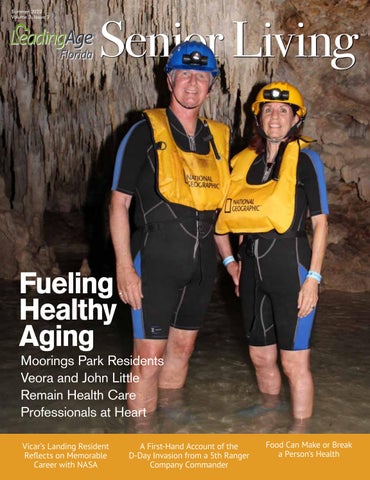
Fueling Healthy Aging
Moorings Park Residents Veora and John Little Remain Health Care Professionals at Heart Vicar’s Landing Resident Reflects on Memorable Career with NASA
A First-Hand Account of the D-Day Invasion from a 5th Ranger Company Commander
Food Can Make or Break a Person’s Health
With more than 100 years of combined experience in Accounts Receivable in a skilled nursing environment, we have the expertise to offer A/R assistance in a professional and effective manner. We have highly trained, highly motivated staff always available to you for any A/R needs that may arise. Third Party SNF Billing and Consulting Services tailored specifically to your facility needs. Providing the most efficient and cost effective services across the country.
Increase cash flow.
Receivables training from SNF billing experts
Save money using our dedicated and experienced staff.
Learn more valuable information by visiting our website or calling us today!
bottomlinesolutions.org
239-242-4303
Strong. Stable. Steady.
Your partner in on-site care. optum.com/SNF © 2020 Optum, Inc. All rights reserved. WF3111009
Support, care, partnership Do more for your community with the Optum® care model and UnitedHealthcare® Assisted Living Plan. Support the health of your residents and ease the burden on your staff with clinical care, specialized health care benefits and 24/7 telephonic support.
Learn more at optum.com/alc © 2021 Optum, Inc. All rights reserved. WF5485067
SENIOR LIVING •
S U M M E R 2022
3
The nation’s leading health, retirement, wealth and HR advisory firm. HEALTH + BENEFITS | WORKFORCE + HR | RETIREMENT + WEALTH | PROPERTY + CASUALTY
DO YOUR BEST WORK
LIVE YOUR BEST LIFE
Contents
SUMMER 2022 VOLUME 3, ISSUE 2
8
Cover Story
14
Fueling Healthy Aging Moorings Park Residents Veora and John Little Remain Health Care Professionals at Heart By Nick Fortuna
Features of This World 8 Out Vicar’s Landing Resident Jim McKnight Reflects on His Memorable Career with NASA By Nick Fortuna
12
Food Can Make or Break a Person’s Health By Rhanda McKown, Director of Affordable Housing, LeadingAge Florida
18
Operation Overlord A First-Hand Account of the D-Day Invasion from a 5th Ranger Company Commander By Nick Van Der Linden, Director of Communications, LeadingAge Florida
22
One (Very) Innovative Year By Steve Bahmer, President & CEO, LeadingAge Florida
18
22
Departments 7
Board Chair’s Message Momentum at Every Turn By D. Bruce Jones, LeadingAge Florida Board Chair
Support Our Advertisers
25
Advertiser Index
About the cover Moorings Park Residents Veora and John Little on a 2021 spelunking adventure in Mexico. Read more on page 14.
LeadingAge Florida 1812 Riggins Road, Suite 1 Tallahassee, FL 32308 (850) 671-3700 www.leadingageflorida.org LeadingAge Florida Executive Staff President & CEO Steve Bahmer sbahmer@LeadingAgeFlorida.org
›
Chief Operating Officer Dawn Jimenez djimenez@LeadingAgeFlorida.org Vice President of Advocacy Susan C. Langston slangston@LeadingAgeFlorida.org
Janet Stringfellow, Affordable Housing Chair Kevin Smaage, ALF/HCBS Chair Scott Cairns, CCRC Chair
LeadingAge Florida Officers D. Bruce Jones, Chair Garry Hennis, Chair-Elect Joel Anderson, Immediate Past Chair Teresa Scott, Secretary Steve Kramer, Treasurer
Publication Team
Senior Living magazine serves as a LeadingAge Florida member resource that supports the LeadingAge promise: to advocate, educate, and serve aging services professionals. Managing Editor Nick Van Der Linden Director of Communications, LeadingAge Florida For advertising inquiries, please contact Katie White at kwhite@thewymancompany.com or (352) 388-7031. Senior Living is the official publication of LeadingAge Florida. All rights reserved. Contents of this publication may not be reproduced without permission from LeadingAge Florida.
SENIOR LIVING •
S U M M E R 2022
5
We’re a better kind of
Local pharmacy
Guardian Pharmacy goes beyond expectations. Make sure your residents get the right medications, right on time. Our team ensures resident safety with thorough medication reviews, 24/7/365 deliveries and smart packaging for easy med pass. We even offer robust analytics to help prepare your community for updates like the new Patient Driven Payment Model, which affects the way you’re reimbursed for facility and medical services. Between large-provider resources and local support, we can help you navigate changes. Ask us about tools to contain costs, improve patient care and enhance safety at guardianpharmacy.net/contact.
Daytona 863-670-7554
Jacksonville 904-624-8960
Northwest Florida 850-209-8787
Orlando 863-670-7554
Southeast Florida 561-756-3909
Southwest Florida 727-366-6766
Tampa 727-366-6766
Message from the Board Chair
Momentum at Every Turn
W
elcome to another amazing edition of Senior Living, a publication of LeadingAge Florida. This exciting edition features stories of new frontiers and ties nicely with our convention theme of momentum. As you will see, these new frontiers include not just careers but also new innovations and a new outlook on life. Regarding new frontiers in work, Vicar’s Landing resident Jim McKnight speaks about his memorable career with NASA and the meaningful work he did during the Apollo missions. Mayflower resident Major General John Raaen recounts his experience storming Omaha Beach as one of the last surviving officer from the D-Day invasion. Former health care professionals Veora and John Little from Moorings Park share their thoughts on the new frontier of being active in a Life Plan Community. They are sharing their knowledge of health and wellness with fellow residents so they all can maintain a healthy and active lifestyle. It’s a great story of looking at all that is gained in moving to a new community as they share their expertise while sharing in the fun and camaraderie of their new life. Finally, we have a couple of great innovations to share. First, Pablo Towers, a HUDsubsidized community in Jacksonville Beach, went against the norm to use a conventional loan to add new apartments, enlarge their common room, and construct a commercial kitchen to provide dining to their residents. Meanwhile, Sinai Residences is offering residents an interactive and innovative fitness concept called MultiBall. It combines physical activity and digital games to make for an enjoyable fitness experience. I am sure you will enjoy this edition of Senior Living. If you have a story to share in a future issue, please let us know!
D. Bruce Jones LeadingAge Florida Board Chair
This exciting edition features stories of new frontiers and ties nicely with our convention theme of momentum. As you will see, these new frontiers include not just careers but also new innovations and a new outlook on life.
S E N I O R L I V I N G • S U M M E R 2022
7
Out of This
World
Vicar’s Landing Resident Jim McKnight Reflects on His Memorable Career with NASA
By Nick Fortuna
W
hether he was monitoring radio communications between America’s adversaries or readying spacecraft for some of NASA’s biggest missions, Jim McKnight always worked in a high-stakes setting requiring technical expertise and a meticulous attention to detail. So, if anyone deserves a relaxing retirement with no deadlines or responsibilities, it’s him.
8
Last November, McKnight, 83, moved into Vicar’s Landing, a CCRC in Ponte Vedra Beach, beginning a new chapter in an eventful life. Although he’s in the independent living section now, he enjoys the security of knowing that assisted living and skilled nursing facilities are onsite, and in his first full year at Vicar’s Landing, he’s looking forward to exploring all the community has to offer.
McKnight spent more than four decades living in a condo two blocks from the ocean in Cocoa Beach, but when his sister moved into a CCRC in Georgia, her positive experience spurred his interest in Vicar’s Landing. “It was a great move for me,” McKnight said. “I like the fact that they have everything right here, and everyone I’ve met here has just been so friendly and helpful,
McKnight left the Air Force in 1963 and returned home to Georgia with an incredible souvenir. The strong U.S. dollar meant that he could snap up a 1955 Mercedes-Benz sedan for about $1,500, and he had it shipped by boat all the way to Savannah, Georgia. Mr. McKnight in his position as NASA Test Director for the Space Shuttle Program, just prior to his retirement in 2001.
making me feel right at home, so it’s been really great.” McKnight has been a Florida guy for most of his life, but he wasn’t always. Born near Memphis, Tennessee, he moved with his family to Macon, Georgia, during the third grade. His father was a traveling paint salesman and his mother an office manager. After a few years at Auburn University, McKnight still hadn’t chosen a career path, so he joined the Air Force in 1959, going through basic training at Lackland Air Force Base in San Antonio. From there, it was on to Goodfellow Air Force Base in San Angelo, Texas, for training as a radio intercept analyst. McKnight would spend the next three years at a listening post in a restricted, five-kilometer zone separating East Germany from West Germany. His job was to intercept radio communications between the Soviet Union and its allies, a covert assignment that remains classified. “I can’t go into any details, of course,” he said. While off duty, McKnight would do a bit of sightseeing, traveling to Paris and the German cities of Munich and Darmstadt. But with the Cold War at its height, he kept his focus squarely on his assignment.
“I didn’t do as much traveling as I would have liked, in hindsight, but I did a little bit anyway,” he said. “The work certainly was important.”
Riding in Style
McKnight left the Air Force in 1963 and returned home to Georgia with an incredible souvenir. The strong U.S. dollar meant that he could snap up a 1955 MercedesBenz sedan for about $1,500, and he had it shipped by boat all the way to Savannah, Georgia. Lacking the money for college tuition, McKnight got a job with the Blue Bird Corp., a manufacturer of school buses based in Fort Valley, Georgia. Commuting about 30 miles each way in his elegant car, he worked on the assembly line installing floor mats. He later got a job as an office assistant in the engineering department at Robins Air Force Base in Warner Robins, Georgia. During this time, McKnight was enrolled in Auburn University’s cooperative education program, which permitted students to alternate between attending school full time and working full time. With the academic year divided into quarters, he would work for three months, save up his money, and take classes for three months, graduating in 1967 with a Bachelor’s De-
gree in industrial engineering. Through his job with the Air Force, McKnight transferred to the National Aeronautics and Space Administration, initially working at the Marshall Space Flight Center in Huntsville, Alabama. Soon after he got there, a workforce reduction put him out of a job, but he was able to transfer to the Merritt Island Launch Operations Center, later renamed the John F. Kennedy Space Center. He quickly fell in love with Florida and never left. “Years later, I got communications from Huntsville saying I could come back there if I wanted to,” McKnight said, “but I told them, ‘No, thank you. I’ve got sand in my shoes now, and I’m very happy down here.’”
Meaningful Work
McKnight’s first assignment was to help reactivate Launch Complex 34, the site of the Apollo 1 fire, which killed crew members Gus Grissom, Ed White and Roger B. Chaffee and destroyed the command module. During a launch rehearsal test on February 21, 1967, an electrical fire in the cabin spread quickly due to the presence of combustible nylon material and the high-pressure, pure oxygen atmosphere in the cabin. Unfortunately, it wouldn’t be the last time a NASA operation turned tragic.
SENIOR LIVING •
S U M M E R 2022
9
At Launch Complex 34, McKnight worked to coordinate reconstruction of the facilities. He and his colleagues cheered as Apollo 7, the first crewed spaceflight of the Apollo program, took off from Launch Complex 34 on October 11, 1968. Commanded by Wally Schirra, the crew spent almost 11 days in space, orbiting Earth and testing out the command module spacecraft that would later transport astronauts to the moon and back. After that mission, McKnight joined the payload operations group, a team committed to the adage of a place for everything, and everything in its place. He was in charge of ensuring that the Lunar Module Eagle, the first crewed vehicle to land on the moon, was fully equipped with all the cameras, scientific equipment and other gear needed by astronauts. “We pre-packaged everything in the lab, and then our contractors would take it out to the Lunar Module,” McKnight said. “Everything stowed onboard had an exact location where it needed to be, and if something didn’t fit properly, then we would work with our contractors to make adjustments and make sure that everything was accomplished properly.” A key area of focus for McKnight was the exterior pallet attached to the Lunar Module known as the modularized equipment stowage assembly, or MESA. An iconic moment came on July 20, 1969, when Eagle landed on the moon and, several hours later, astronauts Neil Armstrong and Buzz Aldrin stepped outside. “One of the first things they did when they stepped out of the Lunar Module was to deploy that MESA,” McKnight said. “There was a camera on that module, and that’s how we got those first pictures on the moon.”
Falling in Love
In the mid-1970s, McKnight joined a local scuba diving club that frequently took trips to the Bahamas and the Florida Keys, a decision that eventually would end his bachelorhood. Although Edie Hansen was 14 years his senior, she had a youthful exuberance and noticed a certain maturity in McKnight. One day, she asked him for a ride to one of the scuba club’s gatherings, and they hit it off, marrying three months later. He was 37. “I like to tell people that we met underwater,” McKnight said with a laugh. “Maybe I was old for my age, and she was young for her age, but it all worked out. She had a 13-year-old daughter and a 15-year-old son, so I had an instant family of teenagers.” Back at NASA, McKnight got involved with the nascent Space Shuttle program, first in the support test management group, where he was responsible for testing of ground support equipment, and later in the NASA Test Director Group, where he was responsible for testing the space shuttle vehicle. Since he typically worked the second shift, he had the morning free on January 28, 1986, so he went to the roof of the launch control center to watch the Challenger take off. About 73 seconds later, he watched in horror with the rest of the country as the space shuttle exploded over the Atlantic Ocean, killing all seven crew members aboard. “I still recall it vividly, of course,” McKnight said. “It was disbelief – total, utter disbelief. Your mind just wouldn’t let you know that this was happening, but it was.” McKnight later would work in payload operations on unmanned missions, helping to launch communications and weather satel10
lites. He retired in 2001, having witnessed almost all of NASA’s memorable highs and lows. He said the camaraderie and sense of a shared purpose among NASA’s employees made his career especially rewarding. “I was proud to work with a team,” he said. “For the most part, I had a very enjoyable career, and I was happy to be a part of it.”
Making his Move
After retiring, McKnight spent much of his time golfing and enjoying the beachside views, but when his wife died in 2013, he naturally went into a funk. He remained in their condo another eight years, until finally it was time for a change. He sold his home and moved to Vicar’s Landing. “It was time for me to get out and rejoin the living,” McKnight said. In April, McKnight was nursing a back injury that had prevented him from fully immersing himself in his new community. He said that after some physical rehabilitation, he hopes to resume working out in the gym at Vicar’s Landing, where he uses the treadmill and stationary bike. He plans on frequenting the CCRC’s excellent library, participating in monthly trivia contests with friends and exploring the nearby shopping centers. McKnight said he’s made “excellent progress” recovering from his injury, and although “golf isn’t the best thing for a bad back,” he hopes to heal enough that he can go to the driving range occasionally. And he won’t be alone for long. McKnight said his sister and niece were planning to visit from Georgia this summer, and his stepdaughter, an insurance executive living in Georgia, was plan-
Jim McKnight.
ning to return to her old home in Ponte Vedra Beach, minutes from Vicar’s Landing. “I’m looking forward to that because it’s always nice to have a child close by,” he said, “and I’m looking forward to becoming more active in the community here.”
inspire people transform lives
architecture, master planning, interior design www.rlps.com
SENIOR LIVING •
S U M M E R 2022
11
Food Can Make or Break a Person’s Health
Pablo Towers residents enjoying food and festivities.
A Pablo Towers resident packages watermelon in the Pablo
By Rhanda McKown, Director of Affordable Housing, LeadingAge Florida
H
elping low-income households meet the needs for basic essentials, like food, is not a new problem, but it is a problem that is getting worse at an alarming rate. This is especially true in Florida with nearly 1,000 people a day moving to the Sunshine State. According to the most recent data available, the United States Census Bureau indicated that Florida saw a net migration in 2019 of 67,093 people over the age of 60 (net migration is the number of people moving into Florida minus the number of people who moved out of Florida in 2019 who were age 60 and older). That means that nearly 20% of the people moving to Florida are older adults. This is in addition to the estimated 4.2 million who already live here. Existing resources and programmatic allocations are stretched thin to try to meet the increasing needs of a rising number of elderly in Florida who are living at or below the poverty line. There is undoubtedly a need for food assistance to help low-income seniors. Although
12
there are programs like the Supplemental Nutrition Assistance Program (SNAP), the Commodity Supplemental Food Program (CSFP), food banks, and local restaurants and grocery chains that sometimes donate food to communities for older adults, there is still a gap in nutrition availability for seniors. This gap is exacerbated by homes that are located in an area not accessible to public transport. It may be that residents don’t have access to a vehicle or no longer have a valid driver’s license. Many seniors have nutritional restrictions due to medical and healthrelated disease and illness. Food availability became an even more serious issue when many senior buildings went into lockdown for an extended period in an effort to protect the high-risk elderly population in response to COVID-19. Many restaurants also were closed or had limited hours. Food delivery services became a popular option for many, but for seniors already living below the poverty line, the extra fees and delivery charges made these delivery services financially infeasible. Some
programs, like Meals on Wheels, deliver healthy food options at little to no cost, but not all residents qualify to participate in the program based on the terms of their local administering agency. In this environment, it can often feel like there is no good solution. But communities for low-income seniors have found ways to ensure their residents get access to nutritious food. While some communities have had food programs on site for years, many found the need to start for the first time – or at least the first in a long time – to ensure their residents have access to healthy food options. “We coordinate with numerous community resources to help our residents in their time of need,” said Miriam Borrego-Waterman, Director of Elderly Housing at Catholic Charities Community Development Corporation. That can include phone canvasing their community to find companies, stores, retailers and locally owned and franchised grocery stores and bakeries that are willing to partner or sponsor food delivery and donation options for residents at a discounted price or for free.
A Pablo Towers resident helps prepare meals for the day.
Many communities rely on local food banks, and some have held their own food drives in an effort to ensure their residents have access to healthy and affordable food options. Other communities have taken part in HUD’s COVID Supplemental Payment (CSP) program to reimburse monies they had to allocate unexpectedly to COVID response measures and supplies, which in turn allowed them to re-allocate those monies back to resident programs, which sometimes includes food and nutrition. Pablo Towers Apartments in Jacksonville Beach took their solution to a new level when they saw that their elderly residents did not have many nutritional options in the vicinity. Residents were relying on the local food bank and a nearby fast-food chain to sustain their nutritional needs. When the opportunity arose, Pablo Towers Apartments took action to change the options available to their elderly residents. After paying off their original 40-year mortgage, they took out a conventional loan to rebuild and enlarge the community room, add 15 apartment units, and, in an avant-garde move for HUD-subsidized independent living, they added a full commercial kitchen. The Pablo Café opened its doors to residents in 2015. Residents can dine in the café in person, or have food delivered to their door. It expanded its clientele to include the public in 2017. They have since further expanded to include catering services to their neighbors and outside businesses in their neighborhood.
Another delicious meal in the making at the Pablo Café.
The café offers nutritious breakfast and lunch options at a reduced rate Monday through Friday. Menus are updated on a monthly basis and posted on the community’s website. There are two entrée options each day, and $5 buys a meat, two vegetables and a drink. Healthy sandwiches, soups and salads are also available. While a conventional loan provided the funds to build the kitchen, the café is sustained through different sources. It is staffed by two kitchen employees and uses resident and outside volunteers for set-up and delivery of food. Pablo Towers also helps pay for the program by renting antenna space on their roof to a telecommunications company. The board allocates a small portion of funds to the café operations, and approximately 20% of the units on the property are market rate with a portion of rent from those units used to help offset the cost of the food. Pablo Towers Apartments is owned by a faith-based, nonprofit corporation and managed by Elderly Housing Management Corporation (EHMC) a 501 (c) 3 not-forprofit management company. “Our board felt we should help our residents’ health by providing access to a more nutritious meal at an affordable rate,” said Melissa Gilreath, Vice President of Elderly Housing Management Corp., Inc. “Pablo Café has been in operation for five years, and while we do subsidize it to a small degree, we feel it is money well spent and it is well received by our residents and
the surrounding community neighbors and businesses,” Gilreath said. “During the pandemic shutdown, having the ability to deliver nutritious food to our residents was a blessing.”
Residents at Pablo Towers Agree
“The cooks do such a great job making very good meals, which I always enjoy,” said resident Billie Swain. “The kitchen manager always has foods on the menu that I can eat even with being gluten free.” Beyond offering healthy options onsite, the café also helps solve another issue for seniors who are no longer able to cook for themselves. “I don’t cook anymore, and I really like being able to get vegetables in the café,” said resident Karen Bolster. For other residents, the café offers affordability and the important security of knowing that healthy options will be available to them every day. And for seniors who can often feel – and during COVID often were – isolated, the café provides an opportunity to socialize while eating lunch with their neighbors. A safe home and available, healthy food are at the very bottom of Maslow’s famous hierarchy of needs, the true essentials that are the foundation of a happy, fulfilling life. LeadingAge Florida’s providers of affordable housing have gotten creative to ensure that Florida seniors have both.
SENIOR LIVING •
S U M M E R 2022
13
Fueling Healthy Aging By Nick Fortuna
V
Moorings Park Residents Veora and John Little Remain HealthCare Professionals at Heart John and Veora spelunking in Mexico in 2021. 14
eora Little may be retired from a career as a nurse anesthetist, but in a sense, she’s still making her rounds. Veora and her husband John Little, a retired neurosurgeon, were among the first seniors to move into Moorings Park’s newest campus, Moorings Park at Grande Lake, in April 2020. Since then, they’ve both served as a resource and as role models for residents of the continuing care retirement community, sharing their medical knowledge and illustrating the benefits of a healthy, active lifestyle. Though this is a story about their life so far, there is far more to write. Veora and John moved into Moorings Park to be a part of healthy aging. Physical fitness, a sense of community and good nutrition are all resources that fuel both healthy aging and their sense of purpose. Veora is chairman of the Moorings Park Health and Wellness committee that meets regularly to discuss every aspect of health services on all the CCRC’s three campuses in Naples. This committee works with the community’s management to educate, facilitate and serve as one of the key voices for the residents. Three years ago, she was diagnosed with cancer and had a tumorous kidney removed, but at 76, her fitness regimen would leave most adults doubled over. Veora attends fitness classes most days, whether it’s Bikram yoga, which involves holding 26 poses twice, in a room heated to 105 degrees, or reformer Pilates, considered a more intense and comprehensive workout than traditional mat Pilates. John, also 76, is similarly hard to keep up with. He golfs three times a week and visits the CCRC’s impressive fitness center about four times a week. Both of their routines require dedication, but Veora said her regimen might be just a little more demanding. “I have been a little more aggressive in my fitness,” Veora said. “Most people don’t want to do hot yoga because it’s too hard and too hot.” Veora said she loves everything about living in Moorings Park Grande Lake, including the plush living quarters and amenities, and enjoys helping new residents get acquainted
Veora made a friend while on adventure in San Christobal, Galapagos Islands.
with the community. She also enjoys answering their questions about the health services available. “I’ve been able to meet a lot of people,” she said. “I love the camaraderie and meeting people, and knowing that these people are my friends. If I want to run upstairs to say hi to somebody, I can, and they can do the same for me.”
Successful Careers in Medicine
Helping others stay healthy has always been the Littles’ mission, even before they first met. Veora, born in Cleveland, Ohio, enrolled in nearby Willoughby-Eastlake School of Practical Nursing after high school to become a licensed practical nurse. Meanwhile, John, a native of Regina, Saskatchewan, attended the University of Saskatchewan before doing his medical residency at the Mayo Clinic. Veora then married her first husband, had two children, and attended Lakeland Community College in Ohio to become a registered nurse. The family eventually moved to Atlanta, where Veora worked three jobs at once. At night she worked as a nurse in the intensive care unit at a local hospital, and as a nightshift supervisor she visited the maximum security Atlanta Federal Penitentiary once a week to care for prisoners with medical needs and taught inmates how to become nurses’ aides.
“The prison turned out to be the most interesting job I ever had,” Veora said. “I developed their audits, and I made rounds on all the patients every time I went. I felt like we upped the compassion and certainly kept their medical records a little better, so those were good things. I was a kind voice and face there.” One night in the intensive care unit a heartbreaking experience would shape the rest of Veora’s career, and her life. A young girl who suffered a traumatic head injury suddenly took a turn for the worse, and as the medical team scrambled in vain to save her, Veora noticed two nurses at the head of the table calling the shots. “Afterward I said to myself, I never want to be in a position where I don’t know what to do,” she said. “So I asked them, ‘What is your job?’ One of them was a nurse anesthetist. I had never heard of the profession before.” When Veora moved back to Ohio, she enrolled in the Cleveland Clinic’s School of Nurse Anesthesia, graduating in 1980. She subsequently earned a Bachelor’s Degree of Arts in Anesthesia from Ursuline College. Veora was divorced and working at the Cleveland Clinic as the Clinical Coordinator for the Anesthesia School in 1982 when she noticed a handsome neurosurgeon in the operating room and struck up a friendship with John, a divorced father of three. While studying anesthesia, Veora also learned medical hypnosis as a way to help patients deal with post-surgical pain and symptoms like nausea and anxiety. One day, she told John that she could help him quit smoking by hypnotizing him, and lo
and behold, it worked. The couple married in 1984 and later had another child, giving them six in total. “I tell everybody now that I really hypnotized him to marry me,” Veora said with a laugh. “It’s not the showman type of hypnosis that you see on TV. You really can work with patients to make their anesthesia and their recovery much less uncomfortable.”
Becoming Floridians
In 1990, the Littles moved to Naples, with Veora working as a nurse anesthetist at Naples Community Hospital and John going into private practice as a neurosurgeon. A few years later, John, an Anglican, and Veora, a Roman Catholic, converted to Judaism, having been exposed to the religion through their friends and a trip to Israel. John eventually became president of Temple Shalom, a synagogue in Naples. “Judaism is the oldest monotheistic religion, dating back 4,000 years,” Veora said. “It teaches us how we should live our lives in service to others. Do well in the world and make it a better place for the next generation.” After undergoing three neck operations, John retired as a neurosurgeon in 2000. Instead of retiring like most people do, he went back to school, earning his second Master’s Degree in business administration and finance from Florida Gulf Coast University. It was here he met Guenther Gosch, Chief Executive Officer of Moorings Park, who invited him to serve on the CCRC’s board.
Sheriff Rambosk cuts the ribbon at an Operation Medicine Cabinet drop box at Grey Oaks in 2019. Also pictured are (from left to right) Scott LeMaster, Jennifer Herwig, Veora Little, Ray Perzeskin, Beth Jones and Moorings Park CEO Dan Lavender. SENIOR LIVING •
S U M M E R 2022
15
Feeling Overwhelmed?
GET SENTRICS SIMPLE.
Sentrics360SM: An integrated suite that pulls it together for you.
• RTLS-based eCall that includes contact tracing and case management to keep residents safe, improve caregiver efficiency and reduce the risk of adverse events • Interactive engagement platform that turns the resident TV into an engagement engine while enhancing wellbeing • All-in-one entertainment from one voice-controlled device • Actionable insights that make your team smarter, more agile and delivers transparency your families trust
One integrated suite makes it Sentrics Simple. Go to sentrics.net/LAFLsimple to see the suite in action. Read more about the integrated suite at sentrics.net/senior-living/. Call Sentrics at (877) 651-1377
16
John played an important role in the growth and development of Moorings Park and is credited with the idea of establishing its Center for Healthy Living. These on-campus facilities provide “residentfocused, physician-based amenities that improve health-care delivery to residents, expand knowledge of the aging process and introduce new approaches to care,” helping seniors retain their vitality and happiness, according to the Moorings Park website. The Center for Healthy Living offers access to doctors; physical, occupational and speech therapy; a salon and spa; fitness classes; cardio- and strength-training equipment; memory classes and cognitive care; a space for seminars; and an Internet café. In addition to Veora’s love for health and wellness, she is also a passionate volunteer. She became inspired by an event that took place in December of 2006 where six children from Cypress Palm Elementary School were taken to the North Collier Hospital with drug overdoses. A young boy had taken his grandmother’s medication off her counter and given it to his friends. Fortunately all survived. Veora’s grandchildren, Kaci and Hunter were in that class. To prevent similar incidents from happening Veora volunteered at the Collier County Sheriff’s Office and the community group Drug Free Collier. The result was the development of a pharmaceutical take-back program called “Operation Medicine Cabinet.” The program collects all types of medication, and over the span of 15 years it became a national initiative with collection boxes at drugstores, police stations and other locations where people can drop off their medications, keeping them out of the hands of children and drug users. To date, the program in Collier County has collected more than 40,000 pounds of unused or expired medications. Moorings Park also has drop boxes on all its campuses for residents. For 18 years Veora also volunteered with the Collier County Citizens’ Foster Care Review Board where she worked with the juvenile court system to ensure that children placed in foster care or protective supervision are living in safe conditions. She also volunteered at the Collier County Medical Society Alliance, which awards scholarships to students pursuing careers in health care, fundraises for community health organizations and works to educate the community about health issues. “I think volunteerism and having a purpose in your life is extremely important,” Veora said. “We have to leave this world a better place than we found it.”
‘Full of Gratitude’
The Littles’ six children have given them 10 grandchildren and four great-grandchildren who are scattered across the world in places such as Canada, London, Texas, California, Colorado and Florida. Avid travelers, Veora and John visited family in San Francisco in March and have toured a number of exotic locations over the years including Peru, the Galápagos Islands, Cancun, the Baltics, France and Canada. This summer, they’re taking a cruise on the Great Lakes. With their focus on health and fitness, the Littles don’t plan on slowing down anytime soon. They’re looking forward to a long, healthy retirement together. “I still have one kidney, it’s functioning, I live in Moorings Park, I have friends, and I’m financially stable,” Veora said. “I’m full of gratitude for everything. We look forward to aging successfully at Moorings Park Grande Lake with our family and our new friends.”
Building a brighter future.
The future is ripe with opportunities. Join us for our session, Senior Living Future Ready! JULY 21, 1:30–2:30 P.M.
Visit us at Booth #806
Dana Wollschlager | Dana.Wollschlager@plantemoran.com | (847) 628-8903
SENIOR LIVING •
S U M M E R 2022
17
Operation Overlord A First-Hand Account of the D-Day Invasion from a 5th Ranger Company Commander
A Landing Craft Assault on display at Utah Beach in Normandy, France. These landing craft were used extensively in World War II, including the invasion of Normandy.
General John Raaen.
By Nick Van Der Linden, Director of Communications, LeadingAge Florida
D
ressed in their olive drab fatigue uniforms, two riflemen of the 5th Ranger Infantry Battalion stood on the bridge of the British Landing Ship Prince Baudouin to shoot at, and explode, floating mines in the cold, stormy, pitch-black night. Their only source of light was the occasional fluorescence of breaking waves. When the time came to board their seven Landing Craft Assault (LCA), the Rangers of the 5th Battalion crammed into three rows with no shoulder or knee room as they made their way to the beaches. The LCA rides low in the sea and easily takes on water from even the smallest waves. This day, waves of six to eight feet battered the seven tiny transports. Drenched and seasick, they had two hours to go before reaching shore. As dawn approached, forms of other ships slowly appeared in the morning twilight, and the horizon began to take shape. In the distance, they heard the rumbling of bombs battering the coast one last time in preparation for their landfall. Years of meticulous planning and training all came down to this. The boat ramp opened, and men were already blanketed by artillery fire. They jumped, ran and crawled trying to make their way to the nearest area of cover, all while carrying 80 pounds of equipment. For most, the scene is impossible to fathom, but this was the reality for the more than 150,000 Allied service members on June 6, 1944, known more commonly as D-Day.
18
The generation who knows D-Day beyond the black and white photos – a generation that saw it with their eyes, heard it through their ears and experienced it firsthand – is shrinking. The U.S. Department of Veterans Affairs estimates that fewer than 2 percent of the 16 million Americans who served in World War II are still alive. Major General John Raaen of the 5th Ranger Battalion is one of those service members who landed on Omaha Beach as part of the first wave on June 6, 1944. He is one of the last surviving officers of that invasion.
A Life of Service
Born on April 22, 1922 at Fort Benning, Georgia, John C. Raaen, Jr., describes his background using one word: military. “My father was an Army officer, and I served all of my life with him,” Raaen said. “I lived on Army posts for most of my early life whenever there were quarters available, and if there weren’t, we lived in the nearest big civilian town. It was a very good life.” Most of Raaen’s adolescent years were during the Great Depression, but he said his family was fortunate not to have suffered, due in part to their military service. “Those of us in the Army who were able to serve on Army posts had it made during the depression,” Raaen said. “When they stopped paying the military services, they allowed you to go to the
post exchange, the post commissary, the quartermaster store, the special services, movies, haircuts, whatever it was, and you just signed your name. And then after the depression was thought to be over, you had to gradually repay those chits back to the government, but you didn’t have to worry. We had stores and we had money, so it was a good, good life. I never suffered during the depression, and I don’t know that my father and mother did. They never discussed it with me. Everything seemed to be happy and healthy.” At age 17, Raaen entered the Military Academy at West Point and roughly three months later, the war in Europe started. In 1943 Raaen was accepted into the Ranger Infantry Battalion, training at Camp Forrest in Tennessee before moving to Fort Pierce, Florida, for amphibious training. Raaen’s Battalion later moved to Dorchester, England, where they were in pre-invasion mode and went on a major multi-division maneuver. “Sea landing ground maneuver was very interesting, and we had cliff climbing training because of the cliffs at Pointe du Hoc where we were going to land, so we had to learn how to climb the cliffs. After that, we waited for the invasion,” he said. “One day, they said, ‘This is it.’ And we took our trucks down to Portland Harbor.”
The Decisive Battle
The weather on the morning of June 6 was foul with a biting wind. In the water, in front of the beaches, the Germans placed row upon row of obstacles designed to either prevent boats from reaching the shore or to disorganize the landing craft formations so that any troops reaching the shore would be scattered.
The beach contained 14 strongpoints all heavily protected by minefields, barbed wire and trenches. Trenches were armed with artillery, mortars, machine guns and infantry. Because of the heavy assault and casualties experienced by troops making initial landfall at Pointe de Hoc, Raaen’s unit had to adjust and land further down the beach than initially planned. “My particular wave was waved off,” he said. “We were told not to land at Pointe de Hoc. We then went to Vierville and were waved off there by landing command and control. So we went to the juncture of Omaha Dog White and Omaha Dog Green. The first of our three waves landed and was butchered. They had over 50 percent casualties.” The scene on the beach was surreal. Ammunition of all kinds was hitting at the water’s edge, machine gun and rifle fire left and right. As Rangers were pouring out of LCAs, men were being hit as they left the craft and struggled across the beach. Dead and wounded lay in the water and across the sand. Those who could crawled out of the water before the advancing tides on all sides. The wounded were screaming for medics. The noise was deafening. Raaen’s battalion commander decided to move the landing down another 800 yards where the beach was comparatively calmer than the other sections because of the breakwaters. At 7:40 a.m. they landed on Omaha Beach. “Because of the breakwaters, we were not subject to as much fire that could incapacitate our unit, and we landed two waves, the entire 5th Ranger Infantry Battalion, on Omaha Dog Red. You’ll hear that we landed on Dog White – wrong. I was the only boat that landed on Dog White.” Because boats were scattered during the landing, units had to reorganize on the beach. Once reorganized, Bangalore torpedoes were
A map of Pointe du Hoc and Vierville, two focal points of the amphibious assault carried out by Allied forces during the early morning hours of June 6, 1944. SENIOR LIVING •
S U M M E R 2022
19
General Raaen in Toul, France.
used to blow holes in the barbed wire, allowing men to move through the gaps, across the flat, and begin their climb up the bluffs. On their way to the top the men had to pass through thick smoke from brush fires. “The smoke was so heavy that I’d say about 50 percent of the people finally had to put on gas masks just to get to the top,” Raaen said.
“Of course, when you were in the smoke, you were not a target for the enemy. So that was pleasant. But when you had to put the gas mask on, it became very unpleasant.” Just before clearing the top, Raaen looked back and took in the scene below once more. Nothing had changed. Boats were still landing troops. Artillery was still hitting near the water’s edge. Small arms fire was pouring in from the west flank, and infantry troops were struggling through the gaps in the wire to join in the climb up the bluffs. Despite the carnage of the beach landing, the hard part was not yet over. The farmland and fields of Normandy were crisscrossed by countless forest-like hedgerows, which made for tough troop navigation, while creating a perfect setting for defense. The Germans had filled those hedgerows with mortars and machine gun nests, as well as their tanks and special camouflage uniforms, which allowed the Germans to blend in perfectly. The Allied had to engage the enemy meter by meter, hedgerow by hedgerow. Unlike previous battles, success wasn’t measured by miles of land taken, but rather the number of hedgerows put behind them. As they were sitting along the side of one of the many hedgerows, one of Raaen’s men asked him “What do you think of it so far, Captain?” To which Raaen responded, “Kind of exciting, isn’t it?” The Ranger Force would then make its way up the coastal road toward Vierville before their final destination of Pointe de Hoc, where they would reconnect with troops and carry out their mission of establishing a beachhead. “As we fought through to the other side of Vierville we ran into fortifications, German fortifications,” Raaen said. “We pulled back a little bit, reorganized so that we could proceed on to our Ranger mission. And we were told, no, the beachhead is too fragile. We want you to stay where you are and strengthen the beachhead until we’re sure
General Raaen presents a framed photo to President Donald Trump at the 75th anniversary of D-Day in Arromanches, Normandy, France on Thursday, June 9, 2019. 20
After World War II, Raaen also served in the Korean and Vietnam Wars and would go on to have major commands in both the Army and Defense Department.
General Raaen during his retirement ceremony.
this counterattack can’t push us back into the English Channel, which we did very resentfully because our buddies were out there five miles away from us with no support from anybody. Period. “A little later, they were able, through signal lights and signal flags, to get some naval gunfire support. But at first they were just sitting there on top of those cliffs that they just climbed and were under counterattack by the Germans. And it was nip and go for them. We didn’t rescue them until two days later. It was, I think, the ninth of June that we finally were able to get to them.” The days thereafter were spent securing and taking out coastal fortifications from Grandcamp-les Bains to Isigny and in patrolling the battalion bivouac area. In five days of fighting, the battalion had 23 men killed, 89 wounded and two missing. Approximately 850 German prisoners were taken, and some 350 Germans were killed.
A signboard indicating the location of sectors Charlie and Dog Green, two of the ten Omaha Beach sectors.
Lasting Impact
D-Day, code-named Operation Overlord, was the turning point in the war that began to shift the control of Western Europe maintained at the time by Nazi Germany. Less than a year after the invasion, the Allies formally accepted Nazi Germany’s surrender. To this day the Allied invasion of June 6, 1944, remains one of the biggest and most significant military campaigns in history. After World War II, Raaen also served in the Korean and Vietnam Wars and would go on to have major commands in both the Army and Defense Department. Major General John C. Raaen, Jr., retired in 1979 after 36 years of devoted service. He now lives at the Mayflower Retirement Community, nestled in the picturesque city of Winter Park, enjoying the more peaceful and quiet parts of life. Raaen says he enjoys reading and stays busy as the subject of a lot of interviews, sharing his D-Day experience with news outlets from all over the world. “I share my story through both phone interviews and in-house interviews, some taking as long as four hours,” he said. “My interview with BBC took four hours and of course I got about 30 seconds in the documentary they ended up putting out.” Raaen recently celebrated his 100th birthday.
Compassion, Dedication, & Creativity Developing environments for community and quality of life. Contact us today to discuss your needs.
Gregg Golden, AIA | 414.254.9668 www.prarch.com
SENIOR LIVING •
S U M M E R 2022
21
One (Very) Innovative Year By Steve Bahmer, President & CEO, LeadingAge Florida
R
achel Blumberg doesn’t think of herself as a ‘techie’. She’s just curious, and driven by a desire to solve problems – particularly those facing seniors and the communities that care for them. “You don’t need to be a tech-savvy person to reap the benefits of technology,” said Rachel Blumberg, the Executive Director of Toby & Leon Cooperman Sinai Residences in Boca Raton, a Continuing Care Retirement Community. “I think about these things in my spare time,” she said. “I scour the Internet, particularly outside the U.S., looking for new technologies. It’s about solving problems instead of waiting.” That curiosity has meant dramatic innovations at Sinai Residences in her short tenure – Blumberg joined Sinai Residences just one year ago. And it has required a willingness to take risks. “Technology is not usually high on the list of investments in senior living,” she said. “But investments in tech infrastructure are just as important as capital investments. “It isn’t a four-letter word. It can scare people, there can be resistance, and sometimes there’s no obvious return on investment,” she said. “But it’s actually the opposite – technology makes us more efficient.” Wheelchair washers are just one example of the kinds of tools that are streamlining operations and helping staff focus on their most important priority. After only about five minutes in the machine, the chairs are clean, and staff are able to spend more meaningful time with residents. “It helps us make sure residents have clean chairs, and our CNAs don’t have to do it,” Blumberg said. “We need to be taking care of residents and not washing wheelchairs.”
22
Sinai’s Resident Services Director Miguel Moronta and Executive Director Rachel Blumberg are excited about their new fleet of Tesla vehicles.
Sinai Residences is the first senior living community in the world to implement MultiBall for its residents.
Sinai resident Sylvia Jaffee and Executive Director Rachel Blumberg in front of their MultiBall exergaming program.
It’s the same reason she has deployed a Servi robot in Sinai dining rooms. Produced by Bear Technologies, the robots deliver food and drinks to residents and carry dishes back and forth across the dining room, without spills or the risk of collisions. And they allow dining staff to spend more time interacting with residents. “Technology can help us work smarter, not harder,” she said. Beyond freeing up time for staff to engage with residents more fully, emerging technologies can also help residents remain mobile and healthy, while having some fun at the same time. Much has been written about the psychological and social tolls the COVID-19 pandemic exacted on older adults. But it caused ancillary health problems as well. Because of lockdowns and the need to isolate to prevent the spread of the virus, independent living residents became more sedentary than normal, and their health began to deteriorate. So, it was back to the computer for Blumberg with another global search for technologies that would allow residents to be physically active, indoors and from a safe social distance. The exploration took her to Germany, where she found MultiBall. And she adapted its 40-plus exercise and mobility programs for senior living.
“At first I thought it was for kids,” Blumberg said. “But it is really a program that is also used by professional athletes. I thought it could solve our problem.” The new fitness concept, also called ‘exergaming,’ projects games onto a large screen that hangs from a wall at Sinai Residences. It includes games that require residents to move quickly in all different directions, in addition to throwing and catching, as well as trivia games, among other programs. “Instead of sitting and playing a board game or cards, MultiBall offers our residents a fun and easy way to move around, bend over and stand up,” Blumberg said. “They are having a blast and absolutely loving this new innovative way of exercising.” Studies show that exergaming is not just good for residents’ physical health, it can boost brain health as well, especially for older adults with dementia. One study found that exergaming improved lower extremity and cognitive functioning, step reaction time, and symptoms of depression. Sinai residents have seen improvements in agility, balance and memory – which are only a few of the reasons that Blumberg’s physical and occupational therapists love it. Stanley Rothman has lived at Sinai for six years. As an active 94-year-old who goes to the gym five days a week and watches his
diet, he became a fan the instant he was introduced to the technology. “I think it’s terrific,” he said. “It’s mind and body, together. Activating both at the same time is the best. It keeps me moving and thinking.” The creators of the mixed reality sports and gaming platform may be surprised by Blumberg’s implementation of the technology at Sinai. “They clearly didn’t realize how beneficial this could be for seniors,” she said. Indeed. Sinai Residences is the first senior living community in the world to implement MultiBall for its residents. Her investments in using new tools to improve resident health don’t stop there. Soon, Sinai residents will be using other new fitness technologies, including Aqua Bikes, which are similar to the stationary cycles in most gyms, except they’re submerged in about three to four feet of water. Because riders pedal against the water, they get a low-impact cardio workout with minimal risk and far less pressure on joints than more traditional workouts. Aqua cycling also has been shown to improve balance, muscle tone and coordination. Blumberg’s vision for technology extends beyond the walls of her 100-acre campus. The luxury senior living community is in the midst of a two-phase expan-
SENIOR LIVING •
S U M M E R 2022
23
In addition to electric vehicles, Sinai Residences has implemented Dashcam, an awardwinning advanced camera technology that uses artificial intelligence to proactively detect driving risks, such as texting while driving, eating while driving, failure to wear a seatbelt, swerving and more. Sinai’s Resident Services Director Miguel Moronta and Executive Director Rachel Blumberg stand next to one of the 20 charging stations for their new Tesla fleet vehicles.
sion that will be complete this year – a project that when finished will add a total of 345 independent living apartments, 60 skilled nursing suites, 48 assisted living residences, and 24 private memory care suites. When the second phase of the project began, the community built in 20 chargers for electric cars. Those chargers will serve double duty in charging Sinai’s own new electric fleet of Teslas. “When it came to our fleet, which transports our residents to the food store, doctor’s appointments, tennis, the movies and
elsewhere, our cars were getting older,” Blumberg said. “And I thought, why continue to buy gas when the rest of the world is driving electric cars?” The Tesla fleet is not only a more modern approach, it’s saving money, it is more environmentally friendly – and, as Blumberg says, it’s cool for residents. The cars themselves are just one element of this particular strategy. In addition to electric vehicles, Sinai Residences has implemented Dashcam, an award-winning advanced camera technology that uses artificial intelligence to proactively detect driv-
Sinai’s Resident Services Director Miguel Moronta shows a resident the new dash cam feature. 24
ing risks, such as texting while driving, eating while driving, failure to wear a seatbelt, swerving and more. Dashcam also tracks distances, rolling stops, speeding, hard braking and lane departure. In short, the new fleet at Sinai Residences is efficient, environmentally conscious and safe. “Sinai residents and their families can rest assured that all safety measures are in place to provide the safest possible transportation experience,” Blumberg said. After a year of innovating and bringing the latest senior living – and non-senior living – technologies to the Boca Raton community, Blumberg still says she’s not a techie. In fact, all of these projects have been implemented and supported without an IT department. “We’ve done all this without an IT department,” she said. “We’re moving in that direction, but this can be done without a team of IT experts.” All it takes is curiosity, a commitment to investing in newer and better ways to enrich the lives of seniors, and the support of a board that has been open-minded about her initiatives and has allowed her to be creative in her approaches. “It’s so important to have board support,” she said. “They have given me the space to be creative and allowed me to better the lives of all those who live and work at Sinai Residences.”
HCPCS print-ad color 7"x4.583" 300dpi
Thank You, Advertisers
BottomLine Solutions, LLC...............................Inside Front Cover Bouchard Insurance................................................... Back Cover Genesis Rehab Services...........................................................25 Guardian Pharmacy..................................................................... 6 Harmony Healthcare International (HHI).........................................................26, Inside Back Cover Health Care Professional Consulting Services, Inc. dba HCPCS, Inc.............................................. 25 Lantz-Boggio Architects............................................................ 17 One Digital................................................................................... 4 Optum.......................................................................................... 3 Paymerang................................................................................. 17
Would you like us to feature your community’s residents in an upcoming issue of Senior Living?
Plante Moran, PLLC.................................................................. 17 Plunkett Raysich Architects, LLP............................................... 21 RLPS Architects & Interiors....................................................... 11 Schaefer.................................................................................... 10 Sentrics / SeniorTV.................................................................... 16
If so, please contact Nick Van Der Linden at NVanDerLinden@LeadingAgeFlorida. org or call (850) 702-0309. SENIOR LIVING •
S U M M E R 2022
25
Business Insurance Employee Health & Benefits Personal Insurance
800-966-6481 www.MarshMMA.com Bouchard Region
Clearwater | Tampa | Sarasota | Ft. Myers | Kissimmee | Maitland