Research Paper
Computer Science
E-ISSN No : 2454-9916 | Volume : 3 | Issue : 5 | May 2017
APPLICATIONS OF BIOMETRIC AUTHENTICATION: AN ANALYSIS AND COMPARISON 1
A. K. Shrivas | Swati Bareth 1
1
Dept. Of IT, Dr. C. V. Raman University, Bilaspur (C. G.), India.
ABSTRACT Biometrics authentication is a growing technology which has been used in huge areas like forensics, telecommunication, government, traffic and health care services. A biometric authentication system provides recognition of an each and every person based on physiological or behavioral characteristics. In this paper the main focus is an comparison of various biometric systems such as iris, retina, DNA, face, ear, voice, heartbeat, gait etc. and simply define their advantages, disadvantages, feature and application. The comparison criteria are accuracy, cost, performance, acceptability etc. KEY WORDS: Biometric Authentication System, Analysis, Applications, Comparison. 1. INTRODUCTION Security is one of the important issues to protect the information and information system from unauthorized persons. There are various organization, institutes and industry are facing the problem of security and using various authentication system to identify the authorized person. Authentication of users in computer system is done based on certain security measures like passwords, keys, id cards pin number etc. Biometric is very important authentic systems to identification the authorized person and protect the system from unauthorized person. Biometric authentication supports the identification, authentication and no repudiation [3]. Biometrics is a technique for recognizing the human characters. Biometric authentication is used in various areas like banking, aviation, financial transactions, forensic etc. [4].
the existing biometric technology on the basis of various parameters. H. Srivastava [5] has described the uses of each and every biometric system and selection of particular biometric device depends upon the application area. It also compared all the biometric system on the basis of various factors like Uniqueness, Universality, Performance, Acceptability etc. B. Kaschte [7] has described about biometrics authentication their types, advantages, disadvantages and future use. A. K. Jain et al. [8] have described features, advantages and applications in forensic, civilian and in commercial field. It also compared all the existing biometric technology on the basis of various parameters. S. Singh et al. [2] have explored physical and behavioral biometric, advantages and disadvantages of all biometric systems and compare all the biometric technology depends on various criteria.
There are various authors have work in areas of biometric authentication. S. Tiwari et al. [6] have described about advantages, limitations, principles of area and applications of all the biometric authentication system after comparing all
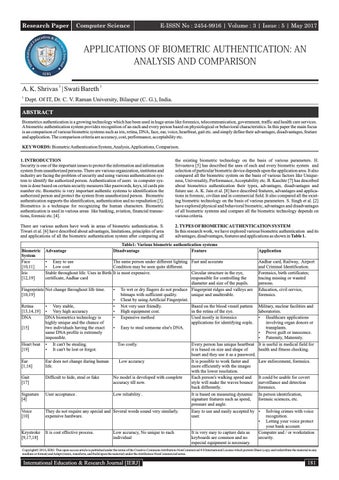
2. TYPES OF BIOMETRIC AUTHENTICATION SYSTEM In this research work, we have explored various biometric authentication and its advantages, disadvantages, features and applications as shown in Table 1.
Biometric System Face [10,11] Iris [12,19]
Advantage
Table1: Various biometric authentication systems Disadvantage Feature
Easy to use The same person under different lighting Fast and accurate Low cost Condition may be seen quite different. Stable throughout life. Uses in Birth It is most expensive. Circular structure in the eye, certificate, Aadhar card responsible for controlling the diameter and size of the pupils. Fingerprints Not change throughout life time. Ÿ To wet or dry fingers do not produce Fingerprint ridges and valleys are [10,19] bitmaps with sufficient quality. unique and unalterable. Ÿ Cheat by using Artificial Fingerprint. Retina Ÿ Very stable, Ÿ Not very user friendly. Based on the blood vessel pattern [13,14,19] Ÿ Very high accuracy Ÿ High equipment cost. in the retina of the eye. DNA DNA biometrics technology is Ÿ Expensive method Used mostly in forensics highly unique and the chance of applications for identifying eople. [15] Ÿ Easy to steal someone else's DNA. two individuals having the exact same DNA profile is extremely impossible. Heart beat Ÿ It can't be stealing. Too costly. Every person has unique heartbeat [19] Ÿ It can't be lost or forgot. it is based on size and shape of heart and they use it as a password. Ear Ear does not change during human Low accuracy It is possible to work faster and [1,16] life. more efficiently with the images with the lower resolution. Gait Difficult to hide, steal or fake No model is developed with complete Each person's walking speed and [17] accuracy till now. style will make the waves bounce back differently. Ÿ Ÿ
Low reliability .
Aadhar card, Railway, Airport and Criminal Identification. Forensics, birth certificates; tracing missing or wanted persons. Education, civil service, forensics. Military, nuclear facilities and laboratories. Ÿ Healthcare applications involving organ donors or transplants. Ÿ Prove guilt or innocence. Ÿ Paternity, Maternity. It is useful in medical field for health and fitness checking. Law enforcement, forensics.
It could be usable for covert surveillance and detection forensics.
Signature [4]
User acceptance .
Voice [10]
They do not require any special and Several words sound very similarly. expensive hardware.
Easy to use and easily accepted by Ÿ user.
Keystroke [9,17,18]
It is cost effective process.
It is very easy to capture data as keyboards are common and no especial equipment is necessary.
Low accuracy, No unique to each individual
It is based on measuring dynamic signature features such as speed, pressure and angle.
Application
In person identification, forensic sciences, etc. Solving crimes with voice recognition. Ÿ Letting your voice protect your bank account. Computer and / or workstation security.
Copyright© 2016, IERJ. This open-access article is published under the terms of the Creative Commons Attribution-NonCommercial 4.0 International License which permits Share (copy and redistribute the material in any medium or format) and Adapt (remix, transform, and build upon the material) under the Attribution-NonCommercial terms.
International Education & Research Journal [IERJ]
181
Research Paper
E-ISSN No : 2454-9916 | Volume : 3 | Issue : 5 | May 2017
3. WORKING PRINCIPLE OF BIOMETRIC AUTHENTICATION All the biometric system uses the same basic principle. It contains predefined steps as acquir sample, feature extraction, matching sample and result. Fiure1 shows that general architecture of biometric authentication system. Firstly, the biometric sample is acquired from user. The some unique features are extracted
from biometric sample of user's and it is stored in database for later comparing to authentication of users. When the users are giving input sample that matches with one of the samples stored in database. If the input sample are matched with data base samples then biometric system allows the person to access the resources otherwise deny.
Figure1: General architecture of biometric authentication 4. ANALYSIS AND COMPARISON OF VARIOUS BIOMETRIC AUTHENTICATION SYSTEM In this section, we have compared various biometric authentication system based on its uniqueness, universality, performance, permanence, acceptability, Circumvention and Collect ability. Uniqueness is how well the biometric separates individually from another .Universality is the quality of being universal; existing everywhere, Performance means accuracy, speed, and robustness of technology
used. Permanence is the biometric should be sufficiently invariant over a certain period of time. Acceptability means to extent society is supporting. Circumvention is the act of cheating someone and Collectability is how well the identifiers can be captured and quantified. Table 2 shows that comparison of biometric authentication system using different factors. These all are factors value like low, medium and high based on advantaged, disadvantages, features and its applications as explained below.
Table 2: Comparison of biometric authentication system using different factors Biometrics
Uniqueness
Permanence
Universality
Collectability
Performance
Acceptability
Circumvention
Face
low
medium
high
high
low
high
High
Iris Fingerprints Retina
high high high
high high high
high medium high
medium medium low
high medium high
medium high low
Low Medium Low
DNA Heart beat Ear Gait Signature Voice Keystroke
high high medium low low low low
high high medium low low low low
high high high medium low medium low
low low medium low high medium medium
high high low low medium low low
high low medium high high high low
Low Low Medium Medium High High Medium
LOW: means is not unique, frequently change, doesn't exists everywhere, low in capture or stored, not accurate, processing speed is slow, not reliable, not easy to cheat someone, not popular in people, provide low cost, low accurate, not easy in use and not stable. MEDIUM: means some time it is not unique (system does not distinguish between more than two people), after some age it must be fixed or not change, stored or capture but not very well, some time it should be accurate, processing speed is not very slow but not high, some time reliable, cheat by someone is not easy but some time it is possible, sometimes popular but not very much, less expensive in cost, sometime its result is not accurate and changeable after some period. HIGH: means it is more unique, not changeable, capture and stored is very easy process, accurate and reliable, not possible to cheat by someone because everyone have unique feature, give highly accurate result, expensive, highly popular, easy in use and fully stable. 5. CONCLUSION A Biometric recognition refers to automatic identification of a person based on physical (e.g. iris, face etc.) and behavioral (e.g. signature, gait etc.) characteristics. This Biometric identification system provides several advantages, features and applications and compared to other traditional methods such as ID card, pin no. , password etc. Biometric system is less expensive and miniaturized and it pro-
182
vides protection, privacy from fraud. In this research work, we have analysis and compared the various biometric authentications in which DNA is better in context of various factors as shown in 2. Ratina, Heart beat and Iris plays very important role to identification of authorized person. Finally these systems are highly confidential, secured and accurate compare to all other traditional authentication system. REFERENCES 1.
D. Bhattacharya, R. Ranjan, F. Alisherov. and C. Minkyu., Biometric Authentication: A Review, International Journal of u-and e-Service, Science and Technology IJUES, Vol. 2(3), pp.13-28, 2009.
2.
S. Singh , A Review on Biometrics and Ear Recognition Technique, IJARCSSE, Vol. 3(6), pp.1624-1630, 2009.
3.
S. R. Kodituwakku, Biometric Authentication: A Review, International Journal of Trend in Research and Development, Vol. 2(4), pp.2394-9333, 2015.
4.
S. Gaur, V. A. Shah and M. Thakker, Biometric Recognition Techniques: A Review, IJAREEIE , Vol. 1(4), pp.282-290, 2012.
5.
H. Srivastava., A Comparison Based Study on Biometrics for Human Recognition, IOSR-JCE, Vol. 15(1), pp.22-29, 2013.
6.
S. Tiwari, J.N. Chaurasia and V.S Chaurasia, A Review of Advancements in Biometric Systems, IJIRAE, Vol. 2(1), pp. 187-204, 2015.
7.
B. Kaschte, Biometric Authentication System Today and In The Future, IEEE, Vol. 2(4), pp. 1-13, 2005.
International Education & Research Journal [IERJ]
Research Paper
E-ISSN No : 2454-9916 | Volume : 3 | Issue : 5 | May 2017
8.
A.K. Jain, A. Ross and S. R. Prabhakar, An Introduction to Biometric Recognition, IEEE, Vol. 14(1),pp. 1-29, 2004.
9.
BTAM, Biometric Technology Application Manual: Applying Biometrics, National Biometric Security Project, Vol. 2, pp. 3-176, 2008.
10. R. Saini and N. Rana, Comparison of Various Biometric Method, IJAST, Vol. 2(1), pp.24-30, 2014. 11. Website[http://lonewlf176.blogspot.in/2010/10/facial-recognition-advantagesand.html] [Browsing date:23-02-2017]. 12. Weblink[http://www.cl.cam.ac.uk/~jgd1000/addisadvans.html][Browsing date: 30/02/2017]. 13. Weblink[http://www.globalsecurity.org/security/systems/biometricseye_scan.htm][ Browsing date :20/04/2017]. 14. Website [http://resources.infosecinstitute.com] [Browsing date: 03-01-2017]. 15. Weblink[http://biometrics.pbworks.com/w/page/14811349/Advantages%20and %20disadvantages%20of%20technologies] [Browsing date: 07-01-2017]. 16. I. M. Alsaadi, Physiological Biometric Authentication Systems, Advantages, Disadvantages And Future Development: A Review, INTERNATIONAL JOURNAL OF SCIENTIFIC & TECHNOLOGY RESEARCH Vol. 4(12), pp.285-289, 2015. 17. A. Babich, Biometric authentication Types of biometric identifiers, Bachelor’s Thesis, Haaga-Helia University of applied science, 2012. 18. M. M. Sawant, Y. Nagargoje., S. Selki, D. Bora and Y. Borate, Keystroke Dynamics: Review Paper, IJARCCE, 2(10)4018-4020, 2013. 19. Weblink[http://www.ijstr.org/final-print/dec2015/Physiological-BiometricAuthentication-Systems-Advantages-Disadvantages-And-Future-Development-AReview.pdf][ Browsing date:22/03/2017].
International Education & Research Journal [IERJ]
183