Research Paper
education
E-ISSN No : 2454-9916 | Volume : 3 | Issue : 5 | May 2017
DEMONITIZATION AND ITS IMPACT ON INDIAN ECONOMY
Rupinder kaur Service and Operations Manager, IDBI Bank Ltd., New Delhi. ABSTRACT On Nov. 8, 86% of India’s currency was nullified in a great demonetization effort that aimed to scrap the black market's cash supply and fake notes which completely disrupted the social, political, and economic spheres of the world’s second largest emerging market. Prime minister Narender Modi’s move to discontinue Specific bank notes (Old Rs. 500 and Rs.1000) created havoc and lot of discomfort for the general public, and since there was shortage of new currency, situation worsened, leading to shortage of even lower denomination notes such as Rs. 100 and Rs. 50. INTRODUCTION Let us define the Term Demonitization. When a particular currency ceases to be a legal tender it is termed as Demonitization. But the way Modi government has replaced the Old 500 ad 1000 notes, the move can be termed as Scrapping of Specific Bank Notes (SBN’s).
ii)Welfare loss for the currency using population: Major segments of the population who constitute the ‘base of the pyramid’ uses currency to meet their daily transactions. The wage earners, labourers, traders etc. who reside out of the formal economy uses cash frequently. These sections lost income in the absence of liquid cash. Cash stringency compelled firms to reduce labour cost and thus reduced income to the poor working class.
This recent attack of demonetization was planned in secret by a tight-knit group led by Prime Minister Modi, and it overtook the country like a flash flood. This surprise was by design, as the government had a fear that if the black market caught wind of what the government was planning they would find ways to rapidly unload their illicit cash, and the initiative would just flop on one of its initially-stated goals. The move of Demonitisation by Prime minister Narender Modi created havoc in Indian society. Not even the banks who would be required to do the heavy lifting on the ground were in the loop. In the days following Modi’s announcement, the banks didn’t have enough of the newly designed banknotes on-hand to distribute in exchange for the canceled notes, and there wasn’t at all adequate supply of smaller denominations in circulation to run the cash economy. During 50 day transition, it is estimated that India’s printing presses were to run 24/7 . Demonetization in 1946 and 1978 Prior to announcement by Prime Minister Narendra Modi that high denomination notes would stop being legal tender w.e.f.9th November, there were two similar instances in India. The move was first implemented in January 1946 when the Reserve Bank of India scrapped Rs 1,000 and Rs 10,000 notes (Yes, we had a Rs 10,000 denomination note). Eight years later, in 1954, Rs 10,000 was brought back in a fresh avatar and a Rs 5,000 rupee note introduced. Later, in 1978, the Morarji Desai government that took over after a resounding vote against the Emergency in 1977 demonetised the big value notes, allegedly to target hoarding by erstwhile prime minister Indira Gandhi.
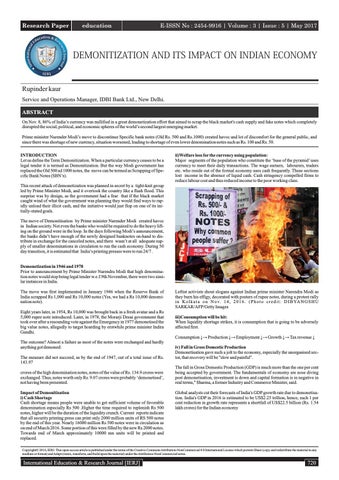
Leftist activists shout slogans against Indian prime minister Narendra Modi as they burn his effigy, decorated with posters of rupee notes, during a protest rally i n K o l k a t a o n N o v. 1 4 , 2 0 1 6 . ( P h o t o c r e d i t : D I B YA N G S H U SARKAR/AFP/Getty Images iii)Consumption will be hit: When liquidity shortage strikes, it is consumption that is going to be adversely affected first. Consumption ↓→ Production ↓→ Employment ↓→ Growth ↓→ Tax revenue ↓
The outcome? Almost a failure as most of the notes were exchanged and hardly anything got demoned: The measure did not succeed, as by the end of 1947, out of a total issue of Rs. 143.97 crores of the high denomination notes, notes of the value of Rs. 134.9 crores were exchanged. Thus, notes worth only Rs. 9.07 crores were probably ‘demonetised’, not having been presented. Impact of Demonitisation i) Cash Shortage Cash shortage means people were unable to get sufficient volume of favorable denomination especially Rs 500 .Higher the time required to replenish Rs 500 notes, higher will be the duration of the liquidity crunch. Current reports indicate that all security printing press can print only 2000 million units of RS 500 notes by the end of this year. Nearly 16000 million Rs 500 notes were in circulation as on end of March 2016. Some portion of this were filled by the new Rs 2000 notes. Towards end of March approximately 10000 mn units will be printed and replaced.
iv) Fall in Gross Domestic Production Demonetisation gave such a jolt to the economy, especially the unorganised sector, that recovery will be "slow and painful". The fall in Gross Domestic Production (GDP) is much more than the one per cent being accepted by government. The fundamentals of economy are nose diving post demonetisation, investment is down and capital formation is in negative in real terms," Sharma, a former Industry and Commerce Minister, said. Global analysts cut their forecasts of India's GDP growth rate due to demonetisation. India's GDP in 2016 is estimated to be US$2.25 trillion, hence, each 1 per cent reduction in growth rate represents a shortfall of US$22.5 billion (Rs. 1.54 lakh crores) for the Indian economy
Copyright© 2016, IERJ. This open-access article is published under the terms of the Creative Commons Attribution-NonCommercial 4.0 International License which permits Share (copy and redistribute the material in any medium or format) and Adapt (remix, transform, and build upon the material) under the Attribution-NonCommercial terms.
International Education & Research Journal [IERJ]
720
Research Paper
E-ISSN No : 2454-9916 | Volume : 3 | Issue : 5 | May 2017 Many such benefits are there to be taken but it needs a sea change. Agencies of government will have to work really hard to make it a cashless economy. The beginning is good but it needs to be taken to the logical conclusion. REFERENCES 1. "The dire consequences of India's demonetisation initiative". The Economist. 2.
"India: Demonetisation takes its toll on the poor". Al Jazeera.
3.
Facts and Figures of Demonitisation. in India by Ajit Roy
4.
Demonitisation, The Economist speaks by Parthasrathi Shome & Dr.Manmohan singh
v) Impact on bank deposits and interest rate: Demonetisation has resulted in sharp rise in deposit growth at a time when banks have abridged interest rates on term deposits. and increased the access to credit. This will boost economic activity with multiplier effects,“ said Arun Jaitley, finance minister, during the Union Budget speech. While deposits grew, credit growth didn't pick up as it remained muted at around 5% with total outstanding bank credit standing at Rs 74 lakh crore. As a result, banks were forced to park surplus funds in government bonds which helped lower yields which, in turn, has helped the government raise cheaper funds. Deposits rose 13.9% or Rs 12.7 lakh crore to Rs 105 lakh crore against a 10% rise last year,as per the data released byRBI vi. Impact on black money: Around Rs 12 lakh crore of the Rs 15.44 lakh crore demonetized currency is with banks now and the extent of black money identified out of this will be the direct effect. Here, it is believed that an estimated Rs 1.5 to 2 lakh crore may be identified as black income. Out of this, around Rs 1.2 lakh crores may be collected as taxes at 50% to 85% tax rate. Demonetisation wont put an end to generation of black wealth.The actual people behind black wealth are not being targeted. Governement is thinking that if they demobilize cash , the black money will collapse, it wont. vii). Impact on counterfeit currency: According to RBI, fake currency amounts to only Rs.400 crore of the total currency in circulation of Rs.17.5 lakh crore which is a miniscule amount .Counterfeit notes have always been used to finance terrorist activities. The printing of fake curreny has to be blocked. If the old notes could be counterfeited,so can the new ones too. viii) Payment Banks Demonetisation has given a major push to e-wallets and Unified payment Interface, a payment system launched by National Payments Corporation of India and regulated by Reserve Bank of India which facilitates the fund transfer between two bank accounts on the mobile platform instantly. CONCLUSION Demonetization as a cleaning exercise may produce several good things in the economy. But at the same time, it has created unavoidable income and welfare losses to the poor sections of the society who gets income on their daily work and those who doesn’t have the digital transaction culture. If demonitisation will end corruption altogether, it is difficult to say. In fact the doubt that the currency of rupees 2000 will help hoarders conveniently accumulate the wealth is not baseless. But then it also has a sense of fear associated that the money could become waste any time. So, people will definitely accumulate currency but will eventually deposit into bank accounts. A regular check will be needed on fake currency notes as if somehow criminals or terrorists are able to copy the high denomination notes, it will be disastrous and economy will fail miserably. Government could start a trend to introduce new notes with different denomination every now and then and can derecognize the old or in-use currency as it did on November 8. Color of the currency makes no difference. Neither is it a one-time activity to be put an end to through such onetime measure. The roots are much deeper. Although people are ready to bear the brunt of cash crunch for now but government must come up with permanent solutions in which the availability of Point of Sale devices will be the key. Online services will gain popularity but for people who are far from technology and deal in cash in the market should be upgraded and trained to use the plastic money. From your home maid to vegetable vendor with a hand cart, everyone must be given a machine. At least one debit card should be mandatory in one family so that at least people operating out of various locations throughout the day can use the money they have in their saving accounts.
721
International Education & Research Journal [IERJ]