Research Paper
Management
E-ISSN No : 2454-9916 | Volume : 3 | Issue : 5 | May 2017
CONNECTING ONLINE VISUAL MERCHANDISING AND CONSUMER RESPONSE BEHAVIOUR Ms. Farah. S. Choudhary Assistant Professor, The Business School, University Of Jammu, India. ABSTRACT The current study was designed to examine the relationship of online visual merchandising and consumers' emotions (pleasure and arousal) that in turn influence consumer response behaviors for this the study will apply Stimuli (S)—Organism (O)—Response (R) model suggested by Mehrabian and Russell (1974) as a base to relate these elements in which online visual merchandising will be the Stimulus, Emotional State will be the Organism and Approach-Avoidance behaviour will be the Response. This study takes two emotional variables i.e. Pleasure and arousal. The purpose of this study is to also explore different online visual merchandising (OVM) elements. The paper through extensive literature on Online Visual Merchandising and Factor Analysis gives five elements of OVM that affects consumer response behaviour. The factors exacted were Atmospheric, Website navigation, Product demonstration, Web graphics and Web advertising. There are various sub-elements included within these factors. A convenience sample of 200 online purchasers was selected. This study presents a detail understanding of online visual merchandising and its elements and how they are used differently in different websites. The paper also gives implications for retailers of how to use online visual merchandising to attract consumers. The findings of the study provides valuable information for online retailers developing successful online stores using various web cues that may attract both online browsers and purchasers. The paper also extends online visual merchandising research by empirically investigating how various web cues presented in websites influence consumer emotions that in turn affect consumer response behaviour. KEYWORDS: Online visual merchandising, approach-avoidance behavior, S-O-R model, pleasure and arousal state. INTRODUCTION Globally, one phenomenon that has been growing at a fast pace is internet shopping, as shoppers are now easily ale to find product information on internet (Ward and Lee, 2000). Past researches have suggested that website design and merchandising attract internet shopping customers and influence their satisfaction (Harris, 1998; Szymanski & Hise, 2000). In addition Menon & Kahn,( 2002) proposed that website that creates pleasure for customers has a positive effect on their approach behaviour and also makes the customers return to the website more often (Rice, 1997). Thus, it is clear that in online context also visual merchandising is an important tool for creating a positive impact to attract the customers. Whereas, there are still a lot of customers who still avoid purchasing online especially apparels as they cannot try the size and fit of a garment. Thus, it is very important for the online retailers to give such kind of feel to the customers visiting their websites such that it satisfies the need of sensory experience and physical inspection of the customers. For this purpose the online websites need to focus on developing excellent online visual merchandising techniques (Khakimdjanova & Park, 2005).
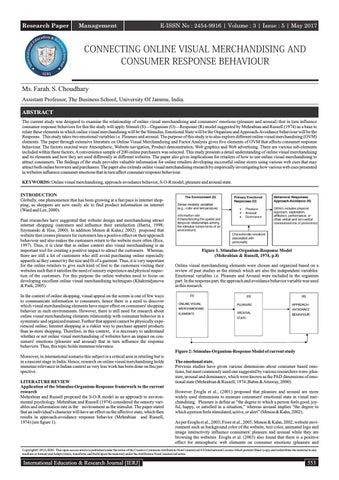
Figure 1. Stimulus-Organism-Response Model (Mehrabian & Russell, 1974, p.8) Online visual merchandising elements were chosen and organized based on a review of past studies as the stimuli which are also the independent variables. Emotional variables i.e. Pleasure and Arousal were included in the organism part. In the response part, the approach and avoidance behavior variable was used in this research.
In the context of online shopping, visual appeal on the screen is one of few ways to communicate information to consumers; hence there is a need to discover which visual merchandising elements have major effect on consumers' shopping behavior in such environments. However, there is still need for research about online visual merchandising elements relationship with consumer behavior in a systematic and organized manner. Further that apparel cannot be physically experienced online; Internet shopping is a riskier way to purchase apparel products than in-store shopping. Therefore, in this context, it is necessary to understand whether or not online visual merchandising of websites have an impact on consumers' emotions (pleasure and arousal) that in turn influence the response behaviors. Thus, this topic holds immense relevance. Figure 2: Stimulus-Organism-Response Model of current study Moreover, in international scenario this subject is a critical area in retailing but is in a nascent stage in India. Hence, research on online visual merchandising holds immense relevance in Indian context as very less work has been done on this perspective. LITERATURE REVIEW Application of the Stimulus-Organism-Response framework to the current research Mehrabian and Russell proposed the S-O-R model as an approach to environmental psychology. Mehrabian and Russell (1974) considered the sensory variables and information rate in the environment as the stimulus. The paper stated that an individual's character will have an effect on the affective state, which then results in approach-avoidance response behavior (Mehrabian and Russell, 1974) (see figure 1).
The emotional state. Previous studies have given various dimensions about consumer based emotions, but most commonly used one suggested by various researchers were- pleasure, arousal and dominance, which were known as the PAD dimensions of emotional state (Mehrabian & Russell, 1974 ;Babin & Attaway, 2000). However Eroglu et al., (2001) proposed that pleasure and arousal are more widely used dimensions to measure consumers' emotional state in visual merchandising. Pleasure is define as “the degree to which a person feels good, joyful, happy, or satisfied in a situation,” whereas arousal implies “the degree to which a person feels stimulated, active, or alert” (Menon & Kahn, 2002). As per Eroglu et al., 2003; Fiore et al., 2005; Menon & Kahn, 2002, website environment such as background color of the website, text color, animated logo and image interactivity influence consumers' pleasure and arousal while they are browsing the websites. Eroglu et al. (2003) also found that there is a positive effect for atmospheric web elements on consumer emotions (pleasure and
Copyright© 2016, IERJ. This open-access article is published under the terms of the Creative Commons Attribution-NonCommercial 4.0 International License which permits Share (copy and redistribute the material in any medium or format) and Adapt (remix, transform, and build upon the material) under the Attribution-NonCommercial terms.
International Education & Research Journal [IERJ]
553
Research Paper
E-ISSN No : 2454-9916 | Volume : 3 | Issue : 5 | May 2017
arousal) in the apparel online shopping context. Hence, Hypothesis H1 has been stated as: H1: Online visual merchandising affects pleasure and arousal consumer's state. According to findings from various psychologists, pleasure state can lead to more approach behavior and stimulation-seeking in the next task (Menon & Kahn, 2002). Donovan & Rossiter, 1982; Holbrook & Gardner, 1993 also concluded that consumers' approach or avoidance to the environment is affected by their emotional responses. In addition, according to Mehrabian and Russell (1974), high arousal would result in approach behavior in a pleasant environment while it would also lead to avoidance behavior if the environment is unpleasant. Therefore, Hypothesis H2 has been structured as: H2: Consumers' emotional state (pleasure and arousal) influence approachavoidance behavior. CONSUMER BEHAVIOUR Turley and Milliman's (2000) studied about other researches and found that past research explored not only many stimuli but also a extensive variety of behavioral responses such as time spent by the customer in the store, total sales of the store and impulsive buying behavior in retail environments. However, in general, buying behaviour is all about positive response and negative response. According to scientific psychology, approach behavior is “instigated or directed by a positive/desirable event or possibility,” whereas avoidance behavior is “instigated or directed by a negative/ undesirable event or possibility” (Elliot & McGregor, 1999; Elliot & Thrash, 2002). In environmental psychology, approach behaviors are those positive responses to an environment while avoidance behaviors are lesser time spent in the environment (Turley & Milliman, 2000).
HYPOTHESIS TESTING H1: Online visual merchandising affects pleasure and arousal consumer's state. Hypothesis 1 states that all the online visual merchandising elements namely Colour, Layout, Product Density, Model Appeal, Product Image quality, Product Presentation, Banners and Ease of Use can predict both customer's arousal and pleasure state. Two multiple regressions were conducted to understand how online visual merchandising elements affect customer's arousal and pleasure state. Tables below shows regression test statistics which consists of pleasure and arousal as dependent variables respectively. Table 1a and 2a respectively shows that online visual merchandising elements have a significant impact on both Pleasure and Arousal state of online website users. But it is seen from Table 1b and 2b that not all online visual merchandising elements had an influence on pleasure and arousal. Only colour, layout and Product Presentation significantly predicted consumers' pleasure and in Table 2b only Product density, while Colour, Layout and product presentation had significant influence on arousal. TABLE 1a: ANOVAb Model
Sum of Squares df Regression 1415.827
1
3719.359
191 32.342
5135.185
199
b. Dependent Variable: Pleasure TABLE 1b: Coefficients Model
Unstandardized Standardized Coefficients Coefficients
t
Sig.
Colour Layout Product Density
-.846 1.184 .314
Std. Error .298 .343 .290
Model Appeal
.094
.306
.030
Product Image Quality
-.107
.314
-.035
-.342 .733
Product Presentation
.634
.217
.278
2.921 .004
Banners
-.189
.220
-.077
-.860 .392
Ease of Use
.162
.219
.070
.741 .460
B
Beta -.288 .382 .115
-2.843 .005 3.448 .001 1.084 .281 .307 .759
TABLE 2a: ANOVAb Model
Various dimensions of online visual merchandising were identified through extensive literature review namely Atmospheric, Website navigation, Product demonstration, Web graphics and Web advertising. There are various subelements included within these factors. The Atmospheric factor includes items such as Color of the website, text of the website and layout of the website. The product demonstration and web graphics included the sub factors like Product Density (Number of pictures and space arrangement of the page), Model Appeal (Attractiveness of the model used to showcase the products), Product Image Quality and Product Presentation (when you play your mouse over the picture and the interactivity of changing picture). The web navigation includes Ease of use and Flexibility of a site and at last web advertising consists of banner ads (a picture with advertisement slogan on it) and promotional text on the website.
5.472 .000a
Residual
Hence, Hypothesis H3 has been stated as:
RESEARCH METHODOLOGY The study has been conducted on the basis of primary data, which has been collected through a structured questionnaire. The data was collected from 200 respondents from Mumbai and Delhi and who had made a purchase or even visited the two websites i.e. Flipkart and Snapdeal. The questionnaire was framed using a seven point Likert Scale consisting of statements covering three dimensions viz; Online Visual Merchandising elements, Pleasure-Arousal State and Approach-Avoidance Behaviour of the customers towards websites. All the dimensions were measured on a scale of 1to 7, where 1 represents Strongly Disagree and 7 represents Strongly Agree. The data so collected was summarized and analysed using SPSS Statistics 24. Regression analysis and ANOVA was conducted for the hypotheses testing.
176.978
a. Predictors: (Constant), Ease of Use, Banners, Product Image Quality, Colour, Product Presentation, Model Appeal, Product Density, Layout
In addition Eroglu and Machleit (1990) argued that overloading the retail density can negatively affect consumers' internal states and consequent shopping behaviors and outcomes of the customer. Similar to product density in physical stores stores, Soiraya, Mingkhwan and Haruechaiyasak, (2008) found that online retailing websites with good image alignment and text density can performance in a better matter. Kim et al.,(2010) also investigated consumers' preference for models' faces. Research in website design has shown that layout of online website, font type it is using, word style and color background are all important to consumers' response behavior (Hill & Scharff, 1997; Mandel & Johnson, 1999; Wu & Yuan, 2003; Griffith, 2005; Yoo, 2010; Biers & Richards, 2011).
H3: Online visual merchandising affects consumer response behavior.
F
Total
Hence, approach-avoidance behavior is an effective way that can describe consumers' shopping behavior. Ha and Lennon (2010) examined that visual merchandising elements especially low task relevant elements can directly increase consumers' approach behavior. In addition, Manganari, Siomkos, Rigopoulou, and Vrechopoulos (2009) suggested a conceptual framework for studying the impact of online store atmosphere on consumer behavior based on the Virtual Component Presentation Framework (VCPF) which was earlier propose by Vrechopoulos, O'Keefe, Doukidis and Siomkos (2004).
8
Sig.
Mean Square
1
Regression
Sum of Squares 994.755
df 8
Mean Square 124.344
Residual Total
2768.882 3763.637
191 199
24.077
Sig. F 5.164 .000a
a. Predictors: (Constant), Ease of Use, Banners, Product Image Quality, Colour, Product Presentation, Model Appeal, Product Density, Layout b. Dependent Variable: Arousal TABLE 2b: Coefficients Model
Unstandardized Coefficients
Standardized Coefficients B Std. Error Beta Colour -.509 .257 -.203 Layout .681 .296 .257 Product Density .312 .250 .134 Model Appeal .075 .264 .028 Product Image Quality .528 .271 .203 Product Presentation .377 .187 .193 Banners -.107 .190 -.051 Ease of Use -.134 .189 -.067
t
Sig.
-1.983 2.298 1.249 .284 1.948 2.012 -.561 -.709
.050 .023 .214 .777 .054 .047 .576 .480
a. Dependent Variable: Arousal
554
International Education & Research Journal [IERJ]
Research Paper
E-ISSN No : 2454-9916 | Volume : 3 | Issue : 5 | May 2017 Thus we can conclude that following model can be proposed from the above testing:
H2: Online visual merchandising affects consumer response behavior. Hypothesis 2 states that all the online visual merchandising elements namely Colour, Layout, Product Density, Model Appeal, Product Image quality, Product Presentation, Banners and Ease of Use can affect customer's response behaviour. Multiple regressions were conducted to understand how online visual merchandising elements affect on customer's approach-avoidance behaviour towards website. Table below shows regression test statistics which consists of approachavoidance behaviour as dependent variable. Table 3a shows that online visual merchandising elements have a significant impact on approach-avoidance behaviour of online website users. But it is seen from 3b that not all online visual merchandising elements had an influence on approach-avoidance behaviour. Only Product Image Quality and Ease of use can significantly predicted consumers' approach-avoidance behaviour. Table 3a: ANOVAb Model Sum of Squares Regression 765.014
1
Residual Total
1548.373 2313.387
df 8 191 199
Sig. F 7.102 .000a
Mean Square 95.627
IMPLICATIONS Seven online visual merchandising elements were identified in the list, including Atmospheric, Online Product density, Model Appeal, Product Presentation, Website Navigation, Website Advertising and Online Product Image .
13.464
a. Predictors: (Constant), Ease of Use, Banners, Product Image Quality, Colour, Product Presentation, Model Appeal, Product Density, Layout b. Dependent Variable: Approach Avoidance Table 3b: Coefficientsa Model
Unstandardized Coefficients
Standardized Coefficients B Std. Error Beta 1 (Constant) 3.181 3.768 Colour -.134 .192 -.068 Layout -.054 .222 -.026 Product Density .290 .187 .159 Model Appeal -.120 .197 -.058 Product Image Quality .600 .203 .294 Product Presentation .138 .140 .091 Banners .223 .142 .135 Ease of Use .345 .141 .222
Figure 3: Stimulus-Organism-Response Model with reference to current study
t
Sig.
.844 -.701 -.243 1.550 -.609 2.961 .990 1.572 2.449
.400 .485 .809 .124 .544 .004 .324 .119 .016
This research hypothesized that the aforementioned seven online visual merchandising elements predict consumers' emotional state (pleasure and arousal). The findings also revealed that there is a positive effect of pleasure, arousal on approach avoidance behaviour. This research also tested visual merchandising elements in online shopping environments which predict consumers' approach and avoidance behavior. Only Product Image Quality and Ease of use were significant for predicting consumers' approach-avoidance behavior at the 0.05 level thereby suggesting the retailers has to put extra effort on Product Image Quality and Ease of use to make consumers stay longer and browse more on the website. It is to suggest that click/click and mortar studies being conducted in international scenario can also be put to use in Indian context. They would provide a more comprehensive understanding and knowledge of online visual merchandising techniques used in Indian websites. The future study may also use consumers' purchase intention as the response variable in the S-O-R framework and test whether emotion state can affect the purchase intentions of online customers. REFERENCES 1.
Allen, C. (2000). Effective online merchandising techniques. Retrieved from www.clickz.com/mkt/precis_mkt/article.php/832981
a. Dependent Variable: Approach Avoidance
2.
Babin, B. J., & Attaway, J. S. (2000). Atmospheric affect as a tool for creating value and gaining share of customer. Journal of Business Research, 49(2), 91-99.
H3: Consumers' emotional state (pleasure and arousal) influence approachavoidance behavior.
3.
Biers, K., & Richards, L. (2011). Color as a factor of product choice in e-commerce. Review of Business Information Systems (RBIS), 9(4), 33-40.
4.
Donovan, R. J., & Rossiter, J. R. (1982). Store atmosphere: An environmental psychology approach. Journal of Retailing, 58 (1), 34-57.
5.
Elliot, A. J., & Thrash, T. M. (2001). Achievement goals and the hierarchical model of achievement motivation. Educational Psychology, 12, 139-156
6.
Elliot, A., & McGregor, H. A. (1999). Test anxiety and the hierarchical model of approach and avoidance achievement motivation. Journal of Personality and Social Psychology, 76, 628-644.
7.
Eroglu, S. A., & Machleit, K. A. (1990). An empirical study of retail crowding: Antecedents and consequences. Journal of Retailing, 66(2), 201-221.
8.
Eroglu, S. A., Machleit, K. A., & Davis, L. M. (2001). Atmospheric qualities of online retailing: A conceptual model and implications. Journal of Business Research, 54(2), 177-184.
9.
Eroglu, S. A., Machleit, K. A., & Davis, L. M. (2003). Empirical testing of a model of online store
Hypothesis 3 tested whether consumers' emotional state (pleasure and arousal) influence their approach-avoidance behavior. This hypothesis was examined using one multiple regression testing the predicted effect of emotional state on consumers' approach and avoidance behavior. The results showed strong significant positive effect of arousal on approach and avoidance behavior. Table 4a: ANOVAb Model 1
Regression Residual Total
Mean Square 144.951 16.723
Sum of Squares df 289.903 2 2023.485 197 2313.387
F 8.668
Sig. .000a
199
10. Eroglu, S.A., Machleit, K. and Davis, L., 2001. Atmospheric qualities of online retailing: a conceptual model and implications. Journal of Business Research, 54, pp. 177184.
a. Predictors: (Constant), Arousal, Pleasure b. Dependent Variable: Approach Avoidance
11. Fiore, A. M., & Jin, H. (2003). Influence of image interactivity on approach responses towards an online retailer. Internet Research, 13(1), 38-48.
Table 4b: Coefficientsa Model
Pleasure Arousal
Unstandardized Coefficients B Std. Error -.009 .075 .284 .088
Standardized Coefficients Beta -.013 .363
t
Sig.
-.121 .904 3.246 .002
a. Dependent Variable: Approach Avoidance
12. Google India Report 2015. Retrieved from; http://www.indiancommercials.in/onlineshopping-trends-in-india-2015-a-google-india-report/ 13. Griffith, D. A. (2005). An examination of the influences of store layout in online retailing. Journal of Business Research, 58(10), 1391-1396. 14. Ha, Y., & Lennon, S. J. (2010). Online visual merchandising (VMD) cues and consumer pleasure and arousal: Purchasing versus browsing situation. Psychology & Marketing, 27(2), 141-165. 15. Ha, Y., Kwon, W., & Lennon, S. J. (2007). Online visual merchandising (VMD) of apparel web sites. Journal of Fashion Marketing and Management, 11(4), 477-493. 16. Ha, Y., Kwon, W., & Lennon, S. J. (2007). Online visual merchandising (VMD) of
International Education & Research Journal [IERJ]
555
Research Paper
E-ISSN No : 2454-9916 | Volume : 3 | Issue : 5 | May 2017
apparel web sites. Journal of Fashion Marketing and Management, 11(4), 477-493. 17. Harris, K. (1998). Merchandising tips for the Web. SGB: Sporting Goods Business, 31 (17), 12-13. 18. Hill, A., & Scharff, L. (1997). Readability of websites with various foreground/background color combinations, font types and word styles. Paper presented at the Proceedings of 11th National Conference in Undergraduate Research, 742-746. 19. Holbrook, M. B., & Gardner, M. P. (1993). An approach to investigating the emotional determinants of consumption durations: Why do people consume what they consume for as long as they consume it? Journal of Consumer Psychology, 2(2), 123-142. 20. Ji, X., & Pang, C. (2006). Online visual merchandising of apparel e-retailers. IEEE Xplore. Retrieved February 27, 2009 from http://ieeexplore.ieee.org/stamp/stamp.jsp? tp=&amumber=4279873&isnumber=4279779 21. Jones, M., M. Spence, and C. Vallaster (2008) “Creating Emotions via B2C Websites,” Business Horizons (51) 5, 419-428. 22. Khakimdjanova, L., & Park, J. H. (2005). Online visual merchandising practice of apparel e-merchants. Journal of Retailing and Consumer Services, 12(5), 307−318 23. Khakimdjanova, L., & Park, J. H. (2005). Online visual merchandising practice of apparel e-merchants. Journal of Retailing and Consumer Services, 12(5), 307−318 24. Kim, H., & Lennon, S. J. (2010). E-atmosphere, emotional, cognitive, and behavioral responses. Journal of Fashion Marketing and Management, 14(3), 412-428. 25. Kim, J., Kim, M., & Lennon, S. J. (2009). Effects of web site atmospherics on consumer responses: Music and product presentation. Direct Marketing: An International Journal, 3(1), 4-19. 26. Kotler, P. (1973). Atmospherics as a marketing tool. Journal of Retailing, 49(4), 48-64. 27. Mandel, N., & Johnson, E. (1999). Constructing preferences online: Can web pages change what you want? (Unpublished Paper).the Wharton School, University of Pennsylvania.PA 28. Manganari, E. E., Siomkos, G. J., & Vrechopoulos, A. P. (2009). Store atmosphere in web retailing. European Journal of Marketing, 43(9/10), 1140-1153. 29. McGoldrick, P. J. (2002). Retail marketing McGraw-Hill London. 30. McWilliams, G. (2000). Building stronger brands through online communities. Sloan Management Review, 41, 43-54. 31. Mehrabian, A., & Russell, J. A. (1974). An approach to environmental psychology. The MIT Press. 32. Menon, S., & Kahn, B. (2002). Cross-category effects of induced arousal and pleasure on the Internet shopping experience. Journal of Retailing, 78, 31-40. 33. Park, J. H., & Stoel, L. (2002). Apparel shopping on the Internet: information availability on US apparel merchant web sites. Journal of Fashion Marketing and Management, 6(2), 158-176. 34. Park, J. H., Lennon, S., & Stoel, L. (2005). On-line product presentation: Effects on mood, perceived risk, and purchase intention. Psychology & Marketing, 22 (9), 695719. 35. Park, M., & Lennon, S. J. (2009). Brand name and promotion in online shopping contexts. Journal of Fashion Marketing and Management, 13(2), 149-160. 36. Pegler, M. (2001). Visual merchandising and display. New York: Fairchild Publications. 37. Rice, M. (1997). What makes users revisit a Web site? Marketing News, 31 (6), 12. 38. Soiraya, B., Mingkhwan, A., & Haruechaiyasak, C. (2008). An analysis of visual and presentation factors influencing the design of E-commerce web sites. Paper presented at the Web Intelligence and Intelligent Agent Technology, 2008. WI-IAT'08. IEEE/WIC/ACM International Conference on, 525-528. 39. Szymanski, D. M., & Hise, R. T. (2000). E-satisfaction: An initial examination. Journal of Retailing, 76 (3), 309-322. 40. Turley, L.W. and Ronald E. Milliman (2000), Atmospheric Effects on Shopping Behavior: A Review of the Experimental Evidence, Journal of Business Research, 49, August, 193-211. 41. Vrechopoulos, A. P., O’Keefe, R. M., Doukidis, G. I., & Siomkos, G. J. (2004). Virtual store layout: An experimental comparison in the context of grocery retail. Journal of Retailing, 80(1), 13-22. 42. Ward, M. R., & Lee, M. J. (2000). Internet shopping, consumer search and product branding. Journal of Product and Brand Management, 9 (1), 6-20. 43. Wu, J., & Yuan, Y. (2003). Improving searching and reading performance: The effect of highlighting and text color coding. Information & Management, 40(7), 617-637. 44. Yoo, J. (2010). Developing effective presentation strategies for online retailers (Unpublished doctoral dissertation). Oregon State University.OR. 45. Yoo, J., & Kim, M. (2012). Online product presentation: The effect of product coordination and a model's face. Journal of Research in Interactive Marketing, 6(1), 59- 72. 46. Zhou, T., Y. Lu, and B. Wang (2009) “The Relative Importance of Website Design Quality and Service Quality in Determining Consumers’ Online Repurchase Behavior,” Information Systems Management (26) 4, 327-337.
556
International Education & Research Journal [IERJ]