Education
Research Paper
E-ISSN No : 2454-9916 | Volume : 3 | Issue : 4 | Apr 2017
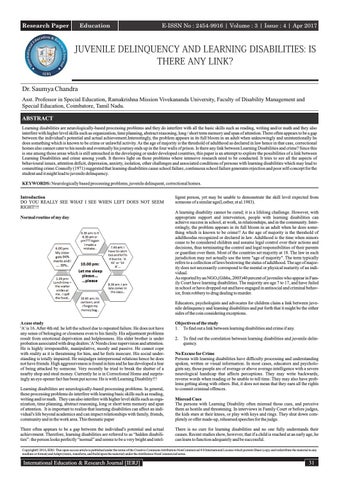
JUVENILE DELINQUENCY AND LEARNING DISABILITIES: IS THERE ANY LINK? Dr. Saumya Chandra Asst. Professor in Special Education, Ramakrishna Mission Vivekananda University, Faculty of Disability Management and Special Education, Coimbatore, Tamil Nadu. ABSTRACT Learning disabilities are neurologically-based processing problems and they do interfere with all the basic skills such as reading, writing and/or math and they also interfere with higher level skills such as organization, time planning, abstract reasoning, long / short term memory and span of attention. There often appears to be a gap between the individual's potential and actual achievement.Interestingly, the problem appears in its full bloom in an adult when unknowingly and unintentionally he does something which is known to be crime or unlawful activity. As the age of majority is the threshold of adulthood as declared in law hence in that case, correctional homes also cannot cater to his needs and eventually his journey ends up in the four walls of prison. Is there any link between Learning Disabilities and crime? Since this is one among those areas which is still untouched in the developing or under developed countries, this paper is an attempt to explore the possibilities of a link between Learning Disabilities and crime among youth. It throws light on those problems where intensive research need to be conducted. It tries to see all the aspects of behavioural issues, attention deficit, depression, anxiety, isolation, other challenges and associated conditions of persons with learning disabilities which may lead to committing crime.Connolly (1971) suggested that learning disabilities cause school failure, continuous school failure generates rejection and poor self-concept for the student and it might lead to juvenile delinquency. KEYWORDS: Neurologically based processing problems, juvenile delinquent, correctional homes. Introduction DO YOU REALLY SEE WHAT I SEE WHEN LEFT DOES NOT SEEM RIGHT!!! Normal routine of my day
ligent person, yet may be unable to demonstrate the skill level expected from someone of a similar age(Loeber, et al.1983). A learning disability cannot be cured; it is a lifelong challenge. However, with appropriate support and intervention, people with learning disabilities can achieve success in school, at work, in relationships, and in the community. Interestingly, the problem appears in its full bloom in an adult when he does something which is known to be crime!! As the age of majority is the threshold of adulthoodas recognized or declared in law. Adulthood is the time when minors cease to be considered children and assume legal control over their actions and decisions, thus terminating the control and legal responsibilities of their parents or guardian over them. Most of the countries set majority at 18. The law in each jurisdiction may not actually use the term "age of majority". The term typically refers to a collection of laws bestowing the status of adulthood. The age of majority does not necessarily correspond to the mental or physical maturity of an individual. As reported by an NGO,(Gibbs, 2003)40 percent of juveniles who appear in Family Court have learning disabilities. The majority are age 7 to 17, and have failed in school or have dropped out and have engaged in antisocial and criminal behavior, from robbery to drug dealing to murder. Educators, psychologists and advocates for children claim a link between juvenile delinquency and learning disabilities and put forth that it might be the either sides of the coin considering exceptions.
A case study 'A' is 16. After 4th std. he left the school due to repeated failure. He does not have any sense of belonging or closeness even to his family. His adjustment problems result from emotional deprivation and helplessness. His elder brother is under probation associated with drug dealers.'A' Needs close supervision and attention. He is highly irresponsible, manipulative, moody and passive. He cannot cope with reality as it is threatening for him, and he feels insecure. His social understanding is totally impaired. He misjudges interpersonal relations hence he does not have friends. High aggressiveness is found in him and he has developed a fear of being attacked by someone. Very recently he tried to break the shutter of a nearby shop and steal money. Currently he is in Correctional Home and surprisingly an eye opener fact has been put across: He is with Learning Disability!!!
Objectives of the study 1. To find out a link between learning disabilities and crime if any. 2.
To find out the correlation between learning disabilities and juvenile delinquency.
No Excuse for Crime Persons with learning disabilities have difficulty processing and understanding spoken, written or visual information. In most cases, educators and psychologists say, those people are of average or above average intelligence with a severe neurological handicap that affects perceptions. They may write backwards, reverse words when reading or be unable to tell time. They may also have problems getting along with others. But, it does not mean that they earn all the rights to commit criminal offences.
Learning disabilities are neurologically-based processing problems. In general, these processing problems do interfere with learning basic skills such as reading, writing and/or math. They can also interfere with higher level skills such as organization, time planning, abstract reasoning, long or short term memory and span of attention. It is important to realize that learning disabilities can affect an individual's life beyond academics and can impact relationships with family, friends, community and in the work area. This thematic paper
Misread Cues The persons with Learning Disability often misread those cues, and perceive them as hostile and threatening. In interviews in Family Court or before judges, the kids stare at their knees, or play with keys and rings. They shut down completely or offer made-up, rehearsed speeches for the judge.
There often appears to be a gap between the individual's potential and actual achievement. Therefore, learning disabilities are referred to as “hidden disabilities”: the person looks perfectly “normal” and seems to be a very bright and intel-
There is no cure for learning disabilities and no one fully understands their causes. Recent studies show, however, that if a child is reached at an early age, he can learn to function adequately and be successful.
Copyright© 2016, IERJ. This open-access article is published under the terms of the Creative Commons Attribution-NonCommercial 4.0 International License which permits Share (copy and redistribute the material in any medium or format) and Adapt (remix, transform, and build upon the material) under the Attribution-NonCommercial terms.
International Education & Research Journal [IERJ]
31
Research Paper
E-ISSN No : 2454-9916 | Volume : 3 | Issue : 4 | Apr 2017 quent acts.
Many youths in the foundation's study had either not been diagnosed as learning disabled or had been diagnosed but received no help in the public-school system. 2.
Delinquency causes learning disabilities. To pursue this model, it must be assumed that some learning disabilities are nonneurological in nature. Being delinquent leads to the development of a set of behaviors or adaptations in the academic setting which are defined as learning disabilities.
3.
Some third factor causes both delinquency and learning disabilities. A third factor such as a neurological condition or a social factor produces both behaviors which are characterized as delinquency and another set of behaviors which are characterized as a learning disabilty. An alternative model would suggest that the third factor produces a single set of behaviors which are interpreted as a learning disability, delinquency or a combination of both depending on environmental factors.
4.
Learning disability and delinquency develop independently but react with each other to produce a situation in which one or both become more severe or are perceived as more severe by others in the environment.
5.
The relationship is fake. Both learning disabilities and delinquency are independent and only appear to be related because of chance associations in the groups of studied delinquents.
Worse Among Adults Officials who are struggling to find room to accommodate a growing number of prisoners, say that at least 30 percent of adult prisoners have learning disabilities(Heilitz, ]., Zaremba, B. & Broder, P. (1979). Moreover, most of those youngsters who come through the courts are from families whose parents are the working poor or are welfare recipients unfamiliar with learning disabilities or unaware of them. In school, their children are characterized as lazy, stupid or troublemakers or put in inappropriate special education classes with special needs children. Literature Review The link between Learning Disabilities and Criminal Behavior From the end of the 60s and the beginning of the 70s onwards research supported the link between Learning Disabilities and anti-social behaviors. Keilitz and Dunivant (1986) offer a review of causal chain theories: The School Failure Rationale It states that Learning Disabilities produce academic failure which causes damage to one's self-image and a sense of frustration, which, in turn, result in a motivation to retaliate at society and engage in antisocial behaviors. Einat & Einat (2008) claim that 39.9% of adult prisoners had Learning Disabilities, attention deficits, whereas in the general population the rate is 10-15%. The Differential Treatment Rationale It suggests that if youths with Learning Disabilities and without Learning Disabilities in the same type and degrees of delinquency, youths with learning disabilities are treated more harshly by the criminal justice system since they lack the abilities to avoid being detected, to conceal their true intentions, and may be unable to understand legal proceedings and to tell “their side of the story”. The Susceptibility Theory It states that children who possess certain social and personality characteristics such as lack of impulse control, inability to anticipate consequences, irritability, aggressiveness, suggestibility, a tendency to act out, low levels of social competence and lack of social skills, are more susceptible to become engaged in delinquent activities. Studies on depression, anxiety and loneliness demonstrated that adults with Learning Disabilities are at risk for experiencing these emotions more often than adults without Learning Disabilities (Margalit& Al-Yagon, 2006). The Cognitive Problem Solving Theory It claims that youth with Learning Disabilities and juvenile delinquents are similar in components of social-cognitive problem solving such asidentifying the problem, generating solutions, or predicting consequences. Training in selfregulation, anger management training and cognitive problem-solving reduces daily disruptive behavior and school aggression and improve daily life skills of both juvenile delinquents and LD (Fraser, 1996). Rationale of the study Viewing through the window inside Till now the search has not been completed, yet another window opens on the screen that is Juvenile crime.Juvenile crime has continued to rise. The Uniform Crime Reports (UCR, 2015) indicate that children and youth under the age of 18 comprise approximately 36% of those· arrested for all indexes of crime. Much controversy exists relevant to a possible link between juvenile delinquency and learning disabilities. The observation that many delinquent children encounter learning disability problems resulted in the estimation that learning disabilities may lead to juvenile delinquency. Establishing the relationship between juvenile delinquency and learning disabilities has been difficult. This may have resulted from the ambiguity associated with the definitions, causes, and characteristics involving juvenile delinquency and Learning Disabilities(Reilly, et al 1985). Case history reviews and clinical observations report that a large number of juvenile delinquents are 'school failures', in that they are unable to experience academic success. Recently it has been suggested that learning disabilities could be the cause ofjuvenile delinquency (Podboy and Mallory, 1978; Swanstrom, Randle, and Oxford, 1981). Juvenile delinquency is a legal term, not a special education category. Nevertheless, many delinquent children are given the label of LD and assigned to special education. Connolly (1971) suggested that learning disabilities cause school failure. Continuous school failure generates rejection and poor self-concept for the student and, ultimately, leads to juvenile delinquency.
Conclusion While much interest has been directed toward the study of learning disabilities and juvenile delinquency, the results tend to create more confusion and uncertainty than fact upon which sound theories can be built and effective programs developed. Even though existing definitions for both variables are confused with each researcher or theorist adopting a model best suited to his/her own purpose, there has been a process of setting boundaries around the classes of phenomena which are sufficient to permit continued research. The research to date has produced contradictory and unclear findings. While further research appears to be warranted, some framework must be established. While Dunivant's (1982) model provides an adequate framework for interpreting the present level of knowledge for the development of diagnostic and treatment programs, it is less effective in identifying a framework for research and the development of accurate theoretical models. The following adaptation of Dunivant's model is focused toward establishing a frame work for further research. The first focus of research should be on the nature of the causal relationship between learning disability and delinquency. Once a basic model or set of models have been established, additional variables can be included to broaden the model. There is a need for a project or a line of research to examine the specific nature of the causal relationship between these two variables before further peripheral research focusing on the impact or the treatment of this condition. If one or more models are found to be valid, then research can focus on impact and treatment. REFERENCES 1.
Connolly, C. (1971). Social and emotional factors in learning disabilities. In Progress in learning disabilities (HR. Myklebust, ed.) (pp. 151-179).
2.
Dunivant, N. (1982). The relationship between learning disabilities and juvenile delinquency: Executive summary. National Center for State Courts; Williamsburg, VA.
3.
Einat T, and Einat A. (2008) Learning disabilities and delinquency: a study of Israeli prison inmates. Int J Offender Ther Comp Criminol. ;52(4):416-34.
4.
Fraser, W. and K, Mike (1996) Primary Health Care for People with a Learning Disability: A Keynote Review, British Journal of Learning Disabilities, Vol. 24, Issue 1, retrieved on http://onlinelibrary.wiley.com/doi/10.1111/j.1468 3156.1996.
5.
Heilitz, ]., Zaremba, B. & Broder, P. (1979). The link between learning disabilities and juvenile delinquency. Learning Disability Quarterly, 2(2), 2-10.
6.
Gibbs, J. C. (2003) Moral Development and Reality: beyond the theories of Kohlberg and Hoffman. Thousand Oaks: Sage Publications.
7.
Loeber, R. &Dishion, T. (1983). Early predictors of male delinquency: A review. Psychological Bulletin, 94, 68-69.
8.
Margalit& Al-Yagon, (2002). Loneliness, sense of coherence and perception of teachers as a secure base among children with reading difficulties, European Journal of Special Needs Education 21(1):21–37.
9.
Murray, C. A. (1976). The link between learning disabilities and juvenile delinquency. Office of Juvenile Justice and Delinquency Prevention; Washington, DC.
10. Podboy, J. & Mallory, W. (1978). Learning handicap: The underdiagnosed disability. juvenile and Family Court journal, 29(4), 13-16. 11. Reilly, R., Wheeler, H. &Etlinger, H. (1985). Intelligence versus academic achievement. A comparison of juvenile delinquents and special education classifications. Criminal justice and Behavior, 12(2), 193-208. 12. Web link: https://ucr.fbi.gov/crime-in-the-u.s/2015/crime-in-the-u.s.-2015
The Relationship From the existing literature, five possible relationships can be identified. 1.
Learning disabilities cause delinquency(Murray, 1976). Either the presence of the learning disability causes delinquent acts or the behaviors which are associated with the symptoms of the learning disability are defined as delinquency, or the adaptation to the presence of learning disabilities cause delin-
32
International Education & Research Journal [IERJ]