D.C. meets Main
Centers for Medicare & Medicaid Services Administrator Dr. Oz and U.S. Representative Bresnahan visit Scranton to connect federal policy with frontline care – highlighting our community-based model that expands access, trains the next generation of physicians, and strengthens health systems
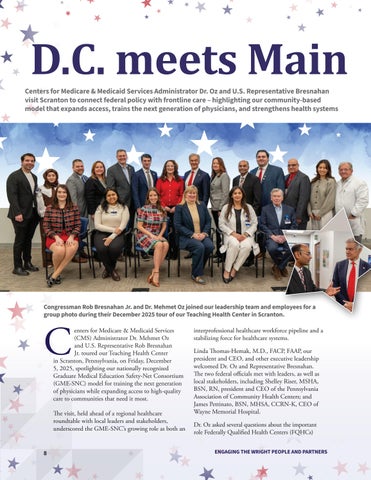
Congressman Rob Bresnahan Jr. and Dr. Mehmet Oz joined our leadership team and employees for a group photo during their December 2025 tour of our Teaching Health Center in Scranton.
C
enters for Medicare & Medicaid Services (CMS) Administrator Dr. Mehmet Oz and U.S. Representative Rob Bresnahan Jr. toured our Teaching Health Center in Scranton, Pennsylvania, on Friday, December 5, 2025, spotlighting our nationally recognized Graduate Medical Education Safety-Net Consortium (GME-SNC) model for training the next generation of physicians while expanding access to high-quality care to communities that need it most. The visit, held ahead of a regional healthcare roundtable with local leaders and stakeholders, underscored the GME-SNC’s growing role as both an
8
interprofessional healthcare workforce pipeline and a stabilizing force for healthcare systems. Linda Thomas-Hemak, M.D., FACP, FAAP, our president and CEO, and other executive leadership welcomed Dr. Oz and Representative Bresnahan. The two federal officials met with leaders, as well as local stakeholders, including Shelley Riser, MSHA, BSN, RN, president and CEO of the Pennsylvania Association of Community Health Centers; and James Pettinato, BSN, MHSA, CCRN-K, CEO of Wayne Memorial Hospital. Dr. Oz asked several questions about the important role Federally Qualified Health Centers (FQHCs) ENGAGING THE WRIGHT PEOPLE AND PARTNERS
Street Medicine ‘It is a profound privilege and honor to share our mission-driven work and the voices of our patients and learners with our distinguished guests.’
- Linda Thomas-Hemak, M.D., FACP, FAAP, President and CEO, The Wright Centers for Community Health and Graduate Medical Education
Linda Thomas-Hemak, M.D., FACP, FAAP, our president and CEO, and Dr. Mehmet Oz hold our Graduate Medical Education Safety-Net Consortium model. and Look-Alikes (FQLAs) play in modern healthcare. FQHCs and FQLAs ensure healthcare for the nation’s underserved communities and vulnerable populations by offering services to all, regardless of their ability to pay, according to the U.S. Health Resources and Services Administration (HRSA). We were designated an FQLA in 2019. “We are sincerely grateful to Dr. Oz, Congressman Bresnahan, and their staffs for visiting us and for recognizing the essential role community health centers, community-based primary care, and physician and healthcare workforce development play in the health and vitality of our region and our nation,” Dr. ENGAGING THE WRIGHT PEOPLE AND PARTNERS
Thomas-Hemak said. “As a Federally Qualified Health Center Look-Alike and nationally recognized PatientCentered Medical Home, we ensure accessible, wholeperson-focused, team-based, and cost-effective care for about 38,300 individuals each year across Northeast Pennsylvania.” Dr. Oz discussed our residency and fellowship programs and our GME-SNC, which is one of the nation’s largest funded by HRSA. Under Dr. ThomasHemak’s leadership, we pioneered the transformative, community-led model that reimagines medical education as a force for public health improvement.
SEE NEXT PAGE 9
OUR GME-SNC MODEL TAKES CENTER STAGE FROM PREVIOUS PAGE
“Our scalable GME-SNC model intentionally “The decisions CMS makes in Washington and Baltimore integrates healthcare delivery, interprofessional affect Americans in every one of the country’s nearly workforce development, innovation, and community 20,000 cities and towns – urban, rural, and everything voice to provide high-quality, affordable, and in between,” Dr. Oz said. “That’s why it’s so important compassionate primary and preventive whole-person for us to get out of the Beltway and hear directly from health services, people in those especially in rural communities. and underserved I’m grateful to communities, Congressman while training Bresnahan 430 residents, for bringing fellows, and together local interprofessional Northeastern learners annually, Pennsylvania with strong experts and retention in those stakeholders to communities,” work toward Dr. Thomasreal, bipartisan Hemak said. solutions that “At a time when can lower costs, hospital mergers increase access, Centers for Medicare & Medicaid Services Administrator Dr. Mehmet and closures, and improve quality Oz and U.S. Representative Robert Bresnahan Jr. address Linda accelerating of care.” Thomas-Hemak, M.D., FACP, FAAP, during a discussion about our healthcare Graduate Medical Education Safety-Net Consortium model. After touring our workforce shortages, Teaching Health and fragile rural healthcare infrastructures threaten Center, Dr. Oz and Representative Bresnahan attended a timely access to care, our integrated primary care and healthcare roundtable with Dr. Thomas-Hemak and other GME-SNC model serves as both a stabilizing anchor stakeholders from the region. Topics included Pharmacy for local health systems and a lifeline for patients and Benefit Manager reform, medical modernization, families. insurance ‘I’m grateful to Congressman Bresnahan for “It is a profound coverage, bringing together local Northeastern Pennsylvania privilege and value-based honor to share care, and the experts and stakeholders to work toward real, our missionbipartisan solutions that can lower costs, increase Rural Health driven work and Transformation access, and improve quality of care.’ the voices of Fund. - Dr. Mehmet Oz our patients and Centers for Medicare & Medicaid Services Administrator Representative learners with our Bresnahan said, distinguished “Our discussion with Administrator Oz and our local guests.” healthcare community was extremely productive. It was Dr. Oz said he appreciated the opportunity to learn a fantastic opportunity to sit down with local leaders to about our efforts to train the next generation of discuss how we can best implement the Rural Health healthcare professionals, and how our growing network Transformation Fund and the importance of high-quality of 13 community health centers in Lackawanna, healthcare. I want to thank Administrator Oz for coming Luzerne, Wayne, and Wyoming counties is increasing to Scranton to hear firsthand from our community. access to affordable, high-quality, whole-person primary We’re committed to delivering real, practical solutions health services for all. that improve access to care, lower costs, and ensure every community gets the support it needs.” 10
ENGAGING THE WRIGHT PEOPLE AND PARTNERS
A national model takes root Our innovative GME-SNC helps community health centers nationwide launch their own residency programs and sponsoring institutions
T
he graduation of the final class of resident physicians from our innovative National Family Medicine Residency Program in June 2026 marked the completion of an ambitious 13-year initiative – but not the end of its impact. Instead, it represents the fulfillment of the program’s original mission. Created in 2013, our National Family Medicine Residency Program was intended to be the seed for new residency development and the building of educational capacity. It was designed to demonstrate that community health centers across the country could successfully develop and sustain graduate medical education programs by using our innovative Teaching Health Center Graduate Medical Education Safety-Net Consortium (GME-SNC) enterprise model. Today, this vision is becoming reality. Several of our national partners have successfully established their own Sponsoring Institutions and family medicine residency programs after years of collaboration with us. Others continue to train resident physicians through our sponsoring institution while continuing to build their own graduate medical education capacity. The result is a lasting national legacy that continues to expand access to physician training and strengthen the primary care workforce in medically underserved communities.
Brian Ebersole
The National Family Medicine Residency Program began as a nationwide learning network with participating community health centers in Arizona, New York, Ohio, Oregon, Washington, and Washington, D.C. While the New York and Oregon sites eventually departed to pursue other paths, four partner organizations remained central to the program’s success: El Rio Health in Tucson, Arizona; HealthSource of Ohio in Hillsboro; HealthPoint in Auburn, Washington; and Unity Health Care in Washington, D.C.
Under the visionary leadership of Linda Thomas-Hemak, M.D., FACP, FAAP, our Together, the program president and CEO, ‘The legacy isn’t simply the physicians graduated 179 family we developed one of we trained; it’s the sustainable graduate medicine physicians, the nation’s largest U.S. with more than half medical education infrastructure we’ve Health Resources and choosing to practice in Services Administration helped build across the nation.’ medically underserved (HRSA)-funded GME- Brian Ebersole communities – a SNC models. Built on Senior Vice President of Strategic Enterprise and direct reflection of the collaboration rather Ecosystem Development, The Wright Center program’s mission to than competition, address our nation’s the enterprise model demonstrates how community growing primary care physician shortage. health centers can partner to create sustainable physician From the outset, however, producing physicians was training programs to improve access to whole-person only one measure of success. primary and preventive health services. 34
ENGAGING THE WRIGHT PEOPLE AND PARTNERS
The larger objective was to help partner organizations build the expertise, governance, accreditation knowledge, and operational infrastructure needed to launch their own residency programs. “Part of what we did intentionally at the very beginning was to identify organizations that had an educational component and an interest in developing residency programs but didn’t yet have the capacity,” said Brian Ebersole, our senior vice president of strategic enterprise and ecosystem development. “We wanted to create opportunities for medical students already training in those communities to remain there for residency while simultaneously helping those organizations build their own graduate medical education programs.” The collaboration extended far beyond resident education. Partner organizations became active participants in our graduate medical education governance, serving on our Graduate Medical Education Board and Graduate Medical Education Committee. We shared accreditation expertise, financial planning tools, operational resources, faculty development, annual reports, and conducted on-site visits while fostering collaboration among participants. The model also encouraged twoway learning. As we pursued Federally Qualified Health Center Look-Alike designation, for example, El Rio Health shared valuable insights from its own experience. That collaboration contributed to our successful designation by HRSA in 2019. “There was a lot of back-and-forth learning,” Ebersole said. “Everyone brought expertise to the table, and together we built something greater than any one organization could have accomplished alone.” The consortium faced a significant challenge in 2023 when the Accreditation Council for Graduate Medical Education withdrew accreditation for the National Family Medicine Residency Program, citing concerns about its unique structure, which trained residents across multiple community health center sites nationwide. ENGAGING THE WRIGHT PEOPLE AND PARTNERS
Rather than ending the consortium’s work, the transition accelerated its original purpose. El Rio Health and HealthPoint have since successfully established their own Sponsoring Institutions and launched independent family medicine residency programs, building upon the infrastructure, experience, and best practices developed through their partnership with us. “El Rio and HealthPoint both had educational ambitions, and they were already building the infrastructure to become sponsoring institutions,” Ebersole said. “They were well equipped, and neither of them had any issues with their sponsoring institution or programmatic applications.” HealthSource of Ohio continues training residents through our sponsoring institution with its own Family Medicine Residency Program, launched in 2025. Unity Health Care remains a partner, with plans for its future residency program advancing through approvals by our Graduate Medical Education Committee. These milestones represent the ultimate measure of success. By helping community health centers develop independent graduate medical education programs, our innovative GMESNC enterprise model has proven that physician workforce development can be replicated nationally while remaining rooted in local communities. The work continues as consortium partners meet regularly to share best practices, advocate for communitybased graduate medical education at the local, state, and federal levels, and mentor other health centers interested in developing residency programs. “There is tremendous opportunity – not only for our existing partners but for replication by other community health centers across the country,” Ebersole said. “Creating the National Family Medicine Residency Program was the right thing to do. The legacy isn’t simply the physicians we trained; it’s the sustainable graduate medical education infrastructure we’ve helped build across the nation.” 35
Celebrating OUR futuristic mission delivery To view and download additional graduation photos, visit TheWrightGraduation.org.
T
here is a distinct energy that fills a room when years of sleepless nights, rigorous training, and profound human connection culminate in a single moment. On Saturday, June 20, 2026, that energy was palpable at the Hilton Scranton and Conference Center, where we hosted our 47th annual commencement ceremony, honoring 67 resident and fellow physician graduates. For these doctors, the day marked the end of an intense chapter and the beginning of a lifetime of impact. But for us, it was also a reflection of a half-century legacy deeply rooted in community-driven medicine. The Class of 2026 represents a broad spectrum of medical expertise, each graduate poised to step onto the front lines of a rapidly evolving healthcare landscape. The commencement honored: 42 graduates in the Internal Medicine Residency Program 13 in the National Family Medicine Residency Program 5 in the Physical Medicine & Rehabilitation Residency Program 3 each in the Cardiovascular Disease and Geriatrics Fellowship programs 1 in the Gastroenterology Fellowship Program Notably, the evening marked a historic milestone for our enterprise: the very first graduating class of our Physical Medicine & Rehabilitation Residency Program, which launched in 2022.
36
Jumee Barooah, M.D., FACP, our senior vice president of education and designated institutional official, took a moment to address all the graduates and the village it took to get them across the finish line. “This moment belongs to you,” Dr. Barooah said. “It also belongs to the families, friends, mentors, faculty members, colleagues, and loved ones who stood beside you through every overnight shift, every exam, every difficult conversation, and every moment of doubt and growth along the way.” With this latest commencement, the Class of 2026 joins a proud network of nearly 1,200 alumni who have trained with us since our inception in 1976. What began 50 years ago with a grant has matured into one of the nation’s largest Teaching Health Center Graduate Medical Education Safety-Net Consortiums, funded by the U.S. Health Resources and Services Administration (HRSA). Today, the enterprise employs more than 677 professionals and trains nearly 200 residents and fellows – alongside more than 200 interprofessional healthcare learners – every single year. Linda Thomas-Hemak, M.D., FACP, FAAP, our president and CEO, emphasized where a doctor learns to practice matters just as much as what they study. “For the past 50 years, The Wright Center and its extraordinarily talented and dedicated governing board members, faculty, physicians, learners, care teams, support staff, and community partners have demonstrated our belief that the environments where physicians train and serve determines their future,” Dr. Thomas-Hemak said during the ceremony. “Our physician-training mission began with a visionary
DEVELOPING THE WRIGHT FUTURE WORKFORCE
investment: a $1 million Federal Bureau of Health Manpower grant awarded in 1976 to demonstrate community-immersed graduate medical education could strengthen the physician and interprofessional workforce and the health of entire communities.” As a physician-led, community-owned nonprofit, we continue to serve as a vital cornerstone of healthcare. Our Accreditation Council for Graduate Medical
DEVELOPING THE WRIGHT FUTURE WORKFORCE
Education-accredited programs ensure that incoming doctors are not just highly skilled clinical experts, but compassionate leaders attuned to the specific needs of the communities they are privileged to serve. As the 67 graduates of the Class of 2026 disperse to hospitals, clinics, and fellowships across the country, they carry with them a legacy of community-first medicine born right here in Scranton, Pennsylvania.
37