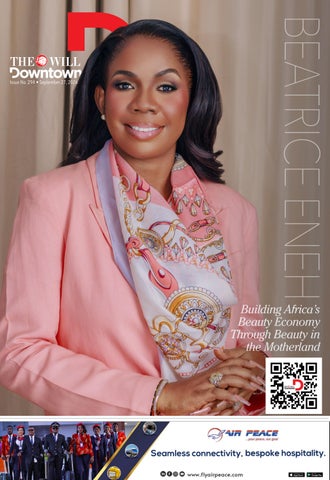
BEATRICE ENEH
Issue No. 294 • September 27, 2026
Building Africa’s Beauty Economy Through Beauty in the Motherland
Issue No. 294 • September 27, 2026
PAGE 2
THEWILL DOWNTOWN • www.thewilldowntown.com
THEWILL DOWNTOWN • www.thewilldowntown.com
Issue No. 294 • Septemebr 27, 2026
CONTENT
Photo: Kola Oshalusi @insignamedia Makeup: Zaron
EDITOR’S NOTE
I
have always found Africa’s beauty story fascinating. Our oils, botanicals, traditions and creativity have never been in short supply; what has often been missing is the structure to turn that wealth into sustainable businesses and global value. That is why Beatrice Eneh’s work with Beauty in the Motherland (BITML) feels particularly timely and important. Founded in 2023 with Linda Edozien, BITML is creating a platform to connect Africa’s beauty ecosystem while encouraging more value to remain on the continent. I find Beatrice’s perspective especially compelling: Africa should not simply supply raw materials or consume finished products, but build the brands, manufacturing systems and networks that can shape the industry’s future. As Beauty in the Motherland 2026 approaches, this vision will take centre stage in Lagos. Beyond the exhibition, the conference, pitch competition and other initiatives reflect a broader ambition to empower entrepreneurs and talent. In our conversation, Beatrice shares her journey, the gaps she sees in the industry, and why Africa must rethink its place in the global beauty value chain. Read Beatrice Eneh’s story on pages 8 through 10. Happiness should not feel like another task to complete. With social media constantly showcasing polished lives, it is easy to believe we should always feel positive and fulfilled. The wellness page (page 13) explores the pressure to be happy and why embracing life’s ordinary, imperfect moments can be more meaningful. Your bedroom should be a retreat, not a storage space for the day’s clutter. Thankfully, creating a calmer, more inviting room does not require a renovation. With a few thoughtful changes, you can transform your space into a softer, more relaxing personal sanctuary. See page 16 for this.
14 WELLNESS
The Happiness Pressure
15 CULTURE
Things We Should Leave Between Us
16 DÉCOR Stylish Ways to 04-05 4Wear Green
FASHION
Untold Truths 07 Are You #UNSHAKABLE
TRUTHS
8-10 COVER
12
LUXURY SILK
13
BEAUTY
Percolating—or Procrastinating?
17 THE SCENE
DOWNTOWN
Beauty in the Motherland 2026 Hosts Industry Stakeholders Ahead of the Big Event
18 DOWNTOWN
Libra The Art of Finding Balance
ZODIAC
Beatrice Eneh Building Africa’s Beauty Economy Through Beauty in the Motherland She Had Sent Her Seventeen Things Makeup Habits That Might Be Ageing You
Small Upgrades for a More Relaxing Space
19
DOWNTOWN CONFIDENTIAL
20
REVIEW
Our Goodbye
Resident Evil (2026)
WHAT YOU SAID Boluwatife Adesina @bolugramm
- Contributing Writer Boluwatife Adesina is a media writer and the helmer of the Downtown Review page. He’s probably in a cinema near you.
Issue No. 293 • September 20, 2026
INSIDE THE MIND OF
MOSES IWANG
Until next week, enjoy your read.
Onah
@sharonooja My director
@onahluciaa +2348033239132
AUSTYN OGANNAH
Sally Chiwuzie @unshakable.is.a.state.of.mind - Contributing Writer Sally Chiwuzie is a non-practising barrister who owns the brand #Unshakable. She is the author of Silent Symphonies, a fictional love story, and the creator of the podcast Chronicles of #Unshakable Truths.
PUBLISHER/EDITOR-IN-CHIEF Executive Editor: Onah Nwachukwu @onahluciaa Writers:Dorcas Akintoye, Johnson Chukwueke & Evi-Ben Ezaga Design & Layout: Hogan Effiom Digital Media: Oladimeji Balogun, Victoria Dairo & Olamide Abolarin Consulting Art Director: Sunny Hughes ‘SunZA’ www.thewilldowntown.com thewilldowntown thewilldowntown 254 Remi Fani-Kayode Avenue, GRA, Ikeja. Lagos, Nigeria. +234 810 345 2286, +234 913 333 3888
Ada Obiajunwa @aaddaahh - Contributing Writer Ada Obiajunwa writes from Lagos about the big truths tucked inside ordinary moments — friendship, self-discovery, and the quiet revolutions of everyday life. She believes in the power of presence, good banter, and decoding the unsaid. Through her fragrance studio, WhiffWonders, she also crafts scents that weave memory and emotion into experiences that feel like home.
@shawnfaqua Sharp!!!
@deyemitheactor
PAGE 3
Issue No. ISSUE NO.294 261••September FEBRUARY27, 08,2026 2026
THEWILL DOWNTOWN • www.thewilldowntown.com
FASHION
4
BY DORCAS AKINTOYE
F STYLISH WAYS TO WEAR GREEN
PAGE 4
rom soft olive green to bright lime and rich emerald, there is a shade of green for almost every style. However, many people are unsure how to wear green without making their outfits look too loud. The good news is that you do not need to wear green from head to toe to look stylish. You can start with one green piece and build your outfit around it. Let us show you four stylish ways to wear green.
THEWILL DOWNTOWN • www.thewilldowntown.com
Issue No. 294 • Septemebr 27, 2026
FASHION PAIR GREEN WITH NEUTRAL When in doubt, go for neutrals. Black, white, cre am, beige and brown all wo rk beautifully with green.Try a green blouse with bla ck trousers for a polished loo k, or pair a green skirt with a white shirt for a feminine touch. If you prefer softe r colours, olive or sage gre en with beige or cream cre ates an effortlessly chic outfit . This combination works because the neutral colou r keeps the outfit balance d while allowing the green to stand out.
LET GREEN TAKE CENTRE STAGE If you love making a statement, go all in. A green dress, jumpsuit, suit or matching set can make an instant impression.The key to wearing a strong colour like green is not to add too many other bold colours. Let the green do most of the work. Choose simple accessories and shoes that complement the outfit rather than compete with it. Choose simple shoes, jewellery, and a handbag instead of adding too many competing colours.
WEAR GREEN WITH DENIM
Green and denim make the perfect casual pair. It is an easy combination that looks stylish without mak ing you feel like you tried too hard. You can also thro w a denim jacket over a gree n dress. It instantly gives the outfit a more relaxed, ever yday feel. Play with shades too. Dark green looks great with light denim, while softe r greens work beautifully w ith darker jeans.
ADD GREEN WITH ACCESSORIES
Not ready to wear green clothing? You can start small. A green handbag, shoes, scarf, belt or pair of earrings ca n instantly bring life to a sim ple outfit. Green accessorie s also work well with denim , white, beige, and other ne utral outfits.They give you a pop of colour without changin g your entire look. If you are ne w to wearing green, start with one green accessory. Once yo u become more comfortab le with the colour, you can add green clothing to yo ur wardrobe.
Green is easier to style than you might think. Wear it with neutrals, pair it with denim, make it the star of your outfit, or add it through accessories. With the right combination, green can easily become one of the most stylish and useful colours in your wardrobe. The key is to choose a shade you love and wear it with confidence.
PAGE 5
Issue No. 294 • September 27, 2026
PAGE 6
THEWILL DOWNTOWN • www.thewilldowntown.com
THEWILL DOWNTOWN • www.thewilldowntown.com
Issue No. 294 • Septemebr 27, 2026
#UNSHAKABLE TRUTHS
SALLY CHIWUZIE
UNTOLD TRUTHS Are You Percolating—or Procrastinating? @unshakable.is.a.state.of.mind
S
ometimes “trusting the process” is faith. Sometimes it is fear with better branding.
be moving underneath. A belief is being questioned. An idea is gathering shape. Information is being absorbed. A habit is changing. A difficult truth is becoming harder to ignore. We may not have a finished answer, but we are engaging honestly with the question.
We say we are waiting for the right time, protecting our peace or allowing things to unfold. Sometimes that is exactly what we are doing. At other times, we already know what needs to happen and are gathering better-sounding reasons not to do it.
Procrastination feels different. It repeatedly circles an answer we already know because accepting it would require action, discomfort or loss. It asks for more time without doing anything useful with the time it has already received.
“Percolating is a very good word,” I said during a recent conversation. It describes thoughts, ideas and even new versions of ourselves developing before we can fully explain them. But it also raises an uncomfortable question: are we genuinely percolating, or have we simply found a more attractive word for procrastinating?
Trusting the process cannot mean refusing to participate in it. Perhaps the question is not simply, “Why has nothing happened yet?” Perhaps it is, “What is changing beneath the surface while I wait?”
The distinction matters because both can look like stillness from the outside.
In May, I talked about planting seeds. In June, I put a date on hope and decided to win by faith. July taught me to notice I have thought about this while looking back over blessings and the last eighteen months to two years. There were abundance. periods when I felt lost and uncertain. An old version of me no longer fitted comfortably, but the August began to unravel next one had not properly introduced herself. I things I had could feel a shift before I could describe it. not known were ready to I can now see that I was not simply waiting. I move. Now was writing, working, rebuilding, questioning September old assumptions, testing new ideas and making decisions before I fully understood where they were feels full of possibility. leading. Something was moving, even when the destination remained unclear. It may look as though That is what genuine percolation does. It changes something us beneath the surface before the results become suddenly visible. changed. It did not. Transformation often begins by unsettling what September we thought we knew. New thoughts need room. New ideas require us to question old ones. Growth did not create cannot happen while everything within us remains what I am seeing now. It simply made visible what had committed to staying the same. been percolating for much longer. Not every transformation arrives with a dramatic big bang. Even the things that appear to happen out But this is the part we must not romanticise: percolation requires participation. of the blue rarely begin there. Even during uncertainty, something must
Are you thinking differently? Are you making quieter but more deliberate choices? Are you gathering courage, knowledge or clarity? Or are you using the language of becoming to avoid the risk of beginning?
what is genuinely still forming.
There is no shame in admitting that we have been procrastinating. Recognition is movement too, provided we do something with it. Nor is there any need to force
A new version of you may already exist in fragments: in what you no longer tolerate, what now excites you, the questions you have begun asking and the life you can suddenly imagine. She may not be ready to introduce herself, but that does not mean she is absent. Perhaps the #Unshakable truth is that percolating and procrastinating can look identical from the outside. The difference is what is happening underneath. One is the quiet work of becoming. The other is fear buying time. So ask yourself honestly: are you avoiding your next move, or is your next version still percolating? ‘See’ you next week.
PAGE 7
Issue No. 29 294• •September September27, 27,2026 2026
COVER
THEWILL DOWNTOWN • www.thewilldowntown.com
B
eauty has always been part of Africa’s story. From the oils and botanicals passed down through generations to the growing number of African beauty brands finding their way into homes and markets around the world, the continent has never lacked beauty, talent or ideas. What has often been missing is the structure to turn these resources into lasting businesses, global brands, and real economic value. In recent years, however, a growing number of African entrepreneurs and industry leaders have begun building the platforms and systems needed to close that gap. Among these entrepreneurs and industry leaders is Beatrice Eneh. Founded in 2023 by Beatrice Eneh and cofounded by Linda Edozien, Beauty in the Motherland (BITML) was created to bring the African beauty ecosystem closer together and help unlock its wider economic potential. Eneh brings a different lens to the industry, shaped by years of experience in global entrepreneurship, business strategy, supply chain optimisation, logistics, negotiations and business development. Her belief is that Africa should not remain a supplier of raw beauty materials and a consumer of finished products, but should build the businesses, manufacturing systems, brands and market networks that allow more value to stay on the continent. That vision will take centre stage at Beauty in the Motherland 2026, held from October 5–7 at the Eko Convention Centre, Lagos. The three-day exhibition will bring together a slew of brands, exhibitors, beauty professionals, and partners, with partnerships from Fidelity Bank, Unilever and the Enterprise Development Centre. Beyond the exhibition floor, the event will feature its conference, Business Pitch Competition and other initiatives designed to support entrepreneurs, professionals and emerging talent. At the heart of it all is BITML’s Vision 2030 ambition to help build a $100 billion African beauty industry. In this interview with THEWILL DOWNTOWN’s Executive Editor, Onah Nwachukwu, Beatrice Eneh discusses her journey from global business and supply chain strategy into African beauty, the gaps she believes are holding the industry back, and why Africa must begin to see itself differently in the global beauty value chain.
You have built a career spanning global entrepreneurship, business strategy, supply chain optimisation, logistics, negotiations and business development, alongside your experience in the beauty sector. How did these seemingly different areas of expertise come together to shape your understanding of what Africa’s beauty industry needs to become globally competitive? My journey is living proof of three simple truths: no experience in life is ever wasted, all things work together for good, and hard work has never killed anyone. When I first set out, I certainly didn't see today through a magnifying glass. But standing here, looking back at how the puzzle pieces have fallen into place (the people, the networks, the late nights, the formal education, and
BEATRICE ENEH
PAGE 8
Building Africa’s Beauty Economy Through Beauty in the Motherland
THEWILL DOWNTOWN • www.thewilldowntown.com
Issue No. 294 • Septemebr 27, 2026
COVER an abiding faith), I feel deeply blessed. What seemed like separate chapters were really just the exact same core problem viewed through different lenses: access, value retention, and structural optimisation. During my master’s thesis at MIT, I focused on optimising crude oil supply chains. Years later, looking at Africa’s beauty landscape, I was struck by the painful symmetry. Africa produces the world’s most sought-after botanical raw materials, including our shea butter, our oils, and our indigenous botanicals. Yet historically, these treasures are harvested here, exported cheaply, refined, packaged, and branded across oceans, only to be sold back to African consumers at massive premiums. What Alhaji Aliko Dangote has done for the energy sector by localising value addition through a historic mega-refinery is the exact mindset we must bring into the beauty value chain. We cannot remain perpetual exporters of raw beauty and consumers of finished prestige. Everything I’ve learned about supply chains, negotiation, and corporate structure converges here: when we build end-to-end processing and route-tomarket architecture on African soil, we do not just compete globally. We shift the narrative so the world finally looks at the beauty industry through the lens of the Motherland. What was the gap you identified in the African beauty ecosystem that ultimately led to the creation of Beauty in the Motherland? And looking back at the journey so far, what has surprised you most about the way the industry has responded to the platform? When I looked closely at our ecosystem, what struck me was never a lack of talent, passion, or product efficacy. African skin and haircare formulations are some of the most potent on earth. The missing piece was connective infrastructure. We had incredible botanicals, rich traditions, and deeply creative formulators operating in fragmented silos, cut off from scalable manufacturing, institutional funding, and structured distribution. Beauty in the Motherland was born from a desire to end that isolation. We wanted to build a unified ecosystem, a grand meeting place where an indigenous brand from Ibadan or Accra has the exact same visibility and credibility as a global legacy house. Looking back, what moves me most hasn’t just been the foot traffic, even though watching over 35,000 beauty enthusiasts fill our halls to the brim has been breathtaking. What truly touches my heart is the human transformation. I have watched female founders walk in with trembling hands and leave with signed distribution deals, life-altering mentorship, and venture conversations. To see a founder realise that her kitchen table formulation belongs on global shelves: that is when I know this platform wasn’t just something the market wanted. It was something our collective soul needed. Beauty in the Motherland has set an ambitious Vision 2030 goal of helping the African beauty industry attain a $100 billion value. What exactly needs to change across the ecosystem for Africa to move from being predominantly a consumer of beauty products to becoming a major global hub for beauty innovation, manufacturing, brands, talent and investment? It begins with a profound recalibration of our minds. For far too long, we have operated with the quiet, inherited assumption that Africa is merely a consuming outpost. Africa is an economic giant in beauty. The sheer diversity of our textures, skin tones, and rich selfcare culture makes us the natural epicentre for global beauty innovation. But the world only receives us the way we project ourselves.
1.
Regional Manufacturing & Supply Chain Density: Many of our brands formulate brilliant products but still import packaging, pumps, and specialised ingredients, which leaves them vulnerable to currency volatility. We need patient capital invested into regional packaging plants and certified manufacturing hubs capable of serving multiple markets across the continent. 2. Access to Single-Digit Funding & Patient Capital: Beauty has historically been dismissed by institutional financiers as a frivolous lifestyle hobby rather than what it actually is: a capital-intensive manufacturing, chemical, and retail juggernaut. We need domestic financial institutions, venture capital, and private equity to unlock single-digit funding and structured credit tailored to production cycles. 3. Enabling Trade Policy & Regulatory Harmony: A founder should not have to navigate several disparate, prohibitive regulatory frameworks to sell across borders. Governments must harmonise NAFDAC and continental export certifications under AfCFTA, remove intra-African trade tariffs, and provide industrial grants for local producers. No one wins by sitting quietly in a corner without a strategy. Uzodinma Esther of Estebare is a perfect example. She came to our Pitch Competition with an uncompromising marketing plan and absolute conviction. She convinced our judges, took home the ₦5 million grand prize, and captured the attention of thousands of consumers and investors. That is the hunger Vision 2030 demands from every brand owner in the beauty industry. We are building the rails so bold entrepreneurs can run full speed.
To see a founder realise that her kitchen table formulation belongs on global shelves: that is when I know this platform wasn’t just something the market wanted.
BITML 2026 is bringing together more than 300 brands, 400+ exhibitors, 10,000+ beauty professionals, 60+ speakers and 20+ partners. Beyond the impressive numbers, what do you want people to actually experience, learn or accomplish during the three days at the Eko Convention Centre? The heart behind this gathering can be summarised in one word: scalability. Beyond the undeniable energy, the flash of cameras, and the excitement of our PR boxes, my quiet prayer is that every person walking through the doors of the Eko Convention Centre experiences deep-seated clarity. I don’t want the exhibition floor to be a passive showroom where attendees simply admire pretty packaging and get free products. Our goal is for it to function as a bustling, high-stakes marketplace where commercial transactions happen on the spot, where buyers sign purchase orders, and where retail distributors meet their next breakout line. In our conference halls, we want the conversations to cut through the fluff of vanity metrics and dive straight into the grit of cash flow, cold-chain distribution, export compliance, and branding equity. And through the BITML Pitch Competition, we want founders to witness their peers commanding the stage, pitching to heavyweights, and walking away with millions in seed capital and lifelong mentorship. I want everyone, from the student testing cosmetics to the multinational executive, to walk out knowing that Africa’s beauty industry is no longer "emerging." It has arrived.
When we address critical topics like raw ingredient policies (such as the narratives surrounding the Nigerian shea trade), we are talking about taking sovereignty over our natural resources.
To turn that $100 billion vision into tangible reality, three major structural pillars must move together:
and export compliance. We must move from artisanal kitchen blending to standardised, batch-consistent manufacturing certified to global standards. When we address critical topics like raw ingredient policies (such as the narratives surrounding the Nigerian shea trade), we are talking about taking sovereignty over our natural resources. Second is deconstructing the financing mismatch. Financial institutions often attempt to evaluate a beauty manufacturing business using the metrics of a short-term retail trading shop. Beauty requires time: formulation, clinical trials, stability testing, and regulatory approvals demand patient capital. We need financiers and commercial banks in the room to understand that when you finance inventory and factory tooling for an indigenous brand, you are funding an export engine. Because these dialogues are too important to remain within the walls of a conference room, our media and communications team ensures these sessions are distilled, broadcast, and shared across digital channels. We want the young founder in Enugu, Nairobi, or London to listen in, take notes, and apply those enterprise lessons immediately.
This year’s edition includes a strong conference and knowledge-sharing session. What are some of the critical conversations you believe the African beauty industry needs to have right now, particularly conversations that go beyond trends, products and social media to address issues such as manufacturing, regulation, financing, sustainability, technology, exports and international competitiveness? We can no longer afford to let the beauty industry be treated like a seasonal aesthetic trend. While three days will never be enough to exhaust the depth of what we must discuss, we are prioritising the conversations that directly determine survival and global scale. First is the urgent question of manufacturing standards
The African beauty industry is incredibly diverse, spanning skincare, haircare, cosmetics, fragrance, wellness, nails, traditional beauty practices, manufacturing, and emerging technologies. How intentional has BITML been about creating a platform where established companies and smaller or emerging players can interact, collaborate, and potentially create opportunities together? It has been deliberate from day one. When you examine our ecosystem, you realise that an established multinational, a third-generation shea-butter cooperative, an indie cosmetic chemist, and a celebrity salon entrepreneur live in entirely different realities. A onesize-fits-all trade show simply doesn't serve them. We intentionally engineer what I call catalytic collisions. We design the physical space and the programming so that traditional herbal wisdom sits alongside cutting-edge laboratory science, and legacy FMCG executives walk down the exact same aisles as bootstrap digital-first founders. You cannot force two people to sign a contract, but you can dismantle the physical and social walls that usually keep them worlds apart. When a multinational executive sees the sheer consumer loyalty commanded by an indie brand, or when an emerging founder discovers a domestic manufacturer with the spare tooling capacity she desperately needs, magic happens. BITML is that bridge. BITML 2026 is being produced in partnership with Fidelity Bank, Unilever and the Enterprise Development Centre. What does each of these partnerships bring to the table, and why was it important to bring financial services, global industry expertise and enterprise development into this program? Passion alone cannot sustain an industry. You can have the most beautiful dream and the most potent formula, but without money, manufacturing muscle, and sound business guidance, that dream quickly hits a wall. That is why this partnership is so deeply personal to what we are building. Fidelity Bank brings the financial backbone. Too many of our founders get stuck running informal, hand-to-mouth setups simply because no one ever taught them how to access formal banking. Fidelity comes to the table to have real, practical conversations about funding and working capital, helping these businesses step out of survival mode and become bankable enterprises. Unilever brings decades of global know-how. They have spent a lifetime figuring out formulation, packaging, and supply chains at the highest level. Having them in the room means an emerging founder can sit face-toface with people who understand what it truly takes to scale a bottle from a home kitchen to thousands of supermarket shelves without losing quality. Then there is the Enterprise Development Centre (EDC), providing the grounding mentorship. They do not just give pep talks. They sit with the founders, look under the hood of
PAGE 9
Issue No. 294 • September 27, 2026
THEWILL DOWNTOWN • www.thewilldowntown.com
COVER their businesses, fix the leaky numbers, and teach them how to run companies that will outlive them. When you bring finance, global industry experience, and enterprise training together, you are wrapping a safety net around African beauty founders. You are telling them, "You are no longer building alone." One of the most interesting aspects of BITML is that its impact is intended to go beyond the exhibition itself. Through the Enterprise Development Centre, the Beauty in the Motherland Business Pitch Competition provides selected businesses with training, mentorship and business-development support. What have you learned from watching entrepreneurs go through this process? The most profound lesson I have learned is this: our entrepreneurs do not lack courage, resilience, or vision. What they have lacked is structural exposure. Watching these founders enter the EDC incubation rooms is always a deeply moving experience. They come in with extraordinary products born out of personal journeys, ancestral recipes, or problem-solving grit. But through the training, you watch a remarkable metamorphosis take place. They stop speaking only as passionate creators and start articulating their vision as astute chief executives. They begin to master their margins, defend their customer acquisition costs, and identify their true competitive moat. Equally transformative is watching their posture change. Many founders enter the room slightly intimidated, subtly diminishing what they’ve built from their kitchen counters or small salons. But when seasoned mentors look them in the eye and say, "What you have built is brilliant, viable, and globally competitive," something unlocks in them. The pitch deck improves, yes; but more importantly, the founder steps fully into their authority. Once an entrepreneur finds that inner certainty, no closed door can ever stop them again. The Business Pitch Competition culminates with finalists pitching to judges and the BITML audience for the opportunity to win cash prizes, training, and further development opportunities. What are you hoping this initiative ultimately produces beyond the individual winners? Beyond the confetti, the giant cheques, and the applause, what we are building is an institutional pipeline. One successful winner is an inspiring story. But a consistent, disciplined pipeline of investmentready, governance-backed beauty enterprises graduating year after year? That is an economic revolution. We want to make backing African beauty an undeniable asset class rather than an uncertain gamble for the global financial sector. Furthermore, we designed this competition so that winning is never restricted to the podium. Every single finalist who goes through the rigorous screening and EDC masterclasses walks away with refined financial models, institutional connections, and heightened visibility. When you look at our podium from Uzodinma Esther of Estebare winning ₦5 million, to Lilian Ohaka of Lil Beauty, Tobiloba Abdulsalami of Hairsentric, Ijiom Egutu of Deegutu receiving seed funding from Akunna Nwala, and Peace of Ornate Beauty securing vital mentorship, every tier walked away equipped to scale. If only the top winner thrived, we would have failed in our promise to ourselves. We want every single founder who touches this stage to become a beacon of operational excellence across the continent. If we look five years ahead, what would success look like for BITML, and what would need to happen for you to say that Beauty in the Motherland has genuinely helped transform Africa’s beauty industry? Five years from now, I will not measure our success by the square footage of our exhibition halls or how many thousands of tickets were scanned at the gate. Those are vanity metrics if real lives and balance sheets remain unchanged. True success will be walking through international airports in London, Paris, New York, or Tokyo, stepping into major department stores, and seeing shelves lined with African-owned, African-manufactured brands; knowing that their journey began on the stage of Beauty in the Motherland.
PAGE 10
Success to me would be local processing plants humming in Nigeria, Ghana, Kenya, and Rwanda, where raw botanical treasures are refined by our own youth, creating hundreds of thousands of dignifying domestic jobs. When the narrative shifts permanently, when African beauty is universally recognised not merely as a culture of consumption, but as a dominant powerhouse of global innovation, manufacturing, and wealth creation: only then will I smile, take a quiet breath, and say that we have accomplished what we set out to do.
THEWILL DOWNTOWN • www.thewilldowntown.com
Issue No. 294 • Septemebr 27, 2026
PAGE 11
Issue No. 294 • September 27, 2026
THEWILL DOWNTOWN • www.thewilldowntown.com
LUXURY SILK
ADA OBIAJUNWA @aaddaahh
SHE HAD SENT HER SEVENTEEN THINGS T
hey hadn't spoken properly in three months.
They had also somehow missed a house.
Ada saw the dress at 11:43 on a Tuesday morning. She was supposed to be reading something else. Instead, she sent it to Teni. No message. Just the dress. Teni replied four minutes later. This is you. Ada sent back: Exactly. Then she returned to what she had been doing. They hadn't spoken properly in three months. This was not because anything had happened. Nothing had happened. That was almost the problem. There had been no argument. No unanswered question sitting between them. Nobody had offended anybody. There was simply work. Then travel. Then one weekend when Teni's mother was visiting. Then another when Ada had something she couldn't move. Somewhere in between, a phone call had been attempted. Teni had called while Ada was driving. Ada sent: Let me call you back. She meant it. By the time she remembered, it was 10:26 p.m. Too late. She would call tomorrow. Tomorrow developed other plans. Still, they were in touch. Quite regularly, actually. There was the video of the woman trying to carry six supermarket bags at once. Ada sent that. Teni sent a photograph of a pair of shoes. Ada replied: No. Teni bought them anyway. Three days later: You were right. Ada reacted with a heart. There was a restaurant somebody had posted. We should go. Yes. Neither asked when. A photograph of somebody they both knew but neither particularly liked. That one required no caption at all. The friendship was, by every available digital measure, alive.
PAGE 12
One evening, Ada was at home when Teni sent her a photograph. It was a room. Empty, mostly. White walls. Two cardboard boxes on the floor. A roll of something leaning against one corner. Ada looked at it. Then typed: Where is this? The dots appeared. Disappeared. Appeared again. My new place. Ada sat up. She looked at the photograph again. Then she called. Teni answered. "New place where?" There was a pause. Then Teni laughed. "My house." "What house?" "The house I moved into." "You moved?" "Last weekend." Ada stared at nothing. "Last weekend?" "Yes." "And you're telling me now?" "I thought I told you." "You did not tell me." "I must have." "Teni." Another pause. "No. Actually, I don't think I did." They began laughing. Not because it was particularly funny. But because the alternative required an explanation neither of them had. Ada opened their conversation while they were still on the phone. She scrolled up. Since the last time they had properly spoken, Ada had sent her seventeen things. There was the dress. The shoes. The restaurant. The photograph that had required no caption. A voice note that lasted eleven seconds. A photograph of lunch. A screenshot with one sentence circled. Teni had sent plenty back. They had been talking all this time.
"When did you even find it?" Teni started explaining. There had been an agent. Then another agent. A place she almost took. Something wrong with the plumbing. A landlord who changed his mind. Another place. Paperwork. Packing. Movers. Ada listened. Every few minutes she interrupted. "Wait. When was this?" Or: "You never told me that." Once: "Who is Femi?" Teni stopped. "You don't know Femi?" "No." "Oh." Then they started laughing again. The call lasted an hour and forty-three minutes. By the end of it, Ada knew about the house. She knew about the plumber. She knew who Femi was. She knew why Teni had nearly cried in a supermarket two weeks earlier and why she had eventually bought the shoes Ada told her not to buy. Teni knew what had happened at Ada's office the previous Thursday. She knew about the thing Ada had been avoiding. She knew why Ada had been awake at 2 a.m. on Sunday. Neither of them could remember why they had allowed three months to pass. Before they hung up, Teni said: "We need to see." "We do." "Saturday?" Ada checked. "I can't Saturday." "Sunday?" "I have lunch." "Next weekend?" "Yes." "Let's do next weekend." "Done." They hung up. The following afternoon, Ada was waiting for a meeting to begin when something appeared on her phone. A video. Teni had sent it. Ada opened it. A woman was trying to put a fitted sheet on a mattress and becoming increasingly angry. Ada watched the whole thing. Then sent: This is you in your new house. Teni replied immediately. Leave me alone. Ada laughed. She put her phone down. They still hadn't chosen a time for next weekend.
THEWILL DOWNTOWN • www.thewilldowntown.com
Issue No. 294 • Septemebr 27, 2026
BEAUTY
MAKEUP HABITS THAT MIGHT BE AGEING YOU BY DORCAS AKINTOYE
M
akeup is meant to make you look fresh, polished, and confident. But the wrong products or application habits can sometimes make you look older than you are. This doesn't mean you should give up applying makeup; there are simple changes you can make to your makeup routine to make it sit better on your skin and give you a softer, fresher appearance.
USING TOO MUCH MATTE FOUNDATION Matte foundation can give your skin a smooth, shine-free finish, but using too much can make dry skin look even drier. It may also settle into fine lines, pores, and uneven areas, making skin texture more noticeable. Instead of applying a thick layer all over your face, start with a small amount. Blend it well and add more only where you need extra coverage.
OVER-POWDERING YOUR FACE Powder helps control shine, but too much can make your skin look dry and flat. It can also settle into fine lines, especially around the eyes, nose, and mouth. You do not need to powder every part of your face. Apply a small amount only to areas that tend to get oily, such as the forehead, nose, or chin.
USING THICK, HEAVY CONCEALER UNDER YOUR EYES Concealer can brighten tired-looking eyes, but applying a thick layer may actually draw attention to fine lines. As you move and blink, the product can collect in the creases under your eyes. For a more natural result, use a small amount of lightweight concealer. Apply it where you need brightness or coverage rather than covering the entire under-eye area. Blend gently and avoid piling on more product unless necessary.
APPLYING VERY DARK OR THICK EYELINER A thick black line around the eyes can make them look smaller and heavier. It may also create a harsh effect that draws attention to the skin around the eyes. Try using a softer brown, charcoal, or dark grey liner instead. Keep the line close to your lashes and blend it slightly for a softer finish. You can still define your eyes without making them look weighed down.
NEGLECTING LIP AND SKIN HYDRATION BEFORE MAKEUP Dry skin can make almost any makeup look older. When your skin or lips are dehydrated, foundation, concealer, and lipstick can cling to dry patches, making lines more visible. Before applying makeup, give your skin time to absorb a moisturiser. Pay attention to areas that tend to feel dry, including around the mouth and under the eyes. For your lips, use a moisturising balm before lipstick. Well-hydrated skin gives makeup a smoother base and helps it look more natural.
Makeup should enhance your features; not make you feel like you need to hide them. By using lighter layers, less powder, softer eye definition, and proper hydration, you can create a fresh, natural look that works beautifully with your skin at any age.
PAGE 13
Issue Issue No. 294 September 27, 2026 No.•294 • September 27, 2026
THEWILL DOWNTOWN • www.thewilldowntown.com THEWILL DOWNTOWN • www.thewilldowntown.com
WELLNESS
The Happiness Pressure BY NATO CHIMA
W
e live in an era where happiness can feel like another item on the todo list. Wake up early, romanticise your morning, practise gratitude, stay positive, protect your peace, find your purpose, and somehow remain cheerful through it all. Social media makes it even harder, constantly presenting polished lives that can make ordinary days seem inadequate. But the more pressure we put on ourselves to feel happy all the time, the more exhausting happiness can become.
FORCED POSITIVITY CAN BECOME EXHAUSTING There is a difference between having a positive outlook and pretending everything is fine. Telling yourself to “look on the bright side” when you are genuinely struggling can sometimes mean pushing difficult feelings aside instead of dealing with them. Constantly performing positivity can become emotionally tiring, particularly when your reality does not match the cheerful image you are trying to maintain.
STOP COMPARING YOUR HAPPINESS
HAPPINESS IS NOT A PERMANENT MOOD
Nobody feels amazing every day, and that is completely normal. Sadness, frustration, boredom, and disappointment are part of being human. Expecting yourself to remain positive regardless of circumstances can make normal emotions feel like personal failures. A healthy emotional life leaves room for the full range of feelings instead of demanding happiness around the clock.
PAGE 14
Social media has turned other people's highlight reels into measuring sticks for our own lives. Someone is travelling, getting married, buying a house or launching a business, and suddenly your own progress feels insufficient. But seeing somebody else's best moments tells you very little about their everyday reality. Your life does not become less meaningful simply because someone else's looks more exciting online.
YOU DON'T HAVE TO OPTIMISE EVERY MOMENT Wellness culture can sometimes turn happiness into another project. There is always a new routine, habit, product, destination or selfimprovement technique promising to make life better. While healthy habits can be useful, constantly trying to optimise yourself can make ordinary life feel like something that needs fixing. Sometimes a quiet evening, an average day or doing absolutely nothing is enough.
BUILD A LIFE YOU ENJOY, NOT JUST A MOOD YOU CHASE
Instead of asking, “What will make me happy right now?” consider whether your everyday life contains things that genuinely matter to you. Meaningful relationships, hobbies, rest, satisfying work, movement, creativity, and time away from your phone can contribute to overall well-being without guaranteeing constant happiness. The goal is not to manufacture a permanent good mood but to create a life that can hold both good and difficult days.
Happiness is wonderful, but it was never designed to be a full-time job. The pressure to constantly feel good can make us more frustrated with ourselves when life inevitably becomes complicated. Permit yourself to have ordinary days, difficult moments and changing emotions. Sometimes, taking the pressure off happiness is exactly what allows you to experience more of it naturally.
THEWILL DOWNTOWN • www.thewilldowntown.com
Issue No. 294 • Septemebr 27, 2026
CULTURE
EVI-BEN EZAGA
THINGS WE SHOULD LEAVE BETWEEN US
F
The person who once knew what not to say can become the person most capable of saying exactly what will hurt.
riendships can end in ordinary ways. People grow apart, priorities change, misunderstandings linger, and sometimes two people simply stop being good for each other.
Speaking publicly about a
But sometimes, a friendship does not really end when the friendship ends. It continues online, through screenshots captioned for an audience, voice notes played for people they were never meant to reach, and posts written to sound like closure but read like exposure. Two people who once knew each other closely can become strangers in front of an audience. It is fast becoming a familiar kind of fallout, one that used to be reserved for celebrities and public figures, now playing out between ordinary friends, watched and judged by people who were never part of it. A disagreement between friends becomes a public conversation. Someone shares their side of the story, another person responds, and soon private conversations and personal details become part of the evidence. The audience begins forming opinions about a relationship they were never part of. A close friend often knows things about you that most people do not. They know the things you said when you were vulnerable, the problems you were dealing with, the insecurities you did not discuss publicly and the parts of your life you trusted them enough to see. That knowledge is part of what makes friendship intimate. But when the friendship breaks down, the same knowledge can become ammunition.
conflict is not automatically wrong. There are situations where people need to defend themselves, correct a false version of events or speak openly about something that has harmed them. Staying silent is not always the safer choice. But there is
a difference between explaining what happened and exposing everything you know simply because you know it. That line blurs the moment your side of the story leans on information that was never yours to share. A person can have genuinely hurt you without any of the private things they ever told you becoming public property. Some things are expected to stay between two people, even after they are no longer close. You could be angry with a friend and still protect the
confidence they once placed in you. The friendship might be over, but that did not erase the responsibility that came with being trusted. That idea seems harder to hold onto in a culture where almost anything can become content. Once a screenshot is posted, it can travel far beyond the original disagreement, separated from the circumstances it came from and read as evidence of someone's character. The conflict may eventually end, but the information can remain, with parts of the relationship taken apart and displayed for people who were never there. That is what makes these public fallouts different from an ordinary friendship ending. There is also something revealing about how quickly audiences participate, forming opinions from fragments and treating someone else's private revelation as a satisfying explanation. But knowing something about two people's history is not the same as understanding it. Not every conflict needs an audience, and not every painful truth needs to be revealed to prove that someone was wrong. A friendship ending does not have to turn every secret into evidence, and being hurt does not make everything you know about someone yours to tell. There is a particular kind of restraint in knowing that someone once trusted you with something and choosing to protect it, even after they are no longer your friend. It is its own quiet form of loyalty. PAGE 15
Issue No. 294 • September 27, 2026
THEWILL DOWNTOWN • www.thewilldowntown.com
DÉCOR
Small Upgrades for a More Relaxing Space STOP RELYING ON ONE HARSH LIGHT
That bright overhead bulb might be excellent for finding a missing earring, but it is not exactly creating relaxation. Add a bedside lamp, a floor lamp, or a warm-toned bulb to create softer lighting in the evening. If you enjoy reading before bed, a small reading lamp can make the space feel even more intentional. Good lighting can make an ordinary room feel surprisingly luxurious.
CREATE A PROPER BEDSIDE ZONE Your bedside table should not look like a technology graveyard. Give your essentials a home: a lamp, a book, a water bottle, and perhaps a small tray for jewellery or other small items. Hide charging cables where possible and remove anything you do not actually need beside the bed. A cleaner surface makes the entire room feel less visually noisy.
BRING IN SOMETHING LIVING BY JOHNSON CHUKWUEKE
Y
our bedroom should not feel like the place where you dump everything after a long day. Yet between clothes on the chair, tangled chargers, harsh lighting and a bed that has seen better days, many bedrooms end up feeling more chaotic than calming. The good news? You do not need a complete renovation or a Pinterest-sized budget to change the mood. A few thoughtful upgrades can make your bedroom feel softer, calmer and much more like your own personal retreat.
GIVE YOUR BED A LITTLE LOVE Your bed is the star of the room, so start there. Fresh bedsheets, comfortable pillows and a cosy throw can immediately change how the space feels. You do not need to buy an entirely new bedding set either. Try adding one or two textured cushions or a lightweight blanket at the foot of the bed. Suddenly, getting under the covers feels like an event.
A little greenery can make a bedroom feel fresher and more inviting. If you have enough natural light, try an easy-care houseplant. If keeping plants alive is not your strong suit, a small vase of fresh flowers or realistic faux greenery can still introduce colour and personality. The goal is not to turn your bedroom into a jungle, but to give it a little life.
MAKE IT SMELL LIKE SOMEWHERE YOU WANT TO BE
Scent is one of those details people often overlook when decorating. A diffuser, scented candle or linen spray can completely change the atmosphere of a room. Choose something calming that you genuinely enjoy, such as vanilla, lavender or a clean linen scent. Just remember to use candles safely and follow the product's instructions.
A relaxing bedroom is less about having the perfect furniture and more about creating an environment that makes you want to slow down. Upgrade the bedding, soften the lighting, clear the bedside clutter, add a little greenery and introduce a scent you love. None requires knocking down a wall or emptying your bank account. Sometimes, your bedroom does not need a makeover; it simply needs a little more attention.
PAGE 16
THEWILL DOWNTOWN • www.thewilldowntown.com
Issue No. 294 • Septemebr 27, 2026
TOSIN
BEAUTY IN THE MOTHERLAND 2026 HOSTS INDUSTRY STAKEHOLDERS AHEAD OF THE BIG EVENT
COFOUNDER BEATRICE ENEH AND COFOUNDER LINDA EDOZIEN
CHIGIRL
Beauty in the Motherland 2026 hosted an intimate dinner last Friday, bringing together some of the beauty industry’s leading influencers, business owners, creatives and industry stakeholders ahead of this year’s exhibition. Held as a pre-event gathering, the dinner provided an opportunity for guests from the beauty, lifestyle and business communities to connect, exchange ideas and build new relationships ahead of the three-day event. The evening featured lively conversations, shared experiences and informal interactions among guests, with discussions reflecting the growing interest and collaboration within Africa’s beauty industry. Beyond the networking, the gathering also offered a preview of the community and energy expected at Beauty in the Motherland 2026, scheduled for October 5 to 7 at the Eko Convention Centre, Lagos. With the exhibition set to bring together beauty brands, professionals, creators, buyers and industry leaders, the dinner marked an early start to the activities leading up to this year’s edition.
DIADEM BEAUTY BY AND A BEAUTY CREA AD TOR GIDDY&CLAIRE
CREATORS
BEAUTYLOVERS
UGC CREATORS
PAGE 17
Issue No. 294 • September 27, 2026
THEWILL DOWNTOWN • www.thewilldowntown.com
DOWNTOWN ZODIAC
LIBRA
The Art of Finding Balance
SEPTEMBER 23RD - OCTOBER 22ND
ELEMENT: AIR RULING PLANET: VENUS SYMBOL: THE BALANCE SCALE FLOWER: ROSE BIRTHSTONES: OPAL
Lil Wayne, Sept 23rd
The Friend Who Knows Everyone
Libras are often the social glue of their circles. They can walk into a room, make conversation, smooth over awkwardness and somehow leave with new contacts. In a generation of group chats, networking events and friendships, this ability to connect is a serious superpower. They also appreciate good aesthetics, from a well-designed apartment to a perfectly curated outfit.
Yes, They Really Can Take Forever to Choose “What do you want to eat?” “Anything is fine.” Until you suggest somewhere, then suddenly, every restaurant requires a full feasibility study. Libra’s famous indecisiveness is linked to considering different perspectives. That can make them thoughtful and fair, but it can also turn simple choices into mental meetings. Sometimes the healthiest Libra move is simply to choose and accept that not everyone will agree.
Jim Iyke, Sept 25th
BY JOHNSON CHUKWUEKE
I
f your life philosophy is “Can we all just get along?”, you might have strong Libra energy. Born between September 23 and October 22, Libra is represented by the Scales and associated with balance, relationships, beauty and fairness. Ruled by Venus, this air sign is often described as charming, social and diplomatic. Beneath the polished aesthetic is someone constantly weighing options before making a move.
PAGE 18
Peace Is Good, But Boundaries Are Better Libras dislike conflict and often prefer compromise. That makes them natural mediators, but keeping everyone happy can mean ignoring their own needs. For a generation talking about boundaries, burnout and protecting their peace, Libra’s lesson is simple: harmony should not require self-abandonment. Saying “no” does not make you difficult; it makes your preferences visible. Libra’s charm is not just aesthetics or smooth conversation. It is the ability to see different sides, create connections, and make spaces feel balanced. The trick is to learn that balance includes you, too.
Joke Silva, Sept 29th
THEWILL DOWNTOWN • www.thewilldowntown.com
Issue No. 294 • Septemebr 27, 2026
DOWNTOWN CONFIDENTIAL
s e l c i n o r h c ’s y s s ca OUR GOODBYE
blamed our parents. At some point, there was nothing left to say. So we agreed. We were done. I don't remember how I started crying. I only remember feeling like somebody had taken something important out of my chest. Deji pulled me close, his warm breath on my ear. "You know I will never stop loving you, right?" he whispered. I turned to him, and our lips met. The kiss started soft, then grew deep and hungry. His tongue explored my mouth while his hands gripped my waist. It was different from every other kiss we'd shared. Maybe because we both knew it would be our last. He kissed down my neck, leaving wet trails that made me shiver. When his mouth reached my shoulder, I felt my lady bits getting soaked. He pulled off my top and bra, then sucked my nipples hard. I moaned loudly, arching into him. My hand slid down to his cock, already stiff in his pants. I rubbed it through the fabric, feeling it throb. Deji groaned against my breast and gave my nipple a soft bite. I unzipped him and wrapped my fingers around his thick shaft. I stroked slowly at first, then faster, twisting my wrist at the head. His hips bucked into my hand. While I jerked him off, he kept sucking and licking my tits, switching between them. I needed him inside me. I pushed him onto his back and climbed on top. I sank down on his cock in one go, taking every inch. We had sex like animals that night. I rode him hard, bouncing on his dick while he grabbed my ass and thrust up to meet me. He flipped me over, pounding into me from behind, his balls slapping against my clit. I pushed back against him, meeting every thrust.
N
obody told me break-up sex could be him. this good. I hated having to break up The problem we had was religion. with Deji, but then it was the best sex My dad was a pastor. His father was a Muslim I've ever had, even with him. We've always had sex, but that night it was on another level. cleric. We both knew our families would never I never knew he had that much in him. It was make things easy, but we kept hoping love a passionate night; one I would never forget in would somehow be enough. a hurry. It wasn't. Deji and I met at a friend's birthday party. The night everything ended, I sat on his bed What started with exchanging numbers staring at the floor while he sat beside me. became late-night calls, random visits, and eventually something neither of us wanted to "We can't keep doing this," he said quietly. name too quickly. I nodded, even though every part of me wanted to say no. Months later, I was completely in love with We talked for hours. We blamed ourselves. We
We tried positions we'd never used before. He held my legs over his shoulders and drilled deep. I got on all fours, and he f@#ked me sideways, one leg hooked over his hip. Every time I came close, he'd slow down, teasing me until I begged. My first orgasm hit like a wave. My lady bits clenched around his cock as I shook and cried out. He didn't stop. He kept f@#king me through it, then came deep inside me with a loud grunt. We barely rested before going again. Round two was against the wall, my legs wrapped around him. Round three was slower but still intense, with him eating me until I came on his tongue. By the fourth round, we were both exhausted but couldn't stop touching each other. When we finally collapsed, sweaty and spent, we didn't speak. We just held each other, knowing we had made the most of our last night together.
PAGE 19
THEWILL THEWILL DOWNTOWN DOWNTOWN •• www.thewilldowntown.com
Issue No. 294 • September 27, 2026
BY BOLUWATIFE ADESINA Scan this with your camera or click to access the playlist (Youtube Music)
Scan this with your camera or click to access the playlist (Spotify)
Mavo - Mofe
VanJess - Slow Down
Janelle Monáe - Float (feat. Seun Kuti & Egypt 80)
Cage The Elephant - Dying In Reverse
Tentendo - I Want Your Love
Rema - Oh No
MOVIE REVIEW:
Resident Evil (2026)
2
026 is the year of the horror video game adaptation, from Iron Lung to Backrooms, The Mortuary Assistant, and The Convenience Store. The one title most gaming fans have been excited for, however, is Resident Evil, the latest reboot of the iconic Capcom franchise from Barbarian and Weapons director Zach Cregger. While Cregger has enjoyed acclaim in the horror sphere thanks to his previous features, with Weapons being an Oscar winner at that, the Resident Evil franchise’s film success has been notoriously rocky. The live-action Resident Evil movies are widely considered bad adaptations of the game, prioritising generic action spectacle and doing away with the nerveshredding survival-horror atmosphere of the video games. Cregger’s adaptation is also barely an adaptation of the game – and yet, in this instance, that’s exactly why it works. Resident Evil doesn’t focus on any of the characters you may be aware of in the game franchise, simply taking place in the same universe. Instead, we follow Bryan (Austin Abrams), an affable yet somewhat dopey medical courier, as he takes a job to urgently PAGE 20
deliver a mysterious package to Raccoon City General Hospital. His brain isn’t quite on the job, though, as he is forced to confront the idea of impending parenthood after finding out his girlfriend is expecting a child. While trying to drive through the remote, snowy passage on the way to Raccoon City, he collides with an old woman who is behaving strangely. This is the catalyst that sees his evening explode from a run-of-themill job offering double pay to an all-out fight for survival against rapidly mutating creatures that he carries the key to stopping. Resident Evil doesn’t replicate any of the characters or the storylines from the game, but that’s not the only thing that makes it feel miles away from a Resident Evil film adaptation. Its character design, though suitably gooey and repulsive, feels miles away from the monsters we’ve come to know and fear, and its set pieces, although incredibly impressive, don’t feel part of the universe until the third act. Cregger’s signature humour is worlds away from what Resi fans are used to and can become grating at times. All of this said, there is one element that has been missing from previous adaptations that means this one works in droves. Resident Evil channels the
spirit of survival horror from the moment Bryan first tracks down the woman he hit with his car. The film is a masterclass in escalation and one man bumbling through the worst day of his life armed with a gun and a litany of curse words to throw at the creatures hellbent on wreaking destruction. Just like in his previous films, Cregger showcases his expertise in creating an atmosphere so wrought with tension, it is the definition of an edge-of-your-seat good time. While much of the humour garners little more than a few chuckles, the scares hit hard, thanks to steadily building tension that never lets up as it hurtles toward its grand, hospital-set finale of all-out pandemonium. Compounding this is Abrams as Bryan, who is a great deal of the reason Resident Evil works. His frantic screaming and swearing through the dark corners of each building, missing every shot he takes and cursing every comically huge padlock he comes across, brings to life how most Resi fans experience the games. Who among us hasn’t screamed aloud and swore violently when pursued by a zombie, or wished the ground to swallow us up when aiming, firing, and missing that crucial kill shot? It’s more relatable than a film set in the universe would have been, and channels the frustration and fear we experience watching survival horror films or playing survival horror games: making a mistake and it costing us greatly. Abrams is, simply, adorable as Bryan, an immediately likeable lead that just can’t seem to get anything right. He’s far from the ass-kicking, wise-cracking action hero
of the previous Resi films, instead spending most of his time screeching or sobbing over the predicament he has found himself in. His physicality makes some of the film’s more tense moments almost unbearable to watch, while the simplest of facial expressions cut through the terror with incredibly comic timing. It’s impossible not to be sucked into his plight to deliver that green cooler intact, no matter how rough around the edges some other elements may be. Resident Evil brings a video game sensibility to the big screen without compromising Cregger’s flair seen in his previous big-hit horror features. He made the smartest decision possible by not tackling any in-game characters or narratives, instead taking the film in his own direction and focusing on the franchise’s survival-horror heart and how that struck fear into generation after generation of gamers. At a cool 90 minutes, the film doesn’t outstay its welcome or give fans long enough to grow tired of some of its elements that don’t work, packing plenty of impressive set pieces, snarling monsters, actionpacked fight scenes, and buckets of blood into what is undoubtedly the best film of the franchise thus far and another hit under Cregger’s belt. Rating: 9/10 It’s a little ironic that the first good RE adaptation has nearly nothing to do with the games. Cregger is quickly flying up my favourite directors list.