Upper School Programs
We help students find their purpose and realize their potential for tomorrow's world. Our Values Be Curious Be Yourself Be Ambitious Be Empathetic Be Responsible
We help students find their purpose and realize their potential for tomorrow's world. Our Values Be Curious Be Yourself Be Ambitious Be Empathetic Be Responsible
Portrait of a Graduate – 3
Daily Schedule – 4
Curriculum & Philosophy – 5
Honors & Advanced Coursework – 5
Graduation Requirements – 7
College Counseling – 9
Matriculation List – 11
English – 12
History – 18
Mathematics – 25
Performing Arts – 30
Physical Education – 34
Science – 37
Technology – 45
Visual Arts – 48
World Languages – 54
Pathway Courses – 60
Wellington International Student Experience (WISE) – 61
College Credit Plus – 62
Student Life – 63
Student Support – 64
Athletics – 65
Trimester Grids – 66
We wholeheartedly take ownership of our educational journey, committing to the lifelong pursuit of knowledge fueled by our passion and curiosity.
We proudly embrace our individuality, celebrating the unique qualities that make us who we are while knowing we are part of a unified whole.
We thoughtfully seek to understand different perspectives, knowing that diversity of all kinds opens our minds and deepens our experiences.
We approach challenges with positivity and determination, grounded in self-confidence.
We advocate for ourselves and others, using our voices to drive positive change and empower those around us.
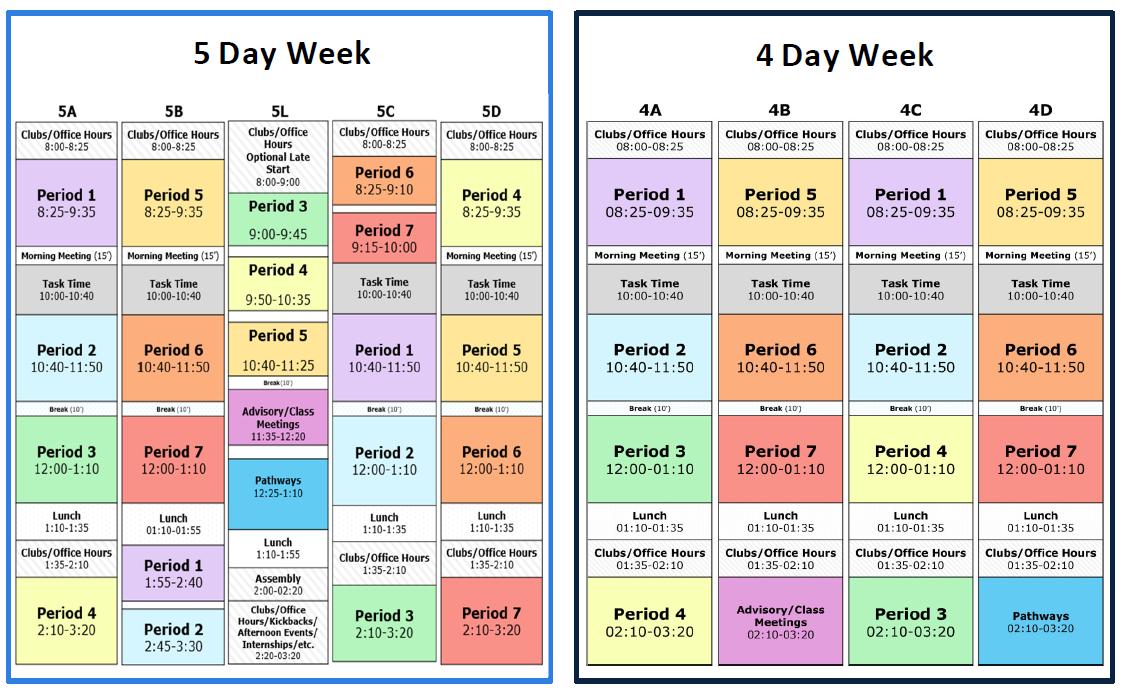
Course Load: Students take 5–7 classes per trimester, choosing from 120+ courses across electives, honors, and advanced offerings. Students design an academic experience that fits their goals.
Class Schedule: Courses meet three times a week for 185 total minutes (2×70 min + 1×45 min). Supporting deep learning and meaningful engagement.
Morning Meeting: A daily tradition that builds community through announcements and shared moments. 5L Assemblies provide extended programming and community events.
Task Time: Dedicated work periods where all teachers are available and students have open time for study and collaboration.
Advisory: Small advisory groups (8–12 students) meet with a faculty advisor who supports them throughout all four years. Advisory fosters wellbeing, academic growth, and strong community bonds.
Pathways: Grade level programs (First-year Survey, Sophomore Forum, Junior Initiative, Senior Seminar) focused on skills, exploration, and postsecondary readiness.
Well-being: Intentionally woven into the school design through LEAP Day late starts, Task Time, student clubs, and balanced assessment practices, all encourage healthy learning habits.
Families never have to choose between academic excellence and student well-being; both are provided by our people and schedules.
We are committed to fostering a love of learning through a diverse and dynamic academic curriculum. With over 120 courses offered, we begin with a solid foundation across all academic disciplines, ensuring that students develop a well-rounded base of knowledge. As our students progress through their education, they are empowered to explore their passions and curiosity through an expanding range of electives. Our approach is designed to support and challenge each student, offering differentiation through honors and advanced courses, independent research, and internships. This personalized approach allows students to craft their own unique academic journey, keeping them engaged, inspired, and prepared for the future.

At Wellington, every course we offer fosters appropriate challenge and intellectual engagement. Honors and Advanced courses are designed for students ready for deeper levels of independence and sophistication in specific disciplines. Wellington’s honors and advanced courses require department approval and students pursuing three or more per trimester must first consult their teachers, advisor, and families. No courses are weighted at Wellington.
Honors courses generally run parallel to foundational offerings (e.g. Algebra 2 and Honors Algebra 2) and can be both trimester- or yearlong classes. Honors courses explore complementary skills and concepts to standard classes but extend student thinking through greater expectations of contentspecific expertise and mastery of higher-level critical thinking skills.
Advanced courses prioritize deep disciplinary training and sophisticated levels of inquiry; these courses are built to challenge students with rich, authentic, university-level learning experiences in a yearlong course. Nearly all Advanced courses culminate in the opportunity to take Advanced Placement Exams in specific subjects. While we do not offer AP-branded courses, our Advanced Courses prepare students exceptionally well for AP exams, and we administer over 100 exams each spring. Because our curriculum extends beyond AP boundaries, students also have access to advanced offerings such as Multivariable Calculus, Linear Algebra, and more. Courses aligned with potential AP exam preparation are marked with the A-Star logo.
Wellington students have recently taken the following AP exams:
Biology
Calculus AB
Drawing
Microeconomics
English Language & Composition Music Theory
Calculus BC English Literature & Composition
Chemistry
Chinese Language & Culture
French Language & Culture
Human Geography

Psychology
Spanish Language & Culture
Physics 1 Statistics
Physics C: Electricity & Magnetism US Government & Politics
Physics C: Mechanics US History
Computer Science A Macroeconomics Precalculus
Advanced Courses
Advanced Biology
Advanced French Advanced Multivariable Calculus
Advanced Spanish
Advanced Calculus AB Advanced Government
Advanced Calculus BC
Advanced Language & Composition
Advanced Musical Studies Advanced Statistics
Advanced Physics
Advanced Chemistry Advanced Latin Advanced Precalculus
Advanced Computer Science: Objectoriented Programming
Advanced Economics
Honors Courses
Advanced Literature & Composition
Honors Algebra 2 Honors French
Honors Art History Honors Geometry
Honors Enduring Questions: Literature & Justice
Honors Great Books: The Tempest
Honors English 9 Honors Humanities 9
Honors English 10 Honors Immunology
Advanced Psychology & Neuroscience
Advanced Studio Art & Design
Advanced US History
Advanced Vocal Ensemble
Honors Integrated Science 2
Honors Latin: Catullus & the Roman Relationship
Honors Latin: Lives of Caesars
Honors Physics: Electricity & Magnetism
Honors Physics: Energy & Rotational Motion
Honors Physics: Waves & Optics
Honors Latin: Roman Drama Honors Political Theory
Honors Notable Authors: James Baldwin Honors Spanish
Wellington also supports students pursuing research and internships through Independent Humanities Research (IHR) and Independent Science Research (ISR).
Wellington offers an innovative curriculum designed to engage students as they prepare for the future. Today, many of the world’s challenges and opportunities appear at the interface of academic disciplines. We are proud to offer several courses that straddle the lines of content and skills, creating unique opportunities for our students. The following courses are cotaught by two teachers. Some courses grant graduation requirements in multiple departments, and others allow students to choose where they apply their earned credits.
• Advanced Economics, 0.67 credits History and 0.33 credits Mathematics
• Advanced Psychology and Neuroscience, 0.67 credits History and 0.33 credits Science
• Art History, 0.33 credits History or 0.33 credits Visual Arts

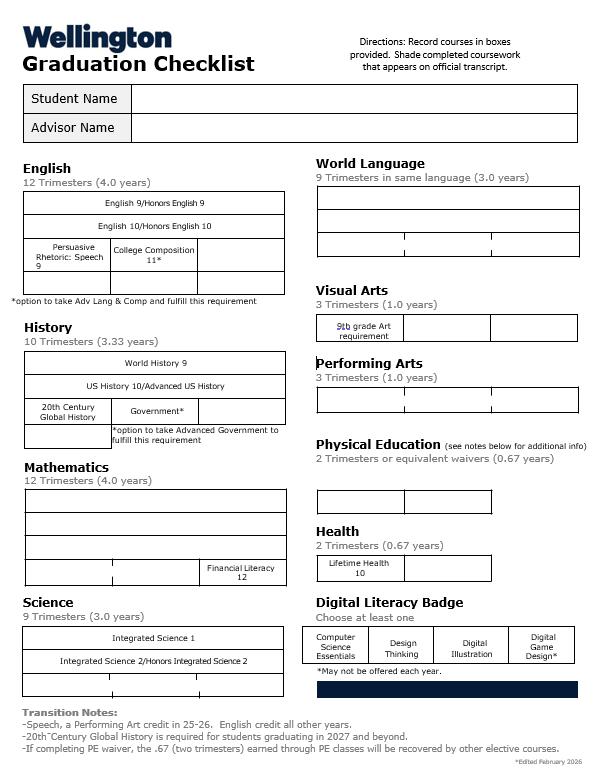
The State of Ohio requires a minimum of twenty units in specific subjects. Wellington students meet and exceed these requirements. Public schools in the State of Ohio require a demonstration of competency through standardized testing and a demonstration of readiness through graduation seals. Independent schools, like Wellington, are exempt from state testing and seals. Wellington graduation requirements:
• 4.0 years of English
• 3.33 years of History
• 4.0 years of Mathematics
• 1.0 year of Performing Arts
• 0.67 years of Physical Education
• 0.67 years of Health
• 3.0 years of Science
• 1.0 year of Visual Arts
• 3.0 years of World Languages
• 0.33 years of Digital Literacy
With more than 120 courses, Wellington works hard to accommodate as many student requests as possible, though it is not always feasible to create a perfect schedule for every student. Course offerings depend on projected enrollment, and courses with insufficient interest may be adjusted or canceled; in such cases, students will receive support in selecting an alternative. Because course requests guide staffing and section planning, students are expected to make thoughtful, committed choices during the course request process.
As technology rapidly evolves, and many future careers have yet to be invented, students must be skilled in working with emerging tools and the design process. To prepare them, Wellington requires all students to complete a Digital literacy credit through courses in computer science, programming, logic, and digital design. Additional offerings introduce students to software such as Adobe Photoshop, Illustrator, and Procreate, and may use Maker Space’s 3-D printer, laser cutter, and other fabrication tools. Wellington also embraces the responsible use of AI. Digital Literacy courses help students use AI effectively and ethically, and examples of its application appear across every academic department.

We seek to cultivate a college-going culture that values self-awareness and celebrates individual accomplishments, allowing each student to remain at the center of their own holistic college search.
We consciously strive to be an inclusive college counseling office by honoring each student’s strengths, backgrounds, cultures, and identities and recognizing the ways in which these aspects intersect and impact post-secondary planning. We meet each student where they are in their unique journey and encourage equal access for all students by empowering them to be effective storytellers of their own narratives. We educate students and families about post-secondary possibilities that can effectively support each student’s academic needs and goals and counsel students as they navigate their individual college search and application processes.
College Counseling is a four-year program at Wellington. Students meet with college counseling in their first and second years through small group meetings that encourage them to purposefully structure their high school experiences. Early programming includes reflection activities and surveys through which students come to better understand their personal strengths, cultures, backgrounds, identities, and how these aspects of self affect postsecondary planning. As they move into junior year, small group sessions are supplemented by individual meetings with college counseling. All juniors take a college composition course and participate in the Pathways college counseling curriculum through which they begin initial work on college applications, resumes, and personal essays. With the one-on-one support of the college counselors, juniors begin identifying schools that will match their personal, academic, and familial needs and continue to celebrate their individual identities. Senior year continues to build upon this foundation through summer essay workshops, supplemental enrichment sessions, and dedicated application and essay work time. Students participate in regular group programming and receive individual support that ensures they are moving forward along their individual timelines and pathways. Collaboration with admissions officers and Wellington alumni allows for enrichment opportunities that further empower seniors in discerning their future goals and aspirations.
• Application case studies
• Resume development
• Common Application foundations
• Alumni networking and career exploration
• College research project
• Continued support on college applications
• Essay workshops/feedback sessions
• Campus life/academic success workshops
• Mock admission interviews
• Financial aid and college affordability
With decades of combined experience in the field of college admissions and college counseling, Wellington’s team is dedicated to supporting each student and family through their individual journeys. We are active members of the Association of College Counselors in Independent Schools, National Association for College Admission Counseling, and Ohio Association for College Admission Counseling, and strive to stay at the forefront of admissions trends and movements in order to most effectively advise our students and families.
Allegheny College
American University of Paris
Amherst College
Arizona State University
Babson College
Belmont Abbey College
Belmont University
Berry College
Boston College
Bowling Green State University
Bryn Mawr College
Butler University
California Lutheran University
Capital University
Carleton College
Carnegie Mellon University
Case Western Reserve University
Cedarville University
Central Connecticut State University
Champlain College
Chatham College
Claremont McKenna College
Clemson University
Coastal Carolina University
College for Creative Studies
College of Charleston
College of William and Mary College of Wooster
Colorado State University
Columbus State Community College
Concord University
Connecticut College
Dallas College
Dartmouth College
Denison University
DePaul University
Drexel University
Duquesne University
Elon University
Embry-Riddle Aeronautical University
Emerson College
Fordham University
Garrett College
George Washington University
Georgetown University
Harvard University
Harvey Mudd College
Heidelberg University
High Point University
Indiana University
Indiana University of Pennsylvania
Kalamazoo College
Kent State University
Kenyon College
Lindenwood University
Loyola University Chicago
Macquarie University
Marietta College
McGill University
Mercyhurst University
Miami University
New York University
North Carolina A&T State University
Northeastern University
Northwestern University
Oberlin College
Ohio Dominican University
Ohio State University
Ohio University
Ohio Wesleyan University
Oklahoma City University
Otterbein University
Pace University
Pennsylvania State University
Pitzer College
Princeton University
Purdue University
Rhodes College
Rice University
Rollins College
Rose-Hulman Institute of Technology
Saint Mary's College
San Diego State University
Sarah Lawrence College
Smith College
St. John's College
Swarthmore College
Syracuse University
Taylor University
Tiffin University
Tufts University
University of Arizona
University of CaliforniaBerkeley
University of California - Irvine
University of California - San Diego
University of Cincinnati
University of Dayton
University of Florida
University of Georgia
University of Illinois at UrbanaChampaign
University of Miami
University of Michigan
University of Notre Dame
University of Pennsylvania
University of Pittsburgh
University of Richmond
University of South Carolina
University of St. Andrews
University of Tampa
University of Tennessee
University of Tulsa
University of Utah
University of Vermont
University of Washington
Vanderbilt University
Vassar College
Virginia Commonwealth University
Virginia Military Institute
Wake Forest University
Washington & Jefferson College
Washington University in St. Louis
Williams College
Wittenberg University
Xavier University
Xavier University of Louisiana
Yale University
The Wellington English Department cultivates flexible, critical, and empathetic practitioners of the English language.
Philosophy
Canadian author Margaret Atwood once said, “Reading and writing, like everything else, improve with practice. And, of course, if there are no young readers and writers, there will shortly be no older ones.” The Wellington English department is committed to providing students with a diverse array of literature, a process of reflective writing, and inquiry-based discussions that guide students toward finding their own voice, understanding differing perspectives, and becoming more curious and empathetic thinkers. Students develop these critical thinking skills through the five domains of language: reading, writing, speaking, listening, and viewing.
ENGLISH 9: STORIES IN PROSE AND VERSE
1 English Credit NCAA
1 Year
PREREQUISITE: None
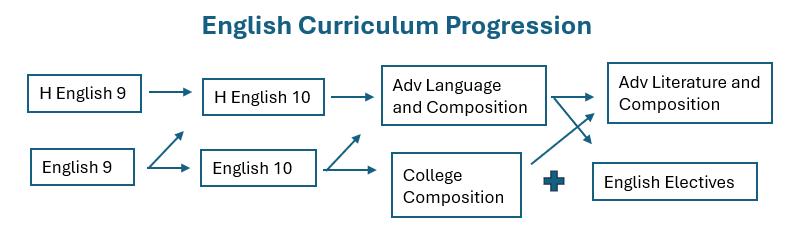
English 9 focuses on developing students’ skills as close readers and analytical writers through the study of short stories and poetry. Students will read both canonical authors and contemporary writers, examining the enduring human themes that appear across literary traditions, historical periods, and cultures. In addition to practicing literary analysis, students will write for a variety of audiences and purposes, building awareness of how audience and intention shape effective writing.
The course also includes a review of foundational English grammar and mechanics, as well as an introduction to MLA formatting and citation practices.
HONORS ENGLISH 9
1 English Credit NCAA 1 Year
PREREQUISITE: Department Approval
English 9 Honors covers all of the essential skills and content of English 9 while offering a faster pace, additional reading, and greater depth of analysis. In addition to studying short stories and poetry, students will engage with longer prose narratives, allowing for sustained close reading, increased independence, and deeper critical thinking. Writing expectations are similarly elevated: alongside analytical and creative writing, students will complete an additional research-based paper that emphasizes source evaluation, integration, and proper citation.
1 English Credit NCAA 1 Year
PREREQUISITE: English 9 or Honors English 9
English 10 builds on the close reading and analytical writing skills developed in English 9, asking students to engage more deeply with complex texts and ideas related to American identity and the American Dream. Students will consider how writers use syntax, diction, and tone to shape meaning and effect, and will apply that same attention to craft in their own writing. Continuing the practice of writing for a variety of audiences and purposes, students will curate a polished portfolio of their strongest work over the course of the year.
HONORS ENGLISH 10
1 English Credit NCAA 1 Year
PREREQUISITE:
English 9 or Honors English 9; Department Approval
English 10 Honors covers all of the essential skills and content of English 10 while offering a faster pace, additional reading, and greater depth of analysis. In addition to studying keystone narratives about American identity, students will engage with critical nonfiction texts, allowing for further interdisciplinary study, increased independence, and deeper critical thinking. Writing expectations are similarly elevated: alongside analytical and creative writing, students will complete an additional research-based paper that emphasizes source evaluation, integration, and proper citation.
PERSUASIVE RHETORIC: SPEECH (Required for 9th grade students)
1/3 English Credit NCAA 1 Trimester
PREREQUISITE: None
A foundational first-year course that immerses students in the art of effective communication. Through hands-on exercises, students will master the fundamentals of crafting compelling speeches, honing their public speaking skills, and delving into the rich world of dramatic literature. With Shakespearean classics, students will analyze and interpret texts while learning to articulate their insights on the page and in front of an audience. Get ready to discover the power of words and the thrill of performance in this dynamic course designed to unleash your voice.
COLLEGE COMPOSITION (required 11th grade, unless taking Adv Language & Composition)
1/3 English Credit NCAA 1 Trimester
PREREQUISITE:
English 10 or Honors English 10
College Composition gives students the skills and confidence needed for success in a college-level classroom while tackling an essential element of the college application process: the personal statement. Students refine their research skills and gain greater facility with both MLA and APA formatting styles. They also review advanced grammar and punctuation, focusing on skills commonly
tested on standardized exams. The course culminates in the composition and revision of their personal statement for their college application.

1 English Credit NCAA 1 Year
PREREQUISITE:
English 10 or Honors English 10; Department Approval
This course focuses on written rhetoric as both an academic discipline and a lifelong skill. Students will analyze a broad range of nonfiction texts drawn from different historical periods, disciplines, and rhetorical situations in order to understand how purpose, audience, and context shape effective communication. The course is organized by thematic units that encourage sustained inquiry into personal, cultural, and societal issues, giving students opportunities to craft well-reasoned arguments grounded in careful reading and reflection. As part of the course’s emphasis on authentic, real-world writing, students will also compose and revise their own personal statement for their college application. While the course offers strong preparation for the AP Language and Composition exam, its broader aim is to cultivate articulate, confident writers whose abilities extend far beyond any single assessment.
1 English Credit NCAA 1 Year
PREREQUISITE:
English 10 or Honors English 10; Department Approval Open to Seniors
This course offers an intensive study of imaginative literature. Students will examine a range of literary forms drawn from diverse historical periods and global traditions, including novels, plays, poetry, and short fiction. Students will analyze how literary elements such as plot structure and figurative language contribute to meaning, while also engaging with key theoretical approaches to literary study, including structuralism, deconstruction, Marxism, and postcolonial criticism. Students will learn multiple ways of thinking about texts and their cultural, historical, and ideological contexts, and through seminar-style discussions and analytical projects, they will develop the ability to articulate how and why authors make particular formal and thematic choices. While this course offers strong preparation for the AP Literature and Composition exam, its primary aim is to cultivate independent, intellectually curious readers and writers who are prepared to engage deeply with literature at the college level and beyond.
CREATIVE WRITING: FICTION
1/3 English Credit
NCAA 1 Trimester
PREREQUISITE:
English 10 or Honors English 10
A deeper understanding and appreciation of literature often comes from practicing the craft of its creation. By trying their own hand at writing, students also begin to discover their individual voices. In Fiction Writing, students study how storytellers build compelling narratives through character, setting, point of view, plot structure, and dialogue. Students will read a range of works through the lens of fiction examining how writers make choices about content and form. Writing workshops, peer feedback, and revision are central components of the course. By the end of the trimester, students will produce a modest portfolio of original short fiction that demonstrates their growth as storytellers.
CREATIVE WRITING: POETRY
1/3 English Credit
NCAA 1 Trimester
PREREQUISITE: English 10 or Honors English 10
A deeper understanding and appreciation of literature often comes from practicing the craft of its creation. By trying their own hand at writing, students also begin to discover their individual voices.
In Poetry Writing, students explore a wide range of poetic forms, from free verse to sonnets, odes, and contemporary experimental structures. They study the elements that shape powerful poetry, including imagery, metaphor, rhythm, sound, line breaks, and voice. Students will read a range of works through the lens of poetry examining how writers make choices about content and form. Writing workshops, peer feedback, and revision are central components of the course. By the end of the trimester, students will produce a modest portfolio of polished poems that reflect their growth as writers.
AND VOICES:
1/3 English Credit NCAA 1 Trimester
PREREQUISITE: English 10 or Honors English 10
In this course, students will read and analyze samples from the iconic masters of the genre, as well as contemporary detective writers who challenge its norms and traditions. We will look at the detective story from literary, philosophical, and historical perspectives. What about the detective story that appeals to humanity across time and space? What do all detective stories have in common? How do these stories reflect the time periods in which they were created, and how do modern detective writers both honor and disrupt expectations for the genre by looking at it through the lens of class, race, and gender? This course will culminate in a project where students create their own model detective for a series.
1 English Credit NCAA 1 Trimester
PREREQUISITE: English 10 or Honors English 10
Some of life’s deepest questions refuse to disappear, and writers across time and cultures return to them again and again. In this course, students explore one enduring human theme through close reading, discussion, and comparative analysis. In Dystopias, students will examine how authors use imagined societies, marked by surveillance, lost freedoms, or technological overreach, to comment on real-world issues and human behavior. The course culminates in a final project that offers students a range of creative and analytical options for demonstrating what they have learned and how their thinking has evolved.
1/3 English Credit NCAA 1 Trimester
PREREQUISITE: English 10 or Honors English 10
In this course, students will explore either a lesser-known literary genre or the work of writers from traditionally marginalized communities. The class examines how literary genres are defined, how their conventions develop, and how writers both work within and challenge the tropes of the genres they choose. Students will also consider how and why certain voices have been historically silenced or overlooked, and what these works reveal about lived experiences, cultural identity, and the human condition. Through close reading, discussion, and analysis, students will develop a deeper understanding of literature’s ability to both reflect and reshape the world in which it is written. Past topics for this course have included The Detective Story, Sports Literature, Memoirs, Women in Science Fiction, and Indigenous Voices.
1/3 English Credit
NCAA 1 Trimester
PREREQUISITE: English 10 or Honors English 10
Some works of literature capture the attention of a generation almost instantly, sparking widespread conversation and debate. But what, exactly, makes a book a contemporary “hit”? In this course, students will read and analyze in depth a single influential modern work of literature, examining the qualities that have earned it broad recognition and cultural relevance. Through close textual analysis, students will explore the author’s background and the social, cultural, and political forces shaping
the work’s creation and reception. The class will also engage with contemporary criticism and reader responses, considering how the text has been interpreted in real time and how its meaning may continue to evolve. Example texts include The Poisonwood Bible by Barbara Kingsolver and A Confederacy of Dunces by John Kennedy Toole.
VOICES:
1/3 English Credit
NCAA 1 Trimester
PREREQUISITE: English 10 or Honors English 10
Using Amanda Montell’s Cultish: The Language of Fanaticism, students will begin this course with an overview of what defines an organization as a cult. We will then move on to discussion of how language is used to attract and sustain a cultish group, as well as how the behaviors of the group move from innocent community-building to sometimes disastrous results. While we will study a few groups together as a class, students will choose a group to research for the trimester, and the final project will be based around evidence of language and behaviors used to control groups of people.
1/3 English Credit
NCAA 1 Trimester
PREREQUISITE: English 10 or Honors English 10
With the advent of social media and technology, modern society has fallen into a pattern of basing opinions about controversial topics off of short snippets of information, often failing to dive deeply into the intricacies of these topics. This course will give students the opportunity to use nonfiction works to research several angles of a topic and will then use Glenn Singleton’s work around Courageous Conversations to ground class discussions. Class size will be limited to ensure a more intimate setting for courageous conversations and civil discussion.
1/3 English Credit
NCAA 1 Trimester
PREREQUISITE: English 10 or Honors English 10
Major works have been created against the backdrop of one of history’s darkest times: the Holocaust. Students read works of nonfiction and view relevant films in an attempt to understand the diverse stories that Nazi Germany could not silence. Students will also study historical instances of genocide throughout the world and strive to answer the question of why the cry of “Never again” remains unfulfilled.
1/3 English Credit NCAA 1 Trimester
PREREQUISITE: English 10 or Honors English 10; Department Approval
Some of life's deepest questions refuse to disappear, and writers across time, cultures, and literary traditions have returned to them again and again. In this course, students will explore one enduring human theme or "big question" through multiple literary works. Through close reading, discussion, and comparative analysis, students will consider how an author's background and worldview shape their treatment of the theme. In this honors section, students will engage with more complex and challenging texts, complete a greater volume of reading, and produce more extensive written work. Past themes have included Literature and Justice, Philosophy in Literature, and The Meaning of Life.
1/3 English Credit
NCAA 1 Trimester
PREREQUISITE: English 10 or Honors English 10; Department Approval
Some works of literature are so enduring that they hardly need an introduction. But what, exactly, makes a book “classic”? In this course, students examine a single canonical text through close reading, author study, and exploration of historical and cultural contexts. They also engage with literary criticism to understand how interpretations of the work have evolved over time. This course features Shakespeare’s The Tempest, students explore themes of power, illusion, colonization, and forgiveness while considering how the play reflects the politics and imagination of the early 1600s. They analyze Shakespeare’s language, dramatic choices, and the play’s long history of reinterpretation to understand its continued relevance.
HONORS NOTABLE AUTHORS: JAMES BALDWIN
1/3 English Credit NCAA 1 Trimester
PREREQUISITE: English 10 or Honors English 10; Department Approval
While there is value in reading widely across many authors, there is also value in spending sustained time with a single creative voice. This course offers an in-depth study of one author's body of work, examining how that writer's life experiences, historical moment, and artistic influences shape both subject matter and style. Students will trace recurring themes and concerns, asking what questions or ideas the author returns to again and again. In this honors section, students will engage with authors whose work is more challenging in content and style, complete a greater volume of reading, and produce more extensive written work. Past authors studied in this course have included Edgar Allan Poe, Gabriel García Márquez, and James Baldwin.
The Wellington History Department helps students foster a global understanding of the past and present; gain an appreciation for the complexity of a diverse society; and understand the world and its problems, as well as various approaches to addressing those problems.
The Wellington History Department is dedicated to cultivating informed, critical thinkers who understand the complexities of the past and its relevance to the present. Through courses in World History, U.S. History, American Government, and 20th Century Global History, students develop key research, analytical, and communication skills. Emphasizing inquiry-based learning, students engage with primary and secondary sources, conduct original research, and explore diverse perspectives. The program encourages student voice and active participation, with opportunities to deepen learning through electives and extracurriculars like Model UN, Ohio Youth in Government, and Debatriot Club.
WORLD HISTORY *Required for 9th grade
1 History Credit NCAA 1 Year
PREREQUISITE: None
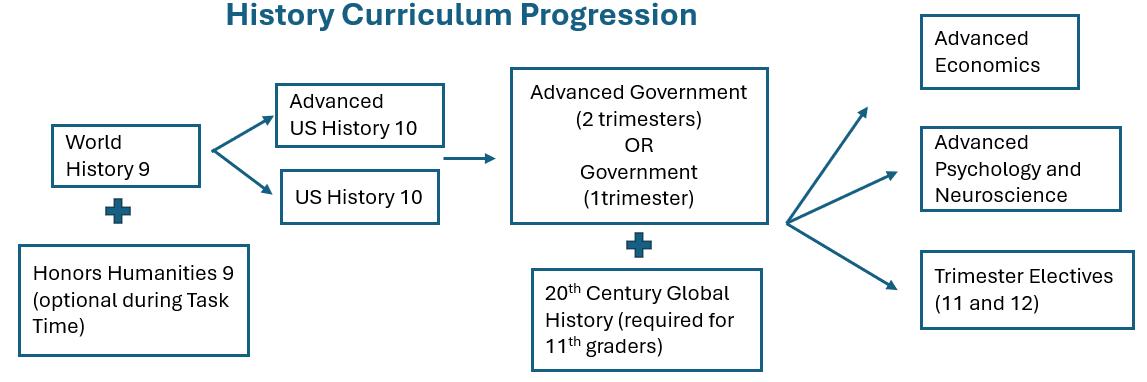
World History engages students in the study of major global eras from approximately 500 CE to 1900 CE, spanning the Middle Ages through the Age of Revolutions. Through a comparative, global lens, students examine how societies from different regions connect and collide through exchange, conflict, and cooperation, and how the values and decisions of past cultures shaped the modern world. The course emphasizes discussion-based learning, with frequent Socratic seminars that challenge students to analyze historical evidence, consider multiple perspectives, and articulate their thinking. Students work closely with primary source materials and develop essential reading, writing, research, and presentation skills. This course is required for graduation and provides a foundation for critical thinking and further historical study.
HONORS HUMANITIES 9: PANDEMICS AND PEOPLES
1/3 Non-departmental Credit NCAA
1 Year: will meet during agreed upon Task Time days
PREREQUISITE: History and English Department Approval
Honors Humanities is an interdisciplinary course for First Year students that challenges students to think critically and draw meaningful connections among literature, history, and the broader human experience. The course meets twice weekly outside of students’ regular schedules. Throughout the year, students engage closely with both literary and historical texts, producing reflective and analytical writing as well as a culminating project. Guided by the essential question: How do societies respond to pandemics, and how are individuals and cultures transformed by these crises? Using Albert Camus’s, The Plague as a thematic anchor, students will examine historical outbreaks including the Black Death and COVID-19 to draw conclusions about the societal structures that shape, and are reshaped by, public health crises.
US HISTORY *Required for 10th grade
1 History Credit NCAA
1 Year
PREREQUISITE: World History
US History is a survey course of the United States from colonization to the present. This course provides students with an understanding of the key ideas and events that shaped the development of the United States. Class activities are designed to strengthen a student’s ability to think clearly and critically, to ask significant questions and research the answers, to read historical materials intelligently, and to express their ideas in a logical, concise manner. This course is required for graduation.
ADVANCED US HISTORY
*Required for 10th grade if not taking US HISTORY
1 History Credit
NCAA 1 Year
PREREQUISITE:
World History and Department Approval
Advanced U.S. History is a yearlong course designed for students who want to engage more deeply with the ideas, events, and debates that have shaped the United States from colonization to the present while preparing for the AP U.S. History examination. Through close analysis of primary sources and an emphasis on historical thinking skills, the course explores how political, social, economic, and cultural forces have shaped the nation’s development. Students construct and defend historical arguments through analytical writing, regular practice with document-based questions (DBQs), and sustained discussion across perspectives. Throughout the course, students are asked not only to understand what happened in U.S. history, but to explore, analyze, and evaluate why events unfolded as they did and how their consequences continue to shape American society. Students have the option of taking the Advanced Placement United States History examination at the end of the year.
GOVERNMENT *Required for graduation
1/3 History Credit
NCAA 1 Trimester
PREREQUISITE: US History
The study of US government is the focus of this course with particular emphasis placed on the structure of the Constitution and its principles. We will examine each branch of government using the branches’ official websites and materials to explore historic and current topics. Throughout our study, we will consider the civic roles of Americans and the concept of government by the people.
ADVANCED GOVERNMENT
2/3 History Credit (meets Government requirement)
NCAA 2 Trimesters
PREREQUISITE:
World History, US History or Advanced US History, and Department Approval
Advanced Government is a two-trimester course designed for students who want to engage more deeply with the structure, principles, and practice of American democracy while preparing for the AP U.S. Government and Politics examination. Anchored in constitutional principles and foundational documents, the course examines how the branches of government interact, how civil liberties and civil rights are protected and contested, and how political beliefs, ideologies, and participation shape public life. Students regularly work with primary sources, Supreme Court decisions, data sets, alongside historic and current events to understand how political concepts operate beyond the textbook. Emphasis is placed on evidence-based reasoning, clear and structured argumentation through free-response writing, and thoughtful disagreement through discussion. Throughout the course, students are asked not only to understand how government is designed to function, but to explore, analyze, and evaluate how those principles are applied in practice. Students have the option of taking the Advanced Placement Government and Politics examination at the end of the year.
20TH-CENTURY GLOBAL HISTORY *Required for graduation
1/3 History Credit
NCAA 1 Trimester
PREREQUISITE: US History or Advanced US History
This course examines the pivotal events, movements, and transformations of the twentieth century that shaped the modern world. Through close engagement with primary sources, scholarly readings, documentaries, and sustained discussion, the course investigates the causes and consequences of major political, social, and economic developments of the twentieth century. Emphasis is placed on historical shifts and enduring patterns, as students analyze how institutions, ideas, and global relationships evolved over time. By situating contemporary issues within a broader historical
framework, students will develop strong analytical skills and a nuanced understanding of the forces that have shaped the modern world.

1 Credit: 2/3 History and 1/3 Math Credits NCAA 1 Year
PREREQUISITE:
US History or Advanced US History, Algebra 2 or Honors Algebra 2, and Department Approval
Economics shapes the world around us, from the daily choices we make (is my $6.95 Starbucks really worth it?) to the headlines we read about inflation, the tech industry, and global markets. This yearlong course begins with the principles of microeconomics, focusing on how decisions are made in the marketplace. Students will explore foundational concepts like scarcity, the power of trade, supply and demand, policy, and externalities. The course then transitions to macroeconomics, examining economy-wide trends such as GDP, inflation, government roles, and financial institutions. Our goal is to move beyond traditional concepts and embrace both the art and science of economics. Students will explore the history of economic thought, engage with cutting-edge behavioral economic research, and analyze current economic trends and challenges. From studying the role of artificial intelligence in the labor market to examining the effects of trade policies and environmental initiatives, students will connect theory to practice. Interactive activities and simulations, including the ever-popular stock market simulation game, will bring economic concepts to life. By the end of the course, students will be equipped with the tools to critically analyze complex economic issues and confidently participate as informed citizens in a dynamic, global economy. Students have the option of taking the Advanced Placement Economics examination at the end of the year.
ADVANCED PSYCHOLOGY AND NEUROSCIENCE
1 Credit:
1/3 Biological Science and 2/3 History Credit NCAA 1 Year
Meets Laboratory Science Requirements: YES (1/3 credit)
PREREQUISITE: Integrated Science 1 & 2, US History, and Department Approval
Psychology is a broad discipline with ties to both the social and natural sciences. As such, this course is taught by both science and humanities faculty. Advanced Psychology and Neuroscience introduces students to the systematic and scientific study of the behavior and mental processes of human beings and other animals. To fully understand psychology and behavior, it is critical to have a thorough understanding of the physical and biological processes occurring within the brain. The course covers content discussed in a first-year psychology course and uses a college-level text. The first trimester focuses on psychological research methods and neurobiology. The second and third trimesters then build upon the biological basis of neuroscience to further explore psychological facts, principles, and phenomena associated with each of the major subfields within psychology.
HONORS ART HISTORY
1/3 History Credit or 1/3 Visual Arts Credit 1 Trimester
PREREQUISITE: US History or Advanced US History
In this course, art is used as a lens through which to examine history, culture, and human experience. This trimester-long course takes a focused, in-depth approach, allowing students to spend extended time with a select group of artistic traditions. Students study the art of the Maya, the Italian Renaissance, and the Baroque period, exploring how artistic techniques, materials, and styles reflect the historical, cultural, and socio-economic contexts in which they were created. The course emphasizes close analysis of composition, form, and historical context, with frequent discussion and
debate about the role of art within each society and time period. This is a highly hands-on, inquirydriven course in which students actively engage with artworks and ideas. Students ultimately apply their learning by curating their own exhibit centered on a historical event, movement, or time period, demonstrating their ability to interpret art as both a reflection of and a response to history.
1/3 History Credit
NCAA
1 Trimester
PREREQUISITE:
US History or Advanced US History
Open to Sophomores with Dept Approval
You have studied Dr. Martin Luther King Jr. but what about Bayard Rustin, Fannie Lou Hamer, or Thurgood Marshall? This course examines the struggle for civil rights in the United States from the nation’s founding to the present, with a focus on lesser known but pivotal figures who shaped the movement. This course will explore the foundations of rights and inequality in early American history, including Enlightenment ideals, slavery, and abolition. It then traces the evolution of civil rights through Reconstruction, the rise of Jim Crow, and a focused study of the Civil Rights Movement of the 1950s and 1960s, emphasizing grassroots activism, legal change, and cultural shifts. Finally, the course explores the expansion of civil rights since the 1970s, examining how the movement broadened to address the rights of a wide range of marginalized groups and how these struggles continue to shape American democracy today.
1/3 History Credit
NCAA
1 Trimester
PREREQUISITE:
US History or Advanced US History
Open to Sophomores with Dept Approval
This course is designed to help students learn the essential history and beliefs of world religions. Comparative Religions recognizes the importance of religion in history and in the lives of individuals. It is designed to allow students to gain knowledge of and respect for the religions and belief systems of the world. Through a comparative approach, students will explore the similarities and differences among major religious traditions, examining how each addresses fundamental questions about morality, the afterlife, and the divine. The course emphasizes the reading and analysis of primary sources, allowing students to engage with sacred texts, historical documents, and religious interpretations within their historical contexts. As the year progresses, students will apply their understanding by analyzing a contemporary global issue through the lens of multiple religious perspectives, gaining insight into how religious traditions shape modern ethical, social, and political debates.
1/3 History Credit
NCAA 1 Trimester
PREREQUISITE:
US History or Advanced US History
Open to Sophomores with Dept Approval
Geography is designed to expand knowledge of the physical, political, cultural, and economic geography of the world. Students study people, places, and environments at local, regional, national, and international levels from various perspectives of geography.
1/3 History Credit
NCAA 1 Trimester
PREREQUISITE:
US History or Advanced US History
Open to Sophomores with Dept Approval
This course examines women’s lives throughout American history, placing them at the center of our interpretation. Students will consider the social, political, cultural, and economic histories of women in the United States, paying attention to how women have played active roles in shaping American history and society. The class contemplates primary sources and cultural evidence including novels, music, art, and film throughout the course. The course is designed to ultimately consider the idea of
feminism and “unpack the F word” by following the evolution of the word itself along with the movements surrounding feminism.
1/3 History Credit
NCAA 1 Trimester
PREREQUISITE:
US History or Advanced US History
The Making of American Foreign Policy examines how the United States makes decisions on the global stage by exploring the institutions, actors, and forces that shape the intention and direction of American foreign policy. Students will begin by analyzing the formal structure of policymaking including the roles of the president, Congress, the military, intelligence agencies, and public opinion before engaging in a focused study of the Cold War through the lens of the Vietnam War and reading The Things They Carried. This combined historical and literary case study allows students to examine how strategy, ideology, uncertainty, and human experience intersect in moments of decision-making. By the end of the trimester, students will apply these insights to contemporary global issues, developing a deeper appreciation for the complexity, trade-offs, and lasting consequences of American foreign policy choices.
1/3 History Credit
NCAA
1 Trimester
PREREQUISITE:
US History or Advanced US History
Open to Sophomores with Dept Approval
This course is designed to encourage critical thought and expand knowledge concerning issues and events that are occurring during the time of the course. Through discussions, readings, research, and presentation of issues, students learn to analyze the facts of current events, considering their implications on society.
1/3 History Credit
NCAA 1 Trimester
PREREQUISITE:
US History or Advanced US History
Honors Political Theory is designed to provide students with a comprehensive understanding of Western political philosophy, tracing its evolution from classical antiquity to the modern era. Through close readings of primary sources and dynamic discussions, students will explore foundational ideas about the development of political institutions, citizenship, and governance. This course emphasizes critical engagement with the works of thinkers such as Plato, Aristotle, Hobbes, Locke, Rousseau, Mill, Marx, and contemporary theorists. Students will compare and contrast diverse perspectives, analyzing how these ideas address enduring questions about justice, freedom, and the role of government in society. Special focus is placed on fostering students' ability to articulate their own political philosophy. This discussion-based course is ideal for students who enjoy reading, debating, and critically examining ideas in an intellectually rigorous and collaborative environment.
1/3 History Credit
NCAA
1 Trimester
PREREQUISITE:
US History or Advanced US History
Race and Identity is designed to encourage critical thought and expand knowledge concerning issues about race and identity in a global context. Students study how race impacts social behavior. The class looks at the origins of the concept of race, and the development, organization, and impact on economic and political institutions through history with an emphasis on today’s world.
Credits May Vary, Department Approval
Length Varies
PREREQUISITE: Department and Academic Dean Approval
Students in this course develop and implement a humanities-related research project. Students are expected to be a part of experimental design, investigation, and information analysis. Each student seeks out an outside expert in the field of their study. Students are required to achieve research benchmarks, meet deadlines, and demonstrate core competencies throughout the year including the writing of an extensive research paper on their topic, and culminating in a presentation to members of the Wellington community. Although this class is an independent study, students are scheduled into a class period and meet periodically with faculty and others in the class. The first trimester has regularly scheduled meetings that focus on qualitative research methods, while the second and third trimesters are focused on implementing the project.
The Wellington Mathematics Department believes that math is the elegant and fundamental language of our universe and is useful for solving various problems and making predictions. Problem-solving lies at the core of mathematics and involves applying learned skills in a wide range of settings, including non-routine, open-ended, and real-world problems.
The Wellington Mathematics Department is committed to fostering curiosity, creativity, and critical thinking as students explore the power and elegance of mathematics. We emphasize clear communication, persistence in problem-solving, and the application of mathematical skills to realworld contexts. As part of a spiraling mathematics curriculum, students engage with statistics and data science concepts that build in complexity from year to year, supporting data-informed reasoning within mathematics and across disciplines. Students develop a deep understanding of mathematical concepts while reflecting on their ethical and social implications, as well as their connections to other subjects and real-world contexts. Through independent and collaborative work, students expand their mathematical knowledge and use technology effectively to solve problems, construct logical arguments, and apply their learning to familiar and unfamiliar challenges.
CALCULATORS: Students are required to have a personal graphing calculator for their courses and college-readiness testing (PSAT/SAT/ACT). We recommend purchasing the NUMWORKS calculator, as it is user-friendly and supports a range of coursework. If a student already has a graphing calculator, we will work with them to ensure they can effectively apply it in their studies.
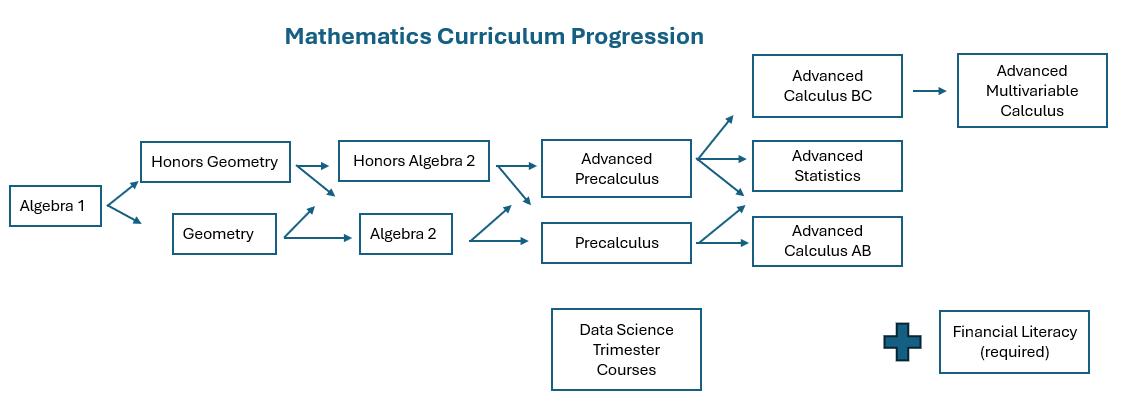
1 Math Credit
NCAA 1 Year
PREREQUISITE: None
This course forms the foundation for all college preparatory mathematics courses. In this course, students review basic algebraic concepts and their applications. Among the topics covered are real number properties, equation solving with one and two unknowns, rational expressions, polynomials, radicals, graphing, introductory statistics concepts, and problem-solving techniques. Students learn to describe the world around them with algebraic expressions, equations, and graphs. Applications, calculators, computers, and other manipulatives provide a context for the abstract language of algebra.
GEOMETRY
1 Math Credit NCAA 1 Year
PREREQUISITE: Algebra 1
This course focuses on problem solving and mathematical communication in a context that further strengthens algebraic skills. Students begin the course with a unit on statistics and data science that builds on prior learning and strengthens their ability to reason with data across contexts. Geometry topics covered include plane geometry, logic, congruence, and similarity. Students will practice using applied algebra to solve ratios and proportions, area and volume, circles, and rightangle and non-right-angle trigonometry. Graphing calculators are not required, but a scientific calculator with trigonometric functions is required; a Numworks calculator is recommended.
HONORS GEOMETRY
1 Math Credit NCAA 1 Year
PREREQUISITE: Algebra 1 and Department Approval
This course emphasizes problem solving, mathematical communication, and logical reasoning. The course moves at a quicker pace and explores topics that require a strong mastery of Algebra 1 concepts to solve. The course begins with a unit on statistics and data science, revisiting and extending prior knowledge while laying a foundation for work throughout the year. Extended geometry topics include proofs, circles, and graphing inverse functions. Compared to the standard Geometry course, Geometry Honors places greater emphasis on proof, abstraction, and multi-step reasoning, with higher expectations for precision, persistence, and mathematical communication. Graphing calculators are not required, but a scientific calculator with trigonometric functions is required; a Numworks calculator is recommended.
1 Math Credit NCAA 1 Year
PREREQUISITE: Algebra 1
This course begins with an exploration of the world of statistics before moving on to emphasize competency and fluency with parent functions, including linear, quadratic, exponential, polynomial, functions with various roots, and logarithmic functions. Students also investigate transformations, compositions, inverses, and applications of these functions. Throughout the course, these relations and functions are studied as tools for modeling real-world situations. The course builds upon the foundation established in Algebra 1, extending key concepts and reinforcing the essential skills needed to progress into higher-level mathematics.
1 Math Credit NCAA 1 Year
PREREQUISITE: Geometry and Department Approval
Honors Algebra 2 covers the same core topics as the standard Algebra 2 course while emphasizing depth of understanding, stronger conceptual connections, and advanced problem solving. Students begin the course with a unit on statistics and data science that builds on prior learning and strengthens their ability to reason with data across a variety of contexts. Throughout the course, students study linear, quadratic, exponential, polynomial, radical, logarithmic, and trigonometric functions, along with their transformations, compositions, inverses, and real-world applications. Additional topics include extended work with matrices, the unit circle, and a more indepth focus on trigonometric ratios and their applications.
This is an advanced, fast-paced, and challenging course designed for students interested in pursuing mathematics, science, or other STEM-related fields. Students regularly use tools such as the NumWorks graphing calculator, laptops, and Desmos to explore concepts and solve complex, real-world problems. Honors courses are intended to be more rigorous than standard courses and provide multiple opportunities for students to take greater responsibility for their learning, with a clear emphasis on the quality and depth of work rather than simply the quantity of work assigned.
1 Math Credit NCAA
1 Year
PREREQUISITE: Algebra 2 or Honors Algebra 2
This yearlong course serves as a culmination of students’ mastery of algebra-based topics and prepares them for calculus, statistics, or other college-level mathematics courses the following year. The course begins with a unit of statistics and data science, building on prior knowledge and emphasizing the use of data to model, analyze, and interpret real-world situations. Students then review and further explore previously studied functions, including polynomial, rational, exponential, logarithmic, and trigonometric functions with an emphasis on deeper understanding, multiple representations, and complex solutions. The course concludes with more advanced topics, including trigonometric identities, sequences and series, probability and combinatorics, and an introduction to limits.
1 Math Credit NCAA
1 Year
PREREQUISITE: Algebra 2 or Honors Algebra 2 and Department Approval
This yearlong course is designed for students prepared to engage with mathematics at a faster pace and in greater theoretical depth than regular precalculus, developing both procedural fluency and conceptual understanding in preparation for calculus, statistics, or other advanced mathematics courses at the honors or AP level. The course begins with a unit of statistics and data science, building
on prior knowledge and emphasizing the use of data to model, analyze, and interpret real-world situations. Students then review and further explore previously studied functions, including polynomial, rational, exponential, logarithmic, and trigonometric functions. Compared to regular Precalculus, this exploration will place a stronger emphasis on complex solutions, further abstraction, and the connections among different families of functions. In addition to the advanced topics in regular precalculus, this course will also study parametric and polar equations in depth and have a more thorough introduction to limits, with an emphasis on reasoning, problem-solving, and conceptual connections across topics. Students have the option of taking the Advanced Placement Precalculus examination at the end of the year.
ADVANCED CALCULUS AB
1 Math Credit
NCAA 1 Year
PREREQUISITE:
Precalculus or Advanced Precalculus and Department Approval
This yearlong course focuses on extending existing algebraic knowledge to differentiation, integration, and their applications in science, business, and the social sciences. This class is intended for most college-bound seniors who expect to study business or the sciences in college. Students have the option of taking the Advanced Placement Calculus AB examination at the end of the year.
ADVANCED CALCULUS BC
1 Math Credit
NCAA 1 Year
PREREQUISITE:
Advanced Precalculus and Department Approval
This full-year, fast-paced course includes all topics from Advanced Calculus AB and extends them to provide a deeper and more comprehensive treatment of differential and integral calculus. Students develop techniques of differentiation and integration and apply them to solve a wide range of problems in science, engineering, economics, and other fields. The course continues with the study of differential equations and the convergence or divergence of infinite series, with an emphasis on conceptual understanding, problem-solving strategies, and mathematical reasoning. A strong foundation in algebra and precalculus skills, as well as a consistent work ethic and persistence in problem solving, are fundamental to success in this course. Students have the option of taking the Advanced Placement Calculus AB or BC examination at the end of the year.
ADVANCED MULTIVARIABLE CALCULUS
1 Math Credit NCAA 1 Year
PREREQUISITE:
Advanced Calculus BC and Department Approval
This yearlong course emphasizes the calculus of multi-variable systems. Working at a challenging college-level pace, students explore various topics including parametric equations, polar coordinates, vectors and surfaces, vector-valued functions, multivariable integration and differentiation, and differential equations. Maple Math Software is used to aid in solutions, modeling, and visualization of complex mathematical systems. A computer capable of running Maple Math Software is required.
ADVANCED STATISTICS
1 Math Credit NCAA 1 Year
PREREQUISITE:
Precalculus or Advanced Precalculus and Department Approval
This full-year course provides opportunities for students to explore and analyze real-world and large datasets, predict patterns and trends, and properly collect samples and design experiments. Students use statistical software and introductory programming to perform calculations, simulate random processes, and visualize data. They then study the foundations of statistical inference. Students
complete multiple projects in which they gather or access data, analyze it using computational methods, draw conclusions through inference, and clearly communicate their findings. Students have the option of taking the Advanced Placement Statistics examination at the end of the year.
1/3 Math Credit
NCAA 1 Trimester
PREREQUISITE: Algebra 2 or Concurrent
This trimester-long course introduces students to data science, beginning with self-generated data and progressing to larger data sets. Students will explore various ways to represent and interpret data, considering the stories data can tell about our community, our state, and ourselves as individuals. They will learn to organize and clean data, examine distributions, analyze measures of center and spread, and create visual representations.
1/3 Math Credit
NCAA 1 Trimester
PREREQUISITE: Algebra 2 or Concurrent
In this trimester-long course, students will explore bivariate data through investigations centered on water usage and prioritization modeling. They will analyze scatter plots, draw lines of best fit, and learn how data scientists determine and interpret these models. They will learn to find data in the Google Data Commons and create dynamic visualizations in Tableau.
1/3 Math Credit
NCAA 1 Trimester
PREREQUISITE: Algebra 2 or Concurrent
This trimester introduces students to fundamental concepts in programming and machine learning through hands-on work in Python. Students use simulations as tools for data analysis and develop machine learning models to make predictions, for example whether they will like a particular song. Alongside the technical work, students examine the broader implications of machine learning, reflecting on its influence on their lives and on society.
LITERACY *Required for graduation
1/3 Math Credit 1 Trimester
PREREQUISITE: Open to Juniors and Seniors
Financial literacy is essential in meeting the challenges of the 21st Century. Understanding and managing personal finance is key to one’s future financial success. This course presents students with the essential knowledge and skills to make informed decisions about real-world financial issues. Through real-life scenarios and hands-on activities, the course explores schooling and career choices, banking, saving and investment options, managing credit and shopping for loans, insurance, taxes, planning for long-term success, and ultimately creating and living within a budget. Ultimately, students will understand how their personal finances and the choices they make as consumers will affect themselves and the world around them.
The Performing Arts Department aims to inspire lifelong appreciation for the arts, encouraging students to become innovative thinkers, passionate performers, and empathetic contributors to their communities.
Philosophy
The Performing Arts program offers classes in band, orchestra, choir, and the dramatic arts. In addition, students are able to enrich their musical experience in advanced ensembles, chamber music, and dramatic productions. We help each student develop an appreciation for the impact of the arts and to support them in their musical journey.
1 Performing Arts
Credit 1 Year
PREREQUISITE: 2 Years Experience on a Band Instrument or Department Approval
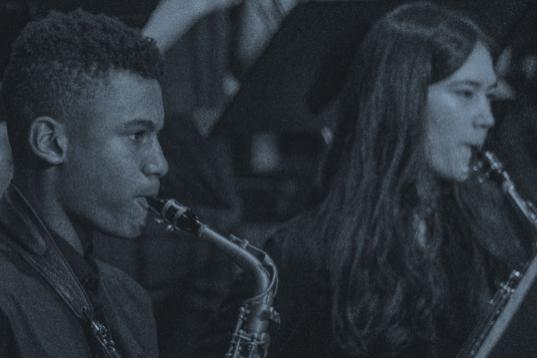
Participation in the upper school band is open to any student with at least two years of previous experience on a band instrument. The class incorporates literature from various genres and from composers from many cultures. In addition, the class focuses on developing each student’s capacity for technique and musicality. Full ensemble concert performances are given in fall, winter, and spring, and students are encouraged to participate in additional performance opportunities including OMEA contests, honor bands, and extracurricular ensembles around central Ohio. Our band occasionally performs at area competitions and plays as a pep band at school functions throughout the year. Attendance is required for all concerts.
1 Performing Arts Credit 1 Year
PREREQUISITE: None
Choir is open to any Upper School student who expresses a desire to sing. Members of the choir meet each class in full rehearsals with occasional task time rehearsals on an as-needed basis near concert time. Students will learn a diverse array of choral music that will challenge them to build upon their knowledge of basic music theory concepts. Students will also learn about the intricacies of vocal techniques to grow as individual and ensemble singers. Members are required to complete a simple voice placement hearing at the beginning of the year and perform in all regular concerts.
1 Performing Arts
Credit 1 Year
PREREQUISITE: 3 Years Experience playing a String Instrument or Department Approval
Participation in the Upper School Orchestra is open to any upper school string player who has at least three years of experience playing the violin, viola, cello, or bass. Ensemble playing is explored with an emphasis on style and proper playing techniques. The concert programs incorporate literature from various genres and from composers from many cultures. In addition, the class focuses on developing each student’s capacity for technique and musicality. Full ensemble concert performances are given in fall, winter, and spring, and students are encouraged to participate in additional performance opportunities including OMEA contests, honor orchestras, and extracurricular ensembles around central Ohio. Attendance is required at all concerts.
1 Performing Arts
Credit Year
PREREQUISITE: Department Approval
Advanced Musical Studies is a yearlong course in which students explore the world of music from multiple perspectives. The course emphasizes foundational music theory, including melody, harmony, rhythm, ear training, and sight-singing. In addition, students examine music within its cultural and historical contexts. Drawing on the seasonal programming of musical organizations throughout Central Ohio, students study selected works and experience them through live performances. This course does not fulfill the Performing Arts graduation requirement.
ADVANCED VOCAL ENSEMBLE
1/3 Performing Arts
Credit
1 Year – will meet during agreed upon Task Time days
PREREQUISITE:
1 Year of Upper School Choir or audition; Students must be concurrently in Choir, Band, or Orchestra; Open to Sophomores, Juniors, and Seniors Advanced Vocal Ensemble is for students who strive for excellence as vocal artists and passionate performers. This course delves into advanced vocal techniques, sight-reading, relevant music theory concepts, and a diverse array of repertoire for performance. The ensemble provides a supportive environment for honing skills and showcasing progress through collaborative rehearsals and performances throughout the year. Student leadership opportunities will be offered. Members of the choir meet each class in full rehearsals with occasional additional task time rehearsals on an asneeded basis near concert time. Members are required to complete a simple voice placement hearing at the beginning of the year and perform in all regular concerts.
1/3 Performing Arts
Credit
1 Trimester
PREREQUISITE:
None
This course increases students’ understanding, appreciation, and critical perceptions of the theatrical event. Through readings, lectures, and hands on activities, we focus on the elements of theatrical practice, artists and innovators of theatre throughout history, and on the theatre’s development as an art form and a social phenomenon. Optional attendance at theatrical events will offer first-hand experience in theatre arts. This course will be offered every year.
DRAMA: ACTING 1
1/3 Performing Arts
Credit
1 Trimester
Offered in 26-27 school year
Offered in 28-29 school year
PREREQUISITE:
None
Acting 1 introduces students to the process of acting, provides a solid foundation in realistic acting technique, and aids in developing the skills for creating a role. Students learn the importance of warming up as an actor; utilize a series of exercises aimed at sharpening the imagination and emotional expression; and develop the actor skills of concentration, attention, relaxation, breathing, playing objectives, and overcoming obstacles. This course will be offered on even school calendar years.
DRAMA: ACTING 2
1/3 Performing Arts
Credit
1 Trimester
Offered 26-27 school year
Offered 28-29 school year
PREREQUISITE: Acting 1
Acting 2 is a movement course designed to prepare students to learn to act. Postural habits are revealed and redirected for the student to develop grounded, centered, and dynamic body use. Various physical techniques are introduced including Viewpoints, relaxation and warmup exercises, and creative movement. Through the process of exploring physical and personal awareness, students develop an aligned, expressive, and efficiently moving body that is more responsive to the needs of their imagination. This course will be offered on even school calendar years.
1/3 Performing Arts
Credit
1 Trimester
Offered 27-28 school year
Offered 29-30 school year
PREREQUISITE: None
This course develops students’ understanding, appreciation, and critical application of technical theatre as both an artistic and collaborative practice. Through demonstrations, lectures, readings, and hands-on production experiences, students explore the fundamental elements of technical theatre, including scenery, lighting, sound, costumes, props, stage management, and backstage operations. Emphasis is placed on the role of technical artists throughout theatre history and on the evolution of technical theatre as an essential component of live performance and storytelling. Students will apply their learning by actively contributing to one of the school’s theatrical productions, documenting their process and completed work in a technical theatre portfolio. This course will be offered on odd school calendar years.
1/3 Performing Arts Credit
1 Trimester
Offered 27-28 school year
Offered 29-30 school year
PREREQUISITE: Acting 1
This advanced course deepens students’ understanding of theatre as a collaborative and generative art form. Through readings, discussions, structured improvisations, and hands-on ensemble work, students explore contemporary devising practices with an emphasis on Moment Work, Viewpoints, and other collaborative composition methods. Working as an ensemble, students will generate, shape, and refine original theatrical material, examining the relationship between movement, space, time, text, and image in performance. The course emphasizes process-driven creation, critical reflection, and shared authorship as students collectively write and develop an original play. Students will analyze the work of influential theatre makers and devised theatre companies while considering theatre’s role as a means of artistic expression and social inquiry. The course culminates in a fully realized original performance created and authored by the ensemble. This course will be offered on odd school calendar years.
The Wellington Physical Education Department promotes the "joy of effort" in physical activities and provides an element of fun and enjoyment through participation in physical activities and fitness.
Philosophy
The Physical Education program provides coeducational instruction that encourages participation for students in suitable and healthy environments. The curriculum provides students with the opportunity to attain levels of skill development that will allow them to participate competently in physical activities. In Physical Education, the students learn to develop attitudes, concepts, and values that will assist them in problem solving and decision-making. Each student develops social skills and attitudes, including independence, responsibility, leadership, cooperation, sportsmanship, and an appreciation of the capabilities of self and others. This program encourages and fosters the development and maintenance of personal physical fitness.
1/3 Physical Education
Credit
1 Trimester
PREREQUISITE:
None
Students are given the opportunity to learn fitness concepts and conditioning techniques used for obtaining optimal physical fitness. Students benefit from comprehensive weight training and cardiorespiratory endurance activities. Students learn the basic fundamentals of strength training, aerobic training, and overall fitness training and conditioning. This course includes both lecture and activity sessions. Students are empowered to make wise choices, meet challenges, and develop positive behaviors in fitness, wellness, and movement activity for a lifetime.
1/3 Physical Education Credit
1 Trimester
PREREQUISITE:
None
Students study a variety of outdoor activities that are introduced at school, practiced on campus, and then taken off campus for further experiences. Some off-campus experiences occur after school or on the weekends to allow for deeper study. The course includes lecture, lab, and activity sessions. Students need to have access to a working bicycle and a bicycle helmet. Units of study may include kayaking, bicycling, bicycle repair, geocaching, orienteering, hiking, climbing/bouldering, first aid training, CPR, sand volleyball, rip-sticking, archery, and angling or fly-fishing. Backpacking, rollerblading/skateboarding, and an overnight experience may be possible depending on the group’s experience and skill. Access to a working bicycle and bicycle helmet, and a lab fee may be required.
1/3 Physical Education Credit 1 Trimester
PREREQUISITE:
None
Students will participate in a wide variety of rigorous activities including team and lifetime sports. Students will study different types of games and activities and then will research and develop their own games. Hard work, fair competition, cooperation, sportsmanship, fitness, and enjoyment of physical activity are emphasized and encouraged. Possible units of study include basketball, floor hockey, physical fitness, team handball, volleyball, curling, create a game, tchoukball, badminton, and archery. Students will complete written assignments with current events in sports, classic sports, movie reviews, and game creation.
1/3 Physical Education
Credit
1 Trimester
PREREQUISITE:
None
Students will participate in a wide variety of rigorous activities including team and lifetime sports. Students will study different types of games and activities and then will research and develop their own games. Hard work, fair competition, cooperation, sportsmanship, fitness, and enjoyment of physical activity are emphasized and encouraged. Possible units of study include softball (diamond games), cricket, tennis, kayaking, rugby, create a game, ultimate frisbee, archery, table tennis, backyard and reunion games, floor hockey, and pickleball. Students will complete written assignments with current events in sports, classic sports, movie reviews, and game creation.
1/3 Physical Education Credit 1 Trimester
PREREQUISITE:
Participation in a Wellington Sport or Department Approval
Student athletes learn the fundamentals of strength training, plyometrics, speed, agility, flexibility, and corrective exercises. The student athletes progress through a variety of exercises performed to increase their overall body strength and linear/lateral speed. This is a hands-on course in which student athletes have the opportunity to gain enhanced athletic ability that directly transfers to the success of their sports performance.
1/3 Physical Education Credit 1 Trimester
PREREQUISITE:
None
This course provides students an opportunity to either experience yoga for the first time or improve their yoga practice. The benefits of a consistent yoga practice complement the busy, stressful lives of adolescents. We may also visit studios in the area to experience different kinds of yoga. Each student needs a yoga mat and journal, and they must wear comfortable clothing.
No Credit
Two sports in one academic year for any two years in 9th-12th grade
Must complete .67 (two trimesters) of elective courses for graduation credits
PREREQUISITE:
NONE
Multisport athletes may waive the Physical Education graduation requirement by completing a Two-Sport Waiver during any two years of their Upper School experience at Wellington.
To qualify, students must:
• Participate in two Wellington sponsored sports during the same academic year, and-sponsored sports during the same academic year,
• Do this in two separate years during Upper School.
Important notes:
• Students may not combine one year of two-sport participation with one trimester of PE to fulfill the requirement. The waiver must be completed for two full years.
• The waiver removes the PE requirement but does not grant PE credit.
• Students using the waiver must complete 0.67 credits (two trimesters) of elective coursework to meet total graduation credit requirements.
The Wellington Science Department’s goal is to make students experts in the scientific method, gaining proficiency with its application and appreciation of its role in past discoveries.
Science has a specific process by which it investigates the world and evaluates claims. This process is essential to modern society, allowing greater insight into the natural world and the development of technology. We teach students to use the scientific method to understand how science works and how to apply its methods to issues outside of the classroom. Emphasis is placed on developing translational skills rather than content. First-year and sophomore students develop foundational scientific competencies, gaining insight into biology, chemistry, and physics. Having learned key knowledge and skills, junior and senior students have a variety of elective and advanced courses to pursue their topic, or topics, of interest. These upper-level courses challenge students to apply what they have learned, transitioning them from being consumers of information to producers of information.
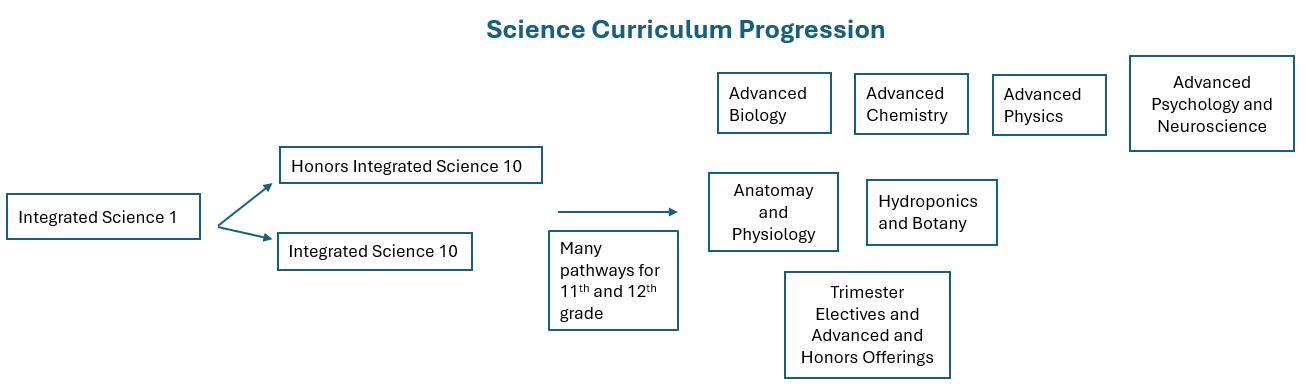
INTEGRATED SCIENCE 1: BIOLOGY, CHEMISTRY, PHYSICS *REQUIRED for 9th grade
1
Credit: 1/2 Biological Science and 1/2 Physical Science
NCAA
1 Year
Meets Laboratory Science Requirements: YES
PREREQUISITE: None
This first-year-level yearlong course covers foundational topics in physics, chemistry, and biology. This course emphasizes the basic and universal physical laws that govern the structure and behavior of matter as they are expressed all around us in the very large (astronomy) to the very small (fundamental particles, atomic structure, cellular structure), from the simple (phases of matter, solution chemistry) to the complex (evolution, genetics, ecology). Class activities include group laboratory experiments, lecture and discussion, and problem-solving sessions. Laboratory experiments are designed to instruct students on scientific research techniques and skills including observation, documentation, data analysis and evaluation, and background source evaluation and usage. This course is team-taught by biology, chemistry, and physics teachers.
INTEGRATED SCIENCE 2: BIOLOGY, CHEMISTRY, PHYSICS *REQUIRED for 10th grade
An honors track option is available to students with department approval.
1
Credit: 1/2 Biological Science and 1/2 Physical Science
NCAA
1 Year
Meets Laboratory Science Requirements: YES
PREREQUISITE: Integrated Science 1
This sophomore-level course is a continuation of Integrated Science 1 with specific topics expanding on those from the previous year. Topics include kinematics, forces, energy, chemical reactions and stoichiometry, acid-base chemistry, biological molecules and organism structures and functions, heredity, and energy dynamics. This course includes topics from biology, chemistry, and physics. Class activities include group laboratory experiments, lecture and discussion, and problem-solving sessions. Laboratory experiments are designed to instruct students on scientific research techniques and skills including observation, documentation, data analysis and evaluation, and background source evaluation and usage. This course is team-taught by biology, chemistry, and physics teachers.
1 Biological Science Credit NCAA 1 Year Meets Laboratory Science Requirements: YES
PREREQUISITE: Integrated Science 1 & 2; Department Approval
This advanced course is designed to provide an extensive exploration of major concepts in the field of biology covering the microscopic to the macroscopic. This course has a major focus on molecular genetics and biotechnology lab techniques. The complexities of scientific research are taught during the student-designed plant biology lab. The course is taught at the level of a first-year college Biology
course for science majors and uses a college-level text. Students have the option of taking the Advanced Placement Biology examination at the end of the year.
ADVANCED CHEMISTRY
1 Physical Science Credit NCAA 1 Year Meets Laboratory Science Requirements: YES
PREREQUISITE:
Integrated Science 1 & 2; Alg 2 or Honors Alg 2; and Department Approval
This course offers a comprehensive exploration of chemistry concepts at a level equivalent to an introductory college chemistry series. Through readings, online videos, interactive discussions, problem-solving sessions, and hands-on laboratory experiments, students investigate the foundational principles of chemistry and their real-world applications. Emphasizing critical thinking and problem-solving skills, students will analyze chemical phenomena, interpret experimental data, and apply mathematical principles to solve complex problems. Laboratory work provides students with opportunities to conduct experiments, develop laboratory techniques, and reinforce theoretical concepts through practical application. Topics covered include atomic structure, chemical bonding, stoichiometry, thermodynamics, kinetics, equilibrium, and acids and bases. Students have the option of taking the Advanced Placement Chemistry examination at the end of the year.
ADVANCED PHYSICS
1 Physical Science Credit NCAA 1 Year Meets Laboratory Science Requirements: YES
PREREQUISITE:
Integrated Science 1 & 2; Calc AB, Calc BC or concurrent in either; and Department Approval
This rigorous course explores the topics of mechanics, developing a student’s physical and mathematical intuition. While material from previous physics courses is reviewed, this course goes into greater depth, using calculus to model and solve realistic problems. Demonstrations and handson activities are used to build understanding and provide opportunities to apply knowledge. Designed as a first-year college-level course for science and engineering majors, Advanced Physics covers many of the topics present on the AP Physics C Mechanics exam. Additional topics are discussed as time allows. Each student is required to purchase his or her own textbook.
ADVANCED PSYCHOLOGY AND NEUROSCIENCE
1 Credit:
1/3 Biological Science and 2/3 History Credit NCAA 1 Year
Meets Laboratory Science Requirements: YES (1/3 credit)
PREREQUISITE:
Integrated Science 1 & 2; US History; and Department Approval
Psychology is a broad discipline with ties to both the social and natural sciences. As such, this course is taught by both science and humanities faculty. Advanced Psychology and Neuroscience introduces students to the systematic and scientific study of the behavior and mental processes of human beings and other animals. To fully understand psychology and behavior, it is critical to have a thorough understanding of the physical and biological processes occurring within the brain. The course covers content discussed in a first-year psychology course and uses a collegelevel text. The first trimester focuses on psychological research methods and neurobiology. The second and third trimesters then build upon the biological basis of neuroscience to further explore psychological facts, principles, and phenomena associated with each of the major subfields within psychology.
ANATOMY AND PHYSIOLOGY
1 Biological Science Credit NCAA 1 Year
Meets Laboratory Science Requirements: YES PREREQUISITE: Integrated Science 1 & 2
This is a college-preparatory science course designed as an introduction for students considering careers in medicine, nursing, physical therapy, sports medicine, or education, or for any student who is just curious about the inner workings of the human body. The course covers the structure and function of major body systems including the integumentary, skeletal, muscular, digestive, cardiovascular, respiratory, nervous, endocrine, and reproductive systems. Conditions related to these body systems are also discussed. The course consists of lecture, extensive discussion, homework, quizzes/tests, and laboratory exercises (including dissection). The lab exercises are designed to provide students with hands-on opportunities to experience and understand the principles being studied.
APPLIED BIOLOGY: HYDROPONICS AND BOTANY
1 Biological Science Credit NCAA 1 Year
Meets Laboratory Science Requirements: YES PREREQUISITE: Integrated Science 1 & 2
During this yearlong science course, we will take a deep dive into the world of growing food. We will learn about the history of hydroponics, different types of hydroponic systems and the science behind them, soil health, plant deficiencies and diseases, food production, and sustainable growing methods. Students will conduct two lab experiments as they are introduced to the concepts of microenvironments and the interactions between plants and different controlled production systems.
APPLIED CHEMISTRY: CLIMATE CHANGE
1/3
Physical Science Credit
NCAA 1 Trimester
Meets Laboratory Science Requirements: YES PREREQUISITE: Integrated Science 1 & 2
Global warming and climate change are topics that are in the news regularly. They are more than buzzwords, however. Our world requires its human residents to be knowledgeable about the environment to better guide government, economic, and social policy. This course introduces students to the complex issue of climate change. In addition to a basic overview of atmospheric science, students also explore the climate system and how various drivers push on the equilibria of its various mechanisms. The current climate is explored in context of paleoclimates, and models are explored to project what awaits earth’s inhabitants in the future. In addition to working with climate data, students also learn about the methods being used to study climate – past, present, and future.
APPLIED CHEMISTRY: SUSTAINABILITY
1/3
Physical Science Credit
NCAA 1 Trimester
Meets Laboratory Science Requirements: YES PREREQUISITE: Integrated Science 1 & 2
Sustainable development is defined in the United Nations’ 1987 Bruntland Report, Our Common Future, as “development that meets the needs of the present without compromising the ability of future generations to meet their own needs.” This course introduces the concepts of sustainability. In this predominantly student-led, project-based course, participants learn about the long-term economic and environmental necessity of reimagining our society and identify the concerns and growing pains associated with change. Common class topics include sustainable food production, resource consumption, and waste management. Enrolled students are encouraged to enter the Earth Prize competition with time and support given to the application and ideation process.
1/3
Physical Science Credit NCAA 1 Trimester
Meets Laboratory Science Requirements: YES
PREREQUISITE: Integrated Science 1 & 2
Dive into the complex web of societal water usage. Explore the critical processes of water treatment methods and the intricate networks of water systems that sustain modern civilization. Investigate pressing issues such as rigorous water-testing protocols, pervasive pollution, the ubiquity of "forever chemicals," the scourge of plastic bottle waste, and the fundamental question of equitable access to water. As we navigate the complexities of water management, students will adopt a river mile to explore and research issues surrounding this essential resource for life. Participants will emerge with a better understanding of society's relationship with water. This course empowers students to become stewards of our most precious resource.
1/3
Biological Science Credit 1 Trimester
Meets Laboratory Science Requirements: YES
PREREQUISITE: Love of bees and nature
From hive basics to sustainable practices, discover the fascinating world of bees and the rewarding art of beekeeping in this comprehensive introductory course. Whether you're looking to start a backyard hive, support pollinators, or explore a budding business venture, this class will provide you with the essential knowledge and skills to begin your beekeeping journey. Course topics will include: bee biology and behavior, seasonal hive management, treatment of pests and diseases, environmental impact, sustainability, and entrepreneurship. Through a mix of interactive lectures, hands-on activities, and engaging discussions, students build a strong foundation in beekeeping. By the end of the course, they will be prepared to establish and manage their own hives while contributing to the health of the local environment.
1/3
Physical Science Credit NCAA 1 Trimester
Meets Laboratory Science Requirements: YES
PREREQUISITE: Calculus and Teacher Approval
Introduction to Quantum Mechanics invites students to step into the strange and beautiful mathematical structure underlying modern physics. In this trimester course, students will explore quantum theory through both the matrix formulation (operators, eigenvalues, and discrete systems) and the wave formulation (the Schrödinger equation, wavefunctions, and continuous systems), discovering how these seemingly different approaches describe the same physical reality. Along the way, essential ideas from linear algebra and differential equations will be developed in context, giving students the tools to analyze quantum states, measurement, superposition, and uncertainty with mathematical precision. This course emphasizes conceptual clarity, mathematical rigor, and problem-solving, offering a first authentic encounter with the framework that shapes atomic physics, modern technology, and our understanding of the microscopic world.
HONORS IMMUNOLOGY
1/3
Biological Science
Credit
NCAA 1 Trimester
Meets Laboratory Science Requirements: YES
PREREQUISITE:
Integrated Science 1 & 2 and Department Approval
This honors course is designed to provide an extensive exploration of the human immune system. A complete understanding of the immune system requires an understanding of human physiology (macroscopic) and the cellular and molecular components (microscopic) at play when maintaining homeostasis and fighting infectious diseases (bacteria, viruses, etc.). The course is taught at the level of an introductory college course for science majors.
HONORS PHYSICS: ELECTRICITY AND MAGNETISM
1/3
Physical Science
Credit
NCAA 1 Trimester
Meets Laboratory Science Requirements: YES
PREREQUISITE:
Integrated Science 1 & 2 and Algebra 2 or Honors Algebra 2
Electricity and Magnetism provides an overview of classical electromagnetism through the theme of household wiring and energy generation. The basics of circuits are explored, considering how a house must be wired to provide it with electricity. Next, charge and electric field are examined, applying these ideas to explain static electricity and lightning. Finally, the nature of magnetism is investigated, examining magnetic force, electric motors, and modern electricity production and transmission. Laboratory work, demonstrations, and numerous hands-on activities provide tangible examples of these topics. The course utilizes physical reasoning and algebra-based problem solving.
HONORS PHYSICS: ENERGY AND ROTATIONAL MOTION
1/3
Physical Science
Credit
NCAA 1 Trimester
Meets Laboratory Science Requirements: YES
PREREQUISITE:
Integrated Science 1 & 2 and Algebra 2 or Honors Algebra 2
Building upon the discussion of forces from Integrated Science 2, this course explores energy transfers and rotational dynamics through the theme of amusement park rides. Various Cedar Point rides serve as examples of these phenomena and allow students to draw upon their own experiences. The course begins with an overview of work and energy, considering how free-fall rides and roller coasters are designed. Next, students explore rotational motion considering merry-go-rounds, Ferris wheels, and roller coaster loops. Laboratory work, demonstrations, and numerous hands-on activities provide tangible examples of these topics. The course utilizes physical reasoning and algebra-based problem solving.
HONORS PHYSICS: WAVES AND OPTICS
1/3
Physical Science
Credit
NCAA 1 Trimester
Meets Laboratory Science Requirements: YES
PREREQUISITE:
Integrated Science 1 & 2 and Algebra 2 or Honors Algebra 2
Waves and Optics explores the nature of waves through the theme of musical instruments and telescopes. The course begins with an overview of waves, looking at the behavior of water waves and physical waves found in earthquakes. Next, sound waves and the production of musical sounds are investigated. Finally, light waves and their associated phenomena are examined, such as mirrors, prisms, lenses, and the human eye. Laboratory work, demonstrations, and numerous hands-on activities provide tangible examples of these topics. The course utilizes physical reasoning and algebra-based problem solving.
LIFETIME HEALTH *Required for graduation
1/3 Health Credit 1 Trimester
Meets Laboratory Science Requirements: NO
PREREQUISITE: None
Lifetime Health examines the physical, mental, social, emotional, and behavioral aspects of health and wellness in today’s society. Students explore the role of behavior change, decision making, nutrition, physical fitness, mental health, drugs, alcohol, and human sexuality in consideration of decisions made striving for a healthy lifestyle. Activities and projects are used to relate and apply concepts to help develop positive lifestyle behaviors as well as to examine current health and wellness topics in our society.
1/3 Health credit 1 Trimester
Meets Laboratory Science Requirements: NO
PREREQUISITE: Open to Seniors
Human Sexuality is designed to help seniors with the transition to the dynamic environment of college and beyond. The course helps navigate increased personal freedom by focusing on various aspects of human sexuality. Topics such as decision making, personal responsibility, and appropriate behaviors are explored, as they are relevant to maintaining or improving personal health. Topics may include: gender and sexuality issues, dating violence, social norms, emotions, orientation, impact of the media, cultural perspectives, historical views, contraception, and diseases. This seminar-style course embraces multiple perspectives, including those of students, faculty, and parents.
1/3 Health Credit 1 Trimester
Meets Laboratory Science Requirements: NO
PREREQUISITE: Open to Sophomores, Juniors, and Seniors
Nutrition is an introduction to nutrients and sources, digestive and metabolic processes, and the health impact of nutrient deficiencies and excesses. Discussion incorporates the relationships between food, nutrition, health, culture, and the environment. Environmental issues include world food supply and choices, food access and security, agriculture and production, and food safety. Essentials of human nutrition that improve and sustain optimal performance for sport and exercise are also emphasized.
1/3 Health Credit 1 Trimester
Meets Laboratory Science Requirements: NO
PREREQUISITE: Open to Sophomores, Juniors, and Seniors
This course is an introduction to the scientific study of behavior with a focus on social and emotional health and development. Typical topics surveyed include the study of the brain, mental states, emotional response and regulation, perception, learning, thinking, motivation, social development, technology, and psychological disorders. Additionally, this course enhances critical thinking skills by acquainting students with fundamental research techniques and discussions of literary works based upon fundamental social and emotional issues.
Credits May Vary,
Department Approval
NCAA Length Varies
Meets Laboratory Science Requirements: Depends on topic
PREREQUISITE:
Department and Academic Dean Approval
Each student in this course develops and implements a research project in consultation with the faculty of the science department. Students may choose to execute the research project in conjunction with one or two other students enrolled in ISR, with science department approval. Students are expected to be a part of experimental design, data collection, and data analysis. Each student must find an outside research expert in the field of study. Students are required to achieve research benchmarks, meet deadlines, and demonstrate core competencies throughout the year. This culminates in a presentation to members of the Wellington community. Although this class is an independent study, students are scheduled into a class period and frequently meet with other students in the course.
Building on the statement of purpose of the Science and Mathematics Departments, Wellington offers courses to prepare and inspire students to be experts in logic, problem-solving, and emerging technologies.
It is predicted that most of today’s young students will enter professions that currently do not exist. Technology is quickly evolving, and it is imperative that students are proficient in interfacing with emerging technologies and the design process. Wellington offers an Introduction to Computer Science course that opens the door for advanced studies in app design and object-oriented programming. We also teach engineering courses where students learn the design process, software tools, and how to apply mathematics and physics to solve real-world problems.
COMPUTER SCIENCE: ESSENTIALS

1/3 Credit 1 Trimester
PREREQUISITE: None
Designed for the student who is interested in gaining a general computer programming background and an introduction to the concepts of computer science, this course explores the concepts of computer science and how those concepts impact our world. This course is open to any upper school student. This course earns the digital literacy badge.
COMPUTER SCIENCE: DIGITAL GAME CREATION
1/3 Credit 1 Trimester
PREREQUISITE: None
Creating a successful game requires design, art, music, sound, and coding. This course focuses on creating a playable computer game. It is an exploration of creativity and design, so it is open to everyone whether they are a gamer or not. The complexity of the game project is tailored to the experience of the student. This course earns the digital literacy badge.
1/3 Credit 1 Trimester
PREREQUISITE: Computer Science Essentials
One of the most common styles of programming is object-oriented programming. In this course, students develop coding and problem-solving skills in the Object-Oriented Programming paradigm. This course prepares students to develop applications for mobile platforms, games, and more.
ENGINEERING: THE DESIGN PROCESS, CAD, AND 3D PRINTING
1/3
Physical Science
Credit
NCAA 1 Trimester
Meets Laboratory Science Requirements: YES
PREREQUISITE:
Integrated Science 1 or Department Approval
This course introduces core engineering principles through hands-on design and fabrication. Professional design tools are used to model, build, test, and refine physical systems, emphasizing measurement, spatial reasoning, and iterative problem solving grounded in the engineering design process.
ENGINEERING: ROBOTICS I—ELECTRONICS AND COMPUTER PROGRAMMING
1/3
Physical Science
Credit
NCAA 1 Trimester
Meets Laboratory Science Requirements: YES
PREREQUISITE:
Integrated Science 1 and Digital Literacy Course or Department Approval
Fundamental interactions between electronic, mechanical, and computational systems are explored through laboratory-based robotics projects. Design, construction, and programming of robotic devices provide experience with sensing, actuation, data collection, and basic control of physical systems.
ENGINEERING: ROBOTICS
1/3
Physical Science Credit
NCAA
1 Trimester
Meets Laboratory Science Require`1ments: YES
PREREQUISITE: Integrated Science 1 and Engineering Robotics I and Digital Literacy Course or Department Approval
More advanced robotic systems are developed through extended laboratory investigations. Emphasis is placed on sensors, feedback control, and Artificial Intelligence techniques used to support perception, decision-making, and system reliability in increasingly autonomous physical systems.
The Wellington Visual Arts Department empowers students to navigate an increasingly visual world, fostering critical thinking and creative expression through both traditional and contemporary artistic practices.
By emphasizing process over product, collaboration with local artists, and the exploration of a wide array of media, our program cultivates digital literacy, appreciation for diverse perspectives, and a readiness to engage meaningfully with art and visual media in a multitude of settings. The department's primary goal is to foster expansive thinking and celebrate a diversity of creative visual expression, nurturing each student’s unique voice in an inclusive and supportive environment. We believe that creativity is deeply personal, multifaceted, and best developed through an emphasis on the artistic process, including (but not limited to) research, discussion, ideation, refinement, and presentation of ideas. Through an engaging blend of traditional techniques and processes and new technology and digital tools, students develop both visual and digital literacy, learning to articulate ideas through a variety of media and to apply critical language to their work and that of others. Our goal is to empower students to be curious, reflective, and prepared to navigate and contribute to the world’s evolving visual landscape.

1/3 Visual Arts Credit 1 Trimester
PREREQUISITE:
None
This hands-on course introduces students to working in two dimensions with a focus on observation, composition, proportion, and shape. Through projects using graphite, charcoal, ink, colored pencils, and mixed media, students explore drawing, mark-making, and visual construction while learning about line, texture, value, and positive and negative space. The course emphasizes experimentation, problem-solving, and creative thinking as students build skills and confidence through regular sketchbook practice. Students will be expected to maintain and post their work to a simple website we create in class.
1/3 Visual Arts Credit 1 Trimester
PREREQUISITE:
None
This hands-on course introduces students to working in three dimensions, with an emphasis on form, balance, and space. Through projects using materials such as cardboard, wire, wood, digital fabrication, and clay, students explore carving, building, stacking, and assembling sculptural forms while developing an understanding of volume, structure, and spatial relationships. The course emphasizes experimentation, problem-solving, and creative thinking as students build skills and confidence through hands-on material exploration. Students will be expected to maintain and post their work to a simple website we create in class.
1/3 Visual Arts Credit OR 1/3 History Credit 1 Trimester
PREREQUISITE: US History or Advanced US History
This course uses art as a lens through which to examine history. Over the trimester, students explore seminal artworks from distinct historical periods, investigating the techniques used in their creation alongside the historical, cultural, and socio-economic factors that shape their style and meaning. The course emphasizes composition, form, and historical context through analysis and discussion, encouraging students to consider the role of art within each society and time period studied.
1/3 Visual Arts Credit 1 Trimester
PREREQUISITE: 9th grade Art requirement
Students study the historical context of ceramics in the past and present while developing their own voice with this tactile material. This course covers the basics of hand-building techniques in pinch, slab, and coil while creating exquisite vessels, tiles, and sculptures. An understanding of the transformative process of clay is discovered by learning about glaze composition and the firing
process in an electric kiln. Students will be expected to maintain and post their work to a portfolio website we create in class.
1/3 Visual Arts Credit 1 Trimester
PREREQUISITE: 9th grade Art requirement
This course is an introduction to the historical and contemporary world of design. Students explore the design thinking process as a means of addressing a series of visual challenges. Visual communication skills using the principles of design are developed, while also learning the basics in professional design programs such as Adobe Photoshop and Adobe Illustrator. Students will be expected to maintain and post their work to a portfolio website we create in class. This course earns the digital literacy badge.
1/3 Visual Arts Credit 1 Trimester
PREREQUISITE: 9th grade Art requirement
This course explores digital illustration through a range of styles and techniques using Adobe Illustrator and Adobe Photoshop. Students apply traditional drawing skills and color theory within a digital format while developing an understanding of core design principles. Through hands-on exercises and project-based work, students build skills in visual problem-solving, personal expression, and communication through design. The course examines how graphic imagery is created, manipulated, and interpreted across a variety of media. This course earns the digital literacy badge.
1/3 Visual Arts Credit 1 Trimester
PREREQUISITE: 9th grade Art requirement
Students will explore the history of fashion design and its impact on culture and society, both past and present. The course introduces the design process, guiding students toward the ultimate challenge: creating one-of-a-kind fashion inspired by a variety of themes of their choice. Students will receive an introduction to both hand and machine sewing techniques, while exploring digital tools through collaborative projects. Students will be expected to maintain and post their work to a portfolio website we create in class.
1/3 Visual Arts Credit 1 Trimester
PREREQUISITE: Open to Juniors and Seniors
Students will explore the timeless art of glass, combining both traditional and digital techniques to create their own unique stained-glass window and glass mosaic designs. Emphasis will be placed on the design process, as students develop ideas through hand-drawn sketches and rendered designs, refining and revising their work from initial concept to final piece while responding to the technical and structural limitations of glass as a medium. The course dives into the cultural significance of glass art, examining its use in historical and contemporary contexts from around the world. From medieval cathedrals to modern installations, students will discover how glass has influenced artistic movements and cultural expression. A visit to the local Franklin Art Glass will provide insight into professional materials, tools, and real-world applications. Students will be expected to maintain and post their work to a portfolio website we create in class.
1/3 Visual Arts Credit 1 Trimester
PREREQUISITE: 9th grade Art requirement
This course offers an introduction to acrylic painting for both beginning and intermediate students. Students learn foundational techniques such as color mixing, brush handling, layering, and composition while exploring a variety of subject matter, including still life, landscape, and portraiture. Emphasis is placed on experimentation with different styles and approaches as students begin to develop their own artistic voice. Throughout the term, students receive individualized feedback and guidance to strengthen skills and build confidence in their painting practice. By the end of the course, students complete several finished acrylic works and develop a strong foundation in the medium.
1/3 Visual Arts Credit 1 Trimester
PREREQUISITE: 9th grade Art requirement
This course offers an in-depth exploration of watercolor painting for both beginning and intermediate students. Students learn foundational watercolor techniques while experimenting with a range of styles, approaches, and effects. The course also examines the work of contemporary and historical artists working in watercolor to build context and inspiration. Throughout the term, students receive individualized feedback and guidance to strengthen skills and build confidence in their painting practice. By the end of the course, students complete several finished watercolor works and develop a strong foundation in the medium.
1/3 Visual Arts Credit 1 Trimester
PREREQUISITE:
9th grade Art requirement
This course explores photography as a visual art medium in the 21st century. Students study digital photography as a tool for personal expression, documentation, and visual storytelling. Topics include aperture and shutter settings, composition, depth of field, motion control, alternative camera angles, lighting, and major photographic genres. Students receive foundational instruction and technique demonstrations while examining examples of professional and student work to clarify goals and outcomes. In addition to capturing images, students edit and refine their photographs using Adobe Photoshop. Students are expected to maintain and publish their work on a portfolio website created in class.
1/3 Visual Arts Credit 1 Trimester
PREREQUISITE: 9th grade Art requirement
Examining the history of printed images, students will explore both traditional and contemporary printmaking techniques, learning how printmaking has been used for communication, expression, and storytelling across cultures and time periods. Studio time will be spent working with graphics, color theory, drawing skills, design elements, and composition to develop original concepts for oneof-a-kind prints and limited editions. Students will experiment with planning, carving, inking, and printing processes while refining craftsmanship and creative problem-solving. Printmaking techniques introduced include collagraph, linocut, and woodcut. Students will be expected to maintain and share their work on a portfolio website developed in class.
1/3 Visual Arts Credit 1 Trimester
PREREQUISITE:
9th grade Art requirement
Photography recommended
This course introduces students to the art of digital storytelling through video editing using Adobe Premiere. Students learn to navigate a timeline, import and organize media, edit and manipulate footage, and apply visual and audio effects to enhance their projects. The course also covers techniques for creating dynamic transitions, adjusting color and exposure, and incorporating text and graphics. Students explore a variety of video formats, including interviews, social media posts, and narrative projects. By the end of the course, students gain a strong understanding of the video editing process and are able to produce polished, high-quality videos.
1 Visual Arts
1 Year
PREREQUISITE:
Three art electives of choice and Department Approval
This multimedia studio art and design course is designed for students pursuing advanced study in visual art. The yearlong program emphasizes an inquiry-based practice, in which artists develop and investigate personally meaningful questions to guide their creative work. A sketchbook supports research, experimentation, and exploration of ideas, artists, and materials. Participants produce an extensive body of work both in and outside of class while engaging with themes, concepts, and contemporary practices through sustained investigation and reflection. The course concludes with a student-run, off-campus exhibition during Arts Week in the spring. Artists will create and maintain a website to document and catalog their work, which may be used for the college admission process. Portfolios may also be submitted for AP Art & Design credit through completion of additional outside work and preparation.
YEARBOOK: STRATEGY AND CONTENT
1/3 Visual Arts Credit 1 Trimester
PREREQUISITE: None
This course is for students with big ideas, strong goal-setting skills, and the ability to see the bigger picture. In Trimester One, students explore the foundations of yearbook production, including the tools and software used to design the book and key journalistic principles. They begin brainstorming content ideas, developing a content plan, determining sections and themes, and gathering initial stories, interviews, and photos. Students also create templates for the various pages and sections of the book. Editors take an active role in shaping the overall vision, leading group discussions, and ensuring the content plan reflects the school’s culture.
YEARBOOK: DESIGN AND LAYOUT
1/3 Visual Arts Credit 1 Trimester
PREREQUISITE: None
This course is designed for students who want to shape the content and style of the yearbook. In Trimester Two, students focus on gathering and editing photos, as well as creating and refining written content. Collaboration is central, as students work closely with their section teams to finalize spreads. The course emphasizes clear content hierarchy, consistent voice, and cohesive style, while students provide feedback and guidance to peers to ensure the book reflects the vision established in Trimester One. Strong writing, photography, or layout skills are welcome but not required.
1/3 Visual Arts Credit 1 Trimester
PREREQUISITE: None
In the final trimester, students focus on completing the yearbook, including editing, proofing, and preparing it for printing, as well as creating marketing materials. They finalize pages designed in Trimesters One and Two, ensuring all sections are cohesive, polished, and error-free. Students collaborate with editors to incorporate final revisions and refine design elements, with a primary goal of meeting printing deadlines. Throughout the trimester, students strengthen their editing skills, attention to detail, and ability to manage complex projects. They also design and lay out content for Spring events and end-of-year coverage.
YEARBOOK: LEADERSHIP
1/3 Visual Arts Credit 1 Trimester
PREREQUISITE: 1 trimester of Yearbook or Department Approval
Students who wish to serve as yearbook editors may enroll in any trimester and provide leadership and vision for the yearbook staff. Editors must have completed at least one previous trimester of a yearbook course and receive pre-approval to enroll. While attending class during their enrolled trimester(s), editors are also expected to offer guidance and support to staff members throughout the school year. This role provides an excellent opportunity to develop strong communication, collaboration, and leadership skills while playing a central part in shaping the story of the Upper School experience.
The Wellington World Language Department champions the growth of cross-cultural competence, equipping students with the linguistic and intercultural skills essential for thoughtful engagement in our interconnected world.
Our World Language program cultivates students' growth as linguistically and culturally literate global citizens, aligning with the school’s mission to help students discover their purpose and potential. Focusing on communicative skills and cultural understanding, the curriculum invites exploration of French, Latin, and Spanish, offering foundational courses alongside honors and advanced options for further mastery. Authentic learning experiences, travel opportunities, and creative assessments deepen students’ engagement with diverse cultures while enhancing language proficiency. We prepare students to communicate confidently, think critically, and approach the world with empathy and curiosity.
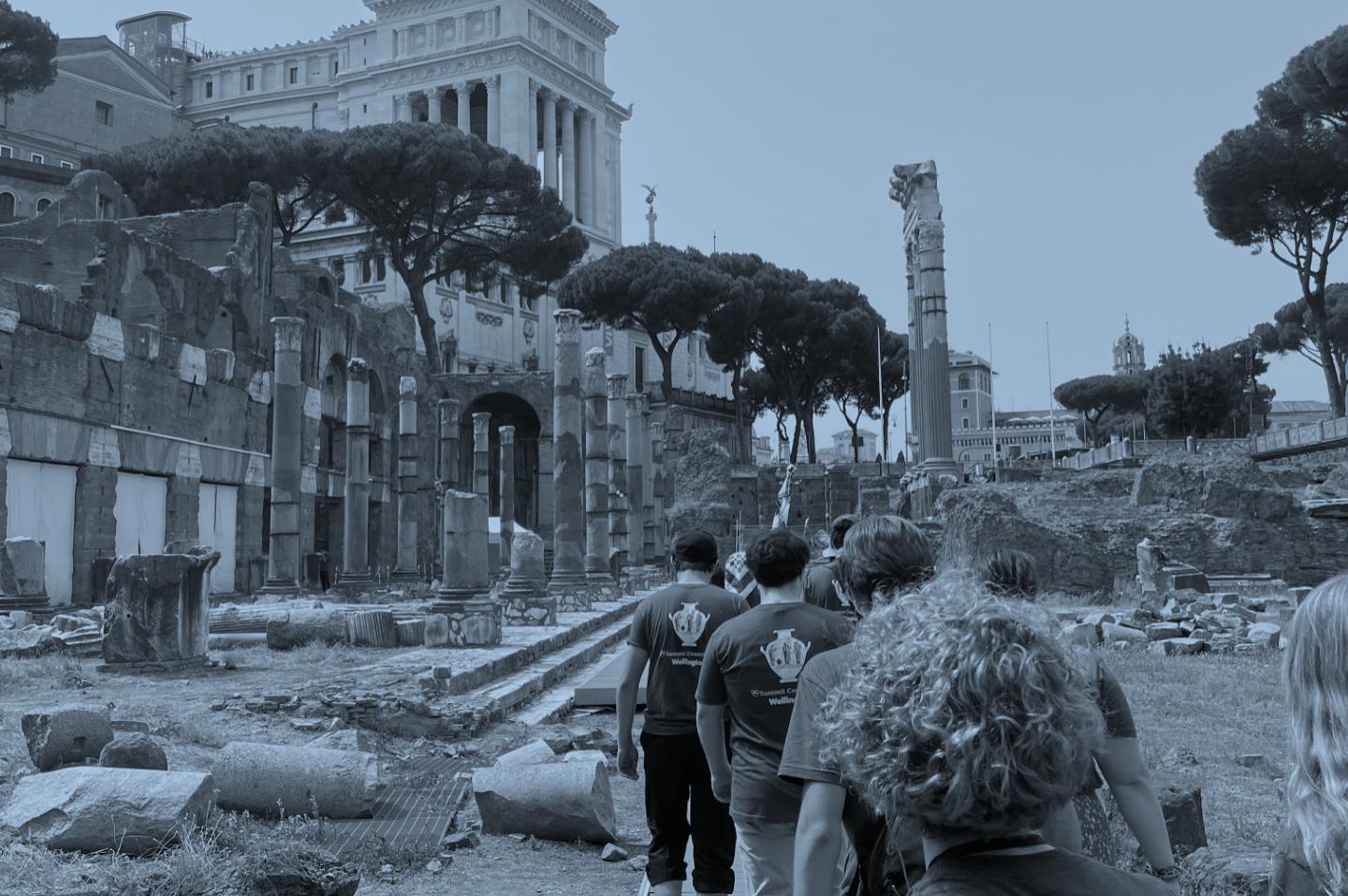
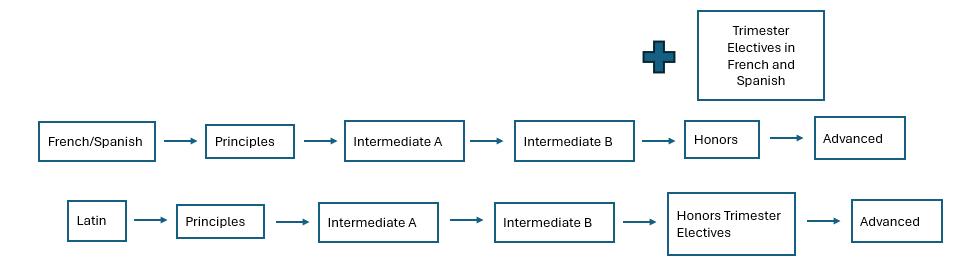
FRENCH PRINCIPLES
1 World Language
1 Year
PREREQUISITE:
None
The Principles course is organized around three modes of communication – interpersonal, interpretive, and presentational. Students are introduced to basic French grammar by participating in interpersonal conversations, interviews, skits, and role-playing activities. They practice the interpretive mode of communication by hearing native speakers in audio and video recordings, as well as by reading specially adapted texts. Students also prepare short presentations and writings. French and Francophone culture is discussed throughout the course.
FRENCH INTERMEDIATE A
1 World Language
1 Year
PREREQUISITE:
French Principles or Department Approval
As in the Principles course, the goal is to steer students toward proficiency in speaking, understanding, reading, and writing French. Students are given ample opportunity to hear native speakers on video and websites. Interpersonal activities such as skits, interviews, conversations, and role-playing help students use the grammar they are acquiring in order to communicate in French. We begin to read and write more extensively. Stories are discussed, summarized, and often reenacted in class. French and Francophone culture is discussed throughout the course.
FRENCH INTERMEDIATE B
1 World Language
1 Year
PREREQUISITE:
French Intermediate A or Department Approval
French Intermediate B continues the work begun in Principles and Intermediate A, presenting an ever-widening series of communicative topics and activities, and covering the more advanced aspects of French grammar. Extensive listening comprehension activities help train the students to understand the main points of conversation and spoken texts. Through the introduction of literature and associated vocabulary, students learn to read for gist and to discuss and write about relevant topics. Cultural awareness is an integral part of the curriculum.
HONORS FRENCH/ADVANCED FRENCH

1 World Language
Credit NCAA 1 Year
PREREQUISITE:
Honors: Intermediate B and Department Approval
Advanced: Honors and Department Approval
Honors French/Advanced French involves exposure to authentic French texts, written (taken from websites, comic books, and short novels) and spoken (taken from news broadcasts and videos). We discuss current events in Europe and French-speaking countries, along with a wide range of issues, as presented in the media and in literature. Students are encouraged to express their opinions and react to the opinions of others. Emphasis is placed on accurate self-expression, both spoken and written. Therefore, we thoroughly review grammar, build vocabulary, and routinely practice speaking and writing. This course runs on a two-year cycle; the material is different each year so that students complete two years without repetition. Students in Advanced French are eligible to take the AP examination in French Language and Culture.
1/3 World Language
Credit
NCAA
1 Trimester
PREREQUISITE:
French Intermediate B or Department Approval
Over the course of the trimester, each student takes on the identity of one tenant of the building, planning a life by deciding his or her personality, preferences, tastes in clothes and décor, profession, activities, and background. Interactions, both spoken and in writing, between tenants are common, as are social occasions, disputes, common problems, and possibly even drama and disasters. The story flows as the tenants wish.
FRENCH: LES ACTUALITÉS
1/3 World Language
Credit
NCAA
1 Trimester
PREREQUISITE:
French Intermediate B or Department Approval
Students investigate current events in France and French-speaking countries and how they relate to US and local news in print, on the Internet, and on TV and radio. Students discuss, analyze, present, and write reactions to issues in the news. While doing so, the class prepares their own news distribution, including a class newsletter, a podcast, and a video.
1/3 World Language
Credit
NCAA
1 Trimester
PREREQUISITE:
French Intermediate B or Department Approval
This course will introduce students to the International Alphabet and specifics of French pronunciation to improve aural comprehension and spoken French. Students will explore such topics as intonation, liaison, transcription, and nasal sounds. Students will also have opportunities to compare standard French with other accents such as Canadian French.
LATIN INTERMEDIATE A
1 World Language
Credit
NCAA 1 Year
PREREQUISITE: Latin Principles
Latin Intermediate A is a continuation of basic Latin, completing the study of grammar and syntax as well as general aspects of culture and history. Topics covered include comparison of adjectives and adverbs, indirect discourse, participles, uses of the subjunctive mood, and the ablative absolute. Increased emphasis is placed upon mastering the translation of Latin prose to English.
LATIN INTERMEDIATE B
1 World Language Credit
1 Year
PREREQUISITE:
Latin Intermediate A
A thorough review of the forms and syntax of classical Latin begins this course, the primary focus of which consists of readings from a variety of authors including Livy, Caesar, and Ovid. The study of military organization, an overview of Roman historians, and an understanding of Caesar as a prose stylist supplement this aspect of the course, while readings from Ovid’s “Metamorphoses” provide an introduction to Roman epic poetry.
ADVANCED LATIN
1 World Language Credit
PREREQUISITE:
Two Trimester Courses and Department Approval
Advanced Latin deepens students’ study of Latin literature through close readings of Vergil’s Aeneid, Pliny the Younger’s Letters, and selected teacherchosen texts. Building on skills from Latin Intermediate B, the course strengthens advanced reading comprehension while exploring themes, structures, and stylistic features of Roman epic and prose. Students analyze literary techniques, authorial choices, and figures of speech, while situating each work within its historical and cultural context. Through this combined linguistic and interpretive study, students develop a richer understanding of Roman society and sharpen their critical and analytical abilities. Students in Advanced Latin are eligible to take the AP examination in Latin Language and Culture. -chosen texts. Building on skills from Latin Intermediate B, the course strengthens advanced reading comprehension while exploring themes, structures, and stylistic features of Roman epic and prose. Students analyze literary techniques, authorial choices, and figures of speech, while situating each work within its historical and cultural context. Through this combined linguistic and interpretive study, students develop a richer understanding of Roman society and sharpen their critical and analytical abilities.
HONORS LATIN: CATULLUS AND THE ROMAN RELATIONSHIP
1/3 World Language
Credit
NCAA
1 Trimester
PREREQUISITE:
Latin Intermediate B or Department Approval
Gaius Valerius Catullus wrote some of Rome’s most recognizable love poetry. His relationship with an infamous woman of the Roman elite gives us a fascinating glimpse into the romantic Roman relationship. In this course, we examine his works, the Roman view on romance, and Catullus’ place in Roman literary history.
HONORS LATIN: ROMAN DRAMA
1/3 World Language
Credit
NCAA
1 Trimester
PREREQUISITE:
Latin Intermediate B or Department Approval
Roman comedy (some of the earliest Roman literature we have) gives us a vastly different picture of Roman life from that which we receive from other classical works. Comedy is full of lovers and mistresses, foolish aristocrats, and crafty servants. Roman drama (most of the extant works were written in the Silver Age as the influence of Rome was waning) can be melodramatic and overly rhetorical, but these very aspects of the texts allow us to understand the Latin language in numerous ways. This course will consider Roman theatre in light of the political, social, and economic realities which made these plays possible.
HONORS LATIN: LIVES OF THE CAESARS
1/3 World Language
Credit
NCAA 1 Trimester
PREREQUISITE: Latin Intermediate B or Department Approval
Students use Suetonius’ biographical work, “Lives of the Twelve Caesars,” as a primary source to learn about the Roman emperors of the Principate. However, Suetonius is well known as a gossip and indelicate author who sometimes veers away from the historically accurate. Thus, students investigate both the perspective of Suetonius as well as delve into their own research of the emperors featured in “Lives of the Twelve Caesars”.
SPANISH PRINCIPLES
1 World Language
Credit
NCAA
1 Year
PREREQUISITE: None
Spanish Principles enables the students to acquire the four language skills of listening, speaking, reading, and writing. Sound patterns, dialogues, vocabulary, and basic grammar structures are presented. Students learn about the daily life, holidays, and customs of people in Spanish-speaking countries and compare them to their own.
SPANISH INTERMEDIATE A
1 World Language
Credit
NCAA
1 Year
PREREQUISITE: Spanish Principles
Spanish Intermediate A reinforces basic skills, expands vocabulary, and further develops grammar concepts. Interpretive skills are developed, and students increase interpersonal and presentational communication skills. Students explore the cultural diversity of the Spanish-speaking world through various forms of media, contemporary literature, and music.
SPANISH INTERMEDIATE B
1 World Language
1 Year
PREREQUISITE: Spanish Intermediate A
This course builds on the skills developed in earlier levels, enhancing students' ability to comprehend and communicate in Spanish by integrating more complex grammar structures within meaningful and engaging contexts. Through the exploration of literature, global issues, contemporary culture, and current events, students deepen their cultural understanding and broaden their perspectives.
HONORS SPANISH
1 World Language Credit NCAA
1 Year
PREREQUISITE: Spanish Intermediate B and Department Approval
In this course, students continue to refine their communicative and interpretive language skills while exploring global issues, current events, art, and literature. Listening and reading comprehension are strengthened through engagement with a variety of authentic texts and audio materials. Students also advance their speaking and writing skills through regular interpersonal conversations, debates, and presentations. Honors Spanish serves as a foundation for Advanced Spanish.
ADVANCED SPANISH
1 World Language Credit NCAA 1 Year
PREREQUISITE: Honors Spanish, Department Approval, and Speaking Sample
Advanced Spanish emphasizes the use of Spanish for active communication and is taught in the style of a college seminar. Students further their proficiency by practicing their interpretive and interpersonal communication skills. They review grammar concepts and apply them to the study of contemporary global issues. Students in Advanced Spanish are eligible to take the AP examination in Spanish Language and Culture.
1/3 World Language
Credit
NCAA
1 Trimester
PREREQUISITE:
Spanish Intermediate B or Department Approval
This course explores cuisine as a part of culture, lifestyle, and global challenges in Spain and Latin America. Students will investigate food-related culture, history, literature, regional specialties, and cooking. Students will use their language skills to research and discuss issues, present topics of interest, create virtual food tours, and write reflections and recipes.
1/3 World Language
Credit
NCAA
1 Trimester
PREREQUISITE:
Spanish Intermediate B or Department Approval
This course surveys the stories, contributions, and challenges of Indigenous groups in Latin America from the pre-Columbian era to the present. Students explore mythology, history, culture, and current events through legends, texts, films, interviews, and guest speakers, and analyze historical and contemporary human rights issues facing Indigenous communities. The course is mainly conducted in Spanish.
SPANISH: EL CINE HISPANO
1/3 World Language
Credit
NCAA
1 Trimester
PREREQUISITE:
Spanish Intermediate B or Department Approval
In this course, students explore the history, art, and influence of Hispanic and Latin American films and filmmakers. Students will study several films, focusing on cultural themes and global issues. The films set the context for discussions, debates, presentations, and written reflection.
Pathway courses provide intentional time for students to develop essential academic, social-emotional, and life-readiness skills that support Wellington’s mission. Each year, students engage in meaningful experiences ranging from executive functioning and research skills to career exploration, global engagement, and college preparation that help them understand themselves, build community, and take greater ownership of their learning. By aligning with students’ developmental needs, Pathways ensure every Wellington student is equipped to thrive in high school, college, and beyond.
Aligned with Wellington’s mission to help students find their purpose and realize their potential for tomorrow’s world, First Year Survey equips students with the essential intellectual and learning tools needed to thrive in the school’s diverse and challenging curriculum. This course strengthens executive functioning and research skills while fostering metacognitive growth and social-emotional awareness. Through student-centered activities and projects, students apply their curiosity, strengths, and interests in meaningful and authentic ways. Integrated with Wellington’s robust advisory program, which prioritizes social-emotional wellness and community building, First-year Survey provides a strong foundation of support as students transition into the Upper School.
Sophomore Forum expands students’ roles in the Wellington community by strengthening academic and interpersonal skills while introducing key Upper School programs. In the first trimester, students build the research and writing skills needed for the Social History Project, the capstone for Sophomore History and English. The second trimester focuses on career exploration through interest assessments, networking, and professional shadowing. In the third trimester, students engage with two major programs: Global Engagement where they develop the mindset and skills for international travel and select their junior-year destination and College Counseling, which introduces the application process and strategies for becoming strong candidates. Throughout the course, students practice organization, time management, constructive communication, and proactive problem-solving.
Junior Initiative provides dedicated time for students to develop productive, lifelong habits that set them up for success while fostering a strong sense of community. The first half of the year focuses on the WISE program, with structured time for trip planning and meetings to prepare for this meaningful experiential learning opportunity. Starting in January, the focus transitions to the initial stages of the college exploration and application process, guiding students through self-reflection, goal setting, and the development of a strong foundation for life after high school. Through intentional and collaborative activities, Junior Initiative helps students grow both as individuals and as members of a supportive community.
Senior Seminar is a program designed for the senior class to support their transition to post-high school opportunities. During this pathway, the College Counseling Team supports students with college applications, essays, and interview preparation, while also providing insights into college student life, academic success, and affordability. Collaborating with community guests and the Upper School Counselor, Senior Seminar addresses topics that prepare students for success in college and other post-secondary paths. A key aspect of the program is student leadership, exemplified by the Senior Buddy System, where seniors mentor younger students.
WISE makes international travel a reality for every Wellington student.
Meaningful international travel provides extensive educational benefits such as growth in resiliency and problem-solving, while building empathy and respect for other cultures. With increasing globalization, the development of these skills is critical for success in college and beyond. Understanding that traditional trip experiences can be cost-prohibitive for many families, we have embraced the concept of experiential equity such that the international travel experiences are built into our core upper school program with no additional cost to tuition.
To be prepared for their international experience, students will participate in Global Engagement, a multi-session workshop during 10th and 11th grade year. Global Engagement will help students to develop an understanding of the logistical and intellectual preparation involved in successful global travel, to build and practice intercultural communication skills, and to discover connections between contemporary global issues and local realities. Students will choose one international trip from a list of available experiences while in Global Engagement. This travel is not required for graduation, but participation is strongly encouraged. Travel will occur during the latter half of the junior year.
Marine biology in Bonaire; History, culture, and art in Brazil, Costa Rica, England, Italy, Poland, and Peru; Outdoor recreation in Canada; Sustainability in Denmark, Iceland, and Norway; Cultural exchanges in France and Spain; Service in Ecuador and Zimbabwe; and more to come!
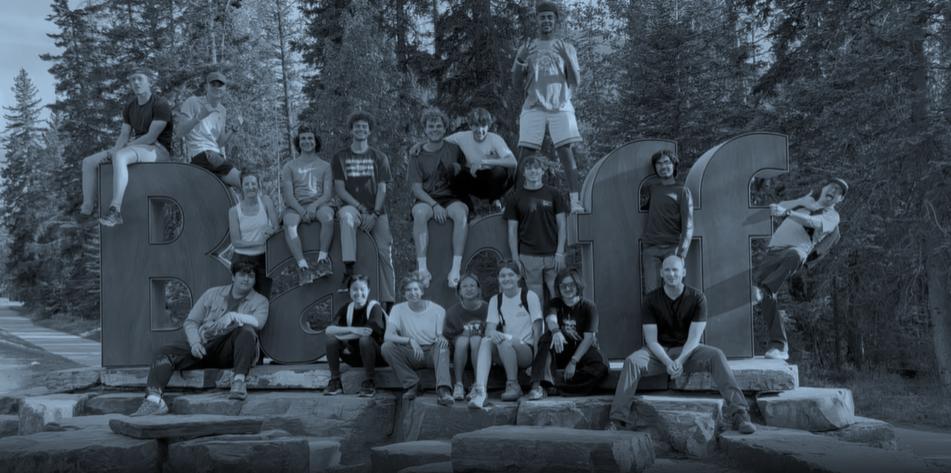
College Credit Plus is a State of Ohio program that provides opportunities for high school students to take courses at local colleges and universities. Historically, Wellington students have enrolled in classes at The Ohio State University and Columbus State Community College. This program is state-funded, meaning there are no out-of-pocket costs for students and their families. This includes tuition, books, and fees. College Credit Plus is an excellent opportunity for students to engage with challenge, expand their skills and content acquisition, earn credits towards both their high school and college transcript, and potentially lower the future costs of college.
In most years, the College Credit Plus application window opens on February 1 and closes on April 1. The Ohio State University accepts applications for the summer term until February 1 and the fall/spring term until March 1. There are no exceptions to these deadlines. Wellington’s academic dean and college counselors are available to help students navigate these options.
In general, Wellington recommends that students enroll in College Credit Plus for three reasons:
1) A student has exhausted the scope and sequence of an academic discipline at Wellington. For example, if a rising senior loves chemistry and has taken all of the chemistry offerings at Wellington, continuing their studies through College Credit Plus is a logical step to engage one’s passion and level of challenge.
2) A student is interested in taking a course that is not offered at Wellington. Examples like Geology and German meet this second criterion.
3) A family is interested in completing general education courses that will transfer to their future college or university, leading to financial benefits.
Any school offering College Credit Plus is obligated to advertise the risks along with the benefits of the program. Colleges and universities follow the Family Educational Rights and Privacy Act (FERPA). This means that parents and caregivers may not communicate with the professors and teaching assistants leading their children’s courses. The student must be able to advocate for themselves. This program is a dual crediting – meaning the courses and grades are published on the high school and college transcript. The record for these courses will follow students into the college application process and will be attached to their future college transcripts. This, paired with the fact that these are college-level courses, means students should be ready for the increased challenge. Finally, simultaneously managing the logistics of enrolling in high school and college courses can be difficult. Summer term is a great opportunity to engage with the program with fewer constraints.
Ohio Department of Education – College Credit Plus https://education.ohio.gov/topics/ohio-education-options/college-credit-plus
The Ohio State University’s Academy Program https://academy-ccp.osu.edu/ Columbus State Community College https://www.cscc.edu/academics/college-credit-plus/ccp-Admissions.shtml
Student Council drives community engagement, fosters school spirit, leads fundraisers, and organizes school dances and field trips. The committee, elected by students, include three executive members (President, Secretary, and Treasurer), and three representatives from each grade level.

At Wellington, the Upper School community gathers daily to share information, get hyped for extracurricular events, and celebrate each others’ achievements. The meetings are run by Student Council and any member of the community may make announcements. On 5L Days, we meet for Assembly – a longer, more formal Morning Meeting. Here, extended talks like Zimmer Zone (quick-hitting lessons from our counselor), Nobel Prize Award lectures, and invited guests may occur. Not only is Morning Meeting an opportunity for students to practice public speaking, it is the event to feel the pulse of the Upper School community.
Each year, students propose and participate in student clubs. These clubs present opportunities for students to engage with passions, advance their academic journeys, develop future-focused skills, and strengthen their connections with the community. The student clubs may vary each year based on student demand. Here is a sampling of our current student clubs: A Foot in 2 Places, Debatriot, Dungeons and Dragons, Genders and Sexualities Alliance, Green Club, Harvard Model UN, Latin Club, National Honors Society, Ohio Youth in Government, Paw Print (newspaper), Pickleball, Science Olympiad, and more.
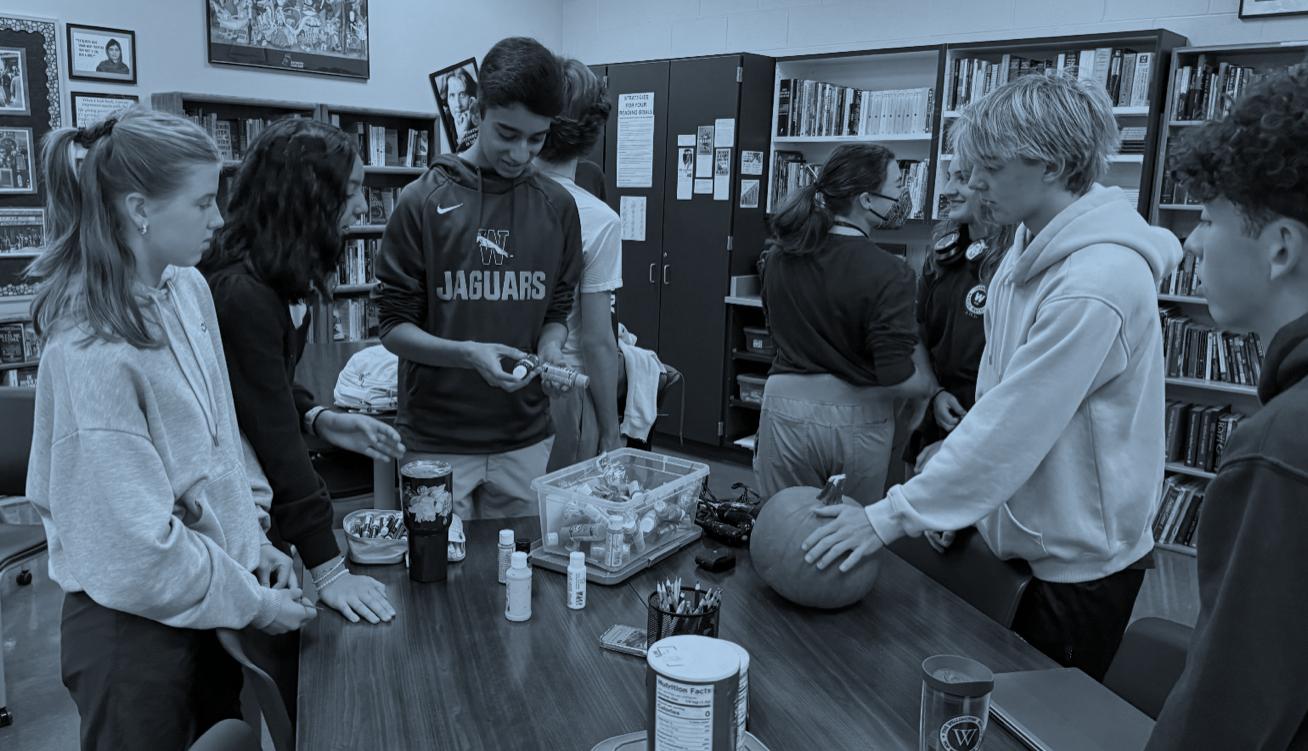
Every Upper School student is placed in an advisory with 8-12 peers and a faculty advisor. This group assembles in ninth grade, and the cohort remains intact through graduation. The advisor is an advocates for the advisee and provides academic and social-emotional guidance. Parents and caregivers should contact their student’s advisor whenever there is a concern about schoolwork or the student’s wellbeing. Often, the advisor knows the student better than anyone in the building. Advisory also establishes opportunities for fun, competition, and community building.
The role of a school counselor is to promote the wellbeing of the students, faculty, and the school community. This includes reoccuring division-wide social and emotional lessons, presentations and activities tailored to each grade level based on developmental and academic needs, guest teaching in various classes, and individual and group counseling. Additionally, the counselor collaborates with teachers, outside mental health professionals, other counselors, and parents and caregivers to provide comprehensive support for all students.
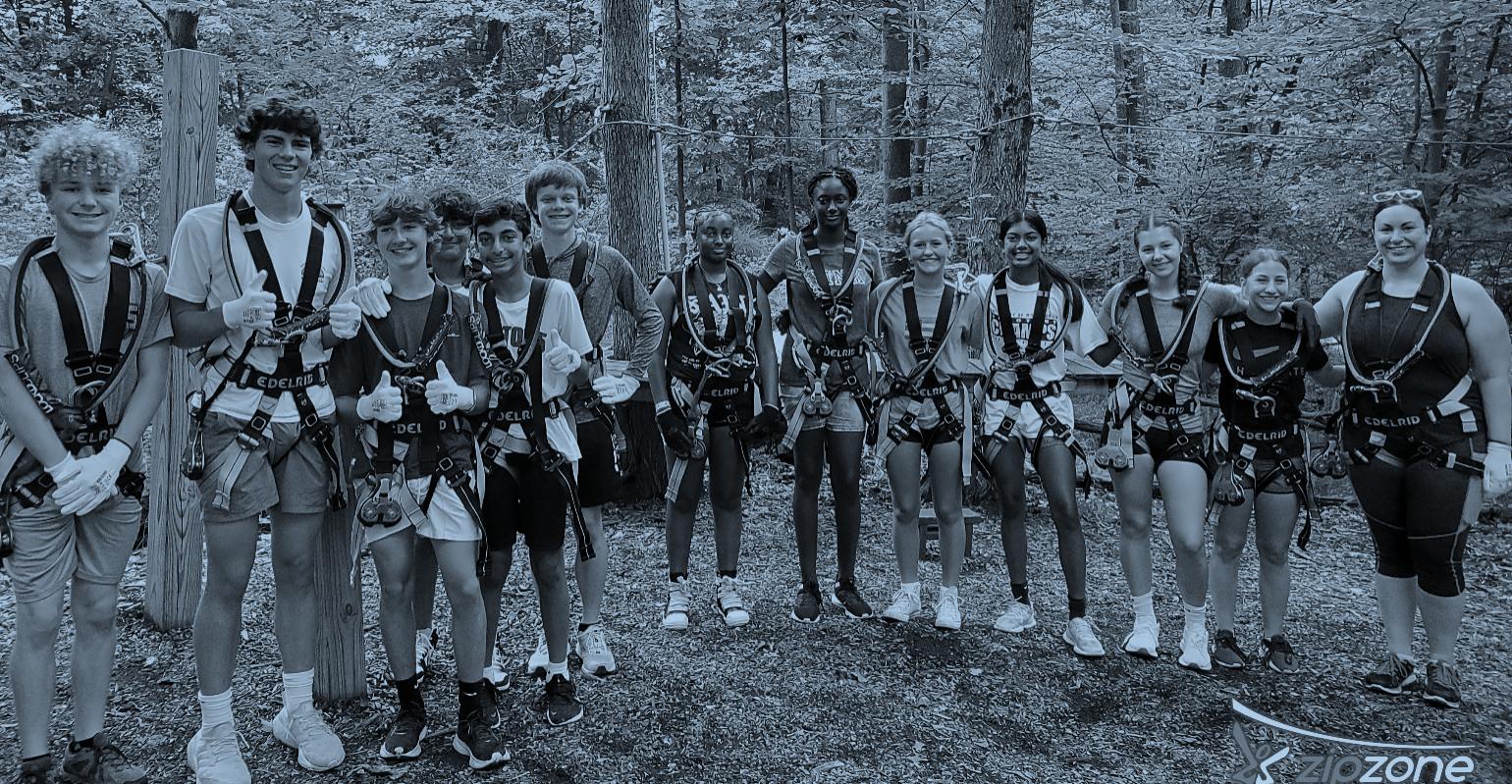
The Upper School Learning Specialist provides academic and emotional support to students during Task Time and free periods, and in a one-on-one or small group setting. This person also helps students break big projects into manageable tasks and holds them accountable for completing their work on time. They advocate for students to make sure they receive their accommodations in the classroom and during tests, as per their WESP (Wellington Education Support Plan). They collaborate with the other learning specialists to ensure we have consistent protocols appropriate for each division.
Through athletics students learn valuable lessons in perseverance, accountability, collaboration, and leadership.
Student-athletes are given a platform to maximize their individual abilities, while simultaneously helping Wellington win championships. The program values the inclusion of the student body and is committed to finding a place for all student-athletes at either the junior varsity or varsity level. Playing time is not guaranteed at the varsity level. Responsibility, time management skills, and leadership development are expected by-products of participation at this level.
Boys Cross Country
Girls Cross Country
Boys Golf
Girls Golf
Boys Soccer
Girls Soccer
Girls Tennis
Boys Basketball
Girls Basketball
Coed Bowling
Sideline Cheer
Boys Swim and Dive
Girls Swim and Dive
Boys Baseball
Girls Lacrosse
Girls Softball
Boys Tennis
Boys Track and Field
Girls Track and Field

English
College Composition
Detective Story
Enduring Questions: Dystopias
Stories of the Holocaust
Honors Notable Authors: James Baldwin
College Composition
Creative Writing: Fiction
Nonfiction: Reframing Conflict
Voices: LGBTQ+ & Literature
Honors Great Books: The Tempest
College Composition
Great Books: The Poisonwood Bible
The Language and Culture of Cults
Honors Enduring Questions: Literature & Justice
Creative Writing: Poetry
Honors Art History
Comparative Religion
Race and Identity
Mathematics
Performing Arts
Civil Rights in American History
Media & Current Events
Feminism: Unpacking the F Word The Making of American Foreign Policy
Honors Political Theory
Visual Arts
Honors Art History
Ceramics
Design Thinking
Glass Art
Photography
Yearbook: Strategy and Content
Design Thinking Digital Illustration
Fashion Design
Painting with Acrylics
Video Editing Studio
Yearbook: Design and Layout
Painting with Watercolors
Photography
Printmaking and Book Arts
Yearbook: Editing and Marketing
Yearbook: Leadership Yearbook: Leadership Yearbook: Leadership
World Languages
French: L’Immeuble (Apartment Building)
Honors Latin: Catullus and the Roman Relationship
Spanish: Gastronomia Hispana
Les Actualites (Current Events)
Honors Latin: Roman Drama
Spanish: Voces Indigenas de America Latina
Honors Latin: Lives of the Caesars
Spanish: El Cine Hispano