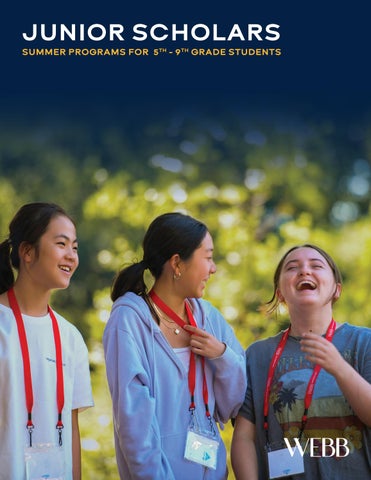
JUNIOR SCHOLARS SUMMER PROGRAMS FOR 5TH - 9TH GRADE STUDENTS
LEADERSHIP LAB@WEBB
AI AND HUMAN-CENTERED DESIGN
BUILT FOR YOUNGER SCHOLARS
Explore how artificial intelligence can support human creativity, judgment, and connection.
Take on big challenges, build bold solutions, and discover what you can accomplish together. • • •
Design community projects, tackle team challenges, and pitch big ideas. Build communication and decision-making skills through strategy games and team simulations. Gain independence and friendships through Webb’s residential experience.
Designed specifically for rising 5th and 6th graders, giving younger students a Junior Scholars experience all their own. Students learn, live, and build community with peers close to their own age, with programming designed around their growing independence, curiosity, and confidence. Through hands-on challenges, collaborative problemsolving, and creative projects, students explore what it means to lead and contribute to a team. They design community initiatives, pitch ideas, navigate team decisions, and use AI tools to help bring their thinking to life. Outdoor strategy games and team simulations create opportunities to practice listening, communication, and shared decision-making. Living and learning together on Webb’s campus extends those lessons beyond the classroom, as students make new friends, take greater responsibility for themselves, navigate life as part of a community, and grow in confidence.
SESSION INFORMATION 5th & 6th Grade Session: July 10-16 TUITION PER SESSION Domestic: $2,175
International: $2,375
• • •
Prototype AI-powered tools and improve them through user feedback. Conduct empathy interviews and usability tests. Examine AI systems for bias, accessibility, and ethical implications.
Bringing together technology, psychology, design, and ethics, students discuss and investigate the people and decisions behind AI systems while developing their own perspectives. Through collaborative design challenges, ethical debates, and hands-on prototyping, they identify human needs, test emerging technologies, and refine solutions through feedback. Students consider bias, accessibility, automation, and responsible design as they build applied AI projects. They leave with stronger designthinking and critical reasoning skills and the judgment to ask not just what technology can do, but what it should do.
FILMMAKING Discover how an idea becomes a story on screen through writing, performance, design, and technology. • • •
Write, storyboard, shoot, and edit original work. Explore performance, directing, sound, sets, costumes, and visual design. Experiment with creative tools and emerging technologies.
Students experience filmmaking as a collaborative art, taking ideas from concept through to post-production.
They write scenes and storyboards, direct performances, shoot footage, create soundtracks, and shape their work through editing and visual effects. Students also gain perspective from professionals working in film and media, connecting their own creative process to California’s entertainment industries. Hands-on production challenges encourage students to experiment across disciplines, solve problems together, and build confidence in using film to communicate ideas and tell compelling stories.
LAW AND DEBATE
in caring for others. Along the way, students strengthen their skills in observation, analysis, collaboration, and problem-solving while developing a deeper understanding of medicine as both a scientific practice and a profoundly human one.
PALEONTOLOGY Step into the world of a research paleontologist and uncover clues to Earth’s prehistoric past. •
Investigate how evidence, argument, and negotiation can shape decisions, laws, and communities.
•
•
•
• •
Argue cases through mock trials and structured debates. Draft legislation and take on diplomatic and policy simulations. Practice persuasive communication while considering competing perspectives.
Students investigate how lawyers, policymakers, and diplomats approach complex questions. Through mock trials, legislative exercises, debate, and diplomacy, they build evidence-based arguments, respond under pressure, and examine issues from multiple perspectives. Students also explore how emerging technologies, including AI, are influencing law and public decision-making. Webb’s residential community extends those conversations beyond class as students learn alongside peers with different perspectives. They leave as stronger communicators and more thoughtful advocates, prepared to listen carefully, question assumptions, and make reasoned decisions.
MEDICAL SCIENCE Explore the science, skills, and ethical questions at the heart of medicine and human health. •
Conduct hands-on investigations in Webb’s advanced science labs. • Use surgical tools through dissection and learn basic First Aid skills. • Meet professionals working across medical and healthcare fields. Students explore anatomy, physiology, neuroscience, molecular biology, psychology, sports medicine, bioethics, and public health through labs, demonstrations, case studies, and real-world experiences. They examine how body systems work together, investigate questions about health and disease, and consider the decisions involved
Work with real fossils in the Raymond M. Alf Museum of Paleontology. Explore fossil preparation, field investigation, and scientific research. Use emerging technologies to document and interpret discoveries.
Students learn inside a nationally accredited museum located directly on Webb’s campus, with access to research collections, fossil preparation facilities, and opportunities for hands-on investigation. They experience the scientific process from discovery and preparation to documentation, analysis, and interpretation, while connecting their work to Southern California’s rich scientific and natural resources. Along the way, students strengthen their observation and inquiry skills and discover that science and history are active processes of asking questions, testing ideas, and making new discoveries.
SCIENCE & ENGINEERING Turn curiosity into experiments, evidence, and solutions through hands-on scientific investigation. • • •
Design experiments and develop original research questions. Build, test, and refine ideas through engineering challenges. Learn from scientists and engineers through experiences around Los Angeles.
Working in Webb’s advanced science lab, students explore fields ranging from chemistry and biology to robotics, electronics, and engineering. Using laboratory equipment and building tools, they design experiments, test ideas, gather evidence, and work through unexpected results. Hands-on challenges encourage students to connect concepts across disciplines while strengthening their skills in observation, analysis, and problem-solving. They leave more confident taking on complex questions, more comfortable learning through experimentation, and more curious about what they might discover next.
7 TH, 8TH & 9TH SESSION INFORMATION: Session 1:
Session 2: July 20 – 29
July 9 – 18
TUITION PER SESSION Domestic:
$3,500
International: $3,700
LIFE AT WEBB Nestled at the base of the San Gabriel Mountains, Webb’s 150-acre campus gives Junior Scholars a welcoming place to stretch themselves, make new friends, and experience the independence and connection of boarding school life within a close community supported by experienced faculty and residential staff. Beyond their chosen tracks, afternoons and evenings are filled with opportunities to connect, recharge, and try something new through sports, games, creative activities, and outings in Claremont and across Southern California. For many Junior Scholars, summer at Webb is an important first overnight camp experience. Within a close and supportive community, students learn to navigate greater independence, build friendships, take responsibility, and grow in confidence—all while surrounded by a community who know them, support them, and help make Webb feel like home.
THE WEBB SCHOOLS Founded in 1922 in Claremont, California, Webb is a boarding and day school where rigorous learning, close relationships, character, and discovery go hand in hand. Students are encouraged to think boldly, mindfully, and creatively; act with honor and moral courage; lead with distinction; serve with a generous spirit. Junior Scholars offers younger students an introduction to that same spirit of curiosity, connection, and discovery.
HOW TO APPLY Applications and additional information can be found at webb.org/summer. Priority application deadline is March 15, with rolling applications accepted after that date as space allows. A $50 nonrefundable application fee is required. Limited need-based financial aid is available.
1175 W. Baseline Road Claremont, California 91711 (909) 482-5214 Scan to learn more and apply
webb.org/summer