Winter 2011 - 2012
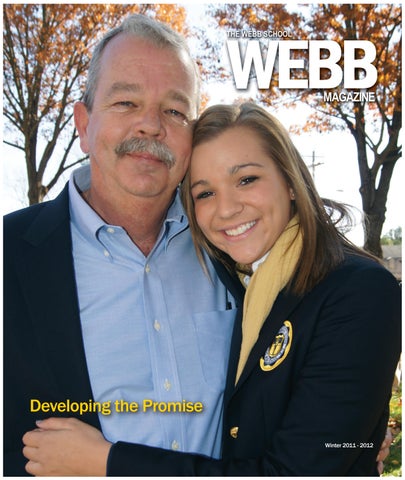
Developing the Promise
Winter 2011 - 2012
1
NEW ITEM!
B
N Silk tie with Webb seal $25 (with gift box $28)
A
JUST IN!
Navy and white Webb School umbrellas (large tote size) $15
C
N
M
D
L
E
J
G
The Webb School Magazine
K
2
A. Baseball cap $11 B. Navy sweatshirt - S, M, L, XL, XXL $25 C. Webb canvas bag $12 D. Webb seal coffee mug $8 E. Pen caddy with pewter seal $19 F. Visor - specify navy or tan $11 G. Rosewood box with pewter seal $65 H. Pewter key chain $7 I. Car magnet $4.50 J. Grey sweatshirt - S, M, L, XL, XXL $25 K. License plate $7.50 L. Small water bottle $6 M. Large water bottle $7.50 N. Kooler $12 O. Navy long sleeve T-shirt (not pictured) $15 P. Grey long sleeve T-shirt (not pictured) $15
I
C
H
F
To order -please make checks payable to The Webb School. See postage and handling charges below. Or enclose a Visa or Mastercard number (all digits on card), expiration date, and your signature. Be sure to include your street address, daytime phone number, sizes, and color choices (can not deliver to P.O. Box). Prices and merchandise in this ad are guaranteed while supplies last or until the next issue of this magazine is published.
SHIPPING RATES
WEBB GEAR
Effective July 2010 Order Total Less than $25.01 $25.01 - 50.00 $50.01 - 75.00 $75.01 - 100.00 $100.01 and up
Rate $7.95 $8.95 $9.95 $10.95 $11.95
Alumni and Development Office P.O. Box 488 Bell Buckle, TN 37020 931.389.6045 a_dwebb@webbschool.com
view items and prices visit www.thewebbschool.com. Go to www.webbschool.com for STo ummer Clearance
WEBB The Webb School
magazine
Raymond S. Broadhead Head of School Joe Iorio Assistant Head of School and Business Manager WEBB COMMUNICATIONS Editor: Rita Mitchell Director of Communications Design & Layout: Gayle McClanahan Graphic Designer Matt Anderson Director of Operations in Admissions /Marketing Claudia Hazelwood Director of Alumni & Development CONTRIBUTORS Alyce Allen Database Coordinator Meredith Crockett Director of Alumni and Parent Outreach Dorothy Elkins Alumni Research Assistant Sandi Jobe ‘95 Director of Alumni Relations and Annual Giving The Webb School Magazine is published biannually in the summer and winter by The Webb School, 319 Webb Road East, Bell Buckle, Tenn. The Webb School is a nonprofit 501(c)(3) organization: 620401875.
I hope that you enjoy this issue on “Developing the Promise of Each Individual” at Webb. Promise begins with passionate students who wish to explore their true selves and who want to try new things. Webb is an ideal place for such a student. It is a place where a student can be an AP scholar, a varsity athlete, play in the strings orchestra, star in a play and serve on the honor council – all at once – and more! It begins with our faculty. Our talented and caring faculty members reveal to students their own diverse interests. Through the faculty, students are exposed to many different passions and ideas at Webb. As students develop their own passions, the faculty members are here to guide them. Our goal is to achieve excellence in all that we do. In recent years, there has been much improvement in many Webb programs, but let me just focus on two – arts and athletics. We often hear the expression, “If you build it, they will come.” To me, while there is some truth to that phrase, it does not stand alone. Without great people working inside the building, they will not come. However, assuming there are great people, yes, a building will make a difference. Consider the Frank G. Barton Athletic Center. Former Head of School, Jon Frere (19892005), saw the need for Webb students to have a place where they could work out, have recreational activities, and compete athletically at a higher level. Completed in 2003, the Barton Gym is one of the nicest gym facilities in this area. What has it meant for our students? For one, it has attracted student/athletes to Webb. And please do not worry, the emphasis remains on the word student in student-athlete. Additionally, it has created student pride in the school. A basketball game at Webb is a fun experience for our community. It brings us together outside of the classroom. It is there where we learn to be good spectators – that is, we support our team but do not dishonor our opponent. Our recent success in basketball is partly attributed to this building. Consider the Lundin Fine Arts Center, built in 2007. Then Head of School, Albert Cauz, was a strong supporter of the arts at Webb. Under his term, an old swimming pool was filled in, additional space was created, and the Lundin Fine Arts Center was born. This is an area of bustling activity all day. The pottery room, the visual arts room, the piano lab, rehearsal rooms, a black box theatre, and an art gallery are fully utilized. When filled with students, the building bursts with enthusiasm. It is truly an area of excellence. Our theatre troupe, the Webb Players, recently returned from Scotland where they performed in the Fringe Festival in Edinburgh. Our strings orchestra has grown in just four years from seven students to 35! Our art students have helped create 600 ceramic bowls for the Empty Bowls project to support a local hunger project. And there is much more to celebrate in the arts at Webb. “If you build it, they will come.” What is next for Webb academic buildings? I see a renovation of the Davis-Woosley Computer-Science Center. We have the faculty to support a vibrant science program filled with hands-on experiments, science fair projects, and inquiry-based learning. For our present student body, and for science in the 21st century, our present facility needs improvements. It is my sincere hope that we will soon raise the necessary funds to renovate the Davis-Woosley Computer-Science Center to better accommodate the students of today and tomorrow. “If we build it, will they come?” Yes! And then science, math, and technology will grow markedly at Webb! Ray Broadhead Head of School
Winter 2011 - 2012
The school complies with all applicable anti-discrimination laws and does not discriminate on the basis of gender, race, color, religion, ethnic or national origin in the administration of its educational policies and programs, admissions processes, scholarship and loan programs, employment practices, athletic and other school administrative programs.
A note from the Head of School
3
WEBB The Webb School
magazine
Developing the Promise
10
Wayne Rogers '50 credits Webb for the love of learning, academic preparation
14
Eddie Rehfeldt '83 creates his way into a high-profile career
16 18 20
Wayne Rogers is a veteran film and television actor, a Broadway producer, an author, investment strategist and an entrepreneur with uncanny business acumen and marked success. But more than anything else, Wayne Rogers is an insatiable learner. That characteristic has directed almost every aspect of his life.
“One of the best things I learned from my Webb education was ‘if I want to do something, I’m just gonna go do it.’” And he did.
Charles Williams '64, planting promises for the future On Christmas Day 1958, young Charles Williams pulled the deed to 90 acres from a long unnoticed envelope beside the Christmas tree: a gift from his grandfather, Charles B. Dowling. Forty-seven years after his Webb graduation commencement in 1964, Williams’ true passion remains for a childhood gift, West Wind Farm, which he calls home today.
The Webb School Magazine
14
Gene Tempelmeyer '72, the passion to paint The smell of painting oils and turpentine has been familiar to Gene Tempelmeyer '72 for as long as he can remember. His first sculpture at age three, a little clay horse with brown glaze, still sits on his desk.
The Fringe: Webb players treated like professionals, grow as actors The Fringe Festival in Edinburgh, Scotland, is the world’s largest and most prestigious performing arts festival. The Webb School theatre program was among 50 U.S. high schools selected to perform as part of the American High School Theatre Festival at The Fringe in August.
Also inside: 5
4
10
Autumn recap
13
Erica Wright '99, Stopping Too Long Between Stations: The poetry of waiting
22
Arts abound at The Webb School
26
Community foundation made it easy for Holliman to establish charitable remainder unitrust
27
Paul Martin '88 sponsors emergency warning system
28
Delivering on the promise takes strategic thinking, planning
Coop '73 and his daughter, Claire Coop '12 on Senior Blazer Day. On the cover: Jack The Coop family has been in Bedford County for more than 200 years.
16
20
Kudos & news
Autumn Recap...
Kudos & news
Benefits of Quebec internship immediate for Garcia
W
hen Mallory Garcia, Webb French teacher, was accepted for an internship with Montreal’s internationally recognized Arion Baroque Orchestra, the opportunity meshed several of her personal and professional interests. Garcia had the opportunity to strengthen her knowledge of the French language and expand her knowledge of technology through her work with the orchestra. Garcia was the recipient of the Frere Grant for Professional Development, and the grant enabled her to spend two months in Montreal. “Working with professional musicians and learning the intricacies of Canadian non-profit organizations, and specifically the effectiveness of various marketing tools for different target audiences, was especially enlightening,” Garcia said. Her main responsibility throughout the summer was updating the English version of the orchestra’s website. The website had recently been redesigned, and as a result, many of the pages were not yet translated from French into English. “Throughout the summer, I re-checked the existing translations for accuracy and also translated those pages that at the time only had a French version.”
Back in the classroom this fall, she quickly realized the overall impact the experience
“The textbook I use has several culture sections dedicated to Quebec, and before this summer I was never able to offer my students much more information than what was in their textbook,” she said. “Now, having experienced the greatness of Montreal, I can tell them what authentic ‘poutine’ (French fries covered in cheese curds and brown gravy) tastes like, and I can attempt to convey the brilliance of Montreal’s Notre Dame Cathedral. From a language point of view, I now have a better understanding of the differences between French from France and French from Quebec.” Garcia came away from the experience with an extreme respect and admiration for the province of Quebec. “One might assume that there would be a certain amount of disgust towards English speakers given the history of conflict between French Canadians and English-speaking Canadians, but both my husband (James) and I felt completely comfortable and welcome no matter what language we were speaking,” she said. “Montreal is easily one of the friendliest and most accepting cities I have ever visited, and I look forward to having the opportunity to visit again – maybe even on a trip with Webb students!”
Garcia and her husband spent most of their free time in the city enjoying weekend festivals, “but we did venture to Toronto to see the Blue Jays take on the New York Yankees one weekend.” Garcia is currently in her fifth year of teaching French at The Webb School. She received her bachelor’s degree in French K-12 Education from the University of Central Missouri and will complete her master’s degree in Professional French Studies in Education from the University of Wisconsin-Madison in December 2011. At Webb, she is also the head of CooperFarris dormitory and advises the French Club and the “Knit Wits,” Webb’s knitting and crocheting club. She and her husband, James, Webb director of residential life, live on campus.
The Arion Baroque Orchestra
James and Mallory Garcia in Montreal
Winter 2011 - 2012
Garcia said one of the most enjoyable jobs she was trusted to undertake was the creation of a retrospective presentation to celebrate the orchestra’s 30th anniversary. “The creation of this presentation allowed me to learn a lot about the history of the orchestra and its influence in the world of classical music.”
would have on her students.
5
Little elected president of statewide organization
SWAG plays host to quiz bowl teams
H
annah Little, The Webb School library director, was elected president of the Tennessee Association of School Librarians for 2012 at the annual conference in Murfreesboro in the fall.
The Webb School hosted the Sawney Webb Academic Games (SWAG), the school’s first home quiz bowl tournament, on Nov. 12. The event attracted participants from 13 schools. “We were really excited to host Webb’s first quiz bowl tournament,” said Kelly Northru p, SWAG director. “We’re hoping this becomes a tradition that the Webb community and the Qui z Bowl community look forward to annually.
“I am honored to serve as the association president. I joined TASL years ago when I was still a student, and TASL has offered me excellent continuing education and networking opportunities over the years,” said Little, who served as conference chair. “The association has responded to the needs of our membership like providing information and training for the upcoming changes with ‘Race to the Top’ and the new evaluation process. I believe that this is why we have had such a spike in membership,” she added.
The tournament was a national qualifier for the National Academic Quiz Tournaments . NAQT organizes the premier high school and college quiz bowl championships in North Ame rica. The organization was founded in 1996 by former players and coaches from across the coun try.
Current TASL membership totals 817, up from 626 in 2010.
Togrye is named National Merit Scholarship Program semifinalist
C
The Webb School Magazine
ameron Togrye, a senior from Murfreesboro, is among the top 1 percent of 2011-12 U.S. high school seniors named a National Merit Scholarship Program semifinalist. A total of 16,000 semifinalists were named for the 2012 National Merit Scholarship Program.
6
“This is a tremendous accomplishment for Cameron, and all of us at Webb share in his joy,” said Head of School Ray Broadhead. “We wish him the best of fortune as he moves forward in the process to win a prestigious National Merit Scholarship.” Togrye participates in Mock Trial, Varsity Soccer, Son Will Society, Math Club, Spanish Club, and Computer Club. He is also working to create a Science Club. Last summer, he attended the Governor’s School for the Sciences, and the summer of 2010, he delivered food for the Meals on Wheels program
and volunteered at Discovery Center in Murfreesboro. He was recently named as an AP Scholar, is a member of the Cum Laude Society, and he received the Harvard Book Award as a junior.
Carter, Da and Gallagher among commended students
T
hree seniors at The Webb School each received a 2012 National Merit Scholarship Program Letter of Commendation. Webb Head of School Ray Broadhead announced that Sallie Carter and Jennifer Da, both of Murfreesboro, and Hannah Gallagher, of Normandy, received the recognition. Approximately 34,000 Commended Students throughout the nation were recognized for their exceptional academic promise. Although they will not continue in the 2012 competition for National Merit Scholarships, Commended Students placed among the top 5 percent of more than 1.5 million students who entered the 2012 competition by taking the 2010 Preliminary SAT/National Merit Scholarship Qualifying Test.
Kudos & news
Webb begins College Work and Readiness Assessment
T
he ultimate goal of education is to train students to prosper in life. Helping students cultivate the requisite skills for such success is a daunting task for educators. Ron Smith, Follin English Chair holder, and Angela Rasnick, English Department Chair, were recently introduced to an idea that would enhance learning for their students and ultimately train the students to transfer their classroom experiences to real-life situations. Smith and Rasnick participated in a Performance Task Academy during the final two days of the summer break. At the Academy, which included 45 K-12 teachers, they took a non-traditional test to determine their abilities in higher order thinking, problem solving, analytical evaluation, close reading, and applied logic. The test was a performance task in which participants were expected to evaluate a series of documents and create a response to a given question based solely on the information presented in the documents. The task, which had to be completed in 90 minutes, culminated in a written response of each participant’s analysis. After the evaluation was complete, Smith and Rasnick were challenged to create their own performance tasks—ideally for use in their own classrooms. The participants had a chance to brainstorm ideas, share curriculum connections, and develop a task that could be of use in Webb’s English curriculum.
These same types of performance tasks are the basis for the College Work and Readiness Assessment (CWRA) that was administered to ninth graders at Webb this fall. This new kind of assessment, which measures students’ ability to think critically, assimilate information, and use higher order reasoning skills, allows students to think outside of the typical test box. The goal of the CWRA is to enable students to transfer learning to new situations, both those in school and those most likely to occur later in life. “The test examines those very skills that we try to emphasize in our classroom work. We expect students to deliberately analyze information and formulate sound conclusions by critically reading and carefully examining a variety of sources,” said Smith. The CWRA will be given to seniors this spring to determine how they compare to
their younger peers who took the test this fall. “This test will give us a baseline measure so that we can test how well the school is teaching skills such as reading, analysis, inference, and writing,” said Raymond Broadhead, head of school. “By analyzing the class results, we will have a better idea of how to move forward in our teaching.” Broadhead explained that if a student appears deficient in a certain skill, Webb will devise a plan to improve that skill. Smith and Rasnick hope that the CWRA initiatives will both complement and enhance The Webb School’s present curriculum. As Heidi Hayes Jacobs claims in Curriculum 21, last summer’s facultywide summer reading book, “The ability to negotiate and evaluate information online, to recognize manipulation and propaganda, and to assimilate ethical values is becoming as basic to education as reading and writing.” Because of these emerging curricular needs, Smith and Rasnick recognize and appreciate the unique value of the CWRA program. They believe that it will give students a challenging and fundamentally different way to hone fundamental skills while they cultivate the forward-thinking skills that are equally vital to leading a successful life in the 21st century.
Winter 2011 - 2012
Rasnick developed a performance task that she and Jacquelyn Boyanton, another Webb English 8 teacher, used this fall with their English 8 classes. The designed task, which evaluates an important theme in the novel Lord of the Flies by William Golding, requires students to evaluate documents, form an opinion, organize group members, debate their opinions, and write a summary of the debate. The eighth graders enthusiastically approached the performance task with seriousness, scholarly ideas, and organizational skills. The debates, which were documented by video, provided an excellent way for students to evaluate the theme of bullying while
expressing the two sides of the argument. “The students were challenged to think outside of the typical testing environment and develop critical-thinking skills as they formulated an opinion,” Rasnick explained. The students readily agreed that they preferred this type of assessment instead of the typical pencil and paper test.
7
Great-grandson of "Sawney" Webb delivers Blazer Day address
T
he 57 seniors in The Webb School Class of 2012 participated in one of many traditions, Nov. 11, as they received their senior blazers. Marking the ceremony, Thompson Webb III, greatgrandson of school founder, W.R. “Sawney” Webb, and Brown University professor emeritus, geological sciences, was the keynote speaker.
and was receptive to new thinking, Thompson Webb III told seniors that life, climate and the earth each evolve and change. “So as you look out on life, the message I can give you as a geologist is ‘expect change.’ And the message from Sawney Webb is ‘keep an open mind.’ Who knows where the changes may carry you and what you can learn by studying as Sawney once did.”
The presentation takes place annually on the birthday of “Sawney” Webb, who would have celebrated his 169th birthday on Nov.11. “This is an exciting day for the members of the senior class,” said Head of School Ray Broadhead. “Today they receive a visible symbol that recognizes their status as seniors. With this status come the challenges of additional responsibility and leadership both within The Webb School community and beyond.” Webb Spanish teacher, Kristen Linton ’00, announced the seniors’ names. Alumni board members, Robert Smith ’70 and Lindsey Fournier ’01, assisted the seniors into their blazers during the school-wide chapel service. Using a story to illustrate how Sawney Webb immersed himself in study when presented with a topic of debate, kept an open mind
2, Blake Cocanougher, Sar Members of the class of 201
Burns, Hulsey earn Eagle Scout Awards
T
The Webb School Magazine
yler Burns, a member of Boy Scouts of America Troop 119, Danville, Ky., and Sam Hulsey, a member of Troop 643, Middle Tennessee Walton Trail District, recently completed the requirements for Eagle Scout, scouting highest award.
6 8
Burns, a junior from Danville, and Hulsey, a senior from Lebanon, each completed 12 required merit badges and nine elective merit badges, held troop leadership posts and led a community service project, among other requirements. Burns’ project included building a series of benches at Danville’s Bate-Wood Park soccer fields and playground area for children and parents to use. Hulsey’s project was to plan and construct a permanent outdoor shelter for Rocketown, a non-profit organization benefitting Nashville youth. Along his path to the Eagle Scout award, Burns earned the Ad Altari Dei Award from the Catholic Church. He also earned a National Certificate of Merit from the National Council in recognition of his work during the ice storm of 2009 in Danville. He works with Troop 390 in Shelbyville while at school. Hulsey is on the football, baseball and cross-country teams. He has served as a Prefect in the dorms for two years. He also has served on Dorm Council all four years at Webb, including the last two years as president. Hulsey is a member of the Mock Trial team, the Spanish Club and the National Honor Society.
n Pryor
ada Kolli, Pearson Lien, Rya
Harold Segroves'73 stands with Dorothy Elkins during the Webb School Parents' Association annual dinner and auction. Proceeds from the event totaled more than $40,000.
Smith presented G. Webb Follin, Jr. Chair of English
R
on Smith, an English teacher at The Webb School, was presented the G. Webb Follin, Jr. Chair of English during a school ceremony on Aug. 26. Smith has been a faculty member for 26 years. “This is a special day in the rich history of The Webb School,” said Ray Broadhead, head of school. “It is a day when we thank a family for working with The Webb School to honor a beloved family member and a Webb faculty member at the same time.” Broadhead added, “Today, we honor teaching through one of the many committed Webb faculty members. For his passion, for his scholarship, and for his dedication to his students and to the craft of teaching, Mr. Ron M. Smith is a most worthy recipient of the G. Webb Follin, Jr. Chair of English.” The chair was created to honor the late G. Webb Follin, Jr. for a lifetime of service to the school and for his contributions to further education in Tennessee. The proceeds from this permanent endowment are used to fund, in perpetuity, a member of the faculty chosen by the administration to lead the teaching and research in this academic discipline. The Follin chair also provides Smith with an annual stipend for professional growth and an annual stipend for professional development for Smith and colleagues in the English Department.
tremendous legacy of giving to The Webb School. “I also want to personally thank, Ray Broadhead, Kay Young and Angela Rasnick for their unwavering support, enduring enthusiasm and positive influence during the past few years of my classroom teaching.”
G. Webb Follin, Jr.
Also attending the ceremony were G. Webb Follin, Jr. family members, including son and daughter, G. Webb Follin, III ’73 and Kathy Follin, both of Nashville; and Simonsen’s husband, Chris Simonsen; and Smith’s wife, Edwina, and their daughter, Chilton, a junior at Webb, and other family members. Unable to attend the ceremony were Mary Coble Follin, of Nashville, widow of G. Webb Follin, Jr.; and daughter, Grace Follin, of Nashville.
“The values of honor, integrity and service were the principles that the faculty and staff of The Webb School instilled in him thus creating a bedrock upon which he built his life,” said Mary Follin Simonsen, of Nashville, who spoke during the presentation about her father and the creation of the chair of English. “His devotion to The Webb School was second only to the love and commitment to our family.” She added, “Webb has produced many fine men and women with principles. Many throughout (Webb’s history) could certainly be honored in a similar way.” Simonsen said this example might lead another Webb family to do this for someone else.
“It’s a profoundly rewarding and humbling honor,” said Smith. “I feel like I’m part of a great tradition.” Ron thanked all members of the Follin family for their
Kathy Follin, G. Webb Follin, III '73, Ray
Broadhead, Ron Smith, Mary Follin Simo
nsen, Chris Simonsen
Winter 2011 - 2012
Smith is a graduate of Memphis University School and holds a bachelor’s degree in philosophy from Vanderbilt University and a master’s degree in English from the University of Virginia. He is the Quiz Bowl faculty adviser and has served as Department of English chair.
9
The Webb School Magazine
Rogers credits Webb for love of learning, 10
Photo by Larry Davidson
By Rita Mitchell
Director of Communications
academic preparation
H
e’s a veteran film and television actor, a Broadway producer, an author, investment strategist and an entrepreneur with uncanny business acumen and marked success. But more than anything else, Wayne Rogers is an insatiable learner. That characteristic has directed almost every aspect of his life.
“I have been blessed with an inquiring mind. I’ll never live long enough to learn everything I want to know,” Rogers said. It wasn’t always that way. Rogers, a native of Birmingham, Ala., attended public high school. “I was more interested in football and chasing girls,” he said. His father, a Rhodes Scholar, had often spoken of The Webb School and what a “wonderful place it was.” After his father’s death, Rogers’ mother thought that Webb might be the right place for her son. “The reason I am here today (on the Webb campus for a Board of Trustees meeting) is that it changed my life. I owe my interest in education and books and any intellectual activity to The Webb School. I was making Fs and Ds in public high school. I came here, and I graduated (1950) with all As.” He added, “They got my mind right. As a consequence, I owe a lot to Webb. I am 78 years old, and it is still prominent in my mind.” And while he has specific memories of his time at Webb, the strongest recollections are of the fundamentals taught and the fact that material was presented in an interesting and engaging manner. “That’s the secret of really good teaching. It can make the process interesting … make you want to have an emotional commitment to learning.” Rogers cited Webb Follin, Sr. as “a wonderful teacher,” but added there were a number of other dedicated faculty members while he was a student at Webb. He can still recite the first lines of Ovid’s Metamorphoses and remembers reading the Iliad in Latin. “Latin is a great mind disciplinarian. It’s the basis for all the romance languages.” Rogers credits Webb with “teaching you not only what you learned, but how to think about it.” Rogers said that as a freshman at Princeton University, he realized the value of attending a college preparatory school. And, among classmates from St. Mark’s School, St. Paul’s School, Andover and Exeter, he fared well. “The rigors of a higher education, I think, are best founded in the kind of education that I got here. I could not have been better prepared to attack the knowledge before me in my college career, and that’s what this school did.” Rogers graduated from Princeton in 1954 and served in the U.S. Navy before becoming an actor.
Fundamental principles and a strong academic foundation are needed for the future, Rogers said, to combat some of the country’s systemic challenges. “We have in this country a knowledge gap,” he said, and added that strengthening education is critical to
Wayne M. Rogers is a well-known professional actor, who was one of the stars of the television series “M*A*S*H,” a Broadway producer and is now a news contributor to the Fox Network and has been involved in investment activities for more than 40 years. These include real estate development, business management of a number of motion picture personalities, as well as co-ventures with other prominent individuals and institutions. During this period, he has also been involved in developing and managing his own business ventures.
He is presently chairman of Wayne M. Rogers & Co., an investment strategy firm, and CEO and chairman of StopN-Save, LLC, which owns and operates convenience stores in the Southeast. He is Chairman of the Board of Kleinfeld, the famous wedding dress emporium in New York. He is a member of the Board of Directors of Vishay Intertechnology, a corporation traded on the NYSE. He is on the Board of Trustees for The Webb School in Bell Buckle, Tenn. He is a founder of the Plaza Bank of Commerce in San Jose, acquired by Comerica, and has served on its advisory board. He also is the founder of and marketing director for the Premier Community Bank of the Emerald Coast. Rogers became one of Hollywood’s most popular stars (as measured by TVQ ratings as well as media pulsetakers) by portraying immensely affable leads in such programs as “House Calls” and “M*A*S*H.” When TV Guide saluted the 50th anniversary of CBS-TV with a national survey, an American audience poll selected
Winter 2011 - 2012
Serving several terms as a member of The Webb School Board of Trustees (his wife, Amy Rogers, recently joined the board), Rogers has remained involved. He views the Webb of today as more sophisticated. “It’s much more diverse; all that is good. I think at the same time, you don’t give up those fundamental principles.”
Rogers’ many “roles”
11
Wayne Rogers and Alan Alda as their favorite comedy duo of all time. But Rogers has always been an inveterate risk-taker and has never shied from a good “bad guy” role. Always relying on his certainty that no man is a villain to himself, he created one of TV’s most memorable villains when he portrayed a dangerously immoral child molester in the critically honored “One Terrific Guy.” Also powerful were his depiction of an insensitive but redeemable autodealer-cum-jazz musician in “The Gig,” a corrupt politician in the mini-series “Bluegrass” and a wiferapist in “The Killing Time” with Kiefer Sutherland. Wayne Rogers is one of those rare people who is able to do a lot of things well at the same time. His activities have included starring in top series, theatrical films and producing such theatrical films as “Once In Paris” and “The Gig,” the award-winning HBO films “Age-Old Friends” and “Perfect Witness” and, on Broadway, many of Neil Simon’s biggest hits. He was National Chairman of Easter Seals, and was a member of the Executive Committee of both the Arthritis Foundation and the Juvenile Diabetes Foundation.
The Webb School Magazine
Rogers and his wife, Amy Hirsh Rogers, a former producer of ABC’s “Good Morning America,” are partners in Stargazer Entertainment, Inc., producing Emmy and ACE Award-winning television movies.
12
Rogers has two children, Laura Rogers and William (Bill) Rogers IV. His grandchildren are Laura’s children, Xander Bienstock and Daniel Bienstock, and Bill’s children, William Rogers V and Anaïs Rogers.
creating a labor force that can prepare and adapt in the future.
that has worked for him will work for you, his success makes a compelling case.
As Rogers expresses in his book, Make Your Own Rules: A Renegade Guide to Unconventional Success, he has let his love of learning preface his life and career choices. But it is his creative thinking and entrepreneurial “bent” that set him apart. “I have a rebellious nature in me.”
Rogers has always applied his unconventional thinking to acting in 300-400 plays, TV shows and movies over the years. “Acting is the ability to live truthfully under the imaginary circumstances – trying to breathe life into something that was on a flat sheet of paper.”
The book, written with Josh Young, a bestselling author and journalist, details Rogers’ business best practices. He noted that “creative” thinking differs from “administrative” thinking in that instead of someone trying to “fill in the blanks” with details based on certain guidelines and rules, a creative thinker creates the details beyond the bounds of what everyone else is doing. Rogers said many of his ventures were in businesses and industries in which he had no experience.
Noting that he will never satisfy his curiosity or need for perfection, he added, “Do I get distressed about that? If I had to think about it, I guess I would.” But he really does not have time to think about it. He’s on to the next idea that captures his interest and “does his fundamental homework” so that he knows every detail about a prospective venture.
He likens it to saying, “I’m going to take off on this side road because I think there’s a better way.” And while he’s quick to tell you he can’t guarantee that what he outlines in his book
In all the “roles” he’s played – investor, strategist, producer, actor – Rogers cannot settle on a favorite past moment. Instead, he said, “I think it’s whatever I am working on at the time, and it’s what interests me. I’m never totally satisfied with what I’ve done. I always think I can do better. We’re different people every day.”
Poulicek excels with Rogers Scholarship Kyle Poulicek recently slipped on his senior blazer as part of the annual tradition that helps seal a Webb education. He also had the opportunity to say thank you in writing and in person to the man who helped provide that education. Poulicek, of Rome, Ga., was a freshman when he received the Wayne M. Rogers Matching Scholarship, a merit award given to a rising ninth grade boarding student. He expressed his appreciation to Rogers, a 1950 Webb graduate and a member of the Board of Trustees, during Rogers’ recent visit to campus for a board meeting. He also captured in a letter to Rogers what his years at Webb have meant to him. “The scholarship award has been invaluable to me. My Webb experience has been wonderful,” Poulicek wrote in his letter. “Academically, I have learned so much. Also the exposure to other cultures and diversity has also helped me become more open and aware. Webb has truly prepared me for life after high school.” Poulicek
added, “The business field has always interested me. When I am older, I am going to do the exact same thing you have done.” During his senior year, Poulicek has been enrolled in AP Statistics and Economics, Honors Spanish and Physics as well as English. This fall, when he was not in class or studying, Poulicek was a two-sport athlete. He ran cross county for the third year and made a quick mark on the school’s inaugural year of eightman football returning the first kickoff of the first game for a touchdown. He lettered in cross-country on a team that earned a trip to the state meet and was named football special teams defensive player for the season. Poulicek plans to major in finance or accounting in addition to a language when he enters college next fall. He is the son of James and Paula Poulicek. The Wayne M. Rogers Matching Scholarship Fund was established in 1997.
Erica Wright is the author of Instructions for Killing the Jackal and the chapbook Silt. After graduating from Webb in 1999, she received her B.A. in English from New York University and her M.F.A. in Writing from Columbia University. Currently, she is the poetry editor at Guernica Magazine and teaches creative writing at Marymount Manhattan College.
Stopping Too Long Between Stations:
The Poetry of
W a it in g
By Erica Wright '99
In Defense of Ophidia Some species exhibit well, the Appalachian Triumvirate for example, rattlesnake, cottonmouth, copperhead. But the Amazonians are cramped with nothing to defend, nothing to test the circumference of their jaws. (Now the goat. Now the child. At seven. At ten.) If you’re playing at the base of a hollowed oak, if you’re climbing up the hayrack, or turning thirteen and protecting the front-porch infant, pity Cleopatra,
No edges, these creatures, only curls of body so that everywhere they touch is intimate.
n September 11, 2001, I evacuated my New York City dorm with a clean pair of underwear and a copy of T.S. Eliot’s Four Quartets. I suppose I must have had my wallet and keys, too, but I don’t remember them. I remember the change of underwear because it turned out to be laughably optimistic since I wouldn’t return for a full month while the building was tested for contamination. And I remember the Eliot because it was a godsend. Four Quartets had been assigned for a poetry course and was already in my bag, not a what-would-you-bring-on-a-desert-island choice. Coincidence or not, it got me through weeks of waiting: standing in line for free shuttles; sitting in a hotel lobby with hundreds of other homeless undergrads; listening to the NYPD as they checked for bombs on a stalled train. In the same way that you read Highlights or Men’s Health at the doctor’s office, I read poetry because I didn’t have anything else for a while. The poems of Four Quartets depict a war-weary society that seemed hauntingly familiar. The city-dwellers of that 2001 fall lived as specters — gracious and resolute — but not wholly present. Eliot wrote, …as, when an underground train, in the tube, stops too long between stations And the conversation rises and slowly fades into silence And you see behind every face the mental emptiness deepen Leaving only the growing terror of nothing to think about; Or when, under ether, the mind is conscious but conscious of nothing (“East Coker,” lines 118-22). And yes, right there and then, that was accurate. In October of 2011, almost ten years to the day on which NYU’s downtown students were allowed back into their rooms, my first full-length collection of poems was published. I spent most of the week worried about whether I had purchased enough cheese for my book launch, or how I would remember to thank all the people I needed to thank, but occasionally, I would be reminded of what brought me to poetry in the first place. I believe in poetry’s ability to gesture toward, and sometimes even speak, the truth, and there’s comfort in that articulation; poetry makes us less alone in the waiting.
Winter 2011 - 2012
but pity too the means of execution.
O
13
Looking for the
Unexpected Eddie Rehfeldt ’83 creates his way into a high-profile career “One of the best things
I learned from my Webb education
was ‘if I want to do something,
I’m just gonna go do it.'”
And he did.
By Sandi Jobe ‘95
Director of Alumni Relations and Annual Giving
Setting the stage Rehfeldt remembers his Webb experience as a challenging, character-building time. “I chose Webb because I liked the atmosphere, the campus, and the outdoor program,” he said. “I would say that more than anything else, Lee Gillis and the Outerlimits program he started taught me that if I challenged myself there was no limit to what was possible. The simple act of standing on the ground and looking up into a 40-foot tree and thinking there was no way I could climb to the top of it… and once I did climb to the top of it, thinking there was no way I could reach out for the rope and take a step, but I did...that was an incredible experience.”
The Webb School Magazine
“I later found in my career that there were many times when I was standing in a place and it was uncertain and uncomfortable, but opportunities appeared, and I reached out and took them,” he said.
14
“Eddie was the senior class president, and really, there wasn’t any other choice – he was a natural leader, and we all recognized it,” said Drew Carrington, a classmate of the class of 1983. “My favorite idea of his was our big fund raiser for our senior project – to sell [Kentucky] fried chicken at the Arts and Crafts Fair. We ended up raising something like $5,000 bucks, carpeted the old library, and had cash left over. And it was two months before my car didn’t smell like fried chicken.” Rehfeldt credits Webb with another role in his future success. “Because of the connections to my Webb classmates, I was able to ‘go do it,’” Rehfeldt said. “I can tie it back to Wayne Rogers and the impact he had when he came back to campus. When I moved to Los Angeles I called Wayne, and he didn’t even hesitate to have lunch with me. A Webb alum was there for me in a new place and at a new place in our career.”
Unexpected opportunities Rehfeldt graduated and went on to Franklin College in Switzerland where he studied Economics and traveled extensively throughout Europe and the former Soviet Union. During these travels, his Webb Outerlimits experience came in handy: he climbed the ancient Roman “Strada Alta” – roads from Italy to Germany which include 18 peaks above 18,000 feet. Rehfeldt’s very first steps into his creative career began with a role as stage manager for his mother’s ballet company. When he returned from Europe, Eddie branched out into film and television production in Nashville working on iconic music videos like Hank Williams’ “All My Rowdy Friends” and commercials with Jim Varney who famously made the Ernest catchphrase “KnowhutImean?” legendary. These commercials were his doorway into feature film. Eddie had the opportunity to work on Varney’s first film, “Ernest Goes to Camp.” This quickly led to his work on “At Close Range,” where he struck up his lifelong friendship with Kiefer Sutherland. Eddie found work in New York as a location manager and production coordinator. An exciting “unexpected” opportunity arose after supporting Martin Scorsese while he directed the Michael Jackson music video “Bad”: Scorsese hired Rehfeldt as an assistant. After a couple of years in this position, Scorsese would later write him a recommendation to his alma mater New York University Tisch School of the Arts, where Eddie studied film and television production and cinema studies. After graduating from NYU, Rehfeldt moved to Los Angeles and returned to film production just as the music video industry was peaking. “I was there when British Pop happened and early hip-hop dawned. I witnessed the death of big hair bands and had a front row seat to the explosion of the grunge scene in Seattle. It was all about being open and prepared for the unexpected.” Rehfeldt became an MTV Video Music Award-winning producer of genre-breaking music videos for Pearl Jam, Cypress Hill, and A Tribe Called Quest. In 1997, Rehfeldt wrote, directed and premiered his own film titled “After” at the Sundance Film Festival. It was at the festival that the next unexpected opportunity arose. “I was offered a job at Microsoft to work on a new product – MSN,” he said. “When MSN started and they were focused on new music, I had deep relationships inside the record labels.” Eventually Eddie led media production efforts for Music Central, Cinemania and Sidewalk. At Microsoft, Rehfeldt was one of the first executive producers hired to run production at their new facility, Microsoft Studios. “At Studios we created the code that allowed the first movies to
be streamed on the Internet that made the movie ‘Avatar’ possible,” he said. “I had some wonderful experiences — from dressing up Bill Gates as Harry Potter (humor video for CES keynote) to executive producing a massive list of videos for the first Xbox launch. While at Microsoft, he worked with directors and producers such as Steven Spielberg, Jerry Bruckheimer, John Wells and Michael Bay. Rehfeldt supported director James Cameron in the development of a digital road map of high-definition stereographic production for the Oscar-winning film, “Avatar.”
A. Mary Kathryn Menck and Caroline Smith congratulate each other. B. From left: Tyler Lewis, Helen Bartlett, Matt Steele, Leanne Fouts, and Jared Betts.
Creating an “unexpected” legacy Rehfeldt left as a eight-year veteran of Microsoft Corp. He is currently the vice president of Waggoner Edstrom Worldwide’s Studio D Experience Design practice. His firm just won “Digital PR Firm of the Year.” His unexpected opportunities kept him busy; so busy, in fact, that he realized that he was missing something. “There are things in our lives that we put on hold. In my case, it was being a father,” he said. With the birth of his children, that changed: Rehfeldt wrote a book based on his blog about fatherhood, called Road to Manhood. Both describe how fatherhood enriches his life as he seeks to teach his children how to “look for the unexpected.” Rehfeldt also teaches and mentors aspiring filmmakers. “The creative process is elusive for some people and available to others,” he said. “I have a lecture about looking for the unexpected and trying to prepare yourself to be as ‘present’ as you can be, so that you can be moved and open to what is possible.” Speaking about his perspective on creativity in secondary education, Rehfeldt feels that a school’s programs should focus on developing the entire individual through academics, athletics, and creative abilities. “My personal belief is that if you look at educational systems around the world, the schools with well-rounded programs produce well-rounded students who are more adapted to what they need to do to be successful in life,” he said. “The school must develop the whole student.”
“Every being has creativity; when someone connects to their creative point of view and is true to it, with integrity, they can express a much stronger sense of self, and that is character.”
Winter 2011 - 2012
Rehfeldt thinks that Webb’s traditional emphasis on character, integrity, and independence is complementary to creative thinking. “Integrity and character are fused in the creative process,” he said. “One definition of integrity is the state of being complete and undivided. That sense of completeness affects everything.”
15
planting Promises for the Future
Charles Dowling Williams ’64: Lawyer, Poet, Conservationist By Sandi Jobe ‘95
Director of Alumni Relations and Annual Giving
The Webb School Magazine
T
16
he introduction to the 1964 Sawney yearbook reads: “The Class of 1964 has witnessed many physical changes in Webb School during the last 4 years. Yet, amidst this physical metamorphosis, the standards of honor and dignity have not been altered. As many graduates under “Sawney” Webb would not recognize the Webb School of 1964, many of this year’s graduates will not recognize the Webb School of 1980. The Sawney for 1964 will attempt to capture the past and the future Webb School as it presents a cross section of the present life at Webb. Possibly by reviewing the past before it fades away and by previewing the future, the Sawney may act as a link which will tie these three Webb Schools closer together.”
On Christmas Day 1958, young Charles Williams pulled the deed to 90 acres from a long unnoticed envelope beside the Christmas tree: a gift from his grandfather, Charles B. Dowling. Forty-seven years after his Webb graduation commencement in 1964, Williams’ true passion remains for a childhood gift, West Wind Farm, which he calls home today. As a Webb senior, Williams served as president of the Honor Council (he was also head of the Honor Council at Duke), a prefect, was voted “Most Likely to Succeed” by his classmates, and was assistant editor to the 1964 Sawney yearbook. Williams’ higher education took place at Duke University and the University of Kentucky College of Law, followed by a successful law career. Williams is an award-winning conservationist and a published author and poet.
An independent thinker In Williams’ book A History of West Wind Farm, he self-deprecatingly describes himself as “such an independent-minded client that it’s amazing the Kentucky Division of Forestry will even take my calls, but I can learn, and they seem to like that about me. My mind is never closed.” “For many years after college, I was what forestry people call ‘a tree hugger.’ I did not want to cut one tree from anything I owned. But then, over time, I saw with my own eyes the folly of that practice. The old stands of Chestnut oak had become riddled by wind and disease. The root-wadded trees were everywhere. The neglect that I was inflicting on the forest by my strong-headed idea of environmentalism had produced bad results.”
An award-winning conservationist As a conservationist woodsman, Williams is a practitioner of “salvage harvesting” and “bottom “Clip art licensed from the Clip Art Gallery on DiscoverySchool.com”
grading” forestry: cutting out the weather-damaged, insect-infested, deformed, or diseased trees from around their healthy comrades. When these compromised trees are allowed to remain in the forest, they attract insects and harbor additional disease, which eventually contaminates the surrounding woods. “Mother nature is quite exploitative of any niche that becomes available,” says Williams. “Some insects such as the Southern Pine Beetle and the Emerald Ash Bore are taking up residence in Kentucky because the climate is no longer inhospitable. Forestry can’t be practiced today as it was in the past: global warming, ice damage, and more frequent almost tornadic windstorms cause additional problems, which require ‘salvage harvest’ – a more time-consuming but healthier operation long-term.” Williams was awarded the 2011 Good Steward Award by the Arbor Day Foundation. Past awards include the Tom Wallace Forestry Award for Kentucky and Indiana in 2005, the Kentucky Outstanding Forestry Steward Award for 2006, Kentucky Tree Farmer of the Year for 2006, the Kentucky Woodland Owners Award for “outstanding Silviculture practices for 2006,” and Hart County Kentucky’s Farm Services Agency’s Award “for outstanding accomplishments in the field of forestry” for 2007. Williams was also a top nominee for American Tree Farmer of the Year in 2010 and 2011.
Planting promises for the future The decade of the 1960s was a turbulent time for Webb, as it was for many boarding schools of that era. Williams remembers planting trees on Webb’s campus with other students, under the direction of Headmaster Henry Whiteside, who commonly led disciplinerelated student work crew activities. Perhaps unlike some of his classmates, Williams enjoyed working with the young trees: he had worked on his family’s farms as a child. The trees he planted with his classmates now tower over today’s students in silent remembrance of the many intervening years. The lens of his love for the practice of forest conservation and his own woodland farm colored Williams’ life.
“I was a student at Webb when I started planting trees by bundles of a thousand,” he said.
I do not know the way back to the gate. I know the way the daffodils have come. Creeping, exploding through green-ridden winter, the mystery-driven face, this force that moves me even on my way. Odd, that it should take me to a gate, the way I watched the daffodils leave last Spring, processions of an April afternoon, unspoken riddles from another tongue. 2 April 1971 Cane Run Creek
Horsetail Pines
(Causarina Equisetifolia) Horsetail pines whinny in the winds, busy with stillness – not being still. Horsetail pines prancing in blue breeze, Pacific whispering – “kaintuckee!” Horsetail pines neighing through the night Pacific moon beckoning – Freedom! Horsetail pines flying like a clipper in Hawaiian winds – Pegasus! 16 May 1980 Maui
Winter 2011 - 2012
Williams recently took time away from his Kentucky law practice and farm to visit the Webb Campus in April 2010 to visit the “young” trees that he planted in 1964 with his classmates and speak to the Webb student body about his forestry practices. He brought a collection of young dogwoods for today’s students to plant around campus.
Upon Discovering that the Daffodils had Taken Leave Without a Word
17
Tempelmeyer
The passion to paint The smell of painting oils and turpentine has been familiar to Gene Tempelmeyer ’72 for as long as he can remember. His first sculpture at age three, a little clay horse with brown glaze, still sits on his desk. By Rita Mitchell The Webb School Magazine
Director of Communications
18
“I
can recall painting and sculpting that early,” said Tempelmeyer, who continues to find a creative outlet in painting. “Growing up in a family rich with artists exposed me not only to frequent visits to galleries and museums, but also to the sensuality of painting – the smell of oil and turpentine, the feel of oil paint flowing onto canvas, and the sight of rich, pure color on a palette.” Tempelmeyer, a resident of Toronto, grew up in Tullahoma. His late mother, Doris, was a professional artist who enjoyed painting portraits and won a number of significant awards for her work. His
father was an aerospace engineer employed at Arnold Engineering Development Center. The family moved to Toronto in 1971, when his father was hired by the Ontario government to write air and noise pollution legislation. When his family returned to Tennessee, he remained to attend Ontario Bible College, now Tyndale University College and Seminary. As a teenager, he had decided he wanted to be in the ministry. He earned a bachelor’s degree in theology and pastoral studies. He also holds a bachelor’s degree in psychology from the University of Waterloo and a master’s degree in religious studies from the University of Windsor. He became a minister in Ontario more
than three decades ago and now serves Spring Garden Church. While in college, Tempelmeyer met his wife, Debbie, who has a master’s in theology and is also an ordained minister. The couple has two grown children, Mike and Andrea. It was “life” – being wrapped up in his ministry, child rearing and other responsibilities in young family life that took him away from painting for a number of years. In the meantime, and to bring instruments other than piano into his church service, he learned to play guitar. “Most of my creative energy went into music,” he said. During a vacation in Mexico, Tempelmeyer saw a mural on a wall and thought it would make an interesting painting. “I began painting passionately and voraciously. As I slather paint onto a canvas, I try to infuse the painting with vibrant color in an effort to describe the energy and divinity I see. I find this energy is usually described better with a palette knife than with a brush.” He added, “To me, painting is a deeply spiritual act that keeps me connected to the world, to other people, to my own identity and, ultimately, to God.” His favorite subjects are found in Toronto and the rocky lakeshores of Georgian Bay, the Muskoka region and the Kawartha lakes area. “The discovery that people enjoy my paintings and want to hang them in their homes and offices came as an unexpected benefit. I sold my first painting in 2004. I’ve just been very fortunate with it since then.” Now, he paints two days a week and produces about 40 canvasses each year. He sells most of his artwork from his website, gktart.com, with about one-fourth of his work commissioned. He also has pieces in several galleries. One of his early paintings brings back memories of The Webb School. “Miss Jeanne’s” captures the general store
in downtown Bell Buckle where most of the all-male student body headed after classes every day for ice cream and candy. Tempelmeyer said the store had it all – “everything from ice cream to shotgun shells.” Speaking of Miss Jeanne, he added, “She had a soft spot in her heart for these boys who were away from home.”
“To me, painting is a deeply spiritual act that keeps me connected to the world, to other people, to my own identity and, ultimately, to God” Tempelmeyer visits Tennessee periodically and always drives through Bell Buckle. When his mother died in February, a schoolmate, Jack Bailey, attended visitation at the funeral home in Tullahoma. “That was a very significant thing. We talked and caught up.” That visit got Tempelmeyer connected to others he knew at Webb. The Internet and Facebook have made several of his classmates online friends. He added, “I go to the (Webb) website to see what’s going on and look at the pictures.” When he recalls his time at Webb, he thinks of what it is to be a southern gentleman and the “Honor Pledge.” He also remembers Henry Whiteside, head of school, and a particularly dramatic lesson he gave during chapel about the importance of integrity. “That had a significant impact.” He also was impressed by the stories of Sawney Webb that were often used to reinforce a point. “I would have loved to meet Sawney. I think I would have liked him a lot.”
"Miss Jeanne's" Tempelmeyer paints in his studio. "Young Yeshua"
Winter 2011 - 2012
19
The Webb Players
Fringe
treated like professionals, grew as actors at
By Rita Mitchell
The Webb School Magazine
Director of Communications
20
“The obvious maturity that appeared from where I sat in the light booth was that we all began to feel like true professionals. We were performing in front of an audience of strangers who had voluntarily paid to attend our show. Having only a few minutes to move in and out of the venue was especially hard, but it let us have just a small taste of what it is like to be on tour. We all loved interacting with professionals who started off just like we are. Instead of being treated like talented high school students, we were treated like professionals. Therefore, we were forced to act like professionals. The trip was truly an experience in which we all grew as actors, as well as crew.” –Jami Averwater, sound and light operator, stage manager and assistant director
J
unior Jami Averwater captured exactly what it meant to be a part of The Fringe Festival in Edinburgh, Scotland, the world’s largest and most prestigious performing arts festival. The Webb School theatre program was among 50 U.S. high schools selected to perform as part of the American High School Theatre Festival at The Fringe in August. “The trip to the international Fringe Festival was an incredible opportunity,” said Ruth Cordell, director of the Webb theatre program, Webb school productions/Webb Players, who saw her troupe mature, gain confidence and hone their acting skills as they staged four performances of “The Rivals” in a venue where well-known actors have given break-through performances. When they arrived in Scotland, the Webb Players rehearsed, observed other groups rehearsing and familiarized themselves with their performance venue. The group also took part in the tradition of performing short vignettes from the play and distributing flyers on the Royal Mile to attract an audience for the Webb shows. When they had the opportunity, they saw as many performances by other high school groups and professional troupes as they could fit into their schedules. Senior Ryan Pryor spent much of his free time seeing other shows and
Kayetlyn Jones and Ryan Pryor
meeting the cast and crew members. “It was a humbling experience,” said Pryor, of seeing the “best of the best.” Pryor thought the Webb production fared well at the festival. “Our show was well rehearsed, well directed and well put together.” Pryor also made the most of sightseeing opportunities in Edinburgh and London. Particularly in Edinburgh, he said, there was a strong contrast between the modern and medieval. “It was absolutely amazing to see.” The lengthy Fringe application process began in the fall of 2009, and it was May 2010 when Cordell was notified that Webb had been selected to attend the international event. The Webb Players staged their annual fall play season in 2010, and then preparation for the Fringe performances began in February. The cast memorized the two and a half hour play for an April 2011 performance at Webb. Two roles were recast for the summer production of the 70-minute traveling version, and the show rehearsed for 10 days. Two summer performances were staged prior to the group’s departure for Scotland. “If this weren’t enough of a challenge, we had two actors playing one of the roles, covering our bases in the case of illness,”
said Cordell, who thanked seniors, Scout Turner and Sarada Kolli, for the “willingness to go through this very necessary and what seems thankless step in taking a show on the road.” Each got to perform the role of Julia two of the four performances. Kolli was thankful for the opportunity to perform internationally. “I really enjoyed getting the experience of acting in front of people I don’t know.” The importance of the shared role was reinforced for everyone when, while attending “Billy Elliot” on the London West End, the fire curtain was lowered, and the stage manager announced that the role of Billy would be taken now by the show’s understudy. “It was amazing how the understudy for “Billy Elliot” was just as perfect as the boy originally cast for the part,” said Kolli.
Tenn. Talking a bit more, they found out that his parents’ farm is adjacent to Cordell’s. Shelton, part of the New York musical comedy troupe, “Baby Wants Candy,” was touring the UK and also performed at The Fringe.
experience,” said Linton. “The students had the opportunity to work with professionals who had their start in Second City (comedy theatre). They also participated in a master class with one of the staff actors at the Old Globe in London. By taking the students through several exercises, the actor demonstrated how an actor should learn a scene emotionally, technically and verbally,” added Linton. “It was very exciting.”
Jami Averwater, Mary Kathryn Menck, Callie Kerbo,Scout Turner, Sarada Kolli, Kayetlyn Jones, Helen Bartlett, Harley Walker, William Fahrnbach, Tea Phillips and Coleman Walker
Cordell noted that a professional performer, Jody Shelton, who attended one of “The Rivals” performances at The Fringe questioned why such a difficult play was chosen. This play is typically advanced college fare. Cordell said she had researched the history of the American High School Theatre Festival, and this play did not appear on the list. The rest of the answer stems from Webb’s approach to training students as professionals from the start and expecting that they will rise to the challenge.
“From the 'Broadway' West End show, “Billy Elliot,” in London, … to the castles, coaches and all the shows by both professional groups and high school players, we had a busy and lovely experience,” said Cordell. “It was thrilling to watch our students navigating London and Scotland. Even more thrilling was watching them grow as performers.”
“The trip to Scotland and participating in The Fringe was a unique and invaluable
Cast and crew members traveling to The Fringe included the following: 2011 graduates, Helen Bartlett, Harley Walker, William Fahrnbach, and Mary Kathryn Menck; seniors, Kayetlyn Jones, Scout Turner, Sarada Kolli, Ryan Pryor, Callie Kerbo; juniors, Sam Fuller, Jami Averwater and Coleman Walker. Tea Phillips, Cascade High School junior and Webb summer program participant, was invited to complete the traveling cast that was one actor short.
Winter 2011 - 2012
Stirling Castle in Scotland “The students disciplined themselves to stay rested and on task and embraced the adventure of learning and performing,” said Cordell. Cordell and the students were joined on “There was very little drama off stage and the trip by Ralph Jones, history teacher and very well placed drama on stage.” She added, technical director, Janet Linton, fine arts “There were so many compliments from department chair, music teacher and choir professionals, high school directors and director, and Dr. and Mrs. Murali Kolli and peers.” Jhansi Kolli, Sarada’s parents and sister.
In a big “small world” moment, Shelton told Cordell that he grew up in Manchester,
Jones appreciated that the students were exposed to a number of historical sites as they traveled in England and Scotland. Touring London and visiting the Stirling and Edinburgh castles in Scotland were highlights of the trip. Additionally, he said, “They saw some good shows, and their performances were very well received, which underscored the strong theatre experience they receive at Webb.”
21
Webb students tour with Amy Strobel.
Arts ABOUND The Lundin Fine Arts Center on The Webb School campus
The Webb School Magazine
at The Webb School
22
Webb’s choir is an academic class and a performance group. Students learn to read and sing music as they work to prepare and perform as a group. The choir performs on and off campus, with the Lessons and Carols program and Spring Concert as significant events. Guest artists such as H. Stephen Smith, Middle Tennessee State University professor of voice, also provide classes throughout the year. With Smith are Webb choir students, Thomas Cooper, Chris Burgoon and Parker Hyde.
Students tour NYC museums Students from The Webb School took an art trip to New York City during fall break. Mike Quinn, Webb art teacher, and students, Erin Aliquo, Will Huddleston, Elizabeth Norvell, Stefan Shelley and Chilton Smith, toured art museums throughout the city. They visited the Museum of Modern Art, the Guggenheim, Metropolitan Museum of Art, PS1, and the galleries in Chelsea. They also attended alumna Erica Wright’s book release and had dinner with artist Stephen Kroninger. Webb alumna Amy Strobel ’74, who lives in NYC and is the aunt of two current Webb students and two alumni, developed the itinerary and led the group on the tour.
Metropolitan Museum of Art, New York City
Strings courses
mark significant growth since inception in 2008 The Webb School’s String Department was created in 2008 carrying out the vision of Albert Cauz, former head of school. That fall debuted Strings I, with a new strings course added each of the next two years. The program has grown from seven students in 2008 to 35 students in three classes in the fall of 2011.
“The Webb Fine Arts Program is an integral part of the entire Webb experience,” said Susan Mullen, strings instructor. “Research has demonstrated what parents intuitively knew all along, that the fine arts greatly enhance the process of learning. It teaches students to work cooperatively, encourages a suppleness of mind, develops fine
Students give public performances several times a year, including playing for Webb’s annual Lessons and Carols program in December. Each year, select students perform with the University of the South orchestra and several audition for Tennessee’s annual Mid-State Orchestra. Strings students have visited the Schermerhorn Symphony Hall in Nashville and traveled to Atlanta for a concert in Woodruff Hall. In March, Mullen will travel with 24 students and four adults to Austria on a music-themed tour of Salzburg and Vienna.
Winter 2011 - 2012
The string ensemble is both an academic class and a performance group. The ensemble includes violin, viola, cello and bass.
motor skills, creativity, and makes the learning environment one of discovery.”
23
Grace Huddleston controls the ball against Cornersville High School.
The Webb School Magazine
Hailey Williams, Ruth Watson, Karly Grissom and Kat Coffey cheer on the football team.
24
Hayden Cliche wins the John Freeman Invitational.
Alex Hulsey gains yardage against Franklin Christian Academy during the Middle Tennessee Athletic Conference Division II semifinal game.
International student profile
First year of competitive football spreads spirit throughout athletics, campus
T
he inaugural season of eight-man football at Webb sparked the interest of students, faculty, staff, parents and other fans. They turned out, tailgated, cheered and proudly wore their Webb gear. But the addition of the sport had several other influences. “The football program not only brought added excitement and spirit to the school, but also to the community,” said Scott Dorsett, Webb director of athletics. “Football in the South is a tradition. It brings people together.” Dorsett said that as the football season began, the enthusiasm and support spread to all fall sports with athletes in one sport showing up at other contests to cheer their fellow teams. “It shows how important athletics can be to a high school campus.” Dorsett praised all the student-athletes noting that they stay strong academically even with the time they spend practicing and competing. He said sports reinforces time management skills as well as leadership and goal setting. “What I’ve tried to nurture is the idea of looking at the whole student as a combination of academic, extracurricular and social activities,” said Dorsett. Kyle Poulicek returns a kick-off for a touchdown.
Jessica Popp plays hard against Franklin County High School.
Winter 2011 - 2012
Webb golf team members, Tyler Rogers, Zach Norris, Blake Cocanougher, Ben Morris, Madison Roberts, Coach Jeff Mitchell, John Wang and Robert Cortner pose after match.
25
Community Foundation
made it easy for By Rita Mitchell
Holliman to establish charitable remainder unitrust
Director of Communications
I
t was during his time as Webb director of development in the late 1970s, that Glenn Holliman became acutely aware of the importance of building an endowment and enhancing alumni and parental giving to strengthen The Webb School for the future.
before joining Webb. “I was very fortunate to have worked with outstanding school heads and fine faculty,” said Holliman, who began in 1971 as a history teacher and left in 1981 as assistant head of school.
At the time, Holliman made a mental note that when he reached the “right” age, he would follow the example of Commander Lingurn Burkhead (Webb ’21), who established the first charitable remainder unitrust for Webb in 1978.
“Adolescents are always challenging – as they should be,” he said, and he found Webb’s history fascinating. Holliman was intrigued by founder, “Sawney” Webb, and wrote several articles about the school and Webb family.
It’s not hard to imagine why Holliman would want to remember Webb. He considers his time at Webb as some of his formative years, and he spent his career enhancing charitable interests.
After he left Webb, Holliman spent time as head of school at a South Carolina day school, founded a fund-raising company with his wife, Barbara, and recently retired as a vice president of The Episcopal Church Foundation in New York.
Holliman returned from serving in the U.S. Army in Vietnam and earned a master’s degree at the University of Tennessee
Holliman, who lives in a farm house in Newport, Pa., visited Webb in April to participate in a tribute to Jack Heffner and was pleased to find a vibrant institution. He cited the broader curriculum and other “exciting” educational opportunities as advancements. “I tip my hat to the very fine board members and school heads. Webb has been blessed with strong leaders.”
The Webb School Magazine
So last summer, Holliman did what he said he was going to do – he and his wife named Webb the 75 percent beneficiary of a charitable remainder unitrust. He said the entire process could not have been easier because he established the unitrust through his local community foundation.
26
“Almost every middle-sized community has a community foundation,” he said. Holliman added that the foundation took care of everything with no attorneys’ fees or red tape. “The beauty of the remainder trust is you can designate several schools or charities of one’s choice,” he said. “I would say to former faculty and alumni to look closely at a remainder unitrust which can underwrite retirement, provide a very pleasant tax deduction and enable one to strengthen an institution that has done so much for so many.” He added, “It’s a win, win, win.”
Glenn Holliman, his wife, Barbara, and his daughter, Grace, who spent her first 12 years in Bell Buckle, are pictured during a trip to England several years ago.
Paul Martin ’88 sponsors emergency warning system By Sandi Jobe ‘95
Director of Alumni Relations and Annual Giving
A
s soon as he read Webb’s announcement about a new emergency warning siren atop the Follin Administration Building, Paul Martin ’88 stepped forward and offered to sponsor the project with a gift. “It will help out the school plus give me bragging rights to my classmates that when danger threatens the campus, I am participating in it,” Martin said. Martin is a lawyer and a lobbyist for State Farm; he recently published a book, Bracing for Impact: A Practical Guide to Preparing for Disasters. “I start Chapter 2 with a story about a teacher I had in high school, who would always tell us ‘those who sweat in practice don’t bleed in battle,’” Martin said. “That teacher was L.R. Smith.” Martin’s gift will essentially replace the funding that was budgeted for the project, freeing those dollars to meet another critical need on campus. “When I first read the story about the warning system at Webb,” Martin said, “I instantly had this mental image of L.R. Smith and Larry Nichols trying to herd kids into the Big Room in an emergency situation. And yeah, I thought that was a pretty funny image to think about.” “While I laugh about it, it’s certainly a real possibility. We live in a much different world than when (I was a student). The kids at Webb now attend school in an era when school shootings such as Columbine and Virginia Tech sadly make our headlines. It made me really happy the Webb community decided to take the kind of proactive steps which help manage the risks our school faces.”
“I know it’s a quirky thing to sponsor,” Martin said, “but unlike any other asset at Webb, when that siren sounds, it impacts everyone on campus – and hopefully helps keep them safe.”
“What is most unusual and wonderful about Paul’s gift is that he spotted an opportunity to support a Webb project that is meaningful to him, personally, and followed through,” said Ray Broadhead, head of school. Martin urges his fellow alumni to consider giving in a similar way. “I would encourage every alum to find something at Webb they are passionate about – whether it be the English Department, the library, the football team, or the siren on top of the building – whatever. Then ‘take a hand in the game’ so to speak and support it, not just financially, but with your time and your interest as well.” “If you haven’t been back to campus in a few years, you really owe it to yourself to go,” Martin added. “The alumni magazine, while well written, doesn’t do it justice – there are a lot of great things happening at Webb, all of which make me proud to be an alum.”
Winter 2011 - 2012
“Most of the dangers (the class of 1988) faced were selfinflicted, fueled by our strongly held belief that we were immortal, and our amazing creativity. But we didn’t face the kinds of risks back then that the current students face now.”
Gifts to Webb are very helpful: each year’s income is carefully budgeted to come from one of three primary sources: tuition, endowment income, and new gifts. New gifts make up almost 10 percent of the annual budget; most new gifts are not restricted by donors so that they can be used wherever they are most needed during that year. “Designated gifts” can also supplement critical needs and fulfill a donor’s wishes.
27
Delivering on the promise takes strategic thinking, planning
E
nsuring that Webb continues to deliver on its promise to students and other stakeholders, a strategic plan is being developed with a target date of April 2012 for presentation to the Board of Trustees. At that point, with board approval, goals and strategies that have been finalized will be ready for tactical subcommittees to begin implementation. The Strategic Plan Committee consists of trustees, Charles Alexander ’68, Vance Berry ’72, Ann Bowers ’74, Paul Jennings ’88, David LaRoche ’98, Walter Manley ’64, David McElroy ’86, George Pine ’68, and John Sawyer ’88; alumni board member, Wilson Sims ’72; parents, Natalie Townes and David Hutchens; faculty/staff, Ray Broadhead, Claudia Hazelwood, Ralph Jones and Kelly Northrup. Current campaign counsel, Kathy Hanson of Marts & Lundy, is assisting with the facilitation of the strategic planning process. “There is no better tool to meet the staggering array of opportunities and challenges facing schools today than a thoughtful and well-executed strategic planning process,” said Hanson. “With goals clearly defined over the next three to five years, Webb School can focus on those strategies which will most enable the school to achieve maximum success,” she added. “At this point in the process, we are gathering input from our various constituencies — alumni, students, parents, past-parents, faculty and staff,” said Ray Broadhead, head of school. “With this data, we hope to provide a concrete vision and plan that will serve us for the next three to five years. It is an exciting opportunity for the school as we work to move from good to great.” After initial meetings to define the scope of the project, critical issues facing the school were preliminarily identified. These include the following: * the need to maintain a stable enrollment of mission-appropriate students in both day and boarding programs; * the need to attract and retain excellent faculty at all levels; * the need to assess the academic strength of the program the school is offering; * the need to address campus facility requirements; and * the need to create financial equilibrium. “We are blessed with a school that has great values and traditions — those are enduring and will not change,” said Berry, committee chair.
The Webb School Magazine
“We are a close-knit community that values academic rigor, civility, honor and integrity. We know that thoughtful planning will assure our ability to deliver a top-notch education, consistent with our values, to future generations of students.”
28
As part of the process, an electronic survey seeking input for the plan was sent in October to all constituent groups. Survey results and emerging themes were provided to the long-range planning committee and board of trustees in November. During the next two months, focus groups, including the alumni board, and faculty and parents’ representatives, are meeting to discuss the emerging themes more fully. In January, goals will be refined and the strategy developed. The board will meet with the planning committee to further refine the goals and strategies in February. In March, subcommittees to develop the tactical portion and associated costs of the plan will be appointed. All of the work will culminate in April when the board will consider approval, the tactical plan will be finalized and the strategic plan will be made available to the Webb community and the public.
2001-2006 Strategic Plan, 2008-2014 Academic Strategic Plan In 2001, the most recent strategic plan was published, and it covered the years 2001-2006. Goals in the plan related to building the enrollment, faculty, mission, music program, competitive athletics, fund raising, curriculum and facilities. At the Spring 2008 Board of Trustees meeting, Sharon Bell ’75, chair of the Strategic Planning Committee, provided a final report, which concluded the 2001-2006 Strategic Plan. During the 2006-2007 academic year, at the direction of Albert Cauz, then head of school, a curriculum review was initiated. Current faculty members who served on the steering committee included Ron Smith, Ralph Jones, Raymond Pryor and Lea Anne Windham. An outgrowth of the steering committee’s report was the creation of the Academic Strategic Plan for 2008-2014, finalized under the direction of Bill Rice, director of studies. In a letter of appreciation to everyone involved in the development of the plan, the Board of Trustees wrote that the document “will move Webb forward to meet the academic challenges of the new century while preserving and strengthening the principles of character education set forth by Sawney and John Webb more than a century ago.”
Reaccreditation allows Webb to plan for future, create benchmarks to track progress
R
enewing and revitalizing commitments to excellence in all aspects of The Webb School are the main objectives of the school’s efforts in seeking reaccreditation by the Southern Association of Independent Schools. SAIS is a voluntary organization of independent elementary and secondary schools throughout the Southeastern United States and the Caribbean. The organization addresses issues of importance to non-public schools such as organizational excellence, accreditation, curriculum, professional development, governance, equity and leadership.
Amy Mitchell ’95, dean of students, is spearheading the selfstudy, and contributing information were George Pine ’68, Board of Trustees chair; Ray Broadhead, head of school; and Joe Iorio,
“In a general sense, this SAIS accreditation process holds Webb accountable,” said Mitchell. “Do we do what we say we do? Mr. Broadhead asks us this consistently, and the genesis of accreditation is essentially this exact question in a nutshell. Webb must be able to prove to the outside world that we measure our successes, failures and progress, and accreditation is one of the ways we do this.” Mitchell noted that reaccreditation is an involved, thorough and thoughtful process. “We address everything from risk management and adequate insurance coverage to alignment of curriculum and instructional design,” she said. “The creation of our self-study for reaccreditation gives us a chance to reflect on what we do well, examine areas that need improvement, prepare a plan for the future, and finally, to create benchmarks that demonstrate that we have made progress,” said Broadhead.
Winter 2011 - 2012
Accreditation is a voluntary process of self-evaluation and continuous improvement that reflects compliance with required standards/indicators, involves a self-study, and includes a peer review by outside educators.
business manager/assistant head of school; and others. The selfstudy is a yearlong segment of SAIS reaccreditation. The peer review, a three-day onsite visit, will follow next fall.
29
Alumni Connections 1950s William Dulaney ’50, Tunica, Miss., writes: “Drury Crawley ’50 and his wife, Ann, meet my wife, Betty Jo, and I after concerts at Germantown, Tenn. We would enjoy having others have dinner with us. (Dutch treat!)”
1960s Michael Wolf ’66, Baton Rouge, La., writes: “I'm still practicing law, still trying to build alternatives to the Democrats and Republicans, and still trying to relocate to the Hudson Valley of New York.”
The Webb School Magazine
EnSafe was listed in the Zweig Letter 2011 Hot Firm List. Phil Coop '66 is president and CEO of EnSafe.
30
John Hornsby ’69, Cashiers, N.C., writes: “Some of you may know of John Maxwell. For those of you who don't, he is considered the leading and foremost authority on leadership in the world. This year (2011), he began a new business/program: The John Maxwell Team. I have the privilege of being one of the founding members of that organization. As a result, I have been through an intensive and ongoing training program (like going back to college only more intense). I am now a certified coach, speaker, trainer, and teacher through John Maxwell.”
1980s Libby Williams Willis ’80, Murfreesboro, Tenn., writes: “Evan is a sophomore now and will turn 16 next week. I have returned to school for a year of study at the Sewanee School of Theology. Never say never!”
Jim Pfaff '83, Hanahan, S.C., writes: “I just moved to the Charleston, S.C., area. I was featured in an article on the Leadership Institute website honoring me for my political career with attribution to The Webb School.” The website notes that Pfaff's political career stretches nearly three decades, serving as president of grassroots organizations, leading winning statewide campaigns, serving as a campaign manager and consultant, and even working as a talk radio host. Pfaff is chief of staff for Congressman Tim Huelskamp from Kansas' First Congressional District.
everything that it gave to me: a strong sense of independence and self, rigorous academic training, and all in a space where I was free to choose where I focused, if I framed my academic interests in a compelling way. As we are encouraged at Webb to walk with honor and integrity, I have tried to carry that in my professional and personal life.” Billie Anne McGregor-Grigg ’95, Chelsea, Okla., and her husband, Mike, welcomed daughter, Willow Rose Grigg, on Sept. 10, 2011.
Tami Simms ’88, St. Petersburg, Fla., writes: “I'm part of a family real estate team, and we have far too much fun to call it work. We love matching good people with good properties, and creating lasting relationships in the process. I also do some public speaking and training, which I love.”
1990s Tracy Jones Salter ’90, Goldsboro, N.C. writes: “I am still teaching first grade in Goldsboro, N.C. My sons are 15 and four years old now, and my husband is still with the Morrisville Fire Department. They keep me busy. My Webb classmates would appreciate the significance of this, but just recently, after 25 years, I finally met the New Kids on the Block. I thought of all my Webb friends when I met them. I miss everyone and can't wait till the next reunion.” Priscilla Grim ’92 is currently the project manager for the Occupy Wall Street Journal and Co-editor for the “We are the 99%" TUMBLr blog. “I would not be where I am today without my education at Webb, and I am enormously grateful for
Megan Watson-Schissel ’95, Tucson, Ariz., and her husband, Jason, welcomed son, Finnian James Schissel, at 11:36 p.m. on Oct. 25, 2011. He weighed 7 pounds, 7 ounces and was 20 inches long.
Mischa Nemeth ’96, Murfreesboro, Tenn., played for Team USA Australian football in the world cup game against South Africa in Sidney on Aug. 18, 2011. James O. Calder ’97, Lexington, Ky., writes: “In August, I will begin my second year of medical school at the University of
Kentucky. I am married to Christy Morgan Calder, and we live in Lexington with our three-year-old daughter, Eva Sophia.” Dorsey Rickard ’99, Nashville, Tenn., writes: “I finished a double residency in internal medicine and pediatrics at Vanderbilt in June and joined Cool Springs Internal Medicine and Pediatrics to practice primary care in Brentwood, Tenn. In other news, my sister, Katie Rickard Larson '03, was married to Daniel Larson on Feb. 19, 2011. She is teaching French at Smyrna High School and living in Nashville.”
2000s Lance Lormand ’02, Murfreesboro, Tenn., is a senior at MTSU majoring in Commercial Song Writing. He recently was filmed in a music video with Rodney Atkins released in mid-October 2011. Lance is sitting on the steps of the gazebo, playing his guitar and smiling... Hudson Byrd ’05, Nashville, Tenn., writes: “Working in Washington, D.C., for junior Congressman Larry Bouchan of Indiana. He is a doctor and Republican. Hard job, but meeting lots of interesting people.”
Following are annotated obituaries of alumni who have passed away. To view the announcements in their entirety, visit www.thewebbschool.com/alumni/alumni-home. The Webb School publishes obituaries as they are received from family and friends of alumni. Please submit notices to a_dwebb@webbschool.com.
1930s Norma Williams Jernigan ’32 passed away July 19, 2011, in Manchester, Tenn. Mrs. Jernigan was born on Oct. 7, 1912, in Bell Buckle, Tenn. Lester M. Baggett ’39 passed away on June 3, 2011. He was born on Nov. 28, 1920, in Oakland, Calif. William H. Webb ’39, 89, of Bethlehem, Pa., died on Jan. 31, 2010, at Gracedale Nursing Home in Nazareth, Pa. He was the husband of Margaret J. (Herbott) Webb, who died Oct. 13, 2007.
1940s Dorothy “June” Paty Young ’41, 88, of Gulf Breeze, Fla., passed away on Nov. 3, 2011. June was born Dec. 3, 1922, in Bell Buckle, Tenn. She graduated salutatorian from The Webb School. While attending Webb, she was the only female enrolled.
Granville Tate, Sr. ’47, 82, of Madison, Miss., fondly known as “Granny” or the “Colonel,” died June 4, 2011, while surrounded by his loving family following a short battle with cancer.
1950s Lt. Col. William “Bill” Gregory, Jr. ‘50, of Glen Rose, Texas, passed away on Aug. 18, 2011. He was 79 and deeply loved by his family. Samuel Herbert “Bud” Werner, IV ’52, 77, of Tracy City, Tenn. died Oct. 18, 2011. Captain Wayne D. Giddings, ’52, USAF (Ret), of Winter Haven, Fla., passed away, at home, on June 21, 2011, after a long battle with cancer, surrounded by his loving family and friends. Douglas R. West ’55, of Costa Mesa, Calif., passed away July 20, 2011. Services were held at Westminster Memorial Park, Westminster, Calif., on July 27, 2011.
SAVE THE DATE Earn up to $10,000 for Webb with your ALUMNI GIVING
CHALLENGE! HOW?
Give to the Webb Fund in December! For details, please visit
www.thewebbschool.com/alumni/give-to-webb
Alumni Reunion Weekend April 27 & 28, 2012 honored years are those ending in 2 and 7
Winter 2011 - 2012
gift or pledge of any amount!
31
The Webb School BELL BUCKLE
Post Office Box 488 Bell Buckle, TN 37020
The Webb School Magazine
Address Service Requested
32