2
@TASTEWC | TASTEWESTCHESTER.COM
Back of House
STAFF PUBLISHER Dan Mathers dan@thewcpress.com
ACCOUNT DIRECTOR Nick Vecchio nick@thewcpress.com
SOCIAL MEDIA MANAGEMENT Blank Films @blank_films CONTRIBUTING EDITORS Becca Boyd bboyd@thewcpress.com Sofi Michael smichael@thewcpress.com STAFF PHOTOGRAPHER Andrew Hutchins @hutchins_photo COLUMNISTS Becca Boyd bboyd@thewcpress.com Andrea Mason amason@thewcpress.com West Chester Public Library wcpl@ccls.org
TASTE West Chester is the food-only spinoff of The WC Press. It’s mailed to 3,500+ local readers and dropped off to more than 200 locations. For a free subscription, mailed or digital, visit thewcpress.com/subscribe Published By... The WC PRESS & Mathers productions, LLC 1271 Phoenixville Pk West Chester, PA 19380 mathersproductions.com 610-299-1100
4
@TASTEWC | TASTEWESTCHESTER.COM
Today’s Menu 5. #TASTEWC
We’re printing our favorite photos from our fans
7. BREAKFAST OF CHAMPIONS The most important meal of the day. by Becca Boyd
9. THE LONG WAY HOME
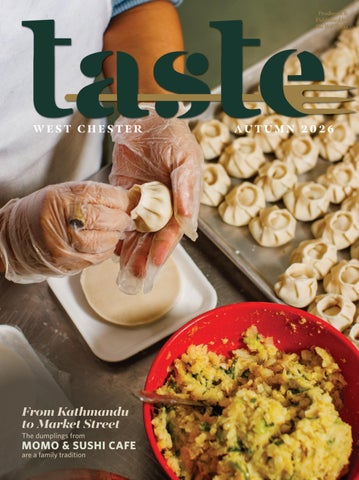
Momo & Sushi Cafe is bringing Kathmandu to town by Dan Mathers
19. ON A ROLL
The best sandwiches in town. by Dan Mathers
21. THE RESTAURANTS THAT RAISED WC Following the people who shaped our food scene for decades by Dan Mathers
31. FORM & FUNCTION
The borough’s best kitchens and dining spaces. by Andrea Mason
33. DINING OUT
Sampling some of our town's best meals. by Dan Mathers
39. ON THE SHELF
The best cookbooks at West Chester Public Library by Maggie Stantion
41. DATE NIGHT
Dinner for two with quality time and quality food. by Becca Boyd
47. PHOTO HUNT
Find the five changes, win a gift card
COVER PHOTO by Andrew Hutchins
@tastewc
#tastewc
Like and follow us on social media, then tag us in your posts for a chance to get your work published here. Our favorite image each month () earns its photographer a gift card to @saloon151.
@stoveandtapwc
@turksheadwines
@pietrosprime
@yorisbakerywc PUBLISHED BY THE WC PRESS
5
6
@TASTEWC | TASTEWESTCHESTER.COM
Breakfast of Champions The most important meal of the day can also be the most delicious way to start This Month: La Baguette Magique On Market Street, right across from the courthouse, La Baguette Magique has become the kind of place regulars build their week around — quiet enough on a weekday morning to get real work done, and lively enough on a Saturday to feel like the whole town showed up for pastry. That contrast, says head baker and manager Scott Weymiller, is part of the charm. “Weekdays are a great time for a meeting or getting something for work,” Weymiller says. “It’s a more relaxed atmosphere.” Weekends flip the script entirely, with full tables and a steady stream of families and kids drawn in by the smell of butter and yeast drifting onto the sidewalk. The bakery has roots that stretch back to its original owner, Catherine, who built the shop before returning to France. In 2019, Maria van Schaijik and Anthony Andiario took over, beginning a new chapter while keeping the bakery’s French sensibility intact. That sensibility shows up most clearly in the pastry case. The bakery uses all-organic flours, a long, slow fermentation process for its doughs and French butter for lamination — the process of repeatedly folding butter into dough that gives a good croissant its crisp, flaky exterior and tender layers inside. “I think the pastry stands out in flavor,” Weymiller says. Sourcing is just as deliberate. Much of what the bakery uses is seasonal and comes from Chester or Lancaster County, while organic flour and organic milk form the backbone of the kitchen. The team builds its offerings around what local farms are producing at the moment. Summer also means preserving, with jams and fruit put up specifically so those flavors can make their
way onto the menu long after the last local peach or berry has disappeared from the market.
“They are just so good,” Weymiller says. “That’s what I think people should order more.”
Coffee stays close to home, too. La Baguette Magique pours coffee from Turks Head and Gryphon, two local roasters Weymiller praises as much for the relationships the bakery has built with them as for what’s in the cup.
Maybe that’s the best argument for La Baguette Magique in the first place. There are plenty of elaborate things waiting behind the glass, but a bakery confident enough to tell you to order the plain croissant is probably pretty confident in its butter, dough and technique.
But this is Breakfast of Champions, so eventually we have to answer the important question: What should you actually order? For pure indulgence, Weymiller points to the chocolate almond croissant paired with a latte. It’s his pick for the most decadent option on the menu and, in his estimation, the best bite in the house. The naturally leavened Campagne country bread, meanwhile, is often the first thing to sell out, thanks to a loyal following. And then there’s the humble plain croissant.
There’s no DoorDash here, but the bakery does take advance orders, and its Instagram is a good place to keep up with what’s coming out of the ovens. For anyone trying to hold onto the last of the season, the patio remains open daily, weather permitting. La Baguette Magique is open Wednesday through Saturday from 7:30 a.m. to 5 p.m. and Sunday from 9 a.m. to 2 p.m. photos & story BECCA BOYD @homebeccanomics
PUBLISHED BY THE WC PRESS
7
8
@TASTEWC | TASTEWESTCHESTER.COM
the long way
HOME
Momo & Sushi Cafe is bringing the best of Kathmandu to the borough of West Chester STORY BY DAN MATHERS
PUBLISHED BY THE WC PRESS
9
10
@TASTEWC | TASTEWESTCHESTER.COM
W
est Chester’s restaurant scene has changed a lot over the past couple decades, and not just because there are more places to eat. The food has become more specific, reflecting the people who have arrived here and brought their own histories, traditions and tastes with them. Few restaurants capture that evolution as neatly as Momo & Sushi Cafe, where a Nepalese family tradition, a decade spent making sushi in American restaurants and a family that chose to make West Chester home all landed together on one Market Street menu.
A Family Affair There are easier ways to get to your grandparents’ house.For Phuri “Kevin” Lama, the trip starts with a flight into Lukla, Nepal, the tiny airport that serves as the gateway to Mount Everest. From there, he says, it’s about three days on foot, hiking six hours a day through the Himalayas to reach Syangboche, where his grandparents are from. For some context, the runway at Lukla sits at roughly 9,300 feet, is just over 1,700 feet long and pitches dramatically up the side of the mountain. Syangboche is higher still, perched above Namche Bazaar with clear views toward Everest. This is not Kevin reaching for some tenuous connection to the world’s most famous mountain. His father was a mountaineer who, Kevin says, summited Everest three times, and he has cousins who have made the climb more than a dozen times.
when he was 21. His first stop was Astoria, Queens, where he enrolled at Borough of Manhattan Community College, although school ultimately wasn’t for him. To make money, he found work in a Japanese restaurant.
Green Means Go Jaco’s ready-to-go Mean Green delivers fresh-pressed flavor in a grab-and-go format, no waiting required.
And now, on East Market Street in West Chester, there are strings of Tibetan Buddhist prayer flags hanging from the ceiling of his restaurant. Momo & Sushi Cafe does not look particularly dramatic from the sidewalk. There isn’t a ton of glass across the storefront, and some of what is there is obscured by posters and advertising. But the room opens up once you walk inside, brighter than expected, with sunlight filtering through plants in the front window and those little strings of colorful flags overhead.
tally. Traditionally printed with prayers, mantras and auspicious symbols, they are a familiar sight throughout Himalayan Buddhist communities, hung from rooftops, bridges and mountain passes where the wind carries the prayers outward. At Momo & Sushi, they also make for a pretty good visual shorthand. Kevin has traveled an awfully long way to end up here.
The flags are called lungta, or “wind horse,” in Tibetan when strung horizon-
He was born in Kathmandu and came to the United States in November 2009,
Kevin started at the bottom. He bussed tables and ran food, working his way toward becoming a server. The restaurant required employees to learn the operation and pass tests before moving up, and eventually one of the chefs suggested he learn another part of the business: sushi. That decision would eventually bring him to West Chester. In 2014, a chef friend in New York heard that Kooma was looking for a sushi chef. At the time, Kevin says, experienced sushi chefs were considerably easier to find in New York than
PUBLISHED BY THE WC PRESS
11
. an it t sc t it s u j e it. regr do n’t o w you
12
@TASTEWC | TASTEWESTCHESTER.COM
around here, so he took the opportunity and moved south. There was another connection waiting for him when he arrived: Kevin remembers Kooma’s kitchen employing a substantial number of Nepali workers. One of the chefs he worked alongside, he says, is still there more than a decade later. Kooma itself was already a West Chester institution. Scott Kim and John Jang opened the original restaurant in 2001, and by the time Kevin arrived, it had grown out of its original Gay Street location and moved into the much larger Church Street space it occupies today. Kevin stayed from 2014 through 2018, and he fell in love with West Chester. That part comes up repeatedly when you talk to him. Kevin is effusive by nature. He calls you “brother.” He wants to know what you think, wants you to taste something else, wants to explain why something is on the menu. He is unmistakably proud of the restaurant his family has built, but his affection for the town predates the restaurant by nearly a decade. After Kooma, Kevin landed at Bon Bon Sushi on North Darlington Street. Bon Bon was a tiny place with a devoted following and a menu built around inexpensive sushi and oversized sushi burritos. Kevin spent several years there, and when its owner decided to leave the restaurant business in 2022, Kevin suddenly found himself staring at an opportunity he hadn’t really planned for. The owner offered Kevin and another chef the restaurant’s equipment and encouraged them to take over. For a moment, Kevin thought he was about to become a restaurant owner. Then they couldn’t get the lease. Kevin had neither the money nor a backup location ready to go, so he took whatever useful equipment he could, rented a storage unit and put it away. The dream sat there with it. There were detours after that. Kevin spent roughly the next year working around several West Chester restaurants while trying to figure out what came next. Another potential restaurant partnership never materialized, and his original prospective partner eventually decided to retire. Kevin kept coming
back to one idea: momo. If you’ve somehow missed momo’s arrival on the American food scene, the easiest description is a dumpling. But that description is about as illuminating as calling ravioli “stuffed pasta.” Momo are among Nepal’s defining foods, made from dough folded around meat or vegetable fillings, most commonly steamed and served with a tomato-based achaar. Their precise origin is murky. Food historians generally trace their development through centuries of cultural exchange across the Himalayas, particularly trade between Tibet and Nepal’s Kathmandu Valley. What isn’t murky is how thoroughly Nepal made momo its own. Today they turn up everywhere from street stalls to restaurants, but
Chicken, beef, paneer and aloo momo showcase the range here, accompanied by Himalayan tomato sauce, chili oil and a bowl of tomato soup that doubles as a dip. they remain equally at home around the family table. That was the version Kevin knew. Growing up, he had absolutely no interest in making them. “He was more interested in eating,” says Lhami Sherpa. Lhami is Kevin’s second mom. That wording matters. Technically, Lhami is his stepmother. Kevin volunteered that
PUBLISHED BY THE WC PRESS
13
fact in his written answers to my questions, then almost immediately corrected the impression when we spoke afterward. “I’ve never referred to her as stepmom to anybody,” he told me. “She’s my second mom.” So that is what she is here. Lhami learned to make momo from her own mother. She was born in Nepal, grew up in India, then returned to Nepal later in life. Some of her strongest memories of momo are not really about the food at all. They are about Friday evenings, when everyone came home from work and school and the family made them together. Momo take time. There is filling to prepare and dough to make, then every dumpling has to be filled and folded before anything gets steamed. In Lhami’s family, that labor became the evening’s activity: everyone together, talking and sharing stories while their hands worked. Kevin mostly waited for the eating part. That changed in America. Living on his own forced him to cook, working in restaurants made him interested in food, and years behind a sushi bar taught him how a professional kitchen operates. Eventually, the kid waiting for his mother to finish the momo started wondering whether he could build a restaurant around them. The problem was getting anyone else to believe it. Kevin pitched potential partners on bringing momo to West Chester, but nobody wanted to take the chance on a food they believed local customers didn’t know. So Kevin went to New York and pitched his family instead. They said yes. Lhami had come to the United States in 2019, and Kevin’s younger sister, Mingma, was finishing high school and beginning to think about college. Kevin told them about his idea. His family invested, Lhami quit her job and Mingma applied to West Chester University. They moved to West Chester. Kevin found the Market Street storefront. He says his credit wasn’t particularly impressive at the time, but the landlord believed in the concept enough to take a chance on him. Then Kevin made another decision: he put the 14
restaurant in Lhami’s name. “I can’t have it in my name,” he remembers thinking. “I would rather have this as Mom’s name because she’s the one making all the momo.” Momo & Sushi Cafe opened at 209 East Market Street in October 2023, and nearly three years later, Lhami still makes the momo. A lot of momo. Kevin estimates she folds about 500 of them every day. And despite the history behind them, these aren’t exactly the dumplings Kevin remembers eating as a kid. Lhami
@TASTEWC | TASTEWESTCHESTER.COM
started with what her mother taught her, but spent the run-up to the restaurant experimenting, refining fillings and adjusting flavors. The recipes served on Market Street are hers. Kevin eventually learned to make them, too, although he freely admits Mom is still much faster. His sister knows how as well, although her primary contribution these days is handling much of the restaurant’s social media. Kevin prefers that she concentrate on school, partly because working with your sibling can be exactly as complicated as anyone with a sibling would expect. Still, he talks about her decision
Made with Love Mom handmakes the momo each morning, regularly as many as 500 a day, which are often served with a traditonal Nepalese tomato-based achaar. sauce. seasoned with Himalayan spices and folded inside dough. I had to remind myself of that while eating it because the flavor was so deeply savory that I kept expecting there to be something else providing all that richness. Kevin told me they don’t add MSG. Fine. Then I’m not entirely sure how Lhami does it. The Himalayan tomato soup pulls the same trick. This isn't Campbell’s with an accent. There’s a noticeable hit of something spicy and an assortment of aromatics that push it well beyond the flavor profile I normally associate with tomato soup. Eventually it became less soup than equipment. We had been talking too long and the remaining momo were getting cold. Kevin suggested dropping one into the hot tomato soup for a moment, letting it warm back through, then pulling it out and dipping it into the chili oil. Problem solved. That interaction tells you more about eating at Momo & Sushi than a lengthy tasting note probably could: Kevin is excited about this food. He wants you to enjoy it, and if he knows a better way for you to enjoy it, he is going to tell you.
to attend West Chester University as a sacrifice for the family. She could have gone elsewhere. Instead, she chose a school that kept everyone together. You begin to understand fairly quickly that this is how Kevin measures things. Family believed in the restaurant when prospective partners didn’t. His mom quit her job to make it happen. His sister stayed nearby. Kevin put the business in his mom’s name. Ask him about the restaurant and, eventually, he talks about them.
The Experience Kevin suggested four momo: aloo, paneer, chicken and beef. They arrived with the restaurant’s tomato sauce and Himalayan chili oil, accompanied by a bowl of Himalayan tomato soup. The chicken and beef are probably the easiest introduction for anyone still trying to mentally translate “momo” into “dumpling.” Paneer takes things somewhere else, filling the dough with Himalayan-spiced cottage cheese. But the aloo surprised me most. It’s potato: mashed potato and green onion,
The other half of the restaurant’s name deserves attention, too. Momo is where Kevin came from. Sushi is how he got here. The menu puts the two next to each other without pretending they came from the same culinary tradition. One side is built around Lhami’s Himalayan-spiced dumplings; the other draws from Kevin’s years behind sushi bars in New York and West Chester. The Everest Roll makes that distinction particularly obvious. Forget the neat little discs that probably appear in your head when someone says “sushi roll.” The Everest is handheld, essentially a sushi burrito, stuffed with asparagus, avocado, carrot, cucumber, glazed tofu
PUBLISHED BY THE WC PRESS
15
16
@TASTEWC | TASTEWESTCHESTER.COM
and tempura crunch, finished with ginger-garlic pesto vegan mayo and soy glaze. You pick it up in its paper wrapper and eat it with your hands. It is as convenient as it is delicious. By the time I finished eating, the name Momo & Sushi made considerably more sense to me than it had when I walked in. This isn't a fusion restaurant in the usual sense. Kevin isn't trying to convince you that sushi and momo share some secret culinary lineage. They share Kevin. One is the food that surrounded him growing up, the other is the craft he learned after leaving Nepal. Lhami brought one into the restaurant. Kevin brought the other. And West Chester gave them somewhere to put both.
A Bigger Borough There’s another guy working the front of the restaurant who calls himself Habibi. I never got his full biography, but I learned one fact about him repeatedly: he is from West Chester. Born and raised. Habibi told me, he told other customers, and over the course of lunch, I heard him work the fact into conversation at least four times. There was a time, not terribly long ago, when being born around here wasn't much of a conversation starter. Plenty of people in West Chester were from West Chester. The transplants only came from as far as Downingtown or Drexel Hill. Now the borough's full of people who came from somewhere else. Some came from Philadelphia. Some came from New York. One came from Kathmandu by way of Queens, carrying years of sushi experience and an idea for a dumpling restaurant nobody wanted to invest in. His second mom followed him. His sister chose a university down the street. His family put their money behind him. And every day Lhami folds hundreds of dumplings based on a food her mother taught her to make thousands of miles away. Momo has always been a food for gathering. The history varies depending on whom you ask, but the ritual is consistent: people sitting together, folding dough, talking, eating. Lhami remembers Friday nights like that. Now she makes them on Market Street.
A Kitchen of His Own Kevin brings years of sushi and restaurant experience to his own Market Street venue. Kevin, who came to West Chester looking for a sushi job in 2014, talks about this town with the enthusiasm of someone who still seems a little amazed that it became his. Meanwhile, Habibi will happily remind you that he was here all along. There’s room for both versions of West Chester now. The guy behind the counter can wear his born-and-raised status like a badge of honor while the guy who owns the place tells you about hiking three days through the Himalayas to reach his grandparents’ village. And neither feels particularly out of place.
That may be the bigger story hiding inside Momo & Sushi. West Chester hasn’t lost its identity as it has grown; it has added to it. The restaurants lining our streets increasingly tell you not only what this town likes to eat, but who lives here, where they came from and what they brought with them. There is something about West Chester—and especially about its restaurant community—that has long made room for people to come here, learn from one another, take chances and eventually build something of their own. Maybe Kevin recognized some of that potential when a sushi job brought him here in 2014 and he decided this was where he wanted to stay. Twelve years later, he isn’t just watching West Chester become a bigger, broader, more interesting version of itself. He and his family are helping build it.
PUBLISHED BY THE WC PRESS
17
18
@TASTEWC | TASTEWESTCHESTER.COM
On a Roll Sampling all of the borough’s best foods served between slices of bread. This Month: Colonial Village Meat Market Colonial Village Meat Market is still Colonial Village Meat Market. That may be the most important thing to know about the place since Collin Stoltzfus, his brother Ryan and their father Dan took over last year. The cheesesteaks are still there. The custom butcher cuts are still there. The original chicken salad is still there. The place just feels a little brighter, a little easier to navigate and, in some ways, a little better. The front windows are no longer obscured by shelves and signs. The floor plan has been opened up, the aisles are easier to maneuver, and new meat, produce and grab-and-go cases have created room for more products. But it still feels like the little neighborhood meat market people have been popping into for years. That extends to the service. I called ahead for a chicken parm hoagie, and the guy answering the phone had that gruff-sounding Philly affectation that can be mistaken for annoyance if you didn’t grow up around here. He was actually helpful, in a great mood and cracking jokes; although I distinctly told him my name was Dan, I was “Danny” by the time we hung up. Ten minutes later, my sandwich was ready. I grabbed a bag of Herr’s chips and Reading Draft root beers on my way to the register and headed to my dad’s house to watch Penn State. We split the hoagie and, along with the chips and root beers, neither of us needed anything else for lunch. It’s a big sandwich. Collin recommended the chicken parm because he thinks it gets overshadowed by their Italian hoagies and cheesesteaks. To him, though, it’s a good representation of what they do: “local, simple, delicious.” The chicken is sourced regionally from Delaware, pounded thin, breaded and cooked in-house. It comes on a Corropolese roll delivered fresh each morning, with thick slices of Pennsylvania pro-
volone, sauce produced in New Jersey and a finishing sprinkle of Parmesan. The roll is crusty and chewy—you have to bite and tear—while the chicken is thin and tender and covered in provolone and a bright, tomato-forward sauces that's simple and fresh rather than sugary like you get from a jar at Giant. The Parmesan registers with a sharp bite. Nothing is particularly complicated. It’s just a really solid sandwich made from really good ingredients. That philosophy makes sense given the new owners’ background. The Stoltzfuses are fifth-generation food retailers, tracing their roots to a great-great-grandfather who sold chickens and bread from his farm during the Great Depression and became one of the early vendors at Booths Corner Farmers Market. Collin says their approach to Colonial is to preserve what already aligns with
Chicken Parm Hoagie Locally sourced and house cooked chicken with fresh marinana and pleny of cheese. their values—quality meat, good products, customer service and fair prices— while improving the shopping experience around it. At checkout, the guy behind the register asked how I was doing, to which I replied, "I'm about to be a lot better." He laughed and said, "I know I work here, but our food is sooo good." When I asked if he got a shift meal he said, "Oh yeah. I'm absolutely getting a cheesesteak before I get out of here. Best part of the job." photo & story DAN MATHERS @danielkmathers
PUBLISHED BY THE WC PRESS
19
20
@TASTEWC | TASTEWESTCHESTER.COM
The Restaurants that Raised West Chester BY DAN MATHERS
Follow the people behind West Chester’s restaurants and you’ll find the same names turning up again and again—behind different bars, in different kitchens and, eventually, on the doors of places of their own. PUBLISHED BY THE WC PRESS
21
22
@TASTEWC | TASTEWESTCHESTER.COM
T
ry drawing a family tree of West Chester restaurants and you quickly discover that nobody remembers the whole family. Ask one restaurateur where he learned the business and you get three names. Call one of those people and you get five more. Someone remembers a bartender who became an owner. Someone else remembers a chef who crossed Gay Street. A third person points out that half the staff at one restaurant eventually wound up working at another. Follow one branch far enough and it inevitably crosses another. This story started as a fairly simple idea: trace a few of those connections and see where they led. It did not stay simple for long. What follows isn't an exhaustive history. It's closer to an oral history, reconstructed largely from the people who were there. Memories differ. Dates get fuzzy. Some branches have certainly been missed. In fact, after enough conversations, it became pretty clear that an exhaustive version of this project could swallow an entire issue. Take almost any West Chester restaurant that lasted more than a few years and you could probably find a line running into it, out of it, or both. But even an incomplete map reveals something important: West Chester becoming a restaurant town was not an accident. To understand how it happened, you have to remember a West Chester that looked very different from the one outside the window today. When Andy Patten opened Market Cafe in 1993, he remembers only a handful of restaurants that really mattered downtown. Donnie Moore, who started Rex's Bar that same year, remembers much the same thing. Both bring up The Restaurant & The Bar. They mention La Cocotte. Vincent's comes up. "The Bar and The Restaurant, that was where everyone went back in the day," Donnie remembers. "There was only that, La Cocotte and Vincent's, and that was it." The Restaurant & The Bar is perhaps the most important ghost on our map. It occupied 18 West Gay Street,
Andy Patten at Market Cafe in 1993, and three decades later at The Original Spence Cafe. What started on Market has become one of West Chester’s longest-running restaurant stories.
where Kildare's sits today, and was created by Jack McFadden and George Mershon. Jack, who died in 2020, had taken inspiration from Steve Poses' Frog Commissary in Philadelphia. The
West Chester restaurant had outdoor dining, Sunday hours, live music and a large ornamental fish tank dividing portions of the room—things that sound fairly ordinary in a borough now packed with restaurants and patios, but which stood out in a downtown with plenty of empty storefronts. Kara Dougherty arrived there as a server in the summer of 2002, near the end of the restaurant's run. She remembers the uniform—black pants, white shirt, tie—and the long bar running through the room. She remembers the fish tank and music on weekends, but mostly she remembers the people.
PUBLISHED BY THE WC PRESS
23
"There were so many people there that went on to do other things," she says. Kara is one of them. She went on to help open Kildare's and eventually became a partner in Wrong Crowd Beer Company. Justin Dougherty— yes, her husband—came through The Restaurant & The Bar before Kildare's and eventually Side Bar. Kelly McGonagle went from The Restaurant & The Bar to Kildare's, then Side Bar and Wrong Crowd. Jason "JB" Braun left for Ryan's Pub. Blaise Labik passed through before working at Kildare's, Spence and Side Bar. "The Restaurant and Bar, in my mind, sort of started it," Kara says. Sometimes those connections operated after hours. Andy's Market Cafe was initially a breakfastand-lunch operation. He would close in the afternoon, then head over to Rex's several nights a week and start serving food there for late night. "I wasn't doing dinners yet so I was closed at three then I would do food at Rex's," Andy remembered when asked about the overlap. "But that didn't start till like nine if I remember right." "And only maybe three nights a week," he added. So, for a while, Andy was simultaneously running his own restaurant by day and working in someone else's by night. By 1996, Market Cafe was gone and Spence Cafe had arrived. If The Restaurant & The Bar is the great ghost of this story, Spence is one of its great surviving bloodlines. Across his various incarnations—Spence Cafe, Butterfish, Spence 312 and today's Original Spence Cafe—Andy estimates somewhere around 800 people have worked for him. Most, obviously, did not go on to open restaurants in West Chester. But enough stayed in the industry that Spence repeatedly appears when you ask today's restaurant people where they learned. Blaise worked there. Justin worked lunches there for roughly a year and a half or two years. Dave Walti came through Spence. Maria van Schaijik worked the front of the house there while she and Anthony Andiario were 24
preparing to open Andiario. And sometimes people came back: Blaise's path is almost comically West Chester— The Restaurant & The Bar, Kildare's, Spence, Side Bar, then back to Spence. On a conventional résumé, that's a series of employers. On this map, it's a loop. Justin remembers Blaise helping shape the kitchen at Side Bar and still speaks about him with obvious affection. Donnie runs The Social just a couple blocks from Spence and had nothing but good things to say about Andy. The more people we spoke to, the more often competitors talked about each other that way.
When we opened... it felt like real investment was finally coming into West Chester. That combination — a town ready to invest in itself, an existing space with a track record, and a small community of operators who liked working alongside each other — is what told me this could grow into something much bigger. -DAVE MAGROGRAN Dave Magrogan, who would eventually operate several concepts within blocks of the people he was talking about, remembers that quality about West Chester from the beginning. “The restaurateurs already here were genuinely committed to building something together, not just competing for scraps,” he says.
Kevin Finn. Inevitably, some of those careers carried people beyond Iron Hill and into other restaurants around town. Stephanie Gray was one of them. She left Iron Hill to head up the kitchen at Kildare’s for Dave Magrogan; years later, she and her husband Dane would take over the business from him. But Iron Hill’s willingness to develop people didn’t necessarily stop at its own doors. When Side Bar was preparing to open in 2009, just down the street, Justin remembers Kevin walking over with two of his managers. “Take these guys,” Justin remembers Kevin telling him. “They’re going to help you get started.” Kevin remembers the details a little differently: one of his managers asked if he could lend Justin a hand, and Kevin and his partners encouraged him to do it. Either way, nobody seems to dispute the important part: Iron Hill employees helped another restaurant get open down the street. Kevin is nevertheless careful about turning Iron Hill into the hero of West Chester’s restaurant story. “I think we get too much credit for starting the restaurant renaissance in West Chester,” he says. Iron Hill recognized an opportunity early, he believes, but plenty of other good operators were seeing it too. What may say more about the culture they were building happened eleven years later, when one of those operators was getting ready to open a restaurant down the street.
One of the better examples came from Kevin Finn and Justin Dougherty, and appropriately enough, they remember it a little differently.
Side Bar was preparing to open in 2009, just down the street from Iron Hill, and Justin remembers Kevin walking over with two of his managers. "Take these guys," Justin remembers Kevin telling him. "They're going to help you get started."
When Iron Hill Brewery & Restaurant opened in West Chester in 1998, it brought something new to the borough: a restaurant company built to grow, with a culture of developing people along with it. “We wanted our best people to stay for the long term and have careers, not just jobs,” says co-founder
Justin remembers the Iron Hill crew helping with the nuts and bolts of getting a restaurant running—sharing knowledge about the point-of-sale system, spreadsheets and data, even helping with spare keys and the alarm. Kevin remembers the beginning a little differently. In his telling, Iron Hill
@TASTEWC | TASTEWESTCHESTER.COM
PUBLISHED BY THE WC PRESS
25
26
@TASTEWC | TASTEWESTCHESTER.COM
manager Clint Wagner came to him and asked whether they could go help the guys opening Side Bar. "We always tried to support others in the business," Kevin says. He and his partners told Clint to go help. Fifteen years later, Justin and Kevin disagree slightly about who first offered the assistance. The important part is that an established restaurant sent its people down the street to help a future competitor get its doors open. Kildare's provides another tangle of lines. Dave opened the West Chester Kildare's in 2003, taking over the former Restaurant & Bar space. He would go on to create Doc Magrogan's Oyster House, Más Mexicali Cantina and Harvest Seasonal Grill & Wine Bar, among other concepts, and his organization became
Rex’s Bar was West Chester’s 100-capacity rock-and-roll dive at 344 W. Gay St. Donnie Moore got his start there in 1993, years before taking his love of live music to The Note. another training ground. That part was deliberate, too. "One of my goals was always to teach our people success principles for business and life," Dave says. And unlike the traditional boss who might regard a good employee's departure as a loss, Dave says he hope some would eventually leave. "I was always excited when someone left us to go chase their own dream." There were plenty of opportunities to
do it. Employees moved among Kildare's, Doc Magrogan's and Más, while others carried what they'd learned elsewhere. Dave remembers Brian Duffy moving from Kildare's to help build Harvest, while Dave Walti arrived there after working for Andy at Spence. Adam Wetzel, Justin and Kelly all came through Kildare's before Side Bar. Even the name followed them: Kildare's had a smaller bar the staff called the "Side Bar," where some of the future Side Bar crew worked. Dane Gray met Dave in Dublin around New Year’s 2003, came to the United States and spent more than a decade working within Dave’s company before buying the West Chester Kildare’s with Tom Farnesi in 2015. By then, Kildare’s was already deeply entwined with his
PUBLISHED BY THE WC PRESS
27
life: Stephanie had spent years in its kitchen, while Dane had worked his way from behind the bar into management and eventually became Dave’s director of operations. “20 years of learning at Kildare’s has given me a lot of experience… invaluable,” Dane says. Today, he looks at the managers working for him much the same way his old boss once looked at his staff: people who could eventually be equipped to run operations of their own.Meanwhile, a remarkable collection of West Chester restaurant people moved through the place. Justin was there, and his now-wife Kara, too. Kelly was there. Adam came over from Jitters. Blaise worked there. Our own Nick Vecchio did marketing and DJ'd on the weekends. Justin, Adam, Kara and Kelly were among the senior bartenders associated with that side bar inside Kildare's. A few years later, Justin, Kevin Barry and Adam opened Side Bar & Restaurant just a few doors down. Blaise and Dave "Big Dave" Young were among the chefs. Kelly worked there. So did Dan Merola, who arrived in West Chester for college after working at The Original Clam Tavern. 28
CHANGING OF THE GUARD Left: Dave Magrogan with his family on the day he sold Kildare’s West Chester to Dane and Stephanie Gray. Right: Dane and Stephanie Gray on the day they bought Kildares. Dan remembers the lessons at Side Bar being less about food than about people. The owners knew their employees. They thanked them. There were shift drinks, parties and staff gatherings. Dan's takeaway was simple: "Take care of your staff as well as you take care of your guests." When he moved on to Roots Cafe, he learned something different. Roots introduced him to seasonal cooking, local sourcing and a different philosophy about what went onto the plate. Years later, those two backgrounds came together when Dan became the owner of Roots.
@TASTEWC | TASTEWESTCHESTER.COM
Other lines keep going. Maria's runs from Spence to Andiario. Kelly's runs through The Restaurant & The Bar, Kildare's and Side Bar before reaching Wrong Crowd. Kara's ends there too. Dave Walti's path runs through The Gables and Spence before Harvest. Paul Maychak moved through Rex's, Spence, The Note and The Social. And then there are branches that barely touch those at all. Frank Herron spent years at Barnaby's, eventually serving as its general manager, before opening Saloon 151. James Cappello managed Rams Head before joining him at Saloon. Today their paths converge again at Station 142. By this point, the idea of a family "tree" had pretty much fallen apart. There were other forces at work, too. Any history that credits restaurants alone would be absurd. West Chester University matters. Borough leadership matters. The Business Improvement District matters. Developers, retailers, arts organizations, festivals, residents and a larger cultural return to downtown living all matter. And then there was Stan Zukin. Andy and Donnie both brought up the late
Justin Dougherty poses with his daughter Ella for a 2012 feature called "The Beer Guy" in the fourth ever issue of this magazine. the idea that Iron Hill started it. Dave remembers established restaurateurs helping rather than guarding their turf. Andy remembers closing Market Cafe at 3 and going over to cook at Rex's at 9. Justin remembers Iron Hill sending managers down the street to help him open. Mostly, they were running restaurants.
By the time Kildare's arrived in 2003, developer without being asked. So did Dave could see that change happening. Dave. "He really cared about the restauLooking back now, he describes that rant scene and trying to attract good period as the one that "turned a sleepy restaurants," Dave says. Stan wasn't a West Chester, restaurateur, but with empty and he invested heavneglected storeily in the people fronts, into the who wanted to dynamic town it is become them. Everybody was competing, today." He bought propbut it never really felt like erties, invested in The downtown that. When we were getting kitchens and, in Andy and Donnie Side Bar open, Kevin Finn some cases, liquor describe from the licenses, removcame down from Iron Hill early 1990s isn't ing some of the recognizable as the with two of his managers and enormous upfront borough today. Gay basically said, ‘Take these costs of getting a Street is lined with restaurant open. guys. They’re going to help restaurants and outdoor tables. On you get started.’ That was just Donnie doesn't busy weekends, the hedge when he how people treated each other. sidewalks fill with talks about Stan. people who came -JUSTIN DOUGHERTY "Without Stan from somewhere Zukin, I don't think else specifically to West Chester spend an evening downtown. would be where it is today," he says. "He helped a lot of us get started." Stan once What's striking in talking to the peodescribed his philosophy more simply: ple who were there isn't that any of them "I wanted to mold this town, to help it claims to have planned that transformagrow." tion. Kevin explicitly pushes back against
When we started asking them about it, something funny happened. Half the people interviewed got caught up in reverie, thinking about the good old days, then called back later the same day to make sure we knew about someone they'd forgotten. Some texted again the next day. One name led to another, one restaurant to another, and every time the map looked finished, somebody remembered another line. Eventually we had to stop. So consider the map accompanying this story a snapshot, not a genealogy. There are people missing who deserve to be there. There are restaurants that trained generations of WC workers and aren't represented. There are connections nobody remembered until the magazine was already headed to press. But look at the lines that did make it. A server at The Restaurant & The Bar helps open Kildare's and, years later, Wrong Crowd. A guy running Market Cafe during the day cooks at Rex's at night, then opens Spence. A young Irishman comes to work for Kildare's, spends more than a decade with the company and eventually buys the place. A college kid learns how to take care of employees at Side Bar, learns how to cook locally at Roots and eventually owns Roots himself. A restaurant about to open gets help from the competitor down the street. Thirty years later, they're still remembering who taught them, who worked beside them and who helped them get the doors open. West Chester is a restaurant town today, and it didn't happen by accident.
PUBLISHED BY THE WC PRESS
29
30
@TASTEWC | TASTEWESTCHESTER.COM
Form & Function Exploring the design concepts of our borough’s best kitchens and dining spaces. This Month: 9 Prime Located in the stunning former First National Bank of West Chester, 9 Prime serves an elevated menu of seafood and steak in a show-stopping interior. Speaking with general manager Chris Jones, you hear the intentions behind what 9 Prime wanted to bring to West Chester. Despite an impressive menu and the grandeur of the space, they wanted it to complement our charming small town. 9 Prime has a big-city feel while showcasing the beautiful original details that are so important to West Chester and its history. The designers at Bernardon worked closely with owners John and Linda O’Connell to create this elevated atmosphere. You can’t help but look up as you walk in, admiring the original 19th-century crown moulding decorating the ceilings and doorways. To create a cozier atmosphere, the designers lowered the ceiling in areas, creating a more intimate, moodier ambiance. Booth and table seating surrounds the bar, while existing gold teller doors serve as partitions between seating. Continuing through the building, you can’t miss the focal point: the original bank vault. Beautiful brass safe-deposit boxes line the walls where they sat more than 100 years ago, creating the perfect backdrop for intimate parties. Upstairs, an additional seating area and bar join multiple rooms for weddings, work meetings and parties. Each has its own character, featuring West Chester scenes by local artists and photographers. Downstairs, the basement hosts a speakeasy called Johnny O’s. Upholstered walls and low ceilings create an acoustically friendly, cozy atmosphere, while another bank vault holds multiple private seating areas. Johnny O’s is a members-only speakeasy but opens
to the public on Tuesday evenings. The bartenders get to know their patrons, giving it an everybody-knows-everybody feeling. The food at 9 Prime is made with thought and precision by Chef Jacob Altemus. The menu changes seasonally, sourcing quality ingredients to complement its celebrated steak and seafood dishes. Appetizer favorites include cheesesteak egg rolls, burrata and octopus. For the mains, you come here for fresh seafood and steak. The beef meets Certified Angus Beef standards. Other crowd pleasers include lobster mac and cheese made with fresh pasta and truffle-honey Brussels sprouts with Parmesan.
Don’t skip dessert, with sky-high chocolate cake and seasonal housemade beignets. Rolling out on the fall menu will be a s’mores tart as well as maple-bacon gelato by local gelateria Gemelli. Complement your food with craft cocktails and brighten up your fall with inventive seasonal drinks. 9 Prime is a perfect place for a special night out or your next party. Check their website for special events and an exclusive chef’s table. story ANDREA MASON @andreamasondesign photos DANIELLE CARINA @carina.danielle
PUBLISHED BY THE WC PRESS
31
32
@TASTEWC | TASTEWESTCHESTER.COM
Dining Out Sampling some of the borough’s best meals in West Chester’s premier dinner destinations. This Month: Osteria Ama I keep thinking about the bread. Not because it was the most elaborate thing we ate at Osteria Ama. It wasn’t even something we ordered. It just showed up at the table, warm from the oven, a handful of round, potato-sized loaves with lightly charred exteriors and soft, chewy centers that pulled apart with a little resistance. I ate one immediately, tearing off pieces and dipping them into the olive oil and balsamic on the table. Then I ate another while we waited for the appetizers. Later, I used what remained to mop up the bright tomato sauce left behind by the arancini. There are worse ways to ruin your appetite. But the bread also turned out to be a pretty good introduction to Osteria Ama, a relatively new Italian BYOB tucked into the shopping center at the intersection of Route 926 and 202. Owner Genti Mataj grew up in Montespertoli, a small town in Tuscany, where his education in Italian cooking started in his mother's kitchen. "She was always in the kitchen reinventing traditional dishes, and I spent a lot of time with her when I was younger," Mataj says. "That is where my love for cooking began." After coming to the United States, he worked in several Italian restaurants, learning the business while holding onto the idea that eventually he'd have one of his own, somewhere he could serve his recipes and his version of Italian food. Today, Osteria Ama has three locations, with more planned. The philosophy behind them is pretty straightforward: make as much as possible yourself. The pasta, sauces, breads and desserts are all made in-house. Certain cheeses, artichokes and other ingredients come through Italian importers, while specials change according to what the kitchen can source fresh. The menu travels around
Italy rather than planting a flag in one region, with Mataj describing it as a collection of distinctive dishes from Northern to Southern Italy, interpreted with a modern touch. That's all useful information to have after dinner, but sitting at the table, you don't really need anyone to tell you the kitchen is doing a lot of the work itself. The bread gives the game away. I was there with my mom, Lisa; my stepdad, Jim; and my sister, Maya, on an ordinary weeknight. We arrived relatively late, at a time when I wouldn't have been surprised to find the dining room winding down. Instead, it was probably three-quarters full. There appeared to be one server handling much of the room, and she was moving: greeting tables, seating guests, taking orders, delivering food and making cappuccinos, seemingly everywhere at once.
House-made bread, warm and lightly charred, alongside eggplant parmigiana and pasta—a table that showcases Osteria Ama’s from-scratch approach. My mom had arrived a few minutes before me and called almost immediately with considerably more urgency than the situation warranted. “They don't have wine.” Osteria Ama is BYOB, a fact Lisa had apparently not encountered, trusting me to just make a decision rather than gameplan her meal in advance like I expect as a Millenial. Jim was promptly dispatched in search of a bottle and, fortunately, returned from somewhere nearby a few minutes later with the crisis resolved.
PUBLISHED BY THE WC PRESS
33
34
@TASTEWC | TASTEWESTCHESTER.COM
Warm, welcoming and comfortably removed from the bustle of downtown, the dining room offers an easygoing setting for a handmade Italian meal—with parking just steps from the door. With wine secured, I did what I generally do when four people give me an excuse to order too much food: started picking appetizers for the table. The arancini were an easy choice, particularly after confirming they were vegetarian so Maya could participate. The rice balls arrived crisp and surprisingly light, with just a little cheese inside and a tomato sauce that was bright and fresh, only slightly sweet. It was the kind of sauce that demanded something be dragged through whatever remained on the plate. Fortunately, I had bread. The Brussels sprouts were even better. Brussels sprouts have undergone one heckuva rehabilitation over the past couple decades. Somewhere along the way, restaurants discovered that if you cooked them hard enough—and bacon fat certainly didn't hurt—people who grew up hating boiled Brussels sprouts would suddenly order them voluntarily. But I think we may have overcorrected. Too often now, the pursuit of the perfectly crispy sprout leaves you with something practically fried: dark and brittle around the edges, saturated with oil once you bite through the exterior. Osteria Ama goes the other direction. These were lightly seared, still soft and delicate, allowing the natural sweetness of the vegetable to remain the point. A little balsamic glaze amplified that sweetness, while shaved Parmesan and generous pieces of mozzarella added richness without burying the sprouts themselves. It was a delightfully traditional treatment of a vegetable that restaurants have spent years trying to reinvent, and probably the best Brussels I've had in a long time. That restraint carries over to the pasta. Mataj makes his pasta in-house, and the difference isn't expressed through some enormous flourish. It's in the texture: the pasta has the firmer bite you'd expect in Italy, noticeably more al dente than the
softer noodles that have become common at American-Italian restaurants. At the same time, it remains delicate and unmistakably fresh. Even the spaghetti my mom had on the side showed it. There wasn't anything complicated about it; it was simply really good pasta, cooked properly. That distinction matters because Osteria Ama isn't trying to abandon the Italian-American dishes people actually want to eat. The eggplant parmigiana is a perfect example. Thin pieces of eggplant are layered almost like lasagna beneath plenty of tomato sauce and cheese, arriving as the sort of enormous, bubbling comfort-food monument that makes portion control feel like somebody else's problem. There is a running joke about
Italian-American restaurants feeding you as though you haven't eaten since Tuesday, and Osteria Ama isn't interested in disproving it. We literally enjoyed that eggplant parm for days. Then there was Jim's special. His lightly seared tuna arrived over a crab bisque, the fish sitting against a creamy orange sauce that wasn't something I would have predicted when walking into an Italian BYOB. But Mataj says the restaurant uses its specials to work with whatever ingredients are particularly good that day—branzino, octopus and homemade lasagna are among the dishes that rotate through—and the tuna demonstrated how far they're willing to wander from the obvious. Jim left nothing behind.
PUBLISHED BY THE WC PRESS
35
36
@TASTEWC | TASTEWESTCHESTER.COM
Ask Mataj what he'd put on the table for someone visiting Osteria Ama for the first time and the list gets long quickly: handmade pasta, risotto, grilled artichokes, eggplant parmigiana, chicken parmigiana and homemade gnocchi. "They showcase the quality of our ingredients and the care we put into every plate," he says. That sounds like something restaurant owners are supposed to say, except after eating there, "care" feels like a fairly accurate description of what distinguishes the place. And yet, driving away, I realized the food was only part of why Osteria Ama made such a strong case for itself. My family lives in East Goshen. For Mom, dinner in downtown West Chester has become an undertaking. It's not an enormous undertaking, obviously—we're not crossing the Dolomites—but after a long day, getting the family together already requires enough coordination. Then there's traffic into the borough, finding somewhere to park, and hoping the spot you find doesn't turn dinner into a hike before you've even reached the restaurant.
Brussels Sprouts Lightly seared with mozzarella, shaved Parmesan and balsamic—tender and naturally sweet For those of us who love downtown West Chester, those inconveniences are generally worth it. But they're also real, and Osteria Ama eliminates them. You come down 202, turn onto 926 and pull into a parking lot. We parked perhaps ten feet from the front door. For my mom, that simplicity wasn't incidental to the experience; it was part of what made dinner appealing in the first place. Then there was that initially devastating BYOB revelation. By the time I picked up the check, Lisa's missing wine list looked considerably less tragic. Four of us had eaten appetizers, entrées and enough food to produce multiple rounds of leftovers, and the bill was only around $100 before tip. In 2026, that feels almost startling. Bring a bottle you already like, park
outside the front door, sit down to warm homemade bread and fresh pasta, and feed four adults without feeling like you've made a questionable financial decision. There are sexier restaurant pitches, but I'm not sure there are many better ones. Mataj says "Ama" means "love" in Italian. He chose the name partly because it reminded him of the love his mother put into cooking when he was growing up in Tuscany—the kitchen where all of this began. "We want our guests to feel like they are sitting at an Italian table," he says, "enjoying food made with passion." For me, that table keeps coming back to the simplest thing they put on it: a warm little loaf, torn open by hand, soft and chewy inside, crusty and charred around the edges. Dragged through olive oil, dipped into balsamic, then used shamelessly to chase the last streaks of tomato sauce around an empty plate. I probably didn't need the second one, but I'd eat it again tomorrow. story DAN MATHERS photo ANDREW HUTCHINS @hutchins_photo
PUBLISHED BY THE WC PRESS
37
38
@TASTEWC | TASTEWESTCHESTER.COM
On the Shelf The Staff at the West Chester Public Library suggest cooking inspiration from their shelves Fall brings a full calendar to the library, with story times, chess, LEGO and junior detective clubs for younger patrons, plus poetry, book clubs and trivia for adults. While you’re there, browse the cookbook shelves for a little seasonal inspiration—whether that means autumn baking, easier back-to-school dinners or a fresh start on healthier eating.
Sourdough Everything:
Sweet and Savory Recipes for Beautiful Breads and Other Bakes by RACHEL PARDOE
Sourdough doesn’t have to be intimidating. Rachel Pardoe walks bakers through creating and caring for a starter before putting it to work in more than 70 recipes. Alongside beautifully crafted loaves are raisin bread, pumpkin chocolate rolls, French crullers and pretzels. Step-by-step instructions and simple tools make the book accessible to beginners, while more ambitious recipes offer experienced bakers plenty of reasons to pull that neglected starter from the back of the fridge.
Bake Your Own Brownies by MARI BOLTE
Here’s one for West Chester’s youngest aspiring bakers. Clear photos and simple, step-by-step instructions guide early readers through making their own batch of fudgy brownies— with a little adult assistance, of course. It’s an approachable introduction to following both a recipe and written directions, with a pretty convincing reward waiting at the end.
Eat Yourself Healthy by JAMIE OLIVER
Jamie Oliver approaches healthy eating by focusing on what you can put on the plate rather than what you need to eliminate. Eat Yourself Healthy combines 120 nourishing recipes with 50 practical healthy-eating tips and a
two-week meal plan. The emphasis is on satisfying, abundant food and sustainable everyday habits rather than deprivation, making it well timed for anyone looking for a reset as summer gives way to the routines of fall.
Of Course It’s Good!
Aggressively Delicious Meals Anyone Can Make and Everyone Will Love by JESSICA SECREST
Jessica Secrest embraces a simple philosophy: good dinner doesn’t need to be difficult. Her debut cookbook
makes liberal use of pre-shredded cheese, tater tots and the slow cooker to create inexpensive, low-effort meals. Recipes include baked mac and cheese, taco tot casserole, teriyaki pork, fried pickle quesadillas and sloppy joe fries. Secrest’s irreverent humor accompanies it all, making this a particularly useful pick when the back-to-school calendar makes simply getting dinner on the table feel like an achievement. story WC PUBLIC LIBRARY @WCPLPHOTOS
PUBLISHED BY THE WC PRESS
39
40
@TASTEWC | TASTEWESTCHESTER.COM
Date Night A historic Dilworthtown tavern, seasonal plates and cocktails made for sharing give The Pear all the ingredients for an unhurried night out.
PHOTOS & STORY BY BECCA BOYD
PUBLISHED BY THE WC PRESS
41
T
here’s a particular kind of magic that happens when a restaurant makes you work a little for it. The Pear sits in Dilworthtown, Pennsylvania—not a place you stumble upon, but a place you decide to go. The drive there winds through some of the prettiest farmland in Chester County, past stone walls and open fields that seem to soften the pace of the evening before you’ve even parked the car. And parking, unlike at the borough restaurants ten minutes away, is never the fight it could be. By the time you step inside, you’ve already left the week behind. This is precisely why The Pear has become one of the area’s most quietly beloved date-night destinations. It isn’t trying to be the loudest table in town. It’s trying to be the one you come back to. Long before it was a restaurant, the building at the heart of The Pear was something else entirely—several something elses, in fact. Portions of the structure date back to the 1760s, and during
42
Made for Sharing Warm marinated olives, triple-cream cheese, pear compote and housemade rosemary, olive oil and thyme crackers set the tone for the meal. the Revolutionary War it served as a hospital for French soldiers. Later, it lived a quieter life as a general store; there’s a painting depicting horses tied up out front, a small artifact of that chapter. Ask around and you’ll hear the local rumor, delivered with a wink, that the place is haunted. Whether or not you believe it, there’s no denying the building carries a weight of history most restaurants can only fake with reclaimed barn wood and mood lighting. The current owners, Nick and Linda Farrell, understood that weight when they took over the space three years ago, after it had sat vacant for a stretch
@TASTEWC | TASTEWESTCHESTER.COM
of time. The couple isn’t new to the restaurant business—far from it. Nick has spent almost three decades successfully running Sovana Bistro in nearby Unionville, and the Farrells still live just a few miles down the road from The Pear. When they took on the tavern, they weren’t chasing a trend; they were bringing a philosophy about food and hospitality they’d already spent a lifetime refining into a smaller, more intimate space. That intimacy is the point. Where Sovana has more scale and a larger menu, The Pear is deliberately smaller—a quaint and cozy space, a tighter menu, a more concentrated experience. The bar area was completely gutted and reimagined with modern leather seating, warm light fixtures and a French-country sensibility that feels elegant without tipping into stuffy. Local artist Jack Marshall’s work lines the walls, grounding the space in its own community rather than importing someone else’s idea of charm. It’s the kind of place where the quiet murmur of your fellow diners creates a romantic background din—and
Start at the Bar The “Now You Know” and “Business Casual” showcase The Pear’s seasonal cocktail program, balancing fresh fruit, citrus and herbs. where the bartender, Mark, runs a playlist good enough that you’ll catch yourself singing along mid-sentence. If there’s one guiding idea behind a date night at The Pear, it’s this: almost everything on the menu wants to be shared. The kitchen leans hard into small, seasonal plates meant to be passed back and forth across the table, which turns dinner into something more like a conversation than a solo performance. Start with the warm marinated olives and cheese board. The triple-cream cheese is so buttery it borders on indulgent, paired with The Pear’s signature pear compote—a kind of mostarda— and housemade rosemary, olive oil and thyme crackers. It’s a simple opener, but it sets the tone: nothing here feels like an afterthought. From there, the kitchen’s relationship with the land becomes obvious. The Pear keeps its own garden out back, growing herbs and edible flowers that show up throughout the menu. Even the borage flowers used in the cocktails come from that same patch of dirt. The kitchen staff takes turns tending it, weeding and harvesting alongside cooking, which is a rare commitment for a restaurant of any size. The garden shows up most memorably in an off-menu salad built around local corn and tomatoes at the height of summer—worth asking your server about if it’s in season. The signature dish, though, is the Dill Caesar salad, a clever hybrid of a wedge and a classic Caesar. It arrives dressed in a proper Caesar dressing, topped with grated egg and Parmesan and, in place of croutons, a scattering of housemade potato chips that add crunch without weighing the dish down. Add salmon if you want to turn it into more of a meal; either way, it’s the kind of salad people order specifically, by name, on repeat.
For the main course, three dishes come up again and again as the ones people talk about on the drive home. The housemade angel hair pasta, tossed with summer squash, heirloom tomato and shrimp in an arrabbiata sauce, is a warm-weather standout—light but flavorful and clearly built around whatever is fresh that week. The smashburger, made with Wagyu beef, is the more indulgent choice, served with fries and a cheddar fondue that turns a simple burger-andfries plate into something worth splitting fork-first. And then there’s the French-cut chicken breast, paired with Parisian gnocchi, spinach cheddar fondue, roasted onions and a mushroom Marsala jus. It’s substantial enough to
anchor a special-occasion dinner but still plated with the kind of restraint that keeps The Pear from ever feeling fussy. No date night at The Pear is complete without a cocktail from the seasonal list, and two in particular are worth building the evening around. The “Now You Know” is a summer martini made with watermelon juice, vodka and smoked honey syrup, brightened with lemon juice and given a silky, frothy texture from egg white. It’s finished with those same edible borage flowers grown just outside the kitchen door. For something with more backbone, “The Business Casual” leans into whiskey-tiki territory: bourbon, almond syrup, orange flower water, fresh lime juice and a yellow Chartreuse rinse that adds an
PUBLISHED BY THE WC PRESS
43
44
@TASTEWC | TASTEWESTCHESTER.COM
herbal snap to the finish. As a gal who eschews overly sweet cocktails, I can happily say both offerings held the ideal balance of tart, fresh and sweet—the sort of drinks I’d have two of instead of switching to wine. Order one of each and split them. It’s that kind of restaurant. The kitchen team makes all of its pastries and desserts on-site, and the effort shows. The flourless chocolate cake remains a top seller for good reason, while the fresh blueberry cobbler captures the same seasonal instinct that runs through the rest of the menu. For something a little more architectural, the caramel budino—a soft Italian pudding—arrives topped with peanut brittle and freshly whipped cream for textural contrast. True to their approach elsewhere, the Farrells also make a point of offering desserts clearly labeled for those with dietary restrictions, including vegan and gluten-free options, so no one at the table has to sit out the ending. While dinner is the classic move, a Saturday brunch date at The Pear deserves serious consideration. Warm
blueberry scones come fresh from the oven, and the Eggs Benedict changes just enough from visit to visit—a slightly different preparation depending on the season—to keep regulars guessing without ever missing the mark. The French toast holds its own, and the coffee, sourced from La Colombe, has earned its own fan base among guests. For those looking to make a morning of it, mimosas and Bloody Marys arrive with house-pickled vegetables, a small detail that signals the kitchen’s attention extends even to the garnish. The Pear runs lunch from 11 to 3, offers a weekday happy hour with bar snacks from 3 to 5 and keeps dinner service going until 9 most nights, stretching to 10 on Fridays and Saturdays for those unhurried weekend evenings. Upstairs, private rooms decorated with succulents host everything from bridal showers to baby showers, evidence that The Pear has quietly become the kind of place woven into the milestones of the surrounding community, not just its Saturday nights.
Caramel Budino Save room for the caramel budino, a soft Italian pudding topped with peanut brittle and freshly whipped cream.
What makes The Pear succeed as a date-night destination isn’t any single dish or cocktail—it’s the accumulation of small, deliberate choices. The drive that slows you down. The building that carries centuries of stories. The garden that ties the menu to the literal ground beneath it. The shareable plates that turn a meal into a conversation. None of it feels engineered for effect. It feels like a restaurant run by people who’ve spent a career learning what makes a night feel worth returning to— and who built a smaller, quieter space specifically to do that even better. Bring someone you like. Order too much. Split the desserts. The drive home will feel shorter than the one there.
PUBLISHED BY THE WC PRESS
45
If you can spot the five differences in these two photos of dumplings (we're obsessed lately, thanks Momo & Sushi Cafe), email your answers to contests@thewcpress.com, and you’ve got a chance to win a Saloon 151 gift certificate.
PUBLISHED BY THE WC PRESS
47