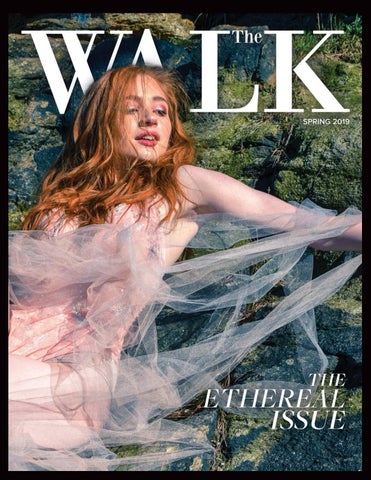
THE ETHEREAL ISSUE
1
Behind the Scenes photographs by Sky Karasik, Sudeep Solanki Bhargava, Shirley Yang, Chris Oh.
“Daintiness and Femininity in Menswear” designed by Megan Cardosi. “Getting Dressed by the Best” and “Senior Spotlight” designed by Claire Shin. “Debunking the Myth of the Self-Care Regimen” designed by Claire Marucci. “That’s Posh!” designed by Christy Qiu. “Behind the Tulle” designed by Siyuan (Mary) Liu. “Beauty Queens” designed by Emma Jabr. “No Longer in Retrograde: How Astrology Became Cool Again” designed by Sudeep Bhargava. “From Quaker to Fighter: Gloria Allred’s Never-Ending Battle for Women’s Rights” designed by Shiqi (Kitty) Chen. Cover designed by Edward Kim. Copyright © 2019 The WALK Magazine. All rights reserved. Stories edited by the editorial staff will carry bylines of the original author. Unless noted otherwise, all content is produced by The WALK teams. Please report corrections to thewalkmag@gmail.com. We will post corrections on our website, at www.thewalkmag.com. The University of Pennsylvania’s premier fashion magazine, The WALK was founded in 2006 as a student initiative and continues to be a student fueled organization. The WALK Online was launched in 2010 as a sister to the print edition. The WALK aims to satisfy our community’s widely-demanded fashion fix year-round. To get involved or learn about advertising and partnership opportunities, please contact us at thewalkmag@gmail.com.
2
THE WALK MAGAZINE
SPRING 2019
SPRING 2019 • VOL . XIII, No. 2
Emily Cieslak Editor-in-Chief
Davery Joso, Natalia Rommen Creative Directors
Siyuan Liu, Edward Kim Design Directors
Anna Jellinek
Jessica Sulima
Krishna Sivakumar
Vanessa Wanyandeh
Marketing Director
Editorial Director
Finance Director
Video Director
Natalie Sadjo
Lobo Itzol
Caroline Gibson
Sarah Llewellyn
Operations Coordinator
Social Media Director
Photography Director
Online Director
EDITORIAL Fashion Editor Emily Schwartz • Features Editor Varshini Gali • People Editor Nadira Berman Copy Editors Amanda Steinborn, Shriya Beesam, Amy Marcus, Karen Pan, Lisa Yang Writers Eugenie Shin, Amanda Kwon, Alexandra Nichols, Sarah Llewellyn, Tyler Lawson, Eliana Waxman, Bebe Hodges
PHOTOGRAHY Photographers Chris Oh, Madison Kahn, Elizabeth Lemieux, Sky Karasik, Skylar Scafidi, Shirley Yang, Nathaly De La Paz,
Gracelynn Wan, Erica Xin, Simon Chen, Sudeep Solanki Bhargava, Shinyoung Hailey Noh, Teresa Xie VIDEO Videographers Sydney Judge, Morgan Jones, Stacey Chen, Michelle Xiong, Sebiga Lee, Joy Leeswadtrakul, Chidera Asiegbu
DESIGN Assistant Art Director Claire Shin Layout Designers Claire Marucci, Christy Qiu, Megan Cardosi, Sudeep Solanki Bhargava, Shiqi Kitty Chen, Emma Jabr Illustrators Samantha Lee, Erin Cho, Gracelynn Wan, Cathleen Gui, Jessi Olarsch
ST YLING & BEAUT Y Fashion Director Paolo Nasr • Beauty Director Madison Kahn Fashion Stylists Carly Ryan, Samantha Braffman, Jen Ahn, Akhil Vaidya, Tamir Frank • Beauty Stylists Keri Zhang, Giovanna
Sena, Emily Yao, Emily Yang, Zena Kipkenda, Emma Jabr, Chidera Asiegbu MANAGEMENT Corporate Sponsorship Coordinators Katie Levinthal, Sheryl Chen, Ana Hallman, Saranya Das Sharma, Emily Yang,
June Perteet THE WALK ONLINE Website Manager and Designer Edward Kim • Managing Editor Tyler Lawson • Creative Director Lauren Tappan Assistant Web Manager Zulfi Soomro Fashion Editors Caroline Harris, Meredith Mitchell, Allison Walter • Health & Beauty Editor Adriana Richmond • Culture Editor Del Patel • Features Editor Sue Lee • Fashion Writers Javier Perez, Bebe Hodges, Pryce Davies, Kalyxa Roman, Emma Van Zandt • Health & Beauty Writers Helen Qi, Charlene Ngige, Changyue Yin • Culture Writers Mariri Niino, Kyle Whiting, Audrey Osborn, Akhil Vaidya, Sarah Ko • Features Writers Marina Gialanella, Tyler Daniels, Needhi Mehta Beauty Stylists Jules Wonodi, Keri Zhang, Lisa Yang • Apparel Stylists Alice Zhao, Pryce Davies, Marina Gialanella, Amanda Cohn • Photographers/Videographers Nathaly De La Paz, Jessica Saad, Erica Xin, Maddy Fair
MARKETING Event Coordinators Allison Domm, Kennedy Benjamin, Anna Callahan, Brendan Lui
SOCIAL MEDIA Content Producers Emma Harris, Caitlin McNamara, Amanda Simpson, Roy Lee
THE ETHEREAL ISSUE
3
09
Daintiness and Femininity in Menswear Taking a look at why femininity in menswear isn’t a norm yet.
10
Body Art Bodies Apart PHOTO ESSAY
18
Getting Dressed by the Best Delve into the emerging universe of online personal styling.
20
Down with the Clique PHOTO ESSAY
28
Debunking the Myth of the Self Care Regime A closer look at the modern day “self-care” trend.
30
Recreating the Classics PHOTO ESSAY
42
That’s Posh! Lauren Tappan shares the secrets to dressing like a Brit.
44
Behind the Tulle Why veils remain in our culture.
49
Beauty Queens: Nina Davuluri and Rooshy Roy Get to know the founders of aavrani, a skincare brand empowering women and making beauty easier for all.
52
No Longer in Retrograde: How Astrology Became Cool Again Find out how this ancient practice has transitioned to the 21st century.
54
From Quaker to Fighter: Gloria Allred’s Never-Ending Battle for Women’s Rights Gloria Allred (CW ‘63) has been fighting for women’s rights way before the O.J. Simpson and Bill Cosby cases and has no intention of stopping now.
57
Senior Spotlight From fashion highs and lows, The WALK seniors tell all.
62
Capture That
Cover Look: ETHEREAL How do you compete with a master artist? This semester we took the challenge of replicating three classic works of art, the Three Muses, Birth of Venus by Sandro Botticelli and The Last Supper by Leonardo da Vinci. We put our own spin on them, o course. Working with swaths of red fabric and pink tulle, our stylists created the outďŹ ts for the Muses and Venus. The location was the intersection of grittiness and sophistication, with both the railroad tracks and the Philadelphia Museum of Art in the background. The originals maybe classic, but our versions represent the muses, Venuses and Jesuses of today. View more on page 30. THE ETHEREAL ISSUE
5
LETTER FROM THE EDITOR
After four years on The WALK, I’m still amazed at how we do it. We start each semester with nothing. Only a date staring back at us of when we need to publish the issue. We huddle together and throw out words for a theme until something clicks. From there, we think how this theme translates to actual articles and photoshoots. Completing those articles or shoots is a whole other test. Something inevitably goes wrong. Sometimes we are gluing cameras to chairs to make tripods, sometimes we are getting kicked out of public places. And we can never control the weather. The models in our Recreating the Classics photoshoot (page 30) braved 20-degrees in sheets of fabric to get the perfect shot. Who says modeling is easy? The process itself is quite ethereal. For most of the semester, the issue isn’t tangible but a compilation of abstract, airy ideas that feel delicate. Miss one deadline, and the entire process can go off the tracks. Yet somehow it always comes together and by the end, we are holding the magazine in our hands. If there is anything I learned from The WALK, it’s that you don’t need all the answers at once and being delicate doesn’t mean weak. When we chose Ethereal as the theme, we weren’t aiming to create a soft issue filled with florals for spring. Rather, we took what is conventionally dainty and added an edge. No day may be more about elegance and fantasy than one’s wedding, yet in her article (page 44), Eugenie Shin questions the tradition of the veil and whether the modern bride still needs to be “unveiled” at the altar? Likewise, we photographed our model in a dying garden because a woman doesn’t need flowers or a man to be beautiful. And in our first shoot, we played with fire and flowers, literally. In this issue, you’ll also hear from women that defy the stereotypes of being feminine. Emily Schwartz speaks with Nina Davuluri (page 49), who used beauty pageants to earn money for college and increase diversity as 2014’s Miss America. She’s now one of the founders of a brand embracing Indian beauty rituals. And in the midst of the R. Kelly trials, Bebe Hodges snagged an interview with the legendary women’s rights attorney Gloria Allred in our alumni series (page 54). Before the word feminist graced Dior’s runway or Beyoncé’s stage, Allred challenged those who didn’t treat women equally and represented sexual assault survivors when no one else believed them. She turned women’s issues into the world’s issue. And she’s not done.
Photo by Sky Karasik.
As more and more people ask me if I am ready to be done with Penn and The WALK, I tell them being done is overrated. Having nothing to do is boring. So thank you to everyone who has ever been part of the magazine and joined me on this crazy, creative endeavor. And thank you to our readers. Without you, there would be no reason to write. So what’s next for me or The WALK? Well, that’s still being written. Yours truly,
Emily Cieslak Editor-in-Chief
6
THE WALK MAGAZINE
SPRING 2019
THE WA LK
ONLINE
HIGHLIGHTS THIS SPRING
FASHION
High-Tech Meets Haute Couture The futuristic designs of Iris van Herpen. By Emma Van Zandt
FASHION / TRAVEL / TRENDS TO TRY
CULTURE / FASHION
Fashion Abroad: Edinburgh
Improving Diversity and Inclusivity in Fashion
By Kalyxa Roman
By Javier Perez
CULTURE
CULTURE / MUSIC
Jaden Smith: Sustainability is a Possibility
Baby Got…Comeback?
By Sarah Ko
By Rachael Ruhland
THE ETHEREAL ISSUE
7
FASHION / HEALTH & BEAUT Y
HEALTH & BEAUT Y: INGREDIENT SPOTLIGHT
Bathed in Color
CBD Oil
Marina Gialanella (Apparel Stylist), Keri Zhang (Beauty Stylist), Jessica Saad (Photographer)
By Charlene Ngige
FASHION
Glitter and Grit Sparkle into the New Year with our Fourth Shoot. Marina Gialanella (Apparel Stylist), Keri Zhang (Beauty Stylist), and Jessica Saad (Photographer)
CULTURE / PENN
CULTURE / FASHION
Getting Caught in the Entanglement
What’s the deal with numerical scores attached to music reviews?
By A.K. Pradhan
By Kyle Whiting
Catch up on the latest from The WALK. 8
THE WALK MAGAZINE
Website thewalkmag.com
SPRING 2019
Instagram @thewalkmag
Facebook /thewalkmagazine
Daintiness and Feminity in Menswear An exploration of why men's clothing is unisex but women's clothing is not and what menswear brands are doing about it
By Amanda Kwon. Illustration by Gracelynn Wan.
T
hose of us who watched the Oscars red carpet closely this year will never forget Billy Porter’s look. He stole the show without question in a full-skirted, strapless, velvet gown complete with a tuxedo jacket. Though the outfit drew some criticism from the internet, it was well-received by the actors and artists in attendance, who have seen men’s fashion on the red carpet evolve beyond the rigid boundaries of masculinity over the past decade with designers meeting the demands of new risk-taking male fashion icons. His spectacular look made nearly every bestdressed list and as Elle put it, “Billy Porter just won every red carpet past, present and future.” For the rest of the male population, however, Porter’s fashion choices would never be a consideration. Though women wearing pants became commonplace in the early 20th century, skirts and other feminine silhouettes in men’s fashion are still not widely accepted in society. The explanation for this lies in how our clothing choices reflect an interaction with our gender. People recognize gender to be binary and opposing — femininity and masculinity are mutually exclusive. Women are also accused of lacking femininity when they wear men’s clothing, but this transition is less offensive because it represents a step up to a stronger position. Even in a time when women are encouraged to be powerful, they are still doing so with the understanding that to be powerful is to be masculine. Thus, by dipping into traditionally feminine silhouettes, styles and designs, men are viewed as sacrificing their masculinity for femininity, a transition seen as a demotion. Femininity in male fashion still has a long way to go before it becomes the norm. Though Travis Scott was praised for posting a picture in a Celine blouse, regular men can not exercise the same freedom of expression without the possibility of severe backlash. Incidents such as a high school student being suspended for wearing a pink tutu for breast cancer awareness as well as an agender teen being hospitalized after their skirt was set on fire by a classmate who thought they were gay serve as painful reminders of the rigid binary structure that men are forced to fit into. 2 THE ETHEREAL ISSUE
9
10
THE WALK MAGAZINE
SPRING 2019
BODY ART
BODIES APART
Directed and styled by Emily Cieslak, Davery Joso, Natalia Rommen. Styled by Paolo Nasr, Sydney Schwartz. Makeup by Madi Kahn, Gio Sena, Sydney Schwartz. Modeled by Sarah Simon, Ricardo Duncan Jr. Photographed by Shirley Yang, Chris Oh.
THE ETHEREAL ISSUE
11
12
THE WALK MAGAZINE
SPRING 2019
THE ETHEREAL ISSUE
13
14
THE WALK MAGAZINE
SPRING 2019
THE ETHEREAL ISSUE
15
16
THE WALK MAGAZINE
SPRING 2019
THE ETHEREAL ISSUE
17
Getting Dressed by the Best Follow one of our writers as she gets a taste of the glamorous, but often inaccessible, world of personal styling. By Alex Nichols. Photos courtesy of Glamhive.
W
hen celebrities strut onto a red carpet, draped in exquisite gowns and polished suits, they represent more than the iconic designers they wear and the exclusive events they attend. Their clothing, and the men and women who put together their look behind the scenes, depict a sort of unattainable luxury. There is a certain level of opulence inherent in having another person entirely dedicated to ensuring you look like your best self. Thus the world of personal styling has been almost entirely limited to the upper echelon of society until recently. The equalizing eect of the internet has made personal styling accessible, and even aordable, to the average style-seeking citizen. I was fortunate enough to be given the opportunity to dip my toe into the world of personal styling through Glamhive, a company dedicated to bringing the same personal stylists who dress celebrities such as Kristen Stewart to the masses. Personal styling has become quite the emerging industry as of late. With the rise of online retail, brick and mortar stores such as Nordstrom, Anthropologie and Club Monaco have introduced personal stylists to lure customers back into the physical retail experience. Integrating technology with the expertise of professional stylists opens up an entirely new direction and paves the way for personalization without the usual price tag. One of the hallmarks of the recent crop of online personal styling services is their emphasis on accessibility. Glamhive, for example, has a wide variety of packages on their site, including ways to revamp existing pieces in your wardrobe. As a college student with little more than the change in my pocket, this option was especially appealing to me. Breathing new life into old clothes was not only far more aordable and accessible, it was also more sustainable than buying and pouring more money into an already wasteful fashion industry. It was this approach that really appealed to me and piqued my interest in this nontraditional service.
118 8
THE WALK MAGAZINE
SPRING 2019
similar to the format of a Pinterest—that my personal stylist put together for me. I followed up the consultation with some photos of me wearing the pieces I asked her to style, along with links to pieces I was considering getting. The board included the pieces I sent to her, as well as some new clothes to try. Upon clicking on a emerald tie-strap camisole from Reformation, a window including Kristina’s two pairing suggestions popped up: a pair of pointed white Alexa Chung ankle boots and white, wide-leg Reformation jeans. One of my favorite aspects of the board was the price accessibility. Having given my meager budget to Kristina before the session, I was nervous whether she would stick to it. Thus, I was pleasantly surprised that the board carried a wide variety of pointed white boot options, from from $50 at ASOS up to $300 at Alexa Chung, with a diverse variety of styles to match. Similarly, my striped jeans (yes, the ones that hadn’t left the confines of my closet) were matched with a variety of different options, some of which Kristina and I had talked about in our call, but others that were a total surprise! I had inquired about upcoming trends for the spring season and Kristina was adamant that cardigans were going to be everywhere. I was audibly hesitant. Cardigans generally conjured up images of grandmothers and librarians, both of whom I love, but neither of whose style I generally emulate. However, the button down sweaters she picked were a far cry from the traditional cardigan and encouraged me to step outside my comfort zone.
The Consult7J?ED After filling out a brief style questionnaire, I was assigned a personal stylist, Kristina, and we scheduled a style consult. After chatting with Kristina over text, it became clear the consult was really an opportunity for me to ask questions and for her to become familiar with my existing style. Upon discovering this, I nervously dove into my wardrobe and pulled dozens of aspirational pieces that had never left the dresser. I also threw together some general questions about my overall aesthetic but prayed to myself these prepared bits would be enough to fill our upcoming 20 minutes together. As someone who is fairly comfortable in her personal style, I wasn’t sure how I’d react to an outsider telling me how to look— or dress. Finally, the time had arrived. The phone rang, and Kristina was on the other end, asking me a flurry of questions about my personal style and aesthetic. I also had the chance to ask her about some specific p i eces i n m y c l oset, including those select few that had yet to see the light of day. A bright crimson leather jacket with a stark white stripe down each arm and a pair of stiff, navy blue straight-leg jeans with white pinstripes were among the chosen. She gave me a few tidbits of knowledge (“Mules would look great with those jeans”), but it seemed as though as a whole, the phone call was oriented toward getting a general feel for my style and how I wanted to change it. I told her I would love to diversify my looks beyond a leather jacket with black jeans while remaining comfortable and casual. Before I knew it, our 20 minute phone call had flown by, and all I Speaking with a Stylist could do was await the big reveal. After my consult, I had a chance to pick Kristina’s brain and get some personal insight into the little-talked about world of personal The Style Board styling. Here’s what she had to say. Ultimately, what that brief phone call culminated in was a style board, accessible Alex: Thanks for sitting down and chatting with through the Glamhive website, that held the me, Kristina! First off, how did you get into the promise of fresh, fun new looks—a much- career of personal styling? needed upgrade from my current style. This Kristina: I went to fashion school and studied board, emblazoned on the Glamhive website, apparel design in Seattle. For my internship, I was a customized style suggestion board— assisted Heidi Merrick in Los Angeles, CA and
was given the opportunity to style shoots as well as source fabrics, make patterns, etc. It was there that I realized I enjoyed styling the most. I worked as a stylist at AllSaints after that and realized I had a knack for it. I actually developed long term clients from working there. However, growing up, my friends and family often used me as their stylist, so I’ve been doing it unofficially since I was a kid! Alex: That’s awesome! I know personal styling is a career not often discussed, especially at Penn. What types of qualities do you think makes someone well-suited for the personal styling industry? Kristina: Good people skills and developing relationships, thinking on your feet as opposed to having time to plan out your day, a good eye— that’s what’s most important and can’t be taught! Alex: It sounds like personal styling is really about relationship building and understanding needs. How do you balance the needs of a client with your personal style? Kristina: I think people choose you, partly because they like your (my) style. It’s very important to get a feel for what the client’s wants and needs are, then put your magic into it. I’d say the root should be based on the client’s needs. My personal style is like icing on the cake, but the icing is actually what they are coming to you for, it’s what is visible. Also keep in mind that they are coming to a stylist because they want help. Alex: What would you say is the most rewarding part about being a personal stylist? Kristina: I love seeing someone feel and look amazing. Aesthetics really have an impact on our mood. I do feel like styling is creating a mood, creating a feeling. You have the opportunity to help your client be whoever they’d like to be.
Final Thoughts Personal styling brands itself as an exclusive club, one I never thought I would be a part of. As the internet serves as the great equalizer, I too gained access to the club. The experience of a personal stylist takes the phrase “retail therapy” to another level. Being able to talk through my style choices allowed me to reflect on my clothing selections, and quite simply, having a fresh lens from which to look at my wardrobe was invaluable. While 20 minutes may not seem like a long time to entirely overhaul your look, that was not the consult’s purpose, at least, not to me. Rather, Kristina’s advice allowed me to consider options I had felt closed off to before and see the opportunity in each piece, new or old. Cardigans! Pointed white boots! Chunky dad sneakers! The possibilities were endless. The experience of personal styling can be anything you take away from it, from a few helpful tips to an entire closet revamp. For me, it was a piece of attainable luxury in my life, one that was quite welcome. 2 THE ETHEREAL ISSUE
19 19
DOWN WITH THE
CLIQUE
20
THE WALK MAGAZINE
SPRING 2019
Directed and styled by Emily Cieslak, Davery Joso, Natalia Rommen. Styled by Paolo Nasr, Jaewoo Kang. Makeup by Madi Kahn, Keri Zhang. Modeled by Asha Wiltshire, Ashley Cheng, Stephanie Coachman, Brisilda Kupa, Alana Mays. Photographed by Gracelynn Wan.
THE ETHEREAL ISSUE
21
22
THE WALK MAGAZINE
SPRING 2019
THE ETHEREAL ISSUE
23
24
THE WALK MAGAZINE
SPRING 2019
THE ETHEREAL ISSUE
25
26
THE WALK MAGAZINE
SPRING 2019
THE ETHEREAL ISSUE
27
DEBUNKING THE
OF THE
SELF-CARE REGIMEN We all need some TLC in our life. Are our current self-care regimens truly fulďŹ lling those needs? Or are we being taken advantage of by the very corporations claiming to help us with our self-care? By Tyler Lawson. Illustrated by Samantha Lee.
28
THE WALK MAGAZINE
SPRING 2019
A
mong the many trends taking over 2019, the one that has stirred up a storm on social media and has some of the greatest potential for positive impact is the trend of self-care. This movement has evolved into a lifestyle that has infiltrated many spheres: there are the classic “inspo” posts that clutter our Instagram stories with whimsical pictures and heartfelt messages on how to love yourself and take control of your destiny; then there are the surge of face masks, massage stones, oils and detox kits that now seem to be available at any store selling some form of cosmetics. And it seems like just about every influencer has added on to their mission the goal of promoting self-care in a world where mental health is constantly at risk. However, there’s always an opportunity to bandwagon: several large corporations, such as Sephora and Ulta, see this movement as a chance to sell products “necessary” in one’s self-care progress, such as face masks for nearly $50. Whether it’s buying bath bombs and mud masks or reading Rupi Kaur’s Milk and Honey on a Saturday night with a large glass of wine, these practices must be critically assessed in order to verify that the outcomes we want are the outcomes we’re getting. Are these popular self-care actions really helping our mental and physical health? Are we forgetting vital steps in this process? Are these influencers and corporations preying on our insecurities or are their methods truly working towards our benefit? Social media has been known to be a source of stress and negative impact on the mental health of teens and young adults. Due to the obsession of posting the most glamorous aspects of our life and comparing them to other seemingly picture-perfect posts, many find themselves constantly unsatisfied with their own lives in comparison. Therefore, the push to make social media a place where you are encouraged to love yourself and take control of your life seems like a healthy response to the dangers of our phone use. Or maybe it’s another way for people to compete with one another, to show who has the most impressive self-care routine? Nevertheless, the need to control your life is the argument self-care app developers started with. Apps like “Stop, Breathe & Think” and other of the top 10 grossing self-care apps accumulated $27 million in revenue worldwide during the first quarter of 2018 according to data from multiple app store intelligence firms, proving that people are looking for this type of outlet. Meanwhile, apps like “Shine,” which promises to be a “daily pep talk in your pocket” by sending positive affirmations throughout the day, often turn social media posts as a means of spreading those positive thoughts to others via Instagram stories. Do these techniques actually improve someone’s mental health? In 1987, the selfdiscrepancy theory, founded by Edward Higgins, helped current psychologists conclude that motivational quotes do push humans to feel inspired as humans are generally “aspirational” and constantly want to improve themselves. The fact still remains that no matter how many “self-care” apps you download or how many inspirational quotes you read on your phone, social media can’t give you the security that real life social interactions will.
Many psychologists and doctors, such as Dean Burnett, a neuroscience doctor and the author of the book, Happy Brain, also believe that there is a danger in an “oversaturation” of inspirational quotes. The clogging of these messages can cause a desensitization to the overarching messages. Even if some quotes have the potential to make someone scrolling through their feed stop and truly reflect on their self-worth, a feed filled with repetitive messages in a repetitive format cause many to ignore the messages altogether. Therefore, the attempts to spread these self-care messages have the potential to be lost in vain. Furthermore, the companies that are claiming to care for your well-being and have the perfect products to do so are not usually backed by science. Popular crystals like jade eggs that claim to “invigorate your life force” and prevent future wrinkles have virtually been debunked by scientists as having no real claims based in evidence. In fact, many scientists urge consumers to be weary of products that undergo little testing yet make large promises. Notably, Gwyneth Paltrow’s lifestyle retailer, goop, was fined $145,000 last year for false declarations that their jade eggs could solve a multitude of vaginal issues. Research has shown that any benefit these pseudoscience products produce are subjective. The same situation applies with aromatherapy self-care kits that feature all types of “healing oils.” Very little evidence supports the main promises these products offer. This isn’t to say all self-care kits are complete hoaxes. Dermatologists who weighed in on face masks say that, like lotion and other creams, face masks are vehicles to deliver “actives” that can improve face quality. Beware, however, that your skin isn’t capable of absorbing all the appealing ingredients offered on the packet. Only the main ingredients, i.e. the first one or two ingredients advertised, will be what your skin actually absorbs, according to Bustle. And a small portion of those main ingredients at that. So, what is all this to say about the dominating self-care trend that is predicted to carry into most of 2019? Self-care is important! With stress caused by a hectic college life filled with midterms, papers, internship applications and club responsibilities, taking care of yourself can often be a daunting task. But doing your research on the proper ways to improve your self-care is just as important.
It’s important we be aware of corporations that try to use our insecurities as a means of profit and celebrate the good we do see in our personal growth as well as encourage it from others. Health experts have many suggestions as to how people, especially college students, can improve their mental health and find ways to inspire themselves to complete their goals. Among these suggestions include physical workouts and visits to a therapist. It’s important that we stay aware of corporations that try to use our insecurities as a means of profit and celebrate the good we do see in our personal growth as well as encourage it from others. In a world full of chaos and falsehoods, developing a self-care routine is as important as ever. 2 THE ETHEREAL ISSUE
29
RECREATING THE CLASSICS
Directed by Emily Cieslak, Davery Joso, Natalia Rommen. Styled by Paolo Nasr, Sam Braffman, Sydney Schwartz, Bela Betsch. Makeup by Madi Kahn, Gio Sena, Emily Yao. Modeled by Chioma Duru, Chris Fernandes, Amanda Gross, Mariko Lewis, Ellen Manford. Photographed by Caroline Gibson, Teresa Xie, Sudeep Bhargava onsite at the Philadelphia Museum of Art.
30
THE WALK MAGAZINE
SPRING 2019
THE ETHEREAL ISSUE
31
32
THE WALK MAGAZINE
SPRING 2019
THE ETHEREAL ISSUE
33
34
THE WALK MAGAZINE
SPRING 2019
THE ETHEREAL ISSUE
35
36
THE WALK MAGAZINE
SPRING 2019
THE ETHEREAL ISSUE
37
38
THE WALK MAGAZINE
SPRING 2019
THE ETHEREAL ISSUE
39
40
THE WALK MAGAZINE
SPRING 2019
THE ETHEREAL ISSUE
41
That’s Posh! While studying abroad in London, Online Creative Director Lauren Tappan analyzed the multifaceted nature of British style.
Text and photographs by Lauren Tappan.
W
henever I think of fashion in London, my mind always travels to one place in particular: Oxford Street. This breathtaking spectacle—a seemingly infinite pathway in the City of Westminster that stretches for approximately 1.2 miles—is adorned with charming boutiques, famous designer shops and high street fashion outlets. Enticing window displays invite you to examine the latest seasonal trends and simply stare in awe at the vast array of en-vogue ensembles. Needless to say, this stunning 5th Avenueesque scene is most definitely a fashion enthusiast’s dream come true. Aside from the plethora of glamorous shops, the Oxford Street atmosphere isn’t complete without the presence of the London residents who stand out from the boisterous crowd of tourists. These fashionable locals have a sense of style that is unlike anything I’ve ever witnessed. After living in London for a few months—and frequenting Oxford Street more times than I can count—I have learned a great deal about the British style. In London, the style code symbolizes a movement towards individuality rather than homogeneity. Every street style outfit I’ve spotted, whether on Oxford Street or on my college campus, possesses its own unique quality. Although the universal fashion
42
THE WALK MAGAZINE
SPRING 2019
principle includes staying in style and on top of the latest trends, Londoners add a slight twist to this fashion mantra. When it comes to wearing trends, they manage to modify common styles in ways that cater to their individual identities. Take the infatuation with chunky white trainer craze for example. These shoes— which were once deemed “ugly dad sneakers”—have made their way back into the realm of mainstream footwear, and so far, they’ve sustained quite a long shelf life in the industry. Initially when I spotted this trend, I noticed that these white trainers were usually coupled with a casual or chic athleisure fit. However, when I moved to London, I recognized this style reached a completely new level overseas. While in London, I’ve seen this type of shoe paired with colorful monochrome suits, long flowy skirts, vintage coats and even business attire. I found it genuinely refreshing and fascinating to see that everyone sporting this look appeared to be distinct from one another. Additionally, there’s an element of rebellion against conventional style standards when it comes to dressing the British way. Instead of following traditional fashion rules, the people of London like to shake things up a bit, mixing casual with classy, combining
various types of patterns and matching colors that aren’t typically seen together. For instance, I’ve observed a number of striking looks ranging from relatively modest fits, such as a black patent leather puffer jacket matched with flowy striped trousers, to more extaravagant pieces, like a lime green see-through trench coat paired with white cargo pants. Nevertheless, piecing together an outfit as a Londoner is not a careless process of randomly and thoughtlessly crafting an outfit. Rather, it’s about creating a carefully calculated look which is tasteful, effortlessly chic and representative of your character. Overall, being a short-term resident of London has introduced me to the many essentials of fashion culture. Along with my suitcase, filled with a handful of clothes from Bershka and Topshop, I’ll also be taking a few lessons back with me when I return to America. Firstly, it’s important to dress for yourself and not for others. Fashion provides the canvas to paint a picture of your own identity. Secondly, there is nothing wrong with following trends, just add your own personalized twist of style. And finally, adhering to your own personal aesthetic requires bravery, much needed self-exploration and a whole bunch of confidence. 2
THE ETHEREAL ISSUE
43
44 44
THE WALK MAGAZINE
SPRING 2019
behind the tulle We recognize veils to be an integral, traditional element of wedding attire. But where does this accessory originate, and what does it imply? By Eugenie Shin.
M
ore than a billion people around the world gaze at their screens, entranced, as Meghan Markle slowly ascends the steps of Windsor Castle, an exquisite 16-foot Givenchy veil cascading behind her. Two boys hold up the tail, and we see that the trim is delicately embroidered with the signature blooms of all the counties in the British Commonwealth. It’s an ethereal, cinematic moment—a real-life princess bride on her way to a fairytale ending. When she emerges after the ceremony with Prince Harry, hand in hand in front of the flower-adorned castle entrance, her smile is no longer shrouded by the veil. The veil is an accessory we are taught to associate with weddings from an early age. The bells ring, the music swells and the mice beam as Cinderella runs down the steps with her prince in a flurry of petals, her blindingly white veil flying behind her. But many might not stop to think—why is the veil actually a part of the wedding costume? What is its historical origin? Most importantly, why is it so deeply ingrained in modern wedding culture despite its problematic connotations? Veils originally emerged among the Assyrians, the rulers of Mesopotamia from 1380 to 612 B.C.E. Legal writings preserved on stone tablets revealed that married or marriageable women were made to wear veils at all times to stop male temptation. Some speculate that the veil was a sign of status in ancient Greece, as Classical Greek statues often captured women with their head and face covered by a veil. As the cultural practices of Greek, Persian and Mesopotamian empires and Semitic peoples of the Middle East influenced each other, women’s veils were established among Jews, Christians and urban Arabs. While there are other historical and contemporary usages of the veil, such as veils pinned to bonnets during mourning or practical headdresses to protect the complexion and keep dust out, one of the main usages of the veil is ritualistic. In the more obvious sense, many wear veils during weddings for religious reasons. Within Christian or Jewish culture, the virgin bride traditionally has her face and head fully veiled until the end of the marriage ceremony when the groom lifts the veil. Participants of modern religious weddings may not necessarily share the antiquated belief that the bride is her father’s property and then her husband’s, but because the veil also symbolizes modesty before God, it is a sacred accessory. However, the veil seems to be an important cultural object outside of religious contexts. It’s a familiar accessory we’ve seen in countless romantic comedies, TV shows, bridal magazines and advertisements. With the rise of Pinterest and Instagram, many (not just engaged brides-to-be) keep “wedding idea” boards and folders laden with pictures from @theknot, @brides and @
stylemepretty. Wedding veils are an indispensable piece of the elaborate puzzle that is the quintessential dazzling bride and the lucrative wedding industry. It’s a $101 billion industry after all (according to The Knot’s 2017 Real Wedding Study). Victor Turner, a cultural anthropologist, claims that “as members of society, we see what we expect to see, and what we expect to see is what we are conditioned to see when we have learned the definitions and classifications of our culture.” Especially in Western cultures and even in other parts of the world, we have grown so accustomed to the veil as a wedding convention that we no longer question its original meaning. Thinking about weddings as a social ritual is crucial to understanding why veils exist today despite a major shift in gender dynamics, as well as why they exist in same sex marriages. We often see at least one, if not two veils on the brides; in Grey’s Anatomy, Callie (Sara Ramirez) wears a veil while Arizona (Jessica Capshaw) does not. As American anthropologist Roy Rappaport explains, acceptance does not equal belief. In other words, just because people accept a certain convention or tradition, that does not imply that they believe in all that it represents. Veils remain sacred in modern weddings not only in a strictly religious sense, but in a sociocultural sense; because a wedding—the “happiest day of your life”—is such an idealized and commercialized rite of passage ritual, the bride’s conventional costume almost takes on a magical meaning that is separate from its historical implications. Finally, we cannot forget about its aesthetic appeal. Laird Borrelli-Persson mentions in a recent Vogue article that the “frail mysteries of tulle,” by nature, “reveal and conceal all at once.” A unique sense of history and allure is undeniably a reason for why the fashion world gravitates to veils time and time again. Aside from its symbolic functions, the veil is simply beautiful to gaze at and inspires designers’ endless artistic interpretations, whether John Galliano’s gossamer-like creation worn by Magdalena Frackowiak on his mythical F/W 2009 show or Beyoncé’s elegant Givenchy veil at the 2014 Met Gala. Even aside from artistic interpretations, the wedding veil is a vast accessory category in itself, with trends that come and go. This year, Britten Weddings predicts a broad range of styles to be in vogue: crystal scatter veils, two tier lace veils, cape veils, waterfall cut veils and more. Veils also vary dramatically price-wise—from $20 short tulle veils to $500 long ornate lace veils. Despite their past, veils clearly serve limitless purposes today. Historical and political assumptions aside, it is up to the couple to decide how they want to look and act on their special day—with or without the veil. 2
THE ETHEREAL ISSUE
45
46
THE WALK MAGAZINE
SPRING 2019
Directed and styled by Emily Cieslak, Davery Joso, Natalia Rommen. Makeup by Gio Sena. Modeled by Alice Li. Photographed by Sky Karasik and Chris Oh onsite at Bartram’s Garden. THE ETHEREAL ISSUE
47 47
Solutions Are In Our DNA
ART COMMUNICATION SYSTEMS, INC. 800.336.2522 -OR- 717.232.0144 email: acsprint@artcomsys.com website: www.artcomsys.com
BEAUTY QUEENS Nina Davuluri and Rooshy Roy
By Emily Schwartz.
Former Miss America Nina Davuluri (left) and Wharton MBA Rooshy Roy work together to change the beauty industry. Photos courtesy of Davuluri and Roy.
THE ETHEREAL ISSUE
49
F
or the past year and a half, a typical day for Nina Davuluri and Rooshy Roy has looked anything but, well, typical. They may have met with a scientist, testing different ingredients and recipes. They may have been gathering feedback on prototypes from all different women of all different backgrounds. They may have been building out their website, or seeking out companies to partner with, or defining roles for new potential team members. Davuluri and Roy are the co-founders of aavrani, a new, all-natural, luxury skincare line that harnesses the power of ancient Indian beauty rituals. While the two women were inspired to launch the brand based on shared frustrations with skincare growing up, their paths to this point were each completely unique. Before aavrani, Davuluri was best known for being the winner of the Miss America pageant in 2014 and being the first woman of South Asian descent to do so. Davuluri got started with pageants when she was 16. She always knew she wanted to go to college and also knew she would have to pay for a significant portion of her tuition on her own, so she began competing in the Miss America teen program, known for the scholarship money it gives to winners. Because of her success in the program, Davuluri won $30,000 in scholarship money throughout her entire time competing in the teen portion, and was able to graduate from college debt free. Yet Davuluri didn’t stop there. Through her entire time competing in the Miss America competition altogether, Davuluri earned just under $100,000, leaving her enough money to potentially pursue a graduate degree down the road. Yet the scholarships weren’t the only reason Davuluri became interested in Miss America. A huge part of her thinking was the opportunity to spread her message and advocate for diversity and female empowerment, beliefs she still actively champions today. “Of course being able to have a voice,” Davuluri says of her motivation for getting involved, “and promote my platform, which was celebrating diversity through cultural competency, something I still continue to work with today.” Since winning in 2014, Davuluri’s life has, in many ways, been shaped by her time in the competition (“It’s crazy because your life changes overnight, literally!” she says). She’s had to deal with the lows, like racist and xenophobic comments towards her culture after she won, the worst of which included being called un-American despite being born and raised in New York or being called a terrorist. Yet she’s also experienced countless highs, like all the positive encouragement she has received and the shift in perspective she has helped create.
50
THE WALK MAGAZINE
SPRING 2019
Davuluri isn’t the only one whose life has changed since 2014. The Miss America competition itself has evolved as well. Not only has it started to depart from its notions of beauty as blonde-haired and blue-eyed, but it has begun to define beauty by measures other than looks. Davuluri speaks highly of the competition’s decision to eliminate the swimsuit portion in June of 2018. “I genuinely believe that being in a swimsuit and being judged on a score from 1 – 10, although I did it, has nothing to do with the job of Miss America,” she says. “We [at Miss America] do have to change and evolve with the demographic of America, and I think removing swimsuit was absolutely a step in the right direction.” Still, a huge part of Davuluri’s time in the competition was spent on her own personal beauty. Skincare that worked for her included ingredients like turmeric used by women in her family that couldn’t be found in products on store shelves. “I traveled so much during my years in Miss America, and I was always pulled aside by TSA for one reason or another with just a little container of yellow powder,” Davuluri remembers, “and then also just sitting in my hotel room trying to make this DIY mask and thinking to myself, ‘Why doesn’t this already exist?’” Enter Roy. A current MBA at Wharton, Roy started her career in finance, then came to business school with the goal of pivoting and exploring entrepreneurship. When she heard Davuluri was coming to speak on campus, she knew she had to attend—she was a huge fan. “When she won in 2014, it was such a big moment, not just for me and my family, but basically for all South Asians in the U.S., finally being seen for beauty and perspective and talent, things that we’re stereotypically not seen for here,” Roy says. Yet what started as a special speaker turned out to be a great business opportunity for both women. Roy started talking to Davuluri about thinking about a potential skincare line using traditionally Indian ingredients like coconut oil and rose water, and the two knew they had to dive in. “We used those growing up with our moms, our grandmothers, our aunts in the community, and it was very much a part of the heritage, women coming together to create and uphold the rituals that South Asian women have used for centuries,” Roy says. “We realized that there was a real opportunity to introduce those ancient rituals to women in the U.S.” Building a business has been a learning experience for the two entrepreneurs. Part of their success has come from recognizing what each brings to the table as a co-founder given their different backgrounds. Roy prides herself on the
business experience she gained from working in finance, whereas Davuluri is on the pulse about both their brand mission—empowering women by encouraging them to embrace their beauty— and about other emerging beauty brands in the space. “It’s one of those things where you realize that if you want to figure it out enough, you will with the limited resources you have, and that has so far been what’s got us along to where we are today,” Roy says. One resource they lack? Mentors who share their background. As they were searching for guidance early in their process, Davuluri and Roy couldn’t find two other Indian female cofounders at the forefront of their own businesses. It only motivated them to work harder. “For me as we’ve grown our brand in this short amount of time, I think one thing that is really important is that we are those mentors that we didn’t have,” Davuluri says. Business acumen aside, Davuluri and Roy have tips in a different area women pay attention to daily. “Oh my goodness, moisturize all day every day!” Davuluri says of her top skincare tip. “When you take care of your skin and you have great skin, you don’t have to rely on makeup,” Roy adds. “We forget that we don’t have to be covering up so much if we just take care of the skin that’s underneath.” As both the pageant and cosmetics industries continue to change, there’s no doubt Davuluri and Roy will continue to be trailblazers. It’s worth keeping an eye on the two women as they continue to take beauty past skin deep. 2
THE ETHEREAL ISSUE
51
52
THE WALK MAGAZINE
SPRING 2019
No Longer in Retrograde: How Astrology Became Cool Again Astrology is everywhere these days, but is it more than just a trend? Find out how this ancient practice has transitioned to the 21st century. By Sarah Llewellyn. Illustration by Cathleen Gui.
W
“
hat’s your sign?” At one point in time, this question would’ve been met with an eye-roll and a grimace, but now that story has changed—today, many people follow astrology non-ironically. Even if you aren’t obsessed with astrology, it’s safe to say most of us know our astrological signs (I’m a Sagittarius, by the way). This means I’m supposed to love traveling, that I’m brutally honest and that I’m optimistic to a fault. I’ve always had a complicated relationship with astrology—yes, I flip to the horoscope section of any magazine I’m looking at, just to search for some insight into my life, but I’ve never been floored by its accuracy. I’ll reluctantly admit I’ve purchased multiple cute accessories personalized with my astrological sign. Even though a study by the National Science Foundation revealed that 60 percent of people think astrology is not at all scientific, the demand for it continues and doesn’t seem to be stopping any time soon. So, what is it about astrology that makes it so enticing? Look no further than the internet to see the ubiquity of astrology. Let us not forget “the signs as…” meme that still hasn’t died. Zodiac signs have been classified as alcoholic beverages, clothing brands, potatoes and even characters from The Office. My favorite Instagram astrology account is @notallgeminis (which boasts a whopping 413K followers) because it uses popular meme formats to create amusing posts for each sign. This isn’t just a Tumblr or Instagram fad; the mainstream media has played a part in popularizing astrology from the very beginning. ManRepeller recently told me that as a Sagittarius, I’d be most likely to win an Oscar for Best Foreign Language Firm, a little too on-the-nose for the astrological sign “destined to travel,” but I still clicked on the article, so they win. The majority of this kind of zodiac content is admittedly meant simply for entertainment, but for every astrology meme out there, there is an equally serious horoscope column. For example, The Cut’s Madame Clairevoyant writes a weekly horoscope that is so deep and poetic it’ll cause you to question all of your life choices. Madame Clairevoyant offers an elegant proposition to the dreaded chaos of Mercury in retrograde: “What would happen if, for now, you didn’t strain so hard to reassert yourself? What would happen if you let the world spin and your thoughts wander?” I don’t know the answer to these questions, though I certainly want to drop everything to find out. Another popular horoscope source, the Co– Star Astrology app, uses data from NASA and AI to deliver “hyperpersonalized” horoscopes. It has a phenomenal rating of 4.9 stars out of five, with over 27,000 reviews on the App Store. All of these outlets are glaringly millennial-oriented, with their clean graphics and subtly politically-charged messages. The popularity of astrology has spread to the fashion world as
well. A simple search for “astrology” on Urban Outfitters’ website yields 47 items, ranging from t-shirts to tapestries. ColourPop Cosmetics currently has a “zodiac” eyeshadow palette, and BITE Beauty is selling an exclusive lipstick color for each sign at Sephora. At Nordstrom, you can find personalized jewelry for your sign, in both costume and fine varieties. For people who do identify with their sign, these products offer a way to display their personality to the world. Others, such as myself, may buy these things just because they think stars are pretty. Whatever the reason, companies are clearly cashing in on zodiac merchandise. But as astrology becomes more mainstream and marketable as a millennial trend, has this ancient phenomenon lost its original meaning? According to the American Federation of Astrologers, the Greeks used astrology to predict the weather and to counsel the stars for all kinds of serious matters thousands of years ago. It was essentially the precursor to astronomy, although in academic circles it is now considered more of a religion than a science. And even though horoscopes may seem frivolous to some, we shouldn’t overlook the fact that many people still take them seriously. Astrology can be a helpful tool, especially in our unpredictable and hectic lives. As the AstroTwins, professional astrologers Ophira and Tali Edut, explain on their website, “astrology’s best use is as a method for planning, gaining more self-awareness and understanding relationships.” If any group of people needed help in these areas, it would have to be college students. We constantly face challenges in our lives, from failed hookups to midterms, and horoscopes can advise us, albeit in a broad and sometimes vague manner, on how best to deal with our problems. With their basis in facts—the numbers, degrees and angles of the planets—they can provide sought-after preparation for what the universe has in store for us, both good and bad. So really, the meaning behind astrology might be more important now than ever. It should be noted that the idea that people are blindly following horoscopes is a myth. Celebrity astrologer Susan Miller says on her website that “astrology isn’t predestination or fate.” Rather, astrology seeks to advise people based on the activity of the planets. But ultimately, “how things play out is going to be up to you.” With these ideas in mind, it makes perfect sense why astrology has become so popular among young adults. Astrology memes can make us laugh, and sharing them encourages connection with friends. Horoscopes, whether serious or not, provide a source of entertainment, and they can even help us figure out life. In the end, if buying a necklace with your sign on it makes you feel happier in this vast and unforgiving universe, by all means do it. We’ll take what we can get. 2 THE ETHEREAL ISSUE
53
ALUMNI FE ATURE
From Quaker to Fighter: Gloria Allred’s Never-Ending Battle for Women’s Rights Gloria Allred (CW ‘63) is no stranger to taking risks and fighting for what she believes is right, even during her time at Penn. But the most famous female attorney practicing law today cannot win the war against sexual assault and discrimination on her own. Allred encourages us to appreciate the fighters who came before and to be empowered leaders for social change.
By Bebe Hodges. Illustrated by Jessi Olarsch.
I
n this era of #MeToo, women are more empowered to speak against the injustices they face, and their claims of sexual assault are taken more seriously. Yet, long before the hashtag, or even the internet, the renowned civil-rights attorney Gloria Allred led a relentless battle for the rights of women. The Penn alum (CW ‘63) has taken on various roles: secondary school teacher and principal, Emmy-nominated radio commentator and Daytime Emmy-nominated TV show host, labor organizer, star of the 2018 Netflix documentary Seeing Allred, and soon-to-be inductee of the National Women’s Hall of Fame. Amid these numerous accolades, Allred is arguably the most famous female attorney practicing law today. Throughout her career, which spans 43 years and counting, the 77-yearold has represented victims in a number of high-profile
54
THE WALK MAGAZINE
SPRING 2019
cases against celebrities like O.J. Simpson, Bill Cosby and most recently R. Kelly. Allred’s law firm has also set a number of legal precedents and won hundreds of millions of dollars for victims of discrimination. Speaking with Allred, it is clear just how determined she is. Even at Penn, Allred was not afraid to push boundaries and fight for what she believed was right, regardless of the consequences. She recounts writing her dissertation senior year, required to earn honors in English, on the African American novelists James Baldwin, Alex Haley and Malcolm X. When Allred’s professor told her these authors wrote nothing of worth and that she risked not receiving honors, Allred proceeded with her topic anyway. Having never read African American novelists in school before, she took the gamble, “because it opened up a whole new world.”
Years later, Allred continues to take risks in her struggle to win equality for women and minorities. She fights for what she believes in even if it might not be the popular opinion. However, she warns, “it’s not just for [me] to wage this battle. It’s for each one of us in every way possible.” She encourages the fight for respect, dignity, equal rights, equal protection and the chance for the Equal Rights Amendment (ERA) to be added to the United States Constitution. Born in Philadelphia in 1941, Allred attended the Philadelphia High School for Girls, where she recently returned on April 13 to celebrate her class’ 60th reunion. When she graduated from the College for Women at Penn in 1963, the English major, “had a baby in one hand and [a] diploma in the other.” Many years later, the alumna gave the 2006 commencement address for the College of Arts & Sciences at Penn in conversation with her daughter, Lisa Bloom, who was all grown up and an attorney herself. Three years after graduating from Penn, Allred and a young Lisa moved to California. According to
the Ninth Circuit and the California Court of Appeals. In Seeing Allred, viewers witness Allred’s hard work throughout several decades. In 1979, she sued Sav-On drugstore to end the separation of toys into aisles designating “girl’s toys,” such as toy vacuums, and “boy’s toys,” like cars. She battled hard for the ERA in the ’70s. In 2017, Allred succeeded in extending the statute of limitation for criminal prosecution of rape cases in the state of California, allowing rape victims to seek justice against their perpetrators years after the initial attack. In 2008, before the California Supreme Court, Allred won a marriage equality case, and her clients were the first same-sex couple allowed to marry in Los Angeles County, California. As Allred described an experience at Penn, it’s increasingly evident that her tireless drive to help others is like common-sense to her: “I believe that it was at Penn decades ago when I was there that ... a professor ... said, here is how you make a moral choice: If you have the desire to act to help someone, you have the opportunity
“I always say if they’re calling me names then I feel like I’ve won my argument because if [the critics] had a good argument they would give it. If they’re resorting to [four letter-words] they might as well haul up the white flag and surrender.” GLORIA ALLRED
Seeing Allred, soon after, Allred became a victim of sexual assault herself—while on vacation in Mexico she was raped at gunpoint and almost faced death as a result of a dangerous abortion. She didn’t report the rape, concerned no one would believe her. Returning to California, Allred graduated from law school and became a founding partner of the law firm, Allred, Maroko & Goldberg. The new lawyer heard from women accounts of sexual assault, gender violence and rape as well as discrimination in employment and family law. This, coupled with her appointment as president of the Los Angeles chapter of the National Organization for Women in the ’70s, increased Allred’s interest in women’s rights. Her law firm soon became the leading private law firm for women’s rights in the United States and has been so for 43 years. The firm represents victims of sexual assault and harassment, civil rape and child sexual abuse, as well as various forms of discrimination, including on the basis of sex, race, sexual orientation, AIDS, age, physical handicap, national origin and religion. The company has also set a number of legal precedents—rules that are then used for the decisions of future cases—in the California Supreme Court, the United States Court of Appeals for
to act, and you have the ability to act to help someone, then it’s the only moral choice you can make.” Allred then simply explained, “I do have the ability to help, win and vindicate the rights of women and minorities. I do have the desire, and I do have the opportunity, so it is the only moral choice that I can make.” In September 2019, Allred’s tireless efforts will be acknowledged, as she will be inducted into the National Women’s Hall of Fame in Seneca Falls. To be in the company of women like Susan B. Anthony, Hillary Rodham Clinton, Ruth Bader Ginsburg, Elizabeth Cady Stanton and Coretta Scott King, and to be inducted along with Justice Sonia Sotomayor and Jane Fonda is amazing to Allred. “You know, even though I was honored by the President of the United States at the White House by President Reagan, in many ways this is even a more significant honor to me because I care so deeply about women’s rights. It’s been my life’s work and it will continue to be my life’s work for the remainder of my life and, if possible, in the great thereafter if there is one,” Allred said. But like many successful, outspoken women who fight for their values, Allred receives backlash. Regardless, this negative feedback does not deter her. Instead, she views name-calling as a signal of triumph. THE ETHEREAL ISSUE
55
“I always say if they’re calling me names then I feel like I’ve won my argument because if [the critics] had a good argument ... they would give it. ... If they’re resorting to [four letter-words] they might as well haul up the white flag and surrender,” Allred said. She continues, explaining that she “knows what is right” and “generally it’s just a process of time.” When Allred became the first woman admitted into the Friars Club of Beverly Hills, she was barred from having lunch in the Friars Club of New York. In response, she filed a complaint of discrimination against the club, urging them to accept female members and to allow women to have lunch there. Though Allred won, she faced name-calling. Years later, the head of the club apologized to Allred, explaining how she was right, the club was wrong and the club is better because she made them accept women. In the face of this adversity, Allred points out the importance of remembering those who came before us, specifically the suffragists. “Women are called names if they are asserting that women should not be subordinated as second-class citizens. That’s always been the case, but nobody was called more names or had more objections hurdled at them than the suffragists. It didn’t stop them, and they actually fought from 1848, at the first women’s rights convention in Seneca Falls, New York, until 1920, when they won the right to vote,” Allred said. This struggle for equality is not only for Allred or the suffragists but for everyone. “Everyone can do something and many somethings,” Allred said. “Inaction only helps to perpetuate injustice.” Through working with her clients, Allred hopes to help them evolve from victims to survivors, and ultimately advocates for change. “Once women become empowered they will never be un-empowered again. They will continue to be empowered in their lives in many ways and it will have an impact on their family, and their friends, and
in their workplace and their community,” Allred said. Allred calls for more people, regardless of gender, to become women’s rights attorneys. She also encourages all feminists to either run for office or to support those running. Finally, she asks for more female partners of law firms, since the partners are the ones who decide which cases to take. In this era of #MeToo and the women’s marches, there has been improvement, and yet, there is still much work to be done. Allred warns college women of the harsh reality—sexual harassment and gender discrimination still exist in the workplace. “Women need to be prepared to not only have aspirations of success but know how to deal with the barriers to equal women’s opportunity and equal success in the workplace that are still there,” Allred said. Pregnancy discrimination, sex discrimination, sexual harassment, gender violence and rape all still exist today. Allred does not want us to stop battling for our rights, and neither will she. “I have no plans to retire, ever,” she said. In terms of the future, she hopes “to help as many of those who are in need of vindicating their rights as possible” and to establish a network of women’s rights lawyers through The National Trial Lawyers. This network would allow women in each state access to experienced and educated lawyers who can help women and minorities earn equal protection. Regardless of the injustices that exist, Allred sees this era as a wonderful time to be alive. The fight for women’s rights “is a battle that began before I was born and will continue in the future. And it’s all about power, it’s all about empowering women, about bringing women out of second-class citizenship to first-class citizenship. We still have many battles to fight, including the battle to win the Equal Rights Amendment, add that to the United States Constitution. I’m excited to be a part of that change.” 2 Gloria Allred lectures at Benjamin Franklin High School, Philadelphia in 1965. Photo courtesy of Allred.
56
THE WALK MAGAZINE
SPRING 2019
Senior Interviews by Eliana Waxman. Photographs by Sky Karasik & Shinyoung Hailey Noh. From their stunning sense of style to their passion and drive, the seniors of The WALK inspire our staff every day to excel at life and look good doing it. The WALK is incredibly grateful to have this group with us for so long—we couldn’t imagine what this magazine would be like without them. To commemorate all the hard work and dedication they’ve put in for The WALK, let’s take a look at what the stars have in store for our seniors...
THE ETHEREAL ISSUE
57 57
What's your major? B.S. in Economics with concentrations in Marketing & Management. Position on The WALK? Formerly Director of Finance. What are your plans for after graduation? Moving to NYC to work in Gap Inc.’s Merchandising Rotational Program. What is your favorite contribution that you've made to The WALK? I love helping to plan the launch parties each semester. They’re a celebration of all the hard work that everyone in the publication has done all year, and it’s amazing to get to applaud everyone for their contributions. What is one piece of advice you want to pass on to readers? Trends are great and all, but having a distinct sense of personal style is so much better. Wear the things that make you feel good about yourself, the things that make you the happiest. Life is a series of choices, and when it comes down to it, the most important person you have to answer to is you. Do and wear the things that make you feel like your best self. If you could pick one fashion capital of the world to live in, where would it be and why? Paris. It’s my happy place. Describe yourself in three words. Would you use those same three words to describe your style? “100% that bitch.” Yes I would also use those three words to describe my personal style.
Christina Walker What’s your major? English and Creative Writing. I’m currently working on my creative writing honors thesis, a short story collection called “Quarter-Life Crisis.” What’s your position on The WALK? Online Senior Fashion Editor. What are your plans for after graduation? Circumnavigating Ireland via sea voyage. The Explorers Club is sponsoring my expedition. My project is about the poetry of the IrishAmerican diaspora and in memory of my grandmother, Moira Flanagan. After circumnavigating Ireland, I plan to move to New York to pursue writing. What is your favorite piece from your time at The WALK? Bebe Hodges has been killing the game. I love her article “Saying Yes to These Fashion No-Nos.” The article is lively, fun and well-written. What is one fashion trend that you hope disappears by your five year reunion? Criss-cross shirts. How has your style changed since NSO freshman year? During freshman year, I was very black-on-black. Since then my wardrobe has gone technicolor. I’ve become much more adventurous with my personal style. Now when I’m shopping, I gravitate toward statement pieces and fun prints.
Caroline Harris What’s your major? PPE. What’s your position on The WALK? People Editor for the editorial section. Previously, I was a Women’s Stylist and Women’s Style Director. What are your plans for after graduation? Working in Boston at Wayfair, an e-commerce company. What is one item from your wardrobe from 10 years ago that you still have or wear? Why is it important to you? I have a pair of Old Navy sweatpants that somehow still fit me and are in good condition. I used to hate them when I was younger, but now I think they actually look like part of the jogger trend. It’s cool how things that used to be ugly can come into style. What is one trend you would like to see come back? New Balance sneakers (Did they go out of style?). Describe yourself in three words. Would you use those same three words to describe your style? Relaxed, funny and independent. Yes, I would use those words.
Nadira Berman 58
THE WALK MAGAZINE
SPRING 2019
Meredith Mitchell
What's your major? Communication and French & Francophone Studies with a Minor in Art History. Position on The WALK? Online Senior Fashion Editor. Plans after graduation? I’m moving to Boston and working as a Consulting Analyst at Accenture (hopefully will get some exciting retail projects!). What is one piece of advice you want to pass on to readers? BE BOLD! I love sweatpants as much as anyone but when you are dressing up go for something exciting! Don’t just go out in a generic black leather jacket and black skinny jeans––have some fun with your wardrobe! Remember Anna Wintour doesn’t wear black. What is one item from your wardrobe from ten years ago that you still have or wear? Why is it important to you? I still have this hamburger purse I got in middle school from a store called Dry Ice (it was basically like another Claire’s). I still think it is super cool. It has gold sequins to represent cheese! I love it because it is pretty ironic considering I’m a lifelong vegetarian. How has your style changed since NSO freshman year? NSO Freshman year I still had my preppy look (I even wore a Lily Pulitzer dress to Convocation). Now I think my look has transitioned to a 70s influenced one. I can almost always be found in a jumpsuit or super high waisted pants with legs that flare. I like to think I was a disco diva in a past life.
What's your major? Visual Studies with a Minor in Consumer Psychology. Position on The WALK? Beauty Director and Part Time Photographer. Plans for after graduation? Working for the Macy’s Executive Development Merchandising Program in Product Development, then I hope to start my own clothing brand one day. What is your favorite contribution that you’ve made to The WALK? Being Beauty Director has allowed me to take on a much larger role in leading the creative direction of the magazine. I love face-painting, face-decorating and all of the other crazy looks we have experimented with. I also really have loved being the leader of such an awesome beauty team! I am so lucky to have met and worked with such talented girls. What is one piece of advice you want to pass on to readers? Believe in yourself and don’t be afraid to think outside of the box and create your own style. It is better to be overdressed than underdressed. What's the most important lesson you've learned from your time at Penn? Do (and study) things you love and are genuinely interested in, rather than trying to live up to some unrealistic expectation of what you are supposed to do. What is one fashion trend that you hope disappears by your five year reunion? Chunky sneakers! I gave into the trend but still think they are pretty ugly.
Madison Kahn What's your major? English with a Minor in Consumer Psychology. Position on The WALK? Editor in Chief. Plans for after graduation? Taking a major city by storm. Favorite piece from your time at The WALK? I’m so proud of Rachael Ruhland’s article on drag queens in Philly! What is one piece of advice you want to pass on to readers? Don’t wait for opportunity to come to you. Ask for it. What is one item from your wardrobe from ten years ago that you still have or wear? Why is it important to you? Every time I visit family in Poland, I get a piece of jewelry. Jewelry is timeless, and it reminds me where my family comes from. What is one fashion trend that you hope disappears by your five year reunion? Canada Goose. What is one trend you would like to see come back? Honestly, I have long waited for the day when the big, flamboyant curls and updos of the 1960s/70s return.
Emily Cieslak THE ETHEREAL ISSUE
59 59
What's your major? English. Position on The WALK? Former Web Editorial Director, Writer for the Magazine. Plans for after graduation? Still deciding on my immediate plans, but I hope to continue my studies and eventually get a Ph.D. in literature or go to law school. Favorite piece from your time at The WALK? In terms of my own work, I enjoyed writing about moguls and their “uniforms” in last semester’s issue. Because people usually think about uniforms as mandatory and anti-expression, it was interesting to flip that definition around and think about them as a powerful tool for self-branding. Also, thinking back to my very first article freshman year about band tees, I definitely grew a lot as a writer. Pick one fashion capital of the world to live in. London, where I studied abroad for a semester. This is probably an unpopular opinion, but I actually enjoyed the “bad” weather and liked seeing (and wearing) different jackets and coats. I prefer playing with layers, so I would love to go back! Most important lesson you've learned from your time at Penn? To calm down. I get stressed out very easily, and I’ve learned to take things step by step and see the bigger picture rather than panicking first.
Eugenie Shin
Emily Schwartz
What's your major? English Major with an Art History Minor. Position on The WALK? Fashion Editor. What are your plans for after graduation? Working as a Marketing Associate Analyst at PepsiCo in New York. I’m very excited to be living in NYC! What is your favorite contribution that you've made to The WALK? I’ve been lucky to write a couple club features over the past few years, which has been such a special opportunity. It allowed me to contribute to The WALK while also getting to know some of Penn’s most passionate and impressive students, and I’m so thankful for that! What is one piece of advice you want to pass on to readers? It may sound cliché, but really take advantage of everything Penn has to offer. See as many speakers as you can, pick older students’ brains over coffee, take your academics seriously. You won’t regret it! If you could pick one fashion capital of the world to live in, where would it be and why? Easily Milan. Access to both the world’s best shopping and best pasta makes for a winning combination. What is one item from your wardrobe from ten years ago that you still have or wear? Why is it important to you? I’ve been wearing the same pair of black biker boots for over five years. I love them because they go with everything, make every outfit look better, and will never go out of style.
What's your major? Concentration in Finance/Accounting, Minor in Music. Position on The WALK? Full-Time Photographer. What are your plans for after graduation? PJT Partners. What is one item from your wardrobe from ten years ago that you still have or wear? Why is it important to you? Leather jacket – got it as a birthday present from my parents. What's the most important lesson you've learned from your time at Penn? Free time and autonomy are valuable. How has your style changed since NSO freshman year? It has not changed all too much. Maybe a bit more “Korean” garments since my two years leave of absence. Describe yourself in three words. Would you use those same three words to describe your style? Appreciative, adventurous, trustworthy – haha, probably not.
Chris Oh 60 60
THE WALK MAGAZINE
SPRING 2019
What’s your major? English. What’s your position on The WALK? Editorial Director. What are your plans for after graduation? If I’m lucky, a career in journalism. What is your favorite contribution that you’ve made to The WALK? The alumni features I wrote—with Mark Waters and Rachel Tashjian. What is one item from your wardrobe from ten years ago that you still have or wear? Why is it important to you? A Marc Jacobs nylon tote that I use as a school bag. It’s super sturdy and has a funky print that never matches with anything, but that’s what I like that about it. I carried it every day in high school, and continue to carry it every day at Penn. There’s something special about that consistency. What is one trend you would like to see come back? Natural makeup. Describe yourself in three words. Would you use those same three words to describe your style? Sarcastic, curious, chic; why not?
Jessica Sulima
Katie Levinthal
What's your major? Psychology. Position on The WALK? Finance Chair. Plans for after graduation? TBA. What is your favorite fashion trend from your time at Penn? Bright winter coats. What is one piece of advice you want to pass on to readers? Take a risk every once in a while, if you never look back and laugh at a mistake (fashion or otherwise) you aren’t living life. What is one fashion trend that you hope disappears by your five year reunion? Fake glasses, be happy that you have good vision. Describe yourself in three words. Would you use those same three words to describe your style? I would describe myself as quirky, adventurous and outspoken. My style is a lot tamer than my personality otherwise I may look like Liberace.
Kiki Dominguez
What’s your major? Economics. What’s your position on The WALK? Marketing Chair (Sophomore year-Senior year). What are your plans for after graduation? Working as a Buyer at Bloomingdale’s. What is one piece of advice you want to pass on to readers? Don’t be afraid to dress the way you want. When I first came to Penn I thought I had to dress and look a certain way, but soon realized that style is personal and you look a lot cooler if you don’t do what everyone else does. If you could pick one fashion capital of the world to live in, where would it be and why? Paris. The city is a work of art and a hub of creativity and deliciousness (hello croissants). Describe yourself in three words. Would you use those same three words to describe your style? Honest, empathetic, ambitious. Style wise—slightly ambitious but tend more towards the classics.
THE ETHEREAL ISSUE
61 61
CAPTURE THAT
“Spring� by Faith Cho My idea was a concept about spring, and how that season is usually a time of transition. Mentally, emotionally and then for nature as well. I wanted there to be a kind of misty-foggy-glowy quality to the photo to communicate a feeling of transience. Everything changes, winter becomes spring, an ethereal passing of time.
62
THE WALK MAGAZINE
SPRING 2019
In the eighth installment of our Capture That challenge, we opened up the contest to all readers to submit their artistic take on the ETHEREAL theme. Thank you to everyone who submitted and a big congrats to Sky Karasik and Faith Cho for blowing us away with their photography and styling.
“Summer Dreams� by Sky Karasik My concept behind this photo is getting lost in a dream and the world fading away into a surreal, quiet fantasy.
THE ETHEREAL ISSUE
63
WANT MORE? thewalkmag.com • @thewalkmag The WALK Magazine Spring 2019 The Ethereal Issue Copyright © 2019 The WALK Magazine. No part of this publication may be altered or reproduced without the express written consent of The WALK Magazine. For all inquiries, please email thewalkmag@gmail.com. All rights reserved. TW/S19-100A
64
THE WALK MAGAZINE
SPRING 2019