the
VOLUNTEER A Publication of Maranatha Volunteers International
I S SU E 3, 2026
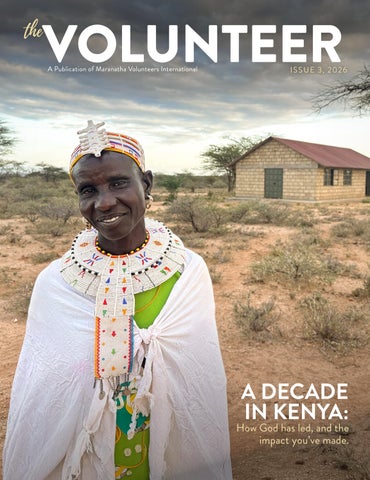
A DECADE IN KENYA:
How God has led, and the impact you’ve made.
KĀNE‘OHE, HAWAII Volunteers (left to right) Renee Copeland, Tina van Philips, Avonda Kratzer, and Lori Brillhart cool off in the waters of Likeke Falls, located on the windward side of Oahu. The excursion was part of a Sabbath afternoon adventure during a mission trip at Hawaiian Mission Academy (HMA). In July, a team of 27 participants assisted on various renovation projects at the Honolulu campus, including installing more than 6,000 square feet of carpet, painting classrooms, and remodeling the computer lab. They also completed general maintenance projects, such as landscaping and powerwashing. The work was intense but volunteers had the advantage of being
the
in one of the most beautiful places on earth. The hardworking team took breaks to enjoy picnics and vespers by the ocean, hikes to scenic vistas, and more. Said the academy in a Facebook post, “We want to extend a heartfelt mahalo to the Maranatha volunteers. Your hard work made a lasting impact on HMA. We can’t wait for our students to enjoy these refreshed spaces!” Founded in 1897, Hawaiian Mission Academy serves secondary students and is one of eight Seventhday Adventist schools throughout the Hawaiian islands and the only campus that serves grades 9-12.
VOLUNTEER Julie Z. Lee Heather Bergren Dustin Comm Victoria Smith Alvarez
Editor Managing Editor/Designer Writer Writer
UNITED STATES HEADQUARTERS: Maranatha Volunteers International 990 Reserve Drive Suite 100 Roseville, CA 95678 Phone: (916) 774 7700 Website: www.maranatha.org Email: info@maranatha.org IN CANADA: Maranatha Volunteers International Association c/o V06494C PO Box 6494, Station Terminal Vancouver, BC V6B 6R3 CANADA All notices of change of address should be sent to the Maranatha Volunteers International United States address.
MISSION STATEMENT: Maranatha spreads the gospel throughout the world as it builds people through the construction of urgently needed buildings.
About the Cover: Justina Lemarampa stands in front of the Maranatha-built Lolparuai Seventh‑day Adventist Church. She helped to establish the congregation more than ten years ago. Photo by Leo Macias Photo by Ron Miller
SHARING THE
Mission
GOD HAD A PLAN On a warm afternoon in July, I was standing in a field of dry grass, surrounded by the mud-brick walls of adobe houses in southeastern Peru. I had a reflector in my hand and was interpreting questions from English to Spanish as the Maranatha media team interviewed the pastor of the newly constructed Calapuja Seventh-day Adventist church. He was telling about how his congregation had been praying for a church for 14 years. As I listened to his story, I was suddenly hit with a feeling of joyous disbelief. Here I was, a young adult in my 20s, conducting an interview for television in the Andes of Peru. And what’s more, this was my job. As I basked in the grateful feeling, I reflected on what had brought me here. In February 2026, I noticed an announcement in my church bulletin for Catalyst, Maranatha’s mission trip for young adults, ages 18-28, to serve near Juliaca, Peru. I instantly felt impressed to go. I’d been on mission projects before, but I had never heard of one with a focus on my age group. The chance to connect with serviceoriented young adults from around the world excited me, so I registered and reserved my place. That was only the beginning of the story. In April 2026, I applied for an open position in the marketing department www.maranatha.org
at Maranatha and in late spring was hired as part of the marketing team. Since I’d already signed up for Catalyst, the Maranatha team asked that I use this experience as part of my job training, which would include writing stories, conducting interviews, and producing television content from the field. So I went to Peru–as both a volunteer and an employee. The experience in Peru was truly incredible. I got to witness what Maranatha does firsthand. Throughout the week, I lay block, worked at medical clinics, and helped out with children’s programs. I also connected with hard-working individuals from all over the world. After high school it can be difficult to find your place in faith communities, and this trip gave us an opportunity to build up and encourage each other in our spiritual journeys. I was amazed at how God brought together 40 complete strangers and turned us into a family through service and faith. At the same time, through my job training I heard encouraging stories while interviewing local church members and leaders, saw incredible parts of Peru behind the scenes, and learned to look more deeply for the ways God is working all around us.
Starting my professional journey with Maranatha on a mission trip was undeniably an extraordinary experience. Yet what impacted me most was seeing how God had planted a desire in my heart to serve with Maranatha long before I knew what He had planned for my future. He opened an opportunity for me to connect with new friends, hear stories of how He is moving in people’s hearts, and share in the inspiring work of serving others. God can do amazing things if we set ourselves aside and focus on the needs of others all around us. If He could use me, a young adult navigating this complex, changing world, He can use anyone, whether you are eighteen, 48, or 80. —Victoria Smith Alvarez is communications coordinator for Maranatha Watch “The Trip,” a series on our YouTube Channel, to see Victoria talk more about this experience. youtube.com/missionstories
T H E V O L U N T E E R ISSUE 3, 2026 | 3
AROUND THE
World
A snapshot of volunteers and projects in the mission field.
INDIA Maranatha recently completed the Kunnapuzha Seventh-day Adventist Church, where the members added beautiful finishes like tile in the courtyard.
KENYA The Maranatha-drilled water well at the New Life Motobo Seventh-day Adventist Church is a popular site each day. 4 | THE VOLUNTEER I S S U E 3, 2026
PERU The Villa Selva Church in the Amazon region is complete, with doors, windows, and paint! www.maranatha.org
INDIA Students are loving their new dorm at the Irvine Adventist English School.
PARAGUAY Volunteers from the Corona Adventist Church in California helped to lay the block walls on the Capitan Meza KM 28 Church.
UNITED STATES Volunteers scrape carpet glue off the floor of a women’s dorm at Pacific Union College in preparation for new flooring.
ZAMBIA Maranatha’s well maintenance crew services the well at the Nseele Adventist Church. www.maranatha.org
KENYA The new Maranatha water well at the Kipsitet Adventist Church brings nothing but smiles. T H E V O L U N T E E R ISSUE 3, 2026 | 5
News + H I G H L I G H T S
Over nearly three decades, Maranatha donors and volunteers built more than 2,000 churches, 1,200 water wells, and 400 school-related structures in India.
MARANATHA CLOSES CHAPTER ON INDIA
A
fter 28 years—building more than 2,000 churches, 1,200 water wells, and 400 school-related structures, Maranatha Volunteers International will be wrapping up our involvement in India at the end of this year. “We have been blessed to support the growth of the Seventh-day Adventist Church in India for all these years,” said Don Noble, president of Maranatha. “This has been a special country for our ministry and our supporters, and the work has made a significant impact in these communities. Our prayer is that each building will continue to share the light and love of Jesus Christ in India.” Maranatha first partnered with India in 1988, when a group of volunteers helped with construction at Roorkee Seventh-day Adventist High School, just north of New Delhi. But it would be another decade before Ron Watts, then president of the Adventist Church in Southern Asia, would invite 6 | THE VOLUNTEER I S S U E 3, 2026
Maranatha to work in India. He hoped to grow membership in the country by one million members–a number that, if reached, would need an estimated 10,000 churches. In 1998, Maranatha established a team and office in India and soon kicked off a church construction effort that would evolve to include schools and, in 2017, well drilling. Over the years, 2,906 volunteers have served in India. According to a 2025 Adventist Review article about Maranatha’s tenure in India, “Southern Asia Division leadership estimate that in the past 25 years, Maranatha has built approximately 2,000 churches, or more than 40 percent of the current 4,588 churches listed in the regional directory.” “We haven’t built 10,000 churches in India, but we’ve built more than 2,000, and they have 1.1 million members. So that piece of the vision— the dream that Ron Watts had—has been accomplished,” said Don Noble,
president of Maranatha, in an interview in 2020. In recent years, increased requirements regarding construction, evangelism, and visas have hampered operations, slowing not only construction but also donor and volunteer participation. In 2026, Maranatha decided to close operations by the end of the year, following the completion of a handful of projects that have already been committed, including churches in West Bengal, Kerala, and Tamil Nadu, and a new dining hall and kitchen at Irvine Adventist English School in Assam. Says Noble, “Maranatha’s work in a country has always been shortlived because we move from place to place, responding to calls for help. Our decades in India were unusual but necessary and definitely impactful. Now it’s time to consider new areas of need, where we can be a catalyst and support for growing the gospel.” www.maranatha.org
MISSION AT MILO
B
etween June 7 and June 19, a team of 54 Maranatha volunteers gathered in rural Oregon to conduct renovations at Milo Adventist Academy. This continues a longstanding partnership dating back to 1989, when Maranatha volunteers first assisted in upgrading staff housing. The 2026 project addressed critical infrastructure needs across the 1950s-era campus. The biggest task focused on the covered bridge—the only entrance to the campus—which required extensive re-siding. Volunteers also worked on a number of other repairs around campus, including on the gym, campus store and food market. Beyond construction, the project emphasized facility organization and groundskeeping. Volunteers cleaned and organized a girls’ dorm
storage room, and cleared out surplus items from gymnasium storage areas. Landscaping efforts included removing trees and stumps, and trimming roses. The project was led by Ed Jensen, a Maranatha board member who has directed all seven projects at Milo since 2020. Jensen noted that the
work provided more than just physical improvements. For the participating families and individual volunteers, the project provided a meaningful opportunity for service, reinforcing the enduring value of the relationship between Maranatha and Milo.
MARANATHA BRINGS MISSIONS SABBATH TO RIO DE JANEIRO
O
n May 9, 2026, Maranatha held a special missions Sabbath program at the Botafogo Seventh-day Adventist Church in Rio de Janeiro, Brazil. More than 700 people attended the event, which featured Maranatha staff; volunteers; Hiram Kalbermatter, president of the Adventist Church in southeast Brazil; and the music of vocalist Regina Mota. The program was also broadcast to viewers on the church’s popular YouTube channel, which has 146,000 subscribers. In the past decade, Maranatha has been working to expand opportunities by organizing volunteer projects in Portuguese, namely for Brazilians, who make up the largest population of Adventists in the world with more than 1.8 million members. More than 600 Brazilians have participated in projects, and interest in Maranatha’s work is rising year by year in this South
www.maranatha.org
American country. “The impact of Maranatha on our church goes far beyond a simple event; it has become a true missionary movement. We have seen a church more spiritually awakened and motivated to leave its four walls to fulfill the mission that Christ entrusted to us,” said Patrick Duarte, senior pastor
of Botafogo church. “Today, I see a church that is more available and more aware that we have been called to impact lives and prepare people for the return of Jesus.”
T H E V O L U N T E E R ISSUE 3, 2026 | 7
TEN YEARS IN Kenya. TEN YEARS OF Change.
A look at Maranatha’s growing legacy in one country. Story and photos by Julie Z. Lee
U “If you want to talk about the impact of Maranatha in Kenya, I can say it is amazing.”
8 | THE VOLUNTEER I S S U E 3, 2026
pon arrival at the Kiutine Seventh-day Adventist Secondary School, in Kenya, the first thing you’ll notice is the pristine landscaping. The view is a manicured set of lawns, bordered by winding sidewalks and trimmed hedges. There are trees, rising 20 feet into the sky and serving as canopies for dormitories, classrooms, and students enjoying an afternoon on the grass. Birds sing from the branches–branches that didn’t exist eight years ago. Because eight years ago this campus was nothing but a few dilapidated buildings atop of a field of dirt. Swaths of green were non-existent. Wind storms passed through often, swirling up tornados of dust that left a sheen of brown on everything, from beds to desks to clothing. It was a depressing place to go to school. Today, it’s an academic paradise for 260 students–a shining example of what can happen when hundreds of volunteers and donors work together to serve a community. And it is just one of the ways God has led Maranatha in Kenya over the past ten years. In January 2015, Blasious Ruguri, president of the Adventist Church in EastCentral Africa, found himself on the roof of a Maranatha One-Day Church in the Dominican Republic. Despite having little knowledge of construction, Ruguri was drilling screws into the metal sheets as part of a short mission excursion during Church meetings in the country. “I had not done any project of that kind before, but everybody received us so kindly. They actually involved us as though they believed we all knew how to do construction,” remembers Ruguri. “So I was given a mentor to show me what to do ... And I felt so good to just participate in this project.” This mini-mission trip was also where Ruguri first met the Maranatha leadership. He was familiar with the ministry; after all, Maranatha had already organized large-scale efforts in multiple African countries such as Zimbabwe, Ghana, and Mozambique. But the first-hand experience gave him an idea. He asked Don Noble, president of Maranatha, if he would consider working in the East Africa Division, www.maranatha.org
which oversees 11 countries, including Ethiopia, Tanzania, Rwanda, and Kenya. “Our membership was growing very, very fast. There was a very vibrant evangelistic business happening in this division. And so we had [membership] increasing everywhere, and we didn’t have worship places,” says Ruguri. The casual conversation resulted in a meeting to discuss needs, specifically in Kenya. Ruguri and Noble went over potential project scope, made visits to church sites, and launched an official effort in 2016. From the Masai Mara to the tribal culture to the diversity of landscapes, supporters found Kenya iconic and alluring. Additionally, the genuine needs and stories of the people tugged at their heartstrings. The response was enthusiastic, and participation swelled. When Maranatha first began work in Kenya, there were approximately 800,000 Adventists in the country. Many groups did not have a permanent or proper place of worship and met under trees or in unstable structures. Ruguri’s request was to provide churches, along with water wells and schools in hopes that the structures would help and grow the Church. Ten years later, more than 2,500 donors and 2,200 volunteers have helped to build 1,126 churches, 298 water wells, and 77 school-related structures. www.maranatha.org
Today, the Adventist Church in Kenya has 1.2 million members. “We have seen places which we would never, ever think we could have members. ... These churches I’m talking about, once they’re completed, in one or less than one month, they’re full of members,” says Ruguri. “If you want to talk about the impact of Maranatha in Kenya, I can say it is amazing.” While churches were the impetus for going to Kenya and the schools launched a flurry of interest, it was the well program that taught Maranatha about the importance of water as a catalyst for transformation. Out of the 42 tribes in Kenya’s population, Maranatha’s efforts have primarily served the Turkana, Samburu, and Maasai communities. These groups are pastoralists, meaning that people subsist by raising and moving livestock. They herd camels, goats, and cattle, from one location to another in search of water and grass. This seminomadic lifestyle has persisted over hundreds of years out of tradition and because of the lack of water. While some prefer to preserve the culture, others are wanting to move their families into a more modern era. They just need one resource to kick off a domino effect of change. “Water is paramount. ... So if you provide water, it means you’ve given them a reason to settle
BRIGHT FUTURES:
Class is in session at Kiutine Adventist Secondary School, where Maranatha renovated the entire campus, building new classrooms, dorms, kitchens, and staff housing.
T H E V O L U N T E E R ISSUE 3, 2026 | 9
1
“Permanance means stability, and stability brings growth in church membership.”
in a particular place,” said Samuel Makori, former president of the Adventist Church in East Kenya, during an interview in 2016. “Then, number two is a school. ... There’s a school, there’s water, and then there’s a church. And that creates a community where people do not have to move. ... So the impact is that it settles them.” Permanence means stability, and stability brings growth in church membership and schools. This was demonstrated in Lolparuai, a village in north-central Kenya in Samburu County. Twenty years ago, Pastor Justus Gituma started a congregation here, meeting under a tree. As the group grew, he started a small school. Later, Adventist missionaries built a couple of classrooms and also provided a well. The duo of a school and water drew families who wanted their children to receive an education. A permanent settlement developed in Lolparuai, resulting in growth at the school and church attendance. The only missing element was a worship structure. In 2016, the first batch of volunteers arrived to construct classrooms for the existing school in Lolparaui. Then in 2017, Maranatha crews erected a One-Day Church in Lolparuai. Ten years later, both the church and the school are doing well. The church suffered a momentary dip in attendance due to a lapse in leadership, but is rising again. The school, which goes through middle school, has 120 students. “We are very grateful for what Maranatha has done. Number one, they have helped us to serve God more easily because [we do not have to] worship under the tree; we are under [a roof]. There’s no rain that is raining on us. When the weather is hot, we worship and have no problems,” says Gituma, who came out of retirement to serve Lolpaurai and the surrounding villages. “Even the schools that you have funded, many children would not have gotten an education if it were not for Maranatha.” No doubt, education is significant to the development of a child, society, and country. Arguably, there is no Maranatha project that better proves this than Kajiado Adventist School and Rescue Center. Located just 30 miles south of the capital city of Nairobi, this boarding school provides not only an education, but new life and
10 | THE VOLUNTEER I S S U E 3, 2026
www.maranatha.org
3
2
hope for Maasai girls who are rescued from the tribal ritual of female genital mutilation and child marriage. When Maranatha first heard about the school, there were 160 students. Girls slept two to a twin mattress in overcrowded quarters, bathed outside with purchased water, shared two toilets for everyone, and studied in cramped classrooms. Bringing real change to the campus would require starting from scratch. It was a daunting dream to dream, but the heartbreaking stories of the rescued girls convinced Maranatha to try. In 2019, Maranatha launched a campaign to rebuild Kajiado. Immediately, people were captivated by the story of brave girls who were fighting to carve out a new future for themselves. Over the next five years, more than 1,600 donors and volunteers showed their support. Kajiado anchored Maranatha’s tenure in Kenya and the steady transformation on campus became an emblem of volunteer and donor impact in Kenya. Today, much like Kiutine, Kajiado is unrecognizable from its former self. There are new classrooms, dorms, offices, staff housing, bathrooms, and a dining hall. There is lush landscaping along with a water well and extensive water system. Now, an astounding 700 students call this beautiful place home. “Very few projects in the history of Maranatha have had such a powerful impact in so many ways as the Kajiado Adventist School and Rescue www.maranatha.org
4
Center project has had,” said Maranatha President Don Noble, at the dedication in 2024. “Hundreds of volunteers were immediately impacted with the reality of the lives these girls have experienced and the emotions went deep, especially when they met the girls. The result has been a totally new campus and expanded education opportunities that will establish a strong future that the girls could have only dreamed about.” While Kajiado was ambitious because of the scale, Maranatha’s most logistically challenging effort took place in Ileret, located in the northern corner of Kenya, just miles from the Ethiopian border. The Maranatha team in Kenya refers to Ileret as “the ends of the earth.” It may be inaccurate but it certainly feels like the truth, as this region, located in Marsabit county, is isolated, barren, and undeveloped. It is home to the Daasanach, a tribe that has had little interaction with the rest of Kenya, partially due to their remote location. The region is extremely difficult to access, requiring vehicles to push through the Chalbi desert on sandy roads and searing heat. But even here–in a place of such scarcity, there is an abundance of hearts open to the gospel. Ten years ago, Adventist missionaries entered the area, carefully built friendships and planted a handful of churches. Later that year, at the request
BIG IMPACT:
1 The Samburu tribe in Lolparuai worships in the church that Maranatha built in 2016. 2 Once a cluster of dilapidated buildings, the Kajiado Adventist School and Rescue Center was completely rebuilt by Maranatha. 3 Students at Kiutine Adventist Secondary School are thriving in their new classrooms and labs. 4 The community surrounding the Kiutine campus line up to collect clean water from the school’s well, which was drilled by Maranatha.
T H E V O L U N T E E R ISSUE 3, 2026 | 1 1
1
3
2
“The structures are a symbol for people to remember that God exists ... God is the one who provided this shelter for them.”
12 | THE VOLUNTEER I S S U E 3, 2026
of the Adventist Church, Maranatha’s crew made the five-day trek to Ileret from Nairobi, hauling steel and tools to build four One-Day Churches. In 2021, a bigger crew made the same trip to not only to build six churches but to also drill water wells. Then in 2026, as the initial congregations grew daughter groups, Maranatha returned for a third time to erect four more One-Day Churches. The buildings are an unusual sight in the region and have become significant in what they represent. “The structures are a symbol for people to remember that God exists, because whenever they come here, they are reminded that God is the one who has provided this shelter for them,” says Stanley Kinathi, one of the first pastors to plant churches in the Ileret area and who still serves the congregations. Daniel Muchiri Mugo is a pastor who has been working with Kinathi to serve the daughter congregations of the original four. Says Mugo. “I’m glad that we have somewhere to worship, and I know it’ll influence other people who used to mock us ... Now they have seen what we have been waiting for. And so this one will bring a very great impact in the ministry.” In Ileret there is water. There are churches. There is growing faith. All this is triggering a shift in people’s expectations. “The community that has been lost in the dungeon of illiteracy, now through the service that we are doing here, they have a light. They have embraced Christian teachings,” says Mugo. The last time Maranatha visited, village leaders asked about the possibility of building a school in the area. The Daasanach are seeing a different path for their families–one that cherishes tradition but is open to a world of new possibilities. Slowly, but surely, change is seeping through. “I look at Maranatha as through the extended hands of our Lord and our Savior, Jesus Christ. They’re not people who think mission is just when you take the Bible and stand at a pulpit. Maranatha believes in the practical gospel, the practical approach to the gospel,” says Ruguri. “They fall in the footsteps of our Lord and our savior–the way He reached out to touch people where the need was. And I think they have changed people’s thinking in those areas where they have been in this country. Everybody’s thinking has been totally revolutionized.”
www.maranatha.org
4
5
The growth of Adventist membership in Kenya is by no means solely because of Maranatha. The construction is a response to requests from a membership that is already dedicated to the gospel commission. The churches, schools, and wells have provided fuel for a fire that was already blazing and is burning still. Eliazer Kogey is the president of the Adventist Church in the West Rift Valley Field, where Maranatha has worked extensively to provide churches and wells. He has witnessed how these projects have changed the communities. “In this region, the fastest growing church is Seventh-day Adventist. And it is majorly because of the One-Day Churches and the [wells],” says Kogey. “Anytime we construct a church, we begin when the numbers are like 30 or 32, 33. Around three to four months down the line, it’s doubling.” “Maranatha has really changed the cause and the face of the Kenyan church today. Our people in Kenya are worshiping in dignified places, nice places all over the country.” Earlier this year, Maranatha’s board of directors set a goal to build 50 OneDay Churches, construct classrooms at the Kimogoro Adventist Boarding Primary School and Mankau Adventist Academy, drill 40 wells, and complete maintenance and repair visits to www.maranatha.org
existing wells in 2026. But after this, what’s next? Ruguri laughs at the question. “At some point we thought we had done a lot of work. But now we are discovering that we haven’t even started. There are so many frontiers which have not yet been opened, and they keep popping up as we move along,” says Ruguri. “I want other countries, other unions to have a taste of this blessing. ... As people continue to see what Maranatha has done in one place, then people start crying, ‘Please come to us as well.’” While there are no current plans to move on from Kenya, there is talk of moving into neighboring countries. It’s a discussion that is still in its infancy, but the seed has been planted. For Ruguri, that’s faith enough. He is confident that God will lead the mission to the place it is needed most. “Maranatha is a ministry of compassion. It is a ministry of hope.” says Ruguri. “May the Lord continue blessing the vision of Maranatha. ... God gave Maranatha this vision and may this vision live and may Maranatha itself live forever.”
TREES TO CHURCHES:
1 A young Daasanach girl gazes at the camera. The Daasanach are one of the more isolated tribes in Kenya. 2 The Lomodang congregation, a Daasanach group, meets under a tree. In June, Maranatha built them a One-Day Church. 3 The Elbogosh congregation, also part of the Daasanach tribe, worships in their One‑Day Church. 4 The Kiptaragon congregation worships in their church, which they worked hard to complete after Maranatha erected the One-Day Church structure in 2023. 5 Six years since Maranatha built a OneDay Church in Kapkatet, members finished the walls, floor, windows, and even added a small apartment for visitors and pastors.
T H E V O L U N T E E R ISSUE 3, 2026 | 1 3
SERVICE, Faith, AND ADVENTURE
Young adults gather in Peru for Catalyst project By Victoria Smith Alvarez Photos by Dustin Comm
T
he moment he stepped out of the airport in Juliaca, Peru, the rain began. For Ken Pombo, who was already feeling nervous about what lay ahead, the weather could have been taken as an omen of a difficult and intimidating week to come. “This [was] something that I would never normally find myself doing,” he says. “I’m an introverted person, so it takes me a lot of time to make a friendship with someone.” What Ken was doing was joining 40 fellow volunteers on Catalyst, a mission project specifically designed for young adults, ages 18-28. Maranatha created the project as a way to offer service opportunities for young people in a pivotal season of life, during which they encounter new schools, jobs, relationships, and other key transitions. This year’s participants came from all over North America and other countries, hoping to not only serve the Juliaca community, but to also find connection with other young adults. What they hadn’t anticipated was being welcomed by a thunderstorm, complete with hail and lightning. Yet, as they ran to the waiting bus through the downpour, there was a glimmer of hope–like a break in the clouds–of the exciting adventure they were about to face. The group’s anticipation was palpable, and the spirit of curiosity and willingness was present from the very beginning. Early the next morning, the team hit the ground running at the construction site,
“As the volunteers ran to the waiting bus, there was a glimmer of the exciting adventure they were about to face.”
14 | THE VOLUNTEER I S S U E 3, 2026
where the volunteers would be building a new church for the Calapuja Seventh-day Adventist congregation. The group had been meeting in a cramped, windowless room in a member’s home for 14 years. The congregation grew to 30 members in just over a decade, but in a place like this there was no room for growth; no extra pews, people, or additional faith activities could be crowded into the already maximized area. Members often felt claustrophobic due to the lack of space or even fearful because of the risk of the building collapsing from an earthquake. “In a home, you can’t have the equipment you need. You don’t have the space, because it’s a home, not a church. [There are certain functions] you can’t take part in,” says Juan Samuel Apaza, the first elder of the church. “Now, thanks to Maranatha, we will have not just a church but a temple where we can do all this.” Many of the volunteers had never laid block before, but they quickly learned under the leadership of Peter Thomas, who served as the volunteer construction superintendent on the trip. The five days spent on the construction project were tiring yet fulfilling. With every block, as the walls grew higher, the volunteers envisioned that by the end of the week, they would be worshipping in the building with the local congregation. Not only that, but they would see the work of their hands stand for years to come. While a large part of the group focused on construction, another dedicated team, which included medical students, nurses and midwivesin-training, coordinated free daily medical www.maranatha.org
1
clinics for local communities. The volunteers engaged in direct patient care, checking vital signs, coordinating triage and intake, and handing out prescriptions. Over the four days of clinics, the team saw more than 200 people, who often waited hours to receive the free care. The third component of the project was children’s programs. Volunteers organized engaging activities for children who waited at the clinic or just wanted to join in the fun. Kids made creative crafts, drew colorful pictures, sang songs and played energetic soccer matches. While the volunteers strived to teach the kids about Christ’s love, they in turn learned about the true nature of gratitude and simplicity. Ken was able to serve in all three foci of the trip, another aspect that stretched his limits and expectations. “I was [also] part of medical, I was part of VBS, and it’s been a really great experience because I just expected to come, lay some block and call it a day. But the Lord calls us to do things that sometimes we’re not ready to do, or are not expecting or planning.” As a whole, the trip brought some environment-related issues that required www.maranatha.org
2
adjustment, like extreme cold in the night but pleasant, sunny days. The high altitude– Juliaca is located 12,500 feet above sea level–affected everyone to some degree; some found themselves winded after walking up a few stairs, while others dealt with varying degrees of altitude sickness. Each day brought new challenges and victories, all of which served as tiny catalysts for connection. “In just the first, second, third, even fifth days we actually connected with a lot of people,” reflects Ken. “It feels like we have
ADVENTURE BEGINS:
1 (L-R) Fontaine Parchment, Falcon Hamilton, and Ken Pombo work on the construction of the Calapuja Seventh-day Adventist church. 2 Young adult volunteers worship beneath the frame of the Calapuja Church on the first Sabbath of the Catalyst mission trip.
T H E V O L U N T E E R ISSUE 3, 2026 | 1 5
1
2
“Seeing the testimony of the young adults here [on this trip] empowers your heart to keep pushing and work towards a better future.”
16 | THE VOLUNTEER I S S U E 3, 2026
3
known each other for years. It’s been great to know that there are a lot of people that [came] to meet others, to meet other friends… it’s only God that brought us and helped us connect.” Tying it all together was the strong spiritual emphasis that kept the volunteers grounded and encouraged. Each day began and ended with worship led by Pastor Sandro Sandoval, the spiritual coordinator for the project. From early morning devotionals to lengthier gatherings in the evenings where people could sing, pray, and debrief from the day, the work was always focused on God and growing faith together. Many of the volunteers were searching for the stability of a church community and navigating personal questions about life and faith. For Ken, this element of faith was a primary reason for joining the project; his overall objective was to grow closer to God and sharing this journey with peers made it even more meaningful. “I think it’s very vital for young adults to be surrounded with more young adults because we can see the challenges of the things that people are going through,” reflects Ken. “And yes, more grown adults have gone through these things before us, but times change, generations change. So seeing the testimony of the young adults here–listening to that–it just empowers your heart to keep pushing… keep working towards a better future.” The experience culminated with a beautiful Sabbath morning service, celebrated with the Calapuja congregation in the newly constructed church. While the windows, doors and utilities were still to come (details the local congregation will add later), the spirit of love and unity was clearly present. The day became even more meaningful as seven volunteers stepped into the icy cold river just down the road from the new church. Throughout the week, they www.maranatha.org
5
4
felt God’s call through their work. Now they publicly dedicated their lives to God through baptism–a powerful reminder that while Catalyst had built a physical church, God was continuing to build in their spiritual hearts. The trip ended in success and with great satisfaction for all. Volunteers like Ken had come prepared to engage in service and outreach, but found themselves surprised with how impactful it was to be part of a young adult team. They came away with lifelong friendships and memories, never having imagined such an adventure when they arrived on that stormy afternoon to the Juliaca airport. “It’s been really great, feeling that sensation of serving a community that you never knew before. And likely the only time you’ll see them again is in heaven. So it’s great to know that a lot of people from around the world are willing and able to come here and just do something for someone and just never expect anything back,” says Ken. “I feel like this Catalyst trip has been a catalyst for my own life– for knowing and pursuing my calling ... It is vital that likewww.maranatha.org
6
minded young adults keep doing these things. God really works and there’s nothing that God cannot do for you when you are giving everything to Him.”
THANK YOU FOR YOUR $10 GIFTS! The Calapuja Church was funded entirely by donations to The $10 Church program, which asks people to give just $10 a month toward the construction of a specific church. Thanks to your participation, we not only built a church but we were able to provide this incredible experience for young adults. Next we’re sponsoring the Barias Church in the Dominican Republic, and we need your help. Join The $10 Church today to start giving now!
CATALYST FOR CHANGE:
1 Volunteer Ken Pombo lays block at the Calapuja Church construction site. 2 Volunteer Kaylie Mena joins in a dedication prayer at the Los Uros Seventhday Adventist Church. 3 Amelia Zimmerman and Claudia Aspajo direct songs for the children’s programs. 4 Volunteers fellowship after Sabbath worship in the church they helped to build. 5 Izzy Burger takes a moment before she is baptized in the icy local river. A total of seven volunteers were baptized on the project. 6 Hannah Hamilton takes a patient’s vital signs at one of the daily free clinics.
T H E V O L U N T E E R ISSUE 3, 2026 | 1 7
RESTORING OAKWOOD
Volunteers serve to restore and honor the roots of a historic university Story and photos by Dustin Comm
W
hen Annette Mims walked into The Annex in 1970 at Oakwood University, it felt like an invitation to the future. As a senior, she was part of the first class granted the privilege of living in the duplexes previously reserved for staff. It was a new chapter in her life— more independence than the dorms, while still within the safe confines of campus. “There were about six or eight of us,” explained Annette. “We had different rooms, and we were able to live together. Actually, NEW LIFE INTO it wasn’t in top condition, but they were working on it, and they were OLD BONES: starting to open them up at that time.” The units might not have been 1 Maranatha volunteers lavish, but they were a sanctuary of faith and learning–a place that transform student would shape the trajectory of her life. housing units with new flooring and paint. In May 2026, Annette returned to The Annex again; this time 2 Esther Victor, an not as a student, but as a Maranatha volunteer. After a full career in alumna of Oakwood education, including a doctorate, she returned to give back to a place University, is happy that left her with so much in her formative years. She didn’t want to to volunteer on just do manual labor; she wanted to support future generations of Maranatha’s first students by enhancing the spaces she benefitted from as a young adult. project at the school. This would be Maranatha’s first-ever project at Oakwood, located in the aerospace hub of Huntsville, Alabama. It is a place where the history is as palpable as the modern-day innovation surrounding it. As the only Historically Black College and University (HBCU) within the Seventh-day Adventist educational system, its roots are deep and complex. The campus sits on land that held a plantation where famous abolitionist Dred Scott was once enslaved. In 1895, Edson White, son of Adventist Church co-founder Ellen White, captained the Morning Star, a mission boat that sailed down the Mississippi River to evangelize African-Americans in the South. In 1896, they purchased the Oakwood property to establish a school for black students that would initially be named Oakwood Industrial School. From an opening class of 16 students, the institution grew into the university it is today, driven by a 130-year mission to transform lives. As with other long-standing Adventist institutions, more than a century of rich history at Oakwood meant that the facilities had begun to wear down. “I couldn’t believe the condition they were in,” said Annette. “But it still brought back memories, and [the units] are still here.” Current students could feel the need for updates too. “The carpet was brown, but I don’t think that was the [original] color,” speculated current Oakwood student Ludivine Kéren Toussay. “There were some holes in the wall, so things from outside were coming inside. It was very difficult.” With the carpets nearly impossible to clean and the deteriorating flooring, it was time to give The Annex a facelift.
“I couldn’t believe the condition they were in. But it still brought back memories, and [the units] are still here.”
18 | THE VOLUNTEER I S S U E 3, 2026
www.maranatha.org
The intervention began when long-time Maranatha volunteer leader Loretta Spivey was hired by Oakwood, her alma mater. As the director of operations, knew the needs of the campus and how the missions of both organizations could be aligned to make a difference. She reached out to Maranatha for assistance, and Maranatha agreed to help. From late May to mid June, a number of volunteers cycled in and out of the project, laboring with dedication no matter how many days they stayed. The first task was cleaning the units—clearing out years of dust, dirt, and grime instantly improved things. Then, volunteers began ripping out the old carpet, in some cases exposing rotten flooring that had to be repaired, before new laminate flooring was installed. Combined with a fresh coat of paint on the walls, these simple improvements made a world of difference. Natilia Chambers, a women’s dean and director of The Annex, emphasized the psychological benefits of the renovation, citing her mother’s wisdom. “My mom would say to me, ‘Your place is a reflection of what’s going on in your mind.’ So I think having a place that is already beautiful adds to the fact that you’re in a space where you’re able to commune with God.” The project was largely made up of volunteers like alumna Esther Victor—people without professional construction experience, who simply wanted to make a difference, sometimes in the quiet act of cleaning windows or sweeping floors for their alma mater. “We’ve been praying as we’ve been cleaning,” shared Esther. “Praying that God be with the students that are going to be housed in those apartments, that they are protected, that they feel comfortable, and that they feel the love that has been put into the work that’s been done for them.” First-time Maranatha volunteer Janine Pierre-Louis Hudson, who admits that the only thing keeping her from joining a project in the past was her own personal hesitation, cancelled previous travel plans to make it to the mission trip with her husband Larry. While there, she found a deep sense of purpose and community through challenging service. “This week has been very hardworking,” said Janine. “If I were to roll up my pant leg, you would see the signs of my labor. I don’t say that to give anybody pause. I say that just to make this point: I might hurt, I might ache, but boy do I feel good!” The work transcended the physical. As volunteers laid flooring and made repairs, they were also taking part in a communal act of worship. They ate together, they prayed together, and they formed bonds that will not soon be forgotten. “You make connections as a result of participating in a Maranatha [project] that I think you will have for the rest of your life,” shares Janine. “There are people here who have told me that they have volunteered on projects all over the world. They’ve known each other for years and didn’t know each other before Maranatha. www.maranatha.org
And now in some cases they are best friends. So this is an opportunity to give, but it is an opportunity to receive while you are giving.” This dynamic is one that Loretta has seen over the dozens of international mission trips she’s led with Maranatha, and she was also pleased to see it play out on a North America project. “People who have retired after working their entire careers, and they get up and spend their time going from place to place to place working hard and serving those people are really special to me,” said Loretta. “They’re the same people that take their [paid] vacation [time] to go and build a building or tear up carpet somewhere. It’s all just amazing to me.” As the project concluded, the visible transformation was stark—the rooms were no longer dirty, worn-out spaces of the past; they were invigorated, clean, bright homes to support learning and a connection to God, for future generations of Oakwood students. But the true transformation was intangible. The students who will move into The Annex at the start of the school year won’t just be entering a duplex; they’ll be entering a space transformed by people who cared enough to sacrifice for them. “My hope is that when they enter the room for the first time that they will be able to look around and say, thank you Lord, for placing me in a room that is freshly painted, new floors, wonderful kitchen, wonderful bathrooms, air conditioning—[all] important; but also, that I’ve come to a school where they must care about the students because a school that didn’t care wouldn’t have gone through the effort to have work done on student housing,” said Janine. “[I pray] that it will be meaningful to them,” said Annette. “That it will help to encourage them as they move forward in life and, as always, that Jesus would be the center of everything and that they can be a part of hastening his coming. In the end, the project at Oakwood was a reminder that our circumstances—whether they are aging infrastructure, personal doubts, or lack of time—don’t control our impact. As Janine points out, “If you feel like because of the circumstances you are under, that you can’t do a Maranatha project—what are you doing under there? Come out from under those circumstances, whatever they may be, because once you’re on a Maranatha project, you will work and praise and laugh so hard. There will no longer be those circumstances you were under. So what are you waiting for? Stop getting in your own way and just do it. Just do it.” The history of Oakwood began with a boat on a river, and a mission to lift people up through education and faith. Now 130 years later, the spirit of the Morning Star mission lives on. Not just in the classrooms or the walls of the housing of the university, but in the hearts of the volunteers, and the hands that reached out to mend just one of the foundational spaces of a legacy of which we are all called to care for and carry for generations to come. T H E V O L U N T E E R ISSUE 3, 2026 | 1 9
HOW YOU’VE
Helped
A look at how your support is making a real difference for communities around the world.
KABILE, ZAMBIA
BEFORE The Forest Park Seventh-day Adventist congregation, in Zambia, met in this ramshackle church made of grass that frequently disintegrated.
LEAVING YOUR
AFTER They meet in this strong One-Day Church constructed by Maranatha that will not fall apart.
Legacy
Sweet Cakes for Sweet Water
How one woman is baking Jamaican treats for missions Six years ago, Lora Douglas saw the need for water on Maranatha’s television program, “Maranatha Mission Stories,” and wanted to do something to help. “I see how the people have to walk so far, and have to put it on their heads,” said the 92-year-old who lives in Florida. “I’m from Jamaica, and I’m used to that. They come home, they have to boil it, and it’s still not clean.” She was ready to take action to help, but as a retiree, expendable income was limited. She figured she’d use the skills she already had to generate the funds she hoped for—she got to work making and selling Jamaican fruitcakes. Lora’s process starts in the spring each year, when she collects fruits and prepares them to marinate until she starts baking in November. Fruitcakes are a regular part of the Jamaican 20 | THE VOLUNTEER I S S U E 3, 2026
Christmas tradition, and Lora has repeat customers who depend on her for their annual cake. Depending on the size of the fruitcake, she sells them for as much as $30, with total sales between $600-$800! It’s a lot of work for anyone, let alone a nonagenarian! But to Lora, the effort is well worthwhile. After all, it’s her way of answering God’s call to serve. “When you want to do something, the Lord tells you what to do and how to make that money.”
www.maranatha.org
PROJECTS IN NEED OF HELP
Here are some specific projects that need funding! Please make a donation to any one of these construction projects. DOMINICAN REPUBLIC CHURCHES
This year, Maranatha made a commitment to build nine churches in the Dominican Republic. This effort is one of our biggest needs this year. The cost of construction is high, but even higher is the need to provide houses of worship for a membership that is growing so fast—a good challenge to have! But we cannot respond to their requests for help without you. Costs vary for full sponsorship of a church, but a gift of any amount will go a long way in helping the overall effort in this country.
Focus on Los Prados Seventh-day Adventist Church, Dominican Republic
More than 16 years ago, a small group of people branched off from an existing church to establish a congregation in a new neighborhood. Called Los Prados, the church plant was born from “the deep longing that, just like us, other people might experience the joy of salvation,” says Maria Camacho, one of the founders. Maria and her fellow missionaries shared the gospel by organizing evangelistic campaigns and even going door to door. Today, the membership is at 40 people. They’ve moved from place to place, meeting in houses and other spaces. Currently they rent a small temple that fills up each Sabbath with little room for guests or even new members. But crowding is only one of its problems. The building is located on a busy street, where motorbikes zoom by in a deafening wail during worship.The structure is old, with a roof that threatens to cave in. The walls also have mold that is believed to be causing health issues for some of the members. But without enough money to rent a better space or to construct their own, Los Prados was stuck. This is just one of the stories of why Maranatha is in the Dominican Republic building churches! Fortunately, Los Prados is one of the nine congregations slated to receive a new church, provided we receive enough funding! You can help by making a donation to this project. Please bring a safer, more respectable place of worship to the Los Prados members by making a gift of any size. www.maranatha.org
Countries
I N 202 6
Here’s where Maranatha is working this year. BRAZIL CUBA DOMINICAN REPUBLIC INDIA KENYA MOZAMBIQUE PARAGUAY PERU UNITED STATES ZAMBIA
CHURCHES SCHOOLS WATER WELLS CAMPS T H E V O L U N T E E R ISSUE 3, 2026 | 2 1
P R OJECT
Calendar
Anyone can join a Maranatha mission trip! Check out our upcoming opportunities here or go to maranatha.org for the most updated list.
DATE
PROJECT NAME
PLACE
LEADERS
SCOPE
Oct. 15 - 25, 2026
Dominican Republic Project
DOMINICAN REPUBLIC
Stacy and Laura Peterson
Church construction
Nov. 12 - 22, 2026
Peru Project
PERU
Elmer Barbosa
Church construction
Dec. 7 - 21, 2026
Streams of Light International Project
MISSISSIPPI, USA
Jeanice and Ernie Riles
Campus Renovations
Dec. 21 - 31, 2026
Family Project
DOMINICAN REPUBLIC
Susan and David Woods
Church construction, outreach
Mar. 1 - 11, 2027
Nosoca Pines Ranch Project
SOUTH CAROLINA, USA
Jeanice and Ernie Riles
Renovations
Mar. 10 - 21, 2027
Multiple Group Project
KENYA
Loretta Spivey
School construction
Mar. 18 - 30, 2027
Zambia Project
ZAMBIA
Susan and David Woods
School construction, outreach
May. 17 - 28, 2027
Andrews University Project
MICHIGAN, USA
Ron and Nancy Davis, David Gott
Church construction
Jun. 13 - 27, 2027
Oakwood University Project
HUNTSVILLE, AL
David Gott
Dorm Renovations
Jun. 16 - 19, 2027
Southern Adventist University Alumni Project
KENYA
Karen Godfrey
Construction
Go to maranatha.org to see all the volunteer opportunities being offered, including full projects and mission trips being coordinated by church or school groups.
Thank You FOR SERVING
The following Group Project teams served during the months of July through September.
KENYA
PERU
Fort Myers - Port Charlotte Team | Florida
PARAGUAY
Missão Central Vitória | Brazil College View Church Mission Team | Nebraska
Corona Adventist Church Team | California 22 | THE VOLUNTEER I S S U E 3, 2026
www.maranatha.org
ANGWIN, CALIFORNIA Jeremiah Thompson, from California, pulls up the carpet in one of the dorm rooms at McReynolds Hall, site of some major renovation work at Pacific Union College (PUC), a Seventh-day Adventist college in Northern California. In August, 38 volunteers, including Jeremiah, spent more than a week revamping the residence hall, which was in need of an update. Their long list of tasks included removing old carpet, scraping carpet glue off the cement, laying new flooring, tearing out built-in furniture, painting, and replacing medicine cabinets and
lighting in the bathrooms. Jeremiah heard about the project from his grandmother, who caught wind of it on Maranatha’s television program, “Maranatha Mission Stories.” Since he was already headed to PUC as a freshman in September, he decided to join the project as a way to help out his future school. He also figured he might meet other young people on the project. But most volunteers on North America Projects are retirees–or close to it– and at 18 years old, he found himself the youngest participant by far; the average age on the project was 65. “It
was kind of surprising,” says Jeremiah with a smile. “My grandmother told me ‘Oh if you’re going to go, there’s a lot of kids I see on TV that will be working there as well.’ And I come, and I’m actually the youngest person here!” But Jeremiah loved the experience. He bonded well with his fellow volunteers, despite the age gap. Most of all, he loved the daily grind of completing project tasks. “Honestly, I like the work here a lot,” he says. “It’s just very calming to be able to work on projects.” Photo by Ed Jensen
Non-Profit U.S. Postage
PAID
Rancho Cordova, CA Permit No. 361
990 Reserve Drive, Suite 100 Roseville, CA 95678
MARANATHA’S NEW-LOOK WEBSITE
Redesigned to be easier than ever to connect with the mission you love. • Explore volunteer opportunities with streamlined search tools.
• Give directly to specific projects with our simplified giving experience. • Dive into our “Be Inspired” section for powerful stories and videos from the mission field.
Travel into the mission field and see how God is leading ordinary people to make an extraordinary difference in communities around the world with our television program, "Maranatha Mission Stories."
HOW TO WATCH BROADCAST CHANNELS
(All times PT)
3ABN Friday, 8:00 p.m. Saturday, 2:00 p.m. Hope Channel Saturday, 3:00 p.m. ON DEMAND
maranatha.org
The Maranatha Channel App Watch current and archived episodes, and other videos on demand. Download for Apple, Android, Amazon Fire TV, and Roku. watch.maranatha.org View all episodes online at Maranatha’s video website. Find segments by using our “Search” function.