WWW.VOICE-ONLINE.CO.UK
OCTOBER 2025 • ISSUE NO. 1971
£2.50
Celebrating Black History Month
OUR judges make history
New body aims to transform the justice system ›› p8
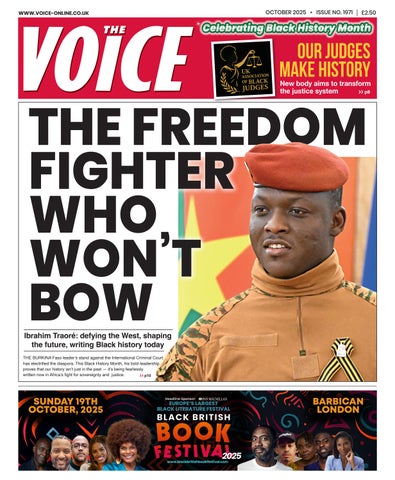
THE FREEDOM FIGHTER WHO WON’T BOW
Ibrahim Traoré: defying the West, shaping the future, writing Black history today THE BURKINA Faso leader’s stand against the International Criminal Court has electrified the diaspora. This Black History Month, his bold leadership proves that our history isn’t just in the past — it’s being fearlessly written now in Africa’s fight for sovereignty and justice. ›› p10
Inside THIS MONTH
The Voice says
ROUNDUP NEWSPAPER
News, views, stories & videos
THE 10 MOST POPULAR STORIES ON VOICE-ONLINE.CO.UK
6
‘Let the hungry be fed’: how Rastafari groups play a key role in Black British history
22
COMEBACK: Michail Antonio
‘From ackee to curry goat’: the Windrush food story takes centre stage in Greenwich
38
Forgotten no more: the unsung Black designers who shaped fashion history
40
‘There would be no Malcolm X without her’: Grenada pays tribute to his mother Louise Little
44
Nigeria’s pioneering modernists honoured in landmark Tate exhibition
53
Dynamic duo: Martine and Rashidah stun powerlifting world
1 Black Futures Matter: why we must celebrate the 2 history being made today 3 4
Opinion: The far-right isn’t hiding anymore – and Black Britons must remain vigilant
B
LACK History Month has always been a vital time to reflect, to remember, and to celebrate. It reminds us of the resilience of figures such as Mary Seacole, Marcus Garvey, and Rosa Parks, whose courage changed the course of history. But for a new generation of Black Britons, it is also something more: a chance to reshape the story and ensure that Black history is not only about the past, but also about the present and future. This is where the idea of Black Futures Matter comes in as some commentators have called it. Every October, we rightly look back at the struggles and victories of those who came before us. But if we only look backwards, we risk missing what’s happening right now – and overlooking the people who are shaping tomorrow. For the Black community to shape history, we must also be future-forward. This focus on the future is very much the theme of this special Black History Month edition of The Voice. Alongside reflections on the important icons and struggles of the past, we’ll be highlighting the history being made today, history that could well lead to Britain’s first Black prime minister; Black Britons playing leading roles in how technology and AI will shape society; and entrepreneurs making bold moves
This issue is 56 pages EDITOR Vic Motune E. vic.motune@thevoicemedia group.co.uk
CORPORATE AFFAIRS & COMMUNICATIONS Paula Dyke E. paula@thevoicemedia group.co.uk
EXECUTIVE DIRECTOR Paulette Simpson E. paulette.simpson@thevoice mediagroup.co.uk
ENTERTAINMENT EDITOR Joel Campbell E. joel.campbell@thevoice mediagroup.co.uk
News: Honouring Dalston’s cultural legacy/ Dalston Square to recognise pioneers at free heritage Sponsored: Tell it Loud - tackling the full reality of sickle cell
that could open the door to a new generation of corporate leaders. Across the country, innovation and creativity in technology is already shaping the future national story. Black-led venture capitalists are doing some amazing things to ensure our community has a voice in how that future pans out whether its through using technology to develop innovative ways of working together or opening doors to new investment. This is just one example of why it’s important to champion the historymaking innovation, leadership and creativity taking place in our community today. Young people in particular say Black history cannot be confined to a handful of names or a single month. They see history as living, evolving, and deeply connected to their own experiences. From youth-led campaigns to digital creators reimagining culture online, they are not waiting to be written into the history books – they are writing themselves in. Black History Month must remain a time of remembrance. But it should also be a time of recognition that the history we make today will shape the world our children inherit. If Black futures matter, then we must celebrate today’s milestones – and commit to building a future where the next generation can thrive.
Opinion/Sport: Black excellence continues to be confined to the pitch/ When it comes to decision making, from touchlines to boardrooms, the story is different as Black managers remain rare in British football
5 6 7
Opinion: Cancer patient, British citizen, cast aside: the cruelty of the Home Office exposed again Sport: Michail Antonio back in business/ Jamaican veteran prepares to tackle World Cup West Midlands News: Community rallies to honour Wesley Williams/ Tributes flow as family launch appeal to ensure the 25-year-old’s light and legacy of compassion lives on
8 9 10
News: Jamaican high school bans girls from wearing ‘edges’ in their hair Entertainment: All eyes on docuseries ‘Surviving South London’ How one rapper is putting mental health at the heart of community change
Got a story? email us at yourviews@thevoicemediagroup.co.uk SPORTS EDITOR Rodney Hinds E. rodney.hinds@thevoice mediagroup.co.uk ADVERTISING AND SALES E. advertising@thevoicemedia group.co.uk
NEWS DESK E. newsdesk@thevoice mediagroup.co.uk
CIRCULATION & SUBSCRIPTIONS E. subscriptions@thevoicemedia group.co.uk
The Voice Newspaper Unit 1, Bricklayers Arms, Mandela Way, London, SE1 5SR T: 020 7510 0340 Web: www.voice-online.co.uk GV MEDIA GROUP LTD
OCTOBER 2025 THE VOICE | 3
Black History Month
News Feature
PROTEST ART ON SHOW
Creative works inspired by Bristol Bus Boycott set to be featured in public exhibitions. By Vic Motune
T
EN WINNING artworks from a national competition marking the 60th anniversary of the Race Relations Act will feature in exhibitions and public events during Black History Month this month, ahead of commemorations of the Act’s passing in November. The Designs4Change competition, run by Bauer Media Outdoor UK in partnership with Bristol-based social enterprise Curiosity Un(Ltd), has transformed public spaces into a “gallery for change” by displaying the winning designs across digital billboards, bus stops, train stations and shopping centres nationwide. The initiative forms part of Bristol Bus Boycott 360, a campaign to highlight the legacy of the 1963 protest that played a key role in the passing of the Act, Britain’s first anti-discrimination law. The winning works, which reflect themes of justice, equality and protest, were unveiled in August on a giant screen at We The Curious, an arts and science centre in Bristol. The date marked both the victory of the Bristol Bus Boycott and the anniversary of Martin Luther King Jr’s famous “I Have a Dream” speech.
“The bus stop is a place where cultures and ethnicities mix every day… a perfect metaphor for Britain.”
Some of the artworks will now feature in the national touring Tapestry of Black Britons, an exhibition during Black History Month, and a youth symposium at We The Curious on November 10. A large-scale public event will follow on November 11 to mark 60 years since the passing of the 1965 Race Relations Act. Julz Davis, Disruptor-in-Chief of Curiosity Un(Ltd), said: “In a pivotal year for peaceful protest, we are delighted to work with Bauer Media Outdoor. Designs4Change is more than just an art competition; it’s a movement for representation, recognition, and resilience. We thank all entrants from across the UK and congratulate this year’s 10 deserving winners.” Several of the winning artists said their work was inspired by the Bristol Bus Boycott and the legislation that followed. Birmingham-based winner Megan Tracey explained: “It’s a great feeling to create something that commemorates figures instrumental in UK activism. My piece aims to foreground the strength of grassroots movements and encourage the idea that there is always more room to grow.” Southampton artist Eireen JoaoCastano, who drew inspiration from Richard Hooker’s photography project By the Bus Stop, said: “This design celebrates the 60th Anniversary of the Race Relations Act, displaying its lasting impact through a bus stop. A place where cultures and ethnicities mix every day, it remains constant – a perfect metaphor for Britain. It captures the modern multicultural life made possible by the Act and pioneers like Paul Stephenson.” Another winner, Opeyemi Vic-
LEGACY: A bus stop poster in Bristol honours the 60th anniverary of the Race Relations Act
MOVEMENT: Above left, protestors marching in Bristol in 1963; above, Audley Evans, Paul Stephenson and Owen Henry, who campaigned in Bristol
tor Olupese, said: “Inspired by the theme ‘Echoes of Protest. Agents of Change’, winning this competition is an incredible honour. I’m proud that my artwork can contribute to the conversation around race, justice, and remembrance, especially as it marks such a powerful moment in history.” The Bristol Bus Boycott of 1963 was a watershed moment in British race relations.
added: “Designs4Change reminds us of the power that creativity has to spark conversation, especially when displayed where people live, work, and move. As we honour 60 years since the Race Relations Act, we’re proud to turn our screens into a national gallery, elevating voices that demand to be seen and heard, whilst reinforcing our role in public spaces.” Curiosity Un(Ltd)’s Bristol Bus Boycott 360 campaign is using the anniversaries of the boycott, the Act, and King’s speech to co-create 360 initiatives that confront racial inequality. A 2017 Runnymede Trust report ranked Bristol the seventh worst city in the UK for people of colour, a statistic the campaign aims to reverse. Members of the public are being encouraged to join the conversation by sharing images and reflections on the artworks using the hashtag #Designs4Change. l For more details and the full programme of Bristol Bus Boycott 360 events, please visit the Curiousity Un(Ltd) website.
Sparked by the Bristol Omnibus High Commissioner for Trinidad Company’s refusal to employ Black and Tobago, Learie Constantine. or Asian bus crews, campaigners The boycott ended on August 28 including Paul Stephenson, Roy 1963 when the company lifted its Hackett, Owen Henry, Audley Evans colour bar, the same day as King’s and Prince Brown organised a four- March on Washington speech. Two month boycott of the city’s buses. years later, the Race Relations Act Inspired by Rosa Parks and the 1965 became the UK’s first legislaMontgomery Bus Boycott in the tion to outlaw racial discrimination United States, their action drew na- in public places. tional attention, with support from Bauer Media Outdoor’s Chief politicians such as Tony Benn and Marketing Officer, Martin Corke,
‘AUNTIE ARMY’ TACKLE SIGHT LOSS IN AFRICAN-CARIBBEAN COMMUNITIES A NEW initiative fronted by TV personality Brenda Edwards, launched by Specsavers with guidance from Glaucoma UK, aims to prevent avoidable sight loss in African-Caribbean communities. People from these backgrounds are up to four times more likely to develop glaucoma, and often at a younger age. The campaign, dubbed ‘The Auntie Army’, encourages self-appointed “aunties” to persuade family and friends to get their eyes tested. Brenda Edwards, actress, singer and Loose Women panellist, said: “Aunties have been praying, cooking and looking after their communities forever. Now it’s time for
them to tell their loved ones to get an eye test. My family has a history of glaucoma so I know how important eye tests are. Do as your auntie says and book one today – even if you think your eyesight is fine.” New research commissioned by Specsavers shows adults from African-Caribbean backgrounds are a third more likely to avoid or delay health appointments due to nerves or anxiety. Almost one in five said it had been two years or more since their last eye test, while 6% had never had one. While hesitancy can make traditional health messages less effective, 78% of respondents said they were influenced by “auntie advice”
from older women in their community. More than seven in 10 said it mattered that advice came from someone from a similar background. Launching with a video briefing from Edwards, The Auntie Army calls on aunties to use their influence at family gatherings, in shops and via WhatsApp groups to push regular sight tests. Ebahi Demi Ejegi, Optometry Director at Specsavers Sidcup, said: “Glaucoma can develop slowly without symptoms, so many don’t realise there’s a problem until damage is done. That’s why regular eye checks are vital.” l Watch the video at specsavers. co.uk/eye-health/glaucoma
LOOKING OUT: TV personality Brenda Edwards (centre) fronts a Specsavers campaign with Glaucoma UK to prevent sight loss in African-Caribbean communities, who face higher and earlier glaucoma risks
12 | THE VOICE OCTOBER 2025
Black History Month
News Feature
BLACK ENTREPRENEURS ARE SHAKING UP THE TECH WORLD
Black-led companies are shaping tomorrow and making sure that Black futures matter. By Vic Motune
W
HEN TWIN brothers Oliver and Alexander Kent-Braham launched their insurtech company Marshmallow, they were told the insurance industry was too traditional, too entrenched to disrupt. But by 2021, their firm had joined the exclusive unicorn club for companies valued at over $1 billion. In the process of reaching this milestone, they rewrote the rules of what a Black-founded tech company could achieve in Britain. Their story is no outlier. Across fintech, healthtech, AI and creative industries, Black entrepreneurs are helping to reshape technology while simultaneously tackling systemic barriers that have long kept people of colour at the margins of innovation. It is proof, say observers, that Black history is not only something to look back on each October, it is being written today. That message is at the heart of this year’s Black Tech Fest (BTF), the UK’s largest gathering of Black professionals in technology. Set to take place on October 9 at London’s Drumsheds, it will host 7,000 attendees, over 150 speakers and a line-up that includes global giants like Microsoft, Uber and Citi alongside grassroots innovators. Organisers say it will be the biggest BTF yet and the clearest demonstration of the idea that “Black Futures Matter”, that Black history is being made today and will shape the future.
of Black professionals in the tech sector that I know of, and every year it continues to grow. Looking back at last year, we had people from companies like Microsoft, Google, Goldman Sachs, JP Morgan, Expedia, Just Eat and many more – even competitors who came together to be part of it.” This year’s programme spans three stages. The “Future of Work” track will explore career journeys from apprentices to C-suite leaders. “Tech and AI” brings together top engineers and product chiefs from Monzo, Spotify, Microsoft and IBM to discuss everything from generative AI to ethics and bias. “Innovation Meets Culture” highlights the intersection of creativity and technology, with appearances from comedian Munya Chawawa, cultural fashion houses like Daily Paper, and executives from Uber and BT. “I’m really proud of what we’ve put together for this year’s Black Tech Fest,” says Ainsley. “We’ve created a world-class programme across three stages. For me, that’s what Black Tech Fest is about: world-class conversations rooted in our community.”
Why Black futures matter The timing of the event – in the first week of Black History Month – is no accident. However, Ainsley is clear that BTF is about looking forward and shaping history rather than merely looking back. “At Black Tech Fest, we see ourselves as sitting at the intersection of innovation and culture,” A festival for the future he says. “For me, innovation is Co-founded in 2020 by Colorinabout creating something new and tech, Black Tech Fest began as a looking to the future. That’s why virtual conference to tackle the I don’t see Black Tech Fest simply lack of diversity in the UK’s tech a celebration of Black history. Yes, sector. the people on stage are iconic and In just five years, it has become have achieved incredible things, a cornerstone event, bringing tobut what excites me most is what gether students, start-ups, industry they’re going to do next and the leaders and investors to celebrate contributions they’ll make to the Black excellence and debate how technology of tomorrow.” technology can be harnessed for Technology, he argues, is moving inclusion and innovation. too fast for the Black community Ashleigh Ainsley, one of the fes- to be left behind. tival’s co-founders, believes what “Take facial recognition as an exthey have built since the event was ample. It’s being rolled out across launched is groundbreaking. councils and law enforcement, “I’d say what we’re doing with but studies repeatedly show that it Black Tech Fest is historic,” he tells performs less accurately for people The Voice. “ It’s the largest gathering with darker skin tones, particularly
BREAKING DOWN BARRIERS: A Black AI developer leads a team meeting – proof of the talent and leadership emerging across the technology sector (photo: Getty Images)
Black people. This has serious implications. We need our community to understand the risks, but more importantly, we need people from our communities involved in building these technologies.” It is this urgency – ensuring that Black voices are at the table when the technologies of the future are being designed – that makes BTF more than just another conference. Breaking barriers in tech But the barriers are real. A landmark 2020 study by Extend Ventures found that just 0.24 per cent of venture capital investment in the UK between 2009 and 2019 went to Black entrepreneurs. Only one Black female founder raised significant Series A funding during that decade.
“When I think about innovation and technology, it’s not just about looking back; it’s about shaping the history that’s being created now and in the future. If we only focus on the past, we risk missing what’s happening right now and what’s ahead”
Meanwhile, a 2023 reCatford in south London, he port by BCS and Coding recalls his mother ensuring Black Females showed he had strong literacy skills that while Black women before starting school, giving make up 1.8 per cent of him a head start. the UK workforce, they Denied access to an account for just 0.7 per Oxbridge prep programme decent of IT professionals. spite high grades at GCSE and The report found A-level, he taught himself how that many needed more to apply and eventually earned skills and qualifications a place at Oxford University. than their peers to seHISTORIC: Ashleigh “I think the theme running cure roles, faced microaggressions Ainsley, co-founder through my life is that I don’t like in predominantly White teams, of Black Tech Fest being told I can’t do something,” and struggled to progress to senior he reflects. “When people say I’m positions. not capable or it’s not for me, I take Despite this, Black-led VC funds that personally and use it as fuel and founders are making breakto prove them wrong. I set my own throughs. their expertise, we create the conlimits – others don’t get to do that Eric Collins’ Impact X Capital ditions for them to influence the has successfully backed minority- future of technology in meaningful for me.” led tech companies, while Black ways,” says Ainsley. “Because the Seed, a Brixton-based venture firm, truth is, if we don’t change who is Looking ahead Ainsley and his team are deterhas raised over £5m to invest exat the table, the same groups will clusively in Black-owned start-ups. continue to be disadvantaged – mined to ensure that the innovaObservers say Marshmallow’s women, ethnic minorities, people tion shaping society is not built unicorn success proves the ecowithout the voices of those most with disabilities. We’ve seen that nomic value of inclusive investpattern repeat throughout history. often excluded. ment. Whether it is AI in policing, I want us to break that cycle.” Entrepreneurs like Anne-Marie financial tools closing the racial Imafidon, founder of Stemettes, Innovation and resilience wealth gap, or creative tech giving and Sharmadean Reid, creator Ainsley insists representation must Black culture global reach, the of Beautystack, are building new be more than tokenism. future is already being written. pathways for women in STEM and “I’ve never accepted the excuse As Ainsley puts it: “When I think digital industries while Londonfrom the organisers of mainstream about innovation and technology, based investor Chenelle le Ansah is tech events that ‘we can’t find it’s not just about looking back; it’s directing millions into climate tech diverse speakers.’ Every year, our about shaping the history that’s beand fintech ventures. line-up has been majority women And programmes like the UK’s and overwhelmingly Black profes- ing created now and in the future. Black Founders initiative – backed sionals. These people exist – they’re If we only focus on the past, we risk by Sony, Channel 4 and Digital just not always given the platform missing what’s happening right now and what’s ahead.” Catapult – are helping early-stage they deserve. By showcasing For those gathering at DrumBlack-founded start-ups in deep them, we challenge the industry to tech and creative industries thrive. rethink its assumptions and prove sheds this October, the message is clear: Black history is alive in the “By raising the profiles of Black- that the talent is out there.” here and now – and Black futures led VC funds and founders, giving His own story is proof of what them visibility, and showcasing persistence can achieve. Raised in matter.
OCTOBER 2025 THE VOICE | 13
News Feature
Black History Month continued from page 6 week,” said Ras Benji. For him, Fairfield House represents both history and hope: “The Rastafari community have always been forebearers of African-centric activities. Championing His Majesty inspires everyone. Locally, their contributions are visible – maintaining the grounds, working in the kitchen, serving on the board. Rastafari are across this organisation, working for progress with others.” He urges members of the wider Black British community to visit. “It’s important to walk in the emperor’s footsteps. In exile, he lived humbly, like an ordinary man. That inspires us. As it was a sanctuary for him, it remains a sanctuary for Rastafari today.” Most Sundays, visitors can join guided tours exploring the emperor’s history. This October 18, the Ethiopian com-
BELONGING: Sistah Stella munity will host a celebration marking the day Haile Selassie was made a Freeman of the City of Bath. Keeping the spirit alive One elder closely tied to Fairfield House is Ras Habakkuk, from Clarendon, Jamaica, who came to England in 1967. “When I arrived, there weren’t any Rastas in Bath apart from the emperor himself living at Fairfield,” he recalled. Calling Fairfield House “the palace of the emperor,” he described finding it as a spiritual experience. “It’s like a spirit pulled me straight across Victoria Park, following the emperor’s footsteps, and I wound up at Fairfield House.”
In the 1970s, he often helped the elderly residents, sometimes being the only Black person permitted inside. “The milkman was Black, but he would leave the bottles on the doorstep,” he recalled. In 1994, when the council proposed selling the house, Ras Habakkuk and Ras Bandele led a campaign to save it. “That’s why Fairfield House is standing today,” he said. Since then, he has worked closely with the Ethiopian Royal Family to preserve its significance. “It means everything to me. I love what I am doing. We are here to keep the legacy going – it is the number one house in the world!” He also wants more Black Britons to visit Fairfield House. “Come and feel the spirit in the house and yard. I want Black women especially to be empowered, knowing Empress Menen was here. She was the backbone for the emperor.” Earlier this year, Ras Habakkuk was honoured with the Beryl Dixon Community Leader of the Year Award by Bath and North East Somerset Council for his contributions to the local community. He told The Voice he has a deep love for his community and the elderly and says he will continue to be of service for many years to come. A lasting contribution From food banks in London to historic sites in Bath, Rastafari-led initiatives continue to sustain and uplift Black Britons. Their work draws on a legacy of self-reliance, faith, and service – ensuring no one is forgotten. Speaking about this legacy, Sistah Stella Headley said: “The Rastafari Creed is let the sick be nourished, the hungry be fed, the aged protected, children cared for and the naked clothed. So doing this it just allows me to be Rastafari. “I used to wonder how I can be Rastafari in this country but doing this work allows me to fulfil the Creed and it doesn’t feel like work, and it feels like I am just doing what Rastafari is.”
COMMUNITY FOCUS: Fairfield House operations manager Ras Benji holding a copy of Time magazine which features Emperor Haile Selassie on the front cover; far left, Ras Habakkuk in the grounds of Fairfield House
BCAP Independent Advisory Steering Group
CHAIR AND X4 MEMBERS Independent Advisory Steering Group Black Community Action Plan
Help Shape the Future of Brent’s Black Community Action Plan Are you passionate about driving meaningful change and tackling inequality? Do you bring lived experience, professional expertise, and a commitment to community-led progress? Launched in 2020, the Black Community Action Plan (BCAP) is Brent Council’s 10-year commitment to addressing the structural inequalities disproportionately affecting Black communities. Following a recent community-led refresh of the Plan, Brent Council is recruiting a Chair and four Independent Members to join its Independent Advisory Steering Group (IASG) – a newly established body supporting the delivery of the BCAP 2025–2029. The IASG will be responsible for ensuring accountability of the BCAP. It will help drive activity and evaluate delivery, attract and oversee project funding, provide insight, challenge and transparency and amplify community voices.
WHO WE’RE LOOKING FOR
We’re seeking individuals who can bring knowledge and/or lived experience of Black communities, along with expertise in at least one of the following areas: • • • • • • •
Early Intervention, Children and Family Development Health and Health Inequalities Management or Operation of Community Assets Housing (Social Housing, Private Rented Sector, Housing Associations) and Property ownership Employment, Skills, and Business Enterprise Community Engagement and Development Fundraising and Income Generation
You’ll need to be a confident communicator, strategic thinker, and someone who can collaborate, challenge constructively, and advocate for long-term, evidence-based solutions. For the Chair role, we are looking for someone with demonstrable leadership experience, ideally having chaired boards or partnerships at a regional or national level.
HELPING HAND: Sistah Stella’s project reduces food waste
Remuneration: Chair: £1,800 per annum. Members: £1,110 per annum. Time Commitment: Minimum of 6 meetings per year (in person, Brent Civic Centre). Additional occasional meetings and at least one annual public event. Tenure: 4-year term (with a maximum of 2 terms)
HOW TO APPLY
Please read our candidate pack on our website for more information about the roles and how to apply. www.brent.gov.uk If you have any questions about the role or would find it helpful to have an informal conversation, please contact: CommunityDevelopment@brent.gov.uk To apply, submit your CV, along with a short supporting statement (maximum 1 page) outlining your motivation for applying along with your knowledge and experience as outlined in the person specification. Please indicate if you wish to be considered for the Chair, Member, or both roles.
TIMETABLE
Closing date: Sunday 12 October (midnight) Interview date: Week Commencing 20 October 2025 The interviews will be held in person held at: Brent Civic Centre. We would appreciate it if you could complete the Equality and Diversity monitoring form via the online application process. This information will not form part of your application. The information we collect from you will be shared with Cifas who will use it to prevent fraud, other unlawful or dishonest conduct, malpractice, and other seriously improper conduct. Further details of how your information will be used by us and Cifas and your data protection rights, can be found on our website. As a disability confident employer Brent welcomes applications from people with all disabilities, including “non-visible” disabilities and mental health conditions. If you require reasonable adjustments to be made to any part of the recruitment process, please contact amanda.Jales@brent.gov.uk
26 | THE VOICE OCTOBER 2025
Black History Month
News Feature
THE AFRICAN EMPEROR S
Dr Simon Elliott FSA explores the life of Roman Emperor Septimius Severus who proudly embraced his North African heritage
EPTIMIUS SEVERUS was the Roman Empire’s African emperor, born in the blazing heat of a Libyan spring in Leptis Magna in AD 145. Sometimes called the Black emperor, his story arc is truly astonishing, ending with his death in the freezing cold of a northern British winter in York in February AD 211. Severus’ career is truly one of superlatives. He ruled at the height of Roman military power, commanding more legions than any other emperor. Furthermore, under his rule Roman territory was expanded to its greatest extent. Given this martial prowess, I argue in my new book The African Emperor, that Severus was the most powerful person ever born in Africa based purely on military and political agency. Throughout his life Severus stayed true to his African heritage. Dark skinned, he ensured he was portrayed this way in contemporary portraiture. While in his time this was unimportant in what was a largely Mediterranean empire, in our world today it can be. ACCENT I address this directly in The African Emperor’s opening chapter, Identity and Race in the Roman World. Severus definitely favoured his North African heritage. For example, even in politest Roman society amid the patricians in the imperial capital, he chose to maintain his strong North African accent. Then, once in power, he swiftly promoted North Africans at every opportunity to key positions of authority. This is not surprising given, as I have seen in my own frequent research trips across the region, this was the richest part of the empire, with a proud cultural heritage to match anything in Rome, Athens, Antioch or Alexandria. Severus used his North African upbringing as the template for what I call the Severan reset. This was the first major post-Augustan reformation of the Roman world, establishing the Severan dynasty which lasted over 40 years. Such was the scale of this reorganisation, which some go further and call a hostile takeo-
ver, that it was not repeated again until the accession of Diocletian over 90 years after Severus became emperor. Roman legions certainly played a key role in his story. Across the vast territory of the empire, war could always be found. Even in times of relative peace, which were very few in Severus’ sanguineous reign, conflict could always be found. He understood this better than most, in his case from the very beginning when he rose to power at the point of a sword in AD 193, last man standing in the ‘Year of the Five Emperors’. Severus never forgot his military roots and on his death bed famously told his squabbling sons Caracalla and Geta to ‘…be of one mind, enrich the soldiers, and despise the rest.’ Severus was not a shy man, monumentalising his rule across the empire at every opportunity. He visited, and fought in, every region. Each time he did he left a mighty legacy in the built environment. I have visited many of the sites personally, following in the footsteps of his travels. Intriguingly, given the popular focus on the likes of Julius Caesar, Augustus, Trajan and Hadrian, this urban Severan legacy often hides in plain sight, with few aware of it. Yet the high-profile examples of this legacy are many in number. Think of forum Romanum in Rome where much is Severan, as are many surviving areas of the imperial palace on the Palatine Hill, the monumental Baths of Caracalla (which would have been called the Baths of Severus had he lived to see the enormous bathing complex completed) and the lovely Temple of the Vesta. Elsewhere in Europe, the presence of Severus is writ large from east to west. Even in far off London, provincial capital of troublesome Britannia, the land wall that still defines the city today is Severan, while in York one can actually stand close to where he perished in the legionary fortress praetorium. This is now beneath the undercroft of today’s Minster. Meanwhile, in his native North Africa, every city and town I have visited has a highly visible Severan phase, whether in the soaring snow-capped Atlas and
LEADER OF MEN: Portrait of Roman Emperor Septimius Severus, who ensured he was depicted with dark features in imperial art. He ruled at the height of Roman military power, commanding more legions than any other emperor (photo: Getty Images)
Aures Mountains or along the Saharan fringe. The story of Severus features a dramatis personae fit to dazzle any historical epic. Marcus Aurelius, the philosopher emperor, and Commodus, his mad and bad son. There was also Publius Helvius Pertinax, son of a manumitted slave who became Roman emperor and was Severus’ friend and mentor. EPIC And Decimus Clodius Albinus and Pescennius Niger, British and Syrian governors respectively, and Severus’ former brothers in arms in the Marcomannic Wars on the Danube. Both were destined to later fight him tooth and nail for the throne in epic confrontations across the empire. Didius
Julianus and Flavius Sulpicianus, scandalous bidders for the imperial throne when auctioned by the Praetorian Guard after Pertinax’s assassination, truly one of the lowest points in imperial Roman history. Then, last but not least, there was his own family. Julia Domna, his second wife and the love of his life. She was a leading figure across the Roman world in her own right, and together they were the power couple of their age. Finally, their two sons, the psychotic Caracalla and the unfortunate Geta, destined to live in a spiral of bitter rivalry ending in the most sanguineous way within a year of Severus death. Here, the former had the latter murdered, he bleeding to death in Julia
Domna’s arms. Sadly that set the tone for the rest of the Severan dynasty. Caracalla himself was assassinated while relieving himself against a tree in AD 217. Macrinus (not a blood relative but a short-term usurper when Praetorian prefect) was then executed, Heliogabalus assassinated with his mother (probably at the behest of their grandmother and Julia Domna’s sister, Julia Maesa), and finally Severus Alexander who was also assassinated with his mother. Such was the grim demise of the dynasty that had reached its high point under
Septimius Severus. What followed was the ‘Crisis of the 3rd Century’ when the empire almost imploded under the weight of numerous civil wars, foreign invasions and plagues. It then took another strong man emperor to drag the Roman world kicking and screaming back from the brink, this being Diocletian who acceded to the throne (again at the point of a sword) in AD 284. I feel sure Severus would have greatly approved. l Dr Simon Elliott FSA, archaeologist, historian and broadcaster, is an awardwinning author on the classical world. His latest book, The African Emperor, is published by Icon Books and Bolinda Audio
OCTOBER 2025 THE VOICE | 27
News Feature
Black History Month
DISPELLING THE MYTHS
CHALLENGES: Artist Cindy Soso’s painting reimagines the journey of Empire Windrush passengers, whose arrival in 1948 would reshape Britain’s social and cultural landscape (photo:
As British citizens, the Windrush arrivals had every right to come to the Mother Country, but they were never invited by the UK government. By Arthur Torrington and Bill Hern
I
N OCTOBER 2017, Professor Laura Serrant authored a poem titled You Called and We Came and performed it for the first time at the Chief Nursing Officer for England’s annual BME conference. She said it was written to reflect, recognise and celebrate the contributions made by Black nurses to the health system of England; also that it shone a light on the hardships, prejudice and challenges faced by the brave men and women who responded to the [call] from England to leave their homes in the West Indies and travel to “The motherland” after the Second World War: a sense of duty, of pride and responsibility which changed the shape of
Britain, themselves and their families forever. In February 2018, the poem was transformed into a piece of spoken word, set to music by Christella Latras and danced by performers from the Phoenix Dance Theatre, managed by Sharon Watson. It was the beginning of a ‘Windrush myth’ which, perhaps, millions of people still believe today. To explain the myth and present the truth, it is important to hear what happened in 1948. On May 29, the Colonial Secretary’s Office in Jamaica sent a memo to the Colonial Office in London stating “…very sorry indeed that you and your staff will be put to all
Windrush Foundation/ Cindy Soso)
the trouble that the arrival of this large number will involve… it is an appalling thing with which to be saddled.” This “appalling thing” was the impending arrival in England of the HMT Empire Windrush.
The Gleaner of May 10, 1948 quoted the government of Jamaica informing prospective passengers that “the prospects of employment in England for unskilled labourers are very slight and advise them to secure
a definite offer of employment before leaving the island.” Having been made aware that the Windrush was heading for Britain, the UK’s initial response was to consider diverting the ship to East Africa where, they
believed, the men from the West Indies could be better deployed on a groundnut scheme. This ridiculous idea was soon dismissed partly because the West Indian jobseekers were all British citizens and proud holders of a British passport. They had every right to come to the Mother Country. Indeed, many had served in the Royal Air Force during the Second World War. When asked in the House of Commons on June 8 who was responsible for the impending arrival of the West Indians, George Isaacs, the Minister of Labour, responded with, continued on page 29
Get your copy!
40 Years of Black British Lives published by The Voice shares the narrative of the Windrush Generation and their descendants in Britain. The book chronicles stories of education, politics, entertainment and sport amongst others as told through the pages of The Voice.
SCAN HERE
It is an essential read. To purchase your copy simply scan the QR code or visit: www.voice-online.co.uk
42 | THE VOICE OCTOBER 2025
Black History Month
Opinion
Jacqui McKenzie
Join the debate online voice-online.co.uk/opinion
THE SHAME OF WITNESSING HISTORY REPEATING ITSELF ‘The UK is no longer the panacea our relatives thought it was when they boarded ships and planes to the promised land of opportunity’
AN anaesthetic consultant was on call at St Thomas’ Hospital Westminster last month when tens of thousands of people marched past shouting racist and other hateful slogans. He was one of just two White British members of staff at a handover briefing. Some of the protesters broke through the barriers set up by the hospital, causing fear. The consultant was distressed by the lack of a strong response from NHS leaders and the government who, he says, should “stop equivocating for fear of offending a group of the electorate that they foolishly think might vote for them…” His sentiments will have reverberated across the UK. I was in the Caribbean watching the scenes live on TV, with friends and relatives asking why I’d bother to return to the UK. The UK is no longer the panacea that our parents and grandparents thought it was when they boarded ships and planes to travel to the promised land of opportunity, and many of my generation and younger are making that journey in reverse, armed with resources and purpose. But that said, Britain is home to millions of non-White people born here and born elsewhere, WHAT’S CHANGED?: White youth clash with British police during the Notting Hill race riots in September 1958 (photo: Getty Images)
TROUBLING: Police contained Tommy Robinson supporters during the far-right ‘Unite The Kingdom’ rally in London, while Stand Up To Racism mounted a counterprotest; inset, the late Enoch Powell, remembered for his anti-immigration rhetoric that emboldened the far-right in Britain (photos: Getty Images)
DIVISIVE: Former British PM Margaret Thatcher and no one is going to make any of us leave unless we want to. These events are not new. Britain’s first recorded protests and race riots took place in June 1919 in Bute Town, Cardiff, when White soldiers, back from the war, attacked sailors and sea merchants from Yemen and Somalia who they accused of taking their jobs, housing and do with those shortages then, as even women. is the case now. Notting Hill was then home to large numbers of KILLED the Windrush generation. But The riots lasted several days. it was also a stronghold for the Homes and people were attacked White Defence League who used and three people were killed. Teddy Boys and other racists to And in 1958, there were attack their homes under the protests and race riots on the banner of “Keep Britain White”. streets of Notting Hill, again A year after the Notting Hill posited as a response to post- riots, a young Caribbean man, war economic woes and housing Kelso Cochrane, was murdered shortages, used by right-wing in a racially motivated attack politicians to scapegoat migrants that remains unsolved, giving whose presence had nothing to rise to the Notting Hill Carnival
as we know it today. These riots were heavily influenced by the earlier antics of Oswald Mosley who founded the British Union of Fascists in 1932, and who had used protests and demagoguery to target the East End’s Jewish population, giving birth to the Cable Street uprising in October 1936 which saw defeat for Mosley. A decade after Notting Hill, Enoch Powell gave his infamous Rivers of Blood Speech at an April 1968 meeting of the Conservatives in Birmingham. The then shadow defence secretary in Edward Heath’s shadow cabinet, criticised immigration from the Commonwealth and opposed the Bill that became the Race Relations Act 1968. The Act criminalised the refusal of housing, employment, or public services to persons on the grounds of colour, race, or ethnic or national origin. Powell’s speech on immigration is said to have been a decisive factor in the Conservative party’s surprise win in the 1970 General Election, as was Thatcher’s 1979 electoral victory. In the previous year, she told the ITV’s World in Action programme that “people are really rather afraid that this country might be
It is appalling our nation’s leaders have not been forthright in their condemnation of the racism and fear large numbers of citizens feel rather swamped by people with a different culture...” in response to large numbers of people arriving from the Commonwealth or Pakistan. So, just last month, as we witnessed the demonstration of racism on Britain’s streets with use of the N and the P words, the presence of foreign provocateurs and threats to kill, and as we learn of an alleged rape of a Sikh woman in Oldham by men using racial slurs, and reports of racist attacks increasing, it is appalling that our nation’s leaders have not been forthright in their
condemnation of the racism and fear that large numbers of this country’s citizens feel. Politicians of most vintages will remain silent. Some because this is what they stand for whilst others hope to gain from their silence. I had come to expect much from Labour even after it produced a mug as merchandise for its 2015 election campaign which said “controls on immigration”, and despite Keir Starmer’s quite disgraceful speech during his introduction of a White paper on immigration in which he said the UK risked becoming “an island of strangers”, a nearecho of words used by Enoch Powell. So, history is repeating itself. Like the anaesthetist demanding that NHS leaders speak out, so too must we demand that our leaders speak out. But I won’t hold my breath. Flirting with this sort of ideology had paid off for others, in the short term at least, and so it’s an attractive but shameful escapade.
JACQUI McKENZIE IS A BRITISH HUMAN RIGHTS LAWYER SPECIALISING IN MIGRATION, ASYLUM AND REFUGEE LAW
Lifestyle
46
Dreaming Whilst Black creator Adjani Salmon feels series three has to be greenlit
50
44-45
NIGERIAN MODERNISM
Jamaican-born British icon Rustie Lee has an important message for the elderly
52 Author Syreeta Brown talks navigating being a parent of an autistic child
52 | THE VOICE OCTOBER 2025
Lifestyle
Books
‘I WANTED TO REACH OUT AND HELP PEOPLE JUST LIKE ME’ Syreeta Brown recounts a transformative and deeply personal journey as the parent of a child with autism. By Joel Campbell
W
HEN WE talk about contributing to modern day Black history, Syreeta Brown has definitely done that. How? By putting pen to paper and sharing her experiences through her debut book, Bigger Than The Moon, A Parent’s Journey with Autism. Hearing about autism won’t be a new thing for most who pick up this newspaper, but reading a book about it from the perspective of a Black British woman who has a child with the lifelong developmental disability and form of neurodivergence, well, that’s not so common. In fact, find another one, if you can. It took Brown seven years to finish the book, hitting online and physical stores earlier this year. She told Lifestyle why she had to share her journey. “I have always written. I used to journal. My degree was in English literature and when I was going through the process of Chloe being diagnosed with autism and just before that, there were a lot of things happening in my life and at the time, whilst I was surrounded by a lot of people, a lot of family and I did have support, I felt quite alone particularly because I was working full-time. “And, as I reflected back, during the process, I realised a lot of other parents go through the similar challenges that I have.” She added: “I don’t think we tell our stories enough. When I say we, I am specifically referring to stories in the Black community that don’t necessarily align to the normal stories. “And I felt my story was quite unique, but I knew I wasn’t alone in it. So I wanted to reach out to those people, give them the benefit of my experience and help people like me.” Celebrating her 50th birthday this year, Brown is taking a break from work over the next couple of months to consider her next move having recently parted ways with Virgin Money. In recent years Brown was named among the UK Powerlist’s top 10 most influential Black Britons and recognised by the
SHARING HER EXPERIENCES: Syreeta Brown feels that the Black community don’t always ‘tell our stories enough’; below, Brown’s debut book took her seven years to finish
Chartered Institute of Personnel and Development for her 20 years of service to the field of Human Resources. She was also listed in Cranfield’s Annual Women to Watch 2024. Her professional journey, which spans over two decades at major organisations including Citi and BT, places her among a small number of Black women in the UK’s C-Suite. But it is Brown’s powerful congruence – interweaving her role as a mother with her HR leadership, that sets her apart. Despite clearly possessing an inherent drive to succeed, Brown, who is also the mother of a 21-year-old son, credits her daughter (now 16-years-old) as having the biggest influence on her personal development, which has also positively impacted her professional capabilities. Brown has unlocked a transformative approach to leadership, inviting everyone to evolve the way we work and relate through the lessons she’s learned as a parent to an autistic child. JOURNEY Speaking of the moment she now recognises was the beginning of her own personal transformation, Brown said: “At the point she (Chloe) got diagnosed, everything was about her. “I (also) realised I was going through the journey myself. I was transforming. I was needing support and it shifted a little bit for me. Not that I detracted from the focus on her, but I needed to pay attention to me more than her, in order to be able to help her. “A lot of other things were happening in my life at the time. And I just felt she came along to help me through that.” While Bigger than the Moon is focused on Brown’s journey as a mother, it also shares leadership lessons vital to HR and business, offering simple yet profound tools for human connection – tools that, if embraced, can help us become more patient, present, and open. Ultimately, they make us better equipped to collaborate in every relationship we have.
The challenges don’t end, but the hope is that you will find a way through. You have to keep going “I’ve learnt so much about leadership through Chloe,” said Brown. “Before becoming her mother, I didn’t fully understand or value difference – and by difference, I mean the variety of interaction styles and perspectives. “We naturally operate from our own viewpoint. Bias in decision-
making means we often align with those who think like us. Mothering Chloe has forced me to set aside preconceived ideas and learn to see the world through her eyes. “That shift has made me a better leader, and a better person.” Speaking on the most emotionally challenging aspect of writing the book, she said: “The most difficult part was the acknowledgment that I had to deal with her diagnosis at the same time as a lot of other things shifting in my life. “I moved jobs. I separated from Chloe’s father and I started again. “I shattered a lot of the myths I had told myself about what my life was going to be like. That was very painful and I actually stopped writing the book at that point. “So there’s a hiatus of a couple of years which I actually acknowledge in one of the chapters. I refer to it
slightly by saying it’s really difficult to write about this part of the journey. But I was able after a couple of years to go back and look at it more objectively and from a better place. And then I finished the book.” As parents of neurodivergent children and aspiring HR professionals turn the final page of Bigger Than The Moon, Brown said she hoped they would feel a sense of hope. “I hope there is an acknowledgement that it doesn’t necessarily end. The challenges don’t end, but the hope is that you will find a way through,” she enthused. “You have to keep going. It’s important to keep going.” She added: “I had to educate myself for Chloe. Just being her mum didn’t mean I was going to be good at it, I had to put the time in and really learn. HR professionals and leaders need
to do the same. There are already many neurodivergent people in the workforce, and that number is only going to grow. “As organisations, we have a responsibility to support every team member – and the gift is that, in doing so, not only do they feel seen and enabled to thrive, but we grow. “We’re forced to let go of rigid ideas about leadership and adopt approaches that truly meet people where they are.” l Watch the full interview with Syreeta Brown on our website now
OCTOBER 2025 THE VOICE | 53
TOP SPORTS COVERAGE 24/7 VOICE-ONLINE.CO.UK/SPORT
OF SPORT
OCTOBER 2025 | THE VOICE
PULLING THEIR WEIGHT
Martine Barons and Rashidah Virgo are proving unstoppable in the world of powerlifting. By Matthew Chadder
T
HEY ARE a dynamic duo! Martine Barons and Rashidah Virgo have demonstrated how togetherness and unity can inspire women in sport — with world-record results to prove it. At the age of 63, Martine, Director of the Applied Statistics and Risk Unit at the University of Warwick, didn’t even know powerlifting competitions existed. However, that would all change when she was introduced to the sport by her colleague and friend, Rashidah, a Research Assistant in the Statistics Department. After Rashidah, who has more than a decade of experience as a personal trainer, had begun coaching Martine, the two decided to enter a powerlifting competition together. “I just wanted to see how far I could push myself,” Rashidah told the Voice of Sport. “Although it’s changing now, there’s this stigma that powerlifting is a maledominated sport, and I wanted to see how far I could go as a female, which is what pushed me to compete.” As for Martine, she had much smaller goals when she first started. “In my case, I was much more naive,” Martine admitted. “I just thought doing the competition might be a bit of fun, and when I managed to convince Rashidah to do it with me, I thought it’d be even more fun.” However, Martine quickly turned her natural strength and curiosity into record-breaking results. She now holds
the British, European and world titles in her age and weight division and is the current holder of all the records in these categories. Earlier this year, Martine successfully defended her European title for a second consecutive year, while adding 25kg to the world records she holds and 7.5kg to her competition personal best in the deadlift. “I’m proud and astonished of my achievements,” Martine stated. “I’m still struggling to let go of the idea that I’m Martine and I’m rubbish at sport. To find a sport that loves you back, I can’t quite believe it. This was not in the plans; this was not expected. I want to show people that it’s not beyond the realms of possibility to take up a sport in your 60s and do really well at it.” “I wouldn’t have gotten into this without Rashidah. Rashidah taught me everything, because I was completely uniformed about this, and I don’t think I would have had the courage to continue without her.” While Rashidah was Martine’s source of inspiration, that encouragement and belief goes both ways, and without Martine, she wouldn’t have taken the leap into competitive lifting and represented Great Britain at the World Championships in Limerick, Ireland, where she placed second in the deadlift. “Although I’m a personal trainer, I would have never competed in powerlifting if it wasn’t for Martine,” Rashidah said. “She brought me out of my shell. I feel like I can
FORCE TO BE RECKONED WITH: Martine Barons, left, and Rashidah Virgo
achieve anything now. I’ve become more disciplined and more fearless.” Martine echoed this sentiment, adding, “It’s the same for me. You’d think by your 60s you’d get rid of all your lack of confidence, but that isn’t always the case. “I’ve gone from thinking, dare I walk into a gym, to being able to walk into any
gym as a defending world champion. I belong here. Me and Rashidah are living examples that you can be young, old, Black, white, any demographic, and you can enjoy this as well as benefit from it. “The powerlifting community is very welcoming. There’s a lot of big guys who look incredibly intimidating, but they are
teddy bears. They might be lifting two or three times what you’re lifting, but they will rejoice with you at a new personal best, without irony. We all started somewhere. “We tend not to gloat over other people. We tend to really be encouraging.” l Interview in conjunction with Sporting Equals
New president doing Eboni-thing she can to drive netball forward By Rodney Hinds EBONI USORO-BROWN has been appointed England Netball president. Her voluntary role comes as predecessor Joan Mills MBE reaches the end of her fiveyear term. An ex-England Vitality Rose, Eboni represented England 117 times across a 15-year career which included three Netball World Cups and four Commonwealth Games, including a gold medal as part of the winning Commonwealth Games squad in 2018. Eboni played in both the Netball Super League and the Suncorp Super Netball League, securing four titles with Team Bath in the former, while off
COMMITTED: Eboni Usoro-Brown court developing a legal career and starting a family. Eboni’s journey offers a unique combination of lived experience and ability to represent netball with authenticity, credibility, and a commitment to the values that
underpin the sport. During the AGM, Baroness Sue Campbell, Chair of England Netball took the opportunity to thank Joan for all her time and efforts as President and welcomed Eboni to the role. “We are very pleased to be welcoming Eboni as the new England Netball president and all look forward to working with her to drive our game forward. As a sport, we are proud that we have over three million women and girls from diverse backgrounds playing netball but we are far from complacent and know there is still much more to do. “Eboni has a lifetime of experience of the impact netball can have on girls and women’s
lives. She shares our belief that netball provides a safe and inclusive space for women to be physically active, to build friendships and to develop confidence in their body and is passionate about using her platform to elevate our sport as we continue to deliver the Adventure Strategy.” Speaking on her appointment, Eboni said: “It’s an incredible honour to be appointed president of England Netball. “This sport has shaped so much of who I am, from a young girl finding her voice on the court, to an elite athlete representing my country, and now as a mother returning to the game with renewed purpose and a strong
commitment to championing equity, visibility, and opportunity at every level. “Netball is more than just a sport — it’s a community, a movement, and a platform for change. It has the power to unite, uplift, and open doors — not only for women and girls but also for the growing men’s teams who continue to enrich our sport. “I’m passionate about building on this foundation to drive the game forward with purpose, courage, and ambition. “Whether grassroots or elite, schools or community leagues, I want everyone in our netball family to feel seen, heard and inspired. I’m excited to serve, to listen, and especially to lead.”