APRIL 2025 • ISSUE NO. 1965
WWW.VOICE-ONLINE.CO.UK
The Caribbean takes on Africa
£2.50
Jamaica, Nigeria, Trinidad and Ghana set for Unity Cup showdown
Lifestyle
Is Britain Home?
SPECIAL GUEST EDIT BY WRETCH 32
Wretch 32’s new album and Voice Lifestyle takeover ask the question
HOME?
if home is where I started?
FRANK ASANTE
TWIN B
YINKA ILORI
SHANI GONZALES
KEEP UP TO DATE ON: VOICE-ONLINE.CO.UK
SEE INSIDE
ELIJAH
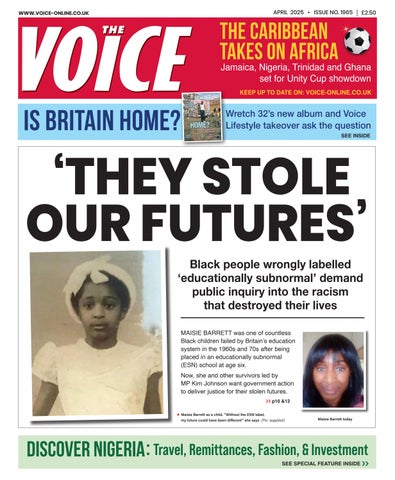
‘THEY STOLE OUR FUTURES’ APRIL 2025
Black people wrongly labelled ‘educationally subnormal’ demand public inquiry into the racism that destroyed their lives MAISIE BARRETT was one of countless Black children failed by Britain’s education system in the 1960s and 70s after being placed in an educationally subnormal (ESN) school at age six. Now, she and other survivors led by MP Kim Johnson want government action to deliver justice for their stolen futures. ›› p10 &12 Maisie Barrett as a child. “Without the ESN label, my future could have been different” she says (Pic: supplied)
Maisie Barrett today
Discover Nigeria : Travel, Remittances, Fashion, & Investment SEE SPECIAL FEATURE INSIDE ››
Inside THIS MONTH
The Voice says
ROUNDUP NEWSPAPER
News, views, stories & videos
THE 10 MOST POPULAR STORIES ON VOICE-ONLINE.CO.UK
4
“They didn’t want to see a Black face — so I hid mine”: Black women’s struggles in the modelling industry
6&13
Digging deep: how Black Britons are growing their own food amidst rising costs
16 ESN schools stole Black
“The Commonwealth’s future is bright”: Baroness Patricia Scotland reflects on nine years of leadership
33
Supporting Black employees means action, not just words, says Cynthia V Davis
44
Lifestyle guest editor Wretch 32 talks to The Voice about new release Home?
46
Celebrating excellence in the Football Black List
children’s futures – it’s time to make amends
N
OEL GORDON (above) was four years old when his future was stolen from him. As a child Maisie Barrett was told, over and over again, that she was a “dunce.” They, along with thousands of Black children in Britain, were wrongly labelled “educationally subnormal” (ESN) and placed in schools where they were condemned to failure. Deprived of a proper education, stripped of their self-belief, and left to navigate adulthood without the skills they should have been given, they were victims of a system built on racist assumptions. Now, they are demanding justice – and the government must listen. The ESN scandal was not an accident. It was the deliberate consequence of an education system that viewed Black children as inherently less capable. Influenced by racist theories, education authorities used biased IQ tests to funnel Black pupils into institutions that provided little more than basic literacy and numeracy. Many left unable to read or write properly, their futures shattered before they even began.
This issue is 48 pages EDITOR Vic Motune E. vic.motune@thevoicemedia group.co.uk
CORPORATE AFFAIRS & COMMUNICATIONS Paula Dyke E. paula@thevoicemedia group.co.uk
EXECUTIVE DIRECTOR Paulette Simpson E. paulette.simpson@thevoice mediagroup.co.uk
ENTERTAINMENT EDITOR Joel Campbell E. joel.campbell@thevoice mediagroup.co.uk
The harm done to these children did not end when they walked out of the school gates. For decades, they have lived with the stigma, the lost opportunities, and the knowledge that they were set up to fail. Their pain is not abstract – it is real, lifelong, and devastating. Now, survivors and campaigners, led by Liverpool Riverside MP Kim Johnson, are calling for a full public inquiry, a government apology, and financial compensation. This is not just about the past; it is about addressing the systemic racism that persists in Britain’s education system today. Today’s school-to-prison pipeline, the disproportionate exclusions of Black children, and the failures to acknowledge Black students’ potential are all echoes of the same biases that led to the ESN crisis. The government cannot bury this injustice. It cannot claim to be committed to racial equality while ignoring one of the greatest educational betrayals in British history. Justice for ESN survivors is long overdue – and the time to act is now.
1
Wonder no longer – Stevie has been confirmed. Music legend is the final BST Hyde Park headliner to be announced
2 3 4 5 6 7 8
Leon Bailey opens up about friendship with Raheem Sterling Jamaica is thriving: ‘Do Business in Jamaica ‘ event for young entrepreneurs cut
Jamaica call up for Charlton outcast: Kaheim Dixon makes the
Chris Eubank unravels his iconic battle with Nigel Benn
Smiley Culture’s grandson hospitalised with head injury Nigeria steps up pursuit of Arsenal star Ethan Nwaneri
Black children with Down’s sydrome are invisible; groundbreaking photography exhibition by Misan Harriman ESN schools: “My childhood and future were stolen by a racist system – I won’t stay silent”
9 10
Crawley railway station murder: man jailed for life for killing teenage mother of his child
Got a story? email us at yourviews@thevoicemediagroup.co.uk SPORTS EDITOR Rodney Hinds E. rodney.hinds@thevoice mediagroup.co.uk ADVERTISING AND SALES E. advertising@thevoicemedia group.co.uk
NEWS DESK E. newsdesk@thevoice mediagroup.co.uk
CIRCULATION & SUBSCRIPTIONS E. subscriptions@thevoicemedia group.co.uk
The Voice Newspaper Unit 1, Bricklayers Arms, Mandela Way, London, SE1 5SR T: 020 7510 0340 Web: www.voice-online.co.uk GV MEDIA GROUP LTD
APRIL 2025 THE VOICE | 3
News
THE POWER OF A NAME
‘too difficult’ or ‘too long.’ It’s also for the people who think it’s okay to rename someone just because their name isn’t familiar to them,” she says. The book’s message is especially timely. In an era where people are increasingly encouraged to embrace their authentic selves – choosing pronouns, celebrating diverse identities – Ifunanyachi points out that the same respect should be given to names. “In many cultures, names carry deep meaning. They reflect history, family ties, and even aspirations. They’re not just sounds – they are stories,” she emphasises. Though this is her first foray into children’s literature, Ifunanyachi is no stranger to storytelling. As an actor and screenwriter, she has made it a mission to represent her heritage proudly. She recalls a pivotal moment when she realised that if she wanted to succeed in the entertainment industry, she needed to embrace her full identity – including her name. “I knew that when I walked a red carpet or saw my name in credits, I wanted it to be my name – Chidinma Ifunanyachi,” she says. “Difficult to pronounce or not, people will have no choice but to learn it because they’ll be seeing it everywhere.”
British-Nigerian actor’s new children’s book inspires cultural pride by tackling the issue of name bias. By Vic Motune
L
ONDONER Chidinma Ifunanyachi grew up answering to two different names – one at home and another on official documents. Her Nigerian family who had emigrated to the UK called her Chidinma, but the name on her birth certificate was Cheryl. Her parents feared that her traditional Igbo name would invite discrimination and bullying often faced by children with African names and so wanted to protect her. Like many first-generation immigrants, they also thought that her Igbo name might be seen as “too foreign” or “too hard to pronounce.” For many children from diverse backgrounds, this experience is all too familiar. In a Britain that prides itself on multiculturalism, mispronunciations, name changes, and outright avoidance still plague classrooms and workplaces. But now, Ifunanyachi, a BritishNigerian actor and filmmaker, is making sure the next generation embraces their names – and the cultural heritage they carry. Her new children’s book, The Importance of Names, aims to instil confidence in young readers by highlighting the beauty of cultural identity. Based on real-life experiences, the book follows a young girl, Sekpurualakelechi, who is bullied for her “difficult” name. In an attempt to fit in, she adopts the name Sophie. But when her aunt overhears her being called by this new name, she takes the time to explain the deep cultural and familial significance
behind her real name. Through this journey, Sekpurualakelechi learns to take pride in her heritage, realising that her name is a gift, not a burden. A personal story, a universal struggle For Ifunanyachi, this story is deeply personal. Born and raised in Camberwell, south-east London, to British-Nigerian parents, she grew up with an understanding of why they had made the choice to name her Cheryl on official documents. “My mum’s side of the family comes from the Igbo tribe,” she explains. “My name, Chidinma, means ‘God is good,’ but my birth certificate says Cheryl. I love my legal name, but it doesn’t fully represent who I am or where I come from.” Her parents’ concerns were not unfounded. Studies show that people with non-Anglicized names often face biases in employment, education, and social interactions. A 2024 survey by Samsung of 2,000 UK adults that was commissioned to understand how widespread name bias is found that nearly half of the respondents from minority ethnic communities said they felt they’d been treated differently because of their names. It also found that 24 per cent of people had witnessed someone suffering workplace discrimination for the same reason. But Ifunanyachi believes the conversation must shift and argues that society must learn to respect and appreciate different cultures. “People, especially children, are made to feel like their names are a
RESPECTING CULTURES: Chidinma Ifunanyachi’s new children’s book, The Importance of Names, aims to instil confidence in young readers by highlighting the beauty of cultural identity problem,” she says. “Some even start shortening them or answering to completely different names just to avoid the embarrassment or frustration of constant mispronunciations.”
claim their identities and challenge Breaking the Cycle The Importance of Names is more the notion that names need to be than just a children’s book; it’s a cul- simplified to be accepted. “This book is for every child who tural statement. Ifunanyachi hopes it will empower young readers to re- has ever been told their name is
A message for all generations Ifunanyachi hopes her book will spark important conversations between children, parents, and educators. She encourages schools to make an effort to pronounce students’ names correctly rather than defaulting to nicknames. “It’s not just about politeness; it’s about respect,” she says. “If we can make an effort to pronounce names like Tchaikovsky and Schwarzenegger, we can do the same for African, Asian, and Indigenous names.”
HIDDEN HISTORIES OF BLACK LONDONERS WHO ESCAPED SLAVERY A NEW exhibition launched at Tower Hamlets Town Hall, Whitechapel, is aiming to uncover the hidden histories of Black Londoners who lived in the East End during the transatlantic slave trade. The ‘Communities of Liberation’ exhibition showcases the stories of African residents in Tower Hamlets between 1567 and 1802. It is based on research and creative work by six local residents who explored archival collections to piece together these overlooked narratives. The exhibition, launched in early March, began with an African blessing and libation ceremony. It
features artwork, poetry, podcasts, and creative writing, alongside archival sources that shed light on the presence of Black people in the East End over 300 years ago. Cllr Kamrul Hussain, Cabinet Member for Culture and Recreation, said: “Tower Hamlets is proud of its rich history. It has been a place of refuge for centuries for people who have settled here and worked and lived together, making a new life for themselves and their families. “Until now, there has been no public recognition that so many people from Africa and the Caribbean lived and survived here from
the mid-1500s – during the Transatlantic Slave Trade. “This milestone exhibition changes the narrative. It is a big step on the way to our vision – to create an outdoor public memorial to honour the lives of these individuals.” Among the stories featured are those of Sabinah, who was transported from Jamaica and found refuge in Whitechapel; Pompey, a trumpet player in Bethnal Green; and Ann, a “maid” in Limehouse who escaped her captor. The project is funded by Historic England’s Everyday Heritage grant programme, which
celebrates working-class histories. Sean Curran, Head of Inclusive Heritage at Historic England, highlighted the exhibition’s impact. “Communities of Liberation demonstrates the power of engaging with heritage” he said. “Through uncovering overlooked stories, contemporary community voices are amplified and the lives of those who are often forgotten are remembered.” After its run at the Town Hall, the exhibition will tour other venues across Tower Hamlets throughout 2025, coinciding with a public consultation on a permanent memorial, set to be installed in 2026.
RICH HISTORY: A libation ceremony was held to launch the Communities of Liberation exhibition
30 | THE VOICE MARCH 2025
MARCH 2025
THE VOICE |31
42 | THE VOICE APRIL 2025
Advertorial
Advertorial
EXPLORING THE BATTLE TO ABOLISH THE SLAVE TRADE Learn about the fight to end transatlantic slavery through the stories of the people, communities and anti-slavery movements who campaigned for abolition in a new exhibition
R
ISE UP: Resistance, Revolution, Abolition at the Fitzwilliam Museum in Cambridge tells the multifaceted story of the fight to end transatlantic slavery, its aftermath and ongoing legacies. Focusing on the period from 1750 to 1850, the exhibition explores the stories of resistance by individuals and communities from across the Caribbean, Europe and the Americas – through an interrogation of historic objects and artworks in conversation with works by contemporary artists. Drawing on new research, Rise Up considers how Atlantic enslavement impacted everything, including the landlocked city of Cambridge. It follows the exhibition Black Atlantic: Power, People, Resistance staged at the museum in 2023. FOCUS The exhibition highlights the often-forgotten roles played by Black Georgians and Victorians in the British abolition story and in British cultural life, with a focus on individuals including Francis Williams, Ignatius Sancho, Olaudah Equiano (aka Gustavus Vassa), Ukawsaw Gronniosaw, Ottobah Cugoano, George Bridgetower, Bill Richmond, Alexander Crummell and Ira Aldridge: all momentum-builders for change and several of whom have untold connections to the University of Cambridge. The vital roles of countless women as resistance leaders, revolutionaries and abolitionists across the Caribbean, Europe and the Americas are also commemorated and celebrated, including Nanny of the Maroons, Phillis Wheatley, Sanité Bélair, MarieJeanne Lamartiniére, Mary Prince and Zilpha Elaw. Over 100 carefully selected historic and contemporary artworks, objects, printed books and manuscripts on loan from Canada, Puerto Rico, France, and the USA, as well as the University of Cambridge collections and public and private collections in the UK, shed new light on the Age of Abolition and the ongoing legacies of enslavement. Contributions by contemporary artists, including
Joy Labinjo, Keith Piper, Karen McLean and Grada Kilomba, help reveal perspectives which were not historically captured. Rise Up begins with a focus on Olaudah Equiano, one of the most famous and influential Black abolitionists of the 18th century. After publishing his autobiography in 1789, Equiano spent the rest of his life travelling across Britain to sell copies and promote abolition and Black rights. Equiano’s powerful testimony was vital in the British anti-slavery campaign, which led to the 1807 Abolition of the Slave Trade Act. The exhibition opens with Joy Labinjo’s monumental An EighteenthCentury Family, 2022, an imagined group portrait of Equiano and his family, who lived in Soham, close to Cambridge. The exhibition has four main sections. The first examines the ‘Africa Trade’ and life on Caribbean plantations. It reveals the ways in which African and African-descended enslaved people resisted oppression on Caribbean plantations. It looks at different stories of resistance, from the individual and collective, nonviolent and violent, to reveal common aims – to regain freedom and self-governance, and to keep dignity, customs and cultures intact. Traditions such as music and dance are represented in the exhibition through examples of song lyrics and music and as well as Igbo cultural and ceremonial objects including a wooden Igba (drum), and a maiden spirit mask used in the Agbogho Mmuo masquerade. Rise Up continues by looking at the Anti-Slave Trade Campaign in Britain, focusing on the role of Black Britons and abolitionists in the decades of struggle that led to the 1807 Abolition of the Slave Trade Act. It examines the vital role of Black campaigners such as Equiano and Cugoano, who were members of The Sons of Africa, a London-based grassroots abolitionist group that effectively petitioned establishment figures to end the slave trade and slavery
MONUMENTAL: An Eighteenth-Century Family, 2022; inset below, Toussaint L’Ouverture, 2009
(Fitzwilliam Museum, University of Cambridge, Joy Labinjo. Courtesy of the Artist and Tiwani Contemporary/ François Cauvin)
the key loans to the exhibition is Clarkson’s ‘Cabinet of Freedom’ campaign chest of 1787–88, the campaigner’s ‘travelling museum’ that provided tangible anti-slavery evidence to the Privy Council inquiry.
itself. They worked in tandem with the Society for the Effecting the Abolition of the Slave Trade (SEAST), founded by a group of white Quakers and Anglicans, in 1787. Alongside important historical documents, significant loans include prominent portraits of Black Georgians such as Francis Williams, The Scholar of Jamaica, c.1760, Thomas Gainsborough’s Ignatius Sancho, 1768, and David Martin’s Dido Elizabeth Belle and Lady Elizabeth Murray, c.1776. Cambridge’s role as a centre of abolitionism in the 1780s is explored. It spotlights individuals such as Peter Peckard who used his influence as Vice-Chancellor of Cambridge University to publicly decry the moral evils of slavery and racial inequality and support the work of Equiano. Peckard’s radicalism inspired future leading abolitionists, including Thomas Clarkson and William Wilberforce. Among
SETTLERS Following the American Revolution, about 3,000 Black Loyalists and their families were transported from New York to Nova Scotia, Canada, in 1783. Promised equal status, rations, and land as white settlers, they faced much harsher realities. In 1787, the Committee for the Relief of the Black Poor coerced 400 economically challenged Black Londoners into ‘resettlement’ in Sierra Leone, becoming the first British colony in Africa. They agreed to go on condition that they would remain British subjects and live free under the protection of the British Crown and the Royal Navy. Rise Up tells the stories of these failed schemes and the devastating effects they had, and continue to have, on Black communities. The 1807 Abolition of the Slave Trade Act made it illegal for British people and ships to trade in enslaved people anywhere in the Empire. This was only a first step towards eradicating the institution of slavery, with more than 800,000 African, Africandescended and Indigenous people in the Caribbean still rendered as ‘property’. News of the Abolition of the Slave Trade Act sent
shockwaves across the Atlantic, resulting in further revolutions across the Caribbean. The Haitian Revolution led to the founding of the independent Republic of Haiti in 1804: a seismic moment being the first independent Caribbean state led by former captives. After the Haitian Revolution, other major uprisings of enslaved people followed, including in the British colonies of Barbados, Guyana and Jamaica. Focusing on key revolutionary figures such as King Henry I of Haiti, Toussaint L’Ouverture, Sanité Bélair and Amba Gladstone, through historical portraits and interpretations by contemporary artists including Francois Cauvin, Rise Up examines how such uprisings helped drive forward the 1833 Slavery Abolition Act. Rise Up concludes by looking at the 1833 Slavery Abolition Act – which made slavery illegal in almost all the British Empire – and its aftermath. It considers how despite formal abolition, newlyemancipated people across the Caribbean were forced to become apprentices, living and working as indentured servants under conditions similar to slavery, while those who were liberated often faced financial hardship and discrimination. The exhibition explores how, to pass the Act, the government borrowed £20 million to ‘compensate’ 4,000 former enslavers for their loss of ‘property’, a debt that was paid off only in 2015. This section also spotlights new research
into the lives of historic Black people whose lives intersected with Cambridge, celebrating the achievements of individuals such as the violinist George Bridgetower and campaigning clergyman Alexander Crummell. In its conclusion, Rise Up offers a reflection on how for peoples of the global majority, despite the passing of almost two centuries since Britain outlawed slavery, the struggles for autonomy, equality and social justice continue today. RESISTANCE Luke Syson, Director and Marlay Curator of the Fitzwilliam Museum, said: “Rise Up explores the complex fight to end transatlantic slavery and its ongoing impact today. By focusing on the testimony of individuals as a powerful tool of resistance, and as a way of helping others to recognise injustice, the exhibition celebrates and commemorates the roles of both familiar and lesser-known figures in the struggle for abolition. Through historical artworks and artefacts as well as contributions by contemporary artists, Rise Up examines how both word and image were tools of resistance, but also performance through music, dance and sport. Alongside historical artworks and artefacts, the exhibition will reveal how contemporary artists continue to keep these traditions alive.” n For further details about Rise Up visit www.fitzmuseum. cam.ac.uk
43 | THE VOICE APRIL 2024