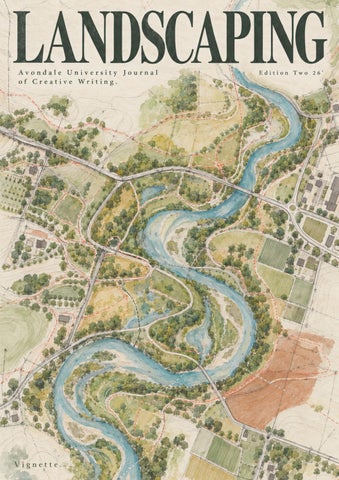
Vignette.
LANDSCAPING
VIGNETTE
We acknowledge the Awabakal people, the Traditional Custodians of the land on which this journal is created and shared. We pay our respects to Awabakal Elders past and present, and we honour the stories, songs, and knowledge that have been passed down through generations on this Country. As a literary journal, we recognise that storytelling has always been central to Awabakal culture, connecting people to land, sea, and sky. We are grateful to walk, write, and create on this Country, and we extend that respect to all First Nations peoples across Australia.
My experience is not yours, and yours is not mine. We each walk on different ground. The land is always changing. We are slower. We hold on tightly until the ground moves us along. We can feel that as punishment, or a pain to carry. Or we can let it become an opening, a place to shape, to heal, to rest. The pages of Landscaping hold many of these terrains. Some may echo your own. Some may simply ask you to listen. So stay here a while. Notice the ground beneath you, and wonder what it might become. — Taylah Jones, Lynnette Lounsbury, Bailee McLeod
a dedication Emme Fraunfelder felt like one of the most purely creative energies you would ever meet. It oozed from her. And I know we tend to think of creative energy and talent as being all light and freedom (and Emme certainly had that), but it isn’t, it is also darkness and weight, and she had that as well. I met Emme when I was in high school and they were creating a special travelling drama performance for one of the first AIDS awareness weeks. It was dark and unusual and visceral and was my first encounter with wellchoreographed creative direction. Emme were such an encouraging and affirming energy that many of us went on to do more performances throughout our lives purely because of this one experience. Thousands of people have a similar story. Thousands. Some of our creative spirit started with an encounter with Emme. She embodied, shared and inspired creativity wherever she went. Her loss is immense and I grieve to think of the space left behind when such an incredibly kind and love-filled person is gone. This edition is dedicated to the memory and inspiration of Emme and to all those who loved her. - Lynnette Lounsbury
2
Mnemosyne The fates drain my grandmother’s spirit as my cousin hacks on swallowed gum. “You’re just like her, you know. You have her spirit”. Grandmother hated the pathetic paleness of little boys playing gods. I take her skeletal hand in mine. Wrinkled flesh. Stark veins. I will stay until the fragile embers finally give up their light. Until Mnemosyne finishes her feasting. Sterile air. Paper sheets on empty beds. Pasty gowns repurposed now. There is no uniformity in dying.
Sterile air. Paper sheets on railed beds. Pasty gowns on rotting vessels. There is no uniformity in dying. “Why are we even here?”, the youngest cousin drawls. He’s been counting seconds since their arrival. “It’s not like grandma even knows we’re here”. The patchwork gathering withers him with their glare, they know he’s right, but none would dare. The silvered matron stares with a milky gaze, She is drawn to sounds without recollection. Mnemosyne’s leaching fingers have frayed the threads of her soul. Sterile air. Paper sheets on railed beds. Pasty gowns on rotting vessels. There is no uniformity in dying. “You’re just like her, you know. You have her spirit”. Blink. “She had a soft spot for you, always did”. Blink. “That ‘Plath’ woman took inspiration from her. She ate men like air. Terrified, they were”. Blink. Mnemosyne feasts. With each blink I watch as she slurps the marrow of memory. Sterile air. Paper sheets on railed beds. Pasty gowns on rotting vessels. There is no uniformity in dying. -
– Zoe Cochrane
3
The Journey I drove past a strangers house today, but I know where the coffee cups are and how they take their tea. We pass in the street, determined gazes direct on The Journey. A gust of perfume suddenly I’m dancing on a Friday night, drunk on happiness and innocence I turn on the radio while driving to the same job I’ve had for years, the melody stings. I know a stranger who memorised every word to the song. I recall the bridge Like it is burning into my throat after Screaming. Talking to new friends, Sharing tales and life. “You know what I always say…” Only, they don’t. I drove past a stranger’s house today, I know where their coffee cups are, and how they take their tea.
-smoke This is the time of smoke. of blue heat on the black road of the small men in the blue suits and the rising sea that soaks their shoes the smoke, it hangs in their hair This is the time of the broken contract The time of monsters The time of the arthritic emperors The time that is just too late
– Jocelyn Foster
This is not yet the fire not yet the gunshot not yet the red guillotine not yet the war They are beyond the smoke This is the time of the deep breath of the long-drawn goodbye of poems to farewell the world of tattoo tributes to exceptional hubris of transfusions of hope of orchestral hymns to what might be beyond This is the time of smoke. - Lynnette Lounsbury
4
Mama Tauvale
when life tried to pull us apart. Her fautuaga, her ote, her sasa, they shaped us more than we understood.
I was five when I met her, yet it feels like she never left me at all. Before the sun even touched the earth, her quiet strength moved through our small home. She rose in the darkness of morning, setting the day into motion, preparing the path of opportunity so her children and grandchildren could walk into the future with steady feet.
She was a devout Christian serving with full obedience. striving, loving, persevering her heart built entirely on devotion. She always held her rosalio necklace day and night, praying for the people she loved, with encouragement: “Fa’amuamua Le Atua”
She was a woman who did not bend to trials or tribulations. In every season, in every weather, she faced every hardship with the calmness of someone who had learned the hard lesson that love is work, and work is love, and both must be made visible.
I have tasted the sweetness of her alofa, In every sacrifice she made, in every night she stayed awake for us, fanning us through the Samoan heat, checking the power and water meter, sending us to Best Value Supermarket so we would have food on the table. Mama Tauvale, thank you for the work of your hands, for the faithfulness of your agaga, for the love that never ran dry.
Her hands were never still. They wove ie toga, tapito, ili, ato, fala each pandanus threads crossing like stories, binding us to her Lepea village and to the land that shaped her.
I miss you I miss you I miss you
In her garden, blessings grew in multiple rows Fala glowing gold, Isalaelu deep as a violet dusk Kamako warm with the touch of sun, Kukama curling like green laughter, Fa’i ripened, taro matured And the earth, faithful to her wrinkled hands, answered her labour with an abundance of alofa and aiga.
You have gone in peace now, Your race completed, Your fight is done. Yet still, you remain in our hearts, in our bones, in our stories that pass on and the mats you wove, in the garden that still remembers your touch. Tofa, Mama Tauvale I will never forget you. You will not be forgotten. Our love for you reaches all the way to eternity. Your journey returned to the One who watched you all your days. From the living to the departed, “ia manuia lau malaga”
She left her nu’u to build a life for her children, to open doors she never walked through herself. Her children finished school, found work, stepped into the world, carrying her upu like a compass: ‘aua ne’i galo le aiga.’ To be a pae is to be the peacemaker. To be an auli is to be the counsellor. To be a mother is to be both, the voice that stitched us together
5
- Francine Sione Ausage
Proud words Green blades tenderly tickle my toes yet, thoughtless and tranquil without troubles or trials they rustle with the breath of the one who made the stars and holds them in his hand. The birds cackle and cry in a harmonious cacophony, They sing with the voice of one who is more than proud words. The kookaburras are his pleasure, the gumtrees are his grandeur Yet are they not worthy of the grandeur of the rational mind? that he gifted above the lively lyre and the Glorious Galah Bless the lord oh my soul, For he is more than proud words - Levi Bruderlin Girl’s Walk A click, push, and a tired sigh The morning air kisses my cheek A kookaburra laughs as I squint into the fading fog Dew clings to the grass crawling over the well-walked trail Bells ring in white limbs stretching high I pass by silk-strung spider webs woven over barbed-wire The old man stands alone, split by lightning long ago The sky becomes enclosed by a paper-lined meeting A moot of melaleuca whispering closely A tunnel twisting and turning until it reaches the river The salty, brackish, sandy creek fills my nose Something cracks and my head turns The wallaby looks at me as I do her Little legs stick out of her pouch Who will blink first? Suddenly, she jumps and runs away Does her mind fill as mine does? Yet, a thought is left behind in each footprint A bridge stretches and swings ahead It is time to turn in One last deep breath I will meet you again tomorrow - Jenaya Lewis 6
What Remains I feel the cold dirt seeping through my worn jeans as I shuffle around in the grass to find a comfortable spot. I’m not sure how long it will take; time is insignificant compared to what reality must withstand. I need to be patient and composed if I want them to trust me. I wrap my jacket tightly around my torso as the crisp wind swirls all around. It’s a sunny day, but winter has arrived. My scent wafts over to them; they know I’m here and can feel my presence. The space is wide and open, accommodating for all of us, yet I know they would prefer it if I was gone. I shuffle around, placing my feet underneath me, trying to emanate relaxation and tranquillity. If I can prove I’m not a threat, we can start to make progress. Though I sit amongst them, I am not one of them. No amount of reading and learning will magically equate to infiltrating their circle. The distance between them and I cannot be measured in metres. The gap will narrow once they decide I am worth trusting. I apologise, I haven’t properly introduced myself. I'm an advocate for the Wild Brumbies of the Snowy Mountains. Horses have been part of my life for as long as I can remember. When the opportunity arose to work with these rescued brumbies, I couldn't say no. The resilience, intelligence and spirit of these horses never cease to amaze me. It has been a rewarding journey and yet, we’ve only just begun. As I keep my eyes on the herd, it doesn’t take long to notice who the lead mare is. The stark black mane and tail strike a contrasting image to her beautiful, sleek brown coat; she is a bay, and her pinned ears and bared teeth leave little doubt about who leads this herd. The rest of the horses keep their distance from her as she starts munching on some hay. It wasn’t fear. It was respect. A lead mare comes with great responsibility; she is always alert, looking out for danger, and her eyes haven’t left me the entire time I have been sitting here. I turn to my right as I see a little colt, wiggling his way through the rest of the horses, his mum hanging back, content with her own patch of grass, on the outskirts of the group. The colt is bold as he prances into the middle, headed straight for the mound of hay that the lead mare is standing next to. Confidently, he waltzes right up to where she is eating, and snatches a mouthful. Always aware of her surroundings, the mare pins her ears back and bares her teeth. A swift nip to the neck and the colt scampers back to his mum, who barely acknowledges his retreat. He knows better than to push the boundaries, but that doesn’t stop him. Next, I turn to see the dapple-grey gelding, right in the middle of the herd. He stands broad and strong. One leg is bent slightly as he hangs his head in quiet rest. He has been placed in this herd to provide a calming presence. He, like the others, was once a wild brumby but has been here for a few years now. Gentled and used to humans, he is content and at peace, the perfect protégé for the rest to follow. As I am left with my thoughts, I start to think about a few questions. What happens when a brumby loses its landscape? Does a herd remember? How do they rebuild after losing everything that is familiar to them? Rounded up and moved on to properties, divided and separated, displaced. What happens next? Beyond the fence, people argue over numbers, environmental impact, heritage and management plans. Depending on who is speaking, the brumby is either a treasured icon, an ecological threat, or something in between. There are passionate voices on every side. Is there a right or wrong answer? Well, that really is up to the individual. Although I would argue there is a need for balance and a humane management rather than eradication. Inside the fence, however, the horses are unconcerned with the debate. They are occupied with the business of being horses. 7
The sun is getting higher now. The wind is dying down, and I take my jacket off and place it beside me, turning my attention back to the herd. My gaze is drawn to a gorgeous palomino mare, who is standing closely next to a striking roan. They stand shoulder to shoulder, moving together across the paddock. I turn to watch a little filly run up to her mum. It takes a second or two to figure out which foals belong to which mum, but after some deduction, I realised this one belongs to a chestnut mare. The filly starts to nurse; her mother’s presence offers her reassurance and safety. One thing stands out to me. This herd that has come together by sheer force, completely out of their control, yet they still act like horses. They’re establishing their hierarchy, forming new friendships, arguing and nurturing. Despite being removed from everything they know, their identity is still the same. Nobody has told them that they are a victim. Are they not the victims? The snowy mountains and rushing streams are no longer the backdrop for their sunrise runs. Herds are divided; some are shot, others are rehomed. Their freedom to move, run, and explore the next terrain has vanished. The harsh winters and boiling summers, fires and floods, births and deaths, all look different now. I sit here in the stillness, listening to the thud of hoofs on the cold, hard ground. The nickers they exchange with one another. The snap of teeth on flesh in another row for dominance… and I wonder. Do they remember? Are they missing home? Will life ever return to normal? It’s completely unknown. What remains? The landscape has changed, but the language of this new herd, thrown together by circumstance, has remained. A nervous nicker can still be comforted. Pinned ears still mean aggression. They look out for each other, and they learn to trust each other. The language that they learn in the wild still translates to this new environment. We have a completely new herd. Brought together by life’s cruelty, yet adaptation is unfolding. I’m watching this metamorphosis happen before my eyes. Belonging is being rebuilt. Each horse has a different background; some have come from completely separate herds. Yet they are now forming their new community. They are bonding together in a weblike structure. The circumstances that have brought them to this place today are disturbing, to say the least; however, these resilient creatures are adapting to the unfortunate circumstances fate has unleashed on them. As the sun starts to set, orange and pink flutter through the sky, golden hour is upon us, and I know it’s time to head home soon. The herd is calm and quiet. The gelding is resting, still centred in the middle of the paddock, facing the setting sun, his droopy eyes slowly flutter in and out of slumber. The horses are spreading out throughout the paddock, some braving getting a little closer to my still form. It is a peaceful evening, and we can all feel it. As I sit there quietly, I feel a warm breath and a gentle nuzzle on the top of my head. Looking up, I find the little colt standing right behind me. Curious, he gently nudges my head with his. As I smile, I wonder if our identity is sometimes less about where we come from and more about what lies within us. - Rachael Jones
8
A Dying Bird in a Dead Elevator “Ew, what is in your bag?” The older boy peered down at the kid, laughing in surprise. “Oh my gosh, it’s a bird.” Came the girl’s soft voice. It was a weak little thing that peered up from the circle of heads that surrounded it. Beady little eyes and a slender beak, matted feathers plastered to its bony frame as it heaved its tiny chest up and down. “Poor thing! Where did you find it?” She asked. “I r-rescued it w-walking home f-from practise.” The young boy said, his voice quivering with cold. “And you decided to put it in your schoolbag?” The older boy asked, amused. Their voices bounced dully off the elevator’s metal panels as they sat against the walls, their faces glowing eerie white beneath the emergency light. “It must be freezing. We have to dry it.” The girl said earnestly. “I t-tried, but my s-soccer jers-sey was wet f-from the rain.” The boy explained through chattering teeth. “Oh, that’s why you aren’t wearing a shirt.” The older boy said. The young boy shivered again, the hard metal flooring sapping the heat from under him. His bare torso glowed in the pale light. He couldn’t have been more than 13, and water was still dripping off the ends of his black hair. His feet were wrinkled and numb. He hadn’t taken his soccer boots off, and he felt bad for contributing to the smell of dank mud that made the tight space feel especially grimy. “Here, take my blazer.” The girl offered. The many badges on the collar glinted in the dim glow, and the lift wobbled as she awkwardly fought it off her shoulders from where she was sitting. She was a senior at the local private school, probably a prefect. Her hair was tied in a practical ponytail, and she, unlike the boy, had carried an umbrella with her that day. “Th-thanks... s-sorry I do-don’t know your n-name.” The boy took the jacket and quickly wrapped himself inside it, pulling his knees up to his chest. “Ally.” She smiled. “Ol-Oliver.” The boy smiled back, his teeth clacking together. “I’m Josh.” The older boy nodded at them both. He wore a black T-shirt and faded grey jeans, which were equally as damp as the boy’s jersey, but it was difficult to tell if he was 17 or 20. He didn’t have a bag. They all peered down at the bird again, slumped sadly in the bundle of wet jersey. Ally rummaged through her school satchel and pulled out a fluffy pencil case, which was probably pastel pink, but looked grey in the lighting. She shook out the pens and highlighters, which clattered loudly in the confined space. “If we turn this inside-out, it could be like a little nest?” She suggested, high shadows making her eyes look especially wide. The boys shrugged in agreeance, eager to warm the little creature and knowing there wasn’t really a better option. “But I don’t want to touch it.” Ally stated. “Me neither…” Oliver admitted. “I only scooped it with the jersey.” “I’ll do it.” Josh said, taking the pencil case and flicking out a few pencil shavings as he flipped the fabric. Ever so gently, he lifted the floppy creature, nestling it carefully inside the case, so the fuzzy material would dry its thin feathers. He handed the makeshift nest back to Oliver, who cradled it close to his chest inside the blazer. “So how long do you think we’ll be stuck in here?” He asked, making sure the bird wasn’t smothered in the jacket. “Well, since we haven’t had a reply from the help button and none of us have charged phones…” Josh started. 9
“Dunno.” Ally finished. “How long have we been in here?” Oliver wondered aloud, perking up now that he was warmer. “Maybe 10 minutes…” Ally guessed, checking her watch. They were all quiet for a moment. Nobody really had anything to say. Then Ally broke the silence. “Are you in school?” She asked Josh. “Technically, yeah. Year 12. Strathpine State.” He leaned his head against the wall. “But I pretty much flunked my mocks, so who knows if I’ll graduate.” Ally nodded, even though she couldn’t relate to failing an exam. “Yeah, year 12 is a killer.” She said instead. Josh turned to Oliver, “What grade are you in?” “Year 7. Also Strathpine.” He said gloomily, staring at the bird. “Rough. I remember year 7.” Josh whistled in sympathy. “Yeah. This kid, Austin, always tips out my bag or makes me give him my lunch.” Josh watched the boy carefully, but Oliver continued to look down at the bird. “I’m sorry, Oliver.” “Yeah, that sucks.” They all went silent again. Ally started digging through her satchel. “I just remembered I have a muesli bar if you guys wanna share.” As she unwrapped the plastic, the smell of peanuts and honey mingled with the scent of wet socks and rust. She divided the bar into three and handed them out. Oliver ate his piece in one mouthful, but Josh turned his over in his fingers, breaking off a small corner and handing it to Oliver. “For the bird.” Ally broke a piece off hers as well, and Oliver shuffled so the bird was resting on his lap. He hovered the pieces in front of the creature’s beak. Except for the way its chest pulsed in and out with each tiny heartbeat, the bird remained still. Ally and Josh glanced at each other, a knowing look in their eyes, but they didn’t say anything. “I wonder if it fell from a tree in the rainstorm.” Ally asked. Oliver shook his head, “It was on the soccer field.” “Did you just find it on the ground?” Josh asked, stroking it lightly. Oliver shook his head again, slower this time. “Austin had it.” Josh and Ally grew still. Oliver continued. “I don’t know how he caught it or if he found it, but when I was walking off the field after the game, I saw them--” he twisted his hands together, eyebrows screwed tight with the memory, “--throwing it to each other, and catching it so roughly… and every time the bird cried out, they all laughed like it was funny.” His hands moved to touch its beaten feathers, “But it wasn’t funny.” The air felt heavy as they sat in the gloom of the pale bulb, cold and damp, imagining the cruel game and the raucous laughter as the innocent animal was clamped, and thrown, and dropped, left lying in the sodden oval grass to be pummelled by rain. Ally picked up the pencil case, cradling the creature under her chin, suddenly protective of the small thing. It needed warmth and love and gentleness. But looking at Josh, she knew it wouldn’t do much good. He looked down, fiddling with the hem of his jeans. “Austin treats you the same way, doesn’t he.” Josh said as more of a statement than a question.
10
Oliver didn’t say anything, but he quickly wiped his cheek and concentrated on the jagged edge of the chipped floor tile in front of him.“I don’t know why.” Oliver’s voice was muffled, his chin tucked into the blazer. After some time, Josh said, “Maybe someone’s treating him like that.” Ally watched him, but he didn’t meet her eyes. “You know him, don’t you?” She frowned, staring intently. “He’s my brother.” Josh eventually said. Oliver looked at him, mouth open in shock. “If you know he torments so many of us, why don’t you do something about it?” He looked hurt, and angry. “I don’t know.” Josh slumped his shoulders, fists pressing into the floor. “Then you’re as bad as him!” Oliver glared in disbelief. Ally pressed her lips together and fiddled with the zip of the pencil case, watching the exchange. “Look, it’s complicated…” Josh began. “No, it’s not!” Oliver interrupted sharply. “Just tell him to stop. You’re bigger than he is!” Josh turned away, rubbing his palm. Ally cocked her head slightly, watching his hands. “I…” He started, before clearing his throat. “I’m just… I dunno… weak I guess?” He clamped his knuckles together, nails white, still staring intently at the wall. Something moved in Ally and she reached out her hand to his. He looked down at them in surprise, loosening his fists. She studied his face, as if she was trying to figure something out. “Not participating is something, at least. That makes you stronger than your brother.” “You could be stronger though.” Oliver muttered under his breath, staring at the little bird in Ally’s lap. “I never said I supported what he does.” Josh defended. “I just, don’t know how to stop it, without just… being a bigger bully.” Ally looked at him with knowing sympathy. He gave a sad smile in response and looked down. They all sat with their thoughts. “How come you’re not rough like Austin?” Oliver asked, confused. “I mean, you’re not rough either.” Josh replied, making Oliver pause. “Everyone feels hurt differently, I guess. Depending where it comes from.” Ally said seriously, still watching Josh. “Where does it come from for you?” Oliver asked hesitantly. “Somewhere it shouldn’t.” Josh said bluntly. He met Ally’s eyes, and saw she understood. He reached for the bird. Ally gave it to him, and they all leaned in, heads crowding together as they watched its frail form. Just three strangers, brought together by a dying bird in a dead elevator. “I don’t understand why people hurt people.” “Or birds.” “Me neither.” Josh leaned back against the metal panel with a sigh. “Sorry, I don’t usually get this deep when I’m in a lift.” Josh apologised awkwardly. “Well, sometimes life’s funny like that. Things just happen. Not for any particular reason.” Ally said, looking up at the dented wall and the tarnished handrail. She reached into her satchel and pulled out a pen, twisting her body so she faced the wall. The boys could hear the sound of her scratching the ballpoint into the surface.
11
She leaned back, shuffling so the others could see. It was a drawing of three people in a box, with a date underneath. “It’s us.” She shrugged. “To mark the occasion.” “Occasion?” Josh asked dryly. “Look, sometimes it’s the random-ass Wednesdays that change your life, okay?” She handed the pen to Josh, who chuckled and faced his own wall. When he turned back around, there was a tiny bird scrawled into the metal. “It’s us.” He said thoughtfully, holding the pen out for Oliver. He took it uncertainly. “I’ve never graffitied before.” He mumbled shyly. “Neither have I,” whispered Ally with a grin, “but I feel as if we should.” Josh smirked at her, “My, the elevator has changed you...” His comment was interrupted by a static click, and a muffled voice came through the panel speaker. “Glenview Lift Services, we receiv… call that… lift stopped…. Is any… stuck inside?” Ally scrambled to her feet, shaking the lift, and pressed the button with relief. “Yes! Yes, there’s three of us!” “Four—” Oliver interjected. Ally waved her hand at him to shush. “Can you send someone to let us out?” Ally asked quickly, afraid the button might stop working altogether. The speaker gave a staticky buzz as it clicked in and out. “A mainten— eam is on… way and should… 30 minutes. Is …body all good?” Ally hovered her hand above the button to reply. In the weak light, she looked at Josh, as he trailed his fingers gently over the bird, and Oliver, who had turned to concentrate on his drawing and didn’t notice his tongue was sticking out. “We’ll be okay.” She told the operator. - Emily Chester
12
Northwind Cicadas. Winged gemstones hidden amongst the thick, looming gum trees. I used to dread the summer because of those ghastly things. The comfy chill at the top of Point Claire would slowly release its arms, the sun would hang in the air for another hour or two, and soon out of Brady's Gully would arise their cacophonous song. A choir with no inclination to pitch, intonation, or clarity would scream out from the depths of the sultry bushland through the day until sundown and then… quiet. It’s the night's turn to speak. Ominous rustles from the gully, Ellie and Tiger hissing and clawing at each other, and the two magnificent Powerful Owls in gentle dialogue deep into the early morning. I remember when we first started writing and recording our music – Me, my piano, and my mate Tonk and his guitar. I wrote a song called Northwind… I sat in front of the piano with the idea floating in my head, the faint hoots drifting in and out of the music. Like in that song by Ricky Montgomery, “Talk to you”. “Frangipani tree Bradys gully Memories fall into place Wish we could go back to Northwind Back to Northwind Back to Northwind Time passes by We remember what’s been lost Pogo sticks and scabby knees Wish we could go back to Northwind Back to Northwind Back to Northwind Back to Northwind Back to Northwind” There was a bike path that anyone from West Gosford to Koolewong would have walked or ridden at least once, but it was better in winter: less noise, less people, more serenity. The path began hidden behind the industrial area with Bunnings and Officeworks, and ran all the way along Brisbane Water to Woy Woy. Overgrown by mangroves and usually littered with glass bottles, rusty scooters, and the odd shopping cart, it was only when you reached the more residential area that it became a little more sanitary, now mostly scattered with whipper snipper cords and empty bread packets. “It’s honestly lucky I haven’t found a syringe yet”. I took a deep breath in and nearly choked on the thick stench of rotten eggs. “Mate”, I said, covering my nose. I have never been able to get used to it, that ‘creek smell’.
13
No one on the Central Coast ever really bothers to Google why, but they just know that when you drive over Narara Creek or any creek or stream that connects to Brisbane Water, you keep those damn windows shut. I stopped on the bridge over Coorumbine Creek and put my AirPods in. The same AirPods (with a dwindling battery life) that I used 5 years ago, riding my bike on this same path through Tascott and Koolewong, making our way to Umina. “Whoa (mind in awe)” started playing. “Banger”, I said quietly, smiling. I looked out across the water, the gold reflection of the sun, threaded through the mangroves, danced over the ripples. Mullet were flamboyantly jumping over each other, alongside the occasional Tailor chasing schools of baitfish. “Shoulda brought a rod”, I thought; in my mind, I could still picture those times out at Square Jetty in Lake Macquarie smashing Bream and catching not much else. Once, Tonk and I caught this massive pufferfish on prawns with a long-shank hook. We just chucked the bait straight out into the deeper water, and what emerged was definitely bigger than a footy and probably the most insane animal I have ever seen. Tonk was a bit like that, a bit of a wild card. He was a real tall, skinny fella with dark eyes and frizzy black hair that sat over his forehead like a pasty-caucasian, unintimidating ghoul. Those nights were good. We would drive our shitboxes home, try to make a meal of our only just legal-size fish and sip on whatever rank excuse for a cocktail we could make using what was in our parents’ pantry. Making those cocktails was a true masterclass of alcoholic craftsmanship, because you had to find that perfect balance where it was as high in alcohol as possible, whilst maintaining a certain level of drinkability. They accompanied us through our famous “beat-offs”, where a wheel would be spun on various themes, and we would have 30 minutes to produce a beat that matched that theme. The themes included a range of random and crass objects, people, or ideas, including but not limited to: Peter Dinklage, Greek yogurt on a Sunday, Dove men’s antiperspirant, and steamy dumps. I was convinced we could’ve made a podcast or a YouTube channel gamifying our escapades. We would’ve made millions. “Haha, nah mate, it’s all luck”. “Nahh, I reckon we could do it.” “Hmm, maybe. But like, what if we don’t even make a living out of it? Then we become teachers with 3 years of pure slop for depraved high schoolers to laugh at.” I laughed. “True, true.” The horizon slowly engulfed the remaining sun, and my eyes strained to find the footpath. King Krules “Rock Bottom” was playing in my AirPods. Squinting ahead, I could just make out the outline of the park bench me and Jackie used to hang out at. She was a shorter girl with a slender build and silky blonde hair flowing over her shoulders, but she wasn’t beautiful in the traditional sense. She had these sharp almond eyes that could pierce through your skull and probe your thoughts at will. 14
“Stop being upset; it’ll be alright.” “Sorry, I know it’s not that big a deal, but it still sucks.” “Yeah, I know, but frick her. She doesn’t know what she’s on about” I don’t know how she knew I was still fighting with mum, but it was good to feel like someone knew you. “frick’. Why don’t you just say the word? It’s so off-putting.” “Ugh, we’ve had this conversation so many times. Just think, whenever you walk past someone, like at Coles or something, and you hear them swearing their head off like an idiot, do you ever think: ‘Wow, that person must be so cool, I’d love to hang out with them. I love how well they use such intelligent language to articulate their feelings.’” “Haha, no. But I don’t know how saying ‘frick’ is any better.” “Yes, you do, bro. It just doesn’t sound as yuck.” We used to go to the bottle-o just down the road in Point Clare to buy something cheap and tasty, like a bottle of Steinbok Schnapps, or something stronger, like those tequila bottles with the little Mexican hats. Then we’d stumble off and clumsily make out beneath the mouldering timber roof of the nasty park bench. We had only just finished high school and had no idea what we were doing, but it was fun all the same. I still remember when she was overseas with her family for a few weeks. I was lying in bed watching some dumb YouTube video, and she FaceTimed me on Snap and told me she wasn’t feeling it anymore. Later, I found out from her friend that she’d hooked up with some Norwegian guy at a bar and felt too guilty to tell me. It tore my heart to shreds. Not that I even liked her all that much, but I’d spent so long chasing her attention, so often finding myself infatuated with the possibility of being wanted by her, that hearing she’d given herself so willingly to a stranger made me want to tear my guts out in anguish. My stomach still churned as I sat down on the bench. I took a deep inhale of the musty air and heard the familiar beep as my AirPods carked it for the day. The night was finally pitch-black, and the eerie quietness was suffocating. “’Bout time I face the music, aye?” I chuckled at the first, and probably the last time, I quote Katy Perry. The cool winter wind really started to pick up, and I decided it was probably about time I headed home. As I reflected on my success at getting some exercise during the week, I began to dread tomorrow, and I mean really dread. The days at the office were getting so long, and if I didn’t move on soon, there really wasn’t much more I could take. It wasn’t until now that I began to realise how much my life had fallen from what I wished it could be, and it wasn’t going to get any better. “But move on where?” I thought, my mind in torment. “Where would I go?” My dad wouldn’t take me at the business; besides, I’d have to be pretty desperate to go back to support work. The wind was now howling like a wolf in agony and was shooting through my scarily thinning, black hair. My teeth started chattering as I quickly checked my bank account. I probably had enough in savings for a 15
for a few months of figuring out what to do. I sent a message to my boss, Mike. “Sorry mate, I’m putting in my two weeks.” I knew he would understand. I sent another message “Can’t keep doing this aye.” I sighed, maybe I could go back to uni. It’d be better than sending other people’s emails and organising the calendar of some pompous prick who couldn’t care less about anyone with a net worth under 1.5mil. I slid back onto the bike seat and pushed myself down the footpath. Maybe nothing would ever change, maybe I would be forced to find another dreary office in another dreary accounting firm. Anyway, there was at least a bit of comfort in knowing something could change, and there was still so much time to experience the world that I didn’t even know what I was worrying about. As I flicked my little headlights on, I found myself quietly singing that cover of ‘Tom’s Diner’ by AnnenMayKantereit and Giant Rooks. “I am sitting in the morning at the diner on the corner I am waiting at the counter for the man to pour the coffee And he fills it only halfway and before I even argue He is looking out the window at somebody coming in.” - Levi Bruderlin
16
Modern Love 101: The Meet Cute ‘Imogen is making insane decisions,’ Josh says. ‘Faking her own pregnancy to try and get Harry to stay? And then faking her miscarriage to garner sympathy but also because she was never pregnant and someone was bound to notice when a baby didn’t arrive? It’s diabolical. If she was my patient, I’d be taking a psychodynamic approach.’ Abigail doesn’t miss a beat. ‘But Imogen is clearly struggling with her own perception of how she views herself,’ she says. ‘Her behaviour is problematic. Obviously. But it will never change if she doesn’t learn to view herself as worthy. Therefore, I think we should be going with cognitive therapy. I propose CBT.’ Josh and Abigail’s voices drone on in the background. Their disagreements are so common that at this point, it’s as good as white noise. I double-check that I’m on mute before letting out a deep sigh and subtly checking my phone. I hate group assignments. Tom sent you a new message I compulsively click on the Tinder notification, desperate for a distraction, a relationship, a dopamine hit, anything. Tom is a Muay Thai instructor. He’s not my usual type, but that hasn’t been working for me lately, so I’m branching out. Branching out is not worth it. Like the stereotype he is, I’ve just received a shirtless pic of Tom. I groan and lock my phone when the sound of my name snaps me out of my reverie. ‘Chloe? What do you think?’ What do I think? I think that determining a treatment plan for the imaginary Imogen, 24 (F), would have been a much more pleasant solo assignment. I think that maybe doing a Master of Clinical Psychology was a mistake and it’d be easier to just stay in PR and pray that AI doesn’t come for my job. I think that I’d much rather meet my partner in a pub like my parents instead of navigating the train wreck that is the apps. Instead, I am suffering through a group assignment with mortal enemies Abigail and Josh, as well as Noah. My eyes snag on Noah as I try to think of a tactful way to answer Abigail’s question. From what I’ve gleaned, Noah and I aren’t all that different. Both are trying psychology as a second career option, and both are too tired to wade into Josh and Abigail’s bickering. I clear my throat. ‘I think it would depend on Imogen’s personality. I don’t think there’s a one-size-fits-all approach here.’ Abigail rolls her eyes at my cop-out answer. I continue. ‘There’s also no reason you couldn’t do a bit of both. Start with something like CBT and, if you as a therapist connect with Imogen in a way that garners trust, then you could consider a psychodynamic approach.’ Both Josh and Abigail seem satisfied with this solution. Noah’s mouth quirks, and a moment later, a private message comes through to my Zoom chat. 17
Well played. Shame Dr Hallaway isn’t on this call, or you might have earned a little extra credit for that. Despite my best efforts to keep my face neutral, my lips tug up at the edges. In an attempt to smother my smile and ensure I contribute something to this group assignment, I say, ‘How about if I share my screen and take notes? Then, once we’ve discussed a course of action for each patient, we can each take a patient and write up the agreed-upon approach.’ The next hour drags by as I tactfully type in clinical plans for various fake patients. It’s a whole hour of Abigail and Josh speaking their minds, Noah taking on the role of mediator, and me jotting down the agreed-upon approach. If I had more time (and more cares to give) I could analyse the dynamic between Abigail and Josh for ages. They both seem to be switched on and intelligent. I truly believe they will be good therapists. But it’s almost like they feel the need to one-up the other instead of working together, leaving Noah and I in our own unique hell. Noah is currently placating Josh as he has just sided with Abigail. I finish jotting down the group’s consensus and watch as Noah skilfully diffuses the situation. I tilt my head to the side as I observe Noah. I wonder if he would find it fascinating to discuss the dynamics between Abigail and Josh, or whether he’d find it frivolous and bordering on gossip. The conversation swirls around me until it becomes white noise again. I format my most recent notes – the ones that Abigail and Noah agreed on – until I am once again watching Noah’s face on my screen. Noah Smith. About as generic as names go, but he is anything but generic. He has sparkling brown eyes, the smoothest caramel skin, and a dimple in his left cheek every time he smiles. It makes me want to make him smile. While Josh defends his position to Noah, with Abigail smiling smugly, I toggle across to my Chrome tab and pull up Instagram. I type Noah Smith into the search bar and tap the Enter key. There he is. Five profiles down, I see those bright eyes and stunning dimples grinning directly at me. I click on his profile, and happily, it’s public. I scroll down his feed, feeling like a curtain has been drawn back. Noah is a surfer. Oh! And he has a dog! The happiest black Labrador occupies half of his grid. I pull up a selfie of him with his dog when I hear Abigail clear her throat. ‘Uh, Chloe, you know we can still see your screen, right?’ I freeze. And then, my brain catches up. ‘Oh, sorry,’ I say, closing Instagram as fast as humanly possible and toggling back to the Word document. A flush creeps its way up my body, and I swear I start radiating heat. My flaming cheeks are on full display with not a lick of makeup to cover them. Holy mother of embarrassment, I want to die. I want to shrivel into nothingness like the Wicked Witch of the West. Blessedly, Abigail simply says, ‘Thanks’, and moves on with her discussion. I sit there, bathing in the white noise of their conversation, my ears ringing and my heart pounding. I can’t bring myself to look at Noah’s tile on my screen, even though he can’t tell where I’m looking. When I steal a glance he’s not even looking at the screen, his head looking down like he’s on his phone. A kernel of hope flutters in my chest. Did he even see? My self-preservation wants to say no, but logically I know he likely did.
18
If Abigail noticed the screen had changed, there’s no way that he didn’t. So I looked him up on social media. That’s not the worst thing, right? I mean, what was I supposed to do? Listen to another verbal tennis match with Josh and Abigail? I am reinforcing this optimistic narrative when my phone buzzes. Giving up all pretence of being engaged in our team call, I glance down, only for my heart to lurch. Noah has messaged me on Instagram. Noah: So, I’m guessing you got bored of A + J’s drama too? I briefly wonder if it looks too eager to check the notification straight away when I remember he just caught me lurking on his profile. I click into the chat and can see the three little bubbles. He’s typing something, so I wait. Noah: I saw your Instagram handle on your screen, so I thought I’d message here instead of the Zoom chat. Hope you don’t mind. He is being ridiculously kind right now by not calling out my stalkerish ways and instead finding solidarity with me. I reply. Chloe: I am beyond tired of their dynamics, OMG. Are they arguing for the sake of arguing at this point? Either way, it makes our job 10x harder than it needs to be. I just want to pass this class and move on from group assignments. I send the message and then immediately cringe. That was way too long to be considered nonchalant. Though I suppose there’s nothing nonchalant about being caught stalking a crush on socials. I cringe again when his reply comes through. Noah: Would you like to get a drink sometime? Decompress from the chaos of group assignments and online uni? I blink at my screen in disbelief. When I sneak a glance at Noah, I see him smiling at me through his Zoom camera. I smile back before ducking my head and replying. Chloe: That sounds great. By the time we finish nutting out our plans to get a drink, Abigail and Josh have resolved their latest spat. I assign each of us a patient to write up, commit to doing the intro and conclusion, and leave the Zoom meeting. As soon as I receive confirmation that I have successfully left the meeting, I exhale sharply and sink deep, deep, deep into my chair until I am sliding onto the floor. What a meeting. Vastly worse than my undergrad days when we’d pile into a library study room and tackle the painful group assignment in person. Though this headache of a meeting might have more to do with the people in my group rather than the changing landscape of study and “ways of working”. I’ve always been a face-to-face person, and yet, I can’t deny that without online study, I would be swiping on Tinder this coming weekend instead of meeting up with someone who actually has dating potential. As I slowly collect myself from the floor, I remember the selfie of Noah and his dog and allow myself to imagine, just for one minute, that one day I’ll feature in a smiling selfie on his Instagram. At the very least, a girl can dream. - Ashley Stanton
19
18:03 It’s not quite 6am. I’m waking from a fitful sleep on the couch near Dad’s bed. For a brief and shining moment, it’s just another day. Too soon the moment is snatched, and something in my heart knows it could be the morning of the day. I’m trying to keep it from dawning by clamping my eyes closed for as long as I can. But the sun is a faithful riser and hues of pink and orange are peeking in through the blinds, willing me to lift my eyelids and drink in the glory of the early-morning sky. I blink slowly through my sleepy haze. As the room comes into focus, I can see that Dad’s already awake. I smile at him and sit up slowly. ‘Morning Dadda.’ His hands gesture impatiently at the cumbersome contraption attached to his face. From my angle on the couch, there’s a hose that looks like it’s rising out of the top of his head. It makes him look like some sort of alien. In a way, he is. This is not the father of my childhood, not even the father of a few months ago. As strange as it looks, I’m used to it now. Now, there’s nothing I don’t know about chronic obstructive pulmonary disease. Ever the ironist, Dad has even made COPD part of the password for the new laptop he’s bought to do some writing during his illness. We’ve been consumed by those four wretched letters since he was admitted to the swanky halls of a North Shore hospital in February. We’ve seen the cloudy x-rays and CT scans. We’ve heard the mucus-laden cough rumble through his chest. We’ve been shocked by the casually-delivered emphysema diagnosis—for them, it’s just another patient; for us, it’s a fatal kick to the gut. We’ve argued with doctors and battled with nurses. We’ve slept countless nights in chairs on the ward and in the ICU. We’ve combed medical journals for trial therapies and spent thousands of dollars on experimental tablets that cured so-and-so’s aunt. We’ve sat in a foggy daze as hospital administrators apologised for the medical negligence that prematurely catapulted him into type 2 respiratory failure. We’ve been called to say a final farewell on five different occasions, and in a rush of despair, we’ve moved Dad home to a bespoke hospital ward where medical charts and equipment waltz with favourite objects and family photos of happier times. We’ll nurse Dad here for the next two months. We’ll nurse him here until today. I rise slowly from the couch and walk over to Dad who smiles weakly and gestures again at his BiPap machine. It’s time for the life-saving boa constrictor to be taken off. Since the respiratory failure, we’ve been using it to pump the extra CO2 out of his lungs, but he hates it. It makes him claustrophobic and brings so much discomfort that we’ve come to despise it too. At 10pm every night he takes his lorazepam— it’s meant to help with the panic and usher sleep—we connect the silicone mask to the head straps, and he flounders into a night of Darth-Vader-breathing and devastating dreams. It’s too cruel. As I undo the straps and release him from his critical imprisonment, Dad’s relief is tangible. It always is. I wonder how long he’s been sitting there waiting for me to stir on the couch. It must feel so nice to have nothing on his face. The relief is short-lived. I’m already passing him the nasal prongs from his oxygen concentrator; at least they don’t prevent him from talking or push on his face like the BiPap machine’s mouthpiece. The sensitive pressure spots on his face are always just a membrane-away from breaking through again. Mum has been so attentive in her care for his skin and its 12hrs/day of BiPap entrapment. ‘Shall I make us a cuppa?’ 20
A gentle nod and I’m in the kitchen flicking on the kettle and setting out mugs. White with one for Dad. As I’m stirring through the sugar, I’m reminded of how long this ritual has been part of our family life. Even when we lived overseas in the scalding tropical heat, Mum and Dad enjoyed their afternoons in the breeze, sipping on cups of hot tea through beads of sweat and steam. I put the warm drink down on the table that sits next to his bed, and plop back onto the couch to begin sipping on my own cup of warm comfort. Dad’s voice breaks through my cosy trance. He’s changed his mind about the tea. ‘Nicky, would you be offended if I didn’t drink it?’ I’m not offended, but I’m sad; I’ve been enjoying our morning cuppas together. As I reflect on his words a little more, I sense a shift because I’m strangely uplifted. Dad’s tidal exhale volume has decreased over the week, which means his CO2 levels are creeping up again. The buildup has left him tired and at times, confused, so while I’m disappointed not to be enjoying our beloved morning routine together, I’m elated to hear him making sense. He sounds like Dad again. I lean my head back into the sofa to delight in his familiar and typically gracious words—a gentleman to the literal end. Presently, I hear quiet footsteps padding down the hall. It’s my stoic mum and her heavy heart—how does she contemplate a life without the man who has been by her side for almost 50 years? She’s exhausted and frightened and has barely left the house since Dad’s been home. Before that, she was staying at the hospital so she could be with him every day. I hop back up to re-boil the kettle and give them space. Rachel and Natalie will be arriving soon. We’ve been sisters-in-arms battling Dad’s shock-prognosis and although Monday’s not their day, it’s been a strange weekend, and I wonder if like me, they’re also worried that it might be the day. We’re all in our own individual bubbles of complicated denial and grief. While I feel a strange comfort in this suspended reality of extended childhood where it’s just the original five—Dad, Mum and the three of us—it’s also a cruel comfort because Dad will be gone in a few hours, and we will be five no more. *** It’s a little after 5pm and we’re all gathered around Dad. He’s the focal point of the living room. I think to myself how the writer in him would be revelling in the gravitas and symbolism of these final hours. I wonder if he knows these are his final hours. I feel like he does. No one has eaten all day. Rach has rustled up some salad sandwiches but we’re not hungry. Our stomachs are full of dread and fear; there’s no room for food. Nat has made an umpteenth cup of tea for each of us, and we’re slowly sipping mouthfuls of Lipton solace that transport us to a better time—to a time when Dad wasn’t sick. Here in the present, his music is playing, and like Roberta Flack, Dad’s favourite singer Nana Mouskouri, is killing us softly with her songs. Killing Dad softly. The oxygen concentrator’s steady rhythmic whispers are no match for Dad’s breathing. It’s getting shallower, though we hardly thought it possible. The specialists tell us he’s been effectively breathing through a straw for the last three months. It’s probably been longer, but that’s as long as we’ve known. In our collective ignorance, it seems that death has been steadily marching to Beckett Street since the first layer of fibrosis. Dad tried to tell us, but we hadn’t wanted to hear it. We hear it now. We can actually see it. It’s right there on the horizon, looming over the setting sun. No one can stop its inevitable strides now. Clutching our cups of tea, we talk quietly with each other. And to Dad. We’ve been talking to him all day. Telling him what a great father he’s been. Telling him that everything is going to be OK. Even though it’s not.
21
‘Can he still hear us?’ Mum assures us he can. Her years as a nurse working in aged care are all the expertise we require and we’re mindful to keep including Dad in our bedside conversations. We’re reminiscing about our childhood. Perhaps, we’re even romanticising it a little. The end is like that; you only want to think about the good times. It’s not that there were any particularly bad times to recall; we had a great childhood. But it was also a real childhood. Like many other dads, ours worked a lot, and when he was home, he could be tired and cantankerous. He was also strict and had high expectations. We couldn’t shirk our chores, and he held us accountable for all our actions. If we were disobedient, we learned things the hard way. In the 70s, the hard way was with a leather strap or a wooden spoon, so we rarely made the same mistake twice. But Dad was as fair and kind as he was strict, and he had a vibrant belief in the magic of childhood. He took great pleasure in trying to cultivate that magic for his girls. He stayed up late plucking away at his Remington typewriter to write whimsical stories and birthday poems that poured from his wonderful imagination. For many years our bedtime story was Silver Mountain, a serial he made up on the fly, about the marvellous adventures of the boy-hero Crispin, and the shadowy villain, Dr Raven. We couldn’t get enough of it. Sometimes on rainy days, Dad helped us construct linen forts and cubbyhouses in the living room. Great lengths of printed cotton sheets billowed from the ceiling where they were tied to curtain rods and anchored on sofa legs. He seemed to love the constructions as much as we did, and they often stayed up for days. Sometimes, he’d make himself comfortable inside with us to read a novel while we played. Our chatter about sheet cubbyhouses brings me back to the present and forces my eyes down to the sheet tucked under Dad’s chin. His once-lofty form is vulnerable and weak. I feel my head tighten with gathering tears. The palliative team left a few hours ago. They’ve suggested that we give Dad some morphine to make him more comfortable. The visiting nurses are compassionate and caring but their presence is an intrusion into our private grief. They don’t even know him. He’s just another sick person on today’s home-visit list. I can’t wait for them to get out of the house. Mum, on the other hand, seems comforted by their presence so I make myself smile through the awkward conversation. The pre-drawn syringes have been stored in the fridge alongside tubs of yoghurt and neatly-packaged meals, cooked for mum by a kind-hearted army of friends. We’ve been trained for this decline into morphine-reliance, but we’ve also subconsciously filed the ghastly instructions in the remote regions of our tired and disbelieving minds. Nat retrieves a syringe from the fridge and takes it over to Mum. With expert fingers, she slowly injects it into the port they’ve placed in Dad’s stomach for such a time. I haven’t realised it was there, so when Mum lifts his pyjama top to reveal it, I have a short intake of breath. I’m not sure why. Maybe it’s because the port is the manifestation of the undeniable fact that Dad is going to die. They knew. They’ve always known. Oh Dadda. Then as if reading our minds and hearing my internal cry, Dad sort of lurches forward in his bed. He half sits up. His eyes are open but they’re looking straight passed us. It’s terrifying. He grips the rails of the bed and takes a deep, desperate gulp of air. It’s like he’s trying one last time to save himself. He looks exhausted and frightened, and his tongue protrudes like a parched animal’s. The episode plays out like a scene in a horror movie and my sisters and I spring from our seats. ‘Mum! What’s happening? Is Dad OK?’
22
Then as if reading our minds and hearing my internal cry, Dad sort of lurches forward in his bed. He half sits up. His eyes are open but they’re looking straight passed us. It’s terrifying. He grips the rails of the bed and takes a deep, desperate gulp of air. It’s like he’s trying one last time to save himself. He looks exhausted and frightened, and his tongue protrudes like a parched animal’s. The episode plays out like a scene in a horror movie and my sisters and I spring from our seats. ‘Mum! What’s happening? Is Dad OK?’ Of course he’s not OK. He’s dying. We’re so stupid. We’ve never had a ringside seat to the spectacle of death, let alone the death of a beloved parent dying from lung disease. Mum explains that the urgent gulp is a natural reflex to the body not getting enough oxygen and generally signals that death is imminent. It might be a natural reflex but it’s a ghastly sight and I wish I’d known it was coming. I would have looked away. The image still haunts me. Almost as quickly as it comes, the distressing gasp passes and Dad leans back into his pillow. He’s still breathing but we won't see those pale blue eyes again. *** Outside, the sun has well and truly set. Nana’s dulcet tones have been replaced by the London Fox Singers and their acapella hymns. Dad is a very spiritual person, and it seems like the right thing to have playing in these final hours. It’s the same playlist I downloaded and took to one of the false-alarm goodbyes at the hospital. His Bible is by his side, and Nat has been reading promises out loud. The Lord’s Prayer hangs on the wall where Dad can see it from his bed and we’re taking turns chanting it to him. The atmosphere in the room is heavy and inevitable. We have finally checked our hope like sagging coats at the door and resigned ourselves to what is right before us. A dying father. He’s been there for months; we just haven’t seen him. The end comes so quietly. Four breaking hearts don’t make a sound. Time of death: 18:03. - Nicole Bentley
23
Too Tall a Poppy: There Is No Perfect Victim. Every time a woman is hurt and her story becomes public, a certain question comes up. It's rarely said out loud, and most people don't realise they're asking it. But you can feel it underneath almost every comment, headline and conversation that follows. On the surface, it sounds like: is she a victim? What we're actually asking is what kind of victim she is, and whether she's the right kind. Was she drinking? Was she out alone? Did she know him? Why didn't she leave? Why did it take her so long? Did she have to make it so public? Shouldn't she be more upset? Why is she making such a big deal of it? Why didn't she say something sooner? Couldn't she take a joke? What did she expect? Did she try to fight back? Isn't she taking this a bit too far? We like to think these questions belong to anonymous comment sections and the occasional headline. They don't. In Australia's national attitudes survey, one in four people agreed that a woman who stays with an abusive partner is partly responsible for the abuse continuing. One in four is five people in a room of twenty. Which means we know, work with, love, or are the people quietly deciding whether women are the right kind of victim. The answer, eventually, is always no. Not because these women did anything wrong, but because the perfect victim doesn't exist. I was going to write that she's rare, but that's misleading. She's impossible. And we keep looking for her anyway. Sociologist and criminologist Nils Christie described a version of her back in 1986. They are weak, respectable, blameless for where they were, and were attacked by a stranger. Christie never said they were a woman, but when searching for a victim to critique, we find her. She is a thought experiment, not a person, and no real woman matches her. Christie also noticed the trap built into "her". She has to be strong enough to be heard, but not so strong that she threatens anyone important. If she stays quiet, no one hears her. If she speaks up, she's too much. I've tried to think of a version of her that passes this double-bind. I can't. A test nobody can pass isn't a test. It's a verdict we reached in advance, dressed up as open-mindedness. We tend to think of doubt as the responsible position. Waiting for all the facts, hearing both sides, and not rushing to judgment. Those sound like virtues, and in a courtroom, they are. But most of us aren't in a courtroom. We're at dinner tables and in group chats and staff rooms, and out there, doubt isn't neutral. It always benefits someone. When the doubt only ever runs in one direction, when we ask a dozen questions about her and none about him, we haven't stayed out of it. We've taken a side. We've chosen not to notice which one. The philosopher Kate Manne has a name for where that sympathy goes: "himpathy", the excessive sympathy we extend to men who harm women. I don't think it comes from cruelty. I think it comes from loyalty. The men in these stories aren't strangers in dark parks. They're sons, husbands, coaches, colleagues, mates. To believe her is to accept that someone like the people we love could do this, and that is far harder to live with than the alternative. So we look for another explanation, and we call it fairness. As a society, we would rather believe a woman is exaggerating than believe a man we like is dangerous.
24
Not because the evidence points that way, but because the first belief costs us nothing and the second costs us a great deal. If that sounds too harsh, look at the women who came closest to passing. Gisèle Pelicot's husband drugged her unconscious for nearly a decade, filming as he invited 72 men into their home to rape her, and he confessed to all of it. Even so, in court, she was asked whether she had really been asleep and whether she had been complicit. The men were ordinary, firefighters, journalists, fathers and grandfathers, most of whom had no criminal record, and yet the mayor of her town told the media that it could have been worse, because "after all, nobody died". And we don't need to look as far as France. Australia has Hannah Clarke, who did everything women are told to do. She left him, and she sought protection. In February 2020, on the school run in Brisbane, the husband she had left doused her and their three children, Aaliyah (6), Laianah (4), and Trey (3), in petrol and set them alight. The next day, a senior detective told the media that police had to keep an open mind about whether he had been "driven too far". A mother and three children were dead, and the first explanation offered to the public was her. In Australia, we have a name for this kind of custom: tall poppy syndrome. We talk about it as something that happens to people who succeed. But it was never really about achievement. It's about standing out, and a woman who speaks about what was done to her stands out. So we cut her down to a height that makes the rest of us comfortable. And the part that worries me most is what happens after enough of that. Eventually, most women don't need anyone else to do the cutting. They learn to do it themselves. If the ideal victim is a silent one, then the standard isn't really about victims at all. It's about our comfort and how much we're willing to hear. As a counsellor, I see it happen. Women apply the same checklist to themselves that everyone else has been using on them. He never hit me, so it can't be abuse. I stayed, so it must be partly my fault. I shouted back, so I'm not allowed to call it what it is. They've absorbed the rules from every story they've watched unfold, and much of the shame, anxiety and self-doubt they carry comes not only from what was done to them, but from the verdict they've already passed on themselves. I used to think of that as a side effect. I'm not sure I do anymore. A standard like this teaches women to stay quiet before anyone has to judge them at all. And our children are watching. Every time an adult asks what she did, a child learns which kinds of hurt are believed and quietly works out whether theirs would be. This isn't an assumption. I've seen it too. And if you were waiting for another statistic to prove my point, you won't get one. Why do we need one? Why does a woman's experience only become real once it's been counted, averaged, and turned into a percentage? I could give you the numbers. But if a number is the only thing that would change your mind, then the problem was never a lack of evidence. It would be nice to think all of this is done by someone else. It isn't. It lives in the half-second before we form an opinion, in the first question we ask about her before we've asked a single one about him, in the joke we let slide because saying something felt awkward, and in the "I'm just saying" at the dinner table.
25
Women aren't exempt either. I get it; that's uncomfortable to hear, and as a woman, it's uncomfortable to write. But we should be questioning everyone, because everyone should be involved in determining what kind of people we want to be, and what we're willing to keep calling normal. I don't have a neat answer to that, and I'm not sure there is one. I just know that a society that makes victims audition for belief hasn't stayed neutral. It's made a choice, and we're part of it, whether we meant to be or not. So maybe the questions worth asking aren't about her at all. They're about us. When a woman tells us she's been hurt, what are we listening for: the detail that shows she's telling the truth, or the one that lets us doubt her? There will never be a perfect victim. There will only be real ones: complicated, angry, grieving, inconsistent, human. - Taylah Jones
26
22 Rolls of Toilet Paper I was on assignment from an art gallery in Michigan to find a river cruise for artists. The idea was to broaden their experience through travel. My wife, Norene, and I chose the Russian River Cruise, and we headed to Moscow to join a cruise one year ahead of the proposed group cruise. It was enjoyable ‘research’. The cruise ships on the Volga River have been built from the same template. This means there is access around the ship’s perimeter, and it is easy to look through the cabin windows to surprise the inhabitants who have forgotten to draw the curtain. Privacy is wanted -- except for one day when the cruise director instituted his good idea. Passengers were encouraged to create a ‘shop window’ for other cruise patrons. It would create the perfect way for tourists on board to ‘show off’purchases they had made in Russia. Norene and I knew that some tourists had spent large numbers of rubels on clothes, hand-embroidered tablecloths, painted dolls and much more. That was in contrast to our street-stall purchase of one small blue-and-white matryoshka with seven nesting dolls. It would be no match for the displays which would be seen in the cabin ‘shop windows’ on the day selected by the cruise director. That happened to be the day following a visit to the Kisii Island open-air museum. Central to the buildings on the island is the Church of the Transfiguration with its 22 domes. We decided to join in the ‘shop window’ fun. Using our white sheets and pillows, we created a white simplified landscape to be seen from the walkway outside our cabin. I had a roll of white paper towel with my watercolour paper and paints, and all we needed was 22 objects that would carry the abstract theme from the landscape to the domes of the Church of the Transfiguration. I went to the cabin stewardess and asked for 22 rolls of toilet paper. I am not sure what she thought, but I have an idea of what it might have been. She dutifully arrived at our cabin door with 22 rolls. We placed them in the window landscape. We now had an abstract model of the church within an abstract landscape. The landscape was somewhat similar to that created by the artists Christo and Jeanne-Claude when, with architectural students, they wrapped the rocky headland at Little Bay near Sydney (1968-69) with white plastic sheets. The simplified abstract forms were further defined by ropes. The installation was one of many large-scale site-specific projects which included wrapped trees, the Berlin Reichstag, the Gates to New York’s Central Park and other significant landscapes and buildings. In the case of the Transfiguration Church, the undulating white forms were supplemented with the blue and white matryoshka in scale with the abstract ’22 domes’. We opened the curtains for all to see. That night there was a mandolin concert. At its conclusion, the results of the cabin window competition were announced to a waiting audience. The announcement that we had won the competition divided the passengers into two groups. The result did not sit well with half of the ship’s passengers who had spent some of their life savings on their display. Their concerns were directed to both the cruise director and us. 27
He was thought to clearly be at fault in judging the competition, and we were seen to have clearly not met the competition conditions. The other half of the patrons who had not spent a lot on souvenirs were able to see the display for what it was. We would like to think that some of these could accept that a simplified abstract landscape and abstract domes can signal perceptiveness as the first part of creativity. Just as Christo’s Little Bay had done. Norene and I were happy to accept a beautiful hand-painted sugar bowl and spoon as the competition prize. We had admired it in the shop on board a few days before. The price tag put it way ahead of our small matryoshka. It became our souvenir of Russia. - Neville Clouten
28
Green Hills to Blue Water: A memoir of a life spent teaching. I was born where the hills ran green to the edge of the sky, I was born on the 19th of March, 1948, in the picturesque town of Kyogle, situated in the Northern Rivers region of New South Wales. My parents, Frank and Jean Wright, named me Glenda Lynnette. I was their only child. My first 18 years were lived in a safe environment, against a landscape of green… green farm paddocks, green timber forests, and rolling green hills. My life was lived quietly. There was a sameness in the way the days and years unfolded. Each school day began and ended with piano practice, and homework kept me busy most evenings. Year after year, I rode my bicycle to early morning piano lessons. Weekends also had their routine. Visits with family in Lismore added variety to my life, and interaction with three cousins brought noise, fun and small adventures. I gained my Leaving Certificate in 1964, and I was pleased with my results. I could also add success in Grade 6 music theory and Grade 7 piano to my achievements. These experiences paved the way for the time when I would become a primary teacher – the career I had decided would be just right for me. But the road I had chosen bent back toward home, and I learned that waiting, too, is ground a person can stand on. The plans we make do not always come to fruition. This was the case with my ambition to attend Avondale. Life changed dramatically for me when my dad became very ill and could no longer do physical work. Next, my mum was diagnosed with tuberculosis and directed to stay at home under the supervision of a district nurse. I was needed at home. Avondale would have to wait! The next two years were spent helping out wherever and whenever I could. Music lessons and study helped fill my time, and in July of 1966 I sat my final piano exam. I was successful and awarded A. Mus. A. Pianoforte. My mother’s health was now greatly improved, so I re-applied to Avondale College to study primary teaching and was accepted. I attended Avondale College from 1967-1968. The experience was greatly enjoyed, especially the faith-based nature of the education offered. I appreciated being in a place that pulsed with energy and enthusiasm. Meeting interesting people and gaining new friends was an adventure in itself. I enjoyed learning the knowledge and skills needed to be a successful teacher. Then I wrote “I’ll go anywhere,” and the sea carried me to an island where we sang above the rain. As 1968 drew to a close, graduation was the topic everyone was talking about. It was time to begin our own adventures. Each of us wondered where we would be appointed. I had no set ideas, so I filled out my application form with the words “I’ll go anywhere.” Some friends thought this a foolish answer, while others said they admired my courage. When I opened my employment offer, I found an invitation to teach at Betikama Adventist School in the Solomon Islands. My thoughts concerning this opportunity varied. This could be the greatest adventure of my life so far, or it could be an absolute disaster. My mum’s advice was “Go for it!” I agreed and sent off my acceptance. A classmate was to accompany me. She would be teaching maths and science, and I would take English, history, art and music. We would now be high school teachers! My life in the Solomon Islands was lived against a tropical landscape where the vegetation was lush, colourful and abundant. The weather varied from hot and steamy to wet with regular downpours. We were advised to watch out for dangerous creatures and warned about tropical diseases and how quickly wounds or small scratches could become infected. We would need to take care! Boarding schools work their teachers hard, and this was the case at Betimaka. It was overwhelming to learn that I was to be responsible for the girls’ dispensary and become Assistant Girls’ Dean.
29
In addition, I would help supervise study periods, organise nightly worship for girls and also run a cleaning dormitories crew. The enormity of these responsibilities would defeat many a new teacher, but I was determined to give it my best. The actual teaching was a challenge, given the lack of resources and syllabus materials. Textbooks were few in number; there were no pianos or art materials, and supplies from Australia often ran out. Insects feasted on our paper supplies, and heat dried up our paints. As a consequence, local materials were often substituted for what we lacked. In my art classes, students relaxed and laughed as they carved and decorated ‘crazy heads’ from coconuts, created ‘amazing creatures’ from cakes of soap and made sculptures from discarded wire left over from World War II. Pencils, crayons and paints, which were easily obtained, made up the rest of our resources. Melanesian students are naturally gifted in the arts, as evidenced by the music classes I taught. When the weather allowed, we sat outside in the shade and settled in ‘to make music.’ The boys collected large bamboo tubes and cut them into varying lengths. With these, an amazing set of ‘drums’ was created. When banged up and down on the ground, a hollow sound was produced that effectively drummed out an accompaniment to the melodies we sang. Guitars and ukuleles were either borrowed or bought. In addition, found materials were adapted to form shakers, clackers, scrapers and bangers and a discarded tea chest, with some simple additions, became a double bass. One class group wrote their own words for a song which we named “These Isles.” It was sung to a popular folk tune and was often performed when cruise ships came into Honiara. I enjoyed my time at Betikama and especially appreciated the friendship and encouragement I received from the staff. Two years went past quickly, and soon it was time to return to Australia. Two of us now, we taught beside a reef that breathed all night, and when the river rose around us, we climbed onto the cargo and kept going. I returned to Australia at the end of 1970 ready to begin teaching at Avondale College Primary School the next year. This landscape was a familiar one. However, I was now a primary teacher, and that was difficult at first. My class was a combined grade 3 & 4, comprising 42 students crammed into a very small classroom. Despite this, I was happy to be there, and the prospect of meeting new people and making friends was exciting. While teaching in this school, I met Peter Roberts, a trainee primary teacher. He taught a practice teaching session in my classroom. We became friends at this time, but it wasn’t until the next year that he asked me to go out with him. A friendship developed which quickly became serious. We became engaged in July, 1972 and were married in Watson Hall Chapel on 7th January, 1973. With this marriage, a teaching team was begun. Our first teaching adventure together was at Kambubu Adventist High School, via Rabaul, Papua New Guinea. This was from 1973-1975. Kambubu is a school built beside the sea. At night, we enjoyed the sound of waves crashing onto the reef and appreciated cool sea breezes after very hot days. The school is situated on a large campus, and the landscape where we lived was tropical. Being able to look out of the classrooms onto a calm, blue sea was a delight. At this school, we were both high school teachers. I taught English to years 9 and 10, and Peter taught English to year 8, as well as social science and commerce to years 7-9. I also assisted him with the school library. On arrival, we searched classrooms and inside cupboards and bookcases in the hope of finding resources for teaching English. We discovered many unopened boxes of novels, short stories, and poetry anthologies we could use. The materials were prepared for African classrooms and proved to be very suitable for ours. 30
Both of us were kept busy with heavy teaching loads and lots of other responsibilities. At times, we seemed to just greet each other in passing as we moved from one activity to another. There were happy times and stressful times. The river crossings and truck and boat journeys we took to Rabaul for shopping were adventures we still remember. At one time we were travelling with friends to spend a weekend in Rabaul. There had been heavy rain, and the rivers we had to cross were rising and running fast. As we entered the Seket River, our jeep (a relic of World War II) suddenly stopped. We were stuck in the middle with water quickly covering the floor. There was a mad scramble to jump out and race back to dry land. The men were left to carry the cases. We were damp and dejected but determined to get to town. Luckily, some plantation workers were just behind us driving a tractor and trailer. They were happy to help. The jeep was pulled out, but it refused to start. It had to be left behind to dry out and would be picked up on our return. Our journey continued with us reclining atop the cargo. We must have looked a funny sight! We returned to Australia in 1976, hoping for a quieter, less busy life. Peter had been appointed to Avondale Primary School. I just wanted to take a break from teaching and start a family. I became a mother to two children in 1977 and 1979. This role was one that I enjoyed very much. Our children came, and we carried them into the foothills of the Bainings, where the nights fell cool, and many languages shared one classroom. Peter accepted a teaching position at Sonoma Adventist College, via Rabaul, Papua New Guinea, in 1981. He would be training primary teachers. The college is located amidst a landscape of tropical lushness in the foothills of the Baining Mountains. The higher elevation brought cooler nights, which were much appreciated. Students at Sonoma were a mixed group. Their ages ranged from school leavers through to married with children. They came from all over Papua New Guinea and from countries in the Western Pacific. Languages differed, but students and staff used English as the medium of instruction. Melanesian, Polynesian and Micronesian students studied, worked, worshipped and relaxed together. While I did not have official employment that first year, I helped out by organising practice teaching sessions and observing individual lessons taught in the afternoons at the Sonoma Demonstration School. Darin often accompanied me with his Lego box in tow. One year I spent a few days back at Kambubu school where I observed our student teachers working at Rugen Harbour Primary School. It was a nostalgic experience being back there. From 1982-1983, I joined the Teacher Education Department on a part-time basis. The subjects I taught were education, Bible and music methods. Life was very busy for our young family. It was relatively easy to travel to Rabaul as there were no rivers to cross and no need of mission boats for transport! Here, at Sonoma, we were able to enjoy the benefits that this beautiful place had to offer. We brought our students back across the water, and they pressed their names into wet cement so the island would remember them. Our family returned to Australia in 1984 and settled in Murwillumbah where Peter was to teach at the Adventist Primary School. This small country town, which sits along the Tweed River, features a lush subtropical landscape. I stayed at home with Darin the first year and continued my studies by distance education. Graduating from Deakin University that year with a Bachelor of Arts (Educ.) brought to an end all the torturous hours spent studying, researching, and writing while living overseas. For the next 10 years, I taught on the staff of Murwillumbah Adventist High School, teaching English, Bible, music and art.
31
Together with Peter, I helped organise three Fly-n-Build school mission trips to Betikama in the Solomon Islands. These occurred in 1990, 1992 and 1994. I wanted to give my students, who were mostly in years 10 and 11, the opportunity to embark on their own adventures. In particular, I wanted to teach them about service. Many hours were taken up in fund-raising activities in order to finance the projects we undertook. We constructed a pottery building housing a kiln, pottery wheels, and storage facilities, a two-room school clinic, and a basketball court. The names of all who participated are etched into the cement along the sides of this court. The students, who worked hard in difficult conditions, were encouraged and led by a professional builder. Everyone rose very early each morning to limit exposure to the tropical heat. Sunscreen, shady hats and an endless supply of bottled water were the order of the day. Heavy gloves were worn to avoid blisters and cuts when they hefted the tools and hand-mixed the concrete. The afternoons were spent in recreation and exploring Honiara. These adventures at Betikama will always be remembered by our students. In the city the school grew the way a river widens, one stream, then three, and we were carried along... Our daughter sat her H.S.C. exams at the end of 1994. She chose to study teaching at Avondale College the next year, so it was time for us to move. We left behind many friends and colleagues who had helped make our time in Murwillumbah such a rewarding experience. Our family moved to Newcastle in 1995. We had been appointed to the staff of Macquarie College. Peter became Head of the Junior School, and I joined the staff of the Senior School. The subjects I taught were English, Modern History, History Extension and Studies of Religion. In 2004 the Australian College of Educators awarded me their ‘Certificate of Recognition for Contribution to the Hunter Community’. Peter also received this award. The College was an exciting place to work. The first principal was a ‘dreamer’ and had high expectations of his staff. We worked long and hard and eventually saw a one-stream school become three streams. By the time I retired from Macquarie College at the end of 2007, our school had earned a reputation as a quality school whose excellence equalled that of the grammar schools in our region. At last the tide turned us home to the Pacific, and the shore we had always known. In retirement, I was involved in 2 special projects. One was further study by distance education. In December, 2012, I graduated from Avondale College with a Master of Education. Peter also completed the same degree, and we graduated together. The second was taking part in a special program that trained untrained but practising primary teachers in both Vanuatu and the Solomon Islands. There were hundreds of them. The distance education program from Fulton College, Fiji, provided an initial qualification for these teachers. Peter co-ordinated the program and wrote most of the course materials. I was one of the lecturers. Several teachers from the Junior School at Macquarie College joined us as lecturers. Seven groups of untrained teachers, with approximately 50 teachers in each, completed the work and graduated. Overall, 350 teachers were trained. We returned to the Pacific for this program, against a very familiar landscape. Port Vila and Honiara, situated in hot, lush environments, were the towns where we lived and worked. The teachers, many of them mature and experienced, were eager to learn new things and were a delight to teach. The ten years we spent working on this project became the amazing climax of our teaching careers. What a way to finish! Finally, some advice. When adventure ‘beckons’ you, don’t fear it or ignore it. Instead, remember the advice my mother gave so long ago… “Go for it!” Invite God to be your partner in life’s adventures and trust Him at all times. - Glenda Roberts 32
Kidnapped I was seventeen when I first heard about a Pacific Poetry – “Kidnapped” by Ruperake Petaia. It was one of those bright, sunny afternoons in English class, the kind where the thick air of boredom felt oppressive. I sat on a wooden, creaking chair, with one elbow pressed on the desk, and one hand holding a rhythmic pen. Outside looked lively. Children running wild and laughter skipping like stones across the concrete. I envied their freedom. I was stuck inside a box of rules and rubrics. Just then, my teacher walked in and wrote – KIDNAPPED – in bold chalk and capitalised letters across the dusty blackboard. I snapped to attention. For a moment, I was convinced it was a real story – someone missing, someone taken. As she cited the verses, I realised it was something more profound, deeper. I didn’t understand the names – Churchill, Garibaldi, Guevara, Hitler, Mao – but I understood the feeling. It was unfamiliar. But that line, “I grew whiter and whiter,” hit home. It was the first time I viewed school as a battlefield. In those days, I was a promising student. Teachers looked up to me. Prideful. So, I wore my grades like armour. Polished, impenetrable, admired. But inside, my world was crumbling, like a careless touch on a perfect sculpture. I studied hard for the people who believed in me. Every perfect score felt like a transaction: my achievement for their approval. I knew what people expected from me, not knowing who I truly was. The Western philosophers’ names, I could recite them. But I couldn’t put my hands on why they were important. I wondered, “How am I succeeding in a foreign language that wasn’t even mine, a history that I never existed in?” I grew up in Samoa, the “Heart of the Pacific.” It is a place where the morning air smelled of vaisalo and keke mamoe, where students walked to school, and where the sound of the ocean was never far from our doorstep. My Lalovaea village was a woven mat of aunties, uncles, cousins, and elders – each pandanus thread holding me in place. Our conversations were harmonious as the Samoan words carried the weight of our culture, dancing with meaning and layered with respect. Home laid the foundation of my early schooling. Under the shade of breadfruit trees, where the breeze caressed my ear, my mama’s fagogo bent time. She told stories of old. The legends of Tagaloa, the story of Nafanua, and whispered histories of our ancestors. These were unwritten stories, carried orally through the lips from one generation to the next, like a torch of sacred fire. To listen was to learn. To speak was to honour. Fa’aaloalo was woven into the fabric of daily life: how you entered the room, how you addressed your elders, how you carried your family’s name. This was the Fa’a Samoan Way. As time unfolded, spirituality, a sacred thread, ran through the entire tapestry of our lives. It connected us between the ordinary and the divine. It surged through the mountains, carried by the tidal waves, and was silent before prayer. I first envisioned school as an extra space, like a seamless transition, where I could discover my identity. But even before I left my motherland, the tides turned. The textbooks grew heavier; the stories became less familiar. 33
I began to feel like my knowledge was being filtered through a foreign system. I didn’t know it yet, but I was learning to forget my cultural roots. When I migrated to Australia, I stepped straight into the lecture hall. First year of university. I expected a world of ideas and a place where knowledge pursues freedom. But instead, I found myself in a maze of definitions, deadlines, and digital portals that locked me out if I forgot my password. The language wasn’t the problem. I spoke fluent English. But the speech, the pace, the accent, and the confidence of others felt like I was two steps behind. I watched my classmates conversing with ease while I, who jotted down notes, struggled to translate between two different realms: the content and the culture. I missed my people and the warmth of Samoan storytelling. It felt like I was listening to my ancestors breathe. Here, I was learning to adapt, to perform well, but mostly, to survive. Deep down, I sensed myself grieving over something unnamed – the unspoken departure of my cultural familiarity. Every day, I walk with my politest smile, my best grammar and my hope of not being asked to speak aloud. As I sat in the middle row of chairs, I was held hostage by readings, worksheets and PowerPoint slides, waiting for my story to be allowed in. It was like a ransom note crafted to meet expectations and not honest truths. Education was supposed to be a ladder. But for me, it became a disguise. I wore it so well that the world couldn’t see my real face. Underneath it all, I wanted my story to be heard without subtitles. During lectures, we studied wars, revolutions and empires. The curriculum, a fortress of Western thought, was a parade of powerful men during the war period – Churchill, Hitler, Mao. I remembered them from Kidnapped. Their names kept popping up on the slides; their legacies were analysed, like a science experiment, cold and calculated. They represented a broken world. I stared at their faces on the projector screen, long and hard. Churchill was highly regarded for his wartime leadership. Hitler was condemned, rightly, but still studied eagerly. Mao was debated – is he a tyrant or revolutionary? I focused, listened, took notes, and passed the exams. But how about Samoa? The Pacific? The silent resistance of my people? My history was missing. My voice was missing. Even my plastic brother who settled here, like forever, corrected my pronunciation casually, not cruelly – “it's Maccas, not McDonald's” – and I let out a tiny, weak laugh, politely. My accent wasn’t wrong. It was just not theirs. Little by little, I started picking up fragments of rediscovering myself. In those quiet moments, in stories I cannot forget, I stopped sanding down my accent. I let my vowels stretch like ocean waves returning to the shore, unapologetic. I began to write essays that braided Samoan proverbs with systems of thought. As time went on, I found my community in the most unexpected places. Other students were like me. They carried their cultures everywhere, like hidden tattoos that could not be washed off. There was no need for translation. It was authentic. I had proud moments, like dancing at cultural night and wearing my Ie lavalava to campus, where the rayon fabric hugs me like home. Even when I’m on the phone, speaking in Samoan, I never have to lower my voice. 34
That was when I stopped apologising for being different. I started writing for myself. Not for grades, not for people, for me. I wrote in English. I struggled, even with the simplest words. But I allowed Samoan to guide the rhythm of my writing. I let my ancestors speak through me. I am still learning. But I now understand that education doesn’t have to be erasure. It can be resistance. It can be reclamation. It can be the sound of a 5’9” student standing tall: “I am here. I am Samoan. I am not a footnote”. I learned to speak at my own pace. To write with my ancestors beside me, to carry my heritage into every lecture room. I’m graduating. Soon. I will get that piece of paper. It won’t be just for decoration. It will be a symbol of hard work, of growth, of survival. That certificate will hang on my wall, yes – but so will my stories, my language and my name. I was never truly kidnapped. I was being challenged, reshaped, silenced. But I found my way back. I found me. I wasn’t just learning; I was learning to stand up for myself. To every student who struggles to balance between two worlds, your background is your strength, your story is your identity, and your culture is not a barrier. Embrace every space with your presence. Do not blend in; the world needs your raw voice. - Francine Sione Ausage
35
I know people. The thoughts they push aside, tucked so far down they've forgotten them, until they're sitting across from me. I learn a name in the same breath I watch its owner cry for the first time. Then the clock. I pause them. Mid-sentence, sometimes. Hold someone open, then gently close them up again and walk them to the door. It isn't natural, is it? It's probably the most natural thing I have made. A client asked me why I counsel. I stuttered. Paused. Looked out past them, through the sheer blinds and the double-frosted privacy windows. I've sat with this person. Healing and wounding as needed. All my mind floated was... sick days. It lets me be ill. Instead, I offered them a life that's taught me to sit with people in the times they'd rather not sit in at all. What I've been through turned into something someone else can benefit from. Truth. Only partial. Headed home. Frida drives me, and the mantra. With kindness, love, and empathy, I recognise these emotions are not mine to carry, and so I hand these problems back to... I name them, one by one, each left holding what is theirs and not mine. Seeing them. Hiding them. To be seen. For a story to live on, even if only with me. Not to change anything. Just to hold. Hands, sadness, grief, connection. To hold. I choose to be the one they burden. To put myself second. To let a whole day of horror and no good news swallow me. I don't bear it long. It runs off me in the shower. Comes away with the work clothes on the bedroom floor. Softens over a good meal. Rinses out in a weekend swim. I can shed it. I can shed. Not carrying it, then. Putting it down. Chameleon. I colour others' stories, teach them to colour their own, and disappear. You see me buying bread. Pushing a trolley. Ordering hot chips. You nod. Look away. Either is okay. Finally giving permission to be ignored. Known just enough. As you need. Now, it pays. I see you. You see me. When I let you. As I let you. - Taylah Jones 36
I get a lot of phone calls from people who feel like they need to be seen straight away. Those clients can be anyone. Someone who has never seen a psychologist before. Clients we have seen for years. One that stands out to me was a lady who was a long-term client. She had undergone EMDR and had uncovered a lot of old traumas. She had completed EMDR. Gone home. And couldn’t stop ruminating about what they talked about that day. She wanted to end her life to stop this from happening. But she didn’t want to die. She was seeking help. I understand why it feels like it can’t wait. These feelings can leave people feeling out of control, lonely and extremely uncomfortable. What they are experiencing is foreign and not something you would encounter every day. So in that moment, they are looking for anything to stop the pain. We refer to this as the “crisis” state. And it does need urgent attention. But a lot of people don’t feel like their mental health is a legitimate reason to go to the emergency department. They’ve either gone before and been sent home. Or they have the mentality of “what can they do?” I truly believe that anyone in that state is urgent, whether or not they meet a specific criteria. Sometimes the urgency they’re feeling can be taken away with just a phone call or a chat. Just helping someone feel like they are not alone can change things dramatically. I always try my best to get them in as soon as possible. But I do explain that if, in the meantime, they feel they may be at harm to themselves or others, they are absolutely entitled to go to the emergency department, the same as someone with a broken leg. You wouldn’t sit at home with a broken leg and wait for it to get better. Would you? So why would you do the same with a psychological injury that is life-threatening? It’s the ones who don’t call that I worry about. I would always prefer people to call. The clients who sit at home, don’t reach out, and wait until their next appointment usually come in worse than they did last time. Healing is not a linear process, but that doesn’t mean you shouldn’t ask for help. Prevention is always better than intervention. Saying “not today” is the hardest part. 37
It’s very hard to turn away people who need help, especially someone I’ve built a professional relationship with over the years, especially when I can tell they’re experiencing concerning behaviours and emotions. I feel somewhat responsible for what might happen, even when I’ve done everything I can. So I go over any safety plans they have, or refer them to Lifeline or the mental health line, so they have someone to talk to. Usually, once people have spoken to me, they do calm down. Just letting someone know how they’re feeling in that moment takes a big weight off their shoulders. If they’re distressed, I’ll do some breathing with them over the phone. Safety plan, if they have one. If not, to the helplines. And I always reassure them that I’ll check in later to make sure they’re okay until I can get them an appointment. To me, looking out for each other means understanding that everyone feels things differently. There is no set criteria for what makes a person reach this point. As people helpers, it’s important that everyone feels they have support. That they feel validated. And that if we know they’re struggling, we put things in place to help them. A Voice on the Other End - Stevie Mitchell
38
I’ve always felt a slight unrest within my spirit. unrest that came from feeling caged. from feeling like I could never climb out of this well. I poured so many things into the well. I poured some god in there which kept me afloat for a while until one day I was at the bottom again. some will say I didn’t believe enough and to those I simply say: mustard seed. I’ve been on the alter many a time asking to be broken open and remade. but I don’t think you have to give up everything of who you are to believe and I don’t think it has to be so gruesome. I tried breaking out of the cage and realised I just broke into an even bigger one. I broke that one recently. maybe the cage is also my mind. thank god and the gods for my therapist. this cage is messy! the unrest still flows through my veins. as I’ve grown I’ve realised that maybe it’ll always exist. I’ve always felt so scared of it, like there was something wrong with me. but I know now that it’s just what it is to be alive. kerouac captured my heart at fifteen when I read the line ‘there was nowhere to go but everywhere’ and maybe for the first time in my life I feel like I can live that way. because the fear that clung to the unrest is no longer drowning me. I’ve learnt that the currents my dad taught me to read can also catch you on land. the calm water isn’t always best. I think I’ll take the sand bank with the swell. that’s how you learn and grow. my mind is still a cage but the gate is open and I’ll continue to sweep it out. I’ve found some seeds in the corner though. maybe the unrest was just a stirring for more. a wanting to do something with these seeds I’ve been too scared to plant. maybe if I plant the seeds - dreams I’ll call them - they’ll start to grow. maybe one day they’ll fruit. there I’ll tend the garden of what was once just seeds. there in the garden I’ll find rest. — she | the garden - Bailee McLeod
39
Being in the same place for too long usually stirs within me an urge to leave. To experience something different. To reinvent myself for the 3rd, 5th, 10th time. I learned very quickly that we are born, we die, & that the space in between is all there is. Booking a one-way flight, packing a bag & leaving with no agenda becomes addictive. Relieving. Freeing. I can’t—I won’t—explain the rush of making it up as I go. Navigating a new environment, a new workplace, a new language or religion. There’s something about being thrown into the unfamiliar that makes me feel so intensely alive. Lately, though, that feeling has been replaced by an almost innate desire to stop. To stay. To belong. I have a lot of free time right now, plus a routine & a stable source of income, which is strange for me: I wake up, meditate, walk to my silly little job at our silly little bakery, to the beach, back home. Meditate again. Sleep. Repeat. Embracing stability involves learning that, for once, there is nothing to prove, nowhere to be. Finding comfort in knowing what tomorrow looks like, recognising names & faces, trading temporary connections over meaningful, lasting depth. (My biggest daily concern is whether there’ll be any leftover chunky steak pies at 5:01pm or not). - Margaret Graham
40
Yesteryear – Caro Claire Burke "Tradwife" content has become one of the more striking corners of social media. Women present an idealised version of traditional domestic life to millions of followers: scratch baking, homeschooling, homesteading and wifely submission. Caro Claire Burke's debut novel, Yesteryear (Knopf, 2026), takes that trend and asks a simple question: what if the fantasy became real? Burke was raised Catholic. She researched the book by talking with Mormon, evangelical and ex-religious women from online communities. The novel has been a significant commercial success. It reached the top of the New York Times bestseller list in June 2026, and film rights were optioned by Anne Hathaway before the book was even published. The novel's protagonist is Natalie Heller Mills. She is a Harvard-educated influencer who, with her husband Caleb, runs Yesteryear Ranch, a carefully filmed Idaho homestead home to their five children, with a sixth on the way. One night she falls asleep in that world and wakes in 1855, in an unfamiliar bed, with a husband and children she doesn't recognise. Is she the victim of a kidnapping, an unwilling reality-show contestant, or losing her mind? The story moves between this harsh pioneer existence and Natalie's past: her escape from a restrictive religious upbringing, her years at Harvard and her marriage into a politically connected conservative family. Natalie's first-person narration becomes increasingly unreliable as the story goes on. Through it, Burke explores performance and surveillance, gender roles, religious fundamentalism, and the gap between curated online life and lived reality. This is a complicated book with a deeply unlikeable and certainly untrustworthy narrator, and many times you will want to “unfollow”, but the experience is an important one. The view through Natalie’s eyes is fascinating, her fears are genuine and reflect the anxieties of many women trying to figure out a place that allows them conservative values but also feminist-won freedoms. I agree with many of the critiques of this book – there is a fairly shallow engagement with motherhood and politics in here, two things that really underpin the plot. There is also only a vague analysis of Natalie’s complicated relationship with the spiritual beliefs of her childhood – this could have been an incredible conversation about religion and modern womanhood. That said – a book can’t do everything, and it does a few things very well. Natalie is a well-drawn, deeply flawed and incredibly complex character and the comments on influencer culture are incisive, particular the nature of online culture that uses children as engagement bait. If nothing else it provokes deep thought about how to unite women in being supported as mothers - however they decide to do that. - Lynnette Lounsbury 41
A Plan Larger Than I Could Draw: Stories and Perspectives from the Mind and Heart - Neville Clouten Few careers cover as much ground as Dr Neville Clouten's. He began studying architecture at the University of Sydney in 1957, the year Jørn Utzon's design for the Sydney Opera House was announced. He went on to become the first researcher and official guide at the Opera House while it was being built. He later earned a PhD from the University of Edinburgh and became the founding Professor of Architecture at Andrews University in Michigan. He has also worked as an administrator and an artist. In A Plan Larger Than I Could Draw: Stories and Perspectives from the Mind and Heart (Signs Publishing, 2022), Clouten looks back over that life. He suggests that what might look like a run of lucky breaks was in fact guided by God. The book is a short, illustrated volume made up of eight essays. They follow his life roughly in order, starting with the Opera House years. Next comes Europe, where a chance meeting with conductor Herbert Blomstedt in Stockholm led to architectural work in Oslo. Later essays move through Mexico and North America and cover his documentation of Aboriginal rock engravings across outback Australia, an important record he made partly with borrowed police cameras. Others describe his years building the architecture program at Andrews and his humanitarian work in Africa. That work includes a school for orphans in Kenya that began with an unexpected email from a Kenyan girl. Clouten also writes about church architecture. He contrasts congregations that plan their worship spaces carefully with their architects against buildings where cost-cutting replaced good design. The collection ends with a homecoming and a summary of his life. This is a beautifully and intellectually rendered memoir that educates and inspires – Neville is a generous writer, sharing experiences and knowledge with humility and grace, but also with a storytellers sense of pace. There is something for everyone in here, bound together in a universally understandable story of faith and belief in God’s guidance across a lifetime. - Lynnette Lounsbury
42
Zoe Cochrane - is a poet, writer and English teacher. Jocelyn Foster - is a poet, writer and Bachelor of Arts/Bachelor of Teaching student. Rachael Jones - is a writer and novelist. Taylah Jones - is a poet, writer, and counsellor. Lynnette Lounsbury - is a writer, poet, filmmaker, lecturer in English and Communications and Head of the School of Arts and Business at Avondale University. Bailee McLeod - is a writer, poet, and creative. Jenaya Lewis - is a teacher and creative who writes, paints, and bakes whenever she can, often when she is supposed to be doing something else. Glenda Roberts - is a retired teacher and humanitarian. Neville Clouten - is Australian architect, academic, researcher, and artist Margaret Graham - is a teacher by trade and whimsical traveller at heart. Ashley Stanton - is a writer and Senior Communications Officer at ADRA Australia. Francine Sione Ausage - is a writer, poet and Bachelor of Arts student. Levi Bruderlin - is a writer, poet and Bachelor of Arts student. Lachlan Alderson - is a writer, poet and BA/BTeach student. Emily Chester - is a writer, poet, artist and BA/BTeach student. Nicole Bentley - is a writer and educator. Stevie Mitchell - is a writer, mental health receptionist, and BA Counselling & Psychology student.
Join our call for submissions database by emailing: lynnette.lounsbury@avondale.edu.au
43
vignette vol. 2 2026 all copyright belongs to the authors.