www.facebook.com/thevillager1982
twitter.com/thevillager1982

www.facebook.com/thevillager1982
twitter.com/thevillager1982

 BY DR. KELLY MCALEESE MEDICAL DIRECTOR/RADIOLOGIST
 THE WOMEN’S IMAGING CENTER

Over the years, different kinds of imaging tools have been developed to increase the detection of breast cancer. Advances in mammography have proven to be the best first-line imaging tool for detecting breast cancer early. Current 3D mammograms use low-dose x-ray to detect very small abnormalities such as distortions, mass es, and microcalcifications (cells as small as grains of sand). Mammography helps find abnormalities at their smallest size when the cancer is most easily treatable.
Many of these mammographic find ings may develop up to five years before a mass can be felt on your clinical or self-ex amination. Discovering a breast lump by self-exam alone depends on its size, how

close it is to the surface, and the size of the breast. In contrast, breast cancer found by mammograms have a better prognosis, require less aggressive treatment, and are less likely to have spread. The approximate average size of a cancerous nodule found by regular screening mammography is one centimeter compared to two centimeters by regular self exam versus three centi meters for cancers accidentally found.
The American Cancer Society (ACS) recommends screening mammograms for women 40 years of age or older every one to two years. Women with an increased risk of breast cancer based on their family history or other personal factors may start mammog raphy earlier. Since Mammography alone may not find all breast cancers, your clinician or radiologist can recommend additional tools that can help increase detection de
pending on what’s right for you. For example, ultrasound may be recommended for dense tissue or MRI for a strong family history.
Colorado has made great strides in educating women about their breast tissue density. Colorado SB17-142 passed its Dense Breast Tissue Notification and Report ing Bill “...to raise your awareness and to inform your conversations with your doctor.. to decide which screening options are right for you.” This education and awareness helps you and your clinician to decide if whole breast ultrasound should be added to your imaging plan. While mammography may have limitations in detecting cancer in a dense breast, ultrasound excels at detecting cancers in these same women with dense tissue as the technology uses sound waves to show differences in nor mal tissue versus cancerous masses.
For women with a strong family history of breast cancer or personal risk factors, breast MRI may increase the detection of small cancers by using contrast technology to de tect vascular tumors. The ACS recommends against surveillance MRI in women with a low risk of breast cancer because of the increase in false alarms. When MRI is added to the imaging recommendation, it is in ad dition, not as a substitute for mammograms.
The American Cancer Society has changed the recommendations of breast self-examination to breast self-awareness. Being familiar with the way your breasts look and feel is important for several reasons: 1.) This is their primary means of finding cancer for women who are not yet screen ing mammogram age; 2.) Some masses are not seen on mammograms because of dense tissue or their position, and 3.) practicing self-awareness may help detect tumors between mammogram intervals.
 Image by pikisuperstar on Freepik


Several years ago, the Col orado Legislature voted down a law which would have made the United States citizenship test a requirement for high school graduation. This rejection was necessary and appropriate because the reasoning behind the requirement was simply wrong. A high school diploma encompasses a body of evidence in competency for multiple disciplines and skills de veloped across thousands of hours: graduation is literally not about one test in one subset of one subject area. No school or society should inval idate a student’s entire body of work across multiple curricular areas and thousands of hours by disproportionately weighting a single standardized test of ran domly chosen facts. However, beyond that obvious reason, Colorado rejected the law be cause the belief that answering simple multiple choice questions is a necessary and indispensable component of being a productive citizen is flawed.
Granted, citizens can easily understand why the law about the citizenship test was proposed. Obviously society should expect that all adults know the basic rules of representative govern ment. And at times it seems like too many people are clueless about the nature of our represen tative democracy. However, in many ways the standardized test for citizenship is not much more than a trivia game, and factual knowledge does not correlate with civil behavior and citizen ship. If that were true, the events of January 6, 2021 would never have happened. Civics is rooted in the idea of being “civil” and being citizens who understand and engage in the participatory role of a democratic republic. Of course, understanding how the government works and what the role of a citizen is are integral parts of civics knowledge. If we understand that, then we clearly know fact-based objective tests have no indication of true civics knowledge and good citizenship.
The citizenship test, like many content-based standardized tests, is nothing but a trivia contest, a bunch of Jeopardy questions masquerading as knowledge and wisdom. And that’s not what civ ics is really about. When looking at how students learn and un derstand civics, the data usually focuses on the small number of people who can “identify the three branches of government.”

But the more important question is whether they truly know how the government works for them. Do they understand how repre sentation works? Do they know how the state taxes their income and returns that money to them in benefits, infrastructure, de fense, and yes even rebates? Do they really know what they mean when they claim to support smaller government or increased regulations? Michael Lewis’ book The Fifth Risk explored the problems that arise when people
don’t truly understand, and thus cannot appreciate, how their government systems and public institutions function.

government class is simply about basic definitions of structure and system and functions. “When we make it relevant and local,” he told me “they actually really care.”

display a flag or a banner. When it comes to local government especially, they truly care about what it does. Civics class should capitalize on the natural curiosity of kids and their tendency to be passionate about their rights.
Jason Kosanovich, a social studies teacher in the southeast Denver suburbs, believes teens are actually yearning to under stand civics and participate in their government, but often they don’t know how. Helping them understand the local relevance is, or at least should be, at the heart of civics education. It’s far too easy for young people to be turned off by the logistics when
Teens, in the experi ence of many educators like Mr. Kosanovich, are actually quite passionate about issues that directly affect them and which they experience every day. They care about potholes in their neigh borhood and the consti tutionality of red light cameras. And while those issues aren’t exactly trivial, young peo ple are also dialed in to serious political issues about the privacy of healthcare, public safety bal anced against individual rights, and issues of labor and industrial policies. When given the oppor tunity to engage with real world issues, they will research what their HOA says about the prop erty rights of homeowners to
Civics should be about under standing the role of a citizen in our communities. Programs like “We the People” are a great way for kids to engage though few schools actually implement it. Knowledge of civics imparts an understanding, appreciation, and acceptance of the individual’s participatory role in that govern ment, including the responsibil ity to maintain it. As one civics teacher noted when asked wheth er civics class can make people more civil, “I certainly hope so.”
Michael P. Mazenko is a writ er, educator, & school admin istrator in Greenwood Village. He blogs at A Teacher’s View and can be found on Twitter @ mmazenko. You can email him at mmazenko@gmail.com

Knowledge of civics imparts an understanding, appreciation, and acceptance of the individual’s participatory role in that government, including the responsibility to maintain it. As one civics teacher noted when asked whether civics class can make people more civil, “I certainly hope so.”County Holiday Arapahoe County Offices will be closed on Monday, October 3 in observance of Arapahoe Day. Visit arapahoegov.com/calendar. Arapahoe County seeks applicants for Citizen Redistricting Advisory Committee legislative process, Arapahoe County will re-draw boundaries for county commissioner districts in 2023. To assist with this process, the County is seeking interested residents on a Citizen Redistricting Advisory Committee that will help solicit public input and feedback and help draw proposed new district maps for consideration by the Board of County Commissioners. arapahoegov.com/getinvolved or scan the QR code with your smartphone.
I’m still laughing and al most crying over the Bronco game Sunday night against the San Francisco 49ers. How did we ever win that game? Well, it was the fi nal effort of our new QB, Russell Wilson, who started to shake off the aging rust and ran well with the ball. I don’t think those runs were in the coach’s playbook as he manipulates his computer on the sideline. Yes, I like the coach, despite his lack of knowledge on when to call time-outs saving crucial minutes and seconds on the score clock.
Kudos to the team defense that came alive in the sec ond half to destroy the 49’s defense. The team shows great promise with a “Rook ie” coach and a very veteran Super Bowl champ. I liked that QB Wilson kept urging his teammates onward as the offense floundered forward most of the game until Wil
son started to run the ball. It wasn’t Wilson’s fault that those receivers kept drop ping passes.
I think we may have a championship team starting to emerge.
It appears that coach Nathanial Hackett is calling the plays and after the game Wilson praised the young coach for some of the calls.
I’ve been follow ing football most of my life from a junior and senior high school player to being a Bronco fan for decades. I have season tickets that are in the 700 numbers. I am also a big fan of the Cherry Creek Bruins, who isn’t… except maybe Valor.
Let me call your attention to our “Best Sports Column” writer, Denny Dressman, who just won first place for his weekly column in The
Villager. The contest was judged by the Michigan State Press Association.
Denny knows sports after writing for The Rocky Moun tain News for 25 years and publishing multiple books on baseball. Note his book ads in The Villager that can be ordered on line from Amazon, a good Christmas present.
A funny side note… I’ve become a fan of the new “House of Dragons” HBO series that follows the award-winning “Game of Thrones” episodes. HBO spent a billion dollars on the new series, and it appears to be a good investment. Sometimes hard to under stand the plot as the cast changes fast as the years jump forward. The episode is about the seven kingdoms, 200 years prior to the “Game of Thrones” trilogy in the
The new study released by the Common Sense Institute shows that Colorado is on track to set an all-time-high in motor vehicle thefts in 2022. By January 2022, Colorado was already #1 in the nation for auto theft. Despite promises from Governor Jared Polis to make Colorado one of the “top 10 safest states in the nation” in his State of the State address, Colorado’s crime tsuna mi has only gotten worse. Since that promise from the Governor, our auto theft rate has increased another 17.2%. While Demo crats have been in control of our state government, drug crimes involving motor vehicle theft have increased by 1,110%, violent crimes involving motor vehicle
theft by 521%, and property crimes involving motor vehicle theft by 583%. It’s clear from data across the state that auto theft is connected to many other crimes, including drug trafficking.
Laws pushed by Democrats on auto theft now target the poorest Coloradans (C.R.S. 184-409). The legislature passed a bill that forces charges on auto theft to be based on the monetary value of the car. The charge an offender gets is based not on the actual commission of the crime, but on the value of the car.
Simply put, stealing a rich person’s Porsche will get a higher criminal sentence than stealing a poorer person’s Ford Taurus. In Colorado, most stolen vehicles (63.51%) are valued at less than $15,000, which means
that criminals are actively using the law to target those who can afford it the least. This is what happens when laws center around criminals rather than victims.
Republican Attorney Gen eral candidate John Kellner has explained the basic solution: “Time to get rid of value-based car theft charges. All car theft should be a class 4 felony. For repeat offenders – a class 3 felony with mandatory prison time.”
This criminal targeting of working families and many in Colorado’s minority communities is a direct result of laws passed by a Democrat-controlled legislature, signed by Democrat Governor Jared Polis, and complemented by Democrat Attorney General Phil Weiser – who is constantly missing in action on Colorado’s
Seven Kingdoms.
I think the theme song of “Fire and Ice” might well describe the Bronco game Sunday night. The sixth epi sode of “House of Dragons” occurred the same time as the Bronco game. The show is so complicated that I didn’t want to miss all of the action, so I was constantly flipping back and forth to see who was having babies next.
The cast seemed to age considerably in the last pro gram, but the saga moves onward with the political intrigue of who will become the next king, or queen, of the Iron Throne Kingdom.
I will think of “Fire and Ice” as the Broncos travel to Las Vegas for the Raider game next Sunday. Who will be king?
Can the Broncos be en throned once again?
The Villager
Office: 6972 S. Vine St., Suite 363, Centennial, CO 80122 • (303) 773-8313
A legal newspaper of general circulation in Arapahoe County, Colorado. (USPS 431-010) Published weekly by the Villager Publishing Co., Inc. 6972 S. Vine St., Suite 363, Centennial, CO 80122. Available for home or office delivery by U.S. Mail for $52 per year. Single copies available for $1 per issue.
PERIODICALS POSTAGE PAID IN LITTLETON, CO. AND ADDITIONAL MAILING OFFICES.
A Colorado Statutory Publication CRS (197324-70 et al). Postmaster: Send address changes to The Villager, 6972 S. Vine St., Suite 363, Centennial, CO 80122 Deadlines: Display Advertising, Legal Notices, press releases, letters to the editor, 4:00 p.m. Friday. Classified Advertising, noon Monday.


PUBLISHER & EDITOR
Gerri Sweeney gerri@villagerpublishing.com
PUBLISHER
Robert Sweeney bsween1@aol.com
CREATIVE MARKETING DIRECTOR
Susan Sweeney Lanam 720-270-2018 susan@villagerpublishing.com
VICE PRESIDENT/MARKETING Sharon Sweeney sharon@villagerpublishing.com
Becky Osterwald legal@villagerpublishing.com
NEWS EDITOR
Gerri Sweeney 720-313-9751 gerri@villagerpublishing.com
GOVERNMENTAL REPORTER
Freda Miklin fmiklin.villager@gmail.com 303-489-4900
REPORTER
Robert Sweeney bsween1@aol.com
FASHION & LIFESTYLE
Scottie Iverson swan@denverswan.com
crime epidemic. In a recent debate with John Kellner at Club 20, Weiser refused to admit he’s the state’s top law enforcement offi cial (actually part of the Attorney General job). Instead, he claims to be a “collaborator” and a “coach.” Coloradans don’t need an AG who collaborates on crime, and there’s no “coaching” our way out of the violent crime records set by Colorado. Instead, we need a real crime fighter like John Kellner.
The only way to stop Colora do’s crime tsunami is to change our leaders. Jared Polis and Phil Weiser have proven they can’t get crime under control. Let’s elect crime fighters who have real solutions, who can stop the drugs running across our border, protect our kids from drugs at school, stop crime, and build a safer, better Colorado for all of us.
DESIGN/PRODUCTION MANAGER
Tom McTighe production@villagerpublishing.com
ADVERTISING CONSULTANTS
Susan Lanam — 720-270-2018 susan@villagerpublishing.com
Sharon Sweeney — 303-503-1388
Gerri Sweeney — 720-313-9751 gerri@villagerpublishing.com
Scottie Iverson swan@denverswan.com
Linda Kehr — 303-881-9469 linda@villagerpublishing.com
Valerie LeVier — 303-773-8313 valerie@villagerpublishing.com
SUBSCRIPTIONS Susan 720-270-2018
PHOTOGRAPHER
Stefan Krusze — 303-717-8282 octaviangogoI@aol.com
Robert Sweeney bsween1@aol.com
The Villager is an award-winning, locally owned, independent newspaper. All letters to the editor must be signed. The contributor’s name, hometown and phone number must also accompany all letters to the editor for verification and we reserve the right to edit contributions for space. We attempt to verify all matters of fact but hold contributors liable for the content, accuracy and fairness of their contributions. All submissions become the property of The Villager and may be reused in any medium.
Reverend Martin Niemoller
“In Germany, the Nazis first came for the communists and didn’t speak up because I wasn’t a communist. Then they came for the Jews and I didn’t speak up because wasn’t a Jew. Then they came for the trade unionists and I didn’t speak up because I wasn’t a trade unionist. Then they came for the Catholics and didn’t speak up because I was a Protestant. Then they came for me and by that time there was no one left to speak for me!”
One
6922 S. Vine St. Suite 363
Centennial, CO 80122
Call: 30 3 77 3- 8313
Email: gerri@villagerpublishing.com
Visit: www.villagerpublishing.com
2020 MemberNone are more hopelessly enslaved than those who falsely believe they are free.
– Johann Wolfgang von Goethe


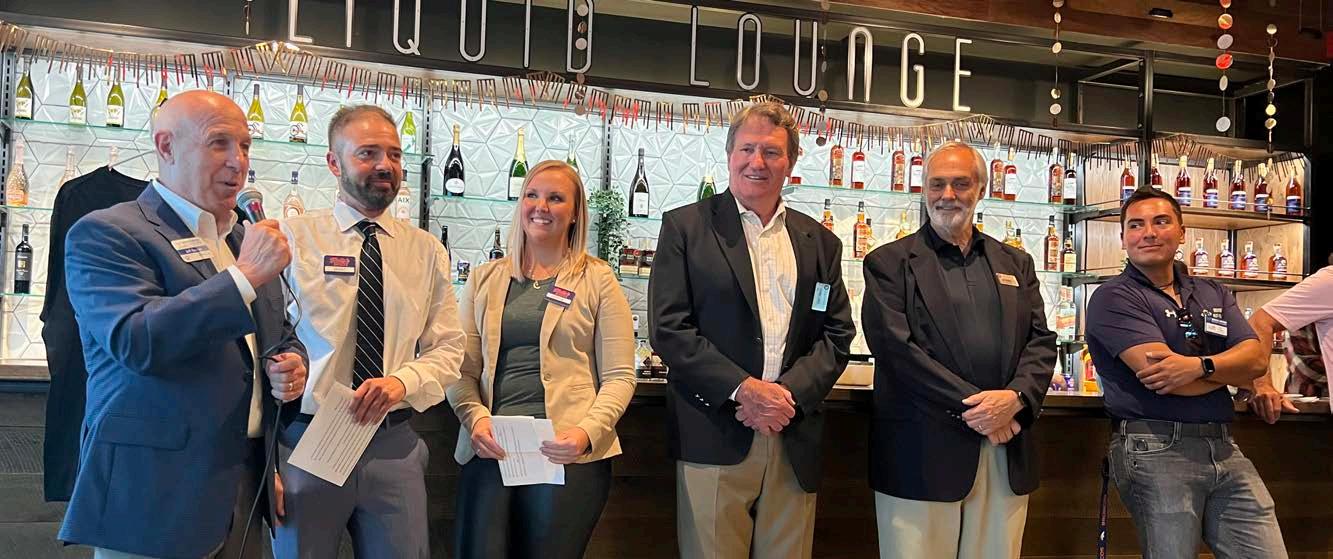

 Friendly and knowledgeable Molly’s Spirits staff
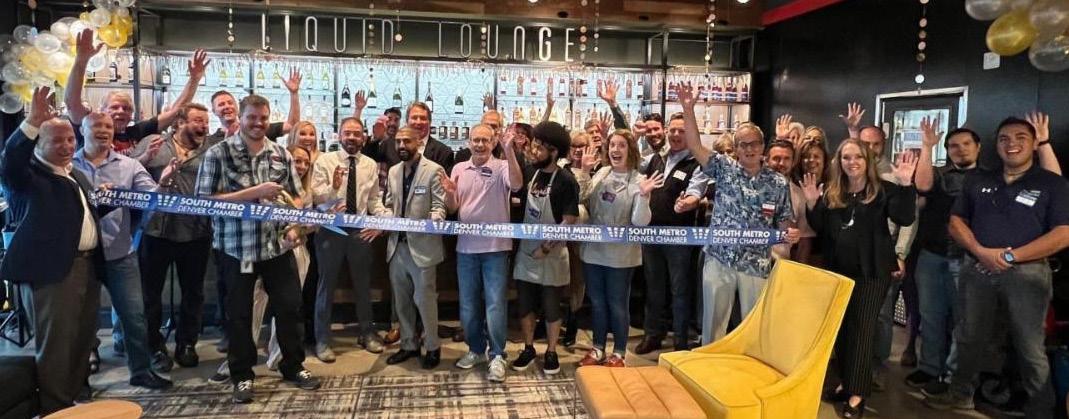
It was a successful chamber new member ribbon-cutting, including Greenwood Village Mayor George Lantz and City Council Member Dave Kerber.
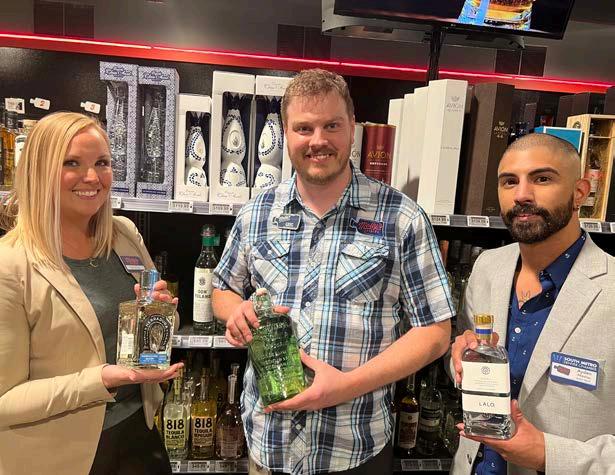
Showcasing some of their high quality tequila brands; Crystal, Greg and Ayden
Friendly and knowledgeable Molly’s Spirits staff
It was a successful chamber new member ribbon-cutting, including Greenwood Village Mayor George Lantz and City Council Member Dave Kerber.
Showcasing some of their high quality tequila brands; Crystal, Greg and Ayden

Bob Roth is running for Arapahoe County Commission er district four in November. He hopes to replace Nancy Jack son, current Chair of the Board of County Commissioners, who is term limited. Roth is opposed by U.S. Navy veteran and small business owner Lesley Sum mey.
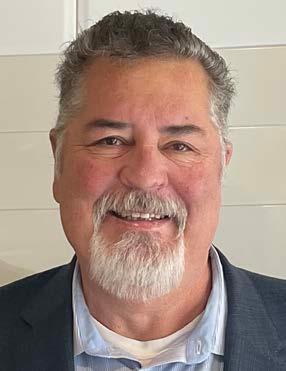

We sat down with Roth on September 6 to talk about his goals in this race. Roth told us, “I hear it from all kinds
of people, they are concerned about public safety. We have to give our police officers all the necessary resources to keep our neighborhood schools and busi nesses safe.” Roth said he be lieves that the Arapahoe County Sheriff’s office is understaffed.
He pointed out that since Arapahoe County does not have a county manager, the day-to-day management of the county’s operating departments is the responsibility of the elected commissioners. As a result, if he is elected, he would be assigned management of several state departments. Roth
described his management style as, “I would take their thoughts and recommendations and bring them back to the whole board of county commissioners for a vote on it.”
The conversation turned to homelessness. Roth said, “We really need to come up with the regional response for homeless ness, rather than city by city.”
Roth brought up the Arapa hoe County Jail, which he de scribed as the county’s biggest infrastructure challenge, noting the 2019 failed vote to fund a new jail with a sales tax. Roth believes a new jail is needed, but would first, “tear the budget apart and first see where we can find money in the current budget.” If that isn’t enough, he would try to find available fed eral funds to “close the gap.” If that doesn’t work or it still leaves a shortfall, Roth would
I just learned from Freda about the 13 CPA awards that The Villager just earned. Congratu lations to you and all your staff! Pretty amazing considering the size of your paper. We (residents of CHV, GV and surrounding area) are fortunate to have The Villager keeping us informed and engaged. Again, congrats!
support a sales tax if it had a sunset date.
Roth was born in Leadville, but grew up in Los Angeles. He attended Los Angeles Baptist College for a few years, and eventually settled in Aurora in 1999, where he decided he wanted to get involved in gov ernment. He volunteered on three different citizens boards in Aurora before running for city council. Roth explained, “I ran for Aurora City Council in 2009 but didn’t win. Then there was a vacancy in 2010 (when Council Member Sue Sand strom was elected Arapahoe County Treasurer) and I was appointed, then had to run ten months later to keep my seat.”
He won that election and was re-elected in 2015. While on the Aurora City Council, he served on the Denver Regional Coun cil of Governments (DRCOG)
for six years, including four in leadership, and one as chair. He also served on the executive committee of the Colorado Mu nicipal League.
In 2019, Roth lost a bid for another term to current Aurora City Council Member Alison Coombs by 275 votes out of 15,067 cast. In 2020, he chal lenged incumbent State Sen. Jeff Bridges in SD26, losing that race by nearly 24 points.
fmiklin.villager@gmail.com
Colorful, cozy, and flavorful, autumn is the most spectacular of seasons. Join us for a sumptuous fall celebration of local apple ciders from Colorado Cider Company, served with fine fare by our very own Chef Nathan Lacy and Duet Dining. And while you’re here, don’t be surprised if you fall for the warm, welcoming spirit that makes our community so special.
Flavors Of Fall Cider & Food Tasting

Tuesday, October 12, 11:30 am –12:30 pm
Seating is very limited. Call 720.266.5611 or email igodoy@clcliving.org
5500 East Peakview Avenue, Centennial, CO 80121 303.713.9004 hollycreekcommunity.com
Best, Earl Hoellen
County Commissioner in 2016 and took office in 2017. Commis sioner Nancy Sharpe provided valuable guidance to me as a new elected official. She taught me how to be responsive to citizens, how to weigh the pro’s and con’s of land use decisions or law enforcement budgeting in the county, and how to have civil discussions with fellow commissioners “across the aisle” in a productive fashion. Along with many of her constituents in district 2, I owe her a debt of gratitude for her many years of dedicated public service. If you
agree with me that Commission er Nancy Sharpe did a fantastic job in office, I invite you to meet Mark Gotto who is a candidate for her seat on the Board of County Commissioners. Over the last few years, I have met with Mark on a frequent basis and now I understand how he earned her endorsement in the upcom ing November election. Nothing I say can, or should, sway how you vote this year. Check out his website. Meet him yourself and decide if he deserves your vote. I’m confident he will impress you with his desire to serve, his ability to understand complex issues and his collaborative attitude. Sound familiar? The citizens of Arapahoe County Commission er District 2 deserve the same degree of public service, respon siveness and dedication that they are accustomed to. Mark Gotto.
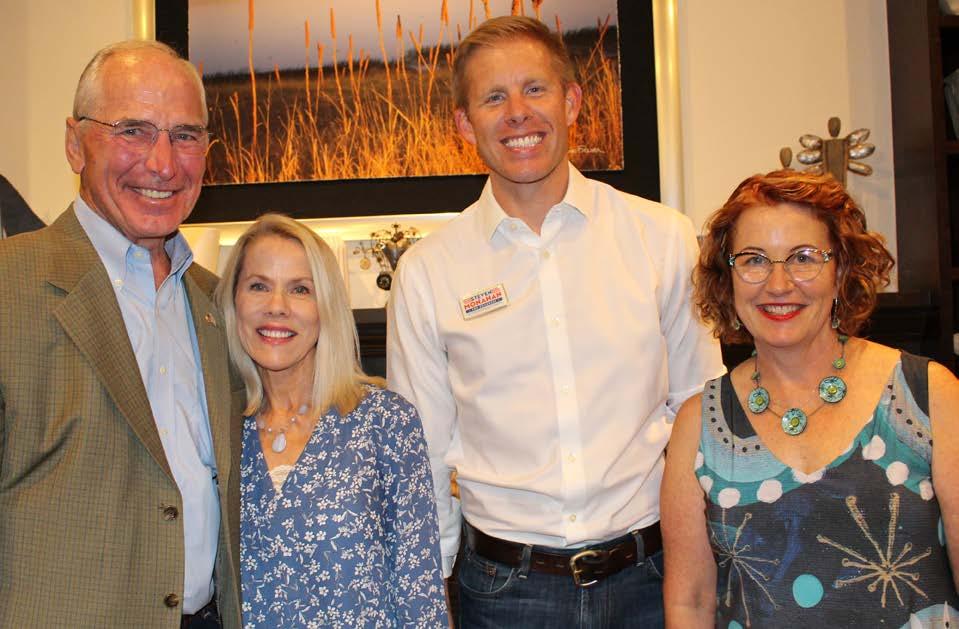
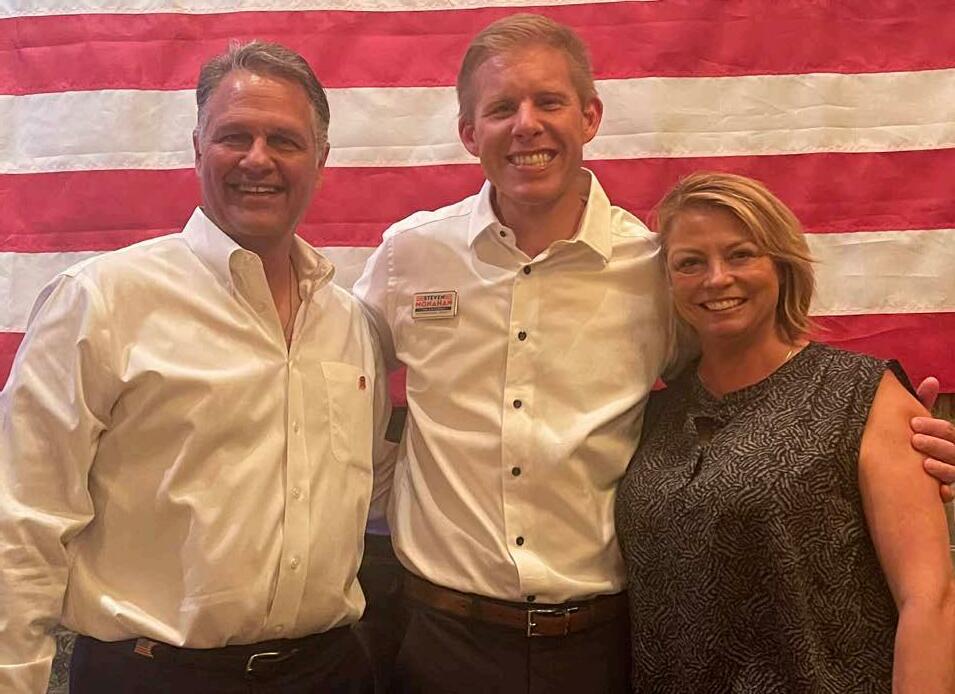
Bob Roth Photo by Freda Miklin Jeff Baker Arapahoe County Commissioner District 3Betsy Wiersma hosted a re ception to meet CD 6 candidate Steven Monahan at her Green wood Village home. Excite ment is mounting for the 20year Navy veteran. In addition to local Denver and suburban supporters, former Congress man Bob Beauprez and wife Claudia were on hand to en dorse Monahan. Beauprez feels strongly that the 6th is winnable - especially for the strong family man with three children who is qualified, capa ble and passionate.
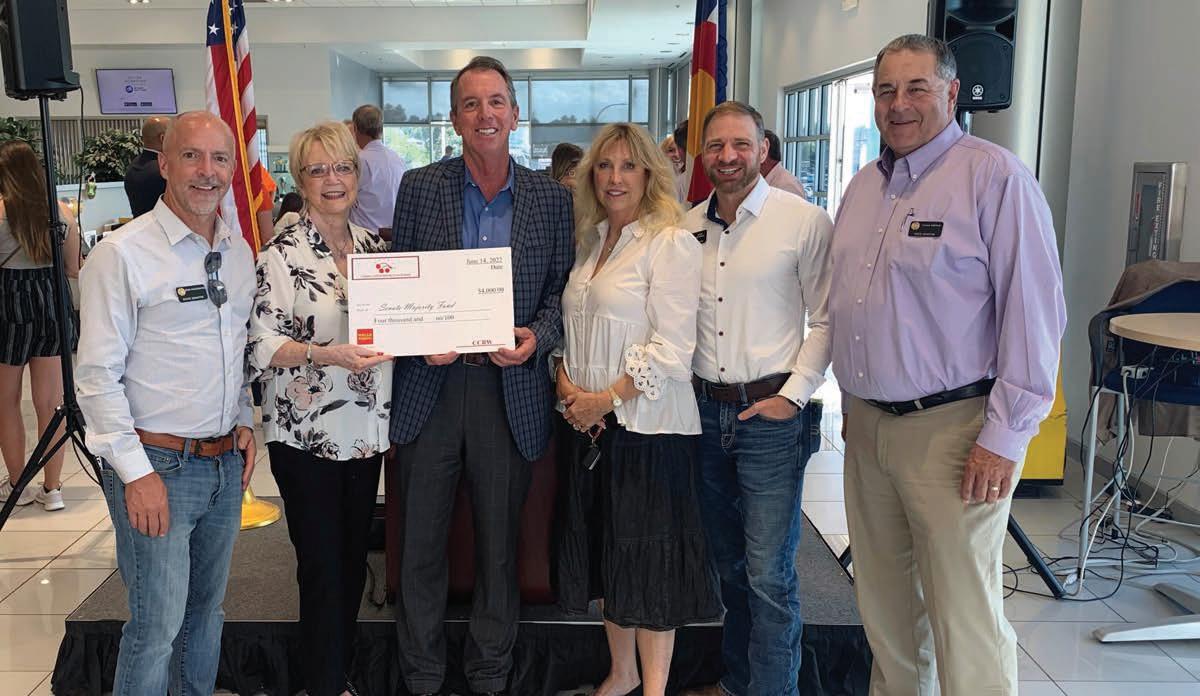
The board of Cherry Creek Republican Women (CCRW) voted to award $4,000. to the Senate Majority Fund. The award was made possible as a result of the club’s success ful, multi-faceted fundrais er - Kentucky Derby Party. The check presentation was officially held at John Elway Chevrolet.
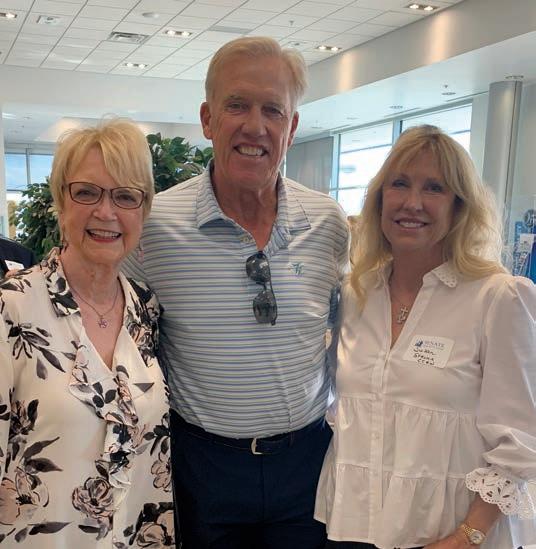

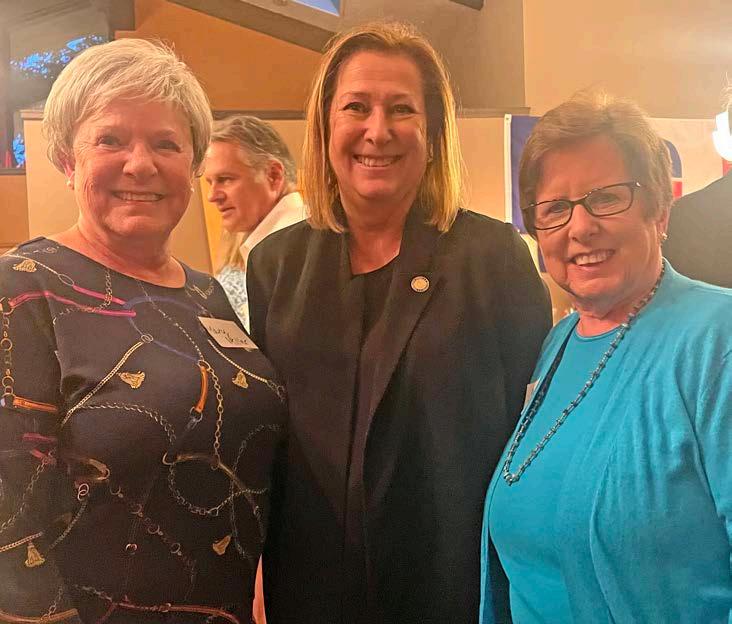
In addition to Colorado GOP chair Kristi Burton Brown, Cher ry Creek Republican Women (CCRW) were also treated to a presentation by Colorado GOP Vice Chair Priscillla Rahn. Rahn is a teacher in Denver Public Schools and gave first- hand ac counts of the education system. “We need bravery and to speak out respectfully.” She also ex plained three tiers of donating to candidates: Small Donors, PAC and IEC if donors have already given the maximum. Instead of
“dark” money, Republicans refer to it as “bright” money. ”It’s an in vestment in our future,” she said.
Kristi Burton Brown, chair of the Colorado Republican Party is a constitutional attorney and a policy analyst. She helped nego tiate Senator Tim Neville’s Free Speech on Campus Bill and has testified for pro-life legislation in multiple states on behalf of the Charlotte Lozier Institute, the research and education arm of the Susan B. Anthony List. She is the author of “Do Justice: Practical
Ways to Engage Our World.” Brown is a wife and mom of two kids. She addressed the concerns of inflation, cost of living and crime. Colorado is now #1 in bank robberies, #1 in car theft and #2 in fentanyl deaths. ‘Immediate ly after the Dems were in session in Colorado – there was decrim inalization of fentanyl, heroine, meth and cocaine. We must get Republicans elected to stop that. It must be a grassroots effort. We can’t match their money, but we can still win!”
Sen. Rob Woodward, Lynne Cottrell, Sen. Paul Lundeen, Susan Struna, Sen. Kevin Van Winkle and Sen. Cleave Simpson“Unaffiliated voters overwhelming disapprove of the BidenPelosi-Schumer agenda and the incumbent has voted 100% with the Democrat leadership. Polling shows just how winnable the 6th Congressional District is this year.”
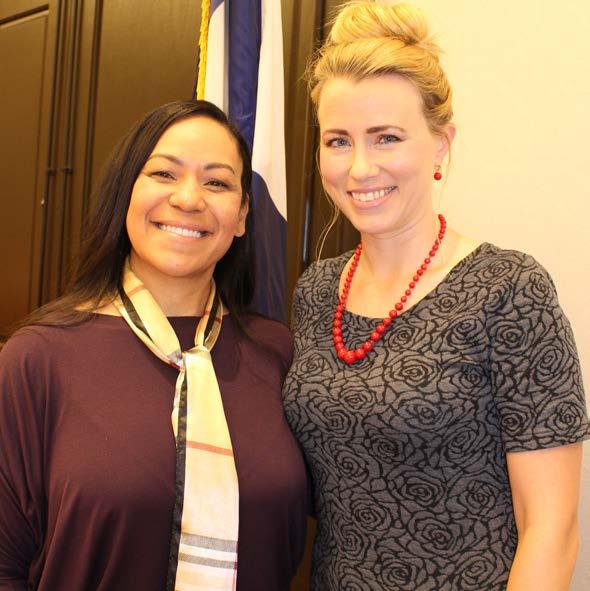
– Hon. Bob BeauprezHon. Bob Beauprez and wife Claudia with CD 6 candidate Steven Monahan and Betsy Wiersma Photo by Scottie Taylor Iverson Colorado GOP Vice Chair Priscilla Rahn and Chair Kristi Burton Brown Photo by Scottie Taylor Iverson CCRW 2nd VP Lynne Cottrell and 1st VP Susan Struna flank John Elway at John Elway Chevrolet Photos courtesy of CCRW
 BY FREDA MIKLIN GOVERNMENT REPORTER
On September 13, Greenwood Vil lage City Coun cil Member Paul Wiesner and his wife Heidi, along with Joy & James Hoffman, Ann & David Durham, and Susie & David Packer hosted a campaign event for Steve Monahan at the Wiesners’ home. Mona han, a U.S. Navy veteran, is challenging incumbent U.S. Rep. Jason Crow in Colorado Congressional District Six in the November election.
Introducing the candi date, Wiesner said, “This is a chance for us to actually do something.” He pointed to the
very strong likelihood that the GOP will take over the House of Representatives after the November election.
Monahan told the crowd of 30 that he entered the U.S. Navy hoping to be a Navy Seal but ended up serving five years as a vocalist in the Navy band. After finishing college using the G.I. Bill, Monahan returned to the military and became a naval aviator, where he “served in basically every geopolitical theater on the planet. On every continent except Antarctica, we hunt ed enemy submarines. We conducted anti-narcotic and anti-human trafficking opera tions all over South America and Central America. We even fought ISIS. That was a true privilege in my life, getting
rid of that level of evil.”
He continued, “Then, a year later, watching the re sponse to Covid, watching us shut down the country, with no regard for what it was go ing to do to our children, what it was going to do to business all over America, I realized this was going to backfire in this country. I saw more and more vitriol and more and more problems. At that point, instead of just complaining about it, I knew that one day my kids would ask me what I did about it. I knew I had to do something. I knew I had to be able to say, I did this for my family, I did this for my neighbors, and ultimately, I did this for my country.”
Monahan went on, “There are people out there who just
aren’t good at anything but service. I think I might be one of them and I can’t think of a better time to be called to ser vice than right now…I want to bring integrity and com mon sense back to the Halls of Congress. It matters this time. It’s real. We have to get people back in Congress who don’t owe anybody anything except for the people who show up to vote and who hold their breath as they go through the checkout line at the gro cery store. When you have to decide between what you buy at the grocery store and new tires on your car or whether to get your oil changed a couple thousand miles later than you normally would have, that’s a problem. That’s not normal in this country. We are not used
to the infringement on pros perity.”
Pointing to the priority of all parents being their chil dren, he said, “Are your chil dren safe? Do your children have prosperity? Is there the opportunity for them in this country that you’ve always expected, and now seems to be dimming? That’s a prob lem. That’s something that we can’t take.”
The candidate concluded by pointing to the fentanyl crisis in Colorado, which he said was a result of drugs be ing sent with the knowledge of Communist governments across the world to Mexico, then coming across the bor der into this country, costing countless American lives.
fmiklin.villager@gmail.com
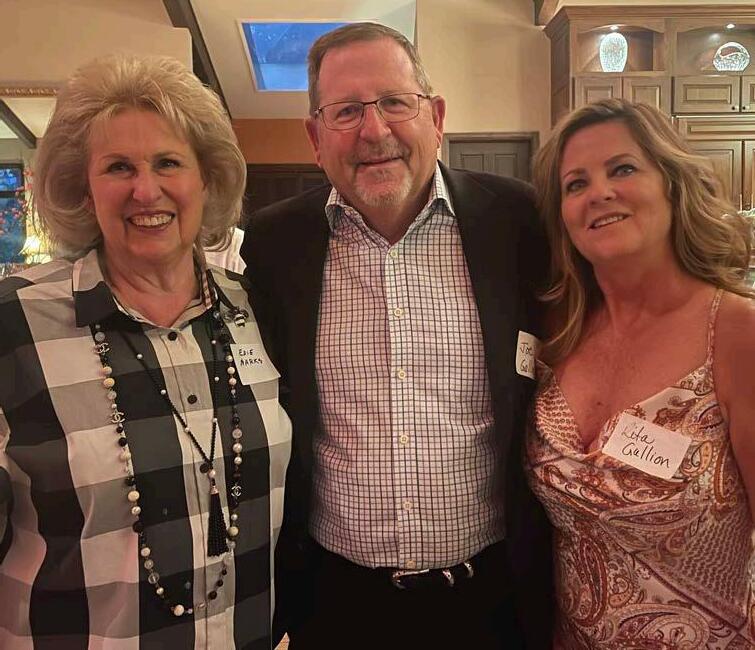
Candidate for U.S. Congress Steve Monahan is surrounded by his hosts, GV Council Member Paul Wiesner and his wife Heidi Wiesner. Photos by Freda Miklin Mary Miller, Joy Hoffman and Pam Powell said they support Monahan because, “We need a change.” Joe Fabbricatore, former ICE acting field office director for enforcement and removal operations in Denver, told Monahan supporters that U.S. laws on immigration have not been changed by any Congress or President since 1996. Monahan supporter Edie Marks greeted Joe and Rita Gallion of Calcon Costructors, Inc.
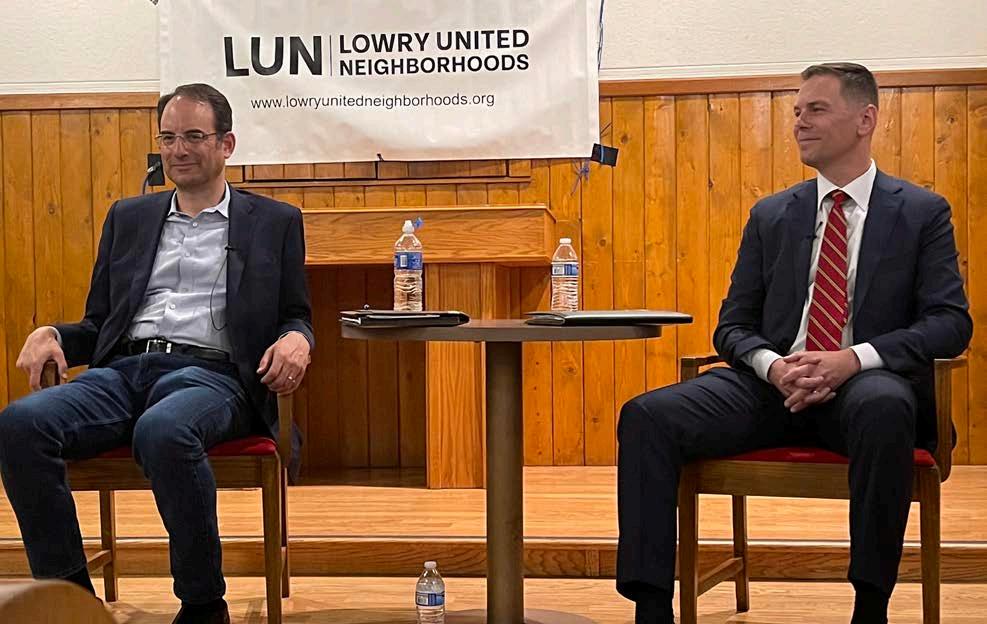
The Eisenhower Chapel at 293 Roslyn Street in Denver was the setting for a debate between incumbent Colorado Attorney General Phil Weiser and challenger 18th Judicial District Attorney John Kellner on September 20. Journalist and author Todd Neff served as moderator.
Weiser was elected Colorado Attorney General in 2018 and is seeking a second term. He holds a law degree from New York University and served as a law clerk for U.S. Supreme Court Justices Byron White and Ruth Bader Ginsberg. He has also worked in the U.S. Justice Department, the National Eco nomic Council and was dean of the CU law school.
Kellner was elected 18th Ju dicial District Attorney in 2020. He holds a law degree from the University of Colorado and spent five years as an activeduty U.S. Marine, where he was a lawyer and prosecutor. He served in Afghanistan, where he worked with local governments and elections. He is presently a Lieutenant Colonel in the Ma rine Corps Reserves.
The Colorado Attorney General has primary responsi bility for consumer protection, antitrust, and prosecuting complex white-collar crime, as well as natural resource and environmental issues. The AG is also the lawyer for all the de partments of state government, manages the statewide grand jury, and is legal counsel and advisor to the governor. The office employs 480 people and has a budget of $70 million.
To the question, “What will be your top three priorities for reducing crime?” Kellner said, “We are number one in Colora do in auto theft, bank robberies, and cocaine use. We have the second highest rate of fentanyl overdose deaths in the coun try... One of the things that dis mayed me was to see Phil ad vocate for a bill that would’ve essentially tied the hands of law enforcement. It made it nearly impossible for them to use arrest, rather than just issue a ticket and summons to somebody for things like motor vehicle theft. I was dismayed to see that he didn’t show up in 2019 …when the legislature was talking about decriminaliz ing (fentanyl and other drugs). So that bill passed, and now we find ourselves with over 900 Coloradans having lost their
lives to fentanyl. In my district, we’ve gone after the drug traf ficking organizations that are importing this stuff, peddling this poison. We’ve seized hun dreds of thousands of fentanyl pills; 40% of those pills are estimated to have a potentially lethal dose… “
Weiser’s response to the question was, “The three strat egies that I as attorney general am using to advance public good are, first, working with the legislature…I was the first attorney general in the United
on elevating and improving law enforcement training for the first time in 40 years, and providing mental health support and emotional awareness for police officers who are in this traumatic line of work.”
A question about a 2022 Colorado law that changed the way those who distribute fen tanyl are held accountable drew different responses from the candidates.
Weiser, who answered first, pointed to the fact that he worked with the legislature
that punishes the distribution of fentanyl resulting in death came from his office.
On the larger issue of drugs, Kellner blamed the federal government for not keeping drugs from coming across the U.S. southern border. Weiser said that the drug problem is complex because it includes young people who are not drug addicts but take a pill that they buy from a friend to help them sleep and it turns out to contain a lethal dose of fentanyl. Weiser said that he has heard criticism
criminal prosecution; 90% of the work of the attorney general is not criminal prosecution. But that’s what you speak about al most exclusively on your web site… It’s what you’ve talked about tonight. It’s important but, what are the top three pri orities other than criminal pros ecution that would bring you to this job?”
Kellner responded, “It’s true. I talk about public safety every where I go because, everywhere I go, that’s the thing that people are most concerned about and I think it is something that Phil has failed to lead on. I think that he has advocated for offend er-friendly legislation that has caused, in large part, the mess that we are in right now… He advocated for a bill that now al lows convicted felons like drug dealers and car thieves to now have guns again.”
When the questioner pressed Kellner on her original question about his priorities in other areas, he named water issues, includ ing the Colorado River Compact, con sumer fraud protec tion, and the federal government’s failure to secure the coun try’s southern border as priorities.
States to testify for a bill ad dressing online retail theft. We pushed for a bill on catalytic converter theft--in both cases, to shut down intermediaries, to go after these crimes. This past session, we worked hard on a bill about fentanyl, getting money to law enforcement and better tools. We’ll keep working on this legislation in a smart, effective way.” He point ed to, “A very important fen tanyl case (in which) we took down a whole organization. Human trafficking-- these are complex crimes…Car theft--those crimes are prosecuted by district attorneys. If someone wants to prosecute those cas es, they are best off staying where they are because that’s not what the attorney general does.” He continued, “We’ve also worked really hard on law enforcement…We don’t have enough law enforcement on the streets across our state. Twice, I’ve gone to the legislature to get more funding to support more people going into this im portant profession. I’m working
and “got any amount of pure fentanyl made illegal,” noting that when the drug is mixed with other drugs, it is more complicated to write laws that specifically call out how different amounts should be treated. He said that his office did all it could to convince the legislature to strengthen penal ties and would like to see them strengthened further. He point ed to a new offense contained in the legislation that he pushed for that specifically punishes the distribution of fentanyl re sulting in death. He also noted other tools contained in the bill that was passed and signed into law, including funding for pub lic awareness and prevention, making Narcan more available, and drug treatment.
Kellner said, “I’ve been a strong proponent that any amount of fentanyl, because of its deadliness, should be a felony. I did not support the decriminalization of fentanyl and other hard drugs like meth, heroin and cocaine in 2019.” He said that the idea for the law
but no solutions, adding, “We need smart, effective leader ship. Last session, I worked at the legislature intensely, literal ly up to the last minute, to get this law passed… The work that we did has gotten biparti san support for our leadership on public safety.” He noted that he has been endorsed in this election by Cynthia Coffman, his predecessor as Colorado Attorney General, who is a Re publican.
Weiser also noted that his office had held a district at torney in the San Luis Valley accountable for violating the Victims Rights Act, leading to the resignation of that district attorney. (According to recent reports, that DA, Alonzo Payne, has since been disbarred from practicing law anywhere in Colorado).
When audience members were allowed to ask questions, one person said to the candi dates, “It seems like you agree on lot of things, but Mr. Kell ner….the things on which you disagree seem to be rooted in
Weiser described his top three priorities not specifically relat ed to criminal behav ior as, “Number one, defending our civil rights, including our reproductive rights; number two, standing up for consumers who are harmed; number three, protecting our land, air, and water, and a bo nus one, the opioid epidemic.”
He also responded to Kellner’s statements, denying that he had advocated for lesser penalties for car thieves, explaining that the law that was adopted, “Was unanimously passed in the Senate and supported by every DA.” Kellner interjected, “It was not supported by me.”
Weiser also pushed back on another of Kellner’s accusations, saying, “I don’t want car thieves to have firearms. It was a con sensus bill that came up that was all that could be voted on. Let’s work on a new bill. That’s what I’m doing right now.” Turning to the audience, he said, “You deserve answers. We deserve an honest campaign.”
When it was all over, the candidates politely shook hands and the 125 people who came to hear them showed their appreci ation with robust applause. Bal lots for the November 8 election will begin arriving in mailboxes on October 17.
fmiklin.villager@gmail.com
Incumbent Colorado Attorney General Phil Weiser (left) and challenger 18th Judicial District Attorney John Kellner Photo by Freda MiklinOn September 25, Arapahoe County Com missioner Car rie Warren-Gul ly hosted a get-together for Democratic incumbents, hopefuls and supporters that drew nearly the full slate of candidates that will appear on area voters’ ballots in November, from the top to the bottom of the ticket. Pres ent and accounted for were November 8 candidates for re-election U.S. Rep. Jason Crow, HD38 State Rep. Da vid Ortiz, Arapahoe County Sheriff Tyler Brown and Arapahoe County Coroner Dr. Kelly Lear. Also on hand to speak to supporters were Arapahoe County commis sioner district two hopeful Jessica Campbell-Swanson and Amy Padden, announced 2024 candidate for 18th Judi cial District Attorney, when the 18th JD will be solely Arapahoe County.
National issues that drew candidates’ attention includ ed the U.S. Supreme Court
decision overturning Roe vs. Wade, described as poten tially removing the right of half of all Americans to make their own health care deci sions, and the challenges to our democracy through mak ing it difficult to vote and to
have every vote count.
Rep. Ortiz talked about his background as being a third-generation military ser vice member on his dad’s side and a first-generation Amer ican on his mom’s side that led him to college, teaching
in Africa, and in the military as a combat aviator, where he suffered a life-threatening helicopter crash in Afghan istan that left him paralyzed from the waist down. He was called to public service by a friend who told him, “you’re
Besides being a recruiting career coach, Caroline Cor nell is the board chair of Girl Scouts of Colorado. She also holds a master’s degree in history from University Col lege-London and would also like to be the next Arapahoe County Clerk.
Cornell told The Villager, “We have restricted access to services from the Clerk’s Office right now. If you are someone who doesn’t look at the website, doesn’t read all the words and all the pages, you show up to a location of the Arapahoe County Clerk’s office to renew your car tag, and you get sent home or to a kiosk.”
She shared the experience of a neighbor whose daughter got a traffic ticket for driving with an expired sticker on her license plate. When the neigh bor tried to buy an up-to-date sticker, she was told she had
to make an appointment, but there were no appointments available for three weeks thus her only options were to risk her daughter being ticketed again or to not drive the car.
Cornell said, “That is hap pening right here in Arapahoe County. People are really frus trated. Communications are not good. Many people want to be able to access services in person to solve problems as they occur, and they are not allowed to do so.” She said that she and many others also find the Arapahoe County Clerk website very difficult to navigate, adding to the level of frustration.
If elected, Cornell would open up the Arapahoe County Clerk’s offices to the pub lic and have a staff member available to greet customers and make sure they are direct ed to someone who can help them. She would also increase the level of training for peo ple who work in the Clerk’s Office to ensure that they are able to serve the public’s
needs effectively.
Cornell has confidence that the state’s voting systems are safe and secure, pointing to the signature verification system as an important tool in ensuring that voters fill out their own ballots. Still, she believes more needs to be
done to assure voters that their ballots are being handled cor rectly. She explained, “I think we have an opportunity to im prove how we communicate about our elections in order to give the public confidence in the system. That is the respon sibility of leadership and we
still here for a reason.” Ortiz is running for a second term to represent HD38 against GOP newcomer Jaylen Mosqueira.
Campbell-Swanson would like to see Arapahoe County be a “healthy, thriving com munity, now and in the future, that supports everybody and is safe.” Watching her father serve in elective office as a city council member and mayor, she was always inter est in government, and de scribed studying wastewater management in Kansas at the age of 16. Campbell-Swanson went on to get her college degree at a religious school, where she studied history, philosophy and political sci ence, then came to Colorado, where she earned both a mas ter’s degree in comparative politics and a law degree from the University of Denver.
Campbell-Swanson is running against Mark Gotto to repre sent Arapahoe County district two on the Board of County Commissioners in an open seat being vacated by current Commissioner Nancy Sharpe, who is term-limited.
fmiklin.villager@gmail. com
could do a much better job in Arapahoe County than we are presently.”
Cornell would also increase transparency by making scanned ballots available to the public upon request after elections are held, without including any information that would identify the voter of the ballot.
If elected, Cornell would “finally clean up the voter rolls,” by carefully removing names of voters who have not cast ballots from the address listed for years because they no longer live at that address. Estimating that thousands of ballots are sent out during each election that are wast ed, Cornell offered, “I think that there’s an opportunity to figure out a better system, to make sure that if you’re receiving a ballot at your home that you shouldn’t be receiving, it doesn’t go on in definitely.”
Caroline Cornell is running against incumbent Arapahoe County Clerk Joan Lopez in the November election. She was also a candidate for State House District 37 in 2020, losing to State Rep. Tom Sul livan.
fmiklin.villager@gmail.com
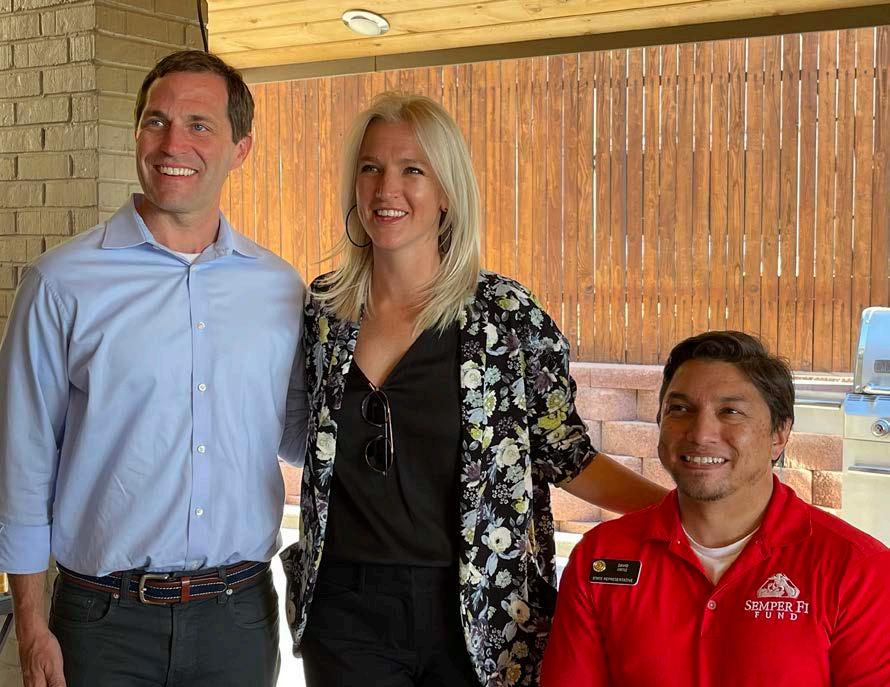 From left to right, U.S. Rep. Jason Crow, candidate for Arapahoe County Commissioner District Two Jessica Campbell-Swanson, and HD 38 Rep. David Ortiz. Photo by Freda Miklin
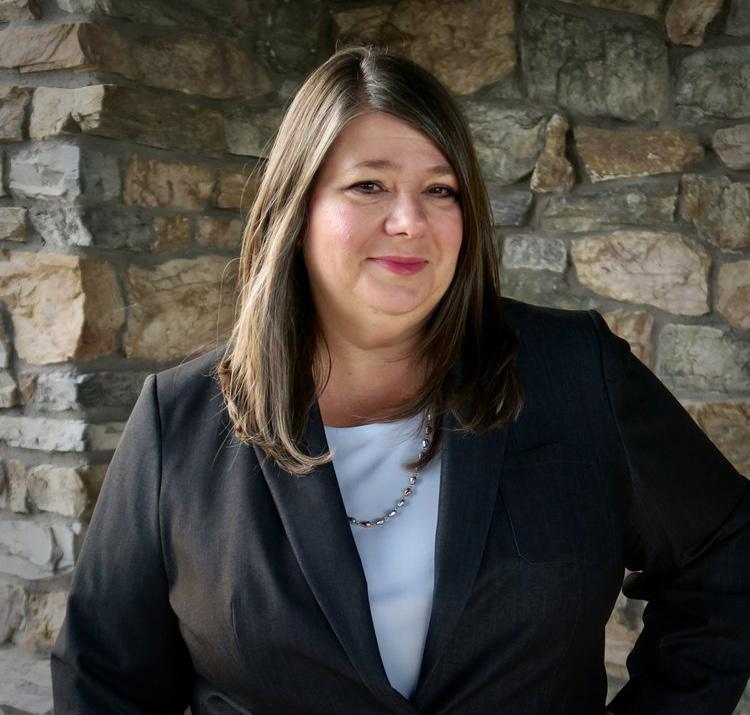
Caroline Cornell is the GOP candidate for Arapahoe County Clerk.
BY FREDA MIKLIN GOVERNMENT REPORTER
From left to right, U.S. Rep. Jason Crow, candidate for Arapahoe County Commissioner District Two Jessica Campbell-Swanson, and HD 38 Rep. David Ortiz. Photo by Freda Miklin
Caroline Cornell is the GOP candidate for Arapahoe County Clerk.
BY FREDA MIKLIN GOVERNMENT REPORTER


When we met Marla Fernandez, the GOP candidate for Colorado HD 3 who is challenging incumbent Meg Froelich, at a meet-and-greet at her home on September 10, she told us, “I had no idea that I would actually run for of fice. It was a miracle that I got nominated at the Republican caucus. I was also unopposed in the Republican primary and that was also a miracle. I’m a paralegal and left my law career to homeschool my son. I’ve been homeschooling for 11 years. As a paralegal, I thought I could do a better job than most of the teachers in school. If elected, I will reform our education system.”

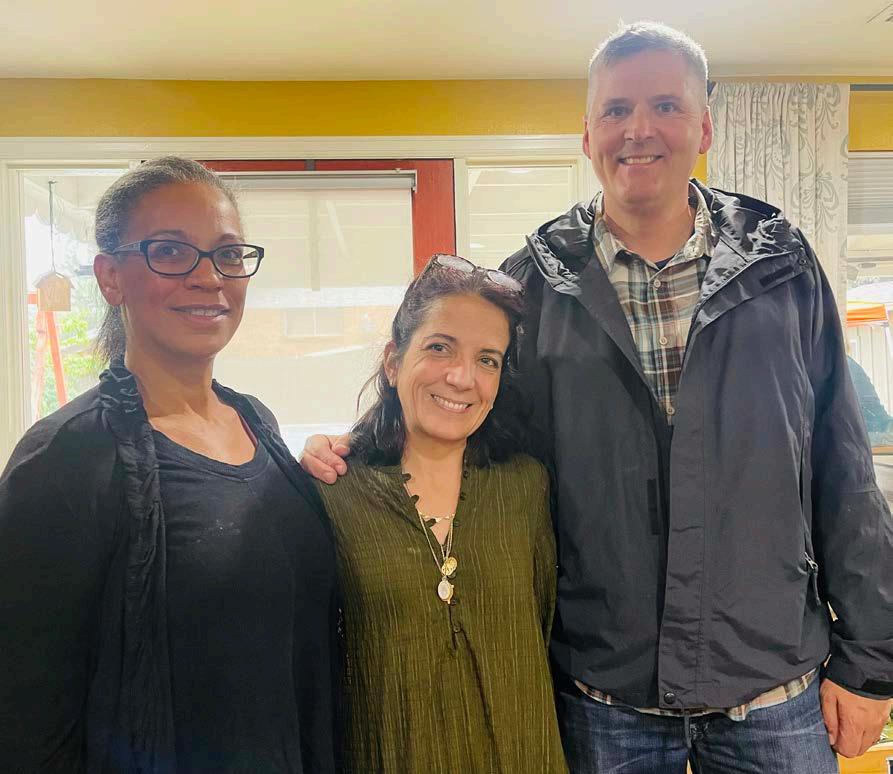
She continued, “One issue that I really care about is unit ing Democrats and Repub licans. I need help from the community building unity. Ev erybody cares about the same things… and together, there is order, method and strength… If we come together as Amer icans again and tolerate the things that we don’t like, in order to work together to make it better, we will be able to fix the homelessness, we will be able to fix the crime, we will be able to fix society, and make it better for our neigh bors to dwell in it.”
Fernandez has strong feel ings about reproductive health care. She told us, “I’m not go ing to ban abortion. There is a liberty issue and there is a life issue. RHEA (the Reproduc tive Health Equity Act passed by the general assembly in the 2022 session) doesn’t even talk about the Constitutional deprivation of life and liber ty…The state has an interest in protecting life and liberty. RHEA doesn’t protect women, it just protects the providers’ rights…Half the providers say there is a life in there and half say it’s a clump of cells… The provider needs to educate the woman. There are a lot of women who are uneducated. They don’t understand what they have inside…Did you know that, as soon as a woman hears a heartbeat, that’s when she actually realizes that she has a baby inside of her?...
A lot of times, providers say, ‘You know, you’re going to ruin your career. It’s just a clump of cells.’
She continued, “I read Roe (U.S. Supreme Court case Roe v. Wade of 1973) extensively.
I know the law and it doesn’t even go with Roe. At the very least, we should read Roe and have a discussion on Roe and RHEA. RHEA is unconstitu tional because the state has an interest in protecting life.”
We asked Fernandez why, if RHEA is unconstitutional, no one has brought a legal action
against the state on that basis? She told us, “We need to but it does take time…Somebody needs to bring an action that actually had a failed abortion or had something in order to bring it up.”
Fernandez told us she had been “booted” from events she attended at the ACLU and Planned Parenthood, “just for asking basic legal questions,” adding, “If we can’t debate this
issue, then we can’t resolve this issue.”
We inquired, “If you are elected to the legislature and the Republican party is in the majority, giving you a real voice, what would you pro pose should be the law on this subject?” She told us, “I would propose that we have a full discussion on all the issues that are in place,” adding, “Our dis trict is divided as Democrats.
Half of the Democrats think that life starts at conception… so I would propose to repeal the law (RHEA) and start again with a discussion.”
Fernandez said she took her 11-year-old son to the legisla ture to listen to the testimony when RHEA was being debat ed because she “wants him to see what activism is all about.” She told us that, “There were only 50 who were in favor of abortion and 350+ people were there against abortion. You need a unanimous consensus.”
Another issue Fernandez said motivated her to run for the general assembly was that, “Article One, Section Two, Clause Three (of the U.S. Con stitution) says that the state has every right to directly tax its people and apportion its people and pay union dues for the United States,” adding, “At the state level, I can initiate legislation that pits the state (against) the federal govern ment and puts us in the U.S. Supreme Court to hear wheth er Amendment 16, that says that the federal government can directly tax the people, is valid. I think that contradicts Article One, Section Two, Clause Three.” We confirmed that she was making the point that the federal government does not have the right to tax U.S. citizens, according to the Constitution.
Fernandez would also “re draft the Science of Reading Act.” The Colorado Depart ment of Education describes the Science of Reading as, “a model that organizes the skills needed to become a proficient and successful reader into the categories of word recognition and language comprehension.”
fmiklin.villager@gmail.com
ILea (left) and John (right) Craig, who live in Littleton, came to show their support for Marla Fernandez. Photos by Freda MiklinHAND



Insok




Program provides needbased scholarships of up to $100,000 over four years
Colorado high school seniors can now apply to become a 2023 Daniels Scholar and receive up to $100,000 towards their college degree. Interest ed students must apply at DanielsFund.org/Scholar ships by 4 p.m. MST on Oct. 15 to be considered for the scholarship.
The Daniels Scholar ship Program provides the opportunity for motivat ed students to attend the college of their choice. The scholarship, based on financial need, provides up to $100,000 to attend any two- or four-year non profit, accredited college or university in the United
States. Earlier this year, the Daniels Fund awarded scholarships to 226 Dan iels Scholars – including 130 from Colorado. Since 2000, the Daniels Fund has provided more than $235 million to over 4,800 scholars.
High school seniors in Colorado, as well as New Mexico, Utah, and Wyo ming, are eligible to apply.
“We’re looking for stu dents with great potential, strong character, and big dreams,” said Daniels
Fund President and CEO Hanna Skandera. “These scholars are America’s next generation of leaders.
They persevere through life’s challenges and their values reflect those of our founder Bill Daniels – they operate with integ rity, honesty, and respect, while striving for excel lence and leading with an entrepreneurial spirit. We’re proud to carry on Bill’s legacy of life-chang
• Be a high school se nior graduating from a school in Colorado, New Mexico, Utah, or Wyoming.
• Be a resident of Colora do, New Mexico, Utah, or Wyoming.

• Be a citizen or perma nent resident of the United States.
• Earn a min imum grade point average of 3.0 in high school (on an unweighted 4.0 scale).
ing giving through our scholarship program.”
Eligibility require ments:
• Earn a min imum SAT math score of 490 and a minimum evi dence-based read ing and writing score of 490, or a minimum ACT score of 18 in each category (writing score not re quired). Super scoring is not accepted.
• The applicant’s parent(s) or legal guardian(s) must have an adjusted gross income of $85,000 or less on their 2021 tax return on which the applicant is claimed as a dependent. Additional income is allowed for additional dependents; visit the Daniels Fund website for specific de tails and examples.
What the scholarship covers:
Daniels Scholars receive $5,000 to $25,000 annual ly, depending on financial need. Funds can be used toward:

• Tuition and fees at any accredited nonprofit col lege or university in the U.S.
• Room and board
• Books and supplies
• Other educational expe riences

All Daniels Scholars also receive a laptop com puter, networking oppor tunities, leadership devel opment opportunities, and career development.
2023 Daniels Schol ars will be announced in March 2023. To learn more about the Daniels Scholar ship Program or to apply, please visit Daniels Fund.org/Scholarships.
proudly introduces

A. We often have people come to our practice and ask, “What is CoolSculpting?” The non-surgical treatment works by taking the targeted area of fat and cooling the cells to a cold enough temperature that they begin to dissipate. The treatment does not disrupt other surrounding cells and only targets the underlying fat cells you wish to reduce. Once the cells are frozen, they are naturally emitted from the body.
Fat freezing is a non-invasive technique of removing stubborn fat. This technique freezes away the fat in a painless way. You are likely to experience mild discomfort, but nothing too drastic or over-thetop. Cryolipolysis has no downtime, meaning that you can immediately return to your job and other day-today task.
A. Cryolipolysis appears to be a safe and effective treatment for fat loss without the downtime of liposuction or surgery. But it is important to note that cryolipolysis is intended for fat loss, not weight loss. The ideal candidate is already close to their ideal body weight, but has stubborn, pinchable areas of fat that are difficult to get rid of with diet and exercise alone. Cryolipolysis also

doesn’t target visceral fat, so it won’t improve your overall health. But it may help you fit into your favorite pair of skinny jeans.
Liposuction is an invasive surgical procedure which includes cutting, stiches, and anaesthesia. This procedure is based on negative pressure similar to sucking liquid through a straw, as surgeons use a long suction tool to physically remove fat from a specific area of the body. Needless to say, this procedure is painful and requires a considerable recovery period.
A. 20 - 25% loss of fat cells
A. There is no downtime
September 29, 2022 • THE VILLAGER | PAGE 15 SHELLY CARRILLO


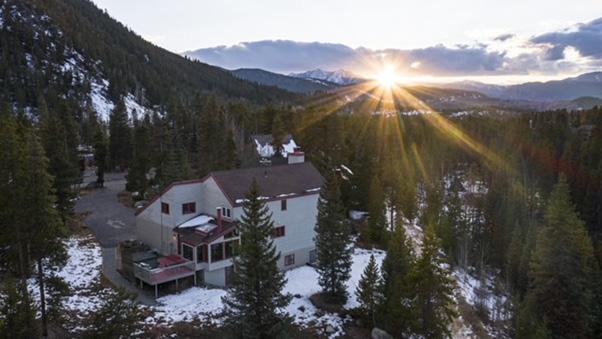





 Keystone
(STR BCA-99325). Visit VRBO.com for more info and booking. VRBO Prop ID: 1860242.
Keystone
(STR BCA-99325). Visit VRBO.com for more info and booking. VRBO Prop ID: 1860242.
Dear Savvy Senior, I am interested in finding some type of travel escort service to help my elderly parents fly across the country. My son is getting married in the fall and would love for my parents to attend, but they’re both in their 80s with health issues, so they’ll need help getting there. Can you direct me to any travel services that can help us?
Looking for Assistance
today that provide traveling companion/escort services to help older adults with the rigors of travel.


A good travel escort can provide your parents with transportation to and from the airport, manage their luggage, navigate and assist them through the airport, sit next to them on the flight, help them to their hotel and much more.
BY JIM MILLERDear Looking, Traveling can be challenging under the best circumstances, but for seniors with medical problems, physical limitations or dementia it can be unmanageable. Fortunately, there are a bevy of companies
Some companion services even provide personal care like medication management, dressing, bathing and feeding. And for those with specific medical needs, traveling nurse services are available too.
But be aware that these services aren’t cheap. You will pay for the travel companion’s tickets, the companion’s hotel room if necessary,
meals, incidentals and fees for the service. The price to accompany a client on a plane trip within the United States – including the companion fees and travel costs for all parties – can range anywhere from $2,500 to $5,000 or more, depending on the flight transfers and length of the trip.
To locate a travel companion service in your area, search online for “senior travel companion” or “senior travel escort,” followed by your parent’s city or state. Or use an experienced national service like Flying Companions (FlyingCompanions. com), Travel Helpers (GoTravelHelpers.com) or FirstLight Home Care (FirstLightHomeCare.com), which has a national network of franchises that provides in-home care for seniors and offers travel companion
Who can make a Power of Attorney and does the document take away your rights?
programs in about 80 percent of their 190 operating territories.
Or, for medical travel companions do a search for “traveling nurse escort” or “medical travel companion,” or checkout Travel Care and Logistics (YourFlightNurse. com), which provides registered nurses as escorts.
If, however, your parents don’t require a lot of assistance, or if you can’t afford a travel escort, consider asking a trusted family member or friend that has some air travel experience.
If you’re interested in hiring a travel companion service, there are a number of things you need to check into to ensure you get the right escort.
First, if you parents require personal or medical care while traveling, find out if the escort
pacitated.
is trained to manage their healthcare needs. What sort of medical certifications do they have? (Nursing credentials? C.P.R. training? etc.)
Also, find out how many trips the companion has taken with clients. Have they completed trips with travelers like your parents? How long has the travel service company been in business? What is the company’s safety record? And what sort of insurance does it carry, and what exactly is covered?
Also, get a quote breaking down exactly what you’ll be required to pay, in addition to the companion’s fees. And get a list of two or three clients/ references who have used their service and call them.
Send your senior questions to: Savvy Senior, P.O. Box 5443, Norman, OK 73070, or visit SavvySenior.org. Jim Miller is a contributor to the NBC Today show and author of “The Savvy Senior” book.
PORTICO PENTHOUSE ON RESTRICTED ACCESS FLOOR IN CHERRY CREEK. MOUNTAIN AND CITY VIEWS, 3 BALCONIES, 2787 SQ FT. THIS HOME HAS BEEN DESIGNED TO PERFECTION BY TONY TORRES . HIGH CEILINGS, 2 BEDROOMS PLUS A STUDY.

SPACIOUS AND EXQUISITE IN A BUILDING WITH 2 POOLS, SPA, PARTY ROOM, SAUNA, FITNESS CENTER. 3 PARKING SPOTS. NOW AVAILABLE FOR SHOWINGS $2,295,000
EXCEPTIONAL TRI-LEVEL WITH FINISHED BASEMENT. FORMER MODEL HOME. ON MARKET NOW. $700,000.
o HIGHLANDS RANCH GOLF CLUB: PATIO HOME. RARE MAIN FLOOR MASTER SUITE. PERFECTION. OVER $150,000 REMODEL $765,000 UNDER CONTRACT.
o COMING: CHARLOU IN CHERRY HILLS. Builder’s own home. Exceptional quality, spacious rooms, walk out basement. European Chateau. $2,700,000.
o THE PRESERVE: EXQUISITE ART DECO HOME WITH A MAIN FLOOR MASTER SUITE AND EXERCISE ROOM. THE BEST OF EVERYTHING!! COMING $2,695,000
A Power of Attorney is cre ated when a person, called the principal, gives someone else, called the attorney in fact or agent, written permission to act on the principal’s behalf. The principal must be men tally competent to grant a Power of Attorney. The Power of Attor ney must be in writing and signed. It should also be notarized, but it does not need to be witnessed. If a Power of Attorney is used to transfer real property, it must be recorded in the Clerk and Recorder’s Office in the county where the property is located.
Because power of attorney documents should be cus tom-tailored to your particular circumstances, they should be prepared by an attorney to insure that your intentions are clearly expressed and are legally enforceable. This includes de termining when a power of attorney should take effect, such as a “spring ing power” which means the docu ments will take effect only when a particular de scribed event takes place. A “standing power” takes effect immediately upon signing by the principal.
Many of my clients have asked what are the critical doc uments needed, particularly in view of the COVID-19 pan demic. Simply being married does not give you the legal right to gain access to your spouse’s medical records or make med ical decisions on your spouse’s behalf, even in an emergency. To avoid this problem and to help others care for you and to achieve your overall estate planning goals, the following documents create an effective medical/estate plan package:
1. Healthcare Power of Attor ney;
2. General Financial Power of Attorney;
#1 DENVER BOARD OF REALTORS 12 YEARS STRAIGHT TOP 1.5% OF AGENTS IN THE USA #44 OF 1,350,000 AGENTS IN THE USA (THE WALL STREET JOURNAL)
A Power of Attorney does not take away the principal’s rights to make his or her own decisions about financial, healthcare, or other matters. The principal can end the Power of Attorney at any time by simply telling the agent in writing. The principal should send copies of the termination notice to anyone with whom the agent may need to conduct busi ness, such as the bank. A Power of Attorney ends automatically when the principal dies.
In Colorado, the principal may state in the document that the Power of Attorney is dura ble. This means that it continues to be valid even if the principal becomes incapacitated. If no such statement is contained in the document, then the Power of Attorney stops being valid when the principal becomes in capacitated. If the principal has stated in the document when the power is to end, then the power will be effective only until the ending date. However, the prin cipal may revoke the Power of Attorney at any time, as noted, as long as he or she is not inca
People often ask whom should they name as their agent under a power of attorney. The agent should be a trusted indi vidual, which may include a spouse, an adult child, a sibling, a trusted friend or a professional fiduciary. It is always best to learn from the person you want to name as agent, for permission to do so, to insure that they are willing to accept the appoint ment. It is also helpful to ap point a successor agent, to serve if your first choice of agent can not serve due to death, incapac ity, resignation or unwillingness to accept the appointment.
What are the four key medical/estate plan documents you need now?
3. Advanced Directive for Medical/Surgical Treatment (“Living Will”); and
4. Will (or a Will with a Trust). Careful medical/estate plan ning should include preparation and signing of these documents, to accomplish your goals and protect you, both during your lifetime, and at the time of pass ing. The Power of Attorney doc uments allow you to designate those agents whom you autho rize to help you on your behalf during your lifetime, and the Will/Trust documents allow you to nominate others to help with your estate after your passing, as well as to identify the bene ficiaries and the distributions to them, to accomplish your estate planning goals.
 SAVVY SENIOR
BY DONALD PETERSON
SAVVY SENIOR
BY DONALD PETERSON
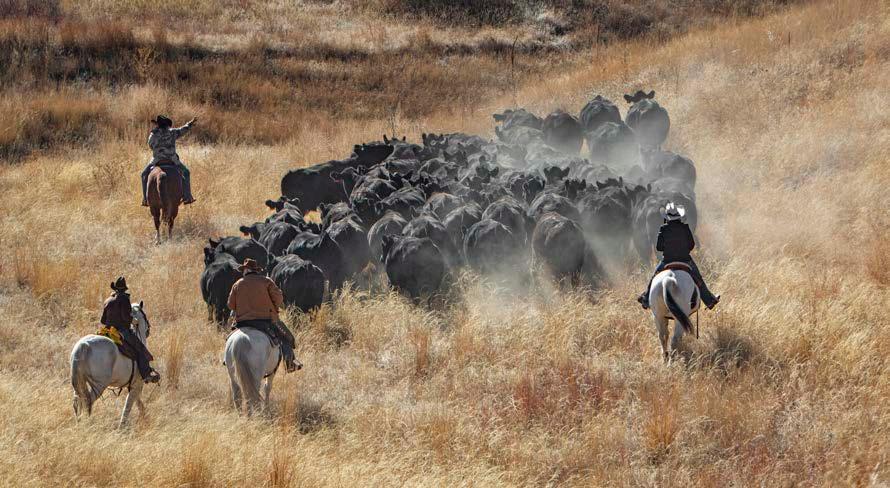
The western tradition moves cattle from summer to winter grazing pastures, pro viding fire mitigation and ad vancing a healthier ecosystem
Sterling Ranch, Colorado’s 21st century master-planned community and the leading community in the greater Den ver market, provides residents with an innovative and amen ity-rich place to call home, is continuing to advance land stewardship and environ mental sustainability with the upcoming annual cattle drive through the community.
On Saturday, October 1 beginning at 11:00 a.m., about 50 head of cattle (part of a 200 head herd that will winter on Sterling Ranch and birth their calves there) will be herded across the 3,400-acre property brought from their summer grazing pastures to their win ter home, as part of a rotation al grazing strategy, a critical way to foster a healthier eco system across the landscapes. Rotational grazing also pro vides an important source of
fire protection for Sterling Ranch as the cattle feed on the prairie grasses that would oth erwise become excessive fuel to feed a fire.
Douglas County itself is planning to include cattle herds in the county’s own fire mitigation plan.
“Cattle grazing might seem like it would have a minimal effect on fire mitigation, but in reality, these cows are de
I dreamt there was an ac tual three-ring circus going on in my home. At the same time, I had two visitors plan ning to stay the night and as I led them past the circus and down the hall to our guest room, I wished them a good night’s sleep despite the noise.
In the way dreams do, it made perfect sense while I was dreaming. Actually, the way my life is, it kind of made sense when I woke up too.
It inspired me to go to the fount of all knowledge, the internet, and research dream interpretation. Sleep experts think dreams are the brain’s way of working through is sues left over from our day. I’m not sure how well it works though because when I woke up my life was still like a circus with the monkeys
loose.
Apparently some of the most commonly reported dream themes are death, be ing late, flying and falling. I’ve had dreams about falling which, according to my re search, could mean I feel like I’m losing control over some thing in my life. If you had a three-ring circus going on in your living room, you’d feel like you were losing control too.
Losing teeth is also a com mon theme in dreams. That seems odd—unless you’re a dentist. I don’t remember ever having that one myself, which doesn’t mean I haven’t. According to the National Sleep Foundation we dream up to six times each night but we forget 95 percent of our dreams. That’s probably a blessing considering some of
vouring ‘fire energy’,” said Harold Smethills, a founder of Sterling Ranch and a Colo rado rancher himself. “Cattle drives are a longtime western tradition and grazing of cattle is a key part of the strategy of building a robust ecosystem and is part of the unique vi sion of Sterling Ranch where the community lives with na ture. By grazing the land, not only is fire risk reduced, but
the hooves of the cattle aerate the land, the cow manure fer tilizes the land, and the low grass provides protection for all types of species from pred ators.”
Before the first home was built at Sterling Ranch, the ownership team worked with experts to create a Prairie Management Plan. The Plan provided a roadmap for man aging and supporting wildlife
cultivating the property which had served as a cattle ranch for many years but had been overgrazed and turned into little more than weeds and dirt. With new plantings in place, the ownership team brought the cattle back to Ster ling Ranch and implemented rotational grazing. The result is a vibrant prairie land that provides forage and shelter for wildlife and an incredible wildlife habitat for Sterling Ranch residents to respect and enjoy.
The upcoming cattle drive at Sterling Ranch will include cowboys and cowgirls, horses and dogs from the Clough Cattle Company who will team-up to move the cattle to their winter home. In addition to the team of hard workers, large numbers of Sterling Ranch residents will likely turn out to watch the cattle drive and celebrate the Colo rado heritage.
More information regard ing Sterling Ranch is available at www.sterlingranch colorado.com.
the most common dreams are about death, falling and losing our teeth.
A lot of people also have school-related dreams even if they’ve been out of school for decades. They don’t know their class schedule; they can’t open their locker or they’re struggling to take a test they haven’t studied for.
I once dreamt I lost a library book. Oh wait. I was awake when I did that.
Another one of the most commonly reported dream themes involves appearing naked in public, though I wouldn’t call that a dream. I’d call it a nightmare.
But according to my re search, if you’ve had this dream, it could mean you’re honest, open and carefree. Or it could mean you’re feeling vulnerable, judged and as if everyone is looking at you. Of course if you’re going around naked they probably are.
Fortunately I don’t recall ever having that one and it seems like the kind of dream I’d remember. I have dreamt many times about appearing in public wearing my bath robe though. I’m not making that up. I’m not sure what it means except that maybe I’m more modest than other dreamers.
I’ve had several dreams where I was back at my for mer place of employment wearing my robe. Maybe it means I was comfortable and relaxed around my coworkers. Or that I cut it kind of close getting out of bed and ready for work when I was em ployed there.
Mostly I have good dreams. But one unpleasant theme that often shows up in my dreams is that of not being prepared. I’m about to give a speech I haven’t practiced or even written. Or I’m in a play and I don’t know my lines. On
the bright side, I’m usually wearing something other than a bathrobe.
Lucky for me, I’m one of those people who occasion ally has what sleep experts call a lucid dream. That’s the kind where you’re aware you’re dreaming so you’re able to control what happens. It doesn’t happen often but when it does, I can learn my lines fast or shoo the circus clowns out of my living room.
I was surprised to read that not everyone has lucid dreams, though I shouldn’t be. If more people could control the outcome of their dreams, they’d put their clothes on be fore they went out in public. Or at least their bathrobe.
Dorothy Rosby is the au thor of three books of humor ous essays, including I Used to Think I Was Not That Bad and Then I Got to Know Me Better. Contact drosby@ rushmore.com
Operation Christmas Child, a project of interna tional Christian relief organi zation Samaritan’s Purse, de livers gift-filled shoeboxes to millions of children in need each year. For 21 years, Cen tennial families have packed shoebox gifts for boys and girls around the world. One of these gifts reached Ana bel Rosario Fermin in the Dominican Republic when she was a young girl. Rosa rio Fermin is now visiting southwest Denver area resi dents to share how the sim ple gift had a life-changing impact.
Rosario Fermin will be
telling her story to local groups and churches. She wants to encourage residents as they kick off the upcom ing collection season to fill more than 14,500 shoeboxes with fun toys, school sup plies and hygiene items— contributing to the global goal of reaching 11 million children in Jesus’ Name.
The community is in vited to hear her first-hand account on Sat., Oct. 1 at 1 p.m. at Waterstone Commu nity Church, 5890 S. Alkire St., Littleton, CO during an Open House and on Sun., Oct. 2 at 9 a.m. at Crow Hill Bible Church, 75 Bull Dog
ger Dr., Bailey, CO to cele brate a 10+ year partnership with Operation Christmas Child.
Rosario Fermin grew up in the Dominican Republic. Her family never had materi al abundance. When she re ceived her shoebox gift, the stuffed animals, school sup plies, and other needed items found inside showed her that God is faithful even when it doesn’t feel that way.
During Operation Christ mas Child’s National Col lection Week Nov. 14 – 21, Centennial residents can bring gift-filled shoeboxes to multiple drop-off locations
across Denver to be an nounced in late October.
For more information, call 303-745-9179 , or visit samaritanspurse.org/occ. Participants can donate $10 per shoebox gift online through “Follow Your Box” and receive a tracking label to discover its destination. Those who prefer the con venience of online shopping can browse samaritanspurse. org/buildonline to select gifts matched to a child’s specific age and gender, then finish packing the virtual shoe box by adding a photo and personal note of encourage ment. Boxes built online go
to hard-to-reach countries.
Operation Christmas Child, a project of Sa maritan’s Purse, seeks to demonstrate God’s love in a tangible way to children in need around the world and, together with the lo cal church worldwide, to share the Good News of Jesus Christ. Since 1993, Operation Christmas Child has collected and delivered more than 198 million giftfilled shoeboxes to children in more than 170 countries and territories. This year, Operation Christmas Child will collect its 200-millionth shoebox!
The headline in last Fri day’s Wall Street Journal read: The Presidents Cup Could Be Decided by the LIV Golf Battle.
Nice attempt at fanning the flames of professional golf’s schism, but in truth, the Pres idents Cup was never in doubt.
The Internationals would have been outmanned even if LIV hadn’t poached a single non-American player.
The PGA Tour has barred pros who jump to the Saudi-backed LIV circuit from playing in a Tour-sponsored event, which includes the Presidents Cup. And LIV has filed an antitrust lawsuit.
But, while the two sides do battle in court and in Con gress, I have an idea.
Why not another team event? It could be bigger than the Ryder Cup and Presidents Cup, combined.
Call it the Loving Cup!
In Loving Cup play, a team from the PGA Tour would play a team from LIV Golf. Granted, there are differences to be resolved, most notably four rounds or three in the competition.
But who wouldn’t want to watch the loyalists versus the renegades . . . the patriots (so to speak) against the traitors?
LIV could field a team that includes Dustin Johnson, Phil Mickelson, Cameron Smith, Brooks Koepka, Bryson De Chambeau, Louie Oosthuizen, Joaquin Nieman and Patrick Reed (and others).
The PGA Tour’s unit could feature Rory McElroy, Scottie Scheffler, John Rahm, Xander Schauffele, Jordan Spieth, Sungjae Im, Justin Thomas
and Patrick Cantlay (among others).
Make the team captains Commissioner Jay Monahan for The Tour and Greg Nor man for LIV—just for extra spice.

Play it in Phoe nix, where crowds at the Waste Man agement Open are allowed—even encouraged—to be raucous in their expressions of approval and disap proval of players’ shots.
The Loving Cup is said to have originated during the 10th century, when King Edward The Martyr was as sassinated while drinking at a banquet. This account states that the king was imbibing from a two-handled cup and thus could not shield himself.
Whatever, it since has been a symbol of both camaraderie and competition for more than 1,200 years. So, why not a mixed metaphor for golf? It certainly would be more fun than any trial or Congressio nal hearing will be.
Instead of just presenting the trophy upon conclusion of the matches, each player from both sides—alternating ly—would be required to take a drink from the Loving Cup and pass it to the next—in keeping with Loving Cup tra dition (pandemic alarmists be damned). The winning side, of course, gets to possess the cup.
Several friends have asked me how I feel about the LIVsters and the breakaway circuit.
Regarding the source of the largesse, I think it’s a question of whether or not each indi vidual feels his participation in the upstart “league” will influence either the worldview
of that nation or its human rights record. The notion that LIV Golf will promote the sport in parts of the world is specious.
As for each personal and professional calculation, I have a hard time criticizing any player who chooses to make the jump.
If you were offered the op tion to travel to tournaments half as often (exponentially increasing family time or per sonal time for other pursuits), while receiving more money than you could reasonably expect to earn if you played your best all the time, would you accept or decline?
That’s the choice the LIVsters weighed then ac cepted.

The advent of LIV Golf re minds me of the early days of the American Football League and the birth of the American Basketball Association. (Den ver was a charter city in both.)
The two-point post-touch down conversion option in pro football and the threepoint shot addition to pro basketball made play in both sports more exciting and in teresting. Former Nuggets coach George Karl recently said the ABA and its innova tions “saved” a “moribund” National Basketball Associa tion.
The key for both upstarts was TV exposure, and so it will be for LIV. If and when its tournaments can be watched on television, LIV will be on the road to comity with The Tour.
Already, The Tour has be gun to adapt in response to LIV, with bigger purses at se lected tournaments and guar anteed participation in more events by its top stars. If/when the animosity subsides, there will be other tweaks that im prove things for players and fans.
What about the fans?
As much as players say they appreciate galleries, and missed them during the height of the pandemic, it’s under standable that the pros would put themselves first in this equation.

The bigger question for me is when will the PGA Tour put fans first?
Loving Cup matches would be a step in that direction. It’s more or less how the Super Bowl began.

Order online from Amazon.

Denny Dressman is a vet eran of 43 years in the news paper business, including 25 at the Rocky Mountain News, where he began as executive sports editor. He is the author of 14 books, eight of them sports-related. You can write to Denny at dennydressman@ comcast.net



 Go behind the scenes as the Colorado Rockies come to life then win the official Coors Field opener in classic walkoff fashion in the 14th inning. And relive their greatest game and their greatest season, ending with Matt Holiday's head-first slide in the 13th - 12 years later.

The Common Sense Institute (CSI) an nounced Kelly Cau field will serve as the non-partisan research organiza tion’s new Executive Director in Colorado.

Caufield is currently the Vice President at Colorado Succeeds, and has served in a number of other policy roles, in Colorado and Washington, DC, including as a policy aide in the US House and Senate.
“Kelly is one of Colorado’s most respected policy minds. She’s smart, she’s a tested executive, and we know she is going to take CSI to new heights,” said CSI President & CEO Kristin Strohm. “CSI has become a force in Colorado’s most important policy debates, and with Kelly Caufield call ing the shots, we know our voice and our impact will only grow.”
CSI is a non-partisan re search organization dedicated to the protection and promotion of Colorado’s economy. CSI currently operates in two states, Colorado and Arizona, with plans to launch additional state chapters. Strohm is handing the leadership reigns of CSI in Colorado to Caufield and will focus on the organization’s na tional expansion push.
“In joining Common Sense Institute Colorado, I am ex cited to ensure economic data continues to be a part of the public discourse surrounding state policies impacting Colo radans and the economy,” said Caufield. “In a time of growing divisiveness, centering more policy conversations around fact-based, objective data is critical to strengthening Colo rado’s economic competitive ness.”
non Bird added her accolades to the announcement, “Con gratulations to Kelly Caufield in her new role with the Com mon Sense Institute. Important ly, however, congratulations to the Common Sense Institute on its choice of Kelly Caufield to serve in the role of Execu tive Director. I have had the privilege of working with Ms. Caufield for the past four years at the Capitol and know the quality of her leadership. She is an impeccable professional with a keen understanding of Colorado politics and is well respected by Republicans and Democrats alike. I look for ward to every opportunity to continue working with her in her new capacity.”
“There is no one better suited to take on this role than Kelly Caufield. She reflects
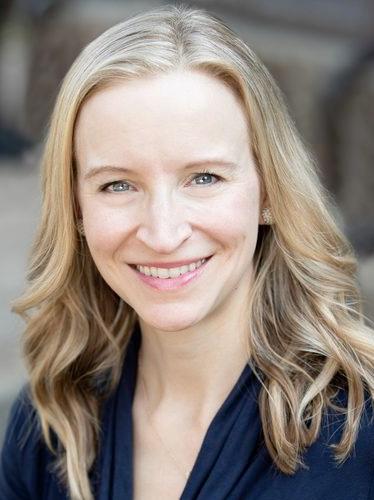
the CSI brand,” said Debbie Brown, President of the Col orado Business Roundtable.
“Kelly understands public poli cy, values data driven solutions and is committed to developing innovative solutions built on bipartisanship and different points of view. I look forward to working with her and the entire CSI team.”
About Kelly Caufield: Kel ly brings nearly 20 years of policy, research, and advocacy experience to CSI. Prior to joining the team, she was the Vice President of Government Affairs at Colorado Succeeds

where she helped lead state wide coalition building efforts that brought diverse business, education, and community partners together around a shared policy agenda. She also served as a a federal lobbyist for the Society for Human Re source Management (SHRM), focusing on labor, workforce, and education lobbying efforts on behalf of 275,000 HR busi
ness professionals. Her experi ence also includes a tenure on Capitol Hill working for a U.S. Senator and U.S. Congress man. She attended the College of William and Mary for her undergraduate degree and George Washington University for her master’s degree in Pub lic Policy. She currently lives in Denver with her husband and two sons.
In honor of JA-Rocky Moun tain President & CEO Robin Wise’s 30th anniversary with JA, a group of JA board members en dowed the Robin Wise Scholar ship. We are thrilled to announce the first recipient of this award is JA alum, Charles O’Donnell. Charles has participated in sev eral JA programs including: JA Rapid Business Planning and JA Launch Lesson as well as mock interview and career speaker events. Through these experi ences, JA staff observed Charles embody the entrepreneurial spir it. Before enrolling this fall at the Colorado School of Mines to study Mechanical Engineering, Charles graduated from Grand view High School, attended the Cherry Creek Innovations Campus, and was even an Am

bassador at the 2022 Colorado Business Hall of Fame. Congrat ulations Charles!
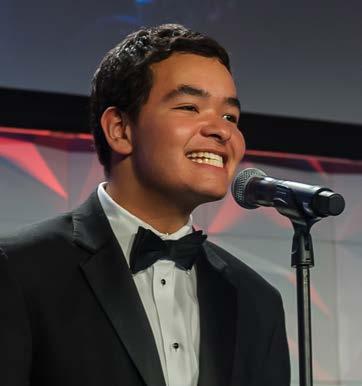
JA Be Entrepreneurial: Rapid Business Planning:
A modular program that chal lenges students to start their own entrepreneurial ventures while still in high school and learn about the mindset and skills needed for success from real world entrepreneurs. In the Rap id Business Planning module, students learn about Lean Can vas, the strategic management template for developing business models. The business model canvas is an easy-to-understand, one-page business plan that is the foundation for fleshing out a business idea. Participating students may elect to enter JA USA’s Social Innovation Chal lenge in March for a chance at national recognition.
JA Launch Lesson: JA Launch Lesson is delivered by community entrepreneurs. Students gain firsthand knowl edge about starting a business and the entrepreneurial journey.
State Representative Shan Kelly Caufield“In a time of growing divisiveness, centering more policy conversations around fact-based, objective data is critical to strengthening CO’s economic competitiveness.”
– Kelly CaufieldCHARLES
The rate of teen suicide in Colorado increased by 58% in 3 years, making it the cause of 1 in 5 adoles cent deaths. Add this to the fentanyl crisis and teens are in peril. Scouring journals and research, this list emerged as to root cause issues.
• Single Parent Households: Since the 50’s the number of single-parent homes has consistently increased to an alarming rate. A Pew Re search Report outlines that for the first time in American history, 25% of children live in single-parent households. This has economic implica tions as single-parent house holds are under-resourced which often has deleterious effects on mental and phys ical health, educational at tainment, and involvement in higher rates of risky behav iors for adults and children.
• Drugs and Alcohol Abuse: Opioids, meth, marijuana, and binge drinking and now fentanyl is at epidemic lev els for adolescents. Young people are checking out and getting high. This is damag ing to the growth and devel opment of the teen brain and will affect the quality of life and future health and success of these children.

• Kids Growing Up Too Fast: Access to the internet and to the sexually saturated culture
is stealing the innocence of the youngest among us. Unless parents are hyper-vigilant, it is hard to keep this material at bay. Children are also isolated from face to face healthy relation ships and express that they are lonely and alone which makes them at risk for sexual exploitation.
• Violence and Bullying in Schools: In many instances, especially in low income, urban settings, schools can be a war zone. There is mean-spirited behavior, gossip, bullying, and even serious violence. There are school shootings, stabbings, fighting and suicides.
• Materialism and Enti tlement: We live in data a society that values material possessions and consum erism. We go into debt to get the things that we want. Research indicates that the average credit card debt for most Americans is at least $10,000. The value of get it now, pay later, is being passed down to children.
• Childhood Obesity: Ac cording to CDC, 20% of children are obese. This can result in low self-esteem, depression, and other health concerns.
• Educational Disparities: The rich are getting richer and the poor, poorer. Without a proper education and life
script, children living in pov erty or in under-resourced communities will be unable to compete in the job market and global economy.
• Shifting Economy: Loss of manufacturing jobs and automation with technology is shifting the workforce into the service industry. Service jobs are being outsourced.
If service jobs are in the United States, they usually command a lower wage to compete with the overseas employee base.
• Poverty: Poverty is a social determinant of health. Hun ger, homelessness, violence, crime, substance abuse, aca demic failure is all related to poverty.
• Civic Disunity and Erosion of National Pride: Not say ing the Pledge of Allegiance in schools and kneeling during the National Anthem are symptoms of a much larger problem. Not knowing basic civics and the rights afforded to us by God (en dowed by our Creator) puts the next generation at risk of being controlled by big gov ernment.
The Center for Relationship Education (CRE) is poised to build a national collaborative effort to address these issues.
Money is available through the ColoradoWorks and other na tional welfare programs. Three out of the 4 welfare goals are met by CRE initiatives:
• reducing the dependency of needy parents by promoting
job preparation, work, and marriage
• preventing out-of-wedlock pregnancies
• encouraging the formation and maintenance of two-par
ent families.
Let’s work together to help children thrive and flourish by addressing this national crisis.
joneen@myrelationshipcenter. org

October 9th, 2022 deKoevend Park, Centennial, CO 11:30 AM to 3:30 PM

Bullying Recovery Resource Center (BRRC) defends bullied children and helps rebuild lives. We work to ensure that all Colorado families experiencing bullying are empowered through education and advocacy to defend their children where the bullying occurs. We are committed to building a community of support to help families rebuild and recover together.



 BY H. THROTTLE AUTOMOTIVE COLUMNIST
The 2023 Hyundai Palisade “Calligraphy,” was delivered this past week and what a handsome all-wheel drive, 3- row seating ve hicle. This is a larger SUV with a V6/3.8L engine driving an 8-speed automatic transmission with steer ing wheel paddle shifters.
No need for turbo-boosting for this Palisade with more than adequate power and performance. The Palisade offers a wide choice of drive modes that include eco, comfort, sport, smart, and snow.
With the larger engine, the sports mode was exhilarating and using the eco mode increased the miles averaging 21 mpg overall.
The Palisade, like sister models of Tucson, and Santa Fe, has a full range of “Smartsense fea tures.” Vehicle safety is so vital to modern day driving and the Pal isade provides forward collision avoidance, lane keep assistance, blind spot warning, safe exit assist, driver attention alerts, high beam assists, smart cruise control, rear cross-traffic avoidance, remote parking assist, rear entry occu
pant alerts. The wide range of safety features earns the Palisade a five-star rating in frontal crash categories.
Design and style have been updated for 2003 with a new instrument panel, steering wheel design, cascading front grille, 20-inch multi-spoke allow wheel design, and new Nappa leather seating surfaces.
Overall, this is a top-line vehi cle with high performance, attrac tive appearance, quality interior space with three-row seating.
The drive is flexible with the
different modes, most of the test drive was performed in “Sport” mode. Especially useful is the blind spot dash picture of rear passing lanes, allowing a quick glimpses to make sure there is no lurking blind spot vehicle.
The Palisade has updated smart phone charging stations from 5W to 15W. The front captain seat has “Ergo-motion massaging features and all row seat heating.
The Hyundai Palisade is totally assembled in Ulsan, Korea.
The suggested manufacture’s price is $52,310 with all options included. Hyundai features one of the highest warranties with a 10 year/ 100,000-mile power-train warranty.
This is a luxury vehicle with the same name as the delicious Colorado grown peaches in Pali sade, Colorado.
DISTRICT COURT COUNTY OF ARAPAHOE STATE OF COLORADO, 7325 S. Potomac Street Centennial, Colorado 80112 (303) 649-6355 Telephone
PEOPLE OF THE STATE OF COLORADO, Petitioner, IN THE INTEREST OF:

SOBRINA MARIA ARCHULETA, Child, and concerning, MARESSA ARCHULETA AND JOHN DOE, Respondents.
Kristi Erickson, Esq., Reg. #50739
Assistant County Attorney Attorney for Petitioner 14980 East Alameda Drive Aurora, CO 80012

Tel: (303) 752-8989

Fax: (303) 636-1889
Case No: 21JV683
Division: 22
NOTICE OF ADJUDICATORY HEARING AND DEFAULT JUDGMENT CONCERNING RESPONDENT FATHER, JOHN DOE
To The Respondents:
PLEASE TAKE NOTICE that an Adjudicatory Hearing regarding JOHN DOE is set for October 24, 2022, at the hour of 3:00 p.m. in Division 22, at the Arapahoe County District Court, 7325 South Potomac Street, Centennial, Colorado 80112. You have the right to be represented by an attorney during these proceedings; if you cannot afford an attorney, one will be appointed to represent you. In the event you fail to appear for said hearing at the date and time indicated, the Petitioner will request that the Court enter a default judgment against you and adjudicate the child, dependent and neglected in accordance with the Colorado Children’s Code.
Due to COVID 19, the Arapahoe County District Court is holding hearings via Cisco WebEx Meetings to allow for audiovisual and/or audio participation. Participants may use any computer, tablet or smart phone equipped with a camera and microphone for audiovisual participation. Parties should use the following link:
• https://judicial.webex.com/meet/ don.toussaint
• Enter your name and email
address (so we know who you are). You will then be in the virtual courtroom.
• Select your audio setting. If the audio on your computer or tablet does not work, please use the alternate audio option of calling in to the number below.
If you do not have a device that will support a video connection, you may still participate by audio only by calling 720-650-7664. When prompted enter Access code: 927 831 127 then press #, # (no attendee ID is needed).
YOU ARE FURTHER COMMANDED to appear before the Court at said time and place, either in person or by phone. If you elect to appear in person, you must be at the Courthouse a half hour before the hearing is scheduled to begin.

Date 09/20/2022
Kristi Erickson, Reg. #50739
Assistant County Attorney Attorney for the Petitioner
Published in The Villager
Published: September 29, 2022 Legal # 10850
CITY OF CHERRY HILLS
NOTICE
NOTICE IS HEREBY GIVEN that the proposed budget for the ensuing year of 2023 has been submitted to the Southeast Public Improvement Metropolitan District (“District”).Such proposed budget will be considered at a meeting and public hearing of the Board of Directors of the District to be held at 12 p.m. on November 15, 2022 at the offices of Denver South Economic Development Partnership, 304 Inverness Way South, Suite 315, Englewood, CO. Information regarding public participation by videoconference will be available at least 24 hours prior to the meeting and public hearing online at www. southeastpublicimprovementmd.colorado.gov/ or by contacting Kelly Conover, by email at kelly@mulhernmre.com.

NOTICE IS FURTHER GIVEN that an amendment to the 2022 budget of the District may also be considered at the above-referenced meeting and public hearing of the Board of Directors of the District.A copy of the proposed 2023 budget and the amended 2022 budget, if required, are available for public inspection at the offices of Mulhern MRE, Inc., 188 Inverness Drive West, Suite 150, Englewood, CO 80112. Any interested elector within the District may, at any time prior to final adoption of the 2023 budget and the amended 2022 budget, if required, file or register any objections thereto.
SOUTHEAST PUBLIC IMPROVEMENTPublished in The Villager Published: September 29, 2022
Legal # 10852
VILLAGE ADOPTION OF ORDINANCE ORDINANCE 14, SERIES 2022
A BILL FOR AN ORDINANCE OF THE CITY OF CHERRY HILLS VILLAGE AMENDING ARTICLES II, IV, AND IX OF CHAPTER 16 OF THE CHERRY HILLS VILLAGE MUNICIPAL CODE CONCERNING ZONING REGULATIONS PERTAINING TO HORSES AND OTHER AGRICULTURAL ACTIVITIES
Copies of the Ordinances are on file at the office of the City Clerk and may be inspected during regular business hours.
Published in The Villager Published: September 29, 2022 Legal # 10851
Arapahoe County will redraw boundaries for county commissioner districts in 2023. The County is seeking interested residents to serve on a Citizen Redistricting Advisory Committee to help draw proposed new district maps for consideration by the Board of County Commissioners. Visit arapahoegov.com/getinvolved


“Take Delight in the Lord.”
SEPT. 30. 7 a.m. - 3 p.m. at Infinity Park Event Center, Glendale. Keynote Speaker: James Barthel, MBA, Founder & former CE O of Metals Treat meant LLC, a National Company. Info: ccballiance.org
In observance of Arapahoe Day.
OCT. 4, 5-7 p.m. In the Streets of Southglenn. Food and beverage will be provided. RSVP: 303-795-0142.
OCT. 6, 6:30-8 p.m. David Taylor’s Zikr Dance Ensemble. Tickets: MOAONLINE. ORG Food truck available. 6331 S. Fiddler’s Green Cir., Greenwood Village.
OCT. 8, 9 a.m. - 12 p.m. 17 Mile House Farm Park, 8181 S. Parker Rd., Centennial. Learn about the property’s daily history (1880-1950). Visit the milking parlor, milk house, and butter corn display. Make
and taste your own butter! A free event, but registration is required. Visit arapahoegov. com/17milehouse.
OCT. 8, registration begins at 8 a.m., kick-off at 10 a.m. at Red Tail Park, Aurora. One Mile walk. Form a team or sign up as an individual. Spina Bifida; a neural tube birth defect that happens in the first month of pregnancy when the spinal column doesn’t for properly, leaving nerves exposed and resulting in damage to the spinal cord. This is a 501c3 association. Sign up at www. spinabilidaco.org
OCT. 9, 11:30 a.m. - 3:30 p.m. at deKoevend Park, Centennial. Benefiting Bullying Recovery Resource Center. BRRC defends bullied children and helps rebuild lives through education and advocacy to defend children. Register: https:/runsignup. com/Race/CO/Littleton/ BRRCUpstande5K
The 29th Annual event will be chaired by Pat Robinson and will feature country star Justin Moore! Table sponsorships available before June 30 Visit Western.com or contact Michael James mjames@ voacolorado.org or 303-2970408.
JEFFERSON SYMPHONY ORCHESTRA 70TH ANNIVERSARY SEASON OPENER
OCT. 16, 3 p.m. at Colorado School of Mines Green Center. MauriceCohn, candidate conductor, conducts Bartok. Tickets: jeffsymphony.org
EVENING SHOPPING FUNDRAISER FOR FRIENDS OF NURSING OCT. 26. Evening shopping at the WISH Boutique on S.
Gaylord St to raise money for the 2023 Scholarship Fund. 15% of purchases between 6 and 8 p.m. will be donated to FON Scholarship Fund. WISH is located at 1099 S. Gaylord. Funds will be used for nurse scholars attending Colorado’s 9 Schools of Nursing.
OCT. 29, 10 a.m. - 2 p.m. at the Police Dept. Police Dept. & Drug Enforcement Admin. will take expired, unused, and unwanted prescription drugs. 2460 E. Quincy Ave. Service is free & anonymous.
NOV. 5, 10 a.m. - 2 p.m. Free admission. 23155 E. Heritage Pkwy. (South of Arapahoe Rd.)
NOV. 10-13. Weekend of community service projects benefitting those in need & supporting important causes and organizations. Benefiting 50+local nonprofit agencies. Volunteer registration opens Oct. 17. More info: projector town.org/sponsors or QR code in Sept. 8 Villager, page 20.
RUE DE NOEL A PARIS STREET CHRISTMAS MARKET NOV. 11 & 12. Indoors - Douglas County Events Center. 10 a.m. - 5 p.m. Free Admission. Visit aparisstreetmarket.com or call 303-877-9457.
Ed Bozarth Chevrolet Aurora is now CELEBRATION CHEVROLET under the leadership of Kent Bozarth. Located at 2001 S Havana Aurora. Delivery anywhere in Colorado. Visit www.celebrationchevrolet. com for information on this third generation led family automobile business.
JAN. 7-22, 2023. The 117th NWSS will host 29 rodeo performances and a full schedule of horse shows. Info: nationalwestern.com

Manager – Regional Explo ration (North America) for Newcrest Resources, Inc. in Greenwood Village, CO. Resp for discovering & identifying future mineral deposit oppor tunities to maintain portfolio of mining growth opportunities in the N. America Region. Reqs. Incl: Bachelor’s deg. in Geolo gy/rltd & 12 yrs post-bach exp.,
incl. some exp in exploration for different styles of gold & copper mineralization. Approx. 40% domestic & int’l travel req. Allows for occasional remote work. To apply, mail resume to Tina Barreto, New crest Resources, Inc., Harlequin Plaza, 7600 E. Orchard Rd, Ste 260 South, Greenwood Village, CO 80111.
535A, Cherry Hills Village, Co 80113 Available: Now Sanford Circle E, 5380 $5,500 (3 x $19,485)
**No more than 2 unrelated in dividuals on a lease**
Cherry Hills North Ranch style home built in 1976 with 3 bedrooms, 5 bathrooms, 3-car garage and over 3300 sq.ft. up plus a finished basement of approximately 1000 sq.ft. large living room and dining room, family room upstairs with fire place. Recreation or 2nd family room located in the basement. Covered patio. Fenced backyard.
Sprinkler system. Circular drive. Cherry Creek Schools. Close to the Highline Canal, walking/ biking paths. Within a mile of Kent Denver and two miles from Cherry Hills Elementary. Easy access to all parts of the city. Tenant(s) are required to have renter’s insurance prior to move in.
*Tenant(s) will have no use of the pool, or the hot tub* All Measurements are approximate.
Call Kurt Krantz303-210-9515
Littleton Real Estate Company





Safe
Call Today!

Call Safe Step: 1-877-596-2899
 Colorado