$2 Each
Since 1982
L O C A L
N E W S
M A T T E R S
Scan here read online at www.villagerpublishing.com
VOLUME 44 • NUMBER 47 • OCTOBER 15, 2026
44 Years of Award-Winning Journalism
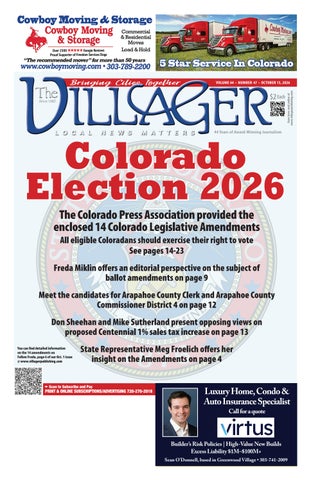
Colorado Election 2026 The Colorado Press Association provided the enclosed 14 Colorado Legislative Amendments All eligible Coloradans should exercise their right to vote See pages 14-23 Freda Miklin offers an editorial perspective on the subject of ballot amendments on page 9 Meet the candidates for Arapahoe County Clerk and Arapahoe County Commissioner District 4 on page 12 Don Sheehan and Mike Sutherland present opposing views on proposed Centennial 1% sales tax increase on page 13 You can find detailed information on the 14 amendments on Follow Freda, page 6 of our Oct. 1 issue @ www.villagerpublishing.com
State Representative Meg Froelich offers her insight on the Amendments on page 4
Scan to Subscribe and Pay
PRINT & ONLINE SUBSCRIPTIONS/ADVERTISING 720-270-2018
Luxury Home, Condo & Auto Insurance Specialist Call for a quote
Builder’s Risk Policies | High-Value New Builds Excess Liability $1M–$100M+
Sean O’Donnell, based in Greenwood Village • 303‑741‑2009
PAGE 2 | THE VILLAGER • October 15, 2026
A RARE ESTATE WITH
MOUNTAIN, LAKE & GOLF COURSE VIEWS IN THE VILLAGE AT CASTLE PINES
FOR
SAL E
1054 CYPRESS WAY
OFFERED FOR: $4,500,000
C A S T L E P I N E S C O U N T R Y C L U B G O L F M E M B E R S H I P AVA I L A B L E – S K I P T H E 2 + Y E A R WA I T L I S T !
EXCEPTIONAL OUTDOOR ENTERTAINING SPACE
STUNNING GREAT ROOM AND ELEGANT INTERIORS
STACIE CHADWIC K 303.829.4713 SCHADWICK@LIVSOTHEBYSREALTY.COM STACIECHADWICK.COM
WALKOUT LOWER LEVEL WITH WET BAR
For those seeking an exceptional lifestyle defined by privacy, security, and luxury, The Village at Castle Pines offers a truly distinctive opportunity. With gated entrances, 24-hour security, spectacular mountain views, championship golf, miles of scenic trails, pools, tennis and pickleball courts, residents enjoy an impressive collection of amenities. Combined with exceptional real estate value, The Village offers a compelling alternative to some of Denver’s most prestigious neighborhoods.
October 15, 2026 • THE VILLAGER | PAGE 3
ENJOY THE SOUNDS OF THE SEASONS WITH
Healthy Hearing Don’t let the best moments fall through the cracks. Call for your evaluation today!
T
he 2026 L’Esprit de Noël Holiday Home Tour is the 50th edition of this popular fundraiser and one of 720.457.5113 Denver’s signature holiday events. CENTENNIAL This year’s tour takes place at the Denver 7180 E Orchard Rd, Ste 302 Country Club on Friday and Saturday, NoJulie Link, Brittany Vaggalis, Doctor of Audiology Doctor of Audiology vember 20th and 21st. Five elegant and (CO Lic. #: AUD.0000725) (CO Lic. #: AUD.0000959) diverse homes in this distinguished community will be creatively decorated for the TheAudiologyMethod.com holidays by some of the metro area’s most accomplished florists and table designers. Proceeds benefit Central City Opera. The tour is self-guided and open between 10 am and 4 pm on each day. Your ticket is valid for either day. Discounts on tickets ions for active members of Donatpted the Central City Opera acce v. 20 No Guild will apply auNow– tomatically at checkout. Click here to join the Guild or renew an existing membership! For assistance with purchasing tickets, please call the Box Office at 303-292-6700 (Mon-Fri, 10AM to 4PM). For day-of ticket asHelp make Thanksgiving special for Human Services clients sistance and Will Call, More than 500 vulnerable children, their families, and individuals served by Arapahoe County Human please visit the Patron Services need community support this Thanksgiving. Every year, staff brings complete Thanksgiving Services team (address meals to hundreds of clients who would otherwise go without on the holiday. You can help by TBA). donating food (through Nov. 20) money, or your time. More information can be found at the L’Esprit Learn how at arapahoeco.gov/ThanksgivingFoodDrive. de Noël website: https:// www.lespritdenoel.org For standalone tickets to the L’Esprit de Noël Golden Jubilee Celebration on NovemOCTOBER IS ber 19th, go to: https:// centralcityopera.org/ lesprit-de-noel-golden-jubilee-celebration2026
DOMESTIC VIOLENCE AWARENESS MONTH Learn more at arapahoeco.gov/gethelp or visit ncadv.org
Election Day is coming Return your ballot or vote in person by 7 p.m. on Nov. 3!
arapahoeco.gov
Visit arapahoegov.com/osmasterplan to read the DIVE summary report.
WEEK OF OCT. 12
Opinion
PAGE 4 | THE VILLAGER • October 15, 2026
COLORADO’S CHANGING CONGRESSIONAL POWER
After watching Colorado politics for more than six decades, I thought I had seen just about everything. This year’s congressional races have me reconsidering that conclusion. Three races, in particular, tell three very different stories about Colorado politics: Denver’s loss of longtime Congresswoman Diana DeGette; Lauren Boebert’s challenge from retired Navy Rear Adm. Eileen Laubacher; and the fascinating contest between Republican Gabe Evans and Democrat Manny Rutinel in Colorado’s 8th Congressional District. Start with Denver. Diana DeGette represented Denver in Congress for 29 years and 15 terms. She had built up the kind of seniority and Washington relationships that take a lifetime to acquire. Then a 29-year-old political newcomer, Melat Kiros, a democratic socialist, defeated her in the Democratic primary. That is a remarkable change. Regardless of one’s politics, Denver lost a very senior member of Congress. DeGette had accumulated enormous institutional knowledge and influence in Washington. Now that seat will have a new representative for the first time in nearly 30 years. It reminds me that in politics, nothing is permanent — not even 15 terms. Then we come to Lauren Boebert and Eileen Laubacher. What an unusual matchup.
dinarily qualified in many ways. Boebert came into national politics from Rifle and a restau- I could see her being an outrant business and has built her- standing university president or self into a nationally recognized leader of a major institution. Republican and now But Congress is a different job. the senior Republican Congress requires member of Colorado’s more than a résumé. It House delegation. requires a personal conHer opponent is almost the exact opposite nection with the people kind of political biogyou represent — includBY BOB SWEENEY raphy. ing the farmer, rancher PUBLISHER Laubacher graduated and small-business from the U.S. Naval Academy, owner hundreds of miles from spent 34 years in the Navy, rose Washington. to rear admiral, served in intelThat will be one of the most ligence, worked in Afghanistan, interesting things to watch in served as the senior U.S. dethis race. fense official in India and later And then there is the money. worked on the National Security Laubacher has raised more Council. than $10 million for the camShe is an impressive woman. paign. That is an astonishing amount of money for a ColoraShe and her husband have do congressional race and tells five children, and the family has lived in Colorado since the us that national Democrats see the 4th District as worth conlate 1990s. She lives today in testing. Highlands Ranch. She was a Finally, drive north to the 8th Republican, changed to unaffiliated and then registered as a Congressional District. Democrat in 2025. This may be the most fascinating district of the three. I find that political journey Republican Gabe Evans and fascinating. Democrat Manny Rutinel are I also find the geography both Latino. Both are well-qualfascinating. Here is a woman who spent ified. Both have Colorado connections. But politically they 34 years serving the federal represent dramatically different government and building an extraordinary career in national sides of the political spectrum. Evans is a Republican, forsecurity who now wants to mer Army helicopter pilot and represent a congressional district that stretches across the former police officer who won Eastern Plains, where farmers the congressional seat in 2024 and ranchers have very different by fewer than 2,500 votes. day-to-day concerns from the Rutinel is a Democrat, attornational-security world in which ney, economist and state legislator whose mother immigrated she spent her career. from the Dominican Republic. That doesn’t make her unqualified. Far from it. He has been elected to the ColoIn fact, I think she is extraor- rado House and is now trying to
move to Washington. The district itself is a political laboratory. About 40% of its population is Latino. It stretches from the Democratic-leaning northern Denver suburbs through Commerce City and Thornton and into the more conservative communities of Weld County and Greeley. And here’s the remarkable part: Latinos aren’t a single political bloc. The two candidates demonstrate that very clearly. Two Latino candidates. Two very different political philosophies. In 2022, a Democrat won the district by about 1,600 votes. In 2024, Evans won it by fewer than 2,500. Now they are fighting over it again. So here we have three congressional races that tell us something about Colorado. Denver loses 29 years of congressional experience. A retired two-star admiral with an extraordinary national-security résumé takes on Lauren Boebert in a district where local identity and rural issues will matter enormously. And two Latino candidates, one Republican and one Democrat, face each other in the state’s true political battleground. Three races. Three very different stories. And perhaps the biggest story is that Colorado politics is changing before our eyes. After six decades of watching Colorado politics, I have learned not to predict too much. But I sure intend to watch.
The Villager
Office: 22095 E. Chestnut Place, Aurora 80016 • (303) 773-8313 A legal newspaper of general circulation in County, Colorado. (USPS 431-010) Published weekly by The Villager Publishing Co., Inc. 22095 E. Chestnut Place, Aurora 80016. Available for home or office delivery by U.S. Mail for $85 per year. Single copies available for $2 per issue. PERIODICALS POSTAGE PAID IN GREENWOOD VILLAGE, CO. 80112 AND ADDITIONAL MAILING OFFICES. A Colorado Statutory Publication CRS (197324-70 et al). USPS # 431010 ISSN 1539-6274 (Print) ISSN 2993-7280 (Online) Postmaster: Send address changes to The Villager, 22095 E. Chestnut Place, Aurora 80016 Deadlines: Display Advertising, Legal Notices, press releases, letters to the editor, 4:00 p.m. Friday. Classified Advertising, noon Monday.
PUBLISHER & EDITOR Gerri Sweeney gerri@villagerpublishing.com PUBLISHER Robert Sweeney bsween1@aol.com CREATIVE MARKETING DIRECTOR/ CO-PUBLISHER Susan Sweeney Lanam 720-270-2018 susan@villagerpublishing.com LEGALS Becky Osterwald legal@villagerpublishing.com NEWS EDITOR Gerri Sweeney 303-773-8313 gerri@villagerpublishing.com SENIOR REPORTER Freda Miklin fmiklin.villager@gmail.com 303-489-4900 REPORTER Robert Sweeney bsween1@aol.com FASHION & LIFESTYLE Scottie Iverson swan@denverswan.com DESIGN/PRODUCTION MANAGER Tom McTighe production@villagerpublishing.com ADVERTISING CONSULTANTS Susan Lanam — 720-270-2018 susan@villagerpublishing.com Sharon Sweeney — 303-503-1388 cogambler@mac.com Gerri Sweeney — 720-313-9751 gerri@villagerpublishing.com Scottie Iverson swan@denverswan.com
Propositions, Referred Measures and Amendments Oh My! BY STATE REPRESENTATIVE MEG FROELICH
This year’s 2026 Ballot is the longest in Colorado history. Our all-mail balloting system allows for us to sit with our ballots, research them thoroughly and then vote from the comfort of our homes. The 2026 Ballot will be a test of voters’ savvy as they navigate conflicting messages, a long ballot and huge dollars invested in campaigns with limited transparency. Only afterwards will we know the totals spent by organizations like Advance Colorado and we may never know complete information on who donated the millions raised and spent.. Despite a well-crafted Blue Book the size of an old phone book, there is understandable confusion among voters. Many voters don’t understand the difference between Constitutional Amendments, Referred Measures and Citizen Initiatives. As an advocate and later as a legislator I have been involved in getting measures onto the ballot, the campaigns
for and against initiatives, and I have sponsored bills to refer measures to the voters. We have direct democracy in Colorado - a matter can be put to the voters by collecting signatures of registered voters and meeting the required thresholds. These are “citizen initiatives.” They may be an Amendment or a Proposition and will be a numbered item on your Ballot. Amendments must obtain 55% percent of the vote and Propositions 50% +1. There is a fairly rigorous process that takes place prior to
signature gathering including Review and Comment Hearings with non-partisan Legislative Council before being filed with the Secretary of State’s Office. The measures also go before the Title Board to make sure they adhere to our single subject law and to finalize Ballot language. Signature collection on a Statewide measure are massive undertakings and almost all entities engage paid signature gatherers. Referred Initiatives are also on your ballot. These come from a Government entity the Legislature for Statewide measures or Local Governments for smaller districts. They are lettered. Over the past decade or so, Ballot measures have been a go-to method to achieve political goals that don’t have a chance at the Legislature. Just the threat of a Ballot measure can lead to intense negotiations sometimes referred to as the Ballot Measure Wars. I was one of the sponsors
of Proposition KK - an excise tax on guns and ammo to fund Domestic Violence programs, which was passed by the voters in 2024. A Proposition referred by the Legislature goes through the same process that a Bill does. There are committee hearings in each chamber, often more than one. There is witness testimony and negotiations before debate and votes in both the House and the Senate. So in some regards, referred measures are “easier” but that presumes passing a bill is easier than convincing voters outside of King Soopers to sign a petition. Voters should seek out trusted ballot guides, read the Blue Book thoroughly and most importantly, VOTE. A few blanks won’t sway the election but too many folks sitting this one out because of the long ballot could be devastating to our State. Meg Froelich has represented House District 3 in the Colorado Legislature for the past 8 years and is term-limited.
SUBSCRIPTIONS Gerri 303-773-8313 EDITORIAL COLUMNIST Robert Sweeney bsween1@aol.com The Villager is an award-winning, locally owned, independent newspaper. All letters to the editor must be signed. The contributor’s name, hometown and phone number must also accompany all letters to the editor for verification and we reserve the right to edit contributions for space. We attempt to verify all matters of fact but hold contributors liable for the content, accuracy and fairness of their contributions. All submissions become the property of The Villager and may be reused in any medium.
Reverend Martin Niemoller “In Germany, the Nazis first came for the communists and I didn’t speak up because I wasn’t a communist. Then they came for the Jews and I didn’t speak up because I wasn’t a Jew. Then they came for the trade unionists and I didn’t speak up because I wasn’t a trade unionist. Then they came for the Catholics and I didn’t speak up because I was a Protestant. Then they came for me and by that time there was no one left to speak for me!”
2026 Member
QUOTE of the WEEK
Power is like QUOTE of the WEEK being a lady... if you have to tell people you are, you aren’t.
– Margaret Thatcher
October 15, 2026 • THE VILLAGER | PAGE 5
YOU’RE I NVITED TO
National Pasta Day SU N DAY, O C TOBER 18 | LUNCH & D I N N E R
BUY ANY PASTA, GET ONE FREE Complimentary pasta must be of equal or lesser value. One complimentary pasta per qualifying pasta purchase. Not valid with other discounts, promotions or prix fixe menus. Dine-in only Sunday, October 18, 2026.
MAKE RESERVATIONS TODAY:
www.OLIVERSITALIAN.com 4250 YOSEMITE STREET IN GREENWOOD VILLAGE • 303-862-8507
FALL IN LOVE With St. Andrew’s Village!
Fall in love with St. Andrew’s Village, where welcoming neighbors, thoughtful care and engaging activities create a comfortable place to call home. Enjoy seasonal dining and inviting gathering places, with living options and personalized support that meet a range of needs. Discover a place to feel at home this fall and beyond.
UP SAVE TO 50% OFF
3 MONTHS’ RENT* and lock in 2026 rates!
SCHEDULE YOUR TOUR TODAY ENJOY LUNCH ON US! 720.684.5913 StAndrewsVillageSeniorLiving.com 13801 East Yale Avenue, Aurora, CO 80014 Active Independent Living | Assisted Living | Rehabilitation & Skilled Nursing Available On-Site** *Valid for Independent Living new residents and select apartments only. Cannot be combined with other offers. Subject to change.**Skilled Nursing Operated Independently by: The Ensign Group, Inc. ©2026 Discovery Management Group. All Rights Reserved. Prices, plans and programs are subject to change or withdrawal without notice. Void where prohibited by law. Managed by Discovery Management Group. Assisted Living Facility License #23G126 STAN-0164 9/26.
PAGE 6 | THE VILLAGER • October 15, 2026
Discover resources for health, aging in place, scam prevention, veterans services, volunteering and more. Connect with local organizations and learn about fun and educational programs at the library. Light refreshments provided.
For more information and to reserve your spot, scan the QR code or visit arapahoelibraries.org/events
Friday, October 30 10 am-12:30 pm
DÍA DE LOS MUERTOS Tequila Tasting • Food • Cocktails • Music T H U R S D AY, O C T O B E R 2 9 • 6 - 8 : 3 0 P M T I C K E T S $8 0 | 2 1+ O N LY
Join us for a vibrant celebration of tequila, mezcal, coastal flavors and the traditions that bring us together. 20+ Tequila & Mezcal Tastings | Cocktails | “Best Spirit” Competition Coastal Riviera Tapas & Snacks by Ash and Agave DJ & Live Music | Face Painting | Giveaways | Costumes Encouraged! A portion of proceeds will be donated to a local 501(c)3.
FOR MORE INFO OR TO PURCHASE TICKETS:
www.ASHAGAVE.com
LOCATED IN THE CHERRY CREEK SHOPPING CENTER • 3000 E 1ST AVE, DENVER 80206
October 15, 2026 • THE VILLAGER | PAGE 7
SMF Women’s Wine Reception at Rouge in Centennial The Rouge Wine & Bourbon Bistro was the venue for the Senate Majority Fund (SMF) annual event for women. Former First Lady Frances Owens, Former CU Regent Heidi Ganahl, Claudia Beauprez, Boo Dixon, Judy McNeil, Lumen and SM Energy were included in the host committee. Energy were included in the host committee. A succinct take away from the elected senators was: “Vote NO on NN and NO on ballot measures that end in 7.”
LEFT: Candidates for Colorado State Senate: Danielle Lammon, SD 27 and Dana Charles, SD 3 ABOVE: Claudia Beauprez, Monica Owens Beauprez and Former First Lady of Colorado Frances Owens Photos by Scottie Iverson
Amy Leake, Jeana Haynes, Naomi Armstrong, Boo Dixon (Host), Lindsay O’Connor, Jen Accola, Kate Cihon
Colorado State Senators Barbara Kirkmeyer, SD 23 (Joint Budget Committee) and Lisa Frizell, SD 2 (Assistant Minority Leader)
Style and Substance at AMG Dome Two Powerful Panels and Power Shopping
When Rally Colorado, a project of Common Sense Institute (CSI) rallied powerful women to explore and share Colorado’s business climate for women, it was a huge success. Free enterprise is the hallmark of CSI and was certainly demonstrated by the sisters who founded the nationally recognized, family-owned, premier lifestyle brand of western clothing dubbed Double D Ranch that started by converting an Indian blanket into a coat. AMG Dome in Greenwood Village was converted into a showroom of Double D clothing and works of art accessories. The three sisters who founded the company in 1989 flew in to share their histo- ABOVE: The sisters who founded ry, go-for-it gut inspiration, “God Double D Ranch – Hedy Carter, moments,” and humor. “We didn’t Cheryl McMullen, Audrey Franz have any common sense,” said Co-Founder Cheryl McMullen. RIGHT: Chair Sharon Magness The second panel’s Tamra Ryan Blake and Executive Director for shared the good news about ColRally Colorado of Common Sense orado’s entrepreneurial spirit and Institute Angela Lieurance that 46% of businesses in Colorado Photos by Scottie Iverson are women owned.
Ashley Tulp, Angela Lieurance, Molly Coors
ABOVE: Fashionistas in attendance – Lindsey Torrence and Jessica White
Panel members: Common Sense Institute Executive Director Melissa Osse, President & CEO Colorado Chamber Loren Forman; Coors Economic Mobility Fellow, Common Sense Institute – Tamra Ryan
TWO SCOOPS
PAGE 8 | THE VILLAGER • October 15, 2026
A TRUE FOODIE
Y’ALL FOLLOW ALONG FOR THIS DELECTABLE JOURNEY
MORNING STORY RESTAURANT REVIEW
Restaurant Reviews and Recipes with Food Columnist Jessica
jessbcarrington@gmail.com
T
he next time you are wanting a spectacular brunch spot, I highly recommend you visit Morning Story in the Denver Tech Center located at 4930 S. Yosemite St. in Greenwood Village. If you’ve already dined here, then you know how good it is! Their well thought out menu has everything your heart desires and then some plus you can’t go wrong because each plated dish is scrumptious! Kevin Konz is the Vice President of Operations, and he does an outstanding job filling these shoes. Speaking of shoes, I’d love to know how many steps he gets in per day. He has an A+ work ethic, and is the nicest person, like someone you’d wanna become friends with! I got to meet a new member of the team here. Hope Shurick, and she has become the new GM at this location. Congrats Hope! I brought my husband, daughter, and a few of her dear friends. I chose a pumpkin latte to enjoy while reading all the fun choices to order. We started with a couple bacon flights, because who doesn’t like bacon?! The flavors are mouth watering from maple, butter, beer, sriracha, and we tested them all. It was difficult to pick a favorite. Morning Story makes oatmeal pancakes, and Belgian waffles from the griddle, and with premium toppings, like a lemon bluberry compote which had my name on it. The sweet sharables include a very large cinnamon roll, french toast dippers, and monkey bread. Their kitchen chefs up some of the most perfect omelets and scrambles that you can pair with a few of their savory sides including smoked gouda grits (mentioned 1st because they are a favorite), ranch potatoes, loaded hash browns, biscuit and gravy, berry oatmeal or coconut chia cup, and onion rings that are yummy with their lunch offerings of gourmet burgers, sandwhiches, and tasty green salads. Ok, back to brunch! They offer “Benedicts,” so we had to try the Mimosa Fried Chicken. We’ll be getting this again! Orange juice and champagne marinated fried chicken with a buttermilk biscuit, pepper jam, poached egg, citrus hollandaise, orange zest, and fresh herbs. Try reading this when you’re really hungry, ha! They present southwest, breakfast hashes, and comfort classics, plus a lighter side section as well. We appreciate their hardworking, fast, attentive staff, loved the juice bar although the mismosas looked tempting, and relished every bite. We’re always looking forward to our next visit.
Dine in, Carryout, and Delivery 7:30am - 2:00pm, (720) 596-4692 morningstoryrestaurant.com
Left to Right: Jordan, Carley, Jessica, Ric, Sara, daughter Avery, and Katie
Morning Story GM Hope, Jessica, and VP of Operations Kevin Konz
Photos by Jessica Carrington
October 15, 2026 • THE VILLAGER | PAGE 9
This year, there are 14 ballot measures everyone in the state is being asked to vote on. It ties the record for the most, ever.
Are ballot amendments a good way to make our laws? Direct democracy has a nice ring to it. Most of us like the idea of letting the people decide important issues, but if we’re honest, are we willing FREDA MIKLIN to take the time BY SENIOR REPORTER to study the measures and the multiple underlying questions that accompany them? This year, there are 14 ballot measures everyone in the state is being asked to vote on. It ties the record for the most, ever. Amendment 87 would raise the marginal income tax rate on the state’s highest corporate and individual earners to 8.9%, increasing annual income taxes by $2 billion the first year and more in later years, for K-12 education, health care, and early childhood education. Proposition 136 would keep the income tax rate at 4.4% for all people and companies, which directly conflicts with Amendment 87. No one is entirely certain what will happen if both pass. Then there is the sticky question of what it means to have a citizen-initiated ballot measure. According to Rocky Mountain Voice, a publication of Heidi Ganahl, who was the Republican candidate for Colorado governor four years ago, “A cluster of measures on this ballot traces to the same small group of people. Republican lawyer Suzanne Taheri, Advance Colorado president Michael Fields, and Steven Ward file out of the same Denver office.” She points out that eight of the 14 ballot measures are directly tied to those three individuals and/ or their entities that all have the same address, including the suite number. The measures that have emanated from this small group of people include controlling local law enforcement’s relationship with federal immigration authorities, constitutional rights to hunt, fish and buy natural gas, voter identification requirements that would have voters place personal information on mail ballot envelopes, and requiring judges to impose specific sentences for crimes involving fentanyl. Then there is the matter of funding K-12 public schools in our state, something that matters to most Coloradans. According to greateducation.org, a 501(c) (3) focused on educational excellence, our state ranks in the bottom ten of all states in teacher wage competitiveness, taxable resources spent on education, and pupil-teacher ratio. Two ballot measures would each add hundreds of millions of dollars to the state’s K-12 education budget in the next few years. One, Amendment 87, would do so by raising taxes on the highest earners by $2 billion or more, annually, while the other, Proposition NN, would do so by keeping money in state coffers that has been collected under our current tax laws, but would otherwise be used for TABOR refunds. Those refunds that would be foregone to add $330 million in 2027-28 and $521 mil-
This year’s ballot only has one measure that was thoroughly vetted in the legislature before it came to voters, Amendment NN; because it was referred to voters by the legislature. It requires voter approval because it would change how funds collected under our current tax structure are used, compared to the requirements of TABOR, a constitutional amendment passed by the voters 34 years ago. What is most noticeable about NN is the clarity of the question it asks, some would say, because it went through the legislative process. If voters who earn $100,000 per year are willing to give up their potential TABOR refund of $28 in year one and $68 in year two to add $330 million in year one and $521 million in year two to increase teachers’ salaries, access to career and technical education, and reduce class sizes, they should say yes. If they are not OK with giving up those potential TABOR refunds to get those benefits, they should say no, although those numbers only calculate the financial benefit to the beneficiaries in the first two years. Notably, no one’s income taxes would be raised by this measure.
lion in 2028-29 to K-12 spending, have been estimated at $28 in 2027-28 and $68 in 2028-29 for a person earning $100,000 per year. All these details pertaining to just some of the ballot measures point to a larger question. Why are we making laws via ballot measures, let alone changing our constitution? Laws in this state are generally made by the people we elect to our state legislature, specifically to do that very job. In the long days and nights they meet between January and May every year, they consider up to 500 proposed bills (each of the 100 legislators is entitled to introduce five). Every bill that is introduced gets referred to at least one committee and often, two. Committees hear witnesses and get evidence, offer amendments, then discuss and debate the attributes and effects of them before voting on whether to pass the bill on to the full chamber, House or Senate, where it originated. If it passes there, it goes on to the other chamber, where the same process ensues. If that entire vetting process results in a positive vote for a bill, it goes to the governor, who can sign or veto it. That cumbersome process is why bills that pass through both chambers of the legislature and are signed into law by the governor are considered to be vetted. It would be disingenuous to not acknowledge the impact of single-party control, so let’s go there. In Colorado, Democrats have controlled both chambers of the legislature and the governor’s office since 2019. They don’t
always agree on every issue, but that control impacts what laws pass, just as it does in Washington D.C., where Republicans have controlled both chambers of the Congress and the Presidency for the past two years, as did Democrats in 2021 and 2022. Elections have consequences, but that is part of our democratic process in this country. Citizen-initiated ballot measures don’t go through any process like bills do in the state legislature. They are scrutinized by the Secretary of State’s office to make sure they follow rules like addressing a single subject, and the thousands of signatures required to get on the ballot—it is a formula that resulted in the number being 124,238 this year—are reviewed to make sure they came from eligible voters who reside in specific districts. But no one knows what the person standing outside the grocery store, who is paid based on the number of valid signatures they get, said to voters to convince them to sign. Regardless, the process ends the same. Voters get ballots in their mailboxes with 14 different measures that would change our laws or our constitution. They read their Blue Book and hope it tells them what they need to know to cast a vote that accurately reflects their beliefs, but are they sure? This year’s ballot only has one measure that was thoroughly vetted in the legislature before it came to voters, Amendment NN; because it was referred to voters by the legislature. It requires voter approval because
it would change how funds collected under our current tax structure are used, compared to the requirements of TABOR, a constitutional amendment passed by the voters 34 years ago. What is most noticeable about NN is the clarity of the question it asks, some would say, because it went through the legislative process. If voters who earn $100,000 per year are willing to give up their potential TABOR refund of $28 in year one and $68 in year two to add $330 million in year one and $521 million in year two to increase teachers’ salaries, access to career and technical education, and reduce class sizes, they should say yes. If they are not OK with giving up those potential TABOR refunds to get those benefits, they should say no, although those numbers only calculate the financial benefit to the beneficiaries in the first two years. Notably, no one’s income taxes would be raised by this
measure. The exact impact of other ballot measures is not as certain. Voters might be wondering why we need a constitutional amendment to tell us we can hunt and fish. They might be wondering what would be the impact to other areas of the state budget to carving out sales tax on sporting goods and limiting its use to support conservation. As the number of ballot measures increases from year to year, as proponents refine their skills in getting the language approved and required signatures gathered, voters might wonder if this is really a better way to make laws than via the folks we elected to the legislature to do so. Legislators are elected to two-year terms in the state House and four-year terms in the state Senate. They are each subject to term limits of eight years. Perhaps that provides ample turnover if voters don’t approve of the policies they are following.
Phone and Internet Discounts Available to CenturyLink Customers The Colorado Public Utilities Commission designated CenturyLink as an Eligible Telecommunications Carrier within its service area for universal service purposes. CenturyLink’s basic local service rates for residential voice lines are $28.50$40.00 per month and business services are $26.00-$55.00 per month. Specific rates will be provided upon request. CenturyLink participates in the Lifeline program, which makes residential telephone or qualifying broadband service more affordable to eligible low-income individuals and families. Eligible customers may qualify for Lifeline discounts of $5.25/ month for voice or bundled voice service or $9.25/ month for qualifying broadband or broadband bundles. Residents who live on federally recognized Tribal Lands may qualify for additional Tribal benefits if they participate in certain additional federal eligibility programs. The Lifeline discount is available for only one telephone or qualifying broadband service per household, which can be either a wireline or wireless service. Broadband speeds must be at least 25 Mbps download and 3 Mbps upload to qualify. A household is defined as any individual or group of individuals who live together at the same address and share income and expenses. Services are not transferable, and only eligible consumers may enroll in these programs. Consumers who willfully make false statements to obtain these discounts can be punished by fine or imprisonment and can be barred from these programs. If you live in a CenturyLink service area, visit https://www.centurylink.com/aboutus/community/community-development/lifeline.html for additional information about applying for these programs or call 1-800-201-4099 with questions.
LEGALS
PAGE 10 | THE VILLAGER • October 15, 2026 The Villager Newspaper has been awarded the
BE ST Public Notice Section 5 years running by the Colorado Press Association
1st place - 2018, 2021, 2023, 2024 2nd place - 2022 and the
2018 BE ST Public Notice Section by the National Newspaper Association
DISTRICT COURT COUNTY OF ARAPAHOE STATE OF COLORADO 7325 South Potomac Street Centennial, Colorado 80112 (303) 649-6355 Telephone PEOPLE OF THE STATE OF COLORADO Petitioner, In the Interest of: ATLAS EROS KIPRAKIS AND ROMAN RAMIREZ, Children, and concerning, ELISSE LUZ RAMIREZJEFFRIES, DEMETRIUS KIPRAKIS AND JOHN DOE Respondents...............................
Assistant County Attorney Attorney for Petitioner 14980 E. Alameda Dr. Aurora, CO 80012 Phone: (720) 874-3265 Email: ayounger-riehl@ arapahoegov.com Published in The Villager Published: October 15, 2026 Legal # 31461 ________________________ DISTRICT COURT COUNTY OF ARAPAHOE STATE OF COLORADO 7325 S. Potomac Street Centennial, Colorado 80112 PEOPLE OF THE STATE OF COLORADO Petitioner, In the Interest of:
Eboni Younger-Riehl, Reg. #42359 Assistant County Attorney Office of the County Attorney 14980 E. Alameda Drive Aurora, CO 80012 Eyounger-riehl@arapahoegov. com 720-874-3265 Case No: 25JV15 Division: 22 NOTICE OF DEFAULT ADJUDICATORY HEARING AND DISPOSITIONAL HEARING CONCERNING JUSTIN GASTON PLEASE TAKE NOTICE that an Adjudication Hearing and Dispositional Hearing regarding JUSTIN GASTON is set on October 26, 2026 at 11:30 a.m. in Division 22 at the Arapahoe County District Court, 7325 South Potomac Street, Centennial, Colorado 80112. You have the right to be represented by an attorney during these proceedings; if you cannot afford an attorney, one will be appointed to represent you. In the event you fail to appear for said hearing at the date and time indicated, the Petitioner, the People of the State of Colorado, will request that the Court enter a default judgment against you and adjudicate the child dependent and neglected and adopt the prepared treatment plan for you in accordance with the Colorado Children’s Code. The Arapahoe County District Court is holding hearings via Cisco WebEx Meetings to allow for audiovisual and/or audio participation. Participants may use any computer, tablet or smart phone equipped with a camera and microphone for audiovisual participation. Parties should use the following link: •................................................... https://judicial.webex.com/meet/ D18-ARAP-Div22 •................................................... Enter your name and email address (so we know who you are). You will then be in the virtual courtroom. •................................................... Select your audio setting. If the audio on your computer or tablet does not work, please use the alternate audio option of calling in to the number below. •................................................... If you do not have a device that will support a video connection, you may still participate by audio only by calling 720-650-7664. When prompted enter Access code: 2594 887 9073 then press #, # (no attendee ID is needed). If you elect to appear in person, you must be at the Courthouse a half-hour before the hearing is scheduled to begin. /s/ Eboni Younger-Riehl Date: October 6, 2026 Eboni Younger-Riehl, Esq. #42359
MA’KOALANI MIKALA WILLIAM, Child, and concerning, MAILIILEEN IENA WILLIAM, RONELL BRYANT, AND JOHN DOE, Respondents. Madeline Doerr, Reg. #60483 Assistant Co Attorney Office of the County Attorney Arapahoe County Department of Human Services 14980 East Alameda Drive Aurora, CO 80012 mdoerr@arapahoegov.com Phone: 720-874-3244 Case No: 2026JV68 Division: 22 NOTICE OF DEFAULT ADJUDICATORY HEARING AND DISPOSITIONAL HEARING CONCERNING RESPONDENTS, RONELL BRYANT AND JOHN DOE PLEASE TAKE NOTICE that an Adjudication Hearing and Dispositional Hearing regarding RONELL BRYANT and JOHN DOE is set on NOVEMBER 9, 2026 at 3:30 p.m. in Division 22 at the Arapahoe County District Court, 7325 South Potomac Street, Centennial, Colorado 80112. You have the right to be represented by an attorney during these proceedings; if you cannot afford an attorney, one will be appointed to represent you. In the event you fail to appear for said hearing at the date and time indicated, the Petitioner, the People of the State of Colorado, will request that the Court enter a default judgment against you and adjudicate the child dependent and neglected and adopt the prepared treatment plan for you in accordance with the Colorado Children’s Code. The Arapahoe County District Court is holding hearings via Cisco WebEx Meetings to allow for audiovisual and/or audio participation. Participants may use any computer, tablet or smart phone equipped with a camera and microphone for audiovisual participation. Parties should use the following link: •https://judicial.webex.com/meet/ D18-ARAP-Div22 •Enter your name and email address (so we know who you are). You will then be in the virtual courtroom. •Select your audio setting. If the audio on your computer or tablet does not work, please use the alternate audio option of calling in to the number below. •If you do not have a device that will support a video connection, you may still participate by audio only by calling 720-650-7664. When prompted enter Access code: 2594 887 9073 then press #, # (no person ID is needed). If you elect to appear in person, you must be at the Courthouse
a half hour before the hearing is scheduled to begin. Respectfully submitted October 7, 2026. Assistant Co Attorney Published in The Villager Published: October 15, 2026 Legal # 31462 ________________________
Misc. Case No. 2026CV31511 District Court, Arapahoe County, Colorado 7325 S. Potomac St., Centennial, CO 80012 (303) 649-6355 Plaintiff: United Wholesale Mortgage, LLC Defendants: Linda Gloria Duran; George Duran; Canvas Credit Union; Miller Family Law; and Michael R. Westerberg in his Official Capacity as the Public Trustee of Arapahoe County, Colorado. Attorney for Plaintiff: Lindsay King #49826 Marcello G. Rojas #46396 Barrett Frappier & Weisserman, LLP 1391 Speer Blvd., #700 Denver, CO 80204 Phone: 303-350-3711 E-mail: LindsayK@bdfgroup.com Email: marcellor@bdfgroup.com SUMMONS BY PUBLICATION
THE PEOPLE OF THE STATE OF COLORADO TO THE ABOVE-NAMED DEFENDANT(S): You are hereby summoned and required to appear and defend against the claims of the complaint filed with the court in this action, by filing with the clerk of this court an answer or other response. You are required to file your answer or other response within 35 days after service of this summons upon you. Service of this summons shall be complete on the day of the last publication. A copy of the complaint may be obtained from the clerk of the court. If you fail to file your answer or other response to the amended complaint in writing within 35 days after the date of the last publication, judgment by default may be entered against you by the court for the relief demanded in the complaint without further notice. This is a C.R.C.P. 105 action
for judicial foreclosure in real property regarding the following real property: LOT 1, BLOCK 2, SPRING CREEK MEADOWS SUBDIVISION FILING NO. 5, COUNTY OF ARAPAHOE, STATE OF COLORADO. known and numbered as 4003 S. Jebel Way, Aurora, CO 80013. Dated: September 21, 2026 Barrett Frappier & Weisserman, LLP /s/Marcello G. Rojas Marcello G. Rojas #46396 Attorney for Plaintiff 00000010519288 Published in The Villager First Publication: October 1, 2026 Last Publication: October 29, 2026 Legal # 5028_ Column_2026CV31511 ________________________
SPECIAL DISTRICTS CENTENNIAL AIRPORT Part 150 Noise Compatibility Study Draft Noise Compatibility Program Public Comment Period and Public Hearing Centennial Airport has published its Draft Noise Compatibility Program (NCP), prepared as part of the Airport’s 14 Code of Federal Regulations (CFR) Part 150 Noise Compatibility Study. The Draft NCP identifies measures intended to address aircraft noise and promote compatible land uses around Centennial Airport based on the FAAaccepted Noise Exposure Maps developed during the Part 150 Study. The Draft NCP is available for public review and comment from September 28, 2026, through November 7, 2026, at the following locations: • Online at https://apa150noisestudy.com/documents/ • Centennial Airport Administration Office – Front Desk (7565 South Peoria Street, Englewood, CO 80112) from 8:30 a.m. to 4:30 p.m. Monday through Friday • Lone Tree Branch of the Douglas County Libraries (10055 Library Way, Lone Tree, CO 80124) Interested persons are invited to review the Draft NCP and submit comments during the public review period. Written comments must be received no later than November 7, 2026, and may be submitted: • Online through the Study website: https://apa150noisestudy.com/ contact/ • At the public hearing on October 28, 2026 • By mail to: Centennial Airport Part 150 NCP Comments c/o Colleen Bosold, Mead & Hunt 999 18th Street, Suite 2300S Denver, CO 80202 Centennial Airport will hold its fourth Part 150 Study public open house in conjunction with a public hearing on the Draft NCP on: Wednesday, October 28, 2026 4:30 p.m. to 6:30 p.m. – brief presentation at 5:00 p.m. with public hearing to follow Four Points by Sheraton Englewood Centennial Airport Falcon Meeting Room 7770 South Peoria Street Englewood, CO 80112 The purpose of the open house and public hearing is to provide information regarding the Draft Noise Compatibility Program and to receive public comments prior to submittal of the final NCP to the Federal Aviation Administration (FAA) for review and approval of the NCP measures. The public hearing portion of the event will provide an opportunity for individuals to offer oral testimony for the official record. Written comments may also be submitted. All oral testimony and written comments received during the public comment period will be included in the Final Part 150 Study. Before including your address, phone number, e-mail address, or other personal identifying information in your comment, be advised that your entire comment – including your personal identifying information – may be made publicly available. The Part 150 Study is being conducted to identify and evaluate measures that address existing and future aircraft noise exposure and improve compatibility between airport operations and surrounding land uses. The goal of the Study is to reduce the number of people affected by aircraft noise. The Draft NCP was developed with input from community members, local jurisdictions, airport stakeholders, and regulatory agencies. For additional information regarding the Part 150 Study, please visit the Study website: https://apa150noisestudy.com/. Published in The Villager First Publication: October 1, 2026 Last Publication: October 15, 2026 Legal # 31451 ________________________ NOTICE AS TO PROPOSED 2027 BUDGET AND AMENDMENT OF 2026 BUDGET CHERRY CREEK CORPORATE CENTER METROPOLITAN DISTRICT CITY OF GLENDALE, ARAPAHOE COUNTY, COLORADO NOTICE IS HEREBY GIVEN, pursuant to Sections 29-1-108 and 109, C.R.S., that a proposed budget has been submitted to the Board of Directors of the Cherry Creek Corporate Center Metropolitan District (the “District”) for the ensuing year of 2027. The necessity may also arise for the amendment of the 2026 budget of the District. Copies of the proposed 2027 budget and 2026 amended budget (if appropriate) are on file in the office of the District’s Accountant, Simmons & Wheeler, P.C., 8822 S. Ridgeline Blvd., Suite 230, Highlands Ranch, CO 80126, where same are available for public inspection. Such proposed 2027 budget and 2026 amended budget will be considered at a regular meeting to be held on Wednesday, October 21, 2026 at 1:00 p.m. 1. To attend via Zoom videoconference, use the following link: https://us02web.zoom.us/j/84893627163?pwd=qtprP7bWfNxbCJJqa8 IAIdJ1rjCJ77.1 2. To attend via telephone, dial 1-719-359-4580 and enter the following additional information: (a) ...... Meeting ID: 848 9362 7163 (b) ...... Passcode: 168937 Any interested elector within the District may, at any time prior to the final adoption of the 2027 budget or the 2026 amended budget, inspect the 2027 budget and the 2026 amended budget and file or register any objections thereto. CHERRY CREEK CORPORATE CENTER METROPOLITAN DISTRICT /s/ Elisabeth A. Cortese McGEADY BECHER CORTESE WILLIAMS P.C. Attorneys for the District Published in The Villager Published: October 15, 2026 Legal # 31468 ________________________ NOTICE OF HEARING ON PROPOSED 2027 BUDGET AND 2026 BUDGET AMENDMENT NOTICE IS HEREBY GIVEN that the proposed budget for the ensuing
year of 2027 has been submitted to the Cherryvale Sanitation District (the “District”). Such proposed budget will be considered at a meeting and public hearing of the Board of Directors of the District to be held on Monday, November 2, 2026 at 10:00 a.m., or as soon thereafter, via telephone and videoconference. To attend and participate by telephone, dial (669) 254-5252 and enter passcode 798593. Information regarding public participation by videoconference will be available at least 24 hours prior to the meeting and public hearing online at wwwcherryvalesanitationdistrict.com. NOTICE IS FURTHER GIVEN that an amendment to the 2026 budget of the District may also be considered at the above-referenced meeting and public hearing of the Board of Directors of the District. A copy of the proposed 2027 budget and the amended 2026 budget, if required, are available for public inspection at the offices of Haynie & Company, located at 1221 W Mineral Avenue, Unit 202, Littleton, Colorado 80120. Please contact Ty Holman at TyH@hayniecpas.com to make arrangements to review the budgets. Any interested elector within the District may, at any time prior to final adoption of the 2027 budget and the amended 2026 budget, if required, file or register any objections thereto. CHERRYVALE SANITATION DISTRICT By: /s/ Drew Damiano, President Published in The Villager Published: October 15, 2026 Legal # 31469 ________________________ NOTICE AS TO PROPOSED 2027 BUDGET AND HEARING GREENWOOD ATHLETIC CLUB METROPOLITAN DISTRICT NOTICE IS HEREBY GIVEN that a proposed budget has been submitted to the GREENWOOD ATHLETIC CLUB METROPOLITAN DISTRICT (the “District”) for the ensuing year of 2027. A copy of such proposed budget has been filed in the office of Club Greenwood, 5801 South Quebec Street, Greenwood Village, Colorado, where the same is open for public inspection. Such proposed budget will be considered at a hearing at the meeting of the District to be held at 9:00 A.M., on Wednesday, October 28, 2026. The location and additional information regarding the meeting will be available on the meeting notice posted at Club Greenwood, 5801 South Quebec Street, Greenwood Village, Colorado at least 24-hours in advance of the meeting. Any interested elector within the District may inspect the proposed budget and file or register any objections at any time prior to the final adoption of the 2027 budget. BY ORDER OF THE BOARD OF DIRECTORS OF THE DISTRICT: By: /s/ ICENOGLE | SEAVER | POGUE A Professional Corporation Published in The Villager Published: October 15, 2026 Legal # 31470 ________________________ NOTICE OF HEARING ON PROPOSED 2027 BUDGET AND 2026 BUDGET AMENDMENT NOTICE IS HEREBY GIVEN that the proposed budget for the ensuing year of 2027 has been submitted to the Harrison Oaks Metropolitan District (the “District”). Such proposed budget will be considered at a meeting and public hearing of the Board of Directors of the District to be held on Wednesday, October 21, 2026 at 11:00 a.m., or as soon thereafter, via telephone and videoconference. Information regarding public participation by videoconference will be available at least 24 hours prior to the meeting and public hearing online at www. harrisonoaksmd.com. NOTICE IS FURTHER GIVEN that an amendment to the 2026 budget of the District may also be considered at the above-referenced meeting and public hearing of the Board of Directors of the District. A copy of the proposed 2027 budget and the amended 2026 budget, if required, are available for public inspection at the offices of Simmons & Wheeler, P.C., located at 8822 South Ridgeline Boulevard, Suite 230, Highlands Ranch, CO 80129. Any interested elector within the District may, at any time prior to final adoption of the 2027 budget and the amended 2026 budget, if required, file or register any objections thereto. HARRISON OAKS METROPOLITAN DISTRICT By: /s/ Andrew D. Reberry, President Published in The Villager Published: October 15, 2026 Legal # 31471 ________________________ INVITATION TO BID LITTLETON VILLAGE METROPOLITAN DISTRICT NO.3 WATER & SEWER MAIN LINE INSTALLATION PROJECT Notice is hereby given that the Littleton Village Metropolitan District No. 3 (“District”) seeks bids from qualified contractors for the construction of Water and Sewer Main Line Improvements in Littleton, County of Arapahoe, Colorado (“Project”) as outlined in the Instructions to Bidders, dated October 6th, 2026, which can be obtained by download viat the link as follows: https://schediogroup.egnyte.com/fl/G8qMV8FJ9PyK Sealed Bids are due by ___________ ____, 2026, not later than 3:00 P.M. MT to the District at ______________________, ___________, CO ___________. Bids not received by 3:00 P.M. MT will not be considered. Bids will not be publicly opened and read. BY ORDER OF THE BOARD OF DIRECTORS: LITTLETON VILLAGE METROPOLITAN DISTRICT NO. 3 Published in The Villager Published: October 15, 2026 Legal # 31472 ________________________
LEGALS
October 15, 2026 • THE VILLAGER | PAGE 11
GLENDALE NOTICE OF PUBLIC HEARING NOTICE IS HEREBY GIVEN that the City Council of the City of Glendale, Colorado, will hold a Public Hearing at Glendale City Hall, 950 South Birch Street, Glendale, Colorado, in the Courtroom/Council Chambers on the first floor, at 7:00 p.m. on Tuesday, November 10, 2026 concerning the following ordinance: ORDINANCE NO. 4 SERIES OF 2026 AN ORDINANCE OF THE CITY COUNCIL OF THE CITY OF GLENDALE, COLORADO, ADOPTING BY REFERENCE THE COLORADO MODEL ELECTRIC READY AND SOLAR READY CODE
Colorado, will hold a Public Hearing at Glendale City Hall, 950 South Birch Street, Glendale, Colorado, in the Courtroom/Council Chambers on the first floor, at 7:00 p.m. on Tuesday, November 10, 2026 concerning the following ordinance: ORDINANCE NO. 5 SERIES OF 2026 AN ORDINANCE OF THE CITY COUNCIL OF THE CITY OF GLENDALE, COLORADO, AMENDING AND CORRECTING REFERENCE NUMBERS FROM ORDINANCE NO. 1, SERIES OF 2026 A copy of the ordinance is on file at the office of the City Clerk and may be inspected during regular business hours.
floor, at 7:00 p.m. on Tuesday, November 10, 2026 concerning the following ordinance: ORDINANCE NO. 6 SERIES OF 2026 AN ORDINANCE OF THE CITY COUNCIL OF THE CITY OF GLENDALE, COLORADO, ADOPTING A BUDGET FOR THE CITY OF GLENDALE, COLORADO, FOR THE CALENDAR YEAR 2027, ESTIMATING THE AMOUNT OF MONEY NECESSARY TO BE RAISED BY TAX LEVY BASED ON THE SAID BUDGET SO ADOPTED; ESTIMATING THE AMOUNT OF MONEY TO BE DERIVED FROM OTHER REVENUE SOURCES; AND SETTING FORTH THE TOTAL EXPENDITURES FOR EACH FUND
A copy of the ordinance is on file at the office of the City Clerk and may be inspected during regular business hours.
Dated the 8th day of October, 2026 City of Glendale, Colorado Veronica Marvin, City Clerk
A copy of the ordinance is on file at the office of the City Clerk and may be inspected during regular business hours.
Dated the 8th day of October, 2026 City of Glendale, Colorado Veronica Marvin, City Clerk
Published in The Villager Published: October 15, 2026 Legal # 31464 ________________________ NOTICE OF PUBLIC HEARING
Dated the 8th day of October, 2026 City of Glendale, Colorado Veronica Marvin, City Clerk
Published in The Villager Published: October 15, 2026 Legal # 31463 ________________________ NOTICE OF PUBLIC HEARING NOTICE IS HEREBY GIVEN that the City Council of the City of Glendale,
NOTICE IS HEREBY GIVEN that the City Council of the City of Glendale, Colorado, will hold a Public Hearing at Glendale City Hall, 950 South Birch Street, Glendale, Colorado, in the Courtroom/Council Chambers on the first
Published in The Villager Published: October 15, 2026 Legal # 31465 ________________________ NOTICE OF PUBLIC HEARING NOTICE IS HEREBY GIVEN that the City Council of the City of Glendale,
Colorado, will hold a Public Hearing at Glendale City Hall, 950 South Birch Street, Glendale, Colorado, in the Courtroom/Council Chambers on the first floor, at 7:00 p.m. on Tuesday, November 10, 2026 concerning the following ordinance: ORDINANCE NO. 7 SERIES OF 2026
at Glendale City Hall, 950 South Birch Street, Glendale, Colorado, in the Courtroom/Council Chambers on the first floor, at 7:00 p.m. on Tuesday, November 10, 2026 concerning the following ordinance: ORDINANCE NO. 8 SERIES OF 2026
AN ORDINANCE OF THE CITY COUNCIL OF THE CITY OF GLENDALE, COLORADO, APPROPRIATING SUMS OF MONEY TO DEFRAY EXPENSES AND LIABILITIES OF THE CITY OF GLENDALE FOR THE CITY’S CALENDAR YEAR 2027
AN ORDINANCE OF THE CITY COUNCIL OF THE CITY OF GLENDALE, COLORADO, LEVYING TAXES FOR THE YEAR 2026 TO DEFRAY THE COSTS OF THE MUNICIPAL GOVERNMENT OF THE CITY OF GLENDALE, COLORADO, FOR THE CALENDAR YEAR BEGINNING JANUARY 1, 2027, AND ENDING DECEMBER 31, 2027
A copy of the ordinance is on file at the office of the City Clerk and may be inspected during regular business hours.
A copy of the ordinance is on file at the office of the City Clerk and may be inspected during regular business hours.
Dated the 8th day of October, 2026 City of Glendale, Colorado Veronica Marvin, City Clerk
Dated the 8th day of October, 2026 City of Glendale, Colorado Veronica Marvin, City Clerk
Published in The Villager Published: October 15, 2026 Legal # 31466 ________________________ NOTICE OF PUBLIC HEARING
Published in The Villager Published: October 15, 2026 Legal # 31467 ________________________
NOTICE IS HEREBY GIVEN that the City Council of the City of Glendale, Colorado, will hold a Public Hearing
Tickets: centralcityopera. Locally woman owned business. 4912 S. 5 Star Google Reviews. Transportation ARAPAHOE COUNTY HIRING org/tickets-esprit-de-noel/ BIPARTISAN ELECTION JUDGES Newport St., Denver. Call 720-507-7387 Executive Services LLC. Call 720-969-5386. MovetCare.com For the June & Nov. elections. Flexible CO AUTHORS HALL OF FAME & Center. Questions: 303-755-22223. CLUB NEWS schedules, variety of positions open, open ST. ANDREW’S VILLAGE SENIOR BARNES-NOBLE BOOKFAIRS NEED AN ATTORNEY? VETERANS COFFEE CLUB to citizens from any county. Go to jobs. LIVING ARAPAHOE COUNTY MYSTICAL CREATE ASPIRING AUTHOR Call Donald Peterson for a free telephone or Every Third Friday of the month from 8-10 a.m. ArapahoeCo.gov or call 303-795-4511 MAYHEM AT ARAPAHOE Upscale dining, engaging events and activities. SCHOLARSHIPS! video consultation. 303-758-0999. Email: Buck Recreation Center Topeka Room, 2004 OCT 25 Southlands, NOV 7 Ft Collins, NOV COUNTY FAIRGROUNDS Donald@PetersonLaw.Co. Located at 5675 DTC Call 720-684-5913. Located at 133801 E. Yale SIGN UP FOR JOB ALERTS W.Powers Ave., Littleton. Coffee provided by OCT. 24, 6:30-9:30 p.m. Glow games, 14 Colorado Blvd, NOV 15 Denver WestAve., Aurora. Boulevard, Suite 250, Greenwood Village. Arapahoe County is hiring. Visit jobs. Littleton Elks Lodge Lakewood, DEC 13 Denver West-Lakewood Mystical Readings,Costume Contest. D.J., dance arapahoeco.gov. This is a new site. party, free parking. $45 online pre-order or AISLYN DERMATOLOGY SEMION BARBERSHOP FOR ALL OPTIMIST CLUB OF MONACO ($50 Day of.) Includes two drinks REINKE BROS HAUNTED “BLACK BASEBALL’S HEYDAY” Dr. Aislyn Nelson MD, PhD dermatologist - MEN, WOMEN & CHILDREN SOUTH MANSION is located in Lincoln Medical Center, 11960 Capturing an Era in Art and Words, Written FRIDAYS from 7-8 a.m. for the pasts 49 years. 5910 S. University Blvd., Greenwood Village. FALL FOR YOU AT ARAPAHOE NOW TILL NOV. 1. Celebrating 50 years. Lioness Way, Ste. 225, Parker. 719-992-0127. by Villager author Denny Dressman and Art American Legion Hall, Yale & I-25. Call Frank COUNTY FAIRGROUNDS 720-531-3998. Downtown Littleton, 5773 S. Prince St. www.aislynderm.com“We Do It All.” by Anthony High. Pre-Order Now! https:// 303-759-9232 for a free breakfast. Have fun OCT. 24-25 11 a.m. 4 p.m. Axe Throwing, Mon.-Thurs.: 6-10 p.m. Fri., 6 p.m. - 12 www.mcfarlandbooks.com/product/Blackmeeting new friends and an opportunity to Petting Farm, Escape Rooms, Chalk Art, a.m. Sat. 3 p.m. -12 a.m. Sun. 3 p.m. -10 BKC KITCHEN & BATH CARLA’S A CLASSIC DESIGN Baseballs-Heyday/ give back to the community. Free Parking, Farm Fun, Circus Performers. p.m. LIGHTS ON KID’S TOURS: Sat. & Sun. 10 Free consultation & estimate. Visit showroom From unique gifts to festive decor. Shop small $15 online. Pre-order. ($17 Day of). a.m. - 1 p.m. Tickets: 303-795-5006 ALSO: and local at The Streets at Southglenn, 6851 S. at 4151 S. Natches Ct., Englewood. 303-761RENEW YOUR VEHICLE DENVER LIONS CLUB Over 20,000 costumes for sale or rent. Tickets: Arapahoecountyeventcenter.com Gaylord St., Centennial. 303-683-0372 REGISTRATION 7477. MEETINGS reinkebrothers.com or at their box office. Renewal kiosks are fast, easy and issue you LITTLETON FINE ARTS GUILD Meets 2nd & 4th Tuesdays at 12 noon at the tags on the spot? Go to COMVExpress.com to COWBOY MOVING & STORAGE PRESENTS ‘CAPTURING FALL PARTIES/EVENTS? BOOK MAGIC OF THE JACK American Legion Hall, I-25 & Yale. Interested in Commercial & Residential Moves - Also, load & find a location near you. COLORADO” O’LANTERNS TODAY joining? Call Bob, 720-313-9741. hold. Call 303-789-2200. NOW - OCT. 31. Wed.,-Sun. 11 a.m. - 4 SEPT. 18 - NOV. 1 Thousands of HandRocky Mountain Valet. Visit www. BUSINESS NEWS p.m. Denver Art gallery 2068 W. Powers Ave., ENGLEWOOD LIONS CLUB Carved pumpkins and glowing Halloween rockymntvalet.com THE AUDIOLOGY METHOD STACIE CHADWICK, LUXURY magic at Hudson Gardens with a synchronized Littleton. MEETINGS Schedule a hearing test. 7180 - E. Orchard Rd., REAL ESTATE light show. S’mores stations, food & beverages. Meets 1st & 3rd Thursdays at 7:00 Ste. 302, Centennial. 720-457-5113. with LIV/Sotheby’ s International Realty. KIMPTON CLARET HOTEL NATIONAL JEWISH HEALTH Tickets: magicofthejackolanderns.com Ticket a.m. At Mango Tree Coffee, 3498 S. Call 303-829-4713 or Schadwick@ Host your next special event at The Kimpton prices vary based on date and availably. 6115 “REV THE RUNWAY Broadway,Englewood. Info: Gail 720-377livsothebysrealty.com HOST YOUR EVENT AT THE THURS., NOV. 5 , Mercedes-Benz of Denver, Claret. www.clarethotel.com S. Santa Fe Dr., Littleton 7682. JUNIOR ACHIEVEMENT FREE 940 S Colo. Blvd., Denver. Chairs, Kristen & OLIVER’S HOST A CELEBRATION ENTERPRISE CENTER Ava Heltzan. 6 p.m. Cocktails, 7:30 Program, CENTRAL CITY OPERA PARKSIDE VILLAGE WHAT’S NEW? Host a celebration on the full-private terrace. In Greenwood Village. Events @ Fashion Awards & Live Auction. 8:10, Fashion HAUNTED HISTORY TOUR RETIREMENT COMMUNITY Now hiring for the November Accommodates 60 guest seated for dinner or JARockyMountain.org SAT., OCT. 17, 5:30 .m. $150. Gather at the Show, 8:30 p.m. After Party. Tickets: njhealth. 14501 E. Crestline Drive, Aurora. Lunch is on election. Become an election judge. up to 85 guests for a cocktail reception. www. or/RevtheRunway Teller House for cocktails and hors d-oeuvres Apply:ArapahoeNotes.gov/election-judges us - schedule your tour today. 720-315-7778 oliversitalian.com PRIVATE AIRPORT before the tour. TRANSPORTATION + MORE or visit ParksideVillageRetirement.com JUNIOR LEAGUE MILE HIGH AURORA CITY COUNCIL ASH & AGAVE HOLIDAY MART EXPLORE THE CHERRY CREEK APPROVES PERMANENT SPRAY RESTAURANT NOW NOV. 6-8 at Gates Field House on the WATERSHED 17 MILE HOUSE lassified dvertising OPEN University. of Denver campus. Local & national IRRIGATION RESTRICTIONS OPEN HOUSE Inspired by the shores of the In effect OCT. 1-APRIL 30 in most areas OCT. 17, 10 a.m. - 1 p.m. 8181 S. Parker Rd., merchants. Mexican Riviera-bringing and October. 15-October. 30 in high-traffic FRI., NOV. 6 1-8 p.m.; SAT., NOV. 7, 9 a.m. - 5 Centennial. Watershed tours 10-11 a.m. and coastal Mexican flavor to p.m. SUN., NOV. 8 10 a.m. - 4 p.m. Tickets: JLD. areas like your yard, parks and athletic fields 11:15-12:15 p.m. Free Event. Reservations the table where smoke, salt, org. VIP Private Shopping event FRI., Nov. 6 11 Turf like Kentucky bluegrass and Fescue, and required at Arapahoe.gov/17milehouse a.m. - 1 p.m. Tickets $40. Early access including new ornamental water features are prohibited and citrus lead the way. Guided tours, hands-on water activities. Fresh seafood and fireparking, winter beverages, breakfast bites. citywide. Drip irrigation and hand watering kissed meats. Cherry Creek CENTENNIAL FALL LEAF DROPstill allowed. Shopping Center, Lower ST. CATHERINE GREEK OFF EVENT Level near Neiman Marcus. ORTHOD0X CHURCH TABLES MON., OCT. 19 - FRI., OCT. 23 2-6 p.m. OVERLAND HIGH SCHOOL 720-464-3819. EXTRAORDINAIRE Collect leaves in brown paper lawn and leaf MAKES WAVES WITH NEW NOV. 11, 12, 13. Holiday Tea with table bags and take to Centennial Public Works AQUATIC CENTER RODIZIO GRILL viewing: NOV. 11 9:30 a.m. & 1 p.m.; Nov. facility. Aquatics Center. the 35,000 sf. facility was “THE BRAZILIAN 12, 1 p.m. built by Saunders Construction and designed STEAK HOUSE” Tables Extraordinaire Table Viewing: NOV. 12, CSU MASTER GARDNERS by DLR Group - an 8 lane, 25-yar, 417,000 LOCATED IN THE DTC AT 9 a.m. - 12 p.m. and NOV. 13 9 a.m.- 4 p.m. LANDSCAPE CARE gallon competition pool, and seating for 300 125 & Dry Creek and tables@stcatherinephiloptochos.org Presale THURS., OCT. 22 4-5 p.m. at APL Central spectators. Downtown Denver, 18th & Library/Central Large Community room. Join closes Nov. 4 online. Shop the Holiday Bake Wynnkoop Master Gardner Ron Hogan to learn how to put Sale - great Holiday gifts. COLORADO LOTTERY REPORTS your gardens to bed. Visit bit.ly/CSU-FWL GOLDEN JUBILEE CELEBRATION RECORD FY26 SCRATCH SALES FIRST AMERICAN Nearly $888 million in total venue. More than STATE BANK - L’ESPRIT DE NOEL AURORA ECONOMIC $181 million to Beneficiaries. Locally Owned and DEVELOPMENT COUNCIL SOLD NOV. 19, 5-7 p.m. Denver Country Club, operated. 8390 E. Crescent 1700 E. 1st Ave., Denver. $150/person. Festive OUT ARNOLD PALMER CUP COMING Parkway, Suite 100, Cocktail Attire. Cocktails, hors d-oeuvres, THURS., OCT. 22, 6-9 p..m. Keynote TO CHERRY HILLS COUNTRY Greenwood Village. tributes, music. etc. Speaker: Chris Barton, Fonder & Creator CLUB of Shazam, Entrepreneur, Inventor, and MOVET - PRIMARY CENTRAL CITY OPERA L’ESPRIT JUNE 7-13, 2027. The event was hosted Tech Investor. Join the waitlist for a table. For hire, mature, dependable female to help DE NOEL HOLIDAY HOME TOUR in 2026 by Trails Golf Links in Ireland. The cup CARE VETERINARY Celebrating the economic successes of the now includes 12 men and 12 women per SERVICES City of Aurora, Adams County, and Arapahoe Historic Denver Country Club neighborhood. run errands, etc. 720-427-2577 County at Gaylord Rockies Resort & Convention FRI., NOV. 20 & SAT., NOV 21. 10-4 p.m. team. In Home, In Clinic or Virtual.
C
A
LET ME HELP!
PAGE 12 | THE VILLAGER • October 15, 2026
October 15, 2026 • THE VILLAGER | PAGE 13
f o l l ow F R E DA
BY FREDA MIKLIN SENIOR REPORTER
13-time Colorado Press Association award winner Former Greenwood Village City Council Member GV resident since 1992 Mother of five graduates of Cherry Creek High School and college FMiklin.Villager@gmail.com
Candidates for Arapahoe County Clerk and Arapahoe County Commissioner District 4 debate at LWV forum All registered voters in Arapahoe County will vote for the County Clerk and Recorder. Only those who live in County Commissioner District Four will have the candidates for that office on their ballot, just as only those who live in State House District 37 will have those candidates on their ballot On October 5, the League of Women Voters held a candidate forum at The Space by Arapahoe Libraries in Englewood for candidates for Arapahoe County Clerk & Recorder, Arapahoe County Commissioner District Four, and State House District 37. We reported on the contestants for HD37 in last week’s Villager. This week, we look at some of the questions and answers in the other two races.
Annette Budd and Joan Lopez
nient for them, rather than make an appointment. Lopez responded that Clerk’s office staff is always available to help citizens make an appointment, if necessary, and that the appointment system is what allows the office to operate efficiently, so she would not get rid of it. Asked their top three priorities if elected, Lopez said she
Arapahoe County Clerk Arapahoe County Clerk Arapahoe County Clerk Joan Lopez, a Joan Lopez, a Democrat, Democrat, was was first elected to that position in November 2018. She first elected to has served two terms and is eligible for one more. Her opthat position in ponent this year is Republican November 2018. Annette Budd. In her opening statement, She has served Budd said she has lived in two terms Arapahoe County for over 30 years and raised six children and is eligible there, adding that she “founded a homeschool high school for one more. hybrid school that I ran and Her opponent administrated for 10 years,” and is very interested in adthis year is ministration. Republican Lopez opened by sharing she has worked in the Clerk’s Annette Budd. Office for 25 years. As the elected Clerk, she said her “focus has been secure and accessible elections, excellent customer service, responsible use of taxpayer dollars, and making government work better for the people we serve,” adding, “Our motor vehicle division serves 250,000 customers, while maintaining an average lobby wait time of 5 ½ minutes.” In response to a question about why people should vote for her, Budd said, “There are people who are very uncomfortable with the online appointment system” and others who simply prefer to walk in for service when it’s conve-
wants to continue to expand access to the services the office provides, including adding translation sheets in more than the 15 languages they currently have available to make sure eligible voters are able to exercise that right. Budd responded that she wants to have services available on a walk-in basis, in addition to appointments for those who prefer to use them. She would also “make the DMV more accessible” and make it easier to get a marriage license, which she asserted “is very difficult in Arapahoe County.” She would also pri-
Sonda “Sunny” Banka and Leslie Summey
oritize “making sure that elections are transparent.” Asked if she had any concerns with the county’s voting machines, Budd said, “Our system right now is a black box system. There’s no transparency. You can see what goes into the (election) machines. You can see what comes out of the machines, but you can’t see what happens in the machines.” She also would like to see county clerks maintain their own voter rolls, without a role for the Secretary of State, who currently maintains the official voter rolls for the state. Lopez said she has no concerns with the voting machines used throughout the County, pointing out that all election equipment is tested before and after every election. On the topic of keeping voter rolls accurate and up-todate, Lopez said that her office constantly updates records based on verified information it receives, e.g., when a voter asks to be removed from the rolls, “First and foremost, we have to make sure it’s them— we won’t remove someone based on someone else telling us to do so.” Budd said she has heard people complain that they have asked to have their adult children who have moved out of state removed the voter rolls but she believes the problem is with the Secretary of State’s office, not the county clerk.
Arapahoe County Commissioner District Four
In her opening statement, Republican challenger Sonda “Sunny” Banka shared that she is a 50-year Arapahoe County resident, has been a realtor there since 1980 and has owned her own real estate company since the late 1990s. She has also served on the City of Aurora’s citizens advisory
Democrat Leslie Summey introduced herself as the incumbent Arapahoe County District Four commissioner and currently in her second year as chair of the Board of County Commissioners (BOCC). budget committee for nearly 30 years and is a current member of the National Association of Realtors’ land use and public policy committee. She said she is running for county commissioner “because we are the second-most overregulated state in the country…and when you tie affordability to regulation, it’s a problem.” Democrat Leslie Summey introduced herself as the incumbent Arapahoe County District Four commissioner and currently in her second year as chair of the Board of County Commissioners (BOCC). She is a U.S. Navy veteran who grew up in El Paso County as part of a U.S. Air Force family. She said she is running on the positive record she has established in the past four years, including getting a parking ordinance passed to keep junk cars off the street in unincorporated Arapahoe County. In her second term, she hopes to work
Photos by Freda Miklin
on “nuisance properties” that “are a blight on the neighborhood.” Asked why voters should support them, Summey pointed to the BOCC’s successful campaign to de-Bruce two years ago, a policy she strongly supported that won with 71% of the vote. That “allowed us to take care of our residents…and stave off some of the impact of federal budget cuts.” Banka said, “Voters should vote for me because I have been a resident for over 50 years and I have watched all the changes and we are overregulated. We need to look at what is happening right now.” She talked about a client who waited two years for a building permit from Arapahoe County and said that Medicaid “needs to be looked at,” pointing to an error made by the state Department of Health Care and Financing that led to a multimillion dollar overpayment of wheelchair transport providers between 2020 and 2025, concluding “There are things, I believe, that we need to look at in the budget, in the regulation, and see if we can do things that will make it less burdensome on our citizens. When you sit at the kitchen table, it’s all they can do to buy groceries, much less deal with the taxes and the fees and all of the other charges that they are incurring as citizens in the state and in Arapahoe County. Voters can watch the entire forums for the candidates for Arapahoe County Clerk, Arapahoe County Commissioner District 4, and State House Districts 36 and 37, as well as the races for Douglas County House District 43 and Senate District 4 on the YouTube channel for the League of Women Voters of Arapahoe and Douglas Counties.
Don Sheehan and Mike Sutherland present opposing views on proposed Centennial 1% sales tax increase at Chamber program
On September 28, South Metro Denver Chamber’s Business Leaders for Responsible Government group hosted a twoand-a-half-hour Ballot Measures Review at The Dome at AMG Bank in Greenwood Village. The event was sponsored by Pinnacle Advanced Primary Care and co-hosted by Common Sense Institute. South Metro Denver Chamber President & CEO Jeff Keener introduced the program and the speakers. Nash Herman, policy analyst at the Independence Institute, reviewed all 14 initiatives on this year’s general election ballot. He also talked about the Taxpayer Bill of Rights (TABOR), pointing out that Colorado’s GDP has grown 5% per year since TABOR was passed by the voters in 1992, while state spending has grown 6% each year. Herman also talked about the number of local entities, across the state, that have voted to exempt themselves from a key requirement of TABOR: refunding taxes collected under the rates and rules in place that exceed the TABOR formula, which is the amount of taxes received the prior year, adjusted for population growth and inflation. An entity that removes itself from that restriction via a decision of its voters is said to have “deBruced,” because the person who crafted the TABOR amendment was Douglas Bruce. According to Herman, 233 of Colorado’s 273 municipalities, 53 of the state’s 64 counties, and 177 of the 178 school districts have de-Bruced. It is important to note that de-Brucing does not allow any government entity to raise taxes without permission from the voters, which was the main feature of the TABOR amendment. It merely allows them to retain the revenue received under their current tax structure, even when that amount exceeds prior year collections, adjusted for population growth and inflation.
I
Centennial City Council Member Don Sheehan and former council member Mike Sutherland discussed City of Centennial Ballot Question 2A. Sutherland leads KeepCentennialMoving.com, a group formed to support the measure, which would raise the city’s sales tax rate from 2.5% to 3.5%. If voters approve it, Centennial’s total sales tax rate will go up from 6.75% to 7.75%, a 14.8% increase. Sutherland, who served on Centennial City Council from 2018 until 2026 and currently holds the position of public policy & legislative action chair at South Metro Denver Chamber, told the 50 people at the meeting that Centennial has watched sales tax revenue flatten in the past few years and expects that pattern to continue for the next five to ten years. He said Centennial maintains 1,150 miles of roadways, 94 bridges, 64 miles of trails and sidewalks, and 92 city-owned traffic signals that must be replaced as needed. According to Sutherland, the cost of replacing a traffic signal has tripled over the past eight years, from $500,000 to $1.5 million. He also cited “the skyrocketing cost of concrete.” Noting that many of the streets Centennial inherited from Arapahoe County when it became a city, 25 years ago, were constructed many years earlier and were already showing signs of wear and tear, Sutherland said that Centennial allocates $15 million annually from its general fund to its street fund for capital improvements but it now requires $35 million “just to cover current service levels.” He also pointed to the Centennial 2040 Transportation Master Plan (TMP), adopted May 22, 2022, on a 9-0 vote of the city council that included Sutherland, Sheehan, current Mayor Christine Sutherland and
Don Sheehan
Mike Sutherland
former Mayor Stephanie Piko. That 79-page plan, which can be found on the city’s website, contains information from multiple community surveys, in-person outreach events, transportation options and tradeoffs, stakeholder group meetings, and detailed analyses of current and future conditions, including commuter patterns, traffic accident patterns, the bicycle and pedestrian network, bus and rail service, ending with a multimodal roadway plan for all the city’s major arterials. When it was adopted four years ago, it was described as “fiscally constrained,” and included the statement, “The revenue forecasts are not adequate to achieve the TMP goals and meet all the City’s transportation needs.” The 1% sales tax increase is expected to generate $27 million annually. The money not needed for routine infrastructure maintenance would go toward the highest-priority new transportation projects identified in the TMP, which included $100 million in total transportation improvements. Current Centennial Council Member Sheehan views the proposed tax increase as unnecessary, and noted that sales tax is regressive, impacting those who earn less more than their economically advantaged counterparts. He did not discuss the TMP, but pointed out that Centennial’s budget surpluses, from 2023-25, totaled $107 million.
Sutherland did not dispute those numbers but noted that the City’s fund balance contains funds restricted for specific purposes, such as the Open Spaces money from Arapahoe County--$4.3 million in 2026---that can only be used for parks, trails, and open space projects, as well as the legally required TABOR reserve of 3% of annual spending, and the fact that the City maintains a 25% operating reserve, as a matter of longstanding policy, to protect against emergencies or an economic downturn. Sheehan calculated that, based on the city’s population, the cost of the additional sales tax would be $250 per resident, but Sutherland pointed out that it would not be paid only by residents, as is the City’s property tax. Rather, it will be paid by everyone who shops anywhere in the city for taxable retail goods (or for food and drink in restaurants or bars). Sheehan also pointed to the extra 1% cost Centennial residents would incur when they buy cars and that it would increase the construction use tax by 1% when new homes or ADUs (auxiliary dwelling units) are built, something that is already very expensive. He also said it could increase homeowners’ insurance premiums because new roofs damaged by hail would be more expensive. Looking at the City’s Street Fund, Sheehan asserted that the
Photos by Freda Miklin
$15 million that is allocated to it annually from the general fund is money Centennial receives from the Highway Users’ Tax Fund, which is required to be spent on roads, but that the City has always added to that total for street projects. He also emphasized there is currently an uncommitted balance of $46.8 million in the general fund that city council could use for other projects it prioritizes A chart Sheehan presented of Centennial’s Street Fund that was prepared from Centennial’s 2025-2026 biennial budget and the 2027-2028 city manager’s proposed budget, showed that the balance in the Street Fund is expected to be depleted by $22.5 million between January 1, 2025, and December 31, 2028. In closing his presentation, Sheehan pointed out that roads in Centennial, on the average, are in “very good” condition, another reason he believes the sales tax increase isn’t necessary. Also on the agenda for the afternoon program was Sheri Davis, Douglas County Clerk and Recorder, who came to talk about election security in Colorado, in place of Matt Crane, former Arapahoe County Clerk and current executive director of the Colorado County Clerks Association, who was unable to appear that day. Davis presented a detailed description of the process by which county clerks in Colorado mail ballots from validated lists, only to eligible voters, individually check the signature on the ballot envelope of every vote that is cast by mail or drop box (there are different secure procedures to verify the identity of in-person voters), and secure all paper ballots in an organized fashion, as required by law. Davis also shared that over 92% of Coloradans vote using their mail ballots and explained the postelection audit process that is used to verify that all ballots received were counted accurately.
fo l l ow F R E DA N E WS B R I E F S
f you’re one of the 800,000 voters, including many in Arapahoe and Douglas Counties, whose ballots erroneously contained the question about a new 0.33% sales tax for CoCo, the new planned Colorado passenger train, and you don’t live in the Front Range Passenger Rail District (FRPRD), don’t worry about it. Whether you cast a vote on it or not, it won’t be counted. The general manager of FRPRD took responsibility for the error. _______________________
T
he Colorado Chamber of Commerce offers a YouTube on its website of the complete candidate forum it recently hosted with gubernatorial candidates Republican Victor Marx and Democrat Phil Weiser. It is
the only such event in which both candidates participated. The Chamber also has available on its website links to multiple in-depth interviews it conducted with the major party candidates for Colorado Attorney General, Secretary of State, and State Treasurer. It also features expert perspectives on the two income tax ballot measures, Amendment 87, the graduated income tax proposal, and Proposition 136, which would keep the income tax rate at its present level of 4.4% for all individuals and companies. _______________________
C
SU has begun training its first cohort of 14 students in its new Veterinary Professional Associate program, created after vot-
ers approved Proposition 129 in 2024 to add veterinary medicine providers in Colorado. At least one retired veterinarian is raising questions about the value and use of this masters’ degree, since the state has not finished developing rules for the profession or licensing standards. Dr. Sherry Lansing, director of CSU’s Master of Science in Veterinary Clinical Care program, told 7News that the curriculum, which includes normal anatomy and physiology, disease processes, diagnosis and treatment of common diseases, and professional communications and ethics, was already being developed when Proposition 129 was passed. _______________________
J
ohn R. Porter, president of Lindenwood University, a 6,800-student private liberal-arts college in St. Charles, Missouri, has developed a new business model for higher education that combines multiple types of schools under one umbrella, from technical trade schools offering training in skilled trades, culinary arts, and health care, with the traditional non-profit university that offers undergraduate and graduate training, so that students can move seamlessly from one level of education to another. It has proved profitable to both the university and its expanding population of students. _______________________
L
ucky fishing license holders on the Western Slope can get free Kokanee salmon from Colorado Parks and Wildlife on Fridays between October 16 and November 20 in Gunnison and October 30 and November 20 in Durango, a regular practice by aquatic biologists who collect eggs and want to be sure fish meat is not wasted. Check with CPW for more information. _______________________
T
wo American professors, Robert E. Hall of Stanford University, and Michael Woodford of Columbia University, won the 2026 Nobel prize in economics for their work in helping governments and central banks stabilize their economies to minimize the impact of external economic shocks.
PAGE 14 | THE VILLAGER • October 15, 2026
2026 Statewide Ballot Issues The Colorado Constitution (Article V, Section 1(7.3)) requires the Colorado Legislative Council to publish the ballot title and legal text of each statewide ballot measure. A “YES/FOR” vote on any ballot issue is a vote in favor of changing current law or existing circumstances, and a “NO/AGAINST” vote on any ballot issue is a vote against changing current law or existing circumstances. Amendment 81 Law Enforcement Communication with Federal Immigration Authorities The ballot title below is a summary drafted by the professional staff of the offices of the secretary of state, the attorney general, and the legal staff for the general assembly for ballot purposes only. The ballot title will not appear in the Colorado constitution. The text of the measure that will appear in the Colorado constitution below was drafted by the proponents of the initiative. The initiated measure is included on the ballot as a proposed change to current law because the proponents gathered the required amount of petition signatures. Ballot Title: Shall there be an amendment to the Colorado Constitution requiring law enforcement to notify the department of homeland security when a person is charged with either a violent crime or any crime if the person has a prior felony conviction if law enforcement cannot determine that the person is lawfully present in the United States? Text of Measure: Be it enacted by the People of the State of Colorado: SECTION 1. In the constitution of the state of Colorado, add section 17 to article XVIII as follows: Section 17. Notification requirements for felons and violent offenders unlawfully present in the United States (1) Definitions. As used in this section, unless the context otherwise requires, “Law enforcement” means: (a) A certified peace officer described in law, who is employed by a law enforcement agency; (b) A correctional officer; or (c) An attorney or investigator who is employed by a district attorney. (2) Requirement to notify upon charging. Notwithstanding any other provision of Colorado law, law enforcement shall notify the federal department of homeland security within seventy-two hours after charging the person with a crime if: (a) The person is not lawfully present in the United States or the status of the person’s lawful presence is unknown after a reasonable attempt to determine it has been made by law enforcement; and (b) Either: (I) The person is charged with a crime of violence as defined by Colorado statute; or (II) The person has been convicted of a prior felony. (3) Reasonable effort required. Law enforcement has a duty to make a reasonable effort to determine whether a person charged who would be the subject of a notification under this section is lawfully present in the United States. Amendment 82 Constitutional Right to Purchase and Sell Natural Gas The ballot title below is a summary drafted by the professional staff of the offices of the secretary of state, the attorney general, and the legal staff for the general assembly for ballot purposes only. The ballot title will not appear in the Colorado constitution. The text of the measure that will appear in the Colorado constitution below was drafted by the proponents of the initiative. The initiated measure is included on the ballot as a proposed change to current law because the proponents gathered the required amount of petition signatures. Ballot Title: Shall there be an amendment to the Colorado Constitution creating new law granting the right for consumers to purchase natural gas for cooking or heating in homes or businesses and for distributors and utilities to sell natural gas to consumers? Text of Measure: Be it enacted by the People of the State of Colorado: SECTION 1. In the constitution of the state of Colorado, add section 17 to article XVIII as follows: Section 17. Right to natural gas. (1) Consumers have the right to purchase natural gas for cooking or heating in homes or businesses throughout the state. (2) Distributors and utilities have the right to sell natural gas for homes or businesses. Amendment 83 Constitutional Right to Hunt and Fish The ballot title below is a summary drafted by the professional staff of the offices of the secretary of state, the attorney general, and the legal staff for the general assembly for ballot purposes only. The ballot title will not appear in the Colorado constitution. The text of the measure that will appear in the Colorado constitution below was drafted by the proponents of the initiative. The initiated measure is included on the ballot as a proposed change to current law because the proponents gathered the required amount of petition signatures. Ballot Title: Shall there be an amendment to the Colorado Constitution creating a constitutional right to hunt, fish, and harvest fish and wildlife by traditional methods, including all species of fish and wildlife managed by the state except non-game species, endangered species, or any species that is illegal to hunt under federal law, and, in connection therewith, establishing hunting and fishing as the preferred means of managing fish and wildlife populations; and preserving the right of the state to regulate hunting, fishing, and wildlife management if necessary for sound scientific wildlife conservation and management, public safety, or to preserve the future of hunting and fishing opportunities for all species? Text of Measure: Be it enacted by the People of the State of Colorado: SECTION 1. In the constitution of the state of Colorado, add Section 13 to article XVIII as follows: Section 13. Right to fish and hunt. (1) There is established a right of the people of Colorado to hunt, fish, and take fish and wildlife. The right includes hunting, fishing, and harvesting fish and wildlife by the use of traditional methods. The right applies to all species of fish and wildlife managed by the state except nongame species, endangered species, or any species that is illegal to hunt under federal law. (2) The policy of the state of Colorado is that hunting and fishing are the preferred means of responsibly managing fish and wildlife populations. (3) This section is not intended to authorize trespass upon private property or to modify any provision of statutes relating to trespass or property rights. (4) This section does not limit the authority of an agency of the state of Colorado or the general assembly to regulate hunting, fishing, and wildlife management if the law is necessary for sound scientific wildlife conservation and management, public safety, or to preserve the future of hunting and fishing opportunities for all species statewide. Amendment 84 Mail Ballot Voter Identification The ballot title below is a summary drafted by the professional staff of the offices of the secretary of state, the attorney general, and the legal staff for the general assembly for ballot purposes only. The ballot title will not appear in the Colorado constitution. The text of the measure that will appear in the Colorado constitution below was drafted by the proponents of the initiative. The initiated measure is included on the ballot as a proposed change to current law because the proponents gathered the required amount of petition signatures. Ballot Title: Shall there be an amendment to the Colorado Constitution requiring a voter to sign and include the last four digits of their social security number or their Colorado driver’s license or identification card number on the outside of their mail ballot for any federal or state election, and,
in connection therewith, allowing the voter to correct missing or incorrect information, including with alternative forms of identification; and prohibiting a county clerk and recorder from counting the mail ballot unless the problem is fixed? Text of Measure: Be it enacted by the People of the State of Colorado: SECTION 1. In the constitution of the state of Colorado, add Section 13 to article VII as follows: Section 13. Voter Authentication (1) For any federal or statewide election, a voter is required to affix their signature and include either the last four digits of their social security number or Colorado real identification number or Colorado real identification driver’s license number, as codified in 49 U.S.C. sec. 30301 note or its successor section and sections 42-2101, 42-2-301, and 42-2-402 or their successor sections, on the self-affirmation of a returned mail ballot. A voter may alternatively include the last four digits of another form of Colorado identification that meets the requirements of the Federal Real ID Act of 2005 or successor legislation. if the voter fails to fill out all or part of the required affirmation, or if an election judge is unable to confirm that the information provided matches the voter’s information contained in the statewide voter registration database, the county clerk and recorder or other designated election official must send notice to the voter informing them of the process to correct the discrepancy. The county clerk and recorder shall not count the ballot until the discrepancy is corrected. (2) A discrepancy may be corrected by providing a copy of the voter’s identification in subsection (1) of this section, US passport, US Military Identification card, or tribal photo identification, in person or digitally, to the county clerk and recorder or other designated election official. (3) Notwithstanding subsection (2) of this section, a voter who is provided the right to vote otherwise than in person under section (b)(2)(B)(ii) of the federal “Voting Accessibility for the Elderly and Handicapped Act”, 52 U.S.C. sec. 20102 et seq., may provide any form of identification deemed acceptable under section 1-1-104 (19.5) or its successor to correct a discrepancy. Amendment 85 Plain Language Ballot Titles The ballot title below is a summary drafted by the professional staff of the offices of the secretary of state, the attorney general, and the legal staff for the general assembly for ballot purposes only. The ballot title will not appear in the Colorado constitution. The text of the measure that will appear in the Colorado constitution below was drafted by the proponents of the initiative. The initiated measure is included on the ballot as a proposed change to current law because the proponents gathered the required amount of petition signatures. Ballot Title: Shall there be an amendment to the Colorado Constitution concerning ballot question language, and, in connection therewith, requiring all state and local ballot questions to be written in plain language and at no more than an 8th grade reading level and prohibiting a state statute from requiring language that conflicts with these requirements in ballot questions for citizen-initiated measures? Text of Measure: Be it enacted by the People of the state of Colorado: SECTION 1. In Colorado Constitution Article V, Section 1, add (5.6) as follows: (5.6) Ballot questions shall be in plain language at no more than an eighth-grade reading level. No statute may interfere with this provision by mandating language preceding, following, or in a ballot title of an initiative. Amendment 86 Requirements for Off-Cycle Congressional Redistricting The ballot title below is a summary drafted by the professional staff of the offices of the secretary of state, the attorney general, and the legal staff for the general assembly for ballot purposes only. The ballot title will not appear in the Colorado constitution. The text of the measure that will appear in the Colorado constitution below was drafted by the proponents of the initiative. The initiated measure is included on the ballot as a proposed change to current law because the proponents gathered the required amount of petition signatures. Ballot Title: Shall there be an amendment to the Colorado Constitution concerning congressional redistricting, and, in connection therewith, reenacting the current process for congressional redistricting in the Colorado Constitution and prohibiting modifications to a final map unless at least three public meetings are held, the modifications do not have the effect of dividing communities of interest or purposefully favoring one political party, and are approved by the congressional redistricting commission and the Colorado Supreme Court? Text of Measure: Be it enacted by the People of the state of Colorado: SECTION 1. In the constitution of the state of Colorado article V, repeal and reenact section 44 as follows: Section 44. Representatives in congress - congressional districts – commission created. (1) Declaration of the people. The people of the state of Colorado find and declare that: (a) The practice of political gerrymandering, whereby congressional districts are purposefully drawn to favor one political party or incumbent politician over another, must end; (b) The public’s interest in prohibiting political gerrymandering is best achieved by creating a new and independent commission that is politically balanced, provides representation to voters not affiliated with either of the state’s two largest parties, and utilizes nonpartisan legislative staff to draw maps; (c) The redistricting commission should set district lines by ensuring constitutionally guaranteed voting rights, including the protection of minority group voting, as well as fair and effective representation of constituents using politically neutral criteria; (d) Competitive elections for members of the united states house of representatives provide voters with a meaningful choice among candidates, promote a healthy democracy, help ensure that constituents receive fair and effective representation, and contribute to the political well-being of key communities of interest and political subdivisions; (e) For years certain political interests opposed competitive districts in Colorado because they are primarily concerned about maintaining their own political power at the expense of fair and effective representation; and (f) Citizens want and deserve an inclusive and meaningful congressional redistricting process that provides the public with the ability to be heard as redistricting maps are drawn, to be able to watch the witnesses who deliver testimony and the redistricting commission’s deliberations, and to have their written comments considered before any proposed map is voted upon by the commission as the final map. (2) Congressional districts - commission created. There is hereby created the independent congressional redistricting commission. The commission shall divide the state into as many congressional districts as there are representatives in congress apportioned to this state by the congress of the united states for the election of one representative to congress from each district. When a new apportionment is made by congress, the commission shall divide the state into congressional districts accordingly. (3) Definitions. As used in this section and in sections 44.1 through 44.6 of this article v, unless the context otherwise requires: (a) “Commission” means the independent congressional redistricting commission created in subsection (2) of this section. (b) (I) “Community of interest” means any group in Colorado that shares one or more substantial interests that may be the subject of federal legislative action,
Continued next page
October 15, 2026 • THE VILLAGER | PAGE 15
Continued from previous page
is composed of a reasonably proximate population, and thus should be considered for inclusion within a single district for purposes of ensuring its fair and effective representation. (II) Such interests include but are not limited to matters reflecting: (A) Shared public policy concerns of urban, rural, agricultural, industrial, or trade areas; and (B) Shared public policy concerns such as education, employment, environment, public health, transportation, water needs and supplies, and issues of demonstrable regional significance. (III) Groups that may comprise a community of interest include racial, ethnic, and language Minority groups, subject to compliance with subsections (1)(b) and (4)(b) of section 44.3 of this article V, which subsections protect against the denial or abridgement of the right to vote due to a person’s race or language minority group. (IV) “Community of interest” does not include relationships with political parties, incumbents, or political candidates. (c) “Race” or “racial” means a category of race or ethnic origin documented in the federal decennial census. (d) “Redistricting year” means the year following the year in which the federal decennial census is taken. (e) “Staff” or “nonpartisan staff” means the staff of the general assembly’s legislative council and office of legislative legal services, or their successor offices, who are assigned to assist the commission by the directors of those offices in accordance with section 44.2 of this article v. (4) Adjustment of dates. If any date prescribed in sections 44.1 through 44.5 of this article v falls on a Saturday, Sunday, or legal holiday, then the date is extended to the next day that is not a Saturday, Sunday, or legal holiday. Section 2. In the constitution of the state of Colorado article V, repeal and reenact section 44.1 as follows: Section 44.1. Commission composition and appointment - vacancies. (1) After each federal decennial census of the United States, the members of the commission shall be appointed and convened as prescribed in this section. (2) The commission consists of twelve members who have the following qualifications: (a) Commissioners must be registered electors who voted in both of the previous two general elections in Colorado; (b) Commissioners must either have been unaffiliated with any political party or have been affiliated with the same political party for a consecutive period of no less than five years at the time of the application; and (c) No person may be appointed to or serve on the commission if he or she: (I) Is or has been a candidate for federal elective office within the last five years preceding the date on which applications for appointment to the commission are due under subsection (4) of this section; (II) Is or has been, within the last three years preceding the date on which applications for appointment to the commission are due under subsection (4) of this section, compensated by a member of, or a campaign committee advocating the election of a candidate to, the united states house of representatives or the United States senate; (III) Is or has been, within the last three years preceding the date on which applications for appointment to the commission are due under subsection (4) of this section, an elected public official at the federal, state, county, or municipal level in Colorado; (IV) Is or has been, within the last three years preceding the date on which applications for appointment to the commission are due under subsection (4) of this section, an elected political party official above the precinct level in Colorado or an employee of a political party; (V) Is a member of the commission responsible for dividing the state into senatorial and representative districts of the general assembly; or (VI) Is or has been a professional lobbyist registered to lobby with the state of Colorado, with any municipality in Colorado, or at the federal level within the last three years preceding the date on which applications for appointment to the commission are due under subsection (4) of this section. (3) (a) By August 10 of the year prior to the redistricting year, nonpartisan staff shall, after holding one or more public hearings, prepare an application form that will allow appointing authorities to evaluate a person’s experience and qualifications and make such application available on the general assembly’s website or comparable means of communicating with the public. (b) The application form must clearly state the legal obligations and expectations of potential appointees. Information required of applicants must include, but is not necessarily limited to, professional background, party affiliation, a description of past political activity, a list of all political and civic organizations to which the applicant has belonged within the previous five years, and whether the applicant meets the qualifications stated in subsection (2) of this section. In addition, the application form must require the applicant to explain why they want to serve on the commission and afford the applicant an opportunity to make a statement about how they will promote consensus among commissioners if appointed to the commission. Applicants may also choose to include up to four letters of recommendation with their application. (4) By November 10 of the year prior to the redistricting year, any person who seeks to serve on the commission must submit a completed application to nonpartisan staff. All applications are public records and must be posted promptly after receipt on the general assembly’s website or comparable means of communicating with the public. (5) (a) No later than January 5 of the redistricting year, the chief justice of the Colorado supreme court shall designate a panel to review the applications. The panel must consist of the three justices or judges who most recently retired from the Colorado supreme court or the Colorado court of appeals, appointed sequentially starting with the most recent justice or judge to retire who has been affiliated with the same political party or unaffiliated with any political party for the two years prior to appointment; except that no appointee, within two years prior to appointment, shall have been affiliated with the same political party as a justice or judge already appointed to the panel. If any of the three justices or judges who most recently retired from the Colorado supreme court or the Colorado court of appeals is unable or unwilling to serve on the panel or has been affiliated within two years prior to appointment with a political party already represented on the panel, then the chief justice shall appoint the next justice or judge who most recently retired from the Colorado supreme court or the Colorado court of appeals and who has not been affiliated within two years prior to appointment with the same political party as any justice or judge already appointed to the panel. If, after considering all justices and judges who have retired from the Colorado supreme court and the Colorado court of appeals, fewer than three eligible participants for the panel have been identified who are able and willing to serve, the chief justice shall appoint the most recently retired district court judge who has not been affiliated within two years prior to appointment with the same political party as any previous appointee to the panel and who accepts such appointment. No justice or judge shall serve both on this panel and the panel assisting in the process of choosing members of the commission responsible for dividing the state into state senate and state house of representatives districts. (b) All decisions of the panel regarding the selection of applicants pursuant to this section require the affirmative approval of all three members of the panel. (c) the general assembly shall prescribe by law the compensation of members of the panel. Nonpartisan staff shall assist the panel in carrying out its duties. (6) After applications are submitted, nonpartisan staff, with the cooperation and assistance of the secretary of state, shall make an objective and factual
finding based on, to the extent possible, publicly available information, including information contained in the application and information contained within the records maintained by the secretary of state, whether each applicant meets the qualifications specified in subsection (2) of this section. No later than January 11 of the redistricting year, nonpartisan staff shall make its findings publicly available and notify the applicants of the staff’s finding. If the staff finds that an applicant is not eligible, then the staff shall include the reasons in its finding. (7) By January 18 of the redistricting year, the panel, in a public meeting, shall randomly select by lot from all of the applicants who were found to meet the qualifications specified in subsection (2) of this section the names of three hundred applicants who are affiliated with the state’s largest political party, three hundred applicants who are affiliated with the state’s second largest political party, and four hundred fifty applicants who are not affiliated with any political party, or such lesser number as there are total applicants who meet the qualifications specified in subsection (2) of this section for each of those groups. (8) (a) In one or more public hearings conducted on or before February 1 of the redistricting year, after reviewing the applications of the applicants selected in accordance with subsection (7) of this section, the panel shall identify fifty applicants who are affiliated with the state’s largest political party, fifty applicants who are affiliated with the state’s second largest political party, and fifty applicants who are unaffiliated with any political party and who best demonstrate: (I) Experience in organizing, representing, advocating for, adjudicating the interests of, or actively participating in groups, organizations, or associations in Colorado; and (II) Relevant analytical skills, the ability to be impartial, and the ability to promote consensus on the commission. (b) No later than February 1 of the redistricting year, from the applicants identified in subsection (8)(a) of this section, the panel shall choose by lot six applicants to serve on the commission as follows: (I) Two commissioners who are not affiliated with any political party; (II) Two commissioners who are affiliated with the state’s largest political party; and (III) two commissioners who are affiliated with the state’s second largest political party. (c) In the process of choosing applicants by lot for appointment to the commission, no applicant whose name is chosen may be appointed if he or she is registered to vote in a congressional district that is already represented on the commission; except that, when all then-existing congressional districts in Colorado are represented on the commission, a congressional district may be represented by a second commissioner. No congressional district may be represented by more than two commissioners. Any persons whose names are chosen but duplicate a congressional district’s representation on the commission and are not appointed to the commission shall be eligible for appointment pursuant to subsections (9) and (10) of this section. (9) (a) by February 16 of the redistricting year, the majority leader of the state senate, the minority leader of the state senate, the majority leader of the state house of representatives, and the minority leader of the state house of representatives shall each select a pool of ten applicants who are affiliated with one of the state’s two largest political parties from all applications submitted to nonpartisan staff and notify the panel of their selections. (b) as determined by the legislative leaders in selecting their respective pools, the applicants selected for each pool must meet the qualifications set forth in subsection (2) of this section and demonstrate the qualities listed in subsection (8)(a) of this section. (c) For each congressional district not represented by a commissioner appointed pursuant to subsections (8)(b) and (8)(c) of this section, each pool must consist of at least one applicant who is registered to vote in that congressional district. (d) If there is an insufficient number of available applicants that meet the requirements of subsection (9)(b) of this section to select any complete pool, then the pool must consist of only those applicants who meet those requirements. (10) By March 1 of the redistricting year, the panel of judges shall select, in such order as the panel determines, one commissioner from each legislative leader’s pool of applicants and two commissioners from those applicants who are not affiliated with any political party and whose names were randomly selected by lot pursuant to subsection (7) of this section. The panel of judges must ensure that the commission includes four commissioners who are not affiliated with any political party, four commissioners who are affiliated with the state’s largest political party, and four Commissioners who are affiliated with the state’s second largest political party. The panel of judges may interview applicants before making the appointments. In selecting applicants, the panel shall, in addition to considering applicants’ other qualifications: (a) To the extent possible, ensure that the commission reflects Colorado’s racial, ethnic, gender, and geographic diversity; (b) Ensure that at least one commissioner is registered to vote in each congressional district but no more than two commissioners are registered to vote in any single congressional district; (c) Ensure that at least one commissioner resides west of the continental divide; and (d) Ensure that all commissioners meet the qualifications set forth in subsection (2) of this section and demonstrate the qualities listed in subsection (8)(a) of this section. (11) (a) A commissioner’s position on the commission will be deemed vacant if he or she, having been appointed as a registered elector who is not affiliated with a political party, affiliates with a political party before the supreme court has approved a plan pursuant to section 44.5 of this article V. A commissioner’s position on the commission will also be deemed vacant if he or she, having been affiliated with one of the state’s two largest political parties at the time of appointment, affiliates with a different political party or becomes unaffiliated with any political party before the supreme court has approved a plan pursuant to section 44.5 of this article V. (b) Any vacancy on the commission, including one that occurs due to death, resignation, removal, failure to meet the qualifications of appointment, refusal or inability to accept an appointment, or otherwise, must be filled as soon as possible by the designated appointing authority from the designated pool of eligible applicants for that commissioner’s position and in the same manner as the originally chosen commissioner; except that no commissioner chosen to fill a vacancy will be bypassed for appointment if all congressional districts are already represented on the commission. (12) For purposes of this section, the state’s two largest political parties shall be determined by the number of registered electors affiliated with each political party in the state according to voter registration data published by the secretary of state for the earliest day in January of the redistricting year for which such data is published. SECTION 3. In the constitution of the state of Colorado, section 44 of article V, add (1.5), as follows: (1.5) Upon adoption and approval of the final plan, no plan may be modified for the 2028 congressional election or thereafter except with the approval of the congressional commission and adoption by the Colorado Supreme Court. In reviewing the plan, the Commission must hold at least three public meetings and must not adopt any plan that has the effect of dividing communities of interest or purposefully favoring one political party. Section 4. In the constitution of the state of Colorado article V, repeal and reenact section 44.2 as follows:
Continued next page
PAGE 16 | THE VILLAGER • October 15, 2026
Continued from previous page
44.2 Commission organization - procedures - transparency - voting requirements. (1) Initial organization, officers, procedures, rules, and transparency. (a) The governor shall convene the commission no later than march 15 of the redistricting year and appoint a temporary chairperson from the commission’s members. Upon convening, the commission shall elect a chair and a vice-chair, who are not members of the same political party, and other such officers as it determines. (b) The director of research of the legislative council and the director of the office of legislative legal services, or the directors of successor nonpartisan offices of the general assembly, shall appoint nonpartisan staff from their respective offices as needed to assist the commission and the panel of judges as described in section 44.1 of this article v. Nonpartisan staff shall acquire and prepare all necessary resources, including computer hardware, software, and demographic, geographic, and political databases, as far in advance as necessary to enable the commission to begin its work immediately upon convening. (c) The commission may retain legal counsel in all actions and proceedings in connection with the performance of its powers, duties, and functions, including representation of the commission before any court. (d) The general assembly shall appropriate sufficient funds for the payment of the expenses of the commission, the compensation and expenses of nonpartisan staff, and the compensation and expenses of the panel of judges as described in section 44.1 of this article v. Members of the commission shall be reimbursed for their reasonable and necessary expenses and may also receive such per diem allowance as may be established by the general assembly. Subject to available appropriations, hardware and software necessary for the development of plans may, at the request of any commissioner, be provided to the commissioner. The commission and its staff must have access to statistical information compiled by the state and its political subdivisions as necessary for its duties. State agencies and political subdivisions shall comply with requests from the commission and its staff for such statistical information. (e) The commission shall adopt rules to govern its administration and operation. The commission must provide at least seventy-two hours of advance public notice of all proposed rules prior to consideration for adoption; except that proposed rules may be amended during commission deliberations without such advance notice of specific, related amendments. Neither the commission’s procedural rules nor its mapping decisions are subject to the “state administrative procedure act”, article 4 of title 24, C.R.S., or any successor statute. Rules must include but need not be limited to the following: (I) The hearing process and review of maps submitted for its consideration; (II) Maintenance of a record of the commission’s activities and proceedings, including a record of written and oral testimony received, and of the commission’s directions to nonpartisan staff on proposed changes to any plan and the commission’s rationale for such changes; (III) The process for removing commissioners for participating in communications prohibited under this section; (IV) The process for recommending changes to plans submitted to the commission by nonpartisan staff; and (V) The adoption of a statewide meeting and hearing schedule, including the necessary elements of electronic attendance at a commission hearing. (2) Voting requirements. A simple majority of the appointed commissioners may approve rules and procedural decisions. The election of the commission’s chair and vice-chair requires the affirmative vote of at least eight commissioners, including the affirmative vote of at least one commissioner who is unaffiliated with any political party. Removal of any commissioner as provided in this section requires the affirmative vote of at least eight commissioners, including the affirmative vote of at least two commissioners who are unaffiliated with any political party. Adoption of the final plan for submission to the supreme court and the adoption of a revised plan after a plan is returned to the commission from the supreme court requires the affirmative vote of at least eight commissioners, including the affirmative vote of at least two commissioners who are unaffiliated with any political party. The commission shall not vote upon a final plan until at least seventy-two hours after it has been proposed to the commission in a public meeting or at least seventy-two hours after it has been amended by the commission in a public meeting, whichever occurs later; except that commissioners may unanimously waive the seventy-two hour requirement. (3) Public involvement - hearing process. (a) all Colorado residents, including individual commissioners, may present proposed redistricting maps or written comments, or both, for the commission’s consideration. (b) The commission must, to the maximum extent practicable, provide opportunities for Colorado residents to present testimony at hearings held throughout the state. The commission shall not approve a redistricting map until at least three hearings have been held in each congressional district, including at least one hearing that is held in a location west of the continental divide and at least one hearing that is held in a location east of the continental divide and either south of El Paso county’s southern boundary or east of Arapahoe county’s eastern boundary. No gathering of commissioners can be considered a hearing for this purpose unless it is attended, in person or electronically, by at least ten commissioners. The commission shall establish by rule the necessary elements of electronic attendance at a commission hearing. (c) The commission shall maintain a website or comparable means of communicating with the public through which any Colorado resident may submit proposed maps or written comments, or both, without attending a hearing of the commission. (d) The commission shall publish all written comments pertaining to redistricting on its website or comparable means of communicating with the public as well as the name of the Colorado resident submitting such comments. If the commission or nonpartisan staff have a substantial basis to believe that the person submitting such comments has not truthfully or accurately identified himself or herself, the commission need not consider and need not publish such comments but must notify the commenter in writing of this fact. The commission may withhold comments, in whole or in part, from the website or comparable means of communicating with the public that do not relate to redistricting maps, policies, or communities of interest. (e) The commission shall provide simultaneous access to the regional hearings by broadcasting them via its website or comparable means of communicating with the public and maintain an archive of such hearings for online public review. (4) Ethical obligations - transparency - lobbyist reporting. (a) commissioners are guardians of the public trust and are subject to antibribery and abuse of public office requirements as provided in parts 3 and 4 of article 8 of title 18, C.R.S., as amended, or any successor statute. (b) To ensure transparency in the redistricting process: (I) (a) the commission and the commissioners are subject to open meetings requirements as provided in part 4 of article 6 of title 24, C.R.S., as amended, or any successor statute. (b) Except as provided in subsection (4)(b)(I)(D) of this section, a commissioner shall not communicate with nonpartisan staff on the mapping of congressional districts unless the communication is during a public meeting or hearing of the commission. (c) Except for public input and comment, nonpartisan staff shall not have any communications about the content or development of any plan outside of public hearings with anyone except other staff members. Nonpartisan staff shall report to the commission any attempt by anyone to exert influence over the staff’s role in the drafting of plans. (d) One or more nonpartisan staff may be designated to communicate with commissioners regarding administrative matters, the definition and scope of which shall be determined by the commission.
(e) Any commissioner who participates in a communication prohibited in this section must be removed from the commission, and such vacancy must be filled within seven days. (II) The commission, each commissioner, and nonpartisan staff are subject to open records requirements as provided in part 2 of article 72 of title 24, C.R.S., as amended, or any successor statute; except that maps in draft form and not submitted to the commission are not public records subject to disclosure. Work product and communications among nonpartisan staff are subject to disclosure once a plan is submitted to the supreme court. (III) Persons who contract for or receive compensation for advocating to the commission, to one or more commissioners, or to the nonpartisan staff for the adoption or rejection of any map, amendment to a map, mapping approach, or manner of compliance with any of the mapping criteria specified in section 44.3 of this article v are lobbyists who must disclose to the secretary of state any compensation contracted for, compensation received, and the person or entity contracting or paying for their lobbying services. Such disclosure must be made no later than seventy-two hours after the earlier of each instance of such lobbying or any payment of such compensation. The secretary of state shall publish on the secretary of state’s website or comparable means of communicating with the public the names of such lobbyists as well as the compensation received and the persons or entities for whom they work within twenty-four hours of receiving such information. The secretary of state shall adopt rules to facilitate the complete and prompt reporting required by this subsection (4)(b)(III) as well as a complaint process to address any lobbyist’s failure to report a full and accurate disclosure, which complaint must be heard by an administrative law judge, whose decision may be appealed to the court of appeals. SECTION 5. In the constitution of the state of Colorado article V, repeal and reenact section 44.3 as follows: Section 44.3. Criteria for determinations of congressional districts - definition. (1) in adopting a congressional redistricting plan, the commission shall: (a) Make a good-faith effort to achieve precise mathematical population equality between districts, justifying each variance, no matter how small, as required by the constitution of the united states. Districts must be composed of contiguous geographic areas; (b) Comply with the federal “Voting Rights Act of 1965”, 52 U.S.C. sec. 10301, as amended. (2) (a) as much as is reasonably possible, the commission’s plan must preserve whole communities of interest and whole political subdivisions, such as counties, cities, and towns. (b) Districts must be as compact as is reasonably possible. (3) (a) Thereafter, the commission shall, to the extent possible, maximize the number of politically competitive districts. (b) In its hearings in various locations in the state, the commission shall solicit evidence relevant to competitiveness of elections in Colorado and shall assess such evidence in evaluating proposed maps. (c) When the commission approves a plan, or when nonpartisan staff submits a plan in the absence of the commission’s approval of a plan as provided in section 44.4 of this article v, the nonpartisan staff shall, within seventy-two hours of such action, make publicly available, and include in the commission’s record, a report to demonstrate how the plan reflects the evidence presented to, and the findings concerning, the extent to which competitiveness in district elections is fostered consistent with the other criteria set forth in this section. (d) For purposes of this subsection (3), “competitive” means having a reasonable potential for the party affiliation of the district’s representative to change at least once between federal decennial censuses. Competitiveness may be measured by factors such as a proposed district’s past election results, a proposed district’s political party registration data, and evidence-based analyses of proposed districts. (4) No map may be approved by the commission or given effect by the supreme court if: (a) It has been drawn for the purpose of protecting one or more incumbent members, or one or more declared candidates, of the united states house of representatives or any political party; or (b) It has been drawn for the purpose of or results in the denial or abridgement of the right of any citizen to vote on account of that person’s race or membership in a language minority group, including diluting the impact of that racial or language minority group’s electoral influence. SECTION 6. In the constitution of the state of Colorado, article V, repeal and reenact section 44.4, as follows: Section 44.4. Preparation, amendment, and approval of plans - public hearings and Participation. (1) the commission shall begin by considering a plan, created by nonpartisan staff alone, to be known as the “preliminary plan”. The preliminary plan must be presented and published no earlier than thirty days and no later than forty-five days after the commission has convened or the necessary census data are available, whichever is later. Within the first twenty days after the commission has convened, any member of the public and any member of the commission may submit written comments to nonpartisan staff on the creation of the preliminary plan and on communities of interest that require representation in one or more specific areas of the state. Nonpartisan staff shall consider such comments in creating the preliminary plan and such comments must be part of the record of the commission’s activities and proceedings. At the first public hearing at which the preliminary plan is presented, nonpartisan staff shall explain how the plan was created, how the plan addresses the categories of public comments received, and how the plan complies with the criteria prescribed in section 44.3 of this article V. (2) By July 7 of the redistricting year, the commission shall complete public hearings on the preliminary plan in several places throughout the state in accordance with section 44.2 of this article V. (3) Subsequent to hearings on the preliminary plan, nonpartisan staff shall prepare, publish online, and present to the commission no fewer than three plans, except as provided in subsection (5) of this section. These plans will be known as the “staff plans” and must be named and numbered sequentially for purposes of subsection (6) of this section. Staff plans must be prepared, published online, and presented in accordance with a timetable established by the commission; except that each staff plan must be presented to the commission no fewer than ten days after the presentation of any previous staff plan and no fewer than twenty-four hours after it has been published online. If the commission fails to establish a timetable for the presentation of staff plans within ten days after the completion of hearings on the preliminary plan, nonpartisan staff shall establish such timetable. Nonpartisan staff shall keep each plan confidential until it is published online or by a comparable means of communicating with the public using generally available technologies. The commission may provide direction, if approved by at least eight commissioners including at least one commissioner unaffiliated with any political party, for the development of staff plans through the adoption of standards, guidelines, or methodologies to which nonpartisan staff shall adhere, including standards, guidelines, or methodologies to be used to evaluate a plan’s competitiveness, consistent with section 44.3 (3)(d) of this article v. In preparing all staff plans, nonpartisan staff shall also consider public testimony and public comments received by the commission that are consistent with the criteria specified in section 44.3 of this article V. (4) Any commissioner or group of commissioners may request nonpartisan staff to prepare additional plans or amendments to plans. Any such request must be made in a public hearing of the commission but does not require commission approval. Plans or amendments developed in response to such requests are separate from staff plans for purposes of subsection (6) of this section.
Continued next page
October 15, 2026 • THE VILLAGER | PAGE 17
Continued from previous page
(5) (a) The commission may adopt a final plan at any time after presentation of the first staff plan, in which case nonpartisan staff does not need to prepare or present additional staff plans. (b) No later than September 1 of the redistricting year, the commission shall adopt a final plan, which must then be submitted to the supreme court for its review and determination in accordance with section 44.5 of this article V. (c) The commission may adjust the deadlines specified in this section if conditions outside of the commission’s control require such an adjustment to ensure adopting a final plan as required by this subsection (5). (d) The commission may grant nonpartisan staff the authority to make technical de minimis adjustments to the adopted plan prior to its submission to the supreme court. (6) If for any reason the commission does not adopt a final plan by the date specified in subsection (5) of this section, then nonpartisan staff shall submit the unamended third staff plan to the supreme court. SECTION 7. In the constitution of the state of Colorado, article V, repeal and reenact section 44.5, as follows: Section 44.5. Supreme court review. (1) the supreme court shall review the submitted plan and determine whether the plan complies with the criteria listed in section 44.3 of this article v. The court’s review and determination shall take precedence over other matters before the court. The supreme court shall adopt rules for such proceedings and for the production and presentation of supportive evidence for such plan. Any legal arguments concerning such plan must be submitted to the supreme court pursuant to the schedule established by the court. (2) The supreme court shall approve the plan submitted unless it finds that the commission or nonpartisan staff, in the case of a staff plan submitted in the absence of a commission-approved plan, abused its discretion in applying or failing to apply the criteria listed in section 44.3 of this article V, in light of the record before the commission. The supreme court may consider any maps submitted to the commission in assessing whether the commission or nonpartisan staff, in the case of a staff plan submitted in the absence of a commission-approved plan, abused its discretion. (3) if the supreme court determines that the submitted plan constitutes an abuse of discretion in applying or failing to apply the criteria listed in section 44.3 of this article v, in light of the record before the commission, the supreme court shall return the plan to the commission with the court’s reasons for disapproval. (4) (a) By November 1 of the redistricting year, the supreme court shall approve the plan submitted or return the plan to the commission. (b) If the court returns the plan to the commission, the commission shall have twelve days to hold a commission hearing that includes public testimony and to return an adopted plan that resolves the court’s reasons for disapproval. (c) if the commission fails to adopt and return a plan to the court within twelve days, nonpartisan staff shall have an additional three days to prepare a plan that resolves the court’s reasons for disapproval and return it to the court for approval. (d) The supreme court shall review the revised plan in accordance with subsections (1), (2), and (3) of this section. (5) The supreme court shall approve a plan for the redrawing of congressional districts no later than December 15 of the redistricting year. The court shall order that such plan be filed with the secretary of state no later than such date. SECTION 8. In the constitution of the state of Colorado, article v, repeal and reenact section 44.6, as follows: Section 44.6. Severability. If any provision of sections 44.1 through 44.5 of this article v is found by a court of competent jurisdiction to be unconstitutional, or if any application of these sections is found by such a court to be unconstitutional, such invalidity shall not affect other provisions or applications of the remaining provisions of these sections that can be given effect without the invalid provision or application. The provisions of sections 44.1 through 44.5 of this article V are deemed and declared severable. Amendment 87 Graduated Income Tax The ballot title below is a summary drafted by the professional staff of the offices of the secretary of state, the attorney general, and the legal staff for the general assembly for ballot purposes only. The ballot title will not appear in the Colorado constitution or Colorado Revised Statutes. The text of the measure that will appear in the Colorado constitution and Colorado Revised Statutes below was drafted by the proponents of the initiative. The initiated measure is included on the ballot as a proposed change to current law because the proponents gathered the required amount of petition signatures. Ballot Title: SHALL STATE TAXES BE INCREASED $2.7 BILLION ANNUALLY, IN ORDER TO INCREASE OR IMPROVE LEVELS OF PUBLIC SERVICES, INCLUDING K-12 PUBLIC SCHOOL EDUCATION, HEALTH CARE, AND EARLY CHILD CARE AND EDUCATION SERVICES, BY AN AMENDMENT TO THE COLORADO CONSTITUTION AND A CHANGE TO THE COLORADO REVISED STATUTES REPEALING EXISTING LAW AND CREATING NEW LAW TO REPLACE THE UNIFORM STATE INCOME TAX RATE WITH A GRADUATED INCOME TAX STRUCTURE, AND, IN CONNECTION THEREWITH, AMENDING THE TAXPAYER’S BILL OF RIGHTS TO ELIMINATE THE CONSTITUTIONAL REQUIREMENT FOR ALL TAXABLE NET INCOME TO BE TAXED AT ONE RATE WITH NO ADDED TAX ON INCOME; ESTABLISHING VARIOUS INCOME TAX RATES BASED ON THE AMOUNT OF TAXABLE INCOME EARNED BY INDIVIDUALS, ESTATES, TRUSTS, AND CORPORATIONS, WHILE MAINTAINING THE CURRENT 4.4% TAX ON INCOME FROM THE SALE OF A PRINCIPAL RESIDENCE, WHICH WILL RESULT IN THE ESTIMATED CHANGE IN INCOME TAXES OWED BY INDIVIDUALS AS IDENTIFIED IN THE FOLLOWING TABLE; AND AUTHORIZING THE STATE TO RETAIN AND SPEND ANY INCREASED REVENUE FROM THE NEW TAX STRUCTURE, AS A VOTER-APPROVED REVENUE CHANGE, TO SUPPLEMENT CURRENT LEVELS OF FUNDING FOR K-12 PUBLIC SCHOOL EDUCATION, HEALTH CARE, AND EARLY CHILD CARE AND EDUCATION PROGRAMS? Amendment 87 Change in Income Taxes Owed by Income Category Income Categories
$25,000 or less
Current Average Income Tax Owed $59
Proposed Proposed Change in Average Average Income Tax Income Owed if Passed Tax Owed + or $50
-$9
$25,001 - $50,000
$751
$632
-$119
$50,001 - $100,000
$1,877
$1,666
-$210
$100,001 - $200,000
$4,126
$3,828
-$298
$200,001 - $500,000
$9,344
$9,019
-$325
$500,001 - $1,000,000
$19,288
$18,963
-$325
$1,000,001 - $2,000,000
$29,432
$34,196
+$4,764
$2,000,001 - $5,000,000
$41,196
$55,110
+$13,914
Income categories use adjusted gross income reported to the federal Internal Revenue Service. Text of Measure: Be it Enacted by the People of the State of Colorado: SECTION 1. Legislative Declaration (1) The people of the state of Colorado find, determine, and declare that: (a) Colorado taxpayers are entitled to a fair and equitable tax system that recognizes the
affordability challenges facing working families, promotes a vibrant statewide economy, and adequately supports our public education, health care, and child care systems and other essential public services available to all Coloradans; (b) Colorado’s current flat income tax system, unlike the graduated income tax system at the federal level and in 27 other states, taxes millionaires and corporations at the same rate as regular working people; (c) Combining state income, sales, and property taxes, the wealthiest 1% of Coloradans–those making over $850,000 per year–pay only 7% of their income in state and local taxes every year, whereas the 60% of Coloradans making between $25,000 and $150,000 per year pay between 9-10%. (d) The 97% of Colorado taxpayers making less than $500,000 would benefit from a tax cut to help them afford the high cost of living; (e) The Taxpayer’s Bill of Rights, or the TABOR amendment, has significantly limited the ability of state and local governments to invest in supporting teachers and care workers, building infrastructure, and keeping up with a changing economy; (f) TABOR can be amended to allow a graduated income tax without impacting TABOR refunds or the voters’ right to approve any future tax increases; (g) As demonstrated by recent state-commissioned adequacy studies, Colorado’s public schools have been underfunded for decades, and despite the elimination of the Budget Stabilization Factor in 2024, teacher wage competitiveness is still 50th in the country. (h) Health care in Colorado is too expensive, and the cuts in the federal budget bill are expected to exceed $2 billion per year by 2032, with rural hospitals and clinics facing the greatest risks for closing or limiting services; and (i) Child care in Colorado is too expensive, making it harder for parents to work while raising their families, and yet wages are so low that 46 percent of early childhood workers in the state rely on social welfare programs like Medicaid and SNAP; (2) The people of the state of Colorado find, therefore, that: (a) A graduated income tax system will: (I) Better support Colorado’s children and families, working people, and older adults by cutting taxes for individuals and small businesses making less than $500,000 per year while only increasing taxes on individuals and corporations making more than $500,000 per year; (II) Increase Colorado’s ability to adequately invest in our public schools, health care, and child care systems and programs to improve the affordability of health care and child care; (b) A graduated income tax system will not: (I) Change the Constitutional requirement that the state government cannot raise any tax rates without another vote of the people; (II) Reduce or otherwise impact TABOR refunds, because any revenue raised from Colorado’s current 4.4% flat income tax, 2.9% sales tax, and various other taxes and fees that exceeds the TABOR spending limit will be required to be refunded to taxpayers; (c) All new revenue from graduated income tax that exceeds what would have otherwise been collected under Colorado’s current tax rates will be transferred into the Colorado’s Future Fund, with spending limited to the following purposes: (I) Improving our public education system, increasing pay to attract and retain great teachers, reducing class sizes, supporting rural schools, and supporting affordable pathways to higher education and workforce training; (II) Improving our health care system, making health care more affordable, replacing federal Medicaid funds that were cut by the federal budget bill, implementing new requirements in the federal budget bill, increasing access to mental and behavioral health care and primary care, supporting services for older adults and people with disabilities, increasing access to nutritious food, supporting our health care workforce, and supporting rural hospitals and clinics; (III) Improving our early child care and education systems, helping families afford child care, and increasing pay to attract and retain great child care providers; (d) New revenues are intended to supplement rather than supplant existing funding; (e) Taxpayers will be able to monitor and assure responsible and effective usage of all new revenue based on the following requirements: (I) The nonpartisan office of legislative council will produce an annual report on all spending of new revenue that will be accessible to the public in various formats including the general assembly’s website with plain language descriptions and understandable data visualizations; (II) The nonpartisan and independent office of the state auditor will annually audit this report and present findings to the Joint Budget Committee and the public; SECTION 2 In the constitution of the state of Colorado, section 20 of article X, amend (8)(a) as follows: (8) Revenue limits. (a) New or increased transfer tax rates on real property are prohibited. No new state real property tax or local district income tax shall be imposed. Neither an income tax rate increase nor a new state definition of taxable income shall apply before the next tax year. Any income tax law change after July 1, 1992 shall also require all taxable net income to be taxed at one rate, excluding refund tax credits or voter-approved tax credits, with no added tax or surcharge. SECTION 3. In Colorado Revised Statutes, 39-22-104, amend (1.7)(c) and (2); and add (1.8) as follows: 39-22-104. Income tax imposed on individuals, estates, and trusts - report - tax preference performance statement - legislative declaration - definitions - repeal. (1.7)(c) Except as otherwise provided in section 39-22-627, subject to subsection (2) of this section, with respect to taxable years commencing on or after January 1, 2022, but before January 1, 2027, a tax of four and forty one-hundredths percent is imposed on the federal taxable income, as determined pursuant to section 63 of the internal revenue code, of every individual, estate, and trust. (1.8)(a) Except as otherwise provided in section 39-22-627, subject to subsection (2) of this section, with respect to taxable years commencing on or after January 1, 2027, a graduated tax is imposed on federal taxable income, as determined by section 63 of the internal revenue code, of every individual, estate, and trust, as follows: (I) For federal taxable income less than or equal to twenty five thousand dollars, the tax is three and seventy one-hundredths percent; (II) For federal taxable income greater than twenty five thousand dollars but less than or equal to one hundred thousand dollars, the tax is (A) three and seventy one-hundredths percent on the amount up to and including twenty five thousand dollars and (B) four and twenty one-hundredths percent on the amount greater than twenty five thousand dollars but less than or equal to one hundred thousand dollars; (III) For federal taxable income greater than one hundred thousand dollars but less than or equal to five hundred thousand dollars, the tax is (A) three and seventy one-hundredths percent on the amount up to and including twenty five thousand dollars, (B) four and twenty one-hundredths percent on the amount greater than twenty five thousand dollars but less than or equal to one hundred thousand dollars, and (C) four and forty one-hundredths percent on the amount greater than one hundred thousand dollars; (IV) For federal taxable income greater than five hundred thousand dollars but less than or equal to seven hundred fifty thousand dollars, the tax is (A) three and seventy one-hundredths percent on the amount up to and including twenty five thousand dollars, (B) four and twenty one-hundredths percent on the amount greater than twenty five thousand dollars but less than or equal to one hundred thousand dollars, (C) four and forty one-hundredths percent on the amount greater than one hundred thousand dollars but less than or equal to five hundred thousand dollars, and (D) seven and forty one-hundredths percent on the amount greater than five hundred thousand dollars; (V) For federal taxable income greater than seven hundred fifty thousand dollars but less than or equal to one million dollars, the tax is (A) three and seventy one-hundredths percent on the amount up to and including twenty five thousand dollars, (B) four and twenty one-hundredths percent on the amount greater than twenty five thousand dollars but less than or equal to one hundred thousand dollars, (C) four and forty one-hundredths percent on the amount greater than one hundred thousand dollars but less than or equal to five hundred thousand dollars, (D) seven and forty one-hundredths percent on the amount over five hundred thousand dollars but less than or equal to seven hundred fifty thousand dollars,
Continued next page
PAGE 18 | THE VILLAGER • October 15, 2026
Continued from previous page
and (E) seven and ninety one-hundredths percent on the amount over seven hundred fifty thousand dollars; and (VI) For federal taxable income greater than one million dollars, the tax is (A) three and seventy one-hundredths percent on the amount up to and including twenty five thousand dollars, (B) four and twenty one-hundredths percent on the amount greater than twenty five thousand dollars but less than or equal to one hundred thousand dollars, (C) four and forty one-hundredths percent on the amount greater than one hundred thousand dollars but less than or equal to five hundred thousand dollars, (D) seven and forty one-hundredths percent on the amount greater than five hundred thousand dollars but less than or equal to seven hundred fifty thousand dollars, (E) seven and ninety one-hundredths percent on the amount greater than seven hundred fifty thousand dollars but less than or equal to one million dollars; and (F) eight and forty one-hundredths percent on the amount greater than one million dollars. (b) For purposes of subsection (1.8)(a) of this section, taxable net income from the sale or exchange of a principal residence exceeding the amount excluded from federal taxable income under Section 121 of the Internal Revenue Code shall be subject to tax under this section at the rate of four and forty one-hundredths percent. (2) Prior to the application of the rate of tax prescribed in subsection (1), (1.5), or (1.7), or (1.8) of this section, the federal taxable income shall be modified as provided in subsections (3) and (4) of this section. SECTION 4. In Colorado Revised Statutes, 39-22-301, amend (1)(d)(I)(K) and add (1)(d)(I)(L) as follows: 39-22-301. Corporate tax imposed – repeal. (1)(d)(I)(K). Except as otherwise provided in section 39-22-627, for income tax years commencing on or after January 1, 2022, but before January 1, 2027, four and forty one-hundredths percent of the Colorado net income. (1)(d)(I)(L) Except as otherwise provided in section 39-22-627, for income tax years commencing on or after January 1, 2027, a graduated tax is imposed on Colorado net income, as determined under this section, of every domestic C corporation, foreign C corporation, and combined group, as defined in section 39-22-303(12)(a.3), doing business in Colorado annually in an amount of the net income of such C corporation during the year derived from sources within Colorado as set forth in the following schedule of rates, as follows: (i) for Colorado net income less than or equal to twenty five thousand dollars, the tax is three and seventy one-hundredths percent; (ii) For Colorado net income greater than twenty five thousand dollars but less than or equal to one hundred thousand dollars, the tax is (I) three and seventy one-hundredths percent on the amount up to and including twenty five thousand dollars and (II) four and twenty one-hundredths percent on the amount greater than twenty five thousand dollars but less than or equal to one hundred thousand dollars; (iii) For Colorado net income greater than one hundred thousand dollars but less than or equal to five hundred thousand dollars, the tax is (I) three and seventy one-hundredths percent on the amount up to and including twenty five thousand dollars, (II) four and twenty one-hundredths percent on the amount greater than twenty five thousand dollars but less than or equal to one hundred thousand dollars, and (III) four and forty one-hundredths percent on the amount greater than one hundred thousand dollars; (iv) For Colorado net income greater than five hundred thousand dollars but less than or equal to seven hundred fifty thousand dollars, the tax is (I) three and seventy one-hundredths percent on the amount up to and including twenty five thousand dollars, (II) four and twenty one-hundredths percent on the amount greater than twenty five thousand dollars but less than or equal to one hundred thousand dollars, (III) four and forty one-hundredths percent on the amount greater than one hundred thousand dollars but less than or equal to five hundred thousand dollars, and (IV) seven and forty one-hundredths percent on the amount greater than five hundred thousand dollars; (v) For Colorado net income greater than seven hundred fifty thousand dollars but less than or equal to one million dollars, the tax is (I) three and seventy one-hundredths percent on the amount up to and including twenty five thousand dollars, (II) four and twenty one-hundredths percent on the amount greater than twenty five thousand dollars but less than or equal to one hundred thousand dollars, (III) four and forty one-hundredths percent on the amount greater than one hundred thousand dollars but less than or equal to five hundred thousand dollars, (IV) seven and forty one-hundredths percent on the amount over five hundred thousand dollars but less than or equal to seven hundred fifty thousand dollars, and (V) seven and ninety one-hundredths percent on the amount over seven hundred fifty thousand dollars; and (vi) For Colorado net income greater than one million dollars, the tax is (I) three and seventy one-hundredths percent on the amount up to and including twenty five thousand dollars, (II) four and twenty one-hundredths percent on the amount greater than twenty five thousand dollars but less than or equal to one hundred thousand dollars, (III) four and forty one-hundredths percent on the amount greater than one hundred thousand dollars but less than or equal to five hundred thousand dollars, (IV) seven and forty one-hundredths percent on the amount greater than five hundred thousand dollars but less than or equal to seven hundred fifty thousand dollars, (V) seven and ninety one-hundredths percent on the amount greater than seven hundred fifty thousand dollars but less than or equal to one million dollars; and (VI) eight and forty one-hundredths percent on the amount greater than one million dollars. SECTION 5. In Colorado Revised Statutes, add 24-77-103.3 as follows: 24-77-103.3. Voter approved revenue change – retention and use of revenue – accountability. (1) Notwithstanding any provision of law to the contrary, for each state fiscal year commencing on or after January 1, 2026, all revenue collected under the income tax rates established by section 39-22-104(1.8) and section 39-22-301(1)(d)(I)(L) in excess of the revenue that would be generated in any such state fiscal year by applying the income tax rate that existed as of December 31, 2026 (“excess revenue”), shall constitute a voter approved revenue change under section 20(7)(d) of article X of the Colorado constitution, and may be collected, kept, and spent notwithstanding any other limits in subsection (20)(7)(d). (2) For purposes of administering the dedication of the excess revenue specified in subsection (1) of this section, there is hereby created in the general fund the Colorado Future’s account, which shall consist of an amount of moneys equal to the amount of the excess revenue specified in subsection (1) of this section. The moneys in the account shall be appropriated or transferred by the general assembly for the following programs and purposes and must supplement and not supplant current levels of appropriations thereto: (a) K-12 Public school education, including: (I) Improving kindergarten through 12th grade; (II) Increasing access to career and technical education programs; (III) Increasing teacher pay; (b) Health care, including: (I) Programs to help families afford health care; (II) Replacing medicaid funding lost due to recent federal legislation, and paying for implementation of new federal requirements; (III) Increasing funding for primary care, behavioral health and rural health care; (IV) Supporting health care, long-term care, and other supports for older adults and people with disabilities; (V) Programs that increase access to nutritious food; and (c) Early child care and education, including: (I) Programs to help families afford child care; (II) Increasing pay and support for the child care workforce;
(III) Improving access to high-quality early childhood education programs; (3)(a) For each fiscal year commencing on or after January 1, 2026, that the state receives excess revenue as defined in subsection (1) of this section, the director of research of the nonpartisan staff of the legislative council shall prepare a report, to be transmitted to the general assembly and made publicly available and easily accessible on or via a link from the general assembly’s website, specifying the uses to which such revenue has been appropriated or transferred and to ensure that such revenue is appropriated, transferred, and spent, as directed by the people of Colorado, in accordance with this section. the office of the state auditor shall annually audit the report, which must at a minimum contain the following information: (I)the amount of such excess revenue; and (II)a specification and description of the amounts, programs and purposes to which such revenue has been allocated and appropriated or transferred. (b) the report shall include a plain language summary and, where possible, easily understandable visualizations of this information, and shall be made reasonably available in other formats when requested. Proposition NN Keep and Spend Money for Education and Other Purposes The ballot title below is a summary drafted by the professional legal staff for the general assembly for ballot purposes only. The ballot title will not appear in the Colorado Revised Statutes. The text of the measure that will appear in the Colorado Revised Statutes below was referred to the voters because it passed by a majority vote of the state senate and the state house of representatives. Ballot Title: Shall state investment in K-12 public education increase two percent each year for the next ten years, with investments used to increase teacher pay, improve teacher retention, lower class sizes, and increase access to career and technical courses, without raising taxes but instead funded by raising the annual limit on state fiscal year spending only by the amount spent on public K-12 education as a voter-approved revenue change, and requiring an annual publicly released, independent audit to show how the new investments are spent? Text of Measure: Be it enacted by the General Assembly of the State of Colorado: SECTION 1. Legislative declaration. (1) The general assembly finds and declares that: (a) Public education is the bedrock of Colorado’s democracy, fundamental to individual opportunity, the underpinning of thriving communities, and the key to Colorado’s economic prosperity and future; (b) Wise and adequate investment in Colorado’s schools is essential to maintaining and improving the competitiveness of Colorado and its students; (c) The money invested in Colorado’s public schools has a return on investment that has long been recognized as among the nation’s highest; (d) An increase in the rates of K-12 graduation, the earning of industry certifications, and the earning of associates degrees demonstrate the effectiveness of Colorado’s investment in public schools; (e) Research demonstrates that increasing school funding results in long-term increases in graduation rates and lifetime wages, prevents crime, and lowers incarceration rates; (f) Educators and support staff in every school district and charter school across Colorado make invaluable contributions to their schools, districts, and communities by dedicating their time, talents, and out-of-pocket money to their students, despite Colorado ranking near the bottom of starting teacher pay and having the largest teacher pay penalty in the nation; (g) Teachers, counselors, para professionals, bus drivers, and essential support staff are leaving their professions because salaries have not kept up with housing, healthcare, and cost of living; (h) Students are learning in overcrowded classrooms and in schools with fewer mental health counselors, opportunities for special education support, and programs that support their ability to develop into healthy, productive adults; (i) Working class, multilingual, and rural communities are hit hardest by chronic school underfunding; (j) In January 2025, the legislature received the reports and recommendation of the two commissioned adequacy studies: “Equity and Adequacy of Colorado School Funding - A Cost-Modeling Approach”, by the American institutes for research, and “Colorado Input-Based Financial Adequacy Study Report”, by Augenblick, Palaich and Associates, Inc; (k) The adequacy studies found that, were Colorado schools funded fully and fairly, every student would have the individual attention they need from teachers, counselors, health professionals, tutors, and support staff to succeed and thrive; every teacher would have a reasonable workload, professional development and coaching, and a salary that would allow them to live where they work; and every community would enjoy the benefit of vibrant public schools, a high-quality workforce, and an engaged citizenry; (l) Colorado’s fiscal constraints and potential of federal funding cuts to education, medicaid, nutrition, human services, and other critical programs threaten the sustainability and adequacy of school funding in Colorado and to deplete the state education fund; (m) Research demonstrates that high-quality early childhood education, including child care and preschool, produces significant long-term benefits, including improved school readiness, higher graduation rates, and greater lifetime earnings, and that every dollar invested in high-quality childhood education yields substantial returns to the state and its communities; (n) Children who participate in high-quality preschool and child care programs arrive in kindergarten better prepared to learn across language, math, and social-emotional domains, with the greatest benefits accruing to children from working families, rural communities, and multilingual households; and (o) Therefore, it is in the best interest of educators, students, and their families to allow voters to invest further in public education by modernizing the state’s ability to retain and spend revenue to meet the needs of Colorado communities and to ensure that state investment in K-12 public education is increased by two percent for at least ten years through the funding of a positive factor. SECTION 2. In Colorado Revised Statutes, add 22-54-103.7 as follows: 22-54-103.7. Positive factor - definitions. (1) As used in this section, unless the context otherwise requires: (a) “New formula district total program calculation” means a district’s total program for the applicable budget year as calculated pursuant to the district total program formula in section 22-54-103.5. The term does not include any adjustments required pursuant to section 22-54-103.3 when determining a district’s total program for the 2027-28 budget year through the 2030-31 budget year. (b) “New formula statewide total program calculation” means the district total program for all districts for the applicable budget year as calculated pursuant to the district total program formula in section 22-54-103.5. The term does not include any adjustments required pursuant to section 22-54-103.3 when determining a district’s total program for the 2027-28 budget year through the 2030-31 budget year. (c) “Positive factor” means: (I) For the 2026-27 budget year, two percent of program foundation calculated for the 2025-26 budget year; (II) For the 2027-28 budget year through the 2034-35 budget year, the sum of: (A) Two percent of program foundation for the immediately preceding budget year; and (B) The positive factor for the immediately preceding budget year; and (III) For the 2035-36 budget year and each budget year thereafter: (A) Two percent of program foundation for the 2034-35 budget year; and (B) The positive factor for the 2034-35 budget year. (d) “Program foundation” means: (I) For budget years before total program is determined pursuant to section 22-54103.5, an amount equal to state share of total program; and (II) For budget years when total program is determined pursuant to section 22-54103.5, an amount equal to new formula statewide total program calculation. (e) “State share of total program” means an amount equal to the total of the state’s
Continued next page
October 15, 2026 • THE VILLAGER | PAGE 19
Continued from previous page
share of each school district’s total program, as defined in section 22-55-102 (18). (f) “Two percent K-12 public education increase” means an amount equal to the lesser of: (I) The positive factor for the current budget year; or (II) The amount that the state is authorized to retain and spend pursuant to section 24-77-302 (1) for the budget year minus, for the 2027-28 budget year and each budget year thereafter, an amount equal to the total dollar amounts of warrants issued by the state treasurer pursuant to section 39-3-207 (4) in the current budget year. (2) For the 2026-27 budget year and each budget year thereafter, a district’s share of positive factor is equal to: (New formula district total program calculation / New formula statewide total program calculation) x (Two percent K-12 public education increase). (3) For the 2026-27 budget year and each budget year thereafter, the department of education shall annually calculate each district’s new formula district total program calculation and the new formula statewide total program calculation. (4) For the 2026-27 budget year and each budget year thereafter, the department of education and the staff of the legislative council shall annually determine each district’s positive factor based on budget projections; except that the department of education and the staff of the legislative council shall make mid-year revisions to replace projections with actual figures to determine any necessary changes in the amount to maintain the positive factor for the applicable budget year. (5) A district’s positive factor is in addition to, but is not included in, the district’s total program determined pursuant to this article 54. The positive factor must be distributed in the same form and manner in which payments of total program are distributed under law to all public schools. (6) A district shall only expend its positive factor to: (a) Increase teacher pay; (b) Improve teacher retention; (c) Lower class sizes; and (d) Increase access to career and technical courses. SECTION 3. In Colorado Revised Statutes, add part 3 to article 77 of title 24 as follows: PART 3 SUBMISSION OF BALLOT ISSUE VOTER-APPROVED REVENUE CHANGE 24-77-301. Definitions. As used in this part 3, unless the context otherwise requires: (1) “Children’s account” or “account” means the children’s account created in section 24-77-302 (2). (2) “State public education funding” means the amount determined by legislative council staff pursuant to section 24-77-303 (1). (3) “State revenues” means state fiscal year spending, as defined in section 24-77-102 (17). (4) “Two percent K-12 public education increase” has the meaning set forth in section 22-54-103.7 (1)(f). 24-77-302. Retention of excess state revenues - children’s account - definitions. (1) For state fiscal years commencing on or after July 1, 2026, the state may retain and spend state revenues that the state otherwise would have been required to refund under section 20 (7)(d) of article X of the state constitution in an amount equal to the state public education funding for the state fiscal year. (2) (a) There is hereby created in the general fund the children’s account, which consists of: (I) For state fiscal year 2026-27, an amount of money equal to the amount that the state retains for state fiscal year 2026-27 pursuant to subsection (1) of this section; and (II) For state fiscal years commencing on or after July 1, 2027, an amount of money equal to the amount that the state retains for the state fiscal year pursuant to subsection (1) of this section minus an amount equal to the total dollar amount of warrants issued by the state treasurer pursuant to section 39-3-207 (4) in the same state fiscal year. (b) For each state fiscal year beginning on or after July 1, 2026, but before July 1, 2036, the general assembly: (I) Shall transfer or appropriate to the department of education an amount equal to the two percent K-12 public education increase for the state fiscal year and the department of education shall distribute that amount in accordance with section 22-54-103.7; (II) Shall appropriate or transfer an amount for investment in K-12 public education, to be used for school services, disability services to students with disabilities, and increasing annual contact hours, equal to the amount, if any, by which one half of the amount credited to the account for the state fiscal year exceeds the amount appropriated or transferred pursuant to subsection (2)(b)(I) of this section for the state fiscal year; and (III) After making the appropriations or transfers required by subsections (2)(b)(I) and (2)(b)(II) of this section for the state fiscal year, shall appropriate or transfer the remaining money in the account to programs that support Colorado’s children, prioritizing child care, full-day preschool, and other programs that prepare children to be successful in school. (3) The approval of the ballot measure including this section by a majority of the electors voting on the ballot measure constitutes a voter-approved revenue change to allow the retention and expenditure of the additional state revenues that the state is authorized to retain and spend pursuant to subsection (1) of this section. (4) This section does not affect the amount that the state is permitted to retain and spend under the excess state revenues cap, as defined in section 24-77-103.6 (6)(b)(I). (5) The money that the general assembly appropriates or transfers pursuant to subsection (2)(b)(I) of this section shall supplement and not supplant total program, as defined in section 22-55-102 (18). 24-77-303. Determination of state public education funding. (1) On or before January 15, 2027, on or after July 1, 2027, but before August 1, 2027, and on or after each July 1 and before each August 1 thereafter, legislative council staff shall determine and report to the state controller, the office of state planning and budgeting, and the joint budget committee, the greatest total amount in a preceding state fiscal year that has been counted as state fiscal year spending and appropriated by the general assembly for a preceding state fiscal year for categorical programs and the state share of total program and the amount of the two percent K-12 public education increase for the same preceding state fiscal year. The amount determined and reported by legislative council staff pursuant to this subsection (1) is the state public education funding for that state fiscal year. (2) As used in this section, unless the context otherwise requires: (a) “Categorical programs” has the meaning set forth in section 22-55-102 (4). (b) “State share of total program” means an amount equal to the total of the state’s share of each school district’s total program, as defined in section 22-55-102 (18). 24-77-304. Excess state revenues expenditure independent audit. (1) For each state fiscal year that the state retains and spends state revenues in excess of the limitation on state fiscal year spending pursuant to this part 3, the state auditor shall report on excess state revenues, including the following information: (a) The amount of state revenues that the state retained and spent in excess of the limitation on state fiscal year spending pursuant to this part 3; and (b) A description of how the state expended from the account the state revenues that the state retained and spent in excess of the limitation on state fiscal year spending pursuant to this part 3. (2) The state auditor shall complete the reporting required by subsection (1) of
this section at the same time that the state auditor completes the report required pursuant to section 2-3-103 (2) following a fiscal year in which the state retains and spends state revenues in excess of the limitation on state fiscal year spending pursuant to this part 3 and may amend the report thereafter as necessary. SECTION 4. In Colorado Revised Statutes, 22-44-304, add (1)(g) as follows: 22-44-304. Financial reporting - online access to information - definitions. (1) (g) (I) Additionally, commencing on August 1, 2027, each local education provider, as defined in section 22-54-202, shall post in a format that can be downloaded and sorted, for free public access, the local education provider’s actual expenditures of any positive factor received pursuant to section 22-54-103.7. (II) As used in this subsection (1)(g), unless the context otherwise requires, “positive factor” has the meaning set forth in section 22-54-103.7 (1)(c). SECTION 5. In Colorado Revised Statutes, 24-77-106.5, amend (1)(b) as follows: 24-77-106.5. Annual financial report - certification of excess state revenues. (1) (b) Notwithstanding section 24-1-136 (11)(a)(I), based upon the financial report prepared in accordance with subsection (1)(a) of this section for any given fiscal year, the controller shall certify to the governor, the general assembly, and the executive director of the department of revenue no later than September 1 following the end of a fiscal year the amount of state revenues in excess of the limitation on state fiscal year spending imposed by section 20 (7)(a) of article X of the state constitution, if any, for such fiscal year and the state revenues in excess of such limitation that the state is authorized to retain and spend pursuant to voter approval of section 24-77-103.6 and part 3 of this article 77. SECTION 6. In Colorado Revised Statutes, 29-32-104, amend (5) as follows: 29-32-104. Permissible expenditures - affordable housing programs - report - definitions. (5) If the Legislative Council Staff ’s March Economic and Revenue Forecast in any given year projects revenue for the next state fiscal year will fall below the revenue limit imposed under section 20 of article X of the state constitution by an amount greater than the amount of state public education funding as defined in section 24-77-301 (2), the general assembly may reduce the funding allocated to the office required by this section for the next state fiscal year in order to balance the state budget for said state fiscal year. SECTION 7. In Colorado Revised Statutes, 39-22-123.5, amend (3.5)(a)(VIII) as follows: 39-22-123.5. Earned income tax credit - legislative declaration - repeal. (3.5) (a) As used in this subsection (3.5), unless the context otherwise requires: (VIII) “Nonexempt revenue” means, for the applicable state fiscal year, the revenues that are identified as nonexempt revenues in the annual comprehensive financial report published by the office of the state controller; except that, for state fiscal years commencing on or after July 1, 2026, nonexempt revenue includes state public education funding as defined in section 24-77-301 (2). SECTION 8. In Colorado Revised Statutes, 39-22-130, amend (2)(b)(II)(G) as follows: 39-22-130. Family affordability tax credit - tax preference performance statement - legislative declaration - definitions - repeal. (2) As used in this section, unless the context otherwise requires: (b) (II) As used in this subsection (2)(b): (G) “Nonexempt revenue” means, for the applicable state fiscal year, the revenue that is identified as nonexempt TABOR revenues in the annual comprehensive financial report published by the office of the state controller; except that, for state fiscal years commencing on or after July 1, 2026, nonexempt revenue includes state public education funding as defined in section 24-77-301 (2). SECTION 9. Refer to people under referendum. At the election held on November 3, 2026, the secretary of state shall submit this act by its ballot title to the registered electors of the state for their approval or rejection. Each elector voting at the election may cast a vote either “Yes/For” or “No/Against” on the following ballot title: “Shall state investment in K-12 public education increase two percent each year for the next ten years, with investments used to increase teacher pay, improve teacher retention, lower class sizes, and increase access to career and technical courses, without raising taxes but instead funded by raising the annual limit on state fiscal year spending only by the amount spent on public K-12 education as a voter-approved revenue change, and requiring an annual publicly released, independent audit to show how the new investments are spent?” Except as otherwise provided in section 1-40-123, Colorado Revised Statutes, if a majority of the electors voting on the ballot title vote “Yes/For”, then the act will become part of the Colorado Revised Statutes. Proposition 132 Increase Penalties for Fentanyl Crimes The ballot title below is a summary drafted by the professional staff of the offices of the secretary of state, the attorney general, and the legal staff for the general assembly for ballot purposes only. The ballot title will not appear in the Colorado Revised Statutes. The text of the measure that will appear in the Colorado Revised Statutes below was drafted by the proponents of the initiative. The initiated measure is included on the ballot as a proposed change to current law because the proponents gathered the required amount of petition signatures. Ballot Title: Shall there be a change to the Colorado Revised Statutes concerning criminal penalties for fentanyl and certain synthetic opioids, and, in connection therewith, increasing the felony classifications of drug-related crimes for distribution, manufacturing, dispensing, sale, or possession of fentanyl and certain synthetic opioids; creating mandated treatment for certain drug felony violations based on possession amount; and changing sentencing provisions to narrow or eliminate exemptions for crimes related to fentanyl and certain synthetic opioids and drug-related deaths? Text of Measure: Be it Enacted by the People of the state of Colorado: SECTION 1. In Colorado Revised Statutes, 18-18-102, add (35.5) as follows: 18-18-102. Definitions. As used in this article 18: (35.5) “Level 4 treatment-mandated drug felony” means a level 4 drug felony that is eligible to be vacated following successful completion of court-ordered treatment for drug rehabilitation according to the provisions of section 18-1.3-103.5. SECTION 2. In Colorado Revised Statutes, repeal and reenact, with amendments, 18-18-405 as follows: 18-18-405. Unlawful distribution, manufacturing, dispensing, or sale. (1)(a) Except as authorized by part 1 of article 280 of title 12, part 2 of article 80 of title 27, part 2 or 3 of this article 18, section 18-18-434, article 170 of title 12, or article 50 of title 44, it is unlawful for any person knowingly to manufacture, dispense, sell, or distribute, or to possess with intent to manufacture, dispense, sell, or distribute, a controlled substance; or induce, attempt to induce, or conspire with one or more other persons, to manufacture, dispense, sell, distribute, or possess with intent to manufacture, dispense, sell, or distribute, a controlled substance; or possess one or more chemicals or supplies or equipment with intent to manufacture a controlled substance. (b) As used in this subsection (1), “dispense” does not include labeling, as defined in section 12-280-103 (23). (2) Except as otherwise provided for an offense concerning marijuana and marijuana concentrate in section 18-18-406 and for special offenders as provided in section 1818-407, a person who violates any of the provisions of subsection (1) of this section: (a) Commits a level 1 drug felony and is subject to the mandatory sentencing provisions in section 18-1.3-401.5 (7) if: (I) The violation involves any material, compound, mixture, or preparation that weighs: (A) More than two hundred twenty-five grams and contains a schedule I or schedule II controlled substance; or (B) More than one hundred twelve grams and contains methamphetamine, heroin, ketamine, or cathinones; or (C) More than fifty milligrams and contains flunitrazepam; or (D) Any amount and contains fentanyl, carfentanil, benzimidazole opiate, or an analog thereof as described in section 18-18-204 (2)(g); or
Continued next page
PAGE 20 | THE VILLAGER • October 15, 2026
Continued from previous page
(II) An adult sells, dispenses, distributes, or otherwise transfers any quantity of a schedule I or schedule II controlled substance or any material, compound, mixture, or preparation that contains any amount of a schedule I or schedule II controlled substance, other than marijuana or marijuana concentrate, to a minor and the adult is at least two years older than the minor; (III) Except as provided in section 18-1-711 (3)(i), the defendant committed a violation of subsection (2)(a)(I)(D) of this section, and the actions in violation of subsection (2) (a)(I)(D) of this section are the proximate cause of the death of another person who used or consumed the material, compound, mixture, or preparation that contained fentanyl, carfentanil, benzimidazole opiate, or an analog thereof as described in section 18-18-204 (2)(g). (b) Commits a level 2 drug felony if: (I) The violation involves any material, compound, mixture, or preparation that weighs: (A) More than fourteen grams, but not more than two hundred twenty-five grams, and contains a schedule I or schedule II controlled substance; (B) More than seven grams, but not more than one hundred twelve grams, and contains methamphetamine, heroin, ketamine, or cathinones; or (C) More than ten milligrams, but not more than fifty milligrams, and contains flunitrazepam; (II) An adult sells, dispenses, distributes, or otherwise transfers any quantity of a schedule III or schedule IV controlled substance or any material, compound, mixture, or preparation that contains any quantity of a schedule III or schedule IV controlled substance to a minor and the adult is at least two years older than the minor; (c) Except as provided in subsection (4) of this section, commits a level 3 drug felony if the violation involves any material, compound, mixture, or preparation that weighs: (I) Not more than fourteen grams and contains a schedule I or schedule II controlled substance; (II) Not more than seven grams and contains methamphetamine, heroin, ketamine, or cathinones; (III) Not more than ten milligrams and contains flunitrazepam; or (IV) More than four grams and contains a schedule III or schedule IV controlled substance. (d) Except as provided in subsection (4) of this section or section 18-1-711 (3)(j), commits a level 4 drug felony if: (I) The violation involves any material, compound, mixture, or preparation that weighs not more than four grams and contains a schedule III or schedule IV controlled substance; or (II) Notwithstanding subsection (2)(c) of this section, the violation involves distribution or transfer of the controlled substance for the purpose of consuming all of the controlled substance with another person or persons at a time substantially contemporaneous with the transfer; except that this subparagraph (II) applies only if the distribution or transfer involves not more than four grams of a schedule I or II controlled substance or not more than two grams of methamphetamine, heroin, ketamine, or cathinones; (e) Commits a level 1 drug misdemeanor if the violation involves: (I) A schedule V controlled substance; or (II) A transfer with no remuneration of not more than four grams of a schedule III or schedule IV controlled substance. (3) When a person commits unlawful distribution, manufacture, dispensing, sale, or possession with intent to manufacture, dispense, sell, or distribute any schedule I or schedule II controlled substance, as listed in section 18-18-203 or 18-18-204, flunitrazepam, ketamine, or cathinones, or conspires with one or more persons to commit the offense, pursuant to subsection (1) of this section, twice or more within a period of six months, without having been placed in jeopardy for the prior offense or offenses, the aggregate amount of the schedule I or schedule II controlled substance, flunitrazepam, ketamine, or cathinones involved may be used to determine the level of drug offense. (4) Except for a prosecution for manufacturing, a person commits a level 1 drug misdemeanor for a violation of subsection (2)(c)(I), (2)(c)(II), or (2)(d) of this section if: (a) The distribution, dispensing, transfer, or sale involves a material, compound, mixture, or preparation that weighs not more than four grams and contains any amount of a controlled substance identified in subsection (2)(c)(I), (2)(c)(II), or (2)(d) of this section; (b) The defendant reports in good faith an emergency drug overdose event to a law enforcement officer, to the 911 system, or to a medical provider, or the defendant aids or seeks aid for the person who suffered the emergency drug overdose; (c) The defendant remains at the scene of the event until a law enforcement officer or an emergency medical responder arrives or the defendant remains at the facilities of the medical provider until a law enforcement officer arrives; (d) The defendant identifies himself or herself and cooperates with the law enforcement officer, emergency medical responder, or medical provider; and (e) The offense arises from the same course of events from which the emergency overdose event arose. SECTION 3. In Colorado Revised Statutes, 18-1.3-401.5, amend (7) and (10)(a)(III.5) as follows: 18-1.3-401.5. Drug felonies classified - presumptive and aggravated penalties - legislative intent. (7) Except as provided in section 18-18-405 (2)(a)(III)(B), notwithstanding Notwithstanding any provision of this section to the contrary, if the defendant is convicted of a level 1 drug felony, the court shall sentence the defendant to a term of incarceration in the department of corrections of at least eight years but not more than thirty-two years. The presence of one or more of the aggravating circumstances provided in subsection (10)(a) of this section or in section 18-18-407 (1) requires the court to sentence a defendant convicted of a level 1 drug felony to a term of incarceration in the department of corrections of at least twelve years but no more than thirty-two years. The court may impose a fine in addition to imprisonment. (10)(a) Except for a level 1 drug felony, the presence of one or more of the following aggravating circumstances at the time of the commission of a drug felony offense requires the court, if it sentences the defendant to incarceration, to sentence the defendant to a term of at least the midpoint in the presumptive range but not more than the maximum term of the aggravated range: (III.5) The defendant was on appeal bond following his or her the defendant’s conviction for a previous felony; SECTION 4. In Colorado Revised Statutes, 18-18-407, amend (1)(h) as follows: 18-18-407. Special offender - definitions. (1) A person who commits a felony offense pursuant to this part 4 under any one or more of the following aggravating circumstances commits a level 1 drug felony and is a special offender: (h) The defendant committed a violation of section 18-18-405 (2)(a)(I)(D), (2)(b)(I)(D), or (2)(c) (V), and the defendant possessed pill or tablet manufacturing equipment with the intent to use the equipment in the manufacture of a controlled substance. SECTION 5. In Colorado Revised Statutes, repeal and reenact 18-18-403.5 as follows: 18-18-403.5. Unlawful possession of a controlled substance - notice to revisor of statutes repeal. (1) Except as authorized by part 1 or 3 of article 280 of title 12, part 2 of article 80 of title 27, section 18-1-711, section 18-18-428 (1)(b), part 2 or 3 of this article 18, section 18-18-434, article 170 of title 12, or article 50 of title 44, it is unlawful for a person knowingly to possess a controlled substance. (2) On or after March 1, 2020, a person who violates subsection (1) of this section by possessing: (a) Any material, compound, mixture, or preparation that contains any quantity of
flunitrazepam; ketamine; gamma hydroxybutyrate, including its salts, isomers, and salts of isomers; cathinones; or more than four grams of a controlled substance listed in schedule I or II of part 2 of this article 18 commits a level 4 drug felony. (b) Any material, compound, mixture, or preparation that contains not more than four grams of a controlled substance listed in schedule I or II of part 2 of this article 18 or any quantity of a controlled substance listed in schedule III, IV, or V of part 2 of this article 18 except flunitrazepam, gamma hydroxybutyrate, or ketamine commits a level 1 drug misdemeanor; except that a fourth or subsequent offense for a violation of this subsection (2)(b) is a level 4 drug felony. (3)(a) Notwithstanding subsection (2) of this section, on or after January 1, 2027, a person who violates subsection (1) of this section by knowingly possessing: (I) Any material, compound, mixture, or preparation that weighs more than one gram and not more than four grams and contains any quantity of fentanyl, carfentanil, benzimidazole opiate, or an analog thereof as described in section 18-18-204 (2)(g), commits a level 3 drug felony; (II) Any material, compound, mixture, or preparation that weighs not more than one gram and contains any quantity of fentanyl, carfentanil, benzimidazole opiate, or an analog thereof as described in section 18-18-204 (2)(g), commits a level 4 treatmentmandated drug felony and such defendant is eligible for court-ordered treatment for drug rehabilitation. (4)(a) A person who violates subsection (1) of this section by possessing any material, compound, mixture, or preparation that contains a quantity of fentanyl, carfentanil, benzimidazole opiate, or an analog thereof as described in section 18-18204 (2)(g), that is more than sixty percent of the total composition of the material, compound, mixture, or preparation, commits a level 2 drug felony. (b)(I) This subsection (4) takes effect at 12:01 a.m. thirty days after the date identified in the notice provided to the revisor of statutes by the director of the Colorado bureau of investigation that the Colorado bureau of investigation has the resources to determine the quantity of fentanyl, carfentanil, benzimidazole opiate, or an analog thereof as described in section 18-18-204 (2)(g), compared to the total composition of the material, compound, mixture, or preparation, or on the date of the notice to the revisor of statutes if the notice does not specify a different date. (II) The director of the Colorado bureau of investigation shall notify the revisor of statutes in writing when the condition specified in subsection (4)(b)(I) of this section has occurred by e-mailing the notice to revisorofstatutes.ga@coleg.gov. (III) Concurrent with the notice required in subsection (4)(b)(II) of this section, the director of the Colorado bureau of investigation shall notify the speaker of the house of representatives, the president of the senate, the chief justice of the supreme court, the governor, the attorney general, the state public defender, and each district attorney in the state, that the Colorado bureau of investigation has the resources to determine the quantity of fentanyl, carfentanil, benzimidazole opiate, or an analog thereof as described in section 18-18-204 (2)(g), compared to the total composition of the material, compound, mixture, or preparation. (IV) This subsection (4)(b) is repealed, effective one year after notice to the revisor of statutes pursuant to subsection (4)(b)(II) of this section. (5) If the circumstances described in section 18-18-428 (1)(b) occur, the peace officer shall not arrest the person pursuant to this section for any minuscule, residual controlled substance that may be present in the used hypodermic needle or syringe, and the district attorney shall not charge or prosecute the person pursuant to this section for any minuscule, residual controlled substance that may be present in a used hypodermic needle or syringe. The circumstances described in section 18-18-428 (1)(b) may be used as a factor in a probable cause or reasonable suspicion determination of any criminal offense if the original stop or search was lawful. (6) Notwithstanding the provisions of subsection (2) of this section, on or after March 1, 2020, a district attorney shall not charge or prosecute a person pursuant to this section for any minuscule, residual, or unusable amount of a controlled substance that may be present in a used hypodermic needle or syringe, or other drug paraphernalia, as defined in section 18-18-426. The circumstances described in this subsection (4) may be used as a factor in a probable cause or reasonable suspicion determination of any criminal offense if the original stop or search was lawful. (7) Notwithstanding any provision of this section, a person may be charged with any other offense in this article 18, including unlawful distribution, manufacturing, dispensing, or sale of a controlled substance, or possession with intent to do the same, pursuant to section 18-18-405, when there is evidence for the person to be so charged. Such evidence may include, but is not limited to, the amount of the controlled substance that the person possesses. (8) Notwithstanding subsection (2) of this section to the contrary, a peace officer shall not arrest and a district attorney shall not charge or prosecute an employee, agent, or volunteer of an entity described in section 12-30-110 (1) (a) who, in the performance of the person’s duties, is in possession of a controlled substance, including fentanyl, carfentanil, benzimidazole opiate, or an analog thereof as described in section 18-18-204 (2)(g), for the purpose of safe disposal of the controlled substance, including fentanyl, carfentanil, benzimidazole opiate, or an analog thereof as described in section 18-18-204 (2)(g), in accordance with applicable law. As used in this subsection (6), “safe disposal” means the procedure and process for depositing the controlled substance, including fentanyl, carfentanil, benzimidazole opiate, or an analog thereof as described in section 18-18-204 (2)(g), in a secure container for law enforcement to subsequently access and dispose of. SECTION 6. In Colorado Revised Statutes, 18-1.3-103.5, amend (3)(e) as follows: 18-1.3-103.5. Felony convictions - vacate and enter conviction on misdemeanor after successful completion. (3) This section applies to convictions for the following offenses: (e) A violation of section 18-18-403.5 (2.5)(a) 18-18-403.5(2.5)(a)(II). SECTION 7. In Colorado Revised Statutes, 18-1.3-801, amend (2)(a)(I); and repeal (2)(c) as follows: 18-1.3-801. Punishment for habitual criminals. (2)(a)(I) Except as otherwise provided in subsections (2)(b), (2)(c), and (5) of this section, every person convicted in this state of any felony, who has been three times previously convicted, upon charges separately brought and tried, and arising out of separate and distinct criminal episodes, either in this state or elsewhere, of a felony or, under the laws of any other state, the United States, or any territory subject to the jurisdiction of the United States, of a crime which, if committed within this state, would be a felony, shall be adjudged an habitual criminal and shall be punished: (2)(c) The provisions of subsection (2)(a) of this section do not apply to a conviction for a level 4 drug felony committed on or after July 1, 2022, pursuant to section 18-18-403.5 (2.5), or a conviction for a level 4 drug felony committed on or after July 1, 2022, for attempt or conspiracy to commit unlawful possession of fentanyl, carfentanil, benzimidazole opiate, or an analog thereof, as described in section 18-18-403.5 (2.5), even if the person has been previously convicted of three or more qualifying felony convictions. SECTION 8. Effective Date. This measure is effective January 1, 2027. Proposition 133 Penalties for Human Trafficking of a Minor The ballot title below is a summary drafted by the professional staff of the offices of the secretary of state, the attorney general, and the legal staff for the general assembly for ballot purposes only. The ballot title will not appear in the Colorado Revised Statutes. The text of the measure that will appear in the Colorado Revised Statutes below was drafted by the proponents of the initiative. The initiated measure is included on the ballot as a proposed change to current law because the proponents gathered the required amount of petition signatures. Ballot Title: Shall there be a change to the Colorado Revised Statutes modifying existing law concerning human trafficking of a minor for sexual servitude, and, in connection therewith, creating new
Continued next page
October 15, 2026 • THE VILLAGER | PAGE 21
Continued from previous page
law expanding human trafficking of a minor for sexual servitude to include knowingly trading anything of monetary value to buy or sell sexual activity with a minor and increasing the penalty to be life in prison without parole or release? Text of Measure: Be it enacted by the people of the State of Colorado SECTION 1. Legislative Declaration. (1) The people of the State of Colorado hereby find and declare: (a) Residents of Colorado and other states and territories throughout the United States have seen an alarming increase in human trafficking, especially human trafficking involving minor children; (b) Current penalties in Colorado law with parole possible in as little as eight years have failed to adequately deter the human trafficking of minor children; and (c) It is the measure of a fair and compassionate society to ensure that children are not for sale. SECTION 2. In Colorado Revised Statutes, 18-3-504, amend (2)(a) and (2)(b); and add (5) and (6) as follows: 18-3-504. Human trafficking for sexual servitude - human trafficking of a minor for sexual servitude. (2) (a) A person commits human trafficking of a minor for sexual servitude if the person: (I) Knowingly sells, recruits, harbors, transports, transfers, isolates, entices, provides, receives, obtains by any means, maintains, or makes available a minor for the purpose of commercial sexual activity; or (II) Knowingly advertises, offers to sell, or sells travel services that facilitate an activity prohibited pursuant to subsection (2)(a)(I) of this section; or (III) Knowingly trades anything of monetary value to buy or sell sexual activity with a minor. (b) Human trafficking of a minor for sexual servitude is a class 2 1 felony. The court shall sentence a person convicted of such a class 2 1 felony to the department of corrections for a term of at least the minimum of the presumptive range for a class 2 felony, life in prison without parole or release, as set forth in section 18-1.3-401. (5) Nothing in this section shall limit a governor’s standing authority of pardon, commutation, or clemency. (6) The short title of this section is the “Children Are Not For Sale Act.” SECTION 3. Effective date -- applicability. This act takes effect on January 1, 2027, and applies to offenses committed on or after that date. Proposition 134 Male and Female Participation in School and Collegiate Sports The ballot title below is a summary drafted by the professional staff of the offices of the secretary of state, the attorney general, and the legal staff for the general assembly for ballot purposes only. The ballot title will not appear in the Colorado Revised Statutes. The text of the measure that will appear in the Colorado Revised Statutes below was drafted by the proponents of the initiative. The initiated measure is included on the ballot as a proposed change to current law because the proponents gathered the required amount of petition signatures. Ballot Title: Shall there be a change to the Colorado Revised Statutes creating new law restricting participation in all K-12 and collegiate school sports based on the participant’s sex as determined by certain aspects of their biological reproductive system, and, in connection therewith, requiring a school, institution of higher education, or athletic association to designate each school or intramural athletic team or sport as male, female, or coeducational; only allowing participants to compete on the team or sport of their designated sex or to compete on a coeducational team; creating an exception to allow a female to participate on a male-designated team or sport if there is no female team available; prohibiting a government entity, licensing or accrediting organization, or athletic association from entertaining a complaint, opening an investigation, or taking other adverse action against a school for maintaining separate teams or sports for females; and providing the commissioner of education with the authority to enforce the proposed initiative for K-12 school districts? Text of Measure: Be it enacted by the people of the State of Colorado, SECTION 1. Legislative Declaration. The people of the State of Colorado hereby find and declare; (1) Males and females possess unique and immutable biological differences that manifest prior to birth and increase as they age and experience puberty; (2) Biological differences between the sexes are enduring and may, in some circumstances, warrant the creation of separate social, educational, athletic, or other arrangements in order to ensure safety and to allow members of each sex to succeed and thrive; (3) Physical differences between males and females have long made separate and sex-specific sports teams important so that female athletes can have equal opportunities to compete in sports while reducing the risk of physical injury; and (4) Because of the physical differences between males and females, having separate athletic teams based on the biological sex of the athlete reduces the chance of injury to female athletes, promotes equality between the sexes, provides opportunities for female athletes to compete against their female peers rather than against male athletes, and allows female athletes to compete on a fair playing field for athletic accomplishments, including educational scholarships. SECTION 2. In Colorado Revised Statutes, add article 60 to title 25 as follows: 25-60-101. Short Title. article 60 of this title shall be known and may be cited as the “Protect Women and Girls Sports Act.” 25-60-102. Definitions: As used in this article 60, unless the context otherwise requires: (1) “Athletic association” means a corporation, association, or organization which has as one of its primary purposes the sponsoring or administration of extracurricular interscholastic athletic contests or competitions. (2) “Boy” means an adolescent human male. (3) “Female” means a person whose biological reproductive system is organized around the production of ova. Female includes a woman and a girl. (4) “Girl” means an adolescent human female. (5) “Male” means a person whose biological reproductive system is organized around the production of sperm. Male includes a man and a boy. (6) “Man” means an adult human male. (7) “Postsecondary educational institution” means a public or private university, college, or community college located in Colorado that is a member institution of an accrediting body recognized by the United States Department of Education. (8) “School” means any (a) public, charter, private, or denominational school offering instruction in elementary or secondary grades or (b) postsecondary educational institution. (9) “State agency” means any state board, bureau, commission, department, institution, division, section, or officer of the state, except those in the legislative branch or judicial branch. (10) “Woman” means an adult human female. 25-60-103. Men’s and women’s sports teams. (1) An interscholastic or intramural athletic team or sport that is sponsored by a school or athletic association shall be expressly designated as one of the following based on biological sex: (a) Males, men, or boys; (b) Females, women, or girls; or (c) Coeducational or mixed. (2)(a) An interscholastic or intramural athletic team or sport sponsored by a school or athletic association that is designated for females, women, or girls shall not be open to a male student or participant. (b) An interscholastic or intramural athletic team or sport sponsored by a school or athletic association and designated for males, men, or boys shall not be open to a female student or participant unless there is no female team offered or available for such sport for such female student or participant. (3) Nothing in this section shall be construed to restrict the eligibility of any
student or participant to participate in any interscholastic or intramural athletic teams or sports designated as coeducational or mixed. (4) A government entity, licensing or accrediting organization, or athletic association may not entertain a complaint, open an investigation, or take any other adverse action against a school for maintaining a separate interscholastic or intramural athletic team or sport for female students or participants. 25-60-104. Enforcement by the Commissioner of Education. (1) The governing body of each school must adopt a policy implementing the provisions of this article. (2) If the commissioner of education determines that any school district as defined in section 22-30-103(13) has intentionally refused to comply with this article, the commissioner shall notify the school district of the noncompliance and allow the school district a reasonable time to comply. If the commissioner determines, after such time has elapsed, that the school district is not in compliance and has not made a good-faith attempt to comply, the commissioner shall take appropriate remedial action within the commissioner’s authority. 25-60-105. Protections under the Americans with Disabilities Act. Notwithstanding any other provision within this article, an individual born with a diagnosis of a disorder or difference in sex development must receive all legal protections and accommodations afforded under federal law. 25-60-106. Severability. If any section in this act or any part of any section is declared invalid or unconstitutional, the declaration shall not affect the validity or constitutionality of the remaining portions. SECTION 3. Effective Date. This measure shall become effective on January 1, 2027. Proposition 135 Prohibit Surgery on Minors in Response to Perception of Sex or Gender The ballot title below is a summary drafted by the professional staff of the offices of the secretary of state, the attorney general, and the legal staff for the general assembly for ballot purposes only. The ballot title will not appear in the Colorado Revised Statutes. The text of the measure that will appear in the Colorado Revised Statutes below was drafted by the proponents of the initiative. The initiated measure is included on the ballot as a proposed change to current law because the proponents gathered the required amount of petition signatures. Ballot Title: Shall there be a change to the Colorado Revised Statutes modifying existing law by prohibiting surgery on a minor for the purpose of altering the minor’s biological sex characteristics, and, in connection therewith, prohibiting any health-care professional or other person from knowingly performing, prescribing, administering, or providing any surgery to a minor for the purpose of altering the minor’s biological sex characteristics and prohibiting the use of state or federal funds, Medicaid reimbursement, or insurance coverage to pay for this type of surgery? Text of Measure: Be it enacted by the people of the State of Colorado: SECTION 1. Legislative Declaration. (1) The people of Colorado do hereby find and declare that: (a) Children lack the maturity to make permanent, life-altering medical decisions; (b) Medical treatments or interventions that attempt to surgically alter a minor child’s biological sex often result in serious, irreversible consequences, including sterility; (c) European nations, including Sweden, Finland, and the United Kingdom, have halted surgery due to the serious and widespread harm resulting from that intervention; and (d) Colorado law already protects children from other, permanent and potentially life-altering decisions, such as consuming alcohol and smoking. The same protections should apply to irreversible medical interventions related to biological sex. SECTION 2. In Colorado Revised Statutes, add 12-30-125 as follows: 12-30-125. Prohibition on surgery for minors – prohibition on state funding for surgery short title – definitions. (1) Short title. The short title of this section is the “Protect Children From Irreversible Sex Change Surgery Act”. (2) Definitions. As used in this section, unless the context otherwise requires: (a) “Altering biological sex characteristics” means treatment in response to a minor’s perception of sex or gender. It does not include treatment for persons born with a medically verifiable disorder of sex development or treatment for acquired physical or chemical abnormalities. “Altering biological sex characteristics” does not include male circumcision. (b) “health-care professional” means any person licensed in this state or any other state to practice medicine, chiropractic, nursing, physical therapy, podiatry, dentistry, pharmacy, optometry, psychiatry, psychology, mental health therapy, or other healing arts. The term includes any professional corporation or other professional entity comprised of such health-care providers as permitted by the laws of this state. (c) “Minor” means an individual who is under eighteen years of age. (3) Prohibition on medical interventions on minors. A health-care professional or other person shall not knowingly perform, prescribe, administer, or provide any surgery to a minor for the purpose of altering biological sex characteristics. (4) No state or federal funds, medicaid reimbursements, or insurance coverage may be used to pay for any prohibited medical interventions described in subsection (3) of this section. (5) Severability. If any section of this section is found unconstitutional or invalid, the remaining sections shall remain in effect. SECTION 3. Effective date - applicability. This measure shall become effective on January 1, 2027, and apply to violations occurring on or after the effective date. Proposition 136 Income Tax Rate Limit The ballot title below is a summary drafted by the professional staff of the offices of the secretary of state, the attorney general, and the legal staff for the general assembly for ballot purposes only. The ballot title will not appear in the Colorado Revised Statutes. The text of the measure that will appear in the Colorado Revised Statutes below was drafted by the proponents of the initiative. The initiated measure is included on the ballot as a proposed change to current law because the proponents gathered the required amount of petition signatures. Ballot Title: Shall there be a change to the Colorado Revised Statutes capping the state income tax rate at 4.4% of federal taxable income for individuals and corporations? Text of Measure: Be it Enacted by the People of the State of Colorado: SECTION 1. In Colorado Revised Statutes, add 39-22-102.5 as follows: 39-22-102.5. Maximum Tax Rate. Starting January 1, 2027, neither the individual income tax rate nor the corporate income tax rate may exceed 4.4% of a taxpayer’s federal taxable income. SECTION 2. Effective date. This measure is effective upon proclamation of the Governor and applicable to the tax year beginning January 1, 2027 and all future tax years thereafter. Proposition 137 Direct Sporting Goods Sales Tax Revenue for Conservation The ballot title below is a summary drafted by the professional staff of the offices of the secretary of state, the attorney general, and the legal staff for the general assembly for ballot purposes only. The ballot title will not appear in the Colorado Revised Statutes. The text of the measure that will appear in the Colorado Revised Statutes below was drafted by the proponents of the initiative. The initiated measure is included on the ballot as a proposed change to current law because the proponents gathered the required amount of petition signatures. Ballot Title: Shall there be a change to the Colorado Revised Statutes creating new law to increase water and land conservation funding without raising taxes, and, in connection therewith, through a voterapproved revenue change, allowing the state to keep and spend a portion of revenue from the state sales tax on sporting goods and equipment to conserve and protect Colorado’s water, land, and
Continued next page
PAGE 22 | THE VILLAGER • October 15, 2026
Continued from previous page
forests, prevent wildfires, support outdoor recreation training and activities, and reduce revenue spent on these conservation purposes if necessary to preserve funding for certain tax credits? Text of Measure: Be it Enacted by the People of the State of Colorado: SECTION 1. In Colorado Revised Statutes, add 24-77-110 as follows: 24-77-110. Declaration of the people of Colorado - retention of exempt sales tax revenue conserve and protect Colorado’s water, land, and forests fund - determination and distribution of wildfire and conservation revenue. (1) The voters of the state of Colorado find and declare that: (a) Without raising taxes, more conservation funding is needed to reduce the risk of wildfire and conserve and protect Colorado’s water, land, parks, and wildlife; (b) Recent wildfires have been the deadliest and most destructive on record, with four of the state’s largest wildfires in history occurring in the last five years, which resulted in the destruction of 1.5 million acres and more than 1,900 homes and hundreds of millions of dollars in damages and losses; (c) Colorado’s rivers, streams, and lakes are the lifeblood of the state, and it is essential to preserve water quality and quantity in rivers, streams, and underground water supplies; (d) Reducing the risk of wildfire can protect Colorado’s water, communities, land, wildlife, and outdoors way of life; (e) The Colorado state forest service and the Colorado department of natural resources work in partnership to protect Colorado communities and water by reducing the risk of wildfire; (f) The Colorado state forest service delivers significant benefits to Colorado by ensuring the long-term health and vitality of Colorado’s forests and watersheds, including through funding that empowers communities to reduce the risk of wildfire to people, property, and infrastructure; promotes forest health and forest restoration projects; and encourages the use of wood for traditional forest products and biomass energy; (g) The Colorado department of natural resources and the Colorado water conservation board provide critical funding for wildfire risk reduction, including by funding large-scale projects to reduce the amount of potential wildfire fuel; investing in workforce development with hands-on experience and training opportunities in wildfire mitigation and forestry; and assisting communities in planning for and lessening the long-term effects that wildfires have on Colorado’s water, wetlands, communities, and infrastructure; (h) Despite these existing investments, Colorado’s forests need additional funding and urgent attention to address wildfire risk and protect watersheds and forest health; (i) Colorado’s great outdoors, water, and wildlife are among the state’s most treasured resources, enhancing Coloradans’ quality of life, contributing to the state’s economy, providing diverse opportunities to experience nature, and supporting jobs in the state; (j) Despite the state’s renowned beauty and vast opportunities for year-round outdoor activities, many communities in Colorado face obstacles to accessing the outdoors and the significant benefits spending time in nature delivers; (k) Colorado has a legacy of land conservation, including through partnerships with private landowners to protect working farms and ranches and to maintain the natural and agricultural heritage of the state, and also has world-class state parks and other public lands, all of which provide significant benefits to Colorado’s waters, wildlife, and people; (l) Colorado parks and wildlife works to ensure Colorado’s outdoors and wildlife are sustained for future generations, including to conserve vulnerable wildlife species and habitats and to maintain a high-quality state parks system; (m) The great outdoors Colorado program (GOCO), established by a vote of the people of Colorado and enshrined in article XXVII of the state constitution, is dedicated to the preservation, protection, enhancement, and management of the state’s wildlife, park, river, trail, and open space heritage; (n) GOCO delivers exceptional benefits to the state by investing Colorado lottery revenue in the state’s wildlife resources and outdoors through Colorado parks and wildlife and competitive grants to protect unique natural landscapes and to match local investments for open space, parks, and environmental education facilities; (o) Created by executive order B-2020-08 in 2020, the Colorado outdoor regional partnerships initiative, which receives funding from GOCO and Colorado parks and wildlife, advances regional and statewide collaboration to ensure that Colorado’s water, land, and wildlife thrive while also enhancing equitable access to quality outdoor experiences; (p) Following the creation of the regional partnerships initiative, the Colorado outdoors strategy emerged from a multi-year, collaborative effort with local, regional, and state participation and serves as a vision for future investments in Colorado’s outdoors with three north-star goals: climate resilient conservation and restoration; exceptional and sustainable outdoor recreation; and coordinated planning and funding; (q) The outdoor equity grant program, within Colorado parks and wildlife, increases access and opportunities for youth and their families to experience Colorado’s outdoors and invests, through grants to organizations that provide transformational conservation, outdoor education, and experiential learning programs, in the next generation of Coloradans learning about the importance of our land and water; (r) The outdoor recreation industry office in the office of economic development works to support the economic value of Colorado’s outdoors and to protect and conserve our water, land, air, and climate by, among other efforts, promoting conservation, economic development, education, workforce training, and public health and wellness and addressing the chronic and systemic inequities that prevent youth and communities from engaging in meaningful experiences in the outdoors; and (s) Without raising taxes or changing the cost of sporting goods and equipment, Colorado voters direct the investment of more conservation funding by allowing the state to retain the revenue generated from the existing state sales tax on sporting goods and equipment and directing that amount of money to the Colorado wildfire protection and water fund to help the Colorado state forest service and the Colorado department of natural resources protect communities and water by reducing the risk of wildfire; to GOCO to preserve, protect, enhance, and manage the state’s wildlife, park, river, trail, and open space heritage; to the outdoor equity grant program to improve access to the outdoors for youth and families; and to the outdoor recreation industry office to invest in workforce development and other opportunities to participate in and contribute to Colorado’s outdoors economy. (2)(a) Notwithstanding any provision of law to the contrary, commencing on July 1, 2027, all state sales tax revenues collected from certain sporting goods and equipment shall constitute a voter-approved revenue change under section 20(7) (d) of article X of the state constitution, as an exception to the limits that would otherwise apply without limiting or affecting the collection or spending of other revenues. (b) The revenue resulting from the voter-approved revenue change created by this section shall be exempt revenue known as “wildfire and conservation revenue”. For the purposes of this section, “exempt revenue” means, for the applicable state fiscal year, revenue exempt from the limitation on state fiscal year spending. (3) The conserve and protect Colorado’s water, land, and forests fund is hereby created in the state treasury. (a) The fund consists of money transferred to the fund pursuant to subsection (3)(c) of this section and any other money that the general assembly may appropriate or
transfer to the fund. (b) All interest and income earned on the deposit and investment of money in the conserve and protect Colorado’s water, land, and forests fund is credited to the fund and is not transferred to the general fund or any other fund at the end of any fiscal year. (c) On July 1, 2027 for the 2027-28 state fiscal year, and on July 1 for each state fiscal year thereafter, the state treasurer shall transfer from the general fund to the conserve and protect Colorado’s water, land, and forests fund an amount equal to the wildfire and conservation revenue determined pursuant to the calculations in subsection (4) of this section. (d) Money in the conserve and protect Colorado’s water, land, and forests fund shall supplement, not supplant, existing funding for the funds in subsections (3)(d)(I), (3)(d)(II), (3)(d)(III), and (3)(d)(IV) of this section and be credited as follows: (I) Forty-seven and five-tenths percent to the great outdoors Colorado trust fund created and established by section 2 of article XXVII of the state constitution for the purposes of such article and to be maintained and expended pursuant to such article; (II) Forty-seven and five-tenths percent to the Colorado wildfire prevention and water fund created in section 24-33-119 to protect communities and water sources from wildfire; (III) Two and five-tenths percent to the outdoor equity fund created in section 33-9206(1)(a); and (IV) Two and five-tenths percent to the outdoor recreation economic development cash fund created in section 24-48.5-129(4)(a) for the purpose of providing grants in furtherance of the purposes listed in section 24-48.5-129 (3)(c) and (3)(d). (4) The amount of wildfire and conservation revenue generated and available for distribution pursuant to this section shall be determined as follows: (a) No later than March 15, 2027, for the 2027-28 state fiscal year, legislative council staff shall determine the amount of wildfire and conservation revenue based on the United States census bureau 2022 economic census data contained in table number EC2200NAPCSINDPRD and pursuant to the following methodology: (I) Collect the Colorado and national total sales, value of shipments, or revenues from the North American industry classification system (NAICS) code 44-45 for retail trade; (II) Collect the total sales, value of shipments, or revenues in NAICS code 44-45 for retail trade for each North American product classification system (NAPCS) product in Colorado and the nation for the NAPCS sporting goods and equipment products with the following codes used in the 2022 economic census table: 5001025000, 5001050000, 5001075000, 5001105000, 5001150000, 5001175000, 5001300000, 5001700000, and 7001800000; (III) Divide: (A) The total dollar amount for each NAPCS product code in Colorado in subsection (4)(a)(II) of this section by the total dollar amount for the entire NAICS code 44-45 for retail trade in Colorado in subsection (4)(a)(I) of this section in order to determine the percent of total retail trade sales that are sporting goods and equipment sales for Colorado; and (B) The total dollar amount for each NAPCS product code in the nation in subsection (4)(a)(II) of this section by the total dollar amount for the entire NAICS code 44-45 for retail trade in the nation in subsection (4)(a)(I) of this section in order to determine the percent of total retail trade sales that are sporting goods and equipment sales for the nation; (IV) Multiply: (A) Each Colorado NAPCS product code percentage in subsection (4)(a)(III)(A) of this section by the Colorado department of revenue gross annual sales from the most recently available tax year for the NAICS code 44-45 for retail trade to determine the estimate of taxable sporting goods and equipment sales in Colorado; and (B) As a substitute for any Colorado NAPCS product code in NAICS code 44-45 for retail trade with a data nondisclosure flag for the total sales, value of shipments, or revenues in table number EC2200NAPCSINDPRD, the national NAPCS product code percentage in percentage in subsection (4)(a)(III)(B) of this section by the Colorado department of revenue gross annual sales from the most recently available tax year for the NAICS code 44-45 for retail trade; and (V) Multiply the total taxable sales from sporting goods and equipment determined in subsection (4)(a)(IV) of this section by the state sales tax rate to determine the amount of wildlife and conservation revenue. (b) For the 2027-28 state fiscal year, the amount of wildfire and conservation revenue determined pursuant to subsection (4)(a) of this section shall be considered exempt revenue available for distribution pursuant to subsection (3) of this section. (c) For fiscal years commencing on and after July 1, 2028, the quarterly December revenue forecast prepared by legislative council staff shall determine the adjustment to the amount of wildfire and conservation revenue generated pursuant to subsection (4)(a) of this section for the upcoming fiscal year. In determining the adjusted annual amount, legislative council staff shall consider, at a minimum, whether: (I) Data used in subsection (4)(a) of this section has been updated; (II) Actual receipts of sales tax revenue for the NAPCS codes in subsection (4)(a) of this section or successor codes are available; or (III) Legislative council staff has prepared an alternative reliable estimate of statewide sales tax revenue received from the sporting goods and equipment reflected in the NAPCS codes in subsection (4)(a) of this section or successor codes. (d) For fiscal years commencing on and after July 1, 2028, the wildfire and conservation revenue is subject to reduction if it is determined that exemption of the full amount of wildfire and conservation revenue, as determined in subsection (4)(c) of this section, would cause a reduction in the credit amount available for either the family affordability tax credit, pursuant to section 39-22-130(6), or the earned income tax credit, pursuant to 39-22-123.5(3.5)(c). Such determination shall be made in either the quarterly December revenue forecast prepared by legislative council staff or the quarterly December revenue forecast prepared by the office of state planning and budgeting in the December immediately preceding the applicable state fiscal year, as determined by which immediately preceding March forecast the joint budget committee used in the preparation of the state budget. If such a reduction is necessary, legislative council staff or the office of state planning and budgeting shall calculate the maximum amount of wildfire and conservation revenue that can be considered exempt revenue without resulting in a reduction of the credit amount available for the family affordability tax credit, pursuant to section 39-22-130(6), or the earned income tax credit, pursuant to 39-22-123.5(3.5)(c). (e) Legislative council staff or the office of state planning and budgeting shall submit to the state treasurer the amount of wildfire and conservation revenue that shall be transferred and available for distribution pursuant to subsection (3) of this section as follows: (I) For the 2027-28 state fiscal year, the amount of wildfire and conservation revenue that results from the determination made in subsection (4)(a) of this section; and (II) For the 2028-29 state fiscal year and for all subsequent state fiscal years, the amount of wildfire and conservation revenue that results from the determinations made in subsections (4)(c) and (4)(d) of this section. SECTION 2. In Colorado Revised Statutes, add 24-33-119 as follows: 24-33-119. Colorado wildfire prevention and water fund - disposition of money. (1) The Colorado wildfire prevention and water fund is hereby created in the state treasury. The fund consists of money credited to the fund pursuant to section 24-77-110 and any other money that the general assembly may appropriate or transfer to the fund. All money in the fund at the end of each fiscal year remains in the fund and does not
Continued next page
October 15, 2026 • THE VILLAGER | PAGE 23 Continued from previous page revert to the general fund or any other fund. The state treasurer shall credit all interest and income derived from the deposit and investment of money in the fund to the fund. (2) After the state treasurer transfers and credits the wildfire and conservation revenue pursuant to section 24-77-110 (3)(c) and (3)(d), on July 1, 2027, for the 2027-28 state fiscal year, the state treasurer shall transfer money in the fund as follows: (a) Ten million dollars to the prescribed fire claims cash fund created in section 2433.5-1240(2)(a); (b) Fifty percent of the money remaining after the transfer pursuant to subsection (2)(a) of this section to the forest restoration and wildfire risk mitigation grant program cash fund created in section 23-31-310(8.5) and the healthy forests and vibrant communities fund created in section 23-31-313(10), with the state forester to determine the amount to be transferred to each fund; and (c) The other fifty percent of the money remaining after the transfer pursuant to subsection (2)(a) of this section to the wildfire mitigation capacity development fund created in section 24-33-117(1) and the Colorado water conservation board
construction fund created in section 37-60-121 for the purposes specified in section 37-60-121(11)(b)(II), with the executive director of the department of natural resources to determine the amount to be transferred to each fund. (3) After the state treasurer transfers and credits the wildfire and conservation revenue pursuant to section 24-77-110 (3)(c) and (3)(d), on July 1, 2028, for the 202829 state fiscal year, and on July 1 for each state fiscal year thereafter, the state treasurer shall credit money in the fund as follows: (a) Fifty percent of the money to the forest restoration and wildfire risk mitigation grant program cash fund created in section 23-31-310(8.5) and the healthy forests and vibrant communities fund created in section 23-31-313(10), with the state forester to determine the amount to be credited to each fund; and (b) Fifty percent of the money to the wildfire mitigation capacity development fund created in section 24-33-117(1) and the Colorado water conservation board construction fund created in section 37-60-121 for the purposes specified in section 37-60-121(11)(b)(II), with the executive director of the department of natural resources to determine the amount to be credited to each fund.
2026 Toyota 4RUNNER Hybrid TRD Pro is built for Colorado Some vehicles simply get you from one place to another. Others make you enjoy the journey. The Toyota 4Runner Hybrid 4-wheel drive TRD Pro is one of those vehicles. I recently spent time behind the wheel of this Toyota, and I came away thoroughly impressed. It is powerful, comfortable and exceptionally sure-footed. Driving Colorado’s highways and mountain roads, I felt a firm sense of control that you don’t experience in every automobile. The manufacturer’s suggested retail price was $68,400, with additional equipment bringing the total to $74,424. That’s a substantial investment, but this SUV offers an impressive combination of power, comfort and capability.
A blue beauty
The Wave Maker blue exterior is beautiful, matching the color of the Colorado sky. With its rugged styling, 18-inch wheels, LED headlights
and distinctive TRD Pro details, this is one handsome SUV. I wasn’t the only one who thought so. A motorist pulled alongside me and gave the vehicle a thumbs-up. That doesn’t happen every day.
Power for the mountains
Under the hood is Toyota’s 2.4-liter turbocharged four-cylinder en-
gine paired with the i-FORCE MAX hybrid powertrain. It produces 326 horsepower and 465 pound-feet of torque, delivered through an eightspeed automatic transmission. The hybrid system combines a gasoline engine with an electric motor to provide additional power and torque without requiring the vehicle to be plugged in.
The four-wheel-drive system, TRD-tuned FOX shocks and locking rear differential add capability for rough terrain. For Colorado drivers who travel mountain passes, encounter changing weather or head off pavement for outdoor adventures, those features make sense.
Tech that makes sense
One of my favorite features was the voice-controlled entertainment system. I’ve found that automobile radios have become unnecessarily complicated. Too often, changing a station or adjusting a setting requires navigating a maze of touchscreen menus. Toyota’s system was a refreshing change. I pressed the voice-control button, asked for Fox News, and the radio took me there. I could request other entertainment without fumbling through menus. It was quick, convenient and remarkably easy to use. Technology should make driving easier, not more
complicated, and this system gets that right. The large touchscreen and premium audio system, complete with a subwoofer, provide plenty of sound. The comfortable interior also includes heated and ventilated front seats, lumbar support, a heated leather-trimmed steering wheel, a leather-trimmed shift knob and a power moonroof. One unusual extra was an onboard cargo-area air compressor, priced at $1,475. I can’t recall encountering that equipment on another vehicle I’ve reviewed. For drivers who venture off-road, an onboard compressor can be useful when adjusting tire pressure for different terrain.
Fuel economy and price
I averaged about 23 miles per gallon overall, with approximately 24 mpg on the highway and 23 mpg in the city. On some mountain drives, I thought my mileage exceeded 30 mpg, although actual results will vary with terrain and driving conditions.
By H. Throttle
Toyota introduced the 4Runner in 1984, and the model has earned a loyal following over more than four decades. Its rugged reputation and practical capability have made it especially popular throughout the American West. The hybrid powertrain brings modern technology to a nameplate with a long history of outdoor adventure. I really liked this Toyota 4Runner Hybrid TRD Pro. It is strong, comfortable and easy to control, with a reassuring feel on the road that makes you appreciate the engineering behind it. At $74,424 as equipped, it isn’t inexpensive. But for Colorado drivers looking for a capable SUV that can handle daily travel and mountain adventures, the 4Runner deserves serious consideration. My verdict: This is a handsome, well-equipped and thoroughly enjoyable SUV. I felt confident behind the wheel, and I can understand why the Toyota 4Runner remains such a popular vehicle throughout the West.
No one supports Cherry Hills Village, “The Town That Cares,” more than your “Once and Future Mayor,” Doug Tisdale!
Whether it’s supporting the CHV Police Department and Chief Jason Lyons or Villager Nikola Jokić, Doug Tisdale is committed to communicating, collaborating, and cooperating with City Council and with all constituents!
Pillar 1: Enhance Cell Service
Pillar 2: Protect our Zoning
Pillar 3: Expand Age-Advantaged Services
For more information and to support, visit www.TisdaleCherryHills.com (Remember “TisdaleCherryHills” is all one word… because nothing separates Tisdale from Cherry Hills!) Paid for by Committee to Elect Doug Tisdale
Return Tisdale as Mayor
I appreciate every vote and donation to serve The Town That Cares.
PAGE 24 | THE VILLAGER • October 15, 2026
Support November November 11th-14th 11th-14th these local Help us to Help Others events!
November 11th-14th November 11th-14th Attend a Tables Extraordinaire Holiday Tea Holiday Teas: Festive High Tea with Table Viewing Purchase tix in advance by 11/4 11/11 @ 9:30am & 1pm Attend a Tables Extraordinaire Holiday Tea 11/12 @1pm Holiday Teas: Festive High Tea with Table Viewing Attend a Tables Extraordinaire Purchase tix in advance by 11/4Table Viewing: @ 9:30am & 1pm Tour 11/11 the tables, receive a sample pastry box & shop 11/12 @1pm 11/12 9am-12pm (last entry 11:30am) Attend a Tables Extraordinaire Table Viewing: 11/13 (lastaentry 3:30pm) Tour the9am-4pm tables, receive sample pastry box & shop
Help us to Help Others
Enjoy a unique boutique holiday shopping experience while supporting the community and local businesses! Proceeds support the Junior League of Denver’s Mission to empower women to become civic leaders and impactful community volunteers, while advancing the League’s work to disrupt the cycle of systemic poverty for women and families in Denver.
NOVEMBER 68, 2026
GATES FIELD HOUSE UNIVERSITY OF DENVER Visit JLD.org for show hours, info about VIP shopping, to purchase tickets and more! Bring toys and books for children newborn through age 11 to benefit Denver Santa Claus Shop and receive FREE admission!
11/12 9am-12pm (last entry 11:30am) 9am-4pm (last entry 3:30pm) Shop11/13 our Holiday Bake Shop:
Shop pastries and goodies. Makes great Shopour ourGreek Holiday Bake Shop: Shop our Greek pastries and goodies. Makes great hostess gifts! Presales close 11/4 online hostess gifts! Presales close 11/4 online
Sales 15: Salesbegin begin September September 15: St. Catherine Greek Orthodox Church 5555 S. Yosemite Greenwood Village
For questions: call (303) 773-3411 ext. 110 or email: tables@stcatherine-philoptochos.org St. Catherine Greek Orthodox Church 5555 S. Yosemite Greenwood Village @juniorleaguedenver & @jldholidaymart JLD.org
@juniorleaguedenver & @jldholidaymart
#JLD #HMDenver #MileHighHolidayMart
For questions: call (303) 773-3411 ext. 110 or email: tables@stcatherine-philoptochos.org