Viking SPORTS MAGAZINE
Vol. XXI Issue 1 Oct. 26
every
BODY can
dance
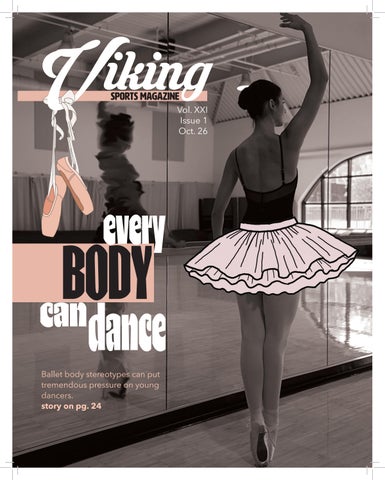
Ballet body stereotypes can put tremendous pressure on young dancers. story on pg. 24
Viking SPORTS MAGAZINE
Hey Vikes! Welcome to the first issue of Viking for the 202627 school year. At Viking, we cover everything involving sports at Paly, ranging from game recaps to feature stories. This magazine is only a fraction of the work we do on Viking. For more stories, visit vikingsportsmag.com. This issue is headlined by our cover story, Every Body Can Dance, located on page 24. This story covers how perfectionism has affected the dance world, but more specifically the impact it can have on its young athletes. Simultaneously, it highlights that dance itself can be a positive source of expression and joy when educators and studios actively foster supportive, healthy environments. On page 18, From Lottery to Lineup discusses the Tinsley program, which is a lottery that brings in students from East Palo Alto schools to Paly. The story goes into depth on the impact and importance of the students that the Tinsley program has brought in and how it is a huge part of Paly’s athletic culture.
Juliet Frick
Greg Goody
Volume XXI, Issue 1 October 2026
Letter from the EDITORS
On page 30, From Player to Paycheck explores how students at Paly have transitioned from playing sports to participating in other ways and even earning. Through officiating, coaching, camp counseling and sports memorabilia trading, it highlights themes of leadership, accountability and personal growth Finally, on page 46 our Head Columnists Carys Olsen and Silas Steele debate whether certain NFL players should be permitted to return to college. Class of 2022 college football players were recently granted a fifth year of eligibility. However, some players who attempted to enter the NFL because they believed their college careers were over are now ineligible to return to college football. We sincerely hope you enjoy this issue of Viking. Be sure to follow us on X and Instagram to keep up with our work, @vikingsportsmag.
Ella Renazco-Sperling
Daniel Segev
STAFF OPINION Putting Finals First Finals week is one of the most stressful times of the school year for students at Paly. For most students, finals week means crucial studying over the weekend and after school in order to prepare for their exams and do their best. After months of keeping up with homework, tests, projects and extracurriculars, students have to finish the semester off strong with several cumulative exams packed into just a few days. For student athletes, that stress can become even harder to manage when games or practices are added to the already stretched-thin schedule. These commitments take away hours of essential study time, leaving student-athletes with less time to prepare and resulting in an incredibly stressful and sleepdeprived week. The solution to this issue is clear: coaches should eliminate mandatory practices and games during finals week, allowing student athletes to prioritize their academics during a high stakes week. With sports being a huge part of the Paly community, they give students a place to compete, spend time with their friends and take a break from school. Being part of a team can also teach students how to work together, manage their time and hold themselves accountable. However, balancing school and sports can be difficult to maintain and during a demanding time like finals week, it becomes nearly impossible. Practices and games can take up several hours after school accounting for transportation, warm-ups and the actual game play and this takes away from essential studying time needed to succeed throughout such a critical week. Currently, it is up to the coaches to make the decision
whether to schedule games or practices during finals week. Leaving this decision up to individual coaches means some student-athletes get the week off to study, while many others, especially varsity athletes, have to participate in exhausting practices and games, coming home hours after school and studying late into the night. If coaches want to continue practices during finals week, they can make them optional, allowing athletes to decide whether they can fit a practice into their schedules rather than having coaches make that decision for them. As long as participation is completely up to the student-athletes, they can determine how to best manage their own time during finals week. Some may argue that taking a week-long break from games and mandatory practices could hurt a team’s performance. Athletic seasons are already short and finding another date for a game may be difficult. However, taking off finals week prioritizes students’ academics and mental health, allowing them to perform their best in school, get enough sleep and ensure that they are maintaining a healthy balance of school and sports. Taking one week off will not completely change how a team performs, especially if the coach accounts for this break in advance. By giving students space to study for these high-stakes tests, coaches can help their players succeed both on and off the playing field. Ultimately, the student part of student-athlete comes first. While Paly takes pride in such a strong athletics program, coaches and teams need to recognize that academics should always come first.
On Behalf of the Viking Staff,
we would like to thank our sponsors! Baskind Family
Olsen Family
Dubey Family Fisch Family Gabriel Fossati-Bellani Goody Family Gruin Family Marketa Injayan Miranda Junowicz Kalember Family Edris Marof
Staff
Editors-in-Chief Juliet Frick, Greg Goody, Ella Renazco-Sperling, Daniel Segev
Porat Family Rod Satterthwaite Segev Family Soparkar Family
Creative Directors Zoe Pashalidis, Shira Porat Photo Editor Dylan Fujita
Sperling Family Xiaochuan Wei Lucas Wu Famliy Michael Wu Family
Viking Vision Statement
Our mission is to create and maintain a magazine that respects and represents the spirit and voice of both Paly students and the wider community. Through stories that are meaningful, highlight perspectives and include ample coverage, we want to celebrate achievements, showcase unique and diverse voices and bring the overall community closer together through Paly sports. We aim to inspire readers, present new ideas and create a space where all perspectives can be heard.
Y PT S A L A P
Business Manager Ian Cierniak Online Editors Andy Comsa, Elif Dogan
Copy Editor Michael Wu
Head Columnists Carys Olsen, Silas Steele
Social Media Manager Lucas Wu Adviser Brian Wilson
Staff Writers Lucy Bothe, Jonathan Chen, Paulina Dubey, Maia Fisch, Kiara Fossati-Moine, Emmett Gruin, Malu Hadade, Sophia Injayan, Mila Kalember andrew Knapp, Marwan Marof, Abigail Neumann, Kostas Pashalidis, Amit Porat, Micah Satterthwaite, Kenley Schmidt, Oli Soparkar
On the cover:
The cover, created by Juliet Frick and Ella Renazco-Sperling with photo by Jonathan Chen, features senior ballet dancer Elsa Packard, modeling in front of a mirror. Read about body image issues in ”Every Body Can Dance” on Page 24. Viking Magazine Palo Alto High School 50 Embarcadero Road Palo Alto, CA 94301 650-329-3837 Email contact: vikingeds@gmail.com Follow us @vikingsportsmag or go to vikingsportsmag.com for current game updates/scores. Viking, a sports magazine published by the students in Palo Alto High School’s Advanced Magazine Journalism class, is an open forum for student expression and the discussion of issues of concern to its readership. Viking is distributed to its readers and the student body at no cost. The staff welcomes letters to the editor, but reserves the right to edit all submissions for length, grammar, potential libel, invasion of privacy and obscenity.
Advertising in Viking
SUPPORTS PALY JOURNALISM USE THE QR CODE TO JOIN US
The staff publishes advertisements with signed contracts providing they are not deemed by the staff inappropriate for the magazine’s audience. For more information about advertising with Viking, please contact Viking by email at vikingeds@gmail.com
Printing Services
2,500 copies of The Viking are printed, four times a year by Folger Graphics in Hayward, Calif. Issue 5, our senior awards issue, is printed by aPrintis in Pleasanton, Calif. Logo Font Courtesy of Måns Grebäck
IN THIS ISSUE
16 Beyond the bleachers 18 from lottery to lineup 22 Road to success 24 every body can dance 28 Finding a new finish line 30 Player to Paycheck 34 Kickin’ it on campus 36 short on sticks 38 new season, different vibes 40 playing the odds 42 fantasy fever 44 Second shot or stolen spot?
Sophomore Sloane Nagayama reaches up for the pass in a game during Paly’s 17-15 win against Mitty on Sept. 3. Photo by DYLAN FUJITA
IN
STRIDE
Mack Reller (‘27) sprints by a defender to haul in a pass during Paly’s 49-12 win against George Washington on Sept. 18. Photo by DYLAN FUJITA
6 | VIKING MAGAZINE | vikingsportsmag.com
6 | VIKING MAGAZINE | vikingsportsmag.com
@vikingsportsmag | October 2026| 7 @vikingsportsmag | April 2026 | 7
8 | VIKING MAGAZINE | vikingsportsmag.com
Power Play Rylie Reklis (‘27) winds up to whip a powerful shot toward the goal in a 17-7 loss against Harker on Sept. 17. Photo by DYLAN FUJITA
@vikingsportsmag | October 2026| 9
10 | VIKING MAGAZINE | vikingsportsmag.com
Breaking
Through
Eleanor Wells (‘28) powers past a defender while carrying the ball downfield in a 26-20 win against Aragon on Sept. 3. Photo by JONATHAN CHEN
@vikingsportsmag | October 2026| 11
17 1
a n a h More T
number
By MILA KALEMBER and SHIRA PORAT
From family connections, birth dates to lucky numbers, jersey numbers are much more than what’s on your back. esy ourt to c Pho JI O of K RBERG E SILV OTA SHIR
Koji Silverberg-Shirota
Inspired to play
17
#
“My jersey number is #17 becaus e Kevin De Bruyne is my favorite midfielder and that’s the number he wears, I chose it be cause I like to visualize myself playing like he does, because he’s the best midfie lder of all time.” —Koji SilVerberg-Shiro ta (‘27).
7 7
Family ties #
Photo by DYLAN FUJITA
“My brother was the person who got me into water polo and his number was seven so being able to share my number with him is a way for me to still have a part of him with me while I play the game.” —Sloane Nagayama (‘29).
sloane nagayama
10 9
What does your Jersey Number mean to you?
sy courte S Photo RYAN E C E of C
By birth
“I picked the Jersey number nine for water polo because I was born Sept. 9, 2009 which is 09/09/2009 so I always just felt like it was my number in a sense. I use it on every team.” —Cece Ryans (‘28).
9
Cece Ryans # O l iv e r R e id s l a o g o tri
that t r o p s a s ity and “Hockey i n u m m o c round centers a closest y m f o o . tw teamwork y wear e k c o h t a friends en, so v e l e d n a ine numbers n g number ten we rin by me wea he ice!” t n o o i r t become a id (‘27). e R r e v i l O —
Photo
courte
sy of O
LIVER
REID
10
#
day-to-day
Grind “The summer workouts this year were awesome. they were super hard but there’s something fun about getting together with all your boys on a summer day and working out hard. —Cole Kristofferson (‘27)
Paly football players share how summer workouts help them build strength, conditioning and team chemistry before the fall season. Photos by DYLAN FUJITA
on a scale of 1-10, How hard are practices? 1/10
Players said drills were
94.4
6/10 7/10 8/10 9/10
Percent effective
Most Used
- Gassers - Pedal Break - Up-Downs - Route Tree - Ladders - Practicing Plays
By MILA KALEMBER and SHIRA PORAT
Most EFFECTIVE
- snakes - up-downs - gassers - route tree - tackling drills
Prep
By MILA KALEMBER and SHIRA PORAT
OR
Passion
Students who choose classes like dance, yoga, or weightlifting instead of PE weigh the benefits of those classes against giving up a free period during their sports season.
“I picked athletic conditioning because I thought it would be a nice challenge.”
Maggie Sabina Sophomore
Photo courtesy of MAGGIE SABINA
“I chose athletic conditioning because I wanted to work on weightlifting. Athletic conditioning is better for getting in better shape.”
Richard Zhang Senior
Photo courtesy of RICHARD ZHANG
“I decided to do yoga instead of P.E. because my club volleyball coach recommended me to take it to increase my flexibility and strength.”
Olivia Roper Junior
Photo courtesy of OLIVIA ROPER
“I wanted to choose yoga because I really enjoyed the yoga unit in PE but I needed to prioritize getting all my schoolwork done so I decided to do regular PE so I could get a prep.”
Devin Teper Senior
Photo courtesy of DEVIN TEPER
BEYONDthe BLEACHERS
As certain sports dominate Paly’s atmosphere, some athletes from less visible sports believe their teams are being overlooked.
By ANDY COMSA and KENLEY SCHMIDT rom packed football games under the lights to tennis matches watched mostly by parents, support for Paly athletics can look dramatically different. Throughout the first weeks of school, some students began noticing patterns of various Paly organization’s social media accounts giving more attention to certain sports. Oftentimes, students found that football updates appear very frequently, while posts about other sports teams are less common. For athletes in lower-profile sports, the difference raised questions about how
F
teams are promoted throughout the Paly “I love what ASB did the first weeks community and which sports receive the of school, where there were posters up most attention. for every game of the week,” Joshi said. One example of an organization with “I really felt like every team was being a high student following is ASB. Senior treated equally and that week we got a Class President and ASB member Luiza lot of photographers at our game.” Teixeira said she noticed However, dethat football has been spite the promogetting more attention tion from ASB, “It sometimes on ASB social media earJoshi has still nofeels like our team ly on this school year. ticed a lack of at“With the first couple tention from Paly is overlooked and weeks of school, I could organizations neglected, which definitely tell that student for field hockey council had been games. doesn’t feel great.” palyasb posting only football “Field hockey updates, whilst other [still] doesn’t get —Laila Joshi ‘27 school teams were much recognialso playing,” Teixeira tion in any assaid. pect, especially After concerns recompared to garding sports promotion were football and basketball,” Joshi said brought up to ASB, Teixeira and the Joshi found that the difference is espeASB social media account have been cially noticeable when field hockey and working to make more holistic chang- football games are on the same day. es. “The overall promotion and attendance “This past week I made it very aware for those games are way higher than for to our student council that we should field hockey games,” Joshi said. “It somebe involving all of our fall sport teams times feels like our team is overlooked and posting more for every sport and and neglected, which doesn’t feel great.” not just football.” For Joshi, having more students at ASB has since started posting week- games can also affect her team’s energy. ly athletic schedules and putting up “I think our team plays a lot better when posters all around campus to high- the energy is high and we see fans, our light different sports and their up- friends, our classmates and our parents coming games. in the stands,” Joshi said. Senior varsity field hockey player Senior varsity football player Mack RelPhoto by DYLAN FUJITA Laila Joshi noticed the increased proler believes that the popularity of football motion and felt it had a positive im- games may be less related to promotion 1,489 pact on the attendance at field hock- and more to the social environment that palyasb HOME GAME FRIDAY!! #football ey games. surrounds them. 16 | VIKING MAGAZINE | vikingsportsmag.com
“I feel like most students go to Paly teams that have done well. palyasb games as a social activity, where other “I’ve definitely seen [the sports don’t really have a social aspect at difference in promotion],” Photo by DYLAN FUJITA their games,” Reller said. Reller said. “After the first Football also works directly with ASB to week of sports, only football create themes and traditions for home got their story published by games. the Paly Voice,” Reller said. “We work “ Vo l l e y b a l l with ASB on had a huge our themes win on the for the games same day “We put in just as and certain and a tournamuch time and traditions that ment and no we want to noticed.” energy into our sport one start,” Reller Some athas the bigger sports.” letes in sports said. “Our coaches work with smaller —Azad with ASB to audiences make our believe that Muraldihara ‘27 home football increased games feel promotion like a homecould help field advanbring more tage.” people to their games. Although Reller thinks that football According to varsity senior games would still draw in students re- tennis player Azad Muraldi10 gardless of social media promotion, he hara, tennis matches usually said having a big crowd can make a huge only have a small number of palyasb Field Hockey win! #skovikes difference for players. spectators. “Having a home-field advantage and “I don’t feel like tennis gets much,” Vogl said. “We obviously just try them being loud is such a huge advan- enough from the school,” tage,” Reller said. Muralidhara said. “Our home games our hardest and we just want to get bet“This recent game against Leigh, there usually only have four or five people in ter.” Although having fans can provide some was definitely a different energy on the the stands and they’re usually parents of extra motivation, some think it doesn’t field.” a kid on the team.” Reller has also noticed that some sports Muraldihara said the difference can have a big impact on the team. “Having some people there motivates do not get as much attention, including sometimes be discouraging for players. “We put in just as much time you when they cheer, but [for me] it’s and energy into our sport as more so just focusing on playing well,” palyasb the bigger sports such as foot- Vogl said. “Promotion doesn’t really matball and basketball, but we ter that much.” Photo by DYLAN FUJITA According to Teixera, to promote sometimes feel like that effort goes unrecognized,” Muraldi- changes, ASB is considering other things to encourage students to come to more hara said. On the other hand, not all ath- games, like promoting team fundraisers letes see differences in promo- and making a possible “spirit squad” that could come to games throughout the tion as a big deal. Varsity boys water polo player year. The difference in attendance among Ulysse Vogl expresses a completely different opinion than Paly sports is not the result of a single Muraldihara regarding the pro- factor. Tradition, popularity and social atmotion of his sport when com- mosphere of the game itself contribute to this problem, yet some players from pared to football. “I feel like we have a good less popular sports believe that more amount of recognition with publicity from the Paly community could funding and the yearbook and aid them in gaining more recognition stuff,” Vogl said. “I don’t feel like and support. Although it may not be possible for all we’re unnoticed.” Vogl believes that his team sports to have the same level of attendoes not get too bothered by dance as football, many students hope other sports getting more at- that school spirit will extend further than just popular sports teams in the future. tention. 26 “We don’t really care that
palyasb Water polo game today! #wopo
@vikingsportsmag | April 2026| 17
FROM
TO
P U E N I L
By JONATHAN CHEN, SOPHIA INJAYAN AND SILAS STEELE
For students in the Tinsley Voluntary Transfer Program, attending Palo Alto schools also means finding a role in Paly athletics — on the field, on the court and in the training room.
T
he huddle breaks and senior Adam Maldonado jogs into position. Around him, his teammates settle into their stances, waiting for the snap. Then the ball moves. Maldonado takes off, arms pumping as he accelerates down the field. He lowers his shoulder to the approaching player, hits them and smiles as the play ends. For a stretch of his high school football career, his injuries kept him sidelined from moments like these. Now recovered from his injuries, Maldonado is back playing football for Paly his senior year. Working through practice, joining the huddle and lining up beside his teammates have become familiar again. After spending a lot of time away, he has adopted a deeper appreciation for his ability to be part of every play he participates in. After football season ends he transitions to basketball, where he continues to develop his friendships and his experiences at Paly. Maldonado’s return to football and basketball means spending his final high school season competing
18 | VIKING MAGAZINE | vikingsportsmag.com
alongside the people who have become a massive part of his life. But Maldonado’s connection to Paly athletics and education began long before he ever stepped onto the field or court. His ability to become part of these teams traces back to a program that gave his family the opportunity to choose where he would attend school. The Tinsley program grew out of a much larger effort to change access to education on the Peninsula. In 1976, a group of parents filed a lawsuit arguing that racial isolation in the Ravenswood City School District denied children equal educational opportunity. According to the San Mateo County Office of Education, the lawsuit was settled in 1986 with an agreement that was designed to reduce that isolation. The Tinsley program became one aspect of that agreement. Named after Margaret Tinsley, one of the parents who founded the case, the program connects eligible students from Ravenswood with neighboring school districts, including PAUSD. The objective of the program includes improving ed-
ucational achievement, reducing racial isolation and strengthening cooperation between surrounding school districts. Today, the eligible minority students living within the boundaries of Ravenswood in East Palo Alto and East Menlo Park can apply for placement in the participating districts. The San Mateo county office oversees the application and the lottery process which offers families an opportunity to seek a different school placement. Through the program, students can attend school in Palo Alto while continuing to live in their home communities, allowing families to remain in more affordable communities while accessing the educational opportunities offered by PAUSD. Maldonado’s place in Paly programs began taking form years before ever putting on a Paly jersey. After pre-K, Maldonado’s parents entered him into a lottery through the Tinsley Voluntary Transfer Program. His selection allowed him to attend school in Palo Alto, beginning a path that would bring him into Paly’s classrooms, onto its basketball court and into its football pro-
gram. sense of community in each team. In Maldonado’s experience is one part football, completing an assignment of Tinsley’s connection to Paly athletics. could help create space for another playSenior cornerback Eduardo Ontiverous er. On the basketball court, a screen or a also attends through the program, as rebound could give a teammate another does sophomore Losehina chance to score. Fusimalohi, who assists in When injuries interthe athletic training room. rupted his participaTheir roles offer a look tion, those opportuniat what follows after enties disappeared from rollment, as the activities his afternoons. Pracstudents choose and the tice continued, but he work they contribute to could no longer take the school’s sports prohis usual place in it. grams. His recovery has For Maldonado, his parbrought him back into ticipation in the Tinsley that contributing role. program spans over the Now a senior, Maldomajority of his school exnado can once again perience. line up, carry out an “I became a part of the assignment and take Tinsley program after part in the football —Eduardo pre-K where I was enseason. Ontiverous ‘27 rolled in a lottery through “Coming back this my parents and ultimately year, I wanted to be that lottery selection was able to play and actualfor me to be able to come to school in ly take part in my last season,” MaldonaPalo Alto,” Maldonado said. do said. “Football has been a big part of Although in preschool, Maldonado going to Paly for me, so getting to finish was far away from deciding which high that out means a lot.” school teams he would join. His parents’ For Maldonado, football and basketball choice to enter him into the Tinsley pro- became part of a school experience his gram has ultimately shaped his learning parents had initially sought for academic experience and the classmates he has reasons. come to know outside of sports. “My parents were thinking about my “When you’re that young, you’re not education when they signed me up,” thinking about high school or what Maldonado said. “But going to school teams you’re going to play on,” Maldo- here also meant I could get involved nado said. “You’re just going to school. in athletics like football and basketball Looking back now, it’s pretty crazy how which ended up being an immense part much has came from my parents putting of my experience.” me in that lottery.” By high school, athletics had become Years later, the opportunity his parents a major part of Maldonado’s experience entered him into had grown into a life at at Paly. Balancing classes with football Paly shaped by the sports he chose to and basketball meant spending much of play. Football and basketball became his time preparing for each season and more than just activities after school, giv- competing alongside his teammates. ing Maldonado different ways to spend “Playing two sports was something I his time and connect with people around wanted to do, even if it meant spending him. a lot of my time preparing for each seaPlaying both football and basketball re- son,” Maldonado said. sulted in becoming part of two different On the defensive side of Paly’s football groups. The transition between seasons program, Ontiverous has his own assignbrought new teammates and a different ment. type of competition, but sports remained As a cornerback, he lines up across rea major part of his time spent on campus. ceivers and works to keep passes from “Some of the people I’m closest with, becoming a completion. His contribuI got close to because we played to- tion may be a hand between the ball and gether,” Maldonado said. “You spend a receiver, or coverage that sends the so much of your time at practice that quarterback looking elsewhere. you eventually start talking about all the That responsibility gives him a crucial things going on in your life, too.” role on the football team at Paly, which Those connections also gave him a he joined through the Tinsley program.
“
Tinsley gave us the opportunity to come to school here and now we’re part of Paly sports.
“
“Tinsley is how I’m able to go to school here,” Ontiverous said. “Football became something I wanted to be a part of while I went to Paly and it will be something I’ll remember as a major part of high school.” For Ontiverous, that involvement includes the hard preparation leading up to games. Such as learning the coverages, working on footwork and practicing the reps. In practice, he repeats the opening steps of a play: moving backward, turning his hips and staying with a receiver as the route changes. The repetition is meant to make those decisions quicker when the offense lines up in a game. “When you watch a game, you see whether I make a play or if I miss one,” Ontiverous said. “You don’t see all the time I’ve spent working on it, so I can do my job well.” His Paly jersey identifies the school he is playing for. But his enrollment through Tinsley is a part of his background that he said many of his classmates aren’t cognizant of. “People might know me as a football player and not know that I came from the Tinsley program,” Ontiverous said. “That is the big part of my story, it’s how I came to be a student here and football is one of the things I’ve taken up in my time at Paly.” For Ontiverous, discussing Tinsley’s place at Paly means looking at the students who represent the school in athletic
Photos of Eduardo Ontiverous and Adam Maldonado by JONATHAN CHEN @vikingsportsmag | October 2026| 19
competitions. He sees their participation she is preoccupied with someone else.” on the school’s teams as part of the proThe work at the trainer’s office has given gram’s connection to a wider campus. her a view of Paly sports that she would “Tinsley gave us the opportunity to not get from solely watching a game. come to school here Athletes from all sports and now we’re part pass through the same of Paly’s sports,” room, some stopping Ontiverous said. in before practice and “We’re at the practices, others spending their we’re in the games and recovery time there. we’re representing the For Fusimalohi, her school.” interactions with these That’s part of the student athletes make up program’s story, too. a significant part of her This contribution experience as a Tinsley extends to other student. The program aspects, including the brought her into Palo athletic training room, Alto schools, where she where sophomore has found a way to work Losehina Fusimalohi with athletes from teams —Adam helps students prepare ranging from the fall to Maldonado ‘27 for practices and future spring season. competitions. “I came to school here Fusimalohi attends through Tinsley and Paly through Tinsley. While other helping in the training room is something participants play for the school, she I found out about when I got here,” assists athletes who need support. Fusimalohi said. “I get to be involved Each afternoon typically involves with sports and help the people that are wrapping up athletes, icing them and playing daily.” helping assess their injuries. Working Her role adds to Tinsley’s contributions under the athletic trainer’s direction, to Paly athletics. Fusimalohi has become familiar with the Maldonado and Ontiverous represent seemingly small tasks that have a large Paly in competition, while Fusimalohi effect on athletes’ ability to participate supports athletes in the training room. on their teams. Through her work alongside the “When it gets busy, there’s usually athletic trainer, she prepares and assists something I can help with,” Fusimalohi in a room used by athletes from every said. “Sometimes it’s just helping sport. someone that the trainer can’t because For Fusimalohi, this is part of what she
“
My parents were thinking about my education when they signed me up.
“
wants others to understand about the students who attend Paly through Tinsley. “There are different things we’re involved in here,” Fusimalohi said. “Some people play on teams and I help in the training room, getting involved in the ways I can.” The three students’ roles grew from interests they developed after their initial enrollment. Their families sought an education in Palo Alto schools; the years that followed brought choices about teams, seasons and how to spend the hours after class. Now those choices take shape in a block that opens space, a covered receiver and supplies ready in the training room. Each is a small part of the daily work of Paly athletics, carried out by students who attend through Tinsley. On the field, Maldonado jogs back to the sideline. His coaches celebrate his tackle, patting him on his shoulders. Moments like this are one part of the larger community created through the Tinsley Voluntary Transfer Program. Students enter Palo Alto schools through an opportunity originally created to expand educational access and over time, they become part of the classrooms, teams and activities that make up the Paly community. From the football field to the basketball court to the athletic training room, Tinsley students have found different ways to contribute to Paly. What began as an effort to expand access to education has become part of the everyday life of the school.
Tinsley Through The Years
20 | VIKING MAGAZINE | vikingsportsmag.com
o t d a o R ss e c c u S
L WU R HAE C I M ARKA By I SOP L O and
hool c s h g i of h n ew o i n t a c u s d n e ro The int nsultants op during co e sports letes can tak t process. h en path at ege recruitm oll their c
O
ut of the eight million high school athletes in the United States, only around 560,000 go on to play a sport in college, according to the NCAA. Around 18% of these high school athletes use a sports consultant or adviser, according to ESPN. Advisers and sports consultants provide a middle ground between athletes and colleges as athletes look to take the next step in their sports journey. Generally, consultants handle the initial contact between the athlete and colleges and build the athlete’s personal brand. They also help athletes create a list of top schools and manage each school’s attention and interactions. Where difficulties and confusion arise regarding college recruitment, consultants are able to clear misunderstandings while building athletes’ portfolios and reaching out to schools that show interest. Advisers can also connect an athlete with their dream schools that are not directly reaching out. The sports consulting industry has been on the rise over the past few years as Photo of Paly swimmer Hannah Oh ‘27 by DYLAN FUJITA
22 | VIKING MAGAZINE | vikingsportsmag.com
competition to get offers has grown. Depending on the sport, the amount a consultant can help varies. In many team sports, such as baseball and football, advisers can help certain players get noticed by schools when they would otherwise blend in; in others, like track and field, recruiting is structured based on specific times, where no matter what school or team they are on, colleges can notice athletes without them needing extra exposure. One business that some past Palo Alto High School athletes have worked with has been Oliveira’s Consulting. The company is run by Joe Oliveira, who entered the consulting scene in the summer of 2021. “I was a recruiting coordinator at San Diego State for eight years, so I was a college coach,” Oliveira said. “Coaching is very time-consum-
ing, so I decided to switch gears to be around my family more. I came up with the [consultant] idea just because I saw it was needed in the process for kids.” Oliveira works with a handful of athletes from every class. He does not explicitly have a limit on the number of players he can work with at a time, although he tries to avoid having multiple players who are too similar. “When college coaches call for a certain position or player in a class, I kind of know what they’re looking for and I don’t want to have too many of the same position or kids looking for the same thing,” Oliveira said. When advisers have multiple players of the same position or too many with the same strengths, it leads to a conflict of interest. If a coach asks for one of those types of players, it puts the adviser in a position where they have to choose one over the other.
“I think there’s a place for everybody and we’ll work hard until we find the right home for them. We’ll never sell a kid short just because we can get a hold of any coach for them.” —Joe Oliveira
For Oliveira, the process consists of numerous steps that he takes in order to help every athlete he works with. “First, we identify the players’ strengths and weaknesses to help them understand what they do well and how to showcase it,” Oliveira said. “We come up with a target list of schools based on what their skill set is on, potential fits and then obviously look at the academic profile. We also contact these schools directly.” Oliveira believes that the role that consultants play is constantly changing as a result of recent events and it is their job to adapt. “The process is just getting more and more difficult for high school players just with the transfer portal and all the rule changes,” Oliveira said. While consultants can take a large load off an athlete’s shoulders, Oliveira also points out some aspects that they are unable to control. “I can’t control the player’s ability and work ethic,” Oliveira said. “All I can do is give them the information and resources that they need in order to improve.” Oliveira takes pride in the success his company has achieved over the last few years. “I haven’t failed any kid,” Oliveira said. “I think there’s a place for everybody and we’ll work hard until we find the right home for them. We’ll never sell a kid short just because we can get a hold of any coach for them.” One athlete who worked with Oliveira was Kanghee Cho, a current baseball player for Brown University. For Cho, working with Oliveira helped him step into the recruiting process and start his journey. “The main thing Joe did for me was reaching out to schools on my behalf to get the conversation started with the coaching staff,” Cho said. For Cho, Oliveira gave him direction and a roadmap to work toward instead of just blindly navigating recruiting. “In general, they’ll help you narrow down your list of schools you want to go to and try to get them to notice you if they haven’t already,” Cho said. During the athletic recruitment phase, many athletes receive unwanted offers and attention from numerous schools. For Cho, his consultant made sure this attention did not go to waste and instead, used it to open doors to offers he desired. “Hiring an adviser can usually help redirect and leverage the attention you’re getting to hopefully get you in contact with the schools you actually want to go to,” Cho said. While an adviser can be a helpful tool for
athletes, they don’t come without a cost. According to USA Today, hiring a consultant can cost anywhere up to $5,000 up front. Although this is a hefty cost, some families and athletes decide that hiring an adviser is the best course of action, while others think differently. “Spending money on an adviser will not guarantee you a spot on a team,” Cho said. “Plenty of high schoolers (probably the majority) get recruited without having one, instead relying on their high school and travel baseball coaches instead.” Hiring an adviser can be majorly beneficial for athletes, but sometimes, it simply is not the right decision. Paying for the services of an adviser is only helpful when an athlete is already receiving offers or close to doing so. “For those who have already been going to showcases, camps, etc. and have not gotten that desired contact with coaches, I don’t know if it would help you out all that much,” Cho said. “You’re not going to go from no offers to dozens just because you hired an adviser.” Cho also cautions athletes on the dangers of the sports consulting business, as some consultants are in the business purely for profit. “I’m a little skeptical of the advisers that are a part of a big company where they have their own video platform and an army of advisers,” Cho said. “I’ve heard mixed results with peers who have worked with them.” Along with Cho, another athlete who used the work of a sports consultant is Paly senior and Brown commit Hannah Oh. During her time as a Paly swimmer, Oh worked with a consultant during her sophomore and junior years. “My adviser helped me get started with the recruiting process and how to talk to college coaches,” Oh said. “Through her, I learned how to draft a swim resume, emails and hold a meaningful conversation with coaches on calls.” Working with her adviser, Oh recognized that a consultant was not necessarily the answer to everything. “As I got deeper into recruiting, our meetings became more sparse throughout the year, (once a month) and so most
of the time I was handling things on my own,” Oh said. “I think at one point I just got the hang of it and started doing things my own way.” In order to recieve the full benefits of hiring an adviser, athletes must always take initiative to remain in close contact with their adviser to make sure they are always on the same page. “One big lesson I learned during the process was communicating with my adviser,” Oh said. “There would be so many times when I would have a meeting with her and the very next day, something big would happen and I wouldn’t email or let her know.” Looking back on the process, Oh believes that the safety net advisers can offer can also be provided by parents and friends for those who decide to not hire an adviser. “Whether it’s a parent or adviser you are working with, never keep your process to only yourself,” Oh said. “Toward the end, it becomes a lot to handle and it’s always reassuring to know that you have someone to lean on and ask questions.” Of the 560,000 high school athletes who go on to play at the collegiate level, many walk down d i ff e re n t paths. Some may pay for an adviser, others may rely on their parents and some navigate the process on their own. For families that are considering an investment in an adviser, Cho and Oh make it clear that advisers are a useful tool; however, they are not always the answer.
“Toward the end, it becomes a lot to handle and it’s always reassuring to know that you have someone to lean on and ask questions.” —Hannah Oh ‘27
@vikingsportsmag | October 2026| 23
EVERY BODY By MARWAN MAROF, CARYS OLSEN and ZOE PASHALIDIS Photo by JONNY CHEN
dance demands discipline and constant correction. the pressure to excel can extend beyond technique and into body image issues
D
ance is a world revolving around mirrors. It’s a tool — a necessity, but at what cost? Mirrors reflect every extension, every turn, every move hit in sync, providing valuable insight crucial for dancer development. A dancer can look in the mirror and see their strengths, or what they think are their greatest “flaws.” According to research published through the National Library of Medicine, most professional dancers are often enrolled in classes around the age of six, although some can start as young as two. That means hours standing in front of a mirr o r before they even begin elementary school. Dancers are left staring and critiquing their body day after day, year after year. For one paly dancer, who will be called *Jane for privacy, the mirror often represents a complicated part of growing up in dance.
“Obviously [the mirror] makes dance easier,” Jane said. “You can correct your form and make sure your shoulders are back. But at the end of the day, you are staring at yourself in a mirror everyday for hours.” According to Jane, being constantly placed in front of a mirror, staring at yourself often changes a dancer’s perception of what they truly look like. “It can be a really big weight on someone’s body image and mental health when you’re just looking at yourself,” Jane said. “And also looking at other people and comparing yourself to them. It’s just not healthy to be staring at yourself in a mirror that often.” But the mirror isn’t the only contributor to those insecurities. Dawn Smith-Theodore, a former dancer, long time dance educator and eating disorder therapist who specializes in treating dancers believes the mirror can magnify another characteristic deeply embedded into dance: perfectionism. “Dance definitely breeds perfectionism,” Smith-Theodore said. “And perfec-
“This image
has definitely evolved across centuries of art. —Lauren*
”
tionism is something that is very prevalent in people with anorexia.” The pursuit of perfection can extend beyond just a dancer’s technique. In ballet especially, dancers have historically aced expectations not only for how they move, but for what their bodies should look like. Paly dancer who will go by *Lauren for anonymity purposes has danced for 10 years, primarily in ball e t . While growing up in the ballet world, Lauren learned quickly that there was an ideal body that ballerinas were supposed to have—and it extends beyond what is seen on the surface, making matters of body image much more complex. “The stereotype of ballerinas being thin does not describe the entire image of a ‘perfect ballet body’,” Lauren said. “There are so many other elements that non-dancers do not realize: feet with high arches, hyper-extended knees, long legs, graceful arms without bulky shoulders, a long neck the list goes on.” Smith-Theodore attributes part of the modern American “ballet body” to George Balanchine, the influential chore-
CAN DANCE
ographer and co-founder of the New York City Ballet. While Balanchine did not create ballet’s emphasis on appearance, his enormous influence over American ballet helped to popularize a particular thin look. “It really took hold and the ballet world completely changed and the body type changed,” Smith-Theodore said. Balanchine repeatedly selected tall, long-legged and skinny dancers for prominent roles. Often promoting the ideal of being skinny to the point of showing bones. “It became the norm for ballet,” Smith-Theodore said. “If you go back and look prior to George Balanchine, in the 1930s and 4 0 s and even into t h e 1800s, ballerinas didn’t look like that.” His influence illustrates a larger power dynamic that has historically existed within professional ballet. “This image definitely evolved across centuries of art and did not have such extreme prominence until recent decades,” Lauren said. “I think its origins have a lot to do in the professional world with primarily male, but also female, executives creating abusive environments as a means of control.” The executives determining the roles and opportunities were often men, Smith-Theodore said, while the bodies being evaluated were disproportionately those of young women. “I hate to say this, but white men con-
trolled the dance world,” Smith-Theodore said. “It was men telling women how they could look and how they could dress and that their hair was too long. Coming from a man that’s really problematic.” While this image appears unrealistic for many, it became something ballerinas strived towards, doing whatever it takes to be as close as possible to the “ballet body.” “If you’re not born with [the ballet body], you’ll never achieve it to its full extent,” Lauren said. “I think this is why a lot of ballerinas become susceptible to eating disorders, feeling that it is the only way they can actually change themselves to look like the professional ballerinas they strive to be.” Regardless of how many hours dancers spend in the studio, some characteristics are simply unattainable. Dancers cannot train themselves into different body shapes and proportions like they can with leaps and turns. Yet according to Smith-Theodore, the culture of perfectionism and constant improvement within dance makes it difficult for dancers to accept that their body may be simply different from the ideal. “Never enough is kind of the concept in dance,” Smith-Theodore said. “Your extension’s never tall enough, you never can do enough turns, you’re not thin enough, your legs are too short.” Reaching one standard however, does not necessarily mean ending the pursuit of perfection. “No matter what you can do, you could
“
always do more,” Smith-Theodore said. “They’re always expecting more and there’s always somebody who can do more.” Smith-Theodore has seen the consequences of the ballet world prioritizing uncontrollable characteristics. She recalls one 10 year old student attending her first dance intensive alongside another dancer who was not as experienced and did gymnastics more than dance. Despite this, her student was placed in a lower level. “Her body wasn’t the ‘ballet type,’” Smith-Theodore said. “She actually came home and said to her mom, ‘I don’t think I’m ever going to make it in the ballet world because, you know, they look for a certain type of body.’” For young dancers, the ballet ideal does not need to be explicitly taught. It is visible in the dancers on professional stages, on social media feeds and even in the celebrities that influence popular culture. For Jane, who is passionate about all aspects of dance and frequently supports the professional dance world, the images the professionals display is difficult to ignore. “If I went to see the Nutcracker all the ballerinas would have a certain look,” Jane said. “Or the Rockettes… even the Dallas Cowboys [Cheerleaders] had to have a certain height and a certain look.”
I’ve found that at Paly, the dance team is a community of incredible support and connection. —Lauren*
”
These expectations are not limited to the professional world. Paly dance coach Alanna Williamson worries that this new ideal may trickle from celebrities and professionals into the studios where children are first learning to dance. “It does, no matter what, have an impact on culture, because they’re celebrities,” Wil-
Balanchine Body
high arches hyper-extended knees
Skinny long legs Graceful arms
Long neck
SKINNY
liamson said. “And it pushes the agenda that ‘thin is in.’” According to Lauren, the incorporation of social media into the dance world has also had a major effect on a dancer’s self esteem. “Dancers are surrounded by mirrors on all sides: both literally in the studio but also on social media when they see other dancers and inherently compare themselves to them,” Lauren said. “Comments such as ‘I wish I had…’ or ‘I wish I was…’ are far too common in the ballet world.” The pressure created by that comparison can extend beyond dissatisfaction with appearance. Studies published by the National Library of Medicine have found an elevated risk of eating disorders among dancers. An analysis of 33 studies found eating disorders in approximately 12% of dancers overall and 16.4% of ballet dancers. Overall dancers were about three times as likely to experience an eating disorder compared to non-dancers. According to Smith-Theodore, eating disorders and body dysmorphia are strongly intertwined. “Body dysmorphia is very much a part of eating disorders,” Smith-Theodore said. “For example, people with anorexia many times see themselves as being fat.” Even then, there are several different types of eating disorders that dancers could develop. According to the National Library of Medicine there are eight categories in feeding and eating disorders, including avoidant or restrictive food intake disorder, pica, purging, night eating, anorexia and bulimia. “There are a wide range of eating disorders from binge eating disorders to anorexia,” Smith-Theodore said. “And so body image is different for each one of those. I think they’re very interconnected.” For one anonymous Paly student, who will go by *Mia, awareness of the traditional body began early on. “I definitely knew what dancers were supposed to look like at a young age,” Mia said. “I’m not a tall skinny person and when I was around eight to 11 that became visible to me and I became
upset because of [the] comparison.” Smith-Theodore believes adolescence can be an especially difficult period for dancers who have spent much of their childhood looking a very specific way. As puberty changes their bodies, some dancers may find themselves moving further away from the ideal that they associate with ballet. “When people’s bodies change when they hit puberty it has a huge impact because they’ve been used to being straight up and down, which is what the ballet world wants,” Smith-Theodore said. “And then all of a sudden you don’t have that body. I think that’s hard for people.” According to Mia, that comparison happens on a “day-to-day” basis and has a significant impact on behavior and mental health. “It can lead you to do bad things to your body,” Mia said. Senior dancer Dalia Saal has witnessed the issues of comparison that Mia describes firsthand at different summer camps and intensives she has attended over the years. “There are kids in those [intensives] who will heavily compare themselves to others,” Saal said. “Especially when everyone here is trying to go into that professional pathway to become a ballerina.” Saal not only saw the comparison between the dancers, but the lengths they would go to to reach a certain body type. “I know some kids that will eat a lot of baby food intensively rather than eating good healthy meals,” Saal said. According to Smith-Theodore dancers eating baby food is unsurprising and an indication that those dancers may be developing an eating disorder. “Baby food is meant for babies,” Smith-Theodore said. “Not for dancers who are expending a lot of energy dancing all day.” But the behaviors dancers develop around food and their bodies do not exist without cause, nor does it exclusively come from within. The pressure to be a certain look can also be reinforced from the people surrounding them. For Mia, she hasn’t simply witnessed this pressure, but has experienced it firsthand. She illustrates how comments from instructors can remain on a dancer’s mind even long after they are said. “A big one is when teachers tell you when they can see your lunch,” Mia said. According to Smith-Theodore, that
phrase is not a new one in the dance world, and is a body-toxic comment used to indicate when a dancer’s stomach is protruding or not being sucked in tight enough. Williamson also recalls comments from teachers while she was a youth dancer, demonstrating how often supposed casual comments can have remained with dancers for years to come. “I heard a lot of comments from dance teachers about needing to be small and praising small bodies,” Williamson said. Comments about a dancer’s stomach or appearance may be intended as quick corrections, but in an environment where bodies are already constantly being observed, those words can carry a much heavier weight. “It just takes one comment for somebody to take that and take it to heart and think ‘I’ve got to change this,’” Smith-Theodore said. These kinds of comments from instructors can raise a difficult question for dance — where is the line drawn between healthy awareness of the body and technique, and body image issues? According to Williamson, that boundary is “dangerously thin,” and proper nutrition education is essential to a healthy athletic environment. “There is this weird myth that carbs are bad for you and that eating as little as possible will make you really, really tiny,” Williamson said. “It’s our responsibility to educate all athletes, not just dance, at a really young age about how to fuel your body.” Williamson, who is also a teacher at Paly, believes that some practices by teachers can overlap into the dance educator world as well, and that all educators who have an influence on young children and teens have a responsibility to teach them good habits. “Similarly to how we as school educators have training about how to talk to students about all kinds of very sensitive issues, I think that dance educators have the responsibility to go through the same kinds of training,” Williamson said. “And theirs would be more focused on athletic bodies and things like that.” Despite the presence of risks within dance, dance itself doesn’t inevitably create poor body image. In fact, many dancers can see dance as a source of confidence, community and self-experession.
Lauren, for example, said her own experience has been overwhelmingly positive. “For me it is far more of a source of confidence than of insecurity,” Lauren said. “I really enjoy the artistic element, the expressiveness of the art and honestly just how fun it can be.” For Saal, dance is a creative outlet separate from school that provides her with positive friendships and healthy development. “When I’m at dance, I will never think about the homework I have to do, the tasks, the things I have to do at home,” Saal said. “It’s a way for me to escape everything else.” Even Mia, despite experiencing comparison and unhealthy environments, also described her passion and love for dance. “In certain situations teachers have been really uplifting,” Mia said. “It feels really good when someone tells you, you did good, or when they show up and watch you.” The differences between these dancer’s experiences, and how they have been able to maintain their passion throughout, suggests that the issue may not be dance, but the environment in which dancers are placed in. Lauren has witnessed that difference between several different studios. I’ve found that at Paly, the dance team is a community of incredible support and connection,” Lauren said. “However, in the ballet world, and at many private studio competition teams, the environment can be extremely competitive and sometimes harmful, especially for young dancers.” The contrast between those environments complicates the idea that dance is inherently damaging to a dancer’s image. The mirrors, leotards and pursuit of stronger technique all remain the same. What changes is the culture and environ-
“
ment dancers are placed in. Williamson has tried to make the culture of Paly’s studio a priority. Focusing on what athletes can control rather than what they can’t. “I honestly just try not to comment on their bodies ever,” Williamson said. “I try really hard to make our team a really encouraging and supportive space rather than one that’s comparative and competitive within each other. So hopefully that then trickles into the body aspect of it.” S m i t h -Th e o dore owned a dance studio for 25 years, and emphasizes the major impact teachers have on their students. “Lots of times dance teachers spend more time with their students than parents do,” Smith-Theodore said. “I think you can create a healthy environment. But teachers need to understand how they impact students.” According to Smith-Theodore, action surrounding body image within dance culture has seen little change. “I think [dance culture] has not improved,” Smith-Theodore said. “I think it’s gotten harder. There’s more awareness, it just needs more implementation.” Despite the lack of action, Smith-Theodore does note that there has been more widespread awareness compared to previous generations. “When I developed my eating disorder at 15 there was no information; there was nothing out there to help me,” Smith-Theodore said. “Now so many more people have eating disorders and there’s a lot more knowledge about it.” While the dance world may understand more about body image than it did when Smith-Theodore was a young dancer, awareness and change are not the same. As the dance world continues to evolve, the challenge lies in turning the awareness into plausible change, where a dancer’s ability and opportunity is not limited by expectations of what their body should look like.
Never enough is kind of the concept in dance.
”
—Smith-Theodore
Finding a New
Finish Line
By ABIGAIL NUEMANN and PAULINA DUBEY, Photos by PAULINA DUBEY
One year after her life-changing injury, senior Sabrina Terman prepares to compete in her first-ever full Ironman Triathlon
A
lmost a year ago, senior Sabrina Terman was at a water polo tournament in San Luis Obispo when she suffered several blows to the head, resulting in a severe double concussion that left her permanently sidelined from the sport she loved. Last October, she could barely walk. This October, she will swim 2.4 miles, bike 112 miles and run 26.2 miles as she competes in a full Ironman. Terman played water polo for seven years prior to her injury, but after her concussion she was forced to give it up. “After my concussion, the doctors told me I couldn’t play water polo anymore,” Terman said. According to Terman’s mother, Nadine Terman, the injury completely changed Sabrina’s life. “At first, she could barely walk,” Nadine said. “She couldn’t read, look at screens, concentrate for long periods or tolerate much stimulation. For a while, even sitting outside was exhausting.” Over time, however, as Terman recovered she began to bounce back from that injury. Her recovery happened in tiny increments: first sitting
outside, then a short walk then a longer However, Terman placed first in her walk. Now, Terman shows how far she age group at that race, which qualified has come by waking up at around 5 a.m. her for the nationals competition of the each morning, training twice a day, six Olympic distance. She then went on to days a week. compete at Nationals and place fourth, “To watch her go from that, to training qualifying for Worlds. for an Ironman has been extraordinary,” “I’m going to Worlds next September Nadine said. “She has rebuilt not just her and that is a big achievement for me bephysical strength but her confidence in cause it makes it feel bigger, going to what her body can do.” Germany,” Terman said. “So, that makes Terman’s injury was incredibly serious me really excited.” and although she could no lonBut for Terman, competing in this upger play water polo, she didn’t coming Ironman is about more than let it deter her from staying just the race; it marks a meaningful active. milestone for her. “What I admire is that she “I decided to do it mainly benever allowed the expericause it’s gonna be a little over a ence to define her by what year since my concussion she could no lonand that was a big setback ger do,” Nadine “I’m just trying to for me, both athletically said. “She kept askand mentally,” Terman prove to myself that said. “So I’m just trying ing, ‘What can I do next?’ That mindset prove to myself that I I can come back to has carried directly can come back stronger. into her training.” I want to do it because stronger.” Terman did not I always like to do hard —Sabrina Terman ‘27 things and challenge myimmediately jump into training for self.” an Ironman; she Nadine has been a huge participated in support throughout Terher first triathlon man’s journey, bringing her last September, eventually turning to to all her races and cheering her on from the sport as a way to exercise while also the sidelines. Nadine is extremely proud competing at a high level. of her daughter and is in awe of how far “I [thought] ‘I love biking, I love swim- Terman has come since her injury. ming, I love running,’” Terman said. “It “In some ways, her triathlon journey [was] a logical choice for me to stay ac- has been a rebirth story,” Nadine said. tive and do something that I love.” For Terman’s training, she usually has Terman’s first triathlon competition was two different training sessions each day, the Olympic distance, which is a 1.5 ki- doing strength training or working on lometer swim, 40 kilometer bike and 10 different disciplines. kilometer run. She has signed up just for “I usually do four to five bike rides in a fun with a family friend, expecting noth- week; some that are long, some that are ing from it. short and more intense,” Terman said.
28 | VIKING MAGAZINE | vikingsportsmag.com
“Some are for recovery and that’s the same for swimming and running. So it’s a really big mix [each week].” In order to maximize her time for training each day, she wakes up at around 5 a.m. each morning and gets an early start to her day. She gives herself a rest day each week, in order to allow her body to recover and have enough energy to sustain this amount of exercise. “It took me a little while to figure out how I could best maximize my training, but also not wear myself out,” Terman said. “And I’ve gotten to the point where I have a really good training schedule that I feel is really efficient for me.” Nevertheless, Terman still has many other aspects in her life that require time and energy. She takes five classes at Paly, one outside of Paly, works at Pizzeria Delfina, helps at a plant growth facility at Stanford and makes time for her family and friends, all while maintaining her training schedule. “I think it’s definitely been sort of a learning curve to figure out how to fit all of the important things in my life,” Terman said. To most high school students, this may seem like a lot to handle. Many struggle balancing school and work, or school and sports alone, let alone all three. Terman has learned how to manage her extracurriculars, not allowing her triathlon training to get in the way of other areas of her life. “What amazes me is how efficiently she uses her time,” Nadine said. “She still works at Delfina, does her homework at the kitchen counter, spends time with her friends and brothers and does all the normal things a high school senior does.” Training has taken up a lot of Terman’s time and effort, but her enjoyment for the sport helps her stay motivated. “For me it’s something that I look forward to doing,” Terman said. “I want to go home and go for a run, it’s something that brings me peace.” Triathlon racing is a sport that is very different from other popular high school
sports, both in the training and competitions. Terman’s progress is something that she has come to take pride in. “I’ve just really gotten to be proud of just the training,” Terman said. “Especially when the competition’s months away and you’re not having games every other day, you really learn how to be patient with yourself and just trust the journey and the process.” Although Terman has a passion for her training, she has struggled to find a community within the sport, which has caused her to feel isolated at times. “I often do wish for a community because I do miss that camaraderie of being on a team,” Terman said. “Like water polo, it’s very team based, so that’s something I obviously really miss.” Terman said that she has been looking for a community to train with for a while now, especially girls her age who share her dedication. “It’s been a struggle for me because there’s people that like to run, bike and swim, but it’s difficult to find those people, especially girls who like to bike,” Terman said. However, she has strong communities in other areas of her life, like her work community at Pizzeria Delfina that continues to support her. “Everyone treats me like a little sister, so if they know I had a big run that day, or if I had an event, they always want to talk to me about it,” Terman said. “Seeing them so happy to talk to me about it, it makes me really happy to have that community.” From signing up to her first triathlon just for fun, to competing at a very high level, Terman has grown not only as an athlete, but as a strong individual. “The biggest change I have seen is Sabrina’s physical confidence and sense of
“In some ways, her
triathlon journey has
been a rebirth story.” —Nadine Terman
possibility,” Nadine said. “Training for an Ironman requires an enormous amount of time and discipline, but it also gives her new goals to work toward all the time. There is always another distance, another race, another challenge.” Terman’s experiences have significantly shaped her journey and have ultimately brought her to where she is today. “Our family has experienced a fair amount of adversity over the past few years and Sabrina has shown an extraordinary ability to survive, pivot and keep focusing o n what matters: health, family, friends, fun and community,” Nadine said. After months of dedicated training, Terman is incredibly excited about her upcoming Ironman, with her main goal being to simply have fun. “[My goal] is really just to finish it and to not be hard on myself,” Terman said. “Just be happy with my result and celebrate it.” Terman’s journey and w o r k ethic is incredibly inspiring and it shows that no matter what life throws at you, you can always rebuild and come back stronger. “[Sabrina] could have spent last year dwelling on everything she was missing or everything that had gone wrong,” Nadine said. “Instead, she forged a new path.”
@vikingsportsmag | October 2026| 29
YER PLA to
By LUCY BOTHE, MAIA FISCH and KOSTAS PASHALIDAS
K C E H C PAY
Rather than solely playing their passion, Paly students are now transitioning into the money making aspect of their sports. Along the way students are also learning important life long lessons.
F
or most high school athletes, sports mean long practices and tournaments. For some, they also mean paychecks. With the new school year beginning, students are returning to their usual practices, games and routines, but some are shifting their involvement in sports from playing to working. The transition into working with sports is becoming more apparent in Paly athletes who have found jobs connected to their passions and more debating to explore that opportunity. Some officiate
30 | VIKING MAGAZINE | vikingsportsmag.com
games, some coach younger athletes and others make m o n e y through the business side of sports. Although each job looks different, they all stem from something the students already enjoyed doing. Once an old sport becomes a job, the students’ roles change. They are still connected to the sport they love, but their involvement now comes with responsibility and lessons. Senior Sid Iyer is already at work while soccer teams warm up. He inspects the field, checks equipment, and looks over the players long before the ball is first kicked. Once the game begins,
Iyer has to enforce the rules, maintain player safety and manage the players, coaches and parents. Iyer started refereeing for a common reason amongst high schoolers: wanting money. As Iyer started high school, he developed a desire of having some of his own money to spend, and decided to get a job. Iyer grew up playing soccer and had seen kids his age start to turn the passion into a job. When Iyer understood that he could make his own money while staying connected to the sport h e loved, it was hard for him to turn away. “I heard there’s a big money aspect for reffing, and I wanted some personal independence,” Iyer said. Iyer can earn upwards of $50 for refereeing a single game, an amount that quickly adds up when he referees tournaments, sometimes ending a single weekend with $200 or $300. The money
“I heard there’s a big money aspect for reffing and I wanted some personal independence.” —Sid Iyer ‘27
led him to a new level of financial independence, allowing him to open his first bank account and get his own debit card. With his earnings, Iyer has the freedom to decide how much to save and how much to spend. Iyer grew up playing soccer, his earliest friends in life being his teammates. As they got older, Iyer saw his peers begin to referee soccer games. “I’d been playing soccer for a while and I was seeing kids my age who were refereeing some of the games,” Iyer said. Seeing other kids his age referee showed Iyer that soccer could be more than something he played. However, this independence came with a price: Iyer had new responsibilities he had to face. As a referee, Iyer is no longer responsible for his own performance. He is responsible for making decisions that affect everyone on the field. “It’s a big leadership position, you have to control the entire game,” Iyer said. Iyer’s decisions on the field are often challenged by people older than him, including players’ parents and team coaches. “One time I was reffing and a parent started yelling at me and was saying my calls were unfair,” Iyer said. These fraught instances put him in a situation where he has to stay calm and try to resolve the conflict at hand. The job not only forces Iyer to control his emotions, but also puts him in a position where he has to make the final decisions, even when the people questioning him are older than he is. At the same time, Iyer is responsible for guiding younger players who may not fully understand the game. “There were some games where the kids don’t even know the rules,” Iyer said. “You have to tell them exactly what to do.”
His role also extended beyond just administrating. When younger players do not know the rules, it is now Iyers’ job to step in and show them what to do. His experience from playing soccer gives him the knowledge to guide them, turning his role from simply enforcing the rules to helping younger players understand the sport. For Iyer, refereeing was a new role within a sport he already loved. Sophomore James Young found a similar connection to baseball, shifting from being the next batter up to being stationed behind the plate as an umpire. “I started umpiring because I still loved the game, I just didn’t have the patience to keep working at it,” Young said. Baseball had been a part of Young’s life for years, so stepping away from playing did not mean he wanted to leave the sport behind. He wanted to stay involved in baseball without p u tt i n g in the same amount of time and effort that playing required. Becoming an umpire is not automatic. Young had to pass an umpire exam, which consists of written questions on rule applications, game mechanics and specific situational scenarios based on official rulebooks. He shares that the test is harder than people expect. His experience with baseball was only part of becoming an umpire. Young now had to make split-second decisions and learn to trust his judgement. “Sometimes you’re not always going to make the right call, but if you’re kind of timid about your decision, then there will be an outside opinion,” Young said.
“I started umpiring because I still loved the game, I just didn’t have the patience to keep working at it.” —James Young ‘29
A wrong call can draw attention from players, coaches and spectators, but hesitating can make people question the decision just as quickly. Umpiring has forced Young to make a decision and stand behind it, even when he knows it may not be perfect. “I’ve kind of applied this to my whole life,” Young said. “Just have conviction when you make a decision, stick with it.” The paychecks taught Young lessons in another part of his life: managing his money. Young saves 20% of his income and gives himself the rest to spend as he pleases. He tries to refrain from spending his money on food, explaining that food can be expensive and he does not feel like he gets much in return. Because the money comes from his own work, Young has become more aware of how much things cost in relation to the time he spends earning them. What once might have seemed like a simple purchase now represents hours of work,
Photo of Myles Allen by KOSTAS PASHALIDAS
@vikingsportsmag | October 2026| 31
giving him a greater appreciation for money that is spent. For some students, the shift was even more drastic: they went from being coached to becoming the ones doing the coaching. Senior Myles Allen began coaching s e v -
Photo of Sid Iyers by CHARLIE KITCHEN
enth-grade students at Greene Middle School after previously playing football himself. Allen initially contacted Greene’s athletic director while looking for a community service opportunity for his Living Skills class. When he was offered a paid coaching position, he decided to take the job and complete his community service hours elsewhere. Although Allen already knew football from years of playing, coaching required him to go from receiving instructions to giving them. The difficulty was not his knowledge of the game, but learning how to establish himself as someone his players would take seriously. Since Allen coaches a group of seventh graders, the small age gap meant he could not rely on his position alone to earn their respect. “The kids didn’t really listen to me because they see me as just a high schooler, not a coach,” Allen said. In order to hold their attention, Allen had to become more confident in giving instructions, learn how to communicate with younger players and find ways to keep the group focused. Over time, Allen noticed that the kids began to listen and respect him more as he adjusted his approach to coaching. “I have adjusted to the kids and they’ve gotten a little better and are starting to listen to me more,” Allen said. He learned to manage his frustration and separate the players behavior from his own abilities as a coach. While Allen found his way into coaching through a community service opportunity, junior Dalia Bendavid’s path
to coaching came through her own experience playing volleyball. Bendavid coaches at the same volleyball club where she plays, giving her a chance to become more involved with the sport while helping younger athletes develop their own skills. Her interest in coaching began after she found herself teaching volleyball to her parents, revealing the happiness she felt when helping others learn the sport. However, once she started coaching professionally, it became more complicated than what she had thought. “I didn’t realize how loud and how much of a personality I needed to have,” Bendavid said. As a player, Bendavid could focus on her own performance and follow the direction of her coaches. As a coach, she has to teach a young group of athletes while making sure they can all hear her, understand her and stay engaged. Over time, Bendavid became more comfortable projecting her voice, a skill she had not needed to develop in the same way as a player. Both Allen and Bendavid encountered challenges that had little to do with their knowledge of their sports and more to do with learning how to coach. Allen had to earn the respect of his players, while Bendavid had to find her voice and become more confident leading a group. Other students find themselves taking on a similar responsibility in a less traditional sports setting. Senior Owen Mcgraw spent his summer working as a counselor at Decathlon Sports Camp, where he helped run the experience for younger athletes. McGraw had attended the camp for six years as a sports-obsessed kid before returning as a counselor, giving him the chance to experience the camp from a completely different position. “It was kind of a fun place for me to return and see what would be different
“I didn’t realize how loud and how much of a personality I needed to have.“ —Dalia Bendavid ‘29
in a leadership position compared to a camper one,” McGraw said. Returning to the camp gave McGraw a different view of an environment he already knew. As a camper, he experienced the activities from the participant’s perspective—as a counselor, he saw what was needed to keep the activities running smoothly and keeping younger campers engaged. That difference became especially apparent when McGraw was assigned to a group of 12-year-old boys who struggled to stay focused. Instead of simply enjoying the activities himself, he had to think about how to keep the group engaged while still meeting the expectations of the camp. The job was a real time commitment: one week of training, followed by four weeks of camp from 9 a.m. to 4 p.m. every day. By the end of the summer, those long days had added up to enough money for a car. Beyond the money, the job built his public speaking skills. “I feel like overall, it did help me with public speaking, trying to get through to these kids and be loud and be assertive,” McGraw said. “These were things that I feel I developed a lot.” Having to manage a group of kids gave McGraw a chance to develop confidence in communicating with others while taking on more responsibility. As a counselor, it was McGraw’s responsibility to keep the group on track and make sure the campers were still enjoying their time. Returning to a place he knew so well allowed him to see the experience in a new way. While these students found jobs that kept them actively involved with sports, others found a way to make money through the business side of sports. Sophomore Quentin Studdert turned his love of basketball into a business of his own. Studdert has been collecting basketball cards since he was young, but over the past three years, he has also started buying and selling them for profit. What started as a way to collect his favorite players eventually became a business, forcing Studdert to consider factors beyond which players he liked. From selling cards, Studdert learned how the market works by buying cards through packs, individual sellers, auctions and trades. Then, evaluating their value based on factors such as the player’s popularity, the card’s rarity and current demand. From there, he has to decide when to sell, knowing that waiting
could increase a card’s value but could also cause him to lose money. When he does make a profit, he puts some of the money back into buying more cards, continuing the cycle. “Deciding when and what to buy and sell has helped me understand the kinds of decisions businesses have to make and the risks they have to take,” Studdert said. By turning his collection into a business, Studdert has had to think beyond simply which cards he likes and start to address what will make him the most successful. Unlike the other students, Studdert’s income is not guaranteed. Each card he buys is a risk because he cannot know for certain whether its value will increase or decrease. His success depends on recognizing which cards are worth investing in and deciding when the right time to sell is. Studdert explains that over the three years he has been selling cards, he has experienced both significant profits and losses. While the big wins are rewarding, he understands that the losses are part of the business and that every purchase comes with some uncertainty. His largest profit came from selling a Devin Booker rookie card for $1000, a moment he claims he will never forget. The joy of the big wins keeps Studdert inter- ested in continuing to buy and sell cards. “I love collecting cards because I love basketball,” Studdert said. “It’s just like another way of expressing it, expressing my love for basketball.” For Studdert, collecting cards has become more
than a way to make money. It gives him another way to stay connected to the sport he is passionate about, turning his love of basketball into something he can be involved in outside of playing. So, what happens when a passion becomes a job? For these students, turning interests into jobs did not make sports feel less meaningful. Instead taking on new responsibilities gave them a different way to experience something they already cared about. Whether they were making calls, teaching younger athletes, running a camp or getting involved with business, they are no longer simply participating. They had to take on responsibilities that came with being the person in charge of something. As the new school year begins, students are looking for ways to become more independent and earn their own money. These students found that opportunity through something they already loved. By building jobs around their interest in sports, they were able to stay connected to something they genuinely enjoyed, which kept them motivated to put effort into their work. In the process, they gained lessons about responsibility, decision making, confidence and independence that extend beyond the jobs themselves.
“I love collecting cards because I love basketball. It’s another way of expressing my love for basketball.” —Quentin Studdert ‘29
K ickin’ It on campus
By ELIF DOGAN and AMIT PORAT Photos by ELIF DOGAN
Hacky sack has become a growing tradition on Paly’s quad, creating a community for students to connect, conversate and take a break from school stress.
P
aly’s quad is the perfect place to soRegardless of any distinguishing faccialize with peers, sit and catch up tors, class or age, students can join each on work, or use the space to relieve other’s circles, sometimes even sproutthemselves from ongoing stress. Today, ing new friendships. A student walking hacky sack has added itself to the list of across the quad can see a group of stuactivities to do on the Quad. Students dents playing, ask to join and suddenly take brunch, lunch and passing periods become part of a bigger community. as opportunities to unite with friends and Junior Tomas Marcello Madeira reinpick up a hacky sack. What seems like a forces students’ abilities to collaborate simple game has become increasingly across different classes as well. popular around campus. Backpacks sit “The circle often isn’t just people in your on the ground, students form circles and friend group but others as well, allowing the sack moves along from foot to foot you to make more friends,” Marcello Mawith what seems like no end. Hacky sack deira said. “I also got close with a couple is known around Paly for the extroversion of sophomores through hacky sack.” it builds within groups. Nowadays, stuUnlike many sports, hacky sack does dents are more inclined to check not require a team, field or a set of their phones rather than to plays. No gloves, knee pads, engage in conversation cleats or any accessories or play. are required to join However, some and participate. Stustudents, indents are also able cluding senior to remain social and It’s one of those things Chapin Walker, maintain conversathat comes in waves in believe that tions while focusing terms of popularity and hacky-sacking on their current rally. it was time to come back. has counterSenior Henry Geracted the repmain adds further to — Henry etition of cell hacky sack’s inclusiviGermain ‘27 phone usage on ty aspect. campus. “If you’re playing, you “Hacky-sacking has aren’t only focused on definitely changed the playing; you’re talking and atmosphere on campus,” socializing with your friends at the Walker said. “Less people are on same time,” Germain said. “So since you phones and more people are socializing are also talking while you’re playing, you and really having a fun time.” get to converse with other people that Playing also gives students a break you maybe don’t talk with on a regular from their normal school routines. Along basis.” with decreased cell phone usage, the adIn addition to creating new friendships, dition of hacky sack to Paly’s atmosphere hacky sack is also a great use of time on the quad has also demonstrated the for its ability to take students’ minds off inclusivity among students. the stress they experience within their “Anyone can join and it does definite- four classroom walls. Learning for ninety ly bring out people who you normally minutes straight across multiple periods wouldn’t hang out with,” Walker said. “It of the day can be draining and having kind of breaks any friendship barriers hacky sack to look forward to when the and really allows you to get to know ev- bell rings gives students something to eryone.” anticipate.
“
”
34 | VIKING MAGAZINE | vikingsportsmag.com
“I think students in general enjoy it so much because it is a type of mental break and stress relief when playing at school,” Germain said. Hacky sack is mostly about keeping the group momentum for as long as possible. One person kicks the sack to another person, who kicks it to someone else. If the sack falls, the group picks it up and starts over. The relaxed atmosphere may be one reason the game has stuck around for so long. There are no tryouts, practices or requirements to participate. Students can play for five minutes in between passing periods or stay for an entire lunch. However, what once were 10 minute passing periods turned into seven, now denying passing periods as an opportunity to pick up a sack. “Short passing periods have affected the times that we are able to play, we only have brunch now,” Walker said. “It’s definitely going to affect how much people are going to play going forward, now that passing periods aren’t a time to play.” Although hacky sack has recently risen in popularity, sacking isn’t a new hobby; the game became popular during the 1970s and continued to grow throughout the 1980s and 1990s. Now, decades later, it has found its way back into the daily lives of Paly students, with the help of social media. “It’s been around for a while,” Germain said. “Social media definitely made it popular especially at the end of last year, but it’s one of those things that will always be around.” As students continue to gather together on the quad, the same scene repeats itself. In a school day filled with classes, assignments and deadlines, hacky sack offers students an opportunity to step away from everything else for a few minutes. What started as a small game has become part of the Paly quad, bringing students together through competition, friendship and a shared love of the game.
g at o f n i y n pla a t ype e h s W l i t i ak and o o h sc l bre . a t n me s re l ie f ‘27 s ain s t re m r Ge
“
”
—H
TRIC K
Hacky Sack
en ry
Interested in Paly students’ coolest hacky sack tricks? Check out tutorial videos for the three tricks below.
“aAnyone coul
d nd i t bro ug jo i n t h e gr of pe o h o p le I w t a ne w gr u p wo u ld o o h a ng u ldn’t t hi n u p o kI u t wi — To t h. mas M M adei r
ar a ‘28 c e l l o
”
of k ind s ] k ip ac k y s f r ie n d sh o ws c a h I t [ s a ny a l l y a l l k e bre a rs a n d r o k n o w t e i b a r r u t o ge t o ne . y yo e ve r ke r ‘27 Wa l n i p ha —C
“
GUIDE
1
“Foot Stall” Henry Germain ‘27 performs a “foot stall” trick
”
2
“ pTehoepcleircle wasn’t jus t
in yo u g ro u p b u t r f r ie n d o t h e rs a s we ll , me a n ing yo u m ade m o re f r ie n d s .
”
— To m a s Ma rc e ll o Madeira ‘28
“Neck Stall”
Richard Zhang ‘27 performs a “neck stall” trick
Henry Germain ‘27 performs an “around the world” trick
It’s just something to do “without phones and a chance to get the body moving in bet ween classes.
”
— Chapin Wa lke r ‘27
3
“Around the World” @vikingsportsmag | October 2026| 35
n o t r Sho
St cks
By IAN CIERNIAK and MALU HADADE Photos by DYLAN FUJITA
As fewer students try out for Paly girls field hockey, the team is adjusting to a changing roster and new challenges. With JV becoming no-cut and coaches working to bring in more players, the program is finding new ways to keep students involved and build for the future.
I
n the 2023 season, more than 80 girls filled the field for Paly field hockey tryouts, competing for spots on the team. This year, tryouts looked very different, with fewer girls coming out and the JV team becoming no-cut. Head varsity coach Lexi Gwyn and the team have entered the season with a different roster and team dynamic. This change raises an even bigger question: why are fewer girls choosing to play, and what does that mean for the team this season? With lower turnout at tryouts, the junior varsity team has become no-cut, and coaches have been putting more effort into finding students who are willing to give field hockey a try, causing a noticeable change in team dynamics for junior Ela Aba. “During tryouts, there was a lack of new players,” Aba said. “But as school started, there were more freshmen trying out, and now the JV team is almost entirely freshmen. So the number increased later.” Even though more freshmen joined the team after school began, the turn-
out was still smaller than years prior. about the sport,” Wu said. “Last year there was a normal amount That lack of awareness has pushed of people trying out,” Aba said. “The Gwyn and the other coaches to reach years before that, especially when the out to families more directly. current seniors were freshmen, there “Once we got the word out to a freshwas a huge influx of people, but this man parent group chat, we got about year, there were not a lot of people try- 10 to 12 additional freshman players ing out at the beginning.” looking to try a sport,” Gwyn said. The smaller turnout has also been a The increase after coaches reached challenge for Head Coach Lexi Gwyn. out suggests that some students may Going into her second year as varsity be interested in field hockey but simply head coach, Gwyn said finding enough do not know enough about the students to try out has continued to program yet. be difficult. For many students, “Every year that I have their choice of coached—this is my second which high school year coaching—we have sport to play destruggled to get girls to pends on their try out,” Gwyn said. prior knowlAba believes part of that edge and expe“Every Year that I have struggle comes from how rience. coached... we unfamiliar field hockey is “With sports have struggled to to many students comsuch as volleyget girls to tryout.” pared with other more esball, tennis or — Lexi gwyn tablished sports at Paly. cross country, “I think field hockey isn’t people might have advertised a lot, and even if it already played them was, it’s not a sport a lot of peoin middle school or ple know about,” Aba said. “It’s at least know what they very niche on the West Coast and in are,” Aba said. America in general. People don’t really Field hockey is often an unfaknow about it, so they’re less likely to miliar sport for girls trying out, which try out for something they don’t know is in stark contrast to other Paly sports much about.” teams that consist of experienced playJunior Isa Wu also sees field hockey’s ers. One way to address this would be low popularity on the West Coast as the increasing the exposure to field hockkey driver behind the lack of younger ey among younger athletes, especially students trying out. middle schoolers. “Personally, I think it’s due to the fact “I think we need to start earlier and that field hockey just isn’t as pop- get people to know what the sport is ular in California as it is in other when they’re in sixth, seventh or eighth Junior Ela Aba chases the ball in a game against Archbishop Mitty parts of the world, and so young- grade,” Aba said. “By the time they get on Sept 15. er students might not know much to Paly, maybe they’ve already started
36 | VIKING MAGAZINE | vikingsportsmag.com
playing or at least know they’re interest- nity that helped smooth her transition. ed in it.” “It’s fun and different and it works both Getting more younger players involved your mental and physical skills without could be crucial because of the current being overly physical,” Aba said. “The composition of the varsity roster. This team atmosphere is also really good. You year, the team has 12 seniors on the ros- make a lot of friends quickly and it’s an ter. This gives Paly plenty of experience enjoyable place to go after school.” this season, but it also creates a problem Gwyn said beginners may also need for next year. time to adjust to some of field hockey’s “We definitely lost a couple of seniors, more unusual rules, like only bebut this year we’re really seing able to use one side of nior-heavy,” Aba said. the stick. The number of younger “Field hockey has a players on the varsity team bit of a steep learnhas also changed. Last ing curve because season, Aba was the only you can only use underclassman on the varone side of the “This year’s team has sity team. This year, there stick,” Gwyn said. an even stronger are four underclassmen. “It’s difficult to stick sense of While the increase reflects with something that community.” the team’s need for youngyou feel bad at.” er players, it could also help Field hockey can — Isa Wu ‘28 the program in the future. The also be a good opunderclassmen are gaining vartion for athletes who sity experience that could preplay other sports. Aba pare them for larger roles after the compared field hockey to 12 seniors graduate. soccer and said that playing Gwyn said developing those younger both sports can be a good way to players will be important for maintaining prepare for one another because the two leadership for years to come. sports’ seasons don’t overlap. “It’s very important to get new players “It’s a really interesting sport and it’s sueach year to keep the program strong,” per fun,” Aba said. “It’s high-energy and Gwyn said. “We need to have players de- similar to soccer. If you’re a soccer player, velop skills year by year so that we have it’s in a different season, so it can also be some form of leadership.” good cross-training.” The roster changes have also improved While there are numerous physical the team’s chemistry. Wu has experi- benefits, the social benefits of field enced those roster changes firsthand. Af- hockey are just as meaningful. Wu said ter beginning the season with junior var- the friendships she has made from field sity, she was moved up to varsity, giving hockey are one of the biggest reasons her a different view of both teams and she would recommend the sport. how they have developed this season. “Players should join because the comAccording to Wu, with fewer players, munity is amazing and like no other,” the JV team has placed a greater em- Wu said. “I’ve made so many friends and phasis on building strong relationships memories through Paly field hockey. with each other, especially through team Joining field hockey my freshman year bonding activities. was probably one of the best decisions “This year’s team has an even stronger that I’ve made in high school.” sense of community,” Wu said. “This year That sense of community is something the focus has definitely included a lot Gwyn remembers from her own time more teambuilding exercises in addition playing field hockey at Paly and now tries to working hard to achieve our athletic to continue as a coach. goals.” “We have a really, really inclusive and The importance of a positive team at- beautiful community that welcomes a lot mosphere could also prove helpful when of new players,” Gwyn said. recruiting new players. The main challenge is getting students For someone who has never played to try field hockey in the first place befield hockey before, joining can be in- cause many students do not know much timidating because they have to learn about the sport and may never considthe rules and skills while playing next to er trying out. Aba believes the program older athletes with more experience. In needs to gain traction around Paly. Aba’s case, when she first joined the field “Something Paly could do is adverhockey team, it was the sense of commu- tise it more through word of mouth,
announcements or other ways in the future,” Aba said. “There should also be outreach to middle schoolers.” For Gwyn, getting more students to try out also means finding better ways to get information to them. “There are lots of people that don’t know information about where to try out and what you need,” Gwyn said. Advertising the team may become especially important after this season, with the departure of the seniors imminent. Despite the concerns about participation, the team is still focused on competing at a high level. Paly has reached the Central Coast Section playoffs the past two years and is hoping to do so again this year. “The future is really exciting,” Wu said. “Seeing as we’ve made it to CCS for the previous two years, I hope we can make it to CCS again this year and win.” Still, the future of the program depends on more than just wins and losses each season. Paly will need to rely on returning players and new athletes to step up next season. Players like Aba will soon go from being the youngest member of the team last year to being among the most experienced players. At the same time, this year’s JV players will need to stay involved and more students will need to give field hockey a chance. For Aba, the future is simple. “It really depends on how many people try out,” Aba said. “If more people join, I think the program can flourish and grow.” For Paly field hockey, the goals for this season go beyond competing and also include ensuring that the program gains enough traction so that players are ready to keep the program thriving in the future.
Sophomore Nova Westin fires at the goal in a game against Los Altos on Sept 3.
@vikingsportsmag | October 2026| 37
New Season,
By KIARA FOSSATI-MOIANE and ANDREW KNAPP
Different Vibes
As the football season kicks off, Paly must adjust to an unfamiliar schedule featuring an unusually high number of Thursday night games.
O
n typical Friday nights, cheers flood the stands at football games, but what will happen when these games occur on a school night? In the past three years, Paly has had a total of three home games played on Thursdays. This year, however, Paly’s home team is scheduled to have half of their home games played on Thursdays. Having an equal amount of games on Thursdays and Fridays this affects the team in multiple ways. Last year, Palo Alto High School’s football team did not live up to the expectations they had set for themselves at the beginning of the season. This led to the team getting knocked down to a lower league, which changed the conference they played in. When the team changed conferences from the Peninsula Athletic League to the De Anza League, their schedule was impacted directly with the addition of more
Thursday night games. The duality of friends who don’t have to, a lot of them having both Thursday and Friday games have work to do and we all have school has sparked a discourse among students the following day.” at the school. Atmosphere has a major impact on the Sophomore Callie Popek believes that game of football as a whole and that fact it would be easier on the team for is no different in high school. them to solely have Friday People often know when the night games. game is being shifted to a “I think that Friday games certain side. Sophomore are definitely better be- “I would much cheerleader Ellie Kim cause they don’t have believes that the atrather have school the next day,” mosphere is better more people in Popek said. “So they on Friday nights. can just sleep in and “I think the biggest the stands.” really fight as hard as difference between —Tristan they like because they Thursdays and Fridays don’t have to worry is that there is usually less Wehner ‘28 about being tired the of a crowd,” Kim said. “On next day.” Fridays, there’s more hype, One popular topic of dispeople are excited, people cussion is the number of people are cheering. As a cheerleader, you available during Thursday night games. can definitely feel the momentum in the With the games not being on Friday stadium.” anymore, the attendance of Another criticism that has risen is the crowd decreases drasti- around the amount of time the team cally due to people having is now given for practice. Specifically, in-class assignments and teammates have expressed that they after-school activities going are always in a hurry when preparing for on throughout the week. their upcoming games. Senior Asher Adams says Junior Tristan Wehner on varsity footthat the stands tend to be ball believes that the team is impacted empty on Thursdays, or by Thursday games. people leave early from the “Well, the football team is impacted a game when a team is signifi- lot, actually, because we have one less cantly winning. day to practice before the game,” junior “At Thursday night games, Wehner said. “We have to try harder the crowd is generally small- during the earlier days and cram everyer and the crowd will start thing in.” leaving a little earlier before With one less day to practice, the the game is fully over,” Ad- football team has to tighten their playA look at Paly’s home crowd at their second home ams said. “I’m in band, so book, which can make some players feel football game against George Washington High I’m required to come to all rushed during their next matchup. School. Photo by DYLAN FUJITA the home games, but for my The shift away from traditional Friday
38 | VIKING MAGAZINE | vikingsportsmag.com
games also creates direct scheduling conflicts for student-athletes in other sports who would otherwise be out in the stands. Senior Leilani Chen has also expressed her own personal inconveniences with the updated scheduling. “I personally prefer Friday night [football games] because I have water polo games on Thursdays and a lot of other students have sports and other commitments on weekdays,” Chen said. “In the United States, Fridays are typically designated for football, that’s why you hear things like ‘Friday Night Lights.’ So, this changes that tradition and I think we need to learn how to adapt.” Thursday games are not as easy to attend as Friday games because of her own personal commitments. Leilani Chen, the spirit commissioner, believes the team should uphold the respect for the support they do receive from people coming to their games. “Other sports have games on Thursdays as well: girls and boys water polo, tennis and volleyball,” Chen said. “I think the football team should be and are appreciative of the students who show up on Thursdays and Friday [nights], but it’s important to be empathetic to the fact that Thursdays are still a school night.” For players on the field, the smaller crowd size directly alters the stadium environment, stripping away some of the traditional home-field atmosphere that typically fuels high-stakes moments. “If it’s a home game, then it impacts morale,” Wehner said. “I would much rather have more people in the stands. When more people come to watch the games, it really helps.” Outside of the limited number of fans who attend the football games, the shift to weeknights noticeably changes the visual dynamic inside the stadium. This inevitably turns what used to be packed out crowds into a lack of people in attendance. “You can see, on Thursdays [that] there are holes in the stands,” Kim said. “There’s not a lot of people there… it’s definitely more parent-oriented.” Despite the decrease in student attendance, Adams believes that the shift in crowd size shouldn’t drastically hold the team back on the field, pointing out how the football team shouldn’t be impacted
by fans, but the high energy of some tice,” Wehner said. “So I feel like Thurspeople in the crowd will affect othday games probably ers. have a higher chance “I don’t think the football be a bit more disor“Thursdays are toganized.” team is impacted too much— if at all— by a Thursday night Rather than letstill a school vs. Friday night game,” ting the schednight, so you Adams said. “I feel like it ule change all affects crowd turnout define their might not have more than overall perforseason, the as big of a mance of the team.” team is smoothRegardless of coming their transition crowd.” plaints coming from to weeknight match—Leilani Chen ups by focusing on players, Chen still believes that the team is now what they can control ‘27 in the right place because of on the field. how much more success Paly is People may have a wide seeing on the field. variety of opinions regarding how and “The general atmosphere is a lot better when football games should be schedthan I’ve seen at a lot of previous home uled, but the amount of success the games,” Chen said. “It felt good to be team is having this season versus the last there. And it’s always good when your can not be disputed. team is winning.” Ultimately, the shift away from tradiIn addition to performance, the shift tional Friday night games will require adto weeknight games changes the visual justments for players and fans, while also experience, impacting the typical high changing how the community attends school atmosphere that also defines the and engages with games throughout the high school football season. fall season. “At night, I feel like for the fans in the Photo of Tristan stands there’s more morale and school Wehner By DYLAN spirit,” Wehner said. “We can do more FUJITA things for the spirit— like glow sticks at night. When the fans are happier and have more spirit, we also have more spirit.” Unfortunately, consistent spirit is becoming increasingly difficult due to individual scheduling constraints. Many students have to balance schoolwork and supporting their team. “The one Thursday game that we did have ended approximately [at] 9:00 or 9:15 and I felt like that was an okay time to still be able to go home and get things done,” Chen said. “In the future for Thursday games, it does pose a challenge of having students attend for the full time because it’s a school night.” According to Wehner, the team’s reduced preparation time also leaks directly into the game-day physical readiness. “We have less time to recover from workouts or practices and we just aren’t as ready for games due to that one less day of prac-
Tristan Wehner getting lined up for the next snap at his football game . @vikingsportsmag | October 2026| 39
LAYING THE
ODDS
F
By LUCAS WU and EMMETT GRUIN
Sports betting is changing what Paly students actually watch, who they root for and how they experience being a sports fan.
or some Paly students, sports bet- ised himself that he would only limit himting has changed what they watch, self to a deposit of $10 and whatever he who they root for and how invested won, he would keep. they become in a game. While having As Alex started betting, he started seemoney on a game can make every play ing changes in the way he viewed sports. feel more important, it can also intro“Before I started sports betting, I would duce stress, financial losses and the risk sometimes put a game on in the backof gambling addiction. ground,” Alex said. “But once I started Sports betting platforms betting, I found myself achave begun to get more tively watching the game have exposure now than ever,When I more.” e with a wave of students Sports betting has h t skin in our age beginning to also allowed Alex start the new form of to gain interest in game, it wagers. When fi In have skin in the sports he had nevy l e t i de While traditional er thought of. game, it definitely sports betting is illegal Baseball was a sport kes me mamakes in California, platAlex never originally r. eme g a e e r o m more eager. forms such as Prizewatched, but after Picks offer daily fanplacing bets with tasy sports contests, the help of his —Ryan — which are available friends who were to users 18 and older. more educated in the However, the legality of sport, he began tuning these contests remains into the games and stats. disputed in California. “I didn’t really watch According to Debra Dewit, a therapist [baseball], but I would often check for at Paly, gambling can become addictive the stats during the game,” Alex said. because winning activates the brain’s Even for a sport like basketball, which reward system. This can encourage peo- Alex has always been interested in, ple to continue betting, even when they sports betting has allowed him to watch begin experiencing financial losses or the game from a new perspective. Instress. stead of focusing on a specific team to For one anonymous Paly student, who win, he paid closer attention to each athwill go by Alex, sports betting began lete’s vulnerabilities, helping him place when one of his friends started winning the most likely-to-win bets. money. At the same time, he saw many “Back then, I used to just kind of underpromotions for sports betting websites stand which team I was rooting for and online and decided to give it a try. hopefully they win,” Alex said. “But now, With the promotion on PrizePicks, he I’m understanding more about how playcould deposit an initial amount of $10 ers play differently and some of those and get $50 in credit as well. Alex prom- dynamics within the game.”
Ryan
40 | VIKING MAGAZINE | vikingsportsmag.com
“
“
Sports betting’s ability to get more people interested in sports they had little interest in has spread across campus. An anonymous Paly student, who will go by Ethan, stated that betting is what first got him into football. With football being one of the most popular sports at Paly, Ethan often asked friends who watched more football and knew more about the sport to place the best bets. Sports betting has also made Ethan’s experience of watching games more volatile. “Once I placed a bet, either from my friends giving me advice or something that I think would hit, it was way more fun to watch the game,” Ethan said. “There’s a lot more anticipation.” This anticipation has turned regular season matchups into games that feel much more important. Instead of cheering for just one specific team to win, Ethan now watches the game more closely as even one more yard can mean the difference between a bet hitting or not. “When I have skin in the game, it definitely makes me more eager and I definitely cheer louder for the teams that I have money on,” Ethan said. “It definitely makes it more interesting and fun to watch.” Following this trend of Paly students placing bets on sports people don’t follow as regularly, an anonymous Paly student, who will go by Ryan, has recently begun betting on Chinese table tennis. “I’ve been betting on that and I’ve actually gotten very interested in the sport,” Ryan said. “I actually might travel there to go watch a game.” Ryan said the same applies to leagues
such as the WNBA, which, without sports “I don’t really particularly support the betting, he never would have thought to teams I bet for,” Daniel said. “I just hope watch. Having money on the outcome of that the players that I’m betting on do a player’s performance or status gives all well.” the more reason to tune into the match. As with Alex, Daniel’s bets have However, while betled him to watch baseball. Withting can have out these wagers, he said he the effect of likely would not have spent the drawing peoamount of time he did watchple into a variing the sports and analyzing the ety of sports, it players’ stats. can also have But the excitement that comes the opposite with having money on a game e g enga effect. also comes with downsides. When we h vior suc Often, when Sports betting can revolve in a beha that … g Ryan goes in around teams and players you n li b as gam e to place a bet already know, but it is still gamh t s e t a activ for a sport like bling and current students are in m e t s y reward s basketball, he still affected by its problems. . our brain avoids watching Dewit explained that repeatthe actual game, ed wins can reinforce gamt i w De as following the bling habits, making it hard—Debra team while it falls er for some people to stop. behind can create “When we engage in a stress, even if at behavior such as gambling, the end, the game such as sports betting and goes their way. we have a win, that acti“If they’re losing vates the reward system in by a lot and then our brain,” Dewit said. they win in the end, For people experiencit’s like, that’s just ing high levels of stress or who such a waste of cortisol,” Ryan are more vulnerable to addiction, this said. “Why can’t I just not watch the game cycle can become increasingly difficult at all?” to break. Over time, the excitement of While having money on a game can winning can influence how often somecreate excitement and anticipation for one bets and how much money they are some, others may feel differently and see willing to risk. it as a trade-off. A game can matter more, For students, these problems can simbut the possibility of losing matters just ply start with putting more money on a as much and may not appear appealing bet than planned and getting overconfito some. dent in a win or watching all the money Ryan has felt both ways after betting on you made disappear after a loss. sports. Alex experienced this very event when “Not having money in the game also he copied the bets of a professional allows you to relax and enjoy it more be- sports bettor on Discord and over the cause you’re not worried about losing or course of two days, he made around winning money,” Ryan said. $150. A bet on an opposing team or player Alex celebrated this win and decidsucceeding can go against the team they ed to take a break from sports betting usually support. Similar to fantasy foot- by stopping for a few weeks. When he ball, where fans may hope an opposing later returned, the results from his bets player performs well because the indi- weren’t what he wanted to see. vidual result benefits them. “I didn’t bet on sports for a good couRyan, who is a Giants fan, has experi- ple of weeks and when I came back, I lost enced this when he placed a bet on the $200,” Alex said. Dodgers winning when the two teams These ups and downs have sometimes played against each other. An anony- led Alex to bet more money than he origmous Paly student, who will go by Dan- inally anticipated. iel, has also talked about his own expe“There are definitely moments where riences when betting and believes that I put in like $20 or $30 when I should his bets have made him value individual have put in a lesser amount,” Alex said. “I performances more than who wins the would often find myself putting in more game. money than I should have and regretting
“
“
it right after.” Ethan has also had similar experiences, as he first started his sports betting portfolio with $100 and was able to grow it to $500. He later put all of his money on a Giants-Broncos game and lost all of it. Instead of trying to win the money back immediately, he reflected on this experience and changed how he placed future bets. He no longer wanted to risk everything he had on one game. For many Paly students, sports betting has changed how they watch sports games. From what they choose to watch, which players they pay attention to and even who they root for. A regular-season game or simple matchup can feel much more personal when there is money on the table for every yard, rebound, or point. Having money on a game can make every play feel more important but, at the same time, can add unwanted stress and regret. Sports betting can also change the reason students watch sports in the first place. Instead of focusing on the sport or team they support, students may start paying more attention to their bets and hoping that they will hit. While sports betting may feel different than traditional forms of gambling, every bet still carries the possibility of losing money. With the excitement of winning, students may want to place larger or more frequent bets. Although sports betting can make sports more exciting, it can become something that affects both how students spend their money and how they experience being a fan. For help with a gambling issue, call or text 1-800-MY-RESET (or 1-800-522-4700), or chat online at https://www.ncpgambling. org/chat/.
@vikingsportsmag | October 2026| 41
Fantasy Fever
By DYLAN FUJITA and MICAH SATTERTHWAITE
Fantasy football has become a major part of football culture at Paly. It brings friends into competition, gets students involved in football and changes who they root for during games. Overall, fantasy football creates new rivalries while also bringing students together to bond over the game.
A
silent buzz coming from someone’s to check scores after the games, look pocket, leading to a quick look at at each other’s teams to find weaknesstheir phone, can turn into excite- es and anticipate what the next week of ment as they see that their fantasy team football will look like. Even teams that scored big points after a crucial touch- people usually pay little attention to suddown or breakout play. On any given denly become the focus of intense, perMonday, conversations about football sonal games that are critical to watch and are a major part of sports culture at Paly. analyze. For senior Ryan Saket, fantasy football From the Paly team, to the storied NFL franchise located a few miles down the is another avenue to follow the NFL while road, there is never a shortage of foot- also giving him something to compete ball talk on campus. But conversations over against friends. “Fantasy gives me another reason to on campus stretch far beyond just these teams. Through fantasy football, students watch games that I would rather not are able to follow players and games watch throughout the week, especially across the entire NFL, turning each week if I’m busy and don’t have much time to watch,” Saket said. “It makes it more fun into fun-filled competitions. Fantasy football has changed the to watch and cheer for players or teams way NFL Sunday is experienced, from that I would normally be against since I’m watching and cheering on a favorite competing against my friends.” Saket has played fantasy footteam, to experiencing ball since 2021 because he a friend versus is able to follow the NFL friend struggle while also engageach week. ing in conversaIn fantasy tions with friends football, “I think it is a great the throughout asyou way to connect season. semble an with people and “I talk about it pretall pro lineup ty frequently, especialof multiple difhave something to ly on Mondays and Tuesdays ferent players from talk about after the weekend games. all around the NFL together.” Sometimes on Fridays also, and compete to see just depending on how the which fantasy squad —Ryan Saket ‘27 Thursday night game went,” performs the best each Saket said. week according to your There’s more to football selected lineup in actuthan just watching and talking al games. The rivalry between fantasy teams about the games. For students at Paly, doesn’t end on Sunday night and is part fantasy football also means having to of the daily grind of managing a roster decide each week who to either play, throughout the week. It allows friends sit, or if it’s better to make a trade. These
42 | VIKING MAGAZINE | vikingsportsmag.com
Senior Mack Reller (on the right) celebrates with teammate Junior Bronson Lindgren after scoring a touchdown against George Washington. “Fantasy makes every game more interesting since you always have someone to root for,” Reller said.
decisions let students have more to talk about with their friends and even give more the NFL season a little excitement for them, even if they’re just managing a fantasy team and don’t much know about football. S e n i o r L a n d o n Zhang said that part of the fun bebegins the fore NFL season even starts, when his league togets gether for its fantasy draft. “We usually try to draft in person because it’s just more fun,” Zhang said. “It feels like its own event before the season starts.” Even after spending time building and managing a team, fantasy football can still come down to things outside of a player’s control. Zhang said injuries and unexpected performances can make fantasy especially frustrating. “The most irritating is certainly losing because one player had a hor-
rible game or one player gets injured,” Zhang said. “You can put in the work all week, make what appears to be the right decisions and you still might lose due to something outside your control.” Saket described his own league as competitive, although arguments between friends usually remain small and never become serious. “I think it is a great way to connect with people and have something to talk about together,” Saket said. “Also [fantasy football] become a pop culture phenomenon, so people are more likely to do it to ‘fit in.’” This social element also makes it so that people can get sucked into the game, especially for students who might just be casual fans of the NFL or don’t follow any teams. Instead of only paying attention to a favorite team or a big matchup, fantasy gives players a reason to care about games happening across the league. “I would watch the big matchups regardless, but I follow other boring games, like Cardinals versus Jets
Photo by DYLAN FUJITA
for example, to check on any players I running back gets 100 yards or if your remight have on my fantasy team,” Saket ceiver scores a touchdown,” Zhang said. said. For Zhang, fantasy football may also A game that might seem unimportant continue to be a way to stay connected suddenly matters when a fantasy match- with friends after high school and in colup depends on one player scoring a lege. touchdown or gaining a few more yards. “I think I will continue playing with the Since fantasy rosters are made same group even though up of players from severwe will all be at sepal different NFL teams, arate colleges,” almost any game Zhang said. can have an effect “Fantasy on someone’s is pretty “[Fantasy football] score. simple to really expanded For students who keep up onmy NFL are less interested in line, so I think football itself, fantasy it could actually knowledge.” can provide another reason be a really good way —Sloane to follow along. Instead of alfor us to stay in touch Nagayama ‘29 ready having a favorite team, when we aren’t all tothey can start by following the gether on a daily baplayers on their fantasy rossis.” ter. As the season continues, Fantasy football can that can lead students to pay even change which attention to a larger variety teams and players peoof games, players and teams across the ple root for. According to sophomore NFL. Sloane Nagayama, a lifelong 49ers fan, Senior Victor Chen believes that fan- fantasy football greatly expanded the tasy football causes him to watch more teams and players she followed. games than he normally would. “I started getting into more teams than “Fantasy football will make me watch just the 49ers,” Nagayama said. “It really more games, especially around Thanks- expanded my NFL knowledge.” giving time,” Chen said. “It does make Sophomore James Young, another lifeother games more interesting, long 49er fan, shared a similar experithough, because I have players on ence saying fantasy football introduced my fantasy team to watch.” him to players he had never paid attenThat interest in the games don’t tion to before. go away once the clock hits zero, “There are some players I didn’t even as fantasy football allows it to be know existed and once I drafted them I carried on into the school week. started paying attention to them,” Young “It also gives me something to said. talk about with friends who are in Young recalled having Puka Nacua on my league,” Chen said. “We com- his fantasy team last year while he was pare our teams and joke about who is playing the 49ers. winning and losing each week.” “I’m a 49ers fan and last year Puka NaKeeping up with fantasy football can cua torched our defense,” Young said. “I also extend beyond watching games. found myself unusually happy that the Zhang said he checks sports apps and 49ers lost.” social media more often during the seaFantasy football has created a comson to stay updated on the players on his pletely new environment at Paly and roster. changes how fans view the game. Fan“I’m looking for injury updates if tasy may pressure someone into questhere are any, as well as any lineup tioning their attachment to their favorite changes and news about players team, since they also have a personal on my team,” Zhang said. fantasy squad to contend with. That focus on individual playWhat starts as a fantasy matchup beers can also change what you care tween friends can become a season-long about in a game. Instead of watching to competition that brings more students see who will ultimately come out on top, into the NFL. With new players to root for you might start watching for individual and games to follow. At Paly, fantasy footstats and how players perform. ball is more than just a game, it’s become “You might not care who wins the a part of the culture. game, but you’re watching to see if your @vikingsportsmag | October 2026| 43
By CARYS OLSEN
Football Players who get drafted — then cut — from an NFL team should be allowed to return to college if they have eligibility left.
F
or nearly every college football If Wright has legitimate collegiate elplayer, hearing your name called igibility, he should not be punished for in the draft means the end of one pursuing another opportunity to play journey and the start of another. At least, football. that’s how the story normally goes. Otherwise, college athletes face a maBut for some players, that next chapter jor gamble. Imagine having another year can end before it ever truly begins. of eligibility and you receive an NFL opOne example is 22-year-old tight end portunity; if you pursue the highest level Dae’Quan Wright. Wright played at Ole of football but fail to make the roster, you Miss for four years before graduating could suddenly be left with no options. in May 2026. After Players may simply stay in going undrafted, college rather than take the he signed with the risk of pursuing the NFL, as Philadelphia Eatheir decision to do so could gles, was claimed become extremely risky. by the Cleveland College football is supposed Browns and was latto prepare athletes for the FEWER ROSTER SPOTS PER er waived. next level, however providing NFL TEAM In the past, there them with no back up opporwas little question tunity discourages them from about what would attempting to reach the NFL. happen next, either College football has already he waits it out and changed dramatically. NIL roster spots eliminated hopes to be signed deals, direct athlete compenleague-wide again, or his footsation, increased player moSource: NFL Football Operations ball career is over. bility and changing eligibility Recent changes rules have all altered how colto NCAA eligibility lege athletics operates, acrules have given college football play- knowledging that for some players, this ers five seasons of eligibility within a five is their livelihood. year period. This has opened the door The argument against allowing playfor some players to potentially return to ers to return often relies on the idea that college after pursuing the NFL, igniting signing an NFL contract permanently debate over whether professional ath- crosses the boundary from amateur to letes should ever be allowed back on a professional. But that boundary has becollege field. come increasingly difficult to define as With an extra year of eligibility, Wright college athletics has become more profwas pursued by LSU and returned to itable for athletes. college football training. However, his College football has modernized alposition remains uncertain as courts, the most every aspect of athlete eligibility NCAA and the SEC struggle to define and compensation. This is not the one their terms on whether professional ath- rule that should be absolute. letes can return to college football. Still, allowing players back without There is a clear distinction here — hav- regulation could create problems. One ing a chance of being on an NFL team major concern is that NFL-trained playdoes not equate to having an NFL career. ers could take roster spots from younger Wright wasn’t an established veteran. He athletes, with coaches potentially viewhadn’t even played in an NFL game. ing NFL cuts as a chance to recruit expeCalling that an “NFL career” feels much rienced players. more like a technicality than a reality. He But more tenure does not make a playwas an undrafted rookie who was waived er better. before establishing a professional caI’ve seen this firsthand growing up as reer. both a dancer and a tennis player. In both
37
~1,184
44 | VIKING MAGAZINE | vikingsportsmag.com
sports, it is easy to assume that the person who has been competing the longest will automatically be the strongest. However, younger athletes can bring just as much skill, drive and adaptability. An older tennis player can’t automatically beat younger opponents. A dancer who has trained for ten years is not inherently better than one who has trained for six. The same thing happens at Paly. Some freshmen make varsity their first year trying out, while older athletes may remain on JV despite having more experience. Experience does not cancel out the skill younger players demonstrate. Football shouldn’t be treated any differently. An athlete returning from an NFL training camp might have more experience, but that does not automatically make him more deserving of a roster spot. Colleges will still have incentives to recruit younger players who offer opportunities for long-term development. Competition for playing time already exists in college sports. Allowing limited numbers of eligible players to return would not create the issue of roster space. Although the concern over roster spots is valid, the potential for error should not entirely eliminate the idea. Instead, restrictions can preserve the distinction between college and professional football without forcing young athletes to choose between ambition and security. Reaching the NFL is difficult enough. Players should not have to wonder whether accepting an opportunity will permanently close a door, even if they have eligibility left. The NFL should be the next step in a player’s journey, but attempting to reach it should not be a point of no return.
The Final Word By SILAS STEELE
Allowing former NFL players to return to college football could take opportunities away from athletes still waiting for their first chance.
A
second chance for a former NFL player can mean one fewer chance for someone who has never even played a college snap. I have been on the losing side of that tradeoff, just in a different sport. On my soccer team, players from the age group above mine could “bio-band down” if they met physical development requirements. That allowed players born in 2009 to compete with my 2010 age group. For those players, the rule created an opportunity. For teammates like me, it meant less playing time. The game did not get longer when they joined. Their extra minutes came at the expense of ours. I do not blame those older players for taking an available opportunity. What bothers me is that supporting their development made it harder for the rest of us to get a fair shot. I cannot say exactly where soccer would have taken me, but having fewer opportunities to play led me to quit. It is hard to show what you can contribute with less time to do it. Youth soccer and college football are different situations. My teammates were other kids, not athletes returning from professional careers. But that experience is why I struggle with the concept that expanding eligibility only creates opportunities. I have experienced what it can take away. That tradeoff matters in the debate over Dae’Quan Wright’s attempted return to college football. The Associated Press reported in August that Wright sought to join LSU after being waived by the Cleveland Browns. I am concerned about the college player whose own future could become less certain because of that return.
I do not support allowing players who Scholarship protections do not fully signed professional football contracts solve that problem, either. The NCAA after college to return to college teams. says athletes who lose roster spots for A brief NFL career deserves sympathy, performance or roster management but it does not make another athlete’s reasons retain their scholarships unless opportunity less important. they transfer. According to the NCAA, Division Keeping financial aid, however, does not 1 schools participating in the House replace a spot on the team or even practice settlement operate with opportunities. For roster limits, although someone who came designated athletes have to college with the exemptions. hopes and aspirations Even when a returning of building a real player fills an existing future in football, that vacancy, that vacancy could loss would still have a have gone to someone hefty impact. max football roster spots else. Coaches could start The money per Division 1 team holding spots for players argument does not leaving NFL camps instead change that for of committing to younger me. The National recruits from high school. Conference of Younger players may State Legislatures One former NFL returnee means need what former reported that the one fewer first-chance opportunity professionals have House settlement Source: NCAA Bylaw 17.2 already received: time to allowed schools to develop through college compensate athletes competition. directly in July 2025. College football never guarantees I support paying college athletes for anyone playing time. Freshmen already the value they bring to their schools. But compete against older players and earning money in college is different from transfers can easily change a team’s depth signing with an NFL team and returning chart overnight. I am not arguing that when that opportunity ends. younger players deserve a starting spot Getting released is still difficult. A player simply for showing up. who spends a few weeks in camp has But there is a difference between hardly experienced the career he hoped competing within an established group for. As an athlete, I understand wanting and finding that the group can now another season to prove yourself. include players who have already moved But I also understand wanting a chance beyond it. before anyone can know whether or not Duke coach Manny Diaz raised the you are good enough. The recruit waiting concern about players who had already for an offer and the backup waiting for gone through summer conditioning and meaningful snaps have not run out of preseason camp, the Associated Press ambition. reported. They are still waiting to exercise it. “I think there’s morale issues, there’s When I think about Wright’s return, real-life consequences,” Diaz said, I think about those players because according to the AP. I recognize something of my own A coach might see these experienced experience in theirs. I was still eligible for players as an addition who can help my soccer team. I just had fewer chances immediately. to play for it. The player moving down the depth And while someone else’s opportunity chart has to think about what it means for was growing, mine was shrinking. his season.
FIXED ROSTER
105
1 IN = 1 OUT
@vikingsportsmag | October 2026| 45
w
—Mack Reller ‘27 Four Paly Students On Why They Oppose Former NFL Players Returning To College
—Jack Lindauer ‘28 “I believe it’s a bad idea. If you go pro you can’t come back to college.”
—Kiana Siress ‘28 “College football is supposed to be for college athletes. If you’ve already played professionally you shouldn’t come back.”
Four Paly Students On Why They Support Former NFL Players Returning To College
—Poppy Morrison ‘27 “They deserve to have a second chance to play in college.”
“I don’t support it, it takes opportunities away from others.”
—Noga Segev ‘29 “I think it should be allowed because it gives them more chances to play.”
—Jordan Johnsson ‘28 “People who have been drafted in the NFL have an unfair advantage over people who are playing in college.”
—Serena Zhang ‘29 “I think they should be able to go back and play because it’s the best option for them. — Roshan Gautham ‘28 “If they never played in a real NFL game then they should be able to go back.”
PALO ALTO UNIFIED SCHOOL DISTRICT PALO ALTO HIGH SCHOOL 50 EMBARCADERO ROAD PALO ALTO, CALIFORNIA 94301
Non-profit Org. U.S. POSTAGE PAID PALO ALTO, CA Permit #44
vikingsportsmag.com Hannah Niebuhr (‘27) dribbles the ball in a varsity field hockey 2-1 loss against Mitty on Sept. 15. Photo by DYLAN FUJITA