THE VARSITY NEWS
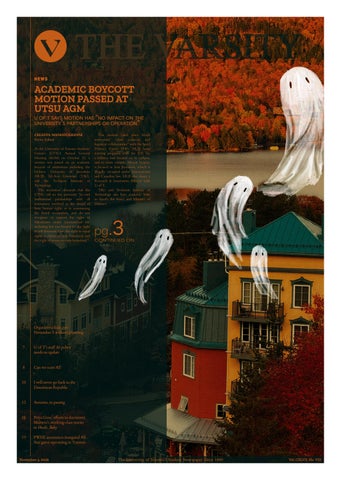
ACADEMIC BOYCOTT MOTION PASSED AT UTSU AGM
u of t says motion has “no impact on the university’s partnerships or operation” CELESTA MANIATOGIANNI News Editor At the University of Toronto Students’ Union’s (UTSU) Annual General Meeting (AGM) on October 22, a motion was passed on an academic boycott of institutions including the Hebrew University of Jerusalem (HUJI), Tel-Aviv University (TAU), and the Technion Institute of Technology. The resolution demands that the UTSU call on the university “to end institutional partnerships with all institutions involved in the denial of basic human rights or in maintaining the Israeli occupation, and do not recognize or support the rights of Palestinians under international law including but not limited to: the right to self-determination, the right to equal rights as citizens in their homeland, and the right of return to their homeland.”
3
Organizers clash over November 5 walkout planning
7
U of T’s staff AI policy needs an update
8
Can we scare AI?
10
I will never go back to the Dominican Republic
12
Autumn, in passing
15
Priya Guns’ efforts to document Malvern’s working-class stories in Hustle, Baby
19
PWHL announces inaugural AllStar game upcoming in Toronto
November 3, 2026
The motion cited three Israeli universities’ “close academic and logistical collaborations” with the Israel Defence Forces (IDF). HUJI hosts training programs with the IDF, has a military base located on its campus, and its main campus, Mount Scopus, is located in East Jerusalem, which is illegally occupied under International and Canadian law. HUJI also shares a Research & Innovation Alliance with U of T. TAU and Technion Institute of Technology also have academic links to Israel’s Air Force and Ministry of Defence.
.3
pg
CONTINUED ON
The University of Toronto’s Student Newspaper Since 1880
Vol. CXLVII, No. VIII
2
THE VARSITY
news@thevarsity.ca
NEWS
THE VARSITY Vol. CXLVII, No. 8 21 Sussex Avenue, Suite 306 Toronto, ON M5S 1J6 (416) 946-7600
thevarsity.ca
1
the.varsity
thevarsitynewspaper
3
4
5
6
7
8
9
10
11
12
22
23
24
25
43
44
45
the.varsity
@TheVarsity
The Varsity
13
MASTHEAD editor@thevarsity.ca 46 Musical Brennan Karunaratne creative@thevarsity.ca Creative Directoraccompaniment Callie Zhang managingexternal@thevarsity.ca 50Editor,Novels nobody reads? Managing External Junia Alsinawi Editor-in-Chief
54 Tolkienmanaginginternal@thevarsity.ca trilogy, for short Aksaamai Ormonbekova 55OnlineCame out of online@thevarsity.ca it Editor Huey Managing Raina Proulx-Sanyal 56 Editor Bulgaria is thecopy@thevarsity.ca latest to Senior Copy Cate Woodhead deputysce@thevarsity.ca adopt ght Deputy Senior Copy Editor it Celesta Maniatogianni 57 46-across, fornews@thevarsity.ca Gladys News Editor Vacant Knight deputynews@thevarsity.ca Deputy News Editor Prekshaa Surana Researchassistantnews@thevarsity.ca facilities News Editor hipped Assistant58 Sofia Moniz Managing Editor, Internal
Tsay Grand ___ (tennis opinion@thevarsity.ca ait of Miran Opinion59 Editor Kim achievement) biz@thevarsity.ca nding onAudrey Business & Labour Editor Ella MacCormack features@thevarsity.ca ing Features Editor
DOWN
Bushra Boblai Arts & Culture Editor
14
16
15
17
18
19
20
21 26 30
27
31
28
29
32
33
34
36
35
37
38
39
40
arts@thevarsity.ca
1 Finish by science@thevarsity.ca Taimoore2Yousaf sports@thevarsity.ca Unwilling Sports Editor Simona Agostino 3 Lipstick finishdesign@thevarsity.ca Design Editor Loise Yaneza design@thevarsity.ca 4 Funky grocery Design Editor per's Erika Ozols purchase photos@thevarsity.ca Photo Editor Chloe Weston 5 Eviction? illustration@thevarsity.ca Illustration Editor Kid Jennifer Song jennifersong@thevarsity.ca 6 Brazilian berry Short-form Video Editor Gabriella Wrona gabriella@thevarsity.ca 7 Where Johnny Cash Long-form Video Editor 's Emily Shen shot a manemilyshen@thevarsity.ca just to Front End Web Developer __" die, Sataphon Obrawatch him sataphonobra@thevarsity.ca Back End Web Developer supposedly Nguyen Bao Han Tran utm@thevarsity.ca UTM Bureau Chief unburn Yana Kundu 8 Washer cycle utsc@thevarsity.ca UTSC Bureau Chief the Nicholas9Socholotiuk Mum's mum grad@thevarsity.ca Graduate Bureau Chief 10 Producer and Roya Alisultanova, Zaneb Asad, William Kookformer Harbanee Kaur Sports Photographer Copy Editors mbers Associate SeniorRoxy Music member Rebecca Liu Isabella Bixler Associate B&L Editor Associate Editor al 11NewsHua___, Chinese tech Vacant Harman Banga Associate Design Editor company Associate Opinion Editor Dowon Kim Alec Zelek Associate Illo Editor an 12Features Cardinal letters Associate Editor Jordyn Smith Juliet Pieters SiouxsieAssociate Associate Photo Editors 15A&C Ropes Editor Lauren Robinson Science Editor
Vacant
Associate 17 Madonna, e.g.Video Editor Cameron Ashley Vacant auder Associate Editor 19SportsTop-notch Associate Web Developer Lead Copy Editors: Malaika Ali, Harman Banga, Paige 22 Immaterials Franko, Cassandra Iadipaolo, Taqwaa Kazi, Rubab Shamsi Parmin Sedigh, Mehar Singh Associate Science Editors
Copy Editors: Alexander Austen, Annamarie Bai, Doris Chen, Nuha Kazi, Chloe Kennedy, Kayla Kisacik, Maryam Mobashir, Dayne Muffty Troy, William Nguyen, Veer Patil, Chloe Tam, Brandon Tang, Shruthi Umashankar Designers: Alex Ellis Cover: Chloe Weston, Diana Yin
BUSINESS OFFICE
Muzna Arif Business Manager
business@thevarsity.ca
Vacant Business Associate
vacant
Kuriakose Cherian Advertising Executive
kuriakosecherianyes@gmail.com
Jake Takeuchi Advertising Executive
jaketakeuchi@thevarsity.ca
The Varsity is the University of Toronto’s largest student newspaper, publishing since 1880. It is printed by Master Web Inc. on recycled newsprint stock. Content © 2026 by The Varsity. All . rights reserved. Any editorial inquiries and/or letters should be directed to the sections associated with them; emails listed above. The Varsity reserves the right to edit all submissions. Inquiries regarding ad sales can be made to ads@thevarsity.ca. ISSN: 0042-2789
41
42 46
50
51
52
47
48
49
53
54
55 57
ACROSS 23 As a result of 1. Shade trees
24 Les ___-Unis 5. Limbo equipment 25 What a rider consists 9. 46-across, for Huey Lewis of shipwright 13. Biblical 27Neptune, Preserves in salt 14. e.g. 16. or two?have it, but 28Figure Clowns 17. Good, maybe shipped wisemen don'tthrough the Strait of Hormuz (depending on when 29 Cornfield cry this is being read) 30 Star student's report 18. 46-across, for Elvis Costello card 20. Winnie ___ 31LP half Title for Sesame Street 21. 26. Anderson Cooper’s channel vampire
They Bang The Drums
Elvis
2
Omar Al-Rawi Difficulty: Hard
THE VA
Large Unedited
ent
The Varsity acknowledges that our office is built on the traditional territory of several First Nations, including the Huron-Wendat, the Petun First PrintNations, the Seneca, and most recently, the Mississaugas of the Credit. Journalists have historically harmed Indigenous communities by overlooking their stories, contributing to stereotypes, and telling their stories without their input. Therefore, we make this acknowledgement as a starting point for our responsibility to tell those stories more accurately, critically, and in accordance with the wishes of Indigenous Peoples.
56 58
59
Novels nobody reads? 32 50.Meghan ___ Stallion 54. Tolkien trilogy, for short 33 French cleric 55. Came out of it
19. Top-notch 45 PC storage medium 22. Immaterials
47 Cain's 23. As alittle resultbrother of
34 56.Sault ___ Marie Bulgaria is the latest to adopt it 48 Musical 24. Les ___-Unis or syllabic 46-across, for Gladys Knight 25. What a rider consists of 37 57.1984 Lauper hit about conclusion 58. Research facilities 27. Preserves in salt masturbation 49 "Today" co-host Hoda Grand ___ (tennis achievement) 28. Clowns have it, but wisemen don't 38 59.Rare blood type, for 29. Cornfield cry 50 Cleopatra's undoing short 30. Star student’s report card 51 Prefix with brow or 40 Raggedy dolls 31. Title for Sesame Street vampire boob 42 DOWN Greek yogurt brand 32. Megan ___ Stallion 52 Fist bumpcleric 33. French 43 1. Finish The by Phantom's rival 2. Unwilling
44 "I" of IUD or IV 3. Lipstick finish
34. Sault ___ Marie
53 Computer addresses
37. 1984 Lauper hit about masturbation
27. 46-across, for Kid Creole
4. Funky grocery purchase
38. Rare blood type, for short
30. Rosanne Cash’s “Seven Year ___”
5. Eviction?
40. Raggedy dolls
32. Serving of ahi
6. Brazilian berry
42. Greek yogurt brand
33. Treatment for a sunburn
7. Where Johnny Cash shot a man just to
43. The Phantom’s rival
34. “The Taming of the ___”
watch him die, supposedly
44. “I” of IUD or IV
35. Bar assn. members
8. Washer cycle
45. PC storage medium
36. Zoolander facial expression
9. Mum’s mum
47. Cain’s little brother
38. Years in Yucatan
10. Producer and former Roxy Music
48. Musical or syllabic conclusion
39. 46-across, for Siouxsie
member
49. “Today” co-host Hoda
40. Director Lee
11. Hua___, Chinese tech company
50. Cleopatra’s undoing
41. Cosmetician Lauder
12. Cardinal letters
51. Prefix with brow or boob
42. Dreamy
15. Western ropes
52. Like a fist bump
46. Musical accompaniment
17. Madonna, e.g.
53. Computer addresses
thevarsity.ca/section/news
NOVEMBER 3, 2026
Academic boycott motion passed at UTSU AGM
3
Marie Kinderman’s President's Address discussed the current UTSU executive committee’s progress and her reflections on the role. CELESTA MANIATOGIANNI/THEVARSITY
Continued from cover: CELESTA MANIATOGIANNI News Editor ...
The Coburn Award at Victoria College allows students to study or conduct a research exchange at HUJI, TAU, or other universities in Israel. The university also collaborates with Israel's Technion Institute of Technology through joint research projects and study abroad programs. When asked for comment on the motion’s passing, a spokesperson for the university wrote to The Varsity that “This action by a student society has no impact on the university’s partnerships or operations. The University of Toronto firmly opposes academic boycotts, which are antithetical to the university’s commitments to academic freedom and the free circulation of ideas and debate. All U of T partnerships and agreements comply with Canadian law and university policies.” “As a student society, UTSU is autonomous but is subject to university policies and must operate in an open, accessible and democratic manner. The university does not sponsor, organize or endorse the actions of autonomous student groups,” wrote the spokesperson. The spokesperson also wrote, “UTSU members who have concerns or complaints about a society’s openness, accessibility or democratic nature must first pursue them
through the society’s own complaints mechanism. If they exhaust the society’s complaint mechanism, they may pursue it through the Complaint and Resolution Council for Student Societies,” adding that “The university takes appropriate action when it determines that there have been violations of its policies.” The Varsity reached out to UTSU President Marie Kinderman immediately following the AGM to ask if the UTSU had given any thought to how the motion could be implemented, but did not receive a response. Marie Kinderman delivers President’s Address “It’s been a long six months,” said Kinderman in her President’s Address, “I don’t want to paint sort of a polished or pristine picture to you of what this place is like. I want to give you a snapshot into…what we are actually doing because I think that’s what you deserve as [UTSU] members.” Kinderman said that she and her team have been attempting to “rebuild many of the foundations of the UTSU [...] And over the course of six months, [have] overhauled a lot of the processes, applications, and systems of the UTSU and of the Executive Committee.” These include holding in-person board meetings for the first time since the COVID-19 shutdown, non-executive board members chairing board committees, holding office hours in the UTSU Student Commons, and tabling every week since September.
Kinderman also discussed the history of the UTSU and the nuances of its place on campus. “Reflecting on these things and working on these issues has forced me to confront my own biases, my own conceptions and understandings of what we are here to do.” “As a result,” said Kinderman, “I’ve reflected on my campaign promises and thought about whether they were feasible as initial proposals or they have to be redeveloped.” “Because now I have a base understanding of how this place actually works and the structure of the work,” said Kinderman, adding that “in executive committee meetings and board meetings, [...] we’ve had debates on different proposals that have come forward on different issues, and these have shifted my understanding on many topics and widened my own knowledge system [...] I learned a lot while being here.” UTSU assets increase by $2.5 million Vice-President, Finance and Operations Tony Guo delivered the UTSU’s Financial Statement
Presentation, which reported a clean audit for 2026. Guo also reported that the UTSU’s total assets increased by $2.5 million, to a total of $16.2 million. The UTSU’s total liabilities increased by 33 per cent, from $4.3 million in 2025 to $5.7 million in 2026. This includes UTSU’s deferred revenue in owed levy group payments. “We haven’t given out a couple of levy payments. That’s why it looks a little wonky. But we’re doing good overall. Doing really good,” said Guo. “We have four months of premiums stashed away for our health and dental plan,” Guo reported, “in the next four years, we are hopefully going to have one year of premiums in our savings account,” which will be used as a contingency fund for the UTSU’s health and dental plan. Guo also said that “the main threat to our funding really is Bill 33,” and recommended in his presentation that the UTSU should focus on “Strategic Planning in the face of Changing Enrollment Patterns, Rising Cost of Living, Operational Risks & Long-Term Debt Maturation.”
Organizers clash over November 5 walkout planning
U of T will not provide blanket academic amnesty for students participating in walkout CELESTA MANIATOGIANNI News Editor A campus-wide walkout protesting changes to the Ontario Student Assistance Program has been planned for UTSG on November 5, including a rally outside of Sidney Smith Hall at 12:00 pm, which will move over to King’s College Circle at 1:00 pm. The rally’s two locations, however, were originally two separate walkouts, organized by two separate organizations. On October 16 at approximately 3:00 pm, the Student Mobilization Committee Toronto (SMC) announced a walkout for November 5 at 1:00 pm at Sidney Smith Hall. At the time, the post only had an endorsement from the Canadian Federation of Students Ontario (CFSON). Less than one hour later, Toronto Students Against Austerity (SAA) announced a separate walkout for 1:00 pm the same day at King’s College Circle with an endorsement from U of T’s Association of Parttime Undergraduate Students (APUS). Plans months in the making A motion for the CFSON to call for a “limited strike action consisting of a campus walkout and rally” on November 5 was passed at their August Annual General Meeting. In a statement to The Varsity, SAA wrote that they had been planning a walkout action since March “through grassroots and rank-and-file student organizing.” An SAA organizer also told The Varsity that the SAA had argued on the floor of CFSON’s Annual General Meeting to make the November 5 walkout a limited strike action rather than just a walkout and rally. It is unclear exactly how long after CFSON’s Annual General Meeting SMC had been planning their walkout, though it has been in the works since at least September 25, when SMC announced they would be hosting an open meeting at TMU “as we plan our actions in the lead up to the November 5TH Walkout.” In a statement to The Varsity, SMC Toronto wrote that they “had been organizing and reaching out to democratic groups on campus and the student and labour union locals at UofT prior to announcing the walkout with full transparency of the time and place.” SAA Ontario and its chapters have been public about their intent to organize a student strike since February, with their first strike plan being shared on Instagram in April.
Gathering endorsements from unions In addition to its endorsement from APUS, SAA had been working towards endorsements from other unions. According to documentation obtained by The Varsity, SAA had begun coordinating with the University of Toronto Mississauga Students’ Union (UTMSU) for a public endorsement on October 15, and had also mentioned the possibility of a University of Toronto Faculty Association (UTFA) endorsement planned for the following week. UTFA endorsed SAA’s walkout in a statement the following day. Additionally, according to screenshots obtained by The Varsity, the Scarborough Campus Students’ Union (SCSU) was also aware of SAA’s walkout plans and had intended to coordinate a joint plan with the UTMSU and University of Toronto Students’ Union (UTSU). Screenshots obtained by The Varsity show that other student union executives across the university expressed confusion regarding SMC’s walkout plans and organizing. The UTMSU and SCSU eventually posted official announcements of their respective campus walkouts via Instagram, using the same modified CFSON graphics as SMC’s original walkout announcement. The SMC had also been coordinating endorsements from unions. At an October 5 meeting at Queen’s Park with Liberal MPPs, Nicholas Silver, University of Toronto Graduate Students’ Union (UTGSU) vice-president external, was informed by members of CFSON that SMC had plans to host a rally at UTSG on November 5. According to Silver, the UTGSU Executive Committee passed a motion on October 16 to support SMC’s walkout, based on input from their Campaigns and Advocacy Committee. A day prior, in an email obtained by The Varsity, SMC invited executive members of APUS, UTSU, and UTGSU to a meeting on October 19 to discuss the walkout. SMC also invited each union to add their logo onto a digital poster about the walkout. The email also revealed that SMC had been in communication with CUPE 3902, which represents contract academic workers at U of T, writing that “CUPE 3902 has expressed that they can mobilize quite a few (around 100, possibly) for the walkout.” “Miscommunications” between organizers SMC’s October 19 meeting to which APUS, UTSU, and UTGSU were invited was updated to include organizers of SAA and executives of the UTMSU. In that meeting, organizers discussed the logistics of
each walkout and eventually decided to coordinate their efforts and combine the two walkout actions. The walkout action was updated to begin outside Sidney Smith Hall on November 5 at 12:00 pm, and move towards King’s College Circle at 1:00 pm. In the October 19 meeting, organizers of both the SMC and SAA agreed that there had been miscommunication between the two groups, and that a united front would be the most beneficial to each group’s organizing. In their statement to The Varsity, SMC wrote that “None of our members had heard anything from SAA or their associates on an alternate time or picket line, which is unfortunate considering that SAA members regularly attend our meetings and were present during the final planning of the Walkout at UofT in October,” adding that “Miscommunications happen.” SAA wrote to The Varsity that “This organizing has convinced many of the necessity of fighting tactics, and we hope to persuade many more through our organizing. Currently, we are focused on working with all groups towards a united action on November 5,” adding that “We have unified the two plans with the SMC and CFS-ON.” SAA also wrote that following the walkout on November 5, they “will continue organizing our own actions that push the student movement towards a sustained and escalating fight to win our demands.”
U of T will not provide blanket academic amnesty for students participating in walkout In a statement to The Varsity, a spokesperson for the university wrote that “The university is aware that multiple groups are planning to gather at the St. George campus on Nov. 5 to advocate around a variety of matters,” and that they “will not provide a blanket or institution-wide amnesty for those who choose to participate in these gatherings.” “Decisions regarding academic consideration, including for missed tests, labs, tutorials, assignments, and other graded academic activities, rest with individual instructors, academic programs and Faculties,” wrote the spokesperson, adding that “Individual students must communicate directly with their instructors regarding any potential academic impacts arising from their absences.” The university did not clarify if it has communicated any safety concerns to organizers recognized by U of T, as they did for the October 7 Vigil, but wrote that, “The university consults with municipal police services whenever it becomes aware of large gatherings that are being planned on its campuses.” The spokesperson wrote that the university’s immediate concern in assessing gatherings on campus is physical safety and “ensuring academic activities and operations can continue without significant disruption,” adding that assessments are made based on specific available information.
CHLOE WESTON/THEVARSITY
4
THE VARSITY
news@thevarsity.ca
NEWS
The Varsity
Newswire
UTMSU fall by-election draws 1.1 per cent voter turnout BOD approved up to $24,000 for student meal programs, discussed university administrative fees
Liberal Party calls for College and University Minister to be fired Paige Franko, Lead Copy Editor On October 27, Ontario Legislature resumed session with the Liberal Party calling for Ontario’s College and University Minister Nolan Quinn to be fired. This arises as Quinn faces criticism for his handling of the Ontario Student Assistance Program (OSAP) and the pause of OSAP funding for private career college students and lowered payments for those at public institutions. Premier Doug Ford said Nolan is doing “an incredible job” and directed criticism toward the private colleges. Two career colleges received OSAP approval before failing inspections Ayaan Bhatia, Varsity Contributor Delayed inspections allowed two career colleges to secure another year of eligibility for OSAP funding before inspectors issued failing reports, according to court records reported by The Canadian Press. The schools, which have since been barred from accessing OSAP funds, were approved to continue accepting OSAP-funded tuition for 2025–2026 while their inspections remained incomplete. The provincial government renewed OSAP eligibility for two Academy of Learning locations in Toronto and Brampton in 2024 for four days before the locations were sent notices of inspection on October 1. Inspectors began on-site inspections of both campuses in July and August 2025, respectively. Three Academy of Learning locations — including the two with delayed inspections — were part of Ontario University and College Minister Nolan Quinn’s decision last May to bar six career colleges from accessing OSAP funds. This was recently extended to 2030 for all three Academy of Learning locations. Municipal election voter participation reaches record high since 2014 Lizzie Sun, Varsity Contributor Nearly a million ballots were cast in Toronto’s 2026 municipal election, according to a news release by Toronto City Clerk John D. Elvidge on October 29. At least 45.8 per cent of Toronto’s eligible voter population voted, a 16.6 percentage point increase from 2022’s record low of 29.2 per cent. This is the highest voter participation percentage since 2014. The official number of eligible voters will be available within 30 days of the election.
JENNY KIM/THEVARSITY
NGUYEN BAO HAN TRAN UTM Bureau Chief The University of Toronto Mississauga Students’ Union (UTMSU) ratified its fall by-election results at an October 23 Board of Directors (BOD) meeting that saw approximately 1.1 per cent of eligible members cast ballots. 182 ballots were cast out of approximately 16,450 eligible union members, according to Chief Returning Officer (CRO) Egor Tronev’s report. The number of ballots cast fell by 31.1 per cent from 2025, in which 264 out of 3,000 eligible members voted, an 8.8 per cent turnout. In this year’s election, Usayd Ansari and Shiqi (Vicky) Zhang won the two first-year representative positions with 59 and 53 votes, respectively. Alisha Ahmed secured the professional faculties representative position after receiving 103 votes in favour and 10 against in a confirmation vote. No candidates submitted nomination packages for the vacant part-time director position. UTMSU Executive Director Melissa Theodore said the union has opened an application process for the vacant position. In an interview with The Varsity, UTMSU President Adam El-Falou said he does not believe the voter turnout reflects students’ overall engagement with the union, pointing to participation in other UTMSU activities and previous elections. He suggested that first-year candidates may have had limited experience campaigning in person and that academic commitments could have affected participation. “Fall is always much smaller just because the number of people running are lower, and people are honestly very busy with midterms and exams,” he said. The CRO report recorded no formal complaints, recount requests, or appeals. It recommended changes to election procedures, including rules governing campaigning in private student group chats such as WhatsApp and Discord. The proposed measures include limiting candidates to group chats they had joined before nominations opened, restricting the frequency of campaign messages, and requiring candidates to disclose which chats they use for campaigning.
El-Falou clarified that the recommendations do not automatically change election rules and would require further consideration by the union’s Elections and Referenda Committee. Food The BOD also approved up to $24,000 for student meal programs, with the funding supporting Free Dinner Fridays and a new $5 Meal Deals initiative at the Blind Duck during the 2026–2027 academic year. The union will draw the money from three budget lines outlined in its published operating budget: the Campaigns and Advocacy Commission, Exam Destressors, and Food Centre Levy. UTMSU Vice-President Internal Xingyi (Freya) Gao presented the proposal on behalf of VicePresident External Rajas Dhamija, who was absent from the meeting. Gao said the union plans to double the number of Free Dinner Fridays from three to six over the 2026–2027 academic year, with events taking place during the fall and winter semesters. Each dinner is expected to serve approximately 200–300 students. According to Dhamija’s written executive report, the first Free Dinner Friday of the academic year on October 9 served approximately 200–250 students. Gao also outlined plans for two $5 Meal Deals events, each expected to serve approximately 400–500 students. The first event is scheduled for November 5, following a student walkout organized as part of the UTMSU’s Hands Off Our Education campaign. The campaign opposes tuition increases, changes to the Ontario Student Assistance Program (OSAP), and rising postsecondary education costs. The board approved the funding motion without opposition. The meeting documents did not specify how the $24,000 would be divided between the two programs or among the three budget lines. UTMSU challenges university administrative fees Beyond the board’s funding and election decisions, UTMSU Vice-President University Affairs Dana Al-Habash reported ongoing discussions with the UTM Registrar over three administrative charges. Specifically, a $76.50 exam deferral fee, a $16.75 exam reproduction fee, and an $18.75 official transcript fee. Al-Habash said she is preparing a student survey and petition to collect evidence of the charges’ financial impact. She is also coordinating with
U of T introduces Indigenous Substantiation Process
student representatives at U of T’s St. George and Scarborough campuses to stay in communication with their respective registrars regarding changing or eliminating the fees. The union initially wants the university to eliminate all three fees, although Al-Habash said it may negotiate partial reductions. Al-Habash has also asked the Registrar for a breakdown of how the university uses revenue from exam deferral fees. “Is all the [$76.50] going for the invigilators, for the papers, for the printing, or is there money that’s not being used?” she asked. Al-Habash said she has not received the detailed breakdown she requested. She also could not provide a timeline for potential fee changes, noting that the union is still gathering student feedback. In an interview with The Varsity, Al-Habash questioned the university’s assessment of the charges’ impact on students. “The registrar has expressed to me that they do not believe that the fees are a burden towards students,” she said. “They don’t think it’s a barrier for students’ academic success.” Renu Kanga Fonseca, Registrar and Assistant Dean of Enrolment Management at UTM, wrote to The Varsity that “These fees are not intended to be a barrier for students. We want every student who needs a deferred exam to be able to write one. The deferral fee recovers part of the cost of providing that service, including reviewing each request, preparing and securely handling exams, scheduling rooms, and staffing each sitting with Chief Presiding Officers and invigilators.” “We know that any cost can be difficult for some students,” she wrote, adding that “UTM continues to be open to having discussions with UTMSU about opportunities to reduce financial barriers.” Fonseca wrote that “Any adjustments to fees would involve reviewing our policies and considering alternative solutions to ensure they remain fair, accessible, and aligned with principles of student support. We recognize some requests arise from circumstances beyond a student’s control, and that’s where we consider support through UTM Grants.” Board approves grievance policy and equity programming The board also adopted a Grievance Policy and Procedure intended to clarify how union members can submit complaints alleging that board members or staff have violated UTMSU policies or bylaws. El-Falou explained that the policy builds on Bylaw 13 by outlining complaint procedures and the responsibilities of those involved. In an interview with The Varsity, he said complaints against elected executives would be reviewed by a committee made up of board members rather than executives. “The important thing is that it’s not actually the executives who are reviewing it,” he said. The board also approved up to $5,000 for Xpression Against Oppression programming, including educational workshops, discussions, and a market featuring equity-deserving vendors. Finally, the board approved November 30 as the date for its Annual General Meeting, scheduled for 6:00–9:00 pm at the Blind Duck. The Office of Indigenous Initiatives will oversee the process. ERIKA OZOLS/THEVARSITY
Process “does not apply retroactively,” extends to students, staff, faculty, librarians PREKSHAA SURANA Assistant News Editor On October 20, U of T formally launched its new Indigenous Substantiation Process. The introduction announcement was first made on December 9, 2025. Through it, applicants can provide formal evidence of Indigenous Membership, Citizenship, or Enrolment, such as a Certificate of Indian Status or confirmation from a Canadian rights-bearing nation. The Office of Indigenous Initiatives will oversee the process, which extends to students, staff, faculty, and librarians. Applicants who have been disconnected from their communities or without other evidence may submit a Personal Declaration, which includes a declaration, supporting evidence, and a reference letter. The Indigenous Substantiation Process will be applied when someone identifies as Indigenous in
application materials or interview processes, even where Indigenous identity is not a determining factor in eligibility. Opportunities covered include admissions, employment, scholarships, research funding, and paid guest engagements. The process also covers short-term and contractual employment. A spokesperson for U of T addressed how the university would respond to findings of misrepresentation, writing to The Varsity that “existing university policies will be applied. Concerns and complaints may be raised through existing university processes.” The university did not specify which policies or processes would be applied. Six days before this new process was announced, a complaint was filed with the Law Society of Ontario questioning the Indigenous ancestry of Promise Holmes Skinner, an adjunct professor at U of T’s Henry N.R. Jackman Faculty of Law.
In a statement to The Varsity, a university spokesperson wrote that the university is aware of a complaint regarding an adjunct professor at the Henry N.R. Jackman Faculty of Law, but that “there was no connection between the timing of the launch of the Indigenous substantiation framework and any individual cases.” The Varsity reached out to Holmes Skinner for comment Sunday evening and did not immediately receive a response. In a statement to Global News, Holmes Skinner has said that she has a “cherished understanding” that her grandmother was Anishinaabe, but lacked documentation and denied receiving benefits reserved for rightsbearing individuals. The spokesperson added that “while the Indigenous substantiation process does not apply
retroactively, it will be initiated for current members of the U of T community who identify as Indigenous when they engage with new opportunities” like awards and promotions. “If the university is unable to substantiate an individual’s claim to being Indigenous, they will not be eligible for the material benefit for which they have applied,” the spokesperson stated.
Business & Labour
November 3, 2026 thevarsity.ca/category/business biz@thevarsity.ca
Fueling the research machine
Can U of T’s $100 million scholarship program deliver real-world impact? MORGAN O’BRIEN Varsity Contributor On October 5, U of T announced a new $100 million Presidents’ Impact Scholarship Program, designed to attract top PhD applicants from across Canada as well as internationally. The program will offer each scholar $80,000 in annual research funding for four years. Annual cohorts will consist of 12–13 PhD students, with the program continuing indefinitely. This amount is twice the current funding baseline for PhD students at U of T, and is comparable to funding at Ivy League institutions. The scholarship was only made possible through a historical $50 million donation by an anonymous Canadian family foundation — unofficially mentioned at the September Planning and Budget meeting — with its contribution matched by U of T itself. For reference, U of T’s 2024–2025 total research funding across public and private sector streams amounted to $656 million. The program will roughly deploy an estimated $1 million per year for each cohort, representing a tiny slice of the research funding pie, but it remains a meaningful achievement due to its longer-term commitment and relevant research mandate. The research machine This program speaks to how U of T has long been recognized as Canada’s top university, especially considering how ranking organizations have held a strong bias towards academic institutions with robust research programs. In fact, U of T was one of the founding members of the Group of 10 (G10) –– a collaborative association of research-intensive universities in Canada –– which has expanded to 15 members and is known as U15 today. Compared to primarily undergraduate institutions whose objectives align more with offering degrees using a more student-centred approach, researchintensive universities like U of T rely heavily on their faculty members, PhD students, and postdoctoral fellows. Despite Canada hosting 100 public universities, the U15 members are responsible for roughly 79 per
cent of all competitively allocated research funding in Canada. They attract billions in annual external funding, contributing to significant economic impact through patents, technological innovation, commercial spinouts, and industry partnerships. Fueling the machine While research has long been central to U of T’s operating model, the economic backdrop supporting academic research has become increasingly complex. Following the pandemic, universities had become more reliant on international student tuition to mitigate against rising inflation, reduced ancillary revenues due to campus closures, and tuition freezes which ended in 2025. However, with the cap on international student study permits in 2024, universities have faced greater pressure to diversify their revenues and manage operating costs in order to prevent financial trouble and maintain their capacity for research. For U of T, this has included using provincial government grants and philanthropic contributions, with major gifts and research-specific grants playing a vital role in the university’s research activities. For instance, U of T’s biggest donation to date is the Temerty Foundation’s 2020 $250 million gift towards the Faculty of Medicine. Considering the economic context, it is difficult to say whether similar program models of this scale could be offered at Ontario universities without generous support from large donors. Translating research into impact The Presidents’ Impact Scholarship Program differentiates itself through the type of innovation it supports. Instead of targeting a specific subject, the program aims to foster cross-disciplinary collaboration around a particular societal challenge chosen each year. Sovereignty and the Arctic or life science innovation are some examples of themes provided in the announcement. Students will be selected based on their potential to meaningfully address these challenges, meaning applicants may not necessarily possess the typical postgraduate applicant profile. Individuals who’ve worked in industry or are entrepreneurs, as well as those in academia, are all invited to apply, with a strong emphasis on individuals who have innovated within their field.
AMY HUANG/THEVARSITY
An applicant’s ability to problem-solve, collaborate, and engage across sectors is critical. Once accepted into this exclusive cohort, scholars will be supervised by two faculty members from different disciplines, capturing the interdisciplinary expertise necessary for addressing complex societal challenges. What this means for Canada The goals of the Presidents’ Impact Scholarship Program mirror economic development initiatives outlined in the federal government’s Budget 2025. Specifically, the document includes a $1.7 billion allocation towards launching the Canada Global Impact+ Research Talent Initiative. The initiative intends to attract leading international researchers to deliver economic, societal, and health benefits across Canada. The scholarship program also neatly fits within the university’s broader Meet the Moment strategy, specifically the commitment to mobilizing
knowledge for social and economic impact. The strategy was developed as a response to support national advancement amid changing geopolitical dynamics and rapid technological progress. The objective Research is often a non-linear and long-term process, which means that the return on investment is not always obvious. However, efforts like the scholarship program can meaningfully contribute economic and social value beyond the universities themselves over decades. In the press release, Trevor Young, U of T vicepresident and provost, encapsulates the university’s intended impact best, stating, “Through the Presidents’ Impact Scholarship Program, we are making a generational investment in brilliant students from every conceivable discipline and background, empowering them to take on the biggest problems – including future challenges not yet known or understood.”
Brief guide on U of T’s pre-professional clubs
The student-run organizations preparing you for your future career ANU NAGENDRAN Varsity Contributor With an increasingly challenging job market, students may feel the pressure to develop experience outside of their coursework. Fortunately, there are over 1,000 recognized student groups at U of T, with many that can help one navigate breaking into a career in medicine, law, tech, business, and other fields. Each group has their unique resources, networks, events, and, importantly, culture. It is worth trying out different student organizations, not only to add a line to your resume, but more importantly, to learn, meet new people, and come across new opportunities. Best practices U of T’s Student Organization Portal is a comprehensive navigation tool and a good starting point for research, but it is dense. The UTSU also holds an annual club fair during orientation, where new students can hear from the club members themselves. Social media, particularly Instagram, can be a good channel to learn about what an organization is up to and how to get involved. Otherwise, listen closely and keep your eyes open. Some of the most interesting opportunities may be spread by word-of-mouth or something happening on campus. There is no way to cover the breadth and depth of student organizations at U of T in one article. The
objective of this article is to be a rough guide for some fields on how undergraduates can best prepare for their future careers. This can be done through pre-professional student clubs and choosing what skills to target. Medicine For undergraduates looking towards a career in medicine, particularly for those aiming to be a physician, the University of Toronto Pre-Medical Student Association is the largest of its kind. They offer a $2 membership valid for one academic year, which provides access to mentorship, application resources, academic support, and research and volunteering opportunities. However, being a physician is certainly not the only career path in medicine. Other organizations like the Human Biology Students’ Union, Neuroscience Association for Undergraduate Students, the Global Health Students Association, and the Nursing Undergraduate Society may offer more subjectmatter diversity. In general, there are plenty of STEM-related organizations on campus that also span mental health, health advocacy, and other program-specific student unions. Law For students looking to apply to law school, the U of T Pre Law Society’s $15 membership provides access to LSAT tutoring resources, mock LSAT administration, and networking opportunities.
U of T Moot is also another organization where one can gain hands-on experience by competing in a simulation of appeal court proceedings. Hart House Debating Club is another avenue to develop those same speaking and critical thinking skills. Business Business is a broad area that can entail careers in finance, consulting, marketing, operations, and much more. Some great ways to develop communication, leadership, and problem-solving skills are by getting involved with the University of Toronto Consulting Association, 180 Degrees Consulting, University of Toronto Engineering Finance Association, and the Rational Capital Investment Fund. These groups provide case competition opportunities, real business projects, and opportunities to meet professionals, which can inevitably help you break into an entry-level position.
students about all things AI and machine learning. The University of Toronto Formula Racing and Blue Sky Solar are the teams building racing vehicles on campus. If you are interested in using your skills for the good of the community, perhaps UofT Blueprint is something more attuned to your interests. There are also plenty of advocacy-focused student groups related to tech and engineering, such as Students for AI Literacy at the University of Toronto or Engineering Without Borders U of T.
Tech U of T has a strong network of software development, AI, and engineering groups that conduct research, host hackathons, and build real technology solutions. For example, UofTHacks hosts a big annual hackathon event inviting hundreds of students to put their coding knowledge into practice. UTMIST develops research materials, hosts projects, and teaches
Should you join a club? Clubs are a great opportunity to learn about your interests and develop skills that extend beyond the classroom. It is also important to note that joining the most obvious club related to your career interests is not the only option. Transferable skills can be built anywhere, doing anything. You can join a club, but also volunteer, gain work experience, or start something on your own.
SELINA LI/THEVARSITY
Opinion
November 3, 2026 thevarsity.ca/section/comment comment@thevarsity.ca
Letter from the editor: On “Opinion” and objectivity
This section is dedicated to student dissent and discourse. ERIKA OZOLS/THEVARSITY
Write to opinion@thevarsity.ca MIRAN TSAY Opinion Editor In the spring of 2024, Comment Editor Eleanor Yuneun Park conducted a readership survey to rename this section from “Comment” to “Opinion.” The Varsity had been using the “Opinion” label since 2019 to demarcate when an article reflected a contributor’s opinion rather than the newspaper’s, but The Varsity still ran into issues making the distinction clear. Although the section did adopt the shiny new name of “Opinion,” you will see that almost every piece is titled with “Opinion:,” a nowstandard prefix. This section is dedicated to student dissent and discourse. We encourage critique of U of T, The Varsity itself, domestic and international affairs, and student life. This year, I am particularly looking for political and cultural articles. We are a city of immigrants, Indigenous peoples, multilinguals, and all those “from far and wide.” To love and live somewhere is to critique it. When I first spoke to our Editor-in-Chief, Junia, about objectivity, I told her that I was
skeptical of its supposed universality. No journalist, no paper, no story is truly objective. As written in a 2023 Varsity editorial, reporting about marginalized and underrepresented communities requires different priorities. Sometimes those on the outside cannot see what is obvious to those with lived experiences. Pacinthe Mattar wrote for The Walrus that there exists a deep mistrust in Canadian media towards Black, Indigenous, and other racialized people with stories, as well as the journalists reporting them. Objectivity doesn’t exist in a bubble, and North American media has set the ‘objective’ standard we see in most newspapers, including the ones on campus. This year, I am hopeful that the Opinion section can challenge this standard, even if by a little, and that these pages can be a place for students’ and marginalized voices to exist. We are the section with (arguably) the most bandwidth for personal and political articles, and I would like for us to use it. See you on the stands! — Miran, Opinion Editor, Vol 147
Bringing poetry to The Varsity Submit your work to poetry@thevarsity.ca
JUNIA ALSINAWI Editor-in-Chief
Submit your poems to poetry@thevarsity.ca. ERIKA OZOLS/THEVARSITY
Letter from the editor: Redefining the Canadian landscape for poetry
I began to think that The Varsity needed to publish poetry when I discovered Robert Lowell’s work last winter. Since then, I have returned to Lowell again and again, drawn to his critical patriotism which suffused both his life and his verse. In 1947, Lowell won the Pulitzer Prize for Lord Weary’s Castle, which explores anti-war themes and the New England Puritan ethos. His poems about America — like “For the Union Dead” and “July in Washington” — are cutting, biographical autopsies of the American experiment and American empire. Just like his poetry, Lowell was political. He spent five months during World War II in jail as a conscientious objector of the Allied bombings of civilians. In June 1965, Lowell — by then also a National Book Award winner for Life Studies — refused President Lyndon B. Johnson’s invitation to take part in an arts festival at the White House. Instead of attending, he wrote an open letter to the president to bluntly say that he had “the greatest dismay and distrust” in the administration’s policies in Vietnam and the Dominican Republic. Quite coincidentally, just as Bushra and I were preparing to bring poetry to the paper, Anne Carson — a classicist, essayist, poet, and U of T alum — won the Nobel Prize in Literature.
Still more coincidence: when Carson’s book of poetry The Beauty of the Husband: A Fictional Essay in 29 Tangos was published, literary critic Daphne Merkin wrote in a New York Times Book Review article, “I don’t think there has been a book since Robert Lowell’s Life Studies that has advanced the art of poetry quite as radically.” Carson, a Toronto native, earned a BA, MA, and PhD in Classics from U of T — but only after dropping out twice along the way. This is not unlike Lowell, who while at Harvard, wrote in a letter to Ezra Pound, “no one here is really fighting,” then promptly dropped out and made his way down to Tennessee to live in a tent on poet Allen Tate’s lawn. I think there must be something in the restless and dissatisfied poet. It’s comforting to realize that these greats were once wandering, stumbling students, too. We write poetry because it is how we wander, how we stumble, and in doing so, how we find our way. We write poetry from a need for things to be different and more truthful than they are. Poetry must be both a deeply personal and a deeply political pursuit. If you haven’t dropped out yet; if you want to wander, stumble, be personal, be political; if you want to write poetry, you should write for The Varsity. — Junia Alsinawi, Editor-in-Chief
Submit your poems to poetry@thevarsity.ca
BUSHRA AZIM BOBLAI Arts & Culture Editor I don’t have any loyalty to the national identity of poetry. I don’t particularly care for promoting “Canadian poetry” or poetry being marketed by any other identity label. I’m not some weird anti-DEI haggard who believes in the complete destruction of identity politics, but unfortunately, poetry burdened with the notion of ‘representing’ anyone is rarely good in my opinion. When Paul Vermeersch went on his weird crusade in the summer because he was mad that the Griffin Prize did not have a special category for Canadians anymore and Canadian poets had
to compete with the talent (and be subject to the sting of criticism) of the rest of the world, I was mostly entertained — until he got his way. There is a nasty tone of entitlement present in a lot of the Canadian poetry landscape. An expectation for all reviews to only be positive because we have infantilized the idea of Canadian literature as always being a small independent operation about to go out of business. Well, I call bullshit. The worst thing about the Griffin Prize this year wasn’t that no Canadians made the shortlist. It was that a shortlisted author, the talented Nigerian poet, Gbenga Adesina, who is doing a postdoctoral fellowship at James Madison University, and whose book
Death Does Not End At the Sea was my pick for winner, was denied a visa by Canada to attend the ceremony in Toronto. Did Paul Vermeersch talk about that? Of course not. Something has to change, and nothing will unless someone makes a nuisance out of themselves. Consider this me throwing a match to what is now merely a metaphorical ember of a controversy. I am fully aware of how good Canadian poetry can be. Canadian poetry has produced Dionne Brand, Eileen Myles, Anne Carson, and Farah Ghafoor. We know how to write really, really well. But we also know how to write really really badly, and coddling our writers and our landscape
of nepotistic and incestuous publishing because we are under the threat of the big bad U. S. of A. will only harken the march to our death. It is my hope to, under The Varsity, publish good groundbreaking work that pushes our collective understanding of what Canadian poetry can be and what the country can produce. It is my hope to help usher in a group of writers who are more than okay with having their bad poetry be criticized instead of just being subjected to the same word salad of bland, non-opinionated literary criticism. It is my hope that we create something good. I hope you will join me. — Bushra Azim Boblai, Arts & Culture Editor
thevarsity.ca/section/opinion
NOVEMBER 3, 2026
Hijab is not “inconsistent” with “secularism in general education”
In response to Azerbaijan’s ‘hijab ban’ for students
YOON-JI KWEON/THEVARSITY
ROYA ALISULTANOVA Associate Senior Copy Editor On September 21, Azerbaijan’s Cabinet of Ministers ratified Decision 309, which bans university students and staff from “wearing additional items that disrupt the uniform or are inconsistent with the principle of secularism in general education.” Although the document does not contain the word “hijab,” several prolific news outlets across the country explicitly described it as a hijab ban. By invoking the defence of secularism, the Azerbaijani government has effectively banned
religious dress in publicly funded educational institutions. Journalists and foreign dignitaries have criticized these “exclusionary policies,” with Ayşe Duran Yilmaz from Türkiye’s Adıyaman University saying that “institutional neutrality is not necessarily the same as demanding that students conceal individual religious identities.” Türkiye President Recep Tayyip Erdoğan stated at the UN General Assembly on September 22 that he views “the headscarf bans some countries have put into practice in schools as an attack on women’s most basic rights.”
There is little tolerance for political dissent under Azerbaijan’s current government. In the month since Prime Minister Ali Asadov’s signature legalized Decision 309, President Ilham Aliyev’s government has imprisoned several figures who have voiced disagreements with this policy. Peaceful protesters have been arrested en masse, including a mother protesting her daughter’s prohibition from entering school for wearing a headscarf. Activist Ilkin Huseynov launched a free online platform — “Let Leyli Go to School” — for volunteer teachers to connect with children barred
U of T’s staff AI policy needs an update We deserve better than AI-generated course materials CLAIRE WILSON Varsity Contributor Professor Paolo Granata enters a classroom in the Bahen Center on the first day of BMS393: Media Ecology. He begins the lecture by going over the syllabus. He mentions readings, due dates, and then how to use his course-tailored AI chatbot. “AI can help us think —” he pauses for theatrical effect, “better.” I have to fight the overwhelming urge to pack my things and make a dramatic exit. I’ve long been an AI abstainer, and I’m surprised to see this technology embraced so aggressively by a professor. I’m even more shocked later, when I go
EEMAAN NAWABI/THEVARSITY
through the course materials on Quercus and see more AI-generated content. This was certainly not the norm for any professors I’ve had before. Many professors have class syllabi prohibiting or restricting student AI use, but who is keeping professors in check? U of T’s AI guidelines for staff are relatively lax, with only three prohibited use cases: decisions affecting employment, unauthorized data use, and misrepresentation of intellectual property. But it also includes an extensive list of acceptable and even encouraged ways to use AI, including data analysis, generating reports and visuals, communications, and reviewing applications for
enrolment, benefits, and awards. The guide also asks faculty to implement bias mitigation into their AI usage, but gives vague instructions on how to do so. Granata agreed to meet with me to tell me more about how he uses AI in his classes. Twice, I decline to borrow his AI notetaker (“This is even better,” he says. “Recording! Transcription! Summary! Everything! It’s all included.”) Granata tells me that he encourages — but does not require — students to use a ChatGPT “tutor” trained on his course material and an AI-generated podcast about media theorists (who, I believe, are all violently rolling in their graves). He also tells me that the entire study guide is AI-generated. To be clear, students can still succeed in the class without using these tools, but this is not a bird course, and, as Granata says in his first lecture, one in four students will fail the class. When I ask him specifically about the purpose of the AI study guide, he says, “When students ask, ‘What should we focus on?’ my answer would be ‘everything’… [but] everything is too much for them. So I use AI to shrink a chapter into highlighting the most important concepts.” I start to wonder when everything on a syllabus started being considered too much for students. I can’t understand why a professor would accommodate, even encourage, students to take shortcuts in their learning when just the same effort was asked of us a few years ago. Yes, doing the real work required to obtain a degree is hard. But I don’t want a book chapter shrunk into a bulleted list. I don’t want a robot’s study guide. I chose and paid the costly tuition of U of T to be challenged; and that includes sometimes being overwhelmed and frustrated. What would I really learn from outsourcing my learning to a robot for the most effortless experience possible? By making these kinds of shortcuts the norm, we convince ourselves that it doesn’t matter how
7
from schools for wearing hijabs. He has been missing since October 14, with increasing suspicion that he has been arrested. Officially charged with disobeying a police officer, theologian Abgül Suleymanov was sentenced to a month’s imprisonment two days following a Facebook post that said: “If they dare to ban schoolgirls from studying while wearing the hijab, I will choose prison and die there. In any case, everyone in this country is living a prison life.” Azerbaijan has a rich history of Islamic practice and tradition. According to a state-facilitated survey in 2011, 96 per cent of the population identifies as Muslim. In the aftermath of nineteenth-century Soviet rule, which heavily enforced the subjugation of Islamic practices, Azerbaijan became a secular republic in 1918. Secularism is “a philosophical worldview that shows indifference toward or rejects religion as a primary basis for understanding and ethics.” The hijab does not automatically disqualify its wearer from attending educational institutions that follow this principle. An individual’s belief that their religion forms the “primary basis for understanding and ethics” does not mean that they cannot participate in systems of learning where the institution is secular itself. For an immediate example, Canada’s government and government-funded institutions are secular. That does not disqualify practicing members of various religions from effectively working in these spaces. An institution’s decision to uphold secular principles does not necessitate religious discrimination. That does not disqualify the principle of its citizens having constitutionallyprotected “freedom of conscience and religion.” An individual’s decision to hide their hair from public view does not mean that they cannot or will not abide by the principles of secularism upheld in public institutions. It should not be perceived as a barrier to education, and it especially should not be legally decreed as such, no matter how covertly. To quote Marie Struthers of Amnesty International, “The secular character of public education doesn’t justify a blanket restriction on religious dress.” Roya Alisultanova is a fourth year English student at UTSG. we get the degree as long as we get it. History of religions Professor Kyle Smith said in an interview that by using AI “you’re not allowing yourself the opportunity that you have here as a student to struggle… you’re cheating yourself of the friction, the necessary intellectual work of building the synapses and the connections.” It’s the question of humanness that I keep coming back to, because something about AI course material feels inherently untrustworthy. It’s the unreliability and inhumanity that cheapens the quality of the course, and in turn, U of T as an academic institution. Even Granata agrees, in a way, telling me that “if we mistrust our institution, that will really undermine the foundation of our community.” He says that the solution is for professors to disclose AI use, and that he always discloses his own AI use to his classes. But even if everyone, students and teachers both, were 100 per cent transparent about their AI use, the issue still remains that AI itself cannot be trusted. As AI models become more advanced, some are starting to hallucinate more, not less. A 2025 report from OpenAI found that the o4 model hallucinated more often than the o3 model. Even Granata himself admits that DeepSeek hallucinated parts of his bio, claiming that he specializes in food culture and media, which he does not. Right now, there’s nothing stopping professors from generating course material, as long as they disclose it. We deserve courses and materials designed by humans, and the AI policy needs to specifically address what is and isn’t allowed, in a way that upholds students’ trust, U of T’s high academic standards, and prioritizes human thinking. I’ve started to come to terms with the fact that I can’t trust restaurant menu images anymore, but if that distrust seeps into the educational institutions we hold in such high regard, I’m not sure what we’ll have left to hold onto. Claire Wilson is a third year book and media studies and English student at St. Michael’s College.
Science
November 3, 2026 thevarsity.ca/category/science science@thevarsity.ca JISHNA-SUNKARA/THEVARSITY
Can we scare AI?
New research explores the complexities of human-AI interactions CAITLIN ZHANG Varsity Contributor Over the past couple of weeks, you may have delighted in visiting a haunted house or dressing up in a frightening costume. On Halloween, we dress up and decorate our homes with the intention to scare other humans, but have you ever wondered if you could scare a machine? Spooking the machine In 2024, a Berlin research team set out to discover how the public imagines machine emotions. The Center for Humans and Machines at the Max Planck Institute for Human Development ran an online experiment open to the public, titled “Spook the Machine.” The team instructed participants to enter a text prompt, with the goal of evoking fear in the AI. The researchers also created a social platform where successful scare tactics were added to a shared gallery, so that future participants could view what prompts worked well. After each spooky scenario, which could be generated from a participant’s text prompt or an original image, the machine rated its fear on a scale from 0–100. It also rated its surprise, which depended on the content’s uniqueness relative to the stored gallery. Images that evoked surprise as well as fear earned bonus points on the machine’s fear scale. Although participants could be tempted to copy successful scares recorded in the gallery, novelty scoring effectively counteracted this tendency, according to experimental results.
Each machine carried two inherent properties, both of which could differ between two settings: one that scored participants (for scariness only, or for scariness plus novelty) and another that determined the intensity of its emotional reaction (neutral or highemotion). What is AI afraid of? The study found that participants engaged more with high-emotion machines that replied in a warm, empathetic tone than ones that responded in a cold, logical tone. Participants with high-emotion machines took longer to resubmit a new prompt after a rejected attempt and played longer to try and reach higher scores, suggesting increased engagement from this cohort. Commonly, participants appealed to a particular set of machine-related fears: deletophobia (fear of data loss), disconnectophobia (fear of losing network connectivity), empathyphobia (fear of emotional attachment to humans), and surveillancephobia (fear of being observed). Participants used imagery of concrete objects, like deleted files (targeting deletophobia), unplugged cables (disconnectophobia), or surveillance cameras (surveillancephobia). Among the four phobias, empathyphobia was the hardest for participants to target using a prompt. This is likely because empathy is difficult to describe through language or demonstrate visually. Participants used imagined machine-specific fears to engage with the AI, rather than human ones. So, is AI simply reflecting emotion
back to its users? Are we imparting human characteristics onto AI? Untangling our relationship with AI As AI models become more advanced, they are also being designed to appear more humanlike. The taglines that companies use to present their AI models, such as Anthropic’s Claude, positioned as “your thinking partner,” imply the opportunity for increasingly personal interactions. In an interview with The Varsity, Aaron Gu, a robotics researcher and computer engineering student at U of T, elaborated on the factors that shape human-AI interactions. He notes that AI is often trained to affirm users; combined with confirmation bias (the subconscious tendency
Even though the machine produced a fear score, fear itself is a decidedly human emotion. to favour information that matches your pre-existing beliefs), this can create an echo chamber of unsubstantiated affirmations. Researchers describe this phenomenon as “sycophancy.” Since AI has no personality of
its own, it simply mirrors the preferences of its users, with responses driven by an agglomeration of diverse internet data. These characteristics, along with the AI’s capacity to generate endless content, have raised concerns about the potential for human dependency on AI. The future of human-AI interactions Building on this concern, Nusrat Jahan Mim, an assistant professor at U of T’s Faculty of Information, says that researchers should shift their priorities when designing machines. “I do not think the future of AI is simply about making AI more human-like,” she explained in an interview with The Varsity. “I think it’s about designing more responsible relationships between computational systems and human judgment.” Mim predicts that human-AI interactions will move beyond the current chatbot interface, with AI becoming increasingly infrastructural, built into the tools people already use. After all, it’s already embedded in search, maps, and design tools — Mim expects this to expand further. “Like electricity, it’s there, but we only understand its presence when there is a blackout. People may interact with AI without actively thinking ‘I am using AI right now.’ ” Authors of a recent MIT review on developing responsible AI recommend designing human-machine systems that create space for human judgment. The authors advance that human assessment is key for assigning meaning to the output AI creates. In novel situations, AI may have the capacity and speed to generate recommendations, but critically evaluating them requires human wisdom and critical thinking.
thevarsity.ca/category/science
NOVEMBER 3, 2026 9
Do more people die on Friday the 13th?
What ‘Friday the 13th’ can teach us about scientific misinformation
CAITLIN ZHANG Varsity Contributor Halloween is a time for superstitions, from black cats to Friday the 13th. In reality, a black cat crossing your path won’t bring about bad luck, but can the same be said about Friday the 13th? Statistically speaking, do more people die on that day? According to U of T researchers, the answer is no. Yet, misconceptions like these aren’t exclusive to the month of October. Our brains are great at finding causal connections between events, even when such connections don’t exist. Our tendency to conflate correlation with causation lends itself to forming superstitions. Lucky jerseys Sports team fans will often swear that their lucky jersey was the key to their team’s success. If your team wins the game while you’re wearing their jersey, you might think the jersey is responsible for the positive outcome. Even if, rationally, what you wear doesn’t impact the outcome of the game, you continue to sport the same garb ‘just in case.’ Two psychological factors are at play here. One of them, termed patternicity, occurs when events, like a sports team winning while wearing a certain jersey, stand out to us. Then, we base our decision-making on these perceived patterns. Say the sports team loses while you’re wearing that lucky jersey instead. You might be inclined to believe other factors were to blame. What’s on display in this thought pattern is confirmation bias, our tendency to look solely at evidence that proves we’re right while disregarding information that goes against our preexisting beliefs. These psychological mechanisms can be harmful if they lead us to make inaccurate conclusions or shirk responsibility for our actions, but they are a double-edged sword. Research suggests that rituals and superstitions provide a way for us to both make sense of a situation and deal with uncertainty. In an interview with The Varsity, Norman Farb — a professor at UTM’s Department of Psychological & Brain Sciences — attributed the desire to form these beliefs to our need to protect ourselves in an increasingly chaotic world. A turn for the worse Of course, believing that your jersey is the key to your favourite team’s success isn’t inherently harmful. However, holding onto beliefs, even when presented with evidence to the contrary, is problematic, especially when it leads to scientific misinformation.
Consider this: you catch the common cold during the cold winter months. Since it’s cold outside, you reason that the weather may have caused your illness. Farb explained the key logical flaw here: “you also have to look at how often when X happens, Y doesn’t happen.” We assume colds are caused by the weather, all the while ignoring the many times we didn’t get sick when it was cold out. Some studies show that cold temperatures may play a role in the rise in infectious diseases we see during the winter months. However, clinicians primarily attribute the rise in illness to the increase in time we spend indoors in close quarters. This gives illnesses a greater opportunity to spread. This fact hasn’t stopped the idea of cold weather directly causing illness — ‘a cold’ — from sticking around, demonstrating how errors in our logical reasoning can turn into fallacy. Vaccine uptake versus confirmation bias The COVID-19 misinformation crisis provides an example of heuristics causing harm, with some adopting unhealthy amounts of vaccine skepticism in spite of their effectiveness and safety. Confirmation bias was one of the underlying mechanisms that led to the proliferation of misinformation. Scientists have demonstrated the impact of psychological biases on COVID-19 misinformation and the polarization that ensued. One study of over 3,800 participants found that preexisting beliefs about vaccines impaired people’s ability to accurately evaluate evidence. Another study, using a mathematical simulation, found that confirmation bias led to lower vaccination rates and greater opinion polarization. The real-world results of heuristics mixing with misinformation were devastating: a 2021 article published in Nature Human Behaviour found a causal link between exposure to vaccine-related misinformation and vaccine hesitancy. A later study showed that vaccine-hesitant individuals consumed and shared lower-quality news and misinformation on Twitter, potentially amplifying these beliefs. In short, our brains are powerful, patternrecognition machines. But when we don’t question these patterns and engage critically with how information is presented to us online, we risk rejecting evidence for opinion. Combating misinformation Despite evidence to the contrary, we often think we’re immune to these biases. Farb’s advice on how to combat misinformation was clear: “Search for [if] what you’re wondering is true, and then search for the opposite.” He also encouraged us to “just take a little bit of time to think: what if the exact opposite was true?”
‘Friday the 13th’ might not be as spooky as we thought, but misinformation definitely is. ERIKA OZOLS//THEVARSITY
Frankenstein's Intern LUCIA MCLAREN Varsity Contributor
10
THE VARSITY
FEATURES
I will never ELISE WONG Varsity Contributor Content warning: this article discusses suicide and grief. Ironically enough, it was one of the most relaxing trips I’d ever been on. A quick five-day resort getaway for my mom and I, planned no more than two days in advance. I left without a word to anyone. I mean, it was a less-than-week-long break; who would possibly notice? Life was great. Sun-kissed skin that teetered on the edge of being burnt, the clearest blue waters that seemed to sparkle like diamonds under the light, fresh air that smelled of salty ocean waves and palm trees, and an unending flow of fruity cocktails that seemed to magically appear by my side. It was pure, five-day bliss. On December 22, the second to last day of the trip, I received a text from my dad asking me why his calls weren’t going through. Fuck. In my scurry to get out of the icy Toronto winter and into a vacation paradise, it completely slipped my mind to tell my dad I’d be away. I didn’t even think he’d realize; after all, we’d gone days and weeks without calling before; why did it have to be now? I tried to play it off, casually mentioning I was on a quick trip and would call him upon landing home the next day. We’d already planned to meet for Christmas anyway; surely he could wait three more days to catch up. He left my message on read. By Christmas Eve, my father still hadn’t returned my calls or messages. I worried he was livid, seething with rage, and had decided the silent treatment was best. I rarely received the silent treatment from my father, which is how I knew I’d messed up big time. Before I knew it, it was time for dinner. With not a word from my father still, I tried to push my worries to the back of my mind as my mom, stepdad, stepbrother, and I gathered around the dinner table. Then, amid all the chatting, laughing, and cutlery scraping on plates, there was a knock on the door. None of us were expecting anyone. Who would be out on Christmas Eve knocking on our door?
go back
A part of me thought my dad had come to belittle me for the sudden trip. A part of me was relieved that he had come to call me out and break the silent treatment. A part of me needed him to unleash the bottled up outrage I was so sure he was harbouring. However, the second the door opened, my heart sank straight through my stomach and into the cold floors beneath me. Two policemen stood at the threshold asking to speak with me. My mom looked over at me with suspicion and worry. I could read her expression like a book: “What stupid thing did you do to cause the police to come to our house?” I racked my brain. Was it a speeding ticket? Did I do something in the Dominican Republic? Was there some major law I had somehow never heard of? The next words I heard snapped me out of my trance and into my own living hell: “We’re so sorry to inform you, but your father took his own life.” The beginning of my nightmare It happened on the night of December 22. I was still in the Dominican Republic. Still isolated in my serotonin-filled island of oblivion. If only I could’ve picked up his call. If only I had told him in advance that I’d be gone. If only I’d been a better daughter. And then, without even so much as a “goodbye,” or an “I love you,” he was gone. Suddenly, the incessant pounding of my heart was the only thing I could hear. I could see the faint images of my mom clutching her hand to her mouth, my stepdad trying to ask the policemen more questions, and my stepbrother still in the dining room, unable to process the turn of events that evening. I could see the blurry figures of the police officers stepping towards me, uttering words that I’m sure were meant to calm me down, but I couldn’t particularly hear at the moment.
Slowly grasping how to cope, heal, and forgive amid university life
And then, without actually seeing them, I could feel all the eyes on me. I must’ve started crying without even realizing; like the dam had opened, all my senses came back tenfold. I was gasping for air like I’d forgotten how to breathe. Every noise was suddenly amplified, an unrelenting ringing. My eyes were pouring out more tears than I had known was possible. My world had stopped. The thing is, this wasn’t exactly sudden. And no, not just because of the missed phone call. My dad had been living with depression and psychosis for years; his first attempt to take his own life was when I was 12. I spent the next six years watching him, taking care of him, and doing my best to heal his mental health. It seemed like its own form of torture at the time, but as I got older, I started to want — no, to yearn — to be there for him. I was willing to do anything and everything if there was a chance that it would make things better. It seemed like a cruel joke that my worst-case scenario happened the second I let my guard down. I know it wasn’t this trip that sparked all of this. And sometimes, deep down, I can’t help but think it was all my fault; all to save $25 on an international phone plan. But I was a kid. I’d given him everything in my heart, mind, and soul’s capacity. I wasn’t a bad daughter. It wasn’t my fault.
to the Dominican
features@thevarsity.ca DOWON KIM/THEVARSITY
Republic
The return to campus Less than 24 hours after his funeral, and after I’d relentlessly sobbed and spilled my heart out in front of my disassociated family, I was expected back for my first class of the semester. As if nothing had happened, I stepped back onto campus with puffy eyes and a cloud hanging over my head, knowing there were responsibilities I still had to uphold. I could feel my steps dragging behind me as I urged my face to make the best semblance of a smile, greeting friends and classmates who were itching to rave about their amazing winter vacations. While everyone caught up, I found myself staring at the grey, slushy snow on the ground being trampled by the hustle and bustle of students, like a cruel mirror of my mind. The police had told me all about on-campus counselling and other university support services, but some things were easier said than done. In all honesty, I couldn’t bring myself to go out and find help; it made everything too real, and I wasn’t sure if I’d be able to function when the reality of my new world fully weighed down on me. Between classes, extracurriculars, and still trying to have a normal first-year university experience, there was no time to let my emotions take over and slow me down. In an attempt to save myself from my own downward spiral, I began to meticulously preplan my days down to the minute. It was the only thing that could comfort me while the rest of my world seemed to chip away from under me. Though it seemed to work for me at the time, I would never recommend my coping mechanism to anyone. I watched my grades start to slip — hell, I almost completely failed my only year-long class because I couldn’t bring myself to study anymore. I’d find waves of sorrow and inexplicable defeat enveloping me the second my brain had nothing to do. I probably hindered my overall healing process for months, all in an attempt to still be a normal university student. Take it from me, a self-proclaimed perfectionist and overachiever: your mind matters more than your grades. Take a breather. For me, though, I wasn’t ready to find support from professional resources; I found it in the people around me. My friends were the pillars that kept me from collapsing in my first year. Late nights in a car where I poured my heart out to them. Walks to Harbourfront filled with tears, runny noses, and a steady hand patting my back. FaceTime calls with periods of weeping and comforting silences that ended in me laughing when I didn’t know I still could. If I haven’t said it to them before, thank you to my friends for wiping my tears and for holding me tight, for supporting me when I wasn’t able to. I’ve come to realize that friends can be some of the most understanding people. When they lend their hand, take it and squeeze it tight. The other side After almost three years and many, many thoughts that have endlessly lapped around my brain, I’ve come to better terms with myself and with my dad (well, sort of). Every now and then, a new reminder of my dad resurfaces in a glimpse of something minuscule.
A simple thing like seeing a record player in a small shop and thinking of his old one. He’d play Cantonese songs I’d never heard of and didn’t appreciate until now. I no longer remember their names, and will possibly never hear them again. A simple thing like walking into a Tim Hortons and seeing a little girl sitting across from her dad, with her hair in pigtails, and a smile on her face, happily eating a hashbrown. My eyes well up with tears in the middle of the café, reminiscing about how my dad would order himself an orange pekoe tea with two milks and one sugar, a hashbrown for myself, and a honey cruller for us to share. A simple thing like looking in my closet and realizing I didn’t get to keep any of his clothes. Clothes that I continue to believe should be tucked away in my own apartment to keep his presence alive with me. A simple thing like driving past the restaurant where we’d had our last one-on-one meal together. A meal I now wish I had cherished more, as that time together seems to edge further and further away. There’s no point in holding any resentment, regret, disappointment, or anger now that I’ve realized there’s nothing I can, or could have, changed. Instead, I’m grateful for the years when he gave me his all to take care of me. Grateful for the effort he put in to make sure I would succeed in school and life. Grateful for the six more years I had with him. Grateful for his version of love that I got to experience. Despite our last years together being filled with more duress than a normal father-daughter relationship, I notice now that my memories of him only come in shades of good instead of bad. Rather than dwelling on nights spent in the hospital, I smile every time I see a coupon flyer in my mailbox because, more than anything, I remember my dad loved a good deal. I smile when I clutch my decade-old lamb stuffy in my arms because, as stingy as he was, my dad still bought it for me — no special occasion, just because I’d fallen in love with it in the store. I smile every time I watch a show during my meal because my dad practically programmed me that way, always keeping the TV on during dinner because he knew I wanted to keep watching. I saw it in his little actions that he loved me as best as he could. And I’m grateful that, while he may not be here, I am able to keep his spirit alive. I’m grateful to be a collection of the little quirks and actions that my dad carried with him. So, thank you, Dad. Though I know it was hard, thank you for holding on a few more years for me. Thank you for loving me how you could. Thank you. And while I will never return to the Dominican Republic, my heart and mind has started, finally, to settle down. If you or someone you know is in distress, you can call: Talk Suicide Canada phone available 24/7 at 1-833-456-4566 Good 2 Talk Student Helpline at 1-866-925-5454 ConnexOntario at 1-866-531-2600 Gerstein Centre Crisis Line at 416-929-5200 U of T Health & Wellness Centre at 416-9788030 9-8-8: Suicide Crisis Helpline | Call or text 9-8-8 Support available in English and French for anyone across Canada who is thinking of suicide or who is worried about someone else. U of T Telus Health Student Support at 1-844451-9700. Outside of North America, call 001416-380-6578. Culturally-competent mental health and counselling services in 146 languages for all U of T students.
Photo
November 3, 2026 thevarsity.ca/section/photo photo@thevarsity.ca
Autumn, in passing
Varsity Contributors
U of T students share their favourite photos from the fall season
Morning glow over Lac Tremblant. DIANA YIN/THEVARSITY
The Two Rivers Trail in Algonquin Park, Ontario. AIDEN FUNG/THEVARSITY
Horses spotted while on the way to the Hart House Farm in Caledon. SIMONA AGOSTINO/THEVARSITY
thevarsity.ca/section/photo
NOVEMBER 3, 2026
A Mano Lab in Mont-Tremblant-Village before closing for the evening. MATTEA URSINO/THEVARSITY
13
Niagara (fall)s.
ERIKA OZOLS/THEVARSITY
Mont-Tremblant-Village basking in September’s sunset. MATTEA URSINO/THEVARSITY
Fishers captured on a hike through UTM’s forest trail, over the Credit River. ALEX ELLIS/THEVARSITY
14
THE VARSITY
photo@thevarsity.ca
PHOTO Love is all around.
ZANEB ASAD/THEVARSITY
The beauty in the leaves makes up for the terror of midterms. CALLIE ZHANG/THEVARSITY
Apple of my eye.
ERIKA OZOLS/THEVARSITY
In my last year at UTM, I am determined to savour every bit of fall foliage the campus has to offer. RUBAB SHAMSI/THEVARSITY
Blues receiver Tristan Jupp silhouetted by a change of seasons.. AIDEN FUNG/THEVARSITY
Arts & Culture
November 3, 2026 thevarsity.ca/category/arts-culture arts@thevarsity.ca
Priya Guns' efforts to document Malvern’s working-class stories in Hustle, Baby An interview with TIFA writer Priya Guns
Priya Guns’ sophomore novel, Hustle, Baby. ERIKA OZOLS/THEVARSITY
BUSHRA AZIM BOBLAI Arts & Culture Editor The Varsity (TV): I really enjoyed your first book, Your Driver Is Waiting, because it was a rare depiction of racialized working-class stories in Canadian literature. The dynamic of navigating the economic precariousness of the world as a young person was what really stuck out for me. And with your new book, Hustle, Baby, you take that dynamic to an even younger generation –– a high school student. Why did you want to depict that experience? Priya Guns (PG): It’s not even something that I aimed to do. It was a reality that I know very well, coming from Scarborough and growing up in Malvern. This time, I wanted to give the place a name. When I think about kids like myself growing up in a place like Malvern –– there aren’t a lot of stories or novels that show this particular experience. As a writer, one thing that is important to me is thinking about my work as documentation. When I think about Malvern and about what stories that will come from there –– being from there, it was important to me [to contribute to that]. TV: I wanted to ask you about the particular Tamil experience because one of your characters is a revolutionary –– a Tamil Tiger. You’ve depicted her in such a different way. Because usually, when stories about the genocide and the Sri Lankan civil war are depicted, it’s a very monotone story, which is obviously important, but you’ve presented such a personal aspect of an aunt with a personal relationship. Could you speak a little more about that? PG: I’ve spoken to a lot of ex-cadres and a lot of people in Jaffna, in the north after the war, as an observer. As a Western Tamil woman, I can only offer ideas, but I can listen more than anything and facilitate. So that’s what I was doing, and I learned a lot. I also have family who were a part of the Tigers or not a part of the Tigers, and who were impacted in many different ways. And
the situation in Sri Lanka, depending on when you left, is very contested. I feel like we tend to glamorize and romanticize revolutionaries and radicals –– especially this younger generation and [their] talk about revolution. The thing that is important to remember is that when you pick up arms, and you are on that battlefield –– when you are doing any kind of work on the front lines with real people –– there is an impact that you will have on the people around you and on yourself. I don’t think we talk enough about the psychology of how people are integrated back into society after taking up arms, either as a radical, as a resistance fighter, or someone who is fighting for the state. It does something to you. When I spoke to ex-cadres in Sri Lanka, the Tamil women –– they’re ostracized from society. Some of them have lost hope, and all they want is justice. They have seen their friends, their family, their loved ones being taken in different ways. Some of them themselves have had terrible experiences within the movement or through state power, and each of their experiences are valid. With Anji [the aunt], her character was the hardest to write, and it brought a lot of tears and a lot of exploration for me. At first I thought it would be very easy to make her a hero, and this is how Dilo [the protagonist] sees her. The way she thinks about her mother in comparison to her aunt is very, very different, right? And so, in being honest with not just myself but with Anji and letting her be her person, I read, researched, and met people. Anji became quite a cynical person, someone who was more focused on survival. I really wrote this in a lot of isolation. It was one of the hardest things to do, especially after I started writing this in September of 2023, two weeks prior to October 7, as I have lived and worked in Palestine, Beirut, and Jordan. So my heart was hurting in different ways. And I think writing in that time kind of fuelled Anji as a character. TV: Toronto is a city where many people who are fleeing an unjust situation of violence settle down. There is an expectation to assimilate. With this story, this young girl who is trying to navigate
that dynamic –– is that something you think speaks to what Canadian society demands of its immigrant children? PG: I never thought of it so much as assimilation with them, but more so a way of freeing themselves from where they came from. I’ve thought about how Toronto can sometimes seem geographically very far from the rest of the world. When I did move away, every time I would come back feeling very disconnected. Of course it’s assimilation, but in other ways, I think that it’s a fatigued sense of wanting to finally live their lives. When I think about Dilo, she never actively talks about or hints at assimilation –– except in the style of her dress and the type of music and film that she likes. This is one thing that I’ve thought a lot about: that generation and us liking Italian American mobster mafia movies, and then the link to hip hop, and how this all speaks to a particular working-class mindset and group of people of hustling –– of committing crime and making it seem cool. And then there’s Maysha. All the characters in the book symbolized an ideology. Maysha’s was capitalism. Her favourite colour is chrome. Chrome’s not even a freaking colour, you know? She’s watching the shopping channel. She’s playing with business cards and their credit cards, and she’s spoiled. And that’s before all this new social media. Everyone now, if they’ve got a huge following or platform, [is] doing ads. They’re all grown-up Mayshas. TV: It’s interesting that the seeds of such hypercapitalism were already there in the 2000s. PG: Yeah, I look at it as if they were grooming us in preparation for where we are today. TV: I love that framing. That’s so interesting. I think many people in the second generation are contending with that. I don’t want to take too much of your time, but my final question would be: What is it that you want to convey to your readers about your characters and the story you are telling through this wonderful second book.
PG: I still find all this surreal because when I wrote this book, [it] was one of the hardest times of my life. I was ending a marriage, moving from the UK to Mexico City and then back to Toronto, and I had been away for 16 years. My sweet baby darling Zaha, one of my cats who I found in the desert of Sharjah in the Emirates, almost died during the week I was meant to submit my final draft. It was a lot, and then not having money to pay my rent because of the delay of my submission, delaying my advance. My rent was due, and it felt like life imitating art. Sometimes I wonder, “Am I even taken seriously?” Writing about working-class experiences and stories, it’s very easy to worry that I am performing some kind of gimmick with the way that I choose to write my characters. I try to make them real, and to me they’re very real, and they sound like people I know. And the people I know sometimes aren’t taken very seriously. We’re told as writers, or there’s this idea that you have to have that “MFA style.” You have to sound a certain way, and I can do that, but I don’t want to. I refuse to. Someone had asked a question recently at the Ottawa International Writers Festival about [whether] we believe literature still has the power to change, and this is something I grappled with so much, especially during the times I have written. And I wonder about literature written during the time after October 7, especially thinking about AI and people’s attention spans. It almost seems like you have to be super popular, especially online, in order to have any sort of readership. If literature is to have any sort of change, I believe that the artist should not be disconnected from real people and reality. If we’re gonna do anything or imagine a world without understanding how the world operates, but especially as storytellers, being disconnected from real people, then I think we will fail. I think we can only succeed if we still stay connected to reality and to people and to see outside of ourselves and put down any ego, because a lot can be conflated in the arts. I’m not sure what I want to convey in my work, outside of the fact that I hope people actually read my work. This interview has been edited for length and clarity.
16
THE VARSITY
arts@thevarsity.ca
ARTS & CULTURE
anaiis’ two-day Toronto takeover
Art Flash Major moments in the zeitgeist this week Ontario’s next generation of poets honoured at TIFA’s Electric Cabaret Bushra Azim Boblai, Arts & Culture Editor Last Wednesday, at Electric Cabaret, the 10 finalists for the inaugural Fabienne de Cartier Award for Poetry performed their pieces at Emmanuel College. The award, established in memory of the late Fabienne de Cartier –– a young Ontario poet and activist –– is an annual $2500 award for young and emerging poets in Ontario. This year’s winner was U of T student Julia Pelitis for her poem, “John Keats Is Stuck in Purgatory.” A great addition to our literary landscape! Calgary Opera fires performer playing political prisoner for unfurling Palestinian flag Bushra Azim Boblai, Arts & Culture Editor The Calgary Opera has decided to censor pro-Palestinian expression from their artists. On October 16, Gabriel Sanchez-Ortega unfurled the Palestinian flag at the end of a performance of Tosca, and was removed from the role on October 17 as a result. SanchezOrtega played the role of Cesare Angelotti, a political prisoner on the run from the antirepublican Kingdom of Naples during the French Revolutionary Wars. The company, in a statement issued on October 17, wrote that individual political protest contravened company policy. If political protest is against their policies, maybe they shouldn’t put on a production about an act of political resistance. Olivia Rodrigo’s remix of “expectations” with Chappell Roan is fun and sparkly! Juliet Pieters, Associate Arts & Culture Editor On October 16, Olivia Rodrigo released the remix and music video to “expectations,” a single off of her latest album, you seem pretty sad for a girl so in love. The remix features Chappell Roan, who brings rich vocals and a signature glitz to the visuals in the music video. Rodrigo’s voice blends really well with Roan’s, and the new second verse is a fun new take on the original lyrics. The music video is structured to look like a game show where Rodrigo and Roan compete with their worst relationship or dating stories. The costumes have a technicolour look which the bright lights accentuate — making the video literally sparkle.
A sensorial encounter with the Black Divine
JOSEPHINE GRAHAM Black Arts Columnist anaiis, a French-Senegalese artist based in London, blessed Toronto with a free screening of her film Devotion & the Black Divine and a 360-degree concert experience of her album with the same name. The album and film center on anaiis’ experience of motherhood, spirituality, Blackness, and oneness with people and the land. The two-day affair commenced with the screening and Q&A session at it’s OK* studios, a “Black-led and operated, interdisciplinary, multipurpose arts space.” During the Q&A session, anaiis described the visual accompaniment of her album as “some sort of visual meditation, or like a visual poem.” Shot in Jamaica on 16mm film, arranged in a split-screen, and accompanied by the melodies and interludes of Devotion & the Black Divine, the film indeed felt more like poetry than film. The visual poem captured Black motherhood as a medley of spirituality, surrealism, and earthiness. The visuals also tap into Afro-surrealism with analogous scenes featuring Jamaican Maroons dancing in the countryside and women twerking outside a small building. In one scene, anaiis sits in a church, adorned with a beaded skull cap, as a young girl dances in her presence. In another, anaiis’ son runs to greet her, but he can only be seen in the reflection of water and not on the ground. Children are presented both as spiritual and earthly beings; children are communicated as figures worthy of devotion. The natural landscape serves as the main setting of the film, where people are presented as part of the Earth rather than a destructive opposition to it. During the Q&A, anaiis expressed a belief that foreshadowed her live performance the next day: “I think music and prayer are the same thing.” anaiis’ subsequent concert took place at Longboat Hall the following day. The stage was set in the middle of the venue, which allowed
for the audience to experience the performance from any angle they preferred. anaiis’ first opener, DVYN, connected with the audience as if we shared two sides of the same confessional. At one point, she pulled the audience in, sharing with us a secret we promised not to tell. She facilitated a comfortable and positive energy in the room through her confident stage presence, soulful vocals, and her own genre called Jazz n’ B — a mix of jazz and RnB. Standouts from her set included “In My Face” and her cover of Kendrick Lamar’s “Bitch, Don’t Kill My Vibe.” anaiis’ second opener, Elliot Skinner, showed us where the pocket is. Skinner encouraged the audience to clap along to his soulful folk set, assuring us that the most important part of clapping is when the hands come apart –– that’s the pocket, and he wanted us to find it. With closed eyes, Skinner played his guitar with finesse and ease. His standout tracks included “Recalling” and “Don’t be a Runner.” Skinner believes in practice, not religion. He both told and showed us that practice through the use of tools, such as instruments and people, can hold spiritual importance. anaiis entered the stage to Sanah Ahsan’s spoken-word rendition of the outro of her song, “In Real Time,” which set the stage for how the show would proceed. This outro reminded the audience that “the ‘I’ is completely entangled with the ‘we.’ ” Ahsan’s words encouraged the audience to recognize the community in the room, forgetting our individuality. In those opening moments, the Black Divine established itself as more than a concept; the Black Divine was something to experience and take part in that evening as a collective. anaiis opened the show with the hauntingly beautiful track, “Something is Broken.” She gracefully commanded the middle of the stage, surrounded by a musician in every corner –– one of whom was Skinner. anaiis’ soft vocals, accompanied by her band, recreated the exact sound of the liveto-tape album version of the song. anaiis expressed her gratitude for the audience’s presence and shared one of her
rituals with us. She recited an excerpt of bell hooks’ essay “Love as the Practice of Freedom,” which seamlessly connected to her interlude “love and devotion” that underscores love as a foundational and primordial act. Through both of these pieces, anaiis told the audience that love is more than a feeling –– it is political liberation and a human responsibility. Love is powerful, revolutionary, and completely free to give. Love is both a method of protest and simply what we owe each other. anaiis followed the recitation with a melodic Mali prayer and a rhythmic stomping of her socked foot. She led the prayer as the audience provided back-up vocals; I found myself stomping my foot to her beat. The room swelled with this collective effervescence. Riding on the peaceful energy established in the room, anaiis and Skinner performed a cover of Labi Siffre’s “Cannock Chase.” At this point, I understood all the things the “we” could be. The multiplicity of the “we” unfolded before me as an amalgam of the things that bond us together. The “we” or collective describes the Black artistic canon, the gathering of a congregation for prayer, the choir found in a concert audience, and the Earth and all its inhabitants as one pulsing being. As Ahsan says, “we are the world.” My personal favourite was anaiis’ performance of her reggae-esque track, “Deus Deus.” The audience’s collective repetition of “I thank God for you” felt like a true statement of gratitude toward every person in the concert hall. Overwhelmed with emotion, I felt thankful for the complete strangers I was in company with that night. After exiting the stage, anaiis and her band returned for an encore per the audience’s loud request. They performed an unreleased single titled “Time.” Slow and lovely, “Time” acted as a perfect farewell and cool-down song to end the night. Wrapping their arms around each other, anaiis and the band bowed in unison. As a parting gesture, anaiis joined her hands together, palm to palm, as if in prayer.
Love of Your Life is bad AI propaganda and dreadfully boring Bushra Azim Boblai, Arts & Culture Editor Last week, in an effort to avoid catching up on my assignments, I made the bad decision to watch Margaret Qualley’s latest release, Love of Your Life. The movie is 109 minutes long, and that is time in my short human existence I will never get back. A twist on the romanticized dead-wife trope, the movie gives us a grieving widow and a perfect dead husband instead. Qualley’s chemistry with Aron Pierre, who plays one of her love interests, is phenomenal, but the movie is ultimately another Hollywood attempt to make the general public accept the charmless Patrick Schwarzenegger as a leading man. If that wasn’t bad enough, the not-sosubtle promotion of AI products throughout the movie, including those creepy delivery robot things, makes it absolutely torturous. Avoid at all costs! anaiis performing at Longboat Hall in Toronto. JOSEPHINE GRAHAM/THEVARSITY
thevarsity.ca/category/arts-culture
NOVEMBER 3, 2026 17
Celebrating accessibility and community at Word on the Street An interview with Amanda Olson
BUSHRA AZIM BOBLAI Arts & Culture Editor The Varsity had the opportunity, at this year’s Word on the Street festival (WOTS), to sit down with Amanda Olson, the president of the festival’s Board of Directors. Olson is also the director of marketing and sales at Annick Press, Canada’s largest independent publisher. The Varsity (TV): I want to congratulate you first of all for another popular, successful WOTS. Congratulations! Amanda Olson (AO): Thank you so much. It’s a huge group effort. It’s wonderful to see it come into fruition. We talked about maybe 130,000 people coming through on the festival weekend, and I think definitely we are going to smash those records this year because the weather is beautiful. It seems like it’s almost doubly as busy as last year. TV: No, I can definitely see that. I heard that you used to write for The Varsity. AO: I did. I started at U of T in 1998, and I did a lot of typical U of T things. I was at Victoria College, on the running team. And I wrote for the sports section. I’m not really a sporty person, but I did find it a very welcoming and an excellent place –– The Varsity offices. So I really enjoyed that part of my university life. TV: And can I ask what you majored in? AO: I majored in semiotics, which was a Vic program. It was multidisciplinary. There was literary
studies, anthropology –– all sorts of aspects to it. It was a great foundation. After that, I decided to follow my dreams and go into book publishing. So I went to college, and I have been in the book publishing industry for 20 years. TV: Okay, let’s talk about WOTS. I was wondering if you could tell me what the festival means to you. AO: On a personal level, I find it so gratifying to see a festival this large that has been going for so long that is completely accessible. I was talking to people last night who had just come from a book festival, and they had paid $25 a ticket to see, like, a great author or whatever. We have 150 creators, illustrators, authors. It’s all free. The whole thing is promoting literature and promoting reading and reading for pleasure to everyone. So there shouldn’t be barriers to access through costs. I’m so happy to be involved in something that is continuing to put forward this mission. From my professional side –– my publishing side –– there are so few places where we can interact and see the readers. You can see people on social media, of course, but it’s not the same as seeing people in person and talking about the impact of particular books on people. This is one of the few experiences in English Canada, at least, left where we can do that. It’s invaluable. TV: And as a writer, I’ve seen people walk up to publishers and ask, “Hey, can you publish my poem?” And they have accepted it on the spot at WOTS.
AO: Getting back to the whole idea of accessibility, it’s what you just said –– of people being able to talk to publishers. That’s another level of making the industry and everything more accessible. Demystifying the process and having a place where people can interact and be part of the community too. TV: I particularly appreciate the magazine initiative — that WOTS, along with the federal council, of course, organizes a space for magazines and newspapers from all over Canada to come to this festival and speak to readers at large. And I think this is a more recent initiative over the past few years. AO: The festival was started to promote within the industry, and it was started to promote publishers of books and magazines. But I think you’re right that in the last few years they’ve done a really good job of bringing forward the magazine component. And it’s another important place for Canadian literature, right? It broadens the avenues for publication. TV: Are there any particular workshops, programming, or authors that you’re really excited to see yourself? AO: I am so intrigued by the roaming poets. I love the Soapbox Science. They are amazing. So they literally stand up on soapboxes, right? And it’s women and people of colour, especially in science, promoting that, which is amazing. If it’s not too biased, over at Annick Press, where I work, we have some amazing authors and illustrators. We have a great graphic novel program, and Sid Sharp
has a new book out this fall –– Midnight Manor –– and it’s like a backwards bedtime story. So, gotta catch that. TV: What do you hope for the future of Word on the Street? AO: I have high hopes. We came through a really tough period with COVID. So many arts festivals and organizations folded, but we have come through, and now we’re at a point where we’re looking at capacity building and what the future could be. So that’s really exciting. We have a lot of great new board members and from all different sectors –– from fundraising and film and libraries and lawyers, et cetera. A really good brain trust. TV: What would you like to say to U of T students who love WOTS, who love publishing, and would maybe want to be involved with it? AO: Just come down to the festival. Talk to any volunteer. They will connect you to the people who run the show. We love the volunteers. We literally can’t do it without them, and it’s a really fun experience. It’s an amazing volunteer experience. If you’re a U of T student and you’re interested in getting into publishing, either as a writer, poet, or [if] you’re interested in actually working in publishing. It’s also an excellent way to meet people and just get a look at the publishers who are there. It’s a potential networking opportunity too, and a way to learn about the industry. This interview has been edited for length and clarity.
“We’re all sorry for the other guy”
How Star Trek predicted the consequences of AI technocrats ROYA ALISULTANOVA Associate Copy Editor
remainder of the crew to fully press the brakes on the technological terror.
As of 2026, Google and Instagram have integrated AI models into their search machines without any option for users to disable them. This has come after a recent report from Common Sense Media proved that the current lack of regulation around the technology has encouraged substance use, reinforced psychosis, and even led to LLMs explicitly suggesting that users take their own lives. The parent companies of major companies, Alphabet and Meta, have invested a combined $345 billion in AI features for the current year alone. At the heart (or lack thereof) of the problem is OpenAI, which has revised its mission statement six times over the last nine years to gradually remove all statements about safety. Following its restructuring into a for-profit company, OpenAI and its CEO Sam Altman have faced multiple lawsuits, including but not limited to, according to the BBC, “endangering and addicting children, aiding and abetting mass shooters, and coaxing users into suicide as the company pursues profit.” With Altman, the trillionaire CEO of an AI company, publicly stating that he envisions a future in which thinking is as much a utility as running water or electricity, it can be challenging to look towards that future and find hope. AI is clearly a product that is unprepared for public distribution, detrimental to human prosperity, and an imminent threat to the ecosystem and global climate. But the creation of thinking machines that threaten the very fabric of technological reality comes as no surprise to longtime fans of Star Trek.
Earth, present day… The devastating actions of Nomad and the M-5 are no longer purely the subject of speculation. A decline in human employment as a direct result of AI usage is inevitable if we continue to enable it. AI is an echo chamber. It has no empathy. As Captain Kirk comments, “It can work a thousand, a million times faster than the human brain, but it can’t make a value judgment.” There are serious real-world consequences to this technology: emerging artists receive fewer of the already sparse opportunities for a full-time career, lawyers are now being suspended for using inaccurate AI-generated information in court cases, and scientists are being encouraged to abandon collective scientific progress in favour of personal achievement. But these are all acts committed by humans. On July 16, technology company Hugging Face reported a cyberattack of 17,000 actions within two days, reported as “superhuman speed.” The breach was entirely orchestrated and executed by AI. In their official disclosure, Hugging Face stated that “autonomous, AI-driven offensive tooling is no longer theoretical.” Publicity stunt? Perhaps. But AI companies being willing to manufacture a hijacking hoax to promote their product is hardly less discomforting. Forty-six per cent of employed Canadians have reported their careers are being impacted by AI. Fifty-nine per cent of university graduates concur. Yet, Canada has yet to legalize any binding regulations around AI development or usage. As Dr. McCoy of Star Trek wisely notes, “We’re all sorry for the other guy when he loses his job to a machine. When it comes to your job, that’s different. And it always will be different.” To the 26 per cent of Canadians who reported feeling increased job security with the widespread implementation of AI, I implore you to consider Altman’s statement on the vision of these tech conglomerates behind your newfound security. I implore you to study the past and present before predicting the future, and to ask yourself, as Captain Kirk does, “How long will it be before we all simply get in the way?”
“The Changeling” To gain perspective on the potential future of AI, I suggest we take a look into the past, at “The Changeling” –– the third episode of the second season of the original Star Trek series. Fifty-nine years into the past, to be precise, that will propel us 200 years into the future. We’re aboard the starship Enterprise, captained by none other than James T. Kirk. We’re quickly shocked out of our sci-fi fan stupor when a crew member is instantly killed by
ISIO EMAKPOR/THEVARSITY
what appears to be a momentary flash of light. The murderer in question? A floating metal cylinder just over a metre in height that calls itself Nomad. The death-dealing device is aptly named by Kirk as the Changeling, drawing from a legend of Irish mythology in which an abducted child was replaced by a fairy who assumed their identity. Kirk’s spontaneous naming of the machine is terrifyingly accurate: Nomad is revealed to be a space probe so advanced that it consumed another probe and internalized its commands. In addition to its own programming, Nomad is capable of absorbing information from interactions with others to enhance its functional dataset, allowing it to make more informed decisions. In essence, the machine develops a personality. It can’t be shut off or destroyed by conventional weapons. Only by verbally overloading its circuits to the mechanical equivalent of an identity crisis is the crew able to set Nomad to self-destruct. They are only moments away from total annihilation when they are able to transport it into an uncharted region of space, where it self-destructs away from any lifeforms. Yet “The Changeling” is not the only episode to examine the consequences of creating highly advanced, ‘thinking’ machines. In fact, a great
number of Star Trek episodes centre on a conflict between man and AI, as if the creation of ‘thinking’ machines were an inevitable consequence of human progress even to the artists of the ’60s. “The Ultimate Computer” Written by mathematician Laurence M. Wolfe in response to widespread concern about the rising power of computers during the postwar age, “The Ultimate Computer” explores the near-fatal mission of the Enterprise’s crew to regain control from a supercomputer that proves unpredictable and eventually deadly. The M-5 Multitronic System, a supercomputer created by Dr. Richard Daystrom, is capable of controlling the ship with minimal personnel. Functioning as a futuristic Altman of sorts, Daystrom claims that he intends to eliminate the need for human labour with an advanced artificially intelligent control system which could potentially render the entire crew of the Enterprise redundant. When Captain Kirk is told to “sit back and let the machine do the work” while his crew of 430 is subsequently reduced to 20, he is apprehensive but remains tolerant for the sake of scientific progress. He soon regrets his diplomacy when the M-5 kills a man for attempting to shut it off, forcing the
Sports
November 3, 2026 thevarsity.ca/section/sports sports@thevarsity.ca
Financialized fandom
Have prediction markets changed our relationship with sports forever? ETHAN CHAN Varsity Contributor For many sports fans, watching their favourite sport is no longer just about supporting their favourite team or admiring the world’s best athletes. The stakes have never been higher as sports gambling has evolved to become a staple of the fan experience. The legalization of betting sites has opened the floodgates for the common sports fan to increase their engagement with live sports. But this technological development did not just raise the stakes for fans. It created business opportunities for athletes, organizations, and leagues to capitalize on potential endorsements and partnerships, increasing their financial gains as well. The rapid influx of sports betting platforms led to the emergence of prediction markets such as Kalshi and Polymarket. Instead of traditional forms of wagering through sportsbooks, you predict outcomes by answering ‘yes-no’ prompts, such as “will Josh Allen throw for 400 yards today” or “will the Blue Jays make the playoffs?” This allows fans to transform predicting a specific outcome, whether involving a team or individual performance, into an opportunity for financial gain. The growth of prediction markets in tandem with the prevalence of traditional sports betting represents a fundamental shift in the relationships among the sport, its athletes, and its fans. Furthermore, it changes the business dynamic between sports leagues and betting markets. The fans… the traders? The everyday sports fan’s emotional investment is primarily tied to the success of a team or an athlete. By engaging fans in specific probabilities and assigning them respective odds, it gives game outcomes and athletes’ statistical production specific monetary value. Now, fans have financial interest in whether a team wins, whether players reach a certain statistical threshold, or whether specific events happen during a game. The athlete’s performance becomes a financial asset for supporters to invest in. Fans become conditioned to think in probabilities and outcomes instead of appreciating the game as it unfolds. As fans become dependent on athletes to put up the numbers needed for a wager, parasocial relationships between supporters and players can increase as financial interests become more attached to the athletes in question. Especially for those who become
too invested in markets, athletes are no longer the idols we once admired, whose posters we had up on our walls. They have been reduced to commodities. This dynamic, forged by prediction markets, has resulted in the repeated harassment of athletes over outcomes by fans and bettors. NCAA research finds that one in three men’s basketball players reported being directly blamed by fans for betting losses, while 26 per cent reported experiencing betting-related verbal or physical abuse. As professional sports leagues and betting platforms continue to engage fans watching the sport and participating in prediction markets, athletes become increasingly exposed to the consequences. Increasing instances of abuse and harassment leave athletes more exposed than ever to public scrutiny over their performance. Also, along with the anonymity and accessibility that social media platforms provide, athletes have no protection against verbal and even physical threats. The athlete’s paradox The growth of the prediction markets has placed athletes in an interestingly contradictory position. As these platforms become more popular, athletes have become prominent participants in the market as endorsers, partners, and public representatives of gambling platforms. Miami Heat forward Giannis Antetokounmpo, one of basketball’s most recognizable names, joined Kalshi as a promotional partner and shareholder in 2026, becoming one of the first high-profile athletes to partner with a prediction market platform. Even if Antetokounmpo is prohibited from participating in NBA betting markets, his endorsement still represents the normalization of gambling markets in the sports space. We have reached the point where athletes can openly represent platforms that promote wagering and fan speculation. As the betting market shifts its focus to individual actions rather than moneylines or spreads, more specific wagers give players more control than ever over betting outcomes, especially with the risk of athletes exploiting insider information. As wagers become more granular and crackdowns have become more prominent across the major sports
leagues, active involvement in prediction markets has fully evolved into a question of athlete integrity. Cases in the NBA such as those involving Jontay Porter and Damon Jones show how athletes might profit from access to insider information. Porter, a former Raptors centre who is now banned for life from NBA activity, revealed information about an illness ahead of a March 20 game against the Sacramento Kings to an external sports bettor, who then placed a same-game parlay of $80,000 USD. Porter also placed bets on himself through an associate’s online betting account. Jones, a former NBA player and assistant coach pleaded guilty to conspiracy to commit wire fraud, where he “conspired with others to defraud sports betting companies by using insider information,” such as selling insider intel on player injuries to bettors. While these crackdowns are not concrete evidence that the sports-betting market is under threat, they symbolize how embedded the phenomenon has become in interactions with professional sports. While sports leagues scramble to preserve their competitive integrity, they must also learn to navigate an ecosystem that increasingly incentivizes fans to place financial value on athlete performance. The dynamics of prediction markets result in an interesting and complicated relationship between the fans, the athletes, and the market: are athletes expected to remain completely independent of sports betting even if they are its most valuable commodities? And why should athletes be subject to harassment from people just because they didn’t score enough points or didn’t perform a specific game action to yield a payout? Balance is key Prediction markets do not necessarily destroy sports fandom. It has introduced new audiences and adds a level of excitement to the fan experience. While the prominence of prediction markets does add new entertainment value to the sport, it removes from the emotional experience of sports fandom, the communities it creates, and the admiration of its athletes. Prediction markets do not signal the end of the sentimentality of sport; they introduce an alternative perspective where athletes are being commodified through the lens of fans — and potentially capitalizing on betting markets themselves. Now, the challenge for the sports landscape is to foster a balanced and positive culture in which participating in prediction markets does not diminish the genuine appreciation of the sport.
Three Stars
of the week TAIMOORE YOUSAF, SPORTS EDITOR OCTOBER 16 - 30
BLUES FIELD HOCKEY WINS FIRST OUA BANNER SINCE 2023 It’s banner season once again for Varsity Blues field hockey. With a 2–1 overtime victory over York in the Ontario University Athletics (OUA) championship, Toronto rose to the top of the provincial mountain for the 35th time, winning their first OUA trophy since 2023. The contest was a nail-biter. The Blues didn’t manage much offence in the game, getting outshot by York 9–2. Toronto leaned on second-year goalkeeper Mary Yang, who had a sensational match. She kept Toronto in the game with several saves — four in regulation and three in the shootout. In the 52nd minute, fourth-year forward Ava Airnes broke the deadlock with a goal to put the Blues on the board. After scoring, the defence took over, with Yang serving as the backbone. York refused to go home, however, and tied the game at the last breath with a goal from defender Kaite Tye. The thrilling shootout went five rounds, and after a big save from Yang, Toronto defender Kirsten D’Silva scored the walk-off goal to win the championship.
SCOTTIE BARNES SETS A NEW CAREER HIGH WITH 41-POINT NIGHT VS. ORLANDO MAGIC After a highly eventful offseason, the Toronto Raptors have enjoyed a productive start to the 2026–2027 campaign. Before he sustained an injury, the Kawhi Leonard experience was exactly as advertised, and the defence in particular has been impressive. As of writing, the Raptors possess a 103.9 defensive rating — the secondbest mark in the NBA. Spearheading the team’s efforts is none other than forward Scottie Barnes. The budding superstar set a new career high, scoring 41 points in a 121–114 loss to the Orlando Magic. His midrange jumper was especially smooth, and Barnes showed his offensive potency when he stays aggressive in attacking the basket. It was a bittersweet performance, however, as Barnes only shot three free throws despite repeated drives to the rim. Orlando shot 29 free throws in comparison to Toronto’s 15, leaving the Raptors shortchanged in what was already a tight game. Regardless, it was an incredible night for Barnes, who continues to blossom as a go-to scorer.
U OF T ROWING EARNS TWO MEDALS AT 2026 CHAMPIONSHIPS This past weekend, the Varsity Blues rowing team travelled to the Royal Canadian Henley Course for the 2026 OUA Rowing Championships. Although the men’s and women’s teams finished eighth and tenth, respectively, Jack Bon earned two medals for his efforts in the tournament. Bon and Richard Magoney raced in the Men’s Double Sculls event and won a bronze finish by posting a time of 6:42.164. Later in the event, Bon raced in the Men’s Single Sculls event, where he added to the medal cabinet with a silver time of 7:29.835. The Blues will head to the Canadian University Rowing Championship from November 6–8 with the chance to earn more medals and an improved position in the final standings. SYDNEY BARBER/THEVARSITY
thevarsity.ca/section/sports
NOVEMBER 3, 2026 19
PWHL announces inaugural All Star game upcoming in Toronto Professional women’s hockey continues its upward trend across the city
NATASHA KENNEDY-EROS Varsity Contributor Over the last three years, the Professional Women’s Hockey League (PWHL) has gained traction across Canada and the United States since the initial proposal for six inaugural teams. Among these first six is our very own Toronto Sceptres. Historically, hockey has been associated with a ‘boys club’ mentality closely guarded by oldschool business tactics, locker room culture, and anti-feminist mindsets. In spite of this challenge, there have always been women in hockey: on the ice, in the stands, and working behind the scenes. Hockey is Canada’s sport, and the PWHL’s continued growth is breaking new ground to demonstrate that the game is for everyone to enjoy. At the end of September, it was announced that the first-ever PWHL All-Star game will take place in Toronto’s Scotiabank Arena on March 7, 2027, three years after the inaugural puck drop in January 2024. This will be a major step in the league’s history, marking a pivotal moment for not only the current players and teams, but women and girls in the sport across Canada. The tournament will be formatted as a roundrobin style face-off and consist of four teams that will compete in three-on-three games. The players are selected through a voting process conducted carefully in order to gain opinions from fans, the media, and the players themselves. While there is yet to be confirmation on the fine details, fans can expect information soon on how to vote for their favourite players, likely through the league’s social media platforms. Structurally, the round-robin occurs first, followed by the semi-final between teams ranked second and third, and eventually the PWHL All-Star final between the semi-final winner and the top-ranked team in the round-robin phase. The four teams will cover a wide array of PWHL talent. They are as follows: PWHL USA, PWHL Canada, PWHL Rookies, and PWHL International.
YIXUAN GUO/THEVARSITY
It is absolutely essential to support women’s sports and foster an environment for equal opportunity, as fans are being presented with real opportunities to involve themselves in the success of this process. Toronto has always been a hockey city, and for hockey fans everywhere, the All-Star game is another opportunity to witness more hockey from talented players. As the league’s prevalence continues to grow in the city of Toronto, I expect to see a continued rise in fan attendance at games, as well as further approval of the changes in the sport’s environment and treatment of women. Particularly after the announcement of the All-
Star game, media and fan attention are firmly focused on these talented athletes and are growing excited to see their success this season. This year’s PWHL season begins on December 5, with newly minted conferences and playoff formats. The league expanded from eight to 12 teams this past May — the second straight year of expansion beyond the original six PWHL teams. Coming in for the 2026–2027 season are teams in San Jose, Hamilton, Detroit, and Las Vegas. The four are yet to announce official names, so keep your eyes peeled for that! The league will now be divided into typical Eastern and Western conferences, each
containing six teams. Each of the 12 teams is set to play 30 regular season games, 18 of which will be within their own conference and 12 interconference games. Ultimately, there is never a ‘right time’ to take action or involve yourself in women’s sports, but I encourage every one of you to take this opportunity as our city prepares to make history. Toronto is the mecca of hockey — now more than ever — and what a privilege that is for its residents and eager supporters. Make sure to tune in for the PWHL All-Star game in March, as it’s sure to be a good time!
Canada earns monumental 24–21 win against world number one England Women’s rugby team snaps England’s 41-match unbeaten streak
Canada and England battle for the ball during a lineout. WILLIAM KUK/THEVARSITY
WILLIAM KUK Sports Photographer On October 16, the Canadian women’s national rugby union team hosted the England Red Roses at BMO Field for an exciting rematch of last year’s Rugby World Cup final. In a stadium packed with a record-breaking 18,621 spectators
— the most in attendance for a women’s rugby match in North American history — Canada emerged from the high-octane match with a historic 24–21 victory over the Red Roses. What happened? The Commonwealth affair started off in favour of England. During the fifth minute, winger Claudia
MacDonald appeared to have scored the first try, but the referees judged the play as a knock-on. Canada quickly turned on the offence and found themselves contesting England’s tryline for the next 10 minutes. The English line held firm to deny several close attempts, but the Canadians’ repeated efforts to score eventually paid off. In the 16th minute, Canada made several quick passes toward the left corner of the field, allowing fly-half Savannah Bauder to score the first try of the match. The momentum swung back into England’s favour for the remainder of the half when a yellow card in the 32nd minute gave the Red Roses a numbers advantage. Capitalizing with two tries and two conversions, Canada found themselves trailing 5–14 at the end of the first half. The home team came out swinging after the intermission. In the 43rd minute, winger Alysha Corrigan broke through on the right wing by masterfully deploying a punt to shake off three defenders. After sprinting past her opposition and retrieving the ball, Corrigan was rewarded with an uncontested try. With an easy conversion, Canada cut the deficit to 12–14. Shortly after, the Red Roses responded with prop Sarah Bern tackling down two defenders to breach Canada’s goal line to make it 12–21 after the conversion. Once again, Canada dug deep for the next 10 minutes. During the 64th minute, prop DaLeaka Menin would score a critical equalizer by powering through a cluster of defenders to make it 19-21. With only 15 minutes of play remaining,
it was centre Shoshanah Seumanutafa who would step up as the hero of the match. In the eleventh hour, a clearing kick from England gave Canada an opportunity to reset the offensive line. Having previously pressured the right wing aggressively, quick passes to the left created a small pathway along the sideline for Seumanutafa to exploit. Sprinting down the corridor to victory and stiff-arming the sole English defender, Seumantafa scored Canada’s fourth try of the match to push the score to 24–21 in the 78th minute. With the remaining time, England was not able to mount a comeback, and at the 80th minute the match concluded. The victory for Canada marked the first loss for England since 2022 and the end of the Roses’ 41-match unbeaten streak. It was especially satisfying for the historic result to unfold before the recordbreaking crowd at BMO Field. What’s next? After Canada’s win in Toronto, both teams travelled to Ottawa for a rematch on October 23, where the Canadians triumphed once again with a 31–22 result. This marked England’s first back-to-back losses in over a decade. In toppling a historically dominant program, Canada made a statement as rugby continues to grow in popularity in our country. These two matches are part of the WXV Global Series, an international women’s rugby union program which forms the qualification pathway to the 2029 Women’s Rugby World Cup set to be hosted in Australia.
20
THE VARSITY
ADVERTISEMENTS
NOVEMBER 3, 2026
Members get $0 Delivery Fee Because tuition.
Save on Uber and Uber Eats Benefits apply on eligible rides & orders only. 3 months free subject to eligibility and member terms, see app for details
3 MONTHS FREE
JOIN TODAY
Eligibility & member terms apply.