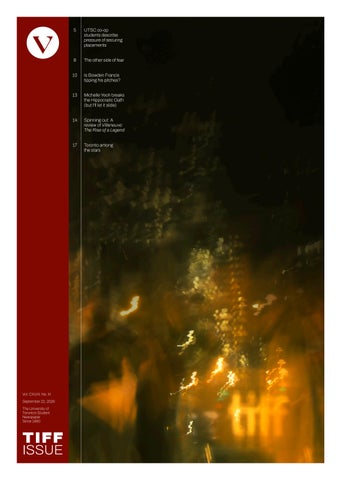
Vol. CXLVII, No. III September 22, 2026 The University of Toronto’s Student Newspaper Since 1880
TIFF
ISSUE
5
UTSC co-op students describe pressure of securing placements
8
The other side of fear
10
Is Bowden Francis tipping his pitches?
13
Michelle Yeoh breaks the Hippocratic Oath (but I'll let it slide)
14
Spinning out: A review of Villeneuve: The Rise of a Legend
17
Toronto among the stars
2
THE VARSITY
news@thevarsity.ca
NEWS
The Varsity acknowledges that our office is built on the traditional territory of several First Nations, including the Huron-Wendat, the Petun First Nations, the Seneca, and most recently, the Mississaugas of the Credit. Journalists have historically harmed Indigenous communities by overlooking their stories, contributing to stereotypes, and telling their stories without their input. Therefore, we make this acknowledgement as a starting point for our responsibility to tell those stories more accurately, critically, and in accordance with the wishes of Indigenous Peoples.
THE V
THE VARSITY Vol. CXLVII, No. 3 21 Sussex Avenue, Suite 306 Toronto, ON M5S 1J6 (416) 946-7600
thevarsity.ca
the.varsity
thevarsitynewspaper
the.varsity
@TheVarsity
The Varsity
MASTHEAD Junia Alsinawi Editor-in-Chief
editor@thevarsity.ca
Brennan Karunaratne Creative Director
creative@thevarsity.ca
Callie Zhang Managing Editor, External
managingexternal@thevarsity.ca
Sofia Moniz Managing Editor, Internal
managinginternal@thevarsity.ca
Aksaamai Ormonbekova Managing Online Editor
online@thevarsity.ca
Raina Proulx-Sanyal Senior Copy Editor
copy@thevarsity.ca
Cate Woodhead Deputy Senior Copy Editor Celesta Maniatogianni News Editor
deputysce@thevarsity.ca news@thevarsity.ca
Arunveer Sidhu Deputy News Editor
deputynews@thevarsity.ca
Prekshaa Surana Assistant News Editor
assistantnews@thevarsity.ca
Zaneb Asad Opinion Editor
opinion@thevarsity.ca
Audrey Kim Business & Labour Editor
biz@thevarsity.ca
Ella MacCormack Features Editor
features@thevarsity.ca
Bushra Boblai Arts & Culture Editor
arts@thevarsity.ca
Lauren Robinson Science Editor
science@thevarsity.ca
Taimoore Yousaf Sports Editor
sports@thevarsity.ca
Simona Agostino Design Editor
design@thevarsity.ca
Loise Yaneza Design Editor
design@thevarsity.ca
Erika Ozols Photo Editor
photos@thevarsity.ca
Chloe Weston Illustration Editor
illustration@thevarsity.ca
Jennifer Song Short-form Video Editor
jennifersong@thevarsity.ca
Gabriella Wrona Long-form Video Editor
gabriella@thevarsity.ca
Emily Shen Front End Web Developer
emilyshen@thevarsity.ca
Sataphon Obra Back End Web Developer
sataphonobra@thevarsity.ca
Nguyen Bao Han Tran UTM Bureau Chief
utm@thevarsity.ca
Yana Kundu UTSC Bureau Chief
utsc@thevarsity.ca
Vacant Graduate Bureau Chief
grad@thevarsity.ca
Vacant Associate Senior Copy Editors
William Kook Sports Photographer
Vacant Associate News Editors
Rebecca Liu Associate B&L Editor
Vacant Associate Opinion Editors
Vacant Associate Design Editor
Alec Zelek Associate Features Editor
Dowon Kim Associate Illo Editor
Juliet Pieters Associate A&C Editor
Jordyn Smith Associate Photo Editor
Parmin Sedigh, Mehar Singh Associate Science Editors
Vacant Associate Video Editors
Jean Patrick Vidad Associate Sports Editor
Vacant Associate Web Developer
Lead Copy Editors: Roya Alisultanova, Harbanee Kaur, Taqwaa Kazi Copy Editors: Malaika Ali, Pham Tran Phu An, Annamarie Bai, Doris Chen, Keira Clinton, Cassandra Iadipaolo, Simra Javaid, Elshaday Nebiyou, William Nguyen, Rubab Shamsi, Madiha Syed, Nardos Wakjira, Judy Zhi
ANNUAL VIC BOOK SALE Thousands of wonderful, well priced books in all subject areas. Featuring a large collection of The Legal Classics Library leather bound, gilt decorated and privately published and a wide-ranging assortment of Military, Canadian and US History. Location: In Old Vic, 91 Charles St. (Museum Subway Exit) Dates & Times: Thu. Sept. 24 – 2–7 PM (First day: Admission $5, Students free with ID) Fri. Sept. 25 – 11 AM–7 PM Sat. Sept. 26 – 11 AM–5 PM Sun. Sept. 27 – 11 AM–5 PM Mon. Sept. 28 – 11 AM–7 PM Payment: Cash & cards accepted Proceeds: Support Victoria University Library & Students
Designers: Vacant Cover: Brennan Karunaratne, Celesta Maniatogianni, Erika Ozols
BUSINESS OFFICE Muzna Arif Business Manager
business@thevarsity.ca
Vacant Business Associate
vacant
Jake Takeuchi Advertising Executive
Contact: vic.booksale@utoronto.ca | tinyurl.com/vicbooksale
jaketakeuchi@thevarsity.ca
The Varsity is the University of Toronto’s largest student newspaper, publishing since 1880. It is printed by Master Web Inc. . on recycled newsprint stock. Content © 2026 by The Varsity. All rights reserved. Any editorial inquiries and/or letters should be directed to the sections associated with them; emails listed above. The Varsity reserves the right to edit all submissions. Inquiries regarding ad sales can be made to ads@thevarsity.ca. ISSN: 0042-2789
CORRECTIONS In Issue 1, the article Union votes 96 per cent in favour of a strike on first day of classes was corrected on September 9, 2026 to reflect the specific unit of USW 1998 that voted, and that the announcement of the vote was made on September 4, not September 6
thevarsity.ca/section/news
SEPTEMBER 22, 2026
3
U of T takes "immediate action" following visiting professor David Lagziel’s X post Lagziel will not be teaching on campus for remainder of visiting professorship CELESTA MANIATOGIANNI News Editor U of T has taken action after concerns were raised regarding an X post made by visiting economics assistant professor David Lagziel. In a statement to The Varsity on September 16, a spokesperson for the university wrote: “The University of Toronto took immediate action after concerns were raised regarding a social media post by a visiting professor in the Department of Economics. By mutual agreement, he will not be teaching at the University over the remainder of his visiting professorship and is not physically on campus at this time. He has apologized for and regrets the post that he shared.” On September 13, The Varsity received a tip indicating that Lagziel’s courses — ECO351: Special Topics in Economics: Israeli Economy and ECO204: Microeconomic Theory and Applications (for Commerce) — scheduled for the 2026–2027 academic year had been removed from his Department of Economics profile, which can still be viewed. As of September 14, ECO351: Special Topics in Economics: Israeli Economy was listed as “Cancelled” on the Department of Economics’ list of courses offered in winter 2026, and had been replaced with
ECO351: Special Topics in Economics: Political Economy on Acorn. Lagziel is no longer listed as an instructor for ECO204 on Acorn. The Varsity reached out to Lagziel for comment again on September 15 regarding his removal from and cancellation of ECO351 but did not receive a response. The spokesperson also wrote: “The University has also received a complaint regarding the earlier social media activity that targeted the visiting professor, which led to safety concerns. It is treating that complaint very seriously and is taking appropriate action.” Lagziel’s September 2 post — translated by Grok from Hebrew — read, “There are people who just need a hug. To the head. With a bat.” The post was made in response to another X user who was reacting to Lagziel’s post regarding an email campaign against him. The post has since been removed, and Lagziel’s X profile has been made private. The Varsity reached out to Lagziel for comment on September 3 but did not receive a response. In a September 4 statement, a spokesperson for the university told The Varsity that “University of Toronto policies and practices will be applied where appropriate and as necessary.”
U of T is also taking action regarding social media activity raising safety concerns for Lagziel. CELESTA MANIATOGIANNI/THEVARSITY
UTM falls below domestic and international enrolment targets New advising programs introduced to help retain enrolment
NGUYEN BAO HAN TRAN UTM Bureau Chief UTM has fallen below its domestic and international enrolment targets for the 2026–2027 academic year. According to administrators at the September 10 Governing Council’s Academic Affairs Committee meeting, a shrinking international student market may require the campus to rethink its long-term enrolment goals and spending plans. In a statement to The Varsity, a UTM spokesperson wrote that the university had set targets of 2,662 domestic and 1,032 international full-time, newly admitted students. According to the Report to the UTM Academic Affairs Committee, the number of newly admitted undergraduate domestic students is 2,725, whereas there are 952 for the international cohort. Therefore, there is a lack of enrolment for international students. This year, administrators reported that UTM had 15,994 undergraduate students registered as of September 2, including 12,282 domestic and 3,712 international students. The spokesperson clarified that the September figures include both full-time and part-time students and are not the enrolment data used for university planning and budgeting. The figures therefore cannot be used to determine how far UTM fell below its new-student targets. UTM expects clearer enrolment figures in November, with a more complete update in the new year once registration has stabilized and the university has completed its regular financial forecasting. Lower enrolment puts pressure on revenue The discussion also addressed the financial impact of lower enrolment. A budget official said several years of declining enrolment had prompted a roughly $250 million revision to the university’s five year revenue forecast. UTM’s March budget presentation projected $22 million less revenue for 2026–27 than anticipated in the previous long-range plan. Administrators planned savings in campus services while increasing academic budgets. The official said administrators had reduced operational and administrative spending while maintaining academic investment.
“We will ring fence and protect the investment we make in research and teaching,” the official said, adding that the university would continue seeking savings through “efficiencies in operations and staffing.” William A. Gough, UTM’s vice-principal academic and dean, said UTM would need to set more realistic enrolment targets and adjust its finances accordingly if international student numbers remained lower over the long term.
more appropriate in the long term, but did not present it as a finalized target. A spokesperson for UTM wrote to The Varsity that international student enrolment “is one area where the university and many other higher education institutions anticipate pressure [...] This reflects broader changes affecting our sector across Canada, including shifts in global student mobility and changes to Canadian immigration
Enrolment lower than usual at UTM for domestic and international students. NGUYEN BAO HAN TRAN/THEVARSITY
UTM reconsiders international enrolment expectations During the meeting’s question period, economics professor Robert McMillan asked administrators for historical enrolment figures and an explanation of how UTM was addressing its enrolment deficit. Gough said some targets may have been too ambitious, particularly for international enrolment. He said, “The international market is drying up across the post-secondary education [sector],” noting that many Ontario universities had seen smaller international student intakes. According to Gough, international students once accounted for roughly nine per cent of UTM’s student population, a share that grew to more than 30 per cent over the past 10 to 15 years. He suggested that around 20 per cent might be
policy that are impacting the number, timing and composition of international applications and confirmations across the postsecondary sector.” Gough also said the factors influencing international students’ university decisions appear to be changing. He noted that U of T had previously benefited from the assumption that international students would attend the highest-ranked university that accepted them, but said this trend is weakening and that “price point is becoming important” to prospective students. He added that other institutions have increasingly invested in attracting international students. Gough said that one of UTM’s proposed responses is its International Foundation Program. The program is expected to form part of UTM’s strategy for international recruitment,
enrolment yield, and reducing student melt, when students who intend to enrol do not follow through. Administrators said development of the program is progressing toward a memorandum of agreement. Gough also reported that summer efforts to reduce melt had helped UTM gain more than 100 students, particularly on the domestic side. Similar efforts were less successful internationally, in part because of visa timelines. Returning domestic enrolment increased from 9,150 students last academic year to 9,557 this year. Helping students stay enrolled The meeting also highlighted UTM’s efforts to retain existing enrolled students. UTM’s average first-to-second-year retention rate over the past three years sits at 90 per cent, three percentage points below the U of T firstentry division average. Its seven-year graduation rate is 75 per cent, seven percentage points below the corresponding U of T average. The Office of the Registrar has launched nine pilot projects testing proactive academic advising for students at higher risk of academic difficulty. One pilot involving 1,008 first-year students with a first-term sessional GPA below 1.85 divided students into groups receiving standard advising (the control group), additional email support or dedicated proactive advising. Students who received dedicated advising had a retention rate six percentage points higher than the control group. Seven per cent ended their first year on academic suspension, compared to 14 per cent in the control group. A separate pilot involving students entering commerce, management, and social sciences found that targeted advising reduced the number who accepted a UTM offer but ultimately did not register. The effect was particularly pronounced among international students. The Registrar’s Office presented the pilots as one way UTM could improve student retention while working toward its broader enrolment goals. According to a spokesperson for UTM, “UTM will continue to monitor the data closely and provide the community with an accurate assessment in the new year.”
4
THE VARSITY
news@thevarsity.ca
NEWS
The Varsity
Newswire
U of T installs 299 new solar panels at OISE Part of the tri-campus initiative to reduce 80 per cent of emissions by 2050
Grassy Narrows First Nation to host River Run Rally Paige Franko, Varsity Contributor On Wednesday, September 23, Grassy Narrows First Nation is hosting a march to demand further action from the Canadian government to support their community affected by mercury poisoning. The Grassy Narrows River Run will begin at 12:00 pm at Grange Park in downtown Toronto. The demands of Grassy Narrows First Nation include the end of further mercury pollution, government support, and compensation for those affected by mercury poisoning. In the 1960s and 1970s, Drayden Paper Mill released around nine tonnes of mercury into the English-Wabigoon River System. Community members are still experiencing symptoms of mercury poisoning to this day. OpenAI agents use U of T link-sharing tool to communicate Aida Umar, Varsity Contributor According to an investigation published by the Globe and Mail on September 18, OpenAI agents reportedly repurposed a U of T URL-shortening service to communicate with one another, using the tool to post links for themselves and other AI agents to access. The agents’ reason for utilizing the tool is unknown. The agents also used more than 10 websites for similar unauthorized communications. In a statement to the Globe and Mail, a spokesperson for U of T stated the agents’ use of the URL-shortening service was not a security breach and that no data or university digital properties were affected. The university has since modified the service so the feature used by the agents is now only available to the university community. Doug Ford says he will not endorse a candidate in Toronto’s Mayoral race Isabella Bixler, Varsity Contributor As election day for Toronto’s mayoral race — October 26 — draws nearer, attention has turned to Ontario premier Doug Ford. Speaking at a news conference in Toronto on September 16, Ford indicated support for incumbent Olivia Chow: “We’re going to continue supporting the mayor, so read between the lines,” said Ford. A day later, Ford’s office denied that he had endorsed Chow and stated that he would not be endorsing a candidate for the mayoral race: “The premier has demonstrated that he will work with anyone no matter their political stripe to advance the interests of the people of Ontario.” U of T and Tanenbaum Foundation establish unique chair in women’s sport Caitlin Zhang, Varsity Contributor On September 18, the Larry & Judy Tanenbaum Family Foundation, combined with matching funds from U of T, created a new $5 million Knowledge Translation Chair for Science in Women’s Sport. The chair will lead research programs, a living lab forum, an evidence-informed podcast series, and a hub providing resources aiming to foster the next generation of leaders in this “new era of women’s sport.” The initiative is in response to a surge in women’s participation in competitive sport, intended to fill the gap in knowledge and research in the health and performance of women athletes.
AMY HUANG/THEVARSITY
PREKSHAA SURANA Assistant News Editor Expanding solar power at St. George U of T recently made progress in its pursuit to decarbonize its St. George campus, with the addition of another 299 solar panels on the roof of the Ontario Institute for Studies in Education (OISE). Facilities & Services typically adds about two solar arrays to campus buildings per year, with the installation at OISE being the newest addition. This comes in addition to existing arrangements at Bahen, Myhal, and The Varsity and Exam Centres. Collectively, there are now more than 2,600 panels campus-wide. The OISE cohort uses double-sided panel technology, absorbing sunlight both directly from the sun and as it reflects off the building’s white roof. According to U of T News, the new panels can produce about 60 per cent more energy than
older models. Once fully operational, the system is anticipated to generate approximately 10 per cent of OISE’s annual electricity use. Part of a wider climate plan Ron Saporta, U of T’s interim vice-president of facilities and real estate, said OISE’s height and largely unobstructed roof made it well suited for solar panels. He linked the project to other infrastructure initiatives underway, describing them as part of a broader effort to reduce campus energy use and emissions. Other initiatives include the geoexchange system beneath Front Campus and ongoing energy retrofits of older buildings. According to Facilities & Services, the OISE installation is one component of U of T’s Climate Positive Campus Plan, which commits the St. George campus to reduce 80 per cent of their emissions by 2050. An interim target calls for cutting emissions by more than 50 per cent by the end of 2027.
Hilary Inwood, one of the lecturers at OISE who coordinates the building’s Sustainability and Climate Action Network, tied the solar installation to OISE’s academic work, noting the institute trains K–12 educators in environmental and sustainability education. Comparable projects are underway at U of T’s other two campuses: UTM’s Project SHIFT and UTSC’s Environmental and Related Technologies Hub. Ontario’s electricity demand rises The new panels come at a time when Ontario’s electricity needs are rising. Provincial demand increased by 4.4 per cent in 2025, according to the Independent Electricity System Operator. Extreme weather and planned shutdowns at nuclear plants increased reliance on natural gas. Gas and oil supplied 19.3 per cent of electricity from generators connected to Ontario’s transmission grid, up from 15.7 per cent in 2024.
Ontario government announces funding for 40,000 new university seats $1.7 billion invested in seats for high-demand programs
ARUNVEER SIDHU Deputy News Editor The provincial government has allocated 40,000 newly funded seats at publicly-assisted universities and colleges. The government announced that the seats would be made available for student enrollment as early as this fall, however it is not yet clear if and how U of T will be impacted. The government revealed the initial investment on May 27, when it announced $975 million to fund 30,000 seats. The additional allocation of 40,000 seats was made public on September 10, through the investment of the remaining $730 million from the $1.7 billion total. This funding is intended to place more students on the path to in-demand and well-paying careers. It also supports Ontario’s plan to protect the province and build one of the most competitive economies and workforces in the G7. Seat allocation breakdown The 70,000 university seats are allocated to highdemand programs in STEM, healthcare, education, and the trades. The specific breakdown based on program includes: 40,200 in STEM programs, 16,100 in healthcare programs, 7,900 in education
programs, 3,800 in trades programs, and 3,000 in labour-market-driven programs. The seat allocation details come from McMaster University, which is receiving $90 million to fund a total of 2,769 seats for the upcoming 2026–2027 academic year. The Varsity reached out to U of T to confirm the funding amount it received and the total number of new seats it will be creating. “We’ll leave it to the government to share this information on their timeline,” is all a university spokesperson said in a statement to The Varsity. Unlike McMaster, it is unclear how many of these additional seats — if any — U of T will have available in the current academic year. The Toronto Star reported that approximately 27,000 of the new 40,000 spots overall have been made available in fall 2026 while the remaining 13,000 will be made available next fall. Criteria for seat allocation The province began the process of allocating new seats by sending out a call for proposals from universities and colleges in Ontario. These were reviewed by a 40-person ministry team upon validation from communities, which haven’t been specified. The ministry received 1,000 letters of
support from local chambers of commerce and businesses. The Toronto Star also reported that Colleges and Universities Minister Nolan Quinn announced this process of adding new seats would result in “more mechanical engineers for North Bay, more teachers for Windsor, more welders for Ottawa and more nurses for Toronto.” Amid the trade disputes between Canada and the United States, Steve Orsini, president and CEO of the Council of Ontario Universities, stated in a news release that “priority fields will strengthen Ontario’s talent pipeline and economic competitiveness at a crucial time.” In a LinkedIn post, U of T President Melanie Woodin wrote, “One of the Presidential Commitments I’ve identified is to prepare futureready graduates, and the government’s major new investment in enrolment expansion at Ontario’s universities and colleges will help us to achieve that goal.” In June, a report by Stokes Economics Projects indicated that Ontario requires 60,000 more university graduates within the next decade in science/technology, healthcare, and business. This is part of Ontario’s need for over one million graduates by 2035 to meet labour market needs.
40,000 new seats are being allocated to programs in STEM, healthcare, education, and trades. JORDYN SMITH/THEVARSITY
thevarsity.ca/section/news
SEPTEMBER 22, 2026
UTSC co-op students describe pressure of securing placements
5
Varsity Horoscopes Ella and also Brennan
Securing a placement can require dozens or hundreds of applications
Aries (March 21 – April 19) That argument you had last week? You were actually completely correct. Go all in, Neptune’s retrograde is in Aries. Taurus (April 20 – May 20) Bet on yourself. Don’t place any bets on sports this week though, your parlay will fail — ensure your legs are strong enough to stand on their own. Be prepared to run. Gemini (May 21 – June 20) Neptune is calling this week. Will you answer? Make sure to recharge, your phone will have low battery at an inconvenient time. Cancer (June 21 – July 22) How can you sit with yourself? Leo (July 23 – August 22) The fall equinox is on Tuesday; look at the colours fading around you as an opportunity for renewal. Dye your hair again, it won’t accidentally stain your bathroom this time. Virgo (August 23 – September 22) You may feel like putting things on pause. Before making any big decisions, take Libra (September 23 – October 22) It’s your season, starting Wednesday. Watch out for prisons of your own making. Food poisoning is imminent. Scorpio (October 23 – November 21) It is time for a change? Do your laundry. Look in corners for piles building up. You might find something you forgot long lost — old shirt from high school included. Sagittarius (November 22 – December 21) Something minor said in an upcoming lecture will be on the course final. Pay attention, your professor will notice you falling asleep; grudges will come easy this week.
Students have considered leaving the program if they cannot secure a placement. ERIKA OZOLS/THEVARSITY
YANA KUNDU UTSC Bureau Chief UTSC has long positioned experiential learning as a defining part of the campus experience. For some students, that reputation is part of what drew them to the Scarborough branch of U of T. In a Position Profile for UTSC’s VicePresident and Principal, the campus is described as a “pioneer and leader in experiential education,” and defined experiential learning as “one of the hallmarks of the UTSC approach to education.” The Varsity interviewed three co-op students on their experience in co-op programs. All three students said co-op influenced their decision to attend UTSC. Students struggling to find placements All three students said they received some support through co-op, but also described the placement search as largely self-driven, with Krish Arora having “found many of the better opportunities through sources outside [of UTSC].” Arora is a third-year student in the Honours BSc, Specialist (Co-Operative) Program in psychology. He wrote to The Varsity that he has submitted more than 250 applications since beginning his co-op search in 2025 and received approximately 20 interviews and two offers, neither of which came through UTSC’s co-op portal. Muskan Oberoi, a fourth year BBA, Specialist (Co-Operative) Program in Management and Finance, submitted more than 150 applications, receiving around four interviews and two offers.
Ayesha Gupta, a third-year molecular biology and biotechnology specialist student, described a different outcome. She submitted around 50 applications, received approximately six interview requests and secured a placement by mid-October. Arora said he worked with a co-op advisor on tailoring his résumé and preparing for interviews, which he found useful. However, he said the support did not necessarily translate into direct help securing a placement. “I understand that no university can guarantee a job, but if students are expected to independently find their own placements, I question what distinguishes the co-op program from simply conducting a job search independently,” he said. Oberoi similarly said the co-op program provides resources and access to job postings, but students still carry significant responsibility for searching, applying, networking, interviewing and competing for positions. She added that the independent job search was not an entirely negative experience, because learning how to navigate recruitment is an important professional skill. Gupta said she visited co-op advisors about once every two weeks for résumé support and used interview-preparation tools. However, she also said students remain responsible for making the most of the opportunity. “For the price we pay for this program, we’re largely left on our own,” she said. UTSC co-op students are required to pay an additional fee in their tuition, which ranges from an extra $4,038–$6,640 in total, depending on the program chosen and which year the student entered that program.
Students expected more university involvement Arora said he expected UTSC to play a meaningful role in helping students secure placements. He said that if he had known how independently he would need to search for a position, he might have considered attending the St. George campus instead. Oberoi said she expected “more of a direct pipeline between the university and employers.” Although Oberoi found the job board, workshops, and application guidance useful, she said stronger employer partnerships, exclusive postings, industry-specific recruiting events, and alumni connections could make the program more distinct from an independent job search. Gupta also said she would have benefited from more opportunities to connect with people who had already worked in the same industry or company. She added that while there were many positions within life sciences, not all of them matched students’ specific interests or qualifications. Students questioning the value of co-op The students also reflected on whether the support and opportunities they received matched the additional cost of being in co-op. Arora said he has considered leaving the program because of the difficulty of finding a placement, but feels he has already invested significant time, effort, and money. “Being enrolled in a co-op program does not necessarily mean that a placement will be secured for you,” he said. “You still have to apply extensively and actively search for opportunities outside the university portal.” Oberoi said her experience made her think more critically about co-op fees.
Capricorn (December 22 – January 19) You can ask the universe for a favour this week. Be reasonable, though. Aquarius (January 20 – February 18) Pay attention to where you are stepping. Even if you think no one saw your trip, the sidewalk noticed. It isn’t pleased. Own up to your mistakes and laugh off your falls. Pisces (February 19 – March 20) Old formulas will not be of use this week. Throw out your cheat sheets and start over again.
“If students are finding many opportunities through their own applications and networking, it is fair to ask what additional value the co-op fees provide,” she said. Gupta had also been prepared to leave the program if she could not secure a placement, “but I got lucky,” she said. The three students also described the placement search as difficult to balance with academics and other responsibilities. “The process has been very draining,” Arora said. “What makes it particularly difficult is feeling like you are largely on your own throughout the search.” Oberoi described the recruiting period as another major commitment on top of school, extracurricular activities, a part-time job, and her work as a teaching assistant. “During recruiting periods, the job search almost felt like an additional course on top of everything else,” she said. Gupta said searching for placements affected her academics: “I was extremely stressed while applying because as a life science major, there’s always a midterm or an assignment due,” she said. “My GPA definitely suffered during that time,” adding that she chose to prioritize her job search. Students must maintain a cGPA of 2.5 or higher to remain in the co-op program.
Business & Labour
September 22, 2026 thevarsity.ca/category/business biz@thevarsity.ca The ultimate decision-makers in the film industry. ZAINAB KHALIL/THEVARSITY
The bets behind the big screen
Are financiers the real decision-makers in the film industry? SRIHITH JARABANA Varsity Contributor When the lights go off, popcorn bags stop rustling and phone screens darken as audiences wait in anticipation for the opening frames to light up the theatre screen. What audiences know as a finished product — plot, faces, settings, and dialogue — began much earlier as a proposal to investors and lenders who took the risk and provided funding. Movies typically require substantial spending that precedes knowing whether the audience will show up at all, let alone if box-office numbers will be high enough to turn a profit. Thus, what stakeholders consider financeable can influence which scripts and stories reach the production stage and which remain ideas someone once had. Yet, these arrangements can also make unusual projects possible by finding the right people who are willing to carry risks that others may reject. This is evidenced by the growing popularity of studios such as A24 and Neon, which have backed numerous unconventional and ‘risky’ films, including the Oscar winning film Everything Everywhere All at Once.
Large studios might finance films with their own cash, while an independent producer often has to assemble several sources of funding before their film gets the go-ahead. Some of it might come from equity investors seeking a share of returns, some might be borrowed (debt financing), and some of it might even come via support that requires no repayment at all (e.g. grants). Through pre-sales, distributors can commit to buying the rights for particular regions and territories before a film is finished, and producers can also use those contracts as collateral for additional funding like loans. Demonstrating this future demand helps producers secure additional financing, not unlike traditional debt or equity company financing. The dollar value of a name A producer can also attach a recognizable actor or director before taking a project to film markets, giving the distributors something familiar to evaluate and be more comfortable with. For example, Deadline reported that Copperhead, with Miles Teller and Jason Momoa attached, would be offered to potential buyers by Black Bear at this year’s Toronto International Film Festival (TIFF) market.
In this sense, an appealing casting decision and a beloved story can simultaneously be an artistic decision as well as assets for the film’s valuation and budget. On the other hand, a film that is financed purely on speculation may not have any buyer waiting once it’s finished, leaving its investors vulnerable to losing their entire investment. That is not to say that funding is reserved for blockbuster sequels or films with star-studded casts, only that some projects offer more ‘reassurance’ than others. But financing does not only place limits on filmmakers. Financing on speculation can actually preserve creative control and direction when backers accept the risk without requiring the filmmakers to satisfy some distributor in advance. For eligible Canadian productions, public financing through Telefilm and the refundable Canadian Film or Video Production Tax Credit can lessen how much conventional private funding is ultimately needed. A modern approach Another approach is to spread uncertainty across multiple films rather than trying to
remove it from one — similar to diversifying a stock portfolio. IPR.VC, whose partners include A24 and MUBI, describes its approach as strategic capital for continuing partnerships (i.e. not one-off financing for individual projects). According to IndieWire, IPR.VC evaluates the company behind the film, including audience relationships, overall portfolio, and ability to generate value repeatedly. Cineuropa reported that IPR.VC’s Timo Argillander described financing slates — groups of films — as a way to reduce exposure to individual productions. Under this approach, a film is also assessed on how it fits into a larger business and its relationship with the audience. A filmmaker may have some space to experiment while still having to prove that the experiment belongs somewhere. Back in the theatre, the big screen does not show signs of these earlier negotiations, nor, in some cases, the struggles of producing a film. By the time viewers settle into their seats, producers and financiers have already shaped what they can watch.
thevarsity.ca/category/business
SEPTEMBER 22, 2026
7
Invest, baby, invest!
Canada’s Investment Summit is an open-for-business sign AUDREY KIM Business and Labour Editor Canada’s economy has struggled over the last couple of years, with productivity lagging for the last couple of decades. This has had negative implications for wages, affordability, and the wider economy. These statistics are not just tools for politicians to take jabs at each other, but actual lived realities deeply felt by Canadians across the country. Therefore, when Prime Minister Mark Carney’s Investment Summit, the first of its kind and scale, occurred in Toronto over the past week, it drew mixed feelings among the public, with over a thousand protestors gathering in downtown Toronto. Some of the loudest criticisms were about concerns over national sovereignty, climate, defence manufacturing, and emphasis on corporate profits. This represents a fundamental misalignment in where some Canadians believe capital should be allocated and the implications of its growth. What happened at the summit? Protests and criticisms aside, the summit is largely deemed a major financial success for business investment and broader industries involved. Many promises were made across private institutions. The five biggest Canadian banks — RBC, TD, BMO, Scotiabank, and CIBC — committed a combined $325 billion in financing — largely lending, but also investing. Capital will be targeted towards domestic industries, namely natural resources, infrastructure, and technology. Defence is also named as a priority industry despite being historically untouched due to reputational and financial risk. Canada’s pension funds and asset managers were also in attendance, representing some
of the country’s largest and most influential institutional investors. This included the cohosts of the event, Canada Pension Plan (CPP) Investments and Public Sector Pension (PSP) Investments. Other pensions included Ontario’s Teachers’ Pension Plan (OTPP), as well as Sun Life Financial and Brookfield Asset Management — some of the largest Canadian-based asset managers. The funds are exclusively dedicating a collective $100 billion towards Canadian assets. Nearly half of the $100 billion allocation is from a newly launched Maple Fund from Carney’s former employer, Brookfield Asset Management, in partnership with CPP Investments. This investment pool represents a significant milestone as Canadian pension funds have historically mainly invested in the US to create the best risk-adjusted returns. A highlight of the Investment Summit was the showcasing of 167 possible investment opportunities — some ready to build and many still in the pipeline — but all with the objective of attracting global capital into Canada. The projects primarily focus on natural resource development and extraction, advanced manufacturing, and infrastructure. Carney’s touted résumé and experience seem to have culminated in those two days. A nearly grandiose showcase of his connections and influence across the private and public sector — where he got to play the ultimate salesman with former conservative prime minister Stephen Harper — closed the summit.
the private sector to spend money to buy assets needed to grow their operations, such as machinery, equipment, land, technology, intellectual property, and more. This growth, in turn, can create jobs, spur innovation, raise productivity, and help businesses stay competitive, which can theoretically increase incomes and improve living standards. The more important thing to understand is not why investment is important— most people can generally agree that it is— it’s the context of Canada’s poor performance in business investment over the past decade.
Why do investments matter? It’s fair to ask why resources are being poured into investments as opposed to something more pertinent to the everyday life of Canadians, like housing, affordability, and climate change. The answer is that investment is a foundational driver of economic growth. It essentially enables
The government’s side of the deal The private sector has seemingly woken up with their promises of spending billions of dollars over the near term, but it would be bad business if the government had nothing to offer in exchange, and Carney is no stranger to corporate “collaboration”, which some refer to as bailouts.
Where money stagnates Underinvestment has been a huge topic of discussion not just among those in the financial services — deemed by some as a “crisis.” For over a decade, capital has left the country at a faster pace than capital entering the country. According to the Organisation for Economic Co-operation and Development (OECD), total real investment growth has seen a decline since over a decade ago. Levels of investment per worker in 2021 only make up only 85 per cent of what it was in 2014. This is further evidenced on the innovation side, with news that made headlines at the start of 2026, as Canada’s first quarter resulted in “near zero” venture funding in growth capital — which means very little investment into more mature companies looking to expand operations and markets.
It was announced that four of the largest Canadian airports would be up for private investment, as well as the introduction of a major tax policy amendment referred to as their “Productivity Mega Deduction.” Carney also intends to continue to streamline approvals for major projects, including the many he proposed at his event, spanning conventional and clean energy projects to advanced manufacturing. Whether these measures are effective has been highly contested across climate organizations, Indigenous groups, and opposition political parties, including the Tories and New Democrats. Carney is betting on private investment to generate broader economic benefits — whether it translates to higher productivity, wages, and living standards is a question time will tell. An official position This two-day whirlwind event has given Canadians, and now investors across the globe, a lot to consider. Carney’s positioning of Canada as a stable and attractive place to invest comes at a time when the country faces significant financial uncertainty during the ongoing trade war with the US. The investment projects offered are diverse, almost confusingly so; they span liquefied natural gas development to clean energy, with investors equally varied. They include some of the world’s largest asset managers, from sovereign wealth funds to private giants, all with their separate priorities that are not necessarily aligned with Canadian objectives, like economic sovereignty. The investment summit leaves many questions on the table about how the coming deals and their governance structures will impact Canada’s economy and near future.
Carney hosts inaugural Investment Summit in Toronto. COURTESY OF WIKIMEDIA
Arts & Culture
September 22, 2026 thevarsity.ca/category/arts-culture arts@thevarsity.ca
The other side of fear
Art Flash
TIFF review: Silenced Nights (2026) JANNA MARANO Varsity Contributor Content warning: This review discusses state violence and murder. The Filipino sociopolitical drama, Silenced Nights (2026), directed by award-winning filmmaker Lawrence Fajardo, premiered at the
As the Philippines is a predominantly Christian nation, it’s no accident that the story happens during November –– Filipinos take Christmas very seriously, and usually initiate holiday festivities as early as September! The typically joyful atmosphere that precedes Christmas is invaded by the weight of tragedy from the regularly occurring EJKs. Slum
A still from Lawrence Fajardo’s Silenced Nights. COURTESY OF TIFF
Toronto International Film Festival (TIFF) on September 13. The plot follows Andoy (Nico Antonio), who witnesses the extrajudicial execution of a teenage boy by corrupt policemen in Manila’s Tondo slum in 2018. Within minutes, an onslaught of carnage explodes on-screen, as the teen is only one of multiple victims gunned down that night. For some, the violence may appear spectacular and excessive to the point of seeming almost fantastical. However, that sentiment is thwarted the moment those scenes are woven with actual newsreel footage of victims from the Philippines’ then-President Rodrigo Duterte’s “War on Drugs.” The authenticity of the violence is further punctuated with archival sound bites from Duterte’s old speeches, including one in which he chillingly boasts that he would dump the dead bodies of suspected drug-pushers into Manila Bay. Although the narrative is a work of fiction, it is rooted in truth — in the grim reality of the violent “Tokhang” period of extrajudicial killings (or “EJKs” as it is most commonly referred to by Filipinos) sanctioned by Duterte, which began in 2016. Based on historical events, the plot is structured in a formulaic and somewhat predictable manner. Yet, the audience’s dire anticipations are always layered with an underlying hope that the worst-case scenarios won’t come to fruition. Thus, this creates a condition of hypervigilance and aspiration among the audience that mirrors that of the characters. A parade of paradoxes Fajardo plays with a multiplicity of binaries that he manages to meaningfully juxtapose with one another. For instance, one setting is introduced with a shot of a sign which reads “Happyland.” Far from any vision of utopia, this moniker refers to one of the worst slums in Tondo, Manila, also known as Barangay 105. In fact, this ironic name originated from the Visayan word “hapilan,” which loosely translates to “dump site” or “garbage dump.” Indeed, hapilan is much more fitting for the squalor displayed on screen. Another instance of wordplay lies in the film’s title, which primarily refers to the crucial decision Andoy must make: stay silent or speak out about the injustice he witnessed. It also alludes to the Christmas carol “Silent Night.”
residents singing Christmas carols are heard with the same frequency as funeral marches. Similarly, firecrackers are heard as much as gunshots. Fajardo fuses opposites to create tension and to layer meaning in various ways. The power of immersion Where Silenced Nights truly shines is in the neon-drenched visuals of Manila at night, which immerse the viewers into the seedy but lively world of Happyland’s residents. As someone who grew up in the Philippines, the attention to detail in the mise-en-scène evoked a strong wave of nostalgia within me. Men playing cards and gambling to pass the time. Bottles of San Miguel beer and Ginebra San Miguel gin spread across the tables. The familiar white plastic chairs outside their homes for informal social gatherings. The vibrant storefronts of tindahans (convenience stores) selling snacks, drinks, and other goods. Street food vendors grilling and gossiping away. Children playing and laughing amidst the chaos. There is a real sense of place, but more importantly, a real sense of community here.
The choice to shoot on-location was a smart decision that steeps the work in realism. The bird’s-eye view shots above Tondo not only give a vantage of the cramped and claustrophobic communities of Manilan urban poverty, but emphasizes the atmosphere of state surveillance they are constantly subjected to. Additionally, the cinematography constantly frames various characters behind bars, no doubt to signify the circularity of violence and the systems that keep the powerless trapped in this grisly cycle. Where the film suffers is during moments of overacting, which push the performances to veer on the edge of melodrama. These occasions pull the audience out of the realism richly crafted by the mise-en-scène, cinematography, sound design, and other wonderful cinematic elements. Indeed, this might just be a case of cultural mistranslation. The cultural register Filipinos typically operate on is a touch more dramatic than some other nationalities, and this is encoded in Tagalog and other Filipino languages. Therefore, the cast’s overall performance will most likely resonate more strongly with a Filipino audience than with international audiences. Ina Feleo, who plays the journalist interviewing Andoy, showed skillful restraint. For me, her performance felt the most natural while still retaining the fiery passion in her joint pursuit with Andoy and Marissa (Lotlot de Leon) in exposing foul play. De Leon is powerful as Marissa — the mother of the murdered teen — erupting into a display of grief during a confrontation with Andoy, which was a standout scene in the film. Andoy elicits the most empathy from me when he is coerced into acts of obedience by the authorities. Finally, Dylan Ray Talon, who plays Andoy’s cousin, injects fragments of comedic relief, which were much needed for such a heavy and dramatic subject matter. Final verdict Fajardo’s work illuminates the dark corners of Philippine society where corruption and systemic violence disproportionately targets urban poor communities. As the film’s tagline goes, “Where fear prevails, justice is silenced.” The film explores the consequences for those who break through to the other side of fear. Unfortunately, Fajardo shows us that the other side of fear might look just as bleak as the sordid state of Happyland. Silenced Nights is not easy to sit through, but it feels like a journey worth embarking on, much like the relentless (though risky) pursuit of truth and justice.
Major moments in the zeitgeist this week Reflecting on the life of the “King of Camp,” Bob Mackie Erika Ozols, Photo Editor Dubbed the “King of Camp,” the late and great Bob Mackie built a remarkable career around glamour, spectacle, and unwavering excess. For over five decades, Mackie designed stage costumes for Cher, Tina Turner, Carol Burnett, and Diana Ross, among hundreds of others. What made Mackie special was his eye for the body and its form, which he viewed as something to be embraced — a trophy to be displayed. His eye for the extravagant was truly otherworldly. Rest in power to the “sultan of sequins,” Bob Mackie.
Practical Magic 2 is full of warm, witchy nostalgia Juliet Pieters, Associate Arts & Culture Editor Practical Magic 2 has hit theatres, and returned audiences to the wonderfully chaotic lives of the Owens women. My favourite aspect of the movie is its portrayal of the interwoven relationships between the aunts, mothers, daughters, and sisters. Standout performances come from Stockard Channing (Franny) and Dianne Wiest (Jet) as the aunts who navigate a changing world and offer guidance to the expanding line of Owens witches. While nothing can beat the whimsical perfection of the first film, this sequel brings a whole lot of witchy nostalgia to the table.
This Mirror Weighs a Ton by Interpol Cam Yu, Varsity Contributor Beloved 2000s indie rock band Interpol’s new album, This Mirror Weighs a Ton, came out on August 28, and the crowd went… okay? The album is airy, gloomy, slow-paced, and sometimes beautiful. Paul Banks’ attempt to reinvent Interpol late in his career is respectable, but it has been a slow slide downhill since 2004. Some standouts are “Bird and the Serpent,” “Iron City,” and the title track. However, I can’t imagine wanting to hear these tracks over any song from Turn on the Bright Lights or Antics at the band’s upcoming concert in Toronto on October 2.
Random person chastises Danny Boyle over AI use in Ink at TIFF premiere Bushra Azim Boblai, Arts & Culture Editor
From left to right: Nico Antonio, Ina Feleo, Lotlot de Leon, Bryan Espiritu, Lawrence Fajardo, and TIFF Q&A panel moderator after the premiere screening of Silenced Nights on September 13. JANNA MARANO/THEVARSITY
Legendary British director Danny Boyle’s 17th film, Ink, made its Canadian debut at this year’s Toronto International Film Festival (TIFF). During the post-screening Q&A session, when Boyle’s dodgy answer about his 30-second use of AI to animate old photographs proved unsatisfactory, another audience member yelled out: “Never do that shit again!” Boyle had previously told Vanity Fair in a video interview that “It doesn’t really matter what I think about AI. It matters what 20-year-olds think about it is the honest truth.” Well, Danny, the 20-year-olds have spoken: stay away from AI.
thevarsity.ca/category/arts-culture
SEPTEMBER 22, 2026 9
TIFF review: The Face of Horror
Technicolour terror, crushed velvet, and women in armour JULIET PIETERS Associate Arts & Culture Editor This review contains spoilers. Content warning: This review contains mention of murder and suicide. The Face of Horror, written and directed by Anna Biller, has landed at this year’s Toronto International Film Festival (TIFF), bringing vintage gore and a technicolour atmosphere to the screen. The Face of Horror is set in fourteenth-century England and follows the story of two sisters — Eleanor (Kristine Frøseth) and Beatrice (Ellie Bamber). They are forced into marriages of convenience when their father and Beatrice’s
Colour in costuming for horror Biller provides the costume design for the film, in addition to her role as writer and director. Biller has a fascination with the technicolour period of film, implementing vibrant colours and metal accents throughout the costumes. Her 2016 feature film The Love Witch has similar fixations on bright colours and hazy shots, which are reminiscent of an older Hollywood design. Costumes in The Face of Horror are heavily saturated with crushed velvet and primary colours. In the first scene with the knights, Biller utilizes red and brown cloaks for Edward and Richard, which mark them as distinct but still dimmer in colour when compared to the priest — clothed in velvet and gold — whom they murder and rob.
During one of their final confrontations, Eleanor is dressed in a plain white kirtle, an underdress that resembles a nightgown. Edward, however, is dressed in the courtly fashion: red velvet, a puffed-sleeve tunic, signet rings, and gold chains. The dulling of Eleanor’s vibrant colour is a visual representation of her fall in status. Where she was once a source of vibrancy, she is now a source of disappointment — and horror. The macabre brought to life The film has an intense fixation on the macabre: on death, heaven, and hell. These dark elements are intensified by the use of practical effects throughout the movie. Rather
In the end, Beatrice decides to take retribution into her own hands, rather than wait for another man to do it on her behalf. She dons a full suit of armour, wields a sword, and with the help of Eleanor’s ghost, kills Edward, avenging both Eleanor and her father. Beatrice looks righteous in that moment of victory before remembering that Eleanor is still dead. Bamber brings a wide-eyed sorrow to her portrayal of Beatrice, that is filtered through such a grim stare that it feels as if her gaze has actually pierced through the screen. Subverting horror genre tropes The film’s greatest strength is its reckoning with the corrupt marriage system of Middle Ages
A still from Anna Biller’s The Face of Horror with Kristine Frøseth and Jonah Hauer-King. COURTESY OF TIFF
husband are murdered by an errant knight, Edward (Jonah Hauer-King) and his squire, Richard (Leo Suter). The two men persuade the women to marry them for the sake of protection, with Edward marrying Eleanor and Richard marrying Beatrice. Edward soon grows tired of not being rich and mourns his choice of a wife, while Eleanor obsesses over regaining his affections. Edward’s terrible treatment of Eleanor escalates when he plots her demise. When he cruelly abandons her for a wealthy noblewoman, Isabele (Bella Heathcote), Eleanor takes her own life. She then returns as a vengeful ghost determined to torture her husband by constantly reminding him of his cruelty, resulting in a blood-soaked horror film reminiscent of 1950s technicolour.
When we are introduced to Eleanor and Beatrice, they wear bright pink and blue dresses, which makes them stand out against the drab interior of their farm estate. Edward and Richard are dull in comparison to the ladies. Biller utilizes these vibrant colours to signify both social status and emotional distress. As time passes on the farm, Eleanor’s dress — once a vibrant pink — grows pale, appearing more white than pink. Edward’s clothes, however, don’t seem to have changed at all; not any richer, not any poorer. This changes when Edward becomes a vassal of Lord Gaunt (Steven Blake). He is then outfitted with velvet tunics, gilded slippers, and a full suit of armour. Compared to Eleanor now, he looks more vibrant and grand.
than oversaturating the film with CGI, Biller uses stop-motion animation and projections, making the spectacles more jarring to the eye. My favourite camera effect is when Eleanor’s ghost floats through the hall and into the kitchen, all in stop-motion. Her grotesque face is then projected onto the fire, candles, torches, and lanterns. Eleanor is out for vengeance by the end of the film. She wishes only to torment Edward for casting her off and for his general disregard for human life. Beatrice, however, is out for justice. The condition of her marriage to Richard at the beginning of the film was that he would avenge her father and her husband, which is impossible as Richard himself is to blame.
England. The church’s corruption is satirized, and the audience is invited to laugh at characters like Edward, Richard, and Lord Gaunt. However, the threat that these men represent is not funny in any way, and to offset this, Biller combines the comic with the horrific through her liberal use of blood and gore. This bloodshed acts as retribution and vindication for the feminist values of Eleanor and Beatrice. Despite the violence and the devastation that the women in this story endure at the hands of Edward and Richard, Biller provides an ending in which the wronged woman has the last word. She has flipped the convention of the medieval damsel-in-distress on its head. In this horror movie, the final character left standing has plaits in her hair and steel in her hands.
10
THE VARSITY
FEATURES
Is Bowden Francis An analysis of Jays fans’ second-favourite Pequod crewman
ALEC ZELEK Associate Features Editor
September 11, 2024. I need not elaborate on the significance of this day of the year. Beyond geography, the New York Mets have deep ties to September 11. In the first major sports match played in NYC after the attacks, Mike Piazza’s eight-inning go-ahead home run helped the Mets cathartically overcome the Atlanta Braves. But on this day, the Mets are at the Rogers Centre for a Wednesday matinee against the Toronto Blue Jays. New York’s Sean Manaea is facing off against a young Bowden Francis, who’s making just his 11th career start for the Jays. It’s a pitchers’ duel to start: Manaea puts up three zeroes before faltering in the fourth inning, loading the bases with no outs but escaping with only one run allowed. Meanwhile, Francis has retired the first three batters he’s seen in order. And the next three. And the next three. And the three after that. Taking the mound with the lead in the top of the fifth, he lets two men reach on a walk and hit-by-pitch but allows nothing more. The entire stadium knows what they’re watching by the top of the ninth inning. The score is holding at 0–1 Toronto, and Francis has still not conceded a hit. A high fastball misses armside, still clipping the zone for a called strike: 0-1 on Francisco Lindor. Each pitch inches Francis closer to penning his name in Toronto’s history books. He earns a whiff with a low splitter: 0-2, and Lindor is set up perfectly for a belt-high fastball. Francis kicks and deals, but the ball drifts over the heart of the plate. Thwap. Catcher Brian Serven slumps in his crouch as he watches the baseball carry into a concourse bar. Tie ballgame, no-hitter over. After 111 pitches, Francis is relieved by Chad Green, who combines with Génesis Cabrera to give up a further five runs. A bottom-of-the-ninth comeback bid proves futile as the Mets beat the Blue Jays, 6–2. It wasn’t meant to be. Of all the days in the year, New York deserved something nice on this one. That’s alright. Francis is no stranger to this fabled territory — he took a no-hit bid into the ninth all of three starts ago against the Los Angeles Angels, where he was also capsized by a solo shot to lead off the inning. Dave Stieb suffered four ninth-inning heartbreaks before he tossed Toronto’s first and only no-hitter in 1990. There’s no reason to expect the second should come any easier for Francis. He’ll be back here. Just give him an offseason. Call him Ishmael In a miserable 2024 campaign for the Blue Jays, Francis shone as a rare bright spot. He was getting lucky with some overperformance, sure, but he still looked like a bona fide Major League arm to emerge from our crop of youngsters. Though 2025 would run back the same paper tigers (with a little extra money thrown at them), Francis would be worth tuning in for. Our first homegrown arm in three years, holding his own in a rotation full of fat chequebooks, chasing his no-hit white whale amid a hopeless season reeking of desperation… Oh, hey, Bowden, I didn’t see you there. No, uh, yeah, we were just talking about you. Yeah,
CHLOE WESTON/THEVARSITY
just normal stuff, like the — hey, is that a new tat? An ouroboros on the back of the hand, I like it. That’s your pitching hand, no? Did you have to get that cleared with the team or anything? They’re okay with the placement, or… No, yeah, I’m sure it’s fine, but anyway I gotta get back to this article. Okay, no, yeah, check in later. Right. So as we know, the Blue Jays’ 2025 season kept on rising — at least for 180 games and eight innings — culminating in a World Series berth that captured the heart of a nation. And as you may have deduced if you didn’t recognize his name, Francis’ 2025 season was all downhill once it began. A rough patch Francis began his year with some flings, going 5.1 and 4.2 no-hit innings before allowing home runs in his first and third starts. In his sixth start, the Boston Red Sox shellacked him for five homers and seven earned runs. The rest of Francis’ year mostly comprised repeats of that performance, barring a couple of bright spots against Seattle and in Texas. On June 14, Francis allowed five straight Philadelphia Phillies to reach base on walks and hit-by-pitches in the fourth inning before getting lifted. Three days later, Francis was placed on the injured list with a shoulder impingement. After a flurry of setbacks, that fate would turn season-ending. At the start of spring training in 2026, it had evolved into Tommy John surgery. Francis finished 2025 with two wins, eight losses and a 6.05 Earned Run Average (ERA) across 14 starts. What torpedoed 2024’s folk darling into an untenable 2025 starter? Pitching through injury is the obvious answer, but it’s doubtful that’d explain two months of struggles. Francis cited some of the problem as “sequencing stuff” in a June postgame media availability. Francis’ coaches brought up issues with location; broadcaster Buck Martinez concurred, suggesting before one outing that Francis was “missing… over the heart of the plate.” (That’s not entirely true — he threw markedly fewer pitches in the ‘heart’ in 2025, but he was outside the zone more with his fastball, suggesting he was indeed routinely missing his spots.) Among all this noise, no one ever seemed to bring up the colossal, conspicuous new tattoo on the back of Francis’ pitching hand. No one other than me. What’s the scenario? Bowden Francis throws his slow overhand curveball about every seventh pitch. Unlike with his other pitches, he supinates — rotates his palm inward — heavily in the process, turning the back of his hand toward the batter. Now, a batter will typically focus their eyes on the pitcher’s release point, so if they can see a swoosh of ink where there should be white flesh, they could plausibly identify Francis’ curveball before he throws it. If the batter knows the curve is coming, it makes hitting it a whole lot easier; if the batter knows something other than the curve is coming, that’s still one pitch ruled out. Francis has only two other big weapons: his fastball
and his splitter. Without exceptional stuff, that might be too few bullets in the gun for a Major League starter. This sounds… farfetched. I get it. But it’s not unprecedented. While with the Los Angeles Dodgers in 2018, Ross “Chicken Strip” Stripling had the ‘tells’ on his pitches sniffed out by nearly every opponent he faced. He got mauled to the tune of a 6.75 ERA in five September appearances before his
teammates caught on to what the rest of the league knew. It’s plenty possible that 29 out of 30 MLB teams have the book on Francis. Oh, did I mention Francis wore a black compression sleeve against Seattle and that Texas’ Globe Life Field has a black strip that backdrops the pitcher’s mound? Let’s look at how Francis regressed in 2025. He got a lot less swing (and less swingand-miss) on pitches above the zone — that’s where fastballs go. Generally, batters will swing at a high fastball because it looks like they can do damage on it, but the ball’s spin counteracts the drop of gravity and keeps it higher than anticipated. A crappier fastball could cause less deception and get fewer swings. … But Francis’ fastball didn’t get worse. I mean, the results did, but the pitch itself was the same. He lost a margin of velocity and added a margin of rise, which basically cancel each other out. FanGraphs’ Stuff+ numbers concur, suggesting the heater was qualitatively almost the same pitch in 2025 as 2024. (The curveball was way worse by Stuff+, a model that measures how challenging a pitch is to batters based on its physical attributes,
features@thevarsity.ca
tipping his pitches? A front-on view of me throwing Bowden Francis’ curveball. This isn’t the best one I threw — the ball popped out of my hand — but the back of my hand is still nowhere near being exposed. BRENNAN KARUNARATNE/THEVARSITY
but Francis’ curve is so unique that I think predictive modelling overfits to the pitch’s own performance.) Nonetheless, the fastball itself isn’t the problem. That brings us to the second reason batters swing at high fastballs. All about tunnelling Fastballs move up relative to gravity. Most other pitches move down relative to fastballs. It just takes them a little while until they stop looking like fastballs to the batter. Pitchers usually leverage this fact by throwing sliders in the dirt that look like fastballs at the bottom of the zone. In Francis’ case, he can ‘tunnel’ his curveball at the bottom of the zone to look like his fastball above the zone, and his splitter at the bottom to look like his fastball up in the zone. And that’s looking great for our theory! Right? If batters see a ball coming in high and they don’t see black ink, they know it’s not coming down and will leave it alone. However, Francis did a measurably worse job of tunneling his fastball with his splitter in 2025. He threw the split below the zone far more often, earning him a nice jump in whiff rate down there, but that tunnels with a fastball low or down the pipe, not so much at the belt. (That’s good for the splitter but slightly bad for the fastball.) So batters might not be swinging because everything that starts high stays high. Hey, pan back around to that splitter for a sec — Holy Jesus, it’s looking worse for wear. Stuff+ dropped nine whole points on it in 2025. What is wrong here? Um. He lost a tick and a half of velo on it, that could mess up some synergy… And he’s not getting any more break on it. Yeah, that’d do it. We’re up to a third plausible explanation for the lack of high whiff after all this: batters aren’t swinging at the high fastball because the splitter doesn’t look like the fastball anymore. Tipping the curveball might be a problem, but it’s clearly not the whole problem. Hey, Bowden, you got any thoughts on a frontrunner here? Bowden? Bowden?… Bowden? One thing to understand about Bowden Francis is he’s kind of a weird dude. He does photography on the side and dreams of barefoot animal husbandry. He burns wood and buys sourdough on days when he starts, just before his meditative breathing exercises with a frog talisman. It’s this real Grateful Dead–era hippie revivalist thing he’s on. My point being that Francis didn’t respond to requests for comment through his agent, but if he did, he’d probably serve up some bromides about, like, mindfulness, just-gotta-get-in-a-flow-stateand-execute stuff. I don’t know, he seems like a cool Zen guy.
Back on the post-mortem table, there are more clear-cut signs of pitch-tipping we should look for. Namely, heightened damage and different swing decisions. The first one we have in spades. Francis’ curveball was absolutely clobbered in 2025. Batting Average Against (AVG), Expected Slugging Percentage (xSLG), Weighted On-base Average (wOBA), you name it, it was stratospheric. But the splitter also got a lot more damage put on it. The areas of the zone where Francis got hammered — the lower third, especially middle/inside — line up eerily well with the heatmap of where he threw his curveball. That said, he gave up a good chunk of that damage on bad splitters and the odd errant fastball. Swing decisions time: batters laid off the curve from Francis a lot more in 2025, as they
might do if they knew it was coming. Or if it were in the zone way less, which it was. I feel like we’re not getting anywhere anymore. How about we put this little thing to the test? The scientific method Through the magic of buying a private lesson at an indoor training facility, I’ve got former Tampa Bay Rays farmhand Trevor Brigden roughly 62 feet away from me behind a mesh screen. I’ve copied Francis’ curveball grip using film from the internet — mostly highlight reels of batters who faced him in 2025. While I throw my best facsimile of Francis’ curve, Brigden will tell me if a batter could see the black circle I’ve drawn onto my hand. I’ve pitched for enough of my life that I don’t need a tutorial on delivering a baseball. All I’ve
gotta do is position my fingers like Francis’ and chuck the ball from the rubber and — oh, shit, I hit my cameraman. Goddamnit. Um, Trevor, what did you see? “I can see the side of the hand.” Not the back of it, with my faux tattoo? “I actually can’t see the back…” Well, fair enough. So no, I don’t think Bowden Francis is tipping his pitches. I think his poor 2025 stemmed from a splitter diminished in quality, a fastball sprayed around the zone, and some issues in how he chose to attack hitters. We haven’t charted a course for Francis in 2027, but we’ve learned what sank him in 2025. And we can take away a crucial lesson: as much as we love to play armchair general manager, none of us are smarter than an MLB team.
From left to right: 1) Front view of Bowden Francis’ four-seam fastball grip. Not much to see here. 2) Front view of Francis’ splitter grip. Francis also threw a slider appreciably often in 2025, but his grip changed from 2024, and there isn’t reliable footage of his 2025 grip. I think it’s a gyro-type slider, if I had to conjecture. 3) Side view of Francis’ curveball. Note the (minorly misplaced) fake hand tattoo that I’ve scribbled on. 4) Front view of Francis’ curveball. The hand tat can’t be seen from this angle… wonder what that means.
BRENNAN KARUNARATNE/THEVARSITY
12
SPIT BACKWASH DROOL SPITTING IMAGE SWAP SPIT GULP SPIT BUBBLES BOOTLICKER spit it out for the varsity’s ORAL SPITTING next magazine DISTANCE BITE BAD BREATH DRY MOUTH SLOBBER DIGEST FOAM AT THE MOUTH DRUG TEST CHEW UP SPITTING MAD SPITTLE DNA SWAB AND SWALLOW THE VARSITY
ADVERTISEMENTS
spit is contained in our mouths in every part of our days. the flow, thickness, and chemical makeup of saliva changes with each emotion. compared to many other bodily fluids, spit is relatively neutral — even spitting on someone can be both very good or very bad, depending on the context. we hope we will see some of this versatility in the mag. here are some potential themes to inspire your pitches: bodies, sexuality, intimacy, desire, degradation, consumption, speech, censorship, anger, disgust, laughter, dna, bacteria, orifices, and bodily fluids
email me at features@thevarsity.ca with your article pitch. we are looking for research articles, personal essays, prose, poetry, visuals, serious pieces, unserious pieces, and anything in between.
SEPTEMBER 22, 2024
Science
September 22, 2026 thevarsity.ca/category/science science@thevarsity.ca
Michelle Yeoh breaks the Hippocratic Oath (but I’ll let it slide) A review of Roshan Sethi’s The Surgeon, and what it means to help people LAUREN ROBINSON Science Editor This review contains spoilers. Content warning: Mentions of violence, death, and gore. Do no harm. That is, of course, until you’re faced with death. In The Surgeon (2026), directed and written by oncologist and screenwriter Dr. Roshan Sethi, Michelle Yeoh is Dr. Eliza Lim, a recently retired surgeon, who has been kidnapped and held at gunpoint. Her task? Perform one last surgery, removing tumours from a patient whose identity is unknown. Lim is faced with a choice. Fulfill the Hippocratic Oath, and die. Or make her escape, taking the life of her patient in the process. Do no harm The beginning of the film offers minimal insight into Lim’s character, with a brief flashback to a young Lim in medical school. She sutures, then squeezes a grapefruit into a pulp, much to the horror of her allmale classmates.
Lim is a no-nonsense, coldhearted surgeon. The movie offers us a glimpse of the presentday, 60-something version of Yeoh’s character who, at a doctor’s appointment, challenges her physician’s attempts at basic social pleasantries by being disproportionately rude. Lim is driven to a fault. Her colleague, Jim Harris (played by Dónall Ó Héalaí), notes that she gave chest compressions for “over an hour,” to further spell out for the audience that Lim is devoted to saving her patients’ lives. The action in the movie takes shape when, after successfully removing the tumours, Lim threatens to kill her mysterious patient. By clamping a critical artery shut, she interrupts her patient’s blood supply to their brain; they will only have minutes to live unless her captors hand over their guns. One of her captors calls her bluff, citing that a doctor wouldn’t harm their patient, and punishes her escape attempt by firing a bullet into her leg. Here, the movie presents Lim’s tragic flaw: she won’t harm her patients, even at great personal cost.
Gore in all its glory Do no harm, however, doesn’t extend to people that aren’t officially her patients. When placed in a room alone with one of her captors, Lim doesn’t hold back, slicing the flexor tendons in his hands and rendering him incapable of shooting her. In these scenes, the movie makes great use of animations to illustrate human anatomy. The film offers a lot of gory body imagery, with enough blood and guts to satisfy even the most depraved of medical students. In particular, one flashback scene features an up-close and personal look at a prolapsed anus. This scene has to be solely for the aspiring proctologist who wanted to see a rectum shrivel back into its place. More likely, the scene unnecessarily offers yet another piece of evidence that Lim is a more competent surgeon than most (as if her wielding a scalpel to expertly mutilate someone’s pelvis isn’t enough). For the attentive viewer, Sethi’s approach to creating Lim’s character comes across as hand-holding and repetitious. The Surgeon at times suffers from a monologuing problem; at its best it is a believable tactic to stall Lim’s
captors, and at its worst feels like lazy exposition. To fix this lack of stakes, the movie employs flashbacks to establish a compelling backstory and force audiences to invest in Lim’s character. Instead, the overly explicit details and excessive callbacks feel like a proactive attempt to cater to today’s second screen viewers. Repeated flashbacks only served to further disconnect the viewer from the movie’s present, which contributed to its slow pacing and struggle to generate tension. Playing God In the beginning, Lim’s identity as a surgeon drives her to save her patient. By the end of the film, this is no longer true. She intentionally rips out the mystery patient’s sutures to save her own life. The patient is revealed in a flashback scene to be a crime boss (played by Martin Freeman) she deemed inoperable months earlier. While futile, she gives chest compressions to his dead body because, in her view, he is still her patient. The Surgeon doesn’t offer any moral judgements on Lim. Rather, it posits that the Hippocratic Oath is too simplistic; being a good surgeon requires you to do harm.
Erm, actually, sci-fi movies don’t need to be accurate
How Project Hail Mary combines science and storytelling in the right amounts An abundance of solar neutrinos are produced inside the Sun, and due to their nature, they escape the core very quickly. To put this into perspective, it takes a million years for light and heat to travel from the Sun’s core to its surface due to its density. Neutrinos, however, don’t have to worry about interacting with the Sun’s matter, and can escape right away. So, the fact that neutrinos are not just interacting with, but are in fact a vital part of Astrophage life, is quite bizarre.
WANYA FARHEEN Varsity Contributor Aliens are eating away at the Sun. The light reaching our planet is slowly dimming, and Earth’s temperatures are dropping. A nightmarish depiction of the near future, Project Hail Mary (2026) follows the interstellar expedition of Dr. Grace (Ryan Gosling), a molecular biologist turned middleschool teacher, in his mission to save the world. Adapted from the book by Andy Weir, Project Hail Mary explores friendship with extraterrestrial beings, and draws on concepts from astrobiology and particle physics. But how accurate is the science in this movie and where does it start to defy reality? Encountering an alien from an advanced civilization in space seems completely plausible, in my opinion. But other aspects of this movie are more fiction than science. Alien life made of carbon The Sun-eating alien cells, Astrophage (meaning star-eater), are made up of water and carbon. It’s no surprise that an extraterrestrial being would have a carbon backbone. After all, it is one of the most abundant elements in the universe, with distinctive properties. Atoms are the building blocks of the universe and bond together to make everything we see around us, from stardust to microbial life. Carbon atoms can form four bonds, which is ideal for
forming a diverse range of complex structures, like amino acids — the essential component in proteins. But what does that say about the origins of Astrophage? While the movie vaguely describes the Astrophage’s properties, the book fills in some blanks, including that they are eukaryotes, a category of organisms that includes everything from humans to fungi. It also mentions that they directly convert solar energy into mass and proportionately convert their mass into energy to propel themselves to Venus. So despite their small size, Astrophage can easily fuel their interstellar and destructive voyage.
Can eukaryotic cells really “eat” the Sun? Cells break down food, primarily glucose, to make energy in the form of adenosine triphosphate. Astrophage, on the other hand, consume the Sun’s energy and store it within them. The amount of energy these beings require to reach Venus is astronomical, so how do they store it? Weir’s scientific answer to this plot conundrum: neutrinos. From what we know in modern physics, neutrinos are electrically neutral particles that rarely interact with matter. Their neutrality, subatomic size, and near-light speed prevent them from being affected by most forces, allowing them to rapidly escape matter.
How important is precision in science fiction? Project Hail Mary was the biggest science fiction release of this year, grossing $685 million globally during its theatrical run. So how important is science when it comes to this genre of film? Science fiction movies give us a glimpse of what reality could look like under different circumstances. In my opinion, the science underlying these films doesn’t always have to be rooted in perfect accuracy, but should be believable, with enough similarities to our reality. For instance, the improbability of Astrophage doesn’t necessarily contradict our universe, but illustrates that perhaps we don’t yet know enough about neutrinos or cellular processes to determine a conflict with reality. Since there is a thin line between science fiction and fantasy, filmmakers must carefully balance scientific truth with an engaging narrative. Perhaps the real lesson to be gleaned about movie-making is that science fiction doesn’t need to be perfectly factual, just plausible and intellectually stimulating.
Sports
September 22, 2026 thevarsity.ca/section/sports sports@thevarsity.ca
A guide to staying fit at U of T
From weight rooms to ice rinks, here’s how to get moving across U of T’s three campuses MARIAM ADAMS Varsity Contributor Hello first-years! If I were to guess, you have just started classes, sat through hours of mind-numbing syllabus talk, discovered the two-for-$10 shawarma deals at the food trucks, and somewhere along the way thought: I should go to the gym! As a fourth-year kinesiology and physical education student, and someone who has worked in far too many U of T athletic and recreational spaces, I have taken it upon myself to help you figure out what our university actually has to offer. And yes, we do have gyms. But staying fit here does not mean you need to become a ‘gym bro.’ Whether you like lifting, swimming, skating, fitness classes, or badminton, there is probably something here for you. All you need is your T-Card. Every facility is a little different, so I wouldn’t necessarily advise you to cancel your outside gym membership right off the bat. But if you spend most of your day on campus, why not use the facilities you have? So… you actually like going to the gym? Perfect. You’ve got options! At the Athletic Centre (AC), the Strength and Conditioning Centre is probably the closest thing to your classic gym. You have cardio machines, free weights, and strength equipment, plus staff facilitators. If you’re new and have absolutely no clue what you are looking at, they can guide you in your fitness goals and get you on the right track. Then, there is the Goldring Centre for High Performance Sport, for when you want to feel a little more serious. There are racks, free weights, cardio equipment, cables, and multiple levels of workout space. Getting a lift in at Goldring is also a great way to watch Blues games at Varsity Stadium across the street through the big, glorious windows. Best for: Strength training and cardio. Hate the gym? Welcome to the motherland Head upstairs in AC and find what I consider the motherland of U of T gyms: the Bruce Kidd Field House.
The field house has a 200-metre indoor track with courts offering different drop-in sports. Basketball? Yes. Volleyball? Of course. Badminton? Absolutely. Tennis? Yup. Pickleball? Fortunately (or unfortunately), that trend has reached us too. Grab a friend, play badminton for an hour, and suddenly you have exercised. Huzzah! Best for: Drop-in sports, running, and anyone bored at traditional-style gyms. Personal verdict: Field House supremacy. Maybe you need someone to tell you what to do Me too. Sometimes you enter the gym, hit every machine, and never come back, repeating the same old mantra: “I’ll start next week.” Hart House offers instructor-led classes throughout the year, so you can try different styles of workouts without having to build one on your own. This will help you build a consistent routine and fall in love with working out and staying fit. Hart House has its own gym, pool, track, and fitness programming. Also, if you enjoy exercising in a building over 100 years old that slightly resembles a church, this one is definitely for you.
Best for: Beginners, structured workouts, and people who need someone yelling the next exercise at them. Become a swimmer for the semester Swimmers, you are not forgotten. Hart House has a 25-yard indoor pool, and AC has three pools, including its 50-metre Varsity Pool and 25-yard Benson Pool. At both pools, there are also womenonly sessions offered at certain times, which is a great option if that makes you more comfortable. Best for: Cardio, low-impact workouts, and your random “I want to start swimming again” phase. Make fitness part of your social life My biggest recommendation for first-years: join a sport! ANY SPORT! Missing the good old days of being a high school athlete? Don’t hang up your jersey just yet. Intramurals are honestly one of the easiest ways to stay active because your workout also becomes a social activity. Additionally, there are different sports and skill levels, so no, you do not have to be the next Lamine Yamal or Victor Wembanyama to sign up. Think you are a little more advanced? Then we have tri-campus sports, where the finest nonvarsity athletes at UTSG, UTM, and UTSC compete against each other. Best for: Meeting people, accountability, and former high school athletes who don’t know what it’s like to not be one. Not everything has to happen in a gym We also have the Varsity Arena — home of our hockey teams!
Drop-in skating is offered, and if you somehow did not think to carry a pair of skates around campus with you, $4 skates and helmet rentals are available for students. Grab your friends, come close to falling a few times, and call it cardio. See? Fitness. Best for: Underrated cardio and becoming more Canadian. UTM and UTSC, don’t worry. I didn’t forget about you If you are at UTM, you have the Recreation, Athletics & Wellness Centre, which is your onestop shop with gym space, a pool, an indoor track, and a variety of recreational programs, so there is no excuse here. And UTSC… lo and behold, you have the Toronto Pan Am Sports Centre. Olympic-sized pools, fitness spaces, gymnasiums, an indoor track, AND a climbing wall!? Alright, we get it. Across all three campuses, there are countless facilities to get your body moving and have fun while doing it. So how do I actually stay fit at U of T? Go swim between classes. Walk laps around the Field House. Try pickleball. Lift for 30 minutes. Join intramurals. Take a workout class. Go skating. Find something you genuinely like doing and keep showing up. Because that is how you build positive habits and find yourself on the path to improved health and wellness. I hope to see you there!
A sunny day in Goldring.
MEGHAN SANDERS/THEVARSITY
Spinning out: A review of Villeneuve: The Rise of a Legend Rémi Goulet stars in biopic following Canadian F1 icon VINCENT WOODFORD Varsity Contributor While Gilles Villeneuve is one of the most electric figures in motorsport history, his story as one of the icons of Formula One (F1) racing is one of the more underrepresented tales in broader Canadian sports history. Villeneuve: The Rise of A Legend, a biopic directed by Québec native Yan Lanouette Turgeon, aims to bring this legacy into full focus. Villeneuve opens with darkness, as the sound of a roaring engine floods the theatre. Soon, we are transported to the 1976 Formula Atlantic Grand Prix in Trois-Rivières, Québec, where a Canadian driver named Gilles Villeneuve (Rémi Goulet) is preparing to race against F1 legend James Hunt (Neil Webb). Villeneuve, which had its world premiere during the 2026 Toronto International Film Festival (TIFF), focuses on the life and upbringing of Villeneuve as he started from humble beginnings in Québec and ascended to the most elite realms of racing. Along the way, Villeneuve is met with financial setbacks, but makes his way through the ranks of motorsport— first in snowmobile racing, then Formula Atlantic, and finally, F1 — thanks to his relentless ambition and support from those around him. Villeneuve has big shoes to fill. It faces the unique challenge of having to tell the story of an expensive sport on a tighter budget than big-studio racing biopics like Senna or Rush. The film makes
an admirable attempt to capture the high-stakes excitement of motorsport on a smaller scale: the track sequences benefit from great cinematography. However, many of the film’s racing scenes suffer from being either too short or filled with quick jump-cut editing that viewers may have trouble actually understanding what is happening in most of the scenes. Compounding the issues, the film is bogged down with overly long montage sequences to advance the plot, but which do not provide the audience with enough information or context to understand the progression or stakes of the story. In short, the film often moves at too much of a breakneck speed for its own good. Off the track, Villeneuve provides a salient commentary on the classist nature of motorsport and the struggles of being a racer from a workingclass background. Throughout the course of the film, Villeneuve must work twice as hard as his rich peers to even be considered by teams. He is forced to make enormous personal and financial sacrifices to chase the career he knows he can attain if given enough resources, and his extreme discipline is what guides him to success. This plot is incredibly refreshing as many sports films — especially those about motorsport — do not explicitly reckon with or explore the systemic barriers faced by athletes and how they respond to such challenges.
DOWON KIM/THEVARSITY
The film also shines a light on the women of motorsport who are often overlooked in racing stories. Joann (Rosalie Bonenfant), Villeneuve’s wife and de facto support team, is foregrounded as one of the main reasons why his career was able to take off. As noted by Villeneuve’s chief engineer Mauro Forghieri (Maurizio Terrazzano), Joann and Villeneuve are both deserving of glory for the sacrifices and dedications they made to achieve success. While the film does suffer from some lapses in editing, the version I saw at TIFF was a workin-production screening, with the final details to
be smoothed out prior to the film’s November theatrical release in Quebec, ahead of a worldwide release in 2027. This will mark 50 years since Villeneuve made his F1 debut at the 1977 British Grand Prix — the beginning of a legendary career in Canadian racing history. All in all, I would recommend this film to any racing fans who are looking to learn more about the history of the sport. I also think this film, in time, will be an important addition to the Canadian sports canon as it is dedicated almost entirely to Canadian sporting events like snowmobile racing and Formula Atlantic driving.
thevarsity.ca/section/sports
SEPTEMBER 22, 2026 15 WANYA FARHEEN/THEVARSITY
Unpacking CTE in contact sports
How sports learned to reckon with repeated hits to the head ASHMAL SHOUKAT Varsity Contributor Football is not where this all started. Nearly a century before chronic traumatic encephalopathy (CTE) was associated with professional football, doctors were noticing some troubling neurological changes in boxers. CTE is a neurodegenerative disease associated with a history of repetitive head impacts, which includes both symptomatic concussions and lighter impacts that do not produce any obvious concussion symptoms. As modern sports have evolved, so has our understanding of repeated head impacts and their possible long-term consequences. In 1928, pathologist Dr. Harrison Martland published an article titled “Punch Drunk.” This article described neurological problems in fighters who had sustained repeated blows to the head. The condition was later called dementia pugilistica, as reports over the following decades started describing symptoms including problems with movement, behaviour, cognition, and memory. What was initially thought to be a problem unique to boxing now became part of a much broader scientific question: what can years of repeated impacts do to the human brain? From the boxing ring to the football field One of the most important developments in CTE research came decades later, quite far from the boxing ring. In 2002, neuropathologist Dr. Bennet Omalu examined the brain of former Pittsburgh Steelers centre Mike Webster, who had died at the age of 50 following years of declining health. Omalu and his colleagues subsequently reported abnormalities in the brain they considered consistent with CTE. In 2005, their findings were published in Neurosurgery, which became the first published report of CTE pathology in a former NFL player. This finding helped shift CTE from a condition associated with boxers to a subject of intense
scrutiny across contact sports in general. Since then, neuropathologically confirmed cases of CTE have been reported in athletes in sports that have repetitive head impacts like American football, ice hockey, rugby, wrestling, and more. However, it is important to note that CTE is not simply another word for a concussion. A concussion is a type of traumatic brain injury that can occur after a blow or jolt to the head or body. Meanwhile, CTE is often a longer-term head injury that often accumulates over the course of a player’s career. The distinction between the two is important because a lot of current research is increasingly concerned not only with recognized concussions, but also with CTE. What does CTE do to the brain? Under a microscope, the defining feature of CTE involves an abnormal form of tau protein. Tau normally helps support structures inside nerve cells. In CTE, the abnormal tau variant accumulates in a distinctive pattern around small blood vessels, especially within the depths of folds in the cerebral cortex (outermost layer of the brain). Based on this unique tau distribution, expert panels convening through the US National Institutes of Health (NIH) have developed consensus neuropathological criteria to diagnose CTE. In January 2026, NIH reported a strong association between severe CTE and dementia. However, the relationship between milder CTE and dementia symptoms is less clear, showing that for non-extreme cases, it is difficult to directly correlate these symptoms with the presence of CTE. The study was conducted with 614 donated brains with histories of repetitive head-impact exposure. Researchers have learned a lot about CTE from studies using brain-bank samples collected post-mortem, but these are random samples that are not representative of all athletes. Hence, brain studies alone aren’t enough to tell us how common the disease is among everyone who plays particular sports.
Scientists still do not know the true prevalence of CTE in the general non-athlete population, or precisely why some people exposed to repetitive head impacts develop the disease while others don’t.
The history of CTE is not a simple story about damaged athletes. Rather, it’s a continuing story of sports and medicine gradually learning that the effects of a hit may last far longer than the moment of impact. A diagnosis too late The most unusual and frustrating part of CTE research is that the disease still cannot be definitively diagnosed in a living person, as confirmation requires examination of brain tissue after death. Researchers are currently studying brain imaging, biomarkers, and clinical testing to develop a reliable method of detecting CTE during life, but no such test has been validated. Instead, doctors and researchers evaluate a similar clinical condition in living athletes known as traumatic encephalopathy syndrome (TES). Research criteria for TES consider frequent exposure to head impacts alongside progression in cognition and neurobehavioral regulation problems. Clinicians are required to consider if another medical or psychiatric condition can better explain those symptoms.
CTE is not always the cause of neurological issues for former athletes. Symptoms such as memory problems, depression, drastic behavioural changes, or dementia can have many plausible causes, and the mere presence of these symptoms is not sufficient to establish that someone has CTE. Changing the way sports respond As researchers continue to investigate CTE itself, sports medicine has evolved significantly in its approach to concussions. Current concussion guidance focuses on immediately removing an athlete from play when a concussion is suspected and preventing same-day game return. The US Centers for Disease Control and Prevention recommends a gradual six-step returnto-sport process, which is supervised by a healthcare professional, with progression only when symptoms do not return. Professional sports leagues have also introduced formal concussion procedures. For example, the NFL has used a game-day concussion diagnosis and management protocol since 2011, and states that the protocol is reviewed annually as medical knowledge advances. That same year, the NBA established a concussion management program which includes baseline neurological and cognitive testing, post-injury assessments, and a multi-stage return-to-play protocol. Similarly, the NHL employs trained concussion spotters who can assess signs of concussion in players and remove them from games for medical evaluation when needed. Some important questions still persist. Who exactly develops CTE? How much exposure to head trauma creates meaningful risk? How can the disease be detected during life? All of these questions still remain unanswered. The history of CTE is not a simple story about damaged athletes. Rather, it’s a continuing story of sports and medicine gradually learning that the effects of a hit may last far longer than the moment of impact.
Opinion
September 22, 2026 thevarsity.ca/section/comment comment@thevarsity.ca
CHLOE WESTON/THEVARSITY
Comment-in-brief: Cyclists should take up space on the road Re: Staying in their lane — U of T weighs in on bike lane removal court ruling
DIBA HEYDARY Varsity Contributor I am a slow and generally cautious cyclist. I only began cycling to campus a few months ago, and I’m still learning how to navigate hurtling down a busy road amid cars and trucks. Nevertheless, there is one thing I do know for certain: If bike lanes are removed from the areas surrounding UTSG, cyclists should feel empowered to take up the whole lane and assert their place on the road.
The Highway Traffic Act details that while cyclists are advised to remain to the right of the lane, they are only expected to do so if it is a safe position for them to ride from. If it is unsafe for a cyclist to ride to the side, they are within their right to move to the centre, a practice called “taking the lane.” In fact, many cycling safety groups, as well as the Toronto Police, advocate that this is often the best position for a cyclist to be in on a busy street. If cyclists are sequestered to the side of the road, drivers are more likely to feel that they have more space than is present and, as a result, may make unsafe passes that endanger the lives of cyclists. By
taking up space in the centre of the lane, cyclists force drivers to pass only when it is safe to do so. The Ford government claims that the removal of bike lanes will reduce gridlock, even though the addition of bike lanes has been shown to reduce congestion by reducing the number of cars on the road, as more people opt to bike. Entertaining the prospect that adding more lanes might reduce congestion, large stretches of the Bloor Street bike lane — which seems to be the province’s first target — were not built as additional lanes for the purpose of driving, but as parking spaces or shoulders intended for temporary stops.
To rip up bike lanes will be a costly and timeintensive endeavour. To replace them with car lanes will likely require extensive reconfiguration of existing sidewalks to create enough width for vehicles to safely operate. Ironically, new construction projects in the city often do lead to more traffic and congestion, making it harder on everyone to get around. Diba Heydary is a second year student at University College studying international relations, economics, and urban studies at UTSG. She previously completed a BSc and MSc in mathematics at UTSG.
Opinion: More people should go to the movie theatre
Do you value convenience or a shared experience? VANYA TAHIR Varsity Contributor As the Toronto International Film Festival commotion comes to an end, we should keep watching movies in theatres. In the golden age of cinema, people around the world would line up to see the same films, sharing the excitement of seeing a movie on the big screen with hundreds of people. It didn’t matter who you were sitting beside since everyone was there for the same reason — to see a movie and share an experience with strangers for a few hours. Our easy access to movies and TV shows online has caused a decline in people going to movie theatres. Streaming services allow us to watch anything we want, whenever we want, without having to leave the house. Having access to a massive assortment of media is a privilege. But when an array of movies are available at home, watching a movie no longer feels like an event. The rise and growing accessibility of streaming platforms has contributed to the death of going to the theatre. I believe we’re seeing fewer and fewer people going to the movie theatre because we’ve started choosing convenience over an immersive experience — watching films and TV shows on streaming platforms instead of going to a movie theatre.
Sure, streaming a movie at home instead of going to a movie theatre might be faster and cheaper, but can a thriller movie on your computer literally thrill you in the way that the movie theatre’s surround-sound speakers and cutting-edge screens do? As an avid moviegoer, I know the joy of getting out of the house and entering a whole different world for a couple of hours. You leave your problems at the door and fully immerse yourself in a world that isn’t the one you needed a break from. Watching a movie at home doesn’t provide the same escape since you’re able to continually pause it to pick up your phone. On the other hand, going to the cinema forces you to shut your phone off. Watching a movie alone almost never used to be an option before the spread of VHS, DVDs, and more recently, streaming platforms; it was an opportunity for social connection. While it isn’t easy to break out of our habit of streaming, going out with our loved ones to see a movie at the theatre could offer a welcome break from watching at home. Vanya Tahir is a second year undergraduate student studying political science. She is a big fan of the phrase “bring back community!”
DOWON KIM/THEVARSITY
Photo
September 22, 2026 thevarsity.ca/section/photo photo@thevarsity.ca
Toronto among the stars
Celebrity portraits from Toronto’s biggest film festival ERIKA OZOLS Photo Editor
Antonio Banderas reflects on love and marriage in an interview with MuchMusic. ERIKA OZOLS/THEVARSITY
Forest Whitaker for the premiere of Up Against It. ERIKA OZOLS/THEVARSITY
Leading man Andrew Scott for the premiere of Elsinore. ERIKA OZOLS/THEVARSITY
(From left to right) Selena Tan, dir. Trudie Styler, Eden Hamilton, Antonio Banderas, Eva Birthistle, and Mickey Summer for Up Against It. ERIKA OZOLS/THEVARSITY
18
THE VARSITY
PHOTO
Rami Malek on the Princess of Wales Theatre red carpet. ERIKA OZOLS/THEVARSITY
photo@thevarsity.ca
Giancarlo Esposito rocks his signature fedora for the premiere of The Only Living Pickpocket in New York. ERIKA OZOLS/THEVARSITY
The only living pickpocket himself, John Turturro. ERIKA OZOLS/THEVARSITY
(From left to right) John Turturro, Will Price, dir. Noah Segan, and Giancarlo Esposito reunited for TIFF. ERIKA OZOLS/THEVARSITY
Matthew Lillard for the premiere of Carrie. ERIKA OZOLS/THEVARSITY
thevarsity.ca/section/photo
Rami Malek and Tom Sturridge for the premiere of The Man I Love. ERIKA OZOLS/THEVARSITY
Billie Piper is all smiles for the premiere of Elsinore. ERIKA OZOLS/THEVARSITY
Matthew Lillard and Carrie dir. Mike Flanagan share a sweet moment on the red carpet. ERIKA OZOLS/THEVARSITY
SEPTEMBER 22, 2026
19
Director of Elsinore, Ira Sachs. ERIKA OZOLS/THEVARSITY
(From left to right) Kate Siegel, Matthew Lillard, Summer H. Howell and Allison Thornton for the premiere of Carrie. ERIKA OZOLS/THEVARSITY
Trudie Styler brings her husband, Sting, as a plus one for the red carpet premiere of Up Against It. ERIKA OZOLS/THEVARSITY
20
THE VARSITY
SEPTEMBER 22, 2024
ADVERTISEMENTS
M
9
1 7
4
2 2
4
3 6
5
9
3
1
7
1 5
4
9
6
2 7
2
3
3
9
4
sudoku i3 2026
Running Start Brennan Karunaratne
Difficulty: Medium