
Will increased police presence reduce TTC violence?
Researchers say the solution lies in social supports
Khadija Alam News EditorContent warning: This article discusses police violence and mentions anti-Black racism.
On January 26, the Toronto Police Service (TPS) announced that it would deploy over 80 additional officers throughout the city’s public transit system in response to recent incidents of violence. The following day, the Toronto Transit Commission (TTC) announced that it would deploy an additional 80 management staff to conduct health and safety audits.

On January 27, a U of T student came forward as the victim of a violent incident on the 510 streetcar at Spadina and Sussex. Shortly afterward, on January 31, senior administration sent an email to the U of T community that contained tips for staying safe on public transit and offered a message of support.

In interviews with The Varsity, U of T community members expressed concerns about
the City of Toronto and the university’s responses to violence on public transit. U of T scholars who research violence, crime, and the police emphasized that funding social services — rather than increasing police presence — is the key to addressing violence on the TTC.
U of T community responds to violence
The TPS justified the increased police presence on the TTC based on “a recent spike in violent crimes over the past few weeks.”
In an interview with The Varsity , Julius Haag — an assistant professor at UTM’s Department of Sociology whose research includes examining issues of policing and police accountability — said that he hasn’t seen data from the TTC or elsewhere that suggest an increase in violent incidents on the TTC in the past few weeks.
Jillian Sunderland — a sociology PhD student studying the intersections of violence, power, gender, and race — suggested that the perception of increased violence may be
a result of heightened reporting on violent incidents in traditional and social media.
The Toronto Star found that the TTC reported 451 violent incidents in the first half of 2022; if this trend continued, the TTC would report 900 violent incidents by the end of the year. In an interview with The Varsity , Sunderland cited a recent Passage article that noted that, although reports of violent incidents on the TTC increased by 18 per cent since 2021, media coverage of TTC violence increased by 300 per cent during the same period.
Sunderland stressed the importance of examining the social causes of violence. She highlighted that violent incidents tend to correlate with drastic cuts to social services such as the TTC. On January 9, the TTC revealed its 2023 operating budget, which proposes nine per cent less service than in pre-pandemic years and a 10-cent fare hike.
U of T community members are involved in lobbying for more consistent and afford-
able public transit. On February 2, the TTCriders — a grassroots collective with a mission to make public transit accessible and equitable — held a day of action. Community organizers, Scarborough residents, and UTSC students gathered at Scarborough Centre Station to protest the cuts to transit that the budget proposes.
At the event, Scarborough Campus Students’ Union Vice-President External Thai Dhillon Higashihara spoke about how TTC service cuts and fare hikes would impact students. In an interview with The Varsity , Higashihara said that increasing TTC service would help reduce violence by reducing the amount of time commuters spend waiting for trains or buses at night. According to a 2015 survey, 59 per cent of UTSC students use local transit to travel to campus. However, Higashihara feels that “Scarborough is often ignored in terms of TTC access.”
Continued on page 2
The University of Toronto’s Student Newspaper Since 1880 Vol. CXLIII, No. 17 Febuary 6, 2023
T HE VAR SI T Y
T HE VAR SI T Y
21 Sussex Avenue, Suite 306 Toronto, ON M5S 1J6
(416) 946-7600
The Varsity would like to acknowledge that our office is built on the traditional territory of several First Nations, including the Huron-Wendat, the Petun First Nations, the Seneca, and most recently, the Mississaugas of the Credit. Journalists have historically harmed Indigenous communities by overlooking their stories, contributing to stereotypes, and telling their stories without their input. Therefore, we make this acknowledgement as a starting point for our responsibility to tell those stories more accurately, critically, and in accordance with the wishes of Indigenous Peoples.
Jadine Ngan editor@thevarsity.ca
Editor-in-Chief
Makena Mwenda creative@thevarsity.ca
Creative Director
Nawa Tahir managingexternal@thevarsity.ca
Managing Editor, External
Sarah Artemia Kronenfeld managinginternal@thevarsity.ca
Managing Editor, Internal
Angad Deol online@thevarsity.ca
Managing Online Editor
Talha Anwar Chaudhry copy@thevarsity.ca
Senior Copy Editor
Khadija Alam news@thevarsity.ca
News Editor
Shernise Mohammed-Ali comment@thevarsity.ca
Comment Editor
Janhavi Agarwal biz@thevarsity.ca
Business & Labour Editor
Alexa DiFrancesco features@thevarsity.ca
Features Editor
Marta Anielska arts@thevarsity.ca
Arts & Culture Editor
Sahir Dhalla science@thevarsity.ca
Science Editor Mekhi Quarshie sports@thevarsity.ca
Sports Editor
Caroline Bellamy design@thevarsity.ca
Design Editor
Andrea Zhao design@thevarsity.ca
Design Editor
Vurjeet Madan photos@thevarsity.ca
Photo Editor
Jessica Lam illustration@thevarsity.ca
Illustration Editor
Maya Morriswala video@thevarsity.ca
Video Editor

Aaron Hong aaronh@thevarsity.ca
Front End Web Developer
Andrew Hong andrewh@thevarsity.ca
Back End Web Developer
Safiya Patel deputysce@thevarsity.ca
Deputy Senior Copy Editor
Lexey Burns deputynews@thevarsity.ca
Deputy News Editor
Jessie Schwalb assistantnews@thevarsity.ca
Assistant News Editor
Al Aref Helal utm@thevarsity.ca
UTM Bureau Chief
Alyanna Denise Chua utsc@thevarsity.ca
UTSC Bureau Chief
Emma Livingstone grad@thevarsity.ca
Graduate Bureau Chief
Ajeetha Vithiyananthan, Kyla Cassandra Cortez, Lina Tupak-Karim
Associate SCEs
Alana Boisvert, Selia
Sanchez, Tony Xun
Associate News Editors
Isabella Liu, Eleanor Park
Associate Comment Editors
Alice Boyle, Maeve Ellis
Associate Features Editors
Madeline Szabo, Milena Pappalardo
Associate A&C Editors
Seavey van Walsum, Salma Ragheb
Associate Science Editors
Alya Fancy Social Media Manager
Kunal Dadlani, Alaysha Merali, Hargun Rekhi Associate Sports Editors
Georgia Kelly, Andrew Ki
Associate B&L Editors
Arthur Hamdani, Johanna Zhang, Spencer Lu Associate Design Editors
Cheryl Nong, Biew Biew
Sakulwannadee Associate Illo Editors
Zeynap Poyanli, Nicholas Tam, Augustine Wong
Associate Photo Editors
Vacant
Associate Video Editors
Lead Copy Editors: Kamilla Bekbossynova, Ozair Chaudhry, Linda Chen, Jevan Konyar, Bella Reny, Momena Sheikh, Nandini Shrotriya, Camille Simkin, Kiri Stockwood, Miran Tsay, Grace Xu
Copy Editors: Medha Barath, Manreet Brar, Gene Case, Mei
Linh Cheng, Selin Ginik, Ikjot Grewal, Tiana Milacic, Victoria
Paulus, Francesca Velardi, Kyleeanne Wood
Designer: Averyn Ngan
Cover: Caroline Bellamy
BUSINESS OFFICE
Parmis Mehdiyar business@thevarsity.ca
Business Manager
Ishir Wadhwa ishirw@thevarsity.ca
Business Associate
Rania Sadik raniasadik@thevarsity.ca
Advertising Executive
Abdulmunem Aboud Tartir atartir@thevarsity.ca
Advertising Executive
In 2018, The Varsity reported that over 75 per cent of U of T students are commuters. Recently, some commuter students told The Varsity that they changed their commuting habits after hearing about recent violent incidents on the TTC. Juliana Sarychev, a third-year student, normally takes the 510 streetcar on her commute to campus. Recently, she has chosen to walk instead. When she needs to use the TTC, she wrote to The Varsity that she keeps her headphones on so that people won’t disturb her, but she doesn’t listen to anything so that she can stay alert.

Maarib Kirmani Haseeb and Emilie Nero — third-year students and the commuter commissioner and commuter co-chair, respectively, of the Victoria University Students’ Administrative Council — wrote to The Varsity that they now avoid travelling alone on the TTC, especially at night.
Increased police presence
During a January 26 press conference at TPS headquarters, Chief Myron Demkiw said, “I know that our presence on the subways, streetcars, and buses of this city helps to make the operators and users of the transit system feel safer and more comfortable.”
In an email to The Varsity, Todd Foglesong — a fellow-in-residence studying crime, violence, and criminal justice at the Munk School of Global Affairs & Public Policy — wrote that, based on his knowledge of England, France, and Germany, police presence can make some people feel safe while making others feel unsafe. As such, he explained, introducing more police officers in these European countries resulted in some people feeling uncomfortable using public transit.
Sunderland explained to The Varsity that white communities are more likely than racialized com-
CORRECTIONS:
munities to view the police as a source of safety. She cited a 2022 study that found that Toronto police are 1.6 times more likely to use force against a Black person, compared to a white person.
Sunderland added that the police may escort people experiencing homelessness out of TTC stations and vehicles. While this may make some people feel safer, the TTC offers crucial shelter during the winter months. “Fundamentally, I don’t think that you can have policies that make some people safe while increasing the risk of violence and unsafety for other people,” she said.
Haag told The Varsity that he finds the City’s response to TTC violence troubling, given that these problems “stem from a lack of available programs and services for many of our most vulnerable residents.” However, he added that he doesn’t find the City’s decision surprising. Haag explained that municipal governments in North America often turn to the police in situations like these because doing so is “the quickest response and the one that will generate the most visibility.”
On January 9, the TPS board unanimously passed the 2023 TPS budget. The new budget increases the service’s funding by $48.3 million, bringing the 2023 TPS budget to just over $1.1 billion. Haag explained that the TPS will increase police presence on the TTC by paying off-duty TPS officers premium overtime pay. He also mentioned that the majority of the police budget goes toward officers’ salaries and benefits.
“Would that money not be better suited to supporting social services and community-based initiatives that serve the needs of our most vulnerable residents?” asked Haag, in reference to the increased police budget. Sunderland expressed a similar view, telling The Varsity that cities should
invest in social programs that prevent violence instead of increasing policing budgets.
Next steps
In the provost’s January 31 email, the university wrote that the news of violence on the TTC may be distressing for U of T community members and added that the university offers supports for those “who are directly affected by emergency situations such as these.” The email also included links to safety resources compiled by the Community Safety Office and the TTC.
Some students who spoke to The Varsity suggested ways that the university could support commuter students. Sarychev said that professors could offer students the option to attend evening classes virtually if they feel unsafe commuting from campus at night. Additionally, Haseeb told The Varsity that she would like to see the university “[use] its power to encourage City officials to invest more in public transit.”
Sunderland told The Varsity that, while she appreciates the provost’s email, it advocated an individualist response, whereas violence on public transit is a systemic issue. She said that she would like to see the university partner with community grassroots organizations that are already working towards harm reduction, trauma-informed care, and protection against violence, such as Toronto Indigenous Harm Reduction.
However, Haag told The Varsity that change can start with the individual. He encouraged students to be more critical of the mainstream discourses around and approaches to complex social problems such as TTC violence.
With files from Alyanna Denise Chua.
A News article from Issue 14 titled “UTSC medical school construction, opening slated to be pushed back” incorrectly stated that the Scarborough Academy of Medicine and Integrated Health was going to open in 2023, instead of 2024.
A News article from Issue 15 titled “Explainer: Why U of T and the UTFA are still negotiating a 1978 policy” incorrectly identified UniForm as the provincial government’s performance-based funding model. In fact, it is a separate information collection and staff management program that was brought up in discussions of the performance-based funding model.
A News article from Issue 16 titled “How dispossessed Indigenous lands financed U of T’s development” incorrectly stated that U of T may own endowment lands not continuous with the original package it received from the Crown in 1827. It has been corrected to show that U of T’s current endowment capital may not include funds originating from the sale of original endowment lands. Due to editorial error, a News article from Issue 16 titled “U of T professor documents experiences of antisemitism at Temerty Faculty of Medicine” incorrectly introduced Dr. Ayelet Kuper as an associate director at the Temerty Faculty of Medicine (TFOM), instead of as the TFOM’s recent senior advisor on antisemitism.
CREDIT: Special illo thanks to Elvia Ip (and to Dalainey Gervais, whose illustration we didn’t actually end up putting in issue 15. Whoops! We’ve put it in this issue instead.)
news@thevarsity.ca 2 THE VARSITY NEWS
The 506 TTC streetcar. NICHOLAS TAM/THEVARSITY
Vol. CXLIII, No. 17
MASTHEAD
The Varsity is the University of Toronto’s largest student newspaper, publishing since 1880. It is printed by Master Web Inc. on recycled newsprint stock. Content © 2022 by The Varsity All rights reserved. Any editorial inquiries and/or letters should be directed to the sections associated with them; emails listed above. The Varsity reserves the right to edit all submissions. Inquiries regarding ad sales can be made to ads@thevarsity. ca. ISSN: 0042-2789 thevarsity.ca thevarsitynewspaper @TheVarsity the.varsity the.varsity The Varsity
The Breakdown: Staying safe on the TTC
Tips and resources for navigating public transit
Selia Sanchez Associate News EditorContent warning: This article briefly mentions violence.
Over the past few weeks, there have been increased reports and media coverage of random violent incidents on the TTC. In response, the TTC announced on January 27 that it would employ an additional 80 employees. The agency announced that these staff would be “highly visible” and rotate throughout the subway network during busy service hours. Despite this measure, four attacks happened on the TTC in the three days following the announcement.
Given the rise in reports of violence, many Torontonians who rely on public transit are becoming increasingly concerned for their safety, including students who attend schools in the GTA.

The Varsity has compiled tips to remain safe while riding the TTC.

Bus and streetcar safety
While items like pepper spray, tasers, and knives are illegal to carry around in Canada, the TTC offers several services aimed at promoting safety across its platforms.
All bus and streetcar operators have access to an alarm system and a two-way radio to call for assistance. If needed, operators can turn on an alarm to attract police attention.
The Request Stop program is also available to all riders travelling by bus alone from 9:00 pm to 5:00 am. The program allows a rider who is feeling vulnerable to exit the bus between regular stops. The request must be made at least one stop before the desired destination, and the rider must exit through the front doors.
At any time of day, TTC operators are able to let
a passenger off a bus between regular stops, as long as there is a genuine need to do so and the vehicle can stop safely.
Subway platform and train safety
When taking a subway or train, the TTC strongly advises riders to stand back from the yellow line until the train is stopped and the doors are open — a measure that carries particular importance given recent incidents where individuals were pushed onto the tracks.
The door chimes and a flashing orange light in the doorway indicate that the doors are about to close. Once this begins, riders should not try to board the subway or train. Forcing the car doors open can be dangerous and damage the door mechanism, potentially causing delays or resulting in an accident.
In the event of an emergency, riders should notify the Station Collector immediately, using the intercom in the Designated Waiting Area (DWA). All subway platforms include a DWA, equipped with intercom access, benches, railings, enhanced lighting, closed-circuit television cameras, and a pay phone. Riders can also find public telephones at station entrances and in bus and streetcar transfer areas. In an emergency, riders should call 911 using the telephone.
If someone falls onto the tracks or is caught in the door of a car that is beginning to move, the track power needs to be turned off, which can be done by locating the nearest Emergency Power Cut Cabinet at the end of the subway platform, marked by a blue light. On the cabinet, there are instructions on how to cut the power to the tracks in both directions.
In an emergency that requires police or fire services, riders should press the yellow emergency alarm strip located above the windows, along the wheelchair positions, and near the doors of the car.
When the yellow strip is pressed, the alarm alerts Transit Control and the subway proceeds to the next station, where trained staff can meet the train to respond to the situation. Activating an emergency alarm delays service anywhere from two to 20 minutes, depending on the circumstances. Using the alarm in cases where emergency services aren’t warranted will result in a $500 fine.
Evacuation procedures
In the case of a bus, streetcar, or subway evacuation, riders are encouraged to remain calm, listen to announcements from TTC or emergency services personnel, follow instructions, and leave behind large personal objects. If riders require further assistance exiting the vehicle, operators or other TTC personnel will determine what assistance is required and provide it safely, if possible.
Safety tips from the university
On January 31, the provost released an announcement to the U of T community, addressing recent violent incidents on the TTC near U of T campuses. Katherine Blouin, a professor at UTSC, tweeted that, without “tangible actions” to ensure that students can access viable and affordable transit, the provost’s statements lack meaning. Her tweet referenced the planned cuts to TTC service, which will reduce the frequency of buses and trains and increase crowding.
In their email, the provost wrote, “Like many of you, we are concerned about recent reports of violence on public transportation routes in Toronto, including a random attack last Tuesday afternoon on a TTC streetcar near the St. George campus.” They added, “We offer supports to faculty, librarians, staff and students who are directly affected by emergency situations such as these.”
The email provided community members with links to safety tips and resources. Students, staff, librarians, and faculty facing urgent safety concerns on campus are encouraged to call Campus Safety or 911 directly. Community members can download the U of T Campus Safety App to connect to more safety resources and supports.
The Community Safety Office advises commuters to be intentional in planning their route before they go, be aware of their surroundings, and pay attention to what is happening around them. The office also encourages students to “check in” with themselves by asking questions: Are you feeling uncomfortable or anxious? Should you wait for the next bus or train? Should you contact a friend or family member?”
The announcement also included a number of other available supports, including information on the tri-campus health clinics, which provide same-day mental health appointments, and the Employee and Family Assistance Program for faculty, librarians, and staff.
president position
Executive updates
On January 31, the Scarborough Campus Students’ Union (SCSU) held a Board of Directors (BOD) meeting. At the meeting, the board approved Michael Sobowale’s resignation from his role as president. Sobowale turned in his resignation to the SCSU executive director on January 23.
The BOD also approved increases to levy fees and announced the completion of their new arcade space.
President resignation Alice Wu, speaker of the SCSU BOD, announced Sobowale’s resignation, which the board unanimously approved.
Sobowale submitted his resignation letter to the SCSU’s executive director on January 23. In it, he cited “personal circumstances” as one of the reasons for his resignation. At the BOD, SCSU VicePresident External Thai Dillon Higashihara said that Sobowale has requested privacy at this time.
Higashihara said that, to fill the vacant role, the SCSU will release the job posting for the position of president shortly in accordance with SCSU bylaws. Students will have 20 days to apply once the posting is up. As of February 5, the posting has not been published.
“We encourage any student who’s qualified and meets the requirements under our bylaws to apply,” Higashihara said at the meeting. After students submit their candidacies, the SCSU’s Executive Committee will conduct interviews and select up to two candidates to submit to the board for election. SCSU Vice-President Public Academics & University Affairs Amrith David will assume the role of president until a new president is elected, in accordance with SCSU bylaws.
Sobowale is a fifth-year international student from Nigeria, and he was the first international student to serve as president of the SCSU.
In the year prior to being elected 2022–2023 president of the union, Sobowale served as the SCSU’s vice-president campus life. Before that, he served as the SCSU’s Frosh orientation coordinator for two years and volunteered with the SCSU’s food centre team and street team.
In his campaign for president, Sobowale pledged to work to improve communication between the union and its membership, support international students, and help first-year students transition to university more smoothly. He was the only candidate to run for president in the elections for the 2022–2023 term.
Levy fee increases
At the meeting, Wu presented the levy fee increases for the 2023–2024 academic year. SCSU VicePresident Operations Mathooshan Manoharan
explained that the union increases student fees in line with inflation, measured using the provincial consumer price index (CPI). Currently, provincial inflation hovers around six per cent according to the CPI.
The SCSU Student Society levy fee will increase from $29.43 to $31.20 per semester for full-time students and $1.82 to $1.93 for part-time students.
The Student Centre levy fee will increase from $43.85 to $46.48 per semester for full-time students and $13.13 to $13.92 for part-time students.
The Canadian Federation of Students (CFS) levy fee will increase from $8.79 to $9.34 per semester for all undergraduate students. “The Canadian Federation of Students fee follows the national CPI increase, which sits at 6.3 per cent,” Manoharan explained. The CFS is a university and college student advocacy organization that addresses student concerns to federal and provincial governments.
The board unanimously approved all levy increases.
At the BOD meeting, SCSU executives updated the board on the union’s new services and advocacy efforts.
Manoharan announced the completion of the SCSU’s new arcade space near 1265 Bistro. The space features table tennis, air hockey, billiards, and foosball, among other entertainment amenities.
SCSU Vice-President Equity Yumna Abdelhameed also announced that students can now apply for the SCSU’s transit grant through the union’s website. With support from the UTSC’s Office of Student Experience and Wellbeing, the grant aims to improve students’ access to transportation. Applicants may receive up to $200. Previously, at the SCSU’s Annual General Meeting in November 2022, Abdelhameed said that applicants receive up to $500.
Meanwhile, Higashihara is working to implement the Universal Transit Pass (U-Pass) at UTSC. The U-Pass is a transit card that allows students unlimited fare-free rides on local transit systems. At UTM, students are automatically charged a U-Pass levy fee, which allows them to ride fare-free on MiWay, Mississauga’s transit system.
Higashihara said implementing the U-Pass at UTM is “much easier” than at UTSC. “There are various transportation systems funnelling into UTSC, whether it be TTC, Durham, GO, or York,” he said. “It’s a huge challenge to amalgamate all these public transit systems into a cohesive system.” He said that the SCSU is working with the U of T administration to meet with Metrolinx and discuss implementing a U-Pass at UTSC.
The Varsity has reached out to Sobowale for comment.
thevarsity.ca/section/news FEBRUARY 6, 2023 3
SCSU President Michael Sobowale resigns, citing “personal circumstances”
Students will have 20 days to submit applications for now-vacant
Alyanna Denise Chua
UTSC Bureau ChiefThe TTC has been a concern lately following multiple random attacks. NICHOLAS TAM/THEVARSITY SCSU board members unanimously approved the president’s resignation. JESSICA LAM, MICHAEL PHOON/THEVARSITY
“We Are Still Here”: Project START protests sexual violence policy
UTSC students call on university to fire Robert Reisz
Alyanna Denise Chua, Nawa Tahir News TeamOn January 27, Project Sexual Trauma & Assault Resource Team (START) — a UTSC student-led, trauma-informed group that supports survivors of sexual violence — organized a protest at UTSC titled “We Are Still Here.” Organizers and participants criticized the Governing Council’s December 2022 decision to accept U of T’s updated Policy on Sexual Violence and Sexual Harassment and UTM Professor Robert Reisz’s continued employment at the university.
Around 30 people attended the protest, marched through the south side of the UTSC campus, and wrote chalk inscriptions on the exterior walls of the Bladen Wing, Student Centre, and Krembil Student Commons. Afterward, protesters moved inside the Meeting Place, and organizers shared their stories with attendees.
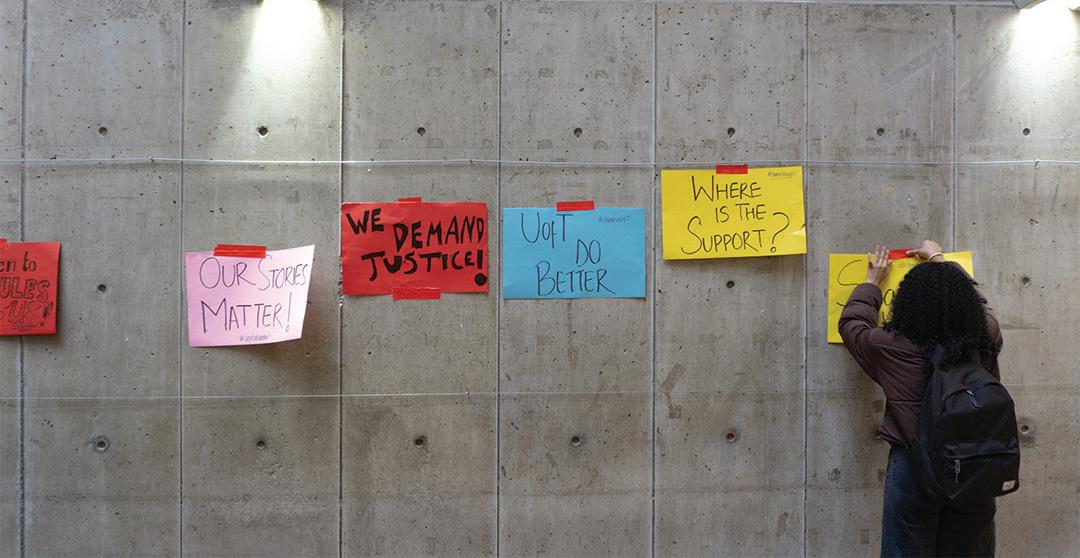
Project START is the UTSC branch of the Prevention, Empowerment, Advocacy, Response, for Survivors (PEARS) Project. The protest was Project START’s first “formal” event, according to the group’s External Director Shreeansha Bhattarai. Bhattarai told The Varsity that Project START began because UTSC students lacked a group on campus that “gave voice to survivors.”
Executives from the Scarborough Campus Students’ Union (SCSU) and the PEARS Project spoke at the event, and representatives from the University of Toronto Students’ Union and Scarborough Campus OUT — which provides a positive space for LGBTQ+ individuals at UTSC — also attended.
Background
In November 2022, The Varsity published an article detailing an external investigation into Reisz’s misconduct undertaken by U of T in 2020. The article revealed that, in April 2022, U of T admitted that Reisz had violated the university’s sexual violence policy on at least one occasion.
In response, the PEARS Project published an
open letter calling on the university to fire Reisz. The open letter has garnered 1,846 signatures as of February 5. In addition, the University of Toronto Mississauga Students’ Union organized a protest outside Reisz’s office in November 2022.

In December 2022, U of T’s Governing Council approved recommended updates to the university’s sexual violence policy, which the PEARS Project openly opposed. Two months beforehand, the PEARS Project had organized a protest outside Simcoe Hall calling on the Governing Council to reject the proposed changes. At the event, PEARS Project criticized recommendation seven of the review, which suggested that the university formalize supports for those accused of sexual violence, and characterized the updates as “too little too late.”
The protest
To begin the protest, participants made posters at the Student Centre then headed to the Meeting Place, where they used red tape to display their posters in the Hall of Excellence.
From the Meeting Place, PEARS Project’s Director Micah Kalisch and START President Radhika Gupta led the protestors in a march through the hallways of the Science and Bladen Wings. The group chanted, “Survivors deserve better,” and, “U of T has failed us.”
Then, protestors marched outdoors along the Gallery Walk, stopping to write on the exterior walls of the Bladen Wing, Student Centre, and Krembil Student Commons. Organizers served coffee and tea while protestors wrote “safe space for all,” and “we are not alone” in chalk. As of February 2, the chalk inscriptions remain on the walls. Afterward, the protest moved back inside the Meeting Place, where organizers shared their stories with attendees.
Gupta and Kalisch gave introductory remarks. “We are still here, despite how many times U of T has tried to silence us, despite how many times they have pushed for harmful policies,” Kalisch said.
PEARS Project Policy Lead Emma Biamonte critiqued the Governing Council’s approval of the updated sexual violence policy. Biamonte said that U of T did not accept all of the PEARS Project’s recommendations — in particular, recommendations that would have “increased the timeliness and transparency of the process of reporting experiences of sexual violence.”
At the Governing Council meeting, Vice-President and Provost Cheryl Regehr said that U of T had integrated PEARS Project’s only recommendation regarding university policy and that the group’s other recommendations predominantly addressed “process.” However, Kalisch clarified to The Varsity after the meeting that the PEARS Project had submitted multiple policy-specific recommendations, which had been reviewed by both a lawyer and a gender-based violence policy analyst.
Kalisch said that U of T President Meric Gertler approached the PEARS Project team after the Governing Council passed the sexual violence policy revisions and suggested that the university work with the PEARS Project to initiate another review of the policy in 2023. According to Kalisch, Gertler has yet to follow up on his offer of meeting with the PEARS Project team.
At the protest, Gupta shared her experiences of sexual violence while she lived on residence at UTSC and the difficulties and delays she experienced in reporting her case to the university.
In an interview with The Varsity after the protest, Gupta said, “I have friends who have chosen to leave this university largely related to gender-based violence, and I still very much carry them and their stories with me.”
Speaking to protest attendees, SCSU VicePresident Campus Life Alyssia Fernandes expressed solidarity. She believes that U of T penal-
izes students more harshly when caught cheating than when people in positions of power incur a “more serious violation” like sexual harassment and assault.
Attendees’ reactions
Thara Majid, a protest attendee and first-year UTSC student, told The Varsity that professors should not “misuse” their authority and power over students. “No one deserves to be assaulted,” she said. “Sexual assault should not be part of the university experience.”
In an interview with The Varsity, SCSU VicePresident External Thai Dillon Higashihara said that the turnout for the protest was “really good.” Fernandes echoed this sentiment, pointing out that she had noticed that a lot of first-year students were in attendance.
Higashihara said that UTM’s decision to continue employing Reisz after an external investigation determined that he had violated U of T’s sexual violence policy was “very telling.” “You see that the sexual violence policy is lacking when this perpetrator is still working and able to be on campus,” he said.
In an interview with The Varsity, Vice-President Academics and University Affairs Amrith David mentioned that Reisz is still teaching undergraduate courses — courses that are prerequisites for UTM’s paleontology major. “The students have to do [those] courses to get their degrees, so they have no choice but to be in them, and that’s so unfair for them,” he said.
In conversation with The Varsity, Gupta highlighted that collective community action plays an important role in making survivors feel less alone. “We may not have all the answers, but we’re here together,” she said.
UTMSU introduces new digital pass, to be piloted in summer Union celebrates 15-year anniversary of MiWay U-Pass
capacity and bus schedule frequency. The union addressed these issues through different discussions and MiWay tabling on campus. Since then, students have highlighted the improved capacity and service. “Students are no longer being left behind as often as [they] used to be,” Barre said.
On January 27, the UTMSU Board of Directors approved an increase to UTM students’ mandatory U-Pass levy fee from $144.74 to $157.77 per session. However, the summer 2023 U-Pass price will stay at $192.29.
U-Pass changes
the physical U-Pass, while still using the digital one. She highlighted that it may turn into a “case-by-case thing” to accommodate accessibility issues.
“We don’t want to leave people behind and make it impossible for them to use their U-Pass,” she said.
What’s next?
On January 24, the University of Toronto Mississauga Students’ Union (UTMSU) held a birthday party for its Universal Transit Pass (U-Pass), a bus pass strictly for UTM students who use the MiWay transit. Following consultations with students, the UTMSU plans to pilot a digital version of the U-Pass this summer, which will eliminate costs for students who lose their pass.
U-Pass history
The UTMSU created the U-Pass in 2007. UT-
MSU President Maëlis Barre, in an interview with The Varsity, explained that the union hosts commission meetings, where students can voice their opinions and suggestions for the initiatives they would like to see the union take on. According to Barre, a student came into one of the commission meetings 15 years ago and brought up the idea of a bus pass.
“I think that’s a really good testament to how much power students have to make changes and that 15 years down the line [those changes are] still there,” Barre said.
In September 2022, students reported experiencing issues with MiWay — namely, shuttle bus
The new policy changes to the U-Pass were born out of the UTMSU’s outreach efforts: gathering over 200 responses of student feedback, emphasizing the importance of the U-Pass service to students, and facilitating discussions about concerns with MiWay policy makers. “[What was] important in our decision to go digital was that it means we’re eliminating any replacement fees,” Barre said. Currently, if a student loses their physical U-Pass card, the replacement fee for the U-Pass is $130.
Students will be able to access the new UPass through the PRESTO app. Additionally, rather than showing the pass to bus drivers, students will tap their phones on the card readers.
“It’s going to be simpler for students… You don't have to carry your card around because everyone has their phone on them,” Barre said.
Barre also explained that there soon won’t be any physical U-Pass options for students. She said that this is to prevent any fraud by selling
The digital version of the U-Pass requires that students ensure their phones remain charged, because if their phone dies, they’ll lose access to their U-Pass. As well, some phones will not be capable of hosting the PRESTO U-Pass, because not all devices have the software required for the app to communicate with the PRESTO card reader. Barre explained that she will follow up with MiWay to continue advocating for student accessibility in regard to the pass.
The digital U-Pass program will pilot in the summer semester “to finetune any problems that may arise,” Barre said.
Students are still unable to opt out of paying for the U-Pass. Barre highlighted that, despite certain students not requiring the MiWay transit system, there are no plans to add an opt-out option for students. She explained that MiWay requires payment from all students for the U-Pass program to remain sustainable. If there were an opt-out option, the price for students to opt in would increase so much that students wouldn’t benefit from it.
The next U-Pass negotiations are set to begin in 2026.
news@thevarsity.ca 4 THE VARSITY NEWS
Lexey Burns, Al Aref Helal News Team
The digital pass will replace the physical U-Pass card. COURTESY LEENA ARBAJI/THEVARSITY
A protestor puts up signs on the wall of the Meeting Place. NAWA TAHIR/THEVARSITY
UTGSU Board of Directors establishes process for selecting elections committee
Board clears hurdle to hiring CRO, approves Bikechain referendum question
 Emma Livingstone Graduate Bureau Chief
On January 31, the University of Toronto Graduate Students’ Union (UTGSU) held its monthly Board of Directors (BOD) meeting. During the meeting, the members passed a motion to allow the union to hire a Chief Returning Officer (CRO). The BOD also viewed a presentation from Bikechain, U of T’s non profit bike repair shop, during which the shop proposed a referendum asking students to increase the shop’s levy beginning in the 2023–2024 academic year.
Elections hiring
The meeting began with the introduction of the UTGSU’s new executive director, Levi Clarkson, who was hired in January 2023.
The BOD then launched into a discussion about the selection process for members of the Elections & Referenda Committee, the committee tasked with hiring a CRO to administer elections.
According to the UTGSU bylaws, the committee must include the executive director (as a non-voting member), a previous member of the Elections & Referenda Committee, and one other member of the BOD. However, several vacancies across the UTGSU BOD, as well as multiple debates about completing a by-election process without violating their own bylaws, delayed the committee’s formation.
BOD member Avinash Mukkala nominated themselves for the committee, but two seats remain unfilled. At the meeting, the BOD put forward a motion that assigns the executive director with the responsibility of finding candidates from the UTGSU general membership to fill the vacant spots on the committee. This new process now allows graduate students outside of the BOD to be nominated for these positions. The executive
director will then bring the committee candidates forward for BOD approval at the February meeting. The BOD approved the motion with some abstentions.
Danielle Karakas, vice-president academics and funding for the School of Graduate Studies (SGS) divisions 3 and 4, further amended the resolution to task the Elections & Referenda Committee with beginning the selection and hiring process for the CRO as soon as possible, following its formation.
“We need a CRO for an election, as some of you may know. This has been a continuous issue, so we’re really excited at the idea of wrapping this up and hiring the CRO,” Karakas told the BOD. The CRO has a necessary position for
the election process as, according to the bylaws, they make sure all of the nomination papers are valid, advertise any nominations and the elections, and resolve any issues candidates may have throughout the nomination, campaign, and election process.
Bikechain referendum
Two representatives from Bikechain, Beth Austerberry and Gabriella Christopher, presented their organization’s referendum question for the BOD’s approval.
Bikechain is a bicycle shop that offers repairs by appointment, free bike rentals, parts for sale, and a workspace where students can repair their bikes. The shop is at 230 College Street, in the
building that also houses the new UTSU Student Commons.
The referendum would ask students belonging to the UTGSU to support increasing the Bikechain fee from $0.60 to $1.50 per year for fulltime graduate students and from $0.30 to $0.75 for part-time graduate students beginning in fall 2023.
In their presentation, Christopher explained that the current levy paid by UTGSU members began in 2010 and only became indexed to the cost of living in 2013. The proposed new fee amount is in accordance with the increased cost of living.
Christopher explained that Bikechain has experienced the negative effects of inflation and could only continue providing low-cost services if students decided to increase the levy. They said that increasing funds would allow Bikechain to employ more people to increase their offerings, while also compensating their staff more fairly.
The BOD voted on whether to present the referendum question to the membership as a “Yes or No Campaign” or an information campaign. According to the UTGSU Policy Handbook, Yes or No Campaigns are to be used if “there are clear or likely divisions within the membership regarding an issue that is to be put to referendum.” For such campaigns, little additional information is provided to voters. For an information campaign referendum, voters receive an unbiased overview of the issue.
UTGSU President Lwanga Musisi argued that the union should present the referendum question as an information campaign, since the UTGSU has historically put forward referenda from levy groups as information campaigns. After two rounds of voting, the BOD approved the referendum question for inclusion as an information campaign in the upcoming election.
The Breakdown: What happens to lost items at U of T
 Alana Boisvert
News
Alana Boisvert
News
When students lose personal belongings on campus, the process of recollecting them depends on what they lost, where they lost it, and how long ago they lost it. A student should first check the building they left their belongings in, according to U of T’s Lost and Found Office. Many buildings on campus have their own lost and found areas.


UTSG
At Sidney Smith Hall (SS), students can check multiple lost and found areas, including the Arts and Science Students’ Union office (SS1068), the Association of Part-time Undergraduate Students’ office (SS1089), and the Faculty Registrar’s Office (SS1090).
If checking the building’s lost and found doesn’t work, students should check UTSG’s centralized lost and found office on the third floor of 256 McCaul St.
According to the lost and found website, items “such as a smartphone, wallet, laptop, or jewelry” are sent to the centralized lost and found on campus, and remain there for eight weeks. The Facilities and Services website directs students who have lost items such as binders, books, USB sticks, and umbrellas to the caretaker’s office in the building the item was lost in.
Within the eight-week period, students can submit an online form detailing what they lost and their contact information. To make an appointment to pick up a lost item, students have to email the lost and found office. The office’s policy requiring
appointments was instituted due to COVID-19 safety concerns.
The swap shop
If a UTSG student doesn’t collect their lost item within the eight-week hold period, it gets donated to the U of T swap shop. The swap shop is part of U of T’s effort to be more sustainable by providing a place to store and pick up “surplus furniture, office equipment, and supplies” ac-
given to charity
cording to the swap shop’s website. University departments are the first to look at all new inventory at the swap shop. However, if items remain unclaimed, U of T students, staff, librarians, and faculty can claim them.
Money is treated differently from most lost items. Any lost money gets collected and donated to a “charitable cause” once a year, according to the lost and found office. A U of T spokesperson wrote in an email to The Varsity that the
charity changes “each year as part of Facilities & Services’ annual holiday fundraising effort.”
UTSC
The centralized Lost & Found at UTSC is located in SW304 in the Science Wing and operated by Campus Safety. With a 90-day hold period, UTSC holds its lost items for a bit longer than UTSG. According to a U of T spokesperson, after the hold period, valuables are donated to “communitybased charitable organizations” while less valuable items are “taken to the UTSC FreeStore for other students to reuse.”
The spokesperson did not provide information on what happens to unclaimed money.
UTM
Lost items at UTM go to the lost and found office at the UTM Service Desk in the Communication, Culture and Technology Building. Items remain there for eight weeks before being donated to United Way Greater Toronto, a charity chapter in Toronto committed to help battle poverty. Their mission includes boosting “education, economic mobility, and health resources.”
According to the spokesperson, unclaimed money is distributed to a dif ferent charitable cause each year.
TCards
If a lost TCard isn’t in the build ing a student has lost it in, the lost and found office advises them to check their campus’s TCard office. However, the TCard offices will generally contact a student when they receive a lost TCard.
thevarsity.ca/section/news FEBRUARY 6, 2023 5
The UTGSU discussed election hiring at their January 31 BOD meeting.
ZEYNEP POYANLI/THEVARSITY
Items held in lost and found for period of time until
Associate
EditorCHRISTINA DINH/THEVARSITY
Business & Labour
How the City of Toronto’s tabled 2023 budget will impact you The budget will affect housing, TTC, police
In January, Mayor John Tory proposed the City of Toronto’s new 2023 budget, which the City Council will review on February 14. The budget encompasses all municipal services. It indicates which public services the City will prioritize this year and how it plans to fund them.
Increasing property taxes will push up rent
Property owners will have to pay seven per cent higher fees on their residential property starting this year, as taxes increase by 5.5 per cent and building levies increase by 1.5 per cent.
The 5.5 per cent tax hike is supposed to offset the effects of the COVID-19 pandemic and economic uncertainty. This will lead to a spike in fuel prices and interest rates, increasing the City’s expenses.
Tory has asked the provincial and federal governments for bailouts to assist with pandemic-related economic recovery for several years, but the requests for 2023 have not yet been answered. If the City does not receive bailouts this year, they may resolve to top up property tax increases to 24 per cent.
What does all this mean for the average Toronto student? Put simply, landlords could be more pressured to increase rent. Average rent has continued to soar since the summer of last year for a variety of reasons, thereby making housing less accessible, and bolstering the homelessness crisis.
Housing accessibility projects will receive more funding
At the same time, the new budget addresses
housing accessibility. It allocates $18.85 million to the Multi-Unit Residential Acquisition (MURA) program, $1.15 million less than was allocated last year when the City of Toronto launched the program. MURA is essentially a fund for a nonprofit housing sector; the city purchases vacant, privately owned residential properties and converts them into affordable housing units.
MURA aims to curb gentrification — the process by which developers convert low-valued property into higher-price residences, making them inaccessible to tenants with smaller budgets. As such, the City looks for properties that are deemed “at risk” of being developed into more expensive units.
20 per cent of MURA’s funding is dedicated to Indigenous housing organizations, which aims to provide accessible housing to Indigenous tenants in the City, in line with the City’s Truth and Reconciliation commitments.
The 2023 budget also proposes $3.5 million for implementing the new multi-tenant housing framework, which will make rooming houses legal in areas of Toronto where they are cur rently prohibited. Although rooming houses are already legal in the Downtown Core around UTSG, the new legislation may diffuse the pres sure from the Downtown housing market by drawing potential tenants toward the periphery of the City.
The police force will gain 290 more mem bers
The budget proposes funding for 16 more Toronto Police Services officers to patrol neighbourhoods, 162 more officers to respond to calls, and 22 more officers to work on major cases. It will also add 90
special constables, who execute search warrants, perform court orders, guard and escort those in police custody, and perform other duties. In total, the Toronto Police’s proposed budget is increasing by $48.3 million.
Tory’s prioritization of the police comes in part as a response to the numerous random attacks on Torontonians recently, including the January 24 attack on a U of T undergraduate student.
Individual Torontonians are denouncing the $48 million increase. Data from major urban centers across Canada indicates increased police presence has been proven to be ineffective at deterring violence, but it does jeopardize people who are homeless and going through mental health crises, as well as members of Black and Indigenous communities.
Reduced TTC services, more fare inspec-

tors
While the TTC’s budget is dramatically increasing on paper, the vast majority of that money is going toward the new Light Rail Transit lines in Eglinton, Crosstown and Finch West . The money left over for existing TTC services is insufficient to cover existing operations, given that revenue from ridership fares has decreased.
Bus, streetcar, and subway services will be cut by five per cent, while fares will increase by 10 cents to make ends meet. Riders should expect buses and streetcars to come by less frequently.
On the other hand, 50 additional TTC special constables will be hired, who will inspect riders for fare evasion and patrol TTC stations and cars.
High inflation, skyrocketing interest rates leave university finances tight
First Business Board meeting of 2023 lays cautious plans for uncertain economy
On February 1, the Business Board of U of T’s Governing Council met to lay out the university’s deferred maintenance plan for the year, the annual debt strategy review, and the forecast of its financial results for the financial year ending in April 2023.
Inflation, underfunding
undercut maintenance
The meeting’s first report on deferred maintenance was given by Ron Saporta, chief operating officer of Property Services & Sustainability, after a brief introduction by Scott Mabury, vicepresident, operations.
In his introduction, Mabury pointed out that recent high rates of inflation have caused maintenance costs to skyrocket compared to
previous years. In his presentation, Saporta explained that U of T has seen an increase in the replacement value of buildings from 2021 to 2022, growing from $559 million to $5.9 billion in 2022. This growth is partially due to inflation costs for non-residential building construction in Toronto, which rose by 15.6 per cent to 17.5 per cent in 2022. The deferred maintenance liability for these buildings has also increased from $820.5 million to $961.3 million over the same period of time.
The university’s deferred maintenance funding is low compared to similar reference points, both at a provincial and federal level. “We are, for us, making significant investments from our operating fund, but combined with the paltry sum we get from the province through the facilities renewal program, FRP — 12.8 million — it’s insufficient,” Mabury said. “If we were in Québec, our sister institution may get its 157 million per year — we get 13.”
UTSG is also considering the impact of the climate crisis on its deferred maintenance plans. The Financial Accountability Office of Ontario predicts “a 7 to 29% increase in the costs of operating and maintaining public buildings by 2100,” according to the deferred maintenance report, which will mean a cost increase of $20 million to $80 million for the university. The report says that the university is also planning to use “decarbonization and infrastructure resilience” to address the effects of the climate crisis.
Interest rates hampering debt strategy
Alongside inflation, high interest rates are another artifact of the post-COVID-19 economy that are affecting U of T’s financial forecasts and burdening the university’s debt. Trevor Rodgers, chief financial officer, presented this perspective during the Business Board meeting’s portion dedicated to debt strategy.
“In the current environment of rising interest rates, of inflation and construction costs… we are anticipating that there’s going to be some pressure and that we will have to review the borrowing capacity in the outer years of the plan,” Rodgers said. “Of particular note this year, we’ve updated the future cost of borrowing… our sensitivity analysis shows that any further increases beyond that would, of course, reduce the overall debt capacity.”
The university’s debt strategy includes both internal and external debt with a single debt limit that is redetermined annually. The debt limit determines the maximum debt that the university can take on.
This year, as of April 30, 2022, the debt limit was $2,096.7 million, with $962.7 million from internal sources and $1,134 million of external debt.
As of December 31, 2022, the university’s actual outstanding debt was $877.2 million.
The debt policy limit is projected to grow by an additional $374.3 million over the next five years, but economic uncertainty may limit that growth. Rodgers explained that this uncertainty may include rising interest rates, slower growth in university expenditures, and construction cost inflation in the GTA.
U of T has lower debt service costs than some other Canadian universities. Nevertheless, the university has been exploring financing structures other than debt to address funding changes.
Certain uncertainty
Rodgers also presented the forecast of the university’s financial results for the fiscal year ending in April 30, 2023. Given that information on enrollment, tuition fees, operating grants, and most expenses are already known for the year, Rodgers mentioned that most of the forecast should be fairly reliable.
However, there are still some significant uncertainties. Investment returns can vary greatly from year to year, and the report noted that uncertainty was particularly present this year, “due to the ongoing war in Ukraine, the residual effects of the COVID-19 pandemic, persistently high inflation, and rising interest rates.” Additionally, the university’s final year-end results may differ based on what happens in the final four months of the fiscal year.
The forecast has made some key assumptions about the university’s endowment payouts, its investment income, the increase in the value of its capital assets, and divisional savings to fund other projects such as planned capital expansion, faculty start-up funding, research infrastructure, and funds to match future donations.
The next meeting of the Business Board is scheduled for March 15.

February 6, 2023 thevarsity.ca/section/business biz@thevarsity.ca
Georgia Kelly
Associate B&L Editor
Andrew Yang Ki
Associate B&L Editor
BIEW BIEW SAKULWANNADEE/THEVARSITY
The City of Toronto released their budget for 2023. VURJEET MADAN/THEVARSITY
Arts & Culture
Department of Italian Studies hosts Italian rapper and
educator Amir Issaa

Issaa discusses art, education, and social justice at the book Q&A session
Marta Anielska Arts & Culture EditorOn February 2, the Department of Italian Studies at U of T hosted a concert by Italian rapper and educator Amir Issaa. The event started with a question and answer period focused on Issaa’s book, Vivo per Questo, as well as rap as a tool for expression, education, and social justice.

spoke with Issaa and Angelica Pesarini, an as sistant professor in the Depart ment of Italian Studies and the Centre for Diaspora and Transnational Studies, about the event, its connections to the global
antiracism movement, and its relevance to students in Canada.
Rap as expression and social education
Issaa explained that he was born in Italy to an Italian mother and an Egyptian father. His upbringing was difficult, especially after his father was arrested, and he explained during the question and answer period that, as a child, his default response was silence.
However, rap gave him the opportunity to take his familial experiences — as well as experiences of racism and alienation in an Italian society that wasn’t yet ready to accept multiculturalism — and turn them into art. Many of his songs hint at themes related to social justice and touch on his own personal experiences.
Issaa noted that he is one of the second generation of rappers to start up in Italy, who looked to the United States where hip hop was invented. According to him, the situation is very different now — were he to be attending high school in 2023, he would no longer be one of the only people of colour in the classroom.
Pesarini added that part of the reason why they invited Issaa to speak at the university is that doing so starts to undo the harmful assumption about Europe’s all-white history.
“We’re trying to show that Italy has never been a white country,” Pesarini explained. “The first Duke of Florence was a biracial man… This part of history has been kind of forgotten.”
Pesarini sees Issaa’s work as an opportunity
to explore different epistemologies and teach history through poetry. She views his work as transforming experiences into art, which subsequently turns them into shared knowledge.
Furthermore, Pesarini explained that this is an opportunity for university students — who often already have some form of a connection to immigration and multiculturalism — to learn about a concept they’re familiar with in a different context. After all, racism looks different in Italy than it does in North America, even if it has the same roots.
A new generation
Issaa believes that even if children don’t respond to institutionalized education, they’ll often be engaged in learning if they can express themselves creatively. As a result, Issaa has been delivering workshops in classrooms for the past ten years, encouraging kids to learn through rap.
“Rap music… is fun,” Issaa said. “The kids love hip hop… For a lot of kids, [it’s] easy to approach.”
While he thinks that a lot of teachers have rejected forms of expression like hip hop for being inappropriate, Issaa believes that the younger generation of educators is slowly recognizing its potential. For example, another one of Issaa’s books, Educazione Rap, is being taught more often in schools.
Pesarini also thinks that Issaa represents a general shift in how we conceptualize Italian identity and a greater acceptance of racial diversity in the country. She added that the death of George Floyd and the resultant protests that started in the United States and swept across the world were also a turning point. According to Pesarini, many young Italian people of colour began to feel like they had to organize and speak up.
Pesarini concluded that Issaa’s work is important because it encourages creativity and passion in children. “Loving to use words, loving music, loving poetry… that is our treasure,” Pesarini said. “It’s important. And so we need to fight for that.”
Filipino Appreciation Week warms up a chilly time of year U
Milena Pappalardo Associate Arts & Culture EditorDuring the week of January 30, the Filipino Student Association of Toronto (FSAT) held its annual Filipino Appreciation Week (FAW), hosting a variety of cultural events and activities. FAW has been running since the club’s founding in 2005, and members of the U of T Filipino community look forward to the event for its festive games, cultural workshops, and delicious feasts.

One major goal of the FSAT is to educate
event celebrates and educates about Filipino culture
both Filipinos and non-Filipinos about Filipino culture. Ernest Esteban, FSAT’s co-president, said in an interview with The Varsity that having grown up in a Canadian suburb with few connections to his roots, getting involved with the FSAT was an opportunity to grow closer to his heritage. “We’ve been planning [FAW] since September and the whole team got involved… I’m really proud of my team this year.”
A language workshop and tote bag painting night simultaneously celebrated and educated on Tuesday evening of the Appreciation Week.
AJ Vidal — a recent U of T Life Sciences grad-
uate and member of FSAT — led an engaging lesson about Baybayin, a Tagalog script. In pre-colonial Philippines, Filipinos who spoke Tagalog wrote in Baybayin. However, the written language was lost due to Spanish colonialism and is rarely used by Filipinos today. “What we do here is anything related to how we can amplify the voices of Filipinos in our community, educate even Filipinos themselves on things that have been forgotten from the pre-colonial era,” said Vidal.
Also, Vidal expressed how the FSAT comforted her during a lonely period of her univer-
sity career. Craving the community and comfort of a culture she grew up with, but could scarcely find in the classroom, Vidal searched on Google whether there were any Filipino student groups on campus. This is how she discovered FSAT, and by her graduating year, she was co-president.
The week concluded with a talent show on February 3. At the Cat’s Eye, an atmospheric café clubhouse at Victoria College, fairy lights and balloons decorated the talent show stage. A variety of acts took the stage, including an acoustic guitar, vocal performances in both Tagalog and English, comedy skits and a Tinikling routine, and a traditional Filipino dance with bamboo sticks. Cheerful club members and their friends packed up the venue, hooting words of encouragement at each talented performer. People lined up to taste Filipino specialties such as barbeque skewers; baked turon — banana in a sweet fried pastry; and lumpia shanghai — Filipino-style egg rolls. Overall, the atmosphere was wonderfully warm.
Kim Sales, a first-year international student from the Philippines, performed for the first time at the talent show with a love ballad vocal number. Despite admitting that he initially felt pressure when performing in front of his talented peers, Kim spoke about the importance of Filipino Appreciation Week to his integration into Toronto life: “I found a community that I feel I belong to… the cultural differences between the Philippines and Canada are very different, so [the FSAT] helped me transition to this kind of environment.”
Co-president Esteban looks forward to more team-building opportunities and memorable events like FAW in the future. The talent show was a festive conclusion to a successful week that showcased the unity and spirit of U of T’s Filipino community.
February 6, 2023 thevarsity.ca/section/arts-and-culture arts@thevarsity.ca
of T
student-run
FAW included
a
COURTESY OF FILIPINO STUDENTS'
many cultural events complete with
talent show and Filipino foods.
ASSOCIATION OF TORONTO
Members of the Italian Department host Q&A with Amir Issaa.
MARTA ANIELSKA/THEVARSITY
Amir Issaa is an Italian rapper and educator. COURTESY OF FLAVIO FICARA
The newfound success of the independent music critic
Why corporations have waned while the individual rises
Caden Elliot Varsity ContributorLet’s play a little game. I’m going to show you a table of four lists — two from large music publications and two from some of today’s biggest independent music critics — and your job is to see if you can pinpoint which list is corporate and which is independent, as well as to decide which one you most agree with. The lists display the top five albums of the 2010s. If you don’t recognize all the albums, that’s okay. Just do your best to see if you can figure it out.
Got your guesses? Great.
The first list is from Rolling Stone, the second is from Pitchfork, the third from Anthony Fantano’s YouTube channel The Needle Drop, and the fourth is from YouTube and Twitch streamer Shawn Cee. The former two are corporate while the latter two are independent.
Did you get it right? It could have been tough to figure out, but there were some hints: Shawn Cee’s list consists entirely of hip hop albums, with all five albums released by male rappers, signifying a strong personal preference. Fans of popular music
critic Anthony Fantano of The Needle Drop YouTube channel may have recognized five of the albums he gave a 10/10 throughout the 2010s in the third column, including You Won’t Get What You Want by Daughters, The Money Store by Death Grips, To Be Kind by Swans, and To Pimp A Butterfly by Kendrick Lamar.
Pitchfork’s top-five list includes a Frank Ocean album, which hints at a more modern, youthful appeal, and chart toppers such as Taylor Swift’s Red glare toward a basic, crowd-pleasing corporation like Rolling Stone

Why do I bring all of this up? Modern music criticism has changed drastically in the last decade, with the advent of the internet affecting all critics and publications, like the aforementioned Rolling Stone being dwarfed by Anthony Fantano, who The New York Times’ Joe Coscarelli calls “The Only Music Critic Who Matters (if You’re Under 25).” Fantano has become a canonical member of YouTube lore, amassing 2.7 million subscribers in his tenured career of music criticism, making him far and away the largest independent music critic.
Shawn Cee’s growth is nothing to dismiss either — the Detroit native is closing in on 900,000 subscribers on his YouTube channel and is one of the most revered hip-hop focused music critics. So what is the key to their success? Why do people seem to gravitate toward these individuals’ opinions and ranking lists of the music that they like? What has caused them to seemingly soar in popularity among the modern generation despite Rolling Stone and Pitchfork still pumping out content on the daily?
The answer comes down to the uniqueness of

each reviewer: when you watch Fantano and Cee’s decade end list, you feel like this singular person’s years of criticism and reviews have been building up to this moment, a climactic statement by someone who you’ve begun to bond with over years of shared music.
Music is inherently parasocial — you become attached to your favourite artist through their art, despite not actually knowing them. This same effect happens with Cee and Fantano, as fans eagerly await their thoughts on an album, seeking validation and acceptance.
Both Rolling Stone and Pitchfork’s articles include a corporate disclaimer about how they came to these decisions, but 80 different staff members wrote Pitchfork’s list. 22 staff members wrote Rolling Stone’s. This creates discrepancy in opinions, and although it could lead to a list with a greater variety of albums from more voices, it also generates a lack of intimacy between the reader and the content.
In today’s somewhat isolated and chronically online society, personable connections are difficult to come across on the internet. People search for relatable content and like-minded communities, giving a golden opportunity to independent creators; this is where Fantano and Cee have hit the jackpot.
Both hold incredible influence over the impressionable minds of YouTube viewers, spreading praise and creating publicity for albums and artists that may not get the same coverage as the tycoons of the music industry. With music being more accessible than ever through streaming, Fantano and Cee can easily alter the career of any budding artist, a power few critics hold.
Artistic expression and performance at U of T
Events to look out for in 2023
As the winter semester starts back up, bulletin boards around campus have begun to fill with a plethora of events that societies and clubs are hosting all over U of T. Club executives collectively breathe a sigh of relief as the university continues opening its doors to more and more in-person activities post pandemic.
For the drama societies all over campus, the online realm was particularly difficult to traverse, given that theatre as a medium depends on intercommunication between the actors, the sets, and the audience. A significant portion of this interaction is lost when students are confined to a Zoom window on someone’s laptop. But some clubs, like the U of T Improv Club, managed to thrive during the pandemic and come out the other end stronger, further building their community and routine as they shift to in person.
From the screen to the stage
The U of T Improv Club’s growth throughout and after the pandemic has been a marked example of how to successfully traverse through and adapt to changing conditions.
In an interview with The Varsity, club president Will Ramsay, a fourth-year linguistics specialist, and executive Joshua Zimmerman, a third-year student
studying robotics engineering, spoke about their experiences with the club and hopes for its growth in 2023.
Ramsay joined the club in 2019, at the precipice of the pandemic, and got to experience the club activities prior to the move to the online realm. He now hands the reins to his capable successor, Zimmerman, who joined after the online transition, and hopes to see the club continue to expand in size but grow tighter in its community.
Ramsay and Zimmerman are united by a love for improv, having been active members of the club throughout their U of T journeys. As they explained, the improv club is a home for anyone who wants a chance to explore their creativity and try a hand at performing.
Improv is unique from traditional performance and theatre since actors create the script as they go. This chance to bring your own voice and perspective to the performance and to interact with others in a novel setting is attractive to many. As Joshua explained, “Even after their first improv scene… they want to keep coming back."
An added plus is the freedom in the degree of participation. “Some people, they love to perform, but for others, they’re a bit more shy,” Ramsay said. But he added that this is not an impediment; even if you’re not center stage, you can still be involved in building the story as an audience member.
It is no surprise then that the club gained trac-
tion, boasting a diverse group of members, all eager for a good laugh. Even during the online days of ‘Zoom-prov,’ they had a great turnout, with people eager to come back. Consequently, the community remained active and was able to thrive during and in the aftermath of the pandemic. With the club’s first in person show in April 2022, its members continue to work diligently to create an atmosphere that is fun for all.
In this no-pressure environment, everyone is able to take a respite from the hectic pursuit of academia for a fun-filled time. “There’s not much opportunity to play or be silly… the improv club is a place where you can do that without being judged,” Ramsay said.
From the introvert to the theatre kid, all are welcome to step into the world of performing — the monthly performances continue, as well as weekly drop-in events for any and all to join. These weekly events take place on Thursdays from 6:00–8:00 pm.
In the coming year, the Improv Club hopes to keep the core community of regulars that are the backbone of the club while continuing to expand into various forms of improv, improving upon its art and expanding into novel avenues of creative expression.
Events, events, and more events!

This winter, the arts scene at U of T continues to
be vibrant with new shows in the works.
The chambers of Hart House echo with the sound of music as the Hart House Choir tirelessly prepares for its upcoming winter concert on February 16. Thankfully, the stage is now set for the drama societies around campus all over U of T to begin their performances.
In terms of plays, the Hart House UofT Drama Festival from February 15–18 will showcase the work of up-and-coming playwrights from U of T with three student-written plays. Additionally, the Trinity College Drama Society hosted Trin Theatre week from January 16 to January 21. The week was filled to the brim with workshops, movie nights, games and more.
For those inclined to poetry, The Cat’s Eye, located in the heart of Victoria College, is your one stop shop for smaller scale, but fun-filled events. The Muslim Voice, a student-run organization highlighting the creative Muslim minds at U of T, hosts its first event of the year: Spoken Word night on February 10 from 5:00–8:00 pm. The event will feature poetry and performances from Muslim students and artists from across the GTA.
There are myriad forms of artistic expression that thrive at U of T, eager to begin — in person — with the dawn of the new year and hope to continue growing.
thevarsity.ca/section/arts-and-culture FEBRUARY 6, 2023 8
Daniyah Asad Varsity Contributor
FIONA TUNG/THEVARSITY
MARTA ANIELSKA/THEVARSITY
Wednesday Addams isn’t like other girls — or is she?
Does Wednesday’s dark demeanor and overall strangeness make her a ‘pick me girl?’
 Sorcha Chow Varsity Contributor
Dark academia, mythical creatures, and youngsters with powers and abilities that ostracize them from ‘normal’ people have always been cherished by young audiences of series such as the Twilight saga and The Vampire Diaries. On November 23, 2022, the hit Netflix show Wednesday starring Jenna Ortega joined this roster.
The Addams Family has been around for almost a century, from the original comic release in 1938 to its several movie and TV adaptations starting from 1964, but Wednesday is the first to focus solely on the famous family’s daughter as she navigates attending a new boarding school and teenage angst. On top of that, Wednesday is the character’s first introduction to a Generation Z setting. With ‘pick me girl’ being a popular term in Gen Z vocabulary to describe a girl who goes out of her way to appear quirky and different, especially to attract a man, one can’t help but wonder if this modern version of Wednesday Addams qualifies as one.
Linked to the classic ‘manic pixie dream girl’ trope, the pick me girl often stands out among her female peers by being self-deprecating, loud, and resistant of anything ‘girly’ just so the male protagonist can select her as his love interest — bonus points if she has dyed hair and no filter. Both tropes give the illusion of appealing to women by depicting characters who are unique but, in reality, these girls lack any development beyond getting a man’s attention. The pick me girl goes a step further than the manic pixie dream girl, since she usually explicitly acts out for male attention, putting down other girls and outright stating how special she is.
The attempts of girls to emulate the manic pixie dream girl might result in a pick me girl, which stems from internalized misogyny. But this character trope is evoked in Western media so often that it’s nearly lost its original meaning. For example, if
a girl is an odd one out based on her personality and appearance, she is often labeled as one or both of these tropes, and it is assumed she is only the way she is for a man’s attention.
With Wednesday, there are many aspects of her character and story to consider when deciding if she belongs to the pick me girl trope. At the start of the show, Wednesday lives with her family and attends public high school before being expelled for tormenting her brother’s bullies. Transferring to her parents’ alma mater, they assure her she will fit in, as the student body is equally eccentric.

Nonetheless, Wednesday remains the odd one out, as her black braids, death stare, psychopathic tendencies, and resistance to social media and technology have students who are sirens and werewolves calling her the “weird one.” Wednesday doesn’t help her case in showing zero interest in bonding with any of the other female characters such as the headmistress, her therapist, her roommate Enid, and her classmate Bianca. Moreover, when Bianca’s on-and-off boyfriend Xavier begins showing interest in Wednesday, leading to
a conflict between the two girls, it all crosses into pick me territory.
In a Netflix question and answer session after the show’s release in December 2022, Ortega revealed that Wednesday channeling pick-me energy was the show’s initial intention until Ortega put her foot down. In a TikTok of this question and answer period that user @dannyraeee posted, Ortega discussed how she was shocked by some of the lines in the original script and simply refused to say them. The lines were little remarks that depicted Wednesday as fake and boy crazy, and Ortega quickly deemed them too cringey.

Admittedly, it wasn’t like the writers were taking a fully developed character and simply modernizing her for Gen Z tastes. In most Addams family adaptations, Wednesday is younger and less developed. The show treads new water in trying to explore her teen years, which might lead to moments where the show emulates other common teen TV tropes, which are especially abundant on Netflix in series like Riverdale or The Chilling Adventures of Sabrina. However, Ortega wanted to
make sure that the show’s love triangle didn’t take centre stage.
Overall, Ortega’s portrayal of Wednesday is successful in sidelining the love triangle and any pick-me tendencies, since the main storyline focuses on the mystery plot. It’s evident the boys fancy Wednesday for her quirks, but she hardly acknowledges their interest, let alone returns it. Wednesday spends most episodes trying to uncover mysteries and secrets of the school, her family, and the townspeople. She only interacts with her ‘love interests’ when she needs their help. It’s pretty far-fetched that she would maintain her peculiar persona just to win their affection.
Though she’s antagonistic toward other women at the beginning of the narrative, her relationships with all of them shift over the course of the show. With each passing episode, the female characters and their dynamics are deeply explored and Wednesday eventually bonds with several of them, despite their differences. Wednesday’s character development is almost the reverse of a pick-me girl, as she becomes an active member of the student body, forms loyal friendships, and feels remorse.
Ultimately, Wednesday is a likable female character because she does not compromise who she is for the male gaze and is a perfect balance of being unique, while not putting down other girls. While most young women can’t relate to her homicidal tendencies, they can relate to her being intelligent, awkward, and assertive. As for her ouija board, typewriter, and mommy issues, she is far from the only teenage girl with all three. Rather than being quick to shame and label girls for being different, there is strength in realizing every girl is unique in her own way.
Wednesday shows the power of focusing on yourself, no matter how weird you are, which is a message that has made fans of all generations fall in love with her. Underneath her icy and dark persona, she is just another teenage girl who wants to let her guard down.
arts@thevarsity.ca 9 THE VARSITY ARTS & CULTURE
VINCENT QUACH/THEVARSITY
Opinion: I’m a U of T instructor, and I believe we need to abolish grades
What students see as “kindness” in the classroom is the bare minimum
 Dylan Jow Varsity Contributor
“Thank you for rescuing our class from its way to collapse,” began the hand-written letter that I received from a student as we adjourned our final class of the semester. The letter, which was accompanied by a box of chocolates, was one of many thank you notes that I received during the Fall 2022 term.
Despite only being a graduate student, I was both the full-time instructor and teacher’s assistant (TA) for an upper-year physics class. Midway through October, when the original professor unexpectedly went on leave because of long COVID-19 symptoms, the department decided that I, having been the course’s TA for three years, was best suited to take over on short notice. It was a simple solution to a straightforward problem.
I was a novice teacher, and I had limited experience delivering lectures and writing exams. While the professor’s serious postCOVID symptoms meant that the course’s organization was chaotic from the start, by no means did it run perfectly after I took over. So why were my students so appreciative when I became their instructor?
As I reflected on my situation over the holidays, I realized that the “collapse” my student referred to was more than just the result of a long-COVID-induced professor swap — it
was part of a growing realization that I’d been navigating for nearly a decade of being involved with higher education as an undergraduate student, graduate student, and then instructor.

The way university instructors incentivize student learning is flawed. The problem is, simply put, how and why instructors grade students. As I have come to realize, grades often have little to do with measuring students’ understanding and are often used as a cudgel to compel student compliance with arbitrary standards set by out-of-touch professors. As has been common throughout the pandemic, COVID-19 simply highlighted deeper structural inadequacies.
Learning assessments and students’ time
Most Canadian universities — U of T included — use the modern A–F grading system, in which students are given a letter grade and corresponding numerical grade point average (GPA) on a scale that represents their academic accomplishment in a course.
However, despite the system’s present ubiquity, it only rose to prominence in North America in the late nineteenth century as a way of standardizing the assessment of student learning in an increasingly international educational environment. Yale, for example, went through four different grading systems between 1967 and 1981, including a pass
and fail system, before settling on its current A–F model.

Grades are primarily intended to assess learning, but instructors often use the implicit threat of giving students a bad grade to compel their engagement with course material in the absence of positive incentive. This absolves professors of responsibility to make their classes engaging.
In my experience as a TA, the students who receive the lowest grades on assignments are the ones that don’t hand them in due to time constraints. These constraints often arise for reasons entirely out of their control, such as health issues or domestic conflict. The Faculty of Arts and Science’s Academic Handbook for Instructors explicitly gives professors “wide latitude” for deciding on late policies, with the only guideline being that any policy must be “fair, equitable, and reasonable.” As such, it is not uncommon for professors to penalize students upward of 10 per cent a day for late work, if they accept late work at all. Exams are a different story. In principle, they are a fairer measure of student learning since students are given the same amount of time to complete them. However, traditional exams assess a student’s ability to perform well in a stressful environment just as much as it does their understanding. Meta analyses consistently show that test anxiety is a strong negative predictor of academic achievement.
It’s been so widely accepted that traditional assessments are a poor measurement of practical understanding that it has almost become a cliché.
Many professors exacerbate the situation with arbitrary grading practices. As a student, I’ve experienced more than one professor proudly proclaim to me that they never award grades higher than a 90 per cent.
According to the FAS’ handbook, grades are meant to function as a measurement of a student’s mastery of course material. If this is the case, then these professors would be admitting that they have never adequately taught the material. Alternatively, these professors are admitting that grades are entirely subject to their own personal whims.
Even when assignments are marked fairly and transparently, the amount of course work assigned is left entirely to professors’ discretion. The FAS’ handbook only includes a guideline that no assignment can account for more than 80 per cent of the final grade. Professors may require students to devote many hours every day to their course to maintain a reasonable grade. When a student has four other courses with similar demands, their ability to earn a good grade may be limited purely by the number of available hours that they have in a day.
Take the flipped classroom structure for example, which is one in which students are
10 THE VARSITY FEATURES JESSICA LAM/THEVARSITY
required to read the lecture materials on their own before class. Lectures then become the instructor expanding on course readings by answering student questions.
This displaces the responsibility to prepare for lectures from the instructor to the student. Professors rarely reduce the assignment workload to compensate for the additional work created by the flipped structure.
Flipped classrooms have gained some popularity among instructors, as there is research that suggests that they improve learning outcomes. I don’t dispute this claim; in fact, it seems obvious that the increased workload would generally improve understanding. The real question is whether improved learning outcomes justify the inflated demand on students’ time.
Even when professors are willing to grant extensions for extenuating circumstances, there is often a high barrier to accessing these accommodations. Something as simple as emailing a professor requesting an extension can be anxiety inducing for students, especially first-year students who have not yet acclimated to the university environment. Moreover, the Faculty of Arts and Science only requires that instructors accept late work when there are “legitimate, documented reasons beyond a student’s control.” It is not always possible for students to attain documented proof for extenuating circumstances, no matter how legitimate.
These barriers are also unnecessary from a pedagogical perspective. There is no policy that stops professors and TAs from giving students feedback on assignments at any time during the term. Therefore, the effect of late penalties is to simply punish students for deviating from a prescribed schedule, rather than to empower them to learn at a pace that accommodates their own needs and priorities.
The arbitrariness and ambiguity of participation grades

According to U of T’s University Assessment and Grading Practices Policy, published in 2021, participation grades can comprise up to 20 per cent of graduate students’ total grades. The document didn’t specify participation grade weight for undergraduate classes, but, in the course I took over, participation grades also made up 20 per cent.
When I was an undergraduate student, I was confused by participation grades. How could a professor who has never asked for my name assess whether or not I had participated in class sufficiently? Did the students who stayed silent during lecture automatically lose 10 per cent of their final grade?
My suspicions were not unfounded. As a new instructor, I received an email from the Physics Department undergraduate coordinator reminding me that “under no circumstances may instructors release final marks to students before they have gone through [departmental] approval.” The email further explained that “instructors should not add in the ‘overall assessment’ portion, ‘participation mark,’ or the final exam mark to the Quercus grade book,” as per the FAS handbook.
When I first started as a TA for the physics course four years ago, the professor told me that participation grades would benefit students. They would motivate students to attend lectures and tutorials and engage with the class material.
I was already skeptical — surely, if instructors wanted to encourage engagement, the most effective way of doing so would be to create engaging course material. Now that I have seen behind the curtain as an instructor myself, the absurdity of this claim is even more apparent to me.
Although it was not stated outright, I interpreted the email I received to mean that students should not be allowed to see their participation grades so that the grade could be adjusted to meet departmental requirements for grade distributions.

Previously, the FAS required specific proportions of students to receive a given letter grade in a class. In recent years, these distribution guidelines have been relaxed, with the general norm being that the number of students receiving an A is between 15 and 30 per cent of the class, and no more than 10 per cent of the class should receive an F. While instructors are expected to grade within these guidelines, departments only review grade distributions at the end of the term. By withholding participation grades from students until after departmental review, professors are able to arbitrarily scale grades without prior accountability.
Not only are participation grades obviously a device for scaling grades, in my experience
they also fail at their purported purpose: encouraging participation.
Last term, the professor whose class I took over introduced a flipped classroom structure. Although I’ve witnessed this lecture structure implemented very successfully, I’ve just as often seen it being implemented disastrously. For the structure to work, the instructor must be skilled at fostering a positive environment of curiosity and encouragement. Accomplishing this task was all the more challenging for a professor suffering from long-term COVID-19 symptoms.
For the first month and a half of the semester, the students in my class learned very little during lectures. Some of them told me that, before I took over as instructor, the lectures were an hour of awkward silence.
In this context, the participation grades were ineffective at encouraging class participation and did nothing to promote learning. They simply forced students to waste multiple hours a week under the threat of losing a significant chunk of their final grade.
Gatekeepers of academic advancement
The unarticulated assumption is that students are lazy and need the threat of a poor grade to motivate them. Now, I have had professors who do empower their students, who work hard to accommodate their needs, and who even award participation marks for actual participation. Ultimately, though, a student’s grade is subject to their professor’s whims, with very little oversight beyond the artificial scaling a department may require.
The result is that a final grade is a meaningless combination of many factors, only a small fraction of which relates to a student’s understanding of course materials.
Grades are the gatekeepers of academic advancement. A good GPA is required to access further education, be it professional school or graduate school. The U of T medical school requires a minimum GPA of 3.60 for admission, although, based on statistics from recent admissions cycles, a 3.80 GPA is required to be competitive. The Masters of Sciences program offered by the U of T Department of Physics, which accepts on average 45 students every year from 400 applicants, requires a minimum GPA of 3.3.
Students are also under enormous pressure to attain good grades, which has negative effects on their well-being and, by extension, their learning. I have seen students prioritize grades over their mental and physical health. As a student myself, I have often sacrificed my own well-being to maintain my GPA. I can only imagine how methods to incentivize student learning are now taking a greater toll, due to the persistent strain caused by the pandemic and increasing economic instability.
Abolish grades
In my brief experience as an instructor, I have seen the advantages of relieving the pressure of grades from students’ shoulders. When I took over the course, I made it clear to the students that the only way to attain a failing grade was to not hand in any assignments at all or sit any exam. I gave unlimited extensions on homework up until the end of the term. For exams, I gave rubrics that clarified that as long as an attempt was made, a passing grade would be given.
If grades encourage student learning and engagement, then one would expect that the effect of these policies would be that students would stop coming to lectures and their responses to exam and homework questions would degrade in quality. The opposite was the case. Attendance did not suffer and the quantity of in-class questions increased. More students attended office hours than in any previous year, and student understanding of the material was unaffected.
In the same letter where my student thanked me for rescuing the course from “collapse,” they also thanked me for my “kindness.” To these students, an instructor who viewed them as adults capable of making decisions regarding their own education — and who didn’t use grades to enforce adherence to arbitrary standards — was remarkable.
While individual instructors have a limited ability to fundamentally alter the grading system, there are still positive policies that professors can implement in the classroom. Before anything can change, however, professors must unlearn the prevailing attitude that good grades are a reward for learning. Rather, the threat of a bad grade in a system that places such high value on GPAs is simply a tool to enforce desired behaviours, thereby disempowering students from making informed decisions about their own.
features@thevarsity.ca
Allocation, allocation, allocation —
The 2023 TTC plans are fine New year, new TTC Budget
Sulaiman Hashim Khan Varsity ContributorAs merry sounds soften and trails of gunpowder dart across the winter skies, the new year has arrived; with it, come announcements from various municipal institutions in the City concerning their monetary plans for the year ahead. Beginning on January 9, the TTC joined in on the fun and announced its 2023 budget. This year, the TTC gets to play with a budget of $2.38 billion in gross expenditure. That’s up from $2.235 billion in 2022, and considerably higher than the
$2.14 billion from the pre-pandemic 2020 budget. The budget increase includes $53 million in City funding, but also comes with fare increases and a decrease in transit frequency. Cue much tumult, pouting, and lamenting from Torontonians.
This lamentation, however, stems mostly from a misunderstanding of the new operational amendments. Curious about the change in operations, I took a look at the 2023 TTC budget release and believe that the TTC’s plans for the upcoming year are justified.

What is changing and why?
Chief among concerns for Torontonians is the modest 10 cent increase in TTC fares to $3.35, which will be applied to buses, street cars, and the subway starting in April. I believe that it is important to put this price hike into context before we criticize it. This is the first fare increase since March 2019, when an additional dime left the fare at $3.25 — where it sits now. The past two and half years have seen the value of the Canadian dollar going down and, if adjusted for inflation, the $3.25 fare price of 2020 would be worth $3.63 in 2022.
A public transport price hike of any level is always a bad thing for citizens, but it is an expected evil that must haunt transit users every few years.
Another set of common complaints among people in Toronto has been about the service decrease. Despite the city’s ongoing transition into the post-pandemic world, the TTC reports that Torontonians still aren’t back to their daily commutes measured against pre-COVID levels. The decreased frequency of transit operations is based on these measurements and is applied accordingly to different routes and during times of day when ridership is lower.
Buses, generally the least efficient and least comfortable mode of transport, see very little change in their schedules — meaning most people won’t have to wait at bus stops for much longer than they do now. Riders of the subway may notice longer wait times but, as the subway surpasses both buses and streetcars in speed and comfort, I feel that the long wait times are an excusable cost-saving measure.
Allocation, allocation, allocation
The fare increase will also help subsidize the Fair Pass Transit Discount Program, which allows low-income individuals a fare discount and ensures more equitable access to the city’s public
transit operations.
I’ve described dreaded fare increases and frustrating frequency decreases on the TTC, but it seems to me that, just like the citizens, ‘Strong Mayor’ John Tory and the city council are also becoming aware of the terrifying wave of violence and danger under our streets. As such, the 2023 budget includes $4.4 million which will be dedicated to preventing and addressing safety concerns for commuters.
This $4.4 million will go directly toward hiring more TTC Special Constables and Streets to Homes outreach workers, intended to help lessen the criminal violence as well as aid in rehabilitating those who have fallen through the social safety net, and have turned to bus stops and subway stations for shelter. I believe this is a responsible and hopefully effective way to help keep our transit safe, and one that works in tandem with the budget increase for the Toronto Police Service. The change involves an increase in and reallocation of funds, much of which is dedicated to training reform and increasing the number of Neighbourhood Community Officers.
The TTC’s mandate is to provide reliable, safe, and efficient transit for Torontonians. While concerns over price increases for the services are valid, these concerns are mostly alleviated when considering today’s socioeconomic state and the needs of the current system. More spending does mean better service, safety, and quality.
Sulaiman Hashim Khan is a second-year student at St. Michael’s College double majoring in ethics, society and law and English.
Rarely do we ever receive good news about the climate crisis. With this influx of bad news, it can be hard to stay positive. What’s worse is that it’s difficult to focus on being sustainable when the actions of major actors and corporations cause more and more detriment to the environment every day. But, when possible, it’s important to celebrate successes in improving the environment as well as recognize how they were achieved.
One such success that we can celebrate is that of the ozone layer’s replenishment. Following decades of chemical phaseouts and global collective action, most of the ozone layer is expected to make a full recovery by 2040.
The ozone layer is an essential part of the planet’s atmosphere, responsible for absorbing ultraviolet (UV) radiation from the sun and thus preventing these harmful rays from reaching us and the land around us. Damage to this layer has implications for human and environmental health,
with consequences ranging from skin cancer to decreased crop yields. Without adequate protection from the ozone layer, entire food webs and ecosystems are at risk of collapse.
Prior to regulation, the uncontrolled use of chlorofluorocarbons (CFCs) and other ozone-depleting substances was gradually destroying the ozone layer. Commonly used in products such as insulation, spray cans, and air conditioners, these greenhouse gases contribute to increases in temperature while simultaneously damaging the ozone layer. Proper regulations have prevented a raise in temperatures by 1 degree Celsius due to these CFCs — making the issue of battling the climate crisis, and maintaining the target limitation of 1.5 degrees Celsius, even more difficult.
In 1985, Jonathan Shanklin, a researcher at the British Antarctic Survey, discovered a hole in the ozone layer. Its health steadily declined until 2000, when the hole began to slowly repair, and UV radiation in the affected regions became less severe. This shift was monumental, as scientists expected total collapse of the integral ozone layer
by 2050, at which point, the planet’s ecosystems would have fallen into disrepair, agriculture would have been collapsing, and genetic defects would have become increasingly prevalent.
Montreal Protocol and its outcomes
Using the Montreal Protocol, the United Nations Environment Programme (UNEP) is working toward restoring the ozone layer.
Implemented in 1987, just two years after the initial discovery of the ozone hole, the Montreal Protocol is widely known as the most successful example of international environmental policy. The agreement required 197 countries that signed to stop the production and use of CFCs and other harmful substances, and replaced these chemicals with less detrimental alternatives.
Since its implementation, 99 per cent of ozone-depleting chemicals have been phased out and every country worldwide has approved of the Protocol’s terms. Almost forty years later, the healing of the ozone layer is a testament to the Montreal Protocol’s success. The key is ambitious, global action, and the Montreal Protocol can serve as a framework for such present and future climate action.
Why is the recovery of the ozone layer significant?
The proliferation of negative climate news makes it difficult to foresee a future in which the environment is stable. Mitigation is difficult, but not impossible — the ozone layer is proof of that.
As a form of climate mitigation, protecting the ozone layer is already an important task. But perhaps even more significantly, the success of the Montreal Protocol represents the power of collective action and legislation.
The climate crisis is a multifaceted problem, requiring innovative solutions. When the ozone hole was discovered, scientists, governments, and policymakers quickly began to develop a strategy that would address the problem of CFCs. While the full scale of its impact would be unknown, the protocol adopted a proactive,
precautionary approach to ensure that the ozone layer would not suffer any further damage.
Individual solutions are beneficial, and we should all strive to be more mindful of our environmental impact. However, the key to many of today’s most striking problems is global action.

Timely, ambitious, coordinated effort toward environmental protection is essential. By drawing on the strategies and successes of the Montreal Protocol, we can inform future legislation. What’s important is that action begins now. In 1987, they didn’t wait to see what would happen twenty years down the road — they decided that the potential effects of ozone-depleting substances necessitated prohibition of CFCs and development of alternatives. Likewise, an incomplete understanding of the full range of consequences of our current practices that harm the environment should not prevent us from changing those practices.
Moving forward

It’s not too late to reverse the effects of the anthropogenic climate crisis. States must maintain their policies, execute their commitments, and continue to find ways to limit emissions. The observed trends and patterns of inaction to address the climate crisis are still reversible — as the Montreal Protocol demonstrated, collective global regulations brought a quickly disintegrating ozone layer back to life.
As it currently stands, the ozone layer is a success story in the otherwise troubled tale of the climate crisis. The current trajectory of the planet is not permanent. In the midst of climate anxiety and a news cycle dominated by stories of environmental degradation, the success of the Montreal Protocol and subsequent healing of the ozone hole serve as a beacon of hope.
Chloe MacVicar is a third-year student at University College, studying environmental studies, political science, and writing. She is a climate columnist for The Varsity’s comment section.
Comment February 6, 2023 thevarsity.ca/section/comment comment@thevarsity.ca
Restoration of the ozone layer is a landmark example of successful global environmental policy Success of Montreal Protocol can inform climate policy, provide hope for future
DALAINEY GERVAIS/THEVARSITY
ChloeMacVicar
Climate ColumnistOn January 10, the TTC announced its 2023 budget. VURJEET MADAN/THEVARSITY
It’s time to do away with the “Harvard of the North” quip
 Eleanor Park Associate Comment Editor
A recent TikTok posted on January 23 revived the age-old byword of U of T as the “Harvard of the North.” In response to being asked about how it feels to go to the “Harvard of the North,” a supposed U of T student in the video briefly glances at the camera and admits, “It feels awesome.” Although I’m sure the video is intended to be purely satirical, it embodies the occasionally elitist attitude that some U of T students have about going to this school.
As of February 4, the video has amassed over 189,000 views and stirred a reactionary article published in Narcity. The heated comments under the TikTok are divisive; some argue for the Ivy League title to be given to McGill University, while others question the validity of the criteria used to rank schools. While social media arguments — serious or not — can often consume us, we need to take a step back and open our eyes towards what it means to be a U of T student, sans the labels and rankings.
Rankings and all
As an academic institution, U of T is undoubtedly a world-renowned school that attracts students from over 170 countries annually. These students from across the world, contributing to nearly 30 per cent of the entire student body as of the 2021–2022 academic year, fly to Canada because they understand the value of a U of T diploma.

It cannot be denied that the soaring global interest in U of T may have something to do with its place in various university rankings. The BlueSky Thinking Ranking of University Rankings of 2022–2023, published collaboratively by Quacquarelli Symonds and Times
Higher Education, recently ranked U of T 13th among all North American universities; University of British Columbia and McGill University were ranked 21st and 23rd respectively.
When observing U of T’s self-congratulatory article on its ranking as first in Canada, and 18th in the world on the Times Higher Education World University Rankings of 2023, it becomes all the more evident that rankings are important to both U of T as an institution and the public.
However, what is most notable about these rankings is that schools on the list that share similar ranks with U of T are nowhere within the realm of Harvard University. Rather, we are typically equated to US schools such as UCLA, Cornell, or University of Michigan-Ann Arbor. Notwithstanding some exceptions, Harvard is generally ranked within the top three schools globally.
One could argue that the rankings themselves exemplify why U of T is the “Harvard of the North”: it is the highest-ranked school in Canada, as is Harvard in the US. In my view, however, the label is more restrictive than promising. It ingrains in us the idea that U of T is merely a “good-enough” version of another school rather than one in the same league as Harvard.
Rankings and nothing
It has almost been a decade since The Globe and Mail published an article discussing if a U of T student could get into Harvard. The piece, penned by two U of T alumni, draws the conclusion that we can never directly cross swords with Harvard because of our inherent differences; while U of T is more research-oriented and focused on its graduate programs, Harvard revolves around its undergraduate school, Harvard College. The article concludes
that U of T students must focus on how they can better improve their institution rather than on how to “[masquerade] as Canada’s answer to Harvard, Yale, and Princeton.”
We must remember that, to much surprise and dismay, a postsecondary institution is not all about rankings! Every time students place too much focus — or indulge in social media arguments — on whether our ranking justifies our identity as a supposed Ivy-equivalent, we draw attention away from what U of T can do better on an institutional level.
Further, a temporary ranking is becom ing increasingly independent from a school’s prestige. In fact, numerous medical schools and law schools in the US have recently made the decision to withdraw from the US News and World Report process because be ing ranked does not advance their goals as professional schools. The common rationale is that the rank ing system’s metrics push schools to enroll students with the highest grades or test scores, while the in stitutions’ criteria for acceptance are more holistic.
My purpose isn’t to suck out the joy of either praising or poking fun at U of T with its nickname. After all, I am aware that U of T students do not take the Harvard quip too literally — the same may not nec essarily apply to McGill students. But with the standards of ranking and evaluating schools becoming muddier and less nuanced than ever, it is important to ask ourselves what U of T is without its ranking. Unless we are content with what U of T’s value is as the institution itself
— not as “number one in Canada” or “Harvard of the North” — we will be perpetually seeking another label to advertise ourselves as a business rather than an educational institution.
Eleanor Park is a second-year student at Trinity College studying English and religion. She is an associate comment editor at The Varsity
comment@thevarsity.ca 13 THE VARSITY COMMENT
U of T must ask itself, is it the “Harvard of the North” or just north of Harvard?
U of T is currently ranked 18th in the world and first in Canada. ZEYNEP POYLANI/THEVARSITY
Who gets abortions, and how do they feel afterward?
How you can better understand the abortion process in Canada
Seavey van Walsum Associate Science EditorOne in six Canadian women have received a surgical abortion and some researchers predict one in three Canadian women will have an abortion in their lifetime, most commonly in their first trimester of pregnancy.
Abortion is a relatively ubiquitous part of human experience. Even so, many people do not consider being informed on abortion as a necessary pillar of their adult life in the same way that filing taxes is, for example. As an adult, you deserve to be well-informed so you can support a friend, partner, or family member in the event that they need you to. This process begins with understanding what abortions are like in Canada, who gets them — and what feelings to expect.
What does abortion look like in Canada?
Abortions are decriminalized at any gestational age in Canada, and they come in two forms: medical and surgical.
A medical abortion is an oral contraceptive administered at an early gestational age. Gestational age refers to how far along a pregnancy is and is often measured from the first day of the last period of the person seeking an abortion rather than from the date of conception.
Without provincial health care, a medical abortion can cost $300–450 — but several provinces, such as Ontario, New Brunswick, Alberta, Nova Scotia, Saskatchewan, and Québec, cover this prescription. Territories offer regional coverage. At Planned Parenthood, the service is free but admin fees can cost from $40–400. U of T’s health insurance — Green Shield Canada — does not cover this drug, likely since it is already covered by the Ontario Health Insurance Plan (OHIP).
After nine weeks of gestation, once medical abortions are no longer possible, surgical abortions — either through vacuum aspiration or dilation and evacuation — are performed instead. OHIP covers the procedure when performed in hospitals — which the majority of them are, as popular abortion clinics, such as Planned Parenthood Toronto, do not offer surgical abortion.

The Supreme Court of Canada decriminalized abortion in the 1988 R v. Morgentaler decision, which considered the criminalization of abortion unconstitutional because it violated the Charter security of person. Unlike in the US, in Canada there are no hard deadlines where it would be illegal to receive an abortion. However, there are no federal regulations protecting access to abortion — aside from Bill C-3, which prevents intimidation of patients or health-care providers around clinics — and provinces and providers may regulate abortions as they see fit.
Abortions being decriminalized does not mean they are accessible to all gestational ages. According to data from June 2022, there are no abortion providers in Canada for gestations past 23 weeks and six days; only three service locations in Canada offer abortion up to this date. After 23 weeks and six days, Canadians must travel to the US for abortions, but abortions serviced after this time will not lead to a criminal record.
Abortions after 20 weeks are extremely rare and account for less than 2.5 per cent of all abortions in Canada. It is important to be mindful of how early many abortions are. Without critical data literacy, it is easy to be misinformed about abortions. For example, the Canadian Institute for Health Information (CIHI) estimates surgical abortion accounted for 89 per cent of abortions in 2020. However, the CIHI only looks at hospitals, and two in three abortions in Canada are performed at abortion clinics, which — unlike hospitals — do not have to report to the CIHI and often do not offer surgical abortions. What do people who get abortions look like?
In 2021, the New York Times profiled commonalities among Americans who get abortions — but what of their Canadian counterparts?
In the US, the average person who has had an abortion is a low-income mother in their late 20s. The average Canadian is someone be-
tween 18–24 years old, lives in Ontario, sought the abortion within the first 12 weeks of gestation, and is from any political background. A study by the Angus Reid Centre — a bipartisan polling organization — reports a comparatively equal rate of abortion among conservative
and liberal individuals, with slightly higher rates among conservative populations at 18 per cent compared to their Liberal and New Democratic Party counterparts, who came in at 14 per cent and 16 per cent respectively.
On a surprising note, teenagers demonstrate the highest use of contraception of any age, and very few of them get abortions, according to the Abortion Rights Coalition of Canada.

Understanding the timeline: Fast or slow While having an abortion is not always difficult, that does not mean it is quick.
Surgical procedures may take less than an hour. However, medical abortions rely on a contraction that may occur anytime in a 24–48 hour span after the pill is taken; a significantly less succinct timespan for the most popular abortion option.
As with any doctor’s appointment, abortions take more time than the time spent in a clinician’s office, and there is the added factor of waiting and scheduling, from the first positive test to the last checkup.
According to a report by the Abortion Rights Coalition of Canada, the majority of people seeking abortions are under 30, which means many of them may be students. So what does abortion look like to a student calendar?

Pregnancy is detectable as early as 10 days after conception, but most people do not test until after their missed period since this may yield a more accurate result; people often test anywhere from 10 days to three or four weeks at the earliest. A person would need to test as soon as the detection is possible, book an abortion appointment for the same day, and receive a short follow up — most of thisis out of the patient’s control — if they wanted to complete the procedure in minimal time, and that would take at least a little over two weeks.
But more realistically, the timeline of many abortions would fall in the six-to-nine week range. For context, U of T semesters are 12–13 weeks.
How do people feel after and how to be supportive
There is no one right way to respond to an abortion.
Some people will feel strongly, and others will see it as a routine procedure and an easy, obvious choice they do not consider central to their identity.
There is a misconception that people often do — or should — feel intensely conflicted about their abortions, but multiple studies demonstrate that relief is high and regret is low.
In a five-year-long longitudinal analysis of post-abortion emotions, one of the most common emotions reported was relief. The researchers also noted a significant decrease in emotional intensity regarding abortions three years after the procedure. Another longitudinal study of two years published in the Journal of the American Medical Association claimed that “depression decreased and self-esteem increased from preabortion to postabortion.”
There is no universally appropriate method to support someone who has received an abortion, but support is important nonetheless. Wayne Sumner, a U of T professor emeritus of bioethics who has studied the ethics of abortion since the early 1970s, told The Varsity, “We have personal obligation to support [people] — especially those to whom we’re closely connected — when they’re going through any difficult point in their lives. I don’t think abortion is any different than supporting [people] when they’ve contracted long COVID.”
Sumner’s writings were cited in the 1988 Morgentaler Decision that decriminalized abortion in Canada.
Abortions are a fact of life — and much like any other part of life, it’s always best to be prepared.
Science February 6, 2023 thevarsity.ca/section/science science@thevarsity.ca
BIEW BIEW SAKULWANNADEE/THEVARSITY
Life in the universe: Emerging evidence of life outside our solar system
The James Webb Space Telescope finds organic particles outside our solar system
Lauren Vomberg Varsity ContributorResearchers using the James Webb Space Telescope (JWST) have recently released images of an interstellar molecular cloud — where stars and planets are born — about 630 light years away. The Hubble telescope had previously identified this cloud, known as Chamaeleon 1, but it took JWST’s infrared camera to measure and identify the contents contained within this cloud.

The Hubble telescope only measured a portion of infrared, ultraviolet, and visible light, and was thus unable to penetrate the dense dust around Chamaeleon 1. JWST, in comparison, observes mostly infrared light, which can pass through dense regions of space dust without losing its quality, unlike visible light. Objects more distant in the universe also typically emit wavelengths of light along the infrared spectrum. By having a telescope that mostly measures in infrared wavelengths, researchers using JWST can now observe more distant images and objects that were previously clouded by such dust.
The ability of JWST to measure infrared light has allowed researchers to make incredible new observations, such as the coldest cloud of interstellar ice ever detected, measured at
-263 degrees Celsius. More surprisingly, researchers have detected chemical molecules that are considered to be the crucial building blocks of life.
These molecular building blocks identified in Chamaeleon 1 include compounds such as carbonyl sulfide, ammonia, methane, and methanol, as well as elements such as carbon, hydrogen, oxygen, nitrogen, and sulfur. If key organic compounds, such as nitrogen and am-
monia, are combined with simpler molecules and ices, simple amino acids can be formed. Amino acids are combined to form proteins, which give rise to life forms of every kind. The presence of these molecules indicates that, when planets do eventually arise from Chamaeleon 1, they may be hospitable to life.
However, there are important caveats to consider with this finding.
To determine the habitability of a newly
formed planet, known as an exoplanet if it orbits a star other than our sun, it is crucial to identify the amount of compounds present in the clouds. This allows researchers to predict the quantity of said elements in the exterior and the atmosphere, and the exoplanet’s interior core.
With the help of the recent measurements obtained by JWST, the amount of sulfur discovered is higher than previously expected. Researchers estimate that the remaining discovered elements are within ice, rocks, or dusty material. If this is the case, then a new telescope or methodology would be needed to measure the wavelengths emitted by these embedded elements.
Another issue with this information is that humans can only work with what we know. While the crucial building blocks of life are the aforementioned compounds and elements on Earth, this does not necessarily have to be the case for life everywhere in the universe. It is possible that life can form based on the combinations of other elements, and it would be biased of us to assume that all life in the universe is like our life here on Earth.
However, as it stands, by identifying the crucial building blocks of life on Earth in a distant cloud, JWST might have found evidence of the possibility of life elsewhere in the universe.
Sewers and beach days: Domestic wastewater overflow and water treatment
The problem, cause, and solutions of wastewater overflow in Toronto
Elizabeth XuFlushing the toilet may seem like an unconscious choice that does not affect the landscape of a community. However, in communities like Toronto, water treatment centres cannot treat groundwater and sewage at higher points of fluctuation, such as after a storm. That’s why, for example, Torontonians are advised not to swim in Lake Ontario 48 hours after heavy rain; the city’s water system can reach capacity and flush waste into the lake without treating the mix of bacteria and water. The overflow contains wastewater from both storms and domestic sewage, causing a high concentration of water pollution from large amounts of bacteria, chemicals, and debris.
Wastewater overflow is a great concern for older parts of the city because of the centuryold combined sewage system. This infrastructure design involves a setup that connects both the storm sewers found on streets, and sanitary sewers that collect domestic wastewater, to a single underground sewage system to be treated.
During Toronto’s early development stage, the construction of the sewage system was a significant improvement to water quality, public health, and hygiene. Water-borne diseases, such as typhoid, that spread through sewage, contaminating well water, immediately declined. The city completed the construction of a combined sewage system in a decade, which was credited to improving the quality of life of Torontonians. These large underground pipes were, and still are, an effective sewage system design because they were economically feasible to build and maintain.
However, as the city grew and the sewage waste increased, the sewage system became a health concern again when heavy precipitation overwhelmed the sewage capacity, and wastewater overflowed into local bodies of water. Wastewater overflow has yet to be completely regulated, and remains a serious problem.
Under normal circumstances, the sewage water flows through underground pipes toward
a water treatment facility before being returned to the lake. However, during periods of heavy rain, stormwater may overwhelm the combined sewage system, forcing the wastewater into the lake. In light of climate change, this has become an increasing concern for areas with older sewage systems that cannot accommodate large amounts of rainfall.
Rather than slowing the issue, winter still sees wastewater overflow according to Brad Bass, assistant professor at U of T’s School of Environment, and a member of Environment and Climate Change Canada’s Great Lakes Nutrient Initiative team.
In an interview with The Varsity , Bass mentions that “it's where you get the instances of
rapid snowmelt while it's on the road, that becomes a flush of water into the drainage system.”

This poses a unique seasonal concern.
“We [shovel] snow, not just to clear the roads, [but] to prevent that case that rapid melt happens in another place so it doesn't all end up flowing into the sewers,” Bass added.
Another reason is the use of road salt becomes a stormwater pollutant during the winter.
To address wastewater overflow, cities such as Toronto are working to lower the impact of combined sewage systems on water quality. However, this is no small feat. “There are many challenges with separating storm and sanitary
systems, least of which is the huge expense and disruption of existing systems,” comments Professor Bryan Karney from the Department of Civil & Mineral Engineering.
Karney explains that one method to waylay costs and reduce stormwater overflow is to build storage systems to withhold temporary excess storm flow, reduce runoff at the upstream catchment, and increase capacity of the treatment plant downstream.
Also, according to Bass, there are other alternatives to reduce the negative effect of wastewater overflow. Options include green roofs, stormwater runoff ponds, and bioswales. These pieces of infrastructure help capture rainwater to reduce the load of water entering the sewage system during rainfall. Some might be engineered to treat the water before entering the sewage.
“You can use other engineering design features to slow the water down once they're in those systems to really give them time to pull the nutrients out. And then there are specialized plants that you could use to target specific nutrients. So it’s nice, and they look nice, because you have plants in the middle of these hard surfaces,” Bass elaborated.
Wastewater overflow can also be reduced through daily activities. People are recommended to avoid non-essential water usage, such as doing laundry or showering, during major rainfall events, especially if they live in regions with older sewage systems. Also, they are advised to avoid inappropriately disposing of chemical waste that shouldn’t be thrown down the drain, like pharmaceutical drugs.
Extreme rain and snow events can cause a complex issue of wastewater overflow all year round, regardless of the seasons. From posing an immediate risk to human and animal health at beaches, or causing long-term ecosystem disruptions, wastewater overflow is a serious environmental issue that must be addressed. Due to the limitations of each solution, the best ways to address wastewater overflow may involve a combination of efforts to upgrade the sewage system, build more green infrastructure, and raise awareness for responsible waste disposal at the individual level.
science@thevarsity.ca 15 THE VARSITY SCIENCE
Varsity Contributor
Essential compounds of life are found in an interstellar molecular cloud.
COURTESY OF NASA'S GODDARD SPACE FLIGHT CENTER
Wastewater overflow can be reduced by raising awareness about waste disposal.
COURTESY OF FATIMA TEIXEIRA/UNSPLASH
Improving the quality and consistency of health care in Canada Dr. Shoo K Lee discusses
Ashiana Sunderji Varsity StaffOn January 18, the Hart House Student Debate & Dialogue Committee hosted Dr. Shoo K Lee — honorary staff pediatrician at Mount Sinai Hospital and founder of the Canadian Neonatal Network, a group of Canadian researchers focusing on neonatal care — for a presentation titled “Private vs Public Healthcare — Improving the Quality of Care in Canada.”
During his talk, he focused on two key problems with the Canadian health-care system as experienced by the public: health-care access and wait times. These issues are experienced by individuals in the long search for a family physician or those without a family physician, as well as those who experience long queues at emergency rooms or prolonged waits for available specialists, which can only worsen the anxiety and pain that a patient might be feeling. But while accessibility and wait times are a concern, Lee mentioned that 75 per cent of patients surveyed are happy with the care they receive.
Privatization of health care
While discussing health-care access, Lee made an argument regarding the privatization of medicine. He explained that whether a country decides on a private versus a public health-care system depends on the types of values by which they want their system to run. If a system is entirely private, then rich individuals will be able to purchase all the health care that their money can buy, while those who are poor will be faced with increasingly inadequate access to health care. This system does work in theory, despite increasing health inequity, but it does not operate based on the values that we want our society to live by.
As it stands, Canada’s health-care system is not entirely public, as 30 per cent of it is made up of privatized services, including drugs, dental care,
health-care accessibility, values
vision care, and physiotherapy. These services are not covered by government insurance, and therefore not deemed medically necessary.
For mental health, meanwhile, while some clinics, centres, hospitals, or associations are government funded, the majority of Canadian health-care plans do not cover registered psychologists or social workers in private practice, which puts up an accessibility barrier for those seeking support. But what are the values by which we should run the Canadian health-care system?
The values of Canadian health care
Lee states that the five key principles of the Canada Health Act — a statute of the Parliament of Canada that establishes the ob jectives of health care in Canada — are Univer sality, Comprehensive ness, Portability, Pub lic Administration, and Accessibility.
According to an analysis comparing the health-care systems of numerous countries, the more public the health-care system is, the more these principles are met, and there were no exceptions to this analysis. While these values are better upheld in a public health-care sys tem, the health outcomes of a particular country are not dependent on whether or not the healthcare system of that country is public or
private, but instead the socioeconomic status of that country.
To address these concerns, Lee proposed that instead of making a decision regarding private versus public health care, we should first tackle the underlying structure of systems in place. One such area of focus should be political will. Risk-averse politicians are an issue because these politicians will not propose change unless they are guaranteed public support.
When it comes to the lack of access and lengthy wait times, Lee spoke about the shortage of doctors and nurses contributing to the issue, and explained the fluctuation of seats in Cana-
dian Medical schools, indicating a 38 per cent increase in the past 20 years. But instead of forcing doctors and nurses to work longer — and potentially unhealthy — hours, a systemic solution would be to increase the number of students being trained in the health-care field to compensate for the work-life balance movement.

Overall, Lee stressed the importance of not trying to fix the issues within our system with band-aid solutions that do not approach the issues holistically. By focusing on the system as a whole, we can ensure sustainable solutions that will prevent these issues from reappearing and worsening.

thevarsity.ca/section/science FEBRUARY 6, 2023 16
Dr. Shoo K Lee discusses private and public health care in Canada. COURTESY OF ONLINE MARKETING/UNSPLASH
Céline Frappier’s hockey journey to gold
U of T women’s hockey forward talks about life on and off the ice

Cole
HayesVarsity Staff
The Canada women’s national ice hockey team added two more medals to their already decorated trophy case as both the men’s and women’s teams brought home the gold at the 2023 Fédération Internationale du Sport Universitaire (FISU) World University Games in Lake Placid, New York.
One of the key contributors to the Team Canada women’s team winning it all was Varsity Blues forward Céline Frappier from Tecumseh, Ontario. The 24 year old had two goals and three assists in seven games, including a goal in the gold medal game against Japan.
Frappier has a masters degree in social work from the University of Windsor and is currently pursuing her masters in education at U of T. She is also a forward for the Varsity Blues women’s hockey team. This week she was interviewed by The Varsity about her hockey idols, her future plans, life as a student athlete, and representing her country.
An unconventional journey
Playing for Team Canada wasn’t an easy journey for Frappier. In fact, she didn’t even make the cut for the team in December. Frappier said, after getting the rejection, “I kept grinding and I was getting ready for my game against Nipissing and I got a call 20 minutes before heading to the rink that, un-
fortunately, someone got hurt, and I was provided the opportunity to replace them and compete for Team Canada.”
She ended up playing the game against Nipissing University and then hopped on a plane to meet the team in Lake Placid.
Frappier told The Varsity that her favourite moments from Lake Placid were playing with the best university athletes in Canada against the best from around the world at The Olympic Center, the arena where the iconic 1980 ‘Miracle on Ice’ occurred. Most importantly, though, was living her dream of putting on a Team Canada jersey to represent her country.
Hockey has always been a part of Frappier’s life. She started skating when she was two years old and has been playing hockey since she was four.
When asked about the benefits that hockey had on her life, Frappier stated that the sport helped her “build character” and that she appreciates “being around amazing human beings; travelling around the world; and having the opportunity to play in the FISU games.”
Growing up, Frappier idolized Meghan Agosta, who grew up 17 kilometres east of Tecumseh in Windsor, Ontario and won three Olympic gold medals with Team Canada.
“[Agosta] was someone whom I strived to be like. To represent Canada and be a part of that [legacy]. She’s also one of the reasons why I chose
Maryhurst — she also went there. She’s someone that I’ve always looked up to who represented the country well and with grace,” said Frappier.
Frappier also paid homage to Marie-Philip Poulin, a three-time Olympic gold medalist and current captain for the Canadian women’s national ice hockey team, for her leadership role in inspiring young women athletes on and off the pitch. Frappier stated that Poulin and Agosta have “represented our country and helped develop the women’s game and inspire the next generations to come.”
When she isn’t suiting up for the Varsity Blues or Team Canada, Frappier is working toward getting her masters degree in education. She said that the keys to balancing life as a hockey player and masters student are good time management skills and communication with professors and coaches about potential conflicts.
Many things that Frappier learned playing hockey have been applied to her studies.
“There’s a lot of sac rifices [involved]… That’s something I’ve learned from both [my studies and hockey] that go hand in hand with my success.”
With women’s hockey growing as a sport, there are multiple roads that Frappier can travel in her hockey journey after her studies.
“I’m open to anything. I know that the women’s game is still growing and, now that there are opportunities to play pro, there could be an opportunity there. Even moving toward a different role in hockey, maybe trying to do some coaching and staying within the women’s hockey culture and environment.”
There’s a bright future for Frappier, between her masters and her hockey career. Now, the 24 year old returns to a Varsity Blues women’s hockey team that’s first in their division with a gold medal and playoffs right around the corner. Life is looking up for Frappier.
Céline Frappier crouches down next to a face off.
The top five foods to have at your Super Bowl party
ahead of the big game. With that, here are the top five foods to enhance your Super Bowl viewing experience.
We’re roughly one week away from Super Bowl Sunday. This year’s matchup is between the Philadelphia Eagles and Kansas City Chiefs. If you’re reading this, there’s a good chance you’ll be tuning in on February 12.
Whether it’s for the game itself, the halftime show, the commercials, or the food, there’s something for everyone to get excited about
Wings
What is football without wings? They’re versatile, easy to share, and delicious! The key to Super Bowl foods is finger foods, and wings are the king of finger foods. Lather one up with your favourite sauce, throw it on a plate, and you’ll be everyone’s favourite at the function. Bonus points
if you manage to not get sauce on your favourite jersey.
Your favourite drink
Whether it’s a cold beer, pop, or water, whatever you choose to down during the game is just as important as any of the food on this list. The combo of chicken wings, a cold one, and playoff football is a big three that hasn’t been matched since LeBron James led the Miami Heat.
Nachos
Probably the most fun option because of its creativity, nachos are a must for a Super Bowl party. The essential ingredients are tortilla chips, cheese, salsa, veggies, and something that’ll add some spice — my preference is jalapeños and tabasco. The perfect part about nachos is that they’re meant to be messy, and the vegetarian option is just as good as the regular option, getting everyone in on the fun.
Dips
As Drake once famously said, “I want my chips

with the dip!” There’s nothing like a medley of dips that eventually all get mixed together by the end of the game, whether it’s some ranch, extra sauce for your wings, some queso, spinach dip — you name it! The right dip can make good food great and is the unsung hero of your Super Bowl party.
Pizza
I’m a wing guy when watching football, but pizza definitely has its place at the Super Bowl party. Pizza checks off all the boxes — it’s shareable, its finger food, and who in their right mind wouldn’t like pizza? While pizza is a fan favourite, it doesn’t have the same pedigree as some of the other options on this list — keeping it at number five.
Hopefully, this prepares you for your Super Bowl party. If your team isn’t in the Super Bowl, just remember that there’s always next year, so you might as well enjoy a good time with some good food and good football.
Blues fall short in thriller to Brock Badgers
minute goal by Jacob Roach sealed the loss after back-and-forth action
On February 3, the Varsity Blues men’s hockey team faced the Brock Badgers for the second time this season. This time, in a game taking place at the Varsity Arena, the Blues came looking for revenge against the team ranked third in the Ontario University Athletics (OUA) West — but just missed the mark.

What happened
The Blues came in on fire. Just after the first five minutes, the Blues kicked it off with a 1–0 lead put in by forward Ross Krieger and assisted by defenseman Nick Grima. The Badgers tied up the game not long after. Nearing the end of the first period, the Blues were awarded two power plays. With the five-on-three advantage, Grima took the opening and scored a goal assisted by forwards Zach Smith and Owen Robinson, making it a 2–1 game.
When asked about making those offensive plays as a defenseman, Grima told The Varsity, “I don’t do much different every game… when the opportunity [to score] comes, [I take it]. It ended up working out today.”
The Badgers took control in the second period, scoring on a power play in the first two minutes, tying up the game. Making things more tense, the Badgers’ centre Frank Pucci was to take a penalty shot against the Blues. Determined to keep the game alive, goalie Jett Alexander maintained composure, saving the shot. Unfortunately, the Badgers scored their third goal of the game on another power play, taking a 3–2 lead.
Fans at the arena seemed anxious going into the third period, though the Blues showed promise. Early in the third, Blues forward Steven Elliot scored, making it a 3–3 game. The goal was assisted by Quinn Hanna and Emmett Serensits.
With less than a minute to go, wondering if the game would go to overtime, the Badgers scored,
making it 3–4 in their favour. Each of the coaches called a timeout in hopes that their teams could do what it would take to win. Unfortunately, even as the Blues pulled their goalie, making it six on five for a chance to tie up the game, they suffered the loss.
The game was far from a blowout. Grima — a key factor in the first half of the game — felt that although the team was on the same page for the first period and a half, their unpredictability toward the end helped lead the Badgers to their success.
Grima talked about his thoughts from the game: “I think we showed that they’re one of the top teams, and we can compete with them and take a lead on them. I think it is just closing it out and playing a full 60 [minutes].”
What’s next
On February 4, the Varsity Blues came out strong against the Laurier Golden Hawks, playing the full 60 minutes and eventually winning the game 3–2.
The Blues remain fifth in the OUA West, with
Sports February 6, 2023 thevarsity.ca/section/sports sports@thevarsity.ca
to a Super Bowl party and don’t know what to
Invited
bring? Say no more
Chips and dip are an iconic Super Bowl snack combination. VURJEET MADAN/THEVARSITY
their last two games of the season against the York Lions and the Badgers coming up before the playoffs begin in less than two weeks.
LastCorina Chahal Varsity Contributor Cole Hayes Varsity Staff
COLE HAYES/THEVARSITY
Blues forward Owen Guy races defenseman Zachary Taylor for the puck.
Varsity Blues shutout TMU Bold to extend winning streak to 16 games
Madeline Albert’s dominance brings Blues to a 3–0 win in the Battle of Toronto
Cole Hayes Varsity StaffThe University of Toronto Varsity Blues women’s hockey team defeated the Toronto Metropolitan University (TMU) Bold on February 4 in Saturday night’s Battle of Toronto at Varsity Arena.

What happened
Despite there being no score in the first period, there was a flurry of action. Varsity Blues’ top line of Taylor Trussler, Céline Frappier, and Natasha Athanasakos were flying for the Blues, generating lots of chances on the cycle. Bold goalie Lauren Griffin was up for the challenge, and the first period wrapped up knotted at zeros.
The Blues got into some penalty trouble at the start of the second period, but midway through the period they cleaned up their game and started seeing results on the scoreboard. Defense Caro-
line Eagles broke the ice for the Blues, getting a point shot through the traffic and past Griffin for her second of the season.
The Blues weren’t done yet. Late in the second period, centre Kaitlyn McKnight scooped up a loose puck in front of the Bold’s net, doubling the Blues’ lead heading into the third period.
In the third period, the Blues shut it down. They clogged up the neutral zone and continued to silence the Bold’s offense. With one minute and 17 seconds left in the game, defense Lauren Omoto cleared the puck into the empty net to secure the 3–0 victory for the Blues.
“It really is a team effort,” said goaltender Madeline Albert in an interview with The Varsity. Albert made 27 saves en route to her fifth shutout of the season against the Bold and credited her teammates, especially Blues defense Olivia Hilton, who “saved [her] bacon” on one play for the shutout.
“You just gotta keep working at it, keep playing
the game, and keep playing Blues hockey,” said Albert, who explained that ‘Blues hockey’ is “grit, blue collar, getting in those corners, and winning
those battles — and just bleeding all of it.”
The Varsity Blues played their brand of hockey against the Bold and took home the victory that improved their record to 20–2–1–0 this season and extended their winning streak to 16 straight games.
What’s next
The Blues have four games remaining before the quarterfinals. Their next game is on the road against Nipissing University on February 10.
Blues thwart Gryphons at home
sweep
Having lost their last three games, the Varsity Blues men’s volleyball team bounced back to beat the Guelph Gryphons 3–0 on February 3.

The Blues had also beaten the Gryphons 3–0 on January 7 and have now won their last five games against them.
“We had a tough weekend last [week],” said Varsity Blues left side Evan Falardeau in a post-game interview with The Varsity. “So to come out and win 3–0 [with] everyone having a good game is big for us right now.”
What happened
The Blues started perfectly, taking a 4–0 lead. With setter Davis Young providing all 13 assists and the team committing only two attack errors, the Blues’ dominance never capitulated as they won the set 25–15.
Early in the second set, Falardeau energized the team with three kills to give the Blues an 8–1 lead. Yet a mix of service and attack errors handed points to the Gryphons and intensified
the game, with the score at 17–15. Nevertheless, with his eighth kill of the set, Falardeau ensured
that the Blues won 25–20. Falardeau leads the Ontario University Athletics
in kills with 292 in total and averages 4.29 kills per set — the third highest in the league.
“[I do] whatever I can do to help the team get a win,” said Falardeau. “If it has to be kills, serving, passing, [or] whatever it is [to win].”
As the third set began, the audience got a sense of déjà vu as the Blues once again took an early dominant lead. The Blues built a 14–6 lead thanks to some impressive kills from Falardeau and left side Jayden Talsma. With Young setting them up, Talsma and Falardeau continued to dominate to win the set 25–16 and complete the sweep.
In the end, Talsma led the team with 14 kills and 4 digs, while Falardeau also impressed with 11 kills, 6 digs, and 2 blocks. Meanwhile, as the team’s sole setter for the night, Young finished the game with 35 assists.
What’s next
After their loss to the TMU Bold on February 4, the Blues will head to North Bay next week to take on Nipissing University, before playing McMaster Marauders on February 19 as the last game before playoffs. The Blues are now 11–6.
On February 3, the Varsity Blues women’s volleyball team beat the Guelph Gryphons 3–0. The Blues returned to the Goldring Centre from a two-game road trip with a 5–10 record, having lost two tight games against the Western Mustangs. Having already beaten the Gryphons on January 7, the Blues hoped to extend their eleven-game winning streak against them.

“Coming down the last stretch of the season here, we really just want to… sustain our level and just play out [until] the end of the season,” the Blues outside hitter Hope Kotun explained in a post-game interview with The Varsity
What happened
The Blues started the game strong in the first set, largely thanks to three kills from Kotun. Their dominance was rewarded, as they held the lead and took the first set 25–18.
The second set started more tightly with the Gryphons and Blues trading points to tie the set 3–3, but the Blues soon gained a dominant 10–4 lead. However, a series of kills by
the Gryphons and two attacking errors saw the Blues’ lead diminish to 11–10. The Blues recovered quickly, and a kill by right hitter Olivia Zhu took the score to 23–18. Yet the Gryphons clawed back to tie the set 24–24. Nevertheless, a kill by left hitter Julia Murmann and a service ace from middle hitter Anna Gadomski snatched the set 26–24 for the Blues.
Despite the deficit, the Gryphons started the third set strong, taking an early 6–2 lead. Yet, the Blues persevered, and two kills from Murmann helped them secure a 10–7 lead and force a Gryphons’ timeout. The Blues never looked back, dominating with four service aces to win the set 25–15 and take the game 3–0.
“[It’s] something we always want to do,” Kotun said when asked about the team’s serving success. “The serve is the one element you can control in the sport. We want as much pressure as we can.”
What’s next
“The cross-town rival is someone we always love playing,” Kotun said about the team’s next game against the Toronto Metropolitan University (TMU) Bold on February 4. “The crowd is always really into it and they’re [also] a really
fun team to play, they hit hard and have a good defense.”
After the Blues’ second 3–1 win of the weekend against the Bold, they now sit ninth in the
standings with a 7–10 record with three games remaining until playoffs. The Blues will take on Nipissing University next weekend.
thevarsity.ca/section/sports FEBRUARY 6, 2023 18
Evan Falardeau and Jayden Talsma
Dadlani Associate Sports Editor Varsity Blues serve strong to slay Guelph Gryphons in straight sets Hope Kotun leads the Blues to glory with 10 kills, three service aces, and seven digs Kunal Dadlani Associate Sports Editor
to set an oncoming ball.
dominate as Varsity Blues
Guelph Gryphons Kunal
Evan Falardeau gets low
MEKHI QUARSHIE/THEVARSITY
Madeline Albert stretches out her stance to cover the net. COURTESY OF SEYRAN MAMMADOV/VARSITY BLUES MEDIA
Hope Kotun beats the ball on the ground before a serve. AVERYN NGAN/THEVARSITY
THE VARSITY ADVERTISEMENTS
2023 Governing Council election
Voting Period:
Open: Tuesday, February 7, 2023 at 9:00 a.m.
Close: Friday, February 17, 2023 at 5:00 p.m.
Vote Online: https://utoronto.simplyvoting.com/.
Student CAndidates’ Statements
FULL-TIME UNDERGRADUATE STUDENTSCONSTITUENCY I
(Faculty of Arts and Science, University of Toronto Mississauga, University of Toronto Scarborough)
-,Jiya
I, Jiya, shall strive to promote inclusivity and create a stronger sense of belonging amongst the students towards the Scarborough campus. believe that I am competent enough to hold such a position and will definitely do justice to it. My LinkedIn: https://www.linkedin.com/in/jiyagahlot
Ali Dad Khan, Beheshta
My name is Beheshta Alidad, and am a third-year full-time undergraduate student at The University of Toronto -- Scarborough Campus. I am running for UTSC Campus Affairs Committee and UofT Governing Council (Constituency I). If elected, strive to be a firm student representative on the Council, promoting and upholding the mission of the University of Toronto by exercising informed judgement and acting sincerely with good faith in the University’s best interests. As a member of the Council, will look forward to sharing honest reflections on students’ experiences and equitability, specifically in supporting mental health initiatives and accessibility needs.
Atique, Soban
As a potential student governor at UofT’s Governing Council, my goals are to a) communicate transparently the needs of the students and subsequently the efforts that the Governing Council is taking to address such needs and b) advocate for effective allocation of financial resources through expanding academic opportunities, increasing mental health support, etc. My ambitious goals will be pursued through my personable and confident leadership style, in addition to my extensive leadership experience and executive-level positions through my time at UofT, all of which can be found on my LinkedIn: https://www.linkedin.com/in/soban-atique-0788ba202/
Babar, Farheen
My name is Farheen Babar. I’m a south Asian undergraduate student learning in CCT while providing free tutoring services in my nation-wide non profit organization! As a member of the council, I plan to be a median of communication between the students and Uoft, while resolving issues such as housing quality, parking issues & transportation. We now how the power to change what sudents-specifically, the change YOU want to see. Together, we’ll create a better community for both international & domestic students. For more information about events on campus and my candidacy, visit: https://www.linkedin.com
Bekbolatova, Gulfara
I am a second-year student in Economics and Political Science at UTM. am interested in this position because want to give back to the UofT community and use my experiences as an Associate at the UTMSU, leading member in several academic societies, and my leadership roles to effectively represent students. Also, I believe that the combination of my international background, living in over five countries (including Ecuador, Saudi Arabia, and England), and my commitment to my current positions at UTM makes me a qualified candidate for this position. Thank you, and hope you vote for me! https://www.linkedin.com/in/gulfara/
Bhambra, Malika
Malika Bhambra is a third-year student at the Centre for Criminology & Sociolegal Studies, committed to amplifying student wellbeing and tri-campus support. Malika’s past service with the University of Toronto’s Pre-Law Society, Ontario Student Trustees’ Association, and political experience advocating for provincial-level policies aimed towards enhancing student-wellbeing, have provided her a deep understanding of the challenges students must face when facing obstacles to their success. Malika welcomes the opportunity to be the advocating voice for Undergraduate Students of Constituency
I on the Governing Council for the 2023-2024 academic school year. For more information on Malika’s platform, please visit @vote4malika on Instagram.
Brubacher, Cameron
Cameron is an undergraduate University College student studying life sciences. Born and raised in Toronto, he prides himself in his knowledge of the Greater Toronto Area and UofT. Being a commuter and mature student, with family at UTM and friends at UTSc, Cameron has unique awareness of issues facing all campuses. Cameron has volunteered with organizations including Out of the Cold, Heart and Stroke Foundation, Amnesty International, and Trillium Health Partners. Cameron believes in supporting students financially, while expanding UofT services. As an engaged GTA resident and student, Cameron looks forward to representing the undergraduates of the University of Toronto. www.voteforcameron.ca
Chow, Samantha
Hi everyone! My name is Samantha Kelly Chow, and I am a third-year Arts
and Science student at the University of Toronto St George. am running to be an elected member of the Governing Council, as I think it would be an exceptional opportunity to become more involved by overseeing the University’s student affairs and academics, from topics of student experience to strategic direction to academic quality. Ultimately, believe that from my skills and student and work experiences, I can contribute to the progression and development of UofT’s objectives and plans.
Danniels, Emma
My name is Emma Danniels, and I am running as a full-time undergraduate student in the Faculty of Arts and Science. I am from Toronto and am currently majoring in Political Science with hopes of a career in environmental law. As House President of my residence and an E-mentor for University College, I have experience conversing with students: answering questions and voicing their opinions. In this position, I could exercise my time management and organizational skills alongside my passion for justice and equity to improve the University experience.
Dhingra, Uday
As a part of the council in 2022, I have understood the workings of the council and have done the best I could to impact the council positively. If granted this opportunity again, I will attend all meetings and remain active in the discussions and matters at hand. will keep an unbiased frame of mind and aim to benefit the goals of the council, the students, and the facility of UofT. My purpose is to bring the concerns of students to the council to help make UofT a better place for all. www.linkedin.com/in/udaydhingra
Dikic, Luka
Howdy Uoft Students! My name is Luka and I am running to be on the Governing Council. I am studying public policy and ethics, society & law, and have an unhealthy obsession with one day working in the government. I love this school and I want to ensure that it is governed as incredibly as possible. am committed to my work to the point where it is detrimental to my sanity, but hey, I am here to benefit you, not myself. If you vote for me, your expectations will be met, nay, exceeded.
Giavedoni, Luca
My name is Luca Giavedoni a third year undergraduate student. What can offer are strong leadership and interpersonal skills to bring about change and both proper and timely implementation of policy you the students want to see happen around campus. I am deeply involved in many different clubs and organizations both on and off campus allowing myself to have a wide understanding of University of Toronto operations. Through these experiences I have profound understanding of what will work for UofT students and what might not to bring the best your education can offer.
Groves, Zach
Zach Groves is a third-year U of T student, double majoring in Criminology and Political Science and minoring in French Language. He is a driven student leader pushing innovative ideas and inclusive events for all students. He was Orientation Coordinator at Victoria College following 2 years of the pandemic. He was the president of the music club Vic Records and has been involved in events and initiatives across U of T. Through working on the Governing Board of Vic, he gained invaluable experience that he will bring into his work to represent students at the Governing Council.
Hung, Glen Xian Quan
Hello everyone, I’m running to be your Full-time Undergraduate Student on your UofT Governance Council. This establishment needs someone with a vision, experience, and sheer will, and that person is me. I’m confident, and understand everyone’s needs. Whether it’s the Model UN accolades from the ivys, working with the MP and MPP, or lastly elected on Arts Sci Governance. All my experiences will be dedicated to this council, and won’t hesitate to hear your opinions. Because the commission is made for you, and a board without you is nothing.
Imam, Fareedah
Growing up in the substandard political state of my community, often felt helpless in my inability to change the circumstances of myself and my people. I have lived with the frustration of ill-informed representation and misjudged policies. Through my initiative and autodidacticism, I aspire to bridge the gap between the St. George Campus Community and its administration, enabling a more significant, collective student input into student-related discussions. My name is Fareedah Imam, and I urge you to vote for inclusivity, commitment and student empowerment. encourage you to vote for me.
Portfolio: https://fkh20imam.wixsite.com/fareedahportfolio
Joy, Shane
Hello UofT students! I’m Shane, and my focus on the Governing Council will be advocating for further revisions to the many inadequate policies concerning students at the University. will also push for more student-centred and community-informed approaches to policymaking. As the current VicePresident External of the VUSAC and a member of the Board of Regents at Victoria University (Vic’s foremost decision-making body), have deep governance and advocacy experience to draw from, so if you’re looking for someone with integrity who’s committed to bettering the university experience, vote for me to become a member of the Governing Council!
Karami, Helia
Helia is a third year pursuing a double major in Political Science and Global Health. She has served as the Mentorship Coordinator at SMC ensuring that first-years have a smooth transition to university life and has also served as a student leader at Hart House helping to promote literature and art-based activities to the student body. She has served on other committees such as RefugeAid UofT and VAC. If elected, she strives to promote equity and diversity, provide accessible education specifically for those currently struggling, aim to reduce tuition costs, and be your voice on the council!
Lee, Ellen
Ellen Lee is a third-year student at New College pursuing an HBA in Political Science and Industrial Relations & Human Resources. Ellen has been involved in many groups such as Ascend U of T, Association of Political Science Students (UTAPSS), North American Model United Nations (NAMUN) and currently working as a policy analysis intern at Health Canada. She’s interested in promoting quality student experience and developing viable internship assistance programs available to all students. Her interests include developing bonding Asian student network channel, and the mentorship programs between alumni and undergraduates to help students to explore realistic career options. https://www.linkedin.com/in/ellen-lee-778752228
Liu, Grace
I am deeply passionate about representing the voices of my peers. My experiences as a first-year representative for the Arts & Science Governing Council and University College Literary and Athletic Society have enhanced my ability to effectively advocate for student needs and concerns. I have shown a history of success in these councils, diligently preparing and participating in Council meetings and pushing for policies that benefit all students, such as faster response rates for petitions. As a representative for the Governing Council, will actively seek out feedback from Constituency students and effectively represent you. Let’s make a difference together. https://www.linkedin.com/in/gracelliu/
Meyer, Paul
For accountability, equity, and student voice on Robert Reisz, accessibility, environmental sustainability, and tuition fees. Studying International Relations, Public Policy, and Economics downtown, I am running for Governing Council to raise a strong student voice in the issues that we face today. aim to give a voice to all of us: first-year and fourth-year, resident and commuter, Canadian and international, to help keep the university and this community great. Serving to represent you would be a great privilege. If can answer any questions or you just want to chat, feel free to reach out! @paulmeyer.208
Misra, Saransh
I SUPPORT ENHANCEMENTS AT UOFT. Saransh Misra here. If you’re anything like me, you undoubtedly think that the parking, dining options, and other amenities at Uoft could use some improvement. In order to improve them, I want to demand a more equitable playing field for us students. think we can influence things for the better by advocating for students like YOU and the university. I’m a trustworthy individual who only wants to see student services enhanced. In the end, I am certain that I can take YOUR opinions to the committee and offer you a voice to help things happen. Give me a shot. https://sites.google.com/kis.in/cas-portfolio-saransh-misra/home https://www.linkedin.com/in/saransh-misra-2ab553208/
Narang, Ayesha
Hi! My name is Ayesha and I’m doing Psychology and Cognitive Science majors. My leadership and campus experience, and my passion for wanting to make a difference and wanting all students to make the most of their university experience helps me make sure your voice is heard, and your perspective represented. I’ve loved my on campus community building involvement experiences like my job at the Sidney Smith Commons and being an executive member in the student union CASA. I’ve also had a lot of leadership experience being on the New College Student Council, Residence Council and an orientation Peer Leader.
Nieuwenhuizen, Natalie
Hi!!
Rao, Adi
I’m a second year Physics, Mathematics, and Computer Science student. have prior leadership and experience in multiple companies, conferences, and events such as TEDx.
Reichert, Zoë
Having spent much of my life on the St George and Scarborough campuses, I am both familiar with the university and passionate about making change. Our constituency is 65% of the student population of UofT, but we have only 25% of the student-held seats on the Governing Council! I want to change that. also want UofT to be a leader in climate justice and to stop accepting fossil fuel money for climate-related research. If elected, will do everything I can to make sure UofT does right by the students, not just of the present but also the future.
Reyes, Lara Athena
I’m Lara, a fellow student demanding accountability and change. I advocate for policies to be discussed with community focus groups and for feedback to be properly considered. As a current member of the Victoria University Council and The Pears Project, and having served in student council, can guarantee my commitment to advocacy, non-complacency, and empathy. I am eager to bring perspective to the table and play a pivotal role in shaping the future of the university, making the most of my position. If this is the type of change you’re looking for, vote for me!
Riha, Jakub
am an international student studying economics at UTSG, and as a fellow undergraduate student, I intend to represent YOU. will advocate and vote for the most pressing issues all undergraduate students in my constituency face and have to deal with daily- tuition relief amid rising costs of living, increased campus safety, and better quality & selection of food on campus. I have experience and dedication from previous leadership positions to ACT. As an active community member, am determined to make YOUR voices heard. Vote for Jakub Riha; vote for your interests.
Ruhela, Vansh Singh
I’m an organized, hard-working and results-oriented team player, dedicated to providing administrative/operational support to the team/broader membership. I’m interested in equity community-based approaches toward acknowledging lived BIPOC students’ experiences at UofT, which is imperative to the development of a more inclusive learning environment across programs, departments and faculties. I’m excited about opportunities to engage with UofT communities and learn more about what fellow students would like to see done more, better or differently. To this end, as a student leader, advocate with my peers for the betterment of our university community and development of sustainable EDI practices.
Sadid, Firdaus
Hello U of T, my name is Firdaus Sadid, and am delighted to be running for full-time undergraduate representative. Experienced and involved in several student organizations, including core executive for the Arts & Science Students’ Union (ASSU), I have honed my abilities to effectively represent and communicate the interests of my constituents, through council meetings with the Dean of Arts and Science. Beyond the diligence and impactful leadership that strive to exhibit, I hold an immense passion for student government, and with your support, we can propel our endeavours forth to constitute a successful term of progress. Thank you. www.linkedin.com/ in/firdaus-sadid
Sahaye, Riddhi
I’m a third-year student studying Cognitive Science, with minors in Computer Science and Psychology. am also working toward a certificate from Rotman. I’m from New York City and am a dual citizen of the US and the Netherlands. I came to Toronto for university. have previously held positions on the Undergraduate Sciences Curriculum Committee and as Head of Trinity College. I have organized college-wide movie nights, escape rooms, and hockey games. I am so proud to have represented students and hope to represent you.
Picheniuk, Jordan
I am a second-year full-time undergraduate pursuing a double major in Economics and History at St. George. Currently, live in downtown Toronto, but I originally come from Penticton, in the Okanagan Valley of British Columbia. As a member of the Governing Council, want to represent you - our undergrads - with practicality and equity in mind. We are a large group, with diverse ideas and needs, and the weight of this responsibility is not lost on me. My candidacy for the Governing Council is a promise of representing your best interests to the highest authorities at the university.
Hey, I’m Riddhi, a first-year international Scholar student of Political Science & Arts Management UTSC. Raised in New Delhi, I’m an aspiring activist lawyer to ensure women have an equal say in the world and have travelled in over 10 countries. I founded GirlUp Delhi, a UN Initiative to conduct campaigns across India, UK and Brazil. I’m an active member at UofT Law Society and UofT Music Choir. As a Governing council member and could strategically & empathetically channelize the voice of fellow students in the areas of HR, infrastructure, security, academics, and everything that builds a world-class student experience. https://riddhisahaye.wordpress.com/
Samouk, Sacha
Hello all! am pursuing my Honours of Bachelor Arts in Education, English, and Anthropology. I have held various leadership positions on and off campus, such as with the VPSEM Student Advisory Group at St. George, Elections Canada as a Supervisor Deputy Returning Officer, and the Toronto Youth Cabinet. Students across all campuses must have a say in the decisions that affect them. Such as proper access to mental health services and co-op opportunities, classrooms being inclusive, the registrar’s office being accessible, student housing being adequately provided, and that you have a positive overall experience. Vote for me! www.linkedin.com/in/sacha-samouk
Shaikha, Aliya Ali
As an international student and an entrepreneur, Ms Aliya Ali wants to in-
FEBRUARY 6, 2023 19
crease financial aid and opportunities for students like herself. She has won multiple academic and community service awards (including the international scholar award of $180,000) and is heavily involved in extracurriculars, including winning at several business and science competitions, mentoring juniors, and volunteering at Neuroscience labs. Apart from this, she is known for her global contributions at the ZNotes company where her work has helped millions of students worldwide. Lastly, her intellectual curiosity and extroverted nature has allowed her to establish a strong rapport with her peers. https://www.linkedin.com/in/aliya-ali-s-79812418b/
Sohail, Alizeh
Through my leadership, I will strive to uphold the University of Toronto’s human rights commitments and work to ensure the university’s partnerships promote equity and sustainability both on campus and elsewhere. See my LinkedIn for more information about me.
Wu, Valentina am currently a first year student at the University of Toronto, a recent immigrant to Canada from China, a bisexual, and I am very interested in sexual minorities in the Canadian community, queer culture, and transnational culture.
Yang, Miranda
I’m Miranda and I’m currently a first year intending to major in International Relations and Human Resources with a minor in Economics. really dissecting interdisciplinary issues and creating a solution for them. This is reflected by my passion for policy creation and evaluation, across different nations and by international organizations, and for entrepreneurship and starting my own nonprofits, usually for issues I notice around me that are prevalent and yet unaddressed.
Yanglem, Arjun Singh
am overjoyed to be a candidate for the Governing Council of the University of Toronto. With a background in student affairs as the Head Boy, I will focus on these spheres: Ethics, Honour, Community Service, & Student-Wellness. will challenge my preconceptions and catalyse novel ideas ensuring that the Governing Council is transparent and responsive to the community’s needs. am committed to fostering a culture of inclusivity, therefore creating a more dynamic and enriching learning environment for all. am eager to work with the community, ensuring that UofT emerges as a leader in research and innovation globally.
LinkedIn: https://www.linkedin.com/in/arjun-singh-yanglem/
Zahed, Hasti
I’m a second-year student at Trinity College pursuing an Honours Bachelor of Arts degree in International Relations and Economics. I’m well acquainted with the UofT community and have served it through my involvement as the Communications Executive for the student-run club ‘Her Voice’ and as an Equity Officer for the UTPLSA. We, as dedicated scholars, deserve a fulfilling academic experience facilitated through communication, transparency, and empathy. As your chosen representative, I would be honoured to represent the undergraduate collective and committed to aiding our different struggles in order to amplify our greatest strengths. Facebook Link: https://www.facebook.com/hasti.zhd/
Zezos, Apostolos
@vote.apostolos as your undergraduate representative standing for your voice and call to action. It would be an honour to continue my work as your elected undergraduate rep in the Arts and Science council. will be your proponent for a fair and equitable upcoming year communicating your concerns whenever necessary on UofT’s highest executive table. I am eager to listen to your new ideas and to be a spokesperson that you feel comfortable to approach. will push for higher student involvement in executive decisionmaking and prioritize the promotion of offered supports. Vote for a trusted candidate, @vote.apostolos.
FULL-TIME UNDERGRADUATE STUDENTS - CONSTITUENCY II
(Professional Faculties)
Altomare, Micol
Micol Altomare is in her second year at the Faculty of Applied Science and Engineering pursuing a BASc in Engineering Science, majoring in Biomedical Engineering, with minors in artificial intelligence and English, and a certificate in business. She has been involved in many groups throughout UTSG, serving on the outreach team of Women in Science and Engineering (WISE), volunteering for the Engineering Science Education Conference (ESEC), and being an active member in design teams and community music groups across campus. Linkedin: https://www.linkedin.com/in/micol-altomare/
Arzoumanian, Ike
After forming the first student council of my high school, running it for two consecutive years, and being elected by my peers to represent 2nd year Civil Engineers at UofT in 2022-2023, am running to represent Constituency II in the Governing Council of 2023. By utilizing my experience, I plan on being the person who hears you out and works to make sure that this university is a space where its students feel welcomed, safe, and understood; To put ideas forward that will allow every student to thrive and improve their wellbeing. https://www.linkedin.com/in/ike-arzoumanian
Chan, Michael
The University must meet its obligations to protect and support student mental health, take strong and immediate action against sexual harassment and assault, and ensure academic equity and fairness. I call for a streamlining of the bureaucratic red tape that drags down progress on real policies in these areas, and will fight for students to be given the protections and supports in these areas that they deserve.
Chen, Jeff
As a current Faculty Council member and long-serving class representative in the Engineering Society, have seen and addressed firsthand the many challenges and opportunities facing our university. I hope to use my experience in governance to improve our university. As a class representative, I’ve advanced student interests at a course level. If elected as an undergraduate representative on the Governing Council, intend to address challenges like the counterproductive university-mandated leave process, which contain opportunities for more robust mental health policies. With my experience, leadership, and vision, will wholeheartedly represent your diverse needs and interests.
Gurses, Aisha
As an engineering student, am excited to bring my diverse skills and experiences to the governing council. My background, leadership, and community involvement have prepared me to contribute to the council’s mission and vision. My experience in finance, event coordination, and non-profit work will allow me to effectively address budget, outreach, and engagement issues. am committed to inclusivity in decision-making and will work to ensure the council is responsive to the community’s concerns. am confident that my experiences make me a valuable asset to the council and eager to serve the UofT community. linkedin.com/in/ayca-aisha-gurses-23439a208 shorturl. at/cjnMZ
Kitching, Ben
am a law student with a degree in political science. I have five years of student government experience having served on the board of directors for my undergrad institution, as president of our student council, and on over 35 university and community committees on a wide range of topics. In my time at U of T, I have continued to be involved as a member of student council, sitting on faculty council committees, and as a member of the University Tribunal. If elected, will use these years of experience with university governance to make your voices heard! benkitching.com
Kurk, Alex
During the last six consecutive years, I served as an elected student representative in leadership/presidential positions. In this capacity, I expressed the voices and views of students to the Ontario Minister of Education. Starting UofT, I received leadership, integrity, and excellence scholarships. If elected, will advocate for your needs to make sure your voice is heard. I will focus on lowering student fees and finding practical ways to improve students’ workloads. Additionally, I will advocate for improved mental health services throughout the university. Feel free to let me know your views at alex.kurk@ mail.utoronto.ca.
Lal, Dveeta
I’m running for this position because I believe that I’ll bring a valuable and holistic outlook to this committee. As a Canadian and Indian, who was raised in Hong Kong, and has volunteered in many countries (Mongolia, China, etc.), I have been fortunate enough to experience a variety of cultures and perspectives. Moreover, my numerous experiences with different teams and governing council committees have instilled an importance of collaboration within me. Because of my experiences/understanding of diverse communities, I’d be a valuable member of this council, helping uphold UofT’s values and represent its remarkable community.
Lee, Nelson
It’s me, hi! I’m Nelson Lee, a 3rd Year Computer Engineering student who served as the Engineering Director on the UTSU and the At-Large Representative on EngSoc. Within these roles, I formed the Mental Health Task Force, a committee focused on improving UofT Mental Health Communications. Outside of UofT, I have founded Haven, a Campus Safety App used by thousands of students across Canada with the sole aim of reducing oncampus sexual assaults. If elected on the Governing Council, will bring my organizational and leadership skills to deliver results for YOU! Vote for Nelson Lee! https://www.linkedin.com/in/nelson-lee2/
Rashid, Mahmoud
As a fellow student at the University, I ‘m honored to stand before you as a candidate for the student government. understand the challenges that we face as a student body and I’m committed to addressing them head-on with passion, and a clear vision for success. With my proven track record of outstanding leadership as a Leister B. Pearson Scholar, I’m uniquely equipped to empower and inspire the student government, to create meaningful and lasting change. Together, let’s make history and leave a legacy of progress.
Vote for me and let’s bring about the change we all strive for.
Wang, Thomas
I’m excited to announce my candidacy for a position on U of T Governing Council. Over the past four years, I have demonstrated excellent academic standings from near-perfect GPA, superior leadership skills in high school student union, and strong willing spirits in athletics. Such commitments have supported me as a first-year engineering undergraduate in this top institution. If have the honor to be nominated, will continue to serve and lead our beloved University community in the coming year. Thank you for your vote! More info on LinkedIn: www.linkedin.com/in/jigaowang
GRADUATE STUDENTS - CONSTITUENCY I (Humanities and Social Sciences)
Al Hidiq, Lulwa
Lulwa is a seasoned professional in Immigration Law, Audit and Advisory Services, and Corporate Governance with firsthand experience in long-term strategic planning. She is a leader, a team player, and an advocate for a results-oriented approach. Her strong profile and skillset have led her to be elected as the first-ever female Chair of the CAPIC Board, a national association for Regulated Canadian Immigration Consultants that played a pivotal role in achieving Federal Statute for the profession. She looks forward to serving her university and the student body on the Council. https://www. linkedin.com/in/lulwaalhidiq/
Khan, Noah
Noah Khan is a PhD student, Massey College Junior Fellow, and SSHRC Doctoral Fellow studying philosophy of technology at OISE. He has extensive educational leadership experience, having sat on multiple university governing bodies and having worked in college administration, on top of being elected prime minister of his fifth grade class. If elected to the Governing Council, Noah will do his best. More specifically, he seeks to: advocate for actual student interests; carefully consider motions rather than voting with the crowd; and speak out against decisions that are deleterious to the student experience.
Rouane, Tifo
Tifo Rouane is an Investment strategist with a large investment firm in Canada. Tifo has over 12 years of experience in the investment sector. Tifo holders the Chartered Investment Manager (CIM) along with Certified International Wealth Manager (CIWM). As a current member of GSLA have worked towards strengthening the student’s voice and sense of community; as a member, I have tried to represent the needs and concerns of the student body; as an active student on campus.
Swerdfager, Bronwyn am a first year PhD student in OISE’s Social Justice Education program with an academic background in communication, psychology, and a professional background in government, privacy, business intelligence. have leadership experience ranging from running leadership camps for high school students to sitting on the governance committee during my MA. If elected, look forward to participating in decisions that affect our student body, applying my policy analyst experience to the role, and getting to know as many of the students in our constituency as possible. I am passionate about serving my community and hope to do so.
Zhang, Kelly Zian
Zian (Kelly) Zhang is a Full-time PhD student in curriculum and pedagogy program at OISE and first OISE student as classical voice musician at the Faculty of Music. Her research focuses on governance, curriculum policy and leadership. Currently, she is the Graduate Research Assistant of SSHRC Creating equitable structures in early secondary school mathematics project and researcher at Encore Lab. She is Co-President at the Canadian Committee of Graduate Students in Education of the Canadian Society for the Study of Education. She serves as President at CTL Students’ Association and Graduate Student Member at OISE Council & Research Committee. https://www.linkedin.com/in/kellyzianzhang430/
GRADUATE STUDENTS - CONSTITUENCY II
(Physical and Life Sciences)
D’Hollander, Curtis
As a MSc graduate from UofT, current PhD candidate in Nutritional Sciences and your Governing Council representative, I will advocate for you! will act on key issues including: ensuring recommendations put forth by the presidential mental health task force are met; achieving a living wage for students to minimize food/housing insecurity; and, welcoming international students with the support necessary to thrive. As Co-Chair of Grad Minds (gradminds.ca), our team successfully increased mental health insurance coverage which all UofT students are now benefiting from. If elected, you can expect this type of progress to continue. Reach out anytime - curtis. dhollander@mail.utoronto.ca
Fattahi Massoum, Reza
One way to advocate for students and contribute to decisions that affect the University of Toronto’s members is through active involvement in its governance. With nine years of experience in leadership roles, I am confident that can continue contributing to the overall student experience at U of T as an elected member of the Governing Council. My current and previous roles include Graduate Student Representative on the FASE Faculty Coun-
cil, two-term president of the Aerospace Students’ Association, executive member of the Graduate Engineering Council of Students, and CUPE Unit 1 Steward, to name a few.
Learn more about me: https://www.linkedin.com/in/srezafattahim/
Kugamoorthy, Bren
My goal is to make equitable opportunities, especially for marginalized students. I have directed national conferences hosting 36 universities to network, compete, and enhance student experiences. represented students for 4 years as an executive faculty council member/faculty ambassador conducting various initiatives (changes for equity in courses, changing the curriculum nationally). Fortunately, have been recognized by UofT for continually exemplifying a positive impact (“Emerging Leader Jus Memorial Human Rights Rights Prize”). Starting programs in hopes that students can make use of all the opportunities offered. My passion is helping students win VOTE BREN. LINKEDin
Muha, Jessica
My diverse experience throughout my undergraduate and graduate studies at UofT has instilled in me a passion and deep appreciation for student involvement in University governance. I serve as Co-Chair of the Council of Athletics and Recreation within the Faculty of Kinesiology, Sporting Director of the Institute of Medical Science Student Association in the Temerty Faculty of Medicine, and am currently a member of the Varsity Blues Women’s Basketball team. am confident my experience, my excellent performance in these roles, and my enthusiasm for collaboration within the university community makes me the ideal candidate for Governing Council.
Patel, Krupa
Being a woman of color, I have felt the disparity between the genders in STEM throughout my studies and work life. This led me to teaching children and women from underprivileged backgrounds the importance of education in local districts in India. Mentoring entry level women employees at Cognizant after my 3 years of work experience has helped me become the catalyst for promoting the idea of Women in Tech. Becoming a part of the University’s Governing Council will allow me to contribute to the inclusive environment and the purpose of the institution. https://www.linkedin.com/ in/tanya-mahajan28/
Proano Falconi, Diego
am a second-year PhD student who has found Toronto my new home, and who like many of you, is starting a new chapter. In almost two years of my studies, I have seen the different challenges graduate students face. know how hard it can be to balance life, finances, health, and deadlines. That’s why I want to bridge the gap between students and the University by bringing your voices to university decisions. Together we can improve our student experiences and, with your support, will ensure you take part at the big table.
https://www.linkedin.com/in/diego-proano/ https://twitter.com/Diego23PF
https://www.instagram.com/diego23pf/
Quddusi, Ayesha
am passionate about taking initiative, finding solutions, and representing students to the best of my abilities.
Samsel, Konrad
Hello UofT! am excited to be running for a position on Governing Council to represent SGS students for the 2023-24 term. As a former university affairs assistant at UofT’s largest student union, helped lead campaigns on student food insecurity, and youth mental health; and used my position to highlight the rising cost of living that students face. There is still more that can be done to support students in these areas, and intend to work collaboratively with student associations and other stakeholders to lead a concerted effort to advocate for change. https://sites.google.com/view/ konrad-samsel-gc2023
Zimmerman, Daniel Daniel Zimmerman As a fourth year graduate student, I have had the chance to learn about governance at UofT, primarily by serving on the Academic Board and the Academic Policy & Program Committee. am invested in promoting Equity, Diversity & Inclusion principles and supporting students across all faculties. Policy should reflect each student’s experience, enabling success through academic supports, such as, streamlining exam accommodations and academic appeals, or alleviating financial stress through lowered tuition, increased access to scholarships and affordable student housing. Please feel free to look up my email from the Roth lab website and reach out!
Students registered at UTM and UTSC are also encouraged to vote in the elections for the Campus Councils and their Standing Committees.
Questions may be directed to gc.elections@utoronto.ca
FEBRUARY 6, 2023 20 THE VARSITY ADVERTISEMENTS