January 13, 2026
THE VARSITY The University of Toronto’s Student Newspaper Since 1880
Vol. CXLVI, No. 14
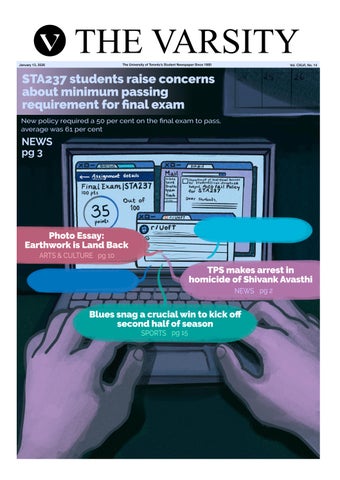
STA237 students raise concerns about minimum passing requirement for final exam New policy required a 50 per cent on the final exam to pass, average was 61 per cent
NEWS pg 3
Photo Essay: Earthwork is Land Back ARTS & CULTURE pg 10
TPS makes arrest in homicide of Shivank Avasthi NEWS pg 2
Blues snag a crucial win to kick off second half of season SPORTS pg 15
TPS asks for any information on the accused from Dece COURTESY OF TPS
2
THE VARSITY
news@thevarsity.ca
NEWS
The Varsity acknowledges that our office is built on the traditional territory of several First Nations, including the Huron-Wendat, the Petun First Nations, the Seneca, and most recently, the Mississaugas of the Credit. Journalists have historically harmed Indigenous communities by overlooking their stories, contributing to stereotypes, and telling their stories without their input. Therefore, we make this acknowledgement as a starting
THE VA
THE VARSITY Vol. CXLVI, No. 14 21 Sussex Avenue, Suite 306 Toronto, ON M5S 1J6 (416) 946-7600
thevarsity.ca
thevarsitypublications
thevarsitynewspaper
the.varsity
@TheVarsity
The Varsity
MASTHEAD Medha Surajpal Editor-in-Chief
editor@thevarsity.ca
Chloe Weston Creative Director
creative@thevarsity.ca
Sophie Esther Ramsey Managing Editor, External
managingexternal@thevarsity.ca
Ozair Chaudhry Managing Editor, Internal
managinginternal@thevarsity.ca
Jake Takeuchi Managing Online Editor
online@thevarsity.ca
Nora Zolfaghari Senior Copy Editor
copy@thevarsity.ca
Callie Zhang Deputy Senior Copy Editor
deputysce@thevarsity.ca
Ella MacCormack News Editor
news@thevarsity.ca
Junia Alsinawi Deputy News Editor
deputynews@thevarsity.ca
Emma Dobrovnik Assistant News Editor
assistantnews@thevarsity.ca
Ahmed Hawamdeh Opinion Editor
opinion@thevarsity.ca
Medha Barath Business & Labour Editor Shontia Sanders Features Editor Sofia Moniz Arts & Culture Editor
biz@thevarsity.ca features@thevarsity.ca arts@thevarsity.ca
Ridhi Balani Science Editor
science@thevarsity.ca
Caroline Ho Sports Editor
sports@thevarsity.ca
Aksaamai Ormonbekova Design Editor
design@thevarsity.ca
Brennan Karunaratne Design Editor
design@thevarsity.ca
Erika Ozols Photo Editor
photos@thevarsity.ca
Simona Agostino Illustration Editor
illustration@thevarsity.ca
Jennifer Song Short-Form Video Editor
video@thevarsity.ca
Gabriella Wrona Long-Form Video Editor
video@thevarsity.ca
Emily Shen Front End Web Developer
emilyshen@thevarsity.ca
Sataphon Obra Back End Web Developer
sataphon.ob@gmail.com
Arunveer Sidhu UTM Bureau Chief
utm@thevarsity.ca
Vacant UTSC Bureau Chief
utsc@thevarsity.ca
Matthew Molinaro Graduate Bureau Chief
grad@thevarsity.ca
Vacant Public Editor
publiceditor@thevarsity.ca
Raina Proulx-Sanyal & Ben Chapman Associate Copy Editors
Taimoore Yousaf, Jean Patrick Vidad Associate Sports Editor
Celesta Maniatogianni Associate News Editor
Rebecca Liu & Audrey Kim Associate B&L Editors
Mia Torres & Sloane Overdorf Associate Features Editors
Vacant Associate Design Editors
Mackenzie Duffy & Bushra Azim Boblai Associate A&C Editors
Emma Cervinka & Dowon Kim Associate Illo Editors
Lauren Robinson & Lucia McLaren Associate Science Editors Vesa Lunji & Zaneb Asad Associate Opinion Editors
Vacant Associate Photo Editors Snigdha Singh Associate Video Editor Vacant Associate Web Developer
Lead Copy Editors: Juliet Pieters, Zaneb Asad, Hilary Cheung Copy Editors : Cindy Liang, Bushra Boblai, Omayma Lateef, Pranav Kansal, Reed Szabo, Sarah Pan Designers: Audrey Apolinario, Carina Chan and Loise Yaneza Cover: Simona Agostino
BUSINESS OFFICE
Eva Tsai Business Manager
business@thevarsity.ca
Vacant Business Associates Muzna Arif Advertising Executive
muznamars@thevarsity.ca
The Varsity is the University of Toronto’s largest student newspaper, publishing since 1880. It is printed by Master Web Inc. on recycled newsprint stock. Content © 2026 by The Varsity. All rights reserved. Any editorial inquiries and/or letters should be directed to the sections associated with them; emails listed above. The Varsity reserves the right to edit all submissions. Inquiries regarding ad sales can be made to ads@thevarsity.ca. ISSN: 0042-2789
point for our responsibility to tell those stories more accurately, critically, and in accordance with the wishes of Indigenous Peoples.
TPS makes arrest in homicide of Shivank Avasthi Increased patrol of UTSC and Highland Creek Valley to continue Medha Surajpal, Junia Alsinawi Editor-in-Chief, Deputy News Editor
At a 10:30 am media conference, Detective Sergeant Stacey McCabe provided an update following the December 23 murder of Shivank Avasthi at UTSC. TPS believes that the suspect was on campus for about an hour prior to the shooting, and shared a still of UTSC video surveillance, showing him walking down a corridor in what appears to be the Arts & Administration (AA) building. According to McCabe, “members of the Homicide and Missing Persons Unit have worked nonstop to identify and locate the person responsible.” Babatunde Afuwape, a 28-year-old male from Toronto, was arrested on December 28 for a parole violation by members of the 55 division and ultimately charged with first degree murder. Afuwape, who was on parole for firearm offenses, is not a student at the university. According to TPS, the suspect and Avasthi did not know each other prior to the incident, and they have not yet found a motive. TPS
TPS asks for any information on the accused from December 23. COURTESY OF TPS
believes that the suspect interacted with other people in the hour they spent on campus prior to the shooting, and asks for any information on this individual from December 23. More details to come out in court. Increased patrolling of UTSC and the Highland Creek Valley will continue, according to an email sent to the UTSC community by President Melanie Woodin and UTSC Principal Linda Johnston. In the email, sent following TPS’s announcement, President Melanie Woodin and UTSC Principal Linda Johnston wrote “We are personally heartbroken and know many of you may be feeling a range of emotions in the wake of this senseless violence.” In a statement sent to The Varsity, President Melanie Woodin wrote, “This morning the University of Toronto learned of an arrest in the death of Shivank Avasthi, 20, a third-
Students campaign for Scarborough campus safety after random shooting
U of T says they are “listening to all the feedback from students” Ella MacCormack News Editor
After the fatal shooting of third-year student Shivank Avasthi in the Highland Creek Valley, UTSC students have been campaigning for increased safety measures on campus. Petitions, mass emails, and online posts have focused on increasing the amount of lights, security patrols, security cameras, and T-card scanners in building entrances. Since the shooting, U of T has increased patrols in the area. In response to the student campaigns, a U of T spokesperson wrote, “We are listening to all the feedback from students, which is being considered in ongoing safety planning.” An email to U of T students from President Melanie Woodin and UTSC Principal Linda Johnston about the suspect’s arrest added, “Any additional [safety] measures that may be forthcoming will be communicated by the relevant campus offices.” The email also reminded students of the mental health and safety supports available to them. The campaigns The “Improve campus security at University of Toronto Scarborough” online petition has gained 4,481 verified signatures as of January 11. The petition organizer, Amon Ali, declined The Varsity’s request for an interview.
The petition reads, “We urge the University of Toronto Scarborough administration to take immediate action to strengthen on-campus security. By increasing surveillance coverage and ensuring a robust security presence, we can foster a safer environment where students can focus on their studies and campus life without fear.” The petition has multiple comments from supporters about not feeling safe on campus. One reads, “How are we to know we are safe on campus, when, in broad daylight, someone was murdered? UTSC must do something to fix this.” Students have also organized an email campaign to UTSC administrators. The subject line of one email template reads, “UTSC Students Do Not Feel Safe.” The campaign outlines some concerns, including a lack of security cameras and low security presence in Highland Creek Valley and that all campus buildings are open access. It also states that the only free parking on campus is available in the valley, despite the safety concerns there. To address these, the email calls on the university for “immediate and visible changes. Not statements. Not reassurances. Action.” When asked what motivated them to organize the email campaign, the student organizer wrote to The Varsity, “I think people wanted to take action, but were unsure how since it was winter break… it’s hard to ignore a direct message into their inbox. Since they’re staff, they can’t not at least see it. If they ignore it, it’s deliberate.”
year international student at our Scarborough campus. We are thankful to the Toronto Police Service and Campus Safety for their dedicated efforts in making an arrest in this senseless act of violence. The individual arrested is not a student at the University of Toronto. We have expressed our deepest condolences and continue to offer our support to Shivank’s family. As members of our community grieve, a book of condolence will be available for our community to express sorrow and share memories of Shivank, and other commemorations will be communicated in the near future.” Anyone with information can contact police at 416-808-7400, Crime Stoppers anonymously at 416-222-TIPS (8477), or at www.222tips. com. Many posts on the r/UTSC subreddit have also been discussing adding T-card entrances to academic buildings. Unlike UTSG, UTSC does not have card scanners at the entrances of its library, student centre, or other large gathering spaces indoors. Zayan, a UTSC student, wrote to The Varsity that they agreed with increasing lighting, security patrols, and security camera coverage, but thought that T-card scanners “would sacrifice a lot of freedom and convenience for a minimal increase in safety... T-card scanners would not have prevented the recent tragedy, nor would they meaningfully increase the school’s overall safety.” Amelie H, a commuter UTSC student, wrote to The Varsity that she hopes, for all three campuses, “better safety measures are put in place, inside, outside and even in what is considered ‘public,’ ” and gave the example of bus stops. “No one has to navigate the campus alone” When asked if UTSC has any message for students concerned about their safety on campus, a U of T spokesperson wrote to The Varsity, “Students are urged to sign up for emergency alerts and download the Campus Safety app. And be aware that no one has to navigate the campus alone. With the Travel Safer Service, Campus Safety personnel will accompany students to the TTC stop, their ride, or anywhere else on campus, 24/7.” In a statement to The Varsity about the arrest, Woodin wrote, “As members of our community grieve, a book of condolence will be available for our community to express sorrow and share memories of Shivank, and other commemorations will be communicated in the near future.” Woodin concluded, “We are continuing with increased patrols in the area and working to identify any additional measures that may be needed to ensure the safety of our campus communities.”
Corrections In Issue 2, a News article titled "Part-time student association was full-time out of office this summer" has been corrected to reflect that APUS President Jaime Kearns is still a student, and did not graduate in 2020. In Issue 13, a Science article titled "Miss who? Remembering Maud Menten and the women science forgot" previously contained a line that implied Ursula Franklin and Rosalind Franklin were cousins. This has no basis in fact, and has been removed.
ember 23.
thevarsity.ca/section/news
JANUARY 13, 2025
3
The performance on the STA237 final exam had high variability. ERIKA OZOLS/THEVARSITY
STA237 students raise concerns about minimum passing requirement for final exam New policy required a 50 per cent on the final exam to pass, average was 61 per cent Ella MacCormack News Editor
After final grades were released on January 5, many students in STA237: Probability, Statistics and Data Analysis I woke up to an F on their transcript. For the first time, STA237 had a minimum passing requirement policy, under which students who scored below 50 per cent on the final exam failed the course outright. STA237, coordinated last semester by Professor Karen Huynh Wong, is an accepted statistics course requirement for multiple programs, including statistics, computer science, economics, and Rotman Commerce. The course has also become infamous for its difficulty online, particularly on the subreddit r/UofT. This year, the final exam had an average of 61.4 per cent and a standard deviation of 23.3 per cent. This means that while the average student passed, many students scored both significantly higher and significantly lower than 61.4 per cent. Students have posted on the r/UofT subreddit claiming that, based on these statistics, roughly one-third of students failed. However, these calculations assume a normal, symmetrical distribution of grades, which would imply scores beyond the maximum grade possible. With the information available, the actual number of students who failed cannot be reliably determined. U of T Media Relations wrote in an email to The Varsity that the assertion that a third of the class failed “has no basis in fact,” but declined to verify how many students failed the course. STA237 in fall 2025 This year, a minimum passing requirement policy was added to the STA237 syllabus for the first
time: “Students must pass the final exam (≥ 50%) to be eligible to pass this course. There are no make-up tutorials or quizzes.” The policy also states that students affected by extenuating circumstances should contact the instructor and their college registrar. One STA237 student wrote to The Varsity: “I thought [auto-fail policies] were meant for project oriented courses where it’s possible to do well without a good understanding of the content, but most of our marks came from things like tutorial quizzes and the midterm, which were all closed book and supervised.” The final exam was worth 40 per cent, with the midterm exam worth 25 per cent; three quizzes contributed a total of 18 per cent, tutorial activities for 10 per cent, and homework modules and other miscellaneous assessments seven per cent. There were also two surveys providing a total of one per cent in bonus marks. Andy Chen, a second-year mathematics student, wrote to The Varsity that STA237 was one of the most demanding courses they had taken so far. “The content wasn’t super challenging… but the practice questions and tutorial questions did not reflect the difficulty of the midterm and final.” Chen continued, “I was told that [the midterm exam average of 58 per cent] was an expected average. This concerned me during that time, as we were required to have at least a 50% on the final to pass the course, many students had significant risk of failing due to the average being so close to the cut off.” The course announcement for the midterm exam grades read, “While the test average may appear a bit low, it is very much in line with past midterm grades for a first course in probability.
The midterm questions were fair and reflective of the course learning outcomes.” The announcement pointed to students focusing too heavily on practicing or memorizing calculations without understanding the underlying statistical concepts: “You need to be able to read and understand questions carefully, identify what the question is asking, and select the appropriate concepts to apply to the problem before you can use any formulas or perform any calculations.” In 2024, the STA237 midterm exam average was 56.5 per cent, described to students as “consistent with typical midterm performance in foundational STA courses such as STA237H1.” In 2022, the average midterm grade was 48 per cent. Another STA237 student wrote to The Varsity that their professor “really tried to answer questions, but most of the kids weren’t even able to understand the content in the first place to be able to ask good enough questions,” and that the students were not “given enough practice problems relevant to the types of questions they asked on that final.” In response to students’ performance in STA237, a Faculty of Arts & Science spokesperson wrote to The Varsity, “Many courses serve as preparation for program completion, and expectations for student success are provided both through the syllabus and as classes begin.” They also listed resources that students can consult, including their college registrar, learning strategists, instructors, and TAs. U of T grading policies The Arts & Science Academic Handbook for Instructors states, “Although it is unusual, it is permissible for instructors to require a minimum
mark on a final exam for a student to pass their course… This requirement should only be used when there are relevant pedagogical principles at play.” Listed examples include cases where the final exam is cumulative while previous assessments were not, or where the exam carries a heavy weight in the course. The handbook also advises, “instructors proposing a percentage of Fs greater than 10% should consider those grades carefully. An individual instructor should reflect on whether the assessments have been scaled appropriately.” While it is against U of T policy to limit grade distribution by quotas, divisions can provide a “reasonable distribution” of grades and request explanations from instructors when courses do not meet the standard. Since STA237 final grades have been released on Acorn, they have been approved by the chair of the Department of Statistical Sciences and the Dean. Statistics department and historic minimum passing requirements There was no minimum passing requirement for STA237 from fall 2019, according to past syllabi published by the Department of Statistical Sciences. This semester, STA238: Probability, Statistics, and Data Analysis II is also taught by Wong and does not have a minimum passing requirement. Last semester, STA302: Methods of Data Analysis I also had a minimum passing policy for the first time. The minimum grade required was an average of 40 per cent between the term test and final exam to pass the course. Karen Huynh Wong declined The Varsity’s interview request.
4
THE VARSITY
news@thevarsity.ca
NEWS
APUS plans to reopen Sidney Smith office this semester. ERIKA OZOLS/THE VARSITY
Student fees still withheld from Association of Part-Time Undergraduate Students APUS challenges out-of-office summer claims
Ella MacCormack News Editor
Until the 2023–2024 and 2024–2025 audits are submitted, U of T is withholding student fees from the Association of Part-Time Undergraduate Students (APUS). In the winter semester, APUS hopes to reopen the Sidney Smith office, process bursaries, plan for the spring elections, finalize budgets and audits, and work on education campaigns like next steps for Bill 33, Don’t Invoice Our Illness, and Part Time and Proud! According to the 2024–2025 Enrolment Report, about 6,265 part-time students were enrolled at U of T. APUS’s tri-campus membership fee during the semester is $13.65, not including the optional health and dental plan. Approved audits A spokesperson for U of T wrote to The Varsity, “As APUS has not submitted its 2023-24 and 2024-25 audited financial statements, and is not exempt, the university has withheld the society’s fees after the October 2024 instalment… The Office of Vice-Provost, Students has been in contact with APUS to offer support.” When The Varsity asked which audits have been approved, APUS wrote, “At the Special General Meeting at the end of August 2025, APUS members had approved the F2023 audited financial statements.” They continued to say the 2023–2024 audit is underway, and once that is completed, the 2024–2025 audit will take place.
APUS also wrote to The Varsity that, “The board and executives are dedicated folks who are passionate about the work and their members. Yes, APUS faced financial hardship over the years requiring us to make financial decisions in the best interest of the organization,” but that “ALL financial decisions that are made, go through the finance committee which comprises board members and executives, with recommendations that then go back to the board for approval.” In the meantime, other U of T student unions have no representation for part-time students. The Scarborough Campus Students’ Union and University of Toronto Mississauga Students’ Union were unable to fill the part-time student director positions in their fall byelections, and the University of Toronto Students’ Union has no positions for part-time students. Other than restricted funds, APUS’s budget was $386,745 in the most recent public audit, 2022–2023. That year, APUS ran at a $55,420 deficit of operating expenses over revenue. The total non-health, non-restricted expenses were $450,210, including $257,616 toward salaries, wages, and benefits; $87,773 in services and programming; $44,434 in audit and legal fees; and $34,500 under office and general expenses. “Layoff Pa…” spreadsheet In the last publicly available general meeting folder, Winter 2025, an Excel spreadsheet titled “2025.09.20-Layoff Pa…” was visible, but inaccessible. When The Varsity requested
U of T releases 2026 Sexual Violence & Harassment Policy Updated policy recommends resolution timelines and clarifies scope Emma Dobrovnik Assistant News Editor
On January 1, the updated Sexual Violence & Harassment Policy went into effect following a year-long policy review. Based on the feedback collected, the policy now includes recommended timelines for resolution, safeguards against reprisals, expanded definitions of cyber sexual violence, and clarified scope for responding to cases of intimate partner violence. The review was led by Professor and former dean of the Factor-Inwentash Faculty of Social Work, Faye Mishna, and included an independent review by legal expert Gillian Hnatiw, as well as community consultations with university students, staff, and faculty members. As provincially mandated, the policy will undergo its next review in 2028. Recommended timelines The policy now includes a 12-month recommended timeframe for closing cases and an eightmonth recommended timeframe for completing investigations. However, U of T must still consider “the circumstances of the particular matter including its complexity and the requirements of Procedural Fairness.” Procedural fairness is defined as a respondent’s right to respond to a report, which usually requires the disclosure of the reporter’s identity. It also includes the respondent’s right to an impartial decision-maker and to receive a rationale for any decisions made. According to the policy’s 2024–2025 Report on Activity, most closed cases lasted more than 12
months from report intake to case closure. The annual report provides anonymous information about sexual violence at the university, including the length of administrative processes for closed cases and case outcomes. All cases that took longer than 12 months were initiated in previous years. Cases that were referred to a hearing under the Code of Student Conduct took an average of 23 months to conclude. The policy’s recommended timeframe does not apply to Code of Student Conduct hearings or other adjudication processes. While hearings do not have a formal timeline, the Code of Student Conduct notes that “every effort shall be made to conclude the case through to delivery of a final decision within the University within one year from the alleged incident of misconduct.” Although most complainants chose to proceed with an investigation under the policy, only about 16 per cent of cases involving a student respondent were referred to a hearing. The remaining 84 per cent of cases were resolved through the Facilitated Resolution Process — formerly known as a non-adjudicative process. The Facilitated Resolution Process is a nondisciplinary process that may result in a no-contact order or mandatory counselling and/or education for the respondent. Either the complainant or respondent can request a Facilitated Resolution Process at any point after a report has been made, but both parties must agree to participate. Adjudication processes refer to investigations conducted by the Office of Safety and High Risk that may result in suspension or expulsion. Since 2023, the university has issued two suspensions
access, the APUS executive director’s Gmail rejected the request. When asked about the spreadsheet, APUS wrote, “the shareable items to all part-time members were the same for the event that took place in August, 2025 and does not and has never included the file name that you requested from your own personal email account on Friday, November 28 at 2:59am, months later post the general meeting.” The file has since been removed from the general meeting folder. “Additionally, we want to stress that HR matters are private and confidential matters that are protected – and unauthorized individuals cannot and should not be trying to gain access to confidential materials,” APUS concluded. APUS disputes out-of-office claims While responding to The Varsity’s questions about the fall semester in December 2025, APUS disputed claims that they were out of office in the summer: “The part-time student association is very much different from our other sister student unions across UofT where elected representatives are committed to full-time roles, as mandated within the bylaws – for APUS elected representatives, it’s a part-time role with a small limited budget. During such time, staff and elected representatives have in fact been doing work and servicing members - from issuing bursaries, to newsletters, to responding to emails and to do outreach.” The Varsity’s emails to APUS from June onwards did not receive a response until September. but no expulsions. Additionally, 57 per cent of closed cases in no contact orders, and 32 per cent resulted in mandatory training. Expanded definitions Reprisal is now formally defined as “any action…. that imposes negative consequences against a complainant to penalize them for disclosing or reporting sexual violence.” Interim measures have been introduced to reduce the risk of reprisal, including separation of parties, schedule changes, or housing changes. Instances or threats of retaliation during a process under the policy will be recorded as new incidents of sexual violence. The policy also updated its definition of cyber sexual violence, now referred to as techfacilitated sexual violence, which accounts for the non-consensual creation and distribution of AI-generated intimate images. The definition now also includes cyber stalking, cyber voyeurism, and sextortion. The 2024–2025 Report on Activity confirms a 166 per cent increase in recorded cases of cyber sexual violence, alongside a general rise in sexual violence occurring in online spaces. Although the policy now includes a definition of intimate partner violence, it clarifies that only instances that constitute sexual violence fall within its scope. Students, staff, and faculty members experiencing intimate partner violence not covered by the policy can still access resources from the Sexual Violence Prevention & Support Centre. Where to find sexual violence and harassment support at U of T A list of safety resources is available at safety. utoronto.ca The tri-campus Sexual Violence Prevention & Support Centre’s website is www.svpscentre. utoronto.ca Individuals can visit the centre’s website for more information, contact details, and hours of operation. Centre staff can be reached by phone at 416-978-2266.
APUS sent two emails to part-time students over the summer. The first was on July 9, 2025, announcing a $250 summer bursary program and the upcoming August Special General Meeting. The second came on August 21, which gave notice for the general meeting and promoted the Canadian Federation of Students Ontario’s Food Experience Survey and “Hands Off Our Education!” campaign. APUS also wrote, “Folks have been going to the office – but unfortunately, your sensationalized recap on September 4 illustrates a very untrue reality.” While the Sidney Smith office has been closed — which APUS plans to reopen this semester — President Jaime Kearns clarified that, “the North Borden office has staff or executives in there during the day but for safety reasons, we will usually keep the door locked if there is only 1 person in the office.” Addressing The Varsity reporter who visited the North Borden office to find it unlocked and empty, Kearns wrote that there have been times when they have stepped out of office to go to First Nations House across the hall. Kearns said that APUS now locks the door if they leave for any reason, thanking The Varsity for bringing it to their attention and for “not stealing anything while you were there.” The Varsity would like to formally apologize for incorrectly representing Kearns’ student status in our September 8 article, “Part-time student association was full-time out of office this summer.” In December, Kearns wrote to The Varsity to clarify that they did not graduate in 2020 and have been a student since 2009. Locations: U of T downtown Toronto campus: Gerstein Library, suite B139 U of T Mississauga: Davis Building, room 3094G U of T Scarborough: Environmental Science and Chemistry Building, EV141 Those who have experienced sexual violence can also call Campus Police to make a report at 416978-2222 (St. George and U of T Scarborough) or 905-569-4333 (U of T Mississauga). After-hours support is also available at: Women’s College Hospital Sexual Assault and Domestic Violence Care Centre (416-323-6040) Scarborough Grace Sexual Assault Care Centre (416-495-2400) Trillium Hospital Sexual Assault Care Centre (905-848-7100) Where to find the closest place to obtain an abortion Closest to UTSG: Bay Centre, Women’s College Hospital 76 Grenville St, third floor 416-351-3700 womenscollegehospital.ca Manual Procedural: up to eight weeks gestational age (GA) Medication: up to 10 weeks GA Procedural in hospital: up to 24 weeks and six days GA No admin fees Closest to UTM: Mississauga Women’s Clinic 101 Queensway W Unit 401 905-629-4516 mwclinic.com Medication: up to 10 weeks and six days GA Procedural: up to 18 weeks GA Admin fees: $70 Closest to UTSC: East End Women’s Clinic 301–520 Ellesmere Rd 416-901-3278 eastendwomensclinic.com Medication: up to 10 weeks GA Admin fee: $60
thevarsity.ca/section/news
JANUARY 13, 2025
UTMSU’s “Free Dinner Fridays” still in pilot phase
5
The first Free Dinner Friday was held at The Blind Duck. FRANCESCO DEL ROSSO/THE VARSITY
First Free Dinner Friday was held in November, no new dates scheduled Arunveer Sidhu UTM Bureau Chief
During the last University of Toronto Mississauga Students’ Union (UTMSU) executive elections, the UTMSU executive committee promised students they would introduce Free Dinner Fridays in addition to the pre-existing Free Breakfast Wednesdays to support students facing food insecurity. At a candidates’ forum during the elections, the committee had also assured students that their fees would not increase as a result of this new opportunity. Instead, the union would fund Free Dinner Fridays by reallocating its existing resources and through potential sponsorships. On November 28, 2025, the UTMSU hosted their first Free Dinner Friday at The Blind Duck as part of their Food Insecurity Campaign, offering students pasta with red or white sauce. Exam season exclusive? It has not been clear if Free Dinner Fridays were exclusively an exam season initiative or would become a common occurrence, like the UTMSU’s bi-weekly Free Breakfast Wednesdays or weekly meals by the U of T Food Coalition at UTSG. Despite referring to the opportunity as “Free Dinner Fridays” during the elections, UTMSU President Andrew Park also mentioned that his committee would provide “free dinners during exam periods” in a September interview with The Medium. At the UTMSU’s 2025 Annual General Meeting, a UTMSU executive said, “We are so excited to introduce free dinner Fridays, with our first one happening tomorrow.” In a January 9 email to The Varsity, UTMSU Vice President (VP) External Rajas Dhamija clarified that Free Dinner Fridays are currently being run as a pilot program, adding that it is intended to be an ongoing initiative rather than a one-time event. Dhamija wrote that the UTMSU plans to continue the program in the winter term and that “they may not occur at the same frequency as Free Breakfast Wednesdays at this stage… Increasing their regularity is something we hope to work toward in the future.” On January 6, the UTMSU posted the winter 2026 term’s January schedule for Free Breakfast
The Varsity Newswire Diabolos Coffee Bar reopens for the first time since 2023 — University College Celesta Maniatogianni, Associate News Editor On January 9, UC’s Diabolos Coffee Bar officially reopened for business after a nearly two and a half year closure. Diabolos held a soft opening last Friday and offered a 25 per cent discount on all drinks. The café’s reopening has been in the works since the fall, when the manager during the 2023 operational period, Raquel Lewin, was rehired to plan the café’s reopening. The café has been around since 1966, but closed at the start of the COVID-19 pandemic. It opened briefly for the 2023 winter semester, but financial difficulties caused the cafe to shut down again soon after. Trin common rooms unlocked — Trinity College Devin Botar, Varsity Staff On January 8, the Trinity College Meeting (TCM) announced on Instagram that common
Wednesdays on their Instagram page, with the first being held on January 7. Free Dinner Fridays have not yet been mentioned. Finance and attendance The UTMSU hosted its first Free Dinner Friday at rooms would henceforth be “COMPLETELY OPEN” to all student residents from 8:00 am to 11:00 pm. Previously, common rooms at Trinity were locked by default, and had to be booked in advance to be used. This policy drew public criticism last year, amidst broader complaints that student life at the college had been suppressed. Provost Nicholas Terpstra has promised to address these concerns. Anneke Lee, the current chair of the TCM — Trinity’s student government — was elected on a platform of revitalizing student life. U of T childcare facilities pass inspections in newly public results — City Hall Ella MacCormack, News Editor Toronto Public Health announced on January 5 that results of infection control inspections of child care facilities will be made public on a dedicated webpage. The ratings are now available for a January 11, 2024, inspection, and all U of T-affiliated facilities passed with no deficiencies. The inspected university’s facilities include the Early Learning Centre at Glen Morris and OISE, Campus Community Co-Operative Daycare, U of T Child Care, Dr. Eric Jackman Institute of Child Study Laboratory School Nursery and After School Daycare, and N’ Sheemaehn: Scarborough
its restaurant, The Blind Duck, which ran a deficit of $138,246 last year. After student levies, the pub ended the year with a surplus of $156. When asked if Free Dinner Fridays would have an impact on The Blind Duck’s future financial performance, Dhamija explained that The Blind
Duck operates on a separate budget that will not be influenced by Free Dinner Fridays. An estimated 250–400 students are expected to attend Free Dinner Fridays based on the UTMSU’s attendance data from its first event and Free Breakfast Wednesdays.
Campus Child Care Centre. Inspections will continue on a yearly basis.
Manitoba MP James Bezan spoke out against Ford’s decision, writing on X that Crown Royal is Canada’s number one export whiskey, and the liquor “is distilled and blended in Gimli, using Manitoba grains and Interlake water.”
Mayor Olivia Chow proposed 2026 budget focused on affordability — City Hall Emma Dobrovnik, Assistant News Editor On Thursday, Mayor Olivia Chow proposed the city’s 2026 budget, which includes a modest 2.2 per cent residential property tax increase and added funding for transit and emergency services. The tax hike — the lowest increase since Chow took office — is part of the budget’s commitment to affordability and cost-cutting. Paramedics, fire, and police will receive an additional $230 million, while transit services will receive $170 million. Overall expenditures remain flat, with annual spending projected to total $18.9 billion in 2026 compared to last year’s $18.7 billion. Doug Ford to pull Crown Royal off LCBO shelves this February — Queen’s Park Jade Parks, Varsity Contributor On January 5, Ontario Premier Doug Ford announced he will be following through on threats to remove Crown Royal whiskey from all LCBOs in February. The Premier’s decision was made after Crown Royal manufacturer Diageo announced the Amherstburg, Ontario, bottling plant would be closing this February.
US citizen and mother of three shot dead by ICE agent — Minneapolis Junia Alsinawi, Deputy News Editor On January 7, Renee Good, a 37-year-old mother of three, was shot and killed by ICE officer Jonathan Ross. Footage of the shooting taken by Ross shows Good smiling at him and saying, “That’s fine, dude, I’m not mad at you.” Less than a minute later, Ross fired once through the windshield, and twice into the driver’s seat window as Good tried to drive away, killing her. Good’s car then drove into a parked car, as seen in a bystander’s video. Another video shows a physician at the scene pleading with officers to let him check Good for a pulse. The officers refuse to let the physician through. President Trump and his administration have defended Ross’s actions as self-defence, claiming that Good had tried to run the officer over. Footage taken at the scene does not support this, as it shows Good turning the car away from the ICE officer while he shoots into her windshield.
Science
January 13, 2026 thevarsity.ca/category/science science@thevarsity.ca
Twins in space: The health of astronauts and special relativity NASA’s astronaut twins study finds dangers of space travel
The theory of special relativity and NASA’s Twins Study reveal the surprising effects of space travel. COURTESY OF NASA CC DEREK STORM
Lucia McLaren Associate Science Editor
The Twin Paradox poses the following: given a pair of identical twins, if one stays on Earth and the other flies off into space, who is older by the end of the trip? The answer comes from a counterintuitive result of special relativity, a field of physics which is notoriously difficult to wrap your head around. Understanding the theories of space travel and the health of astronauts may prove key to future explorations into the vast universe beyond our planet. Spaceflight and health In March 2015, NASA conducted the Twins Study. The goal was to study the effect of spaceflight on the human body. Identical twin astronauts Mark and Scott Kelly were the subjects, with Scott spending a year in orbit about the International Space Station (ISS) while Mark remained on Earth. By comparing two people with the same genetic makeup, NASA’s researchers were able to isolate the hazards of long-term exposure to space travel. By the end of the study, NASA’s researchers had found that the 340-day mission was associated with short-term and long-term changes in human health and genetics. Short-term changes to Scott’s health included a seven per cent decrease in body weight, as is expected for astronauts, along with changes in digestive bacteria, which were suggested to
originate from the changes in diet and socialization. These effects returned to baseline measurements after the end of the mission. The more concerning findings of the study are symptoms which may affect astronauts in the years or decades to come. A notable decline in Scott Kelly’s cognitive speed, accuracy, and efficiency lasted up to six months post-flight, a major concern for any manned missions to the moon or other planets. Potential cardiovascular damage persisted after the mission, as well as changes to genes which control the immune system and DNA repair. These changes in particular might cause long-term health concerns for astronauts, and will require future studies to determine their severity. The Twins Study concluded that the health of astronauts can generally be maintained over a oneyear spaceflight; however, it is important that future long-duration space travel address the concerns raised by NASA’s researchers. To understand the thought experiment that mirrors this study, let’s take a look at some of the scientific theories that aim to explain the universe. Understanding special relativity Special relativity is Albert Einstein’s theory of how space, time, matter, and energy interact to form the universe. A specific application wellknown to physicists is its explanation of the strange behaviour of objects travelling near the speed of light. One real-world example of such
objects is muons: subatomic particles which travel so fast that time passes 40 times slower for them, as they experience an effect known as time dilation. Time dilation is predicted by a mathematical framework used in special relativity called the Lorentz factor. While studying special relativity is incredibly challenging, the Lorentz factor can be understood simply as the effect of measuring time from the point of view of a moving object. As all observers of objects must obey the speed of light and other fundamental laws of the universe, the time, mass, and distance travelled of that object will depend on how close to the speed of light it’s travelling. In the case of time dilation, this means that an object travelling near the speed of light will experience time at a much slower rate, like muons. The tangible effect of time dilation was even supported by a 1971 experiment by J.C. Hafele and Richard E. Keating showing nanosecondlevel differences in time measured by clocks on an airplane versus the ground. With this context, one may wonder whether Scott Kelly experienced the effects of special relativity on his one-year mission with NASA. The ISS orbits the Earth at approximately five miles per second. This may sound unbelievably fast, but for comparison, near-lightspeed travel would need to approach 186,000 miles per second. It seems that time dilation must be incredibly small for the Twins Study.
As done in Hafele and Keating’s experiment, however, it is still possible to quantify the time dilation that took place in the Twins Study. The Journal of Biomedical Physics & Engineering published a letter to the editor in 2023 explaining that the theory of special relativity would predict that Scott Kelly’s one-year-long flight would cause him to experience time dilation of approximately 0.01 seconds. Therefore, Scott should now be 0.01 seconds younger than his identical twin, Mark. So, what exactly has NASA’s research revealed about the answer to the Twins Paradox? According to special relativity, there is no paradox — Scott Kelly experienced time passing at a slightly slower rate due to time dilation. Consequently, the twin who stays on Earth must be older by the end of the trip. While time dilation of this scale is negligible, the health concerns raised by the Twins Study are very real. Astronauts are exposed to the radioactive wasteland of space we know so little about, and any dreams of extraterrestrial human habitation must plan for the unknowns of space travel. NASA’s research is an important first step that will pave the way for future manned missions into the cosmos. If you’re interested in learning more about the topics discussed in this article, undergraduate students can take courses including APM426 and PHY483 from the Faculty of Arts and Science; additionally, the Faculty of Engineering also offers PHY294.
Business & Labour
January 13, 2026 thevarsity.ca/category/business biz@thevarsity.ca
The case for sustainable construction
efficient buildings are 12 per cent higher, and their rent is 3.5 per cent higher.
The economic incentives behind investment in sustainable infrastructure
Is sustainability a buzzword? The financial benefits associated with labelling a building as ‘sustainable’ can cause construction companies to make misleading claims about being environmentally conscious. These companies may simply focus on receiving energyefficiency or environmental certifications to attract consumers who care about sustainability rather than making genuine design choices to reduce the carbon footprint of their buildings. While certifications can help buildings take the first step towards being sustainable, they often focus on the wrong things. The Leadership in Energy and Environmental Design (LEED) certification is a common system that measures building sustainability in Canada. Buildings must meet certain criteria to earn points and reach specific levels of this certification. However, construction companies may then choose to simply match the easiest criteria to receive the certification rather than overhauling unsustainable practices to pursue wholly green construction.
EMMA CERVINKA/THEVARSITY
Medha Barath Business and Labour Editor
Last October, Trinity College’s new Lawson Centre for Sustainability won the Holcim Foundation Award. The foundation honours Regional Grand Prizes to 20 projects across the world for “outstanding contributions to sustainable construction,” with each winner receiving a prize of 40,000 USD. The Lawson Centre — which will provide Trinity College with new residential, academic, and dining spaces — was designed with sustainability in mind. For example, the architects sourced almost all building components from Ontario and have included rooftop solar panels in their designs. The Lawson Centre is one of many new ecofriendly buildings popping up on campus. Seeing as globally, construction is responsible for almost 40 per cent of carbon emissions, the climate incentives behind these investments are clear. Moreover, the idea that sustainable construction projects can often have high upfront costs still persists, even though a recent study from the Green Building Council of Denmark determined that there is little correlation between construction costs and CO2 emissions. In fact, building design often plays a bigger role in increasing costs than the higher prices associated with some eco-friendly technologies due to the necessary research and development required to implement them. Given this, are there any economic motives for builders to make sustainable investments? What is sustainable construction A sustainable building not only employs sustainable construction practices but also has minimal negative impacts on the environment throughout its lifetime.
Effective material use is an important component of sustainable design. Projects generally try to limit their resource use while also sourcing more sustainable materials. Examples include mass timber projects, which use a wood product made up of smaller wood pieces bound together. The production processes of conventional building materials like steel and concrete emit a lot of CO2. Mass timber provides a lower-carbon alternative. In fact, the City of Toronto is working on an affordable housing pilot project using this mass timber. These homes are expected to be completed in the fall of 2026. Sustainable buildings also make use of renewable energy and are energy-efficient as a result. The Lawson Centre makes use of a geothermal exchange system to efficiently heat and cool the building. The system uses the Earth’s constant underground heat, eliminating the need for fuel-based temperature regulation systems in the building.
Ultimately, both environmental and social wellbeing are key guiding principles in sustainable design. The incentive to be sustainable Beyond environmental reasons, companies have an incentive to invest in sustainable projects due to the increased ability to attract consumers. According to a 2024 Forbes article, there is high consumer demand for eco-friendly buildings due to greater public awareness of the detrimental effects of climate change. This can increase the value and marketability of these properties. Despite perceived high upfront costs, these projects can be cost-friendly as they are also usually eligible for more government subsidies. Moreover, their energy efficiency means that occupants will incur lower energy costs. These factors result in tangible financial benefits for property owners — a study conducted by researchers at Maastricht University in the Netherlands revealed that sale prices for energy-
The future of the industry Still, the significant growth expected in the sustainable construction materials market indicates that the industry is truly beginning to prioritize eco-friendly construction — according to Grand View Research, global market value in 2030 is projected to be $47.9 billion, almost double the value in 2024, which was $26.6 billion. U of T’s Academic Wood Tower, a sustainable mass timber project that will house Rotman, Munk School, and Kinesiology and Physical Education (KPE) facilities, is expected to open this year. Moreover, the Canadian government introduced the ENERGY STAR Portfolio Manager system, where users can monitor and optimize their buildings’ energy use. Ultimately, there is a clear business case for sustainable construction, fueled by public demand, cost-efficiency, and government incentives. SIMONA AGOSTINO/THEVARSITY
Are international students good for Canadian business? As Ottawa caps study permits, universities and employers face the economic consequences of a shrinking student population Wanthanai Phlaphongphanich Business Correspondent
Each fall, Canadian universities welcome tens of thousands of international students. Alongside their academic ambitions, they bring tuition dollars and everyday spending that quickly become a small yet significant part of the local economy. With new federal caps limiting international study permits, however, that annual influx is beginning to slow. Canada’s population growth slowed slightly last year, driven largely by fewer international students entering the country — a slowdown last seen during the COVID-19 pandemic. This shift has raised questions about what lower international enrolment means for university finances and the businesses that depend on student spending. A financial pillar under pressure International students pay significantly higher tuition than domestic students — often three to five times as much. For universities, particularly in Ontario, this revenue has become essential. Provincial operating funding has not kept pace with rising costs or enrolment growth, leaving institutions increasingly dependent on international enrolment to balance their budgets. Revenue from international students is often used not only to fund programs and services, but also to subsidize domestic education costs. U of T has also faced this pressure. Last year, the university revealed that international enrolment
fell $73 million short of projections, with the potential to reduce year-on-year revenue growth from 2.8 per cent to 1.1 per cent. With the new federal caps on international study permits introduced in 2024 and tightened in 2025, many institutions are now forecasting budget shortfalls. At U of T, recent Business Board discussions have focused on managing enrolment-related revenue uncertainty under the new federal framework. Some universities have already announced hiring freezes, program reductions, or deferred capital projects. Fewer international students mean more than just smaller class sizes — they also mean less operating revenue, or revenue primarily coming from U of T’s student tuition and provincial operating grants. Spillovers beyond campus The economic impact extends well beyond lecture halls. International students are a reliable customer base for many Canadian businesses, particularly in large urban centres like Toronto. According to federal estimates, international students contributed over $30 billion to Canada’s economy in recent years through tuition, housing, and local spending. They rent apartments, buy food, use public transit, and work part-time in retail, hospitality, and service sectors. A decline in international enrolment therefore affects local labour supply and consumer demand simultaneously. Businesses that rely on flexible, student-based labour — such as cafés,
restaurants, and convenience stores — may face higher hiring pressures. Landlords in studentdense neighbourhoods also may see softer demand, and even transit systems could feel the effect if ridership declines. Why the caps exist The federal government has framed the caps as a response to rapid enrolment growth, strained housing markets, and uneven oversight of international student recruitment and support across institutions. In some cases, international students faced overcrowded housing, limited support services, and misleading recruitment practices. From this perspective, the policy aims to protect students while restoring balance to a system that expanded faster than its infrastructure. The
challenge is that the economic correction is being felt immediately, while the intended benefits may take years to materialize. However, there seems to be a structural reliance on international students across Canadian universities and surrounding economies. Critics argue this dependence leaves institutions vulnerable to policy shifts and external shocks, while supporters view international students as a long-term economic and demographic asset. Changes to international enrolment do not occur in isolation; they reshape university finances, labour markets, and business activity simultaneously. The role of international students in the economy is neither simple nor one-dimensional. As Canada reconsiders its approach, universities and businesses are left navigating a transition with real financial consequences.
8
THE VARSITY
FEATURES
Parasocial relationships:
On one-sided attachments The perceived intimacy between the public and the figures on their screens
Elini Sothy Varsity Contributor
On November 4, 2025, Zohran Mamdani was elected mayor of NYC. Mamdani has garnered a lot of attention throughout his campaign and amid his win — not only for his politics, but for his physical attractiveness, and being the first Muslim American mayor. TikToks, X posts, and other social media posts romanticizing Mamdani went viral during the weeks leading up to the election. One X user posted: “I support Mamdani for his ideas, but I also think it’s so important to have a hot mayor.” Another user mentioned Mamdani’s wife, Rama Duwaji, in their post: “Congrats to New York on your hot mayor and hot mayor wife.” A video of Mamdani reciting and spelling his name out for another mayoral candidate who repeatedly mispronounced it went viral, prompting some social media users to create remixes with upbeat music and flashy transitions, all with the overarching theme of praising Mamdani. While these posts may seem lighthearted and harmless, they associate Mamdani’s abilities as a politician with qualities — such as being “hot” — that are irrelevant to his platform and even beyond his control. Moreover, the combination of Mamdani’s attractive traits and attractive policies — such as making city buses free and freezing rent — seems to have made many people develop a parasocial attachment toward him on social media, viewing Mamdani as a peer with whom they share political views. But just like any famous figure — politicians, celebrities, or influencers alike — we don’t truly know who Mamdani is, and there is a danger in idolizing him and his politics under the assumption that we do. Defining parasocial relationships Parasocial relationships are “one-sided relationships, where one person extends emotional energy, interest, and time,” to another person, who “is completely unaware of the other’s existence.” Thanks to the ever-panoptical social media age, digital celebrities are now a prime object for these attachments. According to Harvard professor and author Arthur C. Brooks, people form parasocial relationships because of their inherent need to connect with others. “Humans have evolved to thrive in groups,” and thus become “attracted to and care about people if we have a regular enough exposure to them.” Through social media, people are frequently exposed to others who seem to share or represent their interests or values, making it easy to feel connected to them without ever having interacted with them in real life.
The COVID-19 pandemic seems to have exacerbated parasocial relationships, too. While trapped at home, limited in our ability to develop or sustain in-person social connections, the figures on our screens supplemented this desire for closeness when we could no longer socialize with friends and family. This has lingered to the present day, with people — especially youth — reporting higher levels than ever of poor social skills and lack of connection and community. Parasocial relationships with politicians and celebrities Social media plays a key role in creating and maintaining connections between politicians and the public; politicians use their digital presence to gain public support. With Mamdani, many people see a young, attractive, brown, and Muslim man wanting to change NYC with his progressive views. Voters who were previously dissatisfied with NYC politics connected to Mamdani because they felt represented by him. Many of the social media edits of Mamdani stemmed from people who idolized him as an attractive person and an attractive politician. Some bridged Mamdani’s personal characteristics with his politics, and began posting romantic edits about him ‘saving the city.’ When people form a parasocial relationship with a politician, it is often rooted in affinity bias, which is defined as “the tendency to favor people who share similar interests, backgrounds and experiences with us,” in a 2024 Forbes article. This tendency manifests in politics, where we are more likely to feel as though a politician ‘knows’ our needs or ‘sees’ us as individuals, when we feel like the policies they propose or their personal characteristics align with our own. This relationship is only intensified when the politician shares personal characteristics with them. When it comes to parasocial relationships with celebrities, some fans similarly cross lines and boundaries. For example, Evanna Lynch, the actress who played Luna Lovegood in the Harry Potter movies, recounted, in an interview with The Guardian, how she will “never forget” an experience with a fan who would send her “novellegnth letters on Facebook” and was sometimes “really friendly and sweet,” but get “furious” when she would not reply to his messages. “I’m much more guarded now,” Lynch said. “I usually don’t reply to those messages, because there’s a fragility there that can be quite dangerous to entertain when you’re somebody who they revere so much.” Since social media often invites people to share more about their lives than they normally would with strangers, the nature of these online spaces readily enables the formation of parasocial
relationships. Moreover, algorithms repeatedly show them content related to the celebrity, and this repeated one-sided ‘interaction’ leads them to form a connection. Social media allows fans to view, share, and comment on posts, not only giving them easier access to updates on celebrities, but also allowing them to develop a sense of proximity to them. This blurs the lines between expectations of closeness with the celebrity, and the reality that we never truly ‘know’ them. Positive and negative effects of parasocial relationships While both positive and negative effects of parasocial relationships involve a lot of energy, time, and interest from fans, they differ in the extent to which behaviours toe the line between fandom and delusion. A 2024 Global News article by Sarah Do Couto discusses Christine Noels, a visual artist from Ontario in her fifties. She became a fan of the K-pop group BTS after discovering them during a difficult period in her life, where she was working an unfulfilling job during the COVID-19 pandemic. After she was laid off, Noels’ love for BTS gave her the inspiration and motivation she needed to start drawing once more. According to the article, Noels felt emotionally invested in BTS, and that the relationship she or other fans have with the band is reciprocal. “There’s this increased loyalty on our side because we feel that. They have encouraged me to be my best self.”
BTS frequently interacts with their fans, through livestreams and fan events, which creates a sense of intimacy, often giving fans like Noels a sense of closeness and acknowledgment as an individual fan. This can lead some fans to think they are justified in boundary-crossing behaviour, like having a say in celebrities’ personal autonomy, or invading their privacy. The hosts of the Shameless podcast, one of Australia’s most popular pop culture podcasts, Zara McDonald and Michelle Andrews, exemplify this. Fans of the podcast are obsessed with finding out the offscreen ‘truth’ about the hosts’ friendship, jumping to conclusions and assuming that they aren’t ‘real’ friends, despite there being no evidence to suggest this. “We still on occasion receive DMs that imply we’re not actually friends, or that we’re trying to deceive people and don’t actually like each other,” Andrews said in an interview with The Guardian. This is another interesting side effect of parasocial relationships, wherein fans can feel like celebrities are lying to them or keeping information that they ‘deserve’ to know from them. McDonald and Andrews similarly recounted tales of changes in fans’ behaviours when their attempts to form friendships with them in real life were rejected. “We’ve been invited out to social events with listeners, who sometimes get a little confused when we don’t respond,” said Andrews. This illustrates the “consequences of not indulging what fans perceive to be a reciprocal relationship.” Having a perceived personal stake in what a celebrity does is another negative impact. Some K-pop fans behave inappropriately and
features@thevarsity.ca CHLOE WESTON/THEVARSITY
are hostile if a band member begins dating someone. For example, fans of boy group EXO felt “betrayed” when a member, Chen, announced his engagement to his girlfriend and hinted at her pregnancy in 2020. A protest erupted outside SM Town Coex Artium, a building owned by SM Entertainment which manages Chen’s group, in Gangnam. There, some fans expressed anger at Chen for promoting “controversial” behaviours like premarital pregnancy; another argued that “he’s pursuing his happiness at the expense of other people’s dreams, youth and passion.” The term “para-loveshock” has even been coined by authors Scott Jones, James Cronin, and Maria G. Piacentini in their article for the Journal of Business Research. The term describes the phenomenon wherein fans “break up” with a beloved celebrity after they commit what fans perceive as some form of wrongdoing. Sentiments like these are baseless and reflect the false sense of ownership some fans feel they have over their idols. Ironically, the term “idol” itself anticipates the parasocial nature of relationships between fans and K-pop groups, which might explain why these issues frequently occur in the K-pop sphere. In parasocial relationships, fans might believe they have a claim over the celebrity based on a fantasy in which they believe they could be in any kind of reciprocal relationship with a celebrity. This has harmful real-world implications, since most celebrities do not know who most of their fans are on an individual level. Fans who are inappropriately invested in the personal lives of
celebrities might not be able to accept that they won’t love them back, which could negatively impact their mental health. Studies have even linked parasocial relationships to maladaptive daydreaming, anxiety, depression, and obsessivecompulsive behaviour. Fans can also forget the fact that the celebrities they follow and engage with are still people at the end of the day. Couto’s article highlights Meghan Nolan, a Taylor Swift fan in her twenties. Nolan acknowledges her admiration of the singer, but claims it is not a parasocial one, and that the difference is that she sees Swift as not just a celebrity, but as an individual. Nolan believes some fans treat Swift as someone who exists solely for their entertainment, which justifies prying into her personal life and violating her boundaries and privacy. These types of behaviours are what distinguish harmless admiration from obsession. The unique dangers of parasocial relationships with young women Social media also plays a major role in facilitating parasocial behaviours. In a 2024 National Geographic article, Mel Stanfill, a digital humanities professor at the University of Central Florida, explains that “when you interact with everything through your phone, the fact that there’s a human being on the other end can often get lost.” A prime example of how women experience the dehumanizing effects of parasocial relationships is stories recounted by the Kalogeras Sisters, who are popular creators on YouTube. The Kalogeras Sisters are a trio of young sisters from Edmonton,
Alberta, who regularly post entertainment content, like travel vlogs and storytimes. In one of their most recent videos, the group recounted interactions with fans who projected parasocial relationships on them. They discuss stories of fans groping, catcalling, assaulting, and verbally harassing them. In one case, they claim that a group of boys repeatedly harassed them from outside their room aboard a cruise by banging on their door in the middle of the night. In another instance, one sister explains how a woman physically grabbed her face and repeatedly tried to kiss her, exclaiming to her sons, “This is how you do it, boys!” The trio’s stories speak to a larger issue of how parasocial relationships uniquely affect female media personalities, especially young women. The fans — and evidently non-fans — in these stories were likely viewers of the group’s YouTube content, and thus felt like they deserved social and physical ‘access’ to the sisters. Many of the group’s videos are filmed with them speaking not only to each other, but directly to the camera, which viewers might experience as intimate, leading to misguided feelings of friendship and familiarity with the sisters. Content where viewers ‘feel like they’re on FaceTime’ with the creator is increasingly desirable to fans, and some influencers even try to curate their videos to exude this feeling. But when fans warp this fun video style into a perceived friendship or bond with the creator,
they develop that parasocial relationship that rationalizes invasive and inappropriate behaviour toward the creator — someone they ultimately don’t know. What can we do? Ultimately, parasocial relationships are a testament to our modern social media age. Perceived ownership over celebrities is nothing new. Magazine tabloids plagued the celebrity realm of the last few decades, where celebrities, especially women, have long been trashed on the front pages. In the current age, social media is the new tabloid, only bigger, bolder, and more widereaching. You don’t have to go to the store and pick up a magazine to find out the latest gossip on celebrities or politicians — you just have to open any of the dozens of social media apps that are available. Our devices make connecting with each other easier and faster than ever. On the flipside, they can distort our perception of what interpersonal connections really look like and entail, especially since social media content consumption is one of the main reasons we use our devices. When the content we consume is about the personal affairs of famous people, it can blur the lines between the lives of others, and our own. So while ‘interaction’ with popular figures seems inevitable in this day and age, it’s up to us to practice actively distancing from the false comfort of reciprocity or connection with the pixels on our screens.
Arts & Culture
January 13, 2026 thevarsity.ca/category/arts-culture arts@thevarsity.ca
Earthwork is Land Back
Mikinaak Migwans dismantles and reimagines land, labour, and sovereignty
A look at the 1492 Land Back Lane blockade, a foreground for earthwork as an active, political practice of community protection and preservation. ERIKA OZOLS/THEVARSITY
Erika Ozols Photo Editor
In a time marked by growing urgency around climate justice and Indigenous sovereignty, Earthwork — showcased at the University of Toronto’s Art Museum from September 4 to December 20, 2025 — provided a powerful retelling of what it means to work with and for the land. Curated by Mikinaak Migwans, assistant professor of art history at University College, the
start to see beyond land as a resource and beyond earthworks as monuments. Instead, we can think of ourselves as participants in a relationship that takes work from both sides.” Playing off the term ‘beadwork,’ Earthwork refers to “a way of working, rather than the making of singular objects.” Migwans uses beadwork as a philosophical metaphor, something which is just not decorative or ornamental, but a practice grounded in knowledge of community, kinship, and memory.
Protect the Tract Collective with Haudenosaunee beadwork artists Talena Atfield, Jija Jacobs, Tesha Emarthle, and Kahionwinehshon Phillips, Bead the Tract (2023-2024). ERIKA OZOLS/THEVARSITY
exhibit critically engages with the term ‘earthwork,’ which is often associated with the 1960s and ’70s Minimalist and Land Art movements. During this time, Earthwork or Land Art referred to large-scale interruptions that treated the land as an object to be shaped, displaced, and industrialized. Migwans redefines this term, shifting the focus from monumentalization to actual lived experience and methods. They paint earthworks as an ongoing practice of relationality, grounded in Indigenous systems of care, collectivity, and knowledge keeping. In Migwans’ engagement guide, they write, “By thinking about the labour that goes into land-based relations, communications, and formations, we can
BUSH Gallery, Plants are (as) monuments, 2021. COURTESY OF JEAN-MICHAEL SEMINARO
The exhibit features immersive pieces from Indigenous artists and land activists. It seamlessly blends contemporary and ancestral practices of restoration, and looks toward a future where land relations and resilience are possible. Most Western art depictions of Earth use spectacle, or expansive interventions to showcase the Earth’s surface — think of Spiral Jetty, constructed by Robert Smithson in 1970. Spiral Jetty was built by moving thousands of tons of rock and land pieces into the Great Salt Lake. Where Spiral Jetty relies on spectacle and physical intervention with the land, Earthwork emphasizes creating a relationship with what's already there. Land is not something which is built for artistic inscription.
Untitled (Controlled burn by mounds at Kay-Nah-Chi-Wah-Nung), 2023. COURTESY OF ART HUNTER
Migwans centers practices that are inextricably linked to the procedural deterioration of our planet at the hands of industrialization and corporate greed. The exhibition invites us to think deeper about the land itself, and the practices that go into restoration. Having had the opportunity to visit the gallery for this exhibit, I appreciated the immersive experience that the pieces brought. The exhibit opens with the idea of art as an act of relation.
Built on King’s College Circle, Michael Belmore’s Drift utilizes a snow fence, not to stop movement, but to shape it. This installation came with an interactive activity: each red-stained wooden slat had a code sandblasted into it. The design itself visually represents a wampum belt, a shell-beaded object used in Indigenous diplomacy to create and commemorate international treaties. The engagement guide featured a code legend to help in unravelling the message.
Michael Belmore, drift. 2025. Steel, wood, 2.43 m x 9 m x 4.5 m. ERIKA OZOLS/THEVARSITY
In this introduction to the Kay-Nah-Chi-WahNung ancestral mound sites, Art Hunter diverts the spectator’s attention from the mounds themselves, and instead towards the rare prairie oak ecology, the controlled burns, and ecological stewardship. As we entered the space, we were given headphones to listen to the viewing. The crackling of the flames and the sound of wind blowing above our heads added to the feel. What I loved about the exhibit was the engagement guide, which, for each piece, invited the spectator to take time to recognize our own senses. As I looked into the flames, I was prompted to think to myself, what does the air smell like? What debris would I bring home on my clothing?
My favourite piece is centred on Land Back Lane, offering an alternative form of ‘earthwork.’ By including real material and video documentation from various land defence protests, including the 1492 Land Back Lane, this piece tied the exhibit together for me. It reminds the spectator of the ongoing relationship between active resistance and collective mobilization, against colonial dispossession. Listening to a protestor’s song during the blockade almost brought me to tears. Earthwork grounds us in the idea that land should not be seen as something we possess but something we are in tandem with, challenging us to rethink what it means to work on, from, and for this world.
Earthwork, curated by Mikinaak Migwans, September 4–December 20, 2025. COURTESY OF LF DOCUMENTATION
thevarsity.ca/category/arts-culture
JANUARY 13, 2026 11
Varsity readers, go out and party! Meet people! COURTESY OF VOX MEDIA
Talking pop culture, Gen Z, and celebrity criticism with Ashley Hamilton and Claire Parker An interview with the hosts of Good Noticings Alex Docherty Varsity Contributor
The Varsity chats pop culture, Gen Z, and celebrity criticism with New York comedians and podcasters Claire Parker and Ashley Hamilton, former hosts of the acclaimed podcast, Celebrity Memoir Book Club, and current hosts of Good Noticings, a comedic cultural criticism podcast focused on trending articles, news, and headlines. The Varsity: We’ll start this off the way you guys start off your podcast. Do you have any recommendations for people in their early 20s figuring things out? Ashley Hamilton: One of my big recommendations is to embrace uncertainty and not think that there’s a final destination of any kind. I think that there’s no end of the road, so if you’ve got certain benchmarks for when you’ll feel sorted, you never will. TV: I’m curious what your research process is like. Do you feel like the podcast keeps you chronically online? Claire Parker: Not more online than I was before. I feel like it’s helped me not get offline but dig deeper. Now, because it’s my job, when I see the discourse start, I go straight to the source and I suss it out. So I actually spend less time online wondering and more time reading and educating myself. A lot of times we’ll find things that people seem to have been talking about all week, put them in a Slack and then on Sunday night or Monday morning, we read all of them and figure out which ones work and if we have to do secondary research. Then we start building out our segments. AH: I think I’m almost honestly less online than I was before. With the broadening of the pod’s topics, we set up a situation where we’re reading more books and watching more movies. I feel like it’s helped me rise to the occasion of actually doing a lot more long-form consumption. TV: You guys bring a lot of celebrity critiques and humour, especially when
you’re reviewing memoirs. Do you ever fear that these celebrities are going to listen to the podcast? Do you self-censor because of that? AH: I think that if they respect themselves, they wouldn’t listen. That’s the mindset that I operate under. There are places on the internet where there’s a chance people are going to be talking shit about us, and I think it’s my responsibility to not go there. CP: There’s a lot of people that I’m like, “Oh, they’re in our career. Why burn this bridge?” But when we’re recording it’s just me and Ashley alone in a room, and it’s hard to remember how many people listen to the podcast and how far-reaching it could be. TV: Are there ever moments you feel like you’ve gone too far and then cut things out? Or do you just let it all into the podcast? AH: There’s probably been a time where we’ve gone off the rails and then been like, okay, let’s walk it back. CP: I think I’ve said some really petty things about people where I recognize that it’s not constructive criticism, it’s just me being a bitch. So, those I’ll keep for Ashley’s ears only. AH: I also feel it’s important to note that I don’t stand by everything I’ve ever said. TV: I was listening to today’s episode and you guys made a point that I liked about how people tend to elevate things like BookTok smut or reality TV, or in your case, celebrity memoirs, just so that you can see it ‘through a lens.’ Do you think conversations around mainstream media should acknowledge that sometimes enjoyable things are bad and not art? CP: Yes, and I think another thing that’s happening right now is that ‘standoms’ have made it impossible to have non-praising reviews. Social media has given us direct access to celebrities, which has choked the importance and the power of gatekeepers like magazines and profiles. So, now if you are Rolling Stone and you want to interview Taylor Swift you know that if you say anything
critical she will not come back for another interview. The media needs celebrities more than celebrities need the media. It’s created this echo chamber where anything less than positive feels like a personal attack when, in reality, criticism exists to have thoughtful discussions. AH: Standom makes everybody a baby girl, and everyone has a story, and they’re like “how could you be so rude about this person’s work? They tried really hard on it.” I hope that they tried, they put this out into the world. Hopefully they’re a good person. That doesn’t mean that they are exempt from criticism. TV: I know you guys recently read the Gooniverse article. I didn’t want to bring this up because my mom reads my articles and I don’t want her Googling what this is –– but, do you guys have any opinions on how Gen Z is written about in the media? Do you think that there’s a panic that everyone in Gen Z is a lonely conservative incel? CP: I definitely think there’s a panic, but I also think that Gen Z are unfortunately the ones coming into it. I don’t think that millennials are not necessarily gooners. I have a friend who was a journalist and she was saying, “so many people live such isolated lives.” And she was referring to people in their 50s, 60s, and 70s. I don’t think it’s new how isolated America is. But I do think that the isolation is starting younger and younger. I understand the moral panic; a lot of times people get upset over something that’s just different and new. But I don’t think it’s unreasonable to assume that if you can outsource your social anxiety by just talking to a robot instead of meeting a person, that will work out well in the long arc of things. AH: I also think there’s something to Gen Z’s validation of social anxiety and loneliness. For millennials and older generations, there was a certain level of social interaction that was expected of you. And now the way you can interact with so many people at once online, it’s very acceptable and almost celebrated now to be someone who is in bed by 9:00 pm every night at 22.
TV: I am a big proponent of that. I think the question “What is it like being a female comedian?” is really stupid because we know that women are funny. But being women talking about pop culture in the podcast sphere, which is dominated by the Joe Rogans and whatnot, do you feel like you’re taken seriously as cultural critics? Do you want to be taken seriously as critics, or more as comedians? CP: I mean, definitely both. The interesting thing about this podcast is it started taking off right around the time I got engaged. Because of that, I really don’t consider men’s opinions at all, specifically about the podcast. I understand we’re on the same internet as Joe Rogan, but the beautiful thing about TikTok and podcasts is that these niche communities can be hiding in plain sight. In order to hate us, you’d have to listen to us for two hours every week. That’s a lot of work. I will say that we have a mostly female audience. I really am talking alone in a room with a woman. Almost everybody we work with is a woman. It very rarely comes to my mind that a man could be listening. Just the other day, we did a live event and the crew that was doing the sound and visuals were men. For the first time, I was noticing the things we say and the jokes we make in a way that I don’t normally. It really did put it into perspective how little I consider men when we’re talking. So I really don’t worry about it. AH: I feel like we’re taken a correct amount of seriously. Sometimes I wish we could access more intellectual spaces, but in general I think that the people who are being taken overly seriously are being taken too seriously. I don’t think that we have very many people dismissing us because we’re women or because we talk about pop culture anymore. But I think there is a general gravitas given to certain podcasts that shouldn’t be at all. Like the way Joe Rogan’s podcast is taken so seriously when he is just a man in his own basement who does not leave his compound rambling into the ether. The fact that that is taken more seriously than anything is crazy. This interview has been edited for length and clarity.
Opinion
January 13, 2026 thevarsity.ca/category/opinion opinion@thevarsity.ca
U of T has a meal plan problem It’s inflexible, wasteful, and a financial burden Russell Adler Varsity Contributor
I believe U of T’s meal plan system is broken: the declining-balance model leaves too many students with non-refundable dining dollars. Reforms such as the All-You-Care-To-Eat (AYCTE) model are an improvement, but still fall short of achieving equity and sustainability. Beginning in first year, these issues compound, leading to increased food waste and reduced trust in the institution. The first-year transition and institutional dependence From my experience, which is shared by many first-year students from outside the GTA, the idea of moving to a new city is daunting. In light of this, the university offers multiple resources to ensure a smooth transition to adulthood in a new environment. While I believe social life is undoubtedly one of the most critical tenets of university life, finances often serve as an ominous overseer of a student’s life. Given that Toronto’s rental prices are unaffordable for many students, firstyear students may opt to live in residence as an affordable, reliable way to secure housing for the school year. Yet while on-campus residences offer lowerthan-average rents, the cost is often offset by meal plans. As most residences, except Woodsworth and Innis College, require them, these plans can set students back as much as $7,625 a year. For students, this can leave them with a lot of leftover meal plan money, with no way to make good use of their meal plan dollars at the end of the year. Many are left with hundreds, if not thousands, of expiring dollars that otherwise could have paid for rent, enabled a night out with friends, or, if you’re anything like me, bought another iced London fog from Starbucks. AYCTE: A partial fix that creates new problems With the widespread end-of-year surpluses, some residences such as CampusOne have transitioned from the former declining balance system to an AYCTE system, in which students are given a set number of “swipes” per week to select items from the meal hall. At face value, this addresses the equity issue of paying an upfront cost that is unused by yearend. Yet it is problematic for several groups of students: those with chaotic schedules who may be unable to use all their swipes; those who experience decision inertia and skip meals early in the week out of fear of running out later; and those who burn through their swipes at the start of the week. These issues are overtly compounded by the fact that unused meal swipes do not carry over into subsequent weeks, leading to similar issues as the declining balance system. I believe that planning ahead is necessary, but a system that requires 18-year-olds to plan their meals perfectly to avoid losing thousands of dollars is poorly designed. Systems ought to be evaluated on typical use, rather than idealized behaviour. In such a case, there must be a way to ensure that all students are treated equitably. What solutions are on the table? There are obvious ones: allowing for full refunds, rollovers, and complete transfers to Flex Dollars. The latter encourages students to explore more
The meal plan system needs reform. JUSTIN CHAN/THEVARSITY
on-campus dining options (validating my love for Tortillas Cantina), reducing potential food waste and easing disgruntlement over unused balances. Alternatively, enabling payments in smaller intervals (e.g., monthly payments) eases the burden of a substantial upfront payment for many students. Allowing incremental payments creates a system that allows students to use their meal plan dollars by the end of their fourth year, even if they lived in residence for only one year. The biggest concern is institutional resistance. Despite some residences allowing rollovers into Flex Dollars, for others, mandatory meal plans are a predictable revenue stream, and largescale refunds or rollovers would remove this source of revenue. If enabling refunds, transfers, and rollovers is impossible, the university must consider the issue of sustainability in terms of food waste.
Sustainability without transparency U of T ranked second in the world in the latest QS sustainability rankings and has made it clear that they value sustainability. Moreover, the university has taken on initiatives that further rectify the issue of food waste. Yet, I don’t believe this is conveyed clearly to those on the meal plans. Of course, these projects remain laudable in their own right. Yet, combined with the above mentioned issues of food waste not being actively dealt with sustainably, the university particularly lacks in advertising ways students can charitably use their meal dollars. One student took to the University of Toronto’s Reddit page, asking what they could do with their excess money. Another post had a plurality of differing opinions on what to do with the excess money, such as purchasing snacks in bulk. In short, it seems that the issue students deal with is that these sustainability initiatives are
being implemented solely within the kitchen, and aren’t considering the student experience. Making sustainability actionable At the end of the day, meal plan issues are not a minor inconvenience. They are a core facet of how students experience two key tenets of life at U of T: affordability and sustainability. A system that predictably produces surplus whilst denying students meaningful ways to ensure equilibrium breaks those two tenets. Ultimately, to best safeguard these ideals, the meal plan system needs reform, whether it be through direct fiduciary means or through the university’s sustainability actions. Russell Adler is a second-year undergraduate student double-majoring in bioethics and environmental ethics at the University of Toronto.
thevarsity.ca/category/opinion
JANUARY 13, 2026
SIMONA AGOSTINO/THEVARSITY
Op-ed: The 2025 federal budget is charting a new course for progressives Budget 2025 is saying yes to strong government Brandon Mahoney Varsity Contributor
2025 may have been the most momentous political year of my lifetime. The affordability crisis in the US and Canada has reshuffled electoral coalitions and the right vs. left spectrum. Mark Carney’s “elbowsup” and “Canada Strong” campaigns promised Canadians a future different from what was marketed by his predecessor. The key to Carney’s vision is infrastructure investment. As noted by Carney’s critics in the NDP, however, this campaign marked a noticeably rightward shift in the Liberal party platform. During the year-end special, Fred DeLorey, a former conservative campaign manager, asked of his party on CBC’s Power and Politics, “how are they dealing with a Carney progressive conservative government — or, sorry, Liberal I guess you’d call it.” One only needs to look south of the border to understand the state of progressive politics in 2025. The Democratic loss in the 2024 American presidential election has left progressive politics and progressive coalitions in tatters. I believe that from those ashes, a new form of progressive politics is beginning to take shape, and nowhere is this clearer than in the 2025 federal budget. Budget 2025 is huge Of all the topics that the 2025 budget covered, arguably the most significant is its funding for major infrastructure projects. $115.2 billion would be spent over five years for nation-building projects in partnerships with the private sector. These include a Liquid Natural Gas pipeline from Alberta to the West Coast; a nuclear power plant in Southern
Ontario; and gold and copper mines across Canada’s interior. The government predicts that the result of these projects will be a one trillion dollar return in private investment. This investment represents a redefinition of the word ‘progressive,’ moving away from one denoting culture wars and social progression, to one centred around the growth of the nation’s economy. Still, such momentous spending inevitably incurs debate. Among conservatives, critics will point to the staggering $78 billion deficit planned for 2026, while voters on the left are quick to criticize the antiimmigration policies. But there is a broader direction here. To understand the momentum that such an audacious budget provides, you have to consider the recent development of progressive politics on this continent. Progressives in Canada and the US are suffering from the same problems Compare the present with 2015, which was the last year in which the Liberals enjoyed a majority government with a democratic administration in the White House. The optimism felt by many progressives at this time was perhaps best summarized by Trudeau’s now infamous electionnight exclamation, “sunny ways, my friends. Sunny ways!” This optimism would not be long-lasting, though. In fact, as immigration surged in the final years of Trudeau’s tenure, Canadians’ opinions on immigrants, surprisingly, seemed to be in lockstep with Americans. For example, 2024 marked the first time in the twenty-first-century that more than
U of T sports needs more visibility
13
half of both Canadians and Americans believed that the government accepts too many immigrants. Look at where these politics have landed in the US: Republicans are using the affordability crisis as an excuse to justify their anti-immigration sentiments. Instead of building renewable energy, the US administration is gutting the Environmental Protection Agency. Instead of supporting innovation at home, the current administration is firing scientists and imposing tariffs. American progressives are understandably desperate for new solutions and political ideologies to guide a more electable brand. Ideologues compete over the future of leftwing politics Among the competing visions of the Democratic future, the book Abundance has emerged as a particularly enduring ideological force. The book argues for a vision of American progressivism based around a ‘Politics of Abundance’ rather than a ‘Politics of Scarcity,’ supporting large-scale infrastructure and national development projects undertaken by the American government, even if such incurs substantial spending or judicial overreach. The election of Donald Trump has taught us that when an electorate feels betrayed by the state, they support populist candidates who seek to corrupt the existing political system to their own benefit. I believe that what Liberals are doing in the
2025 Budget is saying yes to strong government and no to strongmen. Undeniably, there are endless debates to be had over the specifics of this budget. Many will dislike the austerity provisions on traditional povertyreduction mechanisms. Some skeptics will argue that such ambitious infrastructure projects will curtail civil and Indigenous liberties. Budget 2025 is a trendsetter Still, in this uncertain political era, this yearly budget is accomplishing far more than just the funding of public services. This budget defines the new face of progressive politics in a post-Trudeau era. I believe that in 2026, progressivism means supporting and empowering public institutions. It means viewing government spending as investment rather than aid, and in many ways, it includes ceding ground on issues of immigration and civil liberty. But most importantly, it is a trust in the above principles to guide one’s country away from pessimism or extremist replacement theories. Instead, Budget 2025 is about taking risks and securing a future, genuinely promising “sunny ways.” Brandon Mahoney is a graduate student completing a program in European and Eurasian Affairs at the Munk School of Global Affairs and Public Policy. He has worked on Federal Liberal Party campaigns and for grassroots political organizations.
Elevating U of T sports is not just about cheering from the stands NEIL PATEL/THEVARSITY
We need to give students a reason to connect beyond the classroom Ciarah Rampersad Varsity Contributor
Many U of T students assume that varsity sports are a peripheral part of campus life. As someone who only recently discovered the breadth of U of T’s athletics, I was surprised to learn how many teams and opportunities exist –– from basketball and soccer to rowing and rugby. Yet, despite this vibrant ecosystem, games are often sparsely attended, and school spirit around athletics feels muted unless you’re on one of the teams. The issue isn’t student disinterest, it’s a lack of visibility and the structural barriers created by U of T’s commuter-heavy, academically intense environment. As a result, U of T needs to do a better job of amplifying and integrating varsity sports into campus culture so they become a visible and celebrated part of student life rather than a background activity. Varsity sports are a crucial aspect of student life at any university. They foster a sense of community, provide an outlet from academic stress, and offer students a reason to engage with peers outside of their academic faculties. There may often be a strong correlation between participation in or attendance at university sports and overall student social satisfaction or engagement. The commuter campus problem One significant barrier to having a more lively campus sports culture is U of T’s commuterheavy culture. A large portion of U of T students do not reside in college-affiliated residences,
meaning they travel to and from campus daily. Commuting schedules often coincide with the timing of games, making it difficult for students to attend or even become aware of sporting events. Unlike schools with centralized campuses and residential life, U of T’s sprawling and decentralized environment means that games often happen in relative obscurity, tucked away in what can feel like just another random building on campus; particularly when games are not scheduled in prime locations or times. Academic rigour and the culture of prioritization Another factor is the academic rigour of U of T. From my experience, U of T students often prioritize coursework, internships, and research opportunities over attending games, especially when sports feel optional or peripheral. This educational focus is understandable, but it contributes to a cycle: low attendance reduces visibility and enthusiasm, which in turn diminishes the perceived importance of sports on campus. Without a strong culture of engagement, students who might otherwise be interested lack the time or incentive to participate, and teams struggle to build the support they deserve. Opportunities to strengthen promotion Promotion and communication about U of T athletics also play a role. While the U of T Varsity Blues website lists team schedules, and social media channels exist, many students are unaware of these resources. A glance at official social media or student life newsletters can
show that events are often buried among other updates or not highlighted in ways that grab attention. Small changes, such as targeted outreach to specific student groups –– for example, highlighting games that feature students from certain faculties or colleges –– can make the connection feel more personal. School spirit and community building Creating more visibility for sports isn’t just about increasing attendance; it’s about fostering community and a stronger sense of school spirit. Varsity sports can bridge the divide between colleges, faculties, and residences, giving students a shared experience that transcends academic specialization. Even students who do not play sports themselves can benefit from this sense of collective identity, cheering on teams and participating in campus events. According to a 2009 Louisiana State University study, universities that cultivate active sports cultures may demonstrate higher engagement and social integration among students, suggesting that investment in visibility is an investment in student well-being. Making varsity sports more visible and accessible As U of T continues to grow and evolve, there is a clear opportunity to tap into existing student interest in athletics by making varsity sports more visible and accessible. It is essential to recognize that student interest in athletics is present but often untapped.
What is missing is not enthusiasm, but intentional efforts to make varsity sports more visible and accessible to the wider student body. Simple steps such as scheduling games at more accessible times, promoting events through multiple channels, and integrating athletics into major campus events could be significant for student participation. For example, collaborating with U of T Charity Fashion Show could help promote varsity games through shared marketing, offering discounted or bundled tickets, and featuring Varsity Blues athletes at related events. This could go a long way in transforming perception and participation. A clear path forward for U of T athletics The problem with U of T’s sports culture is not a lack of talent or student interest but a lack of awareness and engagement. Varsity teams exist, perform impressively, and yet remain hidden to a large segment of the student body. By addressing the barriers of commuter culture, academic pressures, and communication gaps, U of T can create a more visible, inclusive, and spirited athletic environment. Students want to support their peers –– they just need to know that the opportunity exists. Elevating U of T sports is not just about cheering from the stands; it’s about strengthening community and giving students a reason to connect beyond the classroom. Ciarah Rampersad is a University of Toronto student studying bioethics. She writes for The Varsity and is interested in campus life and culture.
Sports
January 13, 2025 thevarsity.ca/section/sports sports@thevarsity.ca
Aria Shahedi: The heart of a dragon Discussing grit, gains, and gold with a dragon boat racing world champion Jake Takeuchi Managing Online Editor
Before arriving at U of T, third-year Faculty of Kinesiology and Physical Education student Aria Shahedi had never even heard of dragon boat racing. Yet, just two years after picking up the paddle, Shahedi has already made a huge splash in the sport. As a rookie in 2024, Shahedi represented the New Dragons Racing Club (NDRC) at the Club Crew World Championships in Italy, grabbing multiple gold medals. He is currently the cocaptain of the University College Dragon Boat Club (UCDBC) here at U of T. Most remarkably, Shahedi is a world champion with Team Canada, winning a gold medal at the 17th World Dragon Boat Racing Championships last year.
his body. Today, the Dragon Boat Festival is a national holiday in China, Hong Kong, Macau, and Taiwan. The modern version of the sport was established by the Hong Kong Tourist Association in 1976. “There’s many iterations of [dragon boat racing], but the one that we compete in, and the most popular iteration, is 22 people on a boat,” explained Shahedi. “20 people are paddling, ten people per side. You have one steersperson… guiding the direction of the boat… and one drummer to keep pace and echo whatever the steersperson wants for the boat to do.” Making waves in international waters Shahedi initially joined the UCDBC in 2023, with zero prior experience. “I felt a little lonely being at U of T, so I [thought that] I should get involved
Shahedi is currently co-captain of the University College Dragon Boat Club. COURTESY OF ARIA SHAHEDI
In an interview with The Varsity, Shahedi sat down to explain the excitement of dragon boating, its presence at U of T, and the immense dedication that goes into becoming the best of the best in the water. What is dragon boat racing? Dragon boat racing, or dragon boating, is a team water sport where crews race long, narrow, and open boats along the water. Its history traces back more than two millennia to ancient China, where the boats were originally used for various religious and cultural rituals. The act of racing these boats originates in the Tuen Ng or Dragon Boat Festival, which celebrates the ancient poet Qu Yuan, who threw himself into a river to protest political corruption and persecution. The boats are raced to imitate the fishermen who frantically sprinted out to the water to attempt to recover
in something. I liked to go to the gym at the time, but I wasn’t all that serious about it,” he explained. “So I was like, you know what? I want something that will push me to train harder, but also give me something to apply my strength towards and to meet new people.” Within the year, Shahedi was competing at the Club Crew World Championships. As part of the UCDBC’s parent club, the NDRC, Shahedi was part of the crews that grabbed an impressive six out of nine gold medals across the U24 Open (3/3 gold), Women’s (1/3 gold), and Mixed (2/3 gold) divisions in Italy. “I literally had never picked up a paddle before that. But I got to compete internationally, just because our coaches are world-class. Our coaches coach for free… they really invest a lot into us. They take literally anyone, even if you’ve never been to the gym, and they make you into a world-class-calibre athlete,” said Shahedi.
Shahedi is a world champion with Team Canada. COURTESY OF ARIA SHAHEDI
Already on a meteoric trajectory, Shahedi refused to slow down. After trialling for Team Canada in October 2024, Shahedi was rostered on the 200-metre races for the World Championships in Brandenburg, Germany. “You just put everything you can possibly think of into it,” explained Shahedi. “The moment we heard that we won, everyone broke down. That’s the pinnacle, right? You just brought your country pride. You brought home a gold medal.” Dragon boating at U of T Returning for another season of racing with a stacked resume, Shahedi is one of three captains for the UCDBC. “We all… are involved in everything, but each of us takes control of a certain aspect of the team. I’m more involved on the training side, making sure our recruits and our vets are being trained properly, and that they are training properly, making programs for them, trying to challenge them,” explains Shahedi. The club recruits athletes of all skill levels and experience, and although the team takes on the name of University College, it is open to all students. “For people that haven’t tried it before, I was in the same boat two years [ago]… So you really don’t need any experience.” UCDBC is one of the many dragon boat teams at U of T. Other teams on campus include the New Dragons Dragon Boat Team, UTSC Crimson Dragons, University of Toronto Engineering Iron Dragons Dragon Boat Club, Rotman Commerce Liquid Assets Dragon Boat Team, and Pacemakers Dragon Boat Club. While an unconventional sport, dragon boating is a thriving community on campus. “I would say the thing that I want people to understand that you get out of dragon boat is the community,” said Shahedi. “It’s unbelievable. The people I’ve been able to meet and the accomplishments I’ve been able to make because of these people around me… It’s really incredible… They push each other, they push you, you push them.” This sense of community is international in its scope: “I have a jersey from China, and the other day, I was looking at a random Instagram video that popped up on my feed, and I saw
this dragon boater in China wearing that jersey… I can’t believe that I have a piece of someone who is across the planet… we have this shared experience that wouldn’t happen if I wasn’t in the sport… I haven’t seen anything like it [like] in dragon boat.” Monster mentality The physical and mental preparation that goes behind such a gruelling sport is nothing short of draconian. Naturally, part of these preparations includes intense gym sessions, where Shahedi states that the dragon boat teams are “really loud” and “make a presence.” But Shahedi’s schedule also includes early mornings, constant meal preparation, pushing through injuries, and many sacrifices along the way. “I would love to go out partying,” laughed Shahedi. “But I know consciously that I have Saturday practice… I do [go out] once in a while, but if I do that, I know that my practice the next morning won’t be as effective.” What keeps Shahedi motivated is that he knows that his teammates are relying on him. “When you’re on a boat with 22 people, it’s not just about you anymore. You guys are paddling in perfect sync, right?... You feel it every time someone lets off even a little; the water gets heavier.” But it is precisely this proximity and symbiosis with crewmares that make the sport so uniquely appealing. “In the boat, everywhere you look, there’s someone working hard, incredibly hard, beyond anything they ever thought they could work,” said Shahedi. “Knowing that and seeing that just gives you this absurd amount of respect for [your crew], and it makes them mean so much to you… Many times I’ve collapsed on the guy behind me, and he’s held me up.” “The only way I can describe it is magic. It’s truly one of a kind. I know there’s a lot of sports where you get these kinds of experiences, but I think dragon boat is [unique because] you’re such a tight-knit team. You’re all in the same boat, you’re all within inches of each other, and you’re all doing the exact same thing for x distance, for x time. That bond that it creates is unshakable. I don’t believe you can find that anywhere else.”
Shahedi highlights the sense of community in dragon boat racing both within his own teams and internationally. COURTESY OF ARIA SHAHEDI
thevarsity.ca/section/sports
JANUARY 13, 2025 15 EMMA CERVINKA/THE VARSITY
Canada back on the podium: Young stars claim bronze at 2026 IIHF World Junior Championship A new generation of Canadian hockey talent makes its mark with a long-awaited medal Emma Laratta Varsity Contributor
Each year, the International Ice Hockey Federation (IIHF) holds the World Junior Championships, an international U-20 tournament featuring the world’s most promising recently-drafted and draft-eligible young hockey stars. A total of 10 countries participated in the 2026 IIHF World Junior Championship in Minnesota, with Canada entering under immense pressure. Although Canada leads the tournament’s alltime medal count with 20 golds, 10 silvers, and six bronzes, it failed to medal in 2024 and 2025. Although some of Canada’s top U-20 players did not compete in the tournament, including the San Jose Sharks’ forward Macklin Celebrini, who is currently third in points in the NHL, and New York Islanders’ defense Matthew Shaefer, a top contender for the Calder Trophy, which is awarded to the best NHL rookie each year, a new generation of stars rose to the occasion. Canada’s young players quickly defined themselves through skill, composure, and relentless offensive play. Their efforts peaked with a powerful 6–3 victory over Finland in the bronze-medal match, ending a medal drought and reaffirming Canada’s status among the world’s elite. With standout performances from defence Zayne Parekh, center Michael Hage, and forward Gavin McKenna, the tournament offered a clear glimpse of the bright future awaiting Canadian hockey. The names behind the highlights Canada’s tournament was defined by its stars, whose performances stole the spotlight at every turn. Parekh, a force from the blue line, left an indelible mark.
Parekh delivered a historic performance, finishing the tournament with 13 points, six goals, and seven assists, setting a new record for points by a Canadian defenseman in a single World Juniors tournament. In surpassing Alex Pietrangelo’s 2010 mark, Parekh fell just one point shy of the all-time tournament record held by Sweden’s Peter Andersson in 1985. Parekh’s offensive instincts were on full display throughout the championship, especially on the power play. His composure at the blue line, combined with the ability to fire precise shots, consistently tilted momentum in Canada’s favour. At the forefront of Canada’s offence, Hage drove the team with relentless skill and vision. Hage was the tournament’s top scorer before the final, finishing with 15 points, two goals and 13 assists. Hage’s vision, patience, and ability to control the pace of play made him indispensable, particularly in high-pressure moments such as the bronze medal game, where he tallied four points. Alongside Hage, McKenna, a top prospect for the 2026 NHL Draft, put in one of his most complete performances of the tournament, matching Hage with four points in the bronze medal game. His steady play and leadership on the ice reflected the responsibility that comes with learning to wear the Maple Leaf. Beyond statistics, McKenna’s growth over the tournament highlighted his ability to rise to Canada’s elite expectations. Other Canadians contributed crucial moments throughout the tournament as well. Forward Sam O’Reilly scored twice in the bronze medal game, opening the scoring just over one minute in and setting the tone early on. Team captain and forward Porter Martone provided timely goals throughout the tournament, while forward Braeden Cootes and goalie Carter
George offered depth and stability when the stakes were at their highest. Canada’s road to bronze Canada finished with a 6–3 win over Finland in the bronze medal game, a result that brought both relief and celebration. It was Canada’s first medal since 2023 and ended an unusual stretch without hardware. Despite Finland outshooting Canada 35–34, the Canadians relied on efficiency, strong special teams, and timely scoring to control and ultimately win the game. The bronze medal game was fast-paced from the start. O’Reilly opened the scoring just over a minute in, but Finland responded quickly, keeping the first period tense. Goals from Cootes and Parekh, including one on the power play, pushed Canada ahead, and the team maintained momentum into the second period. Martone and O’Reilly extended the lead before Finland struck again, but McKenna’s late thirdperiod goal, set up by Hage, sealed the victory. The bronze medal offered a measure of redemption after consecutive playoff losses to Czechia in recent years. For a program accustomed to gold, the result might not have been the ultimate prize, but it reinforced pride and provided promise for the years to come. Games that shocked the ice Not every game went according to script. One of the tournament’s most unexpected storylines was how frequently Canada’s games veered into chaos, even against opponents traditionally considered manageable.
The tense matchup with Latvia demonstrated this vividly. After Latvia stunned Canada in a 3–2 shootout last year, many dismissed it as a fluke, but history almost repeated itself. Canada led 1–0 late in regulation before Latvia scored to force overtime. Hage’s decisive goal ultimately saved the game, but the scare reminded everyone that margins for error are razor-thin at this level. Boxing Day brought another dramatic contest against Czechia. Typically a tight rivalry, this game defied expectations with constant lead changes and an offensive explosion. Canada led 1–0, 2–1, 4–3, and 5–4, only for Czechia to respond repeatedly. The game finished 7–5, showcasing Canada’s offensive firepower but also the risks of high-tempo, open play. Canada’s New Year’s Eve clash with Finland also proved unpredictable. The scoreboard showed a 7–4 Canadian win, but the first six minutes were surreal, with four goals being scored on just four shots. By the end of the opening period, the teams were tied 3–3. Despite the chaotic start, Canada regained control and pulled away, emphasizing the team’s resilience and composure under pressure. The tournament concluded with Sweden winning gold, Czechia winning silver, and Canada taking the bronze. The 2026 IIHF World Junior Championship served both as a reminder and a return to form for Canada. While the gold standard remains the ultimate goal, performances from Parekh, Hage, and McKenna showed that the future is bright. Canada’s next generation of stars proved capable of rising to the occasion, combining skill, grit, and teamwork to deliver memorable moments and a long-awaited medal.
Sean Clarke’s go-ahead goal lifts Blues past Gryphons in 2026 opener Blues snag a crucial win to kick off second half of season Jean Patrick Vidad Associate Sports Editor
The Varsity Blues men’s ice hockey team started the new year with a bang in a 7–6 overtime win against the Guelph Gryphons at Varsity Arena on November 14, 2025. The atmosphere was filled with angst, as the game’s unfolding seemed reminiscent of the two teams’ last match-up, where the Blues experienced a 5–6 shootout loss at home. Blues forward Sean Clarke buried the overtime winner to nab a much-needed win to keep themselves in contention for the Ontario University Athletics (OUA) playoffs, as they currently sit fifth out of 10 in the standings with a 9–8 record, good for the last postseason slot in the Western Division. What happened? The Blues’ offence got off to an early start, drawing a hooking penalty in the first 27 seconds of play. The home team capitalized on the man-advantage as defence Mark Cooper sniped a shot from the top of the right faceoff circle, finding forward Dylan Wightman for a tipped-in rebound goal, giving the Blues a 1–0 lead.
Despite taking less control of the offensive zone, the Gryphons made every chance count. Guelph forward Cole Craft seized the puck from Blues forward Justin Barker, and tied the game at 1–1. The two teams traded shots for the remainder of the period, with the Blues piling on more shots on goal, but failed to convert, as Guelph goalie Olivier Ciarlo stifled their chances. Odd-man rushes became a point of emphasis for the Blues’ offence, as they banked on speed to create scoring opportunities. Forward Ryan Evenhuis fed the puck to the trailing forward Ryan Watt, as the latter drilled the Blues’ second goal of the night, bringing the score to 2–1. Cooper would then notch his second assist for the night as he slid the puck to the positioned forward Eddie Yan for another Blues’ goal, extending their lead to 3–1. While the Gryphons managed to bring the score to 3–2 and trim down the deficit to one courtesy of defence Dillon Stiles’ goal, the momentum remained on the Blues’ side as their shotmaking abilities were on full display. Forward Rylee Hlusiak rifled the puck past Ciarlo’s shoulder before forward Zack Smith netted another improbable goal against the goalie’s tight guard, to give the Blues a comfortable 5–2 cushion. The series of goals
Goaltender Nicholas Surzycia stays vigilant in the crease. COURTESY OF SEYRAN MAMMADOV CC VARSITY BLUES MEDIA
from the Blues forced a netminder substitution for Guelph, as Cal Schell anchored the crease for the rest of the game. The third period saw the Gryphons chip their way back onto the scoreboard as forward Dylan Hudon snatched the puck and went on a breakaway, giving it off to forward Nolan Dann to score his first goal of the night. Dann would return the favour less than a minute later as he assisted in Hudon’s goal, which cut the Blues’ lead to one with a score of 5–4. A two-minute penalty for Clarke awarded Guelph with a powerplay, which they made no mistake. Dann nailed the equalizer, tying the score at 5–5 and putting pressure on the Blues as they were looking at another potential comeback loss. However, Blues forward Cooper Way answered back with less than nine minutes left, with a goal off forward Owen Hollingsworth’s assist, handing the Blues back the lead and bringing the score to 6–5. With about a minute and a half left in regulation, the Gryphons’ gamble to pull their goalie for another attacker paid off, as defence Nathan Allensen delivered a game-tying goal from the top of the slot off seamless puck movement to force overtime with a 6–6 score.
While Guelph got the better of chances in overtime, Clarke ultimately came up with the gamewinning goal off Way’s assist, earning the Blues a 7–6 win on their 2026 opener. What’s next? The Blues continued the second half of their season against the Waterloo Warriors on January 8, where they earned a 4–3 shootout win. They next faced their cross-town rivals, the Toronto Metropolitan University (TMU) Bold on January 10 and earned a 2–0 win at Mattamy Athletic Centre. “I just have full confidence in our group, and we’ve been through adversity going up into the third period. Going up with a good lead felt nice, but Guelph rallied back. But we had full confidence in our group that we could close this out,” Clarke said in a post-game interview with The Varsity. “For the next game, [we just have to make] sure we play the full 60 minutes. We had a very, very good first and second period, and unfortunately, we let them come back in the third period; credit to them. But, we just have to make sure that we play the last period as hard as the first two.” Sean Clarke responded when asked about the team’s adjustments heading into their next games.
16
THE VARSITY
JANUARY 13, 2026ㅓ무ㅕㅁ교
DIVERSIONS
New Year, New me! Jonathan Wang Varsity Contributor
ACROSS 1. Kitchen measurement: abbr. 4. Website frequented by students at the beginning of Winter Term 6. Italian navigator who landed in Newfoundland in 1497 7. Desired start to the New Year 8. ___ January, month-long period of alcohol abstinence
DOWN 1. ID that can be lost at a New Year’s Eve dorm party 2. What some students try to be, as a New Year’s Resolution 3. Like a boring lecture, perhaps 4. Streaming service available to U of T students to see free films 5. To the ___ degree