Exploring the Top Valves for Industrial Applications Valves are fundamental components in various industrial processes, regulating the flow of liquids, gases, and fluids. Their reliability, efficiency, and adaptability to specific industrial environments make them indispensable. The choice of valves for industrial use often depends on the application, working conditions, and the desired functionality. Here, we delve into some of the best and most popular valves widely employed across industries.
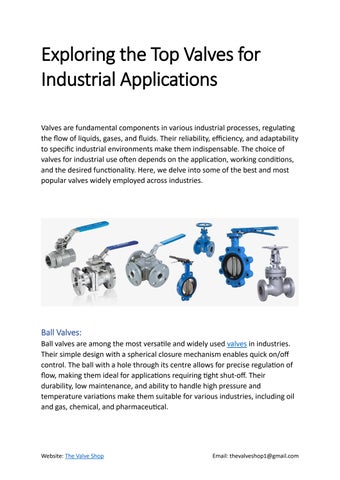
Ball Valves: Ball valves are among the most versatile and widely used valves in industries. Their simple design with a spherical closure mechanism enables quick on/off control. The ball with a hole through its centre allows for precise regulation of flow, making them ideal for applications requiring tight shut-off. Their durability, low maintenance, and ability to handle high pressure and temperature variations make them suitable for various industries, including oil and gas, chemical, and pharmaceutical.
Website: The Valve Shop
Email: thevalveshop1@gmail.com
Butterfly Valves: These valves have a disk mounted on a rotating shaft. They offer quick operation, allowing for efficient throttling of flow. Butterfly valves are compact, cost-effective, and suitable for handling large flow volumes. Their versatility in handling slurries, gases, and liquids makes them popular in water treatment, HVAC systems, and food processing industries.
Gate Valves: Gate valves control flow by raising or lowering a gate (a wedge-shaped disc) to open or close the passage fully. They provide a straight-through, unobstructed flow path when fully open, minimizing pressure drop. Gate valves are commonly used in applications where the valve remains either fully open or fully closed, such as in pipelines for oil, gas, and steam systems.
Check Valves: Check valves allow flow in one direction and prevent backflow. They come in various designs, including swing, lift, and ball check valves. Check valves are crucial in preventing damage to equipment caused by reverse flow and are commonly used in pumps, compressors, and hydraulic systems.
Pressure Relief Valves: These valves automatically release pressure when it exceeds a preset limit, safeguarding equipment and pipelines from overpressure situations. They find extensive use in industries dealing with steam, gas, and liquids, ensuring safety in operations.
Needle Valves: Needle valves provide precise flow control by using a slender, tapered point at the end of a valve stem. They are suitable for applications requiring fine adjustments in flow rates, such as in instrumentation, analytical equipment, and hydraulic systems. Website: The Valve Shop
Email: thevalveshop1@gmail.com
Control Valves: Control valves manage fluid flow by modulating the flow passage's size in response to signals from external controllers. These valves are essential in processes requiring precise control over variables like pressure, temperature, and flow rate, often found in chemical plants, refineries, and manufacturing units.
Selecting the most suitable valve for a specific industrial application involves considering factors like the type of fluid, pressure, temperature, flow rate, and system requirements. Additionally, adherence to industry standards and regulations is crucial to ensure safety, efficiency, and environmental compliance. In recent years, technological advancements have led to the development of smart valves equipped with sensors and actuators that enable remote monitoring, automation, and predictive maintenance. These innovations enhance operational efficiency, reduce downtime, and improve overall system performance in industrial settings. Moreover, the materials used in valve construction play a significant role in their performance and durability. Common materials include stainless steel, carbon steel, brass, and PVC, selected based on their resistance to corrosion, temperature tolerance, and compatibility with the fluid being handled. In conclusion, the choice of valves for industrial applications should be a wellinformed decision considering the specific operational requirements and conditions. With a wide array of valves available, each serving distinct purposes, industries can optimize their processes by selecting the most suitable valve types to meet their needs, ensuring efficient and safe operations.
Website: The Valve Shop
Email: thevalveshop1@gmail.com