On newsstands weekly
Volume 64 Issue 9
Thursday, November 12, 2026
THE USD VISTA VISTA
The Official Student Newspaper of the University of San Diego since 1968
Animal welfare behind lab doors and be approved by the IACUC.” The USD Vista asked professors and administrators where the dead animals are placed. As of Nov. 12, The USD Vista has not received a comment. Not all animals are euthanized. The remainder of animals may be used for breeding, kept until they die of natural causes or, in the case of some wild animals, released back into their environment. IACUC regulations do not cover every species or address every ethical concern. In animal labs, the balance between research and ethics remains a subject of debate. USD professor Colin Fisher, Ph.D., is a former nonscientific IACUC member. Fisher commented on his experience working on the committee.
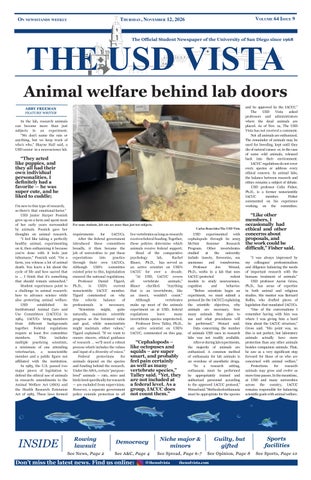
ABBY FREEMAN FEATURE WRITER In the lab, research animals can become more than just subjects in an experiment. “We don’t name the rats or anything, but we keep track of who’s who,” Shayne Hall said, a USD senior in a neuroscience lab.
“They acted like puppies, and they all had their own individual personalities. I definitely had a favorite — he was super cute, and he liked to cuddle; I’m new to this type of research, so there’s that emotional factor.” USD junior Harper Posnick grew up on a farm and spent most of her early years surrounded by animals. Posnick gave her thoughts on animal research. “I feel like taking a perfectly healthy animal, experimenting on it, then euthanizing it because you’re done with it feels just inhumane,” Posnick said. “On a farm, you witness a lot of animal death. You learn a lot about the cycle of life and how sacred that is … I think that it’s something that should remain untouched.” Student experiences point to a challenge in animal research: how to advance science while also protecting animal welfare. USD established its Institutional Animal Care and Use Committees (IACUCs) in 1984. IACUCs bring members from different backgrounds together. Federal regulations require at least five committee members. This includes multiple practicing scientists, a minimum of one attending veterinarian, a nonscientific member and a public figure not affiliated with the institution. In 1985, the U.S. passed two major pieces of legislation to defend the ethical use of animals in research: amendments to the Animal Welfare Act (AWA) and the Health Research Extension Act of 1985. These laws formed
INSIDE
For some students, lab rats are more than just test subjects.
requirements for IACUCs. After the federal government introduced these committees broadly, it then became the job of universities to put these expectations into practice through their own IACUCs. Although USD’s committee existed prior to this, legistalation ensured the national regulations. Professor Daniel Tigard, Ph.D., is USD’s current nonscientific IACUC member. Tigard commented on why this eclectic balance of professionals is necessary. “Scientists might, quite naturally, maintain scientific progress as the foremost value and goal, while nonscientists might maintain other values,” Tigard explained. “If we want to ensure sincere, ethical guidance of research … we’ll need a robust process which includes the values and input of a diversity of voices.” Federal protections for animals depend on the species and funding behind the research. Under the AWA, certain “purposebred” animals — rats, mice and birds bred specifically for research — are excluded from supervision. However, a separate government policy extends protection to all
Carlos Benavides/The USD Vista
live vertebrates as long as research receives federal funding. Together, these policies determine which animals receive federal support. Head of the comparative psychology lab, Rachel Blaser, Ph.D., has served as an active scientist on USD’s IACUC for over a decade. “At USD, IACUC covers all vertebrate animals,” Blaser clarified. “Anything that is an invertebrate, like an insect, wouldn’t count.” Although vertebrates make up most of the animals experiment on at USD, federal regulations leave many invertebrate species unprotected. Professor Drew Talley, Ph.D., an active scientist on USD’s IACUC, commented on this gap.
“Cephalopods – like octopuses and squids – are super smart, and probably feel pain certainly as well as many vertebrate species,” Talley said. “Yet, they are not included at a federal level. As a group, IACUC does not count them.”
USD experimented with cephalopods through its 2025 McNair Summer Research Program. Other invertebrates studied at the university include insects, fireworms, sea anemones and roundworms. Professor Jen Wenzel, Ph.D., works in a lab that uses IACUC-protected rodent models to study neuroscience, cognition and behavior. “Before scientists begin an experiment, we must submit a protocol [to the IACUC] explaining the scientific objectives, why animals are necessary, how many animals they plan to use and what procedures will be performed,” Wenzel said. Data concerning the number of animals USD uses in research labs was not readily avaliable. After or during lab experiments, the majority of animals are euthanized. A common method of euthanasia for lab animals is an overdose of anesthetic drugs. “In a research setting, euthanasia must be performed by appropriately trained and authorized personnel according to the approved IACUC protocol,” Wenzelsaid.“Methodsofeuthanasia must be appropriate for the species
“Like other members, I occasionally had ethical and other concerns about proposals, and the work could be difficult,” Fisher said. “I was always impressed by my colleagues’ professionalism and diligence balancing the needs of important research with the humane treatment of animals.” USD professor Aaron Gross, Ph.D., has areas of expertise in both animal and religious studies. His mentor was Bernard Rollin, who drafted pieces of legislation that mandated IACUCs. “One of the conversations I remember having with him was where I was giving him a hard time about the IACUC structure,” Gross said. “His point was, no this is not perfect, but laboratory animals actually have more protection than any other animals besides companion animals. That, he saw as a very significant step forward for those of us who are concerned with animal welfare.” Protections for research animals may grow and evolve as more time passes. In the meantime, at USD and many universities across the country, IACUC remains responsible for balancing scientific goals with animal welfare.
Rowing lawsuit
Democracy
Niche major & minors
Guilty, but gifted
Sports facilities
See News, Page 2
See A&C, Page 4
See Spread, Page 6-7
See Opinion, Page 8
See Sports, Page 10
Don’t miss the latest news. Find us online:
@theusdvista
theusdvista.com
2
The USD Vista
•
November 12, 2026
NEWS
Former men’s rowing coach sues for religious discrimination USD, Kimya Massey and DOES 1-25 have 2 days to respond
RILEY RAINS EDITOR-IN-CHIEF In a legal complaint filed on Oct. 15, Byron “Bart” Thompson, former head coach of the men’s rowing team, alleges that USD wrongfully terminated his contract and discriminated against him based on his Catholic faith. USD sanctioned an investigation into Thompson’s behavior that involved anonymous participants that testified their experiences; the complaint named them as DOES 1-25. The complaint names USD, Kimya Massey and DOES 1-25 as defendants. “The university hired a new Athletic Director, Defendant Kimya Massey, who almost immediately expressed hostility towards Plaintiff’s expression of his Catholic faith and his values driven approach to mentoring student athletes,” the complaint reads. “Defendant Kimya Massey’s hostility towards Plaintiff and his faith resulted in an orchestrated campaign to oust Plaintiff from his position.” Massey declined to comment. The complaint says that Massey suggested to alumni that Thompson altered medical records and failed to report sexual assault. A prospective student submitted their personal statement for Thompson to review prior to applying to USD; in said statement, the student described overcoming childhood sexual assault. The pleading states that Thompson was not obligated to report the sexual assault because the event occurred before the student was associated with USD.
“Title IX clearly does not apply to that situation and proving the point, on information and belief, once Defendants received that student’s personal statement, they did not start a Title IX investigation,” the complaint reads. The complaint also alleges that Massey suggested to alumni that Thompson committed HIPAA-related wrongdoings. HIPAA is a federal law, passed in 1996, that stands for the Health Insurance Portability and Accountability Act. The law prevents health information from being shared without patient consent. Thompson’s complaint doesn’t provide further detail about the alleged HIPAA violations. University officials have not confirmed why Thompson was fired; however, USD denies all allegations named in the lawsuit.
“We strongly deny Mr. Thompson’s allegations and will allow the process to run its course,” a USD spokesperson wrote. “We are confident that the facts clearly support the action taken.” Among other allegations, Thompson is suing USD and Massey for religious discrimination, retaliation, wrongful termination, defamation and emotional distress. He is asking for over $35,000. Thompson began his tenure at USD in fall 2021, after coaching at Adrian College for four years. About a month and a half before Thompson was fired, USD Magazine wrote a profile
about his coaching style. The article highlights the prayer circles that Thompson hosted after the rowers’ Saturday morning practices, a large point of contention in the lawsuit. “Rather than simply focusing on technique and fitness, he built his program around holistic development,” USD Magazine wrote. “Thompson’s approach centers on 10 core team values, discussed during Saturday practices: accountability, coachability, discipline, drive, enthusiasm, excellence, gratitude, grit, integrity and selflessness.” After USD terminated his position in January 2026, Thompson emailed an eightminute goodbye video to 45 of his athletes. On Nov. 3, men’s rowing alum Santiago Gomez forwarded the tape to The USD Vista. “If you are like me… when you hear someone has been put on unexpected administrative leave, you assume the worst: sexual assault, substance abuse, a misappropriation of funds,” Thompson said in the video. “As someone who has built the program on the premise of character, I want to make clear that no such act occurred.” Student reactions In both the legal complaint and the USD Magazine profile, the prayer meetings were described as voluntary; Gomez disagrees.
“Those [prayer meetings] were not optional,” Gomez said. “There wasn’t really any way to get out of the prayer circle. He was trying to embed a Catholic-family values system into the team
which was very overstepping.” Raised as a Catholic himself, Gomez transferred to USD in 2024 after rowing at Loyola Marymount University. USD alum Vivien Goretic was captain of the women’s rowing team for two years and graduated this spring; she recalled being confused about the prayer circles that the men’s team hosted. “I’m not surprised about the lawsuit,” Goretic said. “He talked really well. You always felt like he knew you, it was always a pleasant interaction, sometimes to an eerie extent … Religion was never a part of [the women’s rowing team’s] conversation, so the fact that it was so heavily part of their conversation stood out to us.” Not all athletes prefer to keep religion separate from their sport; USD senior Caden Leonard played football his sophomore and junior years and recalled saying the Our Father prayer with his team before every game. USD football offers optional Bible studies, player-led or coach-led. “I feel like having faith involved in sports should be somewhat expected at a Catholic institution,” Leonard said. “If it was to the same extent to what the football team is doing… I never thought it was too much. At the end of the day it’s a Catholic university.” The lawsuit argues that Thompson’s actions were in compliance with USD’s athletic mission statement, a mission statement that changed during Thompson’s tenure. According to Copley Archives, when Thompson was hired in 2021 the mission statement included a mention of the Catholic identity, however, during his tenure Massey reformed the statement to remove a direct mention of Catholicism. Massey was appointed as athletic director in 2024 after working at Oregon State University as the deputy athletic director for three years.
USD junior and women’s swim and dive member Mallory Paine comes from a Lutheran religious background but attends Catholic Mass on Sundays. After attending an annual athletic event that acknowledges USD’s Catholic identity, The Blessing of the Torero, Paine reflected on Massey’s character. “Kimya speaks at that every year and he’s always been, in my opinion, really welcoming about the Catholic faith,” Paine said. Moving forward In the goodbye video, before filing the lawsuit, Thompson outlined his outlook on the future for him and his wife.
“Above all, we know that the Lord will be with us on this path, no matter what comes next,” Thompson said. “And we put our faith and our trust in His goodness.” On Oct. 3, The USD Vista reached out to dozens of members of the men’s rowing team; as of Nov. 10, The USD Vista has not received a comment. There is limited public information about certain allegations listed in the initial complaint. A certain Dec. 5 incident revolving around inappropriate language is offhandedly mentioned without elaboration. The reason why Thompson was fired is protected under Employment Law; however, the alleged HIPAA violations and Thompson’s accused failure to report sexual assault are briefly described. More information may be released when USD files a response, an action legally required 30 days after the original complaint filing: in this case, no later than this Saturday, Nov. 14.
Thompson is asking USD, Kimya Massey and DOES 1-25 for over $35,000, citing religious discrimination, retaliation, wrongful termination, defamation and emotional distress. Art by Kyra Lefebvre
EDITOR’S NOTE: To view the legal complaint or Thompson’s USD Magazine profile, select the links attached to this article on our website at theusdvista.com.
Volume 64 Issue 9
•
NEWS
•
3
The USD Vista
Californians elect Becerra for governor Voters reject billionaire wealth tax: Proposition 40
MATTHEW SEDANO NEWS WRITER On Nov. 3, The Associated Press (The AP) called the California Governor’s race for Democrat Xavier Becerra, who defeated Republican Steve Hilton. On the same day, California voters rejected Proposition 40, a proposed billionaire wealth tax that would have allocated billions of dollars to healthcare, education and food assistance programs. Becerra’s win According to the early data released by The AP, Hilton received 35.6% of the vote, while Becerra garnered about 64.4%. Former California Attorney General, Congressman and U.S. Secretary of Health and Human Services, Becerra will replace current Gov. Gavin Newsom in January 2027. Becerra is California’s first elected Latino governor. His campaign centered around affordability, housing, healthcare and shielding California from federal policies under President Donald Trump. These concerns go beyond state politics for college students. Those who are getting ready for their career may be directly impacted by housing expenses, access to
Becerra will serve as California’s next governor. Photo courtesy of @becerraforgovernor/Instagram
reasonably priced healthcare, job possibilities and financial aid. USD junior Ryan Canton said daily needs and groceries are major financial obstacles for undergraduates. “A lot of college students are pretty poor most of the time,” Canton said. “So I think the general affordability of the basic necessities are pretty big.” Canton also said he hopes that the new government will expand affordable housing and reduce living expenses. However, he shared he did not vote in the election. Evan Crawford, Ph.D., is an
associate professor, an advisor for USD Votes and teaches the class Campaigns and Elections. He explained the broader shift toward Democratic candidates in House races nationwide. “The biggest takeaway is not the governor’s race, because… it went exactly how everyone assumed it would go,” Crawford said. “It’s the huge shift toward Democratic candidates. That was pretty uniform across all the states, including California, which is already a Democratic state.” According to Becerra’s campaign website, Becerra has prioritized housing development
by working to remove obstacles that limit affordable housing. Proposition 40 Ballot Proposition 40, which called for a one-time 5% tax on specific assets owned by billionaires, was rejected statewide by many Californians. If approved, most of the money would have gone to global healthcare services, with the remainder going to food aid and education programs. Opponents, such as Planned Parenthood Affiliates of California, cautioned that the tax
could push wealthy Californians out of the state and lower tax income. Supporters, such as Service Employees International Union-United Healthcare Workers West, claimed it would shield essential services from federal funding cuts. Proposition 40 caught the attention of Damaryz Chavez, a USD junior with employerprovided health insurance. “I thought [Proposition 40] was impactful… because that one-time tax on the individuals that had a higher income would have funded healthcare for more people,” Chavez said. USD sophomore Emily Grey shared the same opinion: California residents would have benefited from the law. “I think that would have been good, just because taxing more wealthy people… would have made more of a positive impact,” Grey said. “In the future, hopefully, there’ll be a proposition passed.” Students differ in levels of political engagement on campus. Chavez and Grey acknowledged that campus ballot drop-off, voter information tables and USD Votes helped students understand and participate in the election. As Becerra prepares to take office in January, many Californians are hopeful that campaign promises will lead to tangible change in institutional systems.
PU B LI C SA FET Y REP O R T Oct. 29 – Oct. 31 Location: Valley Residence B – San Juan Capistrano Hall (Exterior) Incident class: Motor Vehicle Theft – Electric Scooter At 9:38 p.m. on Nov. 3, a person reported an electric scooter theft to Public Safety. The incident occurred between 7 p.m. on Oct. 29 and 10 a.m. on Oct. 31. The case was referred to local law enforcement.
Nov. 5 Location: Mata’Yuum Crossroads Incident class: Motor Vehicle Theft – Electric Bicycle; Vandalism At 1:20 p.m. on Nov. 6, a person reported motor vehicle theft and vandalism to Public Safety. The incident occurred between 10:00 a.m. on Nov. 5 and 10:00 a.m. on Nov. 6. Public Safety made a conduct referral.
Oct. 30 – Oct. 31 Location: Valley Residence B – San Juan Capistrano Hall (Exterior) Incident class: Motor Vehicle Theft – Electric Scooter At 9:35 p.m. on Nov. 3, a person reported an electric scooter theft to Public Safety. The incident occurred between 10 p.m. on Oct. 30 and 5 p.m. on Oct. 31. The case was referred to local law enforcement.
Nov. 7 Location: Mata’Yuum Crossroads (Exterior) Incident class: Public Intoxication At 12:47 a.m. on Nov. 7, a person reported public intoxication to Public Safety. The incident occurred between 12:43 a.m. and 1:43 a.m. on Nov. 7. Public Safety made a conduct referral.
Nov. 2 Location: Maher Residence Hall Incident class: Vandalism At 11:10 a.m. on Nov. 3, a person reported vandalism to Public Safety. The incident occurred at 2:27 a.m. on Nov. 2. The case was referred to local law enforcement.
Nov. 7 Location: San Dimas Ave Incident class: Possession of Fake ID At 12:36 p.m. on Nov. 7, a person reported possession of a fake ID to Public Safety. The incident occurred between 12:36 p.m. and 12:39 p.m. on Nov. 7. Public Safety made a conduct referral.
Nov. 2 Location: Mata’Yuum Crossroads Incident class: Theft At 2:59 p.m. on Nov. 4, a person reported theft to Public Safety. The incident occurred between 4:30 p.m. and 7 p.m. on Nov. 2. Public Safety made a conduct referral.
EDITOR’S NOTE: To view USD’s Daily Crime and Fire Log, visit the Department of Public Safety website.
Flock cameras
To read about Flock cameras in San Diego, visit our website at theusdvista.com
4
Volume 64 Issue 9
•
The USD Vista
ARTS & CULTURE
Art by Kyra Lefebvre
Is society’s Roman empire Representatives? Toreros talk democracy that transcends terminology
BETTINA MOGELVANG OPINION WRITER With midterm elections finalizing last week, the U.S. has an influx of new representatives in Congress. According to ABC News, more than 124 million people voted in the 2026 midterm elections, exercising the people’s power to decide who would lead their government. Democracy implies many different things to many different people. The terminology that explains democracy’s various characteristics can even complicate how many think about the people’s power. The etymological origin of the word democracy stems from the Greek roots dēmos and kratos, meaning “common people” and “rule” or “power,” respectively.
“The people’s power,” is a phrase that permeates American political social circles, and yet the understanding of it differs from person to person. Many students understand exercising power as voting. USD sophomore Alma Suarez commented on characteristics she believes are a part of the people’s power. “[It’s] equality,” Suarez said. “Simply, equality. Giving everyone the right to [vote is important].” USD senior Suyara Farache weighed in on the idea. “If some people are less informed or can’t access going to vote, I feel like that hinders democracy,” Farache said. The U.S.’ participatory mode
is largely electoral voting, or indirect democracy. This type of democracy includes voting from the local level all the way to the president. What some may call a “pure” democracy can be noted back to Athens, which bypassed elected representatives, and had citizens vote directly on issues. In his book, “Mass and Elite in Democratic Athens,” chapters of which are assigned to students in USD’s Democratic Theory course this semester, author Josiah Ober illustrates what Athenian democratic politics looked like. “Most government officials were selected by lot,” Ober wrote. “Lotteried officials had very limited powers; their office was generally collegiate, annual and subject to judicial scrutiny. The key decisionmaking body of the Athenian state was the Assembly.” The U.S. still has modes of direct democracy that are aligned with characteristics of Athenian democracy. This includes the people’s ability to vote directly on ballot initiatives, propositions and referendums. However, some of these only exist in certain states and are far less exercised than the electoral vote. While this is still an exercise of democratic power, an election in itself seeks to decide who is the best representative of the people, which naturally follows in the people having less direct power. A democracy which uses representatives can additionally be categorized as a republic, as the U.S. is considered. While they imply different characteristics of political societies, these terminological differences still fall under the idea of democracy. USD Political Science Professor Timothy McCarty, Ph.D., commented on
the of
different avenues democratic power. “The fact that we’re a liberal democratic republic, one of the things that we get is a kind of liberation from the need for everyone to approach politics as a vocation,” McCarty said. “That’s a choice that we’ve made in modern liberal democracy. We could make a different kind of choice as a society, but that’s the choice that we’ve made. And I kind of like that choice. I think it’s okay that our society has space for people who really want to be involved in politics, and people who really don’t.” With the craze around midterm election season, many are engaging with the less-frequent electoral mode. Students share their expectations of this indirect democratic power. USD senior Owen Mink shared what is important to him when giving power to representatives. “I think sticking to formalities [is important],” Mink argued. “When the U.S. was created and all the ideas it was built on, it kind of hit the nail on the head for the most part. I’m uncomfortable with giving any politician, let alone the president, unlimited power.” USD senior Dominic Szalmas shared his thoughts on what he expects from the government.
“I want [people] to have more information on what’s going on behind the scenes when our leaders are making decisions,” Szalmas said. “Going all the
way from the president down to representatives for each state … Knowledge is power.” The U.S. may be moving away from midterm election season, but its people are still political actors. McCarty commented on democratic life outside of elections.
“To say that we’re engaging with democracy only when we vote would be like saying, I’m only a husband on date night,” McCarty argued. “What I learned from [Alexis de] Tocqueville especially is that democracy is a way of life. Which is to say, yes democracy is me voting, sure. But it’s also me being a neighbor. And it’s also me being a parent at my kids’ school … I like to think that instead of voting being the way I do democracy, that the way I vote and the fact that I vote emerges out of me practicing democracy as a way of life.” Alexis de Tocqueville, author of “Democracy in America,” argued that democratic society is healthy when it has what he calls “healthy mores,” not merely just laws and institutions. This means healthy values, habits and modes of engagement with each other. It requires thinking about what it means to be a member of a community rather than a distinct, isolated person separate from everybody else. USD junior Lucca Adams shared what he believes a people’s government looks like. “A people led government is when people come together, and they decide what’s best for the people around them,” Adams said. “They have different
perspectives and different ideologies, and they use that to formulate a government that can fulfill as many needs as those people would want.” USD senior Lexie Langberg, a political science student and Writing Center consultant, commented on the spaces she finds herself engaging with democracy in. “During our Writing Center workshops, we are all collectively in a group talking and gathering ideas to try to get to somewhere better for the student writers, but there isn’t one sort of distinct solution that we’re trying to come to,” Langberg said.
“I think if you feel like you’re part of a group where you’re confident enough to use your voice and speak and be heard, then that confidence can go into other sectors of your life, as well. That could be actual politics and using your voice on political issues, or in other sorts of civic groups … the whole point is to make us more democratic citizens, because if you know what’s going on in society, then you can act in ways to address that.” Terminology may be second then, to the democratic spirit that people find within themselves. While the term democracy can refer to the various characteristics and modes of engagement found within the system, these ideas seem to be rooted in the notion that each person is one of the many members that make up “the people” of a nation.
Volume 64 Issue 9
•
ARTS & CULTURE
•
The USD Vista
‘A Midsummer Night’s Dream’
5
USD students bring the Shakespeare comedy to life SAVANNAH HARLAN ARTS & CULTURE WRITER USD offers a major and minor in Theatre, but this semester’s fall production of “A Midsummer Night’s Dream” was open to all USD students regardless of their major. For USD sophomore Aviella Schneider, this show will be her very first theatrical performance. “I took a class with Jersten [Seraile], the director, last semester and he recommended me to try out,” Schneider shared. “I did it with no intention of getting a good role … I was telling everybody, I’d be happy to just play a tree.” Schneider, who plays Hermia, will be doing far more than just holding branches. Her character is central to the plot. Schneider shared how bringing Hermia to life has expanded her intellect in many ways. “You just go through every single beat [to bring her to life], you have to constantly think about what your intention is, behind what you’re saying and how you’re moving,” Schneider said. The Shakespearean comedy centers around three interconnected plots set in Athens and a nearby enchanted forest. The first plot follows Hermia, who is caught in a forbidden romance against her father’s wishes. The play then heads into the enchanted forest,
SHY BROWN GAMES EDITOR
where the mischievous Puck tricks the fairy queen into falling in love with the first creature she meets, which leads to various mishaps. The final plot centers around a group of Athenian craftsmen, known as the Rude Mechanicals. The cast includes 19 undergraduate students who have been rehearsing since early September. Since then, the cast has dedicated over twenty hours each week to bring the show to
life. USD senior August Nickoli, who plays Helena, shared how rehearsing for a Shakespearean play is particularly unique. “We would go through the text line by line and break it down,” Nickoli explained. “Then we go in and try to understand the objectives of our characters and get really specific.” For some, performing an over 400-year-old show in 2026 may seem irrelevant. Nickoli disagrees.
“I think the universality of Shakespeare is something that not a lot of people understand or always pick up on,” Nickoli argued. “What’s so awesome is that we still see all of these tropes today in modern media … [Shakespeare] is literally the basis of everything.” Schneider agreed with Nickoli’s views on Shakespeare’s relevance. “Shakespeare, and specifically this show, reminds us that basic
human emotions like love, sadness, fear or anger is what makes life beautiful,” Schneider shared. “There’s just something powerful about letting yourself go through these emotions and feel everything really deeply.” USD first-year Nio Beavers, who plays the trouble-stirring Puck, shared that playing this character has been a refreshing change of pace. “I’m an engineering major, so going from classes to rehearsal has been a nice break,” Beavers shared. “It’s just fun to let go and be whimsical.” Beavers’ character Puck is a shapeshifter, and the actor shared that he feels he was a great fit for this reason. “I take on so many roles in my life at once,” Beavers explained. “I shift between those; I’m a shapeshifter just like Puck.” Audiences can expect lots of whimsy, magic and classic Shakespearean drama in the upcoming play. Beavers shared that he hopes audiences will come into the show with lots of energy. “Have fun, it’s a very interactive show and the actors can feel your positive energy,” Beavers concluded. “A Midsummer Night’s Dream” will open today, Thursday, Nov. 12 and conclude on Sunday, Nov. 15. Tickets can be purchased online via the Department of Art by Kyra Lefebvre Theatre’s Instagram account.
Unscramble this week’s crossword theme Across 1. Chop the wondo and spin the “e” 3. Dapper or handsome 4. Another word for yearning 6. On a stack of pancakes 7. __ Rapids (city in Iowa) 8. Georgia icon 9. Buffy’s witch friend on the 1990s TV show
Down
Scan For Answers
2. Allegedly, keeps the doctor away 3. “James and the Giant ___” 5. “Simon ___,” a 1998 comedy-drama film 8. Opposite to the back of your hand
The USD Vista Riley Rains - Editor-in-Chief Calla Jordan - Managing Editor Amelie Sedlack - Copy Editor Sophie Hummel - News Editor Julianna Flores - Feature Editor Cristina Trice - Arts & Culture Editor Pratinya Bodanapu - Opinion Editor Katt Harding - Sports Editor
Kyra Lefebvre - Art Director Emma O’Connell - Photo Editor Lucas Meza Ehlert - Distribution Manager Ella Fitzpatrick - Social Media Manager Sasha Sepatjian - Director of Finance Nina Dameri - Advertising Manager Dr. Byron Howlett - Operations Manager Blake Nelson - Student Media Advisor
Editorial – 619.260.4584 Business – 619.260.4714 www.uofsdmedia.com / @TheUSDVista
The USD Vista publication is written and edited by USD students and funded by revenues generated by advertising and a student fee. Advertising material published is for information purposes only and is not to be construed as an expressed or implied endorsement or verification of such commercial venues by the staff or University. The USD Vista office is located on the fourth floor of the Student Life Pavilion in room 403B. All inquiries should be sent to: The USD Vista 5998 Alcala Park San Diego, CA 92110 Opinions expressed in this publication are not necessarily those of The USD Vista staff, the University of San Diego or of its student body. Letters to the Editor can be submitted to The USD Vista office. Letters should be limited to 300 words and must be signed. For identification purposes, USD identification numbers and writer’s year must be included in the letter. The USD Vista reserves the right to edit published letters. Any content sent to the editor will be considered for publication unless otherwise stated.
The USD Vista
6
•
November 12, 2026
Art by Kyra Lefebvre/The USD Vista: Content by Adela Tabak
Niche major and minor combinations that shape careers Diverse major and minor combinations allow students to explore new and preexisting interests to make their academic journey unique and tailored to their passions. Although it may be difficult to decide on a particular major or minor, these students found a way to make the most of their time at USD. Read more about how students with declared majors found their preferred academic pathways.
Photo courtesy of Natalie Kerr
“I thought with a science major it would be really important to have some background on policy and economics because you can’t make progress in the environment if you don’t understand how the economy works and how policies actually work because it all fits together.” Natalie Kerr, senior Major: environmental and ocean sciences Double minor: music and philosophy, politics and economics (PPE)
“I’ve always been passionate about animals and the environment. A lot of times, scientists are disconnected from the communities that they are studying. That led me to doing Africana studies and the environment.” Soley Montes, sophomore Major: environmental and ocean sciences Minor: Africana studies
“For me, marketing is all about understanding heart and human connection through business. Spanish is my native language, so continuing to study it in [the College of Arts and Sciences] is really meaningful. I am growing my skills while staying true to where I come from.” Paulette Vazquez, senior Major: marketing Minor: Spanish
Volume 64 Issue 9
•
FEATURE
•
“I want [my] major to show on the screen at graduation for people to know this is important to me. I might not do anything with it, but it was important to me during college.” Keira Dooley, senior Double major: political science and Italian studies Minor: environmental and ocean sciences
Photo courtesy of Keira Dooley
“Both the major and the minor that I'm currently in allow me to learn a little bit more about how humans work and how we communicate and think.” Farah Villanueva, senior Major: English Minor: marketing
The USD Vista
7
Volume 64 Issue 9 •
8
OPINION
•
The USD Vista
OPINION Guilty, but gifted
Artistic genius has become a moral loophole PRATINYA BODANAPU OPINION EDITOR On Halloween night, more than 80,000 fans packed a Houston stadium to watch Kanye West perform, despite his history of antisemitic remarks. Pablo Picasso, notorious for his mistreatment of women, had a painting sell for $179.36 million decades after his death. Chris Brown, who pleaded guilty to felony assault against Rihanna in 2009, went on to win a Grammy Award in 2025.
Being extraordinarily talented comes with the privilege of being extraordinarily forgiven. I’d like to believe that morality is straightforward. Cruelty should be cruelty, regardless of who commits it,
and talent, wealth and fame do not excuse wrongdoing. However, history suggests otherwise. Give someone a paintbrush, microphone or camera, and suddenly society’s moral convictions become incredibly flexible. We condemn cruelty, prejudice and abuse until the person responsible happens to have created something we love. Then, the conversation shifts. Their actions become complications and their victims become footnotes rather than headlines. One of the most striking examples of this is filmmaker Roman Polanski. In 1977, Polanski pleaded guilty to unlawful sexual intercourse with a 13-year-old girl before fleeing the U.S. ahead of sentencing. Twenty-six years later, he won the Academy Award for Best Director for “The Pianist.” Although he was absent from the ceremony, the announcement of his victory was met with a standing ovation.
ADVERTISEMENT
The Frances G. Harpst Center for Catholic Thought and Culture at the University of San Diego cordially invites you to
LE S SONS A N D
CAROLS A F E S T I VA L O F W O R D A N D S O N G T O P R EPA R E F O R CH R I S T M A S
All celebrations will take place in
FOUNDERS CHAPEL
Friday, December 4, 2026 at 7:30 p.m. Saturday, December 5, 2026 at 2 p.m. Admission is free. F O R F U R T H E R I N F O R M AT I O N
Visit sandiego.edu/cctc for directions and parking information. Contact us at cctc@sandiego.edu or call (619) 260-7936.
It is difficult to imagine an ordinary person receiving applause from an entire room of colleagues after committing such a crime. One can only imagine how the 13-year-old victim must have felt watching the man who abused her receive overwhelming admiration. Yet, when the individual is responsible for celebrated films, the conversation becomes considerably more complicated. The question is no longer simply what they did, but whether their contributions to cinema somehow outweigh it. Polanski is hardly an isolated case. Nicki Minaj faced criticism for defending her husband, Kenneth Petty, who was convicted of attempted rape in 1995. Additionally, J.K. Rowling, whose “Harry Potter” franchise remains a cultural phenomenon, has attracted widespread criticism for her statements about transgender people, which she defends as advocacy for sex-based rights. In nearly every debate surrounding a controversial artist, the same familiar defense eventually emerges: separate the art from the artist. It is an appealing proposition. After all, why should a painting become less beautiful because its creator was cruel? Why should a song stop sounding good because the singer has said something awful and reprehensible? There is also something reasonable about allowing art to exist independently of the person who created it. A song can become the soundtrack to someone’s childhood, a film can change the way someone sees the world and a book can offer comfort during an otherwise difficult period. These experiences belong to the audience as much as they do to the artist. Separating art from the artist becomes significantly
Fame shields artists from accountability.
more complicated when appreciation turns into financial and cultural support. Listening to a song because of the personal significance it holds can easily become purchasing concert tickets, publicly defending the musician or dismissing the experiences of people harmed by them. These decisions have different implications, even if they are often grouped under the same phrase.
Separating art from the artist should never mean separating the artist from accountability. We have confused acknowledging talent with excusing behavior. Rather than confronting the criticism, fans respond with lists of accomplishments. Kanye West made “My Beautiful Dark Twisted Fantasy.” Picasso revolutionized Cubism. Polanski directed “The Pianist.” All of these statements can be true without functioning as moral defenses. While celebrated male artists can have serious misconduct excused as a consequence of genius, female celebrities often face relentless scrutiny over their personal lives. Consider Ariana Grande, whose relationship with “Wicked” co-star Ethan Slater sparked widespread controversy and accusations of infidelity.
Art by Kyra Lefebvre
This is not to suggest that infidelity is beyond criticism, but it is worth questioning why a woman’s romantic life can provoke such intense outrage while men with histories of far more serious misconduct continue to be celebrated. Grande is not Polanski, yet the disproportionate attention given to their personal lives reveals how inconsistently we apply moral standards. Of course, women are not universally condemned, nor are men universally forgiven. But when male artists can be celebrated as misunderstood geniuses while women are scrutinized for their relationships, appearances and behavior, it becomes difficult to ignore the double standard. Perhaps the issue is not that society has abandoned morality, but that we have made it selective. We only demand accountability when it is convenient. We should be capable of acknowledging two truths at once: a person can be extraordinarily talented and still behave terribly. Achievements do not erase their actions, and actions do not necessarily erase achievements. The problem emerges when we allow one to justify the other. Because, apparently, it is okay to be evil if you’re talented. Just make sure you’re talented enough, famous enough and, preferably, a man.
The views expressed in the editorial and op-ed sections are not necessarily those of The USD Vista staff, the University of San Diego or its student body.
Have an opinion? We want to hear it! The Vista is now accepting essays from students, faculty, staff and community members about the issues that matter to them. If you’d like to submit an opinion piece between 400 and 800 words, please reach out to vistaeditor@sandiego.edu.
9
Volume 64 Issue 9
•
OPINION
•
The USD Vista
Valuing our artists Appreciating art for art’s sake
REESE WELLS OPINION WRITER Where have all the artists gone? This question seems to have a simple answer: they’re on our billboards, in our earbuds and on display in the museums. We buy tickets to see them and purchase their artwork, therefore funding their creativity. So, the question might better be asked like this: what happened to art for artists’ sake? In recent years, access to art and its means of production is more widespread than ever before. There are endless opportunities to draw, paint, sing and write, and an equal amount of places to share that art with the world. Platforms such as Instagram, Spotify, YouTube, Substack and Etsy make this possible. It seems that, with all this access, art should be widely celebrated and respected by our society. But that isn’t quite true. The reality is, there has been a slow and silent death of respect for art and artists. As a society, artists themselves just aren’t that important to us
anymore. In order to be taken seriously in the making of art, you must be selling it for a profit. Otherwise, why do it…right? That’s just the problem. Modern artists face barriers which have sprung up from our fast-paced, consumerist world. They are faced with deadlines and rent payments barreling toward them. They are expected to churn out pieces at the speed which the customer wishes. Yet, even if we travel back to the time of the Italian Renaissance, it seems they faced a similar problem. We would find ourselves in an era that transformed the role of artists in society; the era that produced greats such as Michelangelo and da Vinci. At this time, masterpieces of grand scale were produced on a widespread basis. Some of these works included “David,” “School of Athens” and “The Last Supper.” Passion fueled these pieces, and the artist was raised to an exalted
Art by Alicia Higuchi
status. They weren’t just menial workers anymore, they were the leaders of innovation in their society. They created art because their urge to create
beauty was stronger than any other within them — stronger than hunger, sleep or pleasure. Their craft was valued and even had a sort of spirituality to it. Those with the gift were able to fully realize their artistic potential. These artists still worked for commissions and adhered to strict deadlines. So what is the difference between them and artists now? The truth is, there isn’t much of one, at least in the process by which they make a living. The difference is in the level of respect we, as consumers, give the artists and their art. A musician who publishes an album one week is grilled with questions the next. When are they going on tour next? How much will merch be? Why aren’t they playing in my city? When’s the next album? They are bombarded with questions like these, which are fueled by people’s need to devour new media. By way of
Instagram Reels and TikTok, people have been conditioned to expect speed and efficiency. A recent survey of over 2,000 musicians found that 86% of artists reported experiencing creative burnout; 56% of these artists said this burnout came from stress about social media and 24% said from stress about financial matters. In 2024, the median income for artists was about $56,000, with 66% of American artists reporting that they struggle to pay rent. All of these outside factors put artists under immense pressure to produce art not for their enjoyment, but for the sake of survival. So, art for the artist’s sake, fades away. People no longer want to take the time to pause, to listen, to look. Art demands something that our culture of endless scrolling rarely encourages: attention. But, if we want to preserve that beauty, our art and our artists, we have to learn to admire and support them. We must learn to respect their time and effort, and value them for what they are: the leaders of thought and innovation for the human race.
Don’t call the cops on your neighbors Being a bad neighbor is not a crime
EMMA PIRHALA CONTRIBUTOR A few weekends ago, I had a wonderful time in Los Angeles visiting friends. As the day dragged on, I kept pushing my time of departure to prolong the fun. By the time I made it back to San Diego, it was around 11:30 p.m. and, oddly enough, my house was surrounded by cop cars. “Weird,” I thought. “I don’t remember committing any crimes.” By process of elimination
and the sight of first-years dispersing at the speed of light, I deduced that my neighbors had thrown a party that got busted. Happens to the best of us. What I didn’t know until later, was that my own friends had called the cops on this party for being too noisy. Now, being forced to listen to a 20-year-old “DJ” play “Doses and Mimosas” isn’t everyone’s idea of a good night (sign me up), but resorting to calling the police before it’s even midnight felt like overkill. After
much pondering and reflection, I came to the conclusion that it’s not always right to call the cops for a noise complaint. We are all college students, and one of the greatest rites of passage is to go to a party, lose track of time (and phone and keys) and safely end up in bed while a DoorDasher drops off a Domino’s pizza that you’ll forget about until morning. This is an experience that has held for generations. Our parents and our parents’ parents have all had at least one late night of fun. But numbers are down for Gen Z. Spending time at social events, like parties or mixers, is a driver of emotional development. A 2023 article published by Harvard Medical School explains that staying social boosts one’s mood and reduces stress. Following the pandemic, Gen Z is particularly in need of socialization after time spent in lockdown. Regardless of the benefits of attending gatherings, reporting noise complaints can lead to harsher consequences for the hosts. Complaints come with fines in dorms or managed complexes. Moreover, depending on the kindness of the officers and if there is drinking involved, underage hosts or
attendees could receive a minor in possession of alcohol charge. These can lead to disciplinary action and fines not just from the police department, but also from the university. “Possession and consumption of alcohol is permitted by persons 21 years of age or older only in the student’s assigned space within university residence halls, where at least one assigned resident is 21 years of age or older,” USD’s alcohol policy states. Perhaps the most serious concern I have with reporting noise complaints is what it signals from this generation: a lack of emotional intelligence and an inability to have tough conversations. Rather than going straight to reporting a noisy dorm or apartment, try walking over, knocking and asking them to quiet down. Although it will be uncomfortable and take a little extra time out of the day, both parties will be better for it. Now, of course, if there are concerns about safety and harm — please contact local law enforcement. If on campus, please contact residential assistants (RAs) or the Department of Public Safety .
Art by Kyra Lefebvre
Although parties can be fun and make for good stories, one unfortunate night can change a life. With laced drugs and drink spiking, dangerous events have occurred and continue on campuses across the nation. Reducing harm and practicing consent can decrease the chances of a fun night turning malicious. But, if someone’s having a get together and loses track of their JBL volume, give them grace. We’re only young once, and who knows, you can always go over, join them and make some new friends.
The views expressed in the editorial and op-ed sections are not necessarily those of The USD Vista staff, the University of San Diego or its student body.
10
The USD Vista
•
November 12, 2026
SPORTS
Athletes take training local
Lack of facilities forces athletes to practice off-campus ELLIE HARDMAN SPORTS WRITER
While many start their morning by making the long trek across campus to their 8 a.m. class, several studentathletes are already on their way back from an off-campus morning run, diving session or rowing practice in Mission Bay. For many USD studentathletes, their practices take place just a short scooter ride from their dorm, but not all facilities are created equal. Beyond the Jenny Craig Pavilion, Fowler Park and Torero Stadium, several sports on campus do not have a space of their own dedicated to their specific practice needs. Track and cross country, for example, conduct all their training and practice runs off campus. There has not been a running track on campus at USD since before the construction of the Joan B. Kroc Institute for Peace and Justice in 2001. Even that track was an informal dirt trail open to students. Will Guarino, head coach of track and cross country, ran on that very track when he attended USD from 1984 to 1988. As a longtime fan of the San Diego area, Guarino views the team’s local adventures as an advantage to their craft. “Even though it seems like a hindrance, I think it’s a growth opportunity that other teams don’t have,” Guarino said. “If their nature is nature, why can’t we actually provide them with what their calling is? Their calling happens to be people of the outdoors, and there’s no greater place [than San Diego].” The track and cross country teams travel five days a week at local tracks and trails across San Diego County. From Del Mar to Mission Bay, to Snapdragon Stadium to Bonita, the runners take turns carpooling and taking the university vans to
Weekly athletics recap KATT HARDING SPORTS EDITOR
The rowing team practices on Mission Bay.
complete their weekly training. Rowing also takes advantage of the local resources with its competitions and practices in Mission Bay. Head coach of the women’s team Katie Thurstin admires her players’ ability to organize themselves by commuting back and forth throughout their weekly training schedule, and specifically the captains’ initiative in planning and regulating the system. At other colleges, such as Syracuse University or Dartmouth University, their rowing programs are supported by indoor rowing tanks, artificial pools with flowing water to simulate a real rowing session. Here at USD, any in-the-boat training must be done at Mission Bay.
The cross country team warms up on a local San Diego trail. Photo courtesy of @usdxctf/Instagram
“I think the athletes that stand out the most are the ones who support their teammates the most,” Thurstin said. “We’re a sport where there’s nine people that have to cross the finish line, so you cannot be the best person in the boat. You need to be the best person for the boat.” Through the recently established rowing alumni board and meetings with USD architects, the team hopes to expand their on-campus facilities to maximize their time. As of now, the team practices six days a week and splits their time between commutes to Mission Bay and simulated training in the Sports Center. In their specialized rowing room, the team uses ergometer machines, which simulate the rowing motion done in the real boats. They are also available in the Wellness Center, and allow for the athletes to execute dryland training without leaving campus. While rowing is able to commute as a team throughout the week, the swim and dive program is forced to split up. The diving team takes an early morning trip to the Poway Community Center about 30 minutes off campus every Tuesday and Thursday. First-year diver Reese Taylor, sophomore diver Ava Valadez and junior diver Brooke Blaylock, all compete in both the 1-meter and 3-meter categories for the USD team. The Sports Center pool on campus only allows for them to train using the 1-meter boards with a pool depth of 11 feet. The 3-meter boards at the Poway pool comply
Photo courtesy of @usdtoreros/Instagram
with the NCAA minimum depth requirement of 12 feet, 6 inches. “This year, since we all have 10:45 a.m. classes, it’s been a struggle,” Valadez said. “But I think we have a good system going on where we leave Poway as quickly as possible, and then we all change here before class.” Each diving athlete is required to complete a driving certificate in order to be permitted to drive the team vans to and from morning practices. That way, all players take turns driving the school vehicles and split the responsibility evenly. The athletes explained that the process has been one of trial and error. This season, they worked to find the most practical schedule for ensuring everyone is back in time for classes. As the divers balance their hour-long commute, changing and potential traffic, they learned to communicate with their professors beforehand to be transparent about their potential tardiness. “I think [early morning practices] did make me more resilient because I still pushed myself to go there and get there and still make progress,” Taylor said. “Even if I didn’t have the best practice, I still showed up for myself and for my team.” Many coaches have met with architects hired by the athletic administration to discuss feasible plans for athletic facilities. Within the next three to five years, the administration hopes to execute concrete plans and allow for student-athletes to prioritize their time on campus.
This past week the Toreros opened basketball season with a comback at home and football pulled out a victory on the road in Des Moines, Iowa. Football traveled to Drake University on Nov. 7 and won 40-17, its first win over the Bulldogs since 2022. San Diego improved to 5-5 overall and 4-3 in the Pioneer Football League. The Toreros close the regular season at home against Stetson University on Nov. 21. Men’s basketball opened coach JR Blount’s first season with a 79-62 win over Biola University on Nov. 2 at the Jenny Craig Pavilion. The Toreros then beat Tarleton State University 96-90 in overtime on Nov. 6. San Diego trailed by 15 points and was down 82-79 in the final seconds of regulation. Senior Dusty Stromer then hit a buzzer-beating 3-pointer to force overtime. He finished with 22 points, all in the second half. The Toreros made 34 of 39 free throws, including 10 of 10 in overtime. Women’s basketball won its season opener 61-56 at New Mexico State University on Nov. 2. Senior transfer Kiera Pemberton scored 22 points in her Torero debut, and junior Kylie Ray added 19 points. USD fell 90-88 in overtime to University of California San Diego on Nov. 7 at Pechanga Arena in the inaugural Bill Walton Classic. Women’s volleyball visited Denver on Nov. 7 and swept the Pioneers 3-0 to extend its winning streak to seven matches. It opened a threematch road swing that will continue with Pepperdine University on Nov. 12 and Loyola Marymount University on Nov. 14. Women’s soccer wrapped its 2026 season Nov. 7 with a 1-0 win against University of the Pacific in Stockton. The Toreros were unbeaten in their last three matches. Women’s tennis went 4-1 in the quarterfinals of the San Diego State University Invitational on Nov. 6. Junior Anni Moll and first-year Lila Bachour won in doubles, as did senior Charlotte Keitel and sophomore Maria Shmakova. Moll and Shmakova each won in singles to reach the semifinals. Men’s rowing placed its A and B boats second and third in the open eight at the San Diego Fall Classic on Nov. 8 on Mission Bay.
Volume 64 Issue 9
•
SPORTS
•
The USD Vista
From practice to pitch, rugby kicks off
11
Three-time national champions take on the pitch this fall
MADDY SPADA SPORTS WRITER
ROCCO PASQUINI SPORTS WRITER
Rugby: the game with two teams, 15 players each and one grass pitch. The USD men’s rugby team was founded in 1980 by students Johnny Purcell and Tim Kleier. Rugby serves as a club sport on campus. The team consists of 24 athletes from all grade levels and seven coaching staff members. Their culture came from hard work and success from its founding days, according to their official website. The game came to be in 1823 at the Rugby School in Warwickshire, England; its roots were derived from the traditional sport of football, according to the World Rugby Organization. In the U.S., rugby is not nearly as popular. Rugby is not considered an official NCAA sport, as athletes usually only play in high school leagues with the possibility of eventually joining the USA national team, the Eagles. In 2024, USA Rugby had a little over 50,000 sign ups for youth-level clubs and high school level clubs, compared to over 4.5 million participants in the more popular American sport, tackle football. Tyler Holmberg, a USD sophomore, shared his insights on the sport after
playing for the men’s team for the past two years. “I still learn something new about the sport every year I play,” Holmberg stated. “It took me a while to really understand it, but I don’t blame people for being confused after watching.” In the past four years, men’s rugby has won three national championships and four Gold Coast League championships. Director Kevin Eaton played for the Toreros for four years and transitioned into head coach from 2016 – 2019, then became director in 2019, continuing today. Head coach Charlie Purdon coached the Toreros in backto-back sevens, a game that involves seven players per team and only lasts 15 minutes. There’s also fifteens, a game that involves 15 players per team and has two 40-minute halves. The team practices twice a week and travels to games throughout Southern California. Torres Kapust, a senior at USD who has played on the rugby team all four years, shared his experience on the field.
“What I enjoy about rugby compared to any other sport I’ve played is just the camaraderie with teammates,” Kapust said. “The
difference
between
rugby and football is that in football you can rely on a couple star key players, but in rugby, you’re only as strong as your weakest player.” The Torero’s season comes to an end with the national championships taking place in May 2027 where they have the opportunity to win their fifth title. Even without the public support system that the Division I athletics receive on campus, rugby plays how they practice. Christina Pedreiro, a firstyear student, wishes that she knew more about the program. “I’ve seen the players walk around school but never heard anything about them,” Pedreiro commented. “I don’t know exactly what the sport entails, but it seems like not a lot of other colleges have the club so I would be interested to hear more about it from USD.” Due to its lack of status as an established Division I athletic team on campus and lack of popularity throughout the U.S., sports like rugby don’t receive as much attention from the student body or athletic departments. The sport isn’t listed on the Torero athletics website and their only communication is through their Instagram account and official website. Wyatt Rothgery, a firstyear student at USD and new rugby team member shared his experience on rugby’s popularity. “I think it is growing in
popularity at least in my life,” Rothgery said. “I’ve noticed it a lot more on social media too… USD students know less about the game and the playing, but a lot about the team itself.”
Rugby is both a high-impact and intense sport, with not only physical injuries being extremely common, but also long-term cognitive and mental deterioration from head-on collisions and tackles. The game involves two 40minute halves, where players aim to score points in one of four ways. First, they could score three points via drop goals, drop-kicking the ball through the opponents goal posts on the first bounce. They also have the opportunity to score two points with conversions, kicking the ball through the goal posts after scoring a try. In addition, there’s penalty kicks worth three points, kicking the ball through the opponents goal post as a reward for penalty, or tries worth five points grounding the ball in the opposite team’s end-zone. Vivian Gregory, a sophomore at USD, is familiar with the rugby team on campus through her classmates and peers. “It’s a pretty aggressive
Toreros power through a tackle as teammates close in.
COMING UP THIS WEEK
sport and they get hurt a lot,” Gregory said. “However, I think that the team in general has a really positive family-centered feel, with lots of camaraderie within the organization.” Players are not allowed to wear any sort of padding other than a mouthguard or light protective helmet, which significantly contributes to the amount of injuries players endure. The National Library of Medicine emphasizes how sprain, fracture and contusion rates regarding the shoulder, wrist/hand and lower leg were over four times greater than that of football players. The most common forms of injuries in rugby players include shoulder dislocations from repeated tackling and hard falling, cauliflower ear from blunt-force trauma to the head and scalp lacerations, according to the University of Utah Health Department. Despite the dangers, for Kapust, Rugby is more than a sport at USD. “Team camaraderie and team care and team traditions — that’s what’s kept me coming back every year,” Kapust commented. The 24-man roster has already made strides, beating UCLA in a historic 40-19 run at the inaugural Loc Vetter Memorial Cup. They took home the win at the West Coast Sevens tournament, securing the victory with a plate championship title.
Photo courtesy of @sampuentesphotography/Instagram
WSWIM at USC Diving Invite 11 a.m. Thursday, Nov. 12 Los Angeles, CA
WVB at Pepperdine 7 p.m. Thursday, Nov. 12 Malibu, CA
M/WXC at NCAA West Regionals
MBB vs. Chicago State 6:30 p.m. Wednesday, Nov. 13 San Diego, CA
WVB at LMU 1 p.m. Thursday, Nov. 14 Los Angeles, CA
WBB vs. CSUN 2 p.m. Thursday, Nov. 14 San Diego, CA
10 a.m. Wednesday, Nov. 13 Sacramento, CA
The USD Vista
12
•
November 12, 2026
AR TS & FEATURE
Making matches between classes
USD seniors establish a National Marrow Donor Program chapter JULIA HURTADO FEATURE WRITER Last month, USD senior Evelyn Yandle received a phone call from the National Marrow Donor Program (NMDP), informing her that she matched with a 78-year-old patient with leukemia in need of stem cells. After going through health screenings and blood tests, Yandle’s results were sent to the patient’s healthcare team. She is currently waiting on final testing to determine if she is a match. “It was pretty cool,” Yandle explained. “I joined and a few months later I was a match for someone.” Before becoming copresident, USD senior Sam Azelby was giving blood when she spotted an NMDP table on campus. “I tried to give blood that day, and NMDP was tabling, I thought it was such an amazing cause just because cancer is very prevalent in my family history,” Azelby shared.
“It has affected me personally. At the time my cousin had just gotten diagnosed with leukemia and that’s when I wanted to start the club.” After seeing the table, Azelby decided to start the club with help from Yandle. “I saw Sam tabling for the Alcalá Bazaar and I got really inspired because I want to go into the health field,” Azelby said. “I am applying to medical school. I feel like that aligns directly with helping save lives and just expanding outreach too.” This fall, Yandle and Azelby worked together to establish a chapter of NMDP on campus. NMDP is a nonprofit organization that matches donors with patients in need of bone marrow or blood stem cell transplants. NMDP uses a donor registry to pair patients with donors who are genetic matches. Once matched, donors either donate blood stem cells or bone marrow to patients in need.
According to USD NMDP copresidents, over the past year 300 USD students have joined the NMDP registry. procedure under anesthesia and are paid for by NMDP. On Nov. 3, the pair hosted the first-ever NMDP meeting on campus. The meeting explained how NMDP finds genetic matches for patients and the importance of the nonprofit itself. At the end of the meeting, students were given the option to join the NMDP registry by doing a cheek swab. The swabs were sent to NMDP for processing at a laboratory. Over the summer, the American Red Cross declared its second-ever national blood
crisis due to low donation numbers across the country, with the national blood supply falling nearly 25% in June. While this shortage continues to affect hospitals nationwide, NMDP faces a different issue. Rather than focusing on blood types, NMDP uses human leukocyte antigens (HLA) matching that pairs specific proteins found on the cells of patients with donors who share the same HLA markers. During HLA matching, doctors look at up to 12 different markers
Photo courtesy of @nmdp/Instagram on a patient’s DNA, making a According to Yandle and match difficult to find because Azelby, over the past year, there are millions of possible 300 students have joined the combinations. In order to find NMDP registry. USD first-year a match, doctors want patients Kylie Anderson explained why and donors to share at least eight she joined the club at USD. to ten of the same HLA markers. Joyce Valdez oversees college “At the HOSA chapters of NMDP, including International USD’s. NMDP currently uses Leadership a registry consisting of 44 Conference, I million worldwide potential witnessed a donor donors. Out of those donors, meet their recipient finding a match for certain for the very first patients remains difficult. time. Seeing that “That’s where we have such real, life-saving a shortage,” Valdez noted. impact made a huge
Blood stem cell donations, which are done through a process similar to donating plasma or blood through an IV, make up 90% of donations completed through NMDP. The other 10% of donations are bone marrow donations, which require a surgical
Copresidents Evelyn Yandle and Sam Azelby presenting at their first meeting. Photo courtesy of @usd_nmdp/Instagram
impression on me,” Anderson said.
USD sophomore and neuroscience major Kiki Mellos shared her opinion on the club’s mission. “I think a club like this is really important,” Mellos commented. “It helps connect people who need potentially life-saving treatments with donors, while also giving people more resources and information about the donation process.” The recently established USD chapter of NMDP pairs donors with patients who need blood stem cell or bone marrow transplants. The worldwide registry can match patients in need with donors from anywhere, including the USD campus.