On newsstands weekly
Volume 64 Issue 10
Thursday, November 19, 2026
THE USD VISTA VISTA
The Official Student Newspaper of the University of San Diego since 1968
San Diego City Council votes to shut New SYE location down Flock camera network opens in Peru MATTHEW SEDANO NEWS WRITER
The San Diego City Council voted unanimously on Nov. 16 to shut down the city’s network of about 500 automated license-plate-reader cameras operated through Flock Safety. The cameras will be deactivated within 24 hours and data collected will be deleted by the San Diego Police Department (SDPD), according to The Voice of San Diego. The surveillance equipment will stay in place as the city updates its contract with Flock Safety and technology provider Ubicquia. “This is a win for community,” Council member Sean Elo-Rivera, who led the charge against Flock, wrote on a Nov. 16 Facebook post. “San Diegans deserve to feel safe, but most importantly, they need to trust that government hears them and will find alternative ways to protect their safety that doesn’t require surveillance.” According to NBC 7, the decision follows the SDPD’s alleged use of Flock cameras to track one of its own officers and domestic violence victims during an internal investigation. The alleged incident raised concerns
MAE O’MALLEY NEWS EDITOR
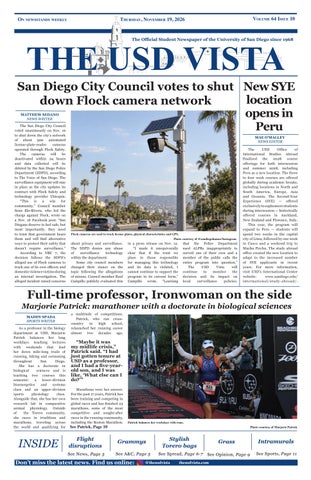
Flock cameras are used to track license plates, physical characteristics and GPS. Photo courtesy of @sandiegohumor/Instagram
about privacy and surveillance. The SDPD denies any abuse of surveillance technology within the department. Some city council members changed their stance on the topic following the allegations of misuse. Council member Raul Campillo publicly evaluated this
in a press release on Nov. 12. “I made it unequivocally clear that if the trust we place in those responsible for managing this technology and its data is violated, I cannot continue to support the program in its current form,” Campillo wrote. “Learning
that the Police Department used ALPRs inappropriately to surveil one of their own and a member of the public calls the entire program into question.” The USD Vista will continue to monitor the decision and its impact on local surveillance policies.
The USD Office of International Studies Abroad finalized the 2028 course offerings for both intersession and summer 2028, including Peru as a new location. The three to four week courses are offered globally during academic breaks, including locations in North and South America, Europe, Asia and Oceania. The Second-Year Experience (SYE) — offered exclusively to sophomore students during intersession — historically offered courses in Auckland, New Zealand and Florence, Italy. This year, the program will expand to Peru — students will spend two weeks in the capital city of Lima, followed by one week in Cusco and a weekend trip to Machu Picchu. The study abroad office created the new location to adapt to the increased number of SYE applicants in recent years. For more information, visit USD’s International Center website: www.sandiego.edu/ international/study-abroad/.
Full-time professor, Ironwoman on the side
Marjorie Patrick: marathoner with a doctorate in biological sciences MADDY SPADA SPORTS WRITER As a professor in the biology department at USD, Marjorie Patrick balances her long workdays teaching lectures with weekends that lead her down mile-long trails of running, biking and swimming throughout San Diego. She has a doctorate in biological sciences and is teaching two courses this semester: a lower-division bioenergetics and systems class and an upper-division sports physiology class. Alongside that, she has her own research lab in comparative animal physiology. Outside of the Torero community, she races in triathlons and marathons, traveling across the world and qualifying for
INSIDE
a multitude of competitions. Patrick, who ran crosscountry in high school, relaunched her running career almost two decades ago.
“Maybe it was my midlife crisis,” Patrick said. “I had just gotten tenure at USD as a professor, and I had a five-yearold son, and I was like, ‘What else can I do?’” Marathons were her answer. For the past 17 years, Patrick has been training and competing in global races and has finished 23 marathons, some of the most competitive and sought-after races in the running community, including the Boston Marathon.
See Patrick, Page 10
Patrick balances her workdays with runs.
Photo courtesy of Marjorie Patrick
Flight disruptions
Grammys
Stylish Torero bags
Grass
Intramurals
See News, Page 3
See A&C, Page 5
See Spread, Page 6-7
See Opinion, Page 9
See Sports, Page 11
Don’t miss the latest news. Find us online:
@theusdvista
theusdvista.com
2
The USD Vista
•
November 19, 2026
NEWS
Flocking away from ‘Flock’ San Diego considers ending its contract with ALPR EDITOR’S NOTE: This article was written prior to the San Diego City Council vote on Nov. 16 and has not been altered to reflect subsequent developments. Read alongside the front page for up-to-date information. MACKENZIE SMITH ARTS & CULTURE WRITER San Diego has installed more than 500 Flock Safety cameras since approving them in November 2023. Just off campus in the Linda Vista neighborhood, more than thirteen ALPR cameras have been reported. Automated License Plate Reader (ALPR) cameras operate in 49 states, with the most cameras reported in California, followed by Texas and Georgia, according to Map Atlas. Flock advertises its devices as tools to prevent and monitor crime. The recent influx of Flock cameras has ignited conversations surrounding U.S. citizens’ constitutional rights and mass surveillance. USD sociology professor Cid Martinez received a doctorate degree from the University of California, Berkeley and was appointed to San Diego’s Privacy Advisory Board in 2022. The Privacy Advisory Board acts as a citizen-led advisory body to the Mayor and City Council on policies and transparency related to the city’s acquisition and use of surveillance technology. “It’s one thing to have a camera or an officer posted outside of your home, but when you create a network of cameras that have this technology, you’ve gone from observing someone to creating a network in space and time where now… you’re tracking people,” Martinez said. The Fourth Amendment protects people from unwarranted searches and seizures, and the right to privacy protects individuals from unwarranted intrusion into their personal lives. The cameras reportedly allow police officers and private owners, such as malls and homeowner associations, to see closely into personal parts of people’s lives: where they live, where they go. In Oklahoma, this tracking has the potential to violate an individual’s Fourth
Flock cameras were first installed in San Diego in November 2023.
Amendment rights, according to United States v. Kyle. The cameras automatically log the make, model and license plate of every car that passes, also recording the current time. Other identifiers such as bike racks and dents are noted, according to Flock Safety. The cameras record information to build a searchable database of each vehicle’s movement throughout a city. The data is said to potentially reveal private details, including the locations of workplaces, medical offices and homes, according to the American Civil Liberties Union of Oregon. USD sophomore Emma Carson sees the value in security but worries Flock cameras go too far. “I think we should have some sort of security system, but I don’t think it should track your every move,” Carson said. “It shouldn’t know everything about you; it shouldn’t know where you live, who you are. I feel like there has to be limits to it.” Martinez feels similarly and hopes for the enforcement of additional
regulations on the devices. “Right now there’s no state policy so it really depends on how each city provides oversight,” Martinez said. “If we’re going to use this technology, it should be overseen and democratically controlled, and that’s not what was happening in San Diego.” In 2022, the San Diego City Council approved the Surveillance Oversight Ordinance requiring public disclosure, impact reports and City Council approval for law enforcement surveillance tools. However, in 2024, the City Council voted to roll back major provisions that exempt various police databases and internal monitoring tools from strict oversight. This repealed many of the legal and operational guardrails that were in place to prevent unauthorized use of ALPR surveillance networks. Public pushback against Flock and other license plate reader cameras is prompting bans in communities nationwide. Santa Cruz became the first California city to cancel its Flock contract in January 2026, and other California
Photo courtesy @sandiegoville/Instagram
cities followed. Similarly, some states have begun to regulate the cameras. This past August, Florida banned ALPR cameras on all state highways and other state-maintained roads. In July 2027, Vermont will become the first state to enact a full statewide ban on all ALPR cameras, while other states such as New Hampshire and Connecticut have strict regulations. New Hampshire mandates the immediate deletion of non-match data, and Connecticut banned the use or sharing of ALPR data for suspected immigration violations or to assist federal immigration enforcement. “I think Flock cameras are kind of stupid in general because they are doing automated work that should be done by a human,” USD junior Aaron Hernandez said. “Especially the fact that they can mess up.” In February, a Flock camera in Sherwood, Arkansas, misread the license plate of an SUV, leading officers to detain an innocent couple while their six-week-old baby sat alone in the back of the vehicle. An Institute for Justice
The USD Vista
Riley Rains - Editor-in-Chief Calla Jordan - Associate Editor Sophie Hummel - Managing Editor Amelie Sedlack - Copy Editor Mae O’Malley - News Editor Julianna Flores - Feature Editor Cristina Trice - Arts & Culture Editor Pratinya Bodanapu - Opinion Editor Katt Harding - Sports Editor
Kyra Lefebvre - Art Director Emma O’Connell - Photo Editor Lucas Meza Ehlert - Distribution Manager Ella Fitzpatrick - Social Media Manager Sasha Sepatjian - Director of Finance Nina Dameri - Advertising Manager Dr. Byron Howlett - Operations Advisor Blake Nelson - Student Media Advisor
review of media reports and court records finds there have been at least 27 similar cases since 2018, with the majority of those happening since 2023. On Oct. 21, the San Diego City Council’s Budget and Government Efficiency Committee voted to end its contract with Flock Safety. Councilman Stephen Whitburn, who had voted multiple times in favor of the Flock contract and ALPR technology, changed his vote and went against the Flock cameras. “Until now, I have voted in favor of the cameras as a matter of public safety,” he told San Diego NBC 7. “They have helped solve crimes, and I believe our police department uses them responsibly. The Trump administration and ICE and their un-American, anti-immigrant brutality have created a police state in many of our communities. Many people worry Flock cameras are being used in that crackdown.” Whitburn’s decision has paved the way for a ban in San Diego. However, ending San Diego’s Flock contract requires a full City Council vote. Without a three-vote majority, Mayor Todd Gloria is likely to veto the resolution. “Elected leaders shouldn’t be making life easier for criminals,” Gloria told NBC 7 San Diego. “We should be making it easier for our constituents. That’s why I urge the full City Council to preserve this important public safety tool and allow the established oversight process to work.” San Diego’s fresh look at Flock and ALPR cameras comes as the city fights a lawsuit against the Partnership for the Advancement of New Americans and the American Civil Liberties Union of San Diego. The lawsuit claims that using ALPR surveillance and sharing ALPR data with law enforcement agencies outside California violates the California Constitution. For more information on Flock cameras, visit flocksafety.com.
The USD Vista publication is written and edited by USD students and funded by revenues generated by advertising and a student fee. Advertising material published is for information purposes only and is not to be construed as an expressed or implied endorsement or verification of such commercial venues by the staff or University. The USD Vista office is located on the fourth floor of the Student Life Pavilion in room 403B.
Editorial – 619.260.4584 Business – 619.260.4714 www.theusdvista.com / @TheUSDVista
All inquiries should be sent to: The USD Vista 5998 Alcala Park San Diego, CA 92110 Opinions expressed in this publication are not necessarily those of The USD Vista staff, the University of San Diego or of its student body. Letters to the Editor can be submitted to The USD Vista office. Letters should be limited to 300 words and must be signed. For identification purposes, USD identification numbers and writer’s year must be included in the letter. The USD Vista reserves the right to edit published letters. Any content sent to the editor will be considered for publication unless otherwise stated.
Volume 64 Issue 10
•
NEWS
•
The USD Vista
FAA shutdown grounds flights nationwide Thousands of flights canceled and delayed
MATTHEW SEDANO NEWS WRITER The Federal Aviation Administration (FAA) ordered airlines to stop all departures on Friday, Nov. 13, due to telecommunication challenges with air traffic control centers, resulting in a nationwide flight grounding that impacted air travel across the country. The hold was the third nationwide ground stop in U.S. history. The first air travel freeze occurred during the Sept. 11 attacks and the second occurred in January 2023, following an FAA computer system malfunction. Flights already in the air at the time the grounding commenced landed safely. The disruption impacted every airport nationwide, leaving travelers with delays, cancellations and anxiety about travel plans. USD sophomore Everett Feldman intended to travel to Seattle from the San Diego International Airport on Friday. Feldman arrived at the airport around 1:30 p.m. on Friday, only to have the scheduled 2:48 p.m. departure delayed several times. The flight was finally canceled around 10 p.m. that night. He considered other routes but decided to stay in San Diego
after the airline provided an itinerary that would have taken him to Seattle late Saturday evening, only one day before the scheduled return flight. Senior and station manager of USD TV, Alexa Kreider, expected a visitor the weekend the outage occurred. “My boyfriend was coming in on Friday,” Kreider said. “His flight was supposed to take off around 2:30. Right as he was about to leave… The outage happened and I got the alert on my phone and I was like, ‘are you kidding me?’” The FAA grounded flights as a precaution to prioritize passenger safety until officials recognized the problem and restored the systems. The FAA lifted the nationwide ground stop on the evening of Nov. 13, more than four hours after the freeze. However, the end of the grounding did not mean the end of chaos. Feldman shared that he tried to contact his airline but was not met with convenience. “I hopped on the phone with Alaska [Airlines] and they told me that my wait time for someone to pick up was six hours and 20 minutes,” Feldman said. Kreider and her boyfriend attempted to speak inperson with customer service to reschedule his flight.
“The representatives sitting at the desk, they have that huge line, people asking questions, wanting to reschedule and then they fully left at one point,” Kreider said. “It was a zoo of people. And no one there.” Secretary of Homeland Security Markwayne Mullin stated at a White House press conference on Friday that there was no evidence a cyberattack caused the outage. During a press conference on Nov. 14, Secretary of Transportation Sean Duffy said that routine maintenance at a remote FAA site caused the outage. A contractor was transitioning telecommunications connections from copper to fiber when a router started overloading the system with connection requests, affecting aircraft communications and radar feeds. “We had over 1,000 connection attempts every four to five seconds,” Duffy said. “What that did was give us issues with our communication with airplanes and it also caused some disruption with our radar feeds.” Duffy stated that officials had yet to determine whether the problem was caused by contractor mistake or malfunctioning equipment at the time the breakdown occurred. The telecommunications breakdown impacted the country’s 22
regional air traffic control centers. The incident highlights how delays in the nation’s air traffic control system can affect travelers well beyond the airports where technical problems occur. Beyond Feldman, other passengers experienced affected flights and itineraries of their own. “I would talk to this one guy, and he was officiating his best friend’s wedding,” Feldman said. “He couldn’t make it.” As delays grew, crowds of passengers gathered around airport flight boards to watch as more and more flights were pushed back or canceled, according to Feldman. The grounding’s repercussions lasted into the weekend as airlines rushed to reorganize flights and workers and to resume standard scheduling. Airline operators and major airlines canceled over 12,000 flights on Friday, according to the FAA. Crew and aircraft issues caused more cancellations in the following days, totaling almost 28,000 canceled flights by Sunday. By Monday, problems had decreased dramatically as airlines began to recover. With Thanksgiving travel approaching, the FAA warned that a return to regular operations would be gradual, forcing airlines to continue working through difficulties.
Flights at San Diego International Airport were canceled and delayed on Nov. 13. Photo courtesy of Marcella Woo
Search process begins
3
MAE O’MALLEY NEWS EDITOR On Sept. 29, President James T. Harris III announced his plans to step down in 2027, following a 13year tenure as USD’s president. The Board of Trustees — established university members charged with advising the university’s interests — began the search by hiring a search firm and developing a search committee consisting of USD faculty, professors and students to hire Harris’ successor. A week after Harris’ announcement, Virginia C. Nelson, chair of the Board of Trustees, sent an email to the USD community indicating next steps in the hiring process. On Nov. 11, Nelson and Donald R. Knauss, of Knauss School of Business, sent a follow-up email including additional information on how the search process will progress. The notification also announced Knauss as search committee chair. The Board of Trustees hired AGB Search, an executive search firm, to locate candidates nationwide for the search committee to then assess during interviews. The firm previously appointed multiple administrators in collaboration with USD, including Harris and Provost James Antony. By recommendation of AGB, the search committee consists of 10 individuals. The university will host two Zoom forums for community members to share their vision for the future. A campus community listening session will be held on Nov. 18 and is open to all USD students, faculty and staff. A listening session strictly for faculty will be held on Nov. 19. There is also a survey link available to all USD community members who would like to share their hopes for the next university president. The survey must be completed by Dec. 6. Determining candidates is the first phase of the search process and is expected to launch in January 2027. The search committee will then begin the evaluation of candidates in early February. The committee anticipates a candidate will be selected by May 2027. Harris agreed to stay in his position until the role is filled.
PUB LI C SA FET Y REP O R T Nov. 15 Location: Manchester Village Apartments - North Parking Lot Incident class: Possession of Fake ID At 11:01 a.m. a person reported possession of a fake ID to Public Safety. The incident occurred between 11:01 a.m. and 11:08 a.m. on Nov. 15. Public Safety made a conduct referral.
Nov. 16 Location: Jenny Craig Pavilion Incident class: Theft At 12:52 p.m. a person reported an electric scooter theft to Public Safety. The incident occurred between 7 p.m. and 7:30 p.m. on Nov. 13. The case was referred to local law enforcement.
EDITOR’S NOTE: To view USD’s Daily Crime and Fire Log, visit the Department of Public Safety website.
4
•
Volume 64 Issue 10
The USD Vista
ARTS & CULTURE Out with the old, in with the… old? ‘Glee’ joins a growing list of reboots
MACKENZIE SMITH ARTS & CULTURE WRITER For six seasons from 2009 to 2015, writer and director Ryan Murphy helped bring “Glee” to life. The musical dramedy covered everything from fake pregnancies to a grilled cheese that looked like Jesus. Now, more than a decade after the show’s ending, Murphy is preparing for a McKinley High reunion. On Oct. 21, Hulu and Disney+ officially announced a “Glee” reboot. Murphy has been hinting at a potential reboot for a while and gave a preliminary nod to the series this past September. “I just finished the script an hour ago,” Murphy told Entertainment Tonight on Sept. 23. “We have a script [that] Brad [Falchuk], Ian [Brannan] and I, who wrote all the first two seasons, have written.” Long-time fan of “Glee” and USD sophomore Max Andreski discussed his opinions on the new reboot. “I’m a little bit terrified,” Andreski said. “I think the whole internet is terrified. It’s a new era so it’s gonna be ‘Glee’ but with songs from [the years] ‘25, ‘24, ‘23 … I think the biggest thing is: can the music be the same? … can we reach the same highs both story-wise and music-wise?” USD sophomore Abby Hill
plans to watch the reboot because of her familiarity with the original series. “I’m just very interested to see how well it’s going to do,” Hill shared. “I think the original ‘Glee’ fanbase will be there to watch it no matter what. I’m just curious to see whether it’s going to take off with the rest of the population.” The “Glee” reboot joins the growing list of familiar television and film franchises that are being revisited. “Baywatch,” which originally premiered in 1989, is set to return in January 2027 with a new generation of lifeguards and a largely new cast. Similarly, “Elle,” a prequel to “Legally Blonde,” premiered on Amazon Prime Video on July 1. Many reboots and revivals target audiences who watched the original shows. Disney+ and Nickelodeon are among the main culprits, rebooting many of their older shows, such as “That’s So Raven,” “Freaky Friday,” “iCarly” and “Wizards of Waverly Place.” Most recent is the “Victorious” spin-off and the revival of “Camp Rock.” Both shows have garnered internet attention using nostalgic advertising. These new sequels bring back original cast members and reference jokes from the original series to appeal to viewers. USD junior Bently
SHY BROWN GAMES EDITOR
Scott claims reboots aren’t always successful. “We’ve seen with ‘Victorious’ and ‘iCarly’ they’re not as good,” Scott argued. “The writers just lost a lot of the plot and the essence and the nostalgia of it. I feel like sometimes when you reboot [older shows] you lose the beauty of what was once there.” One of the main challenges reboots face is living up to the legacy of the original. With a new “Harry Potter” series and another “Hunger Games” movie on the horizon, studios can count on audiences tuning in because these projects are connected to already successful franchises. Even Netflix’s “Stranger Things” announced a prequel series on Nov. 6, less than a year after the original story ended. “Stranger Things” is one of Netflix’s most watched series, totaling 1.2 billion views across all five seasons and 10 years of the show’s run. USD senior Ella ConnellySmith is a long-time fan of “Stranger Things.” “It’s hard because it’s such an iconic show and having a prequel can either add to it or it might not even be relevant at all,” Connelly-Smith said. “I think [the prequel is] just another way of keeping the show relevant just because it was so big for Netflix.” The “Glee” reboot is simply
Ryan Murphy’s ‘Glee’ reboot is set to star some original cast members. Photo courtesy of @voguesingapore/Instagram
another show on the growing list of reboots and spin-offs that have viewers’ interests peaked. These revivals remain popular, many of which capitalize on audiences’ nostalgia and familiarity with beloved stories and characters.
November! Crossword theme: Fall is here
Whether through remakes of long-running series, or sequels and prequels that expand upon worlds viewers already know, studios have long recognized both the financial and emotional value of revisiting established franchises.
Scan For Answers 1
Across 2. One of the birthstones of three down
2 3 4
6. A November meteor shower
5
6
7
4. It’s ___ weather! 8. Jack ___
8
9. A lumberjack might wear this 10. Something “saved” until the first Saturday in November
9
10
11. Fall, in London 12. If only we could skip the cold months entirely...
11
Down: . Honorees of an 11/11 parade
12
13
Down 1. Those honored on 11/11 3. The astrological sign of Mars 5. Something that may grow during no shave November 7. November, numerically 13. Something that’s cast in a booth
Across: 2. The gem of 3 down
Volume 64 Issue 10
•
ARTS & CULTURE
•
The USD Vista
Fan favorites fight for Grammy glory
5
Toreros review the 2027 Grammy nominations
SAVANNAH HARLAN ARTS & CULTURE WRITER On Nov. 16, the Recording Academy announced the nominations for the 69th Annual Grammy Awards. The Big Four categories, Album of the Year, Record of the Year, Song of the Year and Best New Artist typically amass substantial public attention before the ceremony. This year was no exception. Pre-nomination predictions USD sophomore Hina Kristnik watches the Grammys every year. She predicts that the ceremony in February will heavily award Olivia Rodrigo. “Olivia Rodrigo’s album will definitely get nominated, and I think it will win Album of the Year,” Kristnik stated. “I feel like it represents teen girlhood so well and is very relatable … it also had a big cultural impact through social media.” Rodrigo’s third studio album, “you seem pretty sad for a girl so in love,” is also her third nomination in the Album of the Year category. Her debut album “SOUR” and sophomore album “GUTS” scored nominations in 2022 and 2024, respectively. Grammy nominations often come with upsets and surprises. USD senior Anthony Almaraz hopes to see some previously absent artists make a comeback in major categories, particularly Ariana Grande, who has not been nominated in the Big Four since 2020. Almaraz shared his predictions for nominations before they were released. “I think [Grande’s] newest album ‘petal’ will get nominated,” Almaraz predicted. “I also hope that Charli xcx’s ‘Music, Fashion, Film’ makes it in.”
USD sophomore Emerson Hauber hoped the Grammys would nominate voices that have historically been left out, such as artists like Rosalía, whose hit album “LUX” was recorded entirely in Spanish. The Grammys have a history of excluding non-English speakers, previously leaving the artists out of major nominations and confining them to categories like B e s t
Música U r b a n a . “I think Rosalía’s work this year was really important,” Hauber shared. “If she gets nominated, it would be a huge achievement for Latina and Spanishspeaking musicians.” Despite being known as “Music’s Biggest Night,” the Grammys are often accused of unfair voting practices and biases. Grammy voting is a multi-step process, handled exclusively by active music creators and professionals who make up the Recording Academy. Record labels and artists must submit eligible recordings and music videos released during the year-long eligibility period. “The Grammys are all about how you promote yourself,” Almaraz stated. “[The Recording
Academy] doesn’t always get it right. For example, in 2023 they gave [Album of the Year] to Harry Styles when Beyoncé had much more of a cultural impact.” Hauber shared her thoughts on who should be nominated for Record of the Year. “I would love to see Noah Kahan nominated for Record of the Year
Art by Kyra Lefebvre
for ‘The Great Divide’ or ‘Orbiter,’” Hauber shared. “Both songs are so well written, and I feel like everyone was listening to them.” Kahan was previously nominated in the Big Four for Best New Artist in 2024, which he ultimately lost to Victoria Monét. Post-nomination reactions The nominations for Album of the Year include “Lost Weekend”
by Phoebe Bridgers, “The Art of Loving” by Olivia Dean, “Dandelion” by Ella Langley, “The Romantic” by Bruno Mars, “The Music May Contain Hope” by Raye, “you seem pretty sad for a girl so in love” by Olivia Rodrigo, “LUX” by Rosalía and “The Life of a Showgirl” by Taylor Swift. Hauber shared her thoughts on these results. “I’m definitely pleasantly surprised about the Phoebe
Bridgers nomination, but not at all surprised about Taylor Swift or Olivia Dean,” Hauber wrote. “I’m shocked that there is only one male singer in the Album of the Year n o m i n a t i o n s . ” The female-dominated results on Nov. 16 came as a shock to many music fans, stirring both positive and negative commentary online. Notably absent male artists include Noah Kahan and Harry Styles. The categories of Record of the Year, Song of the Year and Best New Artist were also female dominated. Raye leads the pack with 11 nominations overall, closely followed by Rosalía with nine. Phoebe Bridgers, Miranda Lambert, Ella Langley and Olivia Rodrigo tied for third overall with seven nominations. While debate over the Big Four nominations occurred, some of the biggest controversies arose from genre-specific categories. Specifically, the newly introduced Best Asian Pop Music Performance
sparked accusations of racial segregation from fans online. This comes after a string of boycotts from major K-pop acts like BTS and Stray Kids, who chose not to submit their music over the category. Kristnik agreed that the separation of Asian artists was particularly unusual. “The fact that Asian artists [and] other minority artists are often segregated into a different category is odd,” Kristnik wrote. “I think they should just be put into pop performance categories instead of being separated.” Debate over dance and electronic categories also heated up when DJ John Summit took to X to share his thoughts on the nominations. “[N]ever submitting to the Grammys again,” Summit wrote. “[I]’m not just talking about myself either there’s zero respect for real electronic dance music...” Artists nominated in the Best Dance/Electronic Category include Fred Again, Madonna, Slayyyter, Tame Impala, Tinashe and Underscores. Almaraz shared his thoughts on Summit’s comments. “I thought it was so funny that John Summit was throwing a fit about not being nominated when there were so many female nominees that had to work their way up in the [music] industry,” Almaraz added. The Hollywood Reporter predicts that the biggest winners of the night will be a tight race between the Olivia’s: Rodrigo and Dean. Billboard projects that newcomer Ella Langley could also have a successful night following the historic run of “Choosin’ Texas,” which is now the longest-running No. 1 hit in the chart’s history. The 69th Annual Grammy Awards will take place in Los Angeles on Sunday, Feb. 7.
‘Falling’ into new traditions
Hot autumn weather leads to new fall activities CRISTINA TRICE ARTS & CULTURE EDITOR MICHELLE AGUILAR ARTS & CULTURE WRITER USD senior Sydney Mason, a Boston native, was familiar with a fall season where the leaves changed colors, temperatures dropped and she could comfortably wear a sweater outside. After moving across the country to sunny San Diego for college, the fall that she knew and loved started to look a lot different. A season once filled with apple picking, carnivals and fall foliage was replaced with tank tops, beach days and iced coffees. “Fall where I’m from compares to fall here at USD as night and day,” Mason said. “My parents literally shipped me leaves [from Boston] and apple cider donuts because I missed it. People [in San Diego] are more outdoorsy because it’s so nice out all the time.”
This year’s fall is especially unique, as the city prepares for a historic El Niño. With this weather phenomenon comes higher-than-typical temperatures, strong winds and stormy weather. These changes took many San Diegans by surprise, turning the mild warmth many know and love, into a sweaty and sweltering reality. “With temperatures approaching 90 degrees in some areas, San Diego is experiencing an unusual stretch of autumn heat, making it one of the hottest places in the country,” NBC 7 San Diego reported. According to data from the National Weather Service, the typical San Diego climate between the months of September and November ranges from high 70s to low 60s, with nightly lows in the high 50s. With some recent days crossing over 100 degrees, many San Diegans find themselves seeking a cold treat instead of a pumpkin spice latte or hot cocoa. For
some Toreros who are far from their hometowns, these hot fall months are difficult to adjust to. “Right now, I can’t conceptualize that it’s almost Thanksgiving because I conceptualize time passing with it getting colder outside and having less daylight,” Mason shared. “It’s kind of an adjustment to come to California where it’s the same weather everyday because [changing weather] was such a big part of my life growing up.” USD senior Megan Yost moved to San Diego from Memphis, Tennessee. She shared her experience of fall in both places. “I prefer a chilly fall where the leaves turn red but I also really cherish the time I have here in Southern California,” Yost said. “[I] would never want to take the warmth here for granted. We really have it good, and I love both.” Yost didn’t partake in many typical fall activities at home, but finds herself
seeking them out in California. “I’m overcompensating here,” Yost shared. “[I want] to find crunchy leaves and go apple picking. I have fall outside of my bedroom window [at home] but here, I switch over to someone who wants to do fall things because I don’t see it.” For some Toreros, this year’s fall heat wave isn’t all that different from their hometown. “I was born and raised in Saipan [Northern Mariana Islands] where fall was not a season,” USD senior Gerald Deleon Guerrero shared. “Fall in San Diego has been somewhat similar in a sense that the sun is always shining and we have some days where rain seems to appear. In a way, it feels a little like home.” USD sophomore Sienna Dhariwal grew up in Minneapolis, Minnesota and shared how she celebrates fall in San Diego. “Here, I just go swimming,” Dhariwal shared. “The biggest fall activity I’ve done is [going
in] the ocean. It’s crazy that in November we’re able to go swimming … [my hometown friends] don’t really go outside that much, versus I see myself outside just spending time [here] and mostly doing work outside.” Despite the warm weather, Dhariwal still manages to find ways to indulge in some typical fall festivities. “I wanted to see the leaves change so badly so I went to Julian and tried it and just walked around,” Dhariwal recalled. “Last year, I did not seek [fall activities] at all. I was so happy to be in summer [weather] but I started wanting a breakup in patterns and things that people do [that wasn’t] beach beach beach every single day.” From forming new autumn traditions in the heat, or taking the time to enjoy the sunshine before returning to their hometowns, Toreros keep finding ways to make the city their home.
6
The USD Vista
•
November 19, 2026
Toreros pack w
Accessories offer students everywhere a wa purses to tote bags, students can be found spru of styles, colors and personal touches. Read
esy of Rowan D court ool oto ey Ph
Vintage ha n d bag
urtesy of Isabelle to co To Pho
N ot
tin g H
ill s h o p p i n g
bag
“A little pop of color or funkiness in a bag is perfect because sometimes I’m too lazy to throw on a good outfit. If I have my cute bag I don't really need to try because it still is super fun and shows your personality.” Rowan Dooley, sophomore
“I got this tote bag while spending the day in London. I study abroad in Madrid and love using it for shopping, groceries and running errands.” Isabelle To, junior
eman/The USD V y Fre ista Abb
tesy of Marquel Ga cour rdn oto er Ph
N oir v
ere so ho tote
“The star necklace reminds me of my friend, who has a matching one on his tote bag. He goes to [Cal Poly] Pomona, while I go here, so it kind of bonds us. I didn’t use the bag much when I first got it, but after adding these personal touches, I bring it with me wherever I travel.” Grecia Santillan, first-year
Iris b a g
“My favorite right now is called the Iris bag, which I picked up abroad. It’s from Silfen Studio, a Danish brand. It comes with two straps so I can wear it on the shoulder or as a crossbody, which works great for any vibe I want to go for in the moment.” Marquel Gardner, senior
“I lov knick good keych This memo the to
Aly
Volume 64 Issue 10
•
FEATURE
•
The USD Vista
7
with personality
ay to express themselves. From backpacks to ucing up the USD campus with bags in all kinds to see students' personalized bags for class.
eman/The USD V y Fre ista Abb
Love
vook backpack
ve to decorate bags with little k-knacks and things that are memories. I have a bunch of hains from trips I’ve gone on. s Hollywood chain is a good ory because it reminds me of e trip my dad and I went on ogether for my eighteenth birthday.” yssa Beauchene, first-year
Vista: Content by Abby Free he USD man T / e r and bv e f Julia e aL r Hu y K rta y b do t Ar
8
The USD Vista
•
November 19, 2026
OPINION
A blue wave or a blue facade?
Why a ‘blue wave’ doesn’t necessarily mean an ideological shift KENDALL EMTMAN NEWS WRITER On Nov. 3, Americans witnessed what many have called a “blue wave” or even a “blue tsunami” in the midterm elections. Across multiple races, Democrats made sweeping, and to some extent, unexpected gains. Many traditionally Republican states, including Iowa, Kansas and Texas saw previously Republican held congressional seats flip to Democratic candidates. This is a common phenomenon in midterm elections, and is often indicative of Americans’ views toward the current presidential administration. But it does not necessarily mean that the country is headed in a more progressive direction. USD professor Evan Crawford has a doctorate in political science and teaches upper and lower division classes on American politics. Crawford explained that it is typical for the president’s party to lose seats during midterms, often due to general dissatisfaction with the administration’s policies. “We would expect [Republicans] to lose seats,” Crawford said. “The expectation was that Democrats would win the House and win the Senate, but what was maybe unexpected was the magnitude.” The scale of the Democratic party’s gains in the midterms goes further than a response to poor economic conditions — which historically, have contributed to major losses in a president’s party — or the simple fact that the Trump administration is deeply unpopular. Ultimately, the blue wave was a combination of factors that political scientists cannot yet fully explain.
However, these substantial gains made by the Democratic Party do not mean that there has been an ideological shift among voters. In fact, a somewhat contrary trend emerged in the decisions made on ballot measures. Voters in newly flipped or traditionally Democratic states seem to have favored Democratic candidates for political representation. However, decisions on certain ballot measures reflected more conservative
Democrats saw a sweeping victory in the 2026 midterm elections.
positions, particularly in terms of social issues. Crawford explained that historically, results like these aren’t that surprising. “If you look at prior elections, we have a long history, state by state, where blue states will simultaneously vote for Democratic candidates and then either vote down what would be considered a liberal measure or vote in what would be considered a conservative measure,” Crawford said. “Voters are fickle this way, but it’s normal actually.” One of the most glaring contradictions was demonstrated in several states where voters were presented with ballot measures concerning transgender participation in school sports. Arizona flipped blue in the midterms, but its Proposition 318, “Require All Schools and Athletic Associations to Restrict Sports Participation and Access to Private Spaces Based on Sex,” was approved by voters. Similarly, in Washington, a traditionally democratic state,
Initiative 638 “Sex Verification Requirements for Female School Sports,” was voted in. Both of these measures define athletic eligibility based on biological sex rather than gender identity. Lucia Laniecki, a USD junior majoring in political science, explained some of the factors she thinks might have played a role in more conservative measures being voted in. “I think it’s maybe a result of two things,” Laniecki said. “It’s largely a result of the majority of the population still being pretty moderate … Secondly, an indication of this rhetoric that this administration has been pushing. There’s been so much fearmongering surrounding trans athletes in sports, when the numbers of actual trans athletes is minuscule, this is not an issue that, in reality, is as detrimental as the administration is pushing.” Beyond historical trends, the current administration’s rhetoric is perhaps the reason we see contradicting behavior from voters, and why
Photo courtesy of @nytimes/Instagram
this behavior seems antithetical to the “blue wave” label this election has been given. “I think it does go to show that even though there was this pushback from the general population, the rhetoric and the words that this administration is putting out there, they do really have an impact,” Laniecki said. “It also means a lot coming from the highest office in the country, so it’s disappointing and somewhat scary to know that it has such an impact.” These trends comment on the longevity of democratic gains. If voters supported Democratic candidates primarily to express opposition toward the current administration — rather than out of a broader ideological shift — it becomes more difficult to say whether this support will carry over into the 2028 presidential election, especially if voters remain influenced by the rhetoric employed by the administration and Republican party more broadly. Angela Gomez, a USD junior majoring in international
relations, believes these trends might impact the kind of movement we see in the legislative branch over the next two years. “I don’t think we’re going to see as much progress as people think,” Gomez said. “But I hope that for the presidential election, people stay consistent in their votes. Progress can only be made through consistency.”
Ultimately, the results from the midterm election have demonstrated that party affiliation and voter turnout alone are not enough to indicate a shift toward more progressive ideology among voters. As the country heads into the 2028 election cycle, the question remains whether the blue wave may indicate a temporary reaction to the current administration or a broader shift in terms of progressive ideology.
The views expressed in the editorial and op-ed sections are not necessarily those of The USD Vista staff, the University of San Diego or its student body.
Volume 64 Issue 10
•
OPINION
•
The USD Vista
9
Stop touching grass
Stand up to the societal pressure of lawns AMELIE SEDLACK COPY EDITOR A picture of the “American Dream” is a house behind a white picket fence with a sprawling green lawn. This ideal has seeped into every aspect of life, so much so that we have even turned to a plastic alternative just to prove we have achieved the American Dream. Rather than growing non-native grasses that require so much maintenance as they never evolved to survive on their own in California’s climate, we should cultivate native plants to restore the beauty of California and support native wildlife. A couple summers ago, my mom and I decided to plant a garden. In the bare spots, we planted ground covers. At the time, they were small, and only took up about 2 square inches each. After only a couple months, the ground cover had spread over all the bare soil. We began to see butterflies, moths, hummingbirds, rollypollies and even beetles any time we went outside. While our native plants thrived, our lawn died. My parents had to replace the same bare patch of lawn every year after winter. I saw the difference between a native plant and a non-native species i n
real-time, and the effects those plants had on nature. Think back to movies like “Pride and Prejudice.” Remember the sprawling lawns that took up much of the land of those estates? Back in the seventeenth and eighteenth centuries, according to the National Wildlife Federation, grass, hedges and especially large lawns were signs of wealth. Those who were poorer lived in the packed cities often without even a tree by the road. The image of lawns became an aspiration for those who did not have their own space, let alone a yard. Today, the ideal of a home with a lawn is still present in our society; yet, it is counterintuitive with the current state of California. It is no longer realistic to care for a lawn that drinks up more water than California can provide. California receives much of its water from places such as Colorado, raising the question of whether such a limited
resource should be used to meet societal standards. “Lawn watering consumes nearly half of the water used by most homes during the warmest months of the year,” the Monte Vista Water District website reads. Native plants know the climate and have evolved to survive through the lack of water. Plants native to San Diego are also able to withstand the floods common throughout the winter months here. Native ground covers are perfect replacements for grass as they generally only grow 1 to 3 inches off the ground, meaning no need to mow. While occasional watering is still necessary for native plants, it is nothing like the 1 to 2 inches of water that common grasses require weekly. Landscaping companies, such as LawnStarter and Lawn Love, advertise grasses such as Bermudagrass, St. Augustinegrass and tall fescue as possible lawn options. Their maintenance levels range from low to high, as well as their susceptibility to diseases. Still, they require more watering than native plants. Many ground covers even flower, including silver carpet aster, providing pollinators with more flowers to harvest nectar from. Although I enjoy the look of ground covers more than grass, California still has many different species of native grasses to choose from, including tufted hairgrass and California oatgrass. Lawns are known as “biodiversity deserts” because frequent mowing kills off native
bugs and plants, which are considered weeds — making lawns unable to
contribute to any ecosystems. Out in nature, diverse species grow alongside one another: vines growing up trees, roots intermingling, stems entwining. In our yards, there is simply grass. The biodiversity of the forests or hills or even the unkempt parking strip that was forgotten about years ago, is important to the bugs, the soil, the birds and the wildlife. While promoting this monoculture of grass, we are slowly killing off species. Even simply allowing “weeds” to grow alongside grass can help this monoculture become more. Remember: weeds are plants that are unwanted in their current location. “There are more than 1000 species of non-native plants present in California,” the University of California Agriculture of Natural Resources website reads. “The California Academy of Sciences estimates that 75% of the original habitat for native plants has been lost to non-native plants due to human activity.” Due to the urbanization and cultivation of land, California has already lost much of its native
plants, and both butterfly and bee populations are suffering. The milkweed plant, crucial to the lives of monarch butterflies, is less common now due to humans using its natural land for agriculture. The Monarch Joint Venture (MJV) is a national conservation nonprofit that is dedicated to protecting pollinators, such as monarch butterflies. “Female monarchs only lay eggs on milkweed plants since monarch caterpillars only eat milkweed,” the MJV website reads. “The milkweed plant provides both food and shelter for a caterpillar.” With the switch from grass lawns to hubs of biodiverse, native plants, we can help pollinators restore their numbers and begin to heal the environment from the harm humanity has done to it. California will be a much more beautiful place when we decide to display its natural splendor.
Art by Amelie Sedlack
The views expressed in the editorial and op-ed sections are not necessarily those of The USD Vista staff, the University of San Diego or its student body.
Have an opinion? We want to hear it! The Vista is now accepting essays from students, faculty, staff and community members about the issues that matter to them. If you’d like to submit an opinion piece between 400 and 800 words, please reach out to vistaeditor@sandiego.edu.
10
The USD Vista
•
November 19, 2026
The illusion of independent thought The disappearing art of having an opinion
PRATINYA BODANAPU OPINION EDITOR
We have never lived in a world with more opinions. At our fingertips lies an endless stream of commentary, criticism and arguments. Before breakfast, we learn what strangers think about the latest political controversy, which celebrities deserve criticism and what films are overrated. An opinion is available for everything, often before we have formed one ourselves. In a world where everyone has something to say, little of what we say actually belongs to us. Our thoughts are plagued by the barrage of opinions available to us online. Social media has democratized expression, giving ordinary people opportunities to share their thoughts with enormous audiences. However, it also transformed opinions into something consumed rather than constructed. Instead of reaching conclusions through logic, reflection and experience, we are presented with conclusions already packaged for audiences. Opinions should reflect individuals’ thinking. While social media makes knowledge accessible, more information does not necessarily translate to independent thoughts. When beliefs are adopted because they are popular or socially acceptable, the distinction between what we believe and what we have been told disappears. Historically, humans
Marjorie Patrick: Ironwoman From Patrick, Page 1
First-year Ellie Wittmann has been running for the past five years, both on her high school cross country team and now with the USD run club. “It’s really impressive, running marathons,” Wittmann commented. “As a runner myself, I could never imagine running for that long.” The Boston Marathon — the oldest consecutively held marathon in the world — has strict qualifying standards based on the runner’s age, gender and race time. According to RUN, only about 13% of experienced runners expect to qualify in their career. Patrick has qualified for the race five times. “It’s paid off,” Patrick said. “I’ve been on the podium one time and got to world champs. It’s just something I enjoy.” Patrick still
Independent thought is limited in today’s social climate. Art by Alicia Higuchi
SPORTS experiences nerves and uncertainty during races. “I always tell people I have a chicken in my head,” Patrick described. “‘Slow down, you can stop if you want.’ So it’s fighting that chicken. There’s been races where I beat that chicken, but there’s been races when the chicken has won.” After her 23-marathon-long streak, Patrick found herself signing up for triathlons, including the well-known Ironman. Ironmans come in half and full distances, with Ironmans 70.3 (or a halftriathlon) consisting of a 1.2mile swim, 56-mile bike ride and 13.1-mile run. Full Ironmans double each of those distances. The full Ironman championships take place in Kona, Hawaii, and the Ironman 70.3 championship location changes annually. It was held in St. George, Utah, the year Patrick qualified. First-year Anna Brice has been running since the third grade. “I do distance running,” Brice said. “I ran a halfmarathon over the summer.
It’s definitely a goal of mine to run a marathon some time.” Patrick created her own upper-division class in the biology department. In her class, students choose a sport and spend the semester learning how different physiological systems integrate. Enrollment consists of a variety of students, from student-athletes to engineers to pre-med students. Mark Chapman, a professor in integrated engineering with a doctorate in bioengineering, collaborated with Patrick to bring the class abroad. In summer 2024, the Karolinska Institute in Stockholm, Sweden, housed the class for the summer, where integrated sports physiology was taught to the study-abroad students. “To be able to teach a class that’s based in your passion, the students sense the enthusiasm that you have for it,” Patrick said. “That gets the students enthusiastic about it too. So, it’s a fantastic class to teach.” Patrick and Chapman plan to bring the course to Sweden once more in summer 2028. Patrick has no plans to halt her triathlon
have been influenced by those around them. In 1951, psychologist Solomon Asch began experiments analyzing group conformity. Participants were asked to identify which of three lines matched a reference line. When surrounded by people deliberately giving incorrect answers, many conformed to the group’s judgement despite otherwise clear evidence in front of them. Asch’s experiments demonstrated something unsettling: even when we can see the truth ourselves, the desire to agree with others can overpower our own judegment. Sometimes, all it takes is a comment section. Online, popularity is established through likes, shares and views. We can see which opinions receive approval and which provoke ridicule. The social consequences of disagreement are apparent before disagreement even occurs. There is nothing wrong with sharing opinions or changing our minds. Being open to disagreement is essential to intellectual growth. The problem arises when we agree without questioning why. Opinions are an important part of our individuality — they reflect our experiences and understanding of the world. When we allow others to determine what we think, we surrender part of our identity. Question popular beliefs, defend unpopular preferences and admit when you don’t know enough to have an opinion. With so many voices telling us what to believe, maybe it’s time to start thinking on our own.
Marjorie Patrick competed in the cycling portion of the Ironman. Photo courtesy of Marjorie Patrick
and marathon endeavors. “You got to find something that gets you outside doing something ... what’s really important is the community,” Patrick commented. “A lot of my close friends now, I’ve known because of marathoning or doing triathlons.” On Nov. 15, at Fiesta
Island — the birthplace of the triathlon in 1974 — Patrick got back onto her bike and raced the San Diego Bicycle Club time trial, representing the San Diego Triathlon Club. She hoped to beat her past time of 1:14:34.2, a second place finish earlier this fall.
Volume 64 Issue 10
•
SPORTS
•
11
The USD Vista
Intramurals bring competition and community Fall intramurals wrap up ROCCO PASQUINI SPORTS WRITER
The intramural sports season is wrapping up, leading to playoffs for many teams. Carson Waterman, a USD first-year and intramural soccer player, rarely played soccer in high school and joined intramurals to build community. His experience is one of several that show how players at USD approach intramurals, whether it’s making friends or playing to win. “It’s been a great way to meet people,” Waterman said. “We got together with some guys who knew some other people, a friend of a friend, and we made a team. I became really close with a group of guys.” According to USD Campus Recreation, the intramural program offers different league types to students: Open, Co-Recreational, Recreational and Competitive. USD’s intramural league offers seven sports and each sport is played once a week. Students play in 7-on-7 and 5-on5 soccer, 7-on-7 flag football, 3-on-3 basketball, 4-on-4 sand
volleyball, 6-on-6 volleyball, 2-on-2 pickleball and softball. Game locations are split between Manchester Field, the Palomar Health Student Wellness Center and the Reggie Smith Softball Complex. Students use Fusion, an app that allows players to register, join a team, view game times and RSVP. It also shows division standings and tracks points for teams’ wins and losses. USD hires current students to referee and oversee the events. Some sports require referees in 7-on-7 soccer, softball and flag football. Waterman shared his opinion on the referees. “We had a guy who got hurt,” Waterman stated. “He rolls his ankle and the ref doesn’t call anything and they score right after that … we haven’t been enjoying the refs. That’s probably my biggest complaint.” In soccer, softball and flag football, USD players have referees to facilitate decisions and rules. In other intramural sports, students have to make decisions for themselves. First-year Brady Mollahan participates in intramural 3-on-3
basketball. He played competitive high school basketball and hoped to stay in the game at USD. He shared his opinion on students’ facilitation of the games. “For 3-on-3 you don’t normally call that many fouls unless they’re really blatant or game-on-the-line type of things,” Mollahan said. “Having refs present to call fouls wouldn’t be great, but at the same time, there are times where people get really heated over calls.” Players said the competitive nature of the games depends on the league and the sport. USD first-year John Benne played basketball in highschool and joined intramural basketball this semester. “We had a lot of close games,” Benne said. “Compared to high school basketball it was less competitive, but you still want to win while you’re also out there to have fun and just play.” Smaller formats like 3-on-3 basketball aren’t at the scale of 7-on-7 soccer, which requires a larger team effort. USD first-year Lyla Kocher plays intramural soccer. She shared her thoughts on competitiveness.
Intramural volleyball competes in a heated match. Carlos Benavides/The USD Vista “I was surprised by how The intramural playoffs competitive and serious people have already begun. Another took it,” Kocher said. “I enjoy intramural season will start it because it’s not super fun to in the spring. Students can goof around the whole time. register to play through So, it’s fun to play against the Campus Recreation good people that want to win.” page on USD’s website.
Nature Word Search Word hunt theme: Nature
SHY BROWN GAMES EDITOR
Scan For Answers
Q R H A E O Y T C V C S J K E P E V DM T N I M I T L S P I T I I A X U H J D S C D M X O D E Q N P M U D I G WW F H K S K N I SW A T E R F A L L E L M AW C X A D AW Z P R Z Q G N C M N U BW I L D E R N E S S Q K Z T K A A H N L F A N Y Y C J I Y QW A B G A T R N I B Q R Z UW SW V F W N K V M I R K Q I P I F Q C J B TW J A U F Z N U Y P F A F K V R Y D Z Q I O T M VW Z R E P A F Z S J B A B Q V U E P P QW A X R N Q Y M F I WO L WM Q J B E G X K F A M A C J C C A T D F R C O H O V A L L E Y T N T M L W T J S MM QW P I U Z V MO S S X E V V Z U O K J P J V J D U V I L V D V B Y E O F I A Y O Y U PWQ T A Z L F K M P D P Z Z Z G J Z Z Q Y R K H O J A L F T N I C D N N L I Q I O B F F C X T Y H I M C N H G J C B K P J N N J Z M V L G P C F I WW B O R C A X ZWG S B R N H L K P T B F F N Z Q A J I J D O B U Y J A A W K X E S I P Z Q B R N R V Q N D S MQ O I X A Z T Z H K Z A C I H R Q B B J L U F O R E S T B P G K X I E T D L N K V Y N X Y M D U A R E E Z R N L O K J U Z A S P E K Q I Q I I Q U Y MW O UW D D B A L R S I H B O N S G G I D L X X N K T D P F E G J C AWG X F P E P P P G S T R E A M P Y F C G Q H X B P U Y F A H T L Q N P L B OWG C I S U N S H I N E N K MM O U N T A I N C D Q X Z I E G X E I K S O CWM N X TWO E HM X Z L H N K N X Z I W I J U R N P V T G D X S Z E S F V J Q V S F X H M R T N U H A S M X S Y X OW I Q S O U Y H T R B Z F L C U C N D V F K J K O N Z J D I Z C Q G P Y R F I V D Z R T V A C N A E N J T I Z S S L D P VW F A L WD Z Z N K I Z K B I N R H S F A B D G O F S R K A N I H T A M U D H X O P D HM T O H K OM S S Y L G G X R M Y J W Y SWG O K A Y BW E Q E C P X AW L J R R B S C Y B VW Z N N J O Q V G T M X L Z H D K Y J F E Y HM B D C L M C K OM R O J Q D A P N U Y E B T V D B B S L G X H D N Q O H T M F Canopy
Peak
Wilderness
Moss
Waterfall
Sunshine
WILDERNESS Mountain SUNSHINE
ATHLETICS VALLEY RECAP PEAK
WATERFALL Forest
FOREST WVB at Pepperdine Thursday, Nov.CANOPY 12 USD- 3 Pepperdine- MOSS 2 USD victory
COMING UP THIS WEEK
Stream
MOUNTAIN Valley
WVB at LMU
STREAM
Saturday, Nov. 14LEAF USD- 1 LMU- 3 USD loss
Leaf
WBB vs. CSUN
MSOC at Portland
Saturday, Nov. 14 USD- 94 CSUN- 67 USD victory
Saturday, Nov. 14 USD- 2 Portland- 3 USD loss
MSOC vs. Grand Canyon 7 p.m. Thursday, Nov. 19 San Diego, CA
WVB vs. Portland
7 p.m. Thursday, Nov. 19 San Diego, CA
WSWIM at Utah Tech Invite TBA Friday, Nov. 20 San Diego, CA
WSWIM at Utah Tech Invite TBA Saturday, Nov. 21 San Diego, CA
®
Build your own custom worksheet at education.com/worksheet-generator
The USD Vista
12
•
November 19, 2026
AR TS & FEATURE
The campus robot takeover USD implements the Autonomous Lawnmower
‘The Lawn Bugatti’ is the nickname given to the Automated Lawnmower near Founders Hall. ADELA TABAK FEATURE WRITER Along the path next to Founders Chapel Hall and the Immaculata lives a robot that tends to the lawn. The grey, car-like figure is easy to spot, working to keep the lawn spotless for tanning students or playing squirrels.
In October, USD introduced the Autonomous Lawnmower, implementing a new way to keep up with campus landscaping . By using an Exact Positioning Operating System (EPOS), the Autonomous Lawnmower can communicate with several satellite domains by using a centimeter-accurate cellular network. In addition, its maintenance requirements include switching out its metal blades once a month. The device uses electricity as its main functioning source by plugging it into a charging dock. According to the Robotic
Lawnmower Experts website, USD’s robot is called the AM 435 IQ AWD or its nickname “The Lawn Bugatti,” which covers 0.9 acres within a 24-hour period. Juan Pablo Cuevas Cardenas, president and founder of the Robotic Lawnmower Experts, is the manufacturing representative for USD’s implementation of the Autonomous Lawnmower. Cuevas Cardenas explained the purpose of the robot. “What it does is take care of green spaces more frequently than traditional mowing because you can mow any time of day,” Cuevas Cardenas stated. “You can increase the amount of mowing, so instead of mowing once a week, you can mow three times a week, which enables the turf to be a lot healthier.” USD’s Grounds and Transportation Manager Manuel “Manny” Diaz, noted how the robot helps, but doesn’t do the heavy lifting.
“It’s a tool, so we still have to do our part,” Diaz remarked.
“It’s allowed our employees to focus on other areas. That’s why we selected a larger lawn where we’d still have to do some manual work as far as the edging along the sidewalks, and weed whipping with the hand trimmers.” Cuevas Cardenas spoke about barriers the Autonomous Lawnmower faces as a satellite operating product working off of a GPS system. “It does work off GPS, but there’s also an option where it can hardwire around the perimeter,” Cuevas Cardenas said. “If the GPS goes out, sometimes it loses signal because of the trees or buildings.” New technology like the Autonomous Lawnmower raises questions about safety, theft and public acceptance. Since its creation in 1995, building trust with locating the robot on school campuses has been key to expanding the lawn mower’s capabilities. However, Sister Mary Hotz, English department associate professor, expressed her concerns with the Autonomous Lawnmower’s replacement of
Tommy Doyle/The USD Vista human staff with technology.
“My first thought is a concern about robots replacing human labor because we have a tremendous staff that makes USD beautiful,” Hotz remarked. “I would worry about those people over time being replaced and the whole aesthetic quality of USD being developed and maintained by humans with obvious imagination. The gardeners are incredibly faithful people to the campus. There is a lot at stake because USD’s beauty is the endowment.” USD first-year student Natalie Rizkalla lives in Founders Hall and stated her appreciation for the robot. “I really appreciate how the robot makes our lawn look very pristine and put together, and I can appreciate the natural beauty of our school,” Rizkalla said. As USD moves away from mechanical maintenance such
as gas or diesel engines, Diaz shared how battery operated equipment is meant to take a sustainable approach to the robot’s engine. “I don’t think we can ever get to zero, which is the goal,” Diaz added. “We have to use energy and electricity. There’s still some expense, one way or the other, but it has most definitely taken us closer to that zero footprint.” Diaz addressed the importance of securing more funding for this product, in terms of improving outdoor spaces and tending to the groundskeeping initiative. “We just need to figure out where the funding for it will come from, whether it’s building maintenance, facilities or if it comes from sustainability,” Diaz said.
“I’m happy with the unit and what it’s been doing. That’s all you can really ask for.” In the coming weeks, the lawn mower may expand beyond Founders Hall soon.