On newsstands weekly
Volume 64 issue 1
Thursday, September 17, 2026
THE USD VISTA VISTA
The Official Student Newspaper of the University of San Diego since 1968
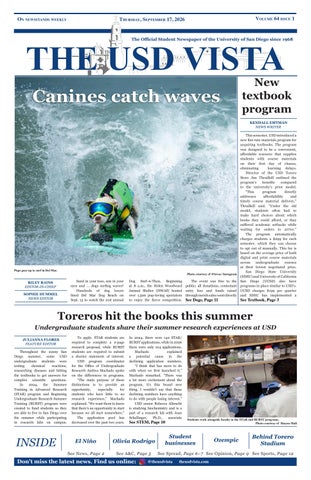
Canines catch waves
New textbook program KENDALL EMTMAN NEWS WRITER
Pups gear up to surf in Del Mar.
Photo courtsey of @hwac/ Instagram
RILEY RAINS EDITOR-IN-CHIEF SOPHIE HUMMEL NEWS EDITOR
Sand in your toes, sun in your eyes and … dogs surfing waves? Hundreds of dog lovers lined Del Mar Dog Beach on Sept. 13 to watch the 21st annual
Dog Surf-A-Thon. Beginning The event was free to the at 8 a.m., the Helen Woodward public; all donations, contestant Animal Shelter (HWAS) hosted entry fees and funds raised over 1,500 pup-loving spectators through merch sales went directly to enjoy the fierce competition. See Dogs, Page 11
This semester, USD introduced a new flat-rate materials program for acquiring textbooks. The program was designed to be a convenient, affordable resource that supplies students with course materials on their first day of classes, eliminating learning delays. Director of the USD Torero Store Jim Thrailkill outlined the program’s benefits compared to the university’s prior model. “This program directly addresses affordability and timely course material delivery,” Thrailkill said. “Under the old model, students often had to make hard choices about which books they could afford, or they suffered academic setbacks while waiting for orders to arrive.” The program automatically charges students a $299 fee each semester, which they can choose to opt out of manually. This fee is based on the average price of both digital and print course materials across undergraduate courses at their lowest negotiated price. San Diego State University (SDSU) and University of California San Diego (UCSD) also have programs in place similar to USD’s. UCSD charges $199 per quarter and SDSU has implemented a
See Textbook, Page 3
Toreros hit the books this summer
Undergraduate students share their summer research experiences at USD JULIANNA FLORES FEATURE EDITOR Throughout the sunny San Diego summer, some USD undergraduate students were testing chemical reactions, researching diseases and hitting the textbooks to get answers for complex scientific questions. In 2024, the Summer Training in Advanced Research (STAR) program and Beginning Undergraduate Research Summer Training (BURST) program were created to fund students so they are able to live in San Diego over the summer while participating in research labs on campus.
INSIDE
To apply, STAR students are required to complete a 2-page research proposal, while BURST students are required to submit a shorter statement of interest. USD program coordinator for the Office of Undergraduate Research Andrea Machado spoke on the differences in programs. “The main purpose of these distinctions is to provide an opportunity, especially for students who have little to no research experience,” Machado explained. “We want them to know that there’s an opportunity to start because we all start somewhere.” The application pool has decreased over the past two years.
In 2024, there were 142 STAR/ BURST applications, while in 2026 there were only 104 applications. Machado explained a potential cause in the declining application numbers. “I think that has more to do with when we first launched it,” Machado remarked. “There was a lot more excitement about the program, it’s this brand new thing. I wouldn’t say that these declining numbers have anything to do with people losing interest.” USD senior Rebecca Albracht is studying biochemistry and is a part of a research lab with Joan Schellinger, Ph.D., associate
See STEM, Page 10
El Niño
Olivia Rodrigo
See News, Page 2
See A&C, Page 5
Don’t miss the latest news. Find us online:
Students work alongside faculty in the STAR and BURST programs. Photo courtesy of Shayne Hall
Student businesses
Ozempic
Behind Torero Stadium
See Spread, Page 6–7 See Opinion, Page 9 See Sports, Page 12
@theusdvista
theusdvista.com
“ $ u s t
2
The USD Vista
•
September 17, 2026
NEWS
San Diego’s approaching “super” El Niño Ni A predicted “super” El Niño will bring rainfall to San Diego
CALLA JORDAN MANAGING EDITOR This winter, San Diego will experience its first “super” El Niño of the century. The climate pattern, coined by a South American fisherman, is the warm phase of the El-Niño-Southern Oscillation (ENSO). The fisherman noticed the changing ocean temperatures during the Christmas season and cited the phenomenon as “El Niño” — “Christ Child” in Spanish. According to the National Oceanic and Atmospheric Administration (NOAA), southern coasts will face a wetter, more humid season than usual, with risks of storms and flooding, while northern areas of the U.S. are expected to experience drier weather. The 2026 El Niño climate pattern is predicted to be exceptionally strong, classifying as a “super” El Niño. USD professor of environmental and ocean sciences Zhi-Yong Yin highlighted the
likely effects of the event and potential secondary geohazards. “It’s almost certain that we’re going to see more rainfall [and] more storms this time, and probably the warming sea surface temperature along the coast will last a bit longer into next spring,” Yin shared. “Whenever we have storms in Southern California, we expect mudslides and landslides. If we have a good rainy season, we [will] probably have better vegetation growth, and then for the following year during the dry season, there might be bigger wildfires if that happens.” While the culmination of an El Niño year and the prevailing effects of climate change have raised many concerns among West Coast residents, their correlation remains uncertain. “Some people are saying that with climate change we probably will see stronger El Niño events in [the] future, but that’s not entirely conclusive at this point,” Yin continued. “But the one
Pictured above is a map of potential flood hazard areas in San Diego.
thing that we’re pretty sure is with global warming… the global temperature is increasing, and then during El Niño years, it’s going to enhance the warming even more.” According to San Diego Coastkeeper, the city of San Diego is familiar with rainfall during the wet season — from December through March. During this season, the lack of proper stormwater infrastructure and the San Diego River’s central location makes flooding more likely. The city is in need of a $1.6 billion investment to improve stormwater infrastructure. However, despite the January 2024 floods that resulted in the destruction of many San Diego homes, this improvement remains underfunded. USD senior Aidan Quinn is originally from the Hawaiian island of Kihei. Like San Diego, the southern side of the island is less prone to hurricanes and intense rainstorms than other areas of the state. “We have a big mountain that
usually the other side takes up all the rain, and we get left with high clouds and no rain,” Quinn shared. “When storms come from the other side, the infrastructure is not really prepared for that much water at one time.” Quinn echoed similar flaws in San Diego’s urban setup. “[During rainstorms] Mission Valley floods every time, and Mission Beach floods every time,” Quinn said. “The whole peninsula area as you drive past Belmont Park, that’ll fill up with a foot of water.” While San Diego is not accustomed to perpetual rainfall, the city has experienced intense precipitation before, giving residents and city officials prior experience for this event. According to The City of San Diego’s government website, Mission Valley, Chollas, Sorrento Valley and the Tijuana River Valley are some of the most prone areas to flooding. Conversely, USD, located near the western end of Mission Valley, is less likely to experience
intense impacts from the storms due to its elevated position. “I don’t see major concerns for people living on campus,” Yin noted. “It’s probably just occasional flooding, maybe there are puddles of water all the time. You have to carry your umbrella more times.” However, some USD students live scattered throughout the city, making it difficult to surmise the impact on their neighborhoods. USD senior Sasha Pasquini noted the importance of accessible resources and information available to students. “We have a big presence in San Diego, and I feel like there are definitely resources that would be helpful to people who aren’t up on the hill,” Pasquini expressed. According to The City of San Diego, city crews are preparing storm drains and other city facilities for the season. Residents are recommended to find their neighborhood flood risk data through the Flood Insurance Map located at Sandiego.gov.
Photo courtesy of @cityofsandiego/Instagram
Volume 64 Issue 1 •
NEWS
•
The USD Vista
NEWS
Textbook pickup is located in the USD Torero bookstore.
Torero Unified Access Program From Textbook, Page 1 “per credit” system that charges $22 per course credit. Both universities have prices that are similar to, or in some cases higher than the price USD charges. Junior Hyen Gemeniano explained her view of the program as a positive addition for students, especially for those who have expensive textbooks for just one or two classes. “I think it’s a good resource, especially for people who have expensive textbooks,” Gemeniano remarked. “One of my classes has a textbook that costs at least $150.”
However, some students believe the $299 fee is too expensive, particularly if their classes don’t require many textbooks or if they can buy them secondhand from a third party. USD junior Kiera Sheehan explained that she chose to opt out because of the high prices. “I do think for some students it may be super helpful, but it should be an opt-in program,” Sheehan stated. “Students should not automatically be placed into the program.” Thrailkill explained that the program was designed as an opt-out model to provide students with the freedom of choosing which path is right for them and their current needs. “While Torero Unified Access is designed for maximum convenience, students retain full control over how they manage their materials,” Thrailkill stated. “They can choose full
3
Emma O’Connell / The USD Vista
program access, select specific books via Inclusive Access, or opt out completely if they prefer to source materials elsewhere. The opt-out model allows the Torero Store to secure the lowest price on digital course materials which keeps the cost low for students.” However, as a new addition to campus resources, the program has introduced some challenges as students and faculty adjust to its implementation. For Sheehan, those challenges have impacted her ability to keep up with certain course expectations. “Overall, I think it’s become a really bad miscommunication between professors and the program,” Sheehan commented. “My professor said that she ordered the books to be at the store in April, and now they’re not there still, and we’re in the middle of September and supposed to be reading the book right now.”
Sheehan’s philosophy professor, Darby Vickers, expanded on her point, explaining that the influx of communication between professors and the Torero Store, even from last semester, is now contributing to setbacks in her classroom. “When the semester started, I was told that someone had neglected to order physical copies of the books, thinking that electronic books were acceptable for my courses,” Vickers commented. “It seems that there is something of a communication breakdown happening with the bookstore and faculty. Worse, from what my students tell me, books will not be available until Wednesday this week.” While there has been criticism from some students and faculty about the program’s initial introduction, others have chosen to see the program’s
long-term potential. Gemeniano suggested that this program could serve as a resource for students whose professors require textbooks that are difficult to purchase through more traditional avenues. “It’s a lot more accessible for some more hard-to-find textbooks,” Gemeniano stated. Ultimately, since it’s the first semester this program has been implemented, the success of Torero Unified Access in future years will depend largely on student and faculty feedback and whether they feel the university’s goals of convenience and affordability are being met. From there, the university will have the opportunity to address the common problems that have come up this semester and determine which changes they feel are necessary to make, improving the program in the semesters that follow.
4
Volume 64 Issue 1
•
The USD Vista
ARTS & CULTURE Toreros talk technology
USD professors employ various policies regarding technology and AI ANNIE BARTOLOME ARTS & CULTURE WRITER The first week of classes is unofficially dubbed by many students as “syllabus week,” as many professors use their first class session to have a formal overview of the syllabus and their expectations for the class. Over the last several years, professors have added a new section into their course outline: policy on technology and artificial intelligence (AI). USD does not have an overarching blanket policy regarding electronics. Instead, it operates as a decentralized system in which the usage of technology and machine intelligence is up to the discretion of the professor. However, the university provides guidelines and expectations on how students should use these tools. USD’s marketing and communications website explained the reasoning for technology use guidelines. “[USD’s guidelines are] intended to promote thoughtful, ethical practices while protecting the authenticity of USD’s brand and Catholic identity, and are consistent with the principles outlined in Pope Leo XIV’s encyclical Magnifica Humanitas, which calls for AI to remain in service of human dignity and the common good,” a USD spokesperson wrote. The result of the university’s statement is a wide range of policies within the different
Students grapple with the tensions between the rise of AI and analog learning. Photo courtesy of @amanda-esque/Flickr
schools, with technology and AI either fully embraced as useful tools, shunned in classrooms or falling somewhere in between. USD professor Alan Lerchbaker teaches courses on management and law and ethics within the Knauss School of Business. Lerchbaker shared his thoughts on the role of technology and AI and its presence in the classroom. “It’s just like when Texas Instruments came out with the TI55, TI-58 and TI-59,” Lerchbaker explained. “It was a tool back then, not much of a tool now because we have computers. Some people are fighting this, but it should just be accepted as a tool.” Lerchbaker stresses to his students that AI can aid them in their projects and papers, but that it is not allowed to do all the work for them. He explains
that many professional firms use AI agents, so he encourages students to become familiar with these tools in order to prepare for their careers. He also emphasizes to his students the importance of always checking sources and content, since AI-generated information can be faulty. USD junior and business administration and finance major Kathy Cao echoes this sentiment when speaking about how her professors approach the use of AI in her classes this semester. “I think [professors] know we’re going to use it anyways, so they encourage us to use it responsibly,” Cao expressed. “Technology depends on how you use it. If you use it irresponsibly, it can hinder your learning.” USD senior Slaiman Safar noted that his professors do not share this
same sentiment toward AI. “We use technology and equipment in our labs, but AI is treated differently,” Safar said. “At the same time, I think there could be more room to teach students how to use it properly, especially for troubleshooting and explaining something they’re struggling with.” Safar wanted professors to recognize that AI can actually help spot problems within code to aid students during labs and projects. He recognized professors’ fears, but hoped that they can trust students to not abuse AI. USD professor of theology and religious studies within the College of Arts and Sciences Nick Witkowski has a zero tolerance policy for AI. “NO AI permitted at any point in this class,” Witkowski
GAMES
08.27 Crossword - Crossword Labs
wrote in his syllabus. “NO electronics may be used in class.” He implements a technologyfree environment in all of his classrooms with the exception of accessing texts digitally. He discussed his rationale behind banning screens and AI. “I restrict it because the fundamentals of learning are impeded,” Witkowski explained. “It affects their ability to concentrate, and will affect success in the big picture.” After establishing these policies, Witkowski noticed a longer attention span and more robust conversation among students during class discussions. He believes that technology hinders class participation, leading to his decision to remove it completely. Tighe Avila, USD junior and psychology major, echoed this sentiment when sharing his experience with technologyfree classroom environments. “In many of my psychology classes, no technology was allowed during the lecture,” Avila explained. “I love this! It forces people to generate their own ideas and perspectives about any given topic.” USD provides guidelines and a framework for employing the use of technology and artificial intelligence in students’ work. It is now in students’ hands to use technology and AI responsibly in their classes and in preparation for their careers beyond the classroom.
8/24/26, 5:46 PM
Scan For Answers
Across
08.27 Crossword
3. The __ is the only bird that can fly backward. 4. TV show created by Matt Groening 5. This winter weather pattern will bring storms and
1
rain
2
6. The first name of our beloved mascot
3
9. Intentional repetition of a word or phrase at the beginning of successive sentences, clauses, or lines.
4
10. What is “the snack that smiles back?”
5
13. The first paper-like writing material in history 14. This singer has the record for Grammy award
6
wins 7
8
Down
9 10
11
1. Rapper __ performed the most-watched Super
12
Bowl Halftime show of all time. 2. This 2026 epic action fantasy stars Matt Damon 7. What is the biggest search engine in the world?
13
8. In a Shakespeare play, this fictional Scottish general kills the king to seize the throne
14
11. __ is the deadliest ocean cross section in the world. Across
3. The ___ is the only bird that can fly backwards
Down 1. Rapper ___ performed the most-watched Super Bowl Halftime show of all time
12. The reigning men’s FIFA World Cup champion
Volume 64 Issue 1 •
ARTS & CULTURE
•
The USD Vista
Daisy Chain Fields grows $20M
5
USD students react to Olivia Rodrigo’s all-women led music festival CRISTINA TRICE ARTS & CULTURE EDITOR Joyful. That was the first word that USD senior Molly Marley thought of when she stepped onto the grounds of Olivia Rodrigos’s inaugural Daisy Chain Fields Music Festival. The sweltering California air had already surpassed an agonizing 90 degrees, but as she looked around at the faces that made up the audience and the women on stage, she knew that she was witnessing something exceptional. A 2025 Live Nation report found that the market for live music and concerts has grown rapidly in the last few years. Music festivals in particular have been increasing in popularity, but Daisy Chain Fields was a standout for one simple reason: 100% of its proceeds went to nonprofit organizations supporting women and girls. Marley was moved to be a part of the event. “I think it was really special,” Marley recalled. “It was genuinely 98% women of all ages. There were some kids and there were some older people … You just couldn’t have a bad time with all the people there. Everyone just made everyone happier.” The 23-year-old pop star announced the festival via Instagram on June 22, 2026. “Truly never felt more excited to share a piece of news with you all,” Rodrigo wrote. “I firmly believe that joy, community, and music can be the drivers of meaningful change and I’m hopeful this
Olivia Rodrigo poses for Rolling Stone.
Olivia Rodrigo performs her headline set at Daisy Chain Fields.
festival will be just that.” Rolling Stone reported that it took just 30 minutes for the event to sell out completely. It was clear that fans weren’t just excited to see the diverse lineup of performers, but that they were also excited to support what the event represented. The festival featured an allwomen lineup, spotlighting artists like Chappell Roan, Doechii and Bikini Kill among others. Special guest Sarah
McLachlan joined Rodrigo on stage during her headline set to sing her song “Angel” in a dedication to Dolly Parton. “[She was] the biggest philanthropist in the history of country music,” McLachlan said. Renowned singersongwriter Stevie Nicks also joined the stage and closed out the festival with a duet of “Landslide” alongside Rodrigo. USD senior Keira Dooley reflected on being in the crowd,
Photo courtesy of @oliviarodrigo/Instagram
Photo courtesy of @daisychainfields/Instagram
witnessing this moment. “During ‘Landslide,’ I looked around and genuinely everyone was crying… tears just streaming down their faces,” Dooley recalled. “We got to see someone finishing their career and someone just starting their career talking about growing up … everyone loved it.” USD senior Justine Simons shared her thoughts on the all-woman lineup and the philanthropic focus. “I was scared to see how people were going to react online because I knew that people would be 10 times more critical,” Simons said. “But what I was seeing online was people saying ‘this is what happens when you let women run things, they run well,’ and that was really cool.” Temperatures in Irvine that day hit upwards of 95 degrees, leaving many fans concerned with issues of safety. Festival organizers stated that hydration stations, misters and cooling tents would be stationed around the venue in an attempt to mitigate the high temperatures. The city of Irvine issued an extreme heat warning before the festival began, but some fans think that despite warnings and cooling efforts, the high temperatures had significant impacts on their experience at the festival. Dooley shared her experience with the extreme heat. “It was so hot, so we didn’t get to see a lot of things which I was kind of sad about,” Dooley recalled. “We ran to go get the merch and then I was like ‘wait I’m going to faint, I need to go lie down…. It was so hot that all of us were sharing fans, and it was just, I guess, very supportive.” Before the festival had even begun, Rodrigo announced that they had already raised $10 million to be donated across
10 organizations supporting women and girls. Among these organizations were Baby2Baby, Planned Parenthood, Black Mamas Matter Alliance and John Hopkins Center for Indigenous Health. Before her headline set, Rodrigo was joined on stage by philanthropist Melinda French Gates, who pledged to match every dollar raised so far, bringing the total to $20 million. Simons serves as her sorority’s co-vice president of panhellenic affairs, where she plans and executes all of their philanthropy events. She discussed the excitement she felt at the amount of money Rodrigo raised. “I was surprised and so glad to see so many artists show up and not look for any monetary compensation,” Simons shared. “It is expensive to put these things on … You need to have the money first to run that event. They did such a good job for it being their first festival. I think that Daisy Chain Fields showed how when women come together, we are so powerful. It’s just amazing to see.” USD sophomore Caleb Montilla did not know much about Rodrigo until Daisy Chain Fields. He discussed his thoughts after hearing about the festival for the first time. “For someone as young as her to achieve something like this… I think it’s really impressive,” Montilla said. “That’s a really great thing she did.” Daisy Chain Fields has concluded its 2026 run, but it may not be the end of the fun, feminine and flowerfilled festival. Rodrigo might have thoughts of continuing the festival in the future. “See you next year!” Rodrigo cheered as she and Nicks walked off stage arm in arm.
6
The USD Vista
•
September 17, 2026
Art by Kyra Lefebvre/The USD Vista: Content by Julia Hurtado
Toreros handle business In between classes and extracurriculars, some Toreros work on what they love the most: running a small business. These brands allow students to gain work experience and make money on the side. From handmade bikinis to espresso drinks, students run businesses right out of their dorms.
Volume 64 Issue 1
•
Mazzy Swim by Katherine Bentzel @mazzyswim
•
7
The USD Vista
Acecutz by Anthony Cepeda @2frcutz
Ph o
l ze
da
esy of Anthony urt Ce o c pe to
y of Kather rtes ine u Be co o n ot
Ph
FEATURE
“I couldn't have done this without my friends. They were so excited and supportive. I named my first round of sets after them. It has been the most amount of support I could have ever received.” Katherine Bentzel, sophomore
“I love seeing progress in myself and through the haircuts themselves. I like people's reactions to their hair cuts. If people come to me it’s just making myself get better and it's only going to get better from here.” Anthony Cepeda, junior
Sullys Grinds by Aidan Sullivan @sullysgrinds
Bikini Blend by Sienna Dhariwal @bikiniblend
Ph
Ph
sy of Sienna Dh urte o c ar o i ot
al w
n
tesy of Aidan Su our c lliv o t a o
“Sometimes I see a name pop up on my order app and I don’t know this person, but it is cool to have a connection with someone I don't know. This is someone I'm not usually talking to but we strike up a conversation over a cup of coffee.” Aidan Sullivan, sophomore
“At first I thought that my favorite part would be designing the swimsuits — that has been amazing. But I think the bigger thing is how fulfilling it is to meet the people I’m working with. I end up learning so much more about myself through those interactions versus sales.” Sienna Dhariwal, sophomore
Nailzzbymiaw by Mia Wilde @nailzzbymiaw
Silva Visuals by Diego Silva @svisuals124
sy ourte of Mia W oc t ild o e Ph
“It’s really fun to talk to people and meet random people. We start talking and learn so much about each other. I like that part because when I see them around school they will be like, ‘oh hey’ and wave and tell me they love their nails.” Mia Wilde, sophomore
rtesy of Dieg oS cou o t ilv o a Ph
“One of my niches is cars. I do freelance for people who have cool cars and want footage of their vehicles.” Diego Silva, sophomore
Volume 64 Issue 1 •
8
OPINION
•
The USD Vista
OPINION Everyone should invest in a houseplant Embrace your obligation
BETTINA MOGELVANG OPINION WRITER I stand in front of you and say “you have no right.” You stand in front of me retaliating, “I have every right.” We both feel wronged, disrespected and stand in opposition to one another. Being steadfast in what we believe we deserve often means failing to recognize what the other person does. There’s an open booth in the library: why am I more deserving than you, and you more than I? Here, rights are a trade-off — one person’s rights come at the expense of another’s. This is why everyone should invest in a house plant. This world, the every-manfor-himself world, pushes us further and further from each other. The person snatching the library booth from me, I come to resent. Even if temporarily, I deemed the fellow person unworthy of my respect. The opportunity for connection is severed. But when this becomes our default response to each other, as it has, we find ourselves in constant c omp e t it ion rather than bound to one another. The law o f
Something to care for
Xenia relies on reciprocity. It is based on the idea that a person in need deserves my hospitality; and, should I need it, it will be guaranteed to me.
Different from a reciprocalobligation dynamic, this is a dependent one. You will not, from your plant, receive back exactly what it is you provide, as you do under the golden rule, good karma or the law of Xenia. But it is not the guarantee of exact reciprocity that makes the orientation worth it. Rather, it is precisely the act of being depended on that provides value.
When “I have just as much of a right as you,” becomes the reciprocal of “I am obliged to you,” we turn declarative individuals into a self-sustaining network of Giving part of you, respect: we are your time and energy, bound together. for the vitality of another thing Think about your friends without physically and relationships. They can seeing the return count on you and you can fosters generosity count on them, and suddenly and selflessness. The a community that relies on plant’s dependence each other emerges. This on you gives you a dependability is why the people reason to stay nearby, closest to you feel so important. giving you a favorable Now, imagine your taste for connection relationship with your new and loyalty. houseplant. This is a living thing without the agency to water itself and place itself in sunlight. Without you, it will wither and die.
Art by Alicia Higuchi
Moreover, the plant being dependent on you entails responsibility. People say there is no such thing as a self less act. In this case, I would entirely agree. Although it’s a dependent dynamic, it is by no means unprofitable. Caring for something comes with all kinds of heartwarming feelings, and breeds numerous virtues. But my favorite lesson is granting grace with growth. As a senior, considering the past and future, and my satisfaction level of where I am, I quickly become critical, shameful and unfair to myself. When I walk into the Cropper Center for Creative Writing, I see the powerful, graceful, tall fiddle leaf fig, and I don’t shame my miniature version at home for not being that size. I awe at the potential, and I applaud the less-than centimeters of daily growth. I don’t expect my plant to achieve that size tomorrow. And you shouldn’t expect that of yourself either. The Cropper Room fiddle, in a space where I want to grow as a writer, reminds me not to compare my work to the authors I admire, but recognize my past growth and praise the opportunity for higher potential. Gifting me all of this, I realized perhaps I am more dependent on my plant than I originally thought. I simply water and move my plant
Embrace the obligation
into the sunlight. This hardly feels like a burden. And then I realized, this plant is uprooted, and it is only dependent on me because of that fact. Our Earth works in interdependent cycles, housing symbiotic relationships. When we violate the Earth, we are not only derelict in our responsibility, we are preventing these circular obligations from taking place. This planet functions in its responsibilities, but the rights we assume got in the way. Remember, we are dependent on nature, not the other way around. We have no right to disrespect eachother and nature, we only have obligations as coexisting people and plants. Experience nature in a way that
Art by Alicia Higuchi
immediately connects you to it.
Experience it as solely your responsibility to keep alive. It may be a small act, but its implications on your disposition widen, imbuing each of us with a greater taste for responsibility and connection. It’s quite obvious to me that we need a reminder of our shared obligation to one another. As quickly as orienting ourselves around rights took hold of our attitudes toward one another, perhaps deeply feeling our obligations can largely connect us. Buying a houseplant might not immediately make us a respectful humanity, but like your new plant, growth is gradual.
The views expressed in the editorial and op-ed sections are not necessarily those of The USD Vista staff, the University of San Diego or its student body.
Volume 64 Issue 1 •
OPINION
•
The USD Vista
9
OPINION
Your body is not a trend When did being hungry become a problem? PRATINYA BODANAPU OPINION EDITOR In the 1820s, poet Lord Byron reportedly drank vinegar and water and severely restricted his diet in pursuit of thinness. By the early 20th century, Americans were sold “reducing soaps” that promised to wash away fat. Later came vibrating belts meant to shake fat off the body, cigarettes marketed as an alternative to sweets and an endless succession of diet pills, meal replacements, cleanses and detox teas. Over centuries, methods have changed, but the promise sold to us — that our bodies can and should be changed to fit the ideal of the moment — has remained the same. G l u c a g o n - l i k e - p e p t i d e -1 medications, commonly known as GLP-1 drugs, emerged from decades of research beginning in the 1980s — transforming the treatment of Type 2 diabetes and, later, obesity. More recently, names like Ozempic, Wegovy and Mounjaro have moved beyond doctor’s offices and into advertisements, celebrity interviews and social media feeds.
Schumer stated on an episode on “Watch What Happens Live with Andy Cohen,” that she lost weight on Ozempic, but severe nausea left her bedridden and unable to play with her son. Schumer’s experience complicates the way GLP-1 transformations are presented in popular culture as smaller bodies are visible on screens but the medical experience behind it often is not. As GLP-1s have become increasingly popular in pop culture, their use has grown alongside the attention. A 2025 Kaiser Family Fund (KFF) poll found that 12% of U.S. adults were taking a GLP-1 medication, including 45% of adults diagnosed with diabetes and 23% of those who reported being diagnosed as overweight or obese. Morgan Stanley Research estimates that the global market for obesity and Type 2 diabetes treatments could reach $190 billion by 2035, more than twice its estimated size in 2025. There are good medical reasons for that growth. According to a 2024
study conducted by the Centers for Disease Control and Prevention, every U.S. state and territory had an adult obesity prevalence of at least 25%. GLP-1 medications have also demonstrated benefits beyond weight loss showing results reducing cardiovascular death by 20%. For these patients, GLP-1xs prove to be necessary healthcare —treating chronic diseases.
That distinction matters because criticism of GLP-1 culture can easily become criticism of the people taking these medications while overlooking their primary purpose and the positive impacts they make on societies. Simultaneously, acknowledging the medical value of GLP-1 drugs does not require ignoring the culture developing around them.
It is clear through the historic data being presented that human bodies have consistently been looked at as trends to capitalise off of, rather than being appreciated as the very things that keep us alive. The rise of GLP-1 medications is particularly relevant to college students. A national study led by researchers at the University of Michigan examined prescription dispensing data from 2020 to 2023 covering 92% of U.S. pharmacies and found a 594% increase in the monthly number of adolescents and young adults ages 12 to 25 using GLP-1 medications. Among young adults ages 18 to 25 (an age group that encompasses most traditional college students), use increased 659% among women and 481% among men. Author of the study, Kao-Ping Chua also documented increased dispensing of Ozempic
GLP-1s represent a new peak in a much older effort to capitalize on bodies insecurities. The ultimate question is not whether these medications should exist, but asking what happens when an extraordinarily effective medical treatment enters a market that has spent centuries learning how to monetize off self-doubt. Data from advertising tracking firm MediaRadar showed that, during the first nine months of 2025, Novo Nordisk spent approximately $316 million advertising Wegovy in the United States and another $169 million advertising Ozempic. Drug manufacturing company Eli Lilly spent approximately $131 million advertising Zepbound and $83 million advertising Mounjaro during the same period. Together, advertising for those four drugs approached $700 million in nine months. Their revenues are substantially larger. Eli Lilly surpassed $1 trillion valuation last year while Novodisk generated $9.16 billion in quarterly sales. According to Harvard Health, the U.S. and New Zealand are the only two countries that permit prescription drug companies to advertise directly to consumers. That means individuals living in these countries are more likely to encounter medications through television commercials, social media or pop culture before discussing them with a physician. Celebrity discussion has accelerated that visibility. Amy
among young people, despite the drug not being approved for weight management in adolescents. There is no number on a scale that neatly separates health care from beauty culture, and telehealth has made that boundary even more difficult to see. While online providers can expand access to obesity treatment, their rapid growth has created opportunities for aggressive marketing. In 2025, the Federal Trade Commission took action against telehealth company NextMed, alleging that it used deceptive weight-loss claims, fake reviews, misleading before-and-after images and unclear pricing to market GLP-1 weight-loss programs. The FDA subsequently issued warning letters to 30 telehealth companies in March 2026 over allegedly false or misleading claims involving compounded GLP-1 products.
These cases do not mean telehealth GLP-1 prescribing as a whole is unsafe. They illustrate what can happen when an intensely desired physical transformation b e c o m e s commercially valuable. The GLP-1 boom has also created a strange contradiction: Americans are increasingly exposed to a body standard that pharmaceutical science can help achieve, while access to that science remains heavily dependent on income and insurance coverage. According a to 2025 KFF poll, 56% of people who had used GLP-1 medications said they found them difficult to afford, including 55% of insured users. Among insured users, 27% reported paying the entire cost themselves—14% cited cost and 13% cited side effects. Rapidly increasing demand has also periodically strained supply. Wegovy, Mounjaro and Zepbound have experienced shortages as manufacturers attempted to keep pace. This scarcity prompted criticism of people using the medications solely for weight loss while patients with diabetes struggled to fill prescriptions.
These shortages reveal how quickly the consequences of a cultural phenomenon can become a medical crisis.
The weight of a trend
Photo courtesy of Giovanna Baldini/Flickr
What begins on television screens and social media feeds eventually reaches doctors’ offices, insurance companies and pharmacies. For the rest, please visit our website at theusdvista.com.
The views expressed in the editorial and op-ed sections are not necessarily those of The USD Vista staff, the University of San Diego or its student body.
The USD Vista
10
◆
September 17, 2026
FEATURE
Summer Researchers From STEM, Page 1 professor of chemistry and biochemistry. Albracht is an undergraduate researcher funded by the STAR program at USD. Albracht spoke on the work she does on campus during the summer in her lab. “I do one day for labs doing the peptide systems, or there’s a peptide synthesis portion and then a conjugation reaction portion,” Albracht stated. “I will usually do a day of reaction time, then also a day of getting literature together or doing the analysis products that I made.” Peptide synthesis is the chemical creation of amino acid chains that allows scientists to study biological mechanisms. Albracht recalled how she was able to participate in this lab and her experience with Schellinger. “I talked to [Schellinger], and I just asked about her various projects,” Albracht recalled. “She kind of gave me the choice. [Schellinger] asked, ‘Which one would you be most interested in?’” After a summer of researching under Schellinger, Albracht and her fellow lab group presented their findings at the end of their program. STAR/BURST applicants may receive up to $500, if they apply for a grant, for travel to these conferences. “At the end of the summer, my last group and then some other chemistry law groups went to a symposium at the [University of California Irvine] and we all presented a poster about our findings,” Albracht stated. Internal funding for STAR/BURST comes from the Office of Provost and the Vice President from Academic Affairs, while the advancement s e r v i c e s department s u p p o r t s STAR/BURST in securing o u t s i d e donations. However, not all
undergraduate researchers are funded by the STAR/ BURST program. USD senior Shayne Hall shares her research experiences over this past summer working in the neurocognition and behavior department (NCD) without funding from STAR/BURST. “I’m in [Dr.] Bonds Lab in the NCD Department, and what we’ve been doing is working with a disease called multiple sclerosis,” Hall said. “We make certain models of that in mice at [University of California San Diego] and then we take that tissue and we see what happens with the disease because we don’t know a lot about it right now.” Hall spoke on how she chose the neuroscience major at USD and how her lab work has impacted her. “I went in as a psych major, and then I realized I loved the process in neuroscience,” Hall explained. “I was really excited to start in labs, and that confirmed it … I joined the lab and realized that I didn’t really want to give this up. I wanted to keep doing it.” With limited amounts of funding and a plethora of student researchers each year, some students, like Hall are unable to receive funding but still choose to go through with the research process. “It’s really satisfying to see what you’re doing, [to] have a working final product,” Hall stated. “Just to communicate in a science lab with other people, it’s really valuable. I just love science.” While most STEM students are required to get lab hours in order to graduate, most students do not choose a research-based path post graduation. USD career statistics cites 87-89% of biology and neuroscience graduates receive fulltime opportunities six months after graduation. This can range from internships or residencies; however, only 3% of those jobs include researchbased industries. Research may be necessary for the undergraduate experience in the STEM department but it is not the end goal for students.
Shayne Hall and her lab group read over lab instructions.
Rebecca Albracht and her lab group pose in their goggles.
Photo courtesy of Shayne Hall
Photo courtesy of @usdour/Instagram