TheUSDVISTA
Volume 55 Issue 17
Thursday, March 15, 2018
On Newsstands Weekly
◆ The Official Student Newspaper of the University of San Diego since 1968 ◆
USD ranks in Peace Corps USD ranks 16th for Peace Corps volunteers with 18 Toreros currently serving
USD releases statement on peaceful protests Celina Tebor Feature Editor Taryn Beaufort Opinion Editor
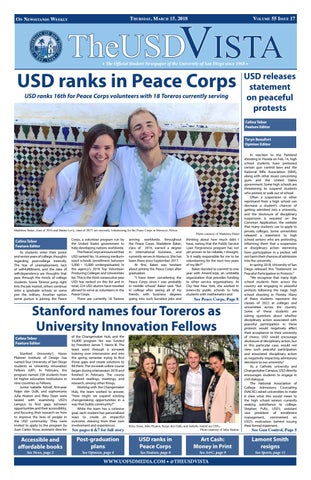
Madelene Baker, class of 2016 and Hunter Levy, class of 2017, are currently volunteering for the Peace Corps in Morocco, Africa.
Celina Tebor Feature Editor As students enter their junior and senior years of college, thoughts regarding post-college intensify. The fear of unemployment, lack of self-fulfillment, and the idea of self-dependency are thoughts that pass through the minds of college students. Some Toreros jump right into the job market, others continue onto a graduate school, or some join the military. Another option some pursue is joining the Peace
Corps, a volunteer program run by the United States government to help developing nations worldwide. The Peace Corps announced that USD ranked No. 16 among mediumsized schools (enrollment between 5,000 - 15,000 undergraduates) in the agency’s 2018 Top VolunteerProducing Colleges and Universities list. This is the third consecutive year USD has ranked on this list and in total, 224 USD alumni have traveled abroad to serve as volunteers in the Peace Corps. There are currently 18 Toreros
serving worldwide throughout the Peace Corps. Madelene Baker, class of 2016, earned a degree in international business, and currently serves in Morocco. She has been there since September 2017. At first, Baker was hesitant about joining the Peace Corps after graduation. “I have been considering the Peace Corps since I was probably in middle school,” Baker said. “But in college after seeing all of my friends with business degrees going into such lucrative jobs and
Photo courtesy of Madelene Baker
thinking about how much debt I have, noting that the Public Service Loan Forgiveness program has not yet proven to be reliable, I thought, ‘Is it really responsible for me to be volunteering for the next two years of my life?’” Baker decided to commit to one year with AmeriCorps, an umbrella organization that provides funding to other service organizations. At City Year New York, she worked in inner-city public schools to help students with mathematics and
See Peace Corps, Page 8
Stanford names four Toreros as University Innovation Fellows Celina Tebor Feature Editor Stanford University’s Hasso Plattner Institute of Design has named four University of San Diego students as University Innovation Fellows (UIF). In February, the program named 258 students from 64 higher education institutions in nine countries as Fellows. Junior Isabelle Ashraf, first-year Reijer den Dulk, and sophomores Julia Heaton and Riley Dean were tasked with examining USD’s campus to find gaps between opportunities and their accessibility, and focusing their research on how to improve the lives of people in the USD community. They were invited to apply to the program by Juan Carlos Rivas, assistant director
Accessible and affordable books See News, page 2
of the Changemaker Hub, and the $4,000 program fee was funded by President James T. Harris III. The team went through a six-week training over intersession and into the spring semester trying to find those gaps and create solutions to fill them. The six-week online course began during intersession 2018 and finished in February. The course involved readings, meetings, and research, among other things. Working with the Changemaker Hub, the team worked to answer, “How might we expand existing changemaking opportunities in a way that builds community?” While the team has a cohesive goal, each student has personalized ways to create an impactful outcome, drawing from their own involvement and experiences.
See pages 6 &7 for full story
Riley Dean, Julia Heaton, Reijer den Dulk, and Isabelle Ashraf are UIFs. Photo courtesy of Julia Heaton
In reaction to the Parkland shooting in Florida on Feb. 14, high school students have protested certain gun control laws and the National Rifle Association (NRA), along with other issues concerning guns and the United States government. Some high schools are threatening to suspend students who protest or walk out of school. Often a suspension or other reprimand from a high school can decrease a student’s chances of getting admitted into a university, and the disclosure of disciplinary suspension is required on the Common Application, the website that many students use to apply to private colleges. Some universities released a statement to high school seniors who are protesting, informing them that a suspension or disciplinary action stemming from participation in a protest will not harm their chances of admission into the university. In spring 2018, University of San Diego released this “Statement on Peaceful Participation in Protests:” “We recognize that many high school students from across the country are engaging in peaceful protests following the tragic high school shooting in Florida. Many of these students represent the classes of 2022 at colleges and universities across the country. Some of these students are asking questions about whether disciplinary action associated with peaceful participation in these protests would negatively affect their acceptance to their university of choice. USD would encourage disclosure of disciplinary action, but in this particular case, would not view such peaceful participation and associated disciplinary action as negatively impacting admissions decisions to our university.” As a Catholic university and Changemaker Campus, USD directly encourages students to engage in civil dialogue. The National Association of College Admissions Counseling (NACAC) asked universities to make it clear what this would mean to the high school seniors currently seeking admittance to college. Stephen Pultz, USD’s assistant vice president of enrollment management, commented on USD’s motivation behind issuing their formal statement.
See Gun Control, Page 5
Post-graduation plans
USD ranks in Peace Corps
Art Cash: Money in Print
Lamont Smith resigns
See Opinion, page 4
See Feature, page 8
See A&C, page 9
See Sports, page 11
WWW.UOFSDMEDIA.COM ◆ @THEUSDVISTA
2
The USD Vista
◆
March 15, 2018
NEWS
Student action on textbooks
Leaders in Associated Students have pioneered new methods to make course materials more accessible Glenn McDonell Contributor Every semester, USD students are faced with the need to decide how best to purchase or otherwise access a new set of course materials. For many, the need to set aside hundreds of dollars to cover textbook costs represents a significant financial burden. Junior Chris Hermes, Associated Students Chair of student life, is well aware of this reality. “As members of AS, we are constantly listening to student concerns,” Hermes said. “What we have been hearing for a while now is that textbooks are too expensive.” According to the Director of the Torero Store James Thrailkill, there is relatively little that Auxiliary Services can do to reduce the costs of textbooks for students. These prices are primarily dependent on faculty preference for materials and action when ordering those materials. “When it comes to how faculty members choose which books to have us order, cost is typically a secondary consideration,” Thrailkill said. “Content is king.” Even if professors choose to have the bookstore order more affordable materials, the timing of order placement also makes a big difference. “The sooner we hear from faculty the sooner we can put book orders in,” Thrailkill said. “We are in
contact with faculty on a regular basis to make sure.” Beginning in the fall of 2016, Hermes and other members of AS worked directly with Student Support Services (SSS) to organize a book drive to serve low income students. Donation bins were placed at the checkout in the Torero Store at the end of the year with signs encouraging students to “Help a fellow Torero.” “There’s plenty of students who have old textbooks laying around that they have no use for, and they’re not selling them back
250. “It got to the point where SSS literally couldn’t hold the books anymore,” Hermes said. While the book drive program was a success in terms of the number of books donated, Hermes and other members of AS knew that something needed to be done on a larger scale to serve the entire student body. “Everyone was passionate about this issue and knew that something needed to be done,” Hermes said. “We realized textbooks were an even bigger issue for students than
“Students definitely need these books, they just don’t always know that these resources are available to them. The number one focus going forward will be going to faculty meetings and making sure (faculty) know that their book has been put in the reserve so they can relay this information to their students.” -Shannan Conlon to the bookstore because they don’t expect to get much,” Hermes said. “Donating them to the book drive was a way for students to do something meaningful for one another.” Throughout the fall semester of last year, the makeshift shelves in SSS became filled to capacity with the overwhelming number of donated books, which exceeded
we had thought.” In the spring of 2017, a combination of faculty, staff, and AS student leaders formed a committee to address these student needs on a larger scale. According to the Dean of the University Library, Dr. Theresa Byrd, the Textbook Accessibility Task Force was the result of a partnership between Copley Library, Associated
Students, and the bookstore. “I personally became interested in the cost of textbooks because a USD student told me her story,” Byrd said. “Moreover, I believe it is important to reduce costs, expand access, and make textbooks more affordable for students.” Since it began a year ago, the task force has worked to identify and implement strategies for reducing the cost of textbooks for USD students. Hermes and junior Om Kanwar were appointed to the task force as representatives of AS to provide a student perspective on the issue. “Having Om and I on the task force was important because we were able to voice real student concerns and opinions,” Hermes said. “The two of us brought the idea of a textbook reserve program to the table, which was something AS had been talking about for some time.” The idea of placing popular textbooks on reserve for studentuse originated a while ago but has only recently been put in place. “People on the AS Executive Board, administrators, and AS Senators have all been trying to get this program going for a while now but it kept hitting roadblocks,” Hermes said. “Finally pushing it through came down to the dedication of a few individuals who have worked to make this idea get off the ground and receive the funding it needed.” The program maintains one
Copley Library manages any book in the AS reserves that is worth over $100 and required for more than two sections in order to help students save money. Cyrus Lange/The USD Vista
The USD Vista Tayler Reviere Verninas - Editor in Chief Elisabeth Smith - Associate Editor James Douglas - Managing Editor Kaia Hubbard - Copy Editor Rita Srekais - Art Director Max Escutia - Assistant Art Director
Lilyana Espinoza - News Editor Taryn Beaufort - Opinion Editor Celina Tebor - Feature Editor Nicole Kuhn - Arts & Culture Editor Anderson Haigler - Sports Editor Cyrus Lange - Photography Editor
Editorial – 619.260.4584 Business – 619.260.4714 www.uofsdmedia.com ◆ @TheUSDVista Cameron Fruehe - Photo Assistant Douglas Horn - Distribution Manager Bailey Marie Donnelly - Finance Director Adnan Hassan Nouh - Advertising Manager Gina Lew - Student Media Advisor Marie Minnick - Operations Advisor
copy of every textbook that exceeds $100 in value and is required for a course with two or more sections for any given semester, according to Kanwar. While Copley Library manages the program, the funding necessary to purchase a copy of every textbook currently on reserve comes from the AS budget. “In the [AS] senate we discussed the possibility of budgeting for the reserve program throughout the spring of last semester, and it received a lot of support,” Kanwar said. “AS funds come out of student tuition, so it makes sense to use some of that money to take some financial burden off of students.” According to Kanwar, the AS Finance Committee budgeted close to $30,000 to fund the reserve program during its first period of implementation last spring. Both Kanwar and Hermes were a part of the task force during spring 2016 but did not continue in subsequent semesters. Associated Students VP Shannan Conlon, who served as an AS representative on the task force last fall, expects funding for the program to continue. “In the coming months we will need to re-evaluate checkouts in order to decide which books on reserve to keep and which ones need to be updated, but I don’t foresee AS stopping that funding,” Conlon said. According to the data which Copley Library collected and made available to AS members on the task force, around 1,000 checkouts occurred last spring. Accounting and finance topped the list in terms of frequency of use, while others for courses in biology for example, had none. In Conlon’s view, the lack of checkouts for some books is due to a lack of awareness of the reserve program among students and faculty alike, which is something she wants to address this semester. “Students definitely need these books, they just don’t always know that these resources are available to them,” Conlon said. “The number one focus going forward will be going to faculty meetings and making sure (faculty) know that their book has been put in the reserve so they can relay this information to their students.” While the affordability of textbooks is largely out of the control of student leadership, AS-led efforts to increase accessibility have demonstrated a potential for change. As awareness and use of the textbook reserve program grows, many more students will stand to benefit.
The USD Vista publication is written and edited by USD students and funded by revenues generated by advertising and a student fee. Advertising material published is for information purposes only and is not to be construed as an expressed or implied endorsement or verification of such commercial venues by the staff or University. The USD Vista office is located on the fourth floor of the Student Life Pavilion in room 403B. All inquiries should be sent to: The USD Vista- SLP403B 5998 Alcala Park San Diego, CA 92110 The first copies of the newspaper are complimentary, all copies thereafter are a 25 cents charge. Opinions expressed in this publication are not necessarily those of The USD Vista staff, the University of San Diego or of its student body. Letters to the Editor can be submitted to The USD Vista office. Letters should be limited to 300 words and must be signed. For identification purposes, USD identification numbers and writer’s year must be included in the letter. The USD Vista reserves the right to edit published letters. Any content sent to the editor will be considered for publication unless otherwise stated.
◆
Volume 55 Issue 17
NEWS
◆
The USD Vista
Millennials are moving home
3
The Millennial generation is most likely to move back in with their parents after graduation
Lilyana Espinoza News Editor An increasing number of Millennials, who according to the Pew Research Center are people born between 1981-1996, are making the decision to move back home with their parents after graduation. Senior Julia Torgerson is a Millennial who has decided to move back home after graduation. She believes Millennials should not feel ashamed to move back home with their parents because of the great advantages that accompany the transition. “I am not embarrassed about (moving back home to Seattle) in the slightest and I don’t think anyone should be,” Torgerson said. “I think parents can give us the stability and the comfort of trying to figure (our lives) out. Our careers are going to be for the rest of our lives. What is another five or six months of living at home? Even if it is two years, the investment you are saving by living at home is ridiculous. As long as you are working hard and working toward your career there is nothing wrong with saving that money.” Having the ability to save money rather than spend it on housing is the main advantage for Torgerson when it comes to returning home after graduation. “If I lived in San Diego, I would be spending anywhere between $700 to $1,200 just on rent,” Torgerson said. “Not having to do that and living at home is going to save me a tremendous amount of money that I could then put toward a down payment on an apartment or house, which is a long-term goal of mine.” According to the Pew Research Center data as of 2016, the Millennial generation is the generation most likely to live at home. Fifteen percent of Millennials are likely to live at home, which is five percent more than Generation Xers, born between 1965-1980, and almost double the number of the Boomers, born between 1946-1964. Ten percent of Millennials in 2016 versus seven percent of Generation Xers in 2000 live at home. According to TD Ameritrade’s 2017 data, 37 percent of Millennials have moved or plan to move back in with their parents after college. Renda Quinn, director of the Office of Parent Relations, recognized the stigma that was generally associated with moving back in with parents after graduation.
Class of 2017 Statistics Not aligned
Other
Minimally aligned
Military Service Volunteer Service Full-Time
Class of 2017 Graduate Outcomes
Enrolled in Graduate School
Closely aligned
93.9%
Source: CDev
of graduates are employed, in graduate school, in the military, or participating in full-time volunteer service
94.5%
of respondents that are employed full-time reported that their current position at least somewhat aligns with their career goals Max Escutia/The USD Vista
“Back in the day there was that stigma that came with going home after college and living with your parents,” Quinn said. “I know I would have thought of that (and) regardless if I could afford it or not, I was going to figure out a way not to come back home. I think that now the relationship is different with parents than it was in the past. I don’t think it is a bad thing to go back to your home after graduation, and I think Millennials are smart in a lot of ways because it allows them
a year to a year and a half recovery time,” Burningham said. “I feel because that is my main reasoning for moving back home people are very understanding and supportive of my decision. However, I feel that if I didn’t have that reason, people would look down on me that I have decided to move back in with my parents after my time here at USD.” USD’s class of 2017 Millennials are reportedly successful after obtaining their degrees and are not put behind by living with
“I think parents can give us the stability and the comfort of trying to figure (our lives) out.” -Julia Torgerson to build a base so that they are not trying to make ends meet while they are just beginning to be established in their careers.” Senior Madison Burningham decided around October of last year that she wanted to move back home to Sonoma, California after her graduation in May. “I decided I wanted to move back home because I will be having major dental surgery that has about
born 1981-96
born 1965-80
their parents. The USD Career Development Center (CDev) took data from the class of 2017 and found that 94.5 percent of respondents reported their current position at least somewhat aligns with their career goals. Another striking statistic is 93.9 percent of graduates are employed, in graduate school, in the military, or participating in full-time volunteer service.
GENERATION GENERATION AGE AGEININ2018 2018 Millennials ages 22-37
Generation X ages 38-53
Boomers ages 54-72
born 1946-64
Silent ages 73-90
born 1928-45
1940
Somewhat aligned
Employed Full-Time
The generations defined The generations defined
1920
Graduate Employment Statistics
1960
1980
2000
PEW RESEARCH CENTER Celina Tebor/The USD Vista
Millennials who have decided to move back in with their parents have the ability to save money, pay off their student debt, and have some stability during that transition period of finding a permanent career. Robin Darmon, senior director of the CDev, also noticed the financial benefit of moving back home for Millennials. “What I observe is that (the Millennial) generation will move back home just because it is so expensive to get started,” Darmon said. “Back when I graduated my parents basically said you are out of the house. But that was possible. I could find something to rent for $200 a month.” Darmon’s experience in the CDev has led her to notice how Millennials operated while trying to find a career. “I think Millennials were seeking their passion and seeking something that fulfilled them,” Darmon said. “They also wanted something that allowed much more flexibility. They wanted that worklife balance in a very different way than my generation did.” As time goes on, Generation Z, the label for the generation
following the Millennials, will graduate. By observing how Generation Z students are asking questions in regard to finding a job, Darmon finds potential for Generation Z to go back to wanting stability rather than seek fulfillment. “I think the Generation Zs are more concerned than ever about a path that gives them stability,” Darmon said. “I get more and more emails from the Generation Zs asking, ‘On that track Robin you happen to say that certain companies will pay for my master’s. I want to get my degree, get a job, start getting my master’s, but I want the master’s paid for. Give me that list.’ I haven’t had those kinds of questions in about 10 years. So (the Generation Zs) are, in general, thinking more about that future and debt-free kind of path.” Data has shown that as the generations go by, more students are moving back home with their parents after graduation. Time will show how Generation Z students will plan and manage their postgraduation life, and whether that generation will continue the increasing trend of moving back home after college or reverse the cycle.
4
The USD Vista
◆
March 15, 2018
OP I N ION
Toreros talk future plans With graduation approaching, students and faculty discuss how to plan for life after college As she searches for jobs in Los Angeles, Grueninger is scoping out jobs that allows for upward movement within the company. “When applying to jobs, I try to apply to companies where I feel there is a lot of room to grow and where there is opportunity for independent creativity,” Grueninger said. “I have been applying to a lot of PR startup companies because they tend to be a lot smaller and offer these kinds of things.” Junior Colleen Comstock, on the other hand, takes a more logistical approach considering the implications a job may have
Taryn Beaufort Opinion Editor As Toreros approach the end of their college days, the looming question of what lies ahead might be a recurring thought. There are many choices that accompany life post-graduation, such as: Where to live? Where to work? Is employment even a possibility? However, some Toreros have already begun to take steps to prepare for their future. With graduation approaching, senior Monica Grueninger has started to think about what her life
“I definitely think that you should live in a city that is ideal for your perosnality and lifestyle.Even though your career is important, you won’t succeed if you’re miserable. There are opportunities everywhere you go as long as you work hard enough. ” -Monic Grueninger post-graduation might look like. Grueninger would like to pursue a career in the public relations industry, specifically within entertainment, art, design, music, and fashion. “Right after graduation, I am staying in San Diego to complete an internship and then I am moving to Los Angeles,” Grueninger said. “I originally wanted to stay in San Diego, but there are more career opportunities for me in L.A.”
on her personal life. “I usually take into consideration the pay and benefits, and also what the history of the job itself is,” Comstock said. “What will they be expecting of me and is it something I can see myself being happy with doing? Do I strive for this kind of job?” Comstock is interested in pursuing a career in the field of mental health, psychology, and social interaction. Although only
a junior, she has decided to be proactive in doing research within her field of interest. “I have mostly used websites in help for my search of jobs,” Comstock said. “I use a lot of helpful sites such as indeed.com that help me filter my results for what I’m looking for. I have also attended my school’s career fair to get helpful insight for my resume.” Comstock mapped out her plans for what she will do in order to ensure her dream job. “I have decided that I will get my master’s in Mental Health Counseling post-grad,” Comstock said. “I also plan to be working in my field already in order to get experience under my belt and to have a way to work my way up in the field if need be.” Although there are certain cities known for having a particularly open job market, such as Dallas and Denver, Grueninger believes it is more important to choose a location based on personal preference. “I definitely think that you should live in a city that is ideal for your personality and lifestyle,” Grueninger said. “Even though your career is important, you won’t succeed if you’re miserable. There are opportunities everywhere you go as long as you work hard enough.” Robin Darmon, senior director of the Career Development Center, added a caveat to the notion that
certain cities are more attractive — job wise — than others.
live first and then search for a job within that area.
“It’s not too late. There are certain majors, where it’s true there is a super tight timeline and if you miss it the ship has sailed. But for other majors, like Communication Studies, they don’t have a finite timeline.” -Robin Darmon “There are pockets that are hotter than hot depending on the industry you are interested in,” Darmon said. “You have to think about the industries where the cities are and if your degree or interests are align with that. For example, Houston is all about chemicals, gas, and energy, and D.C. is all about non-profits. They are hiring all majors, but it will be hotter if you come in with those interests.” However, Darmon noted that there is one specific city i that seems to be an attractive job market, regardless of what major or interests a student might have. “In global terms, the Bay Area is hotter than hot,” Darmon said. “Unbelievable. Anything from non-profits, government, higher education, tech firms, you name it. All these firms, especially tech firms need to have other majors, like humanities to run. And it is needed more than ever.” Comstock would rather choose the location of where she wants to
“I am more likely to apply for a job where it is an ideal location to live in, however I am open to change,” Comstock said. “I do not like to limit myself too much when applying to jobs because I could miss a great opportunity if I am not willing to be flexible with the field and its demands.” Darmon had a parting piece of advice to all undergraduate students currently worrying about employment post-graduation. “It’s not too late,” Darmon said. “There are certain majors, where it’s true there is a super tight timeline and if you miss it the ship has sailed. But for other majors, like Communication Studies, they don’t have a finite timeline. It’s more supple and there is no need to freak out if you don’t have a job secured yet.” There is no correct path for Toreros to take in order to prepare for their future. While there are some paths that could be more reliable than others, it is ultimately dependent on personal choices.
Toreros In The Real World Class of 2017
84.2%
st / Midat ea
dw Mi est
Nort h
12
liforni Ca
26
tic lan
22
tain un
North
est / Mo w
Feel skilled / competent
60.8%
10.2%
a
548
55.6%
Feel passionate about their work
9
N
-Contig on
5
us uo
Source: CDev
utheas So
t
46
t
uthwes So
Work in a positive environment
Work with up-to-date technologies
56.9%
42.0%
Have the opportunity to make a difference
This data reflects the initial career destinations for 74.7 percent of the 1,370 students who graduated between August 2016 and May 2017.
Have an opinion? Write a Letter to the Editor to be considered for publication in The USD Vista. Contact vistaeditor@sandiego.edu for more information. The views expressed in the Opinion section are not necessarily those of The USD Vista staff, the University of San Diego, or its student body.
Earn financial rewards
Max Escutia/ The USD Vista
Volume 55 Issue 17
◆
OPINION
◆
The USD Vista
USD rallies support for protests
5
USD released a statement announcing that high schoolers protesting won’t hurt their admission chances Gun Control from Page 1 “Our putting out a formal statement was really somewhat reactive,” Pultz said. “A lot of other schools had come out with statements, but ours was largely in response to our professional association wanting us to clarify what our position was.” Although USD has chosen to support those who decide to participate in peaceful protests, Pultz acknowledged the stances high schools have taken in regard to the matter. “Lots of school districts are handling it very differently,” Pultz said. “The San Diego Unified School District came out in support of students and teachers walking out and adding their voice to the cause. And other school districts, I kind of see the other side of this in that if you are a principal or superintendent you’ve got to maintain some level of order. ‘Cause tomorrow it could be a protest about something else and the next day it could be a protest about something else and how do you balance that?” Members of the USD community differ on whether the statement is a step in the right direction for the university or whether the formal statement may present an image of the school that is controversial. Senior Pearl Chou did not spend most of her life in the United States — she grew up in Taiwan, where only the police and military are allowed to carry guns. When she came to the country, however, she was understanding of the policies. “Knowing the history of the United States, it will be unreasonable for me to condemn people that believe they have the right to own guns (because after all they have their reasons),” Chou said. “But I personally believe that the U.S. should have stricter gun control laws, not to take guns entirely out of civilian hands, but just in a more systematic way to prevent tragedy.” Chou believes that USD’s decision to release the statement was a step in the right direction for the university. “I think it’s a good move because it’s like an act of affirmation of what (the students are) doing,” Chou said. “And it
Rita Srekais/ The USD Vista
encourages people to do what they think is right, even if it doesn’t abide to the institutional regulations or laws.” Additionally, she regards USD’s statement as not only directed to high school students applying to college, but to everyone currently in the USD community. “I think it’s saying something not just to the people that are applying to USD, but represents what (the university) stands for right now,” Chou said. “It stands for recognizing the tragedy that happened and supporting students who are concerned about political issues and taking agency for their own fates. Even though USD is a relatively liberal school, our student body is still diverse after all.” Greg Ghio communication studies professor believes that the university’s statement could potentially cause issues for the admissions process, however. “We are opening up a big can of worms by releasing this statement,” Ghio said. “By doing this, we are judging which protests are valid and which are invalid. If we want to say we’re as inclusive
as we are, we should either be inclusive of all protests or not inclusive of all protests.” Pultz acknowledged the potential implications this formal statement could have with similar issues in the future. “I certainly understand the notion of it being a slippery slope once we decide to do this,” Pultz said. “But, there is still widespread support in students participating in civil protests. That’s sort of what being a changemaker is in a way. The university certainly supports that, but it goes back to the last point of within that we also need to have some parameters and some way to monitor this and make sure it’s not random and not interfering with the rest of the educational enterprise.” Both Chou and Ghio thought that the formal statement represented what USD stands for. While Chou believed this was a positive decision that the university made, Ghio thought otherwise. “A student might say, ‘I’m protesting the seals,’ and we say, ‘That’s an invalid protest,’” Ghio said. “And then another student
On March 24, there will be a ‘March For Our Lives’ rally in Washington, D.C., as well as local events in communities. Photo courtesy of Slowking4/ Wikimedia Commons
might say, ‘I’m protesting the guns,’ and we say, ‘That’s a valid protest.’ By releasing this statement, USD is saying what causes we choose are worthwhile.” Junior Cody Anderson doesn’t see the current gun control issue as black and white, but rather that it lies within the gray margin. “I believe that gun control supporters genuinely believe that ‘common sense’ gun control is common sense,” Anderson said. “However, my problem with the entire gun control movement is most people who have an opinion on firearm legislation issues have absolutely no idea what they are talking about. The great thing about opinions is that everyone
gun policies. “Many of these students calling for change right now are no more qualified to discuss gun control legislation than they are tax law,” Anderson said. “But because they are angry, sad, and easily impressionable the media and gun control lobbies can easily stir them up into formidable voice.” Anderson also believes that it’s reasonable for high schools to threaten punishment to students wanting to participate in the walkout. “High schools sponsored by the state should have no policy that favors either side in politics,” Anderson said. “If both sides cannot freely express their opinion
“And it encourages people to do what they think is right, even if it doesn’t abide to the institutional regulations or laws.” -Pearl Chou can have one. Opinions become an issue when people who don’t even know that they don’t have any idea what they are talking about express their opinions and push loudly and irrationally for legislation to restrict and remove the constitutional rights of other Americans. The media is largely to blame for this.” However, his personal stance takes on a more direct approach. “I don’t support gun control because gun control supporters are all too happy to remove my constitutional rights all the while having no real knowledge of anything concerning anything about firearms,” Anderson said. “Whenever I see one of the mainstream media sources discussing gun control on TV or read one of the articles, it becomes plainly clear that the majority of staunch gun control supporters simply do not know anything about firearm legislation, or the process and agencies in control of regulating firearms.” Anderson commented on how students seem to be the only ones pushing for change in regard to
without facing bias, then neither side should be able to be favored by the school administration. The school administration does not have the right to impress its political views upon its students.” Anderson acknowledged the consistencies between USD’s formal statements and their own beliefs. “USD is a private institution and is allowed to form its own policies,” Anderson said. “USD has made their position on this political issue clear and I see no reason why they would stop their students from supporting their views.” USD’s “Statement on Peaceful Participation in Protests” echoes a similar message from other universities, and sets a precedent for the types of students they want at their university. While some members of the USD community applaud the university for the release of the statement, others are wary of how it could affect USD’s ideal of inclusivity. With the release of the statement, USD is taking their own stance in the gun control debate.
Have an opinion? Write a Letter to the Editor to be considered for publication in The USD Vista. Contact vistaeditor@sandiego.edu for more information. The views expressed in the Opinion section are not necessarily those of The USD Vista staff, the University of San Diego, or its student body.
6
THE USD VISTA
◆
Volume 55 Issue 17
MARCH 15, 2018
◆
FEATURE
◆
THE USD VISTA
7
Reijer den Dulk, first-year
Toreros named University Innovation Fellows through Stanford program Isabelle Ashraf, junior Junior Isabelle Ashraf is a marketing major and is also a Social Change Corps fellow in the Changemaker Hub at USD. Ashraf has done fellowship programs before, but appreciates the uniqueness of each student pursuing their own motives within the bigger goal as a UIF. “It was unique in the way that we got training and then applied it to what we were doing on campus,” Ashraf said. “In that group, we’re all focusing on different areas on campus: I work on Social Change Corps (which supports students wanting to explore changemaking opportunities by providing financial support and mentoring). It was a great opportunity to apply what we’ve learned. All of us have done design-thinking training, but this was a very intensive process to do it.” Ashraf outlined the process of the program post-application and its training. “Once you get into the program, you do a six-week online course, so basically looking at systematic change on higher-education campuses,” Ashraf said. “So it’s focused on human-centered design thinking process. One of the main ways we look at different issues around the world from a changemaker perspective is putting the user at the center. So the student is what we we’re looking at, and what problems on campus that we wanted to tackle.” Ashraf recounted the amount of time and effort she and her team put into the training. “The actual training part of it was pretty intensive, with readings and meetings and really trying to figure out what we wanted to do,” Ashraf said. “And I think what all of us learned the most was that we’ve done design
thinking before, but really realizing how difficult it is. We went back to the drawing board so many different times about what we wanted to do, what the problems were on campus.” The team saw that students on campus were hoping to get involved, but did not have the best access to discover the opportunities on campus. “One thing that we really felt strongly about, is that after the Alcala Bazaar, it’s really hard for students to get involved in organizations on campus unless they know the right people, are willing to send a lot of emails, or really find it,” Ashraf said. “Personally, from my perspective, the first thing I did was go on the USD website and pretend to be a new student. It took nine clicks to get to information about student leaders and events.” Ashraf noted that she herself has noticed this problem within her own time at USD — when she was a sophomore, her friends and people around her wanted to get involved in new things on campus, but gave up because they did not have easy access to different areas. She hopes to streamline the communication process to help students find easier ways to get involved in the campus community. “You can sign up for as many email lists as you want, but if you’re not on that one email list where that one event’s going on, you’re not going to know about it,” Ashraf said. “There are the students on our campus who want to get involved, it’s just when, how, and where.” Ashraf believes if her team can increase participation percentages on campus, it
will positively affect multiple parts of the community. “I think it will be able to affect sports attendance, and clubs and organizations as well if we really streamline communication and engage students and have a multifaceted approach for students to find information and the people they want to hang out with,” Ashraf
said. “So it doesn’t necessarily have to be Greek Life, it doesn’t have to be the Changemaker Hub, but smaller clubs and bigger clubs that (students) want to be connected to.” Along with her teammates, Ashraf will continue to strive to foster community at USD for those who want to get involved, but cannot find the opportunities.
First-year Reijer den Dulk was the youngest addition to the team, but that did not stop him from pursuing his goals, as his teammate Isabelle Ashraf explained. “Reijer is a freshman, (but) he’s a great freshman who knows exactly what he wants,” Ashraf said. “He’s such a kick-ass, so being able to come back and meet him and work with him was such a great experience.” Den Dulk admitted that his knowledge of USD was limited because he was a firstyear, but his experience working as a fellow allowed him to understand the full breadth of what USD offers. “I got to research parts of campus that I, as a freshman, haven’t been able to experience yet because I haven’t had the time,” den Dulk said. “Researching on the web, working with three other students that I got really close to over the six weeks, I just was able to figure out what USD has to offer.” Being a University Innovation Fellow is not the only thing that occupies den Dulk’s schedule, however. He is also the residential senator of Missions B, and occupies the chair of changemaking position within Associated Students. He knew USD was a changemaker campus before attending, but did not really understand what it meant. Through his first year, den Dulk has been able to gain understanding of what being a changemaker is. “USD is a changemaker school because we’re really involved in our community,” den Dulk said. “And a lot of schools are involved in the community, but USD does it in a way that focuses on human-centered design, and with that person in mind.” Den Dulk explained the idea of humancentered design as focusing on the people of USD when attempting to solve problems, rather than focusing on a bigger system. “I’m in an engineering course right now — it’s Engineering Design — and it’s all about
As the lead of the Changemaker Student Committee, sophomore Riley Dean has already set her prospects on evoking change within USD’s community. Personally, she hopes to expand on the idea of changemaking within the University Innovation Fellowship. “(The Changemaker Student Committee)
Julia Heaton, sophomore
Photo courtesy of Julia Heaton
didn’t want to go with the first idea we had.” All the UIF students have the common goal of fostering community, but in addition to den Dulk’s individual goal, he also has a personal goal outside of fostering community at USD. “Another goal of mine is that more students every year at USD go through this program,” den Dulk said. “And maybe they’ll have a different goal. Our goal was community, and I’ll keep working on that through the remainder of my years here, and maybe more
students are working on something else.” Den Dulk expressed that even after his four years at USD, he would love to continue helping with the program. “Once you’re a fellow, you’re always a fellow,” den Dulk said. “You’re a fellow after you graduate. I would love to still help fellows at USD after I graduate.” Den Dulk will continue to contribute to the UIF program through the rest of his years at USD, and hopes to watch both the school and program grow during his college career.
Photo courtesy of Reijer den Dulk
Riley Dean, sophomore
Photo courtesy of Isabelle Ashraf
As a sociology and psychology major, sophomore Julia Heaton often studies different social justice issues and big topics within society. Through her experience as a University Innovation Fellow, she hopes to incorporate those ideas into the USD community. Heaton noticed that the topics the fellows at USD were discussing were not only on USD’s campus, but across the nation and even worldwide. Heaton believes the worldwide connections will help USD’s team progress their own personal goals. “We had an orientation online from all the fellows all across the world, which was pretty cool because you could see people logging in from Australia, the Netherlands, India — all over the world,” Heaton said. “We had one session where we Skyped with people to show the landscape gap campus for our own campuses and seeing the similarities between different schools across the world was pretty amazing. And the fact that the struggles we’re having, just that we’re not alone in that.” For her personal initiative within the bigger picture of fostering community, Heaton is
human-centered design,” den Dulk said. “And I’m tying in this course with the Changemaker Hub and going out into the community for this course and I’m seeing changemaking in action, and it’s really cool.” Through the University Innovation Fellowship program, he hopes to spark changemaking in the Living Learning Community (LLC) program. “We all had different ideas that worked towards fostering community at USD,” den Dulk said. “My personal one involves the LLC program. I think it can be utilized better to foster community and to promote innovation and entrepreneurship, specifically changemaker, social innovation. I am the chair of changemaking, so I would love to foster a changemaking mindset in first-year students. And the LLC program is something all first-year students are required to be a part of, so it’s something we could utilize more.” Den Dulk plans to expand the LLC program by aligning the names of the LLCs to actual volunteer experience in the community. For example, if a student was in the Innovate LLC, they would go out into the community and volunteer with something that has to do with innovation. “We’re really trying to get the connection between the LLC, where you live, your class, and then the community,” den Dulk said. “I think it’s a really great idea and I think it will give students a lot more opportunities.” Although he and his team have developed a goal for USD, den Dulk echoed Ashraf’s belief that it took a lot of strenuous, hard work to get to the place where they are now. “(The six-week training involved) a lot of ideation,” den Dulk said. “We would come up with an idea, think about it, talk about it, for hours, days, weeks, and then we’d have to scrap it and start over again. It was a lot, it was time consuming, but we really wanted to identify what the end goal was for USD. We
pulling from her sociology and psychology background to get students to interact with each other in a beneficial way and form relationships. Her program is still in the prototyping stage, but is moving more toward implementation. “(My project) focuses on expanding the idea of ‘Dinner With Strangers,’” Heaton said. “It’s something we’ve done in the past, and we’re bringing it back this year, and I’m hoping to expand it.” Heaton explained the process of how “Dinner With Strangers” works. The last event focused on technology and how we interact with it, affecting our relationships and school. The dinner was family style and 25 different members of the community joined in. From undergraduate students to a retired nurse, there was a wide array of opinions and discussions. Heaton hopes to have the event a few more times during the spring semester, but ultimately hopes to expand it to reach more students and not limit it to 25 people. She hopes to expand the event to be more like a nonprofit in Baltimore called Thread, on which she originally based her idea.
“(Thread does) community dinners, family-style dinners, to connect students with different people, and they’re based in Baltimore,” Heaton said. “They have 10 people attend 10 different dinners and they rotate every month, so by the end everyone knows each other. So my goal is to expand ‘Dinner With Strangers’ to something like that with the rotating dinners and people are getting connected and then bringing in their friends about the ideas that they talked about.” Ultimately, Heaton wants “Dinner With Strangers” to grow, but also hopes that the University Innovation Fellows program will grow as well. “We’re going to the conference in a couple of weeks, so I hope that will give me a bit more context about what other people are doing at other universities, to think even bigger,” Heaton said. “I’m just looking forward to the conference, looking at the bigger picture, then expanding the ideas we have here to grow and reach even further.” Through the lens of sociology and psychology, Heaton will continue to look out for ways to improve the USD community from a people-based perspective.
organization has undergone a lot of prototypes like trying to figure out what is the purpose of this group, like what do we mean by changemakers, and like what are we trying to accomplish,” Dean said. “And I think now the purpose is more creating a community of people who are interested in social justice
issues and those types of topics, and (to) provide them concrete experiences to engage with those issues.” This semester, Dean has decided to run the Changemaker Hub in a project-based way in hopes of achieving the team’s goal of fostering community. “There are currently seven different projects going on in the Hub,” Dean said. “And then members can pick and choose which ones they want to be a part of. It’s kind of been like learning through taking action, but then building community within your teams. So far it’s been working really well and we have much better energy, which is awesome.” Two of the biggest projects that Dean hopes will foster community are My Story and What I Be. My Story is an event on campus where students share stories that have shaped their lives. The goal of My Story is to create empathy and to reinforce the idea that people are more than what they seem on the surface. What I Be is a project in which participants write words on their faces that openly showcase their insecurities, and expose a side of themselves that not many know about. Echoing the comments of her teammates, Dean explained the intense process the team went through to try to find the ideas and solutions they are proposing. “We were so excited, it was such a crazy process,” Dean said. “We had a lot of like, latenight brainstorming sessions, trying to figure everything out. We were constantly working on this, but overall we were super excited. And we got really close as a team too throughout the whole process, which made everything more exciting to then finish it together.” Dean believes that although each member of the team is very different from the others, it ultimately benefits the team’s search for achieving their goal. “Everyone has a very different personality, but in a sense that gave everyone something unique to contribute,” Dean said. “And I feel
like because we were all different, we vibed really well, but we were centered around a common goal too. So we were all trying to contribute what we could towards that.” The hardest part about the program for Dean is trying to define it. She noted that many people have asked her what it means to be a University Innovation Fellow, and since it is so abstract, attempting to explain it is difficult. “I think the essence of the program is trying to look at USD’s campus from a bigger picture and creating new solutions,” Dean said. “But we were able to draw off of what is already here. The biggest thing that we found in doing all this research is that USD has so many opportunities for students and they’re kind of hidden away in individual silos. And the biggest issue became connecting engaged students to those opportunities, and that was the common question that then all of our four projects stemmed from.” When connecting to other schools that also had the program, Dean found that there were many schools who had a similar issue on fostering community. They seemed to have a more difficult time creating the opportunities, whereas USD already had the opportunities — it just needed to connect students to them. “We found this common theme, which is interesting because we work with a lot of schools from across the world in this cohort too and they almost had the opposite problem,” Dean said. “In the sense that none of those opportunities existed and they were trying to create them, whereas we had them but just weren’t making the connection between them and the students.” With the goals of all four fellows in conjunction, the team hopes their efforts will ultimately make a difference in USD’s community. Both by drawing from what USD already has and creating new opportunities for students, the fellows will continue to strive to foster community within USD.
Photo courtesy of Riley Dean
Spread by Rita Srekais; Content by Celina Tebor/The USD Vista
6
THE USD VISTA
◆
Volume 55 Issue 17
MARCH 15, 2018
◆
FEATURE
◆
THE USD VISTA
7
Reijer den Dulk, first-year
Toreros named University Innovation Fellows through Stanford program Isabelle Ashraf, junior Junior Isabelle Ashraf is a marketing major and is also a Social Change Corps fellow in the Changemaker Hub at USD. Ashraf has done fellowship programs before, but appreciates the uniqueness of each student pursuing their own motives within the bigger goal as a UIF. “It was unique in the way that we got training and then applied it to what we were doing on campus,” Ashraf said. “In that group, we’re all focusing on different areas on campus: I work on Social Change Corps (which supports students wanting to explore changemaking opportunities by providing financial support and mentoring). It was a great opportunity to apply what we’ve learned. All of us have done design-thinking training, but this was a very intensive process to do it.” Ashraf outlined the process of the program post-application and its training. “Once you get into the program, you do a six-week online course, so basically looking at systematic change on higher-education campuses,” Ashraf said. “So it’s focused on human-centered design thinking process. One of the main ways we look at different issues around the world from a changemaker perspective is putting the user at the center. So the student is what we we’re looking at, and what problems on campus that we wanted to tackle.” Ashraf recounted the amount of time and effort she and her team put into the training. “The actual training part of it was pretty intensive, with readings and meetings and really trying to figure out what we wanted to do,” Ashraf said. “And I think what all of us learned the most was that we’ve done design
thinking before, but really realizing how difficult it is. We went back to the drawing board so many different times about what we wanted to do, what the problems were on campus.” The team saw that students on campus were hoping to get involved, but did not have the best access to discover the opportunities on campus. “One thing that we really felt strongly about, is that after the Alcala Bazaar, it’s really hard for students to get involved in organizations on campus unless they know the right people, are willing to send a lot of emails, or really find it,” Ashraf said. “Personally, from my perspective, the first thing I did was go on the USD website and pretend to be a new student. It took nine clicks to get to information about student leaders and events.” Ashraf noted that she herself has noticed this problem within her own time at USD — when she was a sophomore, her friends and people around her wanted to get involved in new things on campus, but gave up because they did not have easy access to different areas. She hopes to streamline the communication process to help students find easier ways to get involved in the campus community. “You can sign up for as many email lists as you want, but if you’re not on that one email list where that one event’s going on, you’re not going to know about it,” Ashraf said. “There are the students on our campus who want to get involved, it’s just when, how, and where.” Ashraf believes if her team can increase participation percentages on campus, it
will positively affect multiple parts of the community. “I think it will be able to affect sports attendance, and clubs and organizations as well if we really streamline communication and engage students and have a multifaceted approach for students to find information and the people they want to hang out with,” Ashraf
said. “So it doesn’t necessarily have to be Greek Life, it doesn’t have to be the Changemaker Hub, but smaller clubs and bigger clubs that (students) want to be connected to.” Along with her teammates, Ashraf will continue to strive to foster community at USD for those who want to get involved, but cannot find the opportunities.
First-year Reijer den Dulk was the youngest addition to the team, but that did not stop him from pursuing his goals, as his teammate Isabelle Ashraf explained. “Reijer is a freshman, (but) he’s a great freshman who knows exactly what he wants,” Ashraf said. “He’s such a kick-ass, so being able to come back and meet him and work with him was such a great experience.” Den Dulk admitted that his knowledge of USD was limited because he was a firstyear, but his experience working as a fellow allowed him to understand the full breadth of what USD offers. “I got to research parts of campus that I, as a freshman, haven’t been able to experience yet because I haven’t had the time,” den Dulk said. “Researching on the web, working with three other students that I got really close to over the six weeks, I just was able to figure out what USD has to offer.” Being a University Innovation Fellow is not the only thing that occupies den Dulk’s schedule, however. He is also the residential senator of Missions B, and occupies the chair of changemaking position within Associated Students. He knew USD was a changemaker campus before attending, but did not really understand what it meant. Through his first year, den Dulk has been able to gain understanding of what being a changemaker is. “USD is a changemaker school because we’re really involved in our community,” den Dulk said. “And a lot of schools are involved in the community, but USD does it in a way that focuses on human-centered design, and with that person in mind.” Den Dulk explained the idea of humancentered design as focusing on the people of USD when attempting to solve problems, rather than focusing on a bigger system. “I’m in an engineering course right now — it’s Engineering Design — and it’s all about
As the lead of the Changemaker Student Committee, sophomore Riley Dean has already set her prospects on evoking change within USD’s community. Personally, she hopes to expand on the idea of changemaking within the University Innovation Fellowship. “(The Changemaker Student Committee)
Julia Heaton, sophomore
Photo courtesy of Julia Heaton
didn’t want to go with the first idea we had.” All the UIF students have the common goal of fostering community, but in addition to den Dulk’s individual goal, he also has a personal goal outside of fostering community at USD. “Another goal of mine is that more students every year at USD go through this program,” den Dulk said. “And maybe they’ll have a different goal. Our goal was community, and I’ll keep working on that through the remainder of my years here, and maybe more
students are working on something else.” Den Dulk expressed that even after his four years at USD, he would love to continue helping with the program. “Once you’re a fellow, you’re always a fellow,” den Dulk said. “You’re a fellow after you graduate. I would love to still help fellows at USD after I graduate.” Den Dulk will continue to contribute to the UIF program through the rest of his years at USD, and hopes to watch both the school and program grow during his college career.
Photo courtesy of Reijer den Dulk
Riley Dean, sophomore
Photo courtesy of Isabelle Ashraf
As a sociology and psychology major, sophomore Julia Heaton often studies different social justice issues and big topics within society. Through her experience as a University Innovation Fellow, she hopes to incorporate those ideas into the USD community. Heaton noticed that the topics the fellows at USD were discussing were not only on USD’s campus, but across the nation and even worldwide. Heaton believes the worldwide connections will help USD’s team progress their own personal goals. “We had an orientation online from all the fellows all across the world, which was pretty cool because you could see people logging in from Australia, the Netherlands, India — all over the world,” Heaton said. “We had one session where we Skyped with people to show the landscape gap campus for our own campuses and seeing the similarities between different schools across the world was pretty amazing. And the fact that the struggles we’re having, just that we’re not alone in that.” For her personal initiative within the bigger picture of fostering community, Heaton is
human-centered design,” den Dulk said. “And I’m tying in this course with the Changemaker Hub and going out into the community for this course and I’m seeing changemaking in action, and it’s really cool.” Through the University Innovation Fellowship program, he hopes to spark changemaking in the Living Learning Community (LLC) program. “We all had different ideas that worked towards fostering community at USD,” den Dulk said. “My personal one involves the LLC program. I think it can be utilized better to foster community and to promote innovation and entrepreneurship, specifically changemaker, social innovation. I am the chair of changemaking, so I would love to foster a changemaking mindset in first-year students. And the LLC program is something all first-year students are required to be a part of, so it’s something we could utilize more.” Den Dulk plans to expand the LLC program by aligning the names of the LLCs to actual volunteer experience in the community. For example, if a student was in the Innovate LLC, they would go out into the community and volunteer with something that has to do with innovation. “We’re really trying to get the connection between the LLC, where you live, your class, and then the community,” den Dulk said. “I think it’s a really great idea and I think it will give students a lot more opportunities.” Although he and his team have developed a goal for USD, den Dulk echoed Ashraf’s belief that it took a lot of strenuous, hard work to get to the place where they are now. “(The six-week training involved) a lot of ideation,” den Dulk said. “We would come up with an idea, think about it, talk about it, for hours, days, weeks, and then we’d have to scrap it and start over again. It was a lot, it was time consuming, but we really wanted to identify what the end goal was for USD. We
pulling from her sociology and psychology background to get students to interact with each other in a beneficial way and form relationships. Her program is still in the prototyping stage, but is moving more toward implementation. “(My project) focuses on expanding the idea of ‘Dinner With Strangers,’” Heaton said. “It’s something we’ve done in the past, and we’re bringing it back this year, and I’m hoping to expand it.” Heaton explained the process of how “Dinner With Strangers” works. The last event focused on technology and how we interact with it, affecting our relationships and school. The dinner was family style and 25 different members of the community joined in. From undergraduate students to a retired nurse, there was a wide array of opinions and discussions. Heaton hopes to have the event a few more times during the spring semester, but ultimately hopes to expand it to reach more students and not limit it to 25 people. She hopes to expand the event to be more like a nonprofit in Baltimore called Thread, on which she originally based her idea.
“(Thread does) community dinners, family-style dinners, to connect students with different people, and they’re based in Baltimore,” Heaton said. “They have 10 people attend 10 different dinners and they rotate every month, so by the end everyone knows each other. So my goal is to expand ‘Dinner With Strangers’ to something like that with the rotating dinners and people are getting connected and then bringing in their friends about the ideas that they talked about.” Ultimately, Heaton wants “Dinner With Strangers” to grow, but also hopes that the University Innovation Fellows program will grow as well. “We’re going to the conference in a couple of weeks, so I hope that will give me a bit more context about what other people are doing at other universities, to think even bigger,” Heaton said. “I’m just looking forward to the conference, looking at the bigger picture, then expanding the ideas we have here to grow and reach even further.” Through the lens of sociology and psychology, Heaton will continue to look out for ways to improve the USD community from a people-based perspective.
organization has undergone a lot of prototypes like trying to figure out what is the purpose of this group, like what do we mean by changemakers, and like what are we trying to accomplish,” Dean said. “And I think now the purpose is more creating a community of people who are interested in social justice
issues and those types of topics, and (to) provide them concrete experiences to engage with those issues.” This semester, Dean has decided to run the Changemaker Hub in a project-based way in hopes of achieving the team’s goal of fostering community. “There are currently seven different projects going on in the Hub,” Dean said. “And then members can pick and choose which ones they want to be a part of. It’s kind of been like learning through taking action, but then building community within your teams. So far it’s been working really well and we have much better energy, which is awesome.” Two of the biggest projects that Dean hopes will foster community are My Story and What I Be. My Story is an event on campus where students share stories that have shaped their lives. The goal of My Story is to create empathy and to reinforce the idea that people are more than what they seem on the surface. What I Be is a project in which participants write words on their faces that openly showcase their insecurities, and expose a side of themselves that not many know about. Echoing the comments of her teammates, Dean explained the intense process the team went through to try to find the ideas and solutions they are proposing. “We were so excited, it was such a crazy process,” Dean said. “We had a lot of like, latenight brainstorming sessions, trying to figure everything out. We were constantly working on this, but overall we were super excited. And we got really close as a team too throughout the whole process, which made everything more exciting to then finish it together.” Dean believes that although each member of the team is very different from the others, it ultimately benefits the team’s search for achieving their goal. “Everyone has a very different personality, but in a sense that gave everyone something unique to contribute,” Dean said. “And I feel
like because we were all different, we vibed really well, but we were centered around a common goal too. So we were all trying to contribute what we could towards that.” The hardest part about the program for Dean is trying to define it. She noted that many people have asked her what it means to be a University Innovation Fellow, and since it is so abstract, attempting to explain it is difficult. “I think the essence of the program is trying to look at USD’s campus from a bigger picture and creating new solutions,” Dean said. “But we were able to draw off of what is already here. The biggest thing that we found in doing all this research is that USD has so many opportunities for students and they’re kind of hidden away in individual silos. And the biggest issue became connecting engaged students to those opportunities, and that was the common question that then all of our four projects stemmed from.” When connecting to other schools that also had the program, Dean found that there were many schools who had a similar issue on fostering community. They seemed to have a more difficult time creating the opportunities, whereas USD already had the opportunities — it just needed to connect students to them. “We found this common theme, which is interesting because we work with a lot of schools from across the world in this cohort too and they almost had the opposite problem,” Dean said. “In the sense that none of those opportunities existed and they were trying to create them, whereas we had them but just weren’t making the connection between them and the students.” With the goals of all four fellows in conjunction, the team hopes their efforts will ultimately make a difference in USD’s community. Both by drawing from what USD already has and creating new opportunities for students, the fellows will continue to strive to foster community within USD.
Photo courtesy of Riley Dean
Spread by Rita Srekais; Content by Celina Tebor/The USD Vista
8
The USD Vista
◆
March 15, 2018
F E AT U R E
Toreros in the Peace Corps Alumni and current students of USD discuss their experiences with the Peace Corps Peace Corps from Page 1 develop curriculum with teachers. However, she realized that if there were ever a time to do Peace Corps, it was at that point. She explained why she was so attracted to the idea of the Peace Corps. “I’ve been drawn to the idea of international service and global citizenship my whole life,” Baker said. “And Peace Corps is not just a way to give to others, but to learn about other cultures first-hand and to teach about my own (culture) in a way that often contradicts what people think from consuming media and watching movies.” After deciding that the Peace Corps was the right decision for her, Baker was still nervous about spending two years of her life abroad. The thoughts of learning a different language and being tossed into a brand new culture worried her. Baker ultimately took her leap of faith and applied in December 2016. “At the time I applied I was still nervous about whether or not it was the right decision, but as I anxiously awaited my acceptance and started to think I might not get in, I realized how much I really wanted it,” Baker said. “I had talked to my partner-teacher about it and she encouraged me to do it, wishing she had done it before diving into her career.”
Madelene Baker (left), class of 2016, is currently serving in the Peace Corps in Morocco, where she works developing relationships with women and youth. Photo courtesy of Madelene Baker
that September, but some people weren’t cleared until a couple of weeks before departure.” Despite the stress and anxiety Baker experienced before leaving for Morocco, she is grateful for the experiences she has had in the Peace Corps thus far. While she has been in Morocco for six months already, Baker is in awe of how fast time is flying by and grateful for her
“My mind sometimes wanders off to the things I am missing at home, but then I think about all of the opportunities and experiences I would be missing if I wasn’t here.” -Madelene Baker After applying at the end of the year, Baker had her interview in January 2017 and was accepted into the Peace Corps in February 2017. While at the time of applying Baker thought making the decision was nerve-wracking, she had no idea what was heading her direction upon her acceptance. “What was even more stressful was the process of getting legally and medically cleared,” Baker said. “There were so many appointments to be made, and being in the big city so far away from home, I didn’t have a primary care physician to go to for consultation. All of my clearances were made by that July, and I left
eye-opening experience. “Living with such humble and generous people has helped to realign the things that are really important to me in life,” Baker said. “I have grown more patient through the frustrations of learning such a different language, more tolerant and open minded while learning about a culture different from my own, and most importantly I’ve had the time to really consider the importance and what it means to self-care and self-love. There are days when I’m feeling the highest I have ever been, and there are days when I’m at the lowest of lows.” Learning a new language and
trying to communicate with the people she is around has been one of the hardest aspects of living abroad in Morocco for Baker, but she believes the struggle has helped her grow. “Constantly trying to speak, think, teach, and relationship-build in another language can be really exhausting, but some of the best relationships I have made here have been done with little language, and I think that’s really beautiful,” Baker said. ”My mind sometimes wanders off to the things I am missing at home, but then I think about all of the opportunities and experiences I would be missing if I wasn’t here. Not a single ounce of me regrets my decision to come.” In Morocco, Baker works on developing relationships in her community and develops programs with locals for women and youth. She is currently teaching aerobics to women and teaches English to people of all ages. Emily Nye is a senior at USD majoring in business administration, and applied to join the Peace Corps for the year after her graduation, however she was not accepted into the program. She had thought about joining throughout her college career, but as she settled into her second half of college, she began to seriously consider her post-college options.
Madelene Baker (left) has been volunteering in the Peace Corps for six months. Most volunteers serve for two years. Photo courtesy of Madelene Baker
“I started really getting serious junior year about thinking about what I wanted to do,” Nye said. “My best friend really wanted to go into the Peace Corps and we both talked about going into it. I went to an informational meeting last year for the Peace Corps, and it was pretty exciting.” Nye faced the same worries as Baker did when thinking about post-graduate life. “(I applied) mainly to volunteer because it’s scary to think about graduating and getting a full-time job,” Nye said. “I wanted to do something else and give back. I don’t think I was really ready for the idea of getting a boring job somewhere.” There were other concerns Nye faced when she considered applying to the Peace Corps, one of them being the high crime rates in many of the developing nations to which the Peace Corps sends volunteers. “They have a lot of problems with rape and sexual harassment with countries that people go to,” Nye said. “That’s really transparent on their part too. They show statistics about crimes that have been committed in each country. They say that you have to be smart and be careful because they are third-world countries, so it makes sense that there will be some risk.” Nye applied to be a youth volunteer in Fiji, a small archipelago in the South Pacific. The position consisted of teaching kids about reproductive health. Nye explained why she wanted this position specifically. “When I was a kid I was a camp counselor, and I remember having really influential after-school activity directors, and so I thought that would be great to go back and give that back to other countries as well,” Nye said. Although USD has ranked in the top-20 schools for Peace Corps volunteers for the past three years, both Baker and Nye do not believe the school necessarily advertises it as a popular post-graduate option; they believe it stems from the university’s mission as a changemaker campus and Catholic university. “I think USD ranks amongst
the top 20 schools in Peace Corps for two main reasons,” Baker said. “The first is the same as me, because USD attracts and recruits similar-minded individuals who are passionate about peace, service, and changemaking. The second being that even people who did not identify with these values before likely do by the time they leave because of their prevalence in every aspect of a student’s experience at USD.“ Baker does not remember ever being pushed specifically to join the Peace Corps at USD, but believes the skills and passions she developed at USD guided her in its direction. “I’d like to think that Peace Corps was always in the cards for me, but I definitely think that USD has had an influence on my being here,” Baker said. “USD is on the lower end of being in the ‘medium-sized school’ bracket of 5,000-15,000 students. If USD wasn’t such a small school, I would expect it to be in the top five.” In agreement with Baker, Nye noted that during the application process, USD was not directly involved. “It was definitely just me applying to the Peace Corps,” Nye said. “I didn’t have a USD advisor for the Peace Corps or anything.” Nye also agreed that USD’s goals and mission might encourage students who are more inclined to go into the Peace Corps to come to USD. “(The ranking is) probably a lot to do with USD’s main goal of being a changemaker campus,” Nye said. “I feel like the administration at USD tries really hard to have students try and give back as much as possible and make changes on a global scale. I feel like because we have one of the best study abroad programs in the nation, that goes hand in hand with going to the Peace Corps and the changemaking.” The Peace Corps is a nontraditional post-college route, and wrestling with the positives and negatives of the program is something with which some students struggle. With USD’s changemaker campus and mission of giving back to the community, the university will most likely continue to open students’ minds to the idea of joining the Peace Corps.
Volume 55 Issue 17
◆
ARTS & CULTURE
◆
The USD Vista
A RT S & C U LT U R E
9
Examining cash at no cost Hoehn Family Gallery introduces “Art Cash: Money in Print” for the spring semester
The first things visitors see when they enter the exhibit in Founders Hall is John Boldessari’s “The First $100,000 I Ever Made” (2012).
Nicole Kuhn Arts & Culture Editor “Art Cash: Money in Print,” the most recent art exhibit in the Hoehn Family Gallery in Founders Hall, showcases how money can be made into art. It first opened back in February and will be available to the public until May 18.
Katherine Noland, operations coordinator, said the reason the gallery chose this particular exhibit is because it resonates with the USD community not just in art history but also in economics, political studies, literature, and ethnic studies. Students are finding time in between classes to wander through the exhibit. Junior Cara Treu admired the layout and theme of the exhibit.
“In this exhibition, we feature prints by Warhol that appropriate images from advertisements and sales, in addition to his own ‘Art Cash’ bill that he designed and created.” - Katherine Noland
“The entire exhibit was wellcurated,” Treu said. “I was particularly drawn to the ‘Pyramid Scheme’ piece, which alluded to how fraudulent investment plans are disguised into our pop culture. The video was also an important piece because it showed how effective art can be used to share a powerful message. I chose to go to the exhibit because I am learning the printing techniques the artists used in my printmaking course.” Erin Sullivan Maynes, the art’s curator, stated in the catalog that the art is divided into different categories. “The exhibition is divided into four categories, which organize the ways that artworks have responded to, appropriated, or exploited
the functional character of paper money,” Maynes said. “These categories are value, exchange, circulation, and the counterfeit.” The artists range from Roy Lich-
Nicole Kuhn/ The USD Vista
rency,” Noland said. “Artworks in the exhibition mimic currency design, question what makes value, or create their own bills to circulate as alternative currency in local econo-
“The show explores art’s relationship to money and, more specifically, to the concepts of value, circulation and exchange, and counterfeiting.” - Katelyn Allen
tenstein, Andy Warhol, John Baldessari, and Chuck Close. The exhibit first opens up with an enlarged archival pigment print of a real $100,000 bill, before wire transfers, by local artist John Baldessari from National City. Some artists tried to use their artwork of cash in the real world, such as Edward Kieholz, who printed his own currency to use as sort of a social experiment. Senior Katelyn Allen, who works at the gallery, explained that she was excited to see some of Warhol’s work at the exhibit. “The show explores art’s relationship to money and, more specifically, to the concepts of value, circulation and exchange, and counterfeiting,” Allen said. “These are the central themes of the show. Beyond that, one can find many artists in the show exploring currency’s relationship to objecthood and to symbolic meaning. Andy Warhol, for example, saw money as having a sort of iconic status in signifying wealth, power, & privilege. Overall it’s a really engaging and thought-provoking exhibit and I’d encourage everyone to come and take a look.” Noland explained that throughout the exhibit contemporary artists use their voice through their art as a political statement against their local economies. “Art Cash: Money in Print” examines the way in which contemporary The art pictured above is done by John Baldessari, “Money, A space Between.” artists have been ‘making money’ Nicole Kuhn/ The USD Vista by creating artwork related to cur-
mies.” Noland talked about artist Andy Warhol who is featured in the exhibit. The work produced by Warhol in the exhibit was for ARTCASH, an artist-designed currency called “Art Cash benefit for Television Programming” back in 1971. “Andy Warhol is a Pop artist who regularly used his art practice to reflect on — and use to his advantage the art market,” Noland said. “In this exhibition, we feature prints by Warhol that appropriate images from advertisements and sales, in addition to his own ‘Art Cash’ bill that he designed and created.” Noland explained ARTCASH was a gambling night fundraiser for the artists’ collective Experiments in Art and Technology (E.A.T). Noland said that the curator, Sullivan Maynes, explained the details of the artwork. “The black and green boxes on Warhol’s ARTCASH Ones gesture to the counterfeiting proscription in their almost complete rejection of the visual,” Sullivan Maynes said. “He (the artist) employed only two elements: stamped text and a solid rectangle that printed in green on the front and black on the back of the bill.” Tiago Gualberto, a young contemporary artist from Brazil, redesigned his own country’s Brazilian currency. Noland explained that his inspiration for a lot of his art was
See Page 10
The USD Vista
10
Exhibit from Page 9
from his childhood. “This exhibition includes a work from USD’s collection in which he recreated a bill from Brazil’s old currency, the cruzeiro, that featured the portrait of an indigenous person on its front,” Noland said. “Gualberto was fascinated by this bill in his childhood, and now understands that it was because he was deeply upset by the portrayal of this indigenous person as an anonymous face, in contrast to the Brazilian political figures represented on other notes who were always identified.” Across the hall is one of the most important pieces of the exhibit: “Art Rebate,” an art installation by three local San Diego artists. The room presents a living room-esque vibe with a vibrant yellow floral couch, coffee table, and television showing news clippings from the early 2000s. The installation in the Hoehn galleries was created by the artists Louis Hock, Liz Sisco, and David Avalos to document the work they did during this time. Noland explained that “Arte Reembolso/Art Rebate” (1993) is a performance created by the three San Diego artists in the 1990s, when immigration debate was a controversial issue in California, much how it is now in the larger United States. “The artists used money from a federal grant given by the NEA to distribute $10 bills to undocumented workers in San Diego County,” Noland said. “The idea was to provide a ‘rebate’ to these workers who were paying taxes without receiving federal benefits. The artists also marked
◆
March 15, 2018
the bills with their signatures, and hoped that as the workers spent the cash, locals would notice as the notes physically circulated within San Diego, and therefore recognize the positive economic contributions that this population was making.” Toreros can see the art until May 18, as well as some other exhibits including the “Women Who Impress” and “Between the Future and the Past” (Cuban Photography). Students can also join an art walk through the gallery with Professor Shannon Starkey, assistant professor of Architecture + Art History, May 10 at 5 p.m. at the Hoehn Family Gallery.
Other exhibits on campus: My Ewaa Ah: Johhny Bear Contreras’s Sculpture and Kumeyaay Works from the May Collection
Local artists Elizabeth Sisco, Louis Hock, and David Avalos’ featured installation “Arte Reembolso/Rebate” (1993). Nicole Kuhn/ The USD Vista
David W. May American Indian Gallery, Serra Hall Women Who Impress: Women Printmakers in USD’s Collection Humanities Center Gallery, Serra Hall Between the Future and the Past: Photographs of Cuba by Virginia Beahan Fine Art Galleries, KIPJ
Brazilian artist Tiago Gualberto’s “10,000 Cruzeiros” (2012).
Nicole Kuhn/ The USD Vista
Volume 55 Issue 17
◆
SPORTS
◆
11
The USD Vista
SP ORT S
Coach Lamont Smith resigns
Following his arrest on three domestic violence-related charges, the third-year head coach steps down
Lamont Smith went 40-51 (.439) in his three-year tenure as USD’s men’s basketball head coach. This season, he led the team to an 18-12 (9-9 WCC) regular season record, the program’s best in nearly 10 years. Photo courtesy of Thomas Christensen
Anderson Haigler Sports Editor Ten days after his arrest in San Francisco on three domestic violence-related charges, the University of San Diego’s men’s basketball head coach Lamont Smith resigned. Smith, who was in his third year as coach, released a statement last Thursday that
great bodily harm, and false imprisonment. The same night, he was released on $115,000 bail. Immediately following his arrest, Smith was placed on administrative leave by USD, and an independent investigation into the incident was launched by the university. Eight days later, the charges were dropped by the District Attorney’s office, and Smith was cleared of wrongdoing.
“Despite no criminal charges, I felt it was important to take steps to ensure that USD and the team be able to move forward without any distractions.” -Resignation statement from Lamont Smith cited a desire to “ensure that USD and the team be able to move forward without any distractions” as a factor in his resignation. His stepping down came just one day after the San Francisco County District Attorney’s Office announced that they would not be filing charges against him due to a lack of evidence. Smith was arrested Feb. 25 following the team’s final game of the regular season at the University of San Francisco. Police were dispatched to the team hotel after reports of a domestic violence incident. Smith was subsequently arrested, and charged with domestic violence, assault with force likely to commit
Though Smith was not charged with any crimes, the USD investigation regarding the incident and its findings remains unknown. USD Associate Vice President and Executive Director of Athletics Bill McGillis declined to comment on any facet of the investigation, as well as whether its findings were a factor in Smith’s resignation. “Investigations into university personnel are confidential,”McGillis said. “I’m not going to discuss any aspect of (the investigation).” Regardless, McGillis stated that Smith’s resignation was his own choice. Smith’s arrest follows one of the most successful USD men’s
basketball seasons of the last decade. In what turned out to be his final season as head coach, he led the team to a 18-12 (9-9 WCC) record. With a young core of players, and only one graduating senior, it’s clear that he built a solid foundation that set the Toreros up well for the future. Whether USD will be able to continue their momentum in his absence, however, remains to be seen. Directly after Smith’s resignation, McGillis began a search for Smith’s successor. According to McGillis, he is looking for a candidate capable of taking advantage of the talent that USD already has within the program. “I think that we have a great foundation in place,” McGillis said. “We have an excellent team, talented players, great character, on that roster. And we need to build on where we are right now. I think we’re very well positioned for next year, and well positioned for beyond. I’m interested in hiring a head coach who can take this group of young men and lead us to championship success, and build a program that will be strong for the next decade.” However, McGillis said there is not a certain type of coach or any level of coaching pedigree he is looking for in his search. “It’s a wide-open search that’s not limited by number and not limited by profile,” McGillis said.
“In other words, I’m not, you know, committed to a certain kind of candidate in terms of background. I am committed to finding a candidate whose values, whose integrity match the University of San Diego’s, and who will be a great fit at our university in that regard. Someone who will be committed to the academic success of our student-athletes, who’s interested in the long-term welfare of our players, who will represent the university with class, and who will be excellent from a teaching, game preparation, and an ‘x and o’ perspective. We’ll do a national search, and we’ll
“I believe he will apply for the job, he has expressed interest, and he will be a very solid candidate for the position,” McGillis said. In the meantime, Scholl will continue coaching the Toreros as they begin play in the College Insider.com Tournament. Smith’s resignation marks the end of a series of events that placed USD in the national spotlight for all of the wrong reasons. Guilty or not, Smith’s arrest, and the ensuing controversy had a marked effect on both the team’s coaches and players, as well as on the national perception of the program. However, his departure
“I am committed to finding a candidate whose values, whose integrity match the University of San Diego’s, and who will be a great fit at our university in that regard.” -Bill McGillis identify the very best person possible to lead our program.” McGillis also added that he expects to hire a new head coach within the next two to three weeks. Current acting head coach Sam Scholl, who played basketball at USD with Smith during the 1999-2000 season, will most likely apply for the head coaching position, and McGillis said that he will be considered for the job.
from USD appeared to be amicable, and by stepping down, Smith offers the Toreros a chance to turn the page and continue moving in the right direction. The Toreros take on the Portland State University Vikings in the second round of the CollegeInsider.com Postseason Tournament (CIT) this Saturday night at 7 p.m. in the Jenny Craig Pavilion.
Rita Srekais/The USD Vista
12
The USD Vista
◆
March 15, 2018
USD beats Hartford in CIT Strong shooting as a team leads the Toreros to an 88-72 victory over the Hawks
The USD bench celebrates as time winds down on the game against Hartford. The Toreros had six players score in double digits.
Anderson Haigler Sports Editor From the beginning of the season, the University of San Diego’s men’s basketball team has been clear on their goal for the year. “We’ve talked about this as a group, and we want to play in the postseason,” then-head coach Lamont Smith said. “And whether that be the CIT, the NIT, the NCAA tournament, coming off of the two years we had we thought that was a feasible goal, so that’s what we’re shooting for.” The Toreros achieved their goal Tuesday night, albeit without Smith. They took on the University of Hartford Hawks in the opening round of the CollegeInsider.com Postseason Tournament (CIT), and rolled to an 88-72 victory at the Jenny Craig Pavilion (JCP). Strong shooting as a team, as well as career games from both senior forward Cameron Neubauer and junior guard Isaiah Wright propelled the team to a win. With the win, the Toreros advance to the next round of the tournament, where they will play Portland State University in another home game. The game began close, with both teams trading the lead back and forth three times in the opening minutes of the contest. From the game’s outset, though, USD appeared to be playing with confidence. They looked to be
playing loose and having fun in the program’s first appearance in a postseason tournament in four years. An emphatic, alley-oop dunk from redshirt junior Isaiah Pineiro set the tone early, and the Toreros quickly took a 12-10 lead and never looked back. Ten points in the first half from Pineiro as well as seven assists from Wright, allowed USD to maintain their lead through the middle part of the half. As halftime drew near, the Toreros expanded their lead, heading into the break with a seven-point, 42-35 advantage. Acting head coach Sam Scholl spoke about his team’s play in the first half. “We had to just stay in the moment,” Scholl said. “Not get too high with the highs, not get too low with the lows. You know, we get up, they come back down, we didn’t get all frantic, we just stayed poised. And we were able to just kind of make stops, put stops in a row, and we were able to extend the lead.” As play resumed in the second half, the Toreros hit their stride on offense. A barrage of scoring from a variety of Toreros saw USD’s lead swell to 16 points after just four minutes of play. Junior guard Tyler Williams chipped in for nine of his 15 total points, and despite not scoring in the first half, Cameron Neubauer exploded for 16 points. USD ultimately proved to be too much for Hartford
Junior guard Tyler Williams scored 15 points, the second most for USD. Photo courtesy of Thomas Christensen
to handle, prevailing over the Hawks by a final score of 88-72. The win for USD was characterized by their dominance on offense. The game saw the Toreros tie their season high with 24 assists, as well as have six different players score in double digits. The also posted their second best shooting performance of the season, shooting 58.2 percent (32-of-55) from the field. According to Isaiah Wright, who had a double-double in the game with 14 total points and 11 total rebounds, part of the Toreros’ success Monday came from their ability to play as a team. “I thought that we did a really great job of just playing with each other,” Wright said. “I mean, the stats show that on 24 assists on the 32 field goals is pretty dang good. I thought we played together, we were playing for each other, and when we needed to make plays we did. I thought it was a great team effort for the whole game.” Following the game, Coach Scholl stated that he was proud of how his team performed. “To have a chance to coach these guys, and get a win in the postseason, it was just really a thrill,” Scholl said. “They were excited, they were enthusiastic, and they were just ready to play. And they were just ready to go out and show everybody the tremendous young men that they are.” Though their current focus
Photo courtesy of Thomas Christensen
remains on the short term with their upcoming game this Saturday, both USD’s players and coaches were well aware of the value that this tournament experience brings for a building program, and their sights are set high for the future seasons to come. “We call it ‘training camp for March of 2019,’ Scholl said. “That’s what we’re calling it, you know, an opportunity to play in March with our bodies feeling the way we do, our minds, and to be able to find a way to get a win in March. And so its great training for years to come.” Wright agreed with his coach’s sentiment. “Getting wins in March is gonna allow you next year to get used to winning in March, and winning in the postseason, in any tournament that is in the postseason,” Wright said. “Our main goal was to try to get a win, and try to get more wins in the postseason, and let that carry on for next year.” Cameron Neubauer, though, doesn’t have the luxury of building for next season. As the lone senior on the team, he’s helped guide a young group of players through a turbulent two weeks. And in what could’ve been his final game in a Torero uniform, he stepped up in a big way, and helped his team put away the Hartford Hawks with a strong second half. Coach Scholl said that he was appreciative of Neubauer’s performance in the game.
“We are so appreciative of the way Cameron has been,” Scholl said. “These tournaments are different for seniors, because for underclassmen they can use it like we just said, a training camp for March of 2019. Cameron doesn’t get that. So the experiences that this tournament brings, he doesn’t get a chance to do. And so we are so proud of Cameron.” Neubauer said he was simply grateful for the opportunity. “It’s a lot of fun,” Neubauer said. “I didn’t think I would get to play in the JCP again, and I mean, its a blessing. A lot of seniors don’t get to do this — their season’s over after their conference tournament, and we just keep on playing now, game by game. It’s kind of nostalgic in a way, because you know, I thought that it would be all over, and now we just keep on playing.” For the Toreros, their game against Hartford represents a much-needed win. Following two weeks that were undoubtedly trying for both the coaches and the players, the team seemed to be back to normal, and they played with a sense of confidence and passion. “I’m just having fun with my brothers right now,” Wright said. The Toreros will continue CollegeInsider.com Tournament play with another home game against the Portland State University Vikings Saturday at 7 p.m. at the Jenny Craig Pavilion.
Redshirt junior guard Isaiah Wright had a double-double in the game, with 14 points and 11 assists. Photo courtesy of Thomas Christensen