TheUSDVISTA
Volume 55 Issue 10
Thursday, November 16, 2017
On Newsstands Weekly
◆ The Official Student Newspaper of the University of San Diego since 1968 ◆
Standing with Dreamers Several Toreros attend off-campus protest in support of the Clean Dream Act
Football Wins Pioneer League
Anthony Lawerance led the offense. Screenshot from USD Football/Twitter
Eric Boose Contributor
USD students joined other San Diego students at CSUSM to let Dreamers know they are not alone in their concern for a decision on DACA. See full story on page 2. Photo courtesy of Krystal Alvarez
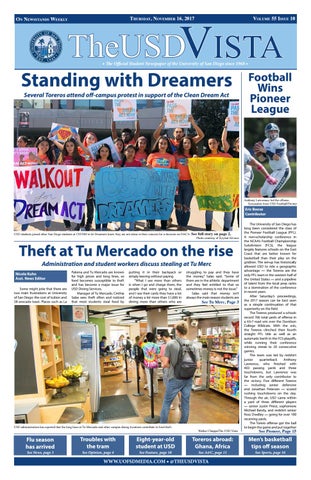
Theft at Tu Mercado on the rise Administration and student workers discuss stealing at Tu Merc
Nicole Kuhn Asst. News Editor Some might joke that there are two main frustrations at University of San Diego: the cost of tuition and $8 avocado toast. Places such as La
Paloma and Tu Mercado are known for high prices and long lines, so food becomes susceptible to theft and has become a major issue for USD Dining Services. Manager of Tu Mercado, Cinthia Salas sees theft often and noticed that most students steal food by
putting it in their backpack or simply leaving without paying. “What I see more than others is when I go and charge them, the people that were going to steal, and I see their cards they have a lot of money a lot more than $1,000 in dining more than others who are
USD administration has reported that the long lines at Tu Mercado and other campus dining locations contribute to food theft.
Flu season has arrived See News, page 3
struggling to pay and they have the money,” Salas said. “Some of them are in the athletic department and they feel entitled to that so sometimes money is not the issue.” Salas said that money isn’t always the main reason students are
See Tu Merc, Page 3
Walker Chuppe/The USD Vista
The University of San Diego has long been considered the class of the Pioneer Football League (PFL). A non-scholarship conference in the NCAA’s Football Championship Subdivision (FCS), the league largely features schools on the East Coast that are better known for basketball than their play on the gridiron. The set-up has historically allowed USD to ride a geographic advantage — the Toreros are the only PFL team in the western half of the United States — and a pipeline of talent from the local prep ranks to a domination of the conference in recent years. After Saturday’s proceedings, the 2017 season can be best seen as a simple continuation of that superiority on the field. The Toreros produced a schoolrecord 706 total yards of offense in a 63-7 road win over the Davidson College Wildcats. With the win, the Toreros clinched their fourth straight PFL title as well as an automatic berth in the FCS playoffs, while running their conference winning streak to 20 consecutive games. The team was led by redshirt junior quarterback Anthony Lawrence, who finished with 403 passing yards and three touchdowns, but Lawrence was far from the only contributor to the victory. Five different Toreros — including senior defensive end Jonathan Petersen — scored rushing touchdowns on the day. Through the air, USD came within a yard of three different players — senior Justin Priest, sophomore Michael Bandy, and redshirt senior Ross Dwelley — going for over 100 receiving yards. The Torero offense got the ball to begin the game and put together
See Pioneer, Page 15
Troubles with the tram
Eight-year-old student at USD
Toreros abroad: Ghana, Africa
Men’s basketball tips off season
See Opinion, page 4
See Feature, page 10
See A&C, page 11
See Sports, page 16
WWW.UOFSDMEDIA.COM ◆ @THEUSDVISTA
2
The USD Vista
◆
November 16, 2017
NEWS
Protests for a Clean Dream Act Students throughout San Diego county unite to support DACA students
Lilyana Espinoza News Editor
As time draws near for a decision to be made on the Deferred Action for Childhood Arrivals (DACA) Act, some University of San Diego students are making their voices heard and showing their support for the passing of a Clean Dream Act. Recipients of the DACA program are referred to as ‘Dreamers.” The addition of the term “clean” describes the desire for a clear way to citizenship for the undocumented immigrants who benefit from DACA. Last Thursday, USD students joined other local San Diego college and high school students on the campus of California State University, San Marcos (CSUSM) to hold a protest in hopes of rallying support for passing the Clean Dream Act. In 2012, Obama passed DACA which President Trump has since halted. It is now in the hands of Congress to pass or deny the action by March. Sophomore Maya Ramirez recognized that the support for DACA students on campus is low because some students find it hard to empathize with those students dealing with issues of immigration. “We are very comfortable here,” Ramirez said. “We are known as the ‘castle on the hill’ and we don’t even engage that much with the Linda
Vista community. I think that along with that comfort comes fear within our minority community.” Ramirez was overjoyed with the turnout at the CSUSM protest and the people who came to support the cause. “They had made about 50 shirts and ran out of shirts,” Ramirez said. “At one point the mass was so big there was almost 100 people.” Ramirez believes that fear plays a factor in student involvement regarding the DACA issue. “I think a lot of people have been afraid for a long time that they will get backlash because they want to speak out or they think it doesn’t pertain to them,” Ramirez said. Sophomore Krystal Alvarez, a board member of the Movimiento Estudiantil Chicano de Aztlán (MEChA), attended a meeting regarding DACA students because one of her friends invited her to go. The meeting had a goal of uniting the schools in different areas in San Diego county to speak out on behalf of the cause. “I have a close friend at San Diego State who is involved with Education Without Borders and she wanted to plan a meeting that was surrounding DACA students and what their needs were and how the San Diego campuses could better serve their needs,” Alvarez said. “It was there where we met an [American Civil Liberties Union] ACLU representative and she brought [the matter] to our
attention and we were down to hop in the movement.” Alvarez is striving for MEChA to make a bigger impact at USD. “We felt that there wasn’t enough happening on campus and part of our goal in MEChA this year was to be more active in the community and be a bigger presence,” Alvarez said. Both Alvarez and Ramirez, along with 11 other USD students, attended the protest at CSUSM as well as a small silent protest at USD during dead hours on the same day. Alvarez thinks that getting students more involved in the
movement on campus will help bring more awareness to the issue. “We are aware that there is a task force on campus that mostly consists of faculty, and I am planning to meet with them,” Alvarez said. “We really just started this out of our own volition and we hadn’t contacted anyone on the task force. Hopefully involving students in the action of what is going on, we feel, is really central and important.” Alvarez finds that sticking up for DACA students is important because they are currently struggling with uncertainty. “It is really hard to focus on your
studies if you are worried about literally getting kicked out of the country or afraid that your parents and sibling might not be home when you get back,” Alvarez said. The end of the six month period for Congress’ decision on DACA will be in March. There is little time left and some point out that students intend to make their voices heard before that time comes. As of now there is no set date for another protest, but Alvarez and Ramirez are meeting with the other San Diego campuses to coordinate more examples of support for DACA students.
USD students protested at CSUSM and spoke out on the passing of a Clean Dream Act.
A silent protest was held on USD’s campus during dead hours last Thursday to show support for DACA students attending the university.
The USD Vista Tayler Reviere Verninas - Editor in Chief Elisabeth Smith - Associate Editor Kelly Kennedy - Managing Editor James Douglas - Copy Editor Kaia Hubbard - Assistant Copy Editor Rita Srekais - Art Director Max Escutia - Assistant Art Director
Editorial – 619.260.4584 Business – 619.260.4714 www.uofsdmedia.com ◆ @TheUSDVista
Lilyana Espinoza - News Editor Nicole Kuhn - Assistant News Editor Taryn Beaufort - Opinion Editor Celina Tebor - Feature Editor Anderson Haigler - Arts & Culture Editor Noah Hilton - Sports Editor Walker Chuppe - Photography Editor
Cyrus Lange - Photo Assistant Ana Contreras Orozco - Photo Assistant Alex Worden - Distribution Editor Bailey Marie Donnelly - Finance Manager Adnan Hassan Nouh - Advertising Manager Gina Lew - Student Media Advisor Marie Minnick - Operations Advisor
Photo courtesy of Krystal Alvarez
Photo courtesy of Krystal Alvarez The USD Vista publication is written and edited by USD students and funded by revenues generated by advertising and a student fee. Advertising material published is for information purposes only and is not to be construed as an expressed or implied endorsement or verification of such commercial venues by the staff or University. The USD Vista office is located on the fourth floor of the Student Life Pavilion in room 403B. All inquiries should be sent to: The USD Vista 5998 Alcala Park San Diego, CA 92110 The first copies of the newspaper are complimentary, all copies thereafter are a 25 cents charge. Opinions expressed in this publication are not necessarily those of The USD Vista staff, the University of San Diego or of its student body. Letters to the Editor can be submitted to The USD Vista office. Letters should be limited to 300 words and must be signed. For identification purposes, USD identification numbers and writer’s year must be included in the letter. The USD Vista reserves the right to edit published letters. Any content sent to the editor will be considered for publication unless otherwise stated.
Volume 55 Issue 10
◆
NEWS
◆
The USD Vista
Students steal campus food
3
Problems with long lines and high prices bring forth issues with theft on campus
Tu Merc, from Page 1 stealing — but high prices and long lines are also factors. “It’s always during lunch,” Salas said. “One time it was eight people in one hour, so you can only imagine what is going on the rest of the day. We are working hard to make the lines faster.” Salas explained that when she sees a student stealing, she doesn’t try to blame them. Instead, she confronts them about paying for the item. “For right now what we do is I try to talk to them,” Salas said. “I usually
plenty of dining dollars, and Apostol confirmed that in most cases money isn’t an issue for students. “I’ve seen my supervisors approach the person asking them if they paid for the item and ask for a receipt,” Apostol said. “In most cases they’ll ask what’s in their pocket and the person will pull out what they took. They [managers] usually say, ‘We will call Public Safety if this happens again.’ But I haven’t actually seen Public Safety ever come.” Loryn Johnson, Director of Marketing for USD Auxiliary Services, stated that when students
“I don’t think people are willing to pay five dollars for a hummus cup or a granola bar when they can easily take it without getting caught” -Hillary Guerrero say, ‘Excuse me you need to pay for that,’ and they always come back and pay. But there was an incident where I did have to call Public Safety and they took it from there. We passed it along from Public Safety and I don’t know what happened after that [due to privacy issues].” Salas said it’s especially difficult when her student employees are confronted with the issue about their peers stealing. Sophomore Michael Apostol, a student worker at Tu Mercado, works morning shifts and said the issue is mostly prevalent during this time, especially when a lot of employees aren’t working. Apostol said when students are confronted by the manager on duty oftentimes their card is taken and charged for the item they stole. A majority of the time they have
are caught they are handed over to Public Safety, and their name and information is given to Student Affairs. The student will then have a trial held in front of a student committee. “First, you have to physically see the person doing it and then you have to confront them,” Johnson said. “Then, of course, they can just walk out the door. Unfortunately in many situations it isn’t because they don’t have the money, [but because] the line is long.” Johnson says her main concern is how much students are paying for their food on campus. “We’re always trying to come up with ways to have a very frugal budget so we can provide food and services and meal plans for students that are more affordable,” Johnson
said. “A lot of people don’t realize that our meal plans are the lowestcost meal plans amongst all of our college and university peers.” Johnson also debunked the myth about the $200 some students believe USD takes out of tuition to cover theft. Johnson explained that as an auxiliary service, no money comes from tuition or student fees. Instead, they manage their own budget to purchase food and provide staffing. “I had heard yesterday from one of my student workers that there is already money taken out of your tuition that is set aside to cover theft, and I thought first of all that’s illegal,” Johnson said. “So I think to clarify, that is not true. None of the food or products comes out of students’ tuition; it’s all a completely separate budget.” Some students argue that high tuition costs justify theft, but Johnson argued against this point. “Dining Services is responsible for creating our own budget, and so we don’t get money from the university but we’re responsible to give money back to the university every year that then goes towards students and student programs and services,” Johnson said. “That is one thing that we’d like to let students be aware of — the fact that we are not getting any money from tuition and we’re not getting any money from any student fees. Dining Services is responsible for creating our own budget and coming up with the money to purchase food.” Junior Hillary Guerrero thinks the stealing has a lot to do with the price of the food on campus. “I don’t think people are willing to pay five dollars for a hummus cup or a granola bar when they can easily take it without getting
caught,” Guerrero said. Guerrero also pointed out that in some dining areas, such as Tu Mercado, students are not allowed to use dining dollars toward some of the produce. “I think it would be helpful if you could use dining dollars [on all items] in Tu Merc and then people wouldn’t steal,” Guerrero said. “Most kids don’t have Campus Cash unless their parents put it on there. Paying out of pocket when you have a meal plan is the reason I think why people steal from Tu Merc.” With food prices being a main concern, Dining Services recently compared their bulk prices to Costco in order to match the costs to make it cheaper for students. According to Dining Services, USD is the cheapest when it comes to produce and food products on campus compared to other universities. Tu Mercado is the main dining service that gets the reputation for expensive food products. Carol Normal, Director of Dining Services at USD, recognized the issue of high prices.
“Part of the reason why we brought in the new bulk grocery concept at Tu Mercado [was] so students have an array of grocery items now that you can purchase that are basically almost comparable to Costco price,” Norman said. “We did that on purpose because we wanted to make sure that there were affordable options for students. The other thing, though, was that when we first developed Tu Mercado the idea was to have it be more of a Whole Foods, Trader Joe’s type of concept to be able to have the organic and the gluten-free options, and those types of items aren’t cheap either.” Dining Services staff continues to explore options like using handheld mobile devices to make lines faster at La Paloma and Tu Mercado, as well as offer affordable food options to prevent theft on campus. While some students may steal for the thrill of it or because they have no time, stealing continues to be a challenge for Dining Services, and an obstacle it hopes to overcome soon.
High prices of items may contribute to the thefts at Tu Mercado. Walker Chuppe/The USD Vista
Flu shot season has arrived
Student Health Center provides free vaccinations for students to protect them from the flu Tyler Arden Contributor Flu season is right around the corner, and this year the University of San Diego Student Health Center (SHC) is reminding students that they aren’t invincible to the infectious disease by encouraging students to get vaccinated. Associated Students continued their support of the health center’s initiative this year, providing a grant of $3,000 to help provide free vaccines to students. The sponsorship offset the cost for 150 students to receive the vaccine on
campus. But the initiative runs much larger than the grant provided by AS. Health Center Director Pamela Sikes said the SHC has ordered 900 vaccines offer to students to date. With those vaccinations, over 773 students were vaccinated by the health center. Using funds allocated in their budget, the SHC purchased the entire supply of vaccines which run $20 per dose. A portion of that cost is covered by the AS grant and student health insurance. Of those vaccinated, 200 students carried the Student Health Insurance Plan, which was billed for the full cost of
The USD Student Health Center provides free flu shots for students. Lilyana Espinoza/The USD Vista
each vaccine. “The Student Health Center has paid for the rest,” Sikes said. “Currently that’s over 400 vaccines for around $8,000.” As the health center approaches the end of their supply, Sikes said they will begin to evaluate whether they need to order more to meet demand. If the SHC orders more, students may have to begin paying for part of the cost. “If we need to order more, we will need to evaluate if we will need to charge for these,” Sikes said. “I hope we do need to order more though, because that means more students will be vaccinated.” Sikes recommended that students receive a vaccination now if they have not yet done so, as this year is forecasted to be a more active flu season. “It takes about two weeks to be maximally protected, so get the vaccine now, before you may be exposed and before Thanksgiving travels,” Sikes said. “This year we’re anticipating high flu activity and the flu vaccine is the best available way to protect against influenza.” The American College Health Association set a target goal for campuses to see 50 percent of their students vaccinated annually for influenza by 2020. The Office of Disease Prevention sets a higher goal for the United States population at 70 percent. Nationally, rates among students range from 8 to 39 percent according to a 2016 National Foundation of Infectious
Diseases report. Even with the health center offering free vaccines and hosting special clinics for students in partnership with the Hahn School of Nursing, the University of San Diego falls well short of these goals. Approximately 14 percent of students elected to receive the vaccine this flu season. Sophomore Tomy Vettukallel is one of the students who received a flu vaccine at one of the clinics. He said that the SHC made the process convenient for students to stay healthy this flu season. “I got my flu shot when they had the flu clinic,” Vettukallel said. “It was super easy. I was already thinking about how I needed to get one when one of the nurses told me that I needed a flu shot as I was walking by.” The large population of students not getting vaccinated carries risks and consequences, especially for higher-risk students living in residence halls on campus. An American College Health Association survey conducted during the fall of 2016, found that 12 percent of college students claimed to receive a lower grade on an exam because they became ill with the flu. Yet even while many students know the risk that comes with going unvaccinated against the flu, there is a long list of excuses. Sophomore Gideon Sawyer said that while getting the flu shot was something on his radar, other things were a higher priority.
“I’m simply too busy,” Sawyer said. “Maybe I should get one, but the fact is it’s on the bottom of my list after obligations with school, work, friends, and free time.” At the same time, students may not realize the full health impact that the flu can have. Where the vaccine can prevent or reduce the time spent ill, those benefits are only realized when students actually get vaccinated. Sawyer expressed that while he is concerned about getting ill, the flu doesn’t resonate as a major concern to him. “The fact is I’m always worried about getting sick just living in such a close environment to everyone,” Sawyer said. “I also don’t think I realize the severity of the flu though. I think of it as something I can get over in a couple of days with medicine.” As a student who did get vaccinated, Vettukallel said he got the vaccine to stay healthy, especially since flu season comes during what is typically the busiest time of the semester. “The last thing that you want to do is get sick during finals,” Vettukallel said. “When it’s so easy to help prevent that from happening, getting a flu shot makes sense.” There is still the opportunity for students to get vaccinated for free. Sikes said students can make an appointment online through the SHC website, but that vaccines are also offered on a walk-in basis during their normal operating hours.
4
The USD Vista
◆
November 16, 2017
OP I N ION
The coming and goings of trams Toreros’ complaints lead to an adjustment in the tram schedules
Taryn Beaufort Opinion Editor University of San Diego students are no strangers to the tram system. Whether they use it to commute from Manchester to main campus or from the West Parking lot up the treacherous hill, the trams serve many purposes. In the past week there has been a flyer on the trams advertising feedback regarding the efficiency of tram services. This is the direct result of two students who took matters into their own hands by requesting a change within Tram Services. Sophomore Marcus Goforth is a student-athlete with a tight schedule and he relies heavily on the tram, especially in the mornings when trying to make it to all of his classes before afternoon practices.
B on time [from Manchester to main campus].” After months of missed trams and being late to class, Goforth decided to express his frustration with Tram Services. “I wasn’t expecting anything, I just decided to email them,” Goforth said. “But then one of the people who works for the Tram Services emailed me back and told me what the problem was. They didn’t realize that one of their drivers taking a break in the morning was slowing down the process.” Goforth’s direct initiative led to an honorable mention in the Tram Services’ feedback flyer, as well as a shift in the system that some USD students might appreciate. “They said they would try to adjust the workers’ break time to later, after the morning rush,” Goforth said. “And I have noticed
“They didn’t realize that one of their drivers taking a break in the morning was slowing down the process.” -Marcus Goforth “My frustrations came from when I come out at 7:30 a.m. trying to get to my 8 a.m., I would look at the tram system [through the MySDMobile app] and it says they are on a 45-minute break,” Goforth said. “I’m like, ‘Why are you doing this at 8 a.m. when everybody is trying to get to class?’ It got to be very frustrating since I rely on them to get from point A to point
a big difference since I emailed them. There are two trams running frequently in the morning and there’s really no issues for me in the morning anymore.” The tram system has also been frustrating for senior Madison Samuels who currently lives in Manchester Hall. “It is too far to walk from Manchester to [main] campus, so
I relied on the tram to get me to class,” Samuels said. “But it was so unreliable that I have to give myself about 40 minutes just to get to class on time, since I was never sure when it would be arriving.” Because of the constant unreliability of the tram schedule, Samuels tried to maximize her chances of catching the tram. “Luckily my bedroom window faces out to the street so if I saw it coming down the hill I would run out and catch it; I didn’t want to miss it while it’s there,” Samuels. “I will constantly take a break from getting ready to check outside to see if the tram is on its way.” Even with the convenient view from her bedroom window, Samuels still has difficulty getting to the tram on time. “I’m never sure when it was arriving and it just isn’t very reliable,” Samuels said. “I have contemplated about calling Ubers to come and pick me up instead, just so I wouldn’t have to stress about the timing of it all.” Besides the unreliability of the tram schedule, Samuels expressed her dissatisfaction with the crowded trams. “I do not like when the trams get so jam-packed that you are forced to stand up,” Samuels said. “No way will I do that. It’s hard trying to maintain your balance [while standing up] with your books and backpack while they are going around turns and speed bumps.”
Samuels recognized that all of her complaints might not be able to be solved by Tram Services, but she still hopes that there may be some ways to alleviate these problems. “I think that if there were more trams that ran more frequently, it may not be as crowded,” Samuels
a lot longer and a lot more often,” Leighty said. “Since I’m not sure when the cut-off is for the tram to stop running at night, this is when the app would come in handy.” Leighty has attempted to use the MySDMobile app to find out when the trams run during the time of her night classes.
“Maybe during the peak class hours, like in the morning or around lunch time, they could increase the amount of shuttles running just to make it more efficient.” -Madison Samuels said. “Maybe during the peak class hours, like in the morning or around lunch time, they could increase the amount of shuttles running just to make it more efficient.” Yet, senior Samantha Leighty has not had any recent issues with the tram. “I usually only take the tram from the West Lot up to [main] campus and then [main] campus back down to the West Lot,” Leighty said. “It’s always pretty timely and runs pretty frequently, at least in the mornings.” Although Leighty has had a good experience with the tram in the mornings, she usually finds it more difficult to navigate later in the day. “The only thing I would say is when I get out of my classes later at night I don’t know how often it does go, so I feel like I’m waiting
“I know that they have the schedules on the app, but I don’t think it works,” Leighty said. “I wish that the app was more informational on maybe how many trams are currently running and when they will start decreasing or increasing the amount of trams running.” Junior Molly McGarvey appreciates Tram Services’ effort to maintain some reliability. “The trams’ consistent routes make it easy to plan a route to get around campus,” McGarvey said. The tram system will not be going anywhere anytime soon, as it is a vital resource for the USD community. However, whether students are content or unhappy with the current system, Tram Services has made it evident that they are open to suggestions and will work with riders to improve the tram experience.
Max Escutia /The USD Vista
Max Escutia /The USD Vista
Max Escutia /The USD Vista
Max Escutia /The USD Vista
Have an opinion? Write a Letter to the Editor to be considered for publication in The USD Vista. Contact vistaeditor@sandiego.edu for more information. The views expressed in the Opinion section are not necessarily those of The USD Vista staff, the University of San Diego, or its student body.
Volume 55 Issue 10
◆
OPINION
The USD Vista
◆
Choosing public or private
5
Toreros discuss why they chose to attend a private school versus public school
Taryn Beaufort Opinion Editor Private versus public, that is the question. When students apply to colleges during their senior year of high school, they may not consider or know the major differences between the two. Private universities have traditionally been associated with more prestige and a smaller population. On the contrary, public universities are generally known to have bigger populations and thus a heightened energy to the environment. There are some common differences between public and private universities. Public universities are funded by state governments, generally have lower tuition fees, are demographically diverse, and have larger class sizes. On the other hand, private universities are just the opposite. They aren’t funded by state governments, generally have a higher tuition, are more geographically diverse, and have smaller class sizes accompanied with a smaller student-toprofessor ratio. For some Toreros there is a strong link between where they went to high school and their college choices, but not all. Senior Daniel Gonzales has attended both private and public schools. He attended a private school from preschool to middle school, and then later transferred to a public high school. While choosing which college to attend, Gonzales’ previous private school history played a minor role in his choice. “I liked the smaller classroom setting from my private school, so I kept that in the back of my mind,” Gonzales said. “In the moment I did not really think about what type of school I wanted to attend, but after four years [of attending USD] I am really happy I ended
up here. I have friends that go to public schools and I could not do a 500-person class like they have, because knowing me I would just skip.” Toward the end of high school, Gonzales thought he didn’t have much of a preference where he continued his education and did not always plan on attending a private university. “I leaned into whatever got me in,” Gonzales said. “I had no preference, I was just straight applying to everything. I got denied by all the UCs, so it was very easy to say no to the public schools because they said no to me. I did not start to care until later.” After attending a private university for the past three years, Gonzales has come to appreciate the benefits of the more intimate atmosphere. “I think at private [universities] you get a lot of personal interaction with professors,” Gonzales said. “I think it is really valuable and I think that building those networking relationships now [that] they can be taken throughout and postcollege.” Some students at USD may not think anything out of the ordinary when it comes to professors’ open office hours and approachable personalities, but not all universities share this same experience. “I know my friends [who attend public universities] say it’s a lot harder to be personal with professors and schedule office hours,” Gonzales said. “It’s still there, but you need to be a lot more attentive and dedicated because it’s harder to find that at a public university.” However, attending a religious, private high school influenced senior Martin Cazarez’s decision to attend a private university like USD. “I wanted to go to a private school the most and it honestly
Attending a private university, like USD, allows students to have more one-on-one time with professors in the classroom. Cyrus Lange /The USD Vista
has everything to do with me going to a private high school,” Cazarez said. “They are way nicer and everything is smaller, I just preferred that. I felt like UC campuses were too widespread and everything felt like its own city.” Cazarez’s family also had a preference for the type of college he should attend. “My family was more inclined to pay for me to go to a private school,” Cazarez said. “Given my experience with private schools in the past, they thought it would offer similar benefits. They thought it would offer more one-on-one education opposed to like 600 people being in one classroom.” The quality of professors and the amount of time they dedicate to students outside of the classroom were very important factors for Cazarez. He shared that
schools before coming to USD. “I came from a very big public high school in Chicago,” Callaci said. “We probably had about 50 kids per class, so that was lot. And my graduating class was about 1,100 students.” Attending a large public school influenced the type of college Callaci wanted to attend. “I definitely wanted a smaller school with smaller class sizes,” Callaci said. “And most of those ended up being private, so that was a main decider for me.” Regardless of each student’s background, it still led them to attend USD. Toreros may be biased toward a private university, but that is not to say the alternative cannot be an option as well. Each type of school has something different to offer, but it is ultimately up to the students to find what will be the right fit for them.
Public
vs
Private
he was fortunate enough to find these kinds of professors at USD. “I think the major difference between us and a public school would probably be population,” Cazarez said. “With a bigger population comes bigger class sizes and those are usually taught by TAs [teachering assistants]. Whereas here, I have never dealt with a TA and I have the option to personally get to know all of my professors.” Being educated in the private school system his entire life, Cazarez has had little experience attending public schools. “I’m very biased, I guess you could say,” Cazarez said. “I really don’t know much of the differences between private and public colleges, because I never really experienced that.” Senior Michael Callaci, however, attended only public
Not funded by state & federal governments Generally higher tuition Geographically diverse Generally smaller class sizes Small student-to-professor ratio
Funded by state & federal governments Cheaper tuition fees Demographically diverse Larger class sizes
Max Escutia/ The USD Vista Source: Petersons.com Have an opinion? Write a Letter to the Editor to be considered for publication in The USD Vista. Contact vistaeditor@sandiego.edu for more information. The views expressed in the Opinion section are not necessarily those of The USD Vista staff, the University of San Diego, or its student body.
6
The USD Vista
◆
November 16, 2017
F E AT U R E
Founders Gala tranforms JCP Biannual Gala raises $1,295,675 through auctions and direct donations Elisabeth Smith Associate Editor Kelly Kennedy Managing Editor The University of San Diego held its fifth Founders Gala last week, hosting over 600 guests and raising funds for student scholarships. Since the event fell on Veterans Day, USD paid special tribute to both current and alumni student-veterans. In total, the event raised $1,295,675. The attendees spent between $500 and $750 each for a ticket to the Gala, with the more expensive option giving them access to an exclusive VIP lounge before the event with President James T. Harris. The night started off in the plaza outside of the Jenny Craig Pavilion (JCP). Dressed in tuxedos and ballgowns, guests pulled up to the circle and valeted their cars. The plaza was unrecognizable with a blue carpet at the entrance that led into a tent full of silent auction prizes, open bars, and waiters carrying hors d’oeuvres complete with iPads identifying the dishes. Outside of the tent, guests mingled among space heaters and entered a raffle to win a Ferrari. Inside the JCP there were more hors d’oeuvres and a Swarovski Sparkle Station where guests could draw
a number and receive a crystal key deeply for our students.” opened with a presentation of the as bought a 10-person table for chain, bracelet, or candleholder After a cocktail hour complete flags by the USD Color Guard and members of her foundation. along with Swarovski Glitter boxes with a silent auction, a two-person featured a Prisoner of War/Missing “I love this university; I wish that for $500 each. colonial band played a drum and in Action (POW/MIA) table at the I would have been able to go here, In the crowd of ballgowns and flute and marched down the stairs entrance to the event, but the but there were dinosaurs roaming tuxedos were students who were onto the court. As the guests filed POW/MIA table was removed after the earth when I went to college and working the event — escorting VIP down the stairs into the JCP, some everyone sat down for dinner to they weren’t open here yet,” Shiley guests, helping with food service, were unaware that they were on make room for the after-party. said. “I think it’s a wonderful school. manning the silent auction, or a court. The floor was covered by Student Veteran, Junior Nick I think the values-based education assisting with coat check. Many rubber mats, and false walls created Kowalski was excited that the Gala they talk about is something that of the students working the a new dining area with three large emphasized supporting student my late husband and I first heard event are part of Alcalá Club, a screens at the front and a large veterans. “As a student veteran, I when Art Hughes was president and service organization that works chandelier at the center. enjoy hearing about events, such gave a speech... I went up to Art in with President Harris as official The actual ceremony was as the gala, which help support the middle of the evening and I said, representatives of the university. hosted by Dorothy Lucey, a USD veterans who take a non-traditional ‘My husband and I would like to Senior Ellie McCaw is the parent and former entertainment approach to college,” Kowalski said. fund a scholarship.’ It was $25,000 President of Alcalá Club. McCaw reporter. Lucey was accompanied “I would have liked to see more or something like that, and over the worked with President Harris for the years the university presented itself first half of the evening, assisting “As someone who relies on scholarship to attend in such a way that we felt it was him with scheduling and attending USD, I was happy to share my experience regarding worth supporting.” the different receptions with him. Shiley wants to see her “When working with Dr. Harris the impact scholarship has had on me.” donations go toward bettering I had the opportunity of attending -Ellie McCaw education as well as focusing on the VIP Reception and was able to senior issues such as senior housing talk with some potential donors by a video presentation that played veterans attend the gala. The event, and Alzheimer’s Research. who wanted to hear a student’s on the screens behind her. Veteran however, was not for veterans as “Working on senior issues is perspective of the event,” McCaw students, ROTC students, and civilian much as it was for the community.” important to me right now and said. “As someone who relies on students who have benefitted from One of the most recognizable continuing with education,” Shiley scholarship to attend USD, I was Founders Gala donations were donors of the night was Darlene said. “Because Don and I came from happy to share my experience featured in the videos thanking the Shiley, representing her late very poor backgrounds, if it wasn’t regarding the impact scholarship donors for their contributions and husband Donald Shiley and the for education I’d be still living in the has had on me by allowing me to introducing other speakers. Shiley Foundation. Shiley’s name projects and he’d still be picking fruit attend such an incredible university. While the night was advertised can be seen throughout campus in Oregon. So, God bless education, I felt honored to interact with those as an event dedicated to honoring at the School of Engineering, the it’s very important.” who make education at USD a veterans and celebrating Veterans science building, and Shiley Theatre. Overall, the night proved to be possibility for so many, and what an Day, the military influence seemed Shiley did not spare any expense very lucrative for the university and experience it was being surrounded to be more of a side theme. The at the Gala. She generously donated added a lot of funds to the new 7DLM14709__REGGAE FEST/COLLEGE by so many people who care so dinner portion ofDAY__VISTA__RUN:11_15_17__10x7.75 the evening to the Fund-a-Torero Veteran as well Veteran Scholarship Fund.
SATURDAY, NOVEMBER 18
FEATURING
On Saturday November 18th, Del Mar gets in the groove during Reggae Fest, featuring the positive vibes of Iration. Even better, it’s also College Day at the track. Show your valid student ID for free track admission, plus access to the college tailgate party in the Red Star Café, featuring DJs, drinks, food, and more. Visit DelMarRacing.com for tickets and more.
7DLM14709_ReggaeFest_CollegeDay_Vista_10x7.75.indd 1
10/19/17 4:19 PM
Volume 55 Issue 10
◆
FEATURE
◆
The USD Vista
Serra name change proposed
7
American Indian & Indigenous Student Organizationlead the charge to change the name of Serra Hall Celina Tebor Feature Editor Hundreds of Toreros pass Serra Hall daily, the home of classes, computer labs, and offices at the University of San Diego. However, most students may not know the history of the man whom the hall is named after. In pursuit of making USD a more inclusive place, the American Indian & Indigenous Student Organization (AIISO) has been pushing for the name of Serra Hall to be changed. The 2015 canonization of Saint Junípero Serra by Pope Francis was a controversial decision. Serra was the head of the missionaries who came from Spain to America in the 18th century. Sophomore Alexii Sigona, who originally brought forth the idea of changing the name of Serra Hall, explained why Serra is such a controversial figure. “It was an ethnocide and there was a lot of terrible things that happened during the missions,” Sigona said. “There was a lot of culture and teachings that were lost and our tribe is still trying to recover
and it kind of triggers an effect of ‘Serra did this, which influenced this,’ which basically led to me not knowing a side of my heritage.” While some indigenous students may feel uncomfortable with the name of Serra Hall, other USD students do not know the history surrounding the saint. Sigona explained why students may not know of Serra’s history. “He was just canonized a few years ago, and so most people just think ‘Oh, it’s St. Serra, he’s a saint,’ and associate that with him being a great person,” Sigona said. Sigona knows that changing the name of a building is not an easy feat, and believes the first step of changing Serra Hall’s name is to inform more students. “Once students learn what he did, which was horrendous, they’ll want change,” Sigona said. “And when you have students who want change, then change will happen.” In order to educate more students about the history of Serra, AIISO will host an event in front of Serra Hall on Thursday, Nov. 16 from 12:30 - 2 p.m. Murphy explained the effect the event should have.
“Once students learn what [Serra] did, which was horrendous, they’ll want change. And when you have students who want change, then change will happen.” -Alexii Sigona all the knowledge that was lost, and that was because of the missions. Forty percent of the natives died during the missions.” Junior and President of AIISO, Patrick Murphy, recognized why USD honored Serra by naming a hall after him, but Murphy still supports the changing of the building’s name. “I can see it as two ways,” Murphy said. “It is a private Catholic school, so they are honoring Serra and his contribution to the religion. It does create an uneasiness for those who know the history.” Sigona, a member of the Amah Mutsun Tribal Band, said he feels affected by the name of Serra Hall. “It makes me feel uncomfortable,” Sigona said. “Every time I see Serra Hall, it reminds me of what happened to my ancestors,
“It’s an informational,” Murphy said. “We’re trying to bring light to the actual history for some of the students who may not know everything about Serra.” Murphy explained what the club will do to catch the attention of students passing by Serra Hall during the event. “We collected 300 rocks and we’re going to spray paint them bright red,” Murphy said. “We’re going to place them in the grass area, around the statue, to catch people’s attention.” Sigona explained what the red rocks symbolize. “Each rock is going to symbolize 1,000 native deaths, and we’re going to lay out the rocks in front of the statue,” Sigona said. AIISO is also going to have
Members of AIISO and other organizations are attempting to change the name of Serra Hall in hopes to be more inclusive. Walker Chuppe/The USD Vista
more tangible information about St. Serra’s history at the event, according to Murphy. “We’re going to have tables around the side with informational flyers,” Murphy said. “And we’re going to have traditional bird singers there. It’ll help us out with the event, and it’ll be respectful towards our traditions and [we hope] that people would get stopped by the bird singing.”
The event will have tribal nation flags to represent the different tribes in California. Murphy believed they will pay respect to the tribes. “[The flags] show that although there was this genocide and almost extinction of the culture, we’re still here today and prominent people,” Murphy said. Junior Davis Luanava, who is part of AIISO, has more plans, beyond the informational, to teach
AIISO will be holding an informational today in front of Serra Hall with flyers and other attractions in hopes of teaching students the history of St. Serra. Walker Chuppe/The USD Vista
about the history of Serra in hopes of changing its name. “We’re going to create an Instagram and a Facebook to get the word out,” Luanava said. “We have some informational papers that we’re planning on putting around campus, just to get people thinking about Serra. And we’re going to partner with the Office of Sustainability, possibly, and go to their events to talk about Serra as well. I’ve started talking to a bunch of the classes for ethnic studies and theology about this topic, [a topic] that even the professors don’t know about.” Luanava believes that it’s important to get the word out to as many people as possible. “Once we’ve started to educate [professors], they have started to educate their own classes,” Luanava said. “We’re going to try to go at this at every angle, because this is a very important topic.” According to Murphy, AIISO has proposed several names to replace Serra Hall. “We have a couple suggestions,” Murphy said. “Kumeyaay Hall, which would give respect to indigenous people in the San Diego area, and another suggestion was St. Kateri, which would help on both levels: on the religious side, she was a saint, and she was [also] Native American, so it would pay both parties.” AIISO’s goal is to inform the USD community about the history of Serra in hopes of someday changing its name. If Serra Hall does become a name of the past, the building will likely host a new name honoring the indigenous community.
8
THE USD VISTA
◆
Volume 55 Issue 10
NOVEMBER 16, 2017
Fund-A-Torero Veteran: Attendees raised their paddles and directly donated whatever number was on the screen to the special Veteran Scholarship Fund, with the first bid starting at $25,000. 8 people donated $25,000 8 people donated $10,000 [one couple raised their donation to $20,000] 13 people donated $5,000 Over 16 donors donated $2,500 The Chair of the Board of Trustees, Donald R. Knauss, matched up to $25,000 of the donors in the $2,500 bracket. About 38 people donated $1000 About 27 people donated $500 Over 20 people donated $250 Over 30 people donated $100
Silent Auction items included:
Live Auction items included:
Wine Vacations Tickets to USD Sporting Events Swarovski Jewelry
Kris Bryant Jersey Dinner with President and Mrs. Harris Super Bowl Tickets
Inside the
Founders Gala
◆
FEATURE
◆
THE USD VISTA
9
Menu: First Course Chicken Velouté topped with Brioche and Black Truffles Dinner Braised Veal Cheek with Parsnip and Roasted Beef Tenderloin accompanied by Swiss Chard and Chanterelles Dessert Chocolate Créneuz with Banana, Yuzu, and Sesame
How did they raise money? Tickets: $500 general admission
The fair market value of this purchase is $150. $350 of this purchase is a tax-deductible contribution and will benefit USD.
$7,500 for a VIP table of 10
The fair market value of this purchase is $1,700. $5,800 of this purchase is a taxdeductible contribution and will benefit USD. Photos courtesy of University Communications and Kelly Kennedy/The USD Vista
$750 VIP ticket
The fair market value of this purchase is $200. $550 of this purchase is a taxdeductible contribution and will
$5,000 for a table of 10
The fair market value of this purchase is $1,500. $3,500 of this purchase is a taxdeductible contribution and will benefit USD. Spread by Rita Srekais; Content by Elisabeth Smith/The USD Vista
8
THE USD VISTA
◆
Volume 55 Issue 10
NOVEMBER 16, 2017
Fund-A-Torero Veteran: Attendees raised their paddles and directly donated whatever number was on the screen to the special Veteran Scholarship Fund, with the first bid starting at $25,000. 8 people donated $25,000 8 people donated $10,000 [one couple raised their donation to $20,000] 13 people donated $5,000 Over 16 donors donated $2,500 The Chair of the Board of Trustees, Donald R. Knauss, matched up to $25,000 of the donors in the $2,500 bracket. About 38 people donated $1000 About 27 people donated $500 Over 20 people donated $250 Over 30 people donated $100
Silent Auction items included:
Live Auction items included:
Wine Vacations Tickets to USD Sporting Events Swarovski Jewelry
Kris Bryant Jersey Dinner with President and Mrs. Harris Super Bowl Tickets
Inside the
Founders Gala
◆
FEATURE
◆
THE USD VISTA
9
Menu: First Course Chicken Velouté topped with Brioche and Black Truffles Dinner Braised Veal Cheek with Parsnip and Roasted Beef Tenderloin accompanied by Swiss Chard and Chanterelles Dessert Chocolate Créneuz with Banana, Yuzu, and Sesame
How did they raise money? Tickets: $500 general admission
The fair market value of this purchase is $150. $350 of this purchase is a tax-deductible contribution and will benefit USD.
$7,500 for a VIP table of 10
The fair market value of this purchase is $1,700. $5,800 of this purchase is a taxdeductible contribution and will benefit USD. Photos courtesy of University Communications and Kelly Kennedy/The USD Vista
$750 VIP ticket
The fair market value of this purchase is $200. $550 of this purchase is a taxdeductible contribution and will
$5,000 for a table of 10
The fair market value of this purchase is $1,500. $3,500 of this purchase is a taxdeductible contribution and will benefit USD. Spread by Rita Srekais; Content by Elisabeth Smith/The USD Vista
10
The USD Vista
◆
November 16, 2017
Student profile: Ramses Sanguino Eight-year-old Ramses Sanguino is enrolled in a USD physics class
Celina Tebor Feature Editor Eight-year-old Ramses Sanguino can be seen strolling across campus with his mother like many other children on campus. But, there is one aspect that distinguishes him from the other children. His mother is not the student: Ramses is. Ramses began classes at USD in fall of 2017. He is currently taking physics classes and working personally with Daniel Sheehan, Ph.D., a professor in the physics department. He sits in class with other students, accompanied by his mother, Nyx Sanguino. In an interview with The USD Vista, Ramses’ mother spoke on behalf of Ramses, as he tends to be shy and reserved around new people. Ramses is the youngest child to
general he’s being educated by his mom and the Internet. A lot of this is getting him familiar with the classroom setting in the hopes that he’s wanting to start with earnest.” While Ramses is shy when talking to new people, Sheehan mentioned that he sometimes makes insightful comments in class. “He’s mostly quiet,” Sheehan said. “He’s in his own world. He’ll occasionally take a few notes and occasionally make an observation and participate in class. I think it’s really good for our students to interact with someone not their own age or standing.” Nyx described Ramses as a prodigious savant: an autistic child with extraordinary capabilities beyond his own age. His mother said she knew her child was special even before he came into the world. “I had a connection with Ramses since before he was born,” Nyx said.
“[Ramses] loves numbers, he knows by memory 200 digits of Pi. He learns languages really easily...He knows about eight languages in terms of reading and writing.” -Nyx Sanguino take classes at USD in the 68 years the school has been in existence, according to Nyx. Nyx explained why she put Ramses immediately into college courses. “He’s a part of an experiment to see how he does,” Nyx said. “I want to see how he’s sitting and paying attention, learning to be in the environment of a class. He’s never been in a class; he’s homeschooled.” Sheehan explained why Ramses is sitting in on the class. “He’s basically getting his feet wet in class, he’s taking notes from time to time,” Sheehan said. “In
“That’s why he has that name — Ramses — because I knew he would be a super smart kid.” Ramses’ name means “Child of Ra,” who is the Egyptian sun God. Ramses has multiple gifts which differentiate him from other eight year olds. Nyx listed his talents. “He loves numbers, he knows by memory 200 digits of Pi,” Nyx said. “He learns languages really easily: Chinese, Greek, Japanese, Spanish, English, Arabic. He knows about eight languages in terms of reading and writing. He has a perfect pitch, he can read music and has never had a teacher.”
Ramses has learned at an accelerated rate since he was a baby, with skills such as speaking and writing in multiple languages. Photo courtesy of Nyx Sanguino
There are several videos on Ramses’ YouTube page, titled “Genius Ramses,” showcasing his talents. With over 250 videos, the channel features clips of Ramses reading and writing in non-English languages, doing algebra, and reciting digits of Pi. According to his mom, Ramses flourished since he was a young child, and continues to do so today. As his mother, Nyx has seen him learn and grow at rates that she had never seen before. “He learned how to read at seven months in Spanish, English, and Greek,” Nyx said. “He learned multiplying by 11 months, learned how to play Jingle Bells at 12 months, and learned all the continents of the world when he was 18 months.” Nyx thought to enroll Ramses in kindergarten at the age of four, but quickly realized that the traditional education system would not work
Ramses started classes at USD this year and is currently taking a physics class with Dr. Daniel Sheehan. Photo courtesy of Genius Ramses/Facebook
with his atypical mind. “He was always questioning the teacher,” Nyx said. “She’d make a little mistake because she was teaching kids how to read. And he already knew how to read, and so he was calling her out every time she was making a mistake.” Ramses himself thought that even college courses were not challenging to him. “[College] is easy,” Ramses said. Sheehan explained how both Ramses and his classmates benefit from having him in class. “He’s someone that has tremendous potential, and I’d love to see it used,” Sheehan said. “I think our students have a lot to gain as well with working with someone who’s different and gifted in his own way, so I think it’s a win-win for everybody. What we get back is having a broader education for our own students and seeing what limits of human potential are.” Academics is not the only subject Ramses excels in, according to Nyx. She believes he has telepathic powers. “He can feel pain when other people feel pain, he can feel sadness when other people feel sadness,” Nyx said. “He can connect with people really easily and he has the ability of saying things that I think. That’s why I knew about him before I was born — I connected with him in a telepathic way.” Neuroscientist Diane Powell, Ph.D. conducted her own research on Ramses in 2015 as a research project on telepathy. Her results were ultimately inconclusive. According to Sheehan, Powell was the person who actually brought Ramses to him. “I was contacted by Diane Powell, and she is an expert researcher in autistic savants,” Sheehan said. “Ramses fits into that category, apparently. She indicated that Nyx and Ramses were moving down to San Diego and asked if I could contact them. The administration here was very helpful in making sure the path was clear for him.” Ramses explained what he is learning at USD and the experience of being in classes with students much older than him. “I’m taking physics class,” Ramses said. “It’s the use of math to make stuff work, like to make gravity. I’m enjoying myself; the classmates are really nice.” Sheehan believed the positive experience was on both sides of the equation. “I think for the most part [the
students] enjoy having them there,” Sheehan said. “It adds another dimension to the class.” Nyx was surprised, but ecstatic about her son’s college career. “Honestly, I have been so proud of him,” Nyx said. “He sits down, and he takes notes, and he pays attention [in class]. Sometimes he can be a little excited and loud maybe, but most of the time I never imagined he would do so well like he’s doing right now.” While Nyx wanted to launch Ramses’ academics early, she knew the importance of his childhood. “He can be sometimes funny, and make jokes, and laugh at things like the kid that he is,” Nyx said. “But I think he’s a really different child, he needs a really different education. So I think that’s it important for him to get the stimulation he needs.” Nyx has been trying to get Ramses in the public eye his whole life, so he can have the opportunity to get the proper education. “It’s an amazing opportunity that Dr. Daniel Sheehan gave us,” Nyx said. “I’m so grateful, he’s an amazing person, he’s really smart too. I think he’s doing the right thing too, because Ramses deserves a better education.” Nyx acknowledged that even though Ramses has not had teachers in the past, that does not mean he cannot benefit from them. “He is a genius, but it doesn’t mean that he doesn’t need to learn,” Nyx said. While Ramses is learning at a pace unachievable by most, he is not sure that he wants to mature as quickly as he learns. “I want to be a scientist when I grow up, but I don’t want to grow up,” Ramses said. “I want to stay a kid.” Sheehan also thought that Ramses should have some typical experiences that other children do. “He comes to office hours after [class] and we chat,” Sheehan said. “He has lots of interests. His mom got him a bicycle, and I tried to teach him how to ride a bicycle a few weeks ago.” Nyx believes her duty is to give Ramses the best life he can have. “I am a single mom, and what I do is be with him,” Nyx said. “My goal in life is to help him to blossom, and be the person that his brain is giving him the opportunity to be.” Ramses Sanguino is a one-of-akind student and child that USD has given the opportunity to flourish. As he continues to take classes at USD, his abilities and talents may lead to further academic development.
Volume 55 Issue 10
◆
ARTS & CULTURE
◆
The USD Vista
A RT S & C U LT U R E
11
Toreros Abroad: Ghana, Africa Semester at Sea students share their experience at a three-night homestay in Senase, Ghana
Junior Megan McDonell was one of five USD students who embarked on a three-night homestay and school visit in Senase, Ghana.
Glenn McDonell Contributor This September, several students on the current voyage of Semester at Sea (SAS) had the chance to connect with a rural community in Ghana as part of a three-night homestay and schoolvisit experience. Among this group of around 30 SAS students were University of San Diego juniors Grace O’Brien, Serena Bonafede, Camille Cohan, my sister Megan McDonell, and myself. As the five of us disembarked the MV World Odyssey and stepped onto African soil for the first time, we braced ourselves for a deluge of culture shock and unfamiliar new experiences. However, the first shock came not from difference but from coincidence. Fredrick Benneh, our local guide and leader, studied at USD for a semester and lived in the UTAs just several months before the now junior class moved into the first-year dorms in the fall of 2015. Bonafede expressed her
surprise at this coincidence. “I was totally mind-blown to learn about this connection to our campus,” Bonafede said. “I never expected to run into someone who shared so many of our experiences so far away from home.” McDonell expressed a similar reaction. “From the moment we learned about Fred’s time at USD, we were absolutely ecstatic,” McDonell said. “It felt like it was almost meant to be.” As a Torero on hiatus from his studies at Hult International Business School in London, Benneh competed in and won the 2015 Social Innovation Challenge (SIC). With the resources provided to him from the SIC, he sought out to change the way Ghanaian elementary taught and punished their students. Ghanaian elementary schools tend to emphasize rote memorization and often use corporal punishment to discipline students. Benneh’s model for social innovation is different. Through the
The students went to Senase to help in the local elementary school. Photo courtesy of Glenn McDonell
integration of technology, positive reinforcement, and hands-on learning, he believes that children can gain the skills they need to escape Ghana’s severe rural poverty cycle. Equipped with a sum of money from the challenge, Benneh was able to finance the project of his dreams in his home village of Senase, Ghana, the destination of our bus trip. Bonafede said she was inspired by Benneh’s success in the challenge. “I felt honored to be a part of a university that provides opportunities for great ideas which can benefit lives of others to become reality,” Bonafede said. “Getting the chance to be a part of his story was so exciting.” The story of Benneh’s project began well before his time as a Torero and his success in the Social Innovation Challenge. As a student at the Hotel Catering and Tourism Institute at Greenhill College in Ghana’s capital city of Accra, Benneh started his first social enterprise, Can Do Tours, in
2011, at the age of 18. Ever since then, he has been taking groups of travelers on homestays in his village, many of them Semester at Sea students like ourselves. A significant portion of the proceeds from Benneh’s tour company became contributions to the GodFred’s Foundation, which Benneh started in partnership with a former Semester at Sea student and client of his tour company, Barbara Allison. Each and every Semester at Sea student who has visited the school since Allison’s first visit has contributed in some way to making the Semanhyiya American School, or “SAS,” into the school it is today. With this legacy in mind, our group set out to earn our place in the school’s ever-growing extended family and write our chapter in its short but proud history. For Cohan, this involved a combination of give and take. “I wanted to touch the lives of the kids at the school and have them touch mine even more,” Cohan said. “That’s exactly
Photo courtesy of Glenn McDonell
what ended up happening and I couldn’t be more grateful for my time spent here.” A day with the children of the Semanhyiya school began with an early morning hand-in-hand escort to the school bus pickup location. McDonell recalled the early morning hours as one of her favorite times of the day. “I loved starting my day rolling down dirt roads on a bus full of chaotic laughter and joy” McDonell said. “It was obvious to me that the children wanted to be at school, which to me meant that the teachers were doing something right.” After every child arrived, we Toreros were given the chance to assist teachers with daily operations. Some of us taught lessons or read books aloud in classrooms, while others regulated recess time or assembled some of the playground equipment donated from abroad. Those who helped out in the classroom were sometimes tasked
See Abroad, Page 12
Toreros assisted local instructors by teaching lessons, reading in classrooms, and regulating recess time. Photo courtesy of Glenn McDonell
The USD Vista
12
Abroad from Page 12
with teaching an entire lesson while the teacher maintained some sense of order. Topics ranged from the alphabet in kindergarten to proper nouns or multiplication in the third grade, which is the highest grade level offered. Bonafede said that her time teaching a math lesson was one of the more memorable and rewarding experiences at the school. “I felt that I was able to give something to this community when helping teachers at the school figure out ways to teach their students math and different subjects,” Bonafede said. “Getting close to the kids and teaching them things that they were interested in was very fulfilling.” McDonell also spent time assisting the teachers in one of the classrooms. She made several observations of how the teachers
interacted with their students. “I’ve noticed how a key to what makes the Semanhyiya school different is positive reinforcement,” McDonell said. “The kids are rewarded for good behavior, which helps motivate them and instills values.” Our time at the school ended with a school-wide assembly, during which the teachers and students delivered a poignant farewell to our group, complete with song and dance. For Bonafede, this moment was particularly special. “The most powerful moment during my time at the Semanhyiya School was when we danced with the kids,” Bonafede said. “The kids and teachers started singing ‘It’s a Small World’ while waving flags from the countries we were visiting on our voyage, and I couldn’t help but get emotional.” The name of the school,
◆
November 16, 2017
Glenn and Megan McDonell, USD juniors and twins, smile with a community member from Senase. Photo courtesy of Glenn McDonell
“semanhyiya,” translates roughly from the local language to mean “if we had never met.” This sentiment began with Barbara Allison, the original visitor from Semester at
so generous with what they had, and the love I received will forever stick with me and I’m so thankful for it.” Before leaving the Semanhyiya
“Being a Changemaker campus, it’s important that we know how Toreros are making a difference all around the world.” -Camille Cohan
McDonell is pictured here interacting with Senase schoolchildren. Photo courtesy of Glenn McDonell
Sea, but has continued to carry a deep meaning for every voyage since. For Cohan, our time at the school was more than just a fun time with kids — it was a change of heart and mind. “The community gave me a new perspective on Africa and the people in Ghana,” Cohan said. “I’ve never encountered such genuinely happy people who were
community behind, our group painted “MV WORLD ODYSSEY” on the side of the children’s playground’s pirate ship to commemorate our ship’s impact on the school. We left the village of Senase and the nation of Ghana feeling proud to be part of such an incredible story. As we come home to the USD community, all of us will hold a
deeper appreciation for what it means to be a social innovator, a changemaker, and a global citizen. Cohan stressed the importance of passing on the story of Fred and the Semanhyiya school. “Being a Changemaker campus, it’s important that we know how Toreros are making a difference all around the world,” Cohan said. “The fact that a USD international student created this school means we should definitely pay attention.” Benneh’s time as a student at USD combined with his connection to Semester at Sea brought these three communities together in a special way. His passion for social change and his entrepreneurial spirit have improved the futures of hundreds of children in his community and have made the world a slightly smaller place.
Artist lecture: Janelle Iglesias Visual artist lectures at USD as part of the Visiting Artist Lecture Series Anderson Haigler A&C Editor Visual Artist Janelle Iglesias spoke on campus Friday at Camino Hall, and brought an intriguing look into her work. Iglesias was hosted by the Department of Art, Architecture, and Art History’s Visiting Artist Lecture Series, and provided a look at her work and inspiration. She hails from Queens, New York, and has had a rich career in art thus far. At her lecture, Iglesias described a six-month stretch spent in Paris, France as an important period for her and her artwork. She lived with her sister, Lisa, and she explained that they were living off a single artist grant, and were totally broke, living in a tiny studio apartment.”Nonetheless, the two sisters found inspiration within the city. “It was super challenging, but also super fantastic,” Iglesias said. Iglesias places a large emphasis on repurposing items and sustainability in her work. Many of her pieces feature items she found in the world around her, and Paris was no exception. “I’ve always been interested in found objects,” she said. “We would take these long walks all over the city, and we were there during the wintertime, and we were coming across not only found objects, but found gloves.” For a project, the sisters found 80 single gloves around Paris. As
the Iglesias sisters laid the gloves out, they painted what they imagined the matching glove would look like, then set them side by side to create a pair. Iglesias explained in her lecture that she has also worked with items like coffee stir sticks, masking tape, and items she simply found in her parents’ garage. Her work displays an ability to take items that were previously in a disordered state and transform them into something cohesive. As a whole, her projects give off a sense of organized chaos. Janelle’s and Lisa’s time spent in Paris also allowed the sisters to draw inspiration from their relationship. “We had to learn from each other, and share information and skills,” Iglesias said. However, the pair did encounter some difficulty spending so much time together. “It was our first time really living and working together since high school, and we really did fight a lot,” Iglesias said. Following a series of fights, they decided the best way to express their frustration with each other would be to construct piñatas in each others image, and hit the piñatas. The project gave them a unique way to put aside their differences, and provided both a literal and figurative representation of the struggles that siblings can often go through. “We wanted to dig into that tension, instead of leaning away
from it,” Iglesias said. “We made piñatas of each other, then we beat each other up,” Iglesias is also working to make art more accessible to people who wouldn’t necessarily call themselves artists. While living in Brooklyn, she brought her piñata concept to the Good Companions Senior Center in an effort to get the community more involved in art. The piñata concept was part of a larger event at the center that featured art from the community. “Everybody came in for our ‘Thanksliving’ celebration, and we brought food and displayed the art and the pinatas,” Iglesias said. “The art sort of belonged to the community, and stayed within the community, and we celebrated that.” Janelle Iglesias brought a unique and diverse body of work to her Visiting Artist Lecture last Friday. She gave students a look at sustainable and creative works. Visiting Artist Lectures are featured periodically throughout the semester, and are held in the drawing studio in Camino Hall.
Upcoming USD Visiting Artist Lectures
Kate Clark Nov 17 10:15 a.m. Camino Hall 29 (Drawing Studio)
Iglesias’ art has been known to feature repurposed, and sustainable items. Photo courtesy of the USD Department of Art
Volume 55 Issue 10
◆
ARTS & CULTURE
◆
The USD Vista
13
Aminé brings tour to San Diego Portland-based rapper known for the hit song “Caroline” is on his first world tour Celina Tebor Feature Editor Hundreds of young adults shuffled around anxiously last Friday night, waiting for Aminé to come on stage. The crowd was a sea of yellow, representing Aminé’s color, which he wears frequently and features in many of his music videos in the form of bananas. The Observatory North Park was packed with fans for the sold-out show. Aminé began his career in Portland, Oregon when he was a teen. His large following in the Pacific Northwest spread across the country after he released his song “Caroline” in May 2016 which hit over 200 million views on YouTube. His fame continued to sweep the nation after releasing his album “Good For You” in July 2017. His music is a mix of hip-hop, pop, and rap with an influence from his hometown Portland. His songs contain many references to the 503, Portland’s area code, and to his Ethiopian heritage. His high-energy beats attract mostly high school and college students, but some adults could be seen jamming in the back of the concert. First-year Sarah Kushner attended the concert and has been a fan of Aminé since his debut single. “I initially was into Aminé when he released ‘Caroline,’” Kushner said. “I wasn’t really into his music
until my friend showed me the song ‘Spice Girl,’ and since then I’ve been listening to his whole album. And I was really excited since the tickets were so cheap.” The rapper seemingly took an eternity to get on stage, which clearly annoyed his fans. His three openers were unknown by most, and by the time the third one came out, his rowdy rap songs did nothing to hype the crowd up for Aminé himself. Kushner was one of the members of the audience who was displeased with the amount of time Aminé took to appear onstage. “I didn’t think the opener was bad, but it went on for quite a while, and I think the whole crowd was getting antsy for Aminé to come out,” Kushner said. Aminé’s set started with his single “Baba,” with inflatable letters spelling “Good For You” acting as his backdrop. After finishing his first song, he paused to talk to the crowd. “We like to promote a lot of self-confidence here,” Aminé said. “So when I say ‘you’re beautiful,’ you say ‘I know.’” He called out “you’re beautiful,” to which the crowd responded “I know,” throughout the night. Aminé rapped every song on his album, along with a few songs from different artists. Near the beginning, he paid respect to Kanye West with “Gold Digger.” After singing one of his more popular songs “Spice Girl,” he
finished with “Wannabe” by the Spice Girls, to which the whole crowd sang along. The majority of the crowd only knew a few of Aminé’s most popular songs, which he finished his set with. “Wedding Crashers,” “Spice Girl,” “Red Mercedes,” and the hit that started off his career, “Caroline,” had the crowd yelling the lyrics and jumping up and down, while some of his other songs only had a few of his dedicated fans singing along. Kushner said that she was impressed with Aminé’s performance. “I would for sure to go to his concert again,” Kushner said. “A lot of people were saying he wasn’t very good live or a very good singer, but I was very impressed. The price of the ticket was so inexpensive, especially because I love Aminé so much, so it was Aminé performed hits like “Caroline” at The Observatory North Park last Friday. Celina Tebor/The USD Vista definitely worthwhile. ” of pants at every concert and adds as fans began to shuffle out of The The Observatory offered a good view for spectators with its a patch with a word or phrase that Observatory, he ran back on stage slanted floor and chairs in the back represents the city. He called a fan with an encore of “Spice Girls,” of the venue. Fans over the age of onstage to help him decide what leaving the crowd buzzing with excitement and energy. 21 could enjoy a drink at the bar to put on San Diego’s patch. After a few minutes of While Aminé is a smaller while jamming out to Aminé. For Kushner, The Observatory deliberation, the crowd decided to artist, his fanbase is growing was a good venue, but not what take the patch-naming into their exponentially, as shown by the own hands and chanted the word sold-out performance in San she was expecting. “I personally liked the venue ‘tacos.’ Aminé got a good laugh Diego. While his openers went because we could get really close out of the cries for tacos, and let on for far too long, his own to Aminé, but I was expecting a the fan that he pulled up on stage performance was spectacular, singing every song on his album bigger venue,” Kushner said. “I write it on his pants. Aminé finished with his hit without missing a beat. With know that he’s small, but I wasn’t song “Caroline,” and quickly $20 tickets and a venue like The expecting that small of a venue.” To remember every city he exited off the stage after saying Observatory, Aminé’s performance visits, Aminé wears the same pair goodnight to San Diego. However, was well worth the wait.
Check out The USD Vista on the MySDMobile app
and visit the website www.UofSDMedia.com
14
The USD Vista
◆
November 16, 2017
SP ORT S
Healthy Hood ready to return
A year removed from a season-ending knee injury, Maya Hood is excited to get back to basketball Sunit Bhakta Contributor Basketball is back, and thus begins another season for the University of San Diego’s women’s basketball team and head coach Cindy Fisher. Coach Fisher embarks on her 13th season as the head coach and looks to lead the Lady Toreros to a bounce-back season after finishing the 201617 season with a losing record. One of Fisher’s primary weapons on the court will once again be forward Maya Hood, a member of the Toreros since 2012. Hood suffered a seasonending knee injury after just nine games last year, and her absence was a major contributor to the Lady Toreros’ lackluster campaign. The injury required a lengthy and grueling rehab process to ensure Hood could return to the court for her sixth season at USD. “Rehab has been challenging,” Hood said. “It was the hardest in the beginning because there was so much swelling in my leg and knee, so that was painful. But once I got past that initial hump, it became a lot easier for me. Overall, the athletic trainers at USD have done an incredible job over the last ten months to get my knee strong and healthy. I will forever be grateful for all their hard work and dedication to me.” Her return is highly anticipated, and the Lady Toreros will lean heavily on the preseason all-conference selection when she comes back.
The anticipation for Hood’s return, expected to be made on Nov. 14, is increased further by her leadership role on the team. “This year my teammates named me the 2017-18 team captain alongside [senior guard] Aubrey Ward-El,” she said. “I think this is a huge honor and it speaks for itself that my teammates see me as a leader and someone they look up to and have respect for. I am always grateful to share my experience and knowledge with my teammates. I think it does help that I have been around college basketball, the coaching staff, and USD for six years now.” Hood is vocal about her excitement to return to the team as one of its foremost leaders, and noted that her recent experiences as a mother to her young son, Elijah, bear some striking similarities to her role with the Lady Toreros at times. “You know it’s funny because sometimes I think of some of my teammates as my children,” Hood said. “I do think I naturally fall into that leader role just because of my age and maturity, the level of knowledge and experience that I bring to the table. There is this level of respect that my teammates have for me and for the things that I have done and accomplished in my years at USD. I’m glad to be that person that people can look up to for guidance and knowledge. I’m all about helping my teammates and pushing them to be the best that they can be.” Expectations for the 2017-18 season are far from a one-way
“I do think I naturally fall into that leader role just because of my age and maturity, the level of knowledge and experience that I bring to the table.” - Maya Hood Hood, however, is welcoming those expectations and is looking forward to getting back to basketball. “I am feeling amazing,” Hood said. “My body has been responding well to everything that I have been doing thus far in the process. I am excited to continue to get better and pick up where I left off last year and then go above and beyond that.”
street, however. Besides helping the team return to its usual winning ways, Hood does not shy away from the personal goals she’s carrying into her graduate season. “Obviously, for me, team goals are the most important,” Hood said. “But I do have some personal goals for this year. My biggest personal goal is to make the allconference team. This is one thing that I still haven’t achieved
Hood, pictured here during her first season as a Torero in 2012-13, now stands within striking distance of several career records. Photo courtesy of USD Athletics
in my six years at USD, so this is something that I really want to work hard for. There are also a few records I could break this year, including USD’s career records for points, rebounds, and steals.” However, Hood emphasized that despite the personal accolades that could be on the way this season, her focus remains on the team’s success. “I think all of these things are going to be in the back of my mind, but none of them are my main focus,” Hood said. “My main focus is on winning the West Coast Conference with my teammates and advancing to the NCAA tournament.” To that end, Hood will certainly have some help. The team returns 11 players from last season, including the five players who played the most minutes. The roster will also carry eight juniors and seniors, bringing a level of maturity and veteran experience to the court on a nightly basis. The aforementioned Ward-El returns for her senior season after averaging 11 points per game last year, while forwards Caroline Buhr and Patricia Brossmann are projected to be among the
Hood’s co-captain, senior guard Aubrey Ward-El, will provide the bulk of the Lady Toreros’ backcourt production. Walker Chuppe/The USD Vista
team’s leading rebounders again in 2017-18. On the defensive side of the ball, senior forward Sydney Williams, the Lady Toreros’ runaway leader in blocks last season, should continue to be a force around the basket. Now nine seasons removed from their last conference title, the Lady Toreros were picked to finish fourth in the WCC this year, trailing Gonzaga, St. Mary’s, and BYU in the preseason predictions. However, a non-conference slate that ranks among the toughest Coach Fisher has ever scheduled should do well to prepare USD for a run at the conference title. Before beginning WCC play, the Lady Toreros will face 10 teams who played in postseason tournaments last year, including San Diego State, California, and Minnesota. The team is certainly off to a strong start so far, winning their first game of the season last
Friday over San Diego Christian, 82-53. Playing in the Sports Center as a part of a “Flashback Friday” promotional night, the Lady Toreros rode Buhr’s 19 points and 11 rebounds to the victory. The team as a whole followed Buhr’s lead on the glass, out-rebounding the opposing Hawks 52-18 and establishing their presence in the paint. Despite the team’s Opening Night success without her, it remains likely that the Lady Toreros’ season will ultimately depend on the performance of Hood. With the sixth-year forward healthy and back in the mix, USD appears primed to return to the forefront of the conference conversation and threaten for a spot in the postseason this year. The Lady Toreros travel to Honolulu for the Bank of Hawai’i Classic before returning home on Nov. 22 for a matchup with Long Beach State.
Forward Sydney Williams should continue to be an interior force for the Lady Toreros. Walker Chuppe/The USD Vista
Volume 55 Issue 10
◆
SPORTS
The USD Vista
◆
Football cruises to PFL title
15
Toreros put on an offensive clinic to trounce Davidson College and claim Pioneer League crown
The Toreros’ Pioneer League title marks the program’s sixth championship in seven years and clinches an automatic berth for the team in the upcoming Football Championship Subdivision playoffs. Photo courtesy of Bobby Jay/Twitter
Champions, from Page 1
a promising drive, only to have it stall around midfield. Davidson marched to San Diego’s 26-yard line, where junior linebacker Marcus Vaivao stopped Davidson running back Wesley Dugger on third and fourth down. After the turnover on downs, Lawrence connected with tight end Ross Dwelley for 58 yards before junior running back Joseph Binda’s 17-yard touchdown run gave the Toreros a 7-0 lead. On their next drive, San Diego marched down the field, going 59 yards in 11 plays. Lawrence found Priest, who made an excellent catch in the corner of the end zone for a touchdown and a 14-0 advantage. San Diego added to their lead with a dominant second quarter, as the Toreros ran 23 plays for 223 yards of offense while dominating time of possession. Blake Martin’s rushing touchdown capped a 65yard drive for the Toreros, who finished the game with 279 yards rushing as a team. Five minutes later, Emilio Martinez became the fourth of nine different Toreros to reach the
end zone on the day. San Diego got the ball back again with a minute and 29 seconds left, and went 71 yards in six plays to score with Lawrence finding Dwelley for an eight-yard touchdown with five seconds left in the half. Up 35-0 at halftime, San Diego went into the break feeling like one hand was already wrapped around the PFL trophy. However, Davidson came out of the locker room a different team. Wildcats’ running back Wesley Dugger broke free for a 68-yard run, forcing USD’s senior safety, Colton Giorgi, to make a touchdown-saving tackle at the two-yard line. Two plays later, Davidson quarterback Tyler Phelps found wide receiver William Wicks for a four-yard score, and the Wildcats were on the board. Any thought of a potential comeback was short-lived, however. With Davidson looking to get back in the game, the Torero offense responded quickly. Lawrence found receiver Michael Bandy for 21 yards and 25 yards on consecutive passes to cap off a 62yard touchdown drive. On Davidson’s next drive, the Torero defense returned to their
first-half quality of play. Davidson gained only 48 yards on the two drives following their touchdown, and managed only 316 yards of total offense on the day – less than half of San Diego’s total. Bandy’s touchdown put the game out of reach, but the Torero offense was not done. Lawrence orchestrated another touchdown drive, with senior defensive end Jonathan Petersen doing the heavy lifting on the goal line. Petersen took three tries, but he smashed his way into the end zone for his first collegiate score. With San Diego leading 49-7 after three quarters, many Torero starters were rested for the final quarter. Lawrence finished with 24 completions on 28 attempts for 403 yards and three touchdowns. Emilio Martinez ended the afternoon with 66 yards and a touchdown on 14 rushing attempts, while Joseph Binda finished with seven attempts, 41 yards, and a score. With the starters out, the fourth quarter began slowly, with two San Diego punts before Davidson marched down to the goal line. With Davidson on the one-
yard line though, the Torero defense stopped four straight runs to keep the Wildcats out of the end zone. Four plays later, backup quarterback Alex Farina took a designed quarterback run 87 yards to the end zone. The USD defense had no problem handling the Davidson offense, but it took until the closing stages of the game for San Diego to force a turnover. Usual running back Blake Martin intercepted Davidson’s backup signal-caller, Taylor Mitchell, with just under five minutes remaining to set up one more drive for San Diego. Farina took advantage, hitting freshman wide receiver Alex Spadone for a final score in a convincing victory over the Wildcats. With the win, San Diego mathematically guaranteed their sixth PFL championship in seven years. Along with the PFL title, the Toreros gained automatic qualification to the FCS playoffs. San Diego is the first FCS team to book a spot in the playoffs this season. While the Toreros are not guaranteed a home playoff game, fifth-year head coach Dale
Lindsey was still vocal about his enthusiasm to compete in the postseason in interviews with local media after the game. “Our goal every year is to win the PFL Championship and earn a trip to the playoffs,” Lindsey said. “Going into the season we knew we had a lot of new pieces to make that happen again. We had great leadership from our seniors throughout the season and had a core group of freshmen that played a key role in our success. I couldn’t be happier for our players, coaching staff, and school that we are heading back to the playoffs.” The Toreros have played only three FCS playoff games in their history, and have historically struggled against teams from schools that offer scholarships for football. However, last season’s upset win over Cal Poly, the first by a non-scholarship school against a scholarship program in FCS history, provides some level of optimism that more playoff success could be on the horizon for USD. The Toreros play their final regular season game at home against the Marist Red Foxes at 2 p.m. on Saturday.
Volleyball climbing rankings With 11 straight wins under their belts, the Toreros are closing in on the national top 10 Numbers to Know Ranked
1 11
Tied for
st
in West Coast Conference
th
nationally
4 17 11
Photo courtesy of Bert Tardieu/Tardieu Photography
Kristen Gengenbacher, Setter
WCC Player sweeps of the Week awards
straight wins Photo courtesy of Bert Tardieu/Tardieu Photography
Jayden Kennedy, Outside Hitter
16
The USD Vista
◆
November 16, 2017
USD hoops set for step forward In Lamont Smith’s third year, Toreros appear primed to improve once again
Noah Hilton Sports Editor When Lamont Smith took the reins as head coach of the University of San Diego men’s basketball team prior to the 2015-16 season, there was an understanding that success would not come quickly or easily. That first team of Toreros carried just three upperclassmen — junior Brett Bailey and seniors Duda Sanadze and Jito Kok — and won just nine games on the season. The team’s on-court struggles covered any signs of potential promise the program flashed that year, including an upset win over crosstown rival San Diego State University. Fast-forward to today, however, and that potential is growing more evident. The rebuild that began Smith’s tenure at Alcalá Park is beginning to pay dividends, and the mediocre program he first inherited appears primed to take a significant step forward during the upcoming 2017-18 season. “From a personnel standpoint, we have players now who fit our system and how we want to play,” Coach Smith said. “We’re a lot deeper this year as a team. I love the culture this team has, and I hope our guys continue to develop. We’re definitely headed in the right direction.” A large part of that progress comes in the improved experience the team will have on the court this year. The Toreros return nine players from last year’s squad, a luxury Smith and the rest of the coaching staff haven’t been able to enjoy in prior years. “The biggest difference this year is the continuity within the program and the experience that comes with that,” Smith said. “We were heavy with underclassmen before, and now we’ve developed a group of guys who have been here and know what we’re looking for.” The headliner of that group of returners is junior guard Olin Carter III, the team’s secondleading scorer last season with 15.3 points per game. After being asked to play point guard during his first two seasons as a Torero,
Carter III will be able to return to his natural position at shooting guard this year, which Smith expects will allow the star scorer to continue to improve his play. “I’m expecting him to take some big steps forward this year after playing out-of-position in each of the last two seasons,” Smith said. “Now that he’s back at shooting guard, he should be able to get free and score the basketball a little bit more. His game’s definitely going to be elevated by that. I think his leadership has improved tremendously as well.” Those expectations resulted in Carter III being selected to the preseason all-conference team and earned him a nomination as one of the team’s captains entering the season. Both are roles Carter III is vocal about embracing as an upperclassman. “I’m grateful that my coaches and teammates see me that way,” Carter III said. “It really magnifies how I need to keep improving and that I can’t take a day off. I need to help make sure our guys are ready to play and bringing everything they have every game.” Carter III is far from the only impact returner on the Toreros, however. The team will also welcome back two redshirt juniors in guard Isaiah Wright and forward Isaiah Piniero. Both sat out the 2016-17 season due to NCAA
Carter III, a preseason all-conference pick, will once again be expected to be a cornerstone of the Toreros’ offense. Walker Chuppe/The USD Vista
them,” Smith said. “Wright was part of a Sweet 16 team at Utah, and Piniero put up good numbers at Portland State. Both of these guys are going to be starting for us right away, and we’re expecting a lot from them.” Carter III echoed his coach’s sentiments, pointing to Wright as a name fans need to know going into the season. “He’s one of our team captains,” Carter III said. “He makes our offense
“We’re a lot deeper this year as a team. I love the culture this team has, and I hope our guys continue to develop.” - Lamont Smith transfer rules after beginning their college careers at the University of Utah and Portland State University, respectively. Each will be expected to take on meaningful roles with the Toreros immediately, with Wright taking over the primary point-guard duties and Piniero providing height and a high motor in the paint. Coach Smith expressed his enthusiasm about finally getting the duo on the court in Torero blue. “These are guys I’ve been excited about since we added
go, and I’d say he’s probably the best defensive player in the West Coast Conference. He does a great job of making the guys around him better. Coming from Utah, he has that experience against big-time opponents, too. It’ll be interesting to see how it goes.” The two Isaiahs will be joined by a physical group of front-court additions headed by redshirt sophomore Alex Floresca, who missed all of last season while recovering from shoulder surgery, and Belarus native and freshman Yauhen Massalski, nicknamed “Big
Now in his third year at USD, head coach Lamont Smith is optimistic about the Toreros’ chances at success in 2017-18. Photo courtesy of USD Athletics
Squirrel” for his height and energy. The duo projects to present Smith with the ability to better battle the gameplans of opponents. “Alex really worked on his body over the offseason, and that’s going to allow him to be very physical in the paint even if he’s giving away a few inches to guys,” Smith said. “We also added Yauhen, who has a knack for the ball and can really move. They’re young, but they present bodies for us and we can match up a little better because of that.” The front-court pairing will be supplemented by sophomore forward Juwan Gray, who led the team in steals last season, and center Andrew Ferguson, a freshman from Australia and the first 7-footer in program history. For a team that struggled to establish an inside presence last season, Toreros such as Carter III are optimistic about the ability of the group to diversify the team’s approach on offense. “Having these guys on the court will definitely make my game easier, and is going to let the entire team have a more all-around game when we have the ball,” Carter III said. “We’ll be able to go inside and out to find scoring chances, which isn’t something we were really able to do as much last year.” USD’s on-court progress was evident during its slate of preseason exhibitions, as the Toreros throttled UC Riverside in a closed-door scrimmage before dropping a tight matchup with Pac-12 school Arizona State. For Smith, the showings point to the potential the 2017-18 season could carry. “When it’s for real, there’ll be a little change, but for the most
part, both of those games were played like real games,” Smith said. “I think you got a glimpse not only of what we’re good at, but also of things we need to improve on. I thought it was a great tune-up.” Despite the promise, USD remains picked to finish just sixth in the West Coast Conference, and still sits some distance away from joining the top tier of WCC teams that includes St. Mary’s, BYU, and last year’s national runner-up, Gonzaga. For Smith, that gap comes more from steady success than anything else. “It’s all in the consistency and the details for me,” Smith said. “You have to do it to know you can do it. We don’t know yet, but we’ve got guys chomping at the bit to chase down the top guys and to understand what it takes to be successful.” Carter III is similarly optimistic about the potential of the program moving forward. “We honestly have everything we need,” Carter III said. “On paper, it might not seem like we’re the most talented, but we can definitely compete with them if we do what we need to do. This is the best team we’ve had in my time here, and I think we’re starting to show where we stand and what we can accomplish this season.” With a more balanced approach on offense and the experience that comes with veteran stability, the Toreros look ready to continue the program’s return to prominence in 2017-18. All that’s left now is to play the games. USD continues its homestand with a Grand Canyon Tournament match-up with Norfolk State on Nov. 18.
Wright made a solid first impression with 22 points in his USD debut. Walker Chuppe/The USD Vista