EST. 1968 WWW.UOFSDMEDIA.COM
VOLUME 54 ISSUE 17 THURSDAY, MARCH 23, 2017
THE USD VISTA
INSIDE
NEWS 1-4
2 5 10 13 16
Lt. Governor Gavin Newsom
Newsom held a meet and greet in San Diego ARTS/CULTURE 5-7
USD alumna opens San Diego distillery
Skipping graduation to summit Mt. Denali
You&Yours is trendy new spot for artisan cocktails FEATURE 8-11
Senior thesis spotlight: “Move”
Debut of Alicia de la Piedra’s senior visual art thesis exhibition OPINION 12-13
College costs jump
Study predicts tuition will cost half a million dollars by 2035 SPORTS 14-16
Seamus McFadden to step down after 2017 season Men’s soccer head coach to make 39th season his last
Want to write for The USD Vista? Join us every Tuesday 12:30pm SLP403B
Read the full story, page 8 Photo courtesy of Karin Wheeler
USD senior Jake Wheeler has summitted the highest points in 49 states and will attempt to climb 20,310 feet to the top of Mt. Denali in Alaska to complete all 50 highpoints.
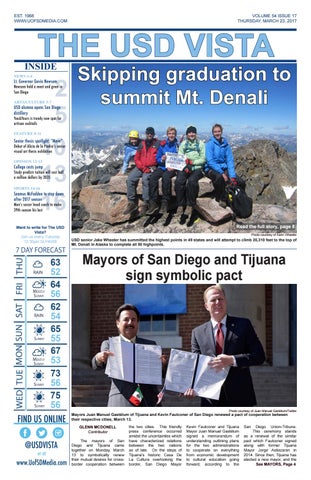
Mayors of San Diego and Tijuana sign symbolic pact
Photo courtesy of Juan Manuel Gastélum/Twitter
Mayors Juan Manuel Gastélum of Tijuana and Kevin Faulconer of San Diego renewed a pact of cooperation between their respective cities, March 13. GLENN MCDONELL Contributor The mayors of San Diego and Tijuana came together on Monday, March 13 to symbolically renew their mutual desires for crossborder cooperation between
the two cities. This friendly press conference occurred amidst the uncertainties which have characterized relations between the two nations as of late. On the steps of Tijuana’s historic Casa De La Cultura overlooking the border, San Diego Mayor
Kevin Faulconer and Tijuana Mayor Juan Manuel Gastélum signed a memorandum of understanding outlining plans for the two administrations to cooperate on everything from economic development to cultural education going forward, according to the
San
Diego Union-Tribune. This ceremony stands as a renewal of the similar pact which Faulconer signed along with former Tijuana Mayor Jorge Astiazaran in 2014. Since then, Tijuana has elected a new mayor, and the See MAYORS, Page 4
2T
he
USD Vista
NEWS
March 23, 2017
NEWS
NEWS EDITOR ELISABETH SMITH @elisabethsmith0
Asst. NEWS EDITOR TAYLER REVIERE VERNINAS
Gavin Newsom campaigns in San Diego
ELE BRUGGER Contributor This past Wednesday, March 15, several University of San Diego students attended a meet and greet with Lt. Governor Gavin Newsom for his campaign for California Governor. The event, located just north of Linda Vista in the Union Machinist Hall, attracted a crowd of about 200 locals. All seemed excited to hear California’s potential new governor’s stance on health care, education reform, and more issues. The previous mayor of San Francisco boasted that he is a self-made businessman and longtime political activist. Newsom said that he helped bring city wide assistance to San Francisco’s homeless population, advocated for same-sex marriage, and worked to implement single payer healthcare. After attendees settled into their seats, hearing introductions from
THE USD VISTA Editorial – 619.260.4584 Business – 619.260.4714 www.uofsdmedia.com @USDVista
staff aides, Newsom took the stage. Remarking on California’s propensity in leading the nation to adopt more inclusive policies, Newsom highlighted the importance of taking action as a state. “I don’t want us to secede,” Newsom said. “I want us to lead.” The topics he touched on included implementing health care reform, creating more sanctuary cities, and working for student loan forgiveness. These issues seem to be at the forefront of many California residents’ and college students’ minds. After his address, he answered the crowd’s questions in a critical group discussion. “The future isn’t something to predict; it is something to manifest,” Newsom said. The event seemed to be a tangible taste of democracy, a small room of engaged individuals, coming together to have the community’s voices heard and discussed.
Brooklyn Dippo- Editor in Chief Matlyuba Nurova - Finance Director Courtney Wong - Advertising Director Sarah Brewington - Associate Editor Diego Luna - Managing Editor Gianna Caravetta - Copy Editor Nora Brewington - Art Director Elisabeth Smith - News Editor Tayler Reviere Verninas - Asst. News Editor
Photos courtesy of Ele Brugger
San Diego residents, including many University of San Diego students, gathered for Gavin Newsom’s meet and greet, March 15. Newsom is campaigning to be the next governor of California.
Dani Devries - Opinion Editor Taryn Beaufort - Asst. Opinion Editor Kelly Kennedy - Feature Editor Jennifer Givens - Asst. Feature Editor Walker Chuppe - Arts & Culture Editor Matthew Roberson - Sports Editor Noah Hilton - Asst. Sports Editor Dray Wilson - Photography Editor Gina Lew - Student Media Advisor Marie Minnick - Operations Advisor
The USD Vista publication is written and edited by USD students and funded by revenues generated by advertising and a student fee. Advertising material published is for information purposes only and is not to be construed as an expressed or implied endorsement or verification of such commercial venues by the staff or University. The USD Vista office is located on the fourth floor of the Student Life Pavilion in room 403B. All inquiries should be sent to: The USD Vista 5998 Alcala Park San Diego, CA 92110 The first copies of the newspaper are complimentary, all copies thereafter are a 25 cents charge. Opinions expressed in this publication are not necessarily those of The USD Vista staff, the University of San Diego or of its student body. Letters to the Editor can be submitted to The USD Vista office. Letters should be limited to 300 words and must be signed. For identification purposes, USD identification numbers and writer’s year must be included in the letter. The USD Vista reserves the right to edit published letters. Any content sent to the editor will be considered for publication unless otherwise stated.
NEWS
Volume 54 Issue 17
The USD Vista
3
Bi-national march is first Rally at the Border
TAYLER REVIERE VERNINAS Asst. News Editor Saturday, March 25, marks the first ever Rally at the Border, a grassroots movement that encourages citizens to build a bridge of unity to break down any wall that may divide citizens from one another. The We Are One Foundation will be hosting the event at Larsen Field on the U.S.-Mexico Border in San Ysidro, Calif. The We Are One Foundation’s focus is on developing the next generation on understanding the qualities of being a good human. According to their website, the mission of the foundation is to engage citizens’ participation at these movements that have the capability of evoking change within communities and on governmental policies. University of San Diego sophomore Natasha Salgado, the student director for the We Are One Foundation, explained the goals for coordinating the Rally at the Border. “As a member, I really want to learn about the logistics of how you can create a changemaking event and
how to bring it back to an organization in order to change the way people see different issues,” Salgado said. “I feel so strongly about the We Are One Foundation’s message about human dignity that we all deserve the same admiration, love, and respect. I want to bring this message back to USD and have students be right in the spotlight. Hopefully it will be a great way for USD to initiate something different.” The theme of the march is to stand in unity and solidarity with one another to reinforce the common bonds of humanity. The event, Rally at the Border, will feature a variety of internationally known humanitarians, activists, artists, and speakers, along with political leaders and affected immigrant families. Salgado stated in further detail the purpose of this bi-national rally. “We are trying to push for the fact that every person deserves the same amount of love and respect and dignity,” Salgado said. “The entire event is a learning process; it is being able to understand and push back ignorance See RALLY, Page 4
Photos courtesy of Natasha Salgado
Members of the We Are One Foundation board present signs that they will use during the Rally at the Border, March 25.
4T
he
USD Vista
March 23, 2017
NEWS
Mayors renew alliance between SD and TJ MAYORS continued from Front Page
United States has elected President Donald Trump. Trump has vowed to create a border wall and cancel the free-trade agreements, which have allowed for growth and cooperation in what Gastélum referred to as the “San DiegoTijuana megaregion.” The San Ysidro border crossing is the busiest border crossing in the Western Hemisphere, with an average of 50,000 cars and 25,000 pedestrians passing from Mexico into California each day, according to the U.S. General Services Administration. Faulconer and Gastélum spoke to an audience of diplomats, staff members, and business leaders from both cities. In his comments, Faulconer emphasized the successes which have come as a result of the continuing commitment to cooperation between the two urban regions. “Our story is about building a better future for people on both sides of the border,” Faulconer said, according to KPBS. “Our story is about success through cooperation.” Gastélum echoed these sentiments. “While some are thinking of building walls, we as the Tijuana-San Diego megaregion have focused on building bridges of understanding,” Gastelum said. While the two mayors largely avoided referring directly to Trump and the new administration’s plans for tightening border security, the national political climate seemed to be on the minds of both men. Faulconer, a Republican, has been careful
to avoid direct conflict with the president on immigration issues. Instead, he chose to facilitate press conferences like this one to promote the successes of the region as a sort of counterexample to the narrative put forth by President Trump. “We do cooperate, we do collaborate, and we do come together,” Faulconer said. Just like Faulconer, many at the University of San Diego recognize the importance of proclaiming the successes of the unique relationship between Tijuana and San Diego in the midst of changing political circumstances. Tanya Ibrahim is a senior at USD and native of San Diego. She has served as a student coordinator for many of University Ministry’s immersion trips to Tijuana, and she expressed her take on the value of communication between the two cities. “The biggest thing for me is that dialogue is happening, and there are attempts being made to reconcile,” Ibrahim said. “This meeting between the mayors is a way for us as San Diegans to understand where we stand mutually so that we can discern a better future.” Ibrahim has led students in their process of becoming immersed in the issues surrounding border politics during the monthly day visits to Tijuana. She said she is concerned about student attitudes and student awareness. “It’s hard because people often talk so negatively about the relationship, and they just assume that it doesn’t concern them because the issues don’t affect them directly,” Ibrahim said.
Photo courtesy of Juan Manuel Gastélum/Twitter
The cities of San Diego and Tijuana officially declared their solidarity. Ev Meade, PhD, of the Trans-Border Institute in the Kroc School of Peace and Justice has been committed to combating such short-sighted border narratives through his role as a researcher and an authoritative voice in public media. “We aim to fact-check what people are saying and also make basic information on the border and the bi-national relationship available to the general public,” Meade said. Meade has been featured by local news networks and university panels both here in San Diego and in Tijuana, and he is also a member of the advisory board for the American Bar Association’s Immigrant Justice Project. Meade said he views the recent meeting between Faulconer and Gastélum as an important merger of local policy initiatives in the face
of a shifting federal agenda. “I think that if you look at trade between the U.S. and Mexico, it becomes clear what is at stake,” Meade said. “The Cali-Baja region is incredibly productive, but any significant slowdown in cross-border traffic, as a result of new law enforcement measures or new security arrangements, would make our current infrastructure less efficient and would put thousands of jobs at risk.” Meade said he views these looming policy initiatives as a major cause of tension not only for politicians, but also for families and business owners. “People in Mexico are angry and feel a great sense of uncertainty,” Meade said. “This uncertainty affects the future of the bi-national relationship and makes it really difficult for families to plan what their life or business outlook will be in the next five to ten years.”
Meade said he views meetings between local officials and business leaders, such as the one which occurred last Monday, are the best way for citizens of the San Diego-Tijuana megaregion to protect their mutual interests going forward. “When you have a united front like this one you stand a better chance of communicating to the federal government’s just how much we have to lose,” Meade said. “If these stakeholders remain vocal, they can present the successes of their multi-layered partnership as a scalable model for other border regions.” To what degree these local efforts will impact looming federal budget decisions in Congress might be contingent upon the cooperation and mobilization of these stakeholders at all levels.
Bi-national march for first rally at the border
Photos courtesy of Natasha Salgado
Members of the We Are One Foundation board present sign that they will use during the Rally at the Border.
RALLY continued from page 3 in a way. It is being open to the cultural diversity that we share across the country.” Sophomore Stephen Jordan will be rallying on the other side of the border with those participating on behalf of the We Are One Foundation in Mexico. “When I went to Tijuana for spring break this year for TJSB, I fell in love with the people,” Jordan said. “I’m rallying all the troops to come to the wall and also all of the people in Casa de Imigrantes. I hope to continue my relationships with these people. I want them to know that the people of USD are not represented by a couple of people in power.” Salgado stated that the rally is from 3 to 6 p.m. will include talks from various speakers, and the march to the border will begin at 6 p.m. from Larsen’s Field.
“At that exact same time, the rally being initiated on the other side of the border and our side will go together and march right next to each other,” Salgado said. “Sister rallies are taking place in Washington D.C.,
interact with the speakers,” Salgado said. “We are trying to welcome USD students, faculty, and members outside of the community to have an opportunity for interaction. We want to spark the message that although we come from
“As a white, privileged male, I want to walk alongside these people and empower them to speak and fight for their rights.” -Stephen Jordan Texas, and Arizona all day.” Prior to the rally and march, the We Are One Foundation will be hosting a forum from 11 a.m. to 12:30 p.m. in the Kroc Institute for Peace and Justice Theatre on March 24. “We are hosting a forum to focus on the younger generation of students, especially with the political climate, to provide a space for them to have an open discussion where they can
different sides of the social and political spectrum, we still fall under the we are one board.” Jordan expressed his hopes for this upcoming event. “The We Are One Foundation is all about coming together and uniting as one,” Jordan said. “As a white, privileged male, I want to walk alongside these people and empower them to speak and fight for their rights. If you want to change the system, you [need] to know the system.”
The USD Vista
ARTS AND CULTURE
March 23, 2017
ARTS & CULTURE
5
A&C EDITOR WALKER CHUPPE @lord.walker
USD grad pursues distillery dream SARAH BREWINGTON Associate Editor
Art comes in many forms: painting, sculpture, driving, sports, and even alcohol. The careful cultivation and process of turning just a few ingredients into spirits is the craftwork of distilleries around the country. There are 10 distilleries in San Diego, and, thanks to a USD graduate, that number will become 11. Just three years out of college, University of San Diego graduate Laura Johnson is opening her own business. Her distillery, You&Yours, is the first distillery to open in Downtown San Diego. Johnson graduated USD in the spring of 2014 with a major in economics and a minor in Italian. Johnson is working with spirits and she explained that her interest peaked in the 21-and-up industry just before her final year of college. “The summer before I studied abroad, I went on a really big road trip before I left,”
Despite this initial frustration, Johnson was determined to make the most out of it. “It was a thousand dollars a day for the course,” Johnson said. “So I kept asking questions and made the most of it. I flew home with the mindset, ‘If these two absolute knuckleheads can do it, and have decent market share regionally, I can absolutely kill this.’” After several months of traveling and many more courses later, Johnson came back to San Diego looking for an internship to get the handson experience she was missing. “I reached out to distilleries to get production experience,” Johnson said. “No one got back to me. I interviewed in a distillery in San Diego, [they] took one look at me, and they were like, ‘You want to distil?’ and it sucked. I could not find anyone who could offer me the production experience that I wanted. I took a step back and figured, ‘What can I do really well?’ I know I can raise capital and do a business plan.
Photo courtesy of @laurakayj/Instagram You&Yours specializes in handcrafted cocktails.
Johnson said. “I happened to visit a distillery. I was enthralled. After that, it was always like a bug [on] my mind, and I figured it was something I might want to do.” While Johnson studied abroad in Florence to accompany her Italian minor, she began to ponder what it meant to explore the distillery business. She researched distillery courses over the summer and found one to enroll in. She expressed that she had hoped to learn more about it from some experts. However, she revealed that this was not the case. “It was an intensive oneon-one, a full week, a master class,” Johnson said. “It was led by two older men who came from other industries. They took one look at me, and saw the senior business plan I put together in college, and they were like, ‘Haha go away.’ When they saw a 23-yearold girl walk in, they made no effort for the rest of the week.”
I decided I can do this myself, and that is how we got here.” You&Yours is unique in the distillery industry. Not only will it be the first to be in Downtown San Diego, it is also a female-run distillery, one of few in the country. Johnson explained that the spirit business has historically been dominated by men. She expressed that her distillery will bring forth a different approach. “[We are] female-run and female-owned,” Johnson said. “As women, we are so thorough. We take pride in every single detail. [...] I am able to create really incredible flavors. The finesse and elegance that I bring to our products doesn’t exist in distilleries where production staff is all male. The hospitality component that we bring, we bring a sense of warmth and comfort to anything that we do. It is really exciting to have that be a focus of what we do as well.” Johnson revealed that getting her dream
Photo courtesy of @laurakayj/Instagram Laura Johnson, USD alumna, and owner and operator of You&Yours distillery.
accomplished has been rewarding. She explained that the work has been tireless. “A typical day is nuts; I kissed life as I knew it goodbye,” Johnson said. “The entire weekend was labels and bottling, finishing construction. I have spoken to media outlets. I was on the news. I am getting cocktail and training manuals finalized [...]. A photographer is here taking photos, so we can get our website up hopefully this weekend. We bought vodka and gin. We have some in production, but we have to move on to other spirits.” Starting your own business so quickly out of college is not common. But Johnson knew it was a goal of hers for a long time. “I don’t know that I ever had one specific career [that I wanted to do],” Johnson said. “I always knew that I wanted to have a business of my own. While I wanted to work for others, I knew, sooner rather than later, I wanted to work for myself.”
After a few years of research and planning, Johnson is looking forward to seeing the finished product. She
and probably a good amount of money. Embrace where you are in the process, ask for help from day one and
“[The name, You&Yours,] encompasses what I wanted this space and distillery to be about. Where friends and family can come together and get back to face-to-face connection.” -Laura Johnson had some advice for college students who are looking to open their own businesses. “Don’t be afraid to ask a ton of questions, especially early on and especially if you think they’re going to make you sound stupid,” Johnson said. “I regret not asking for more help early on because I didn’t want certain people to know how little I actually understood about specific parts of the process. If only I had had the courage to just ask, I would have saved myself a lot of sleepless nights
don’t stop asking for help.” Located on G street in East Village, You&Yours will not only make spirits, but will also sell bottles to customers as well. “[The name, You&Yours,] encompasses what I wanted this space and distillery to be about,” Johnson said. “Where friends and family can come together and get back to face-to-face connection.” Johnson’s You&Yours held its soft opening earlier this month and is now officially open for business.
Photo courtesy of Robbin Watson The You&Yours storefront, which could be a San Diego staple in years to come.
6
March 23, 2017
ARTS AND CULTURE
The USD Vista
Mediocre Yelp adventures TARYN BEAUFORT Asst. Opinion Editor and
CYNTHIA YANTZ Contributor Outside of the University of San Diego’s La Paloma and Student Life Pavilion, there is a whole other world of San Diego cuisine just waiting to be tasted. Some of you may have found the time to venture off-campus to try a few new restaurants. Some may have been great experiences, and others may have been completely terrible. With the help of Yelp, we looked for some of the worstrated restaurants within a few miles of campus to see if they are truly as bad as their ratings show. As easy as it may sound to discover a couple of poorly-rated restaurants, San Diego has very few restaurants under a three star rating. The following are a few restaurants that had three and a half star or lower ratings— try at your own discretion. Roberto’s Taco Shop ($) Coming in at only three stars, Roberto’s Taco Shop is located just down the street from campus and is popular among USD students. The first restaurant on our list to “enjoy,” we discovered the location of the restaurant was shared with a mini mart next to a gas station, which isn’t exactly appealing. Before even entering the restaurant, we were able to guess where its low rating came from. Once inside the restaurant, we walked up to the ordering counter, which was guarded by barred windows, and ordered three chicken rolled tacos, a San Diego classic. While the tacos were affordable and not exactly “three star horrible,” they were not what one would expect from San Diego, a city known for its authentic Mexican cuisine. The tacos were warm and seemed to be freshly made, but when it came to the toppings, that’s where things took a turn. We expected sour cream, guacamole, cheese, and maybe some lettuce. What we got was less than we expected. The tacos were served with sour cream and cheese. The guacamole, however, seemed oddly similar to an avocado impersonator, rather than the kind of guacamole one would hope for at a Mexican restaurant. Hence the guacamole alone deserved Roberto’s three star rating. Joe’s Crab Shack ($$) Second on our list was three and a half starred Joe’s
Taryn Beaufort/The USD Vista Roberto’s Taco Shop’s rolled tacos feature some less-than-savory guacamole.
Crab Shack. Located right off of Friars Road and down the street from Fashion Valley Mall, it seemed like a decent restaurant for students to go to. Arriving at lunch hour, we were surprised to find that there were almost no other customers, and we were
tails in the basket, which was great, but the shrimp was a little on the squishy side. Along with the squishy coconut shrimp was a side of mediocre coleslaw and some lackluster hush puppies. Never having tried hush puppies, we were eager to see what
On the other hand, the caesar salad exceeded expectations, which sounds difficult considering it is just a caesar salad. The shrimp in the salad was pretty good considering the relatively inexpensive price of the salad. They were small, bite-sized tails, but were grilled, not fried, and tasted fresh off the grill on the romaine lettuce and caesar dressing. Maybe Joe’s should stick to the salads and avoid the deep fryer. Cheesecake Factory ($$)
Taryn Beaufort/The USD Vista Joe’s Crab Shack has surprisingly good salads.
seated immediately. We were seated in the very dimly lit restaurant, and were glad we may have beaten the rush hour, because we thought we could make it in and out in less than an hour. We were sadly mistaken, as the service was painfully slow. With perhaps 10 tables occupied at the restaurant, and an exceeding amount of staff, the whole meal still took around an hour and a half for us to finish. One of us ordered the coconut shrimp with a side of coleslaw and hush puppies, while the other ordered a caesar salad with shrimp. While the coconut shrimp was a tad pricey, around $15, the salad was closer to around $10. However, once the meals arrived it was clear to see why the coconut shrimp was more on the expensive side, as they are not shy with their shrimp portions. There were at least 12-16 coconut shrimp
they were about. We came to learn that they are essentially bland in taste, and are not worth compromising your diet with this deep fried food.
On any given weekend night, the Cheesecake Factory’s line is typically out the door. But does it really deserve that kind of recognition? Rated with three and a half stars, we decided to put the previous ratings to the test. After waiting for about 15 minutes, we were seated at a small table, hardly big enough to accommodate our orders to come—not off to a great start. We were handed menus that were basically the size of a small children’s book. You would assume that
The Cheesecake Factory’s lunch portion is still quite large.
having a diverse menu with countless options would be a positive for the customer, but the Cheesecake Factory may actually have a menu that is too large to be beneficial. Our cravings started going every which way, resulting in 20 minutes dedicated to choosing our choice of entree. We ordered fish tacos and a barbeque ranch chicken salad. For being a restaurant with three and a half stars, the fish tacos lived up to the restaurant’s low rating. If you like tasteless fried fish, this dish is for you. Within the fried borders of the batter was a watery, mushy filet of fish. There seemed to be zero substance to the fish. Imagine a fried pocket of air, if there was such a thing. Needless to say, if you are ever in the mood for fish tacos, we’d suggest sticking to San Diego’s native Mexican restaurants. In contrast, the chicken salad was a win. There was a nice ratio of lettuce to toppings and not too heavy on the dressing. We ordered the lunch size, and it was more than enough to be filling. We would highly recommend their salads in general. The cost of each dish was about $12-$15 respectively. In our opinion, it is still far too much for the quality of food that is being served. Going into our calorie filled journey, we thought we would be eating at some of San Diego’s worst dining establishments. Regardless of where the worst Yelp reviews led us, we were ready to take it on with an open mind and fork in hand. Perhaps unsurprisingly, our overall experience was mediocre to say the least. Interestingly, all of these restaurants have one common denominator––they are all chain restaurants. So going forward, if you want to really experience San Diego’s food culture, stick to one of the local hole-in-the-wall restaurants.
Taryn Beaufort/The USD Vista
Volume 54 Issue 17
ARTS AND CULTURE
The USD Vista
CRSSD spring 2017: a photo essay
Photos by Dray Wilson/The USD Vista
7
8T
he
FEATURE
USD Vista
March 23, 2017
49 peaks and climbing G
BROOKLYN DIPPO Editor in Chief
raduation isn’t the only milestone that Jake Wheeler has to look forward to this May. The USD senior will also attempt to summit Mt. Denali in Alaska, completing his quest to climb the highest points in all 50 states. Wheeler’s adventure started in 2005 when he was just 10 years old. His dad packed up the car and Wheeler, his twin brother, and his sister hopped in for the long drive from California to Ohio for their first of 49 summits to date. “We started in Ohio, and the high point in Ohio is just like a hill. And Indiana, Illinois, it’s all very flat,” Wheeler said. “It was tons of time in the car, and we weren’t a big fan in the beginning. But then, as we were getting older, it’s cool because you get to see places that no one visits ever because there’s no reason to, and you get to experience all the travel.” Growing up, they often broke up these road trips into
regions of the United States, and the family would climb a few high points on each trip. Wheeler’s favorite climb was at Mt. Katahdin in Maine during an autumn tour of the Northeast. There, he had the chance to experience the season like he never had in Southern California. “It was still pretty high, but the conditions were perfect, and it wasn’t that hard. You still have to strap on a day pack, but then it’s just an enjoyable hike. It was nice being in the Northeast and the leaves had all changed colors,” Wheeler said. “It’s also where the Appalachian Trail ends, so we ran into a couple of guys that were finishing the Appalachian Trail, and that was really cool to see these guys who are skin and bones who are finally finishing this huge accomplishment, and just to hear their stories.” From an accomplishment perspective, Wheeler is most proud of their climb at Rainier. “We almost didn’t make it when we did Rainier,” Wheeler said. “I think there were six rope teams that tried to summit on
VOLUME 54 ISSUE 17
FEATURE
the day we did, and only two of them made it, and one of them was us.” The family has been lucky to summit at every attempt so far, and their mom has joined them for 38 of the 49 peaks. The biggest challenge, according to Wheeler, isn’t actually the physical aspect of climbing. He laughed as he explained that the hardest thing to overcome on the trail is boredom. “It’s a long time with a lot of weight on your back, and that’s all you do all day every day,” Wheeler said. “Unless you really wanted to, you don’t hike in [with] books or electronics or anything like that, because you want to stay light. And there will be days when you are stuck in a tent.” Though there is little to distract him from the climb, Wheeler did talk about a few funny moments on the trail. Whether it’s his younger sister falling and letting go of her icehacks yard sale style, or bizarre encounters with nature, they have had plenty of laughs along the way. “One time on Granite Peak in Montana, we heard this rustling outside our tent, so we open it up, and it’s just this mountain goat that’s right in front of our tent,” Wheeler said. “And it just looked at us, and we just watched him. And it was super cool, it was way up close and really cool to see.” The only state that Wheeler hasn’t visited is Alaska, and reaching the highpoint there is by far the most ambitious and largely dependent on the weather. “The scale of it is a whole new world compared to what we’ve done before, because the highest point in the continental U.S. is Mt. Whitney, which is 14,400 feet or something, and then Alaska is like 21,000,” Wheeler said. “So you’re passing that point before you’re going for the summit. So it’ll be interesting to see how the altitude feels.” The family is prepared to spend nearly a month on the mountain. They will take the climb slowly and carefully, having to acclimate to the coldest temperatures they’ve experienced yet and very thin air. Wheeler caught a glimpse of the challenge that is ahead of him on a recent flight over Alaska. “[During] winter break, I studied abroad in Shanghai, and, on the way back, we flew over Alaska at night, and I was looking down on it, and it’s a total wasteland,” Wheeler said. “You see the little lights down there of people camping, and it was just, like, ‘Wow, that’s going to be me.’ You have to be ready for below zero degrees every day for weeks and weeks, and just having whatever you hike in on your back, and you have a sled, too.” Wheeler has less than two months until his departure on May 19. He will miss his own graduation in an attempt to
The USD ViSTa
9
accomplish something he has been working toward for much longer. In between classes and studying, Wheeler has been ramping up his physical training to prepare for the challenge. “I’ve been doing at least 120 floors on the stairclimber every day, [but] I need to bump that up,” Wheeler said. “I’ve been going on runs. I do weights, like I have before, six days a week typically. I swim sometimes. Otherwise it’s just the stair climber, and I definitely need to ramp that up.” He added that he might also have to go out on some hikes around San Diego. “I need to start walking around in the boots—you don’t want to be putting those on the first time on the mountain,” Wheeler said. “So I’ll need to do that and go on some hikes— maybe Potato Chip Rock is in my future.”
Photos courtesy of Karin Wheeler
Nora Brewington/The USD Vista
10 T
MARCH 23, 2017
FEATURE
USD VISTA
FEATURE HE
FEATURE EDITOR KELLY KENNEDY
ASST. FEATURE EDITOR JENNIFER GIVENS
Senior thesis spotlight: “Move” Debut of Alicia de la Piedra’s senior visual arts thesis exhibition
“I think this was the realization that simplicity is powerful, and I shouldn’t hide from it, whether it On her aesthetic: be in design or in photography.” “When I thought about my thesis, in my head it was something - Alicia de la Piedra that was supposed to be an example of what I’ve become as an KELLY KENNEDY Feature Editor
artist. I’ve noticed in my design that I’m very minimalist, and I value a lot of simple concepts in my aesthetic. A year ago, when I started this project, I realized that it encompassed everything I believed in design, even though it wasn’t design. It’s who I am as an artist.” On her influences: “I really value Stefan Sagmeister’s work and how he presents ideas in the form he feels they need to be presented in. I felt that the idea of the power of simplicity was very obvious in this work versus my designs, which I have to explain more. I chose to just go for it and do a photography exhibition. I’m proud of it.” On titling the work: “The title is ‘Move’ because that was my one word command that I used when taking the pictures. I gave [the subjects] a little background of what the project was, what it stood for, and why I was doing it, and gave them the frame they could move within however they liked. Then, I literally said, ‘Alright, move.’ I didn’t want to give them too much direction because I wanted it to show who they are, rather than me directing them. I thought ‘Move’ was so fitting [as the title] because it’s the one thing I did say to [the subjects] and everyone interpreted it in his or her own way.” On her four years of visual arts: “I came in with a lot of design background, and I thought I was really confident in the direction that I was going. I think that played to my advantage, and I was able to explore a lot. What I’ve grown into and realized is that who I am as a designer and who I am as an artist, which are two different things, is actually the same person. I’ve championed that in my thesis, and it makes the work more important and special to me; it’s the finish line of my four years. I’ve struggled with the distinction between artist and designer and what my aesthetics are in each.” de la Piedra’s thesis exhibition is open through Feb. 24, 9:00-5:00 p.m. daily, Sacred Heart Gallery Thesis reception: Feb 24, 4:00 p.m.-5:00 p.m.
Kelly Kennedy/The USD Vista de la Piedra’s work will be open for viewing through Feb. 24.
11
FEATURE
VOLUME 54 ISSUE 17
THE USD VISTA
Center for Ethics, Economics, and Public Policy Professor Zwolinski hopes to spark student conversation and interdisciplinary study
ALEXIS FAHEY Contributor College campuses are often known for being forums for ideas and spaces for personal and intellectual growth. Matt Zwolinski is a University of San Diego philosophy professor who prioritizes open-mindedness and free-flowing dialogue in his classes and on campus. For the past 13 years, Zwolinski has encouraged such an environment on USD’s campus. However, he believes that this is lacking at USD and at universities across the country, which is why he helped start the new Center for Ethics, Economics and Public Policy at USD. “I envision universities as a place where people engage in robust debate about important issues and students listen to all sides of political discourse, and then they are encouraged to make up their
Photo courtesy of USD While the new center currently lacks a physical location, it will continue to host events on campus. Zwolinski said. “But I don’t think you can really engage in effective changemaking if all you’ve got is philosophy because philosophy tells you where you wanna go, but it doesn’t tell you how to get there. How to get there comes from other disciplines like economics and political science, which tell us what kind of institutions actually work to achieve the goals we want.” His dream of this interdisciplinary discourse is becoming a reality, as he is the head of the new Center for Ethics, Economics and Public Policy at USD. The center differs from others on campus because it actually doesn’t have a geographic location yet. This is somewhat odd given that seven donors have given $1.8 million dollars to the program. “[The Center for Ethics,
“I don’t think the debate really addressed the most pressing and controversial questions about immigration that seem to dominate the political climate at the moment, specifically regarding Trump’s new policies.” - Clarissa Wolatz own minds,” Zwolinski said. Like many students on campus, Zwolinski has found that “changemaking” is difficult. He explained that many subjects that are vital to that process, including political science, economics, and philosophy, are talked about independently from one another, instead of discussing them together. “Changemaking, as I understand it, involves trying to do your part in making the world a better place, and, as a philosopher, that’s something that is really attractive to me,”
Economics, and Public Policy] is actually right here in my office,” Zwolinski said. “Essentially, right now, the center is me, some money, and some ideas, and we are using that to put on some events and design some curriculum stuff.” Although the center has received quite a lot of media attention, such as articles in the San Diego Union-Tribune and Fox5 San Diego, there has been a lack of advertising to the USD community. The Center technically opened early this year, but it hosted a preview debate last fall about minimum
wage. Besides that event, there was another debate about immigration during University of Diversity Week. This might explain why, despite the center being open, some students have not heard of it. Paola Coronado, a senior at USD, although active on campus, had not heard of the center before. “I am glad that I now know a bit about it,” Coronado said. “I wish I had known about the immigration event, as that is something I am passionate about, yet I do not think it was advertised well to students. Hopefully, there will be better advertising of events and what the center is doing in the future.” The debate’s theme was “Is Immigration a Basic Human Right?” and was held on Thursday, March 16 in the Kroc Institute for Peace and Justice. The debate was between Bryan Caplan, professor of economics at George Mason University Economics, and Christopher Wellman, professor of philosophy at Washington University in St. Louis. Caplan believes that immigration is a basic human right and that humans should be able to migrate wherever they would like. Wellman, on the other hand, believes that legal movement is a basic right, and individual countries should be able to create and enforce immigration laws that make sense for their culture, beliefs and the citizens of their countries. Although the debate was centered around the moral groundings of immigration, many of the points made by both debaters had to do with economics and politics. Professor Zwolinski thought the debate went well. “I was extremely happy with the debate,” Zwolinski
said. “I think students really need to see models of how two people can strongly disagree with each other, and yet do so in a way that is civil, respectful, and focused on improving the quality of our ideas - not simply on ‘winning’ the argument.”
was valuable in its own right.” Zwolinski emphasized that the main goal is to approach “changemaking” through interdisciplinary thinking here at USD. “The Changemaker Hub has things that they
“Essentially, right now, the center is me, some money, and some ideas, and we are using that to put on some events and design some curriculum stuff.” - Matt Zwolinski However, senior Clarissa Wolatz, felt that the event was not relevant to the USD community and nearby border issues. She noted that the discussion felt primarily theoretical, and did not include the voices of USD students or faculty. “I don’t think the debate really addressed the most pressing and controversial questions about immigration that seem to dominate the political climate at the moment, specifically regarding Trump’s new policies,” Wolatz said. “[The event seemed to focus on] the theoretical discussion of rights of people and governments, which I think should underlie any more concrete discussion,
are already specializing in, such as activism, mobilizing students, and community engagement, whereas [this] center is somewhat more in the world of ideas and research,” Zwolinski said. He explained that, besides putting on events, they are succeeding in this ideas- and research-based goal through the development of a new academic minor combining the disciplines of politics, philosophy, and economics. Although the Center for Ethics, Economics and Public Policy is new to USD’s campus, its goal is to get students to engage with one another about difficult issues. Future events will show whether or not the center accomplishes this goal.
Graphic courtesy of USD News The new center will host events on campus.
12
The USD Vista
OPINION
Volume 54 Issue 17
OPINION
OPINION EDITOR DANI DEVRIES opinion@usdvista.com
The views expressed in the Opinion section are not necessarily those of The USD Vista staff, the University of San Diego, or its student body.
OPINION
Volume 54 Issue 17
The USD Vista
13
College costs predicted to soar DANI DEVRIES Opinion Editor Here at the University of San Diego, we know what it’s like to shell out the big bucks for a quality education. Whether your parents are able to help pay for school or you are shouldering the
to about $500,000 in the next 18 years. That means that for most of our undergraduate student population, by the time they have children that are ready to go to college, the price of attending USD could be half a million dollars or more. Let that sink in. It’s not just private universities that will be upping
“I think education is very important. I just think it’s insane how expensive it is. The rising cost of college makes it difficult for a lot of people to achieve higher education.” -Gaby Mendoza costs of attending USD on your own, for most students, attending a private university is a privilege that does not go unappreciated. With USD’s sticker price hovering around $200,000, for a fouryear degree not taking into account added expenses like books, meal plans, and rent, many families must rely on scholarships, financial aid, and sometimes student loans to make attending USD a reality. However, based on future cost projections, that price tag will seem like a steal to the next generation. According to recent calculations done by Business Insider, the cost of attending a four-year private university could rise
their costs either. According to the same predictions, attending a public university will likely cost close to $200,000 in 18 years. This means that for the average American family, which typically has two to three children, the cost of sending kids to a four year university could range from $400,000 to $1,500,000. According to the U.S. Census, only 30.4 percent of Americans ages 25 and older have a bachelor’s degree. Considering the dramatic cost increases that are estimated to occur over the next 20 years, this number will most likely shrink to an even smaller portion of the country. Additionally, according to
the New York Times, only 19 percent of these students graduate in four years, meaning most students would face even more tuition costs. This begs the question whether the benefits associated with attending a four year university justify the massive costs for future families. Senior Caitlin Fogarty said she thinks that this price increase may cause education to revert back to its origins, when only the most wealthy could attend school. “I absolutely see a benefit to a college education, or else I wouldn’t be paying so much
“I think that if the cost of attending a university increases that dramatically, college will become so elitist that only a select portion of people will have the means to attend [...].” -Caitlin Fogarty [to attend USD,]” Fogarty said. “However, I think that if the cost of attending a university increases that dramatically, college will become so elitist that only a select portion of people will have the means to attend, which might result in the devaluing of a university education
Photo courtesy of Illinois Institute of Technology/Flickr These students prepare for their graduation. With the predicted raise in tuition prices, graduation rates are likely to drop.
because so many people will find ways to work around it.” Senior Gaby Mendoza agreed that the evaluated cost of attendance would offset the value of attending college. “I think that education is very important,” Mendoza said. “I just think it is insane how expensive it is. The rising price of college makes it difficult for a lot of people to achieve higher education. I think that the benefits associated with attending college will not be worth the cost, even though it’s insane. Attending college is an investment for a job basically. It ‘assures’ us that we have a ‘stable’ future, so it is said. But there are students who get in debt and are not able to find a job. So, if this is a current issue with the current cost of college, it would only get worse with the rising cost.” Hopefully policies change and make college more affordable and these predictions prove to be wrong. If not, our generation may be one of the last able to afford the rising cost of education.
Blast from the past: Revamps on the rise DANI DEVRIES Opinion Editor
This past weekend, the highly anticipated liveaction version of the Disney classic “Beauty and the Beast” premiered in theaters. For many students at the University of San Diego, this revamp is a blast from the past, causing many to reminisce about their childhood favorites. While it can be fun to see these classics come back for a new generation, the growing trend in TV and movies these
what seems to stand out is the sheer volume of content that is being repurposed. Disney in particular seems to be drawing upon this feeling of nostalgia to boost ratings. With recent live-action releases of “Cinderella,” “Maleficent,” “The Jungle Book,” “Beauty and the Beast,” and a “The Little Mermaid” remake in the works, recycling old content seems to be a frequently used strategy for the studio. Disney isn’t the only one though, as beloved shows from other networks that have been off the air for years are also making a comeback.
“It depends on the movie or TV show. I think when it stays true to the original, it’s a little better. I thought ‘Beauty and the Beast’ was really good in that regard.” -Emma Von Tscharner days seems to be rehashing old stories. Although this certainly isn’t a novel idea, as it has been done in the past with films like “The Parent Trap” and shows like “90210,”
With shows like “Full House,” “Gilmore Girls,” and “The Muppets” all producing reboots in the last year, it doesn’t seem like this trend is going to die down anytime soon. There
are even more shows in talks of coming back, including the “Fresh Prince of Bel Air,” “Will & Grace,” and “Fraiser.” Included in this trend is the uptick in classic movies becoming TV show spinoffs, or vice versa, and older movies getting sequels years later. Although it makes sense to capitalize on a show or movie’s popularity, it means that many plotlines seem tired or overdone. At times, it can be fun to see old favorites get a new life in present-day. For some fans though, these revamps often leave something to be desired and seem to draw in an old fan base to boost ratings. Senior Emma Von Tscharner noted that she thinks that only revamps that stay genuine to the original concept are worth engaging with. “It depends on the movie or TV show,” Von Tscharner said. “I think when it stays true to the original, it’s a little better. I thought ‘Beauty and the Beast’ was really good in that regard. The new ‘Tarzan’ movie didn’t really live up to my expectations though because it didn’t stay true to the original,
so I didn’t care for it. But if the producers have good intent and stay true to the values of the original, I don’t have a problem with them recycling the material, and I think it can be worthwhile to see it.” Even films that stick to the original concept face backlash for tweaking minor things. Beauty and the Beast, for instance, was criticized when it incorporated a gay character in the new film. Some groups protested the film as a result, and certain
theaters refused to show it. Despite some fans being upset about tweaks in plotlines of their favorite revamps, as a category in general, they seem to be very successful at the box office and in ratings. Due to this success, it is likely we will see more of our favorite classics being remade in the future. Let’s just hope that the remakes are a nice extension of the original show or movie, instead of a poorly-made revamp aimed to draw at our heart — and purse — strings.
Photo courtesy of Giri Trisanto/Flickr The live-action version of “Beauty and the Beast” grossed $170 million at the box office opening weekend.
The views expressed in the Opinion section are not necessarily those of The USD Vista staff, the University of San Diego, or its student body.
14 T
USD Vista
SPORTS he
March 23, 2017
SPORTS
SPORTS EDITOR MATTHEW ROBERSON @mroberson22
ASST. SPORTS EDITOR
NOAH HILTON @thebackseatlamp
March Madness starts to heat up
Photos courtesy of Wisconsin Basketball/Twitter (left) and Xavier Men’s Basketball/Instagram
Villanova guard Jalen Brunson watches Wisconsin celebrate their victory (left). Xavier guard Trevon Bluiett is one of the stories of the tournament. JAKE ELLIS Contributor March and April are two of the best months of the year for sports fans at the University of San Diego. Not only is there a week off of school for spring break, but the NCAA Men’s Division I Basketball Tournament, affectionately known as March Madness, also gets underway. The tournament has a nickname that could not be more fitting for this year’s tournament. That word is madness. When the tournament started, Villanova, Kansas, North Carolina, and Gonzaga were the No. 1 seeds in each of the regions. Every year, millions of people submit their brackets with the hope that they could call themselves champions when that final buzzer goes off. The first round came and went, and there seemed to be only one big upset. The Middle Tennessee State Blue Raiders, the 12 seed in the South Region, faced off against the five seed Minnesota Golden Gophers. Usually, the fivetwelve matchup always has upsets, but this one should not have shocked many people. Last year, in the first round, the Blue Raiders knocked off a perennial championship contender, the Michigan State Spartans. Just like last year, the Blue Raiders came out on top 81-72. Next, we had the No. 11 Xavier Musketeers, who faced off against the No. 6 Maryland Terrapins. Xavier was a team who hit a rough patch before the tournament started. It lost its leading scorer Edmond Sumner to an ACL tear in January, then after
that, the team started to fall. The first round matchup came up against dynamic junior point guard Melo Trimble and the Maryland Terrapins. They imposed their will on Maryland and won the game 85-76. After the first round, the avalanche of upsets started to pick up speed. Villanova faced off against a Wisconsin Badgers squad who has been to two Final Fours and three Sweet Sixteens since 2014. On Wisconsin’s final possession, senior forward Nigel Hayes gave his defender a head fake, and, sure enough, he scored the final basket with just over five seconds left. Sunday, there was another potential champion go down, as the Duke Blue Devils were tripped up by the South Carolina Gamecocks. Duke was favored all over the country to be crowned national champions. South Carolina was a team that many people discredited, given their regular season record in the often overlooked Southeastern Conference. People may have thought that before the game. They were almost certainly not thinking that after. In the second half, the Gamecocks took the game over, winning 88-81. The annual field of 68 teams has been whittled down to 16. Gonzaga, North Carolina, and Kansas are the one seeds still standing. The lowest seeded team still remaining is the No. 11 Xavier Musketeers, who will be the only doubledigit seed to appear in the 2017 Sweet Sixteen. This year’s tournament has been unpredictable. We have our underdogs and
Photo courtesy of Bleacher Report/Twitter
Michigan guard D.J. Wilson drives to the hoop in an upset win over Louisville. favorites. This is what makes March Madness so special. Every single year, we see small schools beat some of the top dogs in college basketball. Senior Alex Cameron said he watched the first four days of March Madness fairly intently. Like many, he felt the elation when a team he was pulling for won, while also dealing with the lows that come with each upset. “I didn’t think Louisville was that good, and that was sort of validated when they lost in the second round,” Cameron said. “But, at the same time, I thought Duke was really
good, and they also lost in the second round. The tournament is a great reminder that none of us really know anything.” USD communication professor David Sullivan is the department’s resident sports fan. Like many of us, his bracket has not gone according to plan. Sullivan also revealed that he thinks the UCLA Bruins will defeat the Gonzaga Bulldogs in the national championship game. “My bracket’s in shambles,” Sullivan said. “[The biggest upset] has to be Wisconsin beating Villanova because the latter
was the overall top seed. The likelihood of dramatic finishes, the potential for the big upset, and the probability of one or two great personal stories emerging are enduring features of the tournament.” If the tournament had a seven game series like the NBA Finals, a lot of these lower-ranked teams probably would not stand a chance. But, with one game, anybody can beat anybody on any given day. Now, it is the same predicament: trying to predict a champion. This year especially it seems that will be even more challenging.
Vista staff predictions
Position Sports Editor
West Arizona
Matthew Roberson Noah Hilton Asst. Sports Gonzaga Editor
Jake Ellis
Contributor
East Wisconsin Florida
Gonzaga Wisconsin
South UNC
Midwest Oregon
Kentucky Michigan UNC
Kansas
Champion Arizona Gonzaga Kansas
SPORTS
Volume 54 Issue 17
The USD Vista
15
World Baseball Classic brings patriotism to San Diego NOAH HILTON Asst. Sports Editor The World Baseball Classic (WBC) certainly has its detractors. Baseball’s premier international tournament has drawn criticism on numerous issues in the past. The WBC was first played in 2006 and now is in its fourth iteration. The biggest problem many see with it is the injury risk it poses to its participants. Major League Baseball has a 162-game season ahead of it, so adding competitive games to the schedule more than a month before Opening Day can carry some risk to athletes’ durability. This is especially the case with pitchers, who seem to push their arms to the limit with every blazing heater and biting curve they throw. This potential injury risk, a peril that may put both players and executives on edge, leads many of the game’s true elite to opt out of participating. Do-everything superstar Mike Trout of the Los Angeles Angels of Anaheim isn’t playing. Neither is divisive slugger Bryce Harper, nor Cy Young-worthy flamethrowers like Clayton Kershaw, Justin Verlander, and Noah Syndergaard. As a result, for many fans—especially those in the United States—the tournament lacks the luster that large-scale international events in other sports can be counted on to provide. And yet, for any fan who enters the stadium on game day, those problems melt away as passion and patriotism grab hold. San Diego’s Petco Park was home to one side of the 2017 WBC’s second-round match-ups this past week. The downtown venue provided hometown hardball fans with a glimpse at four teams— Puerto Rico, Venezuela, the Dominican Republic, and the United States—
with sights set on winning it all, as well as a stadium experience unmatched by a typical game in the majors. With a ticket in the right field bleachers in tow, I made the short trek to Petco Park, ready for a win-or-go-home collision between two baseball powerhouses in the United States and the Dominican Republic, ready to decide for myself whether the WBC was worth the constant worries it can never seem to dissuade. Nine action-packed innings and four hours later, I was returning home with a newfound appreciation for the sport’s worldwide fan base and a renewed level of support for the homegrown team that claimed victory. Sure, the players themselves certainly showed up. Each of the four teams that visited America’s Finest City could boast of having one of the best baseball rosters ever assembled, and the U.S. and the D.R. led the pack in that regard. For the Dominicans, their biggest strength appeared to be a buzzsaw of a lineup akin to a modern-day Murderers’ Row, featuring standout MLB sluggers including Adrian Beltre, Starling Marte, Robinson Cano, and Manny Machado. Their pitching staff wasn’t far behind, with strikeout artists such as Dellin Betances, Jeurys Familia, and Alex Colome leading the way. The United States, despite lacking the aforementioned royalty of Trout, Kershaw, and Harper, seemed more than capable of matching the D.R. all night, with a lineup led by Nolan Arenado at the hot corner and hulking homer-hunter Giancarlo Stanton backing a rotation carried by up-andcoming lefty Danny Duffy and bullpen ace Andrew Miller. There was certainly no shortage of talent taking the field at Petco Park. But the
Photo courtesy of WBC Baseball/Twitter
Eric Hosmer rounds third base and sprints for home.
game quickly went beyond that. With everything that stood out on the field that night and all last week, the most telling part of the WBC experience had everything to do with what happened off the field. It began with the national anthem. As the first chords of The Star-Spangled Banner blared over the loudspeakers, everything in the ballpark slowed to a stop. Players lined the baseline with ball caps draped across their chest. Fans on the concourses stopped the ongoing march to their seats and paid tribute to the flag. Even food vendors removed their visors and paused their work in recognition. That proved to be just a small taste of the patriotism to follow. As soon as the first pitch was thrown, chants from both sides of the aisle cascaded down onto the diamond below. The Dominicans marched through the stadium with percussion instruments, celebrating a game that borders on religion in their home country and rooting for a victory with no signs of letting up until the final out was made. Those who didn’t join the parade danced in the stands, showing almost no awareness of the score as they focused instead on enjoying another night at the ballpark.
Photo courtesy of Bleacher Report/Twitter
USA centerfielder Adam Jones skies to rob a home run. one mass of happy humanity. The ballpark was loud, and it would only get louder. In the seventh, with the Americans leading by two against a team that had played dominant spoiler to so many U.S. squads in tournaments past, Manny Machado lifted a fly ball deep toward the center field wall. As soon as ball met bat, Machado appeared certain he had left the yard, dropping his bat and admiring another long home run. However, American center fielder Adam Jones
Two innings later, the game was in hand and the Americans had booked their second trip to the tournament’s semi-finals, defeating a Dominican team that, before arriving in San Diego, hadn’t lost in eight years. It was a huge moment, and a historic one for a U.S. squad that has had its share of disappointments in past WBC appearances. And yet, on both sides of the game’s outcome, love of both nation and national pastime endured. American fans continued
Photo courtesy of WBC Baseball/Twitter
American players stand to honor their country as the national anthem plays. It was a drastic change from the traditional stadium experience here in the United States, one built largely on casual applause and the occasional invitation from the scoreboard to “get loud.” In the early innings, it appeared the American fans, uncomfortable in this bubble of fever-pitched baseball fandom backed by relentless rhythm and song, would be outdone by their visiting counterparts. It’s funny how a lead can change that. A Giancarlo Stanton missile that surely bruised the brick facade of the Western Metal Supply Co. building in Petco Park’s left field corner put the U.S. ahead in the fourth. Suddenly, screams of “U-S-A” filled the stands, a wave of palpable patriotic fervor crashing against the stadium’s suddenly-empty seats as fans jumped to their feet as
had other ideas. With a nearperfect route, Jones sprinted back to the wall, leaping toward a throng of fans and spearing the ball high above the wall before returning to Earth, a smile on his face and the ball grasped firmly in his undoubtedly-Gold glove. The stadium lost its mind. Jones, a San Diego native, had given the United States the iconic WBC moment they desperately needed. Giving in to an enthusiastic explosion all but unknown to most baseball fans here in the States, chills made their way down the spines of thousands of shouting USA baseball supporters. The moment had opened the door for an electricity sure to zap everyone in the building into total awareness of the situation at hand. This was what the WBC was all about.
chanting. Dominican fans continued dancing. University of San Diego senior Austin Jacobs was in attendance for the dramatic game, and commented on his raucous surroundings. “All night, the energy of the environment was phenomenal,” Jacobs said. “There was no hatred, only love of baseball and country.” For all of its latent limitations, this is where the WBC excels. Nowhere else does the passion and the patriotism seem so enthrallingly and intoxicatingly powerful than in this preseason showcase of global significance. There are few things in sports like it. For a week in mid-March, America’s Finest City was lucky enough to get its own taste of the action, complete with a legendary play by a San Diego kid.
16 T
he
March 23, 2017
SPORTS
USD Vista
Seamus McFadden to step down after 2017 season
Photo courtesy of USD Athletics
Seamus McFadden (right) will hand over the USD men’s soccer program to current assistant coach Brian Quinn (left). MATTHEW ROBERSON Sports Editor The fleeting nature of careers in sports inevitably leads to a moment that most coaches and players hope comes later rather than sooner: retirement. On Wed. March 15, a press conference was held in the Jenny Craig Pavilion to announce the future of University of San Diego men’s soccer head coach Seamus
and only person to coach the Toreros’ men’s soccer program. Since starting his USD career in 1979, McFadden has amassed 377 wins and led USD to nine West Coast Conference championships. During this time he also oversaw the careers of eight AllAmerican players and coached in 14 NCAA Tournaments. His 377 victories rank eighth among active NCAA coaches and 22nd on the all-time leaderboard.
“I’m ready to hand it over and I think Brian is an outstanding coach. It’s time for a new face to put on the program, and I think Brian will be outstanding in that role. It’s been a great run.” - Seamus McFadden McFadden. At this conference, athletic director Bill McGillis revealed that McFadden will step down as head coach, effective on Jan. 1, 2018. The 2017 season will be the longtime coach’s last patrolling the Torero Stadium sideline. Brian Quinn, the current associate head coach, will take the reins from McFadden upon his retirement. McFadden is the first
McGillis began the press conference by noting the incredible impact that McFadden has had on Torero soccer. “When Seamus leaves this program as our head coach, he is going to be leaving an amazing legacy,” McGillis said. “He is USD soccer. I know the next nine months [are] going to be one big love fest for Seamus.”
This love fest will include a Seamus McFadden night on Oct. 22, when the Toreros host the UCLA Bruins, where McFadden will be honored with a pregame ceremony. When he stepped to the podium to address the group of media members, USD athletic staff, and past and current players that had gathered in the JCP, McFadden was noticeably emotional. He reflected on his 39year career, in which he was able to coach his son Conor and lead a team to the 1992 national championship game, as well as the 2012 Elite Eight. “Many good friends have asked me, ‘Why not go to 40 [years]?’” McFadden said. “And the simple truth is I just don’t want to. I’m ready to hand it over, and I think Brian is an outstanding coach. It’s time for a new face to put on the program, and I think Brian will be outstanding in that role. It’s been a great run.” McFadden also told those in attendance that he would not be leaving the program entirely. He plans on becoming part of USD’s bench on gamedays, a job that he said he jokingly hoped can make him the most inconspicuous assistant coach in the nation.
Photo courtesy of USD Athletics
McFadden has coached eight All-American players in his time at USD.
The Donegal, Ireland native mentioned that his mother would always remind him that nothing is forever. McFadden’s coaching career had to come to an end some day, but the memories and legacy he leaves behind will not soon be forgotten.
become medical doctors. “I am most proud of our graduation rate,” McFadden said. “I’ve tried to keep an eye on what is important. Soccer is really the side component. I surround myself with great people.” One of these great people is Quinn, who will soon be the new head honcho for one of the West Coast’s most successful collegiate soccer programs. Quinn has been part of the USD coaching staff for the last 10 years and is also a native of Ireland like McFadden. In addition to sharing a homeland, both Quinn and McFadden have a penchant for showing their humorous sides. Quinn began his comments by stating that he plans on coaching until he’s 96 years old to match the amount of time McFadden spent at the helm. “It’s the right time for me, it’s the right university, it’s the right city,” Quinn said. “I’ve lived here since 1983, [and] I enjoy it as much today as I did when I first stayed in San Diego. I
Photo courtesy of USD Athletics
Oct. 22 will be Seamus McFadden night at Torero Stadium. Although his coaching accolades are certainly notable in their own right, McFadden said he was most prideful of his team’s off the field accomplishments. During the press conference, he pointed out that five members of his 1992 Final Four team went on to
enjoy this university, I enjoy the people involved. It’s going to be a fabulous transition, and I look forward to the future.” McFadden is undoubtedly the brightest star to ever shine in the USD soccer galaxy. His replacement, however, seems poised to lead the Toreros to many new frontiers.
Photo courtesy of USD Athletics
Brian Quinn (left), Bill McGillis (center), and Seamus McFadden (right).