UNIVERSITY OF SAN DIEGO ♦ FEBRUARY 25, 2021
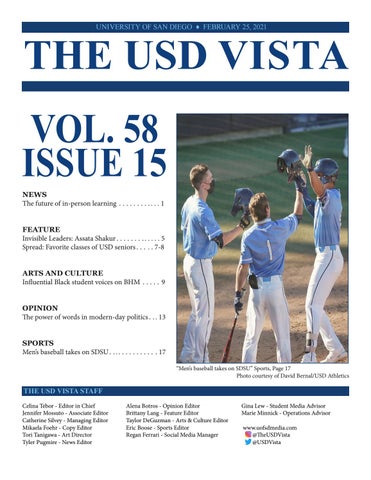
THE USD VISTA VOL. 58 ISSUE 15 NEWS The future of in-person learning ․․․․․․․․․. . . 1 FEATURE Invisible Leaders: Assata Shakur․․․․․․․․. . . . . 5 Spread: Favorite classes of USD seniors․․․ . . 7-8 ARTS AND CULTURE Influential Black student voices on BHM ․․․․․ 9 OPINION The power of words in modern-day politics․․. 13 SPORTS Men’s baseball takes on SDSU․․.․․․․․․․․․․ . 17 “Men’s baseball takes on SDSU” Sports, Page 17 Photo courtesy of David Bernal/USD Athletics
THE USD VISTA STAFF Celina Tebor - Editor in Chief Jennifer Mossuto - Associate Editor Catherine Silvey - Managing Editor Mikaela Foehr - Copy Editor Tori Tanigawa - Art Director Tyler Pugmire - News Editor
Alena Botros - Opinion Editor Brittany Lang - Feature Editor Taylor DeGuzman - Arts & Culture Editor Eric Boose - Sports Editor Regan Ferrari - Social Media Manager
Gina Lew - Student Media Advisor Marie Minnick - Operations Advisor www.uofsdmedia.com @TheUSDVista @USDVista
The USD Vista
◆
February 25, 2021
The future of in-person learning: professor discusses feasibility of returning
As cases around the county begin to decline, a return to campus seems possible, but cases on campus must also fall MARIA SIMPSON ASST. NEWS EDITOR
At the start of the Spring 2021 semester, USD offered certain classes, such as labs and recreation courses, in person. As of Feb. 12, USD encountered a setback as COVID-19 cases on campus shot up in the past few weeks, so those in-person courses were moved back online. According to USD’s COVID-19 Dashboard, cases on campus have recently declined. Since the beginning of the spring semester, it has been a stated goal that if cases in the county drop (which the vaccine might render possible) and San Diego enters into the red tier, USD will attempt a hybrid learning approach. The possibility of moving classes back to campus and learning in a classroom setting once again holds a swarm of unknowns and kinks to be worked through. First and foremost, professors would have to be willing to return to
NEWS
campus themselves for this transition to happen, and there could be a lot of bumps along that road. Just as students may have a preference toward staying online or going back to in-person, professors have their own opinions and concerns. Yi Sun, Ph.D., a professor of the history department, is a proponent of returning to campus, but only when it is safe to do so. “I would continue online teaching but would like to go back to campus if a vaccine is available,” Sun said. Returning to inperson instruction once USD is on track with staff and student vaccinations on campus would be a smart and safe way to significantly lower risk of spreading the virus, but that time period depends on when the county approves distribution for those specific groups, so it could be a significant amount of time before that is possible. Returning to in-person instruction would come with a lot of benefits. Many
teachers and students have acknowledged that the biggest difference would probably be the impact of human interaction. First year Alexandra Hill shared that what she misses most
about in-person class is socializing with other students. “Especially being a freshman, it’s hard to meet new people in Con’t on Page 2
USD has not held fully in-person classes since Spring 2020. Tanner Claudio/The USD Vista
1
Volume 58 Issue 15
◆
NEWS
◆
The USD Vista
Copley Library opened in September 2020 and has allowed students to make reservations in order to study.
From Page 1
class on Zoom,” Hill said. While Zoom is technically equipped to facilitate questions or chatting, breakout rooms hold nowhere near the same effect as hanging out with other students and instructors in a real classroom. The online format has made it much more difficult for new students to get to know people in their classes and form friendships, which are staples of the college experience. “I reminisce about times when my teachers would crack a joke and the class would burst out laughing — that doesn’t happen over Zoom,” first
NEWS
year Paige Gehringer said. “It’s just awkward silence.” Similarly, professors have not had the same ability to bond with students either. Many professors take up their profession because they are passionate about helping their students learn and grow. Online schooling hinders teachers from establishing the connections that make their jobs fulfilling. “I would love to see my students in person,” Sun said. “While I try my best to create an interactive Zoom class, it is still not the same as in-person teaching and learning.” In-person classes could also push students to be more motivated about
their work. It is known that focusing on a screen for long periods of time makes it easier to become distracted and it can be draining to the mind and body, so a more interactive experience is sure to alleviate that. As debates continue on the possibility of returning to campus, it is important to remember that online schooling is a much safer option and COVID-19 is still a very present issue. In-person learning could only happen if a lot of safety measures were taken. While students would still have the option of staying online, the majority of professors would have to agree to return to campus for in-person classes to
Tanner Claudio/The USD Vista
happen, putting them at more risk. Sun also shared another possible issue with switching. “If a proposed return happens later this semester, say after spring break, the transition may be more disruptive than what is worth,” Sun said. A fast turn around could mean a lot of stress and pressure on teachers and students alike. Logistics of shifting classes from remote to hybrid are easier said than done, and will take some time. There are many uncertainties right now and when students and professors will be able to return to a classroom environment once again is one of them.
2
The USD Vista
◆
February 25, 2021
The first year of college can be tough; the pandemic makes it tougher A glimpse of students’ first year of college during COVID-19 YANA KOURETAS CONTRIBUTOR
It’s no secret that college first years grapple with emotions of homesickness, and disorientation. It is easy for them to feel disconnected from the school or those around them when they first move onto campus. Yet as the coronavirus pandemic has prevailed into another semester, these emotions and feelings continue to stay heightened for many. In fact, 1,142 first years at USD were enrolled in
Fall 2019, and only 997 were enrolled in 2020 — a significant 12.7% decrease, which indicates how COVID-19 has affected students’ perspectives and decisions about how to proceed with their education. While under normal circumstances, first years might be spotted sitting in front of La Paloma with new friends or lounging on the quad lawn and soaking up the sun, these activities are now a less familiar sight. Some first years have found comfort and a sense
As classes continue on throughout a pandemic, all students must wear a face mask while walking through campus. Tanner Claudio/The USD Vista
NEWS
of belonging by joining clubs or organizations on campus; others have felt as though they are being kept in the dark. Consequently, each student’s experience in this virtual setting has manifested differently depending on how the pandemic impaired their social and academic lives, or if it hasn’t at all. In this pandemic, where one’s life is set in a predominantly virtual world, the act of making friends and building relationships carries more weight than it has in the past. Not only can it be more difficult to find a sense of connection from behind a screen, but it can also be hard to reach out to people because meeting with others is hard to do at the moment. As the number of COVID-19 cases at USD climbed and preventative measures surged on campus, students turned to different outlets to keep from being entirely isolated from other students and the campus itself. Hiromi Gonzalez, a USD first year,
resonated with feelings of disconnection and disorientation, and explained why she feels like just another lost first year on campus. “It is different being on campus because I am constantly just in my room, and don’t really know what else to do here right now,” Gonzalez said. “I also have felt super disconnected because I haven’t wanted to look into clubs or anything like that yet because I don’t want to add yet another set of Zoom calls to my plate.” On the other hand, some students turned to on-campus organizations to maintain their sanity in this most isolating time. USD first year, Summer Leija, relied on the mundane, yet necessary daily viewing of her peers over Zoom to connect with new people. “I’m involved with the University Ministry, which is something I’m really passionate about, and I have met more people through the retreat they held. I’m also in the Con’t on Page 4
3
Volume 58 Issue 15 From Page 3
Pachamama Alliance club which I had never heard about before,” Leija said. “We have done really fun things to promote sustainability like beach cleanups and hikes, which has really gotten me off of campus and pushed me to get out to different parts of San Diego.” Although some first years like Leija were on campus last semester and may have found their footing in friend groups or best spots on campus, everyone continues to endure struggles in one way or another as the pandemic persists. “It feels crazy to think about that fact that this is the time when I should be getting out of my dorm and meeting people, but instead I am met with an array of Zoom profile boxes every day,” Leija said.
◆
NEWS
Despite the Zoom overload and lack of daily face-to-face connections that all students are experiencing, leaving campus has been another avenue to cope with coronavirus. Leija notes that there are many positives to being in San Diego, which remind her that all isn’t bad at the moment. “I like to explore San Diego, specifically going to different thrift shops. In the middle of the day, I’ll just close my laptop and leave,” Leija said. “Everything is just so walkable in the city, and once you get to a good spot there are so many good stores to look at and scenic neighborhoods to just stroll through.” Some students rely on limited face-to-face interaction to get them through their days and return to a sense of
◆
The USD Vista
normalcy in their lives. USD first year, Hannah Fitz Cluster, explained how she makes the extra effort to meet people in a COVID-friendly way. “The first couple of days I went around and introduced myself to people living around me. I have been trying to do mostly outdoor activities,” Cluster said. “Recently, I went hammocking in the Vistas with a friend.” Owen Wiebe, a first year at USD, feels as though he has a home base: the USD Men’s soccer team. While the team provides him with a sense of community, he still finds it difficult to make connections off the soccer field. “I’m lucky that I automatically have a group of people I have to fall back on that has made USD feel more like home. But it is definitely challenging
Students are encouraged to engage in limited outdoor activity, and have found it beneficial in order to meet other students.
NEWS
to meet people in classes or over social media,” Wiebe said. “Sometimes I don’t want to reach out because I feel like a lot of the conversations become dead-ended because meeting people in person isn’t something that is happening frequently right now.” Nearly every student has their own method of approaching this uncharacteristic college experience. As first years find their way through these unpredictable times, one thing is for sure: there is no first year survival guide handbook for a pandemic. One can only hope that in the near future, surviving the first year of college in a global pandemic will be a distant memory to briefly look back on. However, for now, all one can do is take it day by day, or better yet, Zoom call by Zoom call.
Tanner Claudio/The USD Vista
4
The USD Vista
◆
February 25, 2021
Invisible Leaders: Assata Shakur A story about a civil rights activist who became the FBI’s most wanted DOMINIC URQUIDEZ ASST. FEATURE EDITOR
Activist, political refugee, and relative to famed rapper Tupac Shakur, Assata Shakur lived a life of resistance. She was born on July 16, 1947, in Queens, New York to the name Joanne Deborah Byron, and later moved to North Carolina with her grandparents. Shakur grew up in a time of Jim Crow laws and signs that read “Whites Only” or “Colored Only.”
Due to the racism and prejudice that not only she but also her grandparents experienced, they made sure she practiced personal dignity and respect. The values instilled in her at a young age helped pave the way for her fight against racial inequality. Shakur’s radicalization for Black liberation started during her college years in the mid-60s. She first enrolled in Borough of Manhattan Community College before transferring to City College of New
Assata Shakur’s FBI mugshot, after she was put on COINTELPRO. Photo courtesy of U.S. Government/Wikimedia Commons
feature
York. She was introduced to many Black nationalist organizations which had a tremendous influence on her activism. One such group included the Golden Drums society, where she learned about many Black historical figures who pushed back against racial subjugation and social violence. She also interacted with various activist groups that challenged the Vietnam War and supported the Black liberation movements. In the 1970s, she joined the Black Panther Party (BPP) in New York. After growing more and more critical of the party due to what she believed was the lack of a systematic approach to political education, Shakur left the party and joined the Black Liberation Army (BLA) shortly after. The group called for revolutionary change through selfdetermination, anti-racist laws, and equality for all oppressed people. In the 1970s she decided to change her name. Originally Joanne Deborah Byron, she felt bothered by her name, as if it did not belong to her. She mentioned
in her autobiography that her soul, mind, and heart had returned to Africa, but her name was connected to Europe. For this reason, to reclaim her autonomy she changed her name to Assata, which is derived from the Arabic name Aisha (“she who struggles”), Olugbala, which can be traced to the Yoruba language (“love for the people”), Shakur, which is also Arabic (“the thankful one”). As someone who advocated for selfdetermination and the end of capitalistic exploitation, racist policy, sexism, and political repression, she was deemed dangerous by the Federal Bureau of Investigation (FBI) and became a victim to COINTELPRO, a list of those who were seen as suspicious by the U.S. government. Many of the people on that list were people fighting for civil rights such as Fred Hampton, other members of the Black Panther Party, and Martin Luther King Jr. She was spied on by the FBI and was deemed a threat to the structures of society that upheld white supremacy. Con’t on Page 6
5
Volume 58 Issue 15 From Page 5
Assistant Professor of Sociology at USD, Odilka Santiago, discussed the implications of labeling her a domestic terrorist. She argues that doing so can be harmful as it teaches people that structural change is dangerous and should be avoided. “Calling her a terrorist, labeling her a terrorist, is an attempt to dismantle radical politics and I think that is a very dangerous thing to do with young people, especially those who are learning about what is anti-exploitation and what does antioppression look like,” Santiago said. Between the years 1971 to 1973, Shakur was alleged to have committed a multitude of crimes including bank robberies, kidnapping, and attempted murder. However, all these charges were acquitted or dismissed. The incident that made a huge impact on her life occurred on May 2, 1973. Shakur was riding in a car with other Black Liberation Army members, Zayd Malik Shakur and Sundiata Acoli, when they were pulled over on the New Jersey Turnpike for allegedly driving with a faulty rear light. What was originally a routine traffic violation quickly turned
feature
◆
FEATURE
into a shoot-out where Shakur was shot in the back and her friend Zayd Malik was killed along with Trooper Foerster. “She was severely injured to the point where she was hospitalized afterward, she was shot by police from the back, which shows you that she couldn’t have killed a police officer executionstyle,” Santiago said. “She had no gun residue, there’s no physical evidence to show that she actually did it.” In the days that
◆
The USD Vista
In only 24 hours, the jury found her guilty on one account of murder and six assault charges. She was sentenced to life in prison. After spending two years in prison, Shakur escaped in 1979 with the help of BLA members who pretended to be visitors. She escaped to Cuba where she now lives in political exile. On the 40th anniversary of Troop Foerster’s death in 2013, the FBI placed her on the Most Wanted list and increased her bounty to $2 million. This made her
equitable as well. Though her case is overlooked, it is filled with knowledge that can bring to light the current injustices within the systems of authority, specifically the policies that rely on the exploitation of oppressed people. “I think she’s an important hidden figure to Black history because, one, she still is a symbol of the current struggle that we have today which is that we still haven’t, we still are dealing with racism in this country, sexism,
“The criminalization of Assata Shakur is really a sign that we still have a lot of work to do.” - Odilka Santiago, Ph.D. followed, Shakur was not allowed to call a lawyer, her food was spat in, and the body of Zayd Malik was left next to her. After four years of being incarcerated, her case was brought to court in 1977. Though the Constitution demands a fair trial, it was anything but that. The jurors consisted of twelve white men, two of whom were shown to have expressed prejudice before the case even started. There was also evidence that the office of the defense team was bugged, and materials correlating to her case went missing and were later found with the New York City police.
the first woman and the second domestic terrorist to be on the list. “The way that education in this country generally works is that you’re not taught any kind of information to radicalize you,” Santiago said. “And when I say radicalize students and young people, it means to challenge current structures of power.” Shakur’s name is one to be remembered as her story explains the biases and racism that fill the criminal justice systems. Shakur’s legacy highlights the effort needed to be done in order to create a society that is not only equal but
oppressions of many people,” said Santiago. “The criminalization of Assata Shakur is really a sign that we still have a lot of work to do.” Although Black History Month celebrates Black history for a month, the impact of Black history is important every month of the year. It is important to honor the activists who have been taught in our education systems, yet they should not be alone in their celebration. It is also necessary to research the leaders who helped get the spokespeople to where they were and to value them for their own contributions.
6
Volume 58 Issue 15
◆
FEATURE
◆
The USD Vista
Seniors Reflect on Their Favorite Classes at USD The Best Elective Courses According to USD Seniors Students often get caught up in only taking elective courses within their major, but some have found a new appreciation for classes outside of their comfort zone. When they look back at their time at USD, these are the classes they’ll remember, and first years can find inspiration in these classes as well. Besides the typical Art 101 class, these students hand picked the best elective class they’ve taken in the past four years.
“Media and Conflict with Professor Esteban Del Rio. It was one of the most challenging courses I have taken because of the extent of the material and course load, but I have never had a professor care so much for his students. Going into office hours didn’t feel like a chore, but rather something I was excited to do to learn more about the material and connect with it on a deeper level.” - Larkin Armbruster, senior “I really liked American environmental history. I’ve always really enjoyed learning about history so taking this class was a fun change from my usual classes within my major and the teacher made the classes extremely enjoyable.” - Kylé Kirsch, senior
“Great Moments in Time. It mixes history with role playing and because the students and their speeches are the real teachers of the class, it quickly becomes a sandbox, where you can say whatever you want within reason. It’s single handedly the most fun I’ve had in a class. We’re in Ancient Greece right now and we’re going to do India next.” - Chris Colandene, senior
FEATURE
“Acting 101. I’ve always been involved in performance since elementary school. Those were forced, but over time it felt normal to be in front of a crowd and be someone else. After the semester was done, I was linked to the theater department and have since done three plays, all of which were exhausting, yet incredible experiences that I was able to showcase proudly to my friends.” - Oliver Thiel, senior
7
The USD Vista
◆
February 25, 2021 At Segregated Drinking Fountain, Mobile, Alabama, 1956
“Scuba diving certification was really fun and opened doors. Right now, I’m taking Evolution of Warfare, an ROTC class to fulfill my credit requirement and because I thought it sounded cool. It’s been pretty enjoyable so far if you’re into studying warfare.” - Alex Mar, senior
“A sociology class called Sexualities. I like it because I have never taken a sociology class before so it’s super different and interesting. I am learning a lot without the added stress of an extra major or minor.” - Lexi Crea, senior
“Definitely Great Moments in Time with Molly McClain. I have never had so much fun in a class, nor have I ever made so many friends in a class as I did in that one. I would take it all over again in a heartbeat.” - Gaby Gomozias, senior
“Art in the 20th and 21st century. The professor was really cool and I like art so it was nice to learn more about it from a professional.” - Kendric Clagett, senior
All photos courtesy of their subjects
Untitled, Alabama, 1956
FEATURE
Spread by Tori Tanigawa/ The USD Vista; Content by Jennifer Mossuto/ The USD Vista
8
The USD Vista
February 25, 2021
Black History Month: ‘It should be every day’ Black student leaders at USD share their thoughts on what Black History Month means to them TAYLOR DEGUZMAN A&C EDITOR
Black History Month is a month of celebrating the beauty of Black culture, recognizing the multitude of Black figures and voices that shaped society, and never forgetting the pain and hurt that the Black community has withstood in silence for centuries and still withstands today. While this month appears to be a time where Black culture and history are the most highlighted and recognized, many hope and strive for the time when Black culture and history will be highlighted, recognized, and respected every single day. Until then, many look toward the next generation of the movement: the young voices who tirelessly work each day to have those uncomfortable conversations, educate their peers, and continue to learn as they lead. In wake of the killing of George Floyd last year, among several other Black lives that were lost at the hands of police, and the widespread resurgence of the Black Lives Matter movement, many Black
A&C
students and Black faculty at USD were traumatized and hurt. But above all else, they were moved and empowered to “address how the culture of our institution contributes to the racism that is not only wreaking havoc in this country but also our own university community,” Black faculty at USD said in their letter to the university in July of 2020. Black faculty at USD also addressed how the difficult culture at USD is seen in the low representation of Black students at USD; namely that 3% of undergraduates at USD are Black. Wanting to establish a safe space for Black voices at USD, and welcome all experiences and stories from BIPOC, the @blackatusd Instagram page started around the same time Black faculty at USD released their letter. A countless amount of stories from USD’s BIPOC community were shared on the page, revealing how much work still needs to be done within the USD community to dismantle a culture of discrimination and white privilege, in order to foster inclusivity, acceptance, and a safe space where diversity can
flourish. This Black History Month, USD’s Black Student Union (BSU) and the Black Student Resource Commons, among several other organizations and USD commons, continue to put on weekly events to celebrate Black History Month, elevate different Black voices, and educate others whether it be on systemic racism or dealing with imposter syndrome. Some of USD’S Black student leaders shared their thoughts on Black History Month and how they’re finding moments of self-reflection and celebration. Marissa Dzotsi, USD junior and BSU’s internal outreach chair, shared her thoughts on Black History Month. “Black History Month means acknowledging the number of amazing people who played a role in getting here and realizing the beauty of Black culture,” Dzotsi said. “It should be every day; we shouldn’t have to be confined to one month of educating people, because the learning never stops.” Many see Black History Month as a month of recognizing the
same Black voices and influential figures that are highlighted throughout the American education system. Dzotsi explained why individuals must use the momentum of this month to begin recognizing other Black figures that also played a huge role in shaping society. “I think growing up we only learn about the same four people and then you realize that no civil rights movement was started by one single voice; there were always so many voices,” Dzotsi said. “Rosa Parks, for example, is a very digestible historical figure … we have to acknowledge the other people that weren’t seen as the ‘right’ face for the movement.” The pandemic has left a huge impact on Dzotsi, where a month that is typically celebrated hand in hand with her community has been reduced to isolation and a lack of being surrounded by the voices and people at USD who inspire her. However, Dzotsi has still found her safe space and a way to feel heard through blogging. Con’t on Page 10
9
Volume 58 Issue 15 From Page 9
“I started a new blog this year called, ‘My many shades,’ and the goal of this blog is to highlight Black women’s voices and the Black women in my life who inspire me in all aspects,” Dzotsi said. “I wanted to focus on the limitless breadth of Black women and how no one can confine us to one role in society.” For Dzotsi, blogging is her way to find peace and strength within a world that is still healing from the hurt of last year. She explained how draining each event of last year was. “Each event has truly drained us and it is hard to see what you’re fighting for, but Black History Month empowers us to keep going and keep moving forward, while also acknowledging the importance of breaks,” Dzotsi said. “Just living in your Black skin is fighting.” USD senior, Madonna Connors, described how the pain and strife from last year played a role in what Black History Month means to her. “What happened last summer weren’t isolated incidents, this has been happening for so long and a lot of people I knew just started paying attention because it was a lot harder to ignore,” Connors said.
A&C
“This month does feel different because people are paying more attention, a lot of people want to make a difference and be a part of the change.” For Connors, Black History Month is a special time to prioritize joy and healing. “Joy really is an active resistance, a really big reminder that Black people are so much more than our pain and our struggle; obviously, that is a big part of our history, but, so is love and art and music and food and our whole culture that we’re so proud of,” Connors said. In order to sustain the momentum of Black History Month and individuals’ desire to amplify and support black voices, Connors shared how people can carry the celebration and the pride of this month for the rest of the year. “People need to show up for the Black and brown communities on campus,” Connors said. “We have so many different meetings and events from so many different clubs and organizations and they’re all on Zoom, so there’s no excuse to not show up.” Recognizing that USD is a predominantly white university, Connors expressed how she tries to make her voice heard and make a difference
A&C
The USD Vista
on campus by educating others and encouraging those within the Black and brown community. “Sometimes it can be difficult at USD, but I do try to help lead people to the right resources and share my own experiences as much as I can,” Connors said. Meredith Wiggins, USD senior and president of BSU, felt that in previous years, USD didn’t address Black History Month as much as they are addressing it now. “Now there are a lot of events from other organizations, for example, GESP is doing a huge section for Black History Month (highlighting Black voices) and TPB is also having events,” Wiggins said. “I think people are coming to the realization that Black people have been struggling in silence for so long and want to see how they can support Black students at USD.” Wiggins and BSU had the opportunity to work with TPB to get Deesha Dyer, the former White House Social Secretary under the Obama administration, to speak about her experience with imposter syndrome. “A Night with Deesha Dyer: From Imposter to Impact,” was a remarkable event for students to hear about Dyer’s experience with
imposter syndrome in the White House, and how she overcame it. Wiggins explained how prevalent imposter syndrome is within the Black community, especially within a predominantly white institution like USD. “BSU and I are really focused on getting freshmen involved because I can’t imagine having the whole year on Zoom and not being around other Black people, it can feel pretty isolating,” Wiggins said. Although it can be easy for BIPOC students at USD to have imposter syndrome and not feel as seen at times, Wiggins described the silver linings she’s found at USD. “USD isn’t perfect, but I wouldn’t want to go anywhere else,” Wiggins said. “If you have quality friends your experience can be a lot better.” Wiggins hopes to carry the strength and healing that Black History Month brought her, throughout the rest of the year. “Overall, I want to be kind and gentle to myself, and as a Black student I can only do so much... the burden isn’t on me, it’s on the university and it’s on the students to continue to educate themselves and educate others,” Wiggins said.
10
The USD Vista
February 25, 2021
#FreeBritney: USD students help the movement gain momentum Unpacking the history of the movement and students’ goals for its future OLIVIA HUNT ASST. A&C EDITOR
Two weeks ago, The New York Times released a documentary on Hulu called “Framing Britney Spears.” The film puts a new spotlight on the Free Britney Movement, through which fans and celebrities have spoken out about Britney Spears’ unjust treatment, especially pertaining to her long-standing conservatorship. Though Spears has endured several court battles over her conservatorship since 2008, the Free Britney Movement wasn’t sparked until over a decade later. In April of 2019, “Britney’s Gram,” a podcast in which two women analyze Britney Spears’ confusing and, at times, concerning Instagram posts, received a shocking tip. An anonymous source, claiming to have worked as a paralegal for the legal team in charge of Britney’s conservatorship, urged that Britney Spears had been put in a mental health facility against her will. The source also asserted that Spears’ father, who runs her conservatorship, is more
A&C
focused on exploiting Britney than helping her heal. Currently, Britney is refusing to work until her father is no longer managing her career. USD seniors Helena Witiw and Alessandra Rios have been advocates for the movement ever since its ignition in 2019. The two capitalize on social media to distribute “Free Britney” petitions and post content to raise awareness about Spears’ conservatorship. In order to fully understand the movement now, it’s important to take a look back at Spears’ history. The late 90s was an era of boy bands, butterfly clips, and Britney Spears. But, amidst the novelty of MTV, the entertainment industry was not a progressive environment. Talk show hosts could ask female celebrities sexist questions without fear of backlash, and women’s bodies and sexuality were constantly under a magnifying glass. In short, it was an environment that any 16-year-old girl would have difficulty navigating — especially one suddenly thrust into the spotlight. Upon the release of her 1998 hit
single, “…Baby One More Time,” Britney Spears achieved international fame almost overnight. Her debut album topped the Billboard 200 charts the same year, and went on to sell 25 million copies around the world. Witiw gave her opinion as to why the late 90s to early 2000s was an especially tough time for female artists. “I remember growing up at the time and constantly seeing negative comments about female celebrities like Britney in the media, while at the same time seeing constant praise of men,” Witiw said. “Jessica Simpson’s brand was focused on her being a virgin, but men like Justin Timberlake were allowed to be known for their talents. That taught me, as a young girl, that my worth is determined by my body and how I use it; I learned that how a man uses his body is irrelevant to his character.” The media also perpetuated mental health stigma throughout the 2000s and beyond. In 2007, when Britney Spears was at the height of her fame, she’d recently given birth to two children
back-to-back. It’s now widely reported that she had suffered from postpartum depression. At the time, however, the media chalked up Britney’s erratic behavior to her simply being “crazy.” Her condition worsened following a custody battle with her ex-husband, partnered with relentless harassment by paparazzi. Britney’s notorious “breakdown” ensued: the singer shaved her head and decided to take a much-needed break from the limelight. In the wake of public calls for her to receive help and medical attention, Jamie Spears, Britney’s father, filed for conservatorship over his daughter in 2008. The legal jargon behind a “conservatorship” can be a bit tricky. For some clarity, Witiw explained what the term means, and why it’s central to the Free Britney Movement. “The conservatorship, which is put in place to help people, ended up being the driving force behind her exploitation,” Witiw said. “A conservatorship allows a guardian to be in charge of someone’s finances, estate, or person because
Con’t on Page 12
11
Volume 58 Issue 15
From Page 11
they are unfit to do so themselves. It’s meant to protect people who aren’t capable of making important life decisions.” The initial news of Britney’s conservatorship was shocking to the public for several reasons. One, Britney was young. Conservatorships are typically reserved for senior citizens who aren’t of sound mind or able to take care of themselves. The second reason was that, prior to her “breakdown,” Britney’s father was barely involved in her life. He went from having little contact with his daughter to controlling some of the most important aspects of her life — her finances and her career. Britney’s career, however, didn’t end after the conservatorship. In fact, it led to one of the biggest come-backs in entertainment history. Alessandra Rios feels passionate about the Free Britney Movement and hopes to raise awareness about Britney’s legal situation. She provided further insight as to why the conservatorship has become controversial, and why it resumed Britney’s career instead of pausing it. “The New York Times documentary exposes some legal documents related to Britney’s
A&C
court trials,” Rios said. “One document says that the plan for the conservatorship was to be a hybrid business model. Of course, that’s not what a conservatorship is supposed to be. It’s far from it.” Britney maintained her career during the first 11 years of her conservatorship — she went on tour, participated in TV interviews, and completed a residency in Las Vegas. The only difference was that all the money she earned was (and still is) controlled by her father, and dispensed to her through “weekly allowances.” Many of Spears’ fans, including Witiw and Rios, argue that if her mental health improved enough for her to perform, then her conservatorship is obsolete. Another contentious aspect of Britney’s legal battle is that the money from her estate is being used to fund her legal team as well as that of her father. Questions have been raised regarding whether or not Britney should be forced to pay legal fees for a conservatorship she is actively fighting against. Witiw and Rios expressed how they’d like the movement to move forward in the future.
A&C
The USD Vista
“We want Britney to be free from her conservatorship as soon as possible,” Witiw said. “We fully believe she is capable of making her own decisions, and that her father should not have control over her finances, estate, medical decisions or legal representation.” “We also hope this documentary sheds light on celebrities and their participation in negative media portrayals,” Rios added. “Celebrities like Justin Timberlake should
be held accountable for their actions in perpetuating negative images about women and their supposed promiscuity.” The next court hearing over Britney’s conservatorship is scheduled for March 11 of this year. While Witiw and Rios hope for a positive outcome, they will continue their promotion of the #FreeBritney Movement in the meantime.
Britney Spears, now 39 years old, was first brought into the limelight at 11 years old when she starred in the All-New Mickey Mouse Club. Photo courtesy of Wikimedia Commons
12
The USD Vista
◆
February 25, 2021
Lindsey Graham’s argument for VP Harris’s impeachment crumbles Senator Lindsey Graham fails at his feeble attempt to draw comparison between BLM and the Capitol riot BAYLYNNE BRUNETTI ASST. OPINION EDITOR
At this point, it is no surprise that the Senate voted to acquit President Donald Trump for inciting an insurrection. What did come as a slight surprise was Senator Lindsey Graham claiming that the Republicans’ first order of business if taking control of the House in 2023 would be to impeach Vice
President Kamala Harris. The reasoning behind this theoretical impeachment is a far cry from what Trump did to incite an insurrection; however, Graham attempts to make an argument that Kamala Harris should be held to the same standard. Ultimately, Graham fails to do so and further stirs up divisiveness in the Senate. Senator Graham’s
reasoning stems from the fact that Vice President Harris tweeted out a bail fund link for BLM protestors this past summer. This caused an uproar amongst Republicans, because those who were protesting for their rights were labeled “rioters” by Republicans. This country’s racism is not easily hid and the BLM protests really brought out our true and ugly colors.
When some conservatives threw fits across the country and raided Capitols with assault rifles and attempted to kidnap Michigan’s Democratic Governor Whitmer, this was viewed as patriotic by Trump supporters. The group of insurrectionists during the Capitol riots killed police; however, it seems blue lives only matter Con’t on Page 14
Former president, Donald Trump, and Senator Lindsey Graham at the Federal Judicial Milestones event. Photo courtesy of Julianna Luz; Official White House Photo/flickr
OPINION
13
Volume 58 Issue 15
◆
OPINION
◆
The USD Vista
From Page 13
fines imposed, nor cruel seems the Constitution is back to the streets and when BLM is involved. and unusual punishments only used in conservative broke somebody’s head dialogue when it works to open.” Keep in mind that When people protest in inflicted.” For those who are their advantage but that is there is absolutely zero the streets to stop the unjust killing of multiple practicing their First not how the Constitution evidence of this claim, which seems to be a new Black men and women, Amendment right to works. Additionally, Graham commonality amongst it is viewed as rioting — protest, being arrested especially in the eyes of and forced to pay bail is cannot compare Trump’s the Republican party, Senator Lindsey Graham a violation of both the calculated attempt at who continually promote and other Republicans. Now, with that laid What is horrendous is that with this insurrection, most out, let’s take a deeper Republicans still cannot just take some accountability and look into Graham’s comparison between move forward to make the country better. Trump’s insurrection and Harris simply tweeting First and the Eighth. a coup d’etat to Vice falsehoods. What is horrendous is out a bail fund for those Harris’s tweet stated President Harris tweeting wrongly arrested. Graham support for the nonprofit out a bail fund. Harris was that with this insurrection, Freedom not even Vice President most Republicans still stated that if Trump Minnesota incited violence with Fund. This fund pays the at the time, and certainly cannot just take some his tweets, then Harris bail amount, which is set was not advocating for accountability and move incited violence as well by a judge, for individuals overthrowing the United forward to make the government. country better. Now, this by allowing bail funds who would otherwise States game for protestors. Graham be unable to afford to However, as Graham “impeachment” should look to the Eighth secure their release from stated, “If you use this is live in the Senate to However, Amendment of the United jail while they await their model, I don’t know how Republicans. constitutional States Constitution day in court. Essentially, Kamala Harris doesn’t this which outlines bail and Graham believes that get impeached if the safeguard should not be excessive finds. The Eighth protestors being bailed Republicans take over used like it is a tag game on Amendment states that, out is equatable to Trump’s the House, because she the playground, Lindsey “Excessive bail shall not tweets that left out actually bailed out rioters Graham. It is time to grow be required, nor excessive democracy in shambles. It and one of the rioters went up and govern or step down from office. Even Mitch McConnell had the moral decency (moreso self preservation) to cut himself off from Trump after the insurrection. Lindsey Graham is a Trump puppet whose strings will hopefully be clipped in the next election. But until then, he is a dangerous character in the Senate who is more of a Trump than Republican Lindsey Graham has surfaced the idea of impeaching Vice President Kamala Harris in 2023. Photo courtesy of NCOLCoE Public Affairs/flickr loyalist.
OPINION
14
The USD Vista
Febuary 25, 2021
The story behind the pictures Valentine’s Day serves as a great reminder that what we see on social media isn’t what is necessarily true JENNY HAN ASST. OPINION EDITOR
Although Valentine’s Day has passed, traces of the holiday remain. Instagram feeds are flooded with pictures of significant others or friends, often with the hashtags #relationshipgoals or #galentines, with stylish outfits and joyful expressions. Countless TikToks depict beautiful outings with Instagrammable foods and an ungodly amount of PDA. I admit that I’m also guilty of partaking in those activities with my partner. However, I acknowledge the loneliness that these kinds of posts bring to those who feel alone or unsupported by their partners, family, and friends. COVID-19 doesn’t make it any easier; if anything, it amplifies the loneliness that one may feel during this month of love. The bitterness that you may feel is completely valid, but you must not let what you see determine your happiness and self-
OPINION
worth. I think I speak for most of us when I say that our social media profile is purposefully deceptive. For instance, despite having romance, I’m a lonely person and I struggle immensely with friendships. I was jealous when I was liking pictures of my classmates having the apparent times of their lives with their squads and besties. The train of thought that goes from “Why can’t this be me” to “There must be something wrong with me” from looking at these kinds of posts is all too familiar to me. However, that’s not a struggle you would know about me by looking at my carefully curated Instagram profile. Both you and I have to apply that kind of thinking to everyone else posting on social media. They might be struggling with their love life, struggling academically, or even struggling with drama within that same group of friends they took selfies with. The reality is that we don’t know and we will never know until they
explicitly express it. Social media glamorizes these relationships so much to the point that our inherent focus has shifted from creating meaningful relationships to obtaining the most aesthetic versions of them possible. These partners and friends then shift from being people to accessories of success
wand happiness. We want to be with those who will coordinate outfits with us, try new trends with us, and engage in social events with us for us to post about it later. And although these are hopefully not the fundamentals for most relationships, it certainly plays a huge role in a lot of Con’t on Page 16
As social media use rapidly increases, it has almost become a façade. Photo courtesy of Wikimedia Commons/dtd1986
15
Volume 58 Issue 15
OPINION
The USD Vista
Social media can become an obsession for many people, creating above average screen time.
From Page 15
fundamentally unhappy them. with yourself. Any This glamorization relationship can certainly ultimately makes us help, but it will never obsessive with the idea fix the negative feelings of having those kinds that manifest inside you. of relationships. I’m If left unchecked, it will sure you’ve heard some go as far as to poison variation of the phrases “I those relationships that would be so much happier you’ve made and they if only I had a significant consequently fall apart, other” or “I wouldn’t feel leaving you feeling so lonely if only I could lonelier than before.
that bond. A relationship or squad of any kind will never survive purely on Starbucks runs or fancy dinner dates. If we spent just as much time actively trying to deepen our
relationship and the kinds of relationships that we end up seeking in the first place. A partner, best friend, or squad is just one aspect of our lives. It’s just one part of the bigger picture
What does matter is the one kind of love that we rarely talk about: selflove.
understanding of the other person as we did picking which pictures, filters, This glamorization ultimately makes and captions to use, we us obsessive with the idea of having would probably feel much those kinds of relationships. happier and fulfilled. be a part of a squad.” Additionally, many people To be clear, this article We then begin to base are so obsessed with is not a rant against social our self-worth and our gaining these friendships media; I think that there happiness on our ability to that once they do obtain is a special kind of bond obtain these relationships. them, they have no idea that we make with each But the reality is that how to maintain them. other based on those apps. these romantic or A relationship is a living, However, we can’t let platonic relationships organic being, just like those platforms ultimately mean nothing if you are the people who make up shape the course of the
OPINION
Photo courtesy Ian Livesey/flickr
of who we are. At the end of the day, Valentine’s Day is just one day out of 365 so how and who you spent it with doesn’t matter. What does matter is the one kind of love that we rarely talk about: self-love. That is what we need to find within ourselves before and during any relationship. And that’s something we can work on no matter what day of the year it is.
16
Volume 58 Issue 15
◆
SPORTS
◆
The USD Vista
Toreros’ Sunday rally rescues one win from three against Aztecs USD, SDSU combine for 86 runs over three-game slugfest of a series already in their pockets, all SDSU had to do was SPORTS EDITOR keep USD’s bats quiet and In the middle of the maybe tack on a couple sixth inning of Sunday’s more runs. They did series finale between the neither of those things. University of San Diego The Toreros scored and their neighbors and three runs in the bottom rivals San Diego State of the sixth, four in the University, the visiting seventh, and six in the Aztecs looked well on eighth. First-year relief their way to sweeping the pitcher Ivran Romero Toreros. Leading 12-3 and quieted the Aztec hitters, with two wins — 14-7 on allowing only one hit Friday and 19-18 after 10 across the final three innings on Saturday — innings, and USD stole ERIC BOOSE
Sunday’s game, 16-12. Even after his team engineered a 13-run surge in Sunday’s comeback, head coach Rich Hill aimed to keep the game in perspective. “Well, we stay away from terms like ‘big win, big pitch, big (at bat),’” Hill said. “The lessons learned that you can take out of a win like that are the important things, such as a relentless approach to inning-by-inning, pitch-
by-pitch baseball ... and really our underlying theme of ‘there is no clock in baseball’ and anything can happen.” And Hill added that the entire series, not just Sunday’s win, provided valuable experience for his team. “I think there’s tremendous value in playing a heated crosstown rivalry series early in the game,” Hill said. Con’t on Page 19
Softball strikes out against SDSU USD falls in both games of season-opening doubleheader MARIA WATTERS ASST. SPORTS EDITOR
The University of San Diego softball team kicked off their 2021 season with a doubleheader against the San Diego State University Aztecs at home on Wednesday Feb. 17. The Toreros got off to a rocky start against the Aztecs in game one, giving up four runs in the first inning. USD was unable to stop the bleeding as SDSU proceeded to score four more runs, while the Toreros were unable to score a single run. After seven innings, the Aztecs
SPORTS
emerged victorious, defeating the Toreros 8-0. But USD had little time to recover from the loss as they had to turn around to start game two. Once again, SDSU scored the first run of the game in the first inning; however, neither team was able to score another run for the rest of the game. Ultimately, USD was defeated 0-1 in game two, dropping to 0-2 overall. Torero softball has been surrounded by uncertainty in recent years. The team was on track to win its first season since 2015 last year, but the
abrupt cancellation of the season due to COVID-19 prevented them from improving on their 1512 record. But despite the team’s early success last season, this new generation of USD softball looks very different. The biggest change was made at the very top with a new head coach at the helm in 2021. MJ Knighten is a former All-American and professional fastpitch softball player. She served as the assistant coach at USD last year, and her promotion to the head coaching position makes her the youngest in NCAA
Division I softball and the first Black female head coach of any program in USD Athletics. Knighten’s previous role with the program provides much needed continuity to the team, as they have had three different head coaches in the same number of years. The 2021 Torero softball team will have some big spaces to fill after graduating their star pitcher, second baseman, and catcher. But with ten first-years and twelve returning players, Knighten will have no Con’t on Page 18
17
The USD Vista From Page 17
shortage of talent on the field. Leading this talented group of athletes is team captain, redshirt sophomore Rion Simms. Simms played shortstop last year, but filled the second baseman role against SDSU. Alongside her is redshirt sophomore third baseman Sophia Bjerk who was named to the All-West Coast Conference preseason team for the second year in a row. But the team would be put to the test against the Aztecs who ended last season 17-11. Though the game was originally scheduled for the week before, Knighten did not see the sudden change as a disadvantage: rather, she took advantage of the extra time. “We came in pretty confident,” Knighten said. “We prepared a lot too. Especially now that we didn’t play San Diego State last weekend like we were originally supposed to, so we had even more time to prepare.” The Toreros took the field first with first-year pitcher Katlin Entrup on the mound, while the Aztecs would be up at bat. The first inning was all SDSU. The Aztecs’ junior left fielder Nicole Siess was the first to score off of senior shortstop Shelby Thompson’s sacrifice fly to
SPORTS
◆
centerfield. Junior catcher Danielle Romanello was walked and advanced to second base after sophomore designated hitter Sara Lillie singled to left field. With two runners on base, junior first baseman Taylor Adams scored off of an error by right field. At the end of the first inning, SDSU led USD 4-0. Neither team scored until the top of the fourth. Halfway through the inning, first-year Tyra Clary replaced Entrup on the mound. With one out and SDSU’s freshman third baseman Makena Brocki on second base and Adams on third, Entrup entered the game in a difficult position. Firstyear shortstop Jillian Celis batted in both runners with a single to center field. The Toreros were able to secure the final two outs on a flyball to left field and a batter’s interference call, but found themselves down 0-6. The Toreros couldn’t come up with an answer in the bottom of the fourth, while the Aztecs scored another run at the top of the fifth inning when Lillie’s single to right field allowed first-year pinch runner Jeweliana Perez to score from third base. The final blow would come from SDSU at the top of the seventh when Lillie scored from second base off of first-year catcher
February 25, 2021 Sadie Langlet’s single to right field. After just over an hour of play, SDSU defeated USD 8-0. Knighten pointed to first-game jitters and an inability to bring runners home that were in scoring position as a reason for the tough loss, while Simms suggested the problem was a negative mindset and lack of confidence. “We were just playing tight,” Simms said. “We weren’t defending our pitchers very well at all, and we weren’t coming together as an offense.” With just a short amount of time before the start of the next game, the Toreros would have to find a way to swing the momentum back in their direction in order to get a better result in the second game. As USD took the field and San Diego State went up to bat, both teams squared up for their second matchup of the day. The momentum seemed to still be with the Aztecs as senior center fielder Jenna Holcomb scored from second base off of a single to center field from Thompson. The Toreros were able to force three outs before the Aztecs could score another run, holding them to one after the first inning. Unlike the first game, however, the Toreros defense held strong. Both
teams refused to surrender another run for the rest of the game. After eight scoreless innings, SDSU defeated USD 1-0. Despite losing both games, Simms was proud of how her team came together in the second game. “After the first game we just came together and were like, ‘why don’t we just have fun?’” Simms said. “That first game was not fun and no one was having a good time ... and I truly believe we flipped a switch that second game and we just had a different mindset, and we did a really good job of working with our pitchers on defense and trying to string some runs and hits together.” Though they didn’t get the result they were looking for, the Torero softball team is excited to work to improve through the rest of their season. And they had the opportunity to do just that on Saturday with a doubleheader against Grand Canyon University at home. But while they were able to score two runs in the first game, the Toreros lost both games 2-7 and 0-1, respectively. Their next matchup is a three-game series at home against UC Santa Barbara, starting with a Friday doubleheader. Those games are at 2 p.m. and 4:30 p.m.
18
Volume 58 Issue 15 From Page 17
“It gets our young players in a very intense college baseball environment immediately. The games are always close, they’re always heated.” Friday’s opener started well. Junior Shane McGuire hit a double to the wall in left center on the game’s very first pitch, and Thomas Luevano’s infield single, which bounced off the glove of SDSU’s first baseman, scored McGuire to put the Toreros on top early. A stolen base got Luevano to second, tagging up on a fly ball got him to third, and junior outfielder Tora Otsuka’s line drive up the middle brought Luevano home. The Aztecs went down one, two, three in the bottom of the first, as did the Toreros in the top of the second. In the bottom of the second, however, SDSU’s bats came alive. The first five Aztec batters reached base, and four of them came home to give the hosts a 4-2 lead, which they never relinquished. SDSU scored another run in the third inning, three more in the fifth, four in the sixth, and a final two in the seventh. USD scored a pair of runs in their half of the fifth inning, which cut the Aztecs’ lead to one at the time, but that was as close as they would get. Their three runs in the top of
SPORTS
◆
SPORTS
the seventh inning gave the Toreros a glimmer of hope, but it was not enough to spark a rally. Twenty-four hours after their first clash, SDSU and USD put on an even higher scoring display Saturday afternoon. With former Torero Kohl Simas on the mound for San Diego State, the visiting ‘Ros started even better than they had on Friday. Otsuka earned a lead-off walk, McGuire tripled down the right field line to score Otsuka, and sophomore catcher Caleb Ricketts hit a double into left to score McGuire. Three batters, two runs. Simas got two outs before Luevano doubled to score Ricketts, and redshirt junior outfielder RJ Teijeiro’s single into center field brought home Luevano. McGuire, a key part of the Toreros’ first-inning scoring on Friday and Saturday, explained that he thrives under the pressure of first-inning at-bats. “You still have those butterflies, it’s your biggest at bat of the day, your first at bat,” McGuire said. “I feel like that helps my game, I feel like I’m more focused in those situations, and it was fun getting things started for the team.” The Aztecs started Saturday’s game hot as well, scoring two runs of their own in the bottom
◆
The USD Vista
of the first, and so began the shootout. USD scored again in the top of the second to make it 5-2, but SDSU erupted for eight runs in the bottom of the inning, highlighted by redshirt senior shortstop Mike Jarvis’s two-run home run to left field. In the top of the third and trailing 10-5, the Toreros responded in kind. First year Will Worthington pinch-hit for Teijeiro and reached first after being hit by a pitch. USD’s next two batters both got on to load the bases. Otsuka then earned a walk to score Worthington, McGuire’s single right scored a pair more, and Ricketts was hit by a pitch to load the bases for senior third baseman Adam Lopez. Lopez launched the ball high into the afternoon sky, just clearing the wall in left center field for a grand slam, putting the Toreros ahead, 12-10. But they weren’t done scoring. Jeffris, the next batter after Lopez, hit a single up the middle. Luevano followed Jeffris and launched a two-run homer of his own to the same region of the park as Lopez’s slam. The Aztecs got the next two outs to finally end the inning, but the Toreros had tallied nine runs and retaken the lead, 14-10. Even with 24 runs already on the board, the scoring was far from
over. SDSU was next to score, plating two runs in the bottom of the fourth. USD re-established their four-run advantage in the fifth, with Lopez and Worthington both recording RBI singles. From there, the two teams’ scoring diverged, with the Toreros’ bats cooling while the Aztecs heated up. USD scored a run in the seventh, and another in the eighth, but SDSU exploded for four in the seventh, and two more in the eighth to bring themselves level, 18-18. The game went to extra innings, when both teams would automatically start with a runner on second base. The Toreros almost brought that runner home in the top of the tenth, but McGuire was caught in a rundown between third and home and tagged out, killing the momentum. The Aztecs had more success. With runners on first and second and one out, Cruce hit a ground ball that was a nearperfect setup for USD to turn a double play and end the inning. They didn’t. Cruce was safe at first, and Jarvis advanced to third. Two outs. With SDSU outfielder Jaden Fein at the plate, the Toreros changed pitchers, swapping firstyear reliever Eddy Pelc, who had allowed only one run and one hit in two innings pitched, for Con’t on Page 20
19
SPORTS From Page 19
sophomore Jack Dolak. Dolak only threw one pitch. His curveball got away from Ricketts behind the plate, the wild pitch allowing Jarvis to come home to score the winning run. “That’s a bad matchup, Pelc versus Fein,” Hill said, explaining the pitching change. “It just had not gone well, Fein smoked a double off him the night before, and Jack Dolak was a much better matchup.” Hill also explained the importance of being able to forget mistakes like Dolak’s wild pitch easily. “We call it the fiveminute rule,” Hill said. “You’ve got five minutes to feel bad, to feel regret, to sit in that space of pain, and in the game of baseball we just move on.” Sunday’s game brought a new venue, USD’s Fowler Park, after the first two games were played at SDSU’s Tony Gwynn Stadium. It also brought a different, low-scoring start, featuring, for the first time in the series, a scoreless second inning. The Aztecs scored two runs in the top of the first and an additional run in the top of the third before the Toreros got their first score of the game. That came in the bottom of the third inning, when McGuire launched a pitch 353 feet to right field, over
SPORTS
◆
the wall for a two-run homer. That opened the floodgates a bit. SDSU scored three in the top of the fourth, aided by a pair of wild pitches. Then, Luevano led off the bottom of the fourth with another home run, a 408-foot moonshot into the trees behind the left field wall. That made it 6-3 Aztecs, with plenty of baseball left to be played. The game came alive in the sixth inning, which the visitors started by scoring six runs, largely thanks to redshirt sophomore catcher Wyatt Hendrie’s three-run homer. But from the bottom of the sixth inning on, the momentum firmly belonged to the Toreros. It started with a threerun bottom of the sixth. Romero took the mound in the top of the seventh, facing the top of the Aztec order. He gave up a leadoff single to Jarvis, but was perfect from then on, finishing the game with three strikeouts in three innings pitched. While Romero shut down the SDSU offense,
February 25, 2021 USD’s offense battered the Aztecs’ relief pitchers. A pair of walks and a hitby-pitch loaded the bases to start the bottom of the seventh, and the Toreros got four runs across the plate that inning, thanks in part to another walk and another hit batter, both with the bases loaded. With his team down two, sophomore designated hitter Max Jung-Goldberg earned a walk to start the bottom of the eighth inning. A pair of excellent bunt singles from redshirt freshman center fielder Camden Vazquez and Otsuka (plus a throwing error by SDSU pitcher Casey O’Sullivan) brought Jung-Goldberg home to start the rally. A walk loaded the bases, and Luevano hit a one-out single to score the tying run. Jeffris, the next batter, smacked another single to give USD the lead, and Jung-Goldberg hit a blooper of a single in his second at-bat of the inning to bring home the final runs of the game. Romero took the
mound with a four run lead, needing three outs in the top of the ninth to end it. He forced a pair of flyouts to right field, plus a lineout to Ricketts at first to finish off the comeback. Looking back on Sunday’s game, and the series as a whole, McGuire explained that the clash with the Aztecs had boosted the Toreros’ confidence as they started their season. “Reflecting with the team after, we all agreed this set the tone for the season and got a lot of confidence in our team, because we just knew that that series is going to make us better,” McGuire said. “Just seeing our team fighting back was something I really loved seeing, that was where I got my joy, just the competitive side of our team coming out, so early in the season especially.” Next up for USD is a weekend series against Cal State Fullerton, starting on Friday, Feb. 26 at 3 p.m. The Toreros have won three of their last four games against the Titans.
20