UNIVERSITY OF SAN DIEGO ◆ OCTOBER 20, 2020
NEWS Second Presidential debate preview ․․․․․․․․ 3 OPINION Op-Ed: Kamala Harris’ impact ․․․․․․․․․․․ 5 FEATURE Food choice and environmental justice ․․․․․ 9 Spread: Childhood halloween costumes ․․․․ 11 ARTS & CULTURE Pumpkin Spice Latte review ․․․․․․․․․․․․․ 13 SPORTS USD sophomore chases CrossFit glory ․․․․․ 17
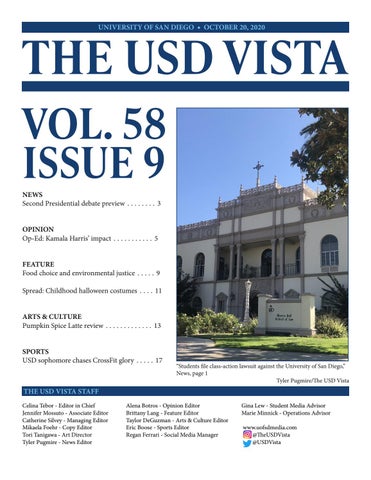
“Students file class-action lawsuit against the University of San Diego,” News, page 1 Tyler Pugmire/The USD Vista
THE USD VISTA STAFF Celina Tebor - Editor in Chief Jennifer Mossuto - Associate Editor Catherine Silvey - Managing Editor Mikaela Foehr - Copy Editor Tori Tanigawa - Art Director Tyler Pugmire - News Editor
Alena Botros - Opinion Editor Brittany Lang - Feature Editor Taylor DeGuzman - Arts & Culture Editor Eric Boose - Sports Editor Regan Ferrari - Social Media Manager
Gina Lew - Student Media Advisor Marie Minnick - Operations Advisor www.uofsdmedia.com @TheUSDVista @USDVista
The USD Vista
◆
October 20, 2020
Students file class-action lawsuit against the University of San Diego Plaintiffs allege that USD breached its contract with students by not offering live classes and not refunding partial tuition and fees CELINA TEBOR EDITOR IN CHIEF
Two University of San Diego students have filed a class-action lawsuit in federal court against the University of San Diego. Plaintiffs Haley Martinez and Matthew Sheridan, two students at USD’s Paralegal Certificate Program, brought the suit in order to receive a partial refund for tuition. The suit alleges they paid the tuition cost for in-person classes, but USD did not hold up its side of the contract in providing the value of an in-person education after canceling in-person classes because of the coronavirus pandemic. The lawsuit argues that through USD’s policies, admission agreement, and payment of tuition and fees, USD and its students entered into a contract; students would pay tuition and fees, and in return, USD would provide in-person instruction and access to on-campus resources for the full duration of Spring 2020 and the 2020-2021 academic year.
NEWS
“Remote learning options cannot replace the comprehensive educational experience promised by USD,” the suit reads. “Access to facilities, materials, laboratories, faculty, student collaboration, and the opportunity for on campus living, school events, dialogue, feedback and critique are essential to the in person educational experience.” Yvette Golan, an attorney representing the plaintiffs, does not dispute that USD made the right call by moving its classes online. “The problem really is with continuing to charge students full tuition,” Golan said. The lawsuit argues that USD stresses and recognizes the importance and value of in-person classes: prior to moving all classes online on March 12, USD did not allow students to transfer credits from online classes. “For the few classes for which USD provided online instruction, USD charged far less in tuition,” the suit reads. “For example, USD
charged $1,580 per unit of on campus classes for its Master of Science in Health Care Informatics, but charged 41% less — $925 per unit — for the online version of the same class, for the same degree.” USD has moved forward with increasing tuition for the 2020-2021 school year. Over 800
students have signed a petition asking for at least a 20% refund of tuition for all students. USD has previously explained its decision regarding the tuition increase and maintains its position. “With regard to the tuition increase for the Con’t on Page 2
USD will be facing legal action due to its inability to decrease tuition for students during a global pandemic. Walker Chuppe/The USD Vista
1
Volume 58 Issue 9
◆
NEWS
◆
The USD Vista
The lawsuit was developed by two students in the Paralegal Certification Program from USD.
From Page 1
fall, that decision was made and approved by the Board of Trustees prior to the pandemic and was communicated to the campus community at that time,” a statement from the university read. Vice President of Student Affairs Carmen Vazquez also previously mentioned that the university lost an estimated $17 million in the spring semester, with a total estimated loss of over $40 million. She also confirmed that the university’s endowment value has decreased by $50 million due to the stock market plunge. Golan disputed the
NEWS
university’s justification for the tuition increase. “This is a risk that schools have always had,” Golan said. “The school is in the best position to handle those risks. Students are not.” The lawsuit used the university’s Paralegal Certificate Program to display what plaintiffs believe is the inferiority of online education. The program’s website says it offers “internships to gain real world experience and hit the ground running.” Sheridan, a plaintiff, attended the internship program during the summer of 2020. He did not gain “real world experience,” he alleges, but only a “simulated”
internship. “USD itself recognized that the ‘simulated’ internship it provided was not reasonably equivalent to its promised internship; USD instructed students such as Plaintiff Sheridan that while the normal internship program qualified as ‘experience’ and could be listed as such in their resume, the internship program USD actually provided qualified only as ‘education,’ and could not be listed as ‘experience’ in their resume,” the lawsuit says. USD deprived students of the education, experience, and services that they were promised and have already paid for, the suit says.
Tyler Pugmire/The USD Vista
“Students suffered a loss of their in-person education — but that’s not something the court can give back,” Golan said. “What can be remedied is the charge of tuition. That here is what we believe is a breach of contract by USD.” Golan says she is litigating cases against other universities such as San Diego State, and UC San Diego for this exact same problem. “I think the facts are on our side,” she said. “I think the equity is on our side. I hope USD will be on our side too.” The University of San Diego did not provide a comment, as it has not officially been served.
2
The USD Vista
◆
October 20, 2020
Previewing the third Presidential debate Leading up to the election: from presidential town halls to what the final debate will bring EMMA VALDISERRI ASST. NEWS EDITOR
As if 2020 couldn’t yield any more chaos, the third and final presidential debate is scheduled for Thursday, Oct. 22 at 6 p.m. PT. The second debate was canceled due to President Trump’s contraction of COVID-19, the virus that has now killed over 220,000 Americans and infected over 7 million. The nonpartisan Commission on Presidential Debates had proposed a virtual debate that would simulate the in-person experience; and while Biden encouraged this proposition, Trump outright refused to participate, claiming it would be a waste of time. In place of the second debate, former Vice President Joe Biden and President Trump held separate, dueling town hall forums to discuss policy. Now, the candidates are in route to take the stage for the third round. Senior undergraduate, Eileen Rhatigan, commented on the nature of the second debate’s
NEWS
cancellation. “I feel like the second debate could have been done via Zoom (or) remotely,” Rhatigan said. “I think President Trump is refraining from participating to delay addressing certain policies and social issues.” Last week on Thursday, Oct. 16, Trump and Biden participated in separate town hall forums in place of the second debate. Here, they were prompted to answer voters’ questions and discuss policyoriented topics in regards to their plans and goals if elected to the presidency. Biden drew 15.1 million viewers and Trump drew 13.5 million. President Trump’s town hall forum took place in Miami, Florida, with NBC Today’s Savannah Guthrie as the moderator. Trump’s forum started with 18 minutes of Guthrie questioning him about his COVID-19 testing and immense financial debt –– which he answered ambiguously. Trump neither confirmed nor denied as to whether he had taken a COVID-19
test on the day of the first debate. He also tiptoed around the question about his $400 million debt, claiming it to be the size of a ‘peanut’ in comparison to his net worth. Additionally, Trump refused to condemn QAnon, a rightwing conspiracy group associated with spreading
false information about COVID-19, the Black Lives Matter movement, and the 2020 election. Meanwhile, Biden’s forum took place in Philadelphia with moderator, George Stephanopolous from ABC News. His discussion went straight Con’t on Page 4
Trump and Biden’s third debate will take place in Nashville, Tennessee. Photo Courtesy of the Library of Congress Photo courtesy of beemergirl99/flickr
3
Volume 58 Issue 9
◆
NEWS
◆
The USD Vista
The debate will feature muted microphones during the first two minutes after each topic is introduced. It will be moderated by Kristen Welker. Photo courtesy of David Everett Strickler/unsplash
From Page 3
to voters’ questions where he debriefed selected policies and denounced the policies Trump has promised to roll through. Biden was asked about packing the court, where he again failed to give a direct answer about what he and his administration, if elected, would do. He was also pressed about his plan to attract Black voters under 30 years old to vote, after he made a highly controversial comment in an interview earlier this year: “If you have a problem figuring out whether you’re for me or Trump, then you ain’t black.” The third and final debate will take place at Belmont University in Nashville, Tennessee. It will be moderated by NBC News’s White House
NEWS
correspondent and coanchor of Weekend Today, Kristen Welker. The debate will follow the same format as the first: it will run for 90 minutes and consist of six 15-minute segments, allowing each nominee two minutes to speak on their own behalf and then lead into open discussion. Once again, USD Votes in collaboration with the university’s political science department will host an academic discussion board on Discord, where students and faculty can share ideas and ask any questions pertaining to the debate. “I think the third, and final debate will mirror the first,” Rhatigan said. “If anything, I think Trump will become more irate, and continue his personal attacks on Biden rather than bringing focus
to the moderator’s actual questions.” In hopes of a more civil, final debate, it’s likely the nature of the SCOTUS hearings involving Amy Coney Barrett will be brought to attention, as well as President Trump’s controversial behavior in regard to the virus, after having contracted it himself. After his release from Walter Reed hospital, Trump tweeted, “Don’t be afraid of Covid. Don’t let it dominate your life.” Many claimed this to be insensitive, as if the people who died from the virus had the choice of letting it dominate their lives and health. On the other hand, Trump’s administration and supporters have shown appreciation for Trump in an attempt to alleviate the panic surrounding the
virus. “I think Trump means to deflect his views as much as possible, and will attempt to paint Biden as a ‘crook.’ On Biden’s part, I think he will continue to speak to the American people, and their needs,” Rhatigan said. Over 73 million Americans watched the first debate, nearly 11 million shy of the first presidential debate between Hillary Clinton and President Trump in 2016. Considering the social climate of the first debate, only time will tell how many Americans will watch the final discussion, on Oct. 22 at Belmont University in Nashville, Tennessee where Trump and Biden have the chance to make their ultimate appeals to the American people.
4
The USD Vista
◆
October 20, 2020
What Kamala Harris means for women Kamala Harris turns 56 today presidential debate, Fox News commentator Tucker Carlson discussed Just after Senator what he believed to Kamala Harris became be Harris’s agenda. He the first woman of color suggested the debate was to stand on the debate simply her audition for the stage as a member of a presidency, urging viewers major party’s ticket, it to focus on what she would has become abundantly do as our “fundamental clear that even in the year president” if Joe Biden is 2020 we remain lacking in elected. He refers to her as gender equality. In his segment aggressive, insisting she preceding the vice is far more “radical” ALENA BOTROS OPINION EDITOR
than her running mate. Additionally, he stated “she knows what she wants, there’s no question she would bulldoze her elderly sentimental boss,” undermining Biden and his ability to run our country. During the debate, Harris repeatedly advocated for Biden and what he stands for. Nonetheless, Carlson’s description of Harris, claiming she would “bull-
doze” Biden in an attempt to get what she wants, is part of the problem. He depicts her as this aggressive, irrational woman instead of the strong, independent woman she is, and in that he is appealing to voters who view “aggressive” women, and women of color especially, as unlikeable. Her decisive nature is something that should be admired rather Con’t on Page 6
Kamala Harris has served as a senator of California since 2017, and has joined Joe Biden as his running mate in the 2020 presidential election. Photo courtesy of Luke Harold/flickr
OPINION
5
Volume 58 Issue 9 From Page 5
than a tactic to demonstrate her supposed radical agenda. After the debate, Harris was met with an immense amount of criticism. From labeling her too “condescending” because of her facial expressions in response to Vice President Pence, or the derogatory language stemming from our president himself as he took to Twitter to share his reaction to the debate, writing “Mike Pence is doing GREAT! She is a gaffe machine,” and that “she is far further left than Crazy Bernie. Biden would not last a month!” This is coming from our president, Donald Trump. As his debates remain on hold, Harris and Pence reiterate the plans of their running mates for our future. Harris is not only subjected to these harmful comments by the public, but by the leader of our country. His explicit remarks demonstrate the challenge women face daily, whether in positions of authority or not. He insinuates her aggressive and radical nature will overwhelm Biden, completely disregarding her authority. Women are continuously referred to as aggressive. Why is it that women cannot simply be goal-oriented,
OPINION
◆
OPINION
determined, and fierce without fear of how they will be perceived? But, Kamala Harris does not waver in the face of this criticism. Instead, she holds firm in her demeanor; she remains calm while retaining her authority. She is aware of the lack of equality women face, specifically the lack of equality she is up against in this election, just as we are aware of the lack of equality we face as women in our daily lives. Yet, we should aim to face this challenge by standing firm, by remaining resilient, and by pushing through as our vice presidential candidate has done so well. Kamala Harris is not only the first woman of color to be chosen for a presidential ticket, but also the first woman of color to serve as California’s attorney general, after having served as San Francisco’s district attorney. Yet, she is still considered aggressive rather than assertive. Kamala Harris is driven, and in her drive she asserts her power and exudes confidence. She stood her ground in a way that should serve as a model for all women who fall into this category. Whether in the workplace, school, or even home,
◆
The USD Vista
there is this pressure to be more feminine and timid; anything but bold. Then, we see our male counterparts who thrive because of their bold nature. I’d argue that before the debate, Harris was told to maintain her position, to remain confident, but in a way that comes off strong rather than aggressive to appeal to her audience, as studies have shown that likability is a defining factor in regards to female candidates rather than their male competitors. However, Harris did not stand down. She instead insisted on receiving the same allotted time as Vice President Pence, reminding him she was speaking with a simple, “Mr. Vice President, I am speaking.” Kamala Harris may not necessarily be a feminist icon. Regardless of your opinions about Kamala Harris’s history or platform, she means something for women. Not only does she reflect women in this presidential ticket, but also women of color. She can stand as an image for intersectional feminism. She can present the ability to reach one’s goal as a woman of color, someone who made it to the top, someone who did not back down in fear. But, much more than that
she can teach us. When asked if Roe v. Wade was to be overturned, what would she want for her home state of California, Harris replied, “First of all, Joe Biden and I are both people of faith,” and that “there is the issue of choice. I will always fight for a woman’s right to make a decision about her own body. It should be her decision and not that of Donald Trump and Vice President Michael Pence.” Kamala Harris said it best. She is pro-choice. She is not pro-abortion. But, she will fight for a woman’s right to make that decision on her own. It is about autonomy. And, the autonomy of women specifically, and to know we have a representative, an advocate, fighting to advance and retain our rights is crucial. Take that into consideration. Kamala Harris will represent women. She will continue to remain assertive, determined, and unapologetically fierce. She may not make everyone happy. But, she will change this perspective of women. I have already learned so much from her. And I know she will have a vast impact on women and the perception of women everywhere.
6
The USD Vista
◆
October 20, 2020
Checking the wrong types of boxes How the California GOP is committing election fraud “official.” Padilla filed a cease and desist letter to the GOP; however the This past week, GOP has chosen not to California Secretary of comply and is insisting State Alex Padilla and that their actions are legal Attorney General Xavier under a California ballot Becerra were alerted that harvesting law. This ballot the California Republican harvesting law was put Party (GOP) had placed into place to help people ballot drop-off boxes at who could not make it locations such as gyms, to the polls. So, if a voter gun stores, and churches is ill, has work, or for that were falsely marked any other reason cannot BAYLYNNE BRUNETTI ASST. OPINION EDITOR
physically vote, they have the option to entrust another person to sign and drop off their ballot. Under California state law, only county election officials are authorized to set up ballot drop boxes to ensure adequate security. Therefore, this is another way for the Republicans to not only undermine our democracy, but to also cry out “election fraud”
when people do not vote Republican. Ultimately, it is illegal. Naturally, any time California is concerned, President Trump has points of contention to yell from Twitter like an unstable tyrant. Trump tweeted, “You mean only Democrats are allowed to do this? But haven’t the Dems been doing this for Con’t on Page 8
The California Republican Party (GOP) has placed ballot drop-off boxes at locations such as gyms and churches that were falsely marked as official. Photo courtesy of Element5 Digital/unsplash
OPINION
7
Volume 58 Issue 9 From Page 7
years? See you in court. Fight hard Republicans!” We cannot forget to mention the tweets from Republicans to the California Governor quite literally saying “screw you.” This is a grim look at the future of civil discourse as we see the parties become even more divided. Moreso, it is beyond baffling that a sitting President is threatening legal action for a states rights issue — that issue being elections, which states dictate for themselves. First and foremost, let’s break down the actual legality of the situation at hand. As previously mentioned, in California, if a voter is unable to return their mail ballot themselves, they have the option to designate a family member or another person close to them to deliver it to a ballot drop box, the county elections office, or send it back in the mail. This is perfectly legal because that ballot has to be signed by the person taking custody, and the state can track who had it and what they did with it. With the GOP unofficial boxes, there is no one to hold accountable. These are simply metal boxes, claiming to be official ballot boxes that have no monitoring. There is no
OPINION
◆
OPINION
record of who retrieved the ballots from the boxes and where they transported them to. For a party who screams “voter fraud” when it comes to mail-in ballots, their tune sure has changed. On the contrary, perhaps the GOP believes this could help their case to prove some sort of election fraud. This could work for them, since no one knows what will happen to the ballots now in their possession. These unofficial ballot boxes are illegal and the California GOP should be prosecuted by the state of California for election fraud and election meddling. Any group that seeks to undermine our democracy and potentially be contributing to election fraud should be held accountable. At this point, it is a gross display of what a party will do to achieve victory. The most important thing to remember is that no one knows what the intention of these ballot drop-offs are. The GOP claims that this is a way for Californians to drop off their ballots with someone they “know and trust” — however, these boxes are not monitored by any specific person and the state does not know in what way they are secured, if at all. With this justification, it is
◆
The USD Vista
Election Day will take place on Nov. 3. Photo courtesy of Element5 Digital/unsplash
more difficult to believe the GOP’s rationale for these boxes. Although, I cannot say certainly they have completely nefarious intentions, I have my doubts. It is suspicious that under the Trump administration, the Republican Party has started to spout conspiracy theories about mail-in ballot fraud. Need we be reminded that there is no evidence of widespread voter fraud on any level? So, now that they are committing voter fraud, it raises doubts on the true intentions of these socalled “ballot drop-offs.” Either way, it is probable that lawsuits will take place being that the
GOP has already declined to remove these boxes and have in fact, threatened to put more of them. Predictably with Trump involved, this case could also end up at the Supreme Court. It will be interesting to see how a conservative majority court rules on state’s-rights voting issues, especially when these issues lead to election fraud — a shot to the heart of our representative democracy. The views expressed in the editorial and op-ed sections are not necessarily those of The USD Vista staff, the University of San Diego, or its student body.
8
The USD Vista
◆
October 20, 2020
How changing our food practices can contribute to environmental justice, sustainability, and anti-racism Aaron Gross, Ph.D. gives a powerful talk on the question of, “can university food become an anti-oppressive practice?” for the Care for our Common Home Series BRITTANY LANG FEATURE EDITOR
The majority of students fill their plates at the dining hall or ask for their usual order at their favorite coffee shop without giving it much thought. Ethically engaging with our food choices is not something financially-str uggling students do on a daily basis. The Care for our Common Home Series features speakers from the arts, sciences, humanities, and social sciences each week to give talks that reflect on pressing environmental concerns. The goal of the series is to examine the challenges civilization is currently facing and offer unique approaches to tackle the climate crisis. Each week the series focuses on a different theme — water, energy, food, or extinction. Aaron Gross, Ph.D., is a professor of theology and religious studies at USD. His area of expertise is in Jewish, animal, and
FEATURE
food studies. He is the founder of the food and farming advocacy group, Farm Forward, and is coleading the USD’s Food Studies Initiative alongside Christopher Carter, Ph.D., and Nick Riggle, Ph.D. Gross’ work is centered around an interdisciplinary approach to theorizing the nature of oppression, and resistance to it, by incorporating insights from animal studies, ecofeminism, and race theory. On Oct. 13, Gross’ talk for the Care for Our Common Home Series was titled, “Can university food become an antioppressive practice?” Gross discussed how humans usually do not think about food as something tied to oppression, but that he thinks using the term “oppression” is very helpful in understanding the profound ramifications of our eating choices. “I think fundamentally what I am talking about is a challenge to our moral imagination — the way in
Animal agriculture has a disproportionate impact on the environment. Photo courtesy of the Michael Pujals/unsplash
which we conceptualize what food is,” Gross said. “Somehow when we look at our plates, we don’t see a great issue of injustice.” The purpose of his talk was to encourage university students to understand how by changing the ways in which we eat, we can quite literally change the planet — this in and of itself is an ethical challenge. Gross discussed how even though industry shapes our world profoundly, a third of the land on the planet that is arable is actually occupied by livestock and the crops we use to feed that
livestock. “We live on a planet that is a farm and how we farm shapes the planet,” Gross said. Animal agriculture has a disproportionate impact on the environment, and therefore has the potential to shape it for better or for worse. The overwhelming majority of scientists and climate change experts see decarbonization and achieving net zero carbon emissions by 2050 as an absolute necessity to combat climate change — essentially seeing the issue of pollution as being Con’t on Page 10
9
Volume 58 Issue 9 From Page 9
solely caused by factories. However, Gross claimed this is not the whole truth. “Even if all of the goals are achieved but dietary patterns see no shift, the world will fail to meet the Paris Agreement,” he said. The Paris Climate Agreement does not address dietary trends specifically or the impact that the consumption of animal protein has on our environment. Even the countries who have taken drastic measures to reduce greenhouse gas emissions have not done anything in terms of addressing diet and have let current dietary trends continue. Gross emphasized that this is not enough. He discussed how animal agriculture today is dominated by factory farming. These are corporations that have structures and demands that are put upon them that make them behave in ways that are morally abhorrent, he said. “The essence of the factory farm system is an oppressive system,” Gross stated. “They have no interest in anything but following their own agenda and they have no interest in protecting the ecology of our planet.” Gross asked the audience to consider who pays the largest price
FEATURE
◆
FEATURE
when we live in a world where the water and air is constantly being polluted, animals are constantly being poisoned, and our microbiome is being disrupted. According to Gross, it will always be the people in underprivileged positions. “It is going to be whoever is vulnerable, whoever can’t get out of the way and in the U.S., that will end up being overwhelmingly people of color,” he stated. To support this argument, Gross touched on the slaughterhouse deaths that came as a result of the COVID-19 pandemic. As the virus spread, employees stopped showing up to work as it became too dangerous. It is important to note that the majority of slaughterhouse workers are people or color. Slaughterhouse jobs already have the highest turnover and injury rate in the country, but the heads of these corporations knew they did not have the ability to stop the spread of COVID-19. However, Gross claimed they were much less concerned with the actual deaths of their workers if they made them return to work, but how it would hurt them financially as they would be liable for these deaths. Nevertheless, in
◆
The USD Vista
April President Trump leveraged the Defense Production Act to order slaughterhouses and meat packing plants to remain open and demand employees return to work. Gross stated how he knew people were ready to put humans in harm’s way to produce meat, but he didn’t think he would see a U.S. president ordering slaughterhouse workers back to work during a global pandemic. “The system was broken long before COVID — the narrative about it breaking as a result of COVID is a little bit silly,” Gross said. “What we have is a fully oppressive system, operating in the way it has always operated.” Gross emphasized that this does not have to be our reality and that by making changes to the ways in which we choose to eat is the first step to dismantling these oppressive practices and institutions. “Food can be creating aggressively positive change in the world,” Gross said. “We don’t have to settle for just a little bit less cruelty or a little bit less climate change.” Gross discussed how although changing the food system is very hard to do as individuals, if we work together within the USD community, change
can be achieved through collective action. The USD Food Studies Initiative is just getting started this semester and will be open to students soon. It will involve a speaker series and discussion events about our common values and how we can then implement these values into the ways in which food on campus is produced. It also seeks to create a food studies minor at USD. “We want to shape the USD campus into a model of how universities can leverage food scholarship and food services to build community on and off campus, and establish more engaged and ethical food ways,” Gross said. He argued that it is the rule rather than the exception that all of the sickness and cruelty that occurs in our environment tends to affect certain human beings. The USD Food Initiative has been created to invite us to ethically engage with the food choices we make as students. If we make necessary changes to our diets, we can then utilize food as a vehicle for addressing anti-Black and Indigenous racism, food sovereignty, climate change, violence toward animals, and the ways in which all of these issues intersect.
10
The USD Vista
◆
October 20, 2020
San Diego’s Tastiest: Pumpkin Spice Lattes The search for San Diego’s tastiest drinks and treats continues with finding the best pumpkin spice lattes SD coffee shops have to offer TAYLOR DEGUZMAN A&C EDITOR
It’s that special time of year again when the air is filled with seasonal scents of sugar, spice, and everything nice. The aromas of pumpkin spice define the true essence of fall. Pumpkin spice takes form in Bath and Body Works candles, hand soaps, body lotions, and car plug-ins to spread more holiday cheer. However, this very popular seasonal scent is also one of the most popular seasonal coffee flavors. Pumpkin Spice Lattes, also known as PSLs, are almost a fall rite of passage because of how much the drink is talked about once it finally hits coffee shop menus. Although sunny San Diego has yet to understand that fall weather is not supposed to be 80 degrees and above, individuals can still get their pumpkin spice latte fix by getting it as an iced drink instead. The following list attempts to find which iced PSL in San
A&C
Diego is worth the hype. The Forum Coffee House 4340 Genesee Ave UNIT 110, San Diego, CA 92110
ratio is crucial to the perfect pumpkin spice latte; too much cinnamon can be overpowering and distract from the pumpkin flavors of the drink. Unfortunately,
Better Buzz’s pumpkin spice latte did in fact have more spice than pumpkin, yet stayed away from artificial spice flavor that could make the drink Con’t on Page 14
This iced pumpkin spice latte doesn’t have that overly pumpkin spiced taste, where the drink tastes exactly how a scented candle or soap smells. Part of their new seasonal drink line-up, the pumpkin spice latte has house-made pumpkin sauce made with real pumpkin. Because of this, the drink successfully avoids artificial pumpkin spice flavoring and rather, has a different taste than normal pumpkin spice lattes that balances both the necessary sugar and spice. The drink is $4.50 if ordered hot, $5 if iced, and $5.75 for oat milk, the recommended non-dairy milk option. Better Buzz 1186 Garnet Ave, San Diego, CA 92109 The pumpkin to spice
It seems like every coffee shop has added this seasonal favorite to their menus. Taylor DeGuzman/The USD Vista
13
Volume 58 Issue 9
◆
A&C
Located in Hillcrest, Communal Coffee is known as a frequent study spot for students. Jenny Han/ The USD Vista
From Page 13
unenjoyable. This PSL is still sweet and creamy, and the coffee strength isn’t overpowering at all. However make sure to ask for less spice if you want to maintain that perfect pumpkin to spice ratio. Better Buzz’s pumpkin spice latte is $5.50. Communal Coffee 2335 University Ave, San Diego, CA 92104 Communal
A&C
Coffee’s
iced pumpkin spice latte lacked both the pumpkin and spice flavor. Rather than any notes of cinnamon or nutmeg, the iced drink tasted more like whole milk than coffee and left an interesting aftertaste because of the amount of milk in the drink. If the “PSL” were labeled a regular latte, it would fit the flavor of the drink. For Communal Coffee fans, perhaps ask for non-dairy milk and more of their “homemade pumpkin puree” to fully
◆
The USD Vista
Better Buzz is often a USD go-to coffee shop.
embrace the seasonal drink. Communal Coffee’s Seasonal Pumpkin Spice Latte is $5.50 or $6.50 for any non-dairy milk substitution. Starbucks Most Starbucks stans eagerly wait for Starbucks’ PSLs to officially return to the menu. Starbucks knows how big of a deal it is with offering their pumpkin spice lattes at the end of August, nearly a month before fall begins.
Jennifer Mossuto/The USD Vista
Although many customers hype up Starbucks’ PSLs, the iced latte had a more underwhelming pumpkin spice flavor than expected. While this latte had more pumpkin flavor than Communal Coffee’s PSL, it still falls short in sweetness and pumpkin flavor, while the spice is still there. A grande pumpkin spice latte is $4.95 or $5.25 with almond milk, but opt for oat milk instead to not distract from the pumpkin spice flavor.
14
The USD Vista
◆
October 20, 2020
San Diego Museum of Art adopts new technology in reopening How COVID safety measures paved the way for unique guest experiences OLIVIA HUNT ASST. A&C EDITOR
Like other public institutions across the county, the San Diego Museum of Art (SDMA) has established new policies to make people feel comfortable about their reopening to the public. With distance markers, temperature scans, limited capacities, and Plexiglas barriers, guests can enjoy some peace of mind when visiting these spaces. The SDMA has gone a few steps further to provide guests with as “normal” of an experience as possible, while protecting public health and safety. First, the museum has introduced a new, free app called SDMA. Visitors are encouraged to download it before planning an in-person visit. The app is designed for mapping visits ahead of time, and contains extensive insight and perspective into the museum’s collections. Its appearance also mimics handheld brochures and maps, which, unfortunately, have
A&C
The San Diego Museum of Art is located in Balboa Park and is currently open.
become obsolete in the post-COVID world. One benefit of the museum’s recent embrace of the digital world, has been its adoption of augmented reality. Through the app, visitors can “bring art to life” by pointing their phone camera at specific exhibition
pieces, such as Diego Rivera’s “Mandrágora” or John Sloan’s “Italian Procession.” Overall, the app attempts to make up for the museum’s lack of interactive experiences. For instance, as guests walk through the galleries, location-specific content
Photo courtesy of Tim Evanson/flickr
pops up for each exhibit. They can also access curator-led videos and custom audio tours whether in-person or online. If visitors wish to experience a sense of communal interaction, they can post and share Con’t on Page 16
15
Volume 58 Issue 9
◆
A&C
◆
The USD Vista
From Page 16
museum personal tips and perspectives with others on the app. In this way, the app does its best to preserve the quality of an in-person visit while creating a valuable interpersonal experience If guests do not want to visit the museum in person, another option is available. The San Diego Museum of Art has recently begun a fullyvirtual collaboration with other local arts institutions called Virtual SDMA+. According to the SDMA’s website, the purpose of this is “to inspire a robust appreciation of the arts and a deeper exploration of the SDMA permanent collection.” This new initiative constitutes a series of free virtual arts performances from a variety of local sources, including Nateesha School of the Bharatanatyam, the San Diego Ballet, and the San Diego Shakespeare Society. Performances are aired on the SDMA’s Youtube channel every Tuesday at 6 p.m. With the help of these new digital resources, guests can still experience the cultural value of the museum, and the SDMA can provide the San Diego public with a safe distraction from pandemic woes.
A&C
The museum is open Monday, Tuesday, Thursday, Friday and Saturday, but closed on Wednesdays. Photo courtesy of Tim Evanson/flickr
16
The USD Vista
◆
October 20, 2020
Rasich finds beast mode through CrossFit USD’s Megan Rasich aims to qualify for CrossFit Games, the sport’s championship SYDNEY AVERY CONTRIBUTOR
Her day is not the average in any capacity. The unreeling chronicles of her day consist of four to five hours of strenuous exercise. Her hands an abstract masterpiece of chalk, her spandex due for a cleaning, and her arms feeling fatigued, she forces herself to find renewed strength. Megan Rasich has a dream, and so the pain is worthwhile. CrossFit is the sport responsible for her sheer drive. The USD sophomore was born in Salt Lake City, Utah and has been the queen of activity since she could hobble on her two legs. She would strap her hiking boots on and climb for extended periods. Then, before the day would cease, she would join her family on any active endeavors that afternoon. “I grew up in a hyperactive family,” Rasich said. “We were constantly on the go; jumping from this to that, seeking adventure. I was the highly competitive one in my family and
SPORTS
any outing always turned into a chance to win at something. I lived for it.” She took her competitive nature and channeled it into sports. In second grade, Rasich decided to pick up alpine ski racing. Through seventh grade, she stuck with it. When seventh grade came around, she put ski racing on the back burner and with high school approaching, she got into cross country and track. But running never clicked for Rasich, and her interest fell flat. She still gave track a run and made it to the state finals and had her medal-winning moment. However, she wasn’t happy. She recognized it. Her dad saw it painted on her face. So, on to the next sport she went. When she stumbled upon CrossFit, she had her throw-theconfetti moment, the realization that she found it — her sport. “It makes sense that I love CrossFit because when I did all other sports, the part I liked best was the conditioning fitness piece,” she said. “That was the part in
Rasich (right) is spending the fall semester in Houston, Texas, coaching younger CrossFit athletes while also training herself. Photo courtesy of Megan Rasich
practice I looked forward to most. CrossFit is a mix of everything. You have the metabolic element with a mix of gymnastics as well as traditional weightlifting.” Rasich knew from the sweaty smell of the gym to the array of skill sets one must possess that she was up for the challenge that CrossFit would entail. With her unique background in sports and her solid foundation of muscular endurance, she was able to pick up the sport fairly quickly. “I always knew I
wanted to be really good at something,” Rasich said. “When I stumbled upon CrossFit, sure it was fun, don’t get me wrong, but I didn’t do it just for fun. I wanted to be the best.” Rasich, being the highly competitive person she is, went to town and worked. She worked hard. She battled mental barriers, she pushed to new personal records, and she opened her horizons to her potential. She was introduced to the sport her junior year of high school and by senior year, Con’t on Page 18
17
Volume 58 Issue 9 From Page 17
she was rearranging her life around it. “Everything in my life started revolving around CrossFit,” Rasich said. “I started paying attention to nutrition, sleep, and things of that nature. Also, when the pivotal moment came to decide where to go to college, I looked to where the best places to train would be. I ended up at USD in part because of the opportunities that I would have there to train.” Her new home gym in San Diego is the training ground for several topnotch CrossFit athletes. She knew that she would be in good company and would be in an environment that could propel her to her ultimate dream of attending the CrossFit Games. The CrossFit Games are the World Championships or Olympics of CrossFit. Attending the Games is no easy task, but Rasich has fixated her eyes on making it. With every workout, she rises with stamina and burning passion because she is a girl with a dream. When she enters the new gym, she will be hungrier than ever for a stronger her. She welcomes the new opportunity. When her first year of college rolled around, she loaded her trunk, mostly with athletic attire, and said her final farewells to
SPORTS
◆
SPORTS
Utah for the time being. “I was terrified to be moving, to be going to a gym packed with so many athletes that have been to the Games,” she said. “I was uncomfortable, but I was able to acknowledge the necessity to go.” She eventually adapted and, before COVID hit, they were the most fun months of her life. “I had a good balance going on,” Rasich said. “I was able to be a fun kid in college but when I left for training, I was in this other mode.” She found herself improving and able to keep up with the top tier at her gym. With every new workout, she became more and more resilient, inviting pain in and loving the constant challenges of the sport. She is ranked
◆
The USD Vista
in the top 5 percent in CrossFit , indicating she is among the fittest women in the world. Although her plans are being altered due to COVID-19, she continues to shape her CrossFit career. When school went virtual during her second semester, she flew to Houston, Texas to train with her starting coach. She is living there on her own, training, and also coaching younger athletes, getting closer and closer to making her dreams reality. She starts her day early, eating breakfast before training for two hours in the morning and finishing with a food refill. Then she coaches. And then, back to training. She never quite stops but she wouldn’t have it any other way. Although the times
are unprecedented, she finds herself reaching new heights with her fitness levels and is savoring the moments of teaching the sport that she loves to young ones. In January, she plans to return to San Diego. Her life was the best it had been before masks were the new complement and she looks forward to returning to school and all its glory. CrossFit always grounds her and gives her the homey feel she needs anywhere, whether or not that be San Diego or Houston or Salt Lake City. CrossFit is her safe haven. She plans to compete until her goals are reached and she has expended herself. In the coming years, Rasich plans to make USD, but more importantly herself, proud.
Having taken up CrossFit only a few years ago, Rasich is already ranked among the top five percent of CrossFit athletes, and has her sights set on qualifying for the CrossFit Games. Photo courtesy of Megan Rasich
18
The USD Vista
◆
October 20, 2020
This week in history: USD salutes McFadden in win over UCLA Men’s soccer capped “Seamus McFadden Night” with 3-1 triumph in 2017 ERIC BOOSE SPORTS EDITOR
In 1979, Seamus McFadden took the helm of the University of San Diego’s brand-new men’s soccer team. After 39 seasons, the only head coach the Toreros had known announced 2017 would be his last year in charge. On Oct. 22 of that year, his team helped send him off in style, beating UCLA 3-1 as the university honored the Irishman’s tenure. On the field, San Diego honored their head coach with a commanding performance to take down a UCLA team that plays a significant role in the history of Torero soccer. USD started fast, forcing Bruin goalkeeper Kevin Silva to make a pair of saves in the first 10 minutes, and the hosts continued creating chances throughout the first half, managing two more shots on target, while the visitors from Los Angeles only troubled Torero keeper Thomas Olsen once. With halftime looming, San Diego finally turned their chances into a goal.
SPORTS
Midfielder Freddy Polzer (14) gave San Diego a 3-0 lead an hour into the match by way of forcing a UCLA own goal, much to the delight of the over 2,500 fans in attendance. Photo courtesy of USD Men’s Soccer/Twitter
Off a corner kick, the ball fell to first-year defender Aaron Frey, who fired it into the top corner for his first collegiate goal. At halftime, with the Toreros leading 1-0, a group of USD soccer alumni helped honor their coach — part of the festivities celebrating McFadden in his penultimate home game as head coach. Ceremony over, McFadden’s team started just as hot in the second
half as they had in the first. Only five minutes into the second half, forward Miguel Berry drove through the Bruin defense before cutting the ball back to tee up midfielder Djordje Babic, who thumped home the Toreros’ second. In the 59th minute, with UCLA still struggling to create shots, let alone put them on target, San Diego added their third goal to ice the game. Midfielder Freddy
Polzer created space for himself to shoot, and although Silva made the initial save, the rebound ricocheted off a Bruin defender and into the back of the net. The Bruins did put up a fight, but their shots rarely troubled Olsen, with the USD defenders either blocking them or watching them fly high or wide. UCLA’s Blayne Martinez did put home
Con’t on Page 20
19
Volume 58 Issue 9 From Page 19
a rebound in the 89th minute, but it was nothing more than consolation. The final whistle blew, and the Toreros were 3-1 winners. It would have been a special victory no matter the opponent — it would end up as McFadden’s final victory as a head coach — but UCLA is not just any opponent. Without a doubt, the San Diego State Aztecs are the Toreros’ primary rival, but it is arguable that, when it comes to men’s soccer, the Bruins are San Diego’s second-biggest rival. There is, of course, the long-standing rivalry between San Diego and
SPORTS
◆
SPORTS
Los Angeles sports teams, but the clashes between USD and UCLA’s soccer teams tend to carry more weight than just regional bragging rights. The teams have met eight times in the NCAA tournament, with each team winning
◆
The USD Vista
the top-ranked team in the country — the fourth time McFadden beat a No. 1-ranked team, and his 11th and final win over a top-10 team. It was a somewhat fitting end then, for McFadden’s final win to come against
It was a somewhat fitting end then, for McFadden’s final win to come against a team so intertwined with the story of his tenure at USD. four of those meetings. Since 2003, McFadden’s Toreros were 3-8-2 against the Bruins. However, one of those wins knocked the Bruins out of the NCAA tournament, and the most recent win came in 2014, when UCLA was
a team so intertwined with the story of his tenure at USD. That tenure came to an end after nine West Coast Conference championships, 14 trips to the NCAA tournament, a run to the Elite Eight in 2012, and an appearance
in the 1992 National Championship game. Rather, it mostly came to an end. After stepping down as head coach, McFadden has remained with the program, serving as an assistant coach under new head coach Brian Quinn — who had served as an assistant coach under McFadden for a decade. Seamus McFadden shaped USD men’s soccer into what it is today. His influence still lingers around the team. On Oct. 22, 2017, the university celebrated him for all of his work, and his team sent him off with a last hurrah over their familiar foe from up north.
20