UNIVERSITY OF SAN DIEGO ◆ SEPTEMBER 29, 2020
NEWS Spring study abroad a go ․․․․․․․․․․․․․․․․ 1 OPINION Editorial: RBG’s final wish ․․․․․․․․․․․․․․․ 7 FEATURE “There’s more” storytelling series ․․․․․․․․․․ 9 Spread: Latinx Heritage Month ․․․․․․․․․․․ 11 ARTS & CULTURE Crush culture on Zoom ․․․․․․․․․․․․․․․․․ 13 SPORTS Padres practice at USD․․․․․․․․․․․․․․․․․․ 15
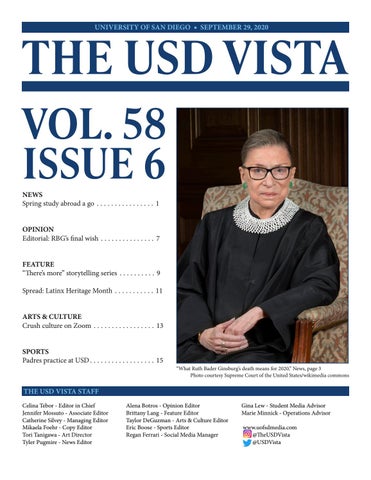
“What Ruth Bader Ginsburg’s death means for 2020,” News, page 3 Photo courtesy Supreme Court of the United States/wikimedia commons
THE USD VISTA STAFF Celina Tebor - Editor in Chief Jennifer Mossuto - Associate Editor Catherine Silvey - Managing Editor Mikaela Foehr - Copy Editor Tori Tanigawa - Art Director Tyler Pugmire - News Editor
Alena Botros - Opinion Editor Brittany Lang - Feature Editor Taylor DeGuzman - Arts & Culture Editor Eric Boose - Sports Editor Regan Ferrari - Social Media Manager
Gina Lew - Student Media Advisor Marie Minnick - Operations Advisor www.uofsdmedia.com @TheUSDVista @USDVista
The USD Vista
◆
September 29, 2020
USD Spring 2021 study abroad moving forward
Several study abroad programs are moving forward with plans to return as soon as this spring semester JENNIFER MOSSUTO ASSOCIATE EDITOR
The University of San Diego canceled all Fall 2020 study abroad programs on March 12. Since, then, study abroad programs for Spring 2021 opened up applications on Sept. 2 and closed Sept. 16. This has erupted concern and also excitement among some students, leaving them confused on what to expect. The USD International Center created a document detailing frequently asked questions amidst the new COVID-19 protocols. As many junior and senior study abroad plans were derailed, students were nervous their study abroad opportunity was over. Students’ last 30 units are required to be completed on campus, but some of the affiliated schools abroad count as “on campus,” allowing seniors to still go abroad in their fall or spring semester. Kira Espiritu Ph.D., assistant provost of international affairs, explained how studying abroad in the spring might look different, as well as what precautions they are
NEWS
taking. “Students need to be prepared to have a backup plan for spring in case travel from the United States is not permitted by the host country,” Espiritu said. “Students are encouraged to register for courses at USD when spring registration begins in October in addition to completing their program requirements for their study abroad location.” According to the U.S. Embassy, U.S. citizens are not currently allowed to enter Spain unless
they meet specific requirements or have been given permission by the Government of Spain. Espiritu explained that students were allowed to choose an alternate program location if their country of choice did not allow U.S. citizens. Espiritu also stated that Intersession 2020 SYE programs have been moved to Summer 2021 from June 6 to June 25 in Auckland and Florence. Spring semester study abroad is not the most popular semester to go,
The view from the Círculo de Bellas Artes, one of many rooftop bars in Madrid.
but Espirtu says USD is on track to have more students study abroad in the spring than in the last two spring semesters. “This is very encouraging and shows how resilient our students are and how important a study abroad experience is for them,” Espiritu said. USD junior Maddie Mandanis had been planning her study abroad in Madrid since her first year. “Before COVID-19, I was so excited to study Con’t on Page 2
Celina Tebor/The USD Vista
1
Volume 58 Issue 6
◆
NEWS
◆
The USD Vista
The famous Colosseum in Rome, Italy.
From Page 1
abroad in Madrid,” Mandanis said. “I couldn’t wait to experience a new culture, try new foods and work on my Spanish skills. Now, I am not quite sure how to feel. I still really want to have that experience but am not sure if I will be able to travel anytime soon.” COVID-19 upset many travel plans, leaving students disappointed and in search of new housing for the fall. “The study abroad center is great and very helpful and I know that they are doing the best that they can, but I think I would have appreciated them making a decision earlier so that we could have made other plans sooner,” Mandanis said. Mandanis has since changed her mind about Spain and decided to take her study abroad experience to Rome, Italy. “I am worried about
NEWS
Jennifer Mossuto/The USD Vista
potentially not being able to go abroad,” Mandanis said. “The study abroad office is moving forward as if the Rome study abroad program is still happening, but with the current state of things I am worried that it will not happen. I am hoping that if it doesn’t work out for me to go in the spring, I will go next fall.” Another junior, Nick Faber, had a particularly unique experience with his study abroad plans. “My program wasn’t part of the Madrid Center. I’m in dual degree so I stay 100% in a Spanish university, so I was left without much contact with USD,” Faber said. “When Corona hit, I was left even more in the dark about what USD wanted and any developments taken by USD. This had a lot to do with the general lack of knowledge about the virus so I understand, but the time leading
up to being sent home, which ultimately was my decision, was very stressful.” Faber’s program allows him to spend a full two years abroad, leaving him feeling lucky that this was simply a bump in the road, but saddened for other students who did not get the full experience. Faber has re-applied to the program and is currently taking a gap semester due to online classes. However, Faber does have some worries about the return. “The reason I’m hesitant about sending kids abroad, or at least a high volume of them, is because just based upon how study abroad people act,” Faber said. “It may cause the case numbers to rise and also there won’t be much for the kids to do because everything is still closed or at minimum capacity.” The drinking age is lower than in the U.S.
in many other countries and sometimes students take advantage of the opportunity to be on their own for the first time by drinking, socializing, and traveling from city to city. Faber points out that it is the student’s choice whether or not they want to go back in terms of COVID-19 cases and safety, but he chooses to take advantage of a poor situation. “I guess this just goes to show that you should always take advantage of every opportunity now because you’ll never know what’s going to happen in the future,” Faber said. Faber is most looking forward a cold sangria on a Spanish rooftop. USD study abroad programs are moving forward with plans for Spring 2021 and Summer 2021, hoping there are no other outbreaks in these countries that would cause plans to be changed.
2
The USD Vista
◆
September 28, 2020
What Ruth Bader Ginsburg’s death means for 2020
RBG’s death brings additional stakes to the 2020 Presidential election and increased tensions between the Democrats and the Republicans. McConnell refused to let vacancies shouldn’t be Insider reports. “He JENNY HAN former President Obama filled the same year as cited Sen. Harry Reid’s ASST. OPINION EDITOR replace former Justice a presidential race is 2013 decision to invoke TYLER PUGMIRE Antonin Scalia’s vacant circulating the internet. the ‘nuclear option’ NEWS EDITOR seat with Judge Merrick “I want you to use my — lowering the vote Garland. As a result, the words against me,”Graham threshold to end floor On Sept.18, 2020, Ruth seat was left vacant until explicitly states. “If there’s debate to 51 on executive Bader Ginsburg (RBG), after President Trump a Republican president in appointments and most nominations, one of the nine justices was sworn in. McConnell 2016 and a vacancy occurs judicial of the United States has responded to that in the last year of the first excluding the Supreme Supreme Court, passed criticism, saying that term, you can say Lindsey Court — while accusing away at the age of 87. circumstances are different Graham said let’s let the Democrats of conspiring Later that evening, Mitch now because both the next president, whoever to ‘destroy the life of Brett McConnell, Republican presidency and the Senate it might be, make that Kavanaugh and hold that Supreme Court seat Senator of Kentucky and are held by the same party. nomination.” Graham states that his open.’” Senate Majority Leader, Some Democrats have Democratic politicians announced intent to considered McConnell’s position has changed due replace RBG’s vacant seat reasoning ridiculous and to changing circumstances aren’t the only one angered about McConnell’s weeks before the election continue to state that due to two reasons. the seat should remain “The two biggest statement. Clara Spera, on Nov. 3. This announcement vacant until after the new changes regarding the the granddaughter of RBG Senate and judicial indicated that RBG left particularly angered president is sworn in. McConnell isn’t the confirmations that have her with one statement. Democrats who wanted the vacant seat to be filled only one Democrats occurred in the last RBG had left her with it after the 2020 election are claiming to be decade have come from Con’t on Page 4 Democrats,” Business process has been finished. hypocritical. “In light of these “There is no doubt — let me be clear — that two events, I will the voters should pick support President @ the president and the r e a l D o n a l d T r u m p president should pick in any effort to move the justice for the Senate forward regarding the to consider.” Joe Biden, recent vacancy created presidential candidate to by the passing of Justice Ginsburg.” Republican the 2020 election, stated. Many Democrats Senator Lindsye Graham called McConnell’s desire of South Carolina tweeted. However, a 2016 video to fill up the seat weeks before the 2020 election about Graham setting hypocritical. Nine months a precedent on how RBG served on the Supreme Court for 37 years. before the 2016 election, Supreme Court Justices Photo courtesy of Camilo Schaser Hughes/flickr
NEWS
3
Volume 58 Issue 6 From Page 3
days before her death: “My most fervent wish is that I will not be replaced until a new president is installed.” However, Trump has questioned the legitimacy of Spera’s statement during an interview on “Fox and Friends,” claiming that the statement “came out of the wind. It sounds so beautiful, but that sounds like a Schumer deal, or maybe Pelosi or Shifty Schiff.” There have also been numerous protests both honoring RBG’s legacy and criticizing Trump’s decision to fill up her vacant seat. On Sept.19 from noon to 3:30 p.m., a group of over 100 protestors congregated outside of McConnell’s home, chanting “Hey hey, ho ho, Mitch McConnell has got to go” along with “Vote him out.” On the night of Sept. 20, there was a vigil hosted by a variety of activist groups, including the
◆
NEWS
Women’s March, Planned Parenthood Action Fund, and MoveOn Political Action in front of the Supreme Court building. Both Elizabeth Warren, Democrat Senator of Massachusetts, and Kirsten Gillibrand, Democrat Senator of New York, were prominent speakers at the vigil. Many of the attendees left candles, flowers, and signs in honor of RBG in front of the Supreme Court. Many of the mourners also highlighted RBG’s Jewish heritage as part of her legacy. The Jewish community particularly honored her death by highlighting the importance of the day she died, Rosh Hashanah (the Jewish New Year that took place from Sept. 18 to Sept. 20). They recited the Mourner’s Kaddish, a Jewish prayer for the dead, and celebrated her being a Tzadeikes, a title given in Judaism to a person who dies on Rosh Hashanah
Amy Coney Barrett was officialy nominated by President Trump on Sept. 26 Photo Courtesy of Geoff Livingston/flickr
NEWS
◆
The USD Vista
as being a person of great righteousness. Protestors also jeered and booed at Trump when he came to pay respects to RBG on Sept. 24. According to Associated Press, there were angry chants of “Vote him out” and “Breonna Taylor” in regards to the recent Kentucky grand jury decision as he arrived. However, Trump seemed unbothered, telling the reporters that he could barely hear them. Trump officially named Amy Coney Barrett as his Supreme Court nominee, on Sept. 26 at the White House. Barrett is a longtime member of the Federalist Society, a group that has helped bring generations of conservative lawyers to serve in government. She has also earned a law degree and worked under Supreme Court Justice Antonin Scalia. Currently, she serves as a circuit judge in the U.S. Court of Appeals for the Seventh Circuit in New Orleans, Louisiana. Barrett is regarded as being a textualist, meaning that she applies the words of the Constitution based on what they meant when adopted, and prefers to look at the text of legislation rather than the spirit of what lawmakers are attempting
to accomplish. She has a record that aligns heavily with the conservative point of view, and is expected to continue this viewpoint into her seat as a Justice. In her past, Barrett has been criticized by the Democratic Party that her Catholic upbringing creates an inability to separate church from state when dealing with secular issues. When Sen. Dianne Feinstein asked Barrett in 2017 if she would uphold Roe v. Wade, she said “I’m being considered for a position on a court of appeals, and there would be no opportunity to be a no vote on Roe.” If Barrett is officially confirmed as the newest Supreme Court Justice, it would create a noticeable political shift in the Supreme Court. Before RBG’s death, there was a slight conserative leaning with five Supreme Court Justices identifying as Republicans and four Supreme Court Justices aligning as Democrats. With Barrett, there would be a considerable conservitave majority (six to). Since Supreme Court Justices serve for life, this will have major, long lasting effects that affect America long after the election, and many of those that will come thereafter.
4
The USD Vista
◆
September 29, 2020
Students shouldn’t take the blame for COVID outbreaks University administrators across the country are blaming students for increases in COVID-19 cases as campuses begin to re-open for in-person classes. But are students really the ones to blame? HALLIE WILTSHIRE ASST. OPINION EDITOR
As colleges and universities around the country begin to welcome their students back to campus, the rhetoric surrounding COVID-19 outbreaks becomes increasingly toxic; if cases on campuses increase, students are to blame with their reckless behavior and lack of responsibility. Students are an easy target, it’s true. Older generations who struggle to accept change have been scapegoating millennials and Gen Z for years, blaming them for all of the issues we face in our country today. Students arrive back on campus and seem to almost immediately attend parties and other large social gatherings. Human decency indicates that this is a wrong, even selfish, choice. But students are not the only ones to blame. U n i v e r s i t y administration has a responsibility to keep their students safe. The weight of these decisions should be on the shoulders of
OPINION
administrators instead of students. USD sent out an email on Sept. 23 urging students to take the Student Pledge to prevent the spread of COVID-19 seriously, and also to prompt students to anonymously report concerning behavior. Zero-tolerance policies and a communication tactic that condemns socializing students is ineffective and is likely making the entire situation worse. After an uptick in cases at Cornell University, the Vice President for Student and Campus Life sent out a message to the student body, reprimanding those who showed “irresponsible behavior and disregard for others in our community,” and threatened suspension and bans from campus. Erica Woodley, the Dean of Students at Tulane University, scolded students for their behavior over the July 4 holiday weekend as “indefensible and truly shameful.” She went even further to say, “Do you really want to be the reason that Tulane and
New Orleans have to shut down again?” It is important to remember that tactics such as these will do little to discourage students from attending social events. Students will inevitably socialize, and if the environment around COVID-19 testing and reporting is threatening, students will likely avoid them altogether. They may downplay symptoms, fail to get tested, or even lie about where they have been and who they have been with, leading to difficulties in tracing
outbreaks. USD began reopening procedures on Monday, Sept. 21, which is expected to increase USD’s COVID-19 case count. As of Sept. 28, there have been 72 reported cases. Eighty-nine percent of these cases are from non-residential students. USD administration is encouraging students to be cautious and show concern for the well-being of their peers. Universities have unrealistic expectations for the behavior and Con’t on Page 6
As students move back to campus, an increase in COVID-19 cases seems certain. Tanner Claudio/The USD Vista
5
Volume 58 Issue 6
◆
OPINION
◆
The USD Vista
Yo u r n e w s i n yo u r h a n d s
@ u s dv i s ta @ t h e u s dv i s ta
From Page 5 an increase in workload,
maturity of student bodies made up primarily of individuals under the age of 24, according to Julia Marcus, an infectious disease epidemiologist at Harvard Medical School. Expecting students to act perfectly and remain isolated from each other at all times is an impractical strategy. Not to mention, forcing students to stay isolated from each other can have detrimental effects on their mental health. If students are not able to escape from school, their performance in the classroom may suffer. For me personally, the expectation that students have nothing to do except school has led to
OPINION
one I am struggling to keep up with. We end up with a perfect storm of more work and less time relaxing with friends, all leading to inevitable breakdowns later in the semester. The narrative that college students are selfish for socializing is unfair, particularly when students are not given other opportunities or suggestions for how to see each other in a safe and healthy manner. Few universities have outlined detailed plans for how students can engage safely, an omission from reopening plans that is more crucial than anything else.
It’s easier to blame students than to consider that maybe the public health plans created by the universities were not thorough, realistic, or effective enough. No one likes to admit when they’ve failed, and what we have here is a perfect example of this. Rather than admit that they messed up, administrators turn the attention to students. It’s also easier to blame students in order to avoid questions of why administrators are bringing students back at all when they know it’s not safe. While university administrations blather on about maintaining the first-year experience and creating an on-campus
community, the true motivations for opening campus are more profitfocused. USD in particular lost a significant portion of its revenue when student housing was closed. Through reopening, they may be able to make some of that money back. This does not mean that students are off the hook. If you attend a large party with limited social distancing and no masks, you are making a conscious choice to endanger yourself and others. Not all of the responsibility falls onto students, but we are still adults and should act as such. Wear your mask and do your part to stop the spread.
6
The USD Vista
◆
September 29, 2020
Fulfilling Ruth Bader Ginsburg’s dying wish
RBG’s death on Sept. 18 has sparked a ferocious debate within the federal government over Trump’s plan to fill her seat on the Supreme Court before the presidential inauguration, ignoring RBG’s wish to not do so BRITTANY LANG FEATURE EDITOR
Following the death of the powerhouse that was Supreme Court Justice Ruth Bader Ginsburg, the White House and Republican leadership wasted no time by jumping on the opportunity to nominate a conservative replacement to fill the now-vacant seat on the Supreme Court. President Donald Trump announced on Sept. 19 during a rally held in Fayetteville, N.C. that he will be nominating a new SCOTUS justice to fill RBG’s seat “without delay,” and that the new justice will be a woman, “a very talented, very brilliant woman.” The crowd erupted in applause and proceeded to chant “fill that seat!” This move by the White House has the potential to manipulate the transformation of the nation’s highest court to their own selfish advantage. It is evident that the choice of individual who will fill the seat will significantly alter the ideological
OPINION
makeup of SCOTUS, and dramatically impact future legislation despite the results of the presidential election on Nov. 3. This is something we should all be outraged over not just for the sake of keeping RBG’s memory alive, but also for the sake of our democracy. Consequently, the White House’s plan to fill RBG’s seat before the election has supercharged activists on both sides of the political spectrum. What is most upsetting is that her potential replacement is an individual who stands in stark contrast to much of what RBG stood for during her life and her time as a SCOTUS justice. Judge Amy Coney Barrett, 48, a member of the Federal Court of Appeals for the Seventh Circuit, was nominated by Trump this past Friday to succeed RBG. She will receive a vote on the Republican-controlled Senate floor as promised by Senate Majority Leader Mitch McConnell. Barrett, if confirmed, would not uphold RBG’s legacy as a trailblazer for
women rights and equality. As a conservative, devout Catholic, and vehement opponent of abortion, Barrett is expected to rule in contrast to some of the progress that RBG fought tirelessly for. The court is already considering a request from the Trump administration to reimpose restrictions on medication abortions — a law that was relaxed as a result of the ongoing COVID-19 pandemic. One reason the Trump administration and Republican leaders in Congress want a vote in the Senate to happen before Election Day, is to ensure that in the possibility that there is a challenge to the election’s results, there will be a conservative majority on the Supreme Court to rule in favor of Trump. This shameless maneuvering by the president and his cohorts was being conducted while they were performatively paying tribute to RBG’s remarkable life and the legacy she has left behind. Her deathbed wish as reported by NPR was as follows: “my most fervent wish is that I will not
be replaced until a new president is installed.” There are distinct contradictions in the rhetoric and reasoning used by McConnell and other Republicans who are adamant about RBG’s replacement. In 2016, McConnell blocked President Barack Obama’s Supreme Court nomination Merrick Garland after the death of Justice Antonin Scalia, when the presidential election was nine months away. He claimed that the American people should have a voice in the selection of the next SCOTUS Justice — the same exact sentiment Democrats are echoing now, five weeks away from the election. Republican Senator and Chairman of the Senate Committee on the Judiciary, Lindsey Graham, is currently under fire for the stark contradictions in his words today compared to 2016 when he was resolute in his belief that the new president should be electing the Supreme “I want you to use my Con’t on Page 8
7
Volume 58 Issue 6 From Page 7
words against me. If there’s a Republican president in 2016 and a vacancy occurs in the last year of the first term, you can say Lindsey Graham said let’s let the next president, whoever it might be, make that nomination,” Graham said. There cannot be one set of rules for a Republican president and a different set of rules for a Democratic president. Installing a new justice would be an extremely inappropriate move at this moment in time, which is something members of both political parties should be able to understand. If Trump was to succeed in his efforts to fill the vacant seat, conservatives would hold six seats on the court for the foreseeable future since SCOTUS justices are appointed for life. This would evidently be a massive loss for Democrats and especially women across the country. This nomination by Trump could have the potential to alter the course of the election in his favor by swaying many conservatives and evangelicals to vote for him on Election Day, who may not have been planning to vote for him before. Barrett is Trump’s third conservative nomination
OPINION
◆
OPINION
over the past 4 years — one third of the high court. If she is confirmed, Trump will have appointed the most justices to SCOTUS in one term since President Richard Nixon. Another potentially devastating effect that replacing RGB with Barrett would have would be reversing the progress made to combat the climate crisis. One of the earliest cases that the Supreme Court is hearing will be pivotal in the climate debate. The DC Circuit Court of Appeals will hear a suit brought forth by states mostly led by Democrats against the Trump Administration’s move to rollback regulations on carbon emissions from power plants adopted during Obama’s presidency. These regulations put a limit on power-sector emissions for each state and provided options to choose from on how to stay within the limit, such as making the switch to natural gas and renewables. Whatever the outcome of this suit may be, it is extremely likely that the losing party will appeal to the Supreme Court. If the court rules in favor of the Trump Administration, the new regulations will reduce carbon emissions by only 11 million tons
◆
The USD Vista
by 2030 compared to 415 million tons under the Obama plan. This would undermine the 2007 Massachusetts vs. EPA decision which established the EPA’s ability to regulate carbon and other greenhouse gas emissions under the Clean Air Act. This outcome would make it so the EPA loses its ability to regulate harmful emissions which is the sharpest tool there is at the moment to curb climate change, especially in a post-Trump presidency. On another note, the individuals who are planning on voting for Trump should also be cautious of what filling RBG’s seat would mean for the upcoming presidential election. Trump is at risk of further alienating women who are centerright on the political spectrum. Trump already has a significant disparity in the gender of his voters, and this move could push women who reside in affluent communities towards voting for Democratic nominee Joe Biden. No matter what party you belong to or your personal views towards each presidential candidate, the legacy that was left behind by RBG should not be tainted by appointing a new justice
to the Supreme Court just weeks before one of the most highly contested elections in U.S. history. We need to respect RBG’s dying wish to wait until after the installation of a new president, where the choice of the new justice is reflected by the people’s choice of president. This is the least we can do to remember a woman who has left her fingerprints all over the everyday lives of men and women in our country. RBG was the champion of the notion that it is unjust to make distinctions between people based on sex alone — her legacy is the ability to perform your gender as you wish. To do right by her would not be replacing her with an individual who does not agree with this notion, woman or not.
The views expressed in the editorial and oped sections are not necessarily those of The USD Vista staff, the University of San Diego, or its student body.
8
The USD Vista
◆
September 29, 2020
“There’s More,” a storytelling series on the human condition: being within and without Stephanie Lynch, director of health promotion at USD, was one of the storytellers who shared her life-changing experience on the theme of being “a/part” for the series BRITTANY LANG FEATURE EDITOR
“There’s More,” a live storytelling initiative put on by the Humanities Center and Changemaker Hub, held their first event of the month this past Thursday, Sept. 24. Three speakers and a group of eager listeners came together to hear the storytellers share a story based on the theme of “a/ part.” The theme can be interpreted as “apart” as in separate, or as “a part” as in a part of the whole. The goal of “There’s More” is to bring to light the raw and meaningful experiences of the human condition. The theme of this month’s event was partially inspired by the great challenges we have all faced due to the COVID-19 pandemic, where we each have spent much time separated from the rest of humanity yet have simultaneously learned what it truly means to be a part of the greater, global collective. The theme was created to prompt the storytellers
FEATURE
to recount any significant time in their lives when they were within and without, and how it shaped them as a human being. The first speaker to share her story was Stephanie Lynch, the director of health promotion at the Center for Health and Wellness. She shared a story titled
February and made a shocking discovery. “All I remembered in the moment that followed was the feeling of my heart stopping in a way I had never felt before,” Lynch recalled. “There in no uncertain terms were two words I had never seen in connection to myself before: half-brother.”
responded right away. They discovered that Lynch’s half-brother was the son of her father and was adopted at birth before her parents met. She was the first genetic relative he had been connected to. “His existence was a true and honest surprise to my dad and brought quite a bit of happy shock
“All I remembered in the moment that followed was the feeling of my heart stopping in a way I had never felt before. There in no uncertain terms were two words I had never seen in connection to myself before: half-brother.” - Director of Health Promotion Stephanie Lynch “A Little Bit Like Me” of an unexpected and lifechanging experience she had that began just before the world went into lockdown. Lynch’s world was flipped upside down after she bought a DNA testing kit for herself and her husband during the holiday season last year, in hopes that she would discover something interesting about her ancestry. She received her results of the test in
The DNA of a man exactly matched the criteria of a half-sibling. Lynch had a thousand questions over how and why this could be. She was an only child and considered herself to be from “the most ordinary of ordinary families.” Lynch contacted the man who appeared to share a lot of the same DNA as her immediately though instant message, and to her surprise he
to my entire family,” she said. Through the use of FaceTime and text messaging, Lynch and her half-brother soon became extremely close friends. They quickly devised a plan to meet in person which wasn’t easy as he lives in Oregon, while she lives in San Diego. However, COVID-19 had other plans. Only two weeks after booking her flight, Lynch watched the Con’t on Page 10
9
Volume 58 Issue 6
◆
FEATURE
◆
The USD Vista
From Page 9
entire world shut down. “Big sloppy tears formed in my eyes as I canceled my April trip and later a trip we had set for May,” Lynch recounted. “I grieved alongside so many others facing big life postponements and disappointments.” “While the world stayed home and learned to cook, and binged watch a documentary about an outspoken tiger keeper, and Zoomed into a life we knew before, my brother and I resolved ourselves to the reality that we weren’t going to get to meet anytime too soon, and that we would have to continue to get to know each other from a thousand miles apart,” she said. Lynch and her brother spent all of quarantine competing to send each other the best memes, FaceTiming, and asking each other a never-ending list of questions in order to strengthen their bond despite being unable to be together in person — they adapted. Eventually as counties started to open and healthcare workers began to understand the virus better, Lynch planned a road trip that seemed to be a low calculated risk as long as they took the necessary precautions beforehand. Her brother
FEATURE
You can listen to “There’s More” on iTrunes or wherever you get your podcasts.
was able to make the trip down to San Diego over the summer where she, their dad, and the rest of her family were finally able to be united with their new family member after months of anxious anticipation. “I finally got to quietly observe mannerisms matching my own and my dad’s, and to be able to be in the presence of someone who was indeed, a little bit like me,” Lynch shared. Lynch expressed her gratitude for the joy she
had in being able to build a strong connection with her long-lost sibling during a global shutdown, even if nothing did compare to actually seeing each other in person. “I am somehow standing on this end of the peak of a great mountain, the global pandemic, with the bonus of a new family member,” Lynch concluded. To hear the other two inspiring storytellers share their stories on the theme of being “a/part”, Micahel Lomas, a graduate student
Photo courtesy of There’s More
at the Francisan School of Theology at USD, and Haley Swartz, a professor in the Department of Communication Studies, visit iTunes or wherever you get your podcasts and search “There’s More” to find the podcast of this event. All of the past recordings of the series from 2018 to 2020 can be found here, as well as all future recordings. Tune in to the next storytelling event in the “There’s More” series on Oct. 15, 4:00 p.m. to 5:00 p.m. via Zoom.
10
Volume 58 Issue 6
◆
FEATURE
◆
The USD Vista
Celebrating Latinx Heritage Month To honor the many contributions of the Latinx community in the U.S., Sept. 15 to Oct. 15 commemorates Hispanic Heritage Month (Latinx Heritage Month). Hispanic and Latinx have different meanings but are often used interchangeably. “Hispanic” refers to someone who speaks the Spanish language. This includes Latin American countries and Spain but excludes countries like Brazil. The term “Latinx” refers to people of Latin American descent and is used as a gender-neutral term for Latino and Latina. The dates were set in place as five Central American countries declared independence on Sept.15; these countries include Costa Rica, Nicaragua, El Salvador, Honduras, and Guatemala. Additionally, Mexico, Chile, and Belize declared independence on Sept. 16, Sept. 18, and Sept. 21 respectively. It is important to recognize the significance of the Latinx community in the United States. Many undocumented Latin American immigrants are overworked and exploited, frequently serving as essential workers.
Focusing on Latinidad for a month allows for individuals to learn more about another culture and their foods, traditions, music, and values. • The Smithsonian Hispanic Center compiled a list of educational resources that pertain to Hispanic Heritage Month. • Netflix and Hulu both have categories for Latino Stories. • AFI Latin American Film Festival is doing a virtual showcase that includes international award-winning films, box office hits, and compelling debuts. Courtesy of Border Angels, @borderangelsofficial on Instagram
FEATURE
11
The USD Vista Courtesy of USD Folklorico and Mariachi, @usd_fama on Instagram
◆
September 29, 2020 On campus, there are many clubs and associations for the Latinx Community to talk about Latinidad, celebrate the culture, and focus on activism: • Movimiento Estudiantil Chicanx de Aztlán (MEChA) • Association of Chicanx Activists (AChA) • Border Angels • Folklórico and Mariachi Association • Society for Advancement of Chicanos/Hispanics and Native Americans in Science • Society of Hispanic Professional Engineers • Spanish Club • Nu Alpha Kappa Fraternity (NAK) • Sigma Theta Psi
These clubs serve as an affinity space for the Latinx community; however, allies and those who are willing to listen to the stories and perspectives of those around them are welcome to participate.
Photo Courtesy Edgar Chavarria
Latinx Heritage Month is a time for celebration. It is a month to honor those who have helped build this country and continue to strengthen our democracy. Observing this month allows for everyone to recognize the continuous work the Latinx community has done in helping this nation grow.
FEATURE
Spread by Tori Tanigawa/ The USD Vista; Content by Dominic Urquidez / The USD Vista
12
The USD Vista
◆
September 29, 2020
Crush culture during COVID-19: Pinning your Zoom crush How hopeless romantics and the avid dating community are finding a way to crush online TAYLOR DEGUZMAN A& C EDITOR
COVID-19 has brought forth several obstacles to everyday life. However, it appears that the community that is taking one of the biggest hits this year includes the hopeless romantics and the avid dating app users (not to mention those who happen to find themselves always in a relationship no matter the circumstance). At the beginning of quarantine, many struggled to cope with the fact that kissing their crush wouldn’t be a possibility for a long time; for some, kissing their crush wouldn’t be a possibility for a long time, global pandemic or not. Moving off campus and back home meant no more “random” sleepovers and late-night hangouts with “friends.” Gone are the days where one would dress up extra cute, hair done, smelling good with their Bath and Body Works body spray, just to brush shoulders with their crush during passing period. First dates at Chick-fil-A were no
A&C
Hopeless romantics worry if they can still find love amidst a global pandemic.
longer an option. How could one both enjoy their spicy chicken sandwich and enjoy their spicy date with six feet in between them? The answer is still undefined. There are invisible guidelines, especially during the coronavirus, for crush culture and the do’s and don’ts for dating. This new column, “Crush Culture during COVID-19” will discover how individuals during a global pandemic are handling their crushes and satisfying all their romantic needs and desires. Today, we’re swiping right on “Zoom Pinning Your Crush” and how individuals are still
developing crushes during online classes. The term “getting pinned” doesn’t have the same meaning as it did back in the 50s and 60s. Back in the day, a gentleman would physically give a token, sometimes a silver or gold ring, to his girlfriend to publicly announce their relationship. Fraternities would hold “pinning ceremonies,” where a fraternity member would pin his girlfriend with his fraternity pin to symbolize his high form of commitment to her. Nowadays, especially in the world of online Zoom classes, pinning means something much more
Photo courtesy of Annette Sousa/Unsplash
simple. During a typical Zoom class, the main screen that someone views is either showing the professor lecturing or the PowerPoint slides. However, it is possible to pin someone else’s screen so that one can see them instead of watching their professor or watching the ongoing lecture. For example, if someone is crushing on a person they find attractive in their class, they can instead, pin their crush’s screen to just stare at them, and not pay attention to the lecture. That way, their crush has no idea that they are looking directly at them, Con’t on Page 14
13
Volume 58 Issue 6
◆
A&C
Pinning your Zoom crush has quickly become a norm in online class culture.
From Page 13
something that wouldn’t fly as easy if class were in person. To keep their identity private, as well as keep their crush guessing, an anonymous source weighed in on Zoom pinning culture and why they think so many people do it. “When class is in person, you normally get the opportunity to meet a lot of people, and when you have a crush in your class, it’s always exciting to see where they’re sitting,” the unnamed source said. “Pinning my Zoom crush is a different way of spicing up the classroom. Class can get really boring and overwhelming when you don’t know people, so
A&C
pinning someone is kind of a fun way to get to know your class, especially your crush.” The anonymous source characterized Zoom pinning as an unspoken rule to add to the crushing during the coronavirus handbook. They explained that they had an interesting experience with someone sliding into their Zoom DMs, through private message. “I’ve had a couple weird Zoom DM experiences,” the unnamed source said. “Last semester, I put Tiger King as my zoom background and someone privately DM’d me and said they liked it. We talked back and forth that whole class period and we
◆
The USD Vista
Photo courtesy of Chris Montgomery/Unsplash
ended up keeping in touch throughout the semester and on Snapchat.” Living in this new virtual world of online classes and mainly online interactions has shifted crush culture to a lack of face-to-face communication and an increase of virtual crushing from afar. Those hesitant to having in-person dates – especially with the risk of mask-fishing and not fully seeing your date’s face underneath their mask – have to stick to pinning their crush on Zoom and possibly gaining the courage to private message them during class. Perhaps a private message might even transpire to a date over Zoom, and if they
really hit it off, a sociallydistanced picnic could happen in the near future. However, if someone decides to meet their Zoom crush in person, there are a series of questions one must ask: Within the past 14 days, have you had contact with anyone that you know had COVID-19 or COVIDlike symptoms? Have you had a positive COVID-19 test for the active virus in the past 10 days? Within the past 14 days, has a public health or medical professional told you to self-monitor, selfisolate, or self-quarantine because of concerns about COVID-19 infection? But, that’s a story for a different time.
14
The USD Vista
◆
September 29, 2020
Padres practice at Fowler Park San Diego Padres injured reserves and top prospects used USD’s baseball stadium for summer training camp
Starting in July, the San Diego Padres’ top prospects, plus players on injured reserve, used USD’s Fowler Park to practice and workout while being available to join the team’s active roster on short notice Tanner Claudio/The USD Vista
MARIA WATTERS ASST. SPORTS EDITOR
Beginning the first week of July, the San Diego Padres made a home at the University of San Diego’s Fowler Park to run their summer training camp. Although the Major League Baseball team has never used the USD facilities in the past, the relationship between the University of San Diego and the Padres dates back to the construction of the stadium in 2013. The executive chairman of the ownership group of the Padres, Ron Fowler, and his wife Alexis
SPORTS
Fowler made a generous donation toward the new ballpark, and in turn, the stadium was named after the couple to honor their contribution. Seven years later, the impact of COVID-19 brought the Padres back to Fowler Park, this time to play on the field itself. “It just made a ton of sense,” the Director of Baseball Operations for the University of San Diego Will Gaines said. “But part of that was the relationship with Ron Fowler being tied into both the school and the Padres. It just made a ton of sense.”
In accordance with the MLB’s operations manual for 2020, the Padres separated their players into smaller groups for summer training camp. The main roster of players continued to practice at the Padres’ home field, Petco Park. Meanwhile, players on injury reserve as well as top prospects made use of USD’s facilities. With other major league baseball teams utilizing local colleges for summer training, both the Padres and the Toreros jumped at the opportunity to use Fowler Park. “It was brought up, probably, the second we
started hearing wind of other teams playing at colleges,” USD Baseball assistant coach Matt Bergandi said. “I reached out to my contacts with the Padres … and then around the same time the Padres actually reached out to Bill McGillis and asked about using the field. It was kind of a weird coincidence. It seemed like all of us had our same thoughts in the same place.” But while the Padres had secured Fowler Park as a location for their most promising prospects to practice and players on injury reserve to rehab, it Con’t on Page 16
15
Volume 58 Issue 6
◆
SPORTS
From Page 15
COVID-19 reported while was imperative that the the Padres trained at USD. safety of all those involved Though they were be the primary concern. unable to watch the Padres Therefore, the players practice, the impact of were tested for COVID-19 the professional baseball three times a week, gloves team’s presence at USD and masks were used as was highly motivational much as possible, and for the Toreros. the entire facility was “In our locker room sanitized. In addition we have a huge wall of all to these measures, the the guys that have signed practices were tightly out of here and so when closed off from the public, players come here they and the Toreros avoided want to go professionally,” the park while the Padres Bergandi said. “This is practiced. just another thing to show The steps taken proved them that professional to be successful as there players are playing here was not a single case of and they all just get to
◆
The USD Vista
look up to them, and be amazed that people get paid to do what they love. It’s all a dream of theirs so … it’s another motivating factor for these guys.” Now that the Padres’ summer training camp at USD has ended and the Toreros have returned to practice on their field, the two baseball teams head their separate ways to focus on their upcoming seasons. Having clinched the fourth seed in the playoffs, the Padres have given themselves the opportunity to achieve great success in their first
postseason appearance since 2006. Meanwhile, the Toreros continue to practice in anticipation of getting back to baseball in the spring. Though the two teams are no longer using the same field, the Padres and the Toreros have mutually contributed to each other’s successes, but more importantly, the relationship between the University of San Diego and the San Diego Padres has a strong foundation, which both teams can continue to build on in the future.
This week in history: USD football wins first ever overtime in 2003 The Toreros engineered a 14-point comeback before going on to beat Holy Cross in double overtime, 46-45 ERIC BOOSE SPORTS EDITOR
On paper, the University of San Diego should have beaten Holy Cross handily. The Toreros came into week four of the 2003 season having outscored their last two opponents 99-14, while the Crusaders came to San Diego a week after suffering a 20-point loss to Harvard. But football is played on grass, not paper, and with 10 minutes left in the fourth quarter, Holy Cross led 31-17. With time running
SPORTS
out and needing a pair of touchdowns, USD’s offense did what it needed to, engineering a pair of quick scoring drives to force overtime — the first overtime ever for the Toreros. The boys in blue navigated the uncharted territory comfortably, finding the endzone in the first and second overtimes. In that second overtime, the Toreros made the bold decision to attempt a twopoint conversion. If USD scored, they would win, completing their fourthquarter comeback. If they failed, Holy Cross would
hold on and leave Torero Stadium with their first away win of the young season. With the game on the line, senior quarterback Eric Rasmussen connected with receiver Nick Garton in the endzone, capping the comeback and giving the Toreros the win, 4645. The overtime winner was not the first time Rasmussen and Garton had connected for a crucial score. With 26 seconds left in the fourth quarter and in need of a touchdown, Rasmussen found Garton
for a seven yards and a score. However, due to an extra point missed earlier by kicker Adam Williams, Garton’s touchdown only brought the Toreros to within two points, not one, so even if Williams could redeem himself, it would not be enough. Instead, USD attempted their first two-point conversion of the evening, turning to sophomore running back and reigning Pioneer Football League Offensive Player of the Week Evan Harney. Rasmussen hit Harney with a short pass, Con’t on Page 17
16
The USD Vista From Page 16
tying the score at 31 with almost no time left. But there was time left. Just enough time, in fact, for USD defensive back Bryan Newbrough to intercept Holy Cross quarterback John O’Neill’s pass and set up a 42-yard field goal attempt to win the game in regulation. With a chance to redeem himself from the earlier missed extra point, Williams put enough power behind his kick, but couldn’t coax the ball between the uprights. Williams had a shot to be the hero, but his kick missed wide left, and the
◆
teams headed to overtime. Overtime was the Evan Harney show. The Torero running back punctuated USD’s first overtime drive with a one-yard run to give the hosts their first lead since the early second quarter, when Harney himself had found the endzone from 10 yards away. Holy Cross leveled the score in their half of the first overtime, then led off the second overtime with another touchdown, meaning the Toreros needed a touchdown just to avoid defeat. Needing three yards on fourth down, Rasmussen hit Harney on a four-yard
September 29, 2020 pass to move the chains and keep USD alive. From there, Harney finished things. The running back carried the ball on the next three plays, covering 14 yards and scoring his third touchdown of the day. While his quarterback Rasmussen put up three touchdowns and 239 yards passing in a solid performance, Harney was undoubtedly San Diego’s hero. He put up 199 yards rushing, added 50 more on only four catches, and accompanied his three touchdowns with that crucial two-point conversion to tie the game
in the fourth quarter. Harney’s 43 rushing attempts in the game are still a USD record, and he would go on to set two more records by the end of the season. His 17 rushing touchdowns, a record in 2003, are still good for third overall, and his 1,475 rushing yards that season remain the most in Torero history. USD would finish the 2003 season with eight wins and only two losses, and the Toreros would not see another overtime until 2013, when they came up short against the Dayton Flyers, also in double overtime.
Eric Boose/The USD Vista
SPORTS
17