UNIVERSITY OF SAN DIEGO ◆ SEPTEMBER 1, 2020
NEWS Voting in a pandemic ․․․․․․․․․․․․․․․․․․․ 1 ARTS & CULTURE Mask fashion in San Diego ․․․․․․․․․․․․․․․ 5 FEATURE Spread: San Diego cafés ․․․․․․․․․․․․․․․․․․ 9 Dr. Jillian Tullis profile ․․․․․․․․․․․․․․․․․․ 11 OPINION Editorial: 20 in a pandemic ․․․․․․․․․․․․․․ 12 SPORTS Former Torero joins SD Loyal SC ․․․․․․․․․ 14
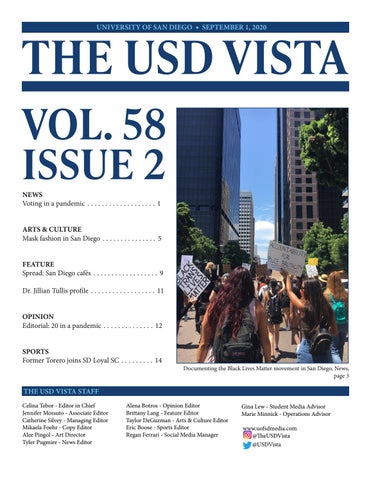
Documenting the Black Lives Matter movement in San Diego, News, page 3
THE USD VISTA STAFF Celina Tebor - Editor in Chief Jennifer Mossuto - Associate Editor Catherine Silvey - Managing Editor Mikaela Foehr - Copy Editor Alee Pingol - Art Director Tyler Pugmire - News Editor
Alena Botros - Opinion Editor Brittany Lang - Feature Editor Taylor DeGuzman - Arts & Culture Editor Eric Boose - Sports Editor Regan Ferrari - Social Media Manager
Gina Lew - Student Media Advisor Marie Minnick - Operations Advisor www.uofsdmedia.com @TheUSDVista @USDVista
The USD Vista
◆
September 1, 2020
2020 Presidential Election: Voting in a global pandemic For many U.S. voters, COVID-19 has left no other option than mail-in voting
EMMA VALDISERRI ASST. NEWS EDITOR
The United States 2020 Presidential election is only a little over two months away. Penciled in for Nov. 3, this election is bound to be different from any other election the nation has ever experienced, as a global pandemic leaves many U.S. citizens to vote by mail. With both the Democratic and Republican National conventions having ended last week, the two selected presidential nominees are Democrat Joe Biden, and Republican Donald Trump. The nation’s current President, Donald Trump, has explicitly shared his concerns for the potential of voter fraud in mail-in voting, despite the fact that the U.S. does not have any widespread, documented, mail in voter fraud cases that have gone unpunished. As a result, he has said to oppose election aid for states and expressed his plans to restrict funding for the U.S. Postal Service.
NEWS
In line with the domino effect, these claims have struck concern in both Republicans and Democrats across the nation, worried their ballots won’t make it in time to count toward the election. To go a step further, the USPS has also expressed its worry about the reception and processing of ballots in time for Election Day. Another concern that arises is the discouragement of voting based on the multi-step process of mail-in voting. Olivia Devia is an undergraduate senior from Reno, Nevada and member of the Changemaker Hub at USD. “I feel like the conservative side is making it seem like mailin voting is hard, they spew out information without fact checking and people are listening to it, but for this election, we’re seeing more mail-in voting than we ever have, so it’s something we need to be cautious of,” Devia said. “I never really thought this
Mail-in voting will be popular for the 2020 presidential election. Photo courtesy of Angie Jane Gray/flickr
is something I would have to worry about during my first election.” Devia is one of many students having returned to San Diego for USD’s online semester who are concerned about mail-in voting. Despite concerns about this approach to voting, corporations like Levi’s and social media
channels like Instagram and Facebook are making efforts in promoting voter registration and participation. Some of these websites even include the links to where their visitors can register, making it quicker and easier for people to register on their devices at the simple touch of their Con’t on Page 2
1
Volume 58 Issue 2
◆
NEWS
◆
The USD Vista
Mikaela Foehr/The USD Vista
From Page 1
fingertips. While voter registration is relatively simple, the process of mailing ballots (depending on the state) may prove to be more complicated. For USD students returning to sunny San Diego for their online semester, there are ways to be proactive in voting for the upcoming presidential election, whether in person or by
NEWS
mail. Registered voters in California will receive vote-by-mail ballots no later than 29 days prior to Election Day and are not required to apply for one. From there, voters may return their filledin ballot (including the authorization section) by mail, in person, or to a drop box. For mailing, the ballot has to be postmarked on or before
Election Day and received by the county elections office no later than 17 days after Election Day. For in-person or dropbox delivery, the ballots must be returned no later than 8 p.m. on Election Day. If people choose to vote in person, they can find their correct polling place address on California’s Secretary of State website. To be safe, they should bring a valid
form of ID to avoid any complications. Students voting in California, but who are originally from out of state, can register using their address from school or their home address. They can also have their ballots sent to their school addresses and then return them, via mail, to their respective home state’s election offices. All registered voters also have the option to vote early. This may be the best option for voters who are concerned about the process and outcome of mail-in voting. In California, the early voting period begins Oct. 5, 2020, and lasts until Nov. 2, 2020. Devia continued, “So much has already happened in 2020, and we haven’t even had the election yet.” The U.S. 2020 Presidential election is on the horizon, and like the rest of 2020, its results, along with the months leading up to it, are unpredictable. For all USD students and U.S. citizens who intend to vote, it’s best to be proactive and make sure their ballots are ready for the polls. For more information on voter registration and participation, students can visit their home state’s Secretary of State website.
2
The USD Vista
◆
September 1, 2020
Documenting the Black Lives Matter movement in San Diego The Say Her Name March goes to show how important protesting is in 2020 TYLER PUGMIRE NEWS EDITOR
When the organizers of the Say Her Name March came together to plan their march for Sunday, Aug. 23, their plan stemmed from Black women ages 15-22. Their main objective was to amplify Black women’s voices to raise awareness for others who have lost their lives to police brutality, raciallybiased health systems, hate crimes, and domestic abuse. What they did not know is that later that night, the story of Jacob Blake would be spread around the country, as another Black man was injured at the hands of police brutality. The Say Her Name March was planned by the creators of the @ dreamhighblackgirls Instagram account, which is based in San Diego and holds virtual meetings to help inform followers about the injustices brought about to Black women in the country. Starting near East Village High School, the march went through downtown
NEWS
San Diego. When the march started at 2:30 p.m., Jacob Blake was still going through his day as if it was just another Sunday in Kenosha. By the end of the night, Blake had been shot seven times by police officers. Gabrielle Grimm, a sophomore at USD, was at the Say Her Name March. “This was a peaceful march, focusing on how Black women are overlooked,” Grimm said. “Whether that be at their own protests, with others starting their own chants, or even in the workforce. The news tries to only show the violence that stems from protesting, but they miss the coverage of the incredible speakers that are doing their best to organize these marches to this day.” Grimm continued on about the importance of protesting. “These protests are really important because they allow a place for marginalized voices to be heard and for all people to come and stand in solidarity and listening,”
Protesters march from East Village High School through downtown San Diego. Photo courtesy of Romona Tellez
Grimm said. “We need to keep showing up because there is power in numbers. Especially with those like Jacob Blake, protests have proven to be effective and I think protests are an important form of advocacy and often for marginalized groups there are no other platforms. When people are dying
without accountability, there is no other choice than to protest.” Grimm, who is from Seattle, has been protesting since the death of George Floyd, and protested at the Capitol Hill Autonomous Zone, a citizen-occupied section of Seattle that did not allow a police Con’t on Page 3
3
Volume 58 Issue 2
◆
NEWS
From Page 3
become larger across the presence. Grimm country. The Get Your said that the picture Knee off our Neck March painted by the news was was held in Washington different from the one she D.C. on Aug. 28, and experienced. saw over 10,000 people After Jacob Blake’s marching for police experience with police accountability.
◆
The USD Vista
each league demanded to not play, in order to seek change from their respective bubbles. Grimm urged USD students to take action to assist the Black Lives Matter movement.
“When people are dying without accountability, there is no other choice than to protest.” - Gabrielle Grimm left him paralyzed in the hospital, his father shared that Blake was then handcuffed to his bed, sparking protests to
Jacob Blake’s story becoming national news also led to a boycott from all major league sports this week, as players from
“The best thing to do right now is to continue to educate yourself and not engage solely in performative activism,”
Grimm said. “Sharing on social media but ask yourself, ‘What am I adding to the conversation? How might my passivity and privilege be harmful in our society?’ Show support to Black women, educate your conservative aunt, challenge what you believe, and don’t let the movement die.” One way that students can find out about protests in San Diego is to follow @ sdprotest on Instagram, which details what protests are going on, and how to come prepared.
Women of all ages, including University of San Diego students, came to the Say Her Name march hosted in San Diego on Sunday, Aug. 23. Photo courtesy of Romona Tellez
NEWS
4
The USD Vista
◆
September 1, 2020
Ethical and sustainable mask fashion in San Diego USD students are finding another way to be creative — fashionable masks TAYLOR DEGUZMAN A&C EDITOR
Face masks have officially taken over the fashion industry. It is now the norm to see people coordinate their masks with their outfits, or to see someone wearing a unique, trendy mask that is different from the rest. In respect of the health and safety of others, wearing masks has become an integral part of our day-to-day lives. Masks are now an essential part of one’s daily routine, and forgetting them has become an everpresent concern. During these times, is it possible to stay fashionable amidst a pandemic? The answer is undoubtedly yes. With global fashion brands starting to sell their own styles of masks, some people are searching under their favorite big name brands for stylish masks. However, there are still many ways individuals can buy or make masks in a sustainable way that helps support small businesses and brands who are not mass producing masks. The recent news that
A&C
USD will be transitioning some courses to an inperson format the week of September 21 means that not only will students have to wear masks on campus, but also in class. Some students will start stocking up on masks in order to keep up with this new decision. With that being said, read on to gain some inspiration on how you can quickly get your hands on your next mask that strays away from bigger businesses. Small business from a USD student Drew Felix, senior, and his younger brother Ryan Felix, first year, started their own business a year ago. Their small business, Bounce SD, sells authentic sneakers, streetwear, clothing, and now masks. Because wearing masks is an integral part of everyday life, Bounce decided to create their own masks to promote the importance of staying safe and healthy during these times. Drew Felix expressed that people should support small businesses, even for masks, now more than ever. He also talked about the efforts that
Bounce has made during this pandemic. “Small businesses are the country’s backbone and they’re run by our local friends trying to make a living,” Felix said. “As a small business, we have donated a portion of our sales to the CDC Foundation, and are making sure all of the deliveries we do are in
a safe, COVID-friendly manner.” The Felixs’ newest drop, in celebration of their one-year anniversary, will put a great emphasis on their roots by promoting diversity and representing the Filipino community. Home“sewn” Kiara Dias, junior, has spent a good amount Con’t on Page 6
Drew Felix, senior, poses in his own business’ (Bounce SD) merch and face mask. Photo courtesy of Drew Felix
5
Volume 58 Issue 2
◆
A&C
◆
The USD Vista
A red Frida Kahlo mask in Old Town at one of the small booths. Brittany Lang/The USD Vista
Kiara Dias, junior, shows off one of her masks.
of quarantine building her mask collection and staying fashionable amidst this pandemic. She explained that a majority of the masks she owns are made and sewn by her mother. “During quarantine my family committed to making a few thousand masks for neighboring hospitals and nursing homes,” Dias said. “My mom ended up making a ton of masks per others’ requests and ones that I specifically wanted as well.” Dias explained that her mom made several masks because of how inexpensive materials such as cloth, filter material,
making and selling masks, one of the small stands at Old Town is selling these embroidered Frida Kahlo masks. The older woman who manages the stand makes all of them herself. This mask alone is sure to catch someone’s eye, as it stands out from colored masks that are without any design. Pair it with a red outfit, or even more neutral colors, and the mask is sure to stand out. Instead of buying a more expensive mask from a well-known brand, one can make a quick trip to Old Town, support a small business, and get their hands on this out of the ordinary mask.
A&C
and elastic are at Joann’s. She encourages others to try making a few masks at home and making the effort to support small local businesses, rather than global fashion brands, to find good, quality masks. “Masks are a necessity with the present pandemic and now more than ever, it’s important to help keep small businesses running in any way possible,” Dias said. “If you get a really unique, trendy mask in the process it’s all the more reason.” Old Town “Frida Kahlo” mask In another effort to support smaller businesses that are
Taylor DeGuzman/The USD Vista
Other handmade masks are sold at these stands in Old Town as well. There are so many other small businesses or small shops in or out of San Diego that one can easily happen upon, and discover unique masks not found anywhere else. Whether it be supporting a small business, especially from students at USD, learning to sew and make a mask at home, or unexpectedly finding masks from smaller businesses and shops, the possibilities of finding masks in ethical, sustainable, and fashionable ways are unlimited.
6
The USD Vista
◆
September 1, 2020
Bringing breath back to Black faculty: Jillian Tullis, P.hD.
Dr. Jillian Tullis discusses her goals for the future, and advice for black allies few weeks, a few of their give up her educational identity as a Black woman. RILEY WEEDEN stories will be shared, goals and worked full- When she interviewed ASST. FEATURE EDITOR starting with the point time while attending a for her current position person for this letter, community college near at USD, Tullis explained With an inbox of about Jillian Tullis, Ph.D. her. During her years spent what she was told by her 4,672 unread emails Tullis, associate at community college, interviewee. and little desire to read professor of she took a very impactful “I would be (one of them during the past few communication studies, public speaking class. the) the first Black women months, there was one teaches introductory and “The professor… to be tenured, at least in email that stood out in theory communication seemed to take an interest the College of Arts and the inbox of some USD courses, and specializes in my success. It was very Sciences, if not the entire students. Twenty-seven in studying end-of- encouraging,” Tullis said. university,” she said. Black faculty members life communication at The support she received Being a minority in shared an eloquent and USD. Tullis was born propelled her to explore academics was not new to thought-provoking letter in Long Beach, grew the field of communication her, as she described the to the university. Sparked up in Sacramento, studies. feeling of “being the only by police brutality and and graduated from This exploration led her one in the room.” blatant acts of anti- the California State to realize, “[She] could see “USD is small, so you Blackness, this letter University Sacramento lots of the things that I was stand out more, right?... could have been an act with her B.A. and M.A. in experiencing… “I would You can count on your of justifiable anger or Communication Studies. take a class… learn about fingers and toes the hostility. Instead, it proved She was the first in her something in the class, number of Black faculty,” to be an act of love for the family to graduate from and then I would see it out Tullis said. school. college. Tullis continued in the “real world,’” Tullis At both USD and In the first paragraph her education at the said.This “real world” was her previous workplace, of the letter, they state University of Southern very closely tied to her Con’t on Page 8 that “the culture of Florida, getting her Ph.D. the university is not in Communication Studies only unpleasant to which subsequently Black faculty, staff, and led her to teach at the students… it often derails University of North our ability to flourish and Carolina at Charlotte breathe freely.” It echoed before relocating to San George Floyd’s last words Diego. Tullis describes before his death, “I can’t her career path as, “...not breathe.” a linear one.” Her goal was In an attempt to to attend the University bring breath to Black of the Pacific to become a faculty members and, physical therapist, but due consequently, Black to financial constraints, students and staff at the she was not able to do so. Jillian Tullis, P.h.D., Associate Professor of Communication Studies. university, over the next However, Tullis did not Photo courtesy of The University of San Diego
FEATURE
7
Volume 58 Issue 2 From Page 7
being a Black faculty member came with a sense of singularity. In her specific classes, Tullis did not describe overt racism but noted the closed perspectives she has faced. In her class on Health Communication, she discusses a lot of socioeconomic class disparity. “What I get from students sometimes are much more subtle (opinions)… they will turn around and say, ‘I don’t understand why these disparities exist in health… I don’t understand why poor people can’t pull themselves up out of poverty, or why they can’t make better choices,” Tullis said. In her experience, students have not recognized the inherent connections between race and class and how asking these types of questions reveal particular preconceived notions and biases. Because of the university’s predominantly wealthy student population, Tullis believes that racism has manifested through classism on the campus. As a leader and facilitator of the writing of the Black faculty letter to the university, she shared why and how this letter came to fruition. Not only was the letter a response
FEATURE
◆
FEATURE
to the current social and political climate, but it also presented an opportunity for the Black faculty at USD to have their true thoughts on the matter be heard. “You have strength in numbers,” Tullis noted. “If you were to talk to faculty who have been here ten, twenty years or more, … they were (most likely) the only one in the department.”Because of the growth of Black faculty, limited as it may be, they were equipped to write this letter at that specific time. The twelvepoint letter described various ways in which the school can and should improve. As to whether any of these points have been addressed, she said, “(We) had lots of structural support. More symbolic than material.” After the letter was sent out, there were multiple letters in support from various departments and groups, but few policy changes have been made thus far. Only a few weeks after the letter was sent out, an Instagram account under the name of “whiteatusd” began posting various racist posts. One of the specific points written in the letter addressed this problem, asking for mediation and regulations on discriminatory social
◆
The USD Vista
media posts. Tullis emphasized the crucial need for these policies. “I would like to see policies in place so that students, faculty, and staff know the consequences of their behavior,” she said. In order to further this point, she compared the policies for cheating. “If you cheat in your class, it describes what can happen,” Tullis said. “What is the response if you say something racist or engage in antiblack rhetoric?”The consequences for academic integrity violations are clearly stated, whereas community standards for social integrity still remains unclear. For students who want to be an ally to the Black community as a whole, and specifically at the university, she shared the three main steps that must be taken. “Call it out, educate yourself, and know that it is an everyday thing,” Tullis said. She emphasized that every day the USD community must put in the effort to change and grow. She advised students to stand up against any act that demonstrated intolerance or prejudice. “There’s too often this sense that when we challenge people who are bigots that we are the ones being rude,” Tullis said. “No, racism is rude.
Bigotry is rude.” As members of the university, she believes each person has the obligation to fulfill our mission statement which is founded on integrity. “When you are educating yourself and you’re prepared to act with integrity, you’re better equipped,” Tullis said. “You’re ready.” Tullis has hope for the future of the university. “USD has been a great place for me to work, but I think it can be better, and I think students would say it could be better,” she said. “We should be working towards that better. Always striving.” In response to the letter, she hopes for action behind the many words of support. Dr. Tullis has co-organized the Black Lives Matter course with her colleague Dr. May Fu, P.h.D, Chair and Associate Professor of Ethnic Studies. New classes, social support, and interviews like this are helpful, but she emphasizes the fact that “there is more to be done.” The Black Student Union at USD sent its own letter to the university. With the support of faculty, staff, and alumni, it echoed similar policy changes and action plans that the faculty letter included along with more studentcentered demands.
8
Volume 58 Issue 2
◆
FEATURE
◆
The USD Vista
A GUIDE TO COVID-19 CAFÉ SOCIETY: Students are already in their third week of the fall semester, yet everyone is still learning to adjust to their new virtual learning environment. With the many unprecedented changes this year has brought, one of the most challenging for students has been staying motivated and inspired while working from within the confines of their home, wherever that may be in the world.
Some students were not able to receive housing for the semester, or chose to remain in their home city or country for the fall. However, the many students who are currently located in San Diego are lucky enough to be able to live in a city that still has a myriad of places open that they can escape to, in order to give themselves a change of scenery and be in a more stimulating environment for studying. Notorious for its chic and tasty coffee shops, San Diego has many establishments that have reopened in the past couple of months to provide residents with places to get their work done or seek solace in, all the while enjoying delicious beverages and food. These cafes and coffee shops have made a conscious and planned attempt to follow all of the COVID-19 heath guidelines, so as to not put any of their customers at risk.
Lo Up to ha Pr Pa St Fo are ha glo Ou W M wh M Ja
BIRD ROCK COFFEE ROASTERS
Location: Torrey Pines location Updated hours of service: 7 a.m. - 2 p.m. Monday to Thursday; 7 a.m. - 4 p.m. Friday to Sunday Price range: beverages range from $3.35 - $6.60 Parking: parking is more limited; usually have to park on the streets adjacent Follow the COVID-19 health code: yes; masks are always worn while ordering at the counter, hand sanitizer is readily available, employees wear gloves, and social distancing is enforced Outdoor seating: yes but it is more limited; pick-up offered Wifi: yes Most popular drinks: the Sandpiper (latte with housemade hazelnut syrup), the Honey B (honey latte), iced dirty chai, and the iced spice mocha Most popular food items: there is a small selection of different pastries each day Photo courtesy of Olivia Hunt
FEATURE
9
The USD Vista
◆
September 1, 2020
MONIKER GENERAL
ocation: Liberty Station, Point Loma pdated hours of service: 10 a.m.- 6 p.m. Sunday Thursday; 10 a.m. - 7 p.m. Friday and Saturday; appy hour 3 p.m.- 6 p.m. Monday to Thursday rice range: beverages range from $3.00 - $5.75 arking: lots of available parking spaces in Liberty tation ollow the COVID-19 health code: yes; masks e always worn while ordering at the counter, and sanitizer is readily available, employees wear oves, and social distancing is enforced utdoor seating: yes; multiple benches outside Wifi: yes Most popular drinks: salted caramel latte, flat hite, cortado, and their cocktails/mocktails Most popular food items: the Hunky Dory and ack of all Trades toasts Photo courtesy of Moniker General
PANNIKIN COFFEE & TEA
Location: Encinitas and La Jolla Updated hours of service: 6:30 a.m.- 5 p.m. daily Price range: beverages range from $2.50 - $7.75 Parking: almost always spots in their parking lot and on the surrounding streets Follow the COVID-19 health code: yes; masks are always worn while ordering at the counter, hand sanitizer is readily available, employees wear gloves, and social distancing is enforced Outdoor seating: yes; lots of tables and seats outside so highly unlikely that there will be a wait; pick-up offered Wifi: No; best to go here if you have reading or written work to do; laptops and electronic still allowed Most popular drinks: oat milk iced vanilla latte, chai tea, vietnamese coffee, and the Jimi Hendrix (four shots of espresso, steamed Mexican chocolate milk, and hazelnut syrup) Most popular food items: cinnamon roll, rhubarb pie, cookie dough coffee cake, and “super steamer” eggs
Photo courtesy of Mikaela Foehr
FEATURE
Spread by Alee Pingol/ The USD Vista; Content by Brittany Lang/ The USD Vista
10
The USD Vista
◆
September 1, 2020
New club spotlight: GESP USD Senior Lexie Rollings founded a new club: Gender equality and sex positivity OLIVIA HUNT ASST. A&C EDITOR
How does a social justice club transition from raising awareness to achieving tangible change on campus? There’s no one-size-fits-all approach, but the University of San Diego’s new Gender Equality and Sex Positivity club (GESP) seems to have a solid strategy — not registering as an official club on campus. The idea came from Lexie Rollings, a senior at USD who chaired the school’s 2019 Sexual Assault Awareness Month committee. Though she considers its execution a success, Rollings felt limited by the university staff ’s content restrictions. She believed the range of education and engagement materials that she wanted to produce was far greater than what the school would allow. Fast forward to Spring 2020, after USD transitioned to online learning. In the beginning of April — the national month for Sexual Assault Awareness — Rollings grew disheartened by what she felt were insufficient content and resources from the university
FEATURE
centers, specifically the Women’s Commons and CARE (Campus Assault Resource and Education). Channeling her disappointment into productive action, Rollings founded GESP as a way for students to lead the conversation. Her motivation behind creating GESP was to “[solidify] a safe and radical space for USD students to engage in conversation, education, and informed activism related, but not limited to, gender equality and sex-positivity.” GESP’s unofficial status also ensures that its content cannot be censored by faculty members or the USD administration. Its executive board is composed of five passionate womxn, who hope for USD to become a more inclusive and educated space. The four seniors on GESP exec have all been employed by the university at some point in their academic careers, and each leader brings her own expertise and experience to the club. Ashley Raines, GESP’s Outreach and Leadership advocate, explained Rollings’ approach to organizing the club. “Every member is well connected
on campus, and all of us have experience in social justice work or on-campus activism,” Raines said. Founder Lexie Rollings serves as the club’s Healthy Relationships Advocate, and other positions include Delaney Tax as the Radical Pleasure Advocate, MaryCatherine Smith as the Self-Love and Gender Equality Advocate, and Brooke Powell as the Admin Coordinator. GESP’s members began their outreach by providing easily-shareable resources on body image, ecofeminism, and sexual pleasure (to name a few) through the club’s Instagram account. Since, they’ve made efforts to demystify USD’s Title IX changes, and worked to normalize pronoun sharing by students and faculty.The group’s social media activism, partnered with student leadership, was quickly recognized by the Associated Student Government (ASG). “ASG wanted to partner with us, and many of our goals align,” Raines said. “Now they’re backing our idea to create a more inclusive, mandatory sex-ed curriculum on campus.” With the help of ASG,
GESP is spearheading major policy changes at USD. They’re currently working with the USD administration in getting free STI prevention materials on campus, and pushing for a comprehensive student sexual education that’s LGBTQ+ inclusive. This course of action, if finalized, would be no small feat at a Catholic university, which does not currently offer treatment such as birth control through its student health center. For student leaders, USD currently provides mandatory diversity training, social distancing training, and sexual assault prevention training. GESP wants sexual education training to be just as accessible for students as well as student leaders. “ASG [wants] to make the school more in touch with their students and their students’ needs,” Raines said. “The reality is that comprehensive sex education is vital to students’ experience on campus.” “Abstinence is also a part of comprehensive sexed,” Raines clarified. “If students choose that route, they have a right to learn more about it, too.”
11
Volume 58 Issue 2
◆
OPINION
◆
The USD Vista
An unconventional cheers to our 20s
As stay-at-home orders keep extending, an entire generation can’t help but think that their youth is slowly slipping away ALENA BOTROS OPINION EDITOR
On March 19, Gavin Newsom, governor of California, announced that all California residents were to shelter in place; a mandatory stay-at-home order was issued. It was then that our schools were closed, we moved to remote learning, and “Zoom University” was born. In March, there was a divide amongst us. Some struggled to cope with the stay-at-home order, and some followed it religiously. When you’re 20, the last thing you want to hear is that your social life will now be canceled until further notice. But we made it through. We finished classes, as hard as it was, and we pushed through to our summer; only summer was not much different. Beaches were closed, and although they began to open, the risks did not decrease. Bars were closed, and there is no possible reason to justify going to any bar that chose to go against the shut down. Yet, we did it anyway because we’re in our 20s. There’s this
OPINION
intense fear of not living your life to the fullest — a fear, I would argue, that is greater than the possibility of exposure to COVID-19 in our minds. Is this a plausible excuse? Not at all. I know that we all want things to go back to normal, but despite the loss we have faced we can’t continue to be irresponsible in this pandemic; we will just miss out on more. Many of us can agree that we have not taken all possible precautions in this fight to slow the spread. I choose which rules I want to follow. I choose whether the risk of exposure outweighs the risk of missing out. And, as the pandemic moved into summer, our fear of exposure, our caution, slowly dwindled away. I stopped worrying. I knew it was wrong, but I wanted my life to go back to normal. Some of us had already missed out on so much. Seniors lost their final moments on campuses they’d come to know as home. They lost their graduations, a culmination of four years of complete and utter dedication. And
now those same seniors have been left to fend for themselves in a world where the job market is hardly welcoming, a world where the unemployment rate screams tragedy. I was a second semester junior when classes moved online, and I was sure we would be back to campus in no time. As days turned into weeks and weeks turned into months I began to miss the little things I have come to love on our campus. I missed walking by the Immaculata on my way to Camino. I missed stopping at Aromas for my morning coffee, and I missed the days where my pit stop at Aromas led to conversations with old friends. I missed my professors who have become like family. San Diego County has officially been removed from the state’s COVID-19 watchlist. I want to believe that we will return to our beloved campus in the spring. But we all know better. After constantly hearing the world around us describe the times as uncertain or unprecedented, it is time for us to realize the reality
in those words. We have no idea what can happen between now and spring. But we can still hold on to hope. I know that there’s nothing more that I want than to spend my last semester on campus again. However, I want our experience to mimic the experience we’ve all shared in the past. There’s a greater fear that has begun to overwhelm me as we move farther and farther from normalcy, this fear of the future after college. Graduation ceremony or not, we still have to move forward. For some it means graduate school, and for others it means starting a career. How are we supposed to do that in the midst of a pandemic? What is going to be different, and what is going to remain constant? For now, we can cheers to being in our 20s in the middle of a global pandemic, laugh about turning 21 during quarantine and laugh about all the dysfunctions of Zoom. But more importantly, we can get through this together as long as we stay connected.
12
The USD Vista
◆
September 1, 2020
Quarantine got you down? Find a new hobby Not only are hobbies fun, but they benefit your mental health too. Read to learn more about the psychological and social benefits of hobbies. HALLIE WILTSHIRE ASST. OPINION EDITOR
There is no denying that the COVID-19 pandemic has brought momentous changes to our society. While people have been stuck quarantining at home, they’ve been able to pick up activities that they never had time for in the past. The pandemic has forced our workaholic culture to slow down, leading to the resurgence of hobbies. There are a plethora of benefits of having a hobby. I have a few hobbies that I’ve done all of my life, but my favorite by far is embroidery. My grandma taught me how as a kid and I’ve never put a needle down since then. It is an activity that I genuinely look forward to doing at the end of the day. I can unwind and reflect on the day rather than just passively watch Netflix, keeping me busy on even the most boring of days. Having a hobby benefits my mental health, and I’m not the only one who thinks so — many psychologists agree. In an article for Psychology Today, Jaime L. Kurtz Ph.D. discusses how the concept of hobbies has fallen by the wayside in
OPINION
the past few generations of Americans. We all hold this belief that we are simply too busy for hobbies, and that there just isn’t enough time in the day for something that is done simply for the sake of fun. It turns out that we aren’t any busier than we were decades ago — we simply waste more of our time, creating the illusion of being busy. This is largely thanks to the rise of social media and video streaming apps, all of which steal our time away without us even noticing. I know that I’m guilty of this. I’ll watch one video on YouTube and suddenly three hours have gone by. Hobbies give us the ability to be active rather than passive. Being active, either physically or mentally, energizes us. If you’re lost in a project or activity that excites you, the time flies. And you’re more satisfied afterwards, having completed something meaningful instead of rewatching The Office for the tenth time. Having a hobby can also help you better structure your time. As I mentioned before, I structure my day around having downtime to embroider in the evenings. Having this “treat” at the
end of the day forces me to be more efficient with my time, and I’ll get my homework done more quickly. Now this isn’t to say that you should rush your work, but instead focus more intently on it rather than being distracted by your phone (I know, I do it too). Hobbies also make you more interesting. I know that I love hearing about people’s random hobbies, and I’m sure other people feel the same way. Whenever I tell people about my hobbies, they always get excited and ask questions. It sparks conversation and fosters social connections with others. Of course, not everyone genuinely has the time for a hobby. Some people work multiple jobs in order to support themselves and/ or their families, and what free time they do have, they want to spend with said family. There is privilege in being able to have a hobby, in having enough free time and extra cash to pick up an activity just for fun. Part of the beauty of a hobby is that you do it simply because you like it. But once again, the American capitalist mindset strikes — what if
we could turn our hobbies into money-making opportunities? It’s from this mentality that side hustles are born. We cannot simply enjoy something for the sake of enjoying it. Instead, we have to turn it into something profitable, a small business that will eventually suck out everything you once loved about your hobby. This push toward side hustles combined with a society so interconnected by the Internet, makes the mentality that we should always be working and finding new ways to make money ubiquitous. Since side work can be done anywhere at any time, we start to believe that side work should be done at all times. This can lead to burnout, since people are unable to take a break from working once “work” has infiltrated every facet of their lives. While it’s true that you should do what you love and love what you do, you should also shield certain parts of your life from economic exploitation. There are a million and one possibilities if you give yourself the chance to try. Find a hobby, and for once, just have fun.
13
Volume 58 Issue 2
◆
SPORTS
◆
The USD Vista
Former Torero Miguel Berry joins San Diego Loyal SC The Poway native returns to San Diego for the remainder of the 2020 season, on loan from Major League Soccer’s Columbus Crew ERIC BOOSE SPORTS EDITOR
Former University of San Diego soccer star Miguel Berry made his professional soccer debut for San Diego Loyal SC in their 0-0 draw against Orange County SC on Saturday. Berry signed for San Diego earlier last week, on loan from Major League Soccer side Columbus Crew. The loan deal means Berry will play for Loyal SC for the remainder of the 2020 season, as well as the playoffs, if San Diego qualifies. Berry was drafted seventh overall in the 2020 MLS draft in January, but did not appear in any of Columbus’ eight competitive matches this COVID-interrupted season. Berry was named the starting center forward and played 70 minutes for San Diego Loyal on Saturday. In a game with few clear-cut scoring chances, Berry had one of the best, finding himself one-on-one against the Orange County goalkeeper midway through the second half.
SPORTS
After scoring 38 goals in 72 games for the Toreros, Miguel Berry (9) will return to Torero Stadium as a professional, joining San Diego Loyal SC. Thomas Christensen/The USD Vista
Unfortunately, the former USD striker took a heavy touch, allowing OCSC’s keeper to grab the ball. It was a situation Berry has been in before. In four years at USD, he tallied 38 goals and 16 assists in 72 games. Seventeen of those goals (and eight assists) came in 2019, Berry’s senior season, when he was named West Coast Conference co-player of the year. Berry’s performance as a Torero earned him high praise from San Diego Loyal head coach and U.S. Soccer legend Landon Donovan. “I had the opportunity to watch Miguel play in
person last year at USD and it was evident that he was ready to play at the next level,” Donovan said in the announcement of Berry’s signing. “He has all the tools to be a top-level striker in this country and we are fortunate to have another San Diegan join us as we push towards the playoffs.” Berry, born in Barcelona, Spain, but raised in Poway, Calif., expressed his excitement to return to the city he calls home. “To play at Torero Stadium, my home for 4 years, again is a dream come true,” Berry said. “I’m extremely excited to
be able to contribute to what the organization is building here in San Diego and I’m looking forward to being able to give back to this great city.” Berry joins a San Diego team with only one goal in their last five games, a pair of draws and three defeats. Loyal SC, which began life as a professional team this year, is currently fourth place in Group B in the USL Championship, the second tier of American professional soccer, below MLS. The team has six games remaining in its season, and must finish as one of the top two teams in its group to qualify for the playoffs.
14
The USD Vista
◆
September 1, 2020
MJ Knighten named USD Softball head coach Knighten, an assistant coach last season, becomes the youngest active Division I softball coach ERIC BOOSE SPORTS EDITOR
MJ Knighten will become the University of San Diego’s next head softball coach, Associate Vice President and Executive Director of Athletics Bill McGillis announced on Friday. Knighten, who served as the Toreros’ hitting coach during the 2019-2020 season, will be the sixth head coach in program history, and the first Black woman to serve as head coach for any USD athletic program. This, Knighten’s first head coaching job, will take place during only her fourth year of coaching. McGillis still expressed confidence in her, despite her relative inexperience. Knighten’s predecessor, Jessica Pistole, had been a head coach for five years before taking over the Toreros. “I am so excited for the young women in our softball program,” McGillis said in announcing Knighten’s hiring. “MJ Knighten is a special person and talent with rare leadership qualities
SPORTS
for a young coach. We’ve watched her grow over the last year as a member of our coaching staff, and I am very confident she is the right head coach to build a championship softball program at USD. MJ played a key role in resetting a new foundation for USD softball last year, and I want to remain on that trajectory.” Knighten served as an assistant coach at her alma mater, the University of Nebraska, in 2017-2018. She then joined Wichita State University’s coaching staff for the 2018-2019 season before taking the job as the Toreros’ hitting coach under head coach Jessica Pistole last season. As Pistole’s hitting coach, Knighten helped San Diego to their best start to a season since 2013, with USD hitters knocking 43 doubles, good for 21st in the nation. Now at the helm herself, Knighten expressed her hopes to keep last season’s momentum rolling. “I would like to thank the University of San Diego and Bill McGillis for the amazing opportunity to lead this on-the-rise
program,” Knighten said. “Jessica Pistole gave us an incredible foundation to build on, and I am excited to continue to grow and shape San Diego softball. Our goal is to become a force on the West Coast, while at the same time empowering strong, beautiful women so that they can succeed after graduation. I cannot wait to get started.” Despite her recent start in coaching, Knighten has a wealth of experience with the game. As a player, Knighten helped the University of Nebraska to a Big Ten Conference championship in 2014 and was named to the AllBig Ten team four times. Knighten also played professionally for two years in the National Pro Fastpitch league. Knighten’s former coaches and colleagues had nothing but praise for the Toreros’ new head coach. “I could not be more thrilled about the direction that USD Softball is headed under Coach Knighten’s leadership,” Pistole, now the head coach at the University of Southern
Oregon, said. “She is a fierce competitor who has a deep trust in the daily process of what it takes to become a champion. Most notable though, she is a bright light who speaks the truth and possesses the superpower of connecting with and bringing out the best in each of her players and coaches. Exciting days are ahead for USD Softball.” Rhonda Revelle, head coach at the University of Nebraska, spent four years as Knighten’s coach, and then served as Knighten’s boss when the former Husker rejoined the team as an assistant coach. The veteran head coach had high praise for the Toreros’ first-time skipper. “MJ has an incredible softball IQ, that along with her passion and love for the game, will be motivating and inspiring for her players,” Revelle said. “With MJ at the helm, she will build a great team and culture, and the program will be highly competitive and accomplished on the field, in the classroom and also in the community. This is a great day to be a Torero.”
15