On newstands weekly
Volume 59 Issue 17
Thursday, March 31, 2022
THE USD VISTA
The Official Student Newspaper of the University of San Diego since 1968
Faith and inclusivity on campus
How USD faith-based organizations and departments promote unity HALEY JACOB FEATURE EDITOR The University of San Diego attracts students from all faith backgrounds, including practicing and non-practicing individuals. According to the most recent Undergraduate Student Body Profile, only 45% of the undergraduate student population lists Catholicism as their religious preference, despite the university’s Roman Catholic identity. USD’s mission values developing students holistically, involving their intellectual, social, and spiritual growth. Regardless of one’s religious identity, the university aims to help every student experience growth in all aspects during their time of attendance, ranging from those who identify as Catholic or Christian to those identifying as Jewish or Muslim, and so on. The university also makes space for those non-practicing, leaving individuals with the power to decide their relationship with spirituality.
One USD tradition that captures its mission of faith inclusivity and acceptance is the long-standing tradition of the “All Faith Service.” At the beginning of every spring semester, the university hosts an event to celebrate the diverse array of faiths and beliefs on campus. Students, staff, faculty, and community members come together in prayer to recognize and commemorate the power and enrichment of faith diversity. Next spring semester, the university will celebrate its 30th year of the tradition. The University Ministry is a department on campus that provides students with programs, events, counseling, and other services to help guide individuals throughout their spiritual journeys. While the department focuses on applying the principles of Catholic social teachings, students of all religious traditions are invited to attend, explore, and enrich themselves in the services. Vice President of Mission Integration Michael LovetteColyer explained the goal of
See Faith, Page 8
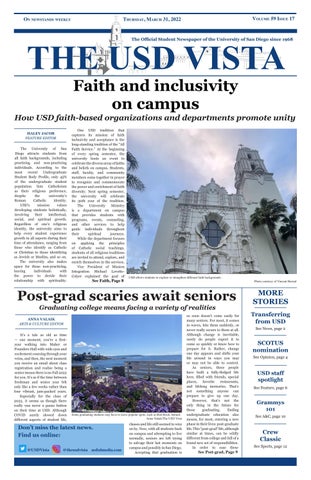
USD allows students to explore or strengthen different faith backgrounds.
Post-grad scaries await seniors Graduating college means facing a variety of realities
ANNA VALAIK ARTS & CULTURE EDITOR It’s a tale as old as time — one moment, you’re a firstyear walking into Maher or Founders Hall with wide eyes and excitement coursing through your veins, and then, the next moment you receive an email about class registration and realize being a senior means there is no Fall 2022 for you. It’s as if the time between freshman and senior year felt only like a few weeks rather than four vibrant, jam-packed years. Especially for the class of 2022, it seems as though there really was never a pause button on their time at USD. Although COVID surely slowed down different aspects of student life,
Some graduating students may have to leave popular spots, such as Bird Rock, behind. Anna Valaik/The USD Vista
Don’t miss the latest news. Find us online: @USDVista
@theusdvista uofsdmedia.com
classes and life still seemed to wizz on by. Now, with all students back on campus and attempting to live normally, seniors are left trying to salvage their last moments on campus and possibly in San Diego. Accepting that graduation is
so soon doesn’t come easily for many seniors. For most, it comes in waves, hits them suddenly, or never really occurs to them at all. Although change is inevitable, rarely do people expect it to come so quickly or know how to prepare for it. Rather, change one day appears and shifts your life around in ways you may or may not be able to control. As seniors, these people have built a fully-fledged life here, filled with friends, special places, favorite restaurants, and lifelong memories. That’s not something anyone can prepare to give up one day. However, that’s not the only thing in the future for those graduating. Ending undergraduate education also means, for most, entering a new phase in their lives: post-graduate life. This “post-grad” life, although similar at times, can be wildly different from college and full of a brand new set of responsibilities. In order to ease these
See Post-grad, Page 9
Photo courtesy of Vincent Hestad
MORE STORIES Transferring from USD See News, page 2
SCOTUS nomination See Opinion, page 4
USD staff spotlight See Feature, page 6
Grammys 101 See A&C, page 10
Crew Classic See Sports, page 12
2
The USD Vista
◆
March 31, 2022
NEWS
Why some students leave USD Reasons students transfer and how the university responds KARISA KAMPBELL NEWS EDITOR As the novelty and excitement of going away for college wears off and reality sets in, many begin to wonder if the university they chose is actually right for them. From not enjoying the culture of the school, to unforeseen financial circumstances, there are many reasons why a student may choose to transfer from USD to a different university. However, a general consensus from the student body is that there appears to be an alarming amount of students transferring out of USD. Sophomore Blake Burke shared his experience with friends and acquaintances transferring away from USD since his first-year. “A huge portion of the people I regularly hung out with during my first year here left,” Burke shared. “Talking with my friends who go to other universities, it seems that they didn’t experience the same thing. I don’t know, it’s just weird to me.” While Burke’s account could be specific to his own first-year experience, it could also be specific to going to a smaller school, and knowing a large percentage of one’s class. USD, however, is boastful about having a high first to second year retention rate. From the most recent data available on USD’s website, the cohort of 2020 first-years had a 92% retention rate. This is a significant boost
from the nationwide average retention rate of 78%, according to collegetransitions.com. While USD is transparent about this number, certain data regarding the number of students transferring from USD after their first year of college is missing. According to a 2015 report by the National Student Clearinghouse Report, 36.6% of students transfer for the first time from a university after their second year of college, as opposed to 14.1% of first-year students. This suggests that the reason students, like Burke, feel as though an abnormally large number of students are transferring is because they are; however, they are just not included in the firstyear retention rate data because they do not fit that demographic. Regardless of when students transfer, there are a variety of reasons that a student may decide that transferring is their best option. Assistant Vice President for enrollment Stephen Pultz spoke on what some of the reasons may be. “I think that the reasons students leave USD… historically are around a couple of things. One is changing circumstances. Students thought they might want to come to a place like USD when they just didn’t. The culture wasn’t a right fit, those kinds of things,” Pultz shared. “I think we also find financial is a big cause as well. The family’s financial situation changed, or you know, they thought they could make
this work. A lot of students leave to pursue a different major. They want to pursue something that maybe we don’t offer.” A student’s decision to transfer from a university is a large decision that one may make for a variety of reasons. Sophomore Bella Syslo shared the reasons why she transferred to University of Nebraska - Lincoln, after her third semester at USD. “My transfer experience was really personal and relied a lot on being closer to my family and support system,” Syslo said. “The academic side of USD was really awesome but I think a lot of my reasons were personal and individual to me and transferring closer to home.” While Syslo’s experience in transferring may have been mostly personal, others view students transferring out of USD as a result specifically of the culture at the university. First-year student Jake Luko shared his frustrations with USD and why he has thought about transferring from USD. “USD is a great place if you you are a straight white cis male or female. As a gay guy, I found it incredibly hard finding a community, and lucky I found two gay best friends or else I would have transferred,” Luko said. “It’s not very welcoming if you do not not fit the mold of what most people are at this school.” Luko continued by stating how it feels impossible to make new friends at USD sometimes due to
its culture, and how Greek Life almost feels like a requirement if one wishes to have a social life. “It’s very cliquey which makes it really hard to find new friends because it feels like everyone is settled into their groups already,” Luko said. “USD claims their school is not a Greek (Life) school because there is technically no frat or sorority housing, but in reality, Greek Life is extremely large and they run most outside school events. It’s hard to socialize on the weekend if you are not interested in joining Greek Life.” Students who decide to withdraw from the university are required to take a withdrawing student survey. This survey gives USD context and information about reasons why students choose to leave. Vice President of Student Affairs Sabrina Nelson discussed the withdrawing student survey and the implications that it has on the university. “My understanding is that it helps inform the types of programs and events that we have, types of mentorship opportunities that we provide at the institution,” Nelson said. “It really informs the different types of programs, initiatives, and events, and such that we’re hosting at the institution.” Some programs that were created as a result of the feedback given to the university through the withdrawing student survey include the Out of State Student Initiatives and the
Commuter Commons. Both of these programs were created to help connect students to other students with similarities, such as being from the same state, or being commuter students, and help build a sense of community among these populations. While the university is listening to the needs of students who are leaving, taking initiatives to encourage students to stay, and helping promote community, some students, like Luko, argue that the university isn’t doing enough to keep students at USD. “I don’t know what the school could do to fix it (the culture of USD), because the school just attracts that demographic,” Luko said. “They could broaden who they let in and pay more attention to demographics during the admissions process, and maybe that would help change the culture.” The idea of transferring may seem foreign and complicated to some students, however, Nelson emphasized that choosing to transfer to a different institution is normal. “I think that it (transferring) is really normal,” Nelson said. “It’s not something that is unique to the University of San Diego. Students’ plans change. It’s a very normal part of the college experience.” Transferring is not a unique experience to the University of San Diego but it is a complicated decision for a student to make. Always talk to an academic advisor before deciding to transfer schools.
New Farmer’s Fridge food option USD’s newest vending machine is an experiment in healthy eating SPENCER BISPHAM ASST. NEWS EDITOR Toreros now have access to an entirely new dining option on campus: Farmer’s Fridge. Located in Bosley Cafe, this machine is responsible for vending fresh ready-to-eat, meals to students who are willing to pay the price. The meals inside include prepackaged salads, yogurt bowls, sandwiches, cold cuts, and more. On the company’s website, details about how their meals are packaged/prepared is displayed under the FAQs page. “All of our items are made fresh by hand in our Chicago kitchen,” it reads. “We use local and organic ingredients whenever possible, but our focus during sourcing is to find the best quality products available from partners we know and trust.” Another important point is the shelf life of the items inside the machine. “On average, items last four to
five days in the fridge,” the FAQs page reads. “Keep in mind that we don’t use preservatives on our items, so you can expect them to last about as long as regular produce does. Items with cooked veggies (like many of our bowls) can stay fresh for five days or more.” The company also claims it does its best to be sustainable. “We strive to work with partners who share our commitment to the best taste possible and who believe in treating their employees and the environment as ethically as possible,” the page reads. “Of course, impeccable food safety standards are a must, as well as the capability to meet our demand for volume.” According to USD Dining Services Director, Charles Ramos the decision to incorporate the machine was a two-way street. “This is a pilot program with the company,” Ramos said. “They came to us a few weeks ago and we thought it would be a good fit so we brought it in for
the remainder of this semester to provide students with a 24/7 healthy food option on campus.” In an email, Ramos went on to outline the specifics of the machine in Bosley. “This is our pilot location since so many students live in the Valley and it’s at the bottom of the fitness center,” Ramos said. “If you’re purchasing at the Farmer’s Fridge, a debit/credit card is required. If you’re purchasing via the Farmer’s Fridge app, Apple Pay or Google Pay is required. Farmer’s Fridge is currently working on USD Campus Card integration; more updates to come in the upcoming weeks.” USD first-year and Bosley Cafe employee Tatiana Glisovich explained how the employees of Bosley Cafe were alerted about the addition of the new vending machine. “It’s a funny story actually, we all just saw this machine inside one day and we asked our manager, Luis, ‘What is that?’ and he said, ‘It’s a salad robot,’”
Glisovich said. “It got all of us thinking it was gonna be one of those make-your-own-salad type of things, but instead it’s an effort to get students to eat healthier since Bosley does pretty much only sell fried food. This is just to offer more healthy options, more vegan options for those who fit that category.” Glisovich also expressed that the benefits of Farmer’s Fridge could help revitalize the attitude toward food at USD. “In recent times, we’re getting less and less fried food orders and more smoothies, salads, acai bowls- we ran out of acai bowls a few times,” Glisovich said. “I feel like it will be successful just because I think everybody’s so tired of eating the same things every day. I feel like there’s not really much change that happens food-wise on campus so getting something new like this is really exciting for students.” Some Toreros, however, are not as hopeful about the impacts of Farmer’s Fridge.
Alex Gonzalez, a junior USD transfer student, is skeptical of the benefits of the new machine. “I don’t even trust it now; it’s too scary,” Gonzalez said. “I think first we have to see how well it’s maintained. So I feel like down the line probably in a year or so, seeing how it’s held up, we’ll see if it provides a healthy option. Because if we find out that it’s not regularly maintenanced, then obviously it’s not going to provide a healthy option with old, past [expired] food.” As of now, the machine in the Valley is the only one on campus. Bosley Cafe currently offers a range of fried foods in addition to smoothies, acai bowls, salads, and sides. It is unclear if the availability of these items will be affected by Farmer’s Fridge. Dining Services shared that there will be updates on the new Farmer’s Fridge machine in the coming weeks. In the meantime, the experimental machine is available for healthy eating options on campus.
Volume 59 Issue 17 ◆
NEWS
3
The USD Vista
◆
Ketanji Brown Jackson
Her historic appointment and confirmation hearings COLIN MULLANEY ASST. NEWS EDITOR When the White House announced in February that Justice Stephen Breyer would retire from the Supreme Court, the focus soon became who President Joe Biden would nominate to replace him. On the campaign trail, President Biden promised to take advantage of any Supreme Court nominations to appoint an African American woman to serve as the first Black, female Justice on the Supreme Court. On Feb. 25, President Biden made good on his promise with the appointment of Judge Ketanji Brown Jackson from the U.S. Court of Appeals for the D.C. Circuit, to the Supreme Court of the United States. Dr. Channon Miller, professor of history at USD, spoke to the historic nature of Judge Jackson’s nomination. “It marks a groundbreaking event for multiple reasons…To have this moment, where we have a Black woman not slipping through the cracks but being recognized by the court of law, by our government and by our judicial system, is really powerful symbolically,” Miller stated. Although both Black men and white women have been elevated
to the position previously, Dr. Miller noted that both conversations around race and gender often neglect the specific intersection of the two identities in African American women. “We have seen two Black men elected to the Supreme Court, which tells us that when it comes to issues of trying to promote Black representation, it’s occurred. But again: occurred through a lens that hasn’t engaged or involved Black women,” Miller said. “On the other side, yes, we’ve seen women represented, but Black women erased from that account too…There’s something powerful about seeing the largely erased brought to the forefront.” Jackson’s nomination reflects all that the Black community and Black women in particular have achieved since the fight first began to end and overcome slavery and then Jim Crow laws in the U.S. “She’s a child of parents who were reared in the midst of Jim Crow, in the midst of Jane Crow, who had to grapple with the social, political, and economic exclusion of Black people from or within the U.S., and to see her as a culmination, in a sense, of many of their sacrifices is quite powerful,” Miller stated. Judge Jackson graduated with distinction from Harvard Law
School and began her legal career as a clerk for Justice Breyer, as well as a public defender for those who have no means to pay for an attorney. According to the White House, Jackson would be the first Justice with this career experience, which will give her valuable perspective in her legal decisions, given the emphasis this role places on human and civil rights. Jackson’s origins in the public school system further distinguish her from prior Supreme Court nominees and open the doors for others to enter, according to Dr. Miller. “For so long, the space [of the Supreme Court] has been exclusive in so many ways. And even to have gone to a public high school…we haven’t seen that before. People educated in our American school systems, our public school systems, can hopefully see more access after events like this.” Miller noted. Judge Jackson’s confirmation hearings before the Senate, which lasted four days, began with her opening statement and affirmation to uphold the constitution. She acknowledged the objective, neutral stance required of Justices, and credited the African American women who paved the way for her nomination. “I stand on the shoulders of
so many who came before me, including Judge Constance Baker Motley, who was the first African American woman appointed to the federal bench,” Jackson said. However, the hearings were not without moments of contention. Among other lines of questioning by Republicans, Texas Senator Ted Cruz presented images from the children’s book, “Antiracist Baby” and other material that he attributes to “critical race theory” and he alleges are taught at Georgetown Day School, where Jackson serves on the board. Jackson responded to Cruz’s questioning. “I do not believe that any child should be made to feel as though they are racist or though they are not valued, or though they are less then…when you asked me whether or not this is taught in schools, ‘critical race theory,’ my understanding is that critical race theory as an academic theory is taught in law schools,” Jackson said. At one point, Senator Marsha Blackburn asked Judge Jackson to define what a woman is, to which Jackson responded, “I’m not a biologist…if there’s a dispute about definitions, people make arguments, I look at the law, and I decide.” Representative Joyce Beatty,
Chairwoman of the Congressional Black Caucus, expressed her displeasure with Cruz and Blackburn’s tactics, stating to NPR, “These bad faith efforts exist despite a résumé that arguably surpasses those of previous nominees… Just last year, Judge Jackson was confirmed by this body on a bipartisan vote to serve on the D.C. Circuit Court.” Beatty’s sentiments about Senators’ targeted questions were shared by Dr. Miller. “[Jackson’s] decision making has been challenged in really unique ways,” Miller said. “Even her desire or perhaps interest in issues specific to race or gender are being questioned…there’s this assertion that she shouldn’t care about these particular issues, that she shouldn’t have a particular connection to these issues, even though she does embody a marginal position in society…I’d be interested to see how these types of racial and gender ideologies about Black women are going to unfold, even more so than they already have.” Judge Jackson is expected to secure the Senate votes necessary to confirm her nomination before the Senate’s Easter recess in April, according to CNN, where she would become a Justice of the Supreme Court.
CALL ING ALL UNDERGRADUATES
President for a day TRADE PL ACES WITH DR. HARRIS FOR A DAY!
On May 10, see what it’s like to run the university, while Dr. Harris stands in your shoes!
Apply onli ne at sandiego .edu/ Pres4aDa y by April 8 !
The USD Vista Taylor DeGuzman - Editor in Chief Maria Watters - Associate Editor Samantha Anaciano - Managing Editor Yana Kouretas - Copy Editor Marissa Esteban - Art Director Karisa Kampbell - News Editor Maria Simpson - Opinion Editor
Haley Jacob - Feature Editor Anna Valaik - Arts & Culture Editor Mari Olson - Sports Editor Kai Welsh - Distribution Manager Julia Sotille - Social Media Manager Michael Guiterez - Finance Manager Morgan Valent - Advertising Manager
Editorial – 619.260.4584 Business – 619.260.4714 www.uofsdmedia.com / @TheUSDVista Gina Lew - Student Media Advisor Marie Minnick - Operations Advisor
The USD Vista publication is written and edited by USD students and funded by revenues generated by advertising and a student fee. Advertising material published is for information purposes only and is not to be construed as an expressed or implied endorsement or verification of such commercial venues by the staff or University. The USD Vista office is located on the fourth floor of the Student Life Pavilion in room 403B. All inquiries should be sent to: The USD Vista 5998 Alcala Park San Diego, CA 92110 Opinions expressed in this publication are not necessarily those of The USD Vista staff, the University of San Diego or of its student body. Letters to the Editor can be submitted to The USD Vista office. Letters should be limited to 300 words and must be signed. For identification purposes, USD identification numbers and writer’s year must be included in the letter. The USD Vista reserves the right to edit published letters. Any content sent to the editor will be considered for publication unless otherwise stated.
“ c o
4
The USD Vista
◆
March 31, 2022
E DI TOR IA L
The power of social media in the Russia-Ukraine conflict Social media platforms have a positive impact on war
MARIA SIMPSON OPINION EDITOR
The media’s role in war is no new concept. For many decades, various uses of media have made huge impacts during times of war. During World War II, President Franklin Roosevelt gave his fireside chats to Americans via radio as a way to boost morale and unite the nation. When footage from the Vietnam War was broadcast on television, it became clear to many Americans that the fighting there was pointless and brutal, pushing them to rally for peace. In this day and age, various social media platforms are showing infographics, discussions, and even memes focused around the ongoing conflict between Russia and Ukraine. I believe that social media has had, and will continue to have, a positive impact throughout this conflict, but only if it is used with a conscientious mindset. While social media was around and utilized during the Afghanistan and Iraq Wars, it has never been so involved in a conflict as it is with Russia and Ukraine. Social media is an incredibly prevalent and ever growing force in most Americans’ lives. There are more platforms and more users than ever before, and they have the power to influence what we wear, what we listen to, how we view certain issues or people, and so much more. Platforms such as Tik Tok even allow individuals to create and post their own short skits or ideas,
providing more creative freedom than many other platforms have in the past. Not to mention, there is a big difference between the effect of social media now and the effects of radio and television in the past; while radio and TV are controlled by media personnel, social media opens the stage for anyone to say anything they want. Ukraine has been given a voice through social media during their unfolding conflict with Russia. They have the tools to show what is happening to their nation and their people, raising more awareness around the unjust and brutal invasion of their country. However, they also express their ideas about the conflict through a very odd twitter account. The official verified Ukraine Twitter, posts many bold memes, expressing their protest against Russia’s invasion. The account’s humorous and almost unprofessional posts shock many people, but it also adds a certain level of humanity and connection: social media users are able to connect with the very real individual who run the account and have more empathy for their situation. The same account was also pushing Twitter users to spam Russia’s Twitter account, outright telling users what they think of Russia’s cruel and catastrophic actions. Social media acts as a tool, not only for official government accounts, but also for average people across the globe, including most Americans. American social media users have been able to signal their support for Ukraine through
social media by reading new information, sharing information with others, and even putting the Ukraine flag in their bios to make it clear who they are standing behind, despite the fact that they are thousands of miles away from the conflict. The easy access to information and day-to-day updates is one of the reasons why social media is a positive force in the Russia-Ukraine conflict. Individuals on a global level are able to keep up with recent developments. Even some college students who don’t often read the news were well aware of the rising tension as Russia waited to invade Ukraine’s border, thanks to updates from news sources on social media. There are inevitable issues with social media and the Russia-Ukraine conflict though. For example, some people have posted photos and videos that they claim to be of the ongoing conflict that have been proved false. I have also seen many inconsiderate people make memes, Tik Toks, and other insensitive jokes regarding the horror of the war in Ukraine. They are poking fun at bombings, escaping, and more. It is incredibly offensive for a U.S. citizen who is safe in their home with their family, viewing the conflict from their phone to make fun of such an unbelievable tragedy. Social media is a helpful tool, but only when it is used to inform, not to make poor and cruel jokes. However, the real photos, videos, interviews, and information shared has opened many people’s eyes to the issue, provided basic
updates and information, and allowed for discussion to occur within a large audience. Social media creates a broader exposure to any particular crisis than most people on earth may ever have without access to or use of popular platforms, like Twitter or Instagram. This allows further removed people, such as people within the U.S., to see issues within the conflict and how it is being handled. For example, the media has shown horrific bias towards white, Christian, and European individuals in the Russia-Ukraine conflict. This is one side issue that I was originally exposed to these racist comments via Instagram and learning about it was incredibly eye opening to the casual racism implemented in our society, even within discourse around war. Even the incredible horror of war itself has become more apparent to Americans who are living comfortably while Ukrainians are losing everything they know and love. Seeing that tragedy with our own eyes through viral photos and videos helps people around the world understand the gravity of the situation and the horrors of violence. With the initial understanding of these different topics, people on social media are then able to have open discourse around those topics to further educate themselves and others. The ability to connect the people around the world is one of the enormous benefits of social media in general. This is especially true for countries that control what content their citizens take in, such as Russia.
Social media is a powerful force that most Americans have access to. Ukraine’s official Twitter account has been very active in finding support during the conflict. Photo courtesy of @shityoushouldcareabout/Instagram
Russia is a big propaganda user, which has become a big issue for citizens during the invasion of Ukraine. Many Russian citizens see no problem with the invasion because they have been told that the Russian military is merely peacekeeping by searching for Neo-Nazis in Ukraine. Social media offers a glimpse of the horrifying reality of Russia’s action to their citizens. Unfortunately, Putin understands this all too well and recently banned platforms such as Instagram and Facebook, cutting 80 million Russian users from contact with the rest of the world. Admittedly, it is odd to say that social media is an asset more than a detriment to keeping people informed and helping educate the world about the ensuing war in Ukraine. However, the connection and fast information it provides is undoubtedly valuable during this time. It has been interesting to see how social media plays into a new large scale conflict. There is definitely some bad that comes with it, as with most topics on social media, but there is also a lot of good that can hopefully be a part of ending the war and bring peace back to the people of Ukraine. If you are on social media, I encourage you to take the opportunity to educate yourself and have healthy discussions about what is happening as a small way of signaling your support of peace. It is a great tool to share articles, fundraise, and overall allow people around the world to make a positive impact.
Photo courtesy of Ademz AY/Unsplash
The views expressed in the editorial and op-ed sections are not necessarily those of The USD Vista staff, the University of San Diego, or its student body.
Volume 59 Issue 17
◆
OPINION
◆
5
The USD Vista
E DI TOR IA L
Lessons from same-sex parents
Going against heteronormative roles in the 21st century JESSICA MILLS ASST. FEATURE EDITOR Most of my childhood was spent in princess dresses, eating mac and cheese, and singing along to songs in the car with my parents. With a wandering imagination, my parents had their hands full. One day I was an international pop star performing in front of my stuffed animals, and the next I was aboard a pirate ship searching for lost treasure. I didn’t understand it then, but my parents were allowing me to adapt to different roles and widen expectations for myself. Despite my ever-changing passions, my parents always allowed me to explore my identity. Even at a young age, I developed a strong sense of self and I owe it all to them. To give a basic description
of my parents: they’re hardworking, supportive, and empathetic. One is tall, blonde and looks like me, and the other is shorter with red, curly hair. They spend most of their time camping, gardening, and taking their dogs on various hikes. Oh, and both of my parents are female. It wasn’t until middle school that I realized my family was different. Most of my friends had two parents, and so did I. I didn’t see the uniqueness of my family because to me, it wasn’t unique. Rather, this was my normal. The gender of my parents was less important than the love, lessons, and structure they provided. While my moms cooked dinner every night, they also fixed broken appliances around the house. They saw the importance of possessing a wide variety of skills. Even those that are typically male gendered, like fixing a broken pipe or wiring
light fixtures. Eventually, I was expected to learn these various skills as well. One day I’d help them bake blueberry muffins and the next I was learning how to change the oil in my car. I was a witness to the vast capabilities that women possess and I learned the value in self-sufficiency. Like most families, we’d sit around our kitchen table for dinner every week. In between sharing highlights of our days, my parents also weaved in topics regarding gender and stereotypes, whether that be through language, behavior, or how I viewed my own abilities. I understood that no matter the gender roles society deemed “appropriate,” I held the power to decide my role as a woman. At a young age, girls are supposed to be well mannered and sensitive. As they grow older, they’re then supposed to be nurturing, accommodating,
and supportive. Women are the natural nurturers and men are the natural leaders. But, this is such a harmful narrative and only furthers widely accepted biases. These stereotypes make it challenging for individuals to cross gender roles, such as male nurses or female CEOs. By providing a choice for how I wanted to identify, my parents created a safe space to navigate heternormative roles. While I always gravitated toward dolls and dresses, they were never forced upon me. I played on an all boys basketball team, collected Legos, and even traded my dresses for pants on occasion. Eventually, I became flexible with gender roles and assumptions toward myself and others. These lessons can be taught in heteronormative relationships. While, in my experience, having same-sex
parents created this dynamic, working against stereotpyes is possible regardless of one’s identity. Heteronormativity is pushed at an early age. Instead of shopping in areas specifically for one’s gender, being allowed to choose from an array of items is more important. In a perfect world, shopping aisles aimed at a specific gender would not exist. It may seem insignificant to allow a child to choose their own toys or clothing for the day, but it plays into a much bigger picture. Those simple choices morphed into adaptable roles and expectations I set for myself. Instead of focusing my attention on what society deemed acceptable I focused on what I wanted. I may not run around in princess dresses or eat mac and cheese for every meal anymore, but I’m still that same girl that refuses to conform to stereotypical roles.
Ketanji Brown Jackson is the Justice we need
KBJ faces racism from the Right during her confirmation hearing MEGAN VALADEZ ASST. OPINION EDITOR In what seems like a Supreme Court that is leaning right – with six conservative justices and three liberal justices – Ketanji Brown Jackson’s (KBJ) nomination to replace Justice Stephen Breyer couldn’t have arrived at a better time. This comes after two disappointing Republican nominations in the last few years with Justice Amy Coney Barrett and Justice Brett Kavanaugh. I fear that if we have a conservative Supreme Court, issues on women’s rights and abortion, racial equality, LGBTQ+ rights, and our overall justice system, will be compromised. I believe that KBJ will be the best Supreme Court justice America has ever seen. Judge Jackson would be the first Black woman to serve as a Justice and the third Black Justice overall. Unlike other sitting Justices, KBJ grew up in a middle-class family, where her parents worked as public school teachers, and had an uncle who was sentenced to life in prison during the war on drugs era. She witnessed first-hand the struggles of growing up in a family that needed to work for their money. If confirmed, she would be the third public high school graduate on the bench, whereas every other current sitting member of the court is
a graduate of a Catholic high school. This means that Judge Jackson had to work even harder to get into an ivy league school to receive a good education. Another factor that makes Judge Jackson distinct from any sitting Justice is the fact that she spent two and a half years as a federal public defender in Washington. Because she represented defendants who could not afford to hire a private lawyer, she could not choose whom she did and did not represent. I would argue that this makes KBJ more diverse in all aspects of the justice system. Because of the time she spent as a public defender, representing mostly low-income individuals, she devoted her career to striving to serve in a fair and equal justice system. She differs from the other Justices on the Supreme Court because she is the only one who did not work to primarily represent the rich and powerful. Conservative Republicans have used KBJ’s public defending experience against her to claim that she is soft on crime. Republican Senate minority leader Mitch McConnell stated during the confirmation hearings that Judge Jackson had “a special empathy for criminals” because, as a public defender, she had to represent those who committed crimes. I think quite the opposite of these conservatives. Jackson’s previous work as a public defender gives her the
professional diversity that no other Supreme Court Justice currently has. Public defenders are not soft on crime, but rather hard on injustice and they bring balance to a system where race and bias are issues. Senator Ted Cruz of Texas is disgusting. During the March confirmation hearings, Cruz claimed that Judge Jackson was too soft on the punishment of child sex predators. “I believe you care for children,” Cruz told Jackson. “But I also see a record of activism and advocacy as it concerns sexual predators that stems back decades, and thar is concerning.” This is ironic because we have a Supreme Court Justice, Brett Kavanaugh, who was accused in September 2018 of sexually assaulting a woman more than 35 years ago. Justice Kavanaugh denied the allegations and raised his voice through tears in his confirmation hearing – “I am innocent of this charge!” Judge Jackson maintained her composure, and gracefully during her confirmation hearing, kept a smile on her face the entire time she was scrutinized and disrespected, despite her frustration. She does not have the privilege to behave in the way Justice Kavanaugh did during his confirmation hearing. He raised his voice, made faces, cut people off, and ignored the bravery of the women who came forward to tell their stories. He was confirmed in spite of allegations. Historically in America, if you
are a rich white man, you can get away with just about anything. It’s outrageous of Josh Hawley, Republican Senator of Missouri, to say that Ketanji Brown Jackson did not punish criminal defendants harshly enough, while his own campaign sells merchandise with a picture of him saluting the people who stormed the Capitol back in January 2021. It is utterly disgusting that Judge Jackson is being treated this way by white, right-wing senators. The fact that a Black woman in this country can be as educated, intelligent, skilled, experienced, and qualified as Judge Jackson, and still be undermined and treated disrespectfully by white men on national television is an appalling problem. Attacks from Republicans during confirmation hearings for judicial nominees and candidates have been present since the 1970’s. They are part of the strain of criticism that Black public servants have come to expect. Conservative senators were determined to prove that Judge Jackson was not qualified to be in the Supreme Court because of her “lenient” sentencing with child sexual abuse cases. Jackson responded with a list of the factors a judge must consider, including guidelines, a defendant’s age, and the harm to the victims. She claimed that “sentencing is a discretionary act of a judge, but it’s not a numbers game.”
Ketanji Brown Jackson is who we need on the Supreme Court. Senator Cory Booker of New Jersey said to KBJ in her hearing, “You have earned this spot. You are worthy. You are a great American.” And I couldn’t agree more. Not only does her nomination serve as a step in the right direction for women of color in America, it also shows us that the fight for equality is not over. If there is anything we should take away from this confirmation hearing, it’s that Black people endure this kind of treatment from white people all the time. Black people, especially women, do not have the privilege to show emotion. They must keep their poise and composure in the face of ridiculous and insulting questioning. Our politicians and congressional representatives need to be better. I am so revolted at our rightwing conservative senators who think they can walk all over people who are more than qualified and capable of making proper decisions. It’s even more sickening to think that white politicians believe they could walk all over Judge Jackson and accuse her of atrocious actions. I am proud of her for showing women of color that we can persevere and overcome these disgusting remarks. There couldn’t be a more qualified individual. Judge Jackson is truly the change that we need to see.
The views expressed in the editorial and op-ed sections are not necessarily those of The USD Vista staff, the University of San Diego, or its student body.
Pa t r i c kNe t t l e s T r a mDr i v e r
The‘ hi dden’
“ I l o v ei n t e r a c t i n gwi t ht h es t u d e n t s , a n d I e n j o ywa t c h i n gt h e mt r a n s i t i o ni n t o u n i v e r s i t yl i f ea n da l l t h ed i f f e r e n t t r i a l s a n dt r i b u l a t i o n st h a t c o mewi t ha t t e n d i n gan e ws c h o o l a n dme e t i n gn e w f r i e n d s . I e n j o ywa t c h i n gt h e me n j o yt h e u n i v e r s i t ya n dc o mei n t ot h e ms e l v e s . I t ’ sf u nf o r meb e c a u s ei t r e mi n d smeo f myc o l l e g ed a y s . I we n t t oUCSD, a n d I ’ maSa nDi e g on a t i v e , a n db e i n gf r o m h e r e , I ’ v ea l wa y sb e e naf a no f USDa c a d e mi c sa n ds p o r t s . ”
Ba r b a As s i Y o l a n d aPi t t a r d Se c u r i t y “ I l i k et h ef a c t t h a t t h es t u d e n t sa n ds t a f f a r ev e r yc o u r t e o u s . Ev e r y o n ei sv e r y f r i e n d l y . Al s o , I e n j o yt h eb e a u t i f u l c a mp u s . I t ’ sag r e a t p l a c et owo r k . ”
HEART
“ Wh a t I e mp l o y e a nu n d e r p e r v i s o r USD’ sC s t u d e n t e Re cc o l l e s p i r i t ) , a n t i o n ) , a r e wi t hac h t i o n sa t U r e s e n t st h l e s s l yt o c a mp u sc
s t a f OFUS D:
Sa b e r l i n aSi r e ga r ( L e f t ) &Mo n i c aOc a mp o( Ri gh t ) Pa v i l i o nDi n i n g “ I ’ v eb e e nwo r k i n gh e r es i n c e2 0 1 0 , a n dI ’ mh a p p yh e r e . I g e t a l o n gwi t he v e r y o n eh e r e , a n da l l o f t h es t u d e n t sl o v emea n dI l o v et h e mt o o . Ev e r y b o d yma k e smeh a p p y , t h a t ’ swh yI wa n t t ob eh e r ef o r t h er e s t o f myl i f eu n t i l I r e t i r e . I ’ mh a p p yt ob e wo r k i n ga t USDb e c a u s ei t ’ sl i k eaf a mi l yh e r e . We ’ r ea l wa y s h a p p y . Al s o , t h e r e ’ sa l wa y ss o me t h i n gg o i n go n , l i k ee v e n t s , a n di t ’ ss of u n . Th e r e ’ sa l wa y ss p e c i a l d a y sa n ds p e c i a l f o o d , a n dweg e t t owe a r s p e c i a l c l o t h i n g . ”
r b a r aZa c k o ws k i s s i s t a n tDi r e c t o r , Fi t n e s sPr o gr a ms
t I l o v emo s t a b o u t USDa r eo u r d e d i c a t e d y e e s . Fr o mt h ei n s p i r a t i o n a l t e a c h e r sI h a da s e r g r a d u a t ea n dg r a d u a t es t u d e n t , t oe v e r ys u o r wi t hwh o mI wo r k e d , I ’ v ee x p e r i e n c e d sCu l t u r eo f Ca r ef o r o v e r 2 0y e a r s ! Ou r s t e l l a r t e mp l o y e e s( myh e a r t ) , c h a r i s ma t i cCa mp u s o l l e a g u e sa n ds e r v a n t l e a d e r s u p e r v i s o r s( my , a n do u r b r o a d e r We l l n e s sa r e a( myd i r e c a r eat e a mo f r e a l l i f ea n g e l s . I ’ ma l s ob l e s s e d c h e r i s h e dl i f ep a r t n e r t h r o u g hmyc o n n e c t USD. Th ee x t e r n a l b e a u t yo f c a mp u sr e p st h ei n n e r b e a u t yo f t h ema n ywo r k i n gt i r e t oc r e a t eat r a n s f o r ma t i v ee n v i r o n me n t f o r o u r sc o mmu n i t
“ Thee x t e r na l b e a ut yo f c a mp us r e p r e s e nt st hei nne rb e a ut yo f t he ma nywo r k i ngt i r e l e s s l yt oc r e a t ea t r a ns f o r ma t i v ee nv i r o nme nt f o r o urc a mp usc o mmuni t y . ” Za c k o ws k i
t a f f me mb e r s
8
The USD Vista
◆
March 31, 2022
AR TS & FEATURE
USD’s open approach to spirituality Recognizing the university’s goal for faith diversity HALEY JACOB FEATURE EDITOR Faith from Page 1 University Ministry and their focus on diverse spiritual enhancement. “At the University Ministry, we focus on creating a variety of programs that are designed to meet students at different places in their journey,” Lovette-Colyer said. “We have a lot of programs that hopefully speak to students’ needs across their four years or however long they’re at USD that may or may not be explicitly religious. Our assessment data over the years has told us that a good chunk of the students we serve don’t identify as Catholic, and that’s great. We’re very happy about that because that’s what we want. That’s our goal.” One of the biggest and longest running programs offered by the University Ministry is their Pre-Orientation Retreat for first-year students. The retreat is an off-campus 3-day overnight experience spent outdoors with other first-year students and upperclassman student leaders. The program focuses on creating community and belonging, assisting individuals in connecting with new friends, and finding where they fit in at their new, unfamiliar home at USD. Lovette-Colyer touched on how the university’s Catholic identity promotes acceptance and non-conformity. “One of the most essential beliefs in the Catholic faith tradition is this conviction that all people are created in the image of God, and therefore have human dignity,” Lovette-Colyer said. “So, since that’s foundational, we believe everybody, and it certainly doesn’t change based on their religious identity, or any other identity, is created in God’s image and have inherent human dignity, so it’s our job to recognize that in every one of our students, including every one of our employees.” As a practicing Catholic, Lovette-Colyer reflected on another aspect of the Catholic faith that contributes to the university’s all-embracing approach to spirituality. “One of my favorite things about being Catholic is that we have explicit teaching that values and honors people of different faith traditions,” Lovette-Colyer said. “It’s a very un-Catholic thing to do to try to convince somebody to leave their tradition to join ours. We just don’t do that. Instead, we celebrate differences, and we recognize that those different traditions communicate a lot of beauty and goodness and holiness as well.” Another faith-based group on campus is USD InterVarsity—a
University Ministry tabling at the spring Alcalá Bazaar.
Photo courtesy of @usdministry/Instagram
USD InterVarsity at their Fall 2021 Leadership Celebration in December.
Photo courtesy of @usdintervarsity/Instagram
co-ed Christian Fellowship organization on campus that offers options for students to come together and discuss, bond, and celebrate their faith in a variety of small groups. Some small-group options include a men’s group, a women’s group, a Greek Life group, and a “God Questions” group. Much like the University Ministry, the organization celebrates and accepts people of different faiths and focuses on prospering and exploring a relationship with religion.
President of USD Intervarsity Matthew Schramm shared about the organization’s mission. “We’re a group where we explore what it means to follow Jesus and talk about what our relationship with Jesus is in college and as college students. We don’t necessarily have a denominational affiliation,” Schramm said. “We have people who come from all kinds of different Christian backgrounds, but we also have a lot of people who have participated who come
who have no faith background or who are just asking questions, or just exploring.” Member of USD InterVarsity Hayden Nabers shared similar sentiments with Schramm about the organization’s inclusivity. “People use it to explore their own spirituality and figure out where they fit in and if it’s right for them. It’s a very open and accepting organization,” Nabers said. “We want people to try things out. People come in, and people come out. We
don’t force anything. We just allow that space for anyone. It’s up to each individual to make their decision, and we’re just here as an avenue for that.” Nabers is a Co-Leader of the organization’s “God Questions” small group, which discusses interesting questions surrounding a range of biblical and broader worldview concepts and ideas. Some past question topics include free will, morality, and the problem of evil. The diverse range of programs and opportunities provided by faith-based departments and organizations on campus provide students the freedom to engage with services fit for their practice, or practice individually without the pressure of conformity. Sophomore Trisha Kanjilal practices Hinduism, and she shared her appreciation for USD’s open approach to religious exploration. “USD is very religiously inclusive,” Kanjilal said. “I like that I get to learn about Catholicism through campus events and academics while still feeling comfortable and welcome to practice my own religion.” On the other side, many students benefit from the faith services and programs offered by the university. Lovette-Colyer finds great joy in watching students utilize departments such as University Ministry to strengthen their relationship with their Catholic faith. “During students’ time at the university, they have a chance to reassess, and sometimes it’s straightforward, and the faith that they were raised in they’re willing and able to make their own,” Lovette-Colyer said. “Other times, there’s a little bit of negotiation. For example, maybe they stopped going to mass during the first year and decided now they’re going to take a bit of a break from church or religion or whatnot. But then, at some point, they come back, and they start to re-engage questions of faith and church and religion, and then when they do, it becomes much more real and much more strong because it’s their own decision.” The diversity in faith practices, traditions, and beliefs present at USD enrich our community and contribute to a supportive, welcoming environment where all students, staff, and faculty are free to express and explore their spiritual identities. Organizations and departments such as the University Ministry and USD InterVarsity continue to lead important conversations and lessons about the different yet equally valid meanings to spirituality, reminding us all about the power of unity, not uniformity.
Volume 59 Issue 17 ◆
ARTS & CULTURE
◆
The USD Vista
A RT S & C U LT U R E
9
Debunking myths about the transition from college to the “real world” Common senior worries for post-grad life
If you are worried about losing touch with your USD friends, there are many ways to avoid that scenario:
ANNA VALAIK ARTS & CULTURE EDITOR Senior from Page 1 nerves, here are some helpful tips and advice to approach this new season of our lives with grace and enthusiasm:
Schedule weekly calls or FaceTimes. Plan a trip far in advance to their new home/your new home Support them no matter what. Attend college reunions.
Finding a Job If you aren’t someone set to attend graduate school or joining a company from a previous internship, then you are probably searching for a job like a mad person. Scouring the internet and sending your resume to countless postings can get repetitive and overwhelming, so here are some other places to look. USD Career Development Center and Career Fairs Handshake Your Teachers/Alumni LinkedIn TEAM for alumni networking Indeed These are all amazing resources to utilize if you want to make this process go a bit smoother. Everyone at USD, from teachers and alumni to fellow students, want to see their peers succeed, so make use of those connections. Don’t be afraid to have meetings with old teachers or reach out to your network on LinkedIn, inquiring about their career journey and if they have any advice to give. It’s really all about putting yourself out there and being open to countless options. We all have
Relaxing on Paseo de Colachis is a favorite pastime of many USD students.
our dream cities or jobs we hope for, but those don’t always come immediately, which is normal. The beautiful thing about this world is that we always end up where we are meant to be, even though that might not be what you expected. Look forward to the potential of something new rather than fixating on what you think is the “perfect” post-grad life for yourself. Meeting People in a New City Freshman year was the last time many USD students entered a completely new social setting and were forced to find a community of people again. Even if you attended
USD with some acquaintances or knew people from your hometown, meeting people and forming new friendships is still a learning experience. For those graduating seniors who know they are moving to a city where they don’t know many people or even just entering a company as a newbie, cultivating a social life might be a worry of yours. We have all gotten so used to our friendships in San Diego that we may forget what we value in friends, how to make new ones, or where to even find them. It’s a scary reality, but it’s something that doesn’t have to be stressful. The butterflies you get from meeting someone that you instantly click with is one of the best feelings in the world, so focus on that and everything else will fall into place. If you are worried about meeting people, here are some tips for finding a community in a new city:
it, what to spend and what to save. Many students aren’t necessarily taught the basics around personal finances, so it can feel a bit overwhelming to all of a sudden be thrown into this world. This is where particular resources can be especially helpful. For example, sign up for budgeting apps like “Mint” or “You Need A Budget” to learn about your spending habits. Personal finance books like “How to Adult” and “Simple Money” can also provide you with a general overview of all things saving, investing, and spending. Lastly, don’t be afraid to ask for help or advice. Parents, siblings, teachers, and more, have all managed and continue to manage their money. They all have surely been through both good and bad times financially, which means they know what to do and what to avoid when it comes to money.
Join a gym or try out exercise classes. Always say “Yes!” to plans. Reach out to friends of friends. Make an effort with coworkers. Use social media to connect with people. Join a community, whether that be at a church, social club, or through a hobby of yours.
It’s cliche to say, but the friends we make in college become family. You do everything with them: cook meals, celebrate birthdays, walk to class, and go through various ups and downs. For this reason, saying goodbye to those people who you’ve spent nearly four years with can be incredibly difficult. You go from spending every moment with them to possibly being thousands of miles away or in a completely different timezone. Although you always want to see your friends succeed, live their life, and embark on new adventures, we also selfishly want to keep them to ourselves for as long as possible. However, this isn’t a reality, and for many of us, we will have to begin to learn how to keep up with these long distance relationships.
Taking Control of Your Own Finances
For many seniors, moving to NYC for a job is on their horizon. Anna Valaik/The USD Vista
Anna Valaik/The USD Vista
Dealing with finances is never easy, and it’s especially difficult for college students who may or may not have had to think of this responsibility before. A large part of entering the “adult world” is understanding how to budget, open up credit cards, and just generally make larger purchases. Once a larger salary is coming in, it can be difficult to know what to do with
Missing College Friends
Although all these stresses surrounding leaving USD and entering the “real world” are valid and worthy of attention, they also are too often met with a negative, anxious attitude. This is not to say that they aren’t scary or nerve wracking; they are, but they are also events that will provide us with countless opportunities to grow, try new things, and see what’s out there waiting for us. Why can’t we flip the narrative and realize that we get yet another chance to start anew? Our future will now only build upon the beautiful life we created here in San Diego. Just think back to your freshman year, when you encountered campus for the first time during Olé Weekend. Yes, it was exciting to leave your parents and have freedom to do whatever you wanted whenever you pleased. But, you would be lying if you didn’t admit there were times when you were nervous or scared for what your future at USD would hold. You were about to take a major leap into this new life, and you had no other choice but to just dive right in. Now, looking back, reflect on how that turned out. Didn’t the anxiousness eventually float away after you made your first few friends? Didn’t campus start feeling a lot less confusing and more like a second home to you in just a matter of months? Didn’t everything seem to just work out? Assuming the answer to those questions is a resounding “yes,” I don’t see why the nerves surrounding post-grad life won’t slowly and seamlessly fade away as we come to realize we were in quite a similar situation four years ago and made it out just fine. San Diego wasn’t home, but it became one. Wherever you may go and whatever you may be doing, try to look at those experiences with the same glittering, excited eyes you had when you first drove up Linda Vista and saw the beautiful white buildings come into view. Four years ago, you had a glimpse into your future, and it was as beautiful as it looked. When you leave this campus at the end of your college journey, truly believe that you are given just yet another opportunity to start anew. How lucky are we to have that? So very lucky.
10
The USD Vista
◆
March 31, 2022
FUSO prepares for their annual showcase
Filipino Ugnayan Student Organization (FUSO): “Pilipino Cultural Night” (PCN) ABIGAIL CAVIZO ASST. A&C EDITOR “Pilipino Cultural Night” (PCN) is an annual event that various collegiate Filipino organizations across the country participate in putting on for their own college communities. At USD, the Filipino Ugnayan Student Organization (FUSO) puts on this annual event during the spring semester. FUSO’s PCN will feature cultural dances, student performances, short documentaries of senior members’ stories, a play, and a special guest performer. Due to COVID, PCN was online last year but will be making its in-person debut this Saturday on April 2 in Shiley Theater. The FUSO Co-Commissioners of Cultural Affairs (CCA) junior Dianne Catapang and junior Reyn Yoshioka have had roles in PCN since their freshman year. As Co-CCA’s, they are tasked with planning, overseeing, and heading PCN and all the performances involved. When they first began writing the play and planning the night, Yoshioka expressed there was a bit more pressure because of the uncertainty surrounding PCN in the past two years and its first in-person return since COVID began. “Dianne and I were both lead actors in the play our freshman year, but it got
2022 Cast of PCN gearing up for the big day. FUSO members dancing “Tinikling.” Photo Courtesy of Caitlyn Parel
cancelled because of COVID, so we’ve actually both never seen a full PCN in person,” Yoshioka said. “Finding a vision for it was tough, but I think it really helps that everyone involved is genuinely interested and motivated to help in some way.” Similarly, Catapang felt they had to deliver an enjoyable night but emphasized that they didn’t want to have any ideas set in stone. If their plans shifted or changed based on the performers, she didn’t want to place stress on it because a night like PCN is meant to draw inspiration from the Filipino community and its cultural practices. “Reyn and I had this freedom to be as creative with it as we wanted to, so I’ve been viewing it as a ‘working experience’ because we all come from different backgrounds,” Catapang said. “The play definitely took a different direction than we expected,
but I think that’s the fun part about collaborating with others in that everyone puts their own identities into our characters.” Both Catapang and Yoshioka drew inspiration from their own lives in writing the play. Through the main protagonists “Nina” and “Jacob,” they wanted to tell a story about the challenges of navigating a new college lifestyle while still trying to stay true to oneself. Although Yoshioka is not Filipino, he draws inspiration from his Japanese background. “In my high school, they were always asking us ‘Who are you?’ ‘Where are you going?’ and I was just floating in this void of trying to figure out who I am,” Yoshioka reflected. “Now that I’m in college, I realize identity is so dynamic. At all points in life, you can pick up things that you find valuable and want to implement in your life without changing yourself. In a cultural context, Jacob realizes his Filipino heritage is valuable and a tool for him to use throughout his life.”
Photo Courtesy of Caitlyn Parel
Sophomore Chris Mauhay attended a couple of the PCN play’s rehearsals because he volunteered to play an extra. Like Yoshioka, Mauhay believes the play will open up new ways of thinking about identities. “I was lucky to grow up around a lot of Asian representation compared to USD,” Mauhay said. “Coming to their rehearsals, watching it makes me see ideas and experience in a way that I haven’t really thought about myself.” First-year Mikayla Nang plays one of the leading roles in the play, Nina’s best friend, “Allison.” She’s excited to reveal the cast’s final product. “We’ve spent a lot of time working on memorizing lines, blocking, and working together,” Nang said. “It’s really fun, but I can’t wait to show everyone what we’ve been doing.” Along with the play, there will be other forms of cultural arts and entertainment throughout the night. First-year Jackie
Dy is participating in multiple dances, as well as singing the Philippine National Anthem. She hopes that everyone who attends the night will enjoy the intersection of educating oneself about Filipino culture and finding interest within it. “I grew up in a Filipino household and my family is coming to watch PCN,” Dy said. “My performances are a tribute to how they raised me in that I want to show them that the culture means as much to me as it does to them.” Both Yoshioka and Catapang want people of all identities and backgrounds to attend, describing the way that learning often reveals itself through two different ways: explicitly and implicitly. “Art is an implicit way of learning in which individuals can learn without being forcefed facts and it’s what makes a night like PCN so unique,” Yoshioka explained. “In learning a dance, they won’t be learning the steps, but they’ll experience a facet of someone’s culture. In seeing the play, you can walk alongside the experience of someone else’s culture.” Even for those who are not Filipino or do not go to USD, the event is open for anyone to attend free of charge. Cultural expression is important not only to those involved, but also for those watching.
Gearing up for the Grammys What to expect from this year’s award show
ANNA VALAIK ARTS & CULTURE EDITOR The award show season is upon us, and what better than to see all your favorite performing artists come together to celebrate this year in music? “Music’s biggest night,” otherwise known as the Grammys, is set to take place this Sunday, April 3 at 5 p.m. Pacific Time. Here’s everything you need to know about the upcoming event. How to watch The show will be broadcast on CBS and will also be available to stream live and on-demand from Paramount+. Who’s hosting the event? Trevor Noah from the “The Daily Show” is back for his second year hosting the Grammys. What music is eligible for nomination? Songs and albums are eligible if they were released from Sept. 1, 2020, through Sept. 30, 2021. (Sadly, Taylor’s Version of “Red” was, in fact, released after this cutoff).
Who is set to perform at the awards ceremony? The 2022 Grammys has some exciting performances that will make this year extra special. Viewers will be able to enjoy a wide variety of genres, from rap to country. Gear up to hear artists like Olivia Rodrigo, Jack Harlow, Brothers Osborne, Lil Nas X, and more. Major Nominations This year, various artists racked up multiple nominations; it’ll be interesting to see who comes out on top because there are so many impressive acts this year. Jon Batiste, who is best known as Stephen Colbert’s Late Show bandleader, is 2022’s most nominated artist. He’s up for 11 Grammys, including best R&B album and record of the year for his full-length album, We Are. Other artists who have the potential to go home with multiple Grammy awards include Olivia Rodrigo, H.E.R., Billie Eilish, Justin Bieber, and Doja Cat. It seems like 2021 really was the year for females in the music industry, with all these artists getting the recognition they deserve.
The 64th Annual Grammy Awards notable categories and nominees.
Art Courtesy of Samantha Anciano/The USD Vista
Volume 59 Issue 17
◆
SPORTS
◆
11
The USD Vista
SP ORT S
Weekly Recap
Dominant performances by USD tennis and baseball teams at home JAREK MORGAN ASST. SPORTS EDITOR University of San Diego Athletics continued to shine over the weekend, as men’s and women’s tennis dominated on the courts, and baseball registered their first sweep of West Coast Conference (WCC) play. The golf team traveled to the Stanford Cardinal, and softball’s season pressed on. Read on to find out how the USD athletes achieved their success. Softball The University of San Diego softball team (14-24) traveled to Las Vegas, NV, over the weekend and were unable to get into the win column in a three game series against University of Nevada, Las Vegas (UNLV). Losing all three games puts the Toreros on a seven-game losing streak. In the first game, the Toreos lost the contest 4-7 after repeatedly trying to start a comeback rally, but the team ultimately couldn’t find their momentum in the back and forth battle. Junior pitcher Madison Earnshaw started the series on the mound and contributed four innings to the team’s performance. Giving up nine hits and seven runs, Earnshaw struck out just one batter after facing 26 in the contest. Junior outfielder Alexia Torculas had the highlight of the game when she hit a tworun homerun in the top of the fifth inning that gave hope to the Toreros of a potential comeback. However, UNLV sealed the win when they also hit a homerun in the bottom of the same inning, which was the final score the Rebels needed for the victory. In the second game, San Diego was only able to convert one run in a 1-7 loss to the Rebels. UNLV had the bats going early against first-year pitcher Courtney Rose. Hitting back-toback home runs that broke the game open, Rebels sophomore Jasmine Martin broke an LED panel on the scoreboard after hammering a solo home run to lead off the bottom of the second in her first at-bat. Senior Samantha Diaz followed her teammate with a solo home run shot of her own. During the second matchup, San Diego committed seven total errors, something that proved too much to overcome for the Toreros.
COMING UP THIS WEEK
Sophomore outfielder Jack Costello swings at a pitch at Fowler Park as the Toreros beat the Gaels over the weekend. Photo courtesy of usdtoreros.com
Senior Charlie Reiter and the USD Golf team competed at Stanford. Photo courtesy of usdtoreros.com
In the final game of the series, UNLV captured the sweep of San Diego with a 6-3 victory at Eller Media Stadium. The Toreros were aggressive at the plate with seven hits and two home runs, but it was not enough to close the gap. First-year Ashley Daughtery took the mound and allowed just one hit, but gave up five errors and walked another eight batters. USD came alive with the bats, but inconsistency on the field forced San Diego to be playing from behind for much of the game. Looking forward, the Toreros will take time off to regroup and refocus and will be back on the field in another three game series on April 9 against the Saint Mary’s College Gaels at home. Baseball USD Baseball (15-7) looked incredibly poised in their first month of the season and continued to improve on their current six-game winning streak over the weekend. The Toreos swept the Saint Mary’s Gaels in emphatic fashion at Fowler Park. In the first game, senior Garrett Rennie turned in a career performance on the mound and graduate student RJ Teijeiro played the hero with a walk-off
home run, leading San Diego to a 4-2 extra-innings thriller win over the Gaels. The win was the fourth straight victory for the Toreros, and their second extrainnings decision in as many games. After allowing an early run on an RBI single, Rennie settled in for the most dominant start of his college career to date, tossing a career high 7.1 innings while striking out a career high eight, walking two, and allowing just one run. Saint Mary’s got a game-tying base hit in the top of the ninth on Friday night, but Teijeiro’s walkoff home run proved that San Diego could handle adversity in critical moments. In game two of three, USD relied on the dominant performances of its pitching staff giving up just one run to complete the 4-1 victory. Sophomore Brycen Mautz threw 6.2 frames of one-run ball on Saturday, a third of an inning shy of his career-long on the mound. This is the fourth time in his last five starts that Mautz has gone at least six innings while surrendering one run or less. Mautz’s final stat line on Saturday night was 6.2 innings pitched, four hits, one run, three base on balls (walk), and seven K’s (strikeouts) on 89 pitches. Mautz handed the ball to
USD BSB @ USF Friday, Apr. 1 6 p.m. Watch: wccnetwork.com
redshirt sophomore Conner Thurman in the top of the seventh with runners on second and third and only one out. Thurman promptly stranded Mautz’s final baserunners of the evening enroute to a dominant night out of the bullpen, throwing 2.1 scoreless, one-hit innings while walking none and striking out four to secure his team’s win. In the final matchup of the weekend, senior Cody Jefferis and sophomores Chase Meidroth and Jack Costello turned in big afternoons at the plate. Redshirt sophomore James Sashin shined out of the bullpen as the Toreros earned their first sweep of the season on March 27, beating the Gaels by an 11-6 margin with a late-game comeback at Fowler Park. Meidroth again led the way for the Toreros at the plate, going 2-for-3 with two runs scored, two runs batted in, and his team-best 18 and 19th walks of the season. USD Baseball will have their hands full when they travel to San Francisco to face off with conference rival University of San Francisco Dons in a three game series on April 1 through 3. Women’s Tennis The no. 36 ranked University of San Diego Women’s Tennis team improved to 3-0 in WCC play on March 25, sweeping the Gonzaga Bulldogs 4-0. USD improves to 12-3 on the season, including an impressive seven straight wins. Sophomore Elizabeth Goldsmith and first-year Claudia De Las Heras teamed up to open the matchup by defeating Gonzaga’s junior Cate Broerman and sophomore Kianna Oda 6-4 in the no. 1 doubles spot. In the most competitive match in the doubles competition, San Diego clinched the doubles point as
USD WTEN @ BYU Saturday, Apr 2 11 a.m. Provo, UT
juniors Solymar Colling and Victoria Kalaitzis won their court two matchup against Gonzaga’s grad student Frederikke Svarre and junior Jenna Sloan, 7-6. In the singles competition, the Toreros increased their lead when De Las Heras defeated Aitken 6-2, 6-3, in the no. 5 spot. On court six, Kalaitzis earned another point for San Diego when she claimed the 6-0, 6-4 victory of the Bulldog’s first year Caroline Wernli. The match was clinched for San Diego after McBride defeated Oda 6-2, 6-3 on court four. The Toreros also beat the University of Portland, 4-2, during the team’s two game road spin. Both weekend wins improve USD’s record to 12-3 for the season and 3-0 in conference play. USD Women’s Tennis will head to Brigham Young University on Saturday, April 2. Golf The USD Golf team competed at Stanford University in the Goodwin tournament March 24 through 26. The Toreros finished tied for 12th in the 28team tournament, sharing the place with the University of San Francisco. The University of Washington won the tournament, while hosts Stanford finished third overall. Redshirt junior Harrison Kingsley finished highest for the Toreros for the second weekend in a row, turning in a 67, 74, 64 performance to finish tied for 15th at five under par. Senior Charlie Reiter finished tied for 25th at three under par, and redshirt senior Donald Kay rounded out the Toreros top-50 performance, finishing tied for 50th. Next up for the Toreros is the Wyoming Cowboy Classic, hosted by the University of Wyoming at the Whirlwind Golf Course in Chandler, AZ on April 4 and 5. Men’s Tennis No. 18 ranked USD Men’s Tennis extended their winning streak to eight matches over the weekend, defeating the University of Portland 4-0 at home on Friday, March 25. After the Toreros took the doubles point, fifth-years August Holmgren and Gui Osorio and redshirt sophomore Sacchitt Sharma beat their Pilot opponents to secure the victory. USD improves to 3-0 in WCC play, and looks to continue their streak against Brigham Young University on April 2 at home.
USD MTEN v. BYU Saturday, Apr. 2 12 p.m. Hogan Tennis Center Mari Olson/The USD Vista
12
The USD Vista
◆
March 31, 2022
A Classic performance on the bay Torero Rowing puts down results on their home course
JAREK MORGAN ASST. SPORTS EDITOR Everybody who’s ever rowed crew knows that coaches love rounding the team up before the sun rises and basking in all that pre-dawn glory before the rest of the world even hits snooze on their alarm. The calm wind meets the still waters, the smell of fresh saltwater, and the sound of hearing oars hitting the water in perfect unison best describes the unique feeling of being a part of University of San Diego rowing. Rowing is a risk/reward sport. You have to fail in a good way a lot before you can reach your full potential. USD rowing gets the opportunity to be able to push your body on a regular basis. To find your edge, you have to fail over and over again. USD senior and captain of the men’s team Drew Paulsen gave his absolute best over the past four years on the crew team. From dealing with multiple different head coaches on the team, all with different philosophies, to enduring significant injuries, Paulsen continues to show his leadership for the team he loves so much. “My four years have been pretty crazy with all the events that have happened,” Paulsen said. “This experience has been something I will never forget. I try to do my absolute best to lead my team by example. Above all, I try to be the best athlete I can, the best student, and the best version of myself in this world. And at the end of the day if I did all those things I am happy with who I am.” The sport of rowing involves adapting to a vigorous training program that requires over 20,000 meters of practice, or just over 15 miles in distance. Culminating with a race that offers only the final 500 meters visible to the fans and spectators. Nothing sums up the importance of striving for excellence better than hearing the wisdom from USD Men’s Rowing Head Coach Bart Thompson as he describes what this team is committed to this season. “Athletes require so much growth to succeed as a student college athlete,” Thompson said. “Erasing your ‘Athletic Ego’ will remove you from thinking that you are a person that thinks ‘I before Team’ and Drew and this team this year does not have one guy that gets on the water with his fellow crew member thinking I’m better than the next man.”
USD women’s rowing competed in the first varsity 8+ category against top crews in the PAC-12 over the weekend. Photo courtesy of Thomas Christensen/USD Athletics
Men’s rowing finished 6th overall. Photo courtesy of usdtoreros.com
The USD women’s rowing first 4+ won their B final event on Sunday. Photo courtesy of Thomas Christensen/USD Athletics
USD men’s rowing hosted a season kick-off event for alumni on Saturday. Photo courtesy of @usdmrowing/Instagram
Rowing is by nature broken down into two disciplines: sculling and sweep. Sculling involves a boat with two or four oars (either a two or four person boat). Sweep rowing is usually a boat propelled by eight oars manned by eight rowers. Spectators at a regatta are treated with absolute royalty. A regatta classically begins with a procession of boats flying their signal flags, followed by a series of races in which boats are grouped by class. The winners receive cups, cash prizes, wreaths, and accolades from the crowd, with members of the crowd watching from stands along the shoreline or from other boats. It is one thing to watch your fellow Torero student perform their best on
the water, but this event is in an entirely different environment presented to the average fan at its peak spectatorship. Sponsored by local athletic wear, merchandise supporting the sport of rowing, the event also offers tents for viewing for alumni and friends of their prospective universities, up to date stats, and details to the public. Additionally, a plethora of food trucks are offered, and to top it off, a beer garden for those above the age of 21. The San Diego Crew Classic (SDCC) is the premiere spring rowing regatta. It is highly regarded among rowers spanning generations. The San Diego Crew Classic spans a lifetime of rowing, bringing athletes from novice to Olympian together,
Mission Bay is USD’s home course. Photo courtesy of Thomas Christensen
and is the place for rowers to “grow up”. Many athletes’ first spring regatta experience is at the SDCC as high school competitors. As a teenager, the SDCC is the greatest introduction to the world of rowing. It feels larger than life: the jumbotron, the considerable number of spectators, and rowing shells as far as the eye can see. USD senior and team captain Isla Blake relished the chance to make her impact on the weekend’s big events. Blake was selected to the 2021 Women’s Rowing All-West Coast Conference (WCC) First Team and was also named an WCC AllAcademic Honorable Mention. Blake happily embraced the excitement of rowing in front of
friends and family. “I tried to tell my friends what to expect when coming to watch me race,” Blake said. “But it is something about being here and feeding off the energy of everyone around you that makes this event so special.” With over 20 tents, each representing their respective universities, the race course is well prepared for students and fans, packed with snacks and chairs for all in attendance, and a massive jumbotron for those wanting to watch from the sidelines. Both USD rowing teams turned out solid performances over the weekend. Collegiate crews compete in two main boat classes: an 8+, which seats eight rowers with one oar each plus a coxswain to steer the boat and motivate her team, and a 4+, which seats four rowers, also with on oar each and a coxswain. The women’s team raced in the first varsity 8+, the second varsity 8+, and the first and second varsity 4+ categories, while the men’s team competed in the first and second varsity 8+ races. Women’s rowing finished sixth out of 14 on Sunday in the first varsity 8+, behind crews from neighbor University of California, San Diego and conference rival Gonzaga University. The second varsity 8+ finished 10th out of 16, and the first varsity 4+ won their B final to finish 8th overall. The second 4+ came second in their final to Gonzaga. Men’s rowing came out 6th of six crews in their final race on Sunday in the first and second 8+’s. Both teams will want to improve upon those results in the future, but the results provide an initial benchmark for the teams to determine where they stand against other universities. Seeing your fellow Torero athletes competing at their highest level, and the dedication and hard work put in by our fellow Toreros, something comes to mind that is best summed up by Thomspon. “I ask my guys after everything they do on and off the water, and that is ‘is the job done? Or is the job done well?’” Thompson said. The next time the women’s rowing team hits the water will be April 9, at home, when they face University of California, San Diego. The men will travel to Irvine, California to face off in the Ebright Invitational, also on April 9.