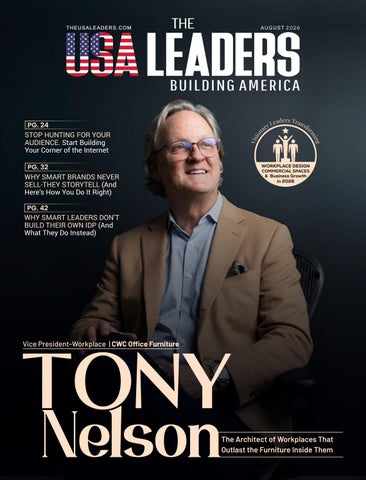
AUGUST 2026
THEUSALEADERS.COM
PG. 24 STOP HUNTING FOR YOUR AUDIENCE. Start Building Your Corner of the Internet PG. 32 WHY SMART BRANDS NEVER SELL-THEY STORYTELL (And Here’s How You Do It Right)
WORKPLACE DESIGN WORKPLACE DESIGN COMMERCIAL SPACES COMMERCIAL SPACES Business Growth && Business Growth in 2026 2026 in
PG. 42 WHY SMART LEADERS DON’T BUILD THEIR OWN IDP (And What They Do Instead)
Vice President-Workplace | CWC O ce Furniture
TONY The Architect of Workplaces That Outlast the Furniture Inside Them
EDITOR’S LETTER
Build the Space, and the People Will Build the Future
D
ear Readers,
Every business begins with a place, whether a desk, a meeting room or a quiet corner where an idea finally clicks. In 2026, those places are changing fast, shaped by hybrid work, new technology and a growing wish to feel connected at work. This edition, “Visionary Leaders Transforming Workplace Design, Commercial Spaces & Business Growth in 2026,” celebrates the people who understand that a well-planned space does more than hold furniture. It lifts performance, builds culture and helps companies grow. These leaders listen closely and deliver with care, turning everyday offices into places where people want to be. Our cover story features Tony Nelson, Vice President of Workplace at CWC in Atlanta, Georgia. Tony has spent 31 years in the contract furniture industry. He started in a warehouse straight out of high school, moved into supply sales, then furniture sales. His first million-dollar deal came with Delta Air Lines, and the UPS World Headquarters project became his own master’s level education in workplace design. Today he leads with the same steady approach at a company founded in 1929 that became employee-owned in 2018. At CWC, every employee-owner has a stake in each project, and clients notice it in the quick replies and the follow-through. CWC also handles design, delivery, installation, warehousing, asset management and long-term support, because a workplace keeps changing after move-in day. Looking ahead, he sees spaces serving many purposes at once, from work and learning to healing. His advice is simple: trust your team, respect people and keep your promises. Joining him in this edition are Josh Flibotte, Chief Executive Officer and President of Commercial Office Interiors LLC; Dave Albert, Chief Executive Officer of One Workplace; Ken Baugh, President & CEO of Pivot Interiors Inc.; and Joseph P. Lozowski, President and Chief Executive Officer of Tangram Interiors. Together, these leaders show that great workplaces are built on trust, good listening and a clear purpose. Their work reminds us that a space is never just a space. It is where people meet, learn, create and belong, and where businesses find room to grow. We hope their stories inspire you to look at your own surroundings with fresh eyes. Sincerely,
Simran Khan MANAGING EDITOR
PUBLISHER
ARCHANA GHULE
EDITOR-IN-CHIEF
VIKRAM SURYAWANSHI
MANAGING EDITOR SIMRAN KHAN
PROJECT EDITOR
THE
USA LEADERS FOLLOW US TheUSALeaders leaders_usa
SHADAB MESTRI
the-usa-leaders
PROJECT BY
usaleaders
PETER SMITH AKASH PATIL
PROJECT MANAGER
NIKHIL MAHAJAN
VISUALIZER
MARK DAVIS
GRAPHIC DESIGNER CHAITANYA KULKARNI
HEAD OF DISTRIBUTION & PRODUCTION AAKASH MAHAJAN
theusaleaders
theusaleaders Office No. 430, 4th Floor, Gera’s Imperium Rise, Opp. Wipro Circle, Hinjewadi Phase 2, Pune, Maharashtra - 411057.
+1 (850) 564-8517
info@theusaleaders.com
www.theusaleaders.com
HEAD OF OPERATIONS ROBERT SMITH
RESEARCH ANALYSTS JAMES ADAMS
ADVERTISING
MARIA SMITH
THE USA LEADERS IS AN ILLUMINATING DIGITAL PLATFORM THAT DRIVES THE CONVERSATION ABOUT THE DISTINGUISHED AMERICAN LEADERS DISRUPTING TECHNOLOGY WITH AN UNPARALLELED APPROACH.
10 Tony Nelson
(Cover Story)
20 Dave Albert
28 Joseph P. Lozowski 38 Josh Flibotte 46 Ken Baugh
CONTENT
PROFILES
ARTICLES 24
Stop Hunting for Your Audience. Start Building Your Corner of the Internet
32
Why Smart Brands Never Sell—They Storytell (And Here’s How You Do It Right)
Why Smart Leaders Don’t Build Their 42 Own IDP (And What They Do Instead)
er Stor y Cov
Vice President-Workplace | CWC O ce Furniture
TONY The Architect of Workplaces That Outlast the Furniture Inside Them
10 I AUGUST 2026
THEUSALEADERS.COM I 11
Cove r
Story
T
here is a particular kind of expertise that cannot be taught in a classroom or simulated in a training module. It accumulates slowly, through years of watching people move through spaces, of listening carefully to what a client says and even more carefully to what they do not say, of learning the difference between a room that merely functions and a room that truly resonates. Tony Nelson has been accumulating that kind of expertise for 31 years.
As Vice President of Workplace at CWC in Atlanta, Georgia, Tony brings more than three decades of experience in the contract furniture industry. Throughout his career, he developed corporate workplace projects and drove business growth through strategic sales leadership. Before joining CWC, Tony spent 5 1/2 years at Global Furniture Group, where he served as Southeast Regional Manager, then SR VP of Sales for the US, leading the sales team and sales initiatives. His career has been shaped not by a single path, but by a depth of experience, with each role building on the last and strengthening the expertise he brings to every client relationship. His portfolio spans major corporate headquarters, higher education institutions, hospitality projects, and leading architecture and design firms throughout Atlanta and beyond, including landmark work for UPS, Equifax, Georgia Tech, The Ritz-Carlton, and several of the region’s most influential commercial organizations. The list is substantial. What he holds onto, however, is not the scale of those projects but the consistency of the approach that made them possible. A Beginning Built from the Ground Up Before the world headquarters and the million-dollar deals, there was a warehouse. Tony’s entry into the industry began practically, working in warehousing and logistics before moving into sales. Straight out of high school, he took a job at an office furniture and office supply dealer, starting in warehousing and logistics. The ambition was always to become a furniture seller for a Steelcase dealer, but Tony understood that you build toward something rather than leap into it.
12 I AUGUST 2026
He moved into supply sales first. Furniture sales followed. Then came the defining chapter: his first boss, John Harris, purchased and began rebuilding a Knoll dealership and brought Tony into that effort. It was the proving ground he needed. His first million-dollar deal came with Delta Air Lines. What followed was even more formative. The United Parcel Service World Headquarters project arrived at a scale and complexity that demanded everything he had. Tony describes it with the precision of someone who knows exactly what shaped him: “That became my personal ‘master’s level program’ in workplace design, strategy, and the contract furniture industry.” That foundation, earned through execution rather than theory, has guided his work with clients across Georgia, the country, and around the world ever since. A Company That Survived the Depression CWC Office Furniture was founded in 1929, which is to say it was founded in the same year the American economy collapsed. That is not a detail to pass over lightly. The company began in office supplies, furniture, machines, and related services, oriented from the start around a mission that was at once simple and demanding: put the customer first, represent stable and forward-thinking manufacturers, and build relationships with the people who shape the built environment, including architects, interior designers, facility managers, and commercial real estate professionals. Over the decades, CWC steadily established itself as one of Atlanta’s leading workplace solutions providers, building long-standing relationships throughout Georgia’s commercial and design communities. Nearly 100 years later, that orientation has not wavered. “The mission has always been to take great care of customers and relationships at every level of Atlanta and throughout the state of Georgia,” he says. The products have transformed, the demands of the market have multiplied, and the tools of the industry have evolved considerably. But the commitment to service, talent, and relationship-building has remained the company’s constant, its true north through every disruption and every season of change.
What Employee Ownership Actually Looks Like In 2018, CWC became employee-owned, and Tony is careful to explain what that means beyond the organizational chart. It is not simply a financial arrangement. It is a cultural one. Every person at CWC has a personal stake in the outcome of every project and every client relationship. That stake shows up not in press releases but in phone calls returned promptly, in problems addressed before they become crises, in clients who sense, without being fully able to name it, that the people working on their space genuinely care about the result. CWC reinforces this culture with infrastructure. The company maintains its own labor workforce, its own fleet of vehicles, and a showroom accessible to the market, all supported by strategic partnerships with manufacturers and representatives who assist in every aspect of project and workplace development. When CWC commits to a timeline or a standard of delivery, it holds the means to honor that commitment from the inside out. “Since becoming employee-owned in 2018, that accountability has grown even stronger,” he says. “Every employee-owner has a personal stake in the outcome, and clients feel that difference in communication, responsiveness, and follow-through.” That is not a small thing in an industry where the distance between a promise and its fulfillment is precisely where trust is either built or broken.
“
The future is not simply about where people work. It is about creating spaces that support connection, culture, performance, and flexibility for whatever comes next. THEUSALEADERS.COM I 13
More Than Furniture: The Full Scope of What CWC Does
That sense of ownership, he makes clear, extends to every touchpoint.
There is a reductive version of what CWC does, and Tony gently but consistently resists it.
Built for Change, by Design
The company’s core services include design services for furniture and architectural products, delivery, installation, warehousing, asset management, workplace strategy, and long-term service support. The work unfolds in close collaboration with designers, facility team members, organizational leadership, and project managers. It requires, above all else, effective listening, genuine accountability, and what he calls exemplary service. “Furniture is only part of the equation,” he says. “What sets CWC apart is how it manages details, anticipates challenges, and supports clients beyond installation.” That word “beyond” carries real weight in his vocabulary. A workspace is not a completed project. It is a living environment that evolves as the organization inside it evolves. CWC’s relationship with its clients is built to accommodate that ongoing reality, and every team member is empowered to make decisions that serve the client rather than wait for authorization that might arrive too late.
14 I AUGUST 2026
Across 31 years in this industry, Tony has watched the workplace transform in ways that would have been difficult to predict at the outset. He does not appear troubled by this. If anything, he finds the pace of change clarifying. “CWC exists because of change,” he says simply. The forces reshaping the modern workplace, including shifting workstyles, evolving space constraints, growth and contraction cycles, attract-and-retain imperatives, collaboration design, employee engagement, and brand representation, are precisely the conditions that CWC is structured to navigate. As a MillerKnoll-aligned dealer, the company brings both product range and strategic perspective to the challenge, working to meet a client’s financial investment goals while also helping them absorb the market’s inevitable disruptions.
Co ver S
tory
Technology has also transformed how clients experience the design process itself. Real-time visualization, product tracking, and project coordination tools now allow clients to see their options clearly, make decisions with speed and confidence, and manage the complexity of a large commercial undertaking without being overwhelmed by it. The projects themselves have only grown more complex, but the tools available to navigate them have become significantly more capable. Earning Trust the Unglamorous Way CWC hosts annual appreciation luncheons for its vendor and manufacturer representative partners, a tradition that reflects the company’s understanding of how the commercial interiors ecosystem actually functions. No firm succeeds in isolation. CWC also supports its relationships through continuing education programs, referral arrangements, internships, and actively promoting customers to one another for mutual growth and resource alignment.
He frames the stakes with characteristic directness. Furniture and workplaces, he says, are “significant tools employers, education entities and businesses provide to serve their clients, communities and employees.” That framing transforms what might appear to be a commercial transaction into something closer to stewardship. Technology in the Service of Space The modern workplace is not simply a physical arrangement of surfaces and seating. It is an integrated environment, and Tony approaches it with both precision and creative instinct. Audiovisual systems, communication technology, biophilia, access to natural light, clean air, visibility, and connectivity are all part of the planning conversation at CWC today. He describes these not as optional enhancements but as foundational components of a workspace that truly serves the people inside it. CWC works to stay ahead of or closely aligned with the providers of these innovations, “always learning how we mutually support businesses, their leaders, their goals, and their missions.”
But Tony is clear-eyed about where trust is actually built. It is not at a luncheon, however warmly attended. It is in the quiet, sustained discipline of honoring your commitments, at every level of the organization, across every interaction. Integrity, honesty, acceptance, and trust are not aspirational language at CWC. They are, as he describes it, actively monitored and promoted across all actions, all locations, and all team members. The standard, he acknowledges, is not complicated. Maintaining it consistently and at scale is where the real work lies. Resilience Measured in People, Not Projects CWC’s nearly 100-year history includes the Great Depression, multiple recessions, a global pandemic, and the ordinary and extraordinary turbulence of a century in business. Tony speaks about those periods without drama, focusing on the response rather than the difficulty. The company’s leaders work to tackle issues directly and hold one another accountable. That approach does not make difficulty disappear, but it prevents it from deepening. What has allowed CWC to move through each disruption, he says, is a sustained commitment to its people, its customers, and its values, alongside a genuine willingness to keep evolving.
THEUSALEADERS.COM I 15
C o ve r S tor y The alumni of industry professionals that CWC has developed over the decades, now leading roles throughout Atlanta, Georgia, and the broader contract furniture industry, are for him the truest measure of the company’s resilience. “A great measure of our resilience is not only the projects we have completed, but the leaders and successful team members developed throughout the life of CWC.”
“
Trust is really earned after the project is complete. It comes from doing what you say you will do, communicating honestly, and remaining available long after installation. 16 I AUGUST 2026
CWC has held the position of leading dealership in Atlanta and the state of Georgia for a significant portion of its nearly century-long lifespan. Its client list spans corporations and businesses of every size, type, and market, alongside some of Atlanta’s most accomplished architecture and design firms. What Tony returns to consistently is not simply the scale of the work, but the continuity of the relationships that remain long after the installations are complete. The Workplace of 2026 and What Comes After Tony does not make predictions in the abstract. He makes them in particular. Workplace design, he believes, will continue to evolve alongside artificial intelligence, new technology, hybrid and remote work strategies, furniture innovation, and architectural walls. Spaces will increasingly be designed to serve multiple and overlapping purposes: work, play, learning, and healing. Every category of the market, from corporate to education to healthcare, uses the tools that CWC provides to help people perform their roles, serve their families, serve their communities, and drive business forward. CWC is preparing for that future by investing in adaptable solutions, technology, service, and partnerships that equip clients to navigate change with clarity and confidence, rather than be caught off-guard by it. The question driving that preparation is not about product or trend. It is about purpose: what do people need from their physical environment in order to connect, to perform, and to belong? For Tony, that question remains at the center of every workplace conversation.
The Philosophy Behind the Leader When Tony talks about balance in a fast-paced industry built on deadlines and client expectations, he does not reach for the expected answers. He says, plainly, that he loves going to work. He means something specific by that. He means the daily engagement with his immediate team, with clients, with influencers, designers, project managers, customers, and business agents. He means the work of driving projects forward, fulfilling needs, and finding what he calls, without any trace of irony, “magic” in the workplace. Honest evaluation of deadlines and milestones, he adds, is what keeps everyone focused and driven to succeed. His advice for future leaders follows the same logic that has guided his own career. Empower your team through trust, respect, and open communication. Be genuinely involved as you develop people, projects, and relationships. Acknowledge successes and, more importantly, acknowledge the people behind them. Remain open-minded and accepting of diverse thoughts, beliefs, and differences, and demonstrate integrity, faith, and honesty both inside the organization and outside it. He ends with a reminder that workplace design is ultimately about people. The workplace should be inspiring and engaging because, as he sees it, we spend a great deal of our lives inside these environments. They deserve to reflect the energy, connection, and purpose of the people within them. After 31 years, Tony Nelson still means every word of it. And the evidence, measured in projects completed, people developed, and a company approaching its centennial, suggests he has been right all along.
THEUSALEADERS.COM I 17
VISIONARY LEADERS TRANSFORMING WORKPLACE DESIGN, COMMERCIAL SPACES & BUSINESS GROWTH IN 2026
Tony Nelson
Dave Albert
www.c-w-c.com
www.oneworkplace.com
Joseph P. Lozowski
Josh Flibotte
www.tangraminteriors.com
LinkedIn- COI
Ken Baugh www.pivotinteriors.com
18 I AUGUST 2026
Chief Executive O cer | One Workplace
DAVE
Albert The Turnaround Architect Building One Workplace’s Next Chapter
F
actories in Reynosa, Tamaulipas do not usually turn out chief executives of American workplace design companies. Yet that is precisely where this particular story begins, on the production floor of Zenith Electronics Systems in the mid 1990s, where a young materials manager and financial analyst first learned to read a supply chain the way other people read a map.
Dave Albert is now the Chief Executive Officer of One Workplace, the Santa Clara, California-based company that shapes how organizations experience their physical environments across furniture, technology, construction, services, and hospitality. He took the role in August 2025, and the appointment, on paper, looks like the natural conclusion of a career that has spent thirty years circling the same central question: how does a business that is losing money find its way back to health, and then keep growing once it gets there? A Career Built in Commodities and Crisis Before boardrooms, there were spreadsheets and shipping manifests. From 1994 to 1996, Dave worked as Senior Commodity Manager, Materials Manager, and Financial Analyst at Zenith Electronics Systems in Reynosa. From there, he moved to General Electric, where between 1996 and 1999 he directed a $200 million electronics commodity spend for the Industrial Systems business, supporting eighteen manufacturing facilities scattered across the globe and leading a staff of thirteen.
20 I AUGUST 2026
THEUSALEADERS.COM I 21
It was, in retrospect, an apprenticeship in scale. He was learning what it meant to move materials, money, and people across borders long before he was asked to move entire divisions. The Stanley and Black & Decker Years In 1999, Dave was recruited to Black & Decker HHI as a director charged with building the division’s first professional global sourcing team, headquartered in Lake Forest, California. He was elevated to Vice President in 2002 with expanded responsibility for manufacturing strategy, leading three plant closure and transfer projects and implementing a disciplined Material Cost Take Out, or MCTO, process.
When Stanley acquired Black & Decker, Dave was promoted, from 2010 to 2012, to Vice President International for the combined Mechanical Access Solutions business, tasked with merging the two companies’ international operations and building the division’s first integrated strategic plan. He went on to lead the Hardware and Home Improvement Division’s international business from 2012 to 2014, a period that required separating operations from Stanley and folding them into Spectrum Brands, a project that involved seven concurrent SAP integrations, six distribution center transitions, and two new office start-ups, completed with minimal business interruption. Turning Around Canada, Then Asia Pacific
By 2005, he had moved into his first commercial assignment, Vice President of Brand Marketing and Business Development, where he led the launch of SmartKey, a technology that drove a significant increase in market share, and helped evaluate potential acquisitions for the division. In 2008, he was appointed to lead the company’s entry into residential access solutions through the Baldwin brand, and within a year had taken on the additional task of turning around Baldwin’s declining profits. That work included a strategic shift from mechanical to electronic locks and the development of the Home Connect electronic lock platform.
22 I AUGUST 2026
From 2014 to March 2016, Dave served as Vice President and General Manager of Canada, based in the Greater Toronto Area, where he was asked to turn around the country’s hardware and home improvement division and integrate it with the rest of Spectrum’s Canadian operations. He consolidated four sales offices, implemented SAP across all operating divisions, and rationalized the portfolio by divesting unprofitable businesses. Under his leadership, the region’s EBITDA grew twenty-one percent on fourteen percent sales growth within the first two years.
He then relocated to Melbourne, Australia, taking on the role of Vice President and General Manager of Asia Pacific from April 2016 to September 2018, with a mandate to build a regional platform capable of tapping into the fastest-growing markets in the world. Over that two-and-a-half-year period, he grew the region’s EBITDA by thirty percent on ten percent net sales growth and reduced inventory by twenty-two percent, while also championing a new strategic alliance between Spectrum Brands and JD.com to enter the Chinese e-commerce market. In September 2018, his responsibilities expanded to include Canada as well, a dual mandate he held until February 2019. A $1.1 Billion Turnaround In February 2019, Dave was appointed President of Spectrum Brands’ Home and Personal Care Appliances division, a $1.1 billion business that had just emerged from a failed sale process and was facing steep revenue and profit decline. Over the next three years and eleven months, he rebuilt the culture, upgraded talent, and aligned execution around four pillars: insight-led innovation, brand equity, go-to-market strategy, and operational excellence. Within the first two years, the division’s EBITDA rose thirty percent on fifteen percent sales growth. In February 2022, he championed the acquisition of the $400 million Tristar Appliances business, a move designed to expand the division’s brand portfolio and accelerate its entry into the direct-to- consumer channel. Across his career, Dave’s mergers and acquisitions record also includes Stanley Black & Decker’s acquisition of TLM, a $150 million lock manufacturer based in Taiwan and the Philippines, and the divestiture auction of the Pfister business. The Wheel Group and Now One Workplace In October 2023, Dave became President and Chief Executive Officer of The Wheel Group, an Ontario, California-based manufacturer and distributor of automotive wheels, tires, and vehicle accessories established in 1969. The company’s distribution network spans twenty centers across North America, reaching more than forty countries, with a portfolio of nine wheel brands, four wheel accessory brands, two vehicle accessory brands, and one specialty off-road tire brand. He led TWG for one year and eleven months before moving, in August 2025, to One Workplace. In his current role, he has described his mandate simply: to elevate the client experience across everything One Workplace touches, from furniture and technology to construction, services, and hospitality. It is a wide canvas, but it is one his career has been quietly preparing him to paint on since a factory floor in Reynosa first taught him to see a business, in full, as a system that can always be made to run better. Dave holds expertise across business transformation, product and brand management, strategic planning, international sales and marketing, manufacturing strategy and restructuring, portfolio rationalization, distribution and supply chain, plant start-ups, Lean Six Sigma, and turnarounds, a résumé of disciplines that reads, in the end, like a single continuous argument: that struggling businesses are not lost causes, only unfinished ones.
THEUSALEADERS.COM I 23
24 I AUGUST 2026
THEUSALEADERS.COM I 25
26 I AUGUST 2026
’
THEUSALEADERS.COM I 27
JOSEPH P. LOZOWSKI How a Failing Dealership Became One of North America’s Largest Interior Solutions Providers
28 I AUGUST 2026
THEUSALEADERS.COM I 29
I
n 2002, somebody had to want a failing business badly enough to buy it. Most people would have looked at the books and walked away. Joseph P. Lozowski looked at the same books and saw the outline of something else entirely. He is President and Chief Executive Officer of Tangram Interiors, a title he has held since August 2002, a run now in its twenty-fourth year across Southern California and Texas. The company he acquired that year was, by his own account, failing. What it has become since is one of the largest interior solutions providers in North America, a transformation that did not happen by accident and did not happen quickly. A Detroit Apprenticeship Joseph’s path to Tangram ran through Detroit. From May 1984 to April 1996, a twelve-year stretch, he worked as Vice President of Sales at Contract Interiors in the Detroit metropolitan area, learning the commercial furniture business from the sales floor up. In March 1996, he moved into his first presidency, leading University Business Interiors in the Greater Detroit Area for six years and six months, until August 2002, when he made the leap that would define the rest of his career: acquiring what was then a struggling dealership and renaming it Tangram. Building a Culture Before Building a Company What Joseph did next was less about products and more about people. He is, by design, an advocate for entrepreneurship inside his own organization, and over the years he has built what is described as a culture centered on customer satisfaction and, just as deliberately, on employee growth. That distinction matters. A company can chase client wins without ever investing in the people responsible for delivering them. He appears to have built Tangram in the opposite order, on the theory that a company that takes care of its own people will, in turn, take care of its clients. A Mission That Outgrew Furniture Tangram’s stated mission is to curate destinations that empower people to work, learn, and heal, a phrase that stretches well beyond the boundaries of a traditional office furniture dealership, and the company’s growth under Joseph reflects exactly that ambition. Over the years, he expanded its offerings from commercial office furniture into an entire ecosystem: Studio Other, a custom furniture division; Tangram Technology; Tangram Construction Trades; Tangram Move; and Onsite, a refurbishing and cleaning division. Each addition represents a different way of touching the same underlying idea: that the physical spaces where people work, learn, and heal deserve more than furniture alone.
30 I AUGUST 2026
Reading the Growth in Its Own Terms It is worth sitting for a moment with what each new division actually represents, because together they sketch the shape of Joseph’s thinking. Studio Other lets Tangram design and build custom furniture rather than simply reselling it. Tangram Technology extends the company’s reach into the systems that now run alongside physical space. Tangram Construction Trades pulls the build-out phase of a project in-house instead of handing it to a separate contractor. Tangram Move handles the literal transition of a business from one space to another. And Onsite closes the loop, refurbishing and cleaning what is already there rather than replacing it outright. None of these are furniture divisions in the traditional sense. Together, they describe a company that decided, under him, to own the entire lifecycle of a workplace rather than a single transaction inside it. A Presence Beyond the Balance Sheet Since September 2020, Joseph has also served as a member of the CEO Leadership Alliance of Orange County, known as CLA-OC, a group forged by leaders of some of the county’s most prominent companies around a shared purpose of creating a thriving Orange County for everyone. Its members describe contributing to the community not as an optional extra but as a responsibility, and his involvement fits a pattern that runs through the rest of his public life. He sits on the board of the Orangewood Children’s Foundation, a cause described as hitting close to home for his family, and he has remained a consistent advocate for the organization for years. The Credo Behind the Career Ask Joseph what drives him, and he does not reach for a business school aphorism of his own invention. He points instead to a line from Ronald Reagan, a credo about the freedom that comes from not needing to be the one who gets the credit. It is a fitting choice for a leader who built his reputation less on personal visibility than on the growth of the people and divisions around him, from the Studio Other design team to the Tangram Construction Trades crews to the sales staff he once stood among in Detroit.
Detroit to Southern California It is easy to overlook how far the arc of this career actually travels, geographically and otherwise. Joseph spent twelve years selling in Detroit before he ever ran a company, and another six and a half years running University Business Interiors there before he made the move that would define him. By the time he acquired the dealership that became Tangram, he had already spent eighteen years learning the commercial interiors business from two very different vantage points, first as the person carrying the sales bag, then as the person setting the strategy. That sequencing seems to matter. The leaders who take over a company after first learning to sell for one tend to build organizations that never lose sight of the customer relationship, even as the business around it grows more complicated. Southern California, Texas, and What Comes Next Twenty-four years after he acquired a failing dealership, Joseph now leads a company with a footprint across Southern California and Texas and an offering that has grown from furniture into technology, construction, moving, and facility services. Tangram’s evolution under him offers a specific answer to a general question: what happens when a leader treats a business turnaround not as a single event but as a permanent operating philosophy? More than two decades into his leadership, Tangram continues to widen its definition of what an interior solutions provider is supposed to do. For a company whose founding, under Joseph, began with a single distressed acquisition, that pattern of continuous reinvention has become the through line of his entire tenure, one division, one Orange County board seat, one credited team member at a time.
THEUSALEADERS.COM I 31
Let’s get one thing straight—no one buys your product. They buy their own transformation. That’s the punchline too many entrepreneurs miss. If you’re still pitching features or bragging about your process, you’re leaving money on the table. The truth? People buy when they feel like the story you’re telling sounds like their story. Not yours. And the most powerful way to make that happen is by hijacking something ancient: The Hero’s Journey. This isn’t a trend. This is human psychology. It’s what our brains default to when trying to make sense of life, change, or challenges. Hollywood knows it. High-performing brands know it. Founders who build category-defining startups know it. Let’s break down how you embed it into your brand messaging like a real strategist—not a content creator who’s winging it. 1. Your Customer Is the Hero. You’re Just the Guide. Accept It. This one shift will clean up 80% of your messaging clutter. Stop trying to convince your customer how smart, qualified, or experienced you are. They don’t care—yet. They care about themselves. Their problem. Their need. Their confusion. Their desire to stop the bleeding. So put them at the center of your story.
32 I AUGUST 2026
You’re not the main character. You re the person who helps the main character win. Think Yoda. Think Haymitch. Think Moana’s grandmother. They’re the ones who nudge the hero out of their comfort zone, hand them the compass, and say, “This way. I’ve walked this road. You're not alone.” That’s your job. So next time you write content, don’t start with, “I help women build soulful businesses.” Start with this: “You know that feeling when you’ve outgrown your business, but every pivot feels risky and wrong? Let’s fix that.” See the difference? 2. The Problem Isn’t Just a Problem—It’s the Call to Adventure Your customer’s stuck moment? That’s where your story starts. Not your origin story. Not your “why.” Theirs. You need to articulate the tension they feel—but can’t always name. When done right, they read your content and say, “Wait, how are you in my head?” That’s when they keep scrolling.
THEUSALEADERS.COM I 33
Here’s how you get that clarity: · Look at what your best clients said when they hired you. · Check DMs. Emails. Exit surveys. · Pay attention to where they almost gave up. · Use their actual words. Don’t translate them into brand language. Example: · Not: “I help burned-out professionals realign with purpose.” · Try: “You thought quitting your job would feel like freedom. But now it’s 2PM, and you’re Googling how to price your service—again.”
Share a small success story. Show proof. Be real. No need for polished perfection. That’s not what builds conversion.
That’s the call to adventure.
4. Then You Sell the Transformation. Not the Offer.
Make it so vivid they feel slightly uncomfortable reading it. That’s when the shift starts.
People don’t care about your 6-week program, your group calls, your templates.
3. You Step In. Not With Hype—With Help. Here’s where most brands go wrong. They hear “guide” and think it means “guru.”
Clarity does.
They care about what changes after working with you. So stop listing deliverables like a menu. Paint a clear before-and-after picture. Make it so grounded, they can visualize themselves living it next week. Here’s what that sounds like:
Nope. Your job isn’t to sound impressive. It’s to offer something solid they can use today. Something that builds trust without pressure.
· Before: “I hate marketing. It feels fake. I never know what to post.” · After: “Now I write posts in 30 minutes flat—and people DM me saying, ‘This hit hard.’” That’s real.
You offer a way forward that feels safe. Predictable. Testable. You break down the next steps clearly. Like this:
You’re showing them the new identity waiting on the other side of the work. It’s not about “6 coaching calls.” It’s about “knowing what to say when someone asks what you do.”
“We map out your new messaging in 90 minutes. Then you try it out. We adjust what doesn’t land. You go live without overthinking it.”
5. You Don’t Need a Funnel. You Need a Narrative Arc.
That’s a plan.
Let’s get practical.
You don’t need fireworks. You need structure.
This is what the Hero’s Journey looks like in your content ecosystem:
34 I AUGUST 2026
Sell that.
Use this map. Repeat it. Rotate it through your channels. Don’t just “post valuable content”—build narrative momentum.
· “Mira told me she felt invisible. Last week, she got her first press mention.”
6. If Your Brand Isn’t Sticky, Your Story’s Not Sharp Enough
These aren’t testimonials. They’re mini-hero journeys. And they show your audience one thing: This is possible for you, too.
Most people don’t quit your content because it’s bad. They quit because it’s vague.
No One Buys Coaching. Or Courses. Or Systems. They buy belief.
You’re not naming the tension. You’re not articulating the shift. You’re not closing the loop. Here’s what fixes that: · Cut 80% of your adjectives. Add 20% more verbs. · Don’t tell people you’re “aligned.” Tell them you stopped crying on Sunday nights. · Don’t say you help people “scale.” Say you helped someone double revenue without doubling hours.
Belief that this time, they’ll make it work. Belief that someone actually understands what they need. Belief that they won’t waste money again. Stories give them that belief. Not hype. Not hacks. Not high-ticket urgency tactics. Stories.
Story sticks when it moves.
And not just any story—a story where they win. That’s the only pitch that really works.
7. Let Their Ending Be Your Beginning
Final Word
Here’s the big one.
Look. We’re not selling lipstick here. We’re building trust with people who’ve likely been burned before. That takes something deeper than dopamine marketing.
When people see themselves in your clients’ wins, they self-select to start the journey.
It takes narrative strategy. So build your content around transformations already happening. Document your client’s first wins. The messy middle. The surprise outcomes.
So ditch the guru vibes. Step into the role you’re actually built for: the woman who shows up with a map, a mirror, and a flashlight. You’re not selling services.
Say things like: You’re selling self-belief. · “When we started, Sam wasn’t even sure she had a real business. Today, she booked out Q3 in two weeks.”
Get your story straight—and watch what happens next.
THEUSALEADERS.COM I 35
Josh Flibotte The Quality Inspector Who Became a Software-First Furniture CEO
S
omewhere between a dialysis lab in New Hampshire and a spine device inspection line in Massachusetts, a quality assurance technician started noticing something that had nothing to do with furniture at all: how much of the built environment, and the products that fill it, were made without much thought for the planet or the people living in it. That noticing eventually became a company. Josh Flibotte is the Chief Executive Officer and President of Commercial Office Interiors LLC, known as COI, a role he has held since November 2022 from the company’s base in New Hampshire. He describes COI as a Software-First furniture dealer with a specific mission: to optimize the furniture buying process in a sustainable way, using biophilic design and low VOC materials to combat what he frames, directly, as a mental health crisis, while responsibly sourcing raw materials and reducing carbon emissions across the process. A Career That Started in Quality Control Josh's early career reads nothing like a furniture executive’s. From October 2011 to April 2014, he worked as a Quality Assurance Quality Inspector at SpineFrontier, a medical device company, a role he later described on his own record with a wry, one-line label: “Diabetic Things!!!”
38 I AUGUST 2026
From May 2014 to April 2015, he moved to DEKA Research and Development as a Quality Assurance Test Technician, a job he tagged, in his own words, “Peri Dialysis Things!!!” He stayed at DEKA for a total of two years and eight months, moving next into an EVT Tech and QA Software Engineer role from April to November 2015, which he called “Tricky Things !!!”, and finishing as a QA and Manufacturing Associate from November 2015 to December 2016, summarized simply as “QA, MFG, Cal, Doc, Eng Things!!!” That habit, of describing serious technical work with a wink rather than a boast, has stayed with him. It shows up again in how he frames leadership itself. Six Years Learning the Furniture Business at NewVo In December 2016, Josh moved into the furniture and interiors industry as Chief Operations Officer of NewVo Interiors in New Hampshire, a post he held for six years, until November 2022. While there, he was connected to NewVo Custom, a division of NewVo Interiors, to Jack the Liquidator, a move management operation, and to Office Zilla, where he served as a franchisee managing member handling office needs for clients. Those six years appear to have functioned as a hands-on education in every corner of the furniture and workplace services business, from custom manufacturing to the unglamorous logistics of moving a company out of one space and into another.
Chief Executive Officer and President | Commercial Office Interiors LLC THEUSALEADERS.COM I 39
Founding Commercial Office Interiors
Who COI Is Built to Serve
In November 2022, Josh became Chief Executive Officer of Commercial Office Interiors LLC, co-founding the company with Joe Aiello, and the company they have built since reflects the values he had apparently been forming since his DEKA and SpineFrontier years. COI positions itself as the preferred dealer for Artopex, a sustainable furniture manufacturer, and for Reseat, a platform focused on asset management, the secondary furniture market, and Scope 3 emissions reporting. Its client base spans end users such as corporations and small and mid-sized businesses, facilities management professionals, owner’s project managers, and both architects and interior designers working in the commercial space.
COI’s client list is worth reading closely, because it reveals a dealer that has built itself around the entire ecosystem of a commercial building project rather than a single buyer. End users, the corporations and small and mid-sized businesses actually occupying the space, sit alongside facilities management professionals who will maintain it for years after the sale closes.
A Mission Framed Around Health and Climate What distinguishes Josh’s framing of COI from a standard furniture dealership pitch is how directly he connects the physical product to human wellbeing. He has described the company’s goal as using the power of nature, through biophilic design and low-VOC furniture, to help address the mental health crisis, while responsibly sourcing raw materials in a way that reduces CO2 emissions. It is an ambitious linkage, from indoor air quality and natural materials to psychological health and climate impact, but it is the linkage he has chosen to build a company around, and it runs through every partnership COI has struck, from Artopex’s sustainable manufacturing to Reseat’s emissions reporting tools. Leadership, in His Own Words Josh has summarized his own philosophy on leadership in a single, characteristically understated line: “Being in charge only means you work for more people. Be the leader you’d follow.” It is a philosophy that seems to trace back to those early years spent on inspection lines and QA benches, watching what leadership looked like from below before he ever held the title himself. Throughout his career, by his own account, he has maintained the highest level of performance standards across quality and medical facility functions and sales guidance, building brands and businesses through what he calls a results-driven mentality aimed, ultimately, at client satisfaction.
40 I AUGUST 2026
Owner’s project managers, the people tasked with keeping a build on schedule and on budget, are named specifically, as are the commercial architects and interior designers who design the space before a single piece of furniture ever arrives. A dealer that tries to serve all five of those constituencies at once is, in effect, promising to speak several different professional languages fluently, a harder proposition than it sounds, and one that only works if the underlying product, sustainably sourced, software supported, and biophilically designed, holds up under each of those different sets of expectations. A New Hampshire Company With a National Ambition Nearly four years into leading COI, Josh is running a company that sits at the intersection of two conversations shaping the commercial interiors industry in 2026: the technology-driven reinvention of how commercial furniture gets bought and sold, and the growing expectation that workplace design accounts for its impact on both the people who use it and the planet that supplies it. For a leader who started his career labeling his own job descriptions with exclamation points, the throughline to a mission statement about sustainable sourcing and mental health is not as strange as it might first appear. Both are, in their own way, an argument that the details most people overlook are exactly the ones worth taking seriously.
Why Smart Leaders Don’t Build
THEIR OWN IDP (And What They Do Instead)
T
here’s a reason the world’s top CEOs don’t build their own payroll software, CRMs, or security stacks from scratch. They buy what works—fast, proven, and scalable.
What’s not obvious—at least to some teams is how to adopt it without setting their company on fire. The Allure of Building It Yourself
Intelligent Document Processing (IDP) falls into the same category. You don’t build it unless your business is in the business of building IDP. Otherwise, you're bleeding cash and time on something you could have deployed weeks ago. Yet every month, some ambitious team sets out to build their own IDP—connecting APIs, fine-tuning models, assembling dashboards—only to realize six months later they’ve burned a million dollars and have a demo, not a solution.
The “build” camp always starts the same way: smart engineers, eager to stitch together an IDP system using off-the-shelf APIs. “We’ll use OpenAI for language, something open-source for layout detection, wrap it in a dashboard, and fine-tune for our use cases.” In theory, that sounds clean.
If you’re even asking the “build vs. buy” question for IDP, here’s your reality check. What’s Actually at Stake with IDP Let’s level-set. Intelligent Document Processing is what lets businesses extract structured data from unstructured documents invoices, contracts, emails, forms, insurance claims, PDFs. Anywhere there’s a file, IDP is what lets you pull signal from noise. In short: it’s the bloodstream of AI-enabled operations. And the IDP market isn’t some fringe use case—it’s compounding at 29% per year. By 2032, we’re looking at an industry worth nearly $18 billion. That kind of momentum doesn’t come from nice-to-haves. It comes from every serious enterprise realizing: “We’re wasting hours and dollars on documents no human wants to read.” The move to IDP is obvious.
42 I AUGUST 2026
In practice, here’s what happens: · You spend 6–12 months cobbling components. · You need a task force of AI engineers, annotators, ops leads, and DevSecOps to maintain it. · You discover that foundational models don’t know your document schema—and now you need expensive prompt engineering, tuning, or custom datasets. · You don’t actually automate anything because you’re stuck validating 40% of outputs. · You start building tools to maintain the tools. Eventually, someone asks, “Why are we building infrastructure for a commodity problem?” And nobody has a good answer.
THEUSALEADERS.COM I 43
Reality Check: Building IDP Costs More Than You Think Let’s walk through the real cost drivers of building IDP in-house: 1. You Need Specialist AI Talent—Constantly These are not just data scientists. You need people fluent in: · Document layout analysis · NLP pipelines · Foundation model APIs and limits · OCR tuning and error correction · Post-processing workflows · Governance frameworks
So Why Do People Still Try to Build? Because there’s a myth: that building is cheaper and gives you control. In theory, yes. In reality, it rarely works out that way. Cheaper? Not when you factor in the talent, the maintenance, the ramp-up time, the technical debt. More control? You'll control every outage, bug, and missed SLA yourself. Good luck scaling that. Meanwhile, your competitors are already shipping products using prebuilt IDP that just works.
They’re expensive. They’re rare. And they leave fast. What Smart Companies Do Instead 2. Accuracy Is Your Problem Forever Smart leaders don’t build IDP from scratch. Every use case you support—invoice extraction, legal clause parsing, insurance claim triage—requires its own performance tuning.
They buy it from vendors who’ve already solved 90% of the problem and spend their time focusing on the 10% that’s unique to their business.
Most foundational models are trained on general-purpose data. Your documents are probably nothing like the ones in their training set.
There are two good options:
This means:
1. Buy IDP as a standalone point solution 2. Buy it embedded within a larger automation platform
· More annotation · More prompt engineering · More error handling · More manual review
Either way, you’re standing on the shoulders of a tech stack that's been stress-tested by global enterprises.
You are never done.
Here’s what you get when you buy:
3. You Inherit Governance Headaches
1. Time to Value in Weeks, Not Quarters
With great AI comes great responsibility:
You skip the “build” phase entirely. Modern IDP platforms come with:
· How do you version your models? · What happens when performance drops in one region? · How do you track and audit predictions? · Can you prove compliance in regulated industries?
· Pretrained models · Out-of-the-box integrations · Built-in feedback loops · Professional services and support
When you build it yourself, these are your problems. You don’t just own the system. You own its failure modes too.
44 I AUGUST 2026
You can go live in under a month—not just with a working model, but with results your CFO can see.
2. Low-Code Training That Anyone Can Use
Why This Matters More Than Ever
No PhDs required.
In 2025, AI strategy is not optional. If your documents are still stuck in PDFs and emails, you’re leaving money, time, and insight on the table.
Best-in-class IDP lets business users annotate, correct, and improve models on the fly. The system learns from realworld feedback. Some even use active learning, where the AI asks for help only when uncertain—optimizing both accuracy and labor. 3. Risk Is Offloaded to the Vendor Governance, monitoring, model updates—all the annoying stuff is now someone else’s responsibility.
But the worst move isn’t to delay IDP. It’s to build your own and delay everything else. Every dollar you spend reinventing the IDP wheel is a dollar not spent on customer experience, product innovation, or market expansion. Speed wins. Precision scales. Clarity beats control. That’s the real calculus behind IDP.
You get uptime guarantees. You get SOC 2 compliance. You get redress when things go wrong. And when new models hit the market? You get the upgrade.
Final Word from the Trenches If your company’s core business is not document AI, don’t pretend it is.
4. Built-In Scale Need to expand from invoices to HR files? From legal documents to customer chats? Prebuilt platforms already support multiple formats, use cases, and global languages.
Buy the system. Customize the 10% that matters. Focus your energy where it counts. And if you’re choosing a vendor, don’t be swayed by flashy demos or big logos.
You don’t build new models. You extend existing ones.
Ask one question: Who owns the risk when this breaks?
This isn’t just scale. It’s compounding returns.
If the answer is “not us,” you’re in the right place.
THEUSALEADERS.COM I 45
President & CEO Pivot Interiors Inc.
46 I AUGUST 2026
Ken BAUGH One Company, Nearly Four Decades of Workplace Transformation
C
areers, in this industry as in most others, are usually told through a chain of job titles, each one a rung on a ladder leading somewhere else. Ken Baugh’s story resists that shape entirely. He has spent nearly four decades at the same company, joining Pivot Interiors Inc. in 1988 and eventually becoming its President & CEO. A role he has now held for nearly three decades, a tenure that places him among the rarest kind of executive: the one who has spent the overwhelming majority of his career helping one company evolve. Before Pivot: A Foundation in Real Estate Ken’s professional path before Pivot was brief but instructive. From 1986 to 1988, he worked as a Portfolio Manager at Prometheus Real Estate Group, a two-year stretch that gave him a grounding in how physical assets are managed, valued, and stewarded over time. It is not a large body of data to work from, but it is a telling one. A portfolio manager thinks in terms of long horizons, of assets that appreciate slowly and require patience rather than speculation. That instinct, whatever shape it took in the years that followed, seems to have carried him into a role he would grow into over the decades that followed. Nearly Four Decades at Pivot In February 1988, Ken joined Pivot Interiors, beginning what would become the defining chapter of his professional life. He became President in 1997 and has since continued to lead the company.
THEUSALEADERS.COM I 47
Thirty-eight years is long enough to have witnessed several full cycles of change in how American businesses think about their offices: the shift from cubicle farms to open-plan layouts, the rise and partial retreat of the fully remote workforce, and now, in 2026, the renewed emphasis on workplaces designed to draw people back together on purpose rather than by mandate. A leader who has stayed in place through all of it inevitably becomes something more than a manager. He becomes a kind of institutional memory, the person who remembers what the last three transformations looked like and can tell you, with some confidence, which parts of the current one are genuinely new. What Longevity Signals It is worth pausing on what a thirty-eight-year career within one company actually communicates, because in an era when executive turnover is measured in single-digit years, it is close to an anomaly. It suggests, at minimum, a deep commitment to an organization that has evolved significantly during his tenure. It suggests trust, both extended and earned, sustained across decades and, presumably, multiple generations of clients, employees, and industry shifts. And it suggests a leader who has chosen depth over breadth, betting that mastery of one company and one market is worth more than the accumulated résumé of someone who moved every few years in search of a bigger title. A Career Spanning Multiple Downturns A tenure that begins in 1988 does not simply span calendar years; it spans recessions. Ken has led Pivot Interiors through multiple economic cycles, each of which reshaped, in its own way, how much office space companies wanted and what they wanted it to look like. Surviving one of those cycles as the head of a commercial interiors business is a meaningful accomplishment. Continuing to lead through successive cycles under the same leadership is something closer to a case study in institutional resilience. It is one thing to build a strategy for a single economic climate. It is another to keep adjusting that strategy, year after year, as the climate itself keeps changing, without ever stepping away from the responsibility of leading the company through it.
48 I AUGUST 2026
A Leader Who Lets the Work Speak There is a modesty embedded in a career like this one. Ken has not, based on the shape of his career, sought the kind of visibility that many chief executives cultivate. His professional record is spare: a career centered on one company and one long chapter. But that spareness is itself a kind of statement. In an industry—workplace and commercial interiors—that is currently being reshaped by conversations about hybrid work, sustainability, and the return to office, the leaders who have actually lived through prior reinventions of the workplace are increasingly rare, and increasingly valuable. Leading Into 2026 As workplace design continues to evolve, Ken’s career offers a reminder that transformation is not always loud. Sometimes it looks like a single executive, at a single company, adjusting course year after year, decade after decade, long enough that the adjustments themselves become the strategy. Nearly four decades after joining Pivot Interiors, Ken Baugh is still its President & CEO, still, presumably, doing the quiet work of keeping a company relevant across eras that most leaders only get to see from the outside, in retrospect, once they have already moved on to something else. Why Longevity Still Matters It would be easy to assume that the most interesting figures in workplace design are the newest ones, the executives who have just taken the top job or closed a headline acquisition. Ken’s career argues otherwise. Somewhere inside every disruptive new idea in workplace design is a much older story about durability, about the people who were already in the room when the last several ideas arrived, tested, and either stuck or faded. A leader who has spent nearly four decades at one workplace interiors company has, by definition, already outlasted several waves of conventional wisdom about what an office is supposed to be. That kind of endurance does not photograph as well as a ribbon cutting or a funding round, but it is, in its own understated way, just as instructive to anyone wondering how a company can remain relevant while the world around it keeps changing.
DON’T MISS AN ISSUE Subscribe Now THE USA LEADERS IS AN ILLUMINATING DIGITAL PLATFORM THAT DRIVES THE CONVERSATION ABOUT THE DISTINGUISHED AMERICAN LEADERS DISRUPTING TECHNOLOGY WITH AN UNPARALLELED APPROACH.
www.theusaleaders.com
THE
USA LEADERS BUILDING AMERICA