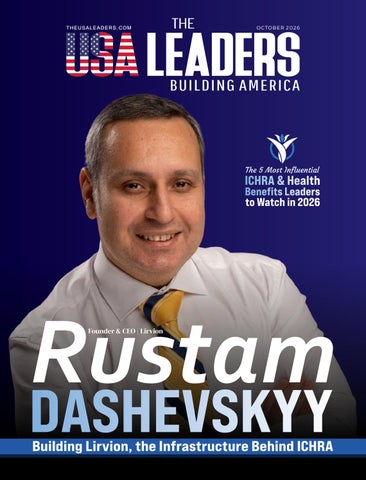
THEUSALEADERS.COM
OC TO B E R 2 0 2 6
Rustam Founder & CEO | Lirvion
DASHEVSKYY Building Lirvion, the Infrastructure Behind ICHRA
EDITOR’S LETTER
The Plan Is Chosen. The Promise Begins.
D
ear Readers,
Employers are asked to do more with health benefits while workers expect more choice. Rising costs, shifting rules, and a changing workforce have made the old group plan feel like a coat that fits no one. ICHRA offers a better fit. It gives employees a voice, gives employers a clear budget, and asks the industry to build stronger systems behind both. In “The 5 Most Influential ICHRA & Health Benefits Leaders to Watch in 2026,” we meet the people doing that work. They are making choice practical, coverage reliable, and benefits something people can trust. Our cover story features Rustam Dashevskyy, Founder & CEO of Lirvion, a nationwide CHOICE Arrangement (ICHRA) administration platform for employers and the benefits professionals who support them. Rustam learned early that choosing a plan is only the beginning. Years of working with consumers in the individual market showed him what follows: eligibility questions, documentation, effective dates, premium payments, and the steady effort of keeping coverage active. Lirvion was built around that lesson. It gives employers and advisors one clear view of eligibility, allowances, coverage status, premium activity, verification, reconciliation, and reporting. Employees can enrol on their own or with licensed support. Rustam is candid that ICHRA is more than a reimbursement account, and that it does not suit every employer. He asks three simple questions of every feature: what happens before it, what happens after it, and what happens when something goes wrong. Founded in 2025 and live with employers in 2026, Lirvion measures success through enrolment, reconciliation accuracy, and cost comparisons rather than early headlines. As he puts it, technology should support good professionals, not blindly replace them. Also featured are Alan Silver, President of Ambetter Health Solutions; Dr. Guy Ezekiel, Co-Founder & CEO of Zorro; Austin Lehman, CEO of Remodel Health; and Jack Hooper, Founder & CEO of Take Command Health. Together, these leaders show that good benefits are built with patience, clear thinking, and respect for the people who rely on them. As ICHRA matures, the question will shift from what it is to how it is run well. May their work inspire you to ask sharper questions of your benefits strategy. Sincerely,
Simran Khan MANAGING EDITOR
PUBLISHER
ARCHANA GHULE
EDITOR-IN-CHIEF
VIKRAM SURYAWANSHI
MANAGING EDITOR SIMRAN KHAN
PROJECT EDITOR SHADAB MESTRI
PROJECT BY AMAN SINGH
PROJECT MANAGER
NIKHIL MAHAJAN
VISUALIZER
MARK DAVIS
GRAPHIC DESIGNER CHAITANYA KULKARNI
HEAD OF DISTRIBUTION & PRODUCTION AAKASH MAHAJAN
THE
USA LEADERS FOLLOW US TheUSALeaders leaders_usa the-usa-leaders usaleaders theusaleaders
theusaleaders Office No. 430, 4th Floor, Gera’s Imperium Rise, Opp. Wipro Circle, Hinjewadi Phase 2, Pune, Maharashtra - 411057.
+1 (850) 564-8517
info@theusaleaders.com
www.theusaleaders.com
HEAD OF OPERATIONS ROBERT SMITH
RESEARCH ANALYSTS JAMES ADAMS
ADVERTISING
MARIA SMITH
THE USA LEADERS IS AN ILLUMINATING DIGITAL PLATFORM THAT DRIVES THE CONVERSATION ABOUT THE DISTINGUISHED AMERICAN LEADERS DISRUPTING TECHNOLOGY WITH AN UNPARALLELED APPROACH.
10 Rustam Dashevskyy
(Cover Story)
18 Alan Silver
28 Austin Lehman 38 Dr. Guy Ezekiel 46 Jack Hooper
CONTENT
PROFILES
ARTICLES 22
EHR vs EMR: Key Differences, Similarities, and Which System Is Right for You
34
The Unpolished Story That builds Your Influence
Why Smart Brands Never Sell—They 42 Storytell (And Here’s How You Do It Right)
10 I OCTOBER 2026
Rustam Founder & CEO| Lirvion
DASHEVSKYY Building Lirvion, the Infrastructure Behind ICHRA
C
hoosing a health plan has the feel of a finish line. There is the relief of a decision made, a selection confirmed, a box checked. For those who work closely with individual coverage, though, that moment looks more like a starting line, and what follows is where the real work begins. It is a lesson that Rustam Dashevskyy, Founder & CEO of Lirvion, absorbed long before he built a company around it. Lirvion is a nationwide CHOICE Arrangement (ICHRA) administration platform for employers and the benefits professionals who support them. Its design traces directly back to what Rustam learned on the individual health insurance side of the industry. An Education in What Comes After Rustam’s perspective on healthcare benefits was formed over years of working directly with consumers. He saw what happens beyond plan selection: eligibility questions, documentation, effective dates, premium payments, carrier requirements, and the ongoing effort of maintaining coverage. “Choosing a plan is only the beginning,” he says, and the real challenge is making the entire process work reliably afterward. That understanding shaped how he read the opportunity in front of him. When he began studying employer-sponsored individual coverage, he saw at once both the potential of ICHRA and the operational complexity beneath it. From that came the principle that anchors his approach to benefits technology today: “technology has to reflect how insurance actually works in the real world.”
THEUSALEADERS.COM I 11
Two Worlds, One Platform
Where the Work Actually Gets Difficult
Lirvion grew from a gap Rustam noticed between ICHRA administration and individual-market enrollment. Many benefits platforms, he explains, approach ICHRA primarily from the employer administration side. His own experience ran the other way. He came from the individual market, and he understood what happens when an employee actually has to select, enroll in, pay for, and maintain an individual policy.
Ask Rustam where the industry most often falls short, and he points to the period after an employee picks a plan. “This is an area that is often underestimated,” he says.
He believed those two worlds needed to be connected far more closely. The company was built around that conviction, with “enrollment should not be an afterthought, but part of the platform’s design from the beginning.” The Infrastructure Behind the Benefit The platform itself is a broad one. It brings together employer setup, employee eligibility, allowance management, coverage verification, premium payment visibility, monthly reconciliation, reporting, and ongoing administration. Employees can move through individual coverage enrollment using self-service pathways, or they can receive one-on-one assistance from licensed professionals when they need it. The intended audience is wide: employers, brokers, consultants, HR teams, PEOs, and other partners. For them, Rustam describes the goal as providing the infrastructure behind the benefit while allowing each of them to remain involved in the employer relationship. His approach to the employer’s day-to-day experience is equally specific. He does not believe employers should manage eligibility in one place, enrollment somewhere else, payments through spreadsheets, and exceptions through email chains. Lirvion instead gives employers and their advisors a centralized view of eligibility, allowances, coverage status, premium activity, verification, and reconciliation. For employees, the aim is the same clarity, from understanding what they are eligible for, to getting enrolled, to maintaining coverage.
12 I OCTOBER 2026
Coverage still has to become effective. Premiums have to be paid correctly. Eligibility can change, and there maybe a document mismatch issue (DMI). Employees move, add dependents, or terminate employment. Multiply those events across many employees buying individual coverage from different carriers in different states, and small issues can become a significant administrative burden. This is why Lirvion places such emphasis on ongoing visibility and reconciliation. In his view, the work is not finished when someone chooses a plan; it is about keeping the entire system functioning afterward. Beyond the Reimbursement Account Misconceptions about ICHRA, Rustam notes, tend to start with its simplicity on paper. The biggest, in his experience, is the belief that ICHRA is simply a reimbursement account. Conceptually, the employer establishes an allowance and employees use it toward individual coverage. Operationally, much more is happening underneath: affordability considerations, employee classes, enrollment, coverage verification, premium activity, eligibility changes, reporting, and ongoing employee support. He is just as direct about a second misconception: that ICHRA automatically makes sense for every employer. “It does not,” he says. The right answer depends on workforce demographics, geography, available individual-market plans, employer economics, and broader benefits strategy. Technology, Regulation, and the Reality of Insurance Building in this market means holding three disciplines in the same hand. “You cannot separate them,” Rustam says. “Technology gives us scale, regulation defines what is permissible, and insurance operations determine whether the system actually works.”
His team monitors changes affecting ICHRA, ACA affordability, individual-market enrollment, reporting, state requirements, and related areas. Each change is then evaluated for its effect on the platform and its workflows. His conviction is that the strongest companies in benefits technology will understand all three disciplines, rather than treating compliance or insurance operations as something added after the technology is built. The Principles Behind the Pace Rustam leads with three principles: understand the problem firsthand, keep things practical, and be willing to change course when the facts change. He is wary of technology that looks impressive but does not solve an operational problem, and in healthcare he considers that mistake especially costly, because regulation, financial transactions, and people’s coverage are all involved. To guard against it, he returns to a short set of questions. “What happens before this feature? What happens after it? What happens when something goes wrong?” He also holds a clear view on the role of technology itself. “Technology should support good professionals, not blindly replace them.” The principles were tested by the company itself. Creating infrastructure in a regulated industry, he says, requires substantial investment and patience, with product development, compliance, enrollment, payment infrastructure, integrations, operations, and business development all progressing at once. There were moments when Lirvion had to reconsider vendors, redesign workflows, or change assumptions after significant work was already complete. The experience taught him that “persistence does not mean refusing to change direction.”
From Concept to Live Administration The milestone Rustam values most is a plain one: Lirvion moved from concept to an operational platform. The company was established in 2025 and entered live employer administration in 2026. Since then, the team has built out the operational capabilities needed to support employer and employee administration, including enrollment and payroll connectivity, while continuing to develop the eligibility, allowance, verification, payment visibility, reconciliation, and reporting functions outlined earlier. The company has also built nationwide licensed enrollment capabilities. He is careful to explain why the list matters. The goal was never a narrow feature, but infrastructure intended to support the complete lifecycle of a CHOICE Arrangement. A Preference for Credible Numbers Those looking for measurable impact will find Rustam candid. Lirvion operates nationwide and is structured to support employers and individual coverage enrollment across all 50 states. As Lirvion enters its first stage of live administration, Rustam is deliberate about how the company defines success. Rather than relying on early headline numbers, the team is building toward measurable outcomes across enrollment, reconciliation, administrative efficiency, affordability, and employer cost comparisons. Over time, the company intends to measure participation, enrollment completion, affordability, reconciliation accuracy, administrative efficiency, and employer cost comparisons.
“
Sometimes leadership means protecting the objective while being willing to change the route. THEUSALEADERS.COM I 13
What Comes Next Looking ahead, Rustam believes defined-contribution healthcare will become a much larger part of the employer benefits landscape. Employers are looking for greater predictability and flexibility, while employees increasingly value choice. ICHRA creates a framework where those interests can potentially meet. The next stage, he says, will depend heavily on technology. Employers will need systems that connect affordability, payroll, enrollment, payments, compliance, reporting, and administration without creating an entirely new burden for HR teams. As the market matures, he expects the conversation to move from “What is ICHRA?” to “How do we operate it efficiently at scale?” His advice to employers and benefits professionals is to approach ICHRA with an open mind, but with discipline. It should not be adopted simply because it is innovative, and it should not be dismissed simply because traditional group coverage is familiar. The question is whether it creates a better outcome for a particular workforce and organization. What makes the moment especially interesting, in his view, is that the individual insurance market and the employer benefits market are moving closer together. That creates a need for a new kind of infrastructure and a new kind of expertise. That is the opportunity Rustam is pursuing with Lirvion.
14 I OCTOBER 2026
“
The goal is not simply to digitize administration; it is to reduce the number of places where something can fall through the cracks.
THEUSALEADERS.COM I 15
THE 5 MOST INFLUENTIAL ICHRA & HEALTH BENEFITS LEADERS TO WATCH IN 2026
Rustam Dashevskyy
Alan Silver
www.lirvion.com
www.ambetterhealth.com
Austin Lehman
Dr. Guy Ezekiel
www.remodelhealth.com
www.myzorro.co
Jack Hooper www.takecommandhealth.com
16 I OCTOBER 2026
Alan
Silver
From Actuarial Associate to President of Ambetter Health Solutions
C
ount the titles in a long career, and you can learn a good deal about its direction. Across a consulting organization and its corporate predecessors that would eventually become WTW, this career spans twenty-four years and seven months, with nine successive titles. That is a rare kind of continuity, and it ended in January 2025. The man behind it is Alan Silver, who is now President of Ambetter Health Solutions, part of Centene Corporation. His latest chapter brings decades of actuarial consulting and exchange-based benefits strategy to a health insurer expanding its business in employer-funded individual coverage. Ambetter Health is Centene’s health insurance brand, while Ambetter Health Solutions offers individual insurance plans compatible with arrangements such as ICHRA. It is the setting for the newest chapter, and the earlier ones deserve a careful reading.
18 I OCTOBER 2026
The Early Rungs The story begins in July 2000, when Alan started as an Actuarial Associate in Retirement at a predecessor organization in the consulting group that would later become WTW. He held that role for three years and eight months, until February 2004. In February 2004, he moved to Health and Welfare, still as an Actuarial Associate. That post lasted three years and two months, until March 2007. Then came the title of Actuarial Consultant, held from March 2007 to March 2011, four years and one month. Three titles, then, and nearly eleven years of foundation work, from July 2000 to March 2011. They come before the rise into the senior ranks.
PRESIDENT AMBETTER HEALTH SOLUTIONS
THEUSALEADERS.COM I 19
Boston, and the Exchange Years From April 2011 to September 2013, two years and six months, Alan was a Senior Consulting Actuary in Health and Group Benefits, based in Boston. In October 2013, the focus narrowed. He became Senior Consulting Actuary for Exchange Solutions, a post he held for three years and nine months, until June 2017, in Greater Boston. The title marked a move toward exchange-based benefit models. That experience provides a relevant backdrop to his current work, as employers consider ways to fund health coverage while giving employees greater flexibility in choosing individual plans.
Across this corporate lineage, the career spans twenty-four years and seven months, with nine titles along the way. A few details of the ledger stand out. The longest single stretch was four years and four months, as Solutions Product and Promotions Leader. The next longest was four years and one month, as Actuarial Consultant. The shortest was a single year, as Benefits Delivery Leader. The geography is as varied as the titles. Among the roles that list a location, the work was based in Boston, Greater Boston, Greater Philadelphia twice, and finally remote. A New Chapter at Ambetter
Together, the two Boston-area roles marked a transition from broader health and group benefits consulting to a more specialized focus on exchange solutions. Philadelphia In June 2017, Alan became Director of Carrier Partnerships for the Group Marketplace. The job lasted one year and one month, until June 2018, and it was based in Greater Philadelphia. The title is revealing. A role built around carrier partnerships in a group marketplace points toward the insurance side of the business, the side he now leads. From July 2018 to June 2019, one year, he was Senior Director and Benefits Delivery Leader, again in Greater Philadelphia. Next came a longer chapter. From June 2019 to September 2023, four years and four months, Alan was Senior Director, Solutions Product and Promotions Leader. The Final Title His last position at WTW began in September 2023 and ended in January 2025, a stretch of one year and five months. The title ran long: Senior Director and Financial, Actuarial and Analytics Intellectual Capital Leader. The role was full-time and remote. Read the sequence in order, and a pattern appears. Retirement. Health and welfare. Consulting. Exchanges. Carriers. Delivery. Products. Intellectual capital. Read that way, the sequence moves from the technical craft of actuarial work toward the design and delivery of solutions.
20 I OCTOBER 2026
In January 2025, Alan became President of Ambetter Health Solutions, a full-time role with Centene Corporation. By October 2026, he had been in the position for approximately one year and ten months. The mandate is specific. He leads Centene’s efforts to develop its ICHRA business through Ambetter Health Solutions, which offers individual health insurance plans for people using employer-funded arrangements. The move changed his vantage point. After nearly twenty-five years in consulting, he took on a leadership role within a health insurer, overseeing a business designed to connect employer contributions with individual-market coverage. The timing also matters. Centene created the role as part of its focus on expanding ICHRA, and Ambetter Health Solutions became available to eligible individuals on January 1, 2025. More Than Two Decades Across his career, Alan has moved from the technical demands of actuarial consulting into benefits administration, exchange strategy, product development, and organizational leadership. That progression gives him a perspective on health benefits that encompasses both the calculations behind a plan and the decisions involved in bringing it to market.
He is also a frequent speaker at industry events and a contributor to industry publications. That visibility extends his influence beyond the organization he leads, bringing his perspective into wider discussions about how benefits are designed and delivered. At Ambetter Health Solutions, that experience now meets a market looking for alternatives to traditional group coverage. Employers are evaluating defined-contribution approaches, while employees are seeking greater choice over their insurance. The challenge is to make those options workable for both sides. The Leader to Watch in 2026 Alan’s career is defined by a gradual widening of responsibility: from actuarial analysis to consulting, from exchange strategy to product leadership, and ultimately to the presidency of a health-benefits business. The nine titles chart that progression, each placing him closer to the decisions that shape how coverage is designed, funded, and delivered. His latest role brings those experiences together at a time when employer-funded individual coverage is gaining greater public attention. In September 2026, federal agencies began promoting CHOICE Arrangements as the public-facing name for ICHRA, while the underlying regulatory framework remained in place. For Alan Silver, the task ahead is to help translate that growing attention into practical health-benefit options for employers and employees. It is the next stage in a career that has moved steadily from understanding the numbers to shaping the choices behind them.
THEUSALEADERS.COM I 21
EHR vs EMR
Key Differences, Similarities, and Which System Is Right for You
22 I OCTOBER 2026
F
inding the right digital record system can feel like navigating a maze filled with technical jargon and competing vendor claims. Traditionally, medical practices relied on paper-based records stored in physical folders, often confined within clinic walls. However, like many other industries, healthcare has undergone a major digital transformation, adopting electronic systems to improve care quality, streamline workflows, and reduce inefficiencies. Today, the adoption of electronic record systems is nearly universal in developed healthcare systems. In the United States, around 95% of office-based physicians use some form of digital record system, while 96% of acute care hospitals rely on certified technologies to manage patient data.
This widespread shift has created an extensive digital ecosystem that requires advanced tools to ensure data remains accessible, accurate, and actionable. At the core of this transformation are EMR (Electronic Medical Record) and EHR (Electronic Health Record) systems. While both healthcare data management systems, the debate around EHR vs EMR largely centers on how data is shared and utilized across different healthcare settings. Despite their importance, many healthcare professionals are familiar with these terms but lack a clear understanding of their functional differences.
THEUSALEADERS.COM I 23
As a result, organizations sometimes invest in EHR or EMR software for clinics that fail to align with their long-term clinical and operational goals. Choosing between EHR and EMR can significantly impact the efficiency and quality of healthcare delivery. However, distinguishing between the two is not always straightforward. This comprehensive guide will help you differentiate EHR vs EMR systems, explore their benefits, and evaluate their strategic implications in modern healthcare. The right choice between EHR and EMR will benefit you in your medical journey.
Limitations of Electronic Medical Record Systems The defining limitation of an EMR is its lack of external interoperability. These systems generally do not share data with other healthcare organizations or specialists. Consequently, if a patient visits an emergency room or a specialist, their record stays behind in the primary EMR. Providers using EMR technology must manually transfer these files via digital fax or physical copies. This creates “data silos” that hinder the continuity of care across the broader healthcare scale. What Is an EHR (Electronic Health Record)?
Let’s Understand The EHR and EMR Systems What Is an EMR (Electronic Medical Record)? An electronic medical record serves as the digital version of a patient’s chart within a single practice. Clinicians use the EMR tool to track a patient’s medical history, diagnoses, and treatments over time. Specifically, an EMR acts as a localized repository for clinical data generated during visits to that specific facility. It improves internal efficiency by allowing for faster charting and easier access to past visit notes. Where is EMR Technology Used In Healthcare Small, independent practices that handle specific, internal care tasks often find EMRs sufficient. These organizations typically do not require extensive referrals or coordination with large hospital networks. For a specialist working in a solo environment, the lower complexity of an EMR may offer a faster learning curve for staff. However, as healthcare moves toward integrated models, these solo EMRs are becoming increasingly rare. Core Features of EMR Systems EMR software primarily supports the internal clinical workflow of a small office or solo practitioner. These systems include features for scheduling, documenting patient encounters, and managing prescriptions within the office.They allow doctors to identify when patients are due for screenings or preventive care vaccinations. Additionally, EMRs store laboratory results and imaging reports that the practice orders directly.
24 I OCTOBER 2026
An electronic health record offers a much broader view of a patient’s total health. Unlike an EMR, the EHR follows the patient wherever they go. It integrates data from every provider involved in the patient’s care, including specialists, laboratories, and imaging centers. This capability ensures that every clinician sees a complete, longitudinal record of the patient’s medical journey. True interoperability allows different computer systems and software to communicate and exchange data accurately. EHR systems utilize standardized protocols like HL7 and FHIR to ensure that information moves securely between facilities. Because of this, a hospital can instantly access a patient’s primary care records during an emergency. This immediate availability of information significantly improves patient safety and clinical outcomes. Functions of EHR systems EHR systems for hospitals provide a suite of tools that extend beyond simple documentation. ● Most modern EHR platforms include integrated patient portals, telehealth modules, and digital h ealth tools for remote monitoring. They also offer sophisticated reporting and analytics features. These tools allow health systems to track quality metrics and manage population health effectively. ● The Electronic Health Record systems support value-based care models. They help providers meet the requirements of programs like the Merit-based Incentive Payment System (MIPS). ● By capturing data on patient outcomes and care quality, these EHR systems ensure that practices receive maximum reimbursement. They also automate the submission of required metrics to payers and government agencies.
EHR vs EMR: Deep Comparison of Core Differences While both EHR and EMR digitize information, their impact on the patient experience varies greatly. Therefore, understanding the functional gaps of EHR vs EMR is vital. 1. Data Mobility An EMR provides a snapshot of what happened during a specific encounter. In contrast, an EHR provides a complete record of the patient’s medical life. This longitudinal view allows doctors to see patterns that they might otherwise miss in a siloed environment.
1. Improving Clinical Efficiency Both EHR and EMR systems eliminate the need to hunt for physical paper charts. Clinicians can access information instantly from any computer in the office. This speed reduces wait times for patients and allows staff to handle larger patient volumes more effectively. Both platforms also utilize standardized templates to ensure consistent documentation across the practice. 2. Enhancing Security and Privacy Protocols
For example, an EHR might reveal that three different specialists prescribed medications that interact dangerously. An EMR, lacking that external data, would not flag the conflict.
Digital health records offer far superior security compared to paper files. Both EHR and EMR systems include rolebased access controls. This ensures that only authorized personnel can view sensitive health information. Additionally, digital systems maintain detailed audit logs. These logs track exactly who viewed a record and what changes they made, satisfying healthcare data security requirements.
2. Financial and Operational Scalability
3. Supporting Research and Quality Analysis
As a practice expands, the limitations of an EMR often become a financial liability. Manual data entry for external referrals increases administrative overhead and the risk of billing errors. On the other hand, EHR systems automate many of these processes. Integrated EHR platforms often report cleaner claim rates and faster payment cycles.
Digitizing patient information allows for easier data extraction. Researchers and practice managers can run reports to identify trends in chronic disease management. Both electronic medical record and electronic health record systems support basic clinical research by organizing data into searchable fields.
Healthcare administrators must view the higher cost of an EHR as an investment in data-driven care and longterm viability. long-term viability. 3. Safety and Medication Error Reduction
Challenges and Limitations of EHR vs EMR Implementation No technology is perfect, and digital record systems come with significant hurdles. Successful adoption requires recognizing and planning for these obstacles.
EHR systems provide superior patient safety compared to EMRs. Specifically, EHRs include clinical decision support tools that check for drug interactions across all providers. Integrated systems can reduce prescribing errors by up to 81%. EHRs prevent unnecessary repeat tests by showing results from external labs, reducing duplicate testing.
The “digital paperwork” required by these systems is a leading cause of exhaustion among doctors. Many providers feel that the software turns them into data entry clerks rather than healers. Complicated workflows and poorly designed interfaces can double the time spent on documentation.
Similarities Between EHR and EMR Systems
2. Security Vulnerabilities and Cyber Threats
Despite their functional differences, both systems represent the digital foundation of modern medicine. They share several core characteristics that improve the baseline of care for all patients.
As medical records move to the cloud, they become prime targets for hackers. Ransomware attacks on healthcare systems have increased as cybercriminals seek to lock down sensitive data for profit. Both EHR and EMR systems require constant monitoring
1. The Problem of Clinician Burnout
THEUSALEADERS.COM I 25
EHR vs EMR: Comparison At Glance
Both EHR and EMR systems require constant monitoring and frequent software updates to defend against these threats. Small practices, in particular, may lack the resources to maintain high-level cybersecurity defenses. 3. Implementation Complexity and Downtime Transitioning to an EHR is a massive organizational undertaking. It requires meticulous data migration, staff training, and workflow redesign. During this period, practices often experience a temporary dip in productivity and patient volume. Furthermore, unplanned system outages can paralyze a clinic, leaving doctors without access to vital patient history. EHR vs EMR Systems: Choosing The Best for Your Organization Choosing the wrong system can cost a practice hundreds of thousands of dollars in lost productivity and missed reimbursements. Consider these critical factors before signing a vendor contract. 1. Your Practice Size and Scope If your practice operates within a single building and does not coordinate care with external specialists, a simple EMR system might suffice. However, if you have multiple locations or work within a large hospital network, an EHR is mandatory. Large health systems require the scalability and robust data-sharing capabilities that only an EHR can provide.
26 I OCTOBER 2026
2. Your Budget and Compliance Consider the total cost of ownership, not just the initial software price. An EHR often requires a higher initial investment but provides better return on investment through automated billing and higher claim acceptance rates. Furthermore, if you participate in government programs like Medicare, you must use a certified EHR to avoid financial penalties. End Note The distinction between EHR vs EMR technology is a fundamental one for the modern healthcare sector. While an electronic medical record digitizes the internal chart of a single practice, an electronic health record creates an interoperable, longitudinal record that follows the patient across the entire care journey. For most organizations, the EHR is the clear choice for the future, offering superior patient safety, better care coordination, and improved financial outcomes. Healthcare providers must choose a system that not only meets today’s documentation needs but also prepares them for a future of connected, data-driven medicine. Whether you are a solo practitioner or a hospital administrator, understanding these differences is the first step toward building a more efficient and effective practice.
28 I OCTOBER 2026
Austin CEO
Lehman Precision, Integrity and the Case for Choice in Health Coverage
In 2004, over ten months, a house in Warsaw, Indiana, was purchased, rebuilt, rented, and resold. Austin managed the entire process, coordinating employees and subcontractors. The project yielded a profit of $17,000, and the appraiser remarked on the high quality of the work. Two decades later, the same instincts are at work on a much larger structure. Austin Lehman is the CEO of Remodel Health in Indianapolis, where he applies that practical approach to the challenge of changing how employers provide health benefits. Numbers First The Warsaw project taught Austin to control costs, compare quotes, and oversee every financial detail. Accounting soon became the formal version of that education. From July 2006 to August 2009, three years and two months, he was a Senior Accountant at Ernst & Young.
His clients spanned real estate, manufacturing, software, and not-for-profits. His portfolio included a major mall-owning real estate business and a large not-for-profit that made loans to churches for capital projects. He studied the internal processes of large organizations and identified best practices, including rigorous budgeting procedures. He managed SOX control testing and gained experience with SEC reporting. Managers and Partners consistently gave him exceptional ratings, and he was commended for his people skills and analytical ability. At L.M. Henderson & Company, LLP, Austin worked from August 2009 through August 2011, building on his accounting experience over the following two years. Again as a Senior Accountant, Austin handled audit and tax work for start-ups, not-for-profits, and real estate clients. His audit assignments covered a broad range of clients, from commercial businesses and nonprofit organizations to employee benefit plans. The role was also a lesson in coordination. He planned and executed multiple projects at once, shared knowledge with colleagues, and contributed to an efficient, innovative, and positive team environment.
THEUSALEADERS.COM I 29
He analyzed finances during audits, prepared taxes, offered tax consulting, and worked with clients on their budgeting and their financial goals.
The consulting work began in 2013 and eventually developed into a separate business focused on helping nonprofit and business leaders navigate their health benefits.
One detail stands out. He managed the audit of a medical research not-for-profit so efficiently that the firm’s cost of the engagement was cut in half in the second year.
In 2017, Remodel Health acquired GuideCare, one of its early broker partners, and he moved into the company’s leadership. He became CEO soon afterward. He had also served as CFO on contract from March 2015 to March 2018, a role that overlapped with his work at GuideCare and the transition into company leadership.
Lehman’s Terms In August 2011, Austin became Owner of Lehman’s Terms, Inc., and stayed until April 2018, six years and nine months. The firm provided accounting and tax services for construction, technology, professional services, and not-for-profit clients. Its values were written plainly. The firm took its example from Jesus Christ, who came not to be served but to serve. It believed that caring for team members would overflow to families, clients, and communities, and it pursued excellence with the highest integrity. It also offered client-specific solutions and encouragement so clients could persevere through the challenges of leadership. Austin sold the business in 2018 for a successful outcome. Alongside his ownership of Lehman’s Terms, from August 2011 to June 2013, he served as Outsourced CFO at Developer Town. The work was strategic: financial analysis and pro forma modeling to raise investment money for a spin-off. That stretch lasted one year and eleven months. GuideCare, and the Road to Remodel Health insurance entered the picture through a different door. From September 2014 to August 2017, three years, Austin was Co-Founder & President of GuideCare LLC, a firm he established with Zac Parker. The firm advised church and nonprofit leaders on how the changing health insurance market affected their organizations. It helped them steward resources of more than $1,000,000. Austin and his team customized solutions that fit the families of pastors and staff, reducing their out-of-pocket exposure by tens of thousands of dollars.
30 I OCTOBER 2026
The CEO By 2026, Austin was approaching his ninth year as Remodel Health's CEO, following earlier work with the company that began before he assumed its top leadership role. Based in Indianapolis, he leads an organization focused on changing how employers provide health benefits. The model allows employers to establish their health-benefit contributions while employees select plans suited to their individual circumstances. Remodel Health says its services now reach more than 140,000 members nationwide. The milestones are concrete. Under his leadership, Remodel Health acquired PeopleKeep in February 2024 to expand its reach and secured more than $100 million in growth funding led by Oak HC/FT, with participation from Hercules Capital, in December 2024. He has also championed technology to change how organizations offer health benefits, worked with brokers to broaden their service offerings, and led initiatives aimed at strengthening client engagement and retention. He ties it all to the accounting years: “My background in accounting and tax services taught me the importance of integrity, precision, and meeting people where they are.” His broader ambition is to help organizations succeed while giving employees a more meaningful role in decisions about their healthcare. Outside the Office The values that appear in his professional life appear in his weekends too. Away from work, Austin supports causes that uplift the fatherless and invests in men learning to be better husbands and fathers. A group of dads attends father-son and father-daughter camps each year.
He also loves coaching basketball. In 2023, he coached his son’s homeschool team to a national championship. The Leader to Watch in 2026 What connects these chapters is not a single industry but a consistent approach: understand the problem, pay attention to the financial details, and build solutions that work for the people who depend on them. From his accounting practice and entrepreneurial ventures to his leadership at Remodel Health, he has applied that approach to increasingly complex challenges. At Remodel Health, those instincts converge around a central question: how can employers manage costs while giving employees greater choice in their coverage? As ICHRA and CHOICE Arrangements become an increasingly prominent part of the health-benefits conversation, Austin’s work sits at the intersection of financial discipline, operational execution, and individualized healthcare.
THEUSALEADERS.COM I 31
The Unpolished Story That Builds Your Influence ounders spend millions trying to craft “the perfect story.” They hire agencies, shoot cinematic videos, polish every line until it shines.
F
Why We Hide the Part People Need Most
Then they wonder why it doesn’t connect.
· Grew revenue by 300%. · Expanded to three continents. · Featured in Forbes.
Here’s the truth most PR decks won’t tell you: the story that earns influence is rarely the one you’ve polished. It’s the one you’ve lived. The Boardroom Lesson Nobody Prepares You For A few weeks ago, I sat in a room with fifteen high-performing founders. We were there for strategy, not therapy. Yet one person—without a slide deck, without the “approved” brand narrative—told a raw, unscripted account of the moment her business almost folded.
Most leaders know their résumé version of their story—the LinkedIn-approved bullet points:
But they cut the sentences that matter: · Spent six weeks sleeping on a friend’s couch to save the business. · Spent four years selling a service no one wanted before finding product-market fit. · Nearly quit the night before the big break. We cut them because they’re messy. We cut them because they’re not “on-brand.” The irony? Those are the exact lines that make you believable. The Strategic Risk of Staying Polished
She didn’t “present.” She talked. She described the week she had to choose between making payroll and paying her mortgage. She explained exactly how she called her supplier and negotiated terms to buy herself 48 hours. It wasn’t pretty. But the table went silent. That’s when it hit me: your influence starts where your polish ends.
34 I OCTOBER 2026
Here’s the cost of staying “safe” with your story: 1. You sound like everyone else. Polished founder bios are interchangeable. 2. You create distance. People can admire perfection, but they rarely trust it. 3. You lose leverage. Investors, clients, and partners lean in when they believe you’ve been tested and survived. Every CEO I respect uses story as a tool—not as a highlight reel.
How to Find the Part of Your Story That Moves People Forget “crafting” for a minute. Go straight to the events that felt risky to say out loud at the time. Ask yourself: · What happened that changed the way I run my business? · When did I have to make a decision that cost me more than money? · What mistake taught me something no spreadsheet could? Those are the points of connection. That’s the material people repeat when they talk about you in rooms you’re not in. The Real Role of Vulnerability We misuse the word “vulnerability” in business.
It’s not about oversharing or emotional catharsis. It’s about strategic transparency—sharing enough of the truth to make the lesson undeniable. Here’s the filter: If the person across the table can apply what you learned to avoid a mistake, or take a calculated risk faster, it’s worth telling. If it’s just for shock value, save it for the memoir. Community Isn’t Just Comfort—It’s Currency One founder in that room said something that stayed with me: “I didn’t come here to be inspired. I came here to remember I’m not the only one in the fight.” That’s why peer communities matter. Not because you “feel seen,” but because you get operating intel from people who’ve survived what you’re in right now.
THEUSALEADERS.COM I 35
When you tell the true version of your story inside a trusted circle, two things happen: 1. You get the strategies that aren’t in books. 2. You build alliances that turn into deal flow, partnerships, and backchannel introductions.
If You’ve Been Editing Yourself Down Consider this your push to stop sanding off the edges. You don’t need a dramatic overhaul. You need to reintroduce the human stakes into your origin, your turning points, and your current play. Try this:
This is why every serious founder I know invests in getting in the right rooms—not just for visibility, but for survival. The Business Case for Telling the Real Story I’ve watched leaders triple their speaking fees, close seven-figure contracts, and land media features—not by adding more success stats, but by revealing the turning points behind them. The mechanics are simple: · Raw detail makes it memorable. “I was down to my last $412” sticks longer than “we were struggling financially.” · Specificity signals truth. People instinctively trust stories with dates, numbers, and real stakes. · Struggle signals credibility. If you’ve been through it, you can help others navigate it. Your story is not PR fluff. It’s an asset with a measurable ROI.
36 I OCTOBER 2026
· Identify one story you’ve been avoiding because it feels too raw. · Write it in bullet points—just the facts, no adjectives. · Decide which parts connect to the value you deliver now. · Share it in a room where the return could be real—whether that’s a sales meeting, investor pitch, or strategic peer group. Final Word Your polished story may get polite nods. Your real one will get remembered, repeated, and relayed to decision-makers you’ll never meet. In business, being known isn’t about telling people what you’ve achieved—it’s about showing them what you've survived, and how that shapes the way you lead. Don’t wait for permission. Don’t wait for the “right” moment. The right moment is the one you decide to stop hiding the part that makes you credible. Lift the filter. Tell the truth. That’s how influence starts.
38 I OCTOBER 2026
Co-Founder & CEO | Zorro
DR. GUY
EZEKIEL From a US$325 Million Exit to Reimagining Health Benefits
V
entor Technologies was a venture-backed start-up in Israel, developing transcatheter heart-valve replacement technologies. In February 2009, Medtronic acquired the company in a transaction reported at US$325 million.
The executive who led that sale was Dr. Guy Ezekiel, who earned his M.D. from Ben-Gurion University of the Negev. Today, he is Co-Founder & CEO of Zorro, a U.S.-based company working to make healthcare more personalized, accessible, and affordable. His career brings together medical training, business leadership, and healthcare investment, a combination that now informs his work in health benefits. The Operator Dr. Ezekiel’s career spans more than 25 years of leadership across start-ups and Fortune 500 companies in Israel and the United States. One of his earliest leadership assignments was at UltraGuide, where he oversaw marketing and clinical functions between 1999 and 2001. From 2001 to 2006, he was Executive Director at MEDRAD, a subsidiary of Bayer, in Pittsburgh, Pennsylvania. Ventor became the next defining chapter. From 2006 through 2009, Dr. Ezekiel headed the company as President and CEO, guiding its development before the Medtronic acquisition.
Rather than ending his involvement with the business, the acquisition marked a transition. From 2009 to 2012, he served as General Manager and Vice President of Medtronic Ventor in Minneapolis, continuing to lead the operation under its new corporate ownership. His earlier MEDRAD post had the same structure, as a wholly owned subsidiary of Bayer AG. His next executive appointment took him to Brainsway, where he led the company as President and CEO during 2015–2016 [TASE: BRIN; NASDAQ: BWAY]. The Investor In 2017, Dr. Ezekiel moved to the other side of the table. He joined Pitango Venture Capital as a Venture Partner, then became Managing Partner of the Pitango HealthTech Fund in May 2018. He remained in that role until December 2022, with his broader tenure at the firm spanning 2017 through 2022.
THEUSALEADERS.COM I 39
The firm’s scale is worth stating. Pitango is one of Israel’s leading venture capital firms, reporting more than US$3 billion in assets under management and a history of investing in more than 300 companies. Dr. Ezekiel’s focus was on disruptive healthcare companies. In September 2021, he also became a Member of 8400–The Health Network. He remains associated with the network, extending his involvement in Israel’s healthcare innovation community beyond his investment role. The Board Seats Beyond running companies and investing in them, Dr. Ezekiel has served on the boards of organizations across a wide range of medical and healthcare technologies. The range is striking. It covers heart failure devices, genomic diagnostics, interactive holography, university technology commercialization, a digital health incubator, and digital health insurance. BGN Technologies, the technology transfer company of Ben-Gurion University, came first. He served on its board from 2009 to 2019. The company commercializes the know-how and inventions of the University’s researchers and manages its patent and intellectual-property portfolio. Enopace Biomedical Ltd. followed, from 2013 to November 2022. It is developing a minimally invasive, implantable neurostimulation device designed to improve cardiac efficiency by reducing the workload on the left ventricle in patients with heart failure.
The seats then multiplied: ● MindUP, The Digital Health Incubator, Board Member, part-time, June 2019 to January 2022. ● Alike.Health, Board Member, part-time, March 2020 to November 2022. ● Laguna Health, Board Member, September 2020 to November 2022, in the digital health insurance space. ● SURGE Therapeutics, Board Member, March 2021 to November 2022, in Boston. Taken together, these appointments gave him exposure to a broad range of healthcare innovations, from medical devices and diagnostics to digital platforms and the commercialization of scientific research. Zorro In January 2022, Dr. Ezekiel helped establish Zorro and assumed the role of Co-Founder and CEO. He continues to lead the U.S.-based company today. By the end of 2022, he had left Pitango and concluded the board tenures outlined above, concentrating his leadership on the company he had co-founded. The idea grew out of his investment years. At Pitango, he recognized the potential for innovation at the intersection of healthcare and financial services, particularly in addressing the unmet needs of millions of families. The ambition was to build something that could reach beyond a narrow patient population and improve how people navigate healthcare costs and coverage.
He joined RealView Imaging in Israel from 2014 to April 2019, a company pioneering interactive live holography for augmented-reality applications. Next was keepMED Ltd., from 2017 to December 2021.
He co-founded Zorro with that vision in mind, and he leads it full-time. The company’s aim is to make healthcare more personalized, accessible, and affordable. Its platform focuses on employer-sponsored health benefits, using data science and individualized choice to help employers manage budgets, give brokers better tools, and help employees find coverage that fits their circumstances.
Variantyx came in January 2019, when he became Chairman of the Board, a role that lasted until November 2022. Variantyx provides wholegenome-sequencing-based testing to help diagnose rare genetic disorders, alongside other genomic diagnostic solutions for hospitals and laboratories.
In September 2026, federal agencies introduced the name CHOICE Arrangements for the model previously known as ICHRA. Zorro’s work in employer-sponsored health benefits therefore sits within a market whose public profile and terminology are evolving alongside its technology.
40 I OCTOBER 2026
Credentials and Pace His academic background combines medical training at Ben-Gurion University of the Negev with an MBA earned cum laude at the University of Pittsburgh. Away from the office, he describes himself as “a bit of an adrenaline-junkie.” He has taken part in multiple triathlons and Ironman challenges. He is also proud of his four children and looks forward to seeing all they accomplish. The Leader to Watch in 2026 Dr. Ezekiel’s career has moved through several distinct arenas: medical-device innovation, executive leadership, healthcare investment, board service and, now, health-benefits technology. Leading Ventor through its acquisition by Medtronic was an early defining moment. His subsequent executive roles and years at Pitango broadened his experience across healthcare businesses at different stages of development. Zorro brings those experiences together around a different challenge: improving how employers fund health benefits while giving people greater choice in their coverage. The work combines the commercial discipline of an operator with the longer view of an investor and the perspective of someone trained in medicine. Through it all runs the same thread: healthcare, and the people it fails to reach. In a market increasingly focused on affordability, access, and individualized coverage, Dr. Ezekiel is pursuing a model intended to connect those concerns. That makes his work at Zorro worth watching in 2026.
THEUSALEADERS.COM I 41
Let’s get one thing straight—no one buys your product. They buy their own transformation. That’s the punchline too many entrepreneurs miss. If you’re still pitching features or bragging about your process, you’re leaving money on the table. The truth? People buy when they feel like the story you’re telling sounds like their story. Not yours. And the most powerful way to make that happen is by hijacking something ancient: The Hero’s Journey. This isn’t a trend. This is human psychology. It’s what our brains default to when trying to make sense of life, change, or challenges. Hollywood knows it. High-performing brands know it. Founders who build category-defining startups know it. Let’s break down how you embed it into your brand messaging like a real strategist—not a content creator who’s winging it. 1. Your Customer Is the Hero. You’re Just the Guide. Accept It. This one shift will clean up 80% of your messaging clutter. Stop trying to convince your customer how smart, qualified, or experienced you are. They don’t care—yet. They care about themselves. Their problem. Their need. Their confusion. Their desire to stop the bleeding. So put them at the center of your story.
42 I OCTOBER 2026
You’re not the main character. You re the person who helps the main character win. Think Yoda. Think Haymitch. Think Moana’s grandmother. They’re the ones who nudge the hero out of their comfort zone, hand them the compass, and say, “This way. I’ve walked this road. You're not alone.” That’s your job. So next time you write content, don’t start with, “I help women build soulful businesses.” Start with this: “You know that feeling when you’ve outgrown your business, but every pivot feels risky and wrong? Let’s fix that.” See the difference? 2. The Problem Isn’t Just a Problem—It’s the Call to Adventure Your customer’s stuck moment? That’s where your story starts. Not your origin story. Not your “why.” Theirs. You need to articulate the tension they feel—but can’t always name. When done right, they read your content and say, “Wait, how are you in my head?” That’s when they keep scrolling.
THEUSALEADERS.COM I 43
Here’s how you get that clarity: · Look at what your best clients said when they hired you. · Check DMs. Emails. Exit surveys. · Pay attention to where they almost gave up. · Use their actual words. Don’t translate them into brand language. Example: · Not: “I help burned-out professionals realign with purpose.” · Try: “You thought quitting your job would feel like freedom. But now it’s 2PM, and you’re Googling how to price your service—again.”
Share a small success story. Show proof. Be real. No need for polished perfection. That’s not what builds conversion.
That’s the call to adventure.
4. Then You Sell the Transformation. Not the Offer.
Make it so vivid they feel slightly uncomfortable reading it. That’s when the shift starts.
People don’t care about your 6-week program, your group calls, your templates.
3. You Step In. Not With Hype—With Help. Here’s where most brands go wrong. They hear “guide” and think it means “guru.”
Clarity does.
They care about what changes after working with you. So stop listing deliverables like a menu. Paint a clear before-and-after picture. Make it so grounded, they can visualize themselves living it next week. Here’s what that sounds like:
Nope. Your job isn’t to sound impressive. It’s to offer something solid they can use today. Something that builds trust without pressure.
· Before: “I hate marketing. It feels fake. I never know what to post.” · After: “Now I write posts in 30 minutes flat—and people DM me saying, ‘This hit hard.’” That’s real.
You offer a way forward that feels safe. Predictable. Testable. You break down the next steps clearly. Like this:
You’re showing them the new identity waiting on the other side of the work. It’s not about “6 coaching calls.” It’s about “knowing what to say when someone asks what you do.”
“We map out your new messaging in 90 minutes. Then you try it out. We adjust what doesn’t land. You go live without overthinking it.”
5. You Don’t Need a Funnel. You Need a Narrative Arc.
That’s a plan.
Let’s get practical.
You don’t need fireworks. You need structure.
This is what the Hero’s Journey looks like in your content ecosystem:
44 I OCTOBER 2026
Sell that.
Use this map. Repeat it. Rotate it through your channels. Don’t just “post valuable content”—build narrative momentum.
· “Mira told me she felt invisible. Last week, she got her first press mention.”
6. If Your Brand Isn’t Sticky, Your Story’s Not Sharp Enough
These aren’t testimonials. They’re mini-hero journeys. And they show your audience one thing: This is possible for you, too.
Most people don’t quit your content because it’s bad. They quit because it’s vague.
No One Buys Coaching. Or Courses. Or Systems. They buy belief.
You’re not naming the tension. You’re not articulating the shift. You’re not closing the loop. Here’s what fixes that: · Cut 80% of your adjectives. Add 20% more verbs. · Don’t tell people you’re “aligned.” Tell them you stopped crying on Sunday nights. · Don’t say you help people “scale.” Say you helped someone double revenue without doubling hours.
Belief that this time, they’ll make it work. Belief that someone actually understands what they need. Belief that they won’t waste money again. Stories give them that belief. Not hype. Not hacks. Not high-ticket urgency tactics. Stories.
Story sticks when it moves.
And not just any story—a story where they win. That’s the only pitch that really works.
7. Let Their Ending Be Your Beginning
Final Word
Here’s the big one.
Look. We’re not selling lipstick here. We’re building trust with people who’ve likely been burned before. That takes something deeper than dopamine marketing.
When people see themselves in your clients’ wins, they self-select to start the journey.
It takes narrative strategy. So build your content around transformations already happening. Document your client’s first wins. The messy middle. The surprise outcomes.
So ditch the guru vibes. Step into the role you’re actually built for: the woman who shows up with a map, a mirror, and a flashlight. You’re not selling services.
Say things like: You’re selling self-belief. · “When we started, Sam wasn’t even sure she had a real business. Today, she booked out Q3 in two weeks.”
Get your story straight—and watch what happens next.
THEUSALEADERS.COM I 45
JACK Founder & CEO | Take Command Health
Hooper
Twelve Years Making the Case for Choice in Health Insurance
R
ead a career backward, and it can resemble a stack of postcards from unrelated places. A few summer months spent alongside engineers working on systems beneath the sea. Three years analyzing counter-terrorism finance for policymakers. A desk at the FBI. Strategy sessions with major companies across the retail and energy sectors, including Fortune 100 firms. Taken one at a time, the cards have little to say to each other. Laid side by side, they begin to trace a single route. The route ends in the Dallas-Fort Worth Metroplex, where Jack Hooper is the Founder & CEO of Take Command Health. He has held that title since January 2014. His career has taken him from engineering and intelligence work to corporate strategy and, ultimately, to the challenge of changing how employers provide health benefits.
The company helps employers reimburse employees for health insurance. It also helps employees connect with the insurance that is best for their unique needs. That makes two audiences and one operating model that must serve both. From the outset, Jack has focused on turning that approach into a workable arrangement for the organizations funding coverage and the employees choosing their plans. The Chairman’s Chair In May 2021, Jack took on a second kind of leadership. He became Chairman of the Board at the HRA Council, a position he held until September 2024.
The Mission, Stated Plainly
The council is a nonprofit, nonpartisan coalition. Its members are employers and industry partners. Their shared goal is a vibrant defined-contribution community for health insurance.
At its heart, Take Command Health aims to make health insurance reimbursement a more widely adopted way for employers to fund coverage.
Its work centers on education and advocacy. The subjects are CHOICE Arrangements, the updated name for ICHRAs, and QSEHRAs, along with other forms of defined contribution.
46 I OCTOBER 2026
THEUSALEADERS.COM I 47
48 I OCTOBER 2026
Notice the pairing. One role built a product. The other worked on the understanding that surrounds it. The pairing reveals a broader ambition: to build the technology while helping the market understand and embrace the model behind it. Two Titles at Once The two roles ran concurrently. While Jack led a business with customers and a product to build, he also helped shape the wider conversation around defined-contribution health benefits. The overlap was not limited to his business and industry leadership. Earlier in his career, he also worked at The Boston Consulting Group while building Take Command Health. In both instances, he balanced the work of developing a business with the broader challenge of helping organizations understand a changing model. The Earlier Cards The postcards are worth turning over one at a time.
Taken together, these four roles trace nearly nine years of experience before and alongside the company he now leads. What the Cards Add Up To Lay the roles out in order and certain themes surface. Across these positions, Jack moved between engineering, national-security analysis, information management, and corporate strategy. The geography shifted from Houston to the Washington-Baltimore corridor and then to North Texas, where he built Take Command Health. The route was not a straight line into healthcare. Yet it repeatedly placed him in environments where complex systems had to be understood before decisions could be made. That experience offers a plausible bridge to the challenge he took on next: helping employers navigate a different way of funding health coverage. The Case for Choice
In the summer of 2006, from June to August, Jack was a Graduate Fellow Engineer at Shell Oil Company in Greater Houston. He worked with the Subsea Completions Team at Shell International Exploration and Production. From January 2007 to February 2010, he was an Analyst with the Central Intelligence Agency in the Washington, D.C.-Baltimore area. There he provided strategic analysis for policymakers on counter-terrorism finance, foreign energy, and clean-technology developments.
What connects these chapters is less a shared industry than a recurring kind of problem: how to make complex systems work for the people who depend on them. At Take Command Health, that question has become concrete. How can employers fund health coverage in a predictable way while giving employees greater freedom to choose the plans that suit their needs?
Then came the Federal Bureau of Investigation. From February 2010 to August 2012, Jack worked as an Information Manager in Greater Houston. His responsibilities included managing information sharing.
More than a decade after founding the company, Jack continues to pursue that question through the reimbursement model. The challenge is not simply to make a case for choice, but to build the systems that make it workable for employers and employees alike.
Next, in the Dallas-Fort Worth Metroplex, came The Boston Consulting Group. From June 2013 to March 2016, Jack was a strategy and management consultant for Fortune 100 retail and energy firms.
For the ICHRA market in 2026, that is the significance of his work: helping turn an alternative approach to health benefits into a practical model that organizations can evaluate, adopt, and operate.
THEUSALEADERS.COM I 49
DON’T MISS AN ISSUE Subscribe Now THE USA LEADERS IS AN ILLUMINATING DIGITAL PLATFORM THAT DRIVES THE CONVERSATION ABOUT THE DISTINGUISHED AMERICAN LEADERS DISRUPTING TECHNOLOGY WITH AN UNPARALLELED APPROACH.
www.theusaleaders.com
THE
USA LEADERS BUILDING AMERICA