THEUSALEADERS.COM
J U LY 2 0 2 6
LEADERS Shaping Organizational Transformation in
2026
Pg. 28 Explainable AI: The CEO’s Ultimate Guide to XAI and ROI
Pg. 42 Payroll Trends 2026: AI, Compliance & Workforce Pay
Pg. 58 Renewable Energy Investment: Top Green Energy Bets for 2026
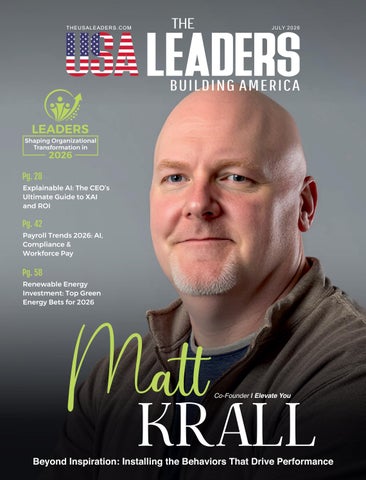
Ma
Co-Founder | Elevate You
KRALL
Beyond Inspiration: Installing the Behaviors That Drive Performance
EDITOR’S LETTER
Where Strategy Ends, Real Transformation Begins!
D
ear Readers,
Every era of business claims to be a turning point, but few decades have tested leadership as thoroughly as this one. Organisations are being asked to move faster, think clearer, and hold their people together under pressures that no strategy document ever anticipated. This issue, “Leaders Shaping Organizational Transformation in 2026,” looks closely at the individuals rebuilding how businesses grow, lead, and endure, proving that transformation is never accidental. It is engineered, practised, and led by people willing to do the unglamorous work first. On the cover, Matt Krall, Co-Founder of Elevate You, opens with a memory of an ordinary Tuesday afternoon, the moment when even the most carefully built strategy quietly starts to fail. After climbing all the way to President and Chief Operating Officer, he discovered that vision means little if the people executing it lack the behavioural capacity to hold together under pressure. That realisation, sharpened by watching an organisation lose fifty million dollars to a culture too nice to have hard conversations, became the seed of Elevate You. Built on habit science rather than inspiration alone, the platform installs five behavioural anchors through ten minutes of daily practice, closing what Matt calls the Capacity Gap, the distance between what people know and what they can actually do when it matters. Across sixteen pilots and hundreds of participants, attrition has fallen and performance has climbed, proof that behaviour, once installed, does not fade the way motivation so often does. This issue also features Randall René, Founder and Chief Consultant of Waypoint 33; Cheryl Beqaj, Founder and CEO of Stone Transformation Inc.; Michael Larkin, CEO and Founder of SC Media Partners LLC; and Brano Vargic, Founder and CEO of Talent Square, each bringing a distinct lens to how modern organisations navigate change. Together, these leaders remind us that transformation is rarely loud or sudden. It shows up in quiet decisions, repeated practices, and the willingness to tell the truth when silence would be far easier. As this issue makes clear, the future belongs to organisations willing to build the systems their people actually need to rise, not merely survive, when the pressure finally arrives on an ordinary afternoon. Sincerely,
Simran Khan Managing Editor
PUBLISHER
ARCHANA GHULE
EDITOR-IN-CHIEF
THE
USA LEADERS
VIKRAM SURYAWANSHI
FOLLOW US
MANAGING EDITOR
TheUSALeaders
SIMRAN KHAN
PROJECT EDITOR SHADAB MESTRI
PROJECT MANAGERS MAYUR JOHARI AKASH PATIL NIKHIL MAHAJAN
VISUALIZER
MARK DAVIS
GRAPHIC DESIGNER OMKAR URAVANE
HEAD OF DISTRIBUTION & PRODUCTION AAKASH MAHAJAN
leaders_usa the-usa-leaders usaleaders theusaleaders
theusaleaders Office No. 430, 4th Floor, Gera’s Imperium Rise, Opp. Wipro Circle, Hinjewadi Phase 2, Pune, Maharashtra - 411057.
+1 (850) 564-8517
info@theusaleaders.com
www.theusaleaders.com
HEAD OF OPERATIONS ROBERT SMITH
RESEARCH ANALYSTS JAMES ADAMS
ADVERTISING
MARIA SMITH
THE USA LEADERS IS AN ILLUMINATING DIGITAL PLATFORM THAT DRIVES THE CONVERSATION ABOUT THE DISTINGUISHED AMERICAN LEADERS DISRUPTING TECHNOLOGY WITH AN UNPARALLELED APPROACH.
10
Ma Krall Cover Story
20 Brano Vargic 34 Cheryl Beqaj 48 Michael Larkin 64 Randall René
CONTENT
PROFILES
ARTICLES 28
Explainable AI: The CEO’s Ultimate Guide to XAI and ROI
42
Payroll Trends 2026: AI, Compliance & Workforce Pay
58
Renewable Energy Investment: Top Green Energy Bets for 2026
Ma
Co-Founder | Elevate You
KRALL
Beyond Inspiration: Installing the Behaviors That Drive Performance
Inspiration is a temporary state; behavior is a permanent system. If you aren't actively installing the habits your strategy requires, you aren't leading—you're just hoping. 10 I JULY 2026
COVER STORY THEUSALEADERS.COM I 11
COVER STORY
T
here is a moment that Matt Krall returns to, again and again, in conversation and in his work. It is not a boardroom triumph or a product launch or the signing of a consequential deal. It is, in his telling, a very ordinary Tuesday afternoon. The pressure is high. The data is incomplete. The calendar is full. And somewhere in that unremarkable middle hour of an otherwise ordinary workday, the most carefully constructed strategy in the world begins, quietly and almost invisibly, to come apart. Most leaders, when pressed, can identify that moment in their own organizations. They just rarely know what to call it or what to do about it. Matt has spent the better part of his career giving it a name and then building the architecture to fix it. The View From the Top, and What It Actually Taught Him Matt’s career followed a trajectory that most business professionals would recognize as a version of the dream: beginning at the front lines of operations and climbing, deliberately, all the way to President and Chief Operating Officer. What he found at the top, however, was not what he had expected. “I expected that the higher you go, the more the work becomes about strategy, vision, and big decisions,” he says. “And it does. But what I discovered is that none of that matters if the people executing the strategy don't have the behavioral capacity to hold it together under pressure.” The experiences that stayed with him were not the wins. They were the moments he watched talented, well-intentioned people, people who genuinely cared about the work and believed in the mission, fall short. Not because of any deficit in intelligence or effort. But because they had never been given the tools to lead themselves first. They had never been trained in the human skills that determine whether someone can stay clear, stay accountable, and stay present when things get hard. He pauses when he talks about those people. Not with frustration, but with something quieter. A kind of protective regard that tells you these were not abstract case studies to him. These were real colleagues. People he worked alongside. People he genuinely liked. Watching them stay stuck, not from complacency, but from the absence of any system designed to help them grow, is what eventually moved him from operator to architect.
12 I JULY 2026
That pattern, talented people stuck in patterns they couldn’t even see, became the thing Matt couldn’t stop thinking about. And eventually, after enough years of watching it repeat across different organizations and different industries, it became Elevate You. Fifty Million Dollars and the Word That Changes Everything The origin story of Elevate You begins, as Matt tells it, with a number. “The origin story starts with a number: $50 million.” He was part of an organization that lost that sum, not due to a flawed strategy, not due to a market disruption, but because of something far more insidious: a culture that was too nice. He is careful, always, to draw the distinction between that word and another one that sounds similar but operates completely differently. “Nice and kind are not the same thing. Nice avoids the hard conversation. Kind has it, because it cares enough about the person to tell them the truth.” The organization had built a culture of nice. Tenured employees, long past the point where anyone thought to challenge them, had quietly plateaued inside roles that no longer asked anything difficult of them. No one told them the truth. The hard conversations had stopped. The honest assessments had stopped. And in that silence, potential stagnated at scale.
The Silence That Speaks Loudest Ask Matt why strategies fail, and he will not point you toward the strategy itself. “The strategy is sound. The plan is clear. The team is capable. And then pressure hits — a difficult quarter, a leadership transition, a market disruption — and the wheels come off.” What he observed, over and over across his career, is that the failure point is a specific and stubbornly consistent gap: the distance between what people know and what they can actually do when the pressure is on. He calls this the Capacity Gap, and it reveals itself in a pattern that most organizations, if they look honestly, will recognize. High engagement. Low confidence. The math does not add up, and that is exactly the point. Survey the average organization, and people will tell you they care. They believe in the work. They are engaged. But ask whether they feel equipped to perform under real pressure, to have the hard conversation, to make a call without perfect information, to hold a standard when it is uncomfortable, and the room goes quiet. “That silence is not a motivation problem,” he says. “It is a behavioral capacity problem. And most organizations have never had a system designed to solve it.” Not Inspiration. Installation.
“That made me angry,” he says. “Not at them, for them. Because they deserved better.” What they deserved, in his view, was a system that would help them grow rather than a culture that would quietly let them stagnate. That system is what Elevate You is. Not a workshop. Not a wellness application. A real, structured, science-backed mechanism for installing the behaviors that make people, and the organizations they work within, genuinely better. He does not dress this up or soften the edges. He sat with that anger long enough to turn it into something useful. The question he kept returning to was not “how did this happen?” It was harder than that: what would it actually take to fix it? Not a values refresh. Not a new set of competencies on a slide deck. Something that would work when the pressure came back, because the pressure, in his experience, always comes back.
The traditional model of leadership development is built on a faith in inspiration. Bring people into a room, create a compelling experience, send them back to their desks fired up, and trust that the energy carries forward. It rarely does. Within weeks, often days, the pressure returns, the old patterns reassert themselves, and the workshop might as well have never happened. Most leaders have felt this. The post-retreat energy that evaporates by Thursday. The keynote that moved the room and changed nothing. “That’s not a failure of the content,” he says. “It’s a failure of the model. Inspiration is not installation.” Elevate You is built on a fundamentally different understanding: behavior change is a neurological process, not an emotional event.
THEUSALEADERS.COM I 13
COVER STORY
The foundation of the system draws on habit formation research, specifically Lally et al.’s findings that automaticity, the point at which a new behavior becomes genuinely automatic, requires an average of 66 days, with some behaviors taking up to 254 days to solidify. On the basis of that science, Matt built a 48-week system that installs behavioral capacity the way the brain actually constructs it: through progressive, repeated practice embedded in the flow of real work. The system is organized around five behavioral Anchors: Clarity over Noise, Ownership over Blame, Courage over Comfort, Collective over Self, and Energy over Exhaustion. These are not values printed on a lobby wall. They are practiced daily, in 10 minutes per person, woven directly into the existing workflow, requiring no new meetings, no separate platform, and no workshop disruption. “The result is not inspiration that fades. It’s behavior that sticks, because it’s been installed at the neurological level.”
A leader can know, in the abstract, exactly what the right response looks like. They can articulate it clearly in a calm setting and still, when the stakes are high and the timeline is short, revert to a pattern that undermines everything the training was supposed to build. “That’s not a character flaw,” he says. “That’s neuroscience.” The only way to close the gap between knowing and doing under pressure is not more knowledge. It is more practice, specifically the kind of deliberate, repeated, in-context practice that builds new neural pathways strong enough to hold when things get genuinely hard. The Equation: A Sequence That Cannot Be Skipped
There is a reason that smart, trained, well-meaning leaders still make the wrong call under pressure. Matt calls it the Neurological Bottleneck, and understanding it is central to everything Elevate You does.
Most behavior change programs fail, Matt argues, because they begin in the wrong place. They move immediately to activation, presenting the new behavior and asking people to immediately implement it. And for a week or two, people try. But willpower is a finite resource, and without the right foundation, the new behavior collapses the first time real pressure arrives.
Under stress, the brain defaults to its most practiced pathways. If the most practiced pathway is avoidance, that is what emerges. If it is over-control, that is what emerges.
The framework at the heart of Elevate You, which he calls The Equation, addresses this through a precise sequence of four phases.
When the Brain Defaults to Survival
14 I JULY 2026
First comes Awareness, which he describes as “The Sensor,” the ability to interrupt the autopilot state and see a pattern that was previously invisible. Then comes Alignment, or “The Logic,” the process of connecting that pattern to something that matters personally to the individual. Only then does Activation, “The Engine,” become viable: the actual behavioral practice now has something genuine to anchor to. The final phase, Amplification, is “The Scale,” the point at which behavior becomes automatic and begins to spread through the team and into the culture itself. “Skip Awareness and Alignment, and you’re asking people to change behaviors they can’t yet see, for reasons that don’t yet feel personal. That’s why most programs fail. The sequence isn’t optional. It's the mechanism.” What makes this measurable is that each phase carries its own leading indicators, tracked weekly rather than waiting for an annual engagement survey. The metrics include language adoption, recovery speed, peer feedback velocity, and decision autonomy, all of them behavioral signals that shift before business results move. Seeing What Was Always Invisible For all the sophistication of modern enterprise dashboards, Matt points out a remarkable gap. Leaders can see revenue, inventory, and spend in real time. But when asked how their culture is performing today, they typically point to an engagement survey conducted six months ago. “That’s like trying to fly a plane by looking at a photograph of the instrument panel from last year.” The Visual Pulse is Elevate You’s answer to that gap. It is a real-time behavioral diagnostic that surfaces the leading indicators behind performance, the signals that appear before performance outcomes materially change. Recovery speed: how quickly does a team pivot back to an Anchor behavior after encountering friction? Peer feedback velocity: Is accountability becoming a cultural standard, or is it still resting entirely on the manager’s shoulders? Language adoption: Is the team using a shared operating language to navigate pressure? Decision autonomy: Are people making better calls without excessive escalation? The data from Elevate You’s pilots speaks clearly. Across 16 structured pilots with approximately 400 participants, the results have been consistent. In one cable provider contact center, attrition declined 30% over six months, in an industry where annual turnover routinely exceeds 40%.
‘‘
The most powerful thing a leader can do is not protect people from hard truths. It’s to build the conditions where hard truths can be spoken, heard, and acted on, safely, consistently, and over time.
Calls per hour improved 12%. One-call resolution improved 15%. Matt notes that these results mirror Oxford University research almost exactly, in which productivity gains were driven by behavioral and emotional capacity rather than longer hours or harder management. Equally significant is what the behavioral data itself reveals: weekly practice completion rates are running above 60% and climbing over time. Most leadership initiatives see participation drop sharply after launch. The fact that engagement is rising is, for him, a leading indicator of genuine behavioral stickiness. “People are not just completing the practice. They’re finding value in it.” The Skills That AI Cannot Replicate As 2026 accelerates the pace of organizational transformation, Matt is watching a paradox unfold at the center of every talent and leadership conversation. The World Economic Forum’s Future of Jobs Report 2025, which surveyed over 1,000 employers across 55 economies, identified the skills most critical over the next decade as almost entirely human: resilience, adaptability, analytical thinking, creative thinking, leadership, emotional intelligence, and curiosity. McKinsey’s research arrives at the same conclusion from a different direction: as artificial intelligence absorbs routine and technical work, the economic value of the human workforce concentrates in the relational, emotional, and judgment-based capacities that AI cannot replicate.
THEUSALEADERS.COM I 15
COVER STORY The paradox is this: these human skills appear on every leadership competency model. They are cited in every future-of-work report and embedded into nearly every modern talent strategy. And they are almost never trained in a lasting way. “AI will grow. Ambiguity will increase. The pace of change will not slow down,” he says. “And in that environment, the leaders who will be most effective are not the ones with the best technical strategies. They are the ones with the highest behavioral capacity.” The shift he believes leaders must make is specific: from knowing to doing under pressure. From managing others to leading oneself first. From inspiration to installation. He frames it plainly as the defining leadership challenge of the decade ahead, and argues that the organizations that build systems to address it now will develop a compounding advantage that is genuinely difficult to replicate. The Tuesday That’s Already Happening Right now, somewhere in your organization, it is 2:00 PM on a Tuesday. The strategy is sound. The plan has been communicated. The people in the room are smart, and they care. And the pressure building in that meeting, on that call, in that inbox, is quietly asking your culture a question that no engagement survey will ever capture: can your people actually hold it together when it gets hard? Not in theory. Not in a calm setting where they can articulate the right answer. Right now, today, under real conditions.
Matt Krall built Elevate You because he needed it first. He watched the cost of not having it, to the tune of $50 million, and an entire generation of talent that deserved more than the culture they were handed. He has spent years building the system he wished had existed.
Most leaders, if they are honest with themselves, already know the answer. They have felt the silence in the room that should have had a hard conversation. Watched a standard quietly erode because no one wanted to be the person who named it. Sat in the meeting where the decision got deferred, again, not because the information was not there, but because the behavioral capacity to act on it was not.
The question is not whether your organization needs this. It almost certainly does. The question is what you will do the next time it is 2:00 PM on a Tuesday, the pressure is high, the data is incomplete, and your human system has to decide: default to survival, or rise to the standard you actually set for it.
That is not a people problem. That is a system problem.
That moment is coming. It may already be here.
And the most uncomfortable part is this: it is fixable. But only if you stop treating behavioral capacity as a given, and start treating it as something that must be built, deliberately, with the same rigor you bring to every other system in the business.
16 I JULY 2026
LEADERS SHAPING ORGANIZATIONAL TRANSFORMATION IN 2026
Matt Krall
Brano Vargic
www.goelevateyou.com
www.jobstalentsquare.com
Cheryl Beqaj
Michael Larkin
www.stonetransformation.com
www.SCMediaPartnersLLC.com
Randall René
www.waypoint33.com
18 I JULY 2026
Founder and CEO I Talent Square
20 I JULY 2026
THEUSALEADERS.COM I 21
It was here that two threads of his experience - deep HR understanding and hands-on tech leadership - started to converge. Not just an HR person dabbling in tech or a coder guessing at HR, Brano brought both fluencies together. Rewriting How Talent Sourcing Happens
In today’s fast-moving startup world, growth often outpaces understanding. Companies scale rapidly, sometimes overlooking the people driving that momentum. But leaders like Brano Vargic, Co-Founder and CEO of Talent Square, don’t just follow the pace - they rethink the playbook altogether. Brano’s career is anything but linear. He moved across industries, roles, and geographies by design - not by default. His goal? To understand business from every angle. Grounded in a master’s in HR and organizational development, and shaped by a PhD exploring how organizational and national cultures influence business & leadership behavior, Brano built a foundation rooted in people, systems, and context. He began in consulting at the Hay Group, focusing on leadership, performance and reward strategies. But a turning point came when a client - CEO of one of Central Europe’s leading banks - invited him to become his HR Director. It was Brano’s first move from advising to building and executing. That led to broader roles: M&A Program Manager, then six years in Southeast Asia as COO in consumer finance and life insurance, where he led major digital transformations. In Southeast Asia, he got his full flavour of what digitalization really means. As he puts it: “The speed of innovation adoption in that region is neck-breaking. I learned how to integrate, test, pivot, and do it all again - sometimes within days.” It wasn't just about technology - it was about rethinking service delivery from a digital-first perspective, with customer experience at the center. This part of the world played a defining role in shaping Brano’s product mindset and tech skill set.
22 I JULY 2026
Talent Square didn’t begin as a big idea - it started as a bottleneck. Brano and his team were knee-deep in social media campaigns, promoting job openings on social media for their clients manually. Each campaign needed a PPC expert, creative input, and constant management. It was slow, expensive, and impossible or at least super pricey to scale. Meanwhile, Brano was watching other industries leap forward. Shopify turned anyone into an online seller. YouTube turned anyone into a creator. Canva made anyone a designer. Why hadn’t HR marketing caught up? That question lit the fuse. The team set on to build a do-it-yourself platform that let recruiters run their own targeted job ad campaigns without agencies or marketing teams. Just log in, upload a job description, and let the AI handle targeting, copywriting, and campaign execution. Crucially, Talent Square was built to reach passive candidates - the 70% of the workforce who aren’t actively job hunting on job boards but might still be open for a new job, should the right opportunity present itself and is presented in attractive verbal and visual format. It wasn’t built overnight. Before launching full automation, Brano and his team manually ran hundreds of social media job campaigns across different industries and regions. This became Talent Square’s “secret sauce.” That real-world testing helped the team gather the data and insights needed to train their targeting algorithms - not in theory, but in practice. In one test, Talent Square’s platform went head-to-head with a top PPC expert. Same job vacancy, same social media budget, same audience. Manual targeting set-up vs. AI driven automated targeting. The AI-driven campaign delivered the same number of leads but did it faster, with almost zero setup time, and at half the cost. Clients report lowering their cost-per-lead by 40% and cutting campaign deployment time from hours to minutes.
“And if you fail, you’ll still walk away with more knowledge than you could ever gain by playing it safe.” THEUSALEADERS.COM I 23
Recent research shows that campaigns using dynamic targeting and behavioral data achieve up to 3x higher click-through rates, and 83% of TA leaders say efficiency is now their top priority given stagnant or shrinking recruitment budgets.
“Don’t let fear or overthinking hold you back. Try it so you don’t live with regret.”
From Smarter Ads to Sharper Hires Talent Square brings performance marketing precision to talent sourcing. At the moment, the platform is fully integrated with Facebook and Instagram, enabling users to launch campaigns quickly and effectively. The team is actively working on new social media integrations, with TikTok next in line (decision on TikTok as the next integration is based purely on users’ demand). The ultimate vision is to embed AI that not only executes campaigns but also advises users on how to split their social media budgets across various social platforms - based on an analysis of the company’s industry and the complexity of the position they’re hiring for. This is a game-changer for companies hiring in multiple locations or in highly competitive sectors. It’s gaining traction in Europe, where lean recruitment teams must stretch every euro. Brano is now actively looking for early adopters in the U.S., knowing the market is fundamentally different - faster, louder, and more saturated. “You can’t just transfer a European playbook here,” he says. “We’re finding our way, one conversation at a time.” Beyond visibility, Talent Square focuses on conversion: how many people click, land, and express interest. Campaigns can go live across Meta platforms in seven clicks and seven minutes. The system transforms job descriptions into sharp, engaging ads, complete with visuals, tone of voice, and smart targeting.
24 I JULY 2026
And the market is following this shift. According to another recent industry research, 74% of employers now say social media is their most important employer branding channel, and over 50% plan to increase spend on social recruiting in 2025. This reflects a broader reality: job boards are no longer the first stop for talent - attention has moved to scrollable, story-driven platforms like Instagram, TikTok or LinkedIn. The platform also introduces tools typically out of reach for small and mid-sized businesses. First among them is an AI-powered hate speech manager, already used in the last two presidential campaigns in Central Europe, now embedded into Talent Square campaign manager to moderate ad comments in real time and protect employer brands. Next in line is an AI voice screening assistant, currently being integrated and expected to go live by the end of summer 2025. This assistant will conduct first-round interviews and provide a traffic light evaluation to help recruiters quickly assess fit. In the future, a video AI creator will also be added, enabling users to produce entire campaigns - visuals, copy, and assets - without needing external help. Especially for SMEs – without marketing or HR departments but in need of candidates – the do-it-yourself aspect of the platform is a key to efficiency. Together, these tools streamline workflows and provide enterprisegrade protection without the enterprise price tag. Reframing the Talent Mindset More than a talent sourcing platform, Talent Square encourages teams to rethink talent itself. Brano believes no candidate is ever the wrong candidate just not the right one yet. Proactive recruitment is key here: with various AI-powered talent matching tools now available, companies can evaluate role-fit for all applicants - not just those suited for the current vacancy.
Recruitment today is a long game. Building a pipeline isn’t just a tactic - it's the strategy. Spreading the Message Changing how companies find talent isn’t just about building software it’s about shifting mindsets. Education is built into Talent Square’s DNA. The team regularly publishes insights, hosts webinars, and speaks at events to help recruiters rethink what’s possible. “Evangelization is part of our daily work,” Brano says. “We’ll talk to anyone who’s willing to listen.” That conversation often begins with apprehension around automation and AI - particularly the fear that these tools might eventually replace recruiters. But Talent Square sees it differently. Automation isn’t about cutting people out; it’s about clearing the clutter. By taking over repetitive, time-consuming tasks like campaign setup, ad targeting, and initial screenings, AI gives recruiters time back to focus on what they do best: building relationships, collaborating with hiring managers, and shaping candidate experience. Candidates who aren’t selected today can still be screened, tagged, and revisited later for potential roles in various organizational areas - sales, compliance, risk, customer services and others. Talent Square supports this mindset by enabling recruiters to build long-term talent pools and maintain employer visibility beyond the immediate hiring cycle. Brano often asks: How can rejected candidates become company brand ambassadors - or even clients - if they aren’t already? In a hiring climate where candidates are bombarded with options, employer branding isn’t a bonus - it’s a baseline. HR leaders are responsible for making sure their company stays top-ofmind. Every interaction, even those that end in rejection, leaves a lasting impression. And if you’re not converting a candidate into a hire, perhaps you can convert them into an advocate. We often talk about customer and employee experience, next in line is candidate experience and specially rejected candidate experience.
It also empowers recruiters in a way that’s long overdue. No more waiting for agency-designed visuals or hoping internal marketing makes your hiring campaign a priority. With Talent Square, recruiters can launch professionally branded, highperforming campaigns on their own quickly, easily, and without bottlenecks. This belief guides every customer interaction. Whether walking someone through performance data or speaking at industry events, the team doesn’t just promote the
THEUSALEADERS.COM I 25
product - they help reframe recruitment itself. “If we want the industry to change,” Brano says, “we have to do more than sell - we have to teach.” And the industry is listening. The majority of HR leaders now rank social media as their top channel for employer brand visibility, and 61% believe AI-powered advertising will be critical for staying competitive in recruitment over the next two years. Wearing Every Hat Running a startup is rarely glamorous. Brano might be jumping from investor calls to product sprints to legal paperwork in a single day. He describes it like “juggling ten tennis balls while forty more are on the floor.” Yet Brano wouldn’t trade it. “The pace is insane, but I’ve learned one thing - momentum is everything,” he says. “No matter how chaotic the day gets, I try to always zoom out and see the bigger picture. It’s easy to drown in the operational grind, especially in a startup. But if you don’t keep your eye on where you’re going, you’ll just keep running in circles. My job is to steer the ship, even when I’m in the engine room.” That mindset has already paid off. Talent Square was bootstrapped from day one - no venture capital, just belief, sweat, and resolve. Since launch, the company has been selected as a semifinalist at the Slovak Startup Awards and joined the Fast Forward accelerator program. It’s also earned early recognition from global HR tech communities and startup watchers.
26 I JULY 2026
What makes Brano proudest isn’t the awards, though - it’s what they represent. “We built all this in just over a year,” he says. “A tiny team, no outside funding, and a ton of conviction. That’s what it takes.” A Founder’s Mindset For Brano, success isn’t just about the hire. It’s about impact, speed, and adaptability. Metrics like impressions and clicks matter - but only if they lead to real conversations. Recruitment, in his view, should borrow from e-commerce: track the full funnel and keep optimizing. “Hiring is not a form you fill out,” he says. “It’s an active, strategic effort. I’m always asking: what’s our conversion rate? How do we improve it? What’s the drop-off? If we treated job ads like e-commerce campaigns, we’d get way better results - and we’d stop pretending job boards are enough.”
This performance-driven mindset runs deep at Talent Square. It’s about empowering teams to move fast, test continuously, and improve what works. “I don’t believe in vanity metrics,” Brano adds. “Likes and shares don’t matter if no one applies or engages. We care about outcomes. That's how you build a hiring engine that actually works.” He’s also cautious about how the industry defines success. “Everyone talks about cost per hire,” he says. “But from my experience, it’s a tricky measure. When I was CHRO, we changed the definition of cost per hire multiple times over five years. There were long debates - should the cost of the HR IT system be included? Should it reflect time-to-fill or the rigor of interview rounds? Even within the same company, cost per hire can vary wildly between departments. Some hiring managers prioritize speed, others prioritize fit. It’s not one-size-fits-all.” This clarity and discipline also extend into how Brano approaches partnerships and investment. “Don’t chase capital. Chase alignment,” he says. “One good partner beats ten wrong ones. I’ve learned that the hard way. I don’t want just money - I want people who understand what we’re building and why.” That founder mindset became even more important as Talent Square began seeking early adopters in the U.S. “The American market is a different ball game,” he explains. “You need traction, storytelling, and presence - fast. But you also need people who believe in you before the big numbers show up.” Rather than chasing scale for its own sake, Brano is focused on finding the right footholds: smart partners, ambitious clients, and early believers. “We’re not selling hype. We’re building trust.” That trust is also guiding the company’s go-to-market strategy. Talent Square is zeroing in on industries where traditional sourcing tools fall short and the candidate pool lives online - on platforms like Facebook and Instagram. These include healthcare, hospitality, logistics, skilled trades, manufacturing, and staffing agencies - sectors all grappling with persistent talent shortages. And as the platform expands its integrations to include additional social media channels, that list will only grow.
Off the Clock Outside the startup world, Brano’s days are often defined by school runs, cooking dinner, and long walks with his dog. “That's where I do most of my thinking,” he says. “Walking clears the head. It's where I try to make sense of things, even when there's no time to truly unplug.” With three children and a business that never really sleeps, true work-life balance is more of a theory than a daily reality. “I try to be present,” he admits. “But when you’re building something from the ground up, the lines blur. Your mind keeps running long after the laptop closes.” Still, that effort to stay grounded matters. Long-distance friendships - from Vietnam to Europe - remain a vital part of his life. “Some of my closest friends are thousands of miles away, but I try to keep them close,” he says. “They remind me who I am outside of my job title.” “What I do know is this: building a company forces you to confront yourself constantly. Your strengths, your limits, your blind spots. And if you’re lucky, your values get sharper with every step.” A Word for the Brave If there’s one thing Brano has learned from his journey from corporate boardrooms to startup chaos - it’s that courage isn’t loud. It’s quiet, persistent, and often invisible from the outside. “I’ve worked with some incredible people,” he says. “And the bravest ones aren’t always the ones giving speeches or raising funding rounds. They’re the ones who show up every day, stay in the game when it gets tough, and do the work nobody sees.” His advice to fellow founders or anyone at a crossroads? Don’t confuse noise with progress. “There’s a lot of noise in the startup world. A lot of chasing the next big thing. But your path doesn’t have to be loud to be real.” “Find your pace. Surround yourself with people who care more about building than bragging. And if you can build something that makes others better. That’s the best kind of success.”
THEUSALEADERS.COM I 27
28 I JULY 2026
Explainable AI The CEO’s Ultimate Guide to XAI and ROI
P
icture this: your company’s biggest decisions are being driven by an algorithm you can’t question. A ‘black box.’ What if it’s wrong? You could be facing massive fines, a public relations nightmare, or even serious legal trouble. It’s a terrifying thought, isn’t it? This isn’t about ditching powerful AI; it’s about making it smarter and safer. We’re talking about transforming that inscrutable black box into a transparent, auditable partner you can actually trust. That’s the incredible power of Explainable AI (XAI). This isn’t just some tech buzzword; it’s the absolute key to responsible leadership and building a futureproof legacy in our rapidly evolving world. Forget ‘optional’—in today’s AI-driven world, this is the cornerstone of winning. Let’s dive in!
● The Transparent Genius: Now, picture an equally brilliant analyst who not only gives you spot-on forecasts but also walks you through their entire thought process, step-by-step. They highlight the key data and explain the logic behind every single decision. That’s XAI in a nutshell. It provides that level of justification, making AI insights verifiable, trustworthy, and ready for action. It’s super important to remember that XAI isn’t a type of AI. Instead, it’s a framework we apply to AI models. Think of AI as the car’s engine, and XAI as the dashboard that tells you exactly how the engine is performing, ensuring the entire system is accountable and makes sense. 2. The Business Imperative: Why XAI is Your New Competitive Advantage ● De-Risking Your Operations & Ensuring Compliance
Let’s Explore Explainable AI 1. What is Explainable AI (XAI)? From Black Box to Glass Box So, what on earth is Explainable AI? At its heart, XAI is a set of tools and methods that crack open the AI “black box” so we can see what’s happening inside. It’s all about making an AI’s decisions understandable to us humans. The goal is simple: to get clear answers on how and why an AI reached a specific conclusion, turning mysterious predictions into transparent “glass box” insights. ● The Enigmatic Analyst Analogy: Imagine you have a brilliant analyst who’s always right but flat-out refuses to show their work. Their results are amazing, but you’re totally dependent on them and have no idea if their process is sound or biased. It feels risky, right?
Let’s be honest, nobody wants a run-in with regulators. In a world of increasing oversight, XAI is your secret weapon for navigating tricky rules and cutting down operational risks. - Stay Ahead of the Law: Regulations like the EU’s GDPR and the upcoming AI Act demand that automated systems be transparent. XAI isn’t just helpful; it’s becoming a requirement for compliance. - Spot Errors and Bias: XAI helps you find and fix flaws in your AI models, leading to sharper, more accurate decisions. - A Real-World Win: One bank used an explainable AI for its credit scoring, and the results were stunning! They saw a 20% drop in false negatives and a 15% boost in approved loans to deserving communities, all while keeping their risk management solid. That’s impressive!
THEUSALEADERS.COM I 29
- Build a Foundation of Trust: By making model behavior clear, XAI establishes trust, transparency, and accountability. This protects you from the headaches of opaque models, especially in critical fields like finance and healthcare.
● Empowering Your Entire Organization for Superior Decision-Making XAI is a game-changer because it takes AI out of the exclusive hands of data scientists and gives its power to everyone in your organization.
● Building Unbreakable Trust with Stakeholders Trust is the ultimate currency in business, isn’t it? For AI to truly succeed in your organization, everyone from your customers to your own team needs to believe in it. - Boost Confidence: XAI does this by showing exactly how models work, building incredible confidence with customers, employees, and regulators. In fact, companies that go all-in on explainable AI report up to a 35% jump in customer trust and a 25% dip in AIrelated risks. - Win Over Your Team: When your people can understand the “why” behind an AI’s suggestion, they’re far more likely to embrace it in their daily work. This melts away skepticism and makes change so much easier. - Ensure Ethical Marketing: This transparency allows you to check for accuracy and fine-tune your strategies, ensuring your marketing is both effective and ethically sound. ● Accelerating Innovation & Slashing R&D Costs
- Clarity for Everyone: With explainable models, even your non-technical team members can grasp the logic behind an AI’s recommendations. This leads to better feedback and more creative uses of the technology. - A Doctor’s Second Opinion: In medical imaging, for example, XAI can highlight suspicious areas on a scan for a doctor to review. This speeds up diagnosis and dramatically reduces the chance of missing something critical. What a lifesaver! - Smarter Financial Moves: In the fast-paced world of finance, AI algorithms can sift through mountains of news to gauge market sentiment. XAI explains why the sentiment is positive or negative, giving traders the timely, trusted information they need. - Democratize Data Science: By making analytics more accessible, XAI helps build AI literacy across your company. It allows more people to work on projects, creating a culture of accountability and improving data quality across the board.
Who wouldn’t want to innovate faster and for less money? Explainable AI makes that a reality by making the entire development process smoother and more efficient.
3. XAI in Action: Real-World Use Cases and Examples
- Debug in Record Time: By giving you a clear window into the AI’s mind, XAI lets your teams spot errors, biases, or inefficiencies in a flash. That means less time troubleshooting and more time making strategic leaps forward.
In the financial world, where a single decision can change a person’s life, explainability is everything.
- Nip Bias in the Bud: XAI helps you catch potential biases early in the testing phase before they snowball into massive, expensive problems down the line. - Future-Proof Your Models: The ability to constantly audit your AI models helps you shield your business from unexpected challenges, which ultimately leads to lower maintenance and retraining costs.
30 I JULY 2026
● Finance
- Fairer Lending: ZestFinance uses its ZAML platform with XAI to assess credit risk. This allows banks to understand why an applicant was approved or denied, leading to fairer decisions, even for people with thin credit files. - Smarter Fraud Detection: PayPal analyzes millions of transactions in real-time to stop fraud. With XAI, they can quickly understand why a transaction was flagged, making the review process much smoother.
- Audit-Ready Compliance: XAI helps financial firms provide clear explanations for their risk assessments, speeding up compliance reviews by over 40%. Now that’s efficiency!
● Retail
● Healthcare
- Truly Personal Recommendations: XAI offers a peek behind the curtain of recommendation engines and churn predictors. By understanding why a product is recommended or a customer is likely to leave, retailers can perfect their strategies.
Here, the stakes are literally life and death, and XAI is acting as a trusted co-pilot for medical professionals. - Optimized Treatment Plans: IBM’s Watson Health analyzes colossal amounts of medical data to suggest the best treatment paths for diseases, explaining its reasoning to doctors every step of the way. - Clearer Diagnoses: Google DeepMind developed an AI that can spot retinal diseases from scans and—crucially—provide the basis for its diagnosis, helping doctors explain the results clearly to anxious patients.
In the competitive retail space, XAI is building deeper, more genuine connections with customers.
- Building Customer Loyalty: When marketers can validate an AI’s output, like a customer segmentation model, they can provide more targeted feedback and build models that truly align with their goals. This means they can even explain to customers why a recommendation was made, boosting trust and satisfaction. 4. The Modern AI Landscape: A CEO’s Field Guide ● The 4 Types of AI
- Enhanced Cancer Detection: PathAI, an AIbased system, helps pathologists analyze tissue samples to diagnose cancer with greater accuracy. In medical imaging, XAI can also highlight the specific variables in an MRI that point to a suspicious area. - Improved Hospital Flow: A hospital network that used an ethical AI framework for patient triage saw a 30% improvement in resource allocation and cut wait times by 25%. Amazing! ● Manufacturing On the factory floor, XAI is driving efficiency and quality to new heights.
To lead effectively in the age of AI, it helps to understand the different levels of intelligence we’re working with. Think of it as a ladder: - Reactive Machines: This is the most basic AI. It follows pre-programmed rules and reacts to the present moment. It has no memory of the past. The classic example is Deep Blue, IBM’s chess computer that could see the board and make a move, but couldn’t learn from past games. - Limited Memory AI: This AI can learn from recent history to make better decisions. Its memory is short-term, but it’s enough to be incredibly useful. Autonomous vehicles are a perfect example, using recent observations of traffic to navigate safely.
- Predictive Maintenance & Quality Control: By explaining AI decisions, manufacturers can optimize workflows, spot problems, and predict equipment failures before they happen, saving a fortune in downtime.
- Theory of Mind AI: We’re not here yet! This is a theoretical future AI that could understand human emotions, beliefs, and intentions. It would be able to interact with us on a truly empathetic level.
- Massive Defect Reduction: One automotive manufacturer integrated an XAI solution into its quality control process and achieved a jawdropping 40% reduction in defects while improving regulatory traceability.
- Self-Aware AI: This is the stuff of science fiction... for now. A self-aware AI would have its own consciousness and sentience. It’s a fascinating concept that raises all sorts of deep philosophical questions.
THEUSALEADERS.COM I 31
● Generative AI vs. Explainable AI Generative AI (think models that create text, images, or code) and Explainable AI aren’t enemies; they’re two sides of the same powerful coin. Generative AI is exploding—a survey found 79% of CEOs see it as a top tool for accelerating innovation. But here’s the catch: these powerful models can be total black boxes. They can also “hallucinate,” meaning they generate information that sounds perfectly plausible but is completely wrong. This is where XAI becomes absolutely critical. It provides the transparency we need to check the accuracy of Generative AI’s output, catch biases, and prevent the massive business risks that come from acting on bad information. ● Deep Dive: The ChatGPT Question So, can you trust ChatGPT’s explanations? The short answer: not in the way you think. While ChatGPT can generate text that sounds like a reasonable explanation for its answer, it’s not showing you its actual internal calculations. It’s essentially creating an explanation after the fact based on all the data it was trained on. This is a huge distinction. It’s describing why it thinks something, not how its algorithms actually got there. For a leader, this presents a major trust issue. Relying on these posthoc rationalizations for high-stakes decisions is like navigating with a map drawn after the journey is over—it’s the black box problem all over again, but with a convincingly human voice. ● Decoding the Hype: Elon Musk, xAI, and the Future It’s crucial not to mix up the company xAI with the concept XAI. They’re completely different things!
- Valuation & Products: At the time of the acquisition, xAI’s private valuation stood at an eye-watering $80 billion. Its main product is Grok, a conversational AI built into X, designed to have a witty personality and access to realtime information. The company also plans to offer enterprise APIs. - Key Relationships: xAI relies heavily on suppliers like Nvidia for the powerful GPUs needed to train its large-scale AI models. The company has also stated a focus on tackling the “hallucination” problem in current AI, hinting at a future push toward more reliable and perhaps even explainable outputs. My Opinion Within the next five years, deploying noninterpretable AI for critical business functions will be viewed not merely as a risk, but as a form of corporate negligence. The societal, regulatory, and economic pressures for transparency are rapidly escalating, making the opaque “black box” approach completely unsustainable. AI systems now influence everything from loan approvals to medical diagnoses, and they demand an ethical, auditable foundation. Explainable AI is no longer a technical nicety or a competitive edge; it is rapidly becoming a non-negotiable pillar of responsible and profitable corporate governance. As a leader, you must proactively weave XAI into your strategic plans to guarantee trust, ensure compliance, and drive long-term shareholder value. This is how you safeguard your organization and foster a culture of true, verifiable innovation.
- The Company: xAI was founded by Elon Musk in 2023 with the ambitious mission to “understand the true nature of the universe.”
● The Rise of “Algorithmic Auditors”:
- The Big Merger: On March 28, 2025, xAI acquired X (formerly Twitter) in an all-stock deal worth a massive $33 billion. This gives xAI direct access to the firehose of real-time data on X—a goldmine for training its models.
Get ready for new C-suite roles like Chief AI Ethics Officer. These leaders will use XAI tools to certify that corporate AI systems are fair, logical, and compliant, stopping bias before it ever affects a customer or employee.
32 I JULY 2026
Here Are Some Future Impacts of XAI
● “Dynamic Personalization” in Education with Justification: Imagine learning platforms that not only adapt to a student’s needs but also explain why they recommend a certain lesson. This will empower students and teachers, boosting motivation by making the AI’s logic clear. ● Resolving Supply Chain Disruptions with Counter-Intuitive Solutions: XAI will allow models to propose and then brilliantly explain optimal, often unconventional, solutions to complex supply chain problems. This will build trust in recommendations that can save millions in delays and costs. ● Hyper-Personalized Medicine with Clinical Rationale: XAI will be the bridge between complex genomic data and the doctor’s office. It will explain to a physician why a specific drug is recommended for a patient based on their unique genetic makeup, enhancing trust and enabling truly personalized care. ● A New Era of Scientific Discovery Through Explained Correlations: AI will find incredible new patterns in vast datasets, and XAI will act as the “scientific translator.” It will explain the “eureka” moment to scientists, showing them how the AI connected the dots and paving the way for a new age of hypothesis and discovery. Feeling inspired? Don’t keep this to yourself! Share this definitive guide with your network, colleagues, and friends to collectively champion a future where AI is not just intelligent, but also transparent, trustworthy, and truly serves humanity.
- Simran Khan THEUSALEADERS.COM I 33
Cheryl
BEQAJ
Paving the Way between Corporate Vision and Human Reality
34 I JULY 2026
Founder and CEO THEUSALEADERS.COM I 35
T
ransformation is a hard, geological word. It suggests immense pressure, tectonic shifts, and the slow, grinding creation of something new from something old. In business, it is a term often wielded like a weapon, a top-down mandate for change that promises efficiency but frequently delivers disruption, confusion, and a dispirited workforce. The landscape is littered with the fossilized remains of grand strategies that failed to take root in the messy, human soil of an organization. This is the world that Cheryl Beqaj, the founder and CEO of Stone Transformation Inc., has set out to reshape. To meet Cheryl is to meet a study in contrast. She is a consulting executive who speaks the language of analytics and ROI, yet her foundational business principle is empathy. She advises on complex digital and supply chain logistics for pharmaceutical giants. Still, her most resonant success story is measured in the thousands of babies born each year thanks to a project she led. In an industry dominated by monolithic firms offering what she calls “rinse-and-repeat solutions,” she has built a boutique powerhouse, a $10 million business with over 40 consultants in just two years, on the radical idea that the most critical element of any business transformation is the human element. Her company, Stone Transformation, is named not for the coldness of change, but for the foundational act of building a solid path. She does not just chart the destination; she is there on the ground, paving the way, ensuring that the vision imagined in the boardroom can actually be walked by the people who make a company run. The Accidental Consultant The path to becoming a transformation guru was not a straight one. It was a pivot born of necessity and a keen sense of self-awareness. Cheryl arrived at Rutgers University with a clear goal: a career in Finance. She was driven, completing her BA in Economics in a compressed three-year timeline, ready to dive into the world of markets and capital. But the economy had other plans. The downturn at the time made finance a difficult field to break into. It was a moment of forced reflection.
36 I JULY 2026
A friend made a suggestion that would alter her trajectory entirely: consulting. It was not a world she had considered, but the more she learned, the more it resonated with a core part of her personality. “I love fixing problems and making processes more efficient,” Cheryl says, reflecting on that pivotal moment. It was this innate desire to untangle knots and create clarity that led her to a role at Accenture. There, she was immersed in the life sciences industry, and something clicked. This was not an abstract world of numbers; it was a sector with a direct, tangible impact on people’s lives. Consulting was not just about optimizing a system; it was about improving a patient’s access to medication or easing a caretaker’s burden. “I fell in love with consulting in the life sciences industry because of the ability to make a real impact in patients’ and caretakers’ lives,” Cheryl recalls. The work was a perfect marriage of Cheryl’s analytical mind and her burgeoning sense of purpose. Her career progressed, and she eventually took on a role at Slalom, a respected consulting firm, where she eventually got promoted to the level of Managing Director, responsible for leading the Life Sciences portfolio and all Account teams in New Jersey. It was there that she connected with Brian Ehlenberger, a colleague who shared her growing conviction that there was a better, more human way to guide companies through change. They saw the same gaps, felt the same frustrations with the industry’s status quo, and nurtured the same vision for a firm that would prioritize people and purpose above all else. The partnership, forged in a shared philosophy, would become the bedrock of Stone Transformation.
“
Missing the human element is the most common mistake I see organizations make during transformation.” Paving the Way: The Stone Philosophy A Vision Forged in Experience The inspiration for Stone Transformation was not an abstract business model conceived on a whiteboard. It was a vision forged in the trenches of realworld projects, crystallized by one experience in particular. Cheryl was advising a pharmaceutical client that manufactured fertility medication. The project was a digital transformation, a phrase that can sound sterile and technical. But for her, the work was deeply personal. “I was able to directly tie the impact of the digital transformation that I was advising on to the thousands of additional babies that were able to be born each year due to their parents having improved access to this medication,” Cheryl says. The line between a logistical improvement and a new life was direct and undeniable. This was the kind of impact that fueled her. “That’s how I see transformation,” she explains, “and why I wanted to create a highly peoplecentric company exclusively dedicated to making positive transformation in the Life Sciences, Healthcare, and Public Health industries.” In 2023, that vision became a reality. Cheryl, alongside Brian Ehlenberger, launched Stone Transformation as a women-owned consulting firm with a clear and audacious mission. They wanted to attract the industry’s best talent not with flashy perks, but with the promise of meaningful work. They sought to partner with like-minded clients, organizations that were not just paying lip service to innovation but were genuinely ready to tackle their most challenging problems in a way that stayed true to their values. They were determined to build a firm that would never lose sight of the people at the end of the supply chain, the patients whose lives hung in the balance.
Cheryl built Stone to solve a fundamental flaw she observed time and again in the management consulting world. “Firms typically fall into two camps,” she explains, “those focused on strategy and those focused on implementation.” One camp delivers a beautiful, ambitious vision, and the other is called in to build it. “But this often leaves a gap between vision and execution.” It is in this gap that transformations falter and fail. Stone was designed to live in that gap, to be the bridge. Cheryl and her team developed a proprietary methodology they call the “Transformation Journey,” a model that spans from “Imagining the Future” to the crucial, often-overlooked middle phase they call “Paving the Way,” and finally to “Realizing Success” through implementation. “Paving the Way” is the connective tissue. It is the detailed work of translating a highlevel strategy into a practical, achievable roadmap, ensuring that the people, processes, and technology are all aligned before a single line of code is written or a new organizational chart is rolled out.
THEUSALEADERS.COM I 37
This bespoke approach is a direct response to the “formulaic, one-size-fits-all solutions” that frustrated her at larger firms. Specializing in the Life Sciences, Healthcare, and Public Health sectors, Stone offers deep expertise in a number of critical Transformation Journeys, including: ● Drug & New Product Launch ● Manufacturing/Supply Chain for Advanced Therapeutics ● Enabling Commercial Marketing & Sales ● Building a Data-Driven Culture ● Patient Services & Engagement ● Agile & Digital Transformation ● AI Ideation & Adoption ● Team Effectiveness & Leadership Coaching This specialized focus ensures clients “Feel the Impact,” achieving measurable outcomes and a real return on their investment.
38 I JULY 2026
“
Strategies and investments only deliver impact when people are engaged, aligned, and empowered to bring them to life.”
The Human Algorithm At the heart of Stone’s methodology is a concept Cheryl champions with the zeal of a convert: Design Thinking. She recognized early on that for any transformation to be successful and sustainable, it had to be designed with and for the people who would be most affected by it. “So much of the human element gets lost when you are a firm that makes the same recommendations over and over for clients,” she says. “I realized that for a transformation to actually stick, you have to involve the people who will be impacted.” This was not just an intuitive feeling; it was a principle she sought to master. She enrolled in the mini-MBA program at Rutgers Business School, focusing specifically on User and Customer Experience, and later returned as a speaker. This human-centered approach is now embedded in every phase of Stone’s work, from their “StAc Labs” (Stone Activation Labs) strategy offering to “Realizing Success” in implementation. This focus is also Stone’s primary defense against the common pitfalls of large-scale projects. Cheryl has seen countless transformations fail for a predictable set of reasons. She has identified several key mistakes that plague almost all unsuccessful transformations:
1. Lack of Leadership Alignment: Senior leadership gets “sold” on the idea but hasn’t dedicated the right level of investment or, more critically, isn’t aligned on the desired outcome.adership gets “sold” on the idea but hasn’t dedicated the right level of investment or, more critically, isn’t aligned on the desired outcome. 2. Passive Project Management: Project managers just “check the box” rather than taking an active role in the transformation’s success. 3. Technology Leading the Strategy: The organization succumbs to “shiny object syndrome,” adopting new tech with no plan for how it will impact employees or be adopted. 4. Discontinuity between Teams: A gap exists between the strategists, the solution designers, and the development teams. 5. A Static Roadmap: The plan has no room for iteration or data-driven decision-making to achieve the desired outcomes. 6. Unclear Success Metrics: There is a lack of clarity on what success looks like or when it has been achieved. To counteract these forces, Stone introduced a unique role into their engagements: the “Transformation Owner.” This individual acts as the central nervous system for the project, a dedicated leader responsible for ensuring alignment, maintaining momentum, and, most importantly, keeping the human experience at the center of every decision.
THEUSALEADERS.COM I 39
Building a Culture of Impact The success of this model has been staggering. To grow into a $10 million business with a team of over 40 consultants in just two years is a remarkable feat in any industry. For Cheryl, the numbers are a byproduct of something more fundamental. “My role is not only to set the vision and strategy but also to support and care for our team,” she asserts. “Creating an environment where people can do meaningful work, collaborate deeply, and have fun along the way.”
At eight months old, he has already become an integral part of the Stone culture. “Desmond loves crashing our Partner and other Leadership team meetings and has become our little mascot,” she says with a laugh. Motherhood, Cheryl shares, has brought the concept of work-life balance into sharp, beautiful focus. She and her husband, Mark, are savoring every moment. It is the ultimate human-centered project, and it has only deepened her conviction that work should support a full life, not consume it. The Bespoke Revolution
Cheryl has seen firsthand how a strong company culture can be sacrificed at the first sign of a business slowdown. “In past organizations, I’ve seen incredible cultures built, only to be abandoned when business slowed—and those organizations quickly unraveled as a result,” she recalls. “At Stone, that is not an option.” Diversity is enshrined as a core value, seen not as a box to be checked but as a key driver of innovation and success. The result is a team that is not just effective, but deeply loyal and collaborative. “The deep friendships we build with our clients are another hallmark of what makes Stone particularly special,” Cheryl adds. The Next Transformation: AI and Motherhood Now, Cheryl is guiding Stone through its next evolution, helping clients navigate the complex world of Artificial Intelligence. Here too, her human-centric philosophy is the guiding principle. While many companies are focused on the technological capabilities of AI, Stone is focused on the human component. “It is critical to consider business value in AI solutions, understand who will use them... and consider how processes might be adjusted to keep humans in the loop,” she explains. She is poised to announce major partnerships with leading AI providers, ensuring Stone remains at the forefront of this technological wave, but on its own terms. This period of intense professional growth has coincided with a profound personal transformation. Cheryl recently gave birth to her first child, a son named Desmond.
40 I JULY 2026
As she looks at the future of her industry, Cheryl sees an irreversible shift. The era of the mega-consultancy is waning. “Clients no longer want to work with large organizations that offer rinse-and-repeat solutions,” she states with conviction. “They want to partner with smaller companies, with consultants who they really know and trust, and solutions that are customized to their needs.” This is the bespoke revolution, and Stone is on its leading edge. But Cheryl knows that providing this level of customized, high-touch service requires a special kind of team. Her final insight is a lesson for any leader. “The only way to provide these services in a genuine way,” she concludes, “is to develop a culture that motivates the elite team of consultants needed to deliver such challenging and meaningful work.” In the end, the secret to transforming a business is no different from the secret to building a great one. It all comes down to the people.
THEUSALEADERS.COM I 41
PAYROLL TRENDS 2026 T AI, Compliance & Workforce Pay
he defining payroll trends of 2026 signal one of the biggest transitions the workforce has seen in years. What was once considered a back-office process is now becoming a critical part of business strategy, employee trust, and regulatory compliance. In 2026, organizations are managing a workforce that is more fragmented, more global, and more dependent on technology than ever before.
Recent payroll sector benchmarks reveal that roughly 45% of enterprises are actively implementing AI-enhanced systems into their payroll and HR ecosystems. However, automation is not an eviction notice for human professionals. “At ADP, we recognize the critical challenges that HR and payroll teams face when it comes to compliance, time management and efficiency,” notes Frank Smits, Senior Vice President of Global Payroll at ADP. “Our new introduction of this ADP Assist agent keeps people at the center with a human-centric approach and empowers payroll teams with the accuracy and support they need to optimize their operations.” The pressure is even higher for enterprises managing remote teams, contractors, multi-state payroll structures, and rapidly changing compliance frameworks. Why Payroll Complexity Is Rising: Key Drivers for 2026 Payroll in 2026 looks very different from what businesses managed just a few years ago. Organizations are no longer dealing with only full-time office employees working fixed schedules. Today’s workforce includes remote workers, part-time employees, contractors, gig professionals, and globally distributed teams.
This shift has created a more fragmented payroll environment where businesses must handle varying tax laws, benefits structures, overtime policies, and payment models simultaneously.
At the same time, governments are tightening compliance standards. Tax authorities across multiple regions are introducing real-time reporting systems through direct API integrations. Payroll systems are now expected to deliver near-instant accuracy, leaving little room for manual corrections or outdated workflows. Another major factor driving payroll complexity is wage pressure. Data from the ADP National Employment Report shows that wage growth for job-stayers has stabilized between 4.4% and 4.5% year-over-year, while the annualized pay premium for job-changers has compressed significantly, hovering between 6.3% and 6.6%. This signals a major shift in workforce expectations. Employees are no longer moving jobs purely for compensation growth, which means organizations are increasingly focusing on retention strategies, financial wellness, and pay accuracy to maintain workforce stability. Businesses are also facing greater pressure to deliver transparency around compensation structures. Employees today expect visibility into: ● Salary bands ● Overtime calculations ● Bonus structures
According to research from ADP Research Institute, tracking the shrinking workweek, part-time jobs now account for 47% of all hourly roles, while average weekly working hours remain close to a seven-year low.
42 I JULY 2026
● Tax deductions ● Benefits contributions
THEUSALEADERS.COM I 43
This is transforming payroll from a finance-only process into an employee experience function that directly influences trust and retention. Key Payroll Trends 2026: The AI Shift Reshaping Operations Artificial intelligence is rapidly becoming one of the biggest forces changing payroll operations in 2026. Businesses are increasingly using AI-powered systems to automate repetitive administrative tasks, improve payroll accuracy, and detect compliance risks before they become larger problems. By leveraging autonomous AI payroll agents, global enterprises are drastically reducing manual data entry errors. These systems are being used for: ● Payroll calculations ● Anomaly detection ● Workforce forecasting
According to Deloitte Human Capital Trends, organizations in 2026 are shifting to dynamic orchestration (the orchestration advantage), where AI supports payroll teams without removing human trust and accountability from critical decisions. Another growing concern is what Gartner HR Practice describes as AI “workslop” – Identified in Gartner HR Practice research as the top productivity drain, caused by an abundance of fast but poor-quality work produced by or with AI. Many organizations rushed into automation without properly integrating systems, creating inefficient workflows that actually increase administrative friction instead of reducing it. As a result, businesses are becoming more selective about how AI is deployed inside payroll ecosystems. The focus is now shifting from aggressive automation to intelligent automation that improves operational efficiency while protecting workforce trust. 2026 Payroll Trends: Cloud-First Systems & Global Scalability
● Benefits administration ● Compliance monitoring One of the biggest advantages of AI in payroll is speed. Modern payroll systems can now identify missing tax information, overtime inconsistencies, or unusual payment activity in real time. This reduces the risk of delayed payments and compliance penalties. AI is also helping businesses move toward predictive payroll analytics. Instead of reacting to payroll issues after they happen, organizations can now forecast labor costs, overtime exposure, and wage liabilities before payroll cycles are completed. However, businesses are also learning that automation alone is not enough. Even advanced AI systems can struggle with complex workforce situations involving multi-state labor laws or international tax structures. This has created the “copilot paradigm” where human oversight validates compliance and localized tax codes. Businesses are no longer asking whether AI should be used. Instead, they are deciding how much decision-making should remain under human supervision.
44 I JULY 2026
As organizations continue to scale across borders in 2026, legacy on-premise infrastructure is completely failing to keep pace with modern operational needs. A major trend dominating the corporate landscape is the total migration toward cloud-first global payroll ecosystems. According to recent HR technology market reports, over 75% of fast-growing enterprises are consolidating their global entities onto unified cloud platforms. This shift is critical for several reasons: ● Cross-Border Compliance: Real-time localization updates ensure that localized benefits, digital nomadic visas, and international contractor regulations are automatically applied. ● Unified Currency Management: Multi-currency processing tools allow centralized corporate finance teams to manage international payroll cycles from a single dashboard. ● Data Consolidation: Eliminating fragmented regional spreadsheets protects organizations against massive data breaches and streamlines enterprise-wide risk management.
Real-Time Compliance: A Non-Negotiable Payroll Trend in 2026 Payroll compliance is becoming more demanding across nearly every industry. Governments are moving toward automated tax verification systems that can monitor payroll activity in real time, creating far greater pressure on businesses to maintain accurate records. Insights from IRIS Software Group indicate that regulators are increasingly adopting API-driven reporting frameworks that instantly compare payroll submissions against tax databases. This means payroll mistakes that once took weeks to identify can now be flagged almost immediately. Businesses are also facing expanding pay transparency laws across the EU, UK, and APAC markets. Employers are expected to provide clearer compensation structures, maintain accurate wage reporting, and reduce pay inequities across workforce groups. For multinational organizations, payroll complexity has increased significantly. Different tax regulations, contractor classifications, benefits structures, and overtime rules can quickly create compliance gaps if payroll systems are not fully integrated. This is one reason payroll is no longer viewed as an isolated finance function. It is becoming part of enterprise risk management.
Because identifying the root causes of data anomalies remains a massive administrative time drain for HR practitioners, providers have pivoted heavily toward proactive tech. This is evidenced by ADP’s recently announced integration of automated AI agents within global payroll systems, built specifically to automatically detect inconsistencies and suggest fixes before the pay cycle ever closes. This is pushing organizations to treat payroll accuracy as a workforce experience priority instead of just an administrative KPI. This matters because workforce expectations are changing rapidly. Employees are becoming more financially conscious due to inflation pressures, rising living costs, and economic uncertainty. Delayed payments or incorrect calculations now have a much greater emotional and financial impact than they did in previous years. Businesses are responding by investing in:
Payroll Accuracy Is Becoming an Employee Trust Metric
● Employee self-service payroll portals
One of the biggest payroll shifts happening in 2026 is the growing connection between payroll accuracy and employee retention. Employees now expect:
● Earned wage access programs
● Real-time payroll visibility
● AI-driven payroll validation systems.
● Faster issue resolution
● Error-free salary processing
Earned Wage Access (EWA), in particular, is becoming a major workforce retention strategy. Employees increasingly want flexible access to earned income rather than waiting for traditional pay cycles. This trend is growing strongly among younger employees and shift-based workforces.
Even minor payroll mistakes can damage workforce trust quickly.
For business leaders, this signals a larger shift: Payroll is becoming part of the overall employee experience strategy.
● Transparent deductions
● Real-time pay visibility
THEUSALEADERS.COM I 45
Organizations that consistently deliver transparent and accurate payroll operations are more likely to strengthen workforce trust, retention, and long-term engagement. Action Plan: 3 Steps to Future-Proof Your Payroll in 2026 To successfully capitalize on these emerging macro shifts and protect your organization against rising regulatory risks, leadership teams must turn insights into action: 1. Eliminate AI “Workslop”: Audit your automated tools today. Ensure your payroll automation layers are deeply integrated with your core HRIS and time-tracking software to stop duplicated workflows. 2. Prioritize Cloud-First Consolidation: If your multi-state or international entities are still operating on isolated local networks, plan a migration toward a centralized cloud payroll platform to secure real-time visibility.
At the same time, organizations are learning that technology alone cannot solve every payroll challenge. Human oversight, governance, and workforce trust remain critical in an increasingly automated environment. Businesses that succeed in 2026 will not simply automate payroll. They will build payroll systems that are: ● Transparent,
3. Deploy Retention-Focused Features: Meet modern employee expectations head-on by launching secure employee self-service portals and introducing flexible Earned Wage Access (EWA) programs.
● Compliant, ● Employee-focused,
The Future of Payroll Is Strategic, Not Administrative
● Operationally resilient.
Payroll in 2026 is no longer operating quietly in the background. It is becoming one of the most important systems connecting workforce management, compliance, employee trust, and business resilience.
For leadership teams, payroll is becoming more than a finance process. It is evolving into a strategic business infrastructure that directly impacts workforce stability and organizational growth.
Research from Deloitte Human Capital Trends highlights that leading organizations are moving from static plans to dynamic orchestration, where payroll, HR, finance, and workforce analytics function as a connected ecosystem rather than separate departments.
Preparing for the Next Payroll Era
This transformation is being driven by several forces at once: ● AI-powered automation, ● Rising compliance pressure,
The payroll decisions organizations make today will shape how effectively they manage workforce expectations, compliance risks, and operational complexity in the years ahead. As AI, automation, and global workforce models continue to evolve, payroll leaders must focus on balancing innovation with accountability. Companies that prioritize payroll accuracy, employee trust, and intelligent compliance systems will be better positioned to adapt to the changing future of work.
● Pay transparency expectations,
Share this article with HR leaders, payroll professionals, and business executives preparing for the workforce transformation shaping 2026.
● Growing cybersecurity risks.
- Shadab Mestri
● Workforce fragmentation,
46 I JULY 2026
CEO and Founder SC Media Partners LLC
48 I JULY 2026
LARKIN Finding the Power in the Story
Attention scarcity is the new currency.”
THEUSALEADERS.COM I 49
50 I JULY 2026
E
very industry has its own rhythm, but marketing moves with a different kind of urgency. It is a space where attention shifts quickly, and where the smallest detail in a message can change how people see a brand. At its heart, marketing is about trust and connection. Companies search for voices that not only sell but also resonate, voices that understand how to translate an idea into something that feels personal. Michael Larkin, CEO and Founder of SC Media Partners LLC, grew up in New York, where he first noticed how messages could shape the way people think. For him, commercials on television or conversations on the radio were more than background noise. They were lessons in persuasion, rhythm, and tone. That early fascination never left him. By the time he entered Hofstra University, he already carried with him a natural curiosity about how communication worked. He began his broadcasting career at WRHU Radio (1981–1984), where he gained hands-on experience in station operations, programming, and marketing. That foundation led him to WBLI (1985–1994), where he advanced into programming and marketing director roles, overseeing station branding, promotions, and audience development. From there, he continued to expand his leadership experience at WKJY and WHLI (1995–1998), directing programming and marketing initiatives that strengthened listener engagement and advertiser partnerships. Throughout these years, he built a strong track record in radio management, creative programming, and strategic marketing that has continued to shape his career. Those years planted the idea that communication is not only about what is said but also about how it is received. For Michael, this realization became more than a lesson. It became the spark that would guide his path into marketing, where shaping stories and building trust would define his work. Building a Foundation in Sales and Leadership Long before starting SC Media Partners, Michael spent more than two decades shaping his career at MarketSource Inc. It was there that he learned how to operate at scale while keeping a close eye on the details that drive performance. For twenty-three years, he worked with some of the world’s most recognizable brands, leading merchandising and sales programs for Fortune 500 companies.
Each role tested his ability to balance strategy with execution, and each one added to the toolkit he would later use as an entrepreneur. His years at MarketSource were not just about hitting targets. He became known for building high-performing teams, streamlining operations, and finding opportunities for growth where others saw only obstacles. The scale of responsibility was immense, yet he thrived in environments where pressure demanded clear decisions and steady results. Looking back, he sees those years as the foundation that prepared him to take the leap into building his own company. Taking the Leap of Faith Transitioning from a long, successful career at MarketSource to founding SC Media Partners was not a simple step for Michael. After twenty-three years of leading teams and managing large-scale programs, he took a brief career break to reflect and reset. It was a time to evaluate what he wanted next, both personally and professionally, and to consider how he could make the most meaningful impact in his work. Launching SC Media Partners was a leap of faith, but Michael approached it with the same focus and discipline that had guided his previous successes. He drew on the lessons learned over decades, from building high-performing teams to managing complex operations, and applied them to a new, entrepreneurial context. “I leaned into my network, stayed grounded in my values, and embraced the challenge of creating something from the ground up,” he recalls. Rather than rushing into the business, Michael treated each decision as a building block. He prioritized authenticity, relationships, and a clear sense of purpose. That careful balance of reflection and action allowed SC Media Partners to grow steadily, transforming uncertainty into opportunity and turning ambition into a company that reflects its vision for thoughtful, impactful marketing. At the same time, Michael began expanding his business holdings beyond SC Media Partners. He launched Sun, Sand and Ocean LLC, which operates online fashion stores, Soleo Fashion and Shirt Heroes, as well as a private-label coffee brand, Beach Blanket Coffee. He also formed the Wedgewood Radio Group, a station acquisition group dedicated to acquiring radio stations that still believe in local radio. These ventures reflect his entrepreneurial spirit and his ability to identify opportunities across different industries while staying true to his passion for communication and connection.
THEUSALEADERS.COM I 51
A Boutique Approach to Growth When Michael launched SC Media Partners, he did not set out to build a large agency with layers of bureaucracy. Instead, he created a boutique firm that focuses on delivering tailored strategies designed to fit the unique needs of each client. The company offers a range of services, including business development, social media strategy, event and account management, and podcast content. Each service is designed with one goal in mind: to help brands not only be seen but remembered. What sets the firm apart is the way it combines strategy with personalization. Larger agencies may deliver volume, but SC Media Partners emphasizes agility and direct engagement. “We built a hybrid model that allows us to move quickly and respond to our clients in real time,” Michael explains. “That agility makes it possible for us to stay aligned with their goals while giving them the personalized support they deserve.” Through carefully crafted campaigns, the agency helps brands strengthen their visibility and deepen customer relationships. Whether managing an event or shaping a digital presence, SC Media Partners approaches each project with the same focus: creating authentic connections that translate into measurable growth.
The agency helps clients take what feels complex, from fragmented markets to shifting algorithms and changing customer expectations, and distill it into campaigns that are clear, strategic, and meaningful. By blending creativity with data-driven insight, SC Media Partners transforms scattered attention into focused engagement. For Michael, this ability to turn a common challenge into an advantage is what allows brands to thrive in today’s crowded marketplace. Leveraging Technology to Stay Ahead For Michael, success in marketing is not about chasing every new tool but understanding how to use the right ones effectively. At SC Media Partners, technology serves as a bridge between strategy and execution. The team relies on CRM systems to manage relationships, social analytics to measure impact, and AI-powered content tools to uncover opportunities for engagement. These platforms provide insight, but the real value comes from applying that information thoughtfully.
The business world today runs on attention, yet attention is harder to earn than ever before. Consumers scroll past countless messages each day, and even the strongest campaigns risk being lost in the flood of content. For many brands, this creates frustration and uncertainty. The challenge is not only about visibility but about finding a way to connect in a way that feels genuine.
“Tools alone don’t create results,” Michael explains. “It’s how you use them to spark creativity and connect with your audience that makes the difference.” Whether producing a podcast to establish thought leadership or responding to real time engagement on social media, the agency emphasizes flexibility and attention to detail. The goal is not just to follow trends but to anticipate them and respond in ways that feel meaningful to clients’ audiences.
Michael Larkin sees this as both a hurdle and an opening. “Attention scarcity is the new currency,” he says. “But if a brand can cut through the noise with authenticity and personalized storytelling, it can build trust that lasts.” His view reflects the guiding philosophy at SC Media Partners, where the focus is not on competing for every click but on crafting strategies that resonate with real people.
By combining the precision of technology with a human-centered approach, SC Media Partners helps brands stay agile and relevant. The company's method demonstrates that adaptability, guided by insight, can transform complex data into campaigns that resonate and produce tangible results.
Turning Challenges into Opportunities
52 I JULY 2026
THEUSALEADERS.COM I 53
Personal Values Driving Professional Impact
Embracing AI to Enhance Creativity
Leadership, for Michael, is not just a matter of strategy or results. It is deeply informed by the values he carries in his personal life. Resilience, empathy, and balance guide the way he approaches challenges, teams, and client relationships. These qualities shape decisions, influence priorities, and provide a framework for how he measures success beyond simple metrics.
Michael views technology as a partner in the creative process, not a replacement for human insight. Artificial intelligence has transformed how marketing strategies are developed and executed, enabling deeper personalization, more precise performance optimization, and sharper audience insights. For SC Media Partners, AI tools are used to strengthen the strategic and creative work the team produces.
“Success is not just about numbers; it’s about impact,” Michael says. This perspective underpins every aspect of SC Media Partners, from mentoring team members to cultivating meaningful relationships with clients. By staying attuned to the human side of business, he ensures that work is not only effective but also purposeful. His commitment to these principles creates a culture where people feel supported and empowered. It informs how he evaluates opportunities, how he navigates setbacks, and how he maintains balance amid the demands of entrepreneurship. Michael’s professional choices reflect a belief that strong values are the foundation for enduring success, allowing him to build a company that delivers measurable results while fostering growth and fulfillment for everyone involved. Milestones That Define a Career Throughout his career, Michael has celebrated achievements that extend beyond numbers and revenue. One of the most meaningful milestones has been guiding and mentoring dozens of team members into leadership roles. Watching others grow under his guidance reinforced his belief that success is measured not only by performance but by the impact you have on people’s careers. Yet the achievement that stands out most personally is founding SC Media Partners. For Michael, it represents more than a business; it embodies a vision brought to life. “Launching SC Media Partners is the culmination of everything I’ve learned and the platform where I can help others grow,” he explains. The company serves as a space to translate experience into opportunity, providing clients and team members alike with guidance, support, and strategies that lead to real results.
54 I JULY 2026
“AI allows us to be more strategic, responsive, and impactful,” Michael explains. By integrating AI into campaigns, the agency can quickly test ideas, identify trends, and refine messaging in real time. The technology provides data and possibilities, but Michael emphasizes that human judgment remains at the center of every decision. Through this approach, SC Media Partners delivers campaigns that resonate with audiences while staying adaptable to a fast changing landscape. AI enhances their work, making it smarter, faster, and more targeted without replacing the creativity and thoughtful planning that define the agency’s approach.
“
But if a brand can cut through the noise with authenticity and personalized storytelling, it can build trust that lasts.”
THEUSALEADERS.COM I 55
56 I JULY 2026
Balancing AI with Authenticity
Advice for Aspiring Leaders
Michael believes that AI offers remarkable opportunities in marketing, particularly when it comes to scale. It allows brands to deliver highly personalized experiences to audiences in ways that were previously impossible. Campaigns can reach more people, test more ideas, and adapt quickly to changing trends, giving companies a significant advantage in a competitive landscape.
Michael believes that building a lasting career in marketing and entrepreneurship is rooted in intentionality and curiosity. He encourages emerging leaders to approach every opportunity with purpose and to focus on genuine connections rather than simply expanding a network. Relationships, he believes, are the foundation of sustainable growth and meaningful influence.
Yet with these possibilities come challenges. Michael emphasizes that marketing remains fundamentally about human connection. “The opportunity is scale, but the challenge is maintaining authenticity,” he explains. At SC Media Partners, AI is never used in isolation. Every campaign is guided by human oversight and ethical standards, ensuring that technology enhances rather than replaces the creativity and judgment at the heart of every strategy. This careful balance allows the agency to harness AI's power while preserving the trust and engagement that make marketing meaningful and effective.
“Lead with purpose. Stay curious. Build relationships, not just networks,” he advises. Setbacks, Michael adds, are part of the journey. “Every setback is a setup for growth. If you stay true to your values and embrace change, you'll build something that lasts.”
Looking Ahead: Vision and Aspirations Michael Larkin sees SC Media Partners as more than a marketing agency. He imagines it growing across the country while becoming a trusted voice in strategic marketing. His goal is to set an example for how brands can connect meaningfully with their audiences while maintaining creativity and precision. Expansion, for Michael, is not simply about size; it is about influence, impact, and the ability to guide companies toward more thoughtful marketing practices.
His guidance reflects the principles that have shaped his own career: resilience, thoughtful strategy, and a commitment to nurturing talent. By keeping these ideas at the center of their work, aspiring marketers and entrepreneurs can not only achieve success but also leave a lasting mark on their industries.
At the same time, he remains committed to mentorship and supporting the next generation of professionals. “I want to create programs that help emerging talent grow and build careers they can be proud of,” he says. Beyond his work with the agency, he is planning a book that blends leadership lessons with real-world marketing strategies, offering insight into both his approach and the industry as a whole. Through these efforts, Michael continues to build SC Media Partners as a platform that delivers results, nurtures talent, and shares knowledge across the marketing world.
THEUSALEADERS.COM I 57
RENEWABLE ENERGY INVESTMENT Top Green Energy Bets for 2026
T
he U.S. renewable energy market is entering 2026 with historic momentum, fueled by powerful tailwinds. Government incentives like the Inflation Reduction Act, surging electricity demand from AI-driven data centers, and rapidly falling solar, wind, and battery costs are transforming clean energy from an alternative into the backbone of America’s future grid. By the mid-2030s, renewables are projected to outpace fossil fuels as the country’s leading power source. For investors, this shift represents not just an environmental milestone but also a generational economic opportunity. In this guide, we’ll examine the top renewable energy investments for 2026, spotlighting U.S. leaders, global players shaping domestic markets, and Asia-Pacific giants with global ambitions. This analysis draws on leading industry research and financial insights but is not financial advice—always do your own due diligence. What’s driving the growth of green energy? The U.S. renewable energy sector is entering 2026 with strong momentum. Several powerful forces are pushing this growth, and each plays a critical role in shaping the future of energy. Let’s look at the main trends. First, the AI and data center boom is fueling demand like never before. Every new data center needs massive amounts of electricity to power servers and cooling systems. Instead of relying on fossil fuels, companies are turning to renewables to meet this demand. Big players such as Microsoft and Google have already signed record solar and wind contracts to run their data centers. This shift is pushing more renewable energy investment nationwide.
58 I JULY 2026
THEUSALEADERS.COM I 59
Second, the rise of solar and wind is impossible to ignore. According to the U.S. Energy Information Administration, solar will add 22 GW of capacity in 2026, while wind will add another 9 GW. Together, they will outpace coal and gas as the fastest-growing energy sources. Their low costs and quick installation times make them highly attractive. Third, battery storage is solving the challenge of reliability. Since solar works only when the sun shines, and wind only when it blows, batteries help store extra power for later. In fact, utility-scale storage capacity in the U.S. is expected to triple by 2026, making the grid more stable and flexible. Finally, government policies are adding speed. The Inflation Reduction Act of 2022 extended tax credits for clean energy projects until 2032. This not only reduced costs but also encouraged domestic manufacturing of solar panels, wind turbines, and batteries.
● Utility Giants Transitioning to Green: Traditional utilities such as Duke Energy (DUK) and Dominion Energy (D) are investing heavily in solar, wind, and storage. Their size and resources allow steady renewable energy investment. ● Clean Tech Manufacturers: Firms building solar panels, wind turbines, and battery components in the U.S. are benefiting from incentives. This includes both established players and newer entrants scaling production rapidly. Together, these categories represent the most promising “green energy bets” for 2026. However, markets remain volatile, and individual performance depends on execution, policy changes, and global demand shifts. A. U.S.-Focused & North American Power Players: NextEra Energy (NEE)
All these trends together make renewable energy the clear path forward in 2026, both for business and for the planet.
Valuation & Market Data: NEE trades at approximately $76.51 per share as of August 19, 2025 (U.S. stock market) .
Which renewable energy stocks are the best investments in 2026?
Overview: It stands as the world’s largest producer of wind and solar energy. The company also invests heavily in green hydrogen and grid modernization projects.
Disclaimer: This is not financial advice. Always do your own research and consult a licensed advisor before making investment decisions. Investors are keeping a close eye on renewable energy in 2026. The sector is growing fast, and several companies are well-positioned for long-term success. Here are some of the top categories to watch from a U.S. perspective: ● Solar Leaders: Companies like First Solar (FSLR) are expanding capacity with strong government support. Their U.S.-based manufacturing gives them an edge under the Inflation Reduction Act. ● Wind Power Developers: Firms such as NextEra Energy (NEE) continue to dominate wind projects, both onshore and offshore. Their consistent growth and project pipeline make them reliable players.
First Solar, Inc. (FSLR) Valuation & Market Data: FSLR is trading around $210.96 per share as of August 20, 2025 . Overview: First Solar specializes in advanced thin-film solar modules, widely used in utility-scale solar installations. It emphasizes domestic manufacturing in the U.S. GE Vernova (GEV) Stock Price & Market Cap: Shares currently trade at about $603.13, with a market capitalization of $170B. Valuation Metrics: Price-to-Sales: around 4.5×
● Energy Storage Innovators: Battery storage is critical for balancing the grid. Companies like Fluence Energy (FLNC) are leading this space, developing advanced solutions that support wider adoption of renewables.
60 I JULY 2026
Price-to-Book: approximately 19× Enterprise Value / EBITDA: between 68–94×, depending on the source.
Fair Value vs. Market Price: One model values GEV at only $177.71, suggesting the stock may trade 70% above its fair value.
Analyst Sentiment: About 58% recommend “buy,” with forecasted upside of up to 46%, driven by optimism from Goldman Sachs, Bernstein, and Citi.
Analyst Sentiment & Performance: Despite two recent downgrades citing high valuation, the stock remains resilient—up 96% year-to-date and 272% over the past year; 65% of analysts rate it a Buy, with average targets approaching $637–$670.
SolarEdge Technologies (SEDG)
Brookfield Renewable Partners (BEP) Valuation & Market Data: Share price stands at about $24.89 as of August 8, 2025. Market capitalization sits near $16.5 billion, with an enterprise value of $76 billion.
Overview: Global leader in solar inverters, optimizers, monitoring systems, and storage solutions, with strong presence in U.S. residential and commercial sectors. Stock Performance: Faces steep declines—down approximately –79% over the past year, with 1-month return at –27%, and 6-month return at –32%. Market Sentiment: Truist maintains a “Hold” rating with a $18 price target, noting that while the company is executing turnaround efforts, it’s still early days to trust a sustained recovery.
Intrinsic Value (GF Value): GuruFocus estimates a GF Value of $32.36, implying BEP may be modestly undervalued at current levels (ratio ≈ 0.77).
Investor Commentary: One retail investor remarks that “SolarEdge is traded at half its fair market value… very likely to return to profitability next two quarters of 2025,” though others urge caution and highlight volatility.
Outlook: The stock offers a compelling entry point with a ~6.1% dividend yield and solid fundamentals supporting both value and income investment theses.
LONGi Green Energy Technology
Corporate Scale: Brookfield Renewable Partners operates across hydro, wind, solar, and storage assets globally, with significant U.S. holdings and a total asset base of approximately $126 billion as of 2024. B. Global Leaders with U.S. Market Impact:
Overview: China’s top producer of monocrystalline silicon wafers, widely supplying solar modules globally. Its scale influences U.S. supply chains and pricing trends. Stock Snapshot: Listed on the Shanghai Stock Exchange (ticker 601012). The price hovers around CNY 13.14, down –42.6% YTD and –51% over the past year, with a market cap near ¥99.6 billion.
Vestas Wind Systems Overview: Danish wind turbine giant with deep roots in the U.S., manufacturing and servicing across the country and globally. Recent Movement: The stock surged over 15% intraday, marking its biggest jump since mid-2022, following regulatory clarity from U.S. agencies on how clean-energy projects qualify for tax credits. Financial Highlights: The company reported net profit of €37 million in H1 2025, rebounding from a €226 million loss a year earlier. Revenues rose 20.7% to €7.213 billion.
Outlook: Analysts forecast a Q3 price around ¥15.76, with a one-year estimate near ¥14.39. C. Asia-Pacific Titans with Global Ambitions: Adani Green Energy Ltd India’s largest renewable energy company, led by Adani, targets 45 GW by 2030 across solar and wind. U.S. investors can gain exposure to fast-growing Asian demand through its expansion trajectory. Note that the company faces scrutiny due to U.S. Justice Department allegations concerning past contracts, which may affect investor sentiment and cross-border financing.
THEUSALEADERS.COM I 61
Tata Power Company Ltd This century-old utility crosses into clean energy through solar, wind, battery storage, and EV charging networks. In Q1 of 2025–26, it posted a 6% year-over-year profit rise, driven largely by growth in renewables and transmission operations. It also explores distribution sector reforms and nuclear partnerships—offering investors a proxy into India’s energy transition at large. JSW Energy Ltd JSW charts a bold course: it exceeded its initial FY 2025 target of 10 GW and now pursues a new Strategy 3.0 with ambitions of 30 GW generation and 40 GWh storage by 2030—backed by a massive planned ₹1.3 lakh crore (₹130,000 crore) investment from FY 2026 to FY 2030. This scale signals a powerful push in India’s energy infrastructure while offering a growth lever for global investors. Key Takeaways If you take one thing away from this: renewable energy investment in 2026 isn’t just about buying “green” stocks. It’s about positioning yourself at the intersection of necessity and opportunity.
62 I JULY 2026
The U.S. grid isn’t expanding because of some distant climate pledge — it’s expanding because your phone, your car, your home, and even the AI tools you use daily are consuming more power than ever. That demand is here, now. Here’s the nuance most headlines miss: the biggest winners won’t always be the flashiest solar names. Sometimes it’s the turbine maker quietly locking 20-year contracts with utilities. Or the inverter company that no one outside the industry talks about, but without which no panel works. And then there’s the global story. Indian giants like Adani or Tata Power aren’t on the Nasdaq yet, but their growth signals where the next trillion-dollar opportunities may come from. For U.S. investors, watching these players isn’t optional — it’s strategic foresight. So, don’t just chase “green” as a trend. Watch where the bottlenecks are being solved, where costs are being crushed, and where governments are writing the biggest checks. That’s where the real long-term value lives.
- Simran Khan
Randall René
Randall 64 I JULY 2026
l René
Founder and Chief Consultant
THEUSALEADERS.COM I 65
T
here is an invisible geography that overlays our world. It is a landscape not of mountains and rivers, but of signals and data streams, a complex web of fiber optic cables and cellular signals that forms the connective tissue of modern society. To most of us, this world is an abstraction, a utility that simply works until it does not. But to Randall René, this landscape is as real and navigable as any continent. He has spent his career as a cartographer of this hidden world, not just mapping its technical terrain, but charting its human impact. He understands that a network is not just a collection of assets; it is the conduit through which we connect to our loved ones, our livelihoods, and our opportunities. As the Founder and Chief Consultant of Waypoint 33, a strategic consulting firm, Randall is now in the business of guiding others through this intricate geography. But his maps do not just show the lay of the land; they reveal a path forward. He has built a career, and now a company, on a fundamental belief that the greatest challenges in technology are rarely about the technology itself. They are about people, about purpose, about seeing the path clearly before you take the first step. After more than two decades in the telecom industry, from the front lines to the executive suite, he saw a recurring pattern: organizations racing toward a future they could not quite see, armed with powerful tools but lacking a clear map. Waypoint 33 is his answer. It is a place where clarity comes before growth, where connection precedes strategy, and where the ultimate goal is not just to build better networks, but to build a more connected, coherent, and human future. Charting the First Waypoints Every journey has a starting point, a place where the purpose of the path first becomes clear. For Randall, that place was the military. It was there that he experienced the profound, almost elemental power of a communication link. A voice from home, a letter, a signal bridging thousands of miles, was not just information; it was a lifeline. “When I served in the military, communication links were how I stayed connected to loved ones and to opportunity,” he recalls. “That experience stayed with me.” Telecom, in that moment, ceased to be an industry and became a vocation. It was about human connection. This foundational understanding of “why” propelled him through a multifaceted career in the telecom industry. He has occupied nearly every seat at the table, from hands-on technical roles to senior executive leadership. His journey was not a passive ascent but a series of deliberate acts of learning.
66 I JULY 2026
“Each step in my journey required proactive and purposeful learning,” Randall explains, “and every experience helped me grow into the next role.” While working full-time as a Planning and Design Manager at Comcast, a role demanding deep technical knowledge, he felt a pull to understand the other side of the equation: the human systems that make a business run. He pursued and earned a Bachelor of Science in Management and Organizational Leadership, and later, an MBA in Strategy and Organizational Development. This was not just about collecting credentials. It was about connecting the dots, about building a bridge between the logic of networks and the motivations of people. The industry’s constant churn and complexity were not a deterrent; for a natural learner, it was an inspiration. When Geographic Information Systems (GIS) entered his world, it added another profound layer to his work. GIS provided the spatial intelligence to transform networks from static lines on a map into dynamic, living systems. It was the ultimate tool for a modern cartographer. The convergence of telecom and GIS became his professional sweet spot, the place where he could help build the very connective fabric that keeps society moving forward. Finding True North: The Origin of Waypoint 33 After years of leading telecom industry strategy at the geospatial giant Esri, collaborating with global partners, and speaking at major conferences, Randall recognized a subtle but persistent gap in the industry. He saw companies investing heavily in digital transformation, adopting new technologies, and modernizing their infrastructure, yet still feeling stuck. “I realized that many organizations were trying to grow faster than they could see clearly,” he observes. “They had the right technology, but not always the clarity of purpose, alignment, or understanding of how to make people, process, and technology move together in the same direction.” This insight became the seed of Waypoint 33. The name itself is a map of its mission. A waypoint is a point of reference on a journey, a marker that helps you navigate toward a destination while showing the progress you have made. It is a symbol of intentional, guided movement. The number 33, however, is where the company’s heart is revealed. It is not a technical specification or a business metric. “It’s a personal homage to my best friend of more than thirty five years,” Randall shares.
Always do the right thing, for the right reason, every day. THEUSALEADERS.COM I 67
“He and his family live near latitude 33, and since relationships are the foundation of how I work, I wanted that to be reflected in everything we do.”
The core product is not a report or a recommendation; it is clarity. And as Randall puts it, “When people have clarity, confidence follows.”
In that single detail, the entire philosophy of Waypoint 33 is encoded. It is a firm built on the primacy of human connection. Its mission is to help organizations find clarity before growth, to untangle the complexities that hold them back. The firm exists to align four key pillars: people, productivity, profitability, and planet. It is a holistic approach that guides companies through the often overwhelming process of modernization by ensuring every part of the organization is moving with a shared purpose and a clear direction.
The Navigator’s Compass
The Consortium of Clarity
He is, by nature, an ENFP personality type: energetic, optimistic, and oriented toward people. His StrengthsFinder results paint a vivid picture of a leader who thrives on Positivity, Woo (winning others over), and Inclusion. His DiSC profile leans heavily toward connection and vision. But true leadership, as he has learned, lies in understanding that your greatest strengths can also be your greatest weaknesses.
In a market crowded with consultants, Waypoint 33’s approach is fundamentally different. It is not a traditional consultancy; Randall describes it as a consortium. This is not just a semantic distinction; it is a structural one. “We bring together trusted partners from across the telecom, geospatial, and technology companies like Cellular Expert, Baron Weather, and Magnify Success, to create tailored, collaborative solutions,” he explains. This model replaces competition with collaboration, creating an ecosystem of expertise that can be precisely molded to a client's unique needs. The focus is always on the human element. “I believe transformation happens when people understand their tools, believe in their purpose, and feel empowered to make change happen,” Randall says. The work is not about selling a specific piece of software or a pre-packaged service. It is about an almost Socratic process of discovery, of helping people and organizations unlock the potential they already possess. When a telecom provider is struggling to move to an AI-first GIS approach, or a utility is navigating the labyrinthine process of broadband expansion, Waypoint 33’s first step is always the same: they listen. They seek to understand the friction points, the frustrations, and the untapped opportunities within the teams themselves. Only then do they begin to design strategies that balance immediate, tangible results with long-term sustainability. By combining high-level strategy with the granular insight of geospatial data and a network of trusted collaborators, they help teams modernize without getting lost in the process.
68 I JULY 2026
To lead a company dedicated to clarity requires a leader who is deeply self-aware. Randall’s daily routine begins not with emails, but with meditation and mindfulness, a practice his dog often joins. This act of grounding himself allows him to review, refocus, and set priorities with intention. He tackles the most demanding work in the morning, leaving his afternoons free for the creative and relational aspects of his work: strategy, partner engagement, and customer connection.
Randall recounts a time when his leadership was profoundly tested, facing a team with personalities and communication styles that were the polar opposite of his own. “Those traits clashed with others who were more analytical or cautious,” he admits. The situation demanded not that he be more energetic, but more adaptable. “It takes self awareness...and it requires adapting my message to the audience and persistence to get the message across. I have to slow down, listen more deeply, and make sure to translate energy into clarity.” The experience taught him a crucial lesson in leadership. “You can’t win everyone over, and not everyone will like you, and that’s okay,” Randall reflects. “The key is to stay consistent, authentic, and fact based. When your intentions are clear and your actions are grounded in truth, people eventually see where your heart is.” It is this blend of head and heart, of data-driven strategy and authentic human empathy, that defines his approach. The Uncharted Territory Ahead The impact of Randall’s work is not measured in traditional milestones alone. While he is proud of the initiatives he led at Esri and the trust he has built across the industry, the true markers of success are the relationships and the collaborative spirit he has fostered. For Waypoint 33, the next chapter is about “scale through purpose.”
” When you were born, you cried and the world rejoiced. Live life so that when you die, the world cries and you rejoice.
THEUSALEADERS.COM I 69
The vision is to continue expanding the consortium model, building a powerful ecosystem of partners all aligned around the principles of people, productivity, profitability, and planet. The goal is to make “clarity of intent and understanding before action” the industry standard for digital transformation. A significant part of this vision is also about looking to the future, empowering the next generation of leaders in telecom and GIS. “The industry is changing fast,” he says, “and we need leaders who can think with both head and heart.” This philosophy of service and connection is not something Randall leaves at the office. It is woven into the fabric of his life. He finds balance and rejuvenation in the outdoors, mountain biking, or driving his Jeep on quiet backroads. He has been a Big Brother for more than thirteen years, now serving on the board of the Inland Empire chapter. His past includes fourteen years as a reserve police officer and time on a national incident management team, deploying to natural disasters. “Giving back keeps me grounded,” Randall says, “and reminds me that connection and helping give a hand to someone matters in every part of life.” His creative outlets, like writing short fiction and painting miniatures, provide another form of focused engagement that recharges his energy. Two simple quotes, their origins unknown to him, have served as his personal and professional compass. The first: “Always do the right thing, for the right reason, every day.” The second: “When you were born, you cried and the world rejoiced. Live life so that when you die, the world cries and you rejoice.” These are the words of a man who sees his work not as a job, but as a legacy. In an industry defined by the relentless pace of change, Randall René has built his life’s work on the timeless principles of integrity, service, and connection. He is a cartographer for our times, reminding us that no matter how complex the technology becomes, the most important journey is the one we take together, guided by a clear sense of where we are going, and why.
70 I JULY 2026
DON’T MISS AN ISSUE Subscribe Now THE USA LEADERS IS AN ILLUMINATING DIGITAL PLATFORM THAT DRIVES THE CONVERSATION ABOUT THE DISTINGUISHED AMERICAN LEADERS DISRUPTING TECHNOLOGY WITH AN UNPARALLELED APPROACH.
www.theusaleaders.com
THE
USA LEADERS BUILDING AMERICA