THEUSALEADERS.COM
AUGUST 2026
V isionary L eaders Driving
COMMUNITY Systems Grants & Social Impact in 2026
Pg.28 How Smart Women Leaders Stay Visible Without Burning Out Pg.42 The Unpolished Story That builds Your Influence Pg.56 The World’s Top Manufacturing Companies Across Every Industry
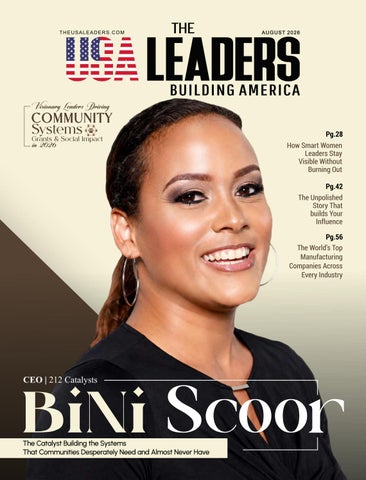
CEO | 212 Catalysts
BiNi Scoor
EDITOR’S LETTER
Where Structure Meets Purpose, Impact Takes Root.
D
ear Readers,
Some leaders chase headlines. Others quietly build the systems that let good work survive its first hard winter: the compliance frameworks, the funding pipelines, the operational scaffolding nobody claps for. “Visionary Leaders Driving Community Systems, Grants & Social Impact in 2026” turns the spotlight on five professionals across healthcare, education, and community development who do precisely that. They are the people who ask not only what good looks like, but how it gets funded, sustained, and scaled across real communities. Their stories make one thing clear: lasting social change is never an accident. It is built, financed, and carried forward by people willing to do the unseen work first. BiNi Scoor, Chief Executive Officer of 212 Catalysts, has spent more than twenty-five years doing the invisible work that makes visible change possible. Since founding the Austin-based consulting and fiscal intermediary firm in 2019, she has helped clients secure over $28 million in funding, generating roughly 31 dollars in community interventions for every dollar received, while reaching more than 100,000 families. Shaped by a mixed-race upbringing in the American South and a grandfather who led resistance against the Nazi regime, BiNi built her career on turning big, nebulous ideas into concrete results. Through her EquiMediary model, she now helps smaller nonprofits access funding by relieving them of backend compliance burdens, freeing mission-driven leaders to focus on the work only they can do. The issue also features Dr. Greg Buchert, Chief Executive Officer of Makani Science; Xunda Gibson, Locum Physician Advisor and Liaison at Sol MD Travel Doctor; Goldean Lowe, CEO and Clinical Director at ABA Classroom; and LaVerne Collins, Founder of New Seasons Counseling, Training, and Consulting. Together, they represent the breadth of leadership shaping community health and social impact today. What unites every leader in this issue is a shared belief that vision alone changes nothing. It takes structure, funding, and disciplined execution to turn good intentions into measurable outcomes for real communities. As the sector looks toward 2026 and beyond, these leaders are quietly proving that the strongest systems, not the loudest headlines, are what carry social impact forward, one funded mission at a time. Sincerely,
Simran Khan MANAGING EDITOR
PUBLISHER
ARCHANA GHULE
EDITOR-IN-CHIEF
THE
USA LEADERS
VIKRAM SURYAWANSHI
FOLLOW US
MANAGING EDITOR
TheUSALeaders
PROJECT EDITOR
the-usa-leaders
SIMRAN KHAN
SHADAB MESTRI
PROJECT MANAGERS NIKHIL MAHAJAN
VISUALIZER
MARK DAVIS
GRAPHIC DESIGNER
leaders_usa usaleaders theusaleaders
theusaleaders Office No. 430, 4th Floor, Gera’s Imperium Rise, Opp. Wipro Circle, Hinjewadi Phase 2, Pune, Maharashtra - 411057.
PRANJALI MAHANGADE +1 (850) 564-8517
HEAD OF DISTRIBUTION & PRODUCTION
info@theusaleaders.com
AAKASH MAHAJAN
HEAD OF OPERATIONS
www.theusaleaders.com
ROBERT SMITH
RESEARCH ANALYSTS JAMES ADAMS
ADVERTISING
MARIA SMITH
THE USA LEADERS IS AN ILLUMINATING DIGITAL PLATFORM THAT DRIVES THE CONVERSATION ABOUT THE DISTINGUISHED AMERICAN LEADERS DISRUPTING TECHNOLOGY WITH AN UNPARALLELED APPROACH.
10
BiNi Scoor
(Cover Story)
CONTENT
PROFILES 20
Dr. Greg Buchert
32
Goldean Lowe
48
LaVerne Collins
64
Xunda Gibson
ARTICLES How Smart Women Leaders Stay Visible
28 Without Burning Out 24
The Unpolished Story That builds 42 Your Influence The World’s Top Manufacturing Companies
56 Across Every Industry
Co
ve
rS
to
10 | AUGUST 2026
ry
CEO | 212 Catalysts
BiNi
Scoor ‘‘
The magic isn’t in the plan... the magic happens when a plan is executed well. THEUSALEADERS.COM I 11
T
here is a particular kind of work that never makes the front page, that earns little applause at galas and generates few headlines, and yet, without which none of the visible, celebrated work of community change would be possible. It is the work of people who build the backend, structure systems, draft compliance frameworks, steward finances, and construct the operational scaffolding that allows a mission to survive contact with reality. BiNi Scoor has been doing this work for over 25 years. As Chief Executive Officer of 212 Catalysts, a consulting and fiscal intermediary firm she founded in Austin, Texas, in 2019, BiNi has made a career of solving the problems others overlook and building the systems others do not think to build. The results are significant by any measure. Since its founding, 212 Catalysts has helped clients secure over $28 million in funding, generating approximately $31 in community interventions for every single dollar received from clients. Over 100,000 families have been reached with vital services and resources. Across the full arc of her career, she has facilitated cross-sector coalitions that helped establish systems and policies for over $600 million in grant and sponsored projects and over $70 million in in-kind partnerships. But numbers alone do not explain the whole story. The rest of it starts in the American South, in a family shaped by history, faith, and the deep, inherited refusal to look away. From the South to the Resistance: A Legacy of Fighting Back BiNi grew up in a mixed-race family, African American and German, in the American South, at a time when that combination was not merely unusual but actively unwelcome. “Growing up in a mixed-race blended family at a time when this was still frowned upon in the South, I experienced a lot of racism,” she recalls. Her response was not retreat but inquiry. She read books and watched documentaries, working to understand Black history and the forces shaping the world around her. Her faith and the steady example of her mother, who “always gave generously to help others,” provided a moral compass that still orients her work today. 12 | AUGUST 2026
Later in life, she discovered something about her grandfather that reframed her understanding of herself entirely. Her grandfather had led the Scoor resistance movement against the Nazi regime during World War II and was detained in the Nordmark Labor Camp. The family history, across two continents, was a story of principled defiance handed down through generations. “Activism and fighting for others who cannot fight for themselves are just ingrained in my DNA and life experience,” she says. What distinguishes her path is what she built on that inheritance: a rigorous professional formation, including a Bachelor’s degree in Public Relations and a Master’s in Business Administration, directed toward the spaces where that formation could do the most practical good. The Gap Nobody Wanted to Fill As her career moved through front-line program work and programmatic leadership into funding and systems-level administration, a pattern became impossible to ignore. Across nonprofits, school systems, churches, and community organizations of every size and structure, the same gap kept appearing. “I discovered a huge need in the community impact ecosystem that has gone unnoticed and unattended for decades: support for the business backend that forms the foundation for programmatic and organizational operation.” The people leading these organizations were almost universally gifted at their missions. They understood their communities, they had vision, and they could execute programs with real dedication. What they consistently lacked was the financial architecture to sustain and grow that work: the expertise to secure funding, to manage it responsibly, to build the compliance infrastructure that would give funders the confidence to invest again and again. BiNi recognized this not as a frustration but as an opportunity. In 2019, she built 212 Catalysts around exactly that purpose. Her specialties, in her own words, are “turning big, nebulous ideas into concrete action to achieve positive, measurable results” and, in two words that function almost as a professional signature: “getting things unstuck.” People, Process, and the Magic of Execution Ask BiNi about her methodology, and the answer comes immediately: “People and process.” Every initiative, every new program, every revival of something that has stalled, begins the same way.
Cover Story
THEUSALEADERS.COM I 13
Cover Story Engage the right people at the right time, guide them through an iterative input process, and move from concept to execution through a facilitated strategic planning framework that clearly defines roles, responsibilities, and timelines. “It works beautifully every time,” she says, with the steady confidence of someone who has watched the same approach deliver results across vastly different contexts for decades. But she is equally clear about where most organizations lose their way. She has watched far too many produce sound plans and then achieve nothing at all. The word “execution” carries particular weight in how she talks about this work, and she uses it deliberately. “The magic isn’t in the plan... the magic happens when a plan is executed well, and that takes being properly funded.” Her process begins with one essential question: “What are we trying to accomplish?” That, she explains, should be the North Star, with deliberate thought given to how success will be measured. From there, you work backward: identifying the inputs, outputs, activities, partnerships, and people required. You quantify the costs, resource the plan properly, and then, as she would put it, you do the work. When a High School Almost Went Dark In 2004, BiNi was selected to manage a campus improvement grant, a 21st Century Community Learning Centers grant, at what was then called Reagan High School in Austin, Texas. The program had already collapsed to near-zero attendance within its first month of operation. Working with the local community, she transformed a program on the verge of failure into a nationally recognized initiative that achieved positive, measurable outcomes at a previously low-performing high school, helping save Reagan from closure alongside two additional schools within the same vertical team. She was subsequently given responsibility for ten secondary campuses and their local and state/federal grants. 14 | AUGUST 2026
‘‘
Many people have been sold by predatory marketing that makes grant funding sound easy to claim.
The work drew recognition from the U.S. Department of Education, Colin and Alma Powell’s America’s Promise Alliance, the Texas Education Agency, the Texas Department of Transportation, Southwestern Educational Development Laboratory (SEDL), and a Stanford University alumni research group, among others.
For an organization to genuinely thrive over the long term, she argues, earned revenue and consistent fundraising must be established and sustained alongside any grant activity. The core operations of any mission-driven organization should live within reliable funding streams, not around the volatility of grants.
From that foundation, the list of initiatives she helped launch or rescue from stagnation continued to grow: the Central Texas Afterschool Network, the Austin/Travis County Ready By 21 Coalition, the Black Men’s Health Clinic, the Austin/Travis County Mentoring Collaborative, the African American Youth Harvest Foundation, the African American Leadership Institute, the St. Johns Community-School Alliance, and the Data Connection Pilot between Austin Independent School District and the Michael and Susan Dell Foundation.
The EquiMediary Shift: More Funding to More Missions Among the most significant innovations in BiNi’s current work is the EquiMediary model, an approach that expands access to funding for smaller and underserved nonprofits by pairing fiscal sponsorship with capacity-building support.
What Most People Get Wrong About Grants
The model works by relieving organizations of the backend complexities associated with fund management. Because 212 Catalysts operates as a trusted, compliant intermediary on the finance, backend, and compliance side, funders become more willing to support mission-driven organizations they believe in, knowing the administrative and audit trail will be clean and properly maintained.
One of the more valuable services BiNi provides is a corrective one. The mythology around grant funding, she has observed, is pervasive, well-marketed, and actively damaging to the organizations that fall for it.
“It will alleviate compliance burden and allow mission-focused leaders to flow more in their zones of genius,” she explains, “translating to the measurable impact we all want to see.”
“Many people have been sold by predatory marketing that makes it sound like grant funding is out there everywhere and just needs to be claimed.”
212 Catalysts is currently part of a national Equitable Intermediaries Cohort, working alongside partners across the country to encourage both philanthropic and government funders to adopt this model. The stakes, as she sees them, are considerable.
In 2023, she moderated a summer program sustainability podcast with the Wallace Foundation and The Learning Agenda national team, grounded in her work with the Texas Education Agency ADSY Summer Learning initiative.
The reality is far more demanding. Every grant requires specific deliverables that must be met, and funds must be spent in strict alignment with the funder’s priorities. New nonprofits generally do not receive funding at the outset, and launching any organization requires genuine sweat equity, personal financial sacrifice, and the development of a demonstrated track record of good stewardship over time. And then there is the observation that surprises most people: “Grants are the worst way to build any kind of healthy business, as they are unpredictable, time-limited, and can be difficult to administer.”
“This would be a game changer for the philanthropic community and government funding models,” she says, “to get more money to smaller/newer agencies and thereby maximize community impact.” Current initiatives connected to this work include the African American Leadership Institute in Central Texas, which BiNi co-founded in 2021 and which has since generated multiple media features, as well as support connected to the development of Texas’s first Trauma Recovery Center. THEUSALEADERS.COM I 15
Cover Story
16 | AUGUST 2026
A Record of Recognition, A Life of Service The arc of recognition in BiNi’s career runs long and consistent. The Legacy Leadership Award from the Central Texas Afterschool Network came in 2017. The Distinguished Changemaker Award from the African American Youth Harvest Foundation followed in 2018. In 2019, she was nominated for Achievements in Black Austin by the Black Austin Network. The years that followed brought a steady stream of acknowledgment. In 2021 alone, she received the Outstanding Leadership Award from the Austin NAACP, inclusion on the Top Ten Central Texas Diversity Champions list from the Austin Black Business Journal and Community News, a feature in VoyageAustin’s “Hidden Gems: Local Businesses and Creatives You Should Know,” and a nomination for the Best CEO Award by the Austin Business Journal. In 2022, she was named among the Best in the Citi: Top 10 Innovators to Watch by Soulciti/AALI, featured in the “In the Black” Black History Month Spotlight by Six Square Austin’s Black Cultural District, nominated for DEI and Nonprofit Leaders of the Year by DivInc, and was selected for inclusion in the Black Women in Business commemorative book. By 2024, the honors included the Association of Fundraising Professionals Special Recognition as Individual Philanthropist, a place on the Austin Woman Changemaker List, and the Austin NAACP DeWitty Overton honor. Her board service spans over 20 agencies since 1997, presently including Austin Achieve Public Schools, where she serves as Chair, the Concordia University Access and Equity Advisory Board, the Friends of Balcones Canyonlands National Wildlife Refuge, where she served as Treasurer, and the African American Leadership Institute. Over the last 18 years, she has presented at dozens of regional, statewide, and national conferences and summits, including at the Harvard Graduate School of Education and the U.S. Department of Education 21st CCLC conferences. She has served as a guest speaker, mentor, and host to students from the RGK Center for Philanthropy and Community Service at The University of Texas at Austin, UT McCombs School of Business, UT Project SERVE, UT CONNECT, Texas State University, and Concordia University, among other programs.
What Comes Next When BiNi looks forward, she speaks in structural terms. She envisions a philanthropic ecosystem where fiscal intermediary models are standard rather than exceptional, where capacity-building support is built into the funding process rather than left as an afterthought, and where organizations doing effective, demonstrated work in underserved communities are no longer shut out of larger funding awards simply because they lack the administrative infrastructure to manage them. Her call to the leaders, funders, and advocates working in this space is clear and unhurried: “Follow 212 Catalysts and work within your spheres of influence to shift resources toward the people and agencies that have demonstrated positive community impact but simply need more funding and resources to expand and amplify their impact.” The thread connecting her grandfather’s resistance against the Nazi regime, her mother’s quiet generosity, a nearly shuttered Austin high school, and the national coalition work now underway through 212 Catalysts is not hard to find. It is a thread made of the conviction that standing between the powerful and the powerless is not heroic, not optional, and not theoretical. It is simply necessary. BiNi has been doing it for over 25 years. By every measure available, the work is only growing.
THEUSALEADERS.COM I 17
VISIONARY LEADERS DRIVING COMMUNITY SYSTEMS, GRANTS & SOCIAL IMPACT IN 2026
BiNi Scoor
Dr. Greg Buchert
www.212catalysts.org
www.makaniscience.com
Goldean Lowe
LaVerne Collins
www.abaclassroom.org
www.newseasons.training
Xunda Gibson www.solmdtravel.com
18 | AUGUST 2026
GREG BUCHERT The Physician Who Sees What the ‘Best Healthcare System in the World’ Still Gets Wrong
20 | AUGUST 2026
Chief Executive Officer
Makani Science
THEUSALEADERS.COM I 21
There
is a particular kind of person who walks into a broken room and, rather than standing there cataloging what is wrong, quietly and methodically begins to rearrange it. Not out of restlessness. Not out of ego. But out of a deep, practiced conviction that things can and should work better than they do. Dr. Greg Buchert is that kind of person. He is a physician and a CEO, a board member and a startup advisor, a healthcare consultant who has spent his career moving between the examining room and the executive suite with the ease of someone who stopped seeing them as separate places a very long time ago. As Chief Executive Officer of Makani Science, he now stands at the center of one of the more quietly consequential healthcare technology stories of this decade, a story that begins with a mother in a neonatal intensive care unit and ends, if all goes according to plan, with a transformation in how the world monitors breathing. Dr. Buchert’s work, across clinical practice, health plan leadership, and medical device innovation, is animated by a single organizing principle: that healthcare must serve everyone, not merely those fortunate enough to afford the best of it. In a field where that conviction is far more common as a stated value than as an operational reality, he has spent decades making it practical. The Making of a Systems Thinker Dr. Buchert’s path into medicine began with the familiar ambition of a pre-med undergraduate. But something shifted early, and it shifted in the right direction. He enrolled in what would turn out to be a genuinely formative experience: the inaugural certificate program at Tufts University, titled “Community Health and Delivery of Health Services.” It was, by his own account, an early college-level public health curriculum, and it was where he first encountered the concept of population health, not the individual patient with a single diagnosis, but the broader and far more complicated question of how entire communities receive, or fail to receive, the care they need. 22 | AUGUST 2026
That early introduction led him to the Tulane School of Public Health and Tropical Medicine, where he earned an MPH in Health Administration. Between and beyond those academic chapters, he accumulated frontline experiences that stretched from the individual to the international level, from community health settings to regional systems to global health environments. “I enjoyed front-line experiences at the individual, community, regional, and international level,” he has reflected, “that drove me to take a systems-level approach to solving problems.” That phrase, “systems level,” resurfaces throughout his career with a kind of quiet insistence. It is not a corporate affectation or a resume flourish. It is, for Dr. Buchert, a genuine orientation, a habit of mind that asks not only what is wrong with this patient, but what is wrong with the conditions that made this patient vulnerable in the first place. It is the difference between treating a symptom and redesigning a system. It is also, it turns out, an extraordinarily useful lens through which to build a healthcare technology company. A Birth, a Crisis, and the Beginning of Something New Makani Science did not begin in a boardroom or a strategy session. It began in a neonatal intensive care unit, in the particular anguish of a mother who could not hold her son. Dr. Michelle Khine, a Professor of Biomedical Engineering and a serial entrepreneur with six startups already to her name, found herself standing beside a hospital crib as her newborn son struggled with respiratory distress. She was surrounded by the full machinery of modern medicine: monitors, wires, screens radiating data. And yet, for all of that technological sophistication, the “state of the art” respiratory monitoring systems in that unit failed to detect her son’s collapsed lung. There was also the matter of the wires. A tangle of them, connecting her son to the machines that were supposed to keep him safe, and keeping her from doing the one thing a mother needs most to do: pick him up and hold him.
THEUSALEADERS.COM I 23
Dr. Khine was not someone who absorbed a failure like that and moved on. She was someone who set about solving it. As a biomedical engineer with the capacity to interrogate a medical problem at the technical level, she began to ask whether there was a better way to monitor respiration. That question became Makani Science. Dr. Buchert, who as CEO serves on the Board of Directors alongside Dr. Khine, carries that origin story not as a marketing narrative but as a moral anchor. Every decision about what Makani Science builds, and for whom, is in some sense an answer to the question of what that mother deserved to have in that hospital room. The Device That Changes Everything What Makani Science has developed is, in its physical form, almost deceptively simple. A bandage-sized wireless respiratory monitor. But the implications of what that small device can do are anything but simple. The monitor is small enough to be placed on a premature infant, which is not a minor engineering achievement in any sense. It is comparable to the gold standard of spirometry in accuracy and faster than pulse oximetry in its measurements. Its novel stretch sensor makes it resistant to motion artifacts, a persistent and frustrating limitation of traditional respiratory monitoring technology that has long confined meaningful monitoring to stationary patients in clinical settings.
‘‘
I’ve never abandoned my role as one who should be doing everything in my power to help individuals obtain optimal care that will help them live their best life possible. 24 | AUGUST 2026
The result is something genuinely unprecedented: the only respiratory monitor that can be worn 24 hours a day, seven days a week, by ambulatory individuals going about their ordinary lives. And what Makani Science is building with the data that flows from those monitors is equally without precedent. The company is in the process of creating the first-of-its-kind database of breathing pattern waveforms for ambulatory individuals, a resource that clinicians, researchers, and pharmaceutical companies have never had access to, because the technology to generate it has simply not existed until now. Dr. Buchert describes the product development philosophy in terms that reflect his broader approach to healthcare as a whole: “It is always important to start with identifying and defining the problem. Next is to understand the workflow of the provider and how a solution could be implemented. Finally, work on developing a solution that solves the problem in a realistic fashion and can be produced with an accessible price point.”
Many of the most celebrated medical innovations, he notes, are realistically available only to those who can afford them. The high cost of some innovations, with little demonstrable impact on long-term outcomes, displaces healthcare dollars that could benefit exponentially more people. And the health outcomes of the overall US population, measured against those of other developed nations, remain a cause for serious concern rather than self-congratulation. This is not pessimism from a man who has lost faith in the system. It is precision from a man who has worked inside it long enough to understand exactly where it is failing. And it is what drives his insistence, in every venture he undertakes, that innovation must be designed with broad accessibility in mind from the very beginning, not awkwardly retrofitted for wider populations after the commercially attractive market has already been served. “In my work,” he says, “I’ve done my best to ensure that innovations are available to as many individuals as possible.” When Leadership Is Tested
Accessible. That word matters to him more than most. It is not incidental to the Makani Science mission. It is inseparable from it.
There is a particular story from Dr. Buchert’s career that reveals more about his character than almost any credential on his professional record.
The Uncomfortable Truth About American Healthcare
He was serving as Director of Outpatient Services at a Children’s Hospital that had no integrated Emergency Department. The Pediatric Specialty Physicians, confronted with urgent cases during clinic hours, would route them to the outpatient clinic. After hours, the same patients, many of them children carrying complex medical conditions, were sent reluctantly to the local emergency department, which was not designed or staffed to meet their particular needs.
One of the most striking things about Dr. Buchert is what he is willing to say out loud, and to whom. Ask him about healthcare innovation in America, and he will not offer the reassurances that many in his position might reach for. He will not simply endorse the familiar claim that the United States leads the world in medical progress. Or rather, he will tell you what that claim consistently and conveniently leaves out. “The United States has the best healthcare system in the world,” he acknowledges, which is a statement many people hold firmly. “Admittedly, we do enjoy exposure to so many new technologies,” he says, and then arrives at the part of the conversation that tends to make rooms go quiet: “But it is important to point out some glaring truths to put that statement into perspective.”
It was a system that worked for almost no one. And it worked least of all for the children. Dr. Buchert’s response was not to escalate the problem upward and wait. He hired Pediatric Emergency Physicians for the clinic. He temporarily expanded clinic operations to run 24 hours a day. And he went to work directly with the local emergency department, collaborating on a redesign of its facility, its protocols, and its staffing configurations so that children with complex medical issues could receive genuinely appropriate care at any hour. THEUSALEADERS.COM I 25
Eventually, the Children’s Hospital built its own Emergency Department when a new tower was constructed. The distance between identifying a problem and actually solving it is where most organizational failures live. It is also where leaders prove what they are made of. Dr. Buchert closed that distance through a combination of practical action, collaborative thinking, and a refusal to accept that the existing arrangement was inevitable. Building a Model Worth Replicating Another chapter in Dr. Buchert’s career speaks directly to those working at the intersection of healthcare access and health equity, a constituency that increasingly includes the largest medical companies and health systems in the world. Working in a community where Medicaid beneficiaries had serious difficulty accessing care, he became a key member of the leadership team that designed and launched a Medicaid Managed Care Health Plan, one built on principles that were, at the time, far from standard practice in the field. The outcomes were measurable and, by any objective standard, remarkable. The number of providers willing to see Medicaid members more than doubled. The plan improved the quality of care, lowered overall cost, increased provider reimbursement, and remained locally accountable, a combination that is notoriously difficult to achieve and almost never achieved all at once. What happened next may be the most telling indicator of the plan’s real success. It became a model for both Republican and Democratic leaders, developing new healthcare delivery strategies. In a political environment where healthcare is almost always contested terrain, building something that earns genuine respect across party lines is an achievement worth noting carefully. It suggests not only competence but a clarity of purpose that transcends the usual ideological framing. 26 | AUGUST 2026
The Art of Building High-Performing Teams Dr. Buchert’s philosophy on the people he chooses to work with is, in its way, as carefully considered as his approach to healthcare systems design. He is not on a search for the most credentialed candidates, though credentials have their place. What he is consistently looking for, across clinical, operational, and business functions, is something that does not appear on a résumé in quite so legible a form. “I always look for individuals with a ‘can-do’ attitude,” he says. “That characteristic associated with a respect for teamwork is a powerful combination that spans clinical, operational, and business functions.” It is a deceptively clean standard. But in practice, it reflects a sophisticated understanding of how organizations actually sustain performance: not through the brilliance of their most individually talented performers, but through the collective, sustained effort of people who believe that problems can be solved and who are genuinely willing to solve them together. What Comes Next The immediate horizon for Makani Science centers on the launch of its respiratory monitor for neonatal care, a device with the potential to revolutionize the management of babies with respiratory-associated conditions, addressing the very clinical gap that brought the company into existence. Beyond neonatal care, the roadmap expands considerably. Dr. Buchert describes plans to leverage the monitor’s exceptionally small size to enter multiple adult markets, placing a comfortable, unobtrusive device on ambulatory individuals who can wear it continuously through the full rhythms of daily life. The data generated by that network of wearable monitors will be unlike anything currently available to the medical community: a living, accumulating database of real-world breathing patterns, available to clinicians making treatment decisions, researchers probing the mechanisms of respiratory disease, and pharmaceutical companies developing and evaluating new therapeutic approaches. For investors and major medical device companies assessing where the next decade of respiratory medicine is heading, this is a space that rewards close and sustained attention.
The Life Behind the Work For all the professional scope of his career, Dr. Buchert is quietly insistent on one thing: the work has to coexist with a life that is genuinely lived. “I learned from experience that I must make time to exercise, spend time with my family, and enjoy a great meal with friends,” he says. “The intermittent physical and mental escapes help me focus intensely on my work.” It is not a dramatic statement, and it is not meant to be. It carries the particular weight of something arrived at through hard experience rather than borrowed from a wellness framework. He is not describing a lifestyle philosophy. He is describing a practice that keeps him functional, present, and capable of the sustained focus his work demands. Advice for Those Who Follow
They are the values of a man who began his professional life asking how health systems could serve more people, more equitably, and more effectively, and who has spent several decades finding answers that are practical, replicable, and genuinely useful to the people who need them most. Dr. Greg Buchert is, at his core, a physician who never stopped practicing medicine. He simply expanded his definition of what a patient could be: from a single person in an examination room, to a community waiting for care, to a population waiting for a system that finally works the way it should. The work is not finished. It may never be finished. But in the hands of leaders like him, it is moving in the right direction.
When asked what he would offer to aspiring leaders in healthcare, Dr. Buchert does not reach for grand declarations or polished aphorisms. He offers something considerably more durable. “Be a constant learner. Seize opportunities when they present themselves. Be humble and respect the value that every member of an organization contributes to the results. Engage in work activities that make a difference and benefit people.” Four directives. Each one is clear. None of them is easy to sustain across an entire career.
‘‘
This new type of information will create an unprecedented database to be used by clinicians, researchers, and pharma companies.
THEUSALEADERS.COM I 27
28 | AUGUST 2026
SMART WOMEN
LEADERS Stay Visible Without Burning Out You Don’t Have to Be Online to Be On Point Let’s start here: The real pros don’t sprint every day. They pace themselves like marathoners with a war plan. That’s something most people don’t tell women leaders building a personal brand: Visibility doesn’t mean volume. Somewhere between the latest webinar on “consistency” and the social post that says, “Just show up daily,” many women in business confuse constant availability with strategic visibility. That confusion is expensive. It costs peace. It costs health. It burns out your creativity. The good news? You don’t need to choose between growth and your nervous system. You just need a shield. You Are the Brand—But You’re Also the Operator There are two versions of you: 1. The one that shows up online. 2. The one that runs the whole operation behind the scenes. Too many women think their business will stop if their face doesn’t appear on every timeline. But when you’re the strategist, the creative director, the CEO, and sometimes the assistant… it’s not just okay to pause—it’s essential. Let’s be blunt: You can’t build a brand worth following if you’re running on fumes. Think of it this way. If you are the light, your visibility is the switch. You control it—not the algorithm. The goal is not to be seen all the time. The goal is to be remembered when it counts.
THEUSALEADERS.COM I 29
Athena Didn’t Post Daily The Greek goddess Athena didn’t march into every war. She picked her battles. She carried a shield, not just to defend—but to signal power. Presence without chaos. You don’t need to explain your silence or justify your break. If you’re in a season where the energy’s low, that’s data. Use it. Adjust. You can still lead, still sell, still inspire—without live-streaming your entire emotional cycle. In fact, a lot of people trust you more when you show restraint. The Power Pause: A Reset, Not a Retreat There’s something most high-performing women avoid talking about: the off-switch. Not the glamorous sabbatical or the post-hustle Bali trip. I’m talking about a quiet Tuesday where you just… don’t show up. No post. No launch. No “I’ll be back soon” note. You just pause. Strategically. Like a woman who knows her value doesn’t disappear when she logs off. You know what that does? It builds intrigue. It commands respect. And it makes space—for new ideas, sharper offers, and better boundaries. Don’t Fear the Algorithm—Train It Let’s get practical. You don’t have to abandon your brand to take a breather. You just need to set it up like a business, not a mood board. 30 | AUGUST 2026
’
’ ’
THEUSALEADERS.COM I 31
Building a Classroom of Hope on the Shores of Maui
Don't be afraid to question what everyone else accepts. Don't be afraid to take responsibility for yourself and your community.
32 | AUGUST 2026
CEO/Clinical Director ABA Classroom, Lahaina THEUSALEADERS.COM I 33
T
he story of Goldean Lowe and ABA Classroom does not begin in a sterile clinic or a university lecture hall. It begins in the brilliant Hawaiian sun, beside the chlorinated blue of the Lahaina public pool and in the open green of local parks. It was here, in 2016, on the West Side of Maui, that Goldean first began her work with children with Autism Spectrum Disorder. She was a newly arrived Board Certified Behavior Analyst in a community with a desperate, unmet need. ABA therapy had only recently become funded by health insurance, and for many families, it was a distant, abstract concept. They had no clinic, no resources, and no clear path to the kind of support their children needed to thrive. So Goldean met them where they were, transforming public spaces into makeshift classrooms, her practice defined by equal parts scientific rigor and heartfelt creativity. When she finally found a small, 700-square-foot classroom, it felt like a sanctuary. This space, now tragically lost to the Lahaina fires, became the official home of ABA Classroom, a name that belied the revolutionary scope of what would happen within and far beyond its walls. For Goldean, a classroom was never just about four walls. It was a launchpad. It was a place to build the foundational skills of communication and behavior, but the real test, the real therapy, happened outside: in the Pacific waves on a surfboard, in the rhythm of a Hula dance, in the responsibility of caring for animals on a farm, in the discipline of an Aikido dojo. She is a leader who wakes at 4:30 a.m. for mantra meditation before beginning an intense 14-hour workday. She is a trauma-informed therapist who understands that a parent’s stress can mirror that of a combat soldier, and a scientist-practitioner who has seen children, through comprehensive treatment, lose their autism diagnosis entirely. Her journey has been one of profound challenges, from a global pandemic and devastating fires to internal crises that tested her resolve. Through it all, she has taken the road, “less travelled,” building a practice and a culture that dares to ask, “Why set the bar low when inclusion is possible?” The Winding Path to a Calling Goldean’s path to becoming a leader in ABA therapy was a winding intellectual and personal journey. Her early university studies from 1994 to 2000 explored Philosophy and Environmental Studies, hinting at a mind drawn to complex systems and deeper questions of human existence. This broad foundation eventually focused on a passion for helping young people, leading her to a Bachelor of Arts in Child and Youth Care from the University of Victoria in 2006, where internships in schools and youth empowerment organizations solidified her commitment. Her academic journey continued with a Master of Arts in Counseling Psychology from City University of Seattle in 2009, where she specialized in Trauma-Informed Care. She pursued further training in highly specific and compassionate modalities, including Trauma-Focused Cognitive Behavioral Therapy (TF-CBT) and Response-Based approaches. These frameworks emphasize a client-directed process, engaging families and using Motivational Interviewing to support individuals through their own stages of change. In 2013, she completed her formal training in Behavior Analysis at the University of British Columbia, fusing her deep background in psychology and trauma with the pragmatic, evidence-based lens of ABA. This rich, layered education, which also includes competencies in addressing bereavement, grief, anxiety, and depression in children, informs every aspect of her work today. She is not just a behavior analyst; she is a clinician who understands the intricate emotional worlds of the children and families she serves. 34 | AUGUST 2026
THEUSALEADERS.COM I 35
36 | AUGUST 2026
Change takes courage and persistence, but when we live with integrity and compassion, we become the leaders we’ve been waiting for.
THEUSALEADERS.COM I 37
A Classroom without Walls What truly sets ABA Classroom apart is its unshakable commitment to pushing the boundaries of what ABA therapy can be. While firmly grounded in the science of precision teaching and a Verbal Behavior Curriculum developed over 30 years by pioneers in the field, Goldean’s vision extends far beyond the clinic. “Children don’t just practice skills in isolated settings,” she explains, “they gain fluency through real-world experiences.” The list of activities her learners participate in is a vibrant testament to this philosophy. They learn Hula and ukulele, participate in theatre, and play volleyball, basketball, and martial arts. They learn to bike, skateboard, swim, and even work out at The Block, a local gym. The natural classroom of Maui is central to their growth, with ocean-based activities like surfing, stand-up paddle boarding, snorkeling, and boogie boarding building both courage and physical skills. The program also tackles practical life challenges head-on. Picky eating is addressed through healthy food exploration. Prevocational skills are developed through hands-on internships and farm work. The goal is holistic: to build confident communication, competent work habits, and a well-rounded life filled with leisure and recreation. “By setting high expectations and fostering independence,” Goldean says, “we equip our learners to step into adulthood with the skills they need to live happy, healthy, and self-reliant lives.” The results of this comprehensive approach have been profound. In a field where progress is often measured in small, incremental steps, Goldean has witnessed life-altering transformations. “Three of my clients have even lost their autism diagnosis after comprehensive, consistent treatment,” she shares. This remarkable outcome is a powerful affirmation of her belief that by applying science in collaborative and creative ways, children can be launched into lives of independence and joy.
“We approach families with the highest respect and empathy, always adjusting the pace of change to match their readiness,” she says. The first priority is to stabilize the home environment by reducing stress. This means addressing foundational challenges first: medical concerns, poor nutrition, sleep disruption, and difficult behaviors. Only when a family feels more stable in these areas can they effectively engage with more intensive teaching routines like toilet training, communication development, or academic readiness. The process is highly individualized. Using the “Stages of Change” model, Goldean and her team first assess a family's readiness, meeting them wherever they are on the spectrum from precontemplation to action. This allows them to co-design therapy plans that feel realistic and sustainable. Early wins are crucial. “When families see immediate, positive changes,” she notes, “they gain confidence in the process and become more invested in long-term implementation.” Every plan is anchored in SMART goals (Specific, Measurable, Achievable, Relevant, and Time-bound), bringing clarity and accountability to the process. But beyond the strategies and goals, the ultimate aim is to strengthen the parent-child relationship, creating opportunities for joy and connection that may have been lost amidst the stress of managing challenging behaviors. Families are coached to maintain consistency, with the gentle encouragement that they can always “get back on the train” after a setback. It is this patient, empathetic, and collaborative approach that empowers families to become the confident architects of their own success. An Ecosystem of Community Support Goldean believes that for a child to truly thrive, the entire community must be part of their support system. ABA Classroom has intentionally built a robust network of collaborations that create a holistic ecosystem of care, ensuring that learning and growth happen in every environment.
The Family at the Heart of the Plan At ABA Classroom, parents are not observers; they are essential partners in their child’s journey. Goldean operates with a deep empathy for the immense stress families face, citing studies that show parents of children with autism often experience cortisol levels comparable to those of combat soldiers. This understanding shapes her entire approach to family training. 38 | AUGUST 2026
A long-standing relationship with the ABA Pediatric team at Kaiser Permanente ensures that medical, developmental, and behavioral care plans are seamlessly aligned. Local community partners provide invaluable real-world learning arenas. At Maui Animal Farm, learners practise responsibility by caring for animals. At Lahaina Rec Center and with Kindermusik, they build social skills through recreation and music recreation.
Partnerships with Lahaina Aikido and The Block gym introduce structured fitness and self-discipline. Kahakukahi Ocean Adventures opens up the world of water sports, while a collaboration with Brew Hut–Soil Regeneration provides older learners with vital prevocational internship experience. Regular communication with school teams ensures consistency in strategies and reinforcement systems, helping children transition smoothly between settings. Together, these partnerships create a web of support that envelops each child and family, reinforcing progress and fostering inclusion in every dimension of their lives. A Culture of Dignity and Kindness Beyond these partnerships, Goldean has spearheaded community campaigns aimed at shifting the very culture in which her learners live. The “No More Silence. No More Bullying.” initiative is a powerful example, born from the understanding that many of the children she serves struggle deeply with social belonging and forming friendships. When bullying is present, those challenges grow exponentially. The campaign is more than an awareness effort; it is a call for a collective culture of dignity, kindness, and accountability. It encourages children and adults alike to ask probing questions about their own behavior: ● Why do people bully? ● Why do we sometimes treat insulting others as a form of entertainment? ● Are we teaching respect and honesty, or are we reinforcing gossip and exclusion? These questions are designed to invite personal responsibility for the impact of one’s actions. At the heart of the campaign is a simple, profound truth: All we are is our word. When we align ourselves with unkindness, we lose authenticity. Silence in the face of bullying is a form of reinforcement, allowing harm to continue unchecked. The antidote, she teaches, is to act with courage by choosing compassion and surrounding ourselves with people who lift others up. This philosophy is directly linked to her work as a behavior analyst, which involves observing behavior and asking a critical question: Is this who I want to be known as? By showing up as people who create dignity and appreciation for others, she believes we can replace cycles of bullying with true respect and belonging, fostering a community where every child feels valued and empowered.
THEUSALEADERS.COM I 39
40 | AUGUST 2026
Forged in Fire The journey of ABA Classroom has been marked by a series of profound challenges that would have broken a less resilient leader. Founding a clinic in 2021, at the height of the COVID pandemic, was the first hurdle. Just two years later, the clinic was evicted with only one month’s notice after their building was condemned. Though they were able to purchase a permanent commercial site, providing much-needed stability, disaster struck again just three months after they settled in. The Lahaina Fires of 2023 threatened to destroy everything. “Walking away from the clinic, I thought it would all be lost,” Goldean recalls, “but miraculously it was spared.” However, the most difficult challenges were not external crises, but internal ones. A group of staff members created a toxic environment that undermined the clinic’s mission and culture. Addressing this required Goldean to make incredibly difficult decisions, including terminating employees and investing significant resources in legal counsel to resolve false accusations. “Through this process, I learned the importance of setting clear expectations, upholding a strong Code of Conduct, and addressing issues of negativity or competitiveness immediately and directly,” she says. These experiences were painful turning points, but they ultimately strengthened her resolve to build a team culture rooted in respect, cooperation, and shared purpose. Today, she is surrounded by a team she deeply appreciates, knowing firsthand that a positive, supportive culture is vital to the mission. The Road Less Travelled Goldean’s life outside the clinic is as intentional and disciplined as her professional practice. Her 80-hour workweeks are balanced by daily meditation and yoga, bodywork, and time spent with family, friends, and her Portuguese Water Dog, Rishi. She co-hosts meditation and women's support groups, nurturing community and shared resilience. Each year, she takes a month-long trip to India, working remotely while immersing herself in practices that refresh her vision and consciousness. When asked to share a piece of wisdom, Goldean offers a long, poignant quote about the courage it takes to challenge accepted truths and take the road less travelled. It speaks of how untruths, repeated long enough, can become culture and tradition, and how it takes rare individuals to question what everyone else passively accepts.
“If someone tells a lie loud enough and long enough, others begin to accept it as truth. When enough people are convinced by that ‘truth’ it becomes a culture. If that culture is somehow transmitted to the next generation, it becomes a tradition. Such traditions, and the worldviews and behaviors they espouse, become etched into society, followed by millions, usually without question. Our weapons of mass instruction—educational systems, media powerhouses and community structures—reinforce these traditions, causing untruth to perpetuate over decades and centuries. Blind leading the blind, all completely oblivious to the illusion. Amidst the mass of people are some unique individuals who begin to challenge what everyone else passively accepts. It takes courage to question, intelligence to search, and determination to change. Beware… going against the grain is risky business! It’s much easier to go with the flow and tread the path of least resistance. The world has its preconceived notions—what’s acceptable and what’s not—and most people seamlessly fit right in. Yet some just can’t. The excitement, intrigue and hunger to find out what lies beyond the ‘safe’ path in life drives them to embark on the road less travelled.” “This resonates deeply with me,” she says, “because in both life and in my work, I’ve had to take the road less travelled, sometimes at great risk.” Building ABA Classroom through fires, relocations, and internal turmoil has been a testament to that courage. It would have been easier to accept the status quo, to offer a more conventional, limited form of therapy. Instead, she chose to stand firmly for honesty, kindness, and a model of science-based care that is as creative and boundless as the children it serves. Her message is an encouragement to others to find that same courage. “Don’t be afraid to question what everyone else accepts,” she urges. “Change takes courage and persistence, but when we live with integrity and compassion, we become the leaders we’ve been waiting for.” In the lush, resilient landscape of Maui, Goldean Lowe has done just that, becoming a leader who is not just changing lives, but is quietly, profoundly, changing the very definition of what is possible.
THEUSALEADERS.COM I 41
The Unpolished Story That Builds Your Influence ounders spend millions trying to craft “the perfect story.” They hire agencies, shoot cinematic videos, polish every line until it shines.
F
Why We Hide the Part People Need Most
Then they wonder why it doesn’t connect.
· Grew revenue by 300%. · Expanded to three continents. · Featured in Forbes.
Here’s the truth most PR decks won’t tell you: the story that earns influence is rarely the one you’ve polished. It’s the one you’ve lived. The Boardroom Lesson Nobody Prepares You For A few weeks ago, I sat in a room with fifteen high-performing founders. We were there for strategy, not therapy. Yet one person—without a slide deck, without the “approved” brand narrative—told a raw, unscripted account of the moment her business almost folded.
Most leaders know their résumé version of their story—the LinkedIn-approved bullet points:
But they cut the sentences that matter: · Spent six weeks sleeping on a friend’s couch to save the business. · Spent four years selling a service no one wanted before finding product-market fit. · Nearly quit the night before the big break. We cut them because they’re messy. We cut them because they’re not “on-brand.” The irony? Those are the exact lines that make you believable. The Strategic Risk of Staying Polished
She didn’t “present.” She talked. She described the week she had to choose between making payroll and paying her mortgage. She explained exactly how she called her supplier and negotiated terms to buy herself 48 hours. It wasn’t pretty. But the table went silent.
Here’s the cost of staying “safe” with your story: 1. You sound like everyone else. Polished founder bios are interchangeable. 2. You create distance. People can admire perfection, but they rarely trust it. 3. You lose leverage. Investors, clients, and partners lean in when they believe you’ve been tested and survived.
That’s when it hit me: your influence starts where your polish ends.
Every CEO I respect uses story as a tool—not as a highlight reel.
42 | AUGUST 2026
How to Find the Part of Your Story That Moves People Forget “crafting” for a minute. Go straight to the events that felt risky to say out loud at the time. Ask yourself: · What happened that changed the way I run my business? · When did I have to make a decision that cost me more than money? · What mistake taught me something no spreadsheet could? Those are the points of connection. That’s the material people repeat when they talk about you in rooms you’re not in. The Real Role of Vulnerability We misuse the word “vulnerability” in business.
It’s not about oversharing or emotional catharsis. It’s about strategic transparency—sharing enough of the truth to make the lesson undeniable. Here’s the filter: If the person across the table can apply what you learned to avoid a mistake, or take a calculated risk faster, it’s worth telling. If it’s just for shock value, save it for the memoir. Community Isn’t Just Comfort—It’s Currency One founder in that room said something that stayed with me: “I didn’t come here to be inspired. I came here to remember I’m not the only one in the fight.” That’s why peer communities matter. Not because you “feel seen,” but because you get operating intel from people who’ve survived what you’re in right now.
THEUSALEADERS.COM I 43
When you tell the true version of your story inside a trusted circle, two things happen: 1. You get the strategies that aren’t in books. 2. You build alliances that turn into deal flow, partnerships, and backchannel introductions.
If You’ve Been Editing Yourself Down Consider this your push to stop sanding off the edges. You don’t need a dramatic overhaul. You need to reintroduce the human stakes into your origin, your turning points, and your current play. Try this:
This is why every serious founder I know invests in getting in the right rooms—not just for visibility, but for survival. The Business Case for Telling the Real Story I’ve watched leaders triple their speaking fees, close seven-figure contracts, and land media features—not by adding more success stats, but by revealing the turning points behind them. The mechanics are simple: · Raw detail makes it memorable. “I was down to my last $412” sticks longer than “we were struggling financially.” · Specificity signals truth. People instinctively trust stories with dates, numbers, and real stakes. · Struggle signals credibility. If you’ve been through it, you can help others navigate it. Your story is not PR fluff. It’s an asset with a measurable ROI.
44 | AUGUST 2026
· Identify one story you’ve been avoiding because it feels too raw. · Write it in bullet points—just the facts, no adjectives. · Decide which parts connect to the value you deliver now. · Share it in a room where the return could be real—whether that’s a sales meeting, investor pitch, or strategic peer group. Final Word Your polished story may get polite nods. Your real one will get remembered, repeated, and relayed to decision-makers you’ll never meet. In business, being known isn’t about telling people what you’ve achieved—it’s about showing them what you've survived, and how that shapes the way you lead. Don’t wait for permission. Don’t wait for the “right” moment. The right moment is the one you decide to stop hiding the part that makes you credible. Lift the filter. Tell the truth. That’s how influence starts.
48 | AUGUST 2026
LaVerne Collins Redefining Mental Health with Culturally Inclusive Care Founder | New Seasons Counseling, Training, and Consulting
THEUSALEADERS.COM I 49
F
or too long, mental health care has operated under a “one-size-fits-all” model, often neglecting the crucial role of culture. This has led to misdiagnosis, ineffective treatment, and a profound lack of access for many communities. But what if mental health care truly reflected the diverse tapestry of human experience? What if cultural understanding was not an afterthought, but the very foundation of healing?
LaVerne Collins, founder of New Seasons Counseling, Training, and Consulting, is answering these questions. As a leading voice in multicultural mental health, Dr. Collins is dismantling culturally insensitive approaches to therapy, paving the way for a more equitable and inclusive system of care. Driven by a deep commitment to human well-being, LaVerne began her career in mass communication before discovering her true passion: bridging the cultural divide in mental health. Her personal experiences and professional insights inspired her to develop innovative programs that prioritize cultural humility over cultural competence and place racial identity at the heart of the therapeutic process. Through New Seasons, LaVerne provides direct counseling services and empowers other practitioners with the skills and knowledge to deliver culturally responsive care. Her impactful initiatives, including the MultiCultural MasterClass (MC2) and her thought-provoking podcast, “The MultiCultural MindSet,” are igniting a vital conversation about the future of mental health. In this cover story, we explore how LaVerne’s work is transforming mental health narratives, empowering practitioners, and challenging deeply rooted biases. Her approach not only changes counseling sessions but also redefines the systems that support them. The USA Leaders: You are a national resource person for multicultural mental health. Could you briefly share your career journey and background? What inspired you to pursue this path? LaVerne: Human behavior has always fascinated me. Even as a child, I was curious about why people do the things they do. This deep interest in human thoughts and emotions, though, didn’t initially lead me to counsel. My first career was in mass communications, and I still use much of that knowledge today. 50 | AUGUST 2026
Eventually, my fascination with human behavior drew me back to academia. I earned my M.S.Ed. in community counseling and later a doctorate in Christian counseling. After working in the counseling field for some time, I noticed a significant issue: many counselors struggled with cross-cultural interactions and often defaulted to a “race-neutral” approach. It became clear that monocultural White ideologies prevalent in counseling and mental health weren’t effectively serving Black Americans.So, I began incorporating practices that were more suitable and relational within Black cultures rather than adhering strictly to White cultural norms in counseling. The results were remarkable. Client retention rates and word-of-mouth referrals increased dramatically. This success led me to develop continuing education courses for counselors on these culturally relevant concepts, which went beyond their academic training. I was essentially integrating aspects from Black sociological studies, and I was surprised by the high demand for this kind of content. This success as a trainer led me to create and implement the MultiCultural MasterClass (MC2), a 12-month coaching and mentorship program. MC2 trains experienced counselors to become approved continuing education trainers and consultants in the mental health field, creating a pipeline of trainers invested in culturally responsive counseling. The USA Leaders: How would you describe the current state of ‘Multicultural Counseling’ in the USA? What are the biggest challenges and opportunities you see? LaVerne: One of the biggest hurdles to effective multicultural counseling is the challenge of disrupting the dominant monocultural beliefs about what constitutes “normal” and “healthy.” Historically, entire cultures have been excluded, denigrated, and even criminalized, with messages suggesting their traditions, practices, and even physical features are inferior to those of the dominant group. When race-based and intergenerational trauma histories are not considered in counseling, and when people are blamed for the pain of their lived realities within unwelcoming systems, we have a serious problem.
As Rev. Dr. Martin Luther King, Jr. so powerfully stated, racism is like “having your legs cut off, and then being condemned for being a cripple” or “seeing your mother and father spiritually murdered by the slings and arrows of daily exploitation and then being hated for being an orphan.” Many treatment models in the mental health system inadvertently focus on blaming and “fixing” the oppressed. Until our systems shift their focus to integrative healing and systemic reform, we risk perpetuating this superiority/inferiority paradigm. Programs like MC2 offer a crucial opportunity to bring about healing by training counselors to be more culturally responsive and address the specific needs of diverse populations. The USA Leaders: Could you please elaborate on your core services and values? How do these values inform your approach to counseling and training, particularly regarding historical and cultural factors? LaVerne: New Seasons offers three tiers of service: counseling for adults, continuing education (CE) training for licensed counselors, and a twelve-month training program for experienced counselors who want to become approved CE trainers or consultants in multicultural sensitivity. All three tiers share several core values. First, we emphasize context. We begin by acknowledging that the United States was built on stolen land using stolen labor. This historical reality has had intergenerational and often traumatic effects on Indigenous, Black, and Hispanic Americans. Neglecting this context when discussing the mental health of historically oppressed people contributes to a denial of the roots of racialized life in the U.S. By ignoring the past and portraying colonialism as heroic, we overlook the ongoing adverse impact on those who were exploited. Therefore, my trainings begin with a land and labor acknowledgment to recognize the initial and continuing damage of systemic exploitation. Second, we foreground race, culture, and ethnicity in the counseling conversation, rather than relegate these identities to the background. Members of racial minorities do not have the privilege of setting aside their racial identity. It’s relevant to every aspect of their lives. Therefore, their counseling work must be understood through the lens of their racial narrative.
Finally, we prioritize cultural humility over cultural competence. Instead of striving for mastery or competence, counselors must acknowledge their own biases and insensitivities and commit to lifelong learning and acceptance of other cultural identities, as well as their own. Most of my clients are Black American women struggling with anxiety or depression related to stress. Often, their work with me marks the first time they’ve been encouraged to explore the connection between their stress and their historical racial narrative. This exploration is often a revelatory experience for them. The USA Leaders: You’ve co-founded Equity Training Partners. Can you tell us about the partnership and how your combined expertise addresses issues of diversity, equity, and inclusion? LaVerne: At Equity Training Partners, I’m fortunate to partner with one of my closest friends, Hope Whylie Cheeks. We combine my expertise in mental health counseling with her knowledge of human capital development. This blend allows us to offer a unique and highly effective combination of organizational and behavioral health insights. By addressing both institutional and interpersonal perspectives on diversity, equity, and inclusion, we meet a critical need. This approach sets us apart as providers of customized learning solutions that promote a sustainable, anti-discrimination culture within organizations and broader societal structures.
The USA Leaders: You’ve experienced a profound personal loss. How has this experience shaped your perspective on mental health, particularly within the Black community? LaVerne: I am a mother, a minister, and a mental health professional. I always believed that with this combination, I could offer people hope. However, I lost my 32-year-old son to suicide in 2019. This devastating loss left me feeling like I had failed in all my roles—as a mother, in mental health, and in ministry. Despite my training, my experience, and my love, I realized I had overlooked or minimized what was most important for my son. In hindsight, it became clear he had undiagnosed problems and unmet needs. Entire systems of care had failed him. It’s often said that Black individuals underutilize therapy, but we criticize them for not using a system that often doesn’t work for them. It’s time to stop placing the burden on the Black community to adapt and instead provide culturally responsive services that are both beneficial and judgment-free.
THEUSALEADERS.COM I 51
Counselors must be able to look at a client and see. Listen to a client and hear. Sit with today’s client and feel the intergenerational emotional and physical pain of yesterday’s ancestors.
52 | AUGUST 2026
”
THEUSALEADERS.COM I 53
After my son’s death, I didn’t want to continue counseling, training, ministering, or consulting. However, hearing stories from people he had helped made me realize I hadn’t failed. I had raised an incredible human being who died from a complex mix of co-occurring conditions and overlooked needs. Nearly three years later, Rowman & Littlefield asked me to write a book. The result is “Overlooked: Counselor Insights for the Unspoken Issues in Black American Life.” It’s the culmination of countless hours of reading and researching the overlooked identity issues, historical factors, clinical biases, losses, and strengths that affect Black American life. The USA Leaders: Could you elaborate on your books? What insights can readers gain from them? LaVerne: My 2001 book, “The Fruit of Your Pain,” which is now out of print, addressed readers who embraced religious faith but struggled with anger towards God after tragedy or misfortune. The book encouraged a reframing of their expectations. My new book, “Overlooked,” serves two audiences. I speak directly to mental health professionals about the unspoken issues faced by ethnically minoritized people. However, the book also allows the general public to “listen in” on this conversation. This allows community members to find language that illuminates their own experiences and learn what to expect from a culturally empathetic practitioner. The USA Leaders: Are there any upcoming projects or initiatives you are particularly excited about? LaVerne: MC2 is a project I’m incredibly passionate about. It’s creating a movement of diversity-informed counselors who are making a real difference Like me, these counselors want everyone to receive culturally sensitive, clinically sound care from prepared clinicians. They’re actively training others to bridge that gap. I’m also excited about my new podcast, “The MultiCultural Mindset,” on my YouTube channel, @lavernecollins. Each episode helps mental health professionals shift away from mindsets that don’t serve racially diverse communities effectively. We’ve all been unconsciously exposed to messages that blame historically marginalized communities for problems actually caused by systemic racism.
54 | AUGUST 2026
We’ve often adopted approaches that focus on “fixing” people instead of addressing the flawed ideologies we were taught. We’ve also been influenced by biases that expect to find mental health deficits within Black people, Black life, and Black culture. “The MultiCultural MindSet” podcast helps counselors develop new, more appropriate responses in these and other areas. The ultimate goal is to enhance counselor awareness and promote systemic changes in the mental health system, ensuring that counseling becomes a safe, just, and non-judgmental experience for members of racially minoritized communities.
“
Connect with a client and comprehend the visible and invisible trauma. Then celebrate intergenerational survival down through the years and still through the tears.
THEUSALEADERS.COM I 55
THE WORLD’S TOP
MANUFACTURING COMPANIES
Across Every Industry (2026)
Manufacturing companies turn raw materials into finished products. They use machinery, automation, assembly lines, and industrial processes to create physical goods at scale. That’s the simple version. But in practice, top manufacturing companies operate in dozens of distinct industries, each with its own supply chains, technology, and market dynamics. The global manufacturing market isn’t one thing. It’s a collection of sectors from semiconductor fabs and aircraft assembly lines to food processing plants and medical device facilities. What they share is a common purpose: transforming inputs into outputs that power economies and daily life. This guide breaks down the world’s largest manufacturers by industry, explains what each sector does, names the key players, and tells you why they matter.
56 | AUGUST 2026
Quick Stats: Global Manufacturing in 2026 According to Statista, ● $29.73 trillion is the estimated total global manufacturing output in 2026 ● $8.64 trillion is the manufacturing value added worldwide in 2026 ● 25.10% is the manufacturing intensity as a share of economic activity ● China remains the world’s largest manufacturing economy by output ● 493 enterprises per million population is the global enterprise density in manufacturing ● Semiconductors, EVs, aerospace, and renewable energy are among the fastest-growing manufacturing sectors
List of Major Manufacturing Companies by Industry in 2026 1. Semiconductor Manufacturing Companies Semiconductor manufacturers produce chips: the tiny components that power everything from smartphones and laptops to cars and industrial equipment. This sector divides into chip designers (fabless), chip foundries (fabs), and integrated device manufacturers (IDMs) that do both. Why They Matter Semiconductors are the backbone of the modern economy. Without chips, there are no smartphones, no cloud servers, no EVs, and no AI systems.
THEUSALEADERS.COM I 57
The global semiconductor market is expected to cross $1 trillion by 2030 and continues to grow rapidly, driven by AI workloads, 5G infrastructure, and EV adoption. Top Manufacturing Companies ● NVIDIA: Though fabless (outsourcing production to TSMC), NVIDIA designs the most in-demand AI and data center GPUs in the world, making it one of the most valuable companies in the semiconductor space. ● TSMC (Taiwan Semiconductor Manufacturing Company): TSMC is the world’s largest contract chipmaker, manufacturing chips for Apple, NVIDIA, AMD, and hundreds of other companies. It controls over 50% of the global foundry market and leads in advanced process nodes like 3nm. ● Samsung Electronics: South Korea’s Samsung operates both a massive foundry and its own chip design division. It’s a leading producer of DRAM memory and NAND flash storage. ● SK Hynix: It is a leading South Korean memory chip maker and the primary supplier of HBM (High Bandwidth Memory) used in AI accelerators.
Top Electronics Companies ● Apple: Apple is the most valuable electronics brand in the world. Apple designs the iPhone, Mac, iPad, and wearables, manufacturing them through its supplier network led by Foxconn. ● Samsung Electronics: They are a dominant force in both finished products (Galaxy smartphones, TVs, home appliances) and components (displays, chips). It’s one of the few truly vertically integrated electronics giants. ● Foxconn (Hon Hai Precision Industry): Foxconn is the world’s largest EMS company. Foxconn assembles products for Apple, Dell, Microsoft, and hundreds of others across its massive factory network in Asia. ● Sony: Japan’s Sony is known for PlayStation consoles, image sensors, professional audio/video equipment, and TVs. ● LG Electronics: A South Korean leader in OLED TVs, home appliances, and automotive components. LG supplies displays to many of its competitors.
2. Electronics Manufacturing Companies Electronics manufacturers produce consumer and industrial devices like smartphones, televisions, laptops, audio equipment, and electronic components. This sector includes both OEM (original equipment manufacturers) who design and sell products, and EMS (electronics manufacturing services) companies that build products for others. Why They Matter Consumer electronics is one of the largest manufacturing segments worldwide. The global consumer electronics manufacturing market generates hundreds of billions in revenue annually. Devices like smartphones alone account for over 1.2 billion units shipped each year. 58 | AUGUST 2026
3. Aircraft Manufacturing Companies Aircraft manufacturers design and build commercial jets, military aircraft, helicopters, and spacecraft. This is one of the most complex and capital-intensive manufacturing sectors. The supply chain for a single aircraft involves thousands of suppliers across dozens of countries. Why They Matter Global air travel demand continues to recover and grow post-pandemic. Airlines are placing record orders for new fuel-efficient jets, pushing aircraft manufacturers to expand production. According to the Business Research Company, the aerospace and defense manufacturing market reached $846.94 billion in 2025.
Top Manufacturing Companies ● Boeing: Boeing is the largest U.S. aircraft manufacturer, known for the 737, 777, and 787 Dreamliner. Boeing serves both commercial and defense customers, though it has faced significant production challenges in recent years. ● Airbus: Europe’s aviation giant and Boeing’s primary global rival. Its A320 family is the world’s best-selling commercial aircraft series. Airbus holds a growing share of new airplane orders. ● Lockheed Martin: The world’s largest defense contractor by revenue. Lockheed manufactures the F-35 fighter jet, C-130 transport aircraft, and a range of military systems. ● Embraer: Brazil’s Embraer is the world’s third-largest commercial aircraft maker and leads the regional jet market with its E-Jet family.
● Hyundai Motor Group: South Korea’s Hyundai and Kia together form one of the world’s top five automakers by volume, with a strong EV push through the IONIQ and EV6 lineups. ● BYD: China’s BYD is the world’s largest EV manufacturer by volume as of 2024. It makes its own batteries, vehicles, and power electronics, making it one of the most vertically integrated automakers globally.
4. Automotive Manufacturing Companies Automotive manufacturers produce passenger cars, SUVs, trucks, commercial vehicles, and increasingly electric vehicles (EVs). This sector is undergoing its biggest transformation in a century as OEMs race to electrify their lineups and integrate software-defined features. Why They Matter The automotive industry is one of the most impactful manufacturing sectors globally, employing millions directly and indirectly across supply chains. According to the IEA, global EV sales crossed 20 million units in 2025, and that number keeps climbing as more markets adopt stricter emissions standards in 2026. Top Manufacturing Companies ● Toyota: Japan’s Toyota has been the world’s top-selling automaker for several consecutive years. It sells over 10 million vehicles annually and is a pioneer of the hybrid model through the Prius. ● Volkswagen Group: Europe’s largest automaker manages a portfolio of brands including VW, Audi, Porsche, Lamborghini, and SEAT. It is one of the largest EV investors globally. ● Tesla: USA’s Tesla is the world’s leading pure-play EV manufacturer. Tesla’s Gigafactories in the U.S., Germany, and China produce millions of EVs per year while also supplying energy storage systems.
5. Motorcycle Manufacturing Companies Motorcycle manufacturers produce two-wheelers, including street bikes, cruisers, scooters, off-road bikes, and electric motorcycles. Markets in Asia account for the largest share of global motorcycle demand. Why They Matter In many parts of the world, especially South and Southeast Asia, motorcycles are the primary mode of personal transportation. The global motorcycle market is projected to reach $8.58 billion in 2026. Electric two-wheelers are the fastest-growing sub-segment. Top Manufacturing Companies ● Honda: Japan’s Honda is the world’s largest motorcycle manufacturer by volume, selling over 20 million units per year. Honda’s Super Cub is the best-selling motor vehicle of all time. ● Hero MotoCorp: India’s Hero is the world’s largest two-wheeler maker in terms of unit sales, dominating the Indian commuter segment with affordable 100–125cc bikes. THEUSALEADERS.COM I 59
● Yamaha Motor: Japan’s Yamaha is a top-three global motorcycle maker, known for its sport, touring, and off road bikes as well as marine products. ● Bajaj Auto: Another Indian giant, Bajaj exports motorcycles to over 70 countries. Its Pulsar brand is popular across Asia, Africa, and Latin America. 6. Food Manufacturing Companies Food companies process raw agricultural products into packaged, preserved, and ready-to-consume food and beverage products. This includes everything from canned goods and frozen meals to snacks, dairy, and beverages. Why They Matter Food manufacturing is one of the most essential and resilient manufacturing sectors. Global demand is stable by nature. The food manufacturing market is projected to exceed $9 trillion in output globally in 2026, driven by population growth, urbanization, and changing dietary preferences. Top Manufacturing Companies ● Nestlé: Switzerland’s Nestlé is the world’s largest food and beverage company by revenue, with brands like KitKat, Nescafé, Maggi, and Purina. ● Unilever: British-Dutch conglomerate Unilever manufactures food products alongside household and personal care goods, with brands like Knorr, Hellmann’s, and Ben & Jerry’s. ● PepsiCo: A U.S. food and beverage giant that manufactures Pepsi, Lay’s, Quaker, Gatorade, and dozens of other brands across snacks and drinks. ● Tyson Foods: One of the world’s largest protein producers, Tyson Foods, processes chicken, beef, and pork under brands like Tyson, Jimmy Dean, and Hillshire Farm. ● JBS: Brazil’s JBS is the world’s largest meat processing company by revenue, operating across beef, pork, poultry, and plant-based segments in dozens of countries. 60 | AUGUST 2026
7. Heavy Equipment Manufacturing Companies Heavy equipment manufacturers produce large machinery used in construction, mining, agriculture, and infrastructure projects. This includes excavators, bulldozers, cranes, loaders, and drilling equipment. Why They Matter Heavy equipment is the backbone of infrastructure development worldwide. As governments invest in roads, bridges, energy systems, and urban expansion, demand for construction and mining equipment remains strong. The global construction equipment market alone is projected to grow past $200 billion in the coming years. Top Manufacturing Companies ● Caterpillar: The US dominant heavy equipment maker, Caterpillar, produces excavators, bulldozers, mining trucks, and engines used across construction and mining worldwide. It also provides financial services and aftermarket parts. ● Komatsu: Japan’s Komatsu is Caterpillar’s closest rival. It leads in mining equipment and is aggressively investing in automation and autonomous mining vehicles. ● John Deere: Known for agricultural equipment, John Deere also manufactures construction machinery. Its precision agriculture technology is reshaping how large-scale farming operates. ● Liebherr: A German-Swiss manufacturer and one of the world’s largest crane makers. Liebherr also produces earthmoving equipment, mining machines, and deep-freeze systems. ● Sany Group: China’s Sany is among the world’s top five construction equipment makers by revenue. It has rapidly expanded internationally, especially in Southeast Asia, Africa, and Latin America.
8. Medical Device Manufacturing Companies Medical device manufacturers produce equipment used for diagnosis, monitoring, surgery, and patient care. This ranges from imaging machines and pacemakers to surgical robots and glucose monitors. Why They Matter The global medical device market is one of the fastest-growing manufacturing sectors, driven by aging populations, rising chronic disease rates, and increasing healthcare spending worldwide. The market is expected to exceed $1 trillion by 2034. 9. Industrial Equipment Manufacturing Companies Top Manufacturing Companies ● Medtronic: The world’s largest standalone medical device company, Medtronic, makes cardiac devices, spinal implants, surgical robots, and diabetes management tools. ● Abbott Laboratories: Abbott Labs produces diagnostics, continuous glucose monitors (the FreeStyle Libre), cardiac devices, and nutritional products. ● Siemens Healthineers: A leader in medical imaging (MRI, CT, X-ray) and laboratory diagnostics, Siemens Healthineers also develops AI-powered diagnostic tools. ● GE HealthCare: Spun off from GE in 2023, GE HealthCare manufactures imaging equipment, patient monitoring systems, and pharmaceutical diagnostics. ● Becton, Dickinson and Company (BD): BD is a major manufacturer of syringes, IV products, lab instruments, and diagnostic systems used in hospitals and clinics worldwide.
Industrial equipment manufacturers produce machinery, automation systems, robotics, electrical equipment, and control systems used in factories and infrastructure. This sector is central to Industry 4.0, which is a shift toward smart, connected, and automated manufacturing. Why They Matter As factories automate and industries digitize, demand for industrial equipment is growing fast. Robots, PLCs (programmable logic controllers), and energy management systems are now standard in modern manufacturing plants. The global industrial machinery market is growing steadily across automation and electrical segments. Top Manufacturing Companies ● Siemens: Germany’s Siemens is a global leader in industrial automation, power grids, smart infrastructure. Its factory automation and digitalization divisions are among the most advanced in the world. ● ABB: A Swiss-Swedish multinational, ABB specializes in robotics, motion control, industrial automation, and electrification. ABB’s robotics division is one of the largest globally. ● Schneider Electric: France’s Schneider Electric is a leader in energy management and industrial automation. Schneider’s EcoStruxure platform helps factories and buildings optimize energy use. ● Fanuc: Japan’s Fanuc is the world’s largest manufacturer of CNC systems and industrial robots, with over 25 million robots and CNCs installed globally. ● Honeywell: A U.S. diversified industrial company producing process control systems, building automation, safety products, and aerospace components. THEUSALEADERS.COM I 61
10. Consumer Goods Manufacturing Companies Consumer goods manufacturers produce the everyday products people buy, like personal care products, cleaning supplies, packaged household items, home appliances, and apparel. This sector is divided into fast-moving consumer goods (FMCG) and durable consumer goods. Why They Matter Consumer goods manufacturing directly touches everyday life at scale. The largest FMCG companies sell billions of units every year across hundreds of countries. As emerging markets expand their middle class, consumer goods demand grows rapidly in regions like Southeast Asia, Africa, and South Asia. Top Manufacturing Companies ● Procter & Gamble (P&G): P&G is the world’s largest consumer goods company by revenue. P&G makes Tide, Pampers, Gillette, Head & Shoulders, and dozens of other household staples. ● Unilever: British-Dutch giant Unilever includes brands spanning personal care, home care, and food. Dove, Axe, Omo, and Rexona are among its biggest product lines. ● Haier Group: China’s Haier is the world’s largest home appliance brand by market share. It owns GE Appliances and the Fisher & Paykel brand. ● Samsung Electronics: Beyond phones and chips, Samsung manufactures refrigerators, washing machines, air conditioners, and TVs, making it a top player in consumer electronics and appliances. 62 | AUGUST 2026
11. Renewable Energy Equipment Manufacturing Companies Renewable energy equipment manufacturers produce solar panels, wind turbines, energy storage systems, and power inverters. This is one of the fastest-growing manufacturing sectors in the world as countries accelerate the energy transition. Why They Matter According to the WEF, global investment in renewable energy tech hit over $3.3 trillion in 2026, and the pace is accelerating. Solar and wind are now the cheapest sources of new electricity in most markets. Equipment demand is surging as utilities, corporations, and governments build out clean energy infrastructure at an unprecedented scale. Top Manufacturing Companies ● LONGi Green Energy: China’s LONGi is the world’s largest solar panel manufacturer by capacity, specializing in high-efficiency monocrystalline silicon modules. ● First Solar: The leading U.S. solar manufacturer, known for its thin-film cadmium telluride (CdTe) technology, First Solar supplies large-scale utility solar projects primarily in North America. ● Vestas: A Danish company and one of the world’s top wind turbine manufacturers. Vestas has installed wind capacity in more than 80 countries. ● Sungrow: Sungrow is a Chinese manufacturer that has become one of the world’s top producers of solar inverters and battery energy storage systems (BESS). ● Siemens Gamesa: A joint venture between Siemens and Spain’s Gamesa, Siemens Gamesa is a global leader in both onshore and offshore wind turbines.
What’s Next: Future Manufacturing Trends to Watch The manufacturing world is changing fast. Here are the key trends shaping where the biggest manufacturing companies are heading:
5. Additive manufacturing (3D printing): Once limited to prototyping, industrial 3D printing is now used in aerospace, medical devices, and tooling at a production scale. Final Thoughts
1. AI and smart factories: Manufacturers are deploying AI for predictive maintenance, quality control, and production optimization. Siemens (digital twin composer), ABB, and Honeywell are leading this shift. 2. Nearshoring and supply chain reshuffling: Companies are moving production closer to home markets after pandemic-era supply disruptions. India, Mexico, and Eastern Europe are gaining manufacturing investment. 3. Electrification across sectors: From vehicles to industrial heat, electrification is driving new capex cycles for automotive, battery, and energy equipment manufacturers. 4. Sustainability mandates: ESG sustainability pressure and regulations are pushing manufacturers to cut carbon emissions, use recycled materials, and build greener supply chains.
The world’s top manufacturing companies don’t belong to one industry. They span every sector that makes the modern world run. With global manufacturing output reaching nearly $29.73 trillion in 2026, according to Statista, this is one of the most economically significant sectors on the planet. From TSMC’s chip fabs and Airbus’ aircraft assembly lines to Nestlé’s food processing plants and Vestas’ wind turbine factories, the largest manufacturers in the world serve very different markets. What they have in common is scale, capital intensity, and an increasing focus on technology and sustainability. Whether you’re researching the biggest manufacturing companies for investment analysis, competitive benchmarking, or market entry planning, understanding these sectors is the starting point. Each industry has its own dynamics, but all of them sit at the heart of global economic activity.
THEUSALEADERS.COM I 63
Dr. Xunda Gibson
Locum Physician Advisor & Liaison Sol MD Travel Doctor
“
How One Physician is Reclaiming Medicine’s Soul
We are more committed to a familiar discomfort than to an unknown possibility. 64 | AUGUST 2026
THEUSALEADERS.COM I 65
T
here is a familiar discomfort in modern medicine. It is the hum of the fluorescent lights at ten p.m., the sterile click of a keyboard, the weight of a thousand charts, and the slow, quiet erosion of a calling. It is the feeling of being “stuck.” For more than fifteen years, Xunda Gibson, M.D., lived inside that discomfort. She was, by every metric, a success. A graduate of the University of Kansas School of Medicine. An internship at the University of Miami’s Jackson Memorial Hospital. A residency was completed at Santa Barbara Cottage Hospital. Board certification in Internal Medicine. She built a life steeped in the nobility of her profession, culminating in her own private practice. She had set out, like most, with a pure and simple desire: to help people. She pictured days filled with meaningful patient care, the slow and steady building of relationships, the quiet satisfaction of making a difference. The reality was a different portrait entirely. It was a canvas painted in the gray tones of long hours, endless charting, and the suffocating pressure of administrative duties. The time for breathing, let alone thinking, was a luxury she could not afford. The person she was serving was no longer the patient; it was the system. “I almost walked away from clinical practice entirely,” Dr. Gibson says, her voice measured, reflecting on a time that nearly broke her. The pressure was not just emotional; it was mathematical. “Rising cost, decreasing reimbursements put a heavy strain on my solo practice. It came down to a cash flow decision.” She sold the practice. Burned out, disillusioned, and standing at the edge of a professional cliff, she knew something profound had to change. She had to reclaim her freedom, but it had to be on her terms. What she found was not an escape from medicine, but a new way into it. It was a path that led her to the U.S. Virgin Islands, to a reboot of her career, and to the discovery of her own “why.” This is the story of how Dr. Xunda Gibson found travel medicine, and in doing so, found the blueprint to give her life back. And now, she is giving that blueprint to every other physician who feels, as she once did, hopelessly stuck. 66 | AUGUST 2026
The Familiar Discomfort To understand the freedom Dr. Gibson now champions, one must first understand the cage she left behind. The central struggle was not the medicine. “Caring for the patient is the easy part,” she explains. The difficulty was, and is, “Navigating the bureaucracy of health care in the U.S.” She describes a daily grind that is all too familiar to her colleagues. The primary adversary was the electronic medical record. “I always struggled with completing my electronic medical records charts,” Dr. Gibson admits. “I spent more time typing office notes than face-to-face time with the patient.” This is the central paradox of modern healthcare: a system designed for efficiency that thieves the very human connection it is supposed to facilitate. The charts, she recalls, would “carry over to the next day.” This created a “perpetual state of being behind,” a Sisyphean task where the digital paperwork was never, ever done. When she transitioned to hospital-based inpatient care, the setting changed, but the burden did not. “The charts were still there,” she says. “I would often skip lunch and breaks to make sure that all my charts were done by the end of my shift.” This daily accumulation of stress, this “grind,” is what she identifies as the core engine of burnout. It is not a failure of the physician; it is a failure of the system. Her solution at the time was triage. She became a fierce protector of her personal time. “I made sure to take meaningful time off for true vacations. Even if I only had 10 days off, I would take a trip for seven of those 10 days.” It was a survival tactic. But survival is not the same as living. After selling her practice, she took time off, a necessary fallow period “to decide what I really wanted to do at this stage of my career.” That is when she accepted a travel assignment in the U.S. Virgin Islands. The assignment was a lifeline. It was a chance to practice medicine, but it was also a chance to process. “This rebooted my travel doctor career,” Dr. Gibson says. “I had time to mentally process everything with clarity.” In the space between the mainland and the island, between the old life and the new, she found clarity. And in that clarity, she found her new purpose.
The Rebirth: A Philosophy of “Sol” For the last ten years, Dr. Gibson has worked as a travel doctor, navigating assignments across the United States and its territories. The shift was transformative. She found she had “more time with my patients, less administrative stress, and more flexibility to actually live… without sacrificing my income or integrity.” Everywhere she went, a chorus began to follow her. Colleagues, seeing her newfound balance, asked the same question: “How do you do it?” The question sparked a new mission. She realized that her journey was not just for her. It was a map. In 2023, she founded Sol MD Travel Doctor, a name that is a mission statement in itself. “Sol MD has many meanings to me,” Dr. Gibson explains, her passion evident. The name is a triptych of her core philosophy. First, “Sol means sun in Latin. The sun is one of the sustainers of life on earth.” It represents renewal, energy, and the fundamental power of life itself. Second, “Sol is also a reference to the spiritual ‘soul’ of an individual. It is necessary to keep our souls aligned with a higher power.” This is the part of the physician that the grind attacks first. The part that withers under the fluorescent lights and the weight of the charts. Finally, “Sol” is a nod to “soul” music. “In American culture, ‘soul’ also refers to a genre of music encompassing gospel, rhythm, and blues rooted in the Black culture,” she says, “with an underlying theme of resilience.” Life. Spirit. Resilience. This is the gospel of Sol MD. When Dr. Gibson mentors physicians, she is not just talking about logistics; she is talking about liberation. “I remind them that the way things are currently are not how they have always been,” she states. “Physicians did not spend decades in training and hundreds of thousands of dollars in tuition to become slaves to a system that does not have the patient’s interest at the forefront.”
Her work is a reminder that another way is possible. It is possible to give “excellent, cost-effective care to patients and maintain a personal balance for yourself and your family.” This balance, she insists, is the key. It is “choosing when and where you offer this medical care.” When those components align, the result is profound: “You have a fulfilled physician that is present in the moment with each patient.” This is the ultimate service. By saving the physician’s soul, she is, in turn, saving the sanctity of the patient encounter. The Blueprint for an Unstuck Life Dr. Gibson is adamant. Sol MD Travel Doctor is “not theory. Not vague advice.” It is “just the real tools, templates, and know-how to make your next move with confidence.” She built the thing she wished she had all those years ago: a clear, step-by-step blueprint. She finds that this blueprint does more than just provide options; it fundamentally reframes a physician’s mindset. “It opens their eyes to alternatives,” she says. “They do not have to remain with one practice in one city forever. They can move around the country and/or world with job security as a travel doctor.” But this freedom often comes with its own set of perceived barriers. The most common one? “It is impossible to do if you have a family.” Dr. Gibson dismantles this misconception with practical, grounded solutions. “I reference numerous colleagues with families who are currently doing it,” she says. “I suggest using an au pair or a sitter who stays at your home with your children on travel weeks for consistency of care.” She also prepares physicians for the practical, operational side of this new life. She stresses the importance of an “independent contractor business entity setup and management,” which includes “tax planning and asset protection.” She notes that an accountant can manage this, but awareness is key. For those with pets, she advises “utilizing pet and house sitters” to make the lifestyle doable. THEUSALEADERS.COM I 67
68 | AUGUST 2026
Her guidance is not just logistical; it is philosophical. When working in new places, especially across diverse U.S. territories, cultural competence is paramount. “I always respect the local culture,” Dr. Gibson states. “For example, some cultures find it offensive to greet a person by their first name at the initial meeting. If you do not know the local culture, become familiar with it before traveling to the area.”
“
Balance, peace, joy, and freedom are awaiting you on the other side of the unknown possibility. All you have to do is take the rst step.
This is the mark of her leadership: a blend of high-level strategy and granular, respectful, on-the-ground execution. And what about the bureaucracy that drove her from private practice? It still exists. “There will always be bureaucracy and barriers to access,” she concedes. But her perspective has changed. Her foundation is no longer beholden to the system. “I learned to stand strong in my clinical knowledge and experience. I am always loyal to the individual patient care experience.” This is the core of physician freedom: to anchor your loyalty not to a corporation or an EMR system, but to the human being in front of you. The Human Component In a profession that is systematically stripping away its own humanity, Dr. Gibson is a powerful voice for re-centering it. She believes that personal growth, balance, and self-care are not “soft” skills; they are the bedrock of a competent physician. “All are necessary and important,” she says with emphasis. “When your life is in balance, you show up as a better leader and doctor. Your diagnostic skills are keener. Your listening skills are better.” A burned-out, depleted doctor is a less effective one. A fulfilled, balanced human being is the one you want at your bedside. By giving physicians the tools to reclaim their lives, Dr. Gibson is directly improving the quality of patient care. This mission is more urgent than ever. Looking ahead to 2026 and beyond, she sees a landscape defined by a “physician shortage, especially in non-urban areas.” This shortage means “more hospitals and clinics will use travel medicine services.” The demand is growing, and physicians who have never considered this path are now looking for a way in. Sol MD Travel Doctor is positioned to meet them at that crossroads.
“I created an app,” Dr. Gibson mentions, “to offer resources on demand regarding the travel doctor process.” This is her scaling solution, a way to provide her hard-won knowledge to as many people as possible. “The travel doctor companies will match you with an assignment/job. However, there is much to learn between agreeing to the assignment and showing up to the site. What happens after the assignment is over? Sol MD Travel Doctor is positioned to fill this knowledge gap.” She is not just a guide; she is building the infrastructure for a new, more resilient medical workforce. The Other Side of the Unknown Dr. Gibson's story is a powerful testament to the fact that you do not have to stay stuck. To the physician trapped in a job they know is no longer serving them, her advice is both simple and profound: “Be willing to try travel medicine out. You can consider a shorter, test assignment over a weekend or holiday before committing to this career path and lifestyle.” She is asking them to challenge the quote she often thinks of, from author Lisa Nichols: “We are more committed to a familiar discomfort than to an unknown possibility.” Dr. Xunda Gibson has walked into that unknown possibility and has returned with a map. She has proven that it is possible to reclaim the “why” that started it all. She has traded the grind for a life of purpose, the endless charts for “more time with patients,” and the burnout for a career defined by flexibility and fulfillment. She is the doctor, the founder, the guide. And she is here to show you that “balance, peace, joy, and freedom are awaiting you on the other side of the unknown possibility.” All you have to do is take the first step. THEUSALEADERS.COM I 69
DON’T MISS AN ISSUE Subscribe Now THE USA LEADERS IS AN ILLUMINATING DIGITAL PLATFORM THAT DRIVES THE CONVERSATION ABOUT THE DISTINGUISHED AMERICAN LEADERS DISRUPTING TECHNOLOGY WITH AN UNPARALLELED APPROACH.
www.theusaleaders.com
THE
USA LEADERS BUILDING AMERICA