MOMENTUM DEPARTMENT OF PHYSICS AND ENGINEERING • 2026
ALUMNI NEWLETTER
INSIDE: University receives Office of Naval Research grant. See page 2.
WELCOME GREG CAMPBELL Gregory Campbell is coming to the University of Scranton from his role as a visiting assistant professor of mechanical engineering at Lafayette College. He taught coursework in design and dynamic systems, and he especially focused on hands-on and lab teaching. Prior to this, he received his Ph.D. in mechanical engineering and applied mechanics from the University of Pennsylvania. His dissertation work explores strain-based control of human-safe soft pneumatic actuators, focusing on
embodied mechanical response for force generation. Before returning to school for his PhD, he spent three years as a forensic engineer and accident reconstruction consultant at Exponent, Inc. Gregory earned his B.S. in mechanical engineering at Villanova University, and his M.S. in mechanical engineering at Stanford University. His research and teaching interests include mechanical and electromechanical design, soft material design, sequential experimentation for modeling, and analysis of dynamic systems.
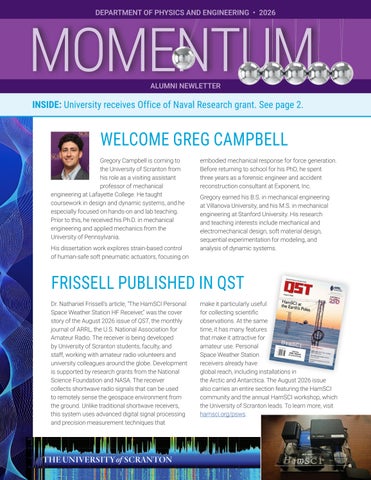
FRISSELL PUBLISHED IN QST Dr. Nathaniel Frissell's article, "The HamSCI Personal Space Weather Station HF Receiver," was the cover story of the August 2026 issue of QST, the monthly journal of ARRL, the U.S. National Association for Amateur Radio. The receiver is being developed by University of Scranton students, faculty, and staff, working with amateur radio volunteers and university colleagues around the globe. Development is supported by research grants from the National Science Foundation and NASA. The receiver collects shortwave radio signals that can be used to remotely sense the geospace environment from the ground. Unlike traditional shortwave receivers, this system uses advanced digital signal processing and precision measurement techniques that
make it particularly useful for collecting scientific observations. At the same time, it has many features that make it attractive for amateur use. Personal Space Weather Station receivers already have global reach, including installations in the Arctic and Antarctica. The August 2026 issue also carries an entire section featuring the HamSCI community and the annual HamSCI workshop, which the University of Scranton leads. To learn more, visit hamsci.org/psws.
University Receives Offic
UNIVERSITY RECEIVES OFFICE OF NAVAL RESEARCH GRANT The University of Scranton is on the front line of that research and received a three-year, $600,000 grant (subject to annual appropriations) from the Office of Naval Research. The project — officially titled, “Crowdsourced Observations for Ionospheric Model Validation and a Diagnostic Approach for Forecasting Equatorial Spread F” — is led by principal investigator Kornyanat “Kukkai” Hozumi, Ph.D., research scientist, with coinvestigator Nathaniel Frissell, Ph.D., associate professor of physics and engineering. “I’m very happy not only because, ‘Oh, we get an award, we get money.’ It’s not just that,” said Dr. Hozumi. “It’s a project that has impact on the real society and can help people to have safe and secure communication in the future. It can also help fulfill the HamSCI volunteers who contribute a lot to our HamSCI projects. Being that helpful to so many people at the same time — I feel very happy.” HamSCI refers to the Ham Radio Science Citizen Investigation community, which was developed by Dr. Frissell and is supported by multiple six- and seven figure grants from the National Science Foundation, NASA and other organizations. It is a worldwide group of licensed ham radio operators who gather and submit data to measure the effects of weather in the ionosphere. “I didn’t know anything about HamSCI, at all, before I came to the United States,” said Dr. Hozumi, who was born in Thailand and educated in Japan. “Just before I started my position in 2023 with NASA CCMC (Community Coordinated Modeling Center) as a postdoc, my supervisor told me that my duty was to work on radio propagation and to use HamSCI data.” From there, Dr. Hozumi was introduced to the world of HamSCI and to Dr. Frissell and was ultimately hired at the University in 2024. She works remotely in Utah. This project will combine HamSCI community contributed observations with physics-based modeling
2
The University of Scranton is on the front line of to serve multiple purposes, including creating a that research received a three-year, $600,000 repeatable way toand test and improve ionospheric forecasts and providing framework to evaluate grant (subject to annual appropriations) from the performance and track improvements over time. Office of Naval Research. The project — officially Strengthening the reliability of systems used for titled, “Crowdsourced Observations for communication, navigation and situational awareness is a boost for national resilience and publicand safety.a Diagnostic Ionospheric Model Validation Approach for Forecasting Equatorial Spread F” — is led by principal investigator Kornyanat “Kukkai” Hozumi, Ph.D., research scientist, with co“It’s a project that has impact investigator Nathaniel Frissell, Ph.D., associate on the real society and can help professor of physics and engineering. people to have safe and secure “I’m very happy not only because, ‘Oh, we get an communication in the future.” award, we get money.’ It’s not just that,” said Dr. – Kornyanat “Kukkai” Hozumi, Hozumi. “It’s a project that has impact on the real Ph.D., research scientist society and can help people to have safe and secure communication in the future. It can also help fulfill the HamSCI volunteers who contribute a Inlota second, to ourequally HamSCI projects. that helpful to important effort, theBeing team will try to identify earlyat warning signs of Equatorial soalso many people the same time — I feel very Plasma Bubbles (EPBs). EPBs can interfere with happy.” critical signals, including GPS and long-distance radio, HamSCI to the Ham Radio Science Citizen most oftenrefers after sunset and sometimes into the early morning in equatorial and low-latitude regions. Investigation community, which wasThis developed by interference can make it more difficult for phones, Dr. Frissell and is supported by multiple six- and planes, ships and emergency responders to know seven-figure grants thea chart National Science if they are connected. On anfrom ionogram, that shows how radio waves travel ionosphere, Foundation, NASA and through other the organizations. It is a EPBs may appear as Equatorial Spread F (ESF) — a worldwide group of licensed ham radio operators spread-out pattern that can cause longdistance highwho gather and to submit data to measure the frequency radio signals fade, distort or disconnect. effects of weather in the ionosphere.
MOMENTUM | 2026
LACKAWANNA BLIND ASSOCIATION AMATEUR RADIO ACCESSIBILITY PROJECT The Lackawanna Blind Association Amateur Radio Audio Accessibility Project is a flagship service project through the University’s Community-Based Learning (CBL) program. This project is designed to teach blind and visually impaired clients toward their FCC Technician amateur-radio licenses. The team — Dr. Nathaniel Frissell, Dr. Christine Zakzewski, students Owen Ruzanski and Liam Miller, and volunteers Ken Martin (KC3ZDW), Bob Nicolais (K1NLS), and Bill Gallagher — meets weekly at the Lackawanna Blind Association. Students also tutored clients outside the weekly session. All five clients successfully earned their Technician license, and the project’s hallmark was individualized accessibility accommodation. The project is also supported by a CommunityBased Learning Faculty Initiatives Fund grant to Dr. Mojib Saei, whose Manufacturing Processes students design and manufacture tactile study aids integrated into the curriculum for the clients.
DR. LEI LEADS NOYCE SCHOLARSHIP PROGRAM'S SCIENCE CAMP – By Juan Serna, Associate Professor Physics & Engineering Twenty middle and high school students from Scranton, Carbondale, and Clarks Summit spent a morning on campus this spring working with shape memory alloys and thermoelectric materials, guided by Dr. Chi-Hou Lei, assistant professor of Mechanical Engineering. The May 2 Science Camp is part of the Noyce Scholarship program, which supports STEM majors preparing to become high school teachers. Students applied heat to a deformed shape memory spring and watched it recover its original geometry, then used a candle to drive a thermoelectric generator through the Seebeck effect, producing enough current to power a small motor. “I wasn't sure how well the activity would resonate with students of such diverse backgrounds,” said Dr. Lei, “but I was happy with their level of engagement. Especially with science, sometimes you just have to see and feel to believe, and I hope they were surprised and even astonished by these unconventional materials. Their reaction also empowers me to devote time to crafting more hands-on activities for future K-12 outreach.” The demonstration gave the group a direct, physical look at two effects that usually stay confined to a textbook page, a temperature gradient converted straight into electrical current, and a material that remembers its own shape.
3
SCRANTON TEAMS WIN MULTIPLE TOP HONORS AT IEEE CONFERENCE Engineering students from The University of Scranton delivered a standout performance, among peers from colleges throughout the region, at a competition testing their engineering, programming and problem-solving skills through robotics.
me when I didn't quite understand something — but also told me a lot about what I had to look forward to in my engineering courses here at Scranton."
The MicroMouse competition tasked the group with designing and 3D printing a small, autonomous robot that could sense walls inside “Even though this was my first a maze. The robot needed to solve the maze on its own, time going to SAC, I didn’t using sensors and intelligently have to worry about feeling left programmed logic to escape. behind...” MicroMouse teammates included Carlton J. Hackett, – Rachel Lendzinski, Noah Millett and Ryan Merlo.
More than 300 students and faculty/staff members from 35 colleges and universities participated at the Institute of Electrical and Electronics Engineers (IEEE) Region 1 and 2 Student Activities Conference (SAC), held March 21 at Rowan University in New Jersey. Only six events were held — and Scranton’s IEEE branch won two of them, placing first in the Mini Pupper and MicroMouse competitions.
RICE Lab President
IEEE Regions 1 and 2 comprise much of the Northeast United States from Ohio and West Virginia through Maine. Other top finishers at the event hailed from Penn State, West Virginia, Maryland, Rutgers, Temple, Ohio Northern, York College, Montclair State and Wilkes. The Mini Pupper competition challenged students to program a small, dog-like robot to complete a set of tasks. Students used their coding skills to make the robot move and behave like a dog. Students also controlled the robot’s responses during a tug-of-war against other robots. Mini Pupper teammates included Rachel Lendzinski, Deanna Holbert and Lailah Merai. "Even though this was my first time going to SAC, I didn't have to worry about feeling left behind. I got to work with two amazing seniors, and we put a lot of time and energy into our project, so to win our division meant a lot," said Lendzinski, president of the University's student-led Laboratory for Research and Innovation in Computer Engineering (RICE Lab). "I got to bond with several upperclassmen who not only helped
4
Additionally, Alfred KumiAtiemo Jr. placed third in Brown Bag, a hands-on engineering challenge where student teams were given a bag of unknown components. Using only those components and their own knowledge, competitors, participating as teams of one to four students, had to design and build a working solution to a surprise problem.
MOMENTUM | 2026
UNIVERSITY’S NEW LABORATORY TESTBED ENHANCES SPACE WEATHER RESEARCH
This past year, faculty and staff in the Physics and Engineering Department established a new laboratory testbed at the University of Scranton to support research and education in space weather using the HamSCI Personal Space Weather Station (PSWS) magnetometer system. These low-cost instruments allow citizen scientists, students, and researchers to monitor changes in Earth's magnetic field produced by solar storms and other space weather events. By developing expertise with this system, our department is expanding opportunities for student involvement while contributing to the growing HamSCI citizen science network. A major focus of the project was recreating the magnetic signature of the May 10, 2024 Gannon geomagnetic storm in a controlled laboratory environment. Using data recorded during the storm,
the team generated corresponding magnetic field variations with a pair of Helmholtz coils and measured the resulting field using a HamSCI magnetometer. The laboratory simulation successfully reproduced the timing and overall structure of the storm, demonstrating that real geomagnetic events can be realistically modeled on a small scale. This work provides a valuable platform for testing and calibrating lowcost magnetometers, validating instrumentation, and developing hands-on educational activities that connect classroom learning with real space weather observations. Future efforts will focus on improving measurement accuracy, evaluating additional sensor designs, and creating laboratory modules that enable students and citizen scientists to explore geomagnetic storms and their effects on Earth's magnetic environment.
5
THE HAYES FAMILY SCIENCE COMPETITION Numerous University of Scranton students, faculty and staff members assisted in organizing, executing and scoring the annual Hayes Family Science Competition on April 16, 2026. One of the most popular and interactive events held each year at the University, this year’s competition attracted nearly 200 registered high school students from Berwick, Carbondale, Crestwood, Delaware Valley, Dunmore, Hazleton Area, Honesdale, Lackawanna Trail, North Pocono, Scranton, Scranton Prep, Wallenpaupack and West Scranton. In addition to learning key physics and engineering principles, the high school students applied their knowledge to compete for trophies and medals. Prizes were awarded to the teams that recorded the highest scores in the events corresponding to the theme, “Waves.” These events included a quiz and Jeopardystyle game show, as well as competitions focused on frequency, temperature and buoyancy, among other concepts.
6
The Hayes Family Science Competition’s signature event took place in the Byron Center, where everyone gathered to watch a student-programmed robot play Deep Purple’s “Smoke on the Water” on a guitar. The guitar was built by the department’s senior laboratory engineer Majid Mokhtari and Patrick Feller ‘27, a computer engineering major from Montgomery, New York. “We built a ‘to-scale’ guitar, two times the size of a regular guitar, with two robots,” said Feller, who took the lead in the presentation. “One of the arms is plucking the strings while another arm is pressing down the strings onto the frets to create a certain note. … “It was a lot of fun. They were a pretty nice crowd and I appreciated their enthusiasm about it.” The overall champion in Division 1 was a team from Delaware Valley, which beat out second- and third-place teams from Scranton and North Pocono, respectively. A team from North Pocono won Division 2, topping teams from Lackawanna Trail and Wallenpaupack.
MOMENTUM | 2026
STUDENTS EXPLORE MATERIALS TO IMPROVE MANUFACTURING EFFICIENCY The team of ME students, faculty members, and staff are partnering with one of the local companies to design, study, and optimize the injection molding process through 3D printed molds. The purpose of the project is transitioning from injection molding using metal molds to injection molding through Mid Quantity, High Strength, Polymer Molds. This represents a potential major advancement in the mid-scale production. Traditionally, parts are made either in either one-off, prototyping quantities, such as manually in a shop, by a 3D printer, or with minimal use of silicon molds with polymer resin injection. Larger scale production necessitates a steel mold to be engineered, capable of often 100,000 or more parts. While this is great for larger scale production, most small to medium-size businesses cannot afford this larger jump in production and cost of a hardened steel mold to be produced, often causing new product launches to not happen or happen with great financial difficulty.
By proceduralizing this mid-scale manufacturing approach, the project provides PA manufacturers with a practical tool to accelerate product commercialization, reduce tooling risk, and iterate designs without incurring the cost of traditional steel molds. The results have the potential to lower barriers to entry for innovation, strengthen the competitiveness of Pennsylvania manufacturing firms, and support sustainable job growth across the state.
7
800 Linden Street Scranton, PA 18510
RICE LABORATORY The Research and Innovation in Computer Engineering (RICE) Laboratory gives undergraduates authentic, handson computer engineering design experiences through real projects with real deliverables. the laboratory runs on a tiered, project-based model (Builders, Designers, and Architects) that carries a student from first hardware experiments to advanced chip design; the program is open to students of every major. The aim is a self-sustaining undergraduate research and education lab where every project ships a working design with documentation the next student can learn. Founded and directed by Dr. Navid Shahrouzi, with eight founding student members spanning multiple majors and class years, current and recent research includes the following: ◗ SRAM and DRAM memory cell design ◗ digital logic gate implementations on real hardware ◗ multi-ported memory design ◗ FPGA power, performance, and area (PPA) analysis Dr. Navid Shahrouzi joined the Department of Physics and Engineering as an Assistant Professor in August 2025. He earned his Ph.D. in Engineering, with a concentration
LOCATION The lab meets weekly in LSC 160, the electrical and computer engineering laboratory, and also uses other Loyola Science Center spaces, including the department makerspace (LSC 142). LSC 167 houses the specialized CAD tools used for the lab's design work.
in Electrical Engineering, from the University of Colorado Colorado Springs in 2018, and previously worked in industry at Cypress Semiconductor (now Infineon Technologies) on synthesis and timing closure for microcontroller IP. His research centers on digital and computer hardware design: how hardware-description-language coding choices shape chip-synthesis outcomes, along with reconfigurable and embedded architectures for data mining and edge computing. At Scranton he founded and directs the RICE Laboratory, bringing hands-on ASIC and FPGA design to undergraduates. He is a Senior Member of IEEE, a member of IEEEHKN, and a lifetime member of ACM.