information UPDATE
A Newsletter from The Harry & Jeanette Weinberg Memorial Library fall 2026
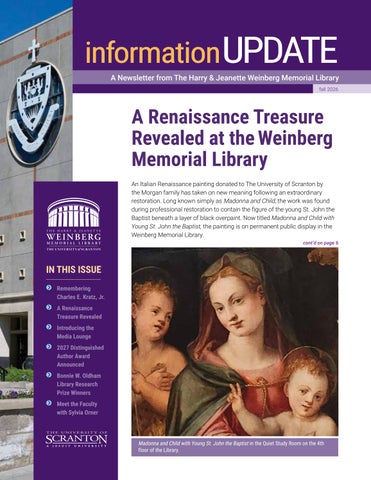
A Renaissance Treasure Revealed at the Weinberg Memorial Library An Italian Renaissance painting donated to The University of Scranton by the Morgan family has taken on new meaning following an extraordinary restoration. Long known simply as Madonna and Child, the work was found during professional restoration to contain the figure of the young St. John the Baptist beneath a layer of black overpaint. Now titled Madonna and Child with Young St. John the Baptist, the painting is on permanent public display in the Weinberg Memorial Library. cont’d on page 6
IN THIS ISSUE u Remembering
Charles E. Kratz, Jr.
u A Renaissance
Treasure Revealed
u Introducing the Media Lounge
u 2027 Distinguished Author Award Announced
u Bonnie W. Oldham Library Research Prize Winners
u Meet the Faculty
with Sylvia Orner
Madonna and Child with Young St. John the Baptist in the Quiet Study Room on the 4th floor of the Library.
In loving memory
CHARLES E. KRATZ
April 22, 1950 February 7, 2026
2
T HE UN IV ERSIT Y OF S C R ANTON
Wei n b erg Mem o r ia l L ib ra r y
Remembering Charles E. Kratz, Jr. It is with deep sadness that we share the news of the passing of Charles E. Kratz, Jr., Dean Emeritus of the Library & Information Fluency. Charles passed away on Saturday, Feb. 7, following a week-long hospitalization due to illness. He was 74 years old. Charles served The University of Scranton with distinction during his tenure as Dean of the Library, helping to shape the institution we know today. A graduate of the University of Notre Dame and the University of Maryland, he joined the University in 1991 as Director and was instrumental in the final completion and opening of the Weinberg Memorial Library the following year. Under his leadership, the Library underwent the transformative renovation of the Reilly Learning Commons, creating a dynamic learning space that continues to serve our students today. Charles also founded the Friends of the Library, establishing a vital bridge between the University and the broader community. In addition to launching the Royden B. Davis, S.J., Distinguished Author Award, he played a key role in the expansion of the University’s Special Collections and their dedication as the McHugh Family Special Collections. His leadership extended well beyond the Library. Charles was integral to the then-Center for Teaching and Learning Excellence’s expansion of support services, the Writing Center, and faculty development programs. He regularly taught writing and remained deeply engaged in the University’s academic life.
Charles retired in December 2019, but his service to the University continued. In 2022, the University dedicated the Library’s Charles Kratz Scranton Heritage Room in his honor. He continued to serve the Library and the University as a member of the Friends of the Library Advisory Board and as chair of the 2024 Royden B. Davis, S.J., Distinguished Author Award. His dedication to supporting student and faculty research, his commitment to accessible and innovative learning environments, and his vision for the Library’s role in the academic life of the University left a lasting impact on our community. Those of us who had the privilege of serving alongside him understand full well the strong foundation he helped build here. As University President Father Joseph G. Marina, S.J., noted in his message to the campus community, “Charles’ influence on The University of Scranton is woven into our very fabric. Those who had the pleasure of knowing and working alongside him know how much of our progress was supported by his work. His legacy will benefit students, faculty, researchers, and the broader community for generations to come.” This loss is felt deeply by all who knew Charles and worked alongside him. We join many friends and family members, including Charles’s beloved husband, Bill, in mourning. He was a valued colleague, and his contributions to our Library and University will be remembered with gratitude. George J. Aulisio, Ph.D., Dean of the Library
Information UP DAT E
FAL L 2026
3
Letter from the Dean We mourn his loss while remaining deeply grateful for the foundation he built. One particularly fitting expression of that continuing work is the restoration and unveiling of Madonna and Child with Young St. John the Baptist. Donated by the Morgan family, the painting was entrusted to the University with the expectation that it would be carefully restored and placed on public display. The conservation process not only preserved the work but also revealed a figure and landscape that had been hidden beneath black overpaint for generations. Subsequent research led to its attribution to the 16th-century Florentine painter Niccolò Betti.
Dear Friends, As we begin a new academic year, this issue of the Information Update invites us to reflect on the relationship between legacy and renewal. Libraries are places where the past is preserved, but they are also places that must continually adapt to new forms of scholarship, learning, and community life. The stories collected here demonstrate both responsibilities. This is our first newsletter following the passing of Charles E. Kratz, Jr., Dean Emeritus of the Library & Information Fluency. Charles’ vision helped shape nearly every aspect of the Weinberg Memorial Library as we know it today. He oversaw the Library’s earliest years, founded the Friends of the Library, established the Distinguished Author Award, expanded Special Collections, and helped create the Reilly Learning Commons. His influence extended throughout the University, and his commitment to students, faculty, and the broader community continues to guide our work.
4
T HE UN IV ERSIT Y OF S C R ANTON
Wei n b erg Mem o r ia l L ib ra r y
The painting’s remarkable journey is fundamentally a story of stewardship. A family preserved it, a conservator recovered its original composition, a scholar restored its artistic identity, and the University has now accepted responsibility for sharing it with future generations. That same commitment to preservation and discovery can be seen in the upcoming Heritage Room exhibition exploring the transformation of book production during the 19th century. Stewardship, however, does not mean leaving things unchanged. In Spring 2026, the Library transformed the former Media Resources Center into the new Media Lounge. The renovated space offers collaborative booths, comfortable seating, individual study areas, a dedicated viewing room, and more accessible shelving for our curated media collections. A new circulating games collection further expands the ways students can gather, relax, and learn together. During Summer 2026, we are also renovating the Library Services Desk, which will reopen in time for the fall semester. A dedication ceremony for the completed space will be planned, and the next issue of the Information Update will feature an article highlighting the renovation. Together, these improvements reflect our continuing effort to ensure that the Library’s spaces remain welcoming, flexible, and responsive to the needs of our community.
NEW MEMBERS Yahya Aslan Aydin Enis This issue also highlights the intellectual work taking place within and around the Library. The recipients of the 2026 Bonnie W. Oldham Library Research Prize demonstrate how careful research can cultivate curiosity, discernment, persistence, and concern for others. Their projects remind us that information literacy is not simply the ability to locate sources. It is the practice of asking better questions, evaluating evidence responsibly, and recognizing the human consequences of the conclusions we draw. I am equally proud of the accomplishments of our faculty and staff. Professor Kate Cummings received the Provost’s Beloved Community Award for her contributions to justice, human dignity, and solidarity. Professor Sylvia Orner received tenure, and Professor Sheli PrattMcHugh was promoted to Professor. We are also pleased to welcome Assistant Professor Erica Getts as our new Research and Instruction Librarian for STEM. Each of these colleagues strengthens the Library through professional expertise, generous service, and a deep commitment to our students. Looking ahead, the Friends of the Weinberg Memorial Library will welcome Andrew Krivák as the recipient of the 2027 Royden B. Davis, S.J., Distinguished Author Award. Krivák’s writing is rooted in the immigrant experience and anthracite history of Northeastern Pennsylvania, making his selection especially meaningful for our University and region. I hope you will join us for the award presentation on April 3. Sponsorship opportunities are available for individuals and organizations wishing to support this signature event and the broader work of the Friends of the Weinberg Memorial Library. To learn more, visit http://www.scranton.edu/library/distinguishedauthoraward. Finally, I extend a warm welcome to the newest members of the Friends of the Weinberg Memorial Library and offer my sincere thanks to all who support our collections, programs, spaces, and students. Your generosity allows the Library to preserve what has been entrusted to us while continuing to imagine what comes next. Sincerely,
George J. Aulisio, Ph.D. Dean of the Library
Christopher Boam Birhan Demir Michelle Donlin Edward Fortuna Matthew J. Geiger Gary Goodall Kenneth Goody Frederic & Linnie Greenberg Vincenta Grum Donna McAllister Ellen Newell Frances (Fran) Samuels Scott Shepard Bill Wehrmann
STAFF UPDATES u Erica Getts joined the
Research Services Department as the Research and Instruction Librarian for STEM on Aug. 3.
u Associate Professor Sylvia
Orner received tenure.
u Sheli Pratt-McHugh was
promoted from Associate Professor to Professor.
Information UP DAT E
FAL L 2026
5
Cover story: Renaissance Treasure cont’d The Morgan family (siblings Patricia, Albert, Mary Louise, Robert, Harry, and John) donated the painting in honor of their parents, Dr. Albert P. and Marcy A. Morgan. It had hung for many years in the family’s Carbondale home, where an earlier owner had incorporated it directly into a wall. When the family left the house, they arranged for a carpenter to remove the painting and selected The University of Scranton to become its steward.
the starkness of the composition began to trouble him. Mary and the Christ Child seemed strangely isolated against a uniform black background, and the arrangement of the figures appeared incomplete.
The gift reflected the family’s longstanding connection to the University. Dr. Albert Morgan interrupted his education to serve in the United States Army Air Corps during World War II. After returning from military service, he resumed his studies and graduated in 1948 from St. Thomas College, now The University of Scranton. His family remembered his gratitude for the care the College showed returning veterans by helping them obtain the courses they needed to complete their degrees. The donation came with two requests. The painting should be professionally restored and then placed on permanent public display. Those requests reflected more than concern for the preservation of a family possession. They represented an act of trust in the University and a desire that the painting be shared with the wider Scranton community. Upon its arrival, the painting was beautiful but showed signs of age — including bowing and areas of chipped paint — that made professional conservation the appropriate next step. Following a careful search and a recommendation from the Everhart Museum, the University entrusted the work to Chelsea Restoration Associates in New York City, where it was treated by the firm’s co-owner and primary restorer, John Powell, a native of Taylor, Pennsylvania. Powell began by stabilizing the painting and carefully removing accumulated grime, aged varnish and evidence of previous restoration. As he worked,
6
T HE UN IV ERSIT Y OF S C R ANTON
As Powell cautiously examined the black background, traces of flesh color began to emerge beneath the overpaint. Gradually, he uncovered the remarkably well-preserved figure of the young St. John the Baptist, along with a woodland setting that had also been concealed. What had appeared to be a simple two-figure devotional image was revealed to be a far richer and more carefully balanced composition. The discovery fundamentally changed the painting. St. John’s gaze directs the viewer toward Mary and the Christ Child, visually connecting all three figures. His presence also deepens the religious meaning of the scene. The child who would later announce the coming of Christ is already shown attending to Mary and Jesus. The project became more than the conservation of an aging painting. It recovered a significant portion of the artist’s original composition. Why a later hand covered the figure of the young St. John the Baptist may never be known. Powell collaborated with Robert B. Simon, Ph.D., president of Robert Simon Fine Art and a specialist in European painting, to study the restored work. Simon’s research led to its attribution to Niccolò Betti, a Florentine painter born in 1546 who worked throughout
Wei n b erg Mem o r ia l L ib ra r y
Tuscany during the second half of the 16th century. Betti trained within the artistic tradition of Domenico and Ridolfo Ghirlandaio and participated in important projects associated with the Medici court. His surviving works can be found in locations including Florence’s Palazzo Vecchio and the Uffizi Gallery.
preserved it and entrusted it to the University. Powell’s trained eye and patient work recovered what had been concealed. Simon’s scholarship placed it within the history of Florentine art. The University now assumes responsibility for caring for the painting and making it accessible to future generations.
The restoration also included the creation of a new frame appropriate to the painting’s period and character. Based on a 17th-century Italian example, the frame was handcrafted from modern materials specifically to house the newly restored work.
Visitors to the Weinberg Memorial Library can now encounter nearly five centuries of art history — not in Florence or New York, but here in Scranton, Pennsylvania. George J. Aulisio, Ph.D., Dean of the Library
The University formally unveiled Madonna and Child with the Young St. John the Baptist on April 30, 2026, during a Schemel Forum program in the Charles Kratz Scranton Heritage Room of the Weinberg Memorial Library. At the unveiling, Powell discussed the careful technical process through which the hidden figure and landscape were recovered, while Simon explained the research that led to the attribution to Betti. The event celebrated not only the restoration of a centuries-old work of art, but also the recovery of an artist’s composition and identity from what had, until recently, been lost to time. The painting’s permanent location in the Library’s fourth-floor Quiet Study Room was chosen deliberately. Open to members of both the University and the wider community, the room provides a space for quiet study, contemplation and reflection. The painting hangs near the Library’s large stained-glass windows, with the cross at their center, giving the room a distinct spiritual character. Within that setting, the painting is not simply an artwork placed on display. It becomes part of a space shaped by light, learning, care, and contemplation. A work created for devotion nearly five centuries ago continues to serve that purpose today. The painting’s journey — from Florence to a family home in Carbondale, through a restoration studio in New York and finally to the Weinberg Memorial Library — is also a story of stewardship. The Morgan family
Madonna and Child with Young St. John the Baptist in the Quiet Study Room on the 4th floor of the Library.
Information UP DAT E
FAL L 2026
7
Upcoming Exhibit: From Hand Crafted to Industrial: Book Production in the 19th Century From the 1450s until about 1800, all parts of book production from papermaking, to typesetting, printing, and bookbinding were done by hand. This Heritage Room exhibit explores the transition from hand-crafted to industrial production of books that occurred during the 19th century. While books looked more or less the same, by the first decade of the 20th century, all parts of book production had been mechanized. The way books were written, published, marketed, and sold also evolved. The exhibit will show examples of how book illustrations changed, book bindings evolved, and how authors produced and sold their works. The exhibit will run through the fall semester. For more information contact Michael Knies at Michael.Knies@scranton.edu. Professor Michael Knies, Special Collections Librarian and University Archivist
Henry Wadsworth Longfellow, The Golden Legend. London, 1854. Publisher’s bookbinding designed by John Leighton. Note JL initials at the bottom of the spine and at the bottom of the central ornament on the cover.
Faculty Member Wins Provost Award Professor Kate Cummings, Research and Instruction Librarian for Business, was awarded the Provost’s Beloved Community Award. The award recognizes a faculty member whose teaching, scholarship and service significantly advances the University’s Jesuit Catholic mission by fostering a campus culture rooted in justice, human dignity, and solidarity. Kate embodies this award through her research, service, and librarianship on topics ranging from DEI, intellectual freedom, and professional leadership. We congratulate Prof. Cummings on her award.
8
T HE UN IV ERSIT Y OF S C R ANTON
Wei n b erg Mem o r ia l L ib ra r y
Friends of the Weinberg Memorial Library 2026 Book Sale The rain-filled final weekend this past April proved to be the perfect weather for browsing the Friends of the Weinberg Memorial Library Annual Book Sale in the Charles Kratz Scranton Heritage Room. Thanks to our dedicated volunteers — including Weinberg Memorial Library staff and faculty, members of the Friends of the Weinberg Memorial Library, community members, and University of Scranton student volunteers — this beloved event continues to be a cornerstone occasion for the Weinberg Memorial Library and the community. Thank you to all who supported and assisted with this book sale in various facets! Melisa Gallo, Interlibrary Loan and Collections Assistant
Information UP DAT E
FAL L 2026
9
GAMES COLLECTION The Weinberg Memorial Library won a small collection of eight games from the Gaming Round Table of the American Library Association. In addition to the eight games, an additional 35 games were added to create the WML Games Collection. The games are available for checkout for five days but can also be played in the Library in the Reilly Learning Commons, Pro Deo Room, and the Media Lounge. To find out what games we have run a keyword search for “WML Games Collection” in Royal Search or Locate on the Library home page.
Library Renovations: Introducing the Media Lounge To meet the evolving needs of our community, the Library completed a renovation of the Media Resources Center on the third floor. Making a shift away from being a primarily physical resource repository, the new space, rebranded as the Media Lounge, is now a more dynamic space that can support student learning activities while retaining media for curricular needs and personal viewing interests. The renovations created a more flexible, modern space that includes:
u A dedicated Media Viewing Room u An open space with lounge seating u Booths for collaborative learning u Individual reading and study space u New shelving for media allowing for the curated collections to be more approachable and discoverable
u A retained dedicated space for the Education Laboratory
10
TH E UN IV ERSIT Y OF S C R ANTON
Wei n b erg Me m o r ia l L ib ra r y
Information UP DAT E
FAL L 2026
11
Library Announces Bonnie W. Oldham Library Research Prize Winners
2026 Bonnie W. Oldham Library Research Prize honorees, from left to right: Corinne R. Langowski, Aaron T. Redis, and Hannah Horn; not pictured: Lucas Camacho, Faith E. Montagnino, Emma McMahon, and Abigail Wall.
12
Dr. George Aulisio, Dean of the Library, awarded the 2026 Bonnie W. Oldham Library Research Prize in the Undergraduate Foundational category to Lucas Camacho, a first-year Kinesiology major on a Pre-Med/ Pre-PA track; the Undergraduate Upper-level category to Hannah Horn, a junior Cybercrime and Homeland Security major with a double minor in Criminal Justice and Criminology; and the Graduate category to Aaron T. Redis, a graduate student in the Master of Science in Clinical Rehabilitation Counseling program.
the methods of research and the information gathering process, and use of Library resources, tools, and services. In 2017, the prize was named for Professor Emerita Bonnie W. Oldham, who founded the prize at the University in 2011. The Bonnie W. Oldham Library Research Prize was fully endowed in 2019 and consists of a prize of $500 awarded to winning projects in each of the three categories: Undergraduate Foundational (100-level projects), Undergraduate Upper-level (200- to 400-level projects), and Graduate-level projects.
Currently celebrating its 16th year, the Library Research Prize was inaugurated in 2011 by the Weinberg Memorial Library to recognize excellence in research projects that show evidence of significant knowledge of
Camacho submitted to the competition his paper titled “Building Habits that Last a Lifetime,” completed in Professor Dawn D’Aries Zera’s WRTG 107: Composition course. Tasked with researching an argumentative
TH E UN IV ERSIT Y OF S C R ANTON
Wei n b erg Me m o r ia l L ib ra r y
contemporary issue related to his major, Camacho’s goal was to write about wearable fitness trackers. Getting started posed a challenge, and he shares in his description of research, “I was not sure how to transform that idea into a well-researched and supported argument. I kept telling myself I had to find the ‘perfect’ source to get started. This mindset kept me stuck [...] Everything changed when I attended a class session instructed by Donna Witek, Librarian, at the Weinberg Memorial Library. This session gave me the direction needed to put me on the right track for success in this assignment.” In the information literacy class session, Camacho learned how to effectively use Library search tools to locate specific materials needed to support his argument. He notes that he had never used many of the Camacho tools introduced in this information literacy class, but that the class made him “confident about the process and how the information was organized.” He began his research with Royal Search, the Library’s main search tool, which searches all of the Library’s databases, electronic resources, and print and media collections for books, articles, and more. He immediately started applying the skills he learned in the information literacy class and mentions using features such as the filters to locate scientific, peer-reviewed literature relevant to his research topic, which he accessed through Library-indexed resources including PubMed, JAMA Network Open, The BMJ, Frontiers in Physiology, and The Lancet Digital Health. He experienced success in combining multiple keywords using Boolean operators such as AND and OR to narrow or broaden his searches as needed. He notes, “Gathering evidence started to become a bit easier with each search, and I was able to start building my claim. Seeing the variety of studies that are connected to my topic helped me understand the scope of scholarship involved in academic research.”
Camacho details his use of reading the abstracts of discovered studies to ensure that they would be supportive of the claims he was making in his essay, and that this allowed him to conduct research more efficiently. He goes on to reflect on the research process as a whole, saying, “The guidance from Professor Donna Witek helped me grow as a student. I developed a clear understanding of how to do academic research with intention instead of just guessing my way through it. This topic taught me how to find sources, but more importantly, how to think more patiently and critically.” He also described a common challenge when conducting research and the ways he persisted through it using what he learned: “When I felt like my research process hit a wall, I remembered that Donna told us that research should be treated as a continuous process instead of just a one-time search. Sometimes the search did not bring up high-quality results, and it became frustrating. I was able to stay calm and focused when I remembered this research mindset. This was not just about collecting sources; it was about building the foundation and context of a truly compelling subject for me.” Finally, Camacho reflected on the role the Ignatian characteristic contemplation in action played in his research when he writes:
_____________________________________________ “Research provided me a chance to reflect on my thinking and fortify my skills, which will serve me further after this assignment. My argument highlighted the importance of building long-term habits. Ironically enough, the research process ended up teaching me the same lesson: progress comes from being consistent in habits. I became more confident in my academic ability based on the skills acquired to search intentionally, evaluate studies, and think critically. The same approach of consistent work, adjustment, and reflection applied to assignments and challenges beyond this one.” _____________________________________________
Information UP DAT E
FAL L 2026
13
The Honorable Mention awards in the Undergraduate Foundational category were presented to Nursing major Emma McMahon, for her project titled “Prioritizing Cognitive Behavioral Therapy Over Pharmacotherapy,” and to Communication Sciences and Disorders major Abigail Wall, for her project titled “Does Telehealth Improve Access to Healthcare or Compromise the Quality of it?,” both completed in the course WRTG 107: Composition for Professor Dawn D’Aries Zera.
For her research, Horn drew on a range of tools and resources available through the Library, including Royal Search, research guides, and the A-Z Databases list. She discusses using the ProQuest Criminal Justice database to locate academic literature on both traditional and emerging money laundering methods, and she supplemented this with JSTOR and EBSCO’s Academic Search Premier to gather literature on regulatory frameworks and organized crime. Because her topic sits at the intersection of criminology, cybersecurity, international law, and financial regulation, she describes using the Library’s unified search system to map citations and trace scholarly conversations across disciplines. She also consulted reports from the Financial Action Task Force and the Financial Crimes Enforcement Network (FinCEN), which grounded her research in real-world investigative practice. Throughout this process, Horn strengthened her ability to evaluate source quality. She explains,
___________________________ “The Library’s resources helped me to distinguish assertions from research grounded in evidence and helped to ensure that all the sources I used were credible and scholarly. I also learned to focus my research on peerreviewed journals, official documents, and legal examinations, considering the reliability of their publication, research methods, sample size, and the availability of data.”
From left to right: Dr. George Aulisio, Dean of the Weinberg Memorial Library; Dr. Ismail Onat, Department of Crime, Justice, and Security; 2026 Bonnie W. Oldham Library Research Prize Undergraduate Upper-level award recipient Hannah Horn; Dr. Carolyn McNamara Barry, Dean of the College of Arts and Sciences; and Dr. Tracy Stewart, Interim Provost and Senior Vice President of Academic Affairs.
Undergraduate Upper-level category winner Horn submitted to the competition her project titled “Money Laundering through Online Gambling,” completed in the course CJ 231: Environmental Criminology, taught by Dr. Ismail Onat. In choosing a research topic, Horn explains in her description of research, “My curiosity about money laundering through gambling began from a desire to understand how digital platforms, such as online casinos, introduce new risks to these conventional systems. At the beginning of the project, I recognized that the subject was extensive and impactful but had very little research regarding it.”
14
TH E UN IV ERSIT Y OF S C R ANTON
_____________________________________________ She continues, “These thorough assessments embody the trait of discernment by distinguishing trustworthy information from deceptive or biased origins. This process required patience, contemplation, and a need for open-mindedness when presented with facts and information.”
Wei n b erg Me m o r ia l L ib ra r y
Exploring this subject led Horn to consider the social and human dimensions of financial crime. She writes: “Online casino sites […] commonly act as conduits for criminal organizations to exploit vulnerable groups, disrupt economies, and weaken confidence in the financial systems used. Researching this subject prompted me to embrace the concept of cura personalis, meaning acknowledging the human aspect behind what might seem like a purely financial framework. I gained an understanding of how illegal activities impact innocent people and communities, especially in nations with fragile regulatory environments and economies.” Horn’s paper offers a robust analysis of online casinos as environments that enable money laundering, tracing the legal history of anti-money laundering legislation, applying criminological frameworks, and culminating in an original intervention proposal. Her work is both analytically rigorous and practically grounded, demonstrating the kind of critical thinking that defines excellent upper-level research. The Honorable Mention awards in the Undergraduate Upper-level category were presented to Corinne R. Langowski, a senior Communication Sciences and Disorders major, for her project titled “Predicting Langowski Developmental Outcomes in Toddlers with Early Language Delay Using the Preschool Language Scale – Fifth Edition,” completed in the course CSD 412: Introduction to Research Methods, taught by Dr. Joseph Motzko; and Faith E. Montagnino, a senior English major with Philosophy and Writing minors, for her University Honors project titled “The Wound as Method: Pain, Language, and Feminist Knowledge in Confessional and Post-Confessional Poetry,” completed in WRTG 489H: Honors Project II, mentored by Dr. Billie Tadros.
Graduate category winner Redis submitted to the competition his project titled “Seeing Trauma Differently: Evaluating the Efficacy of EMDR Across Varying Abilities and Contexts,” in the course COUN Redis 521: Physical and Psychosocial Aspects of Disability, taught by Dr. Samantha Herrick. Redis first notes in his description of research that getting started on a research project is often the hardest step. Deciding to research the broader topic of trauma, he utilized the Library’s resources including Publication Finder and Royal Search and came upon eye movement desensitization / reprocessing (EMDR) therapy as his research topic for this project. About the scope of his research, he notes, “I initially wanted to center the research on providing this therapeutic modality for individuals with physical disabilities. However, I quickly learned there was a significant gap in the scholarly literature, as I could only locate sources on EMDR for individuals with intellectual disabilities.” This discovery led Redis to focus his research on EMDR accessibility overall, relying on key sources to further refine the scope of his project, including in one case a playlist on virtual EMDR which he found through the Library’s search systems and which helped “inform [his] research on adapting EMDR strategies for broader accessibility.” He describes the need to “draw meaningful conclusions” from the information available on a given topic, especially when there may not be direct evidence available on a particular aspect of the topic being researched. This is especially important in evidence-based fields such as clinical counseling practice. His use of a log for his sources, in which he recorded notes on pieces of evidence he found valuable or interesting, was a tool that helped him do this. Redis speaks about this process as “research by serendipity,” a phrase he uses to describe how the synthesis of existing research may reveal gaps, but
Information UP DAT E
FAL L 2026
15
one can still build upon those works in a meaningful way to contribute further to the scholarly conversation. He goes on to reflect on his experience in graduate studies of “expecting [a project] to turn out one way, but the further we go along, we see it turn into something better than we may have expected.” He continues, “This taught me the value of being flexible and seeing that sometimes we grow in the process, even if it feels overwhelming or uncertain.” Redis reflects on the Jesuit values he identified in his research From left to right: Dr. George Aulisio, Dean of the Weinberg Memorial Library; Dr. process for this project. He notes Samantha Herrick, Department of Counseling and Human Services; 2026 Bonnie W. how he learned that “education is Oldham Library Research Prize Graduate award recipient Aaron T. Redis; Dr. Victoria so much more than knowledge” Castellanos, Dean of the Leahy College of Health Sciences; and Dr. Tracy Stewart, and that “it is also about developing Interim Provost and Senior Vice President of Academic Affairs. character and leadership,” which is how he put magis into practice in Through this, Redis illustrates how the research process this project. In addition, his research discovery that impacts both the researcher and those whom the research EMDR interventions need to be adapted to individual client needs looks at a person holistically, which is the will serve. embodiment of cura personalis. On this, he reflects Prize winners were honored at an Awards Ceremony & on what he’s learned about EMDR when he shares, Reception on Friday, May 22, 2026, in the Charles Kratz “There is something to be said for a client trusting Scranton Heritage Room of the Weinberg Memorial Library. us with the heaviest parts of their lived experience; Winning projects and research description essays were we must honor this by encouraging them to care for added to the Library’s Bonnie W. Oldham Library Research themselves in and out of the session, and sometimes Prize Collection in the digital collections over the summer. slowing down or stopping EMDR is the best way to Information about the Bonnie W. Oldham Library Research do so.” Prize can be found on the website: http://www.scranton. Lastly, Redis speaks about how “deep reflection edu/libraryresearchprize. Questions about the Bonnie strongly influenced [his] research process” as he W. Oldham Library Research Prize can be directed strove for continual improvement in the execution to the Library Research Prize Planning Committee at of this research project. He connects this to libraryresearchprize@scranton.edu. contemplation in action and notes, Special thanks to Professors Kate Cummings, _____________________________________________ Colleen Farry, and Ian O’Hara for their contributions to this article. “Being able to sift through the research
and come back to and draw meaningful conclusions matters a lot and determines how much someone takes away from the process.”
Professor Donna Witek Information Literacy Coordinator and Research & Instruction Librarian for the Humanities and Ignatian Pedagogy
_____________________________________________
16
TH E UN IV ERSIT Y OF S C R ANTON
Wei n b erg Me m o r ia l L ib ra r y
Andrew Krivák Selected as 2027 Distinguished Author The Friends of the Weinberg Memorial Library are pleased to announce the 2027 Distinguished Author Award winner, Andrew Krivák. Krivák is an acclaimed novelist and poet whose fiction draws deeply on the immigrant heritage and anthracite coal history of Northeastern Pennsylvania. A finalist for the National Book Award, he writes with a contemplative, scripture-inspired lyricism, and his work has been honored with some of the most distinguished prizes in American letters. His most recent novel, Mule Boy (Bellevue Literary Press), opens on a New Year’s Day 1929, when 13-year-old Ondro Prach, the son of Slovak immigrants in Pennsylvania’s coal country, reports for his first day of work as a mule boy, charged with the animal that hauls cartloads of coal from the deep shafts to the surface. He knows the danger, for his own father died in the mines. On his first day, the earth gives way, and Ondro alone walks out alive. The novel follows the long life that survival sets in motion — including guilt, addiction, and strained relationships.
For The University of Scranton, situated in the heart of the anthracite region, this year’s award carries a particular resonance. Andrew Krivák was born in Wilkes-Barre and raised in Northeastern Pennsylvania, the grandson of Slovak immigrants. The cost of the coal trade was not abstract in his family — his paternal grandfather was killed in a mining accident in Wilkes-Barre. That inheritance runs through his work. His earlier novel The Signal Flame is set in the fictional NEPA town of Dardan, and in Mule Boy he returns once more to Luzerne County collieries and towns that shaped the Wyoming Valley. Join us on Saturday, April 3, at 5 p.m. to hear about Andrew Krivák’s writing and inspirations. For more information and to purchase tickets or become a sponsor, visit the Library’s homepage. Professor Sheli Pratt-McHugh, Research & Instruction Librarian for Social Sciences
Information UP DAT E
FAL L 2026
17
TRAIL CLEANUP As part of Earth Week, Sheli Pratt-McHugh, Penny Pratt, Marleen Cloutier, and Melisa Gallo participated in a trail cleanup along the Lackawanna River Heritage Trail on May 3, 2026.
Nature Reimagined: 2026 Environmental Art Show The 2026 Environmental Art Show themed Nature Reimagined was held from April 13-22, 2026 in the Charles Kratz Heritage Room on the 5th Floor of the Weinberg Memorial Library during Earth Week. Environmental Art promotes the natural beauty of our environment and the ideal practice of sustainable living through artworks of all types. 12 artists participated in this year’s show. Thank you to all of the artists who contributed this year!
18
TH E UN IV ERSIT Y OF S C R ANTON
Wei n b erg Me m o r ia l L ib ra r y
Waymarks Toward Reunion Artist Talk In conjunction with the closing of the Environmental Art Show, an event brought together a sculptor and a playwright at a shared creative threshold. Waymarks Toward Reunion: Making Beauty As a Return to the Earth, an artist talk with Patrick Beldio, MFA, Ph.D., and Waymarks Fellow Gabriella Palmer ′26, was held on April 21 in the Charles Kratz Scranton Heritage Room. The talk asked attendees: What does it mean to return — to the earth, to ourselves, to what is sacred in the ordinary? Patrick Beldio, Artist-in-Residence at the Franciscan Monastery of the Holy Land and Visiting Assistant Professor of Theology and Religious Studies at The University of Scranton, introduced his grant-funded program Waymarks Toward Reunion and reflects on his own creative and spiritual practices, and how these inform and are informed by his scholarship and teaching in the classroom. In addition to his academic work, Dr. Beldio is a professional sacred sculptor with a studio at the Franciscan Monastery in Washington, D.C. His artwork is held in private and public collections across the United States, Europe, and India. You can view his work at https://www.reunionstudios.com. Dr. Beldio shared some examples of his sculptural pieces during his presentation.
Beldio
Gabriella Palmer was a triple major in English, Theatre, and Philosophy with a Legal Studies concentration at The University of Scranton and a Waymarks Fellow. Gabriella spoke about how the environment and nature are present in theater productions and how upcycled materials are utilized in the process of creating scenery for University of Scranton theater productions. She also shared her latest original play: a retelling of The Prodigal Son as family drama with magical realism that also examines the theme of reunion with nature. With the assistance of fellow University of Scranton Players Marcus Smith and Dawson Chrisolm, Gabriella read an excerpt from the play.
Palmer
Associate Professor Marleen Cloutier, Cataloging and Metadata Librarian
Information UP DAT E
FAL L 2026
19
Meet the Faculty Interview with Sylvia Orner Associate Professor Sylvia Orner is the Acquisitions and Electronic Resources Librarian for the Resource Acquisition and Discovery Services Department. Marleen Cloutier (MC), Information Update co-editor, recently interviewed Sylvia Orner (SO). MC: Can you tell us about the work you do in your current role? SO: Currently, I manage the licensing and purchasing for all the Library’s electronic resources, streaming media, and physical books and media. I also help facilitate access and discovery (and occasional troubleshooting) for all our electronic resources and streaming media. MC: What is the most difficult or most interesting part of the work you do? SO: I’m a big fiction reader, so for me the most interesting part is working on the Recreational Reading collection. I love getting to see what’s coming before it hits the shelves. The most difficult part is keeping track of everything. We have about 1.1 million eBooks, 72,000 eJournals, 136,000 streaming media titles, and 180 databases from dozens of different vendors. There are a lot of moving pieces, and I need to make sure that people can find what they need. MC: What brought you to WML? Or, what did you do before you took on your current position? Was it very different from your role now? SO: Before working at WML, I was the Head of Technical Services at the Scranton Public Library. While it was somewhat similar to what I am doing right now, I continue to be amazed at how different some of the processes (and pricing) are from public to academic libraries. I also tend to be more of a technically minded person, so I think the switch to my current position allowed me an opportunity to embrace those skills more fully.
20
TH E UN IV ERSIT Y OF S C R ANTON
MC: You have been very active in the Pennsylvania Library Association (PaLA), including being its President. Can you tell us about your involvement with PaLA and how being a member influences you as a librarian? Was there a particular event or program you are proud of or want to tell us about? SO: I was encouraged by one of my graduate school professors to get involved with a professional organization, and I’m very glad that I did. My first library position was as the branch manager for a small municipal library branch. I was also the only person who worked at said branch, so it was nice to have an organization like PaLA where I could meet other people in the profession to share ideas and learn some new things. I really think that it’s the connections I made with all those people that have helped me grow into the librarian I am today, and I just hope that my volunteer leadership with PaLA helps the organization to continue to offer these kinds of opportunities for future librarians and library workers. I am incredibly proud of all the events and programs that our PaLA volunteers help organize, but I have to say that the 2020 annual conference holds a special place in my heart. I was the conference chair that year, and I don’t think I have to remind anyone what happened in 2020, but we essentially pivoted from having an in-person conference to a virtual conference in less than six months. It was a wild time, but I was just so impressed with how everyone pulled together to make it work. MC: You recently gave some presentations here on campus and off campus. Is there a particular line of research you are interested in or working on now? SO: I feel like I’ve been talking about artificial intelligence a lot lately. Professor Kate Cummings and I have been doing a lot of workshops and presentations, and it’s been kind of interesting how much the conversations and the technologies have shifted since we first started about two years ago. It’s been very interesting to see how librarians as a profession have been grappling with these changes and what they mean. Right now, I’ve
Wei n b erg Me m o r ia l L ib ra r y
been doing some reading and research on AI in the context of our professional ethics. Essentially, we as librarians have been built upon this idea of freedom of information, but I think that the introduction of AI and the policies and processes that go into creating them has kind of challenged that ideal. I’m really interested in exploring some of those challenges a little more in-depth. MC: What are you reading now? Do you have a favorite book or genre? SO: I am a serial multi-tasker when it comes to reading so I have 3 books going right now:Tillinghast by Clare Cavenagh (at home), A Plagued Sea by Kim Bo-Young (on my phone), and I Know a Place by Nat Cassidy (in my backpack). But my all-time favorite is The Haunting of Hill House by Shirley Jackson, and if it was not already obvious, my favorite genre is horror.
RESOURCE ACQUISITION AND DISCOVERY SERVICES The Weinberg Memorial Library’s Technical Services department has a new name: Resource Acquisition and Discovery Services (RADS). RADS is comprised of three departmental units within the Library: Acquisitions, Cataloging, and Serials. This department, hidden behind the scenes, oversees the lifecycle of Library materials and maintains the Library’s online catalogs and databases.
Student Worker Celebration At the end of the school year, we threw our annual party to celebrate our student workers and recognize all their hard work throughout the year. Graduating students were presented with certificates and gifts from their supervisors, and each supervisor spoke about their graduates and what they’ve brought to the Library through the years. Melissa Crotti, Library Services Coordinator
2025-2026 Student workers Back row from left to right: Quentin Pegan, Ryan Devlin, Lucas Doney, Riden Kingston, and Gabriel Messier. Front row: Tracy Mena, Heather Williams-Owen, Cassy Marenski, and Maggie O’Connell.
Information UP DAT E
FAL L 2026
21
Fall Hope Horn Gallery Exhibits September 8 through October 9, 2026 September 8 through October 9, 2026 September 8 through October 9, 2026 Joy in the Process: Joy inthe the Process: Joy in Process: Selections from a Regional Collection
Selections from a Regional Collection Selections from a Regional Collection
The vibrant arts community of Northeastern Pennsylvania provides opportunities artists and collectors to pursue their creative interests. Thevibrant vibrant for arts community of Northeastern Pennsylvania provides The arts community of Northeastern Pennsylvania provides This curated exhibition features work by John Willard Raught, Graydon opportunities for artists and collectors to pursue their creative interests. opportunities for artists and collectors to pursue their creative interests. This Hope curated exhibitionHorn, features work Djordjevic, by John Willard Raught, Graydon Mayer, Cumming Predrag Louis Pontone, Cliff This curated exhibition features work by John Willard Raught, Graydon Mayer,William Hope Cumming Djordjevic, Louis Pontone, Cliff Prokop, Tersteeg,Horn, and Predrag Karl Neuroth, among others.
Mayer, Cumming Predrag Louis Pontone, Cliff Prokop, Prokop,Hope William Tersteeg, Horn, and Karl Neuroth,Djordjevic, among others. William Tersteeg, and Karl Neuroth, among others.
SPECIAL EVENTS
SPECIAL EVENTS SPECIAL EVENTS FRIDAY, SEPTEMBER 11, 2026 FRIDAY, SEPTEMBER 11, 2026 FRIDAY, SEPTEMBER 11,228 2026• 5:00 to 6:00 p.m. Curator’s Lecture: Brennan Curator’s Lecture: Brennan 228 • 5:00 to 6:00 p.m.
Public Reception: Hyland 407 •228 6:00 to5:00 8:00to p.m. Curator’s Lecture: Brennan 6:00 p.m. Public Reception: Hyland 407 • 6:00• to 8:00 p.m. Public Reception: Hyland 407 • 6:00 to 8:00 p.m. CliffCliff Prokop. Vessel from Nature Technology Cliff Prokop. Vessel from Nature and Technology Series. Prokop. Vessel from Nature andand Technology Series.Series. CastCast bronze. 2011-2012. Cast bronze. 2011-2012. bronze. 2011-2012.
October 19 through November 20, 2026 October 19 through November20, 20,2026 2026 October 19 through November
Peter Hoffer: Reflections
Peter Hoffer:Reflections Reflections Peter Hoffer: Five Decades Art Five Decades ofofArt ofEmeritus, Art For over Five fifty years, Decades Peter Hoffer, Professor
For over fifty years, Peter PA, Hoffer, Professor Marywood University, Scranton, has worked as aEmeritus, dedicated Marywood University, Scranton, PA, has worked as a Marywood dedicated and innovative and Professor educator. This exhibition features a For over fifty years, Peterartist Hoffer, Emeritus, and innovative artist and educator. This exhibition features a diverse selection of PA, paintings, watercolors, prints, University, Scranton, has worked as a drawings, dedicated and and collages produced throughout the course of his career. diverse selection of paintings, watercolors, drawings, prints, innovative artist and educator. This exhibition features a Inventing a world for escape, surprise, and discovery is the and produced throughout the course of his career. diverse collages selection of paintings, watercolors, drawings, prints, promise that calls him back and leads him forward. world for escape, surprise, and discovery is the andInventing collagesaproduced throughout the course of his career. promise that calls him back and leads him forward. Inventing a world for escape, surprise, and discovery is the SPECIAL promise that calls him back and leads himEVENTS forward. FRIDAY, OCTOBER 23, 2026
SPECIAL EVENTS
• 5:00 to23, Artist’s Lecture: FRIDAY, Brennan 228 6:00 p.m. OCTOBER 2026 • 6:00 toEVENTS SPECIAL Public Reception: Hyland 407 8:00 p.m. Artist’s Lecture: Brennan 228 • 5:00 to 6:00 p.m. FRIDAY, OCTOBER 23, 2026
Public Reception: Hyland 407 • 6:00 to 8:00 p.m.
Peter Hoffer. Redp.m. Letter Day. Artist’s Lecture: Brennan 228 • 5:00 to 6:00 Relief block print on paper. c. 2005. Public Reception: Hyland 407 • 6:00 to 8:00 p.m.
Peter Hoffer. Red Letter Day. Relief block print on paper. c. 2005.
22
TH E UN IV ERSIT Y OF S C R ANTON
Wei n b erg Me m o r i a l L ib ra r y
Peter Hoffer. Red Letter Day. Relief block print on paper. c. 2005.
February 1 through February 26, 2027
Leaves of Class 2026 Leaves of Class winners for February and May: February 2026- Donna McAllister
May 2026- Don Sack
Prizes:
Prizes:
u Culinary Delights: A’tera 519 ($50 gift card);
u Culinary Delights: Harvest Seasonal Grill
Backyard Ale House ($25 gift card – courtesy of George and Lindsay Aulisio); Black & Brass Coffee Co. ($30 gift card – courtesy of Rosemary Shaver); Dulce Vita Restaurant & Bar ($50 gift card); Krispy Kreme (coupon for one dozen original glazed – courtesy of Cassie Wisdo); Northern Lights Espresso Bar & Café ($25 gift card)
u Entertainment: Cinemark ($25 gift card);
Costa’s Family Fun Park (two wristband packages); Everhart Museum (one familylevel membership); Friends of the WML (two tickets to the Distinguished Author Award event); Hilton Scranton & Conference Center (overnight stay for two, including breakfast); Hotel Anthracite (overnight stay for two, including breakfast); The Schemel Forum (one semester couple’s membership)
u Tres Chic: Hand-knit Shawls (two) (courtesy
of Bonnie Strohl); Liztech Pins (blue butterfly, flower, opal star, and rabbit – courtesy of Charles Kratz & William Varady); Nada & Co. Men’s Tie (courtesy of Charles Kratz & William Varady)
u Wellness: Greater Scranton YMCA (six-month family membership); The Salt Barre ($25 gift card – courtesy of George and Lindsay Aulisio)
u And More!: Agate Soap Dish & Wild Fig Hand Soap (courtesy of Driftwood Antiques); Bamboo/China Serving Set (courtesy of Driftwood Antiques); Hand-crafted Wreath (courtesy of Sheli Pratt-McHugh)
and Wine Bar ($25 gift card); Krispy Kreme (coupon for one dozen original glazed – courtesy of Cassie Wisdo)
u Entertainment: Anthracite Heritage Museum (admission for four); Electric City Trolley Museum (four Excursion and Museum Passes); Scranton Cultural Center (voucher for four tickets); Woodloch Pines Resort (midweek Day Pass for four)
u Tres Chic: Hand-knit Shawl (courtesy of Bonnie Strohl)
u Wellness: Digital Scale (courtesy of Driftwood Antiques)
u And More!: Betty Crocker Cookbook (courtesy of Driftwood Antiques); Hand-crafted Wreath (courtesy of Sheli Pratt-McHugh); Swedish Doilies (courtesy of Charles Kratz & William Varady)
THE ANN MOSKOVITZ LEAVES OF CLASS XXVII RAFFLE is an annual fundraiser organized by the Friends of the Weinberg Memorial Library with proceeds supporting the Weinberg Memorial Library Endowment Fund. We hold four drawings per year and tickets can be purchased online or in person. Visit scranton.edu/library for more information.
The Harry and Jeanette Weinberg Memorial Library Scranton, Pennsylvania 18510-4634
information UPDATE
A Newsletter from The Harry & Jeanette Weinberg Memorial Library
CO-EDITORS
Sheli Pratt-McHugh Marleen Cloutier
DEAN OF THE LIBRARY George J. Aulisio, Ph.D.
Phone: 570-941-7816
fall 2026
The University of Scranton is committed to providing a safe and nondiscriminatory employment and educational environment. The University does not discriminate on the basis of race, color, creed, religion, ancestry, gender, sex, pregnancy and related conditions, sexual orientation, gender identity or expression, sex characteristics, sex stereotypes, age, disability, genetic information, national origin, ethnicity, family responsibilities, marital status, veteran or military status, citizenship status, or any other status protected by applicable law. Sexual harassment, including sexual violence, is a form of sex discrimination prohibited by Title IX of the Education Amendments of 1972. The University does not discriminate on the basis of sex in its educational, extracurricular, athletic, or other programs or in the context of employment. Inquiries regarding non-discrimination and sexual harassment and sexual misconduct policies may be directed to Elizabeth M. Garcia, executive director, Office of Institutional Compliance and Title IX, 570.941.6645.
A Renaissance Treasure Revealed at Weinberg Memorial Library