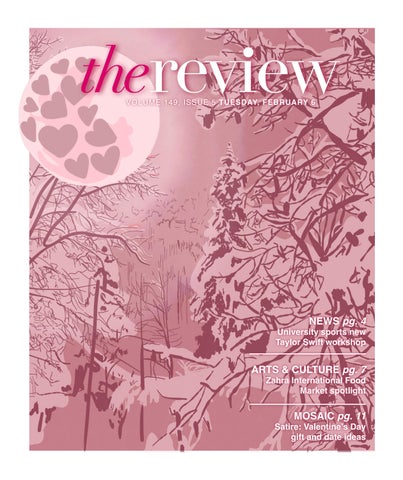
VOLUME 149, ISSUE 5 TUESDAY, FEBRUARY 6
NEWS pg. 4
University sports new Taylor Swift workshop
ARTS & CULTURE pg. 7
Zahra International Food Market spotlight
MOSAIC pg. 11
Satire: Valentine’s Day gift and date ideas
02
FEBRUARY 6, 2024
Letter from the Editors
03
KONNER METZ Editor-in-Chief
Stone Balloon closes
As a new semester begins, a fixture of Main Street is closing its doors.
08
Student streetwear
Two students are aiming to grow Funky Rat, a sustainable streetwear company.
10
“The Curse” review
Nathan Fielder and Emma Stone star in the 2023 comedy drama on Showtime.
14
Conference USA
Daniel Steenkamer offers his opinion on Delaware’s impending FBS move.
Dear readers,
W
elcome back to campus for the Spring 2024 semester! We realize you haven’t heard directly from either of us in a while – for context, we’re both seniors – but as we both embark on a new semester (which also happens to be our last), we are excited for what The Review has in store. Although things on campus quieted down during the long winter, things at The Review certainly didn’t. We’ve kept our website updated with movie reviews, spotlights on campus museums and student entrepreneurs and even coverage from staff members studying abroad. Among the many new things headed your way this semester, we’re certainly excited to start the academic year off with this new look! Our print issues wouldn’t be possible without the hard work of our layout team, whose talents have brought about what you’re holding in your hands. We hope you find this updated format engaging, aesthetically pleasing and, most importantly, easier to flip through. Our first issue of the semester contains a new batch of stories from all of our sections. The News team covers a university grant for students with children, the Arts & Culture section explores a food market tucked inside Newark Shopping Center and the Sports desk has more insight into Delaware’s move to Conference USA. All the while, the Mosaic staff will help prepare you for the upcoming Valentine’s Day. We’re also thrilled to start off the new semester with a few recent graduates from our Development section who have officially joined our staff, and we’re excited to continue working with our group of reporters-intraining. Some of our current staff have also stepped up to editing roles as well, so be sure to keep an eye out for some new and updated bylines this semester!
EDITOR-IN-CHIEF Konner Metz
thereview University of Delaware’s independent student newspaper since 1882
EXECUTIVE EDITOR Nadya Ellerhorst COPY DESK CHIEF Iara Luque COPY EDITORS Danielle McIltrot, Nayzeth RomeroChavarria & Sabina Salguero LAYOUT EDITORS Larissa Veronica Heather, Iara Luque & Sarah Wessel
@udreview udreview.com
250 Perkins Student Center, Newark, DE 19716 302-831-2771 eic@udreview.com
NADYA ELLERHORST Executive Editor
MANAGING SECTION EDITORS Risha Inaganti, News Daniel Steenkamer, Sports Jordanna Garland, Arts & Culture Shayna Demick & Gaby Nieves, Mosaic Alex Millman, Opinion ASSOCIATE SECTION EDITORS Joshua Ciliberti, News Elizabeth Wojciechowski, Arts & Culture
If you’ve been yearning for a byline yourself, The Review is actively recruiting new Development reporters for the upcoming semester, and we encourage you to apply. We’re also seeking Business Team members, illustrators, and layout editors – reach out to eic@udreview.com if interested in these roles, specifically. We’ve probably said it once, but we’ll say it again – there’s really something for everyone at The Review, regardless of major, interests or prior experience, and we’d love to have you join our team. We’re continuing to release monthly print issues this semester, which can be found in a variety of spots across campus and throughout Newark. There’s also a chance you’ve spotted our super-glossy Fall Semester magazine (and maybe you even got to personally pick up a copy from our tables in Perkins and Trabant and meet some of our awesome staff). Rest assured – you can expect another magazine filled with in-depth coverage of fascinating stories later this semester. In spite of all the new things The Review has in store for you, there’s personally going to be a lot of “lasts” for the both of us this semester – our last published articles, our last layout night, our last unsolicited “HENergy” joke. It’s an odd thing to come to terms with, especially since the both of us have been on the paper since the first semester of our freshman year. College without The Review is simply a sensation we’ve never experienced. But that’s only an impetus for us to make the most of our last few months on the paper as we continue to bring you vital coverage of the many facets of campus, the community, the region and wherever else there are stories waiting to be told. Sincerely, KONNER METZ NADYA ELLERHORST Editor-in-Chief Executive Editor
MANAGING VISUALS & LAYOUT EDITOR Larissa Veronica Heather ASSOC. VISUALS EDITORS Ethan Grandin, Jacob Letnaunchyn & Audrey Tong MAGAZINE EDITOR & ART DIRECTOR Sarah Wessel PHOTOGRAPHERS Julia Diamond, Gianna Houck, Emily Mateja, Madelyn McManus, Christina Natalini, Hannah Paliath, Eva Pumo, Jordan Rosales & Wanning Wang ILLUSTRATORS Larissa Veronica Heather & Sarah Wessel STAFF REPORTERS Sydney Becker, Macayla Cook, Jake Harkey, Jamie Kelly, Sabina Salguero, Nya Wynn, Will Capuano, Ryan Gibb, Patty Harden, Percy Allen III, Alex Lavinson, Jennifer Nance, Caroline Powell
DEVELOPMENT REPORTERS Samantha Balice, Jessica Bassion, Marissa Bottiglieri, Lauren Boyd, Janelle Castro, Sydney Christner, Brooke Cooney, Kelly Hall, Zoe Hassett, Tyler Johnson, Grace Kearns, Alex Keating, Dylan Marx, Margaret “Maggie” McDerby, Jessica Mehr, Cayla Mutchnick, Keavy Rhodes, Aubrey Rush, Juliana Scannelli, Carol Scherling, Estelle Smith, Matthew Trunfio & Thomas Vail TREASURER Connor McPhail SOCIAL MEDIA MANAGERS Natalie Tobin, Instagram & TikTok Jake Harkey, Twitter DOODLES BY Larissa Veronica Heather & Sarah Wessel COVER DESIGN BY Larissa Veronica Heather
news
UDPD and Newark Police partner for pedestrian mobility safety education JAMES KELLY Staff Reporter
S
ince the death of a university student caused by a bicycle accident, pedestrian safety has been a pressing concern for both the university and the City of Newark. Both UDPD and the Newark Police Department will be teaming up as students return to campus to educate the community on pedestrian safety and relevant Delaware laws.
HANNAH PALIATH/THE REVIEW
Main Street closures: Stone Balloon, 2S Pizza shut doors KONNER METZ Editor-in-Chief
T
hose who stroll up and down Newark’s Main Street will notice that a familiar pillar of the downtown food scene is now missing. Stone Balloon Ale House permanently closed last month following a break for the holidays, its owners, High 5 Hospitality, announced on Facebook. “We extend our heartfelt gratitude to our loyal Stone Balloon guests for their patronage throughout the years,” High 5 Hospitality CEO Bobby Pancake said in a press release. “We aren’t sure what the future holds, but there is always a possibility that the Stone Balloon may rise again in the future.” The restaurant celebrated its 50th anniversary in 2022, although the establishment had already undergone a major change in operations. Decades ago, Stone Balloon was a popular concert hall and live music spot. It hosted Metallica, Bruce Springsteen and Dave Matthews, among other artists and bands. In 2005, the establishment temporarily closed after 33 years of operation.
Pancake reopened it in 2014, rebranding the highly regarded Main Street venue as a rock ‘n’ rollthemed restaurant with historic decor adorning the walls. “It seemed like such a staple of the student community, both undergraduate students and graduate students,” Caroline Smith, a university alum, said. “So when we heard it was closing, it was sad.” Smith, who attended the university from 1998 to 2005, attended concerts and “mug nights” at the original Stone Balloon. Her husband, also a university alum, has his mug saved to this day. “It was a place where we would go to hear live music and hang out, take a break from our studies,” Smith said. “There were just a lot of good memories and times with friends … It has a soft spot in my heart.” Hundreds of alumni and former customers shared memories and thoughts on the Facebook announcement. Stone Balloon shared select memories, including some from those who met their spouses at the original version of the restaurant. Employees at the Stone Balloon will be able to relocate to other locations owned by the company. The press release emphasized High 5’s focus on ventures elsewhere in
the state: a Buffalo Wild Wings in Milford and a Jersey Mike’s Subs coming to Kirkwood Highway this spring. High 5 Hospitality is also looking to expand in the Baltimore area, the release read. High 5 Hospitality did not respond to The Review’s request for comment on the Stone Balloon’s closure. 2SPizza on Main Street closes up shop Not too far down Main Street is another empty storefront, this one vacated by 2SPizza, a pizzeria that opened last February. The restaurant was launched by the owners of the Two Stones Pub, but Delaware Online/The News Journal reported that there was not enough foot traffic to sustain the business. It is listed for sale for $300,000, with descriptions about the recent renovations done in 2022. “With a huge thanks to all, while holding back tears, we have to post that our last day of being operators on Main Street Newark with 2SPizza will be this Sunday, Jan. 21,” owner Michael J. Stiglitz said on Facebook. “Our amazing 2SP family members will be moving on to our sister restaurants.”
One of their focuses will be on electric skateboards and scooters. As the law is different from surrounding states, the university put out a statement last November regarding electric scooters to remind students what the law is in Delaware. “Motorized scooters are prohibited on streets and sidewalks in Newark,” UDPD said in a UDaily article. “A violation is punishable by a $100 fine and impoundment of the scooter.” During the start of the spring semester, UDPD will be promoting safe mobility and educating students on the law. The educational push is facilitated by UDPD’s Community Resource Unit and funded by the Delaware Office of Highway Safety. “We are there to educate, not write tickets,” UDPD Sgt. William Wentz said. “Do not hesitate to stop and talk with us. We want to communicate effectively.” Last September, Daniel Bacsik was struck by a car and killed while he was riding his bike on South College Avenue. Wentz confirmed he was not wearing a helmet and added that the location where the accident occurred was designated as a “walk your wheels” area. In these areas, pedestrians are required to walk their bikes and scooters. Wentz said that a community outreach campaign is the softer approach to educating people on the law. Part of the push will be to remind students what they can and cannot use to
navigate campus, as well as the rest of Newark. Newark Police Lt. Andrew Rubin explained that electric bicycles can be used in the bike lanes since they are still considered bicycles for the purposes of the law. Skateboards and scooters that require human propulsion are still allowed to be used on walkways. Since 2004, Delaware has included language within its mobility laws that prohibits the use of electric skateboards and scooters on roadways, bicycle lanes and public walkways. “The law in Newark is not different from any other city in Delaware,” Rubin said. “And that has not changed since 2004.” State law defines a motorized scooter as “any device that is designed to travel on at least two wheels with the deck or chassis of such device open and close to the ground.” It also specifies that it has “hand-controlled throttle or brake” and is “powered by a motor that is capable of propelling the device without human propulsion.” In addition, Newark has its own set of ordinances that lets local law enforcement make offenses against state laws a local issue. This allows Newark residents to appear in the city’s Alderman’s Court rather than having to go to the Court of Common Pleas in Wilmington, Rubin said. Rubin explained that electric scooters are prohibited from roadways because they cannot keep up with traffic. The fines for violating the law within Newark city limits are a minimum of $100 and no more than $300, Rubin confirmed. “Students are getting hit,” Wentz said. “Half of them aren’t even wearing helmets, and if you get in an accident, the car is going to win every time.”
SARAH WESSEL/THE REVIEW
04
FEBRUARY 6, 2024
Economics (Taylor’s Version): University enters the world of “Swiftonomics”
W
JOSHUA CILIBERTI Associate News Editor
ith the spring semester upon us, it is swiftly becoming a new era of teaching and learning for the university’s economics department.
The workshop series was made possible as a result of the Paul J. Rickards, Jr. Teaching Innovation Grant, which awarded $5,000 in funding to support experimentation, collaboration and new approaches to teaching.
“There’s undoubtedly an effect,” David Undus, a junior finance and economics double major, who also serves as a “data mentor” for the workshop series, said. “Everywhere her tour
HE
L/T
SE
RE
This academic year marks the inauguration of the grant, which was also given to instructors in the music, art and design, materials science, engineering and visual communications programs.
W
VIE
The workshop pulls data from the music streaming service Spotify, where students can access analytics – such as duration and popularity – that are associated with Swift’s songs and albums.
According to the Federal Reserve Bank of Philadelphia’s “Beige Book,” Swift’s “Eras Tour” concert series resulted in increased travel and tourism-related revenue for the Delaware Valley, a region consisting of parts of Pennsylvania, New Jersey and Delaware.
ES
“I noticed the excitement anytime she was brought up in class,” Bender said. “I wanted to tap into that and try to get students interested in data analytics. If you’re interested in the topic, it doesn’t feel like studying. It’s more fun.”
“I’m hoping that it’ll help me be able to do some more economic research, look at some more data and be able to really analyze stuff in a different way than I’ve been able to before,” Katarina Rodriguez Thomas, a junior international business major, said.
HW
As the workshop series teaches complex material and exposes students to fundamental economic tool sets such as Stata, Python and Tableau, Bender offered a unique theme in order to make the material more relatable – Taylor Swift.
Last December, Time magazine selected Swift for its annual “Person of the Year” designation, an award given to the individual who had a great influence on that year’s headlines.
RA
“We all have to work with data, whether you maybe even realize it or not,” Bender said. “I think it’s important that students know how to work that data and then communicate their results.”
job market so that our students are prepared when they graduate.”
SA
Last October, Kathryn Bender, an assistant professor in the Alfred Lerner College of Business & Economics, launched “Data Enchanted: Transforming Numbers into Knowledge,” an interactive workshop series focused on data visualization.
Although the eight-part program had its pilot launch in the fall semester with three segments, the workshop will be restarted this spring, allowing interested students to not miss out on the action.
goes sees a giant spike in a bunch of people going and a bunch of people bringing business.”
Similar to what was offered in the fall, each installment of the 90-minute workshop will revolve around a different topic, ranging from an introduction to Stata software to data cleaning, transformation and analysis preparation, Bender said.
In addition to the workshop itself, “Data Enchanted” also features a networking session where students and faculty members are able to connect with one another, make “friendship bracelets” and discuss economics topics in an informal environment.
“With data so abundant, the skills that students are going to need are going to be with working with that data,” Bender said. “We have to make sure that our curriculum evolves with what’s needed on the
One of the program’s goals is to attract more women to the university’s economics department, as they currently only make up approximately 25% of the major’s enrollment, Bender mentioned. “The national average for schools like ours is 35%, so we’re still a little underneath,” Bender said, comparing the university to other “R1” institutions. Under the Carnegie Classification of Institutes of Higher Learning, an “R1” institution is one that has “very high research activity.” 146 institutions fall into this category as of February 2024. As it stands today, “Data Enchanted” is not a credit-bearing program; however, there is the possibility that it could expand into a semester-long course in the future. According to Bender, a possible upper-level course could be themed around the economics of pop culture, opening the door for discussion on other celebrities beyond just Swift. Regardless of the course delivery method, with Swift-themed economics courses popping up at colleges and universities across the nation, “Data Enchanted” marks the university’s entrance into “Taylor’s version” of economics – the study of “Swiftonomics.” “She’s definitely paving the way as a very strong, monumental woman in economics,” Daniela Espada, a junior business analytics major, said. “She may not be directly crunching numbers or working with data, but she’s changing the lives of different people along the way.”
Blue Hens go green: Faculty discuss the university’s approach to sustainability on campus MATTHEW TRUNFIO Staff Reporter
T
he university boasts over 1,000 acres of land to its name. Much of the land is adorned with displays of shrubs and trees meticulously placed around areas such as the Green and Old College. The consequential result is an atmosphere of natural
beauty that can accompany students through their daily activities.
Some students regularly choose to spend their afternoons on benches nestled between a few Virginia Willow bushes. Others might even take advantage of the patches of grass outside of Gore Hall for a friendly game of volleyball. The importance of preserving the natural appeal of the university’s
campus seems to be clear to many students and professors. In hopes to understand how the plant life on campus is cared for, Andrew Adams, manager of the Botanic Gardens, shared his experience at the university “A lot of what we use are the most sustainable options,” Adams said when asked about the chemicals and fertilizers used to maintain the plants.
According to Adams, the university has done well in keeping up with the improving standards of plant life care. The gardeners regularly use “the latest stuff they can in order to maintain the campus.”
Susan Barton, a professor of plant and soil sciences at the university, echoed some of Adams’s praise. When discussing how the university applies supplements to its vegetation, she said that “pesticides are never 100% safe,”
but proper use can minimize any harm caused. “Are you using it properly, are you using it the way it’s labeled to be used, and does the desired benefit outweigh any potential risks?” Barton said. “The way the university is applying pesticides and fertilizers are definitely within those bounds.” CONTINUED ON PAGE 5
UDREVIEW.COM
05
How the Newark community rallied together to save its train station
A
TABITHA REEVES Contributing Reporter
s university students gathered on benches and stairs awaiting their train home, 9-year-old Jackson Lawrence set up his new birthday gift for use just outside the Newark History Museum: a tripod and video camera to capture trains as they pass.
LARISSA VERONICA HEATHER/THE REVIEW
Faculty on sustainability (cont.)
Despite the university’s mentioned sustainable actions so far, according to Barton, there is still room for improvement. “Implementing sustainable landscape practices is a relatively new phenomenon in the landscape industry,” Barton said. At the university, there is still “a little bit of old-school landscape management mentality that could be improved,” Barton said when discussing how they can improve upon current practices. When elaborating on this “oldschool landscape management mentality,” Barton characterized it as a mindset that results in missed opportunities. She said the university has a “bad habit” of replacing recyclable resources unnecessarily, opting for new ones instead of utilizing existing ones.
Barton pinpointed the university’s use of mulch as an instance where it could eliminate current practices and adopt more sustainable methods. The university makes an effort to compost all leaves on campus and reuse them as mulch. But despite the availability of the mulched leaves, caretakers of the grounds regularly purchase and utilize hardwood bark mulch from an external source, Barton said. To combat this, Barton made a proposal.
“The university could have a policy that says they don’t use any hardwood bark mulch at all,” she said. “They could use only leaf mulch that is recycled from the leaves they collect.”
Office of Sustainability as a significant achievement. With this development, Powers sees an opportunity for a larger and more organized effort towards sustainability.
Barton characterized this policy as something “that the university could really hang their hat on as a real commitment to sustainability.”
“For those of us who are interested in these issues, we have an administrator to whom we can appeal, the president, the provost, and other people who can make decisions.” Powers said.
Other staff members have echoed some of Barton’s dissatisfactions with the university’s efforts Thomas Powers, a faculty member in the department of philosophy and the Biden School of Public Policy and Administration, described the university’s approach to sustainability as “a work in progress.” Powers emphasized that the mindset is certainly present, but sometimes the execution is not. “Initiatives get started or highlighted, and then, for some reason, they don’t quite come to fruition,” he said. “We’ve talked a lot about making campus greener, reducing the use of pesticides, making it possible for everybody to walk more, reducing car traffic,” Powers said. “But just saying it doesn’t make it true. You’ve gotta keep pushing and improving so that you actually see the benefits.” However, Powers sees the establishment of the university’s
Chris Williams and Jeffrey Summerhays, co-directors of the Office of Sustainability, share a lot of Powers’ enthusiasm when it comes to the office’s establishment. “What’s really exciting about this office is that it has created a formalized conversation that just wasn’t necessarily there before,” Williams said. Williams and Summerhayes both perceived the Office of Sustainability as a way to increase responsiveness to any sustainability-related issues noticed by the university community.
Jackson and his mother Robin Lawrence, a Newark resident of 20 years, are regulars at the Newark History Museum, which shares a location with the Newark Passenger Train Station. “Jackson and I are both old souls, so we like history,” Lawrence said, listing the museums and train stations they frequent. “With the digital age and the constant demand of entertainment, some people forget about what got you there.” Built in 1877, the Newark Passenger Railroad Station was strictly that until 1981, when it became the Newark History Museum as well. Having few renovations and minimal fixes throughout its life, the City of Newark found that the building was due for $700,000 worth of repairs in August 2022. Without proper funds allocated for refurbishment, the city prepared to sell. However, when the Newark Historical Society – the group responsible for museum upkeep – learned about the plans to sell through a newspaper article, they launched a rescue mission: the “Save the Train Station!” initiative.
When asked how a student could help address environmental issues around campus, Williams offered numerous suggestions.
“We have always known that the building needed to be repaired in some way,” Newark Historical Society President Kaitlyn Tanis said. “But with that being said, we didn’t know that the city was having these conversations without us originally.”
“[Students] can write us,” Williams said. “They can complain to us. Tell us your really good ideas. We’re here to try to at least answer the questions or listen and see if there is a solution to that.”
Tanis went on to express that there could have been a better solution to keep the building if the Historical Society had been brought into the discussion sooner. Instead, the plan was, “We don’t have the
money, so it’s either you raise it, or we sell it,” according to Tanis. The society’s initiative gained traction quickly as the community jumped to action. Longtime Newark residents, university faculty, members of the Historical Society and representatives of Preservation Delaware wrote letters advocating for funding from the state. They, and anonymous others, sent in donations ranging from $10 to $5,000, according to Tanis. Together, those involved raised $25,000 by last April – just eight months later. “For a very itty-bitty historical society that is totally volunteerrun, I was really proud that the community came out and supported us in the way that they did,” Tanis said. “We didn’t have a particular donor who reached out. It literally was just a ton of people contributing.” The money that was not gathered through donations was allocated by the state in its annual infrastructure bill – the Bond Bill – due to the amount of advocacy groups vying for more money. “If there’s a building where people would say, ‘That’s an iconic building that is part of the fabric of Newark as I know and understand and appreciate it,’ that would be the building I would expect people to rally around,” Michael Emmons, assistant director of the Center for Historic Architecture (CHAD), said. Emmons, one of those who sent a letter, felt strongly that putting the station’s future at risk “would be a mistake.” As a board member at Preservation Delaware, he explained that the building which now houses the museum is a “rare survival” of Gothic Revival architecture. As he said this, he pointed out the building’s decorative brickwork, Lancet-style windows, steeply pitched roof and awning over the railroad tracks.
CONTINUED ON PAGE 6
06
FEBRUARY 6, 2024
Newark community rallies together to save train station (cont.)
The structure also falls under the “Historic buildings” designation of Newark’s Code of Ordinances. The list includes 36 sites in Newark that have additional regulations when it comes to alteration in order to “safeguard and prevent further loss of the city’s architectural heritage.”
The Green Mansion on Main Street also qualifies as a historic building and is registered on the National Register of Historic Places. In 2022, it was the subject of much controversy when a majority was demolished to make way for a seven-story hotel.
and construction continues to expand across the 272-acre facility. However, the newest addition to campus will be one along East Delaware Avenue. “Building X,” a four-story laboratory and science classroom space, is slated for completion in fall 2024. “It’s important that we are developing and bringing in new businesses and bringing in new attractions for students, but it’s also important to still hold a piece of history here so that we’re preserving that for future generations,” Tanis said.
The recent modernization and growth of Newark – which puts older sites at risk for change – is one of the reasons so many community members felt strongly about the Newark station and the history museum within, said Emmons.
Tanis expressed that the town might not have “had such a strong reaction” without a university nearby to provide support for the cause. While grateful for the “large student involvement” and aid of departments such as CHAD, she feels that the administration can do more.
The university opened its first high-rise on Star Campus in 2018,
“I think the university in general definitely has a bigger role to play
in terms of historic preservation of buildings in Newark and the surrounding community,” Tanis said, recalling that the university often only intervenes if the matter is on their own soil. Emily Passera, a class of 2016 alum, no longer lives in Newark but returns often to visit friends, walk around and see what has changed in the place she once called home. To her, the preservation of the museum is important not only to the fabric of Newark’s community. It also plays an important role for those university students who are just passing through, she said. “There is that very transient nature with college students only here for four years,” Passera said during her visit to the museum. “There’s a lot of change, but it’s an anchor to a community when you have a building that’s held by a historic society.”
TABITHA REEVES/THE REVIEW
University receives $2 million grant to support students with children NYA WYNN Staff Reporter
I
n late 2023, the university received a $2 million grant from the U.S. Department of Education to be used toward increasing accessibility to childcare for university students with children. In 2020, more than 1 in 5 undergraduate students were also parents. At the university alone, an estimated 400 students are parents. Juggling to pay for the cost of childcare on top of their own tuitions and living expenses is a burden many young parents are wrestling with. The Child Care Access Means Parents in School Program (CCAMPIS) is a grant that universities can request from the federal government, with funding based on the number of Pell Granteligible students at the university. Rena Hallam, director of the Delaware Institute for Excellence in Early Childhood, and her team have led the charge to apply for
these funds and properly allocate them.
“This grant is not paying our salaries,” Hallam, who is also a professor in the Department of Human Development and Family Sciences, said. “It is not paying for research. It will pay for childcare scholarships and support for students in need. “Childcare is expensive, so we will not be able to pay for every student, but we are going to strategically use our funds so that we can serve as many students as we can.” Tuition scholarships will be provided for children who qualify to enroll at the Early Learning Center (ELC). The ELC is a nationally-accredited early care and education center located on the university’s campus. “This grant is enabling us to better support our UD students that are looking for quality care and education for their children, which is historically pretty hard to find,” Kelly Freel, co-director of the ELC, said. The ELC provides full-day early childhood programs for children from six weeks to five years old
and school-age children from kindergarten through second grade.
hoping and praying for something like this for years. I can’t believe it’s actually happening.”
“Navigating the childcare field and being a student is really hard work, especially as a brand new parent, which we have a lot of since we specialize in children who are infants through five years old,” Freel said.
Burke-Green has used the ELC’s many programs for the past seven years. Her oldest son participated in the ELC’s baby boot camp program, baby yoga and other enrichment activities.
In addition to providing childcare scholarships, Hallam and her team are also looking to hire a family support specialist to help university students navigate the childcare system. According to Freel, the family support specialist will be a fulltime staff member at the ELC with the task of supporting families and doing advocacy work for university student-parents. While the team is excited to work on these programs, current university students are also looking forward to seeing the opportunities that accompany this grant come to fruition. “Me and a lot of undergrad students will appreciate this, it’s a 100% must,” Ariel Burke-Green, a senior English major, said. “I’ve been
The proximity to campus and priority admission for children affiliated with university community members makes the ELC a prime location for childcare, but many students who are parents are unaware of the benefits it has to offer, or simply cannot afford childcare itself. “Childcare is really, really expensive, so we know when students are parents, they often need some support in paying for child care costs,” Hallam said. According to Burke-Green, undergraduate or graduate students who are expecting a child can be inclined to drop out of school to get a job or find another way to begin supporting their child. “Students shouldn’t feel like they have to give up their degree or
future careers just because they’re pregnant,” Burke-Green said. When student-parents get this form of financial and emotional support, they are more likely to complete their degrees in a timely manner, according to Hallam. Many institutions cannot offer this kind of assistance, which explains why so many students with children struggle to complete their degrees. Hallam and her team are also working on a survey that will be sent out to all undergraduate and graduate students about what other child care needs they may have and spreading the word about resources, like childcare subsidies. “Students need to feel supported as parents and feel comfortable that their children are also learning while they’re learning,” Freel said. “I’m really hoping to increase access and equity.”
Signup for The Review’s weekly newsletter
arts & culture
Local Business Spotlight: Zahra International Food Market
E
NADYA ELLERHORST Executive Editor
ven with an entranceadjacent chalkboard sign advertising the varied global wares for sale inside, a glance at the register of Newark Shopping Center’s Zahra International Food Market can give a prospective customer a feel for the store, its products and its owner. The register is framed in clear boxes of bright-red saffron, locallymade olive oil soap, a kaleidoscope of different chocolate bars and a rotating jewelry stand. Rows of evil eye decorations, necklaces and bracelets look out from behind the counter. Numerous chairs sit conspicuously by the register for customers-turned-friends. Gifts from younger patrons hang nearby: a plastic lei, a painting of a flower, a small rubber band loom creation. Zahra International Food Market is not store owner Jacqueline Karam’s brainchild. Originally from Fih El-Koura, Lebanon, where she worked as a French teacher, Karam bought the store from the previous proprietor in 2016 after permanently moving to Newark. “I used to shop here, and I didn’t want to stay home doing nothing,” Karam said. “That’s why I decide to do something. And my husband told me the lady – the previous owner – wants to sell the business. So I told him, ‘Take it for me.’” Karam’s husband, Walid, studied civil engineering at the university himself, and for a time, Karam traveled to and from Newark. “I used to come back and forth, but then it was really difficult for us to live apart,” she explained. While Karam had 25 years of experience in teaching high school, she came into the new venture with no prior background in business. At the helm as both owner and sole employee, Karam worked seven days a week, although in the present, it has been reduced to six. Karam continues to independently run the store.
“And it’s a small business,” Karam said. “You can’t compete with big service or big businesses. That’s why I’m trying my best to stay in the store.” Shelves of candies, cookies and other sweets stand towards the front of the store, and canned goods, frozen foods, spices, pickles and olive oil fill the aisles. Among the products, Karam points out za’atar, a seasoning that serves as a popular topping for pita; ayvar, a pepper-based spread; and buckwheat, a common grain in Europe. Indeed, it was the store’s offerings that made Karam a customer in the first place. “For me, it was for the bread,” she said. Open one of the store’s numerous freezers, and there are stacks of fresh breads at the ready. Karam counts Turkish borek and pistachios, a variety of international cheeses on display in a case towards the back of the store, European and Turkish chocolates, pita bread from numerous Middle Eastern countries and a variety of other delicacies as some of the most popular products sold. Dates are an especially big seller. The shelves are not limited to the edible, however. A row of vividly-colored hookahs line the front window and side of the store. The store sells both hookahs and the tobacco and charcoal for it, Karam referring to Ali Baba Middle Eastern Restaurant on Main Street as an example of hookah’s popularity. Perfumes and other beauty and cosmetic products, including Turkish kolonya and olive oil and coconut-based soaps, are also available. Zahra International Food Market likewise sells items such as home decorations, incense burners, cookware and henna. There’s cezve (a specialized coffee pot), teapots, coffee and tea glasses – and the drinks to accompany them. “We have herbal tea coming also
from Europe, and Middle East and Turkey, and we have a lot of coffee – different kind of coffee, because our coffee is completely different,” Karam explained. “We make it in a coffee pot – small coffee pot – and we keep the ground inside. It’s really strong coffee.” Karam has taken to displaying small handwritten notes describing associated health benefits near her teas, from rosehip to galangal. She gestured to one with a grin. “The nettle tea is really known in Europe,” she said. “They use it even for their hair.” According to Karam, all products sold in the store come from abroad. While the original owner sold products from Turkey, Karam presently buys from six suppliers: three from Turkey, two from the Middle East and one from Europe. Karam explained that, in continuation from the previous owner, the store sells halal products for Muslim customers. The store also sells hijabs, prayer rugs and Qurans. She explained that products sold align with certain cultural customs. According to Karam, the store’s chocolate, nuts, tea and coffee are frequently served to guests in Middle Eastern homes, and she pointed out trays for sale for the purpose of holding such treats. Karam’s future hopes for Zahra International Food Market include a personal aspiration for its owner/ employee. “I hope it will be more known,” Karam said with a smile. “More business so I can afford to put somebody in here and help me, so I have my life at home, and at the same time I will not be doing nothing.” Karam’s clientele is diverse, and the equally multifarious products she sells serve a purpose. “This community – they miss their country,” she explained. “So you have to have some items that they remind them of their food, of their culture. That’s why we have it.”
GIANNA HOUCK/THE REVIEW
A look into on-campus museums BETH
WOJCIECHOWSKI
F
Associate Arts & Culture Editor
rom art galleries at Old College, to the Mineralogical Museum at Penny Hall, to the Special Collections Exhibit at Morris, there is much to see and do at on-campus museums. Whether an on-campus museum is visited for a class assignment or just for fun, museums have a substantial presence at the university. Exhibitions on campus change often and most are only on view for a limited time. “We have wonderful, beautiful spaces, but they’re not enormous,” Amanda Zehnder, head of museums at the university, said. “Every semester we rotate the collections in different exhibitions by theme and topic.” Regardless of the exhibition, something that the university’s museums always value is diversity, according to Zehnder. The ultimate goal of the on-campus museums is to have something that appeals to everyone. “We like to create spaces and platforms for a wide, diverse range of artists and voices, both in terms of the artists and materials represented in exhibitions,” Zehnder said. “By working with guest curators and student guest
curators, we also like to bring in a diversity of perspectives.” According to Zehnder, guest student curators are usually graduate research assistants within the museum studies program. There is usually only one graduate research assistant per semester. Their main project is to curate their own exhibition that is then displayed in the gallery space at Mechanical Hall, an art building located next to Old College. Graduate students who are guest curators typically have a short period of time to curate an exhibition, as the entire curation process from the initial idea to the exhibition being on view occurs throughout the course of one semester. Museum staff is on hand for guest student curators and assist in certain areas of the curation process, such as helping with research and installing the exhibition. In addition to guest student curators, the exhibitions on campus also feature materials that are on loan from private collections and integrated into full exhibitions by museum staff. Other exhibitions, such as the current Women and Gender Studies display at Morris Library, are curated by seminar classes at the university. Professors, students and museum staff collaborate on
CONTINUED ON PAGE 8
08
FEBRUARY 6, 2024
Museums (Cont.)
seminar-based exhibitions, which gives these exhibitions a unique character. “We also will lend materials to different exhibitions on campus. For example, museums will send things down for Special Collections to use in their spaces, or vice versa – they’ll send things up for our galleries,” Zehnder said. “So that’s one of the wonderful things about this sort of partnership between Special Collections and museums, that you can put together really interesting and sometimes kind of unusual exhibitions based on the types of materials we have.” The Special Collections department is a part of the museums on campus. The department focuses on displaying printed archival materials such as books and documents. It currently has an exhibition space on the second floor of Morris Library. The partnership between the museums and Special Collections department at the university have allowed for exhibitions on campus to be multimedia and multidisciplinary, highlighting the museums’ goal of having something to appeal to a variety of audiences. “Something that we also think about in Special Collections with our exhibits is that they’re a way to bring visibility to the materials that we have,” Hillary Kativa, head of Special Collections, said. “Especially if a student hasn’t had an opportunity to come in for a research assignment or for a class, it’s another way for them to encounter the materials.” Both Zehnder and Kativa agree that the museums on campus are a valuable resource for students, and they encourage students to take advantage of all the museums have to offer. “We want students to feel a sense of pride in these collections,” said Zehnder. “It’s part of UD, and it’s part of their community, and it’s available to them for a whole host of reasons.”
SARAH WESSEL/THE REVIEW
University students open sustainable streetwear company Funky Rat
J
ESTELLE SMITH Staff Reporter
uniors Amanda Membrado and Hunter Wills, both entrepreneurship majors, began selling at flea markets over the summer for their clothing company Funky Rat. But the cost, lack of buyers and numerous rat stories at their first venture in Philly almost convinced them to give up, or even change the name. “Half the people that came up to us were people who wanted to tell us rat stories,” Membrado said. “Like crazy, weird rat stories.” Since then, though, the company’s success has grown. Funky Rat is a local, sustainable streetwear fashion company that aims to make unisex clothing in a more stylized way. Membrado and Wills do this by embroidering, screen printing, puff printing and utilizing other methods of design on their products which include crewnecks, hoodies, hats, jeans and even tote bags. The idea for the company originates from Membrado and Wills’ discovery of their shared frustration with the fit – or lack thereof – of clothing, and how designs are often either gendered or almost nonexistent. “It was very split between this is men’s and this is women’s, and that’s how you have to shop,” Wills said. “Why does it have to be that way?”
Deciding upon a name for their brand was something Wills, who also DJs, had been keeping in his back pocket from when he was trying to figure out a stage name. “I kept begging him to be Funky Rat as a DJ,” Membrado said. “I think that would be such a cool name.” Funky Rat the DJ was not to be, but when they began to conceptualize the company, they decided to test the name out by walking around the Venture Development Center – the building housing the Horn Entrepreneurship program – and asking people if they would buy clothes from a brand called Funky Rat. They received a range of responses, but there was enough support for them to try it. As their business continues to grow, they plan to combine Membrado’s vintage style with Wills’ streetwear style to create sustainably-made, wholesale clothing. Since Funky Rat doesn’t have a direct supplier for the time being, all the clothes they sell are either thrifted or donated. Although not always convenient for them, thrifting has come in handy for testing out designs, where they produce a few items in a certain design and see if people like it, as opposed to ordering in bulk and having no one buy them. This method has been a money saver for them. “It was kind of just being broke,” Membrado said. “I was always
super into thrifting … I’ve always wanted to own a flea or do something like that to make money off of it, and I was like, ‘Well this is perfect. I get to combine my love for thrifting and put it in my business.’” On top of this, Membrado and Wills did not want to follow the well-trodden, easier path that Wills said many new small brands take by “getting cheap clothes from China that are probably made in unethical ways.” “If they sell those clothes, they’re gonna keep buying cheap clothes and keep doing that business model, which is just not good for the world,” Wills said. “I wouldn’t be able to sleep at night trying to do things the wrong way and portray it as doing the right thing or portraying it as being a different way.” Wills personally admires Patagonia as a company because of its commitment to sustainability and fair trade, but he finds it and other sustainable clothing brands pretty plain, the same problem he finds with unisex clothing. “I think people still care about representing themselves and showing their values through how they wear clothes,” Wills said. “And if you really care about sustainability, you gotta wear blank stuff, or wear more boring stuff, and it shouldn’t have to be that way.”
Funky Rat decorates the clothing with designs including, but not limited to, the word “funky” in bubble fonts, birds wearing sideways baseball caps, flowers, short phrases and, of course, rats. Funky Rat sells these at the S4E flea markets on campus and is often found in Perkins Student Center, as well as at flea markets in Philadelphia and Rehoboth Beach. While the two are still trying to build what they have, they explained that their goals are high. They want to expand the “funky world” to other areas, including owning a pretzel company affectionately known as Funky Zel’s because of their love for the food. The young entrepreneurs envision eventually getting into wholesale and sustainable manufacturing, without the typical high prices, and moving to either New York City or Los Angeles after graduation to continue that dream. In the meantime, they are looking to build a social media presence and be in the creator space where they can gain more attention. “Our goals are also to build a community,” Membrado said. “We don’t want just this just to be Funky Rat, the brand. We want people to know us and to know what we’re trying to do and are kind of not only just fans of Funky Rat, but also kind of fans of us, what we’re doing.”
mosaic
Movie Review: It’s not my fault I’m obsessed with “Mean Girls”
JENI NANCE Staff Writer
T
he first time I watched “Mean Girls (2004),” I fell in love. It became one of my many go-to movies and is still among my top five favorite movies along with “Forrest Gump” and “Sixteen Candles.” I was about six years old when I saw it for the first time. My cousin, who is eight years older than me, insisted it was one of the greatest movies of all time and sat me down in front of the TV to watch it. While she may not have had the best judgment by allowing me to watch that movie at such a young age, her decision was lifechanging nonetheless. So with the 2004 “Mean Girls” standing as one of my favorite movies, I was skeptical when I first found out that this iconic film was being remade. After all, I thought the 2011 sequel of the original film was an abomination. I knew that the new film would exclude at least 30 minutes of footage from the original due to
I
SHAYNA DEMICK Co-Managing Mosaic Editor
experienced my first breakup the day before fall semester. The breakup came out of nowhere (and I truly mean nowhere). Though it was a breakup, it left things uncertain between us. It was painfully unclear whether the breakup was temporary or if it was simply diluted to soften the blow. This ambiguity left me confused as thoughts circled my mind. I had no idea how I was supposed to endure three whole classes the next day without spiraling and collapsing into tears. That night, a friend who lives 45 minutes away came over to support me. We talked through what happened – and neither of us could rationalize my ex’s decision. When a 16-month relationship abruptly ends, it’s normal to seek a logical explanation. When there isn’t one, it’s incredibly frustrating. How could I accept such a sudden and paralyzing life change with no explanation?
its controversial nature. When I found out it was a musical, I became ecstatic, since I’m a sucker for musicals. As more and more commercials showcased the new film, I grew more and more restless to see it.
The movie stars Reneé Rapp as Regina George and Angourie Rice as Cady Heron. Rapp has played Regina in the Broadway musical for the last five years alongside other Broadway performers such as Sabrina Carpenter, and is a rising singer/songwriter. Rice is an Australian actress who began her career at a young age. She made her Hollywood breakthrough in the 2016 film, “The Nice Guys.” When the lights went down in the movie theater, my heart began to race. The music played immediately, and I couldn’t contain my excitement. After a few minutes, I realized Damian (Jaquel Spivey) and Janis (Auli’i Cravalho, the voice of Moana) are the musical narrators of this film. It was at this moment that I knew it wasn’t going to be like other remakes.
My jaw was on the floor throughout the entire movie. From the music to the effects to the individual scene work, I was in awe at the creativity put into this film. I even found myself wanting to sing along, even though this was the first time I was hearing the soundtrack.
There are some familiar faces from the first film, including Fey (who reprises her role of Ms. Norbury and Lindsay Lohan (who cameos as the mathlete competition proctor). I loved how Ms. Norbury and Principal Duvall (Tim Meadows) get together in this film. I always said they were endgame, and now it’s true.
toxic Janis and Damian are from the start. While it was less obvious in the old movie, this one made it clear that Janis sees Cady as an opportunity to take revenge on Regina. Cady is simply a pawn in Janis’ game, and Janis pulls the victim card when it backfires in her face. In doing so, she throws everyone else under the bus (or, in this case, in front of it). This is super important in the film’s plot to showcase the reality of how “girl on girl” crime really starts. Nobody is ever just the villain or just the victim. The lessons to be learned are a lot clearer in this new film. It is also made to appeal more to
our generation, referencing pop culture and representing more realistic beauty standards. Overall, the film was one of the best I’ve seen. It definitely has made its way into my top ten list (not passing the original of course, which holds a special place in my heart). The only time I cried during the entire film was when it ended. I 1000% recommend that everyone sees this film. Needless to say, I’ll probably go see it about a dozen more times before it hits streaming services. As Gretchen Wieners would say: It was “so fetch.”
Although some of the scenes differ from the original, every single one had me rolling on the floor laughing. For every scene the creators cut from the original film, they added an equally funny, if not more tolerant scene in its place. The movie is so incredibly unserious that I couldn’t help but laugh the whole way through. The aspect that sets this film apart the most from the original is how
SARAH WESSEL/THE REVIEW
Personal essay: My first heartbreak
Despite this devastating event, I felt a need to persevere. Fortunately, I am incredibly stubborn, and I refused to let a seemingly insurmountable obstacle blemish my transcript. With that said, I went to my first class of the semester. Unsurprisingly, I didn’t process anything that the professor said as I held back tears.
obligations and asked others for patience and understanding.
It’s difficult to describe heartbreak. For me, the feelings manifested as a sharp pain in my chest, throat constriction, nausea and faintness. I discovered that heartache is not metaphorical. Between the distressing thoughts and psychosomatic ailments, I was too overwhelmed to do anything other than cry and sleep.
Immediately after my class, t h e floodgates
opened. I ran to my car, collapsed in the backseat and wailed like a child. I was embarrassed by my fragility, but I lacked appropriate coping mechanisms for emotions of this kind. I had no
LARISSA VERONICA HEATHER/THE REVIEW
choice but to second class.
skip
my
At that moment, I realized that I would have to grieve. Breaking down was a necessary part of my healing journey, and I let my emotions run their course. I needed to practice self-compassion, so I proceeded to cancel all
A f t e r commiserating w i t h someone who had recently experienced a similar devastation, I felt equipped to drive home,
where I crawled into my bed and fell asleep. I later called my friend who told me this would be the best thing to ever happen to me, but I was incredulous. Something so unfair and traumatic couldn’t end up being beneficial, or so I thought. For the following week, I couldn’t eat, drink or do anything other than go to class. My loved ones criticized my choice to neglect eating, but it wasn’t a choice. My body’s refusal was so profound that I couldn’t swallow more than a couple of bites of food. I wasn’t proud of this, but I was proud that I practiced basic hygiene and attended all but one of my classes. With determination and support, I was able to resume taking care of myself and get back into my normal routine. Fast-tracking my healing, I convinced myself that I was over my breakup. I downloaded dating apps and started looking for a new partner. The part of me that didn’t buy my act knew this was merely a distraction, but the prospect of moving on was too tempting not to entertain. I’m known for shamelessly airing out my dirty laundry, but I don’t
CONTINUED ON PAGE 10
10
FEBURARY 6, 2024
Personal essay: My first heartbreak (cont.)
believe dissing my ex is beneficial for me or this story, so I won’t. In fact, we soon got back together, but I was immediately struck with emotional whiplash. This decision was undoubtedly a mistake, but it was a powerful lesson as well. I was only three weeks into my healing journey when we got back together, so I lacked the distance from my own subjectivity to evaluate this choice. I thought that I’d realized my worth and gained self-respect, but that was not the case. I was too caught up in hopeless romanticism to consider whether or not my ex and I were even compatible.
The second breakup was inevitable, but it was still painful. I wanted to go back in time and do things differently. I wanted more power over the situation. However, I needed to acknowledge the finality of the event and move forward.
that ever happened was right. In the weeks following my breakup, I reached out to loved ones who I had drifted away from while in my relationship. I found that friends can bring as much joy as a romantic partner (sometimes more).
I’ve spent enough time feeling like a victim. While I know I deserved better and that my painful feelings were valid, I now frame this experience as an opportunity for learning and growth.
During the relationship, I neglected my friends and my passions. I stopped reading, crafting, journaling and, most importantly, being alone. I spent so much time doing rather than being that I forgot how to exist as an individual. I knew how to love others, but I had forgotten how to love myself.
It took months for me to realize that the friend who told me this breakup would be the best thing
Since my breakup, I have been reading, crafting, writing and socializing more. I’ve made many amazing friends and memories, and I’ve grown much closer with my family. I’ve learned about myself and I reset my priorities. By reclaiming my autonomy and my individuality, I have emerged better from this experience.
I realize that romantic love isn’t everything, and it certainly isn’t worth the loss of myself and my passions. I miss my relationship less each day, and I’m grateful for all the incredible people that I have in my life. Despite the turmoil, I managed to succeed in
my classes, my research, my figure skating and my writing during this time. I proved to myself how resilient I can be and that I don’t have to take on life’s challenges alone. Above all, I’ve learned that growth isn’t linear, and that’s okay. My first heartbreak was painful, but because of it I have learned valuable lessons about life. I am a happier, more mature and more gracious person. And for that, I am grateful.
“The Curse” is an uncomfortable masterpiece ALEX LAVINSON Staff Writer
I
don’t watch a lot of television. More specifically, I don’t watch a lot of drama series. Ten hour-long episodes a season can be a daunting task, one that has often left me behind somewhere near episode three or four. However, every now and then, I stumble upon a TV show that feels uniquely captivating and well worth completing. Most recently, that show was the A24-produced limited series “The Curse,” created by Nathan Fielder and Benny Safdie. Two of my favorite artists and visionary minds, Fielder and Safdie have consistently pushed the boundaries within their respective mediums. We see this in Fielder’s reality-comedy shows “Nathan for You” and “The Rehearsal,” and Safdie’s thriller-drama films “Good Time” (2017) and “Uncut Gems” (2019), all of which expand on the artistic concept known as realism. Both Fielder and Safdie have long been concerned with capturing realism, but their approaches have always been different. Fielder is known for telling non-fictional stories that feel absurd and unrealistic, while Safdie is known for telling fictional stories that could pass as real. “The Curse” is, in a way, a combination of both practices, as paradoxical as it may sound. The show’s primary storyline revolves around Whitney (Emma Stone) and Asher (Nathan Fielder), the “green
queen” and her “jester.” Whitney and Asher are a struggling couple with dreams of creating the next hit HGTV show, in which they sell eco-friendly, passive homes. Their characters are somewhat based on real HGTV couples, but they’re not parodies. Rather than poking fun at the unreality of a show like “Flip or Flop,” “The Curse” is instead interested in digging beneath the surface and questioning the behind-the-scenes aspect of a reality TV relationship. It asks the question: what’s really going on with these couples? Whitney and Asher are realistic but extreme examples of such a hypothesis, embodying a normal and inoffensive marriage on-screen w h i l e being fairly insufferable people offscreen. Whitney a n d
Asher are, in other words, performative people. They’re mere reflections of the environments they reside in, similar to the houses they’ve built.
show can be traced back to the awkwardness of Whitney and Asher’s togetherness and, to me, explains the show’s shocking finale.
believed to be fictional, but how would you handle being cursed? It would likely bother you to some extent. You might even blame your subsequent misfortunes on it.
Whitney, specifically, is a chameleon whose outward behavior is entirely situational and dependent on those around her. She presents herself with an infectious smile and an approachable persona. All the while, she is constantly trying to manipulate people and perfect her environment. She’s a character so layered and extraordinarily embodied that only Emma Stone, one of the best actresses of the last decade, could have possibly played her.
Certain aspects of the show feel more indicative of reality than anything else on television. The usage of long pauses and tedious interactions capture a side of life that is seldom seen in art, while the emphasis on filming through windows and behind objects forces the audience to feel as if they are seeing something they shouldn’t be.
The way the show picks at this concept and contrasts it with the hyperrealism of the primary storyline allows the audience to contemplate whether or not there is something supernatural at play, while also steadily mediating between uproarious comedy and skin-crawling drama.
As for Asher, his actions are almost always shaped by Whitney. His passive personality and crippling self-effacement are indicative of his absolute commitment to her and not to himself. Throughout the show, he becomes less and less himself and more and more his own interpretation of Whitney’s desired husband. This borderline parasitic relationship is the story’s centerpiece and the core of its dramatic tension. Everything that happens during t h e
SARAH WESSEL/THE REVIEW
On the other hand, the show’s unreplicable tone suggests that its viewers should be considering its pragmatism more fervently. Through editing, score and cinematography, the tone drives the audience’s relationship with the characters, the audience’s sense of reality and the show’s bubbling tension. As Christopher Nolan stated in regard to the series, “tone is the star, tone is sort of the point of it.” The show’s usage of tone blurs the line between fiction and reality, as well as realism and absurdism. After all, one of the show’s central plot points revolves around the protagonist, Asher, being “cursed” by a little girl. Sure, curses are mostly
The final episode of “The Curse” is one of the funniest, scariest, most bizarre and unexpected conclusions to any piece of visual media I’ve seen. It’s an episode that solidifies the show’s singular nature all while answering close to nothing. Although, to me, the episode is the answer. The finale is a metaphorical examination of each character’s true self, one that sets the world back to its truest form. It’s the show’s way of judging its main characters and their regrettable actions. And as wild as it is, in the end, it’s weirdly satisfying. “The Curse” is uncomfortable, unnerving, ambiguous and incredibly difficult to summarize, but I don’t have much trouble calling it one of my favorite television series ever. It’s a hilarious and subversive examination of behavior, relationships, reality, class and self-awareness, as well as an eerie window into a world that closely resembles our own. It speaks to the nonsensical and apprehensive nature of reality unlike anything I’ve seen before.
UDREVIEW.COM
Satire: So you’re not alone this Valentine’s Day...
D
GABY NIEVES Co-Managing Mosaic Editor
o you have absolutely zero charm, eternal difficulty forming romantic relationships or just plain old bad luck? If so, chances are you’ve spent every Valentine’s Day prior to this year’s alone, locked in your room and eating out of a soonto-be discounted heart-shaped box of chocolates. The chances of this description matching your lived experience rise significantly if you’re reading this article right now. And yet, the fact that you’re reading this means something else as well. By some miracle, you’ve managed to confront your crush this year. Even more miraculously, they’ve agreed to be your Valentine and spend a Wednesday evening in your company. You actually, truly, won’t be alone this Valentine’s Day. (Just as the title suggests! Finally!)
D
SHAYNA DEMICK Co-Managing Mosaic Editor ear Pinterest,
You’re my day one. My teacher, mentor, therapist, designer, friend. You’ve been an essential app on my phone since fifth grade. You’ve seen me through many hyper-fixations and phases. You’ve helped me compartmentalize my excessive interests and curate a clean aesthetic. For each chaotic realm of my mind, I’ve been able to create a board. Saving pins to my many boards feels like I’m organizing my mind, and it’s truly refreshing. When I first downloaded you onto my phone, I was directionless. I didn’t know what purpose you could serve me, but I knew that if my peers were using you, I needed to as well. Having no objective with the app caused my feed to be painfully unhelpful and generic. How could you know what I wanted if I didn’t even know?
Now, how do you not screw this up?
Well that’s where I come in, my friend. I’m something of a dateplanning, gift-giving expert. When people see me on the street and shout my name, it’ll accidently come out as “Cupid” or “Casanova” instead of “Gaby.” It never surprises me though, since those names are easy to mix up. As you can see, you’re in good hands. Here’s my list of the top 10 guaranteed-to-satisfy things to give to and/or do with your sweetheart this Feb. 14: 10. Gift your valentine a stone, to show them that your feelings for them are rock solid. 9. Watch a movie with them, to let them know that you want to make one. After all, cinematography is one of your greatest passions. 8. Buy them a Brita, to signify your pure intentions.
7. Take them on a dinner date to the fanciest restaurant Newark has to offer: The Cheesecake Factory. Because much like its menu, your sweetheart’s options when they’re with you are limitless.
6. Go to an animal shelter together. While surrounded by all the cute little animals, tell your Valentine that they’re still the cutest in the room (sorry, puppies). 5. Catch a grenade for them. Throw your hand on a blade for them. Jump in front of a train for them. Then say, “You know I’d do anything for ya (yeah, yeah, yeah).” 4. Take them through the McDonald’s drive-thru. After lovin’ it, they’ll be lovin’ you. 3. Speaking of drivethrus, just buy them a car. Show your lover that you’ve got guts. Glory. Ram. 2. Using their new Ram truck, take them
A love letter to Pinterest
classroom crafts and fun snacks. As my feed (and I) evolved, I was able to find posts that resonated with me, whether they were things I wanted to make or outfits I wanted to wear. When I started to communicate my interests with you, you were quick to react and accommodate my needs. With each new pin I saved, my feed became more relevant and engaging. You showed me the most fascinating crafts, recipes and outfits. I felt like a fashionista, chef and artist, all in one. The world felt so full of possibility when I looked at my boards. I could do and be anything I wanted to be! While I was receiving a formal education at school, you were giving me a cultural
I had to follow my friend and teacher so my feed would look less robotic, but I also hoped to find some inspiration for boards. My teacher was the more active SARAH WESSEL/THE REVIEW user, so my feed became mostly
education. I learned about the wide world of food as you showed me the endless possibilities of what I could cook and bake. I wouldn’t have known so many recipes existed if it weren’t for you (and maybe the Food Network). You also taught me about arts and crafts, instilling a lifelong passion for creative expression. The several ceramic jewelry dishes I’ve made are all thanks to you. You showed me what was trending, whether that was in fashion, makeup or room decor. As the trends changed, so did the pins I was shown, and my boards grew with the times. These changes led my boards to become highly eclectic, but they allowed me to pick and choose what I genuinely liked. I learned to know what I want to buy before going into a store, rather than letting the store tell me what I want to buy.
As the years passed and my interests matured, I realized how versatile you can be. Heck, I used a pin of someone with a nose piercing to convince my mom to let me get my nose pierced. Whenever I’ve needed hair dying or cutting inspiration photos, I’ve looked to you. I’ve cut and dyed my hair many times, so that means a lot.
out to a cornfield in Nebraska and get them abducted by aliens. There’s no better way to let them know that a future with you would come in peace. Finally, if you do manage to get off the planet on an alien spacecraft… 1. Give them the entire universe. Because your love for them is constantly expanding. After a Valentine’s Day with you, who wouldn’t ask for a second date? (Disclaimer: Gaby Nieves’ dateplanning and gift-giving expertise is limited to having one (singular) boyfriend. The guaranteed-tosatisfy quality of this list is not guaranteed in any U.S. state or territory. Follow at your own risk. Message and data rates may apply.) LARISSA VERONICA HEATHER/THE REVIEW
When I started journaling, I looked to you for guidance. You gave me wonderful advice, prompts and affirmations. When I needed mental health tips, you were there. You taught me ways I could improve my lifestyle and mindset to better myself. Whenever I look through my mental health pins, I feel capable and inspired. So, thank you. Today, my boards cover practically everything: memes, crochet, vegan food, crafts, room inspiration, workouts, bullet journaling, cute animals, hair cutting and dying, outfit inspiration, mental health information, studying tips – you name it, I probably have a board for it. I’ve learned so much about life from you and you’ve brought me so much dopamine. You make me want to be a better person, whether that’s being more active, being kinder to myself and others or practicing self-care. You continue to anticipate my every need and I never find myself disappointed. If I’m going to mindlessly scroll, you’re the only one I want to do it with. Happy Valentine’s Day. Love, Shayna.
11
Poem: Euffeuiller la Marguerite PERCY ALLEN III Staff Writer The coldest night. Why couldn’t I have just been normal? Writhing in a hellscape of othering – who would ever want someone like me? Someone so radiant? So noticeable? So angry? Would things be easier if I was regular? Has wearing what makes me unique on my sleeve led me to a life that is overrun by grief? I’ve realized that my pride is also the source of my cries; My pleas that, one day, I will have someone with whom I can share my life. Why do I have to be constantly reminded how much I am unwanted? I’m alienated even in my own community; Too feminine to be attractive, too dark to be attractive. Is that why everyone that I desire doesn’t even let their eyes meet my own? Is that why I am constantly perceived but never truly seen? Is all that I am and all that I love the reason why I am still alone? Maybe, then, I could fix all of this. Maybe I could be like them, if only for a day. Become someone so normal; so boring that I would devolve into nothing. Then surely I’d be loved; I’d finally be chosen, the smoldering loneliness in my chest would go away! But that is only a dream, tears rolling down my cheeks through a leaky-eyed stream. I find it hard to believe that love ever comes for people like me. Can my love – can queer love – grow old? Can it burn slowly, unflinchingly? Could I one day look into someone’s eyes, and choose to love them again and again? Tonight, no matter how hard I try, I don’t believe so. So I’ll waste the night away again, playing Euffeuiller la Marguerite on my lifeless screen. Swipe – he loves me, Swipe – he loves me not.
sports
Party in the ‘USA’: University cements athletics move to Conference USA, FBS DANIEL STEENKAMER Managing Sports Editor
The changing tides of NCAA Division I athletics, which have intensified since the COVID-19 pandemic, now reach the university as it bails on the Coastal Athletic Association (CAA) in favor of joining Conference USA (CUSA) in 2025. Delaware’s change, which takes effect July 1 of next year, constitutes the Blue Hens’ leap from the Football Championship Subdivision (FCS) to the Football
thursday Men’s Basketball vs. Towson, 7:00 p.m. [AWAY]
Bowl Subdivision (FBS). The FBS contains the country’s largest college athletic departments along with mid-majors such as those in CUSA.
“In that moment [of conference realignment undertaken nationally since 2021], President [Dennis] Assanis and I, probably about a year ago, said, ‘OK, it’s my responsibility to study this,” Delaware athletic director Chrissi Rawak said at the Hens’ Nov. 29 press conference. “What makes the most sense for us? And it took that long because again, as I described, it was very comprehensive.”
Delaware’s focus on the FBS sharpened earlier in fall.
“It came down about a couple months ago that we realized, ‘Let’s really explore this,’” Rawak said. “The data demonstrates that this is the right decision for us to consider, but let’s explore it. Let’s take it to that next step and really take a look at what opportunities are out there because we certainly wanted the right one, and we’re incredibly grateful and lucky that the right one happens to be with Conference USA.” CUSA Commissioner Judy MacLeod was joined by the
league board’s chair and another institution president on a visit to the university’s campus roughly two weeks before the news conference. “Our board had given us approval contingent on the visit,” MacLeod said of adding Delaware to CUSA over lunch at Assanis’ house in Newark. The Hens are unlikely to be CUSA’s last addition, with Assanis “more than happy to help recruit” to CUSA, he said.
Softball vs. Youngstown State and Gardner-Webb [AWAY] Women’s Lacrosse vs. Lehigh, 3:00 p.m. [AWAY] Women’s Basketball vs. William & Mary, 7:00 p.m. [HOME] Listen Live: 91.3 WVUD FM and wvud.org
“It definitely feels surreal that we have this,” Feliciano said. “I’m really hoping at the very least it’s going to be passed down from generation to generation. And I can come back within 10 years and say okay, I put this thing together and I’m happy that I see other kids succeeding and have a place they can have as a sanctuary to come to.”
With one year left, the passionate junior hopes to not just lay the
sports schedule friday
groundwork for his senior year, but also pave the way for club boxing at the university for years to come.
saturday
sunday
Women’s Tennis vs. Liberty, 10 a.m. [AWAY]
Softball vs. Youngstown State, 10:00 a.m. [AWAY]
Softball vs. East Tennessee State and Gardner-Webb [AWAY]
Women’s Tennis vs. Virginia Tech, 11 a.m. [AWAY]
Men’s Lacrosse Noon [HOME]
Men’s Tennis [AWAY]
vs.
Lafayette,
Men’s Basketball vs. William & Mary, 4:00 p.m. [HOME]
vs.
Penn,
Noon
Women’s Basketball vs. Monmouth, 2:00 p.m. [AWAY]
UDREVIEW.COM
13
How one student has brought club boxing to the university KONNER METZ Editor-in-Chief
A
fter transferring in the spring of his freshman year, Jared Feliciano began to consider what club boxing might look like at the university.
“For whatever reason, that kind of fizzled out,” Jines said of the earlier instances. “ ... But with Jared coming in and Jared being somebody who’s really passionate
he just continued to push, did all the research, did the legwork.”
the birth of a club team, according to Jines.
The NCAA discontinued boxing after 1960, and the sport has
“Sometimes it’s fun to be a trailblazer, but it’s a lot of times far easier to piggyback off of something o t h e r institutions have done,” Jines said.
He had a few years of training in his home state of New Jersey, and felt the university should sport a boxing team. Not wasting any time, he brainstormed and reached out to the club sports office to see if adding boxing was a possibility.
Still, it was an arduous process in confirming the viability and safety of a boxing team at the university. S t u d e n t H e a l t h Services and the Office of Risk
Now a junior, Feliciano is seeing it through after months of completing research, advocating for a boxing club and recruiting a group of invested students. He had to offer presentations to many university faculty members and staff on the benefits and logistics of boxing at the college level. “I kinda had to wow them,” Feliciano, the founder and president of club boxing at the university, said. “It was very difficult to get this approved.” Adam Jines, an assistant director of recreation services, has oversight of the club sports program at the university. He noticed the endless work and passion Feliciano put forth in making this new club sport a reality. Jines said that past attempts at creating a club boxing team were not met with the same dedication that Feliciano had.
student officers as some of the key boxes to check for the club to operate. In the long-term outlook, though, moving to a boxing-specific facility off-campus is a goal to target . Currently, the team trains in the Carpenter Sports Building, or the ‘Lil Bob.’ “Long-term, from a success standpoint, we’d love to see them get into a facility that actually is fully developed to support their needs as a boxing club,” Jines said. Feliciano said the team has at least one committed coach in the area, which is an important stepping stone to competition. Those looking to compete should expect around three weekly practices and a difficult challenge, but the club itself is open to all students at varying interest and experience levels.
LARISSA VERONICA HEATHER/THE REVIEW about this, we were ultimately able to push it to the finish line.” Feliciano said he focused on the prevalence of college boxing at institutions across the country and the safety risks of the sport compared to others, such as wrestling and football. In his presentations, the high level of preparation was evident. “Having somebody like Jared, who was really passionate about seeing this through to the finish line, that’s the difference between this time and the other times that we’ve had this come up,” Jines said. “This was a situation where
D2 Hockey Senior Night vs. Penn State HANNAH PALIATH Photographer The Blue Hens prevailed over Penn State on Friday, Feb. 2 in a 3-2 victory on Senior Night. Delaware split the two-game series with the Nittany Lions.
been abandoned by many colleges since. Across the country, some universities have picked it up as a club endeavor, competing under either the National Collegiate Boxing Association (NCBA) or the United States Intercollegiate Boxing Association (USIBA). Towson University and the University of Maryland are members of the USIBA, while the NCBA includes nearby schools such as Penn State University and Salisbury University. Knowing that other universities have successful boxing teams was an important factor in approving
Management each considered the proposal and gave the go-ahead. For Feliciano, the hard work has just begun. This spring, he will focus on recruiting new members of the club, hoping to form a competitive team that can compete in either the NCBA or USIBA. The club is open membership, but there are tryouts to join the competitive team. Feliciano is aiming to get the competitive team up and running this semester in one of the two college associations. Jines considers student interest, a set of bylaws and a group of
With one year left, the passionate junior hopes to not just lay the groundwork for his senior year, but also pave the way for club boxing at the university for years to come. “It definitely feels surreal that we have this,” Feliciano said. “I’m really hoping at the very least it’s going to be passed down from generation to generation. And I can come back within 10 years and say okay, I put this thing together and I’m happy that I see other kids succeeding and have a place they can have as a sanctuary to come to.”
opinion
Delaware’s rise to FBS not without risk, The university needs a unicyclist but raises ceiling for university DANIEL STEENKAMER Managing Sports Editor
Months ago, Thanksgiving came and went. At many households, a familiar scene unfolded at dinner time: You had the adults’ table and the kids’ table. Sure, everyone got to eat the meal, but the big-person table was the place to be, the room where it happens. In that spirit, university athletics pulled up a chair last November. In a press conference Nov. 29 at the Whitney Athletic Center, Delaware formalized and celebrated its 2025-26 elevation to Conference USA, a Football Bowl Subdivision (FBS) league. Long a subject of speculation and hypotheticals given the Fightin’ Blue Hens’ history of football success and support despite waning results in the last 20 years, Delaware-to-FBS at last became real with university President Dennis Assanis, athletic director Chrissi Rawak and Conference USA Commissioner Judy MacLeod assembled before media and fans in the Whitney’s stadium club. By bolting the Coastal Athletic Association (CAA), jettisoning CAA Football and accepting an invitation to Conference USA (CUSA), Delaware joins the NCAA’s highest tier of Division I football, trading in Football Championship Subdivision (FCS) national championship contention for bowl game selection and increased revenue in the FBS. The increased revenue will be a very happy return via CUSA’s media rights agreements with ESPN and CBS Sports Network, which went into effect last fall. As part of ESPN’s portion of the CUSA deal, the ESPN family of linear networks carries eight weeknight football games per season through the conference’s October midweek scheduling. With its select work-week football games, Conference USA mimics the fellow FBSMid-American Conference’s “MACtion” weeknight games televised on
linear platforms in November. The Sun Belt Conference is yet another FBS “Group of 5”-level league that occasionally showcases its football contests by bending to TV’s midweek evening openings. In other words, there is no shame playing on Tuesday or Wednesday night a few times a year as an FBS mid-major – not when the revenue and exposure generated helps offset or rationalize the initial cost of doing business entering the Bowl Subdivision. That number is steep. Just on arrival or as the transition begins, Delaware incurs a cost of $6 million when one combines the NCAA’s freshly installed FBS reclassification fee with the CAA’s exit fee and CUSA’s entrance fee. The Blue Hens, in their release sharing their CUSA move, assured that the needed dollars “will be fundraised from external sources” and that “no university subsidy will be provided for these fees.” Other aspects of Delaware’s ascension to the FBS will involve cost hikes, such as the football program’s scholarship count rising to the FBS maximum of 85 (from 63 in equivalencies in the FCS). Correspondingly, the Hens will take on more financial obligations with their women’s ice hockey program to come in 2025. The new sport sponsorship will ensure Delaware’s Title IX compliance. Speaking of sport sponsorship, CUSA does not possess all the sports in which Delaware competes at an NCAA Division I level. The Blue Hens are grappling with where to turn for affiliations in field hockey, men’s and women’s lacrosse, swimming and diving, rowing and men’s soccer. What illuminates the wisdom of the jump to Conference USA, though, is that even those sports that currently cannot expect to play a second in CUSA will benefit from Delaware’s impending FBS status. Field hockey’s Rolf van de Kerkhof, for instance, is the most successful active head coach at the university and recruits against established FBS brands that, today, have an edge on Delaware in “household sports name” recognition. Think Maryland and Penn State, just for
state neighbors. The Blue Hens will not enjoy Power Five conference clout like those two while in CUSA, but the Hens will, starting in fall 2025, reach significantly more eyeballs playing conference games on ESPN+ as opposed to streaming rival (and comparatively niche) FloSports, the CAA’s media rights holder. In its press release, Delaware’s stated inspiration for its CUSA move was quite clear: “...the desire to move to the FBS level was the impetus for the University of Delaware changing conferences…” As it should be. Delaware has long prided itself on its prestige within the FCS realm (regardless of 21st century football struggles versus high expectations), boasting one of the subdivision’s premier gameday settings at Delaware Stadium and a legacy of diehard fan support. When one scrutinizes the FCS landscape, however, one finds that Delaware has fewer and fewer regional FCS colleagues that share its gridiron name ID, an expensive brand to maintain. College recruiting, of the studentathlete or of the “regular” student, is all about marketing and the brand. Factoring into that is who is at the table with you in your conference. Also influential are your nonconference opponents, an area in which Delaware is about to upgrade in football seasons to come. Think, perhaps, Temple University, the nearby service academies, the University of Connecticut – the list extends down the coast. After years of broad-based athletic department rebuilding and infrastructure improvements by the Assanis/Rawak administration and after the deterioration of Delaware’s eastern FCS brethren (we have not mentioned Coastal Carolina University’s or Liberty University’s FCS-to-FBS success in this time zone), the Blue Hens have bounced to the grown-up table. And there, with enough victories and the right dominos to fall, Delaware can realize its full athletic potential. At the very least, the Blue Hens could have a say in the direction of increasingly turbulent DI sports.
T
ESTELLE SMITH Staff Reporter
his is my formal petition for a campus unicyclist.
The University of Pittsburgh has one. The Georgia Institute of Technology has not just one, but many who are a part of their official Unicycling Club. Those unicyclists have to face hills, so why, in one of the flattest states I have ever set foot in, do we not even have one here? Besides the probably very difficult act of staying aboard a one-wheeler without falling flat on your face, it would be a worthwhile investment. You could get the benefits of a good workout (particularly for your core), reduce commute time to classes and skyrocket to local fame! Just think of how you could go from being only another face in a sea of NPCs to someone everyone knows. You could be the talk of the town. But why, you may ask, do I so fervently believe we need to solve our glaring lack of a campus unicyclist? For one, I’m sort of hoping a trend will start. Unicyclists will likely be slower than their two-wheeled cousins. I cannot count the number of times that I have nearly had a heart attack from a biker coming up behind me and whizzing by without warning. On top of that, based on extensive hypothetical research I have done on this topic, unicyclists will likely be paying more attention to their surroundings. It’s a lot more difficult to zone out when you are trying not to fall and get a concussion.
Then, suddenly, you see them. At first you think the sleep deprivation has messed with your vision, but you notice other people staring too. As you watch the unicyclist peddle past, instantaneously, some of the stress and worry of the day is lifted off your shoulders. Or, you are the unicyclist, and the running late problem is immediately solved. Unicyclist or not, I truly believe that this campus needs more people embracing less common interests and hobbies. It honestly brightens everyone’s day to see people enjoying slightly goofy activities without fear of judgment. This can be anything from doing funny bits and jokes throughout campus to wearing creative outfits to juggling outside (or I really may just need to go see a circus). As a state university, we also have a huge variety of clubs, including, but not limited to, ones that involve beekeeping, birding, cricket, tea drinking, various forms of dance, pole fitness and improv. The point is, embracing our goofier sides can really help with breaking up the dullness in our lives by adding a little bit of joy, one unicycle at a time.
But beyond a significant need for cycler safety measures, a unicyclist would add a little bit of fun to many of our otherwise overworked, sleep-deprived and increasingly monotonous lives. Imagine, you are running late to your 8 a.m. class. You are running on four hours of sleep because you had to finish a research paper on which you may or may not have procrastinated. You are stressed and in need of caffeine, and now you have to speed-walk across campus. SARAH WESSEL/THE REVIEW
UDREVIEW.COM
Op-Ed: We will not wait for the next school shooting Editor’s Note: The following is a student-written op-ed, signed by over 110 student leaders and meant to be published simultaneously across over 40 student newspapers. The breadth of this op-ed is national and includes public and private universities.
S
tudents are taught to love a country that values guns over our lives.
Some of us hear the sound of gunfire when we watch fireworks on the Fourth of July, or when we watch a drumline performance at halftime. But all of us have heard the siren of an active shooter drill and fear that one day our campus will be next. By painful necessity, we have grown to become much more than students learning in a classroom – we have shed every last remnant of our childhood innocence. The steady silence of Congress is as deafening as gunfire. We will not wait for individual trauma to affect us all before we respond together – our empathy is not that brittle. Our generation responds to shootings by bearing witness and sharing solidarity like none other. We text each other our last thoughts and we cry on each others’ shoulders and we mourn with each other at vigils. We convene in classrooms and we congregate in churches and we deliberate in dining halls. We’re staunch and we’re stubborn and we’re steadfast.
Our hearts bleed from this uniquely American brand of gun violence. Yet, we still summon the courage to witness firework shows and remind ourselves that we love our country so much that we expect better from it. We believe that our country has the capacity to love us back. There are bullet-shaped holes in our hearts, but our spirits are unbreakable. History has taught us that when injustice calls students to act, we shape the moral arc of this country. Students in the Civil Rights Movement shared their stories through protest, creating the Student Nonviolent Coordinating Committee (SNCC) that organized Freedom Rides, sit-ins, and marches. In demanding freedom from racial violence, this group’s activism became woven into American history. Students across America organized teach-ins during the Vietnam War to expose its calculated cruelties – in doing so, rediscovering this country’s empathy. Their work, in demanding freedom from conscription and taxpayer-funded violence, is intertwined with the American story. This fall, UNC Chapel Hill students’ text exchanges during the August 28 shooting reached the hands of the President. The nation read the desperate words of our wounded community, as we organized support, rallies and got thrown out of the NC General Assembly. We demanded freedom
from gun violence, just as we have in Parkland and Sandy Hook and MSU and UNLV. For 360,000 of us since Columbine, the toll of bearing witness, of losing our classmates and friends, of succumbing to the cursed emotional vocabulary of survivorship, has become our American story. Yes, it is not fair that we must rise up against problems that we did not create, but the organizers of past student movements know from lived experience that we decide the future of the country. The country watched student sitins at Greensboro, and Congress subsequently passed civil rights legislation. The country witnessed as students exposed its lies on Vietnam, and Congress subsequently withdrew from the war. In recent years, the country watched student survivors march against gun violence, and as the White House subsequently created the National Office of Gun Violence Prevention this past September. So as students and young people alike, we should know our words don’t end on this page – we will channel them into change. We invite you to join this generation’s community of organizers, all of us united in demanding a future free of gun violence. We understand the gravity of this commitment, because it’s not simply our lives we
DO YOU HAVE AN OPINION? If you have an opinion regarding something happening in Delaware, at the university or within the broader Newark community, we would love to hear it!
protect with prose and protest. It is our way of life itself. We will not allow America to be painted in a new layer of blood. We will not allow politicians to gamble our lives for NRA money. And most of all, politicians will not have the shallow privilege of reading another front-cover oped by students on their knees, begging them to do their jobs – we do not need a permission slip to defend our freedoms. They will instead contend with the reality that by uniting with each other and among parents, educators and communities, our demands become undeniable. We feel intense anger and frustration and sadness, and in its wake we search for reaffirmations of our empathy – the remarkable human capacity to take on a tiny part of someone else’s suffering. We rediscover this fulfillment in our organizing, in our community, in not just moving away from the unbearable pain of our yesterday but in moving toward an unrelenting hope for our tomorrow.
15
A call for stricter gun laws BETH
WOJCIECHOWSKI
T
Associate Arts & Culture Editor
hroughout the 2010s there were over 180 school shootings in the United States. To put that into perspective, there were over 180 school shootings in the U.S. throughout the time that most university students were receiving their K-12 education. For our generation, hearing stories about school shootings and gun violence in the news is the norm. It is heartbreaking news every time, but it is not news that comes as much of a surprise anymore. School shootings are highly publicized in the U.S. Yet instead of any real legislative changes, all we see are active shooter drills and bullet-proof backpacks. According to Blair Taylor, an advocate for Moms Demand Action in Texas, an anti-gun violence nonprofit, measures in place such as active shooter drills are “band-aids for bullet holes.”
Our generation dares politicians to look us in the eye, and tell us they’re too afraid to try.
“We are not addressing the actual problem of easy access to guns and toxic gun culture,” Taylor claims.
Signed by 144 student leaders representing over 90 groups across the nation
Instead of training literal children to “Run, Hide, Fight,” the United States should have stricter gun laws and gun bans, as that seems to really be the only (albeit, logistically difficult and controversial) solution to the epidemic of gun violence that our country is facing.
Please submit your opinions to eic@udreview.com If the piece you are submitting is specifically directed towards the editorial staff of The Review, then please entitle your piece as a “Letter to the Editor.” We prefer that your articles be submitted in Google Docs, however we are perfectly willing to accept other formats as well. Thank you all for your continued support of The Review. Your readership makes our student journalism possible.
16
FEBRUARY 6, 2024
The University of Delaware Departments of Philosophy and Africana Studies present
HOW RACIAL STEREOTYPES WRONG
A POLITICAL ETHICS OF BELIEF SPRING 2024 DAVID NORTON MEMORIAL LECTURE
Friday, March 1 • 3:30 p.m. GORE HALL, ROOM 104 FREE & OPEN TO THE PUBLIC Reception to follow
Tommie Shelby CALDWELL TITCOMB PROFESSOR OF PHILOSOPHY AND OF AFRICAN AND AFRICAN AMERICAN STUDIES HARVARD UNIVERSITY As racial stereotypes are beliefs about contingent matters of fact, it is puzzling how they could be proper objects of moral condemnation, resentment, and blame. Beliefs are not actions. They cannot be formed at will. And their assessment is usually taken to be a matter of their truth or falsity, not their moral permissibility or wrongfulness. This lecture attempts to specify where the moral problems with racial stereotypes lie. It does so, in part, by arguing that there is an underappreciated political ethics that should guide belief formation and intergroup relations in societies that have been deeply shaped by racial injustice.
philosophy.udel.edu
This lecture is sponsored by the David Norton Memorial Fund honoring the late UD Philosophy Professor. JK-CAS-PHIL-01.24