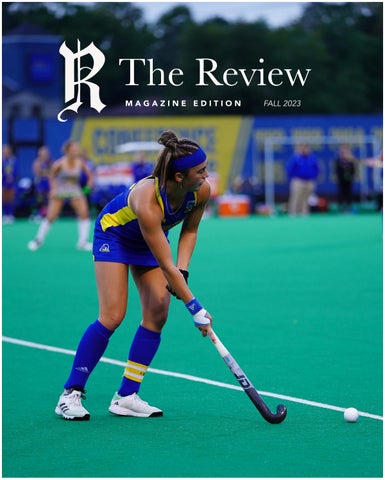
The Review MAGAZINE EDITION
FALL 2023
CONTRIBUTORS EDITOR-IN-CHIEF KONNER METZ EXECUTIVE EDITOR NADYA ELLERHORST MAGAZINE EDITOR & ART DIRECTOR SARAH WESSEL CO-MANAGING NEWS EDITORS RISHA INAGANTI & TABITHA REEVES STAFF NEWS REPORTER SYDNEY BECKER MANAGING SPORTS EDITOR DANIEL STEENKAMER
UD’S ANIMAL TESTING AND TREATMENT pg 3
STAFF SPORTS REPORTER STEVEN NORRIS MANAGING ARTS & CULTURE EDITOR JORDANNA GARLAND ASSOC. ARTS & CULTURE EDITOR BETH WOJCIECHOWSKI STAFF ARTS & CULTURE REPORTER ALEXANDRA MILLMAN CO-MANAGING MOSAIC EDITORS SHAYNA DEMICK & GABY NIEVES STAFF MOSAIC WRITERS PERCY ALLEN III & CAROLINE POWELL DEVELOPMENT OFFICER TABITHA REEVES DEVELOPMENT REPORTER KATHLEEN MARTIN COPY DESK CHIEF IARA LUQUE COPY EDITORS DANIELLE MCILTROT, NAYZETH ROMEROCHAVARRIA & SABINA SALGUERO MANAGING VISUALS & LAYOUT EDITOR LARISSA VERONICA HEATHER
AN INSIDE LOOK AT AETNA pg 29
ASSOC. VISUALS EDITORS ETHAN GRANDIN, JACOB LETNAUNCHYN & AUDREY TONG LAYOUT EDITORS LARISSA VERONICA HEATHER, IARA LUQUE & SARAH WESSEL PHOTOGRAPHERS JULIA DIAMOND, GIANNA HOUCK, EMILY MATEJA, MADDY MCMANUS, CHRISTINA NATALINI, HANNAH PALIATH, JORDAN ROSALES, WANNING WANG COVER PHOTO BY JORDAN ROSALES THE REVIEW udreview.com
BEYOND UDAIRY: UD’S COLLEGE OF AGRICULTURE pg 33
CONTENTS 3 7
From Lab to Farm
The Review takes an inside look at the university’s treatment of animals of all types.
7Lily’s Boutique
Owners Emma Murphy and Jennifer Lieske talk about the new cozy and trendy clothing shop now open on Main Street.
8
Artist Feature: Wanning Wang
8
Artist Feature: Emily Mateja
9
UD’s School Spirit
11
Compulsory Heterosexuality
14
Artist Feature: Gianna Houck
21
Main Street’s Zero-Proof Scene
25
The Sports Betting Craze
27
Peach Pit’s Rise to Fame
28
Artist Feature: Jordan Rosales
29
An Inside Look at Aetna
32
Living with PCOS
33
Beyond UDairy
35
Women and Gender Studies
37
Contributors & Letter
Photographer Wanning Wang showcases her personal work from a lifetime of photography.
Photographer Emily Mateja showcases her personal work from studying abroad.
Many sports programs at the university are on the rise. Is school spirit close behind?
Co-Managing Mosaic Editor Shayna Demick, along with her peers, discuss the queer concept of compulsory heterosexuality.
The Place of Esports
Staff Writer and varsity Super Smash Bros. Ultimate player Percy “Percy XPX” Allen III seeks to demystify the notions surrounding competitive gaming.
15
Become Your Own Trendsetter
17
NILaware
19
20
Staff Writer Caroline Powell dives into the realm of fashion trends and its impact on everyday life.
An increasing number of Delaware student-athletes are participating in the Blue Hen Collective, a home for their name, image and likeness (NIL) pursuits.
Artist Feature: Audrey Tong
Photographer Audrey Tong showcases her personal work from studying marine biology in Lewes, Delaware.
Photographer Gianna Houck showcases her passion for nature photography through her personal work.
Executive Editor Nadya Ellerhorst treks about Main Street in pursuit of its non-alcoholic side.
Wagering on sports is now fully in the mainstream, but how have the floodgates opened?
Canadian band Peach Pit sat down with The Review earlier this fall to share the ins and outs of life on the road.
Photographer Jordan Rosales showcases his monochrome style through landscape and architecture photographs.
In an unpredictable job, Aetna Hose, Hook & Ladder Company employees and volunteers rely on camaraderie and trust to keep the local community safe.
Staff Reporter Alexandra Millman shares her experience with polycystic ovarian syndrome.
Calvin Keeler, the interim dean of the College of Agriculture and Natural Resources, discusses what the college offers to the university community.
The Review explores the history and future of the university department that is enjoying its 50th anniversary.
Editor-in-Chief Konner Metz and Executive Editor Nadya Ellerhorst share closing thoughts on The Review’s fall 2023 Magazine Edition.
FALL 2023
2
photo by AUDREY TONG
FROM LAB TO FARM:
ANIMAL TREATMENT AT THE UNIVERSITY The Review takes an inside look at the university’s treatment of animals of all types. story by RISHA INAGANTI & TABITHA REEVES EVER SINCE TANIA ROTH’S NAME WAS put on blast due to reports of animal cruelty, the university has been on close watch for the treatment of animals. From science labs on the university’s campuses to the farm which makes the well-loved UDairy possible, the university is home to many creatures – rodents, sea anemones, dairy cattle and more. Given the notoriety and number of university programs that use animals, we decided to take a deep dive into how some of these critters are cared for. We began our investigation with the hot topic: the abuse allegations towards Roth. People for the Ethical Treatment of Animals (PETA), a lobbying and activism organization which opposes the use of animals in laboratories for any purpose, has filed complaints against Roth, a professor of psychological and brain sciences. The first published critique was in April 2018, with the most recent one in June 2021. The first PETA statement claimed that Roth’s experiments consisted of “inducing pain and fear in pregnant and neonatal rats” by “force-feeding alcohol,” “repeatedly shocking” and “confining pregnant rats in tiny tubes and exposing them to strobe lights and white noise,” among other accusations.
3
THE REVIEW udreview.com
“In my opinion, the stress was a very mild stress,” Gwen Talham, director of the university’s Animal Care Program, said. “And PETA filed a complaint to [the National Institute of Health] with a lot of allegations, and I looked into it, and they said that none of the allegations were true when they posted the case.” Since then, a person in a rat costume has taken to attending the university’s Board of Trustees meetings in silent protest. NIH has laid out animal research guidelines through their Office of Animal Care and Use, which investigates reports of poor animal wellbeing. Upon request for information on Roth’s case, the NIH Office of Extramural Research told us that they do not “discuss individual institutions and any reported cases of non-compliance” with the policy in question. When we reached out regarding the NIH reports Talham had referred to, neither Talham nor the university’s Office of Communication and Marketing (OCM) followed up with sending over additional information. While Talham offered that Roth explain her research for herself, Roth did not respond to our emails requesting a sit-down and was denied contact with us through OCM when requested.
“Gwen is handling the interview for this story,” an OCM representative said in a one-sentence email after we asked him to put us in contact with Roth. Roth’s website explains that her work primarily focuses on persons who have negative experiences early on in their lives and the impact those experiences might have, which is why some of her studies include simulating different environments for rats. She was also promoted to associate dean for the natural sciences in June of this year, raising questions about how much the university cares about animal safety. Aside from commentary on Roth, Talham discussed her general experiences regarding live test subjects at the university, such as with the Animal Care and Use Committee. The entity is a federally mandated committee to ensure that the university is abiding by the Animal Welfare Act, according to Talham. The committee allows individuals to anonymously submit reports of care concerns to the committee for further review. She described submissions of this nature as “very rare,” and, though she said records of reporting frequency are kept, neither she nor OCM provided specific numbers when asked during the interview and throughout the following week.
“I’ve been in the field 30 years,” Talham said. “It’s very rarely … that I would ever say that I thought anybody did anything intentionally. If I’ve seen problems, it’s usually because somebody just didn’t understand or didn’t quite have the training that they needed to have.” She and her staff are present to supervise research in the Life Science Research Facility, where she said “pretty much all the work with animals in research is done.” But because the building is for both experienced researchers and learning students, “trying to keep people trained is always a challenge,” Talham explained. “I am proud of what goes on in the facility,” Talham said. “It’s a sensitive area, and we always want to make sure that we have good security because there are groups out there that don’t believe in animal research for any reason at all, no matter what.” We were not permitted to tour the Life Science Research Facility or other laboratories with animals due to “potential for vandalism,” according to Talham, although pre-veterinary freshmen are given tours. Amelia Boernert, a pre-veterinary medicine major who graduated in the spring, recalled her experience walking through one of the labs for the first time. “If you don’t have any research experience and you’re a super big animal lover, you’re probably going to be really weirded out because the the animals in the labs, at least the rats and the mice that we worked with for that one lab, they live in boxes,” Boernert said. What Boernert described as boxes, Talham continuously referred to as cages. Even so, Boernert noted that the rodents she saw were given chew toys and tubes for “enrichment.” “Until you, I guess, get situated, it is very strange knowing that these animals live their whole life in the box,” Boernert said. Boernert remembered one student asking what would happen if there was a fire in a laboratory, and a scientist responded that he would risk his life for the animals, paying little regard to the expensive equipment. Apart from looking into the Newark campus labs, we took some time to head down to Webb Farm. Situated just past the Newark Train Station and before the Bob Carpenter Center are the fields, barns and coops which house the furry farm friends that make some of the extensive animalfocused programs possible, as well as the ice cream that UDairy is known for. Boernert worked on Webb Farm in fall 2021 as a volunteer. There, she gained hands-on knowledge about the university’s horses, sheep and beef cattle.
photo by ETHAN GRANDIN FALL 2023
4
IT’S A WORKING FARM, BUT IT’S ALSO A LEARNING FARM, TOO. AMELIA BOERNERT pre-veterinary medicine, ud ‘23 5
THE REVIEW udreview.com
photo by ETHAN GRANDIN
“It’s a well-oiled machine, a running farm,” Boernert said. “You know when you walk on a farm you’re like, ‘Huh, this is kind of sketchy?’ You never get that feeling on Webb. It’s nice.” Boernert’s responsibilities consisted of ensuring fences were intact and gates were locked, cleaning water troughs and barns, trimming sheep hooves, grooming horses, relocating animals and “just making sure that everything was safe and orderly and that the animals were happy.”
Animal Subjects in Research policy, in place to maximize animal welfare when conducting research that involves sentient life. Still, activist groups like PETA aspire for a future where no animal is critical to a scientific discovery. The university appears to be expanding infrastructure used for animal testing through the recent and ongoing construction of buildings such as the Life Science Research Facility, which holds twice the amount of rodents as previous spaces.
When we asked Talham about the future of testing on animals at the university, she said that it may take a while to completely end such use. “There’s no way to completely mimic all the interactions that go on inside a living being for a lot of types of research that they do,” Talham said. “I think it’s gonna be quite a few years away.”
“There was always an emphasis on animal safety first above everything,” Boernert said. “It’s a working farm, but it’s also a learning farm, too. So Larry was always explaining everything and always emphasizing on how to carefully walk around animals and treat them the best way.” Though Boernert spoke frequently about having worked under Larry Armstrong, the manager of Webb Farm, we were denied the request to speak with Armstrong by OCM. Aside from the farm and laboratories on the university’s Newark campus, there are also animal research facilities associated with the College of Earth, Ocean and Environment at the Hugh R. Sharp Campus in Lewes, Delaware. Elizabeth Roros, a junior marine science major, is working in Professor of Marine Science and Policy Mark Warner’s lab on the Lewes campus. As an independent researcher, she is studying the relationship between algae and sea anemones, which are invertebrate marine animals, as the Earth’s rising temperatures impact their habitats. “There’s definitely a big emphasis on proper treatment,” Roros said, who spends a great deal of time feeding and cleaning the creatures. “There’s a lot of care that goes into it, especially to keep them alive and maintained.” She explained that anemones can become easily stressed by slight changes in light and salt content, so the 12 bowls and four tanks of anemones in the lab are fed and cleaned once a week. Cleaning consists of a water change, which comprises hose water with a salinity formula added. She will also use Q-tips to brush built-up algae off the marine life. In addition to growing her own anemone for her studies, many anemones remain from previous students’ projects, which she continues to care for. “I have seen in the past a little bit of neglect, kind of, but it’s just because of going a little past a week,” Roros said. “That’s when they grow a lot of algae around the base, so they stick to the glass, and then it’s harder for them to grow. But they bounced back really quickly, and we’ve never left them for more than two weeks.” The university has mechanisms, such as the Animal Care and Use Committee and the
photo by AUDREY TONG FALL 2023
5 6
MAIN STREET SPOTLIGHT: 7LILY’S BOUTIQUE Owners Emma Murphy and Jennifer Lieske talk about the new cozy and trendy clothing shop now open on Main Street. story by JORDANNA GARLAND photo by GIANNA HOUCK WITH ITS MANY SHOPS AND stores, Main Street is known for being a social hub on campus. In between classes, many students frequent the street to grab a quick bite, study and hang out with friends. The newest addition to Main Street, 7Lily’s Boutique, now provides a place for students looking to switch up their wardrobes, with trendy and fashionable items. Located on 160 East Main Street next to Klondike Kate’s and across the street from Iron Hill Brewery, the clothing shop opened its doors to Newark on Aug. 29. Walking into the store, customers are met with a warm glow of string lights and a welcoming ambiance. The boutique has a wide array of cozy sweaters, cropped T-shirts, dresses, jeans, jackets, tank tops, accessories and more. The co-owner and manager of 7Lily’s Boutique, Emma Murphy, stated that the boutique has clothing for all ages and all sizes. She believes that the shop’s diverse collection is what makes 7Lily’s unique to Main Street. According to Murphy, “a lot of people have told [the shop owners] that it’s the first clothing store on Main Street.” “I think that is very unique for Main Street because all the things around here, it’s just food and things like that,” Murphy said. “I know there’s a couple of little stores with just accessories, and we do have accessories. We have jewelry, soaps and scrubs, we have cups, but we’ve kind of kept it more clothes.”
The clothing shop offers deals and coupons as well. Every $30 that’s spent, customers can receive a stamp. After seven stamps, customers can earn 15% off their next purchase. Another aspect Murphy stated that makes 7Lily’s Boutique distinct is its affordability. As a college student herself — a business marketing major at Wilmington University — Murphy kept in mind the financial burdens on college students when she created the shop with owner Jennifer Lieske. Due to the connotation the word “boutique” can sometimes have in regards to affordability, Lieske and Murphy wanted the prices to be reasonable enough for the average buyer. “I try to do it where … college kids could walk in and be, like, ‘Oh, that top’s $20,’” Lieske said. “Don’t be afraid to come in just because it says ‘boutique.’” As for customers of the shop, Lieske stated that they receive a mixture of college-aged students, parents and people who are visiting from out-ofstate. Before running a boutique with Murphy, Lieske and her husband owned FedEx trucks, but during the pandemic, they decided to sell their trucks. Given Murphy’s knowledge of business and her five-year, long-term relationship with Lieske’s son, Lieske asked Murphy if she would like to own a boutique with her. The name 7Lily’s Boutique holds significance for Lieske. When Lieske’s sister was 16 years old, she was in a car where the driver fell asleep behind the wheel, resulting in a fatal car accident where Lieske’s sister passed away.
NO MATTER WHAT MY FAMILY DOES, WE ALWAYS STICK WITH SEVEN. I JUST WANTED TO KEEP A PART OF MY SISTER THAT WOULD ALWAYS KEEP GOING. 7
THE REVIEW udreview.com
“Seven was always kind of her go-to number,” Lieske said. “Lilies were always the kind of flowers she loved, so no matter what my family does, we always stick with seven. I just wanted to keep a part of my sister that would always keep going.” The shop, which was originally set to open at the beginning of the summer, opened later than expected due to owners of another business on Main Street using the space for storage. However, that did not deter Murphy and Lieske from selling their boutique’s merchandise. The boutique’s online store debuted before the start of the semester. “For the most part, everything that is found instore is probably going to be online as well,” Murphy said. “Once we get it in, we’ll just package it here and then send it out either same day or next day so it’ll get to you pretty quickly.” The shop has a very active presence on social media as well, with over a thousand views on most of their posts and new content being posted almost every day. Its TikTok page often features Murphy advertising a variety of shoes, outfits and tote bags. Although Murphy explains that it is subject to change, 7Lily’s Boutique is currently open from 11 a.m. to 6 p.m. on Tuesday through Friday and 10 a.m. to 4 p.m. on weekends. “We’re close, down to earth, it’s a great place,” Lieske said.
JENNIFER LIESKE owner, 7lily’s boutique
ARTIST FEATURE: EMILY MATEJA EMILY MATEJA is a sophomore history education major from Delaware. She has been a photographer for The Review since spring 2023 and is also involved in WVUD, Intervarsity and the World Scholars Program on campus. She pursues photography to capture the beautiful things in life and explore the art her grandfather made a living out of. After graduation, Emily aspires to become a middle school teacher and eventually open her own education center.
ARTIST FEATURE: WANNING WANG WANNING WANG is a sophomore statistics major with double minors in business administration and organizational leadership. She is originally from China. She has been a photographer for The Review since spring 2023 and is also involved in the Native Species Initiative, National Society of Collegiate Scholars (UD chapter), MakerClub, Phi Sigma Pi (Alpha Eta Chapter), The Women’s Network, Creative Leadership and the Innovation and Service program on campus. She has been taking photographs since she was five years old and continues to pursue photography because of her inspiration from beautiful things. After graduation, she hopes to find a career that involves traveling and being in nature.
FALL 2023
9 8
THE STATE OF SCHOOL SPIRIT AT THE UNIVERSITY A look into student spirit and how it is reflected in football games at the university. story by SYDNEY BECKER photography by LARISSA VERONICA HEATHER COLLEGE FOOTBALL IS OFTEN ASSOCIated with crowds of students bursting with pride as they cheer on their fellow classmates on the field. Despite its prevalence, this classic depiction of school spirit is not always accurate, as students at the university do not seem to adhere to these ideas of school spirit when it comes to sports. Walking around the university’s campus, you will most likely find numerous students in blue and gold, repping the university’s colors and logo. While students are willing to wear their school’s merch, many do not show up to display this same spirit at football games, leaving the student section with empty seats. “I wouldn’t say that I’m the most school-spirited,” Ava Tomlinson, a sophomore English edu-
9
THE REVIEW udreview.com
cation major, says. “I’m proud of where I go, I do participate in merch and stuff on campus, but I’m definitely not as active as I could be.”
However, there are a few students who regularly attend each game. One of these students is James Pizzuta, a junior exercise science major.
Tomlinson, who did not go to the first two home football games of the semester, planned to go to her first one for Parents and Family Weekend with her family. According to Tomlinson, the only time she has truly heard of a large turnout for football games is at opening games or homecoming games.
“It’s fun to represent your team and to cheer for them,” Pizzuta says.
Whether it be because university students are not football fans or because the university does not match the reputation of big football schools, such as Penn State, Ohio State and Michigan State, students do not show as much enthusiasm for games.
“In terms of things like sports, I think it’s definitely lacking because considering how big of a school we are compared to other schools of our size,
Although Pizzuta enjoys going to the games consistently as a football fan, he also notices how the student section sometimes seems to be somewhat empty.
it just seems like people aren’t really as into the sports scene,” Pizzuta says. When asked about the cause of this lack of school spirit, Tomlinson and Pizzuta seem to have similar answers: The university is not a high enough ranking sports school for students to really get into football, and schools like Penn State just have a better reputation when it comes to sports, specifically football. “We have a good football team for what division we’re in, but I think compared to other schools of similar size and academic status and everything, I think our team is kind of a little bit lacking,” Pizzuta says. Currently, the university is in the Football Championship Subdivision (FCS), and Pizzuta notes how school spirit and “hype” surrounding football games could increase if the university were to move up to the Football Bowl Subdivision (FBS) division. While this is not a change that happens overnight, there have been reports of the university potentially moving to an FBS conference.
In the meantime, Ed LeFurge III, director of communications and creative services in athletics, is working alongside other staff members to increase student engagement and support for the university’s sports teams. “We do a lot to try and engage our students,” LeFurge says. “At all of our different events we run promotions.” LeFurge describes some of the tactics implemented to inspire students to attend sports games: t-shirts, “cool swag,” holding giveaways and the Cockpit HENergy Challenge – where a student who attends every single football game has the chance to win a $15,000 prize that goes towards student aid. LeFurge notes how these strategies have given the university its own accomplishments in school spirit. “At Delaware, we’ve been really successful,” LeFurge says. “Last year we were sixth in the country [in the FCS] in average attendance. And looking at those numbers from a student standpoint, we had an average of 2,700 students at every home game.” Students also notice how the earlier games, such as the Parents’ and Family weekend game or the first game of the season, usually seem to have a greater attendance rate.
According to LeFurge, there was a 48% increase in total attendance for football from the year prior. These statistics could speak to an increase in school spirit, although spirit is hard to measure. LeFurge explains that school spirit is subjective and could vary from pride in your institution to more academic considerations. From a statistics standpoint, LeFurge specifically notes how application numbers are going up, with a 6% increase in freshman applications from fall 2022’s application record, according to statistics reported in UDaily. According to LeFurge, this could correlate with more enthusiasm towards the university. “We want our students to come out and be loud and have fun and enjoy the experience, and that’s why we have the different amenities that we do for students,” LeFurge says. Yet when speaking of school spirit in terms of student engagement at sports games, football being the most popular, the university may not be able to compare to large schools such as University of Maryland and Penn State. On Sept. 9, the university played then-No. 7 Penn State at an away game. Many students from Delaware, including Pizzuta, attended this game. Pizzuta explains how even though he is a student at the university, he is also a Penn State football fan since his dad went there, giving him a connection to the school. Although Pizzuta says he ultimately represented Delaware at the game, he noticed how there were some students from Delaware who went in Penn State gear. The final score of the game resulted in a win for Penn State, 63-7. “Delaware’s not the football powerhouse FBS institution like a Penn State or a Clemson or a Florida State, that’s just not who we are,” LeFurge says. “That’s not the identity of what the institution is.” Despite the fact that Delaware may not be a “football powerhouse” like other institutions, LeFurge notes that the university is still doing very well for its division, and team morale is closely related to student school spirit. “It really riles the team up, it gets them excited,” LeFurge says. “Our guys want to go out and play in front of their peers and their fellow students, and having them in attendance at games is really important to us.”
FALL 2023
10
PERSONAL ESSAY: THE NUANCES OF COMPULSORY HETEROSEXUALITY Co-Managing Mosaic Editor Shayna Demick, along with her peers, discuss the queer concept of compulsory heterosexuality. story by SHAYNA DEMICK illustrations by SARAH WESSEL COMPULSORY HETEROSEXUALITY: What is it? I have found very few people who are familiar with the concept, though it seems that many unknowingly struggle with it. After all, the obligation to have a heterosexual identity is deeply ingrained and reinforced in most components of society, including the media, the government, schools and homes. The Equality Archive, a collaborative database of historical equality issues, defines compulsory heterosexuality as the idea that heterosexuality is assumed as the “default” sexuality and imposed in society. We are socialized into identifying as heterosexual until proven otherwise. 11
THE REVIEW udreview.com
Compulsory heterosexuality was popularized by Adrienne Rich in 1980 in her essay, “Compulsory Heterosexuality and Lesbian Existence.” Rich explains that lesbian existence threatens the entire system of patriarchy since lesbians do not need men for (what some may argue are) their most inherent needs. The Equality Archive expands upon this concept on its website: “Upon this assumption is layered another: that men and women are the proper sexual pairing and that men and women are the exclusive objects of each other’s emotional and physical desire.”
Anyone can be a victim of compulsory heterosexuality. Queer individuals tend to be invalidated by this concept, as it is rooted in binary gender differences and the assumption that men and women should be together. This is harmful, as it belittles queer identities and excludes them from conversations about queerness and compulsory heterosexuality. Within the gender binary, women are especially expected to be heterosexual, being taught their identities are defined by a male counterpart. I have known since the seventh grade that I was not heterosexual. I did not know exactly “what” until my freshman year of college. The prospect
THE PROSPECT OF BEING LESBIAN DID NOT EVEN CROSS MY MIND, SIMPLY BECAUSE IT WAS UNTHINKABLE. IT WOULD NOT BE MY REALITY BECAUSE I REFUSED TO LET IT BE. SHAYNA DEMICK co-managing mosaic editor, ud ‘25
of being lesbian did not even cross my mind, simply because it was unthinkable. It would not be my reality because I refused to let it be. With that said, I grasped onto a pansexual label with all the strength I could muster. As a lesbian myself, I have found it tempting to grasp onto a bi/pansexual label. It implies that at the end of the day, I might be able to have a picture-perfect heterosexual marriage. For many years, I continued to tell myself that I would be happier and feel more accepted if I were with a man. The challenge to distinguish bisexuality from lesbianism is so profound that an extensive guide about navigating this challenge has been written about in an anonymously written document called “The Lesbian Masterdoc.” “The Lesbian Masterdoc” is a 31-page document that breaks down the concept of compulsory heterosexuality and explains the experiences and feelings of a lesbian forcing their heterosexuality. After reading it, I realized that my experiences were common. Many queer individuals have been trained to want the same things, therefore experiencing many of the same thoughts and feelings as well.
While I have known homosexual individuals who discovered their identity very young, I was not as lucky. My heterosexuality was a performance that I devotedly adhered to until it could no longer be faked. The thing was, I did not know that my performance was indicative of my queerness. I thought my behavior was normal. It was not until I read “The Lesbian Masterdoc” that I realized my sentiments about men were never genuine. Since I can remember, I have regularly “selected” male crushes. I would see a boy, think they were conventionally attractive and assumed I had to like them. I thought that it was normal to aggressively publicize these crushes until my peers started to call me “boy crazy.” I found this label endearing since I wanted nothing more but for my attraction to men to be validated. I thought that if I liked a male celebrity I was bisexual, but what the masterdoc explained is that I liked these men because they were unobtainable. I would never have to confront my attraction to them – it was the perfect scenario. It never crossed my mind that one should not have to rationalize their attraction, as it is something that you should feel rather than construct. In an attempt to manufacture an attraction to men, I had my first kiss on a cruise at the age of 15. Unsurprisingly, it was not enjoyable, but that did
not stop me from using the experience to bolster my performative heterosexuality. I have observed the bi/pansexual to lesbian progression in many of my friends. It can be far easier to accept that you might date someone who is not a man than to accept that you will never be with a man. It is terrifying to accept this reality since that is what we have been taught to want from a very young age. I recently spoke to my queer friends Jill Perez and Linnie Ulick about their experiences with compulsory heterosexuality. Regardless of one’s security in their identity, Perez explains that society will push bisexuality onto these individuals in order to preserve a heterosexualaligned identity. The heterosexual norm is seen in so much of the media that we consume, and while queer representation has increased, Ulick believes that it is not an accurate representation. They explain that it is hard to find “realistic or relatable queer relationships” in media, especially for those that haven’t fully discovered their sexuality. While my main experiences with compulsory heterosexuality were limited to one kiss and two dates, Ulick and Perez dated several males before realizing they were not attracted to them. FALL 2023
12
Although Ulick had boyfriends in middle and high school, they would have crushes on girls and their female friends while in these relationships. “I understood that I like girls but could not accept that I do not like men, because I have to. Girls are supposed to like guys,” Perez explains. “I knew that I liked women more than I liked men, but it didn’t seem like I was allowed to come out,” Ulick shares. Ulick broke up with their final boyfriend a few years ago because they realized they were not attracted to men. COVID-19 gave Ulick an opportunity to get to know their sexuality and have the resolve to end their relationship. “As I discovered myself in different ways during COVID, I wanted to start living those truths of myself a lot more so that’s what spurred me to be, like, ‘I’m gay, so I’m going to end this relationship so I can live and experience that,’” Ulick explains. Since coming out, they have been living as their authentic self, while also navigating the intersection of their gender identity with sexuality. Perez was highly aware of their feelings toward women being more genuine than their feelings toward men, but they felt inclined to skew this narrative so they could be with men. Like Ulick, they dated males in middle and high school. Perez became particularly confused about their sexuality when they dated a man that they had very passionate platonic feelings for. “I liked a guy as a friend a lot, and then I was, like, ‘This is my opportunity to be with a guy, this is my opportunity to be a little bit straight,’” Perez said. “I kind of forced that in my mind to
13
THE REVIEW udreview.com
be a romantic sexual crush when it wasn’t.” When the two finally kissed, though, Perez came to the jarring realization that they could not and would never like men. When wanting to be attracted to men, it can be incredibly easy to confuse platonic feelings for romantic ones. I have found this to be a common occurrence when one has trained themselves to perceive men from a purely romantic perspective. Without cultivating self-awareness, it can be very difficult to notice this mindset. Perez, Ulick and I discussed how we continue to navigate compulsory heterosexuality today. For Ulick, this manifests in them wanting to fulfill the masculine role in the relationship so they can replicate a masculine/feminine heteronormative dynamic. “I feel like as I become more masc, I’ve wanted to fit the more masculine role in the gender binary if I was with another woman,” they explain. Although I occasionally regress and find myself wanting to like men again, I have found that the way I perceive them now is unchangeable. I flipped a switch and cannot flip it back, and for that I am so grateful. “The Lesbian Masterdoc” explained feelings I could not put words to and helped me see my past thoughts and actions in a new light. Ulick advises questioning individuals also navigating compulsory heterosexuality to contemplate their vision of a lifelong partner. “When you picture your future with a partner, do you picture yourself being in a long-term relationship, and if you view it as a different
scenario than with a person of the opposite sex, which scenario makes you the happiest?” While pondering one’s future, Perez encourages self-educating and communicating with loved ones. “Talk to people, consume gay media and read ‘The Lesbian Masterdoc,’” Perez says. In addition to Perez and Ulick’s tips, I encourage individuals to evaluate their relationships with the male-identifying figures in their lives as well. Understanding the distinction between platonic and romantic attraction can be hugely beneficial in navigating compulsory heterosexuality and relationships throughout one’s life. I hope to see more lesbian representation in educational settings and the media. This will provide opportunities for queer individuals to recognize compulsorily heterosexual thinking patterns and further explore their identities. Whether or not you are part of the LGBTQ+ community, please do not assume that someone is heterosexual just because that is what we have been socialized to do. Dismantling the idea of a “default” sexuality is crucial in supporting queer individuals, as well as in their own understanding and embracing of their identities. It is only through doing this that we can eventually erase the idea of a “default” sexuality. It is important to understand that compulsory heterosexuality is perfectly normal to experience, and one should not blame themselves for neglecting to recognize it earlier in their life. It is difficult to navigate, but remember: You are not alone in this exploration.
ESPORTS’ PLACE IN THE REALM OF PROFESSIONAL COMPETITION story by PERCY ALLEN III photo by CHRISTINA NATALINI Staff Writer and varsity Super Smash Bros. Ultimate player Percy “Percy XPX” Allen III seeks to demystify the notions surrounding competitive gaming. MANY OF US ARE TOLD FROM A young age that video games are a waste of time. They rot our brains, make us violent and keep us from being productive, useful members of society. I recall distant memories of being scolded by my mother for daring to touch the family Nintendo Wii before completing my homework. “You’re not going to get anywhere in life if you stay on that game all day,” she would sneer over the Mario Kart Wii’s Maple Treeway theme. If practicing what you love is considered a waste of time, why does our culture celebrate students who place such emphasis on athletics to the point where it’s a central focus of not only their academic career, but their entire existence? Shouldn’t they be balancing their life around their hobbies the same way that gamers do? What exactly is so different about gaming and other forms of professional athletics? The difference is purely in cultural connotation. Gaming, until recent years, has been viewed as solely a form of entertainment no different from watching television or playing board games. To most, its only purpose is to fulfill the objective of having fun. At the mention of gamers, images of individuals hopelessly glued to their screens often plague people’s minds. This is a stereotype that, when applied to gamers as often as it is, ostracizes them as hermits who are seemingly incapable of functioning when away from their devices. I have experienced this myself. Many are shocked when I disclose that my favorite pastime is playing video games, as if I do not fit the status quo of who they view to be a “gamer.” This rhetoric in turn stigmatizes gaming as a whole, tarnishing any of the potential positives the medium brings with it. Those who play video games competitively are haunted by the accusation of “wasting their time,” and those who wish to join the scene may be put off by the perceived requirement of being a social outcast.
This is where we are going wrong. Competitive gaming has the ability to bring the positives of competition to those who may not want or be able to play traditional sports. Practicing consistently helps build discipline. Facing constant challenges improves problem-solving and decision-making skills. Meeting others who share your passion provides a sense of community. Moving down the unending road of improvement builds humility. Tournaments provide playgrounds for meeting new people and learning to perform under pressure. “It’s definitely given me a form of discipline,” university varsity Super Smash Bros. Ultimate player Keith “Hoodinii” Davis said. “Just like every other sport, it takes practice and a lot of perseverance to try to get through many different bumps in the roads, trying to climb those mountains of getting better.” Esports also provides people the opportunity to reinvent themselves and adopt personas to be used both in and out of the game. Many players take on new names to commemorate the fact that esports provides a means of escape from the outside world. When I compete in events, I don’t go by “Percy Allen” – instead, I’m Percy XPX as a reference to pop star Charli XCX. All the positive aspects of athletics are found within esports, as they are one and the same: A shared community of people all working to improve at the same activity. “We all share a collective love for something,” varsity Super Smash Bros. Ultimate player freshman Anthony “MPg” Casale said. “We can relate, whether it be the characters, how the game feels, what we’re trying to achieve, our goals and the stuff that we want out of this game, and I feel like we can all relate to that in any sport or thing that we try to strive for.”
As a teenager, I remember being utterly mystified at the idea that I could potentially become a competitive Smash player. The activity that I previously felt I had to hide from my friends and family could someday, with hard work and dedication, become one of my greatest points of pride. Throughout my time competing, I have been granted many opportunities that would have otherwise been completely inaccessible. I have participated in events as far as Virginia, been sponsored financially by a local business and made friends from around the country. I have also been ranked second in the state of Delaware and recently was recruited to represent the university on the Super Smash Bros. Ultimate varsity esports team. Experiences like these that make gaming not just a hobby, but a lifeline. People are able to dream of making it big doing something they love and are incentivized to work tirelessly to meet that goal, the same way that kids playing football or basketball do. This is the prime appeal of esports: If you have the game, you can become somebody. Institutions are taking notice as well. With the university’s establishment of the Esports Arena in 2020, as well as scholarship opportunities for its varsity players, gamers are no longer the only individuals realizing the potential esports has. “For me, I took it seriously,” Casale said. “I got a D1 offer out of it. I came to the University of Delaware, and I had so many offers out of it [from] different colleges. I think I had 46 college offers just to play esports there.” As the industry begins to take root, the question is not when esports will take off. Rather, it’s a matter of when the rest of the world will catch up.
I myself have been an avid member of the esports community for almost eight years, with my specialty title being the Super Smash Bros. series. In that time, I have managed to rack up over 1,000 hours on my main character, Bayonetta, alone.
FALL 2023
14
INCORPORATING FASHION TRENDS TO DISCOVER YOUR OWN STYLE Staff Writer Caroline Powell dives into the realm of fashion trends and its impact on everyday life. story by CAROLINE POWELL photo by JORDAN ROSALES FASHION TRENDS ARE NOTHING NEW to our society. We have seen things come and go throughout the years: the 90s mom jeans, crochet clothing, the debatable dress over jeans (yes, it is back, and no, I am not upset about it). The list goes on. However, with TikTok becoming one of the most popular social media apps, exposure to new dances, sounds and pranks are generating trends more quickly than ever before. Of course, this cycle of ever-changing fads also includes clothing. While these trends help us evolve our style with the times, as well as create a sense of community amongst each other, it is important to acknowledge the downsides of fashion trends. Many trends we see are fueled by “fast fashion.” The Oxford Dictionary defines fast fashion as market retailers mass-producing inexpensive clothing to stay on top of the latest trends. In recent years, the popular retailer Shein has become well known for its marketing of fast fashion. The Cut reported in July that an investigation by the U.K.’s Channel Four found that in two Shein factories, employees worked up to 18 hours a day with only one day a month off, violating working conditions in China’s labor laws. Despite Shein’s poor working conditions being no secret on social media, many people still consume their products for its affordable prices and new trending items. Fast fashion not only enables negligence of working conditions; it also negatively impacts the environment. According to TheRoundup, an organization dedicated to spreading environmental awareness, 92 million tons of clothing goes to waste in landfills every year. So how can we keep up with trends in a sustainable manner? In my opinion, the best cost-effective way to maintain sustainability in your wardrobe is to go thrifting. While shopping at thrift stores has its own controversies due to resellers taking over the thrifting experience, it is a great alternative for saving money and finding long-lasting, unique pieces. Keeping up with trends limits you to a cycle of 15
THE REVIEW udreview.com
spending money and never figuring out your own style. The algorithm on social media is designed to make you feel a sense of missing out – if you do not get the latest fashion piece, you are behind. Rather than focusing on what represents you, you indulge in whatever influencers post on social media. That being said, there is definitely a way you can pick out trends and incorporate them into your own style. Trends can be evergreen and help establish classic staples. For example, one trend this past year that I followed is buying my own pair of the Adidas Samba shoes. The Sambas are a classic sneaker. The Sambas are a classic sneaker that have had a resurgence in popularity recently. They have a long history since being released in Adidas’ first decade. Vogue even grants the Sambas the title of “ItGirls’ current favorite sneaker.” I ended up buying the vegan version of the white pair, and I have noticed they have become my go-to shoes, matching the majority of my outfits. Another trend that looks like it will stick around for a while is the color red. According to Glamour magazine, it is the color of this fall and a tangible trend that will likely last. Whether it is a pop of red to enhance your outfit or just wearing red entirely, the color has replaced the usual earth tones of the season to make a statement in your style. This bold color choice is still a palpable fashion trend, as it is a timeless color and has been seen throughout different eras of fashion. There are also trends that are not so timeless. One of the latest trends this past summer were metallic colors (particularly silver). It became popular because of Beyoncé’s recent Renaissance World Tour, where she asked fans to dress in metallic and silver for Virgo season, according to Vogue. Granted, Beyoncé looks amazing in her tour outfits, but metallic will probably not be trending once talk about her tour and costumes start dying down. Metallic is often worn for specific occasions rather than for day-to-day wear. It is a trend that likely will not last, as more “basic” color palettes can be dressed up or down. But if you find that you really like metallic colors, even when everyone else (including Queen B) stop wearing them, then it can become something particular to your style.
Finding what trends work and do not work for you can take a lot of investment in terms of both time and money. Maybe you will indulge in a trend and find you do not like it after six months, or perhaps the opposite will occur. My rule of thumb is if something is still trending later and you really like it, it could be something you might consider buying. I personally enjoy everyday clothes with a twist to show my own style. A trend that I believe has a chance of lasting are peplum tops, or “Peplum, redefined,” according to Glamour. Peplum tops offer a nice twist to a basic T-shirt or tank top by giving a flowy look. These tops can be a good spin on your everyday basics. In the fashion realm, we are leaning towards minimalism: color palettes, style choices and a “less is more” feel. This year, Glamour commented on the runway shows, reporting that “styling leaned minimalist, with high-quality takes on essentials.” Essentials can include the classic tee and jeans, simple colorways, staple dresses and comfortable shoes. People also sometimes pride themselves for not being trend followers. But following trends isn’t necessarily a bad thing. Usually, if something is trending, it means it’s cute or stylish. It’s how much you indulge that can become harmful to your own sense of self and the environment as a whole. One of my favorite ways of figuring out my style sense is using Pinterest boards. Creating a “mood board” with your favorite colors, style icons and pieces of clothing you want to incorporate into your style is a good starting point for discovering what you want to wear while showing off your personality. Even just looking at what people on the street are wearing can be enough inspiration to take it and make your own! It can also be fun to ask people where they got something; this may even lead to a great conversation. People love talking about their outfits, so do not be afraid to put yourself out there while discovering your own style. Do not stress too much about your outfit, or what others may think of it. If you like it, that is all that matters. Take time to find what works for you and what doesn’t, as well as what you like and don’t like, and you can become your own trendsetter. Bonus points if you do this in a sustainable way, because saving the planet never goes out of style.
TAKE TIME TO FIND WHAT WORKS FOR YOU AND WHAT DOESN’T, AS WELL AS WHAT YOU LIKE AND DON’T LIKE, AND YOU CAN BECOME YOUR OWN TRENDSETTER. CAROLINE POWELL mosaic staff writer, ud ‘24
FALL 2023
16
NILAWARE: UD’S BLUE HEN COLLECTIVE An increasing number of Delaware student-athletes are participating in the Blue Hen Collective, a home for their name, image and likeness (NIL) pursuits that is only becoming more prominent. story by DANIEL STEENKAMER collage by ETHAN GRANDIN JASON BELZER GRADUATED FROM Rutgers University knowing exactly what he wanted to do in life. The only problem was that it was entirely illegal – in the NCAA’s world.
ing. Its importance to the future of Fightin’ Blue Hens’ athletics is only beginning to be realized.
A walk-on with the Scarlet Knights, Belzer desired to represent student-athletes in an agency. Under the NCAA’s restrictions geared toward preservation of the amateurism of the student-athlete, college players could not be represented by an agent when Belzer was entering the workforce. He settled for repping coaches to begin his career but all the while was keen on getting back in the student-athlete sphere, one that he lived in for years in Piscataway, New Jersey.
Complexities abound in creating an NIL collective that abides by NCAA rules. Chief among them is that the collective is a third-party operation separate from the given athletic department.
Belzer, who described himself as “a very big advocate of student-athlete rights” in the infancy of his career, took that advocacy pen to paper in his 2012 Forbes story titled “National Letter of Indenture.” Wordplaying on the National Letter of Intent signed by incoming intercollegiate student-athletes to commit to an institution, Belzer argued in the article co-written by Andy Schwarz that college athletes were similar to indentured servants of colonial times. Over a decade after the Forbes piece was published, Belzer is at the forefront of one of the companies leading the new era of college athletics: Name, Image and Likeness LLC. Branded as “Student-Athlete NIL” and with its logo spelling “SANIL,” the company has emerged as an industry powerhouse in the “name, image and likeness” space. It is an economy that has exploded in Division I college sports, specifically among men’s basketball and football players, since the NCAA’s interim policy permitting monetization of student-athletes’ NIL took effect in July 2021. As part of its portfolio, Student-Athlete NIL is in the business of managing NIL collectives, entities organized to facilitate name, image and likeness activations for student-athletes at particular schools. Among the universities assisted by an independent SANIL collective is the University of Delaware, the flagship institution of the state in which SANIL is incorporated. How the “Blue Hen Collective” got off the ground is a story of NCAA compliance tightrope walk17
THE REVIEW udreview.com
“THE ENTREPRENEURIAL INCUBATOR”
That is not to say, however, that a university cannot be proactive in enlisting the help of an outside group such as SANIL to launch a collective that serves its student-athletes. This is exactly what Delaware did to stay in the curve of a college sports world that allows its players to capitalize on their popularity, notoriety or online reach. Belzer had a prior relationship with Delaware athletic director Chrissi Rawak when the Blue Hens inquired about a pathway to a collective. “The university said, ‘Hey, we need somebody to come in and create this for us to connect with our donors,’” Belzer said about Delaware’s interest in what would become the Blue Hen Collective. He noted that depending on regulatory decisions to come from the NCAA or from Congress, the lines between an athletic department and a collective could blur down the line. “There’s a potential that we will just become even more and more closely aligned with the universities in terms of revenue generation and all of those different elements,” Belzer said. In the meantime, a point of intrigue is the basic question of how a collective is named in the first place. Many collectives under the SANIL umbrella are named using imagery or a slogan that correlates to the related school for its target audience while avoiding outright usage of protected marks. This method helps the collective distinguish itself as independent while remaining identifiable: “Fly Hawks Alliance” is devoted to Monmouth University student-athletes, “For The Peayple” is at Austin Peay State University, “RoMo Rise” is Robert Morris University-oriented, “Goh Collective” supports Towson Uni-
versity players, and the list goes on. Delaware, though, was perfectly happy to proceed with a collective name tethered to its own intellectual property. “Delaware wanted to be very much tied in with its existing IP,” Belzer said, citing Syracuse University’s “Orange United” collective and Rutgers University’s “Knights of the Raritan” as examples of the common practice of lending the athletic nickname to the collective. Thus, the Blue Hen Collective was christened. “We try to create names that are very similar to or have direct ties to the university, so what we want is that this becomes the entrepreneurial incubator of the athletics program,” Belzer said. “It is designed to drive and create ideas and monetization around the student-athlete assets and the assets of the university that are existing.” In the end, Delaware stamped the collective with “Blue Hen” while withholding its athletics logos, such as the primary YoUDee head. NIL collective logos across the country often incorporate school colors while depicting the mascot at hand or a campus scene more generically. “We let the university decide what the name is,” Belzer said. “It’s not like we make that decision. We present them all kinds of different ideas, just like any creative agency would, and they say, ‘We like this.’” NIL ACTION IN DELAWARE While the standalone status of the Blue Hen Collective is emphasized as much as that of any other NCAA-compliant collective, Delaware’s athletic department is permitted to publicize the collective and promote awareness of its activities. The Blue Hens’ social media platforms have leaned into this interest through campaigning about the Blue Hen Collective’s “$50,000 in 50 Days” initiative. @UDBlueHens posted a video on Instagram and X on Oct. 3, compiling messages from former Delaware student-athletes, all of whom shared
Delaware student-athletes, all of whom shared their role as investors in the Blue Hen Collective while encouraging viewers to join them. Depending on how one chooses to invest in the Blue Hen Collective, one may or may not expect a personal return on investment. One-time donors may designate their contribution to go toward the NIL activations of all athletes at Delaware. These donors may also earmark a single team for which its Collective-participating athletes will benefit. Additionally, the Blue Hen Collective promotes the option of memberships for fans. These memberships come at various levels of giving, all of which entail a certain amount in return for the member joining. The perks range from a simple car magnet and an exclusive student-athlete meet-and-greet to the $10,000 annual threshold that earns one Blue Hens gear, autographed memorabilia, dinner with a student-athlete or coach, VIP access at a football or basketball game and more. Considering the Blue Hen Collective’s ability to entice memberships with corresponding rewards coming from the athletic department, Belzer’s suggestion that the two parties could evolve into being intertwined seems quite possible not just at Delaware, but at any program with student-athletes backed by a collective.
collective donors. “The second bucket are brands,” Belzer said. “Local, regional, national companies that are doing real NIL work with the student-athletes. “And then the third bucket is donors, donors that are giving money to the collective not necessarily seeking a return on investment.” The mechanics of money moving through the collective life cycle are not always straightforward. “When the money comes into the collective, if you’re a member of the collective, you can decide what sport you support, but you can’t give to a specific student-athlete,” Belzer said. “A brand usually wants to work with specific student-athletes because they are trying to accomplish a specific goal.”
enrollment or one playing (however well) at a particular institution. That swerves into the payfor-play that is still off the table for NCAA member schools and student-athletes. “Do they want everyone on the team to have an opportunity?” Belzer asked rhetorically about coaches. “Is there a preference to help support or reward the student-athletes that have been with the program for the longest period of time?” One of the more conspicuous NIL activities taken up by Collective-engaged Delaware football players during the 2023 season has been promotion of CBS’ Survivor program with Instagram Reels posted using the Survivor season filter. While that social media campaign falls in the brand marketing category, SANIL-participating student-athletes at Delaware can even more simply be paid as ambassadors of the Blue Hen Collective itself, Belzer explained.
Further still, the tendencies of donors are different. “A donor is most often giving to the general sports fund, but sometimes they may allocate money to a specific athlete,” Belzer said. PUTTING IT INTO PRACTICE: NIL IN AND OUT OF THE LOCKER ROOM
The sources of that backing are outlined in three groups by SANIL.
The Blue Hen teams with the most players pitching for the Blue Hen Collective on its social media are football, men’s basketball and men’s lacrosse.
“We look at it as, there’s a total addressable market in the NIL space,” Belzer said. “If you take every dollar that every Delaware student-athlete could accumulate through a given NIL opportunity in a year, what is that number? So let’s just pretend that it’s a million dollars at Delaware. We break that into three buckets, three revenue funnels.
Although this trio represents the bulk of student-athlete NIL inventory at the Collective, not every football, men’s hoops or men’s lacrosse player on each roster is represented in NIL interests by SANIL. Delaware’s athletic department is able to refer to SANIL as a convenient option for its student-athletes when it comes to generation of NIL monetization chances.
“No. 1 are memberships, so individuals that are paying on a monthly basis, just like you probably have a Netflix subscription and a Spotify subscription and whatever else, same concept. Those are not donors. Those are members, those are consumers that are cost-conscious and are paying to get value in return.”
“Just as an example, I would never want to go and just start paying the football student-athletes without actually having an understanding of what the coach’s philosophies are, right?” Belzer said of “a conversation with the university to understand what their priorities are” when money arrives at the Collective.
Belzer contrasts the “member” category with brands that pursue marketing through student-athlete publicity. He further differentiates
Belzer’s allusion to a coach’s input on Collective distributions is intriguing in that genuine NIL activity is not meant to be predicated on one’s
With NIL activations taking hold among different groups of players, it remains to be seen whether there could be any measurable effect on team chemistry or outcomes as a result of naturally unequal NIL payouts dictated by the market. One former Blue Hen who likely would have been prominent in NIL-related offers is Pat Devlin, the Delaware quarterback who helped steer the Hens to the 2010 FCS championship game. “It’ll be interesting to see how the free market plays out,” Devlin said at Delaware football’s 2023 Pro Day in March. “...I’m sure more of that [regulatory] governance is probably a good thing in the future. “But for right now, you just kinda let the free market do what it does.” Devlin serves as a FloFootball color commentator on streams of Blue Hens home games in 2023. He says he does not spend time worrying about the sorts of NIL deals he could have entertained if it were permitted in his not-so-long-ago era of college football. “I’m just happy for the guys that have it now,” Devlin said. “It’s a great opportunity for them to make some money on the side because they do spend so much time working in the facility, working on their game.” FALL 2023
18
ARTIST FEATURE: AUDREY TONG
AUDREY TONG is a junior marine biology major from Arlington, Virginia. She has been a photographer for The Review since fall 2022 and has served as an Associate Visuals and Layout Editor since spring 2023. She has been taking photographs for over five years and continues to pursue photography because of her passion for the medium’s ability to tell stories through captured images. Currently, Audrey is studying in Lewes, Delaware, as an intern at the Marine Education, Research and Rehabilitation (MERR) Institute, where she is involved in rescue and conservation efforts of marine mammals and sea turtles. She is also an intern for the U.S. Department of State Virtual Student Federal Service under National Oceanic and Atmospheric Administration’s (NOAA) Office of Marine Sanctuaries, where she educates the public on maritime history, shipwreck ecology and marine biology at two national marine sanctuaries in North Carolina and Maryland. This collection of photos is from Audrey’s time studying in Lewes, where she found herself capturing beach sunrises and sunsets through her lens. By capturing these moments of dawn and dusk, she is able to appreciate how every sunrise and sunset is truly unique. After graduation, Audrey plans to continue her work in cetacean research and marine and underwater photography. By rescuing stranded marine animals and utilizing photo identification platforms, she will be able to study human impacts, climate change and habitat use of certain species for conservation. Her dream is to one day find herself diving next to a whale in order to capture its beauty through her lens.
19
THE REVIEW udreview.com
ARTIST FEATURE: GIANNA HOUCK
GIANNA HOUCK is a sophomore triple major in psychology, sociology and criminal justice with triple minors in forensic science, anthropology and theatre production. She is originally from Fallston, Maryland. She has been a photographer for The Review since spring 2023 and is also a Golden Girl feature twirler with the University of Delaware Marching Band in addition to her other commitments with HTAC; Gamma Sigma Sigma; UDance; Honors College; College of Arts and Sciences Student Advisory Council; Mentor Collective; Students for the Environment; Earth, Ocean, and Environment Club; Yoga Club; Snowbums; Cru and American Sign Language Club. Gianna has been taking photographs for over four years. She continues to pursue photography because of the medium’s unique ability to allow her to take a breath to notice and capture the beauty of the world we live in. This collection of photographs showcases Gianna’s passion for nature photography in particular. She enjoys focusing on nature photography because it forces her to pause in her active life and take in the natural beauty of the world. After graduation, Gianna plans to complete a Ph.D. in psychology with a concentration in criminology and psychopathology, eventually leading to a career with the Federal Bureau of Investigation.
FALL 2023
20
UNEARTHING MAIN STREET’S NON-ALCOHOLIC SCENE Executive Editor Nadya Ellerhorst treks about Main Street in pursuit of its zero-proof side. story by NADYA ELLERHORST
photo by SARAH WESSEL 21
THE REVIEW udreview.com
I HAIL FROM A CITY WITH AN UP-AND-coming restaurant scene, and mocktails have not been left out of the conversation. After discovering the gustatory wonders of hibiscus juice, crushed raspberries and beet puree (not in tandem, mind you), my curiosity – and palate – has gradually been whetted for more. Upon reaching my 21st birthday, I recently began to wonder about the zero-proof scene of Main Street’s bars, many of which specifically enjoy alcohol-related reputations. There are plenty of reasons for these establishments to offer non-alcoholic drinks beyond soda. Under-21 individuals may want to enjoy something original at a family dinner, or of age folks may not drink due to personal, health, religious or other reasons. Layout Editor Sarah Wessel and I make a plan to do a deep dive on a Tuesday evening (I’m not elbowing my way to the bar only to come away with a Shirley Temple). Notebook, camera and IDs at the ready, we venture out into the quiet night, starting with:
photo by SARAH WESSEL
DEER PARK TAVERN While there’s no non-alcoholic drink menu here and – per the bartender’s explanations – not much of a demand for one, they recommend virgin mojitos as the tastiest option. The beverage includes mint leaves, club soda, lime and simple syrup. It’s minty, bubbly and refreshing, especially once you reach the bottom half of your glass where the crushed leaves await. GROTTO PIZZA Once again, there’s no non-alcoholic drink menu in sight, but bartender Eric Washington rubs his hands excitedly and spontaneously makes me a delicious drink of lemonade, Sprite, strawberry puree and lime juice. It’s like drinking a melted popsicle, and I love it. Washington has around eight years of bartending experience, including in Georgia, and has been bartending in Newark for about a year. I ask him if he makes a lot of non-alcoholic drinks.
photo by HANNAH PALIATH
“No,” he says with a chuckle. “Not in this town.” HAMILTON’S ON MAIN Walking into the dimly lit, decor-laden establishment after two ubiquitous Newark bars, I get a bit of an aesthetic whiplash. Hamilton’s has an extensive cocktail menu, but there’s nothing explicitly non-alcoholic listed. Bartender David Auden comes to our aid, offering to make us the non-alcoholic version of what he calls the “Pom-Pom,” the alcohol-based version of which used to be on Hamilton’s menu. This was probably my favorite drink of the whole night. Consisting of lemon juice, pomegranate
photo by SARAH WESSEL FALL 2023
22
photo by SARAH WESSEL
photo by SARAH WESSEL
photo by SARAH WESSEL
photo by SARAH WESSEL
photo by HANNAH PALIATH
photo by SARAH WESSEL
juice, rosemary, thyme and simple syrup, it’s refreshing, but not overpowering flavor-wise (and the fact that it’s got a darn cute name didn’t hurt). It’s a wonderful balance of sweet, tart and aromatic.
ing no separate non-alcoholic menu, bartender Michelle Hahn, who has 17 years of experience, explains that mocktails aren’t a popular request.
Auden likewise gives us even greater insider knowledge of the non-alcoholic sphere of bartending. He pulls out bottles of Seedlip Non-Alcoholic Spirit Spice 94, which he uses as a substitute for gin, and Clean V Apple Vodka Alternative. He pours us a little sampling of each. Although Spice 94 smells like tonic water and tastes like a Yankee Candle on its own, I found myself a little mind-blown, having been previously unaware of the existence of such concoctions.
She notes, however, that the root beer’s been a Stone Balloon staple. In any case, she recommends a virgin Strawberry Mojito and Ginger Julep, saying they’ll taste good without alcohol.
STONE BALLOON
Although Hahn kindly gives us our drinks for free, she says that normally these cost $5.
I’ve previously had the on-tap root beer here, but it’s not available tonight. There (yet again) be23
THE REVIEW udreview.com
“It’s just not asked as much,” she says.
“It’s strawberry night,” Sarah says at my choice, and the mocktails do taste very good. At this point, I’m personally starting to pick up on citrusy, fruity and minty themes when it comes to Newark mocktails.
TAVERNA A sugar rush is beginning to kick in, but at long last! A printed “No Buzz” menu, with three non-alcoholic cocktails to choose from! By now, I’ve admittedly had it with sweet concoctions. I need palate variation, for goodness’ sake! Bartender of over 20 years Joe Nickel warns us that my selection of Bitter Spritz (Dhōs Bittersweet, blood orange soda and Opia non-alcoholic wine) is pretty dry. He’s not kidding, but it’s a perfect foil to the saccharine drinks I’ve been sipping all night. Meanwhile, Sarah explains that her drink (lime, honey, homemade blueberry syrup, mint and ginger beer) indeed tastes like its namesake jam, and the super sweet concoction is so thick that no light shines through the glass. Regardless, both are delicious, although Sarah’s not able to finish hers.
KLONDIKE KATE’S
HOME GROWN CAFE
My expectation that a Tuesday night on Main Street would be a quiet affair is shattered the moment we enter Kate’s – it’s karaoke night, and it’s packed. Sarah and I snag the two remaining seats at the bar, and when I ask the busy bartender for something non-alcoholic, I’m told my options are juice or soda.
It’s all-day Happy Hour on Tuesdays at Home Grown, and Sarah and I only find seats at the bar on our (awkward) third try, but behold! Another non-alcoholic menu! Our bartender informs us that said menu is a fairly new addition, and that the listed cocktails and mocktails are staff members’ creations.
NADYA & SARAH’S
My heart sinks a little, but I persist, elaborating on what I’m looking for. The bartender whips out the little soda nozzle from behind the bar and makes me a mix of pineapple juice, cranberry juice and orange juice.
As soon as I see the word “grapefruit,” I choose the Violet Turning Violet, a flavorful blend of Seedlip Spice 94, grapefruit juice, blueberry rose water puree, Baba’s Brew Flower Power Kombucha, blueberries and a grapefruit twist. Sarah’s drink (Spice 94, Earl Grey tea, house-made ginger simple syrup, lemon juice and egg white) is the first non-citrusy, exclusively-sweet mocktail of the night with a very foamy top. It also happens to be her favorite of the evening. It’s funny to encounter Seedlip once more; in tandem with other ingredients, its flavor isn’t so overpowering.
DEER PARK TAVERN virgin mojito x 2..........$12.00
I sip this unexpected mash-up as we’re treated to a rendition of “Tennessee Whiskey,” Sarah and I cackling at the sheer absurdity of the scenario. The drink is, well, very juicy, but it beats a soda, and I appreciate the spur-of-the-moment creativity the bartender is able to spare us amid the chaos on all sides. As much as we’d like to stay for the impassioned duet of “Man or Muppet,” we’ve got more ground to cover, and so we move on. We aren’t charged for the drink, but you couldn’t put a price on the experience. IRON HILL BREWERY & RESTAURANT Going into this one, I already know there’s an established non-alcoholic menu. I’ve previously had the craft root beer for $3.75. Even as someone who doesn’t go out of their way to drink root beer, I’ll say it’s pretty tasty. Sarah makes no secret that she doesn’t like the clear, bubbly Hop Water we order, but I think the very mild flavor of the beverage is nice, especially after all of the sweet stuff we’ve been imbibing. Per the menu, it’s zero-calorie and carb-free, and I’ve never had anything quite like it. Should you want something with a little more zest, you can pick from numerous flavors of “Hop-tails” for $5. 2SPIZZA “Ohio’s not real.” The bartender hands my ID back. Things are off to a great start. Two Roads Brewing Company’s Non-Alcoholic Juicy IPA technically isn’t a mocktail, but it’s the only non-alcoholic drink beyond soda pop that this establishment has, and it’s pretty solid. It has a nice fruity flavor, and once again, it’s a nice respite from all of the night’s sugar and spice. According to the Connecticut-based brewery’s website, it’s got less than 0.5% ABV, and Sarah notes that it would pair well with pizza. Even though they denied the existence of my home state, our bartender gives us the last can they had for free. Normally, it rings up at $5.50.
At this point, we’re exhausted – we’re finding the “crabchos” on the menu really funny – and we end the night here. THERE’S A NOTION I’VE ENCOUNTERED time and again that a fun night necessitates some degree of inebriation, that alcohol can unleash a sort of openness – for better or worse – on behalf of those who partake in it. My zero-proof foray into Main Street definitively proved otherwise. Throughout the evening, as we hop from bar to bar, delighting in rubber duck-filled skill cranes and packaged mints, I discover that Sarah is a Leo like me and hear more about the exclusively horse-themed Airbnb she called home for the summer. Meanwhile, Sarah probably learned more about me than she ever needed to know. Seated on wobbly wooden stools or plush seats, serenaded by classic rock hits or earnest attempts at covers, we have insightful discussions with bartenders who, despite each bringing something distinct to their respective establishments, share a mutual dedication to their craft. I’ll be the first to concede that, going into this project, I was expecting to be drinking a whole lot of Diet Cokes. By the night’s conclusion, I was impressed at the variety of non-alcoholic beverages available on the same stretch of Newark that’s arguably known for the opposite. There’s something in every delicious drink we had – yes, even that juice mix – that provides delightful little hints about the characters of every establishment we visit and the people who keep them alive. But one thing’s for certain: No matter the contents of the glass in front of you, be sure to tip your bartenders.
BAR TAB
GROTTO PIZZA strawberry drink............$3.49 HAMILTON’S ON MAIN “pom-pom” x 2..........$10.50 STONE BALLOON virgin strawberry mojito$0.00 ginger julep..................$0.00 TAVERNA bitter spritz ................$10.00 that’s my jam.................$9.00 KLONDIKE KATE’S misc. juices...................$0.00 IRON HILL BREWERY original hop water x 2...$8.50 2SPIZZA non-alcoholic IPA..........$0.00 HOME GROWN CAFE violet turning violet ...$10.00 ginger fox...................$10.00 tips & gratuity.............$36.70 TOTAL....................$110.19
collage by HANNAH PALIATH FALL 2023
24
THE SPORTS BETTING CRAZE: HOW DID WE GET HERE? Wagering on sports is now fully in the mainstream, but how have the floodgates opened and what’s next? story by STEVEN NORRIS illustration by LARISSA VERONICA HEATHER OVER THE LAST SEVERAL YEARS, THE sports world has seen a rapid increase in betting. As betting on sports becomes legal in more states, this craze will only continue to grow. In 1931, the state of Nevada legalized gambling, which included betting on sports. In the several decades following the legalization, the state’s casinos were one of the only places in the country where one could legally bet on sports. This was further cemented when President George H.W. Bush signed the Professional and Amateur Sports Protection Act (PASPA) in 1992, which declared betting, gambling and wagering on sports and sporting events to be unlawful. Like the days of Prohibition, the outlawing of sports betting did not stop gamblers from partaking. The year after PASPA took effect, Nevada’s regulated sports betting market took an all-time high of $2 billion in wagers throughout the year. In 1999, the National Gambling Impact Study Commission estimated that the value of the illegal sports gambling market was $80 billion to $380 billion per year.
25
THE REVIEW udreview.com
There were some, albeit few, exceptions to PASPA rulings. For instance, it was still possible to bet on sports in Delaware, but it was limited to parlay betting. Delaware made efforts during PASPA to legalize full sports betting in the state. In May 2009, Delaware Gov. Jack Markell signed legislation that would legalize betting on professional and collegiate sports. Shortly thereafter, the NFL, NBA, NHL, MLB and NCAA all filed suit against Markell, claiming the state was in violation of PASPA. In a letter sent to Markell, NFL Commissioner Roger Goodell called the legislation a “threat to the integrity of our league and contrary to the public good.” The five leagues would eventually prevail in court. In March of 2009, New Jersey filed a federal lawsuit that sought to end PASPA. The argument presented was that PASPA was in violation of the 10th Amendment, which stipulates that powers not delegated or prohibited by the Constitution are reserved to the states. The Supreme Court finally agreed to hear the case in June 2017.
Nine years later, PASPA was struck down by the Supreme Court. The Court ruled in May 2018 that PASPA was indeed in violation of the Constitution and that states should be allowed to establish their own sports gambling laws. Delaware was the first state to take advantage of this new ruling. Just three weeks after the Supreme Court ruling, full-scale sports wagering was opened at all three of the state’s casinos. This process was hastened by the state’s previous exemption from certain PASPA rulings. Since the Supreme Court ruling, sports betting has quickly become widely accepted, and has grown exponentially. Over 30 states have now legalized sports betting, and according to a Washing-
ton Post and University of Maryland poll, 66 percent of Americans approve of legal sports betting. Of course, there were several bumps in the road prior to this widespread legalization. Throughout the decades, there have been numerous incidents and controversies where players or management participated in sports gambling, thus bringing the integrity of the games into question. This is one of the most prominent arguments against widespread legalization of sports betting. Perhaps the most famous incident was the Pete Rose scandal in 1989. Rose, MLB’s all-time hits leader, was managing the Cincinnati Reds when it was discovered that he had placed bets on numerous games during his tenure, including games involving the Reds. MLB has strict rules against this, and, as a result, Rose was permanently banned from baseball. It is likely that this incident directly led to or at least played a major role in the creation of PASPA. Another major incident came in 2008, when NBA referee Tim Donaghy was sentenced to 15 months in prison after it was discovered that he placed
bets on several NBA games, including some that he officiated. A situation like this greatly jeopardizes the integrity of the league’s officiating, so it is understandable why commissioners may be against the legalization of sports betting when instances like this can occur. The NFL has put strict rules in place that prohibits its players from betting on the league. Yet over the last few years, instanc-
es of NFL players being caught betting on football games has been rampant. This season alone, Isaiah Rodgers, Rashod Berry and Demetrius Taylor were indefinitely suspended for betting on NFL games. The players will have to sit out at least the remainder of the 2023 season, and Rodgers and Berry were both waived by the Indianapolis Colts as a result of their actions. That being said, one thing to consider while sports betting grows exponentially is how it will affect the players. In March of this year, Bradley Beal (then-shooting guard for the Washington Wizards) had an altercation with a fan over a bet that did not hit. According to a police report, Beal and the Wizards were exiting the arena after a loss to the Orlando Magic when a fan heckled Beal and claimed he had lost him money. In response, Beal tipped the fan’s hat off his head and retorted. “When people start getting personal, talking about your family, talking about your character, your integrity towards the game,” Beal said after the season. “I think all of that, we can save it. We can really keep those comments to ourselves.” Time will tell if incidents like this will become a regular occurance. As sports betting continues to become more widespread, the effect it will have on players is something to monitor. Former NBA player and U.S. Senator Bill Bradley, who was a strong proponent of PASPA, encompassed this uncertainty and its potential impacts. “Athletes are not roulette chips, but sports gambling treats them as such.”
FALL 2023
26
PEACH PIT’S LIFE ON THE ROAD story by RISHA INAGANTI & TABITHA REEVES illustration by LARISSA VERONICA HEATHER
Canadian band Peach Pit sat down with The Review earlier this fall to share the ins and outs of life on the road.
CANADA-NATIVE BAND Peach Pit is best known for their funky tunes and upbeat performances. Now grossing 2.6 million monthly listeners on Spotify and in the midst of a tour throughout New Zealand and Australia, the group has grown more than they initially imagined.
After a day of exploring the town, the band prepares to take stage by repeating their new preshow saying: “Have a good show, and if you don’t, you did.”
We sat down with the four-piece band to learn if their day-to-day life matched their eclectic music. What Peter Wilton, the band’s bassist, jokingly described as a “boring routine on an average show day,” is one consisting of continental breakfast, their favorite sport and local shopping.
“Mikey coined that motto yesterday,” Vanderkooy said, referring to drummer Mikey Pascuzzi. “If you feel like it’s not fun, and you’re going to tell one of us that it’s not fun, then keep that f---- s--- to yourself.”
“It’s mostly just waiting around,” lead singer Neil Smith said. “You’ve got to find stuff to keep yourself occupied.”
They explained that the purpose of the expression is to reinforce positivity and avoid bringing the whole team down.
According to Wilton, most mornings tend to start off with Smith and guitarist Chris Vanderkooy waking up right before the time they have to leave.
Maintaining a bright outlook is a theme not only in their everyday life, but one that shines through in their songwriting. Though their lyrics may tell sad stories, the sound of most songs is upbeat and joyous.
After scarfing down a breakfast of powdered eggs and waffles, both usually provided by the hotel’s included breakfast, the band heads out for the day. “We’ll probably be about 15 minutes late for our call time for the lobby,” Smith said. “So our tour manager’s a little bit irritated at us.”
27
To work up an appetite, the group brings their collection of discs everywhere they go and searches for a local disc golf course to check out in every city. If they have time, they see if there are any well-rated vintage stores in the area to do some thrift shopping.
“It’s just easier for me to write about real life than making it up,” Smith, the band’s primary songwriter, said. “So all of our songs are kind of true stories in one way or another.” Smith finds himself writing notes in his phone about funny events and daily happenings that he feels would make an alluring song.
Once arriving at the venue and supporting their crew from afar as the gear is unloaded, the band searches for a lunch location. Having traveled for shows all over, Vanderkooy explained that they do not often check out the tourist locations anymore, describing doing so as “kind of exhausting in a way.”
Their song “Give Up Baby Go,” which has garnered more than 20 million streams on Spotify since its release in March 2022, seemed to catch the attention of the Oceans Calling crowd. Despite a heavy meaning, the track features bouncy guitar plucking and a carefree melody.
Instead, the “Shampoo Bottles” performers find themselves taking time to enjoy the little things, like a tasty bite to eat.
“Knock back a drink, there’s nobody home,” the lyrics read, in reference to alcoholism. “Waking up Monday only to realize that your Saturday self ain’t one you like.”
“I have a long master list of [restaurants] that I look up and get from watching food shows and stuff, so if there’s a restaurant that I really want to go to, we’ll go to that,” Smith said.
Somewhat jokingly, Vanderkooy mentioned making their next album have “happy lyrics, but a really sad sound.”
THE REVIEW udreview.com
Though the group plans to release more music and is growing in popularity, it was not long ago that they were only playing local shows in Vancouver, Canada, where they formed. There, they played multiple shows for the production company Trash City. Describing one local venue that stood out to him as “really beautiful,” Vanderkooy recalled often playing at a place that was an auto shop by day and concert location by night. “The Canadian music scene is pretty sick,” Vanderkooy said. “It takes a lot of people volunteering their time to put [shows] on or host with their venue. So, yeah, really cool people in that scene and people who keep it going that we’re super thankful to have.” Although they now have plenty of on-stage experience, Peach Pit spent about a year-and-a-half strictly practicing their music before they ever officially booked a gig. Smith said he remembered what it was like to “just bomb super hard” with a previous ensemble he was a member in, so he made sure to avoid doing so with Peach Pit. “Most people make a band, they practice for a bit, then they’re like, ‘Let’s play a show,’” Smith said. “And they play, and then they aren’t very good, and then people are like, ‘Well I’m not gonna go see these guys again.” While Smith boils down their success to practice, other members of the band might jokingly attribute their rising number of fans not just to practice, but to their heritage as Canadians. After sharing their routine, Vancouver roots and advice for up-and-coming bands, the members explained that there is little Canadian artists love more than reminding others how many famous musicians are also from Canada. As such, they took the time to list off some for The Review to share. Collectively, the members mentioned Justin Bieber, The Weeknd, Alanis Morissette, Drake, Shawn Mendes, Carly Rae Jepsen, Alessia Cara, Barenaked Ladies and Michael Bublé. And, of course, there’s also Peach Pit.
ARTIST FEA TURE: JORDAN R OSALES
JORDAN Rosales is a senior geological sciences major with minors in marine and coastal geological sciences and marine science from Long Island, New York. He has been a photographer for The Review since spring 2023, and has been practicing photography for the past three years. Outside of The Review, Jordan is also involved in The New as the Director of Photography, UD Fencing and his internship with the Delaware Water Resources Center. Jordan enjoys traveling and capturing the different places he has been to through taking photos. After graduation, Jordan plans to go to graduate school to pursue a masters in oceanography.
Jordan’s style of photography is monochrome with an emphasis on a strong black-and-white contrast. His favorite subjects when shooting are landscape and architecture, and these photos combine both of these styles. Each photo frames the landscape which he achieved by shooting through a window, creating a black border. All of the photos were taken on his travels in New Mexico, Puerto Rico and on a research cruise in the Atlantic. More of Jordan’s work can be found on his Instagram at @moments_in_ monochrome_.
FALL 2023
28
AN INSIDE LOOK AT AETNA
HOSE, HOOK & LADDER COMPANY > Õ «Ài` VÌ>L i L] Ì i wÀi `i«>ÀÌ i Ì Ài ià V> >À>`iÀ i > ` ÌÀÕÃÌ Ì ii« Ì i V> V Õ ÌÞ Ã>vi° story by KONNER METZ photography by ETHAN GRANDIN
29
THE REVIEW udreview.com
ON THE CORNER OF EAST DELAWARE Avenue and Academy Street stands a two-story brick building. A fire truck and ambulance often dash out of the building into nearby streets, and firefighters sit outside enjoying sunny Newark days. It is that spot where a group of full-time, parttime and volunteer emergency responders work to keep the university community and members of the city of Newark safe as part of the Aetna Hose, Hook & Ladder Company. While some days at Station 9 are relatively quiet, others are nonstop for the volunteers and staff that cover a 45-square-mile area. “Every day, you never know what to expect,” Sophia Sahadzic, a part-time EMT at Aetna, said. “Some days you may come in, and the second you step foot in the fire house, you get a call. You kind of have to learn as you go on the way to the call.” Sahadzic, a criminal justice and psychology major and sophomore at the university, is one of many students involved as an EMT at Aetna. From students in the health sciences looking to gain valuable experience to others searching for some extra income, many Blue Hens are involved with Aetna’s Station 9. Junior Ellie O’Keefe began interning at the fire department this September. She has hopes of going into the medical field after her undergraduate career. “I think it’s really awesome that I’m getting so much firsthand experience,” O’Keefe, an EMT candidate going through field certification, said.
“Especially here, we get so many calls. So I’m just really getting pushed into it, and I really think it’s going to help me later.” O’Keefe has found it easy to work alongside some of the career staff and firefighters, despite differences in ages, experiences and roles. She said she has learned a lot about patient care from the firefighters there. Since 2017, Aetna has offered a Live-In Program for students, which provides housing on Skid Row – across the street from the station – for volunteer firefighters and EMTs that are attending the university.The program targets those with experience or skills in firefighting or first response, and of all the students that apply every year, 12 are selected. Students that intern or work part-time hit the ground running in assisting on calls and working long shifts – sometimes overnight. “It forces you to mature quickly,” Aetna spokesman Lawrence Tan said. “And people can see that.” “It’s not just squirting water and climbing ladders,” Aetna President Dan Seador said. “There’s a lot that goes into being a firefighter and being part of the fire service.” WHAT’S IN A DAY – OR NIGHT? It’s difficult to pinpoint what exactly a typical shift looks like for a member of the Aetna team. Some nights are spent on the second-floor beds, while others consist of call after call.
“I just know coming into a shift, I have to be prepared for anything,” Sahadzic said. “You never know if you’re going to be sleeping through the whole night or if you’re not even going to reach the bed.” Nights are often busy, especially during semesters with the population in Newark higher than normal. In 2022, Aetna responded to over 3,323 fire incidents and 10,650 requests for emergency medical assistance, according to its website. As of Sept. 30 of this year, the crew has responded to over 2,800 fire calls and just below 9,000 EMS calls. Shifts run from 6 a.m. to 6 a.m. for full-time members, and there are typically four full-time firefighters per shift, said Seador. In addition to the full-timers, a few people in administrative positions work at a time, along with around eight EMTs. But when it comes to fully staffing their crews and apparatuses, it’s not always smooth sailing for fire departments such as Aetna. TACKLING OBSTACLES Seador told The Review about some of the challenges facing fire departments across the country. Aetna’s Board of Directors, for one, is made up of people who usually have responsibilities elsewhere. “Most of these people have full-time jobs,” he said. “So they’re squeezing in the business of running the fire department when they’re not at a full-time job.”
FALL 2023
30
And forofthethese “Most first responders people have– many full-time of whom jobs,” are he said. “So they’re volunteers – the day-to-day squeezinghas inchanged. the business Seador, of running who has the beenfire a member department sincewhen 1980,they’re said while not at it a full-time used to be ajob.” respond-from-home model when the sirens went off, now members operate with the And for the firehouse as first theirresponders home base.– many of whom are volunteers – the day-to-day has changed. Seador, who hasmeans “That been atime member awaysince from1980, yoursaid spouse whileor it used tofamily,” your be a respond-from-home Seador, who assumed model when the role the sirens of president went off, in now 2017,members said. “That’s operate a personal with the firehouse as their commitment and home a challenge.” base. Even with “That means a handful time away of full-time from your staff spouse at Aetna, or your family,” volunteers are Seador, the backbone who assumed of the life-saving the role of president services provided. in 2017, said. “That’s a personal commitment and a challenge.” According to 2020 data from the National Fire Even with Association, Protection a handful of over full-time 670,000 stafffirefighters at Aetna, volunteers in the country are are thevolunteers backbone (about of the65%). life-saving That services mark is something provided. Seador feels is easy for many to overlook. According to 2020 data from the National Fire Protection The NFPAAssociation, did note that overvolunteer 670,000 firefighters in the country noticeably decreased are volunteers in 2020, (about which 65%). is also Thata mark seen trend is something at Aetna,Seador according feelstoisSeador. easy for many to overlook. Add to that the rising costs of supplying The NFPA did ambulances, fire note trucks that andvolunteer equipment, firefighters and it noticeablyclear becomes decreased that there in 2020, are challenges which isleft also anda trendfor right seen fireatdepartments. Aetna, according to Seador. “It’s to Add gotten that incredibly the rising expensive costs of supplying ... from ambulances, from everything fire trucks equipping and equipment, a firefighter and to it becomes clearthethat maintaining firethere stations are challenges to buying left a piece and right of fireforapparatus,” fire departments. Seador said. “We used to be able to write a check to buy a fire engine or an “It’s gotten incredibly expensive ... from ambulance. everything from equipping a firefighter to maintaining “We can’t save the enough fire stations money to buying fast enough a piece to of fire go write apparatus,” checks anymore. Seador said. So from “We aused financial to be able to write a check to buy a fire engine or an ambulance.
31
THE REVIEW udreview.com
perspective, “We can’t save it’s extremely enough money challenging.” fast enough to go write checks anymore. So from a financial perspective, it’s extremely CAMARADERIE IN THE challenging.” STATION There is no shortageINofTHE CAMARADERIE laughs STATION inside the walls of Station 9 , along with inside jokes, partnerships There and friendships. is no shortage of laughs inside the walls of Station 9 , along with inside jokes, partnerships and friendships. EMT Maddie McCarter sees the station’s camaraderie as a testament to its people. EMT Maddie McCarter sees the station’s camaraderie “I really believe as a this testament company to itshas people. some of the best people in it,” McCarter, who graduated from “I really the university believe lastthis year,company said. “I’ve hasvolunteered some of the at best people other companies, in it,” McCarter, and I just think who graduated the people from here the the are university best. last year, said. “I’ve volunteered at other companies, and I just think the people here are the best. “These people are together for 24 hours for a time, and you get to know each other very well, “These people especially working are on together the ambulance. for 24 hours It doesn’t for a time, and really matter youifget you’re to know fire each or EMS. otherWe’re very well, all a especially family here, working we all care on the about ambulance. each other.” It doesn’t really matter if you’re fire or EMS. We’re all a familyashere, Even college we all students, care about Sahadzic each other.” and O’Keefe expressed similar sentiments, not just for their Even peers, EMS as college but for students, the firefighters Sahadzicand andother O’Keefe staff expressed as well. similar sentiments, not just for their EMS peers, but for the firefighters and other staff as well.the job being physically and mentally With demanding, members say it’s necessary to have With the those closejobbonds beingwith physically co-workers and in mentally order demanding, to foster a members healthy work say it’senvironment. necessary to have The those close pays atmosphere bonds dividends, with co-workers especially in when order an to foster Aetna member a healthy needs someone work environment. to lean on after Thea atmosphere rough trip inpays the ambulance dividends, or especially fire truck. when an Aetna member needs someone to lean on after a rough trip in McCarter said theeveryone ambulance is or able firetotruck. talk to one another inside the station, especially after McCarterworks someone said aeveryone call that ismight able stick to talk withtothem one another for days. inside the station, especially after someone works a call that might stick with them for days.
“You can’t go out everyday as either a firefighter or EMT and face the kind of things we face without having some sense of camaraderie with the people you’re working with shoulder-toshoulder,” Seador said. “We like to joke around a lot, but at the same time, we always have each other’s backs,” Sahadzic said. “Because we do go out on these calls that can be dangerous at times, we know we have to trust each other. We definitely do always have each other’s backs.” Seador also mentioned that post-incident discussions and crisis intervention teams are part of the internal efforts at Aetna to assist members mentally and emotionally. It’s especially important for new members, especially the EMTs, who are gaining their first experience at the Newark station. “As a new EMT, you can see things in the first month or two that most people wouldn’t see in their lifetime,” Seador said. But along with the dangers, physical wear and emotional toll, members gain invaluable experiences at the station in downtown Newark. Even in just a few months, O’Keefe feels right at home in those brick walls. “I was really nervous I was going to come in and be like, ‘Wow, I don’t know anyone,’” O’Keefe said. “But everyone is so welcoming and so excited for new people to become a part of EMS.”
I REALLY BELIEVE THIS COMPANY HAS SOME OF THE BEST PEOPLE IN IT. I’VE VOLUNTEERED AT OTHER COMPANIES, AND I JUST THINK THE PEOPLE HERE ARE THE BEST. MADDIE MCCARTER aetna emt, ud ‘23
THE REALITY OF LIVING WITH PCOS story by ALEXANDRA MILLMAN
I SPENT THE YEAR AFTER MY 20TH birthday longing for the one thing every young woman thinks they are guaranteed: a period. I’d first noticed that I hadn’t been menstruating after about three months. I told my OB-GYN that I hadn’t been getting a period, and she assured me that it was normal and must be the result of a new active lifestyle I had adopted. Three more months passed. Then, three more. Three more again. I went back to my doctor feeling frustrated and confused. I explained my lack of periods, my chronic inflammation, my inability to lose weight, facial hair growth and painful acne. I had no answer as to why I was feeling this way and felt dismissed by my doctors. It had been 14 months since my last menstrual cycle when I was introduced to the term Polycystic ovarian syndrome (PCOS). PCOS is a hormonal condition in which the ovaries produce an abnormal amount of androgens (a type of sex hormone) and often result in cysts filled with immature eggs that develop on the outside of the ovary. Unlike normal eggs, they fail to release, which inhibits ovulation. PCOS is among the most common reasons for infertility among women. According to the World Health Organization, PCOS affects “8-13% of reproductive-aged women” and “up to 70% of affected women remain undiagnosed worldwide.” It is often misdiagnosed and under-recognized by the healthcare system. Symptoms of PCOS can present themselves in a multitude of ways: It can affect weight, skin, hair, energy, mood, sleep, reproductive health and fertility. Those with PCOS likely know that the immediate doctor’s recommendation is to start taking the birth control pill, which should regulate hormones and lead to a period. However, I knew the pill would only mask the symptoms I was experiencing and not address my hormonal imbalances and metabolic problems. I asked my doctor for three months to try and treat my symptoms naturally through diet, exercise and lifestyle changes. If nothing improved, I would then start the pill. Changing my lifestyle was a daunting task. It meant adjusting almost every part of my established routine. My first step was to meet with a PCOS-specialized dietitian, who taught me that a leading symptom of PCOS is insulin
resistance, which affects 50 to 75 percent of women with PCOS. Insulin is produced by the pancreas. It aids in maintaining blood sugar levels and allows cells to use sugar as their primary energy supply. According to John Hopkins Medicine, PCOSaffected cells can be resistant to insulin and do not properly regulate glucose, which results in a buildup and increased risk of diabetes. Insulin resistance came as the primary driving force of my PCOS. I had elevated testosterone levels, which explained my lack of periods, hair loss, trouble losing weight and hormonal acne. The high levels of testosterone and insulin contributed to an overall feeling of inflammation in my body. With this knowledge, I began to examine the impact of the foods I was eating. UChicago Medicine notes that the typical American diet promotes inflammation, so although I thought I was eating moderately healthy, my diet still needed to change. Avoiding foods that aggravated my PCOS symptoms became my first priority. These foods included refined “white” carbs, processed sugar, red meat, fried foods and alcohol. I needed to focus on high-fiber and antiinflammatory foods. These include lean sources of protein, healthy fats, complex carbs and whole foods. Entering my senior year without alcohol and fun food felt like setting myself up for failure. When I was first diagnosed with PCOS, I was overwhelmed with frustration – frustration with my doctors, frustration with my body for what it was experiencing, frustration with the idea of infertility and frustration with the lifestyle changes I had to make. It has been four months since my diagnosis, and I have come to view it as a pivotal moment in my life. I changed my diet, exercise and vitamin regimes while committing to learning more about my body and nourishing it in the healthiest of ways. Through this, I had a period, lost weight and noticed improvements in my overall state. For anyone struggling with PCOS, I want you to know that it gets better. Your symptoms are valid, and the birth control pill does not have to be the only answer. I am grateful that I have managed my PCOS and taken control of my health. No one knows your body like you do – if something is wrong, don’t be afraid to stand up for yourself and your health. FALL 2023
32
BEYOND UDAIRY: UD’S COLLEGE OF AGRICULTURE
photo by CHRISTINA NATALINI
There’s more to the College of Agriculture and Natural Resources than meets the eye. Interim dean Calvin Keeler and students give an inside scoop on the university’s largest college by space. story by KATHLEEN MARTIN OVER A MILE AWAY FROM THE center Green, the College of Agriculture and Natural Resources (CANR) on South Campus serves as a haven for the many different students. With 350 acres of outdoor classroom space, it is the largest college by space and the third smallest by students. Students at the university may associate CANR with the UDairy Creamery, a long trek to statistics class or the Botanic Gardens. But for students in the college, much more is offered. “I feel like people don’t really understand how complex it is and also just how interesting it is,” says Mallory Page, a junior plant science major with a wildlife insect conservation minor. “You can learn a lot of different things. I have been given a lot more opportunities than I really thought.” 33
THE REVIEW udreview.com
Page feels that her major and others in the college are not appreciated by the rest of the university, even though the soil chemistry research program at the university is internationally recognized, according to Calvin Keeler, the college’s interim dean. Keeler, who took over as interim dean in 2021, is proud of all the college stands for. He has been a professor at the college since 1998 in multiple departments. Keeler is so excited to tell me about the college that I don’t even have to ask any questions to get the conversation started. Only after explaining the college’s increase in enrollment with the Class of 2027’s 258 students – a notable feat given all other colleges’ decrease in enrollment due to lowered admis-
sions – does he ask me what my questions are. When I ask him to highlight parts of the college to me, he immediately starts naming majors and the successes of students within them. “The big major is pre-veterinary medicine,” he says. “So that’s probably one of the premier majors in the college. And they have a success rate of 85 to 90 percent of the students that apply to vet school get into vet school.” The national average acceptance rate for pre-veterinary medicine is 40 percent, according to the university’s major finder page. A senior pre-veterinary medicine student, Ashley Streithorst, credits the college’s success to the unique opportunities available to herself and others.
photo by JULIA DIAMOND
“I feel like the classes at CANR have really set me up to succeed in the future with a broad range of different aspects of not just medicine or setting me up to take medicine classes, but within the environment and within different environmental and agriculture classes,” says Streithorst. Experiential learning is at the core of the college’s philosophy, according to Keeler. With only 911 undergraduate students in the college as of last year, there are more opportunities for students to gain experience through hands-on learning and externships. Streithorst had the opportunity to work at a veterinary hospital through one of her courses. “There’s one class that they just started a couple of years ago,” says Streithorst. “It was called the clinical pre-vet experience. They had a veterinarian come in and teach clinical hands-on experiences. Within that class, there was a winter internship opportunity. I did an 80-hour internship, which was also a great opportunity to get more hands-on learning throughout the college.” Such experiences go far beyond just pre-veterinary medicine majors. Page interned at the Botanic Gardens, enjoying her experience greatly. “I was really working in the field as opposed to just a cubicle job,” says Page. The same thing seems to be highlighted across the varied majors within CANR. The college has a model for experiential learning, which includes providing a multitude of hands-on experiences, and the students are excited by it. When I ask about what the college offers to the community as a whole, Keeler immediately mentions the sustainability initiatives. He describes the college as a trailblazer in this field in ways that the rest of campus is probably not aware of. “[We] have a sustainability community that’s gonna look at all aspects of sustainability, not
just recycling, but also agricultural sustainability,” says Keeler. “How do you do agriculture in a sustainable way, but also maintain the business of agriculture?” Keeler has big questions that are at the forefront of the college, some focused on sustainability and others on equity. “We have issues of accessibility and underrepresented minorities with the populations that work in the poultry processing houses,” says Keeler. “So there’s migrant issues …. issues with health. And so I think students want to address these issues, climate sustainability and One Health.” One Health comes up repeatedly in the conversation. One Health is a global approach that uses the integration of environmental, human and animal health, which is then applied to sustainability initiatives in interdisciplinary ways. This approach is used by major organizations such as the CDC. Within the college, the initiative is captured in its One Health Certificate, a recent addition to the available programs. The university is one of the few that offers this certificate.
photo by JULIA DIAMOND
When asked about future projects, Keeler feels confident about the university’s collaborative commitment to sustainability. He foresees the university working collectively towards solving issues even beyond the school and in the greater community, such as the issues within the agriculture industry. To him, the college’s commitment to sustainability is at the forefront of its endeavors. “I see a lot of enthusiasm and energy at the administrative level for establishing these collaborative ventures in order to really truly address these issues I’ve been talking about.”
photo by CHRISTINA NATALINI
FALL 2023
34
CELEBRATING 50 YEARS OF WOMEN & GENDER STUDIES
35
THE REVIEW REVIEW udreview.com udreview.com THE
The Review explores the history and future of the university department that is enjoying its 50th anniversary. story by BETH WOJCIECHOWSKI collage by MADDY MCMANUS
THIS ACADEMIC YEAR, THE UNIVERSITY is celebrating the 50th anniversary of the Women and Gender Studies program. In the fall of 1972, 19 faculty members organized the first official women’s study course, and two years later, the women’s studies program was officially established. In the years since, the Women and Gender Studies department has changed with the times which has created an illustrious history. After nearly forty years of existence, the program officially became a department in 2011. This led to more courses being offered, expanded flexibility in the available courses and the addition of majors and minors within the subject. It is estimated that 2,000 university students take at least one course offering from within the Women and Gender Studies department annually. Another significant change that occurred throughout the past 50 years is the department’s approach to discussions on topics that, in the 1970s, were much less researched and normalized. Much like other programs at the university, the Women and Gender Studies department has also evolved with the times. “There have been significant changes in the way our discipline addresses the concepts, history and evidence of social constructions of sex and gender that move beyond simple dualities,” says Patricia Sloane-White, the department chair. “All our courses today address the complexity and shaping of human sexuality and gender and the notion that what is ‘normal’ in people’s sexual desires and identities are fluid and changeable.” An issue that the department has strived to bring more focus to in recent years is intersectionality, specifically the intersectionality of gender and sexuality. With the variety of courses being offered in that specific subject area, from Women & Religion to Women Across Cultures, the study of intersectionality has moved closer to the forefront of the university’s Women and Gender Studies department. Another important issue that has become more of a central focus for the department is genderbased violence, with an emphasis on domestic violence prevention. According to Jennifer Naccarelli, the university is the only institution in the country that offers an undergraduate minor as well as a certification in domestic violence prevention. Naccarelli is co-director of the university’s Center for the Study and Prevention of Gender-Based Violence, which offers a unique approach to gender-based violence through both research and community activism. “The Center is dedicated to the study of, prevention of and support for survivors of domestic violence, sexual assault, sexual harassment, stalking, human trafficking and other forms of gender-based violence,” says SloaneWhite. “Its scholarship seeks to document,
investigate and ameliorate the causes and effects of gender-based violence.” In addition to studying prevention of domestic violence in an academic sense, the department has also recently become involved with domestic violence prevention on campus, especially following recent incidents of gender-based violence, such as an off-campus assault in fall of 2021 involving a student. “We always stand with the survivors,” says Naccarelli. “ First and foremost, we stand with concealing their identity and their confidentiality, and we’re very careful about that. But what we did in response to that incident is we offered a teaching in Mitchell Hall that was open to the entire community where we had prevention specialists on the panel who could offer suggestions for how UD may structure its educational programs, co-curricular programs and the general spaces on campus.” The department has additionally become active in the fight for equal access to abortion and reproductive healthcare. Since the overturning of Roe v. Wade, the department is educating the university community on reproductive accessibility and rights. With the recent decision, the department is offering more courses that focus on the studies of reproductive healthcare, as well as increasing its activism on the issue. “We see this as a war on women and are worried that it’s just the beginning of more and more restrictive efforts on the part of the states and the Supreme Court,” says Sloane-White. “But it makes our teaching mission that much more necessary. “We continue to elevate our voices, activism and scholarship … to provide students with resources for examining and identifying pathways to social justice for women and all marginalized people.” The Women and Gender Studies department has changed and evolved since its humble beginnings, and there is still much to look forward to within the department. When asked about her hopes for the next 50 years of the department, Sloane-White is looking forward to what the future of the department has to offer. “50 years from now I hope that the students and faculty of the Department of Women and Gender Studies look back on its 100 years of existence to celebrate what we are celebrating in our first 50 years: the extraordinary engagements, scholarship, solutions, activism and creativity that have always characterized UD’s Department of Women and Gender Studies.”
FALL 2023
36
CONTRIBUTORS KONNER METZ editor-in-chief
NADYA ELLERHORST executive editor
MEDIA COMMUNICATION, journalism, 2024
INTERNATIONAL RELATIONS, RUSSIAN STUDIES, journalism, museum studies, 2024
ART, AGRICULTURE & NATURAL RESOURCES, food & agribusiness marketing & management, 2024
RISHA INAGANTI co-managing news editor
DANIEL STEENKAMER managing sports editor
SHAYNA DEMICK co-managing mosaic editor
ENGLISH, COMMUNICATION, journalism, environmental humanities, 2025
COMMUNICATION, 2025
ENVIRONMENTAL SCIENCE, insect and wildlife conservation, 2025
TABITHA REEVES co-managing news editor, development officer INTERNATIONAL RELATIONS, journalism, 2023
COMMUNICATION, 2025
GABY NIEVES co-managing mosaic editor ENGLISH, business administration, 2025
SYDNEY BECKER staff news reporter
JORDANNA GARLAND managing arts & culture editor
CAROLINE POWELL staff mosaic writer
MEDIA COMMUNICATION, ENGLISH, legal studies, 2025
ENGLISH, journalism, theatre production, 2024
PR COMMUNICATION, writing, 2024
BETH WOJCIECHOWSKI associate arts & culture editor
ALEXANDRA MILLMAN staff arts & culture reporter
PERCY ALLEN III staff mosaic writer
COMPUTER SCIENCE, MEDIA COMMUNICATION, journalism, 2026
PR COMMUNICATION, journalism, 2024
ENGLISH, 2025
JULIA DIAMOND photographer
GIANNA HOUCK photographer
CHRISTINA NATALINI photographer
BIOLOGY, MARINE SCIENCE, art, 2025
PSYCHOLOGY, SOCIOLOGY, CRIMINAL JUSTICE, forensic science, theatre production, anthropology, 2026
BIOLOGY, french, 2024
HANNAH PALIATH photographer
JORDAN ROSALES photographer
WANNING WANG photographer
CHINESE, arabic, 2026
GEOLOGICAL SCIENCES, marine science, 2024
STATISTICS, organizational and community leadership, business administration, 2026
MADDY MCMANUS photographer
EMILY MATEJA photographer
POLITICAL SCIENCE, PHILOSOPHY OF LAW, 2026
37
STEVEN NORRIS staff sports reporter
SARAH WESSEL magazine editor & art director
THE REVIEW udreview.com
HISTORY EDUCATION, museum studies, 2026
NOT PICTURED KATHLEEN MARTIN development reporter AUDREY TONG associate visuals editor, photographer
DEAR READERS,
LARISSA VERONICA HEATHER managing visuals and layout editor ENGLISH, COMMUNICATION, journalism, environmental humanities, french, 2026
JACOB LETNAUNCHYN associate visuals editor, photographer CHEMISTRY, computer science, women and gender studies, 2026
ETHAN GRANDIN associate visuals editor, photographer COMMUNICATION, INTERNATIONAL RELATIONS, 2026
IARA LUQUE copy desk chief, layout editor PSYCHOLOGY, CRIMINAL JUSTICE, forensic science, 2025
DANIELLE MCILTROT copy editor ENGLISH, anthropology, global studies with language, insect and wildlife conservation, 2024
NAYZETH ROMEROCHAVARRIA copy editor
ENGLISH, journalism, 2025
SABINA SALGUERO copy editor
ANTHROPOLOGY, journalism, cognitive science, 2025
PORTRAITS TAKEN BY LARISSA VERONICA HEATHER
We hope you’ve enjoyed the fall 2023 edition of The Review’s magazine! We’ve been working on this magazine alongside our stellar layout editors and staff since the summer, and we’re proud to present what we hope will become a Review tradition. The Review’s relentless staff has been working all semester to provide inside looks into many of the university’s programs, departments and controversies. Throughout this process, we have had a wealth of opportunities to reflect on our respective experiences within the overarching world of communicative media. Konner is a media communication major, while Nadya is an international relations and Russian studies major – but we both share an equal dedication to journalism. That being said, the last few years have been a master class in time for the both of us. It’s easy to sit down and begin writing or editing articles and then get utterly lost in the process. Looking up at the clock and realizing that there are only a few hours left in the day is a jolt like no other. We know we’re not alone in this. Our staff of talented writers, reporters, editors, photographers, illustrators, layout team, business team, social media managers and development reporters happen to be talented at a lot of other things, too, and, like us, they have coursework and other obligations to simultaneously keep up with. It can be a frustrating circumstance for a student newspaper. Sometimes, we can’t always get out information as quickly as we want. Maybe we don’t have enough time as we’d like to dedicate to an article, or we have to pass up on a story opportunity to attend a class, study or work. And occasionally, we just get stressed out by it all. But, somehow, even when we’re in no way obligated to stay on the paper if we don’t want to, we keep going. This isn’t just some fun little university hobby. This is countless hours, this is accountability, this is ethics – this is dedication. We’re an independent news source, just like any other publication, be it local or international, and we strive to imbue our work with the highest caliber of quality and professionalism because we care. It speaks volumes to the fact that no matter who you are, you have the right to stay informed. You have the right to pursue and learn about the topics that interest you. You have the right to access them in a manner that’s the most tangible for you, be it written word, audio, video – or a magazine – in a way that’s engaging, informative and enlightening. It’s hard to deny that we live in an age where information is available at unprecedented speed and ease. But something that hasn’t changed over the years is the amount of time and effort it takes to make that information obtainable in the first place, and judging by the work you’re holding in your hands, that circumstance – and the passion that sustains it – isn’t going anywhere any time soon. We hope this magazine – and all the other work in The Review – inspired you to look a little more closely at the world around you, to ask more questions, to seek more answers, to never fear neither the sensation of not knowing nor the steps it takes to discover what you’re looking for. You don’t need to be a journalist – or even a communication major – to do it. We’re just part of a larger equation, an all-encompassing drive for understanding, and we’re glad to have you here with us.
KONNER METZ editor-in-chief
NADYA ELLERHORST executive editor FALL 2023
38
02 01
THE REVIEW udreview.com