CARS! CARS!
BATTLE 4 ATLANTIS TIPS OFF
The Tribune
SEE SPORTS FOR STORY
WEDNESDAY
HIGH 81ºF LOW 75ºF
L AT E S T
N E W S
CLASSIFIEDS TRADER
O N
T R I B U N E 2 4 2 . C O M
Biggest And Best!
Volume: 124 No. 3, Wednesday, November 25, 2026
THE PEOPLE’S PAPER: PRICE–$1
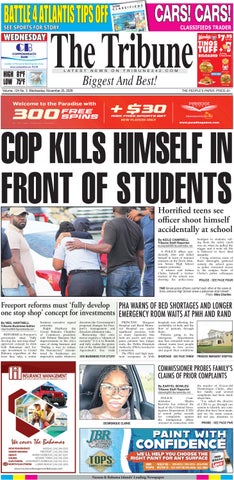
COP KILLS HIMSELF IN FRONT OF STUDENTS Horrified teens see officer shoot himself accidentally at school By KEILE CAMPBELL Tribune Staff Reporter kcampbell@tribunemedia.net A POLICE officer accidentally shot and killed himself in front of stunned students on the Doris Johnson Senior High School campus yesterday. A witness said Joshua Clarke, himself a former student of the school, was showing his police-issue
handgun to students, telling them the safety catch was on, when he pulled the trigger and it went off. He is believed to have died instantly. Crying relatives, some of them distraught, gathered outside the school gates as police restricted access to the campus. Some of Clarke’s police colleagues POLICE - SEE PAGE FOUR
TWO female police officers comfort each other at the scene at Doris Johnson High School where a policeman shot himself. Photo: Nikia Charlton
Freeport reforms must ‘fully develop PHA WARNS OF BED SHORTAGES AND LONGER one stop shop’ concept for investments EMERGENCY ROOM WAITS AT PMH AND RAND By NEIL HARTNELL Tribune Business Editor nhartnell@tribunemedia.net REFORMS to Freeport’s governance must “fully develop the one-stop shop” approvals concept to draw both Bahamian and foreign investment to Grand Bahama regardless of the form they take, a senior
business executive argued yesterday. Ralph Hepburn, the Grand Bahama Chamber of Commerce president, told Tribune Business that improvements to the city’s ease of doing business and “finding a way to reduce the bureaucracy” encountered by businesses are imperative under whatever
direction the Government’s proposed changes for Freeport’s management and direction ultimately take. Reiterating that commerce requires a “climate of certainty” if it is to flourish, and fully realise the potential of the Hawksbill Creek Agreement’s free trade SEE BUSINESS FOR STORY
PRINCESS Margaret Hospital and Rand Memorial Hospital are under significant pressure, with so many inpatients that beds are scarce and emergency patients face longer waits, the Public Hospitals Authority (PHA) warned in a statement. The PHA said high inpatient occupancy at both
hospitals was affecting the availability of beds and the flow of patients through them. Patients going to the emergency departments may face extended waits as clinical teams treat people according to how severe and urgent their conditions SHORTAGE - SEE PAGE THREE
PRINCESS MARGARET HOSPITAL
COMMISSIONER PROBES FAMILY’S CLAIMS OF PRIOR COMPLAINTS By EARYEL BOWLEG Tribune Staff Reporter ebowleg@tribunemedia.net
DESMONIQUE CLARKE
POLICE Commissioner Shanta Knowles has ordered the head of the Criminal Investigation Department (CID) to search police records for complaints against the immigration officer arrested in connection with
Nassau & Bahama Islands’ Leading Newspaper
the murder of 18-year-old Desmonique Clarke, after her family said several complaints had been made about him. "I've asked the director of CID to go through our system to identify any complaint that have been made, and we, for some reason, did not pay attention to PROBE - SEE PAGE FIVE
PAGE 2, Wednesday, November 25, 2026
THE TRIBUNE
Immigration Dept deports 168 foreign nationals in one month
AN IMMIGRATION officer leads a group of Haitian Nationals to a deportation flight. File photo: Bahamas Immigration Department THE Department of Immigration deported 168 foreign nationals between October 23 and November 23, 131 of them Haitians, the department said in a press release yesterday, as 13 more Haitian nationals were convicted of immigration offences in New Providence. The Haitians deported during the month were 107 men and 24 women, the department said. The others removed were ten Chinese nationals, seven Ecuadorians,
five Jamaicans, five British nationals, three Dominicans, two Americans, two Colombians, a Filipino, a French national and an Uzbekistani. The 13 Haitians convicted yesterday, 11 men and two women, all pleaded guilty before Assistant Chief Magistrate Shaka Serville in Magistrate's Court No 4. Eight men and the two women admitted overstaying, while three men admitted illegal landing. They were ordered to pay
fines ranging from $300 to $3,000 or serve between one and 12 months at the Bahamas Department of Correctional Services. Once they pay their fines or complete their sentences, they will be handed over to the Department of Immigration for deportation. The department's Removal Unit also deported an Ecuadorian man yesterday, putting him on Copa Airlines Flight CM197 to Panama City, en route to Ecuador, which left New Providence at 11.40am.
To advertise in The Tribune, contact 502-2394
THE TRIBUNE
Wednesday, November 25, 2026, PAGE 3
Bed shortages strain nation’s two major public hospitals SHORTAGE from page one
PRINCESS MARGARET HOSPITAL
are, the authority said. It urged people who need non-emergency care to use community health clinics or their primary healthcare providers where appropriate. The PHA also called on families and caregivers to work with hospital teams to make sure patients who have been medically cleared, and have arrangements for continued care, are discharged promptly and safely. It stressed that anyone having a medical emergency should not delay seeking help, and should call 919 for emergency assistance. The authority said it recognised the concern and inconvenience the situation may cause patients and their families, and that its priority remained patient safety and ensuring those who need hospital-level care receive it. It said it would provide further updates as necessary. The appeal to families comes months after Dr Michael Darville, who was health minister at the time, raised concerns about “boarders” at PMH and Rand, patients who stay in hospital even though they no longer need active treatment. In October, Free National Movement leader Michael Pintard alleged in Parliament that patients were
sometimes discharged from public hospitals before they had fully recovered because of a lack of bed space. Bahamas Nurses Union president Muriel Lightbourne said last December that PMH’s new Accident and Emergency unit filled beyond capacity as soon as it opened, and that elderly patients were still waiting on trolleys for beds. Charles Sealy, managing director of the Public Hospitals Authority, said: “We recognise that behind every patient is a person, a family, and a loved one seeking care, answers, and reassurance. “We understand the frustration and anxiety that these circumstances can create. Our responsibility is not only to address these challenges, but to keep you informed as we do so. We are asking for the public’s cooperation in accessing the appropriate levels of healthcare.” He added: “As an authority, we remain focused on managing these pressures. improving patient flow, and protecting the safety and well being of those entrusted to our care. We recognise that the public expects more than an acknowledgement of the challenges. You deserve information, action, and accountability. We are committed to keeping you informed. And I want to thank you for your patience, your understanding, and your partnership.”
PAGE 4, Wednesday, November 25, 2026
THE TRIBUNE
Coroner investigates officer’s apparent accidental death POLICE from page one had to be comforted by others. At one point, his sister tried to run onto the school grounds, wailing to see her brother, before police stopped her and escorted her back outside the gates. Their father then came to the gates and consoled her. Loud cries and wailing could be heard as a hearse pulled onto the school grounds, while reporters, plain-clothes officers and other bystanders waited outside and people gathered across the street. “Y’all lying to me,” one loved one cried repeatedly through tears after the officer’s body was placed in the hearse. Clarke worked as a school resource officer at the school. Government officials later shut down questions from the press about school resource officers carrying guns on campus, with Deputy Prime Minister Chester Cooper, the Minister of Education, saying only: “No, I have no further comments.” Minister of National Security Myles LaRoda, who is responsible for the
police, also brushed aside questions, saying there would be time “to discuss other things later”, while Commissioner of Police Shanta Knowles said the Coroner was leading the investigation and that she could not “at this time give you much more information than what I have said”. Commissioner Knowles said police received reports of the shooting shortly after 4pm. Mr Cooper, Mr LaRoda and Fox Hill MP Fred Mitchell were on the school grounds. Mr Cooper offered condolences to the officer’s family and pointed to Clarke’s ties to the school community. “We are grateful for the work that the police do with the Ministry of Education, and we understand that the officer was a part of this community, a former student as well as a school resource officer,” he said. He said he had spoken to Prime Minister Philip “Brave” Davis, who also offered his condolences to the family and the school community. Mr Cooper said grief counselling would begin at 9am today for all students at the school.
A DISTRAUGHT loved one of the police officer,Joshua Clarke, who died from a self inflicted gunshot, is escorted off the campus at Doris Johnson High School yesterday. Photos: Nikia Charlton “This is an issue that they will take very hard,” he said, “and we want to now focus on their health and wellness.” Mr LaRoda offered his condolences to Clarke’s
parents, the school family and the Royal Bahamas Police Force. “You see some of the squad mates out here, and they are very emotional about this,” he said.
“We could have time to discuss other things later, but this is to thank that officer and his family for his service to our country.” Mr Mitchell, the Minister of Foreign Affairs,
whose constituency includes the school, also offered condolences. “We are all traumatised by what has transpired here today, and saddened by it,” he said.
FORMER POLICE OFFICER Family alleges negligence in fatal AMONG TWO MEN KILLED electrocution of MoW employee IN SEPARATE SHOOTINGS TWO men, one of them a former Royal Bahamas Police Force officer, were shot dead in separate incidents less than 24 hours apart in New Providence. In the first incident, a 25-year-old man was killed on Monday during a shooting at a business establishment on Muttonfish Drive, off Malcolm Road. Speaking at the scene, Chief Superintendent Leonard Ramsey, Press Liaison Officer, told reporters the victim was known to police. CSP Ramsey declined to say why the victim was known to police. Police were alerted to gunfire shortly before midnight through their ShotSpotter technology. Responding officers arrived at the scene and found the man suffering from apparent gunshot wounds. Emergency medical personnel examined him and confirmed that he had no vital signs. Initial investigations revealed that the victim had arrived at the business establishment in a vehicle accompanied by a woman. He exited the vehicle and was about to enter the
establishment when two men approached in a darkcoloured vehicle. The men got out of the vehicle and opened fire in his direction, fatally wounding him before fleeing the scene. In the second incident, police were notified of a shooting on Sixth Terrace, Centreville, around 12.30pm. Officers responding to the scene found a man suffering from gunshot wounds. CSP Ramsey confirmed that the victim was a former police officer. Emergency medical personnel were called to the scene and, after examining the man, confirmed that he had no signs of life. Police said the victim was in front of a business establishment on Sixth Terrace when the occupants of a white vehicle pulled up. One of the men exited the vehicle and opened fire, fatally wounding the victim. The assailants then drove away and fled the area. CSP Ramsey encouraged businesses to register with the police force's CCTV programme, noting that camera footage assists with investigations.
By LEANDRA ROLLE Tribune Chief Reporter lrolle@tribunemedia.net
THE family of a Ministry of Works employee who was electrocuted on Monday when a flagpole he was moving struck a live wire blame negligence for his death and want a full investigation, while his father, who has Alzheimer's disease, keeps asking where his son is. Fitzgerald Farrington, 57, a father of four who had worked at the ministry for more than 20 years, died in hospital after the accident on Celery Drive. Farrington had reportedly struggled with another man to pull the pole from the ground, and when it finally came free it struck the wire, electrocuting him and injuring the other man before Farrington fell into a puddle of mud and water. Both men were taken to hospital, where Farrington later died. Police said the other man, who is 54, was in stable condition, and they are investigating the death. His sister, Mebra, said the family had serious questions about the accident and believes it was caused by negligence. "They should have made a better call," she said. "They could have said we ain't gon’ do nothing until BPL come and fix the wire." "We were shocked," she said of the moment she got the call, before she joined relatives at the hospital. "I still can't grasp what's going on," she said. "I just feel as though my brother ain't had a fair chance and I feel as though something needs to be done." She said the family has barely slept since the
accident, and her father, who like the rest of the family called Farrington "Fritty", is struggling to understand that his son is gone. "We told him but we have to keep reiterating again and again," she told The Tribune yesterday. "He'll say like well, 'I haven't seen him today.'" "He asking questions just like how a kid would ask," she said, "because you know when they have Alzheimer's it's like twice a child and he's asking these questions." She described Farrington as a fun-loving, energetic man who liked to make others smile, and said he and his father were close, often fishing, watching football and listening to music together. "My daddy don't have no one to watch football with now," she said. "Nobody, cause my other brothers them they married and they with their family. They come around every now and then when they can and now it's like quiet." She said her brother loved ham and had been looking forward to Christmas, and that this year there would be no one to steal a piece of it. "It gone be rough," she said. "I won't lie to you." Bahamas Power and Light (BPL) acknowledged the incident in a statement yesterday and offered condolences to the family. The company said its monitoring system showed the Blue Hill Road overhead feeder, supplied by the Big Pond substation, tripped offline at about 11.19am. BPL said it initially had no sign of a system disturbance until the Royal Bahamas Police Force's control room contacted it
FITZGERALD FARRINGTON about work in the area and said workers had been hurt while removing a pole. Crews sent to the scene found a metal flagpole in direct contact with a high-voltage power line, isolated the area and later restored electricity to all affected customers. BPL said it would co-operate with the investigation alongside Bahamas Grid Company and provide any information required. The company urged the public to be careful when working near electrical infrastructure and to contact BPL before carrying out any work involving equipment, poles or other objects
that could come close to power lines. The death comes amid a string of serious workplace accidents over the past year that have left several people dead, injured or in hospital, and it is at least the third electrocution this year. In July, John Walkes, 68, died after reportedly coming into contact with a high-voltage electrical transformer while painting at a business on Kings Highway in Bimini. That same month, BPL employee Lawrence Cooper, 35, was electrocuted while working on a utility pole in Grand Cay, Abaco.
THE TRIBUNE
Wednesday, November 25, 2026, PAGE 5
Immigration Department to review vetting procedures PROBE from page one it,” Commissioner Knowles said. “Until he gives me that information, I can’t confirm that any complaints were made.” She also could not confirm whether the teenager had a restraining order, saying she would have to check whether Clarke had applied to the courts for one. Clarke’s father, Desmond Clarke, has told The Tribune his daughter obtained a restraining order against her former partner a week or two before she was kidnapped. Clarke was abducted outside her family home on Gladstone Road on Sunday after a man known to her allegedly drove his vehicle into hers and forced her into his car, and her body was found in bushes off Frank Watson Boulevard on Monday night. State Minister for Immigration Darron Pickstock pledged a zero-tolerance approach to misconduct in the Immigration Department, saying it would review its own processes, including vetting, to make sure it was not missing anything. “We have fine men and women at the Immigration Department who go about their daily routine and follow the law and do their jobs and operate with distinction,” he said. “We don’t want one or two bad apples to cast an aspersion over the entire immigration department. But under my watch, I take a zero tolerance approach to these things.” Mr Pickstock said immigration officers have a responsibility to uphold the same laws they expect others to obey. In a statement on Tuesday, Prime Minister Philip “Brave” Davis said Clarke’s family’s worst fear had come to pass and that the whole country was grieving with them. “Desmonique should be alive today,” he said. “We
DESMONIQUE CLARKE
DESMOND CLARKE, father of Desmonique, speaks to the media on Monday. Photo: Shawn Hanna owe her more than our grief. We owe her a Bahamas where every woman and girl is safe at home, at work, on our streets and in her relationships.” He said violence against women “feeds on silence, on excuses and on people looking the other way” and that ending it “starts with men”, calling on fathers, brothers, pastors, coaches and friends to speak up whenever a man threatens, controls or harms a woman. “Our sons must learn that love never looks like fear,” Mr Davis said. He said he had asked the Ministry of Social Services to offer the family counselling and practical support, and he thanked police officers who searched through the night and members of the public who came forward with information. “Police have made an arrest and the investigation
continues,” he said. “I want justice for Desmonique.” Mr Davis noted that one in four Bahamian women will suffer physical or sexual violence in their lifetime, and said the country marks the International Day for the Elimination of Violence against Women today “in mourning”. He urged any woman in danger to call 919 or 911, or the Bahamas Crisis Centre’s 24-hour line at 328-0922. Commissioner Knowles dismissed reports that the man in custody was trying to flee the country when he was caught. “We have no information that this person was trying to flee the country,” she said. “We found him in New Providence, away from the airports.” She said police met Clarke’s relatives on Tuesday morning to offer condolences and update
Father of murdered Lauren calls for return of death penalty By LYNAIRE MUNNINGS Tribune Staff Reporter lmunnings@tribunemedia.net THE father of Lauren Saunders, the pregnant mother of two killed last year, says the murder of 18-year-old Desmonique Clarke has filled him with a rage that makes him want to "kill them back", as he called on the government to bring back capital punishment. Livingston Saunders, 64, said news of Miss Clarke's death brought back the same anger he felt when his family was desperately searching for Lauren just over a year ago, and that he still breaks down in tears at work. "When I heard about this, it brought a rage in me that if you could catch them, you'll kill them back too," Mr Saunders said yesterday. "You know what I'm saying? It brings a rage in you to know that these young fellas, they ain't taking no for an answer. They're taking matters into their own hands, so when they take matters into their own hands, what do they expect the parents to do?" Lauren, 30, who was seven months pregnant, disappeared on October 19, 2025, and was reported missing after relatives could not reach her. Her silver Jeep was later found abandoned off Coral Harbour Road with a flat tyre, her handbag, shoes and other belongings still inside. Her decomposing body was found three days later in bushes off Munnings Road, near Gladstone Road, after a search
involving police officers, drone units and K-9 teams. A man has been charged with her murder and remains before the courts. Mr Saunders said what he misses most is his daughter's voice and the daily telephone calls in which she checked on him and told him she loved him. "Can you imagine somebody calling you every day and asking you how you're doing, and you don't get them calls no more?" he said. "'Daddy, I love you.' You don't get them calls no more. You don't see her no more. It ain't easy." He said he sometimes breaks down while working alone, or calls home to speak to his wife, Sharon, only to find himself crying on the phone. The family is preparing for its second Christmas without Lauren, and Mr Saunders recalled that she visited him and his wife just days before she died, sharing a meal with them and telling them again and again that she loved them. His comments came after police found Clarke's body in a bushy area off Frank Watson Boulevard on Monday night, following an extensive search for the University of The Bahamas student. Her former partner, a 39-year-old man, has been arrested in connection with her disappearance. Mr Saunders said he was disturbed by what he sees as a growing refusal to accept people's decisions to end relationships. "If a woman tells you it's over, it's over," he said. "Not even just a woman with a man; it goes both ways. They ain't bring nobody in this world to kill,
so just move on with your life." He said he was frustrated by a cycle in which the public is outraged after a killing, only for attention to fade before the next one. "The government need to wake up and smell the coffee and see what's going on," he said. He accused the authorities of failing to tackle violent crime and allowing killers to take lives without consequences, and called on Prime Minister Philip "Brave" Davis and other political leaders to recognise their responsibility to protect the public and restore law and order. "Listen, we have law and order in this country," he said. "Because as it is right now, they carrying on right now like we don't have no law and order. They are taking matters into their own hands, and our government need to show them. Listen, this country doesn't work like that. You take matters into your own hands, then we have to take matters on you." Mr Saunders said tougher penalties were needed to send a message to those who commit violent crimes, and he voiced strong support for the return of capital punishment. Lauren left behind a son and a daughter, who Mr Saunders said are coping with the loss, as well as her siblings. "She was a good person, a very good person," he said. "You know what I mean? Always with a smile. Always calling me every day. She would say, 'Daddy, how you doing? I love you.' She was a loving person to be around."
them on the investigation, and that the family was pleased with the work police had done and understood investigators must follow due process in dealing with the suspect. “We are continuing this investigation, and I’m hopeful that before the end of the week, we should reach a conclusion as to laying charges before the court,” she said. She said the Director of Immigration sent a team to help search for the teenager, and the Commissioner of Corrections provided K-9 support. Commissioner Knowles appealed for more public education on gender-based violence, personal boundaries and people’s right to make their own decisions, stressing that the aim was not to judge anyone’s personal choices. Referring to the 16 Days of Activism against gender-based violence, she said rejection should never be met with violence. “When someone says no, no means no,” she said. “It does not mean that your life has ended, and it does not mean that you should take my life or cause harm to me. It means no, I’m not
prepared to go any further with this relationship or with whatever is causing me to say no.” “I just need us to educate, continue to educate, and the media needs to be a part of this to continue to educate our people, especially our men,” she said, “and I’m not being gender biased here because we do have women who are abusers also, but especially our men to protect our women and girls.” She said women had been losing their lives in similar circumstances for the past three or four years. A source in the Immigration Department described the mood among some employees as sombre, saying the news had come as a surprise. The source said their dealings with the suspect had been strictly professional, saying he occasionally sought advice on work matters but never worked directly under them, and that they knew nothing of his personal affairs and learned of the developments on social media. The source said the police investigation must take its course and the officer should face the same judicial process as anyone else. Meanwhile, Equality Bahamas attacked the prime minister’s response to the killing, accusing his administration of failing to tackle gender-based violence despite advice from local experts and the country’s international obligations. The women’s rights group said Mr Davis “has lazily lamented this femicide without acknowledging the failure of his administration, both previous and current, to address the issue
of gender-based violence as advised by Bahamian experts and mandated by ratified international mechanisms.” “This murder is not a moment for political grandstanding,” the organisation said. “It ought to be yet another impetus to take action.” “As the prime minister continues in his refusal to criminalize marital rape,” the group said, “pass the gender-based violence bill, and implement recommendations from the Bahamas Women’s Health Survey, his written statement is meaningless. His true statement, by his action and inaction, points to a refusal to acknowledge that women are human beings with human rights, regardless of relationships with men.” “Women have the right to bodily autonomy, to end relationships, to control our bodies, and to live free of violence,” the statement said. “Davis and his administration have demonstrated no interest in promoting, upholding, or protecting these, our human rights, and no interest in our right to life.” The organisation renewed its demands that the government update and pass the gender-based violence bill, criminalise marital rape by removing “who is not his spouse” from the definition of rape in section 3 of the Sexual Offences Act, record and publicly report gender-based killings of women and girls as femicide, and fully comply with the Convention on the Elimination of All Forms of Discrimination against Women (CEDAW), including informing the public about it.
PAGE 6, Wednesday, November 25, 2026
THE TRIBUNE
The Tribune Limited NULLIUS ADDICTUS JURARE IN VERBA MAGISTRI “Being Bound to Swear to The Dogmas of No Master”
LEON E. H. DUPUCH,
Publisher/Editor 1903-1914
SIR ETIENNE DUPUCH,
Kt., O.B.E., K.M., K.C.S.G., (Hon.) LL.D., D.Litt . Publisher/Editor 1919-1972 Contributing Editor 1972-1991
RT HON EILEEN DUPUCH CARRON,
C.M.G., M.S., B.A., LL.B. Publisher/Editor 1972-
Published daily Monday to Friday
Shirley & Deveaux Streets, Nassau, Bahamas N3207 TELEPHONES News & General Information Advertising Manager Circulation Department Nassau fax Freeport, Grand Bahama Freeport fax
(242) 502-2350 (242) 502-2394 (242) 502-2386 (242) 328-2398 (242)-352-6608 (242) 352-9348
WEBSITE, TWITTER & FACEBOOK www.tribune242.com
@tribune242
tribune news network
The conversation Bahamian men owe one another DESMOND Clarke told The Tribune that his daughter was thinking about starting another business. Desmonique was 18, a business student at the University of The Bahamas and already an entrepreneur. Her father knew her ambitions, but when he spoke of the daughter he had raised from infancy, the words that came were simpler: “That’s my baby.” We offer our deepest condolences to Mr Clarke, to Desmonique’s mother and to everyone who loved her. Bahamians who helped search for her and those who waited for news were hoping for the same thing: that she would come home. The tributes that have poured in since her body was found on Monday night are an expression of love for a young woman whose family should have had many more years to see what she would make of her life. Desmonique was 18. Her former boyfriend, who is in police custody, is 39. An arrest does not establish guilt; responsibility for her death must be determined on the evidence. But a man of 39 choosing to pursue a teenager is reason enough for the men around him to speak plainly to him. Too often, the very people who have known a man long enough to say something he might actually hear decide that his conduct is his own affair. That silence deserves some of the anger Bahamians feel today. A man approaching 40 has had two decades of adult life that an 18-year-old has scarcely begun. We should be honest about older men who seek out that difference because they want someone they believe they can influence or control. A friend who sees it may hesitate to speak for fear of damaging a friendship of twenty years. But what is that friendship worth if it does not allow one man to tell
another, in private and in earnest, that his conduct is wrong? We owe one another the same honesty about rejection. Most men know the hurt of finding out that someone they love no longer wants to be with them. There ought to be room among friends to admit how much that hurts. The trouble begins when a man comes to believe that because he is hurting, the woman who left him has a duty to put it right. In his mind, turning up at her workplace may be his chance to explain himself. For her, it means that even at work she cannot count on being left in peace. When a woman says no, she means it. She gets to make that decision, and he has to live with it. A good friend can help him through that disappointment without passing along her whereabouts or arranging a meeting she has already refused. If his talk turns threatening, nobody who hears him should laugh it off or keep it between the boys. This is work for Bahamian men in particular. Our sons learn a great deal from what we let pass in their company. When a grown man boasts about pursuing a teenager, a boy hears the laughter around the table. He would remember, too, the uncle who looked his friend in the eye and told him he ought to know better. We need more men willing to be that uncle, especially when the man across the table is someone they love. We hope justice is served for Desmonique Clarke. Her family owes this country nothing in its grief. The obligation belongs to the rest of us: to remember her as the daughter, student and young businesswoman she was, and to find the courage, in our own circles, to challenge the conduct we have looked past for too long.
Desmonique owed more than our sympathy EDITOR, The Tribune. THE tragic kidnapping and passing of Desmonique Clarke is a loss that should concern us all. As a mother, I cannot begin to comprehend the pain of losing a child under such tragic circumstances. At just 18 years old, she had her entire life ahead of her, filled with dreams, promise and possibilities. Her life mattered, and her loss must never be reduced to another statistic. Having served for 26 years as a Senior Social Worker, I am deeply troubled by the devastating impact of domestic violence and the urgent need for stronger systems of protection. Domestic violence is not a private family matter; it is a serious societal issue that requires a coordinated and decisive response. Warning signs must never be ignored,
LETTERS letters@tribunemedia.net reports must be taken seriously, and victims must never feel abandoned or unprotected. We must ask difficult questions about whether existing safeguards, interventions and protection measures are working as intended. I therefore call on our Government, law enforcement agencies and social service institutions to move beyond statements of concern and take meaningful action. We need stronger enforcement of existing domestic violence legislation and protection policies, improved collaboration among relevant agencies, adequately funded victim support services, safe shelters, professional training and greater public education.
We cannot continue to mourn lives lost without committing ourselves to preventing future tragedies. I believe we owe our women and young people more than sympathy; we owe them safety, protection and the assurance that their voices will be heard. May this young woman’s tragic passing be a catalyst for meaningful change, stronger protection systems and a renewed national commitment to ending domestic violence. I extend my sincerest condolences to her family, loved ones and friends during this unimaginable time of grief. We owe Desmonique’s memory action, not simply words. MRS. GERALDINE MILLER-LEWIS Senior Social Worker (retired) Nassa, Bahamas November 24, 2026
Guiding our economy toward true prosperity EDITOR, The Tribune. I WANT to revisit an important question: Why has the economic revolution our Bahamian forefathers envisioned remained unfinished? Imagine standing beside a river, repeatedly striking its surface and demanding it flow in another direction. No matter how forcefully you strike, the river will continue along its natural course shaped by the terrain, gravity, and the obstacles in its path. This image illustrates a major weakness in our approach to Bahamian economic development. For decades, we have tried to create prosperity through announcements, political directives, concessions, and programs without adequately addressing the conditions that determine who can access capital, establish enterprises, acquire assets, and accumulate wealth. We keep striking the river, yet its underlying currents remain largely unchanged. Majority Rule in 1967 and Independence in 1973 were landmark achievements that expanded political representation, affirmed national sovereignty, and improved educational and professional opportunities. These gains are real and must never be dismissed. However, our Independence Constitution envisioned something beyond self-governance: a society where individuals should not have their labor exploited or their lives hindered by deprivation. This aspiration prompts us to ask a crucial question: How far have we progressed from political freedom to broad-based economic freedom? A Bahamian passport signifies citizenship, but it does not provide the capital necessary to purchase a home, finance a business, or own a stake in the enterprises that shape our national economy. Political participation and economic ownership are distinct achievements; we have made significant strides in the former and uneven progress in the latter. Consider how we measure success. We often celebrate billion-dollar investment announcements, increased visitor arrivals, hotel openings, construction projects, and job creation. While these may serve as important indicators of progress, they do not reveal how much value remains in Bahamian hands. How much of each project’s procurement goes to competitive Bahamian suppliers? How much profit is reinvested locally? How many employees become homeowners, shareholders, or business founders? How many Family Island communities gain lasting
productive capacity? An economy can grow while ownership remains concentrated. Employment provides income, but income alone does not equate to asset creation. Without savings, affordable financing, and ownership opportunities, one generation may work hard only to leave the next facing the same challenges. The financial system exemplifies this contradiction. Although we are internationally recognised for financial services, many domestic entrepreneurs struggle to secure appropriate financing. The International Monetary Fund has identified financial inclusion, productivity, competition, and diversification as ongoing priorities. This does not imply that every rejected loan must have been approved; banks must manage risk. However, it does suggest that our national development agenda must prioritise the financing of viable domestic enterprises. Housing presents another challenge. A government can announce plans for thousands of homes, but affordability is dictated by wages, land prices, infrastructure, construction costs, insurance, interest rates, and lending standards. If these conditions remain misaligned, speeches alone will not bridge the gap between family earnings and home prices. Similarly, advocating for entrepreneurship while neglecting high operating costs, access to markets, reliable infrastructure, and business skills risks turning business ownership into a slogan rather than a viable pathway. Bahamianisation was an essential tool for expanding participation. Its next evolution must go beyond who gets hired, focusing instead on who owns productive assets, develops technology, competes for contracts, builds enterprises, and participates in investment returns. A protected business without the capacity to compete is not a sustainable achievement, nor is foreign investment inherently detrimental. The key question is whether the terms create measurable and lasting Bahamian value. Tax revenues are important, but so are local supply chains, skills transfer, property ownership, environmental protection, and opportunities for future Bahamian investors. These outcomes must be established before projects receive public support. This unfinished revolution cannot be blamed on any single administration or political party. Our economic landscape, small market, reliance on imports, vulnerability
to hurricanes, and exposure to external economic shocks present genuine constraints. Nevertheless, policy choices are crucial. Institutions can either broaden access to opportunities or preserve advantages for those already positioned to benefit. What needs to change? First, we must create reliable pathways to capital: improved credit information, well-designed guarantees, regulated equity financing, and fairer access for viable small businesses. While financing must adhere to commercial discipline, reckless lending practices must be avoided. Second, make ownership a measurable national objective. We must track first-time homeowners, household assets, the survival of Bahamian businesses, participation in domestic investments, and the proportion of major project spending that stays within the country. Relying on GDP alone provides an incomplete picture of national performance. Third, align education with productivity. Every student must have the skills necessary to solve problems, apply technology, manage finances, and create value. This applies to both skilled employment and entrepreneurship. Fourth, eliminate barriers that hinder investment, such as unreliable infrastructure, unnecessary administrative delays, unclear procurement processes, and practices that undermine competition. Finally, demand accountability for results. Every major concession, subsidy, and development announcement must clearly state the expected public benefits, identify the recipients, and outline how the delivery will be independently assessed. While none of these proposals guarantee prosperity, they focus on foundational issues rather than merely addressing surface-level concerns. Our forefathers established the political framework for Bahamians to govern themselves. The next step is to build institutions that empower more Bahamians to own, finance, produce, innovate, and pass wealth to future generations. The economic transformation will remain incomplete as long as we confuse announcements with actual achievements, jobs with ownership, and the control of government with the control of our economic futures. You cannot force a river into submission. You must understand the forces that shape its course and work diligently to change them. AMUN DUNAMIS Freeport, Grand Bahama November 19, 2026.
THE TRIBUNE
Wednesday, November 25, 2026, PAGE 7
Prosecutors to decide whether Gardiner should face joint trial US prosecutors are expected to tell a federal judge today whether convicted drug trafficker Jonathan Eric Gardiner should stand trial alone or alongside 13 other defendants accused of participating in the major drug trafficking conspiracy. Gardiner is currently named in a separate superseding indictment, while the other 13 defendants are charged under an earlier superseding indictment.
JONATHAN ‘PLAYER’ GARDINER
US District Judge Lewis Liman said prosecutors have two options: file a motion under Rule 13 of the Federal Rules of Criminal Procedure, asking the court to formally consolidate the two indictments, or return to a grand jury to seek a third superseding indictment (S3) naming all 14 defendants in a single document. Assistant US attorney Jonathan Bodansky told the court prosecutors consider Gardiner part of the same
“overarching conspiracy” as the defendants named in S1. Gardiner faces drug trafficking charges in New York after he was arrested in waters off Florida following an Election Day plane crash. He also faces a separate indictment in Georgia and remains in custody. His New York case is linked to the November 2024 indictment of former police Chief Superintendent Elvis Curtis and others. The trial is due to start on March 1.
Union seeks PM’s intervention over issuing of new Taxi plates By LYNAIRE MUNNINGS Tribune Staff Reporter lmunnings@tribunemedia.net THE Bahamas Taxi Cab Union wants Prime Minister Philip"Brave" Davis to step in over the issuing of taxi plates, with its president warning that a"flood" of new plates is hitting the market while the number of hotel rooms has not grown. "As you know, the tower at Atlantis, the Beach Tower is still closed," union president Tyrone Butler said,"so we need more rooms because right now the market is saturated." Mr Butler said the union was still waiting for the Prime Minister to address the plates issue, arguing that the growing number of operators was putting more pressure on an already competitive market. The union has previously criticised the government
for issuing hundreds of additional taxi and livery plates without a corresponding rise in tourism demand, saying the expansion has diluted drivers' earnings. In November last year, the Ministry of Energy and Transport said an audit had identified 783 inactive taxi and livery plates in New Providence and Grand Bahama that were to be recalled. The union is also still waiting for Transport Minister Leon Lundy to respond to its request for an increase of at least $5 on most taxi fares, which drivers say is needed to offset rising fuel and operating costs. Mr Butler said the union's longstanding grievances remained unresolved despite continued discussions with government officials, and that he hoped to secure another meeting
with Mr Davis as early as next week, depending on the Prime Minister's availability. The union met Mr Davis on September 18, but the meeting was cut short when the Prime Minister had to attend the funeral of Neville Wisdom, leaving several issues undiscussed. The union later submitted its grievances to Mr Davis, who forwarded them to Mr Lundy. When The Tribune reported the fare demand in October, Mr Butler said drivers had already been seeking an adjustment for six months without a definitive response. The last fare increase, a ten percent rise for New Providence operators, came in 2024 and was the first since 2017. The union's concerns have also included its long-running dispute with
livery drivers over competition for passengers and complaints about how Road Traffic Department officers treat taxi operators. Meanwhile, Mr Butler said use of Aqua Rides, the locally developed ride-hailing app the union recently partnered with, had increased since the arrangement began. The app was created by taxi driver Lamont Nixon, and more than 300 licensed taxi drivers had signed on to it as of earlier this month. Passengers see an estimated fare, based on the government-regulated taxi rates, before they book. Mr Butler dismissed concerns over reports that Uber may enter the Bahamian market, saying the union believes its partnership gives customers a more affordable option. The union rejected a proposal to partner with
BAHAMAS TAXI CAB UNION PRESIDENT TYRONE BUTLER Uber earlier this year, and a businessman said in February that he still planned
to bring the service to the country despite the union's opposition.
MAN WHO FLED COUNTRY BEFORE MURDER 38-YEAR-OLD ACCUSED OF SEXUAL OFFENCES TRIAL DENIES BREACHING BAIL CONDITIONS AGAINST MENTALLY IMPAIRED TEEN GIRL By PAVEL BAILEY Tribune Staff Reporter pbailey@tribunemedia.net A MURDER accused who fled to the United States the day before his trial was due to begin in 2024 has been remanded to prison in Nassau after he was deported and charged with breaching his bail conditions. Shelton Thompson, 38, pleaded not guilty to two counts of violating bail conditions before Magistrate Abigail Farrington. Prosecutors allege Thompson failed to surrender to custody for his court dates before Justice Gregory Hilton on February 20, 2024, and June 19, 2025. He is also accused of failing to sign in at his local police station for 78 days between May 18 and November 18. Assistant Superintendent of Police Kendrick Bauld, the prosecutor, objected to bail, citing the serious nature of the offences and arguing that Thompson posed a
serious flight risk. Thompson was denied bail and remanded to the Bahamas Department of Correctional Services until his trial begins on April 8. Thompson is accused of fatally stabbing 19-year-old Richard Bremmer after a traffic accident in April 2009. He had been free on $15,000 bail when he failed to appear for his murder trial in February 2024. A jury had already been empanelled to hear the case, but it was dismissed after he did not turn up. After his disappearance, two of Thompson's cousins were ordered to forfeit his bail bond. Thompson had recently been deported to The Bahamas after his arrest in Florida, where he pleaded guilty in June to possession of a firearm by an illegal alien. US Border Patrol agents arrested him in Pompano Beach on February 12 this year, nearly two years after he fled. According to court
documents, the agents were acting on information when they saw Thompson leave a warehouse and drive away in a white van. They stopped the vehicle and carried out an immigration inspection, during which Thompson identified himself and admitted he was living in the United States illegally, which records checks confirmed. During processing, Thompson also admitted he had a firearm at his Miami home, and he agreed to go there with officers and directed them to the weapon. Agents recovered a loaded Glock 27 .40-calibre pistol that had been made outside Florida and brought into the state. Thompson initially denied the charge but later changed his plea. US Attorney Jason A Reding Quiñones, of the Southern District of Florida, said the case showed why immigration and firearm laws must be enforced in the region.
By PAVEL BAILEY Tribune Staff Reporter pbailey@tribunemedia.net A 38-YEAR-OLD man accused of twice having sex with a mentally impaired 17-year-old girl this year was remanded to prison yesterday. Prosecutors allege that Shawn Davis had sexual intercourse with the girl,
who suffers from a mental disorder, in New Providence on October 28 and November 17. Davis was not required to enter a plea to two counts of sexual intercourse with a person suffering from a mental disorder when he appeared before acting Chief Magistrate Ancella Evans. He was told his case
would proceed to the Supreme Court by voluntary bill of indictment (VBI) and that he could apply for bail in the higher court. Davis was remanded to the Bahamas Department of Correctional Services until his VBI is served on March 18, 2027. Inspector Deon Barr prosecuted.
Motorist fined $2k for offering police officer $200 to avoid ticket By PAVEL BAILEY Tribune Staff Reporter pbailey@tribunemedia.net A MAN who offered a police officer $200 to get out of a traffic ticket last weekend was fined $2,000 after he pleaded guilty to bribery. Luckson Georges, 34, offered Reserve Corporal
1156 Bain the cash as an inducement to abstain from carrying out his duties when he was stopped in his vehicle on Wulff Road on November 21. Georges admitted the offence before Senior Magistrate Kendra Kelly-Burrows. He expressed remorse
and said he had only offered the money to avoid getting a ticket. Senior Magistrate Kelly-Burrows scolded Georges for his irresponsible behaviour and ordered him to pay a $2,000 fine or serve a year in prison. Inspector Vernon Pyfrom prosecuted.
19-year-old remanded on charges of 40-YEAR-OLD MAN MISSING AFTER GOING attempted murder and gun possession
OVERBOARD FROM ROYAL CARIBBEAN SHIP THE Royal Bahamas Defence Force is leading the search for a 40-year-old man who went overboard from Royal Caribbean's Allure of the Seas off San Salvador, hours after the ship's crew began calling his name over the loudspeakers. The US Coast Guard said the ship and the RBDF alerted it at about 11.30pm on Monday that a passenger had gone overboard off San Salvador, about 377 miles south-east of Miami. The US Coast Guard is assisting in the search. "We are coordinating with the cruise and will
have a vessel on scene," an RBDF spokesperson told CBS News. Passengers told US media that the crew called the man's name over the ship's loudspeaker system for several hours before determining that he had gone overboard, and that the ship then turned around to search for him. The ship's captain told passengers on Monday that the crew had "received a report of a missing guest" earlier in the day before determining that he had gone overboard. Royal Caribbean said it "immediately launched a
search and rescue effort" and was working with the authorities, and that its care team was supporting the man's loved ones. The man has not been identified. The Allure of the Seas left Miami on Sunday on a Thanksgiving cruise through the Caribbean and was due in Saint Maarten tomorrow. It is not the first time a passenger has gone overboard from the ship in Bahamian waters: in October 2024, a 66-year-old woman went overboard from the Allure of the Seas north of Nassau.
By PAVEL BAILEY Tribune Staff Reporter pbailey@tribunemedia.net A 19-YEAR-OLD man accused of trying to shoot and kill another man with a handgun earlier this year was remanded to prison. Prosecutors allege that Bobby Henson tried to shoot and kill Kenley
Thomany with a handgun in New Providence on April 17. Henson was not required to enter a plea to charges of attempted murder and possession of a firearm with intent to endanger life when he appeared before acting Chief Magistrate Ancella Evans. He was told his case
would proceed to the Supreme Court by voluntary bill of indictment (VBI) and that he could apply for bail in the higher court. Henson was remanded to the Bahamas Department of Correctional Services until his VBI is served on March 25, 2027. Inspector Deon Barr prosecuted.
To advertise in The Tribune, contact 502-2394
PAGE 8, Wednesday, November 25, 2026
THE TRIBUNE
Alicia Wallace
From symbolic gestures to meaningful action
TODAY, International Day for the Elimination of Violence Against Women (IDEVAW), is the start of the Global 16 Days Campaign which runs until Human Rights Day on December 10. It is a period for multilateral institutions, governments, nongovernmental organizations, and activists to take action to end violence against women, from enacting and amending laws and implementing policies to conducting research and offering programs and services. Following the development of the Global 16 Days Campaign by women’s rights activists who participated in a training institute, UN Women started using it for its own campaign, calling it “16 Days of Activism Against Gender-Based Violence.” The root, however, will always be in the passion and collaboration of women committed to activism to change the world. It was never meant to be a time for symbolic acts. It was always aimed at activating the world to pay attention to the pervasive issue that violence against women and calling on all people, everywhere, to take action to end this scourge.
and stalking to deep fakes and sexual extortion, it is evolving and disproportionately impacting women, girls, LGBTQI+ people, and people with disabilities. In this session, we will look at statistics, domestic and international laws, digital platform responsibilities, the rights of users, and our own power to end TFGBV. Join Equality Bahamas for this virtual session. Register: tiny. cc/16daysgbv
Beyond the words of a theme Every year, UN Women sets a theme, and this year it is “Speak out. Believe survivors. Demand justice.” This theme is rather basic in its message and aim. It is not only for survivors to speak out, but for those who witness violence against women to move from bystander to upstander status by intervening. In December 2024, a man attacked Latasha Rolle at a busy intersection while people watched from their vehicles until, finally, one man ran to help. The attack went on uninterrupted long enough for Ms. Rolle to sustain multiple serious injuries including two broken legs. It is not only for people to believe the survivor, but to support them. In November 2026, student newspaper The Cornell Daily Sun published an editorial about the sexual assault case filed by Jane Doe after being gang raped by seven students. The university did not take sufficient action, and student journalists decided that they would not be complicit. The went beyond believing as a mental state, putting it into action. When you believe a survivor, you offer a level of care that goes beyond words. This group of students used the power of the press to call for accountability and press the university to deliver justice to Jane Doe. It is not only for people to demand justice, but to shape it. Justice begins with the structure of society and all that is and is not permissible. It is in the way we raise children. It is in the way businesses operate. It is in the way doctors relate to their patients. It is in the way we respond when a person says they have been hurt by something we have said or done. It is in the way we seek to repair relationships. It is in the way we view and treat one another on a daily basis, beyond times of conflict. Justice is not only what occurs in the court room, but the mechanisms and practices that could prevent us from needing the judicial system. Justice is not (just) a prison sentence, particularly when a survivor depends on the income of the perpetrator to meet the needs of their children. The way we think about justice has to
It was never meant to be a time for symbolic acts. It was always aimed at activating the world to pay attention to the pervasive issue that violence against women and calling on all people, everywhere, to take action to end this scourge. expand, and the version one need now is the one that is dictated by survivors themselves. The reality of violence against women Less than one in every four women who experienced physical or sexual violence sought help of any kind. Only 7 percent of women who experience physical or sexual violence went to the police for help. This is the result of multiple failures by governments and communities. It is the result of victim-blaming. It is the result of the shame imposed upon people who have been violated and convinced that it was their fault that they did not avoid it on their own. It is the result of careless reporting on physical and sexual violence in the media. It is the result of the refusal of police to take and act on reports and the message it sends to the community. It is the result of the court cases that have devalued women’s lives and found excuses for the men who enact violence against women and girls. It is the result
of the religious (mis)leaders who insist that women must “submit” and interpret it as a woman being disempowered and reduced to objects that are to be possessed and used rather than loved, cared for, and respected. It is the result of cycles of violence in families that do not acknowledge it, intervene in it, or seek to break it. Systems change The Global 16 Days Campaign is one of the flagship events of Equality Bahamas, a feminist organization centering women’s and LGBTQI+ people’s rights as human rights and working to end gender-based violence. This year, Equality Bahamas has “DISRUPT” as its theme, noting the need to dismantle existing systems that were never built for with peace or equity in mind. The series of events is designed to encourage different ways of thinking, build skills, foster connections, and chart a path to peaceful, equitable futures. Below are details on the first four events.
Wednesday, November 25, 6pm: DISRUPT the Archive: An Erasure Poetry Workshop with Sonia Farmer Erasure poetry is the act of removing text from recorded material to create a new narrative. In this workshop, we will use found texts around us— books, official reports, newspaper articles, speeches, manifestos, declarations, manuals, transcriptions, etc.—to experiment with this technique. Join Equality Bahamas at Poinciana Paper Press, 12 Parkgate Road for this free workshop. Register: tiny. cc/16dayspoetry Thursday, November 26, 6pm: Safeguarding Against Technology-Facilitated Gender-Based Violence with Nicole Hendrickson (Trinidad and Tobago) With the increase in digital tools, social media apps, messaging apps, and artificial intelligence, Technology-Facilitated Gender-Based Violence (TFGBV) is increasing in frequency and escalating in form and effect. From online harassment
Saturday, November 28, noon: DISRUPT: A Zine-Making Workshop with Sonia Farmer Making your own books is an empowering and educational social practice that is available to anyone. In this workshop led by Sonia Farmer from Poinciana Paper Press, you'll learn all about making quick, simple, and effective books called "zines" in order to distribute your ideas and creative work on your own terms. This workshop encourages making and distributing publications by hand, bypassing AI algorithms, digital tracking and other forms of surveillance. You'll be encouraged to get creative with what you have, whether that be with professional or open-source designing software, found magazines and other collage materials, or just pen and paper. Join Equality Bahamas for at Poinciana Paper Press, 12 Parkgate Road for this session. Register: tiny. cc/16dayszines Sunday, November 29 at 10am: Solidarity is Practice: Palestine and Collective Resistance with Dr. Shahd Qannam, Jackson Petit-Homme, and Rachel Freed The genocide against the Palestinian people continues, enacted by “Israel” and funded by the U.S. Harmful technology is being tested on the Palestinian people, and the response by the rest of the world is taken as an indication of the evils we are willing to endure in silence. This conversation is a space to learn and strategize toward naming, rejecting, and equipping ourselves to push back against the violence, including ecocide and culturicide, by “Israel” against Palestine. Join Equality Bahamas for this virtual session. Register: tiny.cc/16dayspalestine Tuesday, December 1 at 6pm: Contemporary Cuba and SouthSouth Solidarity with Dr. Lisa Lawlor-Feller, Dr. Niambi Hall Campbell-Dean, and Ambassador Juan Carlos Marcof Sánchez The U.S.-driven economic and fuel blockade on Cuba is having a devastating impact on the Cuban people. The decades-long imperialist aggression against Cuba has led to focused national development and self-sufficiency, and has not prevented Cuba from collaborating with and supporting States in the “Global South.” Dr. Lisa Lawlor Feller will share a contemporary history of Cuba, Niambi Hall Campbell-Dean will draw connections between Cuba and (States populated by) Afrodescendent people, and Ambassador Juan Carlos Marcof Sánchez will tell us about the current state of Cuba and ways we can stand in solidarity. Join Equality Bahamas for this virtual session. Register: tiny. cc/16dayscuba See the full Global 16 Days Campaign event lineup and register
THE TRIBUNE
Wednesday, November 25, 2026, PAGE 9
What are AI chips, and what’s Tech Tip: How to get started with AI agents, and which so special about Nvidia’s? are best for specific tasks By JEFFREY YOUNG Principal Research Scientist, Partnership for an Advanced Computing Environment, Georgia Institute of Technology THE commotion surrounding Nvidia CEO Jensen Huang’s resignation and subsequent reinstatement, the central role of Nvidia in the US-China AI competition and the US economy’s reliance on the AI boom might leave you asking: What’s so special about Nvidia’s chips? The answer comes down to graphics processing units, or GPUs, and how far they’ve come from their humble beginnings as sidekicks to computers’ main chips: central processing units, or CPUs. GPUs now power the most visible advances in generative artificial intelligence, but they began as modestly priced add-on cards for video games and video rendering. As a researcher of high-performance computing and computer processors, I see three factors that explain how GPUs have become so important to the modern economy and how Nvidia became their dominant supplier: software that made GPUs useful beyond graphics, a research breakthrough that showed what they could do for AI and a global commercial and political race to build ever-larger AI models. GPUs vs CPUs The CPU is built to handle a wide variety of complicated tasks quickly, a few at a time. In contrast, a GPU typically performs simpler mathematical tasks, such as multiplying two sets of numbers, but it can perform many of these simpler operations in parallel. A GPU’s design turns out to be ideal for AI. Training a neural network, the kind of AI model behind today’s chatbots and image generators, comes down mostly to multiplying enormous grids of numbers over and over. Today’s top AI GPUs can perform more than a quadrillion, or a thousand trillion, of these operations every second. From pretty pictures to AI data centres Early GPUs could only draw graphics. Programmers controlled them with small programs called shaders, which calculate things such as the colour of each pixel and can be run across millions of pixels in parallel. Nvidia dominated the market for graphics chips in the late 1990s and 2000s. In the early 2000s, Stanford University researchers built software tools that let programmers use this hardware for other kinds of calculations. That work provided the basis for Nvidia’s Compute Unified Device Architecture, or CUDA, which was released in 2007. CUDA allowed scientists and engineers to run scientific and more general-purpose programs using the GPU’s parallel execution model.
AGENTIC artificial intelligence is gaining popularity far beyond tech circles, with Meta, OpenAI, Anthropic and other companies going head-to-head in the surging market for consumer-friendly AI agents. While the leading AI labs have offered tools with agentic capabilities for years, agents designed to work proactively on a user’s behalf for tasks ranging from buying groceries to managing to-do lists have taken off this year. For anyone getting started, it can be overwhelming to understand the differences between the companies’ various offerings and which agents might be best suited to specific tasks. They also force users to weigh how much personal information they are willing to share with AI agents, which perform better the more they know about a person. Here are some pointers on where to begin if you’re looking to leverage agents in your personal or professional life — or both. Don’t just use one agent; opt for a ‘stack’
THE NVIDIA logo at the company’s Santa Clara, California, headquarters. The second major shift occurred when AlexNet, a neural network model developed and trained on GPUs, won the 2012 ImageNet challenge, an annual competition to see which software could most accurately identify objects in a set of photographs. AlexNet was trained on two Nvidia GPUs, and it made far fewer mistakes than any competitor. The result showed that GPUs made it practical to train neural networks big enough to beat the older techniques, and AI researchers quickly adopted them for their work. Because Nvidia had spent years building CUDA and the software around it, it was positioned to benefit more than anyone. Competitors, including AMD, which also makes GPUs, and Google, which designs its own AI chips called tensor processing units, have since built strong alternatives. Nvidia and other chipmakers then began redesigning GPUs for AI with specific features. These included adding hardware specialised for the matrix multiplication mathematics that neural networks rely on, using reduced-precision numbers to improve the speed of neural network training and adding larger amounts of fast memory to keep these chips supplied with data for AI workloads. AI takes off In 2017, Google researchers introduced the transformer, a neural network design originally built to translate between languages. Transformers turned out to perform remarkably well in terms of accuracy as model and dataset sizes grew, and this design became the foundation of today’s chatbots and many other generative AI systems. The growth of these new transformer models has also led to the current boom in generative AI companies, including US-based companies OpenAI, Anthropic, Meta, Google and xAI, as well as Chinese companies such as DeepSeek, Alibaba and Baidu. Each of these companies is actively focused on building large data centres equipped with high-end GPUs to train next-generation foundation models.
These foundation models, exemplified by Google’s Gemini, Anthropic’s Claude Fable and OpenAI’s GPT Astra, are very large neural networks that can reason, write software code and analyse information in response to plain-language instructions. The companies working on foundation model training are betting that the best models will automate much of the world’s information work and generate enormous economic returns. AI ‘arms race’ Nvidia trains some AI models of its own, but most of its profit comes from selling the chips and software that other companies use to build theirs. This AI boom has led to record profits for Nvidia, but it has also drawn attention from the US government, which has debated how far to restrict sales of advanced chips to China. The Trump administration announced tighter export controls on advanced GPUs on November 16, just days after Huang resigned amid a scandal involving his relationship with a woman suspected by US intelligence officials of being a Chinese spy. Demand for AI chips looks likely to keep growing as the leading AI companies compete to build more capable models, but the boom faces real limits. AI data centres require enormous amounts of electricity, raising questions about electricity costs and the environmental impact on local communities. The most advanced AI chips, including Nvidia’s, are fabricated largely by one company, Taiwanese chip giant Taiwan Semiconductor Manufacturing Co, known as TSMC. Demand for AI hardware has also strained supplies of memory chips, creating shortages affecting gaming graphics cards and smartphones. Nvidia also faces direct competition from AMD, cloud companies designing their own chips and start-ups, all promising to run AI more cheaply and with less power. Whether Nvidia’s software and hardware advantages can hold off these challengers is one of the biggest open questions in the industry.
Many people in the tech world turn to multiple agents from different AI labs for both their work and home lives. Why? Because “there’s not one holy grail-like agent right now that could do everything,” said Jose Artigas, a business consultant working on AI strategy. Artigas and many others who use AI agents regularly rely on a “stack” of them, a term that refers to a combination of many tools and technologies. Each company’s consumer-facing agent has a slightly different target function, and the agents vary in accessibility. Some are free, some require a monthly subscription and others are still being tested or are otherwise unavailable to everyone. There are also restrictions on their availability in countries outside the US. Experts say it’s best not to rely solely on one agent if you’re looking to maximise their output and productivity. “What I like to do is to have this system of checks and balances in place where one agent does the work and then I let the other one critique and criticize it, and that way, they find mistakes, correct themselves and become better,” said Clara Gigling, founder of Oudae Labs, a research lab building bespoke tools for agents. Capitalise on each agent’s strengths and weaknesses Each of the major AI companies markets its consumer-facing agents in slightly different ways, often focusing on their ability to help manage either a busy work life or a busy personal life. Anthropic said it built Claude Duet for “professionals and small business owners with more on their plates than they can track.” In contrast, Meta said Muse can help with tasks from “saving money and improving your health to smart shopping and helping you strengthen your relationships.” Claude Duet, OpenAI’s Dots and xAI’s Grok Bot have each been described as aiming to be like a colleague, or even a chief of staff, whereas Muse and Instinct, from the start-up Spear Street Technology, have been described as more like personal assistants. But that’s not to say any of them are incapable of helping with tasks outside those realms. Artigas said he’d recommend looking at Claude Duet as key for someone working on a side hustle or launching a new business, Dots as a debugger and problem solver if they’re engaging in any specialised technical work, and Instinct for help with things like sending tedious emails or making reservations and arranging travel plans. Those are the three consumer-facing agents he uses most often, but Artigas said Muse would be a good place to start for a novice because it’s “very userfriendly,” with many prompts early on to give people ideas of how they can use it. Trial and error is part of the process Your preferences for how you want to interact with an agent, how your agent communicates and your own assessment of the quality of its work should all factor into which agents you’d like to use — and which tasks you’d like to assign to an agent. Experts recommend testing agents you’re curious about to help you make those decisions. To begin this testing, Gigling said it can be helpful to think about tasks you consistently do and then choose some to delegate to agents. It is important to be specific — giving the agent a detailed goal and the required context and tools to achieve it, she said. “Start with one annoying, repeated thing that you keep putting off,” Artigas said, with the caveat that it has to be an online task. An agent can’t handle the pile of laundry you’ve been meaning to fold or the junk drawer that needs organising. A long email you don’t want to write or a flight you’ve been slow to book are good starting points. “You just have to experience the different agents and see what works best” for you, Artigas said. Determine your comfort level with sharing personal information For an agent to handle routine tasks or act as a proactive assistant most effectively, it needs to have access to a wealth of information about you. Your inbox, your calendar, your personal identification information and even your credit card number and bank account details are all par for the course if you want an agent to sort through your deluge of emails, book your flight or do some holiday shopping. This has raised significant privacy concerns for some. “Curiosity is always a great starting point, just trying and playing around with it,” Gigling said, but it’s also important to “be mindful” when sharing private information. Many companies offering consumer-facing personal agents have worked to address those concerns, with privacy policies that outline how agents operate on their own dedicated cloud computers and how users can control their memory retention.
PAGE 10, Wednesday, November 25, 2026
THE TRIBUNE
World News
Pope Francis’ private diary describes a profound spiritual crisis and encounters with the devil Associated Press Pope Francis saw the “gates of hell” when he realised the depths of the clergy sexual abuse scandal and experienced mystical visions of the devil throughout his ministry, according to excerpts from his personal diary published Tuesday by the Vatican. “The Private Diary of Pope Francis” also reveals that the Argentine pope suffered a profound spiritual crisis in 2021-22, connected to his own temptations to exercise absolute power. He overcame the crisis by entrusting himself entirely to God’s mercy. The book, released globally in several languages, offers a deeply personal view of Francis’ mind and heart, revealing his innermost fears, insecurities, dreams and temptations. It shows him as incredibly hard on himself, lamenting his own sense of worthlessness and shame, while revealing his utter trust in God to lead him, even from the depths of despair. The book was curated by a close aide, Cardinal Víctor Manuel Fernández, the Argentine theologian who heads the Vatican’s doctrine office and writes that Francis wanted the papers published. Fernández is listed as the author, as his comments contextualise Francis’ diary entries. Written in a leather-bound calendar used as a notebook, the diary begins in 1992, when Jorge Mario Bergoglio was auxiliary bishop of Buenos Aires. It continues through his time as cardinal in the Argentine
capital and, finally, as pope. The last entry is dated August 18, 2024. Francis tells of encounters with the devil The most moving sections are Francis’ revelations of his own spiritual torments and what he described as encounters with the devil — visceral, tangible and seemingly terrifying visions. Two occurred in Buenos Aires, and the third after his disastrous 2018 trip to Chile. “A few days after returning to Rome, I was in a meeting. I saw him and heard his voice, triumphant possessing everything. ‘Now I’ve gotten everything I wanted,’” Francis quoted the devil as saying in a January 24, 2021, entry. “Just as I can’t forget his eyes from the previous two, in this case, I can’t forget the powerful raspiness of his voice.” During the 2018 Chile trip, Francis created an uproar by discrediting victims of Chile’s most notorious abuser. After journalists, including those from The Associated Press, challenged him during the in-flight news conference on his return home, Francis commissioned an investigation and realised that the victims were right, that he was wrong and that he had been misled by the Chilean hierarchy. “Devastated because of the situation in Chile and the dialogue with the journalists on the airplane,” Francis would write later. “I became aware of how serious the problem was. … It was hard for me to
admit what happened in Chile; I didn’t think it was so serious.” Francis wrote on June 7, 2018, that in the Chile scandal, he “saw the entrance to hell. Pagan seduction in full force.” As he dealt with the fallout over the next two months, he wrote: “What shame and evil this has brought on the church!” and “Once more the gates of hell. … May holiness and conversion abound in the midst of so many scandals.” But Francis’ spiritual crisis would not come until 2021. The diary reveals a spiritual crisis in 2021-22 The book dates the onset of the crisis to January 24, 2021. The day before, Francis cancelled several public appearances due to what the Vatican said was a bout of sciatica. Fernández reveals, however, that Francis was suffering from “insupportable” pain from an intestinal problem that, in July 2021, led to a 10-day hospital stay for surgery to remove 33 centimetres (13 inches) of his colon. In January 2021, amid the COVID-19 pandemic, the Vatican was in utter upheaval over a massive financial investigation authorised by Francis. In September 2020, he had dismissed a once-close collaborator, Cardinal Angelo Becciu, convinced that Becciu had embezzled money from the Holy See. The scandal — and Francis’ belief that a web of corruption had engulfed the
Vatican’s secretariat of state — led to an unprecedented Vatican investigation and years of legal proceedings through which Francis sought to show his willingness to crack down on financial misconduct. The trial resulted in some convictions, including that of Becciu, but much of the prosecutors’ theory of a vast conspiracy of corruption was thrown out. The appeals process is ongoing, with Francis’ own role in the investigation a key question for the defence. There is no mention of the trial in Fernández’s text, though he hints at it by revealing Francis’ later musings that the 2021-22 spiritual crisis was “mixed with governance issues, pressure regarding decisions to make, and aridity and desolation.” Fernández writes that the crisis was primarily related to Francis’ exercise of power, the temptation to omnipotence and the belief that he was above the world. It is a vice Francis admitted to publicly in 2013, in his first interview as pope, when he acknowledged a tendency to wield power in an “authoritarian” way. It is significant that Francis was tormented by something his critics often faulted him for: an authoritarian, go-it-alone governing style in an absolute monarch and supreme leader of the world’s 1.4 billion Catholics. For Francis, the temptation to omnipotence was the devil tempting him to “reductive curiosity”, or believing that he alone
could solve everyone’s problems and essentially thinking of himself as God. By December 30, 2022, Francis had apparently overcome the crisis by entrusting himself to God. Fernández writes that Francis realised that what began on January 24, 2021, “was a powerful invitation from the Lord to become aware of an accumulation of interior darkness that he had to overcome so he could be free.” Fernández notes that the final two major teaching documents of Francis’ life — a 2023 text on confidence in God’s merciful love and a 2024 encyclical on Christ’s human and divine love — are deeply spiritual texts born out of the crisis. They differ in tone and content from the texts often associated with his pontificate. The most confidential parts are in code While the book reveals some of Francis’ innermost thoughts, Fernández says Francis wrote his most confidential thoughts in an indecipherable code, which is not reproduced, presumably to prevent anyone from trying to decipher it. The reader is also left wondering what Fernández left out of his selection of diary entries and what further context he could have provided as one of Francis’ most trusted advisers. Fernández writes that the diary includes hardly any information about church matters and is truly a spiritual repository. He said he omitted entries affecting third parties, though he does
include some of Francis’ personal musings, including those about then-Cardinal Robert Prevost, now Pope Leo XIV: “A great pastor, a generous missionary and an irreproachable man.” Pope Leo approved the work Francis had shown Fernández the diary and told him, “From this, you will all see,” essentially entrusting the writings to him for after his death on April 21, 2025. Fernández said Francis wanted them to be made known because he thought they would help others. Fernández said he mentioned the writings to Leo after his election and feared they would end up in a Vatican warehouse with Francis’ other personal items that were sealed upon his death. “I added that I wished to study these materials — to make them known and interpret the exact meaning of their contents,” Fernández wrote. “The Holy Father showed interest and, a few days later, sent me the cardboard box with those texts, so I could care for them and do the work I hoped to do with them.” The posthumous publication of a pope’s innermost spiritual musings is not unusual. Pope John XXIII’s autobiography, “Journal of a Soul”, was published in 1960. St John Paul II had wanted his personal notes burned after his death, but his secretary defied his wishes and had the writings published in 2014.
THE TRIBUNE
Wednesday, November 25, 2026, PAGE 11
PAGE 12, Wednesday, November 25, 2026
THE TRIBUNE